WO2019059158A1 - 特定の機能細胞を欠損する臓器を発達させる方法 - Google Patents
特定の機能細胞を欠損する臓器を発達させる方法 Download PDFInfo
- Publication number
- WO2019059158A1 WO2019059158A1 PCT/JP2018/034390 JP2018034390W WO2019059158A1 WO 2019059158 A1 WO2019059158 A1 WO 2019059158A1 JP 2018034390 W JP2018034390 W JP 2018034390W WO 2019059158 A1 WO2019059158 A1 WO 2019059158A1
- Authority
- WO
- WIPO (PCT)
- Prior art keywords
- organ
- human animal
- formation
- cells
- inhibited
- Prior art date
- Legal status (The legal status is an assumption and is not a legal conclusion. Google has not performed a legal analysis and makes no representation as to the accuracy of the status listed.)
- Ceased
Links
Images






Classifications
-
- A—HUMAN NECESSITIES
- A01—AGRICULTURE; FORESTRY; ANIMAL HUSBANDRY; HUNTING; TRAPPING; FISHING
- A01K—ANIMAL HUSBANDRY; AVICULTURE; APICULTURE; PISCICULTURE; FISHING; REARING OR BREEDING ANIMALS, NOT OTHERWISE PROVIDED FOR; NEW BREEDS OF ANIMALS
- A01K67/00—Rearing or breeding animals, not otherwise provided for; New or modified breeds of animals
- A01K67/027—New or modified breeds of vertebrates
- A01K67/0271—Chimeric vertebrates, e.g. comprising exogenous cells
-
- A—HUMAN NECESSITIES
- A01—AGRICULTURE; FORESTRY; ANIMAL HUSBANDRY; HUNTING; TRAPPING; FISHING
- A01K—ANIMAL HUSBANDRY; AVICULTURE; APICULTURE; PISCICULTURE; FISHING; REARING OR BREEDING ANIMALS, NOT OTHERWISE PROVIDED FOR; NEW BREEDS OF ANIMALS
- A01K67/00—Rearing or breeding animals, not otherwise provided for; New or modified breeds of animals
- A01K67/027—New or modified breeds of vertebrates
-
- A—HUMAN NECESSITIES
- A01—AGRICULTURE; FORESTRY; ANIMAL HUSBANDRY; HUNTING; TRAPPING; FISHING
- A01K—ANIMAL HUSBANDRY; AVICULTURE; APICULTURE; PISCICULTURE; FISHING; REARING OR BREEDING ANIMALS, NOT OTHERWISE PROVIDED FOR; NEW BREEDS OF ANIMALS
- A01K67/00—Rearing or breeding animals, not otherwise provided for; New or modified breeds of animals
- A01K67/027—New or modified breeds of vertebrates
- A01K67/0275—Genetically modified vertebrates, e.g. transgenic
-
- C—CHEMISTRY; METALLURGY
- C12—BIOCHEMISTRY; BEER; SPIRITS; WINE; VINEGAR; MICROBIOLOGY; ENZYMOLOGY; MUTATION OR GENETIC ENGINEERING
- C12N—MICROORGANISMS OR ENZYMES; COMPOSITIONS THEREOF; PROPAGATING, PRESERVING, OR MAINTAINING MICROORGANISMS; MUTATION OR GENETIC ENGINEERING; CULTURE MEDIA
- C12N15/00—Mutation or genetic engineering; DNA or RNA concerning genetic engineering, vectors, e.g. plasmids, or their isolation, preparation or purification; Use of hosts therefor
- C12N15/09—Recombinant DNA-technology
- C12N15/87—Introduction of foreign genetic material using processes not otherwise provided for, e.g. co-transformation
- C12N15/873—Techniques for producing new embryos, e.g. nuclear transfer, manipulation of totipotent cells or production of chimeric embryos
- C12N15/877—Techniques for producing new mammalian cloned embryos
- C12N15/8778—Swine embryos
-
- A—HUMAN NECESSITIES
- A01—AGRICULTURE; FORESTRY; ANIMAL HUSBANDRY; HUNTING; TRAPPING; FISHING
- A01K—ANIMAL HUSBANDRY; AVICULTURE; APICULTURE; PISCICULTURE; FISHING; REARING OR BREEDING ANIMALS, NOT OTHERWISE PROVIDED FOR; NEW BREEDS OF ANIMALS
- A01K2207/00—Modified animals
- A01K2207/10—Animals modified by protein administration, for non-therapeutic purpose
-
- A—HUMAN NECESSITIES
- A01—AGRICULTURE; FORESTRY; ANIMAL HUSBANDRY; HUNTING; TRAPPING; FISHING
- A01K—ANIMAL HUSBANDRY; AVICULTURE; APICULTURE; PISCICULTURE; FISHING; REARING OR BREEDING ANIMALS, NOT OTHERWISE PROVIDED FOR; NEW BREEDS OF ANIMALS
- A01K2207/00—Modified animals
- A01K2207/12—Animals modified by administration of exogenous cells
-
- A—HUMAN NECESSITIES
- A01—AGRICULTURE; FORESTRY; ANIMAL HUSBANDRY; HUNTING; TRAPPING; FISHING
- A01K—ANIMAL HUSBANDRY; AVICULTURE; APICULTURE; PISCICULTURE; FISHING; REARING OR BREEDING ANIMALS, NOT OTHERWISE PROVIDED FOR; NEW BREEDS OF ANIMALS
- A01K2217/00—Genetically modified animals
- A01K2217/05—Animals comprising random inserted nucleic acids (transgenic)
- A01K2217/054—Animals comprising random inserted nucleic acids (transgenic) inducing loss of function
-
- A—HUMAN NECESSITIES
- A01—AGRICULTURE; FORESTRY; ANIMAL HUSBANDRY; HUNTING; TRAPPING; FISHING
- A01K—ANIMAL HUSBANDRY; AVICULTURE; APICULTURE; PISCICULTURE; FISHING; REARING OR BREEDING ANIMALS, NOT OTHERWISE PROVIDED FOR; NEW BREEDS OF ANIMALS
- A01K2227/00—Animals characterised by species
- A01K2227/10—Mammal
- A01K2227/108—Swine
-
- A—HUMAN NECESSITIES
- A01—AGRICULTURE; FORESTRY; ANIMAL HUSBANDRY; HUNTING; TRAPPING; FISHING
- A01K—ANIMAL HUSBANDRY; AVICULTURE; APICULTURE; PISCICULTURE; FISHING; REARING OR BREEDING ANIMALS, NOT OTHERWISE PROVIDED FOR; NEW BREEDS OF ANIMALS
- A01K2267/00—Animals characterised by purpose
- A01K2267/02—Animal zootechnically ameliorated
- A01K2267/025—Animal producing cells or organs for transplantation
Definitions
- the present invention relates to methods of developing secondary organs using non-human animals in which organ formation is inhibited.
- the present invention also relates to non-human animals having secondary organs that lack specific functional cells.
- the invention relates to a method of producing cells.
- the present invention relates to a secondary organ deficient in a specific functional cell.
- the blastocyst complementation method is a method in which cells of a normal animal are injected into blastocysts of an animal from which an organ has been deleted to form an organ derived from cells of a normal animal.
- the present inventors inject a normal pig-derived embryo (donor embryo) into an embryo (host embryo) derived from a pancreas-deficient pig and allow the donor to grow in a temporary parent's body.
- a normal pig-derived embryo donor embryo
- Non-Patent Document 1 chimeras between pigs are produced, but if human pluripotent stem cells are used as a donor, it is also possible to produce a pig having a human pancreas, and such human pancreas is a islet transplant. It can be used to
- human organs such as pancreas
- functional cells such as beta cells
- the present invention aims to provide means for producing functional cells in an animal body.
- pancreatic-like tissue which was not seen at the time of the fetus, starts development by the above-mentioned breeding and does not form ⁇ cells that produce insulin, but as an incomplete pancreas including other endocrine cells and exocrine cells. It was quite unexpected to be formed. It was also quite unexpected that insulin alone was not produced despite the production of digestive enzymes and glucagon.
- the pancreas-like tissue that lacks ⁇ cells formed by the above-mentioned growth has an environment (such as tissue structure and function) other than ⁇ cells, and It is considered to be very good as "space”. Therefore, it is considered that human ⁇ cells can be efficiently produced by transplanting a human-derived ⁇ cell precursor cell or the like into a pancreatic-like tissue that lacks such ⁇ cells.
- the present invention has been completed based on the above findings.
- a method for developing a secondary organ using a non-human animal in which the formation of an organ is inhibited comprising the following steps: (1) A step of growing a newborn or a fetus of a non-human animal in which formation of the organ is inhibited while complementing at least a part of the function of the organ in which the formation is inhibited.
- the organ whose formation is inhibited is a pancreas, and complementation of the function of the pancreas whose formation is inhibited is performed by administration of at least insulin and digestive enzyme. How to describe.
- a non-human animal obtained by growing a newborn or fetus of a non-human animal whose organ formation has been inhibited, said non-human animal comprising a secondary organ which lacks a specific functional cell. Human animals.
- a method for producing a cell in a non-human animal comprising the step of growing the non-human animal according to [1] or [2].
- the present invention relates to a method for developing a secondary organ using a non-human animal in which organ formation is inhibited, a non-human animal having a secondary organ lacking a specific functional cell, a method for producing a cell, and a specific functional cell Provide a secondary organ that is deficient.
- Photograph (38 days old) showing the result of immunostaining of pancreatic tissue of pancreas formation inhibition pig (right) and wild type pig (left).
- Pancreas-Inhibited Pigs The pancreas of a pig has a pancreatic islet-like structure containing glucagon-producing cells, but no insulin production was observed.
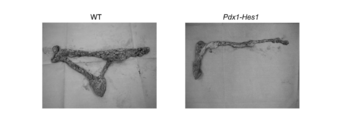
- Pancreatic formation-inhibited pig secondary pancreas (right) and wild-type porcine pancreas (left) developed by caring breeding (breeding with insulin and digestive enzymes). It has a sufficient volume to inject cells from the outside.
- Pancreas-inhibited porcine leaflets were smaller than wild-type porcine leaflets, but had tissues other than beta cells.
- Amylase positive cells were observed in the pancreatic tissue of the pig having inhibition of pancreatic formation.
- pancreas formation inhibition pig (right) and wild type pig (left) retina.
- new blood vessels are generated due to diabetic retinopathy.
- Pancreas-inhibited pigs develop cataracts that are characteristic of diabetes.
- (A) Method for Developing Secondary Organs Using Non-Human Animal in which Organ Formation is Inhibited The method for developing a secondary organ using the non-human animal in which organ formation is inhibited according to the present invention It is characterized in that it comprises a step of supplementing at least a part of the function of the organ whose formation has been inhibited, and growing a newborn or fetus of the non-human animal in which the formation of the organ has been inhibited.
- organs that inhibit formation include the pancreas, but organs other than the pancreas may be used as long as they can obtain surviving newborns or fetuses.
- the organs other than the pancreas can include the kidney.
- the inhibition of organ formation can be performed by genetic modification that modifies genes of non-human animals having organs.
- the Pdx1-Hes1 gene in which the Hes1 gene is linked to the promoter of the Pdx1 gene can be used, that is, the Hes1 gene can be overexpressed under the control of the Pdx1 promoter (Matsunari et al. , PNAS 110: 4557-4562 (2013)).
- administration of a drug may inhibit organ formation.
- organ formation is disabled by destroying the Pdx1 gene, the effects of the present invention can not be obtained.
- the animal that inhibits organ formation may be any animal other than human, but is preferably a mammal.
- animals include mice, rats, hamsters, guinea pigs, rabbits, dogs, cats, horses, cattle, sheep, pigs, goats and monkeys.
- pigs can be mentioned as preferable animals.
- the term "secondary organ” refers to an organ-like tissue formed by growing and growing a non-human animal at a site in the body where an organ (for example, the pancreas) whose formation is inhibited is originally formed. .
- the secondary organ may have 100% of the original organ function or may have only a part.
- Preferred secondary organs include secondary organs that lack specific functional cells.
- “functional cell” refers to a cell contained in an organ and having a function, such as an alpha cell, a beta cell, a gamma cell or the like in the pancreas.
- Preferred functional cells include beta cells.
- Preferred organs lacking specific functional cells include the pancreas lacking ⁇ cells.
- Newborns or fetuses of non-human animals in which organ formation is inhibited can be obtained by known methods.
- a newborn piglet or fetus of a pig whose pancreatic formation is inhibited using the Pdx1-Hes1 gene can be obtained by the following methods (a) to (d).
- (b) In vitro insemination is performed on eggs derived from a wild-type female using spermatozoa into which the Pdx1-Hes1 gene has been incorporated.
- a male producing a sperm incorporating a Pdx1-Hes1 gene is mated with a wild-type female.
- Cloned pigs are produced by nuclear transfer of somatic cells into which the Pdx1-Hes1 gene has been incorporated.
- “Completing at least a part of the function of the organ whose formation has been inhibited” means, for example, administering an enzyme or a hormone naturally produced by the organ or a drug having an equivalent function thereto, or substitutes the function of the organ Transplanting cells or the like, or using a device that substitutes for the function of an organ.
- the function of the organ does not have to be completely complemented, but may be partially complemented as long as the newborn or fetus of the non-human animal can survive.
- the specific complementation method can be appropriately determined according to the type of organ. For example, when complementing the function of the pancreas, all or part of hormones and digestive enzymes produced by the pancreas may be administered.
- pancreas since the pancreas produces hormones such as glucagon, insulin, somatostatin and the like, all or part of them can be administered, and proteolytic enzymes (chymotrypsin, trypsin), polysaccharide degrading enzymes (amylase) Because they produce digestive enzymes such as lipolytic enzymes (lipases), all or part of them can be administered. Also, instead of administering hormones and digestive enzymes produced by the pancreas, drugs having similar functions may be administered. As a preferable breeding method for complementing the function of the pancreas, there can be mentioned a breeding method of administering insulin and digestive enzymes. As digestive enzymes to be administered here, proteolytic enzymes, polysaccharide degrading enzymes, and lipolytic enzymes can be mentioned.
- Rearing of newborns or fetuses can be performed according to a conventional method except for complementing at least a part of the function of the organ whose formation has been inhibited.
- cells derived from human may be transplanted to the secondary organ formed by the above-mentioned method, but such xenotransplantation causes rejection.
- SCID immunodeficiency
- Methods for inducing such immunodeficiency have been reported in many publications, and the present inventor has also produced immunodeficient pigs by knocking out the IL2RG gene (Watanabe et al., PLoS One 8 (10): e 76478 (2013)).
- induction of immunodeficiency can be performed as described in such literature.
- the growth period for developing the secondary organs is not particularly limited. When the developed secondary organ is used in a method for producing functional cells to be described later, the development is carried out until the functional cells can be collected.
- the non-human animal of the present invention is a non-human animal obtained by growing a newborn or fetus of a non-human animal whose organ formation has been inhibited, which is defective in a specific functional cell It is characterized by having a secondary organ.
- the non-human animal of the present invention can be used in the method for producing functional cells described later, but it can also be used as a model animal for diseases and malformations.
- a model animal such as retinopathy, nephropathy, neuropathy, angiopathy or cataract It can be used as retinopathy, nephropathy, neuropathy, angiopathy or cataract It can be used as retinopathy, nephropathy, neuropathy, angiopathy or cataract It can be used as
- the types of functional cells, types of secondary organs that lack specific functional cells, and types of animals that inhibit organ formation are the methods described above for "methods of developing secondary organs using non-human animals in which organ formation is inhibited" It may be similar to Also, the method of inhibiting organ formation and the method of cultivating a newborn or a fetus can be performed in the same manner as the above-mentioned “method of developing a secondary organ using a non-human animal in which organ formation is inhibited”.
- the "non-human animal” is not a structure or a characteristic, but is specified by a manufacturing method, but it is understood that the “non-human animal” is an organism.
- their structures and characteristics are extremely complicated, and the task of identifying them requires a great deal of economic expenditure and time.
- the method of producing a functional cell of the present invention comprises the steps of: (1) implanting at least a precursor cell or pluripotent stem cell of the functional cell into the secondary organ of the non-human animal; 2) A step of inducing the precursor cells or the pluripotent stem cells to the functional cells is included.
- progenitor cells of functional cells refers to cells that can be generated from stem cells and can be differentiated into functional cells, for example, alpha cell precursor cells, beta cell precursor cells, gamma cell precursor cells, etc. It is. As preferred functional cell precursor cells, ⁇ cell precursor cells can be mentioned. Instead of functional cell precursors, appropriately differentiated pluripotent stem cells may be transplanted. As pluripotent stem cells, embryonic stem cells (ES cells) and induced pluripotent stem cells (iPS cells) can be used. In addition to functional cell precursors and pluripotent stem cells, other cells may be transplanted. For example, in the case of the pancreas, it is preferable to transplant cells associated with islet formation. Examples of cells associated with islet formation include cells associated with induction of stromal cells and blood vessels, endocrine cells and the like.
- the method for producing functional cells of the present invention mainly aims to produce functional cells for transplantation into humans, it is preferable that the precursor cells and pluripotent stem cells to be transplanted be of human origin.
- the number of cells to be transplanted to a secondary organ can be appropriately determined according to the type of animal, type of cell, type of secondary organ, etc., and is not particularly limited. Usually, it is 1 ⁇ 10 6 to 5 ⁇ 10 8 when transplanting
- the time of transplantation may be appropriately determined according to the type of cells, the type of secondary organ, the type of animal, etc., and is not particularly limited. , When the pig is 10 to 90 days old.
- the cells to be transplanted are cells of human origin, rejection due to xenotransplantation occurs. This can be avoided if the nonhuman animal into which the cells are to be transplanted is an animal that has induced immune tolerance to the above-described immunodeficient animal or human-derived cells, but if this is not the case, It is preferable to avoid the rejection reaction by administering
- a secondary organ that lacks a specific functional cell lacks a specific functional cell, it has an environment that is easily differentiated into a specific functional cell because it has other functional cells and tissues. it can. Therefore, when precursor cells and pluripotent stem cells are transplanted into this organ, they are considered to differentiate into specific functional cells without special treatment. However, in order to promote differentiation into specific functional cells, substances such as drugs and growth factors may be injected into secondary organs.
- Collect functional cells from secondary organs at an appropriate time after transplantation can be appropriately determined according to the type of cell, the type of secondary organ, the type of animal, etc., and is not particularly limited, but in the case of collecting ⁇ cells from porcine pancreas, Collect 1 to 12 months after transplantation.
- the method of the present invention is characterized in that It is superior to the conventional method.
- the secondary organ of the present invention is a secondary organ developed by breeding a newborn or fetus of a non-human animal whose organ formation has been inhibited, and is deficient in a specific functional cell. It is characterized by
- the types of functional cells, types of secondary organs that lack specific functional cells, and types of animals that inhibit organ formation are the methods described above for "methods of developing secondary organs using non-human animals in which organ formation is inhibited" It may be similar to Also, the method of inhibiting organ formation and the method of cultivating a newborn or a fetus can be performed in the same manner as the above-mentioned “method of developing a secondary organ using a non-human animal in which organ formation is inhibited”.
- Example 1 Acquisition of newborn piglets in which pancreatic formation is inhibited
- the present inventor previously obtained a pig derived embryo (host embryo) having a Pdx1-Hes1 gene and in which pancreatic formation was inhibited (normal embryo origin) After injecting the embryo (donor embryo), this is grown in the body of a temporary parent to create a chimeric pig with a donor-derived pancreas (Matsunari et al., PNAS 110: 4557-4562 (2013)) .
- this chimeric pig male By naturally mating this chimeric pig male with a wild-type sow, it is possible to obtain neonatal offspring in which pancreatic formation is always inhibited at a constant rate.
- Pig newborns with inhibited pancreatic formation used in this example were obtained by natural mating with such chimeric pigs.
- Pancreas formation was inhibited by having the Pdx1-Hes1 gene (strictly, only trace pancreatic tissue is contained) It lacks cells (such as beta cells that produce insulin) and exocrine cells. Therefore, it dies in about 3 days after birth due to intense hyperglycemia and indigestion.
- Insulin preparation Rebemil (Novo Nordics) 0.2-0.3 IU / kg / dose twice a day or trieder (Novo Nordics) once a day.
- Insulin administration method It was administered continuously by subcutaneous injection or insulin pump.
- Verizyme (Shionogi & Co., Ltd.) was fed by mixing 150 mg-750 mg daily with milk substitute or solid (powder) feed. Verizymes include lipases, cellulases, biodiastases and pancreatins.
- Feed and feeding method At 0-7 days of age, artificial milk feeding is carried out by artificial feeding or sows, and after 8 days of age, limited feeding with milk substitute powder or powdered feed (feeding not daily, but determined daily dose) Did.
- Example 3 Pancreatic development associated with caring and breeding of newborn piglets in which pancreatic formation is inhibited 1) Blood glucose control and growth: As a result of rearing pig newborns in which pancreatic formation was inhibited by the method described in Example 2, as shown in FIG. 2, the blood glucose level was controlled to some extent, and the individual grew.
- Pancreatic development Pancreatic tissue was developed by caring and nurturing pancreatic neonatal inhibition pig newborns (FIGS. 5 and 6). Although the size of pancreatic tissue was about one tenth of that of the wild type (FIG. 7), amylase production was also observed (FIG. 8).
- Example 4 Transplantation of Autologous Cells into Pancreatic Tissue Deficient in ⁇ Cells
- Pancreatic tissue developed by caring and breeding of pancreatic neoplasia-inhibited pig newborns lacks ⁇ cells, which are specific functional cells, but other functional cells -Given that the tissue is provided, by transplanting precursor cells of specific functional cells or pluripotent stem cells appropriately induced with differentiation into that tissue, it is possible to establish and expand specific functional cells. It is guessed.
- autologous cells fibroblasts
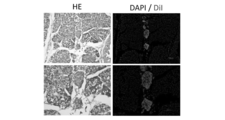
- pancreatic tissue a pancreatic tissue of a 3.5-month-old pancreatic growth inhibition pig.
- autologous cells formed colonies (FIG. 9).
- the transplanted cells are ⁇ -cell precursor cells or pluripotent stem cells
- ⁇ -cell formation / proliferation is possible using the environment of pancreatic tissue. That is, it is thought that human pancreatic functional cells (such as ⁇ cells) can be developed by establishing human pluripotent stem cells in the environment in the pancreatic tissue of a pig under developmental pancreas formation inhibition.
- Example 5 Disease of pig in which pancreatic formation is inhibited 1) Diabetic retinopathy As a result of growing a pig newborn with an inhibition of pancreatic formation by the method described in Example 2, and observing an immunohistochemical staining image of the retina 80 days after the development, it is characterized as diabetic retinopathy. Pathological pathology was confirmed ( Figure 10). On the other hand, the retina after wild-type synchronized breeding was healthy (FIG. 10).
- the present invention relates to non-human animals having secondary organs that lack specific functional cells, the invention is applicable to the industrial field that handles such animals.
Landscapes
- Life Sciences & Earth Sciences (AREA)
- Health & Medical Sciences (AREA)
- Genetics & Genomics (AREA)
- Zoology (AREA)
- Engineering & Computer Science (AREA)
- Environmental Sciences (AREA)
- Biotechnology (AREA)
- General Engineering & Computer Science (AREA)
- Wood Science & Technology (AREA)
- Biomedical Technology (AREA)
- Organic Chemistry (AREA)
- Chemical & Material Sciences (AREA)
- Developmental Biology & Embryology (AREA)
- Bioinformatics & Cheminformatics (AREA)
- General Health & Medical Sciences (AREA)
- Biodiversity & Conservation Biology (AREA)
- Animal Husbandry (AREA)
- Animal Behavior & Ethology (AREA)
- Physics & Mathematics (AREA)
- Plant Pathology (AREA)
- Molecular Biology (AREA)
- Microbiology (AREA)
- Biophysics (AREA)
- Biochemistry (AREA)
- Veterinary Medicine (AREA)
- Cell Biology (AREA)
- Medicines Containing Material From Animals Or Micro-Organisms (AREA)
- Micro-Organisms Or Cultivation Processes Thereof (AREA)
Abstract
ブタなどの動物体内に、β細胞などの機能細胞を作製する手段の確立を目的として、臓器の形成が阻害された非ヒト動物を用いて二次臓器を発達させる方法であって、前記臓器の形成が阻害された非ヒト動物の新生仔又は胎仔を、形成が阻害された前記臓器の機能の少なくとも一部を補完して、育成する工程を含む方法を提供する。
Description
本発明は、臓器の形成が阻害された非ヒト動物を用いて二次臓器を発達させる方法に関する。また、本発明は、特定の機能細胞を欠損する二次臓器を有する非ヒト動物に関する。更にまた、本発明は、細胞の作製方法に関する。更にまた、本発明は、特定の機能細胞を欠損している二次臓器に関する。
胚盤胞補完法とは、臓器が欠損した動物の胚盤胞に、正常動物の細胞を注入し、正常動物の細胞由来の臓器を形成させる方法である。この胚盤胞補完法を利用し、本発明者は、膵臓欠損ブタ由来の胚(ホスト胚)に、正常ブタ由来の胚(ドナー胚)を注入し、仮親の体内で成長させることにより、ドナー由来の膵臓を持ったキメラブタの作出に成功している(非特許文献1)。非特許文献1では、ブタ同士のキメラを作出しているが、ドナーとしてヒト多能性幹細胞を用いれば、ヒト膵臓を持ったブタの作出も可能であり、そのようなヒト膵臓は、膵島移植などに利用し得る。
Matsunari et al., PNAS 110: 4557-4562(2013)
ブタなどの動物体内に、ヒトの臓器(膵臓など)や機能細胞(β細胞など)を作製することができるようになれば、ドナー不足に悩む移植医療の問題を解決できる。
一方で、発生の初期段階においてヒトと動物のキメラ状態を誘導し、それによって作製された臓器や機能細胞をヒトに移植することは、現状倫理的に解決すべき課題が多い。それに比べると、発生の初期段階においてヒトと動物のキメラ状態を誘導せず、ブタなどの動物の臓器において、ヒトに定着可能な特定の機能細胞(β細胞など)を増殖させ、その機能細胞をヒトに移植するような細胞移植を行うことは、倫理的な障壁が低いと考えられる。
しかしながら、このような細胞移植を行うための細胞の増殖に適した、特定の機能細胞(例えばβ細胞など)だけが存在せず、かつ当該特定の機能細胞を作製及び増殖させるための環境として機能する臓器又は組織は、これまで知られていなかった。
本発明は、このような背景の下、動物体内に機能細胞を作製する手段を提供することを目的とする。
膵臓形成が阻害されたブタ新生仔は、高血糖及び消化不良により出生後3日程度で死亡する。本発明者は、このような新生仔を生存させるため、インスリンと複合消化酵素を投与して育成したところ、成長に伴い本来膵臓が形成される部位に、膵臓様組織が形成されることを見出した。また、この膵臓様組織は、消化酵素やグルカゴンを産生するようになるが、インスリンを産生するようにはならないこと(即ち、β細胞は形成されないこと)も見出した。胎仔時には見られなかったこの膵臓様組織が、上記育成により、発達を開始し、さらにインスリンを産生するβ細胞が形成されない一方で、他の内分泌細胞や外分泌細胞を備えるような不完全な膵臓として形成されることは全く予想外のことであった。また、消化酵素やグルカゴンが産生されるにもかかわらず、インスリンだけが産生されないことも、全く予想外のことであった。
上記育成により形成されるβ細胞を欠損する膵臓様組織は、β細胞以外の環境(組織構造や機能など)を備えており、β細胞の前駆細胞や多能性幹細胞を増殖させるための「あき空間」として非常に優れていると考えられる。従って、このβ細胞を欠損する膵臓様組織にヒト由来のβ細胞の前駆細胞などを移植することにより効率的にヒトβ細胞を作製できると考えられる。
本発明は、以上の知見に基づき完成されたものである。
即ち、本発明は以下の〔1〕~〔18〕を提供するものである。
〔1〕臓器の形成が阻害された非ヒト動物を用いて二次臓器を発達させる方法であって、以下の工程を含むことを特徴とする方法、
(1)前記臓器の形成が阻害された非ヒト動物の新生仔又は胎仔を、形成が阻害された前記臓器の機能の少なくとも一部を補完して、育成する工程。
〔1〕臓器の形成が阻害された非ヒト動物を用いて二次臓器を発達させる方法であって、以下の工程を含むことを特徴とする方法、
(1)前記臓器の形成が阻害された非ヒト動物の新生仔又は胎仔を、形成が阻害された前記臓器の機能の少なくとも一部を補完して、育成する工程。
〔2〕前記二次臓器は、前記育成において補完した機能の少なくとも一部が損なわれたまま発達する〔1〕記載の方法。
〔3〕前記二次臓器が、特定の機能細胞を欠損する臓器であることを特徴とする〔1〕又は〔2〕に記載の方法。
〔4〕前記機能細胞が、β細胞であることを特徴とする〔3〕に記載の方法。
〔5〕前記工程(1)において、前記非ヒト動物の遺伝子改変により臓器形成を阻害することを特徴とする〔1〕乃至〔4〕のいずれかに記載の方法。
〔6〕形成が阻害された前記臓器が膵臓であり、形成が阻害された膵臓の機能の補完を、少なくともインスリン及び消化酵素の投与により行うことを特徴とする〔1〕乃至〔5〕のいずれかに記載の方法。
〔7〕前記遺伝子改変が、前記非ヒト動物においてPdx1プロモーター制御下でHes1遺伝子を過剰発現させることであることを特徴とする〔5〕に記載の方法。
〔8〕前記非ヒト動物がブタであることを特徴とする〔1〕乃至〔7〕のいずれかに記載の方法。
〔9〕臓器の形成が阻害された非ヒト動物の新生仔又は胎仔を育成することによって得られる非ヒト動物であって、特定の機能細胞を欠損する二次臓器を有することを特徴とする非ヒト動物。
〔10〕前記臓器が膵臓であり、前記機能細胞がβ細胞であることを特徴とする〔9〕に記載の非ヒト動物。
〔11〕前記非ヒト動物の新生仔又は胎仔がPdx1プロモーター制御下でHes1遺伝子を過剰発現させることにより臓器形成が阻害されたものであることを特徴とする〔10〕に記載の非ヒト動物。
〔12〕前記非ヒト動物がブタであることを特徴とする〔9〕乃至〔11〕のいずれかに記載の非ヒト動物。
〔13〕臓器の形成が阻害された非ヒト動物の新生仔又は胎仔の育成によって発達させた二次臓器であって、特定の機能細胞を欠損していることを特徴とする二次臓器。
〔14〕前記臓器が膵臓であり、前記機能細胞がβ細胞であることを特徴とする〔13〕に記載の二次臓器。
〔15〕前記非ヒト動物の新生仔又は胎仔がPdx1プロモーター制御下でHes1遺伝子を過剰発現させることにより臓器形成が阻害されたものであることを特徴とする〔14〕に記載の二次臓器。
〔16〕前記非ヒト動物がブタであることを特徴とする〔13〕乃至〔15〕のいずれかに記載の二次臓器。
〔17〕前記二次臓器に、移植した細胞が定着していることを特徴とする〔13〕乃至〔16〕のいずれかに記載の二次臓器。
〔18〕〔1〕又は〔2〕に記載の非ヒト動物を育成する工程を含むことを特徴とする、非ヒト動物体内での細胞の作製方法。
本明細書は、本願の優先権の基礎である日本国特許出願、特願2017-178552の明細書および/または図面に記載される内容を包含する。
本発明は、臓器形成が阻害された非ヒト動物を用いて二次臓器を発達させる方法、特定の機能細胞を欠損する二次臓器を有する非ヒト動物、細胞の作製方法、及び特定の機能細胞を欠損している二次臓器を提供する。
以下、本発明を詳細に説明する。
(A)臓器形成が阻害された非ヒト動物を用いて二次臓器を発達させる方法
本発明の臓器形成が阻害された非ヒト動物を用いて二次臓器を発達させる方法は、(1)前記臓器の形成が阻害された非ヒト動物の新生仔又は胎仔を、形成が阻害された前記臓器の機能の少なくとも一部を補完して、育成する工程を含むことを特徴とするものである。
(A)臓器形成が阻害された非ヒト動物を用いて二次臓器を発達させる方法
本発明の臓器形成が阻害された非ヒト動物を用いて二次臓器を発達させる方法は、(1)前記臓器の形成が阻害された非ヒト動物の新生仔又は胎仔を、形成が阻害された前記臓器の機能の少なくとも一部を補完して、育成する工程を含むことを特徴とするものである。
形成を阻害する臓器としては、膵臓を挙げることができるが、生存した新生仔又は胎仔を得ることができる臓器であれば、膵臓以外の臓器であってもよい。膵臓以外の臓器としては腎臓を挙げることができる。
臓器形成の阻害は、臓器を有する非ヒト動物の遺伝子を改変する遺伝子改変により行うことができる。例えば、膵臓の形成を阻害する場合は、Pdx1遺伝子のプロモーターにHes1遺伝子を連結したPdx1-Hes1遺伝子を用いる、すなわちPdx1プロモーター制御下でHes1遺伝子を過剰発現させて行うことができる(Matsunari et al., PNAS 110: 4557-4562(2013))。また、薬剤の投与によって、臓器形成を阻害してもよい。一方、Pdx1遺伝子を破壊することによって臓器形成を不可能としてしまうと、本発明の効果が得られない。腎臓の形成を阻害する場合は、Six2-Notch2 遺伝子を過剰発現させること (Fujimura et al., J Am Soc Nephrol, 21:803-810, 2010)や、Sall1やPax2等腎臓発生を制御する遺伝子の発現阻害又は抑制することによって行うことができる。
臓器形成を阻害させる動物は、ヒト以外の動物であればどのような動物でもよいが、好ましくは、哺乳動物である。動物の具体例としては、マウス、ラット、ハムスター、モルモット、ウサギ、イヌ、ネコ、ウマ、ウシ、ヒツジ、ブタ、ヤギ、サルを挙げることができる。これらの中でも、ブタを好ましい動物として挙げることができる。
本発明において「二次臓器」とは、形成が阻害された臓器(例えば膵臓)が本来形成される体内の部位に、非ヒト動物を育成し成長させることによって形成された臓器様の組織をいう。二次臓器は、本来の臓器としての機能を100%有していてもよく、一部しか有していなくてもよい。好ましい二次臓器としては、特定の機能細胞を欠損する二次臓器を挙げることができる。ここで、「機能細胞」とは、臓器中に含まれる細胞で何らかの機能を持つ細胞を意味し、例えば、膵臓におけるα細胞、β細胞、γ細胞などである。好ましい機能細胞としては、β細胞を挙げることができる。特定の機能細胞を欠損する好ましい臓器としては、β細胞を欠損する膵臓を挙げることができる。
臓器形成が阻害された非ヒト動物の新生仔又は胎仔は、公知の方法によって得ることができる。例えば、Pdx1-Hes1遺伝子を利用して膵臓形成を阻害したブタの新生仔又は胎仔は、以下の(a)~(d)の方法により得ることができる。
(a)Pdx1-Hes1 遺伝子を組み込んだ精子を用いて、野生型雌に人工授精を行う。
(b)Pdx1-Hes1 遺伝子を組み込んだ精子を用いて野生型雌に由来する卵に体外授精を施す。
(c)Pdx1-Hes1 遺伝子を組み込んだ精子を産する雄を、野生型雌と交配する。
(d)Pdx1-Hes1 遺伝子を組み込んだ体細胞の核移植によって、クローンブタを作出する。
(a)Pdx1-Hes1 遺伝子を組み込んだ精子を用いて、野生型雌に人工授精を行う。
(b)Pdx1-Hes1 遺伝子を組み込んだ精子を用いて野生型雌に由来する卵に体外授精を施す。
(c)Pdx1-Hes1 遺伝子を組み込んだ精子を産する雄を、野生型雌と交配する。
(d)Pdx1-Hes1 遺伝子を組み込んだ体細胞の核移植によって、クローンブタを作出する。
「形成が阻害された臓器の機能の少なくとも一部を補完する」とは、例えば、臓器が本来産生する酵素やホルモン若しくはそれらと同等の機能を有する薬剤を投与すること、臓器の機能を代替する細胞等を移植すること、又は臓器の機能を代替する機器を使用することなどである。臓器の機能は、完全に補完される必要はなく、非ヒト動物の新生仔又は胎仔が生存できる限り部分的な補完であってもよい。具体的な補完方法は、臓器の種類に応じて適宜決めることができる。例えば、膵臓の機能を補完する場合は、膵臓が産生するホルモンや消化酵素の全部又は一部を投与すればよい。具体的には、膵臓はグルカゴン、インスリン、ソマトスタチンなどのホルモンを産生するので、これらの全部又は一部を投与することができ、また、タンパク質分解酵素(キモトリプシン、トリプシン)、多糖分解酵素(アミラーゼ)、脂肪分解酵素(リパーゼ)などの消化酵素を産生するので、これらの全部又は一部を投与することができる。また、膵臓が産生するホルモンや消化酵素そのものを投与する代わりに、それらと同等の機能を有する薬剤を投与してもよい。膵臓の機能を補完する好ましい育成方法としては、インスリン及び消化酵素を投与する育成方法を挙げることができる。ここで投与する消化酵素としては、タンパク質分解酵素、多糖分解酵素、及び脂肪分解酵素を挙げることができる。
新生仔又は胎仔の育成は、形成が阻害された臓器の機能の少なくとも一部を補完すること以外は、通常の方法に従って行うことができる。
上記方法により形成させた二次臓器には、後述するように、ヒト由来の細胞を移植する場合があるが、このような異種移植により拒絶反応が起きる。この拒絶反応を回避するため、二次臓器を発達させる非ヒト動物の遺伝子を改変し、免疫不全(SCID)を誘導することが好ましい。このような免疫不全を誘導する方法は、多くの文献において報告されており、本発明者もIL2RG遺伝子のノックアウトにより免疫不全ブタを作製している(Watanabe et al., PLoS One 8(10): e76478 (2013))。従って、免疫不全の誘導は、このような文献の記載に従って行うことができる。また、免疫系確立前の胎仔に多量のヒト由来の細胞を移植することにより、ヒト由来の細胞に対する免疫寛容を誘導することが可能なので、そのような方法によって異種移植による拒絶反応を回避してもよい。
二次臓器を発達させるための育成期間は特に限定されない。発達させた二次臓器を後述する機能細胞の作製方法に用いる場合には、機能細胞を採取できる時期まで育成を行う。
(B)非ヒト動物
本発明の非ヒト動物は、臓器形成が阻害された非ヒト動物の新生仔又は胎仔を育成することによって得られる非ヒト動物であって、特定の機能細胞を欠損する二次臓器を有することを特徴とするものである。
本発明の非ヒト動物は、臓器形成が阻害された非ヒト動物の新生仔又は胎仔を育成することによって得られる非ヒト動物であって、特定の機能細胞を欠損する二次臓器を有することを特徴とするものである。
本発明の非ヒト動物は、後述する機能細胞の作製方法に用いることができるが、それ以外にも、疾患や奇形のモデル動物として用いることもできる。例えば、欠損した特定の機能細胞が、インスリン産生に寄与するβ細胞である非ヒト動物の場合、糖尿病に起因する合併症、例えば網膜症、腎症、神経障害、血管障害や白内障などのモデル動物として用いることができる。
機能細胞の種類、特定の機能細胞を欠損する二次臓器の種類、臓器形成を阻害させる動物の種類は上記の「臓器形成が阻害された非ヒト動物を用いて二次臓器を発達させる方法」と同様のものでよい。また、臓器形成を阻害する方法、及び新生仔又は胎仔を育成する方法も上記の「臓器形成が阻害された非ヒト動物を用いて二次臓器を発達させる方法」と同様に行うことができる。
なお、上述のように、本明細書においては、「非ヒト動物」という「物」を構造や特性ではなく、製造方法によって特定しているが、これは、「非ヒト動物」は生物であることから、その構造や特性は極めて複雑であり、それらを特定する作業を行うことは、著しく過大な経済的支出や時間を必要とするからである。
(C)機能細胞の作製方法
本発明の機能細胞の作製方法は、(1)前記非ヒト動物の前記二次臓器に、少なくとも前記機能細胞の前駆細胞又は多能性幹細胞を移植する工程及び(2)前記前駆細胞又は前記多能性幹細胞を前記機能細胞に誘導する工程を含むことを特徴とするものである。
本発明の機能細胞の作製方法は、(1)前記非ヒト動物の前記二次臓器に、少なくとも前記機能細胞の前駆細胞又は多能性幹細胞を移植する工程及び(2)前記前駆細胞又は前記多能性幹細胞を前記機能細胞に誘導する工程を含むことを特徴とするものである。
「機能細胞の前駆細胞」とは、幹細胞から発生し、機能細胞へ分化することのできる細胞を意味し、例えば、膵臓におけるα細胞の前駆細胞、β細胞の前駆細胞、γ細胞の前駆細胞などである。好ましい機能細胞の前駆細胞としては、β細胞の前駆細胞を挙げることができる。機能細胞の前駆細胞の代わりに、適切に分化誘導した多能性幹細胞を移植してもよい。多能性幹細胞としては、胚性幹細胞(ES細胞)や人工多能性幹細胞(iPS細胞)などを用いることができる。また、機能細胞の前駆細胞や多能性幹細胞に加え、他の細胞を移植してもよい。例えば、膵臓の場合、膵島形成に関連する細胞を移植することが好ましい。膵島形成に関連する細胞の例としては、間質細胞や血管の誘導に関連する細胞、内分泌細胞等が挙げられる。
本発明の機能細胞の作製方法は、ヒトへの移植用の機能細胞の作製を主たる目的とするものなので、移植する前駆細胞や多能性幹細胞はヒト由来のものであることが好ましい。
二次臓器に移植する細胞の数は、動物の種類、細胞の種類、二次臓器の種類などに応じて適宜決めることができ、特に限定されるものではないが、例えば、ブタの膵臓に細胞を移植する場合は、通常、1×10⁶~5×10⁸である。
移植を行う時期は、細胞の種類、二次臓器の種類、動物の種類などに応じて適宜決めることができ、特に限定されるものではないが、ブタの膵臓に細胞を移植する場合は、通常、ブタの日齢が10~90日である時期に行う。
移植する細胞がヒト由来の細胞である場合、異種移植による拒絶反応が起きる。細胞を移植する非ヒト動物が、上述した免疫不全動物又はヒト由来の細胞に対する免疫寛容を誘導した動物であれば、これを回避できるが、そうでない場合は、非ヒト動物に免疫抑制剤(例えば、シクロスポリンなど)を投与することにより、拒絶反応を回避することが好ましい。
特定の機能細胞を欠損する二次臓器は、特定の機能細胞を欠くものの、他の機能細胞や組織を備えていることから、特定の機能細胞に分化し易い環境を有しているということができる。従って、この臓器に、前駆細胞や多能性幹細胞を移植した場合、特別な処理をしなくても、それらは特定の機能細胞に分化していくと考えられる。但し、特定の機能細胞への分化を促進するため、薬剤や成長因子などの物質を二次臓器に注入してもよい。
移植後適当な時期に二次臓器から機能細胞を採取する。採取時期は、細胞の種類、二次臓器の種類、動物の種類などに応じて適宜決めることができ、特に限定されるものではないが、ブタの膵臓からβ細胞を採取する場合は、通常、移植から1~12ヶ月後に採取する。
ヒト由来の機能細胞を非ヒト動物中で作製することは、本発明の方法以外の方法、例えば、胚盤胞補完法などによっても可能であるが、本発明の方法は、以下の点で、従来の方法よりも優れている。
(a)胚盤胞補完法では、胚盤胞のような発生の初期段階にヒト由来の細胞を移植する。このような発生の初期段階に移植を行うとヒト由来の細胞は希釈されてしまう。即ち、移植されたヒト由来の細胞の一部は機能細胞に分化するが、大部分は機能細胞以外の細胞に分化あるいは消失するため、得られるヒト由来の機能細胞の量は少なくなる。これに対し、本発明の方法では、既に分化した臓器にヒト由来の細胞を移植するので、移植した細胞の大部分が機能細胞に分化し、多量のヒト由来の機能細胞を得られると考えられる。
(b) 胚盤胞補完法では、胚盤胞にヒト由来の細胞を移植するが、胚盤胞中に含まれる細胞は未分化な細胞であり、これらは時間の経過に伴い成体の細胞に分化していく。移植されたヒト由来の細胞は、このようなホスト細胞の分化進度に合わせながら、自らも分化していかなければ最終的に機能細胞になることはできない。このため、ホスト細胞の分化進度との関係で、機能細胞になることができないヒト由来の細胞も多数存在すると考えられる。本発明の方法では、既に分化した臓器にヒト由来の細胞を移植するので、前記したホスト細胞の分化進度との問題は生じないと考えられる。
(D)二次臓器
本発明の二次臓器は、臓器形成が阻害された非ヒト動物の新生仔又は胎仔の育成によって発達させた二次臓器であって、特定の機能細胞を欠損していることを特徴とするものである。
本発明の二次臓器は、臓器形成が阻害された非ヒト動物の新生仔又は胎仔の育成によって発達させた二次臓器であって、特定の機能細胞を欠損していることを特徴とするものである。
機能細胞の種類、特定の機能細胞を欠損する二次臓器の種類、臓器形成を阻害させる動物の種類は上記の「臓器形成が阻害された非ヒト動物を用いて二次臓器を発達させる方法」と同様のものでよい。また、臓器形成を阻害する方法、及び新生仔又は胎仔を育成する方法も上記の「臓器形成が阻害された非ヒト動物を用いて二次臓器を発達させる方法」と同様に行うことができる。
次に、実施例を挙げて本発明を更に詳細に説明するが、本発明はこれら実施例に限定されるものではない。
〔実施例1〕 膵臓形成が阻害されたブタ新生仔の取得
本発明者は、以前に、Pdx1-Hes1遺伝子を有し、膵臓形成が阻害されたブタ由来の胚(ホスト胚)に正常ブタ由来の胚(ドナー胚)を注入した後、これを仮親の体内で成長させることにより、ドナー由来の膵臓を持つキメラブタを作出している(Matsunari et al., PNAS 110: 4557-4562(2013))。このキメラブタの雄を、野生型雌ブタと自然交配することにより、常に一定の割合で膵臓形成が阻害された新生仔を得ることができる。
本発明者は、以前に、Pdx1-Hes1遺伝子を有し、膵臓形成が阻害されたブタ由来の胚(ホスト胚)に正常ブタ由来の胚(ドナー胚)を注入した後、これを仮親の体内で成長させることにより、ドナー由来の膵臓を持つキメラブタを作出している(Matsunari et al., PNAS 110: 4557-4562(2013))。このキメラブタの雄を、野生型雌ブタと自然交配することにより、常に一定の割合で膵臓形成が阻害された新生仔を得ることができる。
本実施例において使用する膵臓形成が阻害されたブタ新生仔は、このようなキメラブタとの自然交配により取得した。
〔実施例2〕 膵臓形成が阻害されたブタ新生仔の育成
Pdx1-Hes1遺伝子を有することにより膵臓形成を阻害された(厳密には痕跡的な膵臓組織のみを有する。)ブタ新生仔は、内分泌細胞(インスリンを生産するβ細胞など)と外分泌細胞を欠く。そのため、出生後は強度の高血糖及び消化不良のために、3日程度で死亡する。
Pdx1-Hes1遺伝子を有することにより膵臓形成を阻害された(厳密には痕跡的な膵臓組織のみを有する。)ブタ新生仔は、内分泌細胞(インスリンを生産するβ細胞など)と外分泌細胞を欠く。そのため、出生後は強度の高血糖及び消化不良のために、3日程度で死亡する。
このような膵臓形成阻害ブタ新生仔に、インスリンと複合消化酵素を適宜投与することにより、血糖値を正常値に近づけ、かつ個体成長と膵臓の発達を誘導した。
1) インスリン製剤:
レベミル(ノボノルディクス)0.2-0.3 IU/kg/回 1日2回あるいはトレシーバ(ノボノルディクス)1日1回を投与した。
レベミル(ノボノルディクス)0.2-0.3 IU/kg/回 1日2回あるいはトレシーバ(ノボノルディクス)1日1回を投与した。
2) インスリン投与法:
皮下注射、あるいはインスリンポンプによって連続的に投与した。
皮下注射、あるいはインスリンポンプによって連続的に投与した。
3) 消化酵素複合剤:
ベリチーム(塩野義製薬)を、日量150mg-750mgを代用乳あるいは固形(粉末)飼料に混合して給与した。ベリチームには、リパーゼ、セルラーゼ、ビオヂアスターゼ、パンクレアチンが含まれる。
ベリチーム(塩野義製薬)を、日量150mg-750mgを代用乳あるいは固形(粉末)飼料に混合して給与した。ベリチームには、リパーゼ、セルラーゼ、ビオヂアスターゼ、パンクレアチンが含まれる。
4) 飼料および給餌法:
0-7日齢では、代用乳の人工哺乳あるいは母豚による哺乳を行い、8日齢以後は、代用乳粉末あるいは粉末飼料による制限給餌(自由摂食ではなく、一日量を決めた給餌)を行った。
0-7日齢では、代用乳の人工哺乳あるいは母豚による哺乳を行い、8日齢以後は、代用乳粉末あるいは粉末飼料による制限給餌(自由摂食ではなく、一日量を決めた給餌)を行った。
〔実施例3〕 膵臓形成が阻害されたブタ新生仔の介護育成に伴う膵臓の発達
1) 血糖値制御と成長:
膵臓形成が阻害されたブタ新生仔を実施例2に記載の方法により育成した結果、図2に示すように血糖値はある程度制御され、個体は成長した。
1) 血糖値制御と成長:
膵臓形成が阻害されたブタ新生仔を実施例2に記載の方法により育成した結果、図2に示すように血糖値はある程度制御され、個体は成長した。
2) 血液生化学値:
膵臓形成阻害ブタの血液生化学値(図3)は、インスリン産生が廃絶していることと、成長に伴いグルカゴン生産が認められることを示す。グルカゴン生産は、発達した膵臓組織の免疫染色においても確認された(図4)。一方、インスリン産生は膵臓組織の免疫染色においても認められなかった(図4)。
膵臓形成阻害ブタの血液生化学値(図3)は、インスリン産生が廃絶していることと、成長に伴いグルカゴン生産が認められることを示す。グルカゴン生産は、発達した膵臓組織の免疫染色においても確認された(図4)。一方、インスリン産生は膵臓組織の免疫染色においても認められなかった(図4)。
3) 膵臓の発達:
膵臓形成阻害ブタ新生仔の介護育成によって、膵臓組織は発達した(図5、6)。膵臓組織の大きさは、野生型に比べて約10分の1であったが(図7)、アミラーゼの生産も認められた(図8)。
膵臓形成阻害ブタ新生仔の介護育成によって、膵臓組織は発達した(図5、6)。膵臓組織の大きさは、野生型に比べて約10分の1であったが(図7)、アミラーゼの生産も認められた(図8)。
〔実施例4〕 β細胞を欠く膵臓組織への自家細胞の移植
膵臓形成阻害ブタ新生仔の介護育成によって発達させた膵臓組織は、特定の機能細胞であるβ細胞を欠くものの、他の機能細胞・組織を備えていることから、その組織中に特定の機能細胞の前駆細胞や、適切に分化誘導した多能性幹細胞を移植することで、特定の機能細胞を定着・増殖させることができると推測される。
膵臓形成阻害ブタ新生仔の介護育成によって発達させた膵臓組織は、特定の機能細胞であるβ細胞を欠くものの、他の機能細胞・組織を備えていることから、その組織中に特定の機能細胞の前駆細胞や、適切に分化誘導した多能性幹細胞を移植することで、特定の機能細胞を定着・増殖させることができると推測される。
これを確認するため、3.5ヶ月齢の膵臓形成阻害ブタの膵臓組織内に、自家細胞(繊維芽細胞)を注入した。その結果、自家細胞はコロニーを形成した(図9)。移植細胞がβ細胞の前駆細胞あるいは多能性幹細胞であった場合、膵臓組織の環境を利用してβ細胞の形成・増殖が可能であると推測される。すなわち、発達過程にある膵臓形成阻害ブタの膵臓組織内の環境にヒト多能性幹細胞を定着させることによって、ヒトの膵臓機能細胞(β細胞等)を発達させ得ると考えられる。
〔実施例5〕 膵臓形成が阻害されたブタの疾患
1) 糖尿病性網膜症
膵臓形成が阻害されたブタ新生仔を実施例2に記載の方法により育成し、育成80日後の網膜の免疫組織化学的染色像を観察した結果、糖尿病性網膜症に特徴的な病理像が確認された(図10)。一方、野生型の同期間育成後の網膜は健常であった(図10)。
1) 糖尿病性網膜症
膵臓形成が阻害されたブタ新生仔を実施例2に記載の方法により育成し、育成80日後の網膜の免疫組織化学的染色像を観察した結果、糖尿病性網膜症に特徴的な病理像が確認された(図10)。一方、野生型の同期間育成後の網膜は健常であった(図10)。
2) 白内障
膵臓形成が阻害されたブタ新生仔を実施例2に記載の方法により育成し、育成39日後の眼を観察した結果、白内障を発症していることが確認された(図11)。一方、野生型の同期間育成後の眼は健常であった(図11)。
膵臓形成が阻害されたブタ新生仔を実施例2に記載の方法により育成し、育成39日後の眼を観察した結果、白内障を発症していることが確認された(図11)。一方、野生型の同期間育成後の眼は健常であった(図11)。
本明細書で引用した全ての刊行物、特許および特許出願をそのまま参考として本明細書にとり入れるものとする。
本発明は、特定の機能細胞を欠損する二次臓器を有する非ヒト動物に関するものなので、このような動物を取り扱う産業分野に利用可能である。
Claims (18)
- 臓器の形成が阻害された非ヒト動物を用いて二次臓器を発達させる方法であって、以下の工程を含むことを特徴とする方法、
(1)前記臓器の形成が阻害された非ヒト動物の新生仔又は胎仔を、形成が阻害された前記臓器の機能の少なくとも一部を補完して、育成する工程。 - 前記二次臓器は、前記育成において補完した機能の少なくとも一部が損なわれたまま発達する請求項1記載の方法。
- 前記二次臓器が、特定の機能細胞を欠損する臓器であることを特徴とする請求項1又は2に記載の方法。
- 前記機能細胞が、β細胞であることを特徴とする請求項3に記載の方法。
- 前記工程(1)において、前記非ヒト動物の遺伝子改変により臓器形成を阻害することを特徴とする請求項1乃至4のいずれか一項に記載の方法。
- 形成が阻害された前記臓器が膵臓であり、形成が阻害された膵臓の機能の補完を、少なくともインスリン及び消化酵素の投与により行うことを特徴とする請求項1乃至5のいずれか一項に記載の方法。
- 前記遺伝子改変が、前記非ヒト動物においてPdx1プロモーター制御下でHes1遺伝子を過剰発現させることであることを特徴とする請求項5に記載の方法。
- 前記非ヒト動物がブタであることを特徴とする請求項1乃至7のいずれか一項に記載の方法。
- 臓器の形成が阻害された非ヒト動物の新生仔又は胎仔を育成することによって得られる非ヒト動物であって、特定の機能細胞を欠損する二次臓器を有することを特徴とする非ヒト動物。
- 前記臓器が膵臓であり、前記機能細胞がβ細胞であることを特徴とする請求項9に記載の非ヒト動物。
- 前記非ヒト動物の新生仔又は胎仔がPdx1プロモーター制御下でHes1遺伝子を過剰発現させることにより臓器形成が阻害されたものであることを特徴とする請求項10に記載の非ヒト動物。
- 前記非ヒト動物がブタであることを特徴とする請求項9乃至11のいずれか一項に記載の非ヒト動物。
- 臓器の形成が阻害された非ヒト動物の新生仔又は胎仔の育成によって発達させた二次臓器であって、特定の機能細胞を欠損していることを特徴とする二次臓器。
- 前記臓器が膵臓であり、前記機能細胞がβ細胞であることを特徴とする請求項13に記載の二次臓器。
- 前記非ヒト動物の新生仔又は胎仔がPdx1プロモーター制御下でHes1遺伝子を過剰発現させることにより臓器形成が阻害されたものであることを特徴とする請求項14に記載の二次臓器。
- 前記非ヒト動物がブタであることを特徴とする請求項13乃至15のいずれか一項に記載の二次臓器。
- 前記二次臓器に、移植した細胞が定着していることを特徴とする請求項13乃至16のいずれか一項に記載の二次臓器。
- 請求項1又は2に記載の非ヒト動物を育成する工程を含むことを特徴とする、非ヒト動物体内での細胞の作製方法。
Priority Applications (4)
| Application Number | Priority Date | Filing Date | Title |
|---|---|---|---|
| US16/638,440 US11172657B2 (en) | 2017-09-19 | 2018-09-18 | Method for developing organ that lacks specific functional cell |
| SG11202002118XA SG11202002118XA (en) | 2017-09-19 | 2018-09-18 | Method for developing organ that lacks specific functional cell |
| EP18858805.7A EP3685661B1 (en) | 2017-09-19 | 2018-09-18 | Method for developing organ lacking specific functional cell |
| US17/495,087 US20220022433A1 (en) | 2017-09-19 | 2021-10-06 | Method for developing organ that lacks specific functional cell |
Applications Claiming Priority (2)
| Application Number | Priority Date | Filing Date | Title |
|---|---|---|---|
| JP2017-178552 | 2017-09-19 | ||
| JP2017178552 | 2017-09-19 |
Related Child Applications (2)
| Application Number | Title | Priority Date | Filing Date |
|---|---|---|---|
| US16/638,440 A-371-Of-International US11172657B2 (en) | 2017-09-19 | 2018-09-18 | Method for developing organ that lacks specific functional cell |
| US17/495,087 Continuation US20220022433A1 (en) | 2017-09-19 | 2021-10-06 | Method for developing organ that lacks specific functional cell |
Publications (1)
| Publication Number | Publication Date |
|---|---|
| WO2019059158A1 true WO2019059158A1 (ja) | 2019-03-28 |
Family
ID=65655803
Family Applications (1)
| Application Number | Title | Priority Date | Filing Date |
|---|---|---|---|
| PCT/JP2018/034390 Ceased WO2019059158A1 (ja) | 2017-09-19 | 2018-09-18 | 特定の機能細胞を欠損する臓器を発達させる方法 |
Country Status (6)
| Country | Link |
|---|---|
| US (2) | US11172657B2 (ja) |
| EP (1) | EP3685661B1 (ja) |
| JP (2) | JP6479246B1 (ja) |
| SG (1) | SG11202002118XA (ja) |
| TW (1) | TW201920655A (ja) |
| WO (1) | WO2019059158A1 (ja) |
Families Citing this family (1)
| Publication number | Priority date | Publication date | Assignee | Title |
|---|---|---|---|---|
| SG11202002118XA (en) * | 2017-09-19 | 2020-04-29 | Univ Meiji | Method for developing organ that lacks specific functional cell |
Citations (9)
| Publication number | Priority date | Publication date | Assignee | Title |
|---|---|---|---|---|
| JPH07509363A (ja) * | 1992-07-24 | 1995-10-19 | ザ トラスティーズ オブ ザ ユニバーシティ オブ ペンシルベニア | 生来の肝機能に障害を有する動物における,細胞移植による非生来の肝臓の生成 |
| JPH09500618A (ja) * | 1993-05-24 | 1997-01-21 | ザ・ジョーンズ・ホプキンス・ユニバーシティ | 異種移植に対する寛容性の発現のための代理寛容形成 |
| JP2000510000A (ja) * | 1996-12-31 | 2000-08-08 | マックス−プランク−ゲゼルシャフト ツール フェルデルング デル ヴィッセンシャフテン エー.ヴェー. | 哺乳動物の膵細胞の分化状態を試験する新規な方法 |
| JP2002509736A (ja) * | 1998-03-30 | 2002-04-02 | リサーチ ディベロップメント ファンデーション | 副腎皮質刺激ホルモン放出因子レセプター−1欠損マウス |
| JP2003512846A (ja) * | 1999-11-02 | 2003-04-08 | ユニバーシティ オブ コネチカット | ヒト以外の動物におけるヒト肝細胞の増殖 |
| JP2005535732A (ja) * | 2002-06-27 | 2005-11-24 | ザ ジェネラル ホスピタル コーポレーション | 器官再生法 |
| WO2010021390A1 (ja) * | 2008-08-22 | 2010-02-25 | 国立大学法人 東京大学 | iPS細胞とBLASTOCYST COMPLEMENTATIONを利用した臓器再生法 |
| JP2013501528A (ja) * | 2009-08-14 | 2013-01-17 | レビビコア, インコーポレイテッド | 糖尿病の処置のためのマルチ・トランスジェニック・ブタ |
| JP2017178552A (ja) | 2016-03-30 | 2017-10-05 | 株式会社日立製作所 | エレベーター装置 |
Family Cites Families (10)
| Publication number | Priority date | Publication date | Assignee | Title |
|---|---|---|---|---|
| US6028184A (en) | 1996-12-31 | 2000-02-22 | Max-Plank-Gesellschaft Zur Forderung Der Wissenschaften E.V. | Pax6 and Pax4 nucleic acid mixtures |
| BR0009012A (pt) * | 1999-03-17 | 2001-12-26 | Solvay Pharm Gmbh | Medicamento para o tratamento de diabete |
| PL1928519T3 (pl) * | 2005-08-26 | 2012-08-31 | Univ Minnesota | Decelularyzacja i recelularyzacja narządów i tkanek |
| EP1878342A1 (en) | 2006-07-13 | 2008-01-16 | Institut Pasteur | Immunodeficient mice transgenic for HLA class I and HLA class II molecules and their uses |
| JPWO2008102602A1 (ja) * | 2007-02-22 | 2010-05-27 | 国立大学法人 東京大学 | Blastocystcomplementationを利用した臓器再生法 |
| WO2009104794A1 (ja) | 2008-02-22 | 2009-08-27 | 国立大学法人 東京大学 | 遺伝子改変による致死性表現型を持つ動物の繁殖用ファウンダー動物作製法 |
| US20110218191A1 (en) | 2010-03-03 | 2011-09-08 | Boehringer Ingelheim Vetmedica Gmbh | Use of meloxicam for the long term-treatment of kidney disorders in cats |
| JP5841322B2 (ja) | 2010-04-22 | 2016-01-13 | オレゴン ヘルス アンド サイエンス ユニバーシティ | フマリルアセト酢酸ヒドロラーゼ(fah)欠損性ブタおよびその使用 |
| US11856927B2 (en) * | 2017-01-25 | 2024-01-02 | The University Of Tokyo | Finding and treatment of inflammation after birth in chimeric animal |
| SG11202002118XA (en) * | 2017-09-19 | 2020-04-29 | Univ Meiji | Method for developing organ that lacks specific functional cell |
-
2018
- 2018-09-18 SG SG11202002118XA patent/SG11202002118XA/en unknown
- 2018-09-18 EP EP18858805.7A patent/EP3685661B1/en active Active
- 2018-09-18 US US16/638,440 patent/US11172657B2/en active Active
- 2018-09-18 JP JP2018173749A patent/JP6479246B1/ja active Active
- 2018-09-18 WO PCT/JP2018/034390 patent/WO2019059158A1/ja not_active Ceased
- 2018-09-19 TW TW107132926A patent/TW201920655A/zh unknown
-
2019
- 2019-02-05 JP JP2019018434A patent/JP2019062929A/ja active Pending
-
2021
- 2021-10-06 US US17/495,087 patent/US20220022433A1/en not_active Abandoned
Patent Citations (9)
| Publication number | Priority date | Publication date | Assignee | Title |
|---|---|---|---|---|
| JPH07509363A (ja) * | 1992-07-24 | 1995-10-19 | ザ トラスティーズ オブ ザ ユニバーシティ オブ ペンシルベニア | 生来の肝機能に障害を有する動物における,細胞移植による非生来の肝臓の生成 |
| JPH09500618A (ja) * | 1993-05-24 | 1997-01-21 | ザ・ジョーンズ・ホプキンス・ユニバーシティ | 異種移植に対する寛容性の発現のための代理寛容形成 |
| JP2000510000A (ja) * | 1996-12-31 | 2000-08-08 | マックス−プランク−ゲゼルシャフト ツール フェルデルング デル ヴィッセンシャフテン エー.ヴェー. | 哺乳動物の膵細胞の分化状態を試験する新規な方法 |
| JP2002509736A (ja) * | 1998-03-30 | 2002-04-02 | リサーチ ディベロップメント ファンデーション | 副腎皮質刺激ホルモン放出因子レセプター−1欠損マウス |
| JP2003512846A (ja) * | 1999-11-02 | 2003-04-08 | ユニバーシティ オブ コネチカット | ヒト以外の動物におけるヒト肝細胞の増殖 |
| JP2005535732A (ja) * | 2002-06-27 | 2005-11-24 | ザ ジェネラル ホスピタル コーポレーション | 器官再生法 |
| WO2010021390A1 (ja) * | 2008-08-22 | 2010-02-25 | 国立大学法人 東京大学 | iPS細胞とBLASTOCYST COMPLEMENTATIONを利用した臓器再生法 |
| JP2013501528A (ja) * | 2009-08-14 | 2013-01-17 | レビビコア, インコーポレイテッド | 糖尿病の処置のためのマルチ・トランスジェニック・ブタ |
| JP2017178552A (ja) | 2016-03-30 | 2017-10-05 | 株式会社日立製作所 | エレベーター装置 |
Non-Patent Citations (5)
| Title |
|---|
| FUJIMURA ET AL., J AM SOC NEPHROL, vol. 21, 2010, pages 803 - 810 |
| MATSUNARI ET AL., PNAS, vol. 110, 2013, pages 4557 - 4562 |
| NAGASHIMA, HIROSHI ET AL.: "Production of transplantable organs utilizing genetically modified pigs: Challenges to xenoregeneration-based organ transplantation", KIDNEY AND DIALYSIS, vol. 77, no. 6, 2014, pages 881 - 887, XP009519035 * |
| See also references of EP3685661A4 |
| WATANABE ET AL., PLOS ONE, vol. 8, no. 10, 2013, pages e76478 |
Also Published As
| Publication number | Publication date |
|---|---|
| EP3685661B1 (en) | 2026-02-18 |
| EP3685661A1 (en) | 2020-07-29 |
| SG11202002118XA (en) | 2020-04-29 |
| JP2019062929A (ja) | 2019-04-25 |
| US20200165633A1 (en) | 2020-05-28 |
| TW201920655A (zh) | 2019-06-01 |
| EP3685661A4 (en) | 2021-05-19 |
| US11172657B2 (en) | 2021-11-16 |
| US20220022433A1 (en) | 2022-01-27 |
| JP2019054790A (ja) | 2019-04-11 |
| JP6479246B1 (ja) | 2019-03-06 |
Similar Documents
| Publication | Publication Date | Title |
|---|---|---|
| Abraham et al. | The neurobiology of human allomaternal care; implications for fathering, coparenting, and children's social development | |
| Dranow et al. | Germ cells are required to maintain a stable sexual phenotype in adult zebrafish | |
| O'neil et al. | The isolation and function of porcine islets from market weight pigs | |
| Hayashi et al. | Molecular genetic system for regenerative studies using newts | |
| Baer et al. | Japanese quail as a laboratory animal model | |
| CN103865871A (zh) | 治疗肾功能衰竭的选择性细胞疗法 | |
| Tuch et al. | Histologic differentiation of human fetal pancreatic explants transplanted into nude mice | |
| Wright Jr et al. | Cell therapy for diabetes using piscine islet tissue | |
| US6114599A (en) | Recombinant β-cell and uses thereof | |
| Kim et al. | Production of quail (Coturnix japonica) germline chimeras by transfer of gonadal primordial germ cells into recipient embryos | |
| JPH10504725A (ja) | 糠尿病の治療におけるトランスジェニック魚 | |
| US6476290B1 (en) | Transgenic tilapia comprising a humanized insulin gene | |
| Kobayashi | Control of gonadal maturation and sex in grouper | |
| JP6479246B1 (ja) | 特定の機能細胞を欠損する臓器を発達させる方法 | |
| KR102684690B1 (ko) | Etv2 및 그의 용도 | |
| CN102482678A (zh) | 利用蚯蚓的性腺再生能力的转基因蚯蚓的养殖方法,通过该养殖方法养殖的转基因蚯蚓以及从转基因蚯蚓的体液生产重组蛋白质的方法 | |
| Nagaya et al. | Feasibility of large experimental animal models in testing novel therapeutic strategies for diabetes | |
| Polge et al. | Induced expression of a bovine growth hormone construct in transgenic pigs | |
| Gurdon et al. | Xenopus | |
| Smith | Animal genetic manipulation–a utilitarian response | |
| JP2007502109A (ja) | 精原細胞を利用した鳥類キメラの生産方法及び鳥類キメラ | |
| Masih et al. | Transgenic animals and their applications | |
| KR20190027836A (ko) | 장기의 제조 방법 | |
| Pottle et al. | Impacts of host, cell density, and timing of injection on efficiency for xenogen production in ictalurid catfish | |
| JP4321936B2 (ja) | 不死化血管周皮細胞株 |
Legal Events
| Date | Code | Title | Description |
|---|---|---|---|
| 121 | Ep: the epo has been informed by wipo that ep was designated in this application |
Ref document number: 18858805 Country of ref document: EP Kind code of ref document: A1 |
|
| NENP | Non-entry into the national phase |
Ref country code: DE |
|
| ENP | Entry into the national phase |
Ref document number: 2018858805 Country of ref document: EP Effective date: 20200420 |
|
| WWG | Wipo information: grant in national office |
Ref document number: 2018858805 Country of ref document: EP |