WO2019073861A1 - Dispositif de support de roue - Google Patents
Dispositif de support de roue Download PDFInfo
- Publication number
- WO2019073861A1 WO2019073861A1 PCT/JP2018/036884 JP2018036884W WO2019073861A1 WO 2019073861 A1 WO2019073861 A1 WO 2019073861A1 JP 2018036884 W JP2018036884 W JP 2018036884W WO 2019073861 A1 WO2019073861 A1 WO 2019073861A1
- Authority
- WO
- WIPO (PCT)
- Prior art keywords
- layer
- mixed layer
- support device
- film
- wheel support
- Prior art date
- Legal status (The legal status is an assumption and is not a legal conclusion. Google has not performed a legal analysis and makes no representation as to the accuracy of the status listed.)
- Ceased
Links
Images



Classifications
-
- B—PERFORMING OPERATIONS; TRANSPORTING
- B60—VEHICLES IN GENERAL
- B60B—VEHICLE WHEELS; CASTORS; AXLES FOR WHEELS OR CASTORS; INCREASING WHEEL ADHESION
- B60B27/00—Hubs
-
- B—PERFORMING OPERATIONS; TRANSPORTING
- B60—VEHICLES IN GENERAL
- B60B—VEHICLE WHEELS; CASTORS; AXLES FOR WHEELS OR CASTORS; INCREASING WHEEL ADHESION
- B60B27/00—Hubs
- B60B27/02—Hubs adapted to be rotatably arranged on axle
-
- B—PERFORMING OPERATIONS; TRANSPORTING
- B60—VEHICLES IN GENERAL
- B60B—VEHICLE WHEELS; CASTORS; AXLES FOR WHEELS OR CASTORS; INCREASING WHEEL ADHESION
- B60B35/00—Axle units; Parts thereof ; Arrangements for lubrication of axles
- B60B35/02—Dead axles, i.e. not transmitting torque
-
- F—MECHANICAL ENGINEERING; LIGHTING; HEATING; WEAPONS; BLASTING
- F16—ENGINEERING ELEMENTS AND UNITS; GENERAL MEASURES FOR PRODUCING AND MAINTAINING EFFECTIVE FUNCTIONING OF MACHINES OR INSTALLATIONS; THERMAL INSULATION IN GENERAL
- F16C—SHAFTS; FLEXIBLE SHAFTS; ELEMENTS OR CRANKSHAFT MECHANISMS; ROTARY BODIES OTHER THAN GEARING ELEMENTS; BEARINGS
- F16C19/00—Bearings with rolling contact, for exclusively rotary movement
- F16C19/22—Bearings with rolling contact, for exclusively rotary movement with bearing rollers essentially of the same size in one or more circular rows, e.g. needle bearings
- F16C19/34—Bearings with rolling contact, for exclusively rotary movement with bearing rollers essentially of the same size in one or more circular rows, e.g. needle bearings for both radial and axial load
- F16C19/36—Bearings with rolling contact, for exclusively rotary movement with bearing rollers essentially of the same size in one or more circular rows, e.g. needle bearings for both radial and axial load with a single row of rollers
-
- F—MECHANICAL ENGINEERING; LIGHTING; HEATING; WEAPONS; BLASTING
- F16—ENGINEERING ELEMENTS AND UNITS; GENERAL MEASURES FOR PRODUCING AND MAINTAINING EFFECTIVE FUNCTIONING OF MACHINES OR INSTALLATIONS; THERMAL INSULATION IN GENERAL
- F16C—SHAFTS; FLEXIBLE SHAFTS; ELEMENTS OR CRANKSHAFT MECHANISMS; ROTARY BODIES OTHER THAN GEARING ELEMENTS; BEARINGS
- F16C33/00—Parts of bearings; Special methods for making bearings or parts thereof
- F16C33/30—Parts of ball or roller bearings
- F16C33/34—Rollers; Needles
- F16C33/36—Rollers; Needles with bearing-surfaces other than cylindrical, e.g. tapered; with grooves in the bearing surfaces
-
- F—MECHANICAL ENGINEERING; LIGHTING; HEATING; WEAPONS; BLASTING
- F16—ENGINEERING ELEMENTS AND UNITS; GENERAL MEASURES FOR PRODUCING AND MAINTAINING EFFECTIVE FUNCTIONING OF MACHINES OR INSTALLATIONS; THERMAL INSULATION IN GENERAL
- F16C—SHAFTS; FLEXIBLE SHAFTS; ELEMENTS OR CRANKSHAFT MECHANISMS; ROTARY BODIES OTHER THAN GEARING ELEMENTS; BEARINGS
- F16C33/00—Parts of bearings; Special methods for making bearings or parts thereof
- F16C33/30—Parts of ball or roller bearings
- F16C33/46—Cages for rollers or needles
Definitions
- the present invention relates to a wheel support device for rotatably supporting a wheel with respect to a suspension system of a motor vehicle.
- a wheel supporting apparatus for supporting non-driving wheels such as front wheels in a rear wheel drive type vehicle
- two rolling bearings are mounted on an axle (knuckle spindle) provided on a steering knuckle, and are rotatably supported by the rolling bearings.
- a flange is provided on the outer diameter surface of the axle hub, and a stud bolt provided on the flange and a nut screw-engaged with the flange are used to attach the brake drum of the brake device and the wheel disc of the wheel.
- a back plate is attached to a flange provided on the steering knuckle, and the back plate supports a braking mechanism that applies a braking force to the brake drum.
- a high-rigidity tapered roller bearing having a large load capacity is used as a rolling bearing for rotatably supporting an axle hub.
- the tapered roller bearing is lubricated by grease filled between the axle and the axle hub.
- the bearings used in the wheel support device are prone to breakage of the lubricating oil film of the lubricating grease, in particular, due to the sliding movement of the bearing ring collar at the large end face and the collar portion of the roller due to the severe use conditions of high speed and high load. .
- the lubricating oil film breaks, metal contact occurs, causing a problem that heat generation and frictional wear increase.
- an organic metal compound containing a metal selected from nickel, tellurium, selenium, copper and iron is contained in an amount of 20% by weight or less based on the total amount of grease.
- a rail vehicle bearing having a grease sealed therein which is characterized by the following characteristics (see Patent Document 1).
- the hard carbon film is a hard film generally called diamond-like carbon (hereinafter referred to as DLC, and a film / layer mainly composed of DLC is also referred to as a DLC film / layer).
- DLC diamond-like carbon
- Hard carbon also has various names such as hard amorphous carbon, amorphous carbon, hard amorphous carbon, i-carbon, and diamond-like carbon.
- DLC diamond-based liquid crystal display
- the hardness is as high as that of diamond, and excellent in wear resistance, solid lubricity, thermal conductivity, chemical stability, corrosion resistance, etc. For this reason, for example, it is being used as a protective film for molds / tools, wear resistant mechanical parts, abrasives, sliding members, magnetic / optical parts and the like.
- PVD physical vapor deposition
- CVD chemical vapor deposition
- UBMS unbalanced magnetron sputtering
- the DLC film has extremely high internal stress during film formation and has high hardness and Young's modulus, but has very low deformability, so it has weak adhesion to the substrate and has the disadvantage of being easily peeled off. ing. For this reason, when forming a DLC film on the above-mentioned each surface in a rolling bearing, it is necessary to improve adhesiveness.
- Patent Document 2 a rolling device in which an intermediate layer is provided to improve the adhesion of the DLC film.
- Cr chromium
- W tungsten
- Ti titanium
- Si silicon
- an underlayer containing a composition containing at least one of iron and iron, and the constituent elements of the underlayer and carbon, and the content of carbon on the opposite side of the underlayer is the underlayer
- An intermediate layer larger than the side and a DLC layer composed of argon and carbon and having a content of argon of 0.02% by mass to 5% by mass are formed in this order.
- Patent Document 3 a rolling bearing has been proposed in which adhesion of the DLC film is improved by an anchor effect.
- irregularities having an average width of 300 nm or less are formed on the raceway surface by ion bombardment at a height of 10 to 100 nm, and a DLC film is formed on this raceway surface.
- Patent No. 4178826 gazette Patent No. 3961739 gazette
- the sliding surface on which the application of the DLC film is considered in the wheel support device is often in a state of poor lubrication and accompanied by slippage, and is often more severe than the operating condition in a general rolling bearing.
- the present invention provides a wheel supporting device excellent in long-term durability by preventing friction wear on a lubricating surface in a state where high load or sliding motion occurs.
- the wheel support device is a wheel support device that rotatably supports a rotating member that rotates with the wheel by a grease-sealed rolling bearing mounted on an outer diameter surface of an axle, the surface of the components of the wheel support device A hard film on which a hard film is formed on at least a sliding contact surface between the rolling element and the other member, the hard film comprising an underlayer formed directly on the surface of the component and the underlayer A mixed layer mainly composed of tungsten carbide and diamond like carbon deposited on the upper surface, and a surface layer mainly composed of diamond like carbon deposited on the mixed layer; The content of the tungsten carbide in the mixed layer decreases continuously or stepwise from the underlayer side to the surface layer side, and the diamond in the mixed layer becomes smaller.
- tungsten carbide is an inorganic compound (carbide) composed of equimolar amounts of tungsten atoms and carbon atoms.
- diamond-like carbon is a general term for a thin film made of a carbon-based material having both carbon and carbon bonds of diamond and graphite (graphite).
- a hard film having a predetermined film structure including DLC is formed as a film on at least a sliding contact surface between the rolling element and another member among surfaces of component parts of the wheel support device.
- the intermediate layer is a mixed layer of WC and DLC (WC / DLC) and has a gradient composition, concentration of residual stress after film formation hardly occurs.
- the hydrogen content in this mixed layer is less than 10 atomic%, the peeling resistance of the hard film is excellent even when the lubricating state is bad and it is in contact with other members under the conditions involving slippage.
- the surface layer of the hard film preferably has, on the side adjacent to the mixed layer, a graded layer portion whose hardness increases continuously or stepwise from the mixed layer side. As described above, in the case having the inclined layer portion, the rapid hardness difference between the mixed layer and the surface layer disappears, and the adhesion between the mixed layer and the surface layer can be improved.
- An iron-based material selected from high carbon chromium bearing steel, carbon steel, tool steel, or martensitic stainless steel can be used for the main body of the component part of the wheel support device. That is, any material generally used as a holder material can be used as a holder body.
- the underlayer of the hard film is preferably a layer mainly composed of chromium and tungsten carbide. By setting in this manner, the adhesion between the underlayer and the mixed layer can be improved.
- a wheel support device using a rolling bearing comprising a plurality of rolling elements and a cage for holding the rolling elements, wherein the rolling bearing cage is a component having the hard film. preferable.
- the hard film is excellent in peeling resistance while being formed on the cage sliding surface, and can exhibit the intrinsic characteristics of DLC.
- the wheel supporting device of the present invention is excellent in seizure resistance, wear resistance, and corrosion resistance, and has a long life with less damage such as a sliding surface even in a severe lubrication state.
- FIG. 2 is a schematic view of a two-cylinder tester.
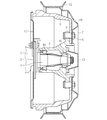
- a steering knuckle 1 is provided with a flange 2 and an axle 3 and an axle hub as a rotating member by a pair of tapered roller bearings 4a and 4b mounted on the outer diameter surface of the axle 3. 5 is rotatably supported.
- the axle hub 5 has a flange 6 on the outer diameter surface, and a stud bolt 7 provided on the flange 6 and a nut 8 screw-engaged with the stud bolt 7 and the brake drum 9 of the brake device and the wheel disc 10 of the wheel. Is attached.
- Reference numeral 11 denotes a rim attached to the outer diameter surface of the wheel disc 10, on which a tire is attached.
- the back plate 12 of the brake device is attached to the flange 2 of the steering knuckle 1 by tightening a bolt and a nut. Although a braking mechanism for applying a braking force to the brake drum 9 is supported by the back plate 12, it is omitted in the figure.
- the pair of tapered roller bearings 4 a, 4 b rotatably supporting the axle hub 5 is lubricated by the grease filled in the axle hub 5.
- a grease cap 17 is attached to the outer end surface of the axle hub 5 so as to cover the tapered roller bearing 4b in order to prevent the leakage of grease from the tapered roller bearing 4b to the outside and the entry of muddy water from the outside.
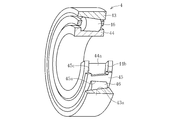
- FIG. 2 is a partially cutaway perspective view of the tapered roller bearing.
- the tapered roller 46 is disposed between the inner ring 44 and the outer ring 43 via a cage 45. As shown in FIG. 3, the tapered roller 46 receives rolling friction between the rolling surface 44 a of the inner ring 44 and the rolling surface 43 a of the outer ring 43, and sliding friction is made between the ring portions 44 b and 44 c of the inner ring 44. receive. Grease for roller bearings is enclosed to reduce these frictions.
- the cage 45 is provided with pockets 45a for holding the tapered rollers 46 as rolling elements, and the pillars 45b positioned between the pockets 45a maintain the intervals between the tapered rollers 46.
- the cage 45 includes a cage body 45A made of an iron-based material selected from high carbon chromium bearing steel, carbon steel, tool steel, or martensitic stainless steel, and a hard formed on the outer surface of the cage body 45A. And a film (hard film) 30 (see FIG. 3).
- the surface portion of the retainer main body 45A forming the hard film 30 is at least a sliding contact surface with the tapered roller 46 which is a rolling element and a sliding contact surface with other members out of the entire outer surface of the holder main body 45A.
- the outer surface of the cage main body 45A is a surface which constitutes the outermost surface of the cage 45 and is in sliding contact with the tapered rollers 46, which are rolling elements, and other members. These outer surfaces are also parts that come in contact with lubricating oil and the like.
- the other members are the inner ring 44, the outer ring 43, and the like.
- the hard film (hard film) 30 be formed on the entire outer surface of the cage 45 including the surface of the pocket 45 a in contact with the tapered roller 46 because of easy manufacturing. Further, in addition to the outermost surface portion of the cage 45, a similar hard film can be formed on the surface of the tapered roller 46, which is a rolling element, and the like.
- the hardness of the surface on which the hard film 30 is formed is preferably Hv 650 or more in Vickers hardness. By setting it as Hv650 or more, the hardness difference with the hard film 30 (underlying layer mentioned later) can be decreased, and adhesiveness can be improved.
- a nitrided layer be formed by nitriding before forming the hard film.
- the nitriding treatment it is preferable to perform plasma nitriding treatment in which it is difficult to form an oxide layer which prevents adhesion on the surface of the base material.
- the hardness of the surface after the nitriding treatment is Hv 1000 or more in Vickers hardness in order to further improve the adhesion to the hard film (underlayer).
- the surface roughness Ra of the surface on which the hard film 30 is formed is preferably 0.05 ⁇ m or less.
- the surface roughness Ra exceeds 0.05 ⁇ m, it becomes difficult to form a hard film at the tip of the protrusion having the roughness, and the film thickness locally decreases.
- FIG. 3 is a schematic cross-sectional view showing the structure of the hard film 30 shown in the tapered roller bearings 4a and 4b of FIG.
- the hard film 30 includes an underlayer 30 a formed directly on the cage main body 45 A, and WC (tungsten carbide) and DLC (diamond like carbon) formed on the underlayer 30 a. And a surface layer 30c mainly made of DLC formed on the mixed layer 30b.
- tungsten carbide is an inorganic compound (carbide) composed of equimolar amounts of tungsten atoms and carbon atoms.
- diamond-like carbon is a general term for a thin film made of a carbon-based material having both carbon and carbon bonds of diamond and graphite (graphite).
- graphite graphite
- the foundation layer 30 a is a foundation layer formed directly on the surface of each bearing member as a base material.
- the material and structure are not particularly limited as long as adhesion with the substrate can be secured, and for example, Cr (chromium), W (tungsten), Ti (titanium), Si (silicon) or the like can be used as the material.
- Cr is preferably contained because it is excellent in adhesion to a bearing member (for example, high carbon chromium bearing steel) serving as a base material.
- the underlayer 30a is preferably a layer mainly composed of Cr and WC in consideration of adhesion to the mixed layer 30b.
- WC has an intermediate hardness and elastic modulus between Cr and DLC, and concentration of residual stress after film formation hardly occurs.
- the mixed layer 30 b is an intermediate layer interposed between the underlayer 30 a and the surface layer 30 c.
- WC used for the mixed layer 30b has hardness and elastic modulus intermediate between Cr and DLC, and concentration of residual stress after film formation is also less likely to occur.
- the mixed layer 30 b has a gradient composition in which the content of WC decreases and the content of DLC increases from the base layer 30 a side to the surface layer 30 c side. For this reason, the adhesiveness on both surfaces of base layer 30a and surface layer 30c is excellent. Further, in the mixed layer 30b, the WC and the DLC are physically bonded to each other, so that damage or the like in the mixed layer 30b can be prevented. Furthermore, since the DLC content is increased on the surface layer 30c side, the adhesion between the surface layer 30c and the mixed layer 30b is excellent.
- the mixed layer 30 b is a layer that bonds DLC having high non-adhesiveness to the base layer 30 a side by WC with an anchor effect. As shown in the examples below, it is important to reduce the hydrogen content in the mixed layer to a certain extent in order to improve the peel resistance in the case of contact with other members under a condition of poor lubrication and sliding. Become.
- the hydrogen content in the mixed layer 30 b is less than 10 at%. By setting this range, it is possible to prevent the separation of the hard film even under the condition of rolling and sliding contact by boundary lubrication.
- the hydrogen content of the mixed layer exceeds 10 atomic%, a relatively soft DLC is present in the mixed layer to be the intermediate layer, and there is a possibility that the layer may be easily peeled off under the above conditions.
- a hydrocarbon-based gas as a carbon supply source for DLC in combination with a slight amount of hydrogen and within the above range.
- the “hydrogen content (atomic%) in the mixed layer” in the present invention can be calculated by a known analysis method. For example, it can be determined by GDS analysis (glow discharge emission spectrometry). GDS analysis is an analysis that can examine the relationship between the depth direction and the amount of elements, and quantification is possible if a calibration curve of each element is prepared.
- the hydrogen amount calibration curve can be created using ERDA analysis (elastic recoil particle detection method) that can measure the absolute amount of hydrogen. Since the hydrogen amount output value in GDS analysis differs depending on the difference in the test strip material, it is necessary to create a hydrogen amount calibration curve for each of DLC and WC that constitute the mixed layer (WC / DLC).
- test pieces with different hydrogen content were adjusted by adjusting the amount of hydrocarbon gas introduced under the conditions matched to the film forming conditions of the mixed layer (WC / DLC).
- Prepare ERDA analysis and GDS analysis and examine the relationship (calibration curve) between the hydrogen amount output value in GDS analysis and the amount of hydrogen (atomic%) measured in ERDA analysis. Since the hydrogen content determined by the DLC hydrogen content calibration curve and the hydrogen content determined by the WC hydrogen content calibration curve are different, any hydrogen content obtained by these two calibration curves is averaged to obtain an arbitrary value. The hydrogen content (atomic%) corresponding to the hydrogen content output value of can be calculated.
- the surface layer 30c is a film mainly made of DLC.
- the difference between the physical properties (hardness, elastic modulus, etc.) of the mixed layer 30b and the surface layer 30c is eliminated rapidly, and the adhesion between the mixed layer 30b and the surface layer 30c is further excellent.
- the composition ratio of the graphite structure (sp 2 ) and the diamond structure (sp 3 ) in the DLC structure is biased to the latter by increasing the bias voltage continuously or stepwise, and the hardness is inclined (increased). .
- the film thickness of the hard film 30 (total of three layers) is preferably 0.5 to 3.0 ⁇ m. If the film thickness is less than 0.5 ⁇ m, the abrasion resistance and mechanical strength may be poor, and if it exceeds 3.0 ⁇ m, the film may be easily peeled off. Furthermore, the ratio of the thickness of the surface layer 30c to the thickness of the hard film 30 is preferably 0.8 or less. If this ratio exceeds 0.8, the inclined structure for physically bonding WC and DLC in the mixed layer 30b is likely to be a discontinuous structure, and the adhesion may be deteriorated.
- the peeling resistance is excellent.
- the wheel support device of the present invention by forming a hard film having the above-described structure and physical properties, abrasion and peeling of the film can be prevented even when a load such as rolling and sliding contact is received at the time of use. Even in a lubricated state, damage to the raceway surface and the like is reduced, resulting in long life.
- a load such as rolling and sliding contact
- Even in a lubricated state damage to the raceway surface and the like is reduced, resulting in long life.
- grease degradation is promoted by the catalytic action, but in the wheel support device of the present invention Since damage to the moving surface can be prevented, this grease deterioration can also be prevented.
- the hard film is obtained by forming the underlayer 30a, the mixed layer 30b, and the surface layer 30c in this order on the film forming surface of the bearing member.
- the formation of the surface layer 30c is preferably performed using a UBMS apparatus using Ar gas as a sputtering gas.
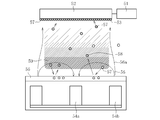
- the film forming principle of the UBMS method using the UBMS apparatus will be described with reference to a schematic view shown in FIG.
- the base material 52 is an inner ring, an outer ring, or a rolling element which is a bearing member to be film-formed, but is schematically shown as a flat plate.
- an inner magnet 54a and an outer magnet 54b having different magnetic characteristics are disposed at the central portion and the peripheral portion of the round target 55, and the magnet 54a, while forming a high density plasma 59 near the target 55.
- a portion 56a of magnetic field lines 56 generated by 54b reaches the vicinity of the base material 52 connected to the bias power supply 51.
- An effect of diffusing Ar plasma generated at the time of sputtering along the magnetic lines of force 56a to the vicinity of the base 52 is obtained.
- the Ar assist ions 57 and electrons cause the ionized target 58 to reach the base material 52 more than in normal sputtering.
- the dense film (layer) 53 can be formed.
- the underlayer 30a and the mixed layer 30b are also preferably formed using a UBMS apparatus using Ar gas as the sputtering gas.
- a Cr target and a WC target are used in combination as the target 55.
- a WC target, and (2) a graphite target and, if necessary, a hydrocarbon-based gas are used. For each formation of each layer, the target used for each is replaced sequentially.
- the sputtering power applied to the WC target is increased continuously or stepwise, and the power applied to the Cr target is decreased.
- Membrane As a result, it is possible to obtain a layer having a structure in which the content of Cr decreases and the content of WC increases toward the mixed layer 30b.
- the mixed layer 30 b is formed continuously or stepwise while increasing the sputtering power applied to the graphite target serving as a carbon source and decreasing the power applied to the WC target. As a result, it is possible to obtain a layer having a gradient composition in which the content of WC decreases toward the surface layer 30c and the content of DLC increases.
- a hard film having a predetermined film structure including DLC is formed as a film on at least a sliding contact surface between the rolling element and another member among surfaces of component parts of the wheel support device.
- the intermediate layer is a mixed layer of WC and DLC (WC / DLC) and has a gradient composition, concentration of residual stress after film formation hardly occurs.
- the hydrogen content in this mixed layer is less than 10 atomic%, the peeling resistance of the hard film is excellent even when the lubricating state is bad and it is in contact with other members under the conditions involving slippage.
- the hard film 30 is excellent in peeling resistance while being formed on, for example, a sliding surface, and can exhibit the characteristics intrinsic to DLC.
- the wheel supporting device of the present invention is excellent in seizure resistance, wear resistance, and corrosion resistance, and has a long life with less damage such as a sliding surface even in a severe lubrication state.
- the surface layer 30c of the hard film has an inclined layer portion on the side adjacent to the mixed layer 30b, in which the hardness increases continuously or stepwise from the mixed layer 30b side.
- the inclined layer portion the rapid hardness difference between the mixed layer 30 b and the surface layer 30 c is eliminated, and the adhesion between the mixed layer 30 b and the surface layer 30 c can be improved.
- the main body of the components of the wheel support device uses an iron-based material selected from high carbon chromium bearing steel, carbon steel, tool steel, or martensitic stainless steel. For this reason, any material generally used as a holder material etc. can be used as a main-body part.
- the underlayer 30a of the hard film 30 is a layer mainly composed of chromium and tungsten carbide, the adhesion between the underlayer 30a and the mixed layer 30b can be improved.
- the present invention can be variously modified without being limited to the above embodiment, and is a radial bearing as a type of a rolling bearing which is a component of a wheel support device. It may be a thrust bearing. Moreover, as a rolling element, it may be a ball or a roller. Also, in the case of a roller, it may be a cylindrical roller, a needle roller, a tapered roller, or a spherical roller having a barrel shape. A rolling bearing using needle rollers with high rigidity as rolling elements can receive a load of higher load than a rolling bearing using rollers as rolling elements.
- a hard film was formed on a predetermined base material as a hard film of a rolling bearing which is a component of the wheel support device of the present invention, and the physical properties of the hard film were evaluated. Moreover, evaluation of peeling resistance was performed by the rolling slip test which used 2 cylindrical tester.
- test pieces used for evaluation of the hard film, the UBMS apparatus, the sputtering gas, etc. are as follows.
- UBMS device manufactured by Kobe Steel; UBMS 202 (5) Sputtering gas: Ar gas
- the formation conditions of the underlayer are described below.
- the inside of the film forming chamber is evacuated to about 5 ⁇ 10 -3 Pa, the specimen serving as the substrate is baked by the heater, the substrate surface is etched by Ar plasma, and then the Cr target and WC target are formed by the UBMS method.
- the sputtering power applied to was adjusted, the composition ratio of WC to DLC was inclined, and a Cr / WC inclined layer having a large amount of Cr on the substrate side and a large amount of WC on the surface side was formed.
- the conditions for forming the mixed layer will be described below. It formed into a film by the UBMS method similarly to a base layer.
- the mixed layer while supplying methane gas that is a hydrocarbon-based gas, the sputtering power applied to the WC target and the graphite target is adjusted to make the composition ratio of WC and DLC inclined, and WC on the underlayer side. There are many WC / DLC gradient layers with many DLC on the surface layer side.
- Specific film formation conditions of the mixed layer are shown in Table 1.
- the hydrogen content (atomic%) in the mixed layer was determined by the above-mentioned method by GDS analysis (glow discharge emission spectroscopy). The results are shown in Table 1.
- the conditions for forming the surface layer are as shown in Table 1 above.
- FIG. 5 is a schematic view of the UBMS apparatus.
- the plasma density in the vicinity of the substrate 21 is increased by the non-equilibrium magnetic field of the sputter evaporation source material (target) 22 to increase the ion assist effect.
- target sputter evaporation source material
- FIG. 4 is an apparatus equipped with a UBMS function that can control the characteristics of the film deposited on the substrate. With this apparatus, it is possible to form a composite film in which a plurality of UBMS films (including compositional gradients) are arbitrarily combined on the substrate.
- a base layer, a mixed layer, and a surface layer are formed as a UBMS film on a ring as a base material.
- Example 1 to 3 and Comparative Examples 1 to 5 the substrates shown in Table 1 were subjected to ultrasonic cleaning with acetone and then dried. After drying, this was attached to a UBMS apparatus, and an underlayer and a mixed layer were formed under the above-described forming conditions. A DLC film as the surface layer was formed thereon under the film forming conditions shown in Table 1 to obtain a test piece having a hard film.
- the “degree of vacuum” in Table 1 is the degree of vacuum in the film forming chamber in the above apparatus.
- the obtained test piece was subjected to a rolling and sliding test using a two-cylinder tester shown below. The results are shown in Table 1.
- Example 1 to 3 and Comparative Examples 1 to 5 the film forming conditions of the base material and the surface layer to be used are the same, and the hardness of the surface layer is about 29 GPa in average value.
- Table 1 when the hydrogen content at the time of forming the mixed layer is changed, when the hydrogen content is high, the peeling life in the two-cylinder rolling slip test tends to be short, and the hydrogen content is 10.2. The life is dramatically short at 8 atomic%, and it is considered that the presence of a relatively soft DLC having a high hydrogen content in the mixed layer adversely affects the peel resistance of the film.
- a hard film such as a DLC film has residual stress in the film, and the residual stress is greatly different under the influence of the film structure and film forming conditions, and as a result, the peeling resistance is also greatly affected.
- the peel resistance also changes depending on the conditions under which the hard film is used. For this reason, the inventors of the present invention have repeatedly conducted verifications under conditions such as rolling and sliding contact in a case where the lubrication state is poor (boundary lubrication condition) by a two-cylinder test or the like. With respect to the hard film formed on the surface, it has been found that the peel resistance can be improved under such conditions by limiting the film structure and, in particular, setting the hydrogen content within a predetermined range. The present invention has been made based on such findings.
- the sliding surface and the rolling surface where the application of DLC is considered are often in a severe lubrication state such as thin lubrication or high sliding speed.
- the DLC film is formed on the sliding surface of the cage, and the peeling resistance of this DL film is excellent even when operated under severe lubrication conditions, and the characteristics of the DLC main body can be exhibited. Resistance, wear resistance, and corrosion resistance. For this reason, the rolling bearing of the present invention is applicable to various applications including applications under severe lubrication conditions.
- a wheel support device for rotatably supporting a wheel with respect to a suspension system of a motor vehicle.
- rolling bearing which is a component of a wheel support device, It may be a radial bearing or a thrust bearing.
Landscapes
- Engineering & Computer Science (AREA)
- General Engineering & Computer Science (AREA)
- Mechanical Engineering (AREA)
- Rolling Contact Bearings (AREA)
Abstract
L'invention concerne un dispositif de support de roue, lequel dispositif supporte de manière rotative, par un palier de roulement à graisse intégrée attaché sur une surface de diamètre externe d'un essieu, un élément rotatif qui tourne conjointement avec une roue. Le dispositif de support de roue comporte un film dur dans lequel un revêtement dur est formé sur au moins une surface de coulissement entre un corps de roulement et un autre élément, parmi des surfaces de composants constitutifs du dispositif de support de roue. Le film dur comprend : une couche de revêtement inférieur directement formée sur la surface externe d'un corps de retenue ; une couche mixte formée sur la couche de revêtement inférieur et composée principalement de carbure de tungstène et de carbone du type diamant ; et une couche de surface formée sur la couche mixte et composée principalement de carbone du type diamant. La couche mixte est une couche dans laquelle la teneur en pourcentage du carbure de tungstène dans la couche mixte diminue et la teneur en pourcentage du carbone du type diamant dans la couche mixte augmente de façon continue ou par étapes, à partir du côté de couche de revêtement inférieur vers le côté de couche de surface. La teneur en hydrogène dans la couche mixte est inférieure à 10% en pourcentage atomique.
Applications Claiming Priority (2)
| Application Number | Priority Date | Filing Date | Title |
|---|---|---|---|
| JP2017196893A JP2019070407A (ja) | 2017-10-10 | 2017-10-10 | 車輪支持装置 |
| JP2017-196893 | 2017-10-10 |
Publications (1)
| Publication Number | Publication Date |
|---|---|
| WO2019073861A1 true WO2019073861A1 (fr) | 2019-04-18 |
Family
ID=66100576
Family Applications (1)
| Application Number | Title | Priority Date | Filing Date |
|---|---|---|---|
| PCT/JP2018/036884 Ceased WO2019073861A1 (fr) | 2017-10-10 | 2018-10-02 | Dispositif de support de roue |
Country Status (2)
| Country | Link |
|---|---|
| JP (1) | JP2019070407A (fr) |
| WO (1) | WO2019073861A1 (fr) |
Citations (4)
| Publication number | Priority date | Publication date | Assignee | Title |
|---|---|---|---|---|
| JP2007031614A (ja) * | 2005-07-28 | 2007-02-08 | Ntn Corp | 車輪支持装置 |
| WO2011122662A1 (fr) * | 2010-03-30 | 2011-10-06 | Ntn株式会社 | Palier anti-friction |
| WO2013042765A1 (fr) * | 2011-09-22 | 2013-03-28 | Ntn株式会社 | Film dur, corps formé d'un film dur et roulement |
| JP2016186354A (ja) * | 2015-03-27 | 2016-10-27 | Ntn株式会社 | 主電動機用軸受 |
-
2017
- 2017-10-10 JP JP2017196893A patent/JP2019070407A/ja active Pending
-
2018
- 2018-10-02 WO PCT/JP2018/036884 patent/WO2019073861A1/fr not_active Ceased
Patent Citations (4)
| Publication number | Priority date | Publication date | Assignee | Title |
|---|---|---|---|---|
| JP2007031614A (ja) * | 2005-07-28 | 2007-02-08 | Ntn Corp | 車輪支持装置 |
| WO2011122662A1 (fr) * | 2010-03-30 | 2011-10-06 | Ntn株式会社 | Palier anti-friction |
| WO2013042765A1 (fr) * | 2011-09-22 | 2013-03-28 | Ntn株式会社 | Film dur, corps formé d'un film dur et roulement |
| JP2016186354A (ja) * | 2015-03-27 | 2016-10-27 | Ntn株式会社 | 主電動機用軸受 |
Also Published As
| Publication number | Publication date |
|---|---|
| JP2019070407A (ja) | 2019-05-09 |
Similar Documents
| Publication | Publication Date | Title |
|---|---|---|
| CN103814150B (zh) | 硬质膜、硬质膜形成体及滚动轴承 | |
| WO2003085276A2 (fr) | Organe de roulement a elements roulants jointifs | |
| JP2018146108A (ja) | 転がり軸受およびその製造方法 | |
| JP2022107481A (ja) | 転がり軸受および車輪支持装置 | |
| JP5938321B2 (ja) | 硬質膜およびその成膜方法、硬質膜形成体およびその製造方法 | |
| JP5993680B2 (ja) | 転がり軸受およびその製造方法 | |
| JP4178826B2 (ja) | 転動装置 | |
| JP7079175B2 (ja) | 複列自動調心ころ軸受、およびそれを備えた風力発電用主軸支持装置 | |
| JP7373341B2 (ja) | 転がり軸受、および風力発電用主軸支持装置 | |
| WO2020031995A1 (fr) | Palier à roulement, dispositif de support de roue, et dispositif de support d'arbre principal pour la génération d'énergie éolienne | |
| US20210317877A1 (en) | Rolling bearing, wheel support device, and wind power generation rotor shaft support device | |
| JP5620860B2 (ja) | 転がり軸受 | |
| WO2018164139A1 (fr) | Palier à roulement et son procédé de fabrication | |
| JP4838455B2 (ja) | 転がり摺動部材及び転動装置 | |
| JP2004060668A (ja) | 転動装置 | |
| WO2019022010A1 (fr) | Dispositif de retenue pour paliers à roulement, et palier à roulement | |
| JP5379734B2 (ja) | 転がり軸受 | |
| JP2019070407A (ja) | 車輪支持装置 | |
| JP6875880B2 (ja) | 転がり軸受および硬質膜成膜方法 | |
| WO2020067334A1 (fr) | Palier de roulement, dispositif de support d'arbre primaire pour la génération d'énergie éolienne | |
| JP2024014629A (ja) | 転がり軸受 | |
| JP2008151264A (ja) | 転がり軸受用保持器 | |
| JP2019035481A (ja) | 等速自在継手 |
Legal Events
| Date | Code | Title | Description |
|---|---|---|---|
| 121 | Ep: the epo has been informed by wipo that ep was designated in this application |
Ref document number: 18866554 Country of ref document: EP Kind code of ref document: A1 |
|
| NENP | Non-entry into the national phase |
Ref country code: DE |
|
| 122 | Ep: pct application non-entry in european phase |
Ref document number: 18866554 Country of ref document: EP Kind code of ref document: A1 |