WO2020031995A1 - Palier à roulement, dispositif de support de roue, et dispositif de support d'arbre principal pour la génération d'énergie éolienne - Google Patents
Palier à roulement, dispositif de support de roue, et dispositif de support d'arbre principal pour la génération d'énergie éolienne Download PDFInfo
- Publication number
- WO2020031995A1 WO2020031995A1 PCT/JP2019/030812 JP2019030812W WO2020031995A1 WO 2020031995 A1 WO2020031995 A1 WO 2020031995A1 JP 2019030812 W JP2019030812 W JP 2019030812W WO 2020031995 A1 WO2020031995 A1 WO 2020031995A1
- Authority
- WO
- WIPO (PCT)
- Prior art keywords
- bearing
- rolling
- layer
- hard film
- film
- Prior art date
- Legal status (The legal status is an assumption and is not a legal conclusion. Google has not performed a legal analysis and makes no representation as to the accuracy of the status listed.)
- Ceased
Links
Images




Classifications
-
- C—CHEMISTRY; METALLURGY
- C23—COATING METALLIC MATERIAL; COATING MATERIAL WITH METALLIC MATERIAL; CHEMICAL SURFACE TREATMENT; DIFFUSION TREATMENT OF METALLIC MATERIAL; COATING BY VACUUM EVAPORATION, BY SPUTTERING, BY ION IMPLANTATION OR BY CHEMICAL VAPOUR DEPOSITION, IN GENERAL; INHIBITING CORROSION OF METALLIC MATERIAL OR INCRUSTATION IN GENERAL
- C23C—COATING METALLIC MATERIAL; COATING MATERIAL WITH METALLIC MATERIAL; SURFACE TREATMENT OF METALLIC MATERIAL BY DIFFUSION INTO THE SURFACE, BY CHEMICAL CONVERSION OR SUBSTITUTION; COATING BY VACUUM EVAPORATION, BY SPUTTERING, BY ION IMPLANTATION OR BY CHEMICAL VAPOUR DEPOSITION, IN GENERAL
- C23C14/00—Coating by vacuum evaporation, by sputtering or by ion implantation of the coating forming material
- C23C14/06—Coating by vacuum evaporation, by sputtering or by ion implantation of the coating forming material characterised by the coating material
-
- F—MECHANICAL ENGINEERING; LIGHTING; HEATING; WEAPONS; BLASTING
- F16—ENGINEERING ELEMENTS AND UNITS; GENERAL MEASURES FOR PRODUCING AND MAINTAINING EFFECTIVE FUNCTIONING OF MACHINES OR INSTALLATIONS; THERMAL INSULATION IN GENERAL
- F16C—SHAFTS; FLEXIBLE SHAFTS; ELEMENTS OR CRANKSHAFT MECHANISMS; ROTARY BODIES OTHER THAN GEARING ELEMENTS; BEARINGS
- F16C19/00—Bearings with rolling contact, for exclusively rotary movement
- F16C19/22—Bearings with rolling contact, for exclusively rotary movement with bearing rollers essentially of the same size in one or more circular rows, e.g. needle bearings
- F16C19/34—Bearings with rolling contact, for exclusively rotary movement with bearing rollers essentially of the same size in one or more circular rows, e.g. needle bearings for both radial and axial load
- F16C19/36—Bearings with rolling contact, for exclusively rotary movement with bearing rollers essentially of the same size in one or more circular rows, e.g. needle bearings for both radial and axial load with a single row of rollers
-
- F—MECHANICAL ENGINEERING; LIGHTING; HEATING; WEAPONS; BLASTING
- F16—ENGINEERING ELEMENTS AND UNITS; GENERAL MEASURES FOR PRODUCING AND MAINTAINING EFFECTIVE FUNCTIONING OF MACHINES OR INSTALLATIONS; THERMAL INSULATION IN GENERAL
- F16C—SHAFTS; FLEXIBLE SHAFTS; ELEMENTS OR CRANKSHAFT MECHANISMS; ROTARY BODIES OTHER THAN GEARING ELEMENTS; BEARINGS
- F16C19/00—Bearings with rolling contact, for exclusively rotary movement
- F16C19/22—Bearings with rolling contact, for exclusively rotary movement with bearing rollers essentially of the same size in one or more circular rows, e.g. needle bearings
- F16C19/34—Bearings with rolling contact, for exclusively rotary movement with bearing rollers essentially of the same size in one or more circular rows, e.g. needle bearings for both radial and axial load
- F16C19/38—Bearings with rolling contact, for exclusively rotary movement with bearing rollers essentially of the same size in one or more circular rows, e.g. needle bearings for both radial and axial load with two or more rows of rollers
-
- F—MECHANICAL ENGINEERING; LIGHTING; HEATING; WEAPONS; BLASTING
- F16—ENGINEERING ELEMENTS AND UNITS; GENERAL MEASURES FOR PRODUCING AND MAINTAINING EFFECTIVE FUNCTIONING OF MACHINES OR INSTALLATIONS; THERMAL INSULATION IN GENERAL
- F16C—SHAFTS; FLEXIBLE SHAFTS; ELEMENTS OR CRANKSHAFT MECHANISMS; ROTARY BODIES OTHER THAN GEARING ELEMENTS; BEARINGS
- F16C33/00—Parts of bearings; Special methods for making bearings or parts thereof
- F16C33/30—Parts of ball or roller bearings
- F16C33/38—Ball cages
- F16C33/44—Selection of substances
-
- F—MECHANICAL ENGINEERING; LIGHTING; HEATING; WEAPONS; BLASTING
- F16—ENGINEERING ELEMENTS AND UNITS; GENERAL MEASURES FOR PRODUCING AND MAINTAINING EFFECTIVE FUNCTIONING OF MACHINES OR INSTALLATIONS; THERMAL INSULATION IN GENERAL
- F16C—SHAFTS; FLEXIBLE SHAFTS; ELEMENTS OR CRANKSHAFT MECHANISMS; ROTARY BODIES OTHER THAN GEARING ELEMENTS; BEARINGS
- F16C33/00—Parts of bearings; Special methods for making bearings or parts thereof
- F16C33/30—Parts of ball or roller bearings
- F16C33/46—Cages for rollers or needles
- F16C33/56—Selection of substances
-
- F—MECHANICAL ENGINEERING; LIGHTING; HEATING; WEAPONS; BLASTING
- F16—ENGINEERING ELEMENTS AND UNITS; GENERAL MEASURES FOR PRODUCING AND MAINTAINING EFFECTIVE FUNCTIONING OF MACHINES OR INSTALLATIONS; THERMAL INSULATION IN GENERAL
- F16C—SHAFTS; FLEXIBLE SHAFTS; ELEMENTS OR CRANKSHAFT MECHANISMS; ROTARY BODIES OTHER THAN GEARING ELEMENTS; BEARINGS
- F16C33/00—Parts of bearings; Special methods for making bearings or parts thereof
- F16C33/30—Parts of ball or roller bearings
- F16C33/58—Raceways; Race rings
- F16C33/62—Selection of substances
-
- F—MECHANICAL ENGINEERING; LIGHTING; HEATING; WEAPONS; BLASTING
- F16—ENGINEERING ELEMENTS AND UNITS; GENERAL MEASURES FOR PRODUCING AND MAINTAINING EFFECTIVE FUNCTIONING OF MACHINES OR INSTALLATIONS; THERMAL INSULATION IN GENERAL
- F16C—SHAFTS; FLEXIBLE SHAFTS; ELEMENTS OR CRANKSHAFT MECHANISMS; ROTARY BODIES OTHER THAN GEARING ELEMENTS; BEARINGS
- F16C33/00—Parts of bearings; Special methods for making bearings or parts thereof
- F16C33/30—Parts of ball or roller bearings
- F16C33/58—Raceways; Race rings
- F16C33/64—Special methods of manufacture
Definitions
- the present invention relates to a rolling bearing in which a hard film containing diamond-like carbon is formed on the surface of an inner ring, an outer ring, a rolling element, and a cage, which are bearing members. Further, the present invention relates to a wheel support device and a main shaft support device for wind power generation to which the rolling bearing is applied.
- the hard carbon film is a hard film generally called diamond-like carbon (hereinafter, referred to as DLC; a film / layer mainly composed of DLC is also referred to as a DLC film / layer).
- DLC diamond-like carbon
- Hard carbon also has various names such as hard amorphous carbon, amorphous carbon, hard amorphous carbon, i-carbon, and diamond-like carbon, but these terms are not clearly distinguished.
- DLC The essence of DLC in which these terms are used is that it has an intermediate structure between diamond and graphite, both of which are structurally mixed. It is as hard as diamond and has excellent wear resistance, solid lubricity, thermal conductivity, chemical stability and corrosion resistance. For this reason, for example, it is being used as a protective film for dies and tools, wear-resistant mechanical parts, abrasives, sliding members, magnetic and optical parts, and the like.
- PVD physical vapor deposition
- CVD chemical vapor deposition
- UBMS unbalanced magnetron sputtering
- DLC films generate extremely large internal stress during film formation and have high hardness and Young's modulus.
- drawbacks due to their extremely small deformability, they have drawbacks such as poor adhesion to substrates and easy peeling. ing. Therefore, when a DLC film is formed on each of the above-mentioned surfaces of the rolling bearing, it is necessary to improve the adhesion.
- an intermediate layer is provided to improve the adhesion of the DLC film, and chromium (hereinafter, referred to as Cr) and tungsten (hereinafter, referred to as W) are formed on a raceway groove and a rolling surface of a rolling element formed of a steel material. ), Titanium (hereinafter, referred to as Ti), silicon (hereinafter, referred to as Si), nickel, and at least one element selected from the group consisting of nickel and iron.
- a rolling device formed in this order has been proposed (see Patent Document 1).
- a rolling bearing is applied to a wheel supporting device for rotatably supporting a wheel with respect to a suspension device of an automobile.
- a wheel supporting device for supporting a non-driving wheel such as a front wheel in a rear wheel drive type vehicle
- two rolling bearings are mounted on an axle (knuckle spindle) provided on a steering knuckle and rotatably supported by the rolling bearings.
- a flange is provided on the outer diameter surface of the axle hub, and a stud bolt provided on the flange and a nut engaged with the flange are used to mount a brake drum of a brake device and a wheel disc of a wheel.
- a back plate is attached to a flange provided on the steering knuckle, and the back plate supports a braking mechanism that applies a braking force to a brake drum.
- a highly rigid tapered roller bearing having a large load capacity is used as a rolling bearing that rotatably supports the axle hub.
- the tapered roller bearing is lubricated by grease filled between the axle and the axle hub.
- Rolling bearings used in wheel support devices are subjected to severe operating conditions such as high speed and high load, and especially because the sliding motion occurs between the large diameter end face of the tapered roller and the end face of the flange, the lubricating oil film of the grease is broken. Easier to do. When the lubricating oil film breaks, metal contact occurs, causing a problem that heat generation and frictional wear increase. Therefore, it is necessary to improve the lubricity and the load resistance under high speed and high load, and to prevent the metal contact due to the breakage of the lubricating oil film. The problem is reduced by using an extreme pressure agent-containing grease.
- an organic metal compound containing a metal selected from nickel, tellurium, selenium, copper, and iron is contained in an amount of 20% by weight or less based on the total amount of grease.
- a bearing for a railway vehicle in which grease is sealed see Patent Document 3).
- Patent Documents 1 and 2 are intended to prevent the peeling of the hard film and the like.
- the DLC film is applied to the obtained rolling bearing in order to satisfy the required characteristics according to the use conditions.
- the present invention has been made to cope with such a problem, and the DLC film can withstand a high load or a poor lubricating state even when the DLC film comes into contact with another member under slippery conditions or when foreign materials are mixed.
- An object of the present invention is to provide a rolling bearing having excellent seizure resistance, abrasion resistance, and corrosion resistance by improving the releasability and exhibiting the inherent characteristics of a DLC film.
- Another object of the present invention is to provide a wheel support device and a main shaft support device for wind power generation to which the rolling bearing is applied.
- An inner ring having an inner raceway surface on the outer periphery, an outer race having an outer raceway surface on the inner periphery, a plurality of rolling elements rolling between the inner raceway surface and the outer raceway surface, and holding the rolling elements
- the inner ring, the outer ring, the plurality of rolling elements, and the retainer are rolling bearings made of an iron-based material
- the hard film includes the inner ring, the outer ring, the rolling elements, and the holding member.
- WC tungsten carbide
- the surface layer has an indentation hardness of 10 to 15 GPa.
- the surface layer has a gradient layer portion having an indentation hardness smaller than the indentation hardness of the surface layer on the side adjacent to the mixed layer.
- the iron-based material is a high-carbon chromium bearing steel, carbon steel, tool steel, or martensitic stainless steel.
- the underlayer is a layer mainly composed of Cr and WC.
- the wheel support device of the present invention is a wheel support device that includes a rolling bearing mounted on an outer diameter surface of an axle and rotatably supports a rotating member that rotates with the wheel by the rolling bearing.
- the rolling bearing according to the present invention is characterized in that:
- the rolling bearing is a tapered roller bearing.
- a large-diameter side end surface of the tapered roller serving as the rolling element and an end surface of a large flange formed on the inner ring make rolling contact and sliding contact.
- the rolling bearing is a bearing that supports a main shaft to which a blade of a wind power generator is attached, and the bearing includes two rows of rollers arranged in the axial direction as the rolling elements between the inner ring and the outer ring. It is a double-row self-aligning roller bearing in which the outer raceway surface is spherical and the outer peripheral surface of the roller is formed along the outer raceway surface.
- the inner ring is provided between the two rows of rollers on the outer peripheral surface of the inner ring, and a middle flange that is in sliding contact with an axially inner end face of each row of rollers, and is provided at each end of the outer peripheral surface of the inner ring, A small flange that is in sliding contact with the axially outer end face of each row of rollers, wherein the hard film is formed on the outer peripheral surface of at least one row of the rollers of each row. I do.
- the main shaft support device for wind power generation of the present invention is a main shaft support device for wind power generation that supports a main shaft to which a blade is attached by one or more bearings installed in a housing, wherein at least one of the bearings is provided.
- the double-row self-aligning roller bearing wherein in the double-row self-aligning roller bearing, a bearing portion of a row farther from the blade has a larger load capacity than a bearing portion closer to the blade.
- the rolling bearing of the present invention has a hard film having a predetermined film structure including DLC on a surface of at least one bearing member selected from an inner ring, an outer ring, a rolling element, and a cage, and the hard film is formed of another bearing.
- the surface layer has an indentation hardness of 9 to 22 GPa, even when it comes into contact with other members under conditions of high load or poor lubrication and slippage, or under conditions where foreign matter is mixed in. Excellent seizure resistance of hard film.
- the hard film is formed on the rolling surface of the rolling element, has excellent peeling resistance, and can exhibit DLC original characteristics.
- rolling bearings have excellent seizure resistance, abrasion resistance, and corrosion resistance, and have a long life with little damage to the sliding surface even under severe lubrication conditions including non-lubrication conditions and lubrication environments with foreign substances. Become.
- the wheel support device of the present invention includes the rolling bearing of the present invention as a rolling bearing mounted on the outer diameter surface of the axle, the sliding surface has excellent friction wear resistance and excellent long-term durability.
- the main shaft support device for wind power generation of the present invention supports at least the main shaft on which the blades are mounted by the rolling bearing of the present invention, even under high load or poor lubricating conditions and slipping conditions, the hard film can be peeled off. Excellent bearing properties, long bearing life, and maintenance-free.
- the bearing is a double-row self-aligning roller bearing in which two rows of rollers are arranged in the axial direction between the inner ring and the outer ring, and at least one of the two rows of rollers is provided. Since the hard film is formed on the outer peripheral surface of the wind turbine generator main shaft bearing, a larger thrust load is applied to one of the two rows of rollers.
- a hard film such as a DLC film has a residual stress in the film, and the residual stress varies greatly depending on the effect of the film structure and the film forming conditions, and as a result, the peeling resistance is also greatly affected. Further, the peeling resistance also changes depending on the conditions under which the hard film is used.
- the inventors of the present invention have repeatedly verified the lubricating condition is poor (under boundary lubrication) by a reciprocating sliding test or the like under the condition of sliding contact, and as a result, the film structure of the hard film formed on the surface of the rolling bearing is determined. And that the indentation hardness of the hard film surface layer is particularly within a predetermined range, thereby improving the peeling resistance under such conditions.
- this hard film has excellent peeling resistance even under lubrication conditions in which foreign matter is mixed, which is a condition of actual use of the bearing, and can suppress raceway surface damage due to indentations formed by the foreign matter.
- the present invention has been made based on such findings.
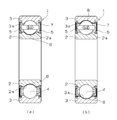
- FIG. 1 is a sectional view of a deep groove ball bearing in which a hard film described later is formed on inner and outer raceway surfaces
- FIG. 2 is a sectional view of a deep groove ball bearing in which a hard film is formed on a rolling surface of a rolling element.
- the deep groove ball bearing 1 includes an inner race 2 having an inner raceway surface 2a on the outer periphery, an outer race 3 having an outer raceway surface 3a on the inner periphery, and a plurality of rolling elements rolling between the inner raceway surface 2a and the outer raceway surface 3a.
- the rolling elements 4 are held at regular intervals by a holder 5.
- the seal member 6 seals the openings at both ends in the axial direction of the inner and outer rings, and seals the grease 7 in the bearing space.
- a hard film 8 is formed on the outer peripheral surface (including the inner raceway surface 2a) of the inner ring 2, and in the rolling bearing of FIG.
- the hard film 8 is formed on the outer ring raceway surface 3a (including the outer ring raceway surface 3a)
- the hard film may be formed on at least one surface of the inner ring, the outer ring, the rolling elements, and the rolling elements according to the application.
- the hard film 8 is formed on the rolling surface of the rolling element 4. Since the rolling bearing of FIG. 2 is a deep groove ball bearing, the rolling element 4 is a ball, and its rolling surface is the entire spherical surface.
- the hard film 8 is formed on the rolling element, the hard film 8 is formed at least on a rolling surface (such as a cylindrical outer periphery). I just need.
- tapered roller bearings used for wheel support devices and double-row self-aligning roller bearings used for main shaft support devices for wind power generation will be described later.
- the inner ring raceway surface 2 a of the deep groove ball bearing is a circular curved surface having an arc-shaped cross section in the axial direction in order to guide the ball as the rolling element 4.
- the outer ring raceway surface 3a is also a circular curved surface having an arc-shaped cross section in the axial direction.
- the radius of curvature of this arc groove is generally about 0.51 to 0.54 dw, where dw is the steel ball diameter.
- the inner ring raceway surface and the outer ring raceway surface are at least curved in the circumferential direction.
- the inner raceway surface and the outer raceway surface are curved in the axial direction in addition to the circumferential direction.
- the inner raceway surface and the outer raceway surface may have any of the above shapes.
- the inner ring 2, the outer ring 3, the rolling elements 4, and the retainer 5, which are the bearing members on which the hard film 8 is to be formed are made of an iron-based material.
- the iron-based material any steel generally used as a bearing member can be used, and examples thereof include high-carbon chromium bearing steel, carbon steel, tool steel, and martensitic stainless steel.
- the surface on which the hard film is formed preferably has a Vickers hardness of Hv650 or more.
- Hv is 650 or more, the difference in hardness from the hard film (underlayer) can be reduced, and the adhesion can be improved.
- a nitride layer is formed by a nitriding treatment before the hard film is formed.
- the nitriding treatment it is preferable to perform a plasma nitriding treatment in which an oxide layer that hinders adhesion is unlikely to be formed on the substrate surface.
- the hardness of the surface after the nitriding treatment is preferably Vvs hardness of Hv1000 or more in order to further improve the adhesion with the hard film (underlying layer).
- the surface roughness Ra of the surface on which the hard film is formed is preferably 0.05 ⁇ m or less. If the surface roughness Ra exceeds 0.05 ⁇ m, it becomes difficult to form a hard film at the tip of the roughness protrusion, and the film thickness is locally reduced.
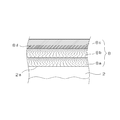
- FIG. 3 is a schematic sectional view showing the structure of the hard film 8 in the case of FIG.
- the hard film 8 includes (1) an underlayer 8a formed directly on the inner raceway surface 2a of the inner race 2, and (2) a WC formed on the underlayer 8a. It has a three-layer structure including a mixed layer 8b mainly composed of DLC and (3) a surface layer 8c mainly composed of DLC formed on the mixed layer 8b.
- a sudden change in physical properties is avoided by forming the hard film into a three-layer structure as described above.
- the underlayer 8a is an underlayer formed directly on the surface of each bearing member serving as a base material.
- the material and structure are not particularly limited as long as they can ensure the adhesion to the base material.
- Cr, W, Ti, Si, or the like can be used as the material.
- the underlayer 8a is preferably a layer mainly composed of Cr and WC in consideration of the adhesion to the mixed layer 8b.
- WC has an intermediate hardness or elastic modulus between Cr and DLC, and hardly causes concentration of residual stress after film formation.
- the mixed layer 8b is an intermediate layer interposed between the underlayer and the surface layer.
- the WC used for the mixed layer 8b has an intermediate hardness and elastic modulus between Cr and DLC, and hardly causes residual stress concentration after film formation.
- the content of WC in the mixed layer is reduced and the content of DLC in the mixed layer is increased continuously or stepwise from the underlayer 8a toward the surface layer 8c. Since the composition is graded, the adhesion on both surfaces of the underlayer 8a and the surface layer 8c is excellent. Further, the structure is such that WC and DLC are physically bonded in the mixed layer, and damage in the mixed layer can be prevented. Furthermore, since the DLC content is increased on the surface layer 8c side, the adhesion between the surface layer 8c and the mixed layer 8b is excellent.
- the mixed layer 8b is a layer that couples the non-adhesive DLC to the base layer 8a side by WC by an anchor effect.
- the surface layer 8c is a film mainly composed of DLC.
- the surface layer 8c preferably has a relaxation layer portion 8d on the side adjacent to the mixed layer 8b. This is because when the film forming condition parameters (the amount of introduced hydrocarbon gas, the degree of vacuum, and the bias voltage) are different between the mixed layer 8b and the surface layer 8c, at least one of the parameters is set to avoid a sudden change of these parameters. This is a relaxation layer portion obtained by changing one of the layers continuously or stepwise. More specifically, the film forming condition parameters for forming the outermost layer of the mixed layer 8b are set as a starting point, and the final film forming condition parameters of the surface layer 8c are set as an end point. Change.
- the composition ratio of the graphite structure (sp 2 ) and the diamond structure (sp 3 ) in the DLC structure is biased toward the latter, and the hardness is inclined (increased).
- the indentation hardness of the surface layer of the hard film measured by the ISO14577 method is 9 to 22 GPa, preferably 10 to 21 GPa, more preferably 10 to 15 GPa, further preferably 10 to 15 GPa. ⁇ 13 GPa.
- the indentation hardness of the relaxation layer is smaller than the indentation hardness of the surface layer 8c, and the indentation hardness of the relaxation layer is, for example, 9 to 10. 22 GPa.
- the hardness of the relaxation layer is increased continuously or stepwise from the mixed layer side.
- the thickness of the hard film 8 (total of three layers) is preferably 0.5 to 3.0 ⁇ m. If the film thickness is less than 0.5 ⁇ m, the abrasion resistance and the mechanical strength may be inferior. If it exceeds 3.0 ⁇ m, the film tends to peel off. Further, the ratio of the thickness of the surface layer 8c to the thickness of the hard film 8 is preferably 0.8 or less. If this ratio exceeds 0.8, the gradient structure for physically coupling WC and DLC in the mixed layer 8b tends to be a discontinuous structure, and the adhesion may be deteriorated.
- the peeling resistance is excellent.
- the rolling bearing of the present invention by forming a hard film having the above-mentioned structural and physical properties, even when subjected to a load of sliding contact during use, wear and separation of the film can be prevented, and even in a severe lubrication state. Longer life with less damage to raceway surfaces. Further, even under lubricating conditions in which foreign matter is mixed, damage to the raceway surface due to indentations formed by the foreign matter can be suppressed, resulting in a long life.
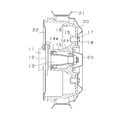
- FIG. 4 is a sectional view of the wheel support device of the present invention.
- a steering knuckle 11 is provided with a flange 12 and an axle 13, and an axle hub 15 as a rotating member is formed by a pair of tapered roller bearings 14a and 14b mounted on the outer diameter surface of the axle 13. It is rotatably supported.
- the axle hub 15 has a flange 16 on an outer diameter surface, and a stud bolt 17 provided on the flange 16 and a nut 18 threadedly engaged with the stud bolt 17, a brake drum 19 of a brake device, and a wheel disc 20 of a wheel. Is installed.
- Reference numeral 21 denotes a rim mounted on the outer diameter surface of the wheel disk 20, and a tire is mounted on the rim.
- the tapered roller bearings 14a and 14b correspond to a wheel supporting device.
- the back plate 22 of the brake device is attached to the flange 12 of the steering knuckle 11 by tightening stud bolts 17 and nuts 18.
- the back plate 22 supports a braking mechanism that applies a braking force to the brake drum 19, but is omitted in the drawing.
- the pair of tapered roller bearings 14a and 14b that rotatably support the axle hub 15 are lubricated by grease sealed in the axle hub 15.
- a grease cap 23 is attached to the outer end surface of the axle hub 15 so as to cover the tapered roller bearing 14b in order to prevent the grease from leaking from the tapered roller bearing 14b to the outside or infiltrating muddy water from the outside.
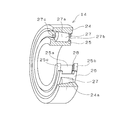
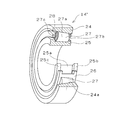
- FIG. 5 is a partially cutaway perspective view showing an example of a tapered roller bearing.
- the tapered roller bearing 14 includes an inner race 25 having a tapered inner raceway surface 25a on an outer peripheral surface, an outer race 24 having a tapered outer raceway surface 24a on an inner peripheral surface, and an inner raceway surface 25a and an outer raceway surface 24a.
- a plurality of tapered rollers 27 that roll between them, and a retainer 26 that rotatably holds each tapered roller 27 with a pocket portion are provided.
- the retainer 26 has a large-diameter ring portion and a small-diameter ring portion connected by a plurality of pillars, and accommodates tapered rollers 27 in pockets between the pillars.
- a large flange 25c is formed integrally with the large diameter end
- a small flange 25b is formed integrally with the small diameter end.
- the inner ring in the tapered roller bearing has a small diameter side and a large diameter side when viewed in the axial direction because it has a tapered inner ring raceway surface, and ⁇ small flange '' is a flange provided at the small diameter side end portion, "Large collar” is a collar provided at the large diameter side end.
- the rolling surface (tapered surface) 27a of the tapered roller 27 is subjected to rolling friction between the inner raceway surface 25a and the outer raceway surface 24a, and the small diameter end surface (small end surface) 27b of the tapered roller 27 is
- the tapered roller 27 receives sliding friction with the inner end surface of the small flange 25b, and the large-diameter end surface (large end surface) 27c of the tapered roller 27 receives sliding friction with the inner end surface of the large flange 25c. Rolling friction and sliding friction also occur between the tapered rollers 27 and the retainer 26.
- the small end surface 27b of the tapered roller 27 is subjected to sliding friction with the end surface of the small diameter ring forming the pocket portion, and the large end surface 27c of the tapered roller 27 is in contact with the end surface of the large diameter ring forming the pocket portion.
- the grease is sealed to reduce such friction.
- Known grease for rolling bearings can be used as grease.
- the wheel supporting device of the present invention is characterized in that a hard film having a predetermined range of indentation hardness is formed on a surface which makes sliding contact between members in the device (particularly under boundary lubrication conditions). Therefore, the hard film is excellent in peeling resistance even when it comes into sliding contact with another member under poor lubrication conditions. Further, when used as a bearing for a wheel supporting device, there is a possibility that foreign matter may enter the bearing from the outside. However, since the hard film is formed, the bearing is excellent in peeling resistance even when foreign matter is mixed. In addition, since the swelling of the indentation formed on the bearing rolling surface is removed by the cutting effect of the hard film, the indentation starting point exfoliation resistance is excellent. Due to the low friction property of the hard film and the effect of preventing metal contact, the seizure resistance of the flange portion of the tapered roller bearing is also excellent.
- a hard film is provided on the inner ring which is a bearing member.
- the hard films 28 are formed on the inner end faces of the flanges (small flange 25b, large flange 25c) of the inner ring 25, respectively.
- the hard film is provided on the collar portion of the inner ring, it is preferable to provide the hard film on at least the inner end face of the large collar, considering that the sliding friction in the large collar is greater than the sliding friction in the small collar.
- the hard film 28 may be provided on the inner raceway surface 25a.
- a hard film is provided on a tapered roller that is a bearing member.
- the hard films 28 are formed on the small end surface 27b and the large end surface 27c, which are the axial end surfaces of the tapered rollers 27, respectively.
- the hard film 28 may be provided on the rolling surface 27a of the tapered roller 27, and in this case, the hard film is provided on the entire surface of the tapered roller 27.
- the location where the hard film is formed is not limited to the location shown in FIGS. 5 and 6, and at least one selected from an inner ring, an outer ring, a rolling element, and a cage that are in rolling contact and sliding contact with each other. It can be formed on any surface of the bearing member.
- a hard film may be formed on the inner end face of the small-diameter ring or the inner end face of the large-diameter ring of the cage that makes rolling contact and sliding contact with the small end face or the large end face of the tapered roller.
- a hard film may be formed on an inner end surface of the flange.
- FIGS. 4 to 6 show tapered roller bearings as rolling bearings in the wheel supporting device.
- any roller bearings that cause rolling sliding motion may be used.
- cylindrical roller bearings and self-adjusting roller bearings may be used.
- a roller bearing, a needle roller bearing, a thrust cylindrical roller bearing, a thrust tapered roller bearing, a thrust needle roller bearing, a thrust self-aligning roller bearing, and the like can be used.
- both ends in the axial direction of the roller and the flanges at both ends in the axial direction of the bearing ring make rolling contact and sliding contact.
- a wind power generator to which the rolling bearing of the present invention is applied will be described.
- a large double-row spherical roller bearing 54 as shown in FIG. 10 is often used as a main shaft bearing in a large wind power generator.
- the main shaft 53 is a shaft to which the blades 52 are attached, rotates by receiving wind force, and the rotation is increased by a speed increaser (not shown) to rotate the generator to generate electricity.
- the main shaft 53 supporting the blade 52 receives an axial load (bearing thrust load) and a radial load (bearing radial load) due to the wind force applied to the blade 52.
- the double-row self-aligning roller bearing 54 can simultaneously apply a radial load and a thrust load, and has an aligning property, so that it can absorb the accuracy error of the bearing housing 51 and the inclination of the main shaft 53 due to the mounting error, and The deflection of the main shaft 53 during operation can be absorbed. Therefore, the bearing is suitable as a bearing for a main shaft of a wind power generator (reference: NTN catalog “Bearing for a new generation wind turbine” A65. CAT. No. 8404/04 / JE, May 2003). 1 day).
- the thrust load is larger than the radial load, and among the double-row rollers 57 and 58, the thrust load is reduced.
- the receiving rows of rollers 58 will apply exclusively radial and thrust loads simultaneously. Therefore, the rolling fatigue life is shortened. Further, since a thrust load is applied, there is a problem that a sliding motion occurs at the flange and wear occurs. In addition, there is a problem that the load is light on the opposite row, and the rollers 57 slide on the raceway surfaces 55a, 56a of the inner and outer races 55, 56, causing surface damage and wear.
- the rolling bearing of the present invention can be applied to a main shaft support device for wind power generation as a double-row self-aligning roller bearing.
- FIGS. 7 is a schematic diagram of the whole wind power generator including the wind power generation spindle support device of the present invention
- FIG. 8 is a diagram showing the wind power generation spindle support device of FIG. As shown in FIG.
- the wind power generator 31 includes a double-row self-aligning roller bearing 35 (hereinafter, also simply referred to as a bearing 35) provided with a main shaft 33 to which a blade 32 serving as a wind turbine is attached, installed in a nacelle 34. ) So as to be rotatable, and a speed increasing device 36 and a generator 37 are installed in the nacelle 34.
- the speed increaser 36 increases the rotation of the main shaft 33 and transmits the rotation to the input shaft of the generator 37.
- the nacelle 34 is rotatably installed on a support base 38 via a swivel bearing 47 and is swung through a speed reducer 40 (see FIG. 8) by driving of a turning motor 39 (see FIG. 8). .
- the turning of the nacelle 34 is performed to make the direction of the blade 32 face the wind direction.
- two bearings 35 for supporting the main shaft are provided in the example of FIG. 8, one bearing may be provided.
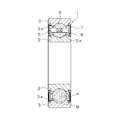
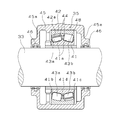
- FIG. 9 shows a double-row self-aligning roller bearing 35 that supports the main shaft of a wind power generator.
- the bearing 35 has an inner ring 41 and an outer ring 42 which are a pair of races, and a plurality of rollers 43 interposed between the inner and outer rings 41 #, 42.
- the plurality of rollers are interposed in two rows in the axial direction of the bearing. In FIG. 9, the roller in the row closer to the blade (left row) is 43a, and the roller in the row farther from the blade (right row) is 43a. 43b.
- the bearing 35 is a radial bearing capable of performing a thrust load.
- the outer raceway surface 42a of the bearing 35 has a spherical shape, and each roller has a spherical shape having an outer peripheral surface along the outer raceway surface 42a.
- the inner race 41 is formed with multiple rows of inner raceway surfaces 41a having a cross-sectional shape along the outer peripheral surfaces of the rollers 43a and 43b in each of the left and right rows.
- Small flanges 41b and 41c are provided at both ends of the outer peripheral surface of the inner ring 41, respectively.
- a middle flange 41d is provided at the center of the outer peripheral surface of the inner ring 41, that is, between the left-row rollers 43a and the right-row rollers 43b.
- the rollers 43a and 43b are held by a holder 44 for each row.
- the outer peripheral surfaces of the rollers 43a and 43b are in rolling contact between the inner raceway surface 41a and the outer raceway surface 42a. Further, the axially inner end face of the roller 43a is in sliding contact with one axial end face of the middle flange 41d, and the axially outer end face of the roller 43a is slidingly contacted with the inner end face of the small flange 41b. Contact. The axially inner end face of the roller 43b is in sliding contact with the other axial end face of the middle flange 41d, and the axially outer end face of the roller 43b is in sliding contact with the inner end face of the small flange 41c. Contact. Grease is sealed to reduce these frictions. Known grease for rolling bearings can be used as grease.
- the outer ring 42 is fitted and installed on the inner diameter surface of the bearing housing 45, and the inner ring 41 is fitted on the outer periphery of the main shaft 33 and supports the main shaft 33.
- the bearing housing 45 has side walls 45 a covering both ends of the bearing 35, and a seal 46 such as a labyrinth seal is formed between each side wall 45 a and the main shaft 33. Since the sealing performance can be obtained by the bearing housing 45, the bearing 35 without seal is used.
- the bearing 35 is a bearing for the main shaft of the wind power generator according to the embodiment of the present invention.
- the double-row self-aligning roller bearing is characterized in that a hard film having a predetermined structure is formed on a surface that comes into rolling and sliding contact between the roller and another member (particularly under boundary lubrication conditions). Therefore, the hard film is excellent in the peeling resistance even when it comes into contact with another member under conditions of poor lubrication and slippage. Further, when used as a bearing for a main shaft of a wind power generator, there is a possibility that foreign matter may enter the bearing from the outside. However, since the hard film is formed, it is excellent in peeling resistance even in a state where foreign matter has entered. In addition, since the swelling of the indentation formed on the bearing rolling surface is removed by the cutting effect of the hard film, the indentation starting point exfoliation resistance is excellent. As a result, it is possible to exhibit the inherent characteristics of the hard film, to have excellent seizure resistance, abrasion resistance, and corrosion resistance, and to prevent damage due to metal contact of the double row spherical roller bearing.
- a hard film 48 is formed on the outer peripheral surface of the inner ring 41 as a bearing member.
- the outer peripheral surface of the inner ring 41 includes a raceway surface 41a, both axial end surfaces of the middle flange 41d, an inner end surface of the small flange 41b, and an inner end surface of the small flange 41c.
- the hard film 48 is formed on the entire outer peripheral surface of the inner ring 41, and the hard film 48 is also formed on the surface that does not make rolling and sliding contact with the rollers 43a and 43b.
- the location of the inner ring 41 on which the hard film 48 is formed is not limited to the embodiment shown in FIG.
- a hard film is formed on at least one of the axial end surfaces of the middle flange 41d, the inner end surface of the small flange 41b, and the inner end surface of the small flange 41c, which are in sliding contact with the rollers 43a and 43b. Is also good.
- the rollers in the row farther from the blade (rollers 43b) are compared with the rollers in the row closer to the blades (rollers 43a). And receive a large thrust load.
- boundary lubrication tends to occur particularly at a portion that comes into sliding contact with the roller 43b. Therefore, the hard film may be formed only on the inner end face of the small flange 41c of the small flanges 41b and 41c in consideration of the fact that loads having different sizes act on the two rows of rollers arranged in the axial direction.
- a hard film is formed on a surface which is in a condition of sliding contact (particularly rolling sliding contact) with another bearing member by boundary lubrication (low lambda condition). Rollers are also rolling between the inner and outer wheels and sliding.
- the hard film shown in FIG. 9 is used under such conditions. Further, the location where the hard film is formed is not limited to the location shown in FIG. 9, but may be formed on any surface of at least one bearing member selected from the inner ring, the outer ring, the rollers, and the retainer, as described above. can do.
- the hard film 48 is formed on the outer peripheral surface of the inner ring 41, but the hard film 48 may be formed on the surface of the outer ring 42 and the rollers 43a, 43b instead or in addition.
- the hard film may be formed on the inner peripheral surface of the outer ring 42 (including the outer ring raceway surface 42a).
- a hard film may be formed on both end surfaces of each of the rollers 43a and 43b.
- a configuration in which a hard film is formed only on both end surfaces of the rollers 43b may be adopted. Further, a configuration in which a hard film is formed on the outer peripheral surfaces of the rollers 43a and 43b may be adopted. For example, a configuration may be adopted in which a hard film is formed on the outer peripheral surface of at least one of the rollers in each row.
- the hard film is obtained by forming an underlayer 8a, a mixed layer 8b, and a surface layer 8c in this order on the film forming surface of the bearing member.
- the formation of the underlayer 8a and the mixed layer 8b is preferably performed using a UBMS apparatus using Ar gas as a sputtering gas.
- the principle of film formation in the UBMS method using a UBMS device will be described with reference to the schematic diagram shown in FIG.
- the substrate 62 is an inner ring, an outer ring, a rolling element, or a cage, which is a bearing member to be formed into a film, and is schematically shown as a flat plate. As shown in FIG.
- an inner magnet 64 a and an outer magnet 64 b having different magnetic properties at the center and the periphery of the round target 65 are arranged, and while forming a high-density plasma 69 near the target 65, the magnet 64 a , 64b of the magnetic force lines 66 reach the vicinity of the base 62 connected to the bias power supply 61.
- the effect that the Ar plasma generated at the time of sputtering along the line of magnetic force 66a is diffused to the vicinity of the base material 62 is obtained.
- Ar ions 67 and electrons travel along a magnetic field line 66a reaching the vicinity of the base material 62 by an ion assist effect that causes the ionized target 68 to reach the base material 62 more than in normal sputtering. And a dense film (layer) 63 can be formed.
- the underlayer 8a is a layer mainly composed of Cr and WC
- a Cr target and a WC target are used in combination as the target 65.
- a WC target and (2) a graphite target and, if necessary, a hydrocarbon-based gas are used. Each time each layer is formed, the target used for each layer is sequentially replaced.
- the underlayer 8a has a gradient composition of Cr and WC as described above, the composition is continuously or stepwise increased while increasing the sputtering power applied to the WC target and decreasing the power applied to the Cr target. Film.
- a layer having a structure in which the content of Cr is smaller and the content of WC is higher toward the mixed layer 8b side can be obtained.
- the mixed layer 8b is formed continuously or stepwise while increasing the sputtering power applied to the graphite target serving as the carbon supply source and decreasing the power applied to the WC target. As a result, a layer having a gradient composition in which the content of WC becomes smaller and the content of DLC becomes higher toward the surface layer 8c side can be obtained.
- the degree of vacuum in the UBMS device (in the film formation chamber) when forming the mixed layer 8b is preferably 0.2 to 1.2 Pa. Further, the bias voltage applied to the bearing member serving as the base material is preferably 20 to 100 V. By setting such a range, the peeling resistance can be improved.
- the formation of the surface layer 8c is also preferably performed using a UBMS apparatus using Ar gas as the above-mentioned sputtering gas. More specifically, the surface layer 8c is formed by using this apparatus, using a graphite target and a hydrocarbon-based gas in combination as a carbon supply source, and applying the hydrocarbon-based gas to the introduction amount 100 of Ar gas into the apparatus. It is preferable that the film is formed by depositing carbon atoms generated from a carbon supply source on the mixed layer 8b at a ratio of 1 to 15 introduced. In addition, it is preferable that the degree of vacuum in the apparatus is 0.2 to 0.9 Pa. The preferred conditions will be described below.
- the indentation hardness and elastic modulus of the DLC film can be adjusted by using a graphite target and a hydrocarbon-based gas together as a carbon supply source.
- a hydrocarbon-based gas methane gas, acetylene gas, benzene, and the like can be used, and are not particularly limited. However, methane gas is preferable from the viewpoint of cost and handleability.
- the ratio of the introduction amount of the hydrocarbon-based gas is 1 to 15 (parts by volume), preferably 6 to 15, relative to 100 (parts by volume) of the introduction amount of Ar gas into the UBMS apparatus (in the film formation chamber).
- the degree of vacuum in the UBMS apparatus is preferably 0.2 to 0.9 Pa as described above. More preferably, it is 0.4 to 0.9 Pa, and still more preferably, it is 0.6 to 0.9 Pa. If the degree of vacuum is less than 0.2 Pa, the amount of Ar gas in the chamber is small, so that Ar plasma is not generated and film formation may not be performed. On the other hand, when the degree of vacuum is higher than 0.9 Pa, the reverse sputtering phenomenon is likely to occur, and the abrasion resistance may be deteriorated.
- the bias voltage applied to the bearing member serving as the base material is preferably 50 to 150 V.
- the bias potential with respect to the base material is applied so as to be negative with respect to the ground potential.
- a bias voltage of 100 V means that the bias potential of the base material is -100 V with respect to the ground potential. Show.
- a hard film used in the rolling bearing of the present invention a hard film was formed on a predetermined base material, and the physical properties of the hard film were evaluated. Evaluation of peeling resistance and the like was performed using a reciprocating sliding tester and a two-cylinder tester.
- the base material, UBMS device, sputtering gas, and the like used for the evaluation of the hard film are as follows.
- Base material properties SUJ2 quenched and tempered product Hardness 780 Hv
- Substrate SUJ2 flat plate with mirror finish (0.02 ⁇ mRa)
- Counterpart material SUJ2 ring ( ⁇ 40 ⁇ L12 sub-curvature 60) with grinding finish (0.7 ⁇ mRa)
- UBMS device manufactured by Kobe Steel; UBMS202
- Sputtering gas Ar gas
- the conditions for forming the underlayer will be described below.
- the inside of the film forming chamber is evacuated to about 5 ⁇ 10 ⁇ 3 Pa, the substrate is baked with a heater, the substrate surface is etched with Ar plasma, and then a UBMS method is applied to a Cr target and a WC target by sputtering
- the power was adjusted, the composition ratio of Cr and WC was inclined, and a Cr / WC gradient layer having a large amount of Cr on the substrate side and a large amount of WC on the surface side was formed.
- the conditions for forming the mixed layer will be described below.
- the film was formed by the UBMS method in the same manner as the underlayer.
- methane gas which is a hydrocarbon-based gas
- the sputtering power applied to the WC target and the graphite target was adjusted, the composition ratio of WC and DLC was inclined, and WC And a WC / DLC gradient layer having a large amount of DLC on the surface layer side was formed.
- Fig. 12 is a schematic diagram of a UBMS device.
- a non-equilibrium magnetic field is applied to a sputter evaporation source material (target) 72 on a substrate 71 placed on a disk 70 to increase the plasma density near the substrate 71 to increase the ion assist effect.
- This is an apparatus having a UBMS function that can control the characteristics of a film deposited on a base material by performing (see FIG. 11).
- a composite coating in which a plurality of UBMS coatings (including composition gradients) are arbitrarily combined can be formed on a substrate.
- a base layer, a mixed layer, and a surface layer are formed as UBMS films on a ring serving as a base material.
- Examples 1 to 6 Comparative Example 1
- the substrates shown in Table 1 were ultrasonically cleaned with acetone, and then dried. After drying, this was attached to a UBMS device, and an underlayer and a mixed layer were formed under the above-mentioned forming conditions.
- a DLC film as a surface layer was formed thereon under the film forming conditions shown in Table 1 to obtain a test piece having a hard film.
- the hard film of Comparative Example 1 is assumed to be a conventional hard film having the same three-layer film structure as the hard films of Examples 1 to 6.
- "Vacuum degree" in Table 1 is the degree of vacuum in the film forming chamber in the above-described apparatus. The following tests were performed using the obtained test pieces. The results are also shown in Table 1.
- the indentation hardness of the obtained test piece was measured using a nanoindenter (G200) manufactured by Agilent Technologies.
- the measured value shows the average value of the depth (the place where the hardness is stable) which is not affected by the surface roughness, and was measured for each of ten test pieces.
- ⁇ Thickness test> The thickness of the hard film of the obtained test piece was measured using a surface shape / surface roughness measuring device (Taylor Hobson: Foam Talysurf PGI830). The film thickness was determined by masking a part of the film forming part and calculating the film thickness from a step between the non-film forming part and the film forming part.
- ⁇ Reciprocating sliding test> Using the reciprocating slide tester shown in FIG. 13, a test for the peeling resistance due to slip was performed on the obtained test piece. As shown in FIG. 13, in the test, first, a base material 73 (test piece) on which a hard film 74 is formed is placed on a pedestal on which a load cell 77 and an acceleration sensor 78 are attached. Then, the silicon nitride sphere 75 on which the load 80 is applied is placed on the hard film 74 of the test piece, and the silicon nitride sphere 75 is reciprocated in the horizontal direction under the following conditions. The silicon nitride sphere 75 is held in a counterpart material holder 76 connected to a vibrator 79.
- the reciprocating sliding test was performed without lubrication, the load was increased at the following load increasing speed, and the load at which the friction coefficient increased due to peeling of the hard film was defined as the limit load (N).
- N the load at which the friction coefficient increased due to peeling of the hard film
- the maximum load was set to 120N
- the maximum load was set to 100N.
- the specific test conditions are as follows. (Test condition) Lubrication: No lubrication Sphere: 3/8 inch, silicon nitride sphere Load: 30-80N Load increase rate: 10 N / min Frequency: 60Hz Amplitude: 2mm
- Table 1 shows the film forming conditions of each layer and the results of the reciprocating sliding test.
- the test was performed twice for each of the example and the comparative example, and the results of each test are shown.
- the substrate used and the film forming conditions of the mixed layer were the same.
- the indentation hardness was 9 to 22 GPa, which was lower than the indentation hardness of the conventional hard film. The critical load tended to be large.
- Example 7 to 10 Comparative Examples 2 to 4
- the substrates shown in Table 1 were ultrasonically cleaned with acetone, and then dried. After drying, this was attached to a UBMS device, and an underlayer and a mixed layer were formed under the above-mentioned forming conditions.
- a DLC film as a surface layer was formed thereon under the film forming conditions shown in Table 2 to obtain a test piece having a hard film.
- Comparative Example 4 a test piece consisting of the base material itself was used without forming a hard film.
- “Vacuum degree” in Table 2 is the degree of vacuum in the film forming chamber of the above-described apparatus.
- the obtained test pieces were subjected to tests using the following two types of two-cylinder testing machines. The hardness test and the film thickness test were performed by the above-described test methods. The results are also shown in Table 2.
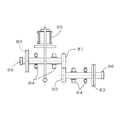
- the two-cylinder testing machine includes a driving-side test piece 81 and a driven-side test piece 82 that comes into rolling and sliding contact. Each test piece (ring) is supported by a support bearing 84, and a load is applied by a load spring 85. Loaded.
- reference numeral 83 denotes a driving pulley
- reference numeral 86 denotes a non-contact tachometer.
- a hard film is formed only on the driven-side test piece 82, and foreign matter is mixed between the drive-side test piece 81 and the driven-side test piece 82 in order to promote peeling of the hard film, and the hard film is peeled off after operation.
- the sex was evaluated.
- the specific test conditions are as follows.
- Lubricating oil VG56 equivalent oil (oil with no foreign matter added) or oil containing the following foreign matter mixed with VG56 equivalent oil (foreign matter added oil)
- Lubrication method dripping lubrication
- Foreign matter powdered high-speed steel KHA30 100-180 ⁇ m, 10 g / l Oil temperature: 40-50 ° C
- Maximum contact surface pressure 2.5 GPa
- Rotation speed (test piece side) 300 min -1 (Material side) 300 min -1 Time: After operation for 1 hour with foreign matter-added oil, run up to 1 ⁇ 10 6 times with foreign matter-free oil
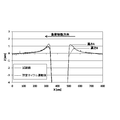
- FIG. 15 shows an example of measurement of the height of the indentation rise.
- the swelling height of the indentation formed on the driving side test piece was about 1.2 to 1.4 ⁇ m.
- the busbar shape passing through the center of the indentation was acquired, and the maximum value of the busbar corrected by the radius of the test piece was measured as the indentation swelling height. There was a difference in how the swell was cut off in the load moving direction, and the indentation swell height on the upstream side in the load moving direction was adopted. The following formula was used to evaluate the residual ratio of the height of the indentation rise.
- Lubricating oil VG56 equivalent oil (containing additives)
- Lubrication method dripping lubrication Indentation condition: 15kgf diamond indenter for Rockwell test Oil temperature: 40-50 ° C
- Maximum contact surface pressure 2.5 GPa
- Rotation speed (test piece side) 300 min -1 (Material side) 300 min -1
- Test cycle Runs up to 1 ⁇ 10 6 load cycles
- the hard films having relatively high hardness had a high ability to remove the bulge of the indentation of the mating material, but had low peeling resistance under the condition that foreign matter was mixed.
- the hard films having comparatively low hardness had a reduced indentation removal ability as compared with Comparative Examples 2 and 3, but significantly improved the peeling resistance against inclusion of foreign matter.
- the indentation hardness was 10 to 15 MPa, almost no peeling of the hard film was observed. This proved that the rolling bearing of the present invention was excellent in peeling resistance even under lubricating conditions in which foreign matter was mixed.
- the rolling bearing of the present invention for example, the DLC film is formed on the inner and outer raceway surfaces and the rolling surfaces of the rolling elements, and a severe lubricating state (for example, poor lubricating state, slipping contact conditions or foreign matter is mixed). Even when the DLC film is operated under lubricating conditions, the DLC film has excellent peeling resistance and exhibits the characteristics of the DLC body, so that it has excellent seizure resistance, abrasion resistance, and corrosion resistance. For this reason, the rolling bearing of the present invention can be applied to various uses including the use under severe lubrication conditions. In particular, it is suitable for application to a wheel supporting device or a main shaft supporting device for wind power generation.
Landscapes
- Engineering & Computer Science (AREA)
- General Engineering & Computer Science (AREA)
- Mechanical Engineering (AREA)
- Chemical & Material Sciences (AREA)
- Manufacturing & Machinery (AREA)
- Chemical Kinetics & Catalysis (AREA)
- Materials Engineering (AREA)
- Metallurgy (AREA)
- Organic Chemistry (AREA)
- Rolling Contact Bearings (AREA)
Abstract
Priority Applications (2)
| Application Number | Priority Date | Filing Date | Title |
|---|---|---|---|
| AU2019320358A AU2019320358A1 (en) | 2018-08-08 | 2019-08-06 | Rolling bearing, wheel support device, and main shaft support device for wind power generation |
| US17/266,552 US20210317877A1 (en) | 2018-08-08 | 2019-08-06 | Rolling bearing, wheel support device, and wind power generation rotor shaft support device |
Applications Claiming Priority (6)
| Application Number | Priority Date | Filing Date | Title |
|---|---|---|---|
| JP2018149640 | 2018-08-08 | ||
| JP2018-149640 | 2018-08-08 | ||
| JP2018174174 | 2018-09-18 | ||
| JP2018-174174 | 2018-09-18 | ||
| JP2019-034126 | 2019-02-27 | ||
| JP2019034126A JP2020046068A (ja) | 2018-08-08 | 2019-02-27 | 転がり軸受、車輪支持装置、および風力発電用主軸支持装置 |
Publications (1)
| Publication Number | Publication Date |
|---|---|
| WO2020031995A1 true WO2020031995A1 (fr) | 2020-02-13 |
Family
ID=69415036
Family Applications (1)
| Application Number | Title | Priority Date | Filing Date |
|---|---|---|---|
| PCT/JP2019/030812 Ceased WO2020031995A1 (fr) | 2018-08-08 | 2019-08-06 | Palier à roulement, dispositif de support de roue, et dispositif de support d'arbre principal pour la génération d'énergie éolienne |
Country Status (1)
| Country | Link |
|---|---|
| WO (1) | WO2020031995A1 (fr) |
Cited By (4)
| Publication number | Priority date | Publication date | Assignee | Title |
|---|---|---|---|---|
| CN111218646A (zh) * | 2020-03-04 | 2020-06-02 | 赵俊亮 | 一种耐极端环境的电机轴承制造设备及其制造方法 |
| CN115076225A (zh) * | 2022-06-07 | 2022-09-20 | 山东华工轴承有限公司 | 基于风力发电主轴用双列异形自动调心滚子轴承 |
| JP2022169406A (ja) * | 2021-04-27 | 2022-11-09 | Ntn株式会社 | 転がり軸受 |
| CN117441066A (zh) * | 2021-03-22 | 2024-01-23 | Ntn株式会社 | 滚子轴承 |
Citations (4)
| Publication number | Priority date | Publication date | Assignee | Title |
|---|---|---|---|---|
| JP2006322504A (ja) * | 2005-05-18 | 2006-11-30 | Ntn Corp | 円すいころ軸受 |
| JP2013079721A (ja) * | 2011-09-22 | 2013-05-02 | Ntn Corp | 転がり軸受 |
| WO2016140225A1 (fr) * | 2015-03-03 | 2016-09-09 | Ntn株式会社 | Palier à roulement pour une utilisation dans un environnement à températures extrêmement basses |
| JP2018115762A (ja) * | 2017-01-13 | 2018-07-26 | Ntn株式会社 | 複列自動調心ころ軸受および飛出し止め治具 |
-
2019
- 2019-08-06 WO PCT/JP2019/030812 patent/WO2020031995A1/fr not_active Ceased
Patent Citations (4)
| Publication number | Priority date | Publication date | Assignee | Title |
|---|---|---|---|---|
| JP2006322504A (ja) * | 2005-05-18 | 2006-11-30 | Ntn Corp | 円すいころ軸受 |
| JP2013079721A (ja) * | 2011-09-22 | 2013-05-02 | Ntn Corp | 転がり軸受 |
| WO2016140225A1 (fr) * | 2015-03-03 | 2016-09-09 | Ntn株式会社 | Palier à roulement pour une utilisation dans un environnement à températures extrêmement basses |
| JP2018115762A (ja) * | 2017-01-13 | 2018-07-26 | Ntn株式会社 | 複列自動調心ころ軸受および飛出し止め治具 |
Cited By (6)
| Publication number | Priority date | Publication date | Assignee | Title |
|---|---|---|---|---|
| CN111218646A (zh) * | 2020-03-04 | 2020-06-02 | 赵俊亮 | 一种耐极端环境的电机轴承制造设备及其制造方法 |
| CN117441066A (zh) * | 2021-03-22 | 2024-01-23 | Ntn株式会社 | 滚子轴承 |
| JP2022169406A (ja) * | 2021-04-27 | 2022-11-09 | Ntn株式会社 | 転がり軸受 |
| JP7686442B2 (ja) | 2021-04-27 | 2025-06-02 | Ntn株式会社 | 転がり軸受 |
| CN115076225A (zh) * | 2022-06-07 | 2022-09-20 | 山东华工轴承有限公司 | 基于风力发电主轴用双列异形自动调心滚子轴承 |
| CN115076225B (zh) * | 2022-06-07 | 2023-08-04 | 山东华工轴承有限公司 | 基于风力发电主轴用双列异形自动调心滚子轴承 |
Similar Documents
| Publication | Publication Date | Title |
|---|---|---|
| CN103814150B (zh) | 硬质膜、硬质膜形成体及滚动轴承 | |
| CN102822546B (zh) | 滚动轴承 | |
| JP2022107481A (ja) | 転がり軸受および車輪支持装置 | |
| EP1497568A2 (fr) | Organe de roulement a elements roulants jointifs | |
| JP2018146108A (ja) | 転がり軸受およびその製造方法 | |
| JP2020046068A (ja) | 転がり軸受、車輪支持装置、および風力発電用主軸支持装置 | |
| JP5993680B2 (ja) | 転がり軸受およびその製造方法 | |
| JP7079175B2 (ja) | 複列自動調心ころ軸受、およびそれを備えた風力発電用主軸支持装置 | |
| CN112739922B (zh) | 滚动轴承以及风力发电用主轴支承装置 | |
| JP2012067900A (ja) | 転がり軸受 | |
| JP5620860B2 (ja) | 転がり軸受 | |
| JP2014228099A (ja) | 転がり軸受 | |
| WO2020067334A1 (fr) | Palier de roulement, dispositif de support d'arbre primaire pour la génération d'énergie éolienne | |
| JP2007002912A (ja) | 転がり軸受 | |
| WO2018164139A1 (fr) | Palier à roulement et son procédé de fabrication | |
| JP2024014629A (ja) | 転がり軸受 | |
| JP5379734B2 (ja) | 転がり軸受 | |
| JP2019027476A (ja) | 転がり軸受用保持器および転がり軸受 | |
| WO2019073861A1 (fr) | Dispositif de support de roue | |
| JP6875880B2 (ja) | 転がり軸受および硬質膜成膜方法 | |
| JP2021001639A (ja) | 複列スラスト針状ころ軸受 | |
| JP7686442B2 (ja) | 転がり軸受 | |
| JP2008151264A (ja) | 転がり軸受用保持器 | |
| JP2009052694A (ja) | 転がり摺動部材及び転動装置 |
Legal Events
| Date | Code | Title | Description |
|---|---|---|---|
| 121 | Ep: the epo has been informed by wipo that ep was designated in this application |
Ref document number: 19847488 Country of ref document: EP Kind code of ref document: A1 |
|
| NENP | Non-entry into the national phase |
Ref country code: DE |
|
| ENP | Entry into the national phase |
Ref document number: 2019320358 Country of ref document: AU Date of ref document: 20190806 Kind code of ref document: A |
|
| 122 | Ep: pct application non-entry in european phase |
Ref document number: 19847488 Country of ref document: EP Kind code of ref document: A1 |