WO2019077678A1 - Procédé de reliure destiné à un livret relié par collage - Google Patents
Procédé de reliure destiné à un livret relié par collage Download PDFInfo
- Publication number
- WO2019077678A1 WO2019077678A1 PCT/JP2017/037554 JP2017037554W WO2019077678A1 WO 2019077678 A1 WO2019077678 A1 WO 2019077678A1 JP 2017037554 W JP2017037554 W JP 2017037554W WO 2019077678 A1 WO2019077678 A1 WO 2019077678A1
- Authority
- WO
- WIPO (PCT)
- Prior art keywords
- adhesive
- bundle
- booklet
- text
- signatures
- Prior art date
- Legal status (The legal status is an assumption and is not a legal conclusion. Google has not performed a legal analysis and makes no representation as to the accuracy of the status listed.)
- Ceased
Links
Images


Classifications
-
- B—PERFORMING OPERATIONS; TRANSPORTING
- B42—BOOKBINDING; ALBUMS; FILES; SPECIAL PRINTED MATTER
- B42C—BOOKBINDING
- B42C3/00—Making booklets, pads, or form sets from multiple webs
-
- B—PERFORMING OPERATIONS; TRANSPORTING
- B42—BOOKBINDING; ALBUMS; FILES; SPECIAL PRINTED MATTER
- B42C—BOOKBINDING
- B42C11/00—Casing-in
- B42C11/02—Machines or equipment for casing-in or applying covers to pamphlets, magazines, pads, or other paper-covered booklets
-
- B—PERFORMING OPERATIONS; TRANSPORTING
- B42—BOOKBINDING; ALBUMS; FILES; SPECIAL PRINTED MATTER
- B42C—BOOKBINDING
- B42C19/00—Multi-step processes for making books
- B42C19/02—Multi-step processes for making books starting with single sheets
-
- B—PERFORMING OPERATIONS; TRANSPORTING
- B42—BOOKBINDING; ALBUMS; FILES; SPECIAL PRINTED MATTER
- B42C—BOOKBINDING
- B42C19/00—Multi-step processes for making books
- B42C19/04—Multi-step processes for making books starting with signatures
-
- B—PERFORMING OPERATIONS; TRANSPORTING
- B42—BOOKBINDING; ALBUMS; FILES; SPECIAL PRINTED MATTER
- B42C—BOOKBINDING
- B42C9/00—Applying glue or adhesive peculiar to bookbinding
-
- B—PERFORMING OPERATIONS; TRANSPORTING
- B42—BOOKBINDING; ALBUMS; FILES; SPECIAL PRINTED MATTER
- B42C—BOOKBINDING
- B42C9/00—Applying glue or adhesive peculiar to bookbinding
- B42C9/0006—Applying glue or adhesive peculiar to bookbinding by applying adhesive to a stack of sheets
-
- B—PERFORMING OPERATIONS; TRANSPORTING
- B42—BOOKBINDING; ALBUMS; FILES; SPECIAL PRINTED MATTER
- B42C—BOOKBINDING
- B42C9/00—Applying glue or adhesive peculiar to bookbinding
- B42C9/0006—Applying glue or adhesive peculiar to bookbinding by applying adhesive to a stack of sheets
- B42C9/0012—Applying glue or adhesive peculiar to bookbinding by applying adhesive to a stack of sheets with a roller
- B42C9/0018—Applying glue or adhesive peculiar to bookbinding by applying adhesive to a stack of sheets with a roller for binding stacks of sheets one at the time
- B42C9/0025—Applying glue or adhesive peculiar to bookbinding by applying adhesive to a stack of sheets with a roller for binding stacks of sheets one at the time and subsequently applying a cover
-
- B—PERFORMING OPERATIONS; TRANSPORTING
- B42—BOOKBINDING; ALBUMS; FILES; SPECIAL PRINTED MATTER
- B42C—BOOKBINDING
- B42C9/00—Applying glue or adhesive peculiar to bookbinding
- B42C9/02—Applying glue or adhesive peculiar to bookbinding for securing back linings, strips, ribbons or headbands
Definitions
- the present invention relates to an improved method for bookbinding of a bound booklet, and more particularly, to a method for binding a bound booklet having excellent spreadability and a bound booklet produced by the bookbinding method.
- Patent Document 1 a perfect bound booklet (see Patent Document 1) and launched it as a horizontally opened notebook (registered trademark).
- the bookbinding method described in Patent Document 1 is for binding a booklet in which any signature in the text does not peel off or not, and in the quality inspection after bookbinding, whether or not the signature does not peel off from the text or not We have thoroughly confirmed the adhesive strength of
- “bundle” in “one bundle of books” or “bundle of plural volumes” means a combination of a predetermined number of texts and a cover and a back cover.
- the present inventor (1) It is necessary to further pressurize the fold of the folded sheet after the paper folding process, in order to cut off any half-patter from the text consisting of the fold. (2)
- the first adhesive that fixes multiple signatures first has a tendency to be able to cut off any half-patter from the text better and more reproducible using an adhesive that exhibits flexibility upon curing
- the present invention has been completed.
- An object of the present invention is to provide a method for forming a bound booklet, which can obtain a bound booklet in which a half-slip does not peel off from the main text.
- the object is to fold a single sheet of paper as a text into two to obtain a plurality of signatures, and to add creases of the plurality of signatures in the thickness direction
- the adhesive exhibits flexibility by curing in an intermediate area excluding 5 to 10 mm from the top and bottom edges of the back cross section of the bundle of one or more bundles or the bundle of one or more bundles.
- An acrylic resin-based emulsion adhesive can be suitably used as the first adhesive. Further, the drying time of the first adhesive can be appropriately set in consideration of the efficiency of the work process and the like, but is preferably set in the range of 0.5 to 2 hours.
- an aqueous emulsion adhesive containing an ethylene-vinyl acetate copolymer or a vinyl acetate-acrylic copolymer as a main component can be suitably used.
- the drying time of the second adhesive can also be set appropriately in consideration of the efficiency of the working process and the like, but is preferably set in the range of 1 to 3 hours.
- a cross pasting step of placing and bonding a cross on the back portion of a bundle of one book can be performed to produce a cross pasted booklet.
- a wrapping process for wrapping the text may be performed to produce a walnut bound book.
- the object is a wirelessly bound booklet that is bound using the above-described method for binding a wirelessly bound booklet, and is continuous from the left page to the right page when the text is opened in any page. This is achieved by a perfect bound booklet characterized in that a printed area is formed.
- the fold portion of one bundle of bundles is pressed in the thickness direction of the bundle, and then the middle region of the back surface of the bundle is softened by curing.
- Apply the first adhesive apply the second adhesive on the entire surface of the back in a relatively short time, and dry it so that the back part of the text, the cover and the back cover are integrated.
- the perfect bound booklet of the present invention has excellent spreadability as described above, it is possible to set one continuous printing area across arbitrarily opened left and right pages.
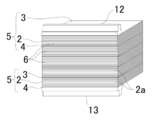
- FIG. 2 is a diagram showing an example of a paper alignment process in which a bundle of one book is sandwiched between a front cover and a back cover in the paper alignment process, following FIG. 1;
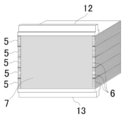
- FIG. 3 is a view showing an example of a paper alignment process of stacking a plurality of bundles of one book shown in FIG. 2 and aligning the bundle of a plurality of books. It is a figure which shows an example of the 1st application
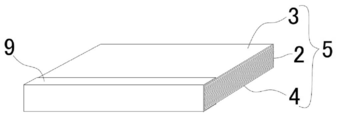
- FIG. 6 is a perspective view of a cross-wound wirelessly bound booklet as an example of a booklet bound by the method for binding a wirelessly bound booklet according to the present invention.
- FIG. 7 is a cross-sectional view of the perfect bound booklet shown in FIG.
- FIG. 1 is a view for explaining an example of a method for forming a bound booklet of the present invention.
- the method of the present invention for binding a bound booklet includes a paper folding process, a pressing process (see FIG. 1A), a paper aligning process (see FIGS. 1B and 1C), and 1 includes the respective steps of the adhesive application step (see FIG. 1 (d)), the second adhesive application step (see FIG. 1 (e)), and the drying step.
- the paper that composes the text 2 can be used without particular limitation, regardless of the type, regardless of the type of booklet, such as magazine, notebook (notebook), paperback book, brochure, photo book etc. .
- Specific examples of such paper include non-coated printing paper such as advanced printing paper, intermediate printing paper, low grade printing paper and thin printing paper; fine coated printing paper; art paper, coated paper, lightweight coated paper etc.
- the basis weight of the paper there is also no particular restriction on the basis weight of the paper, and for example, one having a range of 40 to 150 g / m 2 can be used.
- the booklet to be bound is a notebook
- the sheet may or may not be printed.
- bookbinding it is common practice to print on a base paper having a plurality of printing surfaces in advance and cut it into a sheet of a predetermined size prior to the paper folding process.
- the grid graduations may be continuously printed on the print area in the middle of the sheet, including the gutter portions on the left and right pages of the spread when it is a signature (described later). it can.
- the front cover 3 and the back cover 4 conventionally known various types of paper used for a perfect binding booklet can be used. Specifically, coated printing paper such as art paper, coated paper, light weight coated paper, etc .; special printing paper such as color high quality paper can be used. There is no particular limitation on the basis weight of the cover 3 and the back cover 4 and, for example, one having a range of 80 to 300 g / m 2 can be used.
- the size of the booklet 1 to be bound is that the cover 3 and the back cover 4 are cut off by cosmetic cutting (finishing cutting) at the margins of the top, bottom, and edge of the booklet 1 in the final step of bookbinding. It has a size slightly larger than that.
- Paper Folding Process In the paper folding process, a sheet slightly larger than the area twice as large as the finished size of a booklet to be bound is folded in two for each leaf to obtain a plurality of signatures.
- the size of the paper is set to be slightly larger than the area twice as large as the finish size, because finally the margins of the top, bottom and fore edge are cut off by finish cutting. This process can be performed elsewhere and may be to receive a bundle 2 of multiple signatures.
- FIG. 1 shows an example of this pressing process.
- the bundle of signatures is provided with pressing means 10, 11 at the thickened portion of the fold so as to sandwich it in the thickness direction, and the fold portion of the bundle of signatures is pressed .
- the pressure at this time is not particularly limited as long as it is 1.5 ton or more and within a common sense range (up to about 5 ton), and by pressing the fold portion of the bundle of signatures in the pressing process, the bundle of signatures It is important to make the heights of the crease side and the fore-edge side substantially equal. It is very important to go through this pressing process in that one half sheet can be cut cleanly from any page of the booklet after bookbinding.
- the bundle 2 of a predetermined number of signatures obtained in the paper folding step is sandwiched between the cover 3 and the back cover 4 so that the bundle 5 of one book is folded. create.
- the number of signatures refers to the number of documents divided from a bundle of a plurality of signatures.
- the signatures are arranged in a predetermined editing order by a collation operation (either hand collation or machine collation), and indicate the number obtained by overlapping. .
- the number of the signatures included in the bundle 2 is only illustrated appropriately, and the number is not particularly limited.
- First application step A plurality of bundles of one volume or a plurality of bundles of five, 5, 5,...
- the first adhesive 7 is applied to a substantially rectangular middle region excluding approximately 5 to 10 mm from the upper and lower edges on the back surface 6 of the bundle 5, 5, 5,... (See FIG. 3).
- the adhesive 7 as a cold glue adhesive, the adhesive itself becomes flexible by curing, particularly an acrylic copolymer (60 to 70% by weight (based on the total amount of adhesive)
- An acrylic copolymer emulsion adhesive (acrylic resin-based emulsion adhesive) in which the non-volatile component) is suspended as a main component in water can be suitably used.
- the adhesive may contain, for example, a trace amount of methyl methacrylate or vinyl acetate.
- MB adhesive 22-686 (made by Hisao Matsumoto Co., Ltd.) can be mentioned.
- This adhesive should be used as it is at the time of purchase and should be used without dilution, and it is excellent in coating workability in that respect, and has the feature of exhibiting high adhesiveness while having flexibility after curing. ing.
- the viscosity of the first adhesive 7 largely changes depending on the components and the use environment conditions, so it can not be said in general, but for example, the nominal viscosity (25 In terms of ° C), it seems that about 13000 mPa ⁇ s will be a standard.
- the adhesive is not limited to the acrylic resin-based emulsion adhesive as long as it is an adhesive that exhibits substantially the same flexibility and adhesiveness, and can be used for the bookbinding method of the present invention without particular limitation.
- the conventionally well-known methods such as roller coating and brush coating, are employable.
- the application amount or coating thickness of the first adhesive 7 is not particularly limited as long as it is applied in layers so as to minimize unevenness visually on the back surface 6 of a bundle of plural volumes, but as a rough indication of the application amount Is considered to be set in the range of about 200 to 550 g, preferably 300 to 500 g, more preferably 350 to 450 g in terms of 1 m 2 .
- the first adhesive 7 is dried and cured for about 0.5 to 2.5 hours, preferably for 1 to 2 hours, with the back of the multi-volume bundle applied.
- the drying time of the first adhesive 7 can be appropriately set within the above range in consideration of the working efficiency.
- the drying may be performed using a conventionally known device such as a drier or the like, but it is sufficient to stand still in a room or the like. By drying in this manner for a while, the surface of the adhesive 7 is in a cured state so as not to touch it with a finger and adhere to the finger.
- the first adhesive 7 may be divided and applied to the middle area of the rectangle divided into two times, undercoating and overcoating.
- the primer application when the surface is cured as described above, it is preferable to apply an overcoat in a layered manner so as to cover the entire surface of the primer.
- the drying time of the top coat can also be set to the same extent as that of the base coat.
- the reinforcing material can be laid on the surface after priming and before top coating.
- the primer and the top coat may be of the same kind or of different kinds. For drying, a conventionally known device such as a drier can be used, but it may be left standing and dried in a room or the like.
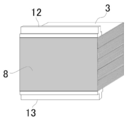
- the entire surface including the application surface of the first adhesive 7 is provided on the back surface 6 of the bundle of a plurality of volumes pressed by the pressing means 12 and 13.
- the second adhesive 8 is applied to the As the second adhesive 8, various adhesives known in the art can be used without particular limitation, as long as the adhesive exhibits high adhesiveness by curing.
- adhesives containing copolymers of these components and the like can be mentioned. .
- These adhesives preferably also contain 40 to 65% by weight, preferably 45 to 60% by weight, more preferably 45 to 55% by weight, based on the total amount of the form, as a non-volatile component.
- the second adhesive 8 is in the range of such volatile content, the adhesion strength at the initial and after solidification is improved, and as a result, the first adhesive layer and the bundle of plural volumes 5, 5, 5, This is because high adhesion with the upper and lower end regions of the back surface 6 can be obtained.
- an aqueous emulsion adhesive containing an ethylene-vinyl acetate copolymer or a vinyl acetate / acrylic copolymer as a main component, an emulsion adhesive in which these two copolymers coexist, etc. can be particularly suitably used.
- MB Adhesive 7K No. M made by Hisao Matsumoto Co., Ltd.
- this adhesive contains 53.0% by weight of ethylene vinyl acetate copolymer and vinyl acetate / acrylic copolymer, and this and isopropyl alcohol as a minor component (containing Of 0.2 wt%) and vinyl acetate (content of 0.3 wt%) are suspended in water (content of 46.5 wt%) (all of the above-mentioned contents are all adhesive To 100% by weight).
- This adhesive is preferably used without dilution as it is purchased, and in that respect it is excellent in coating workability and is characterized in that it exhibits high adhesion after curing.
- the viscosity of the second adhesive 8 largely changes depending on the components and the use environment conditions, so it can not be generally said.
- the nominal viscosity (30 ° C.) is described as 8000 mPa ⁇ s, so the viscosity of the second adhesive 8 is It is believed that this nominal viscosity is roughly a guide.
- the method of applying the second adhesive 8 is not particularly limited, and in the same manner as in the case of the first adhesive 7, conventionally known methods such as roller coating and bar coating as well as conventionally known methods such as roller coating and brush coating It may be a coating method using various coating machines or the like.
- the second adhesive 8 includes the application surface of the first adhesive 7 as well as the back surface 6 of the bundle 5, 5. Apply to the entire surface of At this time, in the region where the first adhesive 7 was not applied, the coating thickness of the second adhesive 8 was increased, and was substantially equal to the total application thickness coated on the application surface of the first adhesive 7. It is important to apply so as to obtain a coating thickness of
- the application amount of the second adhesive 8 is not particularly limited as long as it is applied in layers so that the application thickness of the entire back surface 6 of a bundle of a plurality of volumes is as similar as possible visually. As a rough indication of the coating amount, it may be better to set in the range of about 200 to 450 g, preferably 220 to 400 g, more preferably 240 to 350 g in terms of 1 m 2 .
- the second adhesive 8 is dried and cured.
- the drying time can be appropriately determined in consideration of the convenience and efficiency of operation, etc., and can be referenced to about 1 to 3 hours (preferably 1 to 2.5 hours) or more as a standard. . Therefore, from the viewpoint of work efficiency, for example, if it is preferable to leave it all day and night, it does not matter.
- a conventionally known device such as a dryer may be used, or it may be left standing indoors or the like. By drying in this manner, the surface of the adhesive 8 is sufficiently hardened by touching it with a finger.
- the predetermined drying time for the second adhesive 8 has passed, the bundle 5 for one volume is cut off from the plurality of volumes of the bundle 5, 5, 5,.
- finishing binding can be performed on one bundle 5 which has been separated, it is also possible to complete the binding of the bound booklet, but the back of one bundle 5 and the outer surface of the gutter portion of the cover 3 and the back cover 4 It is also possible to apply a strip-shaped bookbinding cloth along the back surface to finish and cut it so as to cover. As a result, as shown in FIG. 6, bookbinding of the cross-wound wirelessly bound booklet 1 is completed.
- the method for forming a perfect bound booklet according to the present invention has the following three configurations.
- (1) The signatures making up the text 2 are further pressed in the press process at the fold made in the paper folding process.
- (2) Using the first adhesive that causes the adhesive to exhibit flexibility by curing, this is applied to the middle area excluding the upper and lower end areas on the back of a bundle of one book, (3) Before the first adhesive layer was sufficiently dried and cured, a second adhesive showing high adhesiveness was applied to the first adhesive layer and the upper and lower end regions.
- the bookbinding method of the present invention makes it possible to book a wirelessly bound booklet having excellent features as described later.
- the bookbinding method of a bound booklet according to the present invention can be applied to bookbinding of various bound booklets such as books such as paperbacks and notebooks (notebook), but particularly the booklet such as a notebook of about 30 to 300 sheets. It can be effectively applied to bookbinding.
- the embodiment of the method for bookbinding of a bound booklet according to the present invention has been described taking a cross-wound bound booklet as an example, but the present invention is not limited to the binding of such a cross-wound booklet.
- it is also applicable to a walnut bookbinding that wraps the text by a walnut cover including a cover and a back cover.
- the cover and the back cover are disposed on both sides with a band-like portion corresponding to the spine cover at the middle to form a walnut cover integrally formed.
- the walnut binding can be performed by bonding the back cover portion of the walnut cover to the back of the text.
- the body may be wrapped with the walnut cover, and the walnut cover and the body may be bonded by curing the second adhesive 8.
- FIG. 6 is a perspective view of a cross-wound wirelessly bound booklet as an example bound by the above-described method for binding a wirelessly bound booklet according to the present invention
- FIG. 7 is a case where the cross-rolled booklet shown in FIG. Shows a cross-sectional view of
- the same reference numerals are used for the respective parts in common with the respective drawings in FIGS. 1 to 6, and the description of the same matters as described above is omitted.
- a wirelessly bound booklet 1 obtained by the bookbinding method of the present invention is a bundle of a single book obtained by bundling a body 2 of a predetermined number of sheets, a cover 3, a back cover 4 and these.
- the flexibility (elasticity) of the adhesive layer 7 is further increased by using the first adhesive 7, and the movement of the half flapping of any of the signatures constituting the text 2 I guess that the degree of freedom has improved.
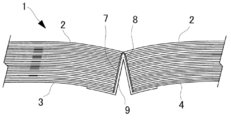
- the second adhesive layer 8 showing high adhesiveness so as to cover the first adhesive layer 7, as shown in FIG. 7, when the booklet (text) is opened at any page.
- the adhesive layer (7, 8) is forcibly bent, with which the individual anti-percussions (signatures) of the left and right pages fixed substantially vertically to the adhesive layer (7, 8) fall horizontally,
- the first adhesive layer 7 is provided only in the middle area of the back of the bundle 2 of one book, and only the second adhesive layer 8 is arranged in the upper and lower end areas, so Only the side or ground end is separated from the second adhesive layer 8 and easier to cut than the middle area, and the individual signatures are further crushed in the pressing step. It is considered that because it has become, it becomes possible to cut out a half patter along the crease from the above-mentioned cut.
- the wireless binding booklet bound by the bookbinding method of the present invention exhibits a spreadability of about 180 degrees, when the text is opened on any page, the left page continues from the left page to the bottom page and from the bottom page to the right page. It becomes possible to form a printed area. For example, a grid can be printed on this print area. In the case of a booklet printed with such a ruled scale, there is an advantage that data can be plotted for a longer period of time than those printed with the conventional one-page-by-square scale. In addition, since the double-binding booklet of the present invention has good spreadability, when copying an optional spread, it is possible to obtain a clean copy without soiling the part of the gutter as in the conventional double-binding booklet. Can.
- a notebook which is a perfect bound booklet according to the present invention, was produced as shown in FIG.
- the size of this notebook is B5.
- the text is composed of 30 sheets by bundling signatures each obtained by folding 15 pieces of high-quality paper (70 g / m 2 in size) slightly larger in size than the B4 version.
- Each section has a 1 mm square grid printed in the central region including the fold so as to be symmetrical with respect to the fold.
- the margin between this printed portion and the three sides excluding the fold in the signature was about 20 mm.
- high-quality paper 100 g / m 2 was used as a cover and a back cover.
- Each of the text, the cover and the back cover is slightly larger than the B5 size in preparation for final makeup cutting (finish cutting).
- a bundle of one volume is made by sandwiching the text between the front cover and the back cover, and 100 copies of this are stacked (a bundle of multiple volumes) (the bundle of multiple volumes is folded by the pressing means) Pressure in the thickness direction (pressure 1.5 tons). The pressure is released and pressed so as not to move across a bundle of multiple volumes, and the first adhesive is layered in the middle region excluding 5 mm from each edge of the top and bottom on the back of the multiple volume bundle It was primed.
- the first adhesive manufactured by Matsumoto Hisao Co., Ltd., trade name: MB adhesive 22-686 (acrylic copolymer emulsion adhesive) was used as it was (stock solution).
- the application amount of the first adhesive was 34 g of adhesive per coated surface obtained by overlapping 100 copies of one notebook (3 mm in thickness, 280 mm in height). 34g, a 1 m 2 per 405 g / m 2. The drying time of the first adhesive was 1.5 hours.
- a second adhesive is applied to the entire back surface of the bundle of plural volumes.
- the second adhesive used is Matsumoto Hisao Co., Ltd., trade name: MB bonded 7K No. M (vinyl acetate / acrylic copolymer, ethylene / vinyl acetate copolymer aqueous emulsion adhesive), It was used as it was (stock solution).
- a thick coating is applied to the portion where the first adhesive is not applied on the top and bottom end regions of the back of the bundle of plural volumes, and the total application thickness is substantially the same as the intermediate region applied with the first adhesive.
- the amount of the second adhesive used was 23 g of adhesive per coated surface obtained by overlapping 100 copies of one notebook (3 mm thick, 100 mm), so the calculation was 0.23 g per one , a 1 m 2 per 274 g / m 2. After that, a bundle of a plurality of volumes was left to stand overnight to make the second adhesive dry. Then, each bundle of one book was cut off, a bookbinding cloth was attached to the back of each bundle, and finishing and cutting was further performed, and bookbinding of the cross-wound B5 version wirelessly bound notebook was completed.
Landscapes
- Engineering & Computer Science (AREA)
- Mechanical Engineering (AREA)
- Folding Of Thin Sheet-Like Materials, Special Discharging Devices, And Others (AREA)
- Adhesives Or Adhesive Processes (AREA)
- Packages (AREA)
- Credit Cards Or The Like (AREA)
Abstract
Le problème décrit par la présente invention est de fournir un procédé de reliure destiné à un livret relié par collage permettant de supprimer proprement de la lézarde une ou plusieurs sections ou pages de pliage arbitraires d'un texte, tout en offrant une excellente aptitude à l'étalement. La solution de la présente invention porte sur un procédé de reliure destiné à un livret relié par collage, lequel procédé comprend : une étape de pliage d'une feuille en deux pour obtenir une pluralité de sections de pliage ; une étape de mise sous pression des parties de pliage de la pluralité de sections de pliage dans le sens de l'épaisseur de cette dernière ; une étape d'agencement d'un paquet formant un livret constitué d'un nombre prescrit de sections de pliage correspondant à un texte, à une page de couverture, et à une couverture arrière, ou un paquet formant plusieurs livrets constitué d'une pluralité de paquets formant un livret empilés les uns sur les autres ; une étape d'application d'une couche d'un premier adhésif qui présente une flexibilité lorsqu'il est durci sur une région intermédiaire du dos du paquet formant un livret ou du paquet formant plusieurs livrets qui mesure de 5 à 10 mm des bords supérieur et inférieur de ce dernier ; une étape, après avoir laissé reposer la première couche adhésive pendant un temps de séchage prescrit, d'application d'un second adhésif sur toute une surface de la surface arrière y compris les parties non recouvertes par le premier adhésif ; et une étape de séchage et de durcissement du second adhésif pendant un temps de séchage prescrit.
Priority Applications (7)
| Application Number | Priority Date | Filing Date | Title |
|---|---|---|---|
| CN201780044215.5A CN109937145B (zh) | 2017-10-17 | 2017-10-17 | 无线装订册子的装订方法 |
| PCT/JP2017/037554 WO2019077678A1 (fr) | 2017-10-17 | 2017-10-17 | Procédé de reliure destiné à un livret relié par collage |
| ES17929075T ES2902742T3 (es) | 2017-10-17 | 2017-10-17 | Método de encuadernación para un cuadernillo encuadernado con adhesivo |
| KR1020197005392A KR20200068609A (ko) | 2017-10-17 | 2017-10-17 | 무선철 책자의 제본 방법 |
| EP17929075.4A EP3711967B1 (fr) | 2017-10-17 | 2017-10-17 | Procédé de reliure destiné à un livret relié par collage |
| JP2018503817A JP6315534B1 (ja) | 2017-10-17 | 2017-10-17 | 無線綴じ冊子の製本方法 |
| US16/340,821 US10737524B2 (en) | 2017-10-17 | 2017-11-17 | Binding method of perfect-bound booklet |
Applications Claiming Priority (1)
| Application Number | Priority Date | Filing Date | Title |
|---|---|---|---|
| PCT/JP2017/037554 WO2019077678A1 (fr) | 2017-10-17 | 2017-10-17 | Procédé de reliure destiné à un livret relié par collage |
Publications (1)
| Publication Number | Publication Date |
|---|---|
| WO2019077678A1 true WO2019077678A1 (fr) | 2019-04-25 |
Family
ID=62069366
Family Applications (1)
| Application Number | Title | Priority Date | Filing Date |
|---|---|---|---|
| PCT/JP2017/037554 Ceased WO2019077678A1 (fr) | 2017-10-17 | 2017-10-17 | Procédé de reliure destiné à un livret relié par collage |
Country Status (7)
| Country | Link |
|---|---|
| US (1) | US10737524B2 (fr) |
| EP (1) | EP3711967B1 (fr) |
| JP (1) | JP6315534B1 (fr) |
| KR (1) | KR20200068609A (fr) |
| CN (1) | CN109937145B (fr) |
| ES (1) | ES2902742T3 (fr) |
| WO (1) | WO2019077678A1 (fr) |
Families Citing this family (2)
| Publication number | Priority date | Publication date | Assignee | Title |
|---|---|---|---|---|
| CN110978852B (zh) * | 2019-12-25 | 2021-05-04 | 郑中涛 | 一种散页旧纸的装订机器 |
| CN115008923A (zh) * | 2022-07-04 | 2022-09-06 | 吴新平 | 一种易单撕纸张制本方法 |
Citations (5)
| Publication number | Priority date | Publication date | Assignee | Title |
|---|---|---|---|---|
| US4184218A (en) * | 1976-12-21 | 1980-01-22 | The Research Association For The Paper And Board, Printing And Packaging Industries | Bookbinding |
| JPS5743362B2 (fr) | 1973-09-14 | 1982-09-14 | ||
| JPS59207293A (ja) * | 1983-05-11 | 1984-11-24 | ダイニツク株式会社 | 簡易製本方法 |
| JP2011126020A (ja) * | 2009-12-15 | 2011-06-30 | Dainippon Printing Co Ltd | 糊付け方法及び装置 |
| JP2014213597A (ja) * | 2013-04-30 | 2014-11-17 | 理想科学工業株式会社 | 製本装置 |
Family Cites Families (16)
| Publication number | Priority date | Publication date | Assignee | Title |
|---|---|---|---|---|
| US3423107A (en) * | 1967-05-10 | 1969-01-21 | Illinois Adhesive Products Co | Method of binding books |
| DE1817490C3 (de) * | 1968-12-21 | 1972-11-02 | Ehlermann Dipl Ing Hans | Klebebindung |
| DE1961040C3 (de) * | 1969-12-05 | 1979-10-18 | Mappei-Organisationsmittel Gmbh, 5600 Wuppertal | Sammel- und Ablegemappe für Schriftstücke o.dgl |
| JPS4836911U (fr) | 1971-09-06 | 1973-05-04 | ||
| US4496617A (en) * | 1983-06-01 | 1985-01-29 | Parker Kevin P | Adhesive binding strip |
| GB8409015D0 (en) * | 1984-04-06 | 1984-05-16 | Eschem Ltd | Binding |
| US4960295A (en) * | 1988-09-27 | 1990-10-02 | Eschem Inc. | Two-shot hot-melt bookbinding |
| US5156510A (en) * | 1989-12-05 | 1992-10-20 | Canon Kabushiki Kaisha | Bookbinding cover |
| US5672030A (en) * | 1996-01-02 | 1997-09-30 | Berryville Graphics | Method of making books |
| US6685416B2 (en) * | 2001-07-11 | 2004-02-03 | Dynic Corporation | Bookbinding device and method |
| GB2377670B (en) * | 2001-07-20 | 2003-07-30 | Kenneth Johnson | A notebook |
| JP3769260B2 (ja) | 2002-12-12 | 2006-04-19 | 日宝綜合製本株式会社 | 製本方法およびホットメルト接着性離型剤 |
| JP3167600U (ja) | 2010-12-20 | 2011-05-12 | 有限会社シュトゥッコ | 開きのよい無線綴じ本 |
| JP2016002717A (ja) * | 2014-06-17 | 2016-01-12 | 有限会社中村印刷所 | 無線綴じ冊子の製本方法 |
| JP5743362B1 (ja) * | 2014-11-27 | 2015-07-01 | 有限会社中村印刷所 | 無線綴じ冊子の製本方法 |
| US9855782B2 (en) * | 2016-01-19 | 2018-01-02 | Lsc Communications Us, Llc | De-collatable bindings and methods of producing the same |
-
2017
- 2017-10-17 KR KR1020197005392A patent/KR20200068609A/ko not_active Withdrawn
- 2017-10-17 EP EP17929075.4A patent/EP3711967B1/fr active Active
- 2017-10-17 ES ES17929075T patent/ES2902742T3/es active Active
- 2017-10-17 CN CN201780044215.5A patent/CN109937145B/zh not_active Expired - Fee Related
- 2017-10-17 WO PCT/JP2017/037554 patent/WO2019077678A1/fr not_active Ceased
- 2017-10-17 JP JP2018503817A patent/JP6315534B1/ja active Active
- 2017-11-17 US US16/340,821 patent/US10737524B2/en active Active
Patent Citations (5)
| Publication number | Priority date | Publication date | Assignee | Title |
|---|---|---|---|---|
| JPS5743362B2 (fr) | 1973-09-14 | 1982-09-14 | ||
| US4184218A (en) * | 1976-12-21 | 1980-01-22 | The Research Association For The Paper And Board, Printing And Packaging Industries | Bookbinding |
| JPS59207293A (ja) * | 1983-05-11 | 1984-11-24 | ダイニツク株式会社 | 簡易製本方法 |
| JP2011126020A (ja) * | 2009-12-15 | 2011-06-30 | Dainippon Printing Co Ltd | 糊付け方法及び装置 |
| JP2014213597A (ja) * | 2013-04-30 | 2014-11-17 | 理想科学工業株式会社 | 製本装置 |
Non-Patent Citations (1)
| Title |
|---|
| See also references of EP3711967A4 |
Also Published As
| Publication number | Publication date |
|---|---|
| JP6315534B1 (ja) | 2018-04-25 |
| CN109937145B (zh) | 2021-07-23 |
| EP3711967B1 (fr) | 2021-12-08 |
| US10737524B2 (en) | 2020-08-11 |
| US20200114676A1 (en) | 2020-04-16 |
| ES2902742T3 (es) | 2022-03-29 |
| JPWO2019077678A1 (ja) | 2019-11-14 |
| EP3711967A4 (fr) | 2021-01-27 |
| CN109937145A (zh) | 2019-06-25 |
| KR20200068609A (ko) | 2020-06-15 |
| EP3711967A1 (fr) | 2020-09-23 |
Similar Documents
| Publication | Publication Date | Title |
|---|---|---|
| JP2521414B2 (ja) | 加圧綴じされた多ペ―ジ小冊子とその製造方法 | |
| KR101924680B1 (ko) | 낱장들로 된 번들을 제본하기 위한 방법과, 이 낱장들로 된 번들을 형성하기 위한 낱장들로 된 번들, 방법 및 장치 | |
| JP6315534B1 (ja) | 無線綴じ冊子の製本方法 | |
| JP5743362B1 (ja) | 無線綴じ冊子の製本方法 | |
| US20040240965A1 (en) | Systems and methods of attaching a cover to a text body | |
| US6428260B1 (en) | Bookbinding system and method | |
| TWI642559B (zh) | 用於結合紙片材之捆包的方法、製備紙片材之捆包之方法及製備具有結合脊的書本或卷宗之方法 | |
| JP6279538B2 (ja) | 製本方法 | |
| JP2020192710A (ja) | 糸綴じ並製本の製本方法 | |
| US20070085321A1 (en) | Interior page structure of a book | |
| US8590938B2 (en) | Environmentally friendly binding of calendars | |
| JP2016002717A (ja) | 無線綴じ冊子の製本方法 | |
| JP2003220774A (ja) | 中綴じ製本方法 | |
| JP2004160664A (ja) | 二つ折り製本方法及びその製本装置 | |
| KR20160148373A (ko) | 재접착 가능 패턴을 갖는 노트 | |
| JP3461139B2 (ja) | 分冊可能本の製本方法 | |
| JP6732385B2 (ja) | 上製本及びその製造方法 | |
| JP2011161900A (ja) | 冊子の製造方法 | |
| JP2002307861A (ja) | デジタル印刷のための接合エレメント及び接合装置 | |
| JP2676332B2 (ja) | 接着剤付表紙 | |
| JP3091391U (ja) | 製本用熱溶解帯 | |
| JPS632798B2 (fr) | ||
| JPH0342598B2 (fr) | ||
| JPH0342597B2 (fr) | ||
| JPS60109900A (ja) | 中綴本の製本方法および製本装置 |
Legal Events
| Date | Code | Title | Description |
|---|---|---|---|
| ENP | Entry into the national phase |
Ref document number: 2018503817 Country of ref document: JP Kind code of ref document: A |
|
| 121 | Ep: the epo has been informed by wipo that ep was designated in this application |
Ref document number: 17929075 Country of ref document: EP Kind code of ref document: A1 |
|
| NENP | Non-entry into the national phase |
Ref country code: DE |
|
| ENP | Entry into the national phase |
Ref document number: 2017929075 Country of ref document: EP Effective date: 20200518 |