WO2019077737A1 - Stratifié et balle de stratifiés - Google Patents
Stratifié et balle de stratifiés Download PDFInfo
- Publication number
- WO2019077737A1 WO2019077737A1 PCT/JP2017/037996 JP2017037996W WO2019077737A1 WO 2019077737 A1 WO2019077737 A1 WO 2019077737A1 JP 2017037996 W JP2017037996 W JP 2017037996W WO 2019077737 A1 WO2019077737 A1 WO 2019077737A1
- Authority
- WO
- WIPO (PCT)
- Prior art keywords
- dots
- protective film
- laminate
- film
- adhesive layer
- Prior art date
- Legal status (The legal status is an assumption and is not a legal conclusion. Google has not performed a legal analysis and makes no representation as to the accuracy of the status listed.)
- Ceased
Links
Images



Classifications
-
- B—PERFORMING OPERATIONS; TRANSPORTING
- B32—LAYERED PRODUCTS
- B32B—LAYERED PRODUCTS, i.e. PRODUCTS BUILT-UP OF STRATA OF FLAT OR NON-FLAT, e.g. CELLULAR OR HONEYCOMB, FORM
- B32B23/00—Layered products comprising a layer of cellulosic plastic substances, i.e. substances obtained by chemical modification of cellulose, e.g. cellulose ethers, cellulose esters, viscose
- B32B23/04—Layered products comprising a layer of cellulosic plastic substances, i.e. substances obtained by chemical modification of cellulose, e.g. cellulose ethers, cellulose esters, viscose comprising such cellulosic plastic substance as the main or only constituent of a layer, which is next to another layer of the same or of a different material
-
- B—PERFORMING OPERATIONS; TRANSPORTING
- B32—LAYERED PRODUCTS
- B32B—LAYERED PRODUCTS, i.e. PRODUCTS BUILT-UP OF STRATA OF FLAT OR NON-FLAT, e.g. CELLULAR OR HONEYCOMB, FORM
- B32B23/00—Layered products comprising a layer of cellulosic plastic substances, i.e. substances obtained by chemical modification of cellulose, e.g. cellulose ethers, cellulose esters, viscose
- B32B23/04—Layered products comprising a layer of cellulosic plastic substances, i.e. substances obtained by chemical modification of cellulose, e.g. cellulose ethers, cellulose esters, viscose comprising such cellulosic plastic substance as the main or only constituent of a layer, which is next to another layer of the same or of a different material
- B32B23/08—Layered products comprising a layer of cellulosic plastic substances, i.e. substances obtained by chemical modification of cellulose, e.g. cellulose ethers, cellulose esters, viscose comprising such cellulosic plastic substance as the main or only constituent of a layer, which is next to another layer of the same or of a different material of synthetic resin
-
- B—PERFORMING OPERATIONS; TRANSPORTING
- B32—LAYERED PRODUCTS
- B32B—LAYERED PRODUCTS, i.e. PRODUCTS BUILT-UP OF STRATA OF FLAT OR NON-FLAT, e.g. CELLULAR OR HONEYCOMB, FORM
- B32B27/00—Layered products comprising a layer of synthetic resin
- B32B27/06—Layered products comprising a layer of synthetic resin as the main or only constituent of a layer, which is next to another layer of the same or of a different material
-
- B—PERFORMING OPERATIONS; TRANSPORTING
- B32—LAYERED PRODUCTS
- B32B—LAYERED PRODUCTS, i.e. PRODUCTS BUILT-UP OF STRATA OF FLAT OR NON-FLAT, e.g. CELLULAR OR HONEYCOMB, FORM
- B32B27/00—Layered products comprising a layer of synthetic resin
- B32B27/06—Layered products comprising a layer of synthetic resin as the main or only constituent of a layer, which is next to another layer of the same or of a different material
- B32B27/08—Layered products comprising a layer of synthetic resin as the main or only constituent of a layer, which is next to another layer of the same or of a different material of synthetic resin
-
- B—PERFORMING OPERATIONS; TRANSPORTING
- B32—LAYERED PRODUCTS
- B32B—LAYERED PRODUCTS, i.e. PRODUCTS BUILT-UP OF STRATA OF FLAT OR NON-FLAT, e.g. CELLULAR OR HONEYCOMB, FORM
- B32B27/00—Layered products comprising a layer of synthetic resin
- B32B27/30—Layered products comprising a layer of synthetic resin comprising vinyl (co)polymers; comprising acrylic (co)polymers
- B32B27/302—Layered products comprising a layer of synthetic resin comprising vinyl (co)polymers; comprising acrylic (co)polymers comprising aromatic vinyl (co)polymers, e.g. styrenic (co)polymers
-
- B—PERFORMING OPERATIONS; TRANSPORTING
- B32—LAYERED PRODUCTS
- B32B—LAYERED PRODUCTS, i.e. PRODUCTS BUILT-UP OF STRATA OF FLAT OR NON-FLAT, e.g. CELLULAR OR HONEYCOMB, FORM
- B32B27/00—Layered products comprising a layer of synthetic resin
- B32B27/30—Layered products comprising a layer of synthetic resin comprising vinyl (co)polymers; comprising acrylic (co)polymers
- B32B27/304—Layered products comprising a layer of synthetic resin comprising vinyl (co)polymers; comprising acrylic (co)polymers comprising vinyl halide (co)polymers, e.g. PVC, PVDC, PVF, PVDF
-
- B—PERFORMING OPERATIONS; TRANSPORTING
- B32—LAYERED PRODUCTS
- B32B—LAYERED PRODUCTS, i.e. PRODUCTS BUILT-UP OF STRATA OF FLAT OR NON-FLAT, e.g. CELLULAR OR HONEYCOMB, FORM
- B32B27/00—Layered products comprising a layer of synthetic resin
- B32B27/32—Layered products comprising a layer of synthetic resin comprising polyolefins
-
- B—PERFORMING OPERATIONS; TRANSPORTING
- B32—LAYERED PRODUCTS
- B32B—LAYERED PRODUCTS, i.e. PRODUCTS BUILT-UP OF STRATA OF FLAT OR NON-FLAT, e.g. CELLULAR OR HONEYCOMB, FORM
- B32B27/00—Layered products comprising a layer of synthetic resin
- B32B27/36—Layered products comprising a layer of synthetic resin comprising polyesters
-
- B—PERFORMING OPERATIONS; TRANSPORTING
- B32—LAYERED PRODUCTS
- B32B—LAYERED PRODUCTS, i.e. PRODUCTS BUILT-UP OF STRATA OF FLAT OR NON-FLAT, e.g. CELLULAR OR HONEYCOMB, FORM
- B32B27/00—Layered products comprising a layer of synthetic resin
- B32B27/36—Layered products comprising a layer of synthetic resin comprising polyesters
- B32B27/365—Layered products comprising a layer of synthetic resin comprising polyesters comprising polycarbonates
-
- B—PERFORMING OPERATIONS; TRANSPORTING
- B32—LAYERED PRODUCTS
- B32B—LAYERED PRODUCTS, i.e. PRODUCTS BUILT-UP OF STRATA OF FLAT OR NON-FLAT, e.g. CELLULAR OR HONEYCOMB, FORM
- B32B3/00—Layered products comprising a layer with external or internal discontinuities or unevennesses, or a layer of non-planar shape; Layered products comprising a layer having particular features of form
- B32B3/02—Layered products comprising a layer with external or internal discontinuities or unevennesses, or a layer of non-planar shape; Layered products comprising a layer having particular features of form characterised by features of form at particular places, e.g. in edge regions
- B32B3/08—Layered products comprising a layer with external or internal discontinuities or unevennesses, or a layer of non-planar shape; Layered products comprising a layer having particular features of form characterised by features of form at particular places, e.g. in edge regions characterised by added members at particular parts
-
- B—PERFORMING OPERATIONS; TRANSPORTING
- B32—LAYERED PRODUCTS
- B32B—LAYERED PRODUCTS, i.e. PRODUCTS BUILT-UP OF STRATA OF FLAT OR NON-FLAT, e.g. CELLULAR OR HONEYCOMB, FORM
- B32B37/00—Methods or apparatus for laminating, e.g. by curing or by ultrasonic bonding
- B32B37/12—Methods or apparatus for laminating, e.g. by curing or by ultrasonic bonding characterised by using adhesives
-
- B—PERFORMING OPERATIONS; TRANSPORTING
- B32—LAYERED PRODUCTS
- B32B—LAYERED PRODUCTS, i.e. PRODUCTS BUILT-UP OF STRATA OF FLAT OR NON-FLAT, e.g. CELLULAR OR HONEYCOMB, FORM
- B32B38/00—Ancillary operations in connection with laminating processes
- B32B38/14—Printing or colouring
- B32B38/145—Printing
-
- B—PERFORMING OPERATIONS; TRANSPORTING
- B32—LAYERED PRODUCTS
- B32B—LAYERED PRODUCTS, i.e. PRODUCTS BUILT-UP OF STRATA OF FLAT OR NON-FLAT, e.g. CELLULAR OR HONEYCOMB, FORM
- B32B38/00—Ancillary operations in connection with laminating processes
- B32B38/16—Drying; Softening; Cleaning
- B32B38/164—Drying
-
- B—PERFORMING OPERATIONS; TRANSPORTING
- B32—LAYERED PRODUCTS
- B32B—LAYERED PRODUCTS, i.e. PRODUCTS BUILT-UP OF STRATA OF FLAT OR NON-FLAT, e.g. CELLULAR OR HONEYCOMB, FORM
- B32B7/00—Layered products characterised by the relation between layers; Layered products characterised by the relative orientation of features between layers, or by the relative values of a measurable parameter between layers, i.e. products comprising layers having different physical, chemical or physicochemical properties; Layered products characterised by the interconnection of layers
- B32B7/04—Interconnection of layers
- B32B7/12—Interconnection of layers using interposed adhesives or interposed materials with bonding properties
-
- B—PERFORMING OPERATIONS; TRANSPORTING
- B32—LAYERED PRODUCTS
- B32B—LAYERED PRODUCTS, i.e. PRODUCTS BUILT-UP OF STRATA OF FLAT OR NON-FLAT, e.g. CELLULAR OR HONEYCOMB, FORM
- B32B2255/00—Coating on the layer surface
- B32B2255/10—Coating on the layer surface on synthetic resin layer or on natural or synthetic rubber layer
-
- B—PERFORMING OPERATIONS; TRANSPORTING
- B32—LAYERED PRODUCTS
- B32B—LAYERED PRODUCTS, i.e. PRODUCTS BUILT-UP OF STRATA OF FLAT OR NON-FLAT, e.g. CELLULAR OR HONEYCOMB, FORM
- B32B2255/00—Coating on the layer surface
- B32B2255/26—Polymeric coating
-
- B—PERFORMING OPERATIONS; TRANSPORTING
- B32—LAYERED PRODUCTS
- B32B—LAYERED PRODUCTS, i.e. PRODUCTS BUILT-UP OF STRATA OF FLAT OR NON-FLAT, e.g. CELLULAR OR HONEYCOMB, FORM
- B32B2307/00—Properties of the layers or laminate
- B32B2307/40—Properties of the layers or laminate having particular optical properties
- B32B2307/412—Transparent
Definitions
- Such a process film has a basic structure having an adhesive layer having releasability on a substrate such as a plastic film, and, for example, a light diffusion film, a prism sheet, a polarizing film, a retardation film, a hard coat film They are also used in the production of optical films such as transparent conductive films.
- the adhesive film is bonded until the final process is completed even after the punching process. Therefore, the process film has come to be used not only as a process application but as a "process protection film” having a protective function.
- each optical film may be sent to the next process after being punched and laminating a plurality of sheets with the process protective film attached.
- means for forming a mat layer by chemical coating or the like, and means for embossing can be considered on the surface (rear surface) opposite to the adhesive layer of the process protective film.
- the optical film may be printed with information such as QR code (registered trademark) and a barcode for inspection and management, and when means for forming a mat layer and means for embossing are performed.
- QR code registered trademark
- barcode for inspection and management
- the planarity of the film is impaired, and when pasted to the optical film, there arises a problem that a defect such as mixing of air bubbles occurs.
- the present invention is devised in view of the above problems, and provides a laminate and a laminate bundle in which the process protective films do not adhere to each other when the process protective films satisfying the readability of information are laminated. To be an issue.
- the present invention relates to the following.
- a laminate comprising a first step protective film on one outermost layer of an adherend, and a second step protective film on the opposite outermost layer of the adherend
- the first step protective film has a first adhesive layer on one side of the first substrate, and is opposite to the side of the first substrate having the first adhesive layer. And the Oken smoothness of the opposite surface of the first substrate is less than 60 seconds, and the protective film for the second step is formed on the second substrate.
- a laminate comprising a second adhesive layer on one surface of the second substrate, and a surface opposite to the surface having the second adhesive layer of the second substrate is a matte surface.
- first substrate 11 it is preferable to use a plastic film of polyethylene terephthalate, polybutylene terephthalate, polyethylene naphthalate, polycarbonate, polyethylene, polypropylene, polystyrene, triacetyl cellulose, poly (meth) acrylate, polyvinyl chloride or the like.
- a polyethylene terephthalate film subjected to a stretching process, particularly a biaxial stretching process is preferred in that it is excellent in mechanical strength, dimensional stability and transparency.
- adhesion to the adhesive layer or the dot pattern is improved by subjecting the surface of the first substrate 11 to a corona discharge treatment or an easy adhesion treatment such as providing an easy adhesive layer.
- the thickness of the first substrate 11 is generally 12 to 500 ⁇ m, preferably 16 to 300 ⁇ m, more preferably 20 to 250 ⁇ m, and 25 to 200 ⁇ m from the viewpoint of handling. Is more preferred.
- the first adhesive layer 12 can be adhered to an adherend 30 such as an optical film such as a light diffusion film, a prism sheet, a polarizing film, a retardation film, a hard coat film, a transparent conductive film, etc. Any material that can be peeled off can be used without particular limitation.
- adherend 30 such as an optical film such as a light diffusion film, a prism sheet, a polarizing film, a retardation film, a hard coat film, a transparent conductive film, etc. Any material that can be peeled off can be used without particular limitation.
- the adhesive constituting the first adhesive layer 12 include acrylic adhesives, polyester adhesives, urethane adhesives, rubber adhesives, silicone adhesives, and the like. An acrylic adhesive is preferable from the viewpoint of contamination to the adherend 30 and cost.
- the thickness of the first adhesive layer 12 is preferably 1 to 100 ⁇ m, more preferably 5 to 75 ⁇ m, and still more preferably 10 to 50 ⁇ m.
- a film surface-treated with a release agent such as silicone, a polyethylene terephthalate film, etc. may be mentioned.
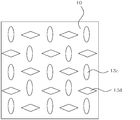
- the patterned dots 13 are formed on the surface of the first base 11 opposite to the surface having the first adhesive layer 12.
- the unevenness is formed on the entire surface of the film, so the readability of the information 31 such as a bar code provided on the adherend 30 is impaired.
- the flatness of a film is lost in embossing, when bonding together to an optical film, a bubble will be mixed and the workability at the time of bonding will fall.
- the pattern-like dots 13 as in the present invention since the dot patterns partially exist, the readability of the information 31 is not impaired.
- the dot pattern can reduce Oken type smoothness while being excellent in readability of information as compared with chemical coating and embossing, and can prevent adhesion. Moreover, even if it forms a dot pattern in the 1st base material 11, the workability of bonding to adherends 30, such as an optical film, does not fall like embossing.
- the shape of the dot 13 is not particularly limited, such as a circle, an ellipse, a square, a polygon, or an irregular shape.
- the pattern-like dots 13 are, for example, as shown in FIG. 2, a combination of circular dots 13a and square dots 13b, or as shown in FIG. 3, a combination of elliptical dots 13c and rhombus dots 13d. It may be a combination of different dot shapes.
- the pattern-like dots 13 may be a combination of similar dot shapes, such as different types of square dots 13e, 13f, 13g.
- the patterned dots 13 may have the same shape.
- the arrangement of the dots 13 may be arranged randomly, or may be arranged in a pattern with regularity, but in order to homogenize the in-plane adhesion prevention property and the readability of information, a regular pattern It is preferable to arrange the
- the Oken type smoothness of the surface having the pattern-like dots 13 is less than 60 seconds.
- the Oken type smoothness is preferably 50 seconds or less, more preferably 30 seconds or less, and still more preferably 20 seconds or less.
- the Oken type smoothness is preferably 10 seconds or more.
- the Oken type smoothness in the present invention can be measured according to JIS P8155: 2010.
- the length of the dot 13 is preferably 100 to 1200 ⁇ m, more preferably 300 to 1000 ⁇ m, and still more preferably 400 to 800 ⁇ m.
- dot length refers to the length of the longest line segment among the line segments connecting any two points on the bottom of the dot 13. For example, when the dots are circular, It means the diameter, and if the dot is oval, it means the major diameter, and if the dot is square, it means the length in the longitudinal direction.
- the area of the dot 13 is preferably 10 ⁇ 10 3 to 25 ⁇ 10 5 ⁇ m 2 , more preferably 30 ⁇ 10 3 to 23 ⁇ 10 5 ⁇ m 2 , and 40 ⁇ 10 3 to 20 ⁇ 10 5 More preferably, it is 2 ⁇ m.
- the area of the dot 13 is 10 ⁇ 10 3 ⁇ 10 5 ⁇ m 2 or more, the number of dots 13 for preventing double feeding can be reduced, and when it is 25 ⁇ 10 5 ⁇ m 2 or less, the resolution is improved. It is possible to reduce the influence on the information and make the readability of information better.
- “the area of the dot” refers to the area per unit of the dot 13.
- the height of the dots 13 is preferably 2 to 15 ⁇ m, and more preferably 6 to 10 ⁇ m. By setting the height of the dots 13 to 2 ⁇ m or more, transportability can be exhibited. Further, by setting the height of the dots 13 to 15 ⁇ m or less, adhesion can be easily prevented while the thickness is thin.
- the “dot height” refers to the height from the surface of the first substrate 11 to the top of the dot 13.
- the density of the dots 13 is preferably 5 to 1000 dots / cm 2 , more preferably 5 to 500 dots / cm 2 , still more preferably 10 to 200 dots / cm 2 , and 20 to 150 It is even more preferable that the number is 1 / cm 2 .
- the density of the dots 13 is 5 pieces / cm 2 or more, adhesion and double feeding can be prevented, and when the number is 1000 pieces / cm 2 or less, the visibility can be prevented from being impaired.
- Dots 13 are polyester resin, acrylic resin, acrylic urethane resin, polyester acrylate resin, polyurethane acrylate resin, epoxy acrylate resin, urethane resin, epoxy resin, polycarbonate resin, cellulose resin, acetal resin
- Thermoplastic resins such as resins, vinyl resins, polyethylene resins, polystyrene resins, polypropylene resins, polyamide resins, polyimide resins, melamine resins, phenol resins, silicone resins, fluorine resins, etc., thermosetting resins It is preferable to form from resin, ionizing radiation curable resin, etc. These resins may be used alone or in combination of two or more.
- thermosetting resins and ionizing radiation curable resins are preferable from the viewpoint of improving adhesion prevention.
- acrylic resins are preferable from the viewpoint of transparency, and among them, from the viewpoint of making adhesion prevention better, acrylic thermosetting resins and ionizing radiation curable resins are preferable.
- acrylic thermosetting resin include a combination of an acrylic polyol and an isocyanate-based curing agent.
- acrylic ionizing radiation curable resins include polyester acrylate resins, polyurethane acrylate resins and epoxy acrylate resins.
- the dots 13 may contain a matting agent.
- a matting agent By containing the matting agent, the adhesion preventing property can be further improved.
- matting agents include calcium carbonate, magnesium carbonate, barium sulfate, aluminum hydroxide, silica, kaolin, clay, inorganic particles such as talc, acrylic resin particles, polystyrene resin particles, polyurethane resin particles, polyethylene resin particles, benzoguanamine resin particles, Resin particles, such as an epoxy resin particle, are mentioned.
- silica is preferable from the viewpoint of the balance of performance such as dispersion and cost.
- the content of the matting agent is usually about 1 to 20 parts by mass with respect to 100 parts by mass of the resin component of the dots 13.
- the average particle size of the matting agent is usually about 5 to 15 ⁇ m.
- the second step protective film 20 has the second adhesive layer 22 on one side of the second base 21 and is opposite to the side of the second base 21 having the second adhesive layer 22.
- the side surface is the matte surface 23.
- the second substrate 21 it is preferable to use a plastic film of polyethylene terephthalate, polybutylene terephthalate, polyethylene naphthalate, polycarbonate, polyethylene, polypropylene, polystyrene, triacetyl cellulose, poly (meth) acrylate, polyvinyl chloride or the like.
- a polyethylene terephthalate film subjected to a stretching process, particularly a biaxial stretching process is preferred in that it is excellent in mechanical strength, dimensional stability and transparency.
- adhesion to the adhesive layer or the dot pattern is improved by subjecting the surface of the second base member 21 to an easy adhesion treatment such as corona discharge treatment or providing an easy adhesive layer.
- an easy adhesion treatment such as corona discharge treatment or providing an easy adhesive layer.
- the thickness of the second substrate 21 is generally 12 to 500 ⁇ m, preferably 16 to 300 ⁇ m, more preferably 20 to 250 ⁇ m, and more preferably 25 to 200 ⁇ m from the viewpoint of handleability. It is further preferred that
- the matte surface 23 can be formed by means of forming a matte layer on one surface of the second base material 21 by chemical coating or the like, by means of embossing, or the like.
- the matte layer by chemical coating is composed of a binder resin and a matting agent, and can be doubled as a hard coat layer by selecting the binder resin.
- a leveling agent, an ultraviolet light absorber, an antibacterial agent, and other additives may be added.
- the second adhesive layer 22 can be adhered to an adherend such as an optical film such as a light diffusion film, a prism sheet, a polarizing film, a retardation film, a hard coat film, a transparent conductive film, etc. If possible, it can be used without particular limitation.
- adherend such as an optical film such as a light diffusion film, a prism sheet, a polarizing film, a retardation film, a hard coat film, a transparent conductive film, etc. If possible, it can be used without particular limitation.
- the adhesive constituting the second adhesive layer 22 include acrylic adhesives, polyester adhesives, urethane adhesives, rubber adhesives, silicone adhesives, and the like. An acrylic adhesive is preferable from the viewpoint of contamination to the adherend 30 and cost.
- the thickness of the second adhesive layer 22 is preferably 1 to 100 ⁇ m, more preferably 5 to 75 ⁇ m, and still more preferably 10 to 50 ⁇ m.
- a release film on the first adhesive layer 12 and the second adhesive layer 22 in order to improve the handleability.
- a film surface-treated with a release agent such as silicone, a polyethylene terephthalate film, etc. may be mentioned.
- a separator Before adhering to the adherend 30, it is preferable to attach a separator to the surfaces of the first adhesive layer 12 and the second adhesive layer 22 in order to improve the handling property.
- the separator it is preferable to use a plastic film as in the case of the first base 11 and the second base 21 described above.
- the thickness of the separator is usually about 5 to 100 ⁇ m.
- an antistatic layer may be formed. By having the antistatic layer, peeling charge can be prevented and workability can be improved.
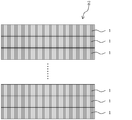
- the laminate bundle 2 according to the embodiment of the present invention is formed by laminating a plurality of laminates 1.
- the laminate 1 has the first process protective film 10 on one outermost layer of the adherend 30.
- the adhesion between two successive continuous laminates 1 can be suppressed, and a laminate is obtained. 1 can be aspirated individually and handled.
- ⁇ Arithmetic mean roughness Ra> A sample is prepared by laminating a polyester film (Lumirror T60, manufactured by Toray Industries, Inc.) with a thickness of 188 ⁇ m on the second adhesive layer of the second step protective film, and the side having the second adhesive layer of the sample is Arithmetic mean roughness Ra based on JIS B 0601: 1994 when the cutoff value is 0.8 mm for the surface on the opposite side (for example, mat surface) is a surface roughness measuring device (manufactured by Kosaka Research Institute Ltd., model number) It measured using "surf coder SE1700 alpha".
- Total ray transmittance For the protective film for the first step, the total light transmittance based on JIS K7361-1: 1997 was measured using a total light transmittance measurement machine (manufactured by Suga Test Instruments, model number “HZ-2”).
- a protective film for the first step is bonded to one side of an optical film (adherend), and 10 sheets of the protective film for the second step are bonded to the other side to form a laminate.
- the laminated film was moved, one by one, using a vacuum tool, with the optical film (adherend) having the process protective film.
- the one that could be lifted only was regarded as "o"
- the ones that were lifted were regarded as "x”.
- QR code registered trademark
- a transparent film adhered body
- a first process protective film was laminated thereon
- the product was placed on a flat surface so that the first process protective film faced upward.
- the readability of the QR code was evaluated with a mobile phone camera set 10 cm above. As a result, those which were read instantaneously were taken as “ ⁇ ”, those which took time for reading were taken as “ ⁇ ”, and those which could not be read were taken as “x”.
- Thermosetting resin (resin solid content 42%) 100 parts by mass (Toyokem Co., Ltd., gloss coat N varnish) Curing catalyst (resin solid content: 25%): 2.7 parts by weight (manufactured by Toyo Chem Co., CRY additive BC) Acrylic resin particles: 4 parts by mass (manufactured by Soken Chemical Co., Ltd., MX-300) -Methyl ethyl ketone ... 100 parts by mass
- Example 3 ⁇ Production of Protective Film for First Step>
- the length (diameter) of the circular dot is 250 ⁇ m
- the length of the square dot is 1200 ⁇ m.
- the height of the dots is changed to 8 ⁇ m, and the ratio of the dots to the total area of the side having the dots is changed to 28.0%, and the dot density is changed to 200 dots / cm 2.
- a protective film for the first step was obtained.
- Comparative Example 3 ⁇ Production of Protective Film for First Step> Example 1 except that the height of the dots is changed to 5 ⁇ m, the ratio of the dots to the total area of the side having the dots is changed to 9.0%, and the dot density is changed to 100 dots / cm 2 In the same manner as in 1, a protective film for the first step was obtained.
Landscapes
- Laminated Bodies (AREA)
- Adhesive Tapes (AREA)
Abstract
La présente invention concerne un stratifié (1) qui est obtenu en agençant un film protecteur (10) pour la première étape sur une couche la plus à l'extérieur d'une partie adhérée (30) et en agençant un film de protection (20) pour la seconde étape sur l'autre couche la plus à l'extérieur de la partie adhérée (30). Le film protecteur (10) pour la première étape est obtenu par agencement d'une première couche adhésive (12) sur une surface d'un premier substrat (11), tout en ayant des points (13) dans un motif sur une autre surface du premier substrat (11), ladite autre surface étant sur le côté inverse de la surface sur laquelle est disposée la première couche adhésive (12). L'autre surface du premier substrat (11) présente un lissé de type Oken de moins de 60 secondes. Le film protecteur (20) pour la seconde étape est obtenu par disposition d'une seconde couche adhésive (22) sur une surface d'un second substrat (21) ; et une autre surface du second substrat (21), ladite autre surface étant sur le côté inverse de la surface sur laquelle la seconde couche adhésive (22) est disposée, est une surface mate (23).
Priority Applications (3)
| Application Number | Priority Date | Filing Date | Title |
|---|---|---|---|
| JP2017563630A JP6335403B1 (ja) | 2017-10-20 | 2017-10-20 | 積層体及び積層体束 |
| CN201780003997.8A CN108698385B (zh) | 2017-10-20 | 2017-10-20 | 层叠体以及层叠体集束 |
| PCT/JP2017/037996 WO2019077737A1 (fr) | 2017-10-20 | 2017-10-20 | Stratifié et balle de stratifiés |
Applications Claiming Priority (1)
| Application Number | Priority Date | Filing Date | Title |
|---|---|---|---|
| PCT/JP2017/037996 WO2019077737A1 (fr) | 2017-10-20 | 2017-10-20 | Stratifié et balle de stratifiés |
Publications (1)
| Publication Number | Publication Date |
|---|---|
| WO2019077737A1 true WO2019077737A1 (fr) | 2019-04-25 |
Family
ID=62238943
Family Applications (1)
| Application Number | Title | Priority Date | Filing Date |
|---|---|---|---|
| PCT/JP2017/037996 Ceased WO2019077737A1 (fr) | 2017-10-20 | 2017-10-20 | Stratifié et balle de stratifiés |
Country Status (3)
| Country | Link |
|---|---|
| JP (1) | JP6335403B1 (fr) |
| CN (1) | CN108698385B (fr) |
| WO (1) | WO2019077737A1 (fr) |
Cited By (1)
| Publication number | Priority date | Publication date | Assignee | Title |
|---|---|---|---|---|
| WO2023027033A1 (fr) * | 2021-08-26 | 2023-03-02 | 富士フイルム株式会社 | Film de polyester, procédé de fabrication de film de polyester et film antiadhésif |
Families Citing this family (1)
| Publication number | Priority date | Publication date | Assignee | Title |
|---|---|---|---|---|
| JP7511687B2 (ja) * | 2021-08-06 | 2024-07-05 | パナック株式会社 | 接続体の製造方法及び接続体 |
Citations (5)
| Publication number | Priority date | Publication date | Assignee | Title |
|---|---|---|---|---|
| JP2008102271A (ja) * | 2006-10-18 | 2008-05-01 | Nitto Denko Corp | 表面保護フィルムおよび表面保護フィルム付き光学フィルム |
| JP2009051373A (ja) * | 2007-08-28 | 2009-03-12 | Sumiron:Kk | 車体保護フィルムおよび車体保護フィルムの粘着性の調整方法 |
| JP2015093972A (ja) * | 2013-11-14 | 2015-05-18 | パナック株式会社 | 工程用保護フィルム |
| JP2016088956A (ja) * | 2014-10-30 | 2016-05-23 | 株式会社倉本産業 | 加飾シートおよび加飾用粘着シート |
| JP2017035884A (ja) * | 2015-08-06 | 2017-02-16 | 東レ株式会社 | 二軸配向ポリプロピレンフィルム |
Family Cites Families (2)
| Publication number | Priority date | Publication date | Assignee | Title |
|---|---|---|---|---|
| CN103687720B (zh) * | 2011-08-11 | 2015-09-16 | 东丽株式会社 | 层叠体、透明导电性层叠体、接触面板、和层叠体的制造方法 |
| JP2017146492A (ja) * | 2016-02-18 | 2017-08-24 | リンテック株式会社 | 保護フィルム付き透明導電膜積層用フィルム、および透明導電性フィルムの製造方法 |
-
2017
- 2017-10-20 WO PCT/JP2017/037996 patent/WO2019077737A1/fr not_active Ceased
- 2017-10-20 JP JP2017563630A patent/JP6335403B1/ja active Active
- 2017-10-20 CN CN201780003997.8A patent/CN108698385B/zh active Active
Patent Citations (5)
| Publication number | Priority date | Publication date | Assignee | Title |
|---|---|---|---|---|
| JP2008102271A (ja) * | 2006-10-18 | 2008-05-01 | Nitto Denko Corp | 表面保護フィルムおよび表面保護フィルム付き光学フィルム |
| JP2009051373A (ja) * | 2007-08-28 | 2009-03-12 | Sumiron:Kk | 車体保護フィルムおよび車体保護フィルムの粘着性の調整方法 |
| JP2015093972A (ja) * | 2013-11-14 | 2015-05-18 | パナック株式会社 | 工程用保護フィルム |
| JP2016088956A (ja) * | 2014-10-30 | 2016-05-23 | 株式会社倉本産業 | 加飾シートおよび加飾用粘着シート |
| JP2017035884A (ja) * | 2015-08-06 | 2017-02-16 | 東レ株式会社 | 二軸配向ポリプロピレンフィルム |
Cited By (1)
| Publication number | Priority date | Publication date | Assignee | Title |
|---|---|---|---|---|
| WO2023027033A1 (fr) * | 2021-08-26 | 2023-03-02 | 富士フイルム株式会社 | Film de polyester, procédé de fabrication de film de polyester et film antiadhésif |
Also Published As
| Publication number | Publication date |
|---|---|
| JPWO2019077737A1 (ja) | 2019-11-14 |
| CN108698385B (zh) | 2019-12-31 |
| JP6335403B1 (ja) | 2018-05-30 |
| CN108698385A (zh) | 2018-10-23 |
Similar Documents
| Publication | Publication Date | Title |
|---|---|---|
| TW202300336A (zh) | 光學膜、積層體、偏光板、影像顯示裝置及偏光板之製造方法 | |
| KR102180281B1 (ko) | 전자 기기, 전자 기기용 케이싱 및 표면 보호판 | |
| JP6335403B1 (ja) | 積層体及び積層体束 | |
| JP2016113506A (ja) | 応力緩和層としてのシリコーンゴムフィルムおよびそれを有するフレキシブルデバイス | |
| JP2017087544A (ja) | 化粧シート、及び化粧板 | |
| US9133368B2 (en) | Adhesive sheet | |
| JP2018192738A (ja) | 機能性物品の製造方法、機能性転写基材および機能性物品 | |
| TW201348390A (zh) | 功能性黏著片 | |
| JP6540483B2 (ja) | タッチパネルペン用筆記シート、タッチパネル及び表示装置、並びにタッチパネルペン用筆記シートの選別方法 | |
| JP6097205B2 (ja) | 工程用保護フィルム | |
| TWI738481B (zh) | 附加飾積層體、光學積層體及撓性影像顯示裝置 | |
| JP6286014B2 (ja) | 工程用保護フィルム | |
| JP2020050756A (ja) | 透明粘着フィルム | |
| JPWO2015119049A1 (ja) | フィルムの搬送方法及び光学フィルムの製造方法 | |
| JP2016078245A (ja) | 透明電極用ハードコートフィルム | |
| JP2016091352A (ja) | 透明電極用ハードコートフィルム | |
| KR102379250B1 (ko) | 코팅층이 형성된 필름의 제조 방법 | |
| JP2010284947A (ja) | 離型フィルム、該離型フィルムを用いた偏光板用保護フィルム、および該偏光板用保護フィルムを用いた偏光板 | |
| CN116338841B (zh) | 一种带基材可碳带打印的逆反射片 | |
| JP5835532B1 (ja) | エッジライト型バックライト用反射フィルム及びそれを用いたバックライト | |
| JP2003208589A (ja) | Icカードおよびその製造方法 | |
| JP2004174918A (ja) | シートおよび記録物 | |
| JP6679855B2 (ja) | ディスプレイ用ハーフミラーフィルム | |
| JP2019155655A (ja) | 転写シート及び化粧板の製造方法 | |
| KR20200015215A (ko) | 패턴화된 이형필름 및 이를 포함하는 테이프 |
Legal Events
| Date | Code | Title | Description |
|---|---|---|---|
| ENP | Entry into the national phase |
Ref document number: 2017563630 Country of ref document: JP Kind code of ref document: A |
|
| 121 | Ep: the epo has been informed by wipo that ep was designated in this application |
Ref document number: 17929382 Country of ref document: EP Kind code of ref document: A1 |
|
| NENP | Non-entry into the national phase |
Ref country code: DE |
|
| 122 | Ep: pct application non-entry in european phase |
Ref document number: 17929382 Country of ref document: EP Kind code of ref document: A1 |