WO2019083041A1 - 調味料用原液、調味料発酵指標用木片、調味料製造用キット及び調味料の製造方法並びに調味料及び濃厚調味料 - Google Patents
調味料用原液、調味料発酵指標用木片、調味料製造用キット及び調味料の製造方法並びに調味料及び濃厚調味料Info
- Publication number
- WO2019083041A1 WO2019083041A1 PCT/JP2018/039991 JP2018039991W WO2019083041A1 WO 2019083041 A1 WO2019083041 A1 WO 2019083041A1 JP 2018039991 W JP2018039991 W JP 2018039991W WO 2019083041 A1 WO2019083041 A1 WO 2019083041A1
- Authority
- WO
- WIPO (PCT)
- Prior art keywords
- seasoning
- soy sauce
- content
- yeast
- liquid
- Prior art date
- Legal status (The legal status is an assumption and is not a legal conclusion. Google has not performed a legal analysis and makes no representation as to the accuracy of the status listed.)
- Ceased
Links
Images




Classifications
-
- A—HUMAN NECESSITIES
- A23—FOODS OR FOODSTUFFS; TREATMENT THEREOF, NOT COVERED BY OTHER CLASSES
- A23L—FOODS, FOODSTUFFS OR NON-ALCOHOLIC BEVERAGES, NOT OTHERWISE PROVIDED FOR; PREPARATION OR TREATMENT THEREOF
- A23L27/00—Spices; Flavouring agents or condiments; Artificial sweetening agents; Table salts; Dietetic salt substitutes; Preparation or treatment thereof
- A23L27/50—Soya sauce
-
- A—HUMAN NECESSITIES
- A23—FOODS OR FOODSTUFFS; TREATMENT THEREOF, NOT COVERED BY OTHER CLASSES
- A23V—INDEXING SCHEME RELATING TO FOODS, FOODSTUFFS OR NON-ALCOHOLIC BEVERAGES AND LACTIC OR PROPIONIC ACID BACTERIA USED IN FOODSTUFFS OR FOOD PREPARATION
- A23V2002/00—Food compositions, function of food ingredients or processes for food or foodstuffs
Definitions
- the present invention relates to a stock solution for seasonings useful as a stock solution for seasonings such as soy sauce and soy sauce-like seasonings.
- the present invention relates to wood pieces that serve as an indicator for carrying out yeast fermentation when producing a seasoning.
- the present invention relates to a kit and a method for easily producing a seasoning.
- the present invention relates to an excellent seasoning with a scent.
- the present invention relates to a thick seasoning having an umami taste and an excellent smell.
- soy sauce is prepared by inoculating and cultivating a mixture containing protein materials such as heat-denatured soybean and starchy materials such as wheat which has been gelatinized by heating and cultivating a seed meal containing koji mold.
- the obtained soy sauce koji is charged into a saline solution, and lactic acid fermentation and ripening are carried out to obtain soy sauce moromi mash, and then the obtained soy sauce moromi mash is yeast fermented and ripened to obtain ripening moromi mash, The resulting ripened moromi mash is subjected to a pressing treatment and a filtration treatment to obtain a raw soy sauce and then produced by burning the resulting raw soy sauce.
- soy sauce it is carried out continuously until the ripening taste is obtained from the soy sauce koji. That is, yeast fermentation etc. are performed by adding yeast etc. to soy sauce moromi mash obtained by lactic acid fermentation etc. from soy sauce koji.
- yeast fermentation is incorporated as part of the process in the above-described conventional soy sauce manufacturing method. Yeast fermentation is carried out by adding yeast to a fermentation stock solution for several weeks to several months.
- soy sauce tastes like soy sauce by containing 4-hydroxy-2 (or 5) -ethyl-5 (or 2) -methyl-3 (2H) -furanone (homofuraneol; HEMF) etc. It is lacking in the gorgeousness of the scent.
- soy sauce which has a fruity smell
- soy sauce is manufactured by mixing fruits, wine, etc., and its flavor is completely different from soy sauce.
- Patent Document 3 describes that by externally adding methyl fatty acid such as ethyl 2-methylbutanoate to soy sauce, a soy sauce-like seasoning having a fruity aroma can be obtained.
- amino acids in soy sauce include glutamic acid, glycine, lysine, alanine, aspartic acid and the like, among which a large amount of glutamic acid is contained.
- Glutamate and other amino acids are nitrogen compounds that bring umami to soy sauce. Therefore, the content of nitrogen compounds, that is, the total nitrogen content, is used as an indicator for the umami of soy sauce.
- amino acids in soy sauce are produced by the proteins contained in the raw material soybeans and wheat under the action of bacillus enzymes (proteases, peptidases, glutaminases, etc.).
- Re-charged soy sauce is produced by charging soy sauce koji into raw soy sauce and carrying out a koji making process using fermented soy sauce as feed water, and then fermenting and ripening with yeast.
- Re-charged soy sauce has a relatively high total nitrogen content.
- Patent Document 4 is a method for producing concentrated soy sauce characterized by adding soy sauce koji with saline solution, adding soy sauce and soy sauce koji during the fermentation and maturation process and after completion of lactic acid fermentation, and further ripening. Is described.
- Patent Document 5 describes a method in which a liquid juice obtained by squeezing soy sauce moromi mash in the initial stage of feeding is used as feed water, and soy sauce koji is added to and mixed with this, followed by fermentation and ripening by a conventional method.
- soy sauce brewing kits are known as those that can enjoy soy sauce brewing easily at home, all are kits containing soy sauce koji. It is still difficult to obtain soy sauce with high palatability at home using such soy sauce brewing kit, and there is a problem that wastes such as residue of soy sauce moromi are generated, and soy sauce brewing in home is general It is not something that
- the lactic acid fermented product obtained by subjecting soy sauce koji to lactic acid fermentation etc. can be used as a seasoning, since it contains a fermented ingredient of "moromi” defined in "Soy sauce quality indication standard" by Ministry of Agriculture, Forestry and Fisheries notification. .
- the lactic acid fermented product itself is difficult to use as a seasoning due to insoluble solids and the like.
- soy sauce brewing simple fermentation management methods such as fermentation management by Baume degree have not been known so far.
- simple fermentation management methods such as fermentation management by Baume degree have not been known so far.
- yeast fermentation to obtain a seasoning as a yeast fermented product in the home, one which can serve as an indicator of fermentation management for obtaining a seasoned with a stable flavor has been known so far.
- the first object to be solved by the invention is to provide a method for producing a complete assembly including a component and a seasoning.
- this invention makes it a 2nd subject which an invention tends to solve to provide the seasoning which has a fruity smell which can not be felt with conventional soy sauce although it has original taste of soy sauce.
- Patent Document 4 is a method in which soy sauce koji and soy sauce are added during fermentation or ripening with yeast in a usual method for producing soy sauce, and further ripening with yeast is carried out. According to the method described in Patent Document 4, a thick soy sauce having a total nitrogen content of 2 wt% or more is obtained.
- Patent Document 4 is a method of using a large amount of soy sauce produced by a conventional method for producing soy sauce, which is very uneconomical. Furthermore, according to the example described in Patent Document 4, the aroma of the inventive product is not much improved as compared to the re-charged soy sauce used as the control product. Therefore, concentrated soy sauce obtained by the method described in Patent Document 4 is likely to have a poor flavor inherent to soy sauce.
- this invention makes it a 3rd subject which an invention tends to solve to provide the liquid seasoning which is excellent in the original flavor of soy sauce, although it is rich in total nitrogen content, and its manufacturing method.
- the present inventors have accumulated earnest research in order to solve the above first problem, and trial and error of lactic acid fermentate suitable for being subjected to yeast fermentation and an original solution of yeast fermentation suitable for being subjected to yeast fermentation I repeated it. And finally, the undiluted
- the yeast fermentation liquid obtained by fermenting the undiluted solution for seasoning with yeast can be used as a seasoning itself without pressing etc., it can be used as a seasoning even in the middle of fermentation, and further it can be pressed There were no wastes such as That is, by using the above-mentioned stock solution for seasoning, seasoning having high palatability can be easily obtained even at home.
- the present inventors repeated trial and error on an indicator of fermentation management as to whether or not appropriate yeast fermentation was performed. Then, finally, a wood piece which is produced by the compression processing technique of wood and further formed into a specific volume is put into a stock solution for seasoning and subjected to yeast fermentation to confirm sedimentation and floating of the wood piece, It has been found that yeast fermentation can be easily managed. Such can be achieved by the liquid for seasoning being liquid. And, surprisingly, the seasoning thus obtained by fermentation management was stable and rich in aroma.
- the present inventors easily produce the seasoning with high flavor and rich taste even in the home, the undiluted solution for seasoning and the wood chip, the undiluted solution for seasoning, the wood chip, and the yeast Succeeded in creating a kit including a complete set of components such as a container for containing these.
- soy sauce moromi mash is separated from the soy sauce moromi mash by external addition, or after completion of lactic acid fermentation, and subjected to membrane treatment and fermented with yeast, etc.
- a seasoning containing a predetermined amount of any one of fatty acid esters of ethyl decanoate and ethyl octanoate.
- the obtained seasoning was, surprisingly, a seasoning with an extremely excellent fruity smell.
- the resulting seasoning had a reduced content of 2-ethyl-6-methylpyrazine as compared to conventional soy sauce. Nevertheless, the resulting seasoning contains a HEMF content that is equivalent to or higher than that of conventional soy sauce, and it has a fruity aroma while having the original flavor of soy sauce, It was an excellent seasoning.
- the present inventors have intensively researched in order to solve the third problem, and repeat trial and error to obtain a liquid seasoning excellent in the original flavor of soy sauce while being rich in total nitrogen content.
- the present inventors faced the problem that it was difficult to further increase the total nitrogen content in obtaining the above-mentioned fruity-scented soy sauce and soy sauce-like seasoning.
- soy sauce moromi mash obtained by performing lactic acid fermentation by mixing soy sauce koji and saline and removing solids and microorganisms from the soy sauce moromi mash to obtain the first soy sauce moromi mash
- a second soy sauce moromi juice is obtained by removing the solid content from the second soy sauce moromi mash obtained by mixing the first soy sauce moromi juice, soy sauce koji and sodium chloride.
- the concentrated soy sauce and concentrated soy sauce seasoning thus obtained give 4-hydroxy-2 (or 5) -ethyl-5 (or 2) -methyl-3 which imparts the original flavor of soy sauce
- the content of (2H) -furanone (homofuraneol; HEMF) was large, and it had a very excellent flavor.
- the concentrated soy sauce and concentrated soy sauce seasonings obtained by the above-described method contained ethyl decanoate and ethyl octanoate and had a fruity smell.
- the present inventors succeeded in creating a thick soy sauce and a thick soy sauce seasoning which are rich in total nitrogen content and excellent in the original flavor of soy sauce, and a method for producing them.
- the present invention is an invention that has been completed on the basis of the above-described successful examples and findings.
- a stock solution for seasoning having a reducing sugar content of 4.5 wt% or more and an ethanol content of 1.5 wt% or less.
- a method for producing a seasoning comprising the step of obtaining a seasoning by subjecting the undiluted solution for seasoning according to any one of [1] to [4] to yeast fermentation.
- [6] A piece of wood characterized by being compressed and having a volume of less than 20 cm 3 .
- Piece of wood [10] The wood piece according to any one of [6] to [9], which is boiled in a short time. [11] The wood chip is a wood chip derived from a tree of a plant selected from the group consisting of a cypress plant, a cypress plant, a rose family plant, a beech family plant and a elmaceous plant, [6] [10] A piece of wood according to any one of [10].
- [12] A process for obtaining a seasoning by using the wood pieces described in any one of [6] to [11] in a stock solution for seasoning, fermenting them with yeast, and using the wood pieces to rise as an index. How to make seasonings, including. [13] The method for producing a seasoning according to [12], wherein the undiluted solution for seasoning is a liquid of soy sauce moromi mash. [14] The method for producing a seasoning according to any one of [12] to [13], wherein the seasoning is soy sauce or soy sauce-like seasoning.
- a stock solution for seasoning having a reducing sugar content of 4.5 wt% or more, an ethanol content of 1.5 wt% or less, and a color number of 15 or more, A piece of wood that has been compressed and has a volume of less than 20 cm 3 , A yeast-containing substance to be added so that the number of bacteria is 1.0 ⁇ 10 3 cells / ml or more as a final concentration; A kit for producing a seasoning comprising a yeast fermentation container.
- a pedestal for placing a yeast fermentation container A hole provided through the pedestal so that light is emitted from the bottom of the yeast fermentation container placed on the pedestal to generate scattered light;
- the yeast-containing substance is a seasoning obtained by yeast fermentation.
- the undiluted solution for seasoning is a liquid of soy sauce moromi mash.
- a container for yeast fermentation added with wood pieces compressed and processed and having a volume of less than 20 cm 3 is subjected to yeast fermentation, and the seasoning is used as an indicator that the wood pieces in the container rise up.
- the manufacturing method of a seasoning including the process to obtain.
- the soy sauce or soy sauce-like seasoning contains less than 10 ppb of 2-ethyl-6-methylpyrazine, [24] Soy sauce or soy sauce-like seasoning described in 4.
- the soy sauce or soy sauce seasoning contains a yeast-fermented product of soy sauce moromi juice, and the soy sauce moromi soup juice before yeast fermentation has a total nitrogen content of at least 1.8 wt%, and is reduced
- the thick soy sauce or thick soy sauce seasoning according to any one of [27] to [28], which has a sugar content of 5.0 wt% or more.
- the undiluted solution for seasoning and the production method of the present invention it is possible to easily carry out yeast fermentation, so that seasoning can be easily produced not only at the manufacturer of the seasoning but also at home. .
- the seasoning can be easily done not only at the manufacturer of the seasoning but also at home You can make Moreover, according to the wood piece which is one aspect of the present invention, since yeast fermentation can be easily managed, seasonings, such as soy sauce and soy sauce-like seasoning, can be easily produced at home. And, surprisingly, the seasoning obtained by such fermentation was stable and rich in aroma.
- kits and the manufacturing method which are one aspect of the present invention, since yeast fermentation can be easily carried out, seasoning can be easily done not only at the manufacturer of the seasoning but also at home without producing excess waste. You can make a fee.
- soy sauce and soy sauce-like seasoning which is one embodiment of the present invention, it is possible to provide an excellent fruity-flavored seasoning that has the original flavor of soy sauce but hardly felt with conventional soy sauce. .
- the soy sauce and soy sauce-like seasoning according to one embodiment of the present invention can be obtained by yeast fermentation using soy sauce moromi juice, without being continuously produced from the preparation of raw materials as in the conventional soy sauce manufacturing method. Because it is a product, it can be easily obtained not only at the seasoning manufacturer but also at home.
- the concentrated soy sauce and concentrated soy sauce seasoning which are one embodiment of the present invention, it is possible to provide a liquid seasoning which is excellent in the original flavor of soy sauce while being rich in total nitrogen content.
- the concentrated soy sauce and concentrated soy sauce seasoning according to one embodiment of the present invention may contain HEMF at a higher concentration than common commercial soy sauce.
- the concentrated soy sauce and concentrated soy sauce seasoning according to one embodiment of the present invention can be obtained by subjecting the soy sauce moromi soup to yeast fermentation, in addition to the original flavor of soy sauce, a fruity smell is imparted. It can be done.
- the concentrated soy sauce and concentrated soy sauce seasoning according to one embodiment of the present invention are produced by yeast fermentation using soy sauce moromi juice, without being continuously produced from the preparation of raw materials as in the conventional soy sauce manufacturing method. Because it can be obtained, it can be easily obtained not only at the seasoning manufacturer but also at home.
- a liquid seasoning which is rich in total nitrogen, is exceptionally superior to the original flavor of soy sauce, and has a fruity smell. It can be manufactured.
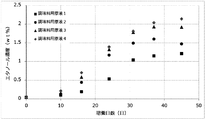
- FIG. 1 is a diagram showing the results of testing the influence on yeast fermentation when changing the content of reducing sugars in the undiluted solution for seasoning as described in the examples described later.
- FIG. 2 is a figure showing the result of having examined the influence on the yeast fermentation at the time of changing content of ethanol in the undiluted
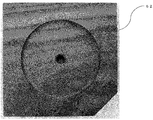
- FIG. 3A is a photograph of a spherical piece of wood of one embodiment of the present invention provided with a hole in the center.
- FIG. 3B is a photograph of the wood piece according to an embodiment of the present invention, which is shaped by shaving the corner of the rectangular wood piece.
- FIG. 3A is a photograph of a spherical piece of wood of one embodiment of the present invention provided with a hole in the center.
- FIG. 3B is a photograph of the wood piece according to an embodiment of the present invention, which is shaped by shaving the corner of the rectangular wood piece.
- FIG. 4 is a photograph of the wood piece of one embodiment of the present invention, which is taken with a scissors and placed in a container.
- a container containing wood chips of one embodiment of the present invention and a stock solution for seasoning is subjected to yeast fermentation, whereby gas (foam) is generated, and wood chips of one embodiment of the present invention float near the liquid surface. It is the photograph which photographed the appearance that it did.
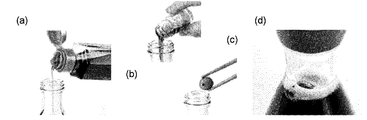
- FIG. 6 is a diagram showing a specific embodiment of the kit of one embodiment of the present invention.
- FIG. 7 is a figure for demonstrating the specific aspect of the manufacturing method of 1 aspect of this invention.
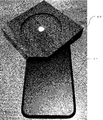
- FIG. 8A is a view showing a preferred embodiment of the container table.
- FIG. 8B is a view showing a use mode of a preferable mode of the container stand.
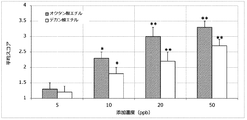
- FIG. 9 is a diagram showing the results of sensory evaluation when changing the addition amount of various esters to be added to raw soy sauce as described in the examples described later.
- FIG. 10 is a diagram showing the results of sensory evaluation of the liquid seasonings 4-1 to 4-2 and the commercially available soy sauces 1 and 2 as described in the examples below.
- FIG. 11 is a diagram showing the results of sensory evaluation when the contents of various esters added to the liquid seasoning 4-2 are changed as described in the examples to be described later.
- FIG. 12 is a diagram showing the results of sensory evaluation when the addition amount of 2-ethyl-6-methylpyrazine added to the liquid seasoning 4-1 was changed as described in Examples described later. .
- liquid seasonings undiluted solution for seasoning, wood chips, kit, soy sauce and soy sauce-like seasonings (hereinafter collectively referred to as liquid seasonings) according to one embodiment of the present invention, methods for producing them, and concentrated soy sauce and concentrated soy sauce seasoning (
- liquid seasonings undiluted solution for seasoning, wood chips, kit, soy sauce and soy sauce-like seasonings
- methods for producing them and concentrated soy sauce and concentrated soy sauce seasoning
- the term “content” is synonymous with concentration, and means the ratio (for example, wt%) of the amount (for example, mass) of the component to the total amount (for example, mass) of the seasoning stock solution or seasoning .
- the term “ppm” is a unit as it is generally known, and in particular 1 ppm is 1 mg / L (w / v).
- the term “ppb” is a unit as it is generally known, and in particular 1 ppb is 1 ⁇ g / L (w / v).
- natural flavor of soy sauce refers to the aroma of ginger soy sauce produced by the conventional method of brewing using soybeans and wheat as raw materials, which penetrates from the mouth to the nose at the time of eating and drinking.
- yeast fermentation means yeast fermentation which can be carried out, for example, at home, without the use of extensive manufacturing equipment.
- fermentation and “aging” are not strictly distinguished and may be referred to together as fermentation.
- the number in “Color number” means the number of "standard color of soy sauce” described in the notification of "Ministry of Agriculture, Forestry and Fisheries””Shoyu Japanese Agricultural Standard.”
- fruity aroma as used herein means a grape-based white wine-like sweet aroma that feels only with the nose without eating and drinking.
- a smell it means at least any one of the smell felt only by the nose without eating and drinking, and the smell penetrated from the inside of the mouth at the time of eating and drinking to the nose.
- Umami refers to what is known as basic taste, as well as sweet, sour, salty and bitter as it is usually known. Umami is, for example, a taste that spreads to the tongue, that the whole tongue is entrapped, a taste that has a lasting effect that affects the aftertaste unlike acidity and saltiness, and although it is viscous, it is a secretion of saliva that moisturizes the mouth. It may be at least one taste, such as a taste to promote.
- the term “rich” refers to commercially available ginger oil, for example, umami and / or compared to ginger oil having a total nitrogen content of less than 1.8 wt% and / or a content of HEMF of less than 50 ppm. It means that the original flavor of soy sauce is excellent.
- the term "and / or” means any one of a plurality of related items listed, or any combination of two or more or all combinations.
- Stock solution for seasoning according to one aspect of the present invention is simple in that the content of reducing sugar and the content of ethanol are adjusted to predetermined amounts. Can be used for various yeast fermentations. As a result, if the stock solution for seasoning of one aspect of the present invention is used, a seasoning as stable yeast fermentation can be obtained.
- the undiluted solution for seasoning of one aspect of the present invention is a liquid used to obtain a seasoning.
- the seasoning is not particularly limited as long as it is used for processing the food, for example, soy sauce, soy sauce-like seasoning, sake, mirin, salted rice, salted rice, noodle soup, soup stock There are soups, dressings, sauces and the like, but soy sauce and soy sauce like seasonings are preferred.
- Soy sauce (also known as soy sauce and soy sauce) is not particularly limited as long as it is used as a seasoning as is generally known, for example, Ministry of Agriculture, Forestry and Fisheries of Japan "Soy sauce quality indication standard" Those described in “Standards” and the like can be mentioned, and specific examples thereof include concentrated soy sauce, light mouth soy sauce, white soy sauce, distilled soy sauce, re-charged soy sauce. Other examples include ginger soy sauce, dumpling soy sauce, teri sauce, fresh fried soy sauce, quick-brew soy sauce, amino acid mixed soy sauce, reduced-salt soy sauce and low-salt soy sauce.
- the soy sauce may be one alone or a combination of two or more of those mentioned above.
- soy sauce-like seasoning refers to a seasoning used in the same application as “soy sauce” defined in Japanese Agricultural Standard, and is a concept including soy sauce, processed soy sauce, and fermented seasoning. If used in the same application as “soy sauce”, the raw material derived from soy sauce koji (eg, soybean and wheat) may not be used for soy sauce-like seasonings.
- the undiluted solution for seasoning is not particularly limited as long as it is a liquid used to obtain a seasoning, but, for example, soy sauce, soy sauce-like seasoning, cooking liquor, mirin, salted rice, salted rice, noodle soup, nabe soup, soup soup, dressing Examples thereof include liquids used for producing sauces and the like, and are preferably a soy sauce stock solution and a soy sauce-like seasoning stock solution.
- the undiluted solution for seasoning can not be prevented from being used as a seasoning by itself.
- the content of reducing sugar in the undiluted solution for seasoning is an amount capable of yeast fermentation, specifically 4.5 wt% or more, and a sufficient amount of ethanol content is obtained by providing a long fermentation period. From the viewpoint of being able to be used, the content is preferably 5 wt% or more, more preferably 6 wt% or more, and still more preferably 7 wt% or more.
- the upper limit of the content of the reducing sugar in the seasoning stock solution is not particularly limited, but is, for example, an amount that does not inhibit yeast fermentation, and is approximately 30 wt% or less.
- reducing sugar means the direct reducing sugar in the place said by the Ministry of Agriculture, Forestry and Fisheries notification "Japanese agriculture and forestry standard of soy sauce".
- the reducing sugar component can be added to the stock solution for seasoning to adjust to 4.5 wt%.
- the reducing sugar component added at this time is not particularly limited as long as it can be directly measured as reducing sugar by the method described in the examples described later, and examples thereof include glucose, fructose, maltose and the like, among which glucose preferable.
- the ethanol content in the stock solution for seasoning is an amount capable of yeast fermentation, specifically 1.5 wt% or less, and 1.0 wt% or less from the viewpoint of carrying out more stable yeast fermentation. Is preferably 0.5 wt% or less.
- the lower limit of the content of ethanol in the stock solution for seasoning is not particularly limited, and may be less than the lower limit of detection, that is, substantially 0 wt%.
- ethanol may be added to the stock solution for seasoning, and examples of ethanol that can be used at that time include alcohol for food used for food and alcohol containing ethanol, etc. It is not particularly limited.
- the content of linoleic acid in the stock solution for seasoning is not particularly limited, it is, for example, less than 0.15 wt%, and from the viewpoint of making the flavor of the seasoning obtained by subjecting the stock solution for seasoning to yeast fermentation preferable.
- the content is preferably 0.10 wt% or less, more preferably 0.05 wt% or less, still more preferably 0.03 wt% or less, and still more preferably 0.01 wt% or less.
- the lower limit of the content of linoleic acid in the stock solution for seasoning is not particularly limited, and may be less than the lower limit of detection, that is, substantially 0 wt%.
- the contents of reducing sugar, ethanol and linoleic acid in the stock solution for seasoning can be measured by the method described in the examples described later. Therefore, the contents of the above-mentioned reducing sugar, ethanol and linoleic acid are values obtained by measurement according to the method described in the examples described later.
- the undiluted solution for seasoning is put in a vessel for yeast fermentation together with wood chips and yeast-containing substances, and subjected to yeast fermentation.
- the undiluted solution for seasoning have a color number that allows visual recognition of the encased wood piece, since yeast fermentation is managed using the floating of the wood piece as an index.
- the color number of the undiluted solution for seasoning is, for example, 15 or more, preferably 20 or more, more preferably 30 or more, and still more preferably 35 or more.
- the wood piece is a cedar wood piece having a volume of 1 cm 3
- the contained cedar wood piece can be visually recognized in a transparent container if the color number of the undiluted solution for seasoning is 15 or more.
- the method for producing the undiluted solution for seasoning is not particularly limited as long as the undiluted solution for seasoning in which the content of reducing sugar, the content of ethanol, and the like become a predetermined amount is obtained.
- the undiluted solution for seasoning is an undiluted solution for seasoning or an undiluted solution for soy sauce-like seasoning
- the undiluted solution for seasoning is produced by the method of producing soy sauce including the steps prior to the yeast fermentation step, ie, the method of producing soy sauce moromi. can do.
- a specific example of the undiluted solution for seasoning according to one embodiment of the present invention is a liquid of soy sauce moromi mash obtained by the method for producing soy sauce of the present brewing method, and may be a raw material of ripening moromi mash.
- the method for producing the soy sauce moromi mash is not particularly limited as long as it is a method including the steps until the soy sauce moromi mash is obtained among the methods for producing soy sauce as generally known.
- a soy sauce raw material which is a mixture of steaming-denatured soybeans, roasted and crushed wheat, is inoculated with seed meal and Soy sauce cake is obtained to obtain soy sauce cake, and then soy sauce cake is added to a saline solution having a salt concentration of 20 to 30 wt%, and optionally, soy sauce lactic acid bacteria are added at 20 to 40 ° C.
- Examples include a method including the step of obtaining soy sauce moromi mash by lactic acid fermentation and aging for ⁇ 200 days.
- the soy sauce raw material is not particularly limited, and examples thereof include soybeans such as whole soybeans and defatted processed soybeans, wheat, barley, naked barley, wheat such as wheat and barley, wheat gluten, rice, corn and the like.
- the seed koji is not particularly limited as long as it is a koji mold generally used in the production of soy sauce, and examples thereof include Aspergillus oryzae and A. sojae .
- the soy sauce lactic acid bacteria are not particularly limited as long as they are soy sauce lactic acid bacteria generally used in the production of soy sauce, and examples thereof include salt-tolerant lactic acid bacteria such as Tetragenococcus halophilus .
- soy sauce moromi mash when the amount of starchy raw materials such as wheat and rice among the soy sauce raw materials is small, it may be impossible to obtain soy sauce moromi which is a predetermined amount of reducing sugar. Therefore, it is preferable that the amount of starchy raw materials such as wheat and rice among the soy sauce raw materials be such an amount that can obtain soy sauce moromi which is a predetermined amount of reducing sugar. However, this is not the case in the case of obtaining soy sauce moromi which is a predetermined amount of reducing sugar by adding a reducing sugar component to soy sauce moromi mash.
- soy sauce moromi mash obtained by a conventional method for producing soy sauce moromi mash is mixed with insoluble solids derived from soy sauce raw materials such as soybean and wheat.
- a liquid prepared by removing insoluble solid content from soy sauce moromi mash can be a stock solution for seasoning of one embodiment of the present invention.
- yeast fermentation is conveniently performed to obtain soy sauce or soy sauce-like seasoning.
- the undiluted solution for seasoning may contain an insoluble solid content as long as the sedimentation and floating of the wood pieces are not prevented.
- soy sauce moromi soya broth by removing insoluble solid content from the soy sauce moromi mash for example, commonly known solid-liquid separation methods etc. may be mentioned.
- a press filtration process using a press using a filter cloth, and a membrane filtration process using various permeable membranes such as an MF membrane and a UF membrane can be mentioned.
- yeast fermentation may not be properly performed.
- the content of the lactic acid bacteria in the soy sauce moromi mash liquid is not particularly limited, but is, for example, preferably 1.0 ⁇ 10 8 cells / ml or less, more preferably 1.0 ⁇ 10 7 cells / ml or less, More preferably, it is 1.0 ⁇ 10 6 cells / ml or less. Therefore, it is preferable that the undiluted
- a seasoning obtained by yeast fermentation of a soy sauce moromi mash has a soy sauce-like aroma and flavor.
- the ethanol content in the soy sauce moromi mash is a predetermined amount
- 4-hydroxy-2 (or5) -ethyl-5 (or2) -methyl-3 (2H) -furanone (homofurane) is obtained by yeast fermentation.
- All (HEMF) may be produced in amounts that produce a soy sauce-like flavor and taste.
- stock solution for seasonings of 1 aspect of this invention is an undiluted
- the amount by which HEMF produces a flavor and taste like soy sauce is, for example, 15 ppm (0.0015 wt%) or more, preferably 20 ppm or more, and more preferably 30 ppm or more.
- the content of HEMF can be measured by the method described in the examples described later.
- the upper limit of the content of HEMF may be set according to the desired flavor and smell like soy sauce, and is not particularly limited.
- soy sauce yeast is not particularly limited as long as yeast used in the production of normal soy sauce, for example, Gigot Saccharomyces rouxii (Zygosaccharomyces rouxii), Gigot Saccharomyces, Bayley (Z.bailii), Candida Etokerushi (Candida etchellsii) And tolerant yeasts such as Candida verstilis ( C. versatilis ).
- Yeast fermentation is not particularly limited as long as it is carried out in a conventional manner depending on the conditions and the number of yeasts, etc., and is, for example, a period until the amount of produced ethanol reaches the maximum amount. . More specifically, when Zygosaccharomyces rouxii is used as a soy sauce yeast, it is about 7 to 45 days at room temperature, preferably 15 to 30 ° C.
- the undiluted solution for seasoning may contain various other components as long as the content of reducing sugar and ethanol etc. is a predetermined amount, and does not prevent the problems of the present invention.
- Other ingredients are not particularly limited, but are, for example, seasoning ingredients and foodstuffs, and specifically, vegetable ingredients (such as radish, carrot, onion, potato, garlic, etc.), meats (beef, pork, chicken etc), fish , Yeast extract, meat extract (chicken extract, pork extract, beef extract, fish meat extract, etc.), fruit juice (apple juice, etc.), spices (such as ginger, pepper, pepper, basil, oregano), chemical seasoning (glutamic acid soda, inosinic acid And soda), flavors and the like, and one of these may be used alone, or two or more of these may be used in combination.
- the content of the other components can be appropriately set as long as the problems of the present invention can be solved.
- the free fatty acid and the amino acid are adsorbed when the soy sauce moromi no miso soup or the stock solution for seasoning obtained above is subjected to a decoloring treatment using an adsorption resin, the soy sauce moromi no miso soup or a seasoning stock solution It is not preferable to use the resin for the decolorization treatment using the adsorption resin.
- the undiluted solution for seasoning of one embodiment of the present invention can be a container-packed undiluted solution that is packed in a container and sealed.
- the container is not particularly limited, but for example, a single layer or laminated film bag, a retort pouch, a vacuum pack, an aluminum container, made of metal such as aluminum, paper, plastic such as PET or PTP, glass etc.
- packaging containers such as a plastic container, a bottle, and a can, are mentioned, Among these, a laminated film, a glass bottle, and a plastic container which are proven as a packaging container for food are preferable.
- stock solution for seasonings of 1 aspect of this invention is disinfected by pressurization and / or a heating etc., in order to avoid a time-lapse deterioration.
- a container containing the seasoning stock solution of one embodiment of the present invention to a soy sauce bottle suitable for yeast fermentation and further usable immediately after yeast fermentation, the seasoning stock solution of one embodiment of the present invention and soy sauce oil Yeast may be added, left at room temperature, and fermented.
- the content of reducing sugar and the content of ethanol are respectively as follows (1-1) and (2-1) Undiluted solutions for seasonings may be mentioned: (1-1) Reducing sugar content: 4.5 to 30 wt% (2-1) Content of ethanol: 0 to 1.5 wt%
- the content of reducing sugar, the content of ethanol and the content of linoleic acid are as follows (1-2) and (2- 2) and (3-2) include seasoning stock solutions: (1-2) Reducing sugar content: 4.5 to 30 wt% (2-2) Ethanol content: 0 to 1.5 wt% (3-2) Linoleic acid content: 0 to 0.10 wt%
- the content of reducing sugar, the content of ethanol and the content of linoleic acid are as follows (1-3) and (2- 3) and (3-3) include seasoning stock solutions: (1-3) Content of reducing sugar: 6 to 30 wt% (2-3) Content of ethanol: 0 to 1.0 wt% (3-3) Linoleic acid content: 0 to 0.03 wt%
- the undiluted solution for seasoning is used to obtain a seasoning by being subjected to yeast fermentation, and in expectation of adjusting the taste with the components in the undiluted solution for seasoning, You may use itself as a seasoning.
- the production method (1) according to one aspect of the present invention is a method for producing a seasoning including at least a step of obtaining a seasoning by subjecting the undiluted solution according to one aspect of the present invention to yeast fermentation.
- the undiluted solution for seasoning according to one aspect of the present invention is subjected to yeast fermentation, and then yeast fermentation used in a conventional method for producing soy sauce such as pressing, filtration, and heating. You may implement the process of the latter part of, etc.
- the seasoning obtained by the production method (1) of one embodiment of the present invention may be filled in a container such as a bottle to be a container-packed seasoning.
- the seasoning obtained by the production method (1) of one embodiment of the present invention may be used alone or in addition to the above-mentioned vegetable components, meats, fish, yeast extract, meat extract, fruit juice, spices, chemical seasoning, and flavors.
- Cooking various foodstuffs by mixing other seasoning ingredients such as soup stock, acidulant, amino acid, nucleic acid, organic acid, protein hydrolyzate, sugar, sake, mirin, alcohol, thickener, emulsifier, inorganic salts It can be used for processing methods, for example, can be used for various dishes such as Japanese food, Western food, Chinese food etc. Specifically, fried food, yakiniku, udon, soba, ramen, hamburg, meatball, Chikuzeni It can be used for Teriyaki, Curry, Stew, Hayashi, etc., but is not limited thereto.
- a piece of wood according to one aspect of the present invention is characterized by being compressed and having a specific volume.
- the wood piece of one embodiment of the present invention is made of compressed wood, so that the wood tissue is broken and the inside of the tissue is broken. The gas is likely to escape and the liquid may easily enter, and the specific gravity may be increased, whereby the wood may be able to settle in the liquid.
- a gas touches the wood piece of one aspect of the present invention that has settled in the liquid, gas-liquid exchange occurs inside the wood chip structure, the gas is taken in, the buoyancy increases, and it floats .
- the wood piece of one embodiment of the present invention is used as an index when producing a seasoning. That is, it is preferable that a wood piece according to one embodiment of the present invention is a wood piece which settles in the undiluted solution for seasoning before yeast fermentation and floats up near the liquid surface in the undiluted solution for seasoning after yeast fermentation. More specifically, when wood chips of one embodiment of the present invention were introduced into a stock solution for seasoning and fermented with yeast, wood chips that first sank in the stock solution for seasoning were generated as the yeast fermentation proceeded It takes in carbon dioxide and eventually floats up near the liquid level.
- the generation of carbon dioxide is associated with the production of alcohol, and it can be confirmed that yeast fermentation is appropriately performed, and a rich seasoning can be obtained from the stock solution for seasoning.
- a seasoning rich in aroma can be obtained depending on the presence or absence of floating of wood pieces subjected to yeast fermentation. Therefore, if a wood piece of one embodiment of the present invention is used as an index, it is possible to manage yeast fermentation simply and appropriately, and it is possible to stably produce a seasoning with high flavor and rich palatability.
- the wood piece of one embodiment of the present invention can be referred to as a wood piece for fermentation indicator or a wood piece for yeast fermentation indicator.
- the degree of compression processing is not particularly limited as long as wood pieces according to one embodiment of the present invention can be precipitated in the undiluted solution for seasoning, but examples thereof include compression processing such that the density of wood pieces is increased.
- compression processing is performed such that the density of wood pieces is 1.1 times or more, more preferably 1.25 times or more, and even more preferably 1.4 times or more as compared to that before compression processing.
- the density of wood pieces is preferably 2.5 times or less as compared to that before compression processing.
- compression processing such that the density of wood pieces is 1.4 times or more compared to that before compressive processing
- Compression of wood to obtain wood pieces according to one embodiment of the present invention can be carried out, for example, by the method described in JP-A-2017-19177.
- the bark is peeled from a cut wood having an outer peripheral surface of the raw wood and a cut surface substantially parallel to the axial direction of the raw wood, and then the peeled wood is peeled at 60 ° C. to 150 ° C. for about 30 minutes, etc.
- the pressure is applied while heating from the outer surface side with 10% to 70% compression ratio of 10% to 70% compression cut ratio of 10% to 70%, and then compression shape cut wood is fixed so that compressed shape is fixed
- 70% of compression ratio means compressing 10-cm-thick cut wood to thickness of 3 cm. Further, by processing at a compression rate of 70%, the volume becomes 30%.
- a piece of wood of one aspect of the present invention can be obtained by molding the above-described compressed wood.
- the volume of a wood piece according to one embodiment of the present invention is a volume to the extent that wood pieces sedimented in the stock solution for seasoning are subjected to yeast fermentation and floated, specifically less than 20 cm 3 , preferably 15 cm 3 or less More preferably, it is 10 cm 3 or less.
- the lower limit of the volume of wood pieces according to one embodiment of the present invention is not particularly limited, and is, for example, a volume that allows wood pieces in the undiluted solution for seasoning to be visually recognized, and specifically about 8.0 mm 3 .
- the density of wood pieces according to one embodiment of the present invention is not particularly limited as long as the wood pieces are settled to a degree in the stock solution for seasoning, but is, for example, 0.6 g / cm 3 or more, preferably 0.7 g / cm. It is cm 3 or more, more preferably 0.75 g / cm 3 or more.
- the upper limit of the density of wood pieces according to one embodiment of the present invention is not particularly limited, and is, for example, a density obtained by compressing wood before compression processing at a compression rate of 60%. Even if the same kind of wood is compressed at the same compression rate, the density may vary depending on the number of grains and the like.
- the mass of wood pieces according to one embodiment of the present invention is not particularly limited because it is determined from the volume and density of wood pieces, but is, for example, about 0.01 to 20 g, preferably 0.5 to 15 g, more preferably It is 5 to 10 g.
- a piece of wood of one embodiment of the present invention may be further processed in addition to the compression processing.
- the wood pieces according to one embodiment of the present invention are preferably those from which the gas inside has been removed when being introduced into the stock solution for seasoning.
- the method of removing the internal gas from the wood chip of one embodiment of the present invention is not particularly limited, for example, a method of employing a generally known degassing means utilizing heating, reduced pressure, ultrasonic waves and the like can be mentioned. It is preferable that it is a method of boiling for several minutes to about 10 minutes. Under the present circumstances, when the time to boil is long, since a wood piece will denature, it is unpreferable.
- the wood piece according to one embodiment of the present invention is preferably shaped by shaving the corner of a piece cut into a rectangular parallelepiped.
- the wood piece of one aspect of the present invention may be provided with a through hole at the center.
- the wood piece according to one embodiment of the present invention is processed to increase the surface area, for example, by cutting corners or providing a centrally penetrating hole, so that the gas can be more easily taken up during yeast fermentation, and it is relatively surfaced. It will be easier.
- the wood piece according to one embodiment of the present invention is not particularly limited as long as it is obtained from a tree generally subjected to wood processing, and for example, from the group consisting of a cedar plant, a rosaceous plant, a beech family plant and an elmaceous plant It is preferably derived from the tree of the selected plant, more preferably from cedar, cypress, cherry, camphor tree, zelkova, red oak and white oak, and still more preferably from cedar, cypress, cherry.
- the shape of the wood piece according to one embodiment of the present invention can be appropriately set according to the shape of the container for containing the undiluted solution for seasoning used and the amount of the pouring spout and undiluted solution for seasoning, and is not particularly limited.
- a rectangular parallelepiped, a cube, a sphere, an irregularly shaped irregular body, etc. may be mentioned.
- Non-limiting specific embodiments of the wood piece according to one embodiment of the present invention include, for example, wood pieces having the following features (1-1) to (1-4): (1-1) Volume (cm 3 ): 0.008 to 18 (1-2) Degree of compression processing: Compression processing (1-3) density (g / cm 3 ): 0. 1 so that the density is 1.25 to 2.5 times the density before compression processing. 500 to 1.000 (1-4) Shape: rectangular solid, cube or sphere
- Non-limiting specific embodiments of wood pieces according to one embodiment of the present invention include, for example, wood pieces having the following features (2-1) to (2-4): (2-1) Volume (cm 3 ): 1 to 10 (2-2) Degree of compression processing: Compression processing such that the density is 1.4 to 2.0 times that before compression processing (2-3) Density (g / cm 3 ): 0. 700 to 0.900 (2-4) Shape: rectangular solid or sphere
- FIG. 3A illustrates a wood piece provided with a hole in the center
- FIG. 3B illustrates a wood piece formed by cutting wood into a rectangular solid.
- FIG. 5 a mode that the wood piece of 1 aspect of this invention pinched
- FIG. 5 a container containing wood chips of one embodiment of the present invention and a stock solution for seasoning is subjected to yeast fermentation, whereby gas (foam) is generated, and wood chips of one embodiment of the present invention are in the vicinity of the liquid surface. It shows how it has surfaced.
- the production method (2) of one aspect of the present invention is a method for producing a seasoning using wood pieces of one aspect of the present invention. Specifically, in the production method (2) of one aspect of the present invention, wood fragments of one aspect of the present invention are introduced into a stock solution for seasoning and fermented with yeast to cause the wood fragments to rise, as an index. At least including the process of obtaining a seasoning.
- Kit according to one aspect of the present invention comprises a stock solution for seasoning to be a stock solution of seasoning, a wood chip to be an indicator of yeast fermentation, and a yeast-containing material for yeast fermentation. And at least a container for yeast fermentation for fermenting the yeast by charging them.
- the seasoning stock solution is a liquid used to obtain a seasoning.
- a specific example of the undiluted solution for seasoning contained in the kit of one embodiment of the present invention is the undiluted solution for seasoning of one embodiment of the present invention.
- the undiluted solution for seasoning contained in the kit of one embodiment of the present invention is put in a vessel for yeast fermentation together with wood chips and yeast-containing substances, and is used for management of yeast fermentation using the floating of wood chips as an indicator. Therefore, the color number of the undiluted solution for seasoning is 15 or more.
- Wood pieces are characterized by being compacted and having a specific volume.
- a specific example of a wood chip included in the kit of one embodiment of the present invention is a wood chip of one embodiment of the present invention.
- the yeast-containing substance is the yeast itself or the yeast-containing substance, and specifically, is a yeast-containing substance to be added so that the number of cells is 1.0 ⁇ 10 3 cells / ml or more as a final concentration. “The final concentration is added so that the number of bacteria is 1.0 ⁇ 10 3 cells / ml or more” means 1 per volume (1 ml) of the member for yeast fermentation containing the yeast-containing material and the stock solution for seasoning .0 ⁇ 10 3 or more is meant to be added.
- the yeast is not particularly limited as long as it can be usually subjected to yeast fermentation, and examples thereof include soy sauce yeast which is usually used in the production of soy sauce, and more specifically, Zygosaccharomyces luxi ( Zygosaccharomyces rouxii ), Examples thereof include salt-tolerant yeasts such as Zigzasaccharomyces baili (Z. bailli ), Candida etkelssy ( Candida etchellsii ), and Candida verstilis ( C. versatilis ).
- soy sauce yeast which is usually used in the production of soy sauce
- Zygosaccharomyces luxi Zygosaccharomyces rouxii
- salt-tolerant yeasts such as Zigzasaccharomyces baili (Z. bailli ), Candida etkelssy ( Candida etchellsii ), and Candida verstilis ( C. versatilis ).
- the yeast-containing substance may be a dried yeast cell and a wet yeast cell of yeast, a solid substance containing yeast, a liquid in which yeast is dissolved in a solution, and the like.
- the method for obtaining the solid of the yeast-containing substance is not particularly limited.
- tablets, granules of dry yeast of yeast alone or a mixture of dry yeast of yeast and other components such as excipients are used. , Methods including formulation into powders and the like.
- the method for obtaining the liquid substance of the yeast-containing substance is not particularly limited.
- the method comprises dissolving dry yeast cells or wet yeast cells in a solution that does not affect the viability of the yeast, such as physiological saline. It is obtained by
- the yeast-containing substance may be obtained by fermenting the yeast, and may be a seasoning in which the yeast is not killed. Such a seasoning can be used as "seed soy sauce", for example, when the seasoning is soy sauce.
- the number of yeast cells in the yeast-containing material is not particularly limited as long as it is the number of bacteria added so that the number of bacteria is 1.0 ⁇ 10 3 cells / ml or more as the final concentration.
- the number of bacteria is more than 1.0 ⁇ 10 3 cells / ml, preferably 5.0 ⁇ 10 3 cells / ml or more, more preferably 1.0 ⁇ 10 4 cells / ml. Or more, more preferably 5.0 ⁇ 10 4 cells / ml or more.
- the final concentration of yeast cells by adding a yeast-containing substance is not particularly limited as long as it is 1.0 ⁇ 10 3 cells / ml or more, and for example, the number of bacteria is more than 1.0 ⁇ 10 3 cells / ml And preferably 5.0 ⁇ 10 3 cells / ml or more, more preferably 1.0 ⁇ 10 4 cells / ml or more, and still more preferably 1.0 ⁇ 10 5 cells / ml to 1.0 It is about 10 6 cells / ml.
- the container for yeast fermentation is not particularly limited as long as it can carry out yeast fermentation by containing at least a stock solution for seasoning, wood chips and a yeast-containing substance and can distinguish sedimentation and floating of wood chips.
- the yeast fermentation vessel preferably has sufficient height, width and depth to the diameter of the wood piece, and is preferably transparent or clear so that the wood piece can be seen.
- Specific examples of the yeast fermentation container include, but are not limited to, soy sauce bottles (table-top bottles) as generally known.
- the yeast fermentation vessel comprises a lid.
- covers there are two types of lid
- the first lid for yeast fermentation has a hole with a diameter of 2 to 5 mm, preferably about 3 mm, which penetrates around the center to prevent the excessive supply of oxygen while supplying oxygen into the container from the outside. It is preferable to have.
- the second lid with the pouring hole may be equivalent to a lid attached to a regular soy sauce bottle.
- the kit according to one aspect of the present invention preferably includes a container base for mounting a yeast fermentation container.
- a container stand will not be specifically limited if it is provided with the base part which can mount the container for yeast fermentation.
- the pedestal is provided to penetrate the pedestal so that light is emitted from the bottom of the yeast fermentation container placed on the pedestal to generate scattered light.
- a container stand etc. provided with a hole and a light source storage part which can store a light source for irradiating a bottom of a container for yeast fermentation from a hole can be mentioned. If such a container stand is used, by irradiating light from the bottom of the yeast fermentation container, scattered light is generated in the liquid in the container, and the whole container is mysteriously and refreshingly lit, so that yeast fermentation is underway. It is possible to use the container for yeast fermentation which is in the above as part of the interior.
- a container stand includes, but is not limited to, a container stand capable of containing a light source at the lower portion as illustrated in FIGS. 8A and 8B.
- the production method (3) of one aspect of the present invention is a method of producing a seasoning using the kit of one aspect of the present invention. That is, the production method (3) according to one aspect of the present invention is a yeast obtained by adding a stock solution for seasoning to be a stock solution of seasoning, a yeast-containing substance for yeast fermentation, and a wood chip to be an indicator of yeast fermentation. The method comprises at least a step of subjecting the fermentation vessel to yeast fermentation to obtain a seasoning with the wood pieces in the vessel rising as an indicator.
- the order of adding the undiluted solution for seasoning, wood chips and yeast-containing substances to the yeast fermentation container is not particularly limited, but after adding the undiluted solution for seasoning to the yeast fermentation container, the yeast-containing substance is added to the container and further wood chips It is preferred to add to the solution.
- the container for yeast fermentation which added the undiluted
- soy sauce is produced according to the production method (3) of one embodiment of the present invention using soy sauce moromi no miso soup as the undiluted solution for seasoning and seed soy sauce as the yeast-containing substance, it differs from ordinary soy sauce production methods Since the yeast is fermented using only the liquid, it is possible to simply carry out the yeast fermentation in a state where the container is allowed to stand without stirring or aeration of the inside of the container.
- the undiluted solution for seasoning is a liquid of soy sauce moromi mash from which most or all insoluble solids have been removed in advance
- what is obtained after yeast fermentation is a yeast fermented solution with low solid content, It can be used as a seasoning (soy sauce).
- it is not necessary to squeeze etc. in the usual soy sauce manufacturing method it is possible to avoid giving out dirt and waste, and it can be used at any time during fermentation, and the seasoning due to the difference in fermentation process Can enjoy the change of
- the soy sauce thus obtained has a fresh fruity odor which can not be produced by ordinary production methods, and is rich in palatability which can enjoy a mellow aroma like wine. Therefore, it is preferable to use the yeast fermented solution as it is for cooking and cooking as it is without burning it.
- the color number is about No. 40 and light brown, but when it is used in the production method (3) of one embodiment of the present invention, yeast fermentation After 7 to 35 days, the color number becomes about 18 and dark brown. And according to the change of the color number, the thing which did not smell at first comes to have a fruity smell.
- the seasoning having a fruity odor obtained by the production method (3) of one embodiment of the present invention is, for example, a seasoning having an ethyl octanoate content of 10 ppb to 20,000 ppb; an ethyl decanoate content of 10 ppb A seasoning which is ⁇ 5,000 ppb; it may be a seasoning whose content of ethyl octoate is 5 ppb to 10,000 ppb and whose content of ethyl decanoate is 5 ppb to 2,000 ppb.
- seasoning having a fruity odor obtained by the production method (3) according to one aspect of the present invention are ethyl octanoate content of 5 ppb to 1,000 ppb and ethyl decanoate content of 5 ppb to
- the seasoning is 1,000 ppb
- the content of 2-ethyl-6-methylpyrazine is 0 ppb to less than 10 ppb
- the content of HEMF is 20 ppm to 200 ppm, but is not limited thereto.
- kit 1 shown in FIG. 6 includes a first stock solution containing seasoning solution 11 containing a stock solution for seasoning and a second stock solution containing solution for seasoning 12; a wood piece 21 as an indicator of yeast fermentation; a seed soy sauce 31 containing yeast; First yeast fermentation vessel 41 and second yeast fermentation vessel 42 for containing and fermenting yeast; first lid 51 for capping the yeast fermentation vessel during yeast fermentation 51; after yeast fermentation A second lid 52 for covering the yeast fermentation container; and a first container base for placing the yeast fermentation container.
- the manufacturing method (3) of 1 aspect of this invention the manufacturing method of the seasoning which used the kit 1 is mentioned. Below, with reference to FIG. 7, the manufacturing method of the seasoning which used the kit 1 is demonstrated.
- the undiluted solution for seasoning in the first undiluted solution containing seasoning solution 11 is poured into the first yeast fermentation container 41 (see (a) in FIG. 7).
- a second yeast fermentation container 42 may be used instead of the first yeast fermentation container 41.
- the seed soy sauce 31 and the wood piece 21 are sequentially put in the first container 41 for yeast fermentation into which the undiluted solution for seasoning is poured (see (b) and (c) in FIG. 7).
- the first yeast fermentation container 41 containing the undiluted solution for seasoning, seed soy sauce 31 and wood pieces 21 is covered with the first lid and placed on the first container table 61 and allowed to stand at room temperature.
- the yeast is fermented by About 1 week after yeast fermentation, by using the floating of the wood piece 21 as an index, it is confirmed that the yeast fermentation is properly performed and the seasoning is completed (see (d) in FIG. 7). Yeast fermentation is performed for about 1 to 4 weeks, during which time the first lid 51 is replaced with the second lid 52 each time the seasoning in the container is used, and the seasoning is poured out.
- the undiluted solution for seasoning in the first yeast fermentation container 41 gradually fades in color to pale in color as the yeast fermentation progresses. Therefore, the first yeast fermentation container 41 is placed on the second container stand 62 as illustrated in FIG. 8A, and the light source is accommodated at the lower part of the second container stand 62 as illustrated in FIG. 8B.
- a light source-equipped portable information terminal smart phone
- the undiluted liquid for seasoning contains less insoluble solid content.
- the whole container shines in aesthetic vermilion.
- the first yeast fermentation container 41 during yeast fermentation can be used as part of the interior.
- the undiluted solution for seasoning contained in the first undiluted solution containing seasoning liquid container 11 and the second undiluted solution containing seasoning liquid 12 may be the same or different.
- the first seasoning stock solution-containing container 11 contains a seasoning stock solution manufactured using Hokkaido-produced soybean as a raw material
- the second seasoning stock solution-containing container 12 uses Niigata-produced soybean as a raw material If the undiluted solution for seasoning manufactured is prepared, it is possible to finally obtain two kinds of seasoning having different flavors.
- liquid seasoning according to one aspect of the present invention has a predetermined content of ethyl octanoate, a content of ethyl decanoate or a content of ethyl octanoate and ethyl decanoate.
- Soy sauce or soy sauce-like seasonings that are Specifically, the liquid seasoning (1-1) according to the first aspect of the present invention is a soy sauce or soy sauce-like seasoning in which the content of ethyl octanoate is a predetermined amount.
- the liquid seasoning (1-2) of the second aspect of the present invention is a soy sauce or soy sauce-like seasoning in which the content of ethyl decanoate is a predetermined amount.
- the liquid seasoning (1-3) of the third aspect of the present invention is a soy sauce or soy sauce-like seasoning in which the contents of ethyl octanoate and ethyl decanoate are respectively predetermined amounts.
- the liquid seasoning according to one aspect of the present invention has a predetermined content of ethyl octanoate, ethyl decanoate or ethyl octanoate and ethyl decanoate while having the flavor inherent to soy sauce As a result, it can be provided to adjust the taste of food and drink as a soy sauce and soy sauce like seasoning having a fruity flavor superior to that of conventional soy sauce. As a result, if the liquid seasoning of one embodiment of the present invention is used, seasonings and food and drink having the flavor of soy sauce and a fruity aroma can be obtained.
- the liquid seasoning according to one aspect of the present invention is any seasoning of soy sauce and soy sauce-like seasoning, and is not particularly limited as long as it is used to prepare a taste when processing a foodstuff.
- the content of ethyl octanoate in the liquid seasoning of the first aspect of the present invention is such an amount that the liquid seasoning has a fruity smell.
- the content of ethyl octanoate in the liquid seasoning (1-1) of the first aspect of the present invention is 10 ppb to 20,000 ppb, and from the viewpoint of a more fruity smell, 20 ppb to 15, It is preferably 000 ppb, more preferably 50 ppb to 10,000 ppb.
- the content of ethyl octanoate is more than 20,000 ppb, the odor is too strong to cause an offensive smell like petroleum, and the smell of the liquid seasoning as a whole becomes unpleasant.
- the upper limit of the ethyl content is preferably less than 20,000 ppb, ie less than 20,000 ppb.
- the content of ethyl octanoate in the liquid seasoning (1-3) according to the third aspect of the present invention is 5 ppb to 10,000 ppb, and 10 ppb to 5,000 ppb from the viewpoint of a more fruity smell Preferably, 15 ppb to 1,000 ppb is more preferred.
- ethyl octanoate-containing substance is not particularly limited as long as it can be measured as ethyl octanoate by the method described in the examples described later.
- the content of ethyl decanoate in the liquid seasoning of the first aspect of the present invention is such an amount that the liquid seasoning has a fruity smell.
- the content of ethyl decanoate in the liquid seasoning (1-2) of the second aspect of the present invention is 10 ppb to 5,000 ppb, and from the viewpoint of a more fruity smell, 20 ppb to 2, 2, It is preferably 000 ppb, more preferably 50 ppb to 1,000 ppb.
- the content of ethyl decanoate is more than 5,000 ppb, the odor is too strong to cause an unpleasant smell like petroleum, and the smell of the liquid seasoning as a whole becomes unpleasant.
- the upper limit of the ethyl content is preferably less than 5,000 ppb, that is, less than 5,000 ppb.
- the content of ethyl decanoate in the liquid seasoning (1-3) according to the third aspect of the present invention is 5 ppb or more, and preferably 10 ppb to 2,000 ppb, 20 ppb from the viewpoint of giving a more fruity smell. It is more preferably -1,500 ppb, still more preferably 30 ppb to 1,000 ppb.
- ethyl decanoate-containing substance is not particularly limited as long as it can be measured as ethyl decanoate by the method described in Examples described later.
- the liquid seasoning has a fruity smell which is hardly felt in conventional soy sauce because the content of ethyl octanoate and / or ethyl decanoate is as described above.
- the fruity odor due to ethyl octanoate and / or ethyl decanoate can be masked by 2-ethyl-6-methylpyrazine, which the traditional soy sauce inherently contains.
- the content of 2-ethyl-6-methylpyrazine in the liquid seasoning may be, for example, an amount that does not suppress the fruity smell of ethyl octanoate and / or ethyl decanoate, and is preferably 50 ppb. Or less, more preferably 20 ppb or less, still more preferably 10 ppb or less, and still more preferably 5 ppb or less.
- the lower limit of the content of 2-ethyl-6-methylpyrazine in the liquid seasoning is not particularly limited, and may be less than the lower limit of detection, ie, substantially 0 ppb.
- the liquid seasoning is characterized by having a soy sauce component while having a fruity aroma, so that the original flavor of soy sauce is produced by HEMF or the like. Therefore, the content of HEMF in the liquid seasoning is preferably 20 ppm or more, more preferably 30 ppm or more, and still more preferably 40 ppm or more.
- the upper limit of the content of HEMF may be appropriately set according to the desired flavor of soy sauce and is typically about 200 ppm.
- the contents of ethyl octanoate, ethyl decanoate, 2-ethyl-6-methylpyrazine and HEMF in the liquid seasoning can be measured by the method described in the examples described later. Accordingly, the contents of ethyl octanoate, ethyl decanoate, 2-ethyl-6-methylpyrazine and HEMF described above are values obtained by measurement according to the method described in the examples described later.
- the peak area of 2-ethyl-6-methylpyrazine and HEMF can be determined using the following m / z. 2-ethyl-6-methylpyrazine: m / z 121 HEMF: m / z 142
- the method for producing a liquid seasoning according to one aspect of the present invention is not particularly limited as long as the liquid seasoning having a predetermined content of ethyl octanoate and / or ethyl decanoate can be obtained.
- the liquid seasoning of one embodiment of the present invention can be produced, for example, by mixing commercially available soy sauce with ethyl octanoate and / or ethyl decanoate.
- the method for producing the liquid seasoning is not particularly limited as long as the liquid seasoning in which the content of ethyl octanoate and the content of ethyl decanoate are predetermined amounts can be obtained.
- the liquid seasoning is subjected to solid-liquid separation of soy sauce moromi mash obtained after lactic acid fermentation according to a conventional method for producing soy sauce, and the liquid portion is further treated with a UF membrane to obtain soy sauce moromi miso soup, and then this soy sauce It can be produced by a method including the use of soy sauce yeast for fermenting the moromi soup with yeast fermentation.
- soy sauce moromite is not continuously subjected to yeast fermentation after lactic acid fermentation, but before being subjected to yeast fermentation, the soy sauce moromite is insoluble solid portion (soy sauce moromi mash concentrate) And the liquid portion (soy sauce moromi juice), followed by performing yeast fermentation on the soy sauce moromi juice. Therefore, the method includes at least a step of obtaining soy sauce moromi mash, a step of obtaining soy sauce moromi mash, and a step of performing yeast fermentation.
- the liquid seasoning thus obtained is, for example, (i) a liquid seasoning having an ethyl octanoate content of 10 ppb to 20,000 ppb, and (ii) an ethyl decanoate content of 10 ppb to 5,000 ppb. It may be a liquid seasoning or (iii) a liquid seasoning in which the content of ethyl octanoate is 5 ppb to 10,000 ppb and the content of ethyl decanoate is 5 ppb to 2,000 ppb.
- the step of obtaining the soy sauce moromi mash is not particularly limited as long as it is a step of obtaining the soy sauce moromi mash among the methods of producing soy sauce which are generally known.
- soy sauce is prepared by inoculating and cultivating a mixture of a protein material such as heat-denatured soybean and a starchy material such as wheat which has been gelatinized by heating, and cultivating a seed meal containing koji mold
- the soy sauce koji is obtained, and then the obtained soy sauce koji is charged into a saline solution to produce lactic acid fermentation and aging to obtain soy sauce moromi mash, and then the obtained soy sauce moromi mash is obtained by yeast fermentation and ripening to obtain ripening moromi mash
- the resulting ripened moromi mash is subjected to a pressing treatment and a filtration treatment to obtain a ginger soy sauce, and then, the resulting ginger so
- soy sauce raw material which is a mixture of steaming-denatured soybeans or steaming-denatured soybeans or straw-breaked oats, is inoculated with seed meal, and at 20 to 40 ° C.
- soy sauce cake Take a gauze strainer for about 2 to 4 days to obtain soy sauce cake, and then add soy sauce cake to the saline solution prepared by adding salt to water so that the salt concentration becomes 20 to 30% (w / v) And a step of obtaining soy sauce moromi mash by carrying out lactic acid fermentation and aging of those to which soy sauce lactic acid bacteria have been optionally added, for 10 to 200 days, preferably 15 to 40 days while appropriately stirring at 15 to 40 ° C.
- the soy sauce raw material is not particularly limited, and examples thereof include soybeans such as whole soybeans and defatted processed soybeans, wheat, barley, naked barley, wheat such as wheat and barley, wheat gluten, rice, corn and the like.
- the seed koji is not particularly limited as long as it is a koji mold generally used in the production of soy sauce, and examples thereof include Aspergillus oryzae and A. sojae .
- the soy sauce lactic acid bacteria are not particularly limited as long as they are soy sauce lactic acid bacteria generally used in the production of soy sauce, and examples thereof include salt-tolerant lactic acid bacteria such as Tetragenococcus halophilus .
- soy sauce moromi In the process of obtaining soy sauce moromi, if the amount of starchy raw material such as wheat and rice among the soy sauce raw materials is small, the content of reducing sugar decreases, and soy sauce moromi can not be obtained which can properly carry out yeast fermentation. there is a possibility. Therefore, it is preferable that the amount of starchy raw materials such as wheat and rice among the soy sauce raw materials be such an amount that can obtain soy sauce moromi with a high content of reducing sugars. However, this is not the case when the soy sauce moromi mash having a large content of reducing sugar is obtained by adding a reducing sugar component such as glucose, fructose, maltose, sugar, mirin and the like to the soy sauce moromi mash.
- a reducing sugar component such as glucose, fructose, maltose, sugar, mirin and the like
- soy sauce koji contains adjusted soy sauce koji prepared by adding a reducing sugar component after obtaining soy sauce koji containing a large amount of total nitrogen by inoculating seed meal with protein raw materials such as soybeans and producing koji Be
- soy sauce moromi soup In the step of obtaining soy sauce moromi mash, solid / liquid separation treatment for removing insoluble solids from the soy sauce moromi mash (lactic acid fermentation product) containing insoluble solids derived from soy sauce raw materials such as soy beans and wheat and / or sterilization treatment for removing microorganisms Obtain soy sauce moromi soup.
- the method for obtaining soy sauce moromi juice from soy sauce moromi mash is not particularly limited. For example, commonly known solid-liquid separation methods and sterilization methods etc. may be mentioned. Specifically, the pressing treatment usually used in soy sauce production methods And filtration treatment etc.
- press filtration treatment using a press using filter cloth filtration material using a filter material such as diatomaceous earth or various permeable membranes such as a UF membrane or MF membrane, microorganisms Treatment to raise the temperature to the point at which At this time, if a large amount of soy sauce lactic acid bacteria remain in the broth of soy sauce moromi mash, yeast fermentation may not be properly performed. Therefore, when obtaining soy sauce moromi juice, it is preferable to adopt a method that can remove most of soy sauce lactic acid bacteria as well as insoluble solids.
- the content of the lactic acid bacteria in the soy sauce moromi mash liquid is not particularly limited, but is, for example, preferably 1.0 ⁇ 10 8 cells / ml or less, more preferably 1.0 ⁇ 10 7 cells / ml or less, More preferably, it is 1.0 ⁇ 10 6 cells / ml or less.
- soy sauce yeast used for producing soy sauce as generally known for soy sauce moromi juice
- the method is carried out according to the conditions according to the type and number of bacteria of soy sauce yeast, etc. Perform yeast fermentation.
- Soy sauce yeast is not particularly limited as long as yeast used in the production of normal soy sauce, for example, Gigot Saccharomyces rouxii (Zygosaccharomyces rouxii), Gigot Saccharomyces, Bayley (Z.bailli), Candida Etokerushi (Candida etchellsii) And tolerant yeasts such as Candida verstilis ( C. versatilis ).
- the period of yeast fermentation is not particularly limited as long as the content of ethyl octanoate and ethyl decanoate in the fermentation liquid is a predetermined amount, but, for example, when Zygosaccharomyces rouxii is used as soy sauce yeast, 15 to It is about 10 to 100 days, preferably about 14 to 60 days, more preferably about 45 days at 30 ° C. Furthermore, the period of yeast fermentation is preferably a period during which the amount of ethanol production is maximum.
- the soy sauce moromi juice and the soy sauce yeast are put in a soy sauce bottle that is suitable for yeast fermentation and that the fermented solution can be used immediately after yeast fermentation. It can be carried out simply by performing yeast fermentation.
- soy sauce moromi juice from which insoluble solid content has been removed in advance is used, and therefore, what is obtained after yeast fermentation is a yeast fermentation fluid with low solid content and itself as a liquid seasoning It is also good.
- the latter stage of yeast fermentation used in the usual soy sauce manufacturing methods such as pressing, filtration, heating and pulling on the yeast fermented solution.
- the liquid portion obtained by being subjected to the treatment of (1) may be used as a liquid seasoning.
- the liquid seasoning according to one aspect of the present invention may have various contents such as ethyl octanoate and ethyl decanoate as long as the content does not prevent the problems of the present invention. be able to.
- Other ingredients are not particularly limited, but are, for example, seasoning ingredients and foodstuffs, and specifically, vegetable ingredients (such as radish, carrot, onion, potato, garlic, etc.), meats (beef, pork, chicken etc), fish , Yeast extract, meat extract (chicken extract, pork extract, beef extract, fish meat extract, etc.), fruit juice (apple juice, etc.), spices (such as ginger, pepper, pepper, basil, oregano), chemical seasoning (glutamic acid soda, inosinic acid And soda), flavors and the like, and one of these may be used alone, or two or more of these may be used in combination.
- the content of the other components can be appropriately set as long as the problems of the present invention can be solved.
- the liquid seasoning according to one embodiment of the present invention can be a container-packed liquid seasoner packed in a container and sealed, that is, a container-packed soy sauce or a container-packed soy sauce-like seasoning.
- the container is not particularly limited, but for example, a single layer or laminated film bag, a retort pouch, a vacuum pack, an aluminum container, made of metal such as aluminum, paper, plastic such as PET or PTP, glass etc.
- Packaging containers, such as a plastic container, a bottle, and a can, are mentioned.
- the container-packed soy sauce and the container-packed soy sauce-like seasoning can be marketed independently and independently in the market.
- the liquid seasoning of one embodiment of the present invention can be used in the same manner as a normal liquid seasoning. That is, the liquid seasoning according to one embodiment of the present invention is, alone or in addition to the above-mentioned vegetable component, meat, fish, yeast extract, meat extract, fruit juice, spice, chemical seasoning, flavor, soup stock, sour agent, Cooking or processing of various foodstuffs by mixing or combining other seasoning ingredients such as amino acids, nucleic acids, organic acids, protein hydrolysates, sugar, sake, mirin, alcohol, thickeners, emulsifiers and inorganic salts It can be used for law.
- the liquid seasoning according to one embodiment of the present invention is, alone or in addition to the above-mentioned vegetable component, meat, fish, yeast extract, meat extract, fruit juice, spice, chemical seasoning, flavor, soup stock, sour agent, Cooking or processing of various foodstuffs by mixing or combining other seasoning ingredients such as amino acids, nucleic acids, organic acids, protein hydrolysates
- the liquid seasoning of one embodiment of the present invention can be used for various dishes such as Japanese food, Western food, Chinese food, and more specifically, fried foods, yakiniku, udon, soba, ramen, hamburg, meatballs Chikuzen simmered meat can be used for meat and potatoes, teriyaki, curry, stew, and oysters, but it is not limited to these.
- a non-limiting specific embodiment of the liquid seasoning according to one embodiment of the present invention is, for example, a liquid seasoning in which the content of ethyl octanoate is as follows (1-1): (1-1) Content of Ethyl Octanoate: 20 ppb to 10,000 ppb
- a non-limiting specific embodiment of the liquid seasoning according to one embodiment of the present invention is, for example, a liquid seasoning in which the content of ethyl decanoate is as follows (2-1): (2-1) Content of ethyl decanoate: 20 ppb to 2,000 ppb
- the content of ethyl octanoate and the content of ethyl decanoate are respectively as the following (1-2) and (2-2) Liquid seasonings that are: (1-2) Content of ethyl octanoate: 5 ppb to 1,000 ppb (2-2) Ethyl decanoate content: 5 ppb to 1,000 ppb
- the content of ethyl octanoate, the content of ethyl decanoate and the content of 2-ethyl-6-methylpyrazine are as follows ( 1-3), (2-3) and (3-3) include liquid seasonings which are as follows: (1-3) Content of Ethyl Octanoate: 5 ppb to 1,000 ppb (2-3) Ethyl decanoate content: 5 ppb to 1,000 ppb (3-3) Content of 2-ethyl-6-methylpyrazine: 0 ppb to less than 10 ppb
- the liquid seasoning for example, the content of ethyl octanoate, the content of ethyl decanoate, the content of 2-ethyl-6-methylpyrazine and the content of HEMF
- the liquid seasoning whose quantity is each as the following (1-4), (2-4), (3-4) and (4-4) is mentioned: (1-4) Content of ethyl octanoate: 5 ppb to 1,000 ppb (2-4) Content of ethyl decanoate: 5 ppb to 1,000 ppb (3-4) Content of 2-ethyl-6-methylpyrazine: 0 ppb to less than 10 ppb (4-4) HEMF content: 20 ppm to 200 ppm
- the concentrated one is called a liquid concentrated seasoning. That is, the liquid concentrated seasoning according to one embodiment of the present invention comprises total nitrogen and 4-hydroxy-2 (or 5) -ethyl-5 (or 2) -methyl-3 (2H) -furanone (homofuraneol; HEMF) By adjusting the content of) to a predetermined amount, while having umami, it is exceptionally superior to the original flavor of soy sauce. Therefore, the liquid concentrated seasoning of one embodiment of the present invention can be provided as a concentrated soy sauce and a concentrated soy sauce seasoning to adjust the taste of food and drink.
- the liquid concentrated seasoning according to one embodiment of the present invention is not particularly limited as long as it is a seasoning of either concentrated soy sauce or concentrated soy sauce seasoning, and is used for the purpose of adjusting the taste when processing the foodstuff.
- the total nitrogen content of the liquid concentrated seasoning is such an amount that the liquid concentrated seasoning feels more savory than commercial ginger sauce.
- the total nitrogen content in the liquid concentrated seasoning is at least 1.8 wt%, and preferably from at least 1.9 wt%, from the viewpoint that umami is felt more, 2.0 wt% or more It is more preferable that The upper limit of the total nitrogen content may be appropriately set according to the desired flavor of soy sauce and is not particularly limited, but is typically about 4 wt%.
- the content of HEMF in the liquid concentrated seasoning is an amount such that the liquid concentrated seasoning can taste the original flavor of soy sauce more than commercially available raw soy sauce.
- the content of HEMF in the liquid concentrated seasoning is 60 ppm or more, and from the viewpoint that the original flavor of soy sauce is felt, it is preferably 70 ppm or more, and more preferably 80 ppm or more, More preferably, it is 90 ppm or more.
- the upper limit of the content of HEMF may be appropriately set according to the desired flavor of soy sauce and is not particularly limited, but is typically about 200 ppm.
- the HEMF in the liquid concentrated seasoning is not externally added to the soy sauce produced by the present brewing method, and is preferably HEMF produced in the process of producing the soy sauce of the present brewing method. That is, it is preferable that HEMF in a liquid thick seasoning is not added as HEMF which is a refined product, or a HEMF containing thing.
- the liquid concentrated seasoning according to one embodiment of the present invention is not particularly limited as long as the total nitrogen content and the amount of HEMF are the amounts described above, but it may affect, for example, the taste and smell of the liquid concentrated seasoning From the viewpoint, it is preferable that the amount of reducing sugar, ethyl decanoate, ethyl octanoate, 2-ethyl-6-methylpyrazine or the like is a predetermined amount.
- the content of reducing sugar in the liquid concentrated seasoning is preferably more than 3.0 wt%, which is the amount of reducing sugar in commercial ginger oil, and the liquid concentrated seasoning is mellow and rich in sweetness From the viewpoint of being able to be used, it is more preferably 4.0 wt% or more, still more preferably 6.0 wt% or more, still more preferably 7.0 wt% or more, and 8.0 wt% or more. It is particularly preferred that Although the upper limit of the content of reducing sugar is not particularly limited, it is typically about 20 wt% in consideration of the sweetness and energy of the liquid concentrated seasoning.
- the content of ethyl decanoate in the liquid concentrated seasoning is preferably 10 ppb to 2,000 ppb from the viewpoint that the liquid concentrated seasoning has a fruity smell, and from the viewpoint of a more fruity smell. Is more preferable, and 50 ppb to 1,000 ppb is more preferable. However, if the content of ethyl decanoate is more than 5,000 ppb, the smell is too strong and it has an offensive smell like petroleum, which tends to make the smell of the whole liquid concentrated seasoning unpleasant.
- the content of ethyl octanoate in the liquid concentrated seasoning is preferably 10 ppb to 10,000 ppb from the viewpoint that the liquid concentrated seasoning has a fruity aroma, and from the viewpoint of a more fruity aroma. Is more preferable, and 50 ppb to 10,000 ppb is more preferable. However, if the content of ethyl octanoate is more than 20,000 ppb, the smell is too strong and it has an offensive smell like petroleum, which tends to make the whole liquid concentrated seasoning smell unpleasant.
- the lower limit of each can be lower.
- the content of ethyl decanoate and ethyl octanoate in the liquid concentrated seasoning is preferably 5 ppb to 2,000 ppb and 5 ppb to 10,000 ppb, respectively, from the viewpoint of a more fruity smell, respectively. 20 ppb to 1,500 ppb and 10 ppb to 5,000 ppb are preferable, and 30 ppb to 1,000 ppb and 15 ppb to 1,000 ppb are more preferable.
- liquid thick seasoning which contains ethyl decanoate and ethyl octanoate by the quantity of each preferable range is a preferable thing with a fruity smell, and does not feel an unpleasant odor. Therefore, as a specific embodiment of the liquid concentrate seasoning, a liquid concentrate seasoning having an ethyl decanoate content of 2,000 ppb and an ethyl octanoate content of 10,000 ppb can be mentioned.
- the liquid thick seasoning is almost felt with conventional soy sauce by containing ethyl decanoate and / or ethyl octanoate, in particular, by the content of ethyl decanoate and / or ethyl octanoate being the above mentioned amount. No, it has a fruity smell. On the other hand, the fruity aroma of ethyl decanoate and / or ethyl octanoate can be masked by 2-ethyl-6-methylpyrazine, which the traditional soy sauce inherently contains.
- the content of 2-ethyl-6-methylpyrazine in the liquid thick seasoning may be, for example, an amount that does not suppress the fruity smell of ethyl decanoate and / or ethyl octanoate, and is preferably It is 50 ppb or less, more preferably 20 ppb or less, more preferably less than 10 ppb, and even more preferably 5 ppb or less.
- the lower limit of the content of 2-ethyl-6-methylpyrazine in the liquid thick seasoning is not particularly limited, and may be less than the lower limit of detection, ie, substantially 0 ppb.
- the contents of total nitrogen, HEMF, reducing sugar, ethyl decanoate, ethyl octanoate and 2-ethyl-6-methylpyrazine in the liquid thick seasoning can be measured by the method described in the examples described later. Accordingly, the contents of total nitrogen, HEMF, reducing sugar, ethyl decanoate, ethyl octanoate and 2-ethyl-6-methylpyrazine described above are values obtained by measurement according to the method described in the examples described later. is there.
- the method for producing a liquid concentrated seasoning is a method for obtaining a liquid concentrated seasoning that can solve the problems of the present invention, specifically a liquid concentrated seasoning wherein the total nitrogen content and the content of HEMF are predetermined amounts, preferably Is a liquid concentrate in which the total nitrogen content and the content of HEMF are predetermined amounts, and the content of the reducing sugar, ethyl decanoate, ethyl octanoate and / or 2-ethyl-6-methylpyrazine is a predetermined amount It is not particularly limited as long as it is a method by which a seasoning can be obtained.
- Another aspect of the present invention is a method of producing a liquid concentrated seasoning, that is, a method of producing concentrated soy sauce and concentrated soy sauce seasoning.
- the liquid concentrated seasoning of one aspect of the present invention can be manufactured by the method of manufacturing a liquid concentrated seasoning of one aspect of the present invention.
- the method for producing a liquid concentrate according to one aspect of the present invention can be roughly divided into two depending on the steps involved.
- the first soy sauce moromi mash obtained by subjecting soy sauce koji and saline to a mixing treatment is subjected to solid-liquid separation treatment and sterilization treatment.
- a step of obtaining a first soy sauce moromi juice a step of subjecting the first soy sauce moromi juice, soy sauce koji and sodium chloride to a mixing treatment to obtain a second soy sauce moromi, a second soy sauce moromi is subjected to solid-liquid separation treatment or solid-liquid treatment
- the first soy sauce mash after lactic acid fermentation is not continuously subjected to yeast fermentation, but yeast fermentation is carried out.
- the soy sauce moromi mash is divided into an insoluble solid portion (first soy sauce moromi mash concentrate) and a liquid portion (first soy sauce moromi mash juice) so as to remove microorganisms before being subjected to
- the second soy sauce moromi mash obtained by promoting the action of soy sauce koji used as feed water is divided into an insoluble solid portion (second soy sauce moromi mash concentrate) and a liquid portion (second soy sauce moromi mash juice).
- the liquid concentrated seasoning thus obtained may be, for example, a liquid concentrated seasoning having a total nitrogen content of at least 1.8 wt% and a content of HEMF of at least 60 ppm.
- a step of obtaining the first soy sauce moromi will also be described, which is a stage prior to the step of obtaining the first soy sauce moromi juice from the first soy sauce moromi.
- the method of the first aspect of the present invention may or may not include the step of obtaining a first soy sauce mash.
- the step of obtaining the first soy sauce moromi mash is not particularly limited as long as it is a step of obtaining the soy sauce moromi mash among methods of producing soy sauce as generally known.
- soy sauce is prepared by inoculating and cultivating a mixture of a protein material such as heat-denatured soybean and a starchy material such as wheat which has been gelatinized by heating, and cultivating a seed meal containing koji mold
- the soy sauce koji is obtained, and then the obtained soy sauce koji is charged into a saline solution to produce lactic acid fermentation and aging to obtain soy sauce moromi mash, and then the obtained soy sauce moromi mash is obtained by yeast fermentation and ripening to obtain ripening moromi mash
- the resulting ripened moromi mash is subjected to a pressing treatment and a filtration treatment to obtain a ginger soy sauce, and then, the resulting ginger soy
- a soy sauce raw material which is a mixture of steaming-denatured soybeans or steaming-denatured soybeans or straw-breaking oats, is inoculated with seed meal, and 20-40
- the salt is prepared by pouring a gauze over a period of about 2 to 4 days to obtain a soy sauce cake, and then adding sodium chloride to the water so that the salt concentration becomes 20 to 30% (w / v).
- this mixed treatment an action by soy sauce koji and lactic acid fermentation by soy sauce lactic acid bacteria can occur.
- the soy sauce raw material is not particularly limited, and examples thereof include soybeans such as whole soybeans and defatted processed soybeans, wheat, barley, naked barley, wheat such as wheat and barley, wheat gluten, rice, corn and the like.
- the koji mold is not particularly limited as long as it is a koji mold generally used for producing soy sauce, and examples thereof include Aspergillus oryzae and A. sojae .
- the soy sauce lactic acid bacteria are not particularly limited as long as they are soy sauce lactic acid bacteria generally used in the production of soy sauce, and examples thereof include salt-tolerant lactic acid bacteria such as Tetragenococcus halophilus .
- the amount of starchy raw material such as wheat and rice among the soy sauce raw materials when the amount of starchy raw material such as wheat and rice among the soy sauce raw materials is small, the content of reducing sugar decreases and the soy sauce moromi mash which can appropriately carry out yeast fermentation is obtained It may not be possible. Therefore, it is preferable that the amount of starchy raw materials such as wheat and rice among the soy sauce raw materials be such an amount that can obtain soy sauce moromi with a high content of reducing sugars.
- soy sauce koji contains adjusted soy sauce koji prepared by adding a reducing sugar component after obtaining soy sauce koji containing a large amount of total nitrogen by inoculating seed meal with protein raw materials such as soybeans and producing koji Be
- the first soy sauce moromi mash including insoluble solids derived from soy sauce raw materials such as soybean and wheat is subjected to solid-liquid separation treatment for removing insoluble solids and sterilization treatment for removing microorganisms.
- solid-liquid separation process for removing insoluble solids from the first soy sauce moromi mash is not particularly limited. For example, commonly known solid-liquid separation methods and the like can be mentioned.
- soy sauce manufacturing method examples thereof include squeezing treatment and filtration treatment, and more specifically, squeezing filtration treatment using a press using a filter cloth, and membrane filtration treatment using various permeable membranes such as a UF membrane and an MF membrane.
- the solid-liquid separation process may be used alone or in combination of two or more of the above-described processes and methods.
- the sterilization treatment for removing the microorganism from the first soy sauce moromi mash is not particularly limited, but specifically, filtration treatment using a filtration material such as diatomaceous earth or various permeable membranes such as UF membrane used when removing the microorganism, A heat treatment to raise the temperature to kill the microorganism may be mentioned.
- the sterilization treatment can be used alone or in combination of two or more of the above-described treatments and methods.
- a sterilization process may be a process which kills the microbe in system inside, without removing it out of a system.
- the microorganism to be mainly excluded in the sterilization treatment is, but not limited to, yeast.
- the solid-liquid separation treatment and the sterilization treatment in the step of obtaining the first soy sauce moromi-sushi may be carried out as separate treatments or may be carried out as one integral treatment. Further, the order of the solid-liquid separation treatment and the sterilization treatment is not limited, and either may be performed first, but it is preferable to use the liquid portion obtained after the solid-liquid separation treatment for the sterilization treatment.
- the amount of microorganisms in the first soy sauce moromi juice is not particularly limited as long as yeast fermentation does not occur in the subsequent step of obtaining the second soy sauce moromi.
- the yeast in the first soy sauce moromi juice is Is preferably 1.0 ⁇ 10 3 pieces / ml or less, more preferably 1.0 ⁇ 10 2 pieces / ml or less, and 1.0 ⁇ 10 1 pieces / ml or less More preferable.
- the oil from the first soy sauce moromi in addition to the insoluble solid content and the microorganism.
- insoluble solids, microorganisms and oil can be removed from the first soy sauce moromi mash by subjecting the press liquid obtained by squeezing the first soy sauce moromi mash to filtration treatment using diatomaceous earth one or more times.
- the step of obtaining the second soy sauce moromi mash is carried out in the same manner as the step of obtaining the first soy sauce moromi mash, except that the first soy sauce moromi juice is used as the feed water instead of water.
- the step of obtaining the second soy sauce moromi mash it is preferable not to add soy sauce lactic acid bacteria.
- the step of obtaining the second soy sauce moromi juice is carried out in the same manner as the step of obtaining the first soy sauce moromi juice.
- the second soy sauce moromi may be subjected to the solid-liquid separation treatment, and the sterilization treatment may not necessarily be performed. And it is preferable to use for sterilization treatment.
- the second soy sauce moromi juice has an isobutyric acid content of not more than 20 ppm, isovaleric acid
- the content of is preferably 20 ppm or less, or the content of each of isobutyric acid and isovaleric acid is 20 ppm or less.
- the step of carrying out the yeast fermentation is carried out using the soy sauce yeast used when producing soy sauce as generally known for the second soy sauce moromi juice, according to the conditions according to the type and number of bacteria of soy sauce yeast, etc. Perform conventional yeast fermentation.
- Soy sauce yeast is not particularly limited as long as yeast used in the production of normal soy sauce, for example, Gigot Saccharomyces rouxii (Zygosaccharomyces rouxii), Gigot Saccharomyces, Bayley (Z.bailli), Candida Etokerushi (Candida etchellsii) And tolerant yeasts such as Candida verstilis ( C. versatilis ).
- the period of yeast fermentation is a period in which HEMF is produced in a sufficient amount in the fermentation solution, preferably a period in which the content of HEMF is a predetermined amount, and ethyl decanoate and ethyl octanoate are produced, more preferably HEMF, More preferably, the content of HEMF is 60 ppm or more, the content of ethyl decanoate is 10 ppb or more, and the content of ethyl octanoate is a period during which the content of ethyl decanoate and ethyl octanoate is a predetermined amount.
- the amount is 10 ppb or more, but, for example, when Zygosaccharomyces rouxii is used as soy sauce yeast, it is about 10 to 100 days, preferably about 14 to 60 days at 15 to 30 ° C. Furthermore, the period of yeast fermentation is preferably a period during which the amount of ethanol production is maximum.
- the second soy sauce moromi juice and the soy sauce yeast are put in a soy sauce bottle that is suitable for yeast fermentation, and the fermented solution can be used immediately after yeast fermentation.
- the reaction can be carried out simply by leaving the cells at rest and fermenting them with yeast.
- the second soy sauce moromi juice from which insoluble solids have been removed in advance is used, and therefore, what is obtained after yeast fermentation is a yeast fermentation broth with a low solid content. It may be used as a concentrated seasoning.
- the latter stage of yeast fermentation used in the usual soy sauce manufacturing methods such as pressing, filtration, heating and pulling on the yeast fermented solution.
- the liquid portion obtained by being subjected to the treatment of (1) may be used as a liquid concentrated seasoning.
- the soy sauce moromi mash obtained by subjecting the soy sauce koji and the saline to a mixing treatment is subjected to a solid-liquid separation treatment and a sterilization treatment to obtain a soy sauce moromi juice.
- Adjusting the amount of total nitrogen content and reducing sugar content to a predetermined amount to obtain adjusted soy sauce moromi juice; and subjecting the prepared soy sauce moromi juice to yeast fermentation by soy sauce yeast At least a step of obtaining concentrated soy sauce or concentrated soy sauce seasoning in which the total nitrogen content and the content of HEMF are predetermined amounts.
- the method according to the second aspect of the present invention at least includes the steps of obtaining soy sauce moromi juice, obtaining adjusted soy sauce moroshi juice, and performing yeast fermentation.
- the liquid concentrated seasoning thus obtained may be, for example, a liquid concentrated seasoning having a total nitrogen content of at least 1.8 wt% and a content of HEMF of at least 60 ppm.
- the step of obtaining the soy sauce moro soup can be carried out in the same manner as the step of obtaining the first soy sauce moro soup from the first soy sauce moromi in the method of the first aspect of the present invention.
- the soy sauce moromi mash in the step of obtaining the soy sauce moromi mash may be tamari soy sauce.
- the accumulated soy sauce it is preferable to be accumulated soy sauce in which the content of isobutyric acid is 20 ppm or less, the content of isovaleric acid is 20 ppm or less, or the contents of isobutyric acid and isovaleric acid is 20 ppm or less.
- the soy sauce moromi juice contains a predetermined amount of total nitrogen and reducing sugar, for example, 1.8 wt% or more and 4.0 wt% or more, preferably 1.8 wt% each.
- a predetermined amount of total nitrogen and reducing sugar for example, 1.8 wt% or more and 4.0 wt% or more, preferably 1.8 wt% each.
- the above and 5.0 wt% or more, more preferably 2.0 wt% or more and 5.0 wt% or more, respectively, and still more preferably 2.2 wt% or more and 7.0 wt% or more are adjusted.
- the upper limit of the total nitrogen content and the reducing sugar content is not particularly limited, but is typically about 4 wt% and about 20 wt%, respectively.
- the liquid concentrated seasoning according to one aspect of the present invention is obtained by subjecting soy sauce moromi juice containing the amounts of total nitrogen and reducing sugar described above to yeast fermentation, that is, a fermented product of soy sauce moromi juice It is preferable that it is what is contained or it is a fermented thing of soy sauce moromi soup.
- soy sauce moromi soup containing a large amount of total nitrogen can be obtained, and soy sauce koji manufactured using a large amount of starchy raw materials such as wheat or rice is used.
- Soy sauce moromi juice with a high content of reducing sugars is obtained. Therefore, in order to set the total nitrogen content and reducing sugar content to a predetermined amount, the reducing sugar component may be added according to a conventional method to soy sauce moromi juice that has a large total nitrogen content, and the reducing sugar content is The total nitrogen component may be added to a large amount of soy sauce moromi juice according to a conventional method.
- both the reducing sugar component and the total nitrogen component may be added to the soy sauce moromi juice.
- the total nitrogen component is not particularly limited as long as it is generally contained as the total nitrogen content of soy sauce, but for example, it is preferable that it is an umami component such as amino acids and peptides such as glutamic acid and soy peptide.
- the step of carrying out the yeast fermentation is a method of yeast fermentation in the method of the first aspect of the present invention by replacing the second soy sauce moromi soup with the adjusted soy sauce moromi soup. Can be carried out in the same manner as the step of carrying out.
- the liquid concentrated seasoning according to one embodiment of the present invention may contain various other components as long as the total nitrogen content and the content of HEMF do not interfere with the object of the present invention. it can.
- Other ingredients are not particularly limited, but are, for example, seasoning ingredients and foodstuffs, and specifically, vegetable ingredients (such as radish, carrot, onion, potato, garlic, etc.), meats (beef, pork, chicken etc), fish , Yeast extract, meat extract (chicken extract, pork extract, beef extract, fish meat extract, etc.), fruit juice (apple juice, etc.), spices (such as ginger, pepper, pepper, basil, oregano), chemical seasoning (glutamic acid soda, inosinic acid And soda), flavors and the like, and one of these may be used alone, or two or more of these may be used in combination.
- the content of the other components can be appropriately set as long as the problems of the present invention can be solved.
- the liquid concentrated seasoning of one embodiment of the present invention can be a container-packed liquid concentrated seasoning packed in a container and sealed, that is, a container-packed concentrated soy sauce or a container-packed concentrated soy sauce-like seasoning.
- the container is not particularly limited, but for example, a single layer or laminated film bag, a retort pouch, a vacuum pack, an aluminum container, made of metal such as aluminum, paper, plastic such as PET or PTP, glass etc.
- Packaging containers, such as a plastic container, a bottle, and a can, are mentioned.
- the container-packed concentrated soy sauce and the container-packed concentrated soy sauce-like seasoning may be independently marketed separately and commercially.
- the liquid concentrated seasoning of one embodiment of the present invention can be used in the same manner as a normal liquid seasoning. That is, the liquid concentrated seasoning according to one embodiment of the present invention is used alone or in addition to the above-mentioned vegetable components, meats, fish, yeast extract, meat extract, fruit juice, spices, chemical seasoning, flavor, soup stock, sour taste And various other seasoning ingredients such as amino acids, nucleic acids, organic acids, protein hydrolysates, sugar, sake, mirin, alcohol, thickeners, emulsifiers, inorganic salts, etc. It can be used in processing methods. For example, the liquid concentrated seasoning according to one embodiment of the present invention can be used for various dishes such as Japanese food, Western food, Chinese food, etc.
- fried food yakiniku, udon, soba, ramen, hamburg, meat It can be used for balls, Chikuzen simmering, Teriyaki, Curry, Stew, Hayashi etc., but is not limited thereto.
- Non-limiting specific embodiments of the liquid concentrated seasoning according to one embodiment of the present invention include, for example, a liquid concentrated seasoning in which the total nitrogen content and the content of HEMF are as follows: Total nitrogen content: 1.8 wt% to 4 wt% HEMF content: 60 ppm to 200 ppm
- Non-limiting specific embodiments of the liquid concentrated seasoning according to one embodiment of the present invention include, for example, a liquid concentrated seasoning in which the total nitrogen content and the content of HEMF are as follows: Total nitrogen content: 2.0 wt% to 4 wt% HEMF content: 80 ppm to 200 ppm
- Non-limiting specific embodiments of the liquid concentrated seasoning according to one embodiment of the present invention include, for example, a liquid concentrated seasoning in which the content of total nitrogen, HEMF and reducing sugar is as follows: Total nitrogen content: 1.9 wt% to 4 wt% HEMF content: 80 ppm to 200 ppm Reducing sugar: 7.0 wt% to 20 wt%
- Non-limiting specific embodiments of the liquid concentrated seasoning according to one embodiment of the present invention include, for example, a liquid concentrated seasoning in which the contents of total nitrogen, HEMF, reducing sugar and ethyl decanoate are as follows: : Total nitrogen content: 1.9 wt% to 4 wt% HEMF content: 80 ppm to 200 ppm Reducing sugar: 7.0 wt% to 20 wt% Ethyl decanoate: 10 ppb to 2,000 ppb
- a non-limiting specific embodiment of the liquid concentrated seasoning according to one embodiment of the present invention includes, for example, a liquid concentrated seasoning having a total nitrogen content, HEMF, reducing sugar and ethyl octanoate content as follows: : Total nitrogen content: 1.9 wt% to 4 wt% HEMF content: 80 ppm to 200 ppm Reducing sugar: 7.0 wt% to 20 wt% Ethyl octanoate: 10 ppb to 10,000 ppb
- liquid concentrated seasoning in which the contents of total nitrogen, HEMF, reducing sugar, ethyl decanoate and ethyl octanoate are as follows: Fees include: Total nitrogen content: 1.9 wt% to 4 wt% HEMF content: 80 ppm to 200 ppm Reducing sugar: 7.0 wt% to 20 wt% Ethyl decanoate: 5 ppb to 2,000 ppb Ethyl octanoate: 5 ppb to 10,000 ppb
- Non-limiting specific embodiments of the liquid concentrated seasoning according to one embodiment of the present invention include, for example, total nitrogen content, HEMF, reducing sugar, ethyl decanoate, ethyl octanoate and 2-ethyl-6-methylpyrazine content
- HEMF total nitrogen content
- reducing sugar ethyl decanoate
- ethyl octanoate ethyl-6-methylpyrazine content
- 2-ethyl-6-methylpyrazine content examples are liquid concentrated seasonings where: Total nitrogen content: 1.9 wt% to 4 wt% HEMF content: 80 ppm to 200 ppm Reducing sugar: 7.0 wt% to 20 wt% Ethyl decanoate: 5 ppb to 2,000 ppb Ethyl octanoate: 5 ppb to 10,000 ppb 2-Ethyl-6-methylpyrazine content: less than 10 ppb
- ⁇ GC-FID analysis conditions Measuring device: GC-2014AF (made by Shimadzu Corporation) Column: porapack q (80-100 mesh) (manufactured by GL Sciences Inc.) Inlet temperature: 230 ° C Temperature conditions: 155 ° C (7 min) holding Carrier gas: nitrogen column flow rate: 20 mL / min Detector temperature: 250 ° C
- HEMF contents of HEMF and 2-octanone used as an internal standard substance in undiluted solution for seasoning and liquid seasoning are measured by GC-MS for the extract obtained by subjecting to extraction treatment using ethyl acetate. It measured according to the following conditions.
- Measurement method of linoleic acid Content of linoleic acid and heptadecanoic acid used as internal standard substance in undiluted solution for seasoning and liquid seasoning is liquid which methylesterified fatty acid using fatty acid methylation kit (made by Nacalai Tesque) Were measured by GC-MS according to the following conditions.
- soy sauce cake 100 parts by mass of the obtained soy sauce cake is charged in 120 parts by mass of a saline solution (salt concentration 23.5%), and further added with soy sauce lactic acid bacteria ( Tetragenococcus halophilus ) at 25 ° C. for 120 days while appropriately stirring And fermented and matured, and then subjected to a pressing treatment and a filtration treatment to obtain soy sauce moromi mash.
- soy sauce lactic acid bacteria Tetragenococcus halophilus
- Zygosaccharomyces rouxii was inoculated into the undiluted solutions 1 to 4 of undiluted solutions 1 to 4, and the yeast was fermented at 20 to 25 ° C. for 45 days without stirring.
- liquid seasonings 1 to 4 were obtained by subjecting stock solutions 1 to 4 for seasoning to yeast fermentation. During yeast fermentation of liquid seasonings 1 to 4, ethanol concentrations in liquid seasonings 1 to 4 were measured 10, 16, 24, 31, 37 and 45 days after yeast inoculation. The results are shown in Table 1 and FIG.
- the reducing sugar concentration in the stock solution for seasoning is desirably 6 wt% or more.
- liquid seasonings 1 to 4 were subjected to sensory evaluation, the liquid seasonings 2, 3 and 4 having a reducing sugar concentration of 5 wt% or more were compared with the liquid seasoning 1 having a reducing sugar concentration of 4 wt%.
- the smell of soy sauce was felt strong.
- the ethanol concentration of soy sauce moromi mash after yeast fermentation is known to exceed 1.5%. From this also, it is considered that the liquid seasoning 1 was insufficient in yeast fermentation as compared with the liquid seasonings 2, 3 and 4 and did not sufficiently cause the smell like soy sauce to be felt.
- the undiluted solution for seasoning having a reducing sugar concentration of 5 wt% or more can produce ethanol by adding yeast, and the liquid seasoning obtained by yeast fermentation has a smell like soy sauce.
- Yeast fermentation was carried out in the same manner as 2-2 above using undiluted solutions 5 to 7 of undiluted solutions 5 to 7 for undiluted seasoning.
- liquid seasonings 5 to 7 were obtained by subjecting the stock solutions 5 to 7 for seasoning to yeast fermentation. During yeast fermentation of liquid seasonings 5 to 7, ethanol concentrations in liquid seasonings 5 to 7 were measured 10, 16, 24, 31, 37 and 45 days after yeast inoculation. The results are shown in Table 2 and FIG. Table 2 and FIG. 2 also show the results of using the undiluted solution for seasoning 4.
- the liquid seasoning after yeast fermentation preferably contains 15 ppm or more of HEMF.
- HEMF concentrations of liquid seasonings 4 to 7 obtained by subjecting undiluted solution for seasoning 4 to 7 to yeast fermentation were measured as described in 2-2 and 3-2 above. The results are shown in Table 3.
- soy sauce cake 100 parts by mass of the obtained soy sauce cake is charged in 98 parts by mass of a saline solution (saline concentration 26%), and further added with soy sauce lactic acid bacteria ( Tetragenococcus halophilus ) for 50 days at 15 to 25 ° C with appropriate stirring
- soy sauce lactic acid bacteria Tetragenococcus halophilus
- solid-liquid separation and diatomaceous earth filtration are performed to recover a lactic acid-fermented juice, which is used as a stock solution 8 for seasoning.
- the content of linoleic acid in the obtained stock solution for seasoning 8 was measured using a fatty acid methylation kit (manufactured by Nacalai) and GC-MS as described in 1-4 above.
- soy sauce oil is 0.06 wt%, 0.31 wt%, 0.61 wt% and 3.07 wt%, respectively.
- To 12 were prepared.
- the content of linoleic acid in the stock solutions for seasoning 9 to 12 was measured.
- Stock solutions for seasoning 8 to 12 were inoculated with Zygosaccharomyces rouxii , and yeast fermentation was performed at 25-30 ° C. for 45 days without stirring.
- the liquid seasoning 8 to 12 was obtained by yeast fermentation.
- liquid seasoning 8 obtained by yeast fermentation of undiluted liquid for seasoning 8 containing linoleic acid is an oil compared to liquid seasonings 9 to 12 containing 0.03% by weight or more of linoleic acid. It was found that the odor and the oxidative odor were significantly reduced. That is, when using the undiluted solution for seasoning containing no oil (linoleic acid), it is possible to obtain a liquid seasoning that exhibits not only the smell of oil and oxidized odor but also a very fruity smell by yeast fermentation. I understand.
- soy sauce cake 100 parts by mass of the obtained soy sauce cake is charged in 94 parts by mass of a saline solution (saline concentration 24% (w / v)), and further to which soy sauce lactic acid bacteria ( Tetragenococcus halophilus ) is added, appropriately stirred at 15 to 25 ° C. Then, after performing lactic acid fermentation according to a conventional method for 20 days, salt-tolerant yeast ( Zygosaccharomyces rouxii ) was added, and fermentation and ripening were carried out for 100 days while appropriately stirring.
- soy sauce lactic acid bacteria Tetragenococcus halophilus
- the obtained ripened moromi mash was subjected to solid-liquid separation, and the obtained supernatant was treated with a disposable membrane filter (pore diameter 0.45 ⁇ m) (manufactured by ADVANTEC) to obtain a crude soy sauce.
- Raw soy sauce made from whole soybeans was used as the liquid seasoning 13
- raw soy sauce made from defatted soybeans was used as the liquid seasoning 14.
- soy sauce cake 100 parts by mass of the obtained soy sauce cake is added to 94 parts by mass of a saline solution (saline concentration 24% (w / v)), and further to which soy sauce lactic acid bacteria ( Tetragenococcus halophilus ) is added, appropriately stirred at 15 to 25 ° C.
- soy sauce lactic acid bacteria Tetragenococcus halophilus
- the lactic acid fermentation was performed according to a conventional method for 20 days.
- the soy sauce moromi mash after completion of lactic acid fermentation was subjected to solid-liquid separation, and the liquid portion was further treated with a UF membrane to obtain lactic acid fermentation juice.
- Salt-tolerant yeast Zygosaccharomyces rouxii
- Zygosaccharomyces rouxii was added to the obtained lactic acid fermentation broth, fermented at 25 ° C. for 28 days without stirring, and then centrifuged at 3,000 rpm for 15 minutes to recover ginger oil as a supernatant .
- Raw soy sauce made from whole soybeans was used as the liquid seasoning 15
- raw soy sauce made from defatted soybeans was used as the liquid seasoning 16.
- Table 6 shows the results of sensory evaluation of the liquid seasonings 13 and 15 using the whole soybeans as a raw material.
- "**" shows that there was a significant difference at a risk rate of 1% as compared with the liquid seasoning 13.
- the liquid seasonings 15 to 16 obtained by yeast fermentation of lactic acid fermented juice are more fruity than the liquid seasonings 13 to 14 obtained by the conventional method for producing ginger oil.
- the smell was found to be remarkably high.
- a liquid seasoning can be obtained without particularly carrying out the steps after yeast fermentation, and the liquid seasoning obtained is further preferably a fruity smell. It is a liquid seasoning having From this, by using the undiluted solution for seasoning which is one aspect of the present invention, a seasoning having high palatability can be easily obtained even at home.
- soy sauce cake 100 parts by mass of the obtained soy sauce cake is charged in 116 parts by mass of a saline solution (25% (w / v) salt concentration) and further containing soy sauce lactic acid bacteria ( Tetragenococcus halophilus ) at 15 to 25 ° C.
- soy sauce lactic acid bacteria Tetragenococcus halophilus
- the lactic acid fermentation was performed according to a conventional method for 20 days while stirring. After completion of lactic acid fermentation, the soy sauce moromi mash was subjected to solid-liquid separation, and the juice was treated with a UF membrane to obtain a stock solution for seasoning having a specific gravity (g / ml) of 1.207.
- a piece of wood was placed in 800 ml water in a 2000 ml stainless steel cup and boiled for 10 minutes. Further, the boiled wood pieces were taken out and placed in a 150 ml stock solution for seasoning placed in a 150 ml tabletop bottle and allowed to stand for 1 day.
- the settling property of the wood pieces was evaluated by visually confirming the presence or absence of sedimentation in the water after boiling of the wood pieces and the presence or absence of sedimentation within 1 day after putting the wood pieces into the stock solution for seasoning. When the wood pieces were settled so as to stay on the bottom of the container, they were evaluated as " ⁇ ", and when they were not settled, they were evaluated as " ⁇ ".
- wood of cypress, zelkova, red oak, white oak that is not compressed is a rectangular solid of 1 cm 3 and
- the camphor wood chip 1, the zelkova wood chip 1, the red oak wood chip 1 and the white oak wood chip 1 were produced by cutting as follows.
- a cedar wood piece 7 and a cypress wood piece 7 are prepared by cutting a 50% compression processing cedar compressed wood and a 40% compression processing cypress compressed wood into a 1 cm 3 rectangular solid. did. With respect to these wood pieces, the sedimentation of the wood pieces was evaluated in the same manner as described above. The results are shown in Table 9.
- red oak wood pieces that have not been compressed and white oak wood pieces also have a boiling stock solution for water and seasoning It was found to settle in the ocean.
- cedar wood pieces, cypress wood pieces and cherry wood pieces obtained from the compressed wood subjected to compression processing were surfaced through yeast fermentation.
- Boiled cedar wood pieces 8 to 11, Hinoki wood pieces 8 to 11 and cherry wood pieces 7 to 10 are added to 400 ml of a stock solution for seasoning in 400 ml of durumin, respectively, and cedar wood pieces 8 to 11, Japanese cypress wood pieces 8 It was confirmed that ⁇ 11 and cherry wood pieces 7 to 10 were sedimented.
- Zygosaccharomyces rouxii is added to the stock solution for seasoning containing cedar wood pieces, cypress wood pieces and cherry wood pieces so as to be 1.0 ⁇ 10 5 pieces / ml, and yeast fermentation is performed for 30 days at normal temperature without stirring. The liquid seasoning was obtained.
- cedar wood pieces 8 to 11 Whether or not cedar wood pieces 8 to 11, cypress wood pieces 8 to 11 and cherry wood pieces 7 to 10 surfaced up was evaluated during the period of yeast fermentation. That is, the evaluation was made as " ⁇ ” if the cedar wood pieces, the cypress wood pieces and the cherry wood pieces rose to the vicinity of the liquid level at the end of yeast fermentation, and "X" if not.
- cedar wood pieces 12 to 15 were put in 800 ml of water put in a 2000 ml stainless steel cup and boiled for 10 minutes. After boiling, pieces of wood were taken out and placed in 150 ml of the stock solution for seasoning prepared in Example 1 placed in a 150 ml tabletop bottle, and allowed to stand for 1 day for sedimentation.
- Zygosaccharomyces rouxii was added to the stock solution for seasoning to which wood chips were sedimented so as to be 1.0 ⁇ 10 5 pieces / ml, and yeast fermentation was carried out at 4 ° C., 15 ° C., 20 ° C. and 30 ° C. without stirring. went. Evaluation was made as " ⁇ ” if the cedar wood pieces rose to the vicinity of the liquid level after "day", 7 days, 14 days, 21 days and 28 days after starting the yeast fermentation, and "X” if it did not rise . In addition, the seasoning at that time was evaluated based on the presence or absence of the "fruity smell". In addition, "fruity smell” is defined as sweetness like white wine made from grape, which is felt only by the nose without eating.
- Each piece of wood was produced by cutting non-compressed wood of non-compressed cedar, cypress, cherry blossom, camphor tree, zelkova, red oak, and white oak into a 1 cm 3 rectangular parallelepiped. In addition, each piece of wood was prepared by similarly cutting 50% compressed cedar compressed wood, 40% compressed cypress compressed wood, and 30% compressed Sakura cherry. . Each piece of wood was boiled in 800 ml water in a 2000 ml stainless steel cup and boiled for 10 minutes.
- evaluation samples 1 to 7 were subjected to sensory evaluation by six panelists. In the sensory evaluation, "Are the smell of wood pieces fit the seasoning and are appetizing?" was evaluated at 1 to 5 points, and the average score and the standard error were calculated. The criteria for the score were (1: very bad, 2: slightly bad, 3: neither good, 4: somewhat good, 5: very good).
- the ethanol concentration hardly changed in the liquid seasonings 13, 14 and 16 in which the amount of yeast added was 0 to 1.0 ⁇ 10 2 pieces / ml.
- the ethanol concentration increased with time. Therefore, it was found that the addition of 1.0 ⁇ 10 3 cells / ml or more of yeast rapidly brought about yeast fermentation.
- the number of yeast cells of the liquid seasoning at the end of fermentation is usually about 5.0 ⁇ 10 6 cells / ml. Therefore, the number of yeasts in the stock solution for seasoning is about 5.0 ⁇ 10 3 / ml by adding a liquid seasoning that has undergone yeast fermentation to a volume of 1/1000 or more of the stock solution for seasoning It can be seen that appropriate yeast fermentation can be performed.
- soy sauce cake 100 parts by mass of the obtained soy sauce cake is charged in 116 parts by mass of a saline solution (25% (w / v) salt concentration) and further containing soy sauce lactic acid bacteria ( Tetragenococcus halophilus ) at 15 to 25 ° C.
- soy sauce lactic acid bacteria Tetragenococcus halophilus
- the lactic acid fermentation was performed according to a conventional method for 20 days while stirring.
- the soy sauce moromi mash after completion of lactic acid fermentation was subjected to solid-liquid separation, and the juice was treated with a UF membrane to obtain a stock solution for seasoning 9 having a specific gravity (g / ml) of 1.207.
- Zygosaccharomyces rouxii is added to stock solution 9 for seasoning so as to be 1.0 ⁇ 10 5 pieces / ml, and yeast fermentation is carried out at 4 ° C., 15 ° C., 20 ° C. and 30 ° C. respectively without stirring.
- Seasonings 17 to 20 were prepared. The liquid seasonings 17 to 20 one day, seven days, fourteen days, twenty-four days, twenty-one days, and twenty-eight days after the start of yeast fermentation were evaluated by confirming the presence or absence of the "fruity smell". The results are shown in Table 17.
- yeast fermentation tests were carried out at various fermentation temperatures, but in the temperature range of 15 to 30 ° C, although there is a difference in the fermentation period, it is stable and sensory It turned out that a preferable seasoning can be obtained.
- Collection agent Tenax TA (manufactured by GERSTEL) Volatile component extractor: MPS 2- DHS (manufactured by GERSTEL) Preheating: 30 ° C, 10 min Collection volume: 650 mL Collection speed: 100mL / min Collection temperature: 30 ° C Dry purge volume: 500 mL Dry purge rate: 50 mL / min Dry purge temperature: 40 ° C
- the sensory evaluation was made by using a panel of six people with discrimination ability to make one point of a commercially available ginger oil (one to which ethyl octanoate and ethyl decanoate were not added) for "white wine-like fruity smell".
- the intensity was evaluated in five steps, and the average value and the standard error were calculated.
- Liquid seasonings 3-1 to 3-4 were prepared by adding ethyl octanoate and ethyl decanoate to a final concentration of 5, 10 and 20 ppb, respectively, to commercially available raw soy sauce. Also, in the same manner as in the above 2-1, sensory evaluation was performed on the prepared liquid seasoning.
- soy sauce cake 100 parts by mass of the obtained soy sauce cake is added to 94 parts by mass of a saline solution (saline concentration 24% (w / v)) and further to which soy sauce lactic acid bacteria ( Tetragenococcus halophilus ) is added, suitably at 15 to 25 ° C.
- soy sauce lactic acid bacteria Tetragenococcus halophilus
- the lactic acid fermentation was performed according to a conventional method for 20 days while stirring.
- the soy sauce moromi mash after completion of lactic acid fermentation was subjected to solid-liquid separation, and the liquid juice was treated with a UF membrane to obtain a permeate (lactic acid fermentation liquid juice).
- Salt-tolerant yeast ( Zygosaccharomyces rouxii ) was added to the obtained lactic acid fermentation broth, and yeast fermentation was performed for 28 days at 25 ° C. without stirring.
- the obtained yeast fermentate was centrifuged at 3,000 rpm for 15 minutes, and liquid seasoning 4-1 was recovered as a supernatant.
- the obtained liquid seasoning 4-1 was treated with a disposable membrane filter (pore diameter 0.45 ⁇ m) (manufactured by ADVANTEC) to obtain a liquid seasoning 4-2 in which ethyl octanoate and ethyl decanoate were reduced.
- Liquid seasonings 5-1 to 5-4 were prepared by adding ethyl octanoate to a final concentration of 5, 10, 20 and 50 ppb to the liquid seasoning 4-2.
- liquid seasonings 6-1 to 6-4 were prepared by adding ethyl decanoate to a final concentration of 5, 10, 20 and 50 ppb respectively to the liquid seasoning 4-2.
- the sensory evaluation was performed in the same manner as the above 2-1.
- Liquid seasonings 7-1 to 7-4 were prepared by adding ethyl octanoate and ethyl decanoate to final concentrations of 5, 10 and 20, respectively. Also, in the same manner as in the above 2-1, sensory evaluation was performed on the prepared liquid seasoning.
- Table 24 shows sensory evaluation results of liquid seasonings 8-1 to 8-4
- Table 25 shows sensory evaluation results of liquid seasonings 9-1 to 9-4.
- “**” and “*” are 1% and 5 respectively. Indicates that there was a significant difference in the percent risk factor.
- the liquid seasoning containing 20,000 ppb or more of ethyl octanoate has a strength of "white wine-like fruity smell" in a concentration-dependent manner as compared to the liquid seasoning containing 10,000 ppb. It turned out that it became low and the intensity
- the content of ethyl octanoate in the liquid seasoning is 20,000 ppb or less, and further 10,000 ppb or less, so that there is no unpleasant odor and a very desirable fruity smell is obtained. It became clear.
- the liquid seasoning containing 5,000 ppb of ethyl decanoate has a lower intensity of "white wine-like fruity smell" in a concentration-dependent manner as compared to the liquid seasoning containing 1,000 ppb. It turned out that the intensity of "petroleum-like unpleasant odor" becomes high. Further, it was confirmed that the liquid seasoning containing 10,000 ppb of ethyl decanoate has almost no "white wine-like fruity smell" and that "petroleum-like unpleasant odor” becomes very strong. In addition, it was found that the liquid seasoning containing 5,000 ppb or more of ethyl decanoate has an undesirable smell.
- Liquid seasonings 8-1 to 8-4 were prepared so that the liquid seasonings 4-1 had 2-ethyl-6-methylpyrazine in final concentrations of 5, 10, 20 and 50 ppb, respectively.
- the sensory evaluation is the strength when the liquid seasoning 4-2 with a small content of ethyl esters is regarded as one point, using the panel of six people with discrimination ability as the evaluation item “fruity aroma like white wine”. Were evaluated in five steps, and their mean value and standard error were calculated.
- the liquid seasoning 4-1 contains HEMF equal to or higher than that of the commercially available soy sauce, it has a white wine-like fruity but has the original flavor of soy sauce that seems like soy sauce. It turned out that it was a fee.
- the liquid seasonings 10-2 to 10-4 were equivalent to 10-1 in all of the fruity smell, unpleasant odor, and preference. Therefore, the liquid seasoning having an ethyl octanoate content of 10,000 ppb or less and an ethyl decanoate content of 2,000 ppb or less has any of a fruity smell, an unpleasant odor, and a preference Was also excellent.
- soy sauce moromi mash 100 parts by mass of the obtained soy sauce cake is added to 94 parts by mass of a saline solution (saline concentration 24% (w / v)) and further to which soy sauce lactic acid bacteria ( Tetragenococcus halophilus ) is added, according to a conventional method at 15-25 ° C.
- Soy sauce moromi mash was produced by treating for 20 days with appropriate stirring.
- the obtained soy sauce moromi mash (first soy sauce moromi mash) is squeezed and subjected to solid-liquid separation, and the obtained squeezed liquid is subjected to filtration treatment with diatomaceous earth twice and then warmed until it reaches 80 ° C.
- the first soy sauce moromi juice was obtained.
- soy sauce moromi mash 100 parts by mass of the soy sauce cake obtained as described above was added to sodium chloride to the first soy sauce moromi soup to prepare 166 parts by mass of sodium chloride added soy sauce moromi soup (salt concentration 19% (w / v))
- the soy sauce moromi mash was prepared by treating the charged product at 15-25 ° C. for 20 days with appropriate stirring according to a conventional method.
- the obtained soy sauce moromi mash (second soy sauce moromi mash) was squeezed and subjected to solid-liquid separation, and the obtained squeezed liquid was subjected to filtration treatment with diatomaceous earth twice to obtain a second soy sauce moromi mash.
- Salt-tolerant yeast Zygosaccharomyces rouxii
- yeast fermentation was performed for 14 days at 20 ° C. without stirring.
- the obtained yeast fermented material was centrifuged at 3,000 rpm for 15 minutes, and liquid seasoning 1 was recovered as a supernatant.
- a liquid seasoning 2 was obtained in the same manner as the liquid seasoning 1, except that yeast fermentation was performed using the first soy sauce moromi-soshi.
- the liquid seasoning 1 is rich in total nitrogen content and reducing sugar content, so it has umami while being mellow and rich, and it is further fruity with ethyl octanoate, ethyl decanoate and high concentration HEMF. And it had a profound sweet smell.
- soy sauce moromi soup 100 parts by mass of the obtained soy sauce koji is charged in 94 parts by mass of saline (salt concentration 24% (w / v)) and controlled with a hygienic closed container to suppress the growth of film-forming yeast to give soy sauce I got the taste.
- soy sauce moromi juice (total nitrogen content: 2.6 wt%) was diluted with water to obtain a diluted soy sauce moromi juice containing 2.0 wt% and 1.8 wt% of total nitrogen (TN), respectively.
- Salt-tolerant yeast Zygosaccharomyces rouxii
- yeast fermentation is carried out at 20 ° C. for 14 days without stirring.
- the resulting fermented yeast was centrifuged at 3,000 rpm for 15 minutes to obtain liquid seasonings 3 to 14 as a supernatant.
- the total nitrogen content is 2.0 wt% or more, and the content of reducing sugar is 5.0 wt% or more. It was found that, by using the moromi soup, a liquid seasoning having a fruity and heavy sweet flavor can be obtained by ethyl octanoate, ethyl decanoate and high concentration of HEMF.
- soy sauce moromi mash 100 parts by mass of the obtained soy sauce cake is added to 94 parts by mass of a saline solution (saline concentration 24% (w / v)) and further to which soy sauce lactic acid bacteria ( Tetragenococcus halophilus ) is added, according to a conventional method at 15-25 ° C.
- Soy sauce moromi mash was produced by treating for 20 days with appropriate stirring.
- the obtained soy sauce moromi mash (first soy sauce moromi mash) was squeezed and solid-liquid separated to obtain a squeezed liquid.
- the obtained recharged moromi mash was squeezed and subjected to solid-liquid separation, and the obtained squeezed liquid was subjected to filtration treatment with diatomaceous earth twice to obtain a recharge mashed miso soup.
- Salt-tolerant yeast Zygosaccharomyces rouxii
- yeast fermentation was carried out at 20 ° C. for 14 days without stirring.
- the obtained yeast fermentate was centrifuged at 3,000 rpm for 15 minutes, and liquid seasoning 16 was recovered as a supernatant.
- the liquid seasoning 16 had a low content of HEMF, ethyl octanoate and ethyl decanoate. This is that when using the pressing liquid not sterilized is used as feed water, yeast fermentation occurs, and as a result, ethyl decanoate is transferred to the oil in the soy sauce moromi mash, and the pressing liquid contains a considerable amount of alcohol. This is considered to be due to the fact that the growth of yeast is inhibited by the formation of ethyl decanoate. HEMF is considered to be produced by yeast fermentation in moromi.
- Salt-tolerant yeast Zygosaccharomyces rouxii
- yeast fermentation was carried out at 20 ° C. for 14 days without stirring.
- the obtained yeast fermentate was centrifuged at 3,000 rpm for 15 minutes, and liquid seasoning 17 was recovered as a supernatant.
- the liquid seasoning 17 had a low content of HEMF, ethyl octanoate and ethyl decanoate. This is considered to be due to the fact that the growth of the yeast is inhibited by containing the alcohol at 3.0% or more in the re-charged soy sauce so that ethyl octanoate and ethyl decanoate are not formed.
- the HEMF did not increase beyond the carry-over amount of re-charged soy sauce.
- the undiluted solution and method for seasoning according to one aspect of the present invention, the wood piece and method according to one aspect of the present invention, and the kit and method according to one aspect of the present invention obtain a seasoning having high flavor and rich palatability In order to easily carry out yeast fermentation, it can be used to easily obtain seasonings at home as well as manufacturers of seasonings.
- the soy sauce and soy sauce-like seasoning according to one embodiment of the present invention can be used to impart a white wine-like fruity aroma in addition to the original flavor of soy sauce by being used for various seasonings and food and drink It can be expected.
- the concentrated soy sauce and concentrated soy sauce-like seasoning according to one embodiment of the present invention impart exceptionally good umami and soy sauce flavor, as well as white wine-like fruity odor, by being used for various seasonings and food and drink. It can be expected to use for
- kit 11 of one embodiment of the present invention 1st container for containing undiluted solution for seasoning 12 container for containing 2nd solution for seasoning 21 wood pieces 31 seed soy sauce 41 container for 1st yeast fermentation 42 container for 2nd yeast fermentation 51 First lid 52 Second lid 61 First container stand 62 Second container stand 71 Mobile information terminal with light source
- the present application is Japanese Patent Application No. 2017-208410 filed on October 27, 2017, Japanese Patent Application No. 2017-208411 filed on October 27, 2017, Japanese Patent Application No. 2017-208412 filed on October 27, 2017 No. 10, the Japanese Patent Application No. 2017-208413 filed on Oct. 27, 2017 and the Japanese Patent Application No. 2018-112279 filed on June 12, 2018, the entire disclosure of which is incorporated herein by reference. Be done.
Landscapes
- Health & Medical Sciences (AREA)
- Nutrition Science (AREA)
- Life Sciences & Earth Sciences (AREA)
- Chemical & Material Sciences (AREA)
- Engineering & Computer Science (AREA)
- Food Science & Technology (AREA)
- Polymers & Plastics (AREA)
- Soy Sauces And Products Related Thereto (AREA)
- Seasonings (AREA)
Abstract
Description
[1]還元糖の含有量が4.5wt%以上であり、かつ、エタノールの含有量が1.5wt%以下である、調味料用原液。
[2]前記調味料用原液は、リノール酸の含有量が0.03wt%以下である、[1]に記載の調味料用原液。
[3]前記調味料用原液は、醤油諸味の液汁である、[1]~[2]のいずれか1項に記載の調味料用原液。
[4]前記調味料は、醤油又は醤油様調味料である、[1]~[3]のいずれか1項に記載の調味料用原液。
[5][1]~[4]のいずれか1項に記載の調味料用原液を、酵母発酵に供することにより、調味料を得る工程を含む、調味料の製造方法。
[6]圧縮加工がされており、かつ、体積が20cm3未満であることを特徴とする木片。
[7]前記木片は、酵母発酵前の調味料用原液中では沈降し、かつ、酵母発酵後の調味料用原液中では液面付近に浮上する、[6]に記載の木片。
[8]前記圧縮加工が、圧縮加工をする前と比べて、密度が1.1倍以上になるような圧縮加工である、[6]~[7]のいずれか1項に記載の木片。
[9]前記圧縮加工が、圧縮加工をする前と比べて、密度が1.25~2.5倍になるような 圧縮加工である、[6]~[7]のいずれか1項に記載の木片。
[10]さらに短時間で煮沸されていることを特徴とする、[6]~[9]のいずれか1項に記載の木片。
[11]前記木片が、スギ科植物、ヒノキ科植物、バラ科植物、ブナ科植物及びニレ科植物からなる群から選ばれる植物の樹木に由来する木片であることを特徴とする、[6]~[10]のいずれか1項に記載の木片。
[12][6]~[11]のいずれか1項に記載の木片を、調味料用原液中に投入して酵母発酵し、該木片が浮上することを指標として、調味料を得る工程を含む、調味料の製造方法。
[13]前記調味料用原液が、醤油諸味の液汁である、[12]に記載の調味料の製造方法。
[14]前記調味料が、醤油又は醤油様調味料である、[12]~[13]のいずれか1項に記載の調味料の製造方法。
[15]還元糖の含有量が4.5wt%以上であり、エタノールの含有量が1.5wt%以下であり、かつ、色番が15番以上である調味料用原液と、
圧縮加工がされており、かつ、体積が20cm3未満である木片と、
最終濃度として菌数が1.0×10³個/ml以上になるように添加される酵母含有物と、
酵母発酵用容器と
を含む、調味料製造用キット。
[16]酵母発酵用容器を載置する台座部と、
該台座部に載置した該酵母発酵用容器の底面から光を照射して散乱光が生じるように台座部を貫通して設けられた孔部と、
該孔部から該酵母発酵用容器の底面を照射するための光源を収容可能な光源収容部と
を備える容器台をさらに含む、[15]に記載のキット。
[17]前記酵母含有物は、酵母発酵させて得た調味料である、[15]~[16]のいずれか1項に記載のキット。
[18]前記調味料用原液は、醤油諸味の液汁である、[15]~[17]のいずれか1項に記載のキット。
[19]前記調味料は、醤油又は醤油様調味料である、[15]~[18]のいずれか1項に記載のキット。
[20]還元糖の含有量が4.5wt%以上であり、エタノールの含有量が1.5wt%以下であり、かつ、色番が15番以上である調味料用原液と、
前記調味料用原液に対して菌数が1.0×10³個/ml以上になるように添加される酵母含有液と、
圧縮加工がされており、かつ、体積が20cm3未満である木片と
を加えた酵母発酵用容器を、酵母発酵に供して、該容器内の前記木片が浮上することを指標として、調味料を得る工程
を含む、調味料の製造方法。
[21]前記酵母含有物は、酵母発酵させて得た調味料である、[20]に記載の製造方法。
[22]前記調味料用原液は、醤油諸味の液汁である、[20]~[21]のいずれか1項に記載の製造方法。
[23]前記調味料は、醤油又は醤油様調味料である、[20]~[22]のいずれか1項に記載の製造方法。
[24]オクタン酸エチル及び/又はデカン酸エチルの含有量が下記(1)~(3)のいずれかである、醤油又は醤油様調味料。
(1)オクタン酸エチルの含有量が10ppb~20,000ppbである
(2)デカン酸エチルの含有量が10ppb~5,000ppbである
(3)オクタン酸エチルの含有量が5ppb~10,000ppbであり、かつ、デカン酸エチルの含有量が5ppb~2,000ppbである
[25]前記醤油又は醤油様調味料は、2-エチル-6-メチルピラジンの含有量が10ppb未満である、[24]に記載の醤油又は醤油様調味料。
[26]前記醤油又は醤油様調味料は、HEMFの含有量が20ppm以上である、[24]~[25]のいずれか1項に記載の醤油又は醤油様調味料。
[27]全窒素分が1.8wt%以上であり、HEMFの含有量が60ppm以上であり、かつ、濃厚である、[24]に記載の醤油又は醤油調味料。
[28]前記HEMFは、外部添加されたHEMFではない、[27]に記載の醤油又は醤油調味料。
[29]前記醤油又は醤油調味料は、醤油諸味液汁の酵母発酵物を含み、かつ、酵母発酵前の該醤油諸味液汁は全窒素分の含有量が1.8wt%以上であり、かつ、還元糖の含有量が5.0wt%以上である、[27]~[28]のいずれか1項に記載の濃厚醤油又は濃厚醤油調味料。
[30]醤油麹と食塩水とを混合処理に供して得られた第1の醤油諸味を、固液分離処理及び除菌処理に供して第1の醤油諸味液汁を得る工程、
前記第1の醤油諸味液汁と醤油麹と食塩とを混合処理に供して第2の醤油諸味を得る工程、
前記第2の醤油諸味を固液分離処理又は固液分離処理及び除菌処理に供して第2の醤油諸味液汁を得る工程、及び
前記第2の醤油諸味液汁を醤油酵母による酵母発酵に供することにより、全窒素分が1.8wt%以上であり、かつ、HEMFの含有量が60ppm以上である濃厚醤油又は濃厚醤油調味料を得る工程を含む、
濃厚醤油又は濃厚醤油調味料の製造方法。
[31]醤油麹と食塩水とを混合処理に供して得られた醤油諸味を、固液分離処理及び除菌処理に供して醤油諸味液汁を得る工程、
前記醤油諸味液汁を、全窒素分が2.0wt%以上及び還元糖の含有量が5.0wt%以上となるように調整して、調整醤油諸味液汁を得る工程、及び
前記調整醤油諸味液汁を醤油酵母による酵母発酵に供することにより、全窒素分が1.8wt%以上であり、かつ、HEMFの含有量が60ppm以上である濃厚醤油又は濃厚醤油調味料を得る工程を含む、
濃厚醤油又は濃厚醤油調味料の製造方法。
「ppm」との用語は、通常知られている意味のとおりの単位であり、具体的には1ppmは1mg/L(w/v)である。
「ppb」との用語は、通常知られている意味のとおりの単位であり、具体的には1ppbは1μg/L(w/v)である。
「醤油本来の風味」との用語は、飲食時の口腔内から鼻へぬける、大豆及び小麦を原料とする通常の本醸造方式によって製造された生醤油の香りを意味する。
「簡便な酵母発酵」との用語は、大がかりな製造装置を使用することなく、例えば、家庭でも実施できるような、酵母発酵を意味する。
「発酵」及び「熟成」との用語は、厳密に区別されるものではなく、これらを合わせて発酵という場合がある。
「色番」における番号は、農林水産省告示「しょうゆの日本農林規格」に記載されている「しょうゆの標準色」の番号を意味する。
「フルーティーな香り」との用語は、本明細書において、飲食せずに鼻だけで感じる、ブドウを原料とする白ワイン様の甘い香りを意味する。なお、単に「香り」という場合は、飲食せずに鼻だけで感じる香り又は飲食時の口腔内から鼻へぬける香りの少なくともいずれか一方を意味する。
「うま味」との用語は、通常知られているとおりの甘味、酸味、塩味及び苦味とともに基本味として知られているものを意味する。うま味は、例えば、舌に広がるような、舌全体が包み込まれるような味、酸味や塩味と違って持続性があり後味に影響を及ぼす味、粘性がありつつも、口中を潤す唾液の分泌を促す味などの少なくともいずれかの味であり得る。
「濃厚」との用語は、市販の生醤油、例えば、全窒素分が1.8wt%未満であり、及び/又は、HEMFの含有量が50ppm未満である生醤油に比べて、うま味及び/又は醤油本来の風味が優れていることを意味する。
「及び/又は」との用語は、列記した複数の関連項目のいずれか1つ、又は2つ以上の任意の組み合わせ若しくは全ての組み合わせを意味する。
本発明の一態様の調味料用原液は、還元糖の含有量及びエタノールの含有量を所定の量に調整したものであることにより、簡便な酵母発酵の用に供され得る。その結果として、本発明の一態様の調味料用原液を用いれば、安定した品質の酵母発酵物としての調味料が得られ得る。
なお、上記で得られた醤油諸味の液汁若しくは調味料用原液について、吸着樹脂を用いた脱色処理に供すると、遊離脂肪酸やアミノ酸などが吸着されることから、醤油諸味の液汁若しくは調味料用原液を吸着樹脂を用いた脱色処理に供することは好ましくない。
(1-1)還元糖の含有量:4.5~30wt%
(2-1)エタノールの含有量:0~1.5wt%
(1-2)還元糖の含有量:4.5~30wt%
(2-2)エタノールの含有量:0~1.5wt%
(3-2)リノール酸の含有量:0~0.10wt%
(1-3)還元糖の含有量:6~30wt%
(2-3)エタノールの含有量:0~1.0wt%
(3-3)リノール酸の含有量:0~0.03wt%
本発明の一態様の木片は、圧縮加工がされており、かつ、特定の体積を有することを特徴とする。本発明の技術的範囲はいかなる理論や推測によって拘泥されるものではないが、本発明の一態様の木片は、圧縮加工された木材からなるものであることにより、木質組織が壊れて、組織内部の気体が抜けやすく液体が入り込みやすくなり、さらに比重が高まることにより、木材でありながら液体中で沈降することができるものである可能性がある。また、液体中に沈降した本発明の一態様の木片に気体(泡)が触れると、木片の組織内部で気液交換が発生して、気体を取り込んで浮力が大きくなり、浮上するようになる。さらに、酵母発酵が進行することによって、アルコールが生成し、調味料用原液の密度が下がることも木片が浮上する要因の一つと考えられる。ただし、このとき、体積(質量)が大きいと、木片の浮上が妨げられることから、本発明の一態様の木片は、気体を取り込んだ際に浮上できる程度の体積を有する。これに対して、圧縮加工をしていない天然木材に由来する木片は、比重が低いために液体中に沈降しないものが多い。沈降するものであっても、木片に気体が付着しにくいこと、組織内部に空気が取り込まれにくいことなどの理由によって、気体を取り込まずに沈降したままの状態を保つため、いずれにしても発酵の指標としてふさわしいものとはいえない。
(1-1)体積(cm3):0.008~18
(1-2)圧縮加工の程度:圧縮加工をする前と比べて、密度が1.25~2.5倍になるような圧縮加工
(1-3)密度(g/cm3):0.500~1.000
(1-4)形状:直方体、立方体又は球体
(2-1)体積(cm3):1~10
(2-2)圧縮加工の程度:圧縮加工をする前と比べて、密度が1.4~2.0倍になるような圧縮加工
(2-3)密度(g/cm3):0.700~0.900
(2-4)形状:直方体又は球体
本発明の一態様のキットは、調味料の元液となる調味料用原液と、酵母発酵の指標となる木片と、酵母発酵のための酵母含有物と、これらを投入して酵母発酵するための酵母発酵用容器とを少なくとも含む。
調味料用原液は、調味料を得るために用いられる液体物である。本発明の一態様のキットに含まれる調味料用原液の具体例は、本発明の一態様の調味料用原液である。ただし、本発明の一態様のキットに含まれる調味料用原液は、木片及び酵母含有物とともに酵母発酵用容器に入れられて、木片の浮上を指標として酵母発酵の管理に供されるものであることから、調味料用原液の色番は15番以上である。
木片は、圧縮加工がされており、かつ、特定の体積を有することを特徴とする。本発明の一態様のキットに含まれる木片の具体例は、本発明の一態様の木片である。
酵母含有物は、酵母それ自体又は酵母を含有するものであり、具体的には最終濃度として菌数が1.0×10³個/ml以上になるように添加される酵母含有物である。「最終濃度として菌数が1.0×103個/ml以上になるように添加される」とは、酵母含有物と調味料用原液とを含む酵母発酵用部材の体積(1ml)あたり1.0×103個以上になるように添加されることを意味する。
酵母発酵用容器は、少なくとも調味料用原液、木片及び酵母含有物を容れて酵母発酵することができ、かつ、木片の沈降及び浮上を識別することができる容器であれば特に限定されない。酵母発酵用容器は、木片の径に対して十分な高さ、幅及び奥行きを有し、さらに木片を視認できるように透明又は澄明であることが好ましい。酵母発酵用容器の具体的態様として、通常知られているとおりの醤油瓶(卓上瓶)などが挙げられるが、これに限定されない。
本発明の一態様のキットは、酵母発酵用容器を載置するための容器台を備えることが好ましい。容器台は、酵母発酵用容器を載置することができる台座部を備えるものであれば特に限定されない。
本発明の一態様の製造方法(3)は、本発明の一態様のキットを用いた調味料の製造方法である。すなわち、本発明の一態様の製造方法(3)は、調味料の元液となる調味料用原液と、酵母発酵のための酵母含有物と、酵母発酵の指標となる木片とを加えた酵母発酵用容器を、酵母発酵に供して、該容器内の木片が浮上することを指標として、調味料を得る工程を少なくとも含む。
;デカン酸エチルの含有量が10ppb~5,000ppbである調味料;オクタン酸エチルの含有量が5ppb~10,000ppbであり、かつ、デカン酸エチルの含有量が5ppb~2,000ppbである調味料であり得る。
本発明の一態様のキットの具体例として、図6に示すキット1が挙げられる。キット1は、調味料用原液を含有する第1の調味料用原液含有容器11及び第2の調味料用原液含有容器12;酵母発酵の指標となる木片21;酵母を含有する種醤油31;これらを容れて酵母発酵するための第1の酵母発酵用容器41及び第2の酵母発酵用容器42;酵母発酵中に酵母発酵用容器に蓋をするための第1の蓋51;酵母発酵後に酵母発酵用容器に蓋をするための第2の蓋52;及び酵母発酵用容器を載せるための第1の容器台を含む。そして、本発明の一態様の製造方法(3)の具体例としては、キット1を用いた調味料の製造方法が挙げられる。以下では、図7を参照して、キット1を用いた調味料の製造方法を説明する。
本発明の一態様の液体調味料は、オクタン酸エチルの含有量、デカン酸エチルの含有量又はオクタン酸エチル及びデカン酸エチルの含有量が所定の量である、醤油又は醤油様調味料である。具体的には、本発明の第1の態様の液体調味料(1-1)は、オクタン酸エチルの含有量が所定の量である、醤油又は醤油様調味料である。本発明の第2の態様の液体調味料(1-2)は、デカン酸エチルの含有量が所定の量である、醤油又は醤油様調味料である。本発明の第3の態様の液体調味料(1-3)は、オクタン酸エチル及びデカン酸エチルの含有量がそれぞれ所定の量である、醤油又は醤油様調味料である。
2-エチル-6-メチルピラジン:m/z121
HEMF:m/z142
(1-1)オクタン酸エチルの含有量:20ppb~10,000ppb
(2-1)デカン酸エチルの含有量:20ppb~2,000ppb
(1-2)オクタン酸エチルの含有量:5ppb~1,000ppb
(2-2)デカン酸エチルの含有量:5ppb~1,000ppb
(1-3)オクタン酸エチルの含有量:5ppb~1,000ppb
(2-3)デカン酸エチルの含有量:5ppb~1,000ppb
(3-3)2-エチル-6-メチルピラジンの含有量:0ppbから10ppb未満
(1-4)オクタン酸エチルの含有量:5ppb~1,000ppb
(2-4)デカン酸エチルの含有量:5ppb~1,000ppb
(3-4)2-エチル-6-メチルピラジンの含有量:0ppbから10ppb未満
(4-4)HEMFの含有量:20ppm~200ppm
本発明の一態様の液体調味料のうち、濃厚なものを、液体濃厚調味料とよぶ。すなわち、本発明の一態様の液体濃厚調味料は、全窒素分及び4-ヒドロキシ-2(又は5)-エチル-5(又は2)-メチル-3(2H)-フラノン(ホモフラネオール;HEMF)の含有量を所定の量に調整したものであることにより、うま味がありつつも、醤油本来の風味に格別優れたものである。したがって、本発明の一態様の液体濃厚調味料は、濃厚醤油及び濃厚醤油調味料として、飲食品の味を調える用に供され得る。
全窒素分:1.8wt%~4wt%
HEMFの含有量:60ppm~200ppm
全窒素分:2.0wt%~4wt%
HEMFの含有量:80ppm~200ppm
全窒素分:1.9wt%~4wt%
HEMFの含有量:80ppm~200ppm
還元糖:7.0wt%~20wt%
全窒素分:1.9wt%~4wt%
HEMFの含有量:80ppm~200ppm
還元糖:7.0wt%~20wt%
デカン酸エチル:10ppb~2,000ppb
全窒素分:1.9wt%~4wt%
HEMFの含有量:80ppm~200ppm
還元糖:7.0wt%~20wt%
オクタン酸エチル:10ppb~10,000ppb
全窒素分:1.9wt%~4wt%
HEMFの含有量:80ppm~200ppm
還元糖:7.0wt%~20wt%
デカン酸エチル:5ppb~2,000ppb
オクタン酸エチル:5ppb~10,000ppb
全窒素分:1.9wt%~4wt%
HEMFの含有量:80ppm~200ppm
還元糖:7.0wt%~20wt%
デカン酸エチル:5ppb~2,000ppb
オクタン酸エチル:5ppb~10,000ppb
2-エチル-6-メチルピラジンの含有量:10ppb未満
1-1.還元糖の測定方法
調味料用原液及び液体調味料中の還元糖含有量は、直接還元糖の含有量として、文献「しょうゆの日本農林規格」(農林水産省告示)に記載の方法により測定した。
調味料用原液及び液体調味料中のエタノール含有量は、常法に従って、下記の条件のGC-FIDにより測定した。
測定装置:GC-2014AF(島津製作所社製)
カラム:porapack q(80-100mesh)(ジーエルサイエンス社製)
注入口温度:230℃
温度条件:155℃(7min)保持
キャリアガス:窒素
カラム流量:20mL/min
検出器温度:250℃
調味料用原液及び液体調味料中のHEMF及び内部標準物質として用いた2-オクタノンの含有量は、酢酸エチルを用いた抽出処理に供して得た抽出液について、GC-MSで以下の条件に従って測定した。
測定装置:7890B-5977 MSD(AgilentTechnologies社製)
カラム:DB-WAX(長さ60m、口径0.25mm、膜厚0.25μm)(AgilentTechnologies社製)
注入口温度:250℃
温度条件:40℃(3min)保持 → 250℃まで6℃/min昇温 → 15min保持
キャリア:高純度ヘリウム、圧力一定モード229kPa
スキャン質量範囲:m/z 30.0~250.0
イオン化方式:EI
HEMF及び内部標準物質である2-オクタノンは以下のm/zを用い、ピーク面積を求めた。
HEMF:m/z142
2-オクタノン:m/z58
調味料用原液及び液体調味料中のリノール酸及び内部標準物質として用いたヘプタデカン酸の含有量は脂肪酸メチル化キット(ナカライテスク社製)を用いて脂肪酸をメチルエステル化した液について、GC-MSで以下の条件に従って測定した。
測定装置:7890B-5977 MSD(AgilentTechnologies社製)
カラム:DB-WAX (長さ60m、口径0.25mm、膜厚0.25μm)(AgilentTechnologies社製)
注入口温度:250℃
温度条件:40℃(3min)保持 → 250℃まで6℃/min昇温 → 15min保持
キャリア:高純度ヘリウム、圧力一定モード229kPa
スキャン質量範囲:m/z 30.0~500.0
イオン化方式:EI
メチルエステル化したリノール酸及び内部標準物質であるヘプタデカン酸は以下のm/zを用い、ピーク面積を求めた。
リノール酸メチル:m/z 294
ヘプタデカン酸メチル:m/z 284
官能評価は識別能力を有するパネル11名により、液体調味料について、「フルーティーな香り」、「油の臭い」及び「酸化臭」の3つの項目について5段階(1:かなり弱い、2:弱い、3:どちらでもない、4:強い、5:かなり強い)で評価し、その平均値を算出した。
蒸煮した大豆にAspergillus sojaeの種麹を接種し、常法により43時間製麹して醤油麹を得た。
調味料用原液1~4に、Zygosaccharomyces rouxiiを接種し、20~25℃で45日間、撹拌をせずに酵母発酵を行った。
上記2-2に記載したとおりに、調味料用原液1~4を酵母発酵に供することにより、液体調味料1~4を得た。液体調味料1~4の酵母発酵に際して、酵母接種から10、16、24、31、37及び45日後に液体調味料1~4中のエタノール濃度を測定した。結果を表1及び図1に示す。
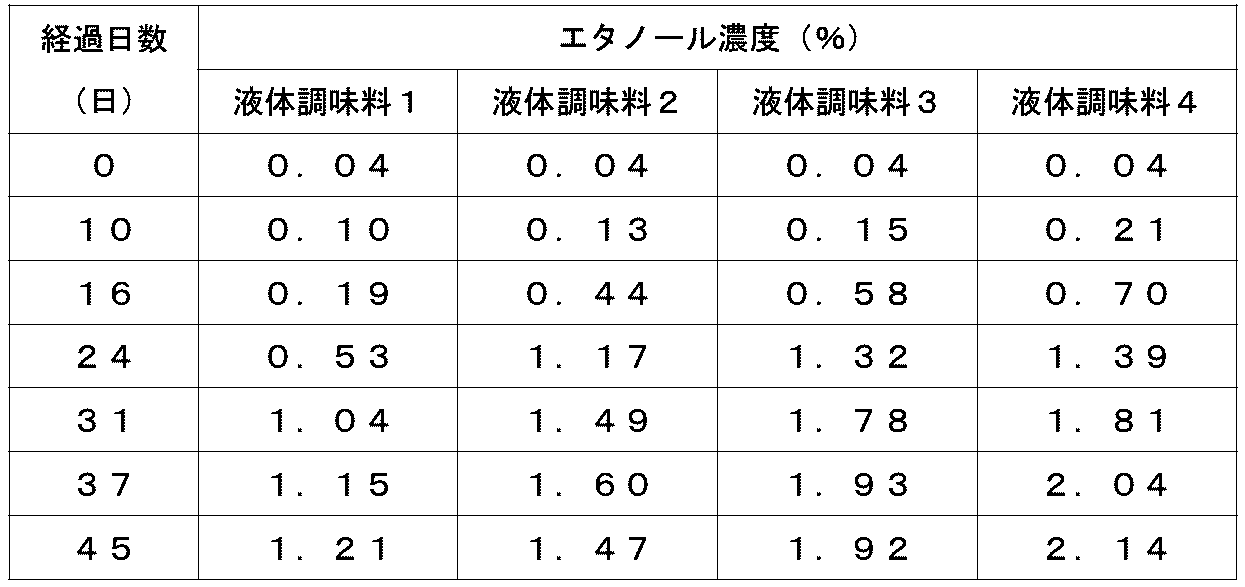
3-1.調味料用原液5~7の調製
調味料用原液4に対してエタノールを添加し、エタノールの含有量がそれぞれ1.0wt%、2.0wt%及び3.0wt%となるように調味料用原液5~7を調製した。
調味料用原液5~7を用いて、上記2-2と同様にして酵母発酵を行った。
上記3-2に記載したとおりに、調味料用原液5~7を酵母発酵に供することにより、液体調味料5~7を得た。液体調味料5~7の酵母発酵に際して、酵母接種から10、16、24、31、37及び45日後に液体調味料5~7中のエタノール濃度を測定した。結果を表2及び図2に示す。なお、表2及び図2には、調味料用原液4を用いた結果も合わせて示す。

醤油らしい香りを形成する香気成分の一部は酵母発酵中に生成することが知られている。酵母発酵によって生成される化合物のひとつであるHEMFは本醸造醤油の特徴成分として知られている(例えば、非特許文献「新増補 醤油の科学と技術」、栃倉辰六郎編著、平成24年1月30日新増補、p.286などを参照)。さらに、特開2014-233292号公報によると、醤油中のHEMFが15ppm未満になると、醤油の特徴香は低減される傾向にある。

5-1.調味料用原液8~12の調製
蒸煮した大豆と割砕した焙煎小麦とを等量混合したものに、Aspergillus sojaeの種麹を接種し、常法により43時間製麹して醤油麹を得た。
調味料用原液8~12中のリノール酸濃度を表4に示す。

リノール酸含有量の異なる調味料用原液8~12を酵母発酵して得た液体調味料8~12の官能評価結果を表5に示す。なお、「*」は液体調味料8と比較して5%の危険率で有意差があったことを示す。

6-1.液体調味料13~14の調製
蒸煮した大豆(丸大豆又は脱脂大豆)と割砕した焙煎小麦とを6:4の割合で混合し、これにAspergillus sojaeの種麹を接種し、常法により43時間製麹して醤油麹を得た。
蒸煮した大豆(丸大豆又は脱脂大豆)と割砕した焙煎小麦とを6:4の割合で混合し、これにAspergillus sojaeの種麹を接種し、常法により43時間製麹して醤油麹を得た。
パネルを5名とし、評価項目を「フルーティーな香り」としたこと以外は、上記1-5に記載の方法により液体調味料13~16について官能評価を実施した。


1-1:調味料用原液中での木片の沈降性の評価
(1)調味料用原液の製造方法
蒸煮した丸大豆と割砕した焙煎小麦とを6:4の割合で混合した混合物に、Aspergillus sojaeの種麹を接種し、常法により43時間製麹して醤油麹を得た。
特開2017-19177号公報に記載の方法により、50%の圧縮加工をしたスギの圧縮木材、40%の圧縮加工をしたヒノキの圧縮木材及び30%の圧縮加工をしたサクラの圧縮木材を飛騨産業株式会社より入手した。
各圧縮木材を1cm3の直方体となるように切断することにより、それぞれスギ木片4~6及びヒノキ木片4~6を作製した。一方、圧縮加工していない天然の木材を1cm3の直方体となるように切断することにより、スギ木片1~3及びヒノキ木片1~3を作製した。
評価した結果を表8に示す。
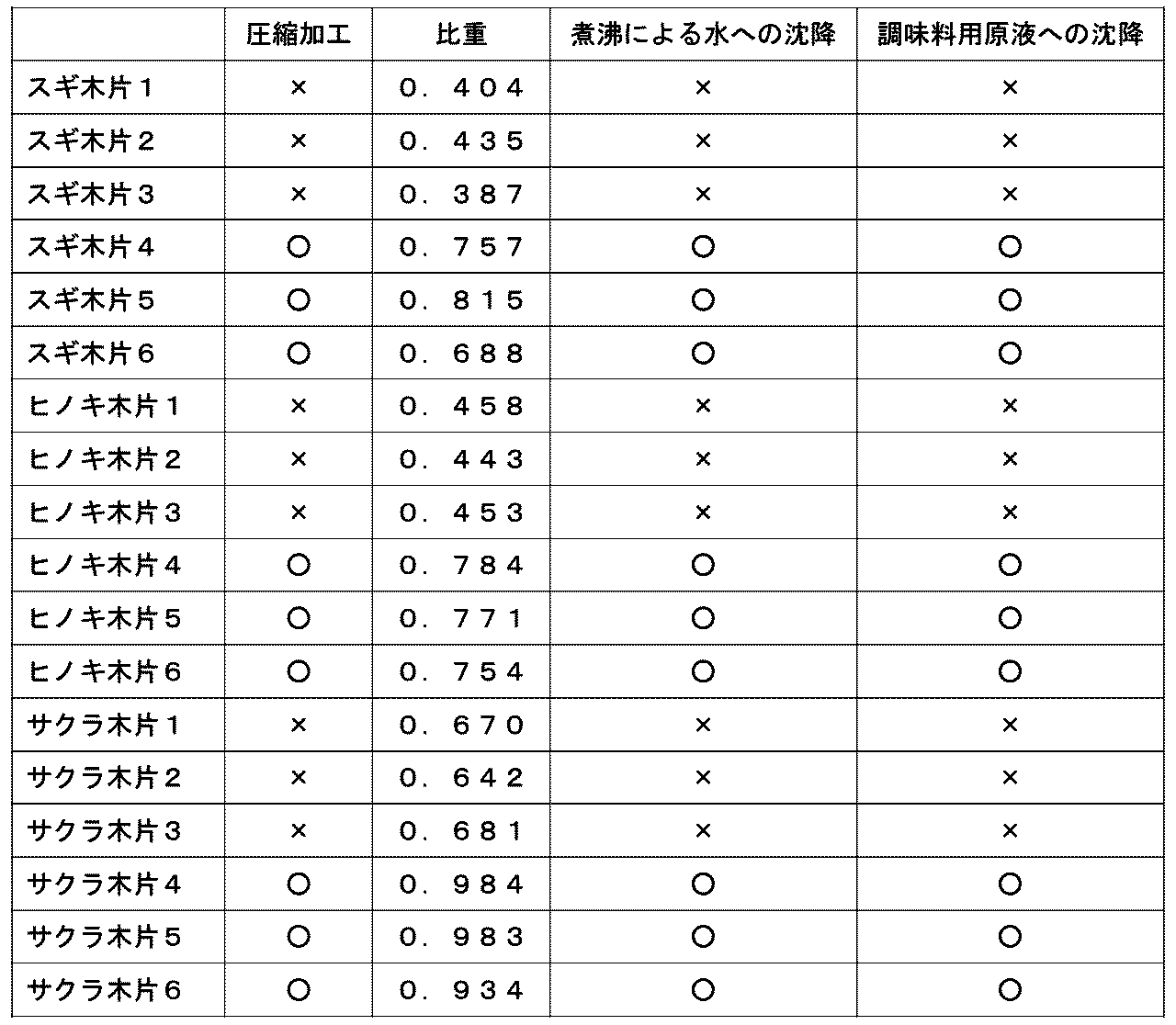
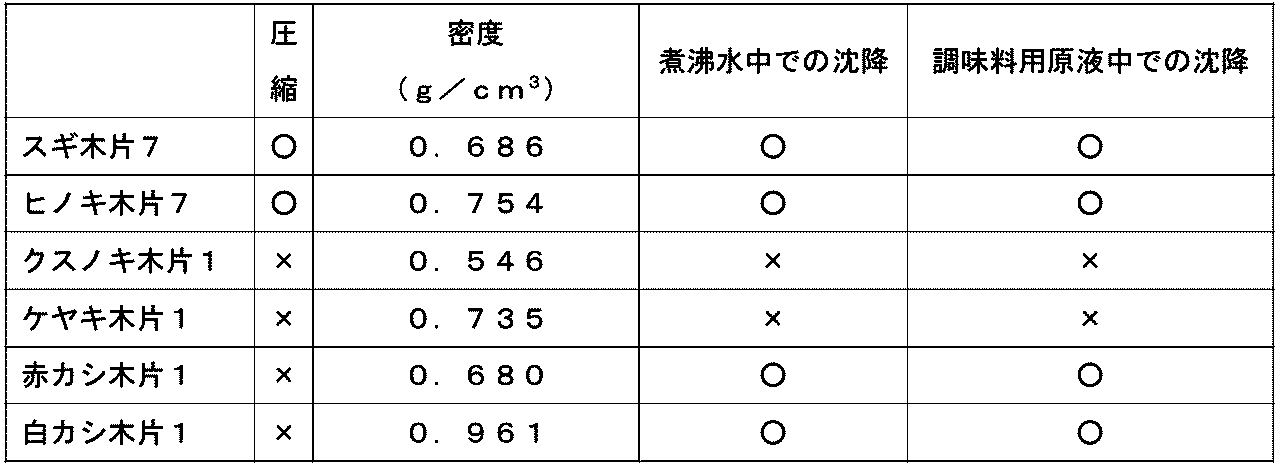
(1)評価方法
スギ木片7、ヒノキ木片7、サクラ木片4、赤カシ木片1及び白カシ木片1をそれぞれ沈降させた調味料用原液に、Zygosaccharomyces rouxiiを1.0×10⁵個/mlとなるように添加し、攪拌を行わずに、常温で30日間酵母発酵を行った。酵母発酵によってそれぞれの木片が液面付近まで浮上していれば「○」、浮上していなければ「×」として評価した。
評価した結果を表10に示す。

(1)評価方法
50%の圧縮加工をしたスギの圧縮木材、40%の圧縮加工をしたヒノキの圧縮木材及び30%の圧縮加工をしたサクラの圧縮木材を、それぞれ1cm3、5cm3、10cm3及び20cm3の直方体となるように切断することにより、スギ木片8~11、ヒノキ木片8~11及びサクラ木片7~10を得た。スギ木片8~11、ヒノキ木片8~11及びサクラ木片7~10を、2000ml容のステンレスカップに入れた800mlの水に入れて、10分間煮沸した。
評価した結果を表11に示す。
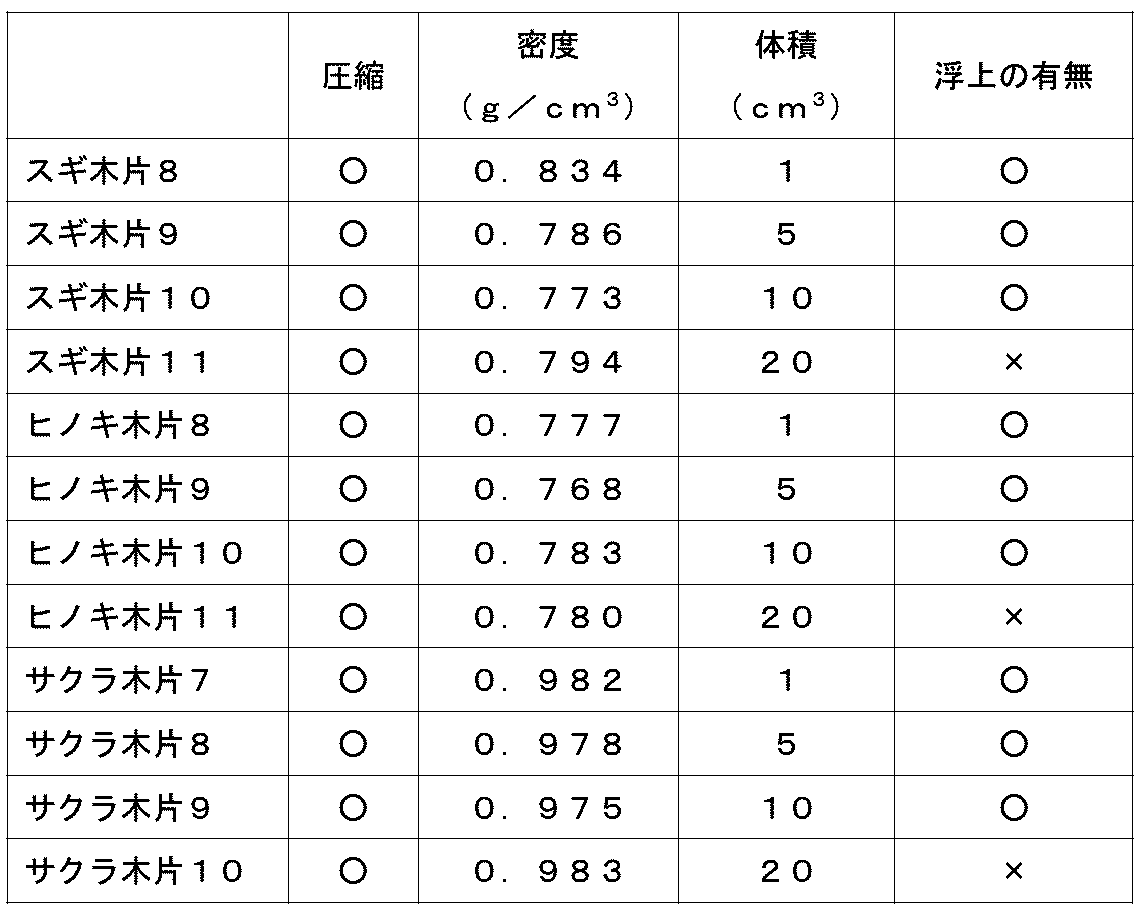
(1)試験方法
上記1と同様にして、50%の圧縮加工をしたスギの圧縮木材を1cm3の直方体となるように切断することにより、表12に示すスギ木片12~15を作製した。
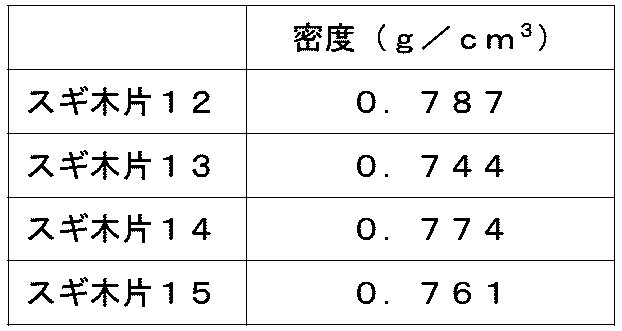
評価した結果を表13に示す。

(1)試験方法
例1で記載したとおりに調製した調味料用原液にZygosaccharomyces rouxiiを添加し、常温で30日間酵母発酵を行って調味料を得た。
官能評価を行った結果を表14に示す。

1-1.液体調味料8~12の調製
市販醤油「九州さしみあまくち」(キッコーマン社製)を色番が5番(液体調味料8)、10番(液体調味料9)、15番(液体調味料10)、20番(液体調味料11)及び30番(液体調味料12)となるように水で希釈して調整した。
150ml容の卓上ビン(第一硝子社製)に液体調味料8~12 150mlを注ぎ、上記5-1に記載の体積が1cm3であるスギ木片1を3個沈降させた。沈降させた木片について、調味料の入った容器を一定の視点から目視により観察して、全ての木片が視認できれば「○」、1~2個の木片視認ができれば「△」、木片が視認できなければ「×」で評価した。

2-1.液体調味料13~16の調製
上記5-1で記載したとおりに調製した調味料用原液8にZygosaccharomyces rouxiiを、添加後の酵母の菌数が1.0×101(=10)個/ml(液体調味料13)、1.0×102(=100)個/ml(液体調味料14)及び1.0×103(=1,000)個/ml(液体調味料15)となるように添加した。また添加していないものを液体調味料16とした。
液体調味料13~16を25℃で14日間撹拌をせずに酵母発酵させた。酵母発酵の指標としてエタノールの濃度を測定した。
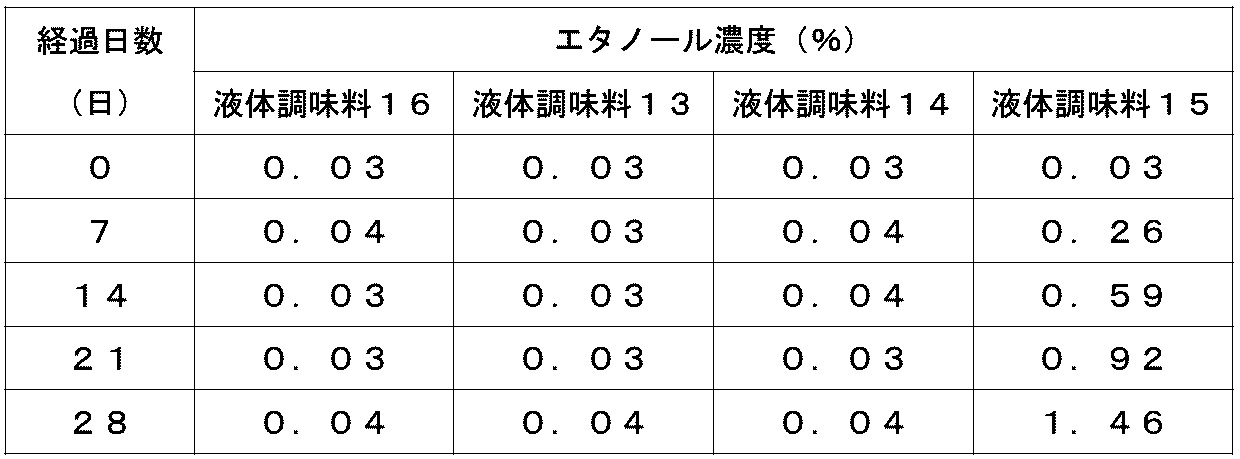
蒸煮した丸大豆と割砕した焙煎小麦とを6:4の割合で混合した混合物に、Aspergillus sojaeの種麹を接種し、常法により43時間製麹して醤油麹を得た。

1-1.エチルエステル類の測定方法
液体調味料中のエチルエステル類及び内部標準物質として用いたシクロヘキサノールの含有量の測定にあたっては、ダイナミックヘッドスペース法により、香気成分の分離濃縮を行ったうえでサンプルをGC-MSによる分析に供した。
捕集剤:Tenax TA(GERSTEL社製)
揮発性成分抽出装置:MPS2―DHS(GERSTEL社製)
予備加温:30℃、10min
捕集容量:650mL
捕集速度:100mL/min
捕集温度:30℃
ドライパージ容量:500mL
ドライパージ速度:50mL/min
ドライパージ温度:40℃
測定装置:7890A-5975MSD(AgilentTechnologies社製)
注入口:加熱脱着ユニット(GERSTEL社製)
カラム:DB-WAX LTM(長さ30m、口径0.25mm、膜厚0.25μm)(AgilentTechnologies社製)
加熱脱着条件:30℃(0.5sec)保持 → 280℃まで720℃/min昇温 → 5min保持
温度条件:40℃(3min)保持 → 160℃まで5℃/min昇温 → 240℃まで25℃/min昇温 → 6min保持
キャリア:高純度ヘリウム、圧力一定モード392.34kPa
スキャン質量範囲:m/z 28.7-185.0
イオン化方式:EI
オクタン酸エチル:m/z88
デカン酸エチル:m/z88
シクロヘキサノール:m/z82
液体調味料中の2-エチル-6-メチルピラジン、HEMF及び内部標準物質として用いた2-オクタノンの含有量は、酢酸エチルを用いた抽出処理に供して得た抽出液について、GC-MSで以下の条件に従って測定した。
測定装置:7890B-5977 MSD(AgilentTechnologies社製)
カラム:DB-WAX(長さ60m、口径0.25mm、膜厚0.25μm)(AgilentTechnologies社製)
注入口温度:250℃
温度条件:40℃(3min)保持 → 250℃まで6℃/min昇温 → 15min保持
キャリア:高純度ヘリウム、圧力一定モード229kPa
スキャン質量範囲:m/z 30.0~250.0
イオン化方式:EI
2-エチル-6-メチルピラジン、HEMF及び内部標準物質である2-オクタノンは以下のm/zを用い、ピーク面積を求めた。
2-エチル-6-メチルピラジン:m/z121
HEMF:m/z142
2-オクタノン:m/z58
2-1.単独添加の効果
市販の醤油に対してオクタン酸エチル及びデカン酸エチルのいずれかを単独で添加することによる「白ワイン様のフルーティーな香り」の向上(付与)効果を官能評価に基づいて確認した。
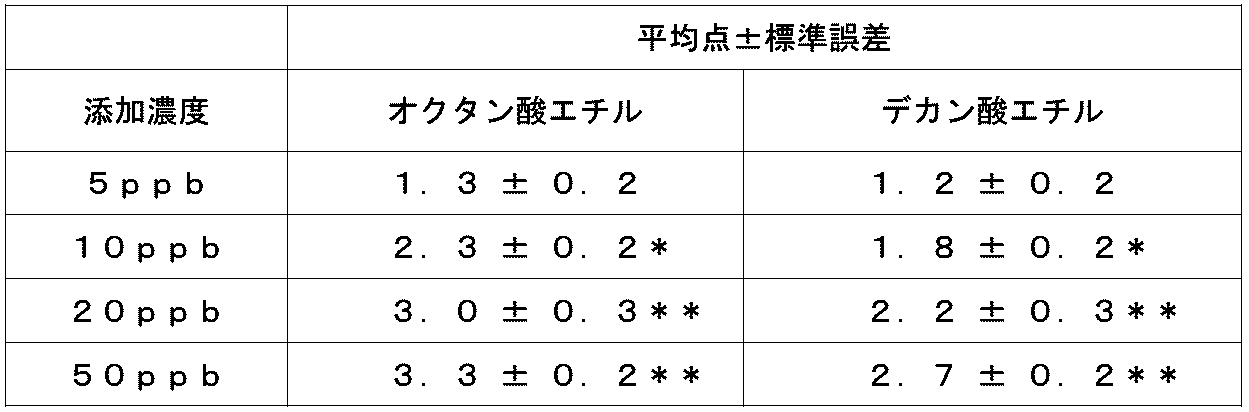
市販の醤油に対してオクタン酸エチル及びデカン酸エチルを混合して添加することによる「白ワイン様のフルーティーな香り」の向上(付与)効果を官能評価に基づいて確認した。
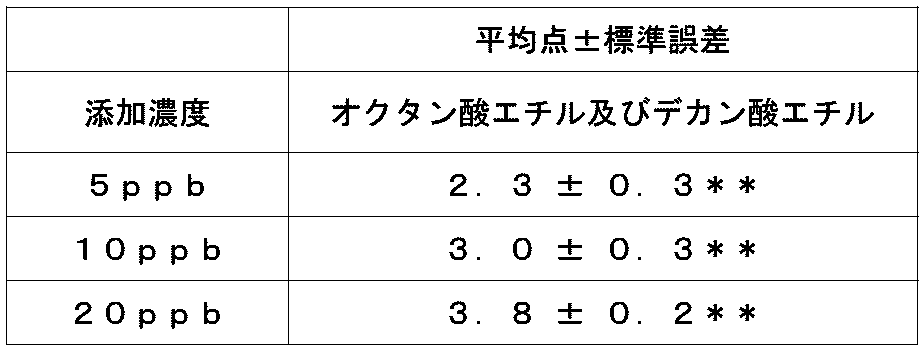
表19及び図9に示されるとおり、10ppb以上であれば、オクタン酸エチル及びデカン酸エチルのいずれか一方を単独で添加することによって、添加していない試料(生醤油)と比較して、「白ワイン様のフルーティーな香り」が向上することが認められた。
3-1.液体調味料の調製
蒸煮した大豆と割砕した焙煎小麦とを6:4の割合で混合した混合物に、Aspergillus sojaeの種麹を接種し、常法により43時間製麹して醤油麹を得た。
上記1-1に記載したとおりに、液体調味料4-1~4-2及び市販醤油1~2について、オクタン酸エチル及びデカン酸エチルの含有量を、標準添加法により、ダイナミックヘッドスペース-GC-MSを用いて測定した。結果を表20に示す。なお、GC-MSの結果より、その他の醤油主要香気成分の含有量について、これらの試料の間に変化はみられなかった。

官能評価は、識別能力を有する6名のパネルにより、液体調味料4-1~4-2及び市販醤油1~2について、「白ワイン様のフルーティーな香り」を評価項目として5段階(1:香りがしない、2:かなり弱い、3:弱い、4:強い、5:かなり強い)で評価し、その平均値及び標準誤差を算出した。
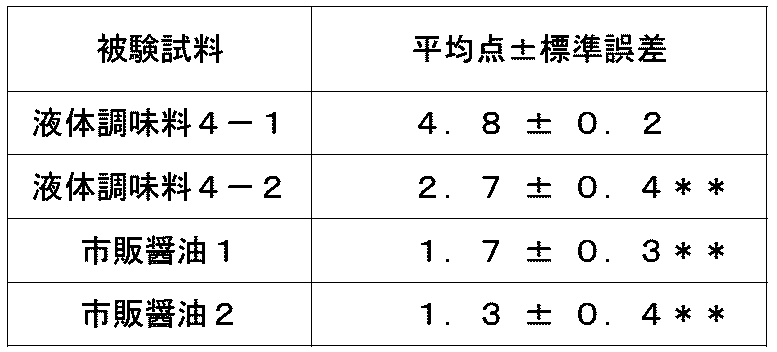
表20、表21及び図10に示されるとおり、オクタン酸エチル及びデカン酸エチルをそれぞれ5ppb以上含む液体調味料4-1は、液体調味料4-2、市販醤油1及び市販醤油2と比較して、「白ワイン様のフルーティーな香り」の強度が顕著に高いことが確認された。
4-1.単独添加の効果
液体調味料4-2について、オクタン酸エチル及びデカン酸エチルのいずれかを単独で添加することによる「白ワイン様のフルーティーな香り」の向上(付与)効果を官能評価に基づいて確認した。
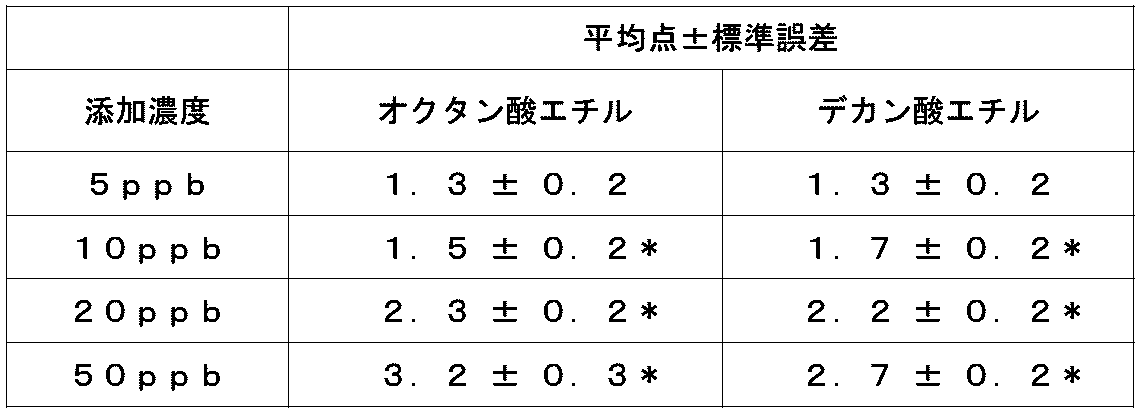
液体調味料4-2について、オクタン酸エチル及びデカン酸エチルを混合して添加することによる「白ワイン様のフルーティーな香り」の向上(付与)効果を官能評価に基づいて確認した。
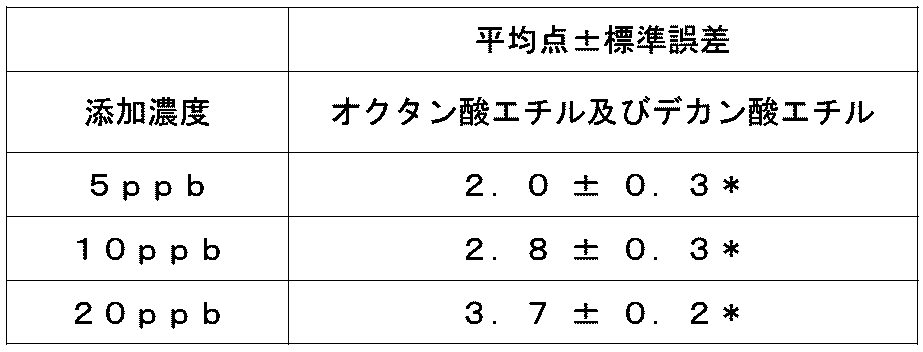
表22、表23及び図11に示されるとおり、10ppb以上であるいずれの濃度においてもオクタン酸エチル及びデカン酸エチルのいずれかを添加することによって、添加していない試料(液体調味料4-2)と比較して、「白ワイン様のフルーティーな香り」が向上することが認められた。
5-1.液体調味料8-1~8-4及び液体調味料9-1~9-4の調製
上記3-1に記載の液体調味料4-1に対して、それぞれ最終濃度で10,000、20,000、50,000及び100,000ppbとなるようにオクタン酸エチルを添加することにより液体調味料8-1~8-4を調製した。また、液体調味料4-1に対して、それぞれ最終濃度で1,000、2,000、5,000及び10,000ppmとなるようにデカン酸エチルを添加することにより液体調味料9-1~9-4を調製した。
官能評価は、識別能力を有する6名のパネルにより、液体調味料8-1~8-4及び液体調味料9-1~9-4について、「白ワイン様のフルーティーな香り」、「石油様の不快臭」及び「全体的な好ましい香り」を評価項目として5段階で評価し、その平均値及び標準誤差を算出した。なお、「石油様の不快臭」及び「全体的な好ましい香り」は以下の5段階で評価した。
「石油様の不快臭」
1:香りがしない、2:かなり弱い、3:弱い、4:強い、5:かなり強い
「全体的な好ましい香り」
1:非常に好ましくない、2:好ましくない、3:普通、4:好ましい、5:非常に好ましい
液体調味料8-1~8-4の官能評価結果を表24に、液体調味料9-1~9-4の官能評価結果を表25にそれぞれ示す。なお、表24及び25中の最も添加濃度の低い液体調味料(液体調味料8-1及び液体調味料9-1)と比較して、「**」及び「*」はそれぞれ1%及び5%の危険率で有意差があったことを示す。


6-1.2-エチル-6-メチルピラジンの測定結果
上記1-2に記載したとおりの方法で、上記3-1に記載の液体調味料4-1~4-2及び市販醤油1~2について、2-エチル-6-メチルピラジンの含有量を、標準添加法により、酢酸エチル抽出液をGC-MSを用いて分析した。結果を表26に示す。

2-エチル-6-メチルピラジンを添加することによる白ワイン様のフルーティーな香りの抑制効果を官能評価に基づいて確認した。

表26~表27に示すように、オクタン酸エチル及びデカン酸エチルをそれぞれ18.7ppb及び40.3ppbを含有する液体調味料4-1について、2-エチル-6メチルピラジンを10ppb以上添加することにより、「白ワイン様のフルーティーな香り」が低減されることが確認された。
上記1-2に記載したとおりの方法で、上記3-1に記載の液体調味料4-1及び市販醤油1~2について、HEMFの含有量を、標準添加法により、酢酸エチル抽出液をGC-MSを用いて分析した。結果を表28に示す。

液体調味料4-1に対して、オクタン酸エチル及びデカン酸エチルを最終濃度で表29に記載の値になるように添加し、液体調味料10-1~10-7を調製した。
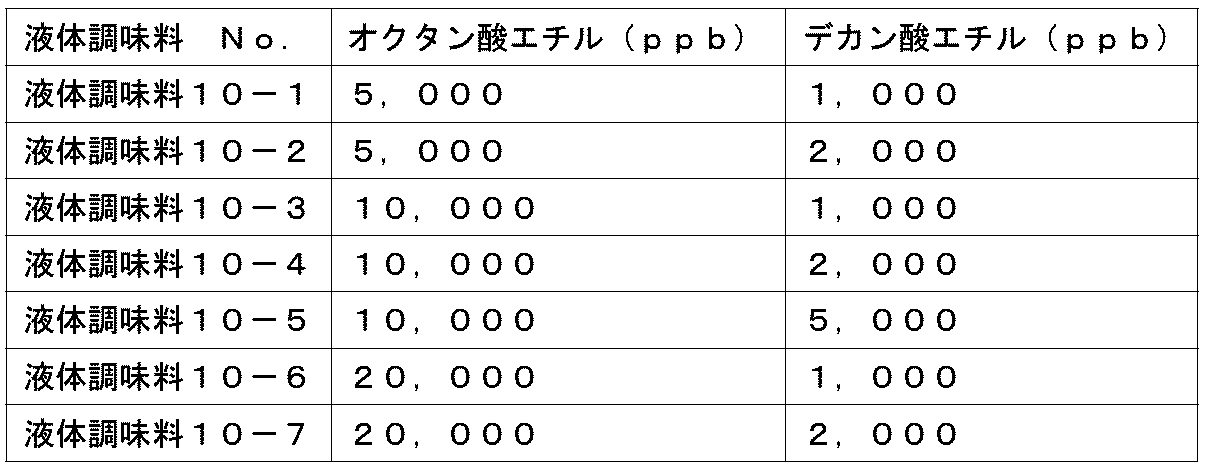

1-1.全窒素分の測定方法
液体調味料中の窒素含有量は、全窒素分として、文献「しょうゆの日本農林規格」(農林水産省告示)に記載の燃焼法全窒素測定装置として「デュマサーム」(ゲルハルトジャパン社製)を用いた燃焼法により測定した。
2-1.液体調味料の製造方法
蒸煮した大豆と割砕した焙煎小麦とを6:4の割合で混合した混合物に、アスペルギルス・ソーヤ(Aspergillus sojae)の種麹を接種し、常法により43時間製麹して醤油麹を得た。
液体調味料1、液体調味料2、市販の生醤油である「しぼりたて生しょうゆ」(キッコーマン社製)及び市販の再仕込み醤油である「二段熟成生しょうゆ」(キッコーマン社製)について、HEMF、オクタン酸エチル、デカン酸エチル、還元糖及び全窒素分の含有量を測定し、さらにそれぞれが有する香りを飲食せずに鼻だけで感じることにより評価した。結果を表31に示す。

3-1.液体調味料の製造方法
膨化処理により加熱変性した脱脂加工大豆のみを用いて、バラ麹(大豆原料を多く用いるたまり醤油製造の際に用いられる、大豆原料を味噌玉様に加工して得られる麹ではない、一般的な醤油麹)により微生物汚染の少ない醤油麹を製造した。
液体調味料3~15について、HEMF、オクタン酸エチル及びデカン酸エチルの含有量を測定した。結果を表32に示す。
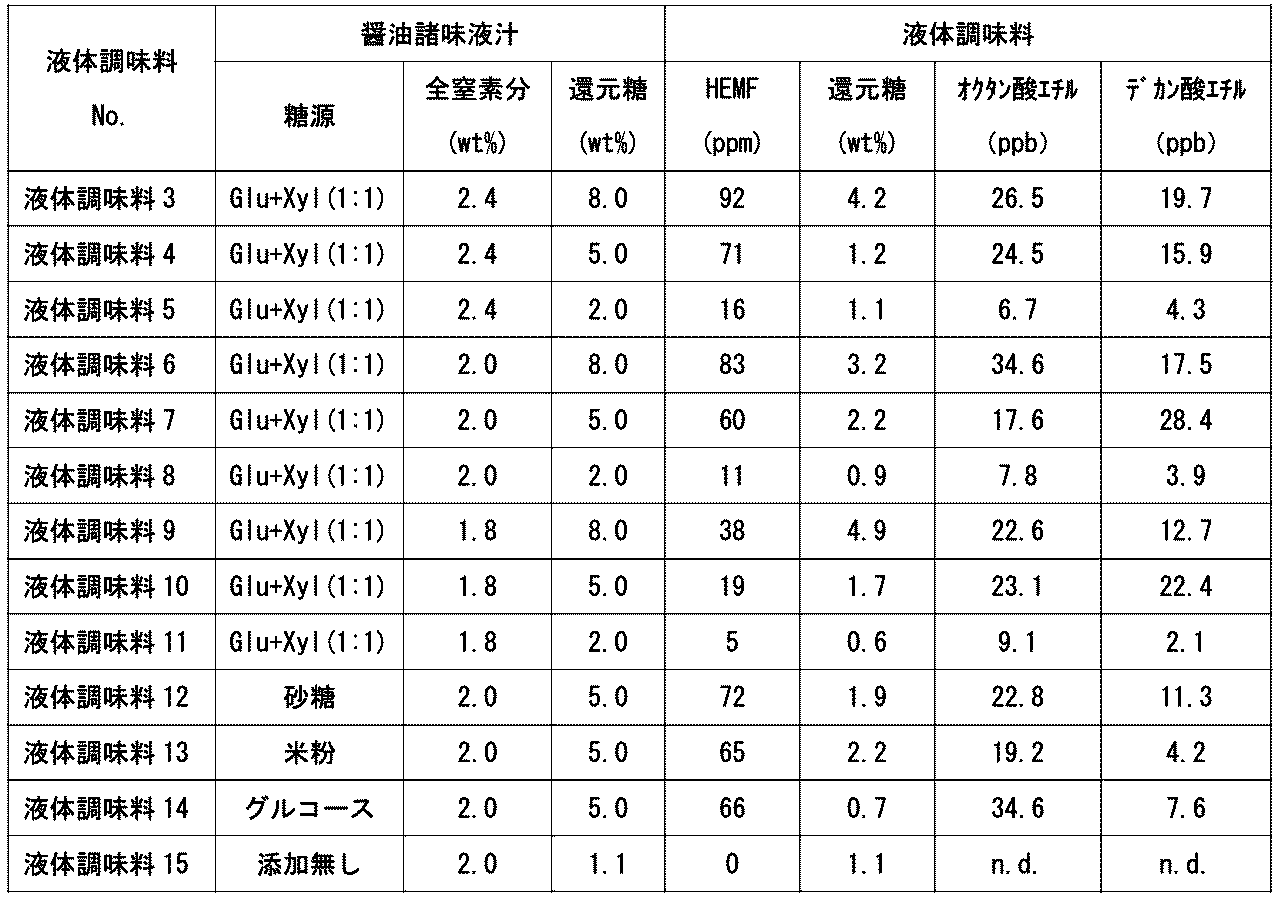
4-1.液体調味料の製造方法
蒸煮した大豆と割砕した焙煎小麦とを6:4の割合で混合した混合物に、アスペルギルス・ソーヤ(Aspergillus sojae)の種麹を接種し、常法により43時間製麹して醤油麹を得た。
液体調味料16について、HEMF、オクタン酸エチル、デカン酸エチル、還元糖及び全窒素分の含有量を測定した。結果を表33に示す。

5-1.液体調味料の製造方法
市販の再仕込醤油である「二段熟成生しょうゆ」(キッコーマン社製)を珪藻土によるろ過処理に2回供して、再仕込醤油液汁を得た。
液体調味料17について、HEMF、オクタン酸エチル、デカン酸エチル、還元糖及び全窒素分の含有量を測定した。結果を表34に示す。

11 第1の調味料用原液含有容器
12 第2の調味料用原液含有容器
21 木片
31 種醤油
41 第1の酵母発酵用容器
42 第2の酵母発酵用容器
51 第1の蓋
52 第2の蓋
61 第1の容器台
62 第2の容器台
71 光源付き携帯情報端末
Claims (31)
- 還元糖の含有量が4.5wt%以上であり、かつ、エタノールの含有量が1.5wt%以下である、調味料用原液。
- 前記調味料用原液は、リノール酸の含有量が0.03wt%以下である、請求項1に記載の調味料用原液。
- 前記調味料用原液は、醤油諸味の液汁である、請求項1~2のいずれか1項に記載の調味料用原液。
- 前記調味料は、醤油又は醤油様調味料である、請求項1~3のいずれか1項に記載の調味料用原液。
- 請求項1~4のいずれか1項に記載の調味料用原液を、酵母発酵に供することにより、調味料を得る工程を含む、調味料の製造方法。
- 圧縮加工がされており、かつ、体積が20cm3未満であることを特徴とする木片。
- 前記木片は、酵母発酵前の調味料用原液中では沈降し、かつ、酵母発酵後の調味料用原液中では液面付近に浮上する、請求項6に記載の木片。
- 前記圧縮加工が、圧縮加工をする前と比べて、密度が1.1倍以上になるような圧縮加工である、請求項6~7のいずれか1項に記載の木片。
- 前記圧縮加工が、圧縮加工をする前と比べて、密度が1.25~2.5倍になるような圧縮加工である、請求項6~7のいずれか1項に記載の木片。
- さらに短時間で煮沸されていることを特徴とする、請求項6~9のいずれか1項に記載の木片。
- 前記木片が、スギ科植物、ヒノキ科植物、バラ科植物、ブナ科植物及びニレ科植物からなる群から選ばれる植物の樹木に由来する木片であることを特徴とする、請求項6~10のいずれか1項に記載の木片。
- 請求項6~11のいずれか1項に記載の木片を、調味料用原液中に投入して酵母発酵し、該木片が浮上することを指標として、調味料を得る工程を含む、調味料の製造方法。
- 前記調味料用原液が、醤油諸味の液汁である、請求項12に記載の調味料の製造方法。
- 前記調味料が、醤油又は醤油様調味料である、請求項12~13のいずれか1項に記載の調味料の製造方法。
- 還元糖の含有量が4.5wt%以上であり、エタノールの含有量が1.5wt%以下であり、かつ、色番が15番以上である調味料用原液と、
圧縮加工がされており、かつ、体積が20cm3未満である木片と、
最終濃度として菌数が1.0×10³個/ml以上になるように添加される酵母含有物と、
酵母発酵用容器と
を含む、調味料製造用キット。 - 酵母発酵用容器を載置する台座部と、
該台座部に載置した該酵母発酵用容器の底面から光を照射して散乱光が生じるように台座部を貫通して設けられた孔部と、
該孔部から該酵母発酵用容器の底面を照射するための光源を収容可能な光源収容部と
を備える容器台をさらに含む、請求項15に記載のキット。 - 前記酵母含有物は、酵母発酵させて得た調味料である、請求項15~16のいずれか1項に記載のキット。
- 前記調味料用原液は、醤油諸味の液汁である、請求項15~17のいずれか1項に記載のキット。
- 前記調味料は、醤油又は醤油様調味料である、請求項15~18のいずれか1項に記載のキット。
- 還元糖の含有量が4.5wt%以上であり、エタノールの含有量が1.5wt%以下であり、かつ、色番が15番以上である調味料用原液と、
前記調味料用原液に対して菌数が1.0×10³個/ml以上になるように添加される酵母含有液と、
圧縮加工がされており、かつ、体積が20cm3未満である木片と
を加えた酵母発酵用容器を、酵母発酵に供して、該容器内の前記木片が浮上することを指標として、調味料を得る工程
を含む、調味料の製造方法。 - 前記酵母含有物は、酵母発酵させて得た調味料である、請求項20に記載の製造方法。
- 前記調味料用原液は、醤油諸味の液汁である、請求項20~21のいずれか1項に記載の製造方法。
- 前記調味料は、醤油又は醤油様調味料である、請求項20~22のいずれか1項に記載の製造方法。
- オクタン酸エチル及び/又はデカン酸エチルの含有量が下記(1)~(3)のいずれかである、醤油又は醤油様調味料。
(1)オクタン酸エチルの含有量が10ppb~20,000ppbである
(2)デカン酸エチルの含有量が10ppb~5,000ppbである
(3)オクタン酸エチルの含有量が5ppb~10,000ppbであり、かつ、デカン酸エチルの含有量が5ppb~2,000ppbである - 前記醤油又は醤油様調味料は、2-エチル-6-メチルピラジンの含有量が10ppb未満である、請求項24に記載の醤油又は醤油様調味料。
- 前記醤油又は醤油様調味料は、HEMFの含有量が20ppm以上である、請求項24~25のいずれか1項に記載の醤油又は醤油様調味料。
- 全窒素分が1.8wt%以上であり、HEMFの含有量が60ppm以上であり、かつ、濃厚である、請求項24に記載の醤油又は醤油調味料。
- 前記HEMFは、外部添加されたHEMFではない、請求項27に記載の醤油又は醤油調味料。
- 前記醤油又は醤油調味料は、醤油諸味液汁の酵母発酵物を含み、かつ、酵母発酵前の該醤油諸味液汁は全窒素分の含有量が1.8wt%以上であり、かつ、還元糖の含有量が5.0wt%以上である、請求項27~28のいずれか1項に記載の醤油又は醤油調味料。
- 醤油麹と食塩水とを混合処理に供して得られた第1の醤油諸味を、固液分離処理及び除菌処理に供して第1の醤油諸味液汁を得る工程、
前記第1の醤油諸味液汁と醤油麹と食塩とを混合処理に供して第2の醤油諸味を得る工程、
前記第2の醤油諸味を固液分離処理又は固液分離処理及び除菌処理に供して第2の醤油諸味液汁を得る工程、及び
前記第2の醤油諸味液汁を醤油酵母による酵母発酵に供することにより、全窒素分が1.8wt%以上であり、かつ、HEMFの含有量が60ppm以上である濃厚醤油又は濃厚醤油調味料を得る工程を含む
濃厚醤油又は濃厚醤油調味料の製造方法。 - 醤油麹と食塩水とを混合処理に供して得られた醤油諸味を、固液分離処理及び除菌処理に供して醤油諸味液汁を得る工程、
前記醤油諸味液汁を、全窒素分が2.0wt%以上及び還元糖の含有量が5.0wt%以上となるように調整して、調整醤油諸味液汁を得る工程、及び
前記調整醤油諸味液汁を醤油酵母による酵母発酵に供することにより、全窒素分が1.8wt%以上であり、かつ、HEMFの含有量が60ppm以上である濃厚醤油又は濃厚醤油調味料を得る工程を含む、
濃厚醤油又は濃厚醤油調味料の製造方法。
Priority Applications (12)
| Application Number | Priority Date | Filing Date | Title |
|---|---|---|---|
| CA3080106A CA3080106C (en) | 2017-10-27 | 2018-10-26 | Raw liquid for seasoning and method for manufacturing seasoning |
| MYPI2020002036A MY202506A (en) | 2017-10-27 | 2018-10-26 | Raw liquid for seasoning, wood piece usable as fermentation index for seasoning, kit for manufacturing seasoning, method for manufacturing seasoning, seasoning, and rich seasoning |
| CN201880069514.9A CN111278299A (zh) | 2017-10-27 | 2018-10-26 | 调味料用原液、调味料发酵指标用木片、调味料制造用套件和调味料的制造方法以及调味料和浓厚调味料 |
| SG11202003727RA SG11202003727RA (en) | 2017-10-27 | 2018-10-26 | Raw liquid for seasoning, wood piece usable as fermentation index for seasoning, kit for manufacturing seasoning, method for manufacturing seasoning, seasoning, and rich seasoning |
| US16/759,369 US20200281240A1 (en) | 2017-10-27 | 2018-10-26 | Liquid concentrate for seasoning, wood piece usable as fermentation index for seasoning, kit for manufacturing seasoning, method for manufacturing seasoning, seasoning, and thickened seasoning |
| JP2019550353A JP7064224B2 (ja) | 2017-10-27 | 2018-10-26 | 調味料用原液、調味料発酵指標用木片、調味料製造用キット及び調味料の製造方法並びに調味料及び濃厚調味料 |
| RU2020114669A RU2746806C1 (ru) | 2017-10-27 | 2018-10-26 | Сырьевая жидкость для приправы, древесный элемент, используемый в качестве показателя брожения для приправы, набор для получения приправы, способ получения приправы, приправа и насыщенная приправа |
| EP18869834.4A EP3701807B1 (en) | 2017-10-27 | 2018-10-26 | Liquid and method for manufacturing seasoning, and seasoning |
| ES18869834T ES3027958T3 (en) | 2017-10-27 | 2018-10-26 | Liquid and method for manufacturing seasoning, and seasoning |
| JP2022030722A JP7260686B2 (ja) | 2017-10-27 | 2022-03-01 | 調味料用原液、調味料発酵指標用木片、調味料製造用キット及び調味料の製造方法並びに調味料及び濃厚調味料 |
| US17/929,701 US20230200418A1 (en) | 2017-10-27 | 2022-09-04 | Liquid concentrate for seasoning, wood piece usable as fermentation index for seasoning, kit for manufacturing seasoning, method for manufacturing seasoning, seasoning, and thickened seasoning |
| US18/751,259 US20240358053A1 (en) | 2017-10-27 | 2024-06-23 | Liquid concentrate for seasoning, wood piece usable as fermentation index for seasoning, kit for manufacturing seasoning, method for manufacturing seasoning, seasoning, and thickened seasoning |
Applications Claiming Priority (10)
| Application Number | Priority Date | Filing Date | Title |
|---|---|---|---|
| JP2017-208413 | 2017-10-27 | ||
| JP2017208413 | 2017-10-27 | ||
| JP2017208412 | 2017-10-27 | ||
| JP2017-208410 | 2017-10-27 | ||
| JP2017-208412 | 2017-10-27 | ||
| JP2017-208411 | 2017-10-27 | ||
| JP2017208410 | 2017-10-27 | ||
| JP2017208411A JP6343710B1 (ja) | 2017-10-27 | 2017-10-27 | 醤油及び醤油様調味料 |
| JP2018-112279 | 2018-06-12 | ||
| JP2018112279 | 2018-06-12 |
Related Child Applications (3)
| Application Number | Title | Priority Date | Filing Date |
|---|---|---|---|
| US16/759,369 A-371-Of-International US20200281240A1 (en) | 2017-10-27 | 2018-10-26 | Liquid concentrate for seasoning, wood piece usable as fermentation index for seasoning, kit for manufacturing seasoning, method for manufacturing seasoning, seasoning, and thickened seasoning |
| US17/929,701 Division US20230200418A1 (en) | 2017-10-27 | 2022-09-04 | Liquid concentrate for seasoning, wood piece usable as fermentation index for seasoning, kit for manufacturing seasoning, method for manufacturing seasoning, seasoning, and thickened seasoning |
| US18/751,259 Division US20240358053A1 (en) | 2017-10-27 | 2024-06-23 | Liquid concentrate for seasoning, wood piece usable as fermentation index for seasoning, kit for manufacturing seasoning, method for manufacturing seasoning, seasoning, and thickened seasoning |
Publications (1)
| Publication Number | Publication Date |
|---|---|
| WO2019083041A1 true WO2019083041A1 (ja) | 2019-05-02 |
Family
ID=66247499
Family Applications (1)
| Application Number | Title | Priority Date | Filing Date |
|---|---|---|---|
| PCT/JP2018/039991 Ceased WO2019083041A1 (ja) | 2017-10-27 | 2018-10-26 | 調味料用原液、調味料発酵指標用木片、調味料製造用キット及び調味料の製造方法並びに調味料及び濃厚調味料 |
Country Status (10)
| Country | Link |
|---|---|
| US (3) | US20200281240A1 (ja) |
| EP (1) | EP3701807B1 (ja) |
| JP (1) | JP7124010B2 (ja) |
| CN (1) | CN111278299A (ja) |
| CA (2) | CA3080106C (ja) |
| ES (1) | ES3027958T3 (ja) |
| MY (1) | MY202506A (ja) |
| RU (1) | RU2746806C1 (ja) |
| SG (1) | SG11202003727RA (ja) |
| WO (1) | WO2019083041A1 (ja) |
Families Citing this family (7)
| Publication number | Priority date | Publication date | Assignee | Title |
|---|---|---|---|---|
| JP7652603B2 (ja) * | 2021-03-25 | 2025-03-27 | キッコーマン株式会社 | 香りの優れた醤油及び醤油様調味料 |
| WO2022176979A1 (ja) * | 2021-02-19 | 2022-08-25 | キッコーマン株式会社 | 香りの優れた醤油及び醤油様調味料、並びに加熱劣化臭の抑制方法、加熱劣化臭が抑制された容器詰組成物及び加熱劣化臭抑制用組成物 |
| CN116963616A (zh) * | 2021-02-19 | 2023-10-27 | 龟甲万株式会社 | 香味优良的酱油和酱油样调味料、以及加热劣化气味的抑制方法、加热劣化气味得到了抑制的容器装组合物和用于抑制加热劣化气味的组合物 |
| CN112914079A (zh) * | 2021-03-04 | 2021-06-08 | 张兵 | 一种以制茶工艺制作酱油的生产方法 |
| EP4385339A4 (en) * | 2021-09-14 | 2025-07-02 | Kikkoman Corp | SOY SAUCE RICH IN ORGANIC ACID |
| CN116035191A (zh) * | 2023-01-09 | 2023-05-02 | 华南理工大学 | 一种结合酶解和发酵技术制备大豆风味料的方法和用途 |
| CN116836824B (zh) * | 2023-06-27 | 2024-06-21 | 西南大学 | 一株埃切假丝酵母菌y19及其应用 |
Citations (11)
| Publication number | Priority date | Publication date | Assignee | Title |
|---|---|---|---|---|
| JPS642550A (en) * | 1987-06-25 | 1989-01-06 | Takeda Shokuryo Kk | Process for quick brewing of soy |
| JPH0239868A (ja) | 1988-07-28 | 1990-02-08 | Kikkoman Corp | 調味液の製造法 |
| JPH03292872A (ja) * | 1990-04-11 | 1991-12-24 | Saga Pref Gov Miso Shoyu Jozo Kyodo Kumiai | 醤油様調味液の製造法 |
| JP2001120293A (ja) * | 1999-10-20 | 2001-05-08 | Japan Science & Technology Corp | 4−ハイドロキシ−2(又は5)−エチル−5(又は2)−メチル−3(2h)−フラノンの製造方法 |
| JP2002191348A (ja) | 2000-12-26 | 2002-07-09 | Ishikawaken Shuzo Kumiai Rengokai | 酒造用醴及び清酒の製造法 |
| JP4222487B2 (ja) | 2004-02-04 | 2009-02-12 | ヤマサ醤油株式会社 | 濃厚醤油の製造法 |
| JP2014233292A (ja) | 2013-05-31 | 2014-12-15 | ヤマサ醤油株式会社 | 醸造醤油および醸造醤油の製造方法 |
| JP2016059382A (ja) * | 2014-09-12 | 2016-04-25 | キッコーマン株式会社 | 醤油様調味料の製造方法及び醤油様調味料 |
| JP2016140321A (ja) | 2015-02-03 | 2016-08-08 | キッコーマン株式会社 | 低分子エステル類を含む醤油様調味料又は醤油の風味改善剤 |
| JP2017019177A (ja) | 2015-07-10 | 2017-01-26 | 飛騨産業株式会社 | 圧縮木材の製造方法及び圧縮木材並びにこの圧縮木材を切削してなる切削板材 |
| JP6343710B1 (ja) * | 2017-10-27 | 2018-06-13 | キッコーマン株式会社 | 醤油及び醤油様調味料 |
Family Cites Families (10)
| Publication number | Priority date | Publication date | Assignee | Title |
|---|---|---|---|---|
| JPS5276488A (en) * | 1975-12-23 | 1977-06-27 | Kikkoman Corp | Production of seasoner |
| JPS61137085A (ja) * | 1984-12-07 | 1986-06-24 | Nissan Motor Co Ltd | ロランc受信機 |
| JPH0685703B2 (ja) * | 1986-10-02 | 1994-11-02 | サンビシ株式会社 | 調味液の速醸装置 |
| JPH02200161A (ja) * | 1989-01-31 | 1990-08-08 | Kikkoman Corp | 醤油の香気改善法 |
| DE69618190D1 (de) * | 1996-09-17 | 2002-01-31 | Nestle Sa | Herstellung eines Gewürzes |
| US20140004225A1 (en) * | 2011-03-23 | 2014-01-02 | Kikkoman Corporation | Very low common salt soy sauce and method for producing same |
| JP2014096989A (ja) * | 2012-10-17 | 2014-05-29 | Ogawa & Co Ltd | 醤油又は醤油香味付与剤の香味改善剤 |
| JP6076037B2 (ja) * | 2012-10-26 | 2017-02-08 | 小川香料株式会社 | 醤油又は醤油香味付与剤の香味改善剤 |
| JP6049015B2 (ja) * | 2013-01-30 | 2016-12-21 | ヤマサ醤油株式会社 | Hemf高含有発酵食品の製造法 |
| JP5836466B1 (ja) * | 2014-10-31 | 2015-12-24 | キッコーマン株式会社 | 醤油様調味液およびその製造方法 |
-
2018
- 2018-10-26 CA CA3080106A patent/CA3080106C/en active Active
- 2018-10-26 RU RU2020114669A patent/RU2746806C1/ru active
- 2018-10-26 CN CN201880069514.9A patent/CN111278299A/zh active Pending
- 2018-10-26 CA CA3133506A patent/CA3133506C/en active Active
- 2018-10-26 MY MYPI2020002036A patent/MY202506A/en unknown
- 2018-10-26 ES ES18869834T patent/ES3027958T3/es active Active
- 2018-10-26 SG SG11202003727RA patent/SG11202003727RA/en unknown
- 2018-10-26 WO PCT/JP2018/039991 patent/WO2019083041A1/ja not_active Ceased
- 2018-10-26 US US16/759,369 patent/US20200281240A1/en not_active Abandoned
- 2018-10-26 EP EP18869834.4A patent/EP3701807B1/en active Active
-
2020
- 2020-06-16 JP JP2020103423A patent/JP7124010B2/ja active Active
-
2022
- 2022-09-04 US US17/929,701 patent/US20230200418A1/en active Pending
-
2024
- 2024-06-23 US US18/751,259 patent/US20240358053A1/en active Pending
Patent Citations (11)
| Publication number | Priority date | Publication date | Assignee | Title |
|---|---|---|---|---|
| JPS642550A (en) * | 1987-06-25 | 1989-01-06 | Takeda Shokuryo Kk | Process for quick brewing of soy |
| JPH0239868A (ja) | 1988-07-28 | 1990-02-08 | Kikkoman Corp | 調味液の製造法 |
| JPH03292872A (ja) * | 1990-04-11 | 1991-12-24 | Saga Pref Gov Miso Shoyu Jozo Kyodo Kumiai | 醤油様調味液の製造法 |
| JP2001120293A (ja) * | 1999-10-20 | 2001-05-08 | Japan Science & Technology Corp | 4−ハイドロキシ−2(又は5)−エチル−5(又は2)−メチル−3(2h)−フラノンの製造方法 |
| JP2002191348A (ja) | 2000-12-26 | 2002-07-09 | Ishikawaken Shuzo Kumiai Rengokai | 酒造用醴及び清酒の製造法 |
| JP4222487B2 (ja) | 2004-02-04 | 2009-02-12 | ヤマサ醤油株式会社 | 濃厚醤油の製造法 |
| JP2014233292A (ja) | 2013-05-31 | 2014-12-15 | ヤマサ醤油株式会社 | 醸造醤油および醸造醤油の製造方法 |
| JP2016059382A (ja) * | 2014-09-12 | 2016-04-25 | キッコーマン株式会社 | 醤油様調味料の製造方法及び醤油様調味料 |
| JP2016140321A (ja) | 2015-02-03 | 2016-08-08 | キッコーマン株式会社 | 低分子エステル類を含む醤油様調味料又は醤油の風味改善剤 |
| JP2017019177A (ja) | 2015-07-10 | 2017-01-26 | 飛騨産業株式会社 | 圧縮木材の製造方法及び圧縮木材並びにこの圧縮木材を切削してなる切削板材 |
| JP6343710B1 (ja) * | 2017-10-27 | 2018-06-13 | キッコーマン株式会社 | 醤油及び醤油様調味料 |
Non-Patent Citations (5)
| Title |
|---|
| "Shin Zoho Shoyu no Kagaku to Gijutsu (New supplement, Science and Technology of Soy Sauce", 30 January 2012, pages: 286 |
| KOBAYASHI, A. ET AL.: "FLAVOR COMPONENTS OF SHOYUAND MISO JAPANESE FERMENTED SOYBEAN SEASONINGS", FLAVOR CHEMISTRY OF ETHNIC FOODS : [PROCEEDINGS OF A MEETING HELD DURING THE FIFTH CHEMICAL CONGRESS OF NORTH AMERICA, HELD NOVEMBER 11 - 15, 1997, IN CANCUN, MEXICO], 1999, pages 5 - 14, XP009520385, ISBN: 0-306-46124-2 * |
| NAGASE, ICHIRO: "A study on aromatic component of soy sauce", JOURNAL OF THE SOCIETY OF BREWING, JAPAN, vol. 73, no. 9, 1978, pages 697 - 700, XP055694578, ISSN: 0369-416X, DOI: 10.6013/jbrewsocjapan1915.73.697 * |
| See also references of EP3701807A4 |
| SUN, S. Y. ET AL.: "Profile of Volatile Compounds in 12 Chinese Soy Sauces Produced by a High-Salt- Diluted State Fermentation", JOURNAL OF THE INSTITUTE OF BREWING, vol. 116, no. 3, 2010, pages 316 - 328, XP055339118, DOI: 10.1002/j.2050-0416.2010.tb00437.x * |
Also Published As
| Publication number | Publication date |
|---|---|
| CN111278299A (zh) | 2020-06-12 |
| EP3701807A4 (en) | 2021-08-04 |
| EP3701807B1 (en) | 2025-04-16 |
| MY202506A (en) | 2024-05-01 |
| ES3027958T3 (en) | 2025-06-17 |
| CA3080106C (en) | 2023-06-13 |
| EP3701807C0 (en) | 2025-04-16 |
| SG11202003727RA (en) | 2020-05-28 |
| JP2020137531A (ja) | 2020-09-03 |
| RU2746806C1 (ru) | 2021-04-21 |
| RU2021100082A3 (ja) | 2021-06-02 |
| EP3701807A1 (en) | 2020-09-02 |
| CA3080106A1 (en) | 2019-05-02 |
| US20200281240A1 (en) | 2020-09-10 |
| US20240358053A1 (en) | 2024-10-31 |
| US20230200418A1 (en) | 2023-06-29 |
| CA3133506C (en) | 2023-11-28 |
| CA3133506A1 (en) | 2019-05-02 |
| JP7124010B2 (ja) | 2022-08-23 |
| RU2021100082A (ru) | 2021-02-02 |
Similar Documents
| Publication | Publication Date | Title |
|---|---|---|
| JP7124010B2 (ja) | 調味料用原液、調味料発酵指標用木片、調味料製造用キット及び調味料の製造方法並びに調味料及び濃厚調味料 | |
| JP6343710B1 (ja) | 醤油及び醤油様調味料 | |
| KR101114888B1 (ko) | 액상 조미료 및 그 제조방법 | |
| CN107581458A (zh) | 一种黑椒牛排专用烧烤酱及其制备方法 | |
| JP7260686B2 (ja) | 調味料用原液、調味料発酵指標用木片、調味料製造用キット及び調味料の製造方法並びに調味料及び濃厚調味料 | |
| JP2014212750A (ja) | にんにく含有調味料 | |
| CN115886235B (zh) | 一种常温贮运的蔬菜汁-酱油复合调味品风味保持方法 | |
| JP7652603B2 (ja) | 香りの優れた醤油及び醤油様調味料 | |
| WO2022176979A1 (ja) | 香りの優れた醤油及び醤油様調味料、並びに加熱劣化臭の抑制方法、加熱劣化臭が抑制された容器詰組成物及び加熱劣化臭抑制用組成物 | |
| JP6645056B2 (ja) | 調味料の製造方法 | |
| RU2785019C2 (ru) | Сырьевая жидкость для приправы, древесный элемент, используемый в качестве показателя брожения для приправы, набор для получения приправы, способ получения приправы, приправа и насыщенная приправа | |
| JP7664726B2 (ja) | ペースト調味料及びその製造方法 | |
| WO2021193925A1 (ja) | 火入れ醤油 | |
| JP6975436B2 (ja) | 酢酸含有調味液 | |
| KR102474151B1 (ko) | 유자 소스의 제조방법 및 이에 의해 제조된 유자 소스 | |
| TW202606584A (zh) | 香味油之製造方法及香味油 | |
| WO2025197114A1 (ja) | 香味油の製造方法及び香味油 | |
| CN119214282A (zh) | 一种复合蛋白菌菇调味料及其制备方法和应用 | |
| JP2021158997A (ja) | 味噌及びその製造方法 |
Legal Events
| Date | Code | Title | Description |
|---|---|---|---|
| 121 | Ep: the epo has been informed by wipo that ep was designated in this application |
Ref document number: 18869834 Country of ref document: EP Kind code of ref document: A1 |
|
| ENP | Entry into the national phase |
Ref document number: 2019550353 Country of ref document: JP Kind code of ref document: A |
|
| ENP | Entry into the national phase |
Ref document number: 3080106 Country of ref document: CA |
|
| NENP | Non-entry into the national phase |
Ref country code: DE |
|
| ENP | Entry into the national phase |
Ref document number: 2018869834 Country of ref document: EP Effective date: 20200527 |
|
| WWG | Wipo information: grant in national office |
Ref document number: 2018869834 Country of ref document: EP |