WO2019087620A1 - Support imprimé au laser, patch imprimé au laser et leurs procédés de fabrication - Google Patents
Support imprimé au laser, patch imprimé au laser et leurs procédés de fabrication Download PDFInfo
- Publication number
- WO2019087620A1 WO2019087620A1 PCT/JP2018/035346 JP2018035346W WO2019087620A1 WO 2019087620 A1 WO2019087620 A1 WO 2019087620A1 JP 2018035346 W JP2018035346 W JP 2018035346W WO 2019087620 A1 WO2019087620 A1 WO 2019087620A1
- Authority
- WO
- WIPO (PCT)
- Prior art keywords
- support
- laser
- printed
- patch
- color change
- Prior art date
- Legal status (The legal status is an assumption and is not a legal conclusion. Google has not performed a legal analysis and makes no representation as to the accuracy of the status listed.)
- Ceased
Links
Images


Classifications
-
- A—HUMAN NECESSITIES
- A61—MEDICAL OR VETERINARY SCIENCE; HYGIENE
- A61F—FILTERS IMPLANTABLE INTO BLOOD VESSELS; PROSTHESES; DEVICES PROVIDING PATENCY TO, OR PREVENTING COLLAPSING OF, TUBULAR STRUCTURES OF THE BODY, e.g. STENTS; ORTHOPAEDIC, NURSING OR CONTRACEPTIVE DEVICES; FOMENTATION; TREATMENT OR PROTECTION OF EYES OR EARS; BANDAGES, DRESSINGS OR ABSORBENT PADS; FIRST-AID KITS
- A61F13/00—Bandages or dressings; Absorbent pads
- A61F13/02—Adhesive bandages or dressings
Definitions
- the present invention relates to a laser printed support, a laser printed patch and methods of making them.
- Patent document 1 JP 2003-102773
- emboss processing and laser printing are difficult to identify, and a large amount of energy is loaded to facilitate identification, resulting in deterioration of the support, and there is a concern about the influence on the drug.
- emboss processing and laser printing are difficult to identify, and a large amount of energy is loaded to facilitate identification, resulting in deterioration of the support, and there is a concern about the influence on the drug.
- ink there is a risk that the ink may bleed into the drug-containing layer, and there is also a problem that the reading of characters and the like can not be performed due to the dissolution of the ink.
- the present invention has been made in view of the above problems, and does not deteriorate the support, there is no fear that the ink etc. will ooze into the drug-containing layer, and that the ink etc. becomes unreadable due to the dissolution of the ink etc.
- Laser-printed supports and patches on which the characters etc. easy to identify are printed on the surface, and laser-printed patches which can be conveniently and easily printed.
- An object of the present invention is to provide a method for producing a support or a patch.
- the present application includes the following inventions.
- a support comprising a color change inducing oxide and comprising fibers, The laser-printed support, wherein the support is partially discolored by the color change inducing oxide.
- the laser-printed support as described above, wherein the color change inducing oxide is uniformly contained in the support.
- the laser-printed support as described above, wherein the color change inducing oxide is titanium oxide.
- a support comprising a color change inducing oxide and composed of fibers, A pressure-sensitive adhesive layer disposed on one side of the support, A release liner covering one side of the pressure-sensitive adhesive layer is laminated; The laser-printed patch, wherein a part of the surface of the support is discolored by the color change inducing oxide.
- the laser-printed support and patch of the present invention do not deteriorate the support, there is no risk that the ink etc. will bleed into the drug-containing layer, and avoid the incomprehensible characters and the like due to the dissolution of the ink etc. It is possible to maintain the printing of easily identifiable characters etc. on its surface. Moreover, according to the method for producing a laser-printed support or patch of the present invention, it is possible to easily and easily produce a patch on which a character or the like that is easy to identify is printed by laser printing.
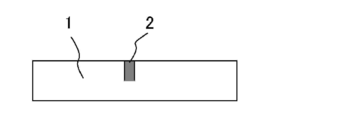
- FIG. 1 is a photograph illustrating one embodiment of a laser printed support of the present application. It is sectional drawing which shows typically the discoloration form of the laser-printed support body of this application. 5 is a photograph showing another embodiment of a laser printed support of the present application.
- Laser printed support In the laser-printed support in the present application, arbitrary characters, shapes and the like are arranged in place by discoloring a part of the surface by a color change inducing oxide. This makes it possible to avoid bleeding of characters and the like caused by printing using ink and the like, and fine or small characters, lines, figures, etc. can be clearly displayed.
- the ink usually contains an organic substance, color degradation may occur due to deterioration with high temperature, etc.
- laser printing it is possible to avoid discoloration or color fade due to high temperature.
- the printing form in which the constituent material of the support itself is deteriorated is not adopted, deterioration and deterioration of the support can be avoided, and the surface form of the support can be maintained before and after printing.
- the laser-printed support of the present application may be any as long as it is used as a support for patches in the relevant field, and may contain fibers.
- the form of the support includes various ones such as woven fabric, knitted fabric or non-woven fabric, a combination thereof or a laminate.
- the support may contain a polymer film or the like. In this case, it is preferable that the polymer film is coated on at least one side with a woven fabric, a knitted fabric or a non-woven fabric.
- the support is preferably one having stretchability, and a knitted fabric having stretchability in one direction or two directions is preferable.
- the fiber material of the support may be, for example, a natural fiber alone, a thermoplastic fiber alone, a non-thermoplastic fiber alone, or a blend of two or more of these.
- Natural fibers include vegetable fibers such as cotton and hemp, animal fibers such as wool and silk, and mineral fibers such as asbestos.
- thermoplastic fibers include materials made of thermoplastic resins such as polyurethane, polyester, polypropylene, acryl and nylon, such as polyester fibers, polyethylene fibers, polypropylene fibers, polyamide fibers, polyvinyl chloride fibers and the like.
- non-thermoplastic fibers include rayon and cupra.
- the non-woven fabric using these fibers can be produced by a known method such as water jet and needle punching. In terms of condition, it is preferable to use a knitted fabric having a uniform thickness in which polyester fibers, polyethylene fibers, polypropylene fibers, polyamide fibers, rayon fibers and the like are 70% or more.
- Such a support is usually used as a support for a patch for external use, and the thickness thereof is, for example, 0.1 mm to 3 mm, preferably 0.2 mm to 2 mm, and 400 to 800 ⁇ m. More preferable.
- the color change inducing oxide contained in the support means an oxide which induces color change by receiving laser light.
- the color change-inducing oxide includes one or more oxides selected from the group consisting of titanium oxide, yellow ferric oxide, ferric oxide and the like. Among them, titanium oxide is preferred.
- the color change inducing oxide is uniformly contained in the support, that is, in the plane and in the thickness direction, before the color change of the color change inducing oxide.
- the color change inducing oxide is uniformly contained in the support, that is, in the plane and in the thickness direction, before the color change of the color change inducing oxide.
- the color-changing organic oxide is preferably, for example, granular or powdery.
- the color change inducing oxide can be used, for example, in a ratio of 0.05 to 30 parts by mass (0.05 to 30% by volume) with respect to 100 parts by mass of all the fibers constituting the support. 0.1 parts by weight to 10 parts by weight (0.1% by volume to 10% by volume) is preferable, and 0.2 parts by weight to 5 parts by weight (0.2% by volume to 5% by volume) is more preferable.
- discoloration induced oxide may be a 1g / m 2 ⁇ 200g / m 2 as a weight per unit area of the support is preferably set to 5g / m 2 ⁇ 150g / m 2.
- the laser beam is preferably an ultraviolet laser beam
- ArF wavelength 193 nm
- KrCl wavelength 222 nm
- KrF wavelength 248 nm
- XeCl wavelength 308 nm
- XeF wavelength 350 nm
- Excimer laser having photon energy in the near ultraviolet region to the far ultraviolet region, and may be a harmonic of a copper vapor laser, a YAG laser or the like.
- Energy of the irradiated laser light for example, 50mJ / cm 2 ⁇ 21000mJ / cm 2, 100mJ / cm 2 ⁇ 18000mJ / cm 2 is preferred. 300mJ / cm 2 ⁇ 10000mJ / cm 2 is more preferable. By setting it as such a range, the thermal damage to a support body etc. can be avoided.
- the laser light irradiation may be performed at any temperature such as room temperature, lower temperature or higher temperature than that in air, nitrogen gas, vacuum, or the like.
- the frequency of the laser beam is, for example, 10000 Hz to 60000 Hz, preferably 20000 Hz to 30000 Hz.
- the irradiation of the laser light onto the surface of the support is carried out by a method of direct irradiation, a method of irradiation through a glass plate or the like that transmits the laser light, a method of irradiating light condensed or expanded using a lens, the laser light and support
- the method of irradiating a laser beam on the whole surface through a mask between body surfaces etc. are mentioned.
- a method of irradiating a laser beam or a method of narrowing a beam diameter of the laser beam and irradiating a necessary marking portion with a laser beam by laser scanning is used.
- the patch in the present application is a preparation to be applied to the skin and the like according to the 17th revision Japanese Pharmacopoeia, and mainly, the above-mentioned support, adhesive layer and release liner are laminated in this order, for example, a tape agent and a patch It means what is called.
- the patch By providing the patch with the above-described support, it is possible to avoid drug contamination and unreadable characters and the like caused by printing using ink and the like.
- the printing form in which the material of the support itself is deteriorated is not employed, the contamination of the drug does not occur.
- characters and the like corresponding to printing without using ink can be applied by color-induced oxide by color change, it is possible to reliably recognize the drug name and the like of the patch taken out of the packaging bag.
- the pressure-sensitive adhesive layer is laminated on the non-discolored surface of the above-mentioned support, and usually contains a drug.
- the drug include acetaminophenone, phenacetin, mefenamic acid, diclofenac sodium, flufenamic acid, aspirin, sodium salicylate, methyl salicylate, glycol salicylate, aminopyrine, alclofenac, ibuprofen, naproxen, flurbiprofen, ketoprofen, anfenac sodium , Mepilizole, indomethacin, piroxicam, loxoprofen, thiaprofen, acemetacin, ferbinac, sulindac, etodolac, tolmetin, anpiroxicam, azapropazone, azapropazone, valdecoxib, an anti-inflammatory analgesic such as rofecoxib, hydrocortisone, triamcinolone, dex
- Topical anesthetics such as tetracaine hydrochloride, brocaine hydrochloride, dibucaine hydrochloride, oxybuprocaine hydrochloride, propitocaine hydrochloride, diphenhydramine hydrochloride, chlorpheniramine maleate, promethazine, cyproheptadine hydrochloride, antihistamines such as diphenylpyraline hydrochloride, salicylic acid, cyclopirone Drugs for parasitic skin diseases such as xoramine and coroconazole hydrochloride, emollients such as urea, calcitriol, thiamine hydrochloride, sodium riboflavin phosphate, pyridoxine hydrochloride, nicotinamide, panthenol, ascorbic acid and other vitamins Etc.
- Topical anesthetics such as tetracaine hydrochloride, brocaine hydrochloride, dibucaine hydrochloride, oxy
- the pressure-sensitive adhesive is preferably known in the art and is preferably composed of components which do not affect the above-mentioned drug.
- rubber pressure-sensitive adhesives acrylic pressure-sensitive adhesives, water-soluble pressure-sensitive adhesives and the like can be mentioned.
- Examples of the rubber component of the rubber-based pressure-sensitive adhesive include natural rubber, styrene butadiene rubber, styrene-isoprene-styrene block copolymer, butyl rubber and the like.
- Examples of acrylic pressure-sensitive adhesives include acrylic acid / acrylic acid octyl ester copolymer, 2-ethylhexyl acrylic acid / vinyl pyrrolidone copolymer solution, acrylic acid ester / vinyl acetate copolymer and the like.
- water-soluble adhesives examples include gelatin, pectin, agarose, alginate, xanthan gum, dextrin, methylcellulose, ethylcellulose, hydroxyethylcellulose, carboxymethylcellulose, polyvinyl alcohol, polyvinyl pyrrolidone, polyethylene glycol, maleic anhydride copolymer, polyacrylic acid and the like
- Natural polymers such as salts or cross-linked products thereof, modified products thereof and the like can be mentioned. These components can be used alone or in combination of two or more.
- the adhesive may contain, in addition to the components described above, additives used in the art.
- the drug can be contained, for example, at 0.1% by mass to 80% by mass, preferably 0.5 to 10% by mass, with respect to the total mass constituting the adhesive.
- the pressure-sensitive adhesive layer can have a thickness of, for example, 10 ⁇ m to 3 mm, preferably 10 ⁇ m to 1 mm, and more preferably 30 to 300 ⁇ m.
- a release liner is laminated on the surface of the pressure-sensitive adhesive layer opposite to the support in order to protect the pressure-sensitive adhesive surface of the pressure-sensitive adhesive layer until the patch is used.
- the release liner it is sufficient if sufficiently light releasability can be secured.
- a film such as polyester, polyvinyl chloride, polyvinylidene chloride, polyethylene terephthalate or the like, which has been subjected to release treatment by applying silicone resin, fluorine resin or the like on the surface in contact with the adhesive layer, fine paper, glassine paper, etc. Paper, high-quality paper or laminated film of glassine paper etc. and polyolefin, etc. may be mentioned.
- a support comprising a color change-inducing oxide and comprising fibers is prepared, and the support is irradiated with laser light to form a surface of the support. Part of the color change caused by the color change inducing oxide. By this color change, arbitrary characters or figures can be printed.
- the irradiation of the laser beam to the support is as described above, but in particular, in the case of producing a patch, if the support is prepared, before and after forming the pressure-sensitive adhesive layer on the support, on the release liner
- the support can be irradiated with laser light at any timing, such as before and after transfer of the pressure-sensitive adhesive layer formed on the support onto the support.
- Example 1 A polyester knit was prepared. This knit is usually used for a tape agent and contains 0.3% of titanium oxide based on the total weight of the knit. This knit is formed by mixing and stirring a titanium oxide powder in a polyester melt and spinning it in a fiber form. Laser printing was performed on one side of the prepared knit using a UV laser marking device (model: LIS-250D (manufactured by Qualicaps Co., Ltd.)) under the conditions of pulse energy 48% and 20 kHz.
- a UV laser marking device model: LIS-250D (manufactured by Qualicaps Co., Ltd.)
- Example 1 As a result of Example 1, as shown in FIG. 1, a gray print which can be clearly discriminated by visual observation was recognized. Then, the printed surface was not deteriorated at all before the irradiation of the laser light, and was flat without generating unevenness, burning and the like. In addition, when the support of the printed portion was cut and the cross section was observed visually, as shown in FIG. A gray discoloration site 2 was observed, and on the back surface side opposite to the front surface of the support 1, no discoloration was observed at about half of the thickness.
- Example 2 As the conditions for laser printing, the number of drawing lines of design data (CAD) used at the time of drawing is twice that in the first embodiment, and the gap between the lines is eliminated as in the first embodiment. Laser printing was performed under the following conditions.
- CAD design data
- Example 2 As a result of Example 2, as shown in FIG. 3, gray printing which can be clearly discriminated by visual observation was recognized, and darker printing than in Example 1 was obtained.
- Example 3 The polyester knit used in Example 1 was prepared. In addition, an adhesive layer having a coating thickness of 100 ⁇ m was formed on the release liner. A pressure-sensitive adhesive layer was attached to one side of the knit to form a patch. The laser beam was irradiated similarly to Example 1, and it printed on the surface in which the adhesive layer of the obtained patch was not laminated
Landscapes
- Health & Medical Sciences (AREA)
- Engineering & Computer Science (AREA)
- Biomedical Technology (AREA)
- Heart & Thoracic Surgery (AREA)
- Vascular Medicine (AREA)
- Life Sciences & Earth Sciences (AREA)
- Animal Behavior & Ethology (AREA)
- General Health & Medical Sciences (AREA)
- Public Health (AREA)
- Veterinary Medicine (AREA)
- Medicinal Preparation (AREA)
Abstract
Le but de la présente invention est de fournir : un support imprimé au laser et un patch qui éliminent des problèmes liés aux suintements d'encre et similaires dans une couche contenant un médicament, peut empêcher le texte et similaire de devenir illisible en raison de la dissolution de l'encre et analogue, et avoir un texte facilement discernable et similaire imprimé sur des surfaces de celui-ci; et un procédé de fabrication d'un support ou d'un patch imprimé au laser qui permet la fabrication simple et facile d'un patch imprimé au laser. La présente invention concerne : un support (1) imprimé au laser comprenant un oxyde induisant un changement de couleur et composé de fibres, la couleur d'une partie d'une surface du support (1) étant modifiée en raison de l'oxyde induisant un changement de couleur; et un patch imprimé au laser formé par stratification d'un support (1) qui comprend un oxyde induisant un changement de couleur et qui est composé de fibres, une couche adhésive disposée sur une face du support (1), et une doublure détachable qui recouvre une face de la couche adhésive, la couleur d'une partie de la surface de support (1) étant modifiée en raison de l'oxyde induisant un changement de couleur.
Priority Applications (1)
| Application Number | Priority Date | Filing Date | Title |
|---|---|---|---|
| JP2019549957A JP7226326B2 (ja) | 2017-11-02 | 2018-09-25 | レーザー印刷された支持体、レーザー印刷された貼付剤及びそれらの製造方法 |
Applications Claiming Priority (2)
| Application Number | Priority Date | Filing Date | Title |
|---|---|---|---|
| JP2017213172 | 2017-11-02 | ||
| JP2017-213172 | 2017-11-02 |
Publications (1)
| Publication Number | Publication Date |
|---|---|
| WO2019087620A1 true WO2019087620A1 (fr) | 2019-05-09 |
Family
ID=66333050
Family Applications (1)
| Application Number | Title | Priority Date | Filing Date |
|---|---|---|---|
| PCT/JP2018/035346 Ceased WO2019087620A1 (fr) | 2017-11-02 | 2018-09-25 | Support imprimé au laser, patch imprimé au laser et leurs procédés de fabrication |
Country Status (2)
| Country | Link |
|---|---|
| JP (1) | JP7226326B2 (fr) |
| WO (1) | WO2019087620A1 (fr) |
Citations (3)
| Publication number | Priority date | Publication date | Assignee | Title |
|---|---|---|---|---|
| JP2003102773A (ja) * | 2001-09-28 | 2003-04-08 | Toko Yakuhin Kogyo Kk | 印字された貼付材及び腰痛帯 |
| WO2012121910A2 (fr) * | 2011-03-04 | 2012-09-13 | 3M Innovative Properties Company | Procédé de marquage au laser et articles |
| JP2013503065A (ja) * | 2009-08-31 | 2013-01-31 | スリーエム イノベイティブ プロパティズ カンパニー | レーザーマーキング方法及び物品 |
-
2018
- 2018-09-25 WO PCT/JP2018/035346 patent/WO2019087620A1/fr not_active Ceased
- 2018-09-25 JP JP2019549957A patent/JP7226326B2/ja active Active
Patent Citations (3)
| Publication number | Priority date | Publication date | Assignee | Title |
|---|---|---|---|---|
| JP2003102773A (ja) * | 2001-09-28 | 2003-04-08 | Toko Yakuhin Kogyo Kk | 印字された貼付材及び腰痛帯 |
| JP2013503065A (ja) * | 2009-08-31 | 2013-01-31 | スリーエム イノベイティブ プロパティズ カンパニー | レーザーマーキング方法及び物品 |
| WO2012121910A2 (fr) * | 2011-03-04 | 2012-09-13 | 3M Innovative Properties Company | Procédé de marquage au laser et articles |
Also Published As
| Publication number | Publication date |
|---|---|
| JP7226326B2 (ja) | 2023-02-21 |
| JPWO2019087620A1 (ja) | 2020-09-24 |
Similar Documents
| Publication | Publication Date | Title |
|---|---|---|
| JP5775032B2 (ja) | エンボス加工可能で書き込み可能な多層裏地構造物 | |
| KR900007178B1 (ko) | 피부 약제 처치용 치료제의 제법 | |
| CA2791196C (fr) | Timbre transdermique adhesif | |
| US20200009073A1 (en) | Fibre-Free Transdermal Therapeutic System and Method for its Production | |
| JP2006044793A (ja) | 貼付材包装体 | |
| SK130298A3 (en) | Transdermal therapeutic system with small application-area thickness and great flexibility, and production process | |
| JP2013237691A (ja) | 経皮的なドラッグデリバリーシステムにおける医薬品の損失及び送達を制御するための組成物及び方法 | |
| US11903939B2 (en) | Patch preparations with accidental use prevention features | |
| JP7226326B2 (ja) | レーザー印刷された支持体、レーザー印刷された貼付剤及びそれらの製造方法 | |
| KR20210065931A (ko) | 함수계 첩부제 | |
| JP2010018539A (ja) | 外用貼付剤および外用貼付剤の貼付方法 | |
| ITMI20120031A1 (it) | Struttura di confezionamento per film biomedicali | |
| JP2012166849A (ja) | 貼付材包装体 | |
| EP1753412B1 (fr) | Bande adhesive pharmaceutique autochauffante | |
| JP4374244B2 (ja) | 貼付剤 | |
| ATE156356T1 (de) | Transdermales therapeutisches system zur verabreichung von physostigmin an die haut und verfahren zu dessen herstellung | |
| JPH0725935Y2 (ja) | 医療用貼付シート | |
| JP2011148536A (ja) | 貼付剤包装構造 | |
| JP2003102773A (ja) | 印字された貼付材及び腰痛帯 | |
| JPWO2018199018A1 (ja) | 経皮吸収型製剤およびその製造方法 | |
| JP2004300029A (ja) | 水分感応性経皮吸収型製剤の製造方法 | |
| KR101675917B1 (ko) | 바디페인팅이 가능한 의료용 문양패취제 및 그 제조방법 | |
| JPWO2018199015A1 (ja) | 経皮吸収型製剤およびその製造方法 | |
| JP2010254646A (ja) | 貼付剤 | |
| HRP920858A2 (en) | Flat therapeutic system |
Legal Events
| Date | Code | Title | Description |
|---|---|---|---|
| 121 | Ep: the epo has been informed by wipo that ep was designated in this application |
Ref document number: 18871963 Country of ref document: EP Kind code of ref document: A1 |
|
| ENP | Entry into the national phase |
Ref document number: 2019549957 Country of ref document: JP Kind code of ref document: A |
|
| NENP | Non-entry into the national phase |
Ref country code: DE |
|
| 122 | Ep: pct application non-entry in european phase |
Ref document number: 18871963 Country of ref document: EP Kind code of ref document: A1 |