WO2019098345A1 - Appareil de fabrication de trichlorosilane et méthode de fabrication de trichlorosilane - Google Patents
Appareil de fabrication de trichlorosilane et méthode de fabrication de trichlorosilane Download PDFInfo
- Publication number
- WO2019098345A1 WO2019098345A1 PCT/JP2018/042557 JP2018042557W WO2019098345A1 WO 2019098345 A1 WO2019098345 A1 WO 2019098345A1 JP 2018042557 W JP2018042557 W JP 2018042557W WO 2019098345 A1 WO2019098345 A1 WO 2019098345A1
- Authority
- WO
- WIPO (PCT)
- Prior art keywords
- trichlorosilane
- reaction
- filter
- filter element
- filter device
- Prior art date
- Legal status (The legal status is an assumption and is not a legal conclusion. Google has not performed a legal analysis and makes no representation as to the accuracy of the status listed.)
- Ceased
Links
Images
Classifications
-
- C—CHEMISTRY; METALLURGY
- C01—INORGANIC CHEMISTRY
- C01B—NON-METALLIC ELEMENTS; COMPOUNDS THEREOF; METALLOIDS OR COMPOUNDS THEREOF NOT COVERED BY SUBCLASS C01C
- C01B33/00—Silicon; Compounds thereof
- C01B33/08—Compounds containing halogen
- C01B33/107—Halogenated silanes
- C01B33/1071—Tetrachloride, trichlorosilane or silicochloroform, dichlorosilane, monochlorosilane or mixtures thereof
-
- C—CHEMISTRY; METALLURGY
- C01—INORGANIC CHEMISTRY
- C01B—NON-METALLIC ELEMENTS; COMPOUNDS THEREOF; METALLOIDS OR COMPOUNDS THEREOF NOT COVERED BY SUBCLASS C01C
- C01B33/00—Silicon; Compounds thereof
- C01B33/08—Compounds containing halogen
- C01B33/107—Halogenated silanes
- C01B33/1071—Tetrachloride, trichlorosilane or silicochloroform, dichlorosilane, monochlorosilane or mixtures thereof
- C01B33/10742—Tetrachloride, trichlorosilane or silicochloroform, dichlorosilane, monochlorosilane or mixtures thereof prepared by hydrochlorination of silicon or of a silicon-containing material
- C01B33/10757—Tetrachloride, trichlorosilane or silicochloroform, dichlorosilane, monochlorosilane or mixtures thereof prepared by hydrochlorination of silicon or of a silicon-containing material with the preferential formation of trichlorosilane
- C01B33/10763—Tetrachloride, trichlorosilane or silicochloroform, dichlorosilane, monochlorosilane or mixtures thereof prepared by hydrochlorination of silicon or of a silicon-containing material with the preferential formation of trichlorosilane from silicon
-
- B—PERFORMING OPERATIONS; TRANSPORTING
- B01—PHYSICAL OR CHEMICAL PROCESSES OR APPARATUS IN GENERAL
- B01D—SEPARATION
- B01D39/00—Filtering material for liquid or gaseous fluids
- B01D39/14—Other self-supporting filtering material ; Other filtering material
- B01D39/20—Other self-supporting filtering material ; Other filtering material of inorganic material, e.g. asbestos paper, metallic filtering material of non-woven wires
-
- B—PERFORMING OPERATIONS; TRANSPORTING
- B01—PHYSICAL OR CHEMICAL PROCESSES OR APPARATUS IN GENERAL
- B01D—SEPARATION
- B01D39/00—Filtering material for liquid or gaseous fluids
- B01D39/14—Other self-supporting filtering material ; Other filtering material
- B01D39/20—Other self-supporting filtering material ; Other filtering material of inorganic material, e.g. asbestos paper, metallic filtering material of non-woven wires
- B01D39/2027—Metallic material
-
- C—CHEMISTRY; METALLURGY
- C01—INORGANIC CHEMISTRY
- C01B—NON-METALLIC ELEMENTS; COMPOUNDS THEREOF; METALLOIDS OR COMPOUNDS THEREOF NOT COVERED BY SUBCLASS C01C
- C01B33/00—Silicon; Compounds thereof
- C01B33/08—Compounds containing halogen
- C01B33/107—Halogenated silanes
- C01B33/10778—Purification
Definitions
- the present invention relates to a trichlorosilane production apparatus and a method for producing trichlorosilane.
- Trichlorosilane is used in the manufacture of polycrystalline silicon used as semiconductor and solar cell material.
- Trichlorosilane is obtained, for example, through the following reaction path.
- metal silicon powder (Si) and hydrogen chloride (HCl) are reacted.
- trichlorosilane is generated as a main reaction as shown in Formula (1), but tetrachlorosilane (STC, SiCl 4 ) is generated as a side reaction as shown in Formula (2).
- Tetrachlorosilane is recycled after recovery and converted to trichlorosilane as shown in the formula (3).
- trichlorosilane may be produced by the reaction of formula (3) without using hydrogen chloride.
- the reaction product recovered from the reaction apparatus in which the above reaction is carried out contains a chlorosilane compound including trichlorosilane, low boiling point silane, tetrachlorosilane and the like, and therefore the reaction is necessary to obtain a high purity trichlorosilane gas. It is necessary to carry out the purification of the product.
- the reaction product also contains unreacted metal silicon powder. Therefore, when the reaction product is supplied as it is from the reaction apparatus to the downstream purification apparatus, erosion and clogging by the metal silicon powder occur in the purification apparatus. The unreacted metal silicon powder can be removed by providing a filter device between the reactor and the purification device.
- Patent Document 1 discloses an apparatus for producing trichlorosilane including a solid-gas separation apparatus provided with a sintered filter element made of metal which is a wear resistant material.
- One aspect of the present invention is made in view of the above problems, and its object is to prevent corrosion cracking (hereinafter referred to as “stress corrosion cracking”) due to corrosion and stress in a trichlorosilane production apparatus. To aim.
- the present invention includes the following configurations.
- a trichlorosilane comprising: a reactor for producing trichlorosilane using metal silicon powder; and a filter device for removing the reaction residue from a reaction product containing the trichlorosilane produced by the reactor and a reaction residue It is a manufacturing apparatus,
- the said filter apparatus is equipped with the filter element comprised from corrosion-resistant material,
- the trichlorosilane manufacturing apparatus characterized by the above-mentioned.
- corrosion and stress corrosion cracking due to hydrochloric acid generated in the filter element portion can be suppressed.
- a to B representing a numerical range means “more than A (including A and greater than A) B or less (including B and less than B)”.
- the filter element has a fine-grained structure so that trichlorosilane and tetrachlorosilane tend to remain, and the problems (i) and (ii) become apparent at the time of opening in periodic inspections and the like.
- the trichlorosilane manufacturing apparatus which concerns on one Embodiment of this invention solves the problem of the prior art mentioned above, and equips a filter element with corrosion resistance. The details will be described below.
- a trichlorosilane production apparatus is a reaction apparatus for producing trichlorosilane using metal silicon powder, and a reaction product containing trichlorosilane produced by the reaction apparatus and a reaction residue.
- the manufacturing method of the trichlorosilane which concerns on one Embodiment of this invention is characterized by having the process of manufacturing trichlorosilane using the said manufacturing apparatus.
- the reaction apparatus used in one embodiment of the present invention is not particularly limited as long as it is an apparatus for synthesizing a reaction product containing trichlorosilane using metal silicon powder, and may be a known apparatus.
- a reaction apparatus a fluidized bed system reaction apparatus is mentioned, for example.
- By using a fluidized bed reactor it is possible to continuously supply metal silicon powder and hydrogen chloride to continuously synthesize trichlorosilane.
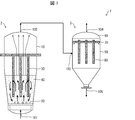
- a fluidized bed type reaction apparatus an apparatus for reacting trichloromethane with metal silicon powder and hydrogen chloride gas to synthesize trichlorosilane is described as an example in FIG.
- An apparatus for reacting trichlorosilane with chlorosilane may be used.
- the reactor 2 includes a reaction vessel 10, a dispersion plate 20, and a heat medium pipe 30.
- metal silicon powder is supplied to the inside of the reaction container 10
- hydrogen chloride gas that reacts with metal silicon powder is supplied from the gas supply port 101 formed at the bottom of the reaction container 10.
- the dispersion plate 20 is provided on the gas supply port 101 of the reaction vessel 10, and disperses the hydrogen chloride gas supplied to the inside of the reaction vessel 10.
- the reaction apparatus 2 causes metal silicon powder in the inside of the reaction vessel 10 to react while flowing with hydrogen chloride gas (a place where the reaction is occurring is hereinafter referred to as a fluidized bed 40).
- a reaction product containing trichlorosilane synthesized by the reaction of metal silicon powder and hydrogen chloride gas and a reaction residue is taken out from the reaction product outlet 102 of the reaction vessel 10.
- a heat medium pipe 30 for circulating a heat medium is provided along the vertical direction (the direction parallel to the gravity). By flowing the heat medium through the heat medium pipe 30, the reaction heat due to the reaction between the metal silicon powder and the hydrogen chloride gas is removed.
- the shape of the reaction vessel 10 (in other words, the shape of the side wall of the reaction vessel 10) is not particularly limited.
- the side wall of the reaction vessel 10 surrounding the fluidized bed 40 may have a shape (not shown) such that the cross-sectional area of the cut surface orthogonal to the height direction of the reaction vessel 10 is constant or not It may be a tapered shape (FIG. 1) that becomes larger toward the end.
- the side wall has an increase in the cross-sectional area of the cut surface orthogonal to the height direction of the reaction vessel upwards It may be tapered. From the viewpoint of reducing the risk of erosion and preventing a local temperature rise, it is preferable that the shape of the reaction vessel 10 be a tapered shape.
- the flow of metal silicon powder and hydrogen chloride up to the reaction device 2 is, for example, described in Japanese Patent Application Laid-Open Publication No. 2011-184242, and thus the description thereof is omitted.
- known materials can be used without particular limitation, and the synthesis conditions can also be used without particular limitation as long as they are known conditions.
- metal silicon powder means a solid substance containing elemental silicon in metallic state such as metallurgical metal silicon, silicon iron, or polysilicon, and known materials can be used without any limitation.
- the metal silicon powder may contain impurities such as an iron compound, and the components and the content thereof are not particularly limited.
- Such metal silicon powder is usually used in the form of a fine powder having an average particle diameter of about 150 to 350 ⁇ m.
- the feed rates of the metallic silicon powder and hydrogen chloride are not particularly limited as long as the metallic silicon powder and hydrogen chloride can be fed at such a rate that the fluid bed can form a flow rate.
- the reaction temperature in the above reaction is appropriately determined in consideration of the material and capability of the reaction apparatus, the catalyst used, etc., but is generally set in the range of 200 to 500 ° C., particularly 250 to 400 ° C.
- the filter device is a device for removing the reaction residue containing unreacted metal silicon powder from the reaction product containing trichlorosilane and the reaction residue.
- the filter device comprises a filter element in which the pores are formed. Thereby, the filter device separates the reaction product into a component that can pass through the pores and a component (reaction residue) that can not pass through the pores.
- the filter device 3 shown in FIG. 1 will be described in detail as an example of the filter device.
- the filter device 3 includes a lower filter container 50, an upper filter container 60, a partition plate 70, and a filter element 80.
- the lower filter container 50 has a tapered bottom, a barrel shaped like a cylinder, and a filter device inlet 103 and a residue recovery port 105.
- the upper filter container 60 comprises a filter device outlet 104.
- the reaction product synthesized in the reactor 2 is sequentially supplied from the filter device inlet 103.
- the supplied reaction product is separated by the filter element 80 and discharged from the filter device outlet 104 and the residue recovery port 105.
- the lower filter container 50 and the upper filter container 60 are installed to be able to open and close.
- the partition plate 70 is a space on the side where the filter device inlet 103 is installed (hereinafter referred to as the filter device inlet side) and a side on which the filter device outlet 104 is installed (hereinafter, the filter device outlet) Divided into two)
- the partition plate 70 may be installed at the boundary between the lower filter container 50 and the upper filter container 60.
- the hole for holding the filter element 80 is opened in the partition plate 70, There is no restriction
- the filter element 80 has a cylindrical shape in which fine pores are formed.
- the filter element 80 is installed in the filter device 3 so as to be held in the hole of the partition plate 70.
- the filter element 80 connects the space on the inlet side of the filter device and the space on the outlet side of the filter device so that gas can flow through the pores.
- components capable of passing through the pores of the filter element 80 (hereinafter referred to as gas components) are discharged from the filter device outlet 104. Since the reaction product is sequentially supplied to the filter device 3, the filter device inlet side is positive pressure, the filter device outlet side is lower in pressure than the inlet, and the gas component is automatically discharged.
- the reaction product having a size larger than the pore diameter of the pores of the filter element 80 can not pass through the pores of the filter element 80, the reaction product remains on the filter device inlet side of the filter device 3.
- the filter container is pressurized to a certain pressure such as N 2 gas, H 2 gas or Ar gas, and held at a lower pressure than the filter downstream of the residue recovery port 105 It is preferable to carry out the discharge operation to discharge into another container. In the discharging operation, it is preferable to quickly open the valve of the connected pipe after holding both containers at different pressures, and discharge using the pressure difference between both containers.
- a certain pressure such as N 2 gas, H 2 gas or Ar gas
- the filter device 3 may be opened to the atmosphere by separating the lower filter container 50 and the upper filter container 60 of the filter device 3. is there.
- the reaction products remaining in the pores of the filter element 80 are removed and discharged by the backwashing and discharging operations as described above, but the reaction products are produced because the pores have a fine-grained structure. Some of them remain in the pores. Since the remaining reaction product contains trichlorosilane and the like, the water in the air and the remaining reaction product react with each other when the air is released to generate a high concentration of hydrochloric acid in the vicinity of the filter element 80, and the filter element 80 It becomes easy to corrode.
- the filter element 80 is made of a corrosion resistant material.
- corrosion resistant material refers to stress corrosion cracking as compared to stainless steel according to JIS G0576 "Test method for stress corrosion cracking of stainless steel” or JIS Z 2291 "High temperature gas corrosion test method for metal materials”. Materials intended to be excellent, or materials which were found to be extremely resistant to oxidation at high temperatures are intended.
- the term "a component is made of a corrosion resistant material” includes that the component is coated with a corrosion resistant material, that the component is forged or cast from a corrosion resistant material, and the like.
- the corrosion-resistant material used for the filter element 80 preferably contains nickel as an essential component, and preferably contains at least one selected from the group consisting of chromium, iron, tungsten, niobium, tantalum and molybdenum. .
- the content of nickel in 100% by weight of the corrosion resistant material is preferably 20 to 80% by weight, and more preferably 50 to 75% by weight.
- the content of chromium is preferably 10 to 25% by weight, and more preferably 14 to 23% by weight.
- the iron content is preferably 2 to 30% by weight, more preferably 3 to 8% by weight.
- the content of tungsten is preferably 0 to 5% by weight, and more preferably 0 to 4% by weight.
- the content of niobium is preferably 0 to 5% by weight, and more preferably 0 to 4% by weight.
- the content of tantalum is preferably 0 to 5% by weight, and more preferably 0 to 4% by weight.
- the content of molybdenum is preferably 1% by weight or more, and more preferably 5 to 20% by weight.
- Specific examples of such corrosion resistant materials include Inconel 600, Inconel 625, Inconel 825, Hastelloy C22, Hastelloy C276 and NAS 254N.
- a corrosion resistant material containing molybdenum as the filter element 80, it is possible to suppress not only corrosion and stress corrosion cracking but also intergranular corrosion (corrosion in which corrosion progresses along grain boundaries). Therefore, it is more preferable to use a corrosion resistant material containing molybdenum.
- a corrosion resistant material containing molybdenum Inconel 625, Inconel 825, Hastelloy C22, Hastelloy C276, NAS254N and the like can be mentioned.
- reaction product discharged from the trichlorosilane production apparatus 1 shown in FIG. 1 was treated using the filter apparatus 3 shown in FIG.
- the reaction product contains the following gas composition and dust components at a temperature of about 200.degree.
- Gas composition 3% by weight of H 2 , 17% by weight of TCS, 80% by weight of STC, and trace components (AlCl 3 , high-boiling components, etc.)
- Dust component Si, intermetallic compound with Si, SiC, Al, Ca slag, AlCl 3 , CaCl 2 , FeCl 2 and the like.
- Table 1 shows the material of the filter element 80, the evaluation of the corrosion resistance of the material, and the presence or absence of stress corrosion cracking after the actual operation.
- Table 2 shows the composition of the material used as the filter element 80.
- the filter element 80 no. 1 to No. A cylindrical filter element (3 mm thick, outer diameter 60 ⁇ ⁇ total length 1300 mm) made of the material shown in 5 and having fine pores formed was used. The filter element was put into practical use for 309 days, and the occurrence of stress corrosion cracking was confirmed.
- a reaction apparatus for producing trichlorosilane using metal silicon powder and a reaction product from a reaction product containing trichlorosilane produced by the reaction apparatus and a reaction residue
- a filter device for removing residue wherein the filter device comprises a filter element made of a corrosion resistant material.
- the corrosion resistant material preferably contains 1 wt% or more of molybdenum.
- the corrosion resistant material is preferably inconel 625 or hastelloy.
- a trichlorosilane production method includes the step of producing trichlorosilane using the trichlorosilane production device according to any one of the trichlorosilane production devices according to an aspect of the present invention. Is preferred.
- the present invention can be utilized for the production of trichlorosilane.
Landscapes
- Chemical & Material Sciences (AREA)
- Organic Chemistry (AREA)
- Inorganic Chemistry (AREA)
- Life Sciences & Earth Sciences (AREA)
- Geology (AREA)
- Chemical Kinetics & Catalysis (AREA)
- Silicon Compounds (AREA)
Abstract
Le but de la présente invention est d'empêcher la corrosion et la fissuration par corrosion sous contrainte dues à l'acide chlorhydrique généré dans une partie d'élément de filtre (80). Un appareil de fabrication de trichlorosilane (1) comprend un dispositif de réaction (2) pour générer du trichlorosilane et un dispositif de filtre (3) pour éliminer un résidu de réaction, le dispositif de filtre (3) étant pourvu d'un élément de filtre constitué d'un matériau résistant à la corrosion.
Priority Applications (5)
| Application Number | Priority Date | Filing Date | Title |
|---|---|---|---|
| JP2019554323A JPWO2019098345A1 (ja) | 2017-11-20 | 2018-11-16 | トリクロロシラン製造装置およびトリクロロシランの製造方法 |
| CN201880060343.3A CN111108065A (zh) | 2017-11-20 | 2018-11-16 | 三氯硅烷制造装置以及三氯硅烷的制造方法 |
| US16/652,051 US20200277197A1 (en) | 2017-11-20 | 2018-11-16 | Trichlorosilane manufacturing apparatus, and method for manufacturing trichlorosilane |
| KR1020207007626A KR20200088276A (ko) | 2017-11-20 | 2018-11-16 | 트리클로로실란 제조 장치 및 트리클로로실란의 제조 방법 |
| EP18878799.8A EP3715329A4 (fr) | 2017-11-20 | 2018-11-16 | Appareil de fabrication de trichlorosilane et méthode de fabrication de trichlorosilane |
Applications Claiming Priority (2)
| Application Number | Priority Date | Filing Date | Title |
|---|---|---|---|
| JP2017-223144 | 2017-11-20 | ||
| JP2017223144 | 2017-11-20 |
Publications (1)
| Publication Number | Publication Date |
|---|---|
| WO2019098345A1 true WO2019098345A1 (fr) | 2019-05-23 |
Family
ID=66539052
Family Applications (1)
| Application Number | Title | Priority Date | Filing Date |
|---|---|---|---|
| PCT/JP2018/042557 Ceased WO2019098345A1 (fr) | 2017-11-20 | 2018-11-16 | Appareil de fabrication de trichlorosilane et méthode de fabrication de trichlorosilane |
Country Status (7)
| Country | Link |
|---|---|
| US (1) | US20200277197A1 (fr) |
| EP (1) | EP3715329A4 (fr) |
| JP (1) | JPWO2019098345A1 (fr) |
| KR (1) | KR20200088276A (fr) |
| CN (1) | CN111108065A (fr) |
| TW (1) | TWI752280B (fr) |
| WO (1) | WO2019098345A1 (fr) |
Cited By (3)
| Publication number | Priority date | Publication date | Assignee | Title |
|---|---|---|---|---|
| WO2021100286A1 (fr) * | 2019-11-21 | 2021-05-27 | 株式会社トクヤマ | Filtre |
| JP7854026B1 (ja) | 2024-11-06 | 2026-04-30 | 株式会社トクヤマ | フィルタの洗浄方法及びフィルタの洗浄装置 |
| JP7854025B1 (ja) | 2024-11-06 | 2026-04-30 | 株式会社トクヤマ | フィルタの洗浄装置 |
Citations (7)
| Publication number | Priority date | Publication date | Assignee | Title |
|---|---|---|---|---|
| JPS4847500A (fr) * | 1971-10-21 | 1973-07-05 | ||
| JP2009292675A (ja) * | 2008-06-04 | 2009-12-17 | Sumitomo Chemical Co Ltd | シリコン又はハロゲン化シランの製造方法及び製造装置 |
| CN201643908U (zh) | 2009-12-01 | 2010-11-24 | 乐山乐电天威硅业科技有限责任公司 | 三氯氢硅合成气气固分离装置 |
| JP2011168443A (ja) * | 2010-02-18 | 2011-09-01 | Tokuyama Corp | トリクロロシランの製造方法 |
| JP2011184242A (ja) | 2010-03-09 | 2011-09-22 | Jnc Corp | クロロシランの製造装置 |
| CN102815706A (zh) * | 2012-08-10 | 2012-12-12 | 中国恩菲工程技术有限公司 | 一种三氯氢硅合成系统 |
| JP2013112589A (ja) * | 2011-11-30 | 2013-06-10 | Mitsubishi Materials Corp | トリクロロシラン製造方法及び製造装置 |
Family Cites Families (5)
| Publication number | Priority date | Publication date | Assignee | Title |
|---|---|---|---|---|
| JPH1072382A (ja) * | 1996-08-28 | 1998-03-17 | Asahi Glass Co Ltd | 1,1,1,3,3−ペンタフルオロプロパンの製造方法 |
| JP4462839B2 (ja) * | 2003-03-19 | 2010-05-12 | 株式会社キノテック・ソーラーエナジー | シリコンの製造装置及び製造方法 |
| US8778292B2 (en) * | 2009-05-12 | 2014-07-15 | Procedyne Corporation | Fluidized bed process for synthesizing trichlorosilane and a trichlorosilane synthesizer |
| CN104024159B (zh) * | 2011-10-18 | 2015-11-25 | 东亚合成株式会社 | 氯代聚硅烷的制造方法及流化床反应装置 |
| JP6439322B2 (ja) | 2014-08-27 | 2018-12-19 | 三菱自動車工業株式会社 | ハイブリッド車両の回生制御装置 |
-
2018
- 2018-11-16 KR KR1020207007626A patent/KR20200088276A/ko not_active Withdrawn
- 2018-11-16 EP EP18878799.8A patent/EP3715329A4/fr not_active Withdrawn
- 2018-11-16 CN CN201880060343.3A patent/CN111108065A/zh active Pending
- 2018-11-16 TW TW107140847A patent/TWI752280B/zh active
- 2018-11-16 WO PCT/JP2018/042557 patent/WO2019098345A1/fr not_active Ceased
- 2018-11-16 JP JP2019554323A patent/JPWO2019098345A1/ja active Pending
- 2018-11-16 US US16/652,051 patent/US20200277197A1/en not_active Abandoned
Patent Citations (7)
| Publication number | Priority date | Publication date | Assignee | Title |
|---|---|---|---|---|
| JPS4847500A (fr) * | 1971-10-21 | 1973-07-05 | ||
| JP2009292675A (ja) * | 2008-06-04 | 2009-12-17 | Sumitomo Chemical Co Ltd | シリコン又はハロゲン化シランの製造方法及び製造装置 |
| CN201643908U (zh) | 2009-12-01 | 2010-11-24 | 乐山乐电天威硅业科技有限责任公司 | 三氯氢硅合成气气固分离装置 |
| JP2011168443A (ja) * | 2010-02-18 | 2011-09-01 | Tokuyama Corp | トリクロロシランの製造方法 |
| JP2011184242A (ja) | 2010-03-09 | 2011-09-22 | Jnc Corp | クロロシランの製造装置 |
| JP2013112589A (ja) * | 2011-11-30 | 2013-06-10 | Mitsubishi Materials Corp | トリクロロシラン製造方法及び製造装置 |
| CN102815706A (zh) * | 2012-08-10 | 2012-12-12 | 中国恩菲工程技术有限公司 | 一种三氯氢硅合成系统 |
Non-Patent Citations (1)
| Title |
|---|
| See also references of EP3715329A4 |
Cited By (4)
| Publication number | Priority date | Publication date | Assignee | Title |
|---|---|---|---|---|
| WO2021100286A1 (fr) * | 2019-11-21 | 2021-05-27 | 株式会社トクヤマ | Filtre |
| JP6956928B1 (ja) * | 2019-11-21 | 2021-11-02 | 株式会社トクヤマ | フィルタ |
| JP7854026B1 (ja) | 2024-11-06 | 2026-04-30 | 株式会社トクヤマ | フィルタの洗浄方法及びフィルタの洗浄装置 |
| JP7854025B1 (ja) | 2024-11-06 | 2026-04-30 | 株式会社トクヤマ | フィルタの洗浄装置 |
Also Published As
| Publication number | Publication date |
|---|---|
| CN111108065A (zh) | 2020-05-05 |
| KR20200088276A (ko) | 2020-07-22 |
| EP3715329A1 (fr) | 2020-09-30 |
| JPWO2019098345A1 (ja) | 2020-10-01 |
| EP3715329A4 (fr) | 2021-07-28 |
| TWI752280B (zh) | 2022-01-11 |
| TW201922335A (zh) | 2019-06-16 |
| US20200277197A1 (en) | 2020-09-03 |
Similar Documents
| Publication | Publication Date | Title |
|---|---|---|
| US8956584B2 (en) | Production of polycrystalline silicon in substantially closed-loop processes that involve disproportionation operations | |
| WO2019098345A1 (fr) | Appareil de fabrication de trichlorosilane et méthode de fabrication de trichlorosilane | |
| CN110167878B (zh) | 多晶硅制造方法 | |
| WO2012087628A2 (fr) | Production de silicium polycristallin par la décomposition thermique de dichlorosilane dans un réacteur à lit fluidisé | |
| EP2105410A1 (fr) | Appareil de purification de chlorosilanes et procédé de purification de chlorosilanes | |
| US20120100059A1 (en) | Production of Polycrystalline Silicon By The Thermal Decomposition of Trichlorosilane In A Fluidized Bed Reactor | |
| TWI403610B (zh) | 在實質上封閉迴路方法及系統中之多晶矽的製造 | |
| KR101309600B1 (ko) | 트리클로로실란 제조방법 | |
| US9394180B2 (en) | Production of polycrystalline silicon in substantially closed-loop systems | |
| TWI820056B (zh) | 反應裝置及三氯矽烷的製造方法 | |
| US8449848B2 (en) | Production of polycrystalline silicon in substantially closed-loop systems |
Legal Events
| Date | Code | Title | Description |
|---|---|---|---|
| 121 | Ep: the epo has been informed by wipo that ep was designated in this application |
Ref document number: 18878799 Country of ref document: EP Kind code of ref document: A1 |
|
| ENP | Entry into the national phase |
Ref document number: 2019554323 Country of ref document: JP Kind code of ref document: A |
|
| ENP | Entry into the national phase |
Ref document number: 2018878799 Country of ref document: EP Effective date: 20200622 |