WO2019117556A1 - 배터리 누전을 검출하기 위한 방법 및 장치 - Google Patents
배터리 누전을 검출하기 위한 방법 및 장치 Download PDFInfo
- Publication number
- WO2019117556A1 WO2019117556A1 PCT/KR2018/015568 KR2018015568W WO2019117556A1 WO 2019117556 A1 WO2019117556 A1 WO 2019117556A1 KR 2018015568 W KR2018015568 W KR 2018015568W WO 2019117556 A1 WO2019117556 A1 WO 2019117556A1
- Authority
- WO
- WIPO (PCT)
- Prior art keywords
- resistance value
- insulation resistance
- count
- battery
- value
- Prior art date
- Legal status (The legal status is an assumption and is not a legal conclusion. Google has not performed a legal analysis and makes no representation as to the accuracy of the status listed.)
- Ceased
Links
Images




Classifications
-
- G—PHYSICS
- G01—MEASURING; TESTING
- G01R—MEASURING ELECTRIC VARIABLES; MEASURING MAGNETIC VARIABLES
- G01R31/00—Arrangements for testing electric properties; Arrangements for locating electric faults; Arrangements for electrical testing characterised by what is being tested not provided for elsewhere
- G01R31/36—Arrangements for testing, measuring or monitoring the electrical condition of accumulators or electric batteries, e.g. capacity or state of charge [SoC]
- G01R31/392—Determining battery ageing or deterioration, e.g. state of health
-
- G—PHYSICS
- G01—MEASURING; TESTING
- G01R—MEASURING ELECTRIC VARIABLES; MEASURING MAGNETIC VARIABLES
- G01R27/00—Arrangements for measuring resistance, reactance, impedance, or electric characteristics derived therefrom
- G01R27/02—Measuring real or complex resistance, reactance, impedance, or other two-pole characteristics derived therefrom, e.g. time constant
- G01R27/025—Measuring very high resistances, e.g. isolation resistances, i.e. megohm-meters
-
- G—PHYSICS
- G01—MEASURING; TESTING
- G01R—MEASURING ELECTRIC VARIABLES; MEASURING MAGNETIC VARIABLES
- G01R31/00—Arrangements for testing electric properties; Arrangements for locating electric faults; Arrangements for electrical testing characterised by what is being tested not provided for elsewhere
- G01R31/36—Arrangements for testing, measuring or monitoring the electrical condition of accumulators or electric batteries, e.g. capacity or state of charge [SoC]
- G01R31/385—Arrangements for measuring battery or accumulator variables
-
- G—PHYSICS
- G01—MEASURING; TESTING
- G01R—MEASURING ELECTRIC VARIABLES; MEASURING MAGNETIC VARIABLES
- G01R31/00—Arrangements for testing electric properties; Arrangements for locating electric faults; Arrangements for electrical testing characterised by what is being tested not provided for elsewhere
- G01R31/36—Arrangements for testing, measuring or monitoring the electrical condition of accumulators or electric batteries, e.g. capacity or state of charge [SoC]
- G01R31/389—Measuring internal impedance, internal conductance or related variables
-
- G—PHYSICS
- G01—MEASURING; TESTING
- G01R—MEASURING ELECTRIC VARIABLES; MEASURING MAGNETIC VARIABLES
- G01R31/00—Arrangements for testing electric properties; Arrangements for locating electric faults; Arrangements for electrical testing characterised by what is being tested not provided for elsewhere
- G01R31/50—Testing of electric apparatus, lines, cables or components for short-circuits, continuity, leakage current or incorrect line connections
- G01R31/52—Testing for short-circuits, leakage current or ground faults
-
- H—ELECTRICITY
- H01—ELECTRIC ELEMENTS
- H01M—PROCESSES OR MEANS, e.g. BATTERIES, FOR THE DIRECT CONVERSION OF CHEMICAL ENERGY INTO ELECTRICAL ENERGY
- H01M10/00—Secondary cells; Manufacture thereof
- H01M10/42—Methods or arrangements for servicing or maintenance of secondary cells or secondary half-cells
-
- H—ELECTRICITY
- H01—ELECTRIC ELEMENTS
- H01M—PROCESSES OR MEANS, e.g. BATTERIES, FOR THE DIRECT CONVERSION OF CHEMICAL ENERGY INTO ELECTRICAL ENERGY
- H01M10/00—Secondary cells; Manufacture thereof
- H01M10/42—Methods or arrangements for servicing or maintenance of secondary cells or secondary half-cells
- H01M10/425—Structural combination with electronic components, e.g. electronic circuits integrated to the outside of the casing
-
- H—ELECTRICITY
- H01—ELECTRIC ELEMENTS
- H01M—PROCESSES OR MEANS, e.g. BATTERIES, FOR THE DIRECT CONVERSION OF CHEMICAL ENERGY INTO ELECTRICAL ENERGY
- H01M10/00—Secondary cells; Manufacture thereof
- H01M10/42—Methods or arrangements for servicing or maintenance of secondary cells or secondary half-cells
- H01M10/48—Accumulators combined with arrangements for measuring, testing or indicating the condition of cells, e.g. the level or density of the electrolyte
-
- H—ELECTRICITY
- H01—ELECTRIC ELEMENTS
- H01M—PROCESSES OR MEANS, e.g. BATTERIES, FOR THE DIRECT CONVERSION OF CHEMICAL ENERGY INTO ELECTRICAL ENERGY
- H01M50/00—Constructional details or processes of manufacture of the non-active parts of electrochemical cells other than fuel cells, e.g. hybrid cells
- H01M50/20—Mountings; Secondary casings or frames; Racks, modules or packs; Suspension devices; Shock absorbers; Transport or carrying devices; Holders
-
- H—ELECTRICITY
- H01—ELECTRIC ELEMENTS
- H01M—PROCESSES OR MEANS, e.g. BATTERIES, FOR THE DIRECT CONVERSION OF CHEMICAL ENERGY INTO ELECTRICAL ENERGY
- H01M50/00—Constructional details or processes of manufacture of the non-active parts of electrochemical cells other than fuel cells, e.g. hybrid cells
- H01M50/50—Current conducting connections for cells or batteries
- H01M50/572—Means for preventing undesired use or discharge
-
- H—ELECTRICITY
- H01—ELECTRIC ELEMENTS
- H01M—PROCESSES OR MEANS, e.g. BATTERIES, FOR THE DIRECT CONVERSION OF CHEMICAL ENERGY INTO ELECTRICAL ENERGY
- H01M50/00—Constructional details or processes of manufacture of the non-active parts of electrochemical cells other than fuel cells, e.g. hybrid cells
- H01M50/50—Current conducting connections for cells or batteries
- H01M50/572—Means for preventing undesired use or discharge
- H01M50/574—Devices or arrangements for the interruption of current
-
- H—ELECTRICITY
- H02—GENERATION; CONVERSION OR DISTRIBUTION OF ELECTRIC POWER
- H02H—EMERGENCY PROTECTIVE CIRCUIT ARRANGEMENTS
- H02H1/00—Details of emergency protective circuit arrangements
- H02H1/0007—Details of emergency protective circuit arrangements concerning the detecting means
-
- H—ELECTRICITY
- H02—GENERATION; CONVERSION OR DISTRIBUTION OF ELECTRIC POWER
- H02H—EMERGENCY PROTECTIVE CIRCUIT ARRANGEMENTS
- H02H7/00—Emergency protective circuit arrangements specially adapted for specific types of electric machines or apparatus or for sectionalised protection of cable or line systems, and effecting automatic switching in the event of an undesired change from normal working conditions
- H02H7/18—Emergency protective circuit arrangements specially adapted for specific types of electric machines or apparatus or for sectionalised protection of cable or line systems, and effecting automatic switching in the event of an undesired change from normal working conditions for batteries; for accumulators
-
- G—PHYSICS
- G01—MEASURING; TESTING
- G01R—MEASURING ELECTRIC VARIABLES; MEASURING MAGNETIC VARIABLES
- G01R31/00—Arrangements for testing electric properties; Arrangements for locating electric faults; Arrangements for electrical testing characterised by what is being tested not provided for elsewhere
- G01R31/36—Arrangements for testing, measuring or monitoring the electrical condition of accumulators or electric batteries, e.g. capacity or state of charge [SoC]
-
- H—ELECTRICITY
- H01—ELECTRIC ELEMENTS
- H01M—PROCESSES OR MEANS, e.g. BATTERIES, FOR THE DIRECT CONVERSION OF CHEMICAL ENERGY INTO ELECTRICAL ENERGY
- H01M2200/00—Safety devices for primary or secondary batteries
-
- H—ELECTRICITY
- H01—ELECTRIC ELEMENTS
- H01M—PROCESSES OR MEANS, e.g. BATTERIES, FOR THE DIRECT CONVERSION OF CHEMICAL ENERGY INTO ELECTRICAL ENERGY
- H01M50/00—Constructional details or processes of manufacture of the non-active parts of electrochemical cells other than fuel cells, e.g. hybrid cells
- H01M50/20—Mountings; Secondary casings or frames; Racks, modules or packs; Suspension devices; Shock absorbers; Transport or carrying devices; Holders
- H01M50/202—Casings or frames around the primary casing of a single cell or a single battery
-
- H—ELECTRICITY
- H01—ELECTRIC ELEMENTS
- H01M—PROCESSES OR MEANS, e.g. BATTERIES, FOR THE DIRECT CONVERSION OF CHEMICAL ENERGY INTO ELECTRICAL ENERGY
- H01M50/00—Constructional details or processes of manufacture of the non-active parts of electrochemical cells other than fuel cells, e.g. hybrid cells
- H01M50/20—Mountings; Secondary casings or frames; Racks, modules or packs; Suspension devices; Shock absorbers; Transport or carrying devices; Holders
- H01M50/204—Racks, modules or packs for multiple batteries or multiple cells
-
- Y—GENERAL TAGGING OF NEW TECHNOLOGICAL DEVELOPMENTS; GENERAL TAGGING OF CROSS-SECTIONAL TECHNOLOGIES SPANNING OVER SEVERAL SECTIONS OF THE IPC; TECHNICAL SUBJECTS COVERED BY FORMER USPC CROSS-REFERENCE ART COLLECTIONS [XRACs] AND DIGESTS
- Y02—TECHNOLOGIES OR APPLICATIONS FOR MITIGATION OR ADAPTATION AGAINST CLIMATE CHANGE
- Y02E—REDUCTION OF GREENHOUSE GAS [GHG] EMISSIONS, RELATED TO ENERGY GENERATION, TRANSMISSION OR DISTRIBUTION
- Y02E60/00—Enabling technologies; Technologies with a potential or indirect contribution to GHG emissions mitigation
- Y02E60/10—Energy storage using batteries
Definitions
- the present invention relates to a method and apparatus for detecting battery leakage, and more particularly to a method and apparatus for detecting battery leakage based on insulation resistance between a battery and ground.
- the insulation resistance value is periodically calculated at regular intervals. However, due to various causes such as noise from the outside, the calculated insulation resistance may temporarily be different from the actual one.
- a method of detecting a battery short circuit includes: calculating a representative insulation resistance value between a battery and a ground; Determining whether the representative insulation resistance value is larger than a predetermined reference resistance value; Determining whether the insulation resistance value difference, which is the difference between the representative insulation resistance value of the previous time and the representative insulation resistance value, is smaller than a predetermined reference difference, when the representative insulation resistance value is larger than the reference resistance value; Assigning a first value to the diagnostic flag, the first value indicating that the representative insulation resistance value is valid if the insulation resistance value difference is less than the reference difference; Assigning a second value to the diagnostic flag, the second value indicating that the representative insulation resistance value is invalid if the insulation resistance value difference is greater than or equal to the reference difference; And activating the count indicator if the second value is assigned to the diagnostic flag.
- the representative insulation resistance value may be a smaller one of a first insulation resistance value between the positive terminal of the battery and the ground and a second insulation resistance value between the negative terminal of the battery and the ground.
- the method further comprising: increasing the fault count if the representative insulation resistance value is less than or equal to the reference resistance value; Determining whether the count indicator is activated if the representative insulation resistance value is less than or equal to the reference resistance value; If the count indicator is not active, determining whether the increased fault count is greater than or equal to a predetermined first count; And if the increased fault count is equal to or greater than the first count, performing a protection operation.
- the method comprising the steps of: if the count indicator is active, determining whether the increased fault count is greater than or equal to a predetermined second count; And if the increased fault count is equal to or greater than the second count, performing the protection operation.
- the second count may be less than the first count.
- the protection operation may include turning off a safety switch installed between two battery cells connected in series adjacent to each other in the battery.
- An apparatus for detecting a short circuit of a battery includes: a switching unit including a first switch and a second switch; A first voltage divider including a first protection resistor and a first reference resistor connected in series between the positive terminal of the battery and the ground when the first switch is turned on; A second voltage divider including a second protection resistor and a second reference resistor connected in series between the negative terminal of the battery and the ground when the second switch is turned on; A voltage measuring unit configured to measure a first detection voltage of the first voltage distribution unit and a second detection voltage from the second voltage distribution unit; A switch driver configured to independently control the first switch and the second switch; And the first detection voltage and the first switch measured by the voltage measurement unit are turned off while the first switch is turned on and the second switch is turned off, A first insulation resistance value between the positive terminal of the battery and the ground and a negative terminal of the negative electrode terminal of the battery based on the second detection voltage measured by the voltage measurement unit while the second circuit with the switch turned on is formed, And a controller configured
- the controller determines whether the representative insulation resistance value, which is either the first insulation resistance value or the second insulation resistance value, is larger than a predetermined reference resistance value.
- the controller determines whether the insulation resistance value difference, which is the difference between the representative insulation resistance value of the previous time and the representative insulation resistance value of the previous time, is smaller than a predetermined reference difference when the representative insulation resistance value is larger than the reference resistance value.
- the controller allocates a first value to the diagnostic flag, the first value indicating that the representative insulation resistance value is valid when the insulation resistance value difference is smaller than the reference difference.
- the controller allocates a second value to the diagnostic flag, and the second value indicates that the representative insulation resistance value is invalid when the insulation resistance value difference is equal to or larger than the reference difference.
- the count indicator When the second value is assigned to the diagnostic flag, the count indicator is activated.
- the controller increases the fault count when the representative insulation resistance value is equal to or less than the reference resistance value. If the count indicator is not active, it is determined whether the increased fault count is equal to or greater than a predetermined first count.
- the controller executes a protection operation when the increased fault count is equal to or greater than the first count.
- the controller may determine whether the increased fault count is greater than a predetermined second count - the second count is less than the first count - when the count indicator is active. The controller may perform the protection operation if the increased fault count is greater than the second count.
- the protection operation may include turning off a safety switch installed between two battery cells connected in series adjacent to each other in the battery.
- a battery pack according to another embodiment of the present invention includes the above apparatus.
- battery leakage can be detected on the basis of whether the insulation resistance value between the battery and the ground continuously becomes equal to or more than a predetermined number of critical resistance values.
- the number of times that the battery is short-circuited can be adjusted based on the insulation resistance value of the battery.
- FIG. 1 is a functional block diagram of a battery leakage detection apparatus according to an embodiment of the present invention.
- FIG. 2 is a circuit diagram of a battery pack according to an embodiment of the present invention.
- FIG. 3 is a circuit diagram schematically showing a first circuit formed in the battery pack by the first switching mode.
- FIG. 4 is a circuit diagram schematically showing a second circuit formed in the battery pack by the second switching mode.
- FIG. 5 is a flowchart illustrating an exemplary method for calculating an insulation resistance value between a battery and ground according to an embodiment of the present invention.
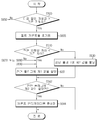
- 6 and 7 are flowcharts illustrating an exemplary method for detecting a battery short circuit in accordance with another embodiment of the present invention.
- Figs. 8 and 9 are different exemplary graphs referred to in describing the method of Figs. 6 and 7.
- Fig. 8 and 9 are different exemplary graphs referred to in describing the method of Figs. 6 and 7.
- " control unit " as described in the specification means a unit for processing at least one function or operation, and may be implemented by hardware or software, or a combination of hardware and software.
- FIG. 1 is a schematic view of a functional configuration of a battery leakage detection apparatus according to an embodiment of the present invention
- FIG. 2 is a diagram schematically showing a circuit configuration of a battery pack 10 according to an embodiment of the present invention .
- the battery pack 10 includes a battery 20 and a battery leakage detection device 100.
- the battery 20 refers to a single battery cell 21 or an aggregate of the battery cells 21, and the aggregate of the battery cells 21 includes a plurality of battery cells 21 that are connected in series, . ≪ / RTI >
- the battery cell 21 may be an electric double layer capacitor including an ultracapacitor or a secondary battery such as a lithium ion battery, a lithium polymer battery, a nickel cadmium battery, a nickel hydride battery, a nickel zinc battery and the like.
- the battery leakage detecting apparatus 100 includes a first voltage distributor 110, a second voltage distributor 120, a switching unit 130, a voltage measuring unit 150, a switch driver 160, .
- the battery leakage detection device 100 is electrically connected to the positive electrode terminal N P and the negative electrode terminal N N of the battery 20.
- FIG. 2 shows two insulation resistors 11 and 12 electrically connected to the positive terminal N P and the negative terminal N N of the battery 20.
- a first insulation resistor 11 is connected between the positive terminal N P of the battery 20 and the ground and a second insulation resistor 11 is connected between the negative terminal N N of the battery 20 and the ground. (12) are connected.
- Each of the two insulation resistors 11 and 12 can be regarded as a virtual equivalent resistor for indicating the insulation state of the battery 20 from the ground. If the insulation state between the battery 20 and the ground is maintained well, the resistance values R Leak (+) and R Leak (-) of the first and second insulation resistors 11 and 12 are set to a predetermined threshold resistance Value. Alternatively, when the insulation state between the battery 20 and the ground is deteriorated, the resistance value of at least one of the first and second insulation resistors 11 and 12 may be less than or equal to the critical resistance value.
- FIG. 2 the parasitic capacitance (C P (+) electrically connected to the positive terminal (P N) and a negative terminal (N N) of the battery 20, C P (-) ). Specifically, between the positive terminal (N P) and a ground of the battery 20, anode-side parasitic capacitance (C P (+)) is being connected, the negative terminal of the battery 20 (N N), and between the grounding And a cathode-side parasitic capacitor Cp ( - ) are connected.
- parasitic capacitors (C P (+) , C P (-) ) is connected between the positive terminal N P of the battery 20 and the ground, and between the negative terminal N N of the battery 20 and the ground, similar to the above-described insulation resistors 11, It can be said to be a virtual equivalent capacitor for representing a capacitor component.
- the parasitic capacitors (C P (+) , C P (-) ) may be equalized in parallel to the insulation resistors 11 and 12, respectively, as shown in FIG.
- the first voltage divider 110 includes a first protection resistor 111 and a first reference resistor 112.
- the first protection resistor 111 and the first reference resistor 112 are interconnected through a first common node N C1 .
- the second voltage divider 120 includes a second protection resistor 121 and a second reference resistor 122.
- the second protection resistor 121 and the second reference resistor 122 are interconnected through a second common node N C2 .
- the battery leakage detection apparatus 100 may further include a DC voltage source 140 connected between the second reference resistor 122 and ground. Since the second reference resistor 122 is connected between the negative terminal N N of the battery 20 and the ground, the voltage applied between the second common node N C2 and the ground may be a negative value. Therefore, a DC voltage source 140 may be provided to make the voltage applied between the second common node N C2 and the ground have a positive value.
- the voltage value V DC output from the DC voltage source 140 is set so that the voltage applied between the second common node N C2 and the ground is a positive value (i.e., the second detection voltage becomes 0 V or more) And can be pre-stored in a memory built in the controller 170.
- the switching unit 130 may include a first switch SW1 and a second switch SW2.
- the first switch SW1 may be connected between the positive terminal N P and the first voltage distributor 110.
- the second switch SW2 may be connected between the positive terminal N N and the second voltage distributor 120.
- the first switch SW1 and the second switch SW2 can be controlled independently of each other in response to a signal output from the switch driver 160. [ That is, the first switch SW1 and the second switch SW2 can be turned on or turned off, respectively. By this combination, up to four switching modes can be selectively executed by the controller 170. [ Each switching mode can be executed only while the battery 20 is in a no-load state.
- the no-load state is a state in which charging and discharging of the battery 20 are stopped.
- the four switching modes are a first switching mode in which the first switch SW1 and the second switch SW2 are turned on and turned off, a second switching mode in which the first switch SW1 and the second switch SW2 are turned on-off, a second switching mode in which the first switch SW1 and the second switch SW2 are turned on- A third switching mode, and a fourth switching mode that is 'turn off-turned off'.
- the switching unit 130 may further include a safety switch SW3.
- the safety switch SW3 is provided to selectively block the electrical connection between the battery cell 21 and the remaining battery cells 21 among the plurality of battery cells 21 included in the battery 20.
- the safety switch SW3 may be installed between any two battery cells 21 connected in series adjacent to each other in the battery 20.
- the safety switch SW3 When the safety switch SW3 is turned off, the use of the battery 20, that is, the charging / discharging is stopped.
- the safety switch SW3 When the safety switch SW3 is included in the switching unit 130, the four switching modes described above can be executed while the safety switch SW3 is turned on.
- the first protection resistor 111 and the first reference resistor 112 may be connected in series between the positive terminal N P of the battery 20 and the ground when the first switch SW1 is turned on.
- the first protection resistor 111 and the first reference resistor 112 can be electrically disconnected from the positive terminal N P of the battery 20 when the first switch SW1 is turned off.
- each of the first protection resistor 111 and the first reference resistor 112 is connected to each other via the first common node N C1 .
- the other end of the first protection resistor 111 is connected to or disconnected from the anode terminal N P through the first switch SW1.
- the other end of the first reference resistor 112 is connected to the ground.
- the second protection resistor 121 and the second reference resistor 122 may be connected in series between the negative terminal N N of the battery 20 and the ground when the second switch SW2 is turned on.
- the second protection resistor 121 and the second reference resistor 122 may be electrically disconnected from the negative terminal N N of the battery 20 when the second switch SW2 is turned off.
- each of the second protection resistor 121 and the second reference resistor 122 is connected to each other via the second common node N C2 .
- the other end of the second protection resistor 121 is connected to or disconnected from the negative terminal N N through the second switch SW2.
- the other end of the second reference resistor 122 is connected to the ground.
- the resistance value of each of the first protection resistor 111, the first reference resistor 112, the second protection resistor 121 and the second reference resistor 122 may be stored in advance in the controller 170.
- the ratio between the resistance value of the first protection resistor 111 and the resistance value of the first reference resistance 112 is preferably set such that the resistance value of the second protection resistor 121 and the resistance value of the second reference resistance 122 May be the same.
- the resistance value of the first protection resistor 111 and the resistance value of the second protection resistor 121 are equal to each other, and the resistance value of the first reference resistance 112 and the resistance value of the second reference resistance 122 are They can be the same.
- the resistance value of the first protection resistor 111 and the resistance value of the second protection resistor 121 are equal to each other by R 1
- the resistance value of the first reference resistance 112 and the resistance value of the second reference resistance 122 ) are respectively equal to each other as R 2 .
- the voltage applied to the first voltage divider 110 is divided according to the ratio between the resistance value of the first protection resistor 111 and the resistance value of the first reference resistor 112 and is measured by the voltage measuring unit 150 .
- the voltage applied to the second voltage distributor 120 is divided according to the ratio between the resistance value of the second protection resistor 121 and the resistance value of the second reference resistor 122, ). ≪ / RTI >
- the switch driving unit 160 can independently control the first switch SW1 and the second switch SW2. That is, the switch driver 160 may selectively turn on or off the first switch SW1 and the second switch SW2.
- the switch driving unit 160 can form different circuits in the battery pack 10 by controlling the first switch SW1 and the second switch SW2.
- the switch driver 160 controls the first switch SW1 and the second switch SW2 to form the following various circuits.
- the switch driver 160 may turn on the first switch SW1 and turn off the second switch SW2 in the first switching mode to form the first circuit (CC1 in Fig. 3).
- the first circuit CC1 is a circuit in which the first voltage distributor 110 is connected to the positive terminal N P and the second voltage distributor 120 is disconnected from the negative terminal N N.
- the switch driver 160 may turn off the first switch SW1 and turn on the second switch SW2 in the second switching mode to form the second circuit (CC2 in Fig. 4).
- the second circuit CC2 means a circuit in which the first voltage distributor 110 is disconnected from the positive terminal N P and the second voltage distributor 120 is connected to the negative terminal N N.
- the switch driving unit 160 may turn on the first switch SW1 and the second switch SW2 in the third switching mode to form a third circuit (not shown).
- the third circuit means a circuit in which the first voltage distributor 110 is connected to the positive terminal N p and the second voltage distributor 120 is connected to the negative terminal N N.
- the switch driver 160 may turn off the first switch SW1 and the second switch SW2 in the fourth switching mode to form a fourth circuit (not shown).
- the fourth circuit means a circuit in which the first reference resistor 112 is not connected to the positive terminal N p and the second reference resistor 122 is not connected to the negative terminal N N.
- the switch driver 160 can control the safety switch SW3 independently of the first switch SW1 and the second switch SW2.
- the voltage measuring unit 150 measures the terminal voltage V Bat of the battery 20.
- the voltage measuring unit 150 may be electrically connected to the connection point between the first switch SW1 and the first voltage distributor 110 and the connection point between the second switch SW2 and the second voltage distributor 120, Can be connected.
- the terminal voltage V Bat of the battery 20 can be measured by the voltage measuring unit 150 while the third switching mode is being executed.
- a voltage sensor (not shown) provided separately from the voltage measuring unit 150 may measure the terminal voltage V Bat of the battery 20 and output a measurement signal indicating the measured terminal voltage V Bat to the controller 170 have.
- the voltage measuring unit 150 measures the voltage applied between the first common node N C1 and the ground (hereinafter, referred to as a 'first detection voltage' or 'V 1 ') and the second common node N C2 (Hereinafter referred to as "second detection voltage” or “V 2 ”) applied between the grounds can be measured simultaneously or at the same time.
- the first detection voltage may be equal to the voltage across the first reference resistor 112 and the second detection voltage may be equal to the sum of the voltage across the second reference resistor 112 and V DC .
- the voltage measuring unit 150 may include a first input port IN1 connected to the first common node N C1 and a second input port IN2 connected to the second common node N C2 .
- the voltage measuring unit 150 may include a voltage sensor and an analog-to-digital converter (ADC).
- the voltage sensor outputs to the ADC an analog signal corresponding to the potential formed at the first input port IN1 and an analog signal corresponding to the potential formed at the second input port IN2.
- the ADC can convert an analog signal corresponding to the potential formed at the first input port IN1 into a digital signal and an analog signal corresponding to the potential formed at the second input port IN2 into a digital signal.
- the controller 170 is operatively coupled to the voltage measuring unit 150 and the switch driver 160.
- the controller 170 controls the switch driver 160 based on the measurement signals output from the voltage measurement unit 150.
- Controller 170 may be implemented in hardware as application specific integrated circuits (ASICs), digital signal processors (DSPs), digital signal processing devices (DSPDs), programmable logic devices (PLDs), field programmable gate arrays (FPGAs) microprocessors, and other electronic units for performing other functions.
- ASICs application specific integrated circuits
- DSPs digital signal processors
- DSPDs digital signal processing devices
- PLDs programmable logic devices
- FPGAs field programmable gate arrays
- the controller 170 may have a built-in memory.
- the memory may additionally store data, instructions and software required for the overall operation of the device 10.
- the memory 120 may be a flash memory type, a hard disk type, a solid state disk type, an SDD type (Silicon Disk Drive type), a multimedia card micro type At least one of a random access memory (RAM), a static random access memory (SRAM), a read-only memory (ROM), an electrically erasable programmable read-only memory (EEPROM) And may include one type of storage medium.
- RAM random access memory
- SRAM static random access memory
- ROM read-only memory
- EEPROM electrically erasable programmable read-only memory
- the resistance value of the first insulation resistor 11 is referred to as a 'first insulation resistance value' or 'R Leak (+) '
- the resistance value of the second insulation resistor 12 is referred to as a ' Or " R Leak (-) ".
- FIG. 3 is a circuit diagram schematically showing a first circuit CC1 formed in the battery pack 10 by the first switching mode.
- the parasitic capacitors CP (+) and CP (-) cause a stabilized state in which the second detection voltage no longer changes with time. Therefore, for convenience of explanation, the parasitic capacitors C P (+) , C P (-) ) will be omitted.
- I 1 is a current flowing from the first protection resistor 111 to the first reference resistor 112 and I 2 is a current flowing from the positive terminal N P to the first insulation resistor 11 And I 3 represents a current flowing from the second insulation resistor 12 to the negative terminal N N.
- the first detection voltage V 1 is expressed by the following equation (1).
- Equation 2 Equation 2
- Equation 3 the following relationship is established as shown in Equation 3 below.
- Equations (2) and (4) can be substituted into Equation (5) and summarized with respect to I 3 , as shown in Equation (6) below.
- Equation (7) when the terminal voltage of the battery 20 is V Bat , applying the Kirchhoff's voltage law to the first circuit CC1 leads to an equation of the first row included in Equation (7) below. If the equation of the first row is summarized using I 2 and I 3 obtained from the equations (4) and (6), the equation of the last row included in Equation (7) below can be derived.
- Equation (7 ) The equation of the last row included in Equation (7 ) is one of the two circuit equations necessary for calculating the first insulation resistance value R Leak (+) and the second insulation resistance R Leak (-) .
- FIG. 4 is a circuit diagram schematically showing a second circuit CC2 formed in the battery pack 10 by the second switching mode.
- the second case a certain amount of time passed from the time that the disclosed switching mode, the parasitic capacitances (CP (+), CP ( -)) no more due to the second detection voltage is time
- the stabilized state does not change along the second direction. Therefore, for convenience of explanation, the parasitic capacitors C P (+) , C P (-) ) will be omitted.
- I 1 is a current flowing from the second reference resistor 122 to the first protection resistor 121
- I 2 is a current flowing from the second insulation resistor 12 to the negative terminal N N
- I 3 denotes a current flowing from the positive terminal N P to the first insulation resistor 11.
- the second detection voltage V 2 is expressed by the following equation (8).
- Equation (9) Equation (9) below.
- Equation (11) (10) using Equation (9), the following Equation (11) can be derived.
- Equations (9) and (11) can be substituted into Equation (12) and summarized with respect to I 3 , as shown in Equation (13) below.
- Equation (14) when the terminal voltage of the battery 20 is V Bat , applying the Kirchhoff's voltage law to the second circuit CC2 results in the first row of equations included in Equation (14) below. If the equation of the first row is summarized using I 2 and I 3 obtained from the equations (11) and (13), the equation of the last row included in the following equation (14) can be derived.
- Equation (14 ) The equation of the last row included in Equation (14 ) is the other of the two circuit equations for calculating the first insulation resistance value R Leak (+) and the second insulation resistance value R Leak (-) .
- Equation (15) The solution of the simultaneous equations including the equation of the last row of Equation (7) and the equation of the last row of Equation (14) can be expressed as Equation (15) below.
- each of R 1 , R 2, and V DC is predetermined, and each of V Bat , V 1, and V 2 is measured by the voltage measuring unit 150.
- the voltage measuring unit 150 outputs a measurement signal representing each of V Bat , V 1 and V 2 to the controller 170.
- Each of V 1 and V 2 can be measured within a predetermined period (for example, 5 seconds) before and after the measurement point of V Bat .
- the controller 170 compares the first insulation resistance value R Leak (+) and the second insulation resistance R Leak (+) using Equation (15) based on V Bat , V 1 and V 2 indicated by the measurement signal output from the voltage detector 130 And the resistance value R Leak (-) .
- the controller 170 compares at least one of the first insulation resistance value R Leak (+) and the second insulation resistance value R Leak (-) with a given critical resistance value to determine the first and second The second insulation resistors 11 and 12 are diagnosed. That is, the controller 170 monitors whether the first insulation resistance value R Leak (+) or the second insulation resistance value R Leak (-) is less than or equal to the threshold resistance value.
- the battery leakage detection apparatus 100 may further include a communication unit 181 for communication with an external device (e.g., an ECU of a vehicle).
- the controller 170 can transmit the diagnosis results of the first and second insulation resistors 11 and 12 to the external device 30 via the communication unit 181.
- the battery leakage detection apparatus 100 may further include an alarm unit 182 for visually or auditorily outputting information corresponding to the diagnosis results of the first and second insulation resistors 11 and 12.
- the controller 170 can output a warning message through the warning unit 182 when the insulation between the battery 20 and the ground is not properly maintained.
- the warning portion 182 may include an LED, an LCD, an alarm alarm, or a combination thereof.
- the controller 170 may be a processor, an application-specific integrated circuit (ASIC), another chipset, a logic circuit, a logic circuit, etc., which are known in the art to perform the insulation resistance calculation and various control logic using Equation (15) Registers, communication modems, data processing devices, and the like.
- ASIC application-specific integrated circuit
- FIG. 5 is a flowchart illustrating an exemplary method for calculating an insulation resistance value between a battery and ground according to an embodiment of the present invention.
- the method of FIG. 5 may be repeatedly performed at predetermined time intervals.
- step S500 the controller 170 receives a measurement signal indicating the terminal voltage Vbat of the battery 20 from the voltage measurement unit 150.
- step S510 the controller 170 executes the first switching mode.
- the switch driver 160 outputs a first switching signal (e.g., a voltage of a predetermined high level) to the first switch SW1 and outputs a second switching signal to the second switch SW2 during the execution of the first switching mode, And outputs a signal (e.g., a voltage of a predetermined low level). Accordingly, the first switch SW1 is turned on in response to the first switching signal, and the second switch SW2 is turned off in response to the second switching signal.
- a first switching signal e.g., a voltage of a predetermined high level
- a signal e.g., a voltage of a predetermined low level
- step S520 the controller 170, receives the first measurement signal representing a first detection voltage V 1 from the voltage measuring unit 150 during the execution of the first switching mode. That is, the first detection voltage V 1 is measured by the voltage measuring unit 150 during the execution of the first switching mode.
- step S530 the controller 170 executes the second switching mode.
- the switch driving unit 160 outputs the second switching signal to the first switch SW1 and outputs the first switching signal to the second switch SW2. Accordingly, the first switch SW1 is turned off in response to the second switching signal, and the second switch SW2 is turned on in response to the first switching signal.
- step S540 the controller 170, receives the second measurement signal indicative of the second detection voltage V 2 from the voltage measuring unit 150 during the execution of the second switching mode. That is, the second detection voltage V 2 is measured by the voltage measuring unit 150 during the execution of the second switching mode.
- step S550 the controller 170 calculates the first insulation resistance value R Leak (+) and the second insulation resistance value R Leak (-) , respectively.
- the controller 170 calculates the first insulation resistance value R Leak (+) and the second insulation resistance value R Leak (-) on the basis of V Bat , V 1 and V 2 Respectively.
- the controller 170 may store the first insulation resistance value R Leak (+) and the second insulation resistance value R Leak (-) in a memory.
- Figures 6 and 7 are flow charts illustrating an exemplary method for detecting a battery short circuit in accordance with another embodiment of the present invention and Figures 8 and 9 are flowcharts illustrating different methods for detecting battery leakage, These are exemplary graphs. 6 and 7 are executed after the first insulation resistance value R Leak (+) and the second insulation resistance value R Leak (-) are calculated through the method of FIG. 5, Can be repeatedly performed once.
- step S600 the controller 170 determines whether the representative insulation resistance value is larger than a predetermined threshold resistance value (see RTH in Figs. 8 and 9).
- the representative insulation resistance value may be set to any one of the first insulation resistance value R Leak (+) and the second insulation resistance value R Leak (-) such as the first insulation resistance value R Leak (+) and the second insulation resistance value R Leak (-) may be the smaller one. If the value of the step S600 is "YES ", the step S605 proceeds. If the value of step S600 is NO, that is, if the representative insulation resistance value is equal to or less than the threshold resistance value, step S650 is performed.
- step S605 the controller 170 initializes the fault count.
- the fault count may be set to a specific value, such as zero, by initialization.
- the fault count may indicate the number of times that the representative insulation resistance value is continuously calculated to be equal to or less than the threshold resistance value.
- step S610 the controller 170 determines whether or not the insulation resistance value difference is smaller than a predetermined reference difference.
- the first insulation resistance value R Leak (+) Or the second insulation resistance value R Leak (-) may sharply decrease or increase toward the critical resistance value. Therefore, when the insulation resistance value difference is equal to or greater than the reference difference, it indicates that the representative insulation resistance value to be determined next time is equal to or less than the threshold resistance value.
- step S610 If the value of the step S610 is "YES ", the step S620 proceeds. If the value of the step S610 is "NO ", the step S630 is proceeded.
- step S620 the controller 170 assigns a first value (e.g., 0) to the diagnostic flag.
- the first value indicates that the representative insulation resistance value is valid. Also, the fact that the first value is assigned to the diagnostic flag may mean that the diagnostic flag is initialized.
- step S630 the controller 170 assigns a second value (e.g., 1) to the diagnostic flag.
- the second value indicates that the representative insulation resistance value is not valid.
- step S642 the controller 170 determines whether the second value is assigned to the diagnostic flag.
- the fact that the second value is assigned to the diagnosis flag means that the step S630 has been executed last time.
- the fact that the second value is not allocated to the diagnostic flag, that is, the first value is assigned means that Step S620 has been executed last time. If the value of the step S642 is "YES ", the step S644 proceeds. If the value of step S642 is "NO ", the method ends.
- step S644 the controller 170 activates the count indicator.
- step S650 can be performed when the value of step S600 is "NO ".
- the controller 170 increments the fault count. That is, the controller 170 increases the fault count every time it is determined that the representative insulation resistance value is equal to or smaller than the threshold resistance value.
- the fault count is a value updated every time in the controller 170, and indicates the number of times that the representative insulation resistance value is determined to be equal to or less than the threshold resistance value consecutively up to now.
- step S660 the controller 170 determines whether or not the count indicator is activated. If the value of the step S660 is "NO ", the step S670 proceeds. If the value of the step S660 is "YES ", the step S680 proceeds.
- step S670 if the count indicator is not activated, the controller 170 determines whether the increased fault flag is equal to or greater than a predetermined first count.
- step S650 if the fault count is programmed to increase by 1, the first count may be 2 or more (preferably 3 or more). If the value of step S670 is YES, step S690 is proceeded. If the value of step S670 is "NO ", the method according to Figs. 6 and 7 can be terminated.
- step S680 when the count indicator is activated, the controller 170 determines whether the increased fault flag is equal to or greater than a predetermined second count. At this time, the second count is smaller than the first count. For example, in step S650, if the fault count is programmed to increase by 1 and the first count is 10, the second count may be any one of 1 to 9. If the value of step S680 is YES, step S690 is proceeded. If the value of step S680 is "NO ", the method according to Figs. 6 and 7 can be terminated.
- step S690 the controller 170 executes a predetermined protection operation.
- the protection operation may include a notification of the insulation resistance value. That is, the controller 170 can transmit a signal indicating the first insulation resistance value R Leak (+) and the second insulation resistance value R Leak (- ) to the external device 30 through the communication unit 181.
- the protection operation may include a warning. That is, the controller 170 can output the warning message through the warning unit 182.
- the protection operation may include turning off the safety switch SW3. That is, the controller 170 can turn off the safety switch SW3 by using the switch driver 160.
- the representative insulation resistance value calculated at the time t i is based on V Bat , V 1 and V 2 measured in the time range of (t i -3 sec) to (t i -1 sec).
- the graph of Figure 8 shows an exemplary variation of the representative insulation resistance over time.
- the period from time T1 to time T2 represents a period during which insulation breakdown occurs between the battery 20 and the ground, or a period during which the voltage measuring unit 150 is temporarily faulty.
- the insulation resistance value calculated by the representative t 3 can not affected to the situation generated in the period from T1 to T2. Accordingly, the first count is utilized for battery shortage diagnosis.
- the representative of the insulation resistance value of the time t 3, time t 4, in response to the time t in succession three times ( first count) in the 5 that is below the threshold resistance value, the controller 170 may execute the protection operation .
- the graph of Figure 9 shows an exemplary variation of the representative insulation resistance over time.
- the period from the time point T3 to the time point T4 indicates a period during which the insulation breakdown occurs between the battery 20 and the ground, or a period during which the voltage measuring unit 150 is temporarily faulty.
- the time point T4 affected by the conditions generated in the period later than if the time (t 3 -3 sec), represented the insulation resistance value calculated at t 3 is from T3 to T4, t 2 the difference between the representative value and the insulation resistance represents insulation resistance value calculated at t 3 calculated in, that is, the insulation resistance difference ( ⁇ R) can be more than the reference difference.
- the controller 170 may execute the protection operation.
Landscapes
- Electrochemistry (AREA)
- General Chemical & Material Sciences (AREA)
- Chemical & Material Sciences (AREA)
- Chemical Kinetics & Catalysis (AREA)
- Physics & Mathematics (AREA)
- General Physics & Mathematics (AREA)
- Engineering & Computer Science (AREA)
- Manufacturing & Machinery (AREA)
- Microelectronics & Electronic Packaging (AREA)
- Testing Of Short-Circuits, Discontinuities, Leakage, Or Incorrect Line Connections (AREA)
- Secondary Cells (AREA)
- Electric Propulsion And Braking For Vehicles (AREA)
- Measurement Of Resistance Or Impedance (AREA)
Abstract
배터리 누전을 검출하기 위한 방법 및 장치가 개시된다. 본 발명의 일 실시예에 따른 방법은, 배터리와 접지 사이의 절연 상태를 나타내는 대표 절연 저항값이 미리 정해진 기준 저항값보다 큰 경우, 전회의 대표 절연 저항값과 상기 대표 절연 저항값 간의 차이인 절연 저항값 차이가 미리 정해진 기준 차이보다 작은지 여부를 판정하는 단계; 상기 절연 저항값 차이가 상기 기준 차이보다 작은 경우, 진단 플래그에 제1 값을 할당하는 단계; 상기 절연 저항값 차이가 상기 기준 차이 이상인 경우, 상기 진단 플래그에 제2 값을 할당하는 단계; 및 상기 진단 플래그에 상기 제2 값이 할당되어 있는 경우, 카운트 인디케이터를 활성화하는 단계를 포함한다. 상기 제1 값은, 상기 대표 절연 저항값이 유효함을 나타낸다. 상기 제2 값은, 상기 대표 절연 저항값이 비유효함을 나타낸다.
Description
본 발명은, 배터리 누전을 검출하기 위한 방법 및 장치에 관한 것으로서, 더욱 상세하게는 배터리와 접지 사이의 절연 저항에 기초하여 배터리 누전을 검출 하기 위한 방법 및 장치에 관한 것이다.
본 출원은 2017년 12월 15일자로 출원된 한국 특허출원 번호 제 10-2017-0173495호에 대한 우선권주장출원으로서, 해당 출원의 명세서 및 도면에 개시된 모든 내용은 인용에 의해 본 출원에 원용된다.
최근 들어, 화석 에너지의 고갈과 환경오염으로 인해 화석 에너지를 사용하지 않고 전기 에너지를 이용하여 구동할 수 있는 전기 제품에 대한 관심이 높아지고 있다.
이에 따라 모바일 기기, 전기차, 하이브리드 자동차, 전력저장 장치, 무정전 전원 장치 등에 대한 기술 개발과 수요가 증가함에 따라 에너지원으로서의 이차전지의 수요가 급격히 증가하고 있으며 수요의 형태 역시 다양해지고 있다. 따라서 다양한 요구에 부응할 수 있게 이차전지로 구성된 배터리에 대한 많은 연구가 진행되고 있다.
한편, 고출력, 고전압(예, 수백 볼트[V]) 배터리를 사용하는 전기차나 하이브리드 자동차 같은 장치에서는 접지(예, 차체)로부터 배터리의 절연 상태가 잘 유지될 필요가 있다. 배터리의 절연 상태가 유지되지 않는 경우, 즉 배터리와 접지 사이의 절연 저항값(insulation resistance)이 일정값 이하가 되는 경우, 배터리로부터 큰 누설 전류가 흐르게 되어 주변 전자 기기들의 오작동을 유발함은 물론 감전 사고가 발생할 수 있다.
배터리 누전 검출을 위한 종래 기술들이 개시되어 있는데, 이러한 종래 기술들 대부분은 상기 절연 저항값을 보다 빠르게 또는 보다 정확하게 산출하는 것에 초점이 맞춰져 있었다.
상기 절연 저항값은, 일반적으로 일정 시간마다 주기적으로 산출된다. 그런데, 외부로부터의 노이즈 등과 같은 다양한 원인으로 인하여, 상기 산출된 절연 저항이 일시적으로 실제와는 다를 수 있다.
본 발명의 일 목적은, 배터리와 접지 사이의 절연 저항값이 연속하여 기준 횟수 이상 임계 저항값(reference resistance) 이하가 되는지에 기초하여 배터리 누전을 검출하는 방법 및 장치를 제공하는 것이다.
본 발명의 다른 목적은, 배터리의 절연 저항값에 기초하여 배터리 누전 여부를 판정하는 기준으로 사용되는 카운트를 조절하는 방법 및 장치를 제공하는 것이다.
본 발명의 다른 목적 및 장점들은 하기의 설명에 의해서 이해될 수 있으며, 본 발명의 실시예에 의해 보다 분명하게 알게 될 것이다. 또한, 본 발명의 목적 및 장점들은 특허청구범위에 나타난 수단 및 그 조합에 의해 실현될 수 있음을 쉽게 알 수 있을 것이다.
본 발명의 일 실시예에 따른 배터리 누전을 검출하는 방법은, 배터리와 접지 사이의 대표 절연 저항값을 산출하는 단계; 상기 대표 절연 저항값이 미리 정해진 기준 저항값보다 큰지 여부를 판정하는 단계; 상기 대표 절연 저항값이 상기 기준 저항값보다 큰 경우, 전회의 대표 절연 저항값과 상기 대표 절연 저항값 간의 차이인 절연 저항값 차이가 미리 정해진 기준 차이보다 작은지 여부를 판정하는 단계; 상기 절연 저항값 차이가 상기 기준 차이보다 작은 경우, 진단 플래그에 제1 값-상기 제1 값은, 상기 대표 절연 저항값이 유효함을 나타냄-을 할당하는 단계; 상기 절연 저항값 차이가 상기 기준 차이 이상인 경우, 상기 진단 플래그에 제2 값-상기 제2 값은, 상기 대표 절연 저항값이 비유효함을 나타냄-을 할당하는 단계; 및 상기 진단 플래그에 상기 제2 값이 할당되어 있는 경우, 카운트 인디케이터를 활성화하는 단계를 포함한다.
상기 대표 절연 저항값은, 상기 배터리의 양극 단자와 상기 접지 사이의 제1 절연 저항값 및 상기 배터리의 음극 단자와 상기 접지 사이의 제2 절연 저항값 중에서 더 작은 것일 수 있다.
상기 방법은, 상기 대표 절연 저항값이 상기 기준 저항값 이하인 경우, 폴트 카운트를 증가시키는 단계; 상기 대표 절연 저항값이 상기 기준 저항값 이하인 경우, 상기 카운트 인디케이터가 활성화되어 있는지 여부를 판정하는 단계; 상기 카운트 인디케이터가 활성화되어 있지 않은 경우, 상기 증가된 폴트 카운트가 미리 정해진 제1 카운트 이상인지 여부를 판정하는 단계; 및 상기 증가된 폴트 카운트가 상기 제1 카운트 이상인 경우, 보호 동작을 실행하는 단계를 더 포함할 수 있다.
상기 방법은, 상기 카운트 인디케이터가 활성화되어 있는 경우, 상기 증가된 폴트 카운트가 미리 정해진 제2 카운트 이상인지 여부를 판정하는 단계; 및 상기 증가된 폴트 카운트가 상기 제2 카운트 이상인 경우, 상기 보호 동작을 실행하는 단계를 더 포함할 수 있다.
상기 제2 카운트는, 상기 제1 카운트보다 작을 수 있다.
상기 보호 동작은, 상기 배터리 내에서 서로 인접하게 직렬로 연결된 두 배터리 셀 사이에 설치된 안전 스위치의 턴 오프를 포함할 수 있다.
본 발명의 다른 실시예에 따른 배터리 누전을 검출하는 장치는, 제1 스위치 및 제2 스위치를 포함하는 스위칭부; 상기 제1 스위치의 턴온 시, 배터리의 양극 단자와 접지 사이에 직렬 연결되는 제1 보호 저항 및 제1 기준 저항을 포함하는 제1 전압 분배부; 상기 제2 스위치의 턴온 시, 상기 배터리의 음극 단자와 상기 접지 사이에 직렬 연결되는 제2 보호 저항 및 제2 기준 저항을 포함하는 제2 전압 분배부; 상기 제1 전압 분배부의 제1 검출 전압 및 상기 제2 전압 분배부로부터 제2 검출 전압을 측정하도록 구성된 전압 측정부; 상기 제1 스위치 및 상기 제2 스위치를 독립적으로 제어하도록 구성된 스위치 구동부; 및 상기 제1 스위치가 턴 온되고 상기 제2 스위치가 턴 오프된 제1 회로가 형성되어 있는 동안에 상기 전압 측정부에 의해 측정된 상기 제1 검출 전압 및 상기 제1 스위치가 턴 오프되고 상기 제2 스위치가 턴 온된 제2 회로가 형성되어 있는 동안에 상기 전압 측정부에 의해 측정된 상기 제2 검출 전압을 기초로, 상기 배터리의 양극 단자와 상기 접지 사이의 제1 절연 저항값 및 상기 배터리의 음극 단자와 상기 접지 사이의 제2 절연 저항값을 산출하도록 구성된 컨트롤러를 포함한다. 상기 컨트롤러는, 상기 제1 절연 저항값 및 상기 제2 절연 저항값 중 어느 하나인 대표 절연 저항값이 미리 정해진 기준 저항값보다 큰지 여부를 판정한다. 상기 컨트롤러는, 상기 대표 절연 저항값이 상기 기준 저항값보다 큰 경우, 전회의 대표 절연 저항값과 상기 대표 절연 저항값 간의 차이인 절연 저항값 차이가 미리 정해진 기준 차이보다 작은지 여부를 판정한다. 상기 컨트롤러는, 상기 절연 저항값 차이가 상기 기준 차이보다 작은 경우, 진단 플래그에 제1 값-상기 제1 값은, 상기 대표 절연 저항값이 유효함을 나타냄-을 할당한다. 상기 컨트롤러는, 상기 절연 저항값 차이가 상기 기준 차이 이상인 경우, 상기 진단 플래그에 제2 값-상기 제2 값은, 상기 대표 절연 저항값이 비유효함을 나타냄-을 할당한다. 상기 진단 플래그에 상기 제2 값이 할당되어 있는 경우, 카운트 인디케이터를 활성화한다. 상기 컨트롤러는, 상기 대표 절연 저항값이 상기 기준 저항값 이하인 경우, 폴트 카운트를 증가시킨다. 상기 카운트 인디케이터가 활성화되어 있지 않은 경우, 상기 증가된 폴트 카운트가 미리 정해진 제1 카운트 이상인지 여부를 판정한다. 상기 컨트롤러는, 상기 증가된 폴트 카운트가 상기 제1 카운트 이상인 경우, 보호 동작을 실행한다.
상기 컨트롤러는, 상기 카운트 인디케이터가 활성화되어 있는 경우, 상기 증가된 폴트 카운트가 미리 정해진 제2 카운트-상기 제2 카운트는, 상기 제1 카운트보다 작음-보다 큰지 여부를 판정할 수 있다. 상기 컨트롤러는, 상기 증가된 폴트 카운트가 상기 제2 카운트보다 큰 경우, 상기 보호 동작을 실행할 수 있다.
상기 보호 동작은, 상기 배터리 내에서 서로 인접하게 직렬로 연결된 두 배터리 셀 사이에 설치된 안전 스위치의 턴 오프를 포함할 수 있다.
본 발명의 또 다른 실시예에 따른 배터리 팩은, 상기 장치를 포함한다.
본 발명의 실시예들 중 적어도 하나에 따르면, 배터리와 접지 사이의 절연 저항값이 연속하여 일정 횟수 이상 임계 저항값 이하가 되는지에 기초하여 배터리 누전을 검출할 수 있다.
또한, 본 발명의 실시예들 중 적어도 하나에 따르면, 배터리의 절연 저항값에 기초하여 배터리 누전 여부를 판정하는 기준이 되는 횟수를 조절할 수 있다.
본 발명의 효과들은 이상에서 언급한 효과들로 제한되지 않으며, 언급되지 않은 또 다른 효과들은 청구범위의 기재로부터 당업자에게 명확하게 이해될 수 있을 것이다.
본 명세서에 첨부되는 다음의 도면들은 본 발명의 바람직한 실시예를 예시하는 것이며, 후술하는 발명의 상세한 설명과 함께 본 발명의 기술사상을 더욱 이해시키는 역할을 하는 것이므로, 본 발명은 그러한 도면에 기재된 사항에만 한정되어 해석되어서는 아니 된다.
도 1은 본 발명의 일 실시예에 따른 배터리 누전 검출 장치의 기능적 구성을 개략적으로 나타낸 도면이다.
도 2는 본 발명의 일 실시예에 따른 배터리 팩의 회로 구성을 개략적으로 나타낸 도면이다.
도 3은 제1 스위칭 모드에 의해 배터리팩 내에 형성되는 제1 회로를 개략적으로 도시한 회로도이다.
도 4는 제2 스위칭 모드에 의해 배터리팩 내에 형성되는 제2 회로를 개략적으로 도시한 회로도이다.
도 5는 본 발명의 일 실시예에 따라 배터리와 접지 사이의 절연 저항값을 산출하기 위한 예시적인 방법을 보여주는 순서도이다.
도 6 및 도 7은 본 발명의 다른 실시예에 따라 배터리 누전을 검출하기 위한 예시적인 방법을 보여주는 순서도이다.
도 8 및 도 9는 도 6 및 도 7의 방법을 설명하는 데에 참조되는 서로 다른 예시적인 그래프들이다.
이하, 첨부된 도면을 참조하여 본 발명의 바람직한 실시예를 상세히 설명하기로 한다. 이에 앞서, 본 명세서 및 청구범위에 사용된 용어나 단어는 통상적이거나 사전적인 의미로 한정해서 해석되어서는 아니 되며, 발명자는 그 자신의 발명을 가장 최선의 방법으로 설명하기 위해 용어의 개념을 적절하게 정의할 수 있다는 원칙에 입각하여 본 발명의 기술적 사상에 부합하는 의미와 개념으로 해석되어야 한다.
따라서, 본 명세서에 기재된 실시예와 도면에 도시된 구성은 본 발명의 가장 바람직한 일 실시예에 불과할 뿐이고 본 발명의 기술적 사상을 모두 대변하는 것은 아니므로, 본 출원시점에 있어서 이들을 대체할 수 있는 다양한 균등물과 변형예들이 있을 수 있음을 이해하여야 한다.
또한, 본 발명을 설명함에 있어 관련된 공지 구성 또는 기능에 대한 구체적인 설명이 본 발명의 요지를 흐릴 수 있다고 판단되는 경우에는 그 상세한 설명은 생략한다.
제1, 제2 등과 같이 서수를 포함하는 용어들은, 다양한 구성요소들 중 어느 하나를 나머지와 구별하는 목적으로 사용되는 것이고, 그러한 용어들에 의해 구성요소들을 한정하기 위해 사용되는 것은 아니다.
명세서 전체에서, 어떤 부분이 어떤 구성요소를 "포함"한다고 할 때, 이는 특별히 반대되는 기재가 없는 한 다른 구성요소를 제외하는 것이 아니라, 다른 구성요소를 더 포함할 수 있다는 것을 의미한다. 또한, 명세서에 기재된 <제어 유닛>과 같은 용어는 적어도 하나의 기능이나 동작을 처리하는 단위를 의미하며, 이는 하드웨어나 소프트웨어, 또는 하드웨어 및 소프트웨어의 결합으로 구현될 수 있다.
덧붙여, 명세서 전체에서, 어떤 부분이 다른 부분과 "연결"되어 있다고 할 때, 이는 "직접적으로 연결"되어 있는 경우뿐만 아니라, 그 중간에 다른 소자를 사이에 두고 "간접적으로 연결"되어 있는 경우도 포함한다.
도 1은 본 발명의 일 실시예에 따른 배터리 누전 검출 장치의 기능적 구성을 개략적으로 나타낸 도면이고, 도 2는 본 발명의 일 실시예에 따른 배터리 팩(10)의 회로 구성을 개략적으로 나타낸 도면이다.
도 1 및 도 2를 참조하면, 배터리팩(10)은, 배터리(20) 및 배터리 누전 검출 장치(100)를 포함한다. 여기서, 배터리(20)는, 단일의 배터리 셀(21) 또는 배터리 셀(21)의 집합체를 의미하며, 배터리 셀(21)의 집합체는, 직렬, 병렬 또는 직병렬된 복수개의 배터리 셀(21)을 포함할 수 있다.
배터리 셀(21)은, 울트라 커패시터를 포함하는 전기 이중층 커패시터 또는 리튬 이온 전지, 리튬 폴리머 전지, 니켈 카드뮴 전지, 니켈 수소 전지, 니켈 아연 전지 등과 같은 이차 전지일 수 있다.
배터리 누전 검출 장치(100)는, 제1 전압 분배부(110), 제2 전압 분배부(120), 스위칭부(130), 전압 측정부(150), 스위치 구동부(160) 및 컨트롤러(170)를 포함한다. 배터리 누전 검출 장치(100)는, 배터리(20)의 양극 단자(NP) 및 음극 단자(NN)에 전기적으로 연결되어 있다.
도 2에는, 배터리(20)의 양극 단자(NP) 및 음극 단자(NN)에 전기적으로 연결된 두 개의 절연 저항(11, 12)이 도시되어 있다. 상세하게는, 배터리(20)의 양극 단자(NP)와 접지 사이에는 제1 절연 저항(11)이 연결되어 있고, 배터리(20)의 음극 단자(NN)와 접지 사이에는 제2 절연 저항(12)이 연결되어 있다.
이러한 두 개의 절연 저항(11, 12) 각각은, 접지로부터의 배터리(20)의 절연 상태를 나타내기 위한 가상의 등가 저항이라고 할 수 있다. 만약, 배터리(20)와 접지 간의 절연 상태가 잘 유지될 경우 제1 및 제2 절연 저항(11, 12) 각각의 저항값(RLeak(+), RLeak(-))은 소정의 임계 저항값보다 클 것이다. 이와 달리, 배터리(20)와 접지 간의 절연 상태가 악화된 경우에는 제1 및 제2 절연 저항(11, 12) 중 적어도 하나의 저항값은 상기 임계 저항값 이하로 될 것이다.
또한, 도 2에는, 배터리(20)의 양극 단자(NP) 및 음극 단자(NN)에 전기적으로 연결된 기생 커패시터(CP(+), CP(-))가 도시되어 있다. 상세하게는, 배터리(20)의 양극 단자(NP)과 접지 사이에는 양극측 기생 커패시터(CP(+))가 연결되어 있고, 배터리(20)의 음극 단자(NN)와 접지 사이에는 음극측 기생 커패시터(CP(-))가 연결되어 있다. 이러한 기생 커패시터(CP(+), CP(-))는, 상술한 절연 저항(11, 12)과 유사하게, 배터리(20)의 양극 단자(NP)와 접지 간 및 배터리(20)의 음극 단자(NN)와 접지 간의 커패시터 성분을 나타내기 위한 가상의 등가 커패시터라고 할 수 있다. 기생 커패시터(CP(+), CP(-))는 도 2에 도시된 바와 같이, 절연 저항(11, 12)에 각각 병렬 연결된 형태로 등가화될 수 있다.
제1 전압 분배부(110)는, 제1 보호 저항(111) 및 제1 기준 저항(112)을 포함한다. 제1 보호 저항(111) 및 제1 기준 저항(112)는, 제1 공통 노드(NC1)를 통해 상호 연결된다.
제2 전압 분배부(120)는, 제2 보호 저항(121) 및 제2 기준 저항(122)을 포함한다. 제2 보호 저항(121) 및 제2 기준 저항(122)은, 제2 공통 노드(NC2)를 통해 상호 연결된다.
구현예에 따라, 배터리 누전 검출 장치(100)는 제2 기준 저항(122)과 접지 사이에 연결되는 직류 전압원(140)을 더 포함할 수 있다. 제2 기준 저항(122)은 배터리(20)의 음극 단자(NN)와 접지 사이에 연결되므로, 제2 공통 노드(NC2)와 접지 사이에 인가되는 전압은 음의 값이 될 수 있다. 따라서, 제2 공통 노드(NC2)와 접지 사이에 인가되는 전압이 양의 값을 갖도록 하기 위해 직류 전압원(140)이 구비될 수 있다. 직류 전압원(140)이 출력하는 전압값(VDC)은, 제2 공통 노드(NC2)와 접지 사이에 인가되는 전압이 양수값이 되도록(즉, 제2 검출 전압이 0V 이상이 되도록) 설정될 수 있고, 컨트롤러(170)에 내장된 메모리에 미리 저장될 수 있다.
스위칭부(130)는, 제1 스위치(SW1) 및 제2 스위치(SW2)를 포함할 수 있다. 제1 스위치(SW1)는, 양극 단자(NP)와 제1 전압 분배부(110) 사이에 연결될 수 있다. 제2 스위치(SW2)는, 양극 단자(NN)와 제2 전압 분배부(120) 사이에 연결될 수 있다.
제1 스위치(SW1) 및 제2 스위치(SW2)는 스위치 구동부(160)로부터 출력되는 신호에 응답하여, 서로 독립적으로 제어될 수 있다. 즉, 제1 스위치(SW1) 및 제2 스위치(SW2)는 각각 턴온 또는 턴오프될 수 있는바, 그 조합에 의해 최대 4가지의 스위칭 모드가 컨트롤러(170)에 의해 선택적으로 실행될 수 있다. 각 스위칭 모드는, 배터리(20)가 무부하 상태에 있는 동안에 한하여 실행될 수 있다. 무부하 상태란, 배터리(20)의 충전 및 방전이 중단된 상태라고 할 수 있다. 4가지 스위칭 모드는, 제1 스위치(SW1) 및 제2 스위치(SW2)가 '턴온-턴오프'되는 제1 스위칭 모드, '턴오프-턴온'되는 제2 스위칭 모드, '턴온-턴온'되는 제3 스위칭 모드, '턴오프-턴오프'되는 제4 스위칭 모드일 수 있다. 이에, 스위칭 모드별로 배터리 팩(10) 내에 서로 다른 4가지의 회로가 선택적으로 형성될 수 있다. 스위칭부(130)는, 안전 스위치(SW3)를 더 포함할 수 있다.
안전 스위치(SW3)는, 배터리(20)에 포함된 복수의 배터리 셀(21) 중에서 서로일부 배터리 셀(21)과 나머지 배터리 셀(21) 간의 전기적인 연결을 선택적으로 차단하도록 제공된다. 안전 스위치(SW3)는, 배터리(20) 내에서 서로 인접하게 직렬로 연결된 어느 두 배터리 셀(21) 사이에 설치될 수 있다. 안전 스위치(SW3)가 턴 오프된 경우, 배터리(20)의 사용 즉, 충방전이 중단된다. 스위칭부(130)에 안전 스위치(SW3)가 포함되는 경우, 전술한 4가지 스위칭 모드는, 안전 스위치(SW3)가 턴 온된 동안에 실행될 수 있다.
제1 보호 저항(111) 및 제1 기준 저항(112)은, 제1 스위치(SW1)의 턴온 시, 배터리(20)의 양극 단자(NP)와 접지 사이에 직렬 연결될 수 있다. 제1 보호 저항(111) 및 제1 기준 저항(112)은, 제1 스위치(SW1)의 턴오프 시, 배터리(20)의 양극 단자(NP)로부터 전기적으로 분리될 수 있다.
구체적으로, 제1 보호 저항(111) 및 제1 기준 저항(112) 각각의 일단은 제1 공통 노드(NC1)를 통해 서로 연결된다. 또한, 제1 보호 저항(111)의 타단은 제1 스위치(SW1)를 통해 양극 단자(NP)에 연결 또는 분리된다. 또한, 제1 기준 저항(112)의 타단은 접지에 연결된다.
제2 보호 저항(121) 및 제2 기준 저항(122)은, 제2 스위치(SW2)의 턴온 시, 배터리(20)의 음극 단자(NN)와 접지 사이에 직렬 연결될 수 있다. 제2 보호 저항(121) 및 제2 기준 저항(122)은, 제2 스위치(SW2)의 턴오프 시, 배터리(20)의 음극 단자(NN)로부터 전기적으로 분리될 수 있다.
구체적으로, 제2 보호 저항(121) 및 제2 기준 저항(122) 각각의 일단은 제2 공통 노드(NC2)를 통해 서로 연결된다. 또한, 제2 보호 저항(121)의 타단은 제2 스위치(SW2)를 통해 음극 단자(NN)에 연결 또는 분리된다. 또한, 제2 기준 저항(122)의 타단은 접지에 연결된다.
제1 보호 저항(111), 제1 기준 저항(112), 제2 보호 저항(121) 및 제2 기준 저항(122) 각각의 저항값은 컨트롤러(170)에 미리 저장될 수 있다. 바람직하게는, 제1 보호 저항(111)의 저항값과 제1 기준 저항(112)의 저항값 간의 비율은, 제2 보호 저항(121)의 저항값과 제2 기준 저항(122)의 저항값 간의 비율과 동일할 수 있다. 예컨대, 제1 보호 저항(111)의 저항값과 제2 보호 저항(121)의 저항값은 서로 동일하고, 제1 기준 저항(112)의 저항값과 제2 기준 저항(122)의 저항값은 서로 동일할 수 있다. 이하에서는, 제1 보호 저항(111)의 저항값과 제2 보호 저항(121)의 저항값이 각각 R1으로 서로 동일하고, 제1 기준 저항(112)의 저항값과 제2 기준 저항(122)의 저항값이 각각 R2으로 서로 동일하다고 가정하겠다.
제1 전압 분배부(110)에 인가된 전압은 제1 보호 저항(111)의 저항값과 제1 기준 저항(112)의 저항값 간의 비율에 따라 분배되어, 전압 측정부(150)에 의해 측정될 수 있다. 이와 유사하게, 제2 전압 분배부(120)에 인가된 전압은 제2 보호 저항(121)의 저항값과 제2 기준 저항(122)의 저항값 간의 비율에 따라 분배되어, 전압 측정부(150)에 의해 측정될 수 있다.
스위치 구동부(160)는, 제1 스위치(SW1) 및 제2 스위치(SW2)를 독립적으로 제어할 수 있다. 즉, 스위치 구동부(160)는, 제1 스위치(SW1) 및 제2 스위치(SW2)를 선택적으로 턴 온시키거나 턴 오프시킬 수 있다. 스위치 구동부(160)는 제1 스위치(SW1) 및 제2 스위치(SW2)를 제어함으로써, 배터리 팩(10) 내에 서로 다른 회로들을 형성할 수 있다.
보다 구체적으로, 스위치 구동부(160)는 제1 스위치(SW1) 및 제2 스위치(SW2)를 제어하여 아래와 같은 다양한 회로를 형성할 수 있다.
스위치 구동부(160)는, 제1 스위칭 모드에서 제1 스위치(SW1)를 턴 온시키고 제2 스위치(SW2)를 턴 오프시켜 제1 회로(도 3의 CC1)를 형성할 수 있다. 제1 회로(CC1)는, 제1 전압 분배부(110)는 양극 단자(NP)에 연결되고, 제2 전압 분배부(120)는 음극 단자(NN)로부터 분리되는 회로를 의미한다.
스위치 구동부(160)는, 제2 스위칭 모드에서 제1 스위치(SW1)를 턴 오프시키고 제2 스위치(SW2)를 턴 온시켜 제2 회로(도 4의 CC2)를 형성할 수 있다. 제2 회로(CC2)는, 제1 전압 분배부(110)는 양극 단자(NP)로부터 분리되고, 제2 전압 분배부(120)는 음극 단자(NN)에 연결된 회로를 의미한다.
스위치 구동부(160)는, 제3 스위칭 모드에서 제1 스위치(SW1) 및 제2 스위치(SW2)를 모두 턴 온시켜 제3 회로(미도시)를 형성할 수 있다. 제3 회로는, 제1 전압 분배부(110)는 양극 단자(NP)에 연결되고, 제2 전압 분배부(120)는 음극 단자(NN)에 연결된 회로를 의미한다.
또한, 스위치 구동부(160)는, 제4 스위칭 모드에서 제1 스위치(SW1) 및 제2 스위치(SW2)를 모두 턴 오프시켜 제4 회로(미도시)를 형성할 수 있다. 제4 회로는, 제1 기준 저항(112)은 양극 단자(NP)에 연결되지 않고 제2 기준 저항(122)은 음극 단자(NN)에 연결되지 않은 회로를 의미한다.
스위치 구동부(160)는, 제1 스위치(SW1) 및 제2 스위치(SW2)와는 독립적으로 안전 스위치(SW3)를 제어할 수 있다.
전압 측정부(150)는, 배터리(20)의 단자 전압 VBat을 측정한다. 이를 위해, 전압 측정부(150)는, 제1 스위치(SW1)와 제1 전압 분배부(110) 간의 접속점 및 제2 스위치(SW2)와 제2 전압 분배부(120) 간의 접속점 각각에 전기적으로 연결될 수 있다. 배터리(20)의 단자 전압 VBat은, 제3 스위칭 모드가 실행 중인 때에 전압 측정부(150)에 의해 측정될 수 있다. 또는, 전압 측정부(150)와는 별도로 마련된 전압 센서(미도시)가 배터리(20)의 단자 전압 VBat을 측정하고, 측정된 단자 전압 VBat을 나타내는 측정 신호를 컨트롤러(170)에게 출력할 수도 있다.
전압 측정부(150)는, 제1 공통 노드(NC1)와 접지 사이에 인가되는 전압(이하, '제1 검출 전압' 또는 'V1'이라고 함)과 제2 공통 노드(NC2)와 접지 사이에 인가되는 전압 전압(이하, '제2 검출 전압' 또는 'V2'이라고 함) 각각을 동시에 또는 이시에 측정할 수 있다. 제1 검출 전압은 제1 기준 저항(112) 양단의 전압과 동일하고, 제2 검출 전압은 제2 기준 저항(112) 양단의 전압과 VDC의 합과 동일할 수 있다.
전압 측정부(150)는 제1 공통 노드(NC1)에 연결되는 제1 입력 포트(IN1) 및 제2 공통 노드(NC2)에 연결되는 제2 입력 포트(IN2)를 포함할 수 있다. 전압 측정부(150)는 전압 센서와 ADC(Analog-Digital Converter)를 포함할 수 있는다. 전압 센서는, 제1 입력 포트(IN1)에 형성된 전위에 대응하는 아날로그 신호 및 제2 입력 포트(IN2)에 형성된 전위에 대응하는 아날로그 신호를 ADC에게 출력한다. ADC는 제1 입력 포트(IN1)에 형성된 전위에 대응하는 아날로그 신호를 디지털 신호로 변환하고, 제2 입력 포트(IN2)에 형성된 전위에 대응하는 아날로그 신호를 디지털 신호로 변환할 수 있다.
컨트롤러(170)는, 전압 측정부(150) 및 스위치 구동부(160)에 동작 가능하게 결합된다. 컨트롤러(170)는, 전압 측정부(150)로부터 출력되는 측정 신호들에 기초하여, 스위치 구동부(160)를 제어한다. 컨트롤러(170)는, 하드웨어적으로, ASICs(application specific integrated circuits), DSPs(digital signal processors), DSPDs(digital signal processing devices), PLDs(programmable logic devices), FPGAs(field programmable gate arrays), 마이크로 프로세서(microprocessors), 기타 기능 수행을 위한 전기적 유닛 중 적어도 하나를 포함하여 구현될 수 있다. 또한, 컨트롤러(170)에는 메모리가 내장될 수 있다. 상기 메모리는, 상기 장치(10)의 전반적인 동작에 요구되는 데이터들, 명령어 및 소프트웨어를 추가적으로 저장할 수 있다. 메모리(120)는 플래시 메모리 타입(flash memory type), 하드디스크 타입(hard disk type), SSD 타입(Solid State Disk type), SDD 타입(Silicon Disk Drive type), 멀티미디어 카드 마이크로 타입(multimedia card micro type), 램(random access memory; RAM), SRAM(static random access memory), 롬(read-only memory; ROM), EEPROM(electrically erasable programmable read-only memory), PROM(programmable read-only memory) 중 적어도 하나의 타입의 저장매체를 포함할 수 있다.
이하 도 3 내지 도 5를 참조하여 본 발명에 따른 배터리 누전 검출 장치(100)가 제1 절연 저항(11)의 저항값과 제2 절연 저항(12)의 저항값을 각각 산출하는 프로세스에 대해서 자세히 살펴보겠다. 지금부터, 제1 절연 저항(11)의 저항값을 '제1 절연 저항값' 또는 'RLeak(+)'라고 칭하고, 제2 절연 저항(12)의 저항값을 '제2 절연 저항값' 또는 'RLeak(-)'라고 칭하기로 한다.
도 3은 제1 스위칭 모드에 의해 배터리팩(10) 내에 형성되는 제1 회로(CC1)를 개략적으로 도시한 회로도이다. 제1 스위칭 모드가 개시된 시점으로부터 어느 정도의 시간이 흐르는 경우, 기생 커패시터(CP(+), CP(-))로 인하여 더 이상 제2 검출 전압이 시간을 따라 변화하지 않는 안정화 상태가 된다. 따라서, 설명의 편의를 위해, 기생 커패시터(CP(+), CP(-))는 생략하도록 하겠다.
도 3을 참조하면, I1는 제1 보호 저항(111)으로부터 상기 제1 기준 저항(112)으로 흐르는 전류이고, I2는 양극 단자(NP)로부터 제1 절연 저항(11)으로 흐르는 전류이며, I3는 제2 절연 저항(12)으로부터 음극 단자(NN)로 흐르는 전류를 나타낸다.
그러면, 제1 검출 전압 V1은 아래의 수학식 1과 같이 표현된다.
<수학식 1>

수학식 1을 I1에 대해 정리하면, 아래의 수학식 2와 같이 표현할 수 있다.
<수학식 2>

그리고, 제1 전압 분배부(110)와 제1 절연 저항(11)은 전기적으로 병렬로 연결되므로, 아래의 수학식 3과 같은 관계가 성립한다.
<수학식 3>

수학식 2를 이용하여 수학식 3을 정리하면, 아래의 수학식 4를 도출할 수 있다.
<수학식 4>

한편, 제1 회로(CC1)에 키르히호프(Kirchhoff)의 전류 법칙을 적용하면, 아래의 수학식 5가 도출된다.
<수학식 5>

상기 수학식 2 및 4를 상기 수학식 5에 대입하고 I3에 대해서 정리하면, 아래의 수학식 6과 같이 표현할 수 있다.
<수학식 6>

한편, 배터리(20)의 단자 전압이 VBat인 경우, 제1 회로(CC1)에 키르히호프(Kirchhoff)의 전압 법칙을 적용하면, 아래의 수학식 7에 포함된 첫번째 행의 방정식이 도출된다. 그리고, 첫번째 행의 방정식을 상기 수학식 4 및 6을 통해 얻어진 I2와 I3를 이용하여 정리하면, 아래의 수학식 7에 포함된 마지막 행의 방정식을 유도할 수 있다.
<수학식 7>

상기 수학식 7에 포함된 마지막 행의 방정식은 제1 절연 저항값 RLeak(+) 및 제2 절연 저항 RLeak(-)을 산출하기 위해 필요한 2개 회로 방정식 중 하나이다.
도 4는 제2 스위칭 모드에 의해 배터리팩(10) 내에 형성되는 제2 회로(CC2)를 개략적으로 도시한 회로도이다. 전술한 제1 스위칭 모드에서와 유사하게, 제2 스위칭 모드가 개시된 시점으로부터 어느 정도의 시간이 흐르는 경우, 기생 커패시터(CP(+), CP(-))로 인하여 더 이상 제2 검출 전압이 시간을 따라 변화하지 않는 안정화 상태가 된다. 따라서, 설명의 편의를 위해, 기생 커패시터(CP(+), CP(-))는 생략하도록 하겠다.
도 4를 참조하면, I1는 제2 기준 저항(122)으로부터 제1 보호 저항(121)으로 흐르는 전류이고, I2는 제2 절연 저항(12)으로부터 음극 단자(NN)로 흐르는 전류이며, I3는 양극 단자(NP)로부터 제1 절연 저항(11)으로 흐르는 전류를 나타낸다.
그러면, 제2 검출 전압 V2은 아래의 수학식 8과 같이 표현된다.
<수학식 8>

상기 수학식 8을 I1에 대해서 정리하면, 아래의 수학식 9와 같이 표현할 수 있다.
<수학식 9>

그리고, 제2 절연 저항(12)은 제2 전압 분배부(120)와 직류 전압원(140)의 직렬전회로에 전기적으로 병렬로 연결되므로, 아래의 수학식 10과 같은 관계가 성립한다.
<수학식 10>

수학식 9를 이용하여 수학식 10을 정리하면, 아래의 수학식 11을 도출할 수 있다.
<수학식 11>

한편, 제2 회로(CC2)에 키르히호프(Kirchhoff)의 전류 법칙을 적용하면, 아래의 수학식 12가 도출된다.
<수학식 12>

상기 수학식 9 및 11을 상기 수학식 12에 대입하고 I3에 대해서 정리하면, 아래의 수학식 13과 같이 표현할 수 있다.
<수학식 13>

한편, 배터리(20)의 단자 전압이 VBat인 경우, 제2 회로(CC2)에 키르히호프(Kirchhoff)의 전압 법칙을 적용하면, 아래의 수학식 14에 포함된 첫번째 행의 방정식이 도출된다. 그리고, 첫번째 행의 방정식을 상기 수학식 11 및 13을 통해 얻어진 I2와 I3를 이용하여 정리하면, 아래의 수학식 14에 포함된 마지막 행의 방정식을 유도할 수 있다.
<수학식 14>

상기 수학식 14에 포함된 마지막 행의 방정식은 제1 절연 저항값 RLeak(+) 및 제2 절연 저항값 RLeak(-)을 산출하기 위한 2개의 회로 방정식 중 나머지 하나이다.
수학식 7의 마지막 행의 방정식과 수학식 14의 마지막 행의 방정식을 포함하는 연립 방정식의 해는 아래의 수학식 15와 같이 표현될 수 있다.
<수학식 15>

수학식 15에서, R1, R2 및 VDC 각각은 미리 정해진 것이며, VBat, V1 및 V2 각각은 전압 측정부(150)에 의해 측정되는 것이다. 전압 측정부(150)는 VBat, V1 및 V2 각각을 나타내는 측정 신호를 컨트롤러(170)에게 출력한다. V1 및 V2 각각은, VBat의 측정 시점 전후의 미리 정해진 기간(예, 5초) 내에 측정될 수 있다.
컨트롤러(170)는 전압 검출부(130)로부터 출력된 측정 신호가 나타내는 VBat, V1 및 V2을 기초로, 상기 수학식 15을 이용하여 제1 절연 저항값 RLeak(+)과 제2 절연 저항값 RLeak(-)을 각각 산출할 수 있다.
컨트롤러(170)는, 제1 절연 저항값RLeak(+) 및 제2 절연 저항값 RLeak(-) 중 적어도 하나를 주어진 임계 저항값과 비교하여, 배터리(20)와 접지 사이의 제1 및 제2 절연 저항(11, 12)을 진단한다. 즉, 컨트롤러(170)는, 제1 절연 저항값 RLeak(+) 또는 제2 절연 저항값 RLeak(-)이 임계 저항값 이하가 되는지를 모니터링한다.
배터리 누전 검출 장치(100)는, 외부 디바이스(예, 차량의 ECU)와의 통신을 위한 통신부(181)를 더 포함할 수 있다. 이 경우, 컨트롤러(170)는, 제1 및 제2 절연 저항(11, 12)의 진단 결과를 통신부(181)를 통해 외부 디바이스(30)에게 전송할 수 있다.
배터리 누전 검출 장치(100)는, 제1 및 제2 절연 저항(11, 12)의 진단 결과에 대응하는 정보를 시각적 또는 청각적으로 출력하는 경고부(182)를 더 포함할 수 있다. 이 경우, 컨트롤러(170)는, 배터리(20)와 접지 사이이 절연이 제대로 유지되지 않는 경우, 경고부(182)를 통해 경고 메시지를 출력할 수 있다. 일 예로, 경고부(182)는, LED, LCD, 알람 경보기 또는 이들의 조합을 포함할 수 있다.
컨트롤러(170)는, 앞서 설명된 수학식 15를 이용한 절연 저항 산출 및 다양한 제어 로직을 실행하기 위해 본 발명이 속한 기술분야에 알려진 프로세서, ASIC(application-specific integrated circuit), 다른 칩셋, 논리 회로, 레지스터, 통신 모뎀, 데이터 처리 장치 등을 포함할 수 있다.
도 5는 본 발명의 일 실시예에 따라 배터리와 접지 사이의 절연 저항값을 산출하기 위한 예시적인 방법을 보여주는 순서도이다. 도 5의 방법은 소정 시간마다 반복적으로 수행될 수 있다.
도 5를 참조하면, 단계 S500에서, 컨트롤러(170)는, 전압 측정부(150)로부터 배터리(20)의 단자 전압 Vbat을 나타내는 측정 신호를 수신한다.
단계 S510에서, 컨트롤러(170)는, 제1 스위칭 모드를 실행한다. 제1 스위칭 모드의 실행 시, 스위치 구동부(160)는, 제1 스위치(SW1)에게 제1 스위칭 신호(예, 미리 정해진 하이 레벨의 전압)를 출력하고, 제2 스위치(SW2)에게 제2 스위칭 신호(예, 미리 정해진 로우 레벨의 전압)를 출력한다. 이에 따라, 제1 스위치(SW1)는 제1 스위칭 신호에 응답하여 턴 온되고, 제2 스위치(SW2)는 제2 스위칭 신호에 응답하여 턴 오프된다.
단계 S520에서, 컨트롤러(170)는, 제1 스위칭 모드의 실행 중에 전압 측정부(150)로부터 제1 검출 전압 V1을 나타내는 측정 신호를 수신한다. 즉, 제1 검출 전압 V1은, 제1 스위칭 모드의 실행 중에 전압 측정부(150)에 의해 측정된 것이다.
단계 S530에서, 컨트롤러(170)는, 제2 스위칭 모드를 실행한다. 제2 스위칭 모드의 실행 시, 스위치 구동부(160)는, 제1 스위치(SW1)에게 제2 스위칭 신호를 출력하고, 제2 스위치(SW2)에게 제1 스위칭 신호를 출력한다. 이에 따라, 제1 스위치(SW1)는 제2 스위칭 신호에 응답하여 턴 오프되고 제2 스위치(SW2)는 제1 스위칭 신호에 응답하여 턴 온된다.
단계 S540에서, 컨트롤러(170)는, 제2 스위칭 모드의 실행 중에 전압 측정부(150)로부터 제2 검출 전압 V2을 나타내는 측정 신호를 수신한다. 즉, 제2 검출 전압 V2은, 제2 스위칭 모드의 실행 중에 전압 측정부(150)에 의해 측정된 것이다.
단계 S550에서, 컨트롤러(170)는, 제1 절연 저항값 RLeak(+) 및 제2 절연 저항값 RLeak(-)을 각각 산출한다. 이 경우, 컨트롤러(170)는, 수학식 15를 이용하여, VBat, V1 및 V2을 기초로, 제1 절연 저항값 RLeak(+)과 제2 절연 저항값 RLeak(-)을 각각 산출할 수 있다. 컨트롤러(170)는, 제1 절연 저항값 RLeak(+)과 제2 절연 저항값 RLeak(-) 을 메모리에 저장할 수 있다.
도 6 및 도 7은 본 발명의 다른 실시예에 따라 배터리 누전을 검출하기 위한 예시적인 방법을 보여주는 순서도이고, 도 8 및 도 9는 도 6 및 도 7의 방법을 설명하는 데에 참조되는 서로 다른 예시적인 그래프들이다. 도 6 및 도 7의 방법은, 도 5의 방법을 통해 제1 절연 저항값 RLeak(+)과 제2 절연 저항값 RLeak(-)이 각각 산출된 다음에 실행되는 것으로서, 상기 소정 시간마다 1회씩 반복적으로 수행될 수 있다.
도 6 및 도 7을 참조하면, 단계 S600에서, 컨트롤러(170)는, 대표 절연 저항값이 미리 정해진 임계 저항값(도 8 및 도 9의 RTH 참조)보다 큰지 여부를 판정한다. 상기 대표 절연 저항값은, 제1 절연 저항값 RLeak(+)과 제2 절연 저항값 RLeak(-) 중 어느 하나, 예컨대 제1 절연 저항값 RLeak(+)과 제2 절연 저항값 RLeak(-) 중에서 더 작은 것일 수 있다. 단계 S600의 값이 "YES"인 경우, 단계 S605가 진행된다. 단계 S600의 값이 "NO"인 경우, 즉 상기 대표 절연 저항값이 상기 임계 저항값 이하인 경우, 단계 S650이 진행된다.
단계 S605에서, 컨트롤러(170)는, 폴트 카운트를 초기화한다. 상기 폴트 카운트는, 초기화에 의해 특정값, 예컨대 0으로 설정될 수 있다. 상기 폴트 카운트는, 상기 대표 절연 저항값이 상기 임계 저항값 이하로 연속하여 산출된 횟수를 나타내는 것일 수 있다.
단계 S610에서, 컨트롤러(170)는, 절연 저항값 차이가 미리 정해진 기준 차이보다 작은지 여부를 판정한다. 상기 절연 저항값 차이는, 전회의 대표 절연 저항값과 상기 대표 절연 저항값 간의 차이이다. 즉, 상기 절연 저항값 차이 = │상기 전회의 대표 절연 저항값 - 상기 대표 절연 저항값│.
배터리(20)와 접지 사이의 절연이 파괴되고 있거나 전압 측정부(150)에 일시적인 오류가 발생되고 있는 매우 짧은 시간 동안에 V1 및 V2 중 적어도 하나가 측정된 경우, 제1 절연 저항값 RLeak(+) 또는 제2 절연 저항값 RLeak(-)은 상기 임계 저항값을 향하여 급격히 작아지거나 커질 수 있다. 따라서, 상기 절연 저항값 차이가 상기 기준 차이 이상인 것은, 다음 회에 결정될 대표 절연 저항값이 상기 임계 저항값 이하가 될 징후를 나타낸다.
단계 S610의 값이 "YES"인 경우, 단계 S620이 진행된다. 단계 S610의 값이 "NO"인 경우, 단계 S630이 진행된다.
단계 S620에서, 컨트롤러(170)는, 진단 플래그에 제1 값(예, 0)을 할당한다. 상기 제1 값은, 상기 대표 절연 저항값이 유효함을 나타낸다. 또한, 상기 제1 값이 진단 플래그에 할당된다는 것은, 진단 플래그가 초기화된다는 것을 의미할 수 있다.
단계 S630에서, 컨트롤러(170)는, 진단 플래그에 제2 값(예, 1)을 할당한다. 상기 제2 값은, 상기 대표 절연 저항값이 비유효함을 나타낸다.
단계 S642에서, 컨트롤러(170)는, 상기 진단 플래그에 상기 제2 값이 할당되어 있는지 판정한다. 상기 진단 플래그에 상기 제2 값이 할당되어 있는 것은, 전회에 단계 S630이 실행되었음을 의미한다. 반면, 상기 진단 플래그에 상기 제2 값이 할당되어 있지 않다는 것, 즉 상기 제1 값이 할당되어 있다는 것은, 전회에 단계 S620이 실행되었음을 의미한다. 단계 S642의 값이 "YES"인 경우, 단계 S644이 진행된다. 단계 S642의 값이 "NO"인 경우, 상기 방법은 종료된다.
단계 S644에서, 컨트롤러(170)는, 카운트 인디케이터를 활성화한다.
도 7을 참조하면, 전술한 바와 같이, 단계 S650은 단계 S600의 값이 "NO"인 때에 진행될 수 있다. 단계 S650에서, 컨트롤러(170)는, 상기 폴트 카운트를 증가시킨다. 즉, 컨트롤러(170)는, 상기 대표 절연 저항값이 상기 임계 저항값 이하라고 판정될 때마다 상기 폴트 카운트를 증가시킨다. 상기 폴트 카운트는, 컨트롤러(170) 내에서 매 회 업데이트되는 값으로서, 상기 대표 절연 저항값이 현재까지 연달아 상기 임계 저항값 이하로 판정된 횟수를 나타낸다.
단계 S660에서, 컨트롤러(170)는, 상기 카운트 인디케이터가 활성화되어 있는지 여부를 판정한다. 단계 S660의 값이 "NO"인 경우, 단계 S670이 진행된다. 단계 S660의 값이 "YES"인 경우, 단계 S680이 진행된다.
단계 S670에서, 컨트롤러(170)는, 상기 카운트 인디케이터가 활성화되어 있지 않은 경우, 상기 증가된 폴트 플래그가 미리 정해진 제1 카운트 이상인지 여부를 판정한다. 단계 S650에서 상기 폴트 카운트가 1씩 증가되도록 프로그램된 경우, 상기 제1 카운트는 2 이상(바람직하게는 3 이상)일 수 있다. 단계 S670의 값이 "YES"인 경우, 단계 S690이 진행된다. 단계 S670의 값이 "NO"인 경우, 도 6 및 도 7에 따른 방법은 종료될 수 있다.
단계 S680에서, 컨트롤러(170)는, 상기 카운트 인디케이터가 활성화되어 있는 경우, 상기 증가된 폴트 플래그가 미리 정해진 제2 카운트 이상인지 여부를 판정한다. 이때, 상기 제2 카운트는, 상기 제1 카운트보다 작다. 예컨대, 단계 S650에서 상기 폴트 카운트가 1씩 증가되도록 프로그램되고 상기 제1 카운트가 10이라면, 상기 제2 카운트는 1~9 중 어느 하나일 수 있다. 단계 S680의 값이 "YES"인 경우, 단계 S690이 진행된다. 단계 S680의 값이 "NO"인 경우, 도 6 및 도 7에 따른 방법은 종료될 수 있다.
단계 S670 또는 단계 S680의 값이 "YES"라는 것은, 상기 배터리의 누전이 검출된 것을 의미한다. 따라서, 단계 S690에서, 컨트롤러(170)는, 미리 정해진 보호 동작을 실행한다. 일 예로, 상기 보호 동작은, 절연 저항값의 통지를 포함할 수 있다. 즉, 컨트롤러(170)는, 제1 절연 저항값 RLeak(+) 및 제2 절연 저항값 RLeak(-)을 나타내는 신호를 통신부(181)를 통해 외부 디바이스(30)에게 전송할 수 있다. 다른 예로, 상기 보호 동작은, 경고를 포함할 수 있다. 즉, 컨트롤러(170)는, 경고부(182)를 통해 상기 경고 메시지를 출력할 수 있다. 또 다른 예로, 상기 보호 동작은, 안전 스위치(SW3)의 턴 오프를 포함할 수 있다. 즉, 컨트롤러(170)는, 스위치 구동부(160)를 이용하여, 안전 스위치(SW3)를 턴 오프할 수 있다.
도 8 및 도 9는 상기 소정 시간이 10초, 상기 제1 카운트가 3, 상기 제2 카운트가 2로 각각 설정된 경우에, 시간에 따른 상기 대표 절연 저항값의 예시적인 변화를 보여준다. 상기 소정 시간이 10초이므로, i=1~6이라고 할 때, ti+1-ti=10초이다. 지금부터, 시점 ti에서 산출되는 대표 절연 저항값은 (ti-3초)~ (ti-1초)의 시간 범위에서 측정된 VBat, V1 및 V2에 기초한 것이라고 가정해보자.
도 8의 그래프는, 시간에 따른 상기 대표 절연 저항값의 예시적인 변화를 보여준다. 도 8을 참조하면, 시점 T1부터 시점 T2까지의 기간은, 배터리(20)와 접지 간의 절연 파괴가 이루어진 기간 또는 전압 측정부(150)에 일시적인 오류가 발생되고 있는 기간을 나타낸다. 이때, 시점 T2가 시점 (t3-3초)보다 앞선다면, t3에서 산출된 대표 절연 저항값은 T1부터 T2까지의 기간 내에서 발생한 상황에 영향을 받지 않는다고 할 수 있다. 이에 따라, 상기 제1 카운트가 배터리 누전 진단이 활용된다. 따라서, 상기 대표 절연 저항값이 시점 t3, 시점 t4, 시점 t5에서 연달아 3번(=제1 카운트) 상기 임계 저항값 이하가 되는 것에 응답하여, 컨트롤러(170)는 상기 보호 동작을 실행할 수 있다.
도 9의 그래프는, 시간에 따른 상기 대표 절연 저항값의 예시적인 변화를 보여준다. 도 9을 참조하면, 시점 T3부터 시점 T4까지의 기간은, 배터리(20)와 접지 간의 절연 파괴가 이루어진 기간 또는 전압 측정부(150)에 일시적인 오류가 발생되고 있는 기간을 나타낸다. 도 8과는 달리, 시점 T4가 시점 (t3-3초)보다 늦다면, t3에서 산출된 대표 절연 저항값은 T3부터 T4까지의 기간 내에서 발생한 상황에 영향을 받음에 따라, t2에서 산출된 대표 절연 저항값과 t3에서 산출된 대표 절연 저항값의 차이, 즉 상기 절연 저항값 차이(ΔR)가 상기 기준 차이 이상이 될 수 있다. 이에 따라, 상기 카운트 인디케이터가 활성화되어, 상기 제1 카운트 대신 상기 제1 카운트보다 작은 상기 제2 카운트가 배터리 누전 진단을 위해 활용된다. 상기 대표 절연 저항값이 시점 t4과 시점 t5에서 연달아 2번(=제2 카운트) 상기 임계 저항값 이하가 되는 것에 응답하여, 컨트롤러(170)는 상기 보호 동작을 실행할 수 있다.
이상에서 설명한 본 발명의 실시예는 장치 및 방법을 통해서만 구현이 되는 것은 아니며, 본 발명의 실시예의 구성에 대응하는 기능을 실현하는 프로그램 또는 그 프로그램이 기록된 기록 매체를 통해 구현될 수도 있으며, 이러한 구현은 앞서 설명한 실시예의 기재로부터 본 발명이 속하는 기술분야의 전문가라면 쉽게 구현할 수 있는 것이다.
이상에서 본 발명은 비록 한정된 실시예와 도면에 의해 설명되었으나, 본 발명은 이것에 의해 한정되지 않으며 본 발명이 속하는 기술분야에서 통상의 지식을 가진 자에 의해 본 발명의 기술사상과 아래에 기재될 특허청구범위의 균등범위 내에서 다양한 수정 및 변형이 가능함은 물론이다.
또한, 이상에서 설명한 본 발명은 본 발명이 속하는 기술분야에서 통상의 지식을 가진 자에 있어 본 발명의 기술적 사상을 벗어나지 않는 범위 내에서 여러 가지 치환, 변형 및 변경이 가능하므로 전술한 실시예 및 첨부된 도면에 의해 한정되는 것이 아니라, 다양한 변형이 이루어질 수 있도록 각 실시예들의 전부 또는 일부가 선택적으로 조합되어 구성될 수 있다.
Claims (10)
- 배터리 누전을 검출하는 방법에 있어서,배터리와 접지 사이의 절연 상태를 나타내는 대표 절연 저항값을 산출하는 단계;상기 대표 절연 저항값이 미리 정해진 기준 저항값보다 큰지 여부를 판정하는 단계;상기 대표 절연 저항값이 상기 기준 저항값보다 큰 경우, 전회의 대표 절연 저항값과 상기 대표 절연 저항값 간의 차이인 절연 저항값 차이가 미리 정해진 기준 차이보다 작은지 여부를 판정하는 단계;상기 절연 저항값 차이가 상기 기준 차이보다 작은 경우, 진단 플래그에 제1 값을 할당하는 단계;상기 절연 저항값 차이가 상기 기준 차이 이상인 경우, 상기 진단 플래그에 제2 값을 할당하는 단계; 및상기 진단 플래그에 상기 제2 값이 할당되어 있는 경우, 카운트 인디케이터를 활성화하는 단계를 포함하되,상기 제1 값은, 상기 대표 절연 저항값이 유효함을 나타내고,상기 제2 값은, 상기 대표 절연 저항값이 비유효함을 나타내는, 방법.
- 제1항에 있어서,상기 대표 절연 저항값은,상기 배터리의 양극 단자와 상기 접지 사이의 제1 절연 저항값 및 상기 배터리의 음극 단자와 상기 접지 사이의 제2 절연 저항값 중에서 더 작은 것인, 방법.
- 제1항에 있어서,상기 대표 절연 저항값이 상기 기준 저항값 이하인 경우, 폴트 카운트를 증가시키는 단계;상기 대표 절연 저항값이 상기 기준 저항값 이하인 경우, 상기 카운트 인디케이터가 활성화되어 있는지 여부를 판정하는 단계;상기 카운트 인디케이터가 활성화되어 있지 않은 경우, 상기 증가된 폴트 카운트가 미리 정해진 제1 카운트 이상인지 여부를 판정하는 단계; 및상기 증가된 폴트 카운트가 상기 제1 카운트 이상인 경우, 보호 동작을 실행하는 단계;를 더 포함하는, 방법.
- 제3항에 있어서,상기 카운트 인디케이터가 활성화되어 있는 경우, 상기 증가된 폴트 카운트가 미리 정해진 제2 카운트 이상인지 여부를 판정하는 단계; 및상기 증가된 폴트 카운트가 상기 제2 카운트 이상인 경우, 상기 보호 동작을 실행하는 단계;를 더 포함하는, 방법.
- 제4항에 있어서,상기 제2 카운트는, 상기 제1 카운트보다 작은, 방법.
- 제3항에 있어서,상기 보호 동작은,상기 배터리 내에서 서로 인접하게 직렬로 연결된 두 배터리 셀 사이에 설치된 안전 스위치의 턴 오프를 포함하는, 방법.
- 배터리 누전을 검출하는 장치에 있어서,제1 스위치 및 제2 스위치를 포함하는 스위칭부;상기 제1 스위치의 턴온 시, 배터리의 양극 단자와 접지 사이에 직렬 연결되는 제1 보호 저항 및 제1 기준 저항을 포함하는 제1 전압 분배부;상기 제2 스위치의 턴온 시, 상기 배터리의 음극 단자와 상기 접지 사이에 직렬 연결되는 제2 보호 저항 및 제2 기준 저항을 포함하는 제2 전압 분배부;상기 제1 전압 분배부의 제1 검출 전압 및 상기 제2 전압 분배부로부터 제2 검출 전압을 측정하도록 구성된 전압 측정부;상기 제1 스위치 및 상기 제2 스위치를 독립적으로 제어하도록 구성된 스위치 구동부; 및상기 제1 스위치가 턴 온되고 상기 제2 스위치가 턴 오프된 제1 회로가 형성되어 있는 동안에 상기 전압 측정부에 의해 측정된 상기 제1 검출 전압 및 상기 제1 스위치가 턴 오프되고 상기 제2 스위치가 턴 온된 제2 회로가 형성되어 있는 동안에 상기 전압 측정부에 의해 측정된 상기 제2 검출 전압을 기초로, 상기 배터리의 양극 단자와 상기 접지 사이의 제1 절연 저항값 및 상기 배터리의 음극 단자와 상기 접지 사이의 제2 절연 저항값을 산출하도록 구성된 컨트롤러를 포함하고,상기 컨트롤러는,상기 제1 절연 저항값 및 상기 제2 절연 저항값 중 어느 하나인 대표 절연 저항값이 미리 정해진 기준 저항값보다 큰지 여부를 판정하고,상기 대표 절연 저항값이 상기 기준 저항값보다 큰 경우, 전회의 대표 절연 저항값과 상기 대표 절연 저항값 간의 차이인 절연 저항값 차이가 미리 정해진 기준 차이보다 작은지 여부를 판정하고,상기 절연 저항값 차이가 상기 기준 차이보다 작은 경우, 진단 플래그에 제1 값을 할당하고,상기 절연 저항값 차이가 상기 기준 차이 이상인 경우, 상기 진단 플래그에 제2 값을 할당하고,상기 진단 플래그에 상기 제2 값이 할당되어 있는 경우, 카운트 인디케이터를 활성화하고,상기 대표 절연 저항값이 상기 기준 저항값 이하인 경우, 폴트 카운트를 증가시키고,상기 카운트 인디케이터가 활성화되어 있지 않은 경우, 상기 증가된 폴트 카운트가 미리 정해진 제1 카운트 이상인지 여부를 판정하고,상기 증가된 폴트 카운트가 상기 제1 카운트 이상인 경우, 보호 동작을 실행하도록 구성되되,상기 제1 값은, 상기 대표 절연 저항값이 유효함을 나타내고,상기 제2 값은, 상기 대표 절연 저항값이 비유효함을 나타내는, 장치.
- 제7항에 있어서,상기 컨트롤러는,상기 카운트 인디케이터가 활성화되어 있는 경우, 상기 증가된 폴트 카운트가 미리 정해진 제2 카운트 이상인지 여부를 판정하되, 상기 제2 카운트는, 상기 제1 카운트보다 작고,상기 증가된 폴트 카운트가 상기 제2 카운트 이상인 경우, 상기 보호 동작을 실행하는, 장치.
- 제7항에 있어서,상기 보호 동작은,상기 배터리 내에서 서로 인접하게 직렬로 연결된 두 배터리 셀 사이에 설치된 안전 스위치의 턴 오프를 포함하는, 장치.
- 제7항 내지 제9항 중 어느한 항에 따른 상기 장치;를 포함하는, 배터리 팩.
Priority Applications (4)
| Application Number | Priority Date | Filing Date | Title |
|---|---|---|---|
| US16/626,411 US10985553B2 (en) | 2017-12-15 | 2018-12-07 | Method and apparatus for detecting battery leakage |
| CN201880037285.2A CN110709719B (zh) | 2017-12-15 | 2018-12-07 | 用于检测电池泄漏的方法和装置 |
| EP18887339.2A EP3674720B1 (en) | 2017-12-15 | 2018-12-07 | Method and apparatus for detecting battery leakage |
| JP2019567968A JP6996813B2 (ja) | 2017-12-15 | 2018-12-07 | バッテリー漏電を検出するための方法及び装置 |
Applications Claiming Priority (2)
| Application Number | Priority Date | Filing Date | Title |
|---|---|---|---|
| KR10-2017-0173495 | 2017-12-15 | ||
| KR1020170173495A KR102259382B1 (ko) | 2017-12-15 | 2017-12-15 | 배터리 누전을 검출하기 위한 방법 및 장치 |
Publications (1)
| Publication Number | Publication Date |
|---|---|
| WO2019117556A1 true WO2019117556A1 (ko) | 2019-06-20 |
Family
ID=66820723
Family Applications (1)
| Application Number | Title | Priority Date | Filing Date |
|---|---|---|---|
| PCT/KR2018/015568 Ceased WO2019117556A1 (ko) | 2017-12-15 | 2018-12-07 | 배터리 누전을 검출하기 위한 방법 및 장치 |
Country Status (6)
| Country | Link |
|---|---|
| US (1) | US10985553B2 (ko) |
| EP (1) | EP3674720B1 (ko) |
| JP (1) | JP6996813B2 (ko) |
| KR (1) | KR102259382B1 (ko) |
| CN (1) | CN110709719B (ko) |
| WO (1) | WO2019117556A1 (ko) |
Cited By (1)
| Publication number | Priority date | Publication date | Assignee | Title |
|---|---|---|---|---|
| EP3988372A4 (en) * | 2019-10-29 | 2022-10-05 | LG Energy Solution, Ltd. | LEAKAGE CURRENT DETECTOR, LEAKAGE CURRENT DETECTION METHOD AND ELECTRIC VEHICLE |
Families Citing this family (23)
| Publication number | Priority date | Publication date | Assignee | Title |
|---|---|---|---|---|
| TWI662766B (zh) * | 2018-05-23 | 2019-06-11 | 車王電子股份有限公司 | 電動巴士之電力系統 |
| CN109765495B (zh) * | 2019-01-15 | 2020-11-10 | 宁德时代新能源科技股份有限公司 | 绝缘检测电路及检测方法、电池管理系统 |
| KR102672495B1 (ko) * | 2019-03-15 | 2024-06-07 | 에스케이온 주식회사 | 절연저항 측정 장치 |
| FR3101425B1 (fr) * | 2019-09-30 | 2021-10-15 | Renault Sas | Procédé d’estimation de la résistance d’isolement d’un circuit haute tension d’un véhicule automobile électrique ou hybride |
| KR102701207B1 (ko) * | 2019-10-30 | 2024-08-29 | 주식회사 엘지에너지솔루션 | 배터리 절연 진단 장치 |
| KR102371743B1 (ko) * | 2019-11-25 | 2022-03-08 | 주식회사 현대케피코 | 세이프티 플러그 제어부를 포함하는 절연저항 제어장치 및 절연저항 제어장치 제어방법 |
| KR102786968B1 (ko) * | 2019-12-10 | 2025-03-26 | 에스케이온 주식회사 | 절연저항 측정 장치 |
| KR102804359B1 (ko) | 2020-04-13 | 2025-05-09 | 에스케이온 주식회사 | 절연 저항 측정 장치 |
| KR102630834B1 (ko) * | 2020-05-15 | 2024-01-30 | 주식회사 엘지에너지솔루션 | 배터리를 진단하기 위한 장치 및 그 방법 |
| CN114152888B (zh) * | 2020-08-21 | 2023-03-31 | 比亚迪股份有限公司 | 动力电池绝缘检测方法、系统及车辆 |
| CN112083299B (zh) * | 2020-09-11 | 2023-05-26 | 国网重庆市电力公司北碚供电分公司 | 一种基于卡尔曼滤波的直流系统绝缘故障预测方法 |
| KR102750967B1 (ko) | 2020-09-24 | 2025-01-09 | 에스케이온 주식회사 | 배터리의 특성 산출 장치 및 방법 |
| KR102861599B1 (ko) * | 2020-09-29 | 2025-09-17 | 주식회사 엘지에너지솔루션 | 절연 상태 진단 방법 및 이를 적용한 배터리 시스템 |
| CN113471479A (zh) * | 2021-06-28 | 2021-10-01 | 三一汽车制造有限公司 | 燃料电池的控制方法、控制装置、燃料电池和存储介质 |
| US11637421B2 (en) * | 2021-07-09 | 2023-04-25 | Transportation Ip Holdings, Llc | Ground impedance and fault detection system and method |
| FR3128791B1 (fr) * | 2021-11-04 | 2023-09-22 | Renault Sas | Procédé de détection des défauts d’isolement d’un véhicule automobile |
| KR102946713B1 (ko) * | 2021-11-22 | 2026-03-31 | 주식회사 엘지에너지솔루션 | 절연 저항을 측정하는 장치 및 이를 포함하는 배터리 시스템 |
| TWI789239B (zh) * | 2022-02-14 | 2023-01-01 | 瑞昱半導體股份有限公司 | 自動調整輸入訊號衰減程度的電壓監測系統與電壓監測裝置以及相關的電壓監測方法 |
| CN114670643B (zh) * | 2022-03-30 | 2023-05-23 | 重庆长安新能源汽车科技有限公司 | 一种绝缘故障诊断方法、装置、控制器及介质 |
| KR20240101171A (ko) * | 2022-12-23 | 2024-07-02 | 주식회사 엘지에너지솔루션 | 배터리 팩, 배터리 장치 및 전해액 누설 검출 방법 |
| CN115951127B (zh) * | 2023-02-10 | 2023-09-12 | 小米汽车科技有限公司 | 车载充电电路的绝缘电阻检测方法、车载充电电路及介质 |
| KR20240153794A (ko) | 2023-04-17 | 2024-10-24 | 현대자동차주식회사 | 배터리 팩 진단 시스템 및 그 방법 |
| CN117054743A (zh) * | 2023-08-16 | 2023-11-14 | 章鱼博士智能技术(上海)有限公司 | 一种电池漏液风险的在线检测方法及装置 |
Citations (5)
| Publication number | Priority date | Publication date | Assignee | Title |
|---|---|---|---|---|
| KR20030010582A (ko) * | 2000-02-22 | 2003-02-05 | 산요 덴키 가부시키가이샤 | 전원 장치의 누전 검출 회로 |
| JP2003066090A (ja) * | 2001-08-29 | 2003-03-05 | Omron Corp | 漏電検出装置 |
| JP2009093822A (ja) * | 2007-10-04 | 2009-04-30 | Toyota Industries Corp | 燃料電池システムの漏電検出装置 |
| KR101371854B1 (ko) * | 2012-08-01 | 2014-03-24 | 기아자동차주식회사 | 절연저항측정센서를 이용한 차량의 누전진단장치 및 이의 제어방법 |
| JP2016128753A (ja) * | 2015-01-09 | 2016-07-14 | 株式会社デンソー | 漏電判定装置 |
Family Cites Families (30)
| Publication number | Priority date | Publication date | Assignee | Title |
|---|---|---|---|---|
| JP2001045652A (ja) | 1999-07-30 | 2001-02-16 | Matsushita Electric Works Ltd | アーク検出器 |
| JP2004245600A (ja) * | 2003-02-10 | 2004-09-02 | Yazaki Corp | 絶縁抵抗検出装置 |
| JP4082676B2 (ja) * | 2003-05-29 | 2008-04-30 | 株式会社デンソー | 漏電検出装置の検査システム |
| JP2007300753A (ja) | 2006-05-01 | 2007-11-15 | Nissan Motor Co Ltd | 絶縁抵抗検出システム |
| CN102119336B (zh) | 2008-08-11 | 2013-11-20 | 株式会社Lg化学 | 用于感测电池漏电流的设备和方法及包括该设备的电池驱动设备和电池组 |
| JP5674662B2 (ja) | 2008-09-01 | 2015-02-25 | エルジー・ケム・リミテッド | バッテリーのリーク電流感知装置及び方法、並びに前記装置を含むバッテリー駆動装置及びバッテリーパック |
| JP5381467B2 (ja) | 2009-07-30 | 2014-01-08 | トヨタ自動車株式会社 | 駆動装置およびその絶縁抵抗低下箇所判定方法並びに車両 |
| JP5515532B2 (ja) * | 2009-09-07 | 2014-06-11 | コベルコ建機株式会社 | 建設機械の漏電検出装置 |
| WO2012122131A2 (en) | 2011-03-04 | 2012-09-13 | Paceco Corp | Measurement of insulation resistance of configurable photovoltaic panels in a photovoltaic array |
| JP5736197B2 (ja) * | 2011-03-09 | 2015-06-17 | 矢崎総業株式会社 | 絶縁状態検出ユニット |
| JP5808678B2 (ja) * | 2012-01-18 | 2015-11-10 | 本田技研工業株式会社 | 電動車両 |
| US9217690B2 (en) | 2012-01-25 | 2015-12-22 | GM Global Technology Operations LLC | Coolant loss detection and remediation in a liquid cooled battery pack |
| JP5474114B2 (ja) * | 2012-03-16 | 2014-04-16 | 三菱電機株式会社 | 車載高電圧機器の漏電抵抗検出装置およびその漏電抵抗検出方法 |
| PL2720056T3 (pl) | 2012-04-04 | 2021-07-12 | Lg Chem, Ltd. | Urządzenie do mierzenia rezystancji izolacji, mające funkcję samodiagnozowania usterek, oraz wykorzystujący je sposób samodiagnozowania |
| CN202710661U (zh) * | 2012-07-16 | 2013-01-30 | 山东奥太电气有限公司 | 一种应用于光伏逆变系统的直流接地电阻检测电路 |
| JP5642737B2 (ja) * | 2012-07-25 | 2014-12-17 | 中国電力株式会社 | 絶縁診断装置、絶縁診断システム、プログラム |
| CN102854395B (zh) * | 2012-09-04 | 2015-10-21 | 阳光电源(上海)有限公司 | 一种直流电源对地绝缘电阻检测电路及其检测方法 |
| CN103389444B (zh) * | 2013-07-24 | 2016-02-03 | 中达电通股份有限公司 | 基于电压预测的投切式绝缘监测误差自适应方法 |
| CN103389436B (zh) * | 2013-07-24 | 2015-12-02 | 中达电通股份有限公司 | 直流供电系统的投切式绝缘监测方法及系统 |
| DE102013013950B4 (de) | 2013-08-21 | 2020-08-06 | Audi Ag | Verfahren, Messanordnung und Messgerät zur Bestimmung von lsolationswiderständen von Einzelzellen einer Hochvoltbatterie |
| KR101512395B1 (ko) | 2013-10-08 | 2015-04-16 | 현대오트론 주식회사 | 절연저항 측정 장치 및 방법 |
| FR3014206B1 (fr) | 2013-12-04 | 2015-12-11 | Renault Sas | Estimation de la resistance d'isolement entre une batterie de vehicule automobile et la masse |
| US9194918B2 (en) * | 2013-12-12 | 2015-11-24 | Ford Global Technologies, Llc | Leakage detection circuit with integral circuit robustness check |
| US9758044B2 (en) * | 2014-10-02 | 2017-09-12 | Ford Global Technologies, Llc | Bus leakage resistance estimation for electrical isolation testing and diagnostics |
| KR101771226B1 (ko) * | 2014-10-02 | 2017-09-05 | 주식회사 엘지화학 | 신속하게 절연 저항을 측정할 수 있는 절연 저항 측정 장치 및 방법 |
| KR20160069800A (ko) | 2014-12-09 | 2016-06-17 | 현대오트론 주식회사 | 배터리 관리 시스템의 누설 전류 검출 장치 및 방법 |
| JP6417256B2 (ja) * | 2015-03-30 | 2018-11-07 | 東洋電機製造株式会社 | 電動機駆動装置 |
| KR101735739B1 (ko) | 2015-12-15 | 2017-05-15 | 현대오트론 주식회사 | 누설 전류 진단 장치 및 방법 |
| CN106154114A (zh) * | 2016-08-03 | 2016-11-23 | 四川网达科技有限公司 | 故障测试装置与方法 |
| KR102654840B1 (ko) * | 2018-12-07 | 2024-04-05 | 현대자동차주식회사 | Obc, 이를 포함하는 차량 및 이의 동작 방법 |
-
2017
- 2017-12-15 KR KR1020170173495A patent/KR102259382B1/ko active Active
-
2018
- 2018-12-07 WO PCT/KR2018/015568 patent/WO2019117556A1/ko not_active Ceased
- 2018-12-07 US US16/626,411 patent/US10985553B2/en active Active
- 2018-12-07 CN CN201880037285.2A patent/CN110709719B/zh active Active
- 2018-12-07 JP JP2019567968A patent/JP6996813B2/ja active Active
- 2018-12-07 EP EP18887339.2A patent/EP3674720B1/en active Active
Patent Citations (5)
| Publication number | Priority date | Publication date | Assignee | Title |
|---|---|---|---|---|
| KR20030010582A (ko) * | 2000-02-22 | 2003-02-05 | 산요 덴키 가부시키가이샤 | 전원 장치의 누전 검출 회로 |
| JP2003066090A (ja) * | 2001-08-29 | 2003-03-05 | Omron Corp | 漏電検出装置 |
| JP2009093822A (ja) * | 2007-10-04 | 2009-04-30 | Toyota Industries Corp | 燃料電池システムの漏電検出装置 |
| KR101371854B1 (ko) * | 2012-08-01 | 2014-03-24 | 기아자동차주식회사 | 절연저항측정센서를 이용한 차량의 누전진단장치 및 이의 제어방법 |
| JP2016128753A (ja) * | 2015-01-09 | 2016-07-14 | 株式会社デンソー | 漏電判定装置 |
Non-Patent Citations (1)
| Title |
|---|
| See also references of EP3674720A4 |
Cited By (2)
| Publication number | Priority date | Publication date | Assignee | Title |
|---|---|---|---|---|
| EP3988372A4 (en) * | 2019-10-29 | 2022-10-05 | LG Energy Solution, Ltd. | LEAKAGE CURRENT DETECTOR, LEAKAGE CURRENT DETECTION METHOD AND ELECTRIC VEHICLE |
| US11762022B2 (en) | 2019-10-29 | 2023-09-19 | Lg Energy Solution, Ltd. | Electric leakage detection apparatus, electric leakage detection method, and electric vehicle |
Also Published As
| Publication number | Publication date |
|---|---|
| JP2020523576A (ja) | 2020-08-06 |
| KR102259382B1 (ko) | 2021-06-01 |
| CN110709719B (zh) | 2021-12-07 |
| EP3674720B1 (en) | 2023-07-19 |
| EP3674720A1 (en) | 2020-07-01 |
| JP6996813B2 (ja) | 2022-01-17 |
| KR20190072272A (ko) | 2019-06-25 |
| EP3674720A4 (en) | 2020-12-02 |
| CN110709719A (zh) | 2020-01-17 |
| US20200144812A1 (en) | 2020-05-07 |
| US10985553B2 (en) | 2021-04-20 |
Similar Documents
| Publication | Publication Date | Title |
|---|---|---|
| WO2019117556A1 (ko) | 배터리 누전을 검출하기 위한 방법 및 장치 | |
| WO2021085893A1 (ko) | 누전 검출 장치, 누전 검출 방법 및 전기 차량 | |
| WO2020005020A1 (ko) | 배터리 관리 시스템, 그것을 포함하는 배터리팩 및 전류 측정 회로의 고장 판정 방법 | |
| WO2023008883A1 (ko) | 배터리 관리 시스템, 배터리 팩, 전기 차량 및 배터리 관리 방법 | |
| WO2016052900A1 (ko) | 이차 전지의 방전 출력 추정 방법 및 장치 | |
| WO2021080161A1 (ko) | 배터리 관리 시스템, 배터리 팩, 전기 차량 및 배터리 관리 방법 | |
| WO2013151355A1 (ko) | 고장 자가 진단 기능을 구비한 절연 저항 측정 장치 및 이를 이용한 자가 진단 방법 | |
| WO2010016647A1 (en) | Apparatus and method for estimating state of health of battery based on battery voltage variation pattern | |
| WO2020153637A1 (ko) | 배터리 관리 장치, 배터리 관리 방법 및 배터리 팩 | |
| WO2019151779A1 (ko) | 프리차지 저항 보호 장치 | |
| WO2013147494A1 (ko) | 배터리의 절연 저항 측정 장치 및 방법 | |
| WO2017142385A1 (ko) | 스위치 부품의 고장 진단 장치 및 방법 | |
| WO2017222186A1 (ko) | 전기 자동차용 구동 회로 및 그 제어 방법 | |
| WO2019117606A1 (ko) | 배터리 팩의 양극 컨택터 진단 장치 및 방법 | |
| WO2022265358A1 (ko) | 배터리 관리 시스템, 배터리 팩, 전기 차량 및 배터리 관리 방법 | |
| WO2018070684A2 (ko) | 진단 장치 및 이를 포함하는 전원 시스템 | |
| WO2021096312A1 (ko) | 멀티 배터리 팩에 포함된 스위치부의 고장 진단 장치 및 방법 | |
| WO2022025725A1 (ko) | 배터리 관리 장치, 배터리 팩, 배터리 시스템 및 배터리 관리 방법 | |
| WO2022124773A1 (ko) | 배터리 진단 장치 및 방법 | |
| WO2022215962A1 (ko) | 배터리 진단 장치 및 방법 | |
| WO2020162675A1 (ko) | 배터리 관리 장치, 배터리 관리 방법 및 배터리 팩 | |
| WO2022030971A1 (ko) | 배터리 진단 디바이스, 배터리 팩, 배터리 시스템 및 배터리 진단 방법 | |
| WO2021085885A1 (ko) | 누전 검출 장치, 누전 검출 방법 및 전기 차량 | |
| WO2019107976A1 (ko) | 배터리 팩 | |
| WO2024058625A1 (ko) | 배터리 진단 장치, 배터리 진단 방법, 배터리 팩 및 자동차 |
Legal Events
| Date | Code | Title | Description |
|---|---|---|---|
| 121 | Ep: the epo has been informed by wipo that ep was designated in this application |
Ref document number: 18887339 Country of ref document: EP Kind code of ref document: A1 |
|
| ENP | Entry into the national phase |
Ref document number: 2019567968 Country of ref document: JP Kind code of ref document: A |
|
| ENP | Entry into the national phase |
Ref document number: 2018887339 Country of ref document: EP Effective date: 20200324 |
|
| NENP | Non-entry into the national phase |
Ref country code: DE |