WO2019135366A1 - Procédé et dispositif de fabrication de stratifié de film - Google Patents
Procédé et dispositif de fabrication de stratifié de film Download PDFInfo
- Publication number
- WO2019135366A1 WO2019135366A1 PCT/JP2018/047211 JP2018047211W WO2019135366A1 WO 2019135366 A1 WO2019135366 A1 WO 2019135366A1 JP 2018047211 W JP2018047211 W JP 2018047211W WO 2019135366 A1 WO2019135366 A1 WO 2019135366A1
- Authority
- WO
- WIPO (PCT)
- Prior art keywords
- polyimide film
- film
- coupling agent
- silane coupling
- laminate
- Prior art date
- Legal status (The legal status is an assumption and is not a legal conclusion. Google has not performed a legal analysis and makes no representation as to the accuracy of the status listed.)
- Ceased
Links
Images



Classifications
-
- B—PERFORMING OPERATIONS; TRANSPORTING
- B05—SPRAYING OR ATOMISING IN GENERAL; APPLYING FLUENT MATERIALS TO SURFACES, IN GENERAL
- B05D—PROCESSES FOR APPLYING FLUENT MATERIALS TO SURFACES, IN GENERAL
- B05D7/00—Processes, other than flocking, specially adapted for applying liquids or other fluent materials to particular surfaces or for applying particular liquids or other fluent materials
- B05D7/02—Processes, other than flocking, specially adapted for applying liquids or other fluent materials to particular surfaces or for applying particular liquids or other fluent materials to macromolecular substances, e.g. rubber
- B05D7/04—Processes, other than flocking, specially adapted for applying liquids or other fluent materials to particular surfaces or for applying particular liquids or other fluent materials to macromolecular substances, e.g. rubber to surfaces of films or sheets
-
- B—PERFORMING OPERATIONS; TRANSPORTING
- B29—WORKING OF PLASTICS; WORKING OF SUBSTANCES IN A PLASTIC STATE IN GENERAL
- B29C—SHAPING OR JOINING OF PLASTICS; SHAPING OF MATERIAL IN A PLASTIC STATE, NOT OTHERWISE PROVIDED FOR; AFTER-TREATMENT OF THE SHAPED PRODUCTS, e.g. REPAIRING
- B29C65/00—Joining or sealing of preformed parts, e.g. welding of plastics materials; Apparatus therefor
- B29C65/48—Joining or sealing of preformed parts, e.g. welding of plastics materials; Apparatus therefor using adhesives, i.e. using supplementary joining material; solvent bonding
-
- B—PERFORMING OPERATIONS; TRANSPORTING
- B32—LAYERED PRODUCTS
- B32B—LAYERED PRODUCTS, i.e. PRODUCTS BUILT-UP OF STRATA OF FLAT OR NON-FLAT, e.g. CELLULAR OR HONEYCOMB, FORM
- B32B27/00—Layered products comprising a layer of synthetic resin
- B32B27/34—Layered products comprising a layer of synthetic resin comprising polyamides
-
- B—PERFORMING OPERATIONS; TRANSPORTING
- B32—LAYERED PRODUCTS
- B32B—LAYERED PRODUCTS, i.e. PRODUCTS BUILT-UP OF STRATA OF FLAT OR NON-FLAT, e.g. CELLULAR OR HONEYCOMB, FORM
- B32B37/00—Methods or apparatus for laminating, e.g. by curing or by ultrasonic bonding
- B32B37/14—Methods or apparatus for laminating, e.g. by curing or by ultrasonic bonding characterised by the properties of the layers
- B32B37/15—Methods or apparatus for laminating, e.g. by curing or by ultrasonic bonding characterised by the properties of the layers with at least one layer being manufactured and immediately laminated before reaching its stable state, e.g. in which a layer is extruded and laminated while in semi-molten state
Definitions
- the present invention relates to a method and apparatus for producing a film laminate by applying a reactive liquid to a long film and immediately laminating the film.
- Silane coupling agents are widely used to improve the wettability, adhesion and the like of an inorganic material such as glass and the interface of a polymer resin and the like.
- the silane coupling agent has a strong adsorptive power to the inorganic material and at the same time tends to cause a self condensation reaction. For this reason, particles of the condensate are formed in the treatment liquid and the coating liquid, and these particles often cause foreign matter defects on the coated surface and the treated surface.
- Patent Document 1 discloses a technique of applying a silane coupling agent to a substrate in a gas phase. According to this method, it is supposed that it is possible to realize a very thin silane coupling agent layer with low defects. However, since the low defect silane coupling agent coating layer obtained by such a method is extremely thin, even if foreign matter is inserted in the coating surface, even if it is minute, the surface of the silane coupling agent coating surface is It interferes with the reaction. Such a problem is not limited to the case where a silane coupling agent is used, but is a problem related to a reactive compound layer, in particular, a general film coated with a reactive compound which is liquid at room temperature.
- the inventors of the present invention have been able to produce a long film laminate with less blister defects by immediately laminating a film coated with a reactive compound to another film and winding it up. I found it.
- by advancing the reaction between the layers at a temperature at which the winding core of the laminate deforms to a certain value or more adhesion between the films during the reaction is maintained, and a longer film laminate of higher quality is manufactured. It has been found that it is possible, and in addition, it has been found that the present method is widely applicable to film laminates generally formed via reactive compounds, to reach the present invention.
- the present invention has the following configuration.
- a method for producing a polyimide film laminate (1) applying a reactive liquid to at least one surface of the first polyimide film; (2) A step of continuously laminating the second polyimide film on the reactive liquid coated surface of the first polyimide film within 5 minutes after application of the reactive liquid using a roll laminator to obtain a laminated film , (3) winding the obtained laminated film on a core made of a material having a CTE of 20 ppm / ° C. or more and 150 ppm / ° C.
- a method of producing a polyimide film laminate comprising at least [2]
- a method for producing a polyimide film laminate comprising (1) applying a reactive liquid to both sides of the first polyimide film; (2) After the application of the reactive liquid A step of simultaneously and continuously laminating the second polyimide film and the third polyimide film on both sides of the first polyimide film using a roll laminator within 5 minutes to obtain a laminated film; (3) winding the obtained laminated film on a core made of a material having a CTE of 25 ppm / ° C. or more and 100 ppm / ° C.
- a method of producing a polyimide film laminate comprising at least [3]
- a method of heat treating a polyimide film laminate which comprises treating the polyimide film laminate roll obtained by the method of the above [1] or [2] at a temperature at which the change length of the core thickness becomes 0.02 mm or more
- the manufacturing method of the polyimide film laminated body characterized by doing.
- An apparatus for producing a polyimide film laminate Unwinding portion of the first long base material, Height adjustment roll of unrolled long base material, Liquid application mechanism, At least one of the second and third long base members, A pressure unit downstream of the liquid application mechanism, Winding unit, And the liquid application mechanism unit An inlet for introducing a long base material, Outlet port for deriving long base material, Reactive liquid supply unit, It has at least a reactive liquid discharge part, and the roll is in direct contact with the reactive liquid application surface of the long base material between the pressurizing base and the downstream side of the long base introduction port of the reactive liquid application mechanism part.
- the manufacturing apparatus of the polyimide film laminated body characterized by being comprised not.
- the laminate manufacturing method of the present invention can suppress the sandwiching of the foreign matter until the film on which the thin film of the reactive liquid is formed is bonded to another film, and as a result, the blister defect due to the foreign matter pinching It is possible to obtain a high-quality long film laminate having a small amount of
- bonding and heat treatment are performed in a short time before occurrence of foreign matter such as crystal nuclei or gel due to dark reaction in the applied reactive liquid, and thus a high-quality laminate is obtained.
- the film laminate obtained in the form of a roll is kept in close contact with each other during the reaction by advancing the reaction between the layers at a temperature at which the winding core deforms to a certain value or more. It is possible to obtain a higher quality long film laminate with less peeling.
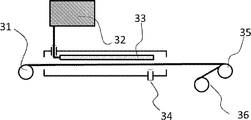
- FIG. 1 is a schematic view showing an example of a laminate manufacturing apparatus of the present invention.
- FIG. 2 is schematic which shows an example of the laminated body manufacturing apparatus of this invention.
- FIG. 3 is a schematic view of a silane coupling agent processing apparatus.
- FIG. 4 is a schematic view of a winding unit of the laminate manufacturing apparatus of the present invention.
- the upper limit of the thickness of the polyimide film is not particularly limited, but is preferably 250 ⁇ m or less, more preferably 150 ⁇ m or less, and still more preferably 90 ⁇ m or less in view of the demand for a flexible electronic device.
- the area of the polyimide film of the present invention is preferably a large area from the viewpoint of production efficiency and cost of a laminate and a flexible electronic device. It is preferably 1000 square cm or more, more preferably 1500 square cm or more, and still more preferably 2000 square cm or more.
- polyimide film aromatic polyimide, alicyclic polyimide, polyamide imide, polyether imide and the like can be used. More preferably, it refers to a polymer containing 50% or more of a polyimide skeleton.
- a polyimide film is prepared by applying a solution of a polyamide acid (polyimide precursor) obtained by reacting diamines and tetracarboxylic acids in a solvent on a support for producing a polyimide film, and drying the green film ("precursor film Or a “polyamic acid film”), further on a support for producing a polyimide film, or in the state of being peeled off from the support, the green film is heat-treated at high temperature to carry out a dehydration ring closure reaction.
- a polyamide acid polyimide precursor
- diamine which comprises a polyamic acid there is no restriction
- combination, aliphatic diamines, alicyclic diamines etc. can be used.
- aromatic diamines are preferable, and among aromatic diamines, aromatic diamines having a benzoxazole structure are more preferable.
- aromatic diamines having a benzoxazole structure are used, it is possible to develop high heat resistance, high elastic modulus, low heat shrinkage, and low linear expansion coefficient.
- the diamines may be used alone or in combination of two or more.
- the aromatic diamines having a benzoxazole structure are not particularly limited.
- aromatic diamines other than the aromatic diamines having the benzoxazole structure described above include, for example, 2,2′-dimethyl-4,4′-diaminobiphenyl, 1,4-bis [2- (4-aminophenyl) ) -2-Propyl] benzene (bisaniline), 1,4-bis (4-amino-2-trifluoromethylphenoxy) benzene, 2,2′-ditrifluoromethyl-4,4′-diaminobiphenyl, 4,4 '-Bis (4-aminophenoxy) biphenyl, 4,4'-bis (3-aminophenoxy) biphenyl, bis [4- (3-aminophenoxy) phenyl] ketone, bis [4- (3-aminophenoxy) phenyl Sulfide, bis [4- (3-aminophenoxy) phenyl] sulfone, 2,2-bis [4- (3-aminophenoxy) phenyl Nyl
- aliphatic diamines examples include 1,2-diaminoethane, 1,4-diaminobutane, 1,5-diaminopentane, 1,6-diaminohexane, 1,8-diaminooctane and the like.
- alicyclic diamines examples include 1,4-diaminocyclohexane, 4,4′-methylenebis (2,6-dimethylcyclohexylamine) and the like.
- the total amount of diamines (aliphatic diamines and alicyclic diamines) other than aromatic diamines is preferably 20% by mass or less, more preferably 10% by mass or less, still more preferably 5% by mass or less of all diamines It is.
- the aromatic diamines are preferably 80% by mass or more, more preferably 90% by mass or more, and still more preferably 95% by mass or more of all diamines.
- tetracarboxylic acids constituting the polyamic acid examples include aromatic tetracarboxylic acids (including their acid anhydrides), aliphatic tetracarboxylic acids (including their acid anhydrides) and alicyclic tetracarboxylic acids which are usually used for polyimide synthesis. Acids (including their acid anhydrides) can be used. Among them, aromatic tetracarboxylic acid anhydrides and alicyclic tetracarboxylic acid anhydrides are preferable, and from the viewpoint of heat resistance, aromatic tetracarboxylic acid anhydrides are more preferable, and from the viewpoint of light transmittance, alicyclic Family tetracarboxylic acids are more preferred.
- the number of anhydride structures in the molecule may be one or two, but preferably those having two anhydride structures (dianhydrides) Good.
- the tetracarboxylic acids may be used alone or in combination of two or more.
- Alicyclic tetracarboxylic acids include, for example, cycloaliphatic tetra-carboxylic acids such as cyclobutane tetracarboxylic acid, 1,2,4,5-cyclohexane tetracarboxylic acid, 3,3 ', 4,4'-bicyclohexyl tetracarboxylic acid, etc. Carboxylic acids and their acid anhydrides can be mentioned.
- dianhydrides having two anhydride structures eg, cyclobutanetetracarboxylic acid dianhydride, 1,2,4,5-cyclohexanetetracarboxylic acid dianhydride, 3,3 ′, 4,4 '-Bicyclohexyltetracarboxylic acid dianhydride etc.
- the alicyclic tetracarboxylic acids may be used alone or in combination of two or more. When importance is attached to transparency of the alicyclic tetracarboxylic acids, for example, 80% by mass or more of all tetracarboxylic acids is preferable, more preferably 90% by mass or more, and still more preferably 95% by mass or more.
- aromatic tetracarboxylic acids are not particularly limited, but are preferably pyromellitic acid residues (that is, those having a structure derived from pyromellitic acid), and more preferably the acid anhydride.
- aromatic tetracarboxylic acids for example, pyromellitic dianhydride, 3,3 ′, 4,4′-biphenyltetracarboxylic dianhydride, 4,4′-oxydiphthalic dianhydride, 3 3,3 ′, 4,4′-benzophenonetetracarboxylic dianhydride, 3,3 ′, 4,4′-diphenyl sulfone tetracarboxylic dianhydride, 2,2-bis [4- (3,4-di) Carboxy phenoxy) phenyl] propanoic acid anhydride etc.
- aromatic tetracarboxylic acids for example, 80% by mass or more of all tetracarboxylic acids is preferable, more preferably 90% by mass or more, and still more preferably 95% by mass or more.
- the polyimide film of the present invention preferably has a glass transition temperature of 250 ° C. or more, preferably 300 ° C. or more, more preferably 350 ° C. or more, or no glass transition point in a region of 500 ° C. or less.
- the glass transition temperature in the present invention is determined by differential thermal analysis (DSC).
- the linear expansion coefficient (CTE) of the polyimide film of the present invention is preferably -5 ppm / K to +20 ppm / K, more preferably -5 ppm / K to +15 ppm / K, and still more preferably 1 ppm / K to +10 ppm It is / K.
- CTE linear expansion coefficient
- the linear expansion coefficient of the polyimide film in the present invention in question uses an average value between 30 and 200 ° C.
- the temperature range of interest changes, considering the process at high temperature, When examining the range of 30 ° C to 400 ° C, it may be in the range of 100 ° C to 400 ° C.
- the working temperature range is -50 ° C to 150 It may be possible to emphasize the range of ° C.
- the breaking strength of the polyimide film in the present invention is 60 MPa or more, preferably 120 MP or more, and more preferably 240 MPa or more. Although the upper limit of the breaking strength is not limited, it is practically less than about 1000 MPa. In addition, the breaking strength of the said polyimide film refers to the average value of the length direction of a polyimide film, and the width direction here.
- the thickness unevenness of the polyimide film in the present invention is preferably 20% or less, more preferably 12% or less, still more preferably 7% or less, and particularly preferably 4% or less. When the thickness unevenness exceeds 20%, application to narrow portions tends to be difficult.
- the polyimide film in the present invention is preferably obtained in the form of being wound up as a long polyimide film having a width of 300 mm or more and a length of 10 m or more at the time of its production.
- Rolled polyimide wound around a winding core More preferred are in the form of a film.
- a lubricant in the polyimide film, in order to ensure the handling property and the productivity, it is preferable to add and contain a lubricant (particles) in the film to impart fine irregularities to the surface of the polyimide film to secure the slip property.
- the lubricant (particles) is preferably a fine particle made of an inorganic substance, such as metal, metal oxide, metal nitride, metal carbonate, metal salt, phosphate, carbonate, talc, mica, clay, etc. Particles of clay mineral, etc. can be used.
- metal oxides such as silicon oxide, calcium phosphate, calcium hydrogen phosphate, calcium dihydrogen phosphate, calcium pyrophosphate, hydroxyapatite, calcium carbonate, glass fillers, phosphates, and carbonates can be used.
- the lubricant may be only one kind or two or more kinds.
- the volume average particle diameter of the lubricant (particles) is usually 0.001 to 10 ⁇ m, preferably 0.03 to 2.5 ⁇ m, more preferably 0.05 to 0.7 ⁇ m, still more preferably 0.05 to It is 0.3 ⁇ m.
- the volume average particle size is based on the measurement value obtained by the light scattering method. If the particle diameter is smaller than the lower limit, industrial production of the polyimide film becomes difficult, and if the upper limit is exceeded, the surface irregularities become too large, the bonding strength becomes weak, and there is a possibility that practical problems may occur.
- the addition amount of the lubricant is 0.02 to 50% by mass, preferably 0.04 to 3% by mass, more preferably 0.08 to 1.2, as the addition amount with respect to the polymer component in the polyimide film. It is mass%. If the addition amount of the lubricant is too small, the effect of the lubricant addition is difficult to expect, and there is a case where the slip property is not secured so much that the production of the polyimide film may be disturbed. Even if the slip property is secured, problems such as a decrease in smoothness, a decrease in breaking strength and a breaking elongation of the polyimide film, and an increase in CTE may be caused.
- a lubricant When a lubricant (particles) is added to or contained in the polyimide film, it may be a single layer polyimide film in which the lubricant is uniformly dispersed, but for example, one surface is made of a polyimide film containing lubricant.
- the lubricant concentration gradient type polyimide film may be formed of a polyimide film having a small amount of lubricant content even if the other surface does not contain lubricant or has a lubricant content. In such a lubricant concentration gradient type film, fine asperities can be imparted to the surface of one layer (film), and the layer (film) can ensure slipperiness, resulting in good handling and productivity. Can be secured.
- the lubricant concentration-graded polyimide film is first filmed using, for example, a polyimide film material not containing a lubricant, and placed on the way of the process to at least one side of the film It can be obtained by applying a resin layer containing a lubricant.
- film formation is carried out using a polyimide film raw material containing a lubricant, and a polyimide film raw material not containing a lubricant is applied to obtain a film during the process or after film formation is completed. It can.
- a polyimide film obtained by using a solution film forming method such as a polyimide film
- a solution film forming method such as a polyimide film
- a polyamic acid solution precursor solution of polyimide
- a lubricant preferably having an average particle diameter of 0.05 to 2
- Content of 0.02 to 50% by mass preferably 0.04 to 3% by mass, more preferably 0.08 to 1.2% by mass
- the polyamide acid solution and containing no lubricant or having a small content preferably less than 0.02% by mass, more preferably less than 0.01% by mass based on the solid content of the polymer in the polyamic acid solution
- the lubricant concentration gradient type method (lamination) method of the lubricant concentration gradient type polyimide film is not particularly limited as long as there is no problem in the adhesion between the two layers, and adhesion is made without using an adhesive layer or the like. I hope there is.
- a polyimide film for example, i) after producing one polyimide film, continuously applying the other polyamic acid solution on the polyimide film for imidization, ii) casting one polyamic acid solution After preparing a polyamic acid film, the other polyamic acid solution is continuously coated on this polyamic acid film and then imidized, iii) coextrusion method, iv) lubricant is not contained or its content is On the film formed by the polyamic-acid solution which is a small amount, the method of apply
- the ratio of the thickness of each layer in the lubricant concentration gradient type polyimide film is not particularly limited, but the polymer layer containing a large amount of lubricant (a) layer, does not contain a lubricant, or the content thereof is small
- the polymer layer is the (b) layer
- the (a) layer / (b) layer preferably has a thickness of 0.05 to 0.95.
- the smoothness of the (b) layer tends to be lost, while when it is less than 0.05, the improvement effect of the surface characteristics is insufficient and the slipperiness is lost. There is something I can do.
- ⁇ Surface activation treatment of polyimide film> It is preferable to perform surface activation treatment on the polyimide film used in the present invention.
- the surface activation treatment in the present invention is a dry or wet surface treatment.
- dry processing of the present invention processing of irradiating the surface with active energy rays such as ultraviolet rays, electron beams, X-rays, corona treatment, vacuum plasma treatment, atmospheric pressure plasma treatment, flame treatment, itro treatment, etc. can be used. .
- As a wet process the process which makes the film surface contact with an acid thru
- the surface activation treatment preferably used in the present invention is plasma treatment, and is a combination of plasma treatment and wet acid treatment.
- the plasma treatment is not particularly limited, and includes RF plasma treatment in vacuum, microwave plasma treatment, microwave ECR plasma treatment, atmospheric pressure plasma treatment, corona treatment, etc., gas treatment including fluorine, ion treatment Also included are ion implantation using a source, processing using a PBII method, flame processing exposed to thermal plasma, and intro processing. Among these, RF plasma treatment in vacuum, microwave plasma treatment and atmospheric pressure plasma treatment are preferable.
- Suitable conditions for plasma treatment include oxygen plasma, plasma containing fluorine such as CF.sub.4, C.sub.2 F.sub.6, or a plasma known to have a high etching effect, or physical such as Ne, Ar, Kr, Xe, or plasma. It is desirable to use plasma treatment, which has a high effect of physically applying energy to the polymer surface. Further, it is also preferable to add plasma such as CO 2, CO, H 2, N 2, NH 4, CH 4, and a mixed gas of these, and further, steam.
- OH, N2, N, CO, CO2, H, H2, O2 NH, NH2, NH3, NH, COOH, NO, NO2, He, Ne, Ar, Kr, Xe, CH2O, Si (OCH3) 4, It is necessary to create a plasma containing at least one or more components selected from the group consisting of Si (OC2H5) 4, C3H7Si (OCH3) 3, C3H7Si (OC2H5) 3 as a gas or as a decomposition product in plasma.
- the plasma has a high energy density, a high kinetic energy of ions in the plasma, and a high density of active species, but the surface smoothness is required.
- Such surface activation treatment cleans the polymer surface and generates more active functional groups.
- the generated functional group is linked to the coupling agent layer by hydrogen bonding or a chemical reaction, and it becomes possible to firmly bond the polyimide film layer and the coupling agent layer.
- the effect of etching the polyimide film surface can also be obtained.
- the protrusions by the lubricant may inhibit the adhesion between the film and the inorganic substrate. In this case, it is possible to remove the lubricant particles in the vicinity of the film surface if the polyimide film surface is thinly etched by plasma treatment to expose a part of the lubricant particles and the treatment with hydrofluoric acid is performed.
- the surface activation treatment may be applied to only one side of the polyimide film or to both sides.
- plasma treatment may be performed only on the side not in contact with the electrode of the polyimide film by placing the polyimide film in contact with the electrode on one side by plasma treatment with the parallel plate type electrode it can.
- the polyimide film is placed in a state of being electrically floated in the space between the two electrodes, plasma processing can be performed on both sides.
- single-sided processing becomes possible by performing a plasma processing in the state which stuck the protective film on the single side
- a protective film a PET film with an adhesive, an olefin film, etc. can be used.
- the surface roughness Ra of the polyimide film in the present invention is desirably 70 nm or less, more desirably 30 nm or less, and further desirably 1.5 nm or less.
- Ra is larger than 70 nm, when a plurality of polyimide films are pasted together via a silane coupling agent layer, it causes uneven coating of the silane coupling agent and peeling unevenness due to it.
- the reactive liquid in the present invention is a compound having an unsaturated double bond, a compound having an epoxy group, a compound having an amino group, a compound having a carboxyl group, a compound having a hydroxyl group, an isocyanate compound, a compound having a silanol group, Etc. can be illustrated.
- the invention is preferably applicable to reactive compounds which are preferably liquid at 25 ° C.
- a silane coupling agent can be used as the reactive liquid preferably used in the present invention.
- the silane coupling agents can be used alone or in combination of two or more. Further, it can be used as a solution of alcohol, water and various solvents.
- the silane coupling agent in the present invention refers to a compound having elemental silicon in the molecule, physically and chemically interposing between polyimide films, and having an effect of enhancing the adhesion between the two.
- Preferred specific examples of the silane coupling agent include N-2- (aminoethyl) -3-aminopropylmethyldimethoxysilane, N-2- (aminoethyl) -3-aminopropyltrimethoxysilane, N-2- Aminoethyl) -3-aminopropyltriethoxysilane, 3-aminopropyltrimethoxysilane, 3-aminopropyltriethoxysilane, 3-triethoxysilyl-N- (1,3-dimethyl-butylidene) propylamine, 2- (3,4-epoxycyclohexyl) ethyltrimethoxysilane, 3-glycidoxyprop
- silane coupling agent which can be used in the present invention, n-propyltrimethoxysilane, butyltrichlorosilane, 2-cyanoethyltriethoxysilane, cyclohexyltrichlorosilane, decyltrichlorosilane, diacetoxydimethylsilane, di-dimethylsilane, di-cyclopentadisilane, di- Ethoxydimethylsilane, dimethoxydimethylsilane, dimethoxydiphenylsilane, dimethoxymethylphenylsilane, dodecyltrichlorosilane, dodecyltrimethoxysilane, ethyltrichlorosilane, hexyltrimethoxysilane, octadecyltriethoxysilane, octadecyltrimethoxysilane, n-octyl
- alkoxysilanes such as tetramethoxysilane, tetraethoxysilane and the like may be appropriately added to the silane coupling agent.
- mixing and heating operations are added to the silane coupling agent, with or without the addition of other alkoxysilanes such as tetramethoxysilane, tetraethoxysilane, etc., as appropriate, and the reaction is slightly delayed. You may go ahead and use it.
- the silane coupling agent preferably used in the present invention is preferably a silane coupling agent having a chemical structure having one silicon atom per molecule of the coupling agent.
- particularly preferred silane coupling agents include N-2- (aminoethyl) -3-aminopropylmethyldimethoxysilane, N-2- (aminoethyl) -3-aminopropyltrimethoxysilane, N-2 -(Aminoethyl) -3-aminopropyltriethoxysilane, 3-aminopropyltrimethoxysilane, 3-aminopropyltriethoxysilane, 3-triethoxysilyl-N- (1,3-dimethyl-butylidene) propylamine, 2- (3,4-Epoxycyclohexyl) ethyltrimethoxysilane, 3-glycidoxypropyltrimethoxysi
- a phosphorus-based coupling agent a titanate-based coupling agent, etc. may be used in combination.
- a diamine can be used as the reactive liquid preferably used in the present invention.
- the diamine compounds can be used singly or in combination of two or more. Further, it can be used as a solution of alcohol, water and various solvents. Moreover, the diamine made into solution may be mixed with reactive liquids other than a diamine.
- diamine which can be used in the present invention, 1,4-butanediamine, 1,5-pentanediamine, 1,6-hexanediamine, 1,7-heptanediamine, 1,8-octanediamine, 1,9- Nonane diamine, 1,10-decanediamine, 1,2-hexanediamine, 1,3-hexanediamine, 1,4-hexanediamine, 1,5-hexanediamine, 1,2-pentanediamine, 1,3-pentanediamine And 1,4-pentanediamine.
- the silane coupling agent treatment refers to a treatment for forming a thin film layer comprising a silane coupling agent or a condensate of a silane coupling agent on the surface of an object.
- a silane coupling agent is used as a solution such as alcohol and applied to an object or applied to the object by dipping or the like in a silane coupling agent solution, and then dried and heated to form a silane. By condensing the coupling agent at the same time as being chemically reactively bound to the object surface.
- a coating method of a silane coupling agent As a coating method of a silane coupling agent, a spin coat method, a spray coat method, a capillary coat method, a dip method, etc. are common.
- the silane coupling agent treatment is carried out on one side or both sides of the polyimide film as needed.
- coater coating can be used as a method for applying a silane coupling agent to a polyimide film.
- concentration of the silane coupling agent in the coating solution is preferably 0.1 wt% or more.
- Low concentration of the silane coupling agent causes uneven coating.
- the distance between the polyimide film and the blade or bar for coating is preferably 15 ⁇ m to 50 ⁇ m. If the distance between the polyimide film and the coating blade or bar is 15 ⁇ m or less, the surface of the polyimide film is easily scratched, and if it is 50 ⁇ m or more, the amount of the silane coupling agent to be coated is too large, causing uneven coating or surface roughness. It becomes.
- the silane coupling agent coating step can be performed via a gas phase.
- a gas phase a method of exposing a polyimide film to a vaporized silane coupling agent.
- Vaporization refers to a vapor of a silane coupling agent, that is, a state in which a substantially gaseous silane coupling agent or a particulate silane coupling agent is present.
- the exposure to this refers to bringing the polyimide film into contact with the atmosphere containing the vaporized silane coupling agent. Since the silane coupling agent has a certain vapor pressure, a certain amount of silane coupling agent in a gaseous state is present even in a normal temperature atmosphere.
- the vaporized silane coupling agent may be atomized due to the relationship of the dew point and may be present in the form of fine particles in a gas. Such a state can also be used in the present invention. Also, the operation of increasing the vapor density can be performed by the operation of temperature and pressure.
- the boiling point of the silane coupling agent varies depending on the chemical structure, but is approximately in the range of 100 to 250.degree. However, heating at 200 ° C. or higher is not preferable because it may cause a side reaction on the organic group side of the silane coupling agent.
- the environment under which the silane coupling agent is heated may be under pressure, under normal pressure or under reduced pressure, but when promoting vaporization of the silane coupling agent, it is preferably under normal pressure or under reduced pressure. Since many silane coupling agents are flammable liquids, it is preferable to carry out the vaporization operation in an enclosed container, preferably after replacing the container with an inert gas. However, from the viewpoint of improving the production efficiency and reducing the cost of production equipment, it is desirable to apply a silane coupling agent in an environment not using vacuum.
- the silane coupling agent deposition method not using vacuum according to the present invention does not use vacuum only at the time of deposition, but usually sets the polyimide film in the atmosphere and then substitutes the carrier gas for the silane coupling agent.
- the time for which the polyimide film is exposed to the silane coupling agent is not particularly limited, but is within 60 minutes, preferably within 20 minutes, and more preferably within 10 minutes.
- the exposure time is a process design value determined by the relationship between the concentration of the silane coupling agent and the required silane coupling agent application amount. Although the lower limit of the exposure time is not particularly limited, it is better to provide a time of about 10 seconds or more, preferably about 30 seconds or more, in order to reduce industrially generated unevenness of coating amount.
- the polyimide film temperature during exposure of the polyimide film to the silane coupling agent is controlled to an appropriate temperature between -50.degree. C. and 200.degree. C. depending on the type of silane coupling agent and the thickness of the silane coupling agent layer required. Is preferred.
- the polyimide film exposed to the silane coupling agent is preferably heated to 70 ° C. to 200 ° C., more preferably 75 ° C. to 150 ° C. after the exposure. By this heating, hydroxyl groups on the surface of the polyimide film react with the alkoxy group or silazane group of the silane coupling agent, and the silane coupling agent treatment is completed.
- the time required for heating is 10 seconds or more and about 10 minutes or less.
- the temperature is too high or the time is too long, deterioration of the coupling agent may occur. If the length is too short, the processing effect can not be obtained. In the case where the substrate temperature during exposure to the silane coupling agent is already 80 ° C. or higher, the subsequent heating can be omitted.
- the surface of the polyimide film coated with the silane coupling agent it is preferable to hold the surface of the polyimide film coated with the silane coupling agent downward and expose it to the silane coupling agent vapor.
- the coated surface of the polyimide film necessarily faces upward during and before application, so that floating foreign matter and the like in the working environment may be deposited on the surface of the inorganic substrate I can not deny it.
- the present invention by holding the polyimide film downward, it is possible to significantly reduce the adhesion of foreign matter in the environment.
- a gas containing a vaporized silane coupling agent when introducing a gas containing a vaporized silane coupling agent into a room where the polymer substrate is exposed, separating and introducing the gas into two or more once, colliding the two or more gases in the room It is also effective to generate turbulent flow by homogenization to make the silane coupling agent distribution uniform.
- a method of vaporizing the silane coupling agent there may be a method of introducing a gas into the silane coupling agent liquid to generate air bubbles, in addition to evaporation by heating. This is called bubbling hereafter. For bubbling, simply put the piping through which the gas passes into the silane coupling agent solution, attach a porous body to the end of the piping so that many fine bubbles come out, superimpose ultrasonic waves, and evaporate It is also effective to prompt
- the vaporized silane coupling agent may be sprayed not only to the exposure but also to the polyimide film.
- the spraying angle is preferably 10 ° or more with respect to the film to be transported. When the spraying angle is 10 ° or less, there is a possibility that a sufficient amount of silane coupling agent can not be applied to the surface of the polyimide film to be transported.
- the vaporized silane coupling agent may be charged.
- the dew point is low.
- the dew point is 15 ° C. or less, more desirably 10 ° C. or less, and further desirably 5 ° C. or less.
- the number of silicon-containing foreign particles having a long diameter of 10 ⁇ m or more present in the silane coupling agent layer of the silane coupling agent layer-laminated polyimide film is 2000 pieces / m 2 or less, preferably 1000 pieces / m 2 or less, and more preferably 500 pieces / m 2 or less Is a preferred form of the invention. Further, the number of silicon-containing foreign matter can be achieved by combining the above operations.
- the application amount of the silane coupling agent depends on the thickness of the silane coupling agent condensate layer.
- the thickness of the silane coupling agent condensate layer of the present invention is preferably 0.1 nm or more and 300 nm or less, and more preferably 0.5 nm or more and 200 nm or less.
- the upper limit of the thickness is preferably less than 200 nm, preferably 150 nm or less, more preferably 100 nm or less for practical use, more preferably 70 nm or less, and still more preferably 50 nm or less.
- the coupling agent is not in the form of a uniform coating film but in the form of clusters, which is not preferable.
- the film thickness of the silane coupling agent condensation product layer is obtained by polishing a cross section in the direction perpendicular to the film surface of the polyimide film laminate, forming an ultrathin section with a microtome, taking a cross-sectional photograph with a transmission electron microscope It calculated back from the magnification.
- the diamine treatment refers to a treatment for forming a thin film layer of diamine on the surface of an object.
- the diamine treatment is, similarly to the silane coupling agent treatment, applied to the object using alcohol or the like as a solvent and after immersion, drying and heating to be chemically reactively bonded to the surface of the object.
- a coating method of diamine a spin coating method, a spray coating method, a capillary coating method, a dip method, coating using a coater, a method using a gas phase, and the like are generally used.
- the diamine treatment is carried out on one side or both sides of the polyimide film as needed.
- a polyimide film is laminated via a silane coupling agent layer to obtain a polyimide film laminate in which the polyimide film layer and the silane coupling agent condensate are alternately laminated.
- Lamination of the polyimide film is performed by overlapping and pressing the polyimide film so that the surface subjected to the silane coupling agent treatment is disposed between the polyimide film layers.
- the combination of pressurization and heating is effective.
- the pressure treatment may be performed while heating, for example, a press, a laminate, a roll laminate, or the like in an atmospheric pressure atmosphere or in vacuum.
- the method of pressure-heating in the state put in the flexible bag is also applicable. From the viewpoint of improvement in productivity and reduction in processing cost brought about by high productivity, press or roll lamination under an air atmosphere is preferable, and in particular, a method of using a roll (roll laminate etc.) is preferable.
- a roll which consists of a flexible raw material at least one side among the upper and lower rolls used for lamination.
- the roll made of a flexible material as used herein refers to a silicone rubber roll or the like having a modulus of elasticity of 300 MPa or less. If at least one of the rolls used for laminating is a flexible material, a high-quality film laminate with less air bubble entrapment can be produced.
- the pressure in the pressure treatment is preferably 1 MPa to 30 MPa, and more preferably 3 MPa to 25 MPa. If the pressure is too high, the support may be broken, and if the pressure is too low, parts that do not adhere may be formed, resulting in insufficient adhesion.
- a temperature in the case of a pressure treatment it carries out in the range which does not exceed the heat-resistant temperature of the polyimide film to be used. In the case of a non-thermoplastic polyimide film, treatment at 10 ° C. to 400 ° C., more preferably 150 ° C. to 350 ° C. is preferred.
- the pressure treatment can also be carried out in the atmospheric pressure atmosphere as described above, but in order to obtain stable adhesive strength over the entire surface, it is preferable to carry out under vacuum. At this time, a degree of vacuum by a normal oil rotary pump is sufficient, and about 10 Torr or less is sufficient.
- a degree of vacuum by a normal oil rotary pump is sufficient, and about 10 Torr or less is sufficient.
- an apparatus which can be used for the pressure heating process for example, “11FD” manufactured by Imoto Seisakusho Co., Ltd. can be used to press in vacuum, and a roll type film laminator in vacuum or vacuum is used.
- MVLP manufactured by Meiki Seisakusho
- the inner diameter of the core used for winding the laminate is preferably 3 inches or more, more preferably 6 inches or more. If the core inner diameter, and hence the core outer diameter, is small, the laminate may be warped when the number of laminations increases, and the stress applied to the reactive liquid layer between the polyimide films increases, and the polyimide films are separated from each other. Cause.
- the CTE of the core material used for winding is preferably 150 ppm / ° C. or less, and more preferably 100 ppm / ° C. or less. If the CTE of the core material is larger than the predetermined range, the core may be deformed significantly in the heating process for reacting the reactive liquid.
- the lower limit of the CTE of the core material is preferably 20 ppm / ° C., and more preferably 25 ppm / ° C. When the CTE is lower than the lower limit, the pressure of the laminated film may be insufficient, and the interlayer adhesion of the laminate may be reduced.
- the core material preferably used in the present invention may be a relatively high CTE metal, for example, a polymeric material such as aluminum or an aluminum alloy, an ABS resin, or polypropylene.
- the angle ⁇ formed by the laminate and the tangent of the core at the winding start point of the laminate be 40 ° or less.
- ⁇ is larger than 40 °, winding may be unstable.
- the unwinding tension of the polyimide film is preferably 2N or more and 15N or less. If the unwinding tension is less than 2N, the film is easily corrugated when entering the laminating roller, and if it is larger than 15N, the film is likely to be longitudinally creased between the unwinding and laminating rollers, and in any case it causes wrinkles in the laminate, Lower.
- the storage environment before heat treatment of the laminate of the present invention is preferably 15 ° C. or less, more preferably 5 ° C. or less, still more preferably ⁇ 5 ° C. or less, and still more preferably ⁇ 15. It is less than ° C.
- a temperature at which the change length of the core thickness used for winding is 0.02 mm or more is desirable.
- the core expands during heat treatment, adhesion between films is further improved, and a high-quality laminate can be obtained.
- the adhesion strength between polyimide film layers after heat treatment of the polyimide film laminate in the present invention is 0.4 N / cm or more and 20 N / cm or less, preferably 0.4 N / cm or more and 18 N / cm in the 90 degree peeling method. It is cm, more preferably 0.4 N / cm or more and 15 N / cm or less.
- the height adjustment roll of the long base material, the liquid application mechanism part and the second and third lengths are provided between the unwinding part and the winding part of the first long base material.
- a laminate of three or more layers can be manufactured by repeatedly arranging at least one of the unwinding portions of the base material and the pressing portion downstream of the liquid application mechanism.
- ⁇ Number of blisters The number of blisters having a diameter of 0.2 mm or more was counted in a 10 cm ⁇ 10 cm laminate.
- a blister is a fault of the type which a space
- 0.5 was added to the total blister number of diameter 0.2 mm or more which exists in 10 cm x 10 cm area, and it converted into the number of blisters as a two-layer laminated body.
- CTE Linear expansion coefficient
- the polyamic acid solution V1 obtained above was used as a final film thickness (imide) on a smooth surface (non-slipper surface) of a long polyester film (“A-4100” manufactured by Toyobo Co., Ltd.) having a width of 1050 mm using a slit die.
- the coating was applied so that the film thickness after conversion was 38 .mu.m, dried at 105.degree. C. for 20 minutes, and peeled from the polyester film to obtain a self-supporting polyamic acid film having a width of 920 mm.
- heat treatment is carried out by a pin tenter for the first stage 150 ° C.
- the vacuum plasma process was performed to the polyimide film as a pre-process which performs a silane coupling agent process to a polyimide film.
- Vacuum plasma processing is performed using a device for a long film, evacuating the vacuum chamber to 1 ⁇ 10 -3 Pa or less, introducing argon gas into the vacuum chamber, discharge power 100 W, frequency 15 kHz conditions Plasma treatment of argon gas was performed for 20 seconds.
- a wide polyimide film after plasma treatment was used as a slit.
- silane coupling agent treatment was apply
- a polyimide film having a width of 220 mm was passed through a 750 mm ⁇ 20 mm ⁇ 10 mm chamber having a 20 mm ⁇ 250 mm slit at a speed of 240 mm / min.
- a container containing 100 g of a silane coupling agent (Shin-Etsu Chemical Co., Ltd. “KBM-903”: 3-aminopropyltrimethoxysilane) is heated to 40 ° C. and nitrogen gas is bubbled at 20 L / min. The nitrogen gas containing the generated silane coupling agent vapor was introduced into the chamber through piping, and both sides of the polyimide film were exposed to the gas for 3 minutes to obtain a silane coupling agent coated polyimide film roll.
- Comparative Example 1 The three silane coupling agent-treated substrates obtained were stacked, further, a release sheet was sandwiched, and a pressure of 100 Pa was applied for pressure reduction by a vacuum press to perform temporary bonding. Next, the obtained temporary adhesive laminate was placed in a clean oven and heated at 100 ° C. for 20 hours under a nitrogen atmosphere to obtain a polyimide film laminate.
- Comparative Example 2 A polyimide film was laminated using the laminate production apparatus schematically shown in FIG. 1, and the polyimide film laminate wound on a 6-inch polypropylene core (manufactured by Chiyoda Koko) was heat treated at 60 ° C. for 20 hours and evaluated.
- Comparative Example 3 A polyimide film laminated in three layers in the same manner as in Comparative Example 2 was wound on a 3 inch polyethylene core (manufactured by Kurimoto Polymer Co., Ltd.), and heat treated at 80 ° C. for 20 hours for evaluation.
- Example 1 A polyimide film laminated in three layers in the same manner as in Comparative Example 2 was wound on a 6-inch polypropylene core and heat-treated at 100 ° C. for 20 hours for evaluation.
- Example 2 A polyimide film was laminated using the laminate production apparatus schematically shown in FIG. 2, and the polyimide film laminate wound on a 6-inch polypropylene core (manufactured by Chiyoda Koko) was heat treated at 100 ° C. for 20 hours and evaluated.
- Example 3 A polyimide film coated with a diamine ("2-methyl-l-5-diaminopentane" manufactured by Tokyo Chemical Industry Co., Ltd.) is laminated using the laminate production apparatus schematically shown in FIG. The heat treatment was evaluated. The results obtained by the above Comparative Examples and Examples are shown in Table 1.
- the method and apparatus for producing a film laminate according to the present invention is a long film with few blister defects by continuously performing the steps from application of the reactive compound on the film surface to lamination.
- Laminates can be made.
- the film laminate is produced using various reactive compounds such as epoxy resin which is a thermosetting compound, (meth) acrylate which is a photocurable compound, and a silane coupling agent as exemplified. It can be used in a variety of industrial areas.
- film unwinding part 12 coating liquid supply part 13 coating liquid discharge part 14 exhaust port for coating liquid vapor 15 long base material unwinding part 16 pressing part 17 winding part 18 height adjustment of long base material Roll 21 film unwinding section 22 coating liquid supply section 23 coating liquid discharge section 24 wire bar 25 long base material unwinding section 26 pressing section 27 winding section 28 height base adjusting roll 31 film winding Dispensing section 32 coating liquid supply section 33 coating liquid discharge section 34 exhaust port of coating liquid vapor 35 film winding section 36 interleaf sheet supply roll 41 film laminate 42 winding section
Landscapes
- Engineering & Computer Science (AREA)
- Mechanical Engineering (AREA)
- Life Sciences & Earth Sciences (AREA)
- Wood Science & Technology (AREA)
- Laminated Bodies (AREA)
- Application Of Or Painting With Fluid Materials (AREA)
- Lining Or Joining Of Plastics Or The Like (AREA)
Abstract
L'invention concerne un stratifié de film stratifié avec une couche de composé réactif pour intermédiaire, et fournit un procédé et un dispositif de fabrication permettant d'élaborer un stratifié allongé de haute qualité présentant moins de défauts. Le stratifié de film de l'invention est obtenu par couchage d'un second et d'un troisième film instantanément après application d'un liquide réactif sur une première surface de film allongé. Selon l'invention, il est possible d'obtenir un stratifié allongé de haute qualité présentant moins de défauts par enroulement sur un mandrin constitué d'un élément de coefficient de dilatation thermique linéaire inférieure ou égale à 100ppm/℃ lors de l'enroulement du stratifié, et par traitement thermique à une température modifiant l'épaisseur du mandrin de 0,02mm ou plus.
Priority Applications (1)
| Application Number | Priority Date | Filing Date | Title |
|---|---|---|---|
| JP2019563967A JP7211374B2 (ja) | 2018-01-04 | 2018-12-21 | フィルム積層体製造方法およびフィルム積層体製造装置 |
Applications Claiming Priority (2)
| Application Number | Priority Date | Filing Date | Title |
|---|---|---|---|
| JP2018000206 | 2018-01-04 | ||
| JP2018-000206 | 2018-01-10 |
Publications (1)
| Publication Number | Publication Date |
|---|---|
| WO2019135366A1 true WO2019135366A1 (fr) | 2019-07-11 |
Family
ID=67144141
Family Applications (1)
| Application Number | Title | Priority Date | Filing Date |
|---|---|---|---|
| PCT/JP2018/047211 Ceased WO2019135366A1 (fr) | 2018-01-04 | 2018-12-21 | Procédé et dispositif de fabrication de stratifié de film |
Country Status (2)
| Country | Link |
|---|---|
| JP (1) | JP7211374B2 (fr) |
| WO (1) | WO2019135366A1 (fr) |
Cited By (1)
| Publication number | Priority date | Publication date | Assignee | Title |
|---|---|---|---|---|
| CN113231945A (zh) * | 2021-06-24 | 2021-08-10 | 深圳市智动精密设备有限公司 | 一种用于半导体晶片排列成型治具 |
Citations (11)
| Publication number | Priority date | Publication date | Assignee | Title |
|---|---|---|---|---|
| WO2005007756A1 (fr) * | 2003-05-21 | 2005-01-27 | Hitachi Chemical Co., Ltd. | Couche primaire, feuille conductrice enduite de resine, lamine et son procede de production |
| JP2007301947A (ja) * | 2006-05-15 | 2007-11-22 | Hitachi Chem Co Ltd | フレキシブル積層板の製造方法及び製造装置、並びに搬送機構 |
| WO2012133665A1 (fr) * | 2011-03-30 | 2012-10-04 | 宇部興産株式会社 | Film de polyimide |
| JP2014054627A (ja) * | 2013-08-28 | 2014-03-27 | Fujifilm Corp | 塗布方法 |
| JP2016016882A (ja) * | 2014-07-08 | 2016-02-01 | 東レ・デュポン株式会社 | ポリイミドフィルムロール包装体及びその製造方法 |
| JP2016183224A (ja) * | 2015-03-25 | 2016-10-20 | 東レ・デュポン株式会社 | ポリイミドフィルム及びその製造方法 |
| WO2016188849A1 (fr) * | 2015-05-26 | 2016-12-01 | Thyssenkrupp Steel Europe Ag | Fabrication d'un matériau composite au moyen d'un revêtement par plasma |
| JP2016203469A (ja) * | 2015-04-21 | 2016-12-08 | 宇部興産株式会社 | 積層体の製造方法 |
| JP2017057116A (ja) * | 2015-09-16 | 2017-03-23 | 日東電工株式会社 | ゾル液およびその製造方法、積層フィルムの製造方法、積層フイルム、光学部材、並びに画像表示装置 |
| WO2017188174A1 (fr) * | 2016-04-28 | 2017-11-02 | 東洋紡株式会社 | Corps stratifié de film à base de polyimide |
| JP2017203146A (ja) * | 2016-05-10 | 2017-11-16 | 住友化学株式会社 | 透明樹脂フィルムの製造方法、及び透明樹脂フィルムを有する積層体の製造方法 |
-
2018
- 2018-12-21 JP JP2019563967A patent/JP7211374B2/ja active Active
- 2018-12-21 WO PCT/JP2018/047211 patent/WO2019135366A1/fr not_active Ceased
Patent Citations (11)
| Publication number | Priority date | Publication date | Assignee | Title |
|---|---|---|---|---|
| WO2005007756A1 (fr) * | 2003-05-21 | 2005-01-27 | Hitachi Chemical Co., Ltd. | Couche primaire, feuille conductrice enduite de resine, lamine et son procede de production |
| JP2007301947A (ja) * | 2006-05-15 | 2007-11-22 | Hitachi Chem Co Ltd | フレキシブル積層板の製造方法及び製造装置、並びに搬送機構 |
| WO2012133665A1 (fr) * | 2011-03-30 | 2012-10-04 | 宇部興産株式会社 | Film de polyimide |
| JP2014054627A (ja) * | 2013-08-28 | 2014-03-27 | Fujifilm Corp | 塗布方法 |
| JP2016016882A (ja) * | 2014-07-08 | 2016-02-01 | 東レ・デュポン株式会社 | ポリイミドフィルムロール包装体及びその製造方法 |
| JP2016183224A (ja) * | 2015-03-25 | 2016-10-20 | 東レ・デュポン株式会社 | ポリイミドフィルム及びその製造方法 |
| JP2016203469A (ja) * | 2015-04-21 | 2016-12-08 | 宇部興産株式会社 | 積層体の製造方法 |
| WO2016188849A1 (fr) * | 2015-05-26 | 2016-12-01 | Thyssenkrupp Steel Europe Ag | Fabrication d'un matériau composite au moyen d'un revêtement par plasma |
| JP2017057116A (ja) * | 2015-09-16 | 2017-03-23 | 日東電工株式会社 | ゾル液およびその製造方法、積層フィルムの製造方法、積層フイルム、光学部材、並びに画像表示装置 |
| WO2017188174A1 (fr) * | 2016-04-28 | 2017-11-02 | 東洋紡株式会社 | Corps stratifié de film à base de polyimide |
| JP2017203146A (ja) * | 2016-05-10 | 2017-11-16 | 住友化学株式会社 | 透明樹脂フィルムの製造方法、及び透明樹脂フィルムを有する積層体の製造方法 |
Cited By (2)
| Publication number | Priority date | Publication date | Assignee | Title |
|---|---|---|---|---|
| CN113231945A (zh) * | 2021-06-24 | 2021-08-10 | 深圳市智动精密设备有限公司 | 一种用于半导体晶片排列成型治具 |
| CN113231945B (zh) * | 2021-06-24 | 2022-04-08 | 深圳市智立方自动化设备股份有限公司 | 一种用于半导体晶片排列成型治具 |
Also Published As
| Publication number | Publication date |
|---|---|
| JP7211374B2 (ja) | 2023-01-24 |
| JPWO2019135366A1 (ja) | 2021-01-07 |
Similar Documents
| Publication | Publication Date | Title |
|---|---|---|
| JP6721041B2 (ja) | ポリイミドフィルム積層体 | |
| JP7192799B2 (ja) | スティフナー | |
| JP7013875B2 (ja) | 積層体、積層体の製造方法、フレキシブル電子デバイスの製造方法 | |
| JP6688450B2 (ja) | 積層体、電子デバイス、及びフレキシブル電子デバイスの製造方法 | |
| JP6965978B2 (ja) | ポリイミドフィルムと無機基板の積層体 | |
| JP7205706B2 (ja) | 積層体製造装置、及び、積層体の製造方法 | |
| JP7205687B2 (ja) | 積層体、積層体の製造方法、及び、金属含有層付き耐熱高分子フィルム | |
| JP6802529B2 (ja) | 積層体およびその製造方法 | |
| CN103561953A (zh) | 聚酰亚胺膜 | |
| JP7211374B2 (ja) | フィルム積層体製造方法およびフィルム積層体製造装置 | |
| JP6780272B2 (ja) | 高分子複合フィルム | |
| JP7400273B2 (ja) | ポリイミドフィルム積層体および、ポリイミドフィルム積層体の製造方法 | |
| JP7651824B2 (ja) | 品位が良く、耐折り曲げ性に優れたスティフナー | |
| JP7287061B2 (ja) | 耐熱高分子フィルム積層体の製造方法 | |
| JP7238235B2 (ja) | ポリイミドフィルム積層体の製造方法 | |
| JP7452135B2 (ja) | ポリイミドフィルム積層体の製造方法 | |
| KR20230035120A (ko) | 적층체, 적층체의 제조 방법 및 플렉시블 전자 디바이스의 제조 방법 | |
| EP3950273A1 (fr) | Stratifié de films polymères résistant à la chaleur et procédé de fabrication d'un stratifié de films polymères résistant à la chaleur | |
| JP2020111066A (ja) | 高分子複合フィルム |
Legal Events
| Date | Code | Title | Description |
|---|---|---|---|
| 121 | Ep: the epo has been informed by wipo that ep was designated in this application |
Ref document number: 18898190 Country of ref document: EP Kind code of ref document: A1 |
|
| ENP | Entry into the national phase |
Ref document number: 2019563967 Country of ref document: JP Kind code of ref document: A |
|
| NENP | Non-entry into the national phase |
Ref country code: DE |
|
| 122 | Ep: pct application non-entry in european phase |
Ref document number: 18898190 Country of ref document: EP Kind code of ref document: A1 |