WO2019159257A1 - PROCÉDÉ POUR LA FABRICATION D'UN CORPS ASSEMBLÉ DE CÉRAMIQUE/MATÉRIAU COMPOSITE D'AL-SiC ET PROCÉDÉ POUR LA FABRICATION D'UN SUBSTRAT POURVU D'UN DISSIPATEUR THERMIQUE POUR UN BLOC DE PUISSANCE - Google Patents
PROCÉDÉ POUR LA FABRICATION D'UN CORPS ASSEMBLÉ DE CÉRAMIQUE/MATÉRIAU COMPOSITE D'AL-SiC ET PROCÉDÉ POUR LA FABRICATION D'UN SUBSTRAT POURVU D'UN DISSIPATEUR THERMIQUE POUR UN BLOC DE PUISSANCE Download PDFInfo
- Publication number
- WO2019159257A1 WO2019159257A1 PCT/JP2018/005089 JP2018005089W WO2019159257A1 WO 2019159257 A1 WO2019159257 A1 WO 2019159257A1 JP 2018005089 W JP2018005089 W JP 2018005089W WO 2019159257 A1 WO2019159257 A1 WO 2019159257A1
- Authority
- WO
- WIPO (PCT)
- Prior art keywords
- composite material
- sic composite
- ceramic
- heat sink
- magnesium
- Prior art date
- Legal status (The legal status is an assumption and is not a legal conclusion. Google has not performed a legal analysis and makes no representation as to the accuracy of the status listed.)
- Ceased
Links
Images


Classifications
-
- C—CHEMISTRY; METALLURGY
- C04—CEMENTS; CONCRETE; ARTIFICIAL STONE; CERAMICS; REFRACTORIES
- C04B—LIME, MAGNESIA; SLAG; CEMENTS; COMPOSITIONS THEREOF, e.g. MORTARS, CONCRETE OR LIKE BUILDING MATERIALS; ARTIFICIAL STONE; CERAMICS; REFRACTORIES; TREATMENT OF NATURAL STONE
- C04B37/00—Joining burned ceramic articles with other burned ceramic articles or other articles by heating
- C04B37/02—Joining burned ceramic articles with other burned ceramic articles or other articles by heating with metallic articles
- C04B37/023—Joining burned ceramic articles with other burned ceramic articles or other articles by heating with metallic articles characterised by the interlayer used
- C04B37/026—Joining burned ceramic articles with other burned ceramic articles or other articles by heating with metallic articles characterised by the interlayer used consisting of metals or metal salts
-
- C—CHEMISTRY; METALLURGY
- C04—CEMENTS; CONCRETE; ARTIFICIAL STONE; CERAMICS; REFRACTORIES
- C04B—LIME, MAGNESIA; SLAG; CEMENTS; COMPOSITIONS THEREOF, e.g. MORTARS, CONCRETE OR LIKE BUILDING MATERIALS; ARTIFICIAL STONE; CERAMICS; REFRACTORIES; TREATMENT OF NATURAL STONE
- C04B35/00—Shaped ceramic products characterised by their composition; Ceramics compositions; Processing powders of inorganic compounds preparatory to the manufacturing of ceramic products
- C04B35/622—Forming processes; Processing powders of inorganic compounds preparatory to the manufacturing of ceramic products
- C04B35/64—Burning or sintering processes
- C04B35/645—Pressure sintering
-
- H—ELECTRICITY
- H10—SEMICONDUCTOR DEVICES; ELECTRIC SOLID-STATE DEVICES NOT OTHERWISE PROVIDED FOR
- H10W—GENERIC PACKAGES, INTERCONNECTIONS, CONNECTORS OR OTHER CONSTRUCTIONAL DETAILS OF DEVICES COVERED BY CLASS H10
- H10W40/00—Arrangements for thermal protection or thermal control
- H10W40/20—Arrangements for cooling
- H10W40/25—Arrangements for cooling characterised by their materials
- H10W40/257—Arrangements for cooling characterised by their materials having a heterogeneous or anisotropic structure, e.g. powder or fibres in a matrix, wire mesh or porous structures
-
- C—CHEMISTRY; METALLURGY
- C04—CEMENTS; CONCRETE; ARTIFICIAL STONE; CERAMICS; REFRACTORIES
- C04B—LIME, MAGNESIA; SLAG; CEMENTS; COMPOSITIONS THEREOF, e.g. MORTARS, CONCRETE OR LIKE BUILDING MATERIALS; ARTIFICIAL STONE; CERAMICS; REFRACTORIES; TREATMENT OF NATURAL STONE
- C04B2237/00—Aspects relating to ceramic laminates or to joining of ceramic articles with other articles by heating
- C04B2237/02—Aspects relating to interlayers, e.g. used to join ceramic articles with other articles by heating
- C04B2237/12—Metallic interlayers
-
- C—CHEMISTRY; METALLURGY
- C04—CEMENTS; CONCRETE; ARTIFICIAL STONE; CERAMICS; REFRACTORIES
- C04B—LIME, MAGNESIA; SLAG; CEMENTS; COMPOSITIONS THEREOF, e.g. MORTARS, CONCRETE OR LIKE BUILDING MATERIALS; ARTIFICIAL STONE; CERAMICS; REFRACTORIES; TREATMENT OF NATURAL STONE
- C04B2237/00—Aspects relating to ceramic laminates or to joining of ceramic articles with other articles by heating
- C04B2237/02—Aspects relating to interlayers, e.g. used to join ceramic articles with other articles by heating
- C04B2237/12—Metallic interlayers
- C04B2237/121—Metallic interlayers based on aluminium
-
- C—CHEMISTRY; METALLURGY
- C04—CEMENTS; CONCRETE; ARTIFICIAL STONE; CERAMICS; REFRACTORIES
- C04B—LIME, MAGNESIA; SLAG; CEMENTS; COMPOSITIONS THEREOF, e.g. MORTARS, CONCRETE OR LIKE BUILDING MATERIALS; ARTIFICIAL STONE; CERAMICS; REFRACTORIES; TREATMENT OF NATURAL STONE
- C04B2237/00—Aspects relating to ceramic laminates or to joining of ceramic articles with other articles by heating
- C04B2237/02—Aspects relating to interlayers, e.g. used to join ceramic articles with other articles by heating
- C04B2237/12—Metallic interlayers
- C04B2237/125—Metallic interlayers based on noble metals, e.g. silver
-
- C—CHEMISTRY; METALLURGY
- C04—CEMENTS; CONCRETE; ARTIFICIAL STONE; CERAMICS; REFRACTORIES
- C04B—LIME, MAGNESIA; SLAG; CEMENTS; COMPOSITIONS THEREOF, e.g. MORTARS, CONCRETE OR LIKE BUILDING MATERIALS; ARTIFICIAL STONE; CERAMICS; REFRACTORIES; TREATMENT OF NATURAL STONE
- C04B2237/00—Aspects relating to ceramic laminates or to joining of ceramic articles with other articles by heating
- C04B2237/02—Aspects relating to interlayers, e.g. used to join ceramic articles with other articles by heating
- C04B2237/12—Metallic interlayers
- C04B2237/126—Metallic interlayers wherein the active component for bonding is not the largest fraction of the interlayer
-
- C—CHEMISTRY; METALLURGY
- C04—CEMENTS; CONCRETE; ARTIFICIAL STONE; CERAMICS; REFRACTORIES
- C04B—LIME, MAGNESIA; SLAG; CEMENTS; COMPOSITIONS THEREOF, e.g. MORTARS, CONCRETE OR LIKE BUILDING MATERIALS; ARTIFICIAL STONE; CERAMICS; REFRACTORIES; TREATMENT OF NATURAL STONE
- C04B2237/00—Aspects relating to ceramic laminates or to joining of ceramic articles with other articles by heating
- C04B2237/02—Aspects relating to interlayers, e.g. used to join ceramic articles with other articles by heating
- C04B2237/12—Metallic interlayers
- C04B2237/126—Metallic interlayers wherein the active component for bonding is not the largest fraction of the interlayer
- C04B2237/127—The active component for bonding being a refractory metal
-
- C—CHEMISTRY; METALLURGY
- C04—CEMENTS; CONCRETE; ARTIFICIAL STONE; CERAMICS; REFRACTORIES
- C04B—LIME, MAGNESIA; SLAG; CEMENTS; COMPOSITIONS THEREOF, e.g. MORTARS, CONCRETE OR LIKE BUILDING MATERIALS; ARTIFICIAL STONE; CERAMICS; REFRACTORIES; TREATMENT OF NATURAL STONE
- C04B2237/00—Aspects relating to ceramic laminates or to joining of ceramic articles with other articles by heating
- C04B2237/02—Aspects relating to interlayers, e.g. used to join ceramic articles with other articles by heating
- C04B2237/12—Metallic interlayers
- C04B2237/126—Metallic interlayers wherein the active component for bonding is not the largest fraction of the interlayer
- C04B2237/128—The active component for bonding being silicon
-
- C—CHEMISTRY; METALLURGY
- C04—CEMENTS; CONCRETE; ARTIFICIAL STONE; CERAMICS; REFRACTORIES
- C04B—LIME, MAGNESIA; SLAG; CEMENTS; COMPOSITIONS THEREOF, e.g. MORTARS, CONCRETE OR LIKE BUILDING MATERIALS; ARTIFICIAL STONE; CERAMICS; REFRACTORIES; TREATMENT OF NATURAL STONE
- C04B2237/00—Aspects relating to ceramic laminates or to joining of ceramic articles with other articles by heating
- C04B2237/30—Composition of layers of ceramic laminates or of ceramic or metallic articles to be joined by heating, e.g. Si substrates
- C04B2237/32—Ceramic
- C04B2237/34—Oxidic
- C04B2237/343—Alumina or aluminates
-
- C—CHEMISTRY; METALLURGY
- C04—CEMENTS; CONCRETE; ARTIFICIAL STONE; CERAMICS; REFRACTORIES
- C04B—LIME, MAGNESIA; SLAG; CEMENTS; COMPOSITIONS THEREOF, e.g. MORTARS, CONCRETE OR LIKE BUILDING MATERIALS; ARTIFICIAL STONE; CERAMICS; REFRACTORIES; TREATMENT OF NATURAL STONE
- C04B2237/00—Aspects relating to ceramic laminates or to joining of ceramic articles with other articles by heating
- C04B2237/30—Composition of layers of ceramic laminates or of ceramic or metallic articles to be joined by heating, e.g. Si substrates
- C04B2237/32—Ceramic
- C04B2237/36—Non-oxidic
- C04B2237/365—Silicon carbide
-
- C—CHEMISTRY; METALLURGY
- C04—CEMENTS; CONCRETE; ARTIFICIAL STONE; CERAMICS; REFRACTORIES
- C04B—LIME, MAGNESIA; SLAG; CEMENTS; COMPOSITIONS THEREOF, e.g. MORTARS, CONCRETE OR LIKE BUILDING MATERIALS; ARTIFICIAL STONE; CERAMICS; REFRACTORIES; TREATMENT OF NATURAL STONE
- C04B2237/00—Aspects relating to ceramic laminates or to joining of ceramic articles with other articles by heating
- C04B2237/30—Composition of layers of ceramic laminates or of ceramic or metallic articles to be joined by heating, e.g. Si substrates
- C04B2237/32—Ceramic
- C04B2237/36—Non-oxidic
- C04B2237/366—Aluminium nitride
-
- C—CHEMISTRY; METALLURGY
- C04—CEMENTS; CONCRETE; ARTIFICIAL STONE; CERAMICS; REFRACTORIES
- C04B—LIME, MAGNESIA; SLAG; CEMENTS; COMPOSITIONS THEREOF, e.g. MORTARS, CONCRETE OR LIKE BUILDING MATERIALS; ARTIFICIAL STONE; CERAMICS; REFRACTORIES; TREATMENT OF NATURAL STONE
- C04B2237/00—Aspects relating to ceramic laminates or to joining of ceramic articles with other articles by heating
- C04B2237/30—Composition of layers of ceramic laminates or of ceramic or metallic articles to be joined by heating, e.g. Si substrates
- C04B2237/32—Ceramic
- C04B2237/36—Non-oxidic
- C04B2237/368—Silicon nitride
-
- C—CHEMISTRY; METALLURGY
- C04—CEMENTS; CONCRETE; ARTIFICIAL STONE; CERAMICS; REFRACTORIES
- C04B—LIME, MAGNESIA; SLAG; CEMENTS; COMPOSITIONS THEREOF, e.g. MORTARS, CONCRETE OR LIKE BUILDING MATERIALS; ARTIFICIAL STONE; CERAMICS; REFRACTORIES; TREATMENT OF NATURAL STONE
- C04B2237/00—Aspects relating to ceramic laminates or to joining of ceramic articles with other articles by heating
- C04B2237/30—Composition of layers of ceramic laminates or of ceramic or metallic articles to be joined by heating, e.g. Si substrates
- C04B2237/40—Metallic
- C04B2237/401—Cermets
-
- C—CHEMISTRY; METALLURGY
- C04—CEMENTS; CONCRETE; ARTIFICIAL STONE; CERAMICS; REFRACTORIES
- C04B—LIME, MAGNESIA; SLAG; CEMENTS; COMPOSITIONS THEREOF, e.g. MORTARS, CONCRETE OR LIKE BUILDING MATERIALS; ARTIFICIAL STONE; CERAMICS; REFRACTORIES; TREATMENT OF NATURAL STONE
- C04B2237/00—Aspects relating to ceramic laminates or to joining of ceramic articles with other articles by heating
- C04B2237/30—Composition of layers of ceramic laminates or of ceramic or metallic articles to be joined by heating, e.g. Si substrates
- C04B2237/40—Metallic
- C04B2237/402—Aluminium
-
- C—CHEMISTRY; METALLURGY
- C04—CEMENTS; CONCRETE; ARTIFICIAL STONE; CERAMICS; REFRACTORIES
- C04B—LIME, MAGNESIA; SLAG; CEMENTS; COMPOSITIONS THEREOF, e.g. MORTARS, CONCRETE OR LIKE BUILDING MATERIALS; ARTIFICIAL STONE; CERAMICS; REFRACTORIES; TREATMENT OF NATURAL STONE
- C04B2237/00—Aspects relating to ceramic laminates or to joining of ceramic articles with other articles by heating
- C04B2237/30—Composition of layers of ceramic laminates or of ceramic or metallic articles to be joined by heating, e.g. Si substrates
- C04B2237/40—Metallic
- C04B2237/407—Copper
-
- C—CHEMISTRY; METALLURGY
- C04—CEMENTS; CONCRETE; ARTIFICIAL STONE; CERAMICS; REFRACTORIES
- C04B—LIME, MAGNESIA; SLAG; CEMENTS; COMPOSITIONS THEREOF, e.g. MORTARS, CONCRETE OR LIKE BUILDING MATERIALS; ARTIFICIAL STONE; CERAMICS; REFRACTORIES; TREATMENT OF NATURAL STONE
- C04B2237/00—Aspects relating to ceramic laminates or to joining of ceramic articles with other articles by heating
- C04B2237/50—Processing aspects relating to ceramic laminates or to the joining of ceramic articles with other articles by heating
- C04B2237/55—Pre-treatments of a coated or not coated substrate other than oxidation treatment in order to form an active joining layer
-
- C—CHEMISTRY; METALLURGY
- C04—CEMENTS; CONCRETE; ARTIFICIAL STONE; CERAMICS; REFRACTORIES
- C04B—LIME, MAGNESIA; SLAG; CEMENTS; COMPOSITIONS THEREOF, e.g. MORTARS, CONCRETE OR LIKE BUILDING MATERIALS; ARTIFICIAL STONE; CERAMICS; REFRACTORIES; TREATMENT OF NATURAL STONE
- C04B2237/00—Aspects relating to ceramic laminates or to joining of ceramic articles with other articles by heating
- C04B2237/50—Processing aspects relating to ceramic laminates or to the joining of ceramic articles with other articles by heating
- C04B2237/59—Aspects relating to the structure of the interlayer
- C04B2237/597—Aspects relating to the structure of the interlayer whereby the interlayer is continuous but porous, e.g. containing hollow or porous particles, macro- or micropores or cracks
-
- C—CHEMISTRY; METALLURGY
- C04—CEMENTS; CONCRETE; ARTIFICIAL STONE; CERAMICS; REFRACTORIES
- C04B—LIME, MAGNESIA; SLAG; CEMENTS; COMPOSITIONS THEREOF, e.g. MORTARS, CONCRETE OR LIKE BUILDING MATERIALS; ARTIFICIAL STONE; CERAMICS; REFRACTORIES; TREATMENT OF NATURAL STONE
- C04B2237/00—Aspects relating to ceramic laminates or to joining of ceramic articles with other articles by heating
- C04B2237/50—Processing aspects relating to ceramic laminates or to the joining of ceramic articles with other articles by heating
- C04B2237/70—Forming laminates or joined articles comprising layers of a specific, unusual thickness
- C04B2237/704—Forming laminates or joined articles comprising layers of a specific, unusual thickness of one or more of the ceramic layers or articles
-
- C—CHEMISTRY; METALLURGY
- C04—CEMENTS; CONCRETE; ARTIFICIAL STONE; CERAMICS; REFRACTORIES
- C04B—LIME, MAGNESIA; SLAG; CEMENTS; COMPOSITIONS THEREOF, e.g. MORTARS, CONCRETE OR LIKE BUILDING MATERIALS; ARTIFICIAL STONE; CERAMICS; REFRACTORIES; TREATMENT OF NATURAL STONE
- C04B2237/00—Aspects relating to ceramic laminates or to joining of ceramic articles with other articles by heating
- C04B2237/50—Processing aspects relating to ceramic laminates or to the joining of ceramic articles with other articles by heating
- C04B2237/70—Forming laminates or joined articles comprising layers of a specific, unusual thickness
- C04B2237/708—Forming laminates or joined articles comprising layers of a specific, unusual thickness of one or more of the interlayers
-
- C—CHEMISTRY; METALLURGY
- C04—CEMENTS; CONCRETE; ARTIFICIAL STONE; CERAMICS; REFRACTORIES
- C04B—LIME, MAGNESIA; SLAG; CEMENTS; COMPOSITIONS THEREOF, e.g. MORTARS, CONCRETE OR LIKE BUILDING MATERIALS; ARTIFICIAL STONE; CERAMICS; REFRACTORIES; TREATMENT OF NATURAL STONE
- C04B2237/00—Aspects relating to ceramic laminates or to joining of ceramic articles with other articles by heating
- C04B2237/50—Processing aspects relating to ceramic laminates or to the joining of ceramic articles with other articles by heating
- C04B2237/72—Forming laminates or joined articles comprising at least two interlayers directly next to each other
-
- H—ELECTRICITY
- H10—SEMICONDUCTOR DEVICES; ELECTRIC SOLID-STATE DEVICES NOT OTHERWISE PROVIDED FOR
- H10W—GENERIC PACKAGES, INTERCONNECTIONS, CONNECTORS OR OTHER CONSTRUCTIONAL DETAILS OF DEVICES COVERED BY CLASS H10
- H10W40/00—Arrangements for thermal protection or thermal control
- H10W40/20—Arrangements for cooling
- H10W40/25—Arrangements for cooling characterised by their materials
- H10W40/255—Arrangements for cooling characterised by their materials having a laminate or multilayered structure, e.g. direct bond copper [DBC] ceramic substrates
-
- H—ELECTRICITY
- H10—SEMICONDUCTOR DEVICES; ELECTRIC SOLID-STATE DEVICES NOT OTHERWISE PROVIDED FOR
- H10W—GENERIC PACKAGES, INTERCONNECTIONS, CONNECTORS OR OTHER CONSTRUCTIONAL DETAILS OF DEVICES COVERED BY CLASS H10
- H10W40/00—Arrangements for thermal protection or thermal control
- H10W40/20—Arrangements for cooling
- H10W40/25—Arrangements for cooling characterised by their materials
- H10W40/258—Metallic materials
-
- H—ELECTRICITY
- H10—SEMICONDUCTOR DEVICES; ELECTRIC SOLID-STATE DEVICES NOT OTHERWISE PROVIDED FOR
- H10W—GENERIC PACKAGES, INTERCONNECTIONS, CONNECTORS OR OTHER CONSTRUCTIONAL DETAILS OF DEVICES COVERED BY CLASS H10
- H10W40/00—Arrangements for thermal protection or thermal control
- H10W40/20—Arrangements for cooling
- H10W40/25—Arrangements for cooling characterised by their materials
- H10W40/259—Ceramics or glasses
Definitions
- the present invention is a method for producing a ceramic / Al-SiC composite material joined body in which a ceramic member and an Al-SiC composite material are joined, and a ceramic substrate of a power module substrate and an Al-SiC composite material.
- the present invention relates to a method of manufacturing a power module substrate with a heat sink formed by joining a heat sink.
- a power module substrate including a ceramic substrate made of 2 O 3 (alumina) or the like and a circuit layer formed by bonding a metal plate having excellent conductivity to one surface of the ceramic substrate has been widely used. It is used.
- a power module substrate with a heat sink in which a heat sink is bonded to the other surface of the ceramic substrate.
- an Al—SiC composite material (also referred to as an aluminum-based composite material) having a porous body made of SiC and an aluminum material made of aluminum or an aluminum alloy impregnated in the porous body is known. Yes.
- Patent Document 1 discloses a power module substrate with a heat sink in which a heat sink whose top plate is made of an Al—SiC composite material is bonded to a ceramic substrate.
- the aluminum material of the Al—SiC composite material is aluminum (pure aluminum) having a purity of 99.98% or more, and an Al—Si based material is used.
- a method of joining a ceramic substrate and an Al—SiC composite material using a brazing material is described.
- the aluminum material of the Al—SiC composite material is an aluminum alloy (Al—Si alloy) having a melting point of 600 ° C. or less, and the Al—SiC composite material is used. Describes a method of forming a skin layer made of an Al—Si alloy on the ceramic substrate side portion and melting a part of the skin layer.
- the aluminum alloy in the Al-SiC composite material is also melted, and a part of the aluminum alloy is eluted. -There was a possibility that voids were generated in the SiC composite material. When voids are generated in the Al—SiC composite material, the thermal conductivity of the Al—SiC composite material is reduced.
- the present invention has been made in view of the above-described circumstances, and the ceramic member and the Al—SiC composite material are heated at a relatively low temperature without causing the aluminum material in the Al—SiC composite material to elute.
- Another object of the present invention is to provide a method for manufacturing a ceramic / Al—SiC composite material bonded body capable of bonding with high strength, and a method for manufacturing a power module substrate with a heat sink.
- a method for manufacturing a ceramic / Al—SiC composite material joined body includes a ceramic member, a porous body made of SiC, and the porous body.
- a method for producing a ceramic / Al—SiC composite material joined body to an Al—SiC composite material having an aluminum material made of an Al—Si alloy having a silicon content of 0.1 atomic% or more impregnated in the material A step of forming a magnesium layer having a thickness of 0.1 ⁇ m or more and 10 ⁇ m or less on at least one surface of the ceramic member and the Al—SiC composite material, the ceramic member and the Al—SiC composite material Are stacked through the magnesium layer to obtain a stacked body, and the stacked body is heated to a temperature range of 550 ° C. to 575 ° C.
- the aluminum material of the Al—SiC composite material is made of an Al—Si alloy having a silicon content of 0.1 atomic% or more. Since the magnesium layer disposed between the ceramic member and the Al—SiC composite material is in contact with the Al—Si alloy, the ceramic member and the Al— are heated by heating at a relatively low temperature of 550 ° C. or more and 575 ° C. or less. SiC composite materials can be joined.
- the magnesium of the magnesium layer removes the oxide film on the surface of the ceramic member and the Al—SiC composite material, and diffuses into the aluminum material of the Al—SiC composite material, so that it is between the ceramic member and the Al—SiC composite material.
- a solid-liquid coexistence region in which a solid phase and a liquid phase are mixed is formed by aluminum, magnesium, silicon, and Mg 2 Si formed by the reaction between diffused magnesium and silicon.
- the ceramic member and the Al—SiC composite material are joined through a joint portion containing aluminum, magnesium, and silicon. Further, magnesium oxide is produced by the reaction between these oxide films and magnesium.
- the ceramic member and the Al—SiC composite material can be bonded with high strength by the portion (bonding portion) where the liquid phase is solidified.
- the ceramic member and the Al—SiC composite material are joined to form a solid-liquid coexistence region, the ceramic substrate and the Al—SiC composite material can be obtained without eluting the aluminum material in the Al—SiC composite material. And can be joined. Further, since the aluminum material in the Al—SiC composite material does not elute, it is possible to suppress the generation of voids due to the aluminum material flowing out of the Al—SiC composite material and the cracking of the Al—SiC composite material.
- the silicon content of the aluminum material of the Al—SiC composite material is less than 0.1 atomic%
- the liquid phase amount in the solid-liquid coexistence region decreases, and the bonding property between the ceramic substrate and the Al—SiC composite material is reduced. May decrease.
- the thickness of the magnesium layer is less than 0.1 ⁇ m
- the amount of Mg 2 Si generated during heating decreases, and the bondability between the ceramic substrate and the Al—SiC composite material decreases.
- the thickness of the magnesium layer exceeds 10 ⁇ m, the liquid phase in the solid-liquid coexistence region increases, and the bondability decreases.
- the heating temperature is lower than 550 ° C.
- the amount of liquid phase in the solid-liquid coexistence region is reduced, so that the bondability is lowered.
- it exceeds 575 ° C. the heat sink base material melts.
- the thickness of the laminated body from the surface of the bonded surface of the Al—SiC composite material to the ceramic member is 50 ⁇ m.
- the ratio (Si / Mg) between the amount of silicon in the Al—Si alloy existing in the range up to and the amount of magnesium present in the magnesium layer is 0.01 or more and 99.99 in atomic ratio. It is preferably within the range of 0 or less.
- Mg 2 Si is easily generated in the solid-liquid coexistence region generated by heating, so that the ceramic member and the Al—SiC composite material can be reliably bonded.
- a method for manufacturing a power module substrate with a heat sink includes the ceramic substrate of the power module substrate having a ceramic substrate and a circuit layer bonded to one surface of the ceramic substrate, and SiC.
- a porous body and a heat sink composed of an Al—SiC composite material having an aluminum material made of an Al—Si alloy having a silicon content of 0.1 atomic% or more impregnated in the porous body are joined.
- a method for manufacturing a power module substrate with a heat sink comprising: forming a magnesium layer having a thickness of 0.1 ⁇ m to 10 ⁇ m on at least one surface of the ceramic substrate and the Al—SiC composite material; The ceramic substrate and the Al—SiC composite material are interposed through the magnesium layer. And laminating to obtain a laminated body, and joining the ceramic substrate and the Al—SiC composite material by heating the obtained laminated body in a temperature range of 550 ° C. to 575 ° C. It is characterized by having.
- the ceramic substrate and the Al—SiC composite material are bonded at 550 ° C. or higher as in the case of the method for manufacturing the ceramic / Al—SiC composite material assembly described above.
- the aluminum material in the Al—SiC composite material can be bonded with high strength without being eluted.
- the ratio (Si / Mg) of the amount of silicon in the Al—Si alloy present in the magnesium layer to the amount of magnesium present in the magnesium layer is 0.01 to 99.0 in atomic ratio. It is preferable to be within the range.
- Mg 2 Si is easily generated in the solid-liquid coexistence region as in the case of the above-described method for manufacturing the ceramic / Al—SiC composite material joined body, so that the ceramic substrate and the Al—SiC composite material can be reliably connected. It becomes possible to join to.
- a ceramic member and an Al—SiC composite material can be bonded to each other with high strength without elution of an aluminum material in the Al—SiC composite material by heating at a relatively low temperature. It is possible to provide a method for producing a / Al—SiC composite material assembly and a method for producing a power module substrate with a heat sink.
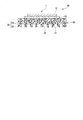
- a power module substrate 1 with a heat sink includes a power module substrate 10 and a heat sink 20.
- the power module substrate 10 includes a ceramic substrate 11 and a circuit layer 12 bonded to one surface (the upper surface in FIG. 1) of the ceramic substrate 11.
- the ceramic substrate 11 prevents electrical connection between the circuit layer 12 and the heat sink 20, and is excellent in insulation and heat dissipation, such as Si 3 N 4 (silicon nitride), AlN (aluminum nitride), Al It is composed of 2 O 3 (alumina) or the like of the ceramics. In this embodiment, it is made of AlN.
- the thickness of the ceramic substrate 11 is set within a range of 0.2 to 1.5 mm, and in this embodiment is set to 0.635 mm.
- the circuit layer 12 is formed by joining an aluminum member made of aluminum or an aluminum alloy to one surface of the ceramic substrate 11.
- aluminum member aluminum (2N aluminum) having a purity of 99 mass% or more and aluminum (4N aluminum) having a purity of 99.99 mass% or more can be used.
- a 4N aluminum rolled plate is used.
- the thickness of the circuit layer 12 is set within a range of 0.1 mm or more and 1.0 mm or less, and is set to 0.4 mm in the present embodiment.
- the circuit layer 12 and the ceramic substrate 11 are joined by, for example, an Al—Si brazing material.
- the heat sink 20 is for dissipating heat on the power module substrate 10 side.
- the heat sink 20 is provided with a flow path 21 for flowing a cooling fluid.
- the heat sink 20 is made of an Al—SiC composite material (so-called AlSiC) 30.
- the Al—SiC composite material 30 includes a porous body 31 made of SiC and an aluminum material 32 made of aluminum or aluminum alloy impregnated in the porous body 31.
- As the aluminum material 32 pure aluminum such as aluminum (2N aluminum) having a purity of 99 mass% or more, aluminum (4N aluminum) having a purity of 99.99 mass% or more, Al: 80 mass% or more and 99.99 mass% or less, Si: An aluminum alloy having a composition of 0.01 mass% or more and 13.5 mass% or less, Mg: 0.03 mass% or more and 5.0 mass% or less, and the balance: impurities can be used.
- the Al—SiC composite material 30 may have a skin layer 33.
- This skin layer 33 is formed when a part of the aluminum material 32 oozes out on the surface when the aluminum material 32 is melted and impregnated into SiC to be the porous body 31 to produce an Al—SiC composite material. Is the layer to be played. Therefore, the skin layer 33 has the same composition as the aluminum material 32.
- the thickness of the skin layer 33 is adjusted by cutting the exuded aluminum material.
- the thickness of the heat sink 20 can be 0.5 mm to 5.0 mm.
- the thickness of the heat sink 20 is a thickness including the thickness of the skin layer when the skin layer is formed.
- the thickness per one side of the skin layer is preferably 0.01 to 0.1 times the thickness of the heat sink 20.
- the area of the heat sink 20 is set to be the same as or larger than the area of the ceramic substrate 11.
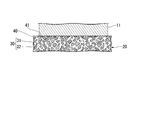
- FIG. 2A shows a case where the Al—SiC composite material 30 has a skin layer 33, and the joint portion 40 is formed in the skin layer 33.
- FIG. 2B shows a case where the Al—SiC composite material 30 does not have the skin layer 33, and the joint 40 is formed in the aluminum material 32 of the Al—SiC composite material 30.
- the joint 40 includes aluminum, magnesium, and silicon.
- the joint 40 is formed by heating a laminated body in which the ceramic substrate 11 and the Al—SiC composite material 30 are laminated via a magnesium layer, This is a layer formed by solidification of a solid-liquid coexisting region containing magnesium and silicon.
- Magnesium oxide 41 is deposited at the joint 40.
- the magnesium oxide 41 is deposited in the vicinity of the bonding interface between the ceramic substrate 11 and the bonding portion 40.
- the magnesium oxide 41 is usually magnesium oxide (MgO), spinel (MgAl 2 O 4 ), and a composite thereof.
- the magnesium oxide 41 includes an oxide film present on the surface of the ceramic substrate 11 and the surface of the Al—SiC composite material 30 in the method for manufacturing a power module substrate with a heat sink, which will be described later, and magnesium in the magnesium layer. Is a product produced by the reaction. Further, Mg 2 Si may be precipitated at the joint 40.
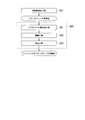
- the manufacturing method of the power module substrate 1 with a heat sink according to the present embodiment includes a circuit layer bonding step S01 and a heat sink bonding step S02 as shown in FIG.
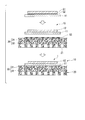
- an aluminum member 51 to be the circuit layer 12 is laminated on one surface of the ceramic substrate 11 via a brazing material 52.
- the circuit layer 12 is bonded to the ceramic substrate 11 by heating while pressing in the stacking direction.
- the power module substrate 10 in the present embodiment is manufactured.
- the heat sink joining step S02 includes a magnesium layer forming step S21, a laminating step S22, and a joining step S23.
- a magnesium layer 53 is formed on at least one surface of the ceramic substrate 11 and the Al—SiC composite material 30.
- the magnesium layer 53 is formed on the surface of the Al—SiC composite material 30.
- the magnesium layer 53 preferably has a magnesium concentration of 80 atomic% or more, and particularly preferably 90 atomic% or more.
- the magnesium concentration of the magnesium layer 53 is 80 atomic% or more, a solid-liquid coexistence region is likely to be generated and Mg 2 Si is likely to be generated in the solid-liquid coexistence region in the bonding step S23 described later.
- the thickness of the magnesium layer 53 is in the range of 0.1 ⁇ m or more and 10 ⁇ m or less (the total thickness when formed on both the ceramic substrate 11 and the Al—SiC composite material 30). If the thickness of the magnesium layer 53 becomes too thin, the amount of Mg 2 Si generated in the bonding step S23 described later decreases, and the bonding strength between the ceramic substrate 11 and the Al—SiC composite material 30 decreases. On the other hand, if the thickness of the magnesium layer 53 becomes too thick, an excessive liquid phase is generated in the solid-liquid coexistence region in the bonding step S23 described later, and the bonding property between the ceramic substrate 11 and the Al—SiC composite material 30 is increased. May decrease.
- a method of forming the magnesium layer 53 As a method of forming the magnesium layer 53, a sputtering method, a vapor deposition method, or a method of applying a magnesium powder paste and drying can be used.
- the ceramic substrate 11 and the Al—SiC composite material 30 are laminated through the magnesium layer 53 to obtain a laminated body.
- the obtained laminate has an amount of silicon in the Al—Si alloy existing in the range from the surface of the bonding surface of the Al—SiC composite material 30 to the ceramic substrate 11 to a thickness of 50 ⁇ m, and the magnesium layer 53.
- the ratio (Si / Mg) to the amount of magnesium present is in the range of 0.01 to 99.0 in terms of atomic ratio.
- Si / Mg is preferably in the range of 1.1 to 6.7.
- the amount of magnesium present in the magnesium layer 53 can be determined from the purity, thickness, and density of the magnesium layer 53.
- the amount of silicon existing in the range from the surface of the Al—SiC composite material 30 to a thickness of 50 ⁇ m can be determined from the silicon content of the Al—SiC composite material 30.
- the silicon content of the Al—SiC composite material 30 includes the silicon content in the skin layer 33.
- the obtained bonded body is heated in a temperature range of 550 ° C. or higher and 575 ° C. or lower while being pressed in the stacking direction.
- the magnesium of the magnesium layer 53 removes the oxide film present on the surface of the ceramic substrate 11 and the Al—SiC composite material 30 and diffuses into the aluminum material 32 of the Al—SiC composite material 30, thereby causing the ceramic substrate 11.
- a solid-liquid coexistence region is generated between aluminum and Al—SiC composite material 30 by aluminum, magnesium, silicon, and Mg 2 Si formed by the reaction between diffused magnesium and silicon.
- the ceramic substrate 11 and the Al—SiC composite material 30 are bonded via the bonding portion 40 containing aluminum, magnesium and silicon, as shown in FIGS. 2A and 2B.
- the bonding portion 40 containing aluminum, magnesium and silicon, as shown in FIGS. 2A and 2B.
- the joint 40 is formed on the ceramic substrate 11 side in the skin layer 33.
- the joint portion 40 is formed on the ceramic substrate 11 side in the aluminum material 32.
- Magnesium oxide 41 is produced by the reaction between these oxide films and magnesium. Further, when the bonding temperature is high or when the holding time is long, Mg 2 Si may be hardly observed at the bonding portion 40.
- Solidification in the solid-liquid coexistence region may be solidification by cooling, or the melting point of the liquid phase in the solid-liquid coexistence region increases due to diffusion of magnesium or the like, so-called solidification while maintaining the heating temperature. It may be by isothermal coagulation.
- the bonding temperature 550 ° C. or higher 575 The holding time is in the range of 15 minutes or more and 180 minutes or less in the range of °C or less. If the bonding temperature is too low, a solid-liquid coexistence region may not be generated. On the other hand, if the bonding temperature is too high, the base material of the Al—SiC composite material 30 may be melted. The bonding temperature is preferably lower than the melting point of the aluminum material 32 in order to suppress the outflow of the aluminum material 32 of the Al—SiC composite material 30.
- the applied load is too low, the solid-liquid coexistence region becomes difficult to contact the Al—SiC composite material 30, which may result in poor bonding. If the applied load becomes too high, the circuit layer 12, the ceramic substrate 11 or the Al—SiC composite material 30 may be cracked or damaged.
- the Al—SiC which becomes the ceramic substrate 11 and the heat sink 20 of the power module substrate 10 in the heat sink joining step S02. Since the magnesium of the magnesium layer 53 is diffused into the Al—Si alloy of the Al—SiC composite material 30 to form a solid-liquid coexisting region, the composite material 30 is joined to the composite material 30 in the Al—SiC composite material 30.
- the ceramic substrate 11 and the Al—SiC composite material 30 can be bonded with high strength without eluting the aluminum material 32.
- the aluminum material in the Al—SiC composite material does not elute, it is possible to suppress the generation of voids due to the outflow of the aluminum material of the Al—SiC composite material and the cracking of the Al—SiC composite material. .
- the power module substrate 1 with a heat sink obtained by the manufacturing method according to the present embodiment has a high bonding strength between the ceramic substrate 11 and the heat sink 20 (Al—SiC composite material 30), and the voids ( Since there are few voids), heat cycle reliability is excellent.
- a power module substrate with a heat sink has been described as an example.
- the present invention is not limited to this, and a ceramic / Al—SiC composite material in which a ceramic member and an Al—SiC composite material are joined. What is necessary is just a joined body.
- the circuit layer 12 was formed by joining the rolling board of 4N aluminum, it is not restricted to this, Copper or a copper alloy is joined by joining a copper or copper alloy board to the ceramic substrate 11.
- a circuit layer (thickness of 0.3 mm to 3.0 mm) may be formed.
- an active metal brazing method using Ag—Cu—Ti or an Ag—Ti brazing material is preferably used.
- the circuit layer may be composed of a laminate of aluminum and copper (or an alloy thereof). In this case, an aluminum layer is formed on the ceramic substrate, and a copper layer is formed on the aluminum layer.
- the metal plate for circuit layer formation and the ceramic substrate were joined as follows, and the ceramic substrate in which the circuit layer was formed was obtained.
- the circuit layer forming metal plate is 4N—Al
- the circuit layer forming metal plate (37 mm ⁇ 37 mm ⁇ thickness 0.4 mm) is placed on one surface of the ceramic substrate, and the brazing material (Al-7.5 mass% Si). , Thickness: 12 ⁇ m).
- the metal plate for circuit layer formation was joined to the ceramic substrate to obtain a ceramic substrate on which the circuit layer was formed.
- the load in the stacking direction was 0.6 MPa, the bonding temperature was 645 ° C., and the holding time was 45 minutes.
- a copper plate (37 mm ⁇ 37 mm ⁇ thickness 0.6 mm) made of oxygen-free copper is placed on one surface of the ceramic substrate via a brazing material (Ag-9.8 mass% Ti).
- the ceramic substrates on which the circuit layer was formed were obtained by bonding under the conditions of a load of 0.6 MPa, a bonding temperature of 830 ° C., and a holding time of 30 minutes.
- a magnesium layer having a thickness shown in Table 1 was formed on one of the ceramic substrate to which the circuit layer was bonded and the surface of the Al—SiC composite material.
- the magnesium layer was formed by a vapor deposition method (ion plating method).
- the ratio (Si / Mg) to the amount of magnesium present in the layer is shown in Table 1 below. Si / Mg was measured by the following method.
- the amount of magnesium in the magnesium layer was determined by measuring the purity and thickness of the magnesium layer and setting the density of the magnesium layer to 1.74 g / cm 3 .
- the purity of the magnesium layer was measured using EPMA, and the thickness was measured by cross-sectional SEM observation.
- the amount of silicon in the Al—Si alloy was determined by measuring the silicon concentration of the skin layer in the case of an Al—SiC composite material with a skin layer. In the case of an Al—SiC composite material without a skin layer, it was determined by measuring the silicon concentration in the Al—SiC composite material.
- the silicon concentration was measured using EPMA. And ratio (Si / Mg) of Si and Mg was calculated
- the bonding rate between the ceramic substrate and the heat sink was measured to evaluate the initial bondability. Specifically, evaluation was performed using an ultrasonic flaw detector (INSIGHT-300 manufactured by Insight Inc.), and the calculation was performed using the following equation.
- the initial bonding area is the area to be bonded before bonding, that is, the area of the ceramic substrate (40 mm ⁇ 40 mm).
- the peeling is indicated by the white portion in the joint portion. Therefore, the area of the white portion is defined as the peeling area.
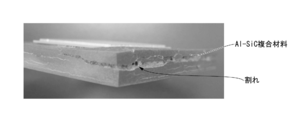
- FIG. 5A and 5B are photographs of side surfaces of an example of the Al—SiC composite material in which the base material melts.
- FIG. 5A is a side view photograph of an Al—SiC composite material in which aluminum has flowed out due to melting of the base material.
- FIG. 5B is a side view photograph of a corner portion of the Al—SiC composite material in which cracking has occurred due to the base metal melting.
- FIG. 5A when aluminum flows out due to melting of the base material, the aluminum exists in a ball shape on the surface of the Al—SiC composite material.
- a ceramic member and an Al—SiC composite material can be bonded to each other with high strength without elution of an aluminum material in the Al—SiC composite material by heating at a relatively low temperature.
- Al—SiC composite material manufacturing method and heat sink-equipped power module substrate manufacturing method can be provided.
Landscapes
- Chemical & Material Sciences (AREA)
- Engineering & Computer Science (AREA)
- Ceramic Engineering (AREA)
- Manufacturing & Machinery (AREA)
- Materials Engineering (AREA)
- Structural Engineering (AREA)
- Organic Chemistry (AREA)
- Inorganic Chemistry (AREA)
- Cooling Or The Like Of Semiconductors Or Solid State Devices (AREA)
- Ceramic Products (AREA)
Abstract
L'invention concerne un procédé pour la fabrication d'un corps assemblé de céramique/matériau composite d'Al-SiC, comprenant : une étape consistant à former une couche de magnésium ayant une épaisseur de 0,1 à 10 µm sur au moins une surface parmi un élément en céramique et un matériau composite d'Al-SiC, le matériau composite d'Al-SiC comprenant un matériau à base d'aluminium constitué d'un alliage d'Al-Si ayant une teneur en silicium supérieure ou égale à 0,1 % atomique; une étape consistant à stratifier l'élément en céramique et le matériau composite d'Al-SiC avec la couche de magnésium entre eux et obtenir un stratifié; et une étape consistant à assembler l'élément en céramique et le matériau composite d'Al-SiC par chauffage du stratifié sur une plage de température de 550 à 575°C.
Priority Applications (2)
| Application Number | Priority Date | Filing Date | Title |
|---|---|---|---|
| PCT/JP2018/005089 WO2019159257A1 (fr) | 2018-02-14 | 2018-02-14 | PROCÉDÉ POUR LA FABRICATION D'UN CORPS ASSEMBLÉ DE CÉRAMIQUE/MATÉRIAU COMPOSITE D'AL-SiC ET PROCÉDÉ POUR LA FABRICATION D'UN SUBSTRAT POURVU D'UN DISSIPATEUR THERMIQUE POUR UN BLOC DE PUISSANCE |
| EP18906674.9A EP3753912A4 (fr) | 2018-02-14 | 2018-02-14 | Procédé pour la fabrication d'un corps assemblé de céramique/matériau composite d'al-sic et procédé pour la fabrication d'un substrat pourvu d'un dissipateur thermique pour un bloc de puissance |
Applications Claiming Priority (1)
| Application Number | Priority Date | Filing Date | Title |
|---|---|---|---|
| PCT/JP2018/005089 WO2019159257A1 (fr) | 2018-02-14 | 2018-02-14 | PROCÉDÉ POUR LA FABRICATION D'UN CORPS ASSEMBLÉ DE CÉRAMIQUE/MATÉRIAU COMPOSITE D'AL-SiC ET PROCÉDÉ POUR LA FABRICATION D'UN SUBSTRAT POURVU D'UN DISSIPATEUR THERMIQUE POUR UN BLOC DE PUISSANCE |
Publications (1)
| Publication Number | Publication Date |
|---|---|
| WO2019159257A1 true WO2019159257A1 (fr) | 2019-08-22 |
Family
ID=67619807
Family Applications (1)
| Application Number | Title | Priority Date | Filing Date |
|---|---|---|---|
| PCT/JP2018/005089 Ceased WO2019159257A1 (fr) | 2018-02-14 | 2018-02-14 | PROCÉDÉ POUR LA FABRICATION D'UN CORPS ASSEMBLÉ DE CÉRAMIQUE/MATÉRIAU COMPOSITE D'AL-SiC ET PROCÉDÉ POUR LA FABRICATION D'UN SUBSTRAT POURVU D'UN DISSIPATEUR THERMIQUE POUR UN BLOC DE PUISSANCE |
Country Status (2)
| Country | Link |
|---|---|
| EP (1) | EP3753912A4 (fr) |
| WO (1) | WO2019159257A1 (fr) |
Cited By (3)
| Publication number | Priority date | Publication date | Assignee | Title |
|---|---|---|---|---|
| CN110922195A (zh) * | 2019-10-16 | 2020-03-27 | 蚌埠学院 | 原位反应制备镁铝尖晶石-碳化硅复合材料的方法 |
| JP2023041258A (ja) * | 2021-09-13 | 2023-03-24 | 東京応化工業株式会社 | 放熱装置および放熱板 |
| CN118712070A (zh) * | 2024-08-30 | 2024-09-27 | 中国电子科技集团公司第二十九研究所 | 一种局部物理性能可调的微波件封装外壳设计及加工方法 |
Citations (6)
| Publication number | Priority date | Publication date | Assignee | Title |
|---|---|---|---|---|
| JPS59164675A (ja) * | 1983-03-10 | 1984-09-17 | 日産自動車株式会社 | セラミツクスの接合方法 |
| JP2010098058A (ja) | 2008-10-15 | 2010-04-30 | Mitsubishi Materials Corp | ヒートシンク付パワーモジュール用基板、ヒートシンク付パワーモジュール及びヒートシンク付パワーモジュール用基板の製造方法 |
| JP2012116683A (ja) * | 2010-11-30 | 2012-06-21 | Showa Denko Kk | アルミニウムろう付品の製造方法 |
| JP2017183360A (ja) * | 2016-03-28 | 2017-10-05 | 三菱マテリアル株式会社 | ヒートシンク付パワーモジュール用基板の製造方法 |
| JP2017183716A (ja) * | 2016-03-25 | 2017-10-05 | 三菱マテリアル株式会社 | ヒートシンク付絶縁回路基板の製造方法、及び、ヒートシンク付絶縁回路基板 |
| JP2018032732A (ja) * | 2016-08-24 | 2018-03-01 | 三菱マテリアル株式会社 | セラミックス/Al−SiC複合材料接合体の製造方法、及びヒートシンク付パワーモジュール用基板の製造方法 |
Family Cites Families (1)
| Publication number | Priority date | Publication date | Assignee | Title |
|---|---|---|---|---|
| JP2002203932A (ja) * | 2000-10-31 | 2002-07-19 | Hitachi Ltd | 半導体パワー素子用放熱基板とその導体板及びヒートシンク材並びにロー材 |
-
2018
- 2018-02-14 EP EP18906674.9A patent/EP3753912A4/fr not_active Withdrawn
- 2018-02-14 WO PCT/JP2018/005089 patent/WO2019159257A1/fr not_active Ceased
Patent Citations (6)
| Publication number | Priority date | Publication date | Assignee | Title |
|---|---|---|---|---|
| JPS59164675A (ja) * | 1983-03-10 | 1984-09-17 | 日産自動車株式会社 | セラミツクスの接合方法 |
| JP2010098058A (ja) | 2008-10-15 | 2010-04-30 | Mitsubishi Materials Corp | ヒートシンク付パワーモジュール用基板、ヒートシンク付パワーモジュール及びヒートシンク付パワーモジュール用基板の製造方法 |
| JP2012116683A (ja) * | 2010-11-30 | 2012-06-21 | Showa Denko Kk | アルミニウムろう付品の製造方法 |
| JP2017183716A (ja) * | 2016-03-25 | 2017-10-05 | 三菱マテリアル株式会社 | ヒートシンク付絶縁回路基板の製造方法、及び、ヒートシンク付絶縁回路基板 |
| JP2017183360A (ja) * | 2016-03-28 | 2017-10-05 | 三菱マテリアル株式会社 | ヒートシンク付パワーモジュール用基板の製造方法 |
| JP2018032732A (ja) * | 2016-08-24 | 2018-03-01 | 三菱マテリアル株式会社 | セラミックス/Al−SiC複合材料接合体の製造方法、及びヒートシンク付パワーモジュール用基板の製造方法 |
Non-Patent Citations (1)
| Title |
|---|
| See also references of EP3753912A4 |
Cited By (4)
| Publication number | Priority date | Publication date | Assignee | Title |
|---|---|---|---|---|
| CN110922195A (zh) * | 2019-10-16 | 2020-03-27 | 蚌埠学院 | 原位反应制备镁铝尖晶石-碳化硅复合材料的方法 |
| JP2023041258A (ja) * | 2021-09-13 | 2023-03-24 | 東京応化工業株式会社 | 放熱装置および放熱板 |
| JP7836158B2 (ja) | 2021-09-13 | 2026-03-26 | 東京応化工業株式会社 | 放熱装置および放熱板 |
| CN118712070A (zh) * | 2024-08-30 | 2024-09-27 | 中国电子科技集团公司第二十九研究所 | 一种局部物理性能可调的微波件封装外壳设计及加工方法 |
Also Published As
| Publication number | Publication date |
|---|---|
| EP3753912A1 (fr) | 2020-12-23 |
| EP3753912A4 (fr) | 2021-10-13 |
Similar Documents
| Publication | Publication Date | Title |
|---|---|---|
| TWI676516B (zh) | 接合體、附加散熱器的電源模組用基板、散熱器、及接合體的製造方法、附加散熱器的電源模組用基板的製造方法、散熱器的製造方法 | |
| TWI695778B (zh) | 接合體、附散熱器之電力模組用基板、散熱器、接合體之製造方法、附散熱器之電力模組用基板之製造方法、及散熱器之製造方法 | |
| JP6256176B2 (ja) | 接合体の製造方法、パワーモジュール用基板の製造方法 | |
| JP6822247B2 (ja) | ヒートシンク付絶縁回路基板の製造方法 | |
| TWI661516B (zh) | 接合體,附散熱器電源模組用基板,散熱器,接合體的製造方法,附散熱器電源模組用基板的製造方法及散熱器的製造方法 | |
| TW201526171A (zh) | 接合體之製造方法及功率模組用基板之製造方法 | |
| TW201508870A (zh) | 接合體之製造方法及功率模組用基板之製造方法 | |
| TWI737894B (zh) | 附有散熱片絕緣電路基板之製造方法 | |
| JP6658400B2 (ja) | セラミックス/Al−SiC複合材料接合体の製造方法、及びヒートシンク付パワーモジュール用基板の製造方法 | |
| WO2020044590A1 (fr) | Corps assemblé en cuivre/céramique, carte de circuit imprimé isolée, procédé de production de corps assemblé en cuivre/céramique, et procédé de fabrication de carte de circuit imprimé isolée | |
| CN107431051A (zh) | 带有散热片的功率模块用基板的制造方法 | |
| JP6569511B2 (ja) | 接合体、冷却器付きパワーモジュール用基板、冷却器付きパワーモジュール用基板の製造方法 | |
| JP6558272B2 (ja) | 接合体の製造方法、ヒートシンク付パワーモジュール用基板の製造方法、接合体及びヒートシンク付パワーモジュール用基板 | |
| EP3753912A1 (fr) | Procédé pour la fabrication d'un corps assemblé de céramique/matériau composite d'al-sic et procédé pour la fabrication d'un substrat pourvu d'un dissipateur thermique pour un bloc de puissance | |
| JP6756189B2 (ja) | ヒートシンク付パワーモジュール用基板、及びヒートシンク付パワーモジュール用基板の製造方法 | |
| TWI780113B (zh) | 陶瓷/鋁-碳化矽複合材料接合體之製造方法、及附散熱塊之功率模組用基板之製造方法 | |
| JP2017120828A (ja) | 接合体の製造方法、ヒートシンク付パワーモジュール用基板の製造方法、接合体及びヒートシンク付パワーモジュール用基板 | |
| CN102593009B (zh) | 电源模块用基板的制造方法、电源模块用基板和电源模块 | |
| JP6645368B2 (ja) | 接合体、パワーモジュール用基板、接合体の製造方法、及び、パワーモジュール用基板の製造方法 | |
| JP6432373B2 (ja) | ヒートシンク付パワーモジュール用基板、パワーモジュール、及び、ヒートシンク付パワーモジュール用基板の製造方法 | |
| TWI744474B (zh) | 陶瓷/鋁接合體、絕緣電路基板、led模組、陶瓷構件、陶瓷/鋁接合體之製造方法、絕緣電路基板之製造方法 | |
| JP2018046265A (ja) | 絶縁回路基板の製造方法、及び、絶縁回路基板、パワーモジュール、ledモジュール、熱電モジュール | |
| JP6561886B2 (ja) | ヒートシンク付パワーモジュール用基板の製造方法 | |
| JP6680144B2 (ja) | セラミックス/Al−SiC複合材料接合体の製造方法、及びヒートシンク付パワーモジュール用基板の製造方法 | |
| WO2016167217A1 (fr) | Corps lié, substrat pour module d'alimentation pourvu d'un dissipateur thermique, dissipateur thermique, procédé de fabrication de corps lié, procédé de fabrication de substrat pour module d'alimentation pourvu d'un dissipateur thermique, et procédé de fabrication de dissipateur thermique |
Legal Events
| Date | Code | Title | Description |
|---|---|---|---|
| 121 | Ep: the epo has been informed by wipo that ep was designated in this application |
Ref document number: 18906674 Country of ref document: EP Kind code of ref document: A1 |
|
| NENP | Non-entry into the national phase |
Ref country code: DE |
|
| ENP | Entry into the national phase |
Ref document number: 2018906674 Country of ref document: EP Effective date: 20200914 |
|
| NENP | Non-entry into the national phase |
Ref country code: JP |