WO2019159600A1 - Composition de résine thermoplastique d'une excellente résistance au jaunissement - Google Patents
Composition de résine thermoplastique d'une excellente résistance au jaunissement Download PDFInfo
- Publication number
- WO2019159600A1 WO2019159600A1 PCT/JP2019/001453 JP2019001453W WO2019159600A1 WO 2019159600 A1 WO2019159600 A1 WO 2019159600A1 JP 2019001453 W JP2019001453 W JP 2019001453W WO 2019159600 A1 WO2019159600 A1 WO 2019159600A1
- Authority
- WO
- WIPO (PCT)
- Prior art keywords
- mass
- parts
- component
- resin composition
- resin
- Prior art date
- Legal status (The legal status is an assumption and is not a legal conclusion. Google has not performed a legal analysis and makes no representation as to the accuracy of the status listed.)
- Ceased
Links
Images


Classifications
-
- B—PERFORMING OPERATIONS; TRANSPORTING
- B32—LAYERED PRODUCTS
- B32B—LAYERED PRODUCTS, i.e. PRODUCTS BUILT-UP OF STRATA OF FLAT OR NON-FLAT, e.g. CELLULAR OR HONEYCOMB, FORM
- B32B27/00—Layered products comprising a layer of synthetic resin
- B32B27/16—Layered products comprising a layer of synthetic resin specially treated, e.g. irradiated
-
- B—PERFORMING OPERATIONS; TRANSPORTING
- B32—LAYERED PRODUCTS
- B32B—LAYERED PRODUCTS, i.e. PRODUCTS BUILT-UP OF STRATA OF FLAT OR NON-FLAT, e.g. CELLULAR OR HONEYCOMB, FORM
- B32B27/00—Layered products comprising a layer of synthetic resin
- B32B27/30—Layered products comprising a layer of synthetic resin comprising vinyl (co)polymers; comprising acrylic (co)polymers
-
- B—PERFORMING OPERATIONS; TRANSPORTING
- B32—LAYERED PRODUCTS
- B32B—LAYERED PRODUCTS, i.e. PRODUCTS BUILT-UP OF STRATA OF FLAT OR NON-FLAT, e.g. CELLULAR OR HONEYCOMB, FORM
- B32B27/00—Layered products comprising a layer of synthetic resin
- B32B27/36—Layered products comprising a layer of synthetic resin comprising polyesters
-
- C—CHEMISTRY; METALLURGY
- C08—ORGANIC MACROMOLECULAR COMPOUNDS; THEIR PREPARATION OR CHEMICAL WORKING-UP; COMPOSITIONS BASED THEREON
- C08L—COMPOSITIONS OF MACROMOLECULAR COMPOUNDS
- C08L27/00—Compositions of homopolymers or copolymers of compounds having one or more unsaturated aliphatic radicals, each having only one carbon-to-carbon double bond, and at least one being terminated by a halogen; Compositions of derivatives of such polymers
- C08L27/02—Compositions of homopolymers or copolymers of compounds having one or more unsaturated aliphatic radicals, each having only one carbon-to-carbon double bond, and at least one being terminated by a halogen; Compositions of derivatives of such polymers not modified by chemical after-treatment
- C08L27/04—Compositions of homopolymers or copolymers of compounds having one or more unsaturated aliphatic radicals, each having only one carbon-to-carbon double bond, and at least one being terminated by a halogen; Compositions of derivatives of such polymers not modified by chemical after-treatment containing chlorine atoms
- C08L27/06—Homopolymers or copolymers of vinyl chloride
-
- C—CHEMISTRY; METALLURGY
- C08—ORGANIC MACROMOLECULAR COMPOUNDS; THEIR PREPARATION OR CHEMICAL WORKING-UP; COMPOSITIONS BASED THEREON
- C08L—COMPOSITIONS OF MACROMOLECULAR COMPOUNDS
- C08L51/00—Compositions of graft polymers in which the grafted component is obtained by reactions only involving carbon-to-carbon unsaturated bonds; Compositions of derivatives of such polymers
- C08L51/04—Compositions of graft polymers in which the grafted component is obtained by reactions only involving carbon-to-carbon unsaturated bonds; Compositions of derivatives of such polymers grafted on to rubbers
-
- C—CHEMISTRY; METALLURGY
- C08—ORGANIC MACROMOLECULAR COMPOUNDS; THEIR PREPARATION OR CHEMICAL WORKING-UP; COMPOSITIONS BASED THEREON
- C08L—COMPOSITIONS OF MACROMOLECULAR COMPOUNDS
- C08L67/00—Compositions of polyesters obtained by reactions forming a carboxylic ester link in the main chain; Compositions of derivatives of such polymers
Definitions
- the present invention relates to a thermoplastic resin composition excellent in yellowing resistance. Furthermore, the present invention is a film substrate suitable for a molded body or film formed from a thermoplastic resin composition excellent in yellowing resistance, particularly a coating film formed from a paint containing an active energy ray-curable resin. About.
- a paint containing an active energy ray-curable resin can be polymerized and cured in a short time by an active energy ray such as an ultraviolet ray or an electron beam to form a coating film excellent in various properties such as scratch resistance. Therefore, paints containing active energy ray-curable resins are frequently used for decorative sheets, decorative films, glass scattering prevention films, and the like.
- active energy rays, especially electron beams have high energy, there is a disadvantage that the film base material for forming the coating film turns yellow. Therefore, as a technique for solving the disadvantage that the film base material turns yellow by an active energy ray, particularly an electron beam, for example, Patent Documents 1 to 4 have been proposed. However, when the inventor made additional trials, they were not fully satisfied.
- An object of the present invention is to provide a thermoplastic resin composition excellent in yellowing resistance (in which an inconvenience of being turned yellow by an active energy ray, particularly an electron beam is suppressed).
- the further subject of this invention is providing the thermoplastic resin composition which was excellent in yellowing resistance and transparency preferably, and the trouble by transfer of a plasticizer was suppressed.
- thermoplastic resin composition for a base material of a coating film formed from a paint containing an active energy ray-curable resin (A) Amorphous or low crystalline polyester resin 1 to 100% by mass; and (B) Polyvinyl chloride resin 99 to 0% by mass Wherein the sum of the component (A) non-crystalline or low-crystalline polyester resin and the component (B) polyvinyl chloride resin is 100% by mass; and (C) A thermoplastic resin composition comprising 1 to 100 parts by mass of core-shell rubber. [2].
- thermoplastic resin composition for a base material of a coating film formed from a paint containing an active energy ray-curable resin (A) Amorphous or low crystalline polyester resin 1 to 99% by mass; and (B) Polyvinyl chloride resin 99 to 1% by mass. Wherein the sum of the component (A) non-crystalline or low-crystalline polyester resin and the component (B) polyvinyl chloride resin is 100% by mass; and (C) Including 1 to 100 parts by weight of core-shell rubber, Furthermore, for 100 parts by mass of the component (B) polyvinyl chloride resin, (D) A resin composition comprising 1 to 250 parts by mass of a polyester plasticizer. [3].
- thermoplastic resin composition of the present invention is excellent in yellowing resistance.
- the thermoplastic resin composition of a preferred embodiment of the present invention is excellent in yellowing resistance and transparency, and troubles due to migration of the plasticizer are suppressed. Therefore, the molded object formed from the thermoplastic resin composition of this invention can be used suitably as a base material of the coating film formed from the coating material containing an active energy ray curable resin.
- the film of the thermoplastic resin composition of the present invention is preferably used as a film substrate for forming a coating film on at least one surface using a paint containing an active energy ray-curable resin. Can do.
- the term “resin” is used as a term including a resin mixture containing two or more resins and a resin composition containing components other than the resin.
- the term “film” is used interchangeably or interchangeably with “sheet”.
- laminating a certain layer and another layer in order means laminating those layers directly and interposing one or more other layers such as anchor coats between these layers. Including both lamination.
- the terms “film” and “sheet” are used for what can be rolled up in a roll form industrially.
- the term “plate” is used for those that cannot be rolled up industrially in roll form.
- ⁇ The term “more” related to a numerical range is used to mean a certain numerical value or a certain numerical value. For example, 20% or more means 20% or more than 20%.
- the term “below” relating to a numerical range is used to mean a certain numerical value or less than a certain numerical value. For example, 20% or less means 20% or less than 20%.
- the symbol “ ⁇ ” in a numerical range is used to mean a certain numerical value, a certain numerical value and less than a certain other numerical value, or another certain numerical value.
- 10-90% means 10%, more than 10% and less than 90%, or 90%.
- thermoplastic resin composition of the present invention comprises (A) an amorphous or low-crystalline polyester resin; and (C) a core shell rubber.
- the thermoplastic resin composition of the present invention includes (A) an amorphous or low-crystalline polyester resin; (B) a polyvinyl chloride resin; and (C) a core-shell rubber.
- the thermoplastic resin composition of the present invention comprises (A) an amorphous or low crystalline polyester resin; (B) a polyvinyl chloride resin; (C) a core shell rubber; and (D) A polyester plasticizer is included.
- the amorphous or low crystalline polyester resin of the above component (A) has high transparency and gloss, and is excellent in embossability and impact resistance. It has the feature. Further, it is excellent in miscibility with the above components (B) to (D).
- the component (A) is preferably an amorphous polyester resin.
- the component (A) is more preferably an amorphous aromatic polyester resin.
- a differential scanning calorimeter is used, held at 320 ° C. for 5 minutes, cooled to ⁇ 50 ° C. at a rate of temperature decrease of 20 ° C./minute, held at ⁇ 50 ° C. for 5 minutes, and then 20 ° C. / Polyester with a heat of fusion in the last temperature rise curve (second melting curve) measured by a program of heating to 320 ° C.
- non-crystalline polyester with 5 J / g or less; more than 5 J / g
- the differential scanning calorimeter for example, Diamond DSC type differential scanning calorimeter of Perkin Elmer Japan Co., Ltd. can be used.
- the amorphous or low crystalline polyester-based resin is not particularly limited as long as it has amorphous or low crystallinity, and examples thereof include polyvalent carboxylic acids such as aromatic polyvalent carboxylic acids and aliphatic polyvalent carboxylic acids. Mention may be made of a copolymer of an acid and a polyvalent ol such as an aliphatic polyvalent ol or an aromatic polyvalent ol.
- a structural unit derived from a polyvalent carboxylic acid a structural unit derived from an aromatic polyvalent carboxylic acid is mainly included (the sum of the structural units derived from a polyvalent carboxylic acid is 100 mol%, usually 50 (Mole% or more, preferably 70 mol% or more, more preferably 90 mol% or more, still more preferably 95 mol% or more) is defined as an aromatic polyester.
- aromatic polyvalent carboxylic acid examples include aromatic dicarboxylic acids such as terephthalic acid, isophthalic acid, orthophthalic acid, and naphthalenedicarboxylic acid; and ester-forming derivatives thereof.
- aliphatic polycarboxylic acid examples include adipic acid, pimelic acid, suberic acid, azelaic acid, sebacic acid, undecanedicarboxylic acid, dodecanedicarboxylic acid, tridecanedicarboxylic acid, tetradecanedicarboxylic acid, pentadecanedicarboxylic acid, hexadecanedicarboxylic acid.
- Chain aliphatic dicarboxylic acids such as acids, octadecanedicarboxylic acids, and eicosanedicarboxylic acids; 1,3-cyclohexanedicarboxylic acid, 1,4-cyclohexanedicarboxylic acid, dicyclohexanemethane-4,4′-dicarboxylic acid, and And alicyclic dicarboxylic acids such as norbornane dicarboxylic acid; and ester-forming derivatives thereof.
- these 1 type, or 2 or more types of mixtures can be used.
- aliphatic polyol examples include ethylene glycol, diethylene glycol, neopentyl glycol, 1,2-butanediol, 1,3-butanediol, 1,4-butanediol, 1,5-pentanediol, 3- Methyl-1,5-pentanediol, 2-methyl-1,3-propanediol, 1,4-cyclohexanedimethanol, 2,2,4,4, -tetramethyl-1,3-cyclobutanediol, and spiroglycol Aliphatic diols such as (3,9-bis (2-hydroxy-1,1-dimethylethyl) -2,4,8,10-tetraoxaspiro [5,5] undecane); and their ester-forming properties Derivatives and the like can be mentioned.
- aromatic polyol examples include xylylene glycol, 4,4′-dihydroxybiphenyl, 2,2-bis (4-hydroxyphenyl) propane, bis (4-hydroxyphenyl) sulfone, bisphenol A, and bisphenol A.
- Aromatic polyhydric ols such as alkylene oxide adducts thereof; and ester-forming derivatives thereof. As said polyvalent ol, these 1 type, or 2 or more types of mixtures can be used.
- non-crystalline or low-crystalline polyester resin examples include, for example, a total of structural units derived from polyvalent carboxylic acid as 100 mol%, and a total of structural units derived from polyvalent ol as 100 mol%, respectively. (1) 90 to 100 mol% of structural units derived from terephthalic acid, and (2) 60 to 80 mol% of structural units derived from ethylene glycol, and 20 to 40 structural units derived from 1,4-cyclohexanedimethanol.
- Glycol-modified polyethylene terephthalate containing 0 to 10 mol% of structural units derived from diethylene glycol; (1) 90 to 100 mol% of structural units derived from terephthalic acid, and (2) derived from ethylene glycol 20 to 60 mol% of structural units, typically 32 to 42 mol%, Glycol-modified polyethylene terephthalate (PCTG) containing 40 to 80 mol%, typically 58 to 68 mol% of structural units derived from rhohexanedimethanol, and 0 to 10 mol% of structural units derived from diethylene glycol; (1) 50 to 99 mol% of structural units derived from terephthalic acid, 1 to 50 mol% of structural units derived from isophthalic acid, and (2) 90 to 100 mol% of structural units derived from 1,4-cyclohexanedimethanol Acid-modified polycyclohexylenedimethylene terephthalate (PCTA); (1) 90 to 100 mol% of structural units derived from 1,4
- non-crystalline or low-crystalline polyester resin one or a mixture of two or more of these can be used.
- the glass transition temperature of the amorphous or low-crystalline polyester resin is usually 50 to 140 ° C., preferably 60 to 120 ° C., more preferably from the viewpoint of yellowing resistance and miscibility with the component (B). May be from 70 to 110 ° C, more preferably from 75 to 105 ° C.
- the glass transition temperature is determined according to JIS K7121-1987 using a differential scanning calorimeter, held at 250 ° C. for 3 minutes, cooled to 20 ° C. at 10 ° C./min, and held at 20 ° C. for 3 minutes. It is the midpoint glass transition temperature calculated from the curve of the last heating process measured by the program which heats up to 250 degreeC at 10 degreeC / min.
- the differential scanning calorimeter for example, Diamond DSC type differential scanning calorimeter of Perkin Elmer Japan Co., Ltd. can be used.
- the polyvinyl chloride resin that can be used as the component (B) is not particularly limited.
- polyvinyl chloride (vinyl chloride homopolymer); vinyl chloride / vinyl acetate copolymer , Vinyl chloride / (meth) acrylic acid copolymer, vinyl chloride / (meth) methyl acrylate copolymer, vinyl chloride / (meth) ethyl acrylate copolymer, vinyl chloride / maleic acid ester copolymer, chloride Vinyl / ethylene copolymer, vinyl chloride / propylene copolymer, vinyl chloride / styrene copolymer, vinyl chloride / isobutylene copolymer, vinyl chloride / vinylidene chloride copolymer, vinyl chloride / styrene / maleic anhydride ternary Copolymer, Vinyl chloride / styrene / acrylonit
- Vinyl chloride copolymers with other monomers copolymerizable with vinyl chloride; post-chlorinated vinyl copolymers such as polyvinyl chloride and vinyl chloride copolymers modified (chlorinated, etc.) Can be mentioned.
- a chlorinated polyolefin having a chemical structure similar to polyvinyl chloride, such as chlorinated polyethylene may be used.
- polyvinyl chloride (vinyl chloride homopolymer) is preferable from the viewpoint of yellowing resistance.
- a polyvinyl chloride resin of the said component (B) these 1 type, or 2 or more types of mixtures can be used.
- the blending ratio of the non-crystalline or low-crystalline polyester resin of the component (A) and the polyvinyl chloride resin of the component (B) is (the component (B)
- the component (A) is usually at least 1% by mass (the above component (B) 99), where the sum of the component (A) and the component (B) is 100% by mass.
- % By mass or less preferably 20% by mass or more (80% by mass or less of the above component (B)), more preferably 40% by mass or more (60% by mass or less of the above component (B)), more preferably 60% by mass or more (
- the component (B) may be 40% by mass or less), most preferably 80 to 100% by mass (the component (B) 20 to 0% by mass or less).
- the blending ratio of the amorphous or low crystalline polyester resin of the component (A) and the polyvinyl chloride resin of the component (B) is from the viewpoint of calender roll rolling film formability of the resin composition
- the component (A) is usually 99% by mass or less (1% by mass or more of the component (B)), preferably 90% by mass or less (10% by mass or more of the component (B)), more preferably 70% by mass or less (above.
- Component (B) 30% by mass or more more preferably 50% by mass or less (the above component (B) 50% by mass or more), most preferably 1 to 30% by mass (the above component (B) 99 to 70% by mass or less). It may be.
- (C) Core shell rubber
- the core shell rubber of the component (C) serves to improve the calender roll rolling film formability of the resin composition.
- the core-shell rubber of the component (C) is not particularly limited.
- methacrylic acid ester / styrene / butadiene rubber graft copolymer methacrylic acid ester / styrene / butadiene rubber graft copolymer, methacrylic acid ester / styrene / styrene / butadiene rubber graft copolymer, acrylonitrile / styrene / Butadiene rubber graft copolymer, acrylonitrile / styrene / styrene / butadiene rubber graft copolymer, acrylonitrile / styrene / ethylene / propylene rubber graft copolymer, acrylonitrile / styrene / acrylate rubber graft copolymer, methacrylate / Acrylic ester rubber graft copolymer
- acrylonitrile / styrene / acrylate rubber graft copolymer methacrylate / acrylate rubber graft copolymer, methacrylate / styrene / acrylate Acrylic system in which (meth) acrylic acid, acrylonitrile, styrene, etc. are graft copolymerized with (meth) acrylic acid ester rubber, such as rubber graft copolymer and methacrylic acid ester / acrylonitrile / acrylic acid ester rubber graft copolymer Core shell rubber is preferred.
- (meth) acrylic acid means acrylic acid or methacrylic acid.
- the core-shell rubber of the component (C) one or a mixture of two or more of these can be used.
- the amount of the component (C) core-shell rubber is usually 1 mass from the viewpoint of weather resistance and calendar roll rolling film formability, with the sum of the component (A) and the component (B) being 100 parts by mass. Part or more, preferably 4 parts by weight or more, more preferably 7 parts by weight or more, and even more preferably 10 parts by weight or more.
- the amount of the component (C) core-shell rubber is usually 100 parts by mass or less, preferably 60 parts by mass or less, more preferably 40 parts by mass or less, and still more preferably 20 parts by mass or less from the viewpoint of transparency. It may be.
- the amount of the component (C) core-shell rubber is usually 1 part by mass or more and 100 parts by mass or less, preferably 100 parts by mass of the sum of the component (A) and the component (B), 1 to 60 parts by mass, 1 to 40 parts by mass, 1 to 20 parts by mass, 4 to 100 parts by mass, 4 to 60 parts by mass, 4 to 40 parts by mass 4 to 20 parts by mass, 7 to 100 parts by mass, 7 to 60 parts by mass, 7 to 40 parts by mass, 7 to 20 parts by mass, 10 It may be from 10 parts by weight to 100 parts by weight, from 10 parts by weight to 60 parts by weight, from 10 parts by weight to 40 parts by weight, or from 10 parts by weight to 20 parts by weight.
- polyester plasticizer of the component (D) is not particularly limited.
- polyhydric alcohols include ethylene glycol, diethylene glycol, triethylene glycol, 1,2-propylene glycol, 1, One or a mixture of two or more of 3-propylene glycol, 1,3-butanediol, 1,4-butanediol, 1,5-hexanediol, 1,6-hexanediol, and neopentyl glycol Used as polycarboxylic acid, oxalic acid, malonic acid, succinic acid, glutaric acid, adipic acid, trimellitic acid, pimelic acid, suberic acid, maleic acid, azelaic acid, sebacic acid, fumaric acid, phthalic acid, isophthalic acid , And a mixture of one or more of terephthalic acid, etc. Alcohol, and polyester type plasticizer obtained by using such a stopper monocarboxylic acids.
- a polyester plasticizer obtained by using such
- the obtained polystyrene-equivalent weight average molecular weight (Mw) is usually 3100 or more, preferably 3500,000 or more, more preferably 4000 or more, more preferably, from the viewpoint of suppressing troubles caused by the migration of the plasticizer and yellowing resistance. May be 4500 or more, most preferably 5000 or more. From the viewpoint of suppressing troubles caused by the migration of the plasticizer, the larger the mass average molecular weight, the better.
- the mass average molecular weight is usually 100,000 or less, preferably 50,000 or less, and more preferably 10,000 or less.
- the weight average molecular weight of the polyester plasticizer of the component (D) is usually 3100 or more and 100,000 or less, preferably 3100 or more and 50,000 or less, 3100 or more and 10,000 or less, 355,000 or more and 100,000 or less, preferably 3500 to 50,000, 3500 to 10,000, 4000 to 100,000, preferably 4000 to 50,000, 4000 to 10,000, 45,000 to 100,000, preferably 4500 to 50,000 below, it may be 4500 or more and 10,000 or less, 5000 or more and 100,000 or less, preferably 5000 or more and 50,000 or less, or 5000 or more and 10,000 or less.
- HPC-8320 high-performance liquid chromatography system
- HPC-8320 a system that includes a degasser, liquid feed pump, autosampler, column oven, and RI (differential refractive index) detector.
- HPC-8320 high-performance liquid chromatography system
- RI differential refractive index
- flow rate 1.0 ml / min, column temperature 40 ° C., sample concentration 1 mg / ml, and sample injection volume 1 0 can be carried out under the conditions of a micro liter.
- the elution amount in each holding volume can be determined from the detection amount of the RI detector, assuming that the refractive index of the measurement sample does not depend on the molecular weight.
- the calibration curve from the retention capacity to the molecular weight in terms of polystyrene is the standard polystyrene “EasiCal PS-1” (trade name) of Agilent Technology Co., Ltd.
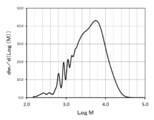
- FIG. 1 shows a differential molecular weight distribution curve of the following component (D-1) used in the examples.
- the molecular weights 650, 860, 1100, and 1400 have the peak top of the oligomer component, the molecular weight 5500 has the peak top of the main component, the overall mass average molecular weight is 5200, and the number average molecular weight is 2300.
- the blending amount of the polyester-based plasticizer of the component (D) is usually 250 parts by mass or less from the viewpoint of suppressing trouble due to blocking resistance and plasticizer migration with respect to 100 parts by mass of the component (B). Preferably, it may be 150 parts by mass or less, more preferably 100 parts by mass or less, still more preferably 60 parts by mass or less, still more preferably 45 parts by mass or less, and most preferably 35 parts by mass or less.
- the lower limit of the amount of the polyester plasticizer of component (D) is usually 1 part by mass or more, preferably 5 parts by mass or more, from the viewpoint of yellowing resistance, weather resistance, and calender roll rolling film formability.
- the compounding amount of the polyester plasticizer of the component (D) is usually 1 part by mass or more and 250 parts by mass or less, preferably 1 part by mass or more and 150 parts by mass with respect to 100 parts by mass of the component (B).
- Part or less 1 part by weight or more and 100 parts by weight or less, 1 part by weight or more and 60 parts by weight or less, 1 part by weight or more and 45 parts by weight or less, 1 part by weight or more and 35 parts by weight or less, 5 parts by weight or more and 250 parts by weight or less Parts by weight to 150 parts by weight 5 parts by weight to 100 parts by weight 5 parts by weight to 60 parts by weight 5 parts by weight to 45 parts by weight 5 parts by weight to 35 parts by weight 10 parts by weight to 250 parts by weight 10 to 150 parts by mass 10 to 100 parts by mass 10 to 60 parts by mass 10 to 45 parts by mass 10 to 35 parts by mass 15 to 15 parts by mass 2 0 parts by mass or less, 15 parts by mass to 150 parts by mass, 15 parts by mass to 100 parts by mass, 15 parts by mass to 60 parts by mass, 15 parts by mass to 45 parts by mass, 15 parts by mass to 35 parts by mass, 20 parts by mass to 250 parts by mass, 20 parts by mass to 150 parts by mass, 20 parts by mass to 100 parts by mass, 20 parts by
- the thermoplastic resin composition of the present invention preferably further contains a heat stabilizer.
- a heat stabilizer for example, organotin compound type
- an organotin compound-based heat stabilizer is preferable.
- the organotin compounds include dioctyltin compounds such as dioctyltin mercapto, dioctyltin dilaurate, dioctyltin versatate, and dioctyltin stearate; and dimethyltin compounds such as dimethyltin mercapto. .
- the blending amount of the heat stabilizer is usually 0.1 parts by mass or more, preferably 0.5 parts by mass or more, more preferably 1 part by mass with respect to 100 parts by mass of the component (B) from the viewpoint of yellowing resistance. Or more. On the other hand, from the viewpoint of suppressing bleed out of the stabilizer, it may be usually 10 parts by mass or less, preferably 7 parts by mass or less, more preferably 5 parts by mass or less. In one embodiment, the blending amount of the heat stabilizer is usually 0.1 parts by mass or more and 10 parts by mass or less, preferably 0.1 parts by mass or more and 7 parts by mass or less with respect to 100 parts by mass of the component (B).
- 0.1 to 5 parts by mass 0.5 to 10 parts by mass, 0.5 to 7 parts by mass, 0.5 to 5 parts by mass, 1 to 10 parts by mass It may be 1 part by mass or less and 1 part by mass or more and 7 parts by mass or less, or 1 part by mass or more and 5 parts by mass or less.
- thermoplastic resin composition of the present invention may further contain other components other than the above components (A) to (D) as long as the object of the present invention is not adversely affected.
- the other components include thermoplastic resins other than the above components (A) to (C); plasticizers other than the above component (D); antioxidants, weather resistance stabilizers, colorants, lubricants, processing aids.
- An additive such as an agent, a nucleating agent, a release agent, an antistatic agent, and a surfactant can be exemplified.
- thermoplastic resins other than the above components (A) to (C) include poly (meth) acrylic acid ester, styrene / (meth) acrylic acid ester copolymer, ethylene / vinyl acetate copolymer, ethylene / ( Examples thereof include a (meth) acrylic acid copolymer, an ethylene / (meth) methyl acrylate copolymer, and an ethylene / (meth) ethyl acrylate copolymer.
- plasticizers other than the component (D) include phthalate ester plasticizers, trimellitic ester plasticizers, pyromellitic ester plasticizers, adipic ester plasticizers, and itaconic ester plasticizers.
- Citrate plasticizer cyclohexanedicarboxylate plasticizer, epoxy plasticizer, trimellitic acid plasticizer, tetrahydrophthalic acid diester plasticizer, glycerin ester plasticizer, epoxyhexahydrophthalic acid diester plasticizer Agent, isosorbide diester plasticizer, phosphate plasticizer, azelaic acid plasticizer, sebacic acid plasticizer, stearic acid plasticizer, citric acid plasticizer, pyromellitic acid plasticizer, biphenyltetracarboxylic acid Examples thereof include ester plasticizers and chlorine plasticizers.
- One or more of these can be used as the other components.
- the compounding amount of the other components is not particularly limited because it is an optional component.
- the total amount may be about 10 parts by mass or less, or about 0.01 to 10 parts by mass with respect to 100 parts by mass in total of the component (A), the component (B), and the component (C).
- thermoplastic resin composition of the present invention uses the above-mentioned component (A), the above-mentioned component (C), and the optional components to be used as desired at the same time or in any order using any melt-kneader. It can be obtained by putting into a machine and melt-kneading.
- melt kneader examples include batch kneaders such as a pressure kneader and a mixer; extrusion kneaders such as a single screw extruder, a co-rotating twin screw extruder, and a different direction rotating twin screw extruder; a calendar roll kneader Can be mentioned. These may be used in any combination.
- the obtained composition can be formed into an arbitrary molded product by an arbitrary method after being pelletized by an arbitrary method.
- the pelletization can be performed by methods such as hot cut, strand cut, and underwater cut.
- the molded body of the present invention is a molded body formed from the thermoplastic resin composition of the present invention.
- the expression “formed from a thermoplastic resin composition” with respect to the “molded body” here means that the thermoplastic resin composition is used as a part or all of the raw material of the molded body. In other words, this is a molded article that contains a part of the cured product of the thermoplastic resin composition of the present invention or the entire cured product.
- the shape is not particularly limited and can be arbitrarily designed.
- the molded body of the present invention is usually a molded body on which a coating film is planned to be formed on a part or all of the surface of the molded body using a paint containing an active energy ray-curable resin. .
- the coating-film formation location of the molded object of this invention is normally comprised with the thermoplastic resin composition of this invention.
- the shape and configuration of such a molded body is not particularly limited.
- the thermoplastic resin composition of the present invention is used as a skin material, and an arbitrary thermoplastic resin is used as a core material.
- a composite molded body obtained by a method of injecting resin as a core material (film insert molding) can be used.
- Film The film of the present invention is a film formed from the thermoplastic resin composition of the present invention.
- the film of this invention can be used suitably as a film base material for forming a coating film using the coating material containing active energy ray-curable resin on the single side
- the film of the present invention can be obtained by using the thermoplastic resin composition of the present invention and forming a film using any film forming apparatus.
- the film forming apparatus include a calendar roll rolling processing machine and a calender roll rolling film forming apparatus including a drawing winder; and a T die forming apparatus including an extruder, a T die, and a drawing winder. And so on.
- Examples of the calendar roll rolling machine include an upright 3 roll, an upright 4 roll, an L 4 roll, an inverted L 4 roll, and a Z roll.
- Examples of the extruder include a single-screw extruder, a same-direction rotating twin-screw extruder, and a different-direction rotating twin-screw extruder.
- Examples of the T die include a manifold die, a fish tail die, and a coat hanger die.
- the film of the present invention can be obtained by forming the film using the thermoplastic resin composition of the present invention, preferably using a calender roll rolling film forming apparatus. More preferably, it can be obtained by using a calender roll rolling film forming apparatus and forming a film at a roll temperature of 160 ° C. to 200 ° C.
- the thickness of the film of the present invention is not particularly limited, but may be usually 20 ⁇ m or more, preferably 50 ⁇ m or more from the viewpoint of handleability. On the other hand, from the viewpoint of meeting the demand for thinning articles including the film of the present invention, it may be usually 1000 ⁇ m or less, preferably 500 ⁇ m or less, more preferably 200 ⁇ m or less. In one embodiment, the thickness of the film is usually 20 ⁇ m to 1000 ⁇ m, preferably 20 ⁇ m to 500 ⁇ m, 20 ⁇ m to 200 ⁇ m, 50 ⁇ m to 1000 ⁇ m, 50 ⁇ m to 500 ⁇ m, or 50 ⁇ m to 200 ⁇ m.
- the laminated film of the present invention is a film of the present invention (a film composed of the thermoplastic resin composition of the present invention, typically a film composed of the polyvinyl chloride resin composition of the present invention, or an amorphous or low It is a laminated film including one or more layers of a film made of a crystalline polyester resin composition.
- the laminated film of the present invention usually has, in order from the surface layer side, a coating film formed using a paint containing an active energy ray-curable resin and the film layer of the present invention.
- Examples of the laminated film of the present invention include a coated film formed using a paint containing an active energy ray-curable resin in order from the surface layer side, and a laminated film having a layer of the film of the present invention.
- the film of the present invention may be transparent, opaque, or colored.
- the “surface layer side” means the side of the surface that is normally visually recognized in the actual use state.
- “Actual use state” means, for example, in the case of a decorative sheet, a state in which the decorative sheet is used for makeup and decoration on the surface of various articles.
- the laminated film of the present invention for example, in order from the surface layer side, it has a coating film formed using a paint containing an active energy ray-curable resin, a layer of the film of the present invention, a printed layer, and a layer of a colored resin film.
- a laminated film can be mentioned.
- the laminated film of such an embodiment is a decorative sheet, a decorative film, a household appliance such as a refrigerator, a washing machine, an air conditioner, a mobile phone, and a personal computer; furniture such as a display shelf, a storage cabinet, a cupboard, and a desk; It can be suitably used for decorative makeup of building members such as walls and bathrooms.
- the film of the present invention is preferably transparent.
- the total light transmittance (measured in accordance with JIS K7105: 2011 5.5.2 measurement method A) of the film of the present invention is usually 60% or more, preferably 70% or more, more preferably 80% or more, and still more preferably 85. % Or more, most preferably 90% or more. A higher total light transmittance is preferable.
- the total light transmittance can be measured using, for example, a spectrophotometer “V-570” (trade name) manufactured by JASCO Corporation in accordance with JIS K7105: 2011 5.5.2 Measurement Method A.
- the printing layer in the laminated film is provided for imparting high designability, and can be formed by printing an arbitrary pattern using an arbitrary ink and an arbitrary printing machine.
- the printed layer can be applied entirely or partially on the front surface of the colored resin film directly or via an anchor coat.
- the patterns include metal-like patterns such as hairlines, wood grain patterns, stone patterns imitating the surface of rocks such as marble, fabric patterns imitating cloth and cloth-like patterns, tiled patterns, brickwork patterns, parquet patterns, And patchwork.
- As printing ink what mixed the pigment, the solvent, the stabilizer, the plasticizer, the catalyst, the hardening
- binder examples include polyurethane resins, vinyl chloride / vinyl acetate copolymer resins, vinyl chloride / vinyl acetate / acrylic copolymer resins, chlorinated polypropylene resins, acrylic resins, polyester resins, polyamides. Resins such as resin, butyral resin, polystyrene resin, nitrocellulose resin, and cellulose acetate resin, and these resin compositions can be used. Further, in order to give a metallic design, aluminum, tin, titanium, indium, and oxides thereof may be directly or partially on the front surface of the colored resin film, or through an anchor coat. In particular, it may be deposited by a known method.
- polyester-type resin such as aromatic polyester and aliphatic polyester
- Acrylic resin Polycarbonate-type resin
- Polyethylene Polypropylene And polyolefin resins such as polymethylpentene
- cellulose resins such as cellophane, triacetylcellulose, diacetylcellulose, and acetylcellulose butyrate
- polystyrene acrylonitrile-butadiene-styrene copolymer resin (ABS resin), styrene-ethylene, Styrene such as butadiene / styrene copolymer, styrene / ethylene / propylene / styrene copolymer, and styrene / ethylene / ethylene / propylene / styrene copolymer Resin; Polyvinyl
- FIG. 2 is a conceptual cross-sectional view showing an example of a decorative sheet using the film of the present invention.
- a coating film 1 formed using a paint containing an active energy ray-curable resin, a transparent film layer 2 of the present invention, a printed layer 3, and a colored thermoplastic resin film layer 4. doing.
- a pressure-sensitive adhesive layer or an adhesive layer may be formed directly or via an anchor coat on the surface of the colored thermoplastic resin film layer 4 opposite to the bonding surface with the printed layer 3.
- Measurement Method (i) Total Light Transmittance Using a spectrophotometer “V-570” (trade name) manufactured by JASCO Corporation in accordance with JIS K7105: 2011 5.5.2 Measurement Method A, total light transmittance was measured.
- the L * a * b * coordinates after processing were determined according to the method described above. Calculate the color difference ( ⁇ E) from the L * a * b * coordinates before processing and the L * a * b * coordinates after processing using the calculation method built in the spectrocolorimeter ( ⁇ E * ab (CIE1976)). Thus, the yellowing resistance was evaluated.
- the Konica Minolta Japan Co., Ltd. homepage (the following address) can be referred to. http: // www. konicaminolta. jp / instruments / knowledge / color / part1 / 07. html
- a thermal cycle process is performed with a program that processes at a temperature of 50 ° C. and a relative humidity of 80% for 2 days, at a temperature of 10 ° C. (no humidity control) for 1 day, at a temperature of 50 ° C. and a relative humidity of 80% for 1 day
- L * a * b * coordinates after the thermal cycle were determined according to the method described above.
- the color difference ( ⁇ E) is calculated using the calculation method ( ⁇ E * ab (CIE1976)) built in the spectrocolorimeter. Was calculated, thereby evaluating the resistance to cold changes.
- SWOM sunshine carbon arc lamp type weather resistance tester
- Suga Test Instruments Co., Ltd. stipulated in JIS B7753: 2007 is used, and the irradiance is 225 W / m 2 ( The specifications of the glass filter are type A in Table 2 of the above standard, and the irradiance category is the normal type in Table 3 of the above standard), water spray for 18 minutes every 120 minutes, ambient temperature 43 ° C, black panel temperature 63 ° C , And a relative humidity of 50 ⁇ 5% for 2000 hours, and further left to stand under constant temperature and humidity conditions (temperature 23 ° C., 50% relative humidity) for 3 days.
- SWOM sunshine carbon arc lamp type weather resistance tester
- FIG. 3 is a photograph showing an example of D evaluation.
- (Vii) Migration 2 Migration was evaluated in the same manner as in (vi) above, except that polystyrene “Toyostyrene HI H450” (trade name) manufactured by Toyo Styrene Co., Ltd. was used instead of the ABS resin.
- Raw materials used Amorphous or low crystalline polyester resin (A-1) Amorphous aromatic polyester resin “KODAR PETG GS1” (trade name) of Eastman Chemical Company: (1) To terephthalic acid 100 mol% of structural units derived from, and (2) 66 mol% of structural units derived from ethylene glycol, 31 mol% of structural units derived from 1,4-cyclohexanedimethanol, and 3 mol% of structural units derived from diethylene glycol. Containing glycol-modified polyethylene terephthalate, glass transition temperature 81 ° C., heat of fusion 0 J / g (no clear melting peak in DSC second melting curve).
- B Polyvinyl chloride resin
- B-1 Polyvinyl chloride homopolymer having a degree of polymerization of 800.
- Core shell rubber (C-1) Core shell rubber (methyl methacrylate / styrene / ethyl acrylate rubber graft copolymer) “Metbrene W-300A” (trade name) manufactured by Mitsubishi Chemical Corporation
- E Optional component
- E-1 Dioctyltin mercapto stabilizer “ADEKA STAB 465” (trade name) manufactured by ADEKA Corporation.
- E-2) ADEKA Corporation's lubricant “ADK STAB LS-16” (trade name).
- E-3) Acrylic processing aid “P-530A” (trade name) manufactured by Mitsubishi Chemical Corporation.
- Examples 1-12 The components (parts by mass) shown in Table 1 were melt kneaded under the condition of a die outlet resin temperature of 160 ° C. using a co-rotating twin screw extruder to obtain a thermoplastic resin composition. Next, using a film forming apparatus equipped with a reverse L-type four-calendar roll rolling machine and a winding device of Nippon Roll Manufacturing Co., Ltd., the first roll temperature is 180 ° C., the second roll temperature is 180 ° C., and the third roll 185 is used. A film having a thickness of 80 ⁇ m was formed under the conditions of ° C, fourth roll 180 ° C, and winding speed 60 m / min. The above tests (i) to (vii) were performed on this film. The results are shown in Table 1 or 2. In addition, the numerical value in a parenthesis in a table
- surface is a compounding quantity (mass part) with respect to 100 mass parts of said components (B).
- thermoplastic resin composition of the present invention was excellent in yellowing resistance and transparency. Moreover, it turned out that the trouble by the transfer of a plasticizer is suppressed in the preferable thermoplastic resin composition of this invention. Moreover, these thermoplastic resin compositions also had good test results for heat resistance, cooling cycle, and weather resistance performed after ⁇ -ray irradiation.
Landscapes
- Chemical & Material Sciences (AREA)
- Health & Medical Sciences (AREA)
- Chemical Kinetics & Catalysis (AREA)
- Medicinal Chemistry (AREA)
- Polymers & Plastics (AREA)
- Organic Chemistry (AREA)
- Compositions Of Macromolecular Compounds (AREA)
- Laminated Bodies (AREA)
Abstract
Selon un premier aspect de la présente invention, une composition de résine thermoplastique pour matériau de base destinée à un film de revêtement formé à partir d'un matériau de revêtement contenant une résine durcissable par rayonnement d'énergie active, contient : (A) 1 à 100% en masse d'une résine polyester non cristalline ou faiblement cristalline ; (B) 100 parties en masse d'un mélange de résine constitué de 99 à 0% en masse d'une résine de polychlorure de vinyle (la somme des composants (A) et (B) valant 100% en masse) ; et (C) 100 parties en masse d'un caoutchouc cœur-écorce. Selon un second aspect de la présente invention, une composition de résine thermoplastique pour matériau de base destinée à un film de revêtement formé à partir d'un matériau de revêtement contenant une résine durcissable par rayonnement d'énergie active, contient : (A) 1 à 99% en masse d'une résine polyester non cristalline ou faiblement cristalline ; (B) 100 parties en masse d'un mélange de résine constitué de 99 à 1% en masse d'une résine de polychlorure de vinyle (la somme du composant (A) et du composant (B) valant 100% en masse) ; et (C) 100 parties en masse d'un caoutchouc cœur-écorce. En outre, cette composition de résine thermoplastique contient (D) 1 à 250 parties en masse d'un plastifiant à base de polyester pour 100 parties en masse de résine de polychlorure de vinyle.
Priority Applications (1)
| Application Number | Priority Date | Filing Date | Title |
|---|---|---|---|
| JP2020500342A JP7220700B2 (ja) | 2018-02-16 | 2019-01-18 | 耐黄変性に優れた熱可塑性樹脂組成物 |
Applications Claiming Priority (2)
| Application Number | Priority Date | Filing Date | Title |
|---|---|---|---|
| JP2018025551 | 2018-02-16 | ||
| JP2018-025551 | 2018-02-16 |
Publications (1)
| Publication Number | Publication Date |
|---|---|
| WO2019159600A1 true WO2019159600A1 (fr) | 2019-08-22 |
Family
ID=67619356
Family Applications (1)
| Application Number | Title | Priority Date | Filing Date |
|---|---|---|---|
| PCT/JP2019/001453 Ceased WO2019159600A1 (fr) | 2018-02-16 | 2019-01-18 | Composition de résine thermoplastique d'une excellente résistance au jaunissement |
Country Status (2)
| Country | Link |
|---|---|
| JP (1) | JP7220700B2 (fr) |
| WO (1) | WO2019159600A1 (fr) |
Families Citing this family (1)
| Publication number | Priority date | Publication date | Assignee | Title |
|---|---|---|---|---|
| JP2023069852A (ja) * | 2021-11-08 | 2023-05-18 | ロンシール工業株式会社 | 塩化ビニル系シート |
Citations (5)
| Publication number | Priority date | Publication date | Assignee | Title |
|---|---|---|---|---|
| JPS5043154A (fr) * | 1973-06-14 | 1975-04-18 | ||
| JPH09136336A (ja) * | 1995-11-15 | 1997-05-27 | Polyplastics Co | 複合成形品およびその製造方法 |
| JPH10278208A (ja) * | 1997-04-09 | 1998-10-20 | Daicel Chem Ind Ltd | 内装材用複合フィルム、それを用いた内装材用複合シートおよび積層体 |
| JP2010106597A (ja) * | 2008-10-31 | 2010-05-13 | Riken Technos Corp | 壁装用積層樹脂シートおよびこれを用いてなる壁紙 |
| JP2017205874A (ja) * | 2016-05-16 | 2017-11-24 | リケンテクノス株式会社 | 化粧シート |
-
2019
- 2019-01-18 WO PCT/JP2019/001453 patent/WO2019159600A1/fr not_active Ceased
- 2019-01-18 JP JP2020500342A patent/JP7220700B2/ja active Active
Patent Citations (5)
| Publication number | Priority date | Publication date | Assignee | Title |
|---|---|---|---|---|
| JPS5043154A (fr) * | 1973-06-14 | 1975-04-18 | ||
| JPH09136336A (ja) * | 1995-11-15 | 1997-05-27 | Polyplastics Co | 複合成形品およびその製造方法 |
| JPH10278208A (ja) * | 1997-04-09 | 1998-10-20 | Daicel Chem Ind Ltd | 内装材用複合フィルム、それを用いた内装材用複合シートおよび積層体 |
| JP2010106597A (ja) * | 2008-10-31 | 2010-05-13 | Riken Technos Corp | 壁装用積層樹脂シートおよびこれを用いてなる壁紙 |
| JP2017205874A (ja) * | 2016-05-16 | 2017-11-24 | リケンテクノス株式会社 | 化粧シート |
Also Published As
| Publication number | Publication date |
|---|---|
| JP7220700B2 (ja) | 2023-02-10 |
| JPWO2019159600A1 (ja) | 2021-02-04 |
Similar Documents
| Publication | Publication Date | Title |
|---|---|---|
| JP3669162B2 (ja) | アクリル系樹脂フィルム | |
| KR102159523B1 (ko) | 합성 수지 적층체 | |
| JP2013541447A (ja) | 多層生分解性フィルム | |
| EP2111978A1 (fr) | Film stratifié et objet moulé | |
| TW201902708A (zh) | 多層薄膜 | |
| JP6938400B2 (ja) | 耐黄変性に優れたポリ塩化ビニル系樹脂組成物 | |
| EP3738995B1 (fr) | Intermédiaire de feuille décorative d'aspect métallique, feuille décorative d'aspect métallique, corps stratifié par extrusion, corps moulé d'aspect métallique, corps moulé par injection, procédé de production d'un corps moulé d'aspect métallique, procédé de production d'un corps moulé par injection, et procédé de production d'un corps stratifié par extrusion | |
| KR101859733B1 (ko) | 금속 광택을 갖는 유색 필름 및 이를 포함하는 모바일 기기의 후면 커버 | |
| JP6787925B2 (ja) | 透明樹脂積層体 | |
| JP6956077B2 (ja) | 化粧シート | |
| JP6915411B2 (ja) | ポリエステル樹脂組成物 | |
| JP2008019339A (ja) | 防汚性の改良された艶消しフィルムまたはシート | |
| WO2019159600A1 (fr) | Composition de résine thermoplastique d'une excellente résistance au jaunissement | |
| JP7242224B2 (ja) | ポリ塩化ビニル系樹脂組成物 | |
| JP5590746B2 (ja) | 金属調シート及びそれを用いた金属調化粧材 | |
| JP2004202971A (ja) | 印刷意匠シート、及び、印刷意匠シートを被覆した金属板 | |
| JP4823853B2 (ja) | 金属調シート及びそれを用いた金属調化粧材 | |
| CN107249836B (zh) | 树脂制面板的生产方法 | |
| JP2018127607A (ja) | フィルム | |
| JP5140262B2 (ja) | 金属調シート及びそれを用いた金属調化粧材 | |
| JP5805229B2 (ja) | フィルム | |
| JP2001062962A (ja) | 積層シート | |
| JP6639878B2 (ja) | ポリエステル系樹脂積層体、及び加飾フィルム | |
| JP2006272835A (ja) | ポリエステル系積層体、その製造方法及び積層体用熱接着剤 | |
| JP2025110281A (ja) | 積層体、およびそれを含む成形体 |
Legal Events
| Date | Code | Title | Description |
|---|---|---|---|
| 121 | Ep: the epo has been informed by wipo that ep was designated in this application |
Ref document number: 19754851 Country of ref document: EP Kind code of ref document: A1 |
|
| ENP | Entry into the national phase |
Ref document number: 2020500342 Country of ref document: JP Kind code of ref document: A |
|
| NENP | Non-entry into the national phase |
Ref country code: DE |
|
| 122 | Ep: pct application non-entry in european phase |
Ref document number: 19754851 Country of ref document: EP Kind code of ref document: A1 |