WO2019163839A1 - Stratifié ignifuge et batterie - Google Patents
Stratifié ignifuge et batterie Download PDFInfo
- Publication number
- WO2019163839A1 WO2019163839A1 PCT/JP2019/006366 JP2019006366W WO2019163839A1 WO 2019163839 A1 WO2019163839 A1 WO 2019163839A1 JP 2019006366 W JP2019006366 W JP 2019006366W WO 2019163839 A1 WO2019163839 A1 WO 2019163839A1
- Authority
- WO
- WIPO (PCT)
- Prior art keywords
- refractory
- resin
- fireproof
- base material
- fire
- Prior art date
- Legal status (The legal status is an assumption and is not a legal conclusion. Google has not performed a legal analysis and makes no representation as to the accuracy of the status listed.)
- Ceased
Links
- QRDJCCQTEQVLKC-HUDPQJTASA-N CC1C(C2)[C@H]2CC1 Chemical compound CC1C(C2)[C@H]2CC1 QRDJCCQTEQVLKC-HUDPQJTASA-N 0.000 description 1
Images





Classifications
-
- C—CHEMISTRY; METALLURGY
- C09—DYES; PAINTS; POLISHES; NATURAL RESINS; ADHESIVES; COMPOSITIONS NOT OTHERWISE PROVIDED FOR; APPLICATIONS OF MATERIALS NOT OTHERWISE PROVIDED FOR
- C09K—MATERIALS FOR MISCELLANEOUS APPLICATIONS, NOT PROVIDED FOR ELSEWHERE
- C09K21/00—Fireproofing materials
- C09K21/06—Organic materials
-
- B—PERFORMING OPERATIONS; TRANSPORTING
- B32—LAYERED PRODUCTS
- B32B—LAYERED PRODUCTS, i.e. PRODUCTS BUILT-UP OF STRATA OF FLAT OR NON-FLAT, e.g. CELLULAR OR HONEYCOMB, FORM
- B32B27/00—Layered products comprising a layer of synthetic resin
- B32B27/18—Layered products comprising a layer of synthetic resin characterised by the use of special additives
-
- B—PERFORMING OPERATIONS; TRANSPORTING
- B32—LAYERED PRODUCTS
- B32B—LAYERED PRODUCTS, i.e. PRODUCTS BUILT-UP OF STRATA OF FLAT OR NON-FLAT, e.g. CELLULAR OR HONEYCOMB, FORM
- B32B15/00—Layered products comprising a layer of metal
- B32B15/02—Layer formed of wires, e.g. mesh
-
- B—PERFORMING OPERATIONS; TRANSPORTING
- B32—LAYERED PRODUCTS
- B32B—LAYERED PRODUCTS, i.e. PRODUCTS BUILT-UP OF STRATA OF FLAT OR NON-FLAT, e.g. CELLULAR OR HONEYCOMB, FORM
- B32B15/00—Layered products comprising a layer of metal
- B32B15/04—Layered products comprising a layer of metal comprising metal as the main or only constituent of a layer, which is next to another layer of the same or of a different material
- B32B15/08—Layered products comprising a layer of metal comprising metal as the main or only constituent of a layer, which is next to another layer of the same or of a different material of synthetic resin
-
- B—PERFORMING OPERATIONS; TRANSPORTING
- B32—LAYERED PRODUCTS
- B32B—LAYERED PRODUCTS, i.e. PRODUCTS BUILT-UP OF STRATA OF FLAT OR NON-FLAT, e.g. CELLULAR OR HONEYCOMB, FORM
- B32B15/00—Layered products comprising a layer of metal
- B32B15/04—Layered products comprising a layer of metal comprising metal as the main or only constituent of a layer, which is next to another layer of the same or of a different material
- B32B15/08—Layered products comprising a layer of metal comprising metal as the main or only constituent of a layer, which is next to another layer of the same or of a different material of synthetic resin
- B32B15/082—Layered products comprising a layer of metal comprising metal as the main or only constituent of a layer, which is next to another layer of the same or of a different material of synthetic resin comprising vinyl resins; comprising acrylic resins
-
- B—PERFORMING OPERATIONS; TRANSPORTING
- B32—LAYERED PRODUCTS
- B32B—LAYERED PRODUCTS, i.e. PRODUCTS BUILT-UP OF STRATA OF FLAT OR NON-FLAT, e.g. CELLULAR OR HONEYCOMB, FORM
- B32B15/00—Layered products comprising a layer of metal
- B32B15/04—Layered products comprising a layer of metal comprising metal as the main or only constituent of a layer, which is next to another layer of the same or of a different material
- B32B15/08—Layered products comprising a layer of metal comprising metal as the main or only constituent of a layer, which is next to another layer of the same or of a different material of synthetic resin
- B32B15/085—Layered products comprising a layer of metal comprising metal as the main or only constituent of a layer, which is next to another layer of the same or of a different material of synthetic resin comprising polyolefins
-
- B—PERFORMING OPERATIONS; TRANSPORTING
- B32—LAYERED PRODUCTS
- B32B—LAYERED PRODUCTS, i.e. PRODUCTS BUILT-UP OF STRATA OF FLAT OR NON-FLAT, e.g. CELLULAR OR HONEYCOMB, FORM
- B32B15/00—Layered products comprising a layer of metal
- B32B15/04—Layered products comprising a layer of metal comprising metal as the main or only constituent of a layer, which is next to another layer of the same or of a different material
- B32B15/08—Layered products comprising a layer of metal comprising metal as the main or only constituent of a layer, which is next to another layer of the same or of a different material of synthetic resin
- B32B15/088—Layered products comprising a layer of metal comprising metal as the main or only constituent of a layer, which is next to another layer of the same or of a different material of synthetic resin comprising polyamides
-
- B—PERFORMING OPERATIONS; TRANSPORTING
- B32—LAYERED PRODUCTS
- B32B—LAYERED PRODUCTS, i.e. PRODUCTS BUILT-UP OF STRATA OF FLAT OR NON-FLAT, e.g. CELLULAR OR HONEYCOMB, FORM
- B32B15/00—Layered products comprising a layer of metal
- B32B15/04—Layered products comprising a layer of metal comprising metal as the main or only constituent of a layer, which is next to another layer of the same or of a different material
- B32B15/08—Layered products comprising a layer of metal comprising metal as the main or only constituent of a layer, which is next to another layer of the same or of a different material of synthetic resin
- B32B15/09—Layered products comprising a layer of metal comprising metal as the main or only constituent of a layer, which is next to another layer of the same or of a different material of synthetic resin comprising polyesters
-
- B—PERFORMING OPERATIONS; TRANSPORTING
- B32—LAYERED PRODUCTS
- B32B—LAYERED PRODUCTS, i.e. PRODUCTS BUILT-UP OF STRATA OF FLAT OR NON-FLAT, e.g. CELLULAR OR HONEYCOMB, FORM
- B32B15/00—Layered products comprising a layer of metal
- B32B15/04—Layered products comprising a layer of metal comprising metal as the main or only constituent of a layer, which is next to another layer of the same or of a different material
- B32B15/08—Layered products comprising a layer of metal comprising metal as the main or only constituent of a layer, which is next to another layer of the same or of a different material of synthetic resin
- B32B15/092—Layered products comprising a layer of metal comprising metal as the main or only constituent of a layer, which is next to another layer of the same or of a different material of synthetic resin comprising epoxy resins
-
- B—PERFORMING OPERATIONS; TRANSPORTING
- B32—LAYERED PRODUCTS
- B32B—LAYERED PRODUCTS, i.e. PRODUCTS BUILT-UP OF STRATA OF FLAT OR NON-FLAT, e.g. CELLULAR OR HONEYCOMB, FORM
- B32B15/00—Layered products comprising a layer of metal
- B32B15/04—Layered products comprising a layer of metal comprising metal as the main or only constituent of a layer, which is next to another layer of the same or of a different material
- B32B15/08—Layered products comprising a layer of metal comprising metal as the main or only constituent of a layer, which is next to another layer of the same or of a different material of synthetic resin
- B32B15/095—Layered products comprising a layer of metal comprising metal as the main or only constituent of a layer, which is next to another layer of the same or of a different material of synthetic resin comprising polyurethanes
-
- B—PERFORMING OPERATIONS; TRANSPORTING
- B32—LAYERED PRODUCTS
- B32B—LAYERED PRODUCTS, i.e. PRODUCTS BUILT-UP OF STRATA OF FLAT OR NON-FLAT, e.g. CELLULAR OR HONEYCOMB, FORM
- B32B15/00—Layered products comprising a layer of metal
- B32B15/04—Layered products comprising a layer of metal comprising metal as the main or only constituent of a layer, which is next to another layer of the same or of a different material
- B32B15/08—Layered products comprising a layer of metal comprising metal as the main or only constituent of a layer, which is next to another layer of the same or of a different material of synthetic resin
- B32B15/098—Layered products comprising a layer of metal comprising metal as the main or only constituent of a layer, which is next to another layer of the same or of a different material of synthetic resin comprising condensation resins of aldehydes, e.g. with phenols, ureas or melamines
-
- B—PERFORMING OPERATIONS; TRANSPORTING
- B32—LAYERED PRODUCTS
- B32B—LAYERED PRODUCTS, i.e. PRODUCTS BUILT-UP OF STRATA OF FLAT OR NON-FLAT, e.g. CELLULAR OR HONEYCOMB, FORM
- B32B15/00—Layered products comprising a layer of metal
- B32B15/18—Layered products comprising a layer of metal comprising iron or steel
-
- B—PERFORMING OPERATIONS; TRANSPORTING
- B32—LAYERED PRODUCTS
- B32B—LAYERED PRODUCTS, i.e. PRODUCTS BUILT-UP OF STRATA OF FLAT OR NON-FLAT, e.g. CELLULAR OR HONEYCOMB, FORM
- B32B15/00—Layered products comprising a layer of metal
- B32B15/20—Layered products comprising a layer of metal comprising aluminium or copper
-
- B—PERFORMING OPERATIONS; TRANSPORTING
- B32—LAYERED PRODUCTS
- B32B—LAYERED PRODUCTS, i.e. PRODUCTS BUILT-UP OF STRATA OF FLAT OR NON-FLAT, e.g. CELLULAR OR HONEYCOMB, FORM
- B32B27/00—Layered products comprising a layer of synthetic resin
- B32B27/06—Layered products comprising a layer of synthetic resin as the main or only constituent of a layer, which is next to another layer of the same or of a different material
- B32B27/08—Layered products comprising a layer of synthetic resin as the main or only constituent of a layer, which is next to another layer of the same or of a different material of synthetic resin
-
- B—PERFORMING OPERATIONS; TRANSPORTING
- B32—LAYERED PRODUCTS
- B32B—LAYERED PRODUCTS, i.e. PRODUCTS BUILT-UP OF STRATA OF FLAT OR NON-FLAT, e.g. CELLULAR OR HONEYCOMB, FORM
- B32B27/00—Layered products comprising a layer of synthetic resin
- B32B27/12—Layered products comprising a layer of synthetic resin next to a fibrous or filamentary layer
-
- B—PERFORMING OPERATIONS; TRANSPORTING
- B32—LAYERED PRODUCTS
- B32B—LAYERED PRODUCTS, i.e. PRODUCTS BUILT-UP OF STRATA OF FLAT OR NON-FLAT, e.g. CELLULAR OR HONEYCOMB, FORM
- B32B27/00—Layered products comprising a layer of synthetic resin
- B32B27/18—Layered products comprising a layer of synthetic resin characterised by the use of special additives
- B32B27/20—Layered products comprising a layer of synthetic resin characterised by the use of special additives using fillers, pigments, thixotroping agents
-
- B—PERFORMING OPERATIONS; TRANSPORTING
- B32—LAYERED PRODUCTS
- B32B—LAYERED PRODUCTS, i.e. PRODUCTS BUILT-UP OF STRATA OF FLAT OR NON-FLAT, e.g. CELLULAR OR HONEYCOMB, FORM
- B32B27/00—Layered products comprising a layer of synthetic resin
- B32B27/28—Layered products comprising a layer of synthetic resin comprising synthetic resins not wholly covered by any one of the sub-groups B32B27/30 - B32B27/42
- B32B27/281—Layered products comprising a layer of synthetic resin comprising synthetic resins not wholly covered by any one of the sub-groups B32B27/30 - B32B27/42 comprising polyimides
-
- B—PERFORMING OPERATIONS; TRANSPORTING
- B32—LAYERED PRODUCTS
- B32B—LAYERED PRODUCTS, i.e. PRODUCTS BUILT-UP OF STRATA OF FLAT OR NON-FLAT, e.g. CELLULAR OR HONEYCOMB, FORM
- B32B27/00—Layered products comprising a layer of synthetic resin
- B32B27/28—Layered products comprising a layer of synthetic resin comprising synthetic resins not wholly covered by any one of the sub-groups B32B27/30 - B32B27/42
- B32B27/285—Layered products comprising a layer of synthetic resin comprising synthetic resins not wholly covered by any one of the sub-groups B32B27/30 - B32B27/42 comprising polyethers
-
- B—PERFORMING OPERATIONS; TRANSPORTING
- B32—LAYERED PRODUCTS
- B32B—LAYERED PRODUCTS, i.e. PRODUCTS BUILT-UP OF STRATA OF FLAT OR NON-FLAT, e.g. CELLULAR OR HONEYCOMB, FORM
- B32B27/00—Layered products comprising a layer of synthetic resin
- B32B27/30—Layered products comprising a layer of synthetic resin comprising vinyl (co)polymers; comprising acrylic (co)polymers
- B32B27/302—Layered products comprising a layer of synthetic resin comprising vinyl (co)polymers; comprising acrylic (co)polymers comprising aromatic vinyl (co)polymers, e.g. styrenic (co)polymers
-
- B—PERFORMING OPERATIONS; TRANSPORTING
- B32—LAYERED PRODUCTS
- B32B—LAYERED PRODUCTS, i.e. PRODUCTS BUILT-UP OF STRATA OF FLAT OR NON-FLAT, e.g. CELLULAR OR HONEYCOMB, FORM
- B32B27/00—Layered products comprising a layer of synthetic resin
- B32B27/30—Layered products comprising a layer of synthetic resin comprising vinyl (co)polymers; comprising acrylic (co)polymers
- B32B27/304—Layered products comprising a layer of synthetic resin comprising vinyl (co)polymers; comprising acrylic (co)polymers comprising vinyl halide (co)polymers, e.g. PVC, PVDC, PVF, PVDF
-
- B—PERFORMING OPERATIONS; TRANSPORTING
- B32—LAYERED PRODUCTS
- B32B—LAYERED PRODUCTS, i.e. PRODUCTS BUILT-UP OF STRATA OF FLAT OR NON-FLAT, e.g. CELLULAR OR HONEYCOMB, FORM
- B32B27/00—Layered products comprising a layer of synthetic resin
- B32B27/30—Layered products comprising a layer of synthetic resin comprising vinyl (co)polymers; comprising acrylic (co)polymers
- B32B27/306—Layered products comprising a layer of synthetic resin comprising vinyl (co)polymers; comprising acrylic (co)polymers comprising vinyl acetate or vinyl alcohol (co)polymers
-
- B—PERFORMING OPERATIONS; TRANSPORTING
- B32—LAYERED PRODUCTS
- B32B—LAYERED PRODUCTS, i.e. PRODUCTS BUILT-UP OF STRATA OF FLAT OR NON-FLAT, e.g. CELLULAR OR HONEYCOMB, FORM
- B32B27/00—Layered products comprising a layer of synthetic resin
- B32B27/30—Layered products comprising a layer of synthetic resin comprising vinyl (co)polymers; comprising acrylic (co)polymers
- B32B27/308—Layered products comprising a layer of synthetic resin comprising vinyl (co)polymers; comprising acrylic (co)polymers comprising acrylic (co)polymers
-
- B—PERFORMING OPERATIONS; TRANSPORTING
- B32—LAYERED PRODUCTS
- B32B—LAYERED PRODUCTS, i.e. PRODUCTS BUILT-UP OF STRATA OF FLAT OR NON-FLAT, e.g. CELLULAR OR HONEYCOMB, FORM
- B32B27/00—Layered products comprising a layer of synthetic resin
- B32B27/32—Layered products comprising a layer of synthetic resin comprising polyolefins
-
- B—PERFORMING OPERATIONS; TRANSPORTING
- B32—LAYERED PRODUCTS
- B32B—LAYERED PRODUCTS, i.e. PRODUCTS BUILT-UP OF STRATA OF FLAT OR NON-FLAT, e.g. CELLULAR OR HONEYCOMB, FORM
- B32B27/00—Layered products comprising a layer of synthetic resin
- B32B27/34—Layered products comprising a layer of synthetic resin comprising polyamides
-
- B—PERFORMING OPERATIONS; TRANSPORTING
- B32—LAYERED PRODUCTS
- B32B—LAYERED PRODUCTS, i.e. PRODUCTS BUILT-UP OF STRATA OF FLAT OR NON-FLAT, e.g. CELLULAR OR HONEYCOMB, FORM
- B32B27/00—Layered products comprising a layer of synthetic resin
- B32B27/36—Layered products comprising a layer of synthetic resin comprising polyesters
-
- B—PERFORMING OPERATIONS; TRANSPORTING
- B32—LAYERED PRODUCTS
- B32B—LAYERED PRODUCTS, i.e. PRODUCTS BUILT-UP OF STRATA OF FLAT OR NON-FLAT, e.g. CELLULAR OR HONEYCOMB, FORM
- B32B27/00—Layered products comprising a layer of synthetic resin
- B32B27/36—Layered products comprising a layer of synthetic resin comprising polyesters
- B32B27/365—Layered products comprising a layer of synthetic resin comprising polyesters comprising polycarbonates
-
- B—PERFORMING OPERATIONS; TRANSPORTING
- B32—LAYERED PRODUCTS
- B32B—LAYERED PRODUCTS, i.e. PRODUCTS BUILT-UP OF STRATA OF FLAT OR NON-FLAT, e.g. CELLULAR OR HONEYCOMB, FORM
- B32B27/00—Layered products comprising a layer of synthetic resin
- B32B27/38—Layered products comprising a layer of synthetic resin comprising epoxy resins
-
- B—PERFORMING OPERATIONS; TRANSPORTING
- B32—LAYERED PRODUCTS
- B32B—LAYERED PRODUCTS, i.e. PRODUCTS BUILT-UP OF STRATA OF FLAT OR NON-FLAT, e.g. CELLULAR OR HONEYCOMB, FORM
- B32B27/00—Layered products comprising a layer of synthetic resin
- B32B27/40—Layered products comprising a layer of synthetic resin comprising polyurethanes
-
- B—PERFORMING OPERATIONS; TRANSPORTING
- B32—LAYERED PRODUCTS
- B32B—LAYERED PRODUCTS, i.e. PRODUCTS BUILT-UP OF STRATA OF FLAT OR NON-FLAT, e.g. CELLULAR OR HONEYCOMB, FORM
- B32B27/00—Layered products comprising a layer of synthetic resin
- B32B27/42—Layered products comprising a layer of synthetic resin comprising condensation resins of aldehydes, e.g. with phenols, ureas or melamines
-
- B—PERFORMING OPERATIONS; TRANSPORTING
- B32—LAYERED PRODUCTS
- B32B—LAYERED PRODUCTS, i.e. PRODUCTS BUILT-UP OF STRATA OF FLAT OR NON-FLAT, e.g. CELLULAR OR HONEYCOMB, FORM
- B32B3/00—Layered products comprising a layer with external or internal discontinuities or unevennesses, or a layer of non-planar shape; Layered products comprising a layer having particular features of form
- B32B3/26—Layered products comprising a layer with external or internal discontinuities or unevennesses, or a layer of non-planar shape; Layered products comprising a layer having particular features of form characterised by a particular shape of the outline of the cross-section of a continuous layer; characterised by a layer with cavities or internal voids ; characterised by an apertured layer
- B32B3/266—Layered products comprising a layer with external or internal discontinuities or unevennesses, or a layer of non-planar shape; Layered products comprising a layer having particular features of form characterised by a particular shape of the outline of the cross-section of a continuous layer; characterised by a layer with cavities or internal voids ; characterised by an apertured layer characterised by an apertured layer, the apertures going through the whole thickness of the layer, e.g. expanded metal, perforated layer, slit layer regular cells B32B3/12
-
- B—PERFORMING OPERATIONS; TRANSPORTING
- B32—LAYERED PRODUCTS
- B32B—LAYERED PRODUCTS, i.e. PRODUCTS BUILT-UP OF STRATA OF FLAT OR NON-FLAT, e.g. CELLULAR OR HONEYCOMB, FORM
- B32B5/00—Layered products characterised by the non- homogeneity or physical structure, i.e. comprising a fibrous, filamentary, particulate or foam layer; Layered products characterised by having a layer differing constitutionally or physically in different parts
- B32B5/02—Layered products characterised by the non- homogeneity or physical structure, i.e. comprising a fibrous, filamentary, particulate or foam layer; Layered products characterised by having a layer differing constitutionally or physically in different parts characterised by structural features of a fibrous or filamentary layer
-
- B—PERFORMING OPERATIONS; TRANSPORTING
- B32—LAYERED PRODUCTS
- B32B—LAYERED PRODUCTS, i.e. PRODUCTS BUILT-UP OF STRATA OF FLAT OR NON-FLAT, e.g. CELLULAR OR HONEYCOMB, FORM
- B32B5/00—Layered products characterised by the non- homogeneity or physical structure, i.e. comprising a fibrous, filamentary, particulate or foam layer; Layered products characterised by having a layer differing constitutionally or physically in different parts
- B32B5/02—Layered products characterised by the non- homogeneity or physical structure, i.e. comprising a fibrous, filamentary, particulate or foam layer; Layered products characterised by having a layer differing constitutionally or physically in different parts characterised by structural features of a fibrous or filamentary layer
- B32B5/022—Non-woven fabric
-
- B—PERFORMING OPERATIONS; TRANSPORTING
- B32—LAYERED PRODUCTS
- B32B—LAYERED PRODUCTS, i.e. PRODUCTS BUILT-UP OF STRATA OF FLAT OR NON-FLAT, e.g. CELLULAR OR HONEYCOMB, FORM
- B32B5/00—Layered products characterised by the non- homogeneity or physical structure, i.e. comprising a fibrous, filamentary, particulate or foam layer; Layered products characterised by having a layer differing constitutionally or physically in different parts
- B32B5/02—Layered products characterised by the non- homogeneity or physical structure, i.e. comprising a fibrous, filamentary, particulate or foam layer; Layered products characterised by having a layer differing constitutionally or physically in different parts characterised by structural features of a fibrous or filamentary layer
- B32B5/024—Woven fabric
-
- B—PERFORMING OPERATIONS; TRANSPORTING
- B32—LAYERED PRODUCTS
- B32B—LAYERED PRODUCTS, i.e. PRODUCTS BUILT-UP OF STRATA OF FLAT OR NON-FLAT, e.g. CELLULAR OR HONEYCOMB, FORM
- B32B5/00—Layered products characterised by the non- homogeneity or physical structure, i.e. comprising a fibrous, filamentary, particulate or foam layer; Layered products characterised by having a layer differing constitutionally or physically in different parts
- B32B5/02—Layered products characterised by the non- homogeneity or physical structure, i.e. comprising a fibrous, filamentary, particulate or foam layer; Layered products characterised by having a layer differing constitutionally or physically in different parts characterised by structural features of a fibrous or filamentary layer
- B32B5/026—Knitted fabric
-
- B—PERFORMING OPERATIONS; TRANSPORTING
- B32—LAYERED PRODUCTS
- B32B—LAYERED PRODUCTS, i.e. PRODUCTS BUILT-UP OF STRATA OF FLAT OR NON-FLAT, e.g. CELLULAR OR HONEYCOMB, FORM
- B32B5/00—Layered products characterised by the non- homogeneity or physical structure, i.e. comprising a fibrous, filamentary, particulate or foam layer; Layered products characterised by having a layer differing constitutionally or physically in different parts
- B32B5/02—Layered products characterised by the non- homogeneity or physical structure, i.e. comprising a fibrous, filamentary, particulate or foam layer; Layered products characterised by having a layer differing constitutionally or physically in different parts characterised by structural features of a fibrous or filamentary layer
- B32B5/028—Net structure, e.g. spaced apart filaments bonded at the crossing points
-
- C—CHEMISTRY; METALLURGY
- C08—ORGANIC MACROMOLECULAR COMPOUNDS; THEIR PREPARATION OR CHEMICAL WORKING-UP; COMPOSITIONS BASED THEREON
- C08K—Use of inorganic or non-macromolecular organic substances as compounding ingredients
- C08K3/00—Use of inorganic substances as compounding ingredients
- C08K3/02—Elements
- C08K3/04—Carbon
-
- C—CHEMISTRY; METALLURGY
- C08—ORGANIC MACROMOLECULAR COMPOUNDS; THEIR PREPARATION OR CHEMICAL WORKING-UP; COMPOSITIONS BASED THEREON
- C08K—Use of inorganic or non-macromolecular organic substances as compounding ingredients
- C08K3/00—Use of inorganic substances as compounding ingredients
- C08K3/18—Oxygen-containing compounds, e.g. metal carbonyls
- C08K3/20—Oxides; Hydroxides
- C08K3/22—Oxides; Hydroxides of metals
-
- C—CHEMISTRY; METALLURGY
- C08—ORGANIC MACROMOLECULAR COMPOUNDS; THEIR PREPARATION OR CHEMICAL WORKING-UP; COMPOSITIONS BASED THEREON
- C08K—Use of inorganic or non-macromolecular organic substances as compounding ingredients
- C08K3/00—Use of inorganic substances as compounding ingredients
- C08K3/30—Sulfur-, selenium- or tellurium-containing compounds
-
- C—CHEMISTRY; METALLURGY
- C08—ORGANIC MACROMOLECULAR COMPOUNDS; THEIR PREPARATION OR CHEMICAL WORKING-UP; COMPOSITIONS BASED THEREON
- C08K—Use of inorganic or non-macromolecular organic substances as compounding ingredients
- C08K3/00—Use of inorganic substances as compounding ingredients
- C08K3/32—Phosphorus-containing compounds
-
- C—CHEMISTRY; METALLURGY
- C08—ORGANIC MACROMOLECULAR COMPOUNDS; THEIR PREPARATION OR CHEMICAL WORKING-UP; COMPOSITIONS BASED THEREON
- C08L—COMPOSITIONS OF MACROMOLECULAR COMPOUNDS
- C08L101/00—Compositions of unspecified macromolecular compounds
-
- C—CHEMISTRY; METALLURGY
- C09—DYES; PAINTS; POLISHES; NATURAL RESINS; ADHESIVES; COMPOSITIONS NOT OTHERWISE PROVIDED FOR; APPLICATIONS OF MATERIALS NOT OTHERWISE PROVIDED FOR
- C09K—MATERIALS FOR MISCELLANEOUS APPLICATIONS, NOT PROVIDED FOR ELSEWHERE
- C09K21/00—Fireproofing materials
- C09K21/02—Inorganic materials
-
- C—CHEMISTRY; METALLURGY
- C09—DYES; PAINTS; POLISHES; NATURAL RESINS; ADHESIVES; COMPOSITIONS NOT OTHERWISE PROVIDED FOR; APPLICATIONS OF MATERIALS NOT OTHERWISE PROVIDED FOR
- C09K—MATERIALS FOR MISCELLANEOUS APPLICATIONS, NOT PROVIDED FOR ELSEWHERE
- C09K21/00—Fireproofing materials
- C09K21/02—Inorganic materials
- C09K21/04—Inorganic materials containing phosphorus
-
- H—ELECTRICITY
- H01—ELECTRIC ELEMENTS
- H01M—PROCESSES OR MEANS, e.g. BATTERIES, FOR THE DIRECT CONVERSION OF CHEMICAL ENERGY INTO ELECTRICAL ENERGY
- H01M10/00—Secondary cells; Manufacture thereof
- H01M10/05—Accumulators with non-aqueous electrolyte
- H01M10/052—Li-accumulators
- H01M10/0525—Rocking-chair batteries, i.e. batteries with lithium insertion or intercalation in both electrodes; Lithium-ion batteries
-
- H—ELECTRICITY
- H01—ELECTRIC ELEMENTS
- H01M—PROCESSES OR MEANS, e.g. BATTERIES, FOR THE DIRECT CONVERSION OF CHEMICAL ENERGY INTO ELECTRICAL ENERGY
- H01M10/00—Secondary cells; Manufacture thereof
- H01M10/60—Heating or cooling; Temperature control
- H01M10/61—Types of temperature control
- H01M10/613—Cooling or keeping cold
-
- H—ELECTRICITY
- H01—ELECTRIC ELEMENTS
- H01M—PROCESSES OR MEANS, e.g. BATTERIES, FOR THE DIRECT CONVERSION OF CHEMICAL ENERGY INTO ELECTRICAL ENERGY
- H01M10/00—Secondary cells; Manufacture thereof
- H01M10/60—Heating or cooling; Temperature control
- H01M10/62—Heating or cooling; Temperature control specially adapted for specific applications
- H01M10/623—Portable devices, e.g. mobile telephones, cameras or pacemakers
-
- H—ELECTRICITY
- H01—ELECTRIC ELEMENTS
- H01M—PROCESSES OR MEANS, e.g. BATTERIES, FOR THE DIRECT CONVERSION OF CHEMICAL ENERGY INTO ELECTRICAL ENERGY
- H01M10/00—Secondary cells; Manufacture thereof
- H01M10/60—Heating or cooling; Temperature control
- H01M10/65—Means for temperature control structurally associated with the cells
- H01M10/658—Means for temperature control structurally associated with the cells by thermal insulation or shielding
-
- H—ELECTRICITY
- H01—ELECTRIC ELEMENTS
- H01M—PROCESSES OR MEANS, e.g. BATTERIES, FOR THE DIRECT CONVERSION OF CHEMICAL ENERGY INTO ELECTRICAL ENERGY
- H01M10/00—Secondary cells; Manufacture thereof
- H01M10/60—Heating or cooling; Temperature control
- H01M10/65—Means for temperature control structurally associated with the cells
- H01M10/659—Means for temperature control structurally associated with the cells by heat storage or buffering, e.g. heat capacity or liquid-solid phase changes or transition
-
- H—ELECTRICITY
- H01—ELECTRIC ELEMENTS
- H01M—PROCESSES OR MEANS, e.g. BATTERIES, FOR THE DIRECT CONVERSION OF CHEMICAL ENERGY INTO ELECTRICAL ENERGY
- H01M50/00—Constructional details or processes of manufacture of the non-active parts of electrochemical cells other than fuel cells, e.g. hybrid cells
- H01M50/10—Primary casings; Jackets or wrappings
- H01M50/102—Primary casings; Jackets or wrappings characterised by their shape or physical structure
- H01M50/105—Pouches or flexible bags
-
- H—ELECTRICITY
- H01—ELECTRIC ELEMENTS
- H01M—PROCESSES OR MEANS, e.g. BATTERIES, FOR THE DIRECT CONVERSION OF CHEMICAL ENERGY INTO ELECTRICAL ENERGY
- H01M50/00—Constructional details or processes of manufacture of the non-active parts of electrochemical cells other than fuel cells, e.g. hybrid cells
- H01M50/10—Primary casings; Jackets or wrappings
- H01M50/116—Primary casings; Jackets or wrappings characterised by the material
- H01M50/117—Inorganic material
-
- H—ELECTRICITY
- H01—ELECTRIC ELEMENTS
- H01M—PROCESSES OR MEANS, e.g. BATTERIES, FOR THE DIRECT CONVERSION OF CHEMICAL ENERGY INTO ELECTRICAL ENERGY
- H01M50/00—Constructional details or processes of manufacture of the non-active parts of electrochemical cells other than fuel cells, e.g. hybrid cells
- H01M50/10—Primary casings; Jackets or wrappings
- H01M50/116—Primary casings; Jackets or wrappings characterised by the material
- H01M50/117—Inorganic material
- H01M50/119—Metals
-
- H—ELECTRICITY
- H01—ELECTRIC ELEMENTS
- H01M—PROCESSES OR MEANS, e.g. BATTERIES, FOR THE DIRECT CONVERSION OF CHEMICAL ENERGY INTO ELECTRICAL ENERGY
- H01M50/00—Constructional details or processes of manufacture of the non-active parts of electrochemical cells other than fuel cells, e.g. hybrid cells
- H01M50/10—Primary casings; Jackets or wrappings
- H01M50/116—Primary casings; Jackets or wrappings characterised by the material
- H01M50/121—Organic material
-
- H—ELECTRICITY
- H01—ELECTRIC ELEMENTS
- H01M—PROCESSES OR MEANS, e.g. BATTERIES, FOR THE DIRECT CONVERSION OF CHEMICAL ENERGY INTO ELECTRICAL ENERGY
- H01M50/00—Constructional details or processes of manufacture of the non-active parts of electrochemical cells other than fuel cells, e.g. hybrid cells
- H01M50/10—Primary casings; Jackets or wrappings
- H01M50/116—Primary casings; Jackets or wrappings characterised by the material
- H01M50/122—Composite material consisting of a mixture of organic and inorganic materials
-
- H—ELECTRICITY
- H01—ELECTRIC ELEMENTS
- H01M—PROCESSES OR MEANS, e.g. BATTERIES, FOR THE DIRECT CONVERSION OF CHEMICAL ENERGY INTO ELECTRICAL ENERGY
- H01M50/00—Constructional details or processes of manufacture of the non-active parts of electrochemical cells other than fuel cells, e.g. hybrid cells
- H01M50/10—Primary casings; Jackets or wrappings
- H01M50/116—Primary casings; Jackets or wrappings characterised by the material
- H01M50/124—Primary casings; Jackets or wrappings characterised by the material having a layered structure
-
- H—ELECTRICITY
- H01—ELECTRIC ELEMENTS
- H01M—PROCESSES OR MEANS, e.g. BATTERIES, FOR THE DIRECT CONVERSION OF CHEMICAL ENERGY INTO ELECTRICAL ENERGY
- H01M50/00—Constructional details or processes of manufacture of the non-active parts of electrochemical cells other than fuel cells, e.g. hybrid cells
- H01M50/10—Primary casings; Jackets or wrappings
- H01M50/116—Primary casings; Jackets or wrappings characterised by the material
- H01M50/124—Primary casings; Jackets or wrappings characterised by the material having a layered structure
- H01M50/126—Primary casings; Jackets or wrappings characterised by the material having a layered structure comprising three or more layers
-
- H—ELECTRICITY
- H01—ELECTRIC ELEMENTS
- H01M—PROCESSES OR MEANS, e.g. BATTERIES, FOR THE DIRECT CONVERSION OF CHEMICAL ENERGY INTO ELECTRICAL ENERGY
- H01M50/00—Constructional details or processes of manufacture of the non-active parts of electrochemical cells other than fuel cells, e.g. hybrid cells
- H01M50/10—Primary casings; Jackets or wrappings
- H01M50/131—Primary casings; Jackets or wrappings characterised by physical properties, e.g. gas permeability, size or heat resistance
-
- H—ELECTRICITY
- H01—ELECTRIC ELEMENTS
- H01M—PROCESSES OR MEANS, e.g. BATTERIES, FOR THE DIRECT CONVERSION OF CHEMICAL ENERGY INTO ELECTRICAL ENERGY
- H01M50/00—Constructional details or processes of manufacture of the non-active parts of electrochemical cells other than fuel cells, e.g. hybrid cells
- H01M50/10—Primary casings; Jackets or wrappings
- H01M50/131—Primary casings; Jackets or wrappings characterised by physical properties, e.g. gas permeability, size or heat resistance
- H01M50/133—Thickness
-
- H—ELECTRICITY
- H01—ELECTRIC ELEMENTS
- H01M—PROCESSES OR MEANS, e.g. BATTERIES, FOR THE DIRECT CONVERSION OF CHEMICAL ENERGY INTO ELECTRICAL ENERGY
- H01M50/00—Constructional details or processes of manufacture of the non-active parts of electrochemical cells other than fuel cells, e.g. hybrid cells
- H01M50/10—Primary casings; Jackets or wrappings
- H01M50/14—Primary casings; Jackets or wrappings for protecting against damage caused by external factors
- H01M50/143—Fireproof; Explosion-proof
-
- H—ELECTRICITY
- H01—ELECTRIC ELEMENTS
- H01M—PROCESSES OR MEANS, e.g. BATTERIES, FOR THE DIRECT CONVERSION OF CHEMICAL ENERGY INTO ELECTRICAL ENERGY
- H01M50/00—Constructional details or processes of manufacture of the non-active parts of electrochemical cells other than fuel cells, e.g. hybrid cells
- H01M50/20—Mountings; Secondary casings or frames; Racks, modules or packs; Suspension devices; Shock absorbers; Transport or carrying devices; Holders
- H01M50/202—Casings or frames around the primary casing of a single cell or a single battery
-
- H—ELECTRICITY
- H01—ELECTRIC ELEMENTS
- H01M—PROCESSES OR MEANS, e.g. BATTERIES, FOR THE DIRECT CONVERSION OF CHEMICAL ENERGY INTO ELECTRICAL ENERGY
- H01M50/00—Constructional details or processes of manufacture of the non-active parts of electrochemical cells other than fuel cells, e.g. hybrid cells
- H01M50/20—Mountings; Secondary casings or frames; Racks, modules or packs; Suspension devices; Shock absorbers; Transport or carrying devices; Holders
- H01M50/218—Mountings; Secondary casings or frames; Racks, modules or packs; Suspension devices; Shock absorbers; Transport or carrying devices; Holders characterised by the material
- H01M50/22—Mountings; Secondary casings or frames; Racks, modules or packs; Suspension devices; Shock absorbers; Transport or carrying devices; Holders characterised by the material of the casings or racks
-
- H—ELECTRICITY
- H01—ELECTRIC ELEMENTS
- H01M—PROCESSES OR MEANS, e.g. BATTERIES, FOR THE DIRECT CONVERSION OF CHEMICAL ENERGY INTO ELECTRICAL ENERGY
- H01M50/00—Constructional details or processes of manufacture of the non-active parts of electrochemical cells other than fuel cells, e.g. hybrid cells
- H01M50/20—Mountings; Secondary casings or frames; Racks, modules or packs; Suspension devices; Shock absorbers; Transport or carrying devices; Holders
- H01M50/218—Mountings; Secondary casings or frames; Racks, modules or packs; Suspension devices; Shock absorbers; Transport or carrying devices; Holders characterised by the material
- H01M50/22—Mountings; Secondary casings or frames; Racks, modules or packs; Suspension devices; Shock absorbers; Transport or carrying devices; Holders characterised by the material of the casings or racks
- H01M50/222—Inorganic material
- H01M50/224—Metals
-
- H—ELECTRICITY
- H01—ELECTRIC ELEMENTS
- H01M—PROCESSES OR MEANS, e.g. BATTERIES, FOR THE DIRECT CONVERSION OF CHEMICAL ENERGY INTO ELECTRICAL ENERGY
- H01M50/00—Constructional details or processes of manufacture of the non-active parts of electrochemical cells other than fuel cells, e.g. hybrid cells
- H01M50/20—Mountings; Secondary casings or frames; Racks, modules or packs; Suspension devices; Shock absorbers; Transport or carrying devices; Holders
- H01M50/218—Mountings; Secondary casings or frames; Racks, modules or packs; Suspension devices; Shock absorbers; Transport or carrying devices; Holders characterised by the material
- H01M50/22—Mountings; Secondary casings or frames; Racks, modules or packs; Suspension devices; Shock absorbers; Transport or carrying devices; Holders characterised by the material of the casings or racks
- H01M50/227—Organic material
-
- H—ELECTRICITY
- H01—ELECTRIC ELEMENTS
- H01M—PROCESSES OR MEANS, e.g. BATTERIES, FOR THE DIRECT CONVERSION OF CHEMICAL ENERGY INTO ELECTRICAL ENERGY
- H01M50/00—Constructional details or processes of manufacture of the non-active parts of electrochemical cells other than fuel cells, e.g. hybrid cells
- H01M50/20—Mountings; Secondary casings or frames; Racks, modules or packs; Suspension devices; Shock absorbers; Transport or carrying devices; Holders
- H01M50/218—Mountings; Secondary casings or frames; Racks, modules or packs; Suspension devices; Shock absorbers; Transport or carrying devices; Holders characterised by the material
- H01M50/22—Mountings; Secondary casings or frames; Racks, modules or packs; Suspension devices; Shock absorbers; Transport or carrying devices; Holders characterised by the material of the casings or racks
- H01M50/229—Composite material consisting of a mixture of organic and inorganic materials
-
- H—ELECTRICITY
- H01—ELECTRIC ELEMENTS
- H01M—PROCESSES OR MEANS, e.g. BATTERIES, FOR THE DIRECT CONVERSION OF CHEMICAL ENERGY INTO ELECTRICAL ENERGY
- H01M50/00—Constructional details or processes of manufacture of the non-active parts of electrochemical cells other than fuel cells, e.g. hybrid cells
- H01M50/20—Mountings; Secondary casings or frames; Racks, modules or packs; Suspension devices; Shock absorbers; Transport or carrying devices; Holders
- H01M50/218—Mountings; Secondary casings or frames; Racks, modules or packs; Suspension devices; Shock absorbers; Transport or carrying devices; Holders characterised by the material
- H01M50/22—Mountings; Secondary casings or frames; Racks, modules or packs; Suspension devices; Shock absorbers; Transport or carrying devices; Holders characterised by the material of the casings or racks
- H01M50/231—Mountings; Secondary casings or frames; Racks, modules or packs; Suspension devices; Shock absorbers; Transport or carrying devices; Holders characterised by the material of the casings or racks having a layered structure
-
- H—ELECTRICITY
- H01—ELECTRIC ELEMENTS
- H01M—PROCESSES OR MEANS, e.g. BATTERIES, FOR THE DIRECT CONVERSION OF CHEMICAL ENERGY INTO ELECTRICAL ENERGY
- H01M50/00—Constructional details or processes of manufacture of the non-active parts of electrochemical cells other than fuel cells, e.g. hybrid cells
- H01M50/20—Mountings; Secondary casings or frames; Racks, modules or packs; Suspension devices; Shock absorbers; Transport or carrying devices; Holders
- H01M50/233—Mountings; Secondary casings or frames; Racks, modules or packs; Suspension devices; Shock absorbers; Transport or carrying devices; Holders characterised by physical properties of casings or racks, e.g. dimensions
-
- H—ELECTRICITY
- H01—ELECTRIC ELEMENTS
- H01M—PROCESSES OR MEANS, e.g. BATTERIES, FOR THE DIRECT CONVERSION OF CHEMICAL ENERGY INTO ELECTRICAL ENERGY
- H01M50/00—Constructional details or processes of manufacture of the non-active parts of electrochemical cells other than fuel cells, e.g. hybrid cells
- H01M50/20—Mountings; Secondary casings or frames; Racks, modules or packs; Suspension devices; Shock absorbers; Transport or carrying devices; Holders
- H01M50/233—Mountings; Secondary casings or frames; Racks, modules or packs; Suspension devices; Shock absorbers; Transport or carrying devices; Holders characterised by physical properties of casings or racks, e.g. dimensions
- H01M50/24—Mountings; Secondary casings or frames; Racks, modules or packs; Suspension devices; Shock absorbers; Transport or carrying devices; Holders characterised by physical properties of casings or racks, e.g. dimensions adapted for protecting batteries from their environment, e.g. from corrosion
-
- B—PERFORMING OPERATIONS; TRANSPORTING
- B32—LAYERED PRODUCTS
- B32B—LAYERED PRODUCTS, i.e. PRODUCTS BUILT-UP OF STRATA OF FLAT OR NON-FLAT, e.g. CELLULAR OR HONEYCOMB, FORM
- B32B2250/00—Layers arrangement
- B32B2250/03—3 layers
-
- B—PERFORMING OPERATIONS; TRANSPORTING
- B32—LAYERED PRODUCTS
- B32B—LAYERED PRODUCTS, i.e. PRODUCTS BUILT-UP OF STRATA OF FLAT OR NON-FLAT, e.g. CELLULAR OR HONEYCOMB, FORM
- B32B2250/00—Layers arrangement
- B32B2250/40—Symmetrical or sandwich layers, e.g. ABA, ABCBA, ABCCBA
-
- B—PERFORMING OPERATIONS; TRANSPORTING
- B32—LAYERED PRODUCTS
- B32B—LAYERED PRODUCTS, i.e. PRODUCTS BUILT-UP OF STRATA OF FLAT OR NON-FLAT, e.g. CELLULAR OR HONEYCOMB, FORM
- B32B2262/00—Composition or structural features of fibres which form a fibrous or filamentary layer or are present as additives
- B32B2262/02—Synthetic macromolecular fibres
- B32B2262/0261—Polyamide fibres
- B32B2262/0269—Aromatic polyamide fibres
-
- B—PERFORMING OPERATIONS; TRANSPORTING
- B32—LAYERED PRODUCTS
- B32B—LAYERED PRODUCTS, i.e. PRODUCTS BUILT-UP OF STRATA OF FLAT OR NON-FLAT, e.g. CELLULAR OR HONEYCOMB, FORM
- B32B2262/00—Composition or structural features of fibres which form a fibrous or filamentary layer or are present as additives
- B32B2262/10—Inorganic fibres
- B32B2262/101—Glass fibres
-
- B—PERFORMING OPERATIONS; TRANSPORTING
- B32—LAYERED PRODUCTS
- B32B—LAYERED PRODUCTS, i.e. PRODUCTS BUILT-UP OF STRATA OF FLAT OR NON-FLAT, e.g. CELLULAR OR HONEYCOMB, FORM
- B32B2262/00—Composition or structural features of fibres which form a fibrous or filamentary layer or are present as additives
- B32B2262/10—Inorganic fibres
- B32B2262/103—Metal fibres
-
- B—PERFORMING OPERATIONS; TRANSPORTING
- B32—LAYERED PRODUCTS
- B32B—LAYERED PRODUCTS, i.e. PRODUCTS BUILT-UP OF STRATA OF FLAT OR NON-FLAT, e.g. CELLULAR OR HONEYCOMB, FORM
- B32B2262/00—Composition or structural features of fibres which form a fibrous or filamentary layer or are present as additives
- B32B2262/10—Inorganic fibres
- B32B2262/106—Carbon fibres, e.g. graphite fibres
-
- B—PERFORMING OPERATIONS; TRANSPORTING
- B32—LAYERED PRODUCTS
- B32B—LAYERED PRODUCTS, i.e. PRODUCTS BUILT-UP OF STRATA OF FLAT OR NON-FLAT, e.g. CELLULAR OR HONEYCOMB, FORM
- B32B2264/00—Composition or properties of particles which form a particulate layer or are present as additives
- B32B2264/10—Inorganic particles
- B32B2264/104—Oxysalt, e.g. carbonate, sulfate, phosphate or nitrate particles
-
- B—PERFORMING OPERATIONS; TRANSPORTING
- B32—LAYERED PRODUCTS
- B32B—LAYERED PRODUCTS, i.e. PRODUCTS BUILT-UP OF STRATA OF FLAT OR NON-FLAT, e.g. CELLULAR OR HONEYCOMB, FORM
- B32B2264/00—Composition or properties of particles which form a particulate layer or are present as additives
- B32B2264/10—Inorganic particles
- B32B2264/107—Ceramic
- B32B2264/108—Carbon, e.g. graphite particles
-
- B—PERFORMING OPERATIONS; TRANSPORTING
- B32—LAYERED PRODUCTS
- B32B—LAYERED PRODUCTS, i.e. PRODUCTS BUILT-UP OF STRATA OF FLAT OR NON-FLAT, e.g. CELLULAR OR HONEYCOMB, FORM
- B32B2270/00—Resin or rubber layer containing a blend of at least two different polymers
-
- B—PERFORMING OPERATIONS; TRANSPORTING
- B32—LAYERED PRODUCTS
- B32B—LAYERED PRODUCTS, i.e. PRODUCTS BUILT-UP OF STRATA OF FLAT OR NON-FLAT, e.g. CELLULAR OR HONEYCOMB, FORM
- B32B2307/00—Properties of the layers or laminate
- B32B2307/30—Properties of the layers or laminate having particular thermal properties
- B32B2307/306—Resistant to heat
- B32B2307/3065—Flame resistant or retardant, fire resistant or retardant
-
- B—PERFORMING OPERATIONS; TRANSPORTING
- B32—LAYERED PRODUCTS
- B32B—LAYERED PRODUCTS, i.e. PRODUCTS BUILT-UP OF STRATA OF FLAT OR NON-FLAT, e.g. CELLULAR OR HONEYCOMB, FORM
- B32B2307/00—Properties of the layers or laminate
- B32B2307/50—Properties of the layers or laminate having particular mechanical properties
- B32B2307/54—Yield strength; Tensile strength
-
- B—PERFORMING OPERATIONS; TRANSPORTING
- B32—LAYERED PRODUCTS
- B32B—LAYERED PRODUCTS, i.e. PRODUCTS BUILT-UP OF STRATA OF FLAT OR NON-FLAT, e.g. CELLULAR OR HONEYCOMB, FORM
- B32B2307/00—Properties of the layers or laminate
- B32B2307/70—Other properties
- B32B2307/732—Dimensional properties
-
- B—PERFORMING OPERATIONS; TRANSPORTING
- B32—LAYERED PRODUCTS
- B32B—LAYERED PRODUCTS, i.e. PRODUCTS BUILT-UP OF STRATA OF FLAT OR NON-FLAT, e.g. CELLULAR OR HONEYCOMB, FORM
- B32B2457/00—Electrical equipment
- B32B2457/10—Batteries
-
- C—CHEMISTRY; METALLURGY
- C08—ORGANIC MACROMOLECULAR COMPOUNDS; THEIR PREPARATION OR CHEMICAL WORKING-UP; COMPOSITIONS BASED THEREON
- C08K—Use of inorganic or non-macromolecular organic substances as compounding ingredients
- C08K3/00—Use of inorganic substances as compounding ingredients
- C08K3/18—Oxygen-containing compounds, e.g. metal carbonyls
- C08K3/20—Oxides; Hydroxides
- C08K3/22—Oxides; Hydroxides of metals
- C08K2003/2227—Oxides; Hydroxides of metals of aluminium
-
- C—CHEMISTRY; METALLURGY
- C08—ORGANIC MACROMOLECULAR COMPOUNDS; THEIR PREPARATION OR CHEMICAL WORKING-UP; COMPOSITIONS BASED THEREON
- C08K—Use of inorganic or non-macromolecular organic substances as compounding ingredients
- C08K3/00—Use of inorganic substances as compounding ingredients
- C08K3/30—Sulfur-, selenium- or tellurium-containing compounds
- C08K2003/3045—Sulfates
-
- C—CHEMISTRY; METALLURGY
- C08—ORGANIC MACROMOLECULAR COMPOUNDS; THEIR PREPARATION OR CHEMICAL WORKING-UP; COMPOSITIONS BASED THEREON
- C08K—Use of inorganic or non-macromolecular organic substances as compounding ingredients
- C08K3/00—Use of inorganic substances as compounding ingredients
- C08K3/32—Phosphorus-containing compounds
- C08K2003/321—Phosphates
- C08K2003/322—Ammonium phosphate
- C08K2003/323—Ammonium polyphosphate
-
- Y—GENERAL TAGGING OF NEW TECHNOLOGICAL DEVELOPMENTS; GENERAL TAGGING OF CROSS-SECTIONAL TECHNOLOGIES SPANNING OVER SEVERAL SECTIONS OF THE IPC; TECHNICAL SUBJECTS COVERED BY FORMER USPC CROSS-REFERENCE ART COLLECTIONS [XRACs] AND DIGESTS
- Y02—TECHNOLOGIES OR APPLICATIONS FOR MITIGATION OR ADAPTATION AGAINST CLIMATE CHANGE
- Y02E—REDUCTION OF GREENHOUSE GAS [GHG] EMISSIONS, RELATED TO ENERGY GENERATION, TRANSMISSION OR DISTRIBUTION
- Y02E60/00—Enabling technologies; Technologies with a potential or indirect contribution to GHG emissions mitigation
- Y02E60/10—Energy storage using batteries
Definitions
- the present invention relates to a fireproof laminate and a battery including the fireproof laminate.
- Various batteries represented by lithium batteries may cause problems such as fire and smoke due to thermal runaway due to internal short circuit.
- a method for making it difficult to transfer the heat of an abnormally high battery to the surrounding battery and the housing containing the battery has been studied. And a method using a protective material such as a refractory material or a heat insulating layer.
- Patent Document 1 discloses a battery cell in which at least a part of the outer side is covered with a fireproof coating, and the fireproof coating is an ablative coating, an intumescent coating, or an endothermic coating. It is disclosed that polyurethane-based coatings can be used.
- Patent Document 1 cannot maintain its shape when ignition occurs, and cannot exhibit sufficient fire resistance and digestive performance.
- the battery of an electronic device such as a mobile phone may ignite due to thermal runaway, but when the battery runs out of heat, the battery becomes large due to gas generated by decomposition of the active material of the electrode material or vaporized electrolyte. After inflating, the flames erupt with a very strong force, causing great damage. Accordingly, there is a need for a coating material that is provided on the outer periphery of the battery and efficiently disperses the flame force emitted from the thermally runaway battery to reduce the flame force and has high fire extinguishing performance and fire resistance.
- the fire-resistant coating of Patent Document 1 cannot exhibit its fire resistance and fire-extinguishing performance because it cannot maintain its shape due to the momentum of flame when ignition occurs.
- this invention makes it a subject to provide the battery provided with the fireproof laminated body which has high fire resistance and digestibility with respect to the ignition accompanying the temperature rise etc. of a battery, and a fireproof laminated body, for example.
- the present invention provides a fire-resistant laminate having high fire extinguishing performance and fire resistance by efficiently dispersing flames ejected from the battery, for example, against ignition due to thermal runaway accompanying, for example, temperature rise of the battery. It is also an object to provide a battery including a body and a fireproof laminate.
- the present inventors have provided a refractory resin layer having a refractory additive on a base material having a high softening point or melting point, so that the base material is a support even after ignition occurs.
- a refractory resin layer having a refractory additive on a base material having a high softening point or melting point, so that the base material is a support even after ignition occurs.
- the following first embodiment of the present invention was completed. That is, the gist of the first embodiment of the present invention is the following [1] to [18].
- the refractory resin layer comprises a refractory resin composition comprising a resin and at least one refractory additive selected from the group consisting of an endothermic agent, a flame retardant, and a thermally expandable layered inorganic substance,
- a fireproof laminate in which the softening point or melting point of the substrate is 300 ° C or higher.
- a battery comprising the refractory laminate according to any one of [1] to [15] and a battery cell, wherein the refractory laminate is provided on a surface of the battery cell.
- the present inventors can efficiently disperse the flame ejected from the battery by providing a fireproof resin layer on a substrate having an aperture ratio in a specific range. It has been found that the material works effectively as a support and that the refractory additive retained in place can exhibit high fire resistance and fire fighting performance. The present inventors have also found that the same effect can be obtained by setting the battery cell coverage by the base material on which the fire-resistant resin layer is laminated within a specific range. Based on these findings, the following second aspect of the present invention was completed. That is, the second aspect of the present invention provides the following [19] to [35].
- a fireproof laminate comprising a fireproof resin composition comprising at least one selected fireproof additive, wherein the base material has one or more holes, and the base material has an open area ratio of 5 to 60%. body.
- a battery comprising the fireproof laminate according to any one of [19] to [32] and a battery cell, wherein the fireproof laminate is provided on a surface of the battery cell.
- a battery comprising a refractory laminate and a battery cell, wherein the battery cell is covered with the refractory laminate, wherein the refractory laminate is provided on at least one surface of the substrate and the substrate.
- a fire resistant resin layer, and the fire resistant resin layer includes a resin and at least one fire resistant additive selected from the group consisting of a heat absorbing agent, a flame retardant, and a thermally expandable layered inorganic substance.
- the battery comprising the composition, wherein the coverage of the battery cell by the substrate is 40 to 95%.
- the present invention also provides the following [36] to [46].
- [36] A fireproof resin composition containing a flame retardant (A) having a liquefaction starting temperature of 50 to 700 ° C. and a resin.
- a fire-resistant sheet comprising the fire-resistant resin composition according to any one of [36] to [42].
- the fire-resistant sheet according to [43] wherein the thickness is 5 to 10,000 ⁇ m.
- a battery comprising the fireproof sheet according to the above [43] or [44] and a battery cell, wherein the fireproof sheet is attached to a surface of the battery cell.
- the battery according to [45] wherein the battery cell includes a safety valve, and the fireproof sheet covers the safety valve.
- the first embodiment of the present invention it is possible to provide a fire resistant laminate having high fire resistance and exhibiting high fire extinguishing performance when ignition occurs, and a battery including the fire resistant laminate.
- a refractory laminate that can efficiently disperse a flame ejected from a battery to reduce the momentum of the flame and exhibit high fire extinguishing performance and fire resistance, and a refractory laminate.
- a battery having the above characteristics can be provided.
- FIG. 1 is a schematic cross-sectional view showing an embodiment of a battery having a square battery cell.
- FIG. 6 is a schematic cross-sectional view showing another embodiment of a battery having a square battery cell.
- 1 is a schematic cross-sectional view showing an embodiment of a battery having a laminated battery cell.
- FIG. 1 is a schematic cross-sectional view illustrating an embodiment of a battery having a cylindrical battery cell. It is a schematic sectional drawing showing one embodiment of a battery provided with two battery cells. It is a schematic perspective view which shows one Embodiment of a battery which has a square-shaped battery cell.
- the fireproof laminate of the present invention includes a base material and a fireproof resin layer provided on at least one surface of the base material, and the fireproof resin layer includes a resin and a predetermined fireproof additive. Consists of.
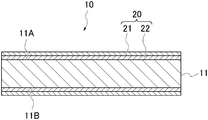
- the fireproof laminate may be a base material 21 and a fireproof laminate 20 provided with a fireproof resin layer 22 on one side of the base material 21 as shown in FIG.
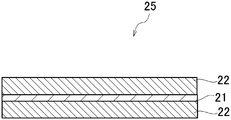
- the base material 21 and the fireproof laminated body 25 in which the fireproof resin layers 22 and 22 are provided on both surfaces of the base material 11 may be used.
- surface of the base material 21 is preferable.
- the refractory resin layer 22 may be directly laminated on the base material 21, or a primer layer, an adhesive layer, or the like formed on the surface of the base material 21 as long as the effect of the present invention is not impaired. It may be laminated on the substrate 21 via, but is preferably laminated directly.
- the softening point or melting point of the substrate is 300 ° C. or higher.
- a fireproof resin layer can express fixed fire resistance and fire extinguishing performance by having a predetermined fireproof additive.
- the base material in the first embodiment has a high softening point or a high melting point, it can effectively function as a support even when ignition occurs and can hold the refractory additive in place. Fire resistance and fire fighting performance are improved.
- each member which comprises a fireproof laminated body is demonstrated in detail.
- the refractory resin layer contains a resin and a refractory additive.
- the refractory additive used in the refractory resin layer is at least one selected from an endothermic agent, a flame retardant, and a thermally expandable layered inorganic substance.
- the refractory resin layer contains a refractory additive so that it has fire resistance and has a fire extinguishing performance that suppresses fire when ignition occurs.
- thermoplastic resins examples include polypropylene resins, polyethylene resins, poly (1-) butene resins, polyolefin resins such as polypentene resins, polyester resins such as polyethylene terephthalate, polystyrene resins, acrylonitrile-butadiene-styrene (ABS) resins, Polyvinyl acetal resin, ethylene vinyl acetate copolymer (EVA) resin, polyvinyl alcohol resin, polycarbonate resin, polyphenylene ether resin, acrylic resin, polyamide resin, polyvinyl chloride resin (PVC), novolac resin, polyurethane resin, polyisobutylene, etc. These synthetic resins are mentioned.
- thermosetting resin examples include synthetic resins such as epoxy resin, urethane resin, phenol resin, urea resin, melamine resin,
- Elastomer resins include acrylonitrile butadiene rubber, ethylene-propylene-diene rubber (EPDM), ethylene-propylene rubber, natural rubber, polybutadiene rubber, polyisoprene rubber, styrene-butadiene block copolymer, hydrogenated styrene-butadiene block copolymer. And hydrogenated styrene-butadiene-styrene block copolymer, hydrogenated styrene-isoprene block copolymer, hydrogenated styrene-isoprene-styrene block copolymer, and the like. In the first embodiment of the present invention, one of these resins may be used alone, or two or more may be mixed and used.
- the resin contained in the fireproof resin layer is preferably a thermoplastic resin.
- a thermoplastic resin is used for the refractory resin layer, the refractory resin layer can be easily formed on the base material by extrusion molding or application of a slurry to be described later.
- thermoplastic resins polyvinyl chloride resin is preferable from the viewpoint of fire resistance, and polyvinyl acetal is preferable from the viewpoint of adhesion to a base material, moldability of a fireproof resin layer, dispersibility of a fireproof additive, and the like.
- Resins, ethylene vinyl acetate copolymer resins, acrylic resins, polyvinyl alcohol resins, and the like are preferable.
- polyvinyl chloride resin, polyvinyl acetal resin, and ethylene vinyl acetate copolymer resin are more preferable, and polyvinyl acetal resin is particularly preferable.
- the polyvinyl acetal resin is not particularly limited as long as it is a polyvinyl acetal resin obtained by acetalizing polyvinyl alcohol with an aldehyde, but a polyvinyl butyral resin is preferable.
- the amount of hydroxyl groups in the polyvinyl acetal resin is preferably 20 to 40 mol%. By making the amount of hydroxyl group 20 mol% or more, the polarity becomes high and the adhesion to the substrate tends to be good. Moreover, it can prevent that a fireproof resin layer becomes hard too much by making the amount of hydroxyl groups into 40 mol% or less.
- the amount of the hydroxyl group is preferably high from the viewpoint of enhancing the adhesion to the substrate, more preferably 23 mol% or more, and even more preferably 26 mol% or more.
- the amount of the hydroxyl group is more preferably 37 mol% or less, and still more preferably 33 mol% or less.
- the degree of acetalization of the polyvinyl acetal resin is preferably 40 to 80 mol%. By setting the degree of acetalization within the above range, it becomes easy to improve the adhesiveness to the substrate by setting the above-mentioned hydroxyl amount within the desired range.
- the degree of acetalization is more preferably 55 mol% or more, further preferably 60 mol% or more, more preferably 75 mol% or less, still more preferably 72 mol% or less.
- the amount of acetyl groups in the polyvinyl acetal resin is preferably 0.1 to 30 mol%.
- the amount of acetyl group is within this range, the moisture resistance is excellent, the compatibility with the plasticizer is excellent, the high flexibility is exhibited, and the handleability is improved. Moreover, it becomes easy to make the adhesiveness to a base material favorable by making the amount of hydroxyl groups mentioned above into a desired range by making the amount of acetyl groups into these ranges. From these viewpoints, the amount of acetyl groups is more preferably 0.2 mol% or more, further preferably 0.5 mol% or more, more preferably 15 mol% or less, and further preferably 7 mol% or less.
- the degree of acetalization, the amount of hydroxyl groups, and the amount of acetyl groups can be measured and calculated by, for example, a method based on JIS K6728 “Testing methods for polyvinyl butyral”.
- the degree of polymerization of the polyvinyl acetal resin is preferably 300 to 4000. By setting the polymerization degree within these ranges, the refractory additive is appropriately dispersed in the refractory resin layer, and the moldability and the like are improved.
- the degree of polymerization is more preferably 400 or more, and still more preferably 600 or more.
- the degree of polymerization of the polyvinyl acetal resin is preferably 2000 or less, more preferably 1500 or less, and still more preferably 1000 or less.
- the polymerization degree of polyvinyl acetal resin means the viscosity average polymerization degree measured based on the method of JISK6728.
- the aldehyde is not particularly limited, but in general, an aldehyde having 1 to 10 carbon atoms is preferably used.
- the aldehyde having 1 to 10 carbon atoms is not particularly limited.
- n-butyraldehyde, n-hexylaldehyde, and n-valeraldehyde are preferable, and n-butyraldehyde is more preferable.
- These aldehydes may be used alone or in combination of two or more.
- the polyvinyl chloride resin may be a vinyl chloride homopolymer or a vinyl chloride copolymer.
- the vinyl chloride copolymer is a copolymer of a monomer having an unsaturated bond copolymerizable with vinyl chloride and vinyl chloride, and contains 50% by mass or more of a structural unit derived from vinyl chloride.
- Examples of monomers having an unsaturated bond copolymerizable with vinyl chloride include vinyl esters such as vinyl acetate and vinyl propionate, acrylic esters such as acrylic acid, methacrylic acid, methyl acrylate, and ethyl acrylate, Examples thereof include methacrylic acid esters such as methyl methacrylate and ethyl methacrylate, olefins such as ethylene and propylene, aromatic vinyl such as acrylonitrile and styrene, and vinylidene chloride.
- the polyvinyl chloride resin may be a polychlorinated vinyl chloride resin obtained by chlorinating a vinyl chloride homopolymer, a vinyl chloride copolymer, or the like.
- a polyvinyl chloride resin may be used individually by 1 type from the above, and may use 2 or more types together.
- the ethylene-vinyl acetate copolymer resin may be a non-crosslinked ethylene-vinyl acetate copolymer resin or a high temperature cross-linked ethylene-vinyl acetate copolymer resin.
- modified ethylene-vinyl acetate resins such as saponified ethylene-vinyl acetate copolymer and hydrolyzate of ethylene-vinyl acetate can also be used.
- the ethylene-vinyl acetate copolymer resin preferably has a vinyl acetate content of 10 to 50% by mass, more preferably 25 to 45% by mass, measured according to JIS K 6730 “Testing method for ethylene / vinyl acetate resin”. .
- the vinyl acetate content By setting the vinyl acetate content to be equal to or higher than these lower limits, the adhesiveness to the substrate is enhanced. Further, by making the vinyl acetate content below these upper limit values, the mechanical strength such as the breaking strength of the refractory resin layer is improved.
- the resin content in the refractory resin composition is, for example, 4% by mass or more based on the total amount of the refractory resin composition.
- the content of the resin is 4% by mass or more, the moldability of the refractory resin composition, the retention performance of the refractory additive by the resin, the dispersibility of the refractory additive in the resin, and the like are improved. It becomes easy to form a fireproof resin layer appropriately.
- the resin content is more preferably 6% by mass or more, and even more preferably 8% by mass or more. .
- the content of the resin is preferably higher, and the content of the resin is more preferably 12% by mass or more.
- the content of the resin is preferably 85% by mass or less, more preferably 50% by mass or less, still more preferably 30% by mass or less, and still more preferably 20% by mass or less.
- the refractory additive is one or more selected from an endothermic agent, a flame retardant, and a thermally expandable layered inorganic substance.
- the refractory additive has fire resistance and exhibits fire extinguishing performance when ignition occurs.
- the refractory additive is dispersed in the resin in the refractory laminate and is retained by the resin.
- the fire-resistant additive preferably contains a heat-absorbing agent from the viewpoint of fire resistance, fire-extinguishing performance, and adhesion to the resin base material.
- Endothermic agent Specific examples of the endothermic agent used for the refractory additive include hydrated metal compounds.
- the hydrated metal compound is a compound that has the effect of decomposing by contact with a flame to generate water vapor and absorbing heat.
- Examples of the hydrated metal compound include metal hydroxides and metal salt hydrates. Specifically, aluminum hydroxide, magnesium hydroxide, calcium hydroxide, calcium-magnesium hydroxide, hydrotalcite, boehmite, talc, dosonite, calcium sulfate hydrate, magnesium sulfate hydrate, boron such as zinc [2ZnO ⁇ 3B 2 O 5 ⁇ 3.5H 2 O] and the like.
- At least one selected from aluminum hydroxide, magnesium hydroxide, calcium sulfate dihydrate, and magnesium sulfate heptahydrate is preferable, and aluminum hydroxide is particularly preferable. Is preferred.
- an endothermic agent having a thermal decomposition starting temperature of 800 ° C. or lower and an endothermic amount of 300 J / g or higher is used. If either the thermal decomposition start temperature or the endothermic amount is out of the above range, it becomes difficult to extinguish the fire quickly when the battery or the like ignites.
- the endothermic agent those having a thermal decomposition starting temperature of 500 ° C. or lower and an endothermic amount of 500 J / g or higher are preferable. When either the thermal decomposition start temperature or the endothermic amount falls within the above range, the fire can be extinguished quickly when the battery or the like ignites.
- the thermal decomposition starting temperature of the endothermic agent is preferably 500 ° C. or lower, more preferably 400 ° C. or lower, further preferably 300 ° C. or lower, and further preferably 250 ° C. or lower.
- the thermal decomposition starting temperature of the endothermic agent is, for example, 50 ° C. or higher, preferably 100 ° C. or higher, more preferably 150 ° C. or higher, and further preferably 180 ° C. or higher.
- the thermal decomposition starting temperature can be measured by a thermogravimetric differential thermal analyzer (TG-DTA), and specifically can be measured by the method described in the examples.
- TG-DTA thermogravimetric differential thermal analyzer
- the endothermic amount of the endothermic agent is preferably 500 J / g or more, more preferably 600 J / g or more, and still more preferably 900 J / g or more. When the endothermic amount of the endothermic agent is within the above range, heat absorbability is improved, and thus fire resistance is further improved.
- the endothermic amount of the endothermic agent is usually 4000 J / g or less, preferably 3000 J / g or less, more preferably 2000 J / g or less.
- the endothermic amount can be measured using a thermogravimetric differential thermal analyzer (TG-DTA), and can be specifically measured by the method described in Examples.
- TG-DTA thermogravimetric differential thermal analyzer
- Examples of the compound having a thermal decomposition starting temperature of 800 ° C. or less and an endothermic amount of 300 J / g or more include the above-mentioned hydrated metal compounds, and more specifically, aluminum hydroxide, magnesium hydroxide, calcium hydroxide. , Calcium sulfate dihydrate, magnesium sulfate heptahydrate, hydrotalcite, zinc borate and the like. These compounds are also endothermic agents having a thermal decomposition starting temperature of 500 ° C. or lower and an endothermic amount of 500 J / g or higher.
- the endothermic agent preferably has an average particle size of 0.1 to 90 ⁇ m.
- the average particle diameter of the endothermic agent is more preferably 0.5 to 60 ⁇ m, further preferably 0.8 to 40 ⁇ m, still more preferably 0.8 to 30 ⁇ m, and particularly preferably 0.8 to 10 ⁇ m.
- the dispersibility of the endothermic agent in the refractory resin composition is improved, and the endothermic agent is uniformly dispersed in the resin, or the blending amount of the endothermic agent in the resin is increased.
- the average particle diameter of the endothermic agent and the flame retardant described later is a median diameter (D50) measured by a laser diffraction / scattering particle size distribution measuring device.
- a phosphorus atom containing compound is mentioned as a flame retardant used for the 1st form of this invention.
- Phosphorus atom-containing compounds include red phosphorus, for example, various phosphate esters such as triphenyl phosphate, tricresyl phosphate, trixylenyl phosphate, cresyl diphenyl phosphate, and xylenyl diphenyl phosphate, sodium phosphate, phosphate Metal phosphates such as potassium and magnesium phosphate, metal phosphites such as sodium phosphite, potassium phosphite, magnesium phosphite, aluminum phosphite, ammonium polyphosphate, the following general formula (1) The phosphorus compound etc. which are represented by these are mentioned. By using these phosphorus-containing compounds, appropriate fire resistance and fire extinguishing performance can be imparted to the fire resistant resin layer.
- a flame retardant may be used individually by these 1 type, and may
- R 1 and R 3 are the same or different and each represents hydrogen, a linear or branched alkyl group having 1 to 16 carbon atoms, or an aryl group having 6 to 16 carbon atoms.
- R 2 represents a hydroxyl group, a linear or branched alkyl group having 1 to 16 carbon atoms, a linear or branched alkoxyl group having 1 to 16 carbon atoms, an aryl group having 6 to 16 carbon atoms, or a carbon number 6 to 16 aryloxy groups are shown.
- Specific examples of the compound represented by the general formula (1) include methylphosphonic acid, dimethyl methylphosphonate, diethyl methylphosphonate, ethylphosphonic acid, n-propylphosphonic acid, n-butylphosphonic acid, 2-methylpropylphosphonic acid.
- T-butylphosphonic acid 2,3-dimethyl-butylphosphonic acid, octylphosphonic acid, phenylphosphonic acid, dioctylphenylphosphonate, dimethylphosphinic acid, methylethylphosphinic acid, methylpropylphosphinic acid, diethylphosphinic acid, dioctylphosphinic acid , Phenylphosphinic acid, diethylphenylphosphinic acid, diphenylphosphinic acid, bis (4-methoxyphenyl) phosphinic acid and the like.
- flame retardants described above one or more selected from phosphoric acid esters, metal phosphites, and ammonium polyphosphates are preferred from the viewpoint of improving the fire resistance and fire extinguishing performance of the fireproof sheet. All of these three components may be used, or two of the three components may be used. By using multiple types of flame retardants, it becomes easy to effectively improve fire resistance and fire extinguishing performance.
- the flame retardant is preferably solid at normal temperature (23 ° C.) and normal pressure (1 atm).
- the average particle size of the flame retardant is preferably 1 to 200 ⁇ m, more preferably 1 to 60 ⁇ m, further preferably 3 to 40 ⁇ m, and still more preferably 5 to 20 ⁇ m.
- the average particle size of the flame retardant is within the above range, the dispersibility of the flame retardant in the refractory resin composition is improved, and the flame retardant is uniformly dispersed in the resin, or the amount of flame retardant added to the resin is increased. You can do it.
- the heat-expandable layered inorganic substance is a conventionally known substance that expands when heated, and examples thereof include vermiculite and heat-expandable graphite. Among them, heat-expandable graphite is preferable.
- the heat-expandable layered inorganic material particles or flakes may be used. Since the heat-expandable layered inorganic material is expanded by heating to form a large-capacity void, it suppresses fire spread or extinguishes when the fireproof laminate is ignited.
- Thermally expandable graphite is a graphite intercalation compound produced by treating natural scale-like graphite, pyrolytic graphite, quiche graphite, and other powders with an inorganic acid and a strong oxidizing agent, and maintains a carbon layered structure. It is a kind of crystalline compound as it is.
- Inorganic acids include concentrated sulfuric acid, nitric acid, selenic acid, and the like.
- strong oxidizing agents include concentrated nitric acid, persulfate, perchloric acid, perchlorate, permanganate, dichromate, dichromate, hydrogen peroxide, and the like.
- the heat-expandable graphite obtained by acid treatment as described above may be further neutralized with ammonia, an aliphatic lower amine, an alkali metal compound, an alkaline earth metal compound, or the like.
- the particle size of the thermally expandable graphite is preferably 20 to 200 mesh. When the particle size of the expandable graphite is within the above range, it becomes easy to expand and create a large-capacity void, so that fire resistance is improved. Moreover, the dispersibility to resin improves.
- the average aspect ratio of the thermally expandable graphite is preferably 2 or more, more preferably 5 or more, and still more preferably 10 or more.
- the upper limit of the average aspect ratio of the thermally expandable graphite is not particularly limited, but is preferably 1,000 or less from the viewpoint of preventing cracking of the thermally expandable graphite.
- the average aspect ratio of the heat-expandable graphite is 2 or more, it becomes easy to expand and create a large-capacity void, so that flame retardancy is improved.
- the average aspect ratio of the thermally expandable graphite was measured for each of the 10 thermally expandable graphites with the maximum dimension (major axis) and the minimum dimension (minor axis), and the maximum dimension (major axis) was divided by the minimum dimension (minor axis).
- the average value is the average aspect ratio.
- the major axis and minor axis of the thermally expandable graphite can be measured using, for example, a field emission scanning electron microscope (FE-SEM).
- the content of the refractory additive in the refractory resin composition is, for example, 50 to 2500 parts by mass with respect to 100 parts by mass of the resin. By setting it as 50 mass parts or more, appropriate fire resistance and fire extinguishing performance can be imparted to the fire resistant laminate. Moreover, when it is 2500 mass parts or less, since a fixed ratio or more resin can be contained in a fireproof resin layer, it becomes possible to disperse
- the content of the refractory additive is preferably 100 parts by mass or more, more preferably 250 parts by mass or more, and still more preferably 400 parts by mass with respect to 100 parts by mass of the resin, from the viewpoint of improving fire resistance and fire extinguishing performance. More than a part.
- the content of the above refractory additive is preferably 2100 parts by mass or less, more preferably 1600 parts by mass or less, and further preferably 1100 parts from the viewpoint of moldability and dispersibility with respect to 100 parts by mass of the resin. From the viewpoint of adhesiveness to the substrate, it is particularly preferably 750 parts by mass or less.
- one of the three components of the endothermic agent, the flame retardant, and the thermally expandable layered inorganic substance may be used alone, or two of these may be used in combination. That is, the endothermic agent and the flame retardant may be used in combination, the flame retardant and the thermally expandable layered inorganic material may be used in combination, or the endothermic agent and the thermally expandable layered inorganic material may be used in combination. Furthermore, you may use all of an endothermic agent, a flame retardant, and a thermally expansible layered inorganic substance.
- a flame retardant in combination with at least one of a thermally expandable layered inorganic material and an endothermic agent, and it is more preferable to use a flame retardant and an endothermic agent in combination.
- the total content of the refractory additives only needs to be within the above range, but the content of at least one of the thermally expandable layered inorganic substance and the endothermic agent may be greater than the content of the flame retardant.
- the content of the flame retardant is 1 to 200 parts by mass with respect to 100 parts by mass of the resin, and the content of at least one of the thermally expandable layered inorganic substance and the endothermic agent is 49 to 2400 parts by mass.
- the content of the flame retardant is preferably 2 to 100 parts by mass, and the content of at least one of the thermally expandable layered inorganic substance and the endothermic agent is 98 to 2000 parts by mass, and more preferably the flame retardant is contained.
- the amount is 5 to 100 parts by mass, and the content of at least one of the thermally expandable layered inorganic substance and the endothermic agent is 240 to 1500 parts by mass.
- the content of the flame retardant is 5 to 50 parts by mass, and the content of at least one of the heat-expandable layered inorganic substance and the endothermic agent is 300 to 1000 parts by mass.
- the content is 5 to 30 parts by mass, and the content of at least one of the thermally expandable layered inorganic substance and the endothermic agent is 380 to 720 parts by mass.
- the fire-resistant resin composition of the first aspect of the present invention may further contain an inorganic filler other than the heat-absorbing agent, the flame retardant, and the thermally expandable layered inorganic material, which are the above-mentioned fire-resistant additives.
- the inorganic filler other than the refractory additive is not particularly limited.
- alumina, zinc oxide, titanium oxide, calcium oxide, magnesium oxide, iron oxide, tin oxide, antimony oxide, ferrite and other metal oxides calcium carbonate
- Metal compounds other than hydrated metal compounds such as glass fiber, aluminum nitride, boron nitride, silicon nitride, carbon black, graphite, carbon fiber, charcoal powder, various metal powders, silicon carbide, stainless steel fibers, various magnetic powders, slag fibers , Fly ash, and dewatered sludge.
- These inorganic fillers may be used alone or in combination of two or more.
- the average particle size of the inorganic filler is preferably 0.5 to 100 ⁇ m, more preferably 1 to 50 ⁇ m.
- the inorganic filler preferably has a small particle size from the viewpoint of improving the dispersibility when the content is small, and when the content is large, the viscosity of the refractory resin composition increases and the moldability increases as the high filling progresses. Since it falls, the thing with a large particle diameter is preferable.
- the refractory resin composition of the first aspect of the present invention contains an inorganic filler other than the refractory additive
- the content thereof is preferably 10 to 300 parts by weight, more preferably 100 parts by weight of the resin. Is 10 to 200 parts by mass.
- the content of the inorganic filler is within the above range, the mechanical properties of the refractory resin layer can be improved.
- the fireproof resin composition of the first aspect of the present invention may further contain a plasticizer.
- a plasticizer when the resin component is a polyvinyl chloride resin or a polyvinyl acetal resin, it is preferable to include a plasticizer from the viewpoint of improving moldability and the like.
- a plasticizer will not be specifically limited if it is a plasticizer generally used together with a polyvinyl chloride resin or a polyvinyl acetal resin.
- phthalate plasticizers such as di-2-ethylhexyl phthalate (DOP), dibutyl phthalate (DBP), diheptyl phthalate (DHP), diisodecyl phthalate (DIDP), di-2-ethylhexyl adipate ( DOA), fatty acid ester plasticizers such as diisobutyl adipate (DIBA), dibutyl adipate (DBA), epoxidized ester plasticizers such as epoxidized soybean oil, adipic acid ester plasticizers such as adipic acid ester and adipic acid polyester, Tree 2 -Trimellitic acid ester plasticizers such as ethylhexyl trimellitate (TOTM) and triisononyl trimellitate (TINTM), and process oils such as mineral oil.
- DOP di-2-ethylhexyl phthalate
- DBP dibutyl phthalate
- DHP
- a plasticizer may be used individually by 1 type, or may be used in combination of 2 or more type.
- the content of the plasticizer is preferably 1 to 60 parts by mass, more preferably 5 to 50 parts by mass with respect to 100 parts by mass of the resin. More preferred is 10 to 40 parts by mass. If the content of the plasticizer is within the above range, the moldability tends to be improved, and the fire-resistant resin layer can be prevented from becoming too soft.
- the fireproof resin composition according to the first aspect of the present invention can contain additional components other than those described above as necessary within a range that does not impair the object of the present invention.
- the kind of the additive component is not particularly limited, and various additives can be used. Examples of such additives include lubricants, shrinkage inhibitors, crystal nucleating agents, colorants (pigments, dyes, etc.), ultraviolet absorbers, antioxidants, antioxidants, flame retardants, antistatic agents, interfaces. An activator, a vulcanizing agent, a dispersing agent, a surface treatment agent and the like can be mentioned.
- the addition amount of the additive can be appropriately selected within a range that does not impair the moldability and the like, and the additive may be used alone or in combination of two or more.
- the fireproof resin layer may have a hole communicating with the hole of the base material when the base material has a hole as in the second embodiment to be described later.
- the thickness of the refractory resin layer is, for example, 2 to 5000 ⁇ m, preferably 10 to 2000 ⁇ m, more preferably 20 to 500 ⁇ m, and further preferably 35 to 150 ⁇ m.
- the “thickness” of the fireproof resin layer (fireproof sheet) in this specification refers to an average thickness of three points in the width direction of the fireproof sheet.
- the thickness of the fireproof laminate is prevented from becoming unnecessarily thick, and it is easy to apply to a small battery used in a mobile device such as a mobile phone or a smartphone.
- the thickness of an above-mentioned fireproof resin layer is the thickness of each fireproof resin layer, when it provides in both surfaces of a base material.
- a substrate having a softening point or melting point of 300 ° C. or higher is used as the substrate.
- the softening point or melting point of the base material is preferably 450 ° C. or higher, more preferably 600 ° C. or higher, further preferably 850 ° C. or higher, and particularly preferably 1400 ° C. or higher, from the viewpoint of further improving fire resistance and fire extinguishing performance. preferable.
- the higher the softening point or melting point of the base material the better.
- the substrate is formed of a resin, metal, inorganic material other than metal, or a composite thereof, among which metal is preferable.
- a film, foil, etc. may be sufficient and cloth, a mesh, etc. may be sufficient. Accordingly, for example, resin films, metal foils, metal cloths, metal meshes, organic fiber cloths, cloths of inorganic materials other than metals (inorganic fiber cloths), and the like can be mentioned.
- polyamideimide resin films polyimide resin films, polyimide resin films, polybenzimidazole (PBI) resin films, polyetheretherketone (PEEK) resin films, polytetrafluoroethylene (PTFE) resin films, polyphenylene sulfide resin films, these resins
- PBI polybenzimidazole
- PEEK polyetheretherketone
- PTFE polytetrafluoroethylene
- polyphenylene sulfide resin films these resins
- the resin film containing 2 or more types of these is mentioned, In these, a polyimide resin film is preferable.
- a polyimide resin film the adhesiveness with the fireproof resin layer tends to be good.
- the polyimide resin film has high heat resistance, it easily functions effectively as a support even during ignition.
- Examples of the metal include zinc, gold, silver, chromium, titanium, iron, aluminum, copper, nickel, tantalum or alloys containing these, and examples of the alloy include stainless steel such as SUS, brass, beryllium copper, and Inconel. . These metals may be used individually by 1 type, and may use 2 or more types together. These metals may be a metal cloth, a metal mesh, or a metal foil. The metal foil may have a plurality of holes formed by punching or the like. A metal mesh or a punched metal foil can exhibit a function as a support effectively while being lightweight.
- cloth includes inorganic fiber cloth such as glass fiber cloth and carbon fiber cloth, aramid fiber cloth, PBO (polyparaphenylene benzoxazole) fiber cloth, polyimide fiber cloth, PEEK fiber cloth, PBI fiber. It may be an organic fiber cloth such as a cloth, or a cloth containing two or more selected from these inorganic fibers and organic fibers.
- the cloth may be a woven fabric, a knitted fabric, or a non-woven fabric.
- inorganic materials other than metals such as metal bases, glass fiber cloths, metal substrates, metal foils, metal meshes, metal cloths, etc.
- a fiber cloth, a resin film and the like are preferable, and among them, a metal substrate, particularly a metal foil is preferable.
- the metal is preferably one or more selected from copper, aluminum, stainless steel, and nickel. Among them, 1 is selected from stainless steel and nickel in order to increase the tensile strength and effectively improve the support function. More than species are more preferred.
- the inorganic fiber cloth is preferably a glass fiber cloth
- the resin film is preferably a polyimide resin film.
- the ratio of the thickness of the refractory resin layer to the thickness of the substrate is not particularly limited, but is preferably 2/8 to 9/1, more preferably 3/7 to 7/1. More preferably, it is 6 to 6/1.
- the thickness ratio is within the above range, the balance of the thickness of the fire-resistant laminate and the base material becomes good, and good fire resistance and fire-extinguishing performance can be obtained without increasing the thickness of the fire-resistant laminate more than necessary. Can do.
- the thickness of the substrate is not particularly limited, but is preferably 2 to 1000 ⁇ m, preferably 5 to 500 ⁇ m, more preferably 8 to 200 ⁇ m, and further preferably 12 to 90 ⁇ m.
- the thickness is not particularly limited, but is preferably 2 to 1000 ⁇ m, preferably 5 to 500 ⁇ m, more preferably 8 to 200 ⁇ m, and further preferably 12 to 90 ⁇ m.
- the base material preferably has a tensile strength at 200 ° C. of 3 GPa or more.
- the tensile strength at 200 ° C. is 3 GPa or more, the base material can sufficiently function as a support when the refractory laminate is ignited or heated to a high temperature.
- the tensile strength is more preferably 8 GPa or more, further preferably 40 GPa or more, and still more preferably 50 GPa or more.
- the upper limit value of the tensile strength is not particularly limited, but is, for example, 1000 GPa and practically 500 GPa.
- the tensile strength at 200 ° C. of the base material is measured at a tensile speed of 20 mm / min using an autograph in accordance with JIS7113.
- the softening point or melting point of the base material is measured differently depending on the material used.
- the softening point is measured by a thermomechanical analyzer (TMA). Means a point. Specifically, using a “TMA-6000” manufactured by Seiko Instruments Inc., a 30 ⁇ m-thick film was prepared, a sample cut into 3 mm ⁇ 15 mm was set in the apparatus, heated at 5 ° C./min, and 5 g
- the softening point is defined as the temperature at which displacement begins while applying a load of.
- a base material when a base material is formed with inorganic materials, such as a metal, it means melting
- DSC differential scanning calorimetry
- LABSYS EVO manufactured by Cetaram Instruments Co., Ltd. is used and heated under an argon atmosphere at 20 ° C./min, and the temperature at which an endothermic peak is observed is defined as the melting point.
- the substrate is formed of a composite material of an organic material and an inorganic material, it is measured by the DSC, and when two peaks are observed, it is measured by the differential scanning calorimetry (DSC). Of these, the higher melting point is meant.
- a material that does not have a melting point or a softening point (that is, a material in which a softening point or the like is not measured in the above method) is decomposed when measured by the above-mentioned differential scanning calorimetry (DSC).
- the decomposition temperature is the melting point or softening point.
- a substrate having one or more holes is used as the substrate.
- the fireproof laminated body of the 2nd form of this invention is equipped with the base material and the fireproof resin layer provided in at least one surface of a base material similarly to the 1st form.
- the substrate has one or more holes, and the opening ratio of the substrate is selected in the range of 5 to 60%.
- a fireproof resin layer can express fixed fire resistance and fire extinguishing performance by having a predetermined fireproof additive.
- the base material with which the fireproof laminated body of this invention is provided has a hole.
- the flames ejected from the battery can be efficiently dispersed by the holes provided in the base material, and the momentum of the flame can be reduced.
- the opening ratio of the base material is 5 to 60%, the preferable opening ratio is 7 to 58%, and the more preferable opening ratio is 8 to 55%. If the opening ratio is less than 5%, water vapor generated by contact between the endothermic agent and the flame cannot be efficiently dispersed from the holes, and the flame ejected from the battery cannot be efficiently dispersed to reduce the flame momentum. On the other hand, if the opening ratio is larger than 60%, the base material cannot support the fireproof resin layer when the flame is ejected from the battery.
- the opening ratio of the base material with which the fireproof laminate of the present invention is provided is the ratio of the area of the holes to the area of the whole base material including the holes when the base material is viewed in plan.
- the shape and arrangement of the holes provided in the substrate are not limited to specific ones. As long as the opening ratio of the substrate is 5 to 60%, holes having an arbitrary shape are arbitrarily arranged.
- the circular holes 3 may be regularly arranged in the substrate 21, and the circular holes 3 are irregularly formed as shown in FIG. It may be arranged.
- the square holes 3 may be regularly arranged, and as shown in FIG. 3D, a mesh-like hole may be arranged.
- the hole 3 provided in the base material 21 will not be specifically limited if it is formed so that a base material may be penetrated, The hole formed by punching etc. in metal foil, cloth, etc. may be sufficient.
- the hole comprised by the clearance gap formed between the wire which comprises a mesh may be sufficient, and in the cloth, the hole comprised by the clearance gap formed between fibers But you can.
- the inside of the hole 3 provided in the base material 21 may be completely closed by the fireproof resin layer 22, and although not shown, a part of the inside of the hole is provided. May be blocked by the fireproof resin layer 22.
- the hole 3 provided in the base material 21 is covered with the fireproof resin layer 22, but the inside may not be blocked by the fireproof resin layer 22.
- a hole 3 ′ communicating with the base material 21 and the fireproof resin layer 22 may be provided.
- the substrate is the same as the first embodiment described above. However, in the second embodiment, the substrate may be a substrate other than one having a softening point or a melting point of 300 ° C. or higher. Good.
- the fire-resistant laminates of the first and second embodiments of the present invention are manufactured by forming a fire-resistant resin layer on one or both sides of a base material by extrusion molding of the fire-resistant resin composition. Can do.
- the fire-resistant laminate of the present invention is applied on one side or both sides of the substrate by applying the diluted solution of the refractory resin composition diluted with a solvent to one side or both sides of the substrate and drying.
- the sheet-like refractory resin composition may be formed by, for example, extrusion molding on a release sheet, or a diluted solution of the refractory resin composition is applied on the release sheet and dried. You may shape
- you may form a refractory resin layer on both surfaces of a base material you may form a refractory resin layer simultaneously on both surfaces, and you may form a refractory resin layer in order one by one.
- the resin is usually a thermoplastic resin, preferably a polyvinyl acetal resin.
- the refractory resin composition is obtained by mixing a resin, a refractory additive, and optional components using a known mixing device such as a bead mill, a ball mill, a Banbury mixer, a kneader mixer, a kneading roll, a lycaic machine, and a planetary stirrer. can get. Further, when the refractory resin composition is diluted with a solvent, the diluted solution of the refractory resin composition may be obtained by further adding a solvent and mixing them using the above mixing apparatus.
- a known mixing device such as a bead mill, a ball mill, a Banbury mixer, a kneader mixer, a kneading roll, a lycaic machine, and a planetary stirrer.
- the solvent used for diluting the refractory resin composition is not particularly limited, but is an aliphatic hydrocarbon solvent such as n-pentane, n-hexane, n-heptane and cyclohexane, and an aromatic hydrocarbon solvent such as toluene.
- the solvent include ester solvents such as ethyl acetate and n-butyl acetate, ketone solvents such as acetone and methyl ethyl ketone (MEK), and alcohol solvents such as ethanol, isopropyl alcohol, and butanol.
- the resin is usually dissolved in a solvent, and the refractory additive is dispersed in the solvent to form a slurry.
- a slurry for example, first, an inorganic powder containing a solvent, a dispersant, and an endothermic material is stirred by a dispersion mixer such as a bead mill to prepare an inorganic dispersion. Thereafter, a resin solution previously dissolved in a solvent is added to the inorganic dispersion, and the mixture is further stirred by the dispersion mixer to prepare a diluted solution of the refractory resin composition.
- the solid content concentration in the diluted solution of the refractory resin composition is, for example, 30 to 70% by mass, preferably 35 to 65% by mass, and more preferably 40 to 60% by mass.
- a resin composition layer can be efficiently formed as solid content concentration is more than a lower limit. Moreover, by setting it as the said upper limit or less, it becomes easy to dissolve resin in a solvent and disperse
- the base material laminated with the fireproof resin composition is previously provided with holes so that the opening ratio is 5 to 60%. .
- the hole provided in the base material is completely filled with the refractory resin composition, or a part thereof is filled with the refractory resin composition.
- the holes communicating with the base material and the fireproof resin composition by punching or the like are used. May be provided. In that case, the hole provided in the base material is not filled with the refractory resin composition.
- the fireproof laminate of each aspect of the present invention may include an adhesive material.
- the adhesive may be provided on the other surface of the base material or may be provided on the fireproof resin layer. It is preferable to be provided.
- the fireproof laminate is arranged in the order of the fireproof resin layer and the base material from the battery side when the laminate is attached to the battery via the adhesive material. Such an arrangement facilitates enhancing fire extinguishing performance as will be described later.
- the adhesive may be provided on one fireproof resin layer or on both fireproof resin layers. It is preferable to be provided on the resin layer.
- the pressure-sensitive adhesive material may be composed of a pressure-sensitive adhesive layer, or may be a double-sided pressure-sensitive adhesive tape in which pressure-sensitive adhesive layers are provided on both surfaces of the substrate, but is preferably composed of a pressure-sensitive adhesive layer.
- a double-sided adhesive tape will be laminated
- an adhesive which comprises an adhesive layer For example, although an acrylic adhesive, a urethane type adhesive, a rubber-type adhesive, etc. are mentioned, it is not limited to these.
- the thickness of the adhesive material is not particularly limited, but is, for example, 3 to 500 ⁇ m, preferably 10 to 200 ⁇ m.
- the base material used for a double-sided adhesive tape is good to use the well-known base material used for double-sided adhesive tapes, such as a resin film and a nonwoven fabric.
- the fireproof laminated body of each form of this invention is used for a battery.
- the battery usually has at least one battery cell, and a refractory laminate may be disposed on the surface of the battery cell.
- a fireproof resin layer is orient
- the refractory resin layer is directed to the battery cell, so that when the battery cell ignites, the fire can be quickly extinguished by the refractory resin layer.
- the battery may have one battery cell or two or more battery cells.
- the battery cell refers to a structural unit of a battery in which a positive electrode material, a negative electrode material, a separator, a positive electrode terminal, a negative electrode terminal, and the like are accommodated in an exterior member.
- Battery cells are classified into cylindrical, square, and laminate types depending on the cell shape.
- a positive electrode material, a negative electrode material, a separator, a positive electrode terminal, a negative electrode terminal, an insulating material, a safety valve, a gasket, a positive electrode cap, and the like indicate a structural unit of a battery housed in an outer can.
- the battery cell when the battery cell is square, it refers to a structural unit of a battery in which a positive electrode material, a negative electrode material, a separator, a positive electrode terminal, a negative electrode terminal, an insulating material, a safety valve, and the like are accommodated in an outer can.
- the battery unit When the battery cell is a laminate type, the battery unit includes a positive electrode material, a negative electrode material, a separator, a positive electrode terminal, a negative electrode terminal, and the like housed in an exterior film.
- a single exterior film is folded in two, for example, between two exterior films, and a positive electrode material, a negative electrode material, a separator, a positive electrode terminal, And a negative electrode terminal or the like are disposed, and the outer edge portion of the exterior film is pressure-bonded by heat sealing.
- the exterior film include an aluminum film on which a polyethylene terephthalate film is laminated.
- Battery cells include lithium ion batteries, lithium ion polymer batteries, nickel / hydrogen batteries, lithium / sulfur batteries, nickel / cadmium batteries, nickel / iron batteries, nickel / zinc batteries, sodium / sulfur batteries, lead storage batteries, air batteries Among these, lithium ion batteries are preferable.
- the battery is used in, for example, small electronic devices such as mobile phones and smartphones, notebook computers, automobiles, and the like, but is not limited thereto.
- the refractory laminate may be provided on any surface of the battery cell, but covers the surface of most of the battery cells (for example, 40% or more, preferably 50% or more, more preferably 70% or more of the surface area). It is preferable.
- the fire-resistant laminate covers most of the surface, so that it is easy to extinguish quickly against the ignition of the battery cell.
- the battery cell often has a safety valve, but when it has a safety valve, it is preferable that the battery cell is provided so as to cover the safety valve with a fireproof laminate. At this time, in order to ensure the function of the safety valve, the fireproof laminate is preferably covered so as not to seal the safety valve.
- the heat-sealed portion to be pressure-bonded by heat-sealing is provided so as to be covered with the fireproof laminate. Since battery cells often ignite from a safety valve or a heat seal part, covering them with a refractory laminate makes it easier to extinguish more effectively than ignition of a battery cell. Furthermore, when a fireproof laminated body has many surface of most battery cells and has a safety valve or a heat seal part, it is more preferable to arrange
- the refractory laminate may be arranged so as to be wound around a battery cell.
- the refractory laminate 20 is arranged so that the outer peripheral surface of the battery cell 11 is wound around, for example, the main surfaces 11A and 11B of the battery cell 11, It is preferable to be disposed on the end faces 11C and 11D.
- the main surfaces 11A and 11B are both surfaces having the largest area in the rectangular battery cell 11, and the end surfaces 11C and 11D are end surfaces that connect the main surfaces 11A and 11B.
- the fireproof laminate 20 covers the safety valve of the battery cell 11 also in the configuration of FIG.
- the fireproof laminate 20 may be provided only on both the main surfaces 11A and 11B. Furthermore, it may be provided on only one of the main surfaces 11A and 11B.
- the refractory laminate 20 may be provided so as to cover both surfaces 11X and 11Y of the battery cell 11, for example.
- the fireproof laminate 20 may be arranged so as to cover the heat seal portion 11Z.
- the fireproof laminate 20 may be provided so as to cover only the one surface 11X.
- the fireproof laminate 20 may be arranged so as to wind the outer peripheral surface of the battery cell 11.
- the fireproof laminate 20 may be arranged so as to be wound around the outer peripheral surface of the battery cell 11.
- the refractory laminate 20 is arranged with the refractory resin layer 22 side facing the surface of the battery cell 11, so that the refractory resin layer 22 and the base material 21 are arranged in this order from the battery cell 11. It is preferred that With this arrangement, when the battery cell 11 is ignited, the refractory resin layer 22 can quickly extinguish the ignition. Further, the refractory laminate 20 may be bonded to the battery cell 11 via an adhesive material provided on one surface of the refractory laminate 20. That is, you may attach to the battery cell 11 through the adhesive material arrange
- the fire-resistant laminate 25 in which the fire-resistant resin layers 22 and 22 are provided on both surfaces of the base material 21 is formed of the battery cells 11 and 11. It is preferable to arrange between them.
- each refractory resin layer 22 of the refractory laminate 25 may be disposed toward each battery cell 11. That is, the battery cell 11, the fireproof resin layer 22, the base material 21, the fireproof resin layer 22, and the battery cell 11 are arranged in this order. According to such a configuration, even if one battery cell 11 is ignited due to thermal runaway, it is effectively extinguished by the refractory laminate 25, so that adjacent battery cells 11 ignite in a chained manner. Can be prevented.
- the battery shown in FIG. 9 schematically shows only two battery cells 11, but three or more battery cells may be provided. In that case, between the battery cells 11 and 11, the fireproof laminated body 25 is good to arrange
- the batteries shown in FIGS. 5 to 9 are merely examples of the structure of the battery, and various modes can be adopted.
- a refractory laminate 20 in which a refractory resin layer 22 is provided on one side may be used.
- the some battery cell 11 shown in FIG. 9 showed the structure which is the square-shaped battery cell 11, it is not limited to such a structure, A laminate-type battery cell etc. may be sufficient.
- the battery according to one embodiment of the present invention is obtained by covering a battery cell with a fireproof laminate including a base material and a fireproof resin layer provided on at least one surface of the base material.
- the battery has a battery cell coverage of 40 to 95% with a base material.
- a coverage means the ratio by which the part of the surface of a battery cell is coat
- a hole is provided in the base material, and a portion where the surface of the battery cell is not covered with the base material by the hole is a portion not covered with the base material.
- the portion where the refractory laminate is not provided on the surface of the battery cell is also a portion not covered with the base material.
- the preferable coverage is 45 to 90%, and the more preferable coverage is 50 to 85%.
- the coverage is less than 40%, the fireproof resin layer is not sufficiently supported by the base material, or the battery cell is not sufficiently covered with the fireproof laminate, and the fireproof laminate having high fire resistance and fire extinguishing performance is obtained. The function is not demonstrated.
- the coverage exceeds 95%, water vapor generated by the contact between the endothermic agent and the flame cannot be efficiently dispersed, and the flame ejected from the battery cannot be efficiently dispersed to reduce the flame momentum.
- the refractory laminate used for the battery having the above-described coverage of the present invention within a predetermined range may be the refractory laminate of the second embodiment of the present invention, and the opening ratio is larger than 0% and 5 It may be a refractory laminate comprising a substrate having pores that are less than%.
- the fire-resistant laminate may be a fire-resistant laminate including a base material having an opening ratio of 0%, that is, a fire-resistant laminate having no holes.
- the base material having an opening ratio larger than 0% is the same as the above-described fireproof laminate of the second embodiment of the present invention except for the aperture ratio, and the fireproof laminate having no holes is a base. Except that the material is not provided with holes, it is the same as the fireproof laminate of the second embodiment of the present invention, and the description thereof is omitted.
- the battery may be disposed on the surface of various battery cells as illustrated in FIGS. Since the arrangement method is as described above, the description thereof is omitted. Further, in a battery having an aspect in which the coverage is within a predetermined range, for example, when the battery cell 11 is square as shown in FIG. May be. Although not shown, the number of corners where the refractory laminate 20 of square battery cells is not provided may be one, two, or three. From the viewpoint of efficient dispersion of water vapor or the like generated by contact between the endothermic agent and the flame, it is preferable that the refractory laminate 20 is provided at a portion other than the four corners of the battery cell 11.
- the base material 21 may or may not have holes as described above. Good. However, in a battery whose coverage is within a predetermined range, it is preferable that the base material 21 has a hole from the viewpoint that flammable gas can be efficiently released to the outside and ignition can be suppressed by the fireproof resin layer 22. Moreover, when the base material 21 does not have a hole, the battery cell may be partially covered with the fireproof resin layer 20 (that is, the base material 21).
- the fireproof laminate 20 is disposed with the fireproof resin layer 22 side facing the surface of the battery cell 11.
- the materials 21 are preferably arranged in this order. With this arrangement, when the battery cell 11 is ignited, the refractory resin layer 22 can quickly extinguish the ignition. Further, even in a battery having an aspect in which the coverage is within a predetermined range, the refractory laminate 20 may be bonded to the battery cell 11 via an adhesive material provided on one surface of the refractory laminate 20. That is, you may attach to the battery cell 11 through the adhesive material arrange
- the batteries shown in FIGS. 5 to 8 and 10 are merely examples of the configuration of the battery even in a mode in which the coverage is within a predetermined range, and various modes can be adopted. Further, when the battery cell is covered with the fireproof laminate of the present invention, the holes provided in the base material and the holes provided in communication with the base material and the fireproof resin layer are illustrated in FIGS. Absent.
- the fireproof laminated body of each form of this invention can also be used as an exterior film which comprises a battery cell.
- the exterior film is configured by laminating a base material layer, a barrier layer, and a sealant layer in this order via an adhesive layer as necessary.
- a base material layer is a layer which forms the outermost layer of an exterior film, and insulation is requested
- the barrier layer is provided to improve the strength of the exterior film and to prevent the entry of water vapor, oxygen, light, etc. into the battery.
- metal foil or inorganic compounds such as aluminum, stainless steel, and titanium are vapor deposited.
- the sealant layer is located in the innermost layer of the exterior film, and is provided for sealing each member accommodated by heat-sealing the sealant layers.
- the fire-resistant resin layer is disposed between the base material layer and the barrier layer, between the barrier layer and the sealant layer, or a combination thereof. can do.
- the refractory laminate of each embodiment of the present invention is disposed between the base material layer and the barrier layer, between the barrier layer and the sealant layer, on the outer layer side of the base material layer, or a combination thereof, and is packaged.
- a film can also be constructed.
- the refractory resin composition according to the third aspect of the present invention is a refractory resin composition comprising an endothermic agent and a resin, wherein the thermal decomposition starting temperature of the endothermic agent is 800 ° C. or less, and the endothermic amount is 300 J / g or more.
- the refractory resin composition has a resin content of 1 to 20 parts by mass with respect to 100 parts by mass of the endothermic agent. Since the endothermic agent used in the third embodiment of the present invention has the specific thermal decomposition start temperature described above, it can be quickly decomposed at the time of ignition and can be extinguished quickly.
- the endothermic agent has the above-mentioned specific endothermic amount
- the heat absorbing agent has good heat absorbability, and fire resistance and fire extinguishing performance are good.
- a fire resistant resin composition capable of providing a fire resistant sheet and a fire resistant resin layer excellent in the balance between mechanical strength, fire resistance and fire extinguishing performance is obtained. be able to.
- thermoplastic resins are preferable from the viewpoint of improving the mechanical strength of the fireproof sheet and the fireproof resin layer.
- thermoplastic resins at least one selected from the group consisting of polyvinyl acetal resin, polyvinyl alcohol resin, acrylic resin, and ethylene-vinyl acetate copolymer resin from the viewpoint of further improving the mechanical strength of the fireproof sheet.
- polyvinyl acetal resin is more preferable.
- a resin having a solubility parameter (SP value) of 9 or more as the resin contained in the refractory resin composition.
- SP value solubility parameter
- the mechanical strength of the fireproof sheet or fireproof resin layer formed from the fireproof resin composition is easily improved.
- a resin having an SP value of 9 or more is used and a hydrated metal compound is used as the endothermic agent, the mechanical strength of the fireproof sheet or fireproof resin layer is further increased. This is because the hydrated metal compound has a relatively high polarity, so the compatibility with the resin having an SP value of 9 or more is good, and the dispersibility between the resin and the hydrated metal compound is increased.
- the mechanical strength of the formed fireproof sheet or fireproof resin layer is improved.
- the dispersibility of the hydrated metal compound is increased, whereby the content of the endothermic agent in the refractory resin composition can be relatively increased.
- the SP value of the resin contained in the refractory resin composition is more preferably 10 or more, and preferably 15 or less, more preferably 13 or less.
- the resin suitably used as the resin having an SP value of 9 or more is a thermoplastic resin, and examples thereof include a polyvinyl acetal resin, a polyvinyl alcohol resin, an acrylic resin, and an ethylene-vinyl acetate copolymer resin.
- the SP value is a value measured by the Fedors method.
- 1 type may be used independently among resin, or 2 or more types may be mixed and used for it.
- each resin suitably used in the third embodiment will be described in more detail.
- the polyvinyl acetal resin is not particularly limited as long as it is a polyvinyl acetal resin obtained by acetalizing polyvinyl alcohol with an aldehyde, but a polyvinyl butyral resin is preferable.
- a polyvinyl butyral resin By using polyvinyl butyral, it is possible to increase the mechanical strength even when the amount of resin relative to the endothermic agent is relatively small. Therefore, even if the thickness of the fireproof sheet or fireproof resin layer is reduced, a certain mechanical strength can be ensured.
- the amount of hydroxyl groups in the polyvinyl acetal resin is preferably 20 to 40 mol%.
- the amount of hydroxyl group 20 mol% or more By making the amount of hydroxyl group 20 mol% or more, the polarity of the polyvinyl acetal resin is increased, the binding force with the endothermic agent is increased, and the mechanical strength of the refractory sheet or the refractory resin layer formed from the refractory resin composition is increased. It becomes easy to improve. Moreover, it can prevent that a fireproof sheet or a fireproof resin layer becomes too hard because the amount of hydroxyl groups shall be 40 mol% or less.
- the amount of the hydroxyl group is more preferably 23 mol% or more, and further preferably 26 mol% or more.
- the amount of the hydroxyl group is more preferably 37 mol% or less, and still more preferably 35 mol% or less.
- the degree of acetalization of the polyvinyl acetal resin is preferably 40 to 80 mol%. By setting the degree of acetalization within the above range, the mechanical strength of the refractory sheet or the refractory resin layer is easily improved with the above-mentioned hydroxyl group amount within the desired range.
- the degree of acetalization is more preferably 55 mol% or more, further preferably 65 mol% or more, and more preferably 76 mol% or less.
- the amount of acetyl groups in the polyvinyl acetal resin is preferably 0.1 to 30 mol%.
- the amount of acetyl group is more preferably 0.2 mol% or more, further preferably 0.5 mol% or more, more preferably 15 mol% or less, and further preferably 7 mol% or less.
- the degree of acetalization, the amount of hydroxyl groups, and the amount of acetyl groups can be measured and calculated by, for example, a method based on JIS K6728 “Testing methods for polyvinyl butyral”.
- the degree of polymerization of the polyvinyl acetal resin is preferably 200 to 3000. By setting the degree of polymerization within these ranges, the endothermic agent can be appropriately dispersed in the fireproof sheet.
- the degree of polymerization is more preferably 250 or more, and still more preferably 300 or more.
- the degree of polymerization of the polyvinyl acetal resin is lowered, the viscosity is lowered, the heat absorbing agent is easily dispersed in the fireproof sheet or fireproof resin layer, and the mechanical strength of the fireproof sheet or fireproof resin layer is improved. From such a viewpoint, the degree of polymerization of the polyvinyl acetal resin is preferably 2000 or less, more preferably 1500 or less, and still more preferably 1000 or less.
- the polymerization degree of polyvinyl acetal resin means the viscosity average polymerization degree measured based on the method of JISK6728.
- the 10 mass% ethanol / toluene viscosity of the polyvinyl acetal resin is preferably 5 mPa ⁇ s or more, more preferably 10 mPa ⁇ s or more, and further preferably 15 mPa ⁇ s or more. Further, the 10 mass% ethanol / toluene viscosity is preferably 500 mPa ⁇ s or less, more preferably 300 mPa ⁇ s or less, and further preferably 200 mPa ⁇ s or less.
- 10 mass% ethanol / toluene viscosity is the value measured as follows. 150 ml of a mixed solvent of ethanol / toluene (1: 1 by weight) is placed in an Erlenmeyer flask, and a weighed sample is added thereto, the resin concentration is 10 wt%, and it is dissolved by shaking in a constant temperature room at 20 ° C. The solution is kept at 20 ° C., and the viscosity is measured using a BM type viscometer to obtain a 10 mass% ethanol / toluene viscosity.
- the aldehyde is not particularly limited, but in general, an aldehyde having 1 to 10 carbon atoms is preferably used.
- the aldehyde having 1 to 10 carbon atoms is not particularly limited.
- n-butyraldehyde, n-hexylaldehyde, and n-valeraldehyde are preferable, and n-butyraldehyde is more preferable.
- These aldehydes may be used alone or in combination of two or more.
- the polyvinyl alcohol resin is obtained by polymerizing a vinyl ester to obtain a polymer according to a conventionally known method, and then saponifying the polymer, that is, hydrolyzing the polymer.
- the vinyl ester include vinyl acetate, vinyl formate, vinyl propionate, vinyl butyrate, vinyl pivalate, vinyl versatate, vinyl laurate, vinyl stearate and vinyl benzoate.
- the saponification degree of the polyvinyl alcohol resin is preferably 80 to 99.9 mol%, more preferably 85 to 99 mol%.
- the degree of saponification is in such a range, the dispersibility with the endothermic agent is improved by increasing the polarity of the polyvinyl alcohol resin, and the mechanical strength of the fireproof sheet or fireproof resin layer formed by the fireproof resin composition is increased. It becomes easy to improve.
- the saponification degree is measured according to JIS K6726. The saponification degree indicates the proportion of units that are actually saponified to vinyl alcohol units among the units converted to vinyl alcohol units by saponification.
- the degree of polymerization of the polyvinyl alcohol resin is not particularly limited, but is preferably 400 or more, more preferably 500 or more, and still more preferably 700 or more. Moreover, it is preferably 2000 or less, more preferably 1500 or less, and still more preferably 1000 or less. By setting the degree of polymerization within these ranges, the endothermic agent can be appropriately dispersed in the fireproof sheet or fireproof resin layer, and the mechanical strength of the fireproof sheet or fireproof resin layer is improved.
- the degree of polymerization is measured according to JIS K6726.
- the viscosity of a 4% by mass aqueous solution of the polyvinyl alcohol resin is preferably 8 mPa ⁇ s or more, more preferably 10 mPa ⁇ s or more, and further preferably 12 mPa ⁇ s or more.
- the viscosity of the 4% by mass aqueous solution is preferably 25 mPa ⁇ s or less, more preferably 20 mPa ⁇ s or less, and still more preferably 16 mPa ⁇ s or less.
- aqueous solution viscosity By adjusting the viscosity of the 4% by weight aqueous solution of the polyvinyl alcohol resin as described above, the endothermic agent is easily dispersed in the refractory sheet, and the mechanical strength of the refractory sheet is improved.
- 4 mass% aqueous solution viscosity can be measured according to JISK6726 at 20 degreeC.
- the ethylene-vinyl acetate copolymer resin may be a non-crosslinked ethylene-vinyl acetate copolymer resin or a high temperature cross-linked ethylene-vinyl acetate copolymer resin.
- modified ethylene-vinyl acetate resins such as a saponified ethylene-vinyl acetate copolymer and a hydrolyzate of ethylene-vinyl acetate can also be used.
- the ethylene-vinyl acetate copolymer resin preferably has a vinyl acetate content of 10 to 50% by mass, more preferably 25 to 45% by mass, measured according to JIS K 6730 “Testing method for ethylene / vinyl acetate resin”. . Adhesiveness to the base material mentioned later becomes high by making vinyl acetate content more than these lower limits. Moreover, the mechanical strength of a fireproof sheet or a fireproof resin layer becomes favorable by making a vinyl acetate content below these upper limits.
- the weight average molecular weight of the ethylene-vinyl acetate copolymer resin is preferably from 5,000 to 200,000, more preferably from 10,000 to 150,000.
- the weight average molecular weight is a standard polystyrene equivalent weight average molecular weight measured by gel permeation chromatography (GPC).
- (acrylic resin) As the acrylic resin, for example, a monomer component containing a (meth) acrylic acid alkyl ester monomer is polymerized.
- (meth) acrylic acid alkyl ester means “acrylic acid alkyl ester or methacrylic acid alkyl ester”. The same applies to other similar terms.
- the (meth) acrylic acid alkyl ester monomer in the present invention is an ester of (meth) acrylic acid and an aliphatic alcohol, and the alkyl group of the aliphatic alcohol preferably has 1 to 14, more preferably carbon atoms. Is 1-10.
- (meth) acrylic acid alkyl ester monomers include methyl (meth) acrylate, ethyl (meth) acrylate, n-propyl (meth) acrylate, isopropyl (meth) acrylate, and n-butyl (meth) acrylate.
- a monomer component for obtaining an acrylic resin you may contain a polar group containing monomer other than the above-mentioned (meth) acrylic-acid alkylester type monomer.
- polar group-containing monomers include carboxylic acids containing vinyl groups such as (meth) acrylic acid and itaconic acid, 2-hydroxyethyl (meth) acrylate, 2-hydroxypropyl (meth) acrylate, and 4-hydroxybutyl.
- Vinyl monomers having a hydroxyl group such as (meth) acrylate, caprolactone-modified (meth) acrylate, polyoxyethylene (meth) acrylate, and polyoxypropylene (meth) acrylate, (meth) acrylonitrile, N-vinylpyrrolidone, N-vinylcaprolactam N-vinyllaurylactam, (meth) acryloylmorpholine, (meth) acrylamide, dimethyl (meth) acrylamide, N-methylol (meth) acrylamide, N-butoxymethyl (meth) acrylamide, and di Nitrogen-containing vinyl monomers such as chill aminomethyl (meth) acrylate.
- Nitrogen-containing vinyl monomers such as chill aminomethyl (meth) acrylate.
- acrylic resin a homopolymer of (meth) acrylic acid alkyl ester monomer is preferable, and is a homopolymer of methyl (meth) acrylate and ethyl (meth) acrylate, polymethyl (meth) acrylate, polyethyl (meth) acrylate Etc. are preferable, polymethyl (meth) acrylate is more preferable, and polymethyl methacrylate is still more preferable.
- the weight average molecular weight of the acrylic resin is preferably 1,000 to 100,000, from the viewpoint of being able to disperse the endothermic agent appropriately in the refractory sheet and improving the mechanical strength of the refractory sheet. More preferably, 20,000 to 80,000.
- the weight average molecular weight is a standard polystyrene equivalent weight average molecular weight measured by gel permeation chromatography (GPC).
- GPC gel permeation chromatography
- the (meth) acrylic acid alkyl ester monomers may be used alone or in combination of two or more.
- the content of the resin contained in the refractory resin composition of the third form is 1 to 20 parts by mass with respect to 100 parts by mass of the endothermic agent. If the resin content is less than 1 part by mass with respect to 100 parts by mass of the endothermic agent, the moldability of the refractory resin composition, the performance of holding the endothermic agent by the resin, the dispersibility of the endothermic agent in the resin, and the like become worse. The mechanical strength of the refractory sheet tends to decrease. When content of resin exceeds 20 mass parts with respect to 100 mass parts of endothermic agents, fire resistance and fire extinguishing performance will worsen.
- the content of the resin is preferably 3 to 17 parts by mass, more preferably 100 parts by mass with respect to 100 parts by mass of the endothermic agent, from the viewpoint of improving the mechanical strength while improving the fire resistance and fire extinguishing performance of the fireproof sheet. 5 to 15 parts by mass.
- the content of the resin in the refractory resin composition of the third embodiment is preferably 0.5 to 50% by mass, more preferably 4 to 20% by mass, and more preferably based on the total amount of the refractory resin composition. 6 to 15% by mass.
- it is at least the lower limit value the dispersibility of the endothermic agent is improved and the mechanical strength of the fireproof sheet is likely to be high, and when it is at most the upper limit value, the fire resistance and fire extinguishing performance of the fireproof sheet are likely to be improved.
- the refractory resin composition contains an endothermic agent.
- the endothermic agent has fire resistance and exhibits fire extinguishing performance when ignition occurs.
- the endothermic agent is dispersed in the resin in the fireproof sheet and is held by the resin.
- Specific examples of the endothermic agent in the third form include hydrated metal compounds.
- the hydrated metal compound is a compound that has the effect of decomposing by contact with a flame to generate water vapor and absorbing heat.
- Examples of the hydrated metal compound include metal hydroxides and metal salt hydrates.
- aluminum hydroxide is particularly preferable. Is preferred.
- the endothermic agent used in the third embodiment of the present invention has a thermal decomposition starting temperature of 800 ° C. or lower.
- the thermal decomposition starting temperature of the endothermic agent exceeds 800 ° C., the endothermic agent is difficult to decompose at the time of ignition, and it becomes impossible to extinguish quickly.
- the endothermic agent used in the third embodiment of the present invention has an endothermic amount of 300 J / g or more. When the endothermic amount of the endothermic agent is less than 300 J / g, the heat absorbability is lowered, and the fire resistance and the fire extinguishing performance are deteriorated.
- the thermal decomposition starting temperature of the endothermic agent is preferably 500 ° C. or lower, more preferably 400 ° C. or lower, further preferably 300 ° C. or lower, and further preferably 250 ° C. or lower.
- the thermal decomposition starting temperature of the endothermic agent is usually 30 ° C. or higher, preferably 100 ° C. or higher, more preferably 150 ° C. or higher, and further preferably 180 ° C. or higher.
- the endothermic amount of the endothermic agent is preferably 500 J / g or more, more preferably 600 J / g or more, and still more preferably 900 J / g or more.
- the endothermic amount of the endothermic agent is usually 4000 J / g or less, preferably 3000 J / g or less, and more preferably 2000 J / g or less. That is, as the endothermic agent, those having a thermal decomposition starting temperature of 500 ° C. or lower and an endothermic amount of 500 J / g or higher are preferable. When either the thermal decomposition start temperature or the endothermic amount falls within the above range, the fire can be extinguished quickly when the battery or the like ignites.
- examples of the compound having a thermal decomposition starting temperature of 800 ° C. or less and an endothermic amount of 300 J / g or more include the above-mentioned hydrated metal compounds. More specifically, aluminum hydroxide, magnesium hydroxide, water Examples include calcium oxide, calcium sulfate dihydrate, magnesium sulfate heptahydrate, hydrotalcite, and zinc borate. These compounds are also endothermic agents having a thermal decomposition starting temperature of 500 ° C. or lower and an endothermic amount of 500 J / g or higher.
- the endothermic agent in the third embodiment preferably has an average particle size of 0.1 to 90 ⁇ m.
- the average particle diameter of the endothermic agent is more preferably from 0.1 to 40 ⁇ m, further preferably from 0.2 to 30 ⁇ m, still more preferably from 0.5 to 10 ⁇ m.
- the average particle diameter of the endothermic agent is within the above range, the dispersibility of the endothermic agent is improved, the mechanical strength of the refractory sheet is increased, and the amount of resin added to the endothermic agent can be reduced. Furthermore, it becomes easy to improve fire resistance and fire extinguishing performance.
- the content of the endothermic agent in the refractory resin composition of the third embodiment is preferably 50 to 99.5% by mass, more preferably 70 to 98% by mass, and still more preferably based on the total amount of the refractory resin composition. Is 80 to 95% by mass.
- the content of the endothermic agent is not less than the above lower limit, the fire resistance and fire extinguishing performance of the fireproof sheet are improved, and when it is not more than the above upper limit, the mechanical strength is increased.
- the fireproof resin composition of the third aspect of the present invention may contain a flame retardant.
- a flame retardant By containing a flame retardant, fire resistance and fire extinguishing performance are further improved.
- the content of the flame retardant is preferably 0.1 to 20 parts by mass, more preferably 0.3 to 10 parts by mass, and further preferably 100 parts by mass of the endothermic agent. 0.5 to 5 parts by mass.
- the fire resistant resin composition of the third aspect of the present invention may contain a thermally expandable layered inorganic substance.
- a thermally expandable layered inorganic substance By containing the thermally expandable layered inorganic material, fire resistance and fire extinguishing performance are further improved.
- the content in the case of using the heat-expandable layered inorganic substance is not particularly limited, but considering fire resistance, fire extinguishing performance, mechanical strength, etc. of the fireproof sheet, for example, 1 to 300 with respect to 100 parts by mass of the endothermic agent. What is necessary is just to adjust suitably in the range of a mass part.
- the refractory resin composition of the present invention may further contain an inorganic filler other than the above-described endothermic agent, flame retardant, and thermally expandable layered inorganic substance.
- an inorganic filler other than the above-described endothermic agent, flame retardant, and thermally expandable layered inorganic substance.
- the content is appropriately adjusted in the range of 1 to 300 parts by mass with respect to 100 parts by mass of the endothermic agent, taking into account the fire resistance, fire extinguishing performance, mechanical strength, etc. of the fireproof sheet. do it.
- the details other than the content of the flame retardant, the thermally expandable layered inorganic substance, and the inorganic filler in the third embodiment are the same as those in the first embodiment, the description thereof is omitted.
- the fireproof resin composition of the third aspect of the present invention may further contain a plasticizer.
- a plasticizer when the resin component is a polyvinyl alcohol resin or a polyvinyl acetal resin, it is preferable to include a plasticizer from the viewpoint of improving moldability and the like.
- a plasticizer will not be specifically limited if it is a plasticizer generally used together with a polyvinyl alcohol resin or a polyvinyl acetal resin. The details of the type and content of the plasticizer are the same as described in the first embodiment, and thus the description thereof is omitted.
- the refractory resin composition of the third embodiment can contain additional components other than those described above as necessary within the range not impairing the object of the present invention.
- the kind of the additive component is not particularly limited, and is as described in the first embodiment.
- the fireproof sheet is made of a fireproof resin composition.
- the fireproof sheet may be used alone, or may be used as a fireproof laminated sheet (fireproof laminate) in which layers other than the fireproof sheet (fireproof resin layer) are laminated.
- the fire-resistant sheet made of the fire-resistant resin composition constitutes the fire-resistant resin layer in the fire-resistant laminate having the base material and the fire-resistant resin layer provided on at least one surface of the base material.
- the fireproof sheet comprising the fireproof resin composition of the third form can be used as the fireproof resin layer of the fireproof laminate described in the first and second forms.
- the structure of a base material is as having demonstrated in the said 1st and 2nd form.
- the refractory sheet comprising the refractory resin composition of the third form can be extinguished quickly by absorbing heat even when the battery ignites by using the refractory sheet around the battery or the like. And excellent in mechanical strength.
- the thickness of the fireproof sheet is, for example, 2 to 1000 ⁇ m, preferably 5 to 500 ⁇ m, more preferably 10 to 100 ⁇ m, and still more preferably 20 to 50 ⁇ m. By making the thickness of the fireproof sheet equal to or higher than the lower limit value, it has appropriate fire resistance and fire extinguishing performance.
- the thickness of a fireproof sheet is the thickness of each fireproof sheet, when provided in both surfaces of a base material.
- the fireproof sheet can be produced by preparing a fireproof resin composition and molding the fireproof resin composition.
- the refractory resin composition is a known mixture such as a Banbury mixer, a kneader mixer, a kneading roll, a laika machine, a planetary stirrer, etc. containing optional components such as a resin, an endothermic agent, and a flame retardant and a plasticizer blended as necessary. It is obtained by mixing using an apparatus.
- Specific examples of the method for forming the fire-resistant resin composition into a fire-resistant sheet include extrusion molding, press molding, and injection molding. Among these, extrusion molding is preferable, and single-screw extruder, twin-screw extruder, and injection molding are preferable. It can be molded using a machine or the like.
- the fireproof sheet may be formed by applying a diluted solution of the fireproof resin composition on the release sheet and drying.
- the resin is usually a thermoplastic resin, preferably a polyvinyl acetal resin.
- the refractory sheet has good dispersibility of the endothermic agent. From the viewpoint of obtaining the above, it is preferable to obtain a fireproof sheet using a diluent.
- the solvent used for diluting the refractory resin composition is not particularly limited, but is an aliphatic hydrocarbon solvent such as n-pentane, n-hexane, n-heptane and cyclohexane, and an aromatic hydrocarbon solvent such as toluene.
- the solvent include ester solvents such as ethyl acetate and n-butyl acetate, ketone solvents such as acetone and methyl ethyl ketone (MEK), and alcohol solvents such as ethanol, isopropyl alcohol, and butanol.
- the resin is usually dissolved in a solvent, and the refractory additive is dispersed in the solvent to form a slurry.
- a slurry for example, first, an inorganic powder containing a solvent, a dispersant, and an endothermic material is stirred by a dispersion mixer such as a bead mill to prepare an inorganic dispersion. Thereafter, a resin solution previously dissolved in a solvent is added to the inorganic dispersion, and the mixture is further stirred by the dispersion mixer to prepare a diluted solution of the refractory resin composition.
- the solid content concentration in the diluted solution of the refractory resin composition is, for example, 30 to 70% by mass, preferably 35 to 65% by mass, and more preferably 40 to 60% by mass.
- a fireproof sheet can be efficiently formed as solid content concentration is more than a lower limit. Moreover, it becomes easy to dissolve resin in a solvent and to disperse an endothermic agent in a solvent by setting it as the said upper limit or less.
- the refractory laminate is produced by forming a refractory resin layer on one or both sides of the base material by extrusion molding of the refractory resin composition as described above. May be.
- a refractory resin layer is formed on one or both surfaces of the substrate. It may be manufactured.
- the resin is usually a thermoplastic resin, preferably a polyvinyl acetal resin.
- the kind of solvent used for dilution, the solid content concentration in the diluted solution, and the like are as described above.
- the refractory resin composition of the fourth aspect of the present invention contains an endothermic agent having a thermal decomposition starting temperature of 800 ° C. or less and an endothermic amount of 300 J / g or more, and a resin, and contains the endothermic agent with respect to 100 parts by mass of the resin.
- the amount is 10 to 1600 parts by mass. Since the refractory resin composition of the present invention has a specific ratio of an endothermic agent having a specific thermal decomposition starting temperature and an endothermic amount and a resin, for example, a battery in which a refractory material made of this refractory resin composition is arranged around the battery. Even if the cell is ignited, it can be extinguished quickly.
- the average particle diameter of the endothermic agent is preferably 0.1 to 90 ⁇ m, and the melt flow rate of the resin is 1.0 g / 10 min or more. It is preferable.
- the moldability when forming a sheet or the like is improved.
- the formability is good, for example, when a fireproof sheet is formed, it can be wound into a roll.
- thermoplastic resins examples include polypropylene resins, polyethylene resins, poly (1-) butene resins, polyolefin resins such as polypentene resins, polyester resins such as polyethylene terephthalate, polystyrene resins, acrylonitrile-butadiene-styrene (ABS) resins, Examples include synthetic resins such as ethylene vinyl acetate copolymer (EVA), polycarbonate resin, polyphenylene ether resin, (meth) acrylic resin, polyamide resin, polyvinyl chloride resin (PVC), novolac resin, polyurethane resin, and polyisobutylene. It is done.
- EVA ethylene vinyl acetate copolymer
- PVC polyvinyl chloride resin
- novolac resin polyurethane resin
- Elastomer resins include acrylonitrile butadiene rubber, liquid acrylonitrile butadiene rubber, ethylene-propylene-diene rubber (EPDM), liquid ethylene-propylene-diene rubber (liquid EPDM), ethylene-propylene rubber, liquid ethylene-propylene rubber, natural rubber, liquid natural Rubber, Polybutadiene rubber, Liquid polybutadiene rubber, Polyisoprene rubber, Liquid polyisoprene rubber, Styrene-butadiene block copolymer, Liquid styrene-butadiene block copolymer, Hydrogenated styrene-butadiene block copolymer, Liquid hydrogenated styrene- Butadiene block copolymer, hydrogenated styrene-butadiene-styrene block copolymer, liquid hydrogenated styrene-butadiene-styrene block copolymer, hydrogenated steel Down -
- thermoplastic resins such as ethylene vinyl acetate copolymer (EVA), polycarbonate resin, (meth) acrylic resin, polyamide resin, and polyvinyl chloride resin (PVC) are used.
- EVA ethylene vinyl acetate copolymer
- PVC polyvinyl chloride resin
- ethylene vinyl acetate copolymer (EVA) is more preferable.
- the melt flow rate of resin is 1.0 g / 10min or more as mentioned above.
- the melt flow rate of the resin is 1.0 g / 10 min or more, the dispersibility of the endothermic agent is improved, the endothermic agent is uniformly dispersed, and the sheet formability is maintained well even if a large amount of the endothermic agent is blended.
- the melt flow rate is more preferably 2.4 g / 10 min or more, further preferably 10 g / 10 min or more, and further preferably 20 g / 10 min or more.
- the melt flow rate of the resin is preferably 40 g / 10 min or less, and more preferably 35 g / 10 min or less.
- the melt flow rate was measured under conditions of 190 ° C. and 2.16 kg load according to JIS K 7210-2: 1999.
- the content of the resin in the refractory resin composition in the fourth embodiment is preferably 5% by mass or more, more preferably 6% by mass or more, and further preferably 8% by mass or more.
- the content is preferably 85% by mass or less, more preferably 80% by mass or less, further preferably 50% by mass or less, and still more preferably 15% by mass or less.
- Endothermic agent As the endothermic agent used in the fourth embodiment of the present invention, an endothermic agent having a thermal decomposition starting temperature of 800 ° C. or lower and an endothermic amount of 300 J / g or higher is used. If either the thermal decomposition start temperature or the endothermic amount is out of the above range, it becomes difficult to extinguish the fire quickly when the battery or the like ignites.
- the endothermic agent preferably has an average particle size of 0.1 to 90 ⁇ m. When the average particle diameter is within the above range, the endothermic agent is easily dispersed in the resin, the endothermic agent can be uniformly dispersed in the resin, and a large amount can be blended.
- an endothermic agent having a thermal decomposition starting temperature of 800 ° C. or lower and an endothermic amount of 300 J / g or higher is simply referred to as an endothermic agent, but may be referred to as a first endothermic agent. .
- the thermal decomposition starting temperature of the endothermic agent is preferably 500 ° C. or lower, more preferably 400 ° C. or lower, further preferably 300 ° C. or lower, and further preferably 250 ° C. or lower.
- the thermal decomposition starting temperature of the endothermic agent is, for example, 50 ° C. or higher, preferably 100 ° C. or higher, more preferably 150 ° C. or higher, and further preferably 180 ° C. or higher.
- the endothermic amount of the endothermic agent is preferably 500 J / g or more, more preferably 600 J / g or more, and still more preferably 900 J / g or more.
- the endothermic amount of the endothermic agent is usually 4000 J / g or less, preferably 3000 J / g or less, more preferably 2000 J / g or less.
- the average particle diameter of the endothermic agent is more preferably 0.5 to 60 ⁇ m, further preferably 0.8 to 40 ⁇ m, and still more preferably 0.8 to 10 ⁇ m.
- the average particle diameter of the endothermic agent is within the above range, the dispersibility of the endothermic agent in the refractory resin composition is improved, and the endothermic agent is uniformly dispersed in the resin, or the blending amount of the endothermic agent in the resin is increased. You can do it.
- the endothermic agent is not particularly limited as long as it satisfies the above-described thermal decomposition starting temperature, endothermic amount, and average particle diameter, and examples thereof include metal hydroxides, boron compounds, metal salt hydrates, and the like. Of these, metal hydroxides are preferred. The use of metal hydroxide is preferable because water is generated by heat generated by ignition and can be extinguished quickly. A combination of a metal hydroxide compound and a metal salt hydrate is also preferred. Examples of the metal hydroxide include aluminum hydroxide, magnesium hydroxide, calcium hydroxide, hydrotalcite, etc. Among them, aluminum hydroxide, magnesium hydroxide, and calcium hydroxide are preferable. Examples of the boron compound include zinc borate.
- the zinc borate may be a hydrate such as 2ZnO ⁇ 3B 2 O 5 ⁇ 3.5H 2 O.
- metal salt hydrates include calcium sulfate hydrate (eg, dihydrate), magnesium sulfate hydrate (eg, heptahydrate), kaolin clay, dosonite, boehmite, and the like. It is done.
- the endothermic agent may be calcium aluminate, talc or the like. Among these, aluminum hydroxide, magnesium hydroxide, and zinc borate are preferable, and aluminum hydroxide and magnesium hydroxide are more preferable.
- the content of the endothermic agent in the refractory resin composition in the fourth embodiment is 10 to 1600 parts by mass with respect to 100 parts by mass of the resin.
- the content of the endothermic agent is preferably 100 parts by mass or more, more preferably 500 parts by mass or more, and still more preferably 900 parts by mass or more.
- it is preferably 1550 parts by mass or less, more preferably 1300 parts by mass or less, and still more preferably 1150 parts by mass or less.
- the refractory resin composition in the fourth embodiment uses, as the endothermic agent, an endothermic agent having a thermal decomposition starting temperature of 500 ° C. or lower and an endothermic amount of 500 J / g or higher.
- an endothermic agent having a thermal decomposition starting temperature of 500 ° C. or lower and an endothermic amount of 500 J / g or higher.
- the fireproof resin composition in a 4th form contains 2 or more types of endothermic agents from which a thermal decomposition start temperature differs as a said one endothermic agent.
- endothermic agents having different pyrolysis start temperatures When two or more kinds of endothermic agents having different pyrolysis start temperatures are used, an endothermic reaction is continuously generated in the process of increasing the temperature, and the fire can be effectively extinguished.
- an electrolyte often burns in a battery, but when two or more kinds of endothermic agents are contained, an endothermic agent having a thermal decomposition start temperature corresponding to each of the flash point and ignition point of the electrolyte should be used. Now you can extinguish more effectively.
- the thermal decomposition start temperatures are preferably different from each other by 50 ° C. or more, more preferably from 70 ° C. or more.
- the endothermic agent for example, two or more different metal hydroxides may be used in combination, a metal hydroxide and a metal salt hydrate may be used in combination, or other combinations may be used. .
- an endothermic agent having a thermal decomposition start temperature of 250 ° C. or higher (a high temperature side endothermic agent) and an endothermic agent having a thermal decomposition start temperature of less than 250 ° C.
- a low temperature side endothermic agent may be used in combination.
- the thermal decomposition starting temperature of the high temperature side endothermic agent is preferably 275 ° C. or higher, and the thermal decomposition starting temperature of the low temperature side endothermic agent is preferably 225 ° C. or lower.
- the thermal decomposition starting temperature of the high temperature side endothermic agent is 800 ° C. or lower, preferably 500 ° C.
- the thermal decomposition starting temperature of the low temperature side endothermic agent is preferably 110 ° C. or higher, 150 ° C.
- the above is more preferable.
- the high temperature side endothermic agent in such an embodiment include magnesium hydroxide
- examples of the low temperature side endothermic agent include aluminum hydroxide.
- the thermal decomposition start temperature of the high temperature side endothermic agent is preferably 175 ° C. or higher, and the thermal decomposition start temperature of the low temperature side endothermic agent is preferably 130 ° C. or lower.
- the thermal decomposition start temperature of a high temperature side endothermic agent is 800 degrees C or less, 500 degrees C or less is preferable, 250 degrees C or less is more preferable, and the thermal decomposition start temperature of a low temperature side endothermic agent is 50 degrees C or more.
- the high temperature side endothermic agent in the present embodiment include aluminum hydroxide
- examples of the low temperature side endothermic agent include calcium sulfate hydrate and magnesium sulfate hydrate.
- the hydrate of the low-temperature endothermic metal salt with respect to the content of the high-temperature side endothermic agent is not particularly limited, but is 1/9 or more and 9/1 or less. It is preferably 2/8 or more and 8/2 or less, more preferably 3/7 or more and 7/3 or less.
- the refractory resin composition according to the fourth embodiment of the present invention includes an endothermic agent having a thermal decomposition starting temperature higher than 800 ° C. (hereinafter referred to as “second endothermic agent”). May also be included.
- second endothermic agent an endothermic agent having a thermal decomposition starting temperature higher than 800 ° C. and an endothermic amount of 300 J / g or more is preferable.
- the second endothermic agent having a high thermal decomposition starting temperature and a high endothermic amount in combination with the first endothermic agent described above, for example, after a certain amount of combustion continues, the second endothermic agent Since the combustion is suppressed, for example, it is possible to prevent the battery from burning and spreading.
- the thermal decomposition starting temperature of the second endothermic agent is preferably 1200 ° C. or lower, more preferably 1000 ° C. or lower. By setting it as these upper limit values or less, combustion can be effectively suppressed by the second endothermic agent.
- the endothermic amount of the second endothermic agent is preferably 500 J / g or more, more preferably 600 J / g or more, still more preferably 900 J / g or more, and still more preferably 1500 J / g, from the viewpoint of enhancing the suppression effect of combustion. g or more.
- the endothermic amount of the second endothermic agent is usually 4000 J / g or less, preferably 3000 J / g or less, more preferably 2000 J / g or less.
- the second endothermic agent include metal carbonates such as calcium carbonate, basic magnesium carbonate, magnesium carbonate, zinc carbonate, strontium carbonate, and barium carbonate.
- the content of the second endothermic agent is not particularly limited, but the mass ratio to the content of the first endothermic agent (second endothermic agent / first endothermic agent) is 1/9 or more and 7/3 or less. It is preferably 2/8 or more and 6/4 or less, more preferably 2/8 or more and 4/6 or less. By setting the mass ratio of the content within the above range, the effect of using the second endothermic agent is easily exhibited.
- the average particle size of the second endothermic agent is not particularly limited, but is preferably 0.1 to 90 ⁇ m. By making the average particle diameter within the above range, the moldability becomes good.
- the average particle diameter of the second endothermic agent is more preferably 0.5 to 60 ⁇ m, further preferably 0.8 to 40 ⁇ m, and still more preferably 0.8 to 10 ⁇ m.
- the method for measuring the average particle diameter of the second endothermic agent is as described above.
- the refractory resin composition of the fourth aspect of the present invention further contains a flame retardant.
- a flame retardant When the fire resistant resin composition of the present invention contains a flame retardant, it is possible to suppress the spread of fire even when the fire resistant sheet using the fire resistant resin composition is ignited.
- the flame retardant that can be used in the fourth embodiment is the same as those listed as the flame retardant in the first embodiment.
- the preferred flame retardant in the fourth embodiment is preferably red phosphorus, ammonium polyphosphate, and a compound represented by the general formula (1) from the viewpoint of improving the flame retardancy of the fireproof sheet, and flame retardancy and safety. From the viewpoints of cost and the like, ammonium polyphosphate is more preferable.
- the refractory resin composition according to the fourth aspect of the present invention contains a flame retardant
- the content thereof is preferably 1 to 200 parts by weight, more preferably 5 to 100 parts by weight, based on 100 parts by weight of the resin component. More preferred is 5 to 50 parts by mass.
- the content of the flame retardant is within the above range, it is possible to suppress the spread of fire when the fireproof sheet or fireproof resin layer using the fireproof resin composition is ignited.
- the refractory resin composition according to the fourth aspect of the present invention may contain thermally expandable graphite.
- the thermally expandable graphite expands when heated to form large-capacity voids and functions as a flame retardant. When the sheet is ignited, the spread of fire can be suppressed. Details of the thermally expandable graphite used in the fourth embodiment are as described in the first embodiment.
- the refractory resin composition of the fourth form contains thermally expandable graphite, the content thereof is preferably 10 to 200 parts by weight, more preferably 20 to 150 parts by weight, more preferably 30 to 100 parts by mass is more preferable.
- the content of the heat-expandable graphite is within the above range, it becomes easy to create a large-capacity void in the refractory resin composition, so that flame retardancy is improved.
- the refractory resin composition of the fourth aspect of the present invention may further contain an inorganic filler other than the endothermic agent, the flame retardant, and the expandable graphite.
- Inorganic fillers other than the endothermic agent and expansive graphite are not particularly limited, for example, metal oxides such as alumina, zinc oxide, titanium oxide, calcium oxide, magnesium oxide, iron oxide, tin oxide, antimony oxide, and ferrite, Silica, diatomaceous earth, barium sulfate, clay, mica, montmorillonite, bentonite, activated clay, sepiolite, imogolite, sericite, glass fiber, glass beads, silica-based balloon, aluminum nitride, boron nitride, silicon nitride, carbon black, graphite, carbon Fiber, carbon balloon, charcoal powder, various metal powders, potassium titanate, magnesium sulfate, lead zirconate titanate, zinc stearate, calcium stearate, aluminum borate, mo
- the average particle size of the inorganic filler is preferably 0.5 to 100 ⁇ m, more preferably 1 to 50 ⁇ m.
- the inorganic filler preferably has a small particle size from the viewpoint of improving the dispersibility when the content is small, and when the content is large, the viscosity of the refractory resin composition increases and the moldability increases as the high filling progresses. Since it falls, the thing with a large particle diameter is preferable.
- the refractory resin composition of the fourth aspect of the present invention contains an inorganic filler other than the endothermic agent and expandable graphite, the content thereof is preferably 10 to 300 parts by mass with respect to 100 parts by mass of the resin, More preferably, it is 10 to 200 parts by mass.
- the content of the inorganic filler is within the above range, the mechanical properties of the refractory sheet using the inorganic filler can be improved.
- the fireproof resin composition in the fourth embodiment of the present invention may further contain a plasticizer.
- a plasticizer when the resin component is a polyvinyl chloride resin, it is preferable to include a plasticizer from the viewpoint of improving moldability.
- the plasticizer is not particularly limited as long as it is a plasticizer generally used for producing a polyvinyl chloride resin molded article, and specific examples of the plasticizer are as listed in the first embodiment.
- a plasticizer may be used individually by 1 type, or may be used in combination of 2 or more type.
- the refractory resin composition of the fourth aspect of the present invention contains a plasticizer, the content thereof is preferably 5 to 40 parts by mass, more preferably 5 to 35 parts by mass with respect to 100 parts by mass of the resin.
- the content of the plasticizer is within the above range, the extrusion moldability tends to be improved, and the molded product can be prevented from becoming too soft.
- the refractory resin composition of the fourth aspect of the present invention can contain various additive components as necessary within the range where the object of the present invention is not impaired.
- the kind of the additive component is not particularly limited, and the various additives described above can be used.
- the addition amount of the additive can be appropriately selected within a range that does not impair the moldability and the like.
- An additive may be used individually or in combination of 2 or more types.
- the fourth form of the refractory resin composition is obtained by mixing the resin, the endothermic agent, and optional components using a known apparatus such as a Banbury mixer, a kneader mixer, a kneading roll, a lycra machine, and a planetary stirrer. Can be obtained.
- the refractory resin composition of the fourth aspect of the present invention may be used alone as a refractory sheet, or a layer other than the refractory sheet (refractory resin layer) is laminated to form a refractory laminate sheet (refractory laminate). Also good.
- the fireproof sheet in the fourth embodiment is made of the fireproof resin composition described above.
- the thickness of the fireproof sheet is not particularly limited, but is preferably 5 to 10,000 ⁇ m, more preferably 20 to 4000 ⁇ m, further preferably 50 to 2000 ⁇ m, further preferably 100 to 1800 ⁇ m, and still more preferably 500 to 1500 ⁇ m.
- the thickness of the refractory sheet is within the above range, it can be used for a small battery cell while maintaining the mechanical strength.
- the refractory sheet may be used as a refractory sheet alone, or a layer other than the refractory sheet (refractory resin layer) is laminated to form a refractory laminate sheet (refractory laminate).
- the fire-resistant sheet comprising the fire-resistant resin composition of the fourth embodiment has a base and a fire-resistant laminate (fire-resistant resin layer) provided on at least one surface of the base as described above. It is good to use as a fireproof resin layer in the body. More specifically, the fireproof sheet comprising the fireproof resin composition of the fourth form can be used as the fireproof resin layer of the fireproof laminate of the first and second forms.
- the structure of a base material is as having demonstrated in the said 1st and 2nd form.
- the refractory sheet is composed of a refractory resin composition containing an endothermic agent and a resin, and the endothermic amount of the refractory sheet is 120 J / g or more.
- the “endothermic amount of the refractory sheet” means an endothermic amount generated when heated from 23 ° C. to 1000 ° C.
- the heat absorption amount of the fireproof sheet is less than 120 J / g, it is difficult to extinguish the fire quickly when the battery or the like ignites.
- the endothermic amount of the refractory sheet is preferably 120 J / g or more, more preferably 400 J / g or more, and further preferably 700 J / g or more. . Further, from the viewpoint of improving the moldability and the like by containing a certain resin in the refractory sheet, the endothermic amount of the refractory sheet is preferably 2500 J / g or less, and more preferably 2000 J / g or less. More preferably, it is 1500 J / g or less.
- the endothermic start temperature of the refractory sheet is 800 ° C. or lower.
- the endothermic start temperature of the refractory sheet is preferably 500 ° C. or lower, more preferably 400 ° C. or lower, further preferably 300 ° C. or lower, and further preferably 250 ° C. or lower.
- the heat absorption start temperature of the refractory sheet is not more than these upper limit values, the refractory sheet is quickly decomposed and absorbs heat at the time of ignition, and can quickly extinguish.
- the endothermic start temperature of the refractory sheet is, for example, 50 ° C. or higher, preferably 100 ° C. or higher, more preferably 150 ° C. or higher, and further preferably 180 ° C. or higher.
- the fireproof sheet according to another aspect of the present invention includes a fireproof sheet containing a resin and an endothermic agent as described above, and appropriately adjusts the amount and type of the endothermic agent as described above, thereby providing a fireproof sheet.
- the endothermic amount and endothermic start temperature of the sheet can be adjusted within the above ranges.
- the fireproof sheet according to another aspect of the present invention is preferably composed of the fireproof resin composition of the fourth aspect described above, and other configurations of the fireproof sheet are also as described above.
- the method for measuring the endothermic amount of the refractory sheet is as follows. Measurement was performed using a thermogravimetric differential thermal analyzer (TG-DTA), and the measurement conditions were from room temperature (23 ° C.) to 1000 ° C., a rate of temperature increase of 4 ° C./min, and a refractory sheet weight of 10 mg. The endothermic amount (recess area) is calculated from the obtained DTA curve. Moreover, the measuring method of the endothermic start temperature of a refractory sheet is as follows.
- TG-DTA thermogravimetric differential thermal analyzer
- thermogravimetric differential thermal analyzer TG-DTA
- the measurement conditions were from room temperature (23 ° C.) to 1000 ° C., a temperature increase rate of 4 ° C./min, and a fireproof sheet weight of 10 mg.
- the temperature reaching 20% of the endothermic amount of the refractory sheet was calculated from the obtained DTA curve, and the value was defined as the endothermic start temperature of the endothermic sheet.
- the fire-resistant sheet of the 4th form of this invention can be manufactured by shape
- Specific examples include extrusion molding, press molding, and injection molding. Among these, extrusion molding is preferable, and molding can be performed using a single screw extruder, a twin screw extruder, an injection molding machine, or the like.
- the refractory resin composition according to the fifth aspect of the present invention is a refractory resin composition containing a flame retardant having a liquefaction starting temperature of 50 to 700 ° C. and a resin.
- a flame retardant having a liquefaction starting temperature of 50 to 700 ° C. will be described as a flame retardant (A). Since the refractory resin composition of the present invention contains the flame retardant (A) having a specific liquefaction start temperature and a resin, for example, a battery cell in which a refractory material made of this refractory resin composition is arranged is ignited. Even if you do, you can extinguish the fire quickly.
- the resin examples include a thermoplastic resin and an elastomer resin.
- the resins listed in the fourth embodiment can be appropriately selected and used.
- resin may be used individually by 1 type, or 2 or more types may be mixed and used for it.
- ethylene vinyl acetate copolymer (EVA) polycarbonate resin, (meth) acrylic resin, polyamide resin, and polyvinyl chloride resin (PVC) ) And the like are preferred, and ethylene vinyl acetate copolymer (EVA) is more preferred.
- the resin melt flow rate is preferably 1.0 g / 10 min or more.
- the melt flow rate of the resin is 1.0 g / 10 min or more, the dispersibility of the flame retardant (A) is improved, the flame retardant (A) is easily dispersed uniformly, and a large amount of the flame retardant (A) is blended. The sheet formability will be good even when it is done.
- the melt flow rate is preferably 2.0 g / 10 min or more, more preferably 2.3 g / 10 min or more, and further preferably 2.4 g / 10 min or more. By setting the melt flow rate to be equal to or higher than these lower limit values, the dispersibility of the flame retardant (A) is improved and the flame retardant is easily mixed in a larger amount.
- the content of the resin in the refractory resin composition in the fifth embodiment is preferably 5% by mass or more, more preferably 6% by mass or more, and further preferably 8% by mass or more.
- the content of the resin in the refractory resin composition is greater than or equal to these lower limits, the moldability when the refractory resin composition is molded into a refractory sheet is improved.
- the content is preferably 85% by mass or less, more preferably 80% by mass or less, and still more preferably 15% by mass or less.
- blend a flame retardant (A) in large quantities by setting it as these upper limit values or less. Even in a small amount of resin such as 15% by mass or less, the moldability is improved by adjusting the melt flow rate of the resin and the average particle size of the flame retardant (A).
- the refractory resin composition according to the fifth embodiment of the present invention contains a flame retardant (A) having a liquefaction starting temperature of 50 to 700 ° C.
- a flame retardant (A) having a liquefaction starting temperature of 50 to 700 ° C.
- the liquefaction start temperature of the flame retardant (A) is preferably 55 ° C or higher, more preferably 150 ° C or higher, and still more preferably 300 ° C or higher. It is preferable that the liquefaction start temperature is not less than these lower limits because the liquefaction is not liquefied by heat generated during normal use of the battery but is liquefied only by heat at the time of ignition.
- the liquefaction starting temperature is preferably 650 ° C. or lower, more preferably 600 ° C. or lower, and further preferably 550 ° C. or lower.
- the liquefaction start temperature can be measured with a differential scanning calorimeter (DSC). Specifically, it can be measured by the following method. Using a differential scanning calorimeter (DSC), measurement was performed at a sample weight of 10 mg and a heating rate of 4 ° C./min to measure the liquefaction start temperature.
- the liquefaction start temperature is an extrapolation start temperature measured by a differential scanning calorimeter (DSC) measurement method defined in JIS-K-7121.
- the extrapolated melting start temperature is a temperature at the intersection of a straight line obtained by extending the low-temperature base line to the high-temperature side and a tangent line drawn at a point where the gradient is maximized on the low-temperature curve of the melting peak.
- the flame retardant (A) is not particularly limited as long as the liquefaction start temperature is satisfied.
- phosphorus atom-containing compounds listed as flame retardants in the first embodiment can be used, and boron compounds and metal hydroxides can also be used.
- the boron compound include zinc borate.
- the metal hydroxide include aluminum hydroxide, magnesium hydroxide, calcium hydroxide, and hydrotalcite. When a metal hydroxide is used, water is generated by heat generated by ignition and can be extinguished quickly.
- phosphoric acid esters such as red phosphorus and triphenyl phosphate (triphenyl phosphate), nitrous acid
- phosphoric acid esters such as red phosphorus and triphenyl phosphate (triphenyl phosphate), nitrous acid
- Aluminum phosphate, ammonium polyphosphate, and zinc borate are preferred.
- ammonium polyphosphate, (triphenyl phosphate), and zinc borate are more preferable.
- ammonium polyphosphate has a liquid starting temperature of 510 ° C.
- commercially available products include “AP422” manufactured by Clariant.
- Triphenyl phosphate has a liquid starting temperature of 60 ° C.
- Triphenyl Phosphate EP manufactured by Tokyo Chemical Industry Co., Ltd. is an example of a commercially available product.
- zinc borate “Firebreak ZB” manufactured by Borax having a liquid start temperature of 370 ° C. can be mentioned.
- the average particle size of the flame retardant (A) is preferably 1 to 200 ⁇ m, more preferably 1 to 60 ⁇ m, further preferably 3 to 40 ⁇ m, and further preferably 5 to 20 ⁇ m, as described in the first embodiment.
- the content of the flame retardant (A) in the refractory resin composition according to the fifth embodiment of the present invention is preferably 15 to 2500 parts by mass, more preferably 50 to 2000 parts by mass with respect to 100 parts by mass of the resin. Preferably, 200 to 1600 parts by mass is more preferable, and 600 to 1200 parts by mass is more preferable.
- the content of the flame retardant (A) is not less than these lower limits, it is possible to extinguish the fire in a shorter time even when the sheet using the refractory resin composition ignites. Moreover, it becomes easy to disperse
- the refractory resin composition in the fifth embodiment of the present invention may contain thermally expandable graphite.
- the thermally expandable graphite expands when heated to form large-capacity voids and functions as a flame retardant. When the sheet is ignited, the spread of fire can be suppressed.
- the details of the thermally expandable graphite used in the fifth embodiment are as described in the first embodiment.
- the refractory resin composition of the fifth form contains thermally expandable graphite, the content thereof is preferably 10 to 200 parts by weight, more preferably 20 to 150 parts by weight, more preferably 30 to 30 parts by weight with respect to 100 parts by weight of the resin. 100 parts by mass is more preferable.
- the fireproof resin composition of the present invention may further contain an inorganic filler other than the flame retardant (A) and the expandable graphite.
- the inorganic filler other than the flame retardant (A) and the expandable graphite is not particularly limited, and examples thereof include metals such as alumina, zinc oxide, titanium oxide, calcium oxide, magnesium oxide, iron oxide, tin oxide, antimony oxide, and ferrite.
- Metal carbonates such as oxides, basic magnesium carbonate, calcium carbonate, magnesium carbonate, zinc carbonate, strontium carbonate, and barium carbonate, silica, diatomaceous earth, dosonite, barium sulfate, talc, clay, mica, montmorillonite, bentonite, activated clay , Sepiolite, imogolite, sericite, glass fiber, glass beads, silica-based balloon, aluminum nitride, boron nitride, silicon nitride, carbon black, graphite, carbon fiber, carbon balloon, charcoal powder, various metal powders, potassium titanate, sulfuric acid magnesium Lead zirconate titanate, zinc stearate, calcium stearate, aluminum borate, molybdenum sulfide, silicon carbide, stainless steel fiber, various magnetic powder, slag fibers, fly ash, and dewatered sludge, and the like.
- These inorganic fillers may be used alone or in combination of two or more.
- the average particle size of the inorganic filler is preferably 0.5 to 100 ⁇ m, more preferably 1 to 50 ⁇ m.
- the inorganic filler preferably has a small particle size from the viewpoint of improving the dispersibility when the content is small, and when the content is large, the viscosity of the refractory resin composition increases and the moldability increases as the high filling progresses. Since it falls, the thing with a large particle diameter is preferable.
- the refractory resin composition according to the fifth aspect of the present invention contains an inorganic filler other than the flame retardant and the expandable graphite
- the content thereof is preferably 10 to 300 parts by mass with respect to 100 parts by mass of the resin, More preferably, it is 10 to 200 parts by mass.
- the content of the inorganic filler is within the above range, the mechanical properties of the refractory sheet using the inorganic filler can be improved.
- the fireproof resin composition of the fifth aspect of the present invention may further contain a plasticizer.
- a plasticizer is not particularly limited as long as it is a plasticizer generally used for producing a polyvinyl chloride resin molded article, and specific examples of the plasticizer are as listed in the first embodiment.
- a plasticizer may be used individually by 1 type, or may be used in combination of 2 or more type.
- the refractory resin composition of the fifth aspect of the present invention contains a plasticizer, the content thereof is preferably 5 to 40 parts by mass, more preferably 5 to 35 parts by mass with respect to 100 parts by mass of the resin. When the content of the plasticizer is within the above range, the extrusion moldability tends to be improved, and the molded product can be prevented from becoming too soft.
- the refractory resin composition of the fifth aspect of the present invention can contain various additive components as necessary within the range where the object of the present invention is not impaired.
- the kind of the additive component is not particularly limited, and the various additives described above can be used.
- the addition amount of the additive can be appropriately selected within a range that does not impair the moldability and the like.
- An additive may be used individually or in combination of 2 or more types.
- the refractory resin composition according to the fifth aspect of the present invention is a mixture of the resin, flame retardant, and optional components using a known apparatus such as a Banbury mixer, a kneader mixer, a kneading roll, a lycaic machine, and a planetary stirrer. Can be obtained.
- the fireproof sheet in the 5th form of this invention consists of the said fireproof resin composition.
- the thickness of the refractory sheet is not particularly limited, but is preferably 5 to 10,000 ⁇ m, more preferably 20 to 4000 ⁇ m, further preferably 50 to 2000 ⁇ m, further preferably 100 to 1800 ⁇ m, and further preferably 500 to 1500 ⁇ m.
- the thickness of the refractory sheet is within the above range, it can be used for a small battery cell while maintaining the mechanical strength.
- the fireproof sheet of the present invention may be used as a single fireproof sheet or may be laminated with layers other than the fireproof sheet to constitute a fireproof multilayer sheet (fireproof laminate).
- a fireproof multilayer sheet (fireproof laminate) has, for example, a base material and a fireproof sheet (fireproof resin layer) provided on at least one surface of the base material. That is, the fireproof sheet of the fifth form can be used as the fireproof resin layer of the fireproof laminate of the first and second forms.
- the structure of a base material is as having demonstrated in the said 1st and 2nd form.
- the fireproof resin compositions of the third to fifth embodiments of the present invention may be used to form a fireproof sheet alone as described above.
- the fireproof resin of the fireproof laminate of the first and second embodiments. Should be used for layers.
- the refractory laminate is used by being disposed on the surface of the battery, and details thereof are as described above.
- the fireproof laminated body of each form may be provided with an adhesive as described above.
- a refractory sheet may be used on the surface of the battery.
- the fireproof sheet may be provided with an adhesive material on at least one surface of the fireproof sheet.
- a fireproof sheet also referred to as a fireproof tape
- the adhesive material may be provided on one of the refractory sheets or may be provided on both of the refractory sheets, but is preferably provided on both of the refractory sheets.
- the adhesive material By providing the adhesive material on both refractory sheets, for example, when a refractory sheet is disposed between two battery cells, the refractory sheet can be bonded to both battery cells. Since the configuration of the adhesive material is as described above, the description thereof is omitted.
- the fireproof resin composition of the third to fifth embodiments of the present invention can be used as an exterior film constituting a battery cell.
- the structure of the exterior film is as described above, and the refractory resin composition of the third to fifth embodiments of the present invention is applied to, for example, the outer layer side of the exterior film, between the base material layer and the barrier layer, or with the barrier layer.
- An exterior film can be comprised by arrange
- the measurement method and evaluation method of each physical property are as follows.
- the measurement conditions were from room temperature to 1000 ° C., a temperature increase rate of 4 ° C./min, and an endothermic agent weight of 10 mg.
- the endothermic amount (recessed area) was calculated from the obtained DTA curve.
- ⁇ Tensile strength of substrate> The tensile strength was measured according to JIS 7113 using AUTOGRAPH (manufactured by Shimadzu Corporation, AGS-J) at a tensile speed of 20 mm / min. ⁇ Melting point or softening point of substrate> It was measured by the method described in the specification.
- ⁇ Strip combustion test> The fire-resistant laminates produced in the examples and comparative examples were cut into 2 cm ⁇ 5 cm test pieces, and a gas lighter (trade name “Chatkaman”, manufactured by Tokai Co., Ltd.) so that the tip of the flame was in contact with the lower end of the cut samples. It was judged by the following evaluation criteria. A: No change for more than 1 minute. B: Burned and deformed within 30 seconds. C: Burned and deformed within 15 seconds. D: Burned and deformed within 5 seconds.
- PVB1 polyvinyl butyral resin, polymerization degree 800, acetalization degree 69 mol%, acetyl group amount 1 mol%, hydroxyl group amount 30 mol%
- PVB2 polyvinyl butyral resin, polymerization degree 1700, acetalization degree 75 mol%, acetyl group amount 3 mol%, hydroxyl group amount 22 mol%
- PVC polyvinyl chloride resin, trade name “TK series”, manufactured by Shin-Etsu Chemical Co., Ltd.
- EVA ethylene-vinyl acetate copolymer resin, trade name “Evaflex”, manufactured by Mitsui DuPont Chemicals, vinyl acetate content 40% by mass ⁇ Plasticizer>
- DIDP Diisodecyl phthalate ⁇ thermally expandable graphite>
- ADT501 Trade name “ADT-501”, manufactured by ADT, average aspect ratio 25.2
- ADT501 Trade name “ADT-501”, manufactured by ADT, average aspect ratio 25.2
- ADT501 Trade name “ADT-501”, manufactured by ADT, average aspect ratio 25.2
- Examples 1A to 6A, 11A, 13A, 14A, 16A to 18A In accordance with the formulation shown in Table 1-1, an endothermic agent, a flame retardant, and a dispersant were added to ethanol, and the mixture was stirred for 30 minutes with a bead mill (“Ready Mill” manufactured by Imex) to prepare an inorganic dispersion. . Next, a resin solution obtained by dissolving a resin and a plasticizer in ethanol in advance was added to this inorganic dispersion, and the mixture was further stirred for 60 minutes to prepare a slurry liquid having a solid content concentration of 52 mass%.
- the slurry liquid is applied to a SUS foil having a thickness of 15 ⁇ m, dried at 80 ° C. for 30 minutes to form a fire-resistant resin layer having a thickness of 40 ⁇ m, and a fire-resistant laminate having a fire-resistant resin layer provided on one side of the substrate. Got the body.
- Example 7A and 8A Examples 7A and 8A were carried out in the same manner as Example 1A, except that the solid content concentrations were changed to 40% by mass and 65% by mass, respectively, to produce sheets.
- Example 9A, 10A, 12A, 15A, 19A, 20A A refractory resin composition having the composition shown in Table 1-1 was supplied to a single screw extruder, extruded at 150 ° C. and laminated on a substrate to form a refractory resin layer having a thickness of 40 ⁇ m. A fire-resistant laminate having a fire-resistant resin layer provided on one side of the substrate was obtained.
- Examples 21A, 22A, 24A to 29A The same procedure as in Example 1A was performed except that the substrate was changed to the type shown in Table 1-2.
- “NCR glass” manufactured by Nittobo Co., Ltd. was used as the glass cloth.
- the polyimide a polyimide resin film (trade name “Kapton”) manufactured by Toray DuPont was used.
- the punched SUS foil and the punched copper foil were SUS foil having a thickness of 20 ⁇ m, or copper foil having holes having a diameter of 1 mm provided in a grid pattern at intervals of 3 mm.
- Example 23A The same procedure as in Example 12A was performed, except that the substrate was changed to the type shown in Table 1-2.
- Examples 30A and 31A The same procedure as in Example 1A was performed, except that a substrate of the type shown in Table 1-2 was used and a refractory resin layer was provided on both surfaces of the substrate.
- the fireproof resin layer formed the fireproof resin layer also on the other surface of the base material by the same method, after forming the fireproof resin layer on the one surface of the base material similarly to Example 1A.
- Example 3A to 5A The same procedure as in Example 1A was performed except that the substrate was changed to the type shown in Table 1-2.
- the PET (polyethylene terephthalate) film used was “Espet Film” manufactured by Toyobo, and the PP (polypropylene) film used was a biaxially stretched polypropylene film manufactured by Phutamura Chemical.
- As the paper general copy paper was used.
- a predetermined fire-resistant additive is blended in the fire-resistant resin layer, and the softening point of the base material or By setting the melting point to 300 ° C. or higher, fire resistance and fire extinguishing characteristics were improved.
- the base material was not provided, and even when the base material was provided, the softening point or melting point was not higher than the predetermined value, so that the fire resistance and fire extinguishing characteristics were not good.
- ⁇ Battery nail penetration test> Around the battery cell consisting of a laminate type lithium ion battery used in smartphones, the fireproof laminates produced in the examples and comparative examples are placed so as to be wound, using nails having a diameter of 5 mm, and a piercing speed of 10 mm / s. A nail penetration test into the battery was conducted under the conditions. The area where the battery cell is covered with the base material in the nail penetration test is as shown in Tables 2-1 to 2-3. The case where fire did not occur even when the nail was pierced was evaluated as “A”. The case where the time from the time when the nail was pierced and the fire was confirmed to the time when the fire was extinguished was within 30 seconds was evaluated as “B”.
- Examples 1B to 5B, 7B to 10B, 15B, 17B, 18B, 20B to 22B In accordance with the formulation shown in Tables 2-1 and 2-2, an endothermic agent, a flame retardant, and a dispersant were added to ethanol and stirred for 30 minutes in a bead mill (“Ready Mill” manufactured by IMEX Co., Ltd.), whereby inorganic dispersion was achieved. A liquid was prepared. Next, a resin solution obtained by dissolving a resin and a plasticizer in ethanol in advance was added to this inorganic dispersion, and the mixture was further stirred for 60 minutes to prepare a slurry liquid having a solid content concentration of 52 mass%.
- the slurry solution was applied to a SUS foil having a thickness of 15 ⁇ m, dried at 80 ° C. for 30 minutes to form a fire-resistant resin layer having a thickness of 40 ⁇ m, and a fire-resistant resin layer provided with a fire-resistant resin layer on one side of the substrate.
- a laminate was obtained.
- the refractory laminate was punched to provide holes with the shapes, sizes and arrangements described in Tables 2-1 and 2-2. In addition, the hole provided in these base materials is not filled with the fireproof resin layer.
- Example 6B The same procedure as in Example 1B was performed except that the slurry liquid was applied to a base material provided with holes in the shape, size, and arrangement described in Table 2-1, to form a fireproof resin layer. In addition, the hole provided in the base material is filled with the fireproof resin layer.
- Example 11B and 12B were carried out in the same manner as in Example 1B, except that the solid content concentrations were changed to 40% by mass and 65% by mass, respectively, to produce sheets. In addition, the hole provided in these base materials is not filled with the fireproof resin layer.
- a refractory resin composition having the composition shown in Tables 2-1 and 2-2 is supplied to a single screw extruder, extruded at 150 ° C., and laminated on a base material to form a refractory resin layer having a thickness of 40 ⁇ m.
- a fire-resistant laminate having a fire-resistant resin layer provided on one side of the substrate is not filled with the fireproof resin layer.
- Examples 25B and 26B It was carried out in the same manner as in Example 1B, except that the fireproof laminate was not punched (opening ratio of the base material 0%), and the coverage of the battery cells with the base material was changed as shown in Table 2.
- Example 27B The same procedure as in Example 1B was performed except that the coverage of the battery cell with the base material was changed as shown in Table 2. In addition, the hole provided in the base material is not filled with the fireproof resin layer.
- Example 28B Example 1B except that a base material provided with holes in the shape, size and arrangement described in Table 2-2 was used, and the coverage of the battery cells by the base material was changed as shown in Table 2. It carried out similarly. In addition, the hole provided in the base material is not filled with the fireproof resin layer.
- Example 29B, 30B, 32B-37B The same procedure as in Example 1B was performed except that the substrate was changed to the type shown in Table 2-3.
- “NCR glass” manufactured by Nittobo Co., Ltd. was used as the glass cloth.
- the polyimide a polyimide film manufactured by Toray DuPont (trade name “Kapton”) was used.
- the hole provided in these base materials is not filled with the fireproof resin layer.
- Example 31B The same operation as in Example 13B was performed, except that the base material was changed to the type shown in Table 2-3. In addition, the hole provided in the base material is not filled with the fireproof resin layer.
- Examples 38B and 39B The same procedure as in Example 1B was performed, except that the substrate shown in Table 2-3 was used, and the fireproof resin layer was provided on both surfaces of the substrate.
- the fireproof resin layer formed the fireproof resin layer also on the other surface of the base material by the same method, after forming the fireproof resin layer on the one surface of the base material similarly to Example 1B.
- the hole provided in these base materials is not filled with the fireproof resin layer.
- Comparative Example 2B A refractory resin composition having the composition shown in Table 2-3 was supplied to a single screw extruder and extruded at 150 ° C. to obtain a single refractory resin layer having a thickness of 40 ⁇ m. Next, a single fireproof resin layer was punched to provide holes with the shape, size, and arrangement described in Table 2-3 to obtain a fireproof sheet.
- Example 3B to 5B The same procedure as in Example 1B was performed except that the substrate was changed to the type shown in Table 2-3.
- the PET (polyethylene terephthalate) film used was “Espet Film” manufactured by Toyobo, and the PP (polypropylene) film used was a biaxially stretched polypropylene film manufactured by Phutamura Chemical.
- As the paper general copy paper was used.
- Example 1B The same procedure as in Example 1B was performed except that the fire-resistant laminate was not punched (the opening ratio of the base material was 0%).
- Example 2B The same procedure as in Example 1B was performed, except that the fireproof laminate was not punched (the opening ratio of the base material was 0%), and the battery cell coverage with the base material was changed as shown in Table 2-3.
- a predetermined value is applied to the fire-resistant resin layer.
- a refractory additive is blended, and the opening ratio of the base material is 5 to 60%.
- a predetermined fire-resistant additive is blended in the fire-resistant resin layer,
- the battery cell coverage is 40 to 90%.
- the base material is not provided, and in Comparative Example 3B and Reference Examples 1B to 3B, the base material is provided. Since it was not within the predetermined range, a flame spouted when the battery was out of control, and the fire resistance and fire extinguishing characteristics of the fire resistant laminate were not utilized.
- ⁇ Tensile strength of fireproof sheet> The tensile strength at normal temperature (23 ° C.) of the fireproof sheets obtained in Examples and Comparative Examples was measured by AUTOGRAPH (manufactured by Shimadzu Corp., AGS-J) in accordance with JIS 7113, and determined as follows. Although Examples 1C to 5C are fireproof laminates having a base material, the tensile strength was measured in a state of a fireproof sheet alone not laminated on the base material.
- B Elastic modulus of 1200 MPa or more and less than 1500 MPa
- C Elastic modulus of 900 MPa or more and less than 1200 MPa
- D Elastic modulus of less than 900 MPa
- Example 1C A slurry solution was prepared by diluting a refractory resin composition having the composition shown in Table 3 with a mixed solvent in which ethanol / toluene was blended at a weight ratio of 50:50 to a solid content concentration of 50% by mass. The slurry is applied to one side of a 20 ⁇ m thick stainless steel foil and dried at 80 ° C. for 30 minutes to form a 40 ⁇ m thick fireproof sheet (fireproof resin layer). A refractory laminate provided with was obtained.
- Examples 2C to 4C> Except having changed the kind of base material into what is shown in Table 3, it carried out similarly to Example 1C, and obtained the fireproof laminated body which provided the fireproof sheet on the single side
- Example 5C A slurry solution was prepared by diluting a refractory resin composition having the composition shown in Table 3 with a mixed solvent in which ethanol / toluene was blended at a weight ratio of 50:50 to a solid content concentration of 50% by mass. The slurry is applied to both sides of a 20 ⁇ m thick stainless steel foil and dried at 80 ° C. for 30 minutes to form a 40 ⁇ m thick refractory sheet on each side. A fireproof laminate was obtained.
- a fireproof sheet using a fireproof resin composition according to the third aspect of the present invention, using a specific endothermic agent and having a resin content with respect to the endothermic agent in a specific range.
- the layer was found to have excellent mechanical strength due to good fire extinguishing performance and high tensile strength.
Landscapes
- Chemical & Material Sciences (AREA)
- Chemical Kinetics & Catalysis (AREA)
- Electrochemistry (AREA)
- General Chemical & Material Sciences (AREA)
- Engineering & Computer Science (AREA)
- Inorganic Chemistry (AREA)
- Organic Chemistry (AREA)
- Materials Engineering (AREA)
- Manufacturing & Machinery (AREA)
- Health & Medical Sciences (AREA)
- Medicinal Chemistry (AREA)
- Polymers & Plastics (AREA)
- Textile Engineering (AREA)
- Composite Materials (AREA)
- Life Sciences & Earth Sciences (AREA)
- Biophysics (AREA)
- Laminated Bodies (AREA)
- Sealing Battery Cases Or Jackets (AREA)
- Fireproofing Substances (AREA)
- Battery Mounting, Suspending (AREA)
- Compositions Of Macromolecular Compounds (AREA)
Abstract
Priority Applications (5)
| Application Number | Priority Date | Filing Date | Title |
|---|---|---|---|
| KR1020207023697A KR20200123122A (ko) | 2018-02-20 | 2019-02-20 | 내화 적층체 및 배터리 |
| JP2019519339A JP6700490B2 (ja) | 2018-02-20 | 2019-02-20 | 耐火積層体及びバッテリー |
| US16/970,760 US20210013460A1 (en) | 2018-02-20 | 2019-02-20 | Fire-resistant laminate and battery |
| EP19756942.9A EP3756884A4 (fr) | 2018-02-20 | 2019-02-20 | Stratifié ignifuge et batterie |
| CN201980013559.9A CN111727120A (zh) | 2018-02-20 | 2019-02-20 | 耐火叠层体及电池 |
Applications Claiming Priority (10)
| Application Number | Priority Date | Filing Date | Title |
|---|---|---|---|
| JP2018028045 | 2018-02-20 | ||
| JP2018-028045 | 2018-02-20 | ||
| JP2018031131 | 2018-02-23 | ||
| JP2018-031131 | 2018-02-23 | ||
| JP2018167994 | 2018-09-07 | ||
| JP2018-167983 | 2018-09-07 | ||
| JP2018-167994 | 2018-09-07 | ||
| JP2018167983 | 2018-09-07 | ||
| JP2018208305 | 2018-11-05 | ||
| JP2018-208305 | 2018-11-05 |
Publications (1)
| Publication Number | Publication Date |
|---|---|
| WO2019163839A1 true WO2019163839A1 (fr) | 2019-08-29 |
Family
ID=67687733
Family Applications (1)
| Application Number | Title | Priority Date | Filing Date |
|---|---|---|---|
| PCT/JP2019/006366 Ceased WO2019163839A1 (fr) | 2018-02-20 | 2019-02-20 | Stratifié ignifuge et batterie |
Country Status (7)
| Country | Link |
|---|---|
| US (1) | US20210013460A1 (fr) |
| EP (1) | EP3756884A4 (fr) |
| JP (2) | JP6700490B2 (fr) |
| KR (1) | KR20200123122A (fr) |
| CN (1) | CN111727120A (fr) |
| TW (1) | TW201945200A (fr) |
| WO (1) | WO2019163839A1 (fr) |
Cited By (21)
| Publication number | Priority date | Publication date | Assignee | Title |
|---|---|---|---|---|
| CN110994067A (zh) * | 2019-11-28 | 2020-04-10 | 横店集团东磁股份有限公司 | 一种锂离子电池冷却系统 |
| WO2021149758A1 (fr) * | 2020-01-22 | 2021-07-29 | ヤマトプロテック株式会社 | Feuille d'extinction d'incendie |
| CN113386589A (zh) * | 2020-03-11 | 2021-09-14 | 华晨宝马汽车有限公司 | 用于电动汽车电池的上部防护件 |
| WO2021192620A1 (fr) * | 2020-03-26 | 2021-09-30 | 積水化学工業株式会社 | Boîtier de batterie pour véhicules électriques |
| JP2021174673A (ja) * | 2020-04-24 | 2021-11-01 | 三洋電機株式会社 | 電池パック |
| WO2021233838A1 (fr) * | 2020-05-19 | 2021-11-25 | Basf Se | Structure de métal-polymère stratifiée |
| JP2022013128A (ja) * | 2020-07-03 | 2022-01-18 | 信越ポリマー株式会社 | 延焼防止部材およびそれを備えるバッテリー |
| JP2022053384A (ja) * | 2020-09-24 | 2022-04-05 | 積水化学工業株式会社 | 耐火性樹脂組成物、耐火材、及び建具 |
| US20220140417A1 (en) * | 2020-10-30 | 2022-05-05 | Bayerische Motoren Werke Aktiengesellschaft | Battery Device Resistant to Thermal Runaway and Motor Vehicle |
| US11344760B2 (en) | 2019-06-07 | 2022-05-31 | Frs Group, Llc | Long-term fire retardant with corrosion inhibitors and methods for making and using same |
| WO2022132246A1 (fr) * | 2020-12-15 | 2022-06-23 | Frs Group, Llc | Produit ignifuge à long terme à inhibiteurs de corrosion et de sulfate de magnésium, et procédés de fabrication et d'utilisation associés |
| JP2022119663A (ja) * | 2021-02-04 | 2022-08-17 | 積水化学工業株式会社 | 積層体、耐火シート及びバッテリー |
| CN115066333A (zh) * | 2020-01-28 | 2022-09-16 | 株式会社 Lg新能源 | 阻燃复合垫、该复合垫的制造方法以及包括该复合垫的二次电池模块和二次电池组 |
| JPWO2022210370A1 (fr) * | 2021-03-29 | 2022-10-06 | ||
| CN115339212A (zh) * | 2022-08-19 | 2022-11-15 | 西安忠舍天域新能源安全技术有限公司 | 一种防火隔热复合膜及其制备方法 |
| US20230087207A1 (en) * | 2021-09-22 | 2023-03-23 | GM Global Technology Operations LLC | Thermal barrier components including hydrates for mitigating thermal runaway in batteries |
| JP2023535442A (ja) * | 2020-10-27 | 2023-08-17 | エルジー エナジー ソリューション リミテッド | 電池モジュールおよびこれを含む電池パック |
| EP4209522A4 (fr) * | 2020-10-29 | 2024-03-27 | LG Energy Solution, Ltd. | Polymère contenant un groupe ignifuge, séparateur de batterie à électrolyte non aqueux le comprenant, et batterie à électrolyte non aqueux |
| EP4118160A4 (fr) * | 2020-03-12 | 2024-04-17 | Carlisle Construction Materials, LLC | Compositions et procédés de fabrication de caoutchouc epdm ignifuge |
| US11975231B2 (en) | 2022-03-31 | 2024-05-07 | Frs Group, Llc | Long-term fire retardant with corrosion inhibitors and methods for making and using same |
| US12062770B2 (en) | 2021-09-20 | 2024-08-13 | GM Global Technology Operations LLC | Thermal barrier component for mitigating thermal runaway in batteries |
Families Citing this family (53)
| Publication number | Priority date | Publication date | Assignee | Title |
|---|---|---|---|---|
| CN111936537B (zh) * | 2018-04-12 | 2023-07-28 | 日本复合材料株式会社 | 不饱和聚酯树脂组合物、成型材料、成型品、及电动车辆的电池组壳体 |
| JP6781227B2 (ja) * | 2018-09-26 | 2020-11-04 | 第一工業製薬株式会社 | 電池被覆シートおよび電池パック |
| JP2020041121A (ja) * | 2019-03-15 | 2020-03-19 | 積水化学工業株式会社 | 耐火樹脂組成物、耐火シート、耐火積層体、及びバッテリー |
| US11569546B2 (en) | 2019-09-05 | 2023-01-31 | Samsung Sdi Co., Ltd. | Energy storage module |
| US12090354B2 (en) | 2019-09-05 | 2024-09-17 | Samsung Sdi Co., Ltd. | Energy storage module |
| US11735795B2 (en) | 2019-09-05 | 2023-08-22 | Samsung Sdi Co., Ltd. | Energy storage module |
| US12355098B2 (en) | 2019-09-05 | 2025-07-08 | Samsung Sdi Co., Ltd. | Energy storage module |
| US11764430B2 (en) | 2019-09-05 | 2023-09-19 | Samsung Sdi Co., Ltd. | Energy storage module |
| US11771935B2 (en) | 2019-09-05 | 2023-10-03 | Samsung Sdi Co., Ltd. | Energy storage module |
| US11735788B2 (en) | 2019-09-05 | 2023-08-22 | Samsung Sdi Co., Ltd. | Energy storage module including insulation spacers and an extinguisher sheet |
| US11764438B2 (en) | 2019-09-05 | 2023-09-19 | Samsung Sdi Co., Ltd. | Energy storage module having extinguisher sheet |
| US11799167B2 (en) | 2019-09-05 | 2023-10-24 | Samsung Sdi Co., Ltd. | Energy storage module having extinguisher sheet |
| US12057598B2 (en) | 2019-09-05 | 2024-08-06 | Samsung Sdi Co., Ltd. | Energy storage module including extinguisher sheet |
| US12288895B2 (en) | 2019-09-05 | 2025-04-29 | Samsung Sdi Co., Ltd. | Energy storage module |
| US11728541B2 (en) | 2019-09-05 | 2023-08-15 | Samsung Sdi Co., Ltd. | Energy storage module |
| US12300848B2 (en) | 2019-09-05 | 2025-05-13 | Samsung Sdi Co., Ltd. | Energy storage module including extinguisher sheet |
| US11848461B2 (en) * | 2019-09-05 | 2023-12-19 | Samsung Sdi Co., Ltd. | Energy storage module |
| KR102480735B1 (ko) * | 2019-10-10 | 2022-12-22 | 주식회사 엘지에너지솔루션 | 전지 모듈 및 이를 포함하는 전지 팩 |
| TWI831708B (zh) * | 2020-01-03 | 2024-02-01 | 耐特科技材料股份有限公司 | 用於鋰電池模組且具有抑制熱失控擴散的阻燃熱塑材料及由該材料製成的支架 |
| KR102824434B1 (ko) * | 2020-01-16 | 2025-06-23 | 주식회사 엘지에너지솔루션 | 전지 모듈 및 이를 포함하는 전지 팩 |
| EP3937296A1 (fr) * | 2020-07-07 | 2022-01-12 | Illinois Tool Works, Inc. | Feuille de blocage thermique |
| KR102496348B1 (ko) * | 2020-10-28 | 2023-02-06 | 광성기업 주식회사 | 연속 섬유 및 불연속 섬유를 포함하는 전기자동차용 배터리 팩 케이스 |
| WO2022092159A1 (fr) * | 2020-11-02 | 2022-05-05 | 凸版印刷株式会社 | Corps d'extinction d'incendie et bloc-batterie |
| KR20230118078A (ko) | 2020-12-04 | 2023-08-10 | 로저스코포레이션 | 열 폭주 방지용 다층 시트 |
| US12570412B2 (en) * | 2022-01-10 | 2026-03-10 | Sundance Management LLC | Deployable aerodynamic decelerators with a gas barrier |
| DE102021101908A1 (de) * | 2021-01-28 | 2022-07-28 | Dr. Ing. H.C. F. Porsche Aktiengesellschaft | Schutzdeckel einer Kraftfahrzeugkarosserie |
| EP4040522A1 (fr) * | 2021-02-03 | 2022-08-10 | Samsung SDI Co., Ltd. | Batterie rechargeable entièrement solide |
| KR102892927B1 (ko) * | 2021-02-22 | 2025-11-27 | 주식회사 엘지에너지솔루션 | 전지 모듈 및 이를 포함하는 전지 팩 |
| KR20220120916A (ko) * | 2021-02-24 | 2022-08-31 | 주식회사 엘지에너지솔루션 | 전지 모듈 및 이를 포함하는 전지팩 |
| JP7127170B1 (ja) * | 2021-03-02 | 2022-08-29 | 積水化学工業株式会社 | 熱膨張性耐火材 |
| JP2022133893A (ja) * | 2021-03-02 | 2022-09-14 | 栗田工業株式会社 | 蓄電デバイス構造体 |
| CN112993472A (zh) * | 2021-03-03 | 2021-06-18 | 上海尧崇智能科技有限公司 | 一种乘用车阻燃剂的施工工艺及阻燃壳体 |
| DE102021105386A1 (de) * | 2021-03-05 | 2022-09-08 | Volocopter Gmbh | Batteriekühlvorrichtung mit Brandschutzmaterial, Batteriemodul mit Brandschutzmaterial sowie Fluggerät |
| TW202240962A (zh) | 2021-03-09 | 2022-10-16 | 美商羅傑斯公司 | 複合熱管理片材、製造方法、使用其之電池組之組件、及包含其之電池組 |
| KR102301921B1 (ko) * | 2021-03-18 | 2021-09-15 | 임상진 | 전기자동차 화재 안전장치 시스템 |
| JP7711195B2 (ja) * | 2021-06-29 | 2025-07-22 | 住友理工株式会社 | 断熱材 |
| KR102844252B1 (ko) * | 2021-07-07 | 2025-08-07 | 주식회사 엘지에너지솔루션 | 전지 모듈 및 이를 포함하는 전지 팩 |
| US11876200B2 (en) * | 2021-07-13 | 2024-01-16 | Rivian Ip Holdings, Llc | Thermal shield for protection of electrical components in electric vehicle battery pack |
| US20240322359A1 (en) * | 2021-09-02 | 2024-09-26 | Shin-Etsu Polymer Co., Ltd. | Fire-spread prevention type cell unit, method for manufacturing same, and battery |
| TW202319240A (zh) * | 2021-10-27 | 2023-05-16 | 美商羅傑斯公司 | 阻燃性多層材料、其製造方法、包含其之電子裝置及其用途 |
| KR20230064246A (ko) * | 2021-11-03 | 2023-05-10 | 주식회사 엘지에너지솔루션 | 전지 모듈 및 이를 포함하는 전지 팩 |
| KR102413926B1 (ko) * | 2022-02-14 | 2022-06-28 | 주식회사 스파이더실크 | 전기 자동차 배터리 팩용 방열 쿠션 소화패드 |
| JP2023146688A (ja) * | 2022-03-29 | 2023-10-12 | 凸版印刷株式会社 | 電池パック |
| KR20240044163A (ko) * | 2022-09-28 | 2024-04-04 | 주식회사 엘지에너지솔루션 | 파우치형 전지 셀 |
| FR3140769B1 (fr) * | 2022-10-13 | 2025-03-21 | Jehier | Matériau multicouches souple résistant à l’explosion d’une batterie électrique |
| CN119998120A (zh) * | 2022-10-19 | 2025-05-13 | 三菱化学株式会社 | 层叠体 |
| KR102813669B1 (ko) * | 2022-12-29 | 2025-05-29 | (주)세경하이테크 | 소화층을 구비하는 단열시트 |
| JP7689544B2 (ja) * | 2023-03-07 | 2025-06-06 | 幸弘 萩原 | 発火物保管構造 |
| CN116387520A (zh) * | 2023-03-24 | 2023-07-04 | 浙江锂威能源科技有限公司 | 一种阻燃负极极片及其生产工艺、锂离子电池 |
| CN121753182A (zh) | 2023-08-17 | 2026-03-27 | Sabic环球技术有限责任公司 | 电池电芯壳体、生产所述壳体的方法和包括所述壳体的电池电芯 |
| KR20250083312A (ko) * | 2023-11-30 | 2025-06-10 | 삼성에스디아이 주식회사 | 흡열 시트, 배터리 셀 및 배터리 모듈 |
| DE102024108181A1 (de) * | 2024-03-21 | 2025-09-25 | Yazaki Systems Technologies Gmbh | Batteriespeichersystem für ein elektrisches Fahrzeug und Verfahren zum Notfallbetrieb des Batteriespeichersystems |
| KR20260038572A (ko) * | 2024-09-12 | 2026-03-19 | 삼성에스디아이 주식회사 | 스페이서, 이의 제조 방법 및 이를 포함하는 배터리 모듈 |
Citations (10)
| Publication number | Priority date | Publication date | Assignee | Title |
|---|---|---|---|---|
| JPS6327246A (ja) * | 1986-07-18 | 1988-02-04 | タキロン株式会社 | 石調模様付無機質化粧板 |
| JPH11131630A (ja) * | 1997-10-28 | 1999-05-18 | Sekisui Chem Co Ltd | 耐火構造体 |
| JP2000311717A (ja) * | 1999-02-25 | 2000-11-07 | Mitsubishi Chemicals Corp | 電池要素及び電池 |
| JP2008184896A (ja) * | 2008-03-24 | 2008-08-14 | Sekisui Chem Co Ltd | 耐火性部材と、その施工方法 |
| WO2010026732A1 (fr) * | 2008-09-05 | 2010-03-11 | パナソニック株式会社 | Bloc-batterie |
| WO2011045841A1 (fr) * | 2009-10-15 | 2011-04-21 | Necエナジーデバイス株式会社 | Module de batterie |
| JP2012507131A (ja) * | 2008-11-03 | 2012-03-22 | ヨウル チョン ケミカル カンパニー, リミテッド | セル用包装材及びその製造方法 |
| JP2013528911A (ja) | 2010-06-07 | 2013-07-11 | ブルーフィン・ロボティクス・コーポレーション | 電池セルならびに電池セルを収容する電池を保護する方法、および保護電池セルならびに電池セルを収容する保護電池 |
| JP2017182898A (ja) * | 2016-03-28 | 2017-10-05 | 積水化学工業株式会社 | バッテリ |
| JP2018206605A (ja) * | 2017-06-05 | 2018-12-27 | 積水化学工業株式会社 | 熱暴走防止シート |
Family Cites Families (8)
| Publication number | Priority date | Publication date | Assignee | Title |
|---|---|---|---|---|
| JPH10226016A (ja) * | 1997-02-12 | 1998-08-25 | Sekisui Plastics Co Ltd | 断熱パネルとこのパネルを使用したコンクリート養生室 |
| US7976987B2 (en) * | 2007-06-19 | 2011-07-12 | Teijin Limited | Separator for nonaqueous secondary battery, method for producing the same, and nonaqueous secondary battery |
| JP4835742B2 (ja) * | 2009-02-20 | 2011-12-14 | ソニー株式会社 | 電池および電池パック |
| JP6188009B2 (ja) * | 2013-03-11 | 2017-08-30 | 藤森工業株式会社 | 電池外装用積層体 |
| WO2016117702A1 (fr) * | 2015-01-22 | 2016-07-28 | 積水化学工業株式会社 | Composition réfractaire de résine |
| CN112297567A (zh) * | 2015-03-27 | 2021-02-02 | 大日本印刷株式会社 | 电池用包装材料和电池 |
| JP6244029B2 (ja) * | 2015-05-14 | 2017-12-06 | 積水化学工業株式会社 | 耐火樹脂組成物 |
| EP3419082B1 (fr) * | 2016-04-01 | 2021-06-16 | LG Chem, Ltd. | Module de batterie |
-
2019
- 2019-02-20 WO PCT/JP2019/006366 patent/WO2019163839A1/fr not_active Ceased
- 2019-02-20 CN CN201980013559.9A patent/CN111727120A/zh not_active Withdrawn
- 2019-02-20 EP EP19756942.9A patent/EP3756884A4/fr not_active Withdrawn
- 2019-02-20 JP JP2019519339A patent/JP6700490B2/ja active Active
- 2019-02-20 US US16/970,760 patent/US20210013460A1/en not_active Abandoned
- 2019-02-20 TW TW108105709A patent/TW201945200A/zh unknown
- 2019-02-20 KR KR1020207023697A patent/KR20200123122A/ko not_active Withdrawn
-
2020
- 2020-04-30 JP JP2020080522A patent/JP2020128089A/ja active Pending
Patent Citations (10)
| Publication number | Priority date | Publication date | Assignee | Title |
|---|---|---|---|---|
| JPS6327246A (ja) * | 1986-07-18 | 1988-02-04 | タキロン株式会社 | 石調模様付無機質化粧板 |
| JPH11131630A (ja) * | 1997-10-28 | 1999-05-18 | Sekisui Chem Co Ltd | 耐火構造体 |
| JP2000311717A (ja) * | 1999-02-25 | 2000-11-07 | Mitsubishi Chemicals Corp | 電池要素及び電池 |
| JP2008184896A (ja) * | 2008-03-24 | 2008-08-14 | Sekisui Chem Co Ltd | 耐火性部材と、その施工方法 |
| WO2010026732A1 (fr) * | 2008-09-05 | 2010-03-11 | パナソニック株式会社 | Bloc-batterie |
| JP2012507131A (ja) * | 2008-11-03 | 2012-03-22 | ヨウル チョン ケミカル カンパニー, リミテッド | セル用包装材及びその製造方法 |
| WO2011045841A1 (fr) * | 2009-10-15 | 2011-04-21 | Necエナジーデバイス株式会社 | Module de batterie |
| JP2013528911A (ja) | 2010-06-07 | 2013-07-11 | ブルーフィン・ロボティクス・コーポレーション | 電池セルならびに電池セルを収容する電池を保護する方法、および保護電池セルならびに電池セルを収容する保護電池 |
| JP2017182898A (ja) * | 2016-03-28 | 2017-10-05 | 積水化学工業株式会社 | バッテリ |
| JP2018206605A (ja) * | 2017-06-05 | 2018-12-27 | 積水化学工業株式会社 | 熱暴走防止シート |
Cited By (60)
| Publication number | Priority date | Publication date | Assignee | Title |
|---|---|---|---|---|
| US11819722B1 (en) | 2019-06-07 | 2023-11-21 | Frs Group, Llc | Long-term fire retardant with corrosion inhibitors and methods for making and using same |
| US11344760B2 (en) | 2019-06-07 | 2022-05-31 | Frs Group, Llc | Long-term fire retardant with corrosion inhibitors and methods for making and using same |
| US11534643B2 (en) | 2019-06-07 | 2022-12-27 | Frs Group, Llc | Long-term fire retardant with corrosion inhibitors and methods for making and using same |
| US11554280B2 (en) | 2019-06-07 | 2023-01-17 | Frs Group, Llc | Long-term fire retardant with corrosion inhibitors and methods for making and using same |
| US11607570B2 (en) | 2019-06-07 | 2023-03-21 | Frs Group, Llc | Long-term fire retardant with corrosion inhibitors and methods for making and using same |
| US11819723B2 (en) | 2019-06-07 | 2023-11-21 | Frs Group, Llc | Long-term fire retardant with corrosion inhibitors and methods for making and using same |
| CN110994067B (zh) * | 2019-11-28 | 2021-11-12 | 横店集团东磁股份有限公司 | 一种锂离子电池冷却系统 |
| CN110994067A (zh) * | 2019-11-28 | 2020-04-10 | 横店集团东磁股份有限公司 | 一种锂离子电池冷却系统 |
| JP2021118847A (ja) * | 2020-01-22 | 2021-08-12 | ヤマトプロテック株式会社 | 消火シート |
| JPWO2021149766A1 (fr) * | 2020-01-22 | 2021-07-29 | ||
| JPWO2021149758A1 (fr) * | 2020-01-22 | 2021-07-29 | ||
| WO2021149766A1 (fr) * | 2020-01-22 | 2021-07-29 | ヤマトプロテック株式会社 | Feuille d'extinction d'incendie |
| US12364888B2 (en) | 2020-01-22 | 2025-07-22 | Yamato Protec Corporation | Fire extinguishing sheet |
| JP7116511B2 (ja) | 2020-01-22 | 2022-08-10 | ヤマトプロテック株式会社 | 消火用積層体 |
| WO2021149758A1 (fr) * | 2020-01-22 | 2021-07-29 | ヤマトプロテック株式会社 | Feuille d'extinction d'incendie |
| JP2023512505A (ja) * | 2020-01-28 | 2023-03-27 | エルジー エナジー ソリューション リミテッド | 難燃性複合パッドとその製造方法、それを含む二次電池モジュール及び二次電池パック |
| CN115066333B (zh) * | 2020-01-28 | 2024-10-18 | 株式会社Lg新能源 | 阻燃复合垫、该复合垫的制造方法以及包括该复合垫的二次电池模块和二次电池组 |
| US12559607B2 (en) | 2020-01-28 | 2026-02-24 | Lg Energy Solution, Ltd. | Flame-retardant composite pad, method for manufacturing same, and secondary battery module and secondary battery pack comprising such composite pad |
| CN115066333A (zh) * | 2020-01-28 | 2022-09-16 | 株式会社 Lg新能源 | 阻燃复合垫、该复合垫的制造方法以及包括该复合垫的二次电池模块和二次电池组 |
| JP7528230B2 (ja) | 2020-01-28 | 2024-08-05 | エルジー エナジー ソリューション リミテッド | 難燃性複合パッドとその製造方法、それを含む二次電池モジュール及び二次電池パック |
| CN113386589A (zh) * | 2020-03-11 | 2021-09-14 | 华晨宝马汽车有限公司 | 用于电动汽车电池的上部防护件 |
| EP4118160A4 (fr) * | 2020-03-12 | 2024-04-17 | Carlisle Construction Materials, LLC | Compositions et procédés de fabrication de caoutchouc epdm ignifuge |
| WO2021192620A1 (fr) * | 2020-03-26 | 2021-09-30 | 積水化学工業株式会社 | Boîtier de batterie pour véhicules électriques |
| JP2021174673A (ja) * | 2020-04-24 | 2021-11-01 | 三洋電機株式会社 | 電池パック |
| JP7507002B2 (ja) | 2020-04-24 | 2024-06-27 | パナソニックエナジー株式会社 | 電池パック |
| WO2021233838A1 (fr) * | 2020-05-19 | 2021-11-25 | Basf Se | Structure de métal-polymère stratifiée |
| CN115666929A (zh) * | 2020-05-19 | 2023-01-31 | 巴斯夫欧洲公司 | 金属-聚合物层压结构件 |
| US20230191751A1 (en) * | 2020-05-19 | 2023-06-22 | Basf Se | Metal Polymer Laminate Structure |
| JP7428606B2 (ja) | 2020-07-03 | 2024-02-06 | 信越ポリマー株式会社 | 延焼防止部材およびそれを備えるバッテリー |
| JP2024036402A (ja) * | 2020-07-03 | 2024-03-15 | 信越ポリマー株式会社 | 延焼防止部材およびそれを備えるバッテリー |
| JP2022013128A (ja) * | 2020-07-03 | 2022-01-18 | 信越ポリマー株式会社 | 延焼防止部材およびそれを備えるバッテリー |
| JP7656740B2 (ja) | 2020-07-03 | 2025-04-03 | 信越ポリマー株式会社 | 延焼防止部材およびそれを備えるバッテリー |
| JP2022053384A (ja) * | 2020-09-24 | 2022-04-05 | 積水化学工業株式会社 | 耐火性樹脂組成物、耐火材、及び建具 |
| EP4181290A4 (fr) * | 2020-10-27 | 2024-07-17 | LG Energy Solution, Ltd. | Module de batterie et bloc-batterie le comprenant |
| JP2023535442A (ja) * | 2020-10-27 | 2023-08-17 | エルジー エナジー ソリューション リミテッド | 電池モジュールおよびこれを含む電池パック |
| JP7673173B2 (ja) | 2020-10-27 | 2025-05-08 | エルジー エナジー ソリューション リミテッド | 電池モジュールおよびこれを含む電池パック |
| US20240039115A1 (en) * | 2020-10-27 | 2024-02-01 | Lg Energy Solution, Ltd. | Battery module and battery pack including the same |
| US12609363B2 (en) | 2020-10-29 | 2026-04-21 | Lg Energy Solution, Ltd. | Phosphorylated vinyl acetate copolymer, separator, and non-aqueous electrolyte battery including the same |
| EP4209522A4 (fr) * | 2020-10-29 | 2024-03-27 | LG Energy Solution, Ltd. | Polymère contenant un groupe ignifuge, séparateur de batterie à électrolyte non aqueux le comprenant, et batterie à électrolyte non aqueux |
| US20220140417A1 (en) * | 2020-10-30 | 2022-05-05 | Bayerische Motoren Werke Aktiengesellschaft | Battery Device Resistant to Thermal Runaway and Motor Vehicle |
| WO2022132246A1 (fr) * | 2020-12-15 | 2022-06-23 | Frs Group, Llc | Produit ignifuge à long terme à inhibiteurs de corrosion et de sulfate de magnésium, et procédés de fabrication et d'utilisation associés |
| US12214236B2 (en) | 2020-12-15 | 2025-02-04 | Frs Group, Llc | Long-term fire retardant with corrosion inhibitors and methods for making and using same |
| US11865392B2 (en) | 2020-12-15 | 2024-01-09 | Frs Group, Llc | Long-term fire retardant with corrosion inhibitors and methods for making and using same |
| US11865391B2 (en) | 2020-12-15 | 2024-01-09 | Frs Group, Llc | Long-term fire retardant with corrosion inhibitors and methods for making and using same |
| US11395934B2 (en) | 2020-12-15 | 2022-07-26 | Frs Group, Llc | Long-term fire retardant with magnesium sulfate and corrosion inhibitors and methods for making and using same |
| US11628324B2 (en) | 2020-12-15 | 2023-04-18 | Frs Group, Llc | Long-term fire retardant with corrosion inhibitors and methods for making and using same |
| US11420084B2 (en) | 2020-12-15 | 2022-08-23 | Frs Group, Llc | Long-term fire retardant with corrosion inhibitors and methods for making and using same |
| US11602658B2 (en) | 2020-12-15 | 2023-03-14 | Frs Group, Llc | Long-term fire retardant with magnesium sulfate and corrosion inhibitors and methods for making and using same |
| US12214237B2 (en) | 2020-12-15 | 2025-02-04 | Frs Group, Llc | Long-term fire retardant with corrosion inhibitors and methods for making and using same |
| US11883703B2 (en) | 2020-12-15 | 2024-01-30 | Frs Group, Llc | Long-term fire retardant with magnesium sulfate and corrosion inhibitors and methods for making and using same |
| JP2022119663A (ja) * | 2021-02-04 | 2022-08-17 | 積水化学工業株式会社 | 積層体、耐火シート及びバッテリー |
| WO2022210370A1 (fr) * | 2021-03-29 | 2022-10-06 | 積水化学工業株式会社 | Stratifié |
| JPWO2022210370A1 (fr) * | 2021-03-29 | 2022-10-06 | ||
| US12062770B2 (en) | 2021-09-20 | 2024-08-13 | GM Global Technology Operations LLC | Thermal barrier component for mitigating thermal runaway in batteries |
| US12095059B2 (en) * | 2021-09-22 | 2024-09-17 | GM Global Technology Operations LLC | Thermal barrier components including hydrates for mitigating thermal runaway in batteries |
| US20230087207A1 (en) * | 2021-09-22 | 2023-03-23 | GM Global Technology Operations LLC | Thermal barrier components including hydrates for mitigating thermal runaway in batteries |
| US12109446B2 (en) | 2022-03-31 | 2024-10-08 | Frs Group, Llc | Long-term fire retardant with corrosion inhibitors and methods for making and using same |
| US12053658B2 (en) | 2022-03-31 | 2024-08-06 | Frs Group, Llc | Long-term fire retardant with corrosion inhibitors and methods for making and using same |
| US11975231B2 (en) | 2022-03-31 | 2024-05-07 | Frs Group, Llc | Long-term fire retardant with corrosion inhibitors and methods for making and using same |
| CN115339212A (zh) * | 2022-08-19 | 2022-11-15 | 西安忠舍天域新能源安全技术有限公司 | 一种防火隔热复合膜及其制备方法 |
Also Published As
| Publication number | Publication date |
|---|---|
| JP6700490B2 (ja) | 2020-05-27 |
| KR20200123122A (ko) | 2020-10-28 |
| TW201945200A (zh) | 2019-12-01 |
| EP3756884A4 (fr) | 2022-02-23 |
| US20210013460A1 (en) | 2021-01-14 |
| EP3756884A1 (fr) | 2020-12-30 |
| JPWO2019163839A1 (ja) | 2020-04-09 |
| CN111727120A (zh) | 2020-09-29 |
| JP2020128089A (ja) | 2020-08-27 |
Similar Documents
| Publication | Publication Date | Title |
|---|---|---|
| JP6700490B2 (ja) | 耐火積層体及びバッテリー | |
| JP6764023B2 (ja) | 耐火樹脂組成物、耐火シート、耐火積層体、及びバッテリー | |
| WO2021100813A1 (fr) | Matériau réfractaire à dilatation thermique pour bloc-batterie, feuille résistante au feu pour bloc-batterie, et bloc-batterie monté sur véhicule | |
| JP2020041121A (ja) | 耐火樹脂組成物、耐火シート、耐火積層体、及びバッテリー | |
| JP2022119610A (ja) | 発火抑制シート及び電子機器 | |
| JP7168494B2 (ja) | 耐火積層体及びバッテリー | |
| JP7150643B2 (ja) | 耐火積層体及びバッテリー | |
| WO2021246451A1 (fr) | Feuille résistante au feu et batterie | |
| WO2020241843A1 (fr) | Matériau résistant au feu à expansion thermique pour batterie | |
| WO2023149009A1 (fr) | Module de batteries secondaires | |
| JP2021002425A (ja) | 電池用外装フィルム、及び電池 | |
| JP2019143139A (ja) | 耐火樹脂組成物、耐火シート、及びバッテリー | |
| JP2021080382A (ja) | 筐体用熱膨張性耐火材、筐体用耐火シート、及び携帯電子機器用筐体 | |
| JP2021002426A (ja) | 電池用外装フィルム、及び電池 | |
| JP2021163712A (ja) | バッテリーセル構造及び電子機器 | |
| JP2020205240A (ja) | 耐火シート、及びバッテリー | |
| JP2020132843A (ja) | 耐火樹脂組成物、耐火シート、及びバッテリー | |
| JP2021118162A (ja) | 耐火樹脂組成物、耐火材、耐火積層体、バッテリー、背面カバー材及び電子機器 | |
| JP2021158025A (ja) | 放熱シート、バッテリーセル、背面カバー材及び電子機器 | |
| JP2020161249A (ja) | バッテリーセル及びバッテリー | |
| JP2024088660A (ja) | 耐火樹脂組成物、耐火材、耐火積層体、区画貫通処理構造及び区画貫通処理方法 | |
| JP2022035833A (ja) | 電子機器 | |
| JP2022125931A (ja) | スラリー分散液及び耐火材 | |
| JP2022119663A (ja) | 積層体、耐火シート及びバッテリー | |
| JP2020147734A (ja) | 耐火樹脂組成物、耐火シート、及びバッテリー |
Legal Events
| Date | Code | Title | Description |
|---|---|---|---|
| ENP | Entry into the national phase |
Ref document number: 2019519339 Country of ref document: JP Kind code of ref document: A |
|
| 121 | Ep: the epo has been informed by wipo that ep was designated in this application |
Ref document number: 19756942 Country of ref document: EP Kind code of ref document: A1 |
|
| ENP | Entry into the national phase |
Ref document number: 20207023697 Country of ref document: KR Kind code of ref document: A |
|
| NENP | Non-entry into the national phase |
Ref country code: DE |
|
| ENP | Entry into the national phase |
Ref document number: 2019756942 Country of ref document: EP Effective date: 20200921 |