WO2019176763A1 - 熱可塑性樹脂組成物およびその成形品 - Google Patents
熱可塑性樹脂組成物およびその成形品 Download PDFInfo
- Publication number
- WO2019176763A1 WO2019176763A1 PCT/JP2019/009302 JP2019009302W WO2019176763A1 WO 2019176763 A1 WO2019176763 A1 WO 2019176763A1 JP 2019009302 W JP2019009302 W JP 2019009302W WO 2019176763 A1 WO2019176763 A1 WO 2019176763A1
- Authority
- WO
- WIPO (PCT)
- Prior art keywords
- mass
- meth
- thermoplastic resin
- parts
- resin composition
- Prior art date
- Legal status (The legal status is an assumption and is not a legal conclusion. Google has not performed a legal analysis and makes no representation as to the accuracy of the status listed.)
- Ceased
Links
Classifications
-
- C—CHEMISTRY; METALLURGY
- C08—ORGANIC MACROMOLECULAR COMPOUNDS; THEIR PREPARATION OR CHEMICAL WORKING-UP; COMPOSITIONS BASED THEREON
- C08L—COMPOSITIONS OF MACROMOLECULAR COMPOUNDS
- C08L69/00—Compositions of polycarbonates; Compositions of derivatives of polycarbonates
-
- B—PERFORMING OPERATIONS; TRANSPORTING
- B29—WORKING OF PLASTICS; WORKING OF SUBSTANCES IN A PLASTIC STATE IN GENERAL
- B29C—SHAPING OR JOINING OF PLASTICS; SHAPING OF MATERIAL IN A PLASTIC STATE, NOT OTHERWISE PROVIDED FOR; AFTER-TREATMENT OF THE SHAPED PRODUCTS, e.g. REPAIRING
- B29C45/00—Injection moulding, i.e. forcing the required volume of moulding material through a nozzle into a closed mould; Apparatus therefor
- B29C45/0001—Injection moulding, i.e. forcing the required volume of moulding material through a nozzle into a closed mould; Apparatus therefor characterised by the choice of material
-
- C—CHEMISTRY; METALLURGY
- C08—ORGANIC MACROMOLECULAR COMPOUNDS; THEIR PREPARATION OR CHEMICAL WORKING-UP; COMPOSITIONS BASED THEREON
- C08F—MACROMOLECULAR COMPOUNDS OBTAINED BY REACTIONS ONLY INVOLVING CARBON-TO-CARBON UNSATURATED BONDS
- C08F283/00—Macromolecular compounds obtained by polymerising monomers on to polymers provided for in subclass C08G
- C08F283/12—Macromolecular compounds obtained by polymerising monomers on to polymers provided for in subclass C08G on to polysiloxanes
-
- C—CHEMISTRY; METALLURGY
- C08—ORGANIC MACROMOLECULAR COMPOUNDS; THEIR PREPARATION OR CHEMICAL WORKING-UP; COMPOSITIONS BASED THEREON
- C08F—MACROMOLECULAR COMPOUNDS OBTAINED BY REACTIONS ONLY INVOLVING CARBON-TO-CARBON UNSATURATED BONDS
- C08F285/00—Macromolecular compounds obtained by polymerising monomers on to preformed graft polymers
-
- C—CHEMISTRY; METALLURGY
- C08—ORGANIC MACROMOLECULAR COMPOUNDS; THEIR PREPARATION OR CHEMICAL WORKING-UP; COMPOSITIONS BASED THEREON
- C08K—Use of inorganic or non-macromolecular organic substances as compounding ingredients
- C08K5/00—Use of organic ingredients
- C08K5/16—Nitrogen-containing compounds
- C08K5/34—Heterocyclic compounds having nitrogen in the ring
- C08K5/3412—Heterocyclic compounds having nitrogen in the ring having one nitrogen atom in the ring
- C08K5/3432—Six-membered rings
- C08K5/3435—Piperidines
-
- C—CHEMISTRY; METALLURGY
- C08—ORGANIC MACROMOLECULAR COMPOUNDS; THEIR PREPARATION OR CHEMICAL WORKING-UP; COMPOSITIONS BASED THEREON
- C08L—COMPOSITIONS OF MACROMOLECULAR COMPOUNDS
- C08L33/00—Compositions of homopolymers or copolymers of compounds having one or more unsaturated aliphatic radicals, each having only one carbon-to-carbon double bond, and only one being terminated by only one carboxyl radical, or of salts, anhydrides, esters, amides, imides or nitriles thereof; Compositions of derivatives of such polymers
- C08L33/04—Homopolymers or copolymers of esters
- C08L33/06—Homopolymers or copolymers of esters of esters containing only carbon, hydrogen and oxygen, which oxygen atoms are present only as part of the carboxyl radical
- C08L33/08—Homopolymers or copolymers of acrylic acid esters
-
- C—CHEMISTRY; METALLURGY
- C08—ORGANIC MACROMOLECULAR COMPOUNDS; THEIR PREPARATION OR CHEMICAL WORKING-UP; COMPOSITIONS BASED THEREON
- C08L—COMPOSITIONS OF MACROMOLECULAR COMPOUNDS
- C08L33/00—Compositions of homopolymers or copolymers of compounds having one or more unsaturated aliphatic radicals, each having only one carbon-to-carbon double bond, and only one being terminated by only one carboxyl radical, or of salts, anhydrides, esters, amides, imides or nitriles thereof; Compositions of derivatives of such polymers
- C08L33/04—Homopolymers or copolymers of esters
- C08L33/06—Homopolymers or copolymers of esters of esters containing only carbon, hydrogen and oxygen, which oxygen atoms are present only as part of the carboxyl radical
- C08L33/10—Homopolymers or copolymers of methacrylic acid esters
-
- C—CHEMISTRY; METALLURGY
- C08—ORGANIC MACROMOLECULAR COMPOUNDS; THEIR PREPARATION OR CHEMICAL WORKING-UP; COMPOSITIONS BASED THEREON
- C08L—COMPOSITIONS OF MACROMOLECULAR COMPOUNDS
- C08L51/00—Compositions of graft polymers in which the grafted component is obtained by reactions only involving carbon-to-carbon unsaturated bonds; Compositions of derivatives of such polymers
- C08L51/04—Compositions of graft polymers in which the grafted component is obtained by reactions only involving carbon-to-carbon unsaturated bonds; Compositions of derivatives of such polymers grafted on to rubbers
-
- C—CHEMISTRY; METALLURGY
- C08—ORGANIC MACROMOLECULAR COMPOUNDS; THEIR PREPARATION OR CHEMICAL WORKING-UP; COMPOSITIONS BASED THEREON
- C08L—COMPOSITIONS OF MACROMOLECULAR COMPOUNDS
- C08L83/00—Compositions of macromolecular compounds obtained by reactions forming in the main chain of the macromolecule a linkage containing silicon with or without sulfur, nitrogen, oxygen or carbon only; Compositions of derivatives of such polymers
- C08L83/04—Polysiloxanes
-
- C—CHEMISTRY; METALLURGY
- C08—ORGANIC MACROMOLECULAR COMPOUNDS; THEIR PREPARATION OR CHEMICAL WORKING-UP; COMPOSITIONS BASED THEREON
- C08F—MACROMOLECULAR COMPOUNDS OBTAINED BY REACTIONS ONLY INVOLVING CARBON-TO-CARBON UNSATURATED BONDS
- C08F220/00—Copolymers of compounds having one or more unsaturated aliphatic radicals, each having only one carbon-to-carbon double bond, and only one being terminated by only one carboxyl radical or a salt, anhydride ester, amide, imide or nitrile thereof
- C08F220/02—Monocarboxylic acids having less than ten carbon atoms; Derivatives thereof
- C08F220/10—Esters
- C08F220/12—Esters of monohydric alcohols or phenols
- C08F220/14—Methyl esters, e.g. methyl (meth)acrylate
-
- C—CHEMISTRY; METALLURGY
- C08—ORGANIC MACROMOLECULAR COMPOUNDS; THEIR PREPARATION OR CHEMICAL WORKING-UP; COMPOSITIONS BASED THEREON
- C08L—COMPOSITIONS OF MACROMOLECULAR COMPOUNDS
- C08L2201/00—Properties
- C08L2201/08—Stabilised against heat, light or radiation or oxydation
-
- C—CHEMISTRY; METALLURGY
- C08—ORGANIC MACROMOLECULAR COMPOUNDS; THEIR PREPARATION OR CHEMICAL WORKING-UP; COMPOSITIONS BASED THEREON
- C08L—COMPOSITIONS OF MACROMOLECULAR COMPOUNDS
- C08L2201/00—Properties
- C08L2201/10—Transparent films; Clear coatings; Transparent materials
-
- C—CHEMISTRY; METALLURGY
- C08—ORGANIC MACROMOLECULAR COMPOUNDS; THEIR PREPARATION OR CHEMICAL WORKING-UP; COMPOSITIONS BASED THEREON
- C08L—COMPOSITIONS OF MACROMOLECULAR COMPOUNDS
- C08L2203/00—Applications
- C08L2203/20—Applications use in electrical or conductive gadgets
-
- C—CHEMISTRY; METALLURGY
- C08—ORGANIC MACROMOLECULAR COMPOUNDS; THEIR PREPARATION OR CHEMICAL WORKING-UP; COMPOSITIONS BASED THEREON
- C08L—COMPOSITIONS OF MACROMOLECULAR COMPOUNDS
- C08L2205/00—Polymer mixtures characterised by other features
- C08L2205/03—Polymer mixtures characterised by other features containing three or more polymers in a blend
-
- C—CHEMISTRY; METALLURGY
- C08—ORGANIC MACROMOLECULAR COMPOUNDS; THEIR PREPARATION OR CHEMICAL WORKING-UP; COMPOSITIONS BASED THEREON
- C08L—COMPOSITIONS OF MACROMOLECULAR COMPOUNDS
- C08L51/00—Compositions of graft polymers in which the grafted component is obtained by reactions only involving carbon-to-carbon unsaturated bonds; Compositions of derivatives of such polymers
- C08L51/08—Compositions of graft polymers in which the grafted component is obtained by reactions only involving carbon-to-carbon unsaturated bonds; Compositions of derivatives of such polymers grafted on to macromolecular compounds obtained otherwise than by reactions only involving unsaturated carbon-to-carbon bonds
- C08L51/085—Compositions of graft polymers in which the grafted component is obtained by reactions only involving carbon-to-carbon unsaturated bonds; Compositions of derivatives of such polymers grafted on to macromolecular compounds obtained otherwise than by reactions only involving unsaturated carbon-to-carbon bonds on to polysiloxanes
Definitions
- the present invention relates to a thermoplastic resin composition excellent in color developability, impact resistance and the like, and a molded product thereof.
- (meth) acrylic acid refers to one or both of “acrylic acid” and “methacrylic acid”. The same applies to “(meth) acrylate”.
- Aromatic polycarbonate resin is excellent in transparency, impact resistance, heat resistance, etc., and the resulting molded product is also excellent in dimensional stability, so electrical and electronic equipment housings, automotive parts, optical disk related parts It is widely used as a raw material for manufacturing precision molded products. In particular, in home appliances, electronic devices, image display devices, and the like, products having high commercial value are obtained by utilizing their beautiful appearance.
- Aromatic polycarbonate resins have the disadvantages of being inferior in fluidity and moldability, and therefore, many methods of alloying with other resins are employed.
- an aromatic polycarbonate resin and an ABS resin that are alloyed to improve fluidity and molding processability (hereinafter referred to as “PC / ABS resin”) have excellent mechanical and thermal properties. Therefore, it is widely used in various fields such as OA equipment field, electronic / electrical equipment field, and automobile field.
- PC / ABS resin has the drawback that the color developability (colorability) inherent to the aromatic polycarbonate resin is reduced by alloying the ABS resin with the aromatic polycarbonate resin. It is difficult to satisfy the demand for color development (colorability) that is attracting attention in the market.
- Patent Document 1 proposes a method of blending PC / ABS resin with polymethyl methacrylate (PMMA), and further describes that impact resistance is improved by blending an elastomer.
- PMMA polymethyl methacrylate
- Patent Document 1 proposes a method of blending PC / ABS resin with polymethyl methacrylate (PMMA), and further describes that impact resistance is improved by blending an elastomer.
- PCA / ABS resin with excellent impact resistance and heat resistance is blended with PMMA with excellent color developability (colorability)
- color developability colorability
- impact resistance is greatly increased. Therefore, this reduction in impact resistance is improved by blending the elastomer.
- the color developability which is a characteristic of PMMA is lowered by blending the elastomer.
- a polymer alloy in which a PC / ABS resin and a (meth) acrylic ester resin such as PMMA are blended is excellent in weather resistance and color developability.
- a PC / ABS resin and a (meth) acrylic ester resin such as PMMA are blended.
- the surface of the molded article turns yellow.
- the resin is decomposed by ultraviolet rays and the strength of the molded product is remarkably lowered.
- hydrolysis under high temperature and high humidity causes an extreme decrease in molecular weight.
- impact resistance is significantly reduced by blending polymethyl methacrylate (PMMA) for weather resistance and color development.
- the hindered amine light stabilizer As a technique for solving yellowish discoloration due to ultraviolet rays, studies are generally made on blending benzotriazole ultraviolet absorbers and hindered amine light stabilizers.
- the hindered amine light stabilizer is considered to have a very high effect of suppressing the yellowish discoloration of the appearance that occurs when ultraviolet rays are irradiated.
- the hindered amine light stabilizer has a problem of promoting hydrolysis by reacting with the polycarbonate resin in granulation processing and molding processing.
- Patent Document 2 Although the weather resistance has been improved by adding a hindered amine light stabilizer, no consideration has been given to hydrolysis resistance.
- JP 2012-131908 A Japanese Patent No. 6298935
- the object of the present invention is to achieve both the impact resistance and the color developability (colorability), both of which have been difficult to achieve in PC / ABS resins, and is excellent in color developability, impact resistance, heat resistance and rigidity.
- Another object of the present invention is to provide a thermoplastic resin composition and a molded product thereof.
- the present invention also achieves durability such as color development, impact resistance, hydrolysis resistance, etc. by combining the weather resistance, hydrolysis resistance, and physical properties such as impact resistance, both of which have been considered difficult to achieve in the past.
- An object of the present invention is to provide a thermoplastic resin composition having excellent weather resistance and a molded product thereof.
- the present inventor polymerizes a vinyl monomer mixture (m1) containing a (meth) acrylic acid ester monomer to an aromatic polycarbonate resin (A) and a graft copolymer (B) (meta It was found that a thermoplastic resin composition excellent in color developability, impact resistance, heat resistance and rigidity can be provided by blending the acrylic ester copolymer (C).
- the inventor also polymerizes a vinyl monomer mixture (m1) containing a (meth) acrylic acid ester monomer on the aromatic polycarbonate resin (A) and the graft copolymer (B) ( By blending the (meth) acrylic acid ester copolymer (C) and adding a NO-Alkyl type hindered amine light stabilizer (D) among the hindered amine light stabilizers, color development, impact resistance, It has been found that a thermoplastic resin composition having excellent durability and weather resistance can be provided.
- the gist of the present invention is as follows.
- thermoplastic resin composition according to [1], wherein the vinyl monomer mixture (m1) contains an N-substituted maleimide monomer and / or an aromatic vinyl monomer. object.
- the content of the (meth) acrylic acid ester monomer in the total 100% by mass of the vinyl monomer mixture (m1) is 52 to 92% by mass [1] to [3]
- the rubbery polymer (X) is a silicone / acrylic composite rubber
- the vinyl monomer (Y) contains an aromatic vinyl monomer and a vinyl cyanide monomer.
- the thermoplastic resin composition according to any one of [1] to [4].
- thermoplastic resin composition according to any one of [1] to [5], further comprising a NO-Alkyl type hindered amine light stabilizer (D).
- the number of carbon atoms of the alkoxy group bonded to the nitrogen atom of the NO-Alkyl type hindered amine light stabilizer (D) is 5 to 15, and the molecular weight of the NO-Alkyl type hindered amine light stabilizer (D) is The thermoplastic resin composition according to [6], which is in the range of 500 to 1,000.
- thermoplastic resin molded product obtained by molding the thermoplastic resin composition according to any one of [1] to [8].
- thermoplastic resin composition of the present invention containing the aromatic polycarbonate resin (A), the graft copolymer (B), and the (meth) acrylic acid ester copolymer (C), color developability, impact resistance, A thermoplastic resin composition excellent in heat resistance and rigidity and a molded product thereof can be provided.
- the thermoplastic resin molded article of the present invention can impart excellent design properties without coating to a wide variety of products due to its excellent color development properties, impact resistance, heat resistance and rigidity.
- thermoplastic resin composition of the present invention containing the NO-Alkyl type hindered amine light stabilizer (D), the thermoplastic resin composition excellent in color development, impact resistance, durability and weather resistance, and molding thereof Goods can be provided.
- the thermoplastic resin molded product of the present invention has excellent colorability, impact resistance, hydrolysis resistance, etc., durability and weather resistance. Can be granted.
- thermoplastic resin composition comprises an aromatic polycarbonate resin (A), a graft copolymer (B), and a (meth) acrylic acid ester copolymer (C) described below as essential components. Further, it may contain a NO-Alkyl type hindered amine light stabilizer (D).
- the aromatic polycarbonate resin (A) is a polymer having a basic structure having a carbonic acid bond represented by the general formula — (— O—R—O—C ( ⁇ O) —) —, which is directly bonded to the carbonic acid bond.
- R is generally an aromatic hydrocarbon group, but may be an aromatic hydrocarbon group into which a hetero atom or a hetero bond is introduced for imparting various properties.
- a representative example of the aromatic polycarbonate resin (A) is an aromatic polycarbonate resin produced from a dihydroxyaryl compound such as 2,2-bis (4-hydroxyphenyl) propane (bisphenol A).
- dihydroxydiaryl compound examples include bisphenol 4-, bis (4-hydroxyphenyl) methane, 1,1-bis (4-hydroxyphenyl) ethane, 2,2-bis (4-hydroxyphenyl) butane, 2, 2-bis (4-hydroxyphenyl) octane, bis (4-hydroxyphenyl) diphenylmethane, 2,2-bis (4-hydroxy-3-methylphenyl) propane, 1,1-bis (4-hydroxy-3- 3-butylphenyl) propane, 2,2-bis (4-hydroxy-3-bromophenyl) propane, 2,2-bis (4-hydroxy-3,5-dibromophenyl) propane, 2,2-bis (4- Bis (hydroxyaryl) alkanes such as hydroxy-3,5-dichlorophenyl) propane; 1,1-bis ( -Hydroxyphenyl) cyclopentane, bis (hydroxyaryl) cycloalkanes such as 1,1-bis (4-hydroxyphenyl) cyclohexane; 4,4′
- dihydroxydiaryl compound and a trivalent or higher phenol compound as shown below may be used in combination.
- trihydric or higher phenol compounds include phloroglucin, 4,6-dimethyl-2,4,6-tri- (4-hydroxyphenyl) -heptene, 2,4,6-trimethyl-2,4,6-tri- (4-hydroxyphenyl) -heptane, 1,3,5-tri- (4-hydroxyphenyl) -benzol, 1,1,1-tri- (4-hydroxyphenyl) -ethane, 2,2-bis- ( 4,4-di (4-hydroxyphenyl) cyclohexyl) -propane and the like.
- the viscosity average molecular weight (Mv) of the aromatic polycarbonate resin (A) is not particularly limited, but those having a viscosity of 15,000 to 40,000 are preferably used. When the viscosity average molecular weight (Mv) is less than 15,000, impact resistance and heat resistance tend to be poor. When the viscosity average molecular weight (Mv) exceeds 40,000, the fluidity is inferior and the moldability is inferior. Tend to occur.
- the viscosity average molecular weight (Mv) of the aromatic polycarbonate resin (A) is more preferably 16,000 to 35,000, and further preferably 18,000 to 30,000.
- the aromatic polycarbonate resin (A) when the aromatic polycarbonate resin (A) is produced, it is possible to produce a product having such a viscosity average molecular weight by using the above-mentioned dihydroxydiaryl compound and the like and a molecular weight adjusting agent, a catalyst or the like as necessary. preferable.
- the intrinsic viscosity [ ⁇ ] is a value calculated from the following equation by measuring the specific viscosity [ ⁇ sp ] at each solution concentration [C] (g / dl).
- aromatic polycarbonate resin (A) examples include commercially available products such as “Iupilon Series”, “Novalex Series” manufactured by Mitsubishi Engineering Plastics, and “Taflon Series” manufactured by Idemitsu Kosan Co., Ltd.
- aromatic polycarbonate resin (A) only one kind may be used, or two or more kinds of aromatic polycarbonate resins having different monomer compositions and physical properties may be mixed and used.
- two or more types of aromatic polycarbonate resins having different viscosity average molecular weights may be mixed and used by adjusting to the above suitable viscosity average molecular weight.
- the content of the aromatic polycarbonate resin (A) is such that the aromatic polycarbonate resin (A), the graft copolymer (B), and the (meth) acrylate copolymer (C ) Is preferably 25 to 80 parts by mass with respect to 100 parts by mass in total from the viewpoint of impact resistance, heat resistance and color development.
- the content of the aromatic polycarbonate resin (A) is more preferably 35 to 80 parts by mass, still more preferably 40 to 75 parts by mass.
- the graft copolymer (B) is composed of a rubber-like polymer (X), a vinyl cyanide monomer, an aromatic vinyl monomer, a (meth) acrylate monomer, and a maleimide monomer. And the like, which are obtained by graft polymerization of at least one kind of vinyl monomer (Y).
- Examples of the rubber-like polymer (X) forming the graft copolymer (B) include butadiene rubbers such as polybutadiene, styrene / butadiene copolymer, acrylate ester / butadiene copolymer, and styrene / isoprene copolymer.
- Examples thereof include conjugated diene rubbers such as polymers, acrylic rubbers such as polybutyl acrylate, olefin rubbers such as silicone / acrylic rubbers and ethylene / propylene copolymers. These rubbery polymers may be used alone or in combination of two or more. Of these, polybutadiene rubber, acrylic rubber, olefin rubber, and silicone / acrylic composite rubber are preferable from the viewpoint of impact resistance. Silicone / acrylic composite rubber is more preferable from the viewpoint of color development.
- silicone / acrylic composite rubber a silicone / acrylic composite rubber in which the polyorganosiloxane (a) and the alkyl (meth) acrylate polymer (b) are combined is preferable.
- the silicone / acrylic composite rubber can be produced, for example, according to the method described in JP-A-2016-125006.
- the polyorganosiloxane (a) constituting the rubber-like polymer (X) which is a silicone / acrylic composite rubber is not particularly limited, but is a polyorganosiloxane containing a vinyl polymerizable functional group (vinyl polymerizable functional group-containing poly Organosiloxane) is preferable, and polyorganosiloxane having a vinyl polymerizable functional group-containing siloxane unit and a dimethylsiloxane unit is more preferable.
- the proportion of the vinyl polymerizable functional group-containing siloxane unit in the polyorganosiloxane (a) is preferably 0.3 to 3 mol%. If the ratio of the vinyl polymerizable functional group-containing siloxane unit is within the above range, the polyorganosiloxane (a) and the alkyl (meth) acrylate polymer (b) are sufficiently complexed, and on the surface of the resulting molded product The polyorganosiloxane (a) is difficult to bleed out. Therefore, the surface appearance of the molded product becomes better, and the impact resistance of the molded product is further improved.
- the surface appearance of the molded article is further improved, so that silicon atoms having three or more siloxane bonds are 0 to 1 mol% with respect to all silicon atoms in the polyorganosiloxane. It is preferable.
- a preferred embodiment of the polyorganosiloxane (a) is composed of 0.3 to 3 mol% of a vinyl polymerizable functional group-containing siloxane unit and 99.7 to 97 mol% of a dimethylsiloxane unit (provided that the vinyl polymerizable functional group The total of the siloxane unit and the dimethylsiloxane unit is 100 mol%.)
- Polyorganosiloxane in which the silicon atom having 3 or more siloxane bonds is 1 mol% or less with respect to the total silicon atoms in the polyorganosiloxane. It is done.
- the average particle diameter of the polyorganosiloxane (a) is not particularly limited, but is preferably 400 nm or less, more preferably 150 nm or less, because the surface appearance of the molded product becomes even better.
- the lower limit of the average particle diameter of the polyorganosiloxane (a) is preferably 20 nm or more.
- the average particle size of the polyorganosiloxane (a) is a value (mass average particle size) calculated from the particle size distribution obtained by measuring the mass-based particle size distribution using a particle size distribution analyzer.
- the (meth) acrylate polymer (b) constituting the rubber-like polymer (X) which is a silicone / acrylic composite rubber is obtained by polymerizing monomer components containing at least one alkyl (meth) acrylate monomer. Is obtained.
- This monomer component may contain a monomer (another monomer) other than the alkyl (meth) acrylate monomer.
- the alkyl (meth) acrylate monomer is not particularly limited.
- alkyl acrylate esters such as methyl acrylate, ethyl acrylate, n-propyl acrylate, n-butyl acrylate, 2-ethylhexyl acrylate, etc.
- Methacrylic acid alkyl esters such as hexyl methacrylate, 2-ethylhexyl methacrylate and n-lauryl methacrylate;
- These alkyl (meth) acrylate monomers may be used individually by 1 type, and may use 2 or more types together.
- n-butyl acrylate is preferable in that the impact resistance of the obtained molded product is further improved.
- the proportion of the alkyl (meth) acrylate monomer in 100% by mass of the monomer component is preferably 80 to 100% by mass, and more preferably 90 to 100% by mass.
- monomers are not particularly limited as long as they can be copolymerized with alkyl (meth) acrylate monomers, but aromatic vinyl monomers (for example, styrene, ⁇ -methylstyrene, p-methylstyrene, etc.) ) And vinyl cyanide monomers (for example, acrylonitrile, methacrylonitrile, etc.).
- aromatic vinyl monomers for example, styrene, ⁇ -methylstyrene, p-methylstyrene, etc.
- vinyl cyanide monomers for example, acrylonitrile, methacrylonitrile, etc.
- Another monomer may be used individually by 1 type and may use 2 or more types together.
- the alkyl (meth) acrylate polymer (b) obtained from the alkyl (meth) acrylate monomer it is preferable to polymerize by adding a crosslinking agent.
- the polymerized crosslinking agent contained in the composite rubber also functions as a graft crossing point for grafting the vinyl monomer (Y) during the production of the graft copolymer (B).
- crosslinking agent examples include allyl (meth) acrylate, butylene di (meth) acrylate, ethylene glycol di (meth) acrylate, propylene glycol di (meth) acrylate, 1,3-butylene glycol di (meth) acrylate, 1,4 -Butylene glycol di (meth) acrylate, triallyl cyanurate, triallyl isocyanurate. These may be used alone or in combination of two or more.
- the amount of the crosslinking agent used is not particularly limited, but is preferably an amount that is 0.1 to 5.0 parts by mass with respect to 100 parts by mass in total of the crosslinking agent and the alkyl (meth) acrylate monomer. .
- the production method of the alkyl (meth) acrylate polymer (b) is not particularly limited, and can be performed according to a known method.
- the ratio of the polyorganosiloxane (a) to the alkyl (meth) acrylate polymer (b) in the rubber-like polymer (X) which is a silicone / acrylic composite rubber is not particularly limited, but the impact resistance of the resulting molded product
- the polyorganosiloxane (a) Is preferably 4 to 14% by mass
- the alkyl (meth) acrylate polymer (b) is preferably 96 to 86% by mass.
- the volume average particle diameter of the rubber-like polymer (X) which is a silicone / acrylic composite rubber is not particularly limited, but is preferably 100 to 200 nm, particularly preferably 120 to 180 nm. When the volume average particle diameter is 100 nm or more, the impact resistance and surface smoothness of the obtained molded article are good. When the volume average particle diameter is 200 nm or less, the surface smoothness of the obtained molded article is good.
- the volume average particle size of the rubber-like polymer (X) is a value calculated from a particle size distribution obtained by measuring a volume-based particle size distribution using a particle size distribution analyzer.
- the proportion of particles having a particle diameter of 300 to 500 nm in all particles in the rubber-like polymer (X) is preferably 5 to 25% by volume. That is, the rubber-like polymer (X) preferably has a particle size distribution in which particles having a particle size of 300 to 500 nm account for 5 to 25% by volume in all particles.
- the proportion of particles having a particle diameter of 300 to 500 nm is 5% by volume or more, the resulting molded article has excellent impact resistance.
- the proportion of particles having a particle diameter of 300 to 500 nm is 25% by volume or less, the surface smoothness of the obtained molded article is good.
- the ratio of particles having a particle size of 300 to 500 nm is preferably 5 to 15% by volume, since the resulting molded article has a better balance between impact resistance and surface appearance.
- Rubbery polymer (X) can be used singly or in combination of two or more.
- Aromatic vinyl-type monomer (meth) acrylic-acid alkylester-type monomer, vinyl cyanide-type single monomer Examples thereof include a monomer and a maleimide monomer.
- aromatic vinyl monomer examples include styrene, ⁇ -methylstyrene, p-methylstyrene and the like.
- (meth) acrylic acid alkyl ester monomers examples include methyl methacrylate, ethyl methacrylate, 2-ethylhexyl methacrylate, methyl acrylate, ethyl acrylate, n-butyl acrylate, isobutyl acrylate, and acrylic acid t. -Butyl and the like.
- vinyl cyanide monomer examples include acrylonitrile and methacrylonitrile.
- an aromatic vinyl monomer and a vinyl cyanide monomer are combined.
- the use of ⁇ 40% by mass is preferable in terms of effects of impact resistance, heat resistance and rigidity by using both in combination.
- the graft copolymer (B) is obtained by graft polymerizing 30 to 80 parts by mass of one or more vinyl monomers (Y) with respect to 20 to 70 parts by mass of the rubber-like polymer (X). (However, the total of the rubber-like polymer (X) and the vinyl monomer (Y) is 100 parts by mass)) From the viewpoints of both impact resistance and fluidity, rigidity, etc. To preferred. This ratio is preferably 32 to 78 parts by mass of the vinyl monomer (Y) with respect to 22 to 68 parts by mass of the rubbery polymer (X), more preferably 24 to 66 parts of the rubbery polymer (X). It is 34 to 76 parts by mass of vinyl monomer (Y) with respect to parts by mass (provided that the total of rubber-like polymer (X) and vinyl monomer (Y) is 100 parts by mass). .
- the graft copolymer (B) can be produced by graft polymerization of the vinyl monomer (Y) according to a conventional method in the presence of the rubber-like polymer (X).
- the method for producing the graft copolymer (B) is not particularly limited, and generally known methods such as bulk polymerization, solution polymerization, bulk suspension polymerization, suspension polymerization, and emulsion polymerization are used.
- the graft copolymer (B) has a graft ratio of 20 to 80%, which is required by the method in Examples described later. It is preferable to be in the range. When the graft ratio of the graft copolymer (B) is not less than the above lower limit, the appearance characteristics of the obtained molded article are good. When the graft ratio of the graft copolymer (B) is within the above range, the impact resistance is good.
- the reduced viscosity of the acetone soluble part of the graft copolymer (B) is preferably 0.1 to 1.5 dL / g, particularly preferably 0.15 to 1.45 dL / g.
- the reduced viscosity of the acetone-soluble component of the graft copolymer (B) is determined by the method described in the Examples section below.
- the content of the graft copolymer (B) is such that the aromatic polycarbonate resin (A), the graft copolymer (B), and the (meth) acrylic ester copolymer ( From the viewpoints of impact resistance and heat resistance, it is preferable that the content is 10 to 30 parts by mass with respect to a total of 100 parts by mass of C).
- the content of the graft copolymer (B) is more preferably 10 to 25 parts by mass, still more preferably 15 to 25 parts by mass.
- the content of the graft copolymer (B) is at least the above lower limit, the impact resistance is good, and when it is at most the above upper limit, the heat resistance and rigidity are good.
- the (meth) acrylic acid ester copolymer (C) can be obtained by polymerizing a vinyl monomer mixture (m1) containing a (meth) acrylic acid ester monomer by a known method.
- the vinyl monomer mixture (m1) contains a (meth) acrylic acid ester monomer as an essential component, and contains other vinyl monomers as necessary.
- Other vinyl monomers include N-substituted maleimide monomers, aromatic vinyl monomers, and other monomers.
- the content of the (meth) acrylic acid ester monomer in the vinyl monomer mixture (m1) is not particularly limited, but the obtained (meth) acrylic acid ester copolymer (C) or The thermoplastic resin composition and the molded product thereof are excellent in color developability and the like, so that the total amount of vinyl monomer mixture (m1) is preferably 52 to 99% by mass, more preferably 60 to 95% by mass. More preferably 65 to 92% by mass.
- the content of the (meth) acrylic acid ester monomer is within the above range, the resulting (meth) acrylic acid ester copolymer (C), the thermoplastic resin composition, and the color developability of the molded product Excellent impact resistance.
- the (meth) acrylic acid ester monomer constituting the vinyl monomer mixture (m1) is not particularly limited.
- methyl methacrylate is most preferred.
- These (meth) acrylic acid ester monomers can be used in combination of two or more as required. When using together, it is preferable that 25 mass% or more of methyl methacrylate is included with respect to the whole quantity of a (meth) acrylic-ester type monomer, and it is more preferable that 50 mass% or more is included.
- the N-substituted maleimide monomer which is another vinyl monomer used in the vinyl monomer mixture (m1), is not particularly limited, and examples thereof include N-phenylmaleimide and NO.
- N-substituted arylmaleimides such as chlorophenylmaleimide
- N-substituted maleimides such as N-methylmaleimide, N-ethylmaleimide, N-propylmaleimide, N-butylmaleimide, Nt-butylmaleimide, N-cyclohexyl
- N-substituted cycloalkylmaleimides such as maleimide.
- N-phenylmaleimide is preferred from the viewpoints of heat resistance and rigidity.
- N-substituted maleimide monomers can be used in combination of two or more if necessary.
- N-phenylmaleimide is preferably contained in an amount of 25% by mass or more, more preferably 50% by mass or more based on the total amount of N-substituted maleimide monomers.
- the content of the N-substituted maleimide monomer in the vinyl monomer mixture (m1) is not particularly limited, but the (meth) acrylic acid ester copolymer (C) and heat Since the heat resistance and color developability of the plastic resin composition and its molded product are excellent, it is 13% by mass or less, preferably 2% by mass or more and 13% by mass or less, out of a total of 100% by mass of the vinyl monomer mixture (m1). More preferably, it is 3 mass% or more and 13 mass% or less. Colorability, fluidity, and impact resistance of (meth) acrylic acid ester copolymer (C) and thermoplastic resin composition and molded products obtained when the content of N-substituted maleimide is 13% by mass or less. Is good. When the content of the N-substituted maleimide is within the above range, the obtained (meth) acrylic ester copolymer (C), the thermoplastic resin composition and the molded product thereof have excellent heat resistance and color development It becomes.
- the aromatic vinyl monomer which is another vinyl monomer used in the vinyl monomer mixture (m1), is not particularly limited.
- These aromatic vinyl monomers can be used in combination of two or more as required.
- styrene and / or ⁇ -methylstyrene is preferably contained in an amount of 25% by mass or more, more preferably 50% by mass or more, based on the total amount of the aromatic vinyl monomer.
- the content of the aromatic vinyl monomer in the vinyl monomer mixture (m1) is not particularly limited, but the (meth) acrylic acid ester copolymer (C) and heat obtained are not particularly limited. Since the color developability of the plastic resin composition and its molded product is excellent, it is preferably 7 to 39% by mass, more preferably 8 to 30% by mass, of the total 100% by mass of the vinyl monomer mixture (m1). More preferably, it is 9 to 25% by mass. When the content of the aromatic vinyl monomer is 7% by mass or more, the fluidity of the resulting (meth) acrylic ester copolymer (C), the thermoplastic resin composition and the molded product thereof becomes good. When the content is 39% by mass or less, color developability and impact resistance are improved.
- the vinyl monomer mixture (m1) requires other vinyl monomers copolymerizable with these. It may be contained accordingly.
- examples of other copolymerizable vinyl monomers include conjugated dienes such as butadiene and isoprene, vinyl cyanide monomers such as acrylonitrile, and unsaturated carboxylic acids such as acrylic acid, maleic acid, and maleic anhydride. Examples include acids. These may be used alone or in combination of two or more.
- the content of other vinyl monomers in 100% by mass of the vinyl monomer mixture (m1) is 35% by mass or less. In particular, the content is preferably 30% by mass or less.
- the mass average molecular weight (Mw) of the (meth) acrylic acid ester copolymer (C) is not particularly limited, but is preferably in the range of 10,000 to 300,000, particularly 50,000 to 200,000. It is preferable that it is the range of these. If the weight average molecular weight of the (meth) acrylic acid ester copolymer (C) is within the above range, the fluidity of the resulting (meth) acrylic acid ester copolymer (C) and the thermoplastic resin composition, Excellent scratch resistance and impact resistance.
- the weight average molecular weight of the (meth) acrylic acid ester copolymer (C) was measured by dissolving in tetrahydrofuran (THF) using gel permeation chromatography (GPC), and expressed in terms of standard polystyrene (PS). Is.
- the (meth) acrylic ester copolymer (C) preferably has a glass transition temperature (Tg) of 100 to 140 ° C., particularly 105 to 135 ° C., from the viewpoint of heat resistance.
- Tg glass transition temperature
- the content of the (meth) acrylate copolymer (C) is such that the aromatic polycarbonate resin (A), the graft copolymer (B), and the (meth) acrylate ester. From the viewpoint of impact resistance, heat resistance, and rigidity, it is preferable to use 10 to 45 parts by mass with respect to 100 parts by mass in total of the system copolymer (C).
- the content of the (meth) acrylic acid ester copolymer (C) is more preferably 10 to 40 parts by mass, still more preferably 10 to 35 parts by mass.
- NO-Alkyl type hindered amine type light stabilizer is one in which a hydrogen atom bonded to a nitrogen atom of a 2,2,6,6-tetramethylpiperidine skeleton is substituted with an alkoxy group.
- the NO-Alkyl-type hindered amine light stabilizer (D) is a monocyclic type having one 2,2,6,6-tetramethylpiperidine ring.
- the tetramethylpiperidine ring may be of a bicyclic type in which an ester bond is formed by dicarboxylic acid such as sebacic acid or carbonic acid, but is preferable from the viewpoint of improving hydrolysis resistance, weather resistance, and impact resistance. Is a two-ring type.
- the number of carbon atoms of the alkoxy group bonded to the nitrogen atom of the 2,2,6,6-tetramethylpiperidine skeleton is preferably 5 to 15 from the viewpoint of improving hydrolysis resistance, weather resistance and impact resistance, 14 is more preferable, and 7 to 13 is more preferable.
- the molecular weight of the NO-Alkyl type hindered amine light stabilizer (D) is preferably in the range of 500 to 1000 from the viewpoint of impact resistance.
- the molecular weight of the NO-Alkyl type hindered amine light stabilizer (D) is more preferably 550 to 950, and still more preferably 600 to 900.
- NO-Alkyl type hindered amine light stabilizer (D) As the NO-Alkyl type hindered amine light stabilizer (D), a corresponding commercially available product can be used.
- examples of commercially available NO-Alkyl type hindered amine light stabilizers (D) include “ADEKA STAB LA-81” manufactured by Adeka Corporation and “Tinvin PA123” manufactured by BASF Corporation, which are represented by the following structural formula.
- the NO-Alkyl type hindered amine light stabilizer (D) can be used alone or in combination of two or more.
- the content of the NO-Alkyl type hindered amine light stabilizer (D) in the thermoplastic resin composition of the present invention Is 0.1 to 0.8 parts by mass with respect to 100 parts by mass in total of the aromatic polycarbonate resin (A), the graft copolymer (B) and the (meth) acrylic acid ester copolymer (C). Is more preferable, and 0.2 to 0.7 parts by mass is more preferable.
- the content of the NO-Alkyl type hindered amine light stabilizer (D) is not less than the above lower limit, excellent hydrolysis resistance and weather resistance tend to be obtained, and impact resistance tends to be improved. If the content of the NO-Alkyl type hindered amine light stabilizer (D) is not more than the above upper limit, the durability tends to be good.
- thermoplastic resin composition of the present invention may be thermoplastic other than the aromatic polycarbonate resin (A), the graft copolymer (B), and the (meth) acrylic acid ester copolymer (C).
- a resin may be contained.
- Other thermoplastic resins are not particularly limited.
- AS resin polybutylene terephthalate (PBT resin), polyethylene terephthalate (PET resin), polyvinyl chloride, polystyrene, polyacetal resin, modified polyphenylene ether (modified PPE resin),
- PBT resin polybutylene terephthalate
- PET resin polyethylene terephthalate
- modified PPE resin modified polyphenylene ether
- Examples include ethylene-vinyl acetate copolymer, polyarylate, liquid crystal polyester resin, polyethylene resin, polypropylene resin, fluororesin, and polyamide resin (nylon). These may be used individually by 1 type and may be used in combination of 2 or more type.
- thermoplastic resin composition of the present invention contains these other thermoplastic resins, from the viewpoint of more effectively obtaining the effects of impact resistance, heat resistance, rigidity, and color developability, all of the thermoplastic resin composition in the thermoplastic resin composition
- the content of another thermoplastic resin in 100% by mass of the thermoplastic resin component is preferably 40% by mass or less, particularly preferably 30% by mass or less.
- thermoplastic resin composition of the present invention other additives commonly used at the time of production (mixing) and molding of the thermoplastic resin composition, as long as the physical properties of the thermoplastic resin composition and its molded product are not impaired.
- thermoplastic resin composition of the present invention can be produced by a known method using a known device.
- a melt mixing method as a general method, and examples of an apparatus used in this method include an extruder, a Banbury mixer, a roller, and a kneader.
- an extruder a Banbury mixer
- a roller a roller
- a kneader a kneader
- Either a batch type or a continuous type may be employed for mixing.
- the molded article of the present invention is formed by molding the thermoplastic resin composition of the present invention.
- the molding method include an injection molding method, an injection compression molding machine method, an extrusion method, a blow molding method, a vacuum molding method, a pressure forming method, a calendar molding method, and an inflation molding method.
- the injection molding method and the injection compression molding method are preferable because they are excellent in mass productivity and a molded product with high dimensional accuracy can be obtained.
- thermoplastic resin composition of the present invention including the aromatic polycarbonate resin (A), the graft copolymer (B), and the (meth) acrylic ester copolymer (C) and the molded product thereof are excellent in fluidity, Since it is excellent in color developability (colorability), heat resistance, impact resistance and rigidity, it is suitably used in a wide range of fields such as vehicle interior / exterior parts, office equipment, home appliances, and building materials.
- thermoplastic resin composition of the present invention containing NO-Alkyl type hindered amine light stabilizer (D) and its molded product have excellent fluidity, color development (colorability), impact resistance, durability, weather resistance. Because of its excellent properties, it is suitably used in a wide range of fields such as vehicle interior / exterior parts, office equipment, home appliances, and building materials.
- ⁇ Volume average particle diameter of rubber-like polymer (X)> The volume average particle diameter of the rubber-like polymer (X) dispersed in the aqueous dispersion was measured using Microtrac (“Nanotrack 150” manufactured by Nikkiso Co., Ltd.) and ion-exchanged water as a measurement solvent.
- W1 is the mass (g) of the acetone-insoluble component of the graft copolymer (B)
- W2 is the total mass (g) of the graft copolymer (B) used to determine W1
- rubber content is the solid content concentration in the aqueous dispersion of the rubber-like polymer (X) used for the production of the graft copolymer (B).
- Graft rate (mass%) ⁇ (W1-W2 ⁇ rubber fraction) / W2 ⁇ rubber fraction ⁇ ⁇ 100 (1)
- Tg Glass transition temperature of (meth) acrylic acid ester copolymer (C)>
- the glass transition temperature (Tg) of the (meth) acrylic acid ester copolymer (C) was determined by differential scanning calorimetry (DSC). Specifically, the (meth) acrylic acid ester copolymer (C) was heated from 35 ° C. to 250 ° C. at 10 ° C./min in a nitrogen atmosphere, cooled to 35 ° C., and again to 250 ° C. The glass transition temperature observed when the temperature was raised was determined.
- Aromaatic polycarbonate resin (A) As the aromatic polycarbonate resin (A), “Iupilon S-2000F” (viscosity average molecular weight (Mv): 22,000) manufactured by Mitsubishi Engineering Plastics Co., Ltd. was used.
- graft copolymer (B) As the graft copolymer (B), a graft copolymer (B-1) produced by the following method was used.
- graft copolymer (B-1) A composite rubber of polyorganosiloxane rubber and an alkyl (meth) acrylate polymer is used as a rubber-like polymer (X), and a graft copolymer (B) obtained by graft polymerization of a vinyl monomer (Y) thereon. -1) was obtained by the following method.
- this reaction product was neutralized to pH 7.0 with a 10% aqueous sodium hydroxide solution to obtain a latex of polyorganosiloxane (a).
- the obtained polyorganosiloxane (a) latex was dried at 180 ° C. for 30 minutes and the solid content was determined to be 18.2%. Further, the mass basis average particle size was 30 nm.
- a reactor equipped with a reagent injection container, a condenser, a jacket heater and a stirrer, 200 parts of ion exchange water, 2 parts of potassium oleate, 4 parts of sodium dioctylsulfosuccinate, ferrous sulfate heptahydrate 0.003 Part, 0.009 part of ethylenediaminetetraacetic acid disodium salt and 0.3 part of sodium formaldehyde sulfoxylate were charged under a nitrogen stream, and the temperature was raised to 60 ° C.
- the atmosphere was purged with nitrogen by passing a nitrogen stream through the reactor, and the internal temperature was raised to 60 ° C.
- the internal temperature reached 60 ° C., from 0.000075 part of ferrous sulfate heptahydrate, 0.00023 part of ethylenediaminetetraacetic acid disodium salt, 0.2 part of sodium formaldehyde sulfoxylate, 10 parts of ion-exchanged water
- the resulting aqueous solution was added to initiate radical polymerization.
- the jacket temperature is set to 75 ° C.
- the polymerization is continued until the polymerization exotherm is not confirmed, and this state is maintained for another hour, and a composite rubber in which polyorganosiloxane and polybutyl acrylate rubber are combined.
- the obtained composite rubber had a volume average particle diameter of 90 nm.
- graft copolymer (B-1) An aqueous solution comprising 0.001 part of ferrous sulfate heptahydrate, 0.003 part of ethylenediaminetetraacetic acid disodium salt, 0.3 part of Rongalite and 10 parts of ion-exchanged water in the latex of the rubber polymer (X). was added. Next, a mixed solution composed of 10 parts of acrylonitrile, 30 parts of styrene, and 0.18 part of t-butyl hydroperoxide was dropped over 80 minutes for polymerization. After completion of dropping, the mixture was kept at a temperature of 75 ° C.
- graft copolymer (B-1) 150 parts of a 1% calcium acetate aqueous solution was heated to 60 ° C., and 100 parts of latex of the graft copolymer was gradually dropped into the solution to solidify. The precipitate was separated, dehydrated, washed and dried to obtain a graft copolymer (B-1).
- Graft copolymer (B-1) had an acetone soluble content of 26% and a graft ratio of 45%.
- the reduced viscosity of the acetone-soluble component was 0.60 dL / g.
- Mass composition ratio mass average molecular weight (Mw), and glass transition temperature (Tg) of the obtained (meth) acrylic acid ester copolymer (C-1) were measured, they were as follows.
- Mass composition ratio: MMA / N-PMI / ST 76/8/16 Mass average molecular weight (Mw): 90,500 Glass transition temperature (Tg): 120 ° C
- Mass composition ratio: MMA / MA 98/2 Mass average molecular weight (Mw): 72,000 Glass transition temperature (Tg): 114 ° C
- Mass composition ratio: MMA / N-PMI / CHMI / ST 82/6/6/6 Mass average molecular weight (Mw): 121,000 Glass transition temperature (Tg): 104 ° C
- Vinyl copolymer (e) The vinyl copolymer (e) used in the following comparative examples was produced by the suspension polymerization method as follows.
- NO-Alkyl type hindered amine light stabilizer (D) ⁇ NO-Alkyl type hindered amine light stabilizer (D-1)> ADEKA stub LA-81 molecular weight 681 ⁇ NO-Alkyl type hindered amine light stabilizer (D-2)> BASF Tinuvin PA123 molecular weight 737
- the structure of the other hindered amine light stabilizer (d) is as follows.
- ⁇ Injection molding 1> The pellets of the thermoplastic resin composition were subjected to a cylinder temperature of 200 to 270 ° C. and a mold temperature of 60 ° C. using an injection molding machine (“IS55FP-1.5A” manufactured by Toshiba Machine Co., Ltd.). A molded product having a thickness of 6.2 mm was molded and used as a molded product for an Izod impact test (with a notch), a molded product for measuring a flexural modulus, and a molded product for measuring a deflection temperature under load.
- thermoplastic resin composition pellets are 100 mm long and 100 mm wide, with a cylinder temperature of 200 to 270 ° C. and a mold temperature of 60 ° C., using an injection molding machine (“IS55FP-1.5A” manufactured by Toshiba Machine Co., Ltd.).
- a molded product of 3 mm was molded and used as a molded product for evaluating color development and a molded product for evaluating weather resistance.
- evaluation methods The evaluation method is as follows.
- Izod impact test> The molded product obtained by injection molding 1 was subjected to an Izod impact test (notched) under the conditions of 23 ° C. or 23 ° C. and ⁇ 30 ° C. in accordance with ASTM D 256 standard, and the Izod impact strength was measured. The higher the Izod impact value, the better the impact resistance.
- ⁇ Evaluation of weather resistance ⁇ E * measurement before and after accelerated test> Using an eye super UV tester (SUV-W151 type manufactured by Iwasaki Electric Co., Ltd.), black panel temperature of 63 ° C., cycle condition 360 minutes (illuminance 100 mW / cm 2 irradiation 240 minutes (humidity 50%) ⁇ shower 10 seconds ⁇ dark 120 An acceleration test was performed in which treatment was performed for 200 hours under the conditions of minutes (humidity 95%), and the color difference ⁇ E * before and after the acceleration test was measured using a spectrocolorimeter (“CM-3500d” manufactured by Konica Minolta Optips). Measured by the SCE method, the smaller the ⁇ E *, the better the weather resistance.
- CM-3500d manufactured by Konica Minolta Optips
- thermoplastic resin composition pellets were melt kneaded at 240 ° C. to obtain thermoplastic resin composition pellets.
- Table 1 parts by mass
- carbon black were mixed therewith
- TEX-30 ⁇ a twin screw extruder with a 32 mm ⁇ vacuum vent
- thermoplastic resin of the present invention containing an aromatic polycarbonate resin (A), a graft copolymer (B), and a (meth) acrylic ester copolymer (C).
- a molded product obtained from the resin composition is excellent in all of color development, impact resistance, rigidity, and heat resistance.
- Comparative Example I-1 shows the result of a general PC / ABS resin not containing the (meth) acrylic acid ester copolymer (C), and has good impact resistance and heat resistance. However, the color developability is inferior.
- Comparative Example I-2 shows the result of using a copolymer other than the (meth) acrylic acid ester copolymer (C), which has good impact resistance, but has rigidity, heat resistance, and color developability. Results in inferior.
- Example II-1 to 14 Comparative Examples II-1 and 2, Reference Example II-1
- Each component is mixed with the formulation (parts by mass) shown in Tables 2A and 2B, and further 0.8 parts of carbon black is mixed therewith, and a twin screw extruder with a 32 mm ⁇ vacuum vent (manufactured by Nippon Steel Works, TEX). ⁇ 30 ⁇ ) was melt-kneaded at 240 ° C. to obtain pellets of a thermoplastic resin composition.
- the molded products obtained by injection-molding the pellets of the obtained thermoplastic resin composition were evaluated by the methods described above, and the results are shown in Tables 2A and 2B.
- Reference Example II-1 corresponds to Example I-1 described above.
- the aromatic polycarbonate resin (A), the graft copolymer (B), and the (meth) acrylic ester copolymer (C) are included, and the NO-Alkyl type Molded articles obtained from the thermoplastic resin composition of the present invention containing a hindered amine light stabilizer (D) have excellent impact resistance, color development, durability, weather resistance, and a wide variety. Suitable for the design surface of products.
- NO-Alkyl type hindered amine light stabilizer (D) is not added, and therefore, impact resistance durability, color developability, and weather resistance are inferior.
- Comparative Examples II-1 and 2 are those using an N—CH 3 type or N—H type hindered amine light stabilizer different from the NO—Alkyl type hindered amine light stabilizer (D). In particular, the durability is extremely inferior.
- thermoplastic resin composition of the present invention containing the aromatic polycarbonate resin (A), the graft copolymer (B) and the (meth) acrylic ester copolymer (C) has excellent impact resistance, rigidity and heat resistance. Since it is excellent in color developability (colorability), the appearance of the obtained molded product can be excellent.
- thermoplastic resin of the present invention comprising an aromatic polycarbonate resin (A), a graft copolymer (B), a (meth) acrylic ester copolymer (C) and a NO-Alkyl type hindered amine light stabilizer (D) Since the composition is excellent in impact resistance, color developability, durability, and weather resistance, the appearance of the obtained molded product can be excellent.
- the molded product formed by molding the thermoplastic resin composition of the present invention can be widely used in various fields such as the OA equipment field, the electronic / electrical equipment field, and the automobile field. For example, it can be used for various purposes according to market needs, and its industrial utility is very high.
Landscapes
- Chemical & Material Sciences (AREA)
- Health & Medical Sciences (AREA)
- Chemical Kinetics & Catalysis (AREA)
- Medicinal Chemistry (AREA)
- Polymers & Plastics (AREA)
- Organic Chemistry (AREA)
- Engineering & Computer Science (AREA)
- Manufacturing & Machinery (AREA)
- Mechanical Engineering (AREA)
- Compositions Of Macromolecular Compounds (AREA)
Abstract
芳香族ポリカーボネート樹脂(A)と、ゴム状重合体(X)に1種以上のビニル系単量体(Y)をグラフト重合してなるグラフト共重合体(B)と、(メタ)アクリル酸エステル系単量体を含むビニル系単量体混合物(m1)を重合してなる(メタ)アクリル酸エステル系共重合体(C)とを含む熱可塑性樹脂組成物。この熱可塑性樹脂組成物は、好ましくは、芳香族ポリカーボネート樹脂(A)、グラフト共重合体(B)および(メタ)アクリル酸エステル系共重合体(C)の合計100質量部中、芳香族ポリカーボネート樹脂(A)を25~80質量部、グラフト共重合体(B)を10~30質量部、(メタ)アクリル酸エステル系共重合体(C)を10~45質量部含む。この熱可塑性樹脂組成物を成形してなる熱可塑性樹脂成形品。
Description
本発明は、発色性、耐衝撃性等に優れる熱可塑性樹脂組成物およびその成形品に関する。
なお、本明細書において、「(メタ)アクリル酸」とは「アクリル酸」と「メタクリル酸」の一方又は双方をさす。「(メタ)アクリレート」についても同様である。
なお、本明細書において、「(メタ)アクリル酸」とは「アクリル酸」と「メタクリル酸」の一方又は双方をさす。「(メタ)アクリレート」についても同様である。
芳香族ポリカーボネート樹脂は、透明性、耐衝撃性、耐熱性などに優れ、得られる成形品は寸法安定性などにも優れることから、電気・電子機器のハウジング類、自動車用部品類、光ディスク関連部品などの精密成形品類等の製造原料として広く使用されている。特に、家電機器、電子機器、画像表示機器の筐体などにおいては、その美麗な外観を活かし、商品価値の高い製品が得られている。
芳香族ポリカーボネート樹脂は、流動性、成形加工性に劣る欠点を有しているため、他樹脂とのアロイ化する方法が多く採用されている。例えば、芳香族ポリカーボネート樹脂とABS樹脂とをアロイ化して流動性、成形加工性を向上させたもの(以降「PC/ABS樹脂」と呼称する。)が、優れた機械特性、熱特性を有しているため、OA機器分野、電子・電気機器分野、自動車分野など様々な分野で広く利用されている。
しかし、PC/ABS樹脂は、芳香族ポリカーボネート樹脂にABS樹脂をアロイ化したことで、本来芳香族ポリカーボネート樹脂が有する発色性(着色性)が低下する欠点を有しており、近年、塗装レスとして市場で注目されている発色性(着色性)の要求を満たすことが難しい。
PC/ABS樹脂の発色性(着色性)を高める手法として、ポリメチルメタアクリレート(PMMA)に代表される(メタ)アクリル酸エステル系樹脂をブレンドすることで、(メタ)アクリル酸エステル系樹脂の特徴である優れた外観や発色性を付与することが提案されている。しかし、(メタ)アクリル酸エステル系樹脂のブレンドで耐衝撃性や耐熱性等が大幅に低下する問題がある。
特許文献1には、PC/ABS樹脂にポリメチルメタクリレート(PMMA)を配合する手法が提案され、更に、エラストラーを配合することで耐衝撃性を改善することが記載されている。特許文献1では、耐衝撃性、耐熱性に優れるPC/ABS樹脂に発色性(着色性)に優れるPMMAを配合すると、発色性(着色性)を付与することはできるが、耐衝撃性が大幅に低下してしまうことから、この耐衝撃性の低下を、エラストマーの配合で改善している。しかし、エラストマーを配合することで、PMMAの特徴である発色性が低下するおそれがある。
PC/ABS樹脂において、耐衝撃性と発色性(着色性)とはトレードオフの関係となり、現状では両者を両立させることが難しい。
PC/ABS樹脂にPMMA等の(メタ)アクリル酸エステル系樹脂を配合したポリマーアロイは、耐候性や発色性に優れるものの、紫外線を含む光に過度に暴露されると、成形品表面が黄色く変色し易く、紫外線により樹脂が分解し、成形品の強度が著しく低下する問題がある。また高温多湿下で加水分解して極端な分子量低下を引き起こすという問題もある。さらに耐候性や発色性のためにポリメチルメタアクリレート(PMMA)を配合したことで、耐衝撃性が著しく低下することも懸念される。
紫外線による黄色み変色を解決する技術として、一般的にベンゾトリアゾール系紫外線吸収剤やヒンダードアミン系光安定剤を配合する検討が成されている。特にヒンダードアミン系光安定剤は、紫外線が照射された場合に起こる外観の黄色み変色を抑制する効果が非常に高いとされている。しかし、ヒンダードアミン系光安定剤は、造粒加工や成形加工において、ポリカーボネート樹脂と反応して加水分解を促進する問題がある。
特許文献2では、ヒンダードアミン系光安定剤を添加して耐候性の改善が成されているものの、耐加水分解性においては何ら検討されていない。
耐候性および耐加水分解性と、耐衝撃性等の物性をトレードオフなく発現させることは非常に難しいとされているのが現状である。
本発明の目的は、PC/ABS樹脂において、従来両立が困難であるとされていた耐衝撃性と発色性(着色性)を両立させて、発色性、耐衝撃性、耐熱性、剛性に優れた熱可塑性樹脂組成物およびその成形品を提供することにある。
本発明はまた、従来両立が困難であるとされていた耐候性および耐加水分解性と、耐衝撃性等の物性を両立させて、発色性、耐衝撃性、耐加水分解性等の耐久性、耐候性に優れた熱可塑性樹脂組成物およびその成形品を提供することを目的とする。
本発明はまた、従来両立が困難であるとされていた耐候性および耐加水分解性と、耐衝撃性等の物性を両立させて、発色性、耐衝撃性、耐加水分解性等の耐久性、耐候性に優れた熱可塑性樹脂組成物およびその成形品を提供することを目的とする。
本発明者は、芳香族ポリカーボネート樹脂(A)とグラフト共重合体(B)に、(メタ)アクリル酸エステル系単量体を含むビニル系単量体混合物(m1)を重合してなる(メタ)アクリル酸エステル系共重合体(C)を配合することで、発色性、耐衝撃性、耐熱性、剛性に優れた熱可塑性樹脂組成物を提供し得ることを見出した。
本発明者はまた、芳香族ポリカーボネート樹脂(A)とグラフト共重合体(B)に、(メタ)アクリル酸エステル系単量体を含むビニル系単量体混合物(m1)を重合してなる(メタ)アクリル酸エステル系共重合体(C)を配合すると共に、ヒンダードアミン系光安定剤の中でも特にNO-Alkyl型ヒンダードアミン系光安定剤(D)を添加することで、発色性、耐衝撃性、耐久性、耐候性に優れた熱可塑性樹脂組成物を提供し得ることを見出した。
本発明者はまた、芳香族ポリカーボネート樹脂(A)とグラフト共重合体(B)に、(メタ)アクリル酸エステル系単量体を含むビニル系単量体混合物(m1)を重合してなる(メタ)アクリル酸エステル系共重合体(C)を配合すると共に、ヒンダードアミン系光安定剤の中でも特にNO-Alkyl型ヒンダードアミン系光安定剤(D)を添加することで、発色性、耐衝撃性、耐久性、耐候性に優れた熱可塑性樹脂組成物を提供し得ることを見出した。
本発明は以下を要旨とする。
[1] 芳香族ポリカーボネート樹脂(A)と、ゴム状重合体(X)に1種以上のビニル系単量体(Y)をグラフト重合してなるグラフト共重合体(B)と、(メタ)アクリル酸エステル系単量体を含むビニル系単量体混合物(m1)を重合してなる(メタ)アクリル酸エステル系共重合体(C)とを含むことを特徴とする熱可塑性樹脂組成物。
[2] 前記ビニル系単量体混合物(m1)が、N-置換マレイミド系単量体および/又は芳香族ビニル系単量体を含むことを特徴とする[1]に記載の熱可塑性樹脂組成物。
[3] 前記芳香族ポリカーボネート樹脂(A)、グラフト共重合体(B)および(メタ)アクリル酸エステル系共重合体(C)の合計100質量部中、芳香族ポリカーボネート樹脂(A)を25~80質量部、グラフト共重合体(B)を10~30質量部、(メタ)アクリル酸エステル系共重合体(C)を10~45質量部含むことを特徴とする[1]又は[2]に記載の熱可塑性樹脂組成物。
[4] 前記ビニル系単量体混合物(m1)の合計100質量%中の(メタ)アクリル酸エステル系単量体の含有量が52~92質量%であることを特徴とする[1]ないし[3]のいずれかに記載の熱可塑性樹脂組成物。
[5] 前記ゴム状重合体(X)がシリコーン/アクリル系複合ゴムであり、前記ビニル系単量体(Y)が芳香族ビニル系単量体とシアン化ビニル系単量体を含むことを特徴とする[1]ないし[4]のいずれかに記載の熱可塑性樹脂組成物。
[6] 更に、NO-Alkyl型ヒンダードアミン系光安定剤(D)を含有することを特徴とする[1]ないし[5]のいずれかに記載の熱可塑性樹脂組成物。
[7] 前記NO-Alkyl型ヒンダードアミン系光安定剤(D)の窒素原子に結合したアルコキシ基の炭素数が5~15であり、該NO-Alkyl型ヒンダードアミン系光安定剤(D)の分子量が500~1000の範囲であることを特徴とする[6]に記載の熱可塑性樹脂組成物。
[8] 前記芳香族ポリカーボネート樹脂(A)、グラフト共重合体(B)および(メタ)アクリル酸エステル系共重合体(C)の合計100質量部に対して、前記NO-Alkyl型ヒンダードアミン系光安定剤(D)を0.1~0.8質量部含むことを特徴とする[6]又は[7]に記載の熱可塑性樹脂組成物。
[9] [1]ないし[8]のいずれかに記載の熱可塑性樹脂組成物を成形してなる熱可塑性樹脂成形品。
芳香族ポリカーボネート樹脂(A)、グラフト共重合体(B)及び(メタ)アクリル酸エステル系共重合体(C)を含む本発明の熱可塑性樹脂組成物によれば、発色性、耐衝撃性、耐熱性、剛性に優れた熱可塑性樹脂組成物およびその成形品を提供することができる。本発明の熱可塑性樹脂成形品は、その優れた発色性、耐衝撃性、耐熱性、剛性から、多種多様な製品において、塗装レスで優れた意匠性を付与することができる。
更にNO-Alkyl型ヒンダードアミン系光安定剤(D)を含む本発明の熱可塑性樹脂組成物によれば、発色性、耐衝撃性、耐久性、耐候性に優れた熱可塑性樹脂組成物およびその成形品を提供することができる。本発明の熱可塑性樹脂成形品は、その優れた発色性、耐衝撃性、耐加水分解性等の耐久性、耐候性から、多種多様な製品において、塗装レスで優れた意匠性と高耐久性を付与することができる。
以下に本発明の実施の形態を詳細に説明する。
[熱可塑性樹脂組成物]
本発明の熱可塑性樹脂組成物は、以下に説明する芳香族ポリカーボネート樹脂(A)とグラフト共重合体(B)と(メタ)アクリル酸エステル系共重合体(C)とを必須成分として含むものであり、更に、NO-Alkyl型ヒンダードアミン系光安定剤(D)を含有していてもよい。
本発明の熱可塑性樹脂組成物は、以下に説明する芳香族ポリカーボネート樹脂(A)とグラフト共重合体(B)と(メタ)アクリル酸エステル系共重合体(C)とを必須成分として含むものであり、更に、NO-Alkyl型ヒンダードアミン系光安定剤(D)を含有していてもよい。
<芳香族ポリカーボネート樹脂(A)>
芳香族ポリカーボネート樹脂(A)は、一般式-(-O-R-O-C(=O)-)-で示される炭酸結合を有する基本構造の重合体であって、炭酸結合に直接結合する炭素原子が芳香族炭素原子であるポリカーボネート樹脂である。式中、Rは、一般には芳香族炭化水素基であるが、種々の特性付与のためヘテロ原子、ヘテロ結合の導入された芳香族炭化水素基であってもよい。芳香族ポリカーボネート樹脂(A)としては、代表的なものとして、2,2-ビス(4-ヒドロキシフェニル)プロパン(ビスフェノールA)等のジヒドロキシアリール化合物から製造された芳香族ポリカーボネート樹脂が挙げられる。
芳香族ポリカーボネート樹脂(A)は、一般式-(-O-R-O-C(=O)-)-で示される炭酸結合を有する基本構造の重合体であって、炭酸結合に直接結合する炭素原子が芳香族炭素原子であるポリカーボネート樹脂である。式中、Rは、一般には芳香族炭化水素基であるが、種々の特性付与のためヘテロ原子、ヘテロ結合の導入された芳香族炭化水素基であってもよい。芳香族ポリカーボネート樹脂(A)としては、代表的なものとして、2,2-ビス(4-ヒドロキシフェニル)プロパン(ビスフェノールA)等のジヒドロキシアリール化合物から製造された芳香族ポリカーボネート樹脂が挙げられる。
上記ジヒドロキシジアリール化合物としては、ビスフェノールAの他に、ビス(4-ヒドロキシフェニル)メタン、1,1-ビス(4-ヒドロキシフェニル)エタン、2,2-ビス(4-ヒドロキシフェニル)ブタン、2,2-ビス(4-ヒドロキシフェニル)オクタン、ビス(4-ヒドロキシフェニル)ジフェニルメタン、2,2-ビス(4-ヒドロキシ-3-メチルフェニル)プロパン、1,1-ビス(4-ヒドロキシ-3-第3ブチルフェニル)プロパン、2,2-ビス(4-ヒドロキシ-3-ブロモフェニル)プロパン、2,2-ビス(4-ヒドロキシ-3,5-ジブロモフェニル)プロパン、2,2-ビス(4-ヒドロキシ-3,5-ジクロロフェニル)プロパンのようなビス(ヒドロキシアリール)アルカン類;1,1-ビス(4-ヒドロキシフェニル)シクロペンタン、1,1-ビス(4-ヒドロキシフェニル)シクロヘキサンのようなビス(ヒドロキシアリール)シクロアルカン類;4,4’-ジヒドロキシジフェニルエーテル、4,4’-ジヒドロキシ-3,3’-ジメチルジフェニルエーテルのようなジヒドロキシジアリールエーテル類;4,4’-ジヒドロキシジフェニルスルファイド、4,4’-ジヒドロキシ-3,3’-ジメチルジフェニルスルファイドのようなジヒドロキシジアリールスルファイド類;4,4’-ジヒドロキシジフェニルスルホキシドのようなジヒドロキシジアリールスルホキシド類;4,4’-ジヒドロキシジフェニルスルホン、4,4’-ジヒドロキシ-3,3’-ジメチルジフェニルスルホンのようなジヒドロキシジアリールスルホン類等が挙げられる。
これらは単独又は2種類以上混合して使用されるが、これらの他に、ピペラジン、ジピペリジルハイドロキノン、レゾルシン、4,4’-ジヒドロキシジフェニル類等を混合して用いても良い。
これらは単独又は2種類以上混合して使用されるが、これらの他に、ピペラジン、ジピペリジルハイドロキノン、レゾルシン、4,4’-ジヒドロキシジフェニル類等を混合して用いても良い。
上記のジヒドロキシジアリール化合物と以下に示すような3価以上のフェノール化合物を混合使用しても良い。3価以上のフェノール化合物としては、フロログルシン、4,6-ジメチル-2,4,6-トリ-(4-ヒドロキシフェニル)-ヘプテン、2,4,6-トリメチル-2,4,6-トリ-(4-ヒドロキシフェニル)-ヘプタン、1,3,5-トリ-(4-ヒドロキシフェニル)-ベンゾール、1,1,1-トリ-(4-ヒドロキシフェニル)-エタン、2,2-ビス-(4,4-ジ(4-ヒドロキシフェニル)シクロヘキシル)-プロパン等が挙げられる。
芳香族ポリカーボネート樹脂(A)の粘度平均分子量(Mv)は特に制限はないが、15,000~40,000のものが好適に使用される。粘度平均分子量(Mv)が15,000未満では、耐衝撃性、耐熱性が悪くなる傾向にあり、粘度平均分子量(Mv)が40,000を超えるものでは流動性が劣り、成形性に不具合を生じる傾向にある。芳香族ポリカーボネート樹脂(A)の粘度平均分子量(Mv)はより好ましくは、16,000~35,000であり、さらに好ましくは18,000~30,000である。
従って、芳香族ポリカーボネート樹脂(A)を製造するに際しては、前記のジヒドロキシジアリール化合物等と必要に応じて分子量調整剤や触媒等を使用して、このような粘度平均分子量のものを製造することが好ましい。
ここで、粘度平均分子量[Mv]とは、溶媒としてメチレンクロライドを使用し、ウベローデ粘度計を用いて温度20℃での極限粘度[η](単位dl/g)を求め、Schnellの粘度式、すなわち、η=1.23×10-4Mv0.83から算出される値である。
極限粘度[η]とは、各溶液濃度[C](g/dl)での比粘度[ηsp]を測定し、下記式により算出した値である。
極限粘度[η]とは、各溶液濃度[C](g/dl)での比粘度[ηsp]を測定し、下記式により算出した値である。

芳香族ポリカーボネート樹脂(A)の具体例としては、市販品の三菱エンジニアリングプラスチックス(株)製「ユーピロンシリーズ」、「ノバレックスシリーズ」、出光興産(株)製「タフロンシリーズ」などが挙げられる。
芳香族ポリカーボネート樹脂(A)は、1種のみを用いてもよく、モノマー組成や物性等の異なる2種以上の芳香族ポリカーボネート樹脂を混合して用いてもよい。例えば粘度平均分子量が互いに異なる2種類以上の芳香族ポリカーボネート樹脂を混合して上記の好適な粘度平均分子量に調整して用いることもできる。
本発明の熱可塑性樹脂組成物において、芳香族ポリカーボネート樹脂(A)の含有量は、芳香族ポリカーボネート樹脂(A)とグラフト共重合体(B)と(メタ)アクリル酸エステル系共重合体(C)の合計100質量部に対して25~80質量部とすることが耐衝撃性、耐熱性、発色性の観点から好ましい。芳香族ポリカーボネート樹脂(A)の含有量は、より好ましくは35~80質量部、更に好ましくは40~75質量部である。芳香族ポリカーボネート樹脂(A)の含有量が上記下限以上であると、耐衝撃性や耐熱性が良好となり、上記上限以下であると、発色性、剛性が良好となる。
<グラフト共重合体(B)>
グラフト共重合体(B)は、ゴム状重合体(X)に、シアン化ビニル系単量体、芳香族ビニル系単量体、(メタ)アクリル酸エステル系単量体、マレイミド系単量体等のビニル系単量体(Y)の少なくとも1種をグラフト重合してなるものである。
グラフト共重合体(B)は、ゴム状重合体(X)に、シアン化ビニル系単量体、芳香族ビニル系単量体、(メタ)アクリル酸エステル系単量体、マレイミド系単量体等のビニル系単量体(Y)の少なくとも1種をグラフト重合してなるものである。
グラフト共重合体(B)を形成するゴム状重合体(X)としては、例えば、ポリブタジエン、スチレン/ブタジエン共重合体、アクリル酸エステル/ブタジエン共重合体等のブタジエン系ゴムや、スチレン/イソプレン共重合体等の共役ジエン系ゴム、ポリアクリル酸ブチル等のアクリル系ゴム、シリコーン/アクリル系ゴム、エチレン/プロピレン共重合体等のオレフィン系ゴムなどが挙げられる。これらのゴム状重合体は1種のみを用いてもよく、2種以上を併用してもよい。これらのうち、耐衝撃性の観点からポリブタジエン系ゴム、アクリル系ゴム、オレフィン系ゴム、シリコーン/アクリル系複合ゴムが好ましい。シリコーン/アクリル系複合ゴムは発色性の観点でより好ましい。
シリコーン/アクリル系複合ゴムとしては、ポリオルガノシロキサン(a)と、アルキル(メタ)アクリレート系重合体(b)とが複合したシリコーン/アクリル系複合ゴムが好ましい。
以下にこのシリコーン/アクリル系複合ゴムについて説明する。シリコーン/アクリル系複合ゴムは、例えば特開2016-125006号公報に記載される方法に従って、製造することができる。
<ポリオルガノシロキサン(a)>
シリコーン/アクリル系複合ゴムであるゴム状重合体(X)を構成するポリオルガノシロキサン(a)としては特に制限されないが、ビニル重合性官能基を含有するポリオルガノシロキサン(ビニル重合性官能基含有ポリオルガノシロキサン)が好ましく、ビニル重合性官能基含有シロキサン単位と、ジメチルシロキサン単位とを有するポリオルガノシロキサンがより好ましい。
シリコーン/アクリル系複合ゴムであるゴム状重合体(X)を構成するポリオルガノシロキサン(a)としては特に制限されないが、ビニル重合性官能基を含有するポリオルガノシロキサン(ビニル重合性官能基含有ポリオルガノシロキサン)が好ましく、ビニル重合性官能基含有シロキサン単位と、ジメチルシロキサン単位とを有するポリオルガノシロキサンがより好ましい。
ポリオルガノシロキサン(a)中のビニル重合性官能基含有シロキサン単位の割合は0.3~3モル%が好ましい。ビニル重合性官能基含有シロキサン単位の割合が上記範囲内であれば、ポリオルガノシロキサン(a)とアルキル(メタ)アクリレート系重合体(b)とが十分に複合化し、得られる成形品の表面においてポリオルガノシロキサン(a)がブリードアウトしにくくなる。よって、成形品の表面外観がより良好となり、成形品の耐衝撃性もより向上する。
ポリオルガノシロキサン(a)としては、成形品の表面外観がさらに良好となることから、3個以上のシロキサン結合を有するケイ素原子がポリオルガノシロキサン中の全ケイ素原子に対し0~1モル%であることが好ましい。
ポリオルガノシロキサン(a)の好ましい態様としては、ビニル重合性官能基含有シロキサン単位0.3~3モル%と、ジメチルシロキサン単位99.7~97モル%とからなり(ただし、ビニル重合性官能基含有シロキサン単位とジメチルシロキサン単位の合計を100モル%とする。)、3個以上のシロキサン結合を有するケイ素原子がポリオルガノシロキサン中の全ケイ素原子に対し1モル%以下であるポリオルガノシロキサンが挙げられる。
ポリオルガノシロキサン(a)の平均粒子径は特に制限されないが、成形品の表面外観がさらに良好となることから、400nm以下が好ましく、150nm以下がより好ましい。ポリオルガノシロキサン(a)の平均粒子径の下限は、20nm以上が好ましい。
ポリオルガノシロキサン(a)の平均粒子径は、粒度分布測定器を用いて質量基準の粒子径分布を測定し、得られた粒子径分布より算出される値(質量平均粒子径)である。
ポリオルガノシロキサン(a)の平均粒子径は、粒度分布測定器を用いて質量基準の粒子径分布を測定し、得られた粒子径分布より算出される値(質量平均粒子径)である。
<アルキル(メタ)アクリレート系重合体(b)>
シリコーン/アクリル系複合ゴムであるゴム状重合体(X)を構成する(メタ)アクリレート系重合体(b)は、アルキル(メタ)アクリレート単量体を1種以上含む単量体成分を重合して得られるものである。この単量体成分には、アルキル(メタ)アクリレート単量体以外の単量体(他の単量体)が含まれていてもよい。
シリコーン/アクリル系複合ゴムであるゴム状重合体(X)を構成する(メタ)アクリレート系重合体(b)は、アルキル(メタ)アクリレート単量体を1種以上含む単量体成分を重合して得られるものである。この単量体成分には、アルキル(メタ)アクリレート単量体以外の単量体(他の単量体)が含まれていてもよい。
アルキル(メタ)アクリレート単量体としては特に制限させるものではないが、例えばアクリル酸メチル、アクリル酸エチル、アクリル酸n-プロピル、アクリル酸n-ブチル、アクリル酸2-エチルヘキシル等のアクリル酸アルキルエステル;メタクリル酸ヘキシル、メタクリル酸2-エチルヘキシル、メタクリル酸n-ラウリル等のメタクリル酸アルキルエステルなどが挙げられる。これらアルキル(メタ)アクリレート単量体は、1種を単独で用いてもよいし、2種以上を併用してもよい。中でも、得られる成形品の耐衝撃性がより向上する点で、アクリル酸n-ブチルが好ましい。
単量体成分100質量%中のアルキル(メタ)アクリレート単量体の割合は、80~100質量%が好ましく、90~100質量%がより好ましい。
単量体成分100質量%中のアルキル(メタ)アクリレート単量体の割合は、80~100質量%が好ましく、90~100質量%がより好ましい。
他の単量体としては、アルキル(メタ)アクリレート単量体と共重合可能であれば特に制限されないが、芳香族ビニル系単量体(例えば、スチレン、α-メチルスチレン、p-メチルスチレン等)、シアン化ビニル系単量体(例えば、アクリロニトリル、メタクリロニトリル等)などが挙げられる。他の単量体は、1種を単独で用いてもよいし、2種以上を併用してもよい。
アルキル(メタ)アクリレート単量体から得られるアルキル(メタ)アクリレート系重合体(b)に架橋構造を導入するために、架橋剤を添加して重合させることが好ましい。複合ゴム中に含まれる重合した架橋剤は、グラフト共重合体(B)の製造の際にビニル系単量体(Y)がグラフト結合するためのグラフト交叉点としても機能する。
架橋剤としては、例えば、アリル(メタ)アクリレート、ブチレンジ(メタ)アクリレート、エチレングリコールジ(メタ)アクリレート、プロピレングリコールジ(メタ)アクリレート、1,3-ブチレングリコールジ(メタ)アクリレート、1,4-ブチレングリコールジ(メタ)アクリレート、トリアリルシアヌレート、トリアリルイソシアヌレートが挙げられる。これらは1種を単独で用いてもよく、2種以上を併用してもよい。
架橋剤の使用量には特に制限はないが、架橋剤とアルキル(メタ)アクリレート単量体との合計100質量部に対して0.1~5.0質量部となる量であることが好ましい。
アルキル(メタ)アクリレート系重合体(b)の製造方法は特に制限されず、公知の方法に従って行うことができる。
<シリコーン/アクリル系複合ゴム組成>
シリコーン/アクリル系複合ゴムであるゴム状重合体(X)におけるポリオルガノシロキサン(a)とアルキル(メタ)アクリレート系重合体(b)との比率は特に制限されないが、得られる成形品の耐衝撃性と表面外観がより優れたものとなることから、ポリオルガノシロキサン(a)とアルキル(メタ)アクリレート系重合体(b)との合計を100質量%としたときに、ポリオルガノシロキサン(a)の割合が4~14質量%で、アルキル(メタ)アクリレート系重合体(b)が96~86質量%であることが好ましい。
シリコーン/アクリル系複合ゴムであるゴム状重合体(X)におけるポリオルガノシロキサン(a)とアルキル(メタ)アクリレート系重合体(b)との比率は特に制限されないが、得られる成形品の耐衝撃性と表面外観がより優れたものとなることから、ポリオルガノシロキサン(a)とアルキル(メタ)アクリレート系重合体(b)との合計を100質量%としたときに、ポリオルガノシロキサン(a)の割合が4~14質量%で、アルキル(メタ)アクリレート系重合体(b)が96~86質量%であることが好ましい。
<体積平均粒子径>
シリコーン/アクリル系複合ゴムであるゴム状重合体(X)の体積平均粒子径は特に制限はないが、100~200nm、特に120~180nmであることが好ましい。体積平均粒子径が100nm以上であると、得られる成形品の耐衝撃性と表面平滑性が良好となる。体積平均粒子径が200nm以下であると、得られる成形品の表面平滑性が良好となる。
ゴム状重合体(X)の体積平均粒子径は、粒度分布測定器を用いて体積基準の粒子径分布を測定し、得られた粒子径分布より算出される値である。
シリコーン/アクリル系複合ゴムであるゴム状重合体(X)の体積平均粒子径は特に制限はないが、100~200nm、特に120~180nmであることが好ましい。体積平均粒子径が100nm以上であると、得られる成形品の耐衝撃性と表面平滑性が良好となる。体積平均粒子径が200nm以下であると、得られる成形品の表面平滑性が良好となる。
ゴム状重合体(X)の体積平均粒子径は、粒度分布測定器を用いて体積基準の粒子径分布を測定し、得られた粒子径分布より算出される値である。
ゴム状重合体(X)中の全粒子中に占める、粒子径が300~500nmである粒子の割合は5~25体積%であことが好ましい。すなわち、ゴム状重合体(X)は、粒子径が300~500nmである粒子が全粒子中に5~25体積%の割合を占める粒子径分布を有することが好ましい。粒子径が300~500nmである粒子の割合が5体積%以上であると、得られる成形品の耐衝撃性に優れる。粒子径が300~500nmである粒子の割合が25体積%以下であると、得られる成形品の表面平滑性が良好となる。得られる成形品の耐衝撃性と表面外観のバランスがより良好なものとなることから、粒子径が300~500nmである粒子の割合は5~15体積%であることが好ましい。
ゴム状重合体(X)は、1種を単独で、或いは2種以上を混合して使用することができる。
グラフト共重合体(B)を形成するビニル系単量体(Y)としては特に制限されないが、芳香族ビニル系単量体、(メタ)アクリル酸アルキルエステル系単量体、シアン化ビニル系単量体、マレイミド系単量体などが挙げられる。
芳香族ビニル系単量体としては、例えばスチレン、α-メチルスチレン、p-メチルスチレン等が挙げられる。
(メタ)アクリル酸アルキルエステル系単量体としては、例えばメタクリル酸メチル、メタクリル酸エチル、メタクリル酸2-エチルヘキシル、アクリル酸メチル、アクリル酸エチル、アクリル酸n-ブチル、アクリル酸イソブチル、アクリル酸t-ブチル等が挙げられる。
シアン化ビニル系単量体としては、例えばアクリロニトリル、メタクリロニトリル等が挙げられる。
これらは1種を単独で用いてもよく、2種以上を組み合わせて用いてもよい。得られる成形品の耐衝撃性がより向上することから、スチレン等の芳香族ビニル系単量体とアクリロニトリル等のシアン化ビニル系単量体とを併用することが好ましい。
ゴム状重合体(X)にグラフト重合させるビニル系単量体(Y)の単量体組成比には特に制限はないが、芳香族ビニル系単量体とシアン化ビニル系単量体とを併用する場合、芳香族ビニル系単量体とシアン化ビニル系単量体との合計100質量%中に芳香族ビニル系単量体を60~95質量%、シアン化ビニル系単量体を5~40質量%用いることが、両者を併用することによる耐衝撃性、耐熱性、剛性の効果の面で好ましい。
グラフト共重合体(B)は、ゴム状重合体(X)20~70質量部に対して、ビニル系単量体(Y)の1種又は2種以上を30~80質量部グラフト重合してなるもの(ただし、ゴム状重合体(X)とビニル系単量体(Y)との合計を100質量部とする。)であることが、耐衝撃性と流動性の両立、剛性等の観点から好ましい。好ましくはこの割合は、ゴム状重合体(X)22~68質量部に対してビニル系単量体(Y)32~78質量部であり、より好ましくはゴム状重合体(X)24~66質量部に対してビニル系単量体(Y)34~76質量部である(ただし、ゴム状重合体(X)とビニル系単量体(Y)との合計を100質量部とする。)。
グラフト共重合体(B)は、ゴム状重合体(X)の存在下に、ビニル系単量体(Y)を常法に従ってグラフト重合させることにより製造することができる。
グラフト共重合体(B)の製造方法に関しては特に制限はなく、塊状重合、溶液重合、塊状懸濁重合、懸濁重合、乳化重合等といった通常公知の方法が用いられる。
得られる成形品の耐衝撃性と得られる成形品の外観特性のバランスを確保するために、グラフト共重合体(B)は、後述の実施例における方法で求められるグラフト率が20~80%の範囲にあることが好ましい。グラフト共重合体(B)のグラフト率が上記下限以上であると、得られる成形品の外観特性が良好となる。グラフト共重合体(B)のグラフト率が上記範囲内であると耐衝撃性が良好となる。
グラフト共重合体(B)のアセトン可溶分の還元粘度は0.1~1.5dL/g、特に0.15~1.45dL/gが好ましい。グラフト共重合体(B)のアセトン可溶分の還元粘度が上記下限以上であると耐衝撃性がより高くなり、上記上限以下であると良好な成形品外観および成形性を保つことができる。グラフト共重合体(B)のアセトン可溶分の還元粘度は、後掲の実施例の項に記載される方法で求められる。
本発明の熱可塑性樹脂組成物において、グラフト共重合体(B)の含有量は、芳香族ポリカーボネート樹脂(A)と、グラフト共重合体(B)と(メタ)アクリル酸エステル系共重合体(C)の合計100質量部に対して10~30質量部とすることが耐衝撃性、耐熱性の観点から好ましい。グラフト共重合体(B)の含有量は、より好ましくは10~25質量部、更に好ましくは15~25質量部である。グラフト共重合体(B)の含有量が上記下限以上であると耐衝撃性が良好となり、上記上限以下であると、耐熱性、剛性が良好となる。
<(メタ)アクリル酸エステル系共重合体(C)>
(メタ)アクリル酸エステル系共重合体(C)は、(メタ)アクリル酸エステル単量体を含むビニル系単量体混合物(m1)を公知の方法で重合することにより得られる。ビニル系単量体混合物(m1)は、(メタ)アクリル酸エステル系単量体を必須成分とし、必要に応じて他のビニル系単量体を含む。他のビニル系単量体としては、N-置換マレイミド系単量体、芳香族ビニル系単量体、及びその他の単量体が挙げられる。
(メタ)アクリル酸エステル系共重合体(C)は、(メタ)アクリル酸エステル単量体を含むビニル系単量体混合物(m1)を公知の方法で重合することにより得られる。ビニル系単量体混合物(m1)は、(メタ)アクリル酸エステル系単量体を必須成分とし、必要に応じて他のビニル系単量体を含む。他のビニル系単量体としては、N-置換マレイミド系単量体、芳香族ビニル系単量体、及びその他の単量体が挙げられる。
ビニル系単量体混合物(m1)中の(メタ)アクリル酸エステル系単量体の含有量は特に限定されるものではないが、得られる(メタ)アクリル酸エステル系共重合体(C)や熱可塑性樹脂組成物およびその成形品の発色性等が優れることから、ビニル系単量体混合物(m1)の合計100質量%中52~99質量%が好ましく、より好ましくは60~95質量%であり、さらに好ましくは65~92質量%である。(メタ)アクリル酸エステル系単量体の含有量が前記範囲内であると、得られる(メタ)アクリル酸エステル系共重合体(C)や熱可塑性樹脂組成物およびその成形品の発色性と耐衝撃性が優れたものとなる。
ビニル系単量体混合物(m1)を構成する(メタ)アクリル酸エステル系単量体としては、特に限定されるものではないが、例えば、(メタ)アクリル酸メチル、(メタ)アクリル酸エチル、(メタ)メタクリル酸プロピル、(メタ)アクリル酸ブチル、(メタ)アクリル酸シクロヘキシル、(メタ)アクリル酸シクロデシル、(メタ)アクリル酸フェニル、(メタ)アクリル酸2,4,6-トリブロモフェニルなどが挙げられる。これらの中でもメタクリル酸メチルが最も好ましい。これらの(メタ)アクリル酸エステル系単量体は必要に応じて2種以上を併用することもできる。併用する場合、(メタ)アクリル酸エステル系単量体の全量に対して、メタクリル酸メチルを25質量%以上含むことが好ましく、50質量%以上含むことがさらに好ましい。
ビニル系単量体混合物(m1)に用いる他のビニル系単量体であるN-置換マレイミド系単量体としては、特に限定されるものではないが、例えば、N-フェニルマレイミド、N-o-クロロフェニルマレイミド等のN-置換アリールマレイミド類、N-メチルマレイミド、N-エチルマレイミド、N-プロピルマレイミド、N-ブチルマレイミド、N-t-ブチルマレイミド等のN-置換アルキルマレイミド類、N-シクロヘキシルマレイミド等のN-置換シクロアルキルマレイミド類などが挙げられる。これらのうち、耐熱性や剛性の観点からN-フェニルマレイミドが好ましい。これらのN-置換マレイミド系単量体は、必要に応じて2種類以上を併用することができる。併用する場合、N-置換マレイミド系単量体の全量に対して、N-フェニルマレイミドを25質量%以上含むことが好ましく、50質量%以上含むことがさらに好ましい。
ビニル系単量体混合物(m1)中のN-置換マレイミド系単量体の含有量は、特に限定されるものではないが、得られる(メタ)アクリル酸エステル系共重合体(C)や熱可塑性樹脂組成物およびその成形品の耐熱性、発色性等が優れることから、ビニル系単量体混合物(m1)の合計100質量%中13質量%以下、好ましくは2質量%以上13質量%以下であり、より好ましくは3質量%以上13質量%以下である。N-置換マレイミドの含有量が13質量%以下であると得られる(メタ)アクリル酸エステル系共重合体(C)や熱可塑性樹脂組成物およびその成形品の発色性と流動性、耐衝撃性が良好ものとなる。N-置換マレイミドの含有量が前記範囲内であると、得られる(メタ)アクリル酸エステル系共重合体(C)や熱可塑性樹脂組成物およびその成形品の耐熱性、発色性が優れたものとなる。
ビニル系単量体混合物(m1)に用いる他のビニル系単量体である芳香族ビニル系単量体としては、特に限定されるものではないが、例えば、スチレン、α-メチルスチレン、ビニルトルエン等が挙げられる。これらの中でもスチレンおよびα-メチルスチレンが好ましい。これらの芳香族ビニル系単量体は、必要に応じて2種類以上を併用することもできる。併用する場合、芳香族ビニル系単量体の全量に対して、スチレンおよび/またはα-メチルスチレンを25質量%以上含むことが好ましく、50質量%以上含むことがさらに好ましい。
ビニル系単量体混合物(m1)中の芳香族ビニル系単量体の含有量としては、特に限定されるものではないが、得られる(メタ)アクリル酸エステル系共重合体(C)や熱可塑性樹脂組成物およびその成形品の発色性が優れることから、ビニル系単量体混合物(m1)の合計100質量%中好ましくは7~39質量%であり、より好ましくは8~30質量%、更に好ましくは9~25質量%である。芳香族ビニル系単量体の含有量が7質量%以上であると、得られる(メタ)アクリル酸エステル系共重合体(C)や熱可塑性樹脂組成物およびその成形品の流動性が良好となり、39質量%以下であると発色性や耐衝撃性が良好となる。
ビニル系単量体混合物(m1)は、(メタ)アクリル酸エステル系単量体及び上記で挙げたビニル系単量体以外に、これらと共重合可能な他のビニル系単量体を必要に応じて含有していてもよい。共重合可能な他のビニル系単量体としては、例えば、ブタジエン、イソプレン等の共役ジエン類、アクリロニトリル等のシアン化ビニル系単量体、アクリル酸、マレイン酸、無水マレイン酸等の不飽和カルボン酸類などが挙げられる。これらは1種を単独で用いてもよく、2種以上を併用してもよい。
これらのその他の単量体は、(メタ)アクリル酸エステル系共重合体(C)の特性に応じて添加すればよいが、(メタ)アクリル酸エステル系共重合体(C)の耐熱性、発色性、および高い機械的性質といった基本的な特性を維持しやすい観点から、ビニル系単量体混合物(m1)100質量%中の他のビニル系単量体の含有量は、35質量%以下、特に30質量%以下であることが好ましい。
(メタ)アクリル酸エステル系共重合体(C)の質量平均分子量(Mw)に特に制限はないが、10,000から300,000の範囲であることが好ましく、特に50,000から200,000の範囲であることが好ましい。(メタ)アクリル酸エステル系共重合体(C)の質量平均分子量が上記範囲内であれば、得られる(メタ)アクリル酸エステル系共重合体(C)や熱可塑性樹脂組成物の流動性、耐傷付き性、耐衝撃性が優れたものとなる。
(メタ)アクリル酸エステル系共重合体(C)の質量平均分子量は、ゲルパーミエーションクロマトグラフィ(GPC)を用い、テトラヒドロフラン(THF)に溶解して測定したものを標準ポリスチレン(PS)換算で示したものである。
(メタ)アクリル酸エステル系共重合体(C)は、耐熱性の観点から、ガラス転移温度(Tg)が100~140℃、特に105~135℃であることが好ましい。
本発明の熱可塑性樹脂組成物において、(メタ)アクリル酸エステル系共重合体(C)の含有量は、芳香族ポリカーボネート樹脂(A)とグラフト共重合体(B)と(メタ)アクリル酸エステル系共重合体(C)の合計100質量部に対して10~45質量部とすることが耐衝撃性、耐熱性、剛性の観点から好ましい。(メタ)アクリル酸エステル系共重合体(C)の含有量は、より好ましくは10~40質量部、更に好ましくは10~35質量部である。(メタ)アクリル酸エステル系共重合体(C)の含有量が上記下限以上であると、耐衝撃性や耐熱性、剛性が良好となり、上記上限以下であると、耐衝撃性が良好となる。
<NO-Alkyl型ヒンダードアミン系光安定剤(D)>
NO-Alkyl型ヒンダードアミン型光安定剤とは、2,2,6,6-テトラメチルピペリジン骨格の窒素原子に結合した水素原子がアルコキシ基で置換されているものである。
NO-Alkyl型ヒンダードアミン型光安定剤とは、2,2,6,6-テトラメチルピペリジン骨格の窒素原子に結合した水素原子がアルコキシ基で置換されているものである。
NO-Alkyl型ヒンダードアミン系光安定剤(D)は、2,2,6,6-テトラメチルピペリジン環を1つ有する単環タイプのものであっても、2つの2,2,6,6-テトラメチルピペリジン環がセバシン酸等のジカルボン酸や炭酸によりエステル結合で結合した2環タイプのものであってもよいが、耐加水分解性、耐候性、耐衝撃性の向上効果の観点から、好ましくは2環タイプのものである。
2,2,6,6-テトラメチルピペリジン骨格の窒素原子に結合するアルコキシ基の炭素数は、耐加水分解性、耐候性、耐衝撃性の向上効果の観点から5~15が好ましく、6~14がより好ましく、7~13がさらに好ましい。
NO-Alkyl型ヒンダードアミン系光安定剤(D)の分子量は、500~1000の範囲内であることが、耐衝撃性の観点から好ましい。NO-Alkyl型ヒンダードアミン系光安定剤(D)の分子量はより好ましくは550~950、さらに好ましくは600~900である。
NO-Alkyl型ヒンダードアミン系光安定剤(D)としては該当する市販品を用いることができる。NO-Alkyl型ヒンダードアミン系光安定剤(D)の市販品としては、下記構造式で表される、アデカ社製「アデカスタブ LA-81」、BASF社製「Tinuvin PA123」等が挙げられる。
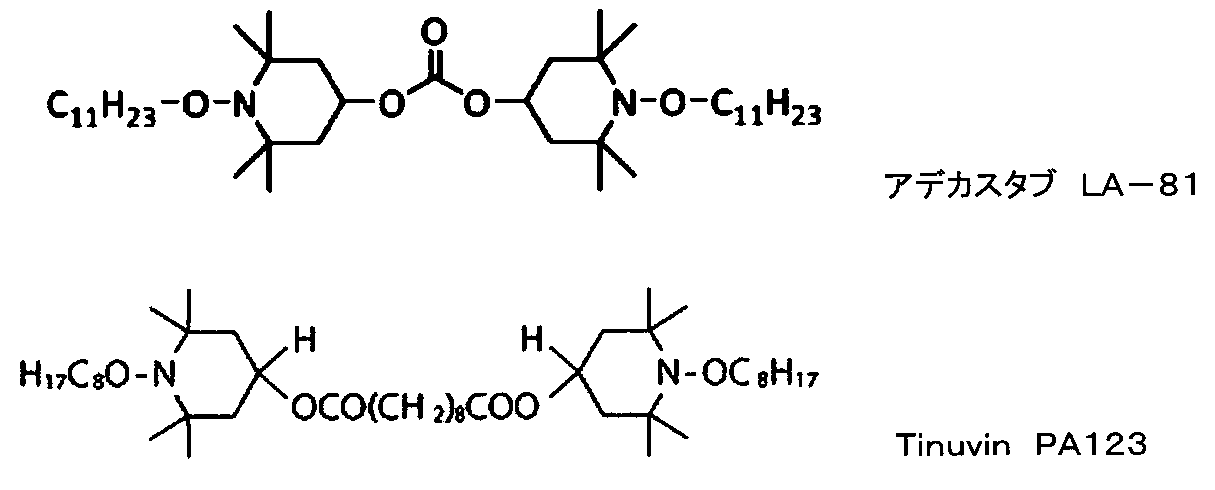
NO-Alkyl型ヒンダードアミン系光安定剤(D)は、1種を単独で、或いは2種以上を混合して使用することができる。
本発明の熱可塑性樹脂組成物がNO-Alkyl型ヒンダードアミン系光安定剤(D)を含む場合、本発明の熱可塑性樹脂組成物中のNO-Alkyl型ヒンダードアミン系光安定剤(D)の含有量は、芳香族ポリカーボネート樹脂(A)、グラフト共重合体(B)および(メタ)アクリル酸エステル系共重合体(C)の合計100質量に対して0.1~0.8質量部であることが好ましく、より好ましくは0.2~0.7質量部である。NO-Alkyl型ヒンダードアミン系光安定剤(D)の含有量が上記下限以上であると、優れた耐加水分解性、耐候性を得ると共に、耐衝撃性を高めることができる傾向にある。NO-Alkyl型ヒンダードアミン系光安定剤(D)の含有量が上記上限以下であれば、耐久性が良好となる傾向にある。
<その他の熱可塑性樹脂>
本発明の熱可塑性樹脂組成物は、必要に応じて、芳香族ポリカーボネート樹脂(A)、グラフト共重合体(B)及び(メタ)アクリル酸エステル系共重合体(C)以外の他の熱可塑性樹脂を含有してもよい。他の熱可塑性樹脂としては特に制限はなく、例えば、AS樹脂、ポリブチレンテレフタレート(PBT樹脂)、ポリエチレンテレフタレート(PET樹脂)、ポリ塩化ビニル、ポリスチレン、ポリアセタール樹脂、変性ポリフェニレンエーテル(変性PPE樹脂)、エチレン-酢酸ビニル共重合体、ポリアリレート、液晶ポリエステル樹脂、ポリエチレン樹脂、ポリプロピレン樹脂、フッ素樹脂およびポリアミド樹脂(ナイロン)等が挙げられる。これらは、1種を単独で用いてもよく、2種以上を組み合わせて用いてもよい。
本発明の熱可塑性樹脂組成物は、必要に応じて、芳香族ポリカーボネート樹脂(A)、グラフト共重合体(B)及び(メタ)アクリル酸エステル系共重合体(C)以外の他の熱可塑性樹脂を含有してもよい。他の熱可塑性樹脂としては特に制限はなく、例えば、AS樹脂、ポリブチレンテレフタレート(PBT樹脂)、ポリエチレンテレフタレート(PET樹脂)、ポリ塩化ビニル、ポリスチレン、ポリアセタール樹脂、変性ポリフェニレンエーテル(変性PPE樹脂)、エチレン-酢酸ビニル共重合体、ポリアリレート、液晶ポリエステル樹脂、ポリエチレン樹脂、ポリプロピレン樹脂、フッ素樹脂およびポリアミド樹脂(ナイロン)等が挙げられる。これらは、1種を単独で用いてもよく、2種以上を組み合わせて用いてもよい。
本発明の熱可塑性樹脂組成物が、これらの他の熱可塑性樹脂を含む場合、耐衝撃性、耐熱性、剛性、発色性の効果をより有効に得る観点から、熱可塑性樹脂組成物中の全熱可塑性樹脂成分100質量%中の他の熱可塑性樹脂の含有量は40質量%以下、特に30質量%以下であることが好ましい。
<添加剤>
本発明の熱可塑性樹脂組成物には、熱可塑性樹脂組成物およびその成形品の物性を損なわない範囲において、熱可塑性樹脂組成物の製造時(混合時)、成形時に、慣用の他の添加剤、例えば滑材、顔料、染料、充填剤(カーボンブラック、シリカ、酸化チタン等)、耐熱剤(熱安定剤)、酸化劣化防止剤、NO-Alkyl型ヒンダードアミン系光安定剤(D)以外の耐候剤(紫外線吸収剤、光安定剤)、離型剤、可塑剤、帯電防止剤、難燃剤、難燃助剤、硬化剤、硬化促進剤、導電性付与剤、応力緩和剤、結晶化促進剤、加水分解抑制剤、潤滑剤、衝撃付与剤、摺動性改良剤、相溶化剤、核剤、強化剤、流動調節剤、増感剤、増粘剤、沈降防止剤、ドリップ防止剤、消泡剤、カップリング剤、光拡散性微粒子、防錆剤、抗菌剤、防カビ剤、防汚剤、導電性高分子などを配合することができる。
本発明の熱可塑性樹脂組成物には、熱可塑性樹脂組成物およびその成形品の物性を損なわない範囲において、熱可塑性樹脂組成物の製造時(混合時)、成形時に、慣用の他の添加剤、例えば滑材、顔料、染料、充填剤(カーボンブラック、シリカ、酸化チタン等)、耐熱剤(熱安定剤)、酸化劣化防止剤、NO-Alkyl型ヒンダードアミン系光安定剤(D)以外の耐候剤(紫外線吸収剤、光安定剤)、離型剤、可塑剤、帯電防止剤、難燃剤、難燃助剤、硬化剤、硬化促進剤、導電性付与剤、応力緩和剤、結晶化促進剤、加水分解抑制剤、潤滑剤、衝撃付与剤、摺動性改良剤、相溶化剤、核剤、強化剤、流動調節剤、増感剤、増粘剤、沈降防止剤、ドリップ防止剤、消泡剤、カップリング剤、光拡散性微粒子、防錆剤、抗菌剤、防カビ剤、防汚剤、導電性高分子などを配合することができる。
<熱可塑性樹脂組成物の製造方法>
本発明の熱可塑性樹脂組成物は、公知の装置を使用した公知の方法で製造することができる。例えば、一般的な方法として溶融混合法があり、この方法で使用する装置としては、押出機、バンバリーミキサー、ローラー、ニーダー等が挙げられる。混合には回分式、連続式のいずれを採用してもよい。各成分の混合順序などにも特に制限はなく、全ての成分が均一に混合されればよい。
本発明の熱可塑性樹脂組成物は、公知の装置を使用した公知の方法で製造することができる。例えば、一般的な方法として溶融混合法があり、この方法で使用する装置としては、押出機、バンバリーミキサー、ローラー、ニーダー等が挙げられる。混合には回分式、連続式のいずれを採用してもよい。各成分の混合順序などにも特に制限はなく、全ての成分が均一に混合されればよい。
[成形品]
本発明の成形品は、本発明の熱可塑性樹脂組成物を成形してなるものである。その成形方法としては、例えば、射出成形法、射出圧縮成形機法、押出法、ブロー成形法、真空成形法、圧空成形法、カレンダー成形法およびインフレーション成形法等が挙げられる。これらのなかでも、量産性に優れ、高い寸法精度の成形品を得ることができるため、射出成形法、射出圧縮成形法が好ましい。
本発明の成形品は、本発明の熱可塑性樹脂組成物を成形してなるものである。その成形方法としては、例えば、射出成形法、射出圧縮成形機法、押出法、ブロー成形法、真空成形法、圧空成形法、カレンダー成形法およびインフレーション成形法等が挙げられる。これらのなかでも、量産性に優れ、高い寸法精度の成形品を得ることができるため、射出成形法、射出圧縮成形法が好ましい。
[用途]
芳香族ポリカーボネート樹脂(A)、グラフト共重合体(B)及び(メタ)アクリル酸エステル系共重合体(C)を含む本発明の熱可塑性樹脂組成物およびその成形品は、流動性に優れ、発色性(着色性)、耐熱性、耐衝撃性、剛性にも優れるため、車輌内外装部品、事務機器、家電、建材等、幅広い分野で好適に使用される。
芳香族ポリカーボネート樹脂(A)、グラフト共重合体(B)及び(メタ)アクリル酸エステル系共重合体(C)を含む本発明の熱可塑性樹脂組成物およびその成形品は、流動性に優れ、発色性(着色性)、耐熱性、耐衝撃性、剛性にも優れるため、車輌内外装部品、事務機器、家電、建材等、幅広い分野で好適に使用される。
更に、NO-Alkyl型ヒンダードアミン系光安定剤(D)を含む本発明の熱可塑性樹脂組成物およびその成形品は、流動性に優れ、発色性(着色性)、耐衝撃性、耐久性、耐候性にも優れるため、車輌内外装部品、事務機器、家電、建材等、幅広い分野で好適に使用される。
以下、本発明を具体的な実施例および比較例を挙げて説明するが、本発明は以下の実施例に限定されるものではない。
以下において、「%」は「質量%」を意味し、「部」は「質量部」を意味する。
以下において、「%」は「質量%」を意味し、「部」は「質量部」を意味する。
[測定・評価方法]
以下の実施例、比較例および参考例における各種測定および評価方法は以下の通りである。
以下の実施例、比較例および参考例における各種測定および評価方法は以下の通りである。
<ゴム状重合体(X)の体積平均粒子径>
マイクロトラック(日機装社製「ナノトラック150」)を用い、測定溶媒としてイオン交換水を用いて、水性分散体に分散しているゴム状重合体(X)の体積平均粒子径を測定した。
マイクロトラック(日機装社製「ナノトラック150」)を用い、測定溶媒としてイオン交換水を用いて、水性分散体に分散しているゴム状重合体(X)の体積平均粒子径を測定した。
<グラフト共重合体(B)のグラフト率>
グラフト共重合体(B)1gを80mLのアセトンに添加し、65~70℃にて3時間加熱還流し、得られた懸濁アセトン溶液を遠心分離機(日立工機社製「CR21E」)にて14,000rpm、30分間遠心分離して、沈殿成分(アセトン不溶成分)とアセトン溶液(アセトン可溶成分)を分取した。
沈殿成分(アセトン不溶成分)を乾燥させてその質量(W1(g))を測定し、下記式(1)によりグラフト率を算出した。
式(1)におけるW1は、グラフト共重合体(B)のアセトン不溶成分の質量(g)、W2はW1を求める際に使用したグラフト共重合体(B)の全質量(g)、ゴム分率はグラフト共重合体(B)の製造に用いたゴム状重合体(X)の水性分散体における固形分濃度である。
グラフト率(質量%)
={(W1-W2×ゴム分率)/W2×ゴム分率}×100 …(1)
<グラフト共重合体(B)のアセトン可溶分の還元粘度>
グラフト共重合体(B)のアセトン可溶分の濃度が0.2dL/gとなるように調製したN,N-ジメチルホルムアミド溶液について、ウベローデ粘度計を用いて25℃での還元粘度:ηsp/C(単位:dL/g)を測定した。
グラフト共重合体(B)のアセトン可溶分の濃度が0.2dL/gとなるように調製したN,N-ジメチルホルムアミド溶液について、ウベローデ粘度計を用いて25℃での還元粘度:ηsp/C(単位:dL/g)を測定した。
<(メタ)アクリル酸エステル系共重合体(C)およびビニル共重合体(d)の分子量>
(メタ)アクリル酸エステル系共重合体(C)およびビニル共重合体(d)の質量平均分子量は、ゲルパーミエーションクロマトグラフィ(GPC)を用い、テトラヒドロフラン(THF)に溶解して測定したものを標準ポリスチレン(PS)換算で示したものである。
(メタ)アクリル酸エステル系共重合体(C)およびビニル共重合体(d)の質量平均分子量は、ゲルパーミエーションクロマトグラフィ(GPC)を用い、テトラヒドロフラン(THF)に溶解して測定したものを標準ポリスチレン(PS)換算で示したものである。
<(メタ)アクリル酸エステル系共重合体(C)のガラス転移温度(Tg)>
(メタ)アクリル酸エステル系共重合体(C)のガラス転移温度(Tg)は、示差走査熱量測定(DSC)により求めた。具体的には、(メタ)アクリル酸エステル系共重合体(C)を窒素雰囲気下、10℃/minで、35℃から250℃まで昇温した後、35℃まで冷却し、再度250℃まで昇温した場合に観測されるガラス転移温度を求めた。
(メタ)アクリル酸エステル系共重合体(C)のガラス転移温度(Tg)は、示差走査熱量測定(DSC)により求めた。具体的には、(メタ)アクリル酸エステル系共重合体(C)を窒素雰囲気下、10℃/minで、35℃から250℃まで昇温した後、35℃まで冷却し、再度250℃まで昇温した場合に観測されるガラス転移温度を求めた。
[芳香族ポリカーボネート樹脂(A)]
芳香族ポリカーボネート樹脂(A)としては、三菱エンジニアリングプラスチックス株式会社製「ユーピロンS-2000F」(粘度平均分子量(Mv):22,000)を用いた。
芳香族ポリカーボネート樹脂(A)としては、三菱エンジニアリングプラスチックス株式会社製「ユーピロンS-2000F」(粘度平均分子量(Mv):22,000)を用いた。
[グラフト共重合体(B)]
グラフト共重合体(B)としては、以下の方法で製造したグラフト共重合体(B-1)を用いた。
グラフト共重合体(B)としては、以下の方法で製造したグラフト共重合体(B-1)を用いた。
<グラフト共重合体(B-1)の製造>
ポリオルガノシロキサンゴムとアルキル(メタ)アクリレート系重合体との複合ゴムをゴム状重合体(X)とし、これにビニル系単量体(Y)をグラフト重合して得られるグラフト共重合体(B-1)を下記の方法により得た。
ポリオルガノシロキサンゴムとアルキル(メタ)アクリレート系重合体との複合ゴムをゴム状重合体(X)とし、これにビニル系単量体(Y)をグラフト重合して得られるグラフト共重合体(B-1)を下記の方法により得た。
<シリコーン/アクリル系複合ゴム(ゴム状重合体(X))の製造>
オクタメチルシクロテトラシロキサン98部、γ-メタクリロイルオキシプロピルジメトキシメチルシラン2部を混合してシロキサン混合物100部を得た。これに、ドデシルベンゼンスルホン酸ナトリウム0.67部、イオン交換水300部からなる水溶液を添加し、ホモミキサーにて10000回転/分で2分間撹拌した後、ホモジナイザーに300kg/cm2の圧力で2回通し、安定な予備混合オルガノシロキサンラテックスを得た。
オクタメチルシクロテトラシロキサン98部、γ-メタクリロイルオキシプロピルジメトキシメチルシラン2部を混合してシロキサン混合物100部を得た。これに、ドデシルベンゼンスルホン酸ナトリウム0.67部、イオン交換水300部からなる水溶液を添加し、ホモミキサーにて10000回転/分で2分間撹拌した後、ホモジナイザーに300kg/cm2の圧力で2回通し、安定な予備混合オルガノシロキサンラテックスを得た。
別途、試薬注入容器、冷却管、ジャケット加熱機および攪拌装置を備えた反応器内に、ドデシルベンゼンスルホン酸10部と、イオン交換水90部とを投入し、10%のドデシルベンゼンスルホン酸水溶液(酸触媒水溶液)を調製した。
この酸触媒水溶液を85℃に加熱した状態で、予備混合オルガノシロキサンラテックスを2時間にわたって滴下し、滴下終了後3時間その温度を維持した後、40℃以下に冷却した。次いで、この反応物を10%水酸化ナトリウム水溶液でpH7.0に中和して、ポリオルガノシロキサン(a)のラテックスを得た。得られたポリオルガノシロキサン(a)のラテックスを180℃で30分乾燥して固形分を求めたところ18.2%であった。また、質量基準の平均粒子径は30nmであった。
この酸触媒水溶液を85℃に加熱した状態で、予備混合オルガノシロキサンラテックスを2時間にわたって滴下し、滴下終了後3時間その温度を維持した後、40℃以下に冷却した。次いで、この反応物を10%水酸化ナトリウム水溶液でpH7.0に中和して、ポリオルガノシロキサン(a)のラテックスを得た。得られたポリオルガノシロキサン(a)のラテックスを180℃で30分乾燥して固形分を求めたところ18.2%であった。また、質量基準の平均粒子径は30nmであった。
試薬注入容器、冷却管、ジャケット加熱機および撹拌装置を備えた反応器内に、イオン交換水200部、オレイン酸カリウム2部、ジオクチルスルホコハク酸ナトリウム4部、硫酸第一鉄七水塩0.003部、エチレンジアミン四酢酸二ナトリウム塩0.009部、ナトリウムホルムアルデヒドスルホキシレート0.3部を窒素気流下で仕込み、60℃に昇温した。60℃になった時点から、アクリル酸n-ブチル85部、メタクリル酸15部、クメンヒドロパーオキサイド0.5部からなる混合物を120分かけて連続的に滴下した。滴下終了後、さらに2時間、60℃を維持した状態で熟成を行い、固形分が33%、重合転化率が96%、酸基含有共重合体の体積平均粒子径が120nmである酸基含有共重合体ラテックスを得た。
試薬注入容器、冷却管、ジャケット加熱機および攪拌装置を備えた反応器内に、ポリオルガノシロキサン(a)のラテックスを固形分換算で5.0部と、アルケニルコハク酸ジカリウム0.48部と、イオン交換水190部とを仕込んで混合した。次いで、アルキル(メタ)アクリレート系重合体(b)を構成する単量体としてアクリル酸n-ブチル45.0部、アリルメタクリレート0.4部、1,3-ブチレングリコールジメタクリレート0.09部、t-ブチルハイドロパーオキサイド0.12部からなる混合物を添加した。この反応器に窒素気流を通じることによって雰囲気の窒素置換を行い、内温を60℃まで昇温した。内温が60℃に達した時点で、硫酸第一鉄七水塩0.000075部、エチレンジアミン四酢酸二ナトリウム塩0.00023部、ナトリウムホルムアルデヒドスルホキシレート0.2部、イオン交換水10部からなる水溶液を添加し、ラジカル重合を開始させた。重合発熱が確認された後、ジャケット温度を75℃とし、重合発熱が確認されなくなるまで重合を継続し、さらに1時間この状態を維持し、ポリオルガノシロキサンとポリブチルアクリレートゴムとが複合した複合ゴムを得た(ラジカル重合工程)。得られた複合ゴムの体積平均粒子径は90nmであった。
反応器内部の液温が70℃に低下した後、5%ピロリン酸ナトリウム水溶液を固形分として0.20部添加した。内温70℃で制御した後、酸基含有共重合体ラテックスを固形分として0.30部添加し、30分撹拌、肥大化を行い、ゴム質重合体(X)のラテックスを得た(肥大化工程)。
得られたラテックス状のゴム質重合体(X)の体積平均粒子径は159nmであった。 ゴム質重合体(X)の全粒子中に占める、粒子径が300~500nmである粒子の割合は10体積%であった。
得られたラテックス状のゴム質重合体(X)の体積平均粒子径は159nmであった。 ゴム質重合体(X)の全粒子中に占める、粒子径が300~500nmである粒子の割合は10体積%であった。
<グラフト共重合体(B-1)の製造>
上記のゴム質重合体(X)のラテックスに、硫酸第一鉄七水塩0.001部、エチレンジアミン四酢酸二ナトリウム塩0.003部、ロンガリット0.3部、イオン交換水10部からなる水溶液を添加した。次いで、アクリロニトリル10部、スチレン30部、t-ブチルハイドロパーオキサイド0.18部からなる混合液を80分間にわたって滴下し、重合した。滴下終了後、温度75℃の状態を30分保持した後、アクリロニトリル2.5部、スチレン7.5部、t-ブチルハイドロパーオキサイド0.05部、n―オクチルメルカプタン0.02部からなる混合物を20分にわたって滴下し、重合した。滴下終了後、温度75℃の状態を30分保持した後、クメンヒドロパーオキシド0.05部を添加し、さらに温度75℃の状態を30分保持した後、冷却し、ゴム質重合体(X)に、アクリロニトリルとスチレンをグラフト重合させたシリコーン/アクリル複合ゴム系のグラフト共重合体(B-1)のラテックスを得た。次いで、1%酢酸カルシウム水溶液150部を60℃に加熱し、この中へグラフト共重合体のラテックス100部を徐々に滴下して凝固した。析出物を分離し、脱水、洗浄した後に乾燥して、グラフト共重合体(B-1)を得た。
上記のゴム質重合体(X)のラテックスに、硫酸第一鉄七水塩0.001部、エチレンジアミン四酢酸二ナトリウム塩0.003部、ロンガリット0.3部、イオン交換水10部からなる水溶液を添加した。次いで、アクリロニトリル10部、スチレン30部、t-ブチルハイドロパーオキサイド0.18部からなる混合液を80分間にわたって滴下し、重合した。滴下終了後、温度75℃の状態を30分保持した後、アクリロニトリル2.5部、スチレン7.5部、t-ブチルハイドロパーオキサイド0.05部、n―オクチルメルカプタン0.02部からなる混合物を20分にわたって滴下し、重合した。滴下終了後、温度75℃の状態を30分保持した後、クメンヒドロパーオキシド0.05部を添加し、さらに温度75℃の状態を30分保持した後、冷却し、ゴム質重合体(X)に、アクリロニトリルとスチレンをグラフト重合させたシリコーン/アクリル複合ゴム系のグラフト共重合体(B-1)のラテックスを得た。次いで、1%酢酸カルシウム水溶液150部を60℃に加熱し、この中へグラフト共重合体のラテックス100部を徐々に滴下して凝固した。析出物を分離し、脱水、洗浄した後に乾燥して、グラフト共重合体(B-1)を得た。
グラフト共重合体(B-1)のアセトン可溶分は26%、グラフト率は45%であった。アセトン可溶分の還元粘度は0.60dL/gであった。
[(メタ)アクリル酸エステル系共重合体(C)]
(メタ)アクリル酸エステル系共重合体(C)としては、以下のようにして製造した、(メタ)アクリル酸エステル系共重合体(C-1)、(C-3)、(C-4)と、以下の市販品(C-2)、(C-5)を用いた。
(メタ)アクリル酸エステル系共重合体(C)としては、以下のようにして製造した、(メタ)アクリル酸エステル系共重合体(C-1)、(C-3)、(C-4)と、以下の市販品(C-2)、(C-5)を用いた。
<(メタ)アクリル酸エステル系共重合体(C-1)の製造>
メタクリル酸メチル(MMA)76部、N-フェニルマレイミド(N-PMI)8部、スチレン(ST)16部のビニル系単量体混合物100部に、パーブチルPV(日油株式会社製)0.1部、パーブチルO(日油株式会社製)0.05部、パーヘキサHC(日油株式会社製)0.05部、t-ドデシルメルカプタン0.6部、α-メチルスチレンダイマー0.2部をあらかじめ混合した。ここへ、純水200部に第三リン酸カルシウム0.5部、アルケニルコハク酸カリウム0.003部を添加したものを入れ、撹拌機付の20リットル耐圧反応槽に仕込み、40℃から重合を開始させた。重合反応における昇温速度は5~10℃/hrで9時間反応を行い、120℃にて重合を終了後、冷却、洗浄、濾過、乾燥工程を経てビーズ状の重合体である(メタ)アクリル酸エステル系共重合体(C-1)を得た。
メタクリル酸メチル(MMA)76部、N-フェニルマレイミド(N-PMI)8部、スチレン(ST)16部のビニル系単量体混合物100部に、パーブチルPV(日油株式会社製)0.1部、パーブチルO(日油株式会社製)0.05部、パーヘキサHC(日油株式会社製)0.05部、t-ドデシルメルカプタン0.6部、α-メチルスチレンダイマー0.2部をあらかじめ混合した。ここへ、純水200部に第三リン酸カルシウム0.5部、アルケニルコハク酸カリウム0.003部を添加したものを入れ、撹拌機付の20リットル耐圧反応槽に仕込み、40℃から重合を開始させた。重合反応における昇温速度は5~10℃/hrで9時間反応を行い、120℃にて重合を終了後、冷却、洗浄、濾過、乾燥工程を経てビーズ状の重合体である(メタ)アクリル酸エステル系共重合体(C-1)を得た。
得られた(メタ)アクリル酸エステル系共重合体(C-1)の質量組成比率、質量平均分子量(Mw)、ガラス転移温度(Tg)を測定したところ、以下の通りであった。
質量組成比率:MMA/N-PMI/ST=76/8/16
質量平均分子量(Mw):90,500
ガラス転移温度(Tg):120℃
質量組成比率:MMA/N-PMI/ST=76/8/16
質量平均分子量(Mw):90,500
ガラス転移温度(Tg):120℃
<(メタ)アクリル酸エステル系共重合体(C-2)>
下記メタクリル酸メチル(MMA)、アクリル酸メチル(MA)比率の三菱ケミカル株式会社製「アクリペットVH5」を用いた。
質量組成比率:MMA/MA=98/2
質量平均分子量(Mw):72,000
ガラス転移温度(Tg):114℃
下記メタクリル酸メチル(MMA)、アクリル酸メチル(MA)比率の三菱ケミカル株式会社製「アクリペットVH5」を用いた。
質量組成比率:MMA/MA=98/2
質量平均分子量(Mw):72,000
ガラス転移温度(Tg):114℃
<(メタ)アクリル酸エステル系共重合体(C-3)の製造>
以下のように、懸濁重合法により共重合体を合成した。
窒素置換した反応器に水120部、アルキルベンゼンスルホン酸ソーダ0.002部、ポリビニルアルコール0.5部、アゾイソブチルニトリル0.3部、t-DM0.5部と、アクリロニトリル(AN)24部、スチレン(ST)30部、メタクリル酸メチル(MMA)46部からなる単量体混合物を使用し、スチレンの一部を逐次添加しながら開始温度60℃から5時間昇温加熱後、120℃に到達させた。更に、120℃で4時間反応した後、重合物を取り出し、(メタ)アクリル酸エステル系共重合体(C-3)を得た。
以下のように、懸濁重合法により共重合体を合成した。
窒素置換した反応器に水120部、アルキルベンゼンスルホン酸ソーダ0.002部、ポリビニルアルコール0.5部、アゾイソブチルニトリル0.3部、t-DM0.5部と、アクリロニトリル(AN)24部、スチレン(ST)30部、メタクリル酸メチル(MMA)46部からなる単量体混合物を使用し、スチレンの一部を逐次添加しながら開始温度60℃から5時間昇温加熱後、120℃に到達させた。更に、120℃で4時間反応した後、重合物を取り出し、(メタ)アクリル酸エステル系共重合体(C-3)を得た。
得られた(メタ)アクリル酸エステル系共重合体(C-3)の質量組成比率、および質量平均分子量(Mw)を測定したところ、以下の通りであった。
質量組成比率:AN/ST/MMA=24/30/46
質量平均分子量(Mw):98,000
ガラス転移温度(Tg):98℃
質量組成比率:AN/ST/MMA=24/30/46
質量平均分子量(Mw):98,000
ガラス転移温度(Tg):98℃
<(メタ)アクリル酸エステル系共重合体(C-4)の製造>
以下のように、懸濁重合法により共重合体を合成した。
窒素置換した反応器に水120部、アルキルベンゼンスルホン酸ソーダ0.002部、ポリビニルアルコール0.5部、アゾイソブチルニトリル0.3部、t-ドデシルメルカプタン0.5部と、アクリロニトリル(AN)11部、スチレン(ST)5部、メタクリル酸メチル(MMA)69部、α-メチルスチレン(α-MST)15部からなる単量体混合物を使用し、スチレンの一部を逐次添加しながら開始温度60℃から5時間昇温加熱後、120℃に到達させた。更に、120℃で4時間反応した後、重合物を取り出し、(メタ)アクリル酸エステル系共重合体(C-4)を得た。
以下のように、懸濁重合法により共重合体を合成した。
窒素置換した反応器に水120部、アルキルベンゼンスルホン酸ソーダ0.002部、ポリビニルアルコール0.5部、アゾイソブチルニトリル0.3部、t-ドデシルメルカプタン0.5部と、アクリロニトリル(AN)11部、スチレン(ST)5部、メタクリル酸メチル(MMA)69部、α-メチルスチレン(α-MST)15部からなる単量体混合物を使用し、スチレンの一部を逐次添加しながら開始温度60℃から5時間昇温加熱後、120℃に到達させた。更に、120℃で4時間反応した後、重合物を取り出し、(メタ)アクリル酸エステル系共重合体(C-4)を得た。
得られた(メタ)アクリル酸エステル系共重合体(C-4)の質量組成比率、および質量平均分子量(Mw)を測定したところ、以下の通りであった。
質量組成比率:AN/ST/MMA/α-MST=11/5/69/15
質量平均分子量(Mw):100,000
ガラス転移温度(Tg):113℃
質量組成比率:AN/ST/MMA/α-MST=11/5/69/15
質量平均分子量(Mw):100,000
ガラス転移温度(Tg):113℃
<メタ)アクリル酸エステル系共重合体(C-5)>
下記メタクリル酸メチル(MMA)、N-フェニルマレイミド(N-PMI)、シクロヘキシルマレイミド(CHMI)、スチレン(ST)比率の株式会社日本触媒製「ポリイミレックスPML203」を用いた。
質量組成比率:MMA/N-PMI/CHMI/ST=82/6/6/6
質量平均分子量(Mw):121,000
ガラス転移温度(Tg):104℃
下記メタクリル酸メチル(MMA)、N-フェニルマレイミド(N-PMI)、シクロヘキシルマレイミド(CHMI)、スチレン(ST)比率の株式会社日本触媒製「ポリイミレックスPML203」を用いた。
質量組成比率:MMA/N-PMI/CHMI/ST=82/6/6/6
質量平均分子量(Mw):121,000
ガラス転移温度(Tg):104℃
[ビニル共重合体(e)]
以下の比較例で用いたビニル共重合体(e)は次のようにして懸濁重合法により製造した。
以下の比較例で用いたビニル共重合体(e)は次のようにして懸濁重合法により製造した。
<ビニル共重合体(e-1)の製造>
窒素置換した反応器に水120部、アルキルベンゼンスルホン酸ソーダ0.002部、ポリビニルアルコール0.5部、アゾイソブチルニトリル0.3部、t-ドデシルメルカプタン0.5部と、アクリロニトリル(AN)26部、スチレン(ST)74部からなる単量体混合物を使用し、スチレンの一部を逐次添加しながら開始温度60℃から5時間昇温加熱後、120℃に到達させた。更に、120℃で4時間反応した後、重合物を取り出し、AN/ST=26/74(質量比)で質量平均分子量(Mw)110,000のビニル共重合体(e-1)を得た。
窒素置換した反応器に水120部、アルキルベンゼンスルホン酸ソーダ0.002部、ポリビニルアルコール0.5部、アゾイソブチルニトリル0.3部、t-ドデシルメルカプタン0.5部と、アクリロニトリル(AN)26部、スチレン(ST)74部からなる単量体混合物を使用し、スチレンの一部を逐次添加しながら開始温度60℃から5時間昇温加熱後、120℃に到達させた。更に、120℃で4時間反応した後、重合物を取り出し、AN/ST=26/74(質量比)で質量平均分子量(Mw)110,000のビニル共重合体(e-1)を得た。
[NO-Alkyl型ヒンダードアミン系光安定剤(D)]
<NO-Alkyl型ヒンダードアミン系光安定剤(D-1)>
ADEKA製 スタブLA-81 分子量681
<NO-Alkyl型ヒンダードアミン系光安定剤(D-2)>
BASF製 Tinuvin PA123 分子量737
<NO-Alkyl型ヒンダードアミン系光安定剤(D-1)>
ADEKA製 スタブLA-81 分子量681
<NO-Alkyl型ヒンダードアミン系光安定剤(D-2)>
BASF製 Tinuvin PA123 分子量737
[その他のヒンダードアミン系光安定剤(d)]
<N-CH3型ヒンダードアミン系光安定剤(d-1)>
ADEKA製 アデカスタブLA-52 分子量847
<N-H型ヒンダードアミン系光安定剤(d-2)>
ADEKA製 アデカスタブLA-57 分子量791
<N-CH3型ヒンダードアミン系光安定剤(d-1)>
ADEKA製 アデカスタブLA-52 分子量847
<N-H型ヒンダードアミン系光安定剤(d-2)>
ADEKA製 アデカスタブLA-57 分子量791
その他のヒンダードアミン系光安定剤(d)の構造は以下の通りである。
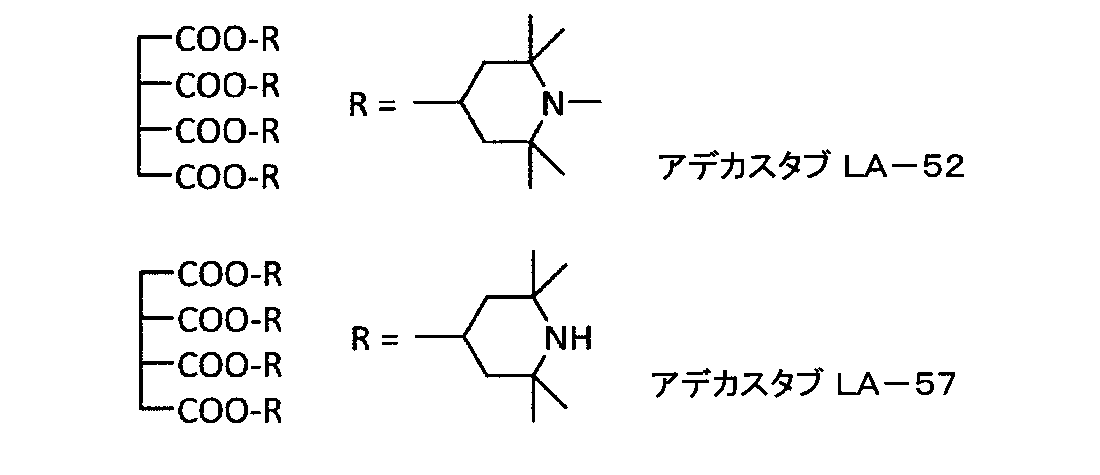
[射出成形方法]
評価に用いた成形品は以下のようにして成形した。
評価に用いた成形品は以下のようにして成形した。
<射出成形1>
熱可塑性樹脂組成物のペレットを射出成形機(東芝機械社製「IS55FP-1.5A」)によりシリンダー温度200~270℃、金型温度60℃の条件で、縦63.5mm、横12.7mm、厚さ6.2mmの成形品を成形し、アイゾット衝撃試験用成形品(ノッチ付)、曲げ弾性率測定用成形品、荷重たわみ温度測定用成形品として用いた。
熱可塑性樹脂組成物のペレットを射出成形機(東芝機械社製「IS55FP-1.5A」)によりシリンダー温度200~270℃、金型温度60℃の条件で、縦63.5mm、横12.7mm、厚さ6.2mmの成形品を成形し、アイゾット衝撃試験用成形品(ノッチ付)、曲げ弾性率測定用成形品、荷重たわみ温度測定用成形品として用いた。
<射出成形2>
熱可塑性樹脂組成物のペレットを射出成形機(東芝機械社製「IS55FP-1.5A」)により、シリンダー温度200~270℃、金型温度60℃の条件で、縦100mm、横100mm、厚さ3mmの成形品を成形し、発色性評価用成形品、耐候性評価用成形品として用いた。
熱可塑性樹脂組成物のペレットを射出成形機(東芝機械社製「IS55FP-1.5A」)により、シリンダー温度200~270℃、金型温度60℃の条件で、縦100mm、横100mm、厚さ3mmの成形品を成形し、発色性評価用成形品、耐候性評価用成形品として用いた。
[評価方法]
評価方法は次の通りである。
評価方法は次の通りである。
<耐衝撃性の評価:アイゾット衝撃試験>
射出成形1で得られた成形品について、ASTM D 256規格に従い、23℃の条件で、或いは23℃と-30℃の条件でアイゾット衝撃試験(ノッチ付)を行い、アイゾット衝撃強度を測定した。アイゾット衝撃値が高い程、耐衝撃性に優れる。
射出成形1で得られた成形品について、ASTM D 256規格に従い、23℃の条件で、或いは23℃と-30℃の条件でアイゾット衝撃試験(ノッチ付)を行い、アイゾット衝撃強度を測定した。アイゾット衝撃値が高い程、耐衝撃性に優れる。
<剛性の評価:曲げ試験>
射出成形1で得られた成形品について、ASTM D 790規格に従い、曲げ弾性率を測定した。曲げ弾性率が高い程、剛性に優れる。
射出成形1で得られた成形品について、ASTM D 790規格に従い、曲げ弾性率を測定した。曲げ弾性率が高い程、剛性に優れる。
<耐熱性の評価:荷重たわみ温度測定>
射出成形1で得られた成形品について、ASTM D 648規格に従い、エッジワイズ法で荷重たわみ温度(HDT)(℃)を測定し、下記判定基準で評価した。
(判定基準)
HDT 105℃以上:○ 実用上優れる
HDT 105℃未満103℃以上:△ 実用上支障がない
HDT 103℃未満:× 実用上問題がある
射出成形1で得られた成形品について、ASTM D 648規格に従い、エッジワイズ法で荷重たわみ温度(HDT)(℃)を測定し、下記判定基準で評価した。
(判定基準)
HDT 105℃以上:○ 実用上優れる
HDT 105℃未満103℃以上:△ 実用上支障がない
HDT 103℃未満:× 実用上問題がある
<発色性の評価:明度L*測定>
射出成形2で得られた成形品について、分光測色計(コニカミノルタオプティプス社製「CM-3500d」)を用いて明度L*を、SCE方式にて測定した。L*が低いほど黒色となり発色性に優れる。
射出成形2で得られた成形品について、分光測色計(コニカミノルタオプティプス社製「CM-3500d」)を用いて明度L*を、SCE方式にて測定した。L*が低いほど黒色となり発色性に優れる。
<耐久性の評価:高温高湿試験>
射出成形1で得られた成形品を使用して、温度85℃、湿度85%の高温高湿環境下に200時間暴露後、上記と同様にアイゾット衝撃試験(ノッチ付)を行い、アイゾット衝撃強度を測定し、恒温高湿環境下暴露前後でのアイゾット衝撃強度の保持率(%)を算出した。判定基準は以下の通りである。
(判定基準)
アイゾット衝撃強度保持率50%以上:耐久性に優れる
アイゾット衝撃強度保持率40~50%未満:耐久性は実用上支障がない
アイゾット衝撃強度保持率40%未満:耐久性が劣る
射出成形1で得られた成形品を使用して、温度85℃、湿度85%の高温高湿環境下に200時間暴露後、上記と同様にアイゾット衝撃試験(ノッチ付)を行い、アイゾット衝撃強度を測定し、恒温高湿環境下暴露前後でのアイゾット衝撃強度の保持率(%)を算出した。判定基準は以下の通りである。
(判定基準)
アイゾット衝撃強度保持率50%以上:耐久性に優れる
アイゾット衝撃強度保持率40~50%未満:耐久性は実用上支障がない
アイゾット衝撃強度保持率40%未満:耐久性が劣る
<耐候性の評価:促進試験前後のΔE*測定>
アイスーパーUVテスター(岩崎電気(株)製SUV-W151型)を用い、ブラックパネル温度63℃、サイクル条件360分(照度100mW/cm2照射240分(湿度50%)→シャワー10秒→暗黒120分(湿度95%)、の条件で200時間処理する促進試験を行った。この促進試験前後の色差ΔE*を、分光測色計(コニカミノルタオプティプス社製「CM-3500d」)を用いて、SCE方式にて測定した。ΔE*が小さいほど耐候性に優れる。
アイスーパーUVテスター(岩崎電気(株)製SUV-W151型)を用い、ブラックパネル温度63℃、サイクル条件360分(照度100mW/cm2照射240分(湿度50%)→シャワー10秒→暗黒120分(湿度95%)、の条件で200時間処理する促進試験を行った。この促進試験前後の色差ΔE*を、分光測色計(コニカミノルタオプティプス社製「CM-3500d」)を用いて、SCE方式にて測定した。ΔE*が小さいほど耐候性に優れる。
[実施例I-1~11、比較例I-1,2]
表1に示す配合処方(質量部)で各成分を混合し、さらにそこにカーボンブラック0.8部を混合し、32mmφの真空ベント付き2軸押し出し機(株式会社日本製鋼所製、TEX-30α)を用いて240℃で溶融混練し、熱可塑性樹脂組成物のペレットを得た。得られた熱可塑性樹脂組成物のペレットを射出成形した成形品について、前述の方法で各評価を行い、結果を表1に示した。
表1に示す配合処方(質量部)で各成分を混合し、さらにそこにカーボンブラック0.8部を混合し、32mmφの真空ベント付き2軸押し出し機(株式会社日本製鋼所製、TEX-30α)を用いて240℃で溶融混練し、熱可塑性樹脂組成物のペレットを得た。得られた熱可塑性樹脂組成物のペレットを射出成形した成形品について、前述の方法で各評価を行い、結果を表1に示した。
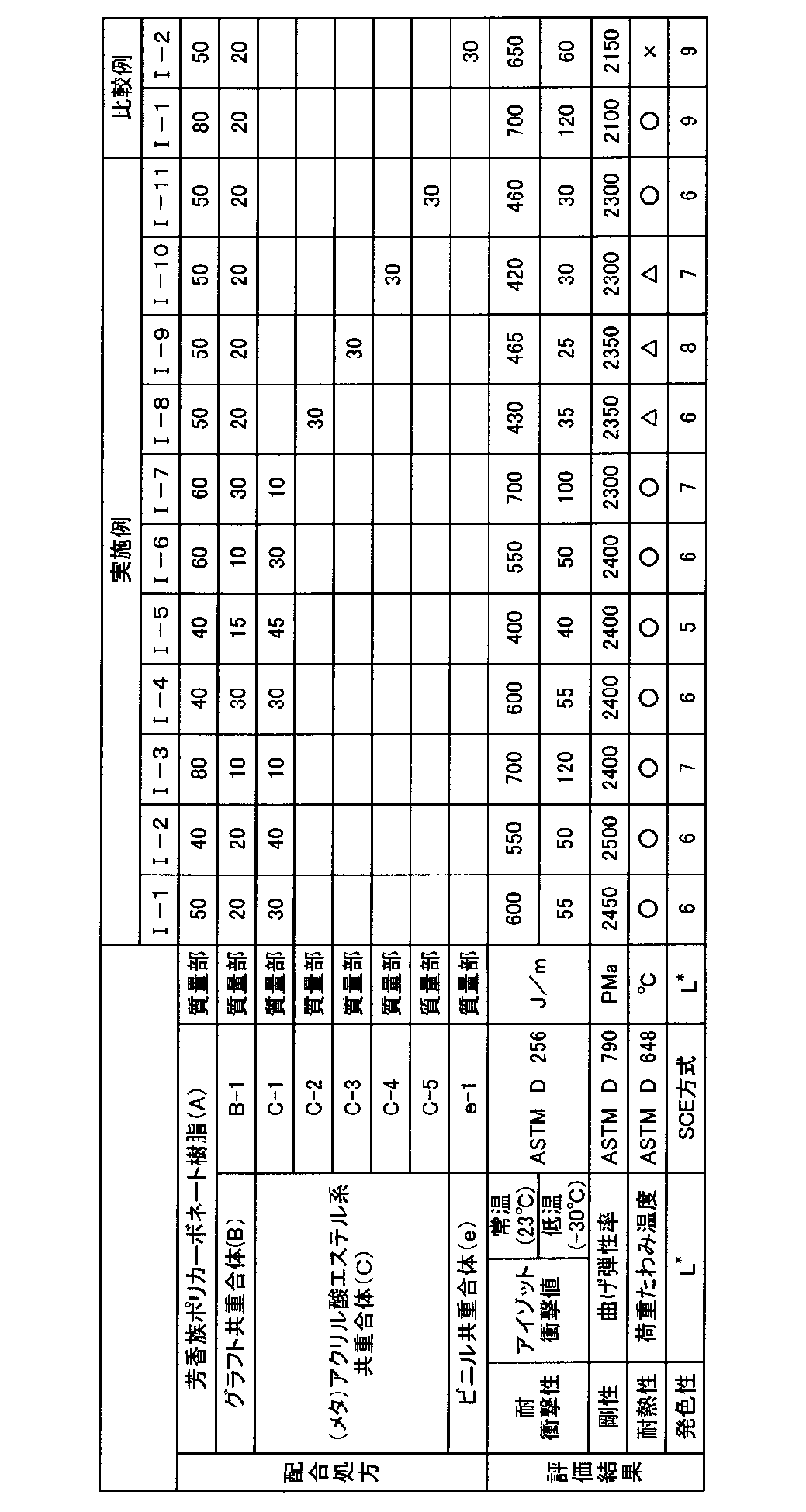
実施例I-1~11に示したように、芳香族ポリカーボネート樹脂(A)、グラフト共重合体(B)、及び(メタ)アクリル酸エステル系共重合体(C)を含む本発明の熱可塑性樹脂組成物から得られた成形品は、発色性、耐衝撃性、剛性、耐熱性のすべてにおいて優れている。
これに対して比較例I-1は、(メタ)アクリル酸エステル系共重合体(C)を含まない一般的なPC/ABS樹脂の結果を示しており、耐衝撃性、耐熱性は良好であるが、発色性が劣る結果となる。
比較例I-2は、(メタ)アクリル酸エステル系共重合体(C)以外の共重合体を使用した結果を示しており、耐衝撃性は良好であるが、剛性や耐熱性、発色性において劣る結果となる。
[実施例II-1~14、比較例II-1,2、参考例II-1]
表2A,2Bに示す配合処方(質量部)で各成分を混合し、さらにそこにカーボンブラック0.8部を混合し、32mmφの真空ベント付き2軸押し出し機(株式会社日本製鋼所製、TEX-30α)を用いて240℃で溶融混練し、熱可塑性樹脂組成物のペレットを得た。得られた熱可塑性樹脂組成物のペレットを射出成形した成形品について、前述の方法で各評価を行い、結果を表2A,2Bに示した。参考例II-1は、前述の実施例I-1に該当する。
表2A,2Bに示す配合処方(質量部)で各成分を混合し、さらにそこにカーボンブラック0.8部を混合し、32mmφの真空ベント付き2軸押し出し機(株式会社日本製鋼所製、TEX-30α)を用いて240℃で溶融混練し、熱可塑性樹脂組成物のペレットを得た。得られた熱可塑性樹脂組成物のペレットを射出成形した成形品について、前述の方法で各評価を行い、結果を表2A,2Bに示した。参考例II-1は、前述の実施例I-1に該当する。
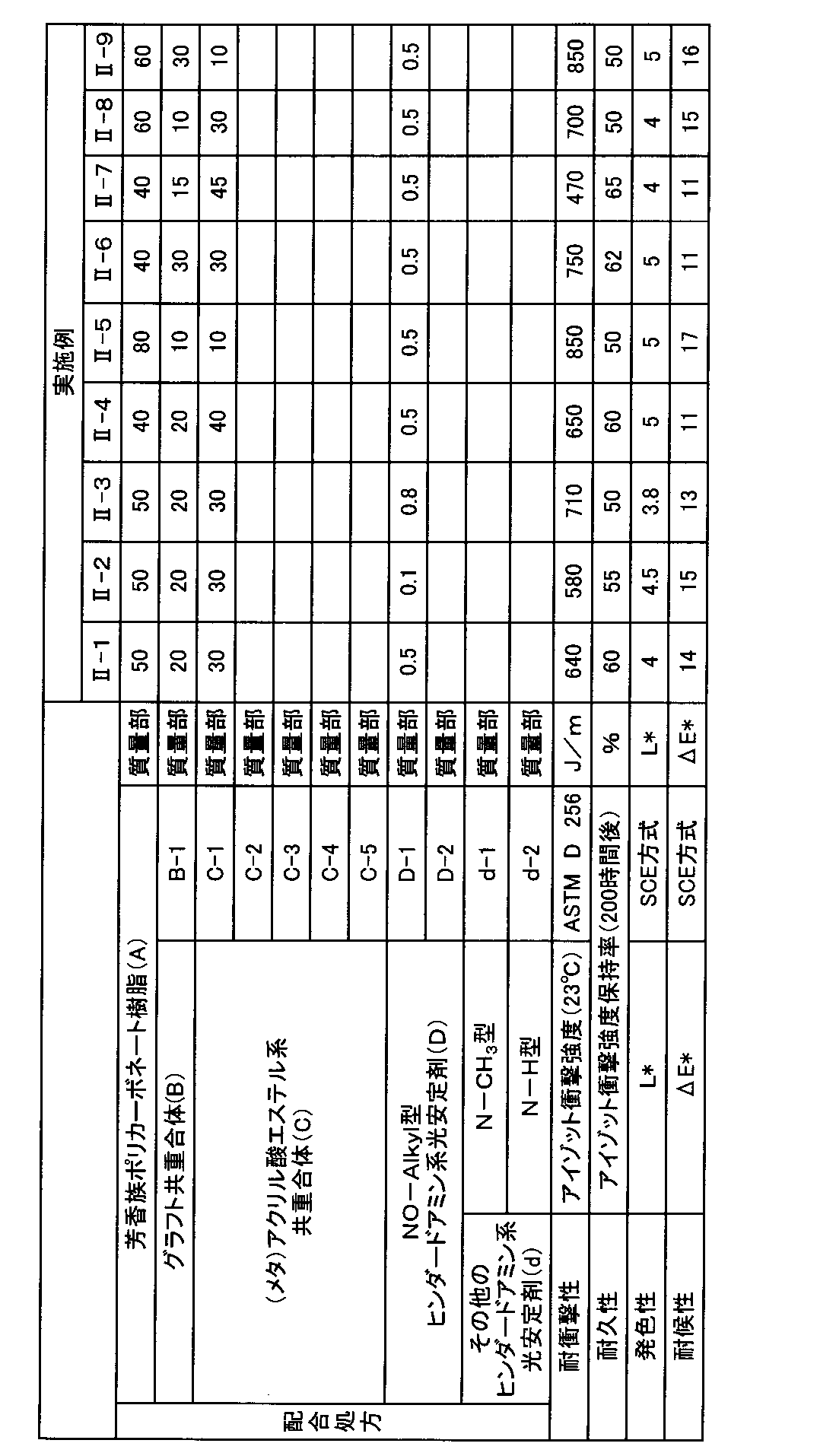
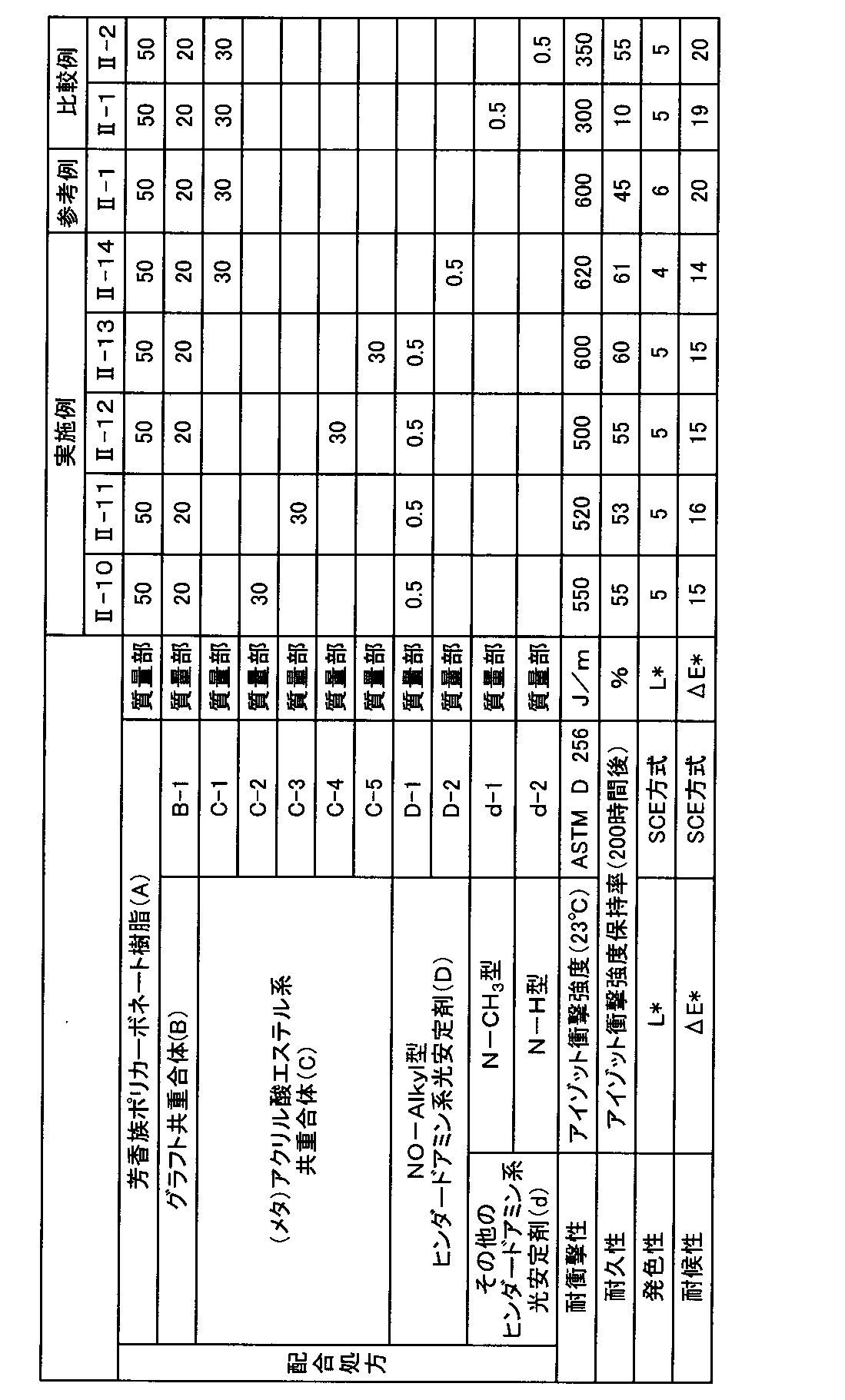
実施例II-1~14に示したように、芳香族ポリカーボネート樹脂(A)、グラフト共重合体(B)および(メタ)アクリル酸エステル系共重合体(C)を含み、且つNO-Alkyl型ヒンダードアミン系光安定剤(D)を含有する本発明の熱可塑性樹脂組成物から得られた成形品は、優れた耐衝撃性、発色性、耐久性、耐候性を有しており、多種多様な製品の意匠面に好適である。
参考例II-1は、NO-Alkyl型ヒンダードアミン系光安定剤(D)を添加していないため、耐衝撃性の耐久性、発色性、耐候性が劣る。
比較例II-1、2は、NO-Alkyl型ヒンダードアミン系光安定剤(D)とは異なるN-CH3型又はN-H型ヒンダードアミン系光安定剤を使用したものであり、耐衝撃性、特に耐久性が著しく劣る結果となる。
本発明を特定の態様を用いて詳細に説明したが、本発明の意図と範囲を離れることなく様々な変更が可能であることは当業者に明らかである。
本出願は、2018年3月16日付で出願された日本特許出願2018-049691に基づいており、その全体が引用により援用される。
本出願は、2018年3月16日付で出願された日本特許出願2018-049691に基づいており、その全体が引用により援用される。
芳香族ポリカーボネート樹脂(A)、グラフト共重合体(B)および(メタ)アクリル酸エステル系共重合体(C)を含む本発明の熱可塑性樹脂組成物は、耐衝撃性、剛性、耐熱性に優れ、また発色性(着色性)にも優れるため、得られる成形品の外観にも優れたものとすることができる。
芳香族ポリカーボネート樹脂(A)、グラフト共重合体(B)、(メタ)アクリル酸エステル系共重合体(C)およびNO-Alkyl型ヒンダードアミン系光安定剤(D)を含む本発明の熱可塑性樹脂組成物は、耐衝撃性、発色性、耐久性、耐候性に優れるため、得られる成形品の外観にも優れたものとすることができる。
本発明の熱可塑性樹脂組成物を成形してなる成形品は、OA機器分野、電子電気機器分野、及び自動車分野など様々な分野で広く使用することができる。例えば、市場のニーズに合わせて多彩な用途に使用することができ、その工業的有用性は非常に高い。
Claims (12)
- 芳香族ポリカーボネート樹脂(A)と、ゴム状重合体(X)に1種以上のビニル系単量体(Y)をグラフト重合してなるグラフト共重合体(B)と、(メタ)アクリル酸エステル系単量体を含むビニル系単量体混合物(m1)を重合してなる(メタ)アクリル酸エステル系共重合体(C)とを含むことを特徴とする熱可塑性樹脂組成物。
- 前記ビニル系単量体混合物(m1)が、N-置換マレイミド系単量体および/又は芳香族ビニル系単量体を含むことを特徴とする請求項1に記載の熱可塑性樹脂組成物。
- 前記芳香族ポリカーボネート樹脂(A)、グラフト共重合体(B)および(メタ)アクリル酸エステル系共重合体(C)の合計100質量部中、芳香族ポリカーボネート樹脂(A)を25~80質量部、グラフト共重合体(B)を10~30質量部、(メタ)アクリル酸エステル系共重合体(C)を10~45質量部含むことを特徴とする請求項1又は2に記載の熱可塑性樹脂組成物。
- 前記ビニル系単量体混合物(m1)の合計100質量%中の(メタ)アクリル酸エステル系単量体の含有量が52~92質量%であることを特徴とする請求項1ないし3のいずれか1項に記載の熱可塑性樹脂組成物。
- 前記ゴム状重合体(X)がシリコーン/アクリル系複合ゴムであり、前記ビニル系単量体(Y)が芳香族ビニル系単量体とシアン化ビニル系単量体を含むことを特徴とする請求項1ないし4のいずれか1項に記載の熱可塑性樹脂組成物。
- 更に、NO-Alkyl型ヒンダードアミン系光安定剤(D)を含有することを特徴とする請求項1ないし5のいずれか1項に記載の熱可塑性樹脂組成物。
- 前記NO-Alkyl型ヒンダードアミン系光安定剤(D)の窒素原子に結合したアルコキシ基の炭素数が5~15であり、該NO-Alkyl型ヒンダードアミン系光安定剤(D)の分子量が500~1000の範囲であることを特徴とする請求項6に記載の熱可塑性樹脂組成物。
- 前記芳香族ポリカーボネート樹脂(A)、グラフト共重合体(B)および(メタ)アクリル酸エステル系共重合体(C)の合計100質量部に対して、前記NO-Alkyl型ヒンダードアミン系光安定剤(D)を0.1~0.8質量部含むことを特徴とする請求項6又は7に記載の熱可塑性樹脂組成物。
- 前記シリコーン/アクリル系複合ゴムが、ポリオルガノシロキサン(a)と、アルキル(メタ)アクリレート系重合体(b)とが複合したシリコーン/アクリル系複合ゴムであり、
該ポリオルガノシロキサン(a)とアルキル(メタ)アクリレート系重合体(b)との合計100質量%中のポリオルガノシロキサン(a)の割合が4~14質量%で、アルキル(メタ)アクリレート系重合体(b)の割合が96~86質量%であることを特徴とする請求項5に記載の熱可塑性樹脂組成物。 - 前記グラフト共重合体(B)は、前記ゴム状重合体(X)20~70質量部に対して、前記ビニル系単量体(Y)30~80質量部をグラフト重合してなる(ただし、ゴム状重合体(X)とビニル系単量体(Y)との合計を100質量部とする。)ことを特徴とする請求項1ないし9のいずれか1項に記載の熱可塑性樹脂組成物。
- 前記ビニル系単量体混合物(m1)の合計100質量%中のN-置換マレイミド系単量体の含有量が7~39質量%で、N-置換マレイミド系単量体の含有量が13質量%以下である請求項1ないし10のいずれか1項に記載の熱可塑性樹脂組成物。
- 請求項1ないし11のいずれか1項に記載の熱可塑性樹脂組成物を成形してなる熱可塑性樹脂成形品。
Priority Applications (3)
| Application Number | Priority Date | Filing Date | Title |
|---|---|---|---|
| CN201980009855.1A CN111655787B (zh) | 2018-03-16 | 2019-03-08 | 热塑性树脂组合物及其成型品 |
| EP19767761.0A EP3766939A4 (en) | 2018-03-16 | 2019-03-08 | COMPOSITION OF THERMOPLASTIC RESIN AND ARTICLE MOLDED THEREOF |
| US16/963,963 US20210040312A1 (en) | 2018-03-16 | 2019-03-08 | Thermoplastic resin composition and molded article thereof |
Applications Claiming Priority (2)
| Application Number | Priority Date | Filing Date | Title |
|---|---|---|---|
| JP2018049691 | 2018-03-16 | ||
| JP2018-049691 | 2018-03-16 |
Publications (1)
| Publication Number | Publication Date |
|---|---|
| WO2019176763A1 true WO2019176763A1 (ja) | 2019-09-19 |
Family
ID=67907758
Family Applications (1)
| Application Number | Title | Priority Date | Filing Date |
|---|---|---|---|
| PCT/JP2019/009302 Ceased WO2019176763A1 (ja) | 2018-03-16 | 2019-03-08 | 熱可塑性樹脂組成物およびその成形品 |
Country Status (5)
| Country | Link |
|---|---|
| US (1) | US20210040312A1 (ja) |
| EP (1) | EP3766939A4 (ja) |
| JP (1) | JP7224723B2 (ja) |
| CN (1) | CN111655787B (ja) |
| WO (1) | WO2019176763A1 (ja) |
Cited By (1)
| Publication number | Priority date | Publication date | Assignee | Title |
|---|---|---|---|---|
| US20240043678A1 (en) * | 2021-03-31 | 2024-02-08 | Techno-Umg Co., Ltd. | Thermoplastic resin composition and molded article |
Families Citing this family (2)
| Publication number | Priority date | Publication date | Assignee | Title |
|---|---|---|---|---|
| KR102474481B1 (ko) * | 2019-06-13 | 2022-12-07 | 주식회사 엘지화학 | 열가소성 수지 조성물 |
| KR102475079B1 (ko) * | 2019-10-23 | 2022-12-07 | 주식회사 엘지화학 | 열가소성 수지 조성물, 이의 제조방법 및 이를 포함하는 성형품 |
Citations (8)
| Publication number | Priority date | Publication date | Assignee | Title |
|---|---|---|---|---|
| JPS6479257A (en) * | 1987-09-21 | 1989-03-24 | Mitsubishi Rayon Co | Thermoplastic resin composition |
| JP2011524449A (ja) * | 2008-06-16 | 2011-09-01 | バイエル・マテリアルサイエンス・アクチェンゲゼルシャフト | 耐衝撃性改良ポリカーボネート組成物 |
| JP2012131908A (ja) | 2010-12-22 | 2012-07-12 | Mitsubishi Engineering Plastics Corp | 芳香族ポリカーボネート樹脂組成物、それからなる成形品および成形品の製造方法 |
| JP2013209629A (ja) * | 2012-02-29 | 2013-10-10 | Toray Ind Inc | ポリカーボネート樹脂成形材料、および成形品 |
| JP2016125006A (ja) | 2015-01-06 | 2016-07-11 | ユーエムジー・エービーエス株式会社 | 複合ゴム系グラフト共重合体含有粉体、複合ゴム系グラフト共重合体含有凝固物、熱可塑性樹脂組成物、およびその成形品 |
| WO2018021164A1 (ja) * | 2016-07-25 | 2018-02-01 | 三菱エンジニアリングプラスチックス株式会社 | ポリカーボネート樹脂組成物 |
| JP6298935B2 (ja) | 2015-12-08 | 2018-03-20 | 日本エイアンドエル株式会社 | 熱可塑性樹脂組成物 |
| JP2018049691A (ja) | 2016-09-20 | 2018-03-29 | 国立大学法人大阪大学 | ホルダー、及びそれを備えた透過型電子顕微鏡 |
Family Cites Families (8)
| Publication number | Priority date | Publication date | Assignee | Title |
|---|---|---|---|---|
| US4524180A (en) * | 1982-05-21 | 1985-06-18 | The Dow Chemical Company | Rubber-modified, impact-resistant polymeric compositions |
| JPH0629303B2 (ja) * | 1984-05-30 | 1994-04-20 | 三菱レイヨン株式会社 | ポリオルガノシロキサン系グラフト共重合体の製造法 |
| DE3853032T2 (de) * | 1987-09-21 | 1995-09-14 | Mitsubishi Rayon Co | Polycarbonat-Harzzusammensetzung. |
| JP2000178433A (ja) * | 1998-12-17 | 2000-06-27 | Kanegafuchi Chem Ind Co Ltd | 熱可塑性樹脂組成物 |
| JP4326624B2 (ja) * | 1999-05-07 | 2009-09-09 | 旭化成ケミカルズ株式会社 | 薄肉成形用の難燃性に優れた樹脂組成物 |
| KR100372569B1 (ko) * | 2000-10-31 | 2003-02-19 | 제일모직주식회사 | 난연성 열가소성 수지조성물 |
| US20020120062A1 (en) * | 2000-12-27 | 2002-08-29 | Tadashi Nagahara | Thermoplastic resin composition and its molded articles |
| GB0711017D0 (en) * | 2007-06-08 | 2007-07-18 | Lucite Int Uk Ltd | Polymer Composition |
-
2019
- 2019-03-08 WO PCT/JP2019/009302 patent/WO2019176763A1/ja not_active Ceased
- 2019-03-08 JP JP2019042817A patent/JP7224723B2/ja active Active
- 2019-03-08 US US16/963,963 patent/US20210040312A1/en not_active Abandoned
- 2019-03-08 EP EP19767761.0A patent/EP3766939A4/en not_active Withdrawn
- 2019-03-08 CN CN201980009855.1A patent/CN111655787B/zh active Active
Patent Citations (8)
| Publication number | Priority date | Publication date | Assignee | Title |
|---|---|---|---|---|
| JPS6479257A (en) * | 1987-09-21 | 1989-03-24 | Mitsubishi Rayon Co | Thermoplastic resin composition |
| JP2011524449A (ja) * | 2008-06-16 | 2011-09-01 | バイエル・マテリアルサイエンス・アクチェンゲゼルシャフト | 耐衝撃性改良ポリカーボネート組成物 |
| JP2012131908A (ja) | 2010-12-22 | 2012-07-12 | Mitsubishi Engineering Plastics Corp | 芳香族ポリカーボネート樹脂組成物、それからなる成形品および成形品の製造方法 |
| JP2013209629A (ja) * | 2012-02-29 | 2013-10-10 | Toray Ind Inc | ポリカーボネート樹脂成形材料、および成形品 |
| JP2016125006A (ja) | 2015-01-06 | 2016-07-11 | ユーエムジー・エービーエス株式会社 | 複合ゴム系グラフト共重合体含有粉体、複合ゴム系グラフト共重合体含有凝固物、熱可塑性樹脂組成物、およびその成形品 |
| JP6298935B2 (ja) | 2015-12-08 | 2018-03-20 | 日本エイアンドエル株式会社 | 熱可塑性樹脂組成物 |
| WO2018021164A1 (ja) * | 2016-07-25 | 2018-02-01 | 三菱エンジニアリングプラスチックス株式会社 | ポリカーボネート樹脂組成物 |
| JP2018049691A (ja) | 2016-09-20 | 2018-03-29 | 国立大学法人大阪大学 | ホルダー、及びそれを備えた透過型電子顕微鏡 |
Non-Patent Citations (1)
| Title |
|---|
| See also references of EP3766939A4 |
Cited By (2)
| Publication number | Priority date | Publication date | Assignee | Title |
|---|---|---|---|---|
| US20240043678A1 (en) * | 2021-03-31 | 2024-02-08 | Techno-Umg Co., Ltd. | Thermoplastic resin composition and molded article |
| US11976189B2 (en) * | 2021-03-31 | 2024-05-07 | Techno-Umg Co., Ltd. | Thermoplastic resin composition and molded article |
Also Published As
| Publication number | Publication date |
|---|---|
| CN111655787B (zh) | 2022-11-08 |
| EP3766939A1 (en) | 2021-01-20 |
| JP2019163452A (ja) | 2019-09-26 |
| CN111655787A (zh) | 2020-09-11 |
| JP7224723B2 (ja) | 2023-02-20 |
| US20210040312A1 (en) | 2021-02-11 |
| EP3766939A4 (en) | 2021-12-15 |
Similar Documents
| Publication | Publication Date | Title |
|---|---|---|
| US8232342B2 (en) | Transparent ABS resin composition having excellent impact strength and flowability | |
| CN103998522B (zh) | 热塑性树脂组合物及其模制品 | |
| JP4054042B2 (ja) | 熱可塑性樹脂組成物ならびにその成形品 | |
| JP2011137158A (ja) | 優れた耐スクラッチ性及び衝撃強度を有するポリカーボネート樹脂組成物 | |
| JP6024757B2 (ja) | 天然ゴム含有熱可塑性樹脂組成物およびその成形品 | |
| CN103180388B (zh) | 聚碳酸酯树脂组合物和使用该组合物的模制品 | |
| AU2003295672A1 (en) | High flow engineering theremoplastic compositions and products made therefrom | |
| WO2012133190A1 (ja) | アクリルゴム系グラフト共重合体、および熱可塑性樹脂組成物 | |
| JP6249130B1 (ja) | 熱可塑性樹脂組成物及びその成形体、並びに車両外装部品 | |
| WO2015151853A1 (ja) | 熱可塑性樹脂組成物およびその成形品 | |
| JP7224723B2 (ja) | 熱可塑性樹脂組成物およびその成形品 | |
| CN107406654A (zh) | 树脂组合物和使用其的成型体 | |
| TWI576387B (zh) | A thermoplastic resin composition, a method for producing the same, and a molded product | |
| TW201012873A (en) | Impact-modified polycarbonate compositions | |
| JP6451872B2 (ja) | (メタ)アクリル系共重合体、樹脂組成物、その成形体及び成形体の製造方法 | |
| KR101247629B1 (ko) | 열가소성 수지 조성물 | |
| JPWO2006004058A1 (ja) | ゴム強化樹脂及びその製造方法並びにゴム強化樹脂組成物 | |
| JPH09216981A (ja) | マレイミド系abs樹脂組成物 | |
| KR100639043B1 (ko) | 가교형 유기 마이크로 입자를 이용한 저광택, 내스크래치성폴리카보네이트계 얼로이 열가소성 수지 조성물 | |
| JP6405923B2 (ja) | 熱可塑性樹脂組成物及びその成形品 | |
| KR101717820B1 (ko) | 방향족 비닐계 공중합체, 이의 제조방법 및 이를 포함하는 열가소성 수지 조성물 | |
| EP3650477A1 (en) | Polymer, graft polymer, and thermoplastic resin composition | |
| JPH1046003A (ja) | マレイミド系abs樹脂組成物 | |
| JP4372431B2 (ja) | 着色樹脂組成物およびその成形品 | |
| JP2004256743A (ja) | 熱可塑性樹脂組成物およびその製造方法 |
Legal Events
| Date | Code | Title | Description |
|---|---|---|---|
| 121 | Ep: the epo has been informed by wipo that ep was designated in this application |
Ref document number: 19767761 Country of ref document: EP Kind code of ref document: A1 |
|
| NENP | Non-entry into the national phase |
Ref country code: DE |
|
| WWE | Wipo information: entry into national phase |
Ref document number: 2019767761 Country of ref document: EP |