WO2019180127A1 - Wässrige uretdiongruppenhaltige zusammensetzungen und verfahren zu deren herstellung - Google Patents
Wässrige uretdiongruppenhaltige zusammensetzungen und verfahren zu deren herstellung Download PDFInfo
- Publication number
- WO2019180127A1 WO2019180127A1 PCT/EP2019/057064 EP2019057064W WO2019180127A1 WO 2019180127 A1 WO2019180127 A1 WO 2019180127A1 EP 2019057064 W EP2019057064 W EP 2019057064W WO 2019180127 A1 WO2019180127 A1 WO 2019180127A1
- Authority
- WO
- WIPO (PCT)
- Prior art keywords
- uretdione
- acid
- group
- diisocyanate
- groups
- Prior art date
- Legal status (The legal status is an assumption and is not a legal conclusion. Google has not performed a legal analysis and makes no representation as to the accuracy of the status listed.)
- Ceased
Links
Classifications
-
- C—CHEMISTRY; METALLURGY
- C08—ORGANIC MACROMOLECULAR COMPOUNDS; THEIR PREPARATION OR CHEMICAL WORKING-UP; COMPOSITIONS BASED THEREON
- C08G—MACROMOLECULAR COMPOUNDS OBTAINED OTHERWISE THAN BY REACTIONS ONLY INVOLVING UNSATURATED CARBON-TO-CARBON BONDS
- C08G18/00—Polymeric products of isocyanates or isothiocyanates
- C08G18/06—Polymeric products of isocyanates or isothiocyanates with compounds having active hydrogen
- C08G18/70—Polymeric products of isocyanates or isothiocyanates with compounds having active hydrogen characterised by the isocyanates or isothiocyanates used
- C08G18/72—Polyisocyanates or polyisothiocyanates
- C08G18/77—Polyisocyanates or polyisothiocyanates having heteroatoms in addition to the isocyanate or isothiocyanate nitrogen and oxygen or sulfur
- C08G18/78—Nitrogen
- C08G18/79—Nitrogen characterised by the polyisocyanates used, these having groups formed by oligomerisation of isocyanates or isothiocyanates
- C08G18/798—Nitrogen characterised by the polyisocyanates used, these having groups formed by oligomerisation of isocyanates or isothiocyanates containing urethdione groups
-
- C—CHEMISTRY; METALLURGY
- C08—ORGANIC MACROMOLECULAR COMPOUNDS; THEIR PREPARATION OR CHEMICAL WORKING-UP; COMPOSITIONS BASED THEREON
- C08G—MACROMOLECULAR COMPOUNDS OBTAINED OTHERWISE THAN BY REACTIONS ONLY INVOLVING UNSATURATED CARBON-TO-CARBON BONDS
- C08G18/00—Polymeric products of isocyanates or isothiocyanates
- C08G18/06—Polymeric products of isocyanates or isothiocyanates with compounds having active hydrogen
- C08G18/08—Processes
- C08G18/10—Prepolymer processes involving reaction of isocyanates or isothiocyanates with compounds having active hydrogen in a first reaction step
- C08G18/12—Prepolymer processes involving reaction of isocyanates or isothiocyanates with compounds having active hydrogen in a first reaction step using two or more compounds having active hydrogen in the first polymerisation step
-
- C—CHEMISTRY; METALLURGY
- C08—ORGANIC MACROMOLECULAR COMPOUNDS; THEIR PREPARATION OR CHEMICAL WORKING-UP; COMPOSITIONS BASED THEREON
- C08G—MACROMOLECULAR COMPOUNDS OBTAINED OTHERWISE THAN BY REACTIONS ONLY INVOLVING UNSATURATED CARBON-TO-CARBON BONDS
- C08G18/00—Polymeric products of isocyanates or isothiocyanates
- C08G18/06—Polymeric products of isocyanates or isothiocyanates with compounds having active hydrogen
- C08G18/08—Processes
- C08G18/16—Catalysts
- C08G18/18—Catalysts containing secondary or tertiary amines or salts thereof
- C08G18/20—Heterocyclic amines; Salts thereof
- C08G18/2009—Heterocyclic amines; Salts thereof containing one heterocyclic ring
- C08G18/2036—Heterocyclic amines; Salts thereof containing one heterocyclic ring having at least three nitrogen atoms in the ring
-
- C—CHEMISTRY; METALLURGY
- C08—ORGANIC MACROMOLECULAR COMPOUNDS; THEIR PREPARATION OR CHEMICAL WORKING-UP; COMPOSITIONS BASED THEREON
- C08G—MACROMOLECULAR COMPOUNDS OBTAINED OTHERWISE THAN BY REACTIONS ONLY INVOLVING UNSATURATED CARBON-TO-CARBON BONDS
- C08G18/00—Polymeric products of isocyanates or isothiocyanates
- C08G18/06—Polymeric products of isocyanates or isothiocyanates with compounds having active hydrogen
- C08G18/08—Processes
- C08G18/16—Catalysts
- C08G18/18—Catalysts containing secondary or tertiary amines or salts thereof
- C08G18/20—Heterocyclic amines; Salts thereof
- C08G18/2045—Heterocyclic amines; Salts thereof containing condensed heterocyclic rings
- C08G18/2063—Heterocyclic amines; Salts thereof containing condensed heterocyclic rings having two nitrogen atoms in the condensed ring system
-
- C—CHEMISTRY; METALLURGY
- C08—ORGANIC MACROMOLECULAR COMPOUNDS; THEIR PREPARATION OR CHEMICAL WORKING-UP; COMPOSITIONS BASED THEREON
- C08G—MACROMOLECULAR COMPOUNDS OBTAINED OTHERWISE THAN BY REACTIONS ONLY INVOLVING UNSATURATED CARBON-TO-CARBON BONDS
- C08G18/00—Polymeric products of isocyanates or isothiocyanates
- C08G18/06—Polymeric products of isocyanates or isothiocyanates with compounds having active hydrogen
- C08G18/08—Processes
- C08G18/16—Catalysts
- C08G18/18—Catalysts containing secondary or tertiary amines or salts thereof
- C08G18/20—Heterocyclic amines; Salts thereof
- C08G18/2045—Heterocyclic amines; Salts thereof containing condensed heterocyclic rings
- C08G18/2072—Heterocyclic amines; Salts thereof containing condensed heterocyclic rings having at least three nitrogen atoms in the condensed ring system
-
- C—CHEMISTRY; METALLURGY
- C08—ORGANIC MACROMOLECULAR COMPOUNDS; THEIR PREPARATION OR CHEMICAL WORKING-UP; COMPOSITIONS BASED THEREON
- C08G—MACROMOLECULAR COMPOUNDS OBTAINED OTHERWISE THAN BY REACTIONS ONLY INVOLVING UNSATURATED CARBON-TO-CARBON BONDS
- C08G18/00—Polymeric products of isocyanates or isothiocyanates
- C08G18/06—Polymeric products of isocyanates or isothiocyanates with compounds having active hydrogen
- C08G18/28—Polymeric products of isocyanates or isothiocyanates with compounds having active hydrogen characterised by the compounds used containing active hydrogen
- C08G18/2805—Compounds having only one group containing active hydrogen
- C08G18/2815—Monohydroxy compounds
- C08G18/282—Alkanols, cycloalkanols or arylalkanols including terpenealcohols
- C08G18/2825—Alkanols, cycloalkanols or arylalkanols including terpenealcohols having at least 6 carbon atoms
-
- C—CHEMISTRY; METALLURGY
- C08—ORGANIC MACROMOLECULAR COMPOUNDS; THEIR PREPARATION OR CHEMICAL WORKING-UP; COMPOSITIONS BASED THEREON
- C08G—MACROMOLECULAR COMPOUNDS OBTAINED OTHERWISE THAN BY REACTIONS ONLY INVOLVING UNSATURATED CARBON-TO-CARBON BONDS
- C08G18/00—Polymeric products of isocyanates or isothiocyanates
- C08G18/06—Polymeric products of isocyanates or isothiocyanates with compounds having active hydrogen
- C08G18/28—Polymeric products of isocyanates or isothiocyanates with compounds having active hydrogen characterised by the compounds used containing active hydrogen
- C08G18/30—Low-molecular-weight compounds
- C08G18/32—Polyhydroxy compounds; Polyamines; Hydroxyamines
- C08G18/3203—Polyhydroxy compounds
- C08G18/3206—Polyhydroxy compounds aliphatic
-
- C—CHEMISTRY; METALLURGY
- C08—ORGANIC MACROMOLECULAR COMPOUNDS; THEIR PREPARATION OR CHEMICAL WORKING-UP; COMPOSITIONS BASED THEREON
- C08G—MACROMOLECULAR COMPOUNDS OBTAINED OTHERWISE THAN BY REACTIONS ONLY INVOLVING UNSATURATED CARBON-TO-CARBON BONDS
- C08G18/00—Polymeric products of isocyanates or isothiocyanates
- C08G18/06—Polymeric products of isocyanates or isothiocyanates with compounds having active hydrogen
- C08G18/28—Polymeric products of isocyanates or isothiocyanates with compounds having active hydrogen characterised by the compounds used containing active hydrogen
- C08G18/30—Low-molecular-weight compounds
- C08G18/32—Polyhydroxy compounds; Polyamines; Hydroxyamines
- C08G18/3225—Polyamines
- C08G18/3234—Polyamines cycloaliphatic
-
- C—CHEMISTRY; METALLURGY
- C08—ORGANIC MACROMOLECULAR COMPOUNDS; THEIR PREPARATION OR CHEMICAL WORKING-UP; COMPOSITIONS BASED THEREON
- C08G—MACROMOLECULAR COMPOUNDS OBTAINED OTHERWISE THAN BY REACTIONS ONLY INVOLVING UNSATURATED CARBON-TO-CARBON BONDS
- C08G18/00—Polymeric products of isocyanates or isothiocyanates
- C08G18/06—Polymeric products of isocyanates or isothiocyanates with compounds having active hydrogen
- C08G18/28—Polymeric products of isocyanates or isothiocyanates with compounds having active hydrogen characterised by the compounds used containing active hydrogen
- C08G18/30—Low-molecular-weight compounds
- C08G18/32—Polyhydroxy compounds; Polyamines; Hydroxyamines
- C08G18/3225—Polyamines
- C08G18/3246—Polyamines heterocyclic, the heteroatom being oxygen or nitrogen in the form of an amino group
-
- C—CHEMISTRY; METALLURGY
- C08—ORGANIC MACROMOLECULAR COMPOUNDS; THEIR PREPARATION OR CHEMICAL WORKING-UP; COMPOSITIONS BASED THEREON
- C08G—MACROMOLECULAR COMPOUNDS OBTAINED OTHERWISE THAN BY REACTIONS ONLY INVOLVING UNSATURATED CARBON-TO-CARBON BONDS
- C08G18/00—Polymeric products of isocyanates or isothiocyanates
- C08G18/06—Polymeric products of isocyanates or isothiocyanates with compounds having active hydrogen
- C08G18/28—Polymeric products of isocyanates or isothiocyanates with compounds having active hydrogen characterised by the compounds used containing active hydrogen
- C08G18/30—Low-molecular-weight compounds
- C08G18/32—Polyhydroxy compounds; Polyamines; Hydroxyamines
- C08G18/3225—Polyamines
- C08G18/325—Polyamines containing secondary or tertiary amino groups
-
- C—CHEMISTRY; METALLURGY
- C08—ORGANIC MACROMOLECULAR COMPOUNDS; THEIR PREPARATION OR CHEMICAL WORKING-UP; COMPOSITIONS BASED THEREON
- C08G—MACROMOLECULAR COMPOUNDS OBTAINED OTHERWISE THAN BY REACTIONS ONLY INVOLVING UNSATURATED CARBON-TO-CARBON BONDS
- C08G18/00—Polymeric products of isocyanates or isothiocyanates
- C08G18/06—Polymeric products of isocyanates or isothiocyanates with compounds having active hydrogen
- C08G18/28—Polymeric products of isocyanates or isothiocyanates with compounds having active hydrogen characterised by the compounds used containing active hydrogen
- C08G18/30—Low-molecular-weight compounds
- C08G18/32—Polyhydroxy compounds; Polyamines; Hydroxyamines
- C08G18/3225—Polyamines
- C08G18/3253—Polyamines being in latent form
-
- C—CHEMISTRY; METALLURGY
- C08—ORGANIC MACROMOLECULAR COMPOUNDS; THEIR PREPARATION OR CHEMICAL WORKING-UP; COMPOSITIONS BASED THEREON
- C08G—MACROMOLECULAR COMPOUNDS OBTAINED OTHERWISE THAN BY REACTIONS ONLY INVOLVING UNSATURATED CARBON-TO-CARBON BONDS
- C08G18/00—Polymeric products of isocyanates or isothiocyanates
- C08G18/06—Polymeric products of isocyanates or isothiocyanates with compounds having active hydrogen
- C08G18/28—Polymeric products of isocyanates or isothiocyanates with compounds having active hydrogen characterised by the compounds used containing active hydrogen
- C08G18/30—Low-molecular-weight compounds
- C08G18/32—Polyhydroxy compounds; Polyamines; Hydroxyamines
- C08G18/3225—Polyamines
- C08G18/3253—Polyamines being in latent form
- C08G18/3256—Reaction products of polyamines with aldehydes or ketones
-
- C—CHEMISTRY; METALLURGY
- C08—ORGANIC MACROMOLECULAR COMPOUNDS; THEIR PREPARATION OR CHEMICAL WORKING-UP; COMPOSITIONS BASED THEREON
- C08G—MACROMOLECULAR COMPOUNDS OBTAINED OTHERWISE THAN BY REACTIONS ONLY INVOLVING UNSATURATED CARBON-TO-CARBON BONDS
- C08G18/00—Polymeric products of isocyanates or isothiocyanates
- C08G18/06—Polymeric products of isocyanates or isothiocyanates with compounds having active hydrogen
- C08G18/28—Polymeric products of isocyanates or isothiocyanates with compounds having active hydrogen characterised by the compounds used containing active hydrogen
- C08G18/40—High-molecular-weight compounds
- C08G18/42—Polycondensates having carboxylic or carbonic ester groups in the main chain
- C08G18/4236—Polycondensates having carboxylic or carbonic ester groups in the main chain containing only aliphatic groups
-
- C—CHEMISTRY; METALLURGY
- C08—ORGANIC MACROMOLECULAR COMPOUNDS; THEIR PREPARATION OR CHEMICAL WORKING-UP; COMPOSITIONS BASED THEREON
- C08G—MACROMOLECULAR COMPOUNDS OBTAINED OTHERWISE THAN BY REACTIONS ONLY INVOLVING UNSATURATED CARBON-TO-CARBON BONDS
- C08G18/00—Polymeric products of isocyanates or isothiocyanates
- C08G18/06—Polymeric products of isocyanates or isothiocyanates with compounds having active hydrogen
- C08G18/28—Polymeric products of isocyanates or isothiocyanates with compounds having active hydrogen characterised by the compounds used containing active hydrogen
- C08G18/40—High-molecular-weight compounds
- C08G18/48—Polyethers
- C08G18/4862—Polyethers containing at least a part of the ether groups in a side chain
-
- C—CHEMISTRY; METALLURGY
- C08—ORGANIC MACROMOLECULAR COMPOUNDS; THEIR PREPARATION OR CHEMICAL WORKING-UP; COMPOSITIONS BASED THEREON
- C08G—MACROMOLECULAR COMPOUNDS OBTAINED OTHERWISE THAN BY REACTIONS ONLY INVOLVING UNSATURATED CARBON-TO-CARBON BONDS
- C08G18/00—Polymeric products of isocyanates or isothiocyanates
- C08G18/06—Polymeric products of isocyanates or isothiocyanates with compounds having active hydrogen
- C08G18/70—Polymeric products of isocyanates or isothiocyanates with compounds having active hydrogen characterised by the isocyanates or isothiocyanates used
- C08G18/72—Polyisocyanates or polyisothiocyanates
- C08G18/721—Two or more polyisocyanates not provided for in one single group C08G18/73 - C08G18/80
- C08G18/725—Combination of polyisocyanates of C08G18/78 with other polyisocyanates
-
- C—CHEMISTRY; METALLURGY
- C08—ORGANIC MACROMOLECULAR COMPOUNDS; THEIR PREPARATION OR CHEMICAL WORKING-UP; COMPOSITIONS BASED THEREON
- C08G—MACROMOLECULAR COMPOUNDS OBTAINED OTHERWISE THAN BY REACTIONS ONLY INVOLVING UNSATURATED CARBON-TO-CARBON BONDS
- C08G18/00—Polymeric products of isocyanates or isothiocyanates
- C08G18/06—Polymeric products of isocyanates or isothiocyanates with compounds having active hydrogen
- C08G18/70—Polymeric products of isocyanates or isothiocyanates with compounds having active hydrogen characterised by the isocyanates or isothiocyanates used
- C08G18/72—Polyisocyanates or polyisothiocyanates
- C08G18/73—Polyisocyanates or polyisothiocyanates acyclic
-
- C—CHEMISTRY; METALLURGY
- C08—ORGANIC MACROMOLECULAR COMPOUNDS; THEIR PREPARATION OR CHEMICAL WORKING-UP; COMPOSITIONS BASED THEREON
- C08G—MACROMOLECULAR COMPOUNDS OBTAINED OTHERWISE THAN BY REACTIONS ONLY INVOLVING UNSATURATED CARBON-TO-CARBON BONDS
- C08G18/00—Polymeric products of isocyanates or isothiocyanates
- C08G18/06—Polymeric products of isocyanates or isothiocyanates with compounds having active hydrogen
- C08G18/70—Polymeric products of isocyanates or isothiocyanates with compounds having active hydrogen characterised by the isocyanates or isothiocyanates used
- C08G18/72—Polyisocyanates or polyisothiocyanates
- C08G18/74—Polyisocyanates or polyisothiocyanates cyclic
- C08G18/75—Polyisocyanates or polyisothiocyanates cyclic cycloaliphatic
- C08G18/751—Polyisocyanates or polyisothiocyanates cyclic cycloaliphatic containing only one cycloaliphatic ring
- C08G18/752—Polyisocyanates or polyisothiocyanates cyclic cycloaliphatic containing only one cycloaliphatic ring containing at least one isocyanate or isothiocyanate group linked to the cycloaliphatic ring by means of an aliphatic group
- C08G18/753—Polyisocyanates or polyisothiocyanates cyclic cycloaliphatic containing only one cycloaliphatic ring containing at least one isocyanate or isothiocyanate group linked to the cycloaliphatic ring by means of an aliphatic group containing one isocyanate or isothiocyanate group linked to the cycloaliphatic ring by means of an aliphatic group having a primary carbon atom next to the isocyanate or isothiocyanate group
- C08G18/755—Polyisocyanates or polyisothiocyanates cyclic cycloaliphatic containing only one cycloaliphatic ring containing at least one isocyanate or isothiocyanate group linked to the cycloaliphatic ring by means of an aliphatic group containing one isocyanate or isothiocyanate group linked to the cycloaliphatic ring by means of an aliphatic group having a primary carbon atom next to the isocyanate or isothiocyanate group and at least one isocyanate or isothiocyanate group linked to a secondary carbon atom of the cycloaliphatic ring, e.g. isophorone diisocyanate
-
- C—CHEMISTRY; METALLURGY
- C08—ORGANIC MACROMOLECULAR COMPOUNDS; THEIR PREPARATION OR CHEMICAL WORKING-UP; COMPOSITIONS BASED THEREON
- C08G—MACROMOLECULAR COMPOUNDS OBTAINED OTHERWISE THAN BY REACTIONS ONLY INVOLVING UNSATURATED CARBON-TO-CARBON BONDS
- C08G18/00—Polymeric products of isocyanates or isothiocyanates
- C08G18/06—Polymeric products of isocyanates or isothiocyanates with compounds having active hydrogen
- C08G18/70—Polymeric products of isocyanates or isothiocyanates with compounds having active hydrogen characterised by the isocyanates or isothiocyanates used
- C08G18/72—Polyisocyanates or polyisothiocyanates
- C08G18/77—Polyisocyanates or polyisothiocyanates having heteroatoms in addition to the isocyanate or isothiocyanate nitrogen and oxygen or sulfur
- C08G18/78—Nitrogen
- C08G18/7806—Nitrogen containing -N-C=0 groups
- C08G18/7818—Nitrogen containing -N-C=0 groups containing ureum or ureum derivative groups
- C08G18/7831—Nitrogen containing -N-C=0 groups containing ureum or ureum derivative groups containing biuret groups
-
- C—CHEMISTRY; METALLURGY
- C08—ORGANIC MACROMOLECULAR COMPOUNDS; THEIR PREPARATION OR CHEMICAL WORKING-UP; COMPOSITIONS BASED THEREON
- C08G—MACROMOLECULAR COMPOUNDS OBTAINED OTHERWISE THAN BY REACTIONS ONLY INVOLVING UNSATURATED CARBON-TO-CARBON BONDS
- C08G18/00—Polymeric products of isocyanates or isothiocyanates
- C08G18/06—Polymeric products of isocyanates or isothiocyanates with compounds having active hydrogen
- C08G18/70—Polymeric products of isocyanates or isothiocyanates with compounds having active hydrogen characterised by the isocyanates or isothiocyanates used
- C08G18/72—Polyisocyanates or polyisothiocyanates
- C08G18/77—Polyisocyanates or polyisothiocyanates having heteroatoms in addition to the isocyanate or isothiocyanate nitrogen and oxygen or sulfur
- C08G18/78—Nitrogen
- C08G18/7806—Nitrogen containing -N-C=0 groups
- C08G18/7818—Nitrogen containing -N-C=0 groups containing ureum or ureum derivative groups
- C08G18/7837—Nitrogen containing -N-C=0 groups containing ureum or ureum derivative groups containing allophanate groups
-
- C—CHEMISTRY; METALLURGY
- C08—ORGANIC MACROMOLECULAR COMPOUNDS; THEIR PREPARATION OR CHEMICAL WORKING-UP; COMPOSITIONS BASED THEREON
- C08G—MACROMOLECULAR COMPOUNDS OBTAINED OTHERWISE THAN BY REACTIONS ONLY INVOLVING UNSATURATED CARBON-TO-CARBON BONDS
- C08G18/00—Polymeric products of isocyanates or isothiocyanates
- C08G18/06—Polymeric products of isocyanates or isothiocyanates with compounds having active hydrogen
- C08G18/70—Polymeric products of isocyanates or isothiocyanates with compounds having active hydrogen characterised by the isocyanates or isothiocyanates used
- C08G18/72—Polyisocyanates or polyisothiocyanates
- C08G18/77—Polyisocyanates or polyisothiocyanates having heteroatoms in addition to the isocyanate or isothiocyanate nitrogen and oxygen or sulfur
- C08G18/78—Nitrogen
- C08G18/79—Nitrogen characterised by the polyisocyanates used, these having groups formed by oligomerisation of isocyanates or isothiocyanates
- C08G18/797—Nitrogen characterised by the polyisocyanates used, these having groups formed by oligomerisation of isocyanates or isothiocyanates containing carbodiimide and/or uretone-imine groups
-
- C—CHEMISTRY; METALLURGY
- C09—DYES; PAINTS; POLISHES; NATURAL RESINS; ADHESIVES; COMPOSITIONS NOT OTHERWISE PROVIDED FOR; APPLICATIONS OF MATERIALS NOT OTHERWISE PROVIDED FOR
- C09D—COATING COMPOSITIONS, e.g. PAINTS, VARNISHES OR LACQUERS; FILLING PASTES; CHEMICAL PAINT OR INK REMOVERS; INKS; CORRECTING FLUIDS; WOODSTAINS; PASTES OR SOLIDS FOR COLOURING OR PRINTING; USE OF MATERIALS THEREFOR
- C09D175/00—Coating compositions based on polyureas or polyurethanes; Coating compositions based on derivatives of such polymers
- C09D175/04—Polyurethanes
- C09D175/06—Polyurethanes from polyesters
-
- C—CHEMISTRY; METALLURGY
- C09—DYES; PAINTS; POLISHES; NATURAL RESINS; ADHESIVES; COMPOSITIONS NOT OTHERWISE PROVIDED FOR; APPLICATIONS OF MATERIALS NOT OTHERWISE PROVIDED FOR
- C09D—COATING COMPOSITIONS, e.g. PAINTS, VARNISHES OR LACQUERS; FILLING PASTES; CHEMICAL PAINT OR INK REMOVERS; INKS; CORRECTING FLUIDS; WOODSTAINS; PASTES OR SOLIDS FOR COLOURING OR PRINTING; USE OF MATERIALS THEREFOR
- C09D175/00—Coating compositions based on polyureas or polyurethanes; Coating compositions based on derivatives of such polymers
- C09D175/04—Polyurethanes
- C09D175/12—Polyurethanes from compounds containing nitrogen and active hydrogen, the nitrogen atom not being part of an isocyanate group
-
- C—CHEMISTRY; METALLURGY
- C09—DYES; PAINTS; POLISHES; NATURAL RESINS; ADHESIVES; COMPOSITIONS NOT OTHERWISE PROVIDED FOR; APPLICATIONS OF MATERIALS NOT OTHERWISE PROVIDED FOR
- C09J—ADHESIVES; NON-MECHANICAL ASPECTS OF ADHESIVE PROCESSES IN GENERAL; ADHESIVE PROCESSES NOT PROVIDED FOR ELSEWHERE; USE OF MATERIALS AS ADHESIVES
- C09J175/00—Adhesives based on polyureas or polyurethanes; Adhesives based on derivatives of such polymers
- C09J175/04—Polyurethanes
- C09J175/06—Polyurethanes from polyesters
-
- C—CHEMISTRY; METALLURGY
- C09—DYES; PAINTS; POLISHES; NATURAL RESINS; ADHESIVES; COMPOSITIONS NOT OTHERWISE PROVIDED FOR; APPLICATIONS OF MATERIALS NOT OTHERWISE PROVIDED FOR
- C09J—ADHESIVES; NON-MECHANICAL ASPECTS OF ADHESIVE PROCESSES IN GENERAL; ADHESIVE PROCESSES NOT PROVIDED FOR ELSEWHERE; USE OF MATERIALS AS ADHESIVES
- C09J175/00—Adhesives based on polyureas or polyurethanes; Adhesives based on derivatives of such polymers
- C09J175/04—Polyurethanes
- C09J175/12—Polyurethanes from compounds containing nitrogen and active hydrogen, the nitrogen atom not being part of an isocyanate group
-
- C—CHEMISTRY; METALLURGY
- C08—ORGANIC MACROMOLECULAR COMPOUNDS; THEIR PREPARATION OR CHEMICAL WORKING-UP; COMPOSITIONS BASED THEREON
- C08G—MACROMOLECULAR COMPOUNDS OBTAINED OTHERWISE THAN BY REACTIONS ONLY INVOLVING UNSATURATED CARBON-TO-CARBON BONDS
- C08G2190/00—Compositions for sealing or packing joints
Definitions
- the present invention relates to aqueous uretdione group-containing compositions comprising or consisting of
- At least one hardener containing uretdione groups based on aliphatic, cycloaliphatic, araliphatic and / or aromatic polyisocyanates, which contains no chemically bonded hydrophilizing groups;
- the quantitative ratio of components (A) and (B) is such that the molar ratio of the uretdione present NCO groups of the harder (A) to NCO-reactive groups of the polyol (B) 3: 0.5 to 0 , 5: 3 and wherein A and B are present as a physical mixture.
- the invention relates to a process for producing a polyurethane layer using the aqueous uretdione group-containing composition of the present invention, the polyurethane layer obtained therefrom, and a substrate coated or adhered to this polyurethane layer.
- aqueous coating systems are already available for many applications, they often can not achieve the high quality level of conventional, solvent-borne coatings in terms of resistance to solvents and chemicals or even elasticity and mechanical stress.
- no polyurethane-based coating agents to be processed from an aqueous phase have hitherto become known which sufficiently satisfy the high requirements in practice.
- aqueous uretdione-containing dispersion coatings can be prepared by combining a solid uretdione compound with a molten water-dispersible resin, salting the water-dispersible resin if necessary, and dispersing the resin composition in water.
- the molten water-dispersible resin may have a functionality reactive with the uretdione compound, or the coating composition may contain another water-dispersible resin having a uretdione compound-reactive functionality.
- an epoxy resin was used. It is well known that the epoxy varnishes are inferior in most properties to polyurethane varnishes.
- EP 1687354 A1 it is also necessary for the preparation of these dispersion coatings to use an additional emulsifier, which further impairs the coating properties of the dispersion coatings.
- the production method described in EP 1687354 A1 is associated with a very high thermal load for the uretdione groups, which in practice would most likely lead to a loss of the uretdione groups.
- the dispersions described in EP 1687354 Al were applied immediately after preparation. There is no information in EP 1687354 Al about the stability of these dispersions.
- water-dispersible hydrophilic uretdione-containing polyisocyanates can be found, for example, in DE 2538484 A1 and DE 10 2005 036 654 A1.
- a hydrophilizing group ie, a carboxyl group
- DE 2538484 A nor DE 10 2005 036 654 Al give information on the stability of these dispersions.
- no physical Mixtures of a specific uretdione hardener and a specific polyol are present.
- US 2015232609A1 discloses water-dispersible hydrophilic uretdione-containing polyisocyanates obtainable by reacting a uretdione group-bearing prepolymer with an emulsifier comprising an ionogenic group, the ionic group having either a pKa> 8 or a pKb> 8 in water at room temperature.
- Such uretdione-containing reaction products showed an improved storage stability of 8 weeks at room temperature, but this is still insufficient for practical applications in industry, where in many cases long transport distances must be expected.
- the present invention particularly relates to:
- Aqueous uretdione group-containing compositions comprising or consisting of
- At least one hardener containing uretdione groups based on aliphatic, cycloaliphatic, araliphatic and / or aromatic polyisocyanates, preferably based on aliphatic, cycloaliphatic, and / or araliphatic polyisocyanates, particularly preferably based on aliphatic and / or cycloaliphatic polyisocyanates, which does not chemically bound hydrophilicizing groups;
- the quantitative ratio of the components (A) and (B) is such that the molar ratio of the uretdione NCO groups of the harder (A) to NCO-reactive groups of the polyol (B) is 3.0: 0, 5 to 0.5: 3.0, preferably from 2.5: 1.0 to 1.0: 2.5; more preferably 2.0: 2.0 to 1.0 to 1.0: 2.0 and wherein (A) and (B) exist as a physical mixture.
- Aqueous uretdione group-containing composition characterized in that the at least one uretdione group-containing curing agent (A) by reacting monomeric isocyanates comprising or consisting of at least one monomeric isocyanate selected from tetramethylene diisocyanate, cyclohexane-1,3- and 1,4-diisocyanate, pentamethylene diisocyanate, hexamethylene diisocyanate (HDI), l-isocyanato 3,3,5-trimethyl-5-isocyanatomethylcyclohexane (isophorone diisocyanate IPDI), dicyclohexylmethane 2,4'- and / or 4,4'-diisocyanate, tetramethylxylylene diisocyanate (TMXDI), triisocyanatononane, tolylene diisocyanate (TDI), diphenylmethane-2, 4'- and / or 4,
- Aqueous uretdione group-containing composition according to aspect 1 or 2 characterized in that
- uretdione group-containing hardener (A) hydroxyl-containing monomers and / or polymers are used as feedstocks for the at least one uretdione group-containing hardener (A) hydroxyl-containing monomers and / or polymers.
- Aqueous uretdione group-containing composition according to one of the preceding aspects, characterized in that
- the at least one uretdione group-containing curing agent (A) has a free NCO content of less than 5 wt .-% and a content of uretdione groups from 1 to 18 wt .-% (calculated as C2N2O2, molecular weight 84 g / mol).
- Aqueous uretdione group-containing composition according to one of the preceding aspects, characterized in that
- the aqueous composition has an acid number of 1 to 100 mg KOH / g, preferably 2 to 50 mg KOH / g, more preferably 5 to 30 mg KOH / g, preferably measured according to DIN EN ISO 2114: 2002-06 with acetone and ethanol in a weight ratio 2: 1 as a solvent, and calculated on solids content.
- Aqueous uretdione group-containing composition according to one of the preceding aspects, characterized in that
- the at least one hydroxyl-containing polyol (B) by reacting hydroxy or aminocarboxylic acids comprising or consisting of at least one carboxylic acid selected from 2,2-dimethylolacetic acid, 2,2-dimethylol butyric acid, 2,2-dimethylolpentanoic acid, dihydroxysuccinic acid, a, W-diaminovaleric acid or mixtures thereof, preferably from dimethylolpropionic acid or hydroxypivalic acid.
- Aqueous uretdione group-containing composition according to one of the preceding aspects, characterized in that
- the at least one hydroxy group-containing polyol (B) has an OH content greater than 1% by weight, calculated as OH group to solids content, molecular weight 17 g / mol, and a number average molecular weight Mn of 500 to 20,000 g / mol.
- the solvent is selected from acetone, methyl ethyl ketone, ethyl acetate, butyl acetate, xylene, heavy benzene, such as the commercially available Solvesso 100 or Solvesso 150,
- Aqueous uretdione dispersion according to one of the preceding aspects, characterized in that
- auxiliaries and additives are selected from the group of flow control agents, for example polysilicones or acrylates, light stabilizers, for example sterically hindered amines, catalysts, for example tin (II) 2-ethylhexanoate or dibutyltin dilaurate, fillers and pigments, for example titanium dioxide, or Mixtures thereof.
- flow control agents for example polysilicones or acrylates
- light stabilizers for example sterically hindered amines
- catalysts for example tin (II) 2-ethylhexanoate or dibutyltin dilaurate
- fillers and pigments for example titanium dioxide, or Mixtures thereof.
- pigments for example titanium dioxide, or Mixtures thereof.
- step iii) curing the mixture from step iii) with heat from 40 ° C to 180 ° C for up to 180 minutes.
- Harder (A) containing at least one hydroxy group-containing polyol (B) was obtained in the absence of water and subsequent dispersion with water. 13.
- the average molecular weight is defined according to this invention as the number average molecular weight Mn, unless explicitly stated otherwise.
- Mn is determined by gel permeation chromatography (GPC) at 23 ° C in tetrahydrofuran as a solvent. The measurement is carried out as described in DIN 55672-1: 2016-03: "Gel Permeation Chromatography, Part 1 - Tetrahydrofuran as Eluent” (SECURITY GPC system from PSS Polymer Service, flow rate 1.0 ml.
- percentages by weight in the present invention refer to the total weight of the particular system or the total weight of the particular component.
- a copolymer may contain a given monomer in weight percent, in which case the weight percentages would be based on the total weight of the copolymer.
- At least one refers to the nature of the compounds rather than individual molecules.
- at least one polyol is to be understood as containing at least one type of polyol, but contained in an arbitrary number of molecules in the composition.
- two or more types of polyols may be present in any arbitrary number, if the amounts are not defined.
- the aqueous uretdione group-containing composition is substantially free of another co-emulsifier (in addition to component (B)).
- the term "substantially free of” according to the present invention is defined as preferably less than 1 wt%, more preferably less than 0.25 wt%, even more preferably less than 0.1 wt%. , most preferably less than 0.01 wt .-% or no fraction of the respective compound, each based on the total weight of the aqueous uretdione groups-containing composition.
- the aqueous uretdione group-containing composition of the present invention is preferably a polyurethane-based composition.
- Suitable polyisocyanates containing uretdione groups as starting compounds for component (A) are polyisocyanates containing at least one isocyanate group and at least one Uretdion group included. These are prepared, as described, for example, in WO 02/92657 A1 or WO 2004/005364 A1 by reaction of suitable starting isocyanates (al). Here, under catalysis, for example with triazolates or 4-dimethylaminopyridine (DMAP) as catalysts, some of the isocyanate groups are converted into uretdione groups.
- DMAP 4-dimethylaminopyridine
- isocyanates (a1) from which the uretdione-containing building blocks are synthesized are tetramethylene diisocyanate, cyclohexane-1,3- and 1,4-diisocyanate, pentamethylene diisocyanate, hexamethylene diisocyanate (HDI), 1-isocyanato-3,3,5 trimethyl-5-isocyanatomethylcyclohexane (isophorone diisocyanate IPDI), dicyclohexylmethane-2,4'- and / or 4,4'-diisocyanate,
- TXDI Tetramethylxylylene diisocyanate
- TDI Triisocyanatononan
- MDI diphenylmethane-2,4'- and / or 4,4'-diisocyanate
- MDI triphenylmethane-4,4'-diisocyanate or naphthylene-l, 5-diisocyanate and any Mixtures of such isocyanates.
- component (A) may also have isocyanurate, biuret, allophanate, urethane and / or urea structures.
- reaction of these uretdione group-carrying polyisocyanates to uretdione-containing hard (A) involves the reaction of the free NCO groups of the abovementioned polyisocyanates with a polyol component (bl), optionally with the concomitant use of the polyol component (b2).
- the polyol component (bl) preferably has a hydroxyl group functionality of> 2 and a molecular weight M n of 62 to 500 g / mol, preferably 62 to 400 g / mol, particularly preferably 62 to 300 g / mol.
- the polyol component (bl) preferably contains 2- to 6-valent polyol components of molecular weight Mn of 62 to 500 g / mol, preferably 62 to 400 g / mol, particularly preferably 62 to 300 g / mol.
- Preferred polyol components (bl) are, for example, 1,4- and / or 1,3-butanediol, 1,6-hexanediol, 2,2,4-trimethyl-1,3-pentanediol, trimethylolpropane, polyester and / or polyether polyols of the middle one Molar weight M n of less than or equal to 500 g / mol.
- Suitable linear difunctional polyols (b2) are selected from the group of polyethers, polyesters, polycaprolactone diols and / or polycarbonates.
- the polyol component (b2) contains at least one diol containing ester groups of molecular weight Mn from 350 to 4000 g / mol, preferably from 350 to 2000 g / mol, particularly preferably from 350 to 1000 g / mol. It is the average, calculated from the hydroxyl number molecular weight.
- the ester diols are mixtures in which, in minor amounts, individual constituents may also be present which are lower or higher having these limits lying molecular weight.
- These are the polyester diols known per se, which are built up from diols and dicarboxylic acids.
- Suitable diols are, for example, 1,4-dimethylolcyclohexane, 1,4- or 1,3-butanediol, 1,6-hexanediol, neopentyl glycol, 2,2,4-trimethyl-1,3-pentanediol, trimethylolpropane and also pentaerythritol or mixtures thereof diols.
- Suitable dicarboxylic acids are, for example, aromatic dicarboxylic acids such as phthalic acid, isophthalic acid and terephthalic acid, cycloaliphatic dicarboxylic acids such as hexahydrophthalic acid, tetrahydrophthalic acid, endomethylenetetrahydrophthalic acid or its anhydrides and aliphatic dicarboxylic acids which are preferably used, such as succinic acid, glutaric acid, adipic acid, suberic acid, azelaic acid and sebacic acid or their anhydrides.
- aromatic dicarboxylic acids such as phthalic acid, isophthalic acid and terephthalic acid
- cycloaliphatic dicarboxylic acids such as hexahydrophthalic acid, tetrahydrophthalic acid, endomethylenetetrahydrophthalic acid or its anhydrides
- aliphatic dicarboxylic acids which are preferably used, such as succinic acid,
- Polyester diols based on adipic acid, phthalic acid, isophthalic acid and tetrahydrophthalic acid are preferably used as component (b2).
- preferred diols for example, 1,4- or 1,3-butanediol, 1,6-hexanediol or trimethylolpropane and mixtures thereof are used.
- component (b2) are polycaprolactone diols of average molecular weight from 350 to 4000 g / mol, preferably from 350 to 2000 g / mol, particularly preferably from 350 to 1000 g / mol, which in a conventional manner from a diol or diol mixture the type exemplified above as starter, and lactones such as .beta.-propiolactone, g-butyrolactone, g- and d-valerolactone, e-caprolactone, 3,5,5- and 3,3,5-trimethylcaprolactone or any mixtures of such lactones have been produced.
- lactones such as .beta.-propiolactone, g-butyrolactone, g- and d-valerolactone, e-caprolactone, 3,5,5- and 3,3,5-trimethylcaprolactone or any mixtures of such lactones have been produced.
- Particularly preferred are those polycaprolactone dio
- linear polyol component (b2) it is also possible to use (co) polyethers of ethylene oxide, propylene oxide and / or tetrahydrofuran, which consist of less than 30 mol% of ethylene oxide units.
- polyethers having an average molecular weight Mn of from 500 to 2000 g / mol such as e.g. Polypropylene oxides or polytetrahydrofurandiols.
- hydroxyl-containing polycarbonates preferably average molecular weight Mn of from 400 to 4000 g / mol, preferably from 400 to 2000 g / mol, for example hexanediol polycarbonate and polyestercarbonates.
- diol component (b2) in the preparation of the curing agent (A) containing uretdione groups it is also possible to use diols having an average molecular weight, calculated from functionality and hydroxyl number, of 134 to 349 g / mol, preferably 176 to, low molecular weight ester groups 349 g / mol, are used. These are, for example, the per se known, ester-containing diols or mixtures of such diols, as they are, for. B. by reacting alcohols with minor amounts of dicarboxylic acids, corresponding dicarboxylic anhydrides, corresponding dicarboxylic acid esters of lower alcohols or lactones.
- Suitable acids are succinic acid, adipic acid, sebacic acid, phthalic acid, isophthalic acid, phthalic anhydride, tetrahydrophthalic acid, maleic acid, maleic anhydride, terephthalic acid dimethyl ester and terephthalic acid bis-glycol ester.
- Suitable lactones for preparing these ester diols are, for example, ⁇ -propiolactone, g-butyrolactone, g- and d-valerolactone, ⁇ -caprolactone, 3,5,5- and 3,3,5-trimethylcaprolactone or any desired mixtures of such lactones.
- uretdione groups having curing agent (A) and amino-functional compounds can be used.
- suitable low molecular weight amino-functional compounds are aliphatic and cy cloaliphatic amines and amino alcohols with primary and / or secondary bound amino groups, such as. B.
- cyclohexylamine 2-methyl-l, 5-pentanediamine, diethanolamine, monoethanolamine, propylamine, butylamine, dibutylamine, hexylamine, monoisopropanolamine, diisopropanolamine, ethylenediamine, 1,3-diaminopropane, 1,4-diaminobutane, isophoronediamine, diethylenetriamine, ethanolamine, Aminoethylethanolamine, diaminocyclohexane, hexamethylenediamine, methyliminobispropylamine, iminobispropylamine, bis (aminopropyl) piperazine, aminoethylpiperazine, 1,2-diaminocyclohexane, triethylenetetramine, tetraethylenepentamine, bis (4-amino-cyclohexyl) methane, bis (4-amino-3-methylcyclohexyl) methane
- solvents may be used in the preparation of the curing agent (A) containing uretdione groups.
- Suitable solvents for uretdione curing agents (A) are all liquid substances which do not react with other ingredients, eg. Acetone, methyl ethyl ketone, ethyl acetate, butyl acetate, xylene, heavy benzene, such as the commercially available Solvesso 100 and Solvesso 150, propylene glycol mono-n-butyl ether, dipropylene glycol dimethyl ether, methoxypropyl acetate, dibasic esters or mixtures thereof.
- the uretdione group-containing hardeners (A) are substantially free of ionic or non-ionic, chemically-bonded hydrophilicizing groups.
- ionic hydrophilizing groups those skilled in the art will understand groups having an ability to form anions or cations.
- Groups capable of anion or cation formation are those which can be converted by chemical reaction into an anionic or cationic group, in particular by neutralization.
- the uretdione group-containing curing agents (A) are preferably free of anionic-capable, carboxyl-containing polyols or diols, e.g. Dihydroxycarboxylic acids, such as ⁇ , ⁇ -dialkylolalkanoic acids, in particular ⁇ , ⁇ -dimethylolalkanoic acids, such as 2,2-dimethylolacetic acid, 2,2-dimethylolpropionic acid, 2,2-dimethylolbutyric acid, 2,2-dimethylolpentanoic acid,
- Dihydroxycarboxylic acids such as ⁇ , ⁇ -dialkylolalkanoic acids, in particular ⁇ , ⁇ -dimethylolalkanoic acids, such as 2,2-dimethylolacetic acid, 2,2-dimethylolpropionic acid, 2,2-dimethylolbutyric acid, 2,2-dimethylolpentanoic acid,
- the hardeners (A) containing uretdione groups are preferably free from amino-containing compounds capable of anion formation such as, for example, ⁇ , W-diaminovaleric acid or 2,4-diamino-toluene-sulphonic acid.
- the uretdione group-containing hardeners (A) are also preferably free of sulfonic acid groups capable of forming anions.
- uretdione hardening agents (A) are preferably free of cation-forming compounds from the group of tertiary amino or ammonium compounds, e.g. Tris (hydroxyalkyl) amines, N, N'-bis (hydroxyalkyl) alkylamines, N-hydroxyalkyldialkylamines, trisaminoalkylamines, N, N'-bisaminoalkylalkylamines, N-aminoalkyldialkylamines, and mixtures thereof.
- Tris (hydroxyalkyl) amines e.g. Tris (hydroxyalkyl) amines, N, N'-bis (hydroxyalkyl) alkylamines, N-hydroxyalkyldialkylamines, trisaminoalkylamines, N, N'-bisaminoalkylalkylamines, N-aminoalkyldialkylamines, and mixtures thereof.
- the uretdione group-containing curing agents (A) are furthermore preferably free from nonionically hydrophilizing compounds, such as, for example, polyalkylene oxide polyether alcohols or polyalkylene oxide polyetheramines.
- the hardeners (A) containing uretdione groups are preferably free of polyethylene oxide polyethers or mixed polyalkylene oxide polyethers whose alkylene oxide units consist of at least 30 mol% of ethylene oxide units.
- Preferred uretdione hardeners (A) have a free NCO content of less than 5% by weight and a content of uretdione groups of 1 to 18% by weight (calculated as C2N2O2, molecular weight 84 g / mol).
- the hardeners (A) may also have isocyanurate, biuret, allophanate, urethane and / or urea structures.
- the composition also contains at least one hydroxyl-containing polyol which contains at least one chemically bonded carboxylic acid group (component (B)).
- Suitable polyols (B) may be selected from polyester polyols, polyether polyols, polyurethane ether polyols, polyurethane ester polyols, polycaprolactone polyols,
- Polyetheresterpolyolen, polycarbonate polyols, C2-io-hydrocarbon having at least two hydroxyl groups or mixtures thereof are selected, as long as such polyols have at least one chemically bonded carboxylic acid groups.
- the suitable polyols (B) are preferably from the group of polyurethane ether polyols, polyurethane ester polyols,
- Polycaprolactone polyols or polycarbonate polyols Particularly preferred are polyurethane ester polyols (B) prepared from 5 to 80 wt .-%, preferably 10 to 60 wt .-% of isocyanates (al),
- At least one chemically bonded carboxylic acid group-containing starting component (b3) for the polyols (B) are suitable such polyols, preferably diols, containing at least one carboxylic acid group, generally 1 to 3 carboxylic acid groups per molecule.
- dihydroxycarboxylic acids such as ⁇ , ⁇ -dialkylolalkanoic acids, especially ⁇ , ⁇ -dimethylolalkanoic acids, such as 2,2-dimethyloleacetic acid, 2,2-dimethylolpropionic acid, 2,2-dimethylolbutyric acid, 2,2-dimethylolpentanoic acid, dihydroxysuccinic acid, furthermore polyhydroxy acids, such as Gluconic acid, or aminocarboxylic acids such as a, W-diaminovaleric acid, and 2,4-diamino-toluene-sulfonic acid. It is also possible to use mixtures of the compounds described above.
- At least one chemically bonded carboxylic acid group-containing starting component (b3) for the polyols (B) is particularly preferred 2,2-dimethylolpropionic acid.
- monohydroxy-functional compounds which have at least one carboxylic acid group, for example hydroxypivalic acid or hydroxydecanoic acid.
- Suitable polyols (B) are polyols which preferably have an OH content of more than 1% by weight (calculated as OH group on solid content, molecular weight 17 g / mol) and preferably a number average Molecular weight Mn of 500 to 20,000 g / mol, preferably from 500 to 10,000 g / mol, particularly preferably from 500 to 5000 g / mol.
- the preparation of the polyurethane resin used according to the invention is preferably carried out by reacting a non-aqueous resin precursor of the polyol (B) with at least one uretdione curing agent (A) based on aliphatic, (cyclo) aliphatic, araliphatic and / or aromatic polyisocyanates, which contains no chemically bound hydrophilizing groups, homogeneously mixed in a nonaqueous system.
- the carboxylic acid groups present in the polyol (B) are preferably neutralized to at least 50%, more preferably 80% to 120%, particularly preferably 95 to 105% with suitable neutralizing agents and then dispersed with deionized water.
- the neutralization may be carried out before, during or after the dispersing step. However, preference is given to neutralization before the addition of water.
- Suitable neutralizing agents are, for example, triethylamine, dimethylaminoethanol, dimethylcyclohexylamine, triethanolamine, methyldiethanolamine, diisopropanolamine, ethyldiisopropylamine, diisopropylcyclohexylamine, N-methylmorpholine, 2-amino-2-methyl-1-propanol, ammonia or other customary neutralizing agents or neutralization mixtures thereof. Preference is given to tert. Amines such as e.g. Triethylamine, diisopropylhexylamine, particularly preferred is dimethylethanolamine.
- the neutralizing agents are to be counted among the group of auxiliary additives (D).
- solvents under (C) all liquid substances are suitable which do not react with other ingredients.
- Preferred are acetone, methyl ethyl ketone, ethyl acetate, butyl acetate, xylene, heavy benzene, such as the commercially available Solvesso 100 and Solvesso 150, propylene glycol mono-n-butyl ether, dipropylene glycol dimethyl ether, methoxypropyl acetate, dibasic esters or mixtures thereof.
- the solvent used can then be removed by distillation.
- customary additives such as leveling agents, for.
- leveling agents for.
- polysilicones or acrylates light stabilizers, for.
- sterically hindered amines, catalysts for example, tin (II) 2-ethylhexyloctoate or dibutyltin dilaurate or other auxiliaries, as described, for.
- tin (II) 2-ethylhexyloctoate or dibutyltin dilaurate or other auxiliaries as described, for.
- fillers and pigments such as titanium dioxide may be added in an amount of up to 50% by weight of the aqueous composition.
- the aqueous uretdione group-containing compositions contains or consists of
- Polyester 1 an aliphatic polyester prepared from 1419 g of trimethylolpropane, 4773 g of neopentyl glycol, 3093 g of adipic acid, 4101 g of isophthalic acid and 267 g of 1,2-propylene glycol having an acid number ⁇ 3 mg KOH / g and an OH number of 181 mg KOH / G.
- the NCO contents were determined titrimetrically in accordance with DIN EN ISO 11909: 2007-05.
- the determination of the average particle size (MTG) was carried out with a Zetasizer Nano Fa.
- pH value determination was carried out with a pH meter according to DIN ISO 976: 2008-07 diluted 1: 4 with distilled water.
- the residual monomer contents were measured according to DIN EN ISO 10283 by gas chromatography with an internal standard.
- the pendulum hardness was measured on a standardized coil test panel (Coil Coating black - CS 200570, Heinz Zanders für-Blech-Logiding) according to DIN EN ISO 1522: 2007-04 with a König pendulum.
- Part 1 from Table 1 was weighed into a stirring apparatus under nitrogen and homogenized for 1 hour at 60 ° C. Thereafter, Part 2 was added at 55 ° C so that by the exothermic reflux has arisen. The reaction mixture was refluxed until the NCO content dropped below 0.05%. Subsequently, the reaction mixture was cooled to 50 ° C, Part 3 was added and stirred for 1 hr. At 50 ° C. Thereafter, part 4 was added and stirred for 30 min. Finally, part 5 was stirred in 15 minutes and acetone distilled off in vacuo.
- the dispersion remained stable for 14 months at 23 ° C.
- Example 2 was prepared as Example 1, except that 718 g of crosslinker 1 solution and 38 g of dimethylethanolamine were used.
- the dispersion thus obtained has the following characteristics:
- the dispersion remained stable for 14 months at 23 ° C.
- Example 3 was prepared as Example 1, except that the following quantity framework from Table 2 was used: TABLE 2
- the dispersion remained stable at 23 ° C for 10 months.
- IPDI isophorone diisocyanate
- DMAP 4-dimethylaminopyridine
- the dispersions were mixed in a speed mixer at 2000 rpm for 1 minute and applied to a coil plate with a doctor blade having a layer thickness of 180 ⁇ m (wet).
- the plates with the applied wet paints were aerated for 5 min at room temperature and then baked for 30 min at 180 ° C and stored for 4 days at room temperature.
- the stored films were evaluated by application technology (Table 4). Table 4
- the uretdione-containing dispersions according to the invention give hard and stable coatings.
Landscapes
- Chemical & Material Sciences (AREA)
- Organic Chemistry (AREA)
- Health & Medical Sciences (AREA)
- Chemical Kinetics & Catalysis (AREA)
- Medicinal Chemistry (AREA)
- Polymers & Plastics (AREA)
- Life Sciences & Earth Sciences (AREA)
- Engineering & Computer Science (AREA)
- Materials Engineering (AREA)
- Wood Science & Technology (AREA)
- Polyurethanes Or Polyureas (AREA)
- Sealing Material Composition (AREA)
- Paints Or Removers (AREA)
- Application Of Or Painting With Fluid Materials (AREA)
Abstract
Die vorliegende Erfindung betrifft wässrige uretdiongruppenhaltige Zusammensetzungen, umfassend oder bestehend aus, (A) mindestens einen uretdiongruppenhaltigen Härter, basierend auf aliphatischen, cycloaliphatischen, araliphatischen und/oder aromatischen Polyisocyanaten, welcher keine chemisch gebundenen hydrophilierenden Gruppen enthält; (B) mindestens ein Hydroxygruppen enthaltendes Polyol, welches mindestens eine chemisch gebundene Carbonsäuregruppe enthält; (C) gegebenenfalls Lösemittel; und (D) gegebenenfalls Hilfs- und Zusatzstoffe; wobei das Mengenverhältnis der Komponenten (A) und (B) so bemessen ist, dass das molare Verhältnis von den als Uretdion vorliegenden NCO-Gruppen des Härters (A) zu NCO-reaktiven Gruppen des Polyols (B) 3,0 : 0,5 bis 0,5 : 3,0 beträgt und wobei A und B als physikalische Mischung vorliegen. Darüber hinaus betrifft die Erfindung ein Verfahren zur Herstellung einer Polyurethanschicht unter Verwenden der wässrigen uretdiongruppenhaltigen Zusammensetzung der vorliegenden Erfindung, die daraus erhaltene Polyurethanschicht und ein Substrat, welches mit dieser Polyurethanschicht beschichtet oder verklebt ist.
Description
Wässrige uretdiongruppenhaltige Zusammensetzungen und Verfahren zu deren Herstellung
Die vorliegende Erfindung betrifft wässrige uretdiongruppenhaltige Zusammensetzungen, umfassend oder bestehend aus,
(A) mindestens einen uretdiongruppenhaltigen Härter, basierend auf aliphatischen, cycloaliphatischen, araliphatischen und/oder aromatischen Polyisocyanaten, welcher keine chemisch gebundenen hydrophilierenden Gruppen enthält;
(B) mindestens ein Hydroxygruppen enthaltendes Polyol, welches mindestens eine chemisch gebundene Carbonsäuregruppe enthält;
(C) gegebenenfalls Lösemittel; und
(D) gegebenenfalls Hilfs- und Zusatzstoffe;
wobei das Mengenverhältnis der Komponenten (A) und (B) so bemessen ist, dass das molare Verhältnis von den als Uretdion vorliegenden NCO-Gruppen des Härtere (A) zu NCO- reaktiven Gruppen des Polyols (B) 3 : 0,5 bis 0,5 : 3 beträgt und wobei A und B als physikalische Mischung vorliegen.
Darüber hinaus betrifft die Erfindung ein Verfahren zur Herstellung einer Polyurethanschicht unter Verwenden der wässrigen uretdiongruppenhaltigen Zusammensetzung der vorliegenden Erfindung, die daraus erhaltene Polyurethanschicht und ein Substrat, welches mit dieser Polyurethanschicht beschichtet oder verklebt ist.
In den letzten Jahren stieg die Bedeutung wässriger Lacke und Beschichtungsmittel aufgrund immer strengerer Emissionsrichtlinien bezüglich der bei der Lackapplikation freiwerdenden Lösemittel stark an. Obwohl inzwischen bereits für viele Anwendungsbereiche wässrige Lacksysteme zur Verfügung stehen, können diese das hohe Qualitätsniveau konventioneller, lösemittelhaltiger Lacke hinsichtlich Lösemittel- und Chemikalienbeständigkeit oder auch Elastizität und mechanischer Belastung oftmals nicht erreichen. Insbesondere sind bislang noch keine aus wässriger Phase zu verarbeitende Beschichtungsmittel auf Polyurethanbasis bekannt geworden, die den hohen Lorderungen aus der Praxis in ausreichendem Maß genügen. Diese Peststellung gilt sowohl für die DE 4001783 Al, die sich mit speziellen anionisch modifizierten aliphatischen Polyisocyanaten befasst, als auch für die Systeme der DE 2456469 Al, der DE 2814815 Al, der EP 0012348 Al und der EP 0424697 Al, die wässrige, einkomponentige Einbrennlackbindemittel auf Basis von blockierten Polyisocyanaten und organischen Polyhydroxylverbindungen beschreiben.
In den letzten Jahren sind weitere Verbesserungen der einkomponentigen Einbrennlackbindemittel auf Basis von blockierten Polyisocyanaten erzielt worden, wie z.B. in der EP 0576952A beschrieben.
Die obigen, dem Stand der Technik entsprechenden, einkomponentigen, auf blockierten Polyisocyanaten basierenden, Einbrennlackbindemittel haben den Nachteil, dass, auch wenn die weitgehend lösemittelfrei sind, beim Einbrennen dieser Lackbindemittel die jeweiligen Blockierungsmittel frei gesetzt werden, was wiederum zu Emissionen beiträgt. Daher bestand seit Langem ein Bedarf im Markt, wässrige, emissionsfreie einkomponentige Einbrennlackbindemittel zu entwickeln. Es hat nicht an Versuchen gemangelt, solche Einbrennlackbindemittel auf Basis von Abspalter-freien, Uretdion haltigen Polyisocyanaten herzustellen.
Gemäß der EP 1687354 Al können wässrige Uretdion haltige Dispersionsbeschichtungen hergestellt werden, indem eine feste Uretdionverbindung mit einem geschmolzenen, wasserdispergierbaren Harz vereinigt wird, das wasserdispergierbare Harz, falls erforderlich, gesalzen wird und die Harzmischung in Wasser dispergiert wird. Das geschmolzene, wasserdispergierbare Harz kann eine Funktionalität aufweisen, die mit der Uretdionverbindung reaktiv ist, oder die Beschichtungszusammensetzung kann ein weiteres wasserdispergierbares Harz mit einer mit der Uretdionverbindung reaktiven Funktionalität enthalten. Im Beispiel wurde allerdings ein Epoxy-Harz verwendet. Es ist allgemein bekannt, dass die Epoxylacke den Polyurethanlacken in meisten Eigenschaften unterlegen sind. Laut der EP 1687354 Al ist auch erforderlich, dass zur Herstellung dieser Dispersionsbeschichtungen ein zusätzlicher Emulgator eingesetzt wird, was die Lackeigenschaften der Dispersionsbeschichtungen weiter beeinträchtig. Darüber hinaus ist die in der EP 1687354 Al beschriebene Herstellmethode mit einer sehr hohen thermischen Belastung für die Uretdion-Gruppen verbunden, welche in der Praxis höchst wahrscheinlich zu einem Verlust der Uretdion-Gruppen führen würde. Ferner wurden die in der EP 1687354 Al beschriebenen Dispersionen direkt nach Herstellung sofort appliziert. Es fehlen in der EP 1687354 Al jegliche Angaben zur Stabilität dieser Dispersionen.
In der US 4496684 A wurden Uretdiongruppen enthaltende Polyurethanoligomere beschrieben, die durch Umsetzen eines Hydroxyl-terminierten Präpolymers mit einem Dicarbonsäureanhydrid hergestellt wurden. In dieser Druckschrift liegt keine wässrige Zusammensetzung vor in der der uretdiongruppenhaltige Härter und das Polyol als physikalische Mischung vorliegen.
Weitere Beispiele im Wasser dispergierbarer hydrophiler Uretdion haltiger Polyisocyanaten findet man z.B. in der DE 2538484 Al und der DE 10 2005 036 654 Al. In beiden Schriften wurde eine hydrophilierende Gruppe (d.h. eine Carboxylgruppe) direkt in das Uretdion haltige Polyisocyanat eingebaut. Weder die DE 2538484 A noch die DE 10 2005 036 654 Al machen Angaben zu der Stabilität dieser Dispersionen. Hier ist ebenfalls der Unterschied, dass keine physikalischen
Mischungen eines spezifischen uretdiongruppenhaltigen Härtere und eines spezifischen Polyols vorliegen.
Die US 2015232609A1 offenbart in Wasser dispergierbare hydrophile Uretdion haltige Polyisocyanate erhältlich durch Umsetzung eines Uretdiongruppen tragenden Präpolymers mit einem eine ionogene Gruppe umfassenden Emulgator, wobei die ionogene Gruppe entweder einen pKa Wert > 8 oder einen pKb > 8 im Wasser bei Raumtemperatur hat. Solche Uretdion haltige Umsetzungprodukte zeigten eine verbesserte Lagerstabilität von 8 Wochen bei Raumtemperatur, was aber immer noch für praktische Anwendungen in der Industrie, wo nicht selten mit langen Transportwegen gerechnet werden muss, unzureichend ist.
Die vorstehenden Probleme konnten überraschenderweise durch die Verwendung einer physikalischen Mischung des spezifischen Härtere und des spezifischen Polyols der vorliegenden Erfindung gelöst werden. Insbesondere konnten Dispersionen erhalten werden, welche eine erhöhte Lagerstabilität im Vergleich zu den im Stand der Technik bekannten Zusammensetzungen aufweisen.
Die vorliegende Erfindung betrifft insbesondere:
1. Wässrige uretdiongruppenhaltige Zusammensetzungen, umfassend oder bestehend aus,
(A) mindestens einen uretdiongruppenhaltigen Härter, basierend auf aliphatischen, cycloaliphatischen, araliphatischen und/oder aromatischen Polyisocyanaten, bevorzugt basierend auf basierend auf aliphatischen, cycloaliphatischen, und/oder araliphatischen Polyisocyanaten, besonders bevorzugt basierend auf aliphatischen, und/oder cycloaliphatischen Polyisocyanaten, welcher keine chemisch gebundenen hydrophilierenden Gruppen enthält;
(B) mindestens ein Hydroxygruppen enthaltendes Polyol, welches mindestens eine chemisch gebundene Carbonsäuregruppe enthält;
(C) gegebenenfalls Lösemittel; und
(D) gegebenenfalls Hilfs- und Zusatzstoffe;
wobei das Mengenverhältnis der Komponenten (A) und (B) so bemessen ist, dass das molare Verhältnis von den als Uretdion vorliegenden NCO-Gruppen des Härtere (A) zu NCO- reaktiven Gruppen des Polyols (B) von 3,0 : 0,5 bis 0,5 : 3,0 bevorzugt von 2,5 : 1,0 bis 1,0 : 2,5; besonders bevorzugt 2,0 : 2,0 bis 1,0 bis 1,0 : 2,0 beträgt und wobei (A) und (B) als physikalische Mischung vorliegen.
2. Wässrige uretdiongruppenhaltige Zusammensetzung nach Aspekt 1, dadurch gekennzeichnet, dass
der mindestens eine uretdiongruppenhaltige Härter (A) durch Umsetzen von monomeren Isocyanaten umfassend oder bestehend aus mindestens einem monomeren Isocyanat ausgewählt aus Tetramethylen-diisocyanat, Cyclohexan-1,3- und 1,4-diisocyanat, Pentamethylendiisocyanat, Hexamethylendiisocyanat (HDI), l-Isocyanato-3,3,5-trimethyl-5- isocyanatomethylcyclohexan (Isophorondiisocyanat IPDI), Dicyclohexylmethan-2,4'- und/oder 4,4'-diisocyanat, Tetramethylxylylendiisocyanat (TMXDI), Triisocyanatononan, Toluylendiisocyanat (TDI), Diphenylmethan-2,4'-und/oder 4,4'-diisocyanat (MDI), Triphenylmethan-4,4'-diisocyanat oder Naphthylen-l,5-diisocyanat oder Mischungen davon, bevorzugt aus Isophorondiisocyanat, Dicyclohexylmethan-2,4'-und/oder 4,4'-diisocyanat oder Hexamethylendiisocyanat erhalten wurde.
3. Wässrige uretdiongruppenhaltige Zusammensetzung nach Aspekt 1 oder 2, dadurch gekennzeichnet, dass
als Einsatzstoffe für den mindestens einen uretdiongruppenhaltigen Härter (A) hydroxylgruppenhaltige Monomere und/oder Polymere eingesetzt werden.
4. Wässrige uretdiongruppenhaltige Zusammensetzung nach einem der vorstehenden Aspekten, dadurch gekennzeichnet, dass
der mindestens eine uretdiongruppenhaltige Härter (A) einen freien NCO-Gehalt von weniger als 5 Gew.-% und einen Gehalt an Uretdiongruppen von 1 bis 18 Gew.-% (berechnet als C2N2O2, Molekulargewicht 84 g/mol) aufweist.
5. Wässrige uretdiongruppenhaltige Zusammensetzung nach einem der vorstehenden Aspekten, dadurch gekennzeichnet, dass
die wässrige Zusammensetzung eine Säurezahl von 1 bis 100 mg KOH/g, bevorzugt 2 bis 50 mg KOH/g, stärker bevorzugt 5 bis 30 mg KOH/g, bevorzugt gemessen nach DIN EN ISO 2114: 2002-06 mit Aceton und Ethanol im Gewichtsverhältnis 2: 1 als Lösungsmittel, und berechnet auf Feststoffgehalt aufweist.
6 Wässrige uretdiongruppenhaltige Zusammensetzung nach einem der vorstehenden Aspekten, dadurch gekennzeichnet, dass
das mindestens eine Hydroxygruppen enthaltende Polyol (B) durch Umsetzen von Hydroxy- oder Aminocarbonsäuren umfassend oder bestehend aus mindestens einer Carbonsäure ausgewählt aus 2,2-Dimethylolessigsäure, 2,2-Dimethylolbuttersäure, 2,2- Dimethylolpentansäure, Dihydroxybernsteinsäure, a,W-Diaminovaleriansäure, oder Mischungen davon, bevorzugt aus Dimethylolpropionsäure oder Hydroxypivalinsäure, erhalten wurde.
Wässrige uretdiongruppenhaltige Zusammensetzung nach einem der vorstehenden Aspekten, dadurch gekennzeichnet, dass
das mindestens eine Hydroxygruppe enthaltende Polyol (B) einen OH-Gehalt größer 1 Gew.- %, als OH-Gruppe auf Festgehalt berechnet, Molekulargewicht 17 g / mol, und ein zahlenmittleres Molekulargewicht Mn von 500 bis 20000 g/mol aufweist. Wässrige Uretdiondispersion nach einem der vorstehenden Aspekten, dadurch gekennzeichnet, dass
das Lösemittel ausgewählt ist aus Aceton, Methylethylketon, Ethylacetat, Butylacetat, Xylol, Schwerbenzol, wie die kommerziell erhältlichen Solvesso 100 oder Solvesso 150,
Propylenglykolmono-n-butylether, Dipropylenglykol dimethylether, Methoxypropylacetat, dibasischen Estern oder Mischungen davon. Wässrige Uretdiondispersion nach einem der vorstehenden Aspekten, dadurch gekennzeichnet, dass
die Hilfs- und Zusatzstoffe ausgewählt sind aus der Gruppe Verlaufsmittel, zum Beispiel Polysilicone oder Acrylate, Lichtschutzmitteln, zum Beispiel sterisch gehinderte Amine, Katalysatoren, zum Beispiel Zinn (II) 2-ethylhexanoat oder Dibutylzinndilaurat, Füllstoffen und Pigmenten, wie zum Beispiel Titandioxid, oder Mischungen davon. Wässrige uretdiongruppenhaltige Zusammensetzung nach einem der vorstehenden Aspekten, dadurch gekennzeichnet, dass
die Summe der Gewichts-Anteile von (A), (B) und (D) 30 bis 60 Gew.-%, bezogen auf den Feststoffgehalt der gesamten wässrigen Zusammensetzung, beträgt. Verfahren zur Herstellung einer Polyurethanschicht, umfassend die Schritte
i) Bereitstellen einer wässrigen uretdiongruppenhaltige Zusammensetzung gemäß einem der Aspekten 1 bis 10;
ii) Aufbringen der unter i) erhaltenen Mischung auf ein Substrat;
iii) Trocknen der Mischung aus Schritt ii), und
iv) Härten der Mischung aus Schritt iii) unter Wärmezufuhr von 40 °C bis 180 °C für bis zu 180 Minuten. Verfahren nach Aspekt 11, dadurch gekennzeichnet, dass die wässrigen uretdiongruppenhaltige Zusammensetzung durch Vermischen des uretdiongruppenhaltigen
Härtere (A) mit dem mindestens eine Hydroxygruppe enthaltenden Polyol (B) in Abwesenheit von Wasser und anschließender Dispergierung mit Wasser erhalten wurde.
13. Polyurethanschicht, insbesondere Polyurethanfilm, erhältlich durch ein Verfahren nach Aspekt 11 oder 12.
14. Ein Substrat, welches mit der Polyurethanschicht nach Aspekt 13 beschichtet oder verklebt ist.
Das durchschnittliche Molekulargewicht ist gemäß dieser Erfindung als das zahlenmittlere Molekulargewicht Mn definiert, falls nicht explizit anders angegeben. Mn wird mittels Gelpermeationschromatographie (GPC) bei 23 ° C in Tetrahydrofuran als Lösungsmittel bestimmt. Die Messung erfolgt wie in DIN 55672-1 :2016-03 beschrieben: "Gelpermeationschromatographie, Teil 1 - Tetrahydrofuran als Elutionsmittel" (SECURITY GPC-System von PSS Polymer Service, Durchfluss 1,0 ml.
Falls nicht explizit anders angegeben beziehen sich in der vorliegenden Erfindung Gew.-% auf das Gesamtgewicht des jeweiligen Systems oder das Gesamtgewicht der jeweiligen Komponente. Zum Beispiel kann ein Copolymer, ein bestimmtes Monomer in Gew.-% angegeben enthalten, in diesem Fall würden sich die Gewichtsprozente auf das Gesamtgewicht des Copolymers beziehen.
Falls nicht explizit anders angegeben bezieht sich der Begriff "mindestens ein" auf die Art der Verbindungen und nicht auf einzelne Moleküle. Zum Beispiel ist mindestens ein Polyol so zu verstehen, dass mindestens eine Art von Polyol enthalten ist, dieses jedoch in einer willkürlichen Anzahl an Molekülen in der Zusammensetzung enthalten ist. Es können also auch zwei oder mehr Arten an Polyolen in jeweils willkürlicher Anzahl vorhanden sein, falls die Mengen nicht definiert sind.
In einer bevorzugten Ausführungsform ist die wässrige uretdiongruppenhaltige Zusammensetzung im Wesentlichen frei von einem weiteren Co-Emulgator (zusätzlich zu Komponente (B)). Der Begriff „im Wesentlichen frei von“ gemäß der vorliegenden Erfindung ist so definiert, dass bevorzugt weniger als 1 Gew.-%, stärker bevorzugt weniger als 0,25 Gew.-%, noch stärker bevorzugt weniger als 0,1 Gew.-%, am stärksten bevorzugt weniger als 0,01 Gew.-% oder gar kein Anteil der jeweiligen Verbindung, jeweils bezogen auf das Gesamtgewicht der wässrigen uretdiongruppenhaltigen Zusammensetzung enthalten sind.
Die wässrige uretdiongruppenhaltige Zusammensetzung der vorliegenden Erfindung ist bevorzugt eine Zusammensetzung auf Polyurethanbasis.
Geeignete, Uretdiongruppen enthaltende Polyisocyanate als Ausgangsverbindungen für die Komponente (A) sind Polyisocyanate, die mindestens eine Isocyanatgruppe und mindestens eine
Uretdiongruppe enthalten. Diese werden, wie beispielsweise beschrieben in WO 02/92657 Al oder WO 2004/005364 Al durch Reaktion geeigneter Ausgangsisocyanate (al) hergestellt. Dabei wird unter Katalyse, beispielsweise mit Triazolaten oder 4-Dimethylaminopyridin (DMAP) als Katalysatoren ein Teil der Isocyanatgruppen in Uretdiongruppen überführt. Beispiele für Isocyanate (al), aus denen die Uretdion-haltigen Bausteine aufgebaut werden sind Tetramethylen- diisocyanat, Cyclohexan-1,3- und 1,4-diisocyanat, Pentamethylendiisocyanat, Hexamethylendiisocyanat (HDI), l-Isocyanato-3,3,5-trimethyl-5-isocyanatomethylcyclohexan (Isophorondiisocyanat IPDI), Dicyclohexylmethan-2,4'-und/oder 4,4'-diisocyanat,
Tetramethylxylylendiisocyanat (TMXDI), Triisocyanatononan, Toluylendiisocyanat (TDI), Diphenylmethan-2,4'-und/oder 4,4'-diisocyanat (MDI), Triphenylmethan-4,4'-diisocyanat oder Naphthylen-l,5-diisocyanat sowie beliebige Gemische derartiger Isocyanate. Bevorzugt sind Isophorondiisocyanat, Dicyclohexylmethan-2,4'-und/oder 4,4'-diisocyanat oder Hexamethylendiisocyanat.
Außer den Isocyanatgruppen und Uretdiongruppen kann die Komponente (A) auch Isocyanurat-, Biuret-, Allophanat-, Urethan- und/oder Harnstoff-Strukturen aufweisen.
Die Umsetzung dieser uretdiongruppentragenden Polyisocyanate zu Uretdiongruppen aufweisenden Hartem (A) beinhaltet die Reaktion der freien NCO-Gruppen der vorstehend genannten Polyisocyanate mit einer Polyolkomponente (bl), gegebenenfalls unter Mitverwendung der Polyolkomponente (b2).
Die Polyolkomponente (bl) weist bevorzugt eine Hydroxylgruppen-Funktionalität von > 2 und ein Molekulargewicht Mn von 62 bis 500 g/mol, bevorzugt 62 bis 400 g/mol, besonders bevorzugt 62 bis 300 g/mol auf. Die Polyolkomponente (bl) enthält bevorzugt 2- bis 6-wertige Polyolkomponenten des Molekulargewichts Mn von 62 bis 500 g/mol, bevorzugt 62 bis 400 g/mol, besonders bevorzugt 62 bis 300 g/mol. Bevorzugte Polyolkomponenten (bl) sind beispielsweise 1,4- und/oder 1,3-Butandiol, 1,6-Hexandiol, 2,2,4-Trimethyl-l,3-pentandiol, Trimethylolpropan, Polyester- und/oder Polyetherpolyole des mittleren Molgewichts Mn von kleiner oder gleich 500 g/mol.
Geeignete lineare difunktionelle Polyole (b2) sind ausgewählt aus der Gruppe der Polyether, Polyester, Polycaprolactondiole und/oder Polycarbonate. Bevorzugt enthält die Polyol- Komponente (b2) mindestens ein Estergruppen enthaltendes Diol des Molekulargewichts Mn von 350 bis 4000 g/mol, bevorzugt von 350 bis 2000 g/mol, besonders bevorzugt von 350 bis 1000 g/mol. Es handelt sich hierbei um das mittlere, aus der Hydroxylzahl berechenbare Molekulargewicht. Im Allgemeinen handelt es sich bei den Esterdiolen um Gemische, in denen in untergeordneten Mengen auch einzelne Bestandteile vorliegen können, die ein unter- oder oberhalb
dieser Grenzen liegendes Molekulargewicht aufweisen. Es handelt sich um die an sich bekannten Polyesterdiole, die aus Diolen und Dicarbonsäuren aufgebaut sind.
Geeignete Diole sind beispielsweise 1,4-Dimethylolcyclohexan, 1,4- oder 1,3-Butandiol, 1,6- Hexandiol, Neopentylglykol, 2,2,4-Trimethyl-l,3-pentandiol, Trimethylolpropan sowie Pentaerythrit bzw. Gemische derartiger Diole. Geeignete Dicarbonsäuren sind beispielsweise aromatische Dicarbonsäuren wie Phthalsäure, Isophthalsäure und Terephthalsäure, cycloaliphatische Dicarbonsäuren wie zum Beispiel Hexahydrophthalsäure, Tetrahydrophthalsäure, Endomethylentetrahydrophthalsäure bzw. deren Anhydride und aliphatische Dicarbonsäuren, die bevorzugt Verwendung finden, wie Bernsteinsäure, Glutarsäure, Adipinsäure, Korksäure, Azelainsäure und Sebacinsäure oder deren Anhydride.
Polyesterdiole auf Basis von Adipinsäure, Phthalsäure, Isophthalsäure und Tetrahydrophthalsäure werden bevorzugt als Komponente (b2) verwendet. Als bevorzugte Diole werden beispielsweise 1,4- oder 1,3-Butandiol, 1,6-Hexandiol oder Trimethylolpropan sowie deren Mischungen eingesetzt.
Ebenfalls bevorzugt als Komponente (b2) sind Polycaprolactondiole des mittleren Molekulargewichts von 350 bis 4000 g/mol, bevorzugt von 350 bis 2000 g/mol, besonders bevorzugt von 350 bis 1000 g/mol, die in an sich bekannter Weise aus einem Diol oder Diolgemisch der oben beispielhaft genannten Art als Starter, und Lactonen wie beispielsweise ß- Propiolacton, g-Butyrolacton, g- und d-Valerolacton, e-Caprolacton, 3,5,5- und 3,3,5- Trimethylcaprolacton oder beliebige Gemische solcher Lactone hergestellt worden sind. Besonders bevorzugt sind solche Polycaprolactondiole, die durch Polymerisation von e-Caprolacton hergestellt worden sind.
Als lineare Polyolkomponente (b2) können auch (Co)polyether aus Ethylenoxid, Propylenoxid und/oder Tetrahydrofuran eingesetzt werden, die aus weniger als 30 Mol% aus Ethylenoxideinheiten bestehen. Bevorzugt sind Polyether mit einem mittleren Molgewicht Mn von 500 bis 2000 g/mol, wie z.B. Polypropylenoxide oder Polytetrahydrofurandiole.
Geeignet als (b2) sind auch hydroxylgruppenhaltige Polycarbonate, bevorzugt mittleren Molgewichts Mn von 400 bis 4000 g/mol, bevorzugt 400 bis 2000 g/mol wie zum Beispiel Hexandiolpolycarbonat sowie Polyestercarbonate.
Als Polyolkomponente (b2) bei der Herstellung der Uretdiongruppen aufweisenden Härter (A) können auch niedermolekulare Estergruppen aufweisende Diole eines mittleren, aus Funktionalität und Hydroxylzahl berechenbaren Molekulargewichts von 134 bis 349 g/mol, vorzugsweise 176 bis
349 g/mol, zum Einsatz kommen. Hierbei handelt es sich beispielsweise um die an sich bekannten, Estergruppen aufweisenden Diole oder Gemische solcher Diole, wie sie sich z. B. durch Umsetzung von Alkoholen mit unterschüssigen Mengen an Dicarbonsäuren, entsprechenden Dicarbonsäureanhydriden, entsprechenden Dicarbonsäureestern von niederen Alkoholen oder Lactonen herstellen lassen. Beispiele geeigneter Säuren sind Bernsteinsäure, Adipinsäure, Sebacinsäure, Phthalsäure, Isophthalsäure, Phthalsäureanhydrid, Tetrahydrophthalsäure, Maleinsäure, Maleinsäureanhydrid, Terephthalsäuredimethylester und Terephthalsäure-bis- glykolester. Geeignete Lactone zur Herstellung dieser Esterdiole sind beispielsweise ß- Propiolacton, g-Butyrolacton, g- und d-Valerolacton, e-Caprolacton, 3,5,5- und 3,3,5- Trimethylcaprolacton oder beliebige Gemische solcher Lactone.
Bei der Herstellung der Uretdiongruppen aufweisenden Härter (A) können auch aminofunktionelle Verbindungen eingesetzt werden. Beispiele für geeignete niedermolekulare aminofunktionelle Verbindungen sind aliphatische und cy cloaliphatische Amine und Aminoalkohole mit primär und/oder sekundär gebundenen Aminogruppen, wie z. B. Cyclohexylamin, 2-Methyl-l,5- pentandiamin, Diethanolamin, Monoethanolamin, Propylamin, Butylamin, Dibutylamin, Hexylamin, Monoisopropanolamin, Diisopropanolamin, Ethylendiamin, 1,3-Diaminopropan, 1,4- Diaminobutan, Isophorondiamin, Diethylentriamin, Ethanolamin, Aminoethyl-ethanolamin, Diaminocyclohexan, Hexamethylendiamin, Methyliminobispropylamin, Iminobispropylamin, Bis(aminopropyl)piperazin, Aminoethylpiperazin, 1,2-Diaminocyclohexan, Triethylentetramin, Tetraethylenpentamin, Bis(4-amino-cyclohexyl)methan, Bis(4-amino-3-methylcyclohexyl)methan, Bis(4-amino-3,5-dimethylcyclohexyl)methan, Bis(4-amino-2,3,5-trimethylcyclohexyl)methan, 1,1- Bis(4-aminocyclohexyl)propan, 2,2-Bis(4-aminocyclohexyl)propan, l,l-Bis(4- aminocyclohexyl)ethan, l,l-Bis(4-aminocyclohexyl)butan, 2,2-Bis(4-aminocyclohexyl)butan, 1,1- Bis(4-amino-3-methylcyclohexyl)ethan, 2,2-Bis(4-amino-3-methylcyclohexyl)propan, l,l-Bis(4- amino-3,5-dimethylcyclohexyl)ethan, 2,2-Bis(4-amino-3,5-dimethylcyclohexyl)propan, 2,2-Bis(4- amino-3,5-dimethylcyclohexyl)butan, 2,4-Diaminodicyclohexylmethan, 4-Aminocyclohexyl-4- amino-3-methylcyclohexylmethan, 4-Amino-3,5-dimethylcyclohexyl-4-amino-3- methylcyclohexylmethan und 2-(4-Aminocyclohexyl)-2-(4-amino-3-methylcyclohexyl)methan.
Bei der Herstellung der Uretdiongruppen aufweisenden Härter (A) können ggf. Lösemittel verwendet werden. Als Lösemittel für die Uretdiongruppen aufweisenden Härter (A) kommen alle flüssigen Substanzen in Frage, die nicht mit anderen Inhaltstoffen reagieren, z. B. Aceton, Methylethylketon, Ethylacetat, Butylacetat, Xylol, Schwerbenzol, wie die kommerziell erhältlichen Solvesso 100 und Solvesso 150, Propylenglykolmono-n-butylether, Dipropylenglykoldimethylether, Methoxypropylacetat, dibasische Ester oder Mischungen davon.
Die Uretdiongruppen aufweisenden Härter (A) sind im Wesentlichen frei von ionischen oder nicht ionischen, chemisch gebundenen hydrophilierenden Gruppen. Unter den ionischen hydrophilierenden Gruppen versteht der Fachmann Gruppen, die eine Fähigkeit zur Anionen- oder Kationenbildung aufweisen. Zur Anionen- oder Kationenbildung befähigte Gruppen sind diejenigen, die durch chemische Reaktion in eine anionische bzw. kationische Gruppe umgewandelt werden können, insbesondere durch Neutralisation.
Die Uretdiongruppen aufweisenden Härter (A) sind bevorzugt frei von zu Anionenbildung befähigten, Carboxylgruppen haltigen Polyolen oder Diolen wie z.B. Dihydroxycarbonsäuren, wie a,a-Dialkylolalkansäuren, insbesondere a,a-Dimethylolalkansäuren, wie 2,2-Dimethylolessigsäure, 2,2-Dimethylolpropionsäure, 2,2-Dimethylolbuttersäure, 2,2-Dimethylolpentansäure,
Dihydroxybernsteinsäure, oder Polyhydroxysäuren, wie Glukonsäure. Weiterhin sind die Uretdiongruppen aufweisenden Härter (A) bevorzugt frei von zu Anion-Bildung befähigten, aminogruppenhaltigen Verbindungen wie beispielsweise a,W-Diaminovaleriansäure oder 2,4- Diamino-toluol-sulfonsäure. Die Uretdiongruppen aufweisenden Härter (A) sind ebenfalls bevorzugt frei von zu Anionenbildung befähigten, Sulfonsäuregruppen.
Darüber hinaus sind die Uretdiongruppen aufweisenden Härter (A) bevorzugt frei von zu Kationenbildung befähigten Verbindungen aus der Gruppe der tertiäre Amino- oder Ammoniumverbindungen, wie z.B. Tris (hydroxyalkyl) amine, N,N'-Bis (hydroxyalkyl) alkylamine, N-Hydroxyalkyldialkylamine, Trisaminoalkylamine, N,N'- Bisaminoalkylalkylamine, N-Aminoalkyldialkylamine, sowie Mischungen davon.
Die Uretdiongruppen aufweisenden Härter (A) sind ferner bevorzugt frei von nichtionisch hydrophilisierenden Verbindungen, wie zum Beispiel Polyalkylenoxidpolyetheralkoholen oder Polyalkylenoxidpolyetheraminen. Insbesondere sind die Uretdiongruppen aufweisenden Härter (A) bevorzugt frei von Polyethylenoxidpolyethern oder gemischten Polyalkylenoxidpolyethern, deren Alkylenoxideinheiten zu mindestens 30 Mol-% aus Ethylenoxideinheiten bestehen.
Bevorzugte Uretdiongruppen aufweisende Härter (A) haben einen freien NCO-Gehalt von weniger als 5 Gew.- % und einen Gehalt an Uretdiongruppen von 1 bis 18 Gew.- % (berechnet als C2N2O2, Molekulargewicht 84 g/mol). Außer den Uretdiongruppen können die Härter (A) auch Isocyanurat- , Biuret-, Allophanat-, Urethan- und/oder Harnstoff- Strukturen aufweisen.
Die Zusammensetzung enthält ebenfalls mindestens ein Hydroxygruppen enthaltendes Polyol, welches mindestens eine chemisch gebundene Carbonsäuregruppe enthält (Komponente (B)).
Geeignete Polyole (B) können aus Polyesterpolyolen, Polyetherpolyolen, Polyurethanetherpolyolen, Polyurethanesterpolyolen, Polycaprolactonopolyolen,
Polyetheresterpolyolen, Polycarbonatpolyolen, C2-io-Kohlenwasserstoff mit mindestens zwei Hydroxylgruppen oder Mischungen davon ausgewählt werden, so lange solche Polyole mindestens eine chemisch gebundene Carbonsäuregruppen aufweisen. Bevorzugt sind die geeigneten Polyole (B) aus der Gruppe der Polyurethanetherpolyolen, Polyurethanesterpolyolen,
Polycaprolactonopolyolen oder Polycarbonatpolyolen, Besonders bevorzugt sind Polyurethanesterpolyole (B) hergestellt aus 5 bis 80 Gew.-%, bevorzugt 10 bis 60 Gew.-% Isocyanaten (al),
10 bis 80 Gew.-%, bevorzugt 40 bis 70 Gew. -% Polyolen (b2) und/oder aminofunktionellen Verbindungen mit einem mittleren Molgewicht Mn von mindestens 400 g/mol;
2 bis 15 Gew.-%, bevorzugt 3 bis 10 Gew.-% mindestens eine chemisch gebundene
Carbonsäuregruppe aufweisende Ausgangskomponente (b3)
0 bis 20 Gew.-%, bevorzugt 1-10% Polyolen (bl),
0 bis 20 Gew.-% Verbindungen, die monofunktionell sind oder aktiven Wasserstoff unterschiedlicher Reaktivität enthalten,
und
0 bis 20 Gew.-% Verbindungen, die von (bl), (b2) und (b3) verschieden sind und mindestens zwei mit NCO-Gruppen reaktive Gruppen enthalten.
Als mindestens eine chemisch gebundene Carbonsäuregruppe aufweisende Ausgangskomponente (b3) für die Polyole (B) kommen solche Polyole, vorzugsweise Diole, infrage, die wenigstens eine Carbonsäuregruppe, im Allgemeinen 1 bis 3 Carbonsäuregruppen je Molekül enthalten. Beispiel hierfür sind Dihydroxycarbonsäuren, wie a,a-Dialkylolalkansäuren, insbesondere a,a- Dimethylolalkansäuren, wie 2,2-Dimethylolessigsäure, 2,2-Dimethylolpropionsäure, 2,2- Dimethylolbuttersäure, 2,2-Dimethylolpentansäure, Dihydroxybernsteinsäure, weiterhin Polyhydroxysäuren, wie Glukonsäure, oder Aminocarbonsäuren, wie beispielsweise a,W- Diaminovaleriansäure, und 2,4-Diamino-toluol-sulfonsäure. Es können auch Gemische der vorstehend beschriebenen Verbindungen zum Einsatz kommen.
Als mindestens eine chemisch gebundene Carbonsäuregruppe aufweisende Ausgangskomponente (b3) für die Polyole (B) besonders bevorzugt ist 2,2-Dimethylolpropionsäure. Alternativ können auch monohydroxyfunktionelle Verbindungen, die wenigstens eine Carbonsäure gruppe aufweisen, wie zum Beispiel Hydroxypivalinsäure oder Hydroxydecansäure eingesetzt werden.
Geeignete Polyole (B) sind Polyole die bevorzugt einen OH-Gehalt größer 1 Gew.-% (als OH- Gruppe auf Festgehalt berechnet, Molekulargewicht 17 g / mol) und bevorzugt ein zahlenmittleres
Molekulargewicht Mn von 500 bis 20000 g/mol, bevorzugt von 500 bis 10000 g/mol, besonders bevorzugt von 500 bis 5000 g/mol, aufweisen.
Die Herstellung des erfindungsgemäß eingesetzten Polyurethanharzes erfolgt bevorzugt in der Weise, dass man eine nicht wässrige Harz-Vorstufe des Polyols (B) mit mindestens einem uretdiongruppenhaltigen Härter (A), basierend auf aliphatischen, (cyclo) aliphatischen, araliphatischen und/oder aromatischen Polyisocyanaten, welcher keine chemisch gebundene hydrophilisierende Gruppen enthält, in nicht-wässrigem System homogen vermischt. Anschließend werden die im Polyol (B) vorhandenen Carbonsäuregruppen bevorzugt zu mindestens 50 %, stärker bevorzugt 80 % bis 120 %, besonders bevorzugt 95 bis 105 % mit geeigneten Neutralisationsmitteln neutralisiert und anschließend mit entionisiertem Wasser dispergiert. Die Neutralisation kann vor, während oder nach dem Dispergierschritt erfolgen. Bevorzugt ist jedoch die Neutralisation vor der Wasserzugabe.
Geeignete Neutralisationsmittel sind beispielsweise Triethylamin, Dimethylaminoethanol, Dimethylcyclohexylamin, Triethanolamin, Methyldiethanolamin, Diisopropanolamin, Ethyldiisopropylamin, Diisopropylcyclohexylamin, N-Methylmorpholin, 2-Amino-2-methyl-l- propanol, Ammoniak oder andere gebräuchliche Neutralisationsmittel oder deren Neutralisationsgemische. Bevorzugt sind tert. Amine wie z.B. Triethylamin, Diisopropylhexylamin, besonders bevorzugt ist Dimethylethanolamin.
Gemäß der vorliegenden Erfindung sind die Neutralisationsmittel unter die Gruppe der Hilfs- uns Zusatzstoffen (D) zu rechnen.
Als Lösemittel unter (C) sind alle flüssigen Substanzen geeignet, die nicht mit anderen Inhaltstoffen reagieren. Bevorzugt sind Aceton, Methylethylketon, Ethylacetat, Butylacetat, Xylol, Schwerbenzol, wie die kommerziell erhältlichen Solvesso 100 und Solvesso 150, Propylenglykolmono-n-butylether, Dipropylenglykol dimethylether, Methoxypropylacetat, dibasischen Estern oder Mischungen davon. Gegebenenfalls kann das eingesetzte Lösemittel anschließend destillativ entfernt werden.
Erfindungsgemäß können die in der Lack- bzw. Klebstofftechnologie üblichen Zusatzstoffe (D), wie Verlaufsmittel, z. B. Polysilicone oder Acrylate, Lichtschutzmittel, z. B. sterisch gehinderte Amine, Katalysatoren, zum Beispiel Zinn (II) 2-ethylhexyloctoat oder Dibutylzinndilaurat oder andere Hilfsmittel, wie sie z. B. in EP 0 669 353 beschrieben wurden, in einer Gesamtmenge von bevorzugt 0,05 bis 5 Gew.-% enthalten sein. Füllstoffe und Pigmente wie zum Beispiel Titandioxid können in einer Menge bis zu 50 Gew.-% der wässrigen Zusammensetzung zugesetzt werden.
In einer bevorzugten Ausführungsform enthält oder besteht die wässrige uretdiongruppenhaltige Zusammensetzungen aus
10-50 Gew.-%, bevorzugt 20-40 Gew. -% A) bezogen auf die Summe A+B
10-80 Gew.-%, bevorzugt 40-70 Gew.-% B) bezogen auf die Summe A+B
0 bis 20 Gew.-%, bevorzugt 1 bis 15 Gew.-%, C) bezogen auf die Summe von A+ B + D
0-70 Gew.-% bevorzugt 2-50 Gew.-% D) bezogen auf A + B + D.
Beispiele:
Eingesetzte Rohstoffe:
Polyester 1: ein aliphatischer Polyester hergestellt aus 1419 g Trimethylolpropan, 4773 g Neopentylglykol, 3093 g Adipinsäure, 4101 g Isophthalsäure und 267 g 1,2-Propylenglykol mit einer Säurezahl < 3 mg KOH / g und einer OH-Zahl von 181 mg KOH / g.
Verwendete analytische Methoden:
Sämtliche Viskositätsmessungen erfolgten mit einem Physica MCR 51 Rheometer der Fa. Anton Paar Germany GmbH (DE) nach DIN EN ISO 3219: 1994-10.
Die Bestimmung der NCO-Gehalte erfolgte titrimetrisch nach DIN EN ISO 11909:2007-05.
Die Bestimmung der OH-Zahlen erfolgte titrimetrisch nach DIN EN ISO 4629-2:2015-02
Die Bestimmung der Säurezahlen titrimetrisch nach DIN EN ISO 2114:2002-06
Festgehalt - Bestimmung erfolgte mittels Umluftofen nach DIN EN ISO 3251:2008-06, Verfahren B
Die Bestimmung der mittleren Teilchengröße (MTG) erfolgte mit einem Zetasizer Nano der Fa.
Malvern (DE) nach DIN ISO 13321:2004-10
pH-Wert Bestimmung erfolgte mit einem pH-Meter nach DIN ISO 976:2008-07 in Verdünnung 1:4 mit destillierten Wasser.
Die Rest-Monomeren-Gehalte wurden nach DIN EN ISO 10283 gaschromatographisch mit internem Standard gemessen.
Die Messung der Pendelhärte erfolgte auf einer normierten Coil-Prüftafel (Coil Coating schwarz - CS 200570, Fa. Heinz Zanders Prüf-Blech-Logistik) nach DIN EN ISO 1522:2007-04 mit einem König Pendel.
Die Bestimmung der Chemikalienbeständigkeit erfolgte auf einer normierten Coil-Prüftafel (Coil Coating schwarz - CS 200570, Fa. Heinz Zanders Prüf-Blech-Logistik). Ein mit der Prüfsubstanz (Xylol bzw. Wasser) getränkter Wattebausch wurde auf die Lackoberfläche gelegt und mit einem Uhrglas abgedeckt. Nach der angegebenen Belastungszeit wurde die mit Prüfsubstanz getränkte Watte entfernt, die belastete Stelle abgetrocknet und sofort abgemustert. Beurteilt wurden Erweichung bzw. Verfärbung der Lackoberfläche. Die Beurteilung wurde in Anlehnung DIN EN ISO 4628-1 wie folgt vorgenommen:
0 keine, d. h. keine erkennbaren Schäden
1 sehr wenige, d. h. kleine, gerade noch signifikante Anzahl von Schäden
2 wenige, d. h. kleine, aber signifikante Anzahl von Schäden
3 mäßig viele Schäden
4 Schäden in beträchtlicher Anzahl
5 sehr viele Schäden
Wenn nicht anders hingewiesen, beziehen sich alle % Angaben auf Gewichtsprozente.
Herstellung eines Uretdiongruppen enthaltenden Vernetzers (Vernetzer 1, Herstellungsbeispiel) 1000 g (4,50 mol) Isophorondiisocyanat (IPDI) wurden bei Raumtemperatur unter trockenem
Stickstoff und Rühren nacheinander mit 10 g (1 %) Triisodecylphosphit sowie 20 g (2 %) 4- Dimethylaminopyridin (DMAP) als Katalysator versetzt. Nach 20 h wurde die Reaktionsmischung, die einen NCO-Gehalt von 28,7 %, entsprechend einem Oligomerisierungsgrad von 21,8 % aufwies, ohne vorherige Zugabe eines Katalysatorgiftes mit Hilfe eines Dünnschichtverdampfers bei einer Temperatur von 160°C und einem Druck von 0,3 mbar von flüchtigen Bestandteilen befreit. Man erhielt ein hellgelbes Uretdionpolyisocyanat mit einem Gehalt an freien NCO-Gruppen von 17,0 %, einem rechnerisch bestimmten Gehalt an Uretdiongruppen von 20,8 %, einem Gehalt an monomerem fPDI von 0,4 % und einer Viskosität von mehr als 200.000 mPas.
337 g 1,4-Butandiol, 108 g 2-Ethylhexanol und 569 g e-Caprolacton wurden bei Raumtemperatur unter trockenem Stickstoff vermischt, mit 0,3 g Zinn(fI)octoat versetzt, 5 h bei 160°C gerührt und anschließend auf Raumtemperatur abgekühlt. Zu dieser Mischung wurden dann 1850 g des vorstehend beschriebenen uretdiongruppenhaltigen Polyisocyanates auf Basis von IPDI, erwärmt auf 80°C innerhalb von 30 min zugegeben. Das Reaktionsgemisch wurde bei einer Temperatur von max. 100°C gerührt bis der NCO-Gehalt des Reaktionsgemisches nach 7 bis 8 h auf einen Wert von 0,8% abgesunken ist. Zum Erstarren wurde das Reaktionsgemisch auf ein Blech gegossen, zerkleinert und anschließend im Aceton gelöst, sodass eine Lösung mit 70 Gew.-% Festanteil entstand.
Beispiele 1-3 (erfindungsgemäß)
Beispiel 1 Tabelle 1

Teil 1 aus der Tabelle 1 wurde in eine Rührapparatur unter Stickstoff eingewogen und 1 Std. bei 60°C homogenisiert. Danach wurde Teil 2 bei 55 °C so zudosiert, dass durch die Exothermie ein Rückfluss entstanden ist. Die Reaktionsmischung wurde unter Rückfluss gehalten bis der NCO-Gehalt unter 0,05% fiel. Anschließend wurde die Reaktionsmischung auf 50°C abgekühlt, Teil 3 wurde zugeben und 1 Std. bei 50°C eingerührt. Danach wurde Teil 4 zugeben und 30 Min. verrührt. Zum Schluss wurde in 15 Min. Teil 5 eingerührt und Aceton im Vakuum abdestilliert.
Es wurde eine Dispersion mit folgenden Kenndaten erhalten:
Festgehalt 49,8 Gew.-%
Säurezahl (100%ig) 20 mg KOH/g
OH-Gehalt (100%ig, berechnet) 1,9 Gew.-%
Mittlere Teilchengröße 143 nm
Viskosität 640 mPas
pH-Wert 7,8
Die Dispersion blieb über 14 Monate bei 23°C stabil.
Beispiel 2
Beispiel 2 wurde wie Beispiel 1 hergestellt, mit der Ausnahme, dass 718 g der Vernetzer 1 - Lösung und 38 g Dimethylethanolamin eingesetzt wurden. Die so erhaltene Dispersion hat folgende Kenndaten:
Festgehalt 42,6 Gew.-%
Säurezahl (100%ig) 18 mg KOH/g
OH-Gehalt (100%ig, berechnet) 1,7 Gew.-%
Mittlere Teilchengröße 180 nm
Viskosität 850 mPas
pH-Wert 8,0
Die Dispersion blieb über 14 Monate bei 23°C stabil.
Beispiel 3
Beispiel 3 wurde wie Beispiel 1 hergestellt, mit der Ausnahme, dass folgendes Mengengerüst aus Tabelle 2 verwendet wurde: Tabelle 2

Die so erhaltene Dispersion hat folgende Kenndaten:
Festgehalt 40,0 Gew.-%
Säurezahl (100%ig) 17 mg KOH/g
OH-Gehalt (100%ig, berechnet) 1,2 Gew.-%
Mittlere Teilchengröße 261 nm
Viskosität 320 mPas
pH-Wert 7,6
Die Dispersion blieb über 10 Monate bei 23°C stabil.
Beispiel 4 (Vergleich)
1000 g (4,50 mol) Isophorondiisocyanat (IPDI) wurden bei Raumtemperatur unter trockenem Stickstoff und Rühren nacheinander mit 10 g (1 %) Triisodecylphosphit sowie 20 g (2 %) 4- Dimethylaminopyridin (DMAP) als Katalysator versetzt. Nach 20 h wurde die Reaktionsmischung, die einen NCO-Gehalt von 28,7 %, entsprechend einem Oligomerisierungsgrad von 21,8 % aufwies, ohne vorherige Zugabe eines Katalysatorgiftes mit Hilfe eines Dünnschichtverdampfers bei einer Temperatur von 160°C und einem Druck von 0,3 mbar von flüchtigen Bestandteilen befreit.
Man erhielt ein hellgelbes Uretdionpolyisocyanat mit einem Gehalt an freien NCO-Gruppen von 17,0 % und einer Viskosität von mehr als 200.000 mPas.
219 g des vorstehend beschriebenen uretdiongruppenhaltigen Polyisocyanates auf Basis von fPDI mit einem Gehalt an freien Isocyanatgruppen von 17,0 % und einem rechnerisch bestimmten Gehalt an Uretdiongruppen von 20,8 % wurden unter trockenem Stickstoff auf 80°C wurden in eine Ruhrapparatur unter Stickstoff eingewogen und bei Raumtemperatur in 849 g Aceton gelöst. Danach wurden zu der homogenen Lösung 22,9 g Dimethylolpropionsäure und 2,11 g Zinn (P) 2- Ethylhexanoat so zudosiert, dass durch die Exothermie ein Rückfluss entstanden ist. Die Reaktionsmischung wurde unter Rückfluss gehalten bis der NCO-Gehalt von 2,2 % erreicht wurde. Anschließend wurden zu der Reaktionsmischung 265,9 g Polyester 1 zugeben und man rührte unter Rückfluss bis der NCO-Gehalt des Reaktionsgemisches auf einen Wert von unter 0,1 % abgesunken war. auf 50°C abgekühlt. Nach Abkühlen auf 23°C wurden zu der Reaktionsmischung 16,8 g Dimethylethanolamin zugegeben und 30 Min. verrührt. Zum Schluss wurden in 15 Min. 1451 g destilliertes Wasser eingerührt und Aceton im Vakuum abdestilliert. Es wurde eine Dispersion mit folgenden Kenndaten erhalten:
Festgehalt 37,62 Gew.-%
Mittlere Teilchengröße 91 nm
Viskosität 30 mPas
pH-Wert 8,0
Diese Dispersion zeigte nach 6 Monaten bei 23°C Bodensatz und gelierte vollständig nach 6 Tagen Lagerung bei 40°C.
Lacktechnische Prüfungen:
Beispiele 5-7 (erfindungsgemäß)
Es wurden Klarlacke aus folgenden Zusammensetzungen hergestellt (alle Einwaagen in g):
Tabelle 3
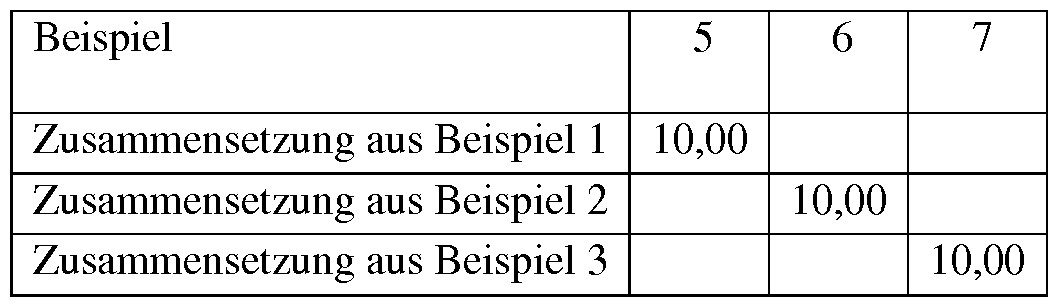

Wie aus der Tabelle 4 ersichtlich ist, ergeben die erfindungsgemäßen Uretdion-haltigen Dispersionen harte und beständige Lacke.
Claims
1. Wässrige uretdiongruppenhaltige Zusammensetzungen, umfassend oder bestehend aus,
(A) mindestens einen uretdiongruppenhaltigen Härter, basierend auf aliphatischen, cycloaliphatischen, araliphatischen und/oder aromatischen Polyisocyanaten, welcher keine chemisch gebundenen hydrophilierenden Gruppen enthält;
(B) mindestens ein Hydroxygruppen enthaltendes Polyol, welches mindestens eine chemisch gebundene Carbonsäuregruppe enthält;
(C) gegebenenfalls Lösemittel; und
(D) gegebenenfalls Hilfs- und Zusatzstoffe;
wobei das Mengenverhältnis der Komponenten (A) und (B) so bemessen ist, dass das molare Verhältnis von den als Uretdion vorliegenden NCO-Gruppen des Härtere (A) zu NCO- reaktiven Gruppen des Polyols (B) 3,0 : 0,5 bis 0,5 : 3,0 beträgt und wobei A und B als physikalische Mischung vorliegen.
2. Zusammensetzung nach Anspruch 1, dadurch gekennzeichnet, dass
der mindestens eine uretdiongruppenhaltige Härter (A) durch Umsetzen von monomeren Isocyanaten umfassend oder bestehend aus mindestens einem monomeren Isocyanat ausgewählt aus Tetramethylen-diisocyanat, Cyclohexan-1,3- und 1,4-diisocyanat, Pentamethylendiisocyanat, Hexamethylendiisocyanat (HDI), l-Isocyanato-3,3,5-trimethyl-5- isocyanatomethylcyclohexan (Isophorondiisocyanat IPDI), Dicyclohexylmethan-2,4'- und/oder 4,4'-diisocyanat, Tetramethylxylylendiisocyanat (TMXDI), Triisocyanatononan, Toluylendiisocyanat (TDI), Diphenylmethan-2,4'-und/oder 4,4'-diisocyanat (MDI), Triphenylmethan-4,4'-diisocyanat oder Naphthylen-l,5-diisocyanat oder Mischungen davon erhalten wurde.
3. Zusammensetzung nach Anspruch 1 oder 2, dadurch gekennzeichnet, dass
als Einsatzstoffe für den mindestens einen uretdiongruppenhaltigen Härter A hydroxylgruppenhaltige Monomere und/oder Polymere eingesetzt werden.
4. Zusammensetzung nach einem der vorstehenden Ansprüchen, dadurch gekennzeichnet, dass der mindestens eine uretdiongruppenhaltige Härter A einen freien NCO-Gehalt von weniger als 5 Gew.-% und einen Gehalt an Uretdiongruppen von 1 bis 18 Gew.-% (berechnet als C2N2O2, Molekulargewicht 84 g/mol) aufweist.
5. Zusammensetzung nach einem der vorstehenden Ansprüchen, dadurch gekennzeichnet, dass die wässrige Zusammensetzung eine Säurezahl von 1 bis 100 mg KOH/g aufweist.
6. Zusammensetzung nach einem der vorstehenden Ansprüchen, dadurch gekennzeichnet, dass das mindestens eine Hydroxygruppen enthaltende Polyol (B) durch Umsetzen von Hydroxy- oder Aminocarbonsäuren umfassend oder bestehend aus mindestens einer Carbonsäure ausgewählt aus 2,2-Dimethylolessigsäure, 2,2-Dimethylolbuttersäure, 2,2- Dimethylolpentansäure, Dihydroxybernsteinsäure, a,W-Diaminovaleriansäure, oder
Mischungen davon, bevorzugt aus Dimethylolpropionsäure oder Hydroxypivalinsäure, erhalten wurde.
7. Zusammensetzung nach einem der vorstehenden Ansprüchen, dadurch gekennzeichnet, dass das mindestens eine Hydroxygruppe enthaltende Polyol (B) einen OH-Gehalt größer 1 Gew.-
%, als OH-Gruppe auf Festgehalt berechnet, Molekulargewicht 17 g / mol, und ein zahlenmittleres Molekulargewicht Mn von 500 bis 20000 g/mol aufweist.
8. Zusammensetzung nach einem der vorstehenden Ansprüche, dadurch gekennzeichnet, dass das Lösemittel ausgewählt ist aus Aceton, Methylethylketon, Ethylacetat, Butylacetat, Xylol,
Schwerbenzol, Propylenglykolmono-n-butylether, Dipropylenglykol dimethylether, Methoxypropylacetat, dibasischen Estern oder Mischungen davon.
9. Zusammensetzung nach einem der vorstehenden Ansprüche, dadurch gekennzeichnet, dass die Hilfs- und Zusatzstoffe ausgewählt sind aus Verlaufsmitteln, Lichtschutzmitteln, Katalysatoren, Füllstoffen und Pigmenten oder Mischungen davon.
10. Zusammensetzung nach einem der vorstehenden Ansprüche, dadurch gekennzeichnet, dass die Summe der Gewichts-Anteile von (A), (B) und (D) 30 bis 60 Gew.-%, bezogen auf den Feststoffgehalt der gesamten wässrigen Zusammensetzung, beträgt.
11. Verfahren zur Herstellung einer Polyurethanschicht, umfassend die Schritte
i) Bereitstellen einer wässrigen uretdiongruppenhaltigen Zusammensetzung gemäß einem der Ansprüche 1 bis 10;
ii) Aufbringen der unter i) erhaltenen Mischung auf ein Substrat;
iii) Trocknen der Mischung aus Schritt ii), und
iv) Härten der Mischung aus Schritt iii) unter Wärmezufuhr von 40 °C bis 180 °C für bis zu 180 Minuten.
12 Verfahren nach Anspruch 11, dadurch gekennzeichnet, dass die wässrige uretdiongruppenhaltige Zusammensetzung durch Vermischen des uretdiongruppenhaltigen Härtere A mit dem mindestens eine Hydroxygruppe enthaltenden Polyol B in Abwesenheit von Wasser und anschließender Dispergierung mit Wasser erhalten wurde.
13. Polyurethanschicht, insbesondere Polyurethanfilm, erhältlich durch ein Verfahren nach Anspruch 11 oder 12.
14. Ein Substrat, welches mit der Polyurethanschicht nach Anspruch 13 beschichtet oder verklebt ist.
Priority Applications (3)
| Application Number | Priority Date | Filing Date | Title |
|---|---|---|---|
| US17/040,071 US20210024680A1 (en) | 2018-03-23 | 2019-03-21 | Aqueous uretdione group-containing compositions and method for producing same |
| CN201980021445.9A CN111886272B (zh) | 2018-03-23 | 2019-03-21 | 含脲二酮基团的水性组合物及其制备方法 |
| EP19711125.5A EP3768749A1 (de) | 2018-03-23 | 2019-03-21 | Wässrige uretdiongruppenhaltige zusammensetzungen und verfahren zu deren herstellung |
Applications Claiming Priority (30)
| Application Number | Priority Date | Filing Date | Title |
|---|---|---|---|
| US15/933,527 | 2018-03-23 | ||
| US15/933,487 US20190292305A1 (en) | 2018-03-23 | 2018-03-23 | Uretdione based polyurethane compositions |
| US15/933,553 US10633477B2 (en) | 2018-03-23 | 2018-03-23 | Extended pot-life for low temperature curing polyuretdione resins |
| US15/933,495 US11312881B2 (en) | 2018-03-23 | 2018-03-23 | One component polyurethane/allophanate formulations with reactive reducer |
| US15/933,507 | 2018-03-23 | ||
| US15/933,507 US20190292294A1 (en) | 2018-03-23 | 2018-03-23 | One component allophanate formulations through basecoat catalyst migration |
| EP18163625.9 | 2018-03-23 | ||
| EP18163620.0A EP3543269A1 (de) | 2018-03-23 | 2018-03-23 | Uretdionhaltige polyurethandispersionen mit hydrophilen gruppen |
| US15/933,495 | 2018-03-23 | ||
| US15/933,570 US10731051B2 (en) | 2018-03-23 | 2018-03-23 | Basecoat acid neutralization through inorganic salts |
| EP18163620.0 | 2018-03-23 | ||
| US15/933,475 US11008416B2 (en) | 2018-03-23 | 2018-03-23 | Aqueous, curable composition, comprising dispersed uretdione prepolymer, reactant and azolate |
| EP18163621.8 | 2018-03-23 | ||
| US15/933,527 US20190292296A1 (en) | 2018-03-23 | 2018-03-23 | Polyol acid neutralization for low temperature uretdione curing |
| US15/933,500 | 2018-03-23 | ||
| US15/933,511 | 2018-03-23 | ||
| EP18163625.9A EP3543271A1 (de) | 2018-03-23 | 2018-03-23 | Wässrige uretdiongruppenhaltige zusammensetzungen und verfahren zu deren herstellung |
| US15/933,470 | 2018-03-23 | ||
| US15/933,500 US10696775B2 (en) | 2018-03-23 | 2018-03-23 | Curing for polyallophanate compositions through undercoat acid neutralization |
| US15/933,570 | 2018-03-23 | ||
| US15/933,470 US11292864B2 (en) | 2018-03-23 | 2018-03-23 | Compositions using polyuretdione resins |
| US15/933,511 US11440988B2 (en) | 2018-03-23 | 2018-03-23 | Polyuretdione-containing resin blend compositions |
| EP18163621.8A EP3543270A1 (de) | 2018-03-23 | 2018-03-23 | Katalysatorsystem für uretdiondispersionen |
| US15/933,487 | 2018-03-23 | ||
| US15/933,553 | 2018-03-23 | ||
| US15/933,475 | 2018-03-23 | ||
| EP18181876.6 | 2018-07-05 | ||
| EP18181877.4A EP3590988A1 (de) | 2018-07-05 | 2018-07-05 | Wässrige uretdiongruppenhaltige zusammensetzungen und verfahren zu deren herstellung |
| EP18181877.4 | 2018-07-05 | ||
| EP18181876.6A EP3590987A1 (de) | 2018-07-05 | 2018-07-05 | Wässrige uretdiongruppenhaltige zusammensetzungen und verfahren zu deren herstellung |
Publications (1)
| Publication Number | Publication Date |
|---|---|
| WO2019180127A1 true WO2019180127A1 (de) | 2019-09-26 |
Family
ID=65767037
Family Applications (15)
| Application Number | Title | Priority Date | Filing Date |
|---|---|---|---|
| PCT/EP2019/057069 Ceased WO2019180131A1 (de) | 2018-03-23 | 2019-03-21 | Wässrige uretdiongruppenhaltige zusammensetzungen und verfahren zu deren herstellung |
| PCT/US2019/023312 Ceased WO2019183313A1 (en) | 2018-03-23 | 2019-03-21 | Extended pot-life for low temperature curing polyuretdione resins |
| PCT/US2019/023334 Ceased WO2019183330A1 (en) | 2018-03-23 | 2019-03-21 | Basecoat acid neutralization through inorganic salts |
| PCT/US2019/023325 Ceased WO2019183323A1 (en) | 2018-03-23 | 2019-03-21 | One component polyurethane/allophanate formulations with reactive reducer |
| PCT/US2019/023297 Ceased WO2019183307A1 (en) | 2018-03-23 | 2019-03-21 | Polyuretdione-containing resin blend compositions |
| PCT/EP2019/057066 Ceased WO2019180129A1 (de) | 2018-03-23 | 2019-03-21 | Katalysatorsystem für uretdiondispersionen |
| PCT/US2019/023314 Ceased WO2019183315A1 (en) | 2018-03-23 | 2019-03-21 | Polyol acid neutralization for low temperature uretdione curing |
| PCT/US2019/023286 Ceased WO2019183300A1 (en) | 2018-03-23 | 2019-03-21 | Aqueous, curable composition, comprising dispersed uretdione prepolymer, reactant and azolate |
| PCT/EP2019/057068 Ceased WO2019180130A1 (en) | 2018-03-23 | 2019-03-21 | Uretdione-containing polyurethane-dispersions comprising hydrophilic groups |
| PCT/US2019/023292 Ceased WO2019183305A1 (en) | 2018-03-23 | 2019-03-21 | Improved curing for polyallophanate compositions through undercoat acid neutralization |
| PCT/US2019/023319 Ceased WO2019183319A1 (en) | 2018-03-23 | 2019-03-21 | One component allophanate formulations through basecoat catalyst migration |
| PCT/US2019/023290 Ceased WO2019183304A1 (en) | 2018-03-23 | 2019-03-21 | Uretdione based polyurethane compositions |
| PCT/US2019/023299 Ceased WO2019183308A1 (en) | 2018-03-23 | 2019-03-21 | Compositions using polyuretdione resins |
| PCT/EP2019/057064 Ceased WO2019180127A1 (de) | 2018-03-23 | 2019-03-21 | Wässrige uretdiongruppenhaltige zusammensetzungen und verfahren zu deren herstellung |
| PCT/EP2019/057065 Ceased WO2019180128A1 (de) | 2018-03-23 | 2019-03-21 | Wässrige uretdiongruppenhaltige zusammensetzungen und verfahren zu deren herstellung |
Family Applications Before (13)
| Application Number | Title | Priority Date | Filing Date |
|---|---|---|---|
| PCT/EP2019/057069 Ceased WO2019180131A1 (de) | 2018-03-23 | 2019-03-21 | Wässrige uretdiongruppenhaltige zusammensetzungen und verfahren zu deren herstellung |
| PCT/US2019/023312 Ceased WO2019183313A1 (en) | 2018-03-23 | 2019-03-21 | Extended pot-life for low temperature curing polyuretdione resins |
| PCT/US2019/023334 Ceased WO2019183330A1 (en) | 2018-03-23 | 2019-03-21 | Basecoat acid neutralization through inorganic salts |
| PCT/US2019/023325 Ceased WO2019183323A1 (en) | 2018-03-23 | 2019-03-21 | One component polyurethane/allophanate formulations with reactive reducer |
| PCT/US2019/023297 Ceased WO2019183307A1 (en) | 2018-03-23 | 2019-03-21 | Polyuretdione-containing resin blend compositions |
| PCT/EP2019/057066 Ceased WO2019180129A1 (de) | 2018-03-23 | 2019-03-21 | Katalysatorsystem für uretdiondispersionen |
| PCT/US2019/023314 Ceased WO2019183315A1 (en) | 2018-03-23 | 2019-03-21 | Polyol acid neutralization for low temperature uretdione curing |
| PCT/US2019/023286 Ceased WO2019183300A1 (en) | 2018-03-23 | 2019-03-21 | Aqueous, curable composition, comprising dispersed uretdione prepolymer, reactant and azolate |
| PCT/EP2019/057068 Ceased WO2019180130A1 (en) | 2018-03-23 | 2019-03-21 | Uretdione-containing polyurethane-dispersions comprising hydrophilic groups |
| PCT/US2019/023292 Ceased WO2019183305A1 (en) | 2018-03-23 | 2019-03-21 | Improved curing for polyallophanate compositions through undercoat acid neutralization |
| PCT/US2019/023319 Ceased WO2019183319A1 (en) | 2018-03-23 | 2019-03-21 | One component allophanate formulations through basecoat catalyst migration |
| PCT/US2019/023290 Ceased WO2019183304A1 (en) | 2018-03-23 | 2019-03-21 | Uretdione based polyurethane compositions |
| PCT/US2019/023299 Ceased WO2019183308A1 (en) | 2018-03-23 | 2019-03-21 | Compositions using polyuretdione resins |
Family Applications After (1)
| Application Number | Title | Priority Date | Filing Date |
|---|---|---|---|
| PCT/EP2019/057065 Ceased WO2019180128A1 (de) | 2018-03-23 | 2019-03-21 | Wässrige uretdiongruppenhaltige zusammensetzungen und verfahren zu deren herstellung |
Country Status (3)
| Country | Link |
|---|---|
| EP (14) | EP3768759A1 (de) |
| CN (10) | CN111868133A (de) |
| WO (15) | WO2019180131A1 (de) |
Families Citing this family (4)
| Publication number | Priority date | Publication date | Assignee | Title |
|---|---|---|---|---|
| CN110698622A (zh) * | 2019-10-12 | 2020-01-17 | 北京长润化工有限公司 | 酮亚胺潜伏固化剂和具有其的反应型聚氨酯热熔胶及应用 |
| CN113816812A (zh) * | 2021-08-27 | 2021-12-21 | 湖北航天化学技术研究所 | 一种液体型脲类降速剂、制备方法及固体推进剂 |
| CN116063975B (zh) * | 2021-11-02 | 2025-07-29 | 浙江华峰合成树脂有限公司 | 一种聚氨酯胶黏剂及其制备和应用 |
| CN116410442B (zh) * | 2021-12-31 | 2025-12-30 | 万华化学集团股份有限公司 | 一种存储稳定的多异氰酸酯组合物 |
Citations (16)
| Publication number | Priority date | Publication date | Assignee | Title |
|---|---|---|---|---|
| DE2456469A1 (de) | 1974-11-29 | 1976-08-12 | Bayer Ag | Verfahren zur herstellung von in wasser loeslichen bzw. dispergierbaren blockierten polyisocyanaten |
| DE2538484A1 (de) | 1975-08-29 | 1977-03-10 | Veba Chemie Ag | Thermisch vernetzbare waessrige polyurethandispersionen |
| DE2814815A1 (de) | 1977-04-07 | 1978-10-19 | Grace W R & Co | Waessrige urethandispersionen und codispersionen |
| EP0012348A1 (de) | 1978-12-14 | 1980-06-25 | Bayer Ag | Eine Polyisocyanat-Komponente und eine Polyhydroxy-Komponente aufweisende Bindemittel für aus wässriger Phase zu verarbeitende Beschichtungsmittel |
| US4496684A (en) | 1984-06-01 | 1985-01-29 | Olin Corporation | Uretdione group-containing polyurethane oligomers and aqueous dispersions thereof |
| EP0424697A2 (de) | 1989-10-03 | 1991-05-02 | Asahi Glass Company Ltd. | Wässrige Polyurethanzusammensetzung und ihre Verwendung |
| DE4001783A1 (de) | 1990-01-23 | 1991-07-25 | Bayer Ag | Polyisocyanatgemische, ein verfahren zu ihrer herstellung und ihre verwendung als bindemittel fuer ueberzugsmittel oder als reaktionspartner fuer gegenueber isocyanatgruppen oder carboxylgruppen reaktionsfaehige verbindungen |
| EP0576952A2 (de) | 1992-07-03 | 1994-01-05 | Bayer Ag | In Wasser lösliche dispergierbare Polyisocyanatgemische und ihre Verwendung in Einbrennlacken |
| EP0669353A1 (de) | 1994-02-28 | 1995-08-30 | Hüls Aktiengesellschaft | Hydroxyl- und uretdiongruppenhaltige Polyadditionsprodukte und Verfahren zu ihrer Herstellung sowie deren Verwendung zur Herstellung abspaltfreier Polyurethan-Pulverlacke hoher Reaktivität und die danach hergestellten Polyurethan-Pulverlacke |
| EP0818482A1 (de) * | 1996-07-13 | 1998-01-14 | Hüls Aktiengesellschaft | Wärmehärtende Einkomponenten-Klebstoffe auf Basis von Polyurethanen, ein Verfahren zu ihrer Herstellung sowie deren Verwendung |
| WO2002092657A1 (de) | 2001-05-14 | 2002-11-21 | Bayer Aktiengesellschaft | Verfahren zur dimerisierung von isophorondiisocyanat |
| WO2004005364A1 (de) | 2002-07-04 | 2004-01-15 | Bayer Materialscience Ag | Uretdiongruppen aufweisende isocyanate |
| EP1687354A1 (de) | 2003-11-25 | 2006-08-09 | Basf Corporation | Verfahren zur herstellung einer wässrigen beschichtung mit einem festen vernetzer |
| DE102005036654A1 (de) | 2005-08-04 | 2007-02-15 | Bayer Materialscience Ag | Selbstvernetzende PUR-Dispersionen mit Uretdionstruktur |
| US20120252926A1 (en) * | 2011-03-30 | 2012-10-04 | Basf Se | Latently reactive polyurethane dispersion with activatable crosslinking |
| DE102012218081A1 (de) * | 2012-10-04 | 2014-04-10 | Evonik Industries Ag | Neuartige hydrophile Polyisocyanate mit verbesserter Lagerstabilität |
Family Cites Families (87)
| Publication number | Priority date | Publication date | Assignee | Title |
|---|---|---|---|---|
| US3169945A (en) | 1956-04-13 | 1965-02-16 | Union Carbide Corp | Lactone polyesters |
| DE1078568B (de) | 1957-08-30 | 1960-03-31 | Basf Ag | Verfahren zur Herstellung von Carbonsaeureamidinen |
| NL126422C (de) | 1960-10-14 | |||
| DE2312391A1 (de) * | 1973-03-13 | 1974-09-19 | Bayer Ag | Pulverfoermige, vernetzbare ueberzugsmittel |
| DE3030572A1 (de) * | 1980-08-13 | 1982-03-18 | Chemische Werke Hüls AG, 4370 Marl | Verfahren zur herstellung von uretdiongruppenhaltigen polyadditionsprodukten sowie die danach hergestellten produkte |
| JPS63284273A (ja) * | 1987-05-15 | 1988-11-21 | Dainippon Ink & Chem Inc | 粉体塗料用樹脂組成物 |
| CA2047635C (en) * | 1990-07-30 | 2003-09-30 | Terry A. Potter | Two-component aqueous polyurethane dispersions |
| DE4136618A1 (de) * | 1991-11-07 | 1993-05-13 | Bayer Ag | Wasserdispergierbare polyisocyanatgemische |
| DE4322242A1 (de) * | 1993-07-03 | 1995-01-12 | Basf Lacke & Farben | Wäßriges Zweikomponenten-Polyurethan-Beschichtungsmittel, Verfahren zu seiner Herstellung und seine Verwendung in Verfahren zur Hestellung einer Mehrschichtlackierung |
| CA2134009C (en) | 1993-11-11 | 2005-03-08 | Oleg Werbitzky | Bicyclic amidines, process for their preparation, and their use as catalyst |
| US5795950A (en) * | 1994-05-20 | 1998-08-18 | Asahi Kasei Kogyo Kabushiki Kaisha | Straight chain crystalline polyuretdione |
| ES2208660T3 (es) * | 1994-06-06 | 2004-06-16 | Basf Corporation | Composiciones de revestimiento que contienen aldimina e isocianato y proceso para su preparacion. |
| US5523376A (en) * | 1994-12-21 | 1996-06-04 | Bayer Corporation | Coating compositions based on aldimines and polyisocyanates containing uretdione groups |
| CA2245730C (en) * | 1996-02-17 | 2006-01-03 | Imperial Chemical Industries Plc | Coating composition |
| DE19611849A1 (de) | 1996-03-26 | 1997-10-02 | Bayer Ag | Neue Isocyanattrimerisate und Isocyanattrimerisatmischungen, deren Herstellung und Verwendung |
| DE19616496A1 (de) | 1996-04-25 | 1997-10-30 | Bayer Ag | Abspaltfreier Polyurethan-Pulverlack mit niedriger Einbrenntemperatur |
| DE19628328A1 (de) * | 1996-07-13 | 1998-01-15 | Huels Chemische Werke Ag | Wärmehärtender abspalt- und lösemittelfreier Einkomponenten-Klebstoff auf Basis von Polyurethanen sowie deren Verwendung |
| US5977285A (en) * | 1997-08-07 | 1999-11-02 | Akzo Nobel N.V. | Sprayable coating compositions comprising oxazolidines, isocyanates and hydroxyl or amine functional resins |
| US5814689A (en) * | 1997-08-29 | 1998-09-29 | Arco Chemical Technology, L.P. | Low viscosity polyuretidione polyurethanes and their use as curatives for solvent and water borne coatings |
| JPH11279450A (ja) * | 1998-02-02 | 1999-10-12 | Asahi Chem Ind Co Ltd | 粉体塗料用組成物 |
| DE19814061A1 (de) | 1998-03-30 | 1999-10-07 | Bayer Ag | Copolymerisatdispersionen, Bindemittelkombinationen auf Basis der Copolymerisatdispersionen, ein Verfahren zu deren Herstellung und deren Verwendung |
| DE19854405B4 (de) * | 1998-11-25 | 2016-05-04 | Basf Se | Kompakte Kaschierung auf der Basis von Polyisocyanat-Polyadditionsprodukten |
| GB9828446D0 (en) * | 1998-12-24 | 1999-02-17 | Ici Plc | Coating composition |
| DE19903391A1 (de) | 1999-01-29 | 2000-08-03 | Bayer Ag | Wäßriges Überzugsmittel, Verfahren zu seiner Herstellung und seine Verwendung |
| DE19929064A1 (de) * | 1999-06-25 | 2000-12-28 | Bayer Ag | Verfahren zur Herstellung Uretdiongruppen aufweisender Polyadditionsverbindungen |
| DE69901260T2 (de) * | 1999-12-07 | 2002-08-14 | Chinese Petroleum Corp., Taipeh/T'ai-Pei | Uretedionderivat, es enthaltende härtbare Harzzusammensetzung und Verfahren zu seiner Herstellung |
| EP1197506B1 (de) * | 2000-10-13 | 2006-01-25 | Tosoh Corporation | Katalysator zur Herstellung von einer Zwei-Komponenten Polyurethandichtungsmasse |
| DE10234792A1 (de) * | 2002-07-31 | 2004-02-12 | Basf Coatings Ag | Strukturviskose Klarlack-Slurry, Verfahren zu ihrer Herstellung und ihre Verwendung |
| ITVA20020064A1 (it) * | 2002-12-02 | 2004-06-03 | Lamberti Spa | Dispersioni acquose stabili di poliisocianati bloccati non ionici. |
| JP4143825B2 (ja) * | 2003-01-28 | 2008-09-03 | 三菱瓦斯化学株式会社 | ポリイソシアネート化合物、その製造方法、重付加組成物、および粉体塗料 |
| DE10320267A1 (de) * | 2003-05-03 | 2004-11-18 | Degussa Ag | Bei niedriger Temperatur härtbare feste uretdiongruppenhaltige Polyurethan-Pulverlackzusammensetzungen |
| DE10347901A1 (de) * | 2003-10-15 | 2005-05-19 | Degussa Ag | Polyurethan-Pulverlackbeschichtungen, welche feste uretdiongruppenhaltige Polyadditionsverbindungen enthalten, und ein Verfahren zu ihrer Herstellung |
| DE10347902A1 (de) * | 2003-10-15 | 2005-05-19 | Degussa Ag | Feste uretdiongruppenhaltige Polyadditionsverbindungen |
| DE10348966A1 (de) | 2003-10-22 | 2005-06-02 | Degussa Ag | Hochreaktive Polyurethan-Pulverlackzusammensetzungen auf Basis epoxidgruppenterminierter, uretdiongruppenhaltiger Polyadditionsverbindungen |
| DE102004012903A1 (de) * | 2004-03-17 | 2005-10-06 | Bayer Materialscience Ag | Niedrigviskose Allophanate mit aktinisch härtbaren Gruppen |
| DE102004020429A1 (de) * | 2004-04-27 | 2005-11-24 | Degussa Ag | Uretdiongruppenhaltige Polyurethanzusammensetzungen, welche bei niedriger Temperatur härtbar sind und (teil-)kristalline Harze enthalten |
| DE102004020451A1 (de) * | 2004-04-27 | 2005-12-01 | Degussa Ag | Uretdiongruppenhaltige Polyurethanzusammensetzungen, welche bei niedriger Temperatur härtbar sind und (teil-)kristalline Harze enthalten |
| US7485729B2 (en) * | 2004-08-12 | 2009-02-03 | King Industries, Inc. | Organometallic compositions and coating compositions |
| EP1778778A4 (de) * | 2004-08-12 | 2011-04-27 | King Industries Inc | Metallorganische zusammensetzungen und beschichtungszusammensetzungen |
| DE102004043540A1 (de) * | 2004-09-09 | 2006-03-30 | Bayer Materialscience Ag | Niedrigviskose Allophanate mit aktinisch härtbaren Gruppen |
| DE102004043538A1 (de) * | 2004-09-09 | 2006-03-16 | Bayer Materialscience Ag | Herstellung von neuen strahlenhärtenden Bindemitteln |
| DE102004048773A1 (de) * | 2004-10-07 | 2006-04-13 | Degussa Ag | Hydroxylterminierte uretdiongruppenhaltige Polyurethanverbindungen |
| DE102004049592A1 (de) * | 2004-10-12 | 2006-05-04 | Bayer Materialscience Ag | Mit Soft-Touch-Lack beschichtete, verformbare Kunststoffverbundfolien und Kunststoffverbundelemente sowie deren Herstellung |
| US7135505B2 (en) * | 2004-10-25 | 2006-11-14 | Bayer Materialscience Llc | Radiation curable coatings based on uretdione polyisocyanates |
| US8686103B2 (en) * | 2004-12-15 | 2014-04-01 | Akzo Nobel Coatings International B.V. | Water borne coating composition containing thiol functional compounds |
| DE102004062588A1 (de) * | 2004-12-24 | 2006-07-06 | Degussa Ag | Hochreaktive uretdiongruppenhaltige Polyurethanzusammensetzungen auf Basis von 1,4-Diisocyanatocyclohexylmethan |
| DE102005013329A1 (de) * | 2005-03-23 | 2006-11-16 | Degussa Ag | Niedrigviskose uretdiongruppenhaltige Polyadditionsverbindungen, Verfahren zur Herstellung und Verwendung |
| DE102005013401A1 (de) * | 2005-03-23 | 2006-09-28 | Degussa Ag | Niedrigviskose uretdiongruppenhaltige Polyadditionsverbindungen, Verfahren zur Herstellung und Verwendung |
| DE102005019430A1 (de) * | 2005-04-25 | 2006-10-26 | Bayer Materialscience Ag | N-Methylpyrrolidon-freie Polyurethan-Dispersionen auf Basis von Dimethylolpropionsäure |
| DE102005049916A1 (de) * | 2005-10-17 | 2007-04-19 | Degussa Gmbh | Lagerstabile, reaktive Pulverlackzusammensetzungen mit kristallinen Bestandteilen |
| DE102005053678A1 (de) * | 2005-11-10 | 2007-05-16 | Bayer Materialscience Ag | Hydrophile Polyisocyanatgemische |
| DE102005060828A1 (de) * | 2005-12-20 | 2007-06-28 | Bayer Materialscience Ag | Verfahren zur Herstellung von Polyadditionsverbindungen |
| DE102006042494A1 (de) * | 2006-09-07 | 2008-03-27 | Evonik Degussa Gmbh | Bei niedriger Temperatur härtbare, uretdiongruppenhaltige Polyurethanzusammensetzungen mit quartären Ammoniumhalogeniden |
| DE102006046368A1 (de) * | 2006-09-29 | 2008-04-03 | Construction Research & Technology Gmbh | Funktionalisiertes Polyurethanharz, Verfahren zu seiner Herstellung sowie dessen Verwendung |
| DE102007040239A1 (de) * | 2007-08-25 | 2009-05-07 | Bayer Materialscience Ag | Verfahren zur Herstellung von niedrigviskosen Allophanaten mit aktinisch härtbaren Gruppen |
| DE102008007386A1 (de) | 2008-02-01 | 2009-08-06 | Evonik Degussa Gmbh | Verfahren zur Herstellung hochreaktiver uretdiongruppenhaltiger Polyurethanzusammensetzungen im Dryblend |
| CA2717054C (en) * | 2008-03-20 | 2017-02-28 | Basf Se | Polyurethane systems for producing polyurethane sandwich parts at low molding temperatures |
| EP2110395A1 (de) * | 2008-04-18 | 2009-10-21 | Bayer MaterialScience AG | Wässrige Polyurethanlösungen für Polyurethan-Systeme |
| EP2110396A1 (de) * | 2008-04-18 | 2009-10-21 | Bayer MaterialScience AG | 1K-PUR-Systeme aus wässrigen oder wasserlöslichen Polyurethanen |
| DE102008002703A1 (de) * | 2008-06-27 | 2009-12-31 | Evonik Degussa Gmbh | Hochreaktive, Uretdiongruppen haltige Polyurethanzusammensetzungen, die metallfreie Acetylacetonate enthalten |
| DE102008040967A1 (de) * | 2008-08-04 | 2010-02-11 | Leibniz-Institut Für Polymerforschung Dresden E.V. | Werkstoff-Kunststoff-Verbunde und Verfahren zu ihrer Herstellung |
| DE102009008950A1 (de) * | 2009-02-13 | 2010-08-19 | Bayer Materialscience Ag | Wässrige Beschichtungssysteme auf Basis physikalisch trocknender Urethanacrylate |
| DK2236533T3 (da) * | 2009-03-31 | 2012-02-20 | Sika Technology Ag | Varmehærdende eller varmeaktiverbar sammensætning indeholdende et overfladeaktiveret polyisocyanat |
| US20110045219A1 (en) * | 2009-08-18 | 2011-02-24 | Bayer Materialscience Llc | Coating compositions for glass substrates |
| US9080074B2 (en) * | 2010-03-19 | 2015-07-14 | Bayer Materialscience Llc | Low temperature curing polyuretdione compositions |
| CN102311700A (zh) * | 2010-06-29 | 2012-01-11 | 拜耳材料科技(中国)有限公司 | 脂肪族聚脲涂料、制备方法及其应用 |
| PL2614112T3 (pl) * | 2010-09-07 | 2015-03-31 | Bayer Ip Gmbh | Spienione, światłotrwałe kształtki poliuretanowe |
| KR20140004091A (ko) * | 2010-10-29 | 2014-01-10 | 루브리졸 어드밴스드 머티어리얼스, 인코포레이티드 | 수성의 양이온성 폴리우레탄 분산물 |
| WO2012078331A1 (en) * | 2010-12-08 | 2012-06-14 | Dow Global Technologies Llc | Two-part polyurethane adhesive for bonding fiber-reinforced plastics |
| EP2465886A1 (de) * | 2010-12-16 | 2012-06-20 | Bayer MaterialScience AG | Polyisocyanat-Polyadditionsprodukte, ein Verfahren zu ihrer Herstellung und ihre Verwendung |
| WO2012122098A1 (en) * | 2011-03-06 | 2012-09-13 | King Industries, Inc. | Compositions of a metal amidine complex and second compound, coating compositions comprising same |
| EP2758443B1 (de) * | 2011-09-21 | 2019-02-27 | Dow Global Technologies LLC | Aus mischungen von tertiären aminverbindungen und lewis-säuren als katalysatoren hergestellte polyurethane |
| JP5976001B2 (ja) * | 2011-09-30 | 2016-08-23 | 関西ペイント株式会社 | 塗膜形成方法及び塗装物品 |
| CN104470963A (zh) * | 2012-07-26 | 2015-03-25 | 拜耳材料科技股份有限公司 | 包含对苯二甲酸聚酯的水性聚氨酯分散体 |
| US9175117B2 (en) * | 2013-03-15 | 2015-11-03 | Covestro Llc | Dual cure composite resins containing uretdione and unsaturated sites |
| CN104130686B (zh) * | 2013-04-30 | 2017-09-19 | 旭化成株式会社 | 多异氰酸酯组合物及涂料组合物 |
| EP2801587A1 (de) * | 2013-05-07 | 2014-11-12 | Rhein Chemie Rheinau GmbH | Zusammensetzungen, deren Herstellung und deren Verwendung zur Herstellung von Gusspolyamiden |
| US9206320B1 (en) * | 2013-07-18 | 2015-12-08 | Hentzen Coatings, Inc. | Matte-appearance powder coating compositions with chemical agent resistance |
| DK3074445T3 (da) * | 2013-11-29 | 2021-03-29 | Basf Se | Polyurethansystem med lang forarbejdningsstid og hurtig hærdning |
| DE102014209183A1 (de) * | 2014-05-15 | 2015-11-19 | Evonik Degussa Gmbh | Reaktive Zusammensetzung aus einer Uretdiongruppen haltigen Dispersion und Polyaminen |
| DE102014214130A1 (de) * | 2014-07-21 | 2016-01-21 | Evonik Degussa Gmbh | Hochreaktive, Uretdiongruppen haltige Polyurethanzusammensetzungen, die Carbonatsalze enthalten |
| EP2979851A1 (de) * | 2014-07-28 | 2016-02-03 | Evonik Degussa GmbH | Effiziente Herstellung von Composite-Halbzeugen und -Bauteilen im Nasspressverfahren unter Einsatz von hydroxyfunktionalisierten (Meth) Acrylaten, die mittels Isocyanaten oder Uretdionen duroplastisch vernetzt werden |
| EP2990398B1 (de) * | 2014-08-29 | 2018-12-19 | Covestro Deutschland AG | Hydrophile Polyasparaginsäureester |
| EP2993202A1 (de) * | 2014-09-08 | 2016-03-09 | Evonik Degussa GmbH | Composite-Halbzeuge und daraus hergestellte Formteile sowie direkt hergestellte Formteile auf Basis von hydroxyfunktionalisierten (Meth)Acrylaten und Uretdionen, die duroplastisch vernetzt werden |
| EP3026071A1 (de) * | 2014-11-26 | 2016-06-01 | Henkel AG & Co. KGaA | Stabilisierte Polyurethan-Dispersionen |
| US10640618B2 (en) * | 2015-05-29 | 2020-05-05 | Basf Se | Polyurethane-polyisocyanurate resins for fiber composite materials with a longer open time |
| CN108699204B (zh) * | 2016-03-09 | 2020-10-16 | 旭化成株式会社 | 多异氰酸酯组合物、涂覆组合物、水系涂覆组合物和涂覆基材 |
-
2019
- 2019-03-21 EP EP19714972.7A patent/EP3768759A1/de not_active Withdrawn
- 2019-03-21 EP EP19711127.1A patent/EP3768748A1/de not_active Withdrawn
- 2019-03-21 EP EP19711128.9A patent/EP3768745A1/de not_active Withdrawn
- 2019-03-21 CN CN201980021559.3A patent/CN111868133A/zh active Pending
- 2019-03-21 WO PCT/EP2019/057069 patent/WO2019180131A1/de not_active Ceased
- 2019-03-21 EP EP19713339.0A patent/EP3768752A1/de active Pending
- 2019-03-21 CN CN201980021506.1A patent/CN111868135A/zh active Pending
- 2019-03-21 CN CN201980021447.8A patent/CN111886271A/zh active Pending
- 2019-03-21 CN CN201980021508.0A patent/CN112041367B/zh active Active
- 2019-03-21 EP EP19713669.0A patent/EP3768757A1/de not_active Withdrawn
- 2019-03-21 EP EP19711125.5A patent/EP3768749A1/de active Pending
- 2019-03-21 WO PCT/US2019/023312 patent/WO2019183313A1/en not_active Ceased
- 2019-03-21 WO PCT/US2019/023334 patent/WO2019183330A1/en not_active Ceased
- 2019-03-21 WO PCT/US2019/023325 patent/WO2019183323A1/en not_active Ceased
- 2019-03-21 WO PCT/US2019/023297 patent/WO2019183307A1/en not_active Ceased
- 2019-03-21 CN CN201980034098.3A patent/CN112105665A/zh active Pending
- 2019-03-21 EP EP19711126.3A patent/EP3768750A1/de active Pending
- 2019-03-21 WO PCT/EP2019/057066 patent/WO2019180129A1/de not_active Ceased
- 2019-03-21 EP EP19713665.8A patent/EP3768753A1/de not_active Withdrawn
- 2019-03-21 WO PCT/US2019/023314 patent/WO2019183315A1/en not_active Ceased
- 2019-03-21 WO PCT/US2019/023286 patent/WO2019183300A1/en not_active Ceased
- 2019-03-21 WO PCT/EP2019/057068 patent/WO2019180130A1/en not_active Ceased
- 2019-03-21 WO PCT/US2019/023292 patent/WO2019183305A1/en not_active Ceased
- 2019-03-21 EP EP19713668.2A patent/EP3768756A1/de active Pending
- 2019-03-21 WO PCT/US2019/023319 patent/WO2019183319A1/en not_active Ceased
- 2019-03-21 WO PCT/US2019/023290 patent/WO2019183304A1/en not_active Ceased
- 2019-03-21 EP EP19713666.6A patent/EP3768754A1/de not_active Withdrawn
- 2019-03-21 EP EP19713670.8A patent/EP3768758A1/de not_active Withdrawn
- 2019-03-21 CN CN201980021604.5A patent/CN112004853B/zh active Active
- 2019-03-21 CN CN201980021448.2A patent/CN111886273A/zh active Pending
- 2019-03-21 EP EP19711129.7A patent/EP3768751A1/de active Pending
- 2019-03-21 WO PCT/US2019/023299 patent/WO2019183308A1/en not_active Ceased
- 2019-03-21 EP EP19713663.3A patent/EP3768747A1/de not_active Withdrawn
- 2019-03-21 EP EP19713667.4A patent/EP3768755A1/de not_active Withdrawn
- 2019-03-21 CN CN201980021445.9A patent/CN111886272B/zh active Active
- 2019-03-21 WO PCT/EP2019/057064 patent/WO2019180127A1/de not_active Ceased
- 2019-03-21 CN CN201980034350.0A patent/CN112105666B/zh active Active
- 2019-03-21 CN CN201980021630.8A patent/CN111868131A/zh active Pending
- 2019-03-21 WO PCT/EP2019/057065 patent/WO2019180128A1/de not_active Ceased
Patent Citations (17)
| Publication number | Priority date | Publication date | Assignee | Title |
|---|---|---|---|---|
| DE2456469A1 (de) | 1974-11-29 | 1976-08-12 | Bayer Ag | Verfahren zur herstellung von in wasser loeslichen bzw. dispergierbaren blockierten polyisocyanaten |
| DE2538484A1 (de) | 1975-08-29 | 1977-03-10 | Veba Chemie Ag | Thermisch vernetzbare waessrige polyurethandispersionen |
| DE2814815A1 (de) | 1977-04-07 | 1978-10-19 | Grace W R & Co | Waessrige urethandispersionen und codispersionen |
| EP0012348A1 (de) | 1978-12-14 | 1980-06-25 | Bayer Ag | Eine Polyisocyanat-Komponente und eine Polyhydroxy-Komponente aufweisende Bindemittel für aus wässriger Phase zu verarbeitende Beschichtungsmittel |
| US4496684A (en) | 1984-06-01 | 1985-01-29 | Olin Corporation | Uretdione group-containing polyurethane oligomers and aqueous dispersions thereof |
| EP0424697A2 (de) | 1989-10-03 | 1991-05-02 | Asahi Glass Company Ltd. | Wässrige Polyurethanzusammensetzung und ihre Verwendung |
| DE4001783A1 (de) | 1990-01-23 | 1991-07-25 | Bayer Ag | Polyisocyanatgemische, ein verfahren zu ihrer herstellung und ihre verwendung als bindemittel fuer ueberzugsmittel oder als reaktionspartner fuer gegenueber isocyanatgruppen oder carboxylgruppen reaktionsfaehige verbindungen |
| EP0576952A2 (de) | 1992-07-03 | 1994-01-05 | Bayer Ag | In Wasser lösliche dispergierbare Polyisocyanatgemische und ihre Verwendung in Einbrennlacken |
| EP0669353A1 (de) | 1994-02-28 | 1995-08-30 | Hüls Aktiengesellschaft | Hydroxyl- und uretdiongruppenhaltige Polyadditionsprodukte und Verfahren zu ihrer Herstellung sowie deren Verwendung zur Herstellung abspaltfreier Polyurethan-Pulverlacke hoher Reaktivität und die danach hergestellten Polyurethan-Pulverlacke |
| EP0818482A1 (de) * | 1996-07-13 | 1998-01-14 | Hüls Aktiengesellschaft | Wärmehärtende Einkomponenten-Klebstoffe auf Basis von Polyurethanen, ein Verfahren zu ihrer Herstellung sowie deren Verwendung |
| WO2002092657A1 (de) | 2001-05-14 | 2002-11-21 | Bayer Aktiengesellschaft | Verfahren zur dimerisierung von isophorondiisocyanat |
| WO2004005364A1 (de) | 2002-07-04 | 2004-01-15 | Bayer Materialscience Ag | Uretdiongruppen aufweisende isocyanate |
| EP1687354A1 (de) | 2003-11-25 | 2006-08-09 | Basf Corporation | Verfahren zur herstellung einer wässrigen beschichtung mit einem festen vernetzer |
| DE102005036654A1 (de) | 2005-08-04 | 2007-02-15 | Bayer Materialscience Ag | Selbstvernetzende PUR-Dispersionen mit Uretdionstruktur |
| US20120252926A1 (en) * | 2011-03-30 | 2012-10-04 | Basf Se | Latently reactive polyurethane dispersion with activatable crosslinking |
| DE102012218081A1 (de) * | 2012-10-04 | 2014-04-10 | Evonik Industries Ag | Neuartige hydrophile Polyisocyanate mit verbesserter Lagerstabilität |
| US20150232609A1 (en) | 2012-10-04 | 2015-08-20 | Evonik Industries Ag | Innovative hydrophilic polyisocyanates with improved storage stability |
Non-Patent Citations (1)
| Title |
|---|
| See also references of EP3768749A1 |
Also Published As
Similar Documents
| Publication | Publication Date | Title |
|---|---|---|
| EP2271686B1 (de) | Wässrige Polyurethanlösungen | |
| EP1862486B1 (de) | Lösemittelarme oder lösemittelfreie Vernetzer-Dispersionen mit Pyrazol-blockierten Isocyanatgruppen | |
| EP3134452B1 (de) | Wässrige zweikomponenten-beschichtungszusammensetzungen und daraus hergestellte beschichtungen mit hoher erosionsbeständigkeit | |
| EP2268691A1 (de) | Wässrige polyurethanlösungen für polyurethan-systeme | |
| EP0496205A1 (de) | Wässrige Bindemittelkombination, ein Verfahren zu ihrer Herstellung und ihre Verwendung | |
| EP2121787A1 (de) | Colöserfreie, selbstvernetzende pur-dispersionen | |
| EP3109269B1 (de) | Harnstofffreie polyurethan-dispersionen | |
| DE102004002525A1 (de) | Beschichtungsmittelzusammensetzung | |
| EP3768749A1 (de) | Wässrige uretdiongruppenhaltige zusammensetzungen und verfahren zu deren herstellung | |
| DE102005036654A1 (de) | Selbstvernetzende PUR-Dispersionen mit Uretdionstruktur | |
| AT411062B (de) | Beschichtungsmittel | |
| EP3026071A1 (de) | Stabilisierte Polyurethan-Dispersionen | |
| EP1910437A1 (de) | Selbstvernetzende pur-dispersionen | |
| EP0562436B1 (de) | Wasserverdünnbare Zweikomponenten-Überzugsmasse, ein Verfahren zu deren Herstellung und deren Verwendung | |
| EP1306398B1 (de) | Hochmolekulare Polyurethan-Dispersionen | |
| EP2305727A1 (de) | Neue 2K-PUR-Systeme | |
| WO2007062760A2 (de) | Herstellung einer vernetzer-dispersion mit blockierten isocyanatgruppen | |
| EP3543271A1 (de) | Wässrige uretdiongruppenhaltige zusammensetzungen und verfahren zu deren herstellung | |
| EP3590987A1 (de) | Wässrige uretdiongruppenhaltige zusammensetzungen und verfahren zu deren herstellung | |
| EP3543270A1 (de) | Katalysatorsystem für uretdiondispersionen | |
| US20210024680A1 (en) | Aqueous uretdione group-containing compositions and method for producing same | |
| EP3590988A1 (de) | Wässrige uretdiongruppenhaltige zusammensetzungen und verfahren zu deren herstellung |
Legal Events
| Date | Code | Title | Description |
|---|---|---|---|
| 121 | Ep: the epo has been informed by wipo that ep was designated in this application |
Ref document number: 19711125 Country of ref document: EP Kind code of ref document: A1 |
|
| NENP | Non-entry into the national phase |
Ref country code: DE |
|
| WWE | Wipo information: entry into national phase |
Ref document number: 2019711125 Country of ref document: EP |