WO2019187672A1 - Dispositif de cuisson, dispositif de traitement d'informations, programme, procédé de commande - Google Patents
Dispositif de cuisson, dispositif de traitement d'informations, programme, procédé de commande Download PDFInfo
- Publication number
- WO2019187672A1 WO2019187672A1 PCT/JP2019/004297 JP2019004297W WO2019187672A1 WO 2019187672 A1 WO2019187672 A1 WO 2019187672A1 JP 2019004297 W JP2019004297 W JP 2019004297W WO 2019187672 A1 WO2019187672 A1 WO 2019187672A1
- Authority
- WO
- WIPO (PCT)
- Prior art keywords
- food
- odor
- cooking
- unit
- sensor
- Prior art date
- Legal status (The legal status is an assumption and is not a legal conclusion. Google has not performed a legal analysis and makes no representation as to the accuracy of the status listed.)
- Ceased
Links
Images









Classifications
-
- A—HUMAN NECESSITIES
- A47—FURNITURE; DOMESTIC ARTICLES OR APPLIANCES; COFFEE MILLS; SPICE MILLS; SUCTION CLEANERS IN GENERAL
- A47J—KITCHEN EQUIPMENT; COFFEE MILLS; SPICE MILLS; APPARATUS FOR MAKING BEVERAGES
- A47J37/00—Baking; Roasting; Grilling; Frying
- A47J37/06—Roasters; Grills; Sandwich grills
-
- F—MECHANICAL ENGINEERING; LIGHTING; HEATING; WEAPONS; BLASTING
- F24—HEATING; RANGES; VENTILATING
- F24C—DOMESTIC STOVES OR RANGES ; DETAILS OF DOMESTIC STOVES OR RANGES, OF GENERAL APPLICATION
- F24C3/00—Stoves or ranges for gaseous fuels
- F24C3/12—Arrangement or mounting of control or safety devices
-
- F—MECHANICAL ENGINEERING; LIGHTING; HEATING; WEAPONS; BLASTING
- F24—HEATING; RANGES; VENTILATING
- F24C—DOMESTIC STOVES OR RANGES ; DETAILS OF DOMESTIC STOVES OR RANGES, OF GENERAL APPLICATION
- F24C7/00—Stoves or ranges heated by electric energy
- F24C7/02—Stoves or ranges heated by electric energy using microwaves
-
- F—MECHANICAL ENGINEERING; LIGHTING; HEATING; WEAPONS; BLASTING
- F24—HEATING; RANGES; VENTILATING
- F24C—DOMESTIC STOVES OR RANGES ; DETAILS OF DOMESTIC STOVES OR RANGES, OF GENERAL APPLICATION
- F24C7/00—Stoves or ranges heated by electric energy
- F24C7/08—Arrangement or mounting of control or safety devices
Definitions
- the present invention relates to a cooking apparatus, an information processing apparatus, a program, and a control method.
- odor sensor elements have been widely developed.
- a QCM (Quartz Crystal Microbalance) sensor in which a film that adsorbs an odor-causing substance is provided on the surface of a crystal resonator is known.
- the resonance frequency of the AT-cut quartz resonator changes due to mass change.
- the QCM sensor detects the mass of the causative substance by vibrating the AT-cut quartz crystal vibrator and detecting the amount of change in the resonance frequency.
- a sensor device including a plurality of odor sensor elements each detecting the mass of a different causative substance is also known.
- Such a sensor device can output the masses of a plurality of causative substances.
- the information processing apparatus receives the respective amounts of the plurality of causal substances output from the sensor device, and compares the received patterns of the amounts of the plurality of causal substances with the patterns registered in advance. Thereby, the information processing apparatus can specify the kind of odor.
- Patent Literature 1 describes a cooking control device that determines the amount of food to be heated based on sensor outputs from an odor sensor and a temperature sensor.
- Patent Document 2 describes a heating cooker that detects the ignition of food based on odor information from an odor sensor and stops the operation of the heating means.
- Patent Document 3 describes a cooking device that controls a cooking process or a cleaning process based on a signal detected by a gas sensor array.
- the odor emitted from the food differs at each cooking stage. For example, different odors are emitted from the food at the initial stage of cooking and at the end stage of cooking. The cook feels such an odor and adjusts the amount of heat, or determines the end timing of heating.
- the kind and timing of the generated odor varies depending on the content of the food. Accordingly, it is very difficult to detect the smell of food and to advance cooking automatically.
- the present invention has been made in view of the above, and an object of the present invention is to provide a cooking apparatus, an information processing apparatus, a program, and a control method capable of appropriately proceeding with cooking.
- a cooking apparatus is a cooking apparatus that heats food, and detects the amount of odor-causing substances present in the air around the food.
- a sensor unit including a plurality of detection elements, a determination unit that determines an odor generated from the food based on a plurality of detection signals output from the sensor unit, and a determination result of the odor of the food continuously.
- a cooking control unit that executes a predetermined control when the odor generated from the food transitions in a pre-registered pattern after starting to heat the food.
- cooking can proceed appropriately.
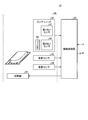
- FIG. 1 is a diagram illustrating an appearance of a cooking apparatus.
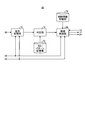
- FIG. 2 is a diagram illustrating a configuration of the cooking apparatus.
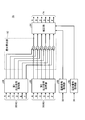
- FIG. 3 is a diagram illustrating a configuration of the sensor unit.
- FIG. 4 is a diagram illustrating an example of the configuration of the first odor sensor.
- FIG. 5 is a diagram illustrating a functional configuration of the information processing unit.
- FIG. 6 is a diagram illustrating a functional configuration of the signal processing unit.
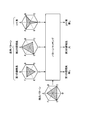
- FIG. 7 is a diagram for explaining the odor determination process.
- FIG. 8 is a state transition diagram showing the flow of the first control process.
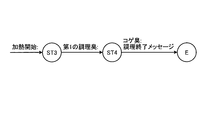
- FIG. 9 is a state transition diagram showing the flow of the second control process.
- FIG. 10 is a state transition diagram showing the flow of the third control process.
- FIG. 11 is a state transition diagram showing the flow of the fourth control process.
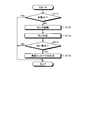
- FIG. 12 is a flowchart showing the flow of the fifth control process.
- FIG. 13 is a diagram illustrating a functional configuration of the information processing unit according to the first modification.
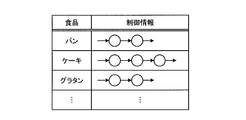
- FIG. 14 is a diagram illustrating an example of a table registered in the control information storage unit.
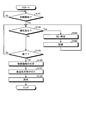
- FIG. 15 is a flowchart showing the flow of new control information generation processing.
- FIG. 16 is a diagram illustrating a cooking apparatus according to a second modification.
- FIG. 17 is a diagram illustrating a hardware configuration of the information processing apparatus.
- FIG. 1 is a diagram showing the appearance of the cooking apparatus 10.
- the cooking apparatus 10 heats food.
- the cooking apparatus 10 stores food in the heating chamber 22 inside the housing and heats the food in the heating chamber 22.
- the cooking apparatus 10 may be an apparatus that does not have the heating chamber 22 such as a gas stove.
- the cooking apparatus 10 includes a display unit 12 and an operation input unit 14.
- the display unit 12 is provided outside the housing and notifies the user of information.
- the operation input unit 14 is provided outside the housing and receives an operation input from the user.
- the operation input unit 14 includes a rotary operation unit 16 for setting a heating time and the like, a start button 18 that receives a heating start, a stop button 20 that receives a heating end, and the like.
- FIG. 2 is a diagram illustrating a configuration of the cooking apparatus 10.
- the cooking apparatus 10 includes a heating unit 24, a sensor unit 30, a temperature sensor 32, a humidity sensor 34, and an information processing unit 40.
- the heating unit 24 heats the food in the heating chamber 22.
- the heating unit 24 may heat the food with a heating wire, may heat the food with electromagnetic force through a metal cooking utensil, or may heat the food with microwave irradiation. .
- the sensor unit 30 includes a first odor sensor 42, a filter 44, and a second odor sensor 46.
- the sensor unit 30 is provided in the vicinity of food. In the present embodiment, the sensor unit 30 is provided so that a substance contained in the air in the heating chamber 22 can be detected.
- the first odor sensor 42 includes a plurality of detection elements that detect the amount of odor-causing substances present in the air around the food. Each detection element detects the mass of the causative substance as the amount of the causative substance of the odor. Alternatively, each detection element may detect the volume or molecular weight of the causative substance as the amount of the causative substance.
- Each of the plurality of detection elements is a different type of element.
- any two detection elements included in the first odor sensor 42 detect the amounts of odor-causing substances of different types.
- the first detection element detects the amount of the substance X
- the second detection element detects the amount of the substance Y.
- any two detection elements included in the first odor sensor 42 may detect the amount of the same kind of odor causing substance with different sensitivities.
- the first detection element detects the amount of the substance X with a first sensitivity
- the second detection element detects the amount of the substance X with a second sensitivity lower than the first sensitivity.
- any two detection elements included in the first odor sensor 42 may detect the amounts of a plurality of odor-causing substances of different types of combinations.
- the first detection element detects the total amount of the substance X and the substance Y
- the second detection element detects the total amount of the substance X and the substance Z.
- any two detection elements included in the first odor sensor 42 may detect the amounts of a plurality of odor-causing substances of the same type of combination with different sensitivities.
- the first detection element detects the total amount of the substance X and the substance Y with a first sensitivity
- the second detection element has a total amount of the substance X and the substance Y lower than the first sensitivity. Detection may be performed with the second sensitivity.
- the filter 44 is provided in front of the second odor sensor 46.
- the filter 44 removes odor-causing substances present in the air that is given to the second odor sensor 46 from around the food.
- the second odor sensor 46 includes a plurality of detection elements that detect the amount of odor-causing substances present in the air that has passed through the filter 44.
- the second odor sensor 46 has the same configuration as the first odor sensor 42. Accordingly, the first odor sensor 42 and the second odor sensor 46 include a plurality of detection elements of the same type.
- Such a sensor unit 30 transmits a plurality of first output signals detected by a plurality of detection elements included in the first odor sensor 42 to the information processing unit 40. Further, the sensor unit 30 transmits a plurality of second output signals detected by a plurality of detection elements included in the second odor sensor 46 to the information processing unit 40.
- the first odor sensor 42, the filter 44 and the second odor sensor 46 are arranged in the vicinity.
- the first odor sensor 42 and the second odor sensor 46 may be disposed in the same casing or may be provided independently of each other.
- the temperature sensor 32 is provided in the vicinity of the first odor sensor 42 and the second odor sensor 46.
- the temperature sensor 32 detects the temperature around the first odor sensor 42 and the second odor sensor 46.
- the temperature sensor 32 transmits a temperature signal representing the temperature around the first odor sensor 42 and the second odor sensor 46 to the information processing unit 40.
- the humidity sensor 34 is provided in the vicinity of the first odor sensor 42 and the second odor sensor 46.
- the humidity sensor 34 detects the humidity around the first odor sensor 42 and the second odor sensor 46.
- the humidity sensor 34 transmits a humidity signal representing the humidity around the first odor sensor 42 and the second odor sensor 46 to the information processing unit 40.
- the information processing unit 40 acquires operation information input by the user via the operation input unit 14.
- the information processing unit 40 controls the heating unit 24 based on the acquired operation information.
- the information processing unit 40 causes the display unit 12 to display information.
- the information processing unit 40 includes a plurality of first output signals detected by a plurality of detection elements included in the first odor sensor 42 and a plurality of second outputs detected by a plurality of detection elements included in the second odor sensor 46. A difference from the output signal is calculated to generate a plurality of detection signals. The information processing unit 40 calculates a difference between the first output signal and the second output signal between the same type of detection elements, and generates a detection signal. Further, the information processing unit 40 corrects the plurality of detection signals based on the temperature signal transmitted from the temperature sensor 32 and the humidity signal transmitted from the humidity sensor 34.
- the information processing unit 40 determines an odor generated from the food to be heated based on the corrected plurality of detection signals.
- the information processing unit 40 executes various controls based on the odor determination result. For example, the information processing unit 40 performs control of information to be displayed on the display unit 12 and heating control of the heating unit 24 based on the odor determination result.
- the information processing unit 40 will be further described with reference to FIG.
- FIG. 3 is a diagram illustrating an example of the configuration of the sensor unit 30.
- the sensor unit 30 includes a first odor sensor 42, a filter 44, a second odor sensor 46, a communication unit 48, and a control unit 50.
- the first odor sensor 42 and the second odor sensor 46 are disposed in the same casing, for example.
- the first odor sensor 42 is given air that has not passed through the filter 44.
- the first odor sensor 42 outputs a plurality of first output signals representing odors in the air that have not passed through the filter 44.
- the second odor sensor 46 is given air that has passed through the filter 44.
- the second odor sensor 46 outputs a plurality of second output signals representing the odor in the air that has passed through the filter 44.
- the communication unit 48 transmits a plurality of first output signals output from the first odor sensor 42 to the information processing unit 40. Further, the communication unit 48 transmits a plurality of second output signals output from the second odor sensor 46 to the information processing unit 40.
- the control unit 50 manages and controls the operations of the first odor sensor 42, the second odor sensor 46, and the communication unit 48.
- the configuration of the sensor unit 30 is an example, and any configuration may be used.
- FIG. 4 is a diagram illustrating an example of the configuration of the first odor sensor 42.
- the first odor sensor 42 is a QCM sensor that can detect the mass of a minute substance contained in air.
- the first odor sensor 42 is not limited to the QCM sensor, and may be a sensor of another type such as a gas sensor using a semiconductor thin film.
- the second odor sensor 46 has the same configuration as the first odor sensor 42.
- the first odor sensor 42 includes a support portion 58, a plurality of gas detection elements 60, and a drive detection circuit 62.
- a plurality of gas detection elements 60 are attached to the support portion 58.
- the gas detection element 60 is an example of a detection element.
- the first odor sensor 42 includes six different types of gas detection elements 60-A to 60-F.
- each of the six gas detection elements 60-A to 60-F detects a different type of odor causing substance.
- Each of the gas detection elements 60 is provided on at least one of the crystal resonator cut so as to be able to vibrate by the piezoelectric effect, two electrodes provided on both sides of the crystal resonator, and the plane of the crystal resonator.
- An adsorption film is provided on at least one of the crystal resonator cut so as to be able to vibrate by the piezoelectric effect, two electrodes provided on both sides of the crystal resonator, and the plane of the crystal resonator.
- Quartz vibrator is partly held on the support 58 so that part of the side surface can vibrate.
- An AC voltage is applied to the two electrodes from the drive detection circuit 62.
- the adsorption film adsorbs a specific causative substance present in the surrounding air.
- Each of the plurality of gas detection elements 60 includes an adsorption film that adsorbs different substances. Specifically, each of the plurality of gas detection elements 60 includes an adsorption film that adsorbs a causative substance to be detected by the sensor unit 30.
- the crystal resonator vibrates due to the piezoelectric effect.
- the fundamental resonance frequency of the crystal unit is determined by mass and viscoelasticity. Therefore, when the causative substance is adsorbed on the adsorption film and the mass changes, the basic resonance frequency of the gas detection element 60 changes according to the change in the mass of the adsorbed substance.
- the drive detection circuit 62 detects a change in the basic resonance frequency of each of the plurality of gas detection elements 60 by applying an AC voltage to each of the plurality of gas detection elements 60 under the control of the control unit 50. Thereby, the drive detection circuit 62 can detect the mass of the odor causing substance contained in the given air for each of the plurality of gas detection elements 60.
- the drive detection circuit 62 gives a first output signal representing the mass of the causative substance detected by each of the plurality of gas detection elements 60 to the communication unit 48.
- FIG. 5 is a diagram illustrating a functional configuration of the information processing unit 40.
- the information processing unit 40 includes a signal processing unit 70, an odor pattern storage unit 72, a determination unit 74, a control information storage unit 78, and a cooking control unit 80.
- the signal processing unit 70 includes a plurality of first output signals detected by the plurality of detection elements included in the first odor sensor 42 and a plurality of second outputs detected by the plurality of detection elements included in the second odor sensor 46. A difference from the output signal is calculated to generate a plurality of detection signals. The signal processing unit 70 calculates a difference between the first output signal and the second output signal between the detection elements of the same type, and generates a detection signal. Further, the signal processing unit 70 corrects the plurality of detection signals based on the temperature signal transmitted from the temperature sensor 32 and the humidity signal transmitted from the humidity sensor 34. The signal processing unit 70 transmits a plurality of detection signals to the determination unit 74. The signal processing unit 70 will be further described with reference to FIG.
- the odor pattern storage unit 72 stores one or more reference patterns in association with each of a plurality of types of odors.
- the determination unit 74 acquires values of a plurality of detection signals from the signal processing unit 70 during cooking (for example, from the start of heating to the end of heating). For example, the determination unit 74 continuously determines the odor based on the values of the plurality of detection signals during cooking. The determination unit 74 gives the determination result to the cooking control unit 80. The determination process will be further described with reference to FIG.
- the control information storage unit 78 stores previously registered control information.
- the control information indicates a transition pattern of the state of the cooking apparatus 10 and the control content for the cooking apparatus 10.
- the state of the cooking device 10 indicated in the control information includes an odor generated from food. Moreover, the state of the cooking apparatus 10 includes the temperature and humidity of the heating chamber 22. Moreover, the state of the cooking device 10 includes an elapsed time from the start of heating and an elapsed time after reaching a predetermined state. Moreover, the state of the cooking apparatus 10 includes the operation content input by the user.
- the state transition pattern of the cooking apparatus 10 represents how such a state transitions. For example, the state transition pattern of the cooking apparatus 10 can be represented by a state transition diagram or the like.
- the control content shown in the control information includes the content of information display control on the display unit 12 of the cooking apparatus 10, the content of heating control (heating stop and temperature adjustment) for the heating unit 24, and the like.
- the cooking control unit 80 acquires operation information input by the user via the operation input unit 14. Further, the cooking control unit 80 controls the display unit 12 to display predetermined information on the display unit 12. The cooking control unit 80 controls the heating unit 24 to change the heating temperature, start heating, or stop heating.
- the cooking control unit 80 acquires the determination result of the odor of the food continuously from the determination unit 74 during cooking. And the cooking control part 80 performs predetermined control, when the smell which generate
- the cooking control unit 80 continuously monitors the state of the cooking apparatus 10 after starting the heating of the food. Specifically, the cooking control unit 80 determines the odor determination result by the determination unit 74, the temperature and humidity in the heating chamber 22, the elapsed time since the start of heating, and the elapsed time after reaching a predetermined state. Monitor time. Furthermore, the cooking control unit 80 may also monitor the operation content by the user.
- the cooking control part 80 performs control of the control content shown by control information, when the state of the cooking apparatus 10 changes with the transition pattern shown by the control information memorize
- the cooking control unit 80 displays a predetermined message on the display unit 12 or heats by the heating unit 24 when the state of the cooking apparatus 10 (for example, the odor of food) transitions according to the transition pattern indicated in the control information. The temperature is changed, or heating by the heating unit 24 is started or stopped.
- FIG. 6 is a diagram illustrating a functional configuration of the signal processing unit 70.
- the signal processing unit 70 includes a first output signal acquisition unit 84, a second output signal acquisition unit 86, a temperature signal acquisition unit 88, a humidity signal acquisition unit 90, a difference calculation unit 92, and a correction unit 94. .
- the first output signal acquisition unit 84 acquires a plurality of first output signals detected by a plurality of detection elements included in the first odor sensor 42 of the sensor unit 30.
- the second output signal acquisition unit 86 acquires a plurality of second output signals detected by a plurality of detection elements included in the second odor sensor 46 of the sensor unit 30.
- the temperature signal acquisition unit 88 acquires the temperature signal output from the temperature sensor 32.
- the humidity signal acquisition unit 90 acquires the humidity signal output from the humidity sensor 34.
- the difference calculation unit 92 includes a plurality of first output signals detected by a plurality of detection elements included in the first odor sensor 42 and a plurality of second outputs detected by a plurality of detection elements included in the second odor sensor 46. A difference from the output signal is calculated to generate a plurality of detection signals. The difference calculation unit 92 calculates the difference between the first output signal and the second output signal between the same type of detection elements.
- the difference calculation unit 92 includes the six first output signals detected by the six gas detection elements 60-A to 60-F included in the first odor sensor 42, and the second odor sensor. The difference from the six second output signals detected by the six gas detection elements 60-A to 60-F included in 46 is calculated. Then, the difference calculation unit 92 outputs six detection signals corresponding to each of the six gas detection elements 60-A to 60-F.
- the correction unit 94 corrects the plurality of detection signals generated by the difference calculation unit 92 based on the temperature of the air around the first odor sensor 42 and the second odor sensor 46 represented by the temperature signal. Further, the correction unit 94 corrects the plurality of detection signals generated by the difference calculation unit 92 based on the humidity of the air around the first odor sensor 42 and the second odor sensor 46 represented by the humidity signal. Note that the correction unit 94 may correct the plurality of detection signals generated by the difference calculation unit 92 based on one of temperature and humidity.
- the characteristics of the circuits and materials included in the first odor sensor 42 and the second odor sensor 46 vary depending on the ambient temperature and humidity. Accordingly, the plurality of detection signals generated by the difference calculation unit 92 vary depending on temperature and humidity.
- the correction unit 94 corrects the plurality of detection signals generated by the difference calculation unit 92 according to the detected temperature and humidity so as to eliminate such fluctuations in value due to temperature and humidity.
- the correction unit 94 may correct the signal before the difference calculation unit 92. That is, the correction unit 94 may correct the first output signal and the second output signal according to temperature and humidity. Even if it does in this way, the correction
- FIG. 1 A block diagram illustrating an exemplary computing environment in accordance with the present disclosure.
- the signal processing unit 70 transmits the generated plurality of detection signals to the determination unit 74.
- the signal processing unit 70 transmits six detection signals corresponding to the six gas detection elements 60-A to 60-F to the determination unit 74.
- the signal processing unit 70 may be realized by a digital processing circuit or an analog processing circuit.
- the signal processing unit 70 may be realized by a processor that executes a program and a memory.
- the signal processing unit 70 may be integrally provided in the sensor unit 30.
- one of the difference calculation unit 92 or the correction unit 94 may be integrally provided in the sensor unit 30.
- FIG. 7 is a diagram for explaining the odor determination process.
- the determination unit 74 acquires values of a plurality of detection signals from the signal processing unit 70.
- the determination unit 74 includes the gas detection element 60-A, the gas detection element 60-B, the gas detection element 60-C, the gas detection element 60-D, the gas detection element 60-E, and the gas.
- the values of the six detection signals corresponding to each of the detection elements 60-F are acquired.
- the odor pattern storage unit 72 stores a reference pattern representing a plurality of detection signal values acquired when a predetermined type of odor occurs.
- the odor pattern storage unit 72 includes the gas detection elements 60-A to 60-F when the first cooking odor, the second cooking odor, and the burnt odor are detected.
- Reference patterns representing the values of the six detection signals corresponding to are stored.
- the determination unit 74 compares a detection pattern representing a plurality of detection signal values with a reference pattern stored in advance. Then, when the detection pattern matches the reference pattern, the determination unit 74 determines that the odor of air given to the sensor unit 30 is a predetermined type of odor.
- the determination unit 74 may store reference patterns for a plurality of types of odors and determine which odor reference pattern matches with one detection pattern. For example, in the example of FIG. 7, the determination unit 74 determines that the odor of air given to the sensor unit 30 is the second cooking odor.
- the case where the patterns are matched includes not only the case where the two patterns completely match, but also the case where they match within a predetermined error or the case where the closest reference pattern among a plurality of reference patterns is selected. Including.
- the determination unit 74 may determine the intensity of the odor for each type of odor. For example, the determination unit 74 stores a reference pattern for each odor type and each odor intensity, and uses a detection pattern and a reference pattern for each odor type and each odor intensity stored in advance. You may match.
- the determination unit 74 is not limited to such pattern matching, and may determine the odor type and the odor intensity by other methods.
- the determination unit 74 may determine the odor type and the odor intensity that match the detection pattern using a neural network or the like.
- the cooking odor is an odor generated from food during cooking.
- the cooking odor may vary from food to food.
- odors generated from food include, for example, alcohol odor, pyridine-based roast odor, furan-based odor generated by caramelization reaction, aldehyde-based odor generated from meat, etc., and aromatic and aliphatic hydrocarbons
- Examples of the odor of the system include koge odor.
- the odor pattern storage unit 72 stores a reference pattern representing the values of a plurality of detection signals when these odors are generated. Thereby, the determination unit 74 can determine the odor generated from the food.
- FIG. 8 is a state transition diagram showing the flow of the first control process.
- an alcoholic odor is generated from the bread at the start of heating.
- a furan odor generated by the caramelization reaction is generated from the bread.
- different cooking odors may be generated from the food at the initial stage and the end stage of heating. Therefore, when the cooking control unit 80 detects the predetermined second cooking odor after detecting the predetermined first cooking odor, the cooking control unit 80 outputs a message indicating the end of cooking.
- the cooking controller 80 changes the state of the cooking apparatus 10 as shown in FIG. First, the cooking control part 80 makes the cooking apparatus 10 change to 1st state ST1, when operation of a heating start is performed. Subsequently, in the first state ST1, when the first cooking odor is detected, the cooking control unit 80 causes the cooking apparatus 10 to transition to the second state ST2. Subsequently, in the second state ST2, when the second cooking odor is detected, the cooking control unit 80 causes the display unit 12 to output a cooking end message for notifying the user that cooking has ended. Then, the cooking control unit 80 causes the cooking device 10 to transition to the end state E. By performing such control, the cooking control unit 80 can notify the user that the cooking of the food has been completed.
- FIG. 9 is a state transition diagram showing the flow of the second control process.
- an initial cooking odor may be generated at the start of heating, and a burnt odor may be generated at the end of heating. Therefore, the cooking control unit 80 outputs a message indicating the end of cooking when detecting a burnt burnt odor after detecting a predetermined first cooking odor.
- the cooking controller 80 changes the state of the cooking apparatus 10 as shown in FIG. First, cooking control part 80 makes cooking device 10 change to the 3rd state ST3, when operation of a heating start is performed. Subsequently, in the third state ST3, the cooking control unit 80 transitions the cooking apparatus 10 to the fourth state ST4 when detecting the first cooking odor. Then, in 4th state ST4, the cooking control part 80 makes the display part 12 output the cooking completion message for notifying a user that cooking was complete
- FIG. 10 is a state transition diagram showing the flow of the third control process. For example, when food is heated, for example, the amount of heat applied to the food is too much, and the food may be burnt. Then, the cooking control part 80 stops the heating of food, when the food smell more than predetermined intensity
- the cooking control unit 80 changes the state of the cooking apparatus 10 as shown in FIG. First, cooking control part 80 makes cooking device 10 change to the 5th state ST5, when operation of a heating start is performed. Subsequently, in the fifth state ST5, the cooking control unit 80 controls the heating unit 24 to stop heating when it detects a burning odor of a predetermined strength or higher. Then, the cooking control unit 80 causes the cooking device 10 to transition to the end state E. By performing such control, the cooking control unit 80 can stop heating when the food is burnt.
- FIG. 11 is a state transition diagram showing the flow of the fourth control process.
- the cooking control unit 80 outputs a message indicating an abnormality when the surroundings of the food is below a predetermined temperature without detecting the first cooking odor after a predetermined time has elapsed after the heating of the food is started.
- the cooking control unit 80 changes the state of the cooking apparatus 10 as shown in FIG. First, the cooking control part 80 makes the cooking apparatus 10 transition to 6th state ST6, when operation of a heating start is performed. Then, in 6th state ST6, the cooking control part 80 makes the cooking apparatus 10 transition to 7th state ST7, when the 1st cooking odor is detected. Subsequently, in the seventh state ST7, when the cooking control unit 80 detects the second cooking odor, the cooking control unit 80 outputs a cooking end message to the display unit 12 and causes the cooking apparatus 10 to transition to the end state E.
- the cooking control part 80 makes the cooking apparatus 10 transition to 8th state ST8, when predetermined time passes, before detecting a 1st cooking odor.
- the cooking control part 80 maintains the state of the cooking apparatus 10 in 8th state ST8, when the circumference
- the cooking control part 80 makes the cooking apparatus 10 transition to 7th state ST7, when the 1st cooking odor is detected.
- the cooking control unit 80 causes the display unit 12 to output an abnormal message indicating a setting abnormality or a failure when the surroundings of the food is below a predetermined temperature. Then, the cooking control unit 80 causes the cooking device 10 to transition to the end state E. By performing such control, the cooking control unit 80 can notify the user that the setting is abnormal or malfunctioned.
- FIG. 12 is a flowchart showing the flow of the fifth control process. For example, when the heating chamber 22 is not cleaned for a long time, the heating chamber 22 becomes dirty and the odor of the heating chamber 22 becomes strong. When such control is performed, a process as shown in FIG. 12 is executed periodically (for example, every day).
- the cooking control unit 80 determines whether heating is in progress. When it is heating (Yes of S111), the cooking control part 80 complete
- the cooking control unit 80 activates and operates the sensor unit 30. Subsequently, in S113, the cooking control unit 80 causes the determination unit 74 to determine an odor. Thereby, the cooking control unit 80 can cause the determination unit 74 to determine the odor around the position where the food is placed.
- the cooking control unit 80 determines whether or not an odor greater than a predetermined intensity is generated.
- the cooking control unit 80 may determine whether or not a scent of a predetermined intensity or more is generated for a specific type of odor, or may be determined in advance without specifying the type. It may be determined whether or not an odor greater than the intensity is generated.
- the cooking control unit 80 ends this flow.
- the smell more than predetermined intensity has generate
- produced Yes of S114
- the cooking control unit 80 causes the display unit 12 to output a cleaning message indicating that cleaning is to be performed.
- the cooking control unit 80 ends this flow.
- the cooking control unit 80 operates the sensor unit 30 at a timing when the food is not heated, and causes the determination unit 74 to determine the odor around the position where the food is placed. And the cooking control part 80 outputs a cleaning message, when the circumference
- the cooking device 10 monitors the state of the cooking device 10 including, for example, the odor of food, and is predetermined when the state of the cooking device 10 transitions in a predetermined transition pattern. Control. Thereby, according to the cooking apparatus 10 which concerns on this embodiment, the completion
- the cooking apparatus 10 which concerns on a 1st modification is demonstrated.
- the cooking apparatus 10 according to the first modification has substantially the same function and configuration as the cooking apparatus 10 according to the embodiment described with reference to FIG. 1 to FIG.
- the same reference numerals are assigned, and detailed description is omitted except for differences.
- FIG. 13 is a diagram illustrating a functional configuration of the information processing unit 40 according to the first modification.
- FIG. 14 is a diagram illustrating an example of a table registered in the control information storage unit 78.
- the information processing unit 40 further includes a selection receiving unit 122, a recording unit 124, a generation unit 126, and a setting unit 128.
- control information storage unit 78 stores control information for each of a plurality of foods.
- the control information storage unit 78 stores, for example, a table in which control information is registered for each food as shown in FIG.
- the selection receiving unit 122 receives the selection of the food to be heated by the user prior to the heating. For example, the selection receiving unit 122 receives the selection of any one of the foods registered in the table shown in FIG.
- the cooking control unit 80 acquires control information corresponding to the heating target food selected by the user from the control information storage unit 78.
- the cooking control unit 80 continuously acquires the determination result of the odor of the food after starting the heating of the food.
- the cooking control part 80 performs control of the control content shown by the acquired control information, when the state of the cooking apparatus 10 changes with the transition pattern shown by the acquired control information. Thereby, the cooking control part 80 can advance the cooking of the food selected by the user appropriately.
- the recording unit 124 receives an instruction for generating new control information from the user.
- the cooking apparatus 10 is used to start heating the target food. Subsequently, the user performs an acquisition operation instructing acquisition of the odor at a timing when the odor of the food changes while observing the state of the food.
- the recording part 124 memorize
- generation part 126 produces
- the setting unit 128 receives an input of a food name by the user, and sets the received food name and the generated control information in the control information storage unit 78 in association with each other. For example, the setting unit 128 registers the received food and the generated control information in the table shown in FIG.
- FIG. 15 is a flowchart showing a flow of new control information generation processing.
- the information processing unit 40 receives an instruction to generate new control information, the information processing unit 40 performs the process illustrated in FIG.
- the information processing unit 40 determines whether or not there is an instruction to start heating. When there is no instruction to start heating (No in S141), the information processing unit 40 waits for processing in S141. When there is an instruction to start heating (Yes in S141), the information processing section 40 advances the process to S142.
- the information processing section 40 determines whether or not an odor acquisition operation has been accepted. When the acquisition operation has not been received (No in S142), in S143, the information processing unit 40 determines whether or not the user has finished cooking. When the cooking end operation has not been performed (No in S143), the information processing section 40 returns the process to S142. Therefore, the information processing unit 40 repeats the processes of S142 and S143 until an odor acquisition operation is received or an end operation is performed.
- the information processing section 40 advances the process to S144.
- the information processing unit 40 determines an odor.
- the information processing unit 40 temporarily records the determined odor.
- the information processing section 40 returns the process to S142.
- the information processing section 40 advances the process to S146.
- the information processing section 40 generates new control information based on the recorded time series pattern of the odor determination result. For example, the information processing unit 40 generates control information that causes a cooking end message to be output when the smell changes in the order of recording.
- the information processing unit 40 receives an input of a food name. Subsequently, in S ⁇ b> 148, the information processing unit 40 associates the received food name and the generated control information, and sets them in the control information storage unit 78. For example, the information processing unit 40 registers the received food and the generated control information in the table shown in FIG. Then, when the process of S148 is completed, the information processing section 40 ends this flow.
- the cooking apparatus 10 according to the first modified example can select one food to be heated from a plurality of foods, and can appropriately cook the selected food. Furthermore, the cooking apparatus 10 according to the first modified example can register new control information and appropriately advance cooking for new foods.
- FIG. 16 is a diagram illustrating a cooking apparatus 10 according to a second modification.
- the cooking apparatus 10 according to the second modification includes a main body unit 150 and a remote operation unit 160.
- the main body 150 includes functions such as the operation input unit 14, the heating chamber 22, and the heating unit 24.
- the remote operation unit 160 includes the function of the information processing unit 40.
- the remote operation unit 160 is a computer having a data processing function, a wireless communication function, and a display function.
- the remote operation unit 160 is separate from the main body unit 150 and may be, for example, a smartphone, a tablet, a mobile phone, or a laptop computer.
- the remote operation unit 160 transmits and receives information to and from the main body unit 150 by wireless communication or wired communication.
- the remote operation unit 160 may include a part of the functions of the information processing unit 40, and the remaining functions may be included in the main body unit 150.
- the remote operation unit 160 may have some functions of the cooking control unit 80. Thereby, some functions of the cooking control unit 80 are provided in both the main body unit 150 and the remote operation unit 160. Therefore, the main body 150 can operate alone as the cooking apparatus 10, and the main body 150 and the remote operation section 160 can operate as the cooking apparatus 10 through communication.
- the remote operation unit 160 remotely controls the main body unit 150 of the cooking apparatus 10.
- the cooking control part 80 with which the remote control part 160 is provided acquires the determination result of the odor determined based on the some detection signal output from the sensor unit 30 from the main-body part 150 continuously, and heats food
- a predetermined control is executed.
- the cooking control unit 80 provided in the remote operation unit 160 displays a message on the display unit of the remote operation unit 160.
- the cooking control unit 80 provided in the remote operation unit 160 stops heating in cooperation with the cooking control unit 80 provided in the main body unit 150.
- the cooking apparatus 10 according to the second modified example can remotely operate the main body 150. Moreover, the cooking apparatus 10 according to the second modification can notify a user at a position away from the main body 150, for example, a cooking end message.
- FIG. 17 is a diagram illustrating a hardware configuration of the information processing apparatus 200.
- the information processing unit 40 and the remote operation unit 160 are realized by, for example, an information processing apparatus 200 as illustrated in FIG.
- the information processing apparatus 200 may have a hardware configuration similar to that of a general computer.
- the information processing device 200 includes a CPU (Central Processing Unit) 201, an operation device 202, a display device 203, a ROM (Read Only Memory) 205, a RAM (Random Access Memory) 206, a storage device 207, and a communication device. 208 and a bus 209. Each unit is connected by a bus 209.
- the CPU 201 executes various processes in cooperation with various programs stored in advance in the ROM 205 or the storage device 207 using a predetermined area of the RAM 206 as a work area, and comprehensively controls the operation of each unit constituting the information processing apparatus 200. . Further, the CPU 201 operates the operation device 202, the display device 203, the communication device 208, and the like in cooperation with a program stored in advance in the ROM 205 or the storage device 207.
- the operation device 202 is an input device such as a touch panel, a mouse, or a keyboard, and receives information input by a user as an instruction signal, and outputs the instruction signal to the CPU 201.
- the display device 203 is an LCD (Liquid Crystal Display) or the like, and displays various information based on a display signal from the CPU 201.
- the ROM 205 stores a program used for controlling the information processing apparatus 200, various setting information, and the like in a non-rewritable manner.
- the RAM 206 is a volatile storage medium such as SDRAM (Synchronous Dynamic Random Access Memory).
- SDRAM Serial Dynamic Random Access Memory
- the RAM 206 functions as a work area for the CPU 201.
- the storage device 207 is a rewritable recording device such as a semiconductor storage medium such as a flash memory or a magnetically or optically recordable storage medium.
- the storage device 207 stores a program used for controlling the information processing apparatus 200.
- the communication device 208 transmits and receives data to and from the sensor unit 30.
- the communication device 208 may transmit and receive data with a server or the like via a network.
- the program executed by the information processing apparatus 200 according to the present embodiment is stored on a computer connected to a network such as the Internet and provided by being downloaded via the network. Further, the program executed by the information processing apparatus 200 of the present embodiment may be provided by being incorporated in advance in a portable storage medium or the like.
- the program executed by the information processing apparatus 200 of this embodiment has a module configuration including a signal processing module, a determination module, and a cooking control module.
- the CPU 201 (processor) reads out such a program from a storage medium or the like, and loads each of the modules into the RAM 206 (main storage device).
- CPU201 (processor) functions as the signal processing part 70, the determination part 74, and the cooking control part 80 by running such a program.
- Part or all of the signal processing unit 70, the determination unit 74, and the cooking control unit 80 may be configured by hardware.
- the storage device 207 or the RAM 206 functions as an odor pattern storage unit 72 and a control information storage unit 78. Further, the determination module may be updated as appropriate in order to update a threshold value used for determination of odor.
Landscapes
- Engineering & Computer Science (AREA)
- Chemical & Material Sciences (AREA)
- Combustion & Propulsion (AREA)
- Mechanical Engineering (AREA)
- General Engineering & Computer Science (AREA)
- Food Science & Technology (AREA)
- Electric Ovens (AREA)
- Electric Stoves And Ranges (AREA)
- Baking, Grill, Roasting (AREA)
Abstract
Selon des modes de réalisation, l'invention concerne un dispositif de cuisson permettant d'accélérer la cuisson de manière appropriée. Le dispositif de cuisson, destiné à chauffer des aliments, comprend : un ensemble capteur comprenant une pluralité d'éléments de détection servant à détecter les quantités de substances provoquant des odeurs dans l'air autour des aliments ; une partie de détermination servant à détecter, en fonction d'une pluralité de signaux de détection ayant été émis de l'ensemble capteur, les odeurs émanant des aliments ; et une partie de commande de cuisson servant à acquérir en continu des résultats de détermination concernant les odeurs des aliments et à effectuer une commande prédéfinie lorsque, après le démarrage du chauffage des aliments, les odeurs émanant des aliments ont changé conformément à un motif préenregistré.
Applications Claiming Priority (2)
| Application Number | Priority Date | Filing Date | Title |
|---|---|---|---|
| JP2018067084A JP2021120595A (ja) | 2018-03-30 | 2018-03-30 | 調理装置、情報処理装置、プログラムおよび制御方法 |
| JP2018-067084 | 2018-03-30 |
Publications (1)
| Publication Number | Publication Date |
|---|---|
| WO2019187672A1 true WO2019187672A1 (fr) | 2019-10-03 |
Family
ID=68061298
Family Applications (1)
| Application Number | Title | Priority Date | Filing Date |
|---|---|---|---|
| PCT/JP2019/004297 Ceased WO2019187672A1 (fr) | 2018-03-30 | 2019-02-06 | Dispositif de cuisson, dispositif de traitement d'informations, programme, procédé de commande |
Country Status (2)
| Country | Link |
|---|---|
| JP (1) | JP2021120595A (fr) |
| WO (1) | WO2019187672A1 (fr) |
Cited By (6)
| Publication number | Priority date | Publication date | Assignee | Title |
|---|---|---|---|---|
| JP2021188867A (ja) * | 2020-06-03 | 2021-12-13 | リンナイ株式会社 | キッチン設備、キッチン設備の動作方法、キッチン設備のための学習装置およびキッチン設備のための学習方法 |
| CN113907615A (zh) * | 2021-09-06 | 2022-01-11 | 珠海格力电器股份有限公司 | 电器中异味的处理方法、系统、存储介质及电器 |
| CN114010064A (zh) * | 2021-11-25 | 2022-02-08 | 珠海格力电器股份有限公司 | 烹饪设备、烹饪设备控制方法和存储介质 |
| CN116671794A (zh) * | 2023-06-26 | 2023-09-01 | 珠海格力电器股份有限公司 | 烹饪设备控制方法、装置、计算机设备和存储介质 |
| WO2025018221A1 (fr) * | 2023-07-14 | 2025-01-23 | パナソニックIpマネジメント株式会社 | Appareil de cuisson chauffant |
| WO2025047015A1 (fr) * | 2023-08-31 | 2025-03-06 | パナソニックIpマネジメント株式会社 | Cuiseur automatique, procédé de cuisson automatique, programme informatique et support de stockage |
Families Citing this family (1)
| Publication number | Priority date | Publication date | Assignee | Title |
|---|---|---|---|---|
| WO2024014203A1 (fr) * | 2022-07-14 | 2024-01-18 | パナソニックIpマネジメント株式会社 | Appareil de cuisson chauffant |
Citations (4)
| Publication number | Priority date | Publication date | Assignee | Title |
|---|---|---|---|---|
| JPS6129203U (ja) * | 1984-07-27 | 1986-02-21 | 三菱電機株式会社 | 複合加熱装置 |
| JPH0518539A (ja) * | 1991-07-15 | 1993-01-26 | Sharp Corp | 加熱調理器 |
| JP2001343128A (ja) * | 2000-03-31 | 2001-12-14 | Osaka Gas Co Ltd | 調理情報システム、通信装置、及び調理装置 |
| JP2008525755A (ja) * | 2004-12-27 | 2008-07-17 | ラツィオナル アクチエンゲゼルシャフト | 少なくとも1つのガスセンサアレイを備える加熱調理器、加熱調理器のためのサンプル採取システム、加熱調理器を用いて加熱調理する方法、および加熱調理器を洗浄する方法 |
-
2018
- 2018-03-30 JP JP2018067084A patent/JP2021120595A/ja active Pending
-
2019
- 2019-02-06 WO PCT/JP2019/004297 patent/WO2019187672A1/fr not_active Ceased
Patent Citations (4)
| Publication number | Priority date | Publication date | Assignee | Title |
|---|---|---|---|---|
| JPS6129203U (ja) * | 1984-07-27 | 1986-02-21 | 三菱電機株式会社 | 複合加熱装置 |
| JPH0518539A (ja) * | 1991-07-15 | 1993-01-26 | Sharp Corp | 加熱調理器 |
| JP2001343128A (ja) * | 2000-03-31 | 2001-12-14 | Osaka Gas Co Ltd | 調理情報システム、通信装置、及び調理装置 |
| JP2008525755A (ja) * | 2004-12-27 | 2008-07-17 | ラツィオナル アクチエンゲゼルシャフト | 少なくとも1つのガスセンサアレイを備える加熱調理器、加熱調理器のためのサンプル採取システム、加熱調理器を用いて加熱調理する方法、および加熱調理器を洗浄する方法 |
Cited By (7)
| Publication number | Priority date | Publication date | Assignee | Title |
|---|---|---|---|---|
| JP2021188867A (ja) * | 2020-06-03 | 2021-12-13 | リンナイ株式会社 | キッチン設備、キッチン設備の動作方法、キッチン設備のための学習装置およびキッチン設備のための学習方法 |
| JP7510788B2 (ja) | 2020-06-03 | 2024-07-04 | リンナイ株式会社 | キッチン設備、キッチン設備の動作方法、キッチン設備のための学習装置およびキッチン設備のための学習方法 |
| CN113907615A (zh) * | 2021-09-06 | 2022-01-11 | 珠海格力电器股份有限公司 | 电器中异味的处理方法、系统、存储介质及电器 |
| CN114010064A (zh) * | 2021-11-25 | 2022-02-08 | 珠海格力电器股份有限公司 | 烹饪设备、烹饪设备控制方法和存储介质 |
| CN116671794A (zh) * | 2023-06-26 | 2023-09-01 | 珠海格力电器股份有限公司 | 烹饪设备控制方法、装置、计算机设备和存储介质 |
| WO2025018221A1 (fr) * | 2023-07-14 | 2025-01-23 | パナソニックIpマネジメント株式会社 | Appareil de cuisson chauffant |
| WO2025047015A1 (fr) * | 2023-08-31 | 2025-03-06 | パナソニックIpマネジメント株式会社 | Cuiseur automatique, procédé de cuisson automatique, programme informatique et support de stockage |
Also Published As
| Publication number | Publication date |
|---|---|
| JP2021120595A (ja) | 2021-08-19 |
Similar Documents
| Publication | Publication Date | Title |
|---|---|---|
| JP2021120595A (ja) | 調理装置、情報処理装置、プログラムおよび制御方法 | |
| JP7397106B2 (ja) | 野外用グリルを制御するためのモバイル・アプリケーション | |
| JP7235726B2 (ja) | センシングシステム、情報処理装置、プログラムおよび情報収集方法 | |
| US11206307B2 (en) | Cloud system for controlling outdoor grill with mobile application | |
| CN111527348B (zh) | 可配置的烹饪系统和方法 | |
| US10757244B2 (en) | Cloud system for controlling outdoor grill with mobile application | |
| CN109310243B (zh) | 具有至少一个加工装置和监控装置的电动厨房多用机 | |
| US10652386B2 (en) | Cloud system for controlling outdoor grill with mobile application | |
| KR20180018548A (ko) | 레시피 시스템 | |
| US20140170275A1 (en) | System For Automating Cooking Steps | |
| JP2016103042A (ja) | 調理スキル評価方法、調理スキル評価システム及び調理スキル評価システムを制御する制御プログラム | |
| JP7438418B2 (ja) | 加熱調理システム、加熱調理器及びアプリケーションプログラム | |
| CN113197491B (zh) | 烹饪时间的控制方法和相关的烹饪设备 | |
| JP2017106692A (ja) | 加熱調理器、及び加熱調理器用のレシピデータのデータ構造 | |
| WO2014199584A1 (fr) | Procédé d'évaluation de compétences en cuisine, système d'évaluation de compétences en cuisine et programme de commande commandant un système d'évaluation de compétences en cuisine | |
| JP6726375B1 (ja) | プログラム、検出方法および調理システム | |
| CN111290446A (zh) | 控制方法、烹饪电器及计算机可读存储介质 | |
| JP2019057222A (ja) | サーバ、調理装置、情報処理システム、サーバとしてコンピュータを機能させるためのプログラム、およびサーバの制御方法 | |
| US12408792B2 (en) | Systems and methods for cooking pizza | |
| JP2007285596A5 (fr) | ||
| JP6800537B2 (ja) | 調理補助装置及び調理補助装置用プログラム | |
| JP2017136365A (ja) | 検知装置及び検知システム | |
| KR20170022077A (ko) | 셀프 레시피 프로그램기능이 구비된 전기오븐과 그 제어방법 | |
| EP3969818A1 (fr) | Appareil électroménager | |
| KR102807813B1 (ko) | 주방 공기질 관리, 초음파 세척 및 수비드 조리가 가능한 전자 장치 |
Legal Events
| Date | Code | Title | Description |
|---|---|---|---|
| 121 | Ep: the epo has been informed by wipo that ep was designated in this application |
Ref document number: 19776561 Country of ref document: EP Kind code of ref document: A1 |
|
| 122 | Ep: pct application non-entry in european phase |
Ref document number: 19776561 Country of ref document: EP Kind code of ref document: A1 |
|
| NENP | Non-entry into the national phase |
Ref country code: JP |