WO2019189221A1 - Film de poly(téréphtalate d'éthylène) pour matériau d'emballage de cellule, matériau d'emballage de cellule, procédé pour la fabrication de matériau d'emballage de cellule et cellule - Google Patents
Film de poly(téréphtalate d'éthylène) pour matériau d'emballage de cellule, matériau d'emballage de cellule, procédé pour la fabrication de matériau d'emballage de cellule et cellule Download PDFInfo
- Publication number
- WO2019189221A1 WO2019189221A1 PCT/JP2019/012939 JP2019012939W WO2019189221A1 WO 2019189221 A1 WO2019189221 A1 WO 2019189221A1 JP 2019012939 W JP2019012939 W JP 2019012939W WO 2019189221 A1 WO2019189221 A1 WO 2019189221A1
- Authority
- WO
- WIPO (PCT)
- Prior art keywords
- heat
- fusion
- temperature
- layer
- packaging material
- Prior art date
- Legal status (The legal status is an assumption and is not a legal conclusion. Google has not performed a legal analysis and makes no representation as to the accuracy of the status listed.)
- Ceased
Links
Images



Classifications
-
- H—ELECTRICITY
- H01—ELECTRIC ELEMENTS
- H01M—PROCESSES OR MEANS, e.g. BATTERIES, FOR THE DIRECT CONVERSION OF CHEMICAL ENERGY INTO ELECTRICAL ENERGY
- H01M50/00—Constructional details or processes of manufacture of the non-active parts of electrochemical cells other than fuel cells, e.g. hybrid cells
- H01M50/10—Primary casings; Jackets or wrappings
- H01M50/14—Primary casings; Jackets or wrappings for protecting against damage caused by external factors
-
- H—ELECTRICITY
- H01—ELECTRIC ELEMENTS
- H01M—PROCESSES OR MEANS, e.g. BATTERIES, FOR THE DIRECT CONVERSION OF CHEMICAL ENERGY INTO ELECTRICAL ENERGY
- H01M10/00—Secondary cells; Manufacture thereof
- H01M10/05—Accumulators with non-aqueous electrolyte
- H01M10/052—Li-accumulators
-
- B—PERFORMING OPERATIONS; TRANSPORTING
- B32—LAYERED PRODUCTS
- B32B—LAYERED PRODUCTS, i.e. PRODUCTS BUILT-UP OF STRATA OF FLAT OR NON-FLAT, e.g. CELLULAR OR HONEYCOMB, FORM
- B32B15/00—Layered products comprising a layer of metal
- B32B15/04—Layered products comprising a layer of metal comprising metal as the main or only constituent of a layer, which is next to another layer of the same or of a different material
- B32B15/08—Layered products comprising a layer of metal comprising metal as the main or only constituent of a layer, which is next to another layer of the same or of a different material of synthetic resin
-
- B—PERFORMING OPERATIONS; TRANSPORTING
- B32—LAYERED PRODUCTS
- B32B—LAYERED PRODUCTS, i.e. PRODUCTS BUILT-UP OF STRATA OF FLAT OR NON-FLAT, e.g. CELLULAR OR HONEYCOMB, FORM
- B32B15/00—Layered products comprising a layer of metal
- B32B15/04—Layered products comprising a layer of metal comprising metal as the main or only constituent of a layer, which is next to another layer of the same or of a different material
- B32B15/08—Layered products comprising a layer of metal comprising metal as the main or only constituent of a layer, which is next to another layer of the same or of a different material of synthetic resin
- B32B15/082—Layered products comprising a layer of metal comprising metal as the main or only constituent of a layer, which is next to another layer of the same or of a different material of synthetic resin comprising vinyl resins; comprising acrylic resins
-
- B—PERFORMING OPERATIONS; TRANSPORTING
- B32—LAYERED PRODUCTS
- B32B—LAYERED PRODUCTS, i.e. PRODUCTS BUILT-UP OF STRATA OF FLAT OR NON-FLAT, e.g. CELLULAR OR HONEYCOMB, FORM
- B32B15/00—Layered products comprising a layer of metal
- B32B15/04—Layered products comprising a layer of metal comprising metal as the main or only constituent of a layer, which is next to another layer of the same or of a different material
- B32B15/08—Layered products comprising a layer of metal comprising metal as the main or only constituent of a layer, which is next to another layer of the same or of a different material of synthetic resin
- B32B15/085—Layered products comprising a layer of metal comprising metal as the main or only constituent of a layer, which is next to another layer of the same or of a different material of synthetic resin comprising polyolefins
-
- B—PERFORMING OPERATIONS; TRANSPORTING
- B32—LAYERED PRODUCTS
- B32B—LAYERED PRODUCTS, i.e. PRODUCTS BUILT-UP OF STRATA OF FLAT OR NON-FLAT, e.g. CELLULAR OR HONEYCOMB, FORM
- B32B15/00—Layered products comprising a layer of metal
- B32B15/04—Layered products comprising a layer of metal comprising metal as the main or only constituent of a layer, which is next to another layer of the same or of a different material
- B32B15/08—Layered products comprising a layer of metal comprising metal as the main or only constituent of a layer, which is next to another layer of the same or of a different material of synthetic resin
- B32B15/088—Layered products comprising a layer of metal comprising metal as the main or only constituent of a layer, which is next to another layer of the same or of a different material of synthetic resin comprising polyamides
-
- B—PERFORMING OPERATIONS; TRANSPORTING
- B32—LAYERED PRODUCTS
- B32B—LAYERED PRODUCTS, i.e. PRODUCTS BUILT-UP OF STRATA OF FLAT OR NON-FLAT, e.g. CELLULAR OR HONEYCOMB, FORM
- B32B15/00—Layered products comprising a layer of metal
- B32B15/04—Layered products comprising a layer of metal comprising metal as the main or only constituent of a layer, which is next to another layer of the same or of a different material
- B32B15/08—Layered products comprising a layer of metal comprising metal as the main or only constituent of a layer, which is next to another layer of the same or of a different material of synthetic resin
- B32B15/09—Layered products comprising a layer of metal comprising metal as the main or only constituent of a layer, which is next to another layer of the same or of a different material of synthetic resin comprising polyesters
-
- B—PERFORMING OPERATIONS; TRANSPORTING
- B32—LAYERED PRODUCTS
- B32B—LAYERED PRODUCTS, i.e. PRODUCTS BUILT-UP OF STRATA OF FLAT OR NON-FLAT, e.g. CELLULAR OR HONEYCOMB, FORM
- B32B15/00—Layered products comprising a layer of metal
- B32B15/04—Layered products comprising a layer of metal comprising metal as the main or only constituent of a layer, which is next to another layer of the same or of a different material
- B32B15/08—Layered products comprising a layer of metal comprising metal as the main or only constituent of a layer, which is next to another layer of the same or of a different material of synthetic resin
- B32B15/092—Layered products comprising a layer of metal comprising metal as the main or only constituent of a layer, which is next to another layer of the same or of a different material of synthetic resin comprising epoxy resins
-
- B—PERFORMING OPERATIONS; TRANSPORTING
- B32—LAYERED PRODUCTS
- B32B—LAYERED PRODUCTS, i.e. PRODUCTS BUILT-UP OF STRATA OF FLAT OR NON-FLAT, e.g. CELLULAR OR HONEYCOMB, FORM
- B32B15/00—Layered products comprising a layer of metal
- B32B15/04—Layered products comprising a layer of metal comprising metal as the main or only constituent of a layer, which is next to another layer of the same or of a different material
- B32B15/08—Layered products comprising a layer of metal comprising metal as the main or only constituent of a layer, which is next to another layer of the same or of a different material of synthetic resin
- B32B15/095—Layered products comprising a layer of metal comprising metal as the main or only constituent of a layer, which is next to another layer of the same or of a different material of synthetic resin comprising polyurethanes
-
- B—PERFORMING OPERATIONS; TRANSPORTING
- B32—LAYERED PRODUCTS
- B32B—LAYERED PRODUCTS, i.e. PRODUCTS BUILT-UP OF STRATA OF FLAT OR NON-FLAT, e.g. CELLULAR OR HONEYCOMB, FORM
- B32B15/00—Layered products comprising a layer of metal
- B32B15/04—Layered products comprising a layer of metal comprising metal as the main or only constituent of a layer, which is next to another layer of the same or of a different material
- B32B15/08—Layered products comprising a layer of metal comprising metal as the main or only constituent of a layer, which is next to another layer of the same or of a different material of synthetic resin
- B32B15/098—Layered products comprising a layer of metal comprising metal as the main or only constituent of a layer, which is next to another layer of the same or of a different material of synthetic resin comprising condensation resins of aldehydes, e.g. with phenols, ureas or melamines
-
- B—PERFORMING OPERATIONS; TRANSPORTING
- B32—LAYERED PRODUCTS
- B32B—LAYERED PRODUCTS, i.e. PRODUCTS BUILT-UP OF STRATA OF FLAT OR NON-FLAT, e.g. CELLULAR OR HONEYCOMB, FORM
- B32B15/00—Layered products comprising a layer of metal
- B32B15/18—Layered products comprising a layer of metal comprising iron or steel
-
- B—PERFORMING OPERATIONS; TRANSPORTING
- B32—LAYERED PRODUCTS
- B32B—LAYERED PRODUCTS, i.e. PRODUCTS BUILT-UP OF STRATA OF FLAT OR NON-FLAT, e.g. CELLULAR OR HONEYCOMB, FORM
- B32B15/00—Layered products comprising a layer of metal
- B32B15/20—Layered products comprising a layer of metal comprising aluminium or copper
-
- B—PERFORMING OPERATIONS; TRANSPORTING
- B32—LAYERED PRODUCTS
- B32B—LAYERED PRODUCTS, i.e. PRODUCTS BUILT-UP OF STRATA OF FLAT OR NON-FLAT, e.g. CELLULAR OR HONEYCOMB, FORM
- B32B27/00—Layered products comprising a layer of synthetic resin
- B32B27/06—Layered products comprising a layer of synthetic resin as the main or only constituent of a layer, which is next to another layer of the same or of a different material
- B32B27/08—Layered products comprising a layer of synthetic resin as the main or only constituent of a layer, which is next to another layer of the same or of a different material of synthetic resin
-
- B—PERFORMING OPERATIONS; TRANSPORTING
- B32—LAYERED PRODUCTS
- B32B—LAYERED PRODUCTS, i.e. PRODUCTS BUILT-UP OF STRATA OF FLAT OR NON-FLAT, e.g. CELLULAR OR HONEYCOMB, FORM
- B32B27/00—Layered products comprising a layer of synthetic resin
- B32B27/16—Layered products comprising a layer of synthetic resin specially treated, e.g. irradiated
-
- B—PERFORMING OPERATIONS; TRANSPORTING
- B32—LAYERED PRODUCTS
- B32B—LAYERED PRODUCTS, i.e. PRODUCTS BUILT-UP OF STRATA OF FLAT OR NON-FLAT, e.g. CELLULAR OR HONEYCOMB, FORM
- B32B27/00—Layered products comprising a layer of synthetic resin
- B32B27/18—Layered products comprising a layer of synthetic resin characterised by the use of special additives
-
- B—PERFORMING OPERATIONS; TRANSPORTING
- B32—LAYERED PRODUCTS
- B32B—LAYERED PRODUCTS, i.e. PRODUCTS BUILT-UP OF STRATA OF FLAT OR NON-FLAT, e.g. CELLULAR OR HONEYCOMB, FORM
- B32B27/00—Layered products comprising a layer of synthetic resin
- B32B27/28—Layered products comprising a layer of synthetic resin comprising synthetic resins not wholly covered by any one of the sub-groups B32B27/30 - B32B27/42
-
- B—PERFORMING OPERATIONS; TRANSPORTING
- B32—LAYERED PRODUCTS
- B32B—LAYERED PRODUCTS, i.e. PRODUCTS BUILT-UP OF STRATA OF FLAT OR NON-FLAT, e.g. CELLULAR OR HONEYCOMB, FORM
- B32B27/00—Layered products comprising a layer of synthetic resin
- B32B27/28—Layered products comprising a layer of synthetic resin comprising synthetic resins not wholly covered by any one of the sub-groups B32B27/30 - B32B27/42
- B32B27/281—Layered products comprising a layer of synthetic resin comprising synthetic resins not wholly covered by any one of the sub-groups B32B27/30 - B32B27/42 comprising polyimides
-
- B—PERFORMING OPERATIONS; TRANSPORTING
- B32—LAYERED PRODUCTS
- B32B—LAYERED PRODUCTS, i.e. PRODUCTS BUILT-UP OF STRATA OF FLAT OR NON-FLAT, e.g. CELLULAR OR HONEYCOMB, FORM
- B32B27/00—Layered products comprising a layer of synthetic resin
- B32B27/28—Layered products comprising a layer of synthetic resin comprising synthetic resins not wholly covered by any one of the sub-groups B32B27/30 - B32B27/42
- B32B27/285—Layered products comprising a layer of synthetic resin comprising synthetic resins not wholly covered by any one of the sub-groups B32B27/30 - B32B27/42 comprising polyethers
-
- B—PERFORMING OPERATIONS; TRANSPORTING
- B32—LAYERED PRODUCTS
- B32B—LAYERED PRODUCTS, i.e. PRODUCTS BUILT-UP OF STRATA OF FLAT OR NON-FLAT, e.g. CELLULAR OR HONEYCOMB, FORM
- B32B27/00—Layered products comprising a layer of synthetic resin
- B32B27/30—Layered products comprising a layer of synthetic resin comprising vinyl (co)polymers; comprising acrylic (co)polymers
- B32B27/308—Layered products comprising a layer of synthetic resin comprising vinyl (co)polymers; comprising acrylic (co)polymers comprising acrylic (co)polymers
-
- B—PERFORMING OPERATIONS; TRANSPORTING
- B32—LAYERED PRODUCTS
- B32B—LAYERED PRODUCTS, i.e. PRODUCTS BUILT-UP OF STRATA OF FLAT OR NON-FLAT, e.g. CELLULAR OR HONEYCOMB, FORM
- B32B27/00—Layered products comprising a layer of synthetic resin
- B32B27/32—Layered products comprising a layer of synthetic resin comprising polyolefins
-
- B—PERFORMING OPERATIONS; TRANSPORTING
- B32—LAYERED PRODUCTS
- B32B—LAYERED PRODUCTS, i.e. PRODUCTS BUILT-UP OF STRATA OF FLAT OR NON-FLAT, e.g. CELLULAR OR HONEYCOMB, FORM
- B32B27/00—Layered products comprising a layer of synthetic resin
- B32B27/32—Layered products comprising a layer of synthetic resin comprising polyolefins
- B32B27/325—Layered products comprising a layer of synthetic resin comprising polyolefins comprising polycycloolefins
-
- B—PERFORMING OPERATIONS; TRANSPORTING
- B32—LAYERED PRODUCTS
- B32B—LAYERED PRODUCTS, i.e. PRODUCTS BUILT-UP OF STRATA OF FLAT OR NON-FLAT, e.g. CELLULAR OR HONEYCOMB, FORM
- B32B27/00—Layered products comprising a layer of synthetic resin
- B32B27/34—Layered products comprising a layer of synthetic resin comprising polyamides
-
- B—PERFORMING OPERATIONS; TRANSPORTING
- B32—LAYERED PRODUCTS
- B32B—LAYERED PRODUCTS, i.e. PRODUCTS BUILT-UP OF STRATA OF FLAT OR NON-FLAT, e.g. CELLULAR OR HONEYCOMB, FORM
- B32B27/00—Layered products comprising a layer of synthetic resin
- B32B27/36—Layered products comprising a layer of synthetic resin comprising polyesters
-
- B—PERFORMING OPERATIONS; TRANSPORTING
- B32—LAYERED PRODUCTS
- B32B—LAYERED PRODUCTS, i.e. PRODUCTS BUILT-UP OF STRATA OF FLAT OR NON-FLAT, e.g. CELLULAR OR HONEYCOMB, FORM
- B32B27/00—Layered products comprising a layer of synthetic resin
- B32B27/36—Layered products comprising a layer of synthetic resin comprising polyesters
- B32B27/365—Layered products comprising a layer of synthetic resin comprising polyesters comprising polycarbonates
-
- B—PERFORMING OPERATIONS; TRANSPORTING
- B32—LAYERED PRODUCTS
- B32B—LAYERED PRODUCTS, i.e. PRODUCTS BUILT-UP OF STRATA OF FLAT OR NON-FLAT, e.g. CELLULAR OR HONEYCOMB, FORM
- B32B27/00—Layered products comprising a layer of synthetic resin
- B32B27/38—Layered products comprising a layer of synthetic resin comprising epoxy resins
-
- B—PERFORMING OPERATIONS; TRANSPORTING
- B32—LAYERED PRODUCTS
- B32B—LAYERED PRODUCTS, i.e. PRODUCTS BUILT-UP OF STRATA OF FLAT OR NON-FLAT, e.g. CELLULAR OR HONEYCOMB, FORM
- B32B27/00—Layered products comprising a layer of synthetic resin
- B32B27/40—Layered products comprising a layer of synthetic resin comprising polyurethanes
-
- B—PERFORMING OPERATIONS; TRANSPORTING
- B32—LAYERED PRODUCTS
- B32B—LAYERED PRODUCTS, i.e. PRODUCTS BUILT-UP OF STRATA OF FLAT OR NON-FLAT, e.g. CELLULAR OR HONEYCOMB, FORM
- B32B27/00—Layered products comprising a layer of synthetic resin
- B32B27/42—Layered products comprising a layer of synthetic resin comprising condensation resins of aldehydes, e.g. with phenols, ureas or melamines
-
- B—PERFORMING OPERATIONS; TRANSPORTING
- B32—LAYERED PRODUCTS
- B32B—LAYERED PRODUCTS, i.e. PRODUCTS BUILT-UP OF STRATA OF FLAT OR NON-FLAT, e.g. CELLULAR OR HONEYCOMB, FORM
- B32B7/00—Layered products characterised by the relation between layers; Layered products characterised by the relative orientation of features between layers, or by the relative values of a measurable parameter between layers, i.e. products comprising layers having different physical, chemical or physicochemical properties; Layered products characterised by the interconnection of layers
- B32B7/04—Interconnection of layers
- B32B7/12—Interconnection of layers using interposed adhesives or interposed materials with bonding properties
-
- C—CHEMISTRY; METALLURGY
- C08—ORGANIC MACROMOLECULAR COMPOUNDS; THEIR PREPARATION OR CHEMICAL WORKING-UP; COMPOSITIONS BASED THEREON
- C08J—WORKING-UP; GENERAL PROCESSES OF COMPOUNDING; AFTER-TREATMENT NOT COVERED BY SUBCLASSES C08B, C08C, C08F, C08G or C08H
- C08J5/00—Manufacture of articles or shaped materials containing macromolecular substances
- C08J5/18—Manufacture of films or sheets
-
- C—CHEMISTRY; METALLURGY
- C09—DYES; PAINTS; POLISHES; NATURAL RESINS; ADHESIVES; COMPOSITIONS NOT OTHERWISE PROVIDED FOR; APPLICATIONS OF MATERIALS NOT OTHERWISE PROVIDED FOR
- C09J—ADHESIVES; NON-MECHANICAL ASPECTS OF ADHESIVE PROCESSES IN GENERAL; ADHESIVE PROCESSES NOT PROVIDED FOR ELSEWHERE; USE OF MATERIALS AS ADHESIVES
- C09J7/00—Adhesives in the form of films or foils
- C09J7/20—Adhesives in the form of films or foils characterised by their carriers
- C09J7/29—Laminated material
-
- C—CHEMISTRY; METALLURGY
- C09—DYES; PAINTS; POLISHES; NATURAL RESINS; ADHESIVES; COMPOSITIONS NOT OTHERWISE PROVIDED FOR; APPLICATIONS OF MATERIALS NOT OTHERWISE PROVIDED FOR
- C09J—ADHESIVES; NON-MECHANICAL ASPECTS OF ADHESIVE PROCESSES IN GENERAL; ADHESIVE PROCESSES NOT PROVIDED FOR ELSEWHERE; USE OF MATERIALS AS ADHESIVES
- C09J7/00—Adhesives in the form of films or foils
- C09J7/30—Adhesives in the form of films or foils characterised by the adhesive composition
- C09J7/35—Heat-activated
-
- C—CHEMISTRY; METALLURGY
- C09—DYES; PAINTS; POLISHES; NATURAL RESINS; ADHESIVES; COMPOSITIONS NOT OTHERWISE PROVIDED FOR; APPLICATIONS OF MATERIALS NOT OTHERWISE PROVIDED FOR
- C09J—ADHESIVES; NON-MECHANICAL ASPECTS OF ADHESIVE PROCESSES IN GENERAL; ADHESIVE PROCESSES NOT PROVIDED FOR ELSEWHERE; USE OF MATERIALS AS ADHESIVES
- C09J7/00—Adhesives in the form of films or foils
- C09J7/50—Adhesives in the form of films or foils characterised by a primer layer between the carrier and the adhesive
-
- H—ELECTRICITY
- H01—ELECTRIC ELEMENTS
- H01M—PROCESSES OR MEANS, e.g. BATTERIES, FOR THE DIRECT CONVERSION OF CHEMICAL ENERGY INTO ELECTRICAL ENERGY
- H01M10/00—Secondary cells; Manufacture thereof
- H01M10/05—Accumulators with non-aqueous electrolyte
- H01M10/052—Li-accumulators
- H01M10/0525—Rocking-chair batteries, i.e. batteries with lithium insertion or intercalation in both electrodes; Lithium-ion batteries
-
- H—ELECTRICITY
- H01—ELECTRIC ELEMENTS
- H01M—PROCESSES OR MEANS, e.g. BATTERIES, FOR THE DIRECT CONVERSION OF CHEMICAL ENERGY INTO ELECTRICAL ENERGY
- H01M50/00—Constructional details or processes of manufacture of the non-active parts of electrochemical cells other than fuel cells, e.g. hybrid cells
- H01M50/10—Primary casings; Jackets or wrappings
- H01M50/102—Primary casings; Jackets or wrappings characterised by their shape or physical structure
- H01M50/105—Pouches or flexible bags
-
- H—ELECTRICITY
- H01—ELECTRIC ELEMENTS
- H01M—PROCESSES OR MEANS, e.g. BATTERIES, FOR THE DIRECT CONVERSION OF CHEMICAL ENERGY INTO ELECTRICAL ENERGY
- H01M50/00—Constructional details or processes of manufacture of the non-active parts of electrochemical cells other than fuel cells, e.g. hybrid cells
- H01M50/10—Primary casings; Jackets or wrappings
- H01M50/116—Primary casings; Jackets or wrappings characterised by the material
- H01M50/124—Primary casings; Jackets or wrappings characterised by the material having a layered structure
-
- H—ELECTRICITY
- H01—ELECTRIC ELEMENTS
- H01M—PROCESSES OR MEANS, e.g. BATTERIES, FOR THE DIRECT CONVERSION OF CHEMICAL ENERGY INTO ELECTRICAL ENERGY
- H01M50/00—Constructional details or processes of manufacture of the non-active parts of electrochemical cells other than fuel cells, e.g. hybrid cells
- H01M50/10—Primary casings; Jackets or wrappings
- H01M50/116—Primary casings; Jackets or wrappings characterised by the material
- H01M50/124—Primary casings; Jackets or wrappings characterised by the material having a layered structure
- H01M50/126—Primary casings; Jackets or wrappings characterised by the material having a layered structure comprising three or more layers
- H01M50/129—Primary casings; Jackets or wrappings characterised by the material having a layered structure comprising three or more layers with two or more layers of only organic material
-
- H—ELECTRICITY
- H01—ELECTRIC ELEMENTS
- H01M—PROCESSES OR MEANS, e.g. BATTERIES, FOR THE DIRECT CONVERSION OF CHEMICAL ENERGY INTO ELECTRICAL ENERGY
- H01M50/00—Constructional details or processes of manufacture of the non-active parts of electrochemical cells other than fuel cells, e.g. hybrid cells
- H01M50/10—Primary casings; Jackets or wrappings
- H01M50/131—Primary casings; Jackets or wrappings characterised by physical properties, e.g. gas permeability, size or heat resistance
- H01M50/136—Flexibility or foldability
-
- H—ELECTRICITY
- H01—ELECTRIC ELEMENTS
- H01M—PROCESSES OR MEANS, e.g. BATTERIES, FOR THE DIRECT CONVERSION OF CHEMICAL ENERGY INTO ELECTRICAL ENERGY
- H01M50/00—Constructional details or processes of manufacture of the non-active parts of electrochemical cells other than fuel cells, e.g. hybrid cells
- H01M50/10—Primary casings; Jackets or wrappings
- H01M50/14—Primary casings; Jackets or wrappings for protecting against damage caused by external factors
- H01M50/141—Primary casings; Jackets or wrappings for protecting against damage caused by external factors for protecting against humidity
-
- B—PERFORMING OPERATIONS; TRANSPORTING
- B32—LAYERED PRODUCTS
- B32B—LAYERED PRODUCTS, i.e. PRODUCTS BUILT-UP OF STRATA OF FLAT OR NON-FLAT, e.g. CELLULAR OR HONEYCOMB, FORM
- B32B2250/00—Layers arrangement
- B32B2250/03—3 layers
-
- B—PERFORMING OPERATIONS; TRANSPORTING
- B32—LAYERED PRODUCTS
- B32B—LAYERED PRODUCTS, i.e. PRODUCTS BUILT-UP OF STRATA OF FLAT OR NON-FLAT, e.g. CELLULAR OR HONEYCOMB, FORM
- B32B2250/00—Layers arrangement
- B32B2250/04—4 layers
-
- B—PERFORMING OPERATIONS; TRANSPORTING
- B32—LAYERED PRODUCTS
- B32B—LAYERED PRODUCTS, i.e. PRODUCTS BUILT-UP OF STRATA OF FLAT OR NON-FLAT, e.g. CELLULAR OR HONEYCOMB, FORM
- B32B2255/00—Coating on the layer surface
- B32B2255/10—Coating on the layer surface on synthetic resin layer or on natural or synthetic rubber layer
-
- B—PERFORMING OPERATIONS; TRANSPORTING
- B32—LAYERED PRODUCTS
- B32B—LAYERED PRODUCTS, i.e. PRODUCTS BUILT-UP OF STRATA OF FLAT OR NON-FLAT, e.g. CELLULAR OR HONEYCOMB, FORM
- B32B2255/00—Coating on the layer surface
- B32B2255/20—Inorganic coating
-
- B—PERFORMING OPERATIONS; TRANSPORTING
- B32—LAYERED PRODUCTS
- B32B—LAYERED PRODUCTS, i.e. PRODUCTS BUILT-UP OF STRATA OF FLAT OR NON-FLAT, e.g. CELLULAR OR HONEYCOMB, FORM
- B32B2255/00—Coating on the layer surface
- B32B2255/20—Inorganic coating
- B32B2255/205—Metallic coating
-
- B—PERFORMING OPERATIONS; TRANSPORTING
- B32—LAYERED PRODUCTS
- B32B—LAYERED PRODUCTS, i.e. PRODUCTS BUILT-UP OF STRATA OF FLAT OR NON-FLAT, e.g. CELLULAR OR HONEYCOMB, FORM
- B32B2255/00—Coating on the layer surface
- B32B2255/26—Polymeric coating
-
- B—PERFORMING OPERATIONS; TRANSPORTING
- B32—LAYERED PRODUCTS
- B32B—LAYERED PRODUCTS, i.e. PRODUCTS BUILT-UP OF STRATA OF FLAT OR NON-FLAT, e.g. CELLULAR OR HONEYCOMB, FORM
- B32B2255/00—Coating on the layer surface
- B32B2255/28—Multiple coating on one surface
-
- B—PERFORMING OPERATIONS; TRANSPORTING
- B32—LAYERED PRODUCTS
- B32B—LAYERED PRODUCTS, i.e. PRODUCTS BUILT-UP OF STRATA OF FLAT OR NON-FLAT, e.g. CELLULAR OR HONEYCOMB, FORM
- B32B2270/00—Resin or rubber layer containing a blend of at least two different polymers
-
- B—PERFORMING OPERATIONS; TRANSPORTING
- B32—LAYERED PRODUCTS
- B32B—LAYERED PRODUCTS, i.e. PRODUCTS BUILT-UP OF STRATA OF FLAT OR NON-FLAT, e.g. CELLULAR OR HONEYCOMB, FORM
- B32B2307/00—Properties of the layers or laminate
- B32B2307/30—Properties of the layers or laminate having particular thermal properties
-
- B—PERFORMING OPERATIONS; TRANSPORTING
- B32—LAYERED PRODUCTS
- B32B—LAYERED PRODUCTS, i.e. PRODUCTS BUILT-UP OF STRATA OF FLAT OR NON-FLAT, e.g. CELLULAR OR HONEYCOMB, FORM
- B32B2307/00—Properties of the layers or laminate
- B32B2307/30—Properties of the layers or laminate having particular thermal properties
- B32B2307/302—Conductive
-
- B—PERFORMING OPERATIONS; TRANSPORTING
- B32—LAYERED PRODUCTS
- B32B—LAYERED PRODUCTS, i.e. PRODUCTS BUILT-UP OF STRATA OF FLAT OR NON-FLAT, e.g. CELLULAR OR HONEYCOMB, FORM
- B32B2307/00—Properties of the layers or laminate
- B32B2307/30—Properties of the layers or laminate having particular thermal properties
- B32B2307/31—Heat sealable
-
- B—PERFORMING OPERATIONS; TRANSPORTING
- B32—LAYERED PRODUCTS
- B32B—LAYERED PRODUCTS, i.e. PRODUCTS BUILT-UP OF STRATA OF FLAT OR NON-FLAT, e.g. CELLULAR OR HONEYCOMB, FORM
- B32B2307/00—Properties of the layers or laminate
- B32B2307/40—Properties of the layers or laminate having particular optical properties
- B32B2307/408—Matt, dull surface
-
- B—PERFORMING OPERATIONS; TRANSPORTING
- B32—LAYERED PRODUCTS
- B32B—LAYERED PRODUCTS, i.e. PRODUCTS BUILT-UP OF STRATA OF FLAT OR NON-FLAT, e.g. CELLULAR OR HONEYCOMB, FORM
- B32B2307/00—Properties of the layers or laminate
- B32B2307/50—Properties of the layers or laminate having particular mechanical properties
- B32B2307/514—Oriented
- B32B2307/518—Oriented bi-axially
-
- B—PERFORMING OPERATIONS; TRANSPORTING
- B32—LAYERED PRODUCTS
- B32B—LAYERED PRODUCTS, i.e. PRODUCTS BUILT-UP OF STRATA OF FLAT OR NON-FLAT, e.g. CELLULAR OR HONEYCOMB, FORM
- B32B2307/00—Properties of the layers or laminate
- B32B2307/50—Properties of the layers or laminate having particular mechanical properties
- B32B2307/54—Yield strength; Tensile strength
-
- B—PERFORMING OPERATIONS; TRANSPORTING
- B32—LAYERED PRODUCTS
- B32B—LAYERED PRODUCTS, i.e. PRODUCTS BUILT-UP OF STRATA OF FLAT OR NON-FLAT, e.g. CELLULAR OR HONEYCOMB, FORM
- B32B2307/00—Properties of the layers or laminate
- B32B2307/50—Properties of the layers or laminate having particular mechanical properties
- B32B2307/554—Wear resistance
-
- B—PERFORMING OPERATIONS; TRANSPORTING
- B32—LAYERED PRODUCTS
- B32B—LAYERED PRODUCTS, i.e. PRODUCTS BUILT-UP OF STRATA OF FLAT OR NON-FLAT, e.g. CELLULAR OR HONEYCOMB, FORM
- B32B2307/00—Properties of the layers or laminate
- B32B2307/50—Properties of the layers or laminate having particular mechanical properties
- B32B2307/584—Scratch resistance
-
- B—PERFORMING OPERATIONS; TRANSPORTING
- B32—LAYERED PRODUCTS
- B32B—LAYERED PRODUCTS, i.e. PRODUCTS BUILT-UP OF STRATA OF FLAT OR NON-FLAT, e.g. CELLULAR OR HONEYCOMB, FORM
- B32B2307/00—Properties of the layers or laminate
- B32B2307/70—Other properties
- B32B2307/71—Resistive to light or to UV
-
- B—PERFORMING OPERATIONS; TRANSPORTING
- B32—LAYERED PRODUCTS
- B32B—LAYERED PRODUCTS, i.e. PRODUCTS BUILT-UP OF STRATA OF FLAT OR NON-FLAT, e.g. CELLULAR OR HONEYCOMB, FORM
- B32B2307/00—Properties of the layers or laminate
- B32B2307/70—Other properties
- B32B2307/724—Permeability to gases, adsorption
- B32B2307/7242—Non-permeable
- B32B2307/7244—Oxygen barrier
-
- B—PERFORMING OPERATIONS; TRANSPORTING
- B32—LAYERED PRODUCTS
- B32B—LAYERED PRODUCTS, i.e. PRODUCTS BUILT-UP OF STRATA OF FLAT OR NON-FLAT, e.g. CELLULAR OR HONEYCOMB, FORM
- B32B2307/00—Properties of the layers or laminate
- B32B2307/70—Other properties
- B32B2307/724—Permeability to gases, adsorption
- B32B2307/7242—Non-permeable
- B32B2307/7246—Water vapor barrier
-
- B—PERFORMING OPERATIONS; TRANSPORTING
- B32—LAYERED PRODUCTS
- B32B—LAYERED PRODUCTS, i.e. PRODUCTS BUILT-UP OF STRATA OF FLAT OR NON-FLAT, e.g. CELLULAR OR HONEYCOMB, FORM
- B32B2307/00—Properties of the layers or laminate
- B32B2307/70—Other properties
- B32B2307/726—Permeability to liquids, absorption
- B32B2307/7265—Non-permeable
-
- B—PERFORMING OPERATIONS; TRANSPORTING
- B32—LAYERED PRODUCTS
- B32B—LAYERED PRODUCTS, i.e. PRODUCTS BUILT-UP OF STRATA OF FLAT OR NON-FLAT, e.g. CELLULAR OR HONEYCOMB, FORM
- B32B2307/00—Properties of the layers or laminate
- B32B2307/70—Other properties
- B32B2307/732—Dimensional properties
-
- B—PERFORMING OPERATIONS; TRANSPORTING
- B32—LAYERED PRODUCTS
- B32B—LAYERED PRODUCTS, i.e. PRODUCTS BUILT-UP OF STRATA OF FLAT OR NON-FLAT, e.g. CELLULAR OR HONEYCOMB, FORM
- B32B2307/00—Properties of the layers or laminate
- B32B2307/70—Other properties
- B32B2307/738—Thermoformability
-
- B—PERFORMING OPERATIONS; TRANSPORTING
- B32—LAYERED PRODUCTS
- B32B—LAYERED PRODUCTS, i.e. PRODUCTS BUILT-UP OF STRATA OF FLAT OR NON-FLAT, e.g. CELLULAR OR HONEYCOMB, FORM
- B32B2307/00—Properties of the layers or laminate
- B32B2307/70—Other properties
- B32B2307/746—Slipping, anti-blocking, low friction
-
- B—PERFORMING OPERATIONS; TRANSPORTING
- B32—LAYERED PRODUCTS
- B32B—LAYERED PRODUCTS, i.e. PRODUCTS BUILT-UP OF STRATA OF FLAT OR NON-FLAT, e.g. CELLULAR OR HONEYCOMB, FORM
- B32B2457/00—Electrical equipment
- B32B2457/10—Batteries
-
- B—PERFORMING OPERATIONS; TRANSPORTING
- B32—LAYERED PRODUCTS
- B32B—LAYERED PRODUCTS, i.e. PRODUCTS BUILT-UP OF STRATA OF FLAT OR NON-FLAT, e.g. CELLULAR OR HONEYCOMB, FORM
- B32B2553/00—Packaging equipment or accessories not otherwise provided for
-
- C—CHEMISTRY; METALLURGY
- C09—DYES; PAINTS; POLISHES; NATURAL RESINS; ADHESIVES; COMPOSITIONS NOT OTHERWISE PROVIDED FOR; APPLICATIONS OF MATERIALS NOT OTHERWISE PROVIDED FOR
- C09J—ADHESIVES; NON-MECHANICAL ASPECTS OF ADHESIVE PROCESSES IN GENERAL; ADHESIVE PROCESSES NOT PROVIDED FOR ELSEWHERE; USE OF MATERIALS AS ADHESIVES
- C09J2203/00—Applications of adhesives in processes or use of adhesives in the form of films or foils
- C09J2203/33—Applications of adhesives in processes or use of adhesives in the form of films or foils for batteries or fuel cells
-
- C—CHEMISTRY; METALLURGY
- C09—DYES; PAINTS; POLISHES; NATURAL RESINS; ADHESIVES; COMPOSITIONS NOT OTHERWISE PROVIDED FOR; APPLICATIONS OF MATERIALS NOT OTHERWISE PROVIDED FOR
- C09J—ADHESIVES; NON-MECHANICAL ASPECTS OF ADHESIVE PROCESSES IN GENERAL; ADHESIVE PROCESSES NOT PROVIDED FOR ELSEWHERE; USE OF MATERIALS AS ADHESIVES
- C09J2301/00—Additional features of adhesives in the form of films or foils
- C09J2301/10—Additional features of adhesives in the form of films or foils characterized by the structural features of the adhesive tape or sheet
- C09J2301/12—Additional features of adhesives in the form of films or foils characterized by the structural features of the adhesive tape or sheet by the arrangement of layers
- C09J2301/122—Additional features of adhesives in the form of films or foils characterized by the structural features of the adhesive tape or sheet by the arrangement of layers the adhesive layer being present only on one side of the carrier, e.g. single-sided adhesive tape
-
- C—CHEMISTRY; METALLURGY
- C09—DYES; PAINTS; POLISHES; NATURAL RESINS; ADHESIVES; COMPOSITIONS NOT OTHERWISE PROVIDED FOR; APPLICATIONS OF MATERIALS NOT OTHERWISE PROVIDED FOR
- C09J—ADHESIVES; NON-MECHANICAL ASPECTS OF ADHESIVE PROCESSES IN GENERAL; ADHESIVE PROCESSES NOT PROVIDED FOR ELSEWHERE; USE OF MATERIALS AS ADHESIVES
- C09J2301/00—Additional features of adhesives in the form of films or foils
- C09J2301/10—Additional features of adhesives in the form of films or foils characterized by the structural features of the adhesive tape or sheet
- C09J2301/16—Additional features of adhesives in the form of films or foils characterized by the structural features of the adhesive tape or sheet by the structure of the carrier layer
-
- C—CHEMISTRY; METALLURGY
- C09—DYES; PAINTS; POLISHES; NATURAL RESINS; ADHESIVES; COMPOSITIONS NOT OTHERWISE PROVIDED FOR; APPLICATIONS OF MATERIALS NOT OTHERWISE PROVIDED FOR
- C09J—ADHESIVES; NON-MECHANICAL ASPECTS OF ADHESIVE PROCESSES IN GENERAL; ADHESIVE PROCESSES NOT PROVIDED FOR ELSEWHERE; USE OF MATERIALS AS ADHESIVES
- C09J2301/00—Additional features of adhesives in the form of films or foils
- C09J2301/30—Additional features of adhesives in the form of films or foils characterized by the chemical, physicochemical or physical properties of the adhesive or the carrier
- C09J2301/304—Additional features of adhesives in the form of films or foils characterized by the chemical, physicochemical or physical properties of the adhesive or the carrier the adhesive being heat-activatable, i.e. not tacky at temperatures inferior to 30°C
-
- C—CHEMISTRY; METALLURGY
- C09—DYES; PAINTS; POLISHES; NATURAL RESINS; ADHESIVES; COMPOSITIONS NOT OTHERWISE PROVIDED FOR; APPLICATIONS OF MATERIALS NOT OTHERWISE PROVIDED FOR
- C09J—ADHESIVES; NON-MECHANICAL ASPECTS OF ADHESIVE PROCESSES IN GENERAL; ADHESIVE PROCESSES NOT PROVIDED FOR ELSEWHERE; USE OF MATERIALS AS ADHESIVES
- C09J2467/00—Presence of polyester
- C09J2467/006—Presence of polyester in the substrate
-
- H—ELECTRICITY
- H01—ELECTRIC ELEMENTS
- H01M—PROCESSES OR MEANS, e.g. BATTERIES, FOR THE DIRECT CONVERSION OF CHEMICAL ENERGY INTO ELECTRICAL ENERGY
- H01M2220/00—Batteries for particular applications
- H01M2220/20—Batteries in motive systems, e.g. vehicle, ship, plane
-
- Y—GENERAL TAGGING OF NEW TECHNOLOGICAL DEVELOPMENTS; GENERAL TAGGING OF CROSS-SECTIONAL TECHNOLOGIES SPANNING OVER SEVERAL SECTIONS OF THE IPC; TECHNICAL SUBJECTS COVERED BY FORMER USPC CROSS-REFERENCE ART COLLECTIONS [XRACs] AND DIGESTS
- Y02—TECHNOLOGIES OR APPLICATIONS FOR MITIGATION OR ADAPTATION AGAINST CLIMATE CHANGE
- Y02E—REDUCTION OF GREENHOUSE GAS [GHG] EMISSIONS, RELATED TO ENERGY GENERATION, TRANSMISSION OR DISTRIBUTION
- Y02E60/00—Enabling technologies; Technologies with a potential or indirect contribution to GHG emissions mitigation
- Y02E60/10—Energy storage using batteries
Definitions
- the present invention relates to a polyethylene terephthalate film for battery packaging material, a battery packaging material, a method for producing a battery packaging material, and a battery.
- packaging materials are indispensable members for sealing battery elements such as electrodes and electrolytes in all batteries.
- metal packaging materials have been widely used for battery packaging, but in recent years, with the increasing performance of electric vehicles, hybrid electric vehicles, personal computers, cameras, mobile phones, etc., batteries are required to have various shapes. At the same time, there is a demand for reduction in thickness and weight.
- conventionally used metal packaging materials have the disadvantages that it is difficult to follow the diversification of shapes and that there is a limit to weight reduction.
- a packaging material that can be easily processed into various shapes and can be made thinner and lighter, it is a film-like material in which a base layer / adhesive layer / barrier layer / heat-sealable resin layer are sequentially laminated.
- a laminated body has been proposed (see, for example, Patent Document 1).
- the peripheral portion of the packaging material is heat-sealed by heat sealing with the heat-fusible resin layers positioned in the innermost layer of the packaging material facing each other.
- the battery element is sealed with the packaging material.
- a resin film such as a polyamide film or a polyester film is used.
- a polyethylene terephthalate film may be used for the base material layer in order to increase resistance to dielectric breakdown.
- a polyethylene terephthalate film conventionally used for battery packaging materials has a problem that it is inferior in moldability although it is excellent in resistance to dielectric breakdown.
- film packaging materials for batteries are used for cold forming, etc., for the purpose of forming a space for accommodating battery elements, although they are very thin. Is required. For this reason, high moldability is also required for the polyethylene terephthalate film required for such a battery packaging material.
- the battery packaging material can exhibit excellent moldability.
- the main object is to provide a polyethylene terephthalate film for battery packaging materials.
- this invention provides the invention of the aspect hung up below.
- Item 1 A polyethylene terephthalate film used for the base material layer of a battery packaging material comprising a base material layer, a barrier layer, and a heat-fusible resin layer in this order, A polyethylene terephthalate film for battery packaging materials, wherein the difference in heat of fusion ⁇ H 1-2 determined by the following method is 6 J / g or more.
- JIS K7122-2012 using a differential scanning calorimeter, heating from a temperature of 0 ° C. to a temperature of 300 ° C.
- the sample is cooled from a temperature of 300 ° C. to a temperature of 0 ° C. at a temperature decrease rate of 10 ° C./min, and then heated from a temperature of 0 ° C. to a temperature of 300 ° C. under the condition of a temperature increase rate of 10 ° C./min.
- the heat of fusion H 2 measured for the second time is measured.
- the difference in heat of fusion ⁇ H 1-2 is calculated by subtracting the amount of heat of fusion H 2 from the amount of heat of fusion H 1 .
- the polyethylene terephthalate film for battery packaging material according to Item 1 having a thickness of 5 ⁇ m or more.
- Item 3. It is composed of a laminate including at least a base material layer, a barrier layer, and a heat-fusible resin layer in this order, The base material layer was measured for the first time by heating from a temperature of 0 ° C. to a temperature of 300 ° C. at a temperature rising rate of 10 ° C./min using a differential scanning calorimeter in accordance with JIS K7122-2012. After the measurement of the heat of fusion H 1 and the heat of fusion H 1 , after cooling from a temperature of 300 ° C. to a temperature of 0 ° C.
- a battery packaging material comprising a polyethylene terephthalate film having a heat of fusion difference ⁇ H 1-2 of 6 J / g or more, which is a difference from the heat of fusion H 2 measured for the second time after heating to 300 ° C.
- Item 5. At least a step of obtaining a laminate by laminating the base layer, the barrier layer, and the heat-fusible resin layer in this order; The base material layer was measured for the first time by heating from a temperature of 0 ° C.
- a heat of fusion H 1 that, the after measurement of heat of fusion H 1, after cooling at a cooling rate 10 ° C. / min from a temperature 300 ° C. to a temperature 0 °C, at a heating rate 10 ° C. / min conditions, the temperature of 0 °C
- a battery packaging material comprising a polyethylene terephthalate film having a heat of fusion difference ⁇ H 1-2 of 6 J / g or more, which is a difference from the heat of fusion H 2 measured at the second time after heating to 300 ° C. Production method.
- the battery packaging material when laminated together with a barrier layer and a heat-fusible resin layer as a base material layer of a battery packaging material, the battery packaging material can exhibit excellent moldability.
- a polyethylene terephthalate film for packaging material can be provided.
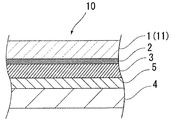
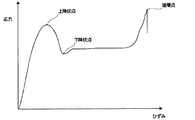
- FIG. 1 is a schematic cross-sectional view of a polyethylene terephthalate film of the present invention. It is a schematic sectional drawing of an example of the packaging material for batteries which used the polyethylene terephthalate film of this invention for the base material layer. It is a schematic sectional drawing of an example of the packaging material for batteries which used the polyethylene terephthalate film of this invention for the base material layer. It is a schematic view for explaining how to determine the absolute value of heat of fusion difference [Delta] H 1-2 of polyethylene terephthalate film (graph). It is a schematic diagram for demonstrating the yield point and fracture point of the stress-strain curve obtained by a tension test.
- the polyethylene terephthalate film of this invention is used for the said base material layer of the packaging material for batteries provided with a base material layer, a barrier layer, and a heat-fusible resin layer in this order.
- the polyethylene terephthalate film of the present invention is characterized in that the heat of fusion difference ⁇ H 1-2 determined by the following method is 6 J / g or more.
- the polyethylene terephthalate film of the present invention has such a specific heat of fusion difference ⁇ H 1-2 , when laminated together with a barrier layer and a heat-fusible resin layer as a base material layer of a battery packaging material Moreover, the moldability excellent in the packaging material for batteries can be exhibited.
- the polyethylene terephthalate film of the present invention and the battery of the present invention using the same will be described in detail.
- the numerical range indicated by “to” means “above” or “below”.
- the notation of 2 to 15 mm means 2 mm or more and 15 mm or less.
- polyethylene terephthalate film 11 of the present invention (hereinafter, “polyethylene terephthalate film” may be referred to as “PET film”) is a PET film for battery packaging materials. More specifically, as shown in FIGS. 2 and 3, the polyethylene terephthalate film 11 of the present invention includes a base material layer 1, a barrier layer 3, and a heat-fusible resin layer 4 in this order. Used for the base material layer 1 of the material 10.
- the base material layer 1 of the battery packaging material 10 only needs to include at least the PET film 11 of the present invention.
- the base material layer 1 is composed only of the PET film 11 of the present invention.
- a polyamide film 13 in addition to the PET film 11 of the present invention, a polyamide film 13, an adhesive layer 12 for improving the adhesion between the polyamide film 13 and the PET film 11, etc.
- Other layers may be provided. That is, the base material layer 1 may have a multilayer structure.
- a plurality of PET films 11 of the present invention may be laminated on the base material layer 1 of the battery packaging material 10.
- the heat of fusion difference ⁇ H 1-2 is A PET film that is less than 6 J / g may be further laminated.
- the base material layer 1 has a multilayer structure
- the PET film Since the PET film has excellent resistance when the electrolytic solution adheres, in the battery packaging material 10, the PET film is located on the outermost layer side (the side opposite to the heat-fusible resin layer). Is preferred.
- the PET film 11 of the present invention is heated for the first time from a temperature of 0 ° C. to a temperature of 300 ° C. at a temperature rising rate of 10 ° C./min using a differential scanning calorimeter in accordance with the provisions of JIS K7122-2012.
- a differential scanning calorimeter in accordance with the provisions of JIS K7122-2012.
- the temperature of 0 ° C./minute is used.
- the difference in heat of fusion ⁇ H 1-2 which is the difference from the heat of fusion H 2 measured for the second time after heating from 300 ° C.
- the battery packaging material can exhibit excellent moldability. That is, since the difference in heat of fusion ⁇ H 1-2 is 6 J / g or more, the crystal orientation is high before the heat of fusion H 1 is measured, and it is suitable for molding in the state of a battery packaging material. It can be said that it has a range of hardness. More specifically, in the film forming process of the PET film 11, the type of film forming method and the conditions during film forming (for example, the film forming temperature, the cooling temperature, the cooling rate, and the heat setting temperature after stretching) are adjusted.
- the difference in heat of fusion ⁇ H 1-2 of the PET film 11 can be set to 6 J / g or more, whereby excellent moldability can be exhibited.
- the method for forming the PET film 11 include a T-die method.
- the difference in heat of fusion ⁇ H 1-2 of the PET film 11 can be adjusted by the molecular weight or molecular weight distribution of polyethylene terephthalate constituting the PET film.
- polyethylene terephthalate is the main constituent component, but it may contain an additive as needed, and the additive also sets the difference in heat of fusion ⁇ H 1-2 in the above range. It is good.
- the lower limit is preferably about 7J / g or more, more preferably about 8 J / g or more, More preferably, about 10 J / g or more is mentioned,
- the upper limit is preferably about 20 J / g or less, more preferably about 18 J / g or less, still more preferably about 16 J / g or less.
- the preferable range of the heat of fusion ⁇ H 1-2 is about 6 to 20 J / g, about 6 to 18 J / g, about 6 to 16 J / g, about 7 to 20 J / g, about 7 to 18 J / g, 7-16 J / g, 8-20 J / g, 8-18 J / g, 8-16 J / g, 10-20 J / g, 10-18 J / g, 10-16 J / g, 13 About 14 J / g.
- the heat of fusion H 1 of the PET film 11 for example, 45 ⁇ 60 J / g, preferably about 47 ⁇ 56J / g or so, particularly preferably include about 53 ⁇ 54J / g, as the heat of fusion H 2 is For example, about 39 to 43 J / g, about 40 to 42 J / g, and particularly preferably about 40 to 41 J / g.
- the method for measuring the difference in heat of fusion ⁇ H 1-2 of the PET film is as follows.
- the thick line A in FIG. 4 is obtained by cooling the sample from room temperature to 0 ° C. at a rate of 10 ° C./min and holding at 0 ° C. for 15 minutes.
- FIG. 4 is a schematic graph (a graph from 0 ° C. to 300 ° C.) obtained when heating to 300 ° C. at a rate of 10 ° C./min.
- a thin line B in FIG. After heating up to 0 ° C., hold at 300 ° C. for 1 minute, cool to 0 ° C. again at a rate of 10 ° C./minute, hold at 0 ° C. for 1 minute, and re-heat to 300 ° C. It is a target graph (graph from 0 degreeC to 300 degreeC).
- the graph of line B shows an example in the case of having two endothermic peaks.
- the heat of fusion corresponds to the area of a region surrounded by the point where the line where the endothermic peak exists and the base line are in contact.
- the heat of fusion H 1 is the two points where the endothermic peak is present and the base line are in contact with each other in the thick line A in FIG. Is the point where the line A leaves the baseline before the transition, and A2 is between 260 ° C. and 280 ° C., the point where the line A returns to the baseline after the transition) Is the area of the region surrounded by.
- the heat of fusion H 2 is the two points where the endothermic peak is present and the base line are in contact with each other in the thin line B of FIG.
- the PET film 11 of the present invention has a yield point (upper yield) in a stress-strain curve showing the relationship between the stress (MPa) applied to the polyethylene terephthalate film and the strain at that time measured by a tensile test.
- S TD / MD is preferably 0.8 or more. When the inclination ratio S TD / MD of the PET film 11 is 0.8 or more, the moldability of the battery packaging material can be further improved.
- the yield point refers to the upper yield point.
- a biaxially stretched PET film has a difference in stretch ratio in the MD direction and TD direction due to its production method, and the STD / MD is often far from 1.
- the PET film 11 of the present invention has an appropriate numerical value of STD / MD close to 1, the elongation at the time of forming the battery packaging material is more uniform and can exhibit excellent moldability.
- the slope ratio S TD / MD of the PET film 11 is also adjusted in the process of forming the PET film 11 by adjusting the type of film forming method and the conditions during film formation (for example, the draw ratio and the heat setting temperature after stretching). By doing so, it can be set to 0.8 or more.
- the lower limit of the slope ratio S TD / MD of the PET film 11 is preferably about 0.8 or more, more preferably about 0.9 or more. More preferred is about 1.0 or more, and the upper limit is preferably about 10.0 or less, more preferably about 7.0 or less, and still more preferably about 5.0 or less.
- preferable ranges of the slope ratio S TD / MD are about 0.8 to 10.0, about 0.8 to 7.0, about 0.8 to 5.0, and about 0.9 to 10.0. 0.9 to 7.0, 0.9 to 5.0, 1.0 to 10.0, 1.0 to 7.0, 1.0 to 5.0, 1.0 to Examples include about 1.5 and about 1.1 to 1.3.
- the slope ratio STD / MD of the PET film can be calculated by measuring the slope of a straight line connecting the yield point and the fracture point by the tensile test described below.
- a PET film sample is cut to a size of 100 mm ⁇ 15 mm so that the long side direction is the MD direction and the short side direction is the TD direction.
- a tensile tester pull at a distance between chucks of 50 mm and a pulling speed of 300 mm / min to obtain a stress-strain curve.
- the tensile tests in the MD direction and TD direction were performed on 30 samples prepared in the same manner, and the yield point and the fracture point were determined from the top five stress-strain curves in descending order of strain (elongation).
- the slopes S MD and S TD of the connecting straight lines are measured, the slope ratio S TD / MD is calculated from the average value of the five slopes S MD and the average value of the five slopes S TD , and the slope ratio S TD / Find the MD value. This is because a sample having a larger strain has a more appropriate cross-sectional state at the time of sample preparation, and it can be said that a fold or the like that affects the measurement result is not formed.
- Slope S MD and S TD of a straight line connecting the breaking point and yield point, respectively can be expressed by the following equation.
- the slope of the straight line connecting the yield point and the fracture point S MD ⁇ (tensile fracture stress in the MD direction) ⁇ (tensile yield stress in the MD direction) ⁇ / ⁇ (tensile fracture strain in the MD direction) ⁇ (MD Direction tensile yield strain) ⁇
- the slope of the straight line connecting the yield point and the failure point S TD ⁇ (tensile fracture stress in the TD direction) ⁇ (tensile yield stress in the TD direction) ⁇ / ⁇ (tensile fracture strain in the TD direction) ⁇ (TD Direction tensile yield strain) ⁇
- the slope S MD of the PET film 11 for example, 1.0 to about 2.0, preferably about 1.2 to 1.9, more preferably include about 1.8-1.9
- the slope S Examples of TD include about 1.5 to 3.0, preferably about 1.6 to 2.2, and more preferably about 2.0 to 2.2.
- the tensile yield stress at the yield point is preferably about 95 to 125 MPa, more preferably about 100 to 125 MPa, and still more preferably about 104 to 120 MPa in the MD direction. Is preferably about 95 to 118 MPa, more preferably about 98 to 115 MPa. Further, the absolute value of the difference between the MD direction and the TD direction of the tensile yield stress is preferably about 0 to 20 MPa, and particularly preferably about 0 to 16 MPa.
- the tensile yield strain at the yield point is preferably about 100 to 115%, more preferably about 104 to 110% in the MD direction, and preferably 100 to 115% in the TD direction.
- the degree is more preferably about 104 to 110%.
- the absolute value of the difference between the MD direction and the TD direction of the tensile yield strain is preferably about 0 to 2%, and particularly preferably about 0 to 0.1%.
- the tensile fracture stress at the fracture point is preferably about 150 to 250 MPa, more preferably about 158 to 245 MPa in the MD direction, and preferably about 185 to 280 MPa in the TD direction. More preferably, about 185 to 272 MPa, and still more preferably about 192 to 272 MPa.
- the absolute value of the difference between the MD direction and the TD direction of the tensile fracture stress is preferably about 0 to 105 MPa, more preferably about 0 to 20 MPa, and about 0 to 5 MPa. Is particularly preferred.
- the tensile fracture strain at the fracture point is preferably about 150 to 190%, more preferably about 160 to 188% in the MD direction, and preferably 160 to 190% in the TD direction. About 163 to 182%, more preferably about 163 to 182%.
- the absolute value of the difference between the MD direction and the TD direction of the tensile fracture strain is preferably about 0 to 25%, and particularly preferably about 0 to 10%.
- the polyethylene terephthalate film 11 of the present invention is a film made of polyethylene terephthalate.
- the thickness of the polyethylene terephthalate film 11 of the present invention is not particularly limited, but from the viewpoint of improving the moldability while reducing the thickness of the battery packaging material, the lower limit is preferably about 5 ⁇ m or more, more preferably The upper limit is preferably about 40 ⁇ m or less, more preferably about 35 ⁇ m or less, and still more preferably about 30 ⁇ m or less.
- Preferable ranges of the thickness of the polyethylene terephthalate film 11 include about 5 to 40 ⁇ m, about 5 to 35 ⁇ m, about 5 to 30 ⁇ m, about 7 to 40 ⁇ m, about 7 to 35 ⁇ m, and about 7 to 30 ⁇ m.
- polyethylene terephthalate is used as the base material layer of a battery packaging material composed of a laminate including a base material layer, a barrier layer, and a heat-fusible resin layer in this order, Obtain the polyethylene terephthalate from the laminate (for example, peel the PET film from the laminate or dissolve the layers other than the PET film. At this time, be careful not to stretch the PET film). It is determined whether or not the film is the polyethylene terephthalate film of the present invention by measuring the above-described difference in heat of fusion ⁇ H 1-2 , slope ratio S TD / MD , thickness and the like.
- the MD direction and the TD direction of the polyethylene terephthalate film laminated on the laminate can generally be determined from a barrier layer described later. That is, in the battery packaging material, the MD and TD in the manufacturing process can be generally discriminated for the barrier layer described later.
- the barrier layer is made of an aluminum foil
- linear streaks called so-called rolling marks are formed on the surface of the aluminum foil in the rolling direction (RD: Rolling Direction) of the aluminum foil. Since the rolling trace extends along the rolling direction, the rolling direction of the aluminum foil can be grasped by observing the surface of the aluminum foil.
- a laminated body in the manufacturing process of a laminated body, generally, since MD of a laminated body and RD of aluminum foil correspond, the surface of the aluminum foil of a laminated body is observed and the rolling direction (RD) of aluminum foil is specified.
- MD of a laminated body namely, MD of a polyethylene terephthalate film
- the TD of the laminate since the TD of the laminate is perpendicular to the MD of the laminate, the TD of the laminate (that is, the TD of the polyethylene terephthalate film) can also be specified.
- the slope ratio S TD / MD and the difference in heat of fusion ⁇ H 1-2 are different elements because the adjustment methods are different and the mechanisms for improving the moldability are different.
- PET film 11 of the present invention can be suitably used for the base material layer 1 for a battery packaging material.
- Examples of the battery packaging material 10 include those having a laminated structure composed of a laminated body having at least the base material layer 1, the barrier layer 3, and the heat-fusible resin layer 4 in this order.
- 2 and 3 as an example of a cross-sectional structure of the battery packaging material 10, a base material layer 1, an adhesive layer 2, a barrier layer 3, an adhesive layer 5, and a heat-fusible resin layer 4 are laminated in this order.
- the aspect which is shown is shown.
- the adhesive layer 2 is a layer provided as necessary for the purpose of improving the adhesion between the base material layer 1 and the barrier layer 3.
- the adhesive layer 5 is a layer provided as necessary for the purpose of improving the adhesion between the barrier layer 3 and the heat-fusible resin layer 4.
- a surface coating layer (not shown) or the like may be provided outside the base material layer 1 (on the side opposite to the heat-fusible resin layer 4) as necessary.
- the base material layer 1 is the outermost layer side
- the heat-fusible resin layer 4 is the innermost layer.
- the thickness of the laminate constituting the battery packaging material 10 is not particularly limited, and the battery packaging material having excellent moldability while reducing the thickness of the battery packaging material to increase the energy density of the battery. From this viewpoint, for example, about 180 ⁇ m or less, preferably about 150 ⁇ m or less, more preferably about 60 to 180 ⁇ m, and still more preferably about 60 to 150 ⁇ m.
- the base material layer 1 should just contain the PET film 11 of this invention at least, and if there exists an effect of this invention, it may contain the other layer.
- the base material layer 1 may be composed of only the PET film 11 of the present invention as shown in FIG. 2, for example.
- Other layers such as the polyamide film 13 and the adhesive layer 12 for improving the adhesion between the polyamide film 13 and the PET film 11 may be provided.
- a plurality of PET films 11 of the present invention may be laminated on the base material layer 1 of the battery packaging material 10.
- the heat of fusion difference ⁇ H 1-2 is A PET film that is less than 6 J / g may be further laminated.
- the material of the other layer that can be included in the base material layer 1 is not particularly limited as long as it has insulating properties.
- polyester however, the above difference in heat of fusion ⁇ H 1-2 is (Excluding polyethylene terephthalate which is 6 J / g or more), polyamide, epoxy resin, acrylic resin, fluorine resin, polyurethane, silicon resin, phenol resin, polycarbonate resin, polyetherimide, polyimide, and mixtures and copolymers thereof.
- polyester (however, the above difference in heat of fusion ⁇ H 1-2 is (Excluding polyethylene terephthalate which is 6 J / g or more), polyamide, epoxy resin, acrylic resin, fluorine resin, polyurethane, silicon resin, phenol resin, polycarbonate resin, polyetherimide, polyimide, and mixtures and copolymers thereof. Can be mentioned.
- polyester examples include co-polymers mainly composed of polyethylene terephthalate, polyethylene naphthalate, polybutylene naphthalate, polyethylene isophthalate, and ethylene terephthalate having a difference in heat of fusion ⁇ H 1-2 of less than 6 J / g.
- Examples thereof include polymerized polyester.
- the copolymer polyester mainly composed of ethylene terephthalate is a copolymer polyester that polymerizes with ethylene isophthalate mainly composed of ethylene terephthalate (hereinafter, polyethylene (terephthalate / isophthalate)).
- polyethylene (terephthalate / decane dicarboxylate) examples of the polyester.
- polyesters mainly composed of butylene terephthalate as a repeating unit examples include polybutylene naphthalate. These polyesters may be used individually by 1 type, and may be used in combination of 2 or more type. Polyester has the advantage of being excellent in electrolytic solution resistance and less likely to cause whitening due to the adhesion of the electrolytic solution, and is suitably used as a material for forming the base material layer 1.
- polyamides include aliphatic polyamides such as nylon 6, nylon 66, nylon 610, nylon 12, nylon 46, and a copolymer of nylon 6 and nylon 66; terephthalic acid and / or isophthalic acid Nylon 6I, Nylon 6T, Nylon 6IT, Nylon 6I6T (I represents isophthalic acid, T represents terephthalic acid) and the like, and polymetaxylylene azide Polyamides containing aromatics such as Pamide (MXD6); Alicyclic polyamides such as Polyaminomethylcyclohexyl Adipamide (PACM6); and Lactam components and isocyanate components such as 4,4'-diphenylmethane-diisocyanate are copolymerized Polya De, copolymerized polyamide and polyester and a copolymer of a polyalkylene ether glycol polyester amide copolymer and polyether ester amide copolymers; and copolymers thereof.
- MXD6
- polyamides may be used individually by 1 type, and may be used in combination of 2 or more type.
- the stretched polyamide film is excellent in stretchability, can prevent whitening due to resin cracking of the base material layer 1 during molding, and is suitably used as a material for forming the base material layer 1.
- each resin film may be bonded via an adhesive (adhesive layer 12), or may be directly laminated without using an adhesive.
- an adhesive for example, a method of bonding in a hot melt state such as a co-extrusion method, a sandwich lamination method, a thermal lamination method, and the like can be given.
- the adhesive agent to be used may be a two-component curable adhesive, or a one-component curable adhesive.
- the bonding mechanism of the adhesive is not particularly limited, and may be any of a chemical reaction type, a solvent volatilization type, a heat melting type, a hot pressure type, an electron beam curable type, an ultraviolet curable type, and the like.
- Specific examples of the adhesive include those similar to the adhesive exemplified in the adhesive layer 2 described later.
- the thickness of the adhesive can be the same as that of the adhesive layer 2.
- the multilayer structure of the base material layer 1 include a configuration in which PET film 11 / adhesive layer 12 / polyamide film 13 are sequentially stacked; a configuration in which PET film 11 / adhesive layer 12 / PET film 11 are sequentially stacked. A configuration in which PET film 11 / polyamide film 13 are sequentially laminated; a configuration in which PET film 11 / PET film 11 is sequentially laminated, and the like.
- the PET film Since the PET film has excellent resistance when the electrolytic solution adheres, in the battery packaging material 10, the PET film is located on the outermost layer side (the side opposite to the heat-fusible resin layer). Is preferred.
- a lubricant is preferably attached to the surface of the base material layer 1 from the viewpoint of improving the moldability of the battery packaging material.
- an amide type lubricant is mentioned.
- Specific examples of the amide-based lubricant include saturated fatty acid amide, unsaturated fatty acid amide, substituted amide, methylolamide, saturated fatty acid bisamide, unsaturated fatty acid bisamide, and the like.
- Specific examples of the saturated fatty acid amide include lauric acid amide, palmitic acid amide, stearic acid amide, behenic acid amide, hydroxy stearic acid amide and the like.
- the unsaturated fatty acid amide include oleic acid amide and erucic acid amide.
- substituted amide include N-oleyl palmitic acid amide, N-stearyl stearic acid amide, N-stearyl oleic acid amide, N-oleyl stearic acid amide, N-stearyl erucic acid amide and the like.
- methylolamide include methylol stearamide.
- saturated fatty acid bisamides include methylene bis stearamide, ethylene biscapric amide, ethylene bis lauric acid amide, ethylene bis stearic acid amide, ethylene bishydroxy stearic acid amide, ethylene bisbehenic acid amide, hexamethylene bis stearic acid amide.
- unsaturated fatty acid bisamides include ethylene bisoleic acid amide, ethylene biserucic acid amide, hexamethylene bisoleic acid amide, N, N′-dioleyl adipic acid amide, N, N′-dioleyl sebacic acid amide Etc.
- fatty acid ester amide include stearoamidoethyl stearate.
- aromatic bisamide include m-xylylene bis stearic acid amide, m-xylylene bishydroxy stearic acid amide, N, N′-distearyl isophthalic acid amide and the like.
- One type of lubricant may be used alone, or two or more types may be used in combination.
- the content of the lubricant in the base material layer 1 is not particularly limited, and is preferably about 0.01 to 0.2% by mass, more preferably 0 from the viewpoint of improving the moldability and insulation of the battery packaging material. About 0.05 to 0.15% by mass.
- the thickness of the base material layer 1 is, for example, 5 ⁇ m or more, preferably about 5 to 50 ⁇ m, more preferably about 10 to 50 ⁇ m, and further preferably about 15 to 30 ⁇ m.
- whether or not the polyethylene terephthalate of the present invention is used as the base material layer 1 is determined for the polyethylene terephthalate alone peeled from the laminate by the above-described difference in heat of fusion ⁇ H 1-2 and slope ratio S. It can be determined by measuring TD / MD , thickness, etc.
- the MD direction and the TD direction of the polyethylene terephthalate film laminated on the laminate can be determined from, for example, a barrier layer described later, as described above.
- the adhesive layer 2 is a layer provided between the base material layer 1 and the barrier layer 3 as necessary in order to firmly bond them.
- the adhesive layer 2 is formed of an adhesive capable of bonding the base material layer 1 and the barrier layer 3 together.
- the adhesive used for forming the adhesive layer 2 may be a two-component curable adhesive or a one-component curable adhesive.
- the bonding mechanism of the adhesive used for forming the adhesive layer 2 is not particularly limited, and may be any of a chemical reaction type, a solvent volatilization type, a heat melting type, and a hot pressure type.
- adhesive components that can be used to form the adhesive layer 2 include polyester resins such as polyethylene terephthalate, polybutylene terephthalate, polyethylene naphthalate, polybutylene naphthalate, polyethylene isophthalate, and copolyester; polyethers Polyurethane adhesives; epoxy resins; phenol resin resins; polyamide resins such as nylon 6, nylon 66, nylon 12, copolymer polyamides; polyolefins such as polyolefins, carboxylic acid modified polyolefins, metal modified polyolefins Resin, polyvinyl acetate resin; cellulose adhesive; (meth) acrylic resin; polyimide resin; polycarbonate; amino resin such as urea resin and melamine resin; chloroprene rubber, nitrile - arm, styrene rubbers such as butadiene rubber; and silicone resins.
- These adhesive components may be used individually by 1 type, and may be used in combination of 2 or more type.
- the thickness of the adhesive layer 2 is not particularly limited as long as it exhibits a function as an adhesive layer, and may be about 0.1 to 10 ⁇ m, preferably about 0.5 to 5 ⁇ m, for example.
- the barrier layer 3 is a layer having a function of preventing water vapor, oxygen, light and the like from entering the battery, in addition to improving the strength of the battery packaging material.
- the barrier layer 3 is preferably a metal layer, that is, a layer formed of metal.
- Specific examples of the metal constituting the barrier layer 3 include aluminum, stainless steel, and titanium, and preferably aluminum.
- the barrier layer 3 can be formed by, for example, a metal foil, a metal vapor-deposited film, an inorganic oxide vapor-deposited film, a carbon-containing inorganic oxide vapor-deposited film, a film provided with these vapor-deposited films, etc. Is preferable, and it is more preferable to form with aluminum foil or stainless steel foil.
- the barrier layer 3 is made of an aluminum foil
- the aluminum foil is made of an aluminum alloy.
- the barrier layer is made of, for example, annealed aluminum (JIS H4160: 1994 A8021H-O, JIS H4160: 1994 A8079H-O, JIS H4000: 2014 A8021P-O, and JIS H4000: 2014 A8079P-O) are more preferable.
- the stainless steel foil is preferably made of austenitic stainless steel.
- the battery packaging material has high puncture strength and excellent resistance to electrolytic solution and moldability.
- the austenitic stainless steel include SUS304, SUS301, and SUS316L.
- SUS304 is particularly preferable.
- especially stainless steel foil improves a ductility by cold-rolling processing, and a moldability improves. Further, after cold rolling, heat treatment is performed and annealing is performed, thereby improving the balance between the flow direction and the width direction and improving the formability.
- the cleaning method include cleaning using an alkali or an acid, and further alkaline electrolytic degreasing cleaning.
- ultrasonic treatment or plasma treatment can be used in combination.
- alkaline degreasing and alkaline electrolytic degreasing are preferable. As a result, the wettability of the surface is improved, the chemical conversion treatment can be made uniform, and the content resistance is stabilized.
- the barrier layer 3 is preferably subjected to chemical conversion treatment on at least one surface, preferably both surfaces, for the purpose of stabilizing adhesion, preventing dissolution and corrosion, and the like.
- the chemical conversion treatment refers to a treatment for forming an acid-resistant film on the surface of the barrier layer.
- a chromium compound such as chromium nitrate, chromium fluoride, chromium sulfate, chromium acetate, chromium oxalate, chromium biphosphate, chromate acetyl acetate, chromium chloride, potassium sulfate chromium, etc.
- a phosphoric acid treatment using a phosphoric acid compound such as sodium phosphate, potassium phosphate, ammonium phosphate or polyphosphoric acid
- a chromate treatment using an aminated phenol polymer such as sodium phosphate, potassium phosphate, ammonium phosphate or polyphosphoric acid
- the thickness of the barrier layer 3 is not particularly limited as long as it functions as a barrier layer such as water vapor, but can be, for example, about 10 to 50 ⁇ m, preferably about 10 to 45 ⁇ m.
- the heat-fusible resin layer 4 corresponds to the innermost layer, and is a layer that heat-fuses the heat-fusible resin layers and seals the battery element when the battery is assembled.
- the resin component used for the heat-fusible resin layer 4 is not particularly limited as long as it can be heat-sealed, and examples thereof include polyolefin, cyclic polyolefin, acid-modified polyolefin, and acid-modified cyclic polyolefin. That is, the resin constituting the heat-fusible resin layer 4 may or may not include a polyolefin skeleton, and preferably includes a polyolefin skeleton.
- the fact that the resin constituting the heat-fusible resin layer 4 contains a polyolefin skeleton can be analyzed by, for example, infrared spectroscopy, gas chromatography mass spectrometry, etc., and the analysis method is not particularly limited.
- a peak derived from maleic acid is detected in the vicinity of the wave number of 1760 cm -1 and near the wave number 1780 cm -1.
- the peak may be small and may not be detected. In that case, it can be analyzed by nuclear magnetic resonance spectroscopy.
- polystyrene resin examples include polyethylene such as low density polyethylene, medium density polyethylene, high density polyethylene, and linear low density polyethylene; homopolypropylene, block copolymer of polypropylene (for example, block copolymer of propylene and ethylene), polypropylene Polypropylenes such as random copolymers of (for example, random copolymers of propylene and ethylene); ethylene-butene-propylene terpolymers, and the like.
- polyethylene and polypropylene are preferable.
- the cyclic polyolefin is a copolymer of an olefin and a cyclic monomer, and examples of the olefin that is a constituent monomer of the cyclic polyolefin include ethylene, propylene, 4-methyl-1-pentene, butadiene, and isoprene. .
- examples of the cyclic monomer that is a constituent monomer of the cyclic polyolefin include cyclic alkenes such as norbornene; specifically, cyclic dienes such as cyclopentadiene, dicyclopentadiene, cyclohexadiene, and norbornadiene.
- a cyclic alkene is preferable, and norbornene is more preferable.
- the acid-modified polyolefin is a polymer obtained by modifying the polyolefin by block polymerization or graft polymerization with an acid component such as carboxylic acid.
- an acid component such as carboxylic acid.
- the acid component used for modification include carboxylic acids such as maleic acid, acrylic acid, itaconic acid, crotonic acid, maleic anhydride, and itaconic anhydride, or anhydrides thereof.
- the acid-modified cyclic polyolefin is obtained by copolymerizing a part of the monomer constituting the cyclic polyolefin in place of the ⁇ , ⁇ -unsaturated carboxylic acid or its anhydride, or by ⁇ , ⁇ - It is a polymer obtained by block polymerization or graft polymerization of an unsaturated carboxylic acid or its anhydride.
- the cyclic polyolefin to be modified with carboxylic acid is the same as described above.
- the carboxylic acid used for modification is the same as that used for modification of the polyolefin.
- polyolefins such as polypropylene and carboxylic acid-modified polyolefins; and more preferred are polypropylene and acid-modified polypropylene.
- the heat-fusible resin layer 4 may be formed of one kind of resin component alone or may be formed of a blend polymer in which two or more kinds of resin components are combined. Furthermore, the heat-fusible resin layer 4 may be formed of only one layer, but may be formed of two or more layers using the same or different resin components.
- the heat-fusible resin layer 4 may contain a lubricant or the like as necessary.
- the lubricant is not particularly limited, and a known lubricant can be used, and examples thereof include those exemplified in the base material layer 1 described above.
- One type of lubricant may be used alone, or two or more types may be used in combination.
- the content of the lubricant in the heat-fusible resin layer 4 is not particularly limited, and is preferably about 0.01 to 0.20% by mass from the viewpoint of improving the moldability and insulation of the battery packaging material. Preferably, it is about 0.05 to 0.15% by mass.
- the thickness of the heat-fusible resin layer 4 is not particularly limited as long as it functions as a heat-fusible resin layer, but is preferably 60 ⁇ m or less, more preferably about 10 to 40 ⁇ m.
- the adhesive layer 5 is a layer provided between the barrier layer 3 and the heat-fusible resin layer 4 as necessary in order to firmly bond them.
- the adhesive layer 5 is formed of a resin capable of bonding the barrier layer 3 and the heat-fusible resin layer 4.
- the resin used for forming the adhesive layer 5 the same adhesive mechanism and the same types of adhesive components as those exemplified for the adhesive layer 2 can be used.
- polyolefin resins such as polyolefin, cyclic polyolefin, carboxylic acid-modified polyolefin, carboxylic acid-modified cyclic polyolefin exemplified in the above-mentioned heat-fusible resin layer 4 can also be used. .
- the polyolefin is preferably a carboxylic acid-modified polyolefin, and particularly preferably a carboxylic acid-modified polypropylene. That is, the resin constituting the adhesive layer 5 may or may not include a polyolefin skeleton, and preferably includes a polyolefin skeleton. The fact that the resin constituting the adhesive layer 5 contains a polyolefin skeleton can be analyzed by, for example, infrared spectroscopy, gas chromatography mass spectrometry, etc., and the analysis method is not particularly limited.
- a peak derived from maleic acid is detected in the vicinity of the wave number of 1760 cm -1 and near the wave number 1780 cm -1.
- the peak may be small and may not be detected. In that case, it can be analyzed by nuclear magnetic resonance spectroscopy.
- the adhesive layer 5 is a resin composition containing an acid-modified polyolefin and a curing agent. It may be a cured product.
- Preferred examples of the acid-modified polyolefin include the same carboxylic acid-modified polyolefin and carboxylic acid-modified cyclic polyolefin exemplified in the heat-fusible resin layer 4.
- the curing agent is not particularly limited as long as it can cure the acid-modified polyolefin.
- the curing agent include an epoxy curing agent, a polyfunctional isocyanate curing agent, a carbodiimide curing agent, and an oxazoline curing agent.
- the epoxy curing agent is not particularly limited as long as it is a compound having at least one epoxy group.
- examples of the epoxy curing agent include epoxy resins such as bisphenol A diglycidyl ether, modified bisphenol A diglycidyl ether, novolac glycidyl ether, glycerin polyglycidyl ether, and polyglycerin polyglycidyl ether.
- the polyfunctional isocyanate curing agent is not particularly limited as long as it is a compound having two or more isocyanate groups.
- Specific examples of the polyfunctional isocyanate-based curing agent include isophorone diisocyanate (IPDI), hexamethylene diisocyanate (HDI), tolylene diisocyanate (TDI), diphenylmethane diisocyanate (MDI), those obtained by polymerizing or nurating these, Examples thereof include mixtures and copolymers with other polymers.
- the carbodiimide curing agent is not particularly limited as long as it is a compound having at least one carbodiimide group (—N ⁇ C ⁇ N—).
- a polycarbodiimide compound having at least two carbodiimide groups is preferable.
- the oxazoline-based curing agent is not particularly limited as long as it is a compound having an oxazoline skeleton.
- Specific examples of the oxazoline-based curing agent include Epocros series manufactured by Nippon Shokubai Co., Ltd.
- the curing agent may be composed of two or more kinds of compounds.
- the content of the curing agent in the resin composition forming the adhesive layer 5 is preferably in the range of about 0.1 to 50% by mass, more preferably in the range of about 0.1 to 30% by mass, More preferably, it is in the range of about 0.1 to 10% by mass.
- the thickness of the adhesive layer 5 is not particularly limited as long as it functions as an adhesive layer. However, when the adhesive exemplified in the adhesive layer 2 is used, it is preferably about 1 to 10 ⁇ m, more preferably 1 About 5 ⁇ m. Further, when the resin exemplified in the heat-fusible resin layer 4 is used, it is preferably about 2 to 50 ⁇ m, more preferably about 10 to 40 ⁇ m. In the case of a cured product of an acid-modified polyolefin and a curing agent, it is preferably about 30 ⁇ m or less, more preferably about 0.1 to 20 ⁇ m, and still more preferably about 0.5 to 5 ⁇ m. In the case where the adhesive layer 5 is a cured product of a resin composition containing an acid-modified polyolefin and a curing agent, the adhesive layer 5 can be formed by applying the resin composition and curing it by heating or the like.
- the base material layer 1 (barrier layer of the base material layer 1) is optionally formed. If necessary, a surface coating layer may be provided on the side opposite to (3).
- a surface coating layer is a layer located in the outermost layer when a battery is assembled.
- the surface coating layer can be formed of a resin composition.
- a resin component As a component contained in the resin composition, as described later, a resin component, a curing accelerator, and an additive (such as a filler) may be mentioned.
- the resin component contained in the resin composition preferably contains a thermosetting resin.
- Any thermosetting resin may be used as long as it causes polymerization upon heating to form a polymer network structure and cure.
- Specific examples of thermosetting resins include polyvinylidene chloride, polyester resins, epoxy resins, amino resins (melamine resins, benzoguanamine resins, etc.), acrylic resins, urethane resins, phenol resins, unsaturated polyester resins, alkyd resins, etc. Is mentioned.
- thermosetting resins urethane resins and epoxy resins are preferable from the viewpoints of shortening the curing time, improving moldability and chemical resistance, and more preferably two-component curable urethane resins and 2 A liquid curable epoxy resin is mentioned, Especially preferably, a 2 liquid curable epoxy resin is mentioned.
- the two-component curable urethane resin examples include a combination of a polyol compound (main agent) and an isocyanate compound (curing agent).
- the two-component curable epoxy resin examples include an epoxy resin (main agent). And a combination of an acid anhydride, an amine compound, or an amino resin (curing agent).
- a polyfunctional urethane (meth) acrylate comprising a combination of a polyfunctional (meth) acrylate (main agent) having active hydrogen and a polyisocyanate (curing agent) is also preferable.
- the polyol compound used as the main agent is not particularly limited, and examples thereof include polyester polyol, polyester polyurethane polyol, polyether polyol, and polyether polyurethane polyol. These polyol compounds may be used individually by 1 type, and may be used in combination of 2 or more type.
- the isocyanate compound used as a curing agent is not particularly limited.
- specific examples of the polyisocyanate include diphenylmethane diisocyanate (MDI), polyphenylmethane diisocyanate (polymeric MDI), tolylene diisocyanate (TDI), hexamethylene diisocyanate (HDI), and bis (4-isocyanatocyclohexyl) methane (H12MDI).
- MDI diphenylmethane diisocyanate
- polymeric MDI polyphenylmethane diisocyanate
- TDI tolylene diisocyanate
- HDI hexamethylene diisocyanate
- H12MDI bis (4-isocyanatocyclohexyl) methane
- Aromatic diisocyanates such as isophorone diisocyanate (IPDI), 1,5-naphthalene diisocyanate (1,5-NDI), 3,3′-dimethyl-4,4′-diphenylene diisocyanate (TODI), xylene diisocyanate (XDI) Aliphatic diisocyanates such as tramethylene diisocyanate, hexamethylene diisocyanate, trimethylhexamethylene diisocyanate, and isophorone diisocyanate Over preparative; 4,4'-methylenebis (cyclohexyl isocyanate), alicyclic diisocyanates such as isophorone diisocyanate; 1,5-polycyclic aromatic diisocyanates such as naphthalene diisocyanate (1, 5-NDI) and the like. Specific examples of the adduct include those obtained by adding trimethylolpropane, glycol and the like to the polyisocyanate. These isocyanate compounds may be
- thermosetting resins may be crosslinkable elastomers.
- a crosslinkable elastomer is a thermosetting resin that can impart a soft segment to a cured product.
- the above-described main agent only needs to have a structure capable of imparting a soft segment.
- the crosslinkable elastomer can be used as a part of the thermosetting resin used for forming the layer constituting the surface coating layer in order to provide the layer constituting the surface coating layer with a desired hardness.
- thermosetting resins may be used alone or in combination of two or more.
- the surface coating layer may be formed of a plurality of layers.
- the thermosetting resin used in each layer may be the same or different, and the type of the thermosetting resin depends on the function to be provided in each layer, What is necessary is just to select suitably according to a physical property etc.
- the layer forming the outermost layer is polycyclic from the viewpoint of having excellent chemical resistance.
- a thermosetting resin having an aromatic skeleton and / or a heterocyclic skeleton is preferably used.
- thermosetting resin having a polycyclic aromatic skeleton examples include an epoxy resin having a polycyclic aromatic skeleton and a urethane resin having a polycyclic aromatic skeleton.
- thermosetting resin having a heterocyclic skeleton examples include amino resins such as melamine resin and benzoguanamine resin. These thermosetting resins having a polycyclic aromatic skeleton and / or a heterocyclic skeleton may be either a one-component curable type or a two-component curable type.
- an epoxy resin having a polycyclic aromatic skeleton a reaction product of dihydroxynaphthalene and epihalohydrin; a condensate of naphthol and aldehydes (naphthol novolak resin) and a reaction product of epihalohydrin; dihydroxy A condensate of naphthalene and aldehydes and an epihalohydrin; a condensate of mono or dihydroxynaphthalene and xylylene glycols and a reaction of epihalohydrin; an adduct of mono or dihydroxynaphthalene and a diene compound; Reaction products with epihalohydrins; reaction products of polynaphthols in which naphthols are directly coupled to epihalohydrins, and the like.
- examples of the urethane resin having a polycyclic aromatic skeleton include a reaction product of a polyol compound and an isocyanate compound having a polycyclic aromatic skeleton.
- the resin composition forming the surface coating layer may further contain a curing accelerator in addition to the resin component.
- a curing accelerator By coexisting a curing accelerator together with the thermosetting resin, the surface coating layer can be cured in a short time without requiring aging under high temperature conditions during production, and a layer having a specific hardness can be formed.
- the “curing accelerator” is a substance that does not form a crosslinked structure by itself, but promotes the crosslinking reaction of the thermosetting resin, and has the effect of promoting the crosslinking reaction of the thermosetting resin. Is also a substance that may form a crosslinked structure.
- the type of curing accelerator is appropriately selected according to the thermosetting resin to be used so that the above-mentioned hardness can be satisfied.
- an amidine compound, a carbodiimide compound, a ketimine compound, a hydrazine compound, a sulfonium salt, a benzoic acid examples include thiazolium salts and tertiary amine compounds.
- amidine compound is not particularly limited, and examples thereof include imidazole compounds, 1,8-diazabicyclo [5.4.0] undec-7ene (DBU), 1,5-diazabicyclo [4.3.0] none-5. En (DBN), a guanidine compound, etc. are mentioned.
- imidazole compound examples include 2-methylimidazole, 2-ethylimidazole, 2-undecylimidazole, 2,4-dimethylimidazole, 2-heptadecylimidazole, 1,2-dimethylimidazole, 1,2- Diethylimidazole, 2-ethyl-4-methylimidazole, 2-phenylimidazole, 1-benzyl-2-phenylimidazole, 1-cyanoethyl-2-methylimidazole, 1-cyanoethyl-2-undecylimidazole, 1-benzyl-2 -Methylimidazole, 2,4-diamino-6- [2'-methylimidazolyl- (1) ']-ethyl-S-triazine, 2,4-diamino-6- [2'-ethyl-4'-methylimidazolyl -(1) ']-ethyl-S-triazine, 2,4-d
- the carbodiimide compound is not particularly limited.
- Specific examples of the ketone include methyl ethyl ketone, methyl isopropyl ketone, methyl tertiary butyl ketone, methyl cyclohexyl ketone, diethyl ketone, ethyl propyl ketone, ethyl butyl ketone, dipropyl ketone, dibutyl ketone, and diisobutyl ketone. .
- amines include aromatic polyamines such as o-phenylenediamine, m-phenylenediamine, p-phenylenediamine, m-xylylenediamine, diaminodiphenylmethane, diaminodiphenylsulfone, and diaminodiethyldiphenylmethane; Ethylenediamine, propylenediamine, butylenediamine, diethylenetriamine, triethylenetetramine, tetraethylenepentamine, pentaethylenehexamine, hexamethylenediamine, trimethylhexamethylenediamine, 1,2-propanediamine, iminobispropylamine, methyliminobispropylamine, etc.
- aromatic polyamines such as o-phenylenediamine, m-phenylenediamine, p-phenylenediamine, m-xylylenediamine, diaminodiphenylmethane, di
- Aliphatic polyamines such as N-aminoethylpiperazine, 3-butoxyisopropylamine and the like having an ether bond in the main chain And diamines having a polyether skeleton; alicyclic polyamines such as isophorone diamine, 1,3-bisaminomethylcyclohexane, 1-cyclohexylamino-3-aminopropane, 3-aminomethyl-3,3,5-trimethylcyclohexylamine: A diamine having a norbornane skeleton; a polyamide amine having an amino group at the molecular end of the polyamide; 2,5-dimethyl-2,5-hexamethylenediamine, mensendiamine, 1,4-bis (2-amino-2-methylpropyl) Specific examples include piperazine. These ketimine compounds may be used individually by 1 type, and may be used in combination of 2 or more type.
- the hydrazine compound is not particularly limited, and examples thereof include dipic acid dihydrazide and isophthalic acid dihydrazide. These hydrazine compounds may be used individually by 1 type, and may be used in combination of 2 or more type.
- the sulfonium salt is not particularly limited.
- 4-acetophenyldimethylsulfonium hexafluoroantimonate 4-acetophenyldimethylsulfonium hexafluoroarsenate, dimethyl-4- (benzyloxycarbonyloxy) phenylsulfonium hexafluoroantimonate
- Alkylsulfonium salts such as dimethyl-4- (benzoyloxy) phenylsulfonium hexafluoroantimonate, dimethyl-4- (benzoyloxy) phenylsulfonium hexafluoroarsenate
- benzyl-4-hydroxyphenylmethylsulfonium hexafluoroantimonate 4- Acetoxyphenylbenzylmethylsulfonium hexafluoroantimonate, benzyl-4-methoxyphenyl Benzylsulfonium salts such as t
- the benzothiazolium salt is not particularly limited, and examples thereof include 3-benzylbenzothiazolium hexafluoroantimonate, 3-benzylbenzothiazolium hexafluorophosphate, 3-benzylbenzothiazolium tetrafluoroborate, 3- Benzylbenzoes such as (p-methoxybenzyl) benzothiazolium hexafluoroantimonate, 3-benzyl-2-methylthiobenzothiazolium hexafluoroantimonate, 3-benzyl-5-chlorobenzothiazolium hexafluoroantimonate Thiazolium salts are mentioned. These benzothiazolium salts may be used individually by 1 type, and may be used in combination of 2 or more type.
- the tertiary amine compound is not particularly limited.
- fatty acids such as trimethylamine, triethylamine, tripropylamine, tributylamine, triethylenediamine, 1,4-diazabicyclo [2.2.2] octane, quinuclidine, and 3-quinuclidinol.
- These tertiary amine compounds may be used individually by 1 type, and may be used in combination of 2 or more type.
- a suitable example of the curing accelerator is one that functions as a thermal acid generator.
- a thermal acid generator is a substance that generates an acid by heating and functions as a curing accelerator.
- Specific examples of the curing accelerator that can function as a thermal acid generator include a sulfonium salt and a benzothiazolium salt.
- the curing accelerator is a thermal potential that is activated under a predetermined heating condition (for example, 80 to 200 ° C., preferably 100 to 160 ° C.) to promote the crosslinking reaction of the thermosetting resin.
- a predetermined heating condition for example, 80 to 200 ° C., preferably 100 to 160 ° C.
- specific examples of the heat latent substance include an epoxy adduct obtained by adding an epoxy compound to an amidine compound, a hydrazine compound, a tertiary amine compound, or the like.
- the curing accelerator does not function as a curing agent in a sealed state, that is, a moisture blocking state, but the sealed state is opened and hydrolyzed under the presence of moisture as a curing agent.
- a sealed state that is, a moisture blocking state
- the hydrolyzable latent substance include an epoxy adduct obtained by adding an epoxy compound to an amidine compound, a hydrazine compound, a tertiary amine compound, or the like.
- curing accelerators may be used alone or in combination of two or more.
- an amidine compound and a sulfonium salt are preferable, and an amidine compound is more preferable.
- curing accelerators may be used alone or in combination of two or more in the surface coating layer.
- the curing accelerator used in each layer constituting the surface coating layer may be the same or different. These may be selected as appropriate according to functions and physical properties to be provided in each layer.
- the content of the curing accelerator in the resin composition used for forming the surface coating layer is appropriately set according to the type of the thermosetting resin used, the type of the curing accelerator, and the like.
- the total amount of the curing accelerator is about 0.01 to 6 parts by weight, preferably about 0.05 to 5 parts by weight, and more preferably 0.1 to 2 parts by weight with respect to 100 parts by weight of the thermosetting resin. About a mass part is mentioned.
- the surface coating layer preferably contains a filler as an additive. That is, the surface coating layer is preferably formed from a resin composition containing a filler. When the surface coating layer contains a filler, an uneven shape can be formed on the surface of the surface coating layer, and a matte feeling can be imparted to the battery packaging material.
- specific examples of fillers include inorganic fillers such as titanium oxide, silica, talc, clay, heavy calcium carbonate, light calcium carbonate, barium sulfate, calcium silicate, synthetic silicate, aluminum hydroxide, and fine powder of silicate. Can be mentioned. Only one type of filler may be used, or two or more types may be mixed and used.
- inorganic fillers made of silica or precipitated barium sulfate are preferred because they are easy to handle and readily available.
- Precipitated barium sulfate refers to barium sulfate produced using a chemical reaction, and is characterized in that the particle diameter can be controlled.
- the filler content in the surface coating layer is preferably about 2.0 to 8.7% by mass when the filler is silica having an average particle size of about 1.0 to 3.0 ⁇ m,
- the amount is preferably about 13.0 to 40.0% by mass.
- the content of the filler is the content of the filler in the surface coating layer, and is the content after the solvent is volatilized from the aforementioned resin composition for forming the surface coating layer containing the filler.
- the average particle diameter of a filler be the median diameter measured with the laser diffraction / scattering type particle size distribution measuring apparatus.
- the surface coating layer may contain at least one of a pigment and a dye as an additive.
- a pigment and a dye When the surface coating layer contains at least one of a pigment and a dye, whitening at the time of molding can be more effectively suppressed, and wear resistance can also be improved.
- the battery packaging material of the present invention can be given distinctiveness (colored by at least one of the pigment and the dye), and the battery packaging material of the present invention. It is possible to impart a matte design to the surface of the battery or to improve the heat dissipation by increasing the thermal conductivity of the battery packaging material of the present invention.
- the material of the pigment is not particularly limited, and may be either an inorganic pigment or an organic pigment.
- the inorganic pigment include carbon black, carbon nanotube, graphite, kaolin, magnesium hydroxide, zinc oxide, magnesium oxide, aluminum oxide, neodymium oxide, antimony oxide, cerium oxide, calcium sulfate, lithium carbonate, and gold.
- Specific examples of the organic pigment include azo pigments, polycyclic pigments, lake pigments, and fluorescent pigments. These pigments may be used alone or in combination of two or more.
- the shape of the pigment is not particularly limited, and examples thereof include a spherical shape, a fiber shape, a plate shape, an indeterminate shape, and a balloon shape.
- the average particle diameter of the pigment is not particularly limited, but for example, it is preferably about 0.01 to 3 ⁇ m, more preferably about 0.05 to 1 ⁇ m.
- the average particle diameter of a pigment be the median diameter measured with the laser diffraction / scattering type particle size distribution measuring apparatus.
- the pigment may be subjected to various surface treatments such as insulation treatment and high dispersibility treatment (resin coating treatment) as necessary.
- the type of dye is not particularly limited as long as it can be dissolved and dispersed in the resin composition used for forming the surface coating layer.
- nitro dye azo dye, stilbene dye, carbonium dye, quinoline dye Methine dyes, thiazole dyes, quinimine dyes, anthraquinone dyes, indigoid dyes, phthalocyanine dyes, and the like, preferably azo dyes, carbonium dyes, anthraquinone dyes, and the like.
- These dyes may be used alone or in combination of two or more.
- pigments and dyes from the viewpoint of further improving the heat dissipation of the battery packaging material of the present invention, it is preferably a pigment, more preferably an inorganic pigment, more preferably carbon such as carbon black, carbon nanotube, and graphite. Materials, particularly preferably carbon black.
- the surface coating layer has a multilayer structure composed of two or more layers
- the pigment and / or the dye is contained in any one of these two or more layers in order to contain the pigment and the like. It may be contained in a layer, and may be contained in two or more layers.
- the surface coating layer is formed into a multilayer structure composed of two or more layers.
- two or more layers contain pigments and / or dyes
- the surface coating layer has a three-layer structure composed of three layers, and all three layers contain pigments and / or dyes. preferable.
- the amount of the pigment and / or dye is 1 to 30 mass in total with respect to 100 parts by mass of the resin component contained in the layer containing the pigment and / or dye, for example. Part grade. From the viewpoint of imparting even better discrimination, the total amount of pigment and / or dye is about 3 to 20 parts by mass with respect to 100 parts by mass of the resin component contained in the layer containing the pigment and / or dye. It is done.
- the total amount of pigment and / or dye is about 5 to 15 parts by mass.
- the resin composition used for forming the surface coating layer in addition to the additives described above, if necessary, an organic filler, a lubricant, a solvent, Other additives such as elastomer resins may be included.
- an organic filler or lubricant When an organic filler or lubricant is added as an additive to the surface coating layer, it gives a slip effect to the surface of the battery packaging material of the present invention, improves molding and workability in press molding and embossing, and operates. Can be improved.
- the type of the organic filler is not particularly limited, and examples thereof include high melting point nylon, crosslinked acrylic, crosslinked styrene, crosslinked polyethylene, and benzoguanamine.
- the shape of the organic filler is not particularly limited, and examples thereof include a spherical shape, a fiber shape, a plate shape, an indeterminate shape, and a balloon shape.
- the lubricant is not particularly limited, and may be, for example, a non-reactive lubricant or a reactive lubricant.
- the reactive lubricant is advantageous in that it is difficult for the lubricant to lose bleed from the outermost surface layer constituting the surface coating layer, and it is possible to suppress the occurrence of powder blowing and set-off during use and the reduction of the slip effect over time.
- a reactive lubricant is preferable.
- the non-reactive lubricant is, for example, a compound that does not have a functional group that reacts with the above-described resin component and chemically binds, and can impart slip properties (slip properties).
- the reactive lubricant is a compound that has a functional group that reacts with the resin component and chemically binds, and can impart slip properties (slip properties).
- non-reactive lubricant examples include fatty acid amide, metal soap, hydrophilic silicone, silicone grafted acrylic, silicone grafted epoxy, silicone grafted polyether, silicone grafted polyester, block Type silicone acrylic copolymer, polyglycerol-modified silicone, paraffin and the like. These non-reactive lubricants may be used alone or in combination of two or more.
- the type of functional group is appropriately set according to the type of resin component used.
- a hydroxyl group, mercapto group, hydrolyzable silyl group, isocyanate group, epoxy group, polymerizable A vinyl group, a (meth) acryloyl group, etc. are mentioned.
- the number of functional groups per molecule is not particularly limited, and examples thereof include 1 to 3, preferably 1 or 2.
- reactive lubricants include modified silicones having the above functional groups; modified fluororesins having the above functional groups; and fatty acid amides such as stearic acid amide, oleic acid amide, erucic acid amide, and ethylenebisstearic acid amide. And a compound in which the functional group is introduced; a metal soap in which the functional group is introduced; paraffin in which the functional group is introduced.
- These reactive lubricants may be used alone or in combination of two or more.
- a modified silicone having the functional group, a modified fluororesin having the functional group, and a silicone-modified resin having the functional group are preferable.
- modified silicone for example, a modified silicone obtained by block polymerization of a polymer having the above functional group, such as a modified silicone obtained by block polymerization of an acrylic resin; a modified silicone obtained by graft polymerization of an acrylate, Examples thereof include modified silicone obtained by graft polymerization of the monomer having the functional group.
- modified fluororesin specifically, for example, a modified fluororesin in which a monomer having the functional group is graft polymerized, such as a fluororesin in which acrylate is graft polymerized; Examples thereof include a fluororesin obtained by block polymerization of a polymer having the functional group, such as a fluororesin.
- silicone-modified resin specifically, silicone having the functional group and silicone graft-polymerized, such as a silicone-modified acrylic resin in which silicone is graft-polymerized to the acrylic resin having the functional group.
- silicone-modified acrylic resin in which silicone is graft-polymerized to the acrylic resin having the functional group.
- modified resins include modified resins.
- a particularly preferable reactive lubricant a modified silicone in which the monomer or polymer having the functional group is polymerized at one terminal of the silicone; the monomer or polymer having the functional group is a fluororesin And a modified fluororesin polymerized at one end of the above.
- modified silicone and modified fluororesin for example, “Modiper (registered trademark) F / FS series” (manufactured by NOF Corporation), “Symac (registered trademark) series” (manufactured by Toagosei Co., Ltd.) and the like are commercially available. These commercial products can also be used.
- the content is not particularly limited.
- the lubricant is used with respect to 100 parts by mass of the resin component. Is about 1 to 12 parts by mass, preferably about 3 to 10 parts by mass, and more preferably about 5 to 8 parts by mass.
- additives include montmorilloid, montmorillonite, synthetic mica, hydrotalcite, zeolite, calcium benzoate, calcium oxalate, magnesium stearate, gold, aluminum, copper, nickel and the like.
- the method for forming the surface coating layer is not particularly limited, and examples thereof include a method of applying a resin composition for forming the surface coating layer on one surface of the base material layer 1.
- the additive may be added to the resin composition, mixed, and then applied.
- the thickness of the surface coating layer is not particularly limited as long as it exhibits the above function as the surface coating layer, and for example, it is about 0.5 to 10 ⁇ m, preferably about 1 to 5 ⁇ m.
- the battery packaging material includes a step of laminating at least a base material layer, a barrier layer, and a heat-fusible resin layer in this order, and the heat difference in melting ⁇ H 1 is added to the base material layer.
- -2 can be produced using a polyethylene terephthalate film of 6 J / g or more.
- a laminate in which the base material layer 1, the adhesive layer 2, and the barrier layer 3 are laminated in this order (hereinafter also referred to as “laminate A”) is formed.
- the laminate A is formed by applying an adhesive used for forming the adhesive layer 2 on the base layer 1 or the barrier layer 3 whose surface is subjected to a chemical conversion treatment, if necessary, a gravure coating method, After applying and drying by a coating method such as a roll coating method, the barrier layer 3 or the base material layer 1 can be laminated and the adhesive layer 2 can be cured by a dry laminating method.
- the heat-fusible resin layer 4 is laminated on the barrier layer 3 of the laminate A.
- the resin component constituting the heat-fusible resin layer 4 is applied to the barrier layer 3 of the laminate A by a gravure coating method or a roll coating method. What is necessary is just to apply
- the adhesive layer 5 is provided between the barrier layer 3 and the heat-fusible resin layer 4, for example, (1) the adhesive layer 5 and the heat-fusible resin layer on the barrier layer 3 of the laminate A 4 by coextrusion (coextrusion lamination method), (2) Separately, a laminate in which the adhesive layer 5 and the heat-fusible resin layer 4 are laminated is formed, and this is formed as a barrier layer of the laminate A (3) A method of extruding or solution coating an adhesive for forming the adhesive layer 5 on the barrier layer 3 of the laminate A, drying at a high temperature, and baking.
- the surface coating layer is laminated on the surface of the base material layer 1 opposite to the barrier layer 3.
- the surface coating layer can be formed, for example, by applying the above-described resin for forming the surface coating layer to the surface of the base material layer 1.
- the order of the step of laminating the barrier layer 3 on the surface of the base material layer 1 and the step of laminating the surface coating layer on the surface of the base material layer 1 are not particularly limited.
- the barrier layer 3 may be formed on the surface of the base material layer 1 opposite to the surface coating layer.
- a laminate comprising the provided adhesive layer 5 / heat-fusible resin layer 4 is formed.
- heat You may use for heat processing, such as a roll contact type, a hot air type, a near-infrared type, or a far-infrared type.
- An example of such heat treatment conditions is 150 to 250 ° C. for 1 to 5 minutes.
- each layer constituting the laminate is improved or stabilized as necessary, for example, film forming property, lamination processing, final product secondary processing (pouching, embossing) suitability, etc.
- Surface activation treatment such as corona treatment, blast treatment, oxidation treatment, and ozone treatment may be performed.
- corona treatment on at least one surface of the base material layer, it is possible to improve or stabilize the film forming property, lamination processing, final product secondary processing suitability, and the like.
- a corona treatment to the surface of the base material layer 1 opposite to the barrier layer 3, the printability of the ink on the surface of the base material layer 1 can be improved.
- Battery packaging material is used in a package for sealing and housing battery elements such as a positive electrode, a negative electrode, and an electrolyte. That is, a battery element including at least a positive electrode, a negative electrode, and an electrolyte can be accommodated in a package formed of a battery packaging material to obtain a battery.
- a space for accommodating a battery element is formed by cold forming or the like to form a package.
- a battery element including at least a positive electrode, a negative electrode, and an electrolyte is formed using the battery packaging material of the present invention, with the metal terminals connected to each of the positive electrode and the negative electrode protruding outward.
- a flange portion region where the heat-fusible resin layers are in contact with each other
- heat-sealing the heat-fusible resin layers of the flange portion to seal the battery
- a battery using the packaging material is provided.
- the battery packaging material may be used for either a primary battery or a secondary battery, but is preferably a secondary battery.
- the type of secondary battery to which the battery packaging material of the present invention is applied is not particularly limited.
- a lithium ion battery, a lithium ion polymer battery, a lead storage battery, a nickel-hydrogen storage battery, a nickel-cadmium storage battery, a nickel- Examples include iron storage batteries, nickel / zinc storage batteries, silver oxide / zinc storage batteries, metal-air batteries, multivalent cation batteries, capacitors, capacitors, and the like.
- lithium ion batteries and lithium ion polymer batteries are suitable applications for the battery packaging material of the present invention.
- Example 1 Example 1 to 6 and Comparative Example 1
- PET film polyethylene terephthalate film
- the moldability was performed as follows. The results are shown in Table 1.
- the heat of fusion difference [Delta] H 1-2 which is the difference between the 2 was measured.
- Specific measurement conditions are as follows. “DSC-60 Plus” manufactured by Shimadzu Corporation was used as a differential scanning calorimeter, and TA60 manufactured by Shimadzu Corporation was used as analysis software. An aluminum pan was used as a sample pan. In addition, the measurement was carried out by setting a PET film sample on the apparatus, then cooling at a rate of 10 ° C./min from room temperature to 0 ° C. in a nitrogen atmosphere, holding at 0 ° C. for 15 minutes, and then 10 ° C./min. Heated to 300 ° C. at high speed.
- the endothermic peak appearing at this time was designated as melting peak 1 and the heat of fusion was designated as H 1 .
- the endothermic peak appearing at this time was defined as melting peak 2 and the heat of fusion H 2 was the same as the heat of fusion H 1 .
- the difference (H 1 ⁇ H 2 ) between the two heats of fusion obtained was taken as the difference of heat of fusion ⁇ H 1-2 .
- the heat of fusion is the baseline before the transition, which was present between 180 ° C. and 200 ° C. in each graph obtained by measurement with a differential scanning calorimeter, as described above using the schematic diagram of FIG. Of the region surrounded by a line connecting the point that is separated from the point and the point that returns between 260 ° C. and 280 ° C. and returns to the base line after the transition, and the line where the endothermic peak exists From this, the heat of fusion (transition heat) was determined.
- Tensilon universal material tester RTG-1210 manufactured by A & D Co., Ltd. was used, and the distance between chucks was 50 mm and the tensile speed was 300 mm / min, and a stress-strain curve was obtained.
- the tensile tests in the MD direction and TD direction were performed on 30 samples prepared in the same manner, and the yield point and the fracture point were determined from the top five stress-strain curves in descending order of strain (elongation).
- the slopes S MD and S TD of the connecting straight lines are measured, the slope ratio S TD / MD is calculated from the average value of the five slopes S MD and the average value of the five slopes S TD , and the slope ratio S TD / The true value of MD was obtained. This is because the larger the strain, the more suitable the state of the fracture surface at the time of sample preparation, and it can be said that there are no folds or the like that affect the measurement results.
- Slope S MD and S TD of a straight line connecting the breaking point and yield point, respectively can be expressed by the following equation.
- the slope of the straight line connecting the yield point and the fracture point S MD ⁇ (tensile fracture stress in the MD direction) ⁇ (tensile yield stress in the MD direction) ⁇ / ⁇ (tensile fracture strain in the MD direction) ⁇ (MD Direction tensile yield strain) ⁇
- the slope of the straight line connecting the yield point and the failure point S TD ⁇ (tensile fracture stress in the TD direction) ⁇ (tensile yield stress in the TD direction) ⁇ / ⁇ (tensile fracture strain in the TD direction) ⁇ (TD Direction tensile yield strain) ⁇
- a battery packaging material A described later using a laminate of a PET film and a biaxially stretched nylon film as a base material layer is cut into a rectangle of 90 mm (MD) ⁇ 150 mm (TD) to prepare a sample.
- This sample was formed into a molding die having a diameter of 32 mm (MD) ⁇ 54 mm (TD) (the surface of the female die is defined in Table 2 of the standard surface roughness reference piece for comparison in JIS B 0659-1: 2002 Annex 1 (reference)).
- the maximum height roughness (Rz nominal value is 3.2 ⁇ m) and the corresponding molding die (male mold surface is JIS B 0659-1: 2002 Annex 1 (reference) for comparison Using the maximum height roughness (Rz nominal value is 1.6 ⁇ m) specified in Table 2 of the surface roughness standard piece, a pressing pressure of 0.9 MPa and a molding depth of 0.5 mm from the molding depth of 0. Cold forming is performed on each of 20 samples by changing the forming depth in units of 5 mm. For samples after cold forming, pinholes in aluminum foil, the deepest forming depth at which cracks do not occur in all 20 samples are Amm, pinholes at the shallowest forming depth at which pinholes are generated in aluminum foil, etc. Let B be the number of samples in which the occurrence occurs, and the value calculated by the following formula be the molding depth of the battery packaging material A. Molding depth of battery packaging material A Amm + (0.5 mm / 20 pieces) ⁇ (20 pieces ⁇ B pieces)
- a battery packaging material B described later using a PET film as a base material layer is cut into a rectangle of 90 mm (MD) ⁇ 150 mm (TD) to prepare a sample.
- This sample was formed into a molding die having a diameter of 32 mm (MD) ⁇ 54 mm (TD) (the surface of the female die is defined in Table 2 of the standard surface roughness reference piece for comparison in JIS B 0659-1: 2002 Annex 1 (reference)).
- Cold forming is performed on each of 20 samples by changing the forming depth in units of 5 mm. For samples after cold forming, pinholes in aluminum foil, the deepest forming depth where cracks do not occur in all 20 samples are Cmm, pinholes etc. at the shallowest forming depth where pinholes are generated in aluminum foil, etc.
- an aluminum foil (thickness: 40 ⁇ m) was prepared by chemical conversion treatment (phosphoric acid chromate treatment) on both sides with a chemical conversion treatment solution comprising three components of a phenol resin, a chromium fluoride (trivalent) compound, and phosphoric acid.
- a chemical conversion treatment solution comprising three components of a phenol resin, a chromium fluoride (trivalent) compound, and phosphoric acid.
- each polyethylene terephthalate film and a biaxially stretched nylon film were laminated via a urethane adhesive (thickness after curing was 1 ⁇ m) to form a base material layer.
- the nylon film side surface of the base material layer and one surface of the barrier layer are laminated via a urethane-based adhesive (thickness after curing is 1 ⁇ m), and the base material layer / adhesive layer / barrier layer is this
- stacked in order was obtained.
- an aluminum foil (thickness: 40 ⁇ m) was prepared by chemical conversion treatment (phosphoric acid chromate treatment) on both sides with a chemical conversion treatment solution comprising three components of a phenol resin, a chromium fluoride (trivalent) compound, and phosphoric acid.
- a chemical conversion treatment solution comprising three components of a phenol resin, a chromium fluoride (trivalent) compound, and phosphoric acid.
- each polyethylene terephthalate film (PET, thickness 12 ⁇ m) having the heat of fusion difference ⁇ H 1-2 shown in Table 1 and the slope ratio S TD / MD was prepared and used as a base material layer.
- One surface of the base material layer and one surface of the barrier layer are laminated via a urethane adhesive (thickness after curing is 1 ⁇ m), and the base material layer / adhesive layer / barrier layer are laminated in this order.
- a laminated body was obtained.
- maleic anhydride-modified polypropylene (thickness 20 ⁇ m) as an adhesive layer
- polypropylene (thickness 15 ⁇ m) as a heat-fusible resin layer are coextruded on the surface of the obtained laminate on the barrier layer side.
- a laminate in which the base material layer (PET) / adhesive layer / barrier layer / adhesive layer / heat-sealable resin layer was laminated in this order was obtained, and this was designated as battery packaging material B.
- PET means a polyethylene terephthalate film and Ny means a biaxially stretched nylon film.
- a polyethylene terephthalate film having a difference in heat of fusion ⁇ H 1-2 of 6 J / g or more is used for the base material layer, and excellent moldability is exhibited.
- the examples having the same value of the difference in heat of fusion ⁇ H 1-2 are compared, it can be seen that the example in which the value of the slope ratio S TD / MD is close to 1 is more excellent in moldability. That is, when Example 3 and Example 4 are compared, the moldability of Example 3 is more excellent, and when Example 2 and Example 5 are compared, the moldability of Example 5 is more excellent.
- the difference in heat of fusion ⁇ H 1-2 is close to the lower limit of 6 J / g, but the slope ratio S TD / MD is close to 1, and the moldability is excellent.
Landscapes
- Chemical & Material Sciences (AREA)
- Chemical Kinetics & Catalysis (AREA)
- Electrochemistry (AREA)
- General Chemical & Material Sciences (AREA)
- Engineering & Computer Science (AREA)
- Manufacturing & Machinery (AREA)
- Organic Chemistry (AREA)
- Materials Engineering (AREA)
- Medicinal Chemistry (AREA)
- Polymers & Plastics (AREA)
- Health & Medical Sciences (AREA)
- Sealing Battery Cases Or Jackets (AREA)
- Laminated Bodies (AREA)
- Manufacture Of Macromolecular Shaped Articles (AREA)
Abstract
Priority Applications (5)
| Application Number | Priority Date | Filing Date | Title |
|---|---|---|---|
| KR1020207025779A KR102727519B1 (ko) | 2018-03-27 | 2019-03-26 | 전지용 포장 재료용 폴리에틸렌테레프탈레이트 필름, 전지용 포장 재료, 전지용 포장 재료의 제조 방법 및 전지 |
| CN201980022632.9A CN111918908B (zh) | 2018-03-27 | 2019-03-26 | 电池用包装材料用聚对苯二甲酸乙二醇酯膜、电池用包装材料、电池用包装材料的制造方法和电池 |
| JP2020510939A JP7456378B2 (ja) | 2018-03-27 | 2019-03-26 | 電池用包装材料用ポリエチレンテレフタレートフィルム、電池用包装材料、電池用包装材料の製造方法及び電池 |
| EP19775853.5A EP3778726A4 (fr) | 2018-03-27 | 2019-03-26 | Film de poly(téréphtalate d'éthylène) pour matériau d'emballage de cellule, matériau d'emballage de cellule, procédé pour la fabrication de matériau d'emballage de cellule et cellule |
| CN202311274240.6A CN117304828A (zh) | 2018-03-27 | 2019-03-26 | 电池用包装材料用聚对苯二甲酸乙二醇酯膜、电池用包装材料、电池用包装材料的制造方法和电池 |
Applications Claiming Priority (2)
| Application Number | Priority Date | Filing Date | Title |
|---|---|---|---|
| JP2018060587 | 2018-03-27 | ||
| JP2018-060587 | 2018-03-27 |
Publications (1)
| Publication Number | Publication Date |
|---|---|
| WO2019189221A1 true WO2019189221A1 (fr) | 2019-10-03 |
Family
ID=68060528
Family Applications (1)
| Application Number | Title | Priority Date | Filing Date |
|---|---|---|---|
| PCT/JP2019/012939 Ceased WO2019189221A1 (fr) | 2018-03-27 | 2019-03-26 | Film de poly(téréphtalate d'éthylène) pour matériau d'emballage de cellule, matériau d'emballage de cellule, procédé pour la fabrication de matériau d'emballage de cellule et cellule |
Country Status (5)
| Country | Link |
|---|---|
| EP (1) | EP3778726A4 (fr) |
| JP (1) | JP7456378B2 (fr) |
| KR (1) | KR102727519B1 (fr) |
| CN (2) | CN117304828A (fr) |
| WO (1) | WO2019189221A1 (fr) |
Cited By (5)
| Publication number | Priority date | Publication date | Assignee | Title |
|---|---|---|---|---|
| WO2022009989A1 (fr) * | 2020-07-09 | 2022-01-13 | 凸版印刷株式会社 | Film de résine, laminé et corps d'emballage |
| JP2022015764A (ja) * | 2020-07-09 | 2022-01-21 | 凸版印刷株式会社 | 樹脂フィルム、積層体、および、包装袋 |
| JP2022015762A (ja) * | 2020-07-09 | 2022-01-21 | 凸版印刷株式会社 | 樹脂フィルム、積層体、および、包装袋 |
| JP2022015763A (ja) * | 2020-07-09 | 2022-01-21 | 凸版印刷株式会社 | 樹脂フィルム、積層体、および、包装袋 |
| JP2022018952A (ja) * | 2020-07-16 | 2022-01-27 | 凸版印刷株式会社 | 樹脂フィルム、積層体、および、包装体 |
Families Citing this family (4)
| Publication number | Priority date | Publication date | Assignee | Title |
|---|---|---|---|---|
| US12456748B2 (en) * | 2021-02-08 | 2025-10-28 | The Johns Hopkins University | Textile and fiber energy storage and power-generating devices |
| WO2024181791A1 (fr) * | 2023-02-28 | 2024-09-06 | 주식회사 에스비티엘첨단소재 | Film pour sachet en acier inoxydable pour batterie secondaire |
| WO2025170445A1 (fr) * | 2024-02-06 | 2025-08-14 | 주식회사 엘지에너지솔루션 | Stratifié de film de poche, boîtier de batterie de type à poche et batterie secondaire de type à poche |
| CN118652576A (zh) * | 2024-05-28 | 2024-09-17 | 厦门海辰储能科技股份有限公司 | 涂层、电池与用电设备 |
Citations (5)
| Publication number | Priority date | Publication date | Assignee | Title |
|---|---|---|---|---|
| JP2010248496A (ja) * | 2009-03-23 | 2010-11-04 | Mitsubishi Plastics Inc | ポリエステル系熱収縮性チューブ |
| JP2014088547A (ja) * | 2012-10-03 | 2014-05-15 | Toray Ind Inc | ポリエチレンテレフタレートフィルムおよびその製造方法 |
| JP2014197559A (ja) | 2014-07-15 | 2014-10-16 | 藤森工業株式会社 | 電池外装用積層体 |
| WO2016147767A1 (fr) * | 2015-03-13 | 2016-09-22 | 東レ株式会社 | Film de polyester à usage optique et plaque de polarisation l'utilisant |
| JP2016181503A (ja) * | 2015-02-06 | 2016-10-13 | 大日本印刷株式会社 | 電池用包装材料 |
Family Cites Families (11)
| Publication number | Priority date | Publication date | Assignee | Title |
|---|---|---|---|---|
| KR101237693B1 (ko) | 2004-10-29 | 2013-02-26 | 다이니폰 인사츠 가부시키가이샤 | 적층체 및 2차 전지 |
| JP5110132B2 (ja) | 2009-08-07 | 2012-12-26 | 大日本印刷株式会社 | 電気化学セル用包装材 |
| JP5644157B2 (ja) | 2010-04-01 | 2014-12-24 | 凸版印刷株式会社 | リチウムイオン電池用外装材 |
| TWI511351B (zh) * | 2010-10-14 | 2015-12-01 | Toppan Printing Co Ltd | 鋰離子電池用外裝材料 |
| JP5930143B1 (ja) * | 2014-07-17 | 2016-06-08 | 大日本印刷株式会社 | 電池用包装材料 |
| JP6710896B2 (ja) | 2014-09-26 | 2020-06-17 | 大日本印刷株式会社 | 電池用包装材料 |
| JP6710897B2 (ja) | 2015-03-27 | 2020-06-17 | 大日本印刷株式会社 | 電池用包装材料 |
| US10547033B2 (en) * | 2015-03-27 | 2020-01-28 | Dai Nippon Printing Co., Ltd. | Packaging material for batteries, and battery |
| US10886506B2 (en) * | 2015-03-30 | 2021-01-05 | Dai Nippon Printing Co., Ltd. | Cell packaging material, method for manufacturing same, and cell |
| WO2016159278A1 (fr) | 2015-03-31 | 2016-10-06 | 大日本印刷株式会社 | Matériau d'encapsulation pour pile, son procédé de production, et pile |
| JP7244206B2 (ja) | 2016-01-29 | 2023-03-22 | 大日本印刷株式会社 | 包装材料及び電池 |
-
2019
- 2019-03-26 WO PCT/JP2019/012939 patent/WO2019189221A1/fr not_active Ceased
- 2019-03-26 KR KR1020207025779A patent/KR102727519B1/ko active Active
- 2019-03-26 EP EP19775853.5A patent/EP3778726A4/fr active Pending
- 2019-03-26 CN CN202311274240.6A patent/CN117304828A/zh active Pending
- 2019-03-26 JP JP2020510939A patent/JP7456378B2/ja active Active
- 2019-03-26 CN CN201980022632.9A patent/CN111918908B/zh active Active
Patent Citations (5)
| Publication number | Priority date | Publication date | Assignee | Title |
|---|---|---|---|---|
| JP2010248496A (ja) * | 2009-03-23 | 2010-11-04 | Mitsubishi Plastics Inc | ポリエステル系熱収縮性チューブ |
| JP2014088547A (ja) * | 2012-10-03 | 2014-05-15 | Toray Ind Inc | ポリエチレンテレフタレートフィルムおよびその製造方法 |
| JP2014197559A (ja) | 2014-07-15 | 2014-10-16 | 藤森工業株式会社 | 電池外装用積層体 |
| JP2016181503A (ja) * | 2015-02-06 | 2016-10-13 | 大日本印刷株式会社 | 電池用包装材料 |
| WO2016147767A1 (fr) * | 2015-03-13 | 2016-09-22 | 東レ株式会社 | Film de polyester à usage optique et plaque de polarisation l'utilisant |
Cited By (10)
| Publication number | Priority date | Publication date | Assignee | Title |
|---|---|---|---|---|
| WO2022009989A1 (fr) * | 2020-07-09 | 2022-01-13 | 凸版印刷株式会社 | Film de résine, laminé et corps d'emballage |
| JP2022015764A (ja) * | 2020-07-09 | 2022-01-21 | 凸版印刷株式会社 | 樹脂フィルム、積層体、および、包装袋 |
| JP2022015762A (ja) * | 2020-07-09 | 2022-01-21 | 凸版印刷株式会社 | 樹脂フィルム、積層体、および、包装袋 |
| JP2022015763A (ja) * | 2020-07-09 | 2022-01-21 | 凸版印刷株式会社 | 樹脂フィルム、積層体、および、包装袋 |
| JP7592994B2 (ja) | 2020-07-09 | 2024-12-03 | Toppanホールディングス株式会社 | 樹脂フィルム、積層体、および、包装袋 |
| JP7600553B2 (ja) | 2020-07-09 | 2024-12-17 | Toppanホールディングス株式会社 | 樹脂フィルム、積層体、および、包装袋 |
| JP7600554B2 (ja) | 2020-07-09 | 2024-12-17 | Toppanホールディングス株式会社 | 樹脂フィルム、積層体、および、包装袋 |
| US12497493B2 (en) | 2020-07-09 | 2025-12-16 | Toppan Inc. | Resin film, laminate, and packaging body |
| JP2022018952A (ja) * | 2020-07-16 | 2022-01-27 | 凸版印刷株式会社 | 樹脂フィルム、積層体、および、包装体 |
| JP7592998B2 (ja) | 2020-07-16 | 2024-12-03 | Toppanホールディングス株式会社 | 樹脂フィルム、積層体、および、包装体 |
Also Published As
| Publication number | Publication date |
|---|---|
| JP7456378B2 (ja) | 2024-03-27 |
| CN111918908B (zh) | 2023-10-24 |
| EP3778726A4 (fr) | 2022-01-05 |
| EP3778726A1 (fr) | 2021-02-17 |
| CN111918908A (zh) | 2020-11-10 |
| KR20200138194A (ko) | 2020-12-09 |
| KR102727519B1 (ko) | 2024-11-06 |
| JPWO2019189221A1 (ja) | 2021-04-22 |
| CN117304828A (zh) | 2023-12-29 |
Similar Documents
| Publication | Publication Date | Title |
|---|---|---|
| JP7456378B2 (ja) | 電池用包装材料用ポリエチレンテレフタレートフィルム、電池用包装材料、電池用包装材料の製造方法及び電池 | |
| JP6020778B2 (ja) | 電池用包装材料 | |
| JP7010332B2 (ja) | 電池用包装材料 | |
| CN105122496B (zh) | 电池用包装材料 | |
| JP7781089B2 (ja) | 電池用包装材料及び電池 | |
| CN105556699B (zh) | 电池用包装材料 | |
| EP3467897A1 (fr) | Matériau d'emballage pour batterie ainsi que procédé de fabrication de celui-ci, batterie, et film polyester | |
| JP2016195113A (ja) | 電池用包装材料を成形するための金型 | |
| JP6555454B1 (ja) | 電池用包装材料、その製造方法、電池及びアルミニウム合金箔 | |
| WO2020071254A1 (fr) | Matériau extérieur pour dispositifs de stockage électrique, son procédé de fabrication et dispositif de stockage électrique | |
| WO2018174056A1 (fr) | Matériau d'emballage pour batteries, son procédé de production, film de polybutylène téréphtalate pour matériau d'emballage pour batteries, et batterie | |
| JP6786802B2 (ja) | 電池用包装材料 | |
| WO2018008767A1 (fr) | Matériau extérieur de batterie et batterie | |
| JPWO2017188445A1 (ja) | 電池用包装材料及び電池 | |
| JP7677376B2 (ja) | 電池用包装材料用ポリエチレンテレフタレートフィルム、電池用包装材料、電池用包装材料の製造方法及び電池 | |
| WO2019074016A1 (fr) | Film de poly(butylène téréphtalate), matériau d'emballage pour batteries, procédé de production de matériau d'emballage pour batteries et batterie | |
| JP2019016537A (ja) | 電池用包装材料、その製造方法、及び電池 | |
| JP6769142B2 (ja) | 電池用包装材料、その製造方法及び電池 | |
| HK1241143B (zh) | 电池用包装材料 |
Legal Events
| Date | Code | Title | Description |
|---|---|---|---|
| 121 | Ep: the epo has been informed by wipo that ep was designated in this application |
Ref document number: 19775853 Country of ref document: EP Kind code of ref document: A1 |
|
| ENP | Entry into the national phase |
Ref document number: 20207025779 Country of ref document: KR Kind code of ref document: A |
|
| ENP | Entry into the national phase |
Ref document number: 2020510939 Country of ref document: JP Kind code of ref document: A |
|
| NENP | Non-entry into the national phase |
Ref country code: DE |
|
| ENP | Entry into the national phase |
Ref document number: 2019775853 Country of ref document: EP Effective date: 20201027 |