WO2019189575A1 - 吸収性物品 - Google Patents
吸収性物品 Download PDFInfo
- Publication number
- WO2019189575A1 WO2019189575A1 PCT/JP2019/013604 JP2019013604W WO2019189575A1 WO 2019189575 A1 WO2019189575 A1 WO 2019189575A1 JP 2019013604 W JP2019013604 W JP 2019013604W WO 2019189575 A1 WO2019189575 A1 WO 2019189575A1
- Authority
- WO
- WIPO (PCT)
- Prior art keywords
- sheet
- polymer
- nonwoven fabric
- polymer sheet
- absorbent article
- Prior art date
- Legal status (The legal status is an assumption and is not a legal conclusion. Google has not performed a legal analysis and makes no representation as to the accuracy of the status listed.)
- Ceased
Links
Images



Classifications
-
- A—HUMAN NECESSITIES
- A61—MEDICAL OR VETERINARY SCIENCE; HYGIENE
- A61F—FILTERS IMPLANTABLE INTO BLOOD VESSELS; PROSTHESES; DEVICES PROVIDING PATENCY TO, OR PREVENTING COLLAPSING OF, TUBULAR STRUCTURES OF THE BODY, e.g. STENTS; ORTHOPAEDIC, NURSING OR CONTRACEPTIVE DEVICES; FOMENTATION; TREATMENT OR PROTECTION OF EYES OR EARS; BANDAGES, DRESSINGS OR ABSORBENT PADS; FIRST-AID KITS
- A61F13/00—Bandages or dressings; Absorbent pads
- A61F13/15—Absorbent pads, e.g. sanitary towels, swabs or tampons for external or internal application to the body; Supporting or fastening means therefor; Tampon applicators
- A61F13/45—Absorbent pads, e.g. sanitary towels, swabs or tampons for external or internal application to the body; Supporting or fastening means therefor; Tampon applicators characterised by the shape
- A61F13/47—Sanitary towels, incontinence pads or napkins
- A61F13/475—Sanitary towels, incontinence pads or napkins characterised by edge leakage prevention means
- A61F13/4751—Sanitary towels, incontinence pads or napkins characterised by edge leakage prevention means the means preventing fluid flow in a transversal direction
- A61F13/4756—Sanitary towels, incontinence pads or napkins characterised by edge leakage prevention means the means preventing fluid flow in a transversal direction the means consisting of grooves, e.g. channels, depressions or embossments, resulting in a heterogeneous surface level
-
- A—HUMAN NECESSITIES
- A61—MEDICAL OR VETERINARY SCIENCE; HYGIENE
- A61F—FILTERS IMPLANTABLE INTO BLOOD VESSELS; PROSTHESES; DEVICES PROVIDING PATENCY TO, OR PREVENTING COLLAPSING OF, TUBULAR STRUCTURES OF THE BODY, e.g. STENTS; ORTHOPAEDIC, NURSING OR CONTRACEPTIVE DEVICES; FOMENTATION; TREATMENT OR PROTECTION OF EYES OR EARS; BANDAGES, DRESSINGS OR ABSORBENT PADS; FIRST-AID KITS
- A61F13/00—Bandages or dressings; Absorbent pads
- A61F13/15—Absorbent pads, e.g. sanitary towels, swabs or tampons for external or internal application to the body; Supporting or fastening means therefor; Tampon applicators
- A61F13/45—Absorbent pads, e.g. sanitary towels, swabs or tampons for external or internal application to the body; Supporting or fastening means therefor; Tampon applicators characterised by the shape
- A61F13/49—Absorbent pads, e.g. sanitary towels, swabs or tampons for external or internal application to the body; Supporting or fastening means therefor; Tampon applicators characterised by the shape specially adapted to be worn around the waist, e.g. diapers, nappies
- A61F13/494—Absorbent pads, e.g. sanitary towels, swabs or tampons for external or internal application to the body; Supporting or fastening means therefor; Tampon applicators characterised by the shape specially adapted to be worn around the waist, e.g. diapers, nappies characterised by edge leakage prevention means
- A61F13/49406—Absorbent pads, e.g. sanitary towels, swabs or tampons for external or internal application to the body; Supporting or fastening means therefor; Tampon applicators characterised by the shape specially adapted to be worn around the waist, e.g. diapers, nappies characterised by edge leakage prevention means the edge leakage prevention means being at the crotch region
- A61F13/49413—Absorbent pads, e.g. sanitary towels, swabs or tampons for external or internal application to the body; Supporting or fastening means therefor; Tampon applicators characterised by the shape specially adapted to be worn around the waist, e.g. diapers, nappies characterised by edge leakage prevention means the edge leakage prevention means being at the crotch region the edge leakage prevention means being an upstanding barrier
-
- A—HUMAN NECESSITIES
- A61—MEDICAL OR VETERINARY SCIENCE; HYGIENE
- A61F—FILTERS IMPLANTABLE INTO BLOOD VESSELS; PROSTHESES; DEVICES PROVIDING PATENCY TO, OR PREVENTING COLLAPSING OF, TUBULAR STRUCTURES OF THE BODY, e.g. STENTS; ORTHOPAEDIC, NURSING OR CONTRACEPTIVE DEVICES; FOMENTATION; TREATMENT OR PROTECTION OF EYES OR EARS; BANDAGES, DRESSINGS OR ABSORBENT PADS; FIRST-AID KITS
- A61F13/00—Bandages or dressings; Absorbent pads
- A61F13/15—Absorbent pads, e.g. sanitary towels, swabs or tampons for external or internal application to the body; Supporting or fastening means therefor; Tampon applicators
- A61F13/53—Absorbent pads, e.g. sanitary towels, swabs or tampons for external or internal application to the body; Supporting or fastening means therefor; Tampon applicators characterised by the absorbing medium
- A61F13/531—Absorbent pads, e.g. sanitary towels, swabs or tampons for external or internal application to the body; Supporting or fastening means therefor; Tampon applicators characterised by the absorbing medium having a homogeneous composition through the thickness of the pad
- A61F13/532—Absorbent pads, e.g. sanitary towels, swabs or tampons for external or internal application to the body; Supporting or fastening means therefor; Tampon applicators characterised by the absorbing medium having a homogeneous composition through the thickness of the pad inhomogeneous in the plane of the pad
-
- A—HUMAN NECESSITIES
- A61—MEDICAL OR VETERINARY SCIENCE; HYGIENE
- A61F—FILTERS IMPLANTABLE INTO BLOOD VESSELS; PROSTHESES; DEVICES PROVIDING PATENCY TO, OR PREVENTING COLLAPSING OF, TUBULAR STRUCTURES OF THE BODY, e.g. STENTS; ORTHOPAEDIC, NURSING OR CONTRACEPTIVE DEVICES; FOMENTATION; TREATMENT OR PROTECTION OF EYES OR EARS; BANDAGES, DRESSINGS OR ABSORBENT PADS; FIRST-AID KITS
- A61F13/00—Bandages or dressings; Absorbent pads
- A61F13/15—Absorbent pads, e.g. sanitary towels, swabs or tampons for external or internal application to the body; Supporting or fastening means therefor; Tampon applicators
- A61F13/53—Absorbent pads, e.g. sanitary towels, swabs or tampons for external or internal application to the body; Supporting or fastening means therefor; Tampon applicators characterised by the absorbing medium
- A61F13/531—Absorbent pads, e.g. sanitary towels, swabs or tampons for external or internal application to the body; Supporting or fastening means therefor; Tampon applicators characterised by the absorbing medium having a homogeneous composition through the thickness of the pad
- A61F13/532—Absorbent pads, e.g. sanitary towels, swabs or tampons for external or internal application to the body; Supporting or fastening means therefor; Tampon applicators characterised by the absorbing medium having a homogeneous composition through the thickness of the pad inhomogeneous in the plane of the pad
- A61F13/533—Absorbent pads, e.g. sanitary towels, swabs or tampons for external or internal application to the body; Supporting or fastening means therefor; Tampon applicators characterised by the absorbing medium having a homogeneous composition through the thickness of the pad inhomogeneous in the plane of the pad having discontinuous areas of compression
-
- A—HUMAN NECESSITIES
- A61—MEDICAL OR VETERINARY SCIENCE; HYGIENE
- A61F—FILTERS IMPLANTABLE INTO BLOOD VESSELS; PROSTHESES; DEVICES PROVIDING PATENCY TO, OR PREVENTING COLLAPSING OF, TUBULAR STRUCTURES OF THE BODY, e.g. STENTS; ORTHOPAEDIC, NURSING OR CONTRACEPTIVE DEVICES; FOMENTATION; TREATMENT OR PROTECTION OF EYES OR EARS; BANDAGES, DRESSINGS OR ABSORBENT PADS; FIRST-AID KITS
- A61F13/00—Bandages or dressings; Absorbent pads
- A61F13/15—Absorbent pads, e.g. sanitary towels, swabs or tampons for external or internal application to the body; Supporting or fastening means therefor; Tampon applicators
- A61F13/53—Absorbent pads, e.g. sanitary towels, swabs or tampons for external or internal application to the body; Supporting or fastening means therefor; Tampon applicators characterised by the absorbing medium
- A61F2013/530481—Absorbent pads, e.g. sanitary towels, swabs or tampons for external or internal application to the body; Supporting or fastening means therefor; Tampon applicators characterised by the absorbing medium having superabsorbent materials, i.e. highly absorbent polymer gel materials
Definitions
- the present invention relates to an absorbent article such as a disposable diaper, a sanitary napkin, a panty liner, an incontinence pad, and more particularly to an absorbent article provided with a polymer sheet that easily fits around a leg.
- a body fluid is absorbed and retained between a liquid-impermeable back sheet such as a polyethylene sheet or a polyethylene sheet-laminated nonwoven fabric and a liquid-permeable surface sheet such as a nonwoven fabric or a liquid-permeable plastic sheet.
- a liquid-impermeable back sheet such as a polyethylene sheet or a polyethylene sheet-laminated nonwoven fabric
- a liquid-permeable surface sheet such as a nonwoven fabric or a liquid-permeable plastic sheet.
- the absorbent body As the absorbent body, a product having a polymer sheet in which a powdery superabsorbent polymer is disposed between two sheets has been proposed. Since the polymer sheet does not contain pulp fibers, the thickness is thin, so that there is no feeling of wearing when wearing, the unevenness of the absorbent article becomes difficult to see from the outside of the clothes when worn (the outer ring does not resonate), etc. There are advantages. However, the polymer sheet is excellent in that it absorbs and retains a large amount of body fluid, but since a collection of powdery superabsorbent polymers is disposed inside, two superabsorbent polymers are provided. There is a problem that it is difficult to stably carry between the sheets. In addition, in order to easily fit around the wearer's leg when worn, there is a problem in that the superabsorbent polymer spills from the cut surface when a leg-line cut line is formed by cutting out both sides of the polymer sheet.
- Examples of absorbent articles using such a polymer sheet include the following Patent Documents 1 and 2.
- Patent Document 1 between the first nonwoven fabric layer, the second nonwoven fabric layer partially bonded to the first nonwoven fabric layer, and the first nonwoven fabric layer and the second nonwoven fabric layer.
- An absorptive pad comprising an absorptive core disposed in a plurality of seals and a plurality of seals connecting the first nonwoven fabric layer to a second nonwoven fabric layer is disclosed.
- Patent Document 2 a polymer sheet that is partitioned into a plurality of polymer-encapsulated cells in which a superabsorbent polymer is encapsulated by a joint that joins an upper layer sheet and a lower layer sheet is disclosed.
- a superabsorbent polymer is disposed between two sheets, and is divided into a plurality of polymer-encapsulated cells by a joint that joins the two sheets.
- it is not easy to fit around the legs when worn.
- a main problem of the present invention is to provide an absorbent article that is easy to follow around the leg when worn and has improved fit.
- the present invention according to claim 1 includes a polymer sheet in which a superabsorbent polymer is disposed between two nonwoven fabric sheets, Absorbency characterized in that a linear embossed groove is formed in a planar shape that bulges inward in the width direction from both side edges at the position where the base part of the wearer's leg abuts when worn on the polymer sheet Articles are provided.
- the width direction inner side from each side edge respectively. Since a flat embossed groove is formed in a planar shape that bulges in, the area surrounded by the embossed groove is easily deformed around the leg using this embossed groove as a flexible shaft, The seat is easier to follow along the legs and the fit is improved.
- the absorbent article according to claim 1 wherein a three-dimensional gather standing on the skin side along the longitudinal direction is provided on both side portions on the skin side.
- the embossed grooves are provided by the contraction force along the longitudinal direction of the three-dimensional gathers by providing the three-dimensional gathers standing on the skin side along the longitudinal direction on both sides on the skin side.
- the region surrounded by is easily raised on the skin side by being bent inward with the embossed groove as a flexible shaft, and both side portions of the polymer sheet are more easily deformed around the legs. For this reason, a polymer sheet tends to follow a leg periphery at the time of mounting
- the superabsorbent polymer is also disposed in the region surrounded by the embossed grooves on both sides of the polymer sheet, this region fits around the leg and absorbs body fluid. Can absorb.
- the superabsorbent polymer is not disposed in the region surrounded by the embossed grooves on both sides of the polymer sheet, and a middle-layer nonwoven fabric sheet is disposed between the two nonwoven fabric sheets.
- the middle layer nonwoven fabric sheet is disposed between the two nonwoven fabric sheets. The cushioning property around the legs can be secured, and a good wearing feeling can be obtained.
- the said super absorbent polymer is not arrange
- the said two nonwoven fabric sheets are joined directly Item 12.
- An absorbent article according to any one of Items 1 and 2 is provided.
- the superabsorbent polymer is not disposed in the region surrounded by the embossed grooves on both sides of the polymer sheet, the two nonwoven fabric sheets are directly joined. Can be easily deformed, and the fit around the legs can be further improved.
- a leg-periphery cut line in which both side portions of the polymer sheet are cut out in regions surrounded by the embossed grooves on both sides of the polymer sheet.
- leg-around cut line is provided in the region surrounded by the embossed grooves on both sides of the polymer sheet, the polymer sheet fits more securely around the leg.
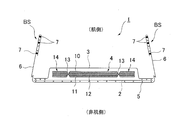
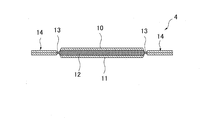
- FIG. 3 is a view taken along line III-III in FIG. 3 is a plan view of a polymer sheet 4.
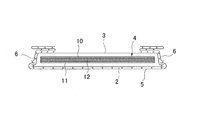
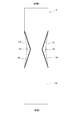
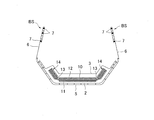
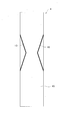
- FIG. FIG. 2 is a cross-sectional view of the pad 1 showing a mounted state (a view taken along the line II-II in FIG. 1). It is sectional drawing of the polymer sheet 4 which concerns on a modification. It is sectional drawing of the polymer sheet 4 which concerns on a modification. It is a top view of the polymer sheet 4 which concerns on a modification. It is a top view of the embossing groove
- a pad 1 according to the present invention is a pad such as a urine collecting pad used by being attached to a skin contact surface such as underwear or a paper diaper.
- a leak-proof sheet made of a polyethylene sheet or the like.
- a surface sheet 3 that forms a skin contact surface and allows urine to pass through quickly
- a polymer sheet 4 interposed between the two sheets 2 and 3, and an outermost surface (non-skin contact surface) of the pad 1
- the left and right sides protruding from the skin side in a predetermined section in the front-rear direction including at least the wearer's urination port, with the substantially side edge of the polymer sheet 4 as an upright base end
- It is mainly composed of a pair of three-dimensional gather BS, side nonwoven fabrics 6 and 6 forming BS, and around the polymer sheet 4, the leakage preventing sheet 2, the surface sheet 3 and the exterior sheet 5 are formed at the upper and lower edges.
- the outer edge is relieved Leak-proof sheet 2, surface sheet 3, and exterior sheet 5 which are joined by joining means such as an adhesive such as a melt, heat seal, ultrasonic seal, etc., and extend laterally from polymer sheet 4 at both side edges.
- joining means such as an adhesive such as a melt, heat seal, ultrasonic seal, etc.
- the side nonwoven fabric 6 is joined by joining means, such as adhesives, such as hot melt, heat sealing, and ultrasonic sealing.
- the leak-proof sheet 2 is made of a sheet material having at least water shielding properties such as polyethylene, but recently has a tendency to use a material having moisture permeability from the viewpoint of preventing stuffiness.
- the water- and moisture-permeable sheet material is a microporous material obtained by melting and kneading an inorganic filler in an olefin-based resin such as polyethylene or polypropylene to form a sheet, and then stretching in a uniaxial or biaxial direction.
- a sheet is preferably used.
- a polylaminated nonwoven fabric in which a plastic film and a nonwoven fabric are laminated may be used as the leak-proof sheet 2.
- a porous or non-porous nonwoven fabric or a porous plastic sheet is preferably used as the top sheet 3.
- material fibers constituting the nonwoven fabric in addition to olefins such as polyethylene or polypropylene, polyesters, polyamides, and other synthetic fibers, regenerated fibers such as rayon and cupra, and natural fibers such as cotton can be used.
- a nonwoven fabric obtained by an appropriate processing method such as a method, a spun bond method, a thermal bond method, a melt blown method, or a needle punch method can be used. Of these processing methods, the spunlace method is excellent in terms of flexibility and drapeability, and the thermal bond method is excellent in terms of bulkiness and high compression recovery.
- the non-woven fiber may be either a long fiber or a short fiber, but preferably a short fiber is used in order to give a towel texture.
- an olefin fiber such as polyethylene or polypropylene having a relatively low melting point.
- a core-sheath fiber, a side-by-side fiber, or a split fiber composite fiber having a fiber having a high melting point as a core and a fiber having a low melting point as a sheath can also be suitably used.
- the exterior sheet 5 covers the leak-proof sheet 2 so that the outer surface of the pad 1 has a cloth-like appearance and feel.
- the exterior sheet 5 is preferably formed of a nonwoven fabric.
- a nonwoven fabric As the material fiber, olefin fiber such as polyethylene or polypropylene, polyester fiber, polyamide fiber, etc., recycled fiber such as rayon and cupra, and natural fiber such as cotton can be used.
- the spun bond method, the thermal bond method, the air through method, the needle punch method and the like can be used.
- a long-fiber nonwoven fabric such as a spunbond nonwoven fabric, an SMS nonwoven fabric, or an SMMS nonwoven fabric is preferable from the viewpoint that both feel and strength can be achieved.
- the fiber basis weight is preferably 10 to 50 g / m 2 , particularly preferably 15 to 30 g / m 2 .
- One or a plurality of temporary fixing layers are formed on the non-use surface side (outer surface) of the exterior sheet 5, and the pad 1 is fixed to an undergarment or a paper diaper when worn on the body. Yes.
- a mechanically bonded hook material or an adhesive may be used as the temporary fixing layer.
- the exterior sheet 5 is slightly wider than the width of the polymer sheet 4, and the both side portions are wound around the side edges of the leak-proof sheet 2 and the surface sheet 3 to the skin side of the surface sheet 3.
- the outer side in the width direction of the top sheet 3 is penetrated by the side nonwoven fabric 6 extending from the surface of both side surfaces of the top sheet 3, specifically urine, etc., on the outer surface side of the exterior sheet 5 extending to the skin side.
- a side nonwoven fabric 6 made of a nonwoven fabric material subjected to appropriate water-repellent treatment or hydrophilic treatment is disposed in accordance with the purpose of preventing it from occurring or enhancing the feeling of touch.
- the side nonwoven fabric 6 can be made of natural fiber, synthetic fiber, regenerated fiber, or the like and formed by an appropriate processing method.
- the side nonwoven fabric 6 eliminates the feeling of stickiness and prevents stuffiness. For this reason, it is preferable to use a non-woven fabric with reduced basis weight and air permeability.
- a nonwoven fabric prepared with a basis weight of 13 to 23 g / m 2 and silicon-based, paraffin-based, alkylchromic chloride-based water repellents, etc. for reliably preventing the passage of body fluids.
- a water repellent nonwoven fabric coated with is preferably used.
- the inner side portion of the side nonwoven fabric 6 is folded substantially double, and inside this double sheet, one or a plurality of both ends or appropriate positions in the longitudinal direction are fixed to the intermediate portion in the height direction, In the illustrated example, three thread-like elastic elastic members 7, 7,... Are arranged in a state where both ends or appropriate positions in the longitudinal direction are fixed.
- the double sheet portion is attached to the polymer sheet 4 side in a state where it is folded once outward and laminated, thereby including at least the urination port of the wearer.
- the three-dimensional gathers BS and BS standing on the skin side are formed in a pair of left and right.
- the polymer sheet 4 interposed between the leak-proof sheet 2 and the top sheet 3 has a structure in which a superabsorbent polymer 12 is disposed between the two nonwoven fabric sheets 10 and 11, and absorbs and retains body fluids. It has properties.
- the said nonwoven fabric sheet has the nonwoven fabric sheet 10 arrange
- nonwoven fabric sheets 10 and 11 a porous or non-porous nonwoven fabric is used.
- material fibers constituting the nonwoven fabric include synthetic fibers such as olefins such as polyethylene and polypropylene, polyesters, and polyamides, recycled fibers such as rayon and cupra, and hydrophilic cellulosic fibers.
- hydrophilic cellulosic fibers include naturally derived fibers such as cotton fibers and pulp fibers, and artificial cellulosic fibers such as rayon fibers, acetate fibers, and lyocell fibers.
- the cotton fibers include raw cotton, refined / bleached cotton fibers, or refined / bleached cotton fibers that have been dyed, refined / bleached cotton wool fibers, and yarns or fabrics that have been defibrated. Any cotton fiber such as hair can be used, but in order to increase the liquid absorption speed and diffusibility in the nonwoven fabric sheets 10 and 11, the absorbent cotton obtained by degreasing the natural oil of cotton wax adhering to the surface of the cotton fiber is used. Is preferred.
- the processing method of the said nonwoven fabric is not ask
- the basis weight of the nonwoven fabric sheets 10 and 11 is preferably 15 g / m 2 or more, particularly preferably 40 to 150 g / m 2 .
- the nonwoven fabric sheet 10 disposed at least on the skin side is made of a hydrophilic material.
- positioned at the non-skin side can be comprised with the raw material which has hydrophilic property or hydrophobicity.
- the superabsorbent polymer 12 includes “powder” in addition to “particles”.
- the superabsorbent polymer 12 those having a particle size used for this type of absorbent article can be used as they are.
- the average particle size when not absorbed is preferably about 250 to 500 ⁇ m. Further, it is desirable that the superabsorbent polymer 12 has an average particle size after absorption of not less than 3 times the average particle size when not absorbed, specifically 500 ⁇ m or more.
- the average particle diameter of the superabsorbent polymer 12 when not absorbed means the particle diameter at an integrated value of 50% in the weight-based particle size distribution.
- the weight-based particle size distribution in this case is measured according to JISZ8815-1994. That is, 710 ⁇ m, 500 ⁇ m, 300 ⁇ m, 150 ⁇ m, and 106 ⁇ m aperture sieves having an inner diameter of 150 mm and a depth of 45 mm are stacked with the narrow aperture sieve on the top, and the top 710 ⁇ m sieve having the widest aperture.
- the basis weight of the superabsorbent polymer 12 can be appropriately determined according to the amount of absorption required for the use of the polymer sheet. Therefore, although it cannot be generally stated, it can be 50 to 350 g / m 2 . If the basis weight of the polymer is less than 50 g / m 2, it is difficult to secure the absorption amount. When it exceeds 350 g / m 2 , not only the effect is saturated, but also the sensation of discomfort caused by the excess of the superabsorbent polymer is given.
- the superabsorbent polymer 12 can be disposed between the two nonwoven fabric sheets 10 and 11 in a known form. For example, (1) using a fiber absorbent device for superabsorbent polymer, a base sheet is disposed in the fiber stack concave portion of the fiber stack drum, and a suction force is applied to the fiber stack concave portion from the inside of the fiber stack drum. After the superabsorbent polymer is stacked on the base sheet, the base sheet is disposed between the two non-woven sheets 10 and 11, and (2) the non-woven sheet having two super-absorbent polymer 12 particles.
- the polymer sheet 4 has a continuous linear shape in a planar shape that bulges inward in the width direction from both side edges at a position where the base portion of the wearer's leg abuts at the time of wearing. Embossed grooves 13 are formed.
- the position where the base part of the wearer's leg abuts refers to the positions on both sides where the leg circumference cut line 16 is provided when the polymer sheet 4 is provided with a leg circumference cut line 16 (see FIG. 4). In the case where the leg-around cut line 16 is not provided, it is a position on both sides of the central section when the polymer sheet 4 is divided into three equal parts in the longitudinal direction.
- the embossed groove 13 squeezes the nonwoven fabric sheet 10 on the skin side and the nonwoven fabric sheet 11 on the non-skin side from the outer surface side and applies heat or ultrasonic waves to perform a sealing process.
- Each of the grooves is recessed in the thickness direction.
- the embossed grooves 13 are provided in left and right pairs arranged on both side portions of the polymer sheet 4, respectively, and are formed in a planar shape that bulges inward in the width direction from the side edge of the polymer sheet 4. More specifically, the planar shape of one embossed groove 13 corresponds to the inseam of the wearer in the width direction intermediate portion that does not reach the center in the width direction from one side edge of the polymer sheet 4 closer to the front side of the wearer.
- the embossed grooves 13 may be recessed only from the outer surface side of the skin-side nonwoven fabric sheet 10 and may not be recessed from the outer surface side of the non-skin-side nonwoven fabric sheet 11, or the non-skin-side nonwoven fabric sheet 11. May be recessed only from the outer surface side, and not from the outer surface side of the nonwoven fabric sheet 10 on the skin side.
- the embossed groove 13 is constituted by a recessed groove continuously recessed along the groove direction, but the discontinuous recessed groove in which the recessed compressed parts and the unsqueezed non-compressed parts are alternately arranged. You may comprise.
- both sides of the polymer sheet 4 are easily deformed around the legs with the embossed groove 13 as a flexible shaft. Easier to fit around the legs, improving fit. That is, the region 14 surrounded by the embossed groove 13 stands up on the skin side as shown in FIG. 5 so that the portion standing up on the skin side adheres to the inside of the base of the wearer's leg. It will be possible to maintain a fitted state around the leg following the movement of the leg.
- the superabsorbent polymer 12 is stably held between the two nonwoven fabric sheets 10 and 11 in a portion where the movement around the leg is intense, and therefore the polymer sheet 4 around the leg.
- the spilling out of the superabsorbent polymer 12 from the side edge of this can be greatly reduced.
- the thread-like elastic elastic member disposed on the three-dimensional gather BS since the three-dimensional gathers BS and BS standing on the skin side along the longitudinal direction are provided on both side portions on the skin side, the thread-like elastic elastic member disposed on the three-dimensional gather BS. As shown in FIG. 5, deformation of both side portions of the polymer sheet 4 having the embossed groove 13 as a flexible shaft is likely to occur due to the contraction force of 7, 7,. That is, in addition to the pressure at the base of the legs acting inward from both sides, a tensile force acting on the skin side by the three-dimensional gather BS acts, so that the region surrounded by the embossed grooves 13 is raised on the skin side. It becomes easy.
- the superabsorbent polymer 12 is also disposed in the region 14 surrounded by the embossed grooves 13 on both sides of the polymer sheet 4. That is, the superabsorbent polymer 12 is disposed on almost the entire surface between the two nonwoven fabric sheets 10 and 11. For this reason, the water absorption capability of the polymer sheet 4 is improved, and more body fluid can be absorbed and held. Moreover, since the water absorption capability can be expressed also in the region 14 surrounded by the embossed grooves 13, leakage around the legs can be surely prevented.
- the superabsorbent polymer 12 is not disposed in the region 14 surrounded by the embossed grooves 13 on both sides of the polymer sheet 4, and the space between the two nonwoven fabric sheets 10, 11.
- the middle-layer nonwoven fabric sheet 15 may be disposed in the middle.
- a substrate sheet for fixing the superabsorbent polymer 12 can be used. That is, using the base sheet having substantially the same shape as the two nonwoven fabric sheets 10 and 11, the superabsorbent polymer 12 is fixed to a region other than the region 14 surrounded by the emboss groove 13, while the embossing is performed.
- the superabsorbent polymer 12 may not be fixed in the region 14 surrounded by the groove 13. Thereby, falling off of the superabsorbent polymer 12 from around the legs can be more reliably prevented while maintaining the cushioning property in the region 14 surrounded by the embossed grooves 13.
- the superabsorbent polymer 12 is not disposed in the region 14 surrounded by the embossed grooves 13 on both sides of the polymer sheet 4, and the two nonwoven fabric sheets 10 and 11 are It is good also as a structure joined directly by the hot-melt-adhesive etc. That is, the superabsorbent polymer 12 is disposed only in a region other than the region 14 surrounded by the embossed groove 13, and no member is interposed between the two nonwoven fabric sheets 10 and 11 in the region 14 surrounded by the embossed groove 13. It is like that. This facilitates the deformation of the region 14 surrounded by the embossed grooves 13 and makes the skin contact of the region 14 soft, thereby preventing the superabsorbent polymer 12 from falling off the region 14. .
- leg-around cut lines 16 in which both side portions of the polymer sheet 4 are cut out are provided in regions 14 surrounded by the embossed grooves 13 on both sides of the polymer sheet 4. That is, the embossed groove 13 is formed so as to surround the leg-around cut line 16 on the inner side at a predetermined distance from the leg-cut line 16.
- the said leg circumference cut line 16 is a shape along the side edge of the polymer sheet 4 in a portion where the side edge of the polymer sheet 4 is cut out along the circumference of the wearer's leg at a portion corresponding to the crotch of the wearer. It is a line.
- the leg-cut line 16 By providing the leg-cut line 16, the region 14 surrounded by the embossed groove 13 can easily fit better around the leg of the wearer, and the uncomfortable feeling at the time of wearing can be reduced.
- the leg circumference cut line 16 is provided in the region 14 surrounded by the emboss groove 13, it is possible to greatly reduce the spilling of the superabsorbent polymer 12 from the cut surface of the leg circumference cut line 16.
- the leg-cut line 16 is preferably formed by a curve that bulges inward in the width direction.
- the separation distance between the embossed groove 13 and the leg circumference cut line 16 is 5 mm or more and 50 mm or less, preferably 5 mm or more and 30 mm or less from the viewpoint of preventing spillage of the superabsorbent polymer 12 and improving the fit to the leg circumference. It is good to do.
- the leg-around cut line 16 need not be provided. That is, the side edge of the polymer sheet 4 may be formed by a straight line that substantially coincides with the region surrounded by the embossed groove 13 and the other region.
- the polymer sheet 4 has the embossed groove 13 as a flexible shaft, and the region surrounded by the embossed groove 13 is easy to stand on the skin side.
- the structure is easy to fit. In this case, the region surrounded by the embossed grooves 13 increases flexibility with respect to the legs. Therefore, as shown in FIG. 7, the superabsorbent polymer 12 is not disposed, and the two nonwoven fabric sheets 10 and 11 are disposed. It is preferable to have a structure in which are directly joined.
- the planar shape of the embossed groove 13 is not particularly limited as long as the region 14 surrounded by the embossed groove 13 is a shape along the periphery of the leg.
- it may be a triangular shape bulging inward in the width direction, as shown in FIG. 9A, or a curved shape bulging inward in the width direction, or FIG. As shown in B), it may have a trapezoidal shape that bulges inward in the width direction.
- the region 14 surrounded by the embossed grooves 13 is preferably formed in a triangular shape as shown in FIG. 4 so that the region 14 can be reliably raised from the crotch portion to the skin side.
Landscapes
- Health & Medical Sciences (AREA)
- Epidemiology (AREA)
- Engineering & Computer Science (AREA)
- Biomedical Technology (AREA)
- Heart & Thoracic Surgery (AREA)
- Vascular Medicine (AREA)
- Life Sciences & Earth Sciences (AREA)
- Animal Behavior & Ethology (AREA)
- General Health & Medical Sciences (AREA)
- Public Health (AREA)
- Veterinary Medicine (AREA)
- Physics & Mathematics (AREA)
- Fluid Mechanics (AREA)
- Absorbent Articles And Supports Therefor (AREA)
Abstract
【課題】装着時に脚周りに沿いやすく、フィット性を向上する。 【解決手段】2枚の不織布シート10、11間に高吸水性ポリマー12が配置されたポリマーシート4を備えるパッド1である。前記ポリマーシート4における装着時に着用者の脚の付け根部分が当接する位置であって、両側縁からそれぞれ幅方向内側に膨出する平面形状で線状のエンボス溝13が形成されている。肌側の両側部にそれぞれ、長手方向に沿って肌側に起立する立体ギャザーBSを設ける。前記エンボス溝13を可撓軸として、前記エンボス溝13で囲まれた領域14が脚周りに沿って変形しやすくなり、装着時にポリマーシート4が脚周りに沿いやすくなり、フィット性が向上する。
Description
本発明は、紙おむつ、生理用ナプキン、パンティライナー、失禁パッド等の吸収性物品に係り、詳しくは脚周りにフィットしやすいポリマーシートを備えた吸収性物品に関する。
従来より、前記吸収性物品として、ポリエチレンシートまたはポリエチレンシートラミネート不織布などの不透液性裏面シートと、不織布または透液性プラスチックシートなどの透液性表面シートとの間に、体液を吸収し保持する機能を備えた吸収体を介在したものが知られている。
この種の吸収性物品にも幾多の改良が重ねられ、前記吸収体として、2枚のシート間に粉粒状の高吸水性ポリマーが配置されたポリマーシートを備えたものが提案されている。前記ポリマーシートは、パルプ繊維を含まないことにより、厚みが薄いため、着用時のゴワ付き感がない、装着時に吸収性物品の凹凸が着衣の外から見えにくくなる(アウターに響かなくなる)などの利点がある。ところが、前記ポリマーシートは、大量の体液を吸収して保持する点では優れているが、内部に粉粒状の高吸水性ポリマーの集合体が配設されているため、高吸水性ポリマーを2枚のシート間に安定的に担持することが難しいという課題があった。また、装着時に着用者の脚周りにフィットしやすくするため、ポリマーシートの両側部を切り欠いた脚周りカットラインなどを設けると、切断面から高吸水性ポリマーがこぼれ落ちる問題があった。
このようなポリマーシートを用いた吸収性物品としては、例えば下記特許文献1、2を挙げることができる。下記特許文献1においては、第1の不織布層と、前記第1の不織布層に部分的に接合された第2の不織布層と、前記第1の不織布層と前記第2の不織布層との間に配置された吸収性コアと、前記第1の不織布層を第2の不織布層に接続する複数のシールとを備えた吸収性パッドが開示されている。
また、下記特許文献2においては、上層シートと下層シートとを接合する接合部によって内部に高吸水性ポリマーが封入された複数のポリマー封入セルに区画されたポリマーシートが開示されている。
しかしながら、上記特許文献1、2に記載されたものではいずれも、2枚のシート間に高吸水性ポリマーが配置され、2枚のシートを接合する接合部によって複数のポリマー封入セルに区画化されているが、装着時に脚周りにフィットしやすい構造とはなっていない。
そこで本発明の主たる課題は、装着時に脚周りに沿いやすく、フィット性を向上した吸収性物品を提供することにある。
上記課題を解決するために請求項1に係る本発明として、2枚の不織布シート間に高吸水性ポリマーが配置されたポリマーシートを備え、
前記ポリマーシートにおける装着時に着用者の脚の付け根部分が当接する位置に、両側縁からそれぞれ幅方向内側に膨出する平面形状で線状のエンボス溝が形成されていることを特徴とする吸収性物品が提供される。
前記ポリマーシートにおける装着時に着用者の脚の付け根部分が当接する位置に、両側縁からそれぞれ幅方向内側に膨出する平面形状で線状のエンボス溝が形成されていることを特徴とする吸収性物品が提供される。
上記請求項1記載の発明では、2枚の不織布シート間に高吸水性ポリマーが配置されたポリマーシートにおいて、装着時に着用者の脚の付け根部分が当接する位置に、両側縁からそれぞれ幅方向内側に膨出する平面形状で線状のエンボス溝が形成されているため、このエンボス溝を可撓軸として、前記エンボス溝で囲まれた領域が脚周りに沿って変形しやすくなり、装着時にポリマーシートが脚周りに沿いやすくなり、フィット性が向上する。
請求項2に係る本発明として、肌側の両側部にそれぞれ、長手方向に沿って肌側に起立する立体ギャザーが設けられている請求項1記載の吸収性物品が提供される。
上記請求項2記載の発明では、肌側の両側部にそれぞれ、長手方向に沿って肌側に起立する立体ギャザーを設けることによって、前記立体ギャザーの長手方向に沿った収縮力によって、前記エンボス溝で囲まれた領域が、前記エンボス溝を可撓軸として内側に折れ曲がることによって肌側に隆起しやすくなり、ポリマーシートの両側部がより一層脚周りに沿って変形しやすくなる。このため、装着時にポリマーシートが脚周りに沿いやすく、フィット性が向上する。
請求項3に係る本発明として、前記ポリマーシートの両側それぞれにおける前記エンボス溝で囲まれた領域に、前記高吸水性ポリマーが配置されている請求項1、2いずれかに記載の吸収性物品が提供される。
上記請求項3記載の発明では、前記ポリマーシートの両側それぞれにおける前記エンボス溝で囲まれた領域にも、前記高吸水性ポリマーが配置されているため、この領域が脚周りにフィットして体液を吸収できるようになる。
請求項4に係る本発明として、前記ポリマーシートの両側それぞれにおける前記エンボス溝で囲まれた領域には、前記高吸水性ポリマーが配置されず、前記2枚の不織布シート間に中層不織布シートが配置されている請求項1、2いずれかに記載の吸収性物品が提供される。
上記請求項4記載の発明では、前記ポリマーシートの両側それぞれにおけるエンボス溝で囲まれた領域には高吸水性ポリマーを配置せず、2枚の不織布シート間に中層不織布シートを配置しているため、脚周りにおけるクッション性が確保でき、良好な装着感が得られるようになる。
請求項5に係る本発明として、前記ポリマーシートの両側それぞれにおける前記エンボス溝で囲まれた領域には、前記高吸水性ポリマーが配置されず、前記2枚の不織布シートが直接接合されている請求項1、2いずれかに記載の吸収性物品が提供される。
上記請求項5記載の発明では、前記ポリマーシートの両側それぞれにおける前記エンボス溝で囲まれた領域には高吸水性ポリマーを配置せず、2枚の不織布シートが直接接合されているため、この領域が変形しやすくなり、脚周りのフィット性がより一層向上できる。
請求項6に係る本発明として、前記ポリマーシートの両側それぞれにおける前記エンボス溝で囲まれた領域に、前記ポリマーシートの両側部を切り欠いた脚周りカットラインが設けられている請求項1~5いずれかに記載の吸収性物品が提供される。
上記請求項6記載の発明では、前記ポリマーシートの両側それぞれにおける前記エンボス溝で囲まれた領域に脚周りカットラインを設けているため、ポリマーシートがより確実に脚周りにフィットするようになる。
以上詳説のとおり本発明によれば、装着時に脚周りに沿いやすく、フィット性が向上できるようになる。
以下、本発明の実施の形態について図面を参照しながら詳述する。
<パッドの基本構造の一例>
本発明に係るパッド1は、下着や紙おむつ等の肌当接面に取り付けて使用する尿とりパッド等のパッドであり、図1~図3に示されるように、ポリエチレンシートなどからなる防漏シート2と、肌当接面をなし、尿などを速やかに透過させる表面シート3と、これら両シート2、3間に介装されたポリマーシート4と、パッド1の最外面(非肌当接面)を覆う外装シート5と、前記ポリマーシート4の略側縁部を起立基端とし、かつ少なくとも着用者の排尿口部を含む前後方向の所定の区間内において肌側に突出して設けられた左右一対の立体ギャザーBS、BSを形成するサイド不織布6、6とから主に構成され、かつポリマーシート4の周囲においては、その上下端縁部では防漏シート2、表面シート3及び外装シート5の外縁部がホットメルトなどの接着剤やヒートシール、超音波シール等の接合手段によって接合され、またその両側縁部ではポリマーシート4よりも側方に延出している防漏シート2、表面シート3、外装シート5及びサイド不織布6がホットメルトなどの接着剤やヒートシール、超音波シール等の接合手段によって接合されている。
本発明に係るパッド1は、下着や紙おむつ等の肌当接面に取り付けて使用する尿とりパッド等のパッドであり、図1~図3に示されるように、ポリエチレンシートなどからなる防漏シート2と、肌当接面をなし、尿などを速やかに透過させる表面シート3と、これら両シート2、3間に介装されたポリマーシート4と、パッド1の最外面(非肌当接面)を覆う外装シート5と、前記ポリマーシート4の略側縁部を起立基端とし、かつ少なくとも着用者の排尿口部を含む前後方向の所定の区間内において肌側に突出して設けられた左右一対の立体ギャザーBS、BSを形成するサイド不織布6、6とから主に構成され、かつポリマーシート4の周囲においては、その上下端縁部では防漏シート2、表面シート3及び外装シート5の外縁部がホットメルトなどの接着剤やヒートシール、超音波シール等の接合手段によって接合され、またその両側縁部ではポリマーシート4よりも側方に延出している防漏シート2、表面シート3、外装シート5及びサイド不織布6がホットメルトなどの接着剤やヒートシール、超音波シール等の接合手段によって接合されている。
前記防漏シート2は、ポリエチレン等の少なくとも遮水性を有するシート材が用いられるが、近年ではムレ防止の観点から透湿性を有するものが用いられる傾向にある。この遮水・透湿性シート材としては、ポリエチレンやポリプロピレン等のオレフィン系樹脂中に無機充填剤を溶融混練してシートを成形した後、一軸または二軸方向に延伸することにより得られる微多孔性シートが好適に用いられる。前記防漏シート2としては、プラスチックフィルムと不織布とを積層させたポリラミ不織布を用いてもよい。
次いで、前記表面シート3は、有孔または無孔の不織布や多孔性プラスチックシートなどが好適に用いられる。不織布を構成する素材繊維としては、ポリエチレンまたはポリプロピレン等のオレフィン系、ポリエステル系、ポリアミド系等の合成繊維の他、レーヨンやキュプラ等の再生繊維、綿等の天然繊維とすることができ、スパンレース法、スパンボンド法、サーマルボンド法、メルトブローン法、ニードルパンチ法等の適宜の加工法によって得られた不織布を用いることができる。これらの加工法の内、スパンレース法は柔軟性、ドレープ性に富む点で優れ、サーマルボンド法は嵩高で圧縮復元性が高い点で優れている。前記表面シート3に多数の透孔を形成した場合には、体液が速やかに吸収されるようになり、ドライタッチ性に優れたものとなる。不織布の繊維は、長繊維または短繊維のいずれでもよいが、好ましくはタオル地の風合いを出すため短繊維を使用するのがよい。また、エンボス処理を容易とするために、比較的低融点のポリエチレンまたはポリプロピレン等のオレフィン系繊維のものを用いるのがよい。また、融点の高い繊維を芯とし融点の低い繊維を鞘とした芯鞘型繊維やサイド-バイ-サイド型繊維、分割型繊維の複合繊維を好適に用いることもできる。
前記外装シート5は、防漏シート2を覆ってパッド1の外面を布のような外観、肌触りとするものである。外装シート5としては、不織布で形成するのが好ましい。素材繊維は、ポリエチレンまたはポリプロピレン等のオレフィン系、ポリエステル系、ポリアミド系等の合成繊維の他、レーヨンやキュプラ等の再生繊維、綿等の天然繊維を用いることができ、加工法は、スパンレース法、スパンボンド法、サーマルボンド法、エアスルー法、ニードルパンチ法等を用いて製作することができる。但し、肌触り及び強度を両立できる点でスパンボンド不織布やSMS不織布、SMMS不織布等の長繊維不織布が好ましい。
不織布は一枚で使用する他、複数枚を重ねて使用することもでき、複数枚を重ねて使用する場合は、不織布相互をホットメルト等の接着剤を介して固定するのが好ましい。また、不織布を用いる場合は、その繊維目付けは10~50g/m2、特に15~30g/m2が好ましい。
不織布は一枚で使用する他、複数枚を重ねて使用することもでき、複数枚を重ねて使用する場合は、不織布相互をホットメルト等の接着剤を介して固定するのが好ましい。また、不織布を用いる場合は、その繊維目付けは10~50g/m2、特に15~30g/m2が好ましい。
前記外装シート5の非使用面側(外面)には1または複数条の仮止め層(図示せず)が形成され、身体への装着時にパッド1を下着や紙おむつ等に固定するようになっている。前記仮止め層としては、機械接合式のフック材を用いてもよいし、粘着剤を用いてもよい。
図示例では、外装シート5はポリマーシート4の幅よりも若干幅が広い程度とされ、両側部が防漏シート2及び表面シート3の側縁を巻き込むようにして表面シート3の肌側にまで延在され、表面シート3の幅方向外側は、この肌側に延在する外装シート5の外面側に表面シート3の両側部表面から延在するサイド不織布6、具体的には尿等が浸透するのを防止する、あるいは肌触り感を高めるなどの目的に応じて、適宜の撥水処理または親水処理を施した不織布素材を用いて構成されたサイド不織布6が配設されている。かかるサイド不織布6としては、天然繊維、合成繊維または再生繊維などを素材として、適宜の加工法によって形成されたものを使用することができるが、好ましくはゴワ付き感を無くすとともに、ムレを防止するために、坪量を抑えて通気性を持たせた不織布を用いるのがよい。具体的には、坪量を13~23g/m2として作製された不織布を用いるのが望ましく、かつ体液の透過を確実に防止するためにシリコン系、パラフィン系、アルキルクロミッククロリド系撥水剤などをコーティングした撥水処理不織布が好適に使用される。
前記サイド不織布6の内方側部分はほぼ二重に折り返されるとともに、この二重シート内部に、その高さ方向中間部に両端または長手方向の適宜の位置が固定された1又は複数本の、図示例では3本の糸状弾性伸縮部材7、7…が両端または長手方向の適宜の位置が固定された状態で配設されている。この二重シート部分は前後端部では図3に示されるように、外側に1回折り返して積層された状態でポリマーシート4側に接着されることによって、少なくとも着用者の排尿口部を含む前後方向の所定の区間内において図2に示されるように、肌側に起立する立体ギャザーBS、BSが左右対で形成されている。
<ポリマーシート>
前記防漏シート2と表面シート3との間に介在されるポリマーシート4は、2枚の不織布シート10、11間に高吸水性ポリマー12が配置された構造を成し、体液を吸収保持する性質を有するものである。前記不織布シートは、肌側に配置される不織布シート10と、非肌側に配置される不織布シート11とを有している。
前記防漏シート2と表面シート3との間に介在されるポリマーシート4は、2枚の不織布シート10、11間に高吸水性ポリマー12が配置された構造を成し、体液を吸収保持する性質を有するものである。前記不織布シートは、肌側に配置される不織布シート10と、非肌側に配置される不織布シート11とを有している。
前記不織布シート10、11としては、有孔または無孔の不織布が用いられる。不織布を構成する素材繊維としては、たとえばポリエチレンまたはポリプロピレン等のオレフィン系、ポリエステル系、ポリアミド系等の合成繊維の他、レーヨンやキュプラ等の再生繊維、親水性のセルロース系繊維とすることができる。前記親水性のセルロース系繊維としては、綿繊維やパルプ繊維などの天然由来のものや、レーヨン繊維、アセテート繊維、リヨセル繊維などの人工セルロース系繊維が挙げられる。前記綿繊維としては、木綿の原綿、精錬・漂白した綿繊維あるいは精錬・漂白後、染色を施した綿繊維、精錬・漂白した脱脂綿繊維、さらには糸もしくは布帛になったものを解繊した反毛等、あらゆる綿繊維を使用できるが、不織布シート10、11における液の吸収スピード及び拡散性を高めるため、特に綿繊維の表面に付着しているコットンワックスの天然油脂を脱脂した脱脂綿を使用するのが好ましい。前記不織布の加工法は問わないが、高吸水性ポリマー12の脱落を防止するため、エアースルー法、スパンボンド法、メルトブローン法、ニードルパンチ法など、得られる製品の繊維密度が大きくなる加工法とするのが好ましい。特に、嵩を大きくできるエアースルー法が望ましい。
前記不織布シート10、11の目付けは、15g/m2以上であるのが好ましく、特に40~150g/m2であるのが好ましい。
少なくとも肌側に配置される不織布シート10は、親水性を有する素材で構成されている。一方、非肌側に配置される不織布シート11は、親水性又は疎水性を有する素材で構成することができる。
前記高吸水性ポリマー12とは、「粒子」以外に「粉体」も含む。高吸水性ポリマー12は、この種の吸収性物品に使用される粒径のものをそのまま使用でき、平均粒径が1000μm以下、好ましくは未吸収時の粒径が106μm以上のものが全体の99重量%以上、特に150~850μmのものが全体の99重量%以上であるのが望ましい。未吸収時の平均粒径は250~500μm程度であるのが好ましい。また、高吸水性ポリマー12は吸収後の平均粒径が未吸収時の平均粒径の3倍以上、具体的には500μm以上であることが望ましい。なお、未吸収時の高吸水性ポリマー12の平均粒径は、重量基準粒度分布における積算値50%での粒径を意味する。この場合における重量基準粒度分布は、JISZ8815-1994に準拠して測定される。すなわち、内径150mm、深さ45mmの710μm、500μm、300μm、150μm及び106μmの目開きのふるいを、目開きの狭いふるいを下にして重ね、一番上の最も目開きの広い710μmのふるいの上に、測定試料50gを入れ、ふるい振動機にて10分間ふるい、各ふるいの上に残った測定試料の重量を測定し、最初の測定試料の重量に基づく各ふるいの上に残った測定試料の重量%を求めることによって測定される。
高吸水性ポリマー12の目付け量は、当該ポリマーシートの用途で要求される吸収量に応じて適宜定めることができる。したがって一概にはいえないが、50~350g/m2とすることができる。ポリマーの目付け量が50g/m2未満では、吸収量を確保し難くなる。350g/m2を超えると、効果が飽和するばかりでなく、高吸水性ポリマーの過剰によりジャリジャリした違和感を与えるようになる。
前記高吸水性ポリマー12は、公知の形態で2枚の不織布シート10、11間に配置することができる。例えば、(1)高吸水性ポリマーの積繊装置を用いて、積繊ドラムの積繊用凹部に基材シートを配設し、前記積繊用凹部において積繊ドラム内側から吸引力を与えながら前記基材シートに高吸水性ポリマーを積繊した後、この基材シートを2枚の不織布シート10、11間に配置する形態、(2)高吸水性ポリマー12の粒子が2枚の不織布シート10、11にホットメルト接着剤層によって接合された形態、(3)高吸水性ポリマーを含むスラリー状分散液を基材シートの表面に塗布し、乾燥させた後、この基材シートを2枚の不織布シート10、11間に配置する形態などを用いることができる。
図4に示されるように、前記ポリマーシート4には、装着時に着用者の脚の付け根部分が当接する位置に、両側縁からそれぞれ幅方向内側に膨出する平面形状で連続的な線状のエンボス溝13が形成されている。前述の着用者の脚の付け根部分が当接する位置とは、ポリマーシート4に脚周りカットライン16(図4参照。)が設けられる場合には、前記脚周りカットライン16が設けられた両側の位置であり、前記脚周りカットライン16が設けられない場合には、ポリマーシート4を長手方向に3等分したときの中央区間の両側の位置である。
前記エンボス溝13は、図2に示されるように、肌側の不織布シート10及び非肌側の不織布シート11をそれぞれ外面側から圧搾するとともに熱又は超音波を加えてシール加工を施すことにより、それぞれ厚み方向に窪ませた凹溝である。前記エンボス溝13は、ポリマーシート4の両側部にそれぞれ配置された左右対で設けられており、それぞれポリマーシート4の側縁から幅方向内側に膨出する平面形状で形成されている。より具体的には、一方のエンボス溝13の平面形状は、着用者の前側寄りのポリマーシート4の一方の側縁から、幅方向中央に至らない幅方向中間部の着用者の股下に対応する位置にかけて、幅方向内方側の斜め後方に向けて延びるとともに、これに連続して、着用者の股下に対応する位置から、着用者の後側寄りのポリマーシート4の一方の側縁にかけて、幅方向外方側の斜め後方に向けて延びている。なお、前記エンボス溝13は、肌側の不織布シート10の外面側からのみ窪ませ、非肌側の不織布シート11の外面側からは窪まないようにしてもよいし、非肌側の不織布シート11の外面側からのみ窪ませ、肌側の不織布シート10の外面側からは窪まないようにしてもよい。
前記エンボス溝13は、図示例では溝方向に沿って連続して窪んだ凹溝によって構成されているが、窪んだ圧搾部と窪まない非圧搾部とが交互に配置された不連続な凹溝で構成してもよい。
前記エンボス溝13を設けることにより、図5に示されるように、このエンボス溝13を可撓軸として、ポリマーシート4の両側部が脚周りに沿って変形しやすくなり、装着時にポリマーシート4が脚周りに沿いやすく、フィット性が向上する。つまり、前記エンボス溝13で囲まれた領域14が、図5に示されるように肌側に起立することにより、この肌側に起立した部分が着用者の脚の付け根の内側に密着し、脚の動きに追従して脚周りにフィットした状態が維持できるようになる。
また、前記エンボス溝13を設けることにより、脚周りの動きが激しい部分において、高吸水性ポリマー12が2枚の不織布シート10、11間に安定的に保持されるため、脚周りのポリマーシート4の側縁から高吸水性ポリマー12がこぼれ落ちるのが大幅に低減できるようになる。
更に、本パッド1では、肌側の両側部にそれぞれ、長手方向に沿って肌側に起立する立体ギャザーBS、BSが設けられているため、前記立体ギャザーBSに配設された糸状弾性伸縮部材7、7…の収縮力によって、図5に示されるように、前記エンボス溝13を可撓軸としたポリマーシート4の両側部の変形が生じやすくなっている。すなわち、両側から内側に向けて作用する脚の付け根部分の圧力に加えて、立体ギャザーBSによる肌側への引張力が作用するため、前記エンボス溝13で囲まれた領域が肌側に隆起しやすくなる。
図4に示される例では、ポリマーシート4の両側それぞれにおける前記エンボス溝13で囲まれた領域14にも、高吸水性ポリマー12が配置されている。すなわち、2枚の不織布シート10、11間のほぼ全面に高吸水性ポリマー12が配置されている。このため、ポリマーシート4の吸水能力が向上し、より多くの体液を吸収保持できるようになる。また、エンボス溝13で囲まれた領域14においても吸水能力が発現できるため、脚周りにおける漏れが確実に防止できるようになる。なお、この領域14の内側はエンボス溝13で区切られ、高吸水性ポリマー12がエンボス溝13を越えて外側に移動するのが防止されているため、この領域14の端縁からこぼれ落ちる高吸水性ポリマー12の量が少なくて済むようになる。
一方、図6に示されるように、ポリマーシート4の両側それぞれにおける前記エンボス溝13で囲まれた領域14には、高吸水性ポリマー12を配置せず、前記2枚の不織布シート10、11間に中層不織布シート15を配置してもよい。前記中層不織布シート15としては、前記高吸水性ポリマー12を定着させる基材シートを用いることができる。すなわち、2枚の不織布シート10、11とほぼ同じ形状の基材シートを用いて、前記エンボス溝13で囲まれた領域14以外の領域に、高吸水性ポリマー12を定着させる一方で、前記エンボス溝13で囲まれた領域14には高吸水性ポリマー12を定着させないようにしてもよい。これにより、エンボス溝13で囲まれた領域14におけるクッション性を維持しつつ、脚周りからの高吸水性ポリマー12の脱落をより確実に防止できる。
また、図7に示されるように、ポリマーシート4の両側それぞれにおける前記エンボス溝13で囲まれた領域14には、高吸水性ポリマー12が配置されず、前記2枚の不織布シート10、11が直接ホットメルト接着剤などによって接合された構造としてもよい。すなわち、高吸水性ポリマー12がエンボス溝13で囲まれた領域14以外の領域にのみ配置され、エンボス溝13で囲まれた領域14には2枚の不織布シート10、11間に部材が介在しないようになっている。これによって、エンボス溝13で囲まれた領域14の変形が容易になるとともに、この領域14の肌当たりが柔らかなものとなり、この領域14からの高吸水性ポリマー12の脱落が防止できるようになる。
図4に示される例では、ポリマーシート4の両側それぞれにおける前記エンボス溝13で囲まれた領域14に、ポリマーシート4の両側部を切り欠いた脚周りカットライン16が設けられている。すなわち、前記エンボス溝13は、脚周りカットライン16から所定の離隔距離をあけた内側に、前記脚周りカットライン16を囲うように形成されている。前記脚周りカットライン16とは、着用者の股下に対応する部位において、ポリマーシート4の側縁部を着用者の脚周りに沿って切り欠いた部分におけるポリマーシート4の側縁に沿った形状線のことである。この脚周りカットライン16を設けることにより、前記エンボス溝13で囲まれた領域14が着用者の脚周りにより良好にフィットしやすくなり、装着時の違和感が軽減できる。また、脚周りカットライン16がエンボス溝13で囲まれた領域14に設けられているため、脚周りカットライン16の切断面から高吸水性ポリマー12がこぼれ落ちるのが大幅に軽減できる。前記脚周りカットライン16は、幅方向内側に膨出する曲線によって形成するのが好ましい。前記エンボス溝13と脚周りカットライン16との離隔距離は、高吸水性ポリマー12のこぼれを防止するとともに、脚周りに対するフィット性を向上する観点から、5mm以上50mm以下、好ましくは5mm以上30mm以下とするのがよい。
一方、図8に示されるように、前記脚周りカットライン16は設けなくてもよい。つまり、ポリマーシート4の側縁が、エンボス溝13で囲まれた領域とそれ以外の領域とでほぼ一致する直線で形成してもよい。前記ポリマーシート4は、前記エンボス溝13を可撓軸として、エンボス溝13で囲まれた領域が肌側に起立しやすくなっているので、あえて脚周りカットラインを設けなくても充分脚周りにフィットしやすい構造となっている。この場合、前記エンボス溝13で囲まれた領域は、脚周りに対する柔軟性を高めるため、図7に示されるように、高吸水性ポリマー12が配置されず、前記2枚の不織布シート10、11が直接接合された構造とするのが好ましい。
前記エンボス溝13の平面形状としては、エンボス溝13で囲まれた領域14が脚周りに沿う形状であれば特にこだわらない。例えば、図4に示されるように、幅方向内側に膨出する三角形状としてもよいし、図9(A)に示されるように、幅方向内側に膨出する曲線形状、又は、図9(B)に示されるように、幅方向内側に膨出する台形状としてもよい。これらのうち、エンボス溝13で囲まれた領域14が、股下部を基点として確実に肌側に隆起できるように、図4に示される三角形状で形成するのが好ましい。
1…パッド、2…防漏シート、3…表面シート、4…ポリマーシート、5…外装シート、6…サイド不織布、7…糸状弾性伸縮部材、10・11…不織布シート、12…高吸水性ポリマー、13…エンボス溝、14…エンボス溝で囲まれた領域、15…中層不織布シート、16…脚周りカットライン
Claims (6)
- 2枚の不織布シート間に高吸水性ポリマーが配置されたポリマーシートを備え、
前記ポリマーシートにおける装着時に着用者の脚の付け根部分が当接する位置に、両側縁からそれぞれ幅方向内側に膨出する平面形状で線状のエンボス溝が形成されていることを特徴とする吸収性物品。 - 肌側の両側部にそれぞれ、長手方向に沿って肌側に起立する立体ギャザーが設けられている請求項1記載の吸収性物品。
- 前記ポリマーシートの両側それぞれにおける前記エンボス溝で囲まれた領域に、前記高吸水性ポリマーが配置されている請求項1、2いずれかに記載の吸収性物品。
- 前記ポリマーシートの両側それぞれにおける前記エンボス溝で囲まれた領域には、前記高吸水性ポリマーが配置されず、前記2枚の不織布シート間に中層不織布シートが配置されている請求項1、2いずれかに記載の吸収性物品。
- 前記ポリマーシートの両側それぞれにおける前記エンボス溝で囲まれた領域には、前記高吸水性ポリマーが配置されず、前記2枚の不織布シートが直接接合されている請求項1、2いずれかに記載の吸収性物品。
- 前記ポリマーシートの両側それぞれにおける前記エンボス溝で囲まれた領域に、前記ポリマーシートの両側部を切り欠いた脚周りカットラインが設けられている請求項1~5いずれかに記載の吸収性物品。
Priority Applications (3)
| Application Number | Priority Date | Filing Date | Title |
|---|---|---|---|
| CN201980012381.6A CN111698977B (zh) | 2018-03-30 | 2019-03-28 | 吸收性物品 |
| EP19776130.7A EP3777805B1 (en) | 2018-03-30 | 2019-03-28 | Absorbent article |
| US16/964,338 US11931232B2 (en) | 2018-03-30 | 2019-03-28 | Absorbent article |
Applications Claiming Priority (2)
| Application Number | Priority Date | Filing Date | Title |
|---|---|---|---|
| JP2018067199A JP6531197B1 (ja) | 2018-03-30 | 2018-03-30 | 吸収性物品 |
| JP2018-067199 | 2018-03-30 |
Publications (1)
| Publication Number | Publication Date |
|---|---|
| WO2019189575A1 true WO2019189575A1 (ja) | 2019-10-03 |
Family
ID=66821670
Family Applications (1)
| Application Number | Title | Priority Date | Filing Date |
|---|---|---|---|
| PCT/JP2019/013604 Ceased WO2019189575A1 (ja) | 2018-03-30 | 2019-03-28 | 吸収性物品 |
Country Status (5)
| Country | Link |
|---|---|
| US (1) | US11931232B2 (ja) |
| EP (1) | EP3777805B1 (ja) |
| JP (1) | JP6531197B1 (ja) |
| CN (1) | CN111698977B (ja) |
| WO (1) | WO2019189575A1 (ja) |
Citations (7)
| Publication number | Priority date | Publication date | Assignee | Title |
|---|---|---|---|---|
| JPH08322875A (ja) * | 1995-05-30 | 1996-12-10 | Kao Corp | 吸収性物品 |
| JP2008079750A (ja) * | 2006-09-27 | 2008-04-10 | Daio Paper Corp | 吸収性物品 |
| JP2010088528A (ja) * | 2008-10-03 | 2010-04-22 | Kao Corp | 吸収性物品 |
| JP2011229853A (ja) * | 2010-04-30 | 2011-11-17 | Unicharm Corp | 吸収性物品 |
| JP2012010980A (ja) * | 2010-06-30 | 2012-01-19 | Unicharm Corp | 薄型吸収性物品 |
| JP2012125354A (ja) * | 2010-12-14 | 2012-07-05 | Kao Corp | 吸収性物品 |
| JP2017148389A (ja) * | 2016-02-26 | 2017-08-31 | ユニ・チャーム株式会社 | 使い捨ておむつ |
Family Cites Families (14)
| Publication number | Priority date | Publication date | Assignee | Title |
|---|---|---|---|---|
| GB8332828D0 (en) * | 1983-12-08 | 1984-01-18 | Procter & Gamble | Diaper with fold points |
| US6416502B1 (en) * | 1998-04-03 | 2002-07-09 | Kimberly-Clark Worldwide, Inc. | Absorbent article having channels for receiving the edges of an undergarment |
| US20030093054A1 (en) * | 2000-07-05 | 2003-05-15 | The Procter & Gamble Company | Disposable absorbent article having improved side features for improved comfort |
| JP3922897B2 (ja) * | 2001-07-12 | 2007-05-30 | ユニ・チャーム株式会社 | 生理用ナプキン |
| US7766889B2 (en) * | 2004-08-20 | 2010-08-03 | First Quality Retail Services, Llc | Absorbent article |
| JP4683892B2 (ja) * | 2004-09-30 | 2011-05-18 | ユニ・チャーム株式会社 | 吸収性パッド |
| PL1827335T3 (pl) * | 2004-12-23 | 2012-11-30 | Essity Hygiene & Health Ab | Wyrób chłonny |
| JP5912428B2 (ja) * | 2011-11-09 | 2016-04-27 | 花王株式会社 | 使い捨ておむつ |
| EP2740450B1 (en) * | 2012-12-10 | 2025-12-31 | The Procter & Gamble Company | Absorbent core with a high content of superabsorbent material |
| ITBO20130176A1 (it) | 2013-04-18 | 2014-10-19 | Gdm Spa | Articolo igienico assorbente e macchina per realizzare tale articolo. |
| JP2015027348A (ja) * | 2013-07-30 | 2015-02-12 | 花王株式会社 | 吸収性物品 |
| EP3058915B1 (en) * | 2015-02-17 | 2018-11-07 | The Procter and Gamble Company | Absorbent cores for absorbent articles |
| JP6169656B2 (ja) | 2015-07-31 | 2017-07-26 | 大王製紙株式会社 | 吸収性物品 |
| JP6373287B2 (ja) * | 2016-01-29 | 2018-08-15 | ユニ・チャーム株式会社 | 吸収性物品 |
-
2018
- 2018-03-30 JP JP2018067199A patent/JP6531197B1/ja active Active
-
2019
- 2019-03-28 CN CN201980012381.6A patent/CN111698977B/zh active Active
- 2019-03-28 WO PCT/JP2019/013604 patent/WO2019189575A1/ja not_active Ceased
- 2019-03-28 EP EP19776130.7A patent/EP3777805B1/en active Active
- 2019-03-28 US US16/964,338 patent/US11931232B2/en active Active
Patent Citations (7)
| Publication number | Priority date | Publication date | Assignee | Title |
|---|---|---|---|---|
| JPH08322875A (ja) * | 1995-05-30 | 1996-12-10 | Kao Corp | 吸収性物品 |
| JP2008079750A (ja) * | 2006-09-27 | 2008-04-10 | Daio Paper Corp | 吸収性物品 |
| JP2010088528A (ja) * | 2008-10-03 | 2010-04-22 | Kao Corp | 吸収性物品 |
| JP2011229853A (ja) * | 2010-04-30 | 2011-11-17 | Unicharm Corp | 吸収性物品 |
| JP2012010980A (ja) * | 2010-06-30 | 2012-01-19 | Unicharm Corp | 薄型吸収性物品 |
| JP2012125354A (ja) * | 2010-12-14 | 2012-07-05 | Kao Corp | 吸収性物品 |
| JP2017148389A (ja) * | 2016-02-26 | 2017-08-31 | ユニ・チャーム株式会社 | 使い捨ておむつ |
Non-Patent Citations (1)
| Title |
|---|
| See also references of EP3777805A4 * |
Also Published As
| Publication number | Publication date |
|---|---|
| CN111698977B (zh) | 2022-03-08 |
| CN111698977A (zh) | 2020-09-22 |
| JP2019176920A (ja) | 2019-10-17 |
| US20210069027A1 (en) | 2021-03-11 |
| EP3777805A4 (en) | 2021-04-28 |
| EP3777805B1 (en) | 2023-07-19 |
| US11931232B2 (en) | 2024-03-19 |
| EP3777805A1 (en) | 2021-02-17 |
| JP6531197B1 (ja) | 2019-06-12 |
Similar Documents
| Publication | Publication Date | Title |
|---|---|---|
| JP5727246B2 (ja) | 吸収性物品 | |
| JP6263584B1 (ja) | 吸収性物品 | |
| JP2016174741A (ja) | 吸収性物品 | |
| WO2017217354A1 (ja) | 吸収性物品 | |
| JP2019170625A (ja) | 吸収性物品 | |
| JP2015065980A (ja) | 吸収性物品 | |
| WO2013154087A1 (ja) | 吸収性物品 | |
| JP2017169967A (ja) | 吸収性物品 | |
| JP6159121B2 (ja) | 吸収性物品 | |
| KR102659782B1 (ko) | 흡수성 물품 | |
| JP7519200B2 (ja) | 吸収体及び吸収性物品 | |
| JPH10295724A (ja) | 体液処理用吸収性物品 | |
| JP6437877B2 (ja) | 吸収性物品 | |
| WO2019189575A1 (ja) | 吸収性物品 | |
| JP3210014U (ja) | 吸収性物品 | |
| JP7567132B2 (ja) | 吸収性物品 | |
| JP7190852B2 (ja) | 吸収性物品 | |
| CN110139633A (zh) | 吸收性物品 | |
| WO2023233780A1 (ja) | 吸収性物品 | |
| JP2017225604A (ja) | 吸収性物品 | |
| JP6484890B2 (ja) | 吸収性物品 | |
| JP6586680B2 (ja) | 吸収性物品 | |
| JP2021053235A (ja) | 吸収性物品 | |
| JP2021069653A (ja) | 吸収性物品 | |
| JP2019171026A (ja) | 吸収性物品 |
Legal Events
| Date | Code | Title | Description |
|---|---|---|---|
| 121 | Ep: the epo has been informed by wipo that ep was designated in this application |
Ref document number: 19776130 Country of ref document: EP Kind code of ref document: A1 |
|
| WWE | Wipo information: entry into national phase |
Ref document number: 2019776130 Country of ref document: EP |