WO2019189797A1 - Feuille décorative et matériau décoratif utilisant celle-ci - Google Patents
Feuille décorative et matériau décoratif utilisant celle-ci Download PDFInfo
- Publication number
- WO2019189797A1 WO2019189797A1 PCT/JP2019/014089 JP2019014089W WO2019189797A1 WO 2019189797 A1 WO2019189797 A1 WO 2019189797A1 JP 2019014089 W JP2019014089 W JP 2019014089W WO 2019189797 A1 WO2019189797 A1 WO 2019189797A1
- Authority
- WO
- WIPO (PCT)
- Prior art keywords
- resin
- decorative sheet
- decorative
- layer
- groups
- Prior art date
- Legal status (The legal status is an assumption and is not a legal conclusion. Google has not performed a legal analysis and makes no representation as to the accuracy of the status listed.)
- Ceased
Links
Images

Classifications
-
- B—PERFORMING OPERATIONS; TRANSPORTING
- B32—LAYERED PRODUCTS
- B32B—LAYERED PRODUCTS, i.e. PRODUCTS BUILT-UP OF STRATA OF FLAT OR NON-FLAT, e.g. CELLULAR OR HONEYCOMB, FORM
- B32B27/00—Layered products comprising a layer of synthetic resin
- B32B27/18—Layered products comprising a layer of synthetic resin characterised by the use of special additives
-
- B—PERFORMING OPERATIONS; TRANSPORTING
- B32—LAYERED PRODUCTS
- B32B—LAYERED PRODUCTS, i.e. PRODUCTS BUILT-UP OF STRATA OF FLAT OR NON-FLAT, e.g. CELLULAR OR HONEYCOMB, FORM
- B32B7/00—Layered products characterised by the relation between layers; Layered products characterised by the relative orientation of features between layers, or by the relative values of a measurable parameter between layers, i.e. products comprising layers having different physical, chemical or physicochemical properties; Layered products characterised by the interconnection of layers
- B32B7/04—Interconnection of layers
- B32B7/12—Interconnection of layers using interposed adhesives or interposed materials with bonding properties
-
- B—PERFORMING OPERATIONS; TRANSPORTING
- B32—LAYERED PRODUCTS
- B32B—LAYERED PRODUCTS, i.e. PRODUCTS BUILT-UP OF STRATA OF FLAT OR NON-FLAT, e.g. CELLULAR OR HONEYCOMB, FORM
- B32B13/00—Layered products comprising a a layer of water-setting substance, e.g. concrete, plaster, asbestos cement, or like builders' material
- B32B13/04—Layered products comprising a a layer of water-setting substance, e.g. concrete, plaster, asbestos cement, or like builders' material comprising such water setting substance as the main or only constituent of a layer, which is next to another layer of the same or of a different material
- B32B13/042—Layered products comprising a a layer of water-setting substance, e.g. concrete, plaster, asbestos cement, or like builders' material comprising such water setting substance as the main or only constituent of a layer, which is next to another layer of the same or of a different material of natural rubber or synthetic rubber
-
- B—PERFORMING OPERATIONS; TRANSPORTING
- B32—LAYERED PRODUCTS
- B32B—LAYERED PRODUCTS, i.e. PRODUCTS BUILT-UP OF STRATA OF FLAT OR NON-FLAT, e.g. CELLULAR OR HONEYCOMB, FORM
- B32B13/00—Layered products comprising a a layer of water-setting substance, e.g. concrete, plaster, asbestos cement, or like builders' material
- B32B13/04—Layered products comprising a a layer of water-setting substance, e.g. concrete, plaster, asbestos cement, or like builders' material comprising such water setting substance as the main or only constituent of a layer, which is next to another layer of the same or of a different material
- B32B13/08—Layered products comprising a a layer of water-setting substance, e.g. concrete, plaster, asbestos cement, or like builders' material comprising such water setting substance as the main or only constituent of a layer, which is next to another layer of the same or of a different material of paper or cardboard
-
- B—PERFORMING OPERATIONS; TRANSPORTING
- B32—LAYERED PRODUCTS
- B32B—LAYERED PRODUCTS, i.e. PRODUCTS BUILT-UP OF STRATA OF FLAT OR NON-FLAT, e.g. CELLULAR OR HONEYCOMB, FORM
- B32B13/00—Layered products comprising a a layer of water-setting substance, e.g. concrete, plaster, asbestos cement, or like builders' material
- B32B13/04—Layered products comprising a a layer of water-setting substance, e.g. concrete, plaster, asbestos cement, or like builders' material comprising such water setting substance as the main or only constituent of a layer, which is next to another layer of the same or of a different material
- B32B13/12—Layered products comprising a a layer of water-setting substance, e.g. concrete, plaster, asbestos cement, or like builders' material comprising such water setting substance as the main or only constituent of a layer, which is next to another layer of the same or of a different material of synthetic resin
-
- B—PERFORMING OPERATIONS; TRANSPORTING
- B32—LAYERED PRODUCTS
- B32B—LAYERED PRODUCTS, i.e. PRODUCTS BUILT-UP OF STRATA OF FLAT OR NON-FLAT, e.g. CELLULAR OR HONEYCOMB, FORM
- B32B17/00—Layered products essentially comprising sheet glass, or glass, slag, or like fibres
- B32B17/06—Layered products essentially comprising sheet glass, or glass, slag, or like fibres comprising glass as the main or only constituent of a layer, next to another layer of a specific material
- B32B17/10—Layered products essentially comprising sheet glass, or glass, slag, or like fibres comprising glass as the main or only constituent of a layer, next to another layer of a specific material of synthetic resin
-
- B—PERFORMING OPERATIONS; TRANSPORTING
- B32—LAYERED PRODUCTS
- B32B—LAYERED PRODUCTS, i.e. PRODUCTS BUILT-UP OF STRATA OF FLAT OR NON-FLAT, e.g. CELLULAR OR HONEYCOMB, FORM
- B32B27/00—Layered products comprising a layer of synthetic resin
- B32B27/06—Layered products comprising a layer of synthetic resin as the main or only constituent of a layer, which is next to another layer of the same or of a different material
- B32B27/08—Layered products comprising a layer of synthetic resin as the main or only constituent of a layer, which is next to another layer of the same or of a different material of synthetic resin
-
- B—PERFORMING OPERATIONS; TRANSPORTING
- B32—LAYERED PRODUCTS
- B32B—LAYERED PRODUCTS, i.e. PRODUCTS BUILT-UP OF STRATA OF FLAT OR NON-FLAT, e.g. CELLULAR OR HONEYCOMB, FORM
- B32B27/00—Layered products comprising a layer of synthetic resin
- B32B27/16—Layered products comprising a layer of synthetic resin specially treated, e.g. irradiated
-
- B—PERFORMING OPERATIONS; TRANSPORTING
- B32—LAYERED PRODUCTS
- B32B—LAYERED PRODUCTS, i.e. PRODUCTS BUILT-UP OF STRATA OF FLAT OR NON-FLAT, e.g. CELLULAR OR HONEYCOMB, FORM
- B32B27/00—Layered products comprising a layer of synthetic resin
- B32B27/18—Layered products comprising a layer of synthetic resin characterised by the use of special additives
- B32B27/20—Layered products comprising a layer of synthetic resin characterised by the use of special additives using fillers, pigments, thixotroping agents
-
- B—PERFORMING OPERATIONS; TRANSPORTING
- B32—LAYERED PRODUCTS
- B32B—LAYERED PRODUCTS, i.e. PRODUCTS BUILT-UP OF STRATA OF FLAT OR NON-FLAT, e.g. CELLULAR OR HONEYCOMB, FORM
- B32B27/00—Layered products comprising a layer of synthetic resin
- B32B27/32—Layered products comprising a layer of synthetic resin comprising polyolefins
-
- C—CHEMISTRY; METALLURGY
- C08—ORGANIC MACROMOLECULAR COMPOUNDS; THEIR PREPARATION OR CHEMICAL WORKING-UP; COMPOSITIONS BASED THEREON
- C08K—Use of inorganic or non-macromolecular organic substances as compounding ingredients
- C08K3/00—Use of inorganic substances as compounding ingredients
- C08K3/02—Elements
- C08K3/08—Metals
-
- C—CHEMISTRY; METALLURGY
- C08—ORGANIC MACROMOLECULAR COMPOUNDS; THEIR PREPARATION OR CHEMICAL WORKING-UP; COMPOSITIONS BASED THEREON
- C08K—Use of inorganic or non-macromolecular organic substances as compounding ingredients
- C08K3/00—Use of inorganic substances as compounding ingredients
- C08K3/18—Oxygen-containing compounds, e.g. metal carbonyls
- C08K3/20—Oxides; Hydroxides
- C08K3/22—Oxides; Hydroxides of metals
-
- C—CHEMISTRY; METALLURGY
- C08—ORGANIC MACROMOLECULAR COMPOUNDS; THEIR PREPARATION OR CHEMICAL WORKING-UP; COMPOSITIONS BASED THEREON
- C08K—Use of inorganic or non-macromolecular organic substances as compounding ingredients
- C08K5/00—Use of organic ingredients
- C08K5/16—Nitrogen-containing compounds
- C08K5/17—Amines; Quaternary ammonium compounds
-
- C—CHEMISTRY; METALLURGY
- C08—ORGANIC MACROMOLECULAR COMPOUNDS; THEIR PREPARATION OR CHEMICAL WORKING-UP; COMPOSITIONS BASED THEREON
- C08K—Use of inorganic or non-macromolecular organic substances as compounding ingredients
- C08K5/00—Use of organic ingredients
- C08K5/16—Nitrogen-containing compounds
- C08K5/34—Heterocyclic compounds having nitrogen in the ring
- C08K5/3467—Heterocyclic compounds having nitrogen in the ring having more than two nitrogen atoms in the ring
- C08K5/3477—Six-membered rings
- C08K5/3492—Triazines
-
- C—CHEMISTRY; METALLURGY
- C08—ORGANIC MACROMOLECULAR COMPOUNDS; THEIR PREPARATION OR CHEMICAL WORKING-UP; COMPOSITIONS BASED THEREON
- C08K—Use of inorganic or non-macromolecular organic substances as compounding ingredients
- C08K9/00—Use of pretreated ingredients
- C08K9/02—Ingredients treated with inorganic substances
-
- E—FIXED CONSTRUCTIONS
- E04—BUILDING
- E04F—FINISHING WORK ON BUILDINGS, e.g. STAIRS, FLOORS
- E04F13/00—Coverings or linings, e.g. for walls or ceilings
- E04F13/07—Coverings or linings, e.g. for walls or ceilings composed of covering or lining elements; Sub-structures therefor; Fastening means therefor
- E04F13/072—Coverings or linings, e.g. for walls or ceilings composed of covering or lining elements; Sub-structures therefor; Fastening means therefor composed of specially adapted, structured or shaped covering or lining elements
-
- B—PERFORMING OPERATIONS; TRANSPORTING
- B32—LAYERED PRODUCTS
- B32B—LAYERED PRODUCTS, i.e. PRODUCTS BUILT-UP OF STRATA OF FLAT OR NON-FLAT, e.g. CELLULAR OR HONEYCOMB, FORM
- B32B2250/00—Layers arrangement
- B32B2250/02—2 layers
-
- B—PERFORMING OPERATIONS; TRANSPORTING
- B32—LAYERED PRODUCTS
- B32B—LAYERED PRODUCTS, i.e. PRODUCTS BUILT-UP OF STRATA OF FLAT OR NON-FLAT, e.g. CELLULAR OR HONEYCOMB, FORM
- B32B2250/00—Layers arrangement
- B32B2250/03—3 layers
-
- B—PERFORMING OPERATIONS; TRANSPORTING
- B32—LAYERED PRODUCTS
- B32B—LAYERED PRODUCTS, i.e. PRODUCTS BUILT-UP OF STRATA OF FLAT OR NON-FLAT, e.g. CELLULAR OR HONEYCOMB, FORM
- B32B2255/00—Coating on the layer surface
- B32B2255/10—Coating on the layer surface on synthetic resin layer or on natural or synthetic rubber layer
-
- B—PERFORMING OPERATIONS; TRANSPORTING
- B32—LAYERED PRODUCTS
- B32B—LAYERED PRODUCTS, i.e. PRODUCTS BUILT-UP OF STRATA OF FLAT OR NON-FLAT, e.g. CELLULAR OR HONEYCOMB, FORM
- B32B2255/00—Coating on the layer surface
- B32B2255/20—Inorganic coating
-
- B—PERFORMING OPERATIONS; TRANSPORTING
- B32—LAYERED PRODUCTS
- B32B—LAYERED PRODUCTS, i.e. PRODUCTS BUILT-UP OF STRATA OF FLAT OR NON-FLAT, e.g. CELLULAR OR HONEYCOMB, FORM
- B32B2255/00—Coating on the layer surface
- B32B2255/26—Polymeric coating
-
- B—PERFORMING OPERATIONS; TRANSPORTING
- B32—LAYERED PRODUCTS
- B32B—LAYERED PRODUCTS, i.e. PRODUCTS BUILT-UP OF STRATA OF FLAT OR NON-FLAT, e.g. CELLULAR OR HONEYCOMB, FORM
- B32B2255/00—Coating on the layer surface
- B32B2255/28—Multiple coating on one surface
-
- B—PERFORMING OPERATIONS; TRANSPORTING
- B32—LAYERED PRODUCTS
- B32B—LAYERED PRODUCTS, i.e. PRODUCTS BUILT-UP OF STRATA OF FLAT OR NON-FLAT, e.g. CELLULAR OR HONEYCOMB, FORM
- B32B2264/00—Composition or properties of particles which form a particulate layer or are present as additives
- B32B2264/10—Inorganic particles
- B32B2264/102—Oxide or hydroxide
-
- B—PERFORMING OPERATIONS; TRANSPORTING
- B32—LAYERED PRODUCTS
- B32B—LAYERED PRODUCTS, i.e. PRODUCTS BUILT-UP OF STRATA OF FLAT OR NON-FLAT, e.g. CELLULAR OR HONEYCOMB, FORM
- B32B2264/00—Composition or properties of particles which form a particulate layer or are present as additives
- B32B2264/10—Inorganic particles
- B32B2264/102—Oxide or hydroxide
- B32B2264/1022—Titania
-
- B—PERFORMING OPERATIONS; TRANSPORTING
- B32—LAYERED PRODUCTS
- B32B—LAYERED PRODUCTS, i.e. PRODUCTS BUILT-UP OF STRATA OF FLAT OR NON-FLAT, e.g. CELLULAR OR HONEYCOMB, FORM
- B32B2264/00—Composition or properties of particles which form a particulate layer or are present as additives
- B32B2264/10—Inorganic particles
- B32B2264/104—Oxysalt, e.g. carbonate, sulfate, phosphate or nitrate particles
-
- B—PERFORMING OPERATIONS; TRANSPORTING
- B32—LAYERED PRODUCTS
- B32B—LAYERED PRODUCTS, i.e. PRODUCTS BUILT-UP OF STRATA OF FLAT OR NON-FLAT, e.g. CELLULAR OR HONEYCOMB, FORM
- B32B2264/00—Composition or properties of particles which form a particulate layer or are present as additives
- B32B2264/10—Inorganic particles
- B32B2264/105—Metal
-
- B—PERFORMING OPERATIONS; TRANSPORTING
- B32—LAYERED PRODUCTS
- B32B—LAYERED PRODUCTS, i.e. PRODUCTS BUILT-UP OF STRATA OF FLAT OR NON-FLAT, e.g. CELLULAR OR HONEYCOMB, FORM
- B32B2264/00—Composition or properties of particles which form a particulate layer or are present as additives
- B32B2264/10—Inorganic particles
- B32B2264/107—Ceramic
- B32B2264/108—Carbon, e.g. graphite particles
-
- B—PERFORMING OPERATIONS; TRANSPORTING
- B32—LAYERED PRODUCTS
- B32B—LAYERED PRODUCTS, i.e. PRODUCTS BUILT-UP OF STRATA OF FLAT OR NON-FLAT, e.g. CELLULAR OR HONEYCOMB, FORM
- B32B2264/00—Composition or properties of particles which form a particulate layer or are present as additives
- B32B2264/40—Pretreated particles
- B32B2264/401—Pretreated particles with inorganic substances
-
- B—PERFORMING OPERATIONS; TRANSPORTING
- B32—LAYERED PRODUCTS
- B32B—LAYERED PRODUCTS, i.e. PRODUCTS BUILT-UP OF STRATA OF FLAT OR NON-FLAT, e.g. CELLULAR OR HONEYCOMB, FORM
- B32B2264/00—Composition or properties of particles which form a particulate layer or are present as additives
- B32B2264/40—Pretreated particles
- B32B2264/403—Pretreated particles coated or encapsulated
-
- B—PERFORMING OPERATIONS; TRANSPORTING
- B32—LAYERED PRODUCTS
- B32B—LAYERED PRODUCTS, i.e. PRODUCTS BUILT-UP OF STRATA OF FLAT OR NON-FLAT, e.g. CELLULAR OR HONEYCOMB, FORM
- B32B2307/00—Properties of the layers or laminate
- B32B2307/40—Properties of the layers or laminate having particular optical properties
- B32B2307/402—Coloured
- B32B2307/4026—Coloured within the layer by addition of a colorant, e.g. pigments, dyes
-
- B—PERFORMING OPERATIONS; TRANSPORTING
- B32—LAYERED PRODUCTS
- B32B—LAYERED PRODUCTS, i.e. PRODUCTS BUILT-UP OF STRATA OF FLAT OR NON-FLAT, e.g. CELLULAR OR HONEYCOMB, FORM
- B32B2307/00—Properties of the layers or laminate
- B32B2307/40—Properties of the layers or laminate having particular optical properties
- B32B2307/41—Opaque
-
- B—PERFORMING OPERATIONS; TRANSPORTING
- B32—LAYERED PRODUCTS
- B32B—LAYERED PRODUCTS, i.e. PRODUCTS BUILT-UP OF STRATA OF FLAT OR NON-FLAT, e.g. CELLULAR OR HONEYCOMB, FORM
- B32B2307/00—Properties of the layers or laminate
- B32B2307/40—Properties of the layers or laminate having particular optical properties
- B32B2307/412—Transparent
-
- B—PERFORMING OPERATIONS; TRANSPORTING
- B32—LAYERED PRODUCTS
- B32B—LAYERED PRODUCTS, i.e. PRODUCTS BUILT-UP OF STRATA OF FLAT OR NON-FLAT, e.g. CELLULAR OR HONEYCOMB, FORM
- B32B2307/00—Properties of the layers or laminate
- B32B2307/50—Properties of the layers or laminate having particular mechanical properties
- B32B2307/584—Scratch resistance
-
- B—PERFORMING OPERATIONS; TRANSPORTING
- B32—LAYERED PRODUCTS
- B32B—LAYERED PRODUCTS, i.e. PRODUCTS BUILT-UP OF STRATA OF FLAT OR NON-FLAT, e.g. CELLULAR OR HONEYCOMB, FORM
- B32B2307/00—Properties of the layers or laminate
- B32B2307/70—Other properties
- B32B2307/71—Resistive to light or to UV
-
- B—PERFORMING OPERATIONS; TRANSPORTING
- B32—LAYERED PRODUCTS
- B32B—LAYERED PRODUCTS, i.e. PRODUCTS BUILT-UP OF STRATA OF FLAT OR NON-FLAT, e.g. CELLULAR OR HONEYCOMB, FORM
- B32B2307/00—Properties of the layers or laminate
- B32B2307/70—Other properties
- B32B2307/712—Weather resistant
-
- B—PERFORMING OPERATIONS; TRANSPORTING
- B32—LAYERED PRODUCTS
- B32B—LAYERED PRODUCTS, i.e. PRODUCTS BUILT-UP OF STRATA OF FLAT OR NON-FLAT, e.g. CELLULAR OR HONEYCOMB, FORM
- B32B2307/00—Properties of the layers or laminate
- B32B2307/70—Other properties
- B32B2307/732—Dimensional properties
-
- B—PERFORMING OPERATIONS; TRANSPORTING
- B32—LAYERED PRODUCTS
- B32B—LAYERED PRODUCTS, i.e. PRODUCTS BUILT-UP OF STRATA OF FLAT OR NON-FLAT, e.g. CELLULAR OR HONEYCOMB, FORM
- B32B2307/00—Properties of the layers or laminate
- B32B2307/70—Other properties
- B32B2307/75—Printability
-
- B—PERFORMING OPERATIONS; TRANSPORTING
- B32—LAYERED PRODUCTS
- B32B—LAYERED PRODUCTS, i.e. PRODUCTS BUILT-UP OF STRATA OF FLAT OR NON-FLAT, e.g. CELLULAR OR HONEYCOMB, FORM
- B32B2310/00—Treatment by energy or chemical effects
- B32B2310/08—Treatment by energy or chemical effects by wave energy or particle radiation
- B32B2310/0806—Treatment by energy or chemical effects by wave energy or particle radiation using electromagnetic radiation
- B32B2310/0831—Treatment by energy or chemical effects by wave energy or particle radiation using electromagnetic radiation using UV radiation
-
- B—PERFORMING OPERATIONS; TRANSPORTING
- B32—LAYERED PRODUCTS
- B32B—LAYERED PRODUCTS, i.e. PRODUCTS BUILT-UP OF STRATA OF FLAT OR NON-FLAT, e.g. CELLULAR OR HONEYCOMB, FORM
- B32B2451/00—Decorative or ornamental articles
-
- B—PERFORMING OPERATIONS; TRANSPORTING
- B44—DECORATIVE ARTS
- B44C—PRODUCING DECORATIVE EFFECTS; MOSAICS; TARSIA WORK; PAPERHANGING
- B44C1/00—Processes, not specifically provided for elsewhere, for producing decorative surface effects
- B44C1/10—Applying flat materials, e.g. leaflets, pieces of fabrics
- B44C1/105—Applying flat materials, e.g. leaflets, pieces of fabrics comprising an adhesive layer
-
- E—FIXED CONSTRUCTIONS
- E04—BUILDING
- E04F—FINISHING WORK ON BUILDINGS, e.g. STAIRS, FLOORS
- E04F13/00—Coverings or linings, e.g. for walls or ceilings
- E04F13/07—Coverings or linings, e.g. for walls or ceilings composed of covering or lining elements; Sub-structures therefor; Fastening means therefor
- E04F13/08—Coverings or linings, e.g. for walls or ceilings composed of covering or lining elements; Sub-structures therefor; Fastening means therefor composed of a plurality of similar covering or lining elements
- E04F13/0866—Coverings or linings, e.g. for walls or ceilings composed of covering or lining elements; Sub-structures therefor; Fastening means therefor composed of a plurality of similar covering or lining elements composed of several layers, e.g. sandwich panels or layered panels
Definitions
- the present invention relates to a decorative sheet and a decorative material using the decorative sheet.
- Interior materials or exterior members of buildings such as walls, ceilings, floors, entrance doors, window frames, doors, handrails, skirting boards, surrounding edges, malls and other fittings or construction materials, kitchens, furniture or light electrical appliances
- a decorative sheet for a surface decorative plate of a cabinet such as OA equipment
- a vehicle interior material or exterior member is a metal member such as a steel plate, a resin member, or a wooden member. The thing which stuck together is used. It is known that the decorative sheet used for these members contains a white pigment such as titanium oxide (TiO 2 ) in the base material from the viewpoint of design.
- titanium oxide exhibits strong oxidizing power by photoexcitation, and when a decorative member containing titanium oxide is applied to an exterior application, the photocatalytic action of titanium oxide may cause decomposition or chemical reaction of the resin contained in the base material. In some cases, the deterioration of the resin or delamination may occur and the weather resistance may decrease.
- the light that excites the photocatalytic action of titanium oxide includes ultraviolet rays having a wavelength band of 380 nm or less, and an ultraviolet absorber is added to the surface protective layer of the decorative sheet that is exposed to light.
- a method for suppressing the photocatalytic action of is known (for example, see Patent Documents 1 and 2).
- a method using white pigment particles obtained by surface-treating titanium oxide with an inorganic metal oxide or the like is known.
- the absorption wavelength band of the practical UV absorber is often continuous from 380 nm to the visible light band. This is because the wavelength of 380 nm is near the boundary between visible rays and ultraviolet rays. For this reason, if the content of the UV absorber in the surface protective layer is increased in order to suppress delamination over time and further increase the UV absorption capability, it will also absorb purple to blue light in the short wavelength band of visible light. The hue of the surface protective layer is yellowed and the design of the decorative member is inferior.
- the ultraviolet absorber bleeds out from the surface protective layer, causing a change in appearance such as contamination and gloss on the surface of the decorative sheet, and further reducing the concentration of the ultraviolet absorber in the decorative sheet, resulting in a decrease in weather resistance. May cause.
- white pigment particles with a film formed on the surface of titanium oxide by surface treatment may have a reduced dispersibility in the resin depending on the properties of the film. It cannot be made, and it becomes a decorative member inferior in weather resistance etc.
- an object of the present invention is to provide a decorative sheet having good dispersibility of white pigment particles and excellent weather resistance, and a cosmetic material using the decorative sheet.
- the present inventors have conceived the following present invention and found that the problems can be solved. That is, the present invention is as follows.
- the surface protective layer contains an ultraviolet absorber
- the base material contains white pigment particles
- the white pigment particles are particles in which a coating containing Al and Si elements is formed on a part or all of the surface of titanium oxide, and Ti, Al, and Si elements are contained in the following mass ratio.
- Sheet When Ti is 1, Al is 0.02 or more and less than 0.20, and Si is more than 0.002 and 0.070 or less.
- the base material further includes a hindered amine light stabilizer.
- the ultraviolet absorber is a triazine-based ultraviolet absorber.
- the present invention it is possible to provide a decorative sheet having good dispersibility of white pigment particles and excellent weather resistance, and a decorative material using the decorative sheet.
- the decorative sheet of the present invention has at least a base material and a surface protective layer, the surface protective layer contains an ultraviolet absorber, the base material contains white pigment particles, The white pigment particles are particles in which a coating containing Al and Si elements is formed on a part or all of the surface of titanium oxide and containing Ti, Al, and Si elements at a specific mass ratio.
- the decorative sheet of the present invention includes white pigment particles containing Ti, Al, and Si elements at a specific mass ratio in the base material, so that the dispersibility of the particles in the base material is improved, and the surface of titanium oxide is further improved. Is coated so that photocatalytic action is suppressed and excellent weather resistance can be exhibited.
- the weather resistance of the decorative sheet of the present invention can be further improved by the ultraviolet absorber contained in the surface protective layer, while the decorative sheet of the present invention exhibits excellent weather resistance due to the white pigment particles as described above. Therefore, yellowing of the decorative sheet due to containing a large amount of the ultraviolet absorber can also be avoided.
- the decorative sheet of the present invention has an effect that the decorative sheet color is not limited and the decorative sheet is excellent in design, unlike the case where the photocatalytic action of titanium oxide is suppressed using carbon black or the like. Can do.
- a coating containing Al and Si elements is formed on a part or all of the surface of titanium oxide, and the Ti, Al, and Si elements are contained in a mass ratio of the following ⁇ conditions>. It is a particle containing. ⁇ Conditions> When Ti is 1, Al is 0.02 or more and less than 0.20, and Si is more than 0.002 and 0.070 or less. If the mass ratio of Al is out of the above range, the dispersibility of the white pigment particles in the substrate may deteriorate and color unevenness may occur.
- the dispersibility of the white pigment particles is poor, when a light stabilizer is contained in the base material, the concentration of the light stabilizer is lowered at a specific location in the base material, and a superior weather resistance cannot be obtained. May cause delamination.
- the mass ratio of Si is outside the above range, the weather resistance of the decorative sheet is inferior.
- the preferable range of the mass ratio of Al is preferably 0.025 or more and more preferably 0.03 or more from the viewpoint of dispersibility.
- the mass ratio of Al is preferably 0.16 or less, and more preferably 0.12 or less.
- the preferable range of the mass ratio of Si is preferably 0.003 or more, and more preferably 0.004 or more, from the viewpoint of weather resistance.
- the mass ratio of Si is preferably 0.060 or less, and more preferably 0.040 or less.
- Titanium oxide includes anatase type, brookite type, and rutile type. Titanium oxide used for the white pigment particles is preferably a rutile type from the viewpoint of concealability and weather resistance as a white pigment.
- the titanium oxide is surface-treated with an inorganic metal oxide containing at least Al and Si elements. Can be obtained.
- the inorganic metal oxide for example, alumina and silica can be used.
- the film formed on the titanium oxide surface may contain elements other than Al and Si. Examples of inorganic metal oxides containing elements other than Al and Si include zirconia, tin oxide, antimony oxide, and zinc oxide.
- the value [(a ⁇ b) / 100] obtained by dividing the product of the white pigment particle content a mass% in the substrate and the thickness b ⁇ m of the substrate by 100 is preferably 0.1 or more. It is more preferably 0 or more, and further preferably 5.0 or more.
- the value of [(a ⁇ b) / 100] is preferably 20.0 or less, more preferably 15.0 or less, and still more preferably 10.0 or less.
- the average particle size of the primary particles of the white pigment particles is preferably 0.02 ⁇ m to 1.5 ⁇ m, more preferably 0.15 ⁇ m to 0.5 ⁇ m, and still more preferably 0.1 ⁇ m to 0.3 ⁇ m.
- an average particle diameter is a value which can be calculated
- the substrate may be a coating film formed by applying a paint containing white pigment particles, or a film formed by molding a resin composition containing a white pigment.
- the binder resin used for the paint is not particularly limited, and may be a polyurethane resin, a vinyl chloride / vinyl acetate copolymer resin, a chloride resin. Vinyl / vinyl acetate / acrylic copolymer resin, chlorinated polypropylene resin, acrylic resin, polyester resin, polyamide resin, butyral resin, polystyrene resin, nitrocellulose resin, cellulose acetate resin, etc. It is done. These binder resins can be used alone or in combination of two or more.
- the base material may have either a single layer of the resin or a multilayer of the same kind or different resin. Moreover, when a base material is the said coating film, it is preferable that a decorative sheet has the below-mentioned backing base material.
- the resin used in the resin composition include a thermoplastic resin.
- the thermoplastic resin include polyolefin resins such as polypropylene and polyethylene, polyester resins, polycarbonate resins, acrylonitrile-butadiene-styrene resins (hereinafter also referred to as “ABS resins”), acrylic resins, vinyl chloride resins, and the like.
- ABS resins acrylonitrile-butadiene-styrene resins
- acrylic resins vinyl chloride resins
- vinyl chloride resins and the like.
- polyolefin resin polyester resin, polycarbonate resin and ABS resin are preferable, and polyolefin resin is particularly preferable.
- these resin can be used individually or in combination of multiple types.
- the base material may have either a single layer of the resin or a multilayer of the same kind or different resin.
- the base material may be a colored base material containing a colorant other than the white pigment particles.
- the colorant other than the white pigment particles include inorganic pigments such as carbon black, iron black, yellow lead, titanium yellow, petal, cadmium red, ultramarine blue, and cobalt blue; quinacridone red, isoindolinone yellow, phthalocyanine blue, and the like Examples include organic pigments or dyes; metal pigments composed of scaly foil pieces such as aluminum and brass; and colorants such as pearlescent (pearl) pigments composed of scaly foil pieces such as titanium dioxide-coated mica and basic lead carbonate.
- Transparent coloring may be sufficient and opaque coloring may be sufficient.
- Additives may be added to the base material as necessary.
- the additive include inorganic fillers such as calcium carbonate and clay, flame retardants such as magnesium hydroxide, antioxidants, lubricants, foaming agents, light stabilizers, ultraviolet absorbers, etc. From the viewpoint, a light stabilizer and an ultraviolet absorber are preferable, and a light stabilizer is more preferable.
- the said additive can be used individually or in combination of multiple types.
- the high molecular weight hindered amine compound may be of a copolymer type with ethylene or other monomer (for example, ethylene / cyclic aminovinyl compound copolymer), or may be grafted to a polymer such as polyethylene. In that case, for example, an ethylene / cyclic aminovinyl compound copolymer and a hindered amine light stabilizer can be contained.
- the said light stabilizer and compound can be used individually or in combination of multiple types.
- a hindered amine compound having at least two piperidine ring structures in the molecule and having a molecular weight of 500 or more can be preferably used.
- the number of piperidine rings of the hindered amine compound is less than 2, sufficient weather resistance is difficult to obtain, and when the molecular weight is less than 500, volatilization is likely to occur and it may be difficult to obtain long-term weather resistance.
- the content of the light stabilizer in the substrate is preferably 0.1 parts by mass or more, more preferably 1 part by mass or more, and still more preferably 3 parts by mass or more with respect to 100 parts by mass of the resin constituting the substrate. Moreover, 10 mass parts or less are preferable with respect to 100 mass parts of resin which comprises a base material, as for content of the light stabilizer in a base material, 8 mass parts or less are more preferable, and 6 mass parts or less are still more preferable. When the content of the light stabilizer is within the above range, the weather resistance is excellent without bleeding out.
- the thickness of the coating film is preferably 0.5 ⁇ m or more, more preferably 1 ⁇ m or more, and further preferably 3 ⁇ m or more from the viewpoint of design. Further, the thickness of the coating film is preferably 30 ⁇ m or less, more preferably 20 ⁇ m or less, and still more preferably 10 ⁇ m or less.
- the thickness of the film is preferably 40 ⁇ m or more, more preferably 50 ⁇ m or more, and still more preferably 60 ⁇ m or more from the viewpoint of improving weather resistance, further processing characteristics and scratch resistance.
- the thickness of the film is preferably 200 ⁇ m or less, more preferably 150 ⁇ m or less, and even more preferably 100 ⁇ m or less.
- the surface protective layer preferably contains a cured product of the curable resin composition.
- the cured product may be a cured product of a thermosetting resin composition, but is a cured product of an ionizing radiation curable resin composition from the viewpoint of improving surface characteristics such as excellent weather resistance and scratch resistance. Is preferred.
- the ionizing radiation curable resin is a resin that crosslinks and cures when irradiated with ionizing radiation, and has an ionizing radiation curable functional group.
- the ionizing radiation curable functional group is a group that crosslinks and cures upon irradiation with ionizing radiation, and preferably includes a functional group having an ethylenic double bond such as a (meth) acryloyl group, a vinyl group, and an allyl group. It is done.
- the ionizing radiation means an electromagnetic wave or charged particle beam having an energy quantum capable of polymerizing or cross-linking molecules, and usually ultraviolet (UV) or electron beam (EB) is used. Also included are electromagnetic waves such as X-rays and ⁇ -rays, and charged particle beams such as ⁇ -rays and ion beams.
- the ionizing radiation curable resin can be appropriately selected from polymerizable monomers and polymerizable oligomers conventionally used as ionizing radiation curable resins.
- a (meth) acrylate monomer having a radical polymerizable unsaturated group in the molecule is preferable, and a polyfunctional (meth) acrylate monomer is particularly preferable.
- “(meth) acrylate” means “acrylate or methacrylate”.
- Examples of the polyfunctional (meth) acrylate monomer include a (meth) acrylate monomer having two or more ionizing radiation-curable functional groups in the molecule and having at least a (meth) acryloyl group as the functional group.
- the number of functional groups is preferably 2 or more, 8 or less, more preferably 2 or more and 6 or less, further preferably 2 or more and 4 or less, and particularly preferably 2 or more and 3 or less.
- These polyfunctional (meth) acrylates may be used alone or in combination.
- Examples of the polymerizable oligomer include a (meth) acrylate oligomer having two or more ionizing radiation-curable functional groups in the molecule and having at least a (meth) acryloyl group as the functional group.
- Examples include urethane (meth) acrylate oligomers, epoxy (meth) acrylate oligomers, polyester (meth) acrylate oligomers, polyether (meth) acrylate oligomers, polycarbonate (meth) acrylate oligomers, acrylic (meth) acrylate oligomers, and the like.
- polymerizable oligomers include polybutadiene (meth) acrylate oligomers with high hydrophobicity having (meth) acrylate groups in the side chain of polybutadiene oligomers, and silicone (meth) acrylate oligomers having polysiloxane bonds in the main chain.
- silicone (meth) acrylate oligomers having polysiloxane bonds in the main chain.
- oligomers having a cationic polymerizable functional group There are oligomers having a cationic polymerizable functional group.
- polymerizable oligomers may be used alone or in combination of two or more. From the viewpoint of improving weather resistance and scratch resistance, and further processing characteristics, urethane (meth) acrylate oligomer, epoxy (meth) acrylate oligomer, polyester (meth) acrylate oligomer, polyether (meth) acrylate oligomer, polycarbonate (meth) acrylate Oligomers and acrylic (meth) acrylate oligomers are preferred, urethane (meth) acrylate oligomers and polycarbonate (meth) acrylate oligomers are more preferred, and urethane (meth) acrylate oligomers are even more preferred.
- the number of functional groups of these polymerizable oligomers is preferably 2 or more and 8 or less from the viewpoint of improving weather resistance and scratch resistance, and further processing characteristics.
- the upper limit is more preferably 6 or less, and further preferably 4 or less. In particular, 3 or less is preferable.
- the weight average molecular weight of these polymerizable oligomers is preferably from 2,500 to 7,500, more preferably from 3,000 to 7,000, and even more preferably from 3,500 to 6,000.
- the weight average molecular weight is an average molecular weight measured by GPC analysis and converted to standard polystyrene.
- the bleedout of the UV absorber in the intermediate resin layer as well as the surface protective layer is suppressed, and more Excellent weather resistance can be obtained, and further, since the surface protective layer has an appropriate hardness, scratch resistance and processing characteristics can be improved.
- a monofunctional (meth) acrylate can be used in combination with the polyfunctional (meth) acrylate and the like as long as the purpose of the present invention is not impaired for the purpose of reducing the viscosity.
- These monofunctional (meth) acrylates may be used alone or in combination of two or more.
- the ionizing radiation curable resin preferably contains a polymerizable oligomer from the viewpoint of improving weather resistance and scratch resistance, and further processing characteristics.
- the content of the polymerizable oligomer in the ionizing radiation curable resin is preferably 80% by mass or more, more preferably 90% by mass or more, still more preferably 95% by mass or more, and particularly preferably 100% by mass.
- UV absorber examples of the UV absorber contained in the surface protective layer include triazine UV absorbers, cyanoacrylate UV absorbers, benzotriazole UV absorbers, and benzophenone UV absorbers.
- triazine-based ultraviolet absorbers are preferable from the viewpoint that the above-mentioned ionizing radiation is not easily discolored by irradiation. You may use a ultraviolet absorber individually or in combination of multiple types.
- a hydroxyphenyl triazine-based ultraviolet absorber in which at least one organic group selected from a hydroxyphenyl group, an alkoxyphenyl group and an organic group containing these groups is linked to a triazine ring is more preferable.
- a hydroxyphenyltriazine-based ultraviolet absorber represented by the following general formula (1) is more preferable. Since the surface protective layer is a layer located on the outermost surface of the decorative sheet, it is preferable that the surface protective layer is difficult to bleed out from the layer, and the hydroxyphenyltriazine-based ultraviolet absorber represented by the following general formula (1) has a branched structure. It is expected to be difficult to bleed out, and is particularly preferable as an ultraviolet absorber used in the surface protective layer from the viewpoint of weather resistance.
- R 11 is a divalent organic group
- R 12 is an ester group represented by —C ( ⁇ O) OR 15
- R 13 , R 14 and R 15 are each independently It is a monovalent organic group
- n 11 and n 12 are each independently an integer of 1 to 5.
- Examples of the divalent organic group for R 11 include an aliphatic hydrocarbon group such as an alkylene group and an alkenylene group.
- an alkylene group is preferable, and the number of carbon atoms is preferably 1 or more, and the upper limit is as follows. Preferably it is 20 or less, More preferably, it is 12 or less, More preferably, it is 8 or less, Most preferably, it is 4 or less.
- the alkylene group and alkenylene group may be linear, branched or cyclic, but are preferably linear or branched.
- alkylene group having 1 to 20 carbon atoms examples include methylene group, 1,1-ethylene group, 1,2-ethylene group, 1,3-propylene, 1,2-propylene, and 2,2-propylene.
- Various propylene groups (hereinafter, “various” indicates linear, branched, and isomers thereof), various butylene groups, various pentylene groups, various hexylene groups, various heptylene groups, Various octylene groups, various nonylene groups, various decylene groups, various undecylene groups, various dodecylene groups, various tridecylene groups, various tetradecylene groups, various pentadecylene groups, various hexadecylene groups, various heptadecylene groups, various octadecylene groups, various nonadecylene groups, various icosylene groups Groups.
- Examples of the monovalent organic group for R 13 and R 14 include an alkyl group, an alkenyl group, a cycloalkyl group, an aryl group, and an arylalkyl group, and an aromatic hydrocarbon group such as an aryl group and an arylalkyl group includes An aryl group is preferable.
- a phenyl group is preferable as the monovalent organic group for R 13 and R 14 .
- the number of carbon atoms is preferably 6 or more, and the upper limit is preferably 20 or less, more preferably 12 or less, still more preferably 10 or less, such as a phenyl group, various methylphenyl groups, various ethylphenyl groups, Examples include various dimethylphenyl groups, various propylphenyl groups, various trimethylphenyl groups, various butylphenyl groups, and various naphthyl groups.
- the number of carbon atoms is preferably 7 or more, and the upper limit is preferably 20 or less, more preferably 12 or less, still more preferably 10 or less, such as benzyl group, phenethyl group, various phenylpropyl groups, Examples include various phenylbutyl groups, various methylbenzyl groups, various ethylbenzyl groups, various propylbenzyl groups, various butylbenzyl groups, various hexylbenzyl groups, and the like.
- Examples of the monovalent organic group for R 15 include an alkyl group, an alkenyl group, a cycloalkyl group, an aryl group, an arylalkyl group, and the like, and an aliphatic hydrocarbon group such as an alkyl group and an alkenyl group is preferable. Is more preferable. That is, R 12 is preferably an alkyl ester group or an alkenyl ester group, and more preferably an alkyl ester group.
- the alkyl group preferably has 1 or more carbon atoms, more preferably 2 or more, still more preferably 6 or more, and the upper limit is preferably 20 or less, more preferably 16 or less, still more preferably 12 or less, such as methyl.
- the alkenyl group preferably has 2 or more carbon atoms, more preferably 3 or more, still more preferably 6 or more, and the upper limit is preferably 20 or less, more preferably 16 or less, still more preferably 12 or less, such as vinyl.
- R 11 is an alkylene group having 1 to 20 carbon atoms
- R 12 and R 15 are alkyl having 1 to 20 carbon atoms.
- R 13 and R 14 are aryl groups having 6 to 20 carbon atoms
- n 11 and n 12 are preferably hydroxyphenyl triazine compounds having 1 and R 11 is 1 to 12 carbon atoms.
- R 12 and R 15 are alkyl ester groups having 2 to 16 carbon atoms
- R 13 and R 14 are aryl groups having 6 to 12 carbon atoms
- R 11 is an alkylene group having 1 to 8 carbon atoms
- R 12 And R 15 is an alkyl ester group having an alkyl group having 6 to 12 carbon atoms
- R 13 and R 14 are aryl groups having 6 to 10 carbon atoms
- n 11 and n 12 are 1 hydroxyphenyl triazines
- the compound is an ester group in which R 11 is an alkylene group having 1 to 4 carbon atoms
- R 12 and R 15 are alkyl groups having 8 carbon atoms
- R 13 and R 14 are phenyl groups
- n 11 and n 12 is hydroxyphenyl triazine compound of 1 is particularly preferable.
- the hydroxyphenyltriazine compound represented by the general formula (1) is an ester group represented by the following chemical formula (2), wherein R 11 is an ethylene group, and R 12 and R 15 are isooctyl groups.
- R 13 and R 14 are phenyl groups
- n 11 and n 12 are 1, a hydroxyphenyl triazine compound, ie, 2- (2-hydroxy-4- [1-octyloxycarbonylethoxy] phenyl) -4, 6-bis (4-phenylphenyl) -1,3,5-triazine is preferred, and this hydroxyphenyltriazine compound is available as, for example, a commercial product (“TINUVIN479”, manufactured by BASF). You may use a triazine type ultraviolet absorber individually or in combination of multiple types.
- Cyanoacrylate UV absorbers include 2-ethyl-hexyl-2-cyano-3,3-diphenyl acrylate, ethyl-2-cyano-3,3-diphenyl acrylate, octyl-2-cyano-3,3-diphenyl An acrylate is mentioned. Moreover, what has functional groups, such as a vinyl group and an allyl group, can be used for these compounds. These cyanoacrylate ultraviolet absorbers may be used alone or in combination of two or more.
- benzotriazole ultraviolet absorber examples include 2- (2-hydroxy-5-methylphenyl) benzotriazole, 2- (2-hydroxy-3,5-di-tert-amylphenyl) benzotriazole, polyethylene glycol 3- And [3- (benzotriazol-2-yl) -5-tert-butyl-4-hydroxyphenyl] propionic acid ester. Moreover, what has functional groups, such as a (meth) acryloyl group, a vinyl group, and an allyl group, can be used for these compounds. These benzotriazole ultraviolet absorbers may be used alone or in combination of two or more.
- benzophenone ultraviolet absorbers examples include 2,4-dihydroxybenzophenone, 2-hydroxy-4-methoxybenzophenone, 2-hydroxy-4-octyloxybenzophenone, 2-hydroxy-4-dodecyloxybenzophenone, 2-hydroxy-4- Benzyloxybenzophenone, 2-hydroxy-4- (2-hydroxy-3-methacryloxypropoxy) benzophenone, 2-hydroxy-4-methoxy-5-sulfobenzophenone, 2-hydroxy-4-methoxy-5-sulfobenzophenone trihydride 2-hydroxy-4-methoxy-2'-carboxybenzophenone, 2-hydroxy-4-octadecyloxybenzophenone, 2-hydroxy-4-diethylamino-2'-hexyloxycarbonylben Phenone, 2,2′-dihydroxy-4-methoxybenzophenone, 2,2 ′, 4,4′-tetrahydroxybenzophenone, 2,2′-dihydroxy-4,4′-dimethoxybenzophenone
- the content of the ultraviolet absorber in the surface protective layer is preferably 0.1 parts by mass or more, more preferably 0.5 parts by mass or more, and more preferably 1 part by mass or more with respect to 100 parts by mass of the resin constituting the surface protective layer. Further preferred. Moreover, 10 mass parts or less are preferable with respect to 100 mass parts of resin which comprises a surface protective layer, as for content of the ultraviolet absorber in a surface protective layer, 8 mass parts or less are more preferable, and 5 mass parts or less are still more preferable. If the content of the ultraviolet absorber is within the above range, it is excellent in weather resistance without bleeding out, and is suitable for suppressing yellowing of the surface protective layer.
- additives other than the ultraviolet absorber may be blended as necessary.
- Additives include light stabilizers, wear resistance improvers, polymerization accelerators, polymerization inhibitors, crosslinking agents, infrared absorbers, antistatic agents, adhesion improvers, leveling agents, thixotropic agents, and coupling agents. , Plasticizers, antifoaming agents, solvents, coloring agents, and the like.
- a weathering agent such as a light stabilizer.
- the said additive can be used individually or in combination of multiple types.
- the thickness of the surface protective layer is preferably 1.5 ⁇ m or more, more preferably 2 ⁇ m or more, and even more preferably 3 ⁇ m or more, from the viewpoint of improving weather resistance, further processing characteristics and scratch resistance.
- the thickness of the surface protective layer is preferably 20 ⁇ m or less, more preferably 15 ⁇ m or less, and even more preferably 10 ⁇ m or less.
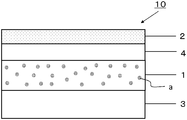
- the decorative sheet of the present invention can have a backing substrate 3, a substrate 1, and a surface protective layer 2 in this order, for example, as shown in FIG.
- the backing substrate can be provided as necessary to reinforce the decorative sheet, provide adhesion with the adherend, or provide concealment, and the substrate is a coating film It is particularly suitable for the case.
- the backing substrate include a resin sheet, paper, nonwoven fabric, woven fabric, and metal foil.
- the resin used for the resin sheet include acrylic resin, polyester resin, polyolefin resin, and ABS resin.
- the thickness of the backing substrate can be appropriately determined according to the purpose, but is usually preferably 10 to 500 ⁇ m or more, more preferably 15 to 200 ⁇ m, still more preferably 20 to 100 ⁇ m.
- the decorative sheet of the present invention may have a decorative layer 4 between the base material 1 and the surface protective layer 2 as shown in FIG.
- the decorative layer may be, for example, a colored layer (so-called solid colored layer) covering the entire surface, or a pattern layer formed by printing various patterns using ink and a printing machine. It may be a combination thereof.
- solid colored layer covering the entire surface
- solid coloring A layer and a pattern layer may be combined.
- the pattern layer may be provided without using a solid colored layer.
- a binder As the ink used for the decorative layer, a binder, a colorant such as a pigment or dye, an extender pigment, a solvent, a stabilizer, a plasticizer, a catalyst, a curing agent, an ultraviolet absorber, a light stabilizer, or the like is appropriately used. I can do it.
- the binder is not particularly limited. For example, polyurethane resin, vinyl chloride / vinyl acetate copolymer resin, vinyl chloride / vinyl acetate / acrylic copolymer resin, chlorinated polypropylene resin, acrylic resin, polyester resin.
- resins any of resins, polyamide resins, butyral resins, polystyrene resins, nitrocellulose resins, cellulose acetate resins and the like may be used alone or in combination of two or more. Of these, polyurethane resins are particularly preferred.
- Colorants include carbon black, iron black, titanium white, antimony white, yellow lead, titanium yellow, petals, cadmium red, ultramarine, cobalt blue and other inorganic pigments, quinacridone red, isoindolinone yellow, phthalocyanine blue, etc.
- examples include organic pigments or dyes, metallic pigments composed of scaly foil pieces such as aluminum and brass, pearlescent pigments composed of scaly foil pieces such as titanium dioxide-coated mica and basic lead carbonate, and the like.
- titanium white it is preferable from a viewpoint of a dispersibility and a weather resistance to use the said white pigment particle
- the thickness of the decoration layer may be appropriately selected depending on the desired pattern, but is preferably 0.5 to 20 ⁇ m from the viewpoint of coloring and concealing the ground color of the adherend and improving the design. 10 ⁇ m is more preferable, and 2 to 5 ⁇ m is still more preferable.
- the decorative sheet of the present invention may be provided with an adhesive layer.
- an adhesive layer in particular, when a decorative layer is provided between the substrate and the surface protective layer, it is preferable to provide an adhesive layer in order to adhere the decorative layer and the surface protective layer.
- an adhesive agent which comprises an adhesive bond layer
- the thickness of the adhesive layer is preferably from 0.1 to 30 ⁇ m, more preferably from 1 to 15 ⁇ m, and even more preferably from 2 to 10 ⁇ m, from the viewpoint of obtaining sufficient adhesiveness.
- the decorative sheet of the present invention may be provided with a transparent resin layer.
- a transparent resin layer can be provided directly on the decorative layer or via another layer such as an adhesive layer.
- the resin constituting the transparent resin layer include polyolefin resin, polyester resin, acrylic resin, polycarbonate resin, polyurethane resin, polystyrene resin, vinyl chloride resin, vinyl acetate resin, and the like.
- polyolefin resins and polyester resins are preferable, and polyolefin resins are more preferable.
- polystyrene resin examples include resins exemplified as those capable of constituting a resin base material, and among them, a polypropylene resin is preferable.
- An additive may be mix
- weathering agents such as ultraviolet absorbers and light stabilizers.
- the thickness of the transparent resin layer is preferably from 10 to 150 ⁇ m, more preferably from 30 to 120 ⁇ m, and even more preferably from 50 to 100 ⁇ m, from the viewpoint of protecting the decorative layer and handling the decorative sheet.
- the transparent resin layer has a physical surface treatment such as an oxidation method and a concavo-convex method, or a chemical surface treatment on one or both sides thereof. Etc. can be subjected to surface treatment. These surface treatments are appropriately selected depending on the type of resin to be treated, but in general, the corona discharge treatment method is preferably used from the viewpoints of effects and operability. Moreover, in order to improve the interlayer adhesion between the transparent resin layer and other layers, a treatment such as forming a primer layer on one or both sides of the transparent resin layer may be performed.
- the decorative sheet of the present invention may be provided with a primer layer.
- a primer layer it is preferable to provide between a decoration layer and a surface protective layer.
- the adhesion between the decorative layer and the surface protective layer can be enhanced, and the stress on the surface protective layer can be relaxed, and it becomes possible to suppress cracking due to the weather resistance deterioration of the surface protective layer.
- Property can be remarkably improved.
- resins exemplified as the binder used in the decorative layer are preferably exemplified, and these can be used alone or in combination of two or more.
- the resin an acrylic-urethane resin, a mixture of a polycarbonate-based urethane-acrylic copolymer and an acrylic polyol resin, or the like can be used.
- the primer layer can be formed from a resin composition in which additives such as a solvent, a stabilizer, a plasticizer, a catalyst, a curing agent, an ultraviolet absorber, and a light stabilizer are appropriately mixed with the resin.
- the thickness of the primer layer is preferably from 0.1 to 10 ⁇ m, more preferably from 0.5 ⁇ m to 8 ⁇ m, and even more preferably from 1 to 6 ⁇ m, from the viewpoint of improving adhesion.
- the decorative sheet of the present invention includes, for example, a step of providing a decoration layer on a substrate, a step of providing an adhesive layer, a transparent resin layer, and a primer layer on the decoration layer, and a curable resin composition on the primer layer. It can manufacture by passing through the process of apply
- the step of providing the decoration layer on the substrate is performed by applying ink used for forming the decoration layer on the substrate containing the white pigment particles to provide a desired colored layer and pattern layer.
- the ink is applied by a known method such as a gravure printing method, a bar coating method, a roll coating method, a reverse roll coating method, or a comma coating method, preferably a gravure printing method.
- the step of providing the adhesive layer, the transparent resin layer, and the primer layer on the decorative layer is performed by applying an adhesive to the decorative layer provided on the substrate to form the adhesive layer, and then forming the transparent resin layer.
- the transparent resin layer can be laminated by adhering and pressing by a method such as extrusion lamination, dry lamination, wet lamination, thermal lamination, etc. using the resin composition constituting
- the resin composition constituting the primer layer is used and applied by a known method such as a gravure printing method, a bar coating method, a roll coating method, a reverse roll coating method, or a comma coating method. Can be done.
- the step of forming the surface protective layer on the primer layer is a step of forming a surface protective layer by applying and curing a curable resin composition containing an ultraviolet absorber on the primer layer.
- Application of the resin composition for forming the surface protective layer is preferably a known gravure coat, bar coat, roll coat, reverse roll coat, comma coat, etc. so that the thickness after curing is a predetermined thickness. More preferably, gravure coating is used.
- an ionizing radiation resin composition is used for forming the surface protective layer, the uncured resin layer formed by applying the resin composition is irradiated with ionizing radiation such as an electron beam or ultraviolet ray to form a cured product. It becomes a protective layer.
- the acceleration voltage can be appropriately selected according to the resin to be used and the thickness of the layer, but the uncured resin layer is usually cured at an acceleration voltage of about 70 to 300 kV. preferable.
- the irradiation dose is preferably such that the crosslinking density of the ionizing radiation curable resin is saturated, and is usually selected in the range of 5 to 300 kGy (0.5 to 30 Mrad), preferably 10 to 50 kGy (1 to 5 Mrad).
- the electron beam source is not particularly limited, and for example, various electron beam accelerators such as a cockroft Walton type, a bandegraft type, a resonant transformer type, an insulated core transformer type, a linear type, a dynamitron type, and a high frequency type are used. be able to.
- various electron beam accelerators such as a cockroft Walton type, a bandegraft type, a resonant transformer type, an insulated core transformer type, a linear type, a dynamitron type, and a high frequency type are used. be able to.
- the decorative material of the present invention has an adherend and the decorative sheet described above. Specifically, the decorative material of the present invention is formed by laminating the base material side surface of the decorative sheet and the adherend.
- Examples of the adherend include plate materials such as flat plates and curved plates, three-dimensional articles such as columns and prisms, sheets (or films), and the like.
- wood members used as plate materials such as timber veneers, wood plywood, particle board, MDF (medium density fiber board) such as cedar, bamboo, pine, lauan, etc.
- Metal alloys used as iron alloys such as iron or carbon steel, aluminum alloys such as aluminum or durarun, copper alloys such as copper or brass, metal plates such as titanium, three-dimensional articles, or sheets; glass, ceramics, etc.
- the adherend may be appropriately selected from the above according to the intended use, such as interior materials for buildings such as walls, ceilings and floors, window frames, doors, handrails, skirting boards, surrounding edges, moldings such as malls, etc.
- an artificial member a member made of at least one member selected from a wooden member, a metal member, and a resin member is preferable, and an exterior member such as an entrance door, a gate, a roofing material, a fence, and a fence, a window frame
- fittings such as a door, what consists of at least 1 type of member chosen from a metal member and a resin member is preferable.
- 0.1 mm or more and 10 mm or less are preferable, 0.3 mm or more and 5 mm are more preferable, 0.5 mm or more and 3 mm or less are still more preferable.
- the adherend and the decorative sheet are preferably bonded together through an adhesive layer.
- the decorative material of the present invention is preferably a member having at least an adherend, an adhesive layer, a base material, and a surface protective layer in this order.
- a well-known adhesive agent can be used,
- adhesive agents such as a heat sensitive adhesive and a pressure sensitive adhesive, are mentioned preferably.
- the resin used for the adhesive constituting the adhesive layer examples include acrylic resin, polyurethane resin, vinyl chloride resin, vinyl acetate resin, vinyl chloride-vinyl acetate copolymer resin, styrene-acrylic copolymer resin, polyester resin, Polyamide resin etc. are mentioned, These can be used individually or in combination of multiple types. Further, a two-component curable polyurethane adhesive or polyester adhesive using an isocyanate compound or the like as a curing agent can also be applied. An adhesive can also be used for the adhesive layer. As the pressure-sensitive adhesive, an acrylic, urethane, silicone, rubber, or other pressure-sensitive adhesive can be appropriately selected and used.
- the adhesive layer is formed by applying and drying the above resin in a form that can be applied, such as a solution or emulsion, by means of a gravure printing method, a screen printing method, or a reverse coating method using a gravure plate. be able to.
- the thickness of the adhesive layer is not particularly limited, but is preferably 1 ⁇ m or more and 100 ⁇ m or less, more preferably 5 ⁇ m or more and 50 ⁇ m or less, and even more preferably 10 ⁇ m or more and 30 ⁇ m or less from the viewpoint of obtaining excellent adhesiveness.
- a decorative material can be manufactured through the process of laminating a decorative sheet and an adherend.
- This step is a step of laminating the adherend and the decorative sheet of the present invention, in which the surface that requires decoration of the adherend and the surface of the decorative sheet on the base material side are opposed to each other.
- Examples of the method of laminating the adherend and the decorative sheet include, for example, a laminating method in which a decorative sheet is pressed onto a plate-shaped adherend with a pressure roller and an adhesive is interposed therebetween.
- the decorative sheet is supplied through the wrapping process in which the decorative sheet is sequentially pressure-bonded and laminated on the plurality of side surfaces constituting the adherend by a plurality of different rollers, and fixed to the fixed frame.
- the heating temperature is preferably 160 ° C. or higher and 200 ° C. or lower depending on the type of resin constituting the adhesive.
- the adhesive 100 ° C. or higher and 130 ° C. or lower is preferable.
- 80 to 130 degreeC is preferable, More preferably, it is 90 to 120 degreeC.
- the decorative material obtained as described above can be arbitrarily cut and subjected to optional decoration such as grooving and chamfering on the surface and the end of the mouth using a cutting machine such as a router or a cutter. Moreover, after sticking a decorative sheet to a steel plate or the like, bending processing such as V-cut processing or lapping processing can also be performed. And various uses, for example, interior materials or exterior members of buildings such as walls, ceilings, floors, window frames, doors, handrails, skirting boards, edges, moldings, and other furniture, furniture, kitchens, furniture Or it can use for the surface decorative board of cabinets, such as a weak electrical product and OA apparatus, the interior material of a vehicle, or an exterior member.
- Example 1 White pigment particles in which a coating containing Al and Si elements is formed on the surface of titanium oxide as a base material, and bis (1-undecanoxy-2,2,6,6-tetramethylpiperidine-) as a hindered amine light stabilizer A polypropylene sheet having a thickness of 60 ⁇ m and containing 3 parts by mass of 4-yl) carbonate with respect to 100 parts by mass of the resin was used.
- the white pigment particles have a Ti: Al: Si mass ratio of 1: 0.05: 0.003, and the content of the white pigment particles in the substrate is 10% by mass.
- the average particle size of the primary particles was 0.26 ⁇ m.
- the surface of the transparent resin layer is subjected to a corona discharge treatment, and then a coating liquid containing a resin composition containing a resin component comprising a polycarbonate-based urethane acrylic copolymer and an acrylic polyol is used, and the thickness becomes 4 g / m 2.
- the primer layer having a thickness of about 4 ⁇ m was formed.
- an ionizing radiation curable resin composition a weight average molecular weight of about 5000, a trifunctional urethane acrylate oligomer 100 parts by mass, and a triazine-based ultraviolet absorber as 2- (2-hydroxy-4- [1-octyloxycarbonyl).
- Example 2 and 3 [Comparative Examples 1 and 2] Instead of the white pigment particles used in Example 1, the same procedure as in Example 1 was used, except that white pigment particles having a titanium oxide surface coated at a mass ratio of Ti: Al: Si shown in Table 1 were used. A decorative sheet was obtained. Said evaluation was performed about the obtained decorative sheet. The evaluation results are shown in Table 1.
- the decorative sheet and the decorative material of the present invention are excellent in weather resistance, they are particularly useful as a decorative material for exterior use.
- Cosmetic sheet 1. Base material 2. 2. Surface protective layer 3. Backing base material Decorative layer a. White pigment particles
Landscapes
- Chemical & Material Sciences (AREA)
- Health & Medical Sciences (AREA)
- Chemical Kinetics & Catalysis (AREA)
- Medicinal Chemistry (AREA)
- Polymers & Plastics (AREA)
- Organic Chemistry (AREA)
- Engineering & Computer Science (AREA)
- Structural Engineering (AREA)
- Architecture (AREA)
- Civil Engineering (AREA)
- Laminated Bodies (AREA)
Abstract
Priority Applications (5)
| Application Number | Priority Date | Filing Date | Title |
|---|---|---|---|
| US17/040,683 US11345128B2 (en) | 2018-03-29 | 2019-03-29 | Decorative sheet and decorative material using same |
| CN201980035537.2A CN112166036B (zh) | 2018-03-29 | 2019-03-29 | 装饰片以及使用了该装饰片的装饰材料 |
| AU2019242537A AU2019242537B2 (en) | 2018-03-29 | 2019-03-29 | Decorative sheet and decorative material using same |
| EP19778348.3A EP3778222B1 (fr) | 2018-03-29 | 2019-03-29 | Feuille décorative et matériau décoratif utilisant celle-ci |
| KR1020207030817A KR20200138304A (ko) | 2018-03-29 | 2019-03-29 | 화장 시트 및 이것을 이용한 화장재 |
Applications Claiming Priority (2)
| Application Number | Priority Date | Filing Date | Title |
|---|---|---|---|
| JP2018-065952 | 2018-03-29 | ||
| JP2018065952A JP7063056B2 (ja) | 2018-03-29 | 2018-03-29 | 化粧シート及びこれを用いた化粧材 |
Publications (1)
| Publication Number | Publication Date |
|---|---|
| WO2019189797A1 true WO2019189797A1 (fr) | 2019-10-03 |
Family
ID=68060631
Family Applications (1)
| Application Number | Title | Priority Date | Filing Date |
|---|---|---|---|
| PCT/JP2019/014089 Ceased WO2019189797A1 (fr) | 2018-03-29 | 2019-03-29 | Feuille décorative et matériau décoratif utilisant celle-ci |
Country Status (7)
| Country | Link |
|---|---|
| US (1) | US11345128B2 (fr) |
| EP (1) | EP3778222B1 (fr) |
| JP (2) | JP7063056B2 (fr) |
| KR (1) | KR20200138304A (fr) |
| CN (1) | CN112166036B (fr) |
| AU (1) | AU2019242537B2 (fr) |
| WO (1) | WO2019189797A1 (fr) |
Cited By (1)
| Publication number | Priority date | Publication date | Assignee | Title |
|---|---|---|---|---|
| WO2021065637A1 (fr) * | 2019-09-30 | 2021-04-08 | 大日本印刷株式会社 | Feuille décorative et matériau décoratif l'utilisant |
Families Citing this family (3)
| Publication number | Priority date | Publication date | Assignee | Title |
|---|---|---|---|---|
| JP7063056B2 (ja) * | 2018-03-29 | 2022-05-09 | 大日本印刷株式会社 | 化粧シート及びこれを用いた化粧材 |
| JP7501005B2 (ja) * | 2020-03-10 | 2024-06-18 | Toppanホールディングス株式会社 | 化粧シート |
| JP6871464B1 (ja) * | 2020-08-18 | 2021-05-12 | 三菱瓦斯化学株式会社 | 樹脂組成物、樹脂シート、多層体、および、カード |
Citations (6)
| Publication number | Priority date | Publication date | Assignee | Title |
|---|---|---|---|---|
| JP2005335336A (ja) * | 2004-05-31 | 2005-12-08 | Dainippon Printing Co Ltd | 横柄エンボス化粧シート及び横柄エンボス化粧板 |
| JP2012212050A (ja) * | 2011-03-31 | 2012-11-01 | Sekisui Plastics Co Ltd | 光反射積層体、これを用いてなる光反射成形体、並びにこれらを用いてなる表示装置及び照明装置 |
| JP2014088026A (ja) * | 2013-11-18 | 2014-05-15 | Dainippon Printing Co Ltd | 化粧シート及びこれを用いた化粧板 |
| JP2016168787A (ja) | 2015-03-13 | 2016-09-23 | 凸版印刷株式会社 | 化粧シート及び化粧材 |
| JP2016168785A (ja) | 2015-03-13 | 2016-09-23 | 凸版印刷株式会社 | 化粧シート及びその製造方法、並びに化粧材 |
| JP2017202674A (ja) * | 2016-05-06 | 2017-11-16 | 大日本印刷株式会社 | 化粧シート及び該化粧シートを備える化粧部材 |
Family Cites Families (32)
| Publication number | Priority date | Publication date | Assignee | Title |
|---|---|---|---|---|
| NL270946A (fr) | 1960-11-02 | 1900-01-01 | ||
| US3437502A (en) | 1968-03-28 | 1969-04-08 | Du Pont | Titanium dioxide pigment coated with silica and alumina |
| GB2108097B (en) | 1981-10-30 | 1985-01-03 | Tioxide Group Plc | Improved pigments and their preparation |
| FR2758826B1 (fr) | 1997-01-27 | 1999-04-16 | Rhodia Chimie Sa | Nouveau pigment de dioxide de titane, son procede de preparation et son utilisation dans les compositions de peinture |
| JP2000319411A (ja) | 1999-05-12 | 2000-11-21 | Mitsubishi Chem Mkv Co | 化粧シート用フィルム |
| DE10002163A1 (de) | 2000-01-20 | 2001-07-26 | Mitsubishi Polyester Film Gmbh | Weiße, schwerentflammbare, UV-stabile Folie aus einem kristallisierbaren Thermoplasten, Verfahren zu ihrer Herstellung und ihre Verwendung |
| US6342099B1 (en) | 2000-05-01 | 2002-01-29 | Millennium Inorganic Chemicals, Inc. | Coated titanium dioxide pigments and processes for production and use |
| US6783586B2 (en) | 2001-11-01 | 2004-08-31 | E. I. Du Pont De Nemours And Company | Easy to disperse, high durability TiO2 pigment and method of making same |
| JP4254280B2 (ja) | 2003-03-14 | 2009-04-15 | 東洋インキ製造株式会社 | ポリプロピレン系樹脂用マスターバッチとその利用 |
| US7371275B2 (en) | 2004-07-02 | 2008-05-13 | E.I. Du Pont De Nemours And Company | Titanium dioxide pigment and polymer compositions |
| JP4848640B2 (ja) | 2004-09-30 | 2011-12-28 | 大日本印刷株式会社 | 化粧シート |
| JP5181408B2 (ja) | 2004-12-27 | 2013-04-10 | 堺化学工業株式会社 | 表面被覆二酸化チタン顔料とその利用 |
| JP5196042B2 (ja) | 2005-03-31 | 2013-05-15 | 大日本印刷株式会社 | 化粧シート |
| DE102005062687A1 (de) | 2005-12-23 | 2007-07-05 | Röhm Gmbh | PMMA-Folie mit besonders hoher Witterungsbeständigkeit und hoher UV-Schutzwirkung |
| DE102006004344B4 (de) | 2006-01-30 | 2008-11-13 | Kronos International, Inc. | Titandioxid-Pigment mit hoher Opazität und Verfahren zur Herstellung |
| JP5209861B2 (ja) | 2006-09-27 | 2013-06-12 | 石原産業株式会社 | 二酸化チタン白色顔料及びその製造方法 |
| EP2397519B1 (fr) | 2009-02-13 | 2015-11-25 | Denki Kagaku Kogyo Kabushiki Kaisha | Film de résine à base de fluorure de vinylidène |
| JP2011042041A (ja) | 2009-08-19 | 2011-03-03 | Toppan Cosmo Inc | 化粧シート |
| JP2011075931A (ja) * | 2009-09-30 | 2011-04-14 | Sekisui Plastics Co Ltd | 光反射板及び光反射積層板 |
| JP5447105B2 (ja) | 2010-03-31 | 2014-03-19 | 大日本印刷株式会社 | 化粧シート及びこれを用いた化粧板 |
| JP5831087B2 (ja) | 2010-09-29 | 2015-12-09 | 大日本印刷株式会社 | 加飾シート及び加飾成形品 |
| JP5809795B2 (ja) | 2010-11-24 | 2015-11-11 | 堺化学工業株式会社 | 二酸化チタン含有複合粒子 |
| JP5697739B2 (ja) | 2011-02-21 | 2015-04-08 | 積水化成品工業株式会社 | 光反射板 |
| JP5821461B2 (ja) * | 2011-09-21 | 2015-11-24 | 大日本印刷株式会社 | 床用化粧シート及びその製造方法 |
| EP2762309B1 (fr) | 2011-09-30 | 2019-12-04 | Dai Nippon Printing Co., Ltd. | Feuille décorative et plaque métallique décorative utilisant celle-ci |
| AU2015343361B2 (en) | 2014-11-06 | 2019-06-20 | The Chemours Company Fc, Llc | Preparation of lacing resistant, titanium dioxide particles for use in photodurable thin film production |
| JP6645026B2 (ja) | 2015-04-06 | 2020-02-12 | 凸版印刷株式会社 | 化粧シート、及び化粧板 |
| WO2016167929A1 (fr) | 2015-04-13 | 2016-10-20 | The Chemours Company Tt, Llc | Particules thermorésistantes de dioxyde de titane et formation d'objets froids |
| JP2017145584A (ja) | 2016-02-16 | 2017-08-24 | 凸版印刷株式会社 | 床用化粧材 |
| JP6711070B2 (ja) | 2016-03-28 | 2020-06-17 | 凸版印刷株式会社 | 化粧シート及び化粧材 |
| WO2018153665A1 (fr) | 2017-02-24 | 2018-08-30 | Solvay Specialty Polymers Usa, Llc | Solution de stabilisation uv pour le traitement de la couche de surface d'un article polymère |
| JP7063056B2 (ja) | 2018-03-29 | 2022-05-09 | 大日本印刷株式会社 | 化粧シート及びこれを用いた化粧材 |
-
2018
- 2018-03-29 JP JP2018065952A patent/JP7063056B2/ja active Active
-
2019
- 2019-03-29 KR KR1020207030817A patent/KR20200138304A/ko active Pending
- 2019-03-29 WO PCT/JP2019/014089 patent/WO2019189797A1/fr not_active Ceased
- 2019-03-29 EP EP19778348.3A patent/EP3778222B1/fr active Active
- 2019-03-29 US US17/040,683 patent/US11345128B2/en active Active
- 2019-03-29 AU AU2019242537A patent/AU2019242537B2/en active Active
- 2019-03-29 CN CN201980035537.2A patent/CN112166036B/zh active Active
-
2022
- 2022-04-19 JP JP2022068792A patent/JP7548266B2/ja active Active
Patent Citations (6)
| Publication number | Priority date | Publication date | Assignee | Title |
|---|---|---|---|---|
| JP2005335336A (ja) * | 2004-05-31 | 2005-12-08 | Dainippon Printing Co Ltd | 横柄エンボス化粧シート及び横柄エンボス化粧板 |
| JP2012212050A (ja) * | 2011-03-31 | 2012-11-01 | Sekisui Plastics Co Ltd | 光反射積層体、これを用いてなる光反射成形体、並びにこれらを用いてなる表示装置及び照明装置 |
| JP2014088026A (ja) * | 2013-11-18 | 2014-05-15 | Dainippon Printing Co Ltd | 化粧シート及びこれを用いた化粧板 |
| JP2016168787A (ja) | 2015-03-13 | 2016-09-23 | 凸版印刷株式会社 | 化粧シート及び化粧材 |
| JP2016168785A (ja) | 2015-03-13 | 2016-09-23 | 凸版印刷株式会社 | 化粧シート及びその製造方法、並びに化粧材 |
| JP2017202674A (ja) * | 2016-05-06 | 2017-11-16 | 大日本印刷株式会社 | 化粧シート及び該化粧シートを備える化粧部材 |
Cited By (2)
| Publication number | Priority date | Publication date | Assignee | Title |
|---|---|---|---|---|
| WO2021065637A1 (fr) * | 2019-09-30 | 2021-04-08 | 大日本印刷株式会社 | Feuille décorative et matériau décoratif l'utilisant |
| US12115762B2 (en) | 2019-09-30 | 2024-10-15 | Dai Nippon Printing Co., Ltd. | Decorative sheet and decorative material using same |
Also Published As
| Publication number | Publication date |
|---|---|
| CN112166036A (zh) | 2021-01-01 |
| CN112166036B (zh) | 2023-01-10 |
| KR20200138304A (ko) | 2020-12-09 |
| JP2019171821A (ja) | 2019-10-10 |
| JP2022089933A (ja) | 2022-06-16 |
| EP3778222A4 (fr) | 2021-12-15 |
| JP7063056B2 (ja) | 2022-05-09 |
| EP3778222A1 (fr) | 2021-02-17 |
| AU2019242537A1 (en) | 2020-11-19 |
| AU2019242537B2 (en) | 2024-02-01 |
| US20210053326A1 (en) | 2021-02-25 |
| EP3778222B1 (fr) | 2024-07-31 |
| JP7548266B2 (ja) | 2024-09-10 |
| US11345128B2 (en) | 2022-05-31 |
Similar Documents
| Publication | Publication Date | Title |
|---|---|---|
| JP7201065B2 (ja) | 化粧シート及びこれを用いた化粧材 | |
| JP6957934B2 (ja) | 化粧シート及びこれを用いた化粧材 | |
| JP7548266B2 (ja) | 化粧シート及びこれを用いた化粧材 | |
| JP7115615B2 (ja) | 化粧シート及びこれを用いた化粧材 | |
| JP2023156288A (ja) | 化粧シート及びこれを用いた化粧材 | |
| JP6977294B2 (ja) | 化粧シート及びこれを用いた化粧材 | |
| WO2021199671A1 (fr) | Feuille décorative et matériau décoratif utilisant cette dernière | |
| JP7004112B2 (ja) | 化粧シート及びこれを用いた化粧材 | |
| JP7415403B2 (ja) | 化粧シート及び化粧材 | |
| JP2022056213A (ja) | 化粧シート及びこれを用いた化粧材 | |
| WO2023190538A1 (fr) | Feuille décorative et matériau décoratif |
Legal Events
| Date | Code | Title | Description |
|---|---|---|---|
| 121 | Ep: the epo has been informed by wipo that ep was designated in this application |
Ref document number: 19778348 Country of ref document: EP Kind code of ref document: A1 |
|
| NENP | Non-entry into the national phase |
Ref country code: DE |
|
| ENP | Entry into the national phase |
Ref document number: 20207030817 Country of ref document: KR Kind code of ref document: A |
|
| WWE | Wipo information: entry into national phase |
Ref document number: 2019778348 Country of ref document: EP |
|
| ENP | Entry into the national phase |
Ref document number: 2019778348 Country of ref document: EP Effective date: 20201029 |
|
| ENP | Entry into the national phase |
Ref document number: 2019242537 Country of ref document: AU Date of ref document: 20190329 Kind code of ref document: A |