WO2019244640A1 - Matériau d'insonorisation et procédé de production de matériau d'insonorisation - Google Patents
Matériau d'insonorisation et procédé de production de matériau d'insonorisation Download PDFInfo
- Publication number
- WO2019244640A1 WO2019244640A1 PCT/JP2019/022403 JP2019022403W WO2019244640A1 WO 2019244640 A1 WO2019244640 A1 WO 2019244640A1 JP 2019022403 W JP2019022403 W JP 2019022403W WO 2019244640 A1 WO2019244640 A1 WO 2019244640A1
- Authority
- WO
- WIPO (PCT)
- Prior art keywords
- layer
- polyurethane foam
- soundproofing material
- soundproofing
- mass
- Prior art date
- Legal status (The legal status is an assumption and is not a legal conclusion. Google has not performed a legal analysis and makes no representation as to the accuracy of the status listed.)
- Ceased
Links
Images


Classifications
-
- B—PERFORMING OPERATIONS; TRANSPORTING
- B32—LAYERED PRODUCTS
- B32B—LAYERED PRODUCTS, i.e. PRODUCTS BUILT-UP OF STRATA OF FLAT OR NON-FLAT, e.g. CELLULAR OR HONEYCOMB, FORM
- B32B27/00—Layered products comprising a layer of synthetic resin
- B32B27/40—Layered products comprising a layer of synthetic resin comprising polyurethanes
-
- B—PERFORMING OPERATIONS; TRANSPORTING
- B32—LAYERED PRODUCTS
- B32B—LAYERED PRODUCTS, i.e. PRODUCTS BUILT-UP OF STRATA OF FLAT OR NON-FLAT, e.g. CELLULAR OR HONEYCOMB, FORM
- B32B5/00—Layered products characterised by the non- homogeneity or physical structure, i.e. comprising a fibrous, filamentary, particulate or foam layer; Layered products characterised by having a layer differing constitutionally or physically in different parts
- B32B5/22—Layered products characterised by the non- homogeneity or physical structure, i.e. comprising a fibrous, filamentary, particulate or foam layer; Layered products characterised by having a layer differing constitutionally or physically in different parts characterised by the presence of two or more layers which are next to each other and are fibrous, filamentary, formed of particles or foamed
- B32B5/32—Layered products characterised by the non- homogeneity or physical structure, i.e. comprising a fibrous, filamentary, particulate or foam layer; Layered products characterised by having a layer differing constitutionally or physically in different parts characterised by the presence of two or more layers which are next to each other and are fibrous, filamentary, formed of particles or foamed at least two layers being foamed and next to each other
Definitions
- the present invention relates to a soundproofing material and a method for manufacturing the soundproofing material.
- the object of the present invention is to provide a soundproofing material capable of improving soundproofing performance and a method of manufacturing a soundproofing material capable of obtaining a soundproofing material capable of improving soundproofing performance.
- the soundproofing material of the present invention A first layer comprising a first polyurethane foam, A second layer laminated on the first side surface of the first layer and formed of a second polyurethane foam having a higher density than the first polyurethane foam; It has.
- the method for producing a soundproofing material of the present invention A method of manufacturing the above soundproofing material, A first layer manufacturing step of manufacturing the first layer; A second layer manufacturing step of thermally compressing a fourth polyurethane foam to obtain the second layer; Laminating the second layer on the surface of the first layer on the first side; including.
- the present invention it is possible to provide a soundproofing material capable of improving soundproofing performance and a method of manufacturing a soundproofing material capable of obtaining a soundproofing material capable of improving soundproofing performance.
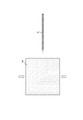
- FIG. 2 is a drawing for explaining a method for manufacturing a second layer of FIG. 1.
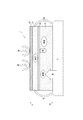
- FIG. 2 is a diagram for explaining the operation and effect of the soundproofing material of FIG. 1. It is a figure which shows the result of the normal incidence sound absorption coefficient test in the Example of the sound insulation material of this invention, and a comparative example. It is drawing which shows the result of the transmission loss test in the Example of the soundproof material of this invention, and a comparative example. 6 is a diagram for explaining a test method of the transmission loss test of FIG.
- the soundproofing material of the present invention may be used in any place or object, but is suitable for use in vehicles.
- a soundproofing material and a method for manufacturing the soundproofing material according to the present invention will be described with reference to the drawings. Components common to the drawings are denoted by the same reference numerals.
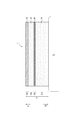
- FIG. 1 shows a cross section of a soundproofing material 1 according to one embodiment of the present invention.
- the soundproofing material 1 of the present embodiment has a laminated structure in which a plurality of (specifically, in this example, four) layers are laminated.
- first side (S1) in the laminating direction of the soundproof material 1
- second side (S2) the laminating direction.
- the stacking direction of the soundproof material 1 is the vertical direction
- the first side S1 is the upper side in the vertical direction
- the second side S2 is the lower side in the vertical direction.
- the lamination direction of the soundproofing material 1 and the directions and directions of the first side S1 and the second side S2 may be different from the example of FIG.
- the soundproofing material 1 is arranged such that the surface of the second side S2 faces the sound source G in use.
- the soundproofing material 1 is configured so as to suppress the sound emitted from the sound source G from being transmitted to the first side S1 than the soundproofing material 1 in this state.
- the performance exerted by the soundproof material 1 to suppress the sound from the sound source G from being transmitted to the first side S1 than the soundproof material 1 is referred to as “soundproof performance”.
- the soundproofing material 1 be disposed such that the surface of the second side S2 is in contact with the sound source G during use, as in the example of FIG. is there.
- the sound source G may be any sound source, but is preferably a component of a vehicle.
- the sound source G is arranged in the engine room of the vehicle.
- the soundproofing material 1 is placed on the sound source G in a contact state.
- the soundproofing material 1 of the present embodiment includes a first layer 10 which is a surface layer located closest to the second side S2, a second layer 20 laminated on a surface of the first layer 10 on the first side S1, and a second layer.
- the first layer 10, the second layer 20, the third layer 30, and the fourth layer 40 are fixed to each other (adhesion or welding, etc.) between the respective layers, whereby the soundproofing material 1 is integrally formed. .
- the first layer 10 and the second layer 20 are bonded by an adhesive
- the second layer 20 and the third layer 30 are bonded by an adhesive
- 30 and the fourth layer 40 are welded.
- the first layer 10 and the third layer 30 are each made of polyurethane foam.
- the polyurethane foam constituting the first layer 10 is referred to as “first polyurethane foam”
- the polyurethane foam constituting the third layer 30 is referred to as “third polyurethane foam”.
- the first polyurethane foam and the third polyurethane foam have the same composition, but they may have different compositions.
- the first polyurethane foam and the third polyurethane foam are ordinary polyurethane foams that are not thermally compressed.
- the second layer 20 is made of a second polyurethane foam.
- the second polyurethane foam forming the second layer 20 has a higher density (kg / m 3 ) than the first polyurethane foam forming the first layer 30.
- the second polyurethane foam is a hot-pressed polyurethane foam (a hot-pressed polyurethane foam). That is, as schematically shown in FIG. 2, the second layer 20 is obtained by thermally compressing a block 120 made of a normal polyurethane foam that has not been thermally compressed.
- the polyurethane foam that is not thermally compressed and that constitutes the block 120 is referred to as a “fourth polyurethane foam”.
- the second layer 20 is thermally compressed in the thickness direction.
- the fourth layer 40 is made of a nonwoven fabric. Examples of the material of the nonwoven fabric include polyethylene.
- the first polyurethane foam and the third polyurethane foam constituting the first layer 10 and the third layer 30, respectively, have a structure in which a large number of (non-crushed) cells are arranged, so that the sound that enters therein is (Hereinafter referred to as "sound absorbing performance").
- the second polyurethane foam constituting the second layer 20 has a higher density (kg / m 3 ) than the first polyurethane foam constituting the first layer 10. For this reason, when compared with the first polyurethane foam, the second polyurethane foam has a smaller amount of voids inside than the first polyurethane foam, and therefore has a low sound absorbing performance, but has a performance of rebounding a sound trying to enter the second polyurethane foam.
- the second polyurethane foam is a heat-compressed polyurethane foam, the cells are crushed, and there are few or no voids inside, so that the second polyurethane foam has almost no sound absorption performance, but has high sound insulation performance.
- the second polyurethane foam constituting the second layer 20 has a higher performance of damping vibration than the first polyurethane foam and the third polyurethane foam constituting the first layer 10 and the third layer 30, respectively.
- the nonwoven fabric forming the fourth layer 40 has higher oil resistance and heat resistance than the first layer 10, the second layer 20, and the third layer 30.
- the second layer 20 having high sound insulation performance is stacked on the surface of the first side S1 of the first layer 10 having high sound absorption performance.
- the surface of the second side S2 of the soundproofing material 1 is arranged so as to face (more specifically, contact) the sound generation source G.
- a part of the sound coming from the sound source G to the first side S1 perpendicularly to the soundproofing material 1 (that is, in the stacking direction) is partly formed by the first layer 10. Sound that has been absorbed and not absorbed by the first layer 10 is blocked by the second layer 20 (bounced back to the second side S2).
- the first polyurethane foam forming the first layer 10 has a lower density (kg / m 3 ) than the second polyurethane foam forming the second layer 20. Therefore, if compared at the same volume, the first polyurethane foam constituting the first layer 10 has the advantage of being lighter in weight than the second polyurethane foam constituting the second layer 20, but has a low soundproofing performance. Has disadvantages.
- the soundproofing material 1 can be reduced in weight while the sound source There is a possibility that the sound from G cannot be sufficiently transmitted to the first side S1 than the soundproofing material 1 (that is, sufficient soundproofing performance cannot be obtained).
- the total thickness of the first layer 10 and the second layer 20 is entirely composed of the second layer 20 (and thus the second polyurethane foam), the sound from the sound source G is effectively isolated.
- the sound from the sound source G can be more effectively prevented from being transmitted to the first side S1 than the soundproofing material 1 (higher soundproofing performance can be obtained), while the weight of the soundproofing material 1 is reduced. There is a possibility that it will increase significantly.
- the soundproofing material 1 when used in a vehicle as in this example, it is preferable that the weight of the soundproofing material 1 be lighter from the viewpoint of fuel economy. Since the soundproofing material 1 of the present embodiment has both the first layer 10 having high sound absorbing performance and the second layer 20 having high sound insulating performance, it is possible to improve the soundproofing performance while suppressing an increase in the weight of the soundproofing material 1. You can get it. Further, in the soundproofing material 1 of the present embodiment, since the second layer 20 made of the second polyurethane foam has a high vibration damping performance, it is possible to effectively attenuate the vibration emitted from the sound source G.
- the second layer 20 made of the second polyurethane foam is disposed on the first side S1 with respect to the first layer 10 made of the first polyurethane foam. That is, as compared with the case where the first layer 10 made of the first polyurethane foam is disposed on the first side S1 with respect to the second layer 20 made of the second polyurethane foam, Of the sound to be emitted, a larger part enters the first layer 10 perpendicularly (in the laminating direction) and is absorbed there, so that the sound absorbing performance of the first layer 10 can be more effectively exhibited, As a result, the soundproofing performance of the soundproofing material 1 can be improved.
- the soundproofing material 1 of the present embodiment includes the third layer 30 which is laminated on the first side S1 of the second layer 20 and is made of a third polyurethane foam, the sound source G or other sources are provided.
- the sound coming from the side to the side surface of the soundproof material 1 enters the inside of the third layer 30 from the side surface of the third layer 30 and is absorbed there. Therefore, the soundproofing effect of the soundproofing material 1 can be further improved.
- the soundproofing material 1 does not need to include the third layer 30 made of the third polyurethane foam.
- a layer made of a material other than polyurethane foam may be laminated on the surface of the first side S1 of the second layer 20, or the second layer 20 None is laminated on the surface of the first side S1, and the second layer 20 may constitute the surface layer of the first side S1 of the soundproofing material 1.
- the fourth layer 40 provides soundproofing.
- each layer (the first layer 10, the second layer 20, and the third layer 30) on the second side S2 than the fourth layer 40 can be effectively protected from oil and high heat.
- the oil resistance and heat resistance of the soundproof material 1 can be improved.
- This configuration is particularly suitable when the soundproofing material 1 is disposed in a place where the soundproofing material 1 is likely to be exposed to oil and / or high heat, such as inside the engine room of a vehicle as in this example. It is.
- the soundproofing material 1 does not have to be configured with the fourth layer 40 made of a nonwoven fabric for the surface layer located closest to the first side S1.
- the outermost layer located on the first side S1 may be constituted by a layer made of a material other than the nonwoven fabric (for example, the third layer 30 or the second layer 20).
- the thickness T1 of the soundproofing material 1 is preferably 10 mm or more, and more preferably 15 mm or more, from the viewpoint of improving the soundproofing performance.
- the thickness T1 of the soundproof material 1 is preferably 30 mm or less, and more preferably 25 mm or less.
- the thickness T10 of the first layer 10 made of the first polyurethane foam is equal to the thickness T10 of the second layer. It is preferable that the thickness is larger than the thickness T20 of the second layer 20 made of a polyurethane foam (T10> T20). From a similar viewpoint, it is preferable that the thickness T10 of the first layer 10 be 10 to 50 times the thickness T20 of the second layer 20.
- the thickness T ⁇ b> 10 of the first layer 10 is 0.1 mm of the thickness T ⁇ b> 1 of the soundproofing material 1. 50 times or more is preferable, and 0.70 times or more is more preferable. From a similar viewpoint, the thickness T10 of the first layer 10 is preferably equal to or greater than 8 mm, and more preferably equal to or greater than 12 mm. On the other hand, the thickness T10 of the first layer 10 is preferably 0.90 times or less the thickness T1 of the soundproofing material 1 from the viewpoint of suppressing an increase in the weight and thickness of the first layer 10 and thus the soundproofing material 1. The thickness is more preferably 0.86 times or less the thickness T1 of the soundproofing material 1. From the same viewpoint, the thickness T10 of the first layer 10 is preferably equal to or less than 25 mm, and more preferably equal to or less than 20 mm.
- the thickness T20 of the second layer 20 is equal to 0.1 mm of the thickness T1 of the soundproofing material 1. 025 times or more is preferable, and 0.045 times or more of the thickness T1 of the soundproofing material 1 is more preferable. From the same viewpoint, the thickness T20 of the second layer 20 is preferably equal to or greater than 0.5 mm, and more preferably equal to or greater than 0.8 mm.
- the thickness T20 of the second layer 20 is preferably 0.15 times or less the thickness T1 of the soundproofing material 1 from the viewpoint of suppressing an increase in the weight and thickness of the second layer 20 and thus the soundproofing material 1. It is more preferable that the thickness of the soundproofing material 1 be 0.075 times or less. From the same viewpoint of weight reduction, the thickness T20 of the second layer 20 is preferably equal to or less than 5 mm, more preferably equal to or less than 3 mm, and still more preferably equal to or less than 1.5 mm.
- the soundproofing material 1 includes the third layer 30 made of the third polyurethane foam as in the example of FIG. 1, from the viewpoint of improving the soundproofing performance while suppressing an increase in the weight of the soundproofing material 1, Is preferably larger than the thickness T20 of the second layer 20 made of the second polyurethane foam (T30> T20). From a similar viewpoint, it is preferable that the thickness T30 of the third layer 30 be 2 to 15 times the thickness T20 of the second layer 20.
- the thickness T ⁇ b> 30 of the third layer 30 is set such that the sound absorption performance of the third layer 30 is improved and the soundproofing performance of the soundproofing material 1 is improved.
- the thickness T30 of the third layer 30 is preferably equal to or greater than 2 mm, and more preferably equal to or greater than 3 mm.
- the thickness T30 of the third layer 30 is preferably equal to or less than 0.50 times the thickness T1 of the soundproofing material 1 from the viewpoint of suppressing an increase in the weight and thickness of the third layer 30 and thus the soundproofing material 1. It is more preferable that the thickness of the soundproofing material 1 be 0.30 times or less.
- the thickness T30 of the third layer 30 is preferably equal to or less than 12 mm, and more preferably equal to or less than 7 mm.
- the soundproofing material 1 includes the fourth layer 40 (a surface layer on the first side S1) made of a nonwoven fabric as in the example of FIG. 1, from the viewpoint of improving the oil resistance and heat resistance of the fourth layer 40 and thus the soundproofing material 1.
- the thickness T40 of the fourth layer 40 is preferably 0.5 mm or more, and more preferably 1 mm or more.
- the thickness T40 of the fourth layer 40 is preferably equal to or less than 5 mm, and more preferably equal to or less than 3 mm, from the viewpoint of suppressing an increase in the weight and the thickness of the fourth layer 40 and thus the soundproof material 1.
- the first polyurethane foam and the third layer 30 that form the first layer 10 are formed from the viewpoint of improving the sound absorbing performance and reducing the weight of each of the first layer 10 and the third layer 30.
- the third polyurethane foam respectively, density is preferable that is 20 kg / m 3 or less, and more preferable that is 15 kg / m 3 or less.
- the first polyurethane foam and the third polyurethane foam each preferably have a density of 6 kg / m 3 or more, More preferably, it is 10 kg / m 3 or more.
- the “density” of a polyurethane foam refers to a density (apparent density) measured according to JIS K 6400-1: 2004. From the viewpoint of improving the sound absorbing performance and reducing the weight of each of the first layer 10 and the third layer 30, the first polyurethane foam and the third polyurethane foam each have a continuous cell structure in which cells communicate with each other.
- the first polyurethane foam and the third layer 30 that form the first layer 10 are formed from the viewpoint of improving the sound absorbing performance and reducing the weight of each of the first layer 10 and the third layer 30.
- the third polyurethane foam respectively, breathable, is suitable When it is 0.1 ⁇ 40ml / cm 2 / sec , and more preferable that is 5 ⁇ 30ml / cm 2 / sec .
- the “air permeability” (air permeability) of a polyurethane foam shall be measured with a Frazier mold at a thickness of 10 mm in accordance with JIS K 6400-7: 2012.
- first polyurethane foam and the third polyurethane foam may have the same composition (and, consequently, density and air permeability) or may have different compositions.
- first polyurethane foam and the third polyurethane foam have the same composition, the first layer 10 and the third layer 30 can be manufactured from the same block of the polyurethane foam, so that the manufacture is facilitated.
- the fourth polyurethane foam constituting the block 120 (FIG. 2) before the second layer 20 is thermally compressed has a different composition (hence, density and air permeability) from the first polyurethane foam.
- the fourth polyurethane foam may have the same composition (and thus density and air permeability) as the first polyurethane foam.
- the fourth polyurethane foam constituting the block 120 (FIG. 2) before the second layer 20 is thermally compressed has a density of 6 kg / m 3 or more, and more preferably 10 kg / m 3 or more.
- the density of the fourth polyurethane foam is higher than the density of the first polyurethane foam and / or the third polyurethane foam.
- fourth polyurethane foam has a density, a suitable When it is 100 kg / m 3 or less, and more preferable that is 90 kg / m 3 or less.
- the air permeability of the fourth polyurethane foam is lower than the air permeability of the first polyurethane foam and / or the third polyurethane foam, It is suitable.
- the fourth polyurethane foam constituting the block 120 (FIG. 2) before the second layer 20 is thermally compressed has a gas permeability of 0.05 to 30 ml / cm 2 / sec. It is suitable, and more preferably 3 to 20 ml / cm 2 / sec.
- the fourth polyurethane foam may be a flexible polyurethane foam having an open cell structure in which cells communicate with each other, or may be a rigid polyurethane foam having an independent closed cell structure in which cells do not communicate with each other. .
- the second polyurethane foam constituting the second layer 20 has a block 120 (FIG. 2) made of the fourth polyurethane foam having a volume of 0. It is preferable that the material is heat-compressed until it becomes 0.3 times or less, and it is more preferable that the material is heat-compressed until it becomes 0.15 times or less.
- the second polyurethane foam constituting the second layer 20 is made of a block 120 (FIG. 2) made of the fourth polyurethane foam having a volume of 0%.
- the material is thermally compressed to 0.05 times or more, and it is more preferable that the material is thermally compressed to 0.10 times or more.
- the second polyurethane foam forming the second layer 20 preferably has a density of 100 kg / m 3 or more, and is preferably 300 kg / m 3. More preferably, it is 3 or more.
- the density of the second polyurethane foam constituting the second layer 20 is preferably at least 8 times the density of the first polyurethane foam constituting the first layer 10, and is preferably 17 times or more. It is more preferable if there is.
- the second polyurethane foam forming the second layer 20 preferably has a density of 1000 kg / m 3 or less, and a density of 500 kg / m 3 or less. It is more preferable if there is. From the same viewpoint, the density of the second polyurethane foam constituting the second layer 20 is preferably 50 times or less the density of the first polyurethane foam constituting the first layer 10, and 33 times or less. More preferred. When the second polyurethane foam satisfies the above numerical range, the sound insulation performance and the weight reduction of the second layer 20 can be preferably compatible.
- the air permeability of the second polyurethane foam constituting the second layer 20 is higher than the air permeability of the first polyurethane foam and / or the third polyurethane foam. Is also preferably low. From the same viewpoint, it is preferable that the second polyurethane foam constituting the second layer 20 has little or no air permeability.
- the second polyurethane foam constituting the second layer 20 may be a normal polyurethane foam that is not heat-compressed, but the heat-compression polyurethane foam can easily and reliably reduce the density of the second polyurethane foam during manufacturing. Good because it can be higher.
- the first layer 10, the second layer 20, the third layer 30, and the fourth layer 40 are manufactured respectively (the first layer manufacturing step, the second layer manufacturing step, the third layer manufacturing step, and the fourth layer Manufacturing steps).
- a first polyurethane foam is manufactured, and then the obtained first polyurethane foam is cut into a predetermined shape and dimensions to obtain a first layer 10.
- a fourth polyurethane foam is manufactured.
- the block 120 made of the fourth polyurethane foam is obtained by cutting the obtained fourth polyurethane foam into a predetermined shape and dimensions.
- the block 120 is heat-compressed in one direction to make it thinner, and the second layer 20 made of the second polyurethane foam is obtained.
- the third layer manufacturing step first, a third polyurethane foam is manufactured. Thereafter, the obtained third polyurethane foam is cut into a predetermined shape and dimensions to obtain the third layer 30.
- the fourth layer manufacturing step the fourth layer 40 is obtained by cutting the nonwoven fabric into a predetermined shape and dimensions. After the first layer manufacturing step, the second layer manufacturing step, the third layer manufacturing step, and the fourth layer manufacturing step are completed, the second layer 20 is laminated on the surface of the first layer 10 on the first side S1.
- the third layer 30 is laminated on the surface of the first side S1 of the layer 20, and the fourth layer 20 is laminated on the surface of the first side S1 of the third layer 30 to obtain the soundproofing material 1 (lamination step).
- the soundproof material 1 is integrally formed by fixing (adhering or welding) the respective layers of the first layer 10, the second layer 20, the third layer 30, and the fourth layer 40.
- the first layer 10 and the second layer 20 are bonded with an adhesive
- the second layer 20 and the third layer 30 are bonded with an adhesive
- the third layer 30 and the fourth layer 40 are bonded. It is preferable to weld.
- the soundproofing material 1 may be manufactured by a method different from the above manufacturing method.
- the first polyurethane foam forming the first layer 10 and the third polyurethane foam forming the third layer 30 are made of polyurethane containing a liquid halogenated olefin in the first layer manufacturing step and the third layer manufacturing step, respectively. It is preferred that the foam-producing composition be reacted and foamed. Thereby, the sound absorbing effect of each of the first layer 10 and the third layer 30 can be improved and the weight can be reduced. Further, in the second layer manufacturing step, the fourth polyurethane foam before the second layer 20 is thermally compressed may be obtained by reacting and foaming a polyurethane foam manufacturing composition containing a liquid halogenated olefin. .
- the composition for producing a polyurethane foam will be described in more detail.
- composition A for producing polyurethane foam contains a polyol, a polyisocyanate, a catalyst, a foaming agent, a foam stabilizer, and an auxiliary foaming agent, contains water as a foaming agent, and the water content is 100 parts by mass of the polyol.
- a liquid halogenated olefin as the auxiliary blowing agent, and a content of the liquid halogenated olefin is 10 to 30 parts by mass with respect to 100 parts by mass of the polyol ( Hereinafter, it is referred to as "composition A for producing polyurethane foam.”).
- composition A for producing a polyurethane foam a polyurethane foam having a low density, a light weight and a high sound absorbing property is provided, and the production suitability is also excellent.
- the mechanism of the onset of the effect is unknown, but some are presumed as follows. That is, it is presumed that by containing a specific amount of water as a foaming agent, a polyurethane foam having excellent foaming properties, low density, and light weight was obtained. It is also presumed that high sound absorption was obtained by containing a specific amount of a liquid halogenated olefin as a foaming aid.
- the composition A for producing a polyurethane foam contains a polyol.
- the polyol is not particularly limited as long as it is a compound having two or more hydroxyl groups in one molecule.
- a polyether polyol, a polyester polyol, or the like is used as the polyol.
- polyether polyols are preferred in that they can improve sound absorption.
- the polyether polyol has an advantage of being excellent in reactivity with the polyisocyanate and not hydrolyzing unlike the polyester polyol.
- polyether polyol examples include polypropylene glycol, polytetramethylene glycol, polyether polyol composed of a polymer obtained by addition polymerization of propylene oxide and ethylene oxide to a polyhydric alcohol, and modified products thereof.
- polyhydric alcohol examples include glycerin and dipropylene glycol.
- Specific examples of the polyether polyol include a diol obtained by addition-polymerizing propylene oxide to glycerin and then addition-polymerizing ethylene oxide, a diol obtained by addition-polymerizing propylene oxide to dipropylene glycol, and further addition-polymerizing ethylene oxide. .
- the polyether polyol includes a polyether ester polyol.
- a polyetherester polyol is obtained by reacting a polyoxyalkylene polyol with a polycarboxylic anhydride and a compound having a cyclic ether group.
- the polyoxyalkylene polyol include polyethylene glycol, polypropylene glycol, and propylene oxide adduct of glycerin.
- the polycarboxylic anhydride include anhydrides such as succinic acid, adipic acid and phthalic acid.
- the compound having a cyclic ether group include ethylene oxide and propylene oxide.
- Polyester polyols, adipic acid, phthalic acid and other polycarboxylic acids, ethylene glycol, diethylene glycol, propylene glycol, glycerin and other condensation-based polyester polyol obtained by reacting, polyol, lactone-based polyester polyol and polycarbonate-based A polyol or the like is used.
- the number of hydroxyl functional groups and the hydroxyl value can be changed by adjusting the type, molecular weight, degree of condensation and the like of the raw material components.
- the polyol is preferably a polyether polyol, and particularly preferably a polypropylene glycol-based polyether polyol produced by adding a propylene oxide group to a high alcohol.
- the polypropylene glycol-based polyether polyol has a number average molecular weight of preferably 500 or more, more preferably 1,000 or more, still more preferably 2,000 or more, and preferably 15,000 or less, more preferably 8 or more. 4,000 or less, more preferably 4,000 or less.
- the number average molecular weight and the weight average molecular weight are measured by GPC (gel permeation chromatography), and are calculated in terms of standard polystyrene.
- the composition A for producing a polyurethane foam contains a polyisocyanate.
- the polyisocyanate is not particularly limited as long as it is a compound having two or more isocyanato groups (also referred to as isocyanate groups) in one molecule.
- TDI tolylene diisocyanate
- MDI 4,4-diphenylmethane diisocyanate
- NDI 1,5-naphthalene diisocyanate
- XDI xylylene diisocyanate
- HDI hexamethylene diisocyanate
- IPDI isophorone diisocyanate
- modified products thereof for example, adducts, isocyanurates, burettes, and the like.
- the polyisocyanate preferably contains the tolylene diisocyanate compound in an amount of 70% by mass or more of the entire polyisocyanate, more preferably 80% by mass or more, even more preferably 90% by mass or more. It is particularly preferred that the total amount of isocyanate is a tolylene diisocyanate compound.
- the tolylene diisocyanate compound may be 2,4-tolylene diisocyanate, 2,6-tolylene diisocyanate, or a mixture of both. Further, it may be an isocyanurate form of tolylene diisocyanate or an adduct of tolylene diisocyanate (for example, a trifunctionalized compound). Particularly preferred is tolylene diisocyanate or a mixture thereof.
- the isocyanate index (isocyanate index) of the polyisocyanate may be 100 or less, but is preferably 80 or more, and is preferably 130 or less, more preferably 110 or less.
- the isocyanate index is 80 or more, the hardness of the obtained foam is appropriate and the mechanical properties such as compression residual strain are excellent.
- the isocyanate index is a percentage of an equivalent ratio of an isocyanate group of the polyisocyanate to an active hydrogen group of water or the like as a polyol or a foaming agent. Therefore, that the isocyanate index exceeds 100 means that the polyisocyanate is in excess of the polyol or the like.
- the composition A for producing a polyurethane foam contains a catalyst.
- the catalyst is for promoting a urethanization reaction between a polyol and a polyisocyanate, a foaming reaction between water as a blowing agent and a polyisocyanate, and may be appropriately selected from conventionally known compounds.
- tertiary amines such as triethylenediamine, dimethylethanolamine, N, N ', N'-trimethylaminoethylpiperazine, and organometallic compounds such as tin octylate (tin octoate) and dibutyltin dilaurate (metal catalysts) ), Acetates, alkali metal alcoholates and the like.
- This catalyst is preferably used in combination with an amine catalyst and a metal catalyst in order to enhance the effect.
- the content of the amine catalyst is preferably at least 0.01 part by mass, more preferably at least 0.2 part by mass, and preferably at most 0.7 part by mass, more preferably at most 0.1 part by mass, per 100 parts by mass of the polyol. 6 parts by mass or less.
- the content of the metal catalyst is preferably at least 0.05 part by mass, more preferably at least 0.1 part by mass, and preferably at most 0.5 part by mass, more preferably at most 0.5 part by mass, per 100 parts by mass of the polyol. 0.4 parts by mass or less.
- the urethanization reaction and the foaming reaction are well-balanced, foaming can be performed well, and the foam has excellent strain characteristics.
- the composition A for producing a polyurethane foam contains a foaming agent, and contains water as the foaming agent.
- the foaming agent is for foaming the polyurethane resin to form a polyurethane foam.
- the content of water is 4 to 11 parts by mass based on 100 parts by mass of the polyol. When the content of water is less than 4 parts by mass with respect to 100 parts by mass of the polyol, the foaming reaction causes insufficient foaming and the density of the foam increases. On the other hand, when the content of water exceeds 11 parts by mass with respect to 100 parts by mass of the polyol, the heat of reaction between water and the polyisocyanate increases, the temperature during foaming increases, and control is difficult.
- the water content is preferably at least 4.5 parts by mass, more preferably at least 5.0 parts by mass, even more preferably at least 5.5 parts by mass, based on 100 parts by mass of the polyol. 0.0 parts by mass or less, more preferably 9.0 parts by mass or less, still more preferably 8.0 parts by mass or less.
- the composition A for producing a polyurethane foam may contain a foaming agent other than water, but preferably contains only water as a foaming agent. When a foaming agent other than water is contained, the content of the foaming agent other than water is preferably 50% by mass or less of the water content, more preferably 30% by mass or less, and more preferably 10% by mass or less. %, And more preferably no foaming agent other than water.
- the composition A for producing a polyurethane foam contains a foam stabilizer.
- the foam stabilizer is used to smoothly advance the foaming performed by the foaming agent.
- a foam stabilizer those usually used when producing a flexible polyurethane foam can be used.
- Specific examples of the foam stabilizer include anionic surfactants such as silicone compounds, sodium dodecylbenzenesulfonate, and sodium lauryl sulfate, polyether siloxanes, and phenolic compounds.
- the content of the foam stabilizer is preferably 1.0 to 8.0 parts by mass per 100 parts by mass of the polyol.
- the foam-regulating action during foaming of the foam raw material is sufficiently exhibited, and a good foam can be obtained.
- the amount is 8.0 parts by mass or less, the foam-regulating action is appropriate, and the communication of the cells is maintained in an appropriate range.
- the reactive silicone is a silicone compound having at least one reactive group selected from the group consisting of an amino group, an epoxy group, a hydroxyl group, a mercapto group, and a carboxy group at a main chain terminal or a side chain (poly) Siloxane compound).
- the reactive silicone is selected from the group consisting of an amino group, an epoxy group, a hydroxyl group, a mercapto group, and a carboxy group at a side chain or a main chain terminal of a silicone compound such as dimethyl silicone, methylphenyl silicone, or methyl hydrogen silicone.
- a reactive silicone having a hydroxyl group or a carboxy group as a reactive group is preferable, and a reactive silicone having a carboxy group is more preferable.
- the reactive silicone commercially available products may be used, and various reactive silicones manufactured by various companies such as Shin-Etsu Silicone Co., Ltd., Toray Dow Corning Co., and Momentive Performance Materials Co., Ltd. are exemplified.
- the reactive silicone having a carboxy group include CF1218 (manufactured by Toray Dow Corning) and X22-3701 (manufactured by Shin-Etsu Silicone Co., Ltd.).
- the reactive silicone having a hydroxyl group examples include SF 8427, BY 16-201, and SF 8428 (all manufactured by Toray Dow Corning), X-22-4039, and X-22-4015 (all manufactured by Shin-Etsu Silicone Co., Ltd.) Manufactured).
- the non-reactive silicone is not particularly limited as long as it has no reactive group, and may be a modified non-reactive silicone such as polyether-modified, aralkyl-modified, or long-chain alkyl-modified.
- non-reactive silicone a commercially available product may be used, and it may be appropriately selected from various products commercially available from Shin-Etsu Silicone Co., Ltd., Dow Corning Toray Co., Ltd., Momentive Performance Materials, and the like.
- the content of the non-reactive silicone is preferably 2.0 parts by mass or more, more preferably 2.5 parts by mass or more, still more preferably 3.0 parts by mass or more, and still more preferably 100 parts by mass of the polyol. It is 3.5 parts by mass or more, and preferably 5.0 parts by mass or less, more preferably 4.5 parts by mass or less. It is preferable that the content of the non-reactive silicone is within the above range, since a polyurethane foam having excellent sound absorbing properties can be obtained. Further, the content of the reactive silicone is preferably at least 1.0 part by mass, more preferably at least 1.5 parts by mass, even more preferably at least 2.0 parts by mass with respect to 100 parts by mass of the polyol, and , Preferably 3.0 parts by mass or less. It is preferable that the content of the reactive silicone be within the above range, since a polyurethane foam having excellent sound absorbing properties can be obtained.
- composition A for producing a polyurethane foam contains an auxiliary blowing agent.
- the auxiliary foaming agent is also called a foaming assistant, and assists foaming by the foaming agent and adjusts the density of the foam.
- Composition A for polyurethane foam production contains a liquid halogenated olefin as an auxiliary foaming agent.
- the "liquid halogenated olefin” means a halogenated olefin which is liquid at 10 ° C, that is, has a boiling point exceeding 10 ° C.
- the olefin to be halogenated is preferably an ⁇ -olefin having 2 to 10 carbon atoms, more preferably an ⁇ -olefin having 2 to 6 carbon atoms, and more preferably an ⁇ -olefin having 3 to 5 carbon atoms. More preferably, it is particularly preferably an ⁇ -olefin having 3 or 4 carbon atoms, and most preferably propene.
- the liquid halogenated olefin is preferably a compound represented by the following formula 1.
- X independently represents a chlorine atom, a bromine atom or an iodine atom
- g represents an integer of 0 to 5
- h represents an integer of 1 to 6
- i represents an integer of 0 to 5.
- g + h + i 6.
- each X independently represents a chlorine atom, a bromine atom or an iodine atom, and is preferably a chlorine atom or a bromine atom, more preferably a chlorine atom.
- g represents an integer of 0 to 5, preferably 1 to 4, and more preferably 1 to 3.
- h represents an integer of 1 to 6, preferably 2 to 5, and more preferably 2 to 4.
- i represents an integer of 0 to 5, preferably 0 to 4, and more preferably 0 to 2.
- the compound represented by the formula 1 is not particularly limited, and may be a cis-form or a trans-form, or may be a mixture. Specifically, for example, 3-chloropentafluoropropene, 2-chloropentafluoropropene, 1-chloropentafluoropropene, 1,1-dichlorotetrafluoropropene, 1,2-dichlorotetrafluoropropene, 1,3- Dichlorotetrafluoropropene, hexafluoropropene, 1-chloro-2,3,3,3-tetrafluoropropene, 1,3-dichloro-2,3,3-trifluoropropene, 1,2-dichloro-3,3 1,3-trifluoropropene, 1,1,3,3,3-pentafluoropropene, 1,2,3,3,3-pentafluoropropene, 2-chloro-3,3,3-trifluoropropene, 2 1,3,
- the fluorinated propane is preferably a methylene group (—CH 2) represented by CF 3 -n Cl n CH 2 CFYH n (n is an integer of 0 to 3, and Y represents a fluorine atom or a chlorine atom). 2 ) are obtained.
- 1-chloro-3,3,3-trifluoropropene (trans form or cis form) and 1,3,3,3-tetrafluoropropene (trans form or cis form) are preferable, 1-chloro-3,3,3-trifluoropropene (trans form or cis form) is more preferred, and trans-1-chloro-3,3,3-trifluoropropene (boiling point 19 ° C.) is even more preferred.
- the liquid halogenated olefin may be a commercially available product, for example, Solstice LBA (trans-1-chloro-3,3,3-trifluoropropene, manufactured by Honeywell). Further, they may be synthesized according to a known method, and examples thereof include a method described in JP-A-2000-7591.
- the content of the liquid halogenated olefin is 10 to 30 parts by mass based on 100 parts by mass of the polyol.
- the content of the liquid halogenated olefin is less than 10 parts by mass with respect to 100 parts by mass of the polyol, the effect of the auxiliary foaming agent is not sufficiently exhibited, the apparent density of the foam is increased, and the obtained polyurethane foam is obtained. Becomes harder.
- the amount exceeds 30 parts by mass the apparent density of the foam becomes too low due to excessive foaming, and the strength of the resin skeleton decreases, and the mechanical strength of the foam decreases.
- the content of the liquid halogenated olefin is preferably at least 11 parts by mass, more preferably at least 12 parts by mass, even more preferably at least 13 parts by mass, and preferably at most 25 parts by mass, based on 100 parts by mass of the polyol. , More preferably 20 parts by mass or less, even more preferably 18 parts by mass or less.
- the liquid halogenated olefins may be used alone or in combination of two or more, but when two or more are used in combination, the total amount of the liquid halogenated olefins may be in the above range. preferable.
- composition A for producing a polyurethane foam may contain an auxiliary blowing agent other than the liquid halogenated olefin.
- auxiliary blowing agents other than the liquid halogenated olefin include liquefied carbon dioxide and alkyl halides.
- alkyl halide examples include difluoromethane, pentafluoroethane, 1,1,2,2-tetrafluoroethane, 1,1,1,2-tetrafluoroethane, difluoroethane, 1,1,1,2,3,3,3-heptafluoropropane, 1,1,1,3,3,3-hexafluoropropane, 1,1 , 1,3,3-pentafluoropropane, 1,1,1,3,3-pentafluorobutane and the like.
- the content of the liquid halogenated olefin in the auxiliary blowing agent is preferably 50% by mass or more, more preferably 70% by mass or more, even more preferably 90% by mass or more of the whole auxiliary blowing agent. , 95% by mass or more, and most preferably, contains only a liquid halogenated olefin as an auxiliary blowing agent.
- the composition A for producing a polyurethane foam may further contain a crosslinking agent, a flame retardant, a filler, a stabilizer, a coloring agent, a plasticizer and the like according to a conventional method.
- a crosslinking agent include polyhydric alcohols such as ethylene glycol, glycerin, trimethylolpropane, and pentaerythritol; amines such as ethylenediamine and hexamethylenediamine; and aminoalcohols such as diethanolamine and triethanolamine.
- the flame retardant include tris-dichloropropyl phosphate, tris-chloroethyl phosphate, dibromoneopentyl alcohol, and tribromoneopentyl alcohol.
- a polyurethane foam (first polyurethane foam, third polyurethane foam) is produced by reacting and foaming each component (raw material) of the composition A for producing polyurethane foam according to a conventional method.
- a polyurethane foam a one-shot method in which a polyol and a polyisocyanate are directly reacted, or a prepolymer in which a polyol and a polyisocyanate are preliminarily reacted to obtain a prepolymer having an isocyanate group at a terminal, and the polyol is reacted therewith. Any of the prepolymer methods can be employed.
- the slab foaming method is preferred because the polyurethane foam can be easily reduced in weight.
- the reaction of the raw materials of the polyurethane foam is complicated, and the main components are a urethanization reaction by addition polymerization of a polyol and a polyisocyanate, a crosslinking reaction between the reaction product and the polyisocyanate, and a polyisocyanate and a foaming agent as a foaming agent. It is a foaming reaction with water.
- Example 1 and Comparative Examples 1 and 2 of the soundproofing material of the present invention will be described with reference to FIGS.
- the soundproofing material of Example 1 had the same four-layer laminated structure as the example of FIG.
- the soundproofing material 1 of Example 1 had an overall thickness T1 of 20 mm.
- T1 the overall thickness of 20 mm.
- the first polyurethane foam constituting the first layer 10 and the third polyurethane foam constituting the third layer 30 had the same composition, and both had the same density.
- the second polyurethane foam constituting the second layer 20 is formed by dividing a block of the fourth polyurethane foam having a density of 35 kg / m 3 which is not thermally compressed, in a thickness direction until the thickness (and thus the volume) becomes 0.1 times. And a density of 350 kg / m 3 .
- the soundproofing material of Comparative Example 1 had a single-layer structure of polyurethane foam.
- the soundproofing material of Comparative Example 1 had an overall thickness of 20 mm.
- the soundproofing material of Comparative Example 2 had a single-layer structure of a nonwoven fabric.
- the overall thickness of the soundproofing material of Comparative Example 2 was 20 mm.
- the material of this nonwoven fabric was polyester.
- Example 1 and Comparative Examples 1 and 2 Using Example 1 and Comparative Examples 1 and 2, a normal incidence sound absorption coefficient test and a transmission loss test were performed. (Perpendicular incidence sound absorption test) The normal incidence sound absorption coefficient test was performed in accordance with JIS A 1405-2: 2007.
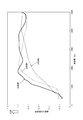
- FIG. 4 shows the results of the normal incidence sound absorption coefficient test.
- the horizontal axis represents the frequency (Hz), and the vertical axis represents the normal incidence sound absorption coefficient.
- the normal incidence sound absorption coefficient is an index indicating the sound absorption performance of the soundproofing performance of the soundproofing material. The higher the value of the normal incidence sound absorption coefficient, the higher the sound absorption performance of the soundproofing material. As can be seen from the results of FIG.
- Example 1 exhibited higher normal incidence sound absorption coefficient and thus sound absorption performance over a wider frequency range than Comparative Examples 1 and 2.
- the transmission loss test was performed in an anechoic chamber using a test device shown by a vertical section in FIG.
- the test apparatus in FIG. 6 includes a rectangular parallelepiped sound insulation box BO, four speakers SP arranged inside and at four lower corners of the sound insulation box BO, and portions (side walls and side walls) of the sound insulation box BO other than the upper wall BP.
- a sound insulation cover CO that covers the bottom wall) from the outside, and a microphone M that is spaced apart above the sound insulation box BO.
- the inside (side wall and lower wall) of the sound insulation box BO was subjected to sound absorption processing.
- the upper wall BP of the sound insulation box BO was made of a metal net.
- sound pressure A the sound pressure (hereinafter, referred to as "sound pressure A"
- the soundproofing material 1 ' is placed on the upper wall BP of the soundproof box BO, and furthermore, the gap between the soundproofing material 1' and the soundproofing cover CO is sealed with the clay CL, and the sound is output from the speaker SP.
- the sound pressure (dB) hereinafter referred to as “sound pressure B” was measured by the microphone M.
- FIG. 5 shows the results of the transmission loss test.
- the horizontal axis represents frequency (Hz) and the vertical axis represents transmission loss (dB).
- the transmission loss is an index representing the soundproofing performance combining the sound absorbing performance and the sound insulating performance of the soundproofing material. The higher the value of the transmission loss, the higher the sound insulation performance including the sound absorption performance and the sound insulation performance of the sound insulation material.
- Example 1 exhibited higher transmission loss and thus soundproofing performance than Comparative Examples 1 and 2.
- Example 1 A transmission loss test was performed using Example 1 described above, and the result of evaluating the transmission loss will be described in further detail. Specifically, when the measured transmission loss is 10 dB or more at any frequency in the frequency range of 1000 to 3000 Hz, the evaluation is “ ⁇ ”. When the measured transmission loss is less than 10 dB at least at some frequencies, ⁇ ”. Table 1 shows the results.
- Example 1 exhibited high transmission loss and thus soundproofing performance.
- the soundproofing material of the present invention may be used in any place or object, but is suitable for use in vehicles.
Landscapes
- Vehicle Interior And Exterior Ornaments, Soundproofing, And Insulation (AREA)
- Polyurethanes Or Polyureas (AREA)
- Laminated Bodies (AREA)
Abstract
Ce matériau d'insonorisation (1) comprend : une première couche (10) constituée d'une première mousse de polyuréthane, et une seconde couche (20) stratifiée sur la surface d'un premier côté de la première couche et constituée d'une seconde mousse de polyuréthane ayant une densité supérieure à celle de la première mousse de polyuréthane.
Applications Claiming Priority (2)
| Application Number | Priority Date | Filing Date | Title |
|---|---|---|---|
| JP2018119233 | 2018-06-22 | ||
| JP2018-119233 | 2018-06-22 |
Publications (1)
| Publication Number | Publication Date |
|---|---|
| WO2019244640A1 true WO2019244640A1 (fr) | 2019-12-26 |
Family
ID=68983669
Family Applications (1)
| Application Number | Title | Priority Date | Filing Date |
|---|---|---|---|
| PCT/JP2019/022403 Ceased WO2019244640A1 (fr) | 2018-06-22 | 2019-06-05 | Matériau d'insonorisation et procédé de production de matériau d'insonorisation |
Country Status (1)
| Country | Link |
|---|---|
| WO (1) | WO2019244640A1 (fr) |
Cited By (3)
| Publication number | Priority date | Publication date | Assignee | Title |
|---|---|---|---|---|
| CN114981084A (zh) * | 2020-02-06 | 2022-08-30 | 旭化成建材株式会社 | 酚醛树脂发泡体层叠板 |
| JP2023088930A (ja) * | 2018-12-25 | 2023-06-27 | 株式会社イノアックコーポレーション | 防音材とその製造方法 |
| JP2023125627A (ja) * | 2022-02-28 | 2023-09-07 | シーシーアイホールディングス株式会社 | 積層吸音体 |
Citations (4)
| Publication number | Priority date | Publication date | Assignee | Title |
|---|---|---|---|---|
| JP2005352036A (ja) * | 2004-06-09 | 2005-12-22 | Asahi Rubber Kk | 防音材およびその製造方法 |
| JP2008033160A (ja) * | 2006-07-31 | 2008-02-14 | Tokai Rubber Ind Ltd | 防音材 |
| JP2017007097A (ja) * | 2015-06-16 | 2017-01-12 | シーシーアイ株式会社 | 断熱吸音材 |
| WO2017053105A1 (fr) * | 2015-09-22 | 2017-03-30 | Dow Global Technologies Llc | Distributeur de mousse de polyuréthane pulvérisée à deux composants avec purge continue du gaz |
-
2019
- 2019-06-05 WO PCT/JP2019/022403 patent/WO2019244640A1/fr not_active Ceased
Patent Citations (4)
| Publication number | Priority date | Publication date | Assignee | Title |
|---|---|---|---|---|
| JP2005352036A (ja) * | 2004-06-09 | 2005-12-22 | Asahi Rubber Kk | 防音材およびその製造方法 |
| JP2008033160A (ja) * | 2006-07-31 | 2008-02-14 | Tokai Rubber Ind Ltd | 防音材 |
| JP2017007097A (ja) * | 2015-06-16 | 2017-01-12 | シーシーアイ株式会社 | 断熱吸音材 |
| WO2017053105A1 (fr) * | 2015-09-22 | 2017-03-30 | Dow Global Technologies Llc | Distributeur de mousse de polyuréthane pulvérisée à deux composants avec purge continue du gaz |
Cited By (4)
| Publication number | Priority date | Publication date | Assignee | Title |
|---|---|---|---|---|
| JP2023088930A (ja) * | 2018-12-25 | 2023-06-27 | 株式会社イノアックコーポレーション | 防音材とその製造方法 |
| JP7587620B2 (ja) | 2018-12-25 | 2024-11-20 | 株式会社イノアックコーポレーション | 防音材とその製造方法 |
| CN114981084A (zh) * | 2020-02-06 | 2022-08-30 | 旭化成建材株式会社 | 酚醛树脂发泡体层叠板 |
| JP2023125627A (ja) * | 2022-02-28 | 2023-09-07 | シーシーアイホールディングス株式会社 | 積層吸音体 |
Similar Documents
| Publication | Publication Date | Title |
|---|---|---|
| US11655365B2 (en) | Polyurethane foam | |
| EP1930367B1 (fr) | Utilisation d'un mousse de polyurethane en véhicules et son procédé de fabrication | |
| US6765034B2 (en) | Flame-resistant and sound- and vibration-insulating member for vehicles, and process of manufacturing the same | |
| KR101623177B1 (ko) | 발포 절연성 물질에서 흡음의 증가 | |
| US11912009B2 (en) | Sound insulation material and method of producing sound insulation material | |
| CA2622045A1 (fr) | Procede pour la production de materaux flexibles alveolaires en polyurethanne de faible densite | |
| JP6998949B2 (ja) | ポリウレタンフォーム製造用組成物、吸音部材用ポリウレタンフォーム、及び吸音部材 | |
| JPS6123213B2 (fr) | ||
| JPH058211B2 (fr) | ||
| JP2005060414A (ja) | 連続気泡硬質ポリウレタンフォーム及びその製造方法並びに吸音材 | |
| JPH058209B2 (fr) | ||
| JP2005213420A (ja) | 軟質ポリウレタンフォーム及び積層体 | |
| KR102284298B1 (ko) | 흡음 성능이 향상된 대쉬 아이솔레이션 패드 | |
| JPH11140153A (ja) | 制振材用常温発泡型ポリウレタン原料及びそれから得られた制振材並びに制振構造材の製造法 | |
| KR102270889B1 (ko) | 복합 단열재 | |
| JP3135106B2 (ja) | 断熱発泡体およびその製造方法 | |
| WO2024134985A1 (fr) | Matériau insonorisant et son procédé de fabrication | |
| JP2018165292A (ja) | 軟質ポリウレタンフォーム用ポリイソシアネート組成物 | |
| KR20220048327A (ko) | 복합 단열재 | |
| JP2008024773A (ja) | 軟質ポリウレタンフォーム | |
| KR20110056568A (ko) | 고밀도 폴리우레탄 폼 및 그 제조방법 | |
| WO2023171183A1 (fr) | Matériau d'insonorisation, structure d'insonorisation et procédé de fabrication d'un matériau d'insonorisation | |
| KR20220139502A (ko) | 친환경 폴리우레탄폼 및 이의 제조방법 | |
| WO2016151942A1 (fr) | Mousse polyuréthane |
Legal Events
| Date | Code | Title | Description |
|---|---|---|---|
| 121 | Ep: the epo has been informed by wipo that ep was designated in this application |
Ref document number: 19821846 Country of ref document: EP Kind code of ref document: A1 |
|
| NENP | Non-entry into the national phase |
Ref country code: DE |
|
| 122 | Ep: pct application non-entry in european phase |
Ref document number: 19821846 Country of ref document: EP Kind code of ref document: A1 |
|
| NENP | Non-entry into the national phase |
Ref country code: JP |