WO2020003848A1 - Oxyde de lithium-nickel-cobalt-tungstène ayant une structure de sel gemme stratifiée - Google Patents
Oxyde de lithium-nickel-cobalt-tungstène ayant une structure de sel gemme stratifiée Download PDFInfo
- Publication number
- WO2020003848A1 WO2020003848A1 PCT/JP2019/020874 JP2019020874W WO2020003848A1 WO 2020003848 A1 WO2020003848 A1 WO 2020003848A1 JP 2019020874 W JP2019020874 W JP 2019020874W WO 2020003848 A1 WO2020003848 A1 WO 2020003848A1
- Authority
- WO
- WIPO (PCT)
- Prior art keywords
- transition metal
- oxide
- lithium
- rock salt
- lncw
- Prior art date
- Legal status (The legal status is an assumption and is not a legal conclusion. Google has not performed a legal analysis and makes no representation as to the accuracy of the status listed.)
- Ceased
Links
Images

Classifications
-
- C—CHEMISTRY; METALLURGY
- C01—INORGANIC CHEMISTRY
- C01G—COMPOUNDS CONTAINING METALS NOT COVERED BY SUBCLASSES C01D OR C01F
- C01G53/00—Compounds of nickel
-
- H—ELECTRICITY
- H01—ELECTRIC ELEMENTS
- H01M—PROCESSES OR MEANS, e.g. BATTERIES, FOR THE DIRECT CONVERSION OF CHEMICAL ENERGY INTO ELECTRICAL ENERGY
- H01M4/00—Electrodes
- H01M4/02—Electrodes composed of, or comprising, active material
- H01M4/36—Selection of substances as active materials, active masses, active liquids
- H01M4/48—Selection of substances as active materials, active masses, active liquids of inorganic oxides or hydroxides
- H01M4/50—Selection of substances as active materials, active masses, active liquids of inorganic oxides or hydroxides of manganese
- H01M4/505—Selection of substances as active materials, active masses, active liquids of inorganic oxides or hydroxides of manganese of mixed oxides or hydroxides containing manganese for inserting or intercalating light metals, e.g. LiMn2O4 or LiMn2OxFy
-
- H—ELECTRICITY
- H01—ELECTRIC ELEMENTS
- H01M—PROCESSES OR MEANS, e.g. BATTERIES, FOR THE DIRECT CONVERSION OF CHEMICAL ENERGY INTO ELECTRICAL ENERGY
- H01M4/00—Electrodes
- H01M4/02—Electrodes composed of, or comprising, active material
- H01M4/36—Selection of substances as active materials, active masses, active liquids
- H01M4/48—Selection of substances as active materials, active masses, active liquids of inorganic oxides or hydroxides
- H01M4/52—Selection of substances as active materials, active masses, active liquids of inorganic oxides or hydroxides of nickel, cobalt or iron
- H01M4/525—Selection of substances as active materials, active masses, active liquids of inorganic oxides or hydroxides of nickel, cobalt or iron of mixed oxides or hydroxides containing iron, cobalt or nickel for inserting or intercalating light metals, e.g. LiNiO2, LiCoO2 or LiCoOxFy
-
- Y—GENERAL TAGGING OF NEW TECHNOLOGICAL DEVELOPMENTS; GENERAL TAGGING OF CROSS-SECTIONAL TECHNOLOGIES SPANNING OVER SEVERAL SECTIONS OF THE IPC; TECHNICAL SUBJECTS COVERED BY FORMER USPC CROSS-REFERENCE ART COLLECTIONS [XRACs] AND DIGESTS
- Y02—TECHNOLOGIES OR APPLICATIONS FOR MITIGATION OR ADAPTATION AGAINST CLIMATE CHANGE
- Y02E—REDUCTION OF GREENHOUSE GAS [GHG] EMISSIONS, RELATED TO ENERGY GENERATION, TRANSMISSION OR DISTRIBUTION
- Y02E60/00—Enabling technologies; Technologies with a potential or indirect contribution to GHG emissions mitigation
- Y02E60/10—Energy storage using batteries
Definitions
- the present invention relates to a lithium nickel cobalt tungsten oxide having a layered rock salt structure used as a positive electrode active material of a lithium ion secondary battery.
- lithium nickel oxide represented by LiNiO 2 was widely used as a positive electrode active material at the beginning of development of a lithium ion secondary battery as described in Patent Document 1.
- Patent Literature 2 specifically describes a lithium ion secondary battery employing LiNi 0.81 Co 0.15 Al 0.04 O 2 as a positive electrode active material.
- Patent Literature 3 discloses a lithium ion employing LiNi 0.8 Co 0.16 Al 0.04 O 2 or LiNi 0.8 Co 0.15 Al 0.04 O 1.9 F 0.1 as a positive electrode active material. A secondary battery is specifically described.
- Patent Literature 4 specifically describes a lithium ion secondary battery employing LiNi 0.8 Co 0.15 Al 0.05 O 2 as a positive electrode active material.
- Patent Literature 5 discloses Li 1.013 Ni 0.831 Co 0.119 Al 0.050 O 2 , Li 1.013 Ni 0.858 Co 0.123 Al 0.020 O 2 or Li 1 as a positive electrode active material. Lithium ion secondary batteries employing 0.013 Ni 0.867 Co 0.098 Al 0.035 O 2 are specifically described.
- the present invention has been made in view of such circumstances, and has as its object to provide a new material that can be a positive electrode active material.
- the lithium nickel cobalt tungsten oxide having a layered rock salt structure of the present invention is represented by the following general formula (1).
- Formula (1) Li a Ni b Co c W d D e O f F g
- D is a doping element.
- a new material that can be a suitable positive electrode active material can be provided.
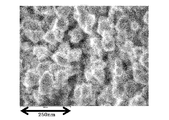
- 3 is an SEM image of a lithium nickel cobalt tungsten oxide having a layered rock salt structure of Example 1.
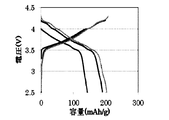
- 3 is a charge / discharge curve of the lithium ion secondary battery of Example 1.
- 9 is a charge / discharge curve of the lithium ion secondary battery of Example 3.
- the numerical range “xy” described in this specification includes the lower limit x and the upper limit y.
- a numerical range can be formed by arbitrarily combining these upper and lower limits and the numerical values listed in the examples.
- numerical values arbitrarily selected from within the numerical value range can be set as upper and lower limit numerical values.
- Lithium nickel cobalt tungsten oxide having a layered rock salt structure of the present invention (hereinafter, may be abbreviated as LNCW oxide of the present invention.
- lithium nickel cobalt tungsten oxide having a layered rock salt structure may be abbreviated as LNCW oxide. Is represented by the following general formula (1).
- Formula (1) Li a Ni b Co c W d D e O f F g
- D is a doping element.
- LNCW oxide of the present invention functions as a positive electrode active material of a lithium ion secondary battery.
- the valence of lithium is +1 and the valence of oxygen is -2, in the conventional lithium nickel cobalt aluminum oxide, lithium was excluded in order to secure electrical neutrality between the metal and oxygen.
- the valence of the entire nickel cobalt aluminum is +3.
- cobalt and aluminum have a valence of +3 and are stable, it is considered that the valence of nickel is also +3.
- nickel is an element that preferentially contributes to the oxidation reaction during charging. Then, as the oxidation reaction of lithium nickel cobalt aluminum oxide during charging, one-electron oxidation of Ni 3+ ⁇ Ni 4+ + e ⁇ occurs.
- Tungsten is present in the LNCW oxide of the present invention.
- Tungsten has a valence of +6 and is stable. Due to the presence of tungsten with a high oxidation number, it can be said that the LNCW oxide of the present invention allows the presence of nickel having a valence of +2 in addition to nickel having a valence of +3. Then, the oxidation reaction at the time of charging also causes two-electron oxidation of Ni 2+ ⁇ Ni 4+ + 2e ⁇ . Therefore, it can be said that the LNCW oxide of the present invention has a large charge / discharge capacity.
- the value of b in the general formula (1) is determined by the capacity of the LNCW oxide of the present invention. Is a value that greatly affects b preferably satisfies 0.6 ⁇ b ⁇ 0.97, more preferably satisfies 0.7 ⁇ b ⁇ 0.97, and satisfies 0.8 ⁇ b ⁇ 0.96. More preferred. Also, 0.95 or 0.9 can be adopted as the upper limit of b.
- c preferably satisfies 0.01 ⁇ c ⁇ 0.3, more preferably satisfies 0.02 ⁇ c ⁇ 0.2, and 0.03 ⁇ c ⁇ 0. .15, more preferably 0.04 ⁇ c ⁇ 0.1.
- d preferably satisfies 0.001 ⁇ d ⁇ 0.3, more preferably satisfies 0.003 ⁇ d ⁇ 0.2, and 0.004 ⁇ d ⁇ 0. .1 is more preferable, and it is particularly preferable that 0.005 ⁇ d ⁇ 0.05 is satisfied.
- a, e, f, and g may be numerical values within the range defined by the general formula (1), and are preferably 0.5 ⁇ a ⁇ 1.5, 0 ⁇ e ⁇ 0.15, 1.8 ⁇ f ⁇ 2.1, 0 ⁇ g ⁇ 0.15, more preferably 0.8 ⁇ a ⁇ 1.3, 0 ⁇ e ⁇ 0.1, 1.9 ⁇ f ⁇ 2.1, 0 ⁇ g ⁇ 0 .1 can be exemplified.
- D in the general formula (1) is a doping element, which is an element capable of improving the characteristics of the LNCW oxide of the present invention.
- F in the general formula (1) is also an element capable of improving the characteristics of the LNCW oxide of the present invention.
- One preferred embodiment of the general formula (1) is the following general formula (1-1).
- Formula (1-1) Li a Ni b Co c W d D 1 e1 D 2 e2 O f F g
- a, b, c, d, e1, e2, f, and g are 0.5 ⁇ a ⁇ 2, 0.5 ⁇ b ⁇ 0.97, and 0 ⁇ c ⁇ 0.
- D 1 is Zr, Ca, V, Mn, Cu, Ni, Sn, Tl, Fe, Sr, Ti, Ba, Mo, Y, a rare earth element, Os, Ir, Cd, Re, Bi, Rh, W, Cr, At least one element selected from Co, Zn, In, Al, Li, Na, Pb, Ru, and Nb.
- D 2 is an element other than Li, Ni, Co, W, D 1, O, F.
- D 1 in the general formula (1-1) is a doping element that can particularly suitably improve the characteristics of the LNCW oxide of the present invention.
- e1 preferably satisfies 0.0001 ⁇ e1 ⁇ 0.2, more preferably satisfies 0.001 ⁇ e1 ⁇ 0.2, and satisfies 0.01 ⁇ e1 ⁇ 0.15. More preferred.
- e1 may be 0 or 0 ⁇ e1 ⁇ 0.2.
- D 2 in the general formula (1-1) is a doping element capable of suitably improving the characteristics of the LNCW oxide of the present invention.
- Examples of the range of e2 in the general formula (1-1) include 0 ⁇ e2 ⁇ 0.1, 0 ⁇ e2 ⁇ 0.00.05, and 0 ⁇ e2 ⁇ 0.01. In addition, e2 may be 0.
- One embodiment of the method for producing an LNCW oxide of the present invention is: Preparing a transition metal hydroxide containing nickel, cobalt and tungsten, Heating the transition metal hydroxide to remove adhering water or a transition metal oxide; A step of mixing the transition metal hydroxide from which the attached water has been removed or the transition metal oxide with a lithium salt and calcining the mixture.
- a preferred embodiment of the method for producing an LNCW oxide of the present invention (hereinafter, also referred to as a “preferred production method of the present invention”) is described below. a) preparing a transition metal hydroxide containing nickel, cobalt and tungsten; b) heating the transition metal hydroxide to remove adhering water or to form a transition metal oxide; c) a step of coating the transition metal hydroxide or the transition metal oxide from which adhering water has been removed with a metal compound to form a coated body; d) mixing the coated body and a lithium salt and firing the mixture.
- D 1 in the general formula (1-1) is a metal mainly derived from the metal compound in step c).
- D 2 is an element derived from predominantly a) step and / or d) compounds that may be added in step.
- step c) particles of a transition metal hydroxide or a transition metal oxide are coated with a metal compound, and in the subsequent step d), the metal compound in the coated portion is It is considered to be a barrier, preventing nickel inside the particles from migrating to lithium sites having a layered rock salt structure. That is, in the LNCW oxide manufactured by the preferable manufacturing method of the present invention, it is considered that the ratio of nickel correctly present in the transition metal site that should originally exist is higher than that of the conventional one. As a result, the lithium ion secondary battery including the positive electrode including the preferred LNCW oxide of the present invention exhibits favorable battery characteristics.
- the pH defined in this specification refers to a value measured at 25 ° C.
- Step a) is a step of preparing a transition metal hydroxide containing nickel, cobalt and tungsten.
- the transition metal hydroxide containing nickel, cobalt and tungsten used in the step a) can be produced by mixing an aqueous solution containing nickel, cobalt and tungsten and a basic aqueous solution to precipitate the transition metal hydroxide. .
- the production process of the transition metal hydroxide will be described in detail.
- the production process of the transition metal hydroxide Dissolving a nickel salt, a cobalt salt and a tungsten compound in water, and preparing a transition metal-containing aqueous solution containing nickel, cobalt and tungsten at a predetermined ratio, A step of preparing a basic aqueous solution, A transition metal hydroxide precipitation step of supplying the transition metal-containing aqueous solution to the basic aqueous solution to precipitate nickel, cobalt and tungsten as transition metal hydroxides.
- nickel salt examples include nickel sulfate, nickel carbonate, nickel nitrate, nickel acetate, and nickel chloride.
- cobalt salt examples include cobalt sulfate, cobalt carbonate, cobalt nitrate, cobalt acetate, and cobalt chloride.
- tungsten compound examples include tungstates such as Li 2 WO 4 , Na 2 WO 4 , K 2 WO 4 , and (NH 4 ) 2 WO 4 .
- the mixing ratio of the nickel salt, the cobalt salt and the tungsten compound in the aqueous solution containing the transition metal may be adjusted so that the mixing ratio becomes a desired metal composition ratio of the LNCW oxide.
- the step of preparing the transition metal-containing aqueous solution is preferably performed in a reaction vessel equipped with a stirrer, and more preferably in a reaction vessel equipped with a device capable of introducing an inert gas such as nitrogen or argon. Further, a reaction tank provided with a device under constant temperature conditions is more preferable.
- the transition metal-containing aqueous solution is preferably heated to a temperature in the range of preferably 40 to 90 ° C, more preferably 40 to 80 ° C.
- the pH of the basic aqueous solution is preferably in the range of 9 to 14, more preferably in the range of 10 to 13, and still more preferably in the range of 10.5 to 12.
- the basic compound that can be used any compound that dissolves in water and exhibits basicity may be used. Examples thereof include ammonia, sodium hydroxide, potassium hydroxide, and alkali metal hydroxides such as lithium hydroxide, sodium carbonate, and carbonate.
- Alkali metal carbonates such as potassium and lithium carbonate; alkali metal phosphates such as trisodium phosphate, tripotassium phosphate and trilithium phosphate; and alkali metal acetates such as sodium acetate, potassium acetate and lithium acetate. Can be.
- the basic compound may be used alone or in combination of two or more. In the following steps, it is preferable that the pH of the aqueous solution is maintained in a suitable range, and therefore, the basic aqueous solution preferably contains at least a basic compound having a buffering ability.
- the basic compound having a buffering ability include ammonia, alkali metal carbonate, alkali metal phosphate, and alkali metal acetate.
- the step of preparing the basic aqueous solution is preferably performed in a reaction vessel equipped with a stirrer, and more preferably in a reaction vessel equipped with a device capable of introducing an inert gas such as nitrogen or argon. Further, a reaction tank provided with a device under constant temperature conditions is more preferable.
- the basic aqueous solution is preferably heated to a temperature in the range of preferably 40 to 90 ° C, more preferably 40 to 80 ° C.
- transition metal hydroxide precipitation step by supplying the transition metal-containing aqueous solution to the basic aqueous solution, metal ions and hydroxide ions react, and nickel, cobalt and tungsten having low solubility in water. Is generated and precipitates.
- tungstate When tungstate is used, tungsten is precipitated as tungstic acid, O 2 W (OH) 2 , together with nickel hydroxide and cobalt hydroxide.
- transition metal hydroxides are collectively referred to as transition metal hydroxides.
- the precipitated transition metal hydroxide particles form the basis of the primary particles of the LNCW oxide.
- transition metal hydroxide precipitation step is performed under conditions where the transition metal hydroxide deposition rate is extremely high, that is, under conditions where transition metal hydroxide nuclei are generated everywhere, disordered transition metal hydroxides are formed. Particles may form, which may result in undesirable crystal habits of the primary particles of the LNCW oxide. Therefore, in the transition metal hydroxide precipitation step, it is preferable to precipitate particles of the transition metal hydroxide under as mild conditions as possible.
- the rate of supplying the transition metal-containing aqueous solution is preferably from 10 to 1000 mL / h, more preferably from 20 to 500 mL / h, and particularly preferably from 50 to 300 mL / h.
- the reaction solution is preferably maintained at a constant pH.
- the pH value means the value itself obtained by measuring the reaction solution with a pH meter.
- the pH is preferably in the range of 9 to 14, more preferably in the range of 10 to 12, and particularly preferably in the range of 10.5 to 11.
- the transition metal hydroxide precipitation step is preferably performed in a reaction vessel equipped with a stirrer, and more preferably in a reaction vessel equipped with a device capable of introducing an inert gas such as nitrogen or argon. Further, a reaction tank provided with a device under constant temperature conditions is more preferable.
- the amount of dissolved oxygen present in the reaction system is small. If the amount of dissolved oxygen present in the reaction system is large, an undesired oxidation reaction may occur, or a suitable crystallization of the transition metal hydroxide accompanying the precipitation of the transition metal hydroxide may be hindered.
- the transition metal hydroxide precipitation step is performed under heating, while performing while introducing an inert gas into the reaction system, a deoxidizer, It is preferable to carry out the reaction in the presence of a reducing agent, an antioxidant and the like.
- Examples of the heating range are 40 to 90 ° C. and 60 to 80 ° C.
- Examples of the inert gas include nitrogen, argon, and helium.
- Examples of the oxygen scavenger, reducing agent and antioxidant include ascorbic acid and its salts, glyoxylic acid and its salts, hydrazine, dimethylhydrazine, hydroquinone, dimethylamine borane, NaBH 4 , NaBH 3 CN, KBH 4 , sulfurous acid and its salts Thiosulfuric acid and its salts, pyrosulfite and its salts, phosphorous acid and its salts, hypophosphorous acid and its salts.
- the transition metal hydroxide is separated by filtration or the like. With the above method, a transition metal hydroxide can be obtained.
- transition metal hydroxide containing D 2 may be manufactured.
- the step b) is a step of heating a transition metal hydroxide containing nickel to remove adhered water or to form a transition metal oxide.
- the heating temperature is preferably in the range of 100 to 800 ° C, more preferably in the range of 200 to 700 ° C, and particularly preferably in the range of 300 to 600 ° C.
- Step b) may be performed under normal pressure or under reduced pressure.
- the step c) is a step of coating a transition metal hydroxide or a transition metal oxide from which adhering water has been removed with a metal compound to obtain a coated body.
- a case where the “transition metal oxide” is coated with a metal compound will be described.
- “transition metal oxide” is appropriately changed to “transition metal hydroxide from which adhered water has been removed”. Then, it should be read.
- a method in which a precursor of each metal compound or an aqueous solution in which each metal is dissolved is sprayed on the transition metal oxide, and / or simultaneously, may be dried.
- the transition metal oxide is immersed in an aqueous solution in which the precursor of each metal compound or each metal is dissolved, and the precursor of each metal compound or the hydroxide of each metal is attached to the surface of the transition metal oxide. Then, a method of heating and drying may be adopted.
- a dispersion of the transition metal oxide, a precursor of each metal compound and an aqueous solution in which each metal is dissolved are mixed, and a hydroxide of each metal is precipitated on the surface of the transition metal oxide, and then dried.
- precipitation method a dispersion of the transition metal oxide, a precursor of each metal compound and an aqueous solution in which each metal is dissolved
- D 1 is the preferred precipitation method when the Zr, will be described in detail.
- the precipitation method includes the following steps c-1), c-2) and c-3). If D 1 is a metal other than Zr are, c-1) step, c-2) step and c-3) zirconium may be read as to the metal in the process.
- c-1 a metal other than Zr
- c-1 step, c-2) step and c-3) zirconium
- zirconium zirconium
- zirconium zirconium
- step c-2 an aqueous solution containing a plurality of metals
- the steps c-2) and c-3) may be repeated.
- c-1) a dispersion liquid preparing step of dispersing the transition metal oxide in water
- c-2) a zirconium precipitation step of mixing the zirconium aqueous solution containing the hetero element-containing organic compound and the dispersion to precipitate zirconium hydroxide on the surface of the transition metal oxide
- c-3) A step of drying a transition metal oxide having zirconium hydroxide deposited on the surface to form a coated body
- the transition metal oxide it is preferable to pulverize the transition metal oxide before the step (c-1). Further, it is preferable to adjust the pH so that the pH of the dispersion is in the range of about 9 to 12.
- a zirconium aqueous solution containing a hetero element-containing organic compound is produced by dissolving a zirconium salt and a hetero element-containing organic compound in water.
- the aqueous zirconium solution containing the hetero element-containing organic compound is usually an acidic solution.
- zirconium salt examples include zirconium oxide, zirconium hydroxide, zirconium sulfate, zirconium nitrate, zirconium phosphate, and zirconium halide.
- the hetero element in the hetero element-containing organic compound means N, O, P or S.
- the hetero element-containing organic compound include an amino group, an amide group, an imide group, an imino group, a cyano group, an azo group, a hydroxyl group, an alkoxy group, a carboxyl group, an ester group, an ether group, a carbonyl group, which can be coordinated with a metal ion.
- a chelate compound having a plurality of the above groups and capable of coordinating to a metal ion at a plurality of positions is preferable.
- chelating compounds include polyamine compounds such as ethylenediamine, diethylenetriamine, glycine, alanine, cysteine, glutamine, arginine, asparagine, aspartic acid, serine, amino acids such as ethylenediaminetetraacetic acid, malonic acid, succinic acid, glutaric acid, and maleic acid.
- polyamine compounds such as ethylenediamine, diethylenetriamine, glycine, alanine, cysteine, glutamine, arginine, asparagine, aspartic acid, serine
- amino acids such as ethylenediaminetetraacetic acid, malonic acid, succinic acid, glutaric acid, and maleic acid.
- dicarboxylic acids such as phthalic acid, and hydroxycarboxylic acids.
- hydroxycarboxylic acid is particularly preferred.
- examples of the hydroxycarboxylic acid having a hydroxyl group and a carboxyl group in a molecule include an aliphatic hydroxycarboxylic acid and an aromatic hydroxycarboxylic acid.
- Aliphatic hydroxycarboxylic acids include glycolic acid, lactic acid, tartronic acid, glyceric acid, 2-hydroxybutyric acid, 3-hydroxybutyric acid, ⁇ -hydroxybutyric acid, malic acid, tartaric acid, citramalic acid, citric acid, isocitric acid, leucic acid , Mevalonic acid, pantoic acid, quinic acid and shikimic acid.
- aromatic hydroxycarboxylic acid examples include o-hydroxybenzoic acid derivatives such as salicylic acid, gentisic acid and orseric acid, mandelic acid, benzylic acid and 2-hydroxy-2-phenylpropionic acid.
- Any of the above specific hydroxycarboxylic acids can form a conformation in which an OH group and a CO 2 H group can coordinate to the same zirconium ion.
- step c-2 it is preferable to control the pH of the mixed solution in step c-2) in order to deposit zirconium efficiently.
- zirconium hydroxide having low solubility is precipitated on the surface of the transition metal oxide by setting the pH of the mixed solution to the alkali side.
- a basic aqueous solution so that the pH of the solution in step c-2) is in the range of 9 to 13.
- the basic aqueous solution those described in the step a) may be employed.
- the transition metal oxide that has passed through the step c-2) is separated by a method such as filtration and supplied to the step c-3).
- the drying in the step c-3) is preferably performed under heating and / or under reduced pressure.
- Examples of the heating temperature are in the range of 100 to 500 ° C and 200 to 400 ° C.
- the main purpose of the drying in the step c-3) is to remove water adhering to the transition metal oxide having zirconium hydroxide precipitated on the surface.
- zirconium hydroxide present on the surface of the transition metal oxide may be dehydrated and changed to zirconium oxide. That is, the coated body may be a transition metal oxide coated with zirconium hydroxide or a transition metal oxide coated with zirconium oxide.
- Step d) is a step in which the coated body and the lithium salt are mixed and fired.
- lithium salt examples include lithium carbonate, lithium hydroxide, lithium nitrate, lithium acetate, lithium oxalate, and lithium halide.
- the amount of the lithium salt may be appropriately determined so that the LNCW oxide has a desired lithium composition.
- Examples of the mixing device include a mortar and pestle, a stirring mixer, a V-type mixer, a W-type mixer, a ribbon-type mixer, a drum mixer, and a ball mill.
- F compounds may be mixed.
- a compound selected from a Na compound, an F compound and a P compound is preferably mixed. Due to the presence of D 2, the improvement of rate characteristics and / or the capacity retention rate of the lithium ion secondary battery having a LNCW oxide of the present invention can be expected.
- the Na compounds exemplified NaF, NaCl, NaBr, NaI, and sodium salts, such as Na 3 PO 4, Na 2 HPO 4, NaH 2 PO 4, Na 2 SO 4, NaHSO 4, NaNO 3, CH 3 CO 2 Na it can.
- the F compound include metal fluorides such as LiF, NaF, KF, MgF 2 , CaF 2 , BaF 2 , and AlF 3 .
- Examples of the P compound include H 3 PO 4 , LiH 2 PO 4 , Li 2 HPO 4 , Li 3 PO 4 , NaH 2 PO 4 , Na 2 HPO 4 , Na 3 PO 4 , KH 2 PO 4 , K 2 HPO 4 , phosphoric acid and phosphates such K 3 PO 4 can be exemplified.
- the firing may be performed in an air atmosphere or an oxygen gas atmosphere, or may be performed in the presence of an inert gas such as helium or argon.
- the heating temperature in the firing step can be, for example, in the range of 400 to 1200 ° C.
- the heating time in the firing step can be, for example, 1 to 50 hours.
- the baking in the step d) may be performed under a single temperature condition, or may be performed by combining a plurality of baking processes having different temperature conditions, or may be performed by setting a specific temperature raising program. May be.
- a first firing step in which the mixture of the coated body and the lithium salt is heated at 400 to 800 ° C. to form a first fired body;
- a second firing step of heating at 550 to 1000 ° C. can be mentioned.
- Examples of the temperature of the first baking step include a range of 400 to 800 ° C. and 650 to 750 ° C.
- Examples of the heating time in the first firing step include a range of 3 to 30 hours, 5 to 20 hours, and 5 to 15 hours.
- the second firing step is a step of heating the first fired body at 550 to 1000 ° C.
- the temperature of the second firing step may be in the range of 550 to 950 ° C., 550 to 900 ° C., 550 to 850 ° C., and 550 to 800 ° C.
- Examples of the heating time in the second baking step include a range of 3 to 30 hours, 5 to 20 hours, and 5 to 15 hours.
- step c) the transition metal oxide particles are coated with the metal compound, so that the coated metal compound becomes a barrier in the first and second firing steps, It is considered that nickel is restrained from migrating to lithium sites having a layered rock salt structure.
- the LNCW oxide obtained in the step d) has a certain particle size distribution through a pulverizing step and a classification step.
- the average particle size (D 50 ) is preferably 50 ⁇ m or less, more preferably 1 ⁇ m or more and 30 ⁇ m or less, still more preferably 1 ⁇ m or more and 20 ⁇ m or less in a measurement with a general laser scattering diffraction type particle size distribution meter. And 2 ⁇ m or more and 10 ⁇ m or less are particularly preferable.
- Another preferred embodiment of the method for producing an LNCW oxide of the present invention (hereinafter, also referred to as a “second production method”) is as follows. a′-1) preparing a transition metal hydroxide containing nickel and cobalt; a′-2) a step of adding an aqueous solution of tungstate to a basic suspension containing a transition metal hydroxide, a′-3) a step of lowering the pH of the suspension after the addition of the aqueous solution of tungstate to precipitate tungstic acid on the surface of the transition metal hydroxide to form a coated body; b ′) heating the coated body to remove adhering water or to form a transition metal oxide; d ′) a step of mixing the transition metal hydroxide or the transition metal oxide from which the adhering water has been removed with a lithium salt and firing the mixture.
- each step includes the a) step or c) step described above for the a′-1) to a′-3) steps, and the b) step described above for the b ′) step.
- the technical content of the step d) described above is appropriately and appropriately used.
- third production method is as follows. a '') providing a transition metal hydroxide comprising nickel and cobalt; b '') heating the transition metal hydroxide to remove adhering water or to form a transition metal oxide; c '') To the transition metal hydroxide or the suspension containing the transition metal oxide from which the adhering water has been removed, an aqueous solution of tungstate is added to convert the transition metal hydroxide or the transition metal oxide into tungsten. Coating with an acid to form a coated body, d '') mixing the coated body and a lithium salt and firing the mixture.
- each step includes the a) step described above for the a ′′) step, the b) step described above for the b ′′) step, and the previously described b) step for the c ′′) step.
- the steps a′-2), a′-3), and d ′′) the technical contents of the step d) described above are appropriately and appropriately used.
- tungsten is added in the step a'-2) and integrated with the transition metal hydroxide containing nickel and cobalt in the step a'-3).
- tungsten is integrated with a transition metal hydroxide containing nickel and cobalt in step c ′′).
- a transition metal hydroxide containing nickel, cobalt and tungsten is produced at a time by coprecipitation, a tungstate composed of hexavalent tungsten is used as a nickel hydroxide. May be partially oxidized to form nickel oxyhydroxide. As a result, it is assumed that the crystal growth of the transition metal hydroxide is hindered.
- a transition metal hydroxide is produced without adding tungsten, as in the second production method and the third production method, in the a′-1) step and the a ′′) step where tungsten is not added, It is considered that the crystal growth of the transition metal hydroxide containing nickel and cobalt proceeds smoothly because there is no inhibition of the crystal growth as described above.
- the size of the crystal of the transition metal hydroxide as an intermediate is considered to be the basis of the size of the primary particles of the LNCW oxide of the present invention, it is produced by the second production method and the third production method. It can be said that the LNCW oxide of the present invention contains relatively large primary particles. And, the LNCW oxide of the present invention containing large primary particles is expected to have low resistance.
- the size of the primary particles of the LNCW oxide is preferably in the range of 50 nm to 1000 nm, more preferably in the range of 100 nm to 500 nm, and even more preferably in the range of 150 nm to 500 nm by microscopic observation.
- the primary particles mean particles that are recognized as one particle during SEM observation.
- the peak intensity (lamellar intensity) derived from the lamellar structure observed at 2 ⁇ 17 to 20 ° is obtained.
- the LNCW oxide of the present invention can be used as an active material of a lithium ion secondary battery.
- the lithium ion secondary battery of the present invention includes the LNCW oxide of the present invention as an active material.
- the lithium ion secondary battery of the present invention includes a positive electrode including the LNCW oxide of the present invention as a positive electrode active material, a negative electrode, and a solid electrolyte, or includes the LNCW oxide of the present invention as a positive electrode active material.
- a positive electrode, a negative electrode, an electrolytic solution, and a separator provided as materials are provided.
- the positive electrode has a current collector and a positive electrode active material layer bound to the surface of the current collector.
- the current collector refers to a chemically inert electronic conductor that keeps current flowing through the electrodes during discharging or charging of the lithium ion secondary battery.
- As the current collector at least one selected from silver, copper, gold, aluminum, tungsten, cobalt, zinc, nickel, iron, platinum, tin, indium, titanium, ruthenium, tantalum, chromium, molybdenum, and stainless steel A metal material can be exemplified.
- the current collector may be covered with a known protective layer. A current collector whose surface is treated by a known method may be used as the current collector.
- the current collector can be in the form of a foil, a sheet, a film, a line, a bar, a mesh, or the like. Therefore, for example, a metal foil such as a copper foil, a nickel foil, an aluminum foil, and a stainless steel foil can be suitably used as the current collector.
- a metal foil such as a copper foil, a nickel foil, an aluminum foil, and a stainless steel foil can be suitably used as the current collector.
- the thickness is preferably in the range of 1 ⁇ m to 100 ⁇ m.
- the positive electrode active material layer contains a positive electrode active material and, if necessary, a conductive auxiliary and / or a binder.
- any material containing the LNCW oxide of the present invention may be used, and only the LNCW oxide of the present invention may be employed, or a combination of the LNCW oxide of the present invention and a known positive electrode active material may be used. May be.
- Examples of the known positive electrode active material include a spinel structure compound such as LiMn 2 O 4 , and a general formula: LiM h PO 4 (M is Mn, Fe, Co, Ni, Cu, Mg, Zn, V, Ca, Sr, and Ba). , At least one element selected from Ti, Al, Si, B, Te and Mo, an olivine structure compound represented by 0 ⁇ h ⁇ 2), LiMVO 4 or Li 2 MSiO 4 (where M is Co, Ni , Mn, or Fe), a polyanionic compound represented by LiMPO 4 F (M is a transition metal), a tabolite compound represented by LiMPO 3 (M is a transition metal). Borate compounds, Li 2 MnO 3 and the like.
- LiM h PO 4 M is Mn, Fe, Co, Ni, Cu, Mg, Zn, V, Ca, Sr, and Ba
- At least one element selected from Ti, Al, Si, B, Te and Mo an olivine structure compound represented by 0 ⁇ h
- the conductive additive is added to increase the conductivity of the electrode. Therefore, the conductive assistant may be arbitrarily added when the conductivity of the electrode is insufficient, and may not be added when the conductivity of the electrode is sufficiently excellent.
- the conductive additive may be any chemically inert high electron conductor, and examples thereof include carbon black, graphite, vapor grown carbon fiber (Vapor Grown Carbon Fiber), and various metal particles. You. Examples of the carbon black include acetylene black, Ketjen Black (registered trademark), furnace black, and channel black. These conductive aids can be used alone or in combination of two or more.
- the compounding ratio of the conductive additive in the active material layer is preferably from 1: 0.005 to 1: 0.5, and preferably from 1: 0.01 to 1: 0, by mass ratio. .2, more preferably 1: 0.03 to 1: 0.1. If the amount of the conductive auxiliary agent is too small, an efficient conductive path cannot be formed, and if the amount of the conductive auxiliary agent is too large, the moldability of the active material layer deteriorates and the energy density of the electrode decreases.
- the binder plays a role of anchoring the active material and the conductive assistant to the surface of the current collector and maintaining the conductive network in the electrode.
- the binder include fluorine-containing resins such as polyvinylidene fluoride, polytetrafluoroethylene, and fluororubber; thermoplastic resins such as polypropylene and polyethylene; imide-based resins such as polyimide and polyamideimide; resins containing alkoxysilyl groups; Examples include acrylic resins such as (meth) acrylic acid, styrene-butadiene rubber (SBR), and carboxymethyl cellulose. These binders may be used alone or in combination.
- the mixing ratio of the binder in the active material layer is preferably 1: 0.001 to 1: 0.3, and 1: 0.005 to 1: 0, in terms of mass ratio. .2, more preferably 1: 0.01 to 1: 0.15. This is because if the amount of the binder is too small, the moldability of the electrode decreases, and if the amount of the binder is too large, the energy density of the electrode decreases.
- the negative electrode has a current collector and a negative electrode active material layer bound to the surface of the current collector.
- the current collector those described for the positive electrode may be appropriately employed.
- the negative electrode active material layer contains a negative electrode active material and, if necessary, a conductive auxiliary and / or a binder.
- the negative electrode active material a known material may be employed, and examples thereof include a carbon-based material capable of inserting and extracting lithium, an element capable of being alloyed with lithium, and a compound having an element capable of being alloyed with lithium. .
- the carbon-based material examples include non-graphitizable carbon, graphite, cokes, graphites, glassy carbons, organic polymer compound fired bodies, carbon fibers, activated carbon and carbon blacks.
- the organic polymer compound fired body is obtained by firing a polymer material such as phenols and furans at an appropriate temperature and carbonizing the polymer material.
- elements that can be alloyed with lithium include Na, K, Rb, Cs, Fr, Be, Mg, Ca, Sr, Ba, Ra, Ti, Ag, Zn, Cd, Al, Ga, In, and Si.
- Ge, Sn, Pb, Sb, and Bi can be exemplified, and Si or Sn is particularly preferable.
- the compound having an element that can be alloyed with lithium include ZnLiAl, AlSb, SiB 4 , SiB 6 , Mg 2 Si, Mg 2 Sn, Ni 2 Si, TiSi 2 , MoSi 2 , CoSi 2 , NiSi 2 , CaSi 2, CrSi 2, Cu 5 Si, FeSi 2, MnSi 2, NbSi 2, TaSi 2, VSi 2, WSi 2, ZnSi 2, SiC, Si 3 N 4, Si 2 N 2 O, SiO v (0 ⁇ v ⁇ 2), SnO w (0 ⁇ w ⁇ 2), SnSiO 3 , LiSiO or LiSnO, and in particular, SiO x (0.3 ⁇ x ⁇ 1.6, or 0.5 ⁇ x ⁇ 1.5) Is preferred.
- the negative electrode active material preferably contains a Si-based material having Si.
- the Si-based material is preferably made of silicon or / and a silicon compound capable of occluding and releasing lithium ions, and is preferably, for example, SiO x (0.5 ⁇ x ⁇ 1.5).
- SiO x 0.5 ⁇ x ⁇ 1.5
- silicon has a large theoretical charge / discharge capacity
- silicon has a large volume change during charge / discharge. Therefore, the volume change of silicon can be reduced by using SiO x containing silicon as the negative electrode active material.
- a Si material obtained by heating a layered polysilane obtained by treating CaSi 2 with an acid such as hydrochloric acid or hydrofluoric acid at 300 to 1000 ° C. may be employed. Further, the Si material may be heated together with a carbon source, and a carbon-coated Si material may be used as the negative electrode active material.
- the negative electrode active material one or more of the above can be used.
- conductive auxiliary agent and the binder used for the negative electrode those described for the positive electrode may be appropriately and appropriately employed in the same mixing ratio.
- the current is collected using a conventionally known method such as a roll coating method, a die coating method, a dip coating method, a doctor blade method, a spray coating method, and a curtain coating method.
- the active material may be applied to the surface of the body.
- a slurry is prepared by mixing an active material, a solvent, and, if necessary, a binder and / or a conductive assistant.
- the solvent include N-methyl-2-pyrrolidone, methanol, methyl isobutyl ketone, and water.
- the slurry is applied to the surface of the current collector and then dried. The dried product may be compressed to increase the electrode density.
- a solid electrolyte that can be used as a solid electrolyte of a lithium ion secondary battery may be appropriately adopted.
- the electrolytic solution contains a non-aqueous solvent and an electrolyte dissolved in the non-aqueous solvent.
- cyclic carbonate As the non-aqueous solvent, cyclic carbonate, cyclic ester, chain carbonate, chain ester, ethers and the like can be used.
- the cyclic carbonate include ethylene carbonate, propylene carbonate, butylene carbonate, and vinylene carbonate
- examples of the cyclic ester include gamma-butyrolactone, 2-methyl-gamma-butyrolactone, acetyl-gamma-butyrolactone, and gamma-valerolactone.
- Examples of the chain carbonate include dimethyl carbonate, diethyl carbonate, dibutyl carbonate, dipropyl carbonate, and ethyl methyl carbonate
- examples of the chain ester include alkyl propionate, dialkyl malonate, and alkyl acetate.
- Examples of the ethers include tetrahydrofuran, 2-methyltetrahydrofuran, 1,4-dioxane, 1,2-dimethoxyethane, 1,2-diethoxyethane, and 1,2-dibutoxyethane.
- As the non-aqueous solvent a compound in which part or all of the hydrogen in the chemical structure of the above specific solvent is replaced by fluorine may be used.
- Examples of the electrolyte include lithium salts such as LiClO 4 , LiAsF 6 , LiPF 6 , LiBF 4 , LiCF 3 SO 3 , LiN (FSO 2 ) 2 , and LiN (CF 3 SO 2 ) 2 .
- lithium salts such as LiClO 4 , LiAsF 6 , LiPF 6 , LiBF 4 , LiCF 3 SO 3 , LiN (FSO 2 ) 2 , and LiN (CF 3 SO 2 ) 2 .
- Examples of the electrolyte include a solution in which a lithium salt is dissolved in a nonaqueous solvent such as ethylene carbonate, dimethyl carbonate, propylene carbonate, and diethyl carbonate at a concentration of about 0.5 mol / L to 1.7 mol / L.
- a nonaqueous solvent such as ethylene carbonate, dimethyl carbonate, propylene carbonate, and diethyl carbonate at a concentration of about 0.5 mol / L to 1.7 mol / L.
- the separator separates the positive electrode and the negative electrode, and prevents lithium ions from passing through while preventing a short circuit due to contact between the two electrodes.
- the separator include synthetic resins such as polytetrafluoroethylene, polypropylene, polyethylene, polyimide, polyamide, polyaramid, polyester, and polyacrylonitrile; polysaccharides such as cellulose and amylose; and natural resins such as fibroin, keratin, lignin, and suberin. Examples thereof include a porous body, a nonwoven fabric, and a woven fabric using one or a plurality of electric insulating materials such as polymers and ceramics. Further, the separator may have a multilayer structure.
- a separator is interposed between the positive electrode and the negative electrode as necessary to form an electrode body.
- the electrode body may be any of a stacked type in which a positive electrode, a separator, and a negative electrode are stacked, or a wound type in which a positive electrode, a separator, and a negative electrode are wound.
- an electrolytic solution is added to the electrode body and lithium ion secondary Use a battery.
- the lithium ion secondary battery of the present invention may be charged and discharged in a voltage range suitable for the type of active material included in the electrode.
- the shape of the lithium ion secondary battery of the present invention is not particularly limited, and various shapes such as a cylindrical type, a square type, a coin type, and a laminate type can be adopted.
- the lithium ion secondary battery of the present invention may be mounted on a vehicle.
- the vehicle may be any vehicle that uses electric energy from a lithium ion secondary battery for all or part of its power source, such as an electric vehicle or a hybrid vehicle.
- a lithium ion secondary battery is mounted on a vehicle, a plurality of lithium ion secondary batteries may be connected in series to form an assembled battery.
- devices equipped with a lithium ion secondary battery include various home electric appliances, office equipment, industrial equipment, and the like, other than vehicles, such as personal computers and portable communication devices, which are driven by batteries.
- the lithium ion secondary battery of the present invention can be used as a wind power photovoltaic power generator, a hydroelectric power generator, a power storage device and a power smoothing device for a power system, a power supply source for motive power of ships and the like, and / or auxiliary equipment, an aircraft, a space.
- Example 1 The LNCW oxide of Example 1 was manufactured as follows.
- Step 80 g of nickel sulfate hexahydrate, 11 g of cobalt sulfate heptahydrate, and 5 g of sodium tungstate dihydrate were dissolved in 400 mL of pure water to prepare a transition metal-containing aqueous solution. .
- the molar ratio of nickel, cobalt, and tungsten in the transition metal-containing aqueous solution is 85: 11: 4.
- a transition metal-containing aqueous solution was supplied to the second basic aqueous solution under nitrogen gas introduction and stirring conditions to precipitate nickel, cobalt and tungsten as transition metal hydroxides. .
- a first basic aqueous solution and a 48 wt% aqueous sodium hydroxide solution were appropriately added dropwise.
- the pH value means the value itself obtained by measuring the reaction solution with a pH meter.
- the transition metal hydroxide was separated by filtration.
- the transition metal hydroxide was washed with pure water using an ultrasonic cleaner, and then the transition metal hydroxide was isolated by filtration.
- Step A transition metal oxide dispersion was prepared by adding the transition metal oxide to pure water.
- aqueous solution of zirconium containing hydroxycarboxylic acid 0.3 g of zirconium sulfate and 0.17 g of glycolic acid as hydroxycarboxylic acid were dissolved in water to prepare an aqueous solution of zirconium containing hydroxycarboxylic acid.
- the molar ratio of zirconium to glycolic acid was 1: 2.
- Step 10 g of the dried coated body, 2.12 g of lithium hydroxide anhydride, 0.13 g of Na 3 PO 4 , and 0.023 g of LiF were mixed in a mortar to form a mixture. Then, the mixture was heated at 650 ° C. for 5 hours in an air atmosphere to obtain a first fired body.
- the first fired body was crushed in a mortar to obtain a powder.
- the powdery first fired body was heated at 750 ° C. for 15 hours in an oxygen gas atmosphere to obtain an LNCW oxide.
- the LNCW oxide was crushed in a mortar to obtain the LNCW oxide of Example 1.
- the composition of the theoretical LNCW oxide of Example 1 is Li 1 Ni 0.85 Co 0.11 W 0.04 Zr 0.0025 Na 0.01 P 0.01 O 2 F 0.01.
- Example 1 A lithium ion secondary battery of Example 1 was manufactured as follows.
- a 20 ⁇ m-thick aluminum foil was prepared as a positive electrode current collector.
- 94 parts by mass of the LNCW oxide of Example 1 as a positive electrode active material, 3 parts by mass of acetylene black as a conductive additive, and 3 parts by mass of polyvinylidene fluoride as a binder were mixed. This mixture was dispersed in an appropriate amount of N-methyl-2-pyrrolidone to prepare a slurry. The slurry was placed on the surface of the aluminum foil, and the slurry was applied using a doctor blade so as to form a film. The aluminum foil coated with the slurry was dried at 80 ° C.
- the aluminum foil having the positive electrode active material layer formed on the surface was compressed using a roll press, and the aluminum foil and the positive electrode active material layer were firmly adhered and joined to form a bonded article.
- the joined article was heated at 120 ° C. for 6 hours using a vacuum dryer, cut into a predetermined shape, and used as a positive electrode.
- the negative electrode was manufactured as follows. 98.3 parts by mass of graphite, 1 part by mass of styrene-butadiene rubber as a binder and 0.7 parts by mass of carboxymethylcellulose were mixed, and the mixture was dispersed in an appropriate amount of ion-exchanged water to produce a slurry.
- the slurry was applied to a 20 ⁇ m-thick copper foil serving as a negative electrode current collector using a doctor blade so as to form a film.
- the current collector coated with the slurry was dried and then pressed to obtain a bonded article.
- the bonded article was heated at 120 ° C. for 6 hours using a vacuum dryer, cut into a predetermined shape, and used as a negative electrode.
- a laminate type lithium ion secondary battery was manufactured. Specifically, a 25 ⁇ m-thick rectangular sheet made of a resin film having a three-layer structure of polypropylene / polyethylene / polypropylene was sandwiched between the positive electrode and the negative electrode to form an electrode plate group. This electrode group was covered with a set of two laminated films, three sides were sealed, and then an electrolyte was injected into the bag-shaped laminated film.
- the electrolytic solution a solution obtained by dissolving LiPF 6 at a concentration of 1 mol / L in a solvent obtained by mixing ethylene carbonate, ethyl methyl carbonate and dimethyl carbonate at a volume ratio of 3: 3: 4 was used.
- the four sides were hermetically sealed, and the laminated lithium ion secondary battery of Example 1 in which the electrode plate group and the electrolyte were sealed was obtained.
- the positive electrode and the negative electrode have tabs that can be electrically connected to the outside, and some of these tabs extend outside the laminated lithium ion secondary battery.
- the lithium ion secondary battery of Example 1 was manufactured.
- Example 2 In the step a), the LNCW oxide and the lithium ion secondary battery of Example 2 were manufactured in the same manner as in Example 1, except that ascorbic acid was added to the aqueous solution containing a transition metal.
- the transition metal-containing aqueous solution used in Example 2 was a solution having a concentration of ascorbic acid of 7.5 g / L. In the solution, W and ascorbic acid are present in equimolar amounts.
- Example 3 (Example 3) c)
- the LNCW oxide and lithium ion secondary battery of Example 3 were manufactured in the same manner as in Example 1, except that the step was not performed.
- Comparative Example 1 A lithium ion secondary battery of Comparative Example 1 was manufactured in the same manner as in Example 1 except that LiNi 0.85 Co 0.11 Al 0.04 O 2 was used as the positive electrode active material.
- FIG. 1 shows an SEM image of the LNCW oxide of Example 1. According to the measurement with the SEM image, the primary particle diameter of the LNCW oxide of Example 1 was about 50 nm, and the secondary particle diameter was about 4 ⁇ m.
- the lithium ion secondary battery of Example 1 is superior to the lithium ion secondary battery of Comparative Example 1 in both parameters of the initial discharge capacity and the discharge capacity retention rate.
- FIG. 2 shows a charge / discharge curve of the lithium ion secondary battery of Example 1
- FIG. 3 shows a charge / discharge curve of the lithium ion secondary battery of Example 3.
- the capacity of the lithium ion secondary battery of Example 1 is larger than the capacity of the lithium ion secondary battery of Example 3 in both charging and discharging. It can be said that the LNCW oxide of Example 1 to which Zr was added was more preferable than the LNCW oxide of Example 3 to which Zr was not added.
- Example 4 (Example 4) a) The molar ratio of nickel, cobalt, and tungsten in the aqueous solution containing the transition metal in the step was 92: 4: 4, the step c) was not performed, and the firing temperature and the firing time in the step d) slightly changed. Except having made it, the LNCW oxide of Example 4 and the lithium ion secondary battery of Example 4 were manufactured by the method similar to Example 1.
- Example 5 (Example 5) a) The molar ratio of nickel, cobalt, and tungsten in the aqueous solution containing the transition metal in the step was 95: 3: 2, the step c) was not performed, and the firing temperature and the firing time in the step d) slightly changed. Except having made it, the LNCW oxide of Example 5 and the lithium ion secondary battery of Example 5 were manufactured by the method similar to Example 1.
- Example 6 (Example 6) a) The molar ratio of nickel, cobalt, and tungsten in the aqueous solution containing the transition metal in the step was 95: 4: 1, the step c) was not performed, and the firing temperature and the firing time in the step d) slightly changed. Except having made it, the LNCW oxide of Example 6 and the lithium ion secondary battery of Example 6 were manufactured by the method similar to Example 1.
- Example 7 a) the molar ratio of nickel, cobalt, and tungsten in the aqueous solution containing the transition metal in step a) was 95.5: 4: 0.5; c) step was not performed; and b) the firing temperature and firing in step d).
- An LNCW oxide and a lithium ion secondary battery of Example 7 were produced in the same manner as in Example 1, except that the time was slightly changed.
- Evaluation example 5 With respect to the lithium ion secondary batteries of Examples 4 to 7 and Comparative Example 1, a charge / discharge cycle of charging to 4.4 V and discharging to 2.5 V at a 0.1 C rate was repeated. Evaluation example 5 was performed on a different date and time from evaluation example 3. Table 3 shows the charge capacity and the discharge capacity per unit volume of the positive electrode active material in the first charge / discharge cycle, together with the composition ratio of nickel, cobalt, and tungsten in the LNCW oxide.
Landscapes
- Chemical & Material Sciences (AREA)
- Inorganic Chemistry (AREA)
- Chemical Kinetics & Catalysis (AREA)
- Electrochemistry (AREA)
- General Chemical & Material Sciences (AREA)
- Organic Chemistry (AREA)
- Battery Electrode And Active Subsutance (AREA)
Abstract
L'invention concerne un nouveau matériau apte à être un matériau actif. La présente invention est un oxyde de lithium-nickel-cobalt-tungstène-tungstène ayant une structure de sel gemme stratifiée qui se caractérise en ce qu'elle est représentée par la formule générale (1). Formule générale (1) : LiaNibCocWdDeOfFg <sb /> <sb />Dans la formule générale (1), a, b, c, c, d, e, f, et g satisfont 0,5 ≤ a ≤ 2, 0,5 ≤ b ≤ 0,97, 0 < c < 0,5, 0 < d < 0,5, 0 ≤ e ≤ 0,2, b + c + d + e =1, 1,8 ≤ f ≤ 2,2 et 0 ≤ g ≤ 0,2. D est un élément dopant.
Applications Claiming Priority (4)
| Application Number | Priority Date | Filing Date | Title |
|---|---|---|---|
| JP2018125354 | 2018-06-29 | ||
| JP2018-125354 | 2018-06-29 | ||
| JP2018-220299 | 2018-11-26 | ||
| JP2018220299A JP2020007210A (ja) | 2018-06-29 | 2018-11-26 | 層状岩塩構造のリチウムニッケルコバルトタングステン酸化物 |
Publications (1)
| Publication Number | Publication Date |
|---|---|
| WO2020003848A1 true WO2020003848A1 (fr) | 2020-01-02 |
Family
ID=68984841
Family Applications (1)
| Application Number | Title | Priority Date | Filing Date |
|---|---|---|---|
| PCT/JP2019/020874 Ceased WO2020003848A1 (fr) | 2018-06-29 | 2019-05-27 | Oxyde de lithium-nickel-cobalt-tungstène ayant une structure de sel gemme stratifiée |
Country Status (1)
| Country | Link |
|---|---|
| WO (1) | WO2020003848A1 (fr) |
Cited By (3)
| Publication number | Priority date | Publication date | Assignee | Title |
|---|---|---|---|---|
| CN111446433A (zh) * | 2020-04-23 | 2020-07-24 | 华鼎国联四川电池材料有限公司 | 锂电池用正极复合材料及其制备方法 |
| CN113461058A (zh) * | 2021-07-15 | 2021-10-01 | 河南理工大学 | 无序岩盐结构的正极材料Li1.3Mo0.3V0.4O2的合成方法 |
| WO2022070898A1 (fr) * | 2020-09-30 | 2022-04-07 | パナソニックIpマネジメント株式会社 | Matériau actif d'électrode positive pour batteries secondaires à électrolyte non aqueux, et batterie secondaire à électrolyte non aqueux |
Citations (6)
| Publication number | Priority date | Publication date | Assignee | Title |
|---|---|---|---|---|
| JP2002216759A (ja) * | 2001-01-23 | 2002-08-02 | Toshiba Corp | リチウムイオン二次電池 |
| JP2003308880A (ja) * | 2002-04-16 | 2003-10-31 | Japan Storage Battery Co Ltd | リチウム二次電池の製造方法 |
| JP2012033397A (ja) * | 2010-07-30 | 2012-02-16 | Sanyo Electric Co Ltd | 非水電解質二次電池 |
| JP2013239434A (ja) * | 2012-04-18 | 2013-11-28 | Nichia Chem Ind Ltd | 非水電解液二次電池用正極組成物 |
| WO2017175978A1 (fr) * | 2016-04-08 | 2017-10-12 | 한양대학교 산학협력단 | Matériau actif d'électrode positive, procédé pour le fabriquer et batterie secondaire au lithium le contenant |
| JP2018078103A (ja) * | 2016-11-02 | 2018-05-17 | 株式会社豊田自動織機 | 非水系二次電池並びにこれに用いられるガス発生抑制剤及び非水系電解液 |
-
2019
- 2019-05-27 WO PCT/JP2019/020874 patent/WO2020003848A1/fr not_active Ceased
Patent Citations (6)
| Publication number | Priority date | Publication date | Assignee | Title |
|---|---|---|---|---|
| JP2002216759A (ja) * | 2001-01-23 | 2002-08-02 | Toshiba Corp | リチウムイオン二次電池 |
| JP2003308880A (ja) * | 2002-04-16 | 2003-10-31 | Japan Storage Battery Co Ltd | リチウム二次電池の製造方法 |
| JP2012033397A (ja) * | 2010-07-30 | 2012-02-16 | Sanyo Electric Co Ltd | 非水電解質二次電池 |
| JP2013239434A (ja) * | 2012-04-18 | 2013-11-28 | Nichia Chem Ind Ltd | 非水電解液二次電池用正極組成物 |
| WO2017175978A1 (fr) * | 2016-04-08 | 2017-10-12 | 한양대학교 산학협력단 | Matériau actif d'électrode positive, procédé pour le fabriquer et batterie secondaire au lithium le contenant |
| JP2018078103A (ja) * | 2016-11-02 | 2018-05-17 | 株式会社豊田自動織機 | 非水系二次電池並びにこれに用いられるガス発生抑制剤及び非水系電解液 |
Cited By (7)
| Publication number | Priority date | Publication date | Assignee | Title |
|---|---|---|---|---|
| CN111446433A (zh) * | 2020-04-23 | 2020-07-24 | 华鼎国联四川电池材料有限公司 | 锂电池用正极复合材料及其制备方法 |
| WO2022070898A1 (fr) * | 2020-09-30 | 2022-04-07 | パナソニックIpマネジメント株式会社 | Matériau actif d'électrode positive pour batteries secondaires à électrolyte non aqueux, et batterie secondaire à électrolyte non aqueux |
| JPWO2022070898A1 (fr) * | 2020-09-30 | 2022-04-07 | ||
| JP7702630B2 (ja) | 2020-09-30 | 2025-07-04 | パナソニックIpマネジメント株式会社 | 非水電解質二次電池用正極活物質および非水電解質二次電池 |
| US12512459B2 (en) | 2020-09-30 | 2025-12-30 | Panasonic Intellectual Property Management Co., Ltd. | Positive electrode active material for nonaqueous electrolyte secondary batteries, and nonaqueous electrolyte secondary battery |
| CN113461058A (zh) * | 2021-07-15 | 2021-10-01 | 河南理工大学 | 无序岩盐结构的正极材料Li1.3Mo0.3V0.4O2的合成方法 |
| CN113461058B (zh) * | 2021-07-15 | 2022-09-09 | 宜宾职业技术学院 | 无序岩盐结构的正极材料Li1.3Mo0.3V0.4O2的合成方法 |
Similar Documents
| Publication | Publication Date | Title |
|---|---|---|
| JP7213427B2 (ja) | アルミニウムの分散が均一である正極活物質 | |
| JP6413949B2 (ja) | リチウム複合金属酸化物部及び導電性酸化物部を含有する材料 | |
| JP7404886B2 (ja) | 層状岩塩構造を示し、リチウム、ニッケル、コバルト、タングステン、アルミニウム及び酸素を含有する正極活物質、並びに、その製造方法 | |
| JP6803028B2 (ja) | リチウム金属複合酸化物粉末の製造方法及びリチウム金属複合酸化物粉末 | |
| JP6288285B2 (ja) | MSix(Mは第3〜9族元素から選択される少なくとも一元素。ただし、1/3≦x≦3)含有シリコン材料およびその製造方法 | |
| JP6848172B2 (ja) | リチウム複合金属酸化物部、中間部及び導電性酸化物部を有する材料 | |
| JP7215260B2 (ja) | 層状岩塩構造を示し、リチウム、ニッケル、コバルト、タングステン、アルミニウム、ジルコニウム及び酸素を含有する正極活物質、並びに、その製造方法 | |
| JP2020001985A (ja) | ニッケルを含有する層状岩塩構造のリチウム遷移金属酸化物の製造方法 | |
| JP7215259B2 (ja) | 層状岩塩構造を示し、リチウム、ニッケル、アルミニウム、タングステン及び酸素を含有する正極活物質、並びに、その製造方法 | |
| WO2020003848A1 (fr) | Oxyde de lithium-nickel-cobalt-tungstène ayant une structure de sel gemme stratifiée | |
| JP7218687B2 (ja) | 層状岩塩構造を示し、リチウム、ニッケル、タングステン及び酸素を含有する正極活物質の製造方法 | |
| WO2020026687A1 (fr) | Procédé de fabrication d'un matériau actif de cathode destiné à une batterie secondaire au lithium | |
| JP2020007210A (ja) | 層状岩塩構造のリチウムニッケルコバルトタングステン酸化物 | |
| JP2015084273A (ja) | リチウムイオン二次電池用正極活物質 | |
| JP5447452B2 (ja) | リチウムイオン二次電池用正極活物質、その正極活物質を用いたリチウムイオン二次電池及びリチウムマンガン銀複合酸化物の製造方法 | |
| CN114127994B (zh) | 铝均匀分散的正极活性物质 | |
| JP7172896B2 (ja) | 層状岩塩構造を示し、リチウム、ニッケル、コバルト、タングステン、アルミニウム及び酸素を含有する正極活物質の製造方法 | |
| JP7215261B2 (ja) | 層状岩塩構造を示し、リチウム、ニッケル、コバルト、タングステン、ジルコニウム及び酸素を含有する正極活物質、並びに、その製造方法 | |
| JP6202205B2 (ja) | リチウム複合金属酸化物の製造方法 | |
| JP6443675B2 (ja) | スピネル型結晶構造のLiaMxMnyO4粉末を含む正極及びリチウムイオン二次電池、並びにこれらの製造方法 | |
| JP7099286B2 (ja) | リチウムニッケルコバルトモリブデン酸化物 | |
| JP6252864B2 (ja) | シリコン材料の製造方法 | |
| JP6635292B2 (ja) | M含有シリコン材料(MはSn、Pb、Sb、Bi、In、Zn又はAuから選択される少なくとも一元素)およびその製造方法 | |
| JP2020158343A (ja) | リチウム金属複合酸化物粉末の製造方法 | |
| JP7446596B2 (ja) | リチウム金属複合酸化物粉末の製造方法 |
Legal Events
| Date | Code | Title | Description |
|---|---|---|---|
| 121 | Ep: the epo has been informed by wipo that ep was designated in this application |
Ref document number: 19826470 Country of ref document: EP Kind code of ref document: A1 |
|
| NENP | Non-entry into the national phase |
Ref country code: DE |
|
| 122 | Ep: pct application non-entry in european phase |
Ref document number: 19826470 Country of ref document: EP Kind code of ref document: A1 |