WO2020003876A1 - 分散性粉体 - Google Patents
分散性粉体 Download PDFInfo
- Publication number
- WO2020003876A1 WO2020003876A1 PCT/JP2019/021502 JP2019021502W WO2020003876A1 WO 2020003876 A1 WO2020003876 A1 WO 2020003876A1 JP 2019021502 W JP2019021502 W JP 2019021502W WO 2020003876 A1 WO2020003876 A1 WO 2020003876A1
- Authority
- WO
- WIPO (PCT)
- Prior art keywords
- powder
- group
- organopolysiloxane
- oil
- dispersible
- Prior art date
- Legal status (The legal status is an assumption and is not a legal conclusion. Google has not performed a legal analysis and makes no representation as to the accuracy of the status listed.)
- Ceased
Links
- 0 CC*N(C)CC Chemical compound CC*N(C)CC 0.000 description 3
Classifications
-
- A—HUMAN NECESSITIES
- A61—MEDICAL OR VETERINARY SCIENCE; HYGIENE
- A61K—PREPARATIONS FOR MEDICAL, DENTAL OR TOILETRY PURPOSES
- A61K8/00—Cosmetics or similar toiletry preparations
- A61K8/02—Cosmetics or similar toiletry preparations characterised by special physical form
-
- A—HUMAN NECESSITIES
- A61—MEDICAL OR VETERINARY SCIENCE; HYGIENE
- A61K—PREPARATIONS FOR MEDICAL, DENTAL OR TOILETRY PURPOSES
- A61K8/00—Cosmetics or similar toiletry preparations
- A61K8/02—Cosmetics or similar toiletry preparations characterised by special physical form
- A61K8/04—Dispersions; Emulsions
-
- A—HUMAN NECESSITIES
- A61—MEDICAL OR VETERINARY SCIENCE; HYGIENE
- A61K—PREPARATIONS FOR MEDICAL, DENTAL OR TOILETRY PURPOSES
- A61K8/00—Cosmetics or similar toiletry preparations
- A61K8/18—Cosmetics or similar toiletry preparations characterised by the composition
- A61K8/19—Cosmetics or similar toiletry preparations characterised by the composition containing inorganic ingredients
-
- A—HUMAN NECESSITIES
- A61—MEDICAL OR VETERINARY SCIENCE; HYGIENE
- A61K—PREPARATIONS FOR MEDICAL, DENTAL OR TOILETRY PURPOSES
- A61K8/00—Cosmetics or similar toiletry preparations
- A61K8/18—Cosmetics or similar toiletry preparations characterised by the composition
- A61K8/19—Cosmetics or similar toiletry preparations characterised by the composition containing inorganic ingredients
- A61K8/29—Titanium; Compounds thereof
-
- A—HUMAN NECESSITIES
- A61—MEDICAL OR VETERINARY SCIENCE; HYGIENE
- A61K—PREPARATIONS FOR MEDICAL, DENTAL OR TOILETRY PURPOSES
- A61K8/00—Cosmetics or similar toiletry preparations
- A61K8/18—Cosmetics or similar toiletry preparations characterised by the composition
- A61K8/30—Cosmetics or similar toiletry preparations characterised by the composition containing organic compounds
- A61K8/64—Proteins; Peptides; Derivatives or degradation products thereof
-
- A—HUMAN NECESSITIES
- A61—MEDICAL OR VETERINARY SCIENCE; HYGIENE
- A61K—PREPARATIONS FOR MEDICAL, DENTAL OR TOILETRY PURPOSES
- A61K8/00—Cosmetics or similar toiletry preparations
- A61K8/18—Cosmetics or similar toiletry preparations characterised by the composition
- A61K8/72—Cosmetics or similar toiletry preparations characterised by the composition containing organic macromolecular compounds
- A61K8/73—Polysaccharides
-
- A—HUMAN NECESSITIES
- A61—MEDICAL OR VETERINARY SCIENCE; HYGIENE
- A61K—PREPARATIONS FOR MEDICAL, DENTAL OR TOILETRY PURPOSES
- A61K8/00—Cosmetics or similar toiletry preparations
- A61K8/18—Cosmetics or similar toiletry preparations characterised by the composition
- A61K8/72—Cosmetics or similar toiletry preparations characterised by the composition containing organic macromolecular compounds
- A61K8/81—Cosmetics or similar toiletry preparations characterised by the composition containing organic macromolecular compounds obtained by reactions involving only carbon-to-carbon unsaturated bonds
-
- A—HUMAN NECESSITIES
- A61—MEDICAL OR VETERINARY SCIENCE; HYGIENE
- A61K—PREPARATIONS FOR MEDICAL, DENTAL OR TOILETRY PURPOSES
- A61K8/00—Cosmetics or similar toiletry preparations
- A61K8/18—Cosmetics or similar toiletry preparations characterised by the composition
- A61K8/72—Cosmetics or similar toiletry preparations characterised by the composition containing organic macromolecular compounds
- A61K8/84—Cosmetics or similar toiletry preparations characterised by the composition containing organic macromolecular compounds obtained by reactions otherwise than those involving only carbon-carbon unsaturated bonds
- A61K8/85—Polyesters
-
- A—HUMAN NECESSITIES
- A61—MEDICAL OR VETERINARY SCIENCE; HYGIENE
- A61K—PREPARATIONS FOR MEDICAL, DENTAL OR TOILETRY PURPOSES
- A61K8/00—Cosmetics or similar toiletry preparations
- A61K8/18—Cosmetics or similar toiletry preparations characterised by the composition
- A61K8/72—Cosmetics or similar toiletry preparations characterised by the composition containing organic macromolecular compounds
- A61K8/84—Cosmetics or similar toiletry preparations characterised by the composition containing organic macromolecular compounds obtained by reactions otherwise than those involving only carbon-carbon unsaturated bonds
- A61K8/87—Polyurethanes
-
- A—HUMAN NECESSITIES
- A61—MEDICAL OR VETERINARY SCIENCE; HYGIENE
- A61K—PREPARATIONS FOR MEDICAL, DENTAL OR TOILETRY PURPOSES
- A61K8/00—Cosmetics or similar toiletry preparations
- A61K8/18—Cosmetics or similar toiletry preparations characterised by the composition
- A61K8/72—Cosmetics or similar toiletry preparations characterised by the composition containing organic macromolecular compounds
- A61K8/84—Cosmetics or similar toiletry preparations characterised by the composition containing organic macromolecular compounds obtained by reactions otherwise than those involving only carbon-carbon unsaturated bonds
- A61K8/88—Polyamides
-
- A—HUMAN NECESSITIES
- A61—MEDICAL OR VETERINARY SCIENCE; HYGIENE
- A61K—PREPARATIONS FOR MEDICAL, DENTAL OR TOILETRY PURPOSES
- A61K8/00—Cosmetics or similar toiletry preparations
- A61K8/18—Cosmetics or similar toiletry preparations characterised by the composition
- A61K8/72—Cosmetics or similar toiletry preparations characterised by the composition containing organic macromolecular compounds
- A61K8/84—Cosmetics or similar toiletry preparations characterised by the composition containing organic macromolecular compounds obtained by reactions otherwise than those involving only carbon-carbon unsaturated bonds
- A61K8/89—Polysiloxanes
-
- A—HUMAN NECESSITIES
- A61—MEDICAL OR VETERINARY SCIENCE; HYGIENE
- A61K—PREPARATIONS FOR MEDICAL, DENTAL OR TOILETRY PURPOSES
- A61K8/00—Cosmetics or similar toiletry preparations
- A61K8/18—Cosmetics or similar toiletry preparations characterised by the composition
- A61K8/72—Cosmetics or similar toiletry preparations characterised by the composition containing organic macromolecular compounds
- A61K8/84—Cosmetics or similar toiletry preparations characterised by the composition containing organic macromolecular compounds obtained by reactions otherwise than those involving only carbon-carbon unsaturated bonds
- A61K8/89—Polysiloxanes
- A61K8/891—Polysiloxanes saturated, e.g. dimethicone, phenyl trimethicone, C24-C28 methicone or stearyl dimethicone
-
- A—HUMAN NECESSITIES
- A61—MEDICAL OR VETERINARY SCIENCE; HYGIENE
- A61K—PREPARATIONS FOR MEDICAL, DENTAL OR TOILETRY PURPOSES
- A61K8/00—Cosmetics or similar toiletry preparations
- A61K8/18—Cosmetics or similar toiletry preparations characterised by the composition
- A61K8/72—Cosmetics or similar toiletry preparations characterised by the composition containing organic macromolecular compounds
- A61K8/84—Cosmetics or similar toiletry preparations characterised by the composition containing organic macromolecular compounds obtained by reactions otherwise than those involving only carbon-carbon unsaturated bonds
- A61K8/89—Polysiloxanes
- A61K8/891—Polysiloxanes saturated, e.g. dimethicone, phenyl trimethicone, C24-C28 methicone or stearyl dimethicone
- A61K8/892—Polysiloxanes saturated, e.g. dimethicone, phenyl trimethicone, C24-C28 methicone or stearyl dimethicone modified by a hydroxy group, e.g. dimethiconol
-
- A—HUMAN NECESSITIES
- A61—MEDICAL OR VETERINARY SCIENCE; HYGIENE
- A61Q—SPECIFIC USE OF COSMETICS OR SIMILAR TOILETRY PREPARATIONS
- A61Q1/00—Make-up preparations; Body powders; Preparations for removing make-up
- A61Q1/02—Preparations containing skin colorants, e.g. pigments
- A61Q1/10—Preparations containing skin colorants, e.g. pigments for eyes, e.g. eyeliner, mascara
-
- A—HUMAN NECESSITIES
- A61—MEDICAL OR VETERINARY SCIENCE; HYGIENE
- A61Q—SPECIFIC USE OF COSMETICS OR SIMILAR TOILETRY PREPARATIONS
- A61Q19/00—Preparations for care of the skin
-
- A—HUMAN NECESSITIES
- A61—MEDICAL OR VETERINARY SCIENCE; HYGIENE
- A61Q—SPECIFIC USE OF COSMETICS OR SIMILAR TOILETRY PREPARATIONS
- A61Q5/00—Preparations for care of the hair
- A61Q5/12—Preparations containing hair conditioners
-
- C—CHEMISTRY; METALLURGY
- C09—DYES; PAINTS; POLISHES; NATURAL RESINS; ADHESIVES; COMPOSITIONS NOT OTHERWISE PROVIDED FOR; APPLICATIONS OF MATERIALS NOT OTHERWISE PROVIDED FOR
- C09C—TREATMENT OF INORGANIC MATERIALS, OTHER THAN FIBROUS FILLERS, TO ENHANCE THEIR PIGMENTING OR FILLING PROPERTIES ; PREPARATION OF CARBON BLACK ; PREPARATION OF INORGANIC MATERIALS WHICH ARE NO SINGLE CHEMICAL COMPOUNDS AND WHICH ARE MAINLY USED AS PIGMENTS OR FILLERS
- C09C1/00—Treatment of specific inorganic materials other than fibrous fillers; Preparation of carbon black
-
- C—CHEMISTRY; METALLURGY
- C09—DYES; PAINTS; POLISHES; NATURAL RESINS; ADHESIVES; COMPOSITIONS NOT OTHERWISE PROVIDED FOR; APPLICATIONS OF MATERIALS NOT OTHERWISE PROVIDED FOR
- C09C—TREATMENT OF INORGANIC MATERIALS, OTHER THAN FIBROUS FILLERS, TO ENHANCE THEIR PIGMENTING OR FILLING PROPERTIES ; PREPARATION OF CARBON BLACK ; PREPARATION OF INORGANIC MATERIALS WHICH ARE NO SINGLE CHEMICAL COMPOUNDS AND WHICH ARE MAINLY USED AS PIGMENTS OR FILLERS
- C09C1/00—Treatment of specific inorganic materials other than fibrous fillers; Preparation of carbon black
- C09C1/62—Metallic pigments or fillers
-
- C—CHEMISTRY; METALLURGY
- C09—DYES; PAINTS; POLISHES; NATURAL RESINS; ADHESIVES; COMPOSITIONS NOT OTHERWISE PROVIDED FOR; APPLICATIONS OF MATERIALS NOT OTHERWISE PROVIDED FOR
- C09C—TREATMENT OF INORGANIC MATERIALS, OTHER THAN FIBROUS FILLERS, TO ENHANCE THEIR PIGMENTING OR FILLING PROPERTIES ; PREPARATION OF CARBON BLACK ; PREPARATION OF INORGANIC MATERIALS WHICH ARE NO SINGLE CHEMICAL COMPOUNDS AND WHICH ARE MAINLY USED AS PIGMENTS OR FILLERS
- C09C3/00—Treatment in general of inorganic materials, other than fibrous fillers, to enhance their pigmenting or filling properties
- C09C3/08—Treatment with low-molecular-weight non-polymer organic compounds
-
- C—CHEMISTRY; METALLURGY
- C09—DYES; PAINTS; POLISHES; NATURAL RESINS; ADHESIVES; COMPOSITIONS NOT OTHERWISE PROVIDED FOR; APPLICATIONS OF MATERIALS NOT OTHERWISE PROVIDED FOR
- C09C—TREATMENT OF INORGANIC MATERIALS, OTHER THAN FIBROUS FILLERS, TO ENHANCE THEIR PIGMENTING OR FILLING PROPERTIES ; PREPARATION OF CARBON BLACK ; PREPARATION OF INORGANIC MATERIALS WHICH ARE NO SINGLE CHEMICAL COMPOUNDS AND WHICH ARE MAINLY USED AS PIGMENTS OR FILLERS
- C09C3/00—Treatment in general of inorganic materials, other than fibrous fillers, to enhance their pigmenting or filling properties
- C09C3/10—Treatment with macromolecular organic compounds
-
- C—CHEMISTRY; METALLURGY
- C09—DYES; PAINTS; POLISHES; NATURAL RESINS; ADHESIVES; COMPOSITIONS NOT OTHERWISE PROVIDED FOR; APPLICATIONS OF MATERIALS NOT OTHERWISE PROVIDED FOR
- C09C—TREATMENT OF INORGANIC MATERIALS, OTHER THAN FIBROUS FILLERS, TO ENHANCE THEIR PIGMENTING OR FILLING PROPERTIES ; PREPARATION OF CARBON BLACK ; PREPARATION OF INORGANIC MATERIALS WHICH ARE NO SINGLE CHEMICAL COMPOUNDS AND WHICH ARE MAINLY USED AS PIGMENTS OR FILLERS
- C09C3/00—Treatment in general of inorganic materials, other than fibrous fillers, to enhance their pigmenting or filling properties
- C09C3/12—Treatment with organosilicon compounds
-
- C—CHEMISTRY; METALLURGY
- C09—DYES; PAINTS; POLISHES; NATURAL RESINS; ADHESIVES; COMPOSITIONS NOT OTHERWISE PROVIDED FOR; APPLICATIONS OF MATERIALS NOT OTHERWISE PROVIDED FOR
- C09D—COATING COMPOSITIONS, e.g. PAINTS, VARNISHES OR LACQUERS; FILLING PASTES; CHEMICAL PAINT OR INK REMOVERS; INKS; CORRECTING FLUIDS; WOODSTAINS; PASTES OR SOLIDS FOR COLOURING OR PRINTING; USE OF MATERIALS THEREFOR
- C09D17/00—Pigment pastes, e.g. for mixing in paints
Definitions
- the present invention relates to a dispersible powder, a method for producing the same, and a cosmetic containing the dispersible powder.
- Patent Document 1 describes that the dispersibility in silicone oil is improved by treating a silicone having a polyoxyalkylene group on silsesquioxane particles, but the dispersion in an aqueous medium is described. Not. In addition, there is no description on the effect and usefulness when the composition is added to a composition, particularly a cosmetic composition.
- Patent Document 2 describes a method of hydrophilically treating a pigment surface with a silane compound having a polyoxyalkylene group.
- a silane compound having a polyoxyalkylene group since the surface hydrophilicity is too high, powders may be agglomerated or used in cosmetics. There was a problem that the feel at the time of application was poor at the time of compounding.
- Patent Literatures 3 and 4 disclose an aqueous makeup cosmetic containing a surfactant having a high HLB and a powder, and these are mixed in a cosmetic composition to form a cosmetic. In the method, aggregation of the powders cannot be suppressed, so that there are problems such as a reduction in the spread during application and a poor spread.
- the present invention has been made in view of the above problems, and has as its object to provide a dispersible powder which is excellent in dispersibility in an aqueous medium or an oil agent and has high dispersion stability, and a method for producing the same. It is another object of the present invention to provide a cosmetic composition containing the dispersible powder, having a uniform cosmetic film, good fit at the time of application, and good spreadability, adhesion, and feeling of use.
- a dispersible powder obtained by treating a powder with a surface treatment agent, wherein the surface treatment agent has an organopolysiloxane interface having a weight average molecular weight of 300 to 20,000.
- the dispersibility is characterized in that the weight ratio of the hydrophilic group to the entire organosiloxane surfactant is 4.0 or less when the hydrophilic group is 1, and has no polyoxyalkylene group.
- the dispersible powder of the present invention has excellent dispersibility in an aqueous medium or an oil agent and has high dispersion stability.
- the powder is silicone powder, polyamide powder, polyacrylic acid / acrylate ester powder, polyester powder, polyethylene powder, polypropylene powder, polystyrene powder, polyurethane powder, benzoguanamine powder, polymethylbenzoguanamine powder, tetrafluoroethylene powder, polymethyl methacrylate. It is preferable to be selected from powder, cellulose powder, silk powder, nylon powder, inorganic powder, colored pigment, pearl pigment, and metal powder pigment.
- the powder is a hydrophobic powder and has an average particle diameter of 200 ⁇ m or less.
- the hydrophobic powder has been surface-hydrophobized by a treatment selected from silicone, a fluorine compound, a silane coupling agent, a titanium coupling agent, an N-acylated amino acid, and a metal soap.
- a treatment selected from silicone, a fluorine compound, a silane coupling agent, a titanium coupling agent, an N-acylated amino acid, and a metal soap.
- silicone a fluorine compound
- silane coupling agent e.g., a silane coupling agent
- titanium coupling agent e.g., titanium coupling agent
- N-acylated amino acid e.g., N-acylated amino acid
- metal soap e.g., N-acylated amino acid
- the present invention provides a method for producing a dispersible powder according to the present invention, wherein, when the powder is treated with the organopolysiloxane surfactant, a heat treatment is performed at 60 ° C. or more and less than 180 ° C.
- the dispersibility is excellent and the dispersion stability is high.
- a dispersible powder that is a cosmetic film having a uniform cosmetic film, good fit at the time of application, and good spreadability, adhesion, and feeling of use.
- the cosmetic containing the dispersible powder of the present invention solves the conventional problems, has excellent dispersibility, has high dispersion stability, has a uniform decorative film, has good fit at the time of application, spreads and adheres. Improves sex and usability.
- the dispersible powder of the present invention has excellent dispersibility, high dispersion stability, and when blended into a cosmetic, has a uniform decorative film, has a good fit at the time of application, and has good spreadability, adhesion, and good usability. Become.
- the present inventors have conducted intensive studies to achieve the above object, and as a result, the powder treated with an organopolysiloxane surfactant having a specific molecular weight and a specific hydrophilic group has improved dispersibility and dispersion stability. I found it to be excellent. Such a treated powder has never been added to cosmetics.
- the present invention relates to a dispersible powder obtained by treating a powder with a surface treatment agent, wherein the surface treatment agent is selected from organopolysiloxane surfactants having a weight average molecular weight of 300 to 20,000.
- the organopolysiloxane surfactant has at least one organic group selected from a glycerin group, an amino group, a carboxyl group, and a sugar residue as a hydrophilic group, and the hydrophilic group and the organosiloxane
- the weight ratio of the entire surfactant is 4.0 or less when the above hydrophilic group is 1, and is a dispersible powder having no polyoxyalkylene group.
- the dispersible powder of the present invention is a dispersible powder obtained by treating a powder with a surface treating agent.
- a surface treating agent e.g., a surface treating agent for treating a powder.
- the powder to be treated with the surface treating agent to obtain the dispersible powder of the present invention (hereinafter also referred to as “raw material powder”) is not particularly limited, but includes silicone powder, polyamide powder, polyacrylic acid and acrylic acid. Ester powder, polyester powder, polyethylene powder, polypropylene powder, polystyrene powder, polyurethane powder, benzoguanamine powder, polymethylbenzoguanamine powder, tetrafluoroethylene powder, polymethyl methacrylate powder, cellulose powder, silk powder, nylon powder, inorganic powder, colored It is preferred to be selected from pigments, pearl pigments and metal powder pigments. When such a raw material powder is used, a powder having excellent dispersibility can be obtained.
- silicone powder examples include polyalkylsilsesquioxane or polyarylsilsesquioxane.
- examples of the commercially available products include KMP-590, 591 (manufactured by Shin-Etsu Chemical Co., Ltd.), MSP-150 (manufactured by Nikko Guatemala), and silicone elastomer powder.
- silicone composite powders and silicone elastomer powders treated with polyalkylsilsesquioxane for example, commercially available products such as KSP-100, 101, 105 , 300, 411, 441, confetti-like silicone powder, for example, commercially available products such as NH-LAS06, NH-KB04, and Silcrusta MK03 (manufactured by Nikko Rica).
- the silicone powder may be spherical or irregular, may have a concave shape, or may have a bowl shape.
- polymer powders include polyamide powder, polyacrylic acid / acrylate ester powder, polyester powder, polyethylene powder, polypropylene powder, polystyrene powder, polyurethane powder, benzoguanamine powder, polymethylbenzoguanamine powder, tetrafluoroethylene powder, poly Examples include methyl methacrylate powder, cellulose powder, silk powder, and nylon powder, but are not particularly limited thereto, and are preferably polyethylene powder, polypropylene powder, polystyrene powder, polyurethane powder, tetrafluoroethylene powder, and polymethyl methacrylate powder. , Polyamide powder.
- colored pigments include inorganic red pigments such as iron oxide, iron hydroxide, and iron titanate; inorganic brown pigments such as ⁇ -iron oxide; inorganic yellow pigments such as yellow iron oxide and loess; black iron oxide; and carbon black.
- inorganic black pigments inorganic purple pigments such as manganese violet and cobalt violet
- inorganic green pigments such as chromium hydroxide, chromium oxide, cobalt oxide, and cobalt titanate
- inorganic blue pigments such as navy blue and ultramarine blue
- synthetic resin powder pigments obtained by compounding these powders.
- titanium oxide coated mica titanium oxide coated mica, bismuth oxychloride, titanium oxide coated bismuth oxychloride, titanium oxide coated talc, fish scale foil, titanium oxide coated colored mica, etc.
- metal powder pigments aluminum powder, Copper powder, stainless steel powder and the like can be mentioned.
- the raw material powder used in the present invention preferably has a hydrophobic surface. Hydrophobic means that it does not disperse in water. If the raw material powder surface is hydrophobic from the beginning, it may be used as it is, or if necessary, a material subjected to the following hydrophobic treatment may be used. By using a hydrophobic powder, the uniformity of the decorative film, the fit during application, and the adhesion are improved.
- the average particle diameter of the powder is preferably 200 ⁇ m or less. Particles constituting the powder are not particularly limited in shape (spherical, needle-like, plate-like, etc.) and particle structure (porous, non-porous, etc.).
- the average particle diameter is preferably 200 ⁇ m or less, more preferably 100 ⁇ m or less, and further preferably 50 ⁇ m or less.
- the lower limit of the average particle diameter is not particularly limited, but may be, for example, 1 ⁇ m or more.
- an average particle diameter is a volume average particle diameter, and can be measured by a laser scattering method or the like.
- the raw material powder is preferably one whose surface has been hydrophobized by a treatment selected from silicone, a fluorine compound, a silane coupling agent, a titanium coupling agent, an N-acylated amino acid, and a metal soap.
- a treatment selected from silicone, fluorine compound, silane coupling agent, a titanium coupling agent, an N-acylated amino acid, and a metal soap is required. It is preferable to use those that have been used.
- the hydrophobizing treatment may be performed using a known hydrophobizing agent and a known hydrophobizing method, and a dry process, a wet process, or the like can be performed.
- the hydrophobizing agent include silicone compounds such as methyl hydrogen polysiloxane, cyclic silicone, one end, both ends, or side chain trialkoxy group-modified organopolysiloxane, perfluoroalkyl phosphate, perfluoroalkyl Fluorine compounds such as alkylalkoxysilanes, silane coupling agents such as alkyltrialkoxysilanes, titanium coupling agents such as long-chain alkoxytitanium, acylated amino acids such as lauroyl lysine, metal soaps such as aluminum stearate and zinc stearate And the like.
- silicone, fluorine compounds and silane coupling agents are more preferred.
- the dispersible powder of the present invention is obtained by treating the above raw material powder with a surface treating agent.
- the present invention is characterized in that a specific organopolysiloxane surfactant is used as a surface treatment agent.
- the raw material powder may have already been subjected to a hydrophobic treatment or the like as described above, and the surface treatment agent used here is the one used for the surface treatment performed on such raw material powder. It is.
- the weight average molecular weight of the organopolysiloxane surfactant is from 300 to 20,000 and does not have a polyoxyalkylene group.
- the organopolysiloxane surfactant has a weight average molecular weight of 300 to 20,000, preferably 400 to 10,000, and more preferably 400 to 5,000.
- the surfactant when the weight average molecular weight of the surfactant is in the above range, the surfactant is well adsorbed on the powder, and a powder having high dispersibility can be obtained.
- low-molecular-weight organopolysiloxane surfactants having a weight-average molecular weight of less than 300 have concerns about irritation and the like. Becomes difficult.
- the organopolysiloxane surfactant does not have a polyoxyalkylene group, a powder having high dispersibility can be obtained.
- the organopolysiloxane surfactant has a polyoxyalkylene group, the surface hydrophilicity becomes too high, so that the powder is agglomerated, or when blended into a cosmetic, the touch at the time of application becomes poor. Occurs.
- the organopolysiloxane surfactant has at least one organic group selected from a glycerin group, an amino group, a carboxyl group and a sugar residue as a hydrophilic group, and the hydrophilic group and the organosiloxane surfactant It is an essential condition that the weight ratio of the whole agent is 4.0 or less when the above hydrophilic group is 1. When the weight ratio exceeds 4.0, the balance between hydrophilicity and hydrophobicity is lost, so that powder having excellent dispersibility cannot be obtained.
- the lower limit of the weight ratio is not particularly limited, but may be, for example, 1.0 or more.
- the organopolysiloxane having a glycerin group (hereinafter, also referred to as “glycerin-modified organopolysiloxane”) is not particularly limited as long as it has a glycerin group as long as it has a siloxane branching and crosslinking site. May be.
- the glycerin group bonded to silicon is represented by the following formula (1).
- X is a divalent hydrocarbon group having 3 to 14 carbon atoms which may have an oxygen atom
- G represents a glycerin group.
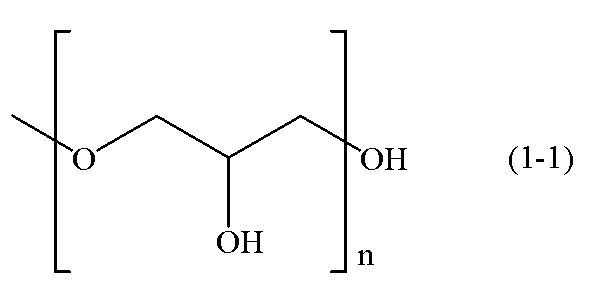
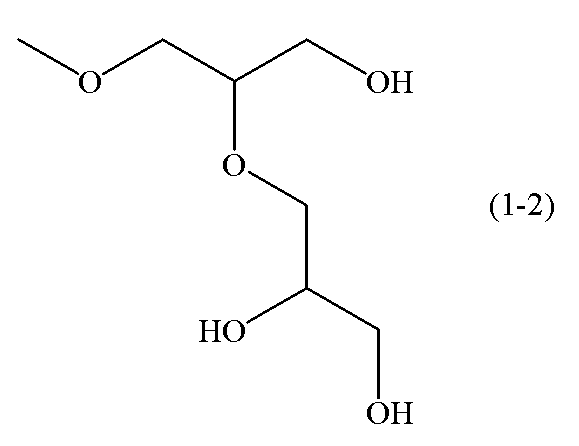
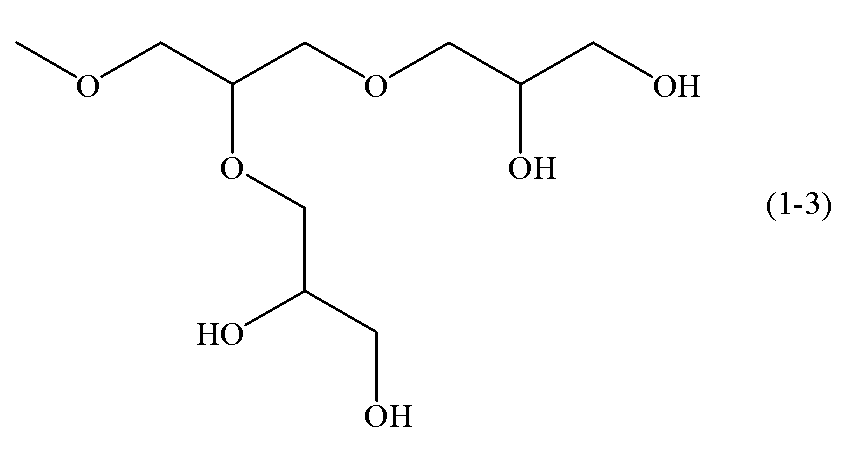
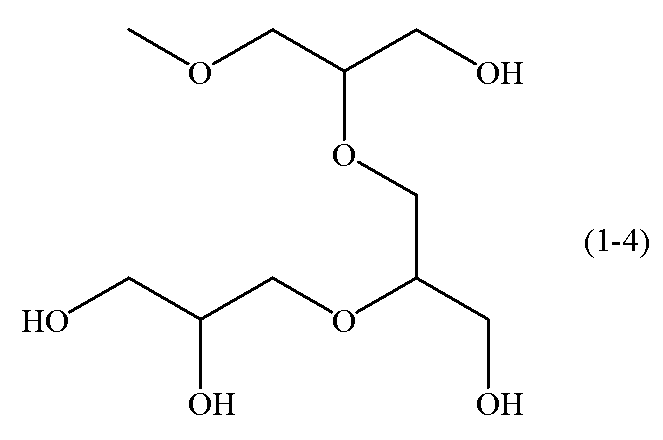
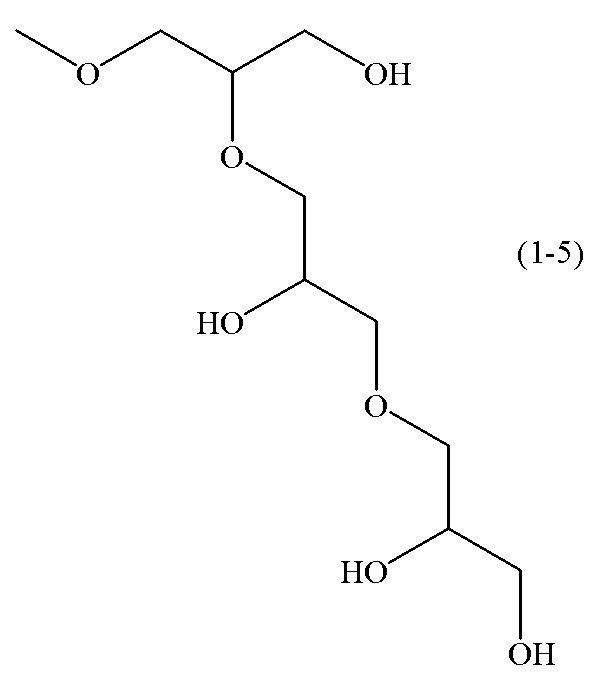
- G is selected from the following groups (1-1) to (1-5), and n is 1 to 5.
- the weight ratio of the glycerin group (hydrophilic group) of the formula (1) to the entire organosiloxane surfactant is 4.0 or less when the glycerin group is 1.
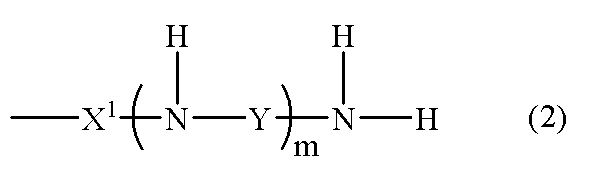
- the chemical structure of an organopolysiloxane having an amino group (hereinafter also referred to as “amino-modified organopolysiloxane”) is not particularly limited as long as it has an amino group. 2) It is expressed by the equation.
- X 1 is a divalent hydrocarbon group having 2 to 8 carbon atoms
- Y is a divalent hydrocarbon group having 2 to 6 carbon atoms
- m is 0 to 3.
- the weight ratio of the amino group (hydrophilic group) of the formula (2) to the entire organosiloxane surfactant is 4.0 or less when the amino group is 1.
- the organopolysiloxane having a carboxyl group (hereinafter also referred to as “carboxyl-modified organopolysiloxane”) is not particularly limited as long as the carboxyl group is present in the siloxane side chain as the chemical structure of the surfactant. Is represented by the following equation (3).
- X 2 is a divalent hydrocarbon group having 3 to 12 carbon atoms. From the viewpoint of the balance between hydrophilicity and hydrophobicity, X 2 is an interface between the carboxyl group (hydrophilic group) of the formula (3) and the organosiloxane.
- the weight ratio of the entire activator is 4.0 or less when the number of carboxyl groups is one.
- the chemical structure of the organopolysiloxane having a sugar residue (hereinafter, also referred to as “sugar-modified organopolysiloxane”) as long as it has a sugar residue as a chemical structure. It is expressed by the following equation (4).
- X 1 is a divalent hydrocarbon group having 2 to 8 carbon atoms
- Y is a divalent hydrocarbon group having 2 to 6 carbon atoms
- m is 0 to 3.
- the weight ratio of the sugar residue (hydrophilic group) of the formula (4) to the entire organosiloxane surfactant is 4.0 or less when the sugar residue is 1.
- the ratio of the raw material powder to the organopolysiloxane surfactant is preferably 0.1 to 20 surfactant per 100 powder by weight. More preferably, it is 0.5 to 10. With the above weight ratio, a dispersible powder having excellent dispersibility can be obtained.
- surfactants from the viewpoint of dispersibility in aqueous media and oils, dispersion stability, uniformity of the cosmetic film when blended in cosmetics, fit during application, spreading, adhesion, and usability Glycerin-modified organopolysiloxane surfactants are particularly preferred.
- the method for producing a dispersible powder according to the present invention is a method for producing a dispersible powder obtained by treating the raw material powder with the surface treatment agent, wherein the raw material powder is treated with the surface treatment agent.
- heat treatment can be performed at 60 ° C. or higher and lower than 180 ° C.
- the surface treating agent organopolysiloxane surfactant
- a dry treatment, a wet treatment, or the like can be performed, but a heat treatment at 60 ° C. or more and less than 180 ° C. is preferable. More preferably, the temperature is from 80 ° C to 120 ° C.
- the heat treatment is preferably performed because the viscosity of the organopolysiloxane surfactant is reduced by heating, and the organopolysiloxane surfactant is well adsorbed on the powder surface and aggregation is suppressed.
- recombination with the powder surface due to cleavage of the siloxane bond in the organopolysiloxane surfactant or recombination with the powder surface due to a trace amount of remaining Si—H groups or alkoxysilyl groups may occur. I do not care.
- optional components such as water and alcohols can be added as necessary.
- a process such as stirring, pulverization, and drying can be performed as necessary.
- the raw material powder whose surface is hydrophobic from the beginning may be used as it is, and if necessary, the surface is subjected to the hydrophobic treatment as described above. May be used. In the latter case, the raw material powder which has been subjected to the hydrophobic treatment in advance is further treated with the surface treatment agent.
- the present invention also provides a cosmetic containing the dispersible powder of the present invention (hereinafter, also referred to as “the cosmetic of the present invention”).
- the cosmetic may contain a medium acceptable for cosmetics in addition to the dispersible powder.
- the cosmetic of the present invention may contain volatile silicone oil or volatile organic oil.
- volatile silicone oils or volatile organic oils volatile silicone oils include dimethylpolysiloxane (dimer, trimer, tetramer, pentamer), caprylyl methicone, octamethylcyclotetrasiloxane, deca Examples include methylcyclopentasiloxane, dodecamethylcyclohexasiloxane, tetramethyltetrahydrogencyclotetrasiloxane, tristrimethylsiloxymethylsilane, tetrakistrimethylsiloxysilane, and the like.
- the volatile organic oil may be a hydrocarbon oil or ester, such as ⁇ -olefin oligomer, light isoparaffin, isododecane, light liquid isoparaffin, butyl acetate, and the like.
- dimethylpolysiloxane tetramer, pentamer
- caprylylmethicone decamethylcyclopentasiloxane
- dodecamethylcyclohexasiloxane tristrimethylsiloxymethylsilane, tetrakistrimethylsiloxysilane
- the content of these volatile oils is 1 to 98% by mass, preferably 1 to 50% by mass, and more preferably 3 to 30% by mass of the whole cosmetic.
- the cosmetic of the present invention may further contain cosmetically acceptable oils.
- a liquid oil include one or more silicone oils, hydrocarbon oils, higher fatty acids, polar oils such as ester oils and natural animal and vegetable oils, semi-synthetic oils, and / or fluorine-based oils. Can be.
- Silicone oils include non-volatile dimethylpolysiloxane, phenyltrimethicone, methylphenylpolysiloxane, methylhexylpolysiloxane, methylhydrogenpolysiloxane, dimethylsiloxane-methylphenylsiloxane copolymer, etc.
- lauric acid As higher fatty acids, lauric acid, myristic acid, palmitic acid, stearic acid, behenic acid, undecylenic acid, oleic acid, linoleic acid, linolenic acid, arachidonic acid, eicosapentaenoic acid (EPA), docosahexaenoic acid (DHA), isostearic acid , 12-hydroxystearic acid, etc., and higher alcohols include lauryl alcohol, myristyl alcohol, palmityl alcohol, stearyl alcohol, behenyl alcohol, hexadecyl alcohol, oleyl alcohol, isostearyl alcohol, hexyldecanol, octyldodecanol, Cetostearyl alcohol, 2-decyltetradecinol, cholesterol, phytosterol, POE cholesterol ether, monostearylglycerine ether (Batyl alcohol), monooleyl glyce
- ester oils diisobutyl adipate, 2-hexyldecyl adipate, di-2-heptylundecyl adipate, N-alkyl glycol monoisostearate, isosetyl isostearate, trimethylolpropane triisostearate, di-2-ethyl Ethylene glycol hexanoate, cetyl 2-ethylhexanoate, trimethylolpropane tri-2-ethylhexanoate, pentaerythritol tetra-2-ethylhexanoate, cetyl octanoate, octyldodecyl gum ester, oleyl oleate, octyldodecyl oleate , Decyl oleate, neopentyl glycol dioctanoate, neopentyl glycol dicaprate, tri
- glyceride oils include acetoglyceryl, glyceryl triisooctanoate, glyceryl triisostearate, glyceryl triisopalmitate, glyceryl monostearate, glyceryl di-2-heptylundecanoate, glyceryl trimyristate, diglyceryl isostearate and the like. Is mentioned.
- fluorinated oil examples include perfluoropolyether, perfluorodecalin, and perfluorooctane.
- the amount of the oil agent other than the volatile oil agent permitted in the cosmetic of the present invention varies depending on the type of cosmetic agent, but is preferably 1 to 98% by mass, more preferably 1 to 50% by mass of the whole cosmetic. It is.
- the cosmetic of the present invention can further contain one or more ultraviolet absorbing components.
- the ultraviolet absorbing component includes an ultraviolet absorbing agent and an ultraviolet scattering agent.
- the ultraviolet absorber include benzoic acid-based ultraviolet absorbers such as para-aminobenzoic acid, anthranilic acid-based ultraviolet absorbers such as methyl anthranilate, salicylic acid-based ultraviolet absorbers such as methyl salicylate, and cinnamon such as octyl paramethoxycinnamate.
- Acid-based UV absorbers benzophenone-based UV absorbers such as 2,4-dihydroxybenzophenone, urocanic acid-based UV absorbers such as ethyl urocanate, dibenzoyl such as 4-t-butyl-4'-methoxy-dibenzoylmethane
- methane-based ultraviolet absorbers examples include methane-based ultraviolet absorbers.
- the above-described silicone derivative having an ultraviolet absorbing functional group may be used.
- the ultraviolet absorbing and scattering agent include powders that absorb and scatter ultraviolet light, such as fine particle titanium oxide, fine particle iron-containing titanium oxide, fine particle zinc oxide, fine particle cerium oxide, and a complex thereof. Of these, cinnamic acid-based ultraviolet absorbers, dibenzoylmethane-based ultraviolet absorbers, titanium oxide, and zinc oxide are preferred.
- the cosmetic of the present invention can contain water.
- the cosmetic of the present invention may further contain one or more surfactants in addition to the surfactant contained in the dispersible powder of the present invention.
- the cosmetic of the present invention becomes more usable according to the purpose of use.
- the surfactant include anionic, cationic, nonionic and amphoteric surfactants, but the surfactant contained in the cosmetic is not particularly limited, and is used in ordinary cosmetics. Any of them can be used.
- anionic surfactants such as fatty acid soaps such as sodium stearate and triethanolamine palmitate, alkyl ether carboxylic acids and salts thereof, condensate salts of amino acids and fatty acids, alkane sulfonates, and alkenes.
- cationic surfactants include amine salts such as alkylamine salts, polyamines and amino alcohol fatty acid derivatives, alkyl quaternary ammonium salts, aromatic quaternary ammonium salts, pyridium salts and imidazolium salts.
- Nonionic surfactants include sorbitan fatty acid ester, glycerin fatty acid ester, polyglycerin fatty acid ester, propylene glycol fatty acid ester, polyethylene glycol fatty acid ester, sucrose fatty acid ester, methyl glucoside fatty acid ester, alkyl polyglucoside, polyoxyethylene alkyl Ether, polyoxypropylene alkyl ether, polyoxyethylene alkylphenyl ether, polyoxyethylene fatty acid ester, polyoxyethylene sorbitan fatty acid ester, polyoxyethylene sorbitol fatty acid ester, polyoxyethylene glycerin fatty acid ester, polyoxyethylene propylene glycol fatty acid ester, Polyoxyethylene castor oil, polyoxyethylene hydrogenated castor oil, Lioxyethylene phytostanol ether, polyoxyethylene phytosterol ether, polyoxyethylene cholestanol ether, polyoxyethylene cholesterol ether, linear or branched polyoxyalkylene-modified organopol
- amphoteric surfactant examples include betaine, aminocarboxylate, imidazoline derivatives, amidoamine type and the like.
- a linear or branched organopolysiloxane having a polyoxyethylene chain in the molecule a linear or branched organopolysiloxane having a polyglycerin chain in the molecule, or an alkyl copolymer of each.
- Surfactants that are modified organopolysiloxanes are preferred.
- a surfactant having an HLB of 2 to 10 is preferable, and the compounding amount is preferably 0.1 to 20% by mass, and particularly preferably 0.2 to 10% by mass of the whole cosmetic. .
- the cosmetic of the present invention may further contain one or more compounds having an alcoholic hydroxyl group in the molecular structure.
- Such compounds include ethanol, lower alcohols such as isopropanol, sorbitol, sugar alcohols such as maltose, cholesterol, sitosterol, phytosterol, sterols such as lanosterol, butylene glycol, propylene glycol, dibutylene glycol, pentylene glycol and the like.
- the compounding amount of the compound having an alcoholic hydroxyl group in the molecular structure is preferably within a range of 98% by mass or less of the whole cosmetic.
- the cosmetic of the present invention may further comprise a composition comprising a crosslinked organopolysiloxane polymer having no one or more hydrophilic groups and a liquid oil agent.
- the crosslinked organopolysiloxane polymer is obtained by reacting an alkyl hydrogen polysiloxane with a crosslinking agent having a reactive vinyl unsaturated group at the molecular chain end.
- the alkyl hydrogen polysiloxane include methyl hydrogen polysiloxane having a linear or partially branched unit, methyl hydrogen polysiloxane to which an alkyl chain having 6 to 20 carbon atoms is grafted, and the like. On average, two or more hydrogen atoms bonded to a silicon atom are required in a molecule.
- crosslinking agent examples include those having two or more vinyl reactive sites in a molecule, such as methylvinylpolysiloxane and ⁇ , ⁇ -alkenyldiene. Examples of these include compositions described in Japanese Patent No. 1925781, Japanese Patent No. 1932769, International Publication WO03-24413, and Japanese Patent Application Laid-Open No. 2009-185296.
- the crosslinked methylpolysiloxane may be used, for example, with a hydrocarbon oil such as low-viscosity silicone having a weight of 0.65 mm 2 / sec (25 ° C.) to 100.0 mm 2 / sec (25 ° C.), liquid paraffin, squalane, isododecane, or the like.
- glyceride oil such as trioctanoin or ester oil.
- cross-linked organopolysiloxanes are not particularly limited as commercial products, but KSG-15, KSG-16, KSG-18, KSG-1610, and USG-103, which are made into pastes with silicone oil.
- USG-106, KSG-41, KSG-42, KSG-43, KSG-44, KSG-810 (all manufactured by Shin-Etsu Chemical Co., Ltd.) made into a paste with hydrocarbon oil or triglyceride oil.
- the amount of the composition comprising the crosslinked organopolysiloxane having no hydrophilic group and the liquid oil agent is preferably 0.1 to 50% by mass, more preferably 1 to 30% by mass, based on the total amount of the cosmetic. % By mass.
- the cosmetic of the present invention may further contain a composition comprising a crosslinked organopolysiloxane polymer having one or more hydrophilic groups and a liquid oil agent.
- a crosslinked organopolysiloxane polymer having one or more hydrophilic groups and a liquid oil agent As the hydrophilic group, a polyether group and a polyglycerin group are preferable.
- the crosslinked organopolysiloxane polymer having a polyether group and / or a polyglycerin group can be obtained by reacting an alkyl hydrogen polysiloxane with a crosslinking agent having a reactive vinyl unsaturated group at a molecular chain terminal.
- alkyl hydrogen polysiloxane examples include methyl hydrogen polysiloxane in which a polyoxyethylene chain is grafted, methyl hydrogen polysiloxane in which a polyglycerin chain is grafted, and the like. Requires an average of two or more.
- the crosslinked organopolysiloxane polymer is converted into a low viscosity silicone oil having a weight of 0.65 mm 2 / sec (25 ° C.) to 100.0 mm 2 / sec (25 ° C.), a liquid oil such as liquid paraffin, squalane, isododecane or the like. Swell in glyceride oils such as trioctanoin and ester oils.
- Crosslinking agents include methylvinylpolysiloxane, ⁇ , ⁇ -alkenyl dienes, glycerin triallyl ether, polyoxyalkynylated glycerin triallyl ether, trimethylolpropane triallyl ether, and polyoxyalkynylated trimethylolpropane triallyl ether.
- Examples thereof include those having two or more vinyl reactive sites in a molecule, and a crosslinked product obtained by reacting them has at least one hydrophilic group.
- Examples of the composition include those described in Japanese Patent No. 2631772, Japanese Patent Application Laid-Open No. 9-136613, Japanese Patent Application Laid-Open No.
- cross-linked organopolysiloxanes are not particularly limited, but may be KSG-210, KSG-240, KSG-710 made into a paste with silicone oil, hydrocarbon oil or triglyceride oil. Examples include KSG-310, KSG-320, KSG-330, KSG-340, KSG-820, KSG-830, and KSG-840 (all manufactured by Shin-Etsu Chemical Co., Ltd.) in paste form.
- the amount of the composition comprising the crosslinked organopolysiloxane having a hydrophilic group and the liquid oil agent is preferably 0.1 to 50% by mass, more preferably 1 to 50% by mass, based on the total amount of the cosmetic. 30% by mass.
- the cosmetic of the present invention can also contain a silicone wax according to the purpose.
- This silicone wax is preferably a polylactone-modified polysiloxane to which a polylactone, which is a ring-opening polymer of a lactone compound having five or more ring members, is bonded.
- this silicone wax is an acrylic-modified polysiloxane containing at least one functional group selected from anionic groups such as a pyrrolidone group, a long-chain alkyl group, a polyoxyalkylene group, a fluoroalkyl group, and a carboxylic acid in the molecule. It is preferably siloxane.
- Examples of commercially available waxes having a long-chain alkyl group include KP-561P and KP-562P (all manufactured by Shin-Etsu Chemical Co., Ltd.).
- the cosmetics of the present invention may contain components used in ordinary cosmetics, such as oil-soluble gelling agents (organic modified clay minerals).
- oil-soluble gelling agent examples include metal soaps such as aluminum stearate, magnesium stearate, zinc myristate, amino acid derivatives such as N-lauroyl-L-glutamic acid, ⁇ , ⁇ -di-n-butylamine, and dextrin palmitin Acid ester, dextrin stearate, dextrin fatty acid ester such as dextrin 2-ethylhexanoate palmitate, sucrose fatty acid ester such as sucrose palmitate, sucrose stearate, fructooligosaccharide stearate, fructooligosaccharide 2 -Fructooligosaccharide fatty acid esters such as ethylhexanoate, benzylidene derivatives of sorbitol such as monobenzylidene sorbitol and dibenzylidene sorbitol, dimethylbenzyloxide
- One or more oil-soluble gelling agents selected from organically modified clay minerals such
- a skin care cosmetic a milky lotion, a cream, a makeup base, a concealer, a white powder, a liquid foundation, an oily foundation, a blusher, an eye shadow, a mascara, an eye, comprising the above cosmetic ingredients.
- Makeup cosmetics such as liners, eyebrows, lipsticks, etc., hair cosmetics such as shampoos, rinses, treatments, and setting agents, antiperspirants, sunscreen oils and sunscreen emulsions, and sunscreen creams and other ultraviolet protective cosmetics.
- the shape of these cosmetics includes various shapes such as liquid, emulsion, cream, solid, paste, gel, powder, press, multilayer, mousse, spray, and stick. Can be selected.
- these cosmetics may be in various forms such as aqueous, oily, water-in-oil emulsions, oil-in-water emulsions, non-aqueous emulsions, and multiple emulsions such as W / O / W and O / W / O. Can be selected.
- % means “% by mass”, and represents the mass% of each component with the total mass of each example being 100%.
- the viscosity is a value at 25 ° C.
- the weight average molecular weight of each polymer was measured by gel permeation chromatography (GPC) using tetrahydrofuran (THF) as an elution solvent and monodisperse polystyrene as a standard, using an apparatus manufactured by Tosoh Corporation.
- Synthesis examples (1) to (6) show the synthesis of the surfactant constituting the dispersible powder of the present invention.
- Comparative Synthesis Examples (1) to (3) show the synthesis of a surfactant that does not constitute the dispersible powder of the present invention.
- the weight ratio of the hydrophilic group (glycerin group, amino group, carboxyl group, sugar residue) in the organopolysiloxane surfactant to the entire organosiloxane surfactant is defined as 1 (Weight of the entire organosiloxane surfactant / weight of hydrophilic group) is referred to as “hydrophilic group ratio”.
- Synthesis example (1) In a glass flask equipped with a stirrer, a thermometer and a reflux condenser, 296 g of hydrogenpolysiloxane represented by the following general formula, 300 g of 2-propanol, 390 g of triglycerin monoallyl ether, and 3% butanol solution of 3% chloroplatinic acid. The reaction was completed by adding 05 g and stirring at 80 ° C. for 5 hours. The reaction solvent was distilled off at 100 ° C. under reduced pressure to obtain a pale yellow transparent liquid.
- the weight average molecular weight of the obtained organopolysiloxane surfactant measured by GPC was 850.
- the organopolysiloxane surfactant had a hydrophilic group ratio of 1.75 and had no polyoxyalkylene group.
- Synthesis example (2) In a glass flask equipped with a stirrer, thermometer and reflux condenser, 700 g of hydrogenpolysiloxane represented by the following general formula, 1000 g of 2-propanol, 720 g of diglycerin monoallyl ether, 86 g of monovinyldisiloxane described below, and chloroplatinic acid The reaction was completed by adding 0.1 g of a 3% butanol solution and stirring at 80 ° C. for 5 hours. The reaction solvent was distilled off at 100 ° C. under reduced pressure to obtain a pale yellow transparent liquid.
- the weight average molecular weight of the obtained organopolysiloxane surfactant measured by GPC was 17,000.
- the organopolysiloxane surfactant had a hydrophilic group ratio of 2.09 and had no polyoxyalkylene group.
- Synthesis example (3) In a glass flask equipped with a stirrer, a thermometer, and a reflux condenser, 1170 g of hydrogenpolysiloxane represented by the following general formula, 1000 g of 2-propanol, 750 g of triglycerin monoallyl ether, and a 3% butanol solution of 3% chloroplatinic acid. 2 g was added and stirred at 80 ° C. for 5 hours to complete the reaction. The reaction solvent was distilled off at 100 ° C. under reduced pressure to obtain a pale yellow transparent liquid.
- the weight average molecular weight of the obtained organopolysiloxane surfactant measured by GPC was 3,000.
- the organopolysiloxane surfactant had a hydrophilic group ratio of 2.56 and had no polyoxyalkylene group.
- Synthesis example (4) An amino-modified organopolysiloxane having the following representative structure was synthesized by a conventional method.
- the weight average molecular weight of this organopolysiloxane surfactant measured by GPC was 4,300.
- the organopolysiloxane surfactant had a hydrophilic group ratio of 2.03 and had no polyoxyalkylene group.
- Synthesis example (5) According to a conventional method, a carboxyl-modified organopolysiloxane having the following representative structure was synthesized. The weight average molecular weight of this organopolysiloxane surfactant measured by GPC was 10,000. The organopolysiloxane surfactant had a hydrophilic group ratio of 1.34 and had no polyoxyalkylene group.
- Synthesis example (6) In a glass flask equipped with a stirrer, thermometer and reflux condenser, 150 g of an amino-modified organopolysiloxane having the following typical structure, 200 g of 2-propanol and 89 g of glucono- ⁇ -lactone were added, and the mixture was stirred at 80 ° C for 5 hours. The reaction was completed. The reaction solvent was distilled off at 100 ° C. under reduced pressure to obtain a pale yellow transparent semi-solid.
- the weight average molecular weight of this organopolysiloxane surfactant measured by GPC was 3,000.
- the organopolysiloxane surfactant had a hydrophilic group ratio of 2.01 and had no polyoxyalkylene group.
- the weight average molecular weight of the obtained organopolysiloxane surfactant measured by GPC was 250.
- the organopolysiloxane surfactant had a hydrophilic group ratio of 2.13 and had no polyoxyalkylene group.
- the weight average molecular weight of the obtained organopolysiloxane surfactant measured by GPC was 6,200.
- the organopolysiloxane surfactant had a hydrophilic group ratio of 6.64 and had no polyoxyalkylene group.
- Comparative Synthesis Example (3) An amino-modified organopolysiloxane having the following representative structure was synthesized by a conventional method.
- the weight average molecular weight of this organopolysiloxane surfactant measured by GPC was 1600.
- the organopolysiloxane surfactant had a hydrophilic group ratio of 6.04 and had no polyoxyalkylene group.
- Production Example 1 100 g of polymethylsilsesquioxane KMP-590 (manufactured by Shin-Etsu Chemical Co., Ltd.) and 3 g of the glycerin-modified organopolysiloxane obtained in Synthesis Example 1 were added to a mixer, and the mixture was stirred and crushed at 110 ° C. for 3 hours to obtain a white powder. Got.
- Production Example 4 100 g of polymethylsilsesquioxane KMP-590 (manufactured by Shin-Etsu Chemical Co., Ltd.), 2 g of the sugar-modified organopolysiloxane obtained in Synthesis Example 6, and 10 g of water are added to a mixer, and the mixture is stirred at 100 ° C. for 3 hours, crushed, and pulverized. Drying at 3 ° C. for 3 hours gave a white powder.
- Production Example 7 100 g of polymethylsilsesquioxane-coated silicone elastomer powder KSP-100 (manufactured by Shin-Etsu Chemical Co., Ltd.), 2 g of the carboxy-modified organopolysiloxane obtained in Synthesis Example 5, and 5 g of ethanol are added to the mixer, and the mixture is stirred at 100 ° C. for 3 hours. , Pulverized and dried at 100 ° C for 3 hours to obtain a white powder.
- Production Example 8 100 g of polyamide powder SP-500 (manufactured by Toray Industries, Inc.), 2 g of the glycerin-modified organopolysiloxane obtained in Synthesis Example 1, and 5 g of ethanol were added to the mixer, stirred at 100 ° C. for 3 hours, stirred, pulverized, and dried at 100 ° C. for 3 hours. A white powder was obtained.
- Production Example 9 100 g of methyl methacrylate crosspolymer M-305 (manufactured by Toray Industries, Inc.), 2 g of glycerin-modified organopolysiloxane obtained in Synthesis Example 2, and 5 g of ethanol were added to a mixer, and the mixture was stirred at 100 ° C. for 3 hours, pulverized, and stirred at 100 ° C. for 3 hours. After drying for an hour, a white powder was obtained.
- Production Example 10 100 g of methicone 2% -treated titanium oxide, 2 g of glycerin-modified organopolysiloxane obtained in Synthesis Example 1, and 5 g of ethanol were added to a mixer, stirred at 100 ° C. for 3 hours, pulverized, and dried at 100 ° C. for 3 hours to obtain a white powder.
- methicone 2% -treated titanium oxide, 2 g of glycerin-modified organopolysiloxane obtained in Synthesis Example 1, and 5 g of ethanol were added to a mixer, stirred at 100 ° C. for 3 hours, pulverized, and dried at 100 ° C. for 3 hours to obtain a white powder.
- Production Example 11 100 g of talc treated with 2% trimethoxycaprylylsilane, 2 g of the glycerin-modified organopolysiloxane obtained in Synthesis Example 3, and 5 g of ethanol were added to a mixer, stirred at 100 ° C. for 3 hours, pulverized, and dried at 100 ° C. for 3 hours. A white powder was obtained.
- Production Example 12 100 g of 2% monoperfluoroalkylethyl phosphoric acid ester-treated mica, 2 g of amino-modified organopolysiloxane obtained in Synthesis Example 4, and 5 g of ethanol were added to a mixer, and the mixture was stirred at 100 ° C. for 3 hours, pulverized, and 100 ° C. for 3 hours Drying gave a white powder.
- Production Example 13 100 g of 2% methicone-treated black iron oxide, 2 g of the amino-modified organopolysiloxane obtained in Synthesis Example 5, and 5 g of ethanol were added to a mixer, stirred at 100 ° C. for 3 hours, pulverized, dried at 100 ° C. for 3 hours, and dried to obtain a black powder. Got a body.
- Comparative Production Example 1 100 g of polymethylsilsesquioxane KMP-590 (manufactured by Shin-Etsu Chemical Co., Ltd.) and 3 g of the glycerin-modified organopolysiloxane obtained in Comparative Synthesis Example 1 were added to a mixer, followed by stirring at 110 ° C. for 3 hours, pulverization, and white powder. Got a body.
- Comparative Production Example 2 100 g of polymethylsilsesquioxane KMP-590 (manufactured by Shin-Etsu Chemical Co., Ltd.) and 4 g of the glycerin-modified organopolysiloxane obtained in Comparative Synthesis Example 2 were added to a mixer, and the mixture was stirred and pulverized at 100 ° C. for 3 hours to give a white powder. Got a body.
- Comparative Production Example 3 100 g of polymethylsilsesquioxane KMP-590 (manufactured by Shin-Etsu Chemical Co., Ltd.) and 4 g of the amino-modified organopolysiloxane obtained in Comparative Synthesis Example 3 were added to a mixer, and the mixture was stirred and ground at 100 ° C. for 3 hours to obtain a white powder. Got a body.
- Comparative Production Example 5 100 g of a polymethylsilsesquioxane-coated silicone elastomer powder KSP-100 (manufactured by Shin-Etsu Chemical Co., Ltd.) and 2 g of the glycerin-modified organopolysiloxane obtained in Comparative Synthesis Example 1 are added to a mixer, and the mixture is stirred and crushed at 100 ° C. for 3 hours. And dried at 100 ° C. for 3 hours to obtain a white powder.
- KSP-100 manufactured by Shin-Etsu Chemical Co., Ltd.
- Comparative Production Example 6 100 g of polymethylsilsesquioxane-coated silicone elastomer powder KSP-100 (manufactured by Shin-Etsu Chemical Co., Ltd.), 2 g of the amino-modified organopolysiloxane obtained in Comparative Synthesis Example 3, and 5 g of ethanol were added to the mixer, and the mixture was added at 100 ° C. for 3 hours. Stirring, pulverization, and drying at 100 ° C. for 3 hours gave a white powder.
- Comparative Production Example 7 100 g of methicone 2% -treated titanium oxide, 2 g of polyether-modified silicone KF-6017 (manufactured by Shin-Etsu Chemical Co., Ltd.) and 5 g of ethanol were added to a mixer, stirred at 100 ° C. for 3 hours, pulverized, and dried at 100 ° C. for 3 hours. A white powder was obtained.
- Comparative Production Example 8 100 g of talc treated with 2% trimethoxycaprylylsilane, 2 g of polyoxyethylene 4-lauryl ether and 5 g of ethanol were added to a mixer, stirred at 100 ° C. for 3 hours, pulverized, and dried at 100 ° C. for 3 hours to obtain a white powder. Obtained.
- the average particle diameter of the powders used in the above-mentioned Production Examples and Comparative Production Examples was 200 ⁇ m or less.
- the lotion obtained by using the dispersible powder of the present invention has extremely excellent dispersibility, high dispersion stability, a uniform makeup film, and a good fit during application. It was confirmed that it was good and good.
- the lotion obtained by using the dispersible powder of the present invention has excellent dispersibility, high dispersion stability, a uniform makeup film, good fit at the time of application, spread, and good feeling of smoothness after application. It was confirmed that.
- Example 3 The foundations shown in Table 3 below were produced by the following methods, and their usability was evaluated.
- Method A Each component shown in Table 3 is heated to 50 ° C. and uniformly mixed.
- B A was pulverized and compression-molded into a dish to obtain a foundation.
- [Sensory evaluation method] The foundations shown in Table 3 below were applied to the skin and subjected to a sensory evaluation. The results are shown according to the following evaluation criteria according to the number of panelists who answered "effective".
- the lotions of Examples 1 to 9 containing the dispersible powder of the present invention, and the foundations of Examples 10 and 11 showed dispersion stability, adjustment during application, and application. Good uniformity and spreading at the time.
- the lotions of Comparative Examples 1 to 13 and the foundations of Comparative Examples 14 to 17, which are out of the range of the present invention have poor dispersion stability, and are insufficient in the ease of application, uniformity in application, and insufficient spread. .
- Comparative Examples 1 and 8 in which the weight average molecular weight of the surface treating agent is less than the lower limit of the present invention, and Comparative Examples 2, 3 and 9 in which the ratio of hydrophilic groups in the surface treating agent exceeds the upper limit of the present invention, is dispersion stable.
- the surface treating agent is selected from organopolysiloxane surfactants having a weight-average molecular weight of 300 to 20,000 as in the present invention, because of its poor properties, poor fit during coating, uniformity during coating and insufficient spread.
- Surface treatment agent has at least one organic group selected from a glycerin group, an amino group, a carboxyl group, and a sugar residue as a hydrophilic group, and the hydrophilic group and the organosiloxane surfactant Obviously, it is important that the total weight ratio is 4.0 or less when the above hydrophilic group is 1, for solving the problem.
- Eyeliner An eyeliner having the following composition was prepared by a conventional method. (component) 1. Decamethylcyclopentasiloxane 22.0 2. Dimethylpolysiloxane (6 mm 2 / sec) 5.0 3. Black powder of Production Example 13 20.0 4. Vitamin E acetate 0.2 5. Jojoba oil 2.0 6. Bentonite 3.0 7. Polyether-modified organopolysiloxane * 2.0 8. Ethanol 10.0 9.1,3-butylene glycol 10.0 10. Preservatives qs. Perfume appropriate amount12. Purified water Remaining Total 100.0% * Polyether-modified silicone KF-6017 (Shin-Etsu Chemical Co., Ltd.)
- the resulting eyeliner is light and easy to draw, has a refreshing feeling without refreshing and sticky feeling, does not change with temperature or aging, has excellent usability and stability, and has a very long lasting makeup Good thing was confirmed.
Landscapes
- Health & Medical Sciences (AREA)
- Life Sciences & Earth Sciences (AREA)
- Animal Behavior & Ethology (AREA)
- General Health & Medical Sciences (AREA)
- Public Health (AREA)
- Veterinary Medicine (AREA)
- Birds (AREA)
- Epidemiology (AREA)
- Chemical & Material Sciences (AREA)
- Organic Chemistry (AREA)
- Inorganic Chemistry (AREA)
- Dermatology (AREA)
- Dispersion Chemistry (AREA)
- Engineering & Computer Science (AREA)
- Materials Engineering (AREA)
- Wood Science & Technology (AREA)
- Cosmetics (AREA)
- Pigments, Carbon Blacks, Or Wood Stains (AREA)
Abstract
本発明は、粉体を表面処理剤で処理してなる分散性粉体であって、前記表面処理剤が、重量平均分子量300~20000のオルガノポリシロキサン界面活性剤から選択される表面処理剤であり、前記オルガノポリシロキサン界面活性剤は、親水性基としてグリセリン基、アミノ基、カルボキシル基、糖残基から選択される有機基を少なくとも1つ有し、前記親水性基と前記オルガノシロキサン界面活性剤全体の重量比は前記親水性基を1とした場合、4.0以下であり、かつ、ポリオキシアルキレン基を有さないことを特徴とする分散性粉体である。これにより、水系媒体や油剤への分散性に優れ、分散安定性が高い分散性粉体を提供する。
Description
本発明は、分散性粉体、その製造方法、及び前記分散性粉体を含む化粧料に関する。
従来から粉体の分散性の向上や組成物に配合した場合の応用が検討されている。
例えば、粉体の表面処理によって水系媒体や油剤への分散性を向上させることが検討されている。特許文献1にはシルセスキオキサン粒子にポリオキシアルキレン基を持つシリコーンを処理することによって、シリコーン油への分散性が向上したことが記載されているが、水系媒体への分散については記載されていない。また、組成物、特に化粧品組成物に配合した場合の効果、有用性については記載されていない。
また、特許文献2には、ポリオキシアルキレン基を持つシラン化合物で顔料表面を親水処理する方法が記載されているが、表面親水性が高くなりすぎるため、粉が凝集したり、化粧料への配合時に塗布時の感触が悪くなる問題があった。
さらに、特許文献3,4には、高HLBの界面活性剤と粉体を含む水性メイク化粧料が記載されており、化粧組成物中でこれらを混合して化粧料としているが、このような方法では粉同士の凝集が抑えられないため、塗布時のおさまり、のびが悪くなる等の問題があった。
本発明は、上記問題点に鑑みてなされたものであって、水系媒体や油剤への分散性に優れ、分散安定性が高い分散性粉体及びその製造方法を提供することを目的とする。また、前記分散性粉体を配合した、化粧膜が均一であり、塗布時のおさまりが良く、のび、密着性、使用感が良い化粧料を提供することを目的とする。
上記課題を解決するために、本発明によれば、粉体を表面処理剤で処理してなる分散性粉体であって、前記表面処理剤が、重量平均分子量300~20000のオルガノポリシロキサン界面活性剤から選択される表面処理剤であり、前記オルガノポリシロキサン界面活性剤は、親水性基としてグリセリン基、アミノ基、カルボキシル基、糖残基から選択される有機基を少なくとも1つ有し、前記親水性基と前記オルガノシロキサン界面活性剤全体の重量比は前記親水性基を1とした場合、4.0以下であり、かつ、ポリオキシアルキレン基を有さないことを特徴とする分散性粉体を提供する。
本発明の分散性粉体であれば、水系媒体や油剤への分散性に優れ、分散安定性が高いものとなる。
前記粉体がシリコーンパウダー、ポリアミドパウダー、ポリアクリル酸・アクリル酸エステルパウダー、ポリエステルパウダー、ポリエチレンパウダー、ポリプロピレンパウダー、ポリスチレンパウダー、ポリウレタンパウダー、ベンゾグアナミンパウダー、ポリメチルベンゾグアナミンパウダー、テトラフルオロエチレンパウダー、ポリメチルメタクリレートパウダー、セルロースパウダー、シルクパウダー、ナイロンパウダー、無機粉体、有色顔料、パール顔料、金属粉末顔料から選択されることが好ましい。
このような粉体を用いると分散性に優れた粉体が得られる。
また、前記粉体が疎水性の粉体であり、平均粒子径が200μm以下であることが好ましい。
このような疎水性粉体を用いることによって粉体の分散性が優れ、分散安定性が高く、化粧料に配合した場合の使用感が良くなる。
この場合、前記疎水性の粉体が、シリコーン、フッ素化合物、シランカップリング剤、チタンカップリング剤、N-アシル化アミノ酸、金属石鹸から選択される処理により表面疎水化されたものであることであることが好ましい。
このような粉体を用いることによって分散性が優れ、分散安定性が高く、化粧料に配合した場合の使用感が一層良くなる。
また、前記粉体を前記オルガノポリシロキサン界面活性剤で処理する際に、60℃以上180℃未満で熱処理を行うことを特徴とする本発明の分散性粉体の製造方法も提供する。
本発明の分散性粉体の製造方法であれば、前記粉体を前記表面処理剤で処理する際、60℃以上180℃未満で熱処理を行うことによって、分散性が優れ、分散安定性が高く、化粧料に配合した場合、化粧膜が均一であり、塗布時のおさまりが良く、のび、密着性、使用感が良い化粧料となる分散性粉体を製造することができる。
さらに、本発明の分散性粉体を含む化粧料も提供する。
本発明の分散性粉体を含む化粧料であれば、従来の問題を解決し、分散性が優れ、分散安定性が高く、化粧膜が均一であり、塗布時のおさまりが良く、のび、密着性、使用感が良くなる。
本発明の分散性粉体は、分散性が優れ、分散安定性が高く、化粧料に配合した場合、化粧膜が均一であり、塗布時のおさまりが良く、のび、密着性、使用感が良くなる。
上記のように、分散性の処理粉体であって、従来の処理粉体よりも分散性が優れ、分散安定性が高く、化粧料に配合した場合、化粧膜が均一であり、塗布時のおさまりが良く、のび、密着性、使用感が良い化粧料が求められている。
本発明者らは、上記目的を達成するため鋭意検討を行った結果、特定の分子量で特定の親水性基を有するオルガノポリシロキサン界面活性剤で処理された粉体が分散性、分散安定性に優れたものとなることを見出した。このような処理粉体が化粧料に添加されたことはこれまでなかった。
すなわち、本発明は、粉体を表面処理剤で処理してなる分散性粉体であって、前記表面処理剤が、重量平均分子量300~20000のオルガノポリシロキサン界面活性剤から選択される表面処理剤であり、前記オルガノポリシロキサン界面活性剤は、親水性基としてグリセリン基、アミノ基、カルボキシル基、糖残基から選択される有機基を少なくとも1つ有し、前記親水性基と前記オルガノシロキサン界面活性剤全体の重量比は前記親水性基を1とした場合、4.0以下であり、かつ、ポリオキシアルキレン基を有さないことを特徴とする分散性粉体である。
以下、本発明について詳細に説明するが、本発明はこれらに限定されるものではない。
本発明の分散性粉体は、粉体を表面処理剤で処理してなる分散性粉体である。以下、本発明の分散性粉体について説明する。
[粉体]
表面処理剤で処理して本発明の分散性粉体とするための粉体(以下、「原料粉体」ともいう)は、特に限定されないが、シリコーンパウダー、ポリアミドパウダー、ポリアクリル酸・アクリル酸エステルパウダー、ポリエステルパウダー、ポリエチレンパウダー、ポリプロピレンパウダー、ポリスチレンパウダー、ポリウレタンパウダー、ベンゾグアナミンパウダー、ポリメチルベンゾグアナミンパウダー、テトラフルオロエチレンパウダー、ポリメチルメタクリレートパウダー、セルロースパウダー、シルクパウダー、ナイロンパウダー、無機粉体、有色顔料、パール顔料、金属粉末顔料から選択されることが好ましい。このような原料粉体を用いると分散性に優れた粉体が得られる。
表面処理剤で処理して本発明の分散性粉体とするための粉体(以下、「原料粉体」ともいう)は、特に限定されないが、シリコーンパウダー、ポリアミドパウダー、ポリアクリル酸・アクリル酸エステルパウダー、ポリエステルパウダー、ポリエチレンパウダー、ポリプロピレンパウダー、ポリスチレンパウダー、ポリウレタンパウダー、ベンゾグアナミンパウダー、ポリメチルベンゾグアナミンパウダー、テトラフルオロエチレンパウダー、ポリメチルメタクリレートパウダー、セルロースパウダー、シルクパウダー、ナイロンパウダー、無機粉体、有色顔料、パール顔料、金属粉末顔料から選択されることが好ましい。このような原料粉体を用いると分散性に優れた粉体が得られる。
シリコーンパウダーとしてはポリアルキルシルセスキオキサン、もしくはポリアリールシルセスキオキサン、例えば市販品としてはKMP-590、591(信越化学工業社製)、MSP-150(日興リカ社製)、シリコーンエラストマーパウダー、例えば市販品としてはKMP-597、598(信越化学工業社製)、シリコーン複合パウダー、シリコーンエラストマ-パウダーにポリアルキルシルセスキオキサンで処理したもの例えば市販品としてはKSP-100、101、105、300、411、441、金平糖状シリコーンパウダー、例えば市販品としてはNH-LAS06、NH-KB04、SilcrustaMK03(日興リカ社製)。シリコーンパウダーは球状、不定形であってもよく、凹みがある形状、お椀状であっても良い。
その他の高分子粉体としては、ポリアミドパウダー、ポリアクリル酸・アクリル酸エステルパウダー、ポリエステルパウダー、ポリエチレンパウダー、ポリプロピレンパウダー、ポリスチレンパウダー、ポリウレタンパウダー、ベンゾグアナミンパウダー、ポリメチルベンゾグアナミンパウダー、テトラフルオロエチレンパウダー、ポリメチルメタクリレートパウダー、セルロースパウダー、シルクパウダー、ナイロンパウダーが挙げられるが、これらに特に限定されることはなく、好ましくはポリエチレンパウダー、ポリプロピレンパウダー、ポリスチレンパウダー、ポリウレタンパウダー、テトラフルオロエチレンパウダー、ポリメチルメタクリレートパウダー、ポリアミドパウダーである。
無機粉体としては、酸化チタン、酸化ジルコニウム、酸化亜鉛、酸化セリウム、酸化マグネシウム、硫酸バリウム、硫酸カルシウム、硫酸マグネシウム、炭酸カルシウム、炭酸マグネシウム、タルク、マイカ、カオリン、セリサイト、白雲母、合成雲母、金雲母、紅雲母、黒雲母、リチア雲母、ケイ酸、無水ケイ酸、ケイ酸アルミニウム、ケイ酸マグネシウム、ケイ酸アルミニウムマグネシウム、ケイ酸カルシウム、ケイ酸バリウム、ケイ酸ストロンチウム、タングステン酸金属塩、ヒドロキシアパタイト、バーミキュライト、ハイジライト、ベントナイト、モンモリロナイト、ヘクトライト、ゼオライト、セラミックスパウダー、第二リン酸カルシウム、アルミナ、水酸化アルミニウム、窒化ホウ素、窒化ボロン、シリカ、シリル化シリカが挙げられる。
有色顔料としては、酸化鉄、水酸化鉄、チタン酸鉄の無機赤色顔料、γ-酸化鉄等の無機褐色系顔料、黄酸化鉄、黄土等の無機黄色系顔料、黒酸化鉄、カーボンブラック等の無機黒色顔料、マンガンバイオレット、コバルトバイオレット等の無機紫色顔料、水酸化クロム、酸化クロム、酸化コバルト、チタン酸コバルト等の無機緑色顔料、紺青、群青等の無機青色系顔料、タール系色素をレーキ化したもの、天然色素をレーキ化したもの、及びこれらの粉体を複合化した合成樹脂粉体顔料等が挙げられる。
パール顔料としては、酸化チタン被覆雲母、酸化チタン被覆マイカ、オキシ塩化ビスマス、酸化チタン被覆オキシ塩化ビスマス、酸化チタン被覆タルク、魚鱗箔、酸化チタン被覆着色雲母等、金属粉末顔料としては、アルミニウムパウダー、カッパーパウダー、ステンレスパウダー等が挙げられる。
[疎水性粉体]
本発明で使用される原料粉体は表面が疎水性であることが好ましい。疎水性とは水へ分散しないことを意味している。原料粉体表面が最初から疎水性であるものはそのまま使用してもよく、必要に応じて以下の疎水化処理がされたものを使用しても構わない。疎水性の粉体であることによって、化粧膜の均一性、塗布時のおさまり、密着性がよくなる。また前記粉体の平均粒子径が200μm以下であることが好ましい。前記粉体を構成する粒子は、その形状(球状、針状、板状等)、粒子構造(多孔質、無孔質等)は特に限定されない。また、平均粒子径が200μm以下であることが好ましく、より好ましくは100μm以下、さらに好ましくは50μm以下である。平均粒子径の下限は特に限定されないが、例えば1μm以上とすることができる。なお、本明細書において平均粒子径は、体積平均粒子径であり、レーザー散乱法などにより測定することができる。
本発明で使用される原料粉体は表面が疎水性であることが好ましい。疎水性とは水へ分散しないことを意味している。原料粉体表面が最初から疎水性であるものはそのまま使用してもよく、必要に応じて以下の疎水化処理がされたものを使用しても構わない。疎水性の粉体であることによって、化粧膜の均一性、塗布時のおさまり、密着性がよくなる。また前記粉体の平均粒子径が200μm以下であることが好ましい。前記粉体を構成する粒子は、その形状(球状、針状、板状等)、粒子構造(多孔質、無孔質等)は特に限定されない。また、平均粒子径が200μm以下であることが好ましく、より好ましくは100μm以下、さらに好ましくは50μm以下である。平均粒子径の下限は特に限定されないが、例えば1μm以上とすることができる。なお、本明細書において平均粒子径は、体積平均粒子径であり、レーザー散乱法などにより測定することができる。
[疎水化処理]
本発明では、原料粉体がシリコーン、フッ素化合物、シランカップリング剤、チタンカップリング剤、N-アシル化アミノ酸、金属石鹸から選択される処理により表面疎水化されたものであることが好ましい。特に無機粉体、有色顔料、パール顔料に関しては、表面が親水性であるため、シリコーン、フッ素化合物、シランカップリング剤、チタンカップリング剤、N-アシル化アミノ酸、金属石鹸から選択される処理をしたものを使用することが好ましい。
本発明では、原料粉体がシリコーン、フッ素化合物、シランカップリング剤、チタンカップリング剤、N-アシル化アミノ酸、金属石鹸から選択される処理により表面疎水化されたものであることが好ましい。特に無機粉体、有色顔料、パール顔料に関しては、表面が親水性であるため、シリコーン、フッ素化合物、シランカップリング剤、チタンカップリング剤、N-アシル化アミノ酸、金属石鹸から選択される処理をしたものを使用することが好ましい。
疎水化処理は、公知の疎水化処理剤及び公知の疎水化処理方法を用いれば良く、乾式処理、湿式処理等を行うことができる。疎水化処理剤の具体例としては、メチルハイドロジェンポリシロキサン、環状シリコーン、片末端、両末端、または側鎖トリアルコキシ基変性オルガノポリシロキサン等のシリコーン系化合物、パーフルオロアルキルリン酸エステル、パーフルオロアルキルアルコキシシラン等のフッ素系化合物、アルキルトリアルコキシシラン等のシランカップリング剤、長鎖アルコキシチタン等のチタンカップリング剤、ラウロイルリジン等のアシル化アミノ酸、ステアリン酸アルミニウム、ステアリン酸亜鉛等の金属石鹸などが挙げられる。中でも、シリコーン、フッ素化合物、シランカップリング剤がより好ましい。
[表面処理剤]
本発明の分散性粉体は上記のような原料粉体を表面処理剤で処理してなるものである。本発明では、表面処理剤として特定のオルガノポリシロキサン界面活性剤を用いることを特徴とする。
本発明の分散性粉体は上記のような原料粉体を表面処理剤で処理してなるものである。本発明では、表面処理剤として特定のオルガノポリシロキサン界面活性剤を用いることを特徴とする。
なお、上記のように原料粉体は、既に疎水化処理等が行われていてもよく、ここで用いられる表面処理剤は、そのような原料粉体の上になされる表面処理に用いられるものである。
前記オルガノポリシロキサン界面活性剤の重量平均分子量が300~20000であり、かつ、ポリオキシアルキレン基を有さない。前記オルガノポリシロキサン界面活性剤は重量平均分子量が300~20000であり、好ましくは400~10000であり、より好ましくは400~5000である。本発明では、界面活性剤の重量平均分子量が上記範囲にあることによって粉体に良く吸着し、分散性の高い粉体が得られる。一方、重量平均分子量が300未満の低分子量のオルガノポリシロキサン界面活性剤は刺激性等の懸念があり、重量平均分子量が20000を超えると粉体に吸着しにくく分散性の高い粉体を得ることが困難となる。
そして、本発明では、前記オルガノポリシロキサン界面活性剤がポリオキシアルキレン基を有さないため、分散性の高い粉体が得られる。一方、オルガノポリシロキサン界面活性剤がポリオキシアルキレン基を有すると、表面親水性が高くなりすぎるため、粉が凝集したり、化粧料への配合した場合に塗布時の感触が悪くなったりする問題が生じる。
さらに、前記オルガノポリシロキサン界面活性剤は、親水性基としてグリセリン基、アミノ基、カルボキシル基、糖残基から選択される有機基を少なくとも1つ有し、前記親水性基と前記オルガノシロキサン界面活性剤全体の重量比は前記親水性基を1とした場合、4.0以下であることを必須の条件とする。前記重量比が4.0を超えると親水性と疎水性のバランスが崩れるため分散性の優れた粉体を得ることができない。前記重量比の下限は特に限定されないが、例えば1.0以上とするができる。
グリセリン基を持つオルガノポリシロキサン(以下、「グリセリン変性オルガノポリシロキサン」ともいう)界面活性剤の化学構造としてはグリセリン基があれば特に限定されることはなく、シロキサン分岐、架橋部位を有していても良い。ケイ素と結合するグリセリン基は下記(1)式で表される。(1)式中、Xは酸素原子を有していても良い炭素数3~14の二価の炭化水素基であり、Gはグリセリン基を表す。Gとしては下記(1-1)~(1-5)に示す基から選択され、nは1~5である。親水性と疎水性のバランスの面から(1)式のグリセリン基(親水性基)とオルガノシロキサン界面活性剤全体の重量比はグリセリン基を1とした場合、4.0以下である。

アミノ基を持つオルガノポリシロキサン(以下、「アミノ変性オルガノポリシロキサン」ともいう)界面活性剤の化学構造としてはアミノ基があれば特に限定されることはなく、ケイ素と結合するアミノ基は下記(2)式で表される。(2)式中、X1は炭素数2~8の二価の炭化水素基であり、Yは炭素数2~6の二価の炭化水素基であり、mは0~3である。親水性と疎水性のバランスの面から(2)式のアミノ基(親水性基)とオルガノシロキサン界面活性剤全体の重量比はアミノ基を1とした場合、4.0以下である。
カルボキシル基を持つオルガノポリシロキサン(以下、「カルボキシル変性オルガノポリシロキサン」ともいう)界面活性剤の化学構造としてシロキサン側鎖にカルボキシル基があれば特に限定されることはなく、ケイ素と結合するカルボキシル基は下記(3)式で表される。(3)式中、X2は炭素数3~12の二価の炭化水素基であり、親水性と疎水性のバランスの面から(3)式のカルボキシル基(親水性基)とオルガノシロキサン界面活性剤全体の重量比はカルボキシル基を1とした場合、4.0以下である。

糖残基を持つオルガノポリシロキサン(以下、「糖変性オルガノポリシロキサン」ともいう)界面活性剤の化学構造として糖残基があれば特に限定されることはなく、ケイ素と結合する糖残基は下記(4)式で表される。(4)式中、X1は炭素数2~8の二価の炭化水素基であり、Yは炭素数2~6の二価の炭化水素基であり、mは0~3である。親水性と疎水性のバランスの面から(4)式の糖残基(親水性基)とオルガノシロキサン界面活性剤全体の重量比は糖残基を1とした場合、4.0以下である。

原料粉体と前記オルガノポリシロキサン界面活性剤との比率は重量比で粉体100に対して界面活性剤0.1~20が好ましい。より好ましくは0.5~10である。上記重量比であれば、分散性に優れた分散性粉体を得ることができる。
これらの界面活性剤の中では、水系媒体や油剤への分散性、分散安定性、化粧料に配合した場合の化粧膜の均一性、塗布時のおさまり、のび、密着性、使用感の観点から、グリセリン変性オルガノポリシロキサン界面活性剤が特に好ましい。
[分散性粉体の製造方法]
本発明の分散性粉体の製造方法は、前記原料粉体を前記表面処理剤で処理してなる分散性粉体の製造方法であって、前記原料粉体を前記表面処理剤で処理する際に、60℃以上180℃未満で熱処理を行うことができる。前記原料粉体を前記表面処理剤(オルガノポリシロキサン界面活性剤)で処理する際、乾式処理、湿式処理等を行うことができるが、60℃以上180℃未満で熱処理を行うことが好ましい。より好ましくは80℃~120℃である。特にオルガノポリシロキサン界面活性剤は加熱することによって粘度が下がり、粉体表面によく吸着し、凝集が抑えられるため、上記熱処理を行うことが好ましい。また加熱処理時にオルガノポリシロキサン界面活性剤中のシロキサン結合の開裂による粉体表面との再結合や微量残存しているSi-H基、アルコキシシリル基による粉体表面との再結合はあっても構わない。なお、前記表面処理剤で処理する際には、必要に応じて水やアルコール類など任意成分を添加することができる。所望の分散性粉体を得るために、必要に応じて撹拌、粉砕、乾燥などの処理を行うこともできる。
本発明の分散性粉体の製造方法は、前記原料粉体を前記表面処理剤で処理してなる分散性粉体の製造方法であって、前記原料粉体を前記表面処理剤で処理する際に、60℃以上180℃未満で熱処理を行うことができる。前記原料粉体を前記表面処理剤(オルガノポリシロキサン界面活性剤)で処理する際、乾式処理、湿式処理等を行うことができるが、60℃以上180℃未満で熱処理を行うことが好ましい。より好ましくは80℃~120℃である。特にオルガノポリシロキサン界面活性剤は加熱することによって粘度が下がり、粉体表面によく吸着し、凝集が抑えられるため、上記熱処理を行うことが好ましい。また加熱処理時にオルガノポリシロキサン界面活性剤中のシロキサン結合の開裂による粉体表面との再結合や微量残存しているSi-H基、アルコキシシリル基による粉体表面との再結合はあっても構わない。なお、前記表面処理剤で処理する際には、必要に応じて水やアルコール類など任意成分を添加することができる。所望の分散性粉体を得るために、必要に応じて撹拌、粉砕、乾燥などの処理を行うこともできる。
また、本発明の分散性粉体の製造方法では、前記原料粉体表面が最初から疎水性であるものをそのまま使用してもよく、必要に応じて上記のように疎水化処理がされたものを使用してもよい。後者の場合には、あらかじめ疎水化処理された原料粉体をさらに前記表面処理剤で処理する。
[化粧料]
本発明は、本発明の分散性粉体を含む化粧料(以下、「本発明の化粧料」ともいう)も提供する。前記化粧料は前記分散性粉体以外に化粧品に許容される媒体を配合することができる。
本発明は、本発明の分散性粉体を含む化粧料(以下、「本発明の化粧料」ともいう)も提供する。前記化粧料は前記分散性粉体以外に化粧品に許容される媒体を配合することができる。
本発明の化粧料には揮発性シリコーン油、または揮発性有機油を含むことができる。揮発性シリコーン油、または揮発性有機油としては、揮発性シリコーン油はジメチルポリシロキサン(2量体、3量体、4量体、5量体)、カプリリルメチコン、オクタメチルシクロテトラシロキサン、デカメチルシクロペンタシロキサン、ドデカメチルシクロヘキサシロキサン、テトラメチルテトラハイドロジェンシクロテトラシロキサン、トリストリメチルシロキシメチルシラン、テトラキストリメチルシロキシシラン等が挙げられる。揮発性有機油としては炭化水素油やエステルでよく、α-オレフィンオリゴマー、軽質イソパラフィン、イソドデカン、軽質流動イソパラフィン、酢酸ブチル等が挙げられる。好ましくはジメチルポリシロキサン(4量体、5量体)、カプリリルメチコン、デカメチルシクロペンタシロキサン、ドデカメチルシクロヘキサシロキサン、トリストリメチルシロキシメチルシラン、テトラキストリメチルシロキシシラン、軽質イソパラフィン、イソドデカン、軽質流動イソパラフィン、酢酸ブチルである。これら揮発性油剤は化粧料全体の1~98質量% 、好ましくは1~50 質量%、さらに好ましくは3~30質量%である。
本発明の化粧料は上記揮発性油剤の他にも、さらに化粧品に許容される油剤を含むことができる。このような液状油剤としては、1種または2種以上のシリコーン油、炭化水素油、高級脂肪酸、エステル油や天然動植物油等の極性油、半合成油、及び/又はフッ素系油等を挙げることができる。
シリコーン油としては、不揮発性のジメチルポリシロキサン、フェニルトリメチコン、メチルフェニルポリシロキサン、メチルヘキシルポリシロキサン、メチルハイドロジェンポリシロキサン、ジメチルシロキサン・メチルフェニルシロキサン共重合体等の低粘度から高粘度の直鎖或いは分岐状のオルガノポリシロキサン、テトラメチルテトラフェニルシクロテトラシロキサン、アミノ変性オルガノポリシロキサン、高重合度のガム状ジメチルポリシロキサン、ガム状アミノ変性オルガノポリシロキサン、ガム状のジメチルシロキサン・メチルフェニルシロキサン共重合体等のシリコーンゴム、及びシリコーンガムやゴムの環状シロキサン溶液、トリメチルシロキシケイ酸、トリメチルシロキシケイ酸の環状オルガノポリシロキサン溶液、ステアロキシシリコーン等の高級アルコキシ変性オルガノポリシロキサン、高級脂肪酸変性オルガノポリシロキサン、アルキル変性オルガノポリシロキサン、長鎖アルキル変性オルガノポリシロキサン、フッ素変性オルガノポリシロキサン、シリコーン樹脂及びシリコーンレジンの溶解物等が挙げられる。
炭化水素油としては不揮発性のオゾケライト、スクワラン、合成スクワラン、植物性スクワラン、スクワレン、セレシン、パラフィン、パラフィンワックス、ポリエチレンワックス、ポリエチレン・ポリピロピレンワックス、(エチレン/プロピレン/スチレン)コポリマー、(ブチレン/プロピレン/スチレン)コポリマー、流動パラフィン、流動イソパラフィン、プリスタン、ポリイソブチレン、水添ポリイソブテン、マイクロクリスタリンワックス、ワセリン等が挙げられる。
高級脂肪酸としては、ラウリン酸、ミリスチン酸、パルミチン酸、ステアリン酸、ベヘン酸、ウンデシレン酸、オレイン酸、リノール酸、リノレン酸、アラキドン酸、エイコサペンタエン酸(EPA)、ドコサヘキサエン酸(DHA)、イソステアリン酸、12-ヒドロキシステアリン酸等が挙げられ、高級アルコールとしては、ラウリルアルコール、ミリスチルアルコール、パルミチルアルコール、ステアリルアルコール、ベヘニルアルコール、ヘキサデシルアルコール、オレイルアルコール、イソステアリルアルコール、ヘキシルドデカノール、オクチルドデカノール、セトステアリルアルコール、2-デシルテトラデシノール、コレステロール、フィトステロール、POEコレステロールエーテル、モノステアリルグリセリンエーテル(バチルアルコール)、モノオレイルグリセリルエーテル(セラキルアルコール)等が挙げられる。
エステル油としては、アジピン酸ジイソブチル、アジピン酸2-ヘキシルデシル、アジピン酸ジ-2-ヘプチルウンデシル、モノイソステアリン酸N-アルキルグリコール、イソステアリン酸イソセチル、トリイソステアリン酸トリメチロールプロパン、ジ-2-エチルヘキサン酸エチレングリコール、2-エチルヘキサン酸セチル、トリ-2-エチルヘキサン酸トリメチロールプロパン、テトラ-2-エチルヘキサン酸ペンタエリスリトール、オクタン酸セチル、オクチルドデシルガムエステル、オレイン酸オレイル、オレイン酸オクチルドデシル、オレイン酸デシル、ジオクタン酸ネオペンチルグリコール、ジカプリン酸ネオペンチルグリコール、クエン酸トリエチル、コハク酸2-エチルヘキシル、ステアリン酸イソセチル、ステアリン酸ブチル、セバシン酸ジイソプロピル、セバシン酸ジ-2-エチルヘキシル、乳酸セチル、乳酸ミリスチル、イソノナン酸イソノニル、イソノナン酸イソトリデシル、パルミチン酸イソプロピル、パルミチン酸2-エチルヘキシル、パルミチン酸2-ヘキシルデシル、パルミチン酸2-ヘプチルウンデシル、12-ヒドロキシステアリル酸コレステリル、ジペンタエリスリトール脂肪酸エステル、ミリスチン酸イソプロピル、ミリスチン酸オクチルドデシル、ミリスチン酸2-ヘキシルデシル、ミリスチン酸ミリスチル、ジメチルオクタン酸ヘキシルデシル、ラウリン酸エチル、ラウリン酸ヘキシル、N-ラウロイル-L-グルタミン酸-2-オクチルドデシルエステル、ラウロイルサルコシンイソプロピルエステル、リンゴ酸ジイソステアリル等が挙げられる。グリセライド油としては、アセトグリセリル、トリイソオクタン酸グリセリル、トリイソステアリン酸グリセリル、トリイソパルミチン酸グリセリル、モノステアリン酸グリセリル、ジ-2-ヘプチルウンデカン酸グリセリル、トリミリスチン酸グリセリル、ミリスチン酸イソステアリン酸ジグリセリル等が挙げられる。
また、天然動植物油類及び半合成油として、アボガド油、アマニ油、アーモンド油、イボタロウ、エノ油、オリーブ油、カカオ脂、カポックロウ、カヤ油、カルナウバロウ、肝油、キャンデリラロウ、精製キャンデリラロウ、牛脂、牛脚脂、牛骨脂、硬化牛脂、キョウニン油、鯨ロウ、硬化油、小麦胚芽油、ゴマ油、コメ胚芽油、コメヌカ油、サトウキビロウ、サザンカ油、サフラワー油、シアバター、シナギリ油、シナモン油、ジョジョバロウ、スクワラン、スクワレン、セラックロウ、タートル油、大豆油、茶実油、ツバキ油、月見草油、トウモロコシ油、豚脂、ナタネ油、日本キリ油、ヌカロウ、胚芽油、馬脂、パーシック油、パーム油、パーム核油、ヒマシ油、硬化ヒマシ油、ヒマシ油脂肪酸メチルエステル、ヒマワリ油、ブドウ油、ベイベリーロウ、ホホバ油、水添ホホバ油、マカデミアナッツ油、ミツロウ、ミンク油、メドウフォーム油、綿実油、綿ロウ、モクロウ、モクロウ核油、モンタンロウ、ヤシ油、硬化ヤシ油、トリヤシ油脂肪酸グリセライド、羊脂、落花生油、ラノリン、液状ラノリン、還元ラノリン、ラノリンアルコール、硬質ラノリン、酢酸ラノリン、酢酸ラノリンアルコール、ラノリン脂肪酸イソプロピル、卵黄油等が挙げられる。
フッ素系油剤としては、パーフルオロポリエーテル、パーフルオロデカリン、パーフルオロオクタン等が挙げられる。
本発明の化粧料に許容される揮発性油剤以外の油剤の配合量は化粧料の剤系によっても異なるが、化粧料全体の1~98質量%、好ましくは1~50質量%の範囲が好適である。
本発明の化粧料は、さらに1種または2種以上の紫外線吸収成分を含むことができる。これにより、本発明の化粧料は使用感良好で使用性及び持続性に優れる上、紫外線を吸収することのできる化粧料となる。紫外線吸収成分としては、紫外線吸収剤及び紫外線散乱剤が包含される。紫外線吸収剤としては、パラアミノ安息香酸等の安息香酸系紫外線吸収剤、アントラニル酸メチル等のアントラニル酸系紫外線吸収剤、サリチル酸メチル等のサリチル酸系紫外線吸収剤、パラメトキシケイ皮酸オクチル等のケイ皮酸系紫外線吸収剤、2,4-ジヒドロキシベンゾフェノン等のベンゾフェノン系紫外線吸収剤、ウロカニン酸エチル等のウロカニン酸系紫外線吸収剤、4-t-ブチル-4’-メトキシ-ジベンゾイルメタン等のジベンゾイルメタン系紫外線吸収剤等が例示される。また、先に述べた紫外線吸収性の官能基を備えるシリコーン誘導体を用いてもよい。紫外線吸収散乱剤としては、微粒子酸化チタン、微粒子鉄含有酸化チタン、微粒子酸化亜鉛、微粒子酸化セリウム及びそれらの複合体等、紫外線を吸収散乱する粉体が挙げられる。これらのうち、ケイ皮酸系紫外線吸収剤、ジベンゾイルメタン系紫外線吸収剤、酸化チタン、及び酸化亜鉛が好ましい。
本発明の化粧料は、水を配合することができる。
本発明の化粧料は、本発明の分散性粉体に含まれる界面活性剤以外にさらに1種または2種以上の界面活性剤を含むことができる。これにより、本発明の化粧料は使用目的に応じて、より使用性にすぐれた化粧料となる。界面活性剤としては、アニオン性、カチオン性、非イオン性及び両性の界面活性剤があるが、前記化粧料に含まれる界面活性剤は特に制限されるものではなく、通常の化粧料に使用されるものであれば、いずれのものも使用することができる。
具体的に例示すると、アニオン性界面活性剤としては、ステアリン酸ナトリウムやパルミチン酸トリエタノールアミン等の脂肪酸セッケン、アルキルエーテルカルボン酸及びその塩、アミノ酸と脂肪酸の縮合物塩、アルカンスルホン酸塩、アルケンスルホン酸塩、脂肪酸エステルのスルホン酸塩、脂肪酸アミドのスルホン酸塩、ホルマリン縮合系スルホン酸塩、アルキル硫酸エステル塩、第二級高級アルコール硫酸エステル塩、アルキル及びアリルエーテル硫酸エステル塩、脂肪酸エステルの硫酸エステル塩、脂肪酸アルキロールアミドの硫酸エステル塩、ロート油等の硫酸エステル塩類、アルキルリン酸塩、エーテルリン酸塩、アルキルアリルエーテルリン酸塩、アミドリン酸塩、N-アシル乳酸塩、N-アシルサルコシン塩、N-アシルアミノ酸系活性剤等;カチオン性界面活性剤としては、アルキルアミン塩、ポリアミン及びアミノアルコール脂肪酸誘導体等のアミン塩、アルキル四級アンモニウム塩、芳香族四級アンモニウム塩、ピリジウム塩、イミダゾリウム塩等が挙げられる。
非イオン性界面活性剤としては、ソルビタン脂肪酸エステル、グリセリン脂肪酸エステル、ポリグリセリン脂肪酸エステル、プロピレングリコール脂肪酸エステル、ポリエチレングリコール脂肪酸エステル、ショ糖脂肪酸エステル、メチルグルコシド脂肪酸エステル、アルキルポリグルコシド、ポリオキシエチレンアルキルエーテル、ポリオキシプロピレンアルキルエーテル、ポリオキシエチレンアルキルフェニルエーテル、ポリオキシエチレン脂肪酸エステル、ポリオキシエチレンソルビタン脂肪酸エステル、ポリオキシエチレンソルビトール脂肪酸エステル、ポリオキシエチレングリセリン脂肪酸エステル、ポリオキシエチレンプロピレングリコール脂肪酸エステル、ポリオキシエチレンヒマシ油、ポリオキシエチレン硬化ヒマシ油、ポリオキシエチレンフィトスタノールエーテル、ポリオキシエチレンフィトステロールエーテル、ポリオキシエチレンコレスタノールエーテル、ポリオキシエチレンコレステロールエーテル、直鎖或いは分岐状ポリオキシアルキレン変性オルガノポリシロキサン、直鎖或いは分岐状ポリオキシアルキレン・アルキル共変性オルガノポリシロキサン、直鎖或いは分岐状ポリグリセリン変性オルガノポリシロキサン、直鎖或いは分岐状ポリグリセリン・アルキル共変性オルガノポリシロキサン、アルカノールアミド、糖エーテル、糖アミド等が挙げられる。
両性界面活性剤としては、ベタイン、アミノカルボン酸塩、イミダゾリン誘導体、アミドアミン型等が挙げられる。
これらの界面活性剤の中でも、分子中にポリオキシエチレン鎖を有する直鎖或いは分岐状のオルガノポリシロキサン、分子中にポリグリセリン鎖を有する直鎖或いは分岐状のオルガノポリシロキサン、或いはそれぞれのアルキル共変性オルガノポリシロキサンである界面活性剤が好ましい。市販品としては、特に限定されるものではないが、KF-6011、KF-6011P、KF-6043、KF-6012、KF-6013、KF-6015、KF-6016、KF-6017、KF-6028、KF-6028P、KF-6038、KF-6100、KF-6104、KF-6105(何れも信越化学工業(株)製)等がある。また、HLBが2~10である界面活性剤が好ましく、配合量は、化粧料全体の0.1~20質量%であることが好ましく、特に0.2~10質量%の範囲が好適である。
本発明の化粧料は、さらに1種または2種以上の分子構造中にアルコール性水酸基を有する化合物を含んでも良い。かかる化合物としては、エタノール、イソプロパノール等の低級アルコール、ソルビトール、マルトース等の糖アルコール等があり、コレステロール、シトステロール、フィトステロール、ラノステロール等のステロール、ブチレングリコール、プロピレングリコール、ジブチレングリコール、ペンチレングリコール等の多価アルコール等があるが、通常は水溶性一価のアルコール、水溶性多価アルコールが多く用いられる。分子構造中にアルコール性水酸基を有する化合物の配合量は、化粧料全体の98質量%以下の範囲が好適である。
本発明の化粧料は、さらに1種または2種以上の親水性基を有しない架橋型オルガノポリシロキサン重合物と液状油剤からなる組成物を含んでも良い。該架橋型オルガノポリシロキサン重合物は、アルキルハイドロジェンポリシロキサンを分子鎖末端に反応性ビニル性不飽和基を有する架橋剤と反応することによって得られる。アルキルハイドロジェンポリシロキサンとしては直鎖ないし一部分岐単位を有するメチルハイドロジェンポリシロキサン、炭素数が6~20のアルキル鎖がグラフトされたメチルハイドロジェンポリシロキサン等をあげることができる。ケイ素原子に結合した水素原子は、分子中に平均で二つ以上必要である。架橋剤は、メチルビニルポリシロキサンやα、ω-アルケニルジエン等のように、分子中に二つ以上のビニル性反応部位を持つものがあげられる。これらの例として特許第1925781号公報、特許第1932769号公報、国際公開第WO03-24413号パンフレット、特開2009-185296号公報に記載されている組成物が挙げられる。該架橋型メチルポリシロキサンを、例えば自重以上の0.65mm2/秒(25℃)~100.0mm2/秒(25℃)の低粘度シリコーン、流動パラフィン、スクワラン、イソドデカン等の炭化水素油やトリオクタノイン等のグリセライド油、エステル油で膨潤させる。また、これらの架橋型オルガノポリシロキサンは市販品としては、特に限定されるものではないが、シリコーン油でペースト状にしたKSG-15、KSG-16、KSG-18、KSG-1610、USG-103、炭化水素油やトリグリセライド油でペースト状にしたUSG-106、KSG-41、KSG-42、KSG-43、KSG-44、KSG-810(何れも信越化学工業(株)製)等がある。該親水性基を有しない架橋型オルガノポリシロキサンと液状油剤からなる組成物の配合量は、化粧料の総量に対して0.1~50質量%であることが好ましく、更に好ましくは1~30質量%である。
本発明の化粧料は、さらに1種または2種以上の親水性基を有する架橋型オルガノポリシロキサン重合物と液状油剤からなる組成物を含んでも良い。該親水性基としては、ポリエーテル基、ポリグリセリン基が好ましい。該ポリエーテル基及び/又はポリグリセリン基を有する架橋型オルガノポリシロキサン重合物は、アルキルハイドロジェンポリシロキサンを分子鎖末端に反応性ビニル性不飽和基を有する架橋剤と反応することによって得られる。アルキルハイドロジェンポリシロキサンとしてポリオキシエチレン鎖がグラフトされたメチルハイドロジェンポリシロキサン、ポリグリセリン鎖がグラフトされたメチルハイドロジェンポリシロキサン等をあげることができ、ケイ素原子に結合した水素原子は、分子中に平均で二つ以上必要である。架橋型オルガノポリシロキサン重合物を、自重以上の0.65mm2/秒(25℃)~100.0mm2/秒(25℃)の低粘度シリコーン、流動パラフィン、スクワラン、イソドデカン等の炭化水素油やトリオクタノイン等のグリセライド油、エステル油に膨潤させる。架橋剤は、メチルビニルポリシロキサンやα、ω-アルケニルジエン、グリセリントリアリルエーテル、ポリオキシアルキニル化グリセリントリアリルエーテル、トリメチロールプロパントリアリルエーテル、ポリオキシアルキニル化トリメチロールプロパントリアリルエーテル等のように、分子中に二つ以上のビニル性反応部位を持つものがあげられるが、これらを反応させた架橋物は、少なくとも1つの親水基を有するものである。組成物としては、特許第2631772号公報、特開平9-136813号公報、特開2001-342255号公報、国際公開第WO03/20828号パンフレット、特開2009-185296号公報に記載されているものが好ましい。また、これらの架橋型オルガノポリシロキサンは市販品としては、特に限定されるものではないが、シリコーン油でペースト状にしたKSG-210、KSG-240、KSG-710、炭化水素油やトリグリセライド油でペースト状にしたKSG-310、KSG-320、KSG-330、KSG-340、KSG-820、KSG-830、KSG-840(何れも信越化学工業(株)製)等がある。また、該親水性基を有する架橋型オルガノポリシロキサンと液状油剤からなる組成物の配合量は、化粧料の総量に対して0.1~50質量%であることが好ましく、更に好ましくは1~30質量%である。
本発明の化粧料は、その目的に応じてシリコーンワックスを含むこともできる。このシリコーンワックスは、5員環以上のラクトン化合物の開環重合物であるポリラクトンを結合させたポリラクトン変性ポリシロキサンであることが好ましい。あるいは、このシリコーンワックスは、ピロリドン基、長鎖アルキル基、ポリオキシアルキレン基、フルオロアルキル基、カルボン酸などのアニオン基の中から選択された少なくとも一つの官能基を分子中に含有するアクリル変性ポリシロキサンであることが好ましい。市販品としては、長鎖アルキル基を有するワックスとして、KP-561P、KP-562P(何れも信越化学工業(株)製)等が例示される。
さらに本発明の化粧料には、通常の化粧料に使用される成分、油溶性ゲル化剤(有機変性粘土鉱物)等を添加することができる。
前記油溶性ゲル化剤としては、例えばアルミニウムステアレート、マグネシウムステアレート、ジンクミリステート等の金属セッケン、N-ラウロイル-L-グルタミン酸、α,γ-ジ-n-ブチルアミン等のアミノ酸誘導体、デキストリンパルミチン酸エステル、デキストリンステアリン酸エステル、デキストリン2-エチルヘキサン酸パルミチン酸エステル等のデキストリン脂肪酸エステル、ショ糖パルミチン酸エステル、ショ糖ステアリン酸エステル等のショ糖脂肪酸エステル、フラクトオリゴ糖ステアリン酸エステル、フラクトオリゴ糖2-エチルヘキサン酸エステル等のフラクトオリゴ糖脂肪酸エステル、モノベンジリデンソルビトール、ジベンジリデンソルビトール等のソルビトールのベンジリデン誘導体、ジメチルベンジルドデシルアンモニウムモンモリロナイトクレー、ジメチルジオクタデシルアンモニウムモンモリナイトクレー等の有機変性粘土鉱物等から選ばれる1種または2種以上の油溶性ゲル化剤が挙げられる。
また、本発明の化粧料としては、上記化粧料成分を配合してなる、スキンケア化粧料、乳液、クリーム、メイクアップ下地、コンシーラー、白粉、リキッドファンデーション、油性ファンデーション、頬紅、アイシャドウ、マスカラ、アイライナー、アイブロウ、口紅等のメイクアップ化粧料、シャンプー、リンス、トリートメント、セット剤等の毛髪化粧料、制汗剤、日焼け止めオイルや日焼け止め乳液、日焼け止めクリームなどの紫外線防御化粧料等が挙げられる。
また、これらの化粧料の形状としては、液状、乳液状、クリーム状、固形状、ペースト状、ゲル状、粉末状、プレス状、多層状、ムース状、スプレー状、スティック状等、種々の形状を選択することができる。
さらに、これらの化粧料の形態としては、水性、油性、油中水型エマルション、水中油型エマルション、非水エマルション、W/O/WやO/W/Oなどのマルチエマルション等、種々の形態を選択することができる。
以下、合成例、製造例及び本発明の化粧料の実施例、比較例を示し、本発明を具体的に説明するが、本発明は下記の実施例に制限されるものではない。尚、特に断らない限り、以下に記載する「%」は「質量%」を意味し、各例の全体の質量を100%として各成分の質量%を表す。粘度は25℃での数値である。各重合体の重量平均分子量は、東ソー(株)製装置を用い、テトラヒドロフラン(THF)を溶出溶媒として、単分散ポリスチレンを標準とするゲルパーミエーションクロマトグラフィー(GPC)により測定した。
(合成例(1)~(6))、(比較合成例(1)~(3))
合成例(1)~(6)には、本発明の分散性粉体を構成する界面活性剤の合成について示す。比較合成例(1)~(3)には、本発明の分散性粉体を構成しない界面活性剤の合成について示す。なお、以下では、オルガノポリシロキサン界面活性剤中の親水性基(グリセリン基、アミノ基、カルボキシル基、糖残基)とオルガノシロキサン界面活性剤全体の重量比であって、前記親水性基を1とした場合の比(オルガノシロキサン界面活性剤全体の重量/親水性基の重量)を「親水性基比率」という。
合成例(1)~(6)には、本発明の分散性粉体を構成する界面活性剤の合成について示す。比較合成例(1)~(3)には、本発明の分散性粉体を構成しない界面活性剤の合成について示す。なお、以下では、オルガノポリシロキサン界面活性剤中の親水性基(グリセリン基、アミノ基、カルボキシル基、糖残基)とオルガノシロキサン界面活性剤全体の重量比であって、前記親水性基を1とした場合の比(オルガノシロキサン界面活性剤全体の重量/親水性基の重量)を「親水性基比率」という。
合成例(1)
攪拌機、温度計、還流冷却器を備えたガラス製フラスコに、下記一般式で表されるハイドロジェンポリシロキサン296g、2-プロパノール300g、トリグリセリンモノアリルエーテル390g、塩化白金酸3%ブタノール溶液0.05gを加え、80℃で5時間撹拌して、反応を完了した。反応溶剤を100℃で減圧留去し、淡黄色透明の液体を得た。
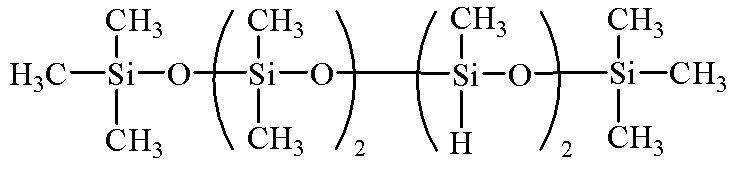
攪拌機、温度計、還流冷却器を備えたガラス製フラスコに、下記一般式で表されるハイドロジェンポリシロキサン296g、2-プロパノール300g、トリグリセリンモノアリルエーテル390g、塩化白金酸3%ブタノール溶液0.05gを加え、80℃で5時間撹拌して、反応を完了した。反応溶剤を100℃で減圧留去し、淡黄色透明の液体を得た。
得られたオルガノポリシロキサン界面活性剤の代表構造を以下に示す。
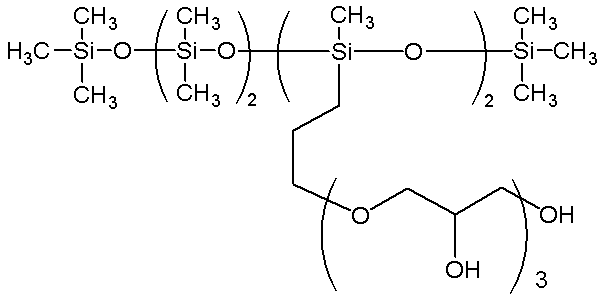
得られたオルガノポリシロキサン界面活性剤のGPC測定による重量平均分子量は850であった。前記オルガノポリシロキサン界面活性剤は、親水性基比率が1.75であり、かつ、ポリオキシアルキレン基を有さないものであった。
合成例(2)
攪拌機、温度計、還流冷却器を備えたガラス製フラスコに、下記一般式で表されるハイドロジェンポリシロキサン700g、2-プロパノール1000g、ジグリセリンモノアリルエーテル720g、下記モノビニルジシロキサン86g、塩化白金酸3%ブタノール溶液0.1gを加え、80℃で5時間撹拌して、反応を完了した。反応溶剤を100℃で減圧留去し、淡黄色透明の液体を得た。

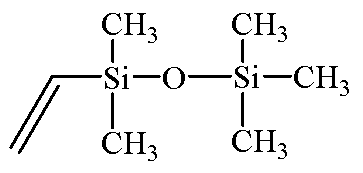
攪拌機、温度計、還流冷却器を備えたガラス製フラスコに、下記一般式で表されるハイドロジェンポリシロキサン700g、2-プロパノール1000g、ジグリセリンモノアリルエーテル720g、下記モノビニルジシロキサン86g、塩化白金酸3%ブタノール溶液0.1gを加え、80℃で5時間撹拌して、反応を完了した。反応溶剤を100℃で減圧留去し、淡黄色透明の液体を得た。
得られたオルガノポリシロキサン界面活性剤の代表構造を以下に示す。

得られたオルガノポリシロキサン界面活性剤のGPC測定による重量平均分子量は17000であった。前記オルガノポリシロキサン界面活性剤は、親水性基比率が2.09であり、かつ、ポリオキシアルキレン基を有さないものであった。
合成例(3)
攪拌機、温度計、還流冷却器を備えたガラス製フラスコに、下記一般式で表されるハイドロジェンポリシロキサン1170g、2-プロパノール1000g、トリグリセリンモノアリルエーテル750g、塩化白金酸3%ブタノール溶液0.2gを加え、80℃で5時間撹拌して、反応を完了した。反応溶剤を100℃で減圧留去し、淡黄色透明の液体を得た。

攪拌機、温度計、還流冷却器を備えたガラス製フラスコに、下記一般式で表されるハイドロジェンポリシロキサン1170g、2-プロパノール1000g、トリグリセリンモノアリルエーテル750g、塩化白金酸3%ブタノール溶液0.2gを加え、80℃で5時間撹拌して、反応を完了した。反応溶剤を100℃で減圧留去し、淡黄色透明の液体を得た。
得られたオルガノポリシロキサン界面活性剤の代表構造を以下に示す。
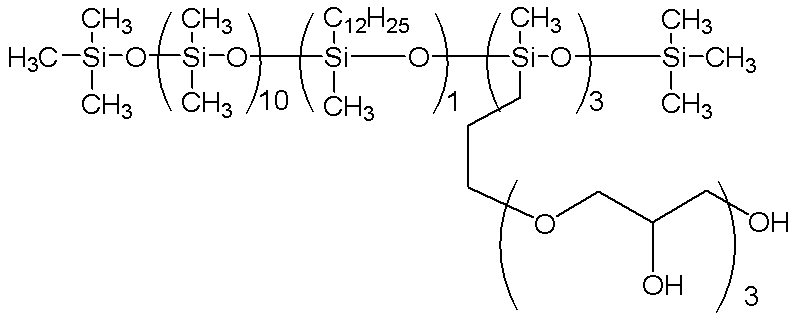
得られたオルガノポリシロキサン界面活性剤のGPC測定による重量平均分子量は3000であった。前記オルガノポリシロキサン界面活性剤は、親水性基比率が2.56であり、かつ、ポリオキシアルキレン基を有さないものであった。
合成例(4)
常法により、下記代表構造のアミノ変性オルガノポリシロキサンを合成した。このオルガノポリシロキサン界面活性剤のGPC測定による重量平均分子量は4300であった。前記オルガノポリシロキサン界面活性剤は、親水性基比率が2.03であり、かつ、ポリオキシアルキレン基を有さないものであった。
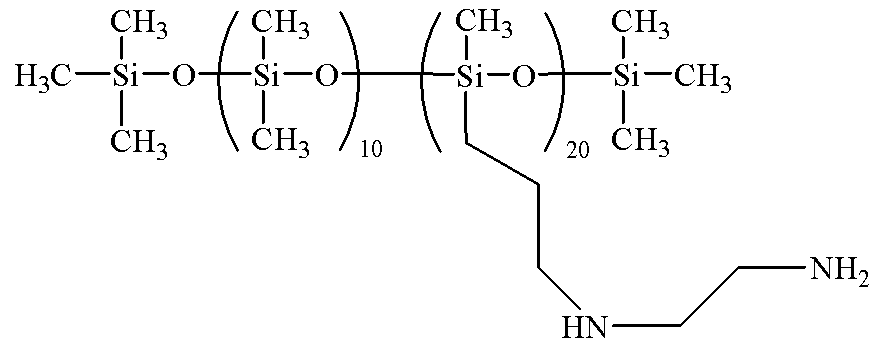
常法により、下記代表構造のアミノ変性オルガノポリシロキサンを合成した。このオルガノポリシロキサン界面活性剤のGPC測定による重量平均分子量は4300であった。前記オルガノポリシロキサン界面活性剤は、親水性基比率が2.03であり、かつ、ポリオキシアルキレン基を有さないものであった。
合成例(5)
常法により、下記代表構造のカルボキシル変性オルガノポリシロキサンを合成した。このオルガノポリシロキサン界面活性剤のGPC測定による重量平均分子量は10000であった。前記オルガノポリシロキサン界面活性剤は、親水性基比率が1.34であり、かつ、ポリオキシアルキレン基を有さないものであった。

常法により、下記代表構造のカルボキシル変性オルガノポリシロキサンを合成した。このオルガノポリシロキサン界面活性剤のGPC測定による重量平均分子量は10000であった。前記オルガノポリシロキサン界面活性剤は、親水性基比率が1.34であり、かつ、ポリオキシアルキレン基を有さないものであった。
合成例(6)
攪拌機、温度計、還流冷却器を備えたガラス製フラスコに、下記代表構造のアミノ変性オルガノポリシロキサン150gと2-プロパノール200g、グルコノ-δ-ラクトン89gを加え、80℃で5時間撹拌して、反応を完了した。反応溶剤を100℃で減圧留去し、淡黄色透明の半固体を得た。
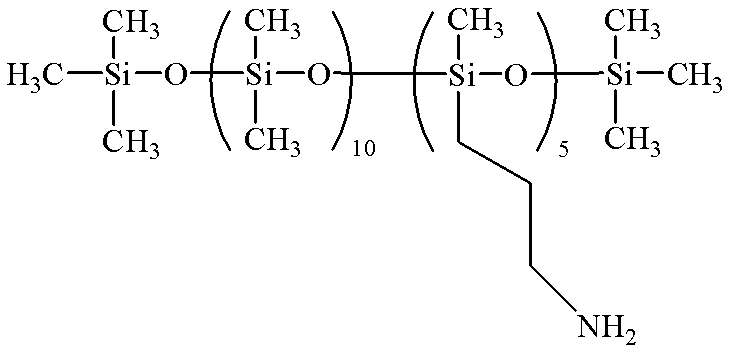
攪拌機、温度計、還流冷却器を備えたガラス製フラスコに、下記代表構造のアミノ変性オルガノポリシロキサン150gと2-プロパノール200g、グルコノ-δ-ラクトン89gを加え、80℃で5時間撹拌して、反応を完了した。反応溶剤を100℃で減圧留去し、淡黄色透明の半固体を得た。
得られたオルガノポリシロキサン界面活性剤の代表構造を以下に示す。
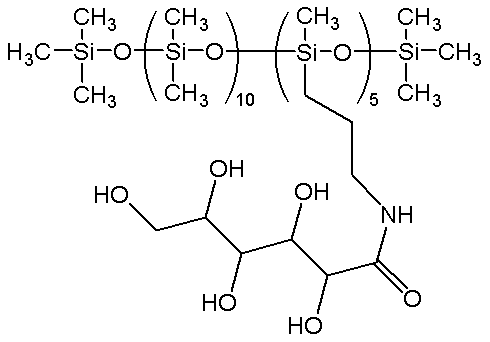
このオルガノポリシロキサン界面活性剤のGPC測定による重量平均分子量は3000であった。前記オルガノポリシロキサン界面活性剤は、親水性基比率が2.01であり、かつ、ポリオキシアルキレン基を有さないものであった。
比較合成例(1)
攪拌機、温度計、還流冷却器を備えたガラス製フラスコに、下記一般式で表されるハイドロジェンジシロキサン150g、2-プロパノール50g、グリセリンモノアリルエーテル130g、塩化白金酸3%ブタノール溶液0.05gを加え、80℃で5時間撹拌して、反応を完了した。未反応原料、及び反応溶剤を100℃で減圧留去し、淡黄色透明の液体を得た。
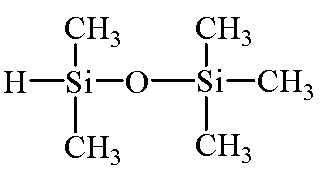
攪拌機、温度計、還流冷却器を備えたガラス製フラスコに、下記一般式で表されるハイドロジェンジシロキサン150g、2-プロパノール50g、グリセリンモノアリルエーテル130g、塩化白金酸3%ブタノール溶液0.05gを加え、80℃で5時間撹拌して、反応を完了した。未反応原料、及び反応溶剤を100℃で減圧留去し、淡黄色透明の液体を得た。
得られたオルガノポリシロキサン界面活性剤の代表構造を以下に示す。
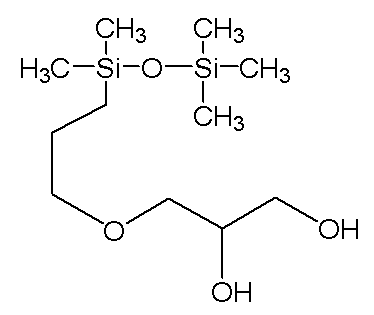
得られたオルガノポリシロキサン界面活性剤のGPC測定による重量平均分子量は250であった。前記オルガノポリシロキサン界面活性剤は、親水性基比率が2.13であり、かつ、ポリオキシアルキレン基を有さないものであった。
比較合成例(2)
攪拌機、温度計、還流冷却器を備えたガラス製フラスコに、下記一般式で表されるハイドロジェンジシロキサン480g、2-プロパノール200g、ジグリセリンモノアリルエーテル85g、塩化白金酸3%ブタノール溶液0.05gを加え、80℃で5時間撹拌して、反応を完了した。未反応原料、及び反応溶剤を100℃で減圧留去し、淡黄色透明の液体を得た。
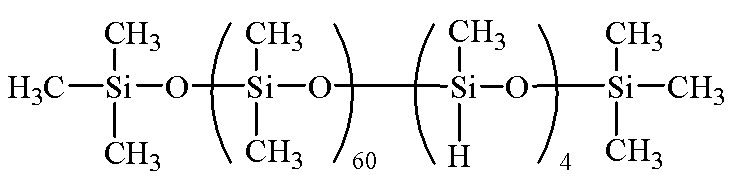
攪拌機、温度計、還流冷却器を備えたガラス製フラスコに、下記一般式で表されるハイドロジェンジシロキサン480g、2-プロパノール200g、ジグリセリンモノアリルエーテル85g、塩化白金酸3%ブタノール溶液0.05gを加え、80℃で5時間撹拌して、反応を完了した。未反応原料、及び反応溶剤を100℃で減圧留去し、淡黄色透明の液体を得た。
得られたオルガノポリシロキサン界面活性剤の代表構造を以下に示す。
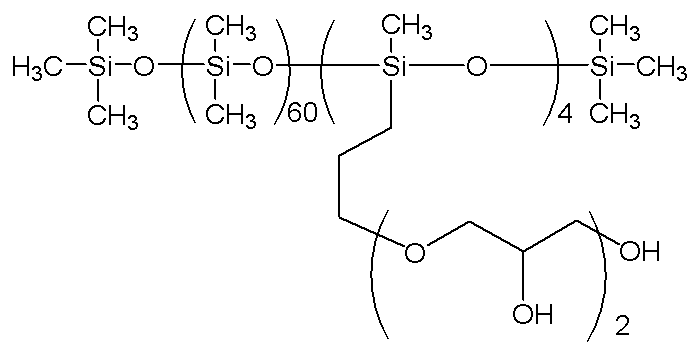
得られたオルガノポリシロキサン界面活性剤のGPC測定による重量平均分子量は6200であった。前記オルガノポリシロキサン界面活性剤は、親水性基比率が6.64であり、かつ、ポリオキシアルキレン基を有さないものであった。
比較合成例(3)
常法により、下記代表構造のアミノ変性オルガノポリシロキサンを合成した。このオルガノポリシロキサン界面活性剤のGPC測定による重量平均分子量は1600であった。前記オルガノポリシロキサン界面活性剤は、親水性基比率が6.04であり、かつ、ポリオキシアルキレン基を有さないものであった。
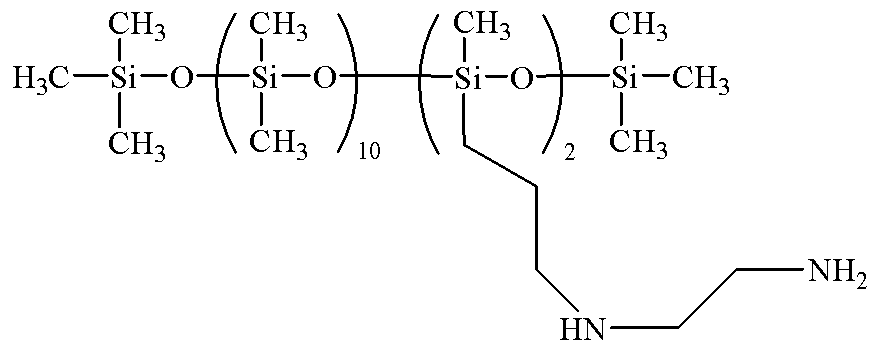
常法により、下記代表構造のアミノ変性オルガノポリシロキサンを合成した。このオルガノポリシロキサン界面活性剤のGPC測定による重量平均分子量は1600であった。前記オルガノポリシロキサン界面活性剤は、親水性基比率が6.04であり、かつ、ポリオキシアルキレン基を有さないものであった。
製造例1
ミキサーにポリメチルシルセスキオキサンKMP-590(信越化学工業社製)100g、合成例1で得たグリセリン変性オルガノポリシロキサン3gを添加し、110℃で3時間、撹拌、粉砕し、白色粉体を得た。
ミキサーにポリメチルシルセスキオキサンKMP-590(信越化学工業社製)100g、合成例1で得たグリセリン変性オルガノポリシロキサン3gを添加し、110℃で3時間、撹拌、粉砕し、白色粉体を得た。
製造例2
ミキサーにポリメチルシルセスキオキサンKMP-590(信越化学工業社製)100g、合成例2で得たグリセリン変性オルガノポリシロキサン4gを添加し、100℃で3時間、撹拌、粉砕し、白色粉体を得た。
ミキサーにポリメチルシルセスキオキサンKMP-590(信越化学工業社製)100g、合成例2で得たグリセリン変性オルガノポリシロキサン4gを添加し、100℃で3時間、撹拌、粉砕し、白色粉体を得た。
製造例3
ミキサーにポリメチルシルセスキオキサンKMP-590(信越化学工業社製)100g、合成例4で得たアミノ変性オルガノポリシロキサン4gを添加し、100℃で3時間、撹拌、粉砕し、白色粉体を得た。
ミキサーにポリメチルシルセスキオキサンKMP-590(信越化学工業社製)100g、合成例4で得たアミノ変性オルガノポリシロキサン4gを添加し、100℃で3時間、撹拌、粉砕し、白色粉体を得た。
製造例4
ミキサーにポリメチルシルセスキオキサンKMP-590(信越化学工業社製)100g、合成例6で得た糖変性オルガノポリシロキサン2g、水10gを添加し、100℃で3時間、撹拌、粉砕、100℃で3時間乾燥し、白色粉体を得た。
ミキサーにポリメチルシルセスキオキサンKMP-590(信越化学工業社製)100g、合成例6で得た糖変性オルガノポリシロキサン2g、水10gを添加し、100℃で3時間、撹拌、粉砕、100℃で3時間乾燥し、白色粉体を得た。
製造例5
ミキサーにシリコーンエラストマーパウダーKMP-597(信越化学工業社製)100g、合成例1で得たグリセリン変性オルガノポリシロキサン2g、エタノール5gを添加し、100℃で3時間、撹拌、粉砕、100℃で3時間乾燥し、白色粉体を得た。
ミキサーにシリコーンエラストマーパウダーKMP-597(信越化学工業社製)100g、合成例1で得たグリセリン変性オルガノポリシロキサン2g、エタノール5gを添加し、100℃で3時間、撹拌、粉砕、100℃で3時間乾燥し、白色粉体を得た。
製造例6
ミキサーにポリメチルシルセスキオキサン被覆シリコーンエラストマーパウダーKSP-100(信越化学工業社製)100g、合成例3で得たグリセリン変性オルガノポリシロキサン2gを添加し、100℃で3時間、撹拌、粉砕、100℃で3時間乾燥し、白色粉体を得た。
ミキサーにポリメチルシルセスキオキサン被覆シリコーンエラストマーパウダーKSP-100(信越化学工業社製)100g、合成例3で得たグリセリン変性オルガノポリシロキサン2gを添加し、100℃で3時間、撹拌、粉砕、100℃で3時間乾燥し、白色粉体を得た。
製造例7
ミキサーにポリメチルシルセスキオキサン被覆シリコーンエラストマーパウダーKSP-100(信越化学工業社製)100g、合成例5で得たカルボキシ変性オルガノポリシロキサン2g、エタノール5gを添加し、100℃で3時間、撹拌、粉砕、100℃で3時間乾燥し、白色粉体を得た。
ミキサーにポリメチルシルセスキオキサン被覆シリコーンエラストマーパウダーKSP-100(信越化学工業社製)100g、合成例5で得たカルボキシ変性オルガノポリシロキサン2g、エタノール5gを添加し、100℃で3時間、撹拌、粉砕、100℃で3時間乾燥し、白色粉体を得た。
製造例8
ミキサーにポリアミドパウダーSP-500(東レ社製)100g、合成例1で得たグリセリン変性オルガノポリシロキサン2g、エタノール5gを添加し、100℃で3時間、撹拌、粉砕、100℃で3時間乾燥し、白色粉体を得た。
ミキサーにポリアミドパウダーSP-500(東レ社製)100g、合成例1で得たグリセリン変性オルガノポリシロキサン2g、エタノール5gを添加し、100℃で3時間、撹拌、粉砕、100℃で3時間乾燥し、白色粉体を得た。
製造例9
ミキサーにメタクリル酸メチルクロスポリマーM-305(東レ社製)100g、合成例2で得たグリセリン変性オルガノポリシロキサン2g、エタノール5gを添加し、100℃で3時間、撹拌、粉砕、100℃で3時間乾燥し、白色粉体を得た。
ミキサーにメタクリル酸メチルクロスポリマーM-305(東レ社製)100g、合成例2で得たグリセリン変性オルガノポリシロキサン2g、エタノール5gを添加し、100℃で3時間、撹拌、粉砕、100℃で3時間乾燥し、白色粉体を得た。
製造例10
ミキサーにメチコン2%処理酸化チタン100g、合成例1で得たグリセリン変性オルガノポリシロキサン2g、エタノール5gを添加し、100℃で3時間、撹拌、粉砕、100℃で3時間乾燥し、白色粉体を得た。
ミキサーにメチコン2%処理酸化チタン100g、合成例1で得たグリセリン変性オルガノポリシロキサン2g、エタノール5gを添加し、100℃で3時間、撹拌、粉砕、100℃で3時間乾燥し、白色粉体を得た。
製造例11
ミキサーにトリメトキシカプリリルシラン2%処理タルク100g、合成例3で得たグリセリン変性オルガノポリシロキサン2g、エタノール5gを添加し、100℃で3時間、撹拌、粉砕、100℃で3時間乾燥し、白色粉体を得た。
ミキサーにトリメトキシカプリリルシラン2%処理タルク100g、合成例3で得たグリセリン変性オルガノポリシロキサン2g、エタノール5gを添加し、100℃で3時間、撹拌、粉砕、100℃で3時間乾燥し、白色粉体を得た。
製造例12
ミキサーに2%モノパーフルオロアルキルエチルリン酸エステル処理マイカ100g、合成例4で得たアミノ変性オルガノポリシロキサン2g、エタノール5gを添加し、100℃で3時間、撹拌、粉砕、100℃で3時間乾燥し、白色粉体を得た。
ミキサーに2%モノパーフルオロアルキルエチルリン酸エステル処理マイカ100g、合成例4で得たアミノ変性オルガノポリシロキサン2g、エタノール5gを添加し、100℃で3時間、撹拌、粉砕、100℃で3時間乾燥し、白色粉体を得た。
製造例13
ミキサーに2%メチコン処理黒酸化鉄100g、合成例5で得たアミノ変性オルガノポリシロキサン2g、エタノール5gを添加し、100℃で3時間、撹拌、粉砕、100℃で3時間乾燥し、黒色粉体を得た。
ミキサーに2%メチコン処理黒酸化鉄100g、合成例5で得たアミノ変性オルガノポリシロキサン2g、エタノール5gを添加し、100℃で3時間、撹拌、粉砕、100℃で3時間乾燥し、黒色粉体を得た。
比較製造例1
ミキサーにポリメチルシルセスキオキサンKMP-590(信越化学工業社製)100g、比較合成例1で得たグリセリン変性オルガノポリシロキサン3gを添加し、110℃で3時間、撹拌、粉砕し、白色粉体を得た。
ミキサーにポリメチルシルセスキオキサンKMP-590(信越化学工業社製)100g、比較合成例1で得たグリセリン変性オルガノポリシロキサン3gを添加し、110℃で3時間、撹拌、粉砕し、白色粉体を得た。
比較製造例2
ミキサーにポリメチルシルセスキオキサンKMP-590(信越化学工業社製)100g、比較合成例2で得たグリセリン変性オルガノポリシロキサン4gを添加し、100℃で3時間、撹拌、粉砕し、白色粉体を得た。
ミキサーにポリメチルシルセスキオキサンKMP-590(信越化学工業社製)100g、比較合成例2で得たグリセリン変性オルガノポリシロキサン4gを添加し、100℃で3時間、撹拌、粉砕し、白色粉体を得た。
比較製造例3
ミキサーにポリメチルシルセスキオキサンKMP-590(信越化学工業社製)100g、比較合成例3で得たアミノ変性オルガノポリシロキサン4gを添加し、100℃で3時間、撹拌、粉砕し、白色粉体を得た。
ミキサーにポリメチルシルセスキオキサンKMP-590(信越化学工業社製)100g、比較合成例3で得たアミノ変性オルガノポリシロキサン4gを添加し、100℃で3時間、撹拌、粉砕し、白色粉体を得た。
比較製造例4
ミキサーにポリメチルシルセスキオキサンKMP-590(信越化学工業社製)100g、ポリエーテル変性オルガノポリシロキサンKF-6017 4gを添加し、100℃で3時間、撹拌、粉砕し、白色粉体を得た。
ミキサーにポリメチルシルセスキオキサンKMP-590(信越化学工業社製)100g、ポリエーテル変性オルガノポリシロキサンKF-6017 4gを添加し、100℃で3時間、撹拌、粉砕し、白色粉体を得た。
比較製造例5
ミキサーにポリメチルシルセスキオキサン被覆シリコーンエラストマーパウダーKSP-100(信越化学工業社製)100g、比較合成例1で得たグリセリン変性オルガノポリシロキサン2gを添加し、100℃で3時間、撹拌、粉砕、100℃で3時間乾燥し、白色粉体を得た。
ミキサーにポリメチルシルセスキオキサン被覆シリコーンエラストマーパウダーKSP-100(信越化学工業社製)100g、比較合成例1で得たグリセリン変性オルガノポリシロキサン2gを添加し、100℃で3時間、撹拌、粉砕、100℃で3時間乾燥し、白色粉体を得た。
比較製造例6
ミキサーにポリメチルシルセスキオキサン被覆シリコーンエラストマーパウダーKSP-100(信越化学工業社製)100g、比較合成例3で得たアミノ変性オルガノポリシロキサン2g、エタノール5gを添加し、100℃で3時間、撹拌、粉砕、100℃で3時間乾燥し、白色粉体を得た。
ミキサーにポリメチルシルセスキオキサン被覆シリコーンエラストマーパウダーKSP-100(信越化学工業社製)100g、比較合成例3で得たアミノ変性オルガノポリシロキサン2g、エタノール5gを添加し、100℃で3時間、撹拌、粉砕、100℃で3時間乾燥し、白色粉体を得た。
比較製造例7
ミキサーにメチコン2%処理酸化チタン100g、ポリエーテル変性シリコーンKF-6017(信越化学工業社製)2g、エタノール5gを添加し、100℃で3時間、撹拌、粉砕、100℃で3時間乾燥し、白色粉体を得た。
ミキサーにメチコン2%処理酸化チタン100g、ポリエーテル変性シリコーンKF-6017(信越化学工業社製)2g、エタノール5gを添加し、100℃で3時間、撹拌、粉砕、100℃で3時間乾燥し、白色粉体を得た。
比較製造例8
ミキサーにトリメトキシカプリリルシラン2%処理タルク100g、ポリオキシエチレン4-ラウリルエーテル2g、エタノール5gを添加し、100℃で3時間、撹拌、粉砕、100℃で3時間乾燥し、白色粉体を得た。
なお、上記製造例、比較製造例で用いた粉体の平均粒子径はいずれも200μm以下であった。
ミキサーにトリメトキシカプリリルシラン2%処理タルク100g、ポリオキシエチレン4-ラウリルエーテル2g、エタノール5gを添加し、100℃で3時間、撹拌、粉砕、100℃で3時間乾燥し、白色粉体を得た。
なお、上記製造例、比較製造例で用いた粉体の平均粒子径はいずれも200μm以下であった。
(実施例1~4及び比較例1~7)
(評価1)
下記表に示す化粧水を常法により製造し、その使用性について評価した。
[官能評価方法]
下記表1に示す配合で得た化粧水を皮膚に十分塗布し、官能評価した。また、分散性については目視にて評価を行った。結果を「効果がある」と回答したパネラーの人数により、下記の評価基準で示す。
(評価1)
下記表に示す化粧水を常法により製造し、その使用性について評価した。
[官能評価方法]
下記表1に示す配合で得た化粧水を皮膚に十分塗布し、官能評価した。また、分散性については目視にて評価を行った。結果を「効果がある」と回答したパネラーの人数により、下記の評価基準で示す。
[評価基準]
◎:4~5人が効果あると回答
○:3人が効果あると回答
△:2人が効果あると回答
×:効果あると回答したのは1人または0人
◎:4~5人が効果あると回答
○:3人が効果あると回答
△:2人が効果あると回答
×:効果あると回答したのは1人または0人
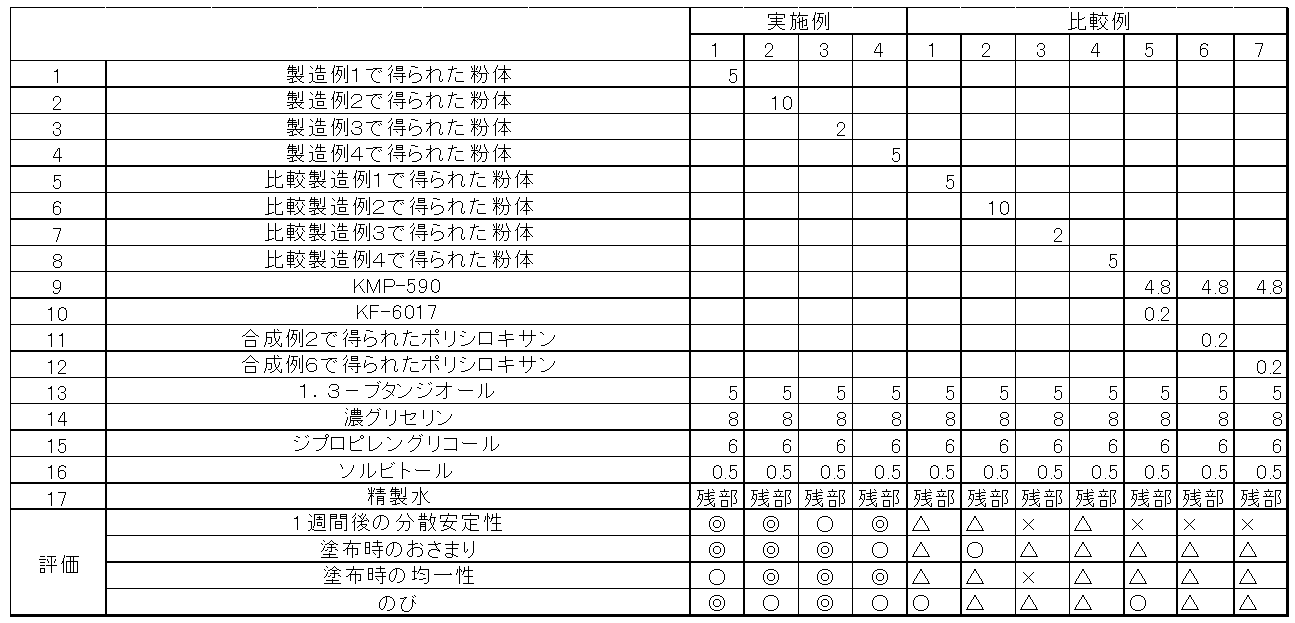
表1に示されるように、本発明の分散性粉体を用いて得られた化粧水は分散性が非常に優れ、分散の安定性が高く、化粧膜が均一であり、塗布時のおさまりが良く、のびが良いことが確認された。
(実施例5~9及び比較例8~13)
(評価2)
下記表2に示す配合で得た化粧水を常法により製造し、その使用性について評価した。
[官能評価方法]
下記表2に示す化粧水を皮膚に十分塗布し、官能評価した。また、分散性については目視にて評価を行った。結果を「効果がある」と回答したパネラーの人数により、下記の評価基準で示す。
(評価2)
下記表2に示す配合で得た化粧水を常法により製造し、その使用性について評価した。
[官能評価方法]
下記表2に示す化粧水を皮膚に十分塗布し、官能評価した。また、分散性については目視にて評価を行った。結果を「効果がある」と回答したパネラーの人数により、下記の評価基準で示す。
[評価基準]
◎:4~5人が効果あると回答
○:3人が効果あると回答
△:2人が効果あると回答
×:効果あると回答したのは1人または0人
◎:4~5人が効果あると回答
○:3人が効果あると回答
△:2人が効果あると回答
×:効果あると回答したのは1人または0人

本発明の分散性粉体を用いて得られた化粧水は分散性に優れ、分散安定性が高く、化粧膜が均一であり、塗布時のおさまりが良く、のび、塗布後のさらさら感が良いことが確認された。
(実施例10,11及び比較例14~17)
(評価3)
下記表3に示すファンデーションを下記方法により製造し、その使用性について評価した。
方法
A:表3に示す各成分を50℃に加熱し、均一に混合する。
B:Aを粉砕し、皿に圧縮成形し、ファンデーションを得た。
[官能評価方法]
下記表3に示すファンデーションを皮膚に塗布し、官能評価した。結果を「効果がある」と回答したパネラーの人数により、下記の評価基準で示す。
(評価3)
下記表3に示すファンデーションを下記方法により製造し、その使用性について評価した。
方法
A:表3に示す各成分を50℃に加熱し、均一に混合する。
B:Aを粉砕し、皿に圧縮成形し、ファンデーションを得た。
[官能評価方法]
下記表3に示すファンデーションを皮膚に塗布し、官能評価した。結果を「効果がある」と回答したパネラーの人数により、下記の評価基準で示す。
[評価基準]
◎:4~5人が効果あると回答
○:3人が効果あると回答
△:2人が効果あると回答
×:効果あると回答したのは1人または0人
◎:4~5人が効果あると回答
○:3人が効果あると回答
△:2人が効果あると回答
×:効果あると回答したのは1人または0人
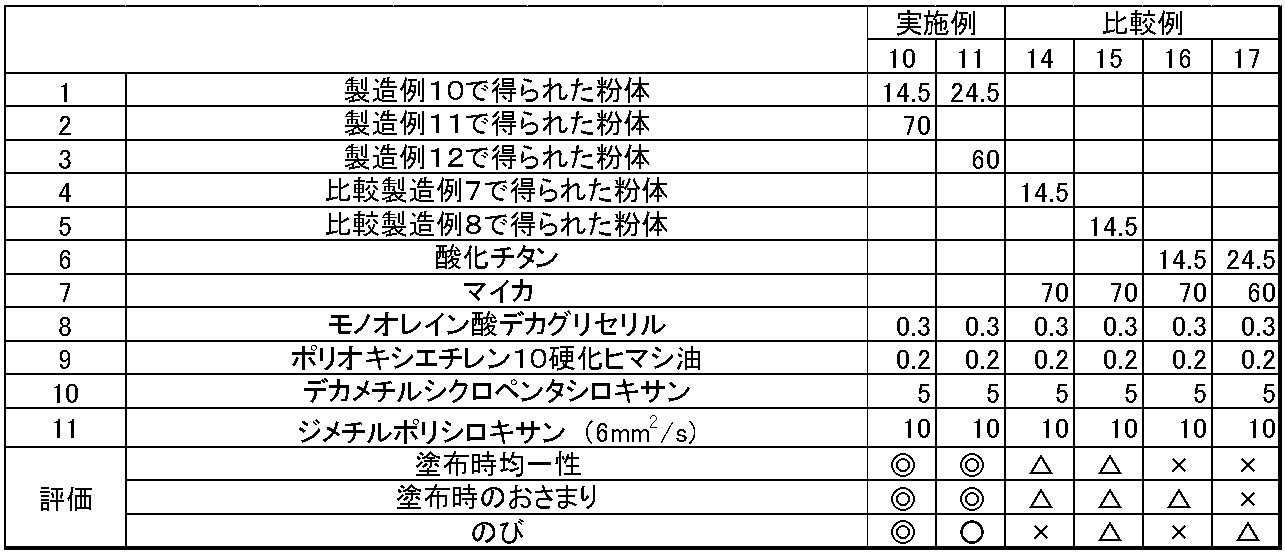
本発明の分散性粉体を用いて得られたファンデーションは分散性が良いため、化粧膜が均一であり、塗布時のおさまりが良く、のびが良いことが確認された。
表1~3の評価結果より明らかなように、本発明の分散性粉体を含む実施例1~9の化粧水、実施例10,11のファンデーションは、分散安定性、塗布時のおさまり、塗布時の均一性、のびが良好である。一方、本発明の範囲外である比較例1~13の化粧水、比較例14~17のファンデーションは、分散安定性が悪く、塗布時のおさまり、塗布時の均一性、のびが不十分である。特に、表面処理剤の重量平均分子量が本発明の下限値未満である比較例1、8、表面処理剤の親水性基比率が本発明の上限値を超える比較例2、3、9では分散安定性が悪く、塗布時のおさまり、塗布時の均一性、のびが不十分であることから、本発明のように前記表面処理剤が、重量平均分子量300~20000のオルガノポリシロキサン界面活性剤から選択される表面処理剤であり、かつ、親水性基としてグリセリン基、アミノ基、カルボキシル基、糖残基から選択される有機基を少なくとも1つ有し、前記親水性基と前記オルガノシロキサン界面活性剤全体の重量比は前記親水性基を1とした場合、4.0以下であることが課題解決のために重要であることは明らかである。
(実施例12)アイライナー
下記組成のアイライナーを常法により調製した。
(成分)
1.デカメチルシクロペンタシロキサン 22.0
2.ジメチルポリシロキサン(6mm2/秒) 5.0
3.製造例13の黒色粉体 20.0
4.ビタミンEアセテート 0.2
5.ホホバ油 2.0
6.ベントナイト 3.0
7.ポリエーテル変性オルガノポリシロキサン※ 2.0
8.エタノール 10.0
9.1,3-ブチレングリコール 10.0
10.防腐剤 適量
11.香料 適量
12.精製水 残量
合計 100.0%
※ポリエーテル変性シリコーン KF-6017(信越化学工業社製)
下記組成のアイライナーを常法により調製した。
(成分)
1.デカメチルシクロペンタシロキサン 22.0
2.ジメチルポリシロキサン(6mm2/秒) 5.0
3.製造例13の黒色粉体 20.0
4.ビタミンEアセテート 0.2
5.ホホバ油 2.0
6.ベントナイト 3.0
7.ポリエーテル変性オルガノポリシロキサン※ 2.0
8.エタノール 10.0
9.1,3-ブチレングリコール 10.0
10.防腐剤 適量
11.香料 適量
12.精製水 残量
合計 100.0%
※ポリエーテル変性シリコーン KF-6017(信越化学工業社製)
得られたアイライナーは、伸びが軽くて描きやすく、清涼感があってさっぱりとしてべたつきがない使用感で、温度や経時による変化もなく、使用性も安定性にも優れ、化粧持ちも非常に良いことが確認された。
(実施例13)ヘアトリートメント
下記組成のヘアトリートメントを調製した。
(成分) 組成質量(%)
1.シリコーンガム溶解品(注1) 5.0
2.ジフェニルジメチコン(注2) 4.0
3.製造例1で得られた粉体 2.0
4.オクタン酸セチル 1.0
5.ポリエーテル変性シリコーン(注3) 1.0
6.PEG-60水添硬化ヒマシ油 1.0
7.モノステアリン酸グリセリル 0.5
8.カルボキシビニルポリマー(1質量%水溶液) 25.0
9.キサンタンガム(1質量%水溶液) 7.0
10.1,3-ブチレングリコール 5.0
11.アルコール 7.0
12.防腐剤 0.5
13.香料 0.2
14.精製水 残量
合計 100.0
(注1)信越化学工業(株)製:MK-15H
(注2)信越化学工業(株)製:KF-54
(注3)信越化学工業(株)製:KF-6013
下記組成のヘアトリートメントを調製した。
(成分) 組成質量(%)
1.シリコーンガム溶解品(注1) 5.0
2.ジフェニルジメチコン(注2) 4.0
3.製造例1で得られた粉体 2.0
4.オクタン酸セチル 1.0
5.ポリエーテル変性シリコーン(注3) 1.0
6.PEG-60水添硬化ヒマシ油 1.0
7.モノステアリン酸グリセリル 0.5
8.カルボキシビニルポリマー(1質量%水溶液) 25.0
9.キサンタンガム(1質量%水溶液) 7.0
10.1,3-ブチレングリコール 5.0
11.アルコール 7.0
12.防腐剤 0.5
13.香料 0.2
14.精製水 残量
合計 100.0
(注1)信越化学工業(株)製:MK-15H
(注2)信越化学工業(株)製:KF-54
(注3)信越化学工業(株)製:KF-6013
<化粧料の調製>
A:成分1、2、4~7を加熱溶解した。
B:成分10~14を加熱溶解した。
C:攪拌下、AにBを添加して乳化し、さらに、これに成分3、8及び9を加えてヘアトリートメントを得た。
A:成分1、2、4~7を加熱溶解した。
B:成分10~14を加熱溶解した。
C:攪拌下、AにBを添加して乳化し、さらに、これに成分3、8及び9を加えてヘアトリートメントを得た。
以上のようにして得られたヘアトリートメントは、のび広がりが軽く、毛髪に光沢と滑らかさを与えることが確認された。
なお、本発明は、上記実施形態に限定されるものではない。上記実施形態は例示であり、本発明の特許請求の範囲に記載された技術的思想と実質的に同一な構成を有し、同様な作用効果を奏するものは、いかなるものであっても本発明の技術的範囲に包含される。
Claims (6)
- 粉体を表面処理剤で処理してなる分散性粉体であって、
前記表面処理剤が、重量平均分子量300~20000のオルガノポリシロキサン界面活性剤から選択される表面処理剤であり、
前記オルガノポリシロキサン界面活性剤は、親水性基としてグリセリン基、アミノ基、カルボキシル基、糖残基から選択される有機基を1つ以上有し、前記親水性基と前記オルガノシロキサン界面活性剤全体の重量比は前記親水性基を1とした場合、4.0以下であり、かつ、ポリオキシアルキレン基を有さないことを特徴とする分散性粉体。 - 前記粉体がシリコーンパウダー、ポリアミドパウダー、ポリアクリル酸・アクリル酸エステルパウダー、ポリエステルパウダー、ポリエチレンパウダー、ポリプロピレンパウダー、ポリスチレンパウダー、ポリウレタンパウダー、ベンゾグアナミンパウダー、ポリメチルベンゾグアナミンパウダー、テトラフルオロエチレンパウダー、ポリメチルメタクリレートパウダー、セルロースパウダー、シルクパウダー、ナイロンパウダー、無機粉体、有色顔料、パール顔料、金属粉末顔料から選択されることを特徴とする請求項1に記載の分散性粉体。
- 前記粉体が疎水性の粉体であり、平均粒子径が200μm以下であることを特徴とする請求項1又は請求項2に記載の分散性粉体。
- 前記疎水性の粉体が、シリコーン、フッ素化合物、シランカップリング剤、チタンカップリング剤、N-アシル化アミノ酸、金属石鹸から選択される処理により表面疎水化されたものであることを特徴とする請求項3に記載の分散性粉体。
- 前記粉体を前記表面処理剤で処理する際に、60℃以上180℃未満で熱処理を行うことを特徴とする請求項1から請求項4のいずれか1項に記載の分散性粉体の製造方法。
- 請求項1から請求項4のいずれか1項に記載の分散性粉体を含む化粧料。
Applications Claiming Priority (2)
| Application Number | Priority Date | Filing Date | Title |
|---|---|---|---|
| JP2018120538A JP6923487B2 (ja) | 2018-06-26 | 2018-06-26 | 分散性粉体 |
| JP2018-120538 | 2018-06-26 |
Publications (1)
| Publication Number | Publication Date |
|---|---|
| WO2020003876A1 true WO2020003876A1 (ja) | 2020-01-02 |
Family
ID=68986264
Family Applications (1)
| Application Number | Title | Priority Date | Filing Date |
|---|---|---|---|
| PCT/JP2019/021502 Ceased WO2020003876A1 (ja) | 2018-06-26 | 2019-05-30 | 分散性粉体 |
Country Status (2)
| Country | Link |
|---|---|
| JP (1) | JP6923487B2 (ja) |
| WO (1) | WO2020003876A1 (ja) |
Cited By (1)
| Publication number | Priority date | Publication date | Assignee | Title |
|---|---|---|---|---|
| CN117178028A (zh) * | 2021-05-11 | 2023-12-05 | 帝化株式会社 | 复合表面处理无机粉体 |
Families Citing this family (1)
| Publication number | Priority date | Publication date | Assignee | Title |
|---|---|---|---|---|
| EP4644466A1 (en) * | 2022-12-26 | 2025-11-05 | Shin-Etsu Chemical Co., Ltd. | Organopolysiloxane, and cosmetics containing organopolysiloxane |
Citations (10)
| Publication number | Priority date | Publication date | Assignee | Title |
|---|---|---|---|---|
| JPH0959125A (ja) * | 1995-08-24 | 1997-03-04 | Kao Corp | 化粧料用粉体及びこれを含有する化粧料 |
| JPH10316536A (ja) * | 1997-05-19 | 1998-12-02 | Kose Corp | 改質粉体及びそれを配合した化粧料 |
| JP2004231609A (ja) * | 2003-01-31 | 2004-08-19 | Kose Corp | 化粧料 |
| JP2008266285A (ja) * | 2006-10-24 | 2008-11-06 | Shiseido Co Ltd | オルガノシロキサン誘導体 |
| JP2009256616A (ja) * | 2008-03-21 | 2009-11-05 | Shin Etsu Chem Co Ltd | グリセリン変性シリコーン及びそれを含む化粧料 |
| JP2009263213A (ja) * | 2008-04-03 | 2009-11-12 | Shin Etsu Chem Co Ltd | カルボキシル基を有するオルガノポリシロキサンで表面処理された粉体、該粉体の分散物および該粉体を含む化粧料 |
| JP2010030954A (ja) * | 2008-07-29 | 2010-02-12 | Fuji Kasei Kk | 処理粉体および乳化組成物 |
| WO2011049246A1 (ja) * | 2009-10-23 | 2011-04-28 | 東レ・ダウコーニング株式会社 | 新規オルガノポリシロキサン共重合体 |
| JP2014070220A (ja) * | 2012-10-02 | 2014-04-21 | Dow Corning Toray Co Ltd | 新規な共変性オルガノポリシロキサン、それを含有してなる粉体処理剤および粉体組成物 |
| WO2016157869A1 (ja) * | 2015-03-30 | 2016-10-06 | 株式会社コーセー | 固形粉末化粧料 |
-
2018
- 2018-06-26 JP JP2018120538A patent/JP6923487B2/ja active Active
-
2019
- 2019-05-30 WO PCT/JP2019/021502 patent/WO2020003876A1/ja not_active Ceased
Patent Citations (10)
| Publication number | Priority date | Publication date | Assignee | Title |
|---|---|---|---|---|
| JPH0959125A (ja) * | 1995-08-24 | 1997-03-04 | Kao Corp | 化粧料用粉体及びこれを含有する化粧料 |
| JPH10316536A (ja) * | 1997-05-19 | 1998-12-02 | Kose Corp | 改質粉体及びそれを配合した化粧料 |
| JP2004231609A (ja) * | 2003-01-31 | 2004-08-19 | Kose Corp | 化粧料 |
| JP2008266285A (ja) * | 2006-10-24 | 2008-11-06 | Shiseido Co Ltd | オルガノシロキサン誘導体 |
| JP2009256616A (ja) * | 2008-03-21 | 2009-11-05 | Shin Etsu Chem Co Ltd | グリセリン変性シリコーン及びそれを含む化粧料 |
| JP2009263213A (ja) * | 2008-04-03 | 2009-11-12 | Shin Etsu Chem Co Ltd | カルボキシル基を有するオルガノポリシロキサンで表面処理された粉体、該粉体の分散物および該粉体を含む化粧料 |
| JP2010030954A (ja) * | 2008-07-29 | 2010-02-12 | Fuji Kasei Kk | 処理粉体および乳化組成物 |
| WO2011049246A1 (ja) * | 2009-10-23 | 2011-04-28 | 東レ・ダウコーニング株式会社 | 新規オルガノポリシロキサン共重合体 |
| JP2014070220A (ja) * | 2012-10-02 | 2014-04-21 | Dow Corning Toray Co Ltd | 新規な共変性オルガノポリシロキサン、それを含有してなる粉体処理剤および粉体組成物 |
| WO2016157869A1 (ja) * | 2015-03-30 | 2016-10-06 | 株式会社コーセー | 固形粉末化粧料 |
Cited By (1)
| Publication number | Priority date | Publication date | Assignee | Title |
|---|---|---|---|---|
| CN117178028A (zh) * | 2021-05-11 | 2023-12-05 | 帝化株式会社 | 复合表面处理无机粉体 |
Also Published As
| Publication number | Publication date |
|---|---|
| JP6923487B2 (ja) | 2021-08-18 |
| JP2020002031A (ja) | 2020-01-09 |
Similar Documents
| Publication | Publication Date | Title |
|---|---|---|
| JP7236349B2 (ja) | 分散性粉体及び化粧料 | |
| JP7371854B2 (ja) | 水中油型乳化化粧料 | |
| JP3678420B2 (ja) | 粘度鉱物を有する化粧料 | |
| JP2004169015A (ja) | 粉体組成物及び油中粉体分散物.並びにそれらを有する化粧料 | |
| JP6560151B2 (ja) | オルガノポリシロキサン、化粧料、及びオルガノポリシロキサンの製造方法 | |
| JP2009256616A (ja) | グリセリン変性シリコーン及びそれを含む化粧料 | |
| JP2012207078A (ja) | オルガノポリシロキサン及びそれを含む化粧料 | |
| WO2017187750A1 (ja) | 乳化化粧料 | |
| JPWO2017221940A1 (ja) | 化粧料用粉体の処理剤、化粧料用粉体、およびこれを配合した化粧料 | |
| JP6215719B2 (ja) | 化粧料 | |
| KR20130108150A (ko) | 신규 오르가노폴리실록산, 이것을 포함하는 화장료 및 오르가노폴리실록산의 제조 방법 | |
| JP6754346B2 (ja) | 化粧料 | |
| WO2021171735A1 (ja) | 化粧料 | |
| US20250313669A1 (en) | Organopolysiloxane, powder treatment agent, and treated powder and cosmetic treated with powder treatment agent | |
| WO2017169278A1 (ja) | オルガノポリシロキサン、化粧料、及びオルガノポリシロキサンの製造方法 | |
| JP6923487B2 (ja) | 分散性粉体 | |
| JP2019089715A (ja) | 化粧料の製造方法 | |
| EP3909647B1 (en) | Dispersible powder and cosmetic | |
| KR102741724B1 (ko) | 화장료 | |
| JP6754316B2 (ja) | 化粧料 | |
| JP7048480B2 (ja) | マイクロエマルション組成物及びその硬化物、並びに、それを含んだ化粧料 | |
| JP4993509B2 (ja) | 粉体表面処理剤、該処理剤で処理された粉体、及び該粉体を含む化粧料 |
Legal Events
| Date | Code | Title | Description |
|---|---|---|---|
| 121 | Ep: the epo has been informed by wipo that ep was designated in this application |
Ref document number: 19826804 Country of ref document: EP Kind code of ref document: A1 |
|
| NENP | Non-entry into the national phase |
Ref country code: DE |
|
| 122 | Ep: pct application non-entry in european phase |
Ref document number: 19826804 Country of ref document: EP Kind code of ref document: A1 |