WO2020003953A1 - Programme exécuté par ordinateur, dispositif de traitement d'informations et procédé exécuté par ordinateur - Google Patents
Programme exécuté par ordinateur, dispositif de traitement d'informations et procédé exécuté par ordinateur Download PDFInfo
- Publication number
- WO2020003953A1 WO2020003953A1 PCT/JP2019/022469 JP2019022469W WO2020003953A1 WO 2020003953 A1 WO2020003953 A1 WO 2020003953A1 JP 2019022469 W JP2019022469 W JP 2019022469W WO 2020003953 A1 WO2020003953 A1 WO 2020003953A1
- Authority
- WO
- WIPO (PCT)
- Prior art keywords
- time
- resident
- degree
- night
- determining
- Prior art date
- Legal status (The legal status is an assumption and is not a legal conclusion. Google has not performed a legal analysis and makes no representation as to the accuracy of the status listed.)
- Ceased
Links
Images






Classifications
-
- G—PHYSICS
- G16—INFORMATION AND COMMUNICATION TECHNOLOGY [ICT] SPECIALLY ADAPTED FOR SPECIFIC APPLICATION FIELDS
- G16H—HEALTHCARE INFORMATICS, i.e. INFORMATION AND COMMUNICATION TECHNOLOGY [ICT] SPECIALLY ADAPTED FOR THE HANDLING OR PROCESSING OF MEDICAL OR HEALTHCARE DATA
- G16H40/00—ICT specially adapted for the management or administration of healthcare resources or facilities; ICT specially adapted for the management or operation of medical equipment or devices
- G16H40/60—ICT specially adapted for the management or administration of healthcare resources or facilities; ICT specially adapted for the management or operation of medical equipment or devices for the operation of medical equipment or devices
- G16H40/67—ICT specially adapted for the management or administration of healthcare resources or facilities; ICT specially adapted for the management or operation of medical equipment or devices for the operation of medical equipment or devices for remote operation
-
- A—HUMAN NECESSITIES
- A61—MEDICAL OR VETERINARY SCIENCE; HYGIENE
- A61B—DIAGNOSIS; SURGERY; IDENTIFICATION
- A61B5/00—Measuring for diagnostic purposes; Identification of persons
-
- G—PHYSICS
- G06—COMPUTING OR CALCULATING; COUNTING
- G06Q—INFORMATION AND COMMUNICATION TECHNOLOGY [ICT] SPECIALLY ADAPTED FOR ADMINISTRATIVE, COMMERCIAL, FINANCIAL, MANAGERIAL OR SUPERVISORY PURPOSES; SYSTEMS OR METHODS SPECIALLY ADAPTED FOR ADMINISTRATIVE, COMMERCIAL, FINANCIAL, MANAGERIAL OR SUPERVISORY PURPOSES, NOT OTHERWISE PROVIDED FOR
- G06Q50/00—Information and communication technology [ICT] specially adapted for implementation of business processes of specific business sectors, e.g. utilities or tourism
- G06Q50/10—Services
- G06Q50/22—Social work or social welfare, e.g. community support activities or counselling services
-
- G—PHYSICS
- G08—SIGNALLING
- G08B—SIGNALLING SYSTEMS, e.g. PERSONAL CALLING SYSTEMS; ORDER TELEGRAPHS; ALARM SYSTEMS
- G08B21/00—Alarms responsive to a single specified undesired or abnormal condition and not otherwise provided for
- G08B21/02—Alarms for ensuring the safety of persons
-
- G—PHYSICS
- G08—SIGNALLING
- G08B—SIGNALLING SYSTEMS, e.g. PERSONAL CALLING SYSTEMS; ORDER TELEGRAPHS; ALARM SYSTEMS
- G08B25/00—Alarm systems in which the location of the alarm condition is signalled to a central station, e.g. fire or police telegraphic systems
- G08B25/01—Alarm systems in which the location of the alarm condition is signalled to a central station, e.g. fire or police telegraphic systems characterised by the transmission medium
- G08B25/04—Alarm systems in which the location of the alarm condition is signalled to a central station, e.g. fire or police telegraphic systems characterised by the transmission medium using a single signalling line, e.g. in a closed loop
Definitions
- the present disclosure relates to data processing, and more specifically, to data processing based on a movement trajectory.
- Patent Literature 1 discloses that "a human body such as an elderly person has a psychic and / or behavioral disorder or a state without the disorder.
- the system includes: a photographing unit 1 and a determination unit 7 that are installed in a room and detect a movement frequency that is a distance that a human body has moved in the room during a predetermined time interval;
- the human body has a mental and / or behavioral disorder based on the open / close sensor 9 and the determination means 7 for at least detecting the use frequency of the tool and the detected movement frequency and the detected use frequency.
- Judgment means for judging whether the state is a state or a state without a failure. "(Refer to [Summary]).
- Patent Literature 2 states, “To watch the relative changes in the behavior and ecology of the resident in a manner close to the resident's life, A monitoring system that can perform relative evaluations according to the occupants' abilities and environment and present watching specifications that match the evaluation ”(see [Issues] in [Summary]).
- WO 2014/132340 describes a “system that evaluates a resident's condition in a time series without consciousness of the resident in daily life and determines a resident's health condition”. (Paragraph 0009).
- the system includes a measuring unit that measures the position of the subject in a facility where the subject lives or stays in a time series, and determines whether a change in the time series of the position of the subject satisfies a predetermined determination condition.
- an information processing unit that determines the health condition of the subject person ”([Summary]).
- JP 2003-153868 A JP-A-2015-215711 International Publication No. 2014/132340
- nursing care certification is performed based on, for example, interviews with the target person and caregiver and the opinion of the attending physician. This may be the case. Also, for example, even if there are residents whose nighttime behavior (for example, wandering) is increasing, the residents cannot always be monitored, and the actual situation may not be accurately grasped. Therefore, there is a need for a technique that enables quantitative measurement and does not require much time for determination.
- the present disclosure has been made in view of the above-described background, and an object in one aspect is to provide a technique for deriving information that can grasp a resident's state based on a change in a resident's action time. It is.
- a computer-executable program for determining the degree of care causes a computer to acquire trajectory data representing a trajectory of a resident in a living room, and based on the trajectory data, determine a resident's behavior time in a first time zone and a behavior time in a second time zone.
- the calculating step and the step of determining the degree of care required by the resident based on at least the change in the action time in the first time period are executed.
- the first time period is nighttime
- the second time period is daytime
- the step of determining is based on a comparison between nighttime activity hours and daytime activity hours.
- the step of determining the degree of need for nursing is included.
- the determining step includes a step of notifying the maintenance of the degree of need for nursing when the time during the day is longer than the time during the night.
- the determining step includes a step of notifying the increase in the degree of need for nursing care when the time spent at night has been increasing more than before.
- the determining step includes a step of notifying an increase in the degree of need for nursing care based on the fact that the time spent during the night has exceeded the time spent during the day.
- an information processing apparatus includes a memory and a processor coupled to the memory.
- the processor obtains trajectory data representing a trajectory of a resident in the living room, calculates an occupant's activity time in a first time zone and an activity time in a second time zone, based on the trajectory data, The degree of nursing care of the resident is determined based on a change in the action time in one time zone.
- the first time zone is at night and the second time zone is at daytime. Determining includes determining the degree of resident's need for nursing care based on a comparison between the nighttime activity time and the daytime activity time.
- the determination includes notifying that the degree of need for nursing care is maintained when the time during the daytime is longer than the time during the nighttime.
- the determination includes notifying that the degree of need for nursing care is to be increased when the time during which the user is acting at night is increasing more than before.
- the determining includes notifying the increase in the degree of need for nursing care based on the fact that the time during the night has exceeded the time during the day. .
- a computer-implemented method for determining a caregiving level includes obtaining trajectory data representing a trajectory of a resident in a living room, and calculating an activity time of the resident in a first time zone and an activity time in a second time zone based on the trajectory data. And determining the degree of care required of the resident based on at least a change in the action time in the first time period.
- the first time period is night and the second time period is daytime.
- the determining step includes a step of determining the degree of nursing care of the resident based on a comparison between the night time and the daytime.
- the determining step includes a step of notifying the maintenance of the degree of need for nursing care when the time during the day is longer than the time during the night.
- the determining step includes a step of notifying an increase in the degree of need for nursing care when the time during which the person is working at night is increasing more than before.
- the determining step includes a step of notifying an increase in the degree of need for nursing care based on the fact that the time spent during the night has exceeded the time spent during the day.
- the occupant's night action time is objectively measured, so that the action pattern can be grasped.
- FIG. 1 is a diagram illustrating an example of a configuration of a watching system.
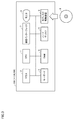
- FIG. 1 is a block diagram illustrating an outline of a configuration of a watching system.
- FIG. 3 is a block diagram illustrating a hardware configuration of a computer system 300 functioning as a cloud server 150. It is a figure showing an example of the outline of the device composition of watching system 100 using sensor box 119.
- FIG. 3 is a diagram illustrating one mode of data storage in a hard disk 5 included in the cloud server 150. It is a figure showing a change of a moving track of a resident in a certain situation.
- FIG. 3 is a diagram illustrating one mode of data storage in a hard disk 5.
- 9 is a flowchart illustrating a part of a process executed by CPU 1 of cloud server 150.
- 9 is a flowchart illustrating a part of a determination process executed by CPU 1 of cloud server 150.
- FIG. 6 is a diagram illustrating an example of a diagnosis result displayed by a monitor 8
- the system used in the facility sequentially collects movement trajectory data indicating the time and movement of each resident at night, and uses the time and movement trajectory data to determine whether or not each resident has a non-nighttime movement.
- the time of the lying state (the state of being awake and the state of behaving) is calculated.
- the time can be handled as information indicating the “nighttime activity amount”.
- FIG. 1 is a diagram illustrating an example of the configuration of the watching system 100.
- the watching target is, for example, a resident in each living room provided in the living room area 180 of the facility.
- living rooms 110 and 120 are provided in a living room area 180.
- the living room 110 is assigned to the resident 111.
- the living room 120 is assigned to the resident 121.
- the number of living rooms included in the watching system 100 is two, but the number is not limited to this.
- Network 190 may include both an intranet and the Internet.
- the mobile terminal 143 carried by the caregiver 141 and the mobile terminal 144 carried by the caregiver 142 can be connected to the network 190 via the access point 140. Further, the sensor box 119, the management server 200, and the access point 140 can communicate with the cloud server 150 via the network 190.
- Each of the living rooms 110 and 120 includes a closet 112, a bed 113, and a toilet 114 as facilities.
- the door of the living room 110 is provided with a door sensor 118 that detects opening and closing of the door.
- a toilet sensor 116 for detecting the opening and closing of the toilet 114 is installed on the door of the toilet 114.
- the bed 113 is provided with an odor sensor 117 for detecting the odor of each of the residents 111 and 121.
- Each resident 111, 121 is equipped with a vital sensor 290 for detecting vital information of the resident 111, 121.
- the detected vital information includes the resident's body temperature, respiration, heart rate, and the like.
- the residents 111 and 121 can operate the care call slave 115, respectively.
- the sensor box 119 has a built-in sensor for detecting the behavior of an object in the living rooms 110 and 120.
- a sensor is a Doppler sensor for detecting the movement of an object.
- a camera is another example.
- the sensor box 119 may include both a Doppler sensor and a camera as sensors.
- FIG. 2 is a block diagram showing an outline of the configuration of the watching system 100.
- the sensor box 119 includes a control device 101, a read only memory (ROM) 102, a random access memory (RAM) 103, a communication interface 104, a camera 105, a Doppler sensor 106, a wireless communication device 107, and a storage device. 108.
- the control device 101 controls the sensor box 119.
- the control device 101 is composed of, for example, at least one integrated circuit.
- the integrated circuit is, for example, at least one CPU (Central Processing Unit), MPU (Micro Processing Unit) or other processor, at least one ASIC (Application Specific Integrated Circuit), at least one FPGA (Field Programmable Gate Array), or these. And the like.
- An antenna (not shown) and the like are connected to the communication interface 104.
- the sensor box 119 exchanges data with an external communication device via the antenna.
- External communication devices include, for example, management server 200, mobile terminals 143, 144 and other terminals, access point 140, cloud server 150, and other communication terminals.
- the camera 105 is a near-infrared camera in one implementation.
- the near-infrared camera includes an IR (Infrared) projector that emits near-infrared light.
- IR Infrared
- camera 105 is a surveillance camera that receives only visible light.
- a 3D sensor or a thermographic camera may be used as camera 105.
- the sensor box 119 and the camera 105 may be configured integrally or may be configured separately.
- the Doppler sensor 106 is, for example, a microwave Doppler sensor, and emits and receives radio waves to detect the behavior (movement) of objects in the living rooms 110 and 120. Thereby, the biological information of the resident 111, 121 of the living room 110, 120 can be detected.
- the Doppler sensor 106 emits microwaves in the 24 GHz band toward the beds 113 of the rooms 110 and 120, and receives reflected waves reflected by the residents 111 and 121. The reflected waves are Doppler shifted by the actions of the residents 111 and 121.
- the Doppler sensor 106 can detect the respiratory state and heart rate of the residents 111 and 121 from the reflected waves.
- the wireless communication device 107 receives signals from the care call slave device 240, the door sensor 118, the toilet sensor 116, the odor sensor 117, and the vital sensor 290, and transmits the signals to the control device 101.
- the care call slave unit 240 includes a care call button 241. When the button is operated, care call slave device 240 transmits a signal indicating that the operation has been performed to wireless communication device 107.
- the door sensor 118, the toilet sensor 116, the odor sensor 117, and the vital sensor 290 transmit respective detection results to the wireless communication device 107.
- the storage device 108 is, for example, a fixed storage device such as a flash memory or a hard disk, or a recording medium such as an external storage device.
- the storage device 108 stores a program executed by the control device 101 and various data used for executing the program.
- the various data may include behavior information of the residents 111 and 121. The details of the action information will be described later.
- At least one of the above-mentioned programs and data is a storage device other than the storage device 108 (for example, a storage area (for example, a cache memory) of the control device 101, a ROM 102, The RAM 103 and external devices (for example, the management server 200 and the portable terminals 143 and 144) may be stored.
- a storage device other than the storage device 108 for example, a storage area (for example, a cache memory) of the control device 101, a ROM 102,
- the RAM 103 and external devices for example, the management server 200 and the portable terminals 143 and 144) may be stored.
- the action information is, for example, information indicating that the residents 111 and 121 have performed a predetermined action.
- the predetermined action is “wake up” indicating that the resident 111, 121 has occurred, “leaving” indicating that the resident 111, 121 has left the bed (bedding) 113, and the resident 111, 121 It includes four actions of “fall” indicating that the user has fallen from the bed (bedding) 113 and “fall” indicating that the resident 111 or 121 has fallen.
- the control device 101 generates each piece of behavior information of the resident 111, 121 associated with each room 110, 120 based on an image captured by the camera 105 installed in each room 110, 120. I do.
- the control device 101 detects, for example, the heads of the residents 111 and 121 from the image, and based on the detected temporal changes in the sizes of the heads of the residents 111 and 121, “ “Wake up”, “get out of bed”, “fall” and “fall” are detected.
- “Wake up”, “get out of bed”, “fall” and “fall” are detected.
- the storage area of the beds 113 in the living rooms 110 and 120, the first threshold Th1, the second threshold Th2, and the third threshold Th3 are stored in the storage device.
- the first threshold Th1 identifies the size of the resident's head between the lying position and the sitting position in the area where the bed 113 is located.
- the second threshold value Th2 identifies whether or not the resident is in the standing posture, based on the size of the resident's head in the living rooms 110 and 120 excluding the area where the bed 113 is located.
- the third threshold value Th3 identifies whether or not the resident is in the recumbent posture in the living rooms 110 and 120 excluding the area where the bed 113 is located, based on the size of the resident's head.
- the control device 101 extracts a moving object region from the target image as a region of the occupants 111 and 121 by, for example, the background difference method or the frame difference method.
- the control device 101 further derives from the extracted moving body region by, for example, a circular or elliptical Hough transform, by pattern matching using a prepared head model, or by a neural network learned for head detection.
- the head areas of the residents 111 and 121 are extracted using the thresholds thus set.
- the control device 101 detects “wake up”, “get out of bed”, “fall” and “fall” from the extracted position and size of the head.
- the control device 101 determines that the position of the head extracted as described above is within the area where the bed 113 is located, and that the size of the head extracted as described above uses the first threshold Th1 to lie down. When it is detected that the size of the posture has changed to the size of the sitting posture, it may be determined that the action “wake up” has occurred.
- the control device 101 controls the size of the head extracted as described above.
- the control device 101 controls the size of the head extracted as described above.
- the control device 101 determines that the position of the head extracted as described above is located in the living rooms 110 and 120 excluding the area where the bed 113 is located, and the size of the extracted head uses the third threshold Th3. If it is detected that the size has changed from a certain size to the size of the recumbent posture, it may be determined that the action “fall” has occurred.
- the control device 101 of the sensor box 119 generates the behavior information of the residents 111 and 121.
- an element other than the control device 101 for example, the cloud server 150
- the cloud server 150 generates the behavior information of the residents 111 and 121 using the images in the living rooms 110 and 120. Is also good.
- the mobile terminals 143 and 144 include a control device 221, a ROM 222, a RAM 223, a communication interface 224, a display 226, a storage device 228, and an input device 229.
- the mobile terminals 143 and 144 are realized as, for example, a smartphone, a tablet terminal, a wristwatch-type terminal, or other wearable devices.
- the control device 221 controls the mobile terminals 143 and 144.
- the control device 221 is configured by, for example, at least one integrated circuit.
- the integrated circuit includes, for example, at least one CPU, at least one ASIC, at least one FPGA, or a combination thereof.
- An antenna (not shown) and the like are connected to the communication interface 224.
- the mobile terminals 143 and 144 exchange data with an external communication device via the antenna and the access point 140.
- External communication devices include, for example, the sensor box 119, the management server 200, and the like.
- the display 226 is realized by, for example, a liquid crystal display, an organic EL (Electro Luminescence) display, or the like.
- the input device 229 is realized by, for example, a touch sensor provided on the display 226. The touch sensor receives a touch operation on the mobile terminals 143 and 144, and outputs a signal corresponding to the touch operation to the control device 221.
- the storage device 228 is realized by, for example, a flash memory, a hard disk or another fixed storage device, or a removable data recording medium.
- FIG. 3 is a block diagram illustrating a hardware configuration of computer system 300 functioning as cloud server 150.
- the computer system 300 includes, as main components, a CPU 1 that executes a program, a mouse 2 and a keyboard 3 that receive an instruction input by a user of the computer system 300, and data generated by executing the program by the CPU 1 or a mouse 2.
- a RAM 4 for volatilely storing data input via the keyboard 3
- a hard disk 5 for nonvolatilely storing data
- an optical disk drive 6 a communication interface (I / F) 7, and a monitor 8 Including.
- Each component is mutually connected by a data bus.
- the optical disk drive 6 is loaded with a CD-ROM 9 and other optical disks.
- the processing in the computer system 300 is realized by each hardware and software executed by the CPU 1.
- Such software may be stored in the hard disk 5 in advance.
- the software may be stored on the CD-ROM 9 or another recording medium and distributed as a computer program.
- the software may be provided as a downloadable application program by an information provider connected to the so-called Internet.
- Such software is temporarily stored in the hard disk 5 after being read from the recording medium by the optical disk drive 6 or another reading device, or downloaded via the communication interface 7.
- the software is read from the hard disk 5 by the CPU 1 and stored in the RAM 4 in the form of an executable program.
- CPU 1 executes the program.
- Each component of the computer system 300 shown in FIG. 3 is a general component. Therefore, it can be said that one of the essential parts of the technical idea according to the present disclosure is software stored in the RAM 4, the hard disk 5, the CD-ROM 9, or other recording media, or software downloadable via a network.
- the storage medium may include a non-transitory, computer-readable data storage medium. Since the operation of each piece of hardware of computer system 300 is well known, detailed description will not be repeated.
- the recording medium is not limited to a CD-ROM, FD (Flexible Disk), or hard disk, but may be a magnetic tape, cassette tape, optical disk (MO (Magnetic Optical Disc) / MD (Mini Disc) / DVD (Digital Versatile Disc)). , IC (Integrated Circuit) card (including memory card), optical card, mask ROM, EPROM (Electronically Programmable Read-Only Memory), EEPROM (Electronically Erasable Programmable Read-Only Memory), and fixed memory such as flash ROM It may be a medium that carries the program.
- IC Integrated Circuit
- the program here includes not only a program directly executable by the CPU but also a program in a source program format, a compressed program, an encrypted program, and the like.
- FIG. 4 is a diagram illustrating an example of a schematic device configuration of the watching system 100 using the sensor box 119.
- the watching system 100 is used for watching the residents 111 and 121 who are the monitoring target (monitoring target) and other residents. As shown in FIG. 4, a sensor box 119 is attached to the ceiling of the living room 110. Sensor boxes 119 are similarly attached to other rooms.
- a range 410 represents a detection range of the sensor box 119.
- the Doppler sensor detects a person's behavior that has occurred within the range 410.
- the sensor box 119 has a camera as a sensor, the camera captures an image in the range 410.
- the sensor box 119 is installed in, for example, a nursing care facility, a medical facility, or a home.
- the sensor box 119 is attached to the ceiling, and the resident 111 and the bed 113 are imaged from the ceiling.
- the place where the sensor box 119 is mounted is not limited to the ceiling, and may be mounted on the side wall of the living room 110.
- the watching system 100 detects a danger occurring to the resident 111 based on a series of images (that is, videos) obtained from the camera 105.
- the detectable danger includes a fall of the resident 111 and a state where the resident 111 is at a danger location (for example, a bed fence).
- the monitoring system 100 When the monitoring system 100 detects that the resident 111 is in danger, the monitoring system 100 notifies the caregivers 141, 143, etc. of that fact. As an example of the notification method, the watching system 100 notifies the danger of the resident 111 to the portable terminals 143 and 144 of the caregivers 141 and 142. Upon receiving the notification, the mobile terminals 143 and 144 notify the caregivers 141 and 142 of the danger of the resident 111 by a message, voice, vibration, or the like. Accordingly, the caregivers 141 and 142 can immediately recognize that the danger has occurred in the resident 111 and can rush to the resident 111 quickly.
- FIG. 4 illustrates an example in which the watching system 100 includes one sensor box 119, but the watching system 100 may include a plurality of sensor boxes 119.
- FIG. 4 shows an example in which the watching system 100 includes a plurality of mobile terminals 143 and 144. However, the watching system 100 can be realized by one mobile terminal.
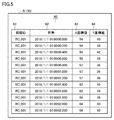
- FIG. 5 is a diagram illustrating one mode of data storage in the hard disk 5 included in the cloud server 150.
- the hard disk 5 holds the table 60.
- the table 60 sequentially stores data transmitted from each sensor provided in each living room. More specifically, the table 60 includes a room ID 61, a date and time 62, an X coordinate value 63, and a Y coordinate value 64.
- the room ID 61 identifies the room of the resident.
- the date and time 62 identifies the date and time when the signal sent from the sensor was acquired.
- the X coordinate value 63 indicates the point detected at the date and time, that is, the X coordinate value of the position of the resident.
- the Y coordinate value 64 represents the point detected at the date and time, that is, the Y coordinate value of the position of the resident.
- the coordinate axes that are the basis of the X coordinate value and the Y coordinate value are defined, for example, with reference to the end point of the living room (for example, one corner of the room).
- the coordinate axis may be defined based on a certain point in the facility where each living room is provided.
- the hard disk 5 holds the image data sent from the sensor box 119.
- Image data is acquired at predetermined time intervals.
- the CPU 1 can identify the state of the resident by performing image analysis using each image data. For example, the CPU 1 can extract a head from each image data and extract a time when the resident is lying down, a time when the resident is sitting on the bed 113, and a time when the resident is walking.
- the person who moves in the room may be a caregiver or a family other than the resident. Therefore, the CPU 1 can exclude the movement locus of a person other than the resident. For example, the CPU 1 may calculate a moving speed for each moving locus, and exclude a moving locus calculated at a speed equal to or higher than a certain speed estimated to be a moving speed of a healthy person other than the resident from image analysis targets. In this case, a moving speed measured in advance or a moving speed measured during image analysis can be used as the moving speed of the healthy person.
- the CPU 1 calculates, for each point detected at a plurality of times, the x-coordinate value and the y-coordinate value, and the next point from one of the points. Can be calculated based on the time required to reach.
- the CPU 1 acquires trajectory data representing a trajectory of a person in a living room.
- the CPU 1 of the cloud server 150 reads the locus data stored in the hard disk 5 from the table 60 and temporarily writes the locus data in the RAM 4 based on an instruction from the management server 200.
- the CPU 1 calculates, for each resident, the action time of the resident in the first time zone and the action time in the second time zone.
- the first time zone can be nighttime
- the second time zone can be daytime.
- the time zone can be set to an arbitrary time, and is not limited to the above.
- the night time zone is defined as, for example, a time zone from 10:00 p.m.
- the daytime time zone can be another time zone. As an example, it is defined as a time zone from 6:00 in the morning to 10:00 at night.
- the CPU 1 calculates night time and other times (hereinafter also referred to as “daytime”). If a day is divided into night time and day time, the day time is other than night time. In another aspect, the remaining time may be calculated as daytime activity time by subtracting a meal time, a rest time, a bathing time, and other time essential for living.
- the CPU 1 can determine the degree of nursing care of the resident based on the ratio between the night action time and the day action time. Alternatively, the CPU 1 may detect the presence or absence of a chronological change in the nighttime activity time occupying one day, and determine the degree of need for nursing care according to the detection result.
- the CPU 1 may notify the maintenance of the degree of need for nursing care. In such a case, it is considered that the state of the resident has not changed, so that it is determined that there is no need to change the degree of nursing care, and the degree of nursing care of the resident may be determined to be appropriate to maintain the current status .
- the CPU 1 may notify the increase in the degree of need for nursing care when the nighttime activity time is longer than before.
- the cloud server 150 or the management server 200 may be configured to execute a process of calculating a ratio between nighttime activity time and daytime activity time as background processing. In this case, if the system 100 detects that the occupant's night time is increasing, the system 100 notifies the user (facility manager, care staff, care manager, etc.) of the fact. You may be notified. In this way, even when the user has not instructed the system 100 to calculate the nighttime activity time, it is possible to quickly grasp the change in the resident's state, so that the user can take quick measures. .
- the CPU 1 may notify the user of an increase in the degree of need for nursing care based on the fact that the resident's nighttime action time exceeds the daytime action time. Also in this case, similarly to the above case, the user can quickly grasp the change in the resident's state and can objectively determine the degree of nursing care. Sex can also be guaranteed.
- FIG. 6 is a diagram illustrating a change in the trajectory of a resident in a certain situation.
- the resident may move without purpose (wandering).
- the movement trajectories 622 and 623 that are not directed to a specific destination for example, the wash basin 51, the closet 112, and the desk 52
- a specific destination for example, the wash basin 51, the closet 112, and the desk 52
- the change in the movement locus of each resident it is possible to objectively grasp the change in the state of the resident. For example, if it is detected that the moving trajectory, which has been almost straight from the bed 113 to the destination, fluctuates or goes around the same place, it is estimated that the state of the resident has changed. .
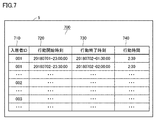
- FIG. 7 is a diagram illustrating one mode of data storage in hard disk 5.
- the data structure shown in FIG. 7 is generated on the hard disk 5 of the cloud server 150 or the management server 200.
- the hard disk 5 has a table 700.
- Table 700 includes resident ID 710, action start time 720, action end time 730, and action data such as action time 740.
- the resident ID 710 identifies a resident of a facility using the system 100.
- the action start time 720 indicates the time when the resident started the action in a certain time zone.
- the night time zone is defined as, for example, a bedtime time zone from 10:00 a.m. to 6:00 a.m., but is not limited to this. Further, the time zone is not limited to the night time zone. For example, a certain time in the early morning or daytime may be set as the observation target.
- the action end time 730 indicates the time at which the action by the resident has ended.
- the action time 740 represents the time from the action start time 720 to the action end time 730.
- FIG. 8 is a flowchart showing a part of the process executed by CPU 1 of cloud server 150.
- step S2 the CPU 1 acquires the movement trajectory data from the hard disk 5 based on the instruction of the data processing being given to the cloud server 150.
- the CPU 1 of the cloud server 150 reads the locus data stored in the hard disk 5 from the table 60 and temporarily writes the locus data in the RAM 4 based on an instruction from the management server 200.
- step S4 the CPU 1 calculates, for each resident, the time during which the resident is acting, based on the trajectory data. Specifically, based on the trajectory data, the time at which the resident started the action in a certain time zone is specified. Also, the time at which the action by the resident has ended is specified. Thereby, the resident's action start time 720 and action end time 730 are specified. Then, the CPU 1 calculates the action time 740 based on the action start time 720 and the action end time 730.
- step S6 CPU 1 stores action data including action start time 720, action end time 730, and action time 740 corresponding to each resident in table 700 (FIG. 7) of hard disk 5. Thereafter, the CPU 1 ends the processing.
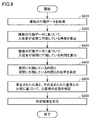
- FIG. 9 is a flowchart illustrating a part of the determination process executed by CPU 1 of cloud server 150.
- CPU 1 acquires a plurality of action data. For example, when a user (administrator, nursing staff, etc.) of the management server 200 accessing the cloud server 150 instructs data processing, the cloud server 150 stores the stored behavior data (see FIG. 7) on a hard disk. 5 to the RAM 4.
- step S820 CPU 1 calculates a time during which the resident is acting in a first time zone (for example, at night) based on the plurality of action data. More specifically, the CPU 1 extracts nighttime data from the action data read from the hard disk 5. The CPU 1 totals the action time in the night time zone from the extracted data. Each time corresponding to the action start time 720 and the action end time 730 is specified. By this processing, the CPU 1 can calculate the total of the action time in the night time zone.
- step S830 CPU 1 calculates the time during which the resident is acting in a second time zone (for example, during the day) based on the plurality of action data. More specifically, the CPU 1 extracts daytime data from the action data read from the hard disk 5. The CPU 1 totalizes the action time in the daytime zone from the extracted data. Each time corresponding to the action start time 720 and the action end time 730 is specified. By this processing, the CPU 1 can calculate the total of the action time in the daytime.
- the CPU 1 calculates the daytime activity time by subtracting the activity time 740 calculated in step S820 from 24 hours. You may make it.
- other times may be appropriately deducted. For example, a meal time, a bathing time, a rehabilitation time, etc. may be deducted from a daytime action time as an indispensable time.
- the CPU 1 can calculate, for example, a time obtained by subtracting a meal time or the like from a daytime action time as “daytime free time”. The CPU 1 can accurately grasp the transition of the occupant's movement in the room by analyzing the movement trajectory during the free time in the daytime.
- step S840 the CPU 1 calculates the ratio between the time during which the user is acting at night (nighttime action time) and the time during which the user is operating during the daytime (daytime action time).
- the relationship between the night action time and the daytime action time may be expressed as a closing ratio of the night action time in one day (24 hours) other than these ratios.
- step S850 CPU 1 determines the state of the resident based on a comparison between the calculated ratio and a predetermined reference. For example, the CPU 1 performs this comparison for each occupant, and the occupant whose night action time is longer (or the ratio of night action time is higher) or whose occupancy exceeds a set reference value. Detect people.
- daytime activity time daytime activity amount
- nighttime activity time nighttime activity amount
- nighttime activity time nighttime activity amount
- the system 100 may recommend a review of the determination of the degree of need for nursing (eg, increasing the level of the degree of need of nursing by one level).
- Daytime activity time eg, 4 hours
- Nighttime activity time eg, 8 hours
- the system 100 may recommend a review of the degree of need for nursing (eg, increasing the level of the degree of need for nursing by two levels, etc.).
- CPU 1 outputs a determination result. For example, the CPU 1 displays on the monitor 8 a screen on which the resident's night time is plotted. In another aspect, CPU 1 may display on monitor 8 a screen indicating nighttime activity time for the resident detected in step S850. Further, the CPU 1 can display a message corresponding to the above cases 1 to 3 on the monitor 8.
- FIG. 10 is a diagram illustrating an example of a diagnosis result displayed on the monitor 8 of the management server 200.
- the management server 200 can display a diagnosis result for each resident by using a calculation result by the CPU 1 of the cloud server 150.
- the monitor 8 shows a group 910 indicating residents whose nighttime activity time exceeds a certain reference value, and the distribution of other residents.
- the night action time is displayed, for example, according to the level of the degree of care. If the manager or caregiver of the resident recognizes that a new resident not included in the previous diagnosis result is included in the occupants belonging to the group 910, the tendency of dementia is increased. Necessary measures can be taken, such as determining the degree of care again if there is any.
- the night activity time of the resident is calculated using data (image data, output data from Doppler sensor 106) and the like sent from sensor box 119 in each living room. .
- data image data, output data from Doppler sensor 106
- the night time can be used as information obtained objectively in the determination of the degree of need for nursing, etc. Can be secured.
- This technology is applicable to information processing using data obtained in hospitals, nursing homes, nursing homes and other facilities.
Landscapes
- Health & Medical Sciences (AREA)
- Business, Economics & Management (AREA)
- Engineering & Computer Science (AREA)
- Physics & Mathematics (AREA)
- General Physics & Mathematics (AREA)
- Biomedical Technology (AREA)
- Life Sciences & Earth Sciences (AREA)
- General Health & Medical Sciences (AREA)
- Primary Health Care (AREA)
- Tourism & Hospitality (AREA)
- Medical Informatics (AREA)
- General Business, Economics & Management (AREA)
- Emergency Management (AREA)
- Public Health (AREA)
- Veterinary Medicine (AREA)
- Pathology (AREA)
- Surgery (AREA)
- Molecular Biology (AREA)
- Child & Adolescent Psychology (AREA)
- Heart & Thoracic Surgery (AREA)
- Economics (AREA)
- Human Resources & Organizations (AREA)
- Marketing (AREA)
- Animal Behavior & Ethology (AREA)
- Strategic Management (AREA)
- Biophysics (AREA)
- Theoretical Computer Science (AREA)
- Epidemiology (AREA)
- Medical Treatment And Welfare Office Work (AREA)
- Alarm Systems (AREA)
- Emergency Alarm Devices (AREA)
Abstract
L'invention concerne un programme destiné à déterminer un niveau de soins, ledit programme amenant un ordinateur à exécuter : une étape (S810) dans laquelle une pluralité d'éléments de données de mouvement sont acquises ; une étape (S820) dans laquelle une durée pendant laquelle un occupant se déplace pendant une première période de temps (par exemple, la nuit) est calculée, sur la base de la pluralité d'éléments de données de mouvement ; une étape (S830) dans laquelle une durée pendant laquelle l'occupant se déplace pendant une seconde période de temps (par exemple, la journée) est calculée, sur la base de la pluralité d'éléments de données de mouvement ; une étape (S840) dans laquelle un rapport entre la durée pendant laquelle l'occupant se déplace pendant la nuit (temps de déplacement nocturne) et la durée pendant laquelle l'occupant se déplace pendant la journée (temps de déplacement diurne) est calculé ; une étape (S850) dans laquelle un état de l'occupant est déterminé sur la base d'une comparaison du rapport calculé et d'une norme prédéterminée ; et une étape (S860) dans laquelle le résultat de détermination est fourni.
Priority Applications (1)
| Application Number | Priority Date | Filing Date | Title |
|---|---|---|---|
| JP2020527344A JP7276336B2 (ja) | 2018-06-26 | 2019-06-06 | コンピュータで実行されるプログラム、情報処理システム、および、コンピュータで実行される方法 |
Applications Claiming Priority (2)
| Application Number | Priority Date | Filing Date | Title |
|---|---|---|---|
| JP2018121240 | 2018-06-26 | ||
| JP2018-121240 | 2018-06-26 |
Publications (1)
| Publication Number | Publication Date |
|---|---|
| WO2020003953A1 true WO2020003953A1 (fr) | 2020-01-02 |
Family
ID=68986496
Family Applications (1)
| Application Number | Title | Priority Date | Filing Date |
|---|---|---|---|
| PCT/JP2019/022469 Ceased WO2020003953A1 (fr) | 2018-06-26 | 2019-06-06 | Programme exécuté par ordinateur, dispositif de traitement d'informations et procédé exécuté par ordinateur |
Country Status (2)
| Country | Link |
|---|---|
| JP (1) | JP7276336B2 (fr) |
| WO (1) | WO2020003953A1 (fr) |
Cited By (3)
| Publication number | Priority date | Publication date | Assignee | Title |
|---|---|---|---|---|
| JP2022049788A (ja) * | 2020-09-17 | 2022-03-30 | コニカミノルタ株式会社 | 情報処理装置、情報処理システム、およびプログラム |
| WO2025028190A1 (fr) * | 2023-08-01 | 2025-02-06 | Sompoケア株式会社 | Procédé, dispositif de traitement d'informations et support non transitoire lisible par ordinateur |
| WO2025028188A1 (fr) * | 2023-08-01 | 2025-02-06 | Sompoケア株式会社 | Procédé, dispositif de traitement d'informations et support non transitoire lisible par ordinateur |
Citations (6)
| Publication number | Priority date | Publication date | Assignee | Title |
|---|---|---|---|---|
| JP2002251466A (ja) * | 2001-02-23 | 2002-09-06 | Hitachi Plant Eng & Constr Co Ltd | 介護業務支援システム及び携帯通信端末 |
| JP2003288656A (ja) * | 2002-03-28 | 2003-10-10 | Ntt Comware Corp | 安否通知装置、安否通知方法、安否通知装置用プログラム、及び安否通知装置用記録媒体 |
| JP2006092257A (ja) * | 2004-09-24 | 2006-04-06 | Sekisui Chem Co Ltd | 介護支援システム及び介護支援方法 |
| JP2007048093A (ja) * | 2005-08-10 | 2007-02-22 | Medca Japan Co Ltd | 要介護度判定サービスシステム |
| JP2017220047A (ja) * | 2016-06-08 | 2017-12-14 | 株式会社日立ビルシステム | 生活見守りシステム |
| JP2018507008A (ja) * | 2015-01-12 | 2018-03-15 | コーニンクレッカ フィリップス エヌ ヴェKoninklijke Philips N.V. | 人の日常生活動作をモニタリングするためのシステム及び方法 |
Family Cites Families (1)
| Publication number | Priority date | Publication date | Assignee | Title |
|---|---|---|---|---|
| JP2001188859A (ja) * | 2000-05-19 | 2001-07-10 | Nissetsu Engineering Co Ltd | 要介護度認定方法、要介護度認定システム、記録媒体及び、携帯端末制御機器 |
-
2019
- 2019-06-06 WO PCT/JP2019/022469 patent/WO2020003953A1/fr not_active Ceased
- 2019-06-06 JP JP2020527344A patent/JP7276336B2/ja active Active
Patent Citations (6)
| Publication number | Priority date | Publication date | Assignee | Title |
|---|---|---|---|---|
| JP2002251466A (ja) * | 2001-02-23 | 2002-09-06 | Hitachi Plant Eng & Constr Co Ltd | 介護業務支援システム及び携帯通信端末 |
| JP2003288656A (ja) * | 2002-03-28 | 2003-10-10 | Ntt Comware Corp | 安否通知装置、安否通知方法、安否通知装置用プログラム、及び安否通知装置用記録媒体 |
| JP2006092257A (ja) * | 2004-09-24 | 2006-04-06 | Sekisui Chem Co Ltd | 介護支援システム及び介護支援方法 |
| JP2007048093A (ja) * | 2005-08-10 | 2007-02-22 | Medca Japan Co Ltd | 要介護度判定サービスシステム |
| JP2018507008A (ja) * | 2015-01-12 | 2018-03-15 | コーニンクレッカ フィリップス エヌ ヴェKoninklijke Philips N.V. | 人の日常生活動作をモニタリングするためのシステム及び方法 |
| JP2017220047A (ja) * | 2016-06-08 | 2017-12-14 | 株式会社日立ビルシステム | 生活見守りシステム |
Cited By (4)
| Publication number | Priority date | Publication date | Assignee | Title |
|---|---|---|---|---|
| JP2022049788A (ja) * | 2020-09-17 | 2022-03-30 | コニカミノルタ株式会社 | 情報処理装置、情報処理システム、およびプログラム |
| JP7552185B2 (ja) | 2020-09-17 | 2024-09-18 | コニカミノルタ株式会社 | 情報処理装置、情報処理システム、およびプログラム |
| WO2025028190A1 (fr) * | 2023-08-01 | 2025-02-06 | Sompoケア株式会社 | Procédé, dispositif de traitement d'informations et support non transitoire lisible par ordinateur |
| WO2025028188A1 (fr) * | 2023-08-01 | 2025-02-06 | Sompoケア株式会社 | Procédé, dispositif de traitement d'informations et support non transitoire lisible par ordinateur |
Also Published As
| Publication number | Publication date |
|---|---|
| JPWO2020003953A1 (ja) | 2021-08-02 |
| JP7276336B2 (ja) | 2023-05-18 |
Similar Documents
| Publication | Publication Date | Title |
|---|---|---|
| CN108882853B (zh) | 使用视觉情境来及时触发测量生理参数 | |
| JP7415434B2 (ja) | 情報共有装置、情報共有システム、および情報共有プログラム | |
| JP7776254B2 (ja) | サービスのメニューの作成を支援する方法、当該方法をコンピューターに実行させるプログラム、および、情報提供装置 | |
| JP2019020993A (ja) | 見守り支援システム及びその制御方法 | |
| JP7666508B2 (ja) | 被介護者の情報を提供するためにコンピューターで実行される方法、プログラム、および、情報提供装置 | |
| JP7342863B2 (ja) | コンピュータで実行されるプログラム、情報処理システム、および、コンピュータで実行される方法 | |
| JP7435459B2 (ja) | 状態監視装置および状態監視方法 | |
| JP7276336B2 (ja) | コンピュータで実行されるプログラム、情報処理システム、および、コンピュータで実行される方法 | |
| JP7468350B2 (ja) | 状態監視装置および状態監視装置の制御方法 | |
| JP7371624B2 (ja) | コンピューターで実行されるプログラム、情報処理装置、および、コンピューターで実行される方法 | |
| JP7310327B2 (ja) | 行動検知装置、それを備えるシステム、行動検知方法、および、プログラム | |
| JP2023105966A (ja) | 入居者の状態の変化を検知するためにコンピューターによって実行される方法、プログラム、および、入居者の状態変化検出装置 | |
| JP7255359B2 (ja) | 情報を通知するためのプログラム、情報通知装置、および、情報を通知するためにコンピューターで実行される方法 | |
| JP7327397B2 (ja) | コンピューターで実行されるプログラム、情報処理システム、および、コンピューターで実行される方法 | |
| JPWO2020075675A1 (ja) | ケアシステムの管理方法および管理装置、ならびにプログラム | |
| JP7215481B2 (ja) | コンピューターで実行されるプログラム、情報処理装置、および、コンピューターで実行される方法 | |
| JPWO2020003714A1 (ja) | レポート出力プログラム、レポート出力方法およびレポート出力装置 | |
| JP7468363B2 (ja) | 情報表示方法、プログラムおよび情報表示装置 | |
| JP2023108852A (ja) | 表示装置、表示システム、表示方法、および表示プログラム | |
| JP7205540B2 (ja) | コンピューターで実行されるプログラム、情報処理装置、および、コンピューターで実行される方法 | |
| Liu et al. | Detecting out-of-bed activities to prevent pneumonia for hospitalized patient using Microsoft Kinect V2 | |
| JP2020057222A (ja) | 状態監視装置および状態監視方法 | |
| JP2024065638A (ja) | 睡眠パターンの安定性を表す指標を取得するためのコンピューターが実行する方法、プログラムおよび情報処理装置 | |
| JP2024167938A (ja) | 情報処理装置、情報処理プログラムおよび機械学習装置 | |
| JP2024073801A (ja) | 認知機能評価装置、認知機能評価方法およびプログラム |
Legal Events
| Date | Code | Title | Description |
|---|---|---|---|
| 121 | Ep: the epo has been informed by wipo that ep was designated in this application |
Ref document number: 19826569 Country of ref document: EP Kind code of ref document: A1 |
|
| ENP | Entry into the national phase |
Ref document number: 2020527344 Country of ref document: JP Kind code of ref document: A |
|
| NENP | Non-entry into the national phase |
Ref country code: DE |
|
| 122 | Ep: pct application non-entry in european phase |
Ref document number: 19826569 Country of ref document: EP Kind code of ref document: A1 |