WO2020004102A1 - Système et procédé de support d'aide à l'entraînement pour récupération fonctionnelle - Google Patents
Système et procédé de support d'aide à l'entraînement pour récupération fonctionnelle Download PDFInfo
- Publication number
- WO2020004102A1 WO2020004102A1 PCT/JP2019/023853 JP2019023853W WO2020004102A1 WO 2020004102 A1 WO2020004102 A1 WO 2020004102A1 JP 2019023853 W JP2019023853 W JP 2019023853W WO 2020004102 A1 WO2020004102 A1 WO 2020004102A1
- Authority
- WO
- WIPO (PCT)
- Prior art keywords
- support system
- subject
- function recovery
- recovery training
- unit
- Prior art date
- Legal status (The legal status is an assumption and is not a legal conclusion. Google has not performed a legal analysis and makes no representation as to the accuracy of the status listed.)
- Ceased
Links
Images










Classifications
-
- G—PHYSICS
- G16—INFORMATION AND COMMUNICATION TECHNOLOGY [ICT] SPECIALLY ADAPTED FOR SPECIFIC APPLICATION FIELDS
- G16H—HEALTHCARE INFORMATICS, i.e. INFORMATION AND COMMUNICATION TECHNOLOGY [ICT] SPECIALLY ADAPTED FOR THE HANDLING OR PROCESSING OF MEDICAL OR HEALTHCARE DATA
- G16H50/00—ICT specially adapted for medical diagnosis, medical simulation or medical data mining; ICT specially adapted for detecting, monitoring or modelling epidemics or pandemics
- G16H50/20—ICT specially adapted for medical diagnosis, medical simulation or medical data mining; ICT specially adapted for detecting, monitoring or modelling epidemics or pandemics for computer-aided diagnosis, e.g. based on medical expert systems
-
- A—HUMAN NECESSITIES
- A61—MEDICAL OR VETERINARY SCIENCE; HYGIENE
- A61B—DIAGNOSIS; SURGERY; IDENTIFICATION
- A61B5/00—Measuring for diagnostic purposes; Identification of persons
- A61B5/103—Measuring devices for testing the shape, pattern, colour, size or movement of the body or parts thereof, for diagnostic purposes
- A61B5/11—Measuring movement of the entire body or parts thereof, e.g. head or hand tremor or mobility of a limb
-
- A—HUMAN NECESSITIES
- A61—MEDICAL OR VETERINARY SCIENCE; HYGIENE
- A61B—DIAGNOSIS; SURGERY; IDENTIFICATION
- A61B5/00—Measuring for diagnostic purposes; Identification of persons
- A61B5/22—Ergometry; Measuring muscular strength or the force of a muscular blow
-
- A—HUMAN NECESSITIES
- A63—SPORTS; GAMES; AMUSEMENTS
- A63B—APPARATUS FOR PHYSICAL TRAINING, GYMNASTICS, SWIMMING, CLIMBING, OR FENCING; BALL GAMES; TRAINING EQUIPMENT
- A63B24/00—Electric or electronic controls for exercising apparatus of preceding groups; Controlling or monitoring of exercises, sportive games, training or athletic performances
- A63B24/0062—Monitoring athletic performances, e.g. for determining the work of a user on an exercise apparatus, the completed jogging or cycling distance
-
- G—PHYSICS
- G01—MEASURING; TESTING
- G01C—MEASURING DISTANCES, LEVELS OR BEARINGS; SURVEYING; NAVIGATION; GYROSCOPIC INSTRUMENTS; PHOTOGRAMMETRY OR VIDEOGRAMMETRY
- G01C22/00—Measuring distance traversed on the ground by vehicles, persons, animals or other moving solid bodies, e.g. using odometers, using pedometers
- G01C22/02—Measuring distance traversed on the ground by vehicles, persons, animals or other moving solid bodies, e.g. using odometers, using pedometers by conversion into electric waveforms and subsequent integration, e.g. using tachometer generator
-
- G—PHYSICS
- G16—INFORMATION AND COMMUNICATION TECHNOLOGY [ICT] SPECIALLY ADAPTED FOR SPECIFIC APPLICATION FIELDS
- G16H—HEALTHCARE INFORMATICS, i.e. INFORMATION AND COMMUNICATION TECHNOLOGY [ICT] SPECIALLY ADAPTED FOR THE HANDLING OR PROCESSING OF MEDICAL OR HEALTHCARE DATA
- G16H20/00—ICT specially adapted for therapies or health-improving plans, e.g. for handling prescriptions, for steering therapy or for monitoring patient compliance
- G16H20/30—ICT specially adapted for therapies or health-improving plans, e.g. for handling prescriptions, for steering therapy or for monitoring patient compliance relating to physical therapies or activities, e.g. physiotherapy, acupressure or exercising
-
- G—PHYSICS
- G16—INFORMATION AND COMMUNICATION TECHNOLOGY [ICT] SPECIALLY ADAPTED FOR SPECIFIC APPLICATION FIELDS
- G16H—HEALTHCARE INFORMATICS, i.e. INFORMATION AND COMMUNICATION TECHNOLOGY [ICT] SPECIALLY ADAPTED FOR THE HANDLING OR PROCESSING OF MEDICAL OR HEALTHCARE DATA
- G16H50/00—ICT specially adapted for medical diagnosis, medical simulation or medical data mining; ICT specially adapted for detecting, monitoring or modelling epidemics or pandemics
- G16H50/30—ICT specially adapted for medical diagnosis, medical simulation or medical data mining; ICT specially adapted for detecting, monitoring or modelling epidemics or pandemics for calculating health indices; for individual health risk assessment
-
- A—HUMAN NECESSITIES
- A63—SPORTS; GAMES; AMUSEMENTS
- A63B—APPARATUS FOR PHYSICAL TRAINING, GYMNASTICS, SWIMMING, CLIMBING, OR FENCING; BALL GAMES; TRAINING EQUIPMENT
- A63B71/00—Games or sports accessories not covered in groups A63B1/00 - A63B69/00
- A63B71/06—Indicating or scoring devices for games or players, or for other sports activities
- A63B71/0619—Displays, user interfaces and indicating devices, specially adapted for sport equipment, e.g. display mounted on treadmills
- A63B2071/065—Visualisation of specific exercise parameters
-
- A—HUMAN NECESSITIES
- A63—SPORTS; GAMES; AMUSEMENTS
- A63B—APPARATUS FOR PHYSICAL TRAINING, GYMNASTICS, SWIMMING, CLIMBING, OR FENCING; BALL GAMES; TRAINING EQUIPMENT
- A63B2220/00—Measuring of physical parameters relating to sporting activity
- A63B2220/40—Acceleration
- A63B2220/44—Angular acceleration
-
- A—HUMAN NECESSITIES
- A63—SPORTS; GAMES; AMUSEMENTS
- A63B—APPARATUS FOR PHYSICAL TRAINING, GYMNASTICS, SWIMMING, CLIMBING, OR FENCING; BALL GAMES; TRAINING EQUIPMENT
- A63B2230/00—Measuring physiological parameters of the user
- A63B2230/04—Measuring physiological parameters of the user heartbeat characteristics, e.g. ECG, blood pressure modulations
-
- A—HUMAN NECESSITIES
- A63—SPORTS; GAMES; AMUSEMENTS
- A63B—APPARATUS FOR PHYSICAL TRAINING, GYMNASTICS, SWIMMING, CLIMBING, OR FENCING; BALL GAMES; TRAINING EQUIPMENT
- A63B2230/00—Measuring physiological parameters of the user
- A63B2230/08—Measuring physiological parameters of the user other bio-electrical signals
-
- A—HUMAN NECESSITIES
- A63—SPORTS; GAMES; AMUSEMENTS
- A63B—APPARATUS FOR PHYSICAL TRAINING, GYMNASTICS, SWIMMING, CLIMBING, OR FENCING; BALL GAMES; TRAINING EQUIPMENT
- A63B2230/00—Measuring physiological parameters of the user
- A63B2230/40—Measuring physiological parameters of the user respiratory characteristics
-
- G—PHYSICS
- G01—MEASURING; TESTING
- G01C—MEASURING DISTANCES, LEVELS OR BEARINGS; SURVEYING; NAVIGATION; GYROSCOPIC INSTRUMENTS; PHOTOGRAMMETRY OR VIDEOGRAMMETRY
- G01C22/00—Measuring distance traversed on the ground by vehicles, persons, animals or other moving solid bodies, e.g. using odometers, using pedometers
- G01C22/006—Pedometers
Definitions
- the present invention relates to a function recovery training support system and method for presenting a function recovery situation, a function recovery task, a function recovery target, and the like.
- Patent Literature 1 Japanese Patent Application Laid-Open No. 2005-352686 proposes a rehabilitation management device that analyzes information on exercise (rehabilitation exercise) performed by a patient for functional recovery and manages the entire history of motor functions of a plurality of patients. Have been.
- Patent Document 2 Japanese Patent Application Laid-Open No. 2010-108430 discloses that the evaluation values of a large number of evaluation items of functional recovery training (rehabilitation) generally indicate that the evaluation values are going to be better, that there is no change, There has been proposed a rehabilitation support device that enables the user to easily grasp whether he or she is heading for the wrong one by going back to a desired point in time.
- the function is limited to a function of managing and displaying the results of the function recovery training exercise performed by the patient, and how much the patient's physical function has recovered and how close the patient is to a healthy person. , could not understand clearly.
- conventionally there has been a problem that it is difficult to grasp the results of the function recovery training.
- the present invention has been made to solve the above problems, and has as its object to make it easier to grasp the results of function recovery training.
- a function recovery training support system includes: a physical measurement unit that is mounted on a subject and measures in a time series physical information representing a static or dynamic state of a body of the subject; A physiological measurement unit that measures physiological information in the body of the subject in time series, a first calculation unit that determines the amount of activity of the subject from changes in the physical information measured by the physical measurement unit, and a physiological measurement that is measured by the physiological measurement unit A second calculator for calculating a physiological load on the subject from a change in the target information, and a graph generator for generating a graph relating to the amount of activity determined by the first calculator and the physiological load determined by the second calculator. And a display unit for the subject to visually recognize the graph generated by the graph generation unit.
- the function recovery training support method includes a first step of measuring physical information representing a sexual or dynamic state of a subject's body, and a first step of measuring physiological information in the subject's body. Two steps, a third step of obtaining the amount of activity of the subject from the measured physical information, a fourth step of obtaining a physiological load on the subject from the measured physiological information, and a third step It includes a fifth step of generating a graph relating to the determined amount of activity and the physiological load determined in the fourth step, and a sixth step of displaying the generated graph so as to be visible to the subject.
- the present invention since the graph relating to the activity amount and the exercise load determined from the physical information and the physiological information measured in the subject is displayed, the result of the function recovery training is improved. An excellent effect that it becomes easy to grasp is obtained.
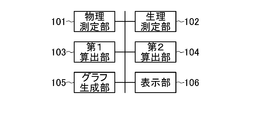
- FIG. 1 is a configuration diagram showing a configuration of a function recovery training support system according to Embodiment 1 of the present invention.
- FIG. 2 is a configuration diagram showing a hardware configuration of a part of the function recovery training support system according to the first embodiment of the present invention.
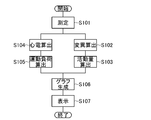
- FIG. 3 is a flowchart for explaining an operation example (function recovery training support method) of the function recovery training support system according to the first embodiment of the present invention.
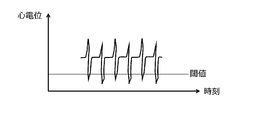
- FIG. 4 is an explanatory diagram for explaining a waveform of cardiac potential data and a heart rate.
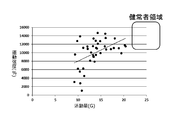
- FIG. 5 is an explanatory diagram illustrating an example of a two-dimensional graph displayed by the function recovery training support system according to the first embodiment of the present invention.
- FIG. 6 is a characteristic diagram showing statistical data on the relationship between the measured movement standard deviation of acceleration and FIM.
- FIG. 7 is a configuration diagram showing a partial configuration of a function recovery training support system according to Embodiment 2 of the present invention.
- FIG. 8 is a two-dimensional graph in which the 24-hour cumulative value of% HRR is an exercise load, and the 24-hour activity time (sum of standing time, sitting time, and walking time) is the amount of activity.
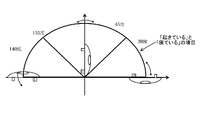
- FIG. 9 is a characteristic diagram showing a result of measuring a posture angle of the subject.
- FIG. 10 is a characteristic diagram showing a change in the estimated posture.
- FIG. 11 is a characteristic diagram showing the measured values of the angles when standing up, lying on the back, and prone.
- FIG. 12 is an explanatory diagram for explaining a range of 30 to 140 degrees that is determined to be occurring based on the measured values of the angles when standing up, lying on the back, and prone.
- FIG. 13 is a characteristic diagram showing statistical data on the relationship between the activity amount and the quotient obtained by dividing the exercise load by the activity amount.
- FIG. 14 is a characteristic diagram showing statistical data on the relationship between the quotient obtained by dividing the exercise load by the amount of activity and the SIAS.
- FIG. 15 is a graph showing a time series in which the exercise load is divided by the amount of activity (additional processing value).
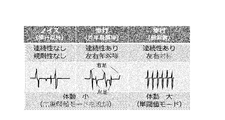
- FIG. 16 is an explanatory diagram illustrating a state in which walking is detected.
- FIG. 16 is an explanatory diagram for explaining a range of 30 to 140 degrees that is determined to be occurring based on the measured values of the angles when standing up, lying on the back, and prone.
- FIG. 13 is a characteristic diagram showing statistical data on the relationship between the activity amount and the quotient obtained by
- FIG. 17 is an explanatory diagram showing a state in which the threshold for counting the number of steps is set to two in accordance with the left and right feet to ensure the accuracy of walking detection.
- FIG. 18 is a configuration diagram showing a configuration of a function recovery training support system according to Embodiment 3 of the present invention.
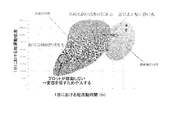
- FIG. 19 is a two-dimensional graph in which the vertical axis represents the total exercise intensity (exercise load) in one day, and the horizontal axis represents the total activity time (activity) in one day.
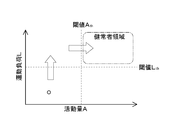
- FIG. 20 is an explanatory diagram showing a threshold value A th of the activity amount and a threshold value L th of the exercise load set for the activity amount A and the exercise load L.
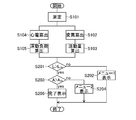
- FIG. 21 is a flowchart for explaining an operation example of the function recovery training support system according to the third embodiment of the present invention.
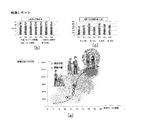
- FIG. 22 is an explanatory diagram showing an example in which a two-dimensional graph (a) of the exercise load and the activity amount is displayed by adding the time lapse of the exercise load (b) and the time lapse of the activity amount (c).
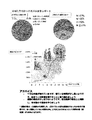
- FIG. 23 is an explanatory diagram illustrating an example in which advice (advice) is displayed in addition to the results of the exercise load and the activity amount.
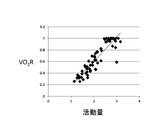
- FIG. 24 is a characteristic diagram showing the relationship between the amount of activity and the reserve oxygen intake amount from walking to running of the subject, calculated by equation (4). .
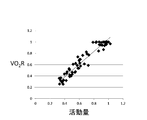
- FIG. 25 is a characteristic diagram showing a relationship between the positive square root of the activity amount from walking to running of the subject calculated by the equation (4) and the reserve oxygen intake.
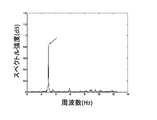
- FIG. 26 is a characteristic diagram illustrating a result of performing a fast Fourier transform on a temporal change of the sum of accelerations in three directions measured by the physical measurement unit 101.
- FIG. 27 is a characteristic diagram showing the relationship between the frequency of the peak obtained by performing the fast Fourier transform on the time change of the sum of the accelerations in the three directions measured by the physical measurement unit 101 and the reserve oxygen intake.
- FIG. 28 is a configuration diagram showing a configuration of a function recovery training support system according to Embodiment 4 of the present invention.
- FIG. 29 is a configuration diagram showing a configuration of a function recovery training support system according to Embodiment 5 of the present invention.
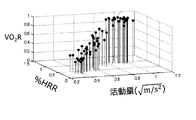
- FIG. 30 shows the amount of activity obtained by the positive square root of the value calculated by equation (4) and the% HRR, with respect to the acceleration measurement value during the period from walking to running of the subject calculated by equation (4).
- FIG. 4 is a characteristic diagram showing a relationship between the amount of oxygen and reserve oxygen.
- FIG. 31 is a characteristic diagram showing the relationship between healthy subjects with the positive square root of the amount of activity as the horizontal axis and% HRR as the vertical axis.
- This function recovery training support system includes a physical measurement unit 101, a physiological measurement unit 102, a first calculation unit 103, a second calculation unit 104, a graph generation unit 105, and a display unit 106.
- the physical measurement unit 101 is worn on a subject (patient) and measures time-series physical information representing a static / dynamic state of the subject's body.
- the physical information is, for example, at least one of acceleration, angular velocity, and position coordinates.
- an acceleration measurement unit that measures acceleration in time series will be described as an example.
- the physiological measurement unit 102 measures physiological information in the body of the subject.
- the physiological information is, for example, at least one of cardiac potential, heart rate, pulse rate, blood pressure, myoelectric potential, and respiratory activity.
- an example of an electrocardiographic measurement unit that measures a subject's cardiac potential will be described as the physiological measurement unit 102.
- the first calculation unit 103 obtains the amount of activity related to the body movement of the subject from the change in the physical information measured by the physical measurement unit 101. For example, the first calculator 103 calculates the sum of squares of the measured physical information, the square root of the sum of squares, or the accumulated value of any period, or the time difference, or the absolute value of the time difference, the standard deviation of any period, or The amount of activity is obtained by one or a combination of variances.
- the second calculating unit 104 obtains a physiological load applied to the subject from a change in the physiological information measured by the physiological measuring unit 102.
- the second calculating unit 104 calculates, for example, an exercise load as the physiological load.
- the second calculator 104 calculates a value obtained by normalizing the measured physiological information based on an arbitrary standard, a value accumulated over an arbitrary period, or an averaged value, a median value, or a differentiated value.
- the exercise load may be obtained by any one or a combination.
- the arbitrary period may be, for example, 24 hours in which the progress of one day is completely included.
- the graph generation unit 105 generates a graph relating to the activity calculated by the first calculation unit 103 and the physiological load calculated by the second calculation unit 104. For example, the graph generation unit 105 uses the change in the amount of activity obtained by the first calculation unit 103 as a first parameter, the change in a physiological load (eg, exercise load) obtained by the second calculation unit 104 as a second parameter, Let the first parameter and the second parameter be a two-dimensional graph.
- the display unit 106 displays a graph based on the graph data generated by the graph generation unit 105 so that the graph can be visually recognized by the subject.
- Two-dimensional graph data may be generated using the obtained change in exercise load as the first parameter and the second parameter as the second parameter, and a graph based on this graph data may be displayed to the subject.
- the server is a computer device including a CPU (Central Processing Unit), a main storage device, an external storage device, a network connection device, and the like, and the CPU operates according to a program developed in the main storage device.
- CPU Central Processing Unit
- the device shown in FIG. 2 includes an acceleration sensor 111, a capacitance detection circuit 112, an analog-digital circuit (ADC) 113, two electrodes 114a and 114b, a potential detection circuit 115, an analog-digital circuit (ADC) 116, and an arithmetic processing circuit 117. , A radio circuit 118.
- a radio circuit 118 A radio circuit 118.
- the acceleration sensor 111 generates a capacitance change by displacing a movable body provided therein due to a change in acceleration. This change in capacitance is converted into an electric signal by the capacitance detection circuit 112, converted into digital data by the ADC 113, and used as acceleration data.
- the physical measurement unit 101 includes an acceleration sensor 111, a capacitance detection circuit 112, and an ADC 113.
- the two electrodes 114a and 114b are, for example, embedded in clothes so that they can come into contact with the skin.
- the potential difference between the two electrodes 114a and 114b is detected by a potential detection circuit 115, and the analog-digital circuit is used.
- ADC Analog-digital circuit
- the data is converted into digital data and becomes cardiac potential data.
- the electrodes 114a and 114b, the potential detection circuit 115, and the ADC 116 constitute the physiological measurement unit 102.
- the arithmetic processing circuit 117 acquires acceleration data and cardiac potential data at each set time (for example, every one second).
- the acceleration data and the cardiac potential data acquired by the arithmetic processing circuit 117 are transmitted to the server by a wireless circuit 118 via a gateway (not shown).
- step S101 the physical measurement unit 101 measures a capacitance change as a change in acceleration, for example, as physical information, and the physiological measurement unit 102 measures a potential difference as physiological information (first step, second step). Process).
- step S102 the physical measurement unit 101 calculates a displacement from the measured change in capacitance to obtain acceleration data.
- step S103 the first calculation unit 103 obtains an activity amount related to the body movement of the subject from the acceleration data (third step).
- step S104 the physiological measurement unit 102 calculates an electrocardiogram from the measured potential difference and sets the electrocardiogram as the subject's cardiac potential.
- step S105 the second calculation unit 104 obtains the exercise load of the subject from the cardiac potential (fourth step).
- step S106 the graph generation unit 105 generates graph data relating to the activity calculated in the third step and the physiological load calculated in the fourth step (fifth step). For example, the graph generation unit 105 uses the obtained change in the amount of activity as the first parameter, the obtained change in the exercise load as the second parameter, the first parameter on the horizontal axis, and the second parameter on the vertical axis. Generate dimensional graph data.
- step S107 the display unit 106 displays the generated graph (two-dimensional graph) (sixth step).
- the exercise load can be obtained from the heart rate.
- the heart rate can be calculated as the number of peaks per minute, for example, by detecting the peak by thresholding the waveform of the electrocardiographic data with a predetermined threshold, measuring the time interval from the peak to the next peak. (See FIG. 4).
- the value obtained by dividing this heart rate by the maximum heart rate of the subject may be used as the exercise load.
- the measured heart rate / maximum heart rate of the subject ⁇ 100 is generally called exercise intensity (% MHR; Maximum ; Heart Rate).
- the exercise load is calculated by using the difference between the resting heart rate and the maximum heart rate (reserve heart rate, Heart Rate Reserved; HRR), (measured heart rate ⁇ resting heart rate of the subject) ⁇ (measured heart rate) Heart rate at rest-heart rate at rest).
- HRR Heart Rate Reserved
- acceleration is detected using a three-axis acceleration sensor that detects acceleration in three directions of XYZ axes. Since the acceleration of each axis changes depending on the inclination of the physical measurement unit 101 mounted on the subject, for example, the norm (the sum of vectors) is used as the displacement.
- Norm x-axis, y-axis, the acceleration in each direction of the z-axis a x, a y,
- a z given by "
- (a x 2 + a y 2 + a z 2) 1/2
- the amount of activity is calculated (moving sum) by integrating the norm as shown in the following equation (1).
- the measurement results of the exercise amount and the activity amount obtained as described above are generated as a two-dimensional graph (see FIG. 5) in which exercise intensity (exercise load) is set on the vertical axis and activity amount is set on the horizontal axis.
- exercise intensity exercise load
- activity amount is set on the horizontal axis.
- the measurement results are indicated by circles.
- a healthy person region obtained from a data group of healthy people measured in advance is set and displayed. This makes it possible to visually grasp how close the measurement result indicated by the white circle is to the healthy person zone.
- the effect of recovery by rehabilitation can be considered in association with (associated with) physical function.
- the activity amount may be calculated by integrating a value obtained by squaring the difference of the time change of the norm as shown in the following equation (2).
- the activity amount may be calculated by integrating the absolute value of the difference in the time change of the norm (sum of the absolute values of the difference), as shown in the following equation (3). In this case, the amount of calculation can be reduced as compared with the sum of squares of the difference.
- the amount of activity may be calculated as the standard deviation of the time change of the norm and the moving standard deviation.
- FIG. 6 shows statistical data relating to the relationship between the moving standard deviation and FIM (Functional Independence).
- FIM is an evaluation index of ADL (Activities @ of @ daily @ living). It can be seen that the moving standard deviation has a correlation with the FIM.
- the same value (1 G) as the gravitational acceleration is output even at rest, but a very small value is output at rest because the moving standard deviation is an amount indicating the distance from the average.
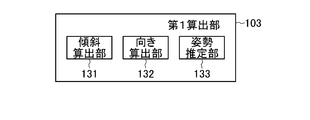
- the first calculation unit 103 estimates the posture of the subject based on the acceleration measured by the physical measurement unit 101 and sets the posture as the activity amount.
- the first calculator 103 includes a tilt calculator 131, a direction calculator 132, and a posture estimator 133.
- the inclination calculation unit 131 obtains the inclination angle ⁇ of the subject from the acceleration measured by the physical measurement unit 101 using the following equation (5).
- the direction calculation unit 132 obtains the direction ⁇ of the subject from the acceleration measured by the physical measurement unit 101 using the following equation (6).
- ⁇ ( ⁇ 90 ⁇ ⁇ ⁇ 270) is the inclination of the z-axis of the physical measurement unit 101 with respect to the vertical direction
- ⁇ ( ⁇ 90 ⁇ ⁇ ⁇ 270) is the inclination of the x-axis of the physical measurement unit 101 with respect to the vertical direction.
- the unit is degree [degree].
- the posture estimation unit 133 estimates the posture by comparing the values of the inclination angle ⁇ and the direction ⁇ obtained as described above with threshold values. Since the inclination of the physical measurement unit 101 reflects the inclination of the body of the subject wearing the physical measurement unit 101, the posture of the subject can be estimated from the inclination of the physical measurement unit 101.
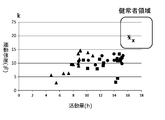
- FIG. 8 is a two-dimensional graph in which the 24-hour cumulative value of% HRR is exercise intensity (exercise load), and the 24-hour activity time (sum of standing time, sitting time, and walking time) is the amount of activity.
- the measurement results of the patient are indicated by circles, squares, and triangles. Circles indicate patients with high FIM, squares indicate patients with intermediate FIM, and triangles indicate patients with low FIM.
- a healthy subject region (*) obtained from a data group of healthy subjects measured in advance is set and displayed.
- the FIM the closer to the healthy person area is, the higher the FIM, which is a medical evaluation index of existing rehabilitation, is related to the measurement result. Thereby, it is possible to visually grasp how close the measurement result indicated by a circle is to the healthy person zone.
- the effect of recovery by rehabilitation can be considered in association with (associated with) physical function.
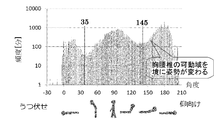
- FIG. 9 shows the results of measuring the posture angle of the patient (subject). This is a result of measuring for 28 hours (including men and women) for 48 hours per person.
- a highly reliable threshold value based on the hospitalized living condition can be set.
- the total time other than the sum of the sitting, standing, and walking times, that is, the time other than the sleeping (lying) time is defined as the activity amount.
- the standard deviation s of the acceleration may be obtained from the acceleration measured by the physical measurement unit 101 according to the following equation (7), and the direction calculated by the direction calculation unit 132 may be compensated based on the standard deviation s. .
- the acceleration measured by the physical measurement unit 101 when the acceleration measured by the physical measurement unit 101 is large, it is interpreted as sitting or standing, and when the acceleration measured by the physical measurement unit 101 is small, , The orientation of the body determined by the orientation calculation unit 132 is held for a certain period of time. Focusing on the magnitude of the acceleration measured by the physical measurement unit 101 and holding it enables a posture estimation that is stable against disturbance and stable.
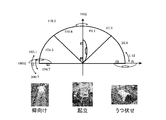
- the measured values of the angles when standing up, lying on the back, and prone will be described with reference to FIGS.
- the results ranged from 165 to 200 degrees when lying on the back, from 1 to 27 degrees when prone, and from 67 to 118 degrees when standing up.
- the range in which it is determined to be awake is set to a range of 30 to 140 degrees (FIG. 12).
- the second calculating unit 104 calculates an additional processing value obtained by dividing the calculated exercise load by the activity amount calculated by the first calculating unit 103.
- the graph generating unit 105 calculates the additional processing value calculated by the second calculating unit 104. May be used as a second parameter, and the first parameter and the second parameter may be represented as a two-dimensional graph. For example, in the graph shown in FIG. 5, the vertical axis may be shown in FIG. 13 using the quotient (additional processing value) obtained by dividing the exercise load by the activity amount as the exercise intensity (exercise load). In FIG. 13, circles indicate patients with high FIM, squares indicate patients with intermediate FIM, and triangles indicate patients with low FIM.
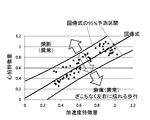
- FIG. 14 shows statistical data on the relationship between the 24-hour accumulation of% HRR divided by the amount of activity calculated by the movement standard deviation and the evaluation index SIAS (StrokepairImpairment Assessment) Set) for dysfunction used during stroke treatment.
- SIAS StressImpairment Assessment
- the index on the vertical axis has an inverse correlation with the SIAS.
- Exercise intensity (exercise load) divided by the amount of activity is an index of efficiency when the patient moves the body, so using this as the vertical axis, the amount of activity as activity time and the efficiency of physical manipulation Can be evaluated.
- the graph generation unit 105 generates a graph (time-series graph) in which the additional processing values obtained by the second calculation unit 104 are displayed in time series as illustrated in FIG. A series graph may be displayed.
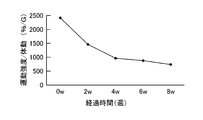
- FIG. 15 illustrates changes in body movements of a plurality of patients, that is, changes in the load (exercise intensity / body movement) of a plurality of patients as additional processing values.
- the graph generation unit 105 may generate both a time-series graph indicating the additional processing value in a time series and the two-dimensional graph described above, and simultaneously display these on the display unit 106.
- One of the graphs may be generated, and the generated one of the graphs may be displayed on the display unit 106.
- the function recovery training support system according to the first embodiment further includes a training item storage unit 107 and an item selection unit 108.
- the training item storage unit 107 stores a plurality of items related to the function recovery training in association with the activity amount and the exercise load.
- the item selection unit 108 selects one of the items stored in the training item storage unit 107 based on the activity amount obtained by the first calculation unit 103 and the exercise load obtained by the second calculation unit 104. As described above, the item selected by the item selection unit 108 is displayed on the display unit 106 together with the graph generated by the graph generation unit 105.
- the function recovery training support system includes an advice storage unit 109 and an advice selection unit 110.
- the advice storage unit 109 stores a plurality of advices relating to the function recovery training in association with the activity amount and the exercise load.
- the advice selection unit 110 selects one of the advices stored in the advice storage unit 109 based on the activity amount obtained by the first calculation unit 103 and the exercise load obtained by the second calculation unit 104. As described above, the advice selected by the advice selecting unit 110 is displayed on the display unit 106 together with the graph generated by the graph generating unit 105.
- FIG. 19 shows a two-dimensional graph in which the vertical axis represents the total exercise intensity (exercise load) in one day, and the horizontal axis represents the total activity time (activity) in one day.
- the total exercise intensity in one day “(measured heart rate ⁇ resting heart rate of the subject) ⁇ (maximum heart rate of the subject ⁇ resting heart rate) ⁇ 100” is used.
- the activity time the total time in a posture other than the sleeping or lying time in one day is used. As shown in FIG. 19, it can be seen that the greater the exercise load and the amount of activity, the longer the time that can be moved, the higher the activity that can be performed, and the more efficiently the user can move long.
- a threshold value A th of the activity amount and a threshold value L th of the exercise load are set based on the region of the healthy person.
- the rehabilitation menu can be presented as a training item suited to the patient's condition by determining the obtained exercise load and activity amount as threshold values based on the flowchart of FIG.
- step S101 the physical measurement unit 101 measures a change in capacitance as a change in acceleration, and the physiological measurement unit 102 measures a potential difference.
- step S102 the physical measurement unit 101 calculates a displacement from the measured change in capacitance to obtain acceleration data.
- step S103 the first calculation unit 103 obtains an activity amount related to the body movement of the subject from the acceleration data.
- step S104 the physiological measurement unit 102 calculates an electrocardiogram from the measured potential difference and sets the electrocardiogram as the subject's cardiac potential.
- step S105 the second calculation unit 104 obtains the exercise load of the subject from the cardiac potential.
- step S201 the item selecting unit 108, the obtained exercise load L whether the threshold L th is greater than. If exercise load L is equal to or less than the threshold L th (no in step S201), in step S202, the item selecting unit 108 selects the menu 1 from training item storage unit 107, the display unit 106. On the other hand, if the exercise load L is larger than the threshold value L th (yes in step S201), the process proceeds to step S203, the item selecting unit 108, the obtained amount of activity A is equal to or threshold A th or greater.
- step S202 When the activity amount A is equal to or smaller than the threshold value Ath (No in step S203), in step S202, the item selecting unit 108 selects the menu 2 from the training item storage unit 107 and displays the menu 2 on the display unit 106. On the other hand, when the activity amount A is larger than the threshold value Ath (Yes in step S203), the process proceeds to step S205, and the item selecting unit 108 displays on the display unit 106 a notification that the rehabilitation is completed.
- the elapsed time (b) of the exercise load and the elapsed time (c) of the activity amount may be displayed.
- the patient can grasp the activity in daily life in association with the exercise load and the amount of activity, and can feed back to the function recovery training that is being performed.
- advice (advice) is displayed in addition to the results of the exercise load and the activity amount.
- Advice from a doctor or the like is stored in the advice storage unit 109.
- the advice selecting unit 110 the results of the obtained exercise load and the amount of activity are selected by using an algorithm such as machine learning, and an advice as a standard document stored in the advice storage unit 109 is selected and displayed on the display unit 106.
- an algorithm such as machine learning
- FIG. 24 shows the relationship between the amount of activity and the reserve oxygen uptake from walking to running of the subject, calculated by equation (4).
- FIG. 25 shows the relationship between the positive square root of the amount of activity from walking to running of the subject calculated by equation (4) and the reserve oxygen intake.
- the plot is non-linearly distributed in a quadratic function, whereas in FIG. 25, the plot is linearly, that is, linearly distributed. This tendency is similar even when the maximum oxygen intake is used instead of the reserve oxygen intake. The same tendency can be obtained by using equations (1), (2) and (3) instead of equation (4).
- the linear relationship has the advantage that it is intuitive and predictive for oxygen uptake, and the amount of calculation is small.Also, the application to linear assumption analysis, such as multiple regression analysis, is performed with high reliability. It becomes possible.
- FIG. 26 shows a result obtained by performing a fast Fourier transform (FFT) on a temporal change of 1024 points that are temporally continuous at the data rate of 25 Hz, that is, a sum of the accelerations in the three directions measured by the physical measurement unit 101 at a data rate of 25 Hz.
- FFT fast Fourier transform
- FIG. 27 shows the relationship between such peak frequency and reserve oxygen intake, and it can be seen that a correlation has been obtained. This indicates the relationship between the walking pitch and the oxygen intake, and it is possible to simultaneously grasp the specific condition of walking or running and the oxygen intake in that condition.
- the function recovery training support system according to the third embodiment further includes an oxygen intake amount calculation unit 121.
- the oxygen intake amount calculation unit 121 creates a regression equation from the distribution of the activity amount and the oxygen intake amount, and calculates the oxygen intake amount using the created regression equation.
- the regression equation may be created using a distribution obtained in advance, or may be created each time from the oxygen intake and the activity stored in the oxygen intake calculator 121.
- the oxygen uptake calculation unit 121 can also implement these regression equations.
- Oxygen intake is originally measured from expiration, but since expiration measurement places a large burden on the subject, it can be easily estimated from the amount of activity using the above-mentioned regression equation to achieve low oxygen consumption. The intake amount can be grasped.
- the function recovery training support system according to the fourth embodiment further includes a subject information storage unit 122.
- the subject information storage unit 122 includes the subject's date of birth, age, gender, height, weight, medical history, medication history, hospitalization / discharge history, treatment staff, FIM (Functional Independence Measure), hospital room, and beds used. At least one of the history information of the subject is stored. By providing the subject information storage unit 122 that stores the history information of the subject, it is possible to associate the change in the activity amount or the exercise load of the subject with the cause. Can be.
- the oxygen uptake calculating unit 121 calculates the activity amount obtained by the first calculating unit 103, the physiological load obtained by the second calculating unit 104, and the history information of the subject stored in the subject information storage unit 122.
- the maximal oxygen uptake or reserve oxygen uptake can be determined from at least one of the following.
- FIG. 30 shows the amount of activity calculated by the positive square root of the value calculated by equation (4) and the% HRR with respect to the acceleration measurement value during the period from walking to running of the subject calculated by equation (4).
- the regression equation described above may be created using such a relationship.
- Equation (8) does not include the history information of the subject, but if multiple regression analysis is performed using the history information as the following terms, a regression equation including the history information can be obtained. Also, if the number of x 1 is large, using stepwise variable selection method (see Non-Patent Document 1), may be to selected only strong x 1 a more relationship with Y to create a regression equation. Since the stepwise variable selection method can be performed mechanically, it can be easily implemented in a system.
- Table 1 below, the amount of activity positive determination of the preliminary oxygen uptake regression equation obtained by using the square root factor R 2,% determination of the regression equation for the preliminary oxygen uptake obtained with HRR coefficient R 2, The coefficient of determination R 2 of the regression equation for reserve oxygen uptake obtained by using the multiple regression analysis for both the positive square root of the amount of activity and the% HRR is shown. It can be seen that the best estimation accuracy is obtained when both are used. Using such a multivariate regression equation can provide an accurate estimate of oxygen uptake.
- logistic regression can be used for the multivariate regression equation. These can perform non-linear regression, which cannot be performed by multiple regression analysis, so that more optimized regression can be performed and a reliable oxygen intake estimate can be provided.
- each term can be multiplied by a coefficient, and the value of the coefficient can be switched according to a condition.
- FIG. 31 illustrates the relationship between the positive square root of the amount of activity and the healthy subject, with the horizontal axis representing% HRR and the vertical axis representing% HRR.
- the results of the function recovery training are displayed. Is easier to grasp.
- the physical measurement unit may use an angular velocity sensor (gyro sensor).
- the angular velocity sensor has an advantage that the activity amount can be more easily obtained because the angular velocity sensor outputs an angle that is a substitute for the above ⁇ and ⁇ as a measured value.
- the physical measurement unit may use GPS. Since the GPS acquires position information, it can calculate the amount of movement from its history, and can provide an effective amount of exercise from the viewpoint of exercise monitoring.
- the physiological measurement unit may use an electromyograph.
- the electrocardiograph can grasp the metabolism of the whole body, including the central and peripheral systems. Load information can be provided.
- a respirometer may be used for the physiological measurement unit. Since the respiratory rate generally increases when the exercise load increases, the respirometer can be expected to play a role similar to that of an electrocardiograph, and it is expected that the heart rate can be replaced with the respiratory rate.
- the respirometer has an advantage that the sensor does not need to be arranged on the surface of the skin of the body, so that it can be easily attached and detached.
- a sphygmomanometer may be used on the side of the physiological meter. Exercise increases oxygen consumption and increases blood pressure as well as heart rate, so blood pressure can replace heart rate. When blood pressure is constantly measured due to illness or the like, since it is complicated to use other sensors in combination, it is possible to secure convenience by using the blood pressure monitor used.
- a pulse meter may be used for the side of the physiological meter. If a pulse is used, measurement can be performed with an arm, a foot, a neck, or the like where it is difficult to measure a cardiac potential, and measurement can be more easily performed.
Landscapes
- Health & Medical Sciences (AREA)
- Engineering & Computer Science (AREA)
- Public Health (AREA)
- Life Sciences & Earth Sciences (AREA)
- Medical Informatics (AREA)
- General Health & Medical Sciences (AREA)
- Biomedical Technology (AREA)
- Physical Education & Sports Medicine (AREA)
- Epidemiology (AREA)
- Biophysics (AREA)
- Physics & Mathematics (AREA)
- Primary Health Care (AREA)
- Pathology (AREA)
- Remote Sensing (AREA)
- Radar, Positioning & Navigation (AREA)
- General Physics & Mathematics (AREA)
- Animal Behavior & Ethology (AREA)
- Veterinary Medicine (AREA)
- Surgery (AREA)
- Molecular Biology (AREA)
- Heart & Thoracic Surgery (AREA)
- Data Mining & Analysis (AREA)
- Databases & Information Systems (AREA)
- Physiology (AREA)
- Dentistry (AREA)
- Oral & Maxillofacial Surgery (AREA)
- Measurement Of The Respiration, Hearing Ability, Form, And Blood Characteristics Of Living Organisms (AREA)
- Measurement And Recording Of Electrical Phenomena And Electrical Characteristics Of The Living Body (AREA)
- Medical Treatment And Welfare Office Work (AREA)
Abstract
Dans la présente invention, une première unité de calcul (103) détermine, à partir d'un changement d'informations physiques mesurées par une unité de mesure physique (101), la quantité d'activité liée au mouvement corporel d'un sujet mesuré. Une seconde unité de calcul (104) détermine, à partir d'un changement d'informations physiologiques mesurées par une unité de mesure physiologique (102), la charge physiologique exercée sur le sujet. Une unité de génération de graphique (105) génère un graphique relatif à la quantité d'activité déterminée par la première unité de calcul (103) et à la charge physiologique déterminée par la seconde unité de calcul (104). Par exemple, l'unité de génération de graphique (105) attribue le changement de la quantité d'activité déterminée par la première unité de calcul (103) à un premier paramètre, attribue le changement dans la charge physiologique déterminée par la seconde unité de calcul (104) à un second paramètre, et adopte le premier paramètre et le second paramètre sous la forme de données de graphique en deux dimensions. L'unité d'affichage (106) affiche le graphique à partir des données de graphique générées par l'unité de génération de graphique (105) d'une manière visualisable sur le sujet.
Priority Applications (2)
| Application Number | Priority Date | Filing Date | Title |
|---|---|---|---|
| US17/255,617 US20210217509A1 (en) | 2018-06-25 | 2019-06-17 | Rehabilitation Support System and Method |
| JP2020527408A JP7036211B2 (ja) | 2018-06-25 | 2019-06-17 | 機能回復訓練支援システム |
Applications Claiming Priority (2)
| Application Number | Priority Date | Filing Date | Title |
|---|---|---|---|
| JP2018-119729 | 2018-06-25 | ||
| JP2018119729 | 2018-06-25 |
Publications (1)
| Publication Number | Publication Date |
|---|---|
| WO2020004102A1 true WO2020004102A1 (fr) | 2020-01-02 |
Family
ID=68986479
Family Applications (1)
| Application Number | Title | Priority Date | Filing Date |
|---|---|---|---|
| PCT/JP2019/023853 Ceased WO2020004102A1 (fr) | 2018-06-25 | 2019-06-17 | Système et procédé de support d'aide à l'entraînement pour récupération fonctionnelle |
Country Status (3)
| Country | Link |
|---|---|
| US (1) | US20210217509A1 (fr) |
| JP (1) | JP7036211B2 (fr) |
| WO (1) | WO2020004102A1 (fr) |
Cited By (5)
| Publication number | Priority date | Publication date | Assignee | Title |
|---|---|---|---|---|
| WO2021246285A1 (fr) * | 2020-06-01 | 2021-12-09 | 株式会社Arblet | Système de traitement d'informations, serveur, procédé de traitement d'informations, et programme |
| JPWO2024004099A1 (fr) * | 2022-06-29 | 2024-01-04 | ||
| WO2024009487A1 (fr) * | 2022-07-08 | 2024-01-11 | 日本電信電話株式会社 | Dispositif d'estimation, procédé d'estimation et programme |
| JP2024039861A (ja) * | 2022-09-12 | 2024-03-25 | 日本電信電話株式会社 | 安静時心拍数算出装置、安静時心拍数算出方法、プログラム及び記録媒体 |
| WO2025028181A1 (fr) * | 2023-08-01 | 2025-02-06 | 株式会社グレースイメージング | Dispositif de traitement d'informations, procédé de traitement d'informations et programme |
Families Citing this family (3)
| Publication number | Priority date | Publication date | Assignee | Title |
|---|---|---|---|---|
| JP7409384B2 (ja) * | 2019-08-21 | 2024-01-09 | 日本電気株式会社 | 情報処理方法 |
| JP7327498B2 (ja) * | 2019-10-17 | 2023-08-16 | 日本電気株式会社 | 情報処理方法 |
| JP7246648B2 (ja) * | 2021-06-13 | 2023-03-28 | Rehabilitation3.0株式会社 | 作業療法支援装置、作業療法支援装置のための人工知能学習装置、作業療法支援方法、作業療法支援装置のための人工知能学習方法、作業療法支援プログラム、及び人工知能学習プログラム |
Citations (5)
| Publication number | Priority date | Publication date | Assignee | Title |
|---|---|---|---|---|
| JP2008262522A (ja) * | 2007-04-11 | 2008-10-30 | Aichi Micro Intelligent Corp | 歩数計 |
| JP2011193976A (ja) * | 2010-03-18 | 2011-10-06 | Nippon Koden Corp | 目標心拍数到達時間予測装置および目標心拍数到達時間予測方法 |
| JP2015132957A (ja) * | 2014-01-10 | 2015-07-23 | フクダ電子株式会社 | リハビリテーション支援装置及びリハビリテーションレポート |
| JP2017006745A (ja) * | 2016-10-17 | 2017-01-12 | 国立大学法人東北大学 | 健康情報処理装置、健康情報表示装置及び方法 |
| JP2017148312A (ja) * | 2016-02-25 | 2017-08-31 | 富士通株式会社 | センサ情報処理装置、センサユニット、及び、センサ情報処理プログラム |
Family Cites Families (6)
| Publication number | Priority date | Publication date | Assignee | Title |
|---|---|---|---|---|
| JP4357503B2 (ja) * | 2006-06-28 | 2009-11-04 | 株式会社東芝 | 生体情報計測装置、生体情報計測方法および生体情報計測プログラム |
| US20110245688A1 (en) * | 2010-03-31 | 2011-10-06 | General Electric Company | System and method of performing electrocardiography with motion detection |
| JP5741964B2 (ja) * | 2012-12-19 | 2015-07-01 | カシオ計算機株式会社 | センサデータ抽出システム、センサデータ抽出方法およびセンサデータ抽出プログラム |
| US10238915B2 (en) * | 2013-09-11 | 2019-03-26 | Firstbeat Technologies Oy | Method to determine body's physiological response to physical exercise for assessing readiness and to provide feedback, and system for implementing the method |
| CN104840191A (zh) * | 2015-04-30 | 2015-08-19 | 吴健康 | 测试心脏运动功能的设备、系统和方法 |
| KR102457563B1 (ko) * | 2015-11-24 | 2022-10-24 | 삼성전자주식회사 | 서비스 제공을 위한 웨어 시스템 및 방법 |
-
2019
- 2019-06-17 JP JP2020527408A patent/JP7036211B2/ja active Active
- 2019-06-17 WO PCT/JP2019/023853 patent/WO2020004102A1/fr not_active Ceased
- 2019-06-17 US US17/255,617 patent/US20210217509A1/en not_active Abandoned
Patent Citations (5)
| Publication number | Priority date | Publication date | Assignee | Title |
|---|---|---|---|---|
| JP2008262522A (ja) * | 2007-04-11 | 2008-10-30 | Aichi Micro Intelligent Corp | 歩数計 |
| JP2011193976A (ja) * | 2010-03-18 | 2011-10-06 | Nippon Koden Corp | 目標心拍数到達時間予測装置および目標心拍数到達時間予測方法 |
| JP2015132957A (ja) * | 2014-01-10 | 2015-07-23 | フクダ電子株式会社 | リハビリテーション支援装置及びリハビリテーションレポート |
| JP2017148312A (ja) * | 2016-02-25 | 2017-08-31 | 富士通株式会社 | センサ情報処理装置、センサユニット、及び、センサ情報処理プログラム |
| JP2017006745A (ja) * | 2016-10-17 | 2017-01-12 | 国立大学法人東北大学 | 健康情報処理装置、健康情報表示装置及び方法 |
Cited By (9)
| Publication number | Priority date | Publication date | Assignee | Title |
|---|---|---|---|---|
| WO2021246285A1 (fr) * | 2020-06-01 | 2021-12-09 | 株式会社Arblet | Système de traitement d'informations, serveur, procédé de traitement d'informations, et programme |
| JP2021190122A (ja) * | 2020-06-01 | 2021-12-13 | 株式会社Arblet | 情報処理システム、サーバ、情報処理方法及びプログラム |
| JPWO2024004099A1 (fr) * | 2022-06-29 | 2024-01-04 | ||
| WO2024004099A1 (fr) * | 2022-06-29 | 2024-01-04 | 日本電信電話株式会社 | Dispositif d'analyse d'état de santé et procédé d'analyse d'état de santé |
| JP7765720B2 (ja) | 2022-06-29 | 2025-11-07 | Ntt株式会社 | 容態分析装置、および容態分析方法 |
| WO2024009487A1 (fr) * | 2022-07-08 | 2024-01-11 | 日本電信電話株式会社 | Dispositif d'estimation, procédé d'estimation et programme |
| JPWO2024009487A1 (fr) * | 2022-07-08 | 2024-01-11 | ||
| JP2024039861A (ja) * | 2022-09-12 | 2024-03-25 | 日本電信電話株式会社 | 安静時心拍数算出装置、安静時心拍数算出方法、プログラム及び記録媒体 |
| WO2025028181A1 (fr) * | 2023-08-01 | 2025-02-06 | 株式会社グレースイメージング | Dispositif de traitement d'informations, procédé de traitement d'informations et programme |
Also Published As
| Publication number | Publication date |
|---|---|
| JPWO2020004102A1 (ja) | 2021-02-15 |
| JP7036211B2 (ja) | 2022-03-15 |
| US20210217509A1 (en) | 2021-07-15 |
Similar Documents
| Publication | Publication Date | Title |
|---|---|---|
| JP7036211B2 (ja) | 機能回復訓練支援システム | |
| US10856810B2 (en) | Smart carpet systems and methods of using same for monitoring physical and physiological activities | |
| US11464457B2 (en) | Determining an early warning score based on wearable device measurements | |
| Paalasmaa et al. | Unobtrusive online monitoring of sleep at home | |
| US10213153B2 (en) | Wearable pain monitor using accelerometry | |
| JP6047346B2 (ja) | 生体情報処理システム、ウェアラブル装置、サーバーシステム及びプログラム | |
| KR101656611B1 (ko) | 무구속적으로 측정한 생체신호를 이용하여 산소탈포화지수를 획득하는 방법 | |
| JP7667162B2 (ja) | 患者の脊椎、平衡、歩行、又は姿勢を監視するためのシステム及び方法 | |
| EP3429456B1 (fr) | Procédé et appareil permettant de déterminer une valeur de référence pour une ou plusieurs caractéristiques physiologiques d'un sujet | |
| JPWO2017090732A1 (ja) | 呼吸推定方法および装置 | |
| JP6692933B2 (ja) | 活動状態解析装置および方法 | |
| CN112272534B (zh) | 用于估计血压替代物趋势的方法和装置 | |
| US20230007922A1 (en) | Method and System for Estimating Physiological Parameters Utilizing a Deep Neural Network to Build a Calibrated Parameter Model | |
| JP6450025B2 (ja) | 呼吸推定方法および装置 | |
| JP2008067892A (ja) | 生体解析装置及びプログラム | |
| JP2021122580A (ja) | 体調評価方法、および、体調評価システム | |
| US20220015717A1 (en) | Activity State Analysis Device, Activity State Analysis Method and Activity State Analysis System | |
| Xu et al. | Total health: Toward continuous personal monitoring | |
| JP7294449B2 (ja) | 監視システム、監視方法、および監視プログラム | |
| CN110022758B (zh) | 用于确定心力衰竭风险的确定系统 | |
| Lakudzode et al. | Review on human stress monitoring system using wearable sensors | |
| Kutilek et al. | Methods of motion assessment of upper limb for rehabilitation application | |
| KR102405320B1 (ko) | 근감소증 진단장치 및 진단방법 | |
| Sprowls et al. | Integrated Sensing Systems for Monitoring Interrelated Physiological Parameters in Young and Aged Adults: A Pilot Study | |
| Nikishov et al. | Remote monitoring of periodic limb movement disorder during sleep |
Legal Events
| Date | Code | Title | Description |
|---|---|---|---|
| 121 | Ep: the epo has been informed by wipo that ep was designated in this application |
Ref document number: 19824700 Country of ref document: EP Kind code of ref document: A1 |
|
| ENP | Entry into the national phase |
Ref document number: 2020527408 Country of ref document: JP Kind code of ref document: A |
|
| NENP | Non-entry into the national phase |
Ref country code: DE |
|
| 122 | Ep: pct application non-entry in european phase |
Ref document number: 19824700 Country of ref document: EP Kind code of ref document: A1 |