WO2020004331A1 - Agricultural material, agricultural material roll, and agricultural house - Google Patents
Agricultural material, agricultural material roll, and agricultural house Download PDFInfo
- Publication number
- WO2020004331A1 WO2020004331A1 PCT/JP2019/024966 JP2019024966W WO2020004331A1 WO 2020004331 A1 WO2020004331 A1 WO 2020004331A1 JP 2019024966 W JP2019024966 W JP 2019024966W WO 2020004331 A1 WO2020004331 A1 WO 2020004331A1
- Authority
- WO
- WIPO (PCT)
- Prior art keywords
- agricultural
- cellulose acylate
- layer
- agricultural material
- aggregate
- Prior art date
- Legal status (The legal status is an assumption and is not a legal conclusion. Google has not performed a legal analysis and makes no representation as to the accuracy of the status listed.)
- Ceased
Links
Images




Classifications
-
- A—HUMAN NECESSITIES
- A01—AGRICULTURE; FORESTRY; ANIMAL HUSBANDRY; HUNTING; TRAPPING; FISHING
- A01G—HORTICULTURE; CULTIVATION OF VEGETABLES, FLOWERS, RICE, FRUIT, VINES, HOPS OR SEAWEED; FORESTRY; WATERING
- A01G9/00—Cultivation in receptacles, forcing-frames or greenhouses; Edging for beds, lawn or the like
- A01G9/14—Greenhouses
- A01G9/1407—Greenhouses of flexible synthetic material
-
- A—HUMAN NECESSITIES
- A01—AGRICULTURE; FORESTRY; ANIMAL HUSBANDRY; HUNTING; TRAPPING; FISHING
- A01G—HORTICULTURE; CULTIVATION OF VEGETABLES, FLOWERS, RICE, FRUIT, VINES, HOPS OR SEAWEED; FORESTRY; WATERING
- A01G9/00—Cultivation in receptacles, forcing-frames or greenhouses; Edging for beds, lawn or the like
- A01G9/14—Greenhouses
- A01G9/1438—Covering materials therefor; Materials for protective coverings used for soil and plants, e.g. films, canopies, tunnels or cloches
-
- A—HUMAN NECESSITIES
- A01—AGRICULTURE; FORESTRY; ANIMAL HUSBANDRY; HUNTING; TRAPPING; FISHING
- A01G—HORTICULTURE; CULTIVATION OF VEGETABLES, FLOWERS, RICE, FRUIT, VINES, HOPS OR SEAWEED; FORESTRY; WATERING
- A01G9/00—Cultivation in receptacles, forcing-frames or greenhouses; Edging for beds, lawn or the like
- A01G9/14—Greenhouses
- A01G9/16—Dismountable or portable greenhouses ; Greenhouses with sliding roofs
-
- B—PERFORMING OPERATIONS; TRANSPORTING
- B32—LAYERED PRODUCTS
- B32B—LAYERED PRODUCTS, i.e. PRODUCTS BUILT-UP OF STRATA OF FLAT OR NON-FLAT, e.g. CELLULAR OR HONEYCOMB, FORM
- B32B23/00—Layered products comprising a layer of cellulosic plastic substances, i.e. substances obtained by chemical modification of cellulose, e.g. cellulose ethers, cellulose esters, viscose
- B32B23/04—Layered products comprising a layer of cellulosic plastic substances, i.e. substances obtained by chemical modification of cellulose, e.g. cellulose ethers, cellulose esters, viscose comprising such cellulosic plastic substance as the main or only constituent of a layer, which is next to another layer of the same or of a different material
-
- B—PERFORMING OPERATIONS; TRANSPORTING
- B32—LAYERED PRODUCTS
- B32B—LAYERED PRODUCTS, i.e. PRODUCTS BUILT-UP OF STRATA OF FLAT OR NON-FLAT, e.g. CELLULAR OR HONEYCOMB, FORM
- B32B23/00—Layered products comprising a layer of cellulosic plastic substances, i.e. substances obtained by chemical modification of cellulose, e.g. cellulose ethers, cellulose esters, viscose
- B32B23/04—Layered products comprising a layer of cellulosic plastic substances, i.e. substances obtained by chemical modification of cellulose, e.g. cellulose ethers, cellulose esters, viscose comprising such cellulosic plastic substance as the main or only constituent of a layer, which is next to another layer of the same or of a different material
- B32B23/08—Layered products comprising a layer of cellulosic plastic substances, i.e. substances obtained by chemical modification of cellulose, e.g. cellulose ethers, cellulose esters, viscose comprising such cellulosic plastic substance as the main or only constituent of a layer, which is next to another layer of the same or of a different material of synthetic resin
-
- B—PERFORMING OPERATIONS; TRANSPORTING
- B32—LAYERED PRODUCTS
- B32B—LAYERED PRODUCTS, i.e. PRODUCTS BUILT-UP OF STRATA OF FLAT OR NON-FLAT, e.g. CELLULAR OR HONEYCOMB, FORM
- B32B27/00—Layered products comprising a layer of synthetic resin
- B32B27/30—Layered products comprising a layer of synthetic resin comprising vinyl (co)polymers; comprising acrylic (co)polymers
- B32B27/306—Layered products comprising a layer of synthetic resin comprising vinyl (co)polymers; comprising acrylic (co)polymers comprising vinyl acetate or vinyl alcohol (co)polymers
-
- B—PERFORMING OPERATIONS; TRANSPORTING
- B32—LAYERED PRODUCTS
- B32B—LAYERED PRODUCTS, i.e. PRODUCTS BUILT-UP OF STRATA OF FLAT OR NON-FLAT, e.g. CELLULAR OR HONEYCOMB, FORM
- B32B27/00—Layered products comprising a layer of synthetic resin
- B32B27/30—Layered products comprising a layer of synthetic resin comprising vinyl (co)polymers; comprising acrylic (co)polymers
- B32B27/308—Layered products comprising a layer of synthetic resin comprising vinyl (co)polymers; comprising acrylic (co)polymers comprising acrylic (co)polymers
-
- B—PERFORMING OPERATIONS; TRANSPORTING
- B32—LAYERED PRODUCTS
- B32B—LAYERED PRODUCTS, i.e. PRODUCTS BUILT-UP OF STRATA OF FLAT OR NON-FLAT, e.g. CELLULAR OR HONEYCOMB, FORM
- B32B27/00—Layered products comprising a layer of synthetic resin
- B32B27/32—Layered products comprising a layer of synthetic resin comprising polyolefins
-
- B—PERFORMING OPERATIONS; TRANSPORTING
- B32—LAYERED PRODUCTS
- B32B—LAYERED PRODUCTS, i.e. PRODUCTS BUILT-UP OF STRATA OF FLAT OR NON-FLAT, e.g. CELLULAR OR HONEYCOMB, FORM
- B32B27/00—Layered products comprising a layer of synthetic resin
- B32B27/34—Layered products comprising a layer of synthetic resin comprising polyamides
-
- B—PERFORMING OPERATIONS; TRANSPORTING
- B32—LAYERED PRODUCTS
- B32B—LAYERED PRODUCTS, i.e. PRODUCTS BUILT-UP OF STRATA OF FLAT OR NON-FLAT, e.g. CELLULAR OR HONEYCOMB, FORM
- B32B27/00—Layered products comprising a layer of synthetic resin
- B32B27/40—Layered products comprising a layer of synthetic resin comprising polyurethanes
-
- B—PERFORMING OPERATIONS; TRANSPORTING
- B32—LAYERED PRODUCTS
- B32B—LAYERED PRODUCTS, i.e. PRODUCTS BUILT-UP OF STRATA OF FLAT OR NON-FLAT, e.g. CELLULAR OR HONEYCOMB, FORM
- B32B7/00—Layered products characterised by the relation between layers; Layered products characterised by the relative orientation of features between layers, or by the relative values of a measurable parameter between layers, i.e. products comprising layers having different physical, chemical or physicochemical properties; Layered products characterised by the interconnection of layers
- B32B7/04—Interconnection of layers
- B32B7/12—Interconnection of layers using interposed adhesives or interposed materials with bonding properties
-
- B—PERFORMING OPERATIONS; TRANSPORTING
- B32—LAYERED PRODUCTS
- B32B—LAYERED PRODUCTS, i.e. PRODUCTS BUILT-UP OF STRATA OF FLAT OR NON-FLAT, e.g. CELLULAR OR HONEYCOMB, FORM
- B32B2250/00—Layers arrangement
- B32B2250/02—2 layers
-
- B—PERFORMING OPERATIONS; TRANSPORTING
- B32—LAYERED PRODUCTS
- B32B—LAYERED PRODUCTS, i.e. PRODUCTS BUILT-UP OF STRATA OF FLAT OR NON-FLAT, e.g. CELLULAR OR HONEYCOMB, FORM
- B32B2250/00—Layers arrangement
- B32B2250/03—3 layers
-
- B—PERFORMING OPERATIONS; TRANSPORTING
- B32—LAYERED PRODUCTS
- B32B—LAYERED PRODUCTS, i.e. PRODUCTS BUILT-UP OF STRATA OF FLAT OR NON-FLAT, e.g. CELLULAR OR HONEYCOMB, FORM
- B32B2255/00—Coating on the layer surface
- B32B2255/10—Coating on the layer surface on synthetic resin layer or on natural or synthetic rubber layer
-
- B—PERFORMING OPERATIONS; TRANSPORTING
- B32—LAYERED PRODUCTS
- B32B—LAYERED PRODUCTS, i.e. PRODUCTS BUILT-UP OF STRATA OF FLAT OR NON-FLAT, e.g. CELLULAR OR HONEYCOMB, FORM
- B32B2255/00—Coating on the layer surface
- B32B2255/26—Polymeric coating
-
- B—PERFORMING OPERATIONS; TRANSPORTING
- B32—LAYERED PRODUCTS
- B32B—LAYERED PRODUCTS, i.e. PRODUCTS BUILT-UP OF STRATA OF FLAT OR NON-FLAT, e.g. CELLULAR OR HONEYCOMB, FORM
- B32B2307/00—Properties of the layers or laminate
- B32B2307/50—Properties of the layers or laminate having particular mechanical properties
- B32B2307/582—Tearability
- B32B2307/5825—Tear resistant
-
- B—PERFORMING OPERATIONS; TRANSPORTING
- B32—LAYERED PRODUCTS
- B32B—LAYERED PRODUCTS, i.e. PRODUCTS BUILT-UP OF STRATA OF FLAT OR NON-FLAT, e.g. CELLULAR OR HONEYCOMB, FORM
- B32B2307/00—Properties of the layers or laminate
- B32B2307/70—Other properties
- B32B2307/724—Permeability to gases, adsorption
- B32B2307/7242—Non-permeable
- B32B2307/7246—Water vapor barrier
-
- B—PERFORMING OPERATIONS; TRANSPORTING
- B32—LAYERED PRODUCTS
- B32B—LAYERED PRODUCTS, i.e. PRODUCTS BUILT-UP OF STRATA OF FLAT OR NON-FLAT, e.g. CELLULAR OR HONEYCOMB, FORM
- B32B2307/00—Properties of the layers or laminate
- B32B2307/70—Other properties
- B32B2307/732—Dimensional properties
-
- B—PERFORMING OPERATIONS; TRANSPORTING
- B32—LAYERED PRODUCTS
- B32B—LAYERED PRODUCTS, i.e. PRODUCTS BUILT-UP OF STRATA OF FLAT OR NON-FLAT, e.g. CELLULAR OR HONEYCOMB, FORM
- B32B2307/00—Properties of the layers or laminate
- B32B2307/70—Other properties
- B32B2307/748—Releasability
-
- B—PERFORMING OPERATIONS; TRANSPORTING
- B32—LAYERED PRODUCTS
- B32B—LAYERED PRODUCTS, i.e. PRODUCTS BUILT-UP OF STRATA OF FLAT OR NON-FLAT, e.g. CELLULAR OR HONEYCOMB, FORM
- B32B2410/00—Agriculture-related articles
-
- Y—GENERAL TAGGING OF NEW TECHNOLOGICAL DEVELOPMENTS; GENERAL TAGGING OF CROSS-SECTIONAL TECHNOLOGIES SPANNING OVER SEVERAL SECTIONS OF THE IPC; TECHNICAL SUBJECTS COVERED BY FORMER USPC CROSS-REFERENCE ART COLLECTIONS [XRACs] AND DIGESTS
- Y02—TECHNOLOGIES OR APPLICATIONS FOR MITIGATION OR ADAPTATION AGAINST CLIMATE CHANGE
- Y02A—TECHNOLOGIES FOR ADAPTATION TO CLIMATE CHANGE
- Y02A40/00—Adaptation technologies in agriculture, forestry, livestock or agroalimentary production
- Y02A40/10—Adaptation technologies in agriculture, forestry, livestock or agroalimentary production in agriculture
- Y02A40/25—Greenhouse technology, e.g. cooling systems therefor
Definitions
- the present invention relates to an agricultural material, an agricultural material roll, and an agricultural house.
- Patent Document 1 An agricultural house in which a cellulose acylate film is spread on a frame is known (for example, see Patent Document 1).
- the cellulose acylate film described in Patent Document 1 has an equilibrium water content of 4 to 8% at a relative humidity of 80%. Since the cellulose acylate film is excellent in transparency, it can sufficiently irradiate external light to a medium such as a plant and / or soil in an agricultural house.
- the cellulose acylate film is further excellent in a property of transmitting water vapor (hereinafter, referred to as moisture permeability), and the concentration of carbon dioxide (CO 2 ) in an agricultural house can be controlled by a plant to perform photosynthesis without ventilation. Can be maintained at a level that can.
- moisture permeability water vapor
- CO 2 carbon dioxide
- the saponified layer is a layer formed by saponifying a cellulose acylate film.
- the base resin film is a polyolefin film, a polystyrene film, a polyester film, a polycarbonate film, a cellulose acylate film, or the like.
- the coating is mainly composed of two components, a fluorinated acrylic polymer and a vinylidene fluoride resin.
- the fluorine-containing acrylic polymer is a copolymer of an acrylic monomer and a perfluoroalkyl group-containing acrylic monomer.
- the adhesive acrylic resin layer contains a polymer obtained by polymerizing an acrylic monomer, an ultraviolet absorbing monomer, an acrylic monomer having a cycloalkyl group, and an ultraviolet stable monomer. ing.
- the cellulose acylate film is excellent in moisture permeability and also excellent in transparency, and thus is very suitable for an agricultural house.
- a crack is generated from a hole (through hole) formed by penetration of the screw, and the crack progresses, for example, during screwing of the screw, In some cases, the film may be torn.
- a screw penetration portion in the film is reinforced in advance with an adhesive tape or the like.
- such a method is troublesome.
- cellulose acylate films may break (hereinafter referred to as knick deformation) when fixed to the aggregate with screws, and there is a concern that the film may break at the fold.
- an object of the present invention to provide an agricultural material, an agricultural material roll, and an agricultural house in which, when fixing with a screw, tearing of the screw from the through hole and cracking due to knick deformation are suppressed.
- the agricultural material of the present invention includes a cellulose acylate layer and a polymer layer and has a low tear strength of 0.10N.
- the cellulose acylate layer is formed of cellulose acylate.
- the polymer layer is provided on one surface of the cellulose acylate layer and has a moisture permeation resistance per 1 ⁇ m thickness of at least 7.5 ⁇ 10 ⁇ 4 m 2 ⁇ day / g. Is formed.
- the peel strength between the cellulose acylate layer and the polymer layer is small, it is preferably 0.10 N / 25 mm.
- the thickness of the polymer layer is preferably in the range of 10 ⁇ m or more and 150 ⁇ m or less.
- the thickness is in the range of 80 ⁇ m or more and 300 ⁇ m or less.
- the polymer of the polymer layer is preferably any one of polyurethane, polyamide, polyvinyl alcohol-based polymer, polyacrylamide derivative, and polyacrylonitrile derivative.
- the above-mentioned agricultural material formed in a long length is wound in a roll shape.
- the agricultural house of the present invention includes a skeleton formed of metal aggregate, and the above-mentioned agricultural material that is formed on the skeleton to form a space partitioned from the outside.
- Agricultural materials are preferably fixed to the aggregate with screws.
- the service screw fixes the agricultural material to the aggregate through a plate-shaped pressing member disposed on the agricultural material.
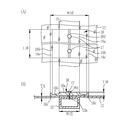
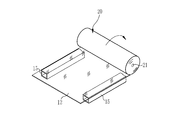
- FIG. 1 It is a schematic perspective view of an agricultural house. It is explanatory drawing of the agricultural material fixed to the aggregate, (A) is a plane explanatory view, (B) is sectional explanatory drawing. It is explanatory drawing of a holding member. It is a schematic perspective view of an agricultural material roll. It is explanatory drawing of the layer structure of an agricultural material. It is explanatory drawing of another fixing aspect of agricultural materials with respect to aggregate. It is explanatory drawing explaining the layer structure of the film which is another embodiment. It is explanatory drawing explaining the layer structure of the film which is another embodiment. It is explanatory drawing explaining the layer structure of the film which is another embodiment. It is explanatory drawing explaining the layer structure of the film which is another embodiment. It is explanatory drawing explaining the layer structure of the film which is another embodiment. It is explanatory drawing of the screwing test method.
- ⁇ Agricultural house 10 shown in FIG. 1 includes a frame 11 and a film-like agricultural material 12.
- the frame 11 is for supporting the agricultural material 12 and is formed in a three-dimensional (three-dimensional) shape by assembling a plurality of metal aggregates 15.
- the aggregates 15 are formed in a long shape, and the aggregates 15 are fixed to each other, for example, by connecting and fixing fasteners (not shown).
- the skeleton 11 includes a main body 11A having a rectangular shape in a plan view and a triangular mountain-shaped roof 11B provided on the main body 11A, but the shape of the skeleton is not limited to this example.
- the roof may be an arched so-called round roof, may have a flat shape in the horizontal direction, or may have an inclined shape in which the height gradually decreases in one direction.
- the number of the aggregates 15 in the frame 11, the direction of each aggregate 15, and the method of assembling are not particularly limited.
- a known material for an agricultural house can be used as the aggregate 15, but a metal material is preferable from the viewpoint of durability (strength), and examples thereof include a solid steel material and a hollow steel pipe. In this example, a steel pipe is used.
- the agricultural material 12 is spread on the frame 11 to form a space partitioned from the outside inside the frame 11.
- the agricultural material 12 may be extended inside the frame 11 or may be extended outside. In this example, the agricultural material 12 is extended outside. This is because the outer side of the frame 11 is easier to expand than the inner side.
- the agricultural material 12 is fixed to the aggregate 15 with screws 17 (see FIG. 2) via a holding member 16. In FIG. 1, screws 17 are not shown to avoid complication of the drawing.
- the pressing member 16 may have a shape (rectangular shape) extending in the longitudinal direction of the aggregate 15, as shown in FIG. 1, or may have a shorter shape, for example, a square. In this example, a pressing member 16 having a shape (rectangular) extending in the longitudinal direction of the aggregate 15 is used.
- the holding member 16 is disposed on the agricultural material 12, whereby the agricultural material 12 is sandwiched between the aggregate 15 and the through-hole 12 a is screwed into the agricultural material 12 by the screw 17. It is formed and fixed to the aggregate 15. Note that a hole into which the screw 17 enters may be formed in the holding member 16 in advance. In FIG. 2, the thickness TA of the agricultural material 12 is greatly exaggerated with respect to other members and the like.
- the screw 17 is screwed from the holding member 16 toward the aggregate 15.
- the holding member 16 is disposed on the aggregate 15 in a state of being symmetric with respect to the center in the width direction of the aggregate 15.
- the screw 17 is screwed into the center of the pressing member 16 and the aggregate 15 in the width direction of the aggregate 15.
- a screw hole into which the screw 17 is screwed may be provided in the aggregate 15 in advance, but is not provided in this example, and is formed by screwing the screw 17.
- the number of screws 17 per holding member 16 is not particularly limited. That is, if the pressing member 16 and the agricultural material 12 can be fixed in a stable state, the number may be determined as appropriate, and may be one or three or more. For example, when the length L16 of the pressing member 16 in the longitudinal direction of the aggregate 15 (hereinafter, simply referred to as “length”) is 2 m, the screws 17 are provided at a pitch of 20 cm, so that 9 The screws 17 will be used.
- the screw 17 in this example is a tapping screw having a sharp tip (taper) and a threaded entire shaft.
- the screw is not limited to this, and other known various screws may be used.
- a washer is not used in this example, a screw with a washer may be used.
- the holding member 16 is plate-shaped, and has a central portion 16a, a thin portion 16b, and an end 16c in order from the center in the width direction of the aggregate 15.
- the central portion 16a has the largest thickness T16, and a groove 16d having a V-shaped cross section is formed in the center of the aggregate 15 in the width direction.
- a screw 17 is screwed into the groove 16d.
- the thickness T16 of the thin portion 16b is smaller than that of the center portion 16a.
- the end 16c is formed to have a thickness T16 larger than the thin portion 16b and a rounded cross section.
- the pressing member may be a flat plate having a constant thickness T16.
- the pressing member 16 may not be used, but is preferably used because a crack is hardly generated from a through hole formed by screwing the screw 17 and even if a crack is generated, it does not easily progress. Since the holding member 16 has the rounded end portion 16c, even if the spread agricultural material 12 flaps, for example, in the wind, the agricultural material 12 is less likely to crack. Therefore, it is preferable that a rounded end portion is formed even in the case of a flat pressing member having a constant thickness T16.
- the length (hereinafter referred to as the width) of the pressing member 16 in the width direction of the aggregate 15 is denoted by the reference symbol W16.
- the width W16 of the pressing member 16 is larger than the width W15 of the aggregate 15, but is not limited thereto, and may be the same as the width W15 or smaller than the width W15. However, the width W16 is preferably larger than the width W15 from the viewpoint of suppressing the fluttering of the agricultural material 12.
- the width W16 of the pressing member 16 is preferably in a range from 10 mm to 60 mm.
- the length L16 of the pressing member 16 is not particularly limited, and in the present example, the length L16 is set to various lengths within a range of 50 mm or more and 3000 mm or less.
- the width W15 of the aggregate 15 is not particularly limited, it is preferably in the range of 5 mm or more and 50 mm or less. In this example, the width W15 is 10 mm, and the width W16 is 20 mm.
- the cross section of the contact surface 16 s that contacts the agricultural material 12 is concave.
- the holding member 16 deforms the agricultural material 12 into a shape along the curvature of the contact surface 16s and pulls the agricultural material 12 in accordance with the screwing of the screw 17.
- the screw 17 may be screwed in by observing the pulled state of the agricultural material 12 and adjusting the screwing amount.
- the agricultural material 12 is manufactured to be long by the method described later, and is wound into a roll as shown in FIG.
- the agricultural material roll 20 has the agricultural material 12 wound around the core 21, but may not include the core 21.
- the agricultural material 12 is spread by rolling the agricultural material roll 20 in the longitudinal direction of each of the aggregates 15 while, for example, two aggregates 15 are hung over each other as shown in FIG. Note that an adhesive tape (not shown) may be attached to the surface of the aggregate 15 in advance, or the agricultural material 12 may be spread while being attached.
- the agricultural material 12 includes a cellulose acylate layer 41 formed of cellulose acylate, and a polymer layer 42 formed of a polymer different from cellulose acylate.
- the cellulose acylate layer 41 and the polymer layer 42 are in close contact with each other, and the polymer layer 42 is provided so as to cover one surface (hereinafter, referred to as a first CA surface) 41A of the cellulose acylate layer 41. .
- the cellulose acylate layer 41 is formed of only cellulose acylate in this example, but may include other components in addition to cellulose acylate.
- the content by mass of components other than cellulose acylate in the cellulose acylate layer 41 is preferably 0 or more and 50 or less when the mass of cellulose acylate is 100.
- Other components include, for example, additives. Examples of the additive include an ultraviolet absorber, a plasticizer, and a matting agent.
- the agricultural material 12 is disposed with the cellulose acylate layer 41 inside the agricultural house 10 (see FIG. 1) and the polymer layer 42 outside.
- Cellulose acylate has a high degree of transparency, so that external light effectively irradiates the plants in the agricultural house 10 and / or a cultivation bed (medium) such as a nursery.
- the cellulose acylate layer 41 contains cellulose acylate, the equilibrium water content increases due to an increase in humidity in the agricultural house 10. Due to the increase in the equilibrium water content, the cellulose acylate layer 41 absorbs moisture. The moisture in the agricultural house 10 is reduced by the absorption of the moisture of the cellulose acylate layer 41, whereby the equilibrium water content of the cellulose acylate layer 41 is reduced, and the moisture is released. In this way, the change in humidity in the agricultural house 10 is suppressed. As a result, dew condensation on the first material surface 12A of the agricultural material 12, which is the inner wall surface of the agricultural house 10, is suppressed. Since dew condensation is suppressed, a decrease in the amount of external light is suppressed.
- the above-mentioned equilibrium water content is an equilibrium water content at 25 ° C. and a relative humidity of 80%.
- the temperature and the relative humidity correspond to the temperature and the relative humidity normally set as the cultivation environment of the plant.
- reference numeral 12 ⁇ / b> B is assigned to the second material surface of the agricultural material 12, which is the outer wall surface of the agricultural house 10.
- Cellulose acylate has an acyl group because the hydroxy group of cellulose is esterified with a carboxylic acid.
- the cellulose acylate is not particularly limited, but the acyl group substitution degree of the cellulose acylate is preferably in the range of 2.00 to 2.97. Thereby, the change in humidity in the agricultural house 10 can be suppressed more reliably.
- the degree of substitution of the acyl group is smaller, the amount of water absorbed by the cellulose acylate layer 41 also increases, so that deformation due to water absorption easily occurs. However, the deformation is more reliable by setting the degree of substitution of the acyl group of the cellulose acylate to 2.00 or more. It is preferable because it can be suppressed.
- the upper limit of the degree of acyl group substitution is 3.00 in theory, but it is difficult to synthesize cellulose acylate having a degree of acyl group substitution of more than 2.97. For this reason, the acyl substitution degree of cellulose acylate is set to 2.97 or less.
- the acyl group substitution degree of cellulose acylate is more preferably in the range of 2.40 or more and 2.95 or less, and further preferably in the range of 2.70 or more and 2.95 or less.
- the degree of acyl group substitution is, as is well known, the rate at which the hydroxy group of cellulose is esterified with a carboxylic acid, that is, the degree of acyl group substitution.
- the acyl group of cellulose acylate is not particularly limited, and may be an acetyl group having 1 carbon atom, or may be an acetyl group having 2 or more carbon atoms.
- the acyl group having 2 or more carbon atoms may be an aliphatic group or an aryl group, and examples thereof include an alkylcarbonyl ester, an alkenylcarbonyl ester or an aromatic carbonyl ester of cellulose, and an aromatic alkylcarbonyl ester. It may have a further substituted group.
- Examples include a carbonyl group, an oleoyl group, a benzoyl group, a naphthylcarbonyl group, and a cinnamoyl group.
- the cellulose acylate constituting the cellulose acylate layer 41 may have only one type of acyl group or two or more types of acyl groups, but it is preferable that at least one type is an acetyl group. Since the cellulose acylate has an acetyl group, the cellulose acylate layer 41 easily absorbs moisture, so that the effect of suppressing a change in humidity in the agricultural house 10 is further improved. Most preferably, the acyl group is a cellulose acylate in which all of the acetyl groups are present, that is, it is more preferable that the cellulose acylate is a cellulose acetate. In this example, cellulose triacetate (TAC) is used.
- TAC cellulose triacetate
- the degree of acyl group substitution can be determined by a conventional method.
- the degree of acetylation degree of acetyl group substitution
- ASTM test method for cellulose acetate and the like
- the degree of acylation (degree of acyl group substitution) distribution measurement by high performance liquid chromatography can also be used.
- the measurement of the degree of acetylation of cellulose acetate is performed by dissolving a sample in methylene chloride and using a column Novapac @ phenyl (Waters), and using a mixed solution of methanol and water as an eluent (methanol: water mass ratio:
- methanol: water mass ratio The acetylation degree distribution is measured by a linear gradient from 8: 1) to a mixture of dichloromethane and methanol (the mass ratio of dichloromethane: methanol is 9: 1) and compared with a calibration curve using standard samples having different acetylation degrees. Ask for.
- These measuring methods can be determined with reference to the method described in JP-A-2003-201301.
- the measurement of the degree of acetylation of cellulose acylate is preferably performed by high performance liquid chromatography.
- the cellulose acylate layer 41 Since the cellulose acylate layer 41 is formed of cellulose acylate, it has high moisture permeability, and the moisture permeability is generally in the range of 200 g / m 2 ⁇ day to 1500 g / m 2 ⁇ day. . In addition to the above-mentioned equilibrium moisture content, the change in humidity in the agricultural house 10 is suppressed to be smaller due to the high moisture permeability.
- the moisture permeability is determined by a cup method based on Japanese Industrial Standard JIS Z 0208. The measurement conditions are a temperature of 40 ° C. and a relative humidity of 90%.
- the polymer layer 42 is for suppressing tears from the through holes 12a in the cellulose acylate layer 41 and cracks caused by knick deformation.
- the polymer layer 42 has a high moisture permeation resistance per 1 ⁇ m thickness of 7.5 ⁇ 10 ⁇ 4 m 2 ⁇ day / g, that is, 7.5 ⁇ 10 ⁇ 4 m 2 ⁇ day / g or less.
- the thickness T42 of the polymer layer 42 can be further increased as long as the high moisture permeability of the cellulose acylate layer 41 is not hindered. Since the thickness T42 can be increased, the tear strength of the agricultural material 12 is 0.10 N, that is, 0.10 N or more even if the tear strength is small. As described above, the tear strength of the agricultural material 12 is set to 0.10 N or more.
- the thickness TA of the agricultural material 12 can be increased accordingly, so that even when the agricultural house 10 is blown by the wind, fluttering of the agricultural material 12 is suppressed, and therefore, Hard to tear for a long time.
- the polymer layer 42 preferably has a moisture permeation resistance per 1 ⁇ m thickness of not less than 1.0 ⁇ 10 ⁇ 6 m 2 ⁇ day / g and not more than 7.5 ⁇ 10 ⁇ 4 m 2 ⁇ day / g, preferably not more than 3.0. It is more preferably from ⁇ 10 ⁇ 6 m 2 ⁇ day / g to 5.0 ⁇ 10 ⁇ 4 m 2 ⁇ day / g, and more preferably from 5.0 ⁇ 10 ⁇ 6 m 2 ⁇ day / g to 2.0 ⁇ .
- the moisture permeability resistance is calculated as the reciprocal of the above-described moisture permeability, and indicates the difficulty of passing water vapor. Specifically, when the moisture permeability is A (g / m 2 ⁇ day), the moisture permeability resistance R is 1 / A.
- the moisture permeability resistance R per unit thickness of the material is obtained by dividing the moisture permeability resistance R by the thickness of the material. For example, when the thickness of the polymer layer 42 is 1 ⁇ m, the moisture permeation resistance R per 1 ⁇ m is obtained by R / d.
- the tear strength is 0.10 N or more, the effect of suppressing tearing and cracking can be sufficiently obtained, but the larger it is, the more preferable.
- the preferred range is in the range of 0.10 N or more and 7.50 N or less, more preferably the range of 0.30 N or more and 6.50 N or less. And more preferably in the range of 0.80 N or more and 5.50 N or less, and particularly preferably in the range of 1.00 N or more and 3.00 N or less.
- Tear strength is determined by the Elmendorf method.
- the tear strength is measured by an Elmendorf tear tester (digital type) manufactured by Toyo Seiki Seisaku-sho, Ltd. Specifically, a 76 mm ⁇ 63 mm sample cut from the agricultural material 12 is set on a sample table of an Elmendorf tear tester with the long side of the sample being horizontal, and a 2 cm cut is made in the sample at the test location. Then, the tear strength is measured at a load of 16 N and a pendulum angle of 70 degrees.
- the polymer (resin) constituting the polymer layer 42 is not particularly limited as long as it is a polymer different from cellulose acylate and has a moisture permeation resistance of 7.5 ⁇ 10 ⁇ 4 m 2 ⁇ day / g or less.
- polyurethane, polyamide, polyvinyl alcohol-based polymer, polyacrylamide derivative, polyacrylonitrile derivative and the like are mentioned, and any of these is preferable.
- a commercially available polyurethane can be used. Specifically, an ester (adipate) type, an ester (lactone) type, an ether type, a polycarbonate type, an aliphatic non-yellowing type, or the like can be used as a two-component curable polyurethane or a thermoplastic polyurethane elastomer.
- Commercially available products include Pandex (registered trademark) GW series “GW-3670 / HX-770” (manufactured by DIC), a system for two-component curable continuous coating urethane film, and Elastollan (registered trademark) as a thermoplastic polyurethane elastomer.
- urethane elastomers may be used in combination.
- a commercially available polyurethane film may be used. Specific examples include Tough Grace (registered trademark) manufactured by Takeda Sangyo Co., Ltd.
- polyamides examples include polyamides such as nylon 6 obtained by ring-opening polymerization of ⁇ -caprolactam and nylon 66 obtained by polycondensation of hexamethylenediamine and adipic acid. Further, a commercially available polyamide film may be used. Specific examples include Kobari (registered trademark) ONY manufactured by Kojin Film & Chemicals Inc., and Harden (registered trademark) film NAP02 manufactured by Toyobo Co., Ltd.
- polyvinyl alcohol-based polymer examples include polyvinyl alcohol, a polyvinyl alcohol-polyvinyl acetate copolymer obtained by partial saponification of polyvinyl acetate, and a copolymer of polyvinyl alcohol and ethylene.
- the polymer of the polymer layer 42 has adhesiveness.
- the second material surface 12B of the agricultural material 12 has adhesiveness.
- the agricultural material 12 is disposed such that the cellulose acylate layer 41 is located inside the agricultural house 10 as described above, the agricultural material 12 is externally arranged with respect to the frame 11 as in this example. Is spread, the agricultural material roll 20 is spread in a state where the cellulose acylate layer 41 having extremely low adhesiveness is in contact with the aggregate 15. Therefore, the agricultural material roll 20 easily rolls on the skeleton 11 and has good workability.
- the peel strength between the cellulose acylate layer 41 and the polymer layer 42 is at least 0.10 N per 25 mm width, that is, preferably 0.10 N or more. Thereby, the occurrence of a tear from the through hole 12a is further suppressed, and even if a tear occurs, the progress of the tear is further suppressed, so that the tear from the through hole 12a is suppressed.
- the agricultural material 12 is fixed to the aggregate 15 with the screws 17, knick deformation is suppressed, and even when knick deformation occurs, cracking at a fold is suppressed. Since the peel strength per 25 mm width is about 25 mm width as described above, the unit of the peel strength is described as “N / 25 mm” in the following description.
- the peel strength between the cellulose acylate layer 41 and the polymer layer 42 is preferably in the range of 0.10 N / 25 mm or more and 30.00 N / 25 mm or less, and in the range of 0.50 N / 25 mm or more and 20.00 N / 25 mm or less. It is more preferably within the range of 0.70 N / 25 mm or more and 15.00 N / 25 mm or less, and particularly preferably within the range of 1.00 N / 25 mm or more and 10.00 N / 25 mm or less. preferable.
- the peel strength between the cellulose acylate layer 41 and the polymer layer 42 depends on the type of polymer in the polymer layer 42, the degree of acylation of the cellulose acylate in the cellulose acylate layer 41 and the type of additive, the method of forming the polymer layer 42, The above preferable range can be achieved by a method such as using an adhesive between the layer 42 and the cellulose acylate layer 41.
- the cellulose acylate layer 41 and the polymer layer 42 may be laminated, and the laminated sheet may be immersed in water and then subjected to a heat treatment to increase the peel strength, so that the preferable range is obtained.
- the water may be an aqueous solution of alkali or acid, washing water, or the like used in a saponification treatment by a dipping method described later. Therefore, in the saponification treatment of the laminated sheet by the immersion method, the peel strength between the cellulose acylate layer 41 and the polymer layer 42 can be increased through the immersion step and the drying step.
- the thickness T42 of the polymer layer 42 is preferably in the range of 10 ⁇ m or more and 150 ⁇ m or less.
- the thickness T42 is 10 ⁇ m or more, the occurrence of a crack from the through-hole 12a is more reliably suppressed than when the thickness T42 is less than 10 ⁇ m, and even when a crack occurs, the progress of the crack is more reliable. Is suppressed.
- the agricultural material 12 is fixed to the aggregate 15 by the screws 17, knick deformation is further suppressed, and even when knick deformation occurs, cracks at folds are more reliably suppressed.
- the thickness T42 is 150 ⁇ m or less, the high moisture permeability of the cellulose acylate layer 41 of the agricultural material 12 is more reliably utilized as compared with a case where the thickness T42 exceeds 150 ⁇ m.
- the thickness T42 is 150 ⁇ m or less, when the agricultural material roll 20 is spread on the skeleton, the roll is lightweight, for example, is easy to roll and has good workability as compared with the case where the thickness T42 exceeds 150 ⁇ m.
- Thickness T42 is more preferably in the range of 15 ⁇ m or more and 100 ⁇ m or less, and further preferably in the range of 20 ⁇ m or more and 80 ⁇ m or less.
- the thickness TA of the agricultural material 12 is preferably in the range of 80 ⁇ m or more and 300 ⁇ m or less.
- the thickness TA is 80 ⁇ m or more, the generation of a crack from the through-hole 12a is more reliably suppressed and the case where a crack is generated than in the case where the thickness TA is less than 80 ⁇ m and in the case where the thickness TA is less than 10 ⁇ m. Even so, the progress of the tear is more reliably suppressed.
- the agricultural material 12 is fixed to the aggregate 15 by the screws 17, knick deformation is further suppressed, and even when knick deformation occurs, cracks at folds are more reliably suppressed.
- the thickness TA is 300 ⁇ m or less, the workability is good because the agricultural material roll 20 is lighter when the agricultural material roll 20 is spread on the frame than when the thickness exceeds 300 ⁇ m.
- the thickness TA is more preferably in the range of 90 ⁇ m or more and 230 ⁇ m or less, and even more preferably in the range of 100 ⁇ m or more and 200 ⁇ m or less.
- the thickness T41 of the cellulose acylate layer 41 is not particularly limited, but is preferably in the range of 20 ⁇ m or more and 100 ⁇ m or less, and more preferably in the range of 30 ⁇ m or more and 90 ⁇ m in consideration of the above-mentioned preferable ranges of the thickness TA and the thickness T41. It is within the following range, and more preferably within the range of 40 ⁇ m or more and 80 ⁇ m or less.
- the agricultural material 12 is fixed directly to the aggregate 15, that is, in a state of being in contact with the aggregate 15, but the fixing method is not limited to this.
- a plate-like raising member 45 is arranged between the aggregate 15 and the agricultural material 12.
- the horizontal direction in FIG. 6 is the longitudinal direction of the aggregate 15.
- the raising member 45 prevents the agricultural material 12 from contacting the aggregate 15 when the agricultural material 12 flaps due to the thickness T45 of the raising member 45, and the contact pressure is low even if the agricultural material 12 abuts. It is to be suppressed.
- the cellulose acylate layer 41 of the agricultural material 12 has a property of absorbing moisture as described above for the equilibrium moisture content.
- the cellulose acylate layer 41 when the cellulose acylate layer 41 contains a large amount of water, the cellulose acylate layer 41 expands as compared with a state where the cellulose acylate layer 41 contains a small amount of water.
- the agricultural material 12 itself becomes more slack as indicated by the two-dot broken line than in the stretched state as indicated by the solid line.
- the agricultural material 12 strongly contacts the aggregate 15.
- the agricultural material 12 does not abut or does not abut. Even so, the contact pressure can be kept low. Therefore, cracking of the agricultural component 12 is further suppressed.
- a pit hull registered trademark manufactured by Toto Kogyo may be used.
- the agricultural material 12 is formed by applying a coating solution in which the polymer constituting the polymer layer 42 is dissolved to a cellulose acylate film material manufactured in a long length by a known solution casting method, and forming the coating material. It is manufactured by drying the membrane. According to this method, the above-mentioned cellulose acylate film material becomes the cellulose acylate layer 41.
- Cellulose acylate film material to form a casting film by casting a dope obtained by dissolving cellulose acylate in a solvent, into a continuously moving long belt, and then peeling off the casting film after drying, It is made by further drying.
- a drum may be used, and the cast film may be cooled and / or dried on the drum and then peeled off.
- the agricultural material 12 can also be manufactured by a melting method, a laminating method, or the like.
- a melting method for example, a polymer for forming the polymer layer 42 is melted by a heating extruder, and then cast on a cellulose acylate film material using a T-die to form the polymer layer 42.
- the laminating method can also be manufactured by laminating the above-mentioned cellulose acylate material on a long film material (hereinafter, referred to as a polymer film material) which becomes the polymer layer 42 and laminating.
- an adhesive may be used between the cellulose acylate material and the polymer film material.
- Agricultural materials are not limited to the above examples, and may have the following configurations, for example.
- the agricultural material 52 further includes a saponified layer 53.
- the same members as those of the agricultural material 12 are denoted by the same reference numerals, and description thereof will be omitted.
- the saponified layer 53 is for further improving the hydrophilicity of the first material surface 52A, which is the inner wall surface of the agricultural house 10 (see FIG. 1).
- the saponified layer 53 is provided so as to cover the other surface (hereinafter, referred to as a second CA surface) 41B of the cellulose acylate layer 41.
- the agricultural material 52 is provided with the saponified layer 53 on the inside of the agricultural house 10 and the polymer layer 42 on the outside.
- reference numeral 52A is given to a first material surface which is an inner wall surface when the agricultural material 52 is used for the agricultural house 10
- reference numeral 52B is given to a second material surface which is an outer wall surface. Attach.
- the saponified layer 53 is also formed of cellulose acylate, and is formed by saponifying the surface of the aforementioned cellulose acylate film material. Depending on the degree of saponification, the saponified layer 53 may contain cellulose. That is, the saponified layer 53 is formed of cellulose acylate and / or cellulose.
- the thickness T53 of the saponified layer 53 is preferably in a range from 0.1 ⁇ m to 20.0 ⁇ m, and is approximately 0.3 ⁇ m in this example.
- the saponified layer 53 is formed by saponifying a cellulose acylate material, and thus has higher hydrophilicity than the cellulose acylate layer 41. For this reason, the first material surface 52A when used in the agricultural house 10 (see FIG. 1) is more suppressed from dew condensation. Since the saponified layer 53 is formed of cellulose acylate and / or cellulose as described above, it has moisture permeability similarly to the cellulose acylate layer 41, and is thin as described above. Therefore, the agricultural material 52 shows high moisture permeability similarly to the agricultural material 12, and also has good workability when it is spread. In addition, since the agricultural material 52 includes the polymer layer 42, breakage from the through hole 12a is suppressed. Moreover, when the agricultural material 52 is fixed to the aggregate 15 by the screws 17, knick deformation is suppressed.
- the agricultural material 52 is manufactured by the following method.
- the saponified layer 53 is formed by bringing an aqueous solution such as sodium hydroxide and / or potassium hydroxide into contact with one surface of the aforementioned cellulose acylate film material.
- the aforementioned coating solution is applied to the surface of the cellulose acylate film material on which the saponified layer 53 is formed, on the surface opposite to the surface on which the saponified layer 53 is provided.
- the agricultural material 52 is obtained by drying the formed coating film. Therefore, the cellulose acylate film material before saponification becomes the cellulose acylate layer 41 and the saponified layer 53 of the agricultural material 52.
- the agricultural material 52 can also be manufactured by a melting method and a laminating method.
- the agricultural material 62 includes a polymer layer 42 between a pair of cellulose acylate layers 41. That is, the polymer layer 42 is provided in close contact with both the first CA surface 41A of one cellulose acylate layer 41 and the first CA surface 41A of the other cellulose acylate layer 41.
- the same members as those of the agricultural materials 12 and 52 are denoted by the same reference numerals, and description thereof will be omitted.
- the saponified layer 53 is provided.
- the saponified layer 53 is provided so as to cover the second CA surface 41B of one cellulose acylate layer 41.
- the saponified layer 53 is formed inside the agricultural house 10 (see FIG. 1). It is provided in a state where one of the cellulose acylate layers 41 not provided is on the outside.
- the saponification layer 53 does not need to be provided like the agricultural material 12 like the agricultural material 72 shown in FIG.
- reference numeral 62A is attached to the first material surface which is the inner wall surface when the agricultural material 62 is used for the agricultural house 10, and reference numeral 62B is assigned to the second material surface which is the outer wall surface. Attach.
- any one of the pair of cellulose acylate layers 41 may be inside the agricultural house 10.
- the lower material surface is a first material surface 72A serving as an inner wall surface of the agricultural house
- the upper material surface is a second material surface 72B serving as an outer wall surface of the agricultural house. It is illustrated as
- the polymer layer 42 has adhesiveness, the polymer layer 42 is not exposed to the outside, so that the workability of the spreading is good and the contamination by sand dust or the like is suppressed.
- the agricultural materials 62 and 72 show high moisture permeability similarly to the agricultural materials 12 and 52. Moreover, since the agricultural materials 62 and 72 are provided with the polymer layer 42, breakage from the through holes 12a is suppressed. Moreover, when the agricultural material 12 is fixed to the aggregate 15 with the screws 17, knick deformation is suppressed.
- the agricultural material 62 can be manufactured by the following method. Two long cellulose acylate film materials are prepared. A saponification treatment is performed on one of the cellulose acylate materials in the same manner as in the case of producing the agricultural material 52 to form a saponified layer 53. The above-mentioned coating solution is applied to the surface of the cellulose acylate film material having the saponified layer 53 opposite to the surface on which the saponified layer 53 is provided. The formed coating film is dried. This drying is performed in a state where the solvent remains (semi-dried state) as compared with the case where the agricultural material 52 is manufactured. The other cellulose acylate material is superimposed on the semi-dried coating film, and the coating film is dried in the superposed state, whereby the agricultural material 62 is obtained.
- the agricultural material 62 can also be manufactured by a melting method, a laminating method, or the like.
- the melting method after the polymer of the polymer layer 42 is melted by an extruder, the polymer layer 42 is provided by casting it on one cellulose acylate film material using a T-die. Before the temperature does not drop, the other cellulose acylate is layered. Note that one of the two cellulose acylate materials is subjected to a saponification treatment in advance.
- a cellulose acylate material is laminated on one surface and the other surface of the above-mentioned polymer film material to be the polymer layer 42, respectively, and laminated. In this case, an adhesive may be used between the cellulose acylate material and the polymer film material.
- the agricultural material 72 can be manufactured by any of the coating, melting, and laminating methods.
- the saponification layer 53 of the agricultural material 52 or the agricultural material 62 can be manufactured by an immersion method.
- the saponification treatment by the immersion method may be performed under any conditions, and includes, for example, a saponification step, a first cleaning step, a neutralization step, a second cleaning step, and a drying step.
- the saponification step saponifies the film surface by immersing the film in an aqueous alkali solution.
- the alkali for example, sodium hydroxide (NaOH) or potassium hydroxide (KOH) is used.
- NaOH sodium hydroxide
- KOH potassium hydroxide
- the cleaning is performed, for example, with pure water.
- the neutralization step an acid or an aqueous solution of an acid is used as a neutralization liquid, and the film that has undergone the first washing step is neutralized with the neutralization liquid.
- the second washing step the film that has undergone the neutralization step is washed with, for example, pure water.
- the drying step the film that has undergone the second cleaning step is dried.
- the peel strength between the cellulose acylate layer 41 and the polymer layer 42 can also be increased by laminating the cellulose acylate layer 41 and the polymer layer 42 and subjecting the laminated sheet to saponification by an immersion method.
- the drying conditions after the second cleaning step are adjusted.
- the drying temperature is preferably set to 100 ° C. or higher, and specifically, is preferably set to a range from 100 ° C. to 150 ° C.
- the drying time is preferably in the range of 30 seconds to 600 seconds, more preferably in the range of 50 seconds to 300 seconds. It is preferable to drain the water adhered to the film surface immediately after the second washing step, because it has the effect of preventing the film surface temperature from decreasing during drying.
- the saponified layer 53 is formed on the side of the agricultural material 52 having cellulose acylate, and the saponified layer 53 is formed on the agricultural material 62 on both sides of the cellulose acylate.
- the saponification layer can be prevented from being formed by a method such as laminating a protective film.
- the agricultural materials 12, 52, 62 are used as films for an agricultural house, but the agricultural materials 12, 52, 62 can be used for other agricultural applications.
- Other agricultural uses include, for example, use as a so-called seedling raising film that grows around a seedling, or as a material for packaging sheets and packaging bags for packaging harvested agricultural products.
- Example 1 Long agricultural materials 12, 52, 62, and 72 were made and rolled, and Examples 1 to 17 were made.
- Example 1 and Example 7 are agricultural materials 12
- Examples 2 to 6 and Examples 8 to 12 are agricultural materials 72
- Examples 13 to 17 are agricultural materials 62
- Example 18 is agricultural materials. 52.
- the “first CA layer” is the cellulose acylate layer 41 forming the first material surfaces 12A and 72A in the case of the agricultural materials 12 and 72, and the saponification layer 53 in the case of the agricultural materials 52 and 62.
- the cellulose acylate layer 41 is formed on the surface 41B.
- the “second CA layer” is the cellulose acylate layer 41 having the second material surfaces 62B and 72B without the saponification layer 53.
- the “material” column of “polymer layer” in Table 1 shows the following. PU1; polyurethane (Elastollan (registered trademark) S80A manufactured by BASF) PU2; polyurethane (Elastoran (registered trademark) 1164D manufactured by BASF) PU3; Polyurethane (PANDEX (registered trademark) T-5265 manufactured by DIC Covestropolymer Co., Ltd.) PU4; polyurethane (Pandex (registered trademark) T-8175 manufactured by DIC Covestropolymer Co., Ltd.) PU5; Polyurethane (PANDEX (registered trademark) T-5102 manufactured by DIC Covestropolymer Co., Ltd.) PP; polypropylene
- peel strength The peel strength between the cellulose acylate layer 41 and the polymer layer 42 in the agricultural materials 12 and 52, and the peel strength between the cellulose acylate layer 41 and the polymer layer 42 forming the second material surfaces 62B and 72B in the agricultural materials 62 and 72.
- the peel strength of each was determined.
- the peel strength was determined according to Japanese Industrial Standard JIS Z0237. First, a rectangular sample of 25 mm ⁇ 150 mm was cut out from the agricultural materials 12, 52, 62, and 72. The denominator “25 mm” in the unit of the peel strength corresponds to the length of the short side of this sample.
- the cellulose acylate layer 41 is partially peeled off from one edge in the longitudinal direction of this sample.
- a part of the peeled cellulose acylate layer 41 is pulled toward the other end of the sample at a speed of 300 mm / min, and the force at which the cellulose acylate layer 41 peels from the polymer layer 42 is measured. And When the strength of the polymer layer 42 was weak and measurement was difficult, a rectangular sample having a peel strength of 25 mm ⁇ 150 mm was adhered to a glass plate (not shown) with an adhesive or the like, and the cellulose acylate layer 41 was partially peeled off and peeled off. A part of the cellulose acylate layer can be similarly pulled and measured as a force when the sample peels off from the glass plate.
- Screw hit evaluation The occurrence of a tear and the degree of progress of the tear when screw 17 was screwed in were evaluated as screw hit evaluation.
- the evaluation method will be described with reference to FIG.
- the agricultural materials 12, 52, 62, and 72 were evaluated by the same method, the following description and FIG. 10 illustrate the case where the agricultural materials 12 are evaluated as an example, and the other agricultural materials 52, 62, and 72 are used. The description of the case is omitted.
- the pressing member 16 and the aggregate 15 shown in FIGS. 2 and 3 were cut to a length of 5 cm along the longitudinal direction.
- the pressing member 16 used was a product name “Pit Hull (registered trademark) aluminum press” manufactured by Toto Kogyo
- the aggregate 15 was a product name “Pit Hull (registered trademark)” manufactured by Toto Kogyo.
- the aggregate 15 cut to a length of 5 cm was processed to form a fixture 81 shown in FIG.
- the agricultural material 12 was cut into a rectangle of 4 cm ⁇ 15 cm to obtain a sample.
- one end of the sample of the agricultural material 12 in the longitudinal direction is connected to the holding member 16 and the metal fixture 81 used as a substitute for the aggregate 15 or the raising member 45 in the agricultural house.
- the screw 17 was screwed from the holding member 16 side and fixed.
- the holding member 16 was arranged in a state where the sample of the agricultural material 12 was on the second material surface 12B side, and the fixture 81 was on the first material surface 12A side.
- the screw 17 was screwed into a position where the distance LM from one end of the sample of the agricultural material 12 in the longitudinal direction to the through hole 12a was 4 cm.
- the screw 17 used was a tapping screw having a screw head diameter of 7 mm and a shaft length of 10 mm.
- An adhesive tape 83 was attached to the first material surface 12A from the other end of the sample of the agricultural material 12 in the longitudinal direction to the fixture 81, and was reinforced.
- the fixing tool 81 is gripped by one of the gripping tools 82a and 82b of a pair of gripping tools 82a and 82b of a tensile tester (Tensilon Universal Material Testing Machine RTG-1210 manufactured by A & D Corporation).
- the other end of the sample on the reinforced side was gripped by the other gripper 82b.
- the tensile test was performed by moving the gripper 82a at 200 mm / min in a direction in which the distance between the gripper 82a and the gripper 82b increased.
- the maximum value of the load (unit: N) was read from the obtained strograph and evaluated according to the following criteria. A and B are acceptable, and C is unacceptable.
- A 16N or more.
- B 10 N or more and less than 16 N.
- C less than 10N.
- the moisture permeability was measured by the method described above and evaluated according to the following criteria. AC is acceptable and D is unacceptable.
- A 500 g / m 2 ⁇ day or more.
- B 300 g / m 2 ⁇ day or more and less than 500 g / m 2 ⁇ day.
- C 100 g / m 2 ⁇ day or more and less than 300 g / m 2 ⁇ day.
- D less than 100 g / m 2 ⁇ day.
- the total light transmittance was measured with a haze meter (SH7000 manufactured by Nippon Denshoku Co., Ltd.) and evaluated according to the following criteria. A and B are acceptable and C is unacceptable. A: 92% or more. B: 88% or more and less than 92%. C: less than 88%.
- Example 29 The agricultural materials 72 of Examples 2 and 8 were saponified by an immersion method to obtain Examples 29 and 30.
- the saponification treatment was performed under the following conditions. It was immersed in a 1.5 mol / L NaOH aqueous solution at a temperature of 50 ° C. for an immersion time of 180 seconds. Thereafter, as a first cleaning step, the substrate is immersed and washed in pure water at a temperature of 25 ° C. for 15 seconds. In the second washing step, the film was immersed and washed in pure water at a temperature of 25 ° C. for 15 seconds, the surface of the film was drained with an air knife, and then dried at 140 ° C. for 60 seconds in the drying step. This film was evaluated by the same method and criteria as in Examples 1 to 18 and is shown in Table 1.
- Example 19 An agricultural house 10 was made using a part of the agricultural materials 12, 52, 62, 72 made in the examples.
- the agricultural material rolls 20 of the agricultural materials 12, 52, 62, and 72 were rolled on the frame 11 and spread.
- the example numbers of the agricultural materials 12, 52, 62, and 72 used are shown in the "Agricultural materials" column of Table 2.
- Table 2 “Aggregate distance” is the distance between adjacent aggregates (distance between centers in the width direction of the aggregate) extending in the same direction. It is equal to the interval between the holes 12a.
- the “thickness configuration” column in Table 2 shows the sum of the thicknesses of the first CA layer and the saponified layer, the thickness of the polymer layer, and the thickness of the second CA layer in Table 1 in order from the left.
- Breakage at the through hole 12a The agricultural materials 12, 52, 62, 72 were fixed to the aggregate 15 via the holding member 16 as shown in FIG.
- the state of breakage from the formed through hole 12a was observed from the holding member 16 side, and evaluated according to the following criteria. The results are shown in the "Tear" column of Table 2.
- C The tear extending outside the holding member 16 was observed shortly after the screw 17 was started to be screwed, and further advanced during the subsequent screwing and was torn.
- the length of the agricultural material 12, 52, 62, 72 in the agricultural material roll 20 was set to 50 m.
- the agricultural material roll 20 was rolled on the skeleton 11 in a state where a plurality of aggregates 15 were suspended as shown in FIG. 4, and the ease of rolling was evaluated as the ease of rolling.
- the lighter the agricultural material roll, and the weaker the adhesion of the agricultural materials to each other in the agricultural material roll the easier the roll on the frame 11 is.
- the evaluation criteria are as follows. A: It was easy to roll. B: It was relatively easy. C: Although it was slightly difficult to roll, it could be rolled.
- Knick deformation The agricultural materials 12, 52, 62, and 72 were rolled along the aggregate 15, and the agricultural materials 12, 52, 62, and 72 were fixed with screws 17 via the holding members 16. The occurrence and extent of knick deformation and cracking near the aggregate 15 were visually observed and evaluated according to the following criteria. The strength of the knick deformation was judged based on the clarity of the crease observed white. When it is observed clearly white, the fold is strong, and the thinner the white, the weaker the fold. AC is acceptable and D is unacceptable. A: There was neither knick deformation nor cracking. B: Despite knick deformation, the crease was weak and there was no crack. C: Knick deformation was observed and a strong fold was observed, but no crack was found. D: Knick deformation was observed, and strong folds and cracks were observed.
- Flap of Agricultural Materials In the agricultural house 10, flapping of the agricultural materials 12, 52, 62, and 72 when a wind of 2 m / min or more was blown was observed, and evaluated based on the following criteria. A: I did not flutter. B: Although fluttered slightly, the agricultural materials did not come into contact with the aggregate 15. C: Flap and contacted aggregate 15.
Landscapes
- Life Sciences & Earth Sciences (AREA)
- Environmental Sciences (AREA)
- Chemical & Material Sciences (AREA)
- Engineering & Computer Science (AREA)
- Materials Engineering (AREA)
- Soil Sciences (AREA)
- Greenhouses (AREA)
- Protection Of Plants (AREA)
- Laminated Bodies (AREA)
Abstract
Description
本発明は、農産資材、農産資材ロール及び農業ハウスに関する。 (4) The present invention relates to an agricultural material, an agricultural material roll, and an agricultural house.
セルロースアシレートフィルムを躯体に展張した農業ハウスが知られている(例えば、特許文献1参照)。特許文献1に記載されるセルロースアシレートフィルムは、相対湿度80%における平衡含水率が4~8%である。セルロースアシレートフィルムは、透明性に優れることから、外光を十分に農業ハウス内の植物及び/または土壌などの培地に照射できる。セルロースアシレートフィルムは、さらに、水蒸気を透過させる性質(以下、透湿性と称する)に優れており、換気を行わなくても農業ハウス内の二酸化炭素(CO2)濃度を、植物が光合成を行うことができるレベルに維持することができる。
An agricultural house in which a cellulose acylate film is spread on a frame is known (for example, see Patent Document 1). The cellulose acylate film described in
けん化層が表面に形成されたセルロースアシレートフィルムを、躯体に展張した農業ハウスも知られている(例えば、特許文献2参照)。けん化層は、セルロースアシレートフィルムのけん化により形成された層である。 There is also known an agricultural house in which a cellulose acylate film having a saponified layer formed on the surface is spread on a frame (for example, see Patent Document 2). The saponified layer is a layer formed by saponifying a cellulose acylate film.
また、基体樹脂フィルムに、接着性アクリル樹脂層を介して、被膜が形成された農業用樹脂フィルムを、躯体に展張した農業ハウスも知られている(例えば、特許文献3参照)。基体樹脂フィルムは、ポリオレフィンフィルム、ポリスチレンフィルム、ポリエステルフィルム、ポリカーボネートフィルム、またはセルロースアシレートフィルム等である。被膜は、含フッ素アクリル系重合体とフッ化ビニリデン系樹脂との2成分を主成分としている。含フッ素アクリル系重合体は、アクリル系単量体とパーフルオロアルキル基含有アクリル系単量体との共重合体である。接着性アクリル樹脂層は、アクリル系単量体と、紫外線吸収性単量体と、シクロアルキル基を有するアクリル系単量体と、紫外線安定性単量体とを重合させた重合体を含有している。 農業 Also, there is known an agricultural house in which an agricultural resin film in which a coating is formed on a base resin film via an adhesive acrylic resin layer is spread on a frame (for example, see Patent Document 3). The base resin film is a polyolefin film, a polystyrene film, a polyester film, a polycarbonate film, a cellulose acylate film, or the like. The coating is mainly composed of two components, a fluorinated acrylic polymer and a vinylidene fluoride resin. The fluorine-containing acrylic polymer is a copolymer of an acrylic monomer and a perfluoroalkyl group-containing acrylic monomer. The adhesive acrylic resin layer contains a polymer obtained by polymerizing an acrylic monomer, an ultraviolet absorbing monomer, an acrylic monomer having a cycloalkyl group, and an ultraviolet stable monomer. ing.
フィルムを躯体に展張した農業ハウスには、長期使用をする場合には堅牢性が求められる。そのため、躯体には金属で形成された骨材を使用することが好ましく、また、フィルムは骨材に対してビスで固定されることが好ましい。 農業 Agricultural houses with film stretched over the frame need to be robust for long-term use. Therefore, it is preferable to use an aggregate formed of metal for the frame, and it is preferable that the film be fixed to the aggregate with screws.
セルロースアシレートフィルムは、前述の通り透湿性に優れ、さらに透明性にも優れることから、農業ハウスに非常に適している。しかし、セルロースアシレートフィルムは、ビスで骨材に固定する場合には、ビスの貫通によって形成された孔(貫通孔)から裂け目が生じ、この裂け目が例えばビスのねじ込み中に進行してしまい、場合によってはフィルムが破れることがある。このようなフィルムの裂け目及び破れを抑えるために、フィルムにおけるビスの貫通箇所を予め粘着テープなどで補強しておく方法がある。しかし、このような方法は手間がかかる。 As described above, the cellulose acylate film is excellent in moisture permeability and also excellent in transparency, and thus is very suitable for an agricultural house. However, when the cellulose acylate film is fixed to the aggregate with a screw, a crack is generated from a hole (through hole) formed by penetration of the screw, and the crack progresses, for example, during screwing of the screw, In some cases, the film may be torn. In order to suppress such tears and tears in the film, there is a method in which a screw penetration portion in the film is reinforced in advance with an adhesive tape or the like. However, such a method is troublesome.
また、セルロースアシレートフィルムの中には、ビスにより骨材に固定した場合に、折れること(以下、クニック(knick)変形と称する)があり、折れ目で割れてしまうことが懸念される。 In addition, some cellulose acylate films may break (hereinafter referred to as knick deformation) when fixed to the aggregate with screws, and there is a concern that the film may break at the fold.
そこで、本発明は、ビスで固定する場合において、ビスの貫通孔からの破れと、クニック変形に起因した割れとを抑制した農産資材、農産資材ロール及び農業ハウスを提供することを目的とする。 Accordingly, it is an object of the present invention to provide an agricultural material, an agricultural material roll, and an agricultural house in which, when fixing with a screw, tearing of the screw from the through hole and cracking due to knick deformation are suppressed.
本発明の農産資材は、セルロースアシレート層と、ポリマー層とを備え、引裂強度が小さくても0.10Nである。セルロースアシレート層は、セルロースアシレートで形成されている。ポリマー層は、セルロースアシレート層の一方の表面に設けられ、厚み1μmあたりの透湿抵抗が高くても7.5×10⁻⁴m2・day/gであり、セルロースアシレートと異なるポリマーで形成されている。 The agricultural material of the present invention includes a cellulose acylate layer and a polymer layer and has a low tear strength of 0.10N. The cellulose acylate layer is formed of cellulose acylate. The polymer layer is provided on one surface of the cellulose acylate layer and has a moisture permeation resistance per 1 μm thickness of at least 7.5 × 10 −4 m 2 · day / g. Is formed.
セルロースアシレート層とポリマー層との剥離強度が小さくても0.10N/25mmであることが好ましい。 て も Even if the peel strength between the cellulose acylate layer and the polymer layer is small, it is preferably 0.10 N / 25 mm.
一対の上記セルロースアシレート層の間に、上記ポリマー層を備えることが好ましい。 こ と が It is preferable to provide the polymer layer between a pair of the cellulose acylate layers.
ポリマー層の厚みが10μm以上150μm以下の範囲内であることが好ましい。 厚 み The thickness of the polymer layer is preferably in the range of 10 μm or more and 150 μm or less.
厚みが80μm以上300μm以下の範囲内であることが好ましい。上記ポリマー層の上記ポリマーは、ポリウレタンとポリアミドとポリビニルアルコール系ポリマーとポリアクリルアミド誘導体とポリアクリロニトリル誘導体とのいずれかであることが好ましい。 It is preferable that the thickness is in the range of 80 μm or more and 300 μm or less. The polymer of the polymer layer is preferably any one of polyurethane, polyamide, polyvinyl alcohol-based polymer, polyacrylamide derivative, and polyacrylonitrile derivative.
本発明の農産資材ロールは、長尺に形成された上記の農産資材がロール状に巻かれている。 農 In the agricultural material roll of the present invention, the above-mentioned agricultural material formed in a long length is wound in a roll shape.
本発明の農業ハウスは、金属製の骨材で形成されている躯体と、躯体に展張されることにより外部から仕切られた空間を形成する上記の農産資材とを備える。 農業 The agricultural house of the present invention includes a skeleton formed of metal aggregate, and the above-mentioned agricultural material that is formed on the skeleton to form a space partitioned from the outside.
農産資材は骨材にビスによって固定されていることが好ましい。 Agricultural materials are preferably fixed to the aggregate with screws.
ビスは、農産資材上に配された板状の押さえ部材を介して、農産資材を骨材に固定することが好ましい。 It is preferable that the service screw fixes the agricultural material to the aggregate through a plate-shaped pressing member disposed on the agricultural material.
本発明によれば、ビスで固定する場合において、ビスの貫通孔からの破れと、クニック変形に起因した割れとが抑制される。 According to the present invention, when fixing with a screw, breakage of the screw from the through hole and cracking due to knick deformation are suppressed.
図1に示す農業ハウス10は、躯体11と、フィルム状の農産資材12とを備える。躯体11は、農産資材12を支持するためのものであり、複数の金属製の骨材15が組まれることにより立体(三次元)に形成されている。骨材15は長尺に形成されており、骨材15同士は、例えば接続固定用の止め金具(図示無し)により、固定されている。躯体11は、平面視において矩形とされた本体部11Aと、本体部11Aの上に設けられた三角形状の山型の屋根11Bとを備えるが、躯体の形状はこの例に限られない。例えば屋根は、アーチ状のいわゆる丸屋根でもよいし、水平方向に平坦な形状などでもよいし、一方向に高さが漸減する傾斜形状などであってもよい。また、躯体11における骨材15の本数、各骨材15の方向、及び、組み方は、特に限定されない。
農業
骨材15としては農業ハウス用の公知の素材を用いることができるが、耐久性(強度)の観点では金属製が好ましく、例えば、中実の鋼材及び、中空の鋼管などが挙げられる。なお、本例では鋼管としている。
A known material for an agricultural house can be used as the
農産資材12は、躯体11に展張されることにより、外部から仕切られた空間を躯体11の内側に形成する。農産資材12は、躯体11の内側に展張してもよいし、外側に展張してもよく、本例では、外側に展張している。躯体11の外側の方が、内側よりも、展張しやすいからである。農産資材12は、押さえ部材16を介して、ビス17(図2参照)により骨材15に固定されている。なお、図1においては、図の煩雑化を避けるために、ビス17の図示は略してある。押さえ部材16は、図1に示すように、骨材15の長手方向に延びた形状(長方形)であってもよいし、あるいは、それよりも短い例えば正方形であってもよい。この例では、骨材15の長手方向に延びた形状(長方形)の押さえ部材16を用いている。
(4) The
図2に示すように、押さえ部材16は農産資材12上に配されており、これにより農産資材12を骨材15との間に挟持し、農産資材12はビス17のねじ込みにより貫通孔12aが形成され、骨材15に固定される。なお、押さえ部材16に予めビス17が入りこむ孔を予め形成しておいてもよい。なお、図2において、農産資材12の厚みTAは、他の部材等に対して大きく誇張して描いてある。ビス17は、押さえ部材16側から骨材15へ向けてねじ込まれる。押さえ部材16は、骨材15に対して、骨材15の幅方向における中心に関して対象となる状態に、配される。ビス17は、骨材15の幅方向における押さえ部材16及び骨材15の概ね中央にねじ込まれている。骨材15には、ビス17がねじ込まれるビス孔が予め設けられていてもよいが、この例では設けておらず、ビス17のねじ込みにより形成される。
As shown in FIG. 2, the
図2においては、ビス17を2個のみ描いてあるが、押さえ部材16一つ当たりのビス17の個数は特に限定されない。すなわち、押さえ部材16及び農産資材12が安定した状態に固定できるならば個数は適宜決定すればよく、1個または3個以上であってもよい。例えば、骨材15の長手方向における押さえ部材16の長さ(以下、単に「長さ」と称する)L16を2mとするときには、ビス17を20cmピッチで設けることにより、押さえ部材16ひとつあたり、9個のビス17を用いることになる。
In FIG. 2, only two
本例のビス17は先端尖鋭(先細)かつ軸全体にねじがきられており、タッピングビスである。ただし、ビスはこれに限定されず、他の公知の各種ビスを用いてよい。また、この例では座金を用いていないが、座金が組み込まれたビスを用いてもよい。
ビ ス The
押さえ部材16は、板状であり、骨材15の幅方向における中央から順に、中央部16a、肉薄部16b、及び、端部16cを有する。中央部16aは最も厚みT16が大きく、骨材15の幅方向における中央に断面V字状の溝16dが形成されている。この溝16dに、ビス17がねじ込まれる。肉薄部16bは、中央部16aよりも厚みT16が小さい。端部16cは、肉薄部16bよりも厚みT16が大きく、かつ、断面が丸みを帯びた状態に形成されている。なお、押さえ部材は、厚みT16が一定の平板状であってもよい。
The holding
押さえ部材16は、用いなくてもよいが、用いる方が、ビス17のねじ込みで形成された貫通孔から裂け目が生じにくく、また、仮に裂け目が生じても進行しにくいから好ましい。押さえ部材16に丸みを帯びた端部16cが形成されていることにより、展張された農産資材12が、例えば風にあおられてばたついても、農産資材12が割れにくい。したがって、厚みT16が一定の平板状の押さえ部材であっても同様に、丸みを帯びた端部が形成されている方が好ましい。
(4) The pressing
骨材15の幅方向における押さえ部材16の長さ(以下、幅と称する)に符号W16を付す。押さえ部材16の幅W16は、骨材15の幅W15よりも大きいが、これに限定されず、幅W15と同じ、または、幅W15よりも小さくてもよい。ただし、農産資材12のばたつきを抑える等の観点で、幅W16は幅W15よりも大きい方が好ましい。押さえ部材16の幅W16は10mm以上60mm以下の範囲内が好ましい。押さえ部材16の長さL16は前述の通り特に限定されず、本例では、50mm以上3000mm以下の範囲内で種々の長さL16にしている。なお、骨材15の幅W15も特に限定されないが、好ましくは5mm以上50mm以下の範囲内である。本例での幅W15は10mm、幅W16は20mmとしている。
符号 The length (hereinafter referred to as the width) of the pressing
押さえ部材16は、図3に示すように、ビス17をねじ込む前の状態においては、農産資材12と当接する当接面16sの断面が凹形状となっている。これにより、押さえ部材16で農産資材12を押圧した場合に農産資材12が適度に引っ張られ、ばたつきがより抑えられる。例えば、押さえ部材16は、ビス17のねじ込みに応じて、農産資材12を当接面16sの湾曲に沿った形状に変形させ、引っ張る。その結果、ばたつきが抑えられる。ビス17のねじ込みは、農産資材12の引っ張られた状態を観察し、そのねじ込み量を調節するとよい。
As shown in FIG. 3, in the pressing
農産資材12は、後述の方法により長尺に製造され、図4に示すようにロール状に巻かれ、農産資材ロール20となっている。農産資材ロール20は、農産資材12が巻き芯21に巻かれているが、巻き芯21は備えなくてもよい。農産資材12は、農産資材ロール20を図4に示すように例えば2本の骨材15を掛けわたした状態で、各骨材15の長手方向で転がすことにより、展張される。なお、骨材15の表面に粘着テープ(図示無し)を予め貼っておく、または、貼りながら、農産資材12を展張してもよい。
(4) The
農産資材12は、図5に示すように、セルロースアシレートで形成されたセルロースアシレート層41と、セルロースアシレートと異なるポリマーで形成されたポリマー層42とを備える。セルロースアシレート層41とポリマー層42とは互いに密着した状態であり、ポリマー層42は、セルロースアシレート層41の一方の表面(以下、第1CA面と称する)41Aを覆う状態に設けられている。
As shown in FIG. 5, the
セルロースアシレート層41は、本例ではセルロースアシレートのみで形成されているが、セルロースアシレートに加えて他の成分を含んでいてもよい。セルロースアシレート層41におけるセルロースアシレート以外の成分の質量での含有率は、セルロースアシレートの質量を100とするときに、0以上50以下であることが好ましい。他の成分としては、例えば添加剤がある。添加剤としては、紫外線吸収剤、可塑剤、マット剤などが挙げられる。
The
農産資材12は、セルロースアシレート層41が農業ハウス10(図1参照)の内部側に、ポリマー層42が外部側にされた状態で、配される。セルロースアシレートは、透明度が高く、そのため、外部の光が効果的に農業ハウス10内の植物及び/または例えば苗床などの培床(培地)に照射される。
(4) The
また、セルロースアシレート層41は、セルロースアシレートを含有することにより、農業ハウス10内における湿度の上昇によって、平衡含水率が上昇する。この平衡含水率の上昇により、セルロースアシレート層41は水分を吸収する。セルロースアシレート層41の水分の吸収により農業ハウス10内の湿度が低下し、これによってセルロースアシレート層41は平衡含水率が下がり水分を放出する。このようにして、農業ハウス10内における湿度は、変化が抑えられる。その結果、農業ハウス10の内部側の壁面である農産資材12の第1資材面12Aにおける結露が抑制される。結露が抑制されるから、外部からの光量の減少が抑えられる。上記の平衡含水率は、25℃、相対湿度80%での平衡含水率である。この温度と相対湿度とは、植物の栽培環境として通常設定する温度と相対湿度とに対応する。なお、図5において、農業ハウス10の外部側の壁面である農産資材12の第2資材面には符号12Bを付す。
{Circle around (4)} Since the
セルロースアシレートは、セルロースのヒドロキシ基がカルボン酸でエステル化されたものであるから、アシル基を有する。セルロースアシレートは、特に限定されないが、セルロースアシレートのアシル基置換度は、2.00以上2.97以下の範囲内であることが好ましい。これにより、農業ハウス10内の湿度変化がより確実に小さく抑えられる。アシル基置換度が小さいほど、セルロースアシレート層41が吸収する水分量も上がるので吸水による変形がしやすいが、セルロースアシレートのアシル基置換度を2.00以上とすることにより変形がより確実に抑えられるので好ましい。また、アシル基置換度は、理論上は3.00が上限となるが、アシル基置換度が2.97を超えるセルロースアシレートは合成が難しい。このため、セルロースアシレートのアシル基置換度は2.97以下としている。
Cellulose acylate has an acyl group because the hydroxy group of cellulose is esterified with a carboxylic acid. The cellulose acylate is not particularly limited, but the acyl group substitution degree of the cellulose acylate is preferably in the range of 2.00 to 2.97. Thereby, the change in humidity in the
セルロースアシレートのアシル基置換度は、2.40以上2.95以下の範囲内がより好ましく、2.70以上2.95以下の範囲内がさらに好ましい。なお、アシル基置換度は、周知の通り、セルロースのヒドロキシ基がカルボン酸によりエステル化されている割合、つまりアシル基の置換度である。 ア シ ル The acyl group substitution degree of cellulose acylate is more preferably in the range of 2.40 or more and 2.95 or less, and further preferably in the range of 2.70 or more and 2.95 or less. The degree of acyl group substitution is, as is well known, the rate at which the hydroxy group of cellulose is esterified with a carboxylic acid, that is, the degree of acyl group substitution.
セルロースアシレートのアシル基は、特に限定されず、炭素数が1であるアセチル基であってもよいし、炭素数が2以上のものであってもよい。炭素数が2以上であるアシル基としては、脂肪族基でもアリール基でもよく、例えばセルロースのアルキルカルボニルエステル、アルケニルカルボニルエステルあるいは芳香族カルボニルエステル、芳香族アルキルカルボニルエステルなどがあり、これらは、それぞれさらに置換された基を有していてもよい。プロピオニル基、ブタノイル基、ペンタノイル基、ヘキサノイル基、オクタノイル基、デカノイル基、ドデカノイル基、トリデカノイル基、テトラデカノイル基、ヘキサデカノイル基、オクタデカノイル基、iso-ブタノイル基、t-ブタノイル基、シクロヘキサンカルボニル基、オレオイル基、ベンゾイル基、ナフチルカルボニル基、シンナモイル基などを挙げることが出来る。 ア シ ル The acyl group of cellulose acylate is not particularly limited, and may be an acetyl group having 1 carbon atom, or may be an acetyl group having 2 or more carbon atoms. The acyl group having 2 or more carbon atoms may be an aliphatic group or an aryl group, and examples thereof include an alkylcarbonyl ester, an alkenylcarbonyl ester or an aromatic carbonyl ester of cellulose, and an aromatic alkylcarbonyl ester. It may have a further substituted group. Propionyl, butanoyl, pentanoyl, hexanoyl, octanoyl, decanoyl, dodecanoyl, tridecanoyl, tetradecanoyl, hexadecanoyl, octadecanoyl, iso-butanoyl, t-butanoyl, cyclohexane Examples include a carbonyl group, an oleoyl group, a benzoyl group, a naphthylcarbonyl group, and a cinnamoyl group.
セルロースアシレート層41を構成するセルロースアシレートのアシル基は1種類だけでもよいし、2種類以上であってもよいが、少なくとも1種がアセチル基であることが好ましい。アセチル基を有するセルロースアシレートであることにより、セルロースアシレート層41が水分を吸収しやすいため、農業ハウス10内の湿度変化の抑制効果がより向上する。最も好ましくはアシル基がすべてアセチル基であるセルロースアシレートであること、すなわち、セルロースアシレートがセルロースアセテートであることがより好ましい。本例ではセルローストリアセテート(TAC)を用いている。
ア シ ル The cellulose acylate constituting the
アシル基置換度は、慣用の方法で求めることができる。例えば、アセチル化度(アセチル基置換度)は、ASTM:D-817-91(セルロースアセテート等の試験方法)におけるアセチル化度の測定および計算に従って求められる。また、高速液体クロマトグラフィーによるアシル化度(アシル基置換度)分布測定によっても測定できる。この方法の一例としてセルロースアセテートのアセチル化度測定は、試料をメチレンクロライドに溶解し、カラムNovapac phenyl(Waters)を用い、溶離液であるメタノールと水との混合液(メタノール:水の質量比が8:1)からジクロロメタンとメタノールとの混合液(ジクロロメタン:メタノールの質量比が9:1)へのリニアグラジエントによりアセチル化度分布を測定し、アセチル化度の異なる標準サンプルによる検量線との比較で求める。これらの測定方法は特開2003-201301号公報に記載の方法を参照して求めることができる。セルロースアシレートのアセチル化度の測定は、セルロースアシレート層41が添加剤を含む場合には、高速液体クロマトグラフィーによる測定が好ましい。
The degree of acyl group substitution can be determined by a conventional method. For example, the degree of acetylation (degree of acetyl group substitution) is determined according to the measurement and calculation of the degree of acetylation in ASTM: D-817-91 (test method for cellulose acetate and the like). The degree of acylation (degree of acyl group substitution) distribution measurement by high performance liquid chromatography can also be used. As an example of this method, the measurement of the degree of acetylation of cellulose acetate is performed by dissolving a sample in methylene chloride and using a column Novapac @ phenyl (Waters), and using a mixed solution of methanol and water as an eluent (methanol: water mass ratio: The acetylation degree distribution is measured by a linear gradient from 8: 1) to a mixture of dichloromethane and methanol (the mass ratio of dichloromethane: methanol is 9: 1) and compared with a calibration curve using standard samples having different acetylation degrees. Ask for. These measuring methods can be determined with reference to the method described in JP-A-2003-201301. When the
セルロースアシレート層41は、セルロースアシレートで形成されているから高い透湿性を有しており、透湿度は概ね200g/m2・day以上1500g/m2・day以下の範囲内となっている。前述の平衡含水率に加えて、この高い透湿性によって、農業ハウス10内の湿度の変化はより小さく抑えられる。透湿度は、日本工業規格JIS Z 0208に基づくカップ法で求められる。測定条件は、温度が40℃、相対湿度が90%である。
Since the
ポリマー層42は、セルロースアシレート層41における貫通孔12aからの破れと、クニック変形に起因した割れとを抑えるためのものである。なお、骨材15上で農産資材ロール20(図4参照)を転がし、その後、押さえ部材16を介してビス17で固定した場合に、農産資材12のしわが強く発生している部分でクニック変形が生じることが多い。ポリマー層42は、厚み1μmあたりの透湿抵抗が高くても7.5×10⁻⁴m2・day/gであり、すなわち7.5×10-4m2・day/g以下である。これにより、ポリマー層42は、セルロースアシレート層41の高い透湿性を妨げない範囲で、厚みT42をより大きくすることができる。厚みT42をより大きくできるから、農産資材12の引裂強度が小さくても0.10N、すなわち0.10N以上になる。このように、農産資材12の引裂強度は0.10N以上とされている。
The
そのため、ビス17をねじ込んだ場合において、密着しているセルロースアシレート層41の貫通孔12aからの裂け目の発生を抑制し、裂け目が発生した場合であってもその裂け目が進行してしまうことを抑制する。したがって、農産資材12は、貫通孔12aからの破れが抑制される。また、農産資材12をビス17によって骨材15に固定した場合に、クニック変形が抑制され、クニック変形が発生した場合であっても折れ目での割れが抑制される。さらに、ポリマー層42の厚みをより大きくすることにより、農産資材12の厚みTAもその分大きくできるから、農業ハウス10が風にあおられた場合でも、農産資材12のばたつきが抑えられ、そのため、長期にわたって破れにくい。
Therefore, when the
ポリマー層42は、厚み1μmあたりの透湿抵抗が1.0×10⁻⁶m2・day/g以上7.5×10-4m2・day/g以下であることが好ましく、3.0×10-6m2・day/g以上5.0×10-4m2・day/g以下であることがより好ましく、5.0×10-6m2・day/g以上2.0×10-4m2・day/g以下であることがさらに好ましく、7.0×10-6m2・day/g以上1.0×10-4m2・day/g以下であることが特に好ましい。
The
透湿抵抗は、前述の透湿度の逆数として算出され、水蒸気の通しにくさを示す。具体的には、透湿度がA(g/m2・day)のとき、透湿抵抗Rは、1/Aである。そして、素材の単位厚みあたりの透湿抵抗Rは、透湿抵抗Rを素材の厚みで除算することにより求められる。例えば、ポリマー層42の厚み1μmあたりの透湿抵抗Rは、ポリマー層42の厚みがdμmであるとき、R/dで求められる。
The moisture permeability resistance is calculated as the reciprocal of the above-described moisture permeability, and indicates the difficulty of passing water vapor. Specifically, when the moisture permeability is A (g / m 2 · day), the moisture permeability resistance R is 1 / A. The moisture permeability resistance R per unit thickness of the material is obtained by dividing the moisture permeability resistance R by the thickness of the material. For example, when the thickness of the
引裂強度は、0.10N以上であれば、破れと割れとの抑制効果が十分に得られるが、大きいほど好ましい。ただし、引裂強度の得られている最大値は、7.50Nであるので、好ましい範囲は0.10N以上7.50N以下の範囲内であり、より好ましくは0.30N以上6.50N以下の範囲内であり、さらに好ましくは0.80N以上5.50N以下の範囲内であり、特に好ましくは1.00N以上3.00N以下の範囲内である。 If the tear strength is 0.10 N or more, the effect of suppressing tearing and cracking can be sufficiently obtained, but the larger it is, the more preferable. However, since the obtained maximum value of the tear strength is 7.50 N, the preferred range is in the range of 0.10 N or more and 7.50 N or less, more preferably the range of 0.30 N or more and 6.50 N or less. And more preferably in the range of 0.80 N or more and 5.50 N or less, and particularly preferably in the range of 1.00 N or more and 3.00 N or less.
引裂強度は、エルメンドルフ法により求めており、本例では(株)東洋精機製作所製のエルメンドルフ引裂試験機(デジタル型)にて測定している。具体的には、農産資材12から切り出した76mm×63mmのサンプルを、サンプルの長辺が水平の状態でエルメンドルフ引裂試験機のサンプル台にセットし、試験箇所のサンプルに2cmの切り込みを入れる。そして、荷重16N、振り子角70度で、引裂強度を測定する。
Tear strength is determined by the Elmendorf method. In this example, the tear strength is measured by an Elmendorf tear tester (digital type) manufactured by Toyo Seiki Seisaku-sho, Ltd. Specifically, a 76 mm × 63 mm sample cut from the
ポリマー層42を構成するポリマー(樹脂)は、セルロースアシレートと異なるポリマーであり、かつ、透湿抵抗が7.5×10⁻⁴m2・day/g以下のポリマーであれば、特に限定されない。好ましくは、ポリウレタン、ポリアミド、ポリビニルアルコール系ポリマー、ポリアクリルアミド誘導体、ポリアクリロニトリル誘導体などが挙げられ、これらのいずれかであることが好ましい。
The polymer (resin) constituting the
ポリウレタンとしては、市販のものを使用することができる。具体的には、二液硬化型ポリウレタン、熱可塑性ポリウレタンエラストマーとしてエステル(アジペート)タイプ、エステル(ラクトン)タイプ、エーテルタイプ、ポリカーボネートタイプ、脂肪族無黄変タイプ等を用いることができる。市販品としては、二液硬化型連続塗工ウレタンフィルム用システムのパンデックス(登録商標)GWシリーズ「GW-3670/HX-770」(DIC社製)、熱可塑性ポリウレタンエラストマーとしてエラストラン(登録商標)C80A、C85A、C90A、C95A、C64D、1180A、1185A、1190A、1195A、1164D、ET385、ET880、ET885、ET890、ET858D、ET860D、ET864D、NY585、NY90A、NY1197A(BASFジャパン社製)、パンデックス(登録商標)T-5105、T-5201、T-5265、T-5102、T-8175、T-8180、T-8185、T-8190、T-8195、DP9370A、5377A、588、KU2-8659、DP5094A(ディーアイシーコベストロポリマー社製)、レザミン(登録商標)P-1000、P-7000、P-2000シリーズ(大日精化工業社製)などが挙げられる。なお、ウレタンエラストマーは2種以上を併用してもよい。また、市販のポリウレタンフィルムを用いても良い。具体的には武田産業株式会社製タフグレイス(登録商標)等が挙げられる。 市 販 A commercially available polyurethane can be used. Specifically, an ester (adipate) type, an ester (lactone) type, an ether type, a polycarbonate type, an aliphatic non-yellowing type, or the like can be used as a two-component curable polyurethane or a thermoplastic polyurethane elastomer. Commercially available products include Pandex (registered trademark) GW series “GW-3670 / HX-770” (manufactured by DIC), a system for two-component curable continuous coating urethane film, and Elastollan (registered trademark) as a thermoplastic polyurethane elastomer. ) C80A, C85A, C90A, C95A, C64D, 1180A, 1185A, 1190A, 1195A, 1164D, ET385, ET880, ET885, ET890, ET858D, ET860D, ET864D, NY585, NY90A, NY1197A (manufactured by BASF Japan), PANDEX (Registered trademark) T-5105, T-5201, T-5265, T-5102, T-8175, T-8180, T-8185, T-8190, T-8195, DP9370A, 5377A, 588, KU2- 659, DP5094A (manufactured by DIC co-best b Polymer Co., Ltd.), Resamine (registered trademark) P-1000, P-7000, P-2000 series (Dainichiseika Color & Chemicals Mfg. Co., Ltd.) and the like. In addition, two or more urethane elastomers may be used in combination. Alternatively, a commercially available polyurethane film may be used. Specific examples include Tough Grace (registered trademark) manufactured by Takeda Sangyo Co., Ltd.
ポリアミドとしては、ε-カプロラクタムの開環重合により得られるナイロン6、ヘキサメチレンジアミンとアジピン酸の重縮合により得られるナイロン66等のポリアミド類が挙げられる。また、市販のポリアミドフィルムを用いてもよい。具体的には興人フィルム アンド ケミカルズ社製コーバリア(登録商標)ONY、東洋紡株式会社製ハーデン(登録商標)フィルムNAP02等が挙げられる。 Examples of polyamides include polyamides such as nylon 6 obtained by ring-opening polymerization of ε-caprolactam and nylon 66 obtained by polycondensation of hexamethylenediamine and adipic acid. Further, a commercially available polyamide film may be used. Specific examples include Kobari (registered trademark) ONY manufactured by Kojin Film & Chemicals Inc., and Harden (registered trademark) film NAP02 manufactured by Toyobo Co., Ltd.
ポリビニルアルコール系のポリマーとしては、ポリビニルアルコール、ポリ酢酸ビニルの部分けん化によるポリビニルアルコールとポリ酢酸ビニル共重合体、ポリビニルアルコールとエチレンの共重合体等が挙げられる。 Examples of the polyvinyl alcohol-based polymer include polyvinyl alcohol, a polyvinyl alcohol-polyvinyl acetate copolymer obtained by partial saponification of polyvinyl acetate, and a copolymer of polyvinyl alcohol and ethylene.
ポリマー層42を構成するポリマーが前述の1μmあたりの透湿抵抗をもち、かつセルロースアシレート層41との引裂強度が0.10N以上である場合のポリマー層42のポリマーは、粘着性を有するものが多い。特に、前述のポリウレタン、ポリビニルアルコール系ポリマーなどは粘着性を有するものが多い。したがって、農産資材12の第2資材面12Bは粘着性がある。この点、農産資材12は、前述のように、セルロースアシレート層41を農業ハウス10において内部側となるように配されるから、本例のように躯体11に対して外部側から農産資材12を展張することにより、農産資材ロール20は粘着性が極めて低いセルロースアシレート層41が骨材15と接する状態で展張される。したがって、農産資材ロール20は躯体11上で転がしやすく、作業性がよい。
When the polymer constituting the
セルロースアシレート層41とポリマー層42との剥離強度は、幅25mmあたり、小さくても0.10Nである、すなわち0.10N以上であることが好ましい。これにより、貫通孔12aからの裂け目の発生がより抑制され、裂け目が発生した場合であってもその裂け目の進行がより抑制されるから、貫通孔12aからの破れが抑えられる。また、農産資材12をビス17によって骨材15に固定した場合に、クニック変形が抑制され、クニック変形が発生した場合であっても折れ目での割れが抑制される。なお、幅25mmあたりの剥離強度は、上記の通り幅25mmあたりであるので、以降の説明において剥離強度の単位は「N/25mm」として記載する。
剥離 The peel strength between the
セルロースアシレート層41とポリマー層42との剥離強度は、0.10N/25mm以上30.00N/25mm以下の範囲内であることが好ましく、0.50N/25mm以上20.00N/25mm以下の範囲内であることがより好ましく、0.70N/25mm以上15.00N/25mm以下の範囲内であることがさらに好ましく、1.00N/25mm以上10.00N/25mm以下の範囲内であることが特に好ましい。セルロースアシレート層41とポリマー層42との剥離強度は、ポリマー層42のポリマーの種類、セルロースアシレート層41のセルロースアシレートのアシル化度及び添加剤の種類、ポリマー層42の形成方法、ポリマー層42とセルロースアシレート層41との間に接着材を用いる等の方法で上記の好ましい範囲内にすることができる。
The peel strength between the
また、セルロースアシレート層41とポリマー層42を積層し、積層したシートを水に浸漬した後加熱処理することで剥離強度を高め、好ましい範囲にすることもできる。なお、この水は、後述する浸漬法によるけん化処理において用いるアルカリまたは酸の水溶液または洗浄水等でもよい。したがって、積層したシートの浸漬法によるけん化処理において、浸漬工程及び乾燥工程を経ることにより、セルロースアシレート層41とポリマー層42との剥離強度を高めることができる。
剥離 Alternatively, the
ポリマー層42の厚みT42は、10μm以上150μm以下の範囲内であることが好ましい。厚みT42が10μm以上であることにより、10μm未満である場合に比べて、貫通孔12aからの裂け目の発生がより確実に抑制され、裂け目が発生した場合であってもその裂け目の進行がより確実に抑制される。また、農産資材12をビス17によって骨材15に固定した場合に、クニック変形がさらに抑制され、クニック変形が発生した場合であっても折れ目での割れがより確実に抑えられる。厚みT42が150μm以下であることにより、150μmを超える場合に比べて、農産資材12は、セルロースアシレート層41の高い透湿性がより確実に生かされる。また、厚みT42が150μm以下であることにより、150μmを超える場合に比べて、農産資材ロール20を躯体に展張する場合に、軽量なので例えば転がしやすく、作業性がよい。
厚 み The thickness T42 of the
厚みT42は、15μm以上100μm以下の範囲内であることがより好ましく、20μm以上80μm以下の範囲内であることがさらに好ましい。 Thickness T42 is more preferably in the range of 15 μm or more and 100 μm or less, and further preferably in the range of 20 μm or more and 80 μm or less.
農産資材12の厚みTAは、80μm以上300μm以下の範囲内であることが好ましい。厚みTAが80μm以上であることにより、80μm未満である場合に比べて、10μm未満である場合に比べて、貫通孔12aからの裂け目の発生がより確実に抑制され、裂け目が発生した場合であってもその裂け目の進行がより確実に抑制される。また、農産資材12をビス17によって骨材15に固定した場合に、クニック変形がさらに抑制され、クニック変形が発生した場合であっても折れ目での割れがより確実に抑えられる。厚みTAが300μm以下であることにより、300μmを超える場合に比べて、農産資材ロール20を躯体に展張する場合に、農産資材ロール20が軽量なので、作業性がよい。
厚 み The thickness TA of the
厚みTAは、90μm以上230μm以下の範囲内であることがより好ましく、100μm以上200μm以下の範囲内であることがさらに好ましい。なお、セルロースアシレート層41の厚みT41は、特に限定されないが、厚みTAと厚みT41との上記の好ましい範囲を考慮し、好ましくは20μm以上100μm以下の範囲内であり、より好ましくは30μm以上90μm以下の範囲内であり、さらに好ましくは40μm以上80μm以下の範囲内である。
The thickness TA is more preferably in the range of 90 μm or more and 230 μm or less, and even more preferably in the range of 100 μm or more and 200 μm or less. The thickness T41 of the
上記の例は、農産資材12を骨材15に直接、すなわち骨材15に接する状態で固定しているが、固定方法はこれに限られない。図6において、骨材15と農産資材12との間には、板状の嵩上げ部材45を配してある。なお、図6での横方向は、骨材15の長手方向である。嵩上げ部材45は、嵩上げ部材45の厚みT45により、農産資材12がばたついた場合に、農産資材12が骨材15に当接することを防ぐ、及び、仮に当接してもその接触圧が低く抑えられるためのものである。農産資材12のセルロースアシレート層41は、前述の平衡含水率の通り、水分を吸収する性質がある。そのため、セルロースアシレート層41が水分を多く含んだ状態では、少ない状態に比べて伸びてしまう。その結果、農産資材12自体も、実線で示す張った状態に比べて、二点破線で示すたるんだ状態になる。例えばこの状態で風にあおられた場合には、農産資材12が骨材15に強く当接してしまうが、嵩上げ部材45を介して骨材15に固定することで、当接しない、または当接してもその接触圧が低く抑えられる。そのため、農産部材12の割れがより抑えられる。嵩上げ部材45としては、東都興業製のピットハル(登録商標)を用いてもよい。
In the above example, the
農産資材12は、本実施形態では、周知の溶液製膜方法により長尺に製造されたセルロースアシレートフィルム材に、ポリマー層42を構成するポリマーが溶解した塗布液を塗布し、形成された塗膜を乾燥することにより製造している。この方法によると、上記のセルロースアシレートフィルム材が、セルロースアシレート層41になる。セルロースアシレートフィルム材は、セルロースアシレートを溶媒に溶解したドープを、連続的に移動する長尺のベルトに流延することにより流延膜を形成し、流延膜を乾燥してから剥がし、さらに乾燥することによりつくっている。なお、ベルトの代わりに、ドラムを用いて、ドラム上で流延膜を冷却及び/または乾燥してから剥がしてもよい。
In the present embodiment, the
農産資材12は、溶融法及びラミネート法などでも製造することができる。溶融法は、例えば、ポリマー層42を形成するためのポリマーを加熱押出機にて溶融後、T―ダイを用いてセルロースアシレートフィルム材の上に流延することでポリマー層42を設ける。ラミネート法は、ポリマー層42になる長尺のフィルム材(以下、ポリマーフィルム材と称する)に上記のセルロースアシレート材を重ねラミネート加工(lamination)する方法で製造することもできる。ラミネート加工の場合にはセルロースアシレート材と上記のポリマーフィルム材との間に接着材を用いてもよい。
The
農産資材は、上記の例に限られず、例えば、以下の構成でもよい。図7において、農産資材52は、さらにけん化層53を備えている。農産資材52において、農産資材12と同じ部材には同じ符号を付し、説明を略す。
Agricultural materials are not limited to the above examples, and may have the following configurations, for example. In FIG. 7, the
けん化層53は、農業ハウス10(図1参照)の内部側の壁面である第1資材面52Aの親水性をより向上させるためのものである。けん化層53は、セルロースアシレート層41の他方の表面(以下、第2CA面と称する)41Bを覆う状態に設けられている。この農産資材52は、けん化層53が農業ハウス10の内部側、ポリマー層42が外部側となる状態で、設けられる。図7において、この農産資材52を農業ハウス10に用いた場合の内部側の壁面である第1資材面には符号52Aを付し、外部側の壁面である第2資材面には符号52Bを付す。
The
けん化層53もセルロースアシレートで形成されており、前述のセルロースアシレートフィルム材の表面をけん化することにより形成される。けん化の程度によっては、けん化層53は、セルロースを含有していることもある。すなわち、けん化層53は、セルロースアシレート及び/またはセルロースで形成されている。けん化層53の厚みT53は、0.1μm以上20.0μm以下の範囲内であることが好ましく、本例では概ね0.3μmである。
The
けん化層53は、上記の通り、セルロースアシレート材をけん化処理することにより形成されるから、セルロースアシレート層41よりも親水性が高い。そのため、農業ハウス10(図1参照)に用いた場合の第1資材面52Aは、結露がより抑制される。けん化層53は、上記のようにセルロースアシレート及び/またはセルロースで形成されているからセルロースアシレート層41と同様に透湿性があり、また、上記のように薄い。そのため、農産資材52は、農産資材12と同様に、高い透湿性を示し、また、展張する場合の作業性もよい。また、農産資材52は、ポリマー層42を備えるから、貫通孔12aからの破れが抑制される。また、農産資材52をビス17によって骨材15に固定した場合に、クニック変形が抑制される。
As described above, the
農産資材52は、本実施形態では、以下の方法で製造している。前述のセルロースアシレートフィルム材の一方の表面に、水酸化ナトリウム及び/または水酸化カリウム等の水溶液を接触させることによりけん化層53を形成する。けん化層53が形成されたセルロースアシレートフィルム材のけん化層53が設けられている表面とは反対側の表面に、前述の塗布液を塗布する。形成された塗膜を乾燥することにより、農産資材52が得られる。したがって、けん化前のセルロースアシレートフィルム材は、農産資材52のセルロースアシレート層41とけん化層53とになる。農産資材52も農産資材12と同様に、溶融法及びラミネート法などでも製造することができる。
In this embodiment, the
図8において、農産資材62は、一対のセルロースアシレート層41の間に、ポリマー層42を備える。すなわち、ポリマー層42は、一方のセルロースアシレート層41の第1CA面41Aと、他方のセルロースアシレート層41の第1CA面41Aとの両方に、密着した状態に設けられている。農産資材62において、農産資材12,52と同じ部材には同じ符号を付し、説明を略す。
In FIG. 8, the
この例においても、けん化層53が設けられている。けん化層53は、一方のセルロースアシレート層41の第2CA面41Bを覆う状態に設けられている農産資材62は、けん化層53が農業ハウス10(図1参照)の内部側、けん化層53が設けられていない一方のセルロースアシレート層41が外部側となる状態で、設けられる。ただし、図9に示す農産資材72のように、けん化層53は、農産資材12と同様に、設けていなくてもよい。図8において、この農産資材62を農業ハウス10に用いた場合の内部側の壁面である第1資材面には符号62Aを付し、外部側の壁面である第2資材面には符号62Bを付す。けん化層53が無い農産資材72(図9参照)の場合には、一対のセルロースアシレート層41のいずれが農業ハウス10の内部側であってもよい。なお、図9においては、紙面下側の資材面を、農業ハウスの内部側の壁面となる第1資材面72A、紙面上側の資材面を農業ハウスの外部側の壁面となる第2資材面72Bとして図示してある。
に お い て Also in this example, the
これらの例では、ポリマー層42が粘着性を有していても、ポリマー層42が外部に露呈していないから、展張の作業性がよく、かつ、砂塵等によって汚れることが抑えられる。また、農産資材62,72は、農産資材12,52と同様に、高い透湿性を示す。また、農産資材62,72は、ポリマー層42を備えるから、貫通孔12aからの破れが抑制される。また、農産資材12をビス17によって骨材15に固定した場合に、クニック変形が抑制される。
で は In these examples, even if the
農産資材62は、以下の方法で製造することができる。長尺のセルロースアシレートフィルム材を、2つ準備する。一方のセルロースアシレート材について、農産資材52を製造する場合と同様に、けん化処理を行い、けん化層53を形成する。けん化層53を形成したセルロースアシレートフィルム材のけん化層53が設けられている表面とは反対側の表面に、前述の塗布液を塗布する。形成された塗膜を乾燥するが、この乾燥は、農産資材52を製造する場合よりも溶媒が残った状態(半乾燥状態)にする。半乾燥状態の塗膜に、他方のセルロースアシレート材を重ね、重ねた状態で塗膜の乾燥をすすめ、これにより、農産資材62が得られる。
The
農産資材62も、溶融法及びラミネート法などでも製造することができる。溶融法はポリマー層42のポリマーを押出機にて溶融後、T―ダイを用いて一方のセルロースアシレートフィルム材の上に流延することでポリマー層42を設け、この後、ポリマー層42の温度が下がらないうちに、他方のセルロースアシレートを重ねる。なお、2つのセルロースアシレート材のいずれか一方には、あらかじめけん化処理をしておく。ラミネート法はポリマー層42になる前述のポリマーフィルム材の一方の表面と他方の表面とにそれぞれセルロースアシレート材を重ね、ラミネート加工する。この場合、セルロースアシレート材とポリマーフィルム材との間に接着材を用いてもよい。
The
農産資材72も農産資材62と同様に、塗布と、溶融法と、ラミネート法とのいずれでも製造することができる。
(4) Similarly to the
また、農産資材52または農業資材62において、けん化層53の形成を浸漬法で製造することもできる。浸漬法によるけん化処理は、いかなる条件でもよいが、例えば、けん化工程と、第1洗浄工程と、中和工程と、第2洗浄工程と、乾燥工程とを有する。けん化工程は、アルカリの水溶液にフィルムを浸漬して、フィルム面をけん化する。アルカリとしては、例えば水酸化ナトリウム(NaOH)、又は水酸化カリウム(KOH)が用いられる。第1洗浄工程は、けん化工程を経たフィルムを洗浄する。洗浄は、例えば純水で行う。中和工程は、酸または酸の水溶液を中和液とし、この中和液で第1洗浄工程を経たフィルムを中和する。第2洗浄工程は、中和工程を経たフィルムを、例えば純水で、洗浄する。乾燥工程は、第2洗浄工程を経たフィルムを、乾燥させる。
In addition, the
また、セルロースアシレート層41とポリマー層42を積層し、積層したシートを浸漬法でケン化処理することにより、セルロースアシレート層41とポリマー層42との剥離強度を高めることもできる。剥離強度を高めるためには、例えば第2洗浄工程を経たあとの乾燥条件を調整する。乾燥条件として、乾燥温度は100℃以上にすることが好ましく、具体的には100℃以上150℃以下の範囲内とすることが好ましい。乾燥時間30秒以上600秒以下の範囲内が好ましく、50秒以上300秒以下の範囲内がより好ましい。なお、第2洗浄工程の直後にフィルム表面に付着した水切りを行うことは乾燥時のフィルム表面温度の低下を防ぐなどの効果があり好ましい。なお、浸漬法によるケン化処理では、農産資材52ではセルロースアシレートを有する側にケン化層53が形成され、農産資材62では両面のセルロースアシレート側にケン化層53が形成される。ケン化層が不要な側には、保護フィルムをラミネートするなどの方法によりケン化層を形成しないようにすることもできる。
(4) The peel strength between the
上記の例は、農産資材12,52,62を、農業ハウス用のフィルムとして用いた場合であるが、農産資材12,52,62は他の農産用途にも用いることができる。他の農産用途としては、例えば、苗の周囲を囲んだ状態で育てるいわゆる育苗フィルムとして用いたり、あるいは、収穫した農産物を包装する包装シート及び包装袋の材料として用いることが挙げられる。
In the above example, the
[実施例1]~[実施例18]
長尺の農産資材12,52,62,72をつくり、それぞれロール状にし、実施例1~17とした。実施例1及び実施例7は農産資材12であり、実施例2~6及び実施例8~12は農産資材72であり、実施例13~17は農産資材62であり、実施例18は農産資材52である。
[Example 1] to [Example 18]
Long
表1において、「第1CA層」は、農産資材12,72の場合は第1資材面12A,72Aを成すセルロースアシレート層41であり、農産資材52,62の場合はけん化層53が第2CA面41Bに形成してあるセルロースアシレート層41である。「第2CA層」は、けん化層53を設けていない、第2資材面62B,72Bを成すセルロースアシレート層41である。
In Table 1, the “first CA layer” is the
表1の「ポリマー層」の「材料」欄は、それぞれ以下を示す。
PU1;ポリウレタン(BASF社製エラストラン(登録商標)S80A)
PU2;ポリウレタン(BASF社製エラストラン(登録商標)1164D)
PU3;ポリウレタン(ディーアイシーコベストロポリマー(株)製パンデックス(登録商標)T-5265)
PU4;ポリウレタン(ディーアイシーコベストロポリマー(株)製パンデックス(登録商標)T-8175)
PU5;ポリウレタン(ディーアイシーコベストロポリマー(株)製パンデックス(登録商標)T-5102)
PP;ポリプロピレン
The “material” column of “polymer layer” in Table 1 shows the following.
PU1; polyurethane (Elastollan (registered trademark) S80A manufactured by BASF)
PU2; polyurethane (Elastoran (registered trademark) 1164D manufactured by BASF)
PU3; Polyurethane (PANDEX (registered trademark) T-5265 manufactured by DIC Covestropolymer Co., Ltd.)
PU4; polyurethane (Pandex (registered trademark) T-8175 manufactured by DIC Covestropolymer Co., Ltd.)
PU5; Polyurethane (PANDEX (registered trademark) T-5102 manufactured by DIC Covestropolymer Co., Ltd.)
PP; polypropylene
各農産資材12,52,62,72につき、引裂強度と剥離強度とを求め、さらに、ビス打ち評価と透湿度と全光線透過率とを評価した。それぞれの求め方と、評価方法及び評価基準は以下の通りである。各結果は、表1に示す。
(4) For each of the
1.引裂強度
前述のエルメンドルフ法により求めた。
1. Tear strength was determined by the Elmendorf method described above.
2.剥離強度
農産資材12,52においてはセルロースアシレート層41とポリマー層42との剥離強度を、農産資材62,72においては第2資材面62B,72Bを成すセルロースアシレート層41とポリマー層42との剥離強度を、それぞれ求めた。剥離強度は、日本工業規格JIS Z0237により求めた。まず、農産資材12,52,62,72から、25mm×150mmの長方形のサンプルを切り出した。上記の剥離強度の単位における分母の「25mm」は、このサンプルの短辺の長さに対応したものである。このサンプルの長手方向における一方の端縁からセルロースアシレート層41を一部剥がす。剥がした一部のセルロースアシレート層41をサンプルの他端側に向けて速度300mm/分の速度で引っ張り、セルロースアシレート層41がポリマー層42から剥がれるときの力を測定し、これを剥離強度とした。ポリマー層42の強度が弱く測定がしにくい場合には、剥離強度は25mm×150mmの長方形サンプルをガラス板(図示無し)に接着剤等ではりつけ、セルロースアシレート層41を一部剥がし、剥がした一部のセルロースアシレート層を同様に引っ張り、サンプルがガラス板から剥がれるときの力として測定することもできる。
2. Peel strength The peel strength between the
3.ビス打ち評価
ビス17をねじ込んだ場合の裂け目の発生及び裂け目の進行度合いを、ビス打ち評価として評価した。評価方法について、図10を参照しながら説明する。なお、農産資材12,52,62,72は同様の方法で評価したので、以下の説明及び図10は、農産資材12を評価する場合を例に説明し、他の農産資材52,62,72の場合については説明を略す。まず、図2及び図3に示す押さえ部材16と骨材15とを、それぞれ長手方向に沿った長さで5cmの長さにカットした。用いた押さえ部材16は、東都興業製の商品名「ピットハル(登録商標)アルミ押え」であり、骨材15は、東都興業製の商品名「ピットハル(登録商標)」であった。5cmの長さにカットした骨材15を加工し、図10に示す固定具81をつくった。農産資材12を、4cm×15cmの長方形にカットし、サンプルとした。
3. Screw hit evaluation The occurrence of a tear and the degree of progress of the tear when
図10に示すように、農産資材12のサンプルの長手方向における一方の端部を、押さえ部材16と、農業ハウスにおける骨材15または嵩上げ部材45の代わりとして用いた金属製の固定具81とに挟み、押さえ部材16側からビス17をねじ込んで固定した。押さえ部材16は農産資材12のサンプルの第2資材面12B側、固定具81は第1資材面12A側となる状態に、配した。ビス17は、農産資材12のサンプルの長手方向における一端から貫通孔12aまでの距離LMが4cmとなる位置に、ねじ込んだ。用いたビス17は、ビス頭の径が7mmであり、軸の長さが10mmのタッピングビスであった。
As shown in FIG. 10, one end of the sample of the
農産資材12のサンプルの長手方向における他端から固定具81までの第1資材面12Aに、粘着テープ83を貼り付け、補強した。この粘着テープ83での補強により、下記の引張試験において、貫通孔12での裂け目の発生及び進行が確実に評価できた。引張試験機((株)エー・アンド・デイ製テンシロン万能材料試験機RTG-1210)の一対の把持具82a,82bのうちの一方の把持具82aにより固定具81を把持し、粘着テープ83で補強された側のサンプルの他端部を他方の把持具82bにより把持した。把持具82aと把持具82bとの距離が互いに増加する方向に、把持具82aを200mm/minで移動し、引張試験を行った。得られたストログラフについて、荷重(単位はN)の最大値を読み取り、以下の基準で評価した。AとBとは合格、Cは不合格である。
(4) An
A;16N以上であった。
B;10N以上16N未満であった。
C;10N未満であった。
A: 16N or more.
B: 10 N or more and less than 16 N.
C: less than 10N.
4.透湿度
前述の方法により測定し、以下の基準で評価した。A~Cは合格、Dは不合格である。
A;500g/m2・day以上であった。
B;300g/m2・day以上500g/m2・day未満であった。
C;100g/m2・day以上300g/m2・day未満であった。
D;100g/m2・day未満であった。
4. The moisture permeability was measured by the method described above and evaluated according to the following criteria. AC is acceptable and D is unacceptable.
A: 500 g / m 2 · day or more.
B: 300 g / m 2 · day or more and less than 500 g / m 2 · day.
C: 100 g / m 2 · day or more and less than 300 g / m 2 · day.
D: less than 100 g / m 2 · day.
5.全光線透過率
ヘイズメーター(日本電色製SH7000)にて測定し、以下の基準で評価した。A,Bは合格、Cは不合格である。
A;92%以上であった。
B;88%以上92%未満であった。
C;88%未満であった。
5. The total light transmittance was measured with a haze meter (SH7000 manufactured by Nippon Denshoku Co., Ltd.) and evaluated according to the following criteria. A and B are acceptable and C is unacceptable.
A: 92% or more.
B: 88% or more and less than 92%.
C: less than 88%.
[実施例29],[実施例30]
実施例2および8の農産資材72を浸漬法によりけん化し、実施例29及び30とした。けん化処理は以下の条件により行った。濃度が1.5mol/LのNaOH水溶液に温度50℃、浸漬時間180秒浸漬した。その後、第1洗浄工程として温度25℃の純水で15秒間浸漬洗浄し、中和工程は、濃度0.3mol/Lの硫酸の水溶液(H2SO4aq)に温度が25℃、中和時間15秒行い、第2洗浄工程は、温度25℃の純水で15秒間浸漬洗浄し、エアーナイフでフィルムの表面の水切りを行った後、乾燥工程で140℃60秒間乾燥した。このフィルムを実施例1~18と同様の方法及び基準で評価し表1に示した。
[Example 29], [Example 30]
The

[比較例1]~[比較例4],[参考例]
表1に示す層構成をもつ農産資材をつくり、比較例1~4とした。また、フッ素系ポリマーエフクリーン(登録商標)(AGCグリーンテック(株)製)で構成された単層構造のフィルムを、参考例とした。
[Comparative Example 1] to [Comparative Example 4], [Reference Example]
Agricultural materials having the layer configuration shown in Table 1 were produced, and Comparative Examples 1 to 4 were made. In addition, a film having a single layer structure composed of a fluorine-based polymer Fclean (registered trademark) (manufactured by AGC Greentech Co., Ltd.) was used as a reference example.
各農産資材及び参考例のフィルムを、実施例1~12と同様の方法及び基準で、測定及び評価した。結果は表1に示す。 (4) Each agricultural material and the film of Reference Example were measured and evaluated by the same method and criteria as in Examples 1 to 12. The results are shown in Table 1.
[実施例19]~[実施例28]
実施例でつくった農産資材12,52,62,72の一部を用いて、農業ハウス10をつくった。農産資材12,52,62,72の農産資材ロール20を躯体11上で転がし、展張した。用いた農産資材12,52,62,72の実施例番号は、表2の「農産資材」欄に示す。表2「骨材間隔」は、同方向に延び、かつ、隣り合う骨材同士の距離(骨材の幅方向における中央同士の距離)であり、この骨材間隔は、ビス17で固定した貫通孔12a同士の間隔に等しい。また、表2の「厚み構成」欄は、表1における第1CA層とけん化層との厚みの和と、ポリマー層の厚みと、第2CA層の厚みとを左から順に示している。
[Example 19] to [Example 28]
An
農業ハウス10において、貫通孔12aでの破れと、展張し易さと、クニック変形と、農産資材12,52,62,72のばたつきとを、以下の方法により評価した。評価結果は表2に示す。
に お い て In the
6.貫通孔12aでの破れ
図2に示すように押さえ部材16を介して農産資材12,52,62,72を骨材15に固定した。形成された貫通孔12aからの破れの状態を、押さえ部材16側から観察し、以下の基準で評価した。結果は、表2の「破れ」欄に示す。
A;破れがビス17のねじ込み開始から終わりまで観察されない。
B;押さえ部材16よりも外側に延びた破れがビス17のねじ込み開始後まもなく観察されたが、その後のねじ込み中には進行せずに、ねじ込みを終えた。
C;押さえ部材16よりも外側に延びた破れがビス17のねじ込み開始後まもなく観察され、その後のねじ込み中にさらに進行し、破れた。
6. Breakage at the through
A: No break is observed from the start to the end of screwing of the
B: Although tearing extending outside the holding
C: The tear extending outside the holding
7.展張のしやすさ
農産資材ロール20における農産資材12,52,62,72の長さを50mとした。この農産資材ロール20を躯体11上において複数の骨材15を図4に示すように懸け渡した状態で転がし、転がしやすさを展張のしやすさとして評価した。農産資材ロールが軽いほど躯体11上で取り扱いやすく、また、農産資材ロールにおいて重なる農産資材同士の貼り付きが弱いほど農産資材を巻出しやすい。このように、農産資材ロールが軽い場合ほど、また、農産資材ロールにおける農産資材同士の貼り付きが弱いほど、躯体11上で転がしやすい。したがって、農産資材ロールの重みと農産資材ロールにおける農産資材同士の貼り付きの程度が、転がしやすさの程度につながる。評価基準は以下の通りである。
A;容易に転がしやすかった。
B;比較的容易だった。
C;若干転がしにくかったものの、転がすことはできた。
7. Ease of Expansion The length of the
A: It was easy to roll.
B: It was relatively easy.
C: Although it was slightly difficult to roll, it could be rolled.
8.クニック変形
骨材15に沿って農産資材12,52,62,72を転がし、押さえ部材16を介して農産資材12,52,62,72をビス17により固定した。骨材15付近でのクニック変形及び割れの発生及びその程度を目視で観察し、以下の基準で評価した。なお、クニック変形は、白く観察される折り目の明瞭さで、強弱を判定した。明瞭に白く観察された場合は折り目が強く、白さが薄いほど折り目が弱いことを意味する。A~Cは合格、Dは不合格である。
A:クニック変形も割れもなかった。
B:クニック変形は認められたものの、その折り目が弱く、割れは無かった。
C:クニック変形があり、強い折り目が観察されたが、割れはなかった。
D:クニック変形があり、強い折り目と割れとが観察された。
8. Knick deformation The
A: There was neither knick deformation nor cracking.
B: Despite knick deformation, the crease was weak and there was no crack.
C: Knick deformation was observed and a strong fold was observed, but no crack was found.
D: Knick deformation was observed, and strong folds and cracks were observed.
9.農産資材のばたつき
農業ハウス10において、風速2m/分以上の風が吹いた場合の農産資材12,52,62,72のばたつきを観察し、以下の基準で評価した。
A:ばたつかなかった。
B:若干ばたついたが、農産資材は骨材15には接触しなかった。
C:ばたつき、骨材15へ接触した。
9. Flap of Agricultural Materials In the
A: I did not flutter.
B: Although fluttered slightly, the agricultural materials did not come into contact with the aggregate 15.
C: Flap and contacted
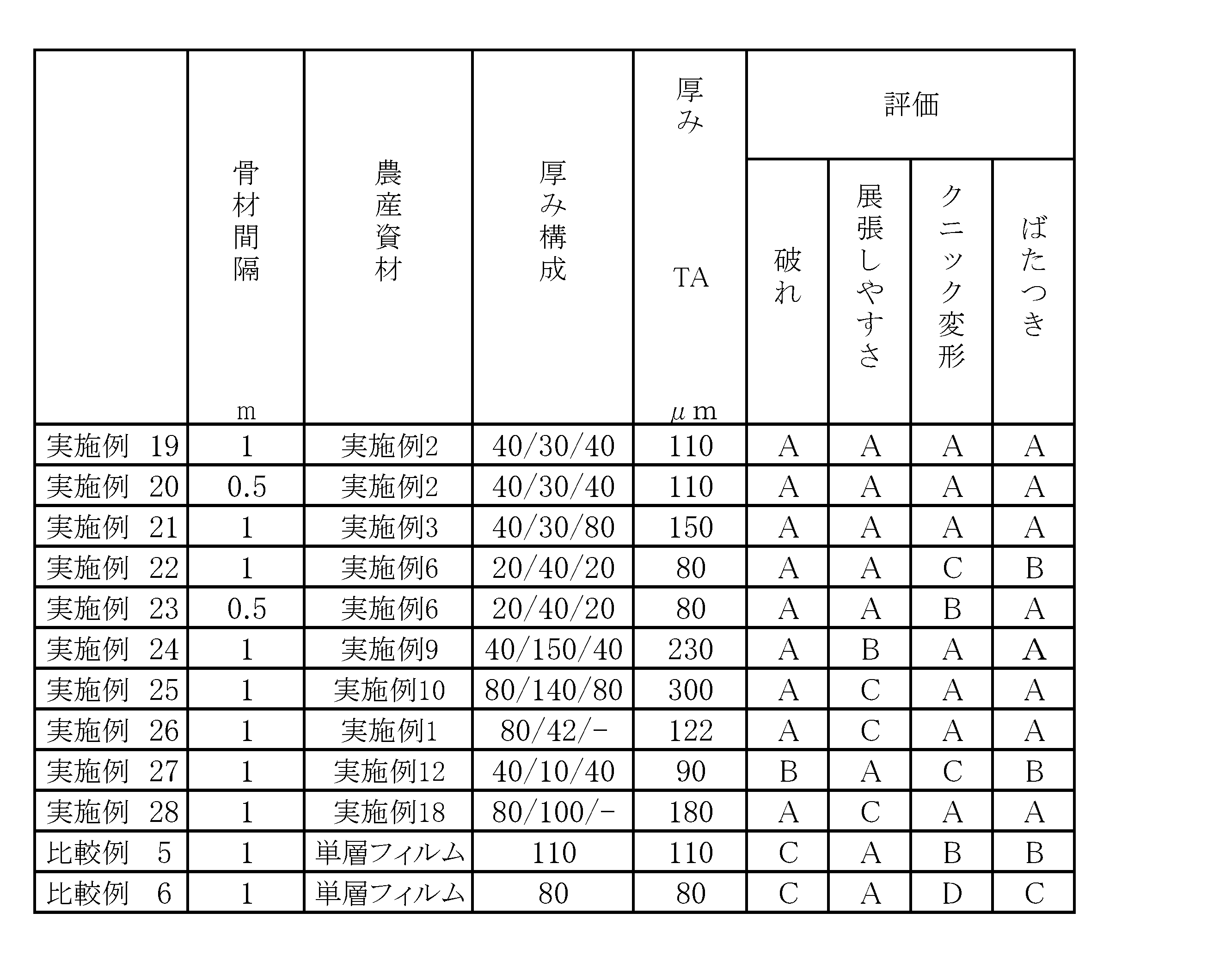
[比較例5]~[比較例6]
単層構造のセルロースアシレートフィルムを用いて、農業ハウスをつくった。用いたセルロースアシレートフィルムのセルロースアシレートはTACであり、表2の「農産資材」欄には単層フィルムと記載し、厚みは表2の「厚みTA」欄に示す。
[Comparative Example 5] to [Comparative Example 6]
An agricultural house was made using a single-layer cellulose acylate film. The cellulose acylate of the cellulose acylate film used was TAC, and the column for “agricultural materials” in Table 2 was described as a single-layer film, and the thickness is shown in the column for “thickness TA” in Table 2.
各農業ハウスを、実施例19~28と同様の方法及び基準で、評価した。結果は表2に示す。 Each agricultural house was evaluated by the same method and criteria as in Examples 19 to 28. The results are shown in Table 2.
10 農業ハウス
11 躯体
11A 本体部
11B 屋根
12,52,62,72 農産資材
12A,52A,62A,72A 第1資材面
12B,52B,62B,72A 第2資材面
12a 貫通孔
15 骨材
16 押さえ部材
16a 中央部
16b 肉薄部
16c 端部
16d 溝
16s 当接面
17 ビス
20 農産資材ロール
21 巻き芯
41 セルロースアシレート層
41A 第1CA面
41B 第2CA面
42 ポリマー層
45 嵩上げ部材
53 けん化層
81 固定具
82a,82b 把持具
83 粘着テープ
L16 押さえ部材の長さ
LM 距離
T16 押さえ部材の厚み
T41 セルロースアシレート層の厚み
T42 ポリマー層の厚み
T45 嵩上げ部材の厚み
T53 けん化層の厚み
TA 農産資材の厚み
W15 骨材の幅
W16 押さえ部材の幅
DESCRIPTION OF
Claims (10)
前記セルロースアシレート層の一方の表面に設けられ、厚み1μmあたりの透湿抵抗が高くても7.5×10⁻⁴m2・day/gであり、セルロースアシレートと異なるポリマーで形成されたポリマー層と、
を備え、
引裂強度が小さくても0.10Nである農産資材。 Cellulose acylate layer formed of cellulose acylate,
It was provided on one surface of the cellulose acylate layer and had a moisture permeation resistance per 1 μm thickness of at least 7.5 × 10 −4 m 2 · day / g, and was formed of a polymer different from cellulose acylate. A polymer layer;
With
Agricultural material with a low tear strength of 0.10N.
前記躯体に展張されることにより外部から仕切られた空間を形成する請求項1ないし6のいずれか1項に記載の農産資材と、
を備える農業ハウス。 A skeleton made of metal aggregate,
The agricultural material according to any one of claims 1 to 6, which forms a space partitioned from the outside by being extended on the skeleton.
Agricultural house equipped with.
Priority Applications (4)
| Application Number | Priority Date | Filing Date | Title |
|---|---|---|---|
| CN201980041521.2A CN112351677B (en) | 2018-06-26 | 2019-06-24 | Agricultural materials, rolls of agricultural materials and agricultural sheds |
| JP2020527511A JP7012851B2 (en) | 2018-06-26 | 2019-06-24 | Agricultural materials, agricultural material rolls and agricultural houses |
| EP19827573.7A EP3815512B1 (en) | 2018-06-26 | 2019-06-24 | Agricultural material, agricultural material roll, and agricultural house |
| US17/114,958 US20210084833A1 (en) | 2018-06-26 | 2020-12-08 | Agricultural material, agricultural material roll, and agricultural house |
Applications Claiming Priority (2)
| Application Number | Priority Date | Filing Date | Title |
|---|---|---|---|
| JP2018120724 | 2018-06-26 | ||
| JP2018-120724 | 2018-06-26 |
Related Child Applications (1)
| Application Number | Title | Priority Date | Filing Date |
|---|---|---|---|
| US17/114,958 Continuation US20210084833A1 (en) | 2018-06-26 | 2020-12-08 | Agricultural material, agricultural material roll, and agricultural house |
Publications (1)
| Publication Number | Publication Date |
|---|---|
| WO2020004331A1 true WO2020004331A1 (en) | 2020-01-02 |
Family
ID=68985003
Family Applications (1)
| Application Number | Title | Priority Date | Filing Date |
|---|---|---|---|
| PCT/JP2019/024966 Ceased WO2020004331A1 (en) | 2018-06-26 | 2019-06-24 | Agricultural material, agricultural material roll, and agricultural house |
Country Status (5)
| Country | Link |
|---|---|
| US (1) | US20210084833A1 (en) |
| EP (1) | EP3815512B1 (en) |
| JP (1) | JP7012851B2 (en) |
| CN (1) | CN112351677B (en) |
| WO (1) | WO2020004331A1 (en) |
Cited By (1)
| Publication number | Priority date | Publication date | Assignee | Title |
|---|---|---|---|---|
| JPWO2021131270A1 (en) * | 2019-12-27 | 2021-07-01 |
Citations (7)
| Publication number | Priority date | Publication date | Assignee | Title |
|---|---|---|---|---|
| JP2003201301A (en) | 2001-11-05 | 2003-07-18 | Daicel Chem Ind Ltd | Method for adjusting the degree of acetyl substitution of cellulose acetate |
| JP2009204834A (en) * | 2008-02-27 | 2009-09-10 | Fujifilm Corp | Optical film, optical functional film, polarizing plate and image display device |
| JP2009296893A (en) | 2008-06-10 | 2009-12-24 | Mkv Dream Co Ltd | Agricultural resin film |
| JP2015213499A (en) * | 2014-04-25 | 2015-12-03 | 富士フイルム株式会社 | Film for agricultural house |
| JP2016007183A (en) * | 2014-06-26 | 2016-01-18 | 東都興業株式会社 | Sheet fixing member |
| JP2016185122A (en) | 2015-03-27 | 2016-10-27 | 富士フイルム株式会社 | Agricultural house film and agricultural house |
| JP2017057370A (en) | 2015-09-14 | 2017-03-23 | 富士フイルム株式会社 | Anti-fogging film |
Family Cites Families (4)
| Publication number | Priority date | Publication date | Assignee | Title |
|---|---|---|---|---|
| GB201106677D0 (en) * | 2011-04-20 | 2011-06-01 | Kritis Plastika | Multilayer plastic film with separable layers for covering of inflated greenhouse |
| KR102072480B1 (en) * | 2014-12-26 | 2020-02-03 | 후지필름 가부시키가이샤 | Agricultural greenhouse |
| CN106342588A (en) * | 2015-07-20 | 2017-01-25 | 徐昳昊 | Greenhouse film |
| CN106313843A (en) * | 2016-08-19 | 2017-01-11 | 滁州嘉实农业科技有限公司 | Reflective film for orchards |
-
2019
- 2019-06-24 WO PCT/JP2019/024966 patent/WO2020004331A1/en not_active Ceased
- 2019-06-24 EP EP19827573.7A patent/EP3815512B1/en active Active
- 2019-06-24 JP JP2020527511A patent/JP7012851B2/en active Active
- 2019-06-24 CN CN201980041521.2A patent/CN112351677B/en active Active
-
2020
- 2020-12-08 US US17/114,958 patent/US20210084833A1/en not_active Abandoned
Patent Citations (7)
| Publication number | Priority date | Publication date | Assignee | Title |
|---|---|---|---|---|
| JP2003201301A (en) | 2001-11-05 | 2003-07-18 | Daicel Chem Ind Ltd | Method for adjusting the degree of acetyl substitution of cellulose acetate |
| JP2009204834A (en) * | 2008-02-27 | 2009-09-10 | Fujifilm Corp | Optical film, optical functional film, polarizing plate and image display device |
| JP2009296893A (en) | 2008-06-10 | 2009-12-24 | Mkv Dream Co Ltd | Agricultural resin film |
| JP2015213499A (en) * | 2014-04-25 | 2015-12-03 | 富士フイルム株式会社 | Film for agricultural house |
| JP2016007183A (en) * | 2014-06-26 | 2016-01-18 | 東都興業株式会社 | Sheet fixing member |
| JP2016185122A (en) | 2015-03-27 | 2016-10-27 | 富士フイルム株式会社 | Agricultural house film and agricultural house |
| JP2017057370A (en) | 2015-09-14 | 2017-03-23 | 富士フイルム株式会社 | Anti-fogging film |
Non-Patent Citations (1)
| Title |
|---|
| See also references of EP3815512A4 |
Cited By (4)
| Publication number | Priority date | Publication date | Assignee | Title |
|---|---|---|---|---|
| JPWO2021131270A1 (en) * | 2019-12-27 | 2021-07-01 | ||
| WO2021131270A1 (en) * | 2019-12-27 | 2021-07-01 | 富士フイルム株式会社 | Multilayer sheet, multilayer sheet roll, agricultural material and use of multilayer sheet |
| JP7235898B2 (en) | 2019-12-27 | 2023-03-08 | 富士フイルム株式会社 | LAMINATED SHEET ROLL, AGRICULTURE MATERIAL AND LAMINATED SHEET USAGE |
| EP4082788A4 (en) * | 2019-12-27 | 2023-05-10 | FUJIFILM Corporation | MULTILAYER SHEET, ROLL OF MULTILAYER SHEET, AGRICULTURAL MATERIAL AND USE OF MULTILAYER SHEET |
Also Published As
| Publication number | Publication date |
|---|---|
| EP3815512A4 (en) | 2021-09-08 |
| US20210084833A1 (en) | 2021-03-25 |
| EP3815512B1 (en) | 2022-07-06 |
| JPWO2020004331A1 (en) | 2021-06-24 |
| EP3815512A1 (en) | 2021-05-05 |
| CN112351677A (en) | 2021-02-09 |
| JP7012851B2 (en) | 2022-01-28 |
| CN112351677B (en) | 2022-04-29 |
Similar Documents
| Publication | Publication Date | Title |
|---|---|---|
| KR102551734B1 (en) | Polarizing film, polarizing film with pressure-sensitive adhesive layer, image display device, and continuous production method thereof | |
| KR101694590B1 (en) | Polarizing film and method for manufacturing polarizing film | |
| KR101844935B1 (en) | Polarizing film protected on one side, polarizing film with pressure-sensitive adhesive layer, image display device, and continuous production process therefor | |
| KR101696521B1 (en) | Polarizing film and method for manufacturing polarizing film | |
| KR101419086B1 (en) | Cellulose ester film, method for production of the cellulose ester film, and polarizing plate and display device both using the cellulose ester film | |
| JP2017187731A (en) | Manufacturing methods for stretched film and polarizing film | |
| KR20180103974A (en) | Polarizer, polarizing protective film, polarizing film with pressure-sensitive adhesive layer, image display apparatus and continuous manufacturing method thereof | |
| JP7012851B2 (en) | Agricultural materials, agricultural material rolls and agricultural houses | |
| KR102180044B1 (en) | Manufacturing method of nano cellulose film | |
| JP6444070B2 (en) | Biaxially stretched polyamide film for cold forming and packaging material using the same | |
| TWI649360B (en) | Polarizing film manufacturing apparatus and manufacturing method, and polarizing film | |
| JP5191442B2 (en) | Polarizing plate, manufacturing method thereof, and adhesive for manufacturing polarizing plate | |
| WO2018061911A1 (en) | Molded body | |
| KR20170044037A (en) | Polarizer and method of manufacturing the same | |
| TWI432492B (en) | A process for producing a polarizer | |
| KR102159366B1 (en) | Method for producing a single protective polarizing film with a transparent resin layer, a method for producing a polarizing film with an adhesive layer, and a method for producing an image display device | |
| US11125924B2 (en) | One-side-protected polarizing film, pressure-sensitive-adhesive-layer-attached polarizing film, image display device, and method for continuously producing same | |
| JP2003131034A (en) | Polarizing plate and manufacturing method thereof | |
| KR101570257B1 (en) | Film and method of film processing | |
| JP2011053535A (en) | Preservation method of polarizing plate | |
| EP3277497B1 (en) | Multilayer shrink film with scission layer | |
| KR20140137441A (en) | Process for production of hard coat film | |
| CN111032753A (en) | Cling film and cling film rolls | |
| CN110621499A (en) | Sheet, method for manufacturing sheet, and method for attaching sheet | |
| JP2009103854A (en) | Method for producing polarizing film and use thereof |
Legal Events
| Date | Code | Title | Description |
|---|---|---|---|
| 121 | Ep: the epo has been informed by wipo that ep was designated in this application |
Ref document number: 19827573 Country of ref document: EP Kind code of ref document: A1 |
|
| ENP | Entry into the national phase |
Ref document number: 2020527511 Country of ref document: JP Kind code of ref document: A |
|
| NENP | Non-entry into the national phase |
Ref country code: DE |
|
| ENP | Entry into the national phase |
Ref document number: 2019827573 Country of ref document: EP Effective date: 20210126 |