WO2020004331A1 - Matériau agricole, rouleau de matériau agricole et maison agricole - Google Patents
Matériau agricole, rouleau de matériau agricole et maison agricole Download PDFInfo
- Publication number
- WO2020004331A1 WO2020004331A1 PCT/JP2019/024966 JP2019024966W WO2020004331A1 WO 2020004331 A1 WO2020004331 A1 WO 2020004331A1 JP 2019024966 W JP2019024966 W JP 2019024966W WO 2020004331 A1 WO2020004331 A1 WO 2020004331A1
- Authority
- WO
- WIPO (PCT)
- Prior art keywords
- agricultural
- cellulose acylate
- layer
- agricultural material
- aggregate
- Prior art date
- Legal status (The legal status is an assumption and is not a legal conclusion. Google has not performed a legal analysis and makes no representation as to the accuracy of the status listed.)
- Ceased
Links
Images




Classifications
-
- A—HUMAN NECESSITIES
- A01—AGRICULTURE; FORESTRY; ANIMAL HUSBANDRY; HUNTING; TRAPPING; FISHING
- A01G—HORTICULTURE; CULTIVATION OF VEGETABLES, FLOWERS, RICE, FRUIT, VINES, HOPS OR SEAWEED; FORESTRY; WATERING
- A01G9/00—Cultivation in receptacles, forcing-frames or greenhouses; Edging for beds, lawn or the like
- A01G9/14—Greenhouses
- A01G9/1407—Greenhouses of flexible synthetic material
-
- A—HUMAN NECESSITIES
- A01—AGRICULTURE; FORESTRY; ANIMAL HUSBANDRY; HUNTING; TRAPPING; FISHING
- A01G—HORTICULTURE; CULTIVATION OF VEGETABLES, FLOWERS, RICE, FRUIT, VINES, HOPS OR SEAWEED; FORESTRY; WATERING
- A01G9/00—Cultivation in receptacles, forcing-frames or greenhouses; Edging for beds, lawn or the like
- A01G9/14—Greenhouses
- A01G9/1438—Covering materials therefor; Materials for protective coverings used for soil and plants, e.g. films, canopies, tunnels or cloches
-
- A—HUMAN NECESSITIES
- A01—AGRICULTURE; FORESTRY; ANIMAL HUSBANDRY; HUNTING; TRAPPING; FISHING
- A01G—HORTICULTURE; CULTIVATION OF VEGETABLES, FLOWERS, RICE, FRUIT, VINES, HOPS OR SEAWEED; FORESTRY; WATERING
- A01G9/00—Cultivation in receptacles, forcing-frames or greenhouses; Edging for beds, lawn or the like
- A01G9/14—Greenhouses
- A01G9/16—Dismountable or portable greenhouses ; Greenhouses with sliding roofs
-
- B—PERFORMING OPERATIONS; TRANSPORTING
- B32—LAYERED PRODUCTS
- B32B—LAYERED PRODUCTS, i.e. PRODUCTS BUILT-UP OF STRATA OF FLAT OR NON-FLAT, e.g. CELLULAR OR HONEYCOMB, FORM
- B32B23/00—Layered products comprising a layer of cellulosic plastic substances, i.e. substances obtained by chemical modification of cellulose, e.g. cellulose ethers, cellulose esters, viscose
- B32B23/04—Layered products comprising a layer of cellulosic plastic substances, i.e. substances obtained by chemical modification of cellulose, e.g. cellulose ethers, cellulose esters, viscose comprising such cellulosic plastic substance as the main or only constituent of a layer, which is next to another layer of the same or of a different material
-
- B—PERFORMING OPERATIONS; TRANSPORTING
- B32—LAYERED PRODUCTS
- B32B—LAYERED PRODUCTS, i.e. PRODUCTS BUILT-UP OF STRATA OF FLAT OR NON-FLAT, e.g. CELLULAR OR HONEYCOMB, FORM
- B32B23/00—Layered products comprising a layer of cellulosic plastic substances, i.e. substances obtained by chemical modification of cellulose, e.g. cellulose ethers, cellulose esters, viscose
- B32B23/04—Layered products comprising a layer of cellulosic plastic substances, i.e. substances obtained by chemical modification of cellulose, e.g. cellulose ethers, cellulose esters, viscose comprising such cellulosic plastic substance as the main or only constituent of a layer, which is next to another layer of the same or of a different material
- B32B23/08—Layered products comprising a layer of cellulosic plastic substances, i.e. substances obtained by chemical modification of cellulose, e.g. cellulose ethers, cellulose esters, viscose comprising such cellulosic plastic substance as the main or only constituent of a layer, which is next to another layer of the same or of a different material of synthetic resin
-
- B—PERFORMING OPERATIONS; TRANSPORTING
- B32—LAYERED PRODUCTS
- B32B—LAYERED PRODUCTS, i.e. PRODUCTS BUILT-UP OF STRATA OF FLAT OR NON-FLAT, e.g. CELLULAR OR HONEYCOMB, FORM
- B32B27/00—Layered products comprising a layer of synthetic resin
- B32B27/30—Layered products comprising a layer of synthetic resin comprising vinyl (co)polymers; comprising acrylic (co)polymers
- B32B27/306—Layered products comprising a layer of synthetic resin comprising vinyl (co)polymers; comprising acrylic (co)polymers comprising vinyl acetate or vinyl alcohol (co)polymers
-
- B—PERFORMING OPERATIONS; TRANSPORTING
- B32—LAYERED PRODUCTS
- B32B—LAYERED PRODUCTS, i.e. PRODUCTS BUILT-UP OF STRATA OF FLAT OR NON-FLAT, e.g. CELLULAR OR HONEYCOMB, FORM
- B32B27/00—Layered products comprising a layer of synthetic resin
- B32B27/30—Layered products comprising a layer of synthetic resin comprising vinyl (co)polymers; comprising acrylic (co)polymers
- B32B27/308—Layered products comprising a layer of synthetic resin comprising vinyl (co)polymers; comprising acrylic (co)polymers comprising acrylic (co)polymers
-
- B—PERFORMING OPERATIONS; TRANSPORTING
- B32—LAYERED PRODUCTS
- B32B—LAYERED PRODUCTS, i.e. PRODUCTS BUILT-UP OF STRATA OF FLAT OR NON-FLAT, e.g. CELLULAR OR HONEYCOMB, FORM
- B32B27/00—Layered products comprising a layer of synthetic resin
- B32B27/32—Layered products comprising a layer of synthetic resin comprising polyolefins
-
- B—PERFORMING OPERATIONS; TRANSPORTING
- B32—LAYERED PRODUCTS
- B32B—LAYERED PRODUCTS, i.e. PRODUCTS BUILT-UP OF STRATA OF FLAT OR NON-FLAT, e.g. CELLULAR OR HONEYCOMB, FORM
- B32B27/00—Layered products comprising a layer of synthetic resin
- B32B27/34—Layered products comprising a layer of synthetic resin comprising polyamides
-
- B—PERFORMING OPERATIONS; TRANSPORTING
- B32—LAYERED PRODUCTS
- B32B—LAYERED PRODUCTS, i.e. PRODUCTS BUILT-UP OF STRATA OF FLAT OR NON-FLAT, e.g. CELLULAR OR HONEYCOMB, FORM
- B32B27/00—Layered products comprising a layer of synthetic resin
- B32B27/40—Layered products comprising a layer of synthetic resin comprising polyurethanes
-
- B—PERFORMING OPERATIONS; TRANSPORTING
- B32—LAYERED PRODUCTS
- B32B—LAYERED PRODUCTS, i.e. PRODUCTS BUILT-UP OF STRATA OF FLAT OR NON-FLAT, e.g. CELLULAR OR HONEYCOMB, FORM
- B32B7/00—Layered products characterised by the relation between layers; Layered products characterised by the relative orientation of features between layers, or by the relative values of a measurable parameter between layers, i.e. products comprising layers having different physical, chemical or physicochemical properties; Layered products characterised by the interconnection of layers
- B32B7/04—Interconnection of layers
- B32B7/12—Interconnection of layers using interposed adhesives or interposed materials with bonding properties
-
- B—PERFORMING OPERATIONS; TRANSPORTING
- B32—LAYERED PRODUCTS
- B32B—LAYERED PRODUCTS, i.e. PRODUCTS BUILT-UP OF STRATA OF FLAT OR NON-FLAT, e.g. CELLULAR OR HONEYCOMB, FORM
- B32B2250/00—Layers arrangement
- B32B2250/02—2 layers
-
- B—PERFORMING OPERATIONS; TRANSPORTING
- B32—LAYERED PRODUCTS
- B32B—LAYERED PRODUCTS, i.e. PRODUCTS BUILT-UP OF STRATA OF FLAT OR NON-FLAT, e.g. CELLULAR OR HONEYCOMB, FORM
- B32B2250/00—Layers arrangement
- B32B2250/03—3 layers
-
- B—PERFORMING OPERATIONS; TRANSPORTING
- B32—LAYERED PRODUCTS
- B32B—LAYERED PRODUCTS, i.e. PRODUCTS BUILT-UP OF STRATA OF FLAT OR NON-FLAT, e.g. CELLULAR OR HONEYCOMB, FORM
- B32B2255/00—Coating on the layer surface
- B32B2255/10—Coating on the layer surface on synthetic resin layer or on natural or synthetic rubber layer
-
- B—PERFORMING OPERATIONS; TRANSPORTING
- B32—LAYERED PRODUCTS
- B32B—LAYERED PRODUCTS, i.e. PRODUCTS BUILT-UP OF STRATA OF FLAT OR NON-FLAT, e.g. CELLULAR OR HONEYCOMB, FORM
- B32B2255/00—Coating on the layer surface
- B32B2255/26—Polymeric coating
-
- B—PERFORMING OPERATIONS; TRANSPORTING
- B32—LAYERED PRODUCTS
- B32B—LAYERED PRODUCTS, i.e. PRODUCTS BUILT-UP OF STRATA OF FLAT OR NON-FLAT, e.g. CELLULAR OR HONEYCOMB, FORM
- B32B2307/00—Properties of the layers or laminate
- B32B2307/50—Properties of the layers or laminate having particular mechanical properties
- B32B2307/582—Tearability
- B32B2307/5825—Tear resistant
-
- B—PERFORMING OPERATIONS; TRANSPORTING
- B32—LAYERED PRODUCTS
- B32B—LAYERED PRODUCTS, i.e. PRODUCTS BUILT-UP OF STRATA OF FLAT OR NON-FLAT, e.g. CELLULAR OR HONEYCOMB, FORM
- B32B2307/00—Properties of the layers or laminate
- B32B2307/70—Other properties
- B32B2307/724—Permeability to gases, adsorption
- B32B2307/7242—Non-permeable
- B32B2307/7246—Water vapor barrier
-
- B—PERFORMING OPERATIONS; TRANSPORTING
- B32—LAYERED PRODUCTS
- B32B—LAYERED PRODUCTS, i.e. PRODUCTS BUILT-UP OF STRATA OF FLAT OR NON-FLAT, e.g. CELLULAR OR HONEYCOMB, FORM
- B32B2307/00—Properties of the layers or laminate
- B32B2307/70—Other properties
- B32B2307/732—Dimensional properties
-
- B—PERFORMING OPERATIONS; TRANSPORTING
- B32—LAYERED PRODUCTS
- B32B—LAYERED PRODUCTS, i.e. PRODUCTS BUILT-UP OF STRATA OF FLAT OR NON-FLAT, e.g. CELLULAR OR HONEYCOMB, FORM
- B32B2307/00—Properties of the layers or laminate
- B32B2307/70—Other properties
- B32B2307/748—Releasability
-
- B—PERFORMING OPERATIONS; TRANSPORTING
- B32—LAYERED PRODUCTS
- B32B—LAYERED PRODUCTS, i.e. PRODUCTS BUILT-UP OF STRATA OF FLAT OR NON-FLAT, e.g. CELLULAR OR HONEYCOMB, FORM
- B32B2410/00—Agriculture-related articles
-
- Y—GENERAL TAGGING OF NEW TECHNOLOGICAL DEVELOPMENTS; GENERAL TAGGING OF CROSS-SECTIONAL TECHNOLOGIES SPANNING OVER SEVERAL SECTIONS OF THE IPC; TECHNICAL SUBJECTS COVERED BY FORMER USPC CROSS-REFERENCE ART COLLECTIONS [XRACs] AND DIGESTS
- Y02—TECHNOLOGIES OR APPLICATIONS FOR MITIGATION OR ADAPTATION AGAINST CLIMATE CHANGE
- Y02A—TECHNOLOGIES FOR ADAPTATION TO CLIMATE CHANGE
- Y02A40/00—Adaptation technologies in agriculture, forestry, livestock or agroalimentary production
- Y02A40/10—Adaptation technologies in agriculture, forestry, livestock or agroalimentary production in agriculture
- Y02A40/25—Greenhouse technology, e.g. cooling systems therefor
Definitions
- the present invention relates to an agricultural material, an agricultural material roll, and an agricultural house.
- Patent Document 1 An agricultural house in which a cellulose acylate film is spread on a frame is known (for example, see Patent Document 1).
- the cellulose acylate film described in Patent Document 1 has an equilibrium water content of 4 to 8% at a relative humidity of 80%. Since the cellulose acylate film is excellent in transparency, it can sufficiently irradiate external light to a medium such as a plant and / or soil in an agricultural house.
- the cellulose acylate film is further excellent in a property of transmitting water vapor (hereinafter, referred to as moisture permeability), and the concentration of carbon dioxide (CO 2 ) in an agricultural house can be controlled by a plant to perform photosynthesis without ventilation. Can be maintained at a level that can.
- moisture permeability water vapor
- CO 2 carbon dioxide
- the saponified layer is a layer formed by saponifying a cellulose acylate film.
- the base resin film is a polyolefin film, a polystyrene film, a polyester film, a polycarbonate film, a cellulose acylate film, or the like.
- the coating is mainly composed of two components, a fluorinated acrylic polymer and a vinylidene fluoride resin.
- the fluorine-containing acrylic polymer is a copolymer of an acrylic monomer and a perfluoroalkyl group-containing acrylic monomer.
- the adhesive acrylic resin layer contains a polymer obtained by polymerizing an acrylic monomer, an ultraviolet absorbing monomer, an acrylic monomer having a cycloalkyl group, and an ultraviolet stable monomer. ing.
- the cellulose acylate film is excellent in moisture permeability and also excellent in transparency, and thus is very suitable for an agricultural house.
- a crack is generated from a hole (through hole) formed by penetration of the screw, and the crack progresses, for example, during screwing of the screw, In some cases, the film may be torn.
- a screw penetration portion in the film is reinforced in advance with an adhesive tape or the like.
- such a method is troublesome.
- cellulose acylate films may break (hereinafter referred to as knick deformation) when fixed to the aggregate with screws, and there is a concern that the film may break at the fold.
- an object of the present invention to provide an agricultural material, an agricultural material roll, and an agricultural house in which, when fixing with a screw, tearing of the screw from the through hole and cracking due to knick deformation are suppressed.
- the agricultural material of the present invention includes a cellulose acylate layer and a polymer layer and has a low tear strength of 0.10N.
- the cellulose acylate layer is formed of cellulose acylate.
- the polymer layer is provided on one surface of the cellulose acylate layer and has a moisture permeation resistance per 1 ⁇ m thickness of at least 7.5 ⁇ 10 ⁇ 4 m 2 ⁇ day / g. Is formed.
- the peel strength between the cellulose acylate layer and the polymer layer is small, it is preferably 0.10 N / 25 mm.
- the thickness of the polymer layer is preferably in the range of 10 ⁇ m or more and 150 ⁇ m or less.
- the thickness is in the range of 80 ⁇ m or more and 300 ⁇ m or less.
- the polymer of the polymer layer is preferably any one of polyurethane, polyamide, polyvinyl alcohol-based polymer, polyacrylamide derivative, and polyacrylonitrile derivative.
- the above-mentioned agricultural material formed in a long length is wound in a roll shape.
- the agricultural house of the present invention includes a skeleton formed of metal aggregate, and the above-mentioned agricultural material that is formed on the skeleton to form a space partitioned from the outside.
- Agricultural materials are preferably fixed to the aggregate with screws.
- the service screw fixes the agricultural material to the aggregate through a plate-shaped pressing member disposed on the agricultural material.
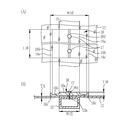
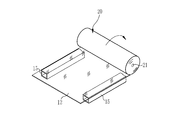
- FIG. 1 It is a schematic perspective view of an agricultural house. It is explanatory drawing of the agricultural material fixed to the aggregate, (A) is a plane explanatory view, (B) is sectional explanatory drawing. It is explanatory drawing of a holding member. It is a schematic perspective view of an agricultural material roll. It is explanatory drawing of the layer structure of an agricultural material. It is explanatory drawing of another fixing aspect of agricultural materials with respect to aggregate. It is explanatory drawing explaining the layer structure of the film which is another embodiment. It is explanatory drawing explaining the layer structure of the film which is another embodiment. It is explanatory drawing explaining the layer structure of the film which is another embodiment. It is explanatory drawing explaining the layer structure of the film which is another embodiment. It is explanatory drawing explaining the layer structure of the film which is another embodiment. It is explanatory drawing of the screwing test method.
- ⁇ Agricultural house 10 shown in FIG. 1 includes a frame 11 and a film-like agricultural material 12.
- the frame 11 is for supporting the agricultural material 12 and is formed in a three-dimensional (three-dimensional) shape by assembling a plurality of metal aggregates 15.
- the aggregates 15 are formed in a long shape, and the aggregates 15 are fixed to each other, for example, by connecting and fixing fasteners (not shown).
- the skeleton 11 includes a main body 11A having a rectangular shape in a plan view and a triangular mountain-shaped roof 11B provided on the main body 11A, but the shape of the skeleton is not limited to this example.
- the roof may be an arched so-called round roof, may have a flat shape in the horizontal direction, or may have an inclined shape in which the height gradually decreases in one direction.
- the number of the aggregates 15 in the frame 11, the direction of each aggregate 15, and the method of assembling are not particularly limited.
- a known material for an agricultural house can be used as the aggregate 15, but a metal material is preferable from the viewpoint of durability (strength), and examples thereof include a solid steel material and a hollow steel pipe. In this example, a steel pipe is used.
- the agricultural material 12 is spread on the frame 11 to form a space partitioned from the outside inside the frame 11.
- the agricultural material 12 may be extended inside the frame 11 or may be extended outside. In this example, the agricultural material 12 is extended outside. This is because the outer side of the frame 11 is easier to expand than the inner side.
- the agricultural material 12 is fixed to the aggregate 15 with screws 17 (see FIG. 2) via a holding member 16. In FIG. 1, screws 17 are not shown to avoid complication of the drawing.
- the pressing member 16 may have a shape (rectangular shape) extending in the longitudinal direction of the aggregate 15, as shown in FIG. 1, or may have a shorter shape, for example, a square. In this example, a pressing member 16 having a shape (rectangular) extending in the longitudinal direction of the aggregate 15 is used.
- the holding member 16 is disposed on the agricultural material 12, whereby the agricultural material 12 is sandwiched between the aggregate 15 and the through-hole 12 a is screwed into the agricultural material 12 by the screw 17. It is formed and fixed to the aggregate 15. Note that a hole into which the screw 17 enters may be formed in the holding member 16 in advance. In FIG. 2, the thickness TA of the agricultural material 12 is greatly exaggerated with respect to other members and the like.
- the screw 17 is screwed from the holding member 16 toward the aggregate 15.
- the holding member 16 is disposed on the aggregate 15 in a state of being symmetric with respect to the center in the width direction of the aggregate 15.
- the screw 17 is screwed into the center of the pressing member 16 and the aggregate 15 in the width direction of the aggregate 15.
- a screw hole into which the screw 17 is screwed may be provided in the aggregate 15 in advance, but is not provided in this example, and is formed by screwing the screw 17.
- the number of screws 17 per holding member 16 is not particularly limited. That is, if the pressing member 16 and the agricultural material 12 can be fixed in a stable state, the number may be determined as appropriate, and may be one or three or more. For example, when the length L16 of the pressing member 16 in the longitudinal direction of the aggregate 15 (hereinafter, simply referred to as “length”) is 2 m, the screws 17 are provided at a pitch of 20 cm, so that 9 The screws 17 will be used.
- the screw 17 in this example is a tapping screw having a sharp tip (taper) and a threaded entire shaft.
- the screw is not limited to this, and other known various screws may be used.
- a washer is not used in this example, a screw with a washer may be used.
- the holding member 16 is plate-shaped, and has a central portion 16a, a thin portion 16b, and an end 16c in order from the center in the width direction of the aggregate 15.
- the central portion 16a has the largest thickness T16, and a groove 16d having a V-shaped cross section is formed in the center of the aggregate 15 in the width direction.
- a screw 17 is screwed into the groove 16d.
- the thickness T16 of the thin portion 16b is smaller than that of the center portion 16a.
- the end 16c is formed to have a thickness T16 larger than the thin portion 16b and a rounded cross section.
- the pressing member may be a flat plate having a constant thickness T16.
- the pressing member 16 may not be used, but is preferably used because a crack is hardly generated from a through hole formed by screwing the screw 17 and even if a crack is generated, it does not easily progress. Since the holding member 16 has the rounded end portion 16c, even if the spread agricultural material 12 flaps, for example, in the wind, the agricultural material 12 is less likely to crack. Therefore, it is preferable that a rounded end portion is formed even in the case of a flat pressing member having a constant thickness T16.
- the length (hereinafter referred to as the width) of the pressing member 16 in the width direction of the aggregate 15 is denoted by the reference symbol W16.
- the width W16 of the pressing member 16 is larger than the width W15 of the aggregate 15, but is not limited thereto, and may be the same as the width W15 or smaller than the width W15. However, the width W16 is preferably larger than the width W15 from the viewpoint of suppressing the fluttering of the agricultural material 12.
- the width W16 of the pressing member 16 is preferably in a range from 10 mm to 60 mm.
- the length L16 of the pressing member 16 is not particularly limited, and in the present example, the length L16 is set to various lengths within a range of 50 mm or more and 3000 mm or less.
- the width W15 of the aggregate 15 is not particularly limited, it is preferably in the range of 5 mm or more and 50 mm or less. In this example, the width W15 is 10 mm, and the width W16 is 20 mm.
- the cross section of the contact surface 16 s that contacts the agricultural material 12 is concave.
- the holding member 16 deforms the agricultural material 12 into a shape along the curvature of the contact surface 16s and pulls the agricultural material 12 in accordance with the screwing of the screw 17.
- the screw 17 may be screwed in by observing the pulled state of the agricultural material 12 and adjusting the screwing amount.
- the agricultural material 12 is manufactured to be long by the method described later, and is wound into a roll as shown in FIG.
- the agricultural material roll 20 has the agricultural material 12 wound around the core 21, but may not include the core 21.
- the agricultural material 12 is spread by rolling the agricultural material roll 20 in the longitudinal direction of each of the aggregates 15 while, for example, two aggregates 15 are hung over each other as shown in FIG. Note that an adhesive tape (not shown) may be attached to the surface of the aggregate 15 in advance, or the agricultural material 12 may be spread while being attached.
- the agricultural material 12 includes a cellulose acylate layer 41 formed of cellulose acylate, and a polymer layer 42 formed of a polymer different from cellulose acylate.
- the cellulose acylate layer 41 and the polymer layer 42 are in close contact with each other, and the polymer layer 42 is provided so as to cover one surface (hereinafter, referred to as a first CA surface) 41A of the cellulose acylate layer 41. .
- the cellulose acylate layer 41 is formed of only cellulose acylate in this example, but may include other components in addition to cellulose acylate.
- the content by mass of components other than cellulose acylate in the cellulose acylate layer 41 is preferably 0 or more and 50 or less when the mass of cellulose acylate is 100.
- Other components include, for example, additives. Examples of the additive include an ultraviolet absorber, a plasticizer, and a matting agent.
- the agricultural material 12 is disposed with the cellulose acylate layer 41 inside the agricultural house 10 (see FIG. 1) and the polymer layer 42 outside.
- Cellulose acylate has a high degree of transparency, so that external light effectively irradiates the plants in the agricultural house 10 and / or a cultivation bed (medium) such as a nursery.
- the cellulose acylate layer 41 contains cellulose acylate, the equilibrium water content increases due to an increase in humidity in the agricultural house 10. Due to the increase in the equilibrium water content, the cellulose acylate layer 41 absorbs moisture. The moisture in the agricultural house 10 is reduced by the absorption of the moisture of the cellulose acylate layer 41, whereby the equilibrium water content of the cellulose acylate layer 41 is reduced, and the moisture is released. In this way, the change in humidity in the agricultural house 10 is suppressed. As a result, dew condensation on the first material surface 12A of the agricultural material 12, which is the inner wall surface of the agricultural house 10, is suppressed. Since dew condensation is suppressed, a decrease in the amount of external light is suppressed.
- the above-mentioned equilibrium water content is an equilibrium water content at 25 ° C. and a relative humidity of 80%.
- the temperature and the relative humidity correspond to the temperature and the relative humidity normally set as the cultivation environment of the plant.
- reference numeral 12 ⁇ / b> B is assigned to the second material surface of the agricultural material 12, which is the outer wall surface of the agricultural house 10.
- Cellulose acylate has an acyl group because the hydroxy group of cellulose is esterified with a carboxylic acid.
- the cellulose acylate is not particularly limited, but the acyl group substitution degree of the cellulose acylate is preferably in the range of 2.00 to 2.97. Thereby, the change in humidity in the agricultural house 10 can be suppressed more reliably.
- the degree of substitution of the acyl group is smaller, the amount of water absorbed by the cellulose acylate layer 41 also increases, so that deformation due to water absorption easily occurs. However, the deformation is more reliable by setting the degree of substitution of the acyl group of the cellulose acylate to 2.00 or more. It is preferable because it can be suppressed.
- the upper limit of the degree of acyl group substitution is 3.00 in theory, but it is difficult to synthesize cellulose acylate having a degree of acyl group substitution of more than 2.97. For this reason, the acyl substitution degree of cellulose acylate is set to 2.97 or less.
- the acyl group substitution degree of cellulose acylate is more preferably in the range of 2.40 or more and 2.95 or less, and further preferably in the range of 2.70 or more and 2.95 or less.
- the degree of acyl group substitution is, as is well known, the rate at which the hydroxy group of cellulose is esterified with a carboxylic acid, that is, the degree of acyl group substitution.
- the acyl group of cellulose acylate is not particularly limited, and may be an acetyl group having 1 carbon atom, or may be an acetyl group having 2 or more carbon atoms.
- the acyl group having 2 or more carbon atoms may be an aliphatic group or an aryl group, and examples thereof include an alkylcarbonyl ester, an alkenylcarbonyl ester or an aromatic carbonyl ester of cellulose, and an aromatic alkylcarbonyl ester. It may have a further substituted group.
- Examples include a carbonyl group, an oleoyl group, a benzoyl group, a naphthylcarbonyl group, and a cinnamoyl group.
- the cellulose acylate constituting the cellulose acylate layer 41 may have only one type of acyl group or two or more types of acyl groups, but it is preferable that at least one type is an acetyl group. Since the cellulose acylate has an acetyl group, the cellulose acylate layer 41 easily absorbs moisture, so that the effect of suppressing a change in humidity in the agricultural house 10 is further improved. Most preferably, the acyl group is a cellulose acylate in which all of the acetyl groups are present, that is, it is more preferable that the cellulose acylate is a cellulose acetate. In this example, cellulose triacetate (TAC) is used.
- TAC cellulose triacetate
- the degree of acyl group substitution can be determined by a conventional method.
- the degree of acetylation degree of acetyl group substitution
- ASTM test method for cellulose acetate and the like
- the degree of acylation (degree of acyl group substitution) distribution measurement by high performance liquid chromatography can also be used.
- the measurement of the degree of acetylation of cellulose acetate is performed by dissolving a sample in methylene chloride and using a column Novapac @ phenyl (Waters), and using a mixed solution of methanol and water as an eluent (methanol: water mass ratio:
- methanol: water mass ratio The acetylation degree distribution is measured by a linear gradient from 8: 1) to a mixture of dichloromethane and methanol (the mass ratio of dichloromethane: methanol is 9: 1) and compared with a calibration curve using standard samples having different acetylation degrees. Ask for.
- These measuring methods can be determined with reference to the method described in JP-A-2003-201301.
- the measurement of the degree of acetylation of cellulose acylate is preferably performed by high performance liquid chromatography.
- the cellulose acylate layer 41 Since the cellulose acylate layer 41 is formed of cellulose acylate, it has high moisture permeability, and the moisture permeability is generally in the range of 200 g / m 2 ⁇ day to 1500 g / m 2 ⁇ day. . In addition to the above-mentioned equilibrium moisture content, the change in humidity in the agricultural house 10 is suppressed to be smaller due to the high moisture permeability.
- the moisture permeability is determined by a cup method based on Japanese Industrial Standard JIS Z 0208. The measurement conditions are a temperature of 40 ° C. and a relative humidity of 90%.
- the polymer layer 42 is for suppressing tears from the through holes 12a in the cellulose acylate layer 41 and cracks caused by knick deformation.
- the polymer layer 42 has a high moisture permeation resistance per 1 ⁇ m thickness of 7.5 ⁇ 10 ⁇ 4 m 2 ⁇ day / g, that is, 7.5 ⁇ 10 ⁇ 4 m 2 ⁇ day / g or less.
- the thickness T42 of the polymer layer 42 can be further increased as long as the high moisture permeability of the cellulose acylate layer 41 is not hindered. Since the thickness T42 can be increased, the tear strength of the agricultural material 12 is 0.10 N, that is, 0.10 N or more even if the tear strength is small. As described above, the tear strength of the agricultural material 12 is set to 0.10 N or more.
- the thickness TA of the agricultural material 12 can be increased accordingly, so that even when the agricultural house 10 is blown by the wind, fluttering of the agricultural material 12 is suppressed, and therefore, Hard to tear for a long time.
- the polymer layer 42 preferably has a moisture permeation resistance per 1 ⁇ m thickness of not less than 1.0 ⁇ 10 ⁇ 6 m 2 ⁇ day / g and not more than 7.5 ⁇ 10 ⁇ 4 m 2 ⁇ day / g, preferably not more than 3.0. It is more preferably from ⁇ 10 ⁇ 6 m 2 ⁇ day / g to 5.0 ⁇ 10 ⁇ 4 m 2 ⁇ day / g, and more preferably from 5.0 ⁇ 10 ⁇ 6 m 2 ⁇ day / g to 2.0 ⁇ .
- the moisture permeability resistance is calculated as the reciprocal of the above-described moisture permeability, and indicates the difficulty of passing water vapor. Specifically, when the moisture permeability is A (g / m 2 ⁇ day), the moisture permeability resistance R is 1 / A.
- the moisture permeability resistance R per unit thickness of the material is obtained by dividing the moisture permeability resistance R by the thickness of the material. For example, when the thickness of the polymer layer 42 is 1 ⁇ m, the moisture permeation resistance R per 1 ⁇ m is obtained by R / d.
- the tear strength is 0.10 N or more, the effect of suppressing tearing and cracking can be sufficiently obtained, but the larger it is, the more preferable.
- the preferred range is in the range of 0.10 N or more and 7.50 N or less, more preferably the range of 0.30 N or more and 6.50 N or less. And more preferably in the range of 0.80 N or more and 5.50 N or less, and particularly preferably in the range of 1.00 N or more and 3.00 N or less.
- Tear strength is determined by the Elmendorf method.
- the tear strength is measured by an Elmendorf tear tester (digital type) manufactured by Toyo Seiki Seisaku-sho, Ltd. Specifically, a 76 mm ⁇ 63 mm sample cut from the agricultural material 12 is set on a sample table of an Elmendorf tear tester with the long side of the sample being horizontal, and a 2 cm cut is made in the sample at the test location. Then, the tear strength is measured at a load of 16 N and a pendulum angle of 70 degrees.
- the polymer (resin) constituting the polymer layer 42 is not particularly limited as long as it is a polymer different from cellulose acylate and has a moisture permeation resistance of 7.5 ⁇ 10 ⁇ 4 m 2 ⁇ day / g or less.
- polyurethane, polyamide, polyvinyl alcohol-based polymer, polyacrylamide derivative, polyacrylonitrile derivative and the like are mentioned, and any of these is preferable.
- a commercially available polyurethane can be used. Specifically, an ester (adipate) type, an ester (lactone) type, an ether type, a polycarbonate type, an aliphatic non-yellowing type, or the like can be used as a two-component curable polyurethane or a thermoplastic polyurethane elastomer.
- Commercially available products include Pandex (registered trademark) GW series “GW-3670 / HX-770” (manufactured by DIC), a system for two-component curable continuous coating urethane film, and Elastollan (registered trademark) as a thermoplastic polyurethane elastomer.
- urethane elastomers may be used in combination.
- a commercially available polyurethane film may be used. Specific examples include Tough Grace (registered trademark) manufactured by Takeda Sangyo Co., Ltd.
- polyamides examples include polyamides such as nylon 6 obtained by ring-opening polymerization of ⁇ -caprolactam and nylon 66 obtained by polycondensation of hexamethylenediamine and adipic acid. Further, a commercially available polyamide film may be used. Specific examples include Kobari (registered trademark) ONY manufactured by Kojin Film & Chemicals Inc., and Harden (registered trademark) film NAP02 manufactured by Toyobo Co., Ltd.
- polyvinyl alcohol-based polymer examples include polyvinyl alcohol, a polyvinyl alcohol-polyvinyl acetate copolymer obtained by partial saponification of polyvinyl acetate, and a copolymer of polyvinyl alcohol and ethylene.
- the polymer of the polymer layer 42 has adhesiveness.
- the second material surface 12B of the agricultural material 12 has adhesiveness.
- the agricultural material 12 is disposed such that the cellulose acylate layer 41 is located inside the agricultural house 10 as described above, the agricultural material 12 is externally arranged with respect to the frame 11 as in this example. Is spread, the agricultural material roll 20 is spread in a state where the cellulose acylate layer 41 having extremely low adhesiveness is in contact with the aggregate 15. Therefore, the agricultural material roll 20 easily rolls on the skeleton 11 and has good workability.
- the peel strength between the cellulose acylate layer 41 and the polymer layer 42 is at least 0.10 N per 25 mm width, that is, preferably 0.10 N or more. Thereby, the occurrence of a tear from the through hole 12a is further suppressed, and even if a tear occurs, the progress of the tear is further suppressed, so that the tear from the through hole 12a is suppressed.
- the agricultural material 12 is fixed to the aggregate 15 with the screws 17, knick deformation is suppressed, and even when knick deformation occurs, cracking at a fold is suppressed. Since the peel strength per 25 mm width is about 25 mm width as described above, the unit of the peel strength is described as “N / 25 mm” in the following description.
- the peel strength between the cellulose acylate layer 41 and the polymer layer 42 is preferably in the range of 0.10 N / 25 mm or more and 30.00 N / 25 mm or less, and in the range of 0.50 N / 25 mm or more and 20.00 N / 25 mm or less. It is more preferably within the range of 0.70 N / 25 mm or more and 15.00 N / 25 mm or less, and particularly preferably within the range of 1.00 N / 25 mm or more and 10.00 N / 25 mm or less. preferable.
- the peel strength between the cellulose acylate layer 41 and the polymer layer 42 depends on the type of polymer in the polymer layer 42, the degree of acylation of the cellulose acylate in the cellulose acylate layer 41 and the type of additive, the method of forming the polymer layer 42, The above preferable range can be achieved by a method such as using an adhesive between the layer 42 and the cellulose acylate layer 41.
- the cellulose acylate layer 41 and the polymer layer 42 may be laminated, and the laminated sheet may be immersed in water and then subjected to a heat treatment to increase the peel strength, so that the preferable range is obtained.
- the water may be an aqueous solution of alkali or acid, washing water, or the like used in a saponification treatment by a dipping method described later. Therefore, in the saponification treatment of the laminated sheet by the immersion method, the peel strength between the cellulose acylate layer 41 and the polymer layer 42 can be increased through the immersion step and the drying step.
- the thickness T42 of the polymer layer 42 is preferably in the range of 10 ⁇ m or more and 150 ⁇ m or less.
- the thickness T42 is 10 ⁇ m or more, the occurrence of a crack from the through-hole 12a is more reliably suppressed than when the thickness T42 is less than 10 ⁇ m, and even when a crack occurs, the progress of the crack is more reliable. Is suppressed.
- the agricultural material 12 is fixed to the aggregate 15 by the screws 17, knick deformation is further suppressed, and even when knick deformation occurs, cracks at folds are more reliably suppressed.
- the thickness T42 is 150 ⁇ m or less, the high moisture permeability of the cellulose acylate layer 41 of the agricultural material 12 is more reliably utilized as compared with a case where the thickness T42 exceeds 150 ⁇ m.
- the thickness T42 is 150 ⁇ m or less, when the agricultural material roll 20 is spread on the skeleton, the roll is lightweight, for example, is easy to roll and has good workability as compared with the case where the thickness T42 exceeds 150 ⁇ m.
- Thickness T42 is more preferably in the range of 15 ⁇ m or more and 100 ⁇ m or less, and further preferably in the range of 20 ⁇ m or more and 80 ⁇ m or less.
- the thickness TA of the agricultural material 12 is preferably in the range of 80 ⁇ m or more and 300 ⁇ m or less.
- the thickness TA is 80 ⁇ m or more, the generation of a crack from the through-hole 12a is more reliably suppressed and the case where a crack is generated than in the case where the thickness TA is less than 80 ⁇ m and in the case where the thickness TA is less than 10 ⁇ m. Even so, the progress of the tear is more reliably suppressed.
- the agricultural material 12 is fixed to the aggregate 15 by the screws 17, knick deformation is further suppressed, and even when knick deformation occurs, cracks at folds are more reliably suppressed.
- the thickness TA is 300 ⁇ m or less, the workability is good because the agricultural material roll 20 is lighter when the agricultural material roll 20 is spread on the frame than when the thickness exceeds 300 ⁇ m.
- the thickness TA is more preferably in the range of 90 ⁇ m or more and 230 ⁇ m or less, and even more preferably in the range of 100 ⁇ m or more and 200 ⁇ m or less.
- the thickness T41 of the cellulose acylate layer 41 is not particularly limited, but is preferably in the range of 20 ⁇ m or more and 100 ⁇ m or less, and more preferably in the range of 30 ⁇ m or more and 90 ⁇ m in consideration of the above-mentioned preferable ranges of the thickness TA and the thickness T41. It is within the following range, and more preferably within the range of 40 ⁇ m or more and 80 ⁇ m or less.
- the agricultural material 12 is fixed directly to the aggregate 15, that is, in a state of being in contact with the aggregate 15, but the fixing method is not limited to this.
- a plate-like raising member 45 is arranged between the aggregate 15 and the agricultural material 12.
- the horizontal direction in FIG. 6 is the longitudinal direction of the aggregate 15.
- the raising member 45 prevents the agricultural material 12 from contacting the aggregate 15 when the agricultural material 12 flaps due to the thickness T45 of the raising member 45, and the contact pressure is low even if the agricultural material 12 abuts. It is to be suppressed.
- the cellulose acylate layer 41 of the agricultural material 12 has a property of absorbing moisture as described above for the equilibrium moisture content.
- the cellulose acylate layer 41 when the cellulose acylate layer 41 contains a large amount of water, the cellulose acylate layer 41 expands as compared with a state where the cellulose acylate layer 41 contains a small amount of water.
- the agricultural material 12 itself becomes more slack as indicated by the two-dot broken line than in the stretched state as indicated by the solid line.
- the agricultural material 12 strongly contacts the aggregate 15.
- the agricultural material 12 does not abut or does not abut. Even so, the contact pressure can be kept low. Therefore, cracking of the agricultural component 12 is further suppressed.
- a pit hull registered trademark manufactured by Toto Kogyo may be used.
- the agricultural material 12 is formed by applying a coating solution in which the polymer constituting the polymer layer 42 is dissolved to a cellulose acylate film material manufactured in a long length by a known solution casting method, and forming the coating material. It is manufactured by drying the membrane. According to this method, the above-mentioned cellulose acylate film material becomes the cellulose acylate layer 41.
- Cellulose acylate film material to form a casting film by casting a dope obtained by dissolving cellulose acylate in a solvent, into a continuously moving long belt, and then peeling off the casting film after drying, It is made by further drying.
- a drum may be used, and the cast film may be cooled and / or dried on the drum and then peeled off.
- the agricultural material 12 can also be manufactured by a melting method, a laminating method, or the like.
- a melting method for example, a polymer for forming the polymer layer 42 is melted by a heating extruder, and then cast on a cellulose acylate film material using a T-die to form the polymer layer 42.
- the laminating method can also be manufactured by laminating the above-mentioned cellulose acylate material on a long film material (hereinafter, referred to as a polymer film material) which becomes the polymer layer 42 and laminating.
- an adhesive may be used between the cellulose acylate material and the polymer film material.
- Agricultural materials are not limited to the above examples, and may have the following configurations, for example.
- the agricultural material 52 further includes a saponified layer 53.
- the same members as those of the agricultural material 12 are denoted by the same reference numerals, and description thereof will be omitted.
- the saponified layer 53 is for further improving the hydrophilicity of the first material surface 52A, which is the inner wall surface of the agricultural house 10 (see FIG. 1).
- the saponified layer 53 is provided so as to cover the other surface (hereinafter, referred to as a second CA surface) 41B of the cellulose acylate layer 41.
- the agricultural material 52 is provided with the saponified layer 53 on the inside of the agricultural house 10 and the polymer layer 42 on the outside.
- reference numeral 52A is given to a first material surface which is an inner wall surface when the agricultural material 52 is used for the agricultural house 10
- reference numeral 52B is given to a second material surface which is an outer wall surface. Attach.
- the saponified layer 53 is also formed of cellulose acylate, and is formed by saponifying the surface of the aforementioned cellulose acylate film material. Depending on the degree of saponification, the saponified layer 53 may contain cellulose. That is, the saponified layer 53 is formed of cellulose acylate and / or cellulose.
- the thickness T53 of the saponified layer 53 is preferably in a range from 0.1 ⁇ m to 20.0 ⁇ m, and is approximately 0.3 ⁇ m in this example.
- the saponified layer 53 is formed by saponifying a cellulose acylate material, and thus has higher hydrophilicity than the cellulose acylate layer 41. For this reason, the first material surface 52A when used in the agricultural house 10 (see FIG. 1) is more suppressed from dew condensation. Since the saponified layer 53 is formed of cellulose acylate and / or cellulose as described above, it has moisture permeability similarly to the cellulose acylate layer 41, and is thin as described above. Therefore, the agricultural material 52 shows high moisture permeability similarly to the agricultural material 12, and also has good workability when it is spread. In addition, since the agricultural material 52 includes the polymer layer 42, breakage from the through hole 12a is suppressed. Moreover, when the agricultural material 52 is fixed to the aggregate 15 by the screws 17, knick deformation is suppressed.
- the agricultural material 52 is manufactured by the following method.
- the saponified layer 53 is formed by bringing an aqueous solution such as sodium hydroxide and / or potassium hydroxide into contact with one surface of the aforementioned cellulose acylate film material.
- the aforementioned coating solution is applied to the surface of the cellulose acylate film material on which the saponified layer 53 is formed, on the surface opposite to the surface on which the saponified layer 53 is provided.
- the agricultural material 52 is obtained by drying the formed coating film. Therefore, the cellulose acylate film material before saponification becomes the cellulose acylate layer 41 and the saponified layer 53 of the agricultural material 52.
- the agricultural material 52 can also be manufactured by a melting method and a laminating method.
- the agricultural material 62 includes a polymer layer 42 between a pair of cellulose acylate layers 41. That is, the polymer layer 42 is provided in close contact with both the first CA surface 41A of one cellulose acylate layer 41 and the first CA surface 41A of the other cellulose acylate layer 41.
- the same members as those of the agricultural materials 12 and 52 are denoted by the same reference numerals, and description thereof will be omitted.
- the saponified layer 53 is provided.
- the saponified layer 53 is provided so as to cover the second CA surface 41B of one cellulose acylate layer 41.
- the saponified layer 53 is formed inside the agricultural house 10 (see FIG. 1). It is provided in a state where one of the cellulose acylate layers 41 not provided is on the outside.
- the saponification layer 53 does not need to be provided like the agricultural material 12 like the agricultural material 72 shown in FIG.
- reference numeral 62A is attached to the first material surface which is the inner wall surface when the agricultural material 62 is used for the agricultural house 10, and reference numeral 62B is assigned to the second material surface which is the outer wall surface. Attach.
- any one of the pair of cellulose acylate layers 41 may be inside the agricultural house 10.
- the lower material surface is a first material surface 72A serving as an inner wall surface of the agricultural house
- the upper material surface is a second material surface 72B serving as an outer wall surface of the agricultural house. It is illustrated as
- the polymer layer 42 has adhesiveness, the polymer layer 42 is not exposed to the outside, so that the workability of the spreading is good and the contamination by sand dust or the like is suppressed.
- the agricultural materials 62 and 72 show high moisture permeability similarly to the agricultural materials 12 and 52. Moreover, since the agricultural materials 62 and 72 are provided with the polymer layer 42, breakage from the through holes 12a is suppressed. Moreover, when the agricultural material 12 is fixed to the aggregate 15 with the screws 17, knick deformation is suppressed.
- the agricultural material 62 can be manufactured by the following method. Two long cellulose acylate film materials are prepared. A saponification treatment is performed on one of the cellulose acylate materials in the same manner as in the case of producing the agricultural material 52 to form a saponified layer 53. The above-mentioned coating solution is applied to the surface of the cellulose acylate film material having the saponified layer 53 opposite to the surface on which the saponified layer 53 is provided. The formed coating film is dried. This drying is performed in a state where the solvent remains (semi-dried state) as compared with the case where the agricultural material 52 is manufactured. The other cellulose acylate material is superimposed on the semi-dried coating film, and the coating film is dried in the superposed state, whereby the agricultural material 62 is obtained.
- the agricultural material 62 can also be manufactured by a melting method, a laminating method, or the like.
- the melting method after the polymer of the polymer layer 42 is melted by an extruder, the polymer layer 42 is provided by casting it on one cellulose acylate film material using a T-die. Before the temperature does not drop, the other cellulose acylate is layered. Note that one of the two cellulose acylate materials is subjected to a saponification treatment in advance.
- a cellulose acylate material is laminated on one surface and the other surface of the above-mentioned polymer film material to be the polymer layer 42, respectively, and laminated. In this case, an adhesive may be used between the cellulose acylate material and the polymer film material.
- the agricultural material 72 can be manufactured by any of the coating, melting, and laminating methods.
- the saponification layer 53 of the agricultural material 52 or the agricultural material 62 can be manufactured by an immersion method.
- the saponification treatment by the immersion method may be performed under any conditions, and includes, for example, a saponification step, a first cleaning step, a neutralization step, a second cleaning step, and a drying step.
- the saponification step saponifies the film surface by immersing the film in an aqueous alkali solution.
- the alkali for example, sodium hydroxide (NaOH) or potassium hydroxide (KOH) is used.
- NaOH sodium hydroxide
- KOH potassium hydroxide
- the cleaning is performed, for example, with pure water.
- the neutralization step an acid or an aqueous solution of an acid is used as a neutralization liquid, and the film that has undergone the first washing step is neutralized with the neutralization liquid.
- the second washing step the film that has undergone the neutralization step is washed with, for example, pure water.
- the drying step the film that has undergone the second cleaning step is dried.
- the peel strength between the cellulose acylate layer 41 and the polymer layer 42 can also be increased by laminating the cellulose acylate layer 41 and the polymer layer 42 and subjecting the laminated sheet to saponification by an immersion method.
- the drying conditions after the second cleaning step are adjusted.
- the drying temperature is preferably set to 100 ° C. or higher, and specifically, is preferably set to a range from 100 ° C. to 150 ° C.
- the drying time is preferably in the range of 30 seconds to 600 seconds, more preferably in the range of 50 seconds to 300 seconds. It is preferable to drain the water adhered to the film surface immediately after the second washing step, because it has the effect of preventing the film surface temperature from decreasing during drying.
- the saponified layer 53 is formed on the side of the agricultural material 52 having cellulose acylate, and the saponified layer 53 is formed on the agricultural material 62 on both sides of the cellulose acylate.
- the saponification layer can be prevented from being formed by a method such as laminating a protective film.
- the agricultural materials 12, 52, 62 are used as films for an agricultural house, but the agricultural materials 12, 52, 62 can be used for other agricultural applications.
- Other agricultural uses include, for example, use as a so-called seedling raising film that grows around a seedling, or as a material for packaging sheets and packaging bags for packaging harvested agricultural products.
- Example 1 Long agricultural materials 12, 52, 62, and 72 were made and rolled, and Examples 1 to 17 were made.
- Example 1 and Example 7 are agricultural materials 12
- Examples 2 to 6 and Examples 8 to 12 are agricultural materials 72
- Examples 13 to 17 are agricultural materials 62
- Example 18 is agricultural materials. 52.
- the “first CA layer” is the cellulose acylate layer 41 forming the first material surfaces 12A and 72A in the case of the agricultural materials 12 and 72, and the saponification layer 53 in the case of the agricultural materials 52 and 62.
- the cellulose acylate layer 41 is formed on the surface 41B.
- the “second CA layer” is the cellulose acylate layer 41 having the second material surfaces 62B and 72B without the saponification layer 53.
- the “material” column of “polymer layer” in Table 1 shows the following. PU1; polyurethane (Elastollan (registered trademark) S80A manufactured by BASF) PU2; polyurethane (Elastoran (registered trademark) 1164D manufactured by BASF) PU3; Polyurethane (PANDEX (registered trademark) T-5265 manufactured by DIC Covestropolymer Co., Ltd.) PU4; polyurethane (Pandex (registered trademark) T-8175 manufactured by DIC Covestropolymer Co., Ltd.) PU5; Polyurethane (PANDEX (registered trademark) T-5102 manufactured by DIC Covestropolymer Co., Ltd.) PP; polypropylene
- peel strength The peel strength between the cellulose acylate layer 41 and the polymer layer 42 in the agricultural materials 12 and 52, and the peel strength between the cellulose acylate layer 41 and the polymer layer 42 forming the second material surfaces 62B and 72B in the agricultural materials 62 and 72.
- the peel strength of each was determined.
- the peel strength was determined according to Japanese Industrial Standard JIS Z0237. First, a rectangular sample of 25 mm ⁇ 150 mm was cut out from the agricultural materials 12, 52, 62, and 72. The denominator “25 mm” in the unit of the peel strength corresponds to the length of the short side of this sample.
- the cellulose acylate layer 41 is partially peeled off from one edge in the longitudinal direction of this sample.
- a part of the peeled cellulose acylate layer 41 is pulled toward the other end of the sample at a speed of 300 mm / min, and the force at which the cellulose acylate layer 41 peels from the polymer layer 42 is measured. And When the strength of the polymer layer 42 was weak and measurement was difficult, a rectangular sample having a peel strength of 25 mm ⁇ 150 mm was adhered to a glass plate (not shown) with an adhesive or the like, and the cellulose acylate layer 41 was partially peeled off and peeled off. A part of the cellulose acylate layer can be similarly pulled and measured as a force when the sample peels off from the glass plate.
- Screw hit evaluation The occurrence of a tear and the degree of progress of the tear when screw 17 was screwed in were evaluated as screw hit evaluation.
- the evaluation method will be described with reference to FIG.
- the agricultural materials 12, 52, 62, and 72 were evaluated by the same method, the following description and FIG. 10 illustrate the case where the agricultural materials 12 are evaluated as an example, and the other agricultural materials 52, 62, and 72 are used. The description of the case is omitted.
- the pressing member 16 and the aggregate 15 shown in FIGS. 2 and 3 were cut to a length of 5 cm along the longitudinal direction.
- the pressing member 16 used was a product name “Pit Hull (registered trademark) aluminum press” manufactured by Toto Kogyo
- the aggregate 15 was a product name “Pit Hull (registered trademark)” manufactured by Toto Kogyo.
- the aggregate 15 cut to a length of 5 cm was processed to form a fixture 81 shown in FIG.
- the agricultural material 12 was cut into a rectangle of 4 cm ⁇ 15 cm to obtain a sample.
- one end of the sample of the agricultural material 12 in the longitudinal direction is connected to the holding member 16 and the metal fixture 81 used as a substitute for the aggregate 15 or the raising member 45 in the agricultural house.
- the screw 17 was screwed from the holding member 16 side and fixed.
- the holding member 16 was arranged in a state where the sample of the agricultural material 12 was on the second material surface 12B side, and the fixture 81 was on the first material surface 12A side.
- the screw 17 was screwed into a position where the distance LM from one end of the sample of the agricultural material 12 in the longitudinal direction to the through hole 12a was 4 cm.
- the screw 17 used was a tapping screw having a screw head diameter of 7 mm and a shaft length of 10 mm.
- An adhesive tape 83 was attached to the first material surface 12A from the other end of the sample of the agricultural material 12 in the longitudinal direction to the fixture 81, and was reinforced.
- the fixing tool 81 is gripped by one of the gripping tools 82a and 82b of a pair of gripping tools 82a and 82b of a tensile tester (Tensilon Universal Material Testing Machine RTG-1210 manufactured by A & D Corporation).
- the other end of the sample on the reinforced side was gripped by the other gripper 82b.
- the tensile test was performed by moving the gripper 82a at 200 mm / min in a direction in which the distance between the gripper 82a and the gripper 82b increased.
- the maximum value of the load (unit: N) was read from the obtained strograph and evaluated according to the following criteria. A and B are acceptable, and C is unacceptable.
- A 16N or more.
- B 10 N or more and less than 16 N.
- C less than 10N.
- the moisture permeability was measured by the method described above and evaluated according to the following criteria. AC is acceptable and D is unacceptable.
- A 500 g / m 2 ⁇ day or more.
- B 300 g / m 2 ⁇ day or more and less than 500 g / m 2 ⁇ day.
- C 100 g / m 2 ⁇ day or more and less than 300 g / m 2 ⁇ day.
- D less than 100 g / m 2 ⁇ day.
- the total light transmittance was measured with a haze meter (SH7000 manufactured by Nippon Denshoku Co., Ltd.) and evaluated according to the following criteria. A and B are acceptable and C is unacceptable. A: 92% or more. B: 88% or more and less than 92%. C: less than 88%.
- Example 29 The agricultural materials 72 of Examples 2 and 8 were saponified by an immersion method to obtain Examples 29 and 30.
- the saponification treatment was performed under the following conditions. It was immersed in a 1.5 mol / L NaOH aqueous solution at a temperature of 50 ° C. for an immersion time of 180 seconds. Thereafter, as a first cleaning step, the substrate is immersed and washed in pure water at a temperature of 25 ° C. for 15 seconds. In the second washing step, the film was immersed and washed in pure water at a temperature of 25 ° C. for 15 seconds, the surface of the film was drained with an air knife, and then dried at 140 ° C. for 60 seconds in the drying step. This film was evaluated by the same method and criteria as in Examples 1 to 18 and is shown in Table 1.
- Example 19 An agricultural house 10 was made using a part of the agricultural materials 12, 52, 62, 72 made in the examples.
- the agricultural material rolls 20 of the agricultural materials 12, 52, 62, and 72 were rolled on the frame 11 and spread.
- the example numbers of the agricultural materials 12, 52, 62, and 72 used are shown in the "Agricultural materials" column of Table 2.
- Table 2 “Aggregate distance” is the distance between adjacent aggregates (distance between centers in the width direction of the aggregate) extending in the same direction. It is equal to the interval between the holes 12a.
- the “thickness configuration” column in Table 2 shows the sum of the thicknesses of the first CA layer and the saponified layer, the thickness of the polymer layer, and the thickness of the second CA layer in Table 1 in order from the left.
- Breakage at the through hole 12a The agricultural materials 12, 52, 62, 72 were fixed to the aggregate 15 via the holding member 16 as shown in FIG.
- the state of breakage from the formed through hole 12a was observed from the holding member 16 side, and evaluated according to the following criteria. The results are shown in the "Tear" column of Table 2.
- C The tear extending outside the holding member 16 was observed shortly after the screw 17 was started to be screwed, and further advanced during the subsequent screwing and was torn.
- the length of the agricultural material 12, 52, 62, 72 in the agricultural material roll 20 was set to 50 m.
- the agricultural material roll 20 was rolled on the skeleton 11 in a state where a plurality of aggregates 15 were suspended as shown in FIG. 4, and the ease of rolling was evaluated as the ease of rolling.
- the lighter the agricultural material roll, and the weaker the adhesion of the agricultural materials to each other in the agricultural material roll the easier the roll on the frame 11 is.
- the evaluation criteria are as follows. A: It was easy to roll. B: It was relatively easy. C: Although it was slightly difficult to roll, it could be rolled.
- Knick deformation The agricultural materials 12, 52, 62, and 72 were rolled along the aggregate 15, and the agricultural materials 12, 52, 62, and 72 were fixed with screws 17 via the holding members 16. The occurrence and extent of knick deformation and cracking near the aggregate 15 were visually observed and evaluated according to the following criteria. The strength of the knick deformation was judged based on the clarity of the crease observed white. When it is observed clearly white, the fold is strong, and the thinner the white, the weaker the fold. AC is acceptable and D is unacceptable. A: There was neither knick deformation nor cracking. B: Despite knick deformation, the crease was weak and there was no crack. C: Knick deformation was observed and a strong fold was observed, but no crack was found. D: Knick deformation was observed, and strong folds and cracks were observed.
- Flap of Agricultural Materials In the agricultural house 10, flapping of the agricultural materials 12, 52, 62, and 72 when a wind of 2 m / min or more was blown was observed, and evaluated based on the following criteria. A: I did not flutter. B: Although fluttered slightly, the agricultural materials did not come into contact with the aggregate 15. C: Flap and contacted aggregate 15.
Landscapes
- Life Sciences & Earth Sciences (AREA)
- Environmental Sciences (AREA)
- Chemical & Material Sciences (AREA)
- Engineering & Computer Science (AREA)
- Materials Engineering (AREA)
- Soil Sciences (AREA)
- Greenhouses (AREA)
- Protection Of Plants (AREA)
- Laminated Bodies (AREA)
Abstract
L'invention concerne un matériau agricole, un rouleau de matériau agricole et une maison agricole, chacun de ces éléments ne subissant pas de rupture à partir d'un trou traversant d'une vis et de fissuration provoquée par une déformation de réparation. Le matériau agricole (12, 52, 62, 72) comprend une couche d'acylate de cellulose (41) et une couche de polymère (42). La couche d'acylate de cellulose (41) est formée à partir d'acylate de cellulose. La couche de polymère (42) est disposée sur une première surface d'AC (41A) qui est l'une des surfaces de la couche d'acylate de cellulose (41). La couche de polymère (42) a une résistance à la perméation de l'humidité allant jusqu'à 7,5 × 10⁻⁴ m2·jour/g pour 1 µm d'épaisseur et est formée à partir d'un polymère qui est différent de l'acylate de cellulose. Le matériau agricole (12, 52, 62, 72) présente une résistance à la déchirure d'au moins 0,10 N.
Priority Applications (4)
| Application Number | Priority Date | Filing Date | Title |
|---|---|---|---|
| CN201980041521.2A CN112351677B (zh) | 2018-06-26 | 2019-06-24 | 农用材料、农用材料卷及农用棚 |
| JP2020527511A JP7012851B2 (ja) | 2018-06-26 | 2019-06-24 | 農産資材、農産資材ロール及び農業ハウス |
| EP19827573.7A EP3815512B1 (fr) | 2018-06-26 | 2019-06-24 | Matériau agricole, rouleau de matériau agricole et maison agricole |
| US17/114,958 US20210084833A1 (en) | 2018-06-26 | 2020-12-08 | Agricultural material, agricultural material roll, and agricultural house |
Applications Claiming Priority (2)
| Application Number | Priority Date | Filing Date | Title |
|---|---|---|---|
| JP2018120724 | 2018-06-26 | ||
| JP2018-120724 | 2018-06-26 |
Related Child Applications (1)
| Application Number | Title | Priority Date | Filing Date |
|---|---|---|---|
| US17/114,958 Continuation US20210084833A1 (en) | 2018-06-26 | 2020-12-08 | Agricultural material, agricultural material roll, and agricultural house |
Publications (1)
| Publication Number | Publication Date |
|---|---|
| WO2020004331A1 true WO2020004331A1 (fr) | 2020-01-02 |
Family
ID=68985003
Family Applications (1)
| Application Number | Title | Priority Date | Filing Date |
|---|---|---|---|
| PCT/JP2019/024966 Ceased WO2020004331A1 (fr) | 2018-06-26 | 2019-06-24 | Matériau agricole, rouleau de matériau agricole et maison agricole |
Country Status (5)
| Country | Link |
|---|---|
| US (1) | US20210084833A1 (fr) |
| EP (1) | EP3815512B1 (fr) |
| JP (1) | JP7012851B2 (fr) |
| CN (1) | CN112351677B (fr) |
| WO (1) | WO2020004331A1 (fr) |
Cited By (1)
| Publication number | Priority date | Publication date | Assignee | Title |
|---|---|---|---|---|
| JPWO2021131270A1 (fr) * | 2019-12-27 | 2021-07-01 |
Citations (7)
| Publication number | Priority date | Publication date | Assignee | Title |
|---|---|---|---|---|
| JP2003201301A (ja) | 2001-11-05 | 2003-07-18 | Daicel Chem Ind Ltd | セルロースアセテートのアセチル置換度の調整方法 |
| JP2009204834A (ja) * | 2008-02-27 | 2009-09-10 | Fujifilm Corp | 光学フィルム、光学機能性フィルム、偏光板、および画像表示装置 |
| JP2009296893A (ja) | 2008-06-10 | 2009-12-24 | Mkv Dream Co Ltd | 農業用樹脂フィルム |
| JP2015213499A (ja) * | 2014-04-25 | 2015-12-03 | 富士フイルム株式会社 | 農業ハウス用フィルム |
| JP2016007183A (ja) * | 2014-06-26 | 2016-01-18 | 東都興業株式会社 | シート定着部材 |
| JP2016185122A (ja) | 2015-03-27 | 2016-10-27 | 富士フイルム株式会社 | 農業ハウス用フィルムおよび農業ハウス |
| JP2017057370A (ja) | 2015-09-14 | 2017-03-23 | 富士フイルム株式会社 | 防曇フィルム |
Family Cites Families (4)
| Publication number | Priority date | Publication date | Assignee | Title |
|---|---|---|---|---|
| GB201106677D0 (en) * | 2011-04-20 | 2011-06-01 | Kritis Plastika | Multilayer plastic film with separable layers for covering of inflated greenhouse |
| KR102072480B1 (ko) * | 2014-12-26 | 2020-02-03 | 후지필름 가부시키가이샤 | 농업 하우스 |
| CN106342588A (zh) * | 2015-07-20 | 2017-01-25 | 徐昳昊 | 一种大棚膜 |
| CN106313843A (zh) * | 2016-08-19 | 2017-01-11 | 滁州嘉实农业科技有限公司 | 一种用于果园的反光膜 |
-
2019
- 2019-06-24 WO PCT/JP2019/024966 patent/WO2020004331A1/fr not_active Ceased
- 2019-06-24 EP EP19827573.7A patent/EP3815512B1/fr active Active
- 2019-06-24 JP JP2020527511A patent/JP7012851B2/ja active Active
- 2019-06-24 CN CN201980041521.2A patent/CN112351677B/zh active Active
-
2020
- 2020-12-08 US US17/114,958 patent/US20210084833A1/en not_active Abandoned
Patent Citations (7)
| Publication number | Priority date | Publication date | Assignee | Title |
|---|---|---|---|---|
| JP2003201301A (ja) | 2001-11-05 | 2003-07-18 | Daicel Chem Ind Ltd | セルロースアセテートのアセチル置換度の調整方法 |
| JP2009204834A (ja) * | 2008-02-27 | 2009-09-10 | Fujifilm Corp | 光学フィルム、光学機能性フィルム、偏光板、および画像表示装置 |
| JP2009296893A (ja) | 2008-06-10 | 2009-12-24 | Mkv Dream Co Ltd | 農業用樹脂フィルム |
| JP2015213499A (ja) * | 2014-04-25 | 2015-12-03 | 富士フイルム株式会社 | 農業ハウス用フィルム |
| JP2016007183A (ja) * | 2014-06-26 | 2016-01-18 | 東都興業株式会社 | シート定着部材 |
| JP2016185122A (ja) | 2015-03-27 | 2016-10-27 | 富士フイルム株式会社 | 農業ハウス用フィルムおよび農業ハウス |
| JP2017057370A (ja) | 2015-09-14 | 2017-03-23 | 富士フイルム株式会社 | 防曇フィルム |
Non-Patent Citations (1)
| Title |
|---|
| See also references of EP3815512A4 |
Cited By (4)
| Publication number | Priority date | Publication date | Assignee | Title |
|---|---|---|---|---|
| JPWO2021131270A1 (fr) * | 2019-12-27 | 2021-07-01 | ||
| WO2021131270A1 (fr) * | 2019-12-27 | 2021-07-01 | 富士フイルム株式会社 | Feuille multicouche, rouleau de feuille multicouche, matériau agricole et utilisation de feuille multicouche |
| JP7235898B2 (ja) | 2019-12-27 | 2023-03-08 | 富士フイルム株式会社 | 積層シートロール、農業資材及び積層シートの使用方法 |
| EP4082788A4 (fr) * | 2019-12-27 | 2023-05-10 | FUJIFILM Corporation | Feuille multicouche, rouleau de feuille multicouche, matériau agricole et utilisation de feuille multicouche |
Also Published As
| Publication number | Publication date |
|---|---|
| EP3815512A4 (fr) | 2021-09-08 |
| US20210084833A1 (en) | 2021-03-25 |
| EP3815512B1 (fr) | 2022-07-06 |
| JPWO2020004331A1 (ja) | 2021-06-24 |
| EP3815512A1 (fr) | 2021-05-05 |
| CN112351677A (zh) | 2021-02-09 |
| JP7012851B2 (ja) | 2022-01-28 |
| CN112351677B (zh) | 2022-04-29 |
Similar Documents
| Publication | Publication Date | Title |
|---|---|---|
| KR102551734B1 (ko) | 편광 필름, 점착제층 부착 편광 필름 및 화상 표시 장치 및 그 연속 제조 방법 | |
| KR101694590B1 (ko) | 편광막 및 편광막의 제조 방법 | |
| KR101844935B1 (ko) | 편보호 편광 필름, 점착제층이 부착된 편광 필름, 화상 표시 장치 및 그 연속 제조 방법 | |
| KR101696521B1 (ko) | 편광막 및 편광막의 제조 방법 | |
| KR101419086B1 (ko) | 셀룰로오스 에스테르 필름, 그의 제조 방법, 셀룰로오스 에스테르 필름을 이용한 편광판, 및 표시 장치 | |
| JP2017187731A (ja) | 延伸フィルムの製造方法及び偏光フィルムの製造方法 | |
| KR20180103974A (ko) | 편광자, 편보호 편광 필름, 점착제층 부착 편광 필름 및 화상 표시 장치 및 그 연속 제조 방법 | |
| JP7012851B2 (ja) | 農産資材、農産資材ロール及び農業ハウス | |
| KR102180044B1 (ko) | 나노 셀룰로오스 필름의 제조 방법 | |
| JP6444070B2 (ja) | 冷間成形用二軸延伸ポリアミドフィルム及びそれを用いた包材 | |
| TWI649360B (zh) | 偏光膜之製造裝置及製造方法,以及偏光膜 | |
| JP5191442B2 (ja) | 偏光板、及び、その製造方法、並びに、偏光板製造用接着剤 | |
| WO2018061911A1 (fr) | Corps moulé | |
| KR20170044037A (ko) | 편광자 및 그 제조 방법 | |
| TWI432492B (zh) | 偏光板的製造方法 | |
| KR102159366B1 (ko) | 투명 수지층 부착 편보호 편광 필름의 제조 방법, 점착제층 부착 편광 필름의 제조 방법, 및 화상 표시 장치의 제조 방법 | |
| US11125924B2 (en) | One-side-protected polarizing film, pressure-sensitive-adhesive-layer-attached polarizing film, image display device, and method for continuously producing same | |
| JP2003131034A (ja) | 偏光板およびその製造方法 | |
| KR101570257B1 (ko) | 필름 및 필름 가공 방법 | |
| JP2011053535A (ja) | 偏光板の保管方法 | |
| EP3277497B1 (fr) | Film rétractable multicouche à couche de scission | |
| KR20140137441A (ko) | 하드 코팅 필름의 제조 방법 | |
| CN111032753A (zh) | 保鲜膜和保鲜膜卷绕体 | |
| CN110621499A (zh) | 片材、片材的制造方法以及贴附方法 | |
| JP2009103854A (ja) | 偏光フィルムの製造方法およびその用途 |
Legal Events
| Date | Code | Title | Description |
|---|---|---|---|
| 121 | Ep: the epo has been informed by wipo that ep was designated in this application |
Ref document number: 19827573 Country of ref document: EP Kind code of ref document: A1 |
|
| ENP | Entry into the national phase |
Ref document number: 2020527511 Country of ref document: JP Kind code of ref document: A |
|
| NENP | Non-entry into the national phase |
Ref country code: DE |
|
| ENP | Entry into the national phase |
Ref document number: 2019827573 Country of ref document: EP Effective date: 20210126 |