WO2020004343A1 - Batterie secondaire et procédé de fabrication associé - Google Patents
Batterie secondaire et procédé de fabrication associé Download PDFInfo
- Publication number
- WO2020004343A1 WO2020004343A1 PCT/JP2019/024991 JP2019024991W WO2020004343A1 WO 2020004343 A1 WO2020004343 A1 WO 2020004343A1 JP 2019024991 W JP2019024991 W JP 2019024991W WO 2020004343 A1 WO2020004343 A1 WO 2020004343A1
- Authority
- WO
- WIPO (PCT)
- Prior art keywords
- positive electrode
- negative electrode
- secondary battery
- mass
- mixture layer
- Prior art date
- Legal status (The legal status is an assumption and is not a legal conclusion. Google has not performed a legal analysis and makes no representation as to the accuracy of the status listed.)
- Ceased
Links
Images
Classifications
-
- H—ELECTRICITY
- H01—ELECTRIC ELEMENTS
- H01M—PROCESSES OR MEANS, e.g. BATTERIES, FOR THE DIRECT CONVERSION OF CHEMICAL ENERGY INTO ELECTRICAL ENERGY
- H01M10/00—Secondary cells; Manufacture thereof
- H01M10/05—Accumulators with non-aqueous electrolyte
- H01M10/056—Accumulators with non-aqueous electrolyte characterised by the materials used as electrolytes, e.g. mixed inorganic/organic electrolytes
- H01M10/0564—Accumulators with non-aqueous electrolyte characterised by the materials used as electrolytes, e.g. mixed inorganic/organic electrolytes the electrolyte being constituted of organic materials only
- H01M10/0565—Polymeric materials, e.g. gel-type or solid-type
-
- H—ELECTRICITY
- H01—ELECTRIC ELEMENTS
- H01M—PROCESSES OR MEANS, e.g. BATTERIES, FOR THE DIRECT CONVERSION OF CHEMICAL ENERGY INTO ELECTRICAL ENERGY
- H01M10/00—Secondary cells; Manufacture thereof
- H01M10/05—Accumulators with non-aqueous electrolyte
- H01M10/056—Accumulators with non-aqueous electrolyte characterised by the materials used as electrolytes, e.g. mixed inorganic/organic electrolytes
- H01M10/0564—Accumulators with non-aqueous electrolyte characterised by the materials used as electrolytes, e.g. mixed inorganic/organic electrolytes the electrolyte being constituted of organic materials only
- H01M10/0566—Liquid materials
- H01M10/0568—Liquid materials characterised by the solutes
-
- H—ELECTRICITY
- H01—ELECTRIC ELEMENTS
- H01M—PROCESSES OR MEANS, e.g. BATTERIES, FOR THE DIRECT CONVERSION OF CHEMICAL ENERGY INTO ELECTRICAL ENERGY
- H01M10/00—Secondary cells; Manufacture thereof
- H01M10/05—Accumulators with non-aqueous electrolyte
- H01M10/058—Construction or manufacture
-
- H—ELECTRICITY
- H01—ELECTRIC ELEMENTS
- H01M—PROCESSES OR MEANS, e.g. BATTERIES, FOR THE DIRECT CONVERSION OF CHEMICAL ENERGY INTO ELECTRICAL ENERGY
- H01M4/00—Electrodes
- H01M4/02—Electrodes composed of, or comprising, active material
- H01M4/13—Electrodes for accumulators with non-aqueous electrolyte, e.g. for lithium-accumulators; Processes of manufacture thereof
-
- H—ELECTRICITY
- H01—ELECTRIC ELEMENTS
- H01M—PROCESSES OR MEANS, e.g. BATTERIES, FOR THE DIRECT CONVERSION OF CHEMICAL ENERGY INTO ELECTRICAL ENERGY
- H01M4/00—Electrodes
- H01M4/02—Electrodes composed of, or comprising, active material
- H01M4/62—Selection of inactive substances as ingredients for active masses, e.g. binders, fillers
-
- Y—GENERAL TAGGING OF NEW TECHNOLOGICAL DEVELOPMENTS; GENERAL TAGGING OF CROSS-SECTIONAL TECHNOLOGIES SPANNING OVER SEVERAL SECTIONS OF THE IPC; TECHNICAL SUBJECTS COVERED BY FORMER USPC CROSS-REFERENCE ART COLLECTIONS [XRACs] AND DIGESTS
- Y02—TECHNOLOGIES OR APPLICATIONS FOR MITIGATION OR ADAPTATION AGAINST CLIMATE CHANGE
- Y02E—REDUCTION OF GREENHOUSE GAS [GHG] EMISSIONS, RELATED TO ENERGY GENERATION, TRANSMISSION OR DISTRIBUTION
- Y02E60/00—Enabling technologies; Technologies with a potential or indirect contribution to GHG emissions mitigation
- Y02E60/10—Energy storage using batteries
-
- Y—GENERAL TAGGING OF NEW TECHNOLOGICAL DEVELOPMENTS; GENERAL TAGGING OF CROSS-SECTIONAL TECHNOLOGIES SPANNING OVER SEVERAL SECTIONS OF THE IPC; TECHNICAL SUBJECTS COVERED BY FORMER USPC CROSS-REFERENCE ART COLLECTIONS [XRACs] AND DIGESTS
- Y02—TECHNOLOGIES OR APPLICATIONS FOR MITIGATION OR ADAPTATION AGAINST CLIMATE CHANGE
- Y02P—CLIMATE CHANGE MITIGATION TECHNOLOGIES IN THE PRODUCTION OR PROCESSING OF GOODS
- Y02P70/00—Climate change mitigation technologies in the production process for final industrial or consumer products
- Y02P70/50—Manufacturing or production processes characterised by the final manufactured product
Definitions
- the present disclosure relates to a secondary battery and a method for manufacturing the same.
- lithium secondary batteries have a high energy density and are therefore used as power sources for portable electronic devices, electric vehicles, and the like.
- Lithium secondary batteries are required to have high safety, and as a means therefor, all-solid-state batteries are being developed.
- a layer of solid electrolyte such as a polymer electrolyte or an inorganic solid electrolyte (electrolyte layer) is provided on the electrode mixture layer instead of the electrolytic solution (for example, Patent Document 1).
- a solvent may be added to the electrolyte layer.
- Patent Document 2 discloses a secondary battery in which an ionic liquid is contained in an electrolyte layer such as a polymer electrolyte.
- JP 2006-294326 A International Publication No. WO 2011/037060
- an object of the present invention is to provide a secondary battery having excellent initial characteristics and a method for manufacturing the same.
- One aspect of the present invention is a secondary battery including a positive electrode, an electrolyte layer, and a negative electrode, wherein the positive electrode, the electrolyte layer, and the negative electrode are stacked in this order, and in a pressurized state pressed in the stacking direction.
- the secondary battery further includes a holding unit that holds a pressurized state.
- the positive electrode, the electrolyte layer, and the negative electrode may be pressurized at 0.7 MPa or more in the laminating direction.
- the laminate may be pressed at 0.7 MPa or more in the stacking direction.
- the above manufacturing method may further include a step of heating the laminate at 50 ° C. or higher after the holding step.
- the electrolyte layer may contain a polymer, oxide particles, an electrolyte salt, and an ionic liquid.
- the positive electrode includes a positive electrode current collector and a positive electrode mixture layer provided on the positive electrode current collector, and the positive electrode mixture layer may contain a positive electrode active material and an ionic liquid.
- the negative electrode includes a negative electrode current collector and a negative electrode mixture layer provided on the negative electrode current collector, and the negative electrode mixture layer may contain a negative electrode active material and an ionic liquid.
- a secondary battery having excellent initial characteristics and a method for manufacturing the same can be provided.
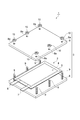
- FIG. 1 is an exploded perspective view showing a secondary battery according to one embodiment.
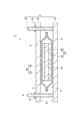
- 1 is a schematic cross-sectional view illustrating a secondary battery according to one embodiment.
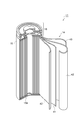
- FIG. 9 is a perspective view illustrating an overall configuration and an internal structure of a secondary battery according to another embodiment.
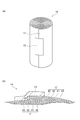
- 1A is a perspective view illustrating an electrode group according to an embodiment, and
- FIG. 2B is a schematic cross-sectional view illustrating a main part of the electrode group.
- ⁇ ⁇ The numerical values and ranges in this specification do not limit the present invention.
- a numerical range indicated by using “to” indicates a range including numerical values described before and after “to” as a minimum value and a maximum value, respectively.
- the upper limit or the lower limit described in one numerical range may be replaced with the upper limit or the lower limit described in another step.
- the upper limit or the lower limit of the numerical range may be replaced with the value shown in the embodiment.
- FIG. 1 is an exploded perspective view showing a secondary battery according to one embodiment.
- a secondary battery 1 according to one embodiment includes a laminated battery 2 and a sandwiching member 3 that sandwiches the laminated battery 2.
- the laminated battery 2 includes an electrode group 4 composed of a positive electrode, a negative electrode, and an electrolyte layer, and a bag-shaped battery case 5 that houses the electrode group 4.
- the positive electrode and the negative electrode are provided with a positive electrode current collecting tab 6 and a negative electrode current collecting tab 7, respectively.
- the positive electrode current collecting tab 6 and the negative electrode current collecting tab 7 protrude from the inside of the battery outer package 5 to the outside so that the positive electrode and the negative electrode can be electrically connected to the outside of the laminated battery 2 respectively.
- the battery case 5 may be formed of, for example, a laminate film.
- the laminated film may be, for example, a laminated film in which a polymer film such as a polyethylene terephthalate (PET) film, a metal foil such as aluminum, copper, and stainless steel, and a sealant layer such as polypropylene are laminated in this order.
- PET polyethylene terephthalate
- metal foil such as aluminum, copper, and stainless steel
- a sealant layer such as polypropylene
- the holding member 3 includes a pair of substrates 8, a screw (bolt) 9 for fastening the substrates 8, 8, and a nut 10.
- a plurality of screws 9 are attached to one substrate 8, and a plurality of holes 8 a into which the plurality of screws 9 can be inserted are formed in the other substrate 8.
- the nut 10 is screwed into the screw 9 inserted into the hole 8a, whereby the substrates 8, 8 are tightened.
- FIG. 2 is a schematic sectional view showing the secondary battery 1.
- the electrode group 4 in the laminated battery 2 includes a positive electrode 41, an electrolyte layer 42, and a negative electrode 43 in this order.
- the positive electrode 41 includes a positive electrode current collector 44 and a positive electrode mixture layer 45 provided on the positive electrode current collector 44.
- the negative electrode 43 includes a negative electrode current collector 46 and a negative electrode mixture layer 47 provided on the negative electrode current collector 46.
- the positive electrode current collector 44 may be formed of aluminum, stainless steel, titanium, or the like. Specifically, the positive electrode current collector 44 may be, for example, an aluminum perforated foil having a hole diameter of 0.1 to 10 mm, an expanded metal, a foamed metal plate, or the like. In addition to the above, the positive electrode current collector 44 may be formed of any material as long as it does not cause a change such as dissolution and oxidation during use of the battery, and may have any shape, manufacturing method, and the like. Not restricted.
- the thickness of the positive electrode current collector 44 may be 10 ⁇ m or more, and may be 100 ⁇ m or less.
- the thickness of the positive electrode current collector 44 is preferably 10 ⁇ m or more and 50 ⁇ m or less from the viewpoint of reducing the volume of the entire positive electrode 41, and more preferably from the viewpoint of winding the positive electrode with a small curvature when forming a battery. 10 ⁇ m or more and 20 ⁇ m or less.
- the positive electrode mixture layer 45 contains a positive electrode active material and an ionic liquid.
- the positive electrode active material may be a lithium transition metal compound such as a lithium transition metal oxide and a lithium transition metal phosphate.
- the lithium transition metal oxide may be, for example, lithium manganate, lithium nickelate, lithium cobaltate, or the like.
- Lithium transition metal oxide a part of transition metal such as Mn, Ni, Co contained in lithium manganate, lithium nickelate, lithium cobaltate or the like, one or more other transition metals, or A lithium transition metal oxide substituted with a metal element (typical element) such as Mg or Al may be used. That is, the lithium transition metal oxide may be a compound represented by LiM 1 O 2 or LiM 1 O 4 (M 1 contains at least one transition metal).
- Lithium transition metal oxides specifically, Li (Co 1/3 Ni 1/3 Mn 1/3) O 2, LiNi 1/2 Mn 1/2 O 2, LiNi 1/2 Mn 3/2 O 4 or the like.
- the lithium transition metal oxide is preferably a compound represented by the following formula (1) from the viewpoint of further improving the energy density.
- the positive electrode active material may be ungranulated primary particles or granulated secondary particles.
- the particle size of the positive electrode active material is adjusted to be equal to or less than the thickness of the positive electrode mixture layer 45. If the positive electrode active material contains coarse particles having a particle size greater than or equal to the thickness of the positive electrode mixture layer 45, the coarse particles are removed in advance by sieving, airflow classification, or the like, and the particles having a thickness equal to or less than the thickness of the positive electrode mixture layer 45 are removed. A positive electrode active material having a diameter is selected.
- the average particle size of the positive electrode active material is preferably 0.1 ⁇ m or more, and more preferably 1 ⁇ m or more.
- the average particle size of the positive electrode active material is preferably 30 ⁇ m or less, and more preferably 25 ⁇ m or less.
- the average particle size of the positive electrode active material is a particle size (D 50 ) when the ratio (volume fraction) to the volume of the entire positive electrode active material is 50%.
- the average particle size (D 50 ) of the positive electrode active material is measured by using a laser scattering type particle size measuring device (for example, Microtrack) to measure the suspension of the positive electrode active material in water by a laser scattering method. It can be obtained by:
- the content of the positive electrode active material may be 70% by mass or more, 80% by mass or more, or 90% by mass or more based on the total amount of the positive electrode mixture layer.
- the content of the positive electrode active material may be 99% by mass or less based on the total amount of the positive electrode mixture layer.
- the ionic liquid contains the following anion component and cation component. Note that the ionic liquid in the present embodiment is a substance that is liquid at ⁇ 20 ° C. or higher.
- the anionic component of the ionic liquid is not particularly limited, but an anion of a halogen such as Cl ⁇ , Br ⁇ , or I ⁇ , an inorganic anion such as BF 4 ⁇ or N (SO 2 F) 2 — or B (C 6 H 5 ) 4 -, CH 3 SO 2 O -, CF 3 SO 2 O -, N (SO 2 C 4 F 9) 2 -, N (SO 2 CF 3) 2 -, N (SO 2 C 2 F 5) 2 - And the like.
- the anionic component of the ionic liquid preferably contains at least one anionic component represented by the following formula (I).
- m and n each independently represent an integer of 0 to 5.
- m and n may be the same or different from each other, and are preferably the same as each other.
- the anion components represented by the formula (I) include, for example, N (SO 2 C 4 F 9 ) 2 ⁇ , N (SO 2 F) 2 ⁇ , N (SO 2 CF 3 ) 2 ⁇ and N (SO 2 C 2 F 5) 2 - a.
- the anionic component of the ionic liquid is more preferably N (SO 2 C 4 F 9 ) 2 ⁇ , CF 3 SO from the viewpoint of further improving the ion conductivity at a relatively low viscosity and further improving the charge / discharge characteristics.
- [FSI] ⁇ N (SO 2 F) 2 ⁇ , bis (fluorosulfonyl) imide anion [TFSI] ⁇ : N (SO 2 CF 3 ) 2 ⁇ , bis (trifluoromethanesulfonyl) imide anion [BOB] ⁇ : B (O 2 C 2 O 2 ) 2 ⁇ , bisoxalate borate anion [f3C] ⁇ : C (SO 2 F) 3 ⁇ , tris (fluorosulfonyl) carbanion
- the cation component of the ionic liquid is preferably at least one selected from the group consisting of chain quaternary onium cations, piperidinium cations, pyrrolidinium cations, pyridinium cations, and imidazolium cations.
- the chain quaternary onium cation is, for example, a compound represented by the following formula (II).
- R 11 to R 14 each independently represent a chain alkyl group having 1 to 20 carbon atoms or a chain alkoxyalkyl group represented by RO— (CH 2 ) n — ( R represents a methyl group or an ethyl group, n represents an integer of 1 to 4), and X represents a nitrogen atom or a phosphorus atom.
- the alkyl group represented by R 11 to R 14 preferably has 1 to 20, more preferably 1 to 10, and still more preferably 1 to 5 carbon atoms.
- the piperidinium cation is, for example, a nitrogen-containing six-membered cyclic compound represented by the following formula (III).
- R 15 and R 16 are each independently an alkyl group having 1 to 20 carbon atoms or an alkoxyalkyl group represented by RO— (CH 2 ) n — (R is a methyl group Or n represents an ethyl group, and n represents an integer of 1 to 4).
- the carbon number of the alkyl group represented by R 15 and R 16 is preferably 1 to 20, more preferably 1 to 10, and still more preferably 1 to 5.
- the pyrrolidinium cation is, for example, a five-membered cyclic compound represented by the following formula (IV).
- R 17 and R 18 are each independently an alkyl group having 1 to 20 carbon atoms or an alkoxyalkyl group represented by RO— (CH 2 ) n — (R is a methyl group Or n represents an ethyl group, and n represents an integer of 1 to 4).
- the carbon number of the alkyl group represented by R 17 and R 18 is preferably 1 to 20, more preferably 1 to 10, and still more preferably 1 to 5.
- the pyridinium cation is, for example, a compound represented by the following formula (V).
- R 19 to R 23 each independently represent an alkyl group having 1 to 20 carbon atoms, an alkoxyalkyl group represented by RO— (CH 2 ) n — (R represents a methyl group or Represents an ethyl group, and n represents an integer of 1 to 4) or a hydrogen atom.
- the alkyl group represented by R 19 to R 23 preferably has 1 to 20, more preferably 1 to 10, and still more preferably 1 to 5 carbon atoms.
- the imidazolium cation is, for example, a compound represented by the following formula (VI).
- R 24 ⁇ R 28 each independently represent an alkyl group having a carbon number of 1 ⁇ 20, R-O- ( CH 2) n - alkoxyalkyl group (R represented by a methyl group or Represents an ethyl group, and n represents an integer of 1 to 4) or a hydrogen atom.
- the carbon number of the alkyl group represented by R 24 to R 28 is preferably 1 to 20, more preferably 1 to 10, and still more preferably 1 to 5.
- the content of the ionic liquid is preferably 3% by mass or more, more preferably 5% by mass or more, and further preferably 10% by mass or more, based on the total amount of the positive electrode mixture layer.
- the content of the ionic liquid is preferably 30% by mass or less, more preferably 25% by mass or less, and still more preferably 20% by mass or less, based on the total amount of the positive electrode mixture layer.
- the positive electrode mixture layer 45 may further contain a conductive material, a binder and the like.
- the conductive material is not particularly limited, but may be a carbon material such as graphite, acetylene black, carbon black, carbon fiber, carbon nanotube, or the like.
- the conductive material may be a mixture of two or more of the above-described carbon materials.
- the content of the conductive material may be 0.1% by mass or more, 1% by mass or more, or 3% by mass or more, 15% by mass or less, 10% by mass or less, or 8% by mass based on the total amount of the positive electrode mixture layer. % By mass or less.
- the binder is not particularly limited, and contains, as monomer units, at least one selected from the group consisting of ethylene tetrafluoride, vinylidene fluoride, hexafluoropropylene, acrylic acid, maleic acid, ethyl methacrylate, and methyl methacrylate. It may be a rubber such as a polymer, styrene-butadiene rubber, isoprene rubber, and acrylic rubber.
- the binder is preferably a copolymer containing ethylene tetrafluoride and vinylidene fluoride as structural units, or a copolymer containing vinylidene fluoride and hexafluoropropylene as structural units.
- the content of the binder may be 0.5% by mass or more, 1% by mass or more, or 3% by mass or more based on the total amount of the positive electrode mixture layer.
- the content of the binder may be 20% by mass or less, 15% by mass or less, or 10% by mass or less based on the total amount of the positive electrode mixture layer.
- An electrolyte salt may be dissolved in the ionic liquid.
- the electrolyte salt may be at least one selected from the group consisting of a lithium salt, a sodium salt, a calcium salt, and a magnesium salt.
- the anion components of the electrolyte salt include halide ions (I ⁇ , Cl ⁇ , Br ⁇ , etc.), SCN ⁇ , BF 4 ⁇ , BF 3 (CF 3 ) ⁇ , BF 3 (C 2 F 5 ) ⁇ , PF 6 ⁇ , ClO 4 ⁇ , SbF 6 ⁇ , N (SO 2 F) 2 ⁇ , N (SO 2 CF 3 ) 2 ⁇ , N (SO 2 C 2 F 5 ) 2 ⁇ , B (C 6 H 5 ) 4 ⁇ , B (O 2 C 2 H 4 ) 2 ⁇ , C (SO 2 F) 3 ⁇ , C (SO 2 CF 3 ) 3 ⁇ , CF 3 COO ⁇ , CF 3 SO 2 O ⁇ , C 6 F 5 SO 2 O — , B (O 2 C 2 O 2 ) 2 — and the like.
- halide ions I ⁇ , Cl ⁇ , Br
- the anion component of the electrolyte salt is preferably an anion component represented by the above formula (I) such as N (SO 2 F) 2 ⁇ , N (SO 2 CF 3 ) 2 ⁇ , PF 6 ⁇ , BF 4 ⁇ , B (O 2 C 2 O 2 ) 2 ⁇ , or ClO 4 — .
- Lithium salt LiPF 6, LiBF 4, Li [FSI], Li [TFSI], Li [f3C], Li [BOB], LiClO 4, LiBF 3 (CF 3), LiBF 3 (C 2 F 5), LiBF 3 (C 3 F 7 ), LiBF 3 (C 4 F 9 ), LiC (SO 2 CF 3 ) 3 , LiCF 3 SO 2 O, LiCF 3 COO, and LiRCOO (R is an alkyl group having 1 to 4 carbon atoms) , A phenyl group or a naphthyl group.).
- Calcium salts include Ca (PF 6 ) 2 , Ca (BF 4 ) 2 , Ca [FSI] 2 , Ca [TFSI] 2 , Ca [f3C] 2 , Ca [BOB] 2 , Ca (ClO 4 ) 2 , Ca [BF 3 (CF 3 )] 2 , Ca [BF 3 (C 2 F 5 )] 2 , Ca [BF 3 (C 3 F 7 )] 2 , Ca [BF 3 (C 4 F 9 )] 2 , Ca [C (SO 2 CF 3 ) 3 ] 2 , Ca (CF 3 SO 2 O) 2 , Ca (CF 3 COO) 2 and Ca (RCOO) 2 (R is an alkyl group having 1 to 4 carbon atoms, phenyl Or a naphthyl group).
- Magnesium salts include Mg (PF 6 ) 2 , Mg (BF 4 ) 2 , Mg [FSI] 2 , Mg [TFSI] 2 , Mg [f3C] 2 , Mg [BOB] 2 , Na (ClO 4 ) 2 , Mg [BF 3 (CF 3)] 2, Mg [BF 3 (C 2 F 5)] 2, Mg [BF 3 (C 3 F 7)] 2, Mg [BF 3 (C 4 F 9)] 2, Mg [C (SO 2 CF 3 ) 3 ] 2 , Mg (CF 3 SO 3 ) 2 , Mg (CF 3 COO) 2 , and Mg (RCOO) 2 (R is an alkyl group having 1 to 4 carbon atoms, a phenyl group Or a naphthyl group.).
- the electrolyte salt is preferably LiPF 6 , LiBF 4 , Li [FSI], Li [TFSI], Li [f3C], Li [BOB], or LiClO 4.
- LiRCOO R is an alkyl group having 1 to 4 carbon atoms, a phenyl group or a naphthyl group
- the thickness of the positive electrode mixture layer 45 may be 10 ⁇ m or more, 15 ⁇ m or more, or 20 ⁇ m or more.
- the thickness of the positive electrode mixture layer 45 may be 100 ⁇ m or less, 80 ⁇ m or less, or 70 ⁇ m or less.
- the negative electrode current collector 46 may be a metal such as aluminum, copper, nickel, and stainless steel, or an alloy thereof.
- the negative electrode current collector 46 is preferably aluminum and its alloy because it is lightweight and has a high weight energy density.
- the negative electrode current collector 46 is preferably made of copper from the viewpoint of ease of processing into a thin film and cost.
- the thickness of the negative electrode current collector 46 may be 10 ⁇ m or more, and may be 100 ⁇ m or less.
- the thickness of the negative electrode current collector 46 is preferably 10 ⁇ m or more and 50 ⁇ m or less from the viewpoint of reducing the volume of the entire negative electrode, and more preferably 10 ⁇ m from the viewpoint of winding the negative electrode with a small curvature when forming a battery. Not less than 20 ⁇ m.
- the negative electrode mixture layer 47 contains a negative electrode active material and an ionic liquid.
- the negative electrode active material those commonly used in the field of energy devices can be used.
- the negative electrode active material include lithium metal, lithium titanate (Li 4 Ti 5 O 12 ), a lithium alloy or another metal compound, a carbon material, a metal complex, and an organic polymer compound.
- the negative electrode active material may be one of these alone or a mixture of two or more thereof.
- the carbon material include natural graphite (flaky graphite, etc.), graphite such as artificial graphite (graphite), amorphous carbon, carbon fiber, acetylene black, Ketjen black, channel black, furnace black, lamp black, and thermal black. And the like. From the viewpoint of obtaining a larger theoretical capacity (for example, 500 to 1500 Ah / kg), the negative electrode active material may be silicon, tin, or a compound containing these elements (oxide, nitride, alloy with another metal). Good.
- the average particle size (D 50 ) of the negative electrode active material is preferably 1 ⁇ m or more from the viewpoint of obtaining a well-balanced negative electrode having an increased irreversible capacity due to a decrease in particle size and an increased ability to retain an electrolyte salt. And more preferably 5 ⁇ m or more, further preferably 10 ⁇ m or more, and preferably 50 ⁇ m or less, more preferably 40 ⁇ m or less, and still more preferably 30 ⁇ m or less.
- the average particle size of the negative electrode active material (D 50) is measured in the same manner as the average particle diameter of the above-mentioned positive electrode active material (D 50).
- the content of the negative electrode active material may be 60% by mass or more, 65% by mass or more, or 70% by mass or more based on the total amount of the negative electrode mixture layer.
- the content of the negative electrode active material may be 99% by mass or less, 95% by mass or less, or 90% by mass or less based on the total amount of the negative electrode mixture layer.
- the ionic liquid may be the ionic liquid described above as the ionic liquid contained in the positive electrode mixture layer 45.
- the content of the ionic liquid is preferably 3% by mass or more, more preferably 5% by mass or more, and still more preferably 10% by mass or more, based on the total amount of the negative electrode mixture layer.
- the content of the ionic liquid is preferably 30% by mass or less, more preferably 25% by mass or less, and still more preferably 20% by mass or less, based on the total amount of the negative electrode mixture layer.
- An electrolyte salt similar to the electrolyte salt that can be used for the positive electrode mixture layer 45 described above may be dissolved in the ionic liquid.
- the negative electrode mixture layer 47 may further contain a conductive material, a binder, and the like that can be used for the positive electrode mixture layer 45 described above.
- the contents of the conductive material and the binder contained in the negative electrode mixture layer 47 may be the same as the contents of the conductive material and the binder in the positive electrode mixture layer 45 described above.
- the thickness of the negative electrode mixture layer 47 may be 10 ⁇ m or more, 15 ⁇ m or more, or 20 ⁇ m or more.
- the thickness of the negative electrode mixture layer 47 may be 100 ⁇ m or less, 80 ⁇ m or less, or 70 ⁇ m or less.
- the electrolyte layer 42 includes, in one embodiment, a polymer, oxide particles, an electrolyte salt, and an ionic liquid.
- the polymer preferably has a first structural unit selected from the group consisting of ethylene tetrafluoride and vinylidene fluoride.
- the polymer is preferably one or more polymers, and among the structural units constituting the one or more polymers, the first structural unit includes hexafluoropropylene, acrylic acid, and maleic acid.
- a second structural unit selected from the group consisting of an acid, ethyl methacrylate, and methyl methacrylate may be included. That is, the first structural unit and the second structural unit may be included in one kind of polymer to constitute a copolymer, and each of the first structural unit and the second structural unit may be included in another polymer and have the first structural unit having the first structural unit. And a second polymer having a second structural unit.
- the polymer may be polytetrafluoroethylene, polyvinylidene fluoride, a copolymer of vinylidene fluoride and hexafluoropropylene, or the like.
- the content of the polymer is preferably 3% by mass or more based on the total amount of the electrolyte layer.
- the content of the polymer is preferably 50% by mass or less, more preferably 40% by mass or less, based on the total amount of the electrolyte layer.
- the content of the polymer is preferably 3 to 50% by mass, or 3 to 40% by mass, based on the total amount of the electrolyte layer.
- the polymer Since the polymer has excellent affinity with the ionic liquid contained in the electrolyte layer 42, the polymer can suitably hold the ionic liquid, and as a result, the electrolyte salt in the ionic liquid can also be held. Thereby, leakage of the ionic liquid when a load is applied to the electrolyte layer 42 is suppressed.
- the oxide particles are, for example, particles of an inorganic oxide.
- the inorganic oxide is an inorganic oxide containing, for example, Li, Mg, Al, Si, Ca, Ti, Zr, La, Na, K, Ba, Sr, V, Nb, B, Ge, or the like as a constituent element. Good.
- the oxide particles are preferably at least one selected from the group consisting of SiO 2 , Al 2 O 3 , AlOOH, MgO, CaO, ZrO 2 , TiO 2 , Li 7 La 3 Zr 2 O 12 , and BaTiO 3 . Particles. Since the oxide particles have polarity, dissociation of the electrolyte salt in the electrolyte layer 42 can be promoted, and battery characteristics can be improved.
- the oxide particles may be a rare earth metal oxide.
- the oxide particles include scandium oxide, yttrium oxide, lanthanum oxide, cerium oxide, praseodymium oxide, neodymium oxide, samarium oxide, eurobium oxide, gadolinium oxide, terbium oxide, dysprosium oxide, holmium oxide, erbium oxide, and oxide oxide. It may be thulium, ytterbium oxide, lutetium oxide, or the like.
- the specific surface area of the oxide particles is preferably 5 m 2 / g or more, 10 m 2 / g or more, or 15 m 2 / g or more, and more preferably 100 m 2 / g, from the viewpoint of excellent discharge characteristics of the secondary battery.
- it is 80 m ⁇ 2 > / g or less, or 60 m ⁇ 2 > / g or less.
- the specific surface area of the oxide particles means the specific surface area of the entire oxide particles including the primary particles and the secondary particles, and is measured by a BET method.
- the average particle size of the oxide particles is preferably 0.005 ⁇ m or more, more preferably 0.01 ⁇ m or more, and further preferably 0.03 ⁇ m or more.
- the average particle size of the oxide particles is preferably 5 ⁇ m or less, more preferably 3 ⁇ m or less, and still more preferably 1 ⁇ m or less.
- the average particle size of the oxide particles is measured by a laser diffraction method, and corresponds to a particle size at which the volume accumulation becomes 50% when a volume accumulation particle size distribution curve is drawn from the small particle size side.
- the content of the oxide particles is preferably 5% by mass or more, more preferably 10% by mass or more, still more preferably 15% by mass or more, particularly preferably 20% by mass or more, based on the total amount of the electrolyte layer. It is preferably at most 60% by mass, more preferably at most 50% by mass, even more preferably at most 40% by mass.
- the electrolyte salt may be at least one selected from the group consisting of lithium salt, sodium salt, calcium salt and magnesium salt.
- the electrolyte salt may be the same as the electrolyte salt that can be used for the positive electrode mixture layer 45 and the negative electrode mixture layer 47.
- the ionic liquid may be the ionic liquid described above as the ionic liquid contained in the positive electrode mixture layer 45.
- An electrolyte salt may be dissolved in the ionic liquid.
- the concentration of the electrolyte salt per unit volume of the ionic liquid is preferably 0.5 mol / L or more, more preferably 0.7 mol / L or more, and still more preferably 0.8 mol / L, from the viewpoint of further improving the charge / discharge characteristics. It is preferably 2.0 mol / L or less, more preferably 1.8 mol / L or less, and still more preferably 1.5 mol / L or less.
- the content of the ionic liquid may be 10% by mass or more and 80% by mass or less based on the total amount of the electrolyte layer from the viewpoint of suitably producing the electrolyte layer 42.
- the total content of the electrolyte salt and the ionic liquid is preferably 10% by mass or more, more preferably 10% by mass or more, based on the total amount of the electrolyte layer, from the viewpoint of further improving the conductivity and suppressing a decrease in the capacity of the secondary battery. Is at least 25% by mass, more preferably at least 40% by mass.
- the total content of the electrolyte salt and the ionic liquid is preferably 80% by mass or less, based on the total amount of the electrolyte layer, from the viewpoint of suppressing a decrease in the strength of the electrolyte layer.
- the thickness of the electrolyte layer 42 is preferably 5 ⁇ m or more, more preferably 10 ⁇ m or more, from the viewpoint of increasing strength and improving safety.
- the thickness of the electrolyte layer 42 is preferably 200 ⁇ m or less, more preferably 150 ⁇ m or less, and still more preferably 100 ⁇ m or less, from the viewpoint of further reducing the internal resistance of the secondary battery and further improving the large current characteristics.
- the clamping members 3 clamp the laminated battery 2 by tightening the substrates 8 with the screws 9 and the nuts 10.
- the positive electrode 41, the electrolyte layer 42, and the negative electrode 43 in the laminated battery 2 are in a pressurized state pressed in the stacking direction D1, and the holding member 3 functions as a holding unit that holds the pressurized state. I do.
- the positive electrode 41, the electrolyte layer 42, and the negative electrode 43 may have a pressure of, for example, 0.1 MPa or more, and are preferably 0.2 MPa or more, 0.4 MPa or more, from the viewpoint of further improving initial characteristics.
- a pressure of 0.5 MPa or more, more preferably 0.7 MPa or more, 0.8 MPa or more, 0.9 MPa or more, or 1.0 MPa or more is applied.
- the pressurized state of the positive electrode 41, the electrolyte layer 42, and the negative electrode 43 is held by the sandwiching member 3 (holding means), so that the positive electrode 41 (the positive electrode mixture layer 45) and the electrolyte layer 42
- the interface and the interface between the negative electrode 43 (negative electrode mixture layer 47) and the electrolyte layer 42 are formed well (adhesion at the interface is improved), and as a result, the secondary battery 1 (laminated battery 2) having excellent initial characteristics is obtained. ) Is considered to be obtained.
- the holding member 3 functions as a holding unit.
- a thermoplastic resin, a thermosetting resin, or the like may be used as the holding unit.
- a resin material such as a resin and a photocurable resin can be used.
- the pressurized state of the positive electrode 41, the electrolyte layer 42, and the negative electrode 43 may be maintained.
- the pressurized state of the positive electrode 41, the electrolyte layer 42, and the negative electrode 43 may be maintained by, for example, arranging and solidifying a resin material so as to cover the entire laminated battery 2.
- FIG. 3 is a perspective view showing the overall configuration and internal structure of a secondary battery according to another embodiment.
- the secondary battery 11 includes an electrode group 14, a cylindrical battery container 15 that houses the electrode group 14 and has an open top surface, and a lid 16 that closes the opening of the battery container 15.
- It is a secondary battery of a round type (also called a 18650 type or a cylindrical type).
- the electrode group 14 includes a long positive electrode 41, an electrolyte layer 42, and a negative electrode 43 in this order.
- An insulating coating (not shown) is provided on the entire outer peripheral surface of the electrode group 14.
- the battery container 15 may be, for example, a nickel-plated steel container.
- the lid 16 is caulked and fixed to the upper part of the battery container 15 via, for example, an insulating resin gasket.
- the positive electrode 41 and the negative electrode 43 are provided with a positive electrode current collecting tab and a negative electrode current collecting tab (not shown) so that the positive electrode 41 and the negative electrode 43 can be electrically connected to the outside of the secondary battery 11, respectively.
- One end of the positive electrode current collection tab is joined to the lower surface of the lid 16 of the secondary battery 11 by, for example, ultrasonic welding.
- One end of the negative electrode current collecting tab is joined to the inner bottom portion 15a of the battery container 15 by, for example, resistance welding.
- the positive current collecting tab is formed of aluminum and the negative current collecting tab is formed of copper.
- FIG. 4 (a) is a perspective view showing the electrode group 14 shown in FIG. 3, and FIG. 4 (b) is a schematic sectional view showing a main part of the electrode group 14.
- the electrode group 14 is formed by spirally winding a long laminate 17.
- the laminate 17 includes, for example, an electrolyte layer 42, a positive electrode 41, an electrolyte layer 42, and a negative electrode 43 in this order from the inside of the spiral.
- a fixing member 13 for fixing the front end of the stacked body 17 to the stacked body 17 located immediately below is provided.
- the fixing member 13 may be a stickable member such as an adhesive tape, for example, or may be a member obtained by solidifying a resin material such as a thermoplastic resin, a thermosetting resin, and a photocurable resin.
- the fixing member 13 functions as a holding unit that holds the stacked body 17 in a pressurized state by fixing the front end of the stacked body 17.
- the manufacturing method includes a pressing step of pressing a stacked body including the positive electrode 41, the electrolyte layer 42, and the negative electrode 43 in this order in a stacking direction, and a holding unit that holds a pressed state of the pressed stacked body. And a holding step of providing.
- the laminate includes a positive electrode 41 obtained by forming a positive electrode mixture layer 45 on a positive electrode current collector 44 and a negative electrode composite on a negative electrode current collector 46. It is produced by providing the electrolyte layer 42 between the negative electrode 43 obtained by forming the agent layer 47.
- the laminate is obtained, for example, in the same manner as described above, with the first laminate in which the electrolyte layer 42 is laminated on the positive electrode 41 obtained in the same manner as described above.
- the second laminate in which the electrolyte layer 42 is laminated on the negative electrode 43 is further laminated so that the positive electrode 41 in the first laminate and the electrolyte layer 42 in the second laminate are in contact with each other. .
- the positive electrode mixture layer 45 is formed, for example, by applying a slurry-like positive electrode mixture in which the above-described material used for the positive electrode mixture layer 45 is dispersed in a dispersion medium to one surface of the positive electrode current collector 44. Thereafter, it is obtained by volatilizing the dispersion medium (the same applies to the negative electrode mixture layer 47).
- the dispersion medium may be, for example, an organic solvent such as N-methyl-2-pyrrolidone.
- the electrolyte layer 42 is provided on the positive electrode 41, the negative electrode 43, or between the positive electrode 41 and the negative electrode 43 after being formed in advance on the sheet-like electrolyte layer.
- an electrolyte slurry in which the above-described material used for the electrolyte layer is dispersed in a dispersion medium is applied on a substrate, and then the dispersion medium is volatilized to obtain a sheet-like electrolyte layer.
- the dispersion medium may be, for example, water, NMP, toluene and the like.
- the electrolyte layer By pressing this electrolyte layer in a state where it is overlapped so as to be in contact with the positive electrode mixture layer 45 and / or the negative electrode mixture layer 47, the electrolyte is formed on the positive electrode 41, the negative electrode 43, or between the positive electrode 41 and the negative electrode 43.
- a layer 42 can be provided.
- the electrolyte layer 42 is formed by applying an electrolyte slurry in which the above-described material used for the electrolyte layer is dispersed in a dispersion medium to the positive electrode mixture layer 45 and / or the negative electrode mixture layer 47 and drying the mixture. Obtained by:
- the content of the polymer in the electrolyte slurry may be 3% by mass or more, or 50% by mass or less or 40% by mass based on the total amount of non-volatile components (components excluding the dispersion medium from the electrolyte slurry) in the electrolyte slurry. %.
- the content of the oxide particles in the electrolyte slurry may be 5% by mass or more, 10% by mass or more, 15% by mass or more, or 20% by mass or more, based on the total amount of nonvolatile components in the electrolyte slurry, It may be 60% by mass or less, 50% by mass or less, or 40% by mass or less.
- the total content of the ionic liquid and the electrolyte salt in the electrolyte slurry may be 90% by mass or less, 85% by mass or less, or 80% by mass or less based on the total amount of nonvolatile components in the electrolyte slurry.
- the content of the dispersion medium in the electrolyte slurry may be, for example, 5 parts by mass or more and 1000 parts by mass or less based on 100 parts by mass of the nonvolatile components in the electrolyte slurry.
- the pressing step pressure is applied in the stacking direction of the stacked body.
- the laminates the positive electrode 41
- the sandwiching members 3 by clamping the substrates 8, 8 with the screws 9 and the nuts 10.
- the electrolyte layer 42 and the negative electrode 43 are pressed in the stacking direction D1.
- the laminate 17 when the laminate 17 is wound into a spiral shape, by applying a winding tension, the laminate 17 (the electrolyte layer 42, the positive electrode 41, the electrolyte The layer 42 and the negative electrode 43) are pressed in the stacking direction D2.
- the pressure in the pressurizing step may be, for example, 0.1 MPa or more, from the viewpoint of further improving the initial characteristics of the secondary battery, preferably 0.2 MPa or more, 0.4 MPa or more, or 0.5 MPa or more, More preferably, it is 0.7 Mpa or more, 0.8 MPa or more, 0.9 MPa or more, or 1.0 MPa or more.
- a holding means for holding the pressure applied in the pressing step is provided.
- the pressurized state of the laminate is maintained by maintaining the state. That is, in the manufacture of the secondary battery 1 shown in FIGS. 1 and 2, the pressurizing step and the holding step are performed substantially continuously (substantially simultaneously).
- the tip of the stacked body 17 is fixed by the fixing member 13, so that the stacked body 17 is applied. Maintain pressure state.
- the method for manufacturing a secondary battery preferably further includes a step of heating the laminate after the holding step, from the viewpoint of further improving the initial characteristics of the secondary battery.
- the laminate is heated while maintaining the pressurized state, so that the interface between the positive electrode 41 (the positive electrode mixture layer 45) and the electrolyte layer 42, and the negative electrode 43 (the negative electrode mixture layer 47) and the electrolyte layer It is considered that the interface with the interface 42 is formed more favorably (adhesion at the interface is further improved).
- the heating temperature in the heating step is preferably 25 ° C. or higher, more preferably 40 ° C. or higher, still more preferably 50 ° C. or higher, and particularly preferably 60 ° C. or higher, from the viewpoint of improving the discharge characteristics of the secondary battery.
- the heating temperature in the heating step may be, for example, 100 ° C. or lower, and is preferably 90 ° C. or lower, more preferably 80 ° C. or lower, from the viewpoint of improving the discharge characteristics of the secondary battery.
- Example 1 ⁇ Preparation of positive electrode> 79.6 parts by mass of layered lithium-nickel-manganese-cobalt composite oxide (positive electrode active material), acetylene black (conductive material, average particle size 48 nm, specific surface area 39 m 2 / g, manufactured by Denka Corporation, trade name: HS-100) 3.87 parts by mass, acetylene black (conductive material, average particle size 23 nm, specific surface area 133 m 2 / g, manufactured by Denka Corporation) 0.43 parts by mass, copolymer of vinylidene fluoride and hexafluoropropylene (Binder) 2.1 parts by mass and an ionic liquid (N-methyl-N-propylpyrrolidinium bis) in which lithium salt (lithium bis (fluoromethanesulfonyl) imide (LiFSI)) is dissolved at 1 mol / L.
- positive electrode active material positive electrode active material
- acetylene black conductive material
- This negative electrode mixture was coated on a negative electrode current collector (a copper foil having a thickness of 10 ⁇ m) at a coating amount of 73 g / m 2 , and heated at 80 ° C. to volatilize the dispersion medium. Then, the mixture was compacted to a mixture density of 1.90 g / cm 3 by pressing to form a negative electrode mixture layer (thickness: 38 ⁇ m). The obtained laminate was punched into a square of 3.1 cm ⁇ 4.6 cm to obtain a negative electrode.
- a negative electrode current collector a copper foil having a thickness of 10 ⁇ m 2
- ⁇ Preparation of electrolyte layer 40 parts by mass of SiO 2 particles (average particle size 0.04 ⁇ m, specific surface area 50 m 2 / g) and 60 parts by mass of a copolymer of vinylidene fluoride and hexafluoropropylene are mixed, and then NMP as a dispersion medium is added. Then, a mixture of SiO 2 particles and a copolymer was obtained by kneading. LiFSI (electrolyte salt) dried under a dry argon atmosphere was dissolved in Py13-FSI (ionic liquid) at a concentration of 1.5 mol / L.
- a mixture of SiO 2 particles and a copolymer was mixed with an ionic liquid in which an electrolyte salt was dissolved to prepare an electrolyte slurry.
- the obtained slurry was applied to a polyethylene terephthalate base material (thickness: 40 ⁇ m) and heated to evaporate the dispersion medium to obtain an electrolyte layer (electrolyte sheet).
- the thickness of the obtained electrolyte layer was 20 ⁇ 5 ⁇ m.
- a laminate was prepared by laminating the positive electrode, the electrolyte layer, and the negative electrode produced in the above order in this order.
- This laminate was placed in an aluminum laminate container (product name: aluminum laminate film, manufactured by Dai Nippon Printing Co., Ltd.), and the laminate container was evacuated and thermally welded to produce a laminate type battery for evaluation.
- ⁇ Pressure of laminated battery> The laminated battery manufactured as described above is clamped by a clamping member (made of SUS) as shown in FIG. 1, a pressure of 0.14 MPa is applied at 25 ° C. in a lamination direction of the laminate, and the battery is tightened with a screw and a nut. A secondary battery in which the state was maintained was obtained. At this time, in order to prevent a short circuit of the secondary battery, the current collecting tab was prevented from directly contacting the holding member. Note that a spring was arranged between the substrate and the nut of the holding member, and the magnitude of the pressure was adjustable.
- Examples 2 to 9 A secondary battery was fabricated in the same manner as in Example 1, except that the pressure during pressurization was changed to the pressure shown in Table 1.
- Example 10 to 13 A secondary battery was fabricated in the same manner as in Example 5, except that the laminated battery was sandwiched between sandwiching members and the pressurized state was maintained, and the secondary battery was heated at the temperature shown in Table 1 for 30 minutes.
- 1,11 secondary battery, 3,13 holding means 41 positive electrode, 42 electrolyte layer, 43 negative electrode, 44 positive electrode current collector, 45 positive electrode mixture layer, 46 negative electrode current collector, 47 ... Negative electrode mixture layer.
Landscapes
- Chemical & Material Sciences (AREA)
- Chemical Kinetics & Catalysis (AREA)
- Electrochemistry (AREA)
- General Chemical & Material Sciences (AREA)
- Engineering & Computer Science (AREA)
- Manufacturing & Machinery (AREA)
- Physics & Mathematics (AREA)
- Condensed Matter Physics & Semiconductors (AREA)
- General Physics & Mathematics (AREA)
- Inorganic Chemistry (AREA)
- Dispersion Chemistry (AREA)
- Materials Engineering (AREA)
- Secondary Cells (AREA)
- Battery Electrode And Active Subsutance (AREA)
- Battery Mounting, Suspending (AREA)
Abstract
Un aspect de la présente invention concerne une batterie secondaire dotée d'une électrode positive, d'une couche électrolytique et d'une électrode négative, dans laquelle : l'électrode positive, la couche électrolytique et l'électrode négative sont empilées dans cet ordre et sont dans un état d'application de pression dans lequel une pression est appliquée dans la direction empilée ; et la batterie secondaire est en outre dotée d'un moyen de maintien destiné à maintenir l'état d'application de pression.
Priority Applications (1)
| Application Number | Priority Date | Filing Date | Title |
|---|---|---|---|
| JP2020527521A JP7546910B2 (ja) | 2018-06-26 | 2019-06-24 | 二次電池及びその製造方法 |
Applications Claiming Priority (2)
| Application Number | Priority Date | Filing Date | Title |
|---|---|---|---|
| JP2018121166 | 2018-06-26 | ||
| JP2018-121166 | 2018-06-26 |
Publications (1)
| Publication Number | Publication Date |
|---|---|
| WO2020004343A1 true WO2020004343A1 (fr) | 2020-01-02 |
Family
ID=68985056
Family Applications (1)
| Application Number | Title | Priority Date | Filing Date |
|---|---|---|---|
| PCT/JP2019/024991 Ceased WO2020004343A1 (fr) | 2018-06-26 | 2019-06-24 | Batterie secondaire et procédé de fabrication associé |
Country Status (3)
| Country | Link |
|---|---|
| JP (1) | JP7546910B2 (fr) |
| TW (1) | TW202002383A (fr) |
| WO (1) | WO2020004343A1 (fr) |
Cited By (5)
| Publication number | Priority date | Publication date | Assignee | Title |
|---|---|---|---|---|
| JP2023501632A (ja) * | 2020-02-13 | 2023-01-18 | エルジー エナジー ソリューション リミテッド | 二次電池の加圧装置および加圧方法 |
| CN115842134A (zh) * | 2022-12-28 | 2023-03-24 | 河北远拓嘉诚新能源科技有限公司 | 一种固体电池集流体及制造方法、固体电池及制造方法 |
| JP2023536129A (ja) * | 2021-04-09 | 2023-08-23 | エルジー エナジー ソリューション リミテッド | 全固体電池の製造方法及びこれによる全固体電池 |
| WO2024014476A1 (fr) * | 2022-07-13 | 2024-01-18 | 株式会社小松製作所 | Procédé de production d'un dispositif de stockage d'énergie au lithium-ion et dispositif de stockage d'énergie au lithium-ion |
| WO2024053717A1 (fr) * | 2022-09-08 | 2024-03-14 | 株式会社小松製作所 | Procédé de fabrication de condensateur au lithium-ion |
Citations (9)
| Publication number | Priority date | Publication date | Assignee | Title |
|---|---|---|---|---|
| JP2001210370A (ja) * | 2000-01-27 | 2001-08-03 | Sony Corp | ゲル電解質電池の製造方法 |
| JP2003257476A (ja) * | 2002-02-27 | 2003-09-12 | Fuji Photo Film Co Ltd | 電解質組成物および非水電解質二次電池 |
| JP2008103284A (ja) * | 2006-10-20 | 2008-05-01 | Idemitsu Kosan Co Ltd | 全固体電池 |
| WO2010090253A1 (fr) * | 2009-02-09 | 2010-08-12 | コニカミノルタホールディングス株式会社 | Dispositif d'éclairage en feuille |
| WO2011052094A1 (fr) * | 2009-11-02 | 2011-05-05 | トヨタ自動車株式会社 | Procédé de fabrication d'une batterie à électrolyte solide |
| WO2014007232A1 (fr) * | 2012-07-04 | 2014-01-09 | 株式会社カネカ | Batterie secondaire à électrolyte non aqueux, module de batterie secondaire, et procédé d'utilisation de batterie secondaire à électrolyte non aqueux |
| WO2018025582A1 (fr) * | 2016-08-04 | 2018-02-08 | パナソニックIpマネジメント株式会社 | Matériau d'électrolyte solide, et cellule |
| WO2018221669A1 (fr) * | 2017-06-01 | 2018-12-06 | 日立化成株式会社 | Composition d'électrolyte et batterie rechargeable |
| WO2018221668A1 (fr) * | 2017-06-01 | 2018-12-06 | 日立化成株式会社 | Composition d'électrolyte et batterie rechargeable |
Family Cites Families (2)
| Publication number | Priority date | Publication date | Assignee | Title |
|---|---|---|---|---|
| JP2008130229A (ja) * | 2006-11-16 | 2008-06-05 | National Institute Of Advanced Industrial & Technology | リチウム二次電池 |
| WO2011037060A1 (fr) * | 2009-09-24 | 2011-03-31 | コニカミノルタホールディングス株式会社 | Composition électrolyte et batterie secondaire au lithium-ion |
-
2019
- 2019-06-24 WO PCT/JP2019/024991 patent/WO2020004343A1/fr not_active Ceased
- 2019-06-24 JP JP2020527521A patent/JP7546910B2/ja active Active
- 2019-06-26 TW TW108122257A patent/TW202002383A/zh unknown
Patent Citations (9)
| Publication number | Priority date | Publication date | Assignee | Title |
|---|---|---|---|---|
| JP2001210370A (ja) * | 2000-01-27 | 2001-08-03 | Sony Corp | ゲル電解質電池の製造方法 |
| JP2003257476A (ja) * | 2002-02-27 | 2003-09-12 | Fuji Photo Film Co Ltd | 電解質組成物および非水電解質二次電池 |
| JP2008103284A (ja) * | 2006-10-20 | 2008-05-01 | Idemitsu Kosan Co Ltd | 全固体電池 |
| WO2010090253A1 (fr) * | 2009-02-09 | 2010-08-12 | コニカミノルタホールディングス株式会社 | Dispositif d'éclairage en feuille |
| WO2011052094A1 (fr) * | 2009-11-02 | 2011-05-05 | トヨタ自動車株式会社 | Procédé de fabrication d'une batterie à électrolyte solide |
| WO2014007232A1 (fr) * | 2012-07-04 | 2014-01-09 | 株式会社カネカ | Batterie secondaire à électrolyte non aqueux, module de batterie secondaire, et procédé d'utilisation de batterie secondaire à électrolyte non aqueux |
| WO2018025582A1 (fr) * | 2016-08-04 | 2018-02-08 | パナソニックIpマネジメント株式会社 | Matériau d'électrolyte solide, et cellule |
| WO2018221669A1 (fr) * | 2017-06-01 | 2018-12-06 | 日立化成株式会社 | Composition d'électrolyte et batterie rechargeable |
| WO2018221668A1 (fr) * | 2017-06-01 | 2018-12-06 | 日立化成株式会社 | Composition d'électrolyte et batterie rechargeable |
Cited By (8)
| Publication number | Priority date | Publication date | Assignee | Title |
|---|---|---|---|---|
| JP2023501632A (ja) * | 2020-02-13 | 2023-01-18 | エルジー エナジー ソリューション リミテッド | 二次電池の加圧装置および加圧方法 |
| JP7495068B2 (ja) | 2020-02-13 | 2024-06-04 | エルジー エナジー ソリューション リミテッド | 二次電池の加圧装置および加圧方法 |
| US12051773B2 (en) | 2020-02-13 | 2024-07-30 | Lg Energy Solution, Ltd. | Apparatus and method for pressing secondary battery |
| JP2023536129A (ja) * | 2021-04-09 | 2023-08-23 | エルジー エナジー ソリューション リミテッド | 全固体電池の製造方法及びこれによる全固体電池 |
| JP7531976B2 (ja) | 2021-04-09 | 2024-08-13 | エルジー エナジー ソリューション リミテッド | 全固体電池の製造方法及びこれによる全固体電池 |
| WO2024014476A1 (fr) * | 2022-07-13 | 2024-01-18 | 株式会社小松製作所 | Procédé de production d'un dispositif de stockage d'énergie au lithium-ion et dispositif de stockage d'énergie au lithium-ion |
| WO2024053717A1 (fr) * | 2022-09-08 | 2024-03-14 | 株式会社小松製作所 | Procédé de fabrication de condensateur au lithium-ion |
| CN115842134A (zh) * | 2022-12-28 | 2023-03-24 | 河北远拓嘉诚新能源科技有限公司 | 一种固体电池集流体及制造方法、固体电池及制造方法 |
Also Published As
| Publication number | Publication date |
|---|---|
| JPWO2020004343A1 (ja) | 2021-07-15 |
| TW202002383A (zh) | 2020-01-01 |
| JP7546910B2 (ja) | 2024-09-09 |
Similar Documents
| Publication | Publication Date | Title |
|---|---|---|
| JP5813800B2 (ja) | 非水電解質電池および電池パック | |
| JP7546910B2 (ja) | 二次電池及びその製造方法 | |
| CN105990576A (zh) | 电极、非水电解质电池和电池包 | |
| WO2019035190A1 (fr) | Organe de batterie pour accumulateurs, et accumulateur | |
| WO2018221670A1 (fr) | Composition d'électrolyte, cellule secondaire et procédé de fabrication de feuille d'électrolyte | |
| JPWO2018198969A1 (ja) | 二次電池用電池部材及び二次電池、並びにそれらの製造方法 | |
| JP5737595B2 (ja) | 二次電池 | |
| JP6128391B2 (ja) | 非水電解液二次電池および組電池 | |
| JP2018206561A (ja) | 二次電池 | |
| WO2015068680A1 (fr) | Pile rechargeable à électrolyte non aqueux, et circuit de stockage d'énergie électrique l'utilisant | |
| JP6812827B2 (ja) | 非水電解液およびそれを用いた非水電解液電池 | |
| JP2019160782A (ja) | 負極及びリチウムイオン二次電池 | |
| JP2000090932A (ja) | リチウム二次電池 | |
| CN105493319B (zh) | 负极活性物质、使用该负极活性物质的负极、以及锂离子二次电池 | |
| JP6054540B2 (ja) | 正極活物質、非水電解質電池及び電池パック | |
| JP5692605B2 (ja) | 非水電解液二次電池 | |
| JP2023117209A (ja) | 固体電解質電池用負極及び固体電解質電池 | |
| JP7446657B2 (ja) | 二次電池用電極、二次電池用電解質層及び二次電池 | |
| JP6147797B2 (ja) | 非水電解質電池および電池パック | |
| JP2019169444A (ja) | 二次電池用電極、二次電池及びその製造方法 | |
| JP2019153545A (ja) | 二次電池用負極及び二次電池 | |
| JPH06243856A (ja) | 蓄電素子 | |
| WO2018221668A1 (fr) | Composition d'électrolyte et batterie rechargeable | |
| WO2014007183A1 (fr) | Batterie rechargeable au lithium-ion | |
| JP6955660B2 (ja) | 蓄電素子 |
Legal Events
| Date | Code | Title | Description |
|---|---|---|---|
| 121 | Ep: the epo has been informed by wipo that ep was designated in this application |
Ref document number: 19825594 Country of ref document: EP Kind code of ref document: A1 |
|
| ENP | Entry into the national phase |
Ref document number: 2020527521 Country of ref document: JP Kind code of ref document: A |
|
| NENP | Non-entry into the national phase |
Ref country code: DE |
|
| 122 | Ep: pct application non-entry in european phase |
Ref document number: 19825594 Country of ref document: EP Kind code of ref document: A1 |