WO2020004419A1 - Procédé de fabrication d'aliment à base de viande transformée, modificateur de qualité pour aliment à base de viande transformée, et aliment à base de viande transformée - Google Patents
Procédé de fabrication d'aliment à base de viande transformée, modificateur de qualité pour aliment à base de viande transformée, et aliment à base de viande transformée Download PDFInfo
- Publication number
- WO2020004419A1 WO2020004419A1 PCT/JP2019/025236 JP2019025236W WO2020004419A1 WO 2020004419 A1 WO2020004419 A1 WO 2020004419A1 JP 2019025236 W JP2019025236 W JP 2019025236W WO 2020004419 A1 WO2020004419 A1 WO 2020004419A1
- Authority
- WO
- WIPO (PCT)
- Prior art keywords
- processed meat
- gluconate
- food
- meat food
- transglutaminase
- Prior art date
- Legal status (The legal status is an assumption and is not a legal conclusion. Google has not performed a legal analysis and makes no representation as to the accuracy of the status listed.)
- Ceased
Links
Images




Classifications
-
- A—HUMAN NECESSITIES
- A23—FOODS OR FOODSTUFFS; TREATMENT THEREOF, NOT COVERED BY OTHER CLASSES
- A23L—FOODS, FOODSTUFFS OR NON-ALCOHOLIC BEVERAGES, NOT OTHERWISE PROVIDED FOR; PREPARATION OR TREATMENT THEREOF
- A23L13/00—Meat products; Meat meal; Preparation or treatment thereof
- A23L13/40—Meat products; Meat meal; Preparation or treatment thereof containing additives
- A23L13/48—Addition of, or treatment with, enzymes
-
- A—HUMAN NECESSITIES
- A23—FOODS OR FOODSTUFFS; TREATMENT THEREOF, NOT COVERED BY OTHER CLASSES
- A23L—FOODS, FOODSTUFFS OR NON-ALCOHOLIC BEVERAGES, NOT OTHERWISE PROVIDED FOR; PREPARATION OR TREATMENT THEREOF
- A23L13/00—Meat products; Meat meal; Preparation or treatment thereof
- A23L13/40—Meat products; Meat meal; Preparation or treatment thereof containing additives
- A23L13/42—Additives other than enzymes or microorganisms in meat products or meat meals
- A23L13/432—Addition of inorganic compounds, e.g. minerals; oligo-elements
-
- A—HUMAN NECESSITIES
- A23—FOODS OR FOODSTUFFS; TREATMENT THEREOF, NOT COVERED BY OTHER CLASSES
- A23L—FOODS, FOODSTUFFS OR NON-ALCOHOLIC BEVERAGES, NOT OTHERWISE PROVIDED FOR; PREPARATION OR TREATMENT THEREOF
- A23L13/00—Meat products; Meat meal; Preparation or treatment thereof
- A23L13/50—Poultry products, e.g. poultry sausages
- A23L13/55—Treatment of original pieces or parts
-
- A—HUMAN NECESSITIES
- A23—FOODS OR FOODSTUFFS; TREATMENT THEREOF, NOT COVERED BY OTHER CLASSES
- A23L—FOODS, FOODSTUFFS OR NON-ALCOHOLIC BEVERAGES, NOT OTHERWISE PROVIDED FOR; PREPARATION OR TREATMENT THEREOF
- A23L13/00—Meat products; Meat meal; Preparation or treatment thereof
- A23L13/60—Comminuted or emulsified meat products, e.g. sausages; Reformed meat from comminuted meat product
- A23L13/65—Sausages
-
- A—HUMAN NECESSITIES
- A23—FOODS OR FOODSTUFFS; TREATMENT THEREOF, NOT COVERED BY OTHER CLASSES
- A23L—FOODS, FOODSTUFFS OR NON-ALCOHOLIC BEVERAGES, NOT OTHERWISE PROVIDED FOR; PREPARATION OR TREATMENT THEREOF
- A23L29/00—Foods or foodstuffs containing additives; Preparation or treatment thereof
- A23L29/015—Inorganic compounds
-
- A—HUMAN NECESSITIES
- A23—FOODS OR FOODSTUFFS; TREATMENT THEREOF, NOT COVERED BY OTHER CLASSES
- A23L—FOODS, FOODSTUFFS OR NON-ALCOHOLIC BEVERAGES, NOT OTHERWISE PROVIDED FOR; PREPARATION OR TREATMENT THEREOF
- A23L29/00—Foods or foodstuffs containing additives; Preparation or treatment thereof
- A23L29/03—Organic compounds
- A23L29/035—Organic compounds containing oxygen as heteroatom
-
- A—HUMAN NECESSITIES
- A23—FOODS OR FOODSTUFFS; TREATMENT THEREOF, NOT COVERED BY OTHER CLASSES
- A23L—FOODS, FOODSTUFFS OR NON-ALCOHOLIC BEVERAGES, NOT OTHERWISE PROVIDED FOR; PREPARATION OR TREATMENT THEREOF
- A23L29/00—Foods or foodstuffs containing additives; Preparation or treatment thereof
- A23L29/06—Enzymes
-
- A—HUMAN NECESSITIES
- A23—FOODS OR FOODSTUFFS; TREATMENT THEREOF, NOT COVERED BY OTHER CLASSES
- A23V—INDEXING SCHEME RELATING TO FOODS, FOODSTUFFS OR NON-ALCOHOLIC BEVERAGES AND LACTIC OR PROPIONIC ACID BACTERIA USED IN FOODSTUFFS OR FOOD PREPARATION
- A23V2002/00—Food compositions, function of food ingredients or processes for food or foodstuffs
Definitions
- the present invention is a processed meat food having a reduced salt content or a reduced binder content, a method for producing a processed meat food having a resilient and good texture, and a salt content.
- a meat processing food modifier that can provide resilience to a processed meat food having a reduced or reduced binder content, and a reduced salt content or a binder content and a good elasticity
- the present invention relates to a processed meat food having a natural texture.
- transglutaminase is applied to raw materials including fish meat and meat to improve water retention and texture (Patent Document 1), and the quality of processed meat food is improved using ⁇ -glucosidase and transglutaminase.
- Patent Document 2 a method for suppressing deterioration of quality due to the passage of time or cold thawing (Patent Document 2), a marine product or animal meat preparation containing gluconate, calcium lactate and an alkaline agent in a specific composition ratio (Patent Document 3), meat A method of producing a processed meat food having a favorable texture by emulsifying fat in a system food material with a protease and lipase (Patent Document 4) and the like are disclosed.
- phosphates such as sodium pyrophosphate, sodium polyphosphate, and sodium metaphosphate are used as a binder, and phosphates absorb calcium in the body. There is also a need to reduce the use of such binders or not to add them, which may be hindered.
- the present inventors have conducted intensive studies to solve the above problems, and as a result, in the production of processed meat food with a reduced salt content, by adding transglutaminase and gluconate or lipase, or with transglutaminase It has been found that by adding gluconate and lipase, an elastic texture can be imparted to processed meat foods. Further, the content of the binder is reduced, or in the manufacture of processed meat foods containing no binder, by adding transglutaminase and gluconate or lipase, or transglutaminase and gluconate and lipase It has been found that the addition of (1) and (2) can impart an elastic texture to the processed meat food.
- transglutaminase and one or more selected from the group consisting of gluconate and chloride of alkaline earth metal, Or, by adding transglutaminase, one or more selected from the group consisting of gluconates and chlorides of alkaline earth metals, and lipase, the texture of the processed meat food is improved. And completed the present invention.
- the present invention relates to the following.
- a method for producing processed meat food having a salt content of 0.1% by weight to 1% by weight, wherein transglutaminase and gluconate or lipase are added to the processed meat food, or transglutaminase is added.
- a method for producing a processed meat food comprising adding a gluconate and a lipase to the processed meat food.
- the gluconate is one or more selected from the group consisting of sodium gluconate, potassium gluconate and calcium gluconate.
- the production method according to [1] or [2], wherein the processed meat food is a processed meat food.
- a method for producing processed meat food wherein the content of the binder is 0.2% by weight or less, wherein transglutaminase and gluconate or lipase are added to the processed meat food, or transglutaminase is added.
- a method for producing a processed meat food comprising adding a gluconate and a lipase to the processed meat food.
- the production method according to [4] which is a method for producing a processed meat food containing no binder.
- the gluconate is one or more selected from the group consisting of sodium gluconate, potassium gluconate, and calcium gluconate.
- a method for producing processed meat food comprising adding to processed meat food.
- gluconate is at least one selected from the group consisting of sodium gluconate, potassium gluconate, and calcium gluconate.
- the chloride of the alkaline earth metal is calcium chloride.
- the method according to any one of [8] to [10], wherein the processed meat food is a processed meat food or processed meat food.
- a modifier for processed meat food having a salt content of 0.1% by weight to 1% by weight, comprising a transglutaminase and a gluconate or lipase, or a transglutaminase And gluconate and lipase.
- the modifier according to [12], wherein the gluconate is one or more selected from the group consisting of sodium gluconate, potassium gluconate, and calcium gluconate.
- the modifier according to [12] or [13], wherein the processed meat food is a processed meat food.
- a modifier containing gluconate and lipase is a modifier for processed meat foods containing no binder.
- gluconate is one or more selected from the group consisting of sodium gluconate, potassium gluconate and calcium gluconate.
- a modifying agent comprising one or more selected members, or transglutaminase, one or more selected from the group consisting of gluconates and chlorides of alkaline earth metals, and a lipase.
- gluconate is one or more selected from the group consisting of sodium gluconate, potassium gluconate and calcium gluconate.
- the chloride of the alkaline earth metal is calcium chloride.
- Processed meat food [29] The food according to [28], wherein the gluconate is one or more selected from the group consisting of sodium gluconate, potassium gluconate, and calcium gluconate. [30] The food according to any one of [27] to [29], which does not contain a binder. [31] The food according to any of [27] to [30], wherein the processed meat food is a processed meat food.
- a processed meat food having a salt content of 0.1% by weight to 1% by weight, wherein the meat has been treated with transglutaminase or has been treated with transglutaminase and lipase, gluconate and alkaline earth A food containing one or more selected from the group consisting of metal chlorides.
- the gluconate is one or more selected from the group consisting of sodium gluconate, potassium gluconate, and calcium gluconate.
- the chloride of the alkaline earth metal is calcium chloride.
- a method for producing a processed meat food having a resilient and good texture a processed meat food having a reduced salt content is imparted with a resilient and good texture. It is possible to provide an obtained processed meat food modified agent, and a processed meat food having a reduced salt content and an elastic good texture. Further, according to the present invention, even if the content of the binder is reduced or the processed meat does not contain the binder, the method for producing the processed meat having elastic and good texture, the binder, The content of the modified meat processing food that can provide a resilient and good texture to meat processed food that does not contain a binder, or the content of the binder is reduced.
- a processed meat food which does not contain a binder but has an elastic and good texture.
- INDUSTRIAL APPLICABILITY The present invention is particularly suitably applied to ground meat processed food in which the binding property of meat is significantly reduced or deficient due to a reduced salt content or a reduced binder content. Further, according to the present invention, it is possible to provide a processed meat food having an improved texture such as a fibrous feel in a processed meat food having a reduced salt content.
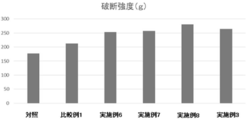
- FIG. 1 is a diagram showing the measurement results of the breaking strength of the sausage of the control, Examples 1 to 3 and Comparative Examples 1 to 3 in Test Example 1.
- FIG. 2 is a diagram showing the measurement results of the breaking strength of the control and the sausages of Examples 1, 4, 5, and Comparative Example 1 in Test Example 2.
- FIG. 3 is a view showing the measurement results of the breaking strength of the control and the sausages of Examples 3, 6 to 8 and Comparative Example 1 in Test Example 2.
- FIG. 4 is a diagram showing the measurement results of the breaking strength of the control and the sausages of Examples 9 to 11 and Comparative Examples 4 to 6 in Test Example 3.
- FIG. 5 is a diagram showing the measurement results of the breaking strength of the control and the sausages of Examples 12 to 14 and Comparative Examples 7 to 9 in Test Example 4.
- FIG. 1 is a diagram showing the measurement results of the breaking strength of the sausage of the control, Examples 1 to 3 and Comparative Examples 1 to 3 in Test Example 1.
- FIG. 2 is a diagram showing the measurement results of the breaking strength of the control and
- FIG. 6 is a view showing the measurement results of the breaking strength of the control, the sausages of Examples 15 to 17 and Comparative Examples 10 to 12 in Test Example 4.
- FIG. 7 is a diagram showing the measurement results of the breaking strength of the sausage of the control, Examples 18 to 20, and Comparative Examples 13 to 15 in Test Example 5.
- the present invention relates to a method for producing a processed meat food having reduced salt content or a reduced binder content or containing no binder, wherein the processed meat food has an elastic and good texture.
- the production method of the present invention is a method for producing a processed meat food having a salt content of 0.1% by weight to 1% by weight, wherein a transglutaminase and a gluconate or a lipase are processed by the meat processing. Adding to food, or adding transglutaminase and gluconate and lipase to processed meat foods.
- the production method of the present invention is a method for producing a processed meat food having a binder content of 0.2% by weight or less, wherein transglutaminase and gluconate or lipase are used. Adding to processed meat food, or adding transglutaminase and gluconate and lipase to processed meat food.
- Salt is a seasoning added to add salty taste to food, and satisfies the Codex Standards (International Food Standards) standards for purity of sodium chloride, content of secondary components, contaminating elements, etc. A thing.
- salt manufactured and sold as salt can be used.
- the content of salt is reduced from the amount normally contained in processed meat food, and is 0.1% by weight to 1% by weight in processed meat food, preferably It is from 0.5% to 1% by weight, more preferably from 0.8% to 1% by weight.
- the content of salt may be the amount normally contained in processed meat food, or may be reduced from the amount normally contained, Usually 0.1 to 2.5% by weight, preferably 0.5 to 2.5% by weight, more preferably 0.8 to 2.5% by weight in processed meat foods. is there.
- processed meat food refers to a food prepared by processing meat or the like.
- “Flesh” means meat that is edible and includes livestock such as cows, pigs, horses, sheep, goats, rabbits, poultry such as chickens, duck, duck, turkey, duck, quail, guinea fowl, and geese; Wild animals obtained by hunting wild boars, deer, etc., meat, salmon, mackerel, mackerel, sardines, tuna, bonito, scallop, Thai, shiroguchi, shark, Nagazuka, squid obtained from marine mammals such as whales, dolphins and sea lions And meat obtained from fish such as shrimp and shrimp.
- processing means include shredding, shredding, crushing, kneading, molding, drying, salting, pickling in miso, pickling in soy sauce, heating (boiled, steamed, roasted, fried, smoked, etc.), fermentation, and the like. It is not limited to these.
- processed meat foods include ham, bacon, sausage, hamburger, meatballs, shumai, gyoza, tsukuni, menchikatsu, and the like.
- a meat paste product fish sausage, kamaboko, chikuwa, fish cake, hampen, tuna, shrimp dumpling, etc.
- fish such as white fish, shark, squid, shrimp, etc. Salt, seasoning, etc.
- the processed meat food of the present invention is preferably provided as a ground meat processed food, and more preferably as the above-mentioned meat and meat paste product.
- transglutaminase added to processed meat food condenses an amino group of glutamine on a protein with a primary amine, transfers a substituent on the amine to glutamine, and generates ammonia. It is a transferase that catalyzes the reaction, and usually uses the amino group of lysine on the protein as a primary amine and acts as a cross-linking enzyme. Therefore, when transglutaminase is allowed to act on a food material such as meat, proteins contained in the food material such as meat are cross-linked.
- transglutaminase a calcium-independent one obtained from a microorganism is preferably used.
- the calcium-independent transglutaminase derived from microorganisms include transglutaminase produced by actinomycetes belonging to the genus Streptomyces, and can be obtained according to the method described in Japanese Patent No. 2572716.
- Commercially available products such as "ACTIVA TG-K" and "ACTIVA TG-S" provided by the company can also be used.
- the amount of transglutaminase to be added is preferably 0.0001 U (unit) or more, more preferably 0.01 U or more per gram of processed meat food.
- the enzymatic activity of transglutaminase can be determined, for example, by reacting benzyloxycarbonyl-L-glutaminylglycine with hydroxylamine as a substrate to form the resulting iron complex of hydroxamic acid in the presence of trichloroacetic acid.
- the enzyme activity can be calculated by measuring the absorbance at 525 nm and determining the amount of hydroxamic acid produced from a calibration curve. In the present specification, the amount of an enzyme that produces 1 ⁇ mol of hydroxamic acid per minute at 37 ° C.
- the added amount of transglutaminase is preferably 1 U or less per 1 g of food, More preferably, it is not more than 0.5 U.
- examples of gluconate added together with transglutaminase include edible salts of gluconic acid, and alkali metal salts such as lithium salt, sodium salt and potassium salt; calcium salt and magnesium salt Alkaline earth metal salts; ammonium salts; transition metal salts such as zinc salts, iron salts, copper salts, and manganese salts; and solvates such as hydrates thereof.
- alkali metal salts such as lithium salt, sodium salt and potassium salt
- calcium salt and magnesium salt Alkaline earth metal salts such as ammonium salts
- transition metal salts such as zinc salts, iron salts, copper salts, and manganese salts
- solvates such as hydrates thereof.
- Such a gluconate can be produced and used by a method known per se, or a product commercially available from each company can also be used.
- one kind of gluconate may be used alone, or two or more kinds may be used in combination.
- sodium salts, potassium salts and calcium salts are
- the amount of gluconate added in the production method of the present invention is preferably 0.1 g to 5 g, more preferably 0.4 g to 2 g, per 100 g of processed meat food in terms of free gluconic acid. And more preferably 0.4 g to 1.3 g.
- the amount of gluconate added per 1 U of transglutaminase activity [addition amount (g) in terms of free gluconic acid / transglutaminase activity (U)] is preferably 0.001 g / U to 500 g / U. And more preferably 0.008 g / U to 1.3 g / U.
- a lipase can be added to processed meat food together with transglutaminase in place of the gluconate or together with the gluconate.
- Lipase is an enzyme having a property of hydrolyzing an ester bond constituting a lipid, and particularly refers to a triacylglyceride lipase that decomposes triglycerides to release fatty acids.
- lipases derived from microorganisms are preferably used, for example, lipases derived from bacteria belonging to the genus Alcaligenes, fungi belonging to the genus Penicillium, fungi belonging to the genus Candida, fungi belonging to the genus Aspergillus, and the like. No.
- lipase PL derived from a bacterium belonging to the genus Alcaligenes, Meito Sangyo Co., Ltd.
- lipase QLM derived from a bacterium belonging to the genus Alcaligenes, Meito Sugar Co., Ltd.
- lipase R Pulicillium roqueforti
- Amano Enzyme Co., Ltd. lipase A (from Aspergillus niger, Amano Enzyme Co., Ltd.).
- the amount of the lipase to be added is usually 0.1 U or more, preferably 1 U or more per gram of processed meat food, depending on the type of the lipase. Further, it is usually 10,000 U or less, preferably 5,000 U or less, per gram of processed meat food.
- the amount of lipase added per 1 U of transglutaminase activity is such that the lipase activity is usually 0.1 U to 5,000,000 U, preferably 5 U to 400,000 U, more preferably 30 U to 30,000 U.
- the enzyme activity of lipase can be calculated, for example, by allowing lipase to act on an emulsion of olive oil as a substrate for a certain period of time and quantifying the amount of liberated fatty acid with alkali.
- the amount of an enzyme that releases 1 ⁇ mol of a fatty acid per minute at 37 ° C. is defined as 1 U.
- transglutaminase and gluconate or lipase are added to processed meat food, and raw materials of processed meat food such as meat and other food materials. And contact. Regardless of the order of addition of transglutaminase and gluconate or lipase, or gluconate and lipase, they may be added simultaneously to the processed meat food, respectively, one of them may be added first, and the other may be added later. .
- transglutaminase, gluconate and lipase may be added in the form of powder or granules, respectively, or may be dissolved or suspended in water or the like and added in the form of a liquid. Furthermore, as described later, it can also be added as a liquid, semi-solid, or solid preparation containing transglutaminase and gluconate or lipase, or transglutaminase, gluconate and lipase.
- ⁇ Contacting the raw material of processed meat food '' means that the above-mentioned form of transglutaminase or the like is attached to the raw material of processed meat food, or a solution or suspension of transglutaminase or the like is applied to the raw material of processed meat food, Alternatively, the raw material of processed meat food is immersed in a solution or suspension of transglutaminase or the like, or the above-described transglutaminase or the like in each form is kneaded with the raw material of processed meat food such as cut, shredded or ground meat. Etc.
- transglutaminase and gluconate or lipase By contacting transglutaminase and gluconate or lipase, or transglutaminase and gluconate and lipase with the raw material of processed meat food, the content of processed meat or binder with reduced salt content is reduced. Even in a processed meat food in which the amount of glycerol is reduced, the function of transglutaminase can be sufficiently exerted, and the cross-linking reaction of the protein in the raw material of the processed meat food can be advanced.
- the cross-linking reaction of the protein in the raw material of the processed meat food by the transglutaminase added to the processed meat food is usually performed at 0 ° C. to 50 ° C., preferably 5 ° C. to 50 ° C., more preferably 30 ° C. to 50 ° C.
- the reaction is usually performed for 1 minute to 120 hours, preferably 1 minute to 72 hours, more preferably 1 minute to 24 hours, and still more preferably 1 minute to 12 hours.
- the step of adding transglutaminase and gluconate or lipase, or transglutaminase and gluconate and lipase to the processed meat food and contacting it with the raw material of the processed food is a condition that satisfies the above conditions. It is preferable to carry out below.
- processed meat foods if necessary, other food materials, and commonly used food additives are added to the meat and mixed, and transglutaminase and gluconate or lipase, or transglutaminase and After adding gluconate and lipase and bringing them into contact with the raw material of the processed meat food, they are molded, filled in a casing or the like, and then pickled (salt pickled, miso pickled, soy sauce pickled, etc.), heated (dried, It is processed by ordinary processing means such as boiled water, smoke, steamed and the like, fermentation and the like, and then cooled as required to produce.
- the contact between the transglutaminase and the like and the raw material of the processed meat food may be performed after various pickling treatments. Further, the molding or filling in the casing or the like may be performed after the immersion treatment.
- meat is used as it is or after being cut, cut, crushed, or the like.
- animal fats such as beef tallow, lard, etc .
- starchy materials such as bread, flour, rice, oatmeal, cornmeal, vermicelli, etc .
- vegetable proteins such as soybean proteins can be used.
- the content of meat in processed meat foods is usually 30% by weight to 90% by weight, preferably 40% by weight to 80% by weight, and more preferably 45% by weight to 70% by weight.
- Common food additives include excipients such as magnesium carbonate, sugars (glucose, lactose, corn starch, etc.), sugar alcohols (sorbitol, mannitol, etc.); gelatin, pregelatinized starch, partially pregelatinized starch, cellulose And dispersants such as crospovidone, povidone, crystalline cellulose and the like; lubricants such as talc and magnesium stearate; thickening and stabilization such as xanthan gum and sodium carboxymethyl cellulose.
- excipients such as magnesium carbonate, sugars (glucose, lactose, corn starch, etc.), sugar alcohols (sorbitol, mannitol, etc.); gelatin, pregelatinized starch, partially pregelatinized starch, cellulose And dispersants such as crospovidone, povidone, crystalline cellulose and the like; lubricants such as talc and magnesium stearate; thickening and stabilization such as x
- Emulsifier such as glycerin fatty acid ester, sucrose fatty acid ester, polyglycerin fatty acid ester, saponin, lecithin, sodium caseinate; phosphate (monosodium phosphate, dipotassium phosphate, etc.), polymerized phosphate Binders such as sodium polyphosphate and sodium metaphosphate; preservatives such as sodium nitrite and sorbic acid; antioxidants such as sodium L-ascorbate and catechin; pH adjusters such as fumaric acid; salt, soy sauce , Umami seasonings (sodium L-glutamate, sodium inosinate, etc.); coloring agents, such as annatto pigment and cochineal pigment; spices, such as pepper and sage; vitamins (L-ascorbic acid, ergocalciferol, ⁇ Nutrients such as -carotene), minerals (zinc salts, ferric chloride, etc.), amino acids (sodium L-aspart
- the processed meat food is produced without reducing the content of the binder or using the binder.
- the binder include the above-mentioned phosphates and polymerized phosphates.
- the content of the binder is preferably 0.2% by weight or less, more preferably 0.1% by weight or less, based on the total amount of the processed meat food. And more preferably 0% by weight (ie, no binder added).
- cooling after heating and processing may be performed by cooling at room temperature or cooling with running water, or by cooling to about 2 ° C. to 10 ° C. in a refrigerator. You may.
- the content of salt is reduced, the binding property of meat is reduced, and the processed meat food or the content of the binding agent that cannot sufficiently exert the function of transglutaminase is reduced.
- a processed meat food that does not contain a binder and does not have sufficient meat binding properties, the cross-linking reaction of transglutaminase can be promoted, so that a good elastic texture can be obtained. Therefore, the production method of the present invention, such as sausage, reduced binding properties due to reduced salt content, or reduced binder content, or less binding properties due to the absence of a binder. It can be suitably used for the production of processed meat products which are remarkably observed.
- a method for producing sausage is described below.
- salt and, if necessary, food additives such as binders, preservatives and antioxidants, and knead with a kneader.
- After aging at low temperature ie, after the salting treatment), add the seasonings and mix, then add transglutaminase and gluconate or lipase, or add transglutaminase and gluconate and lipase, and mix. Etc. to mix.
- the mixture is filled in a casing such as an animal intestine or a collagen casing, subjected to a heat treatment such as drying, smoking, and steaming, and then cooled.
- a heat treatment such as drying, smoking, and steaming, and then cooled.
- transglutaminase, gluconate and lipase may be added together with salt and food additives.
- the production method of the present invention is a method for producing a processed meat food having a salt content of 0.1% by weight to 1% by weight, the method comprising transglutaminase, gluconate and alkaline earth. Adding one or more selected from the group consisting of chlorides of similar metals to processed meat foods, or selecting from the group consisting of transglutaminase, gluconates and chlorides of alkaline earth metals Lipase and one or more of the above-mentioned ingredients and lipase.
- the processed meat, salt, trus glutaminase and its addition amount per gram of processed meat, gluconate and lipase are as described above.
- the amount of gluconate added to 100 g of processed meat food in the production method of the present embodiment is preferably 0.01 g to 2.5 g, and more preferably 0.1 g to 1 g.
- Examples of the alkaline earth metal chloride in the production method of the present embodiment include calcium chloride and magnesium chloride, and calcium chloride is preferably used.
- the addition amount of the alkaline earth metal chloride to 100 g of processed meat food is preferably 0.01 g to 2.5 g, and more preferably 0.1 g to 1 g.
- one kind can be selected from the group consisting of gluconates and chlorides of alkaline earth metals and added alone or in combination of two or more kinds.
- One or more selected from the group consisting of gluconates and alkaline earth metal chlorides are added in an amount of usually 0.001 g to 0.5 g per 1 U of transglutaminase activity, and preferably 0 to 0.5 g.
- the amount of gluconate added is represented by the amount converted to gluconic acid as a free form. From the viewpoint of the texture improving effect of processed meat food, it is preferable to add transglutaminase, gluconate and chloride of alkaline earth metal, and gluconate and chloride of alkaline earth metal,
- the ratio of these addition amounts is 1:10 to 10: 1. , And more preferably in a ratio of 1: 6 to 5: 1.
- a processed meat food having an elastic and good texture can be provided in a processed meat food having a reduced salt content.
- a processed meat food using a lump of meat it is possible to impart a preferable texture with improved fibrous feeling and the like described later.
- the present invention also provides a modifier for processed meat food in which the binding property of meat is reduced or insufficient (hereinafter, also referred to as “the modifier of the present invention”).
- the modifier of the present invention is, as a first aspect, a modifier for processed meat food with reduced salt content, comprising transglutaminase and gluconate or lipase, or transglutaminase and gluconic acid. Salt and lipase.
- the modifier of the present invention is, as a second aspect, a modifier for processed meat food in which the content of the binder is reduced or does not contain the binder, wherein transglutaminase and gluconic acid are used.
- the modifier of the present invention is, as a third aspect, a modifier for processed meat food having a reduced salt content, comprising transglutaminase, gluconate and chloride of alkaline earth metal. Or one or more selected from the group consisting of: or a transglutaminase, and one or more selected from the group consisting of gluconates and chlorides of alkaline earth metals, and lipase. .
- transglutaminase, gluconate, lipase, and chloride of alkaline earth metal contained in the modifier of the present invention are as described above in the production method of the present invention.
- transglutaminase and gluconate or lipase, or transglutaminase and gluconate and lipase may be mixed and used directly as the modifier of the present invention.
- transglutaminase is mixed with one or more selected from the group consisting of gluconate and chloride of alkaline earth metal, or transglutaminase is mixed with gluconate and alkaline earth metal.
- One or two or more selected from the group consisting of chlorides and lipase may be mixed and used as it is as the modifier of the present invention.
- the above-mentioned general food additive may be added to form the modifier of the present invention.
- the modifier of the present invention if necessary, the above-mentioned excipients, binders, disintegrants, lubricants, thickening stabilizers, additives such as emulsifiers, water, and solvents such as ethanol are added.
- the content of transglutaminase in the modifier of the first or second aspect of the present invention is such that the transglutaminase activity per 1 g of the modifier of the present invention is usually 0.01 U to 1,000 U.
- the amount is preferably from 0.1 U to 200 U, and more preferably from 1 U to 100 U.
- the content of gluconate in the modifier of the first or second embodiment of the present invention is usually 1% by weight to 99% by weight, preferably 20% by weight, in terms of free gluconic acid. % To 99% by weight.
- the lipase content in the modifier of the first or second aspect of the present invention is such that the lipase activity per 1 g of the modifier of the present invention is usually 100 U to 150,000 U, and preferably 1 part.
- the amount is from 2,000U to 120,000U, more preferably from 2,000U to 100,000U.
- the amount of gluconate in terms of free gluconic acid per 1 U of transglutaminase activity is usually 0.00001 g to 99 g. , And preferably 0.0005 to 8 g, more preferably 0.001 to 8 g.
- the lipase is contained such that the lipase activity is 0.1 U to 5,000,000 U per 1 U of transglutaminase activity, and is preferably It is contained so as to be 5U to 400,000U, more preferably 30U to 30,000U.
- the modifier of the first aspect of the present invention is useful as a modifier for processed meat food having a salt content of 0.1% by weight to 1% by weight, and a salt content of 0.5% by weight. It is suitable for modifying processed meat foods having a salt content of 0.8 to 1% by weight, and is more suitable for modifying processed meat foods having a salt content of 0.8 to 1% by weight. Further, the modifier of the second aspect of the present invention is useful as a modifier for processed meat food having a binder content of 0.2% by weight or less, and has a binder content of 0%. 0.1% by weight or less, which is suitable for modifying processed meat food, and more suitable for modifying processed meat food that does not contain a binder.
- the processed meat food to which the modifier of the second embodiment of the present invention is used may contain a normal amount of salt or may have a reduced salt content.
- the salt content of the processed meat food using the modifier of the second embodiment of the present invention is usually 0.1% by weight to 2.5% by weight, preferably 0.5% by weight to 2.5% by weight. %, More preferably 0.8 to 2.5% by weight.
- the salt and the binder are as described above for the production method of the present invention.
- transglutaminase content and the like in the modifier of the third embodiment of the present invention are as described above for the modifier of the first embodiment.
- the content of one or more selected from the group consisting of gluconate and chloride of alkaline earth metal is usually 10% by weight to 99% by weight. And preferably 20% to 95% by weight.
- one or more selected from the group consisting of gluconates and chlorides of alkaline earth metals are usually contained in an amount of 0.1 g / U of transglutaminase activity. It is contained so as to be 001 g to 0.5 g, preferably 0.05 g to 0.2 g.
- the content of gluconate is represented by an amount converted to gluconic acid in a free form.
- the modifier of the third aspect of the present invention it is preferable to include transglutaminase and gluconate and chloride of alkaline earth metal.
- the gluconate and the alkaline earth metal chloride are the content ratio of these (the content of the gluconate in terms of the free gluconic acid: the content of the alkaline earth metal chloride) ( (Weight ratio) is preferably 1:10 to 10: 1, more preferably 1: 6 to 5: 1.
- the lipase content and the like in the modifier of the third aspect of the present invention are as described above for the modifier of the first aspect or the second aspect.
- the modifier according to the third aspect of the present invention is useful as a modifier for processed meat food having a salt content of 0.1% by weight to 1% by weight, and has a salt content of 0.5% by weight. It is suitable for modifying processed meat foods of up to 1% by weight.
- the salt is as described above for the production method of the present invention.
- transglutaminase, gluconate or lipase, or transglutaminase, gluconate and lipase respectively, in the above-mentioned amount for processed meat food Is added so that it can be brought into contact with raw materials of processed meat food.
- the “contact” with the raw material of the processed meat food is as described above.
- the modifier of the third aspect of the present invention includes one or more selected from the group consisting of transglutaminase, gluconate and chloride of alkaline earth metal, or transglutaminase,
- a processed meat food wherein one or more selected from the group consisting of gluconates and chlorides of alkaline earth metals and lipase are added so that the above-mentioned amounts are added to the processed meat food, respectively; Raw materials.
- the “contact” with the raw material of the processed meat food is as described above.
- the modifier of the present invention can improve the texture of processed meat food having a reduced salt content or processed meat food having a reduced binder content or containing no binder. Especially suitable for improving the texture of processed meat products in which the binding of meat is reduced due to the reduction of the salt content, or the binding of meat is reduced due to the reduction of the binder content. Can be used for Further, the modifier of the present invention can improve the texture such as fibrous feeling in processed foods using lump meat.
- the present invention provides a processed meat food having a good texture, although the salt content is reduced or the content of the binder is reduced or the binder is not contained (hereinafter, the processed meat food of the present invention). ").
- the processed meat food of the present invention has a salt content reduced to 0.1% by weight to 1% by weight, and contains meat on which transglutaminase and lipase act, or transglutaminase. Or transglutaminase and lipase acted on, and gluconate.
- the processed meat food of the present invention has a binder content reduced to 0.2% by weight or less, and contains meat on which transglutaminase and lipase have acted. It contains meat treated with glutaminase or meat treated with transglutaminase and lipase, and gluconate.
- the content of salt is reduced to 0.1% by weight to 1% by weight, and the meat on which transglutaminase has acted, or the transglutaminase and lipase are contained. It contains the acted meat and one or more selected from the group consisting of gluconates and chlorides of alkaline earth metals.
- the salt, binder, transglutaminase, gluconate and lipase, and chlorides of alkaline earth metals in the processed meat food of the present invention are as described above in the production method of the present invention.
- ⁇ meat on which transglutaminase has acted '' or ⁇ meat on which transglutaminase and lipase have acted '' means, as described above in the production method of the present invention, transglutaminase in processed meat food. It refers to meat after adding or adding transglutaminase and lipase to processed meat foods and contacting with transglutaminase and the like. The amounts of transglutaminase and lipase added to the processed meat food are as described above in the production method of the present invention.
- the content of meat treated with transglutaminase or meat treated with transglutaminase and lipase in the processed meat food of the present invention is usually 30% by weight to 90% by weight, preferably 40% by weight to 80% by weight. And more preferably 45 to 70% by weight.
- the content of the gluconate in the processed meat food of the first embodiment or the second embodiment of the present invention is usually 0.1% by weight to 5% by weight in terms of free gluconic acid, Preferably it is 0.4% to 2% by weight, more preferably 0.4% to 1.3% by weight.
- the content of one or more selected from the group consisting of gluconates and alkaline earth metal chlorides in the processed meat food of the third embodiment of the present invention is usually 0.01% by weight.
- the processed meat food of the present embodiment preferably contains a gluconate and a chloride of an alkaline earth metal, and the content ratio thereof is as described above.
- the gluconate may be added to the processed meat food simultaneously with transglutaminase or transglutaminase and lipase.
- one or more selected from the group consisting of gluconates and chlorides of alkaline earth metals, together with transglutaminase or transglutaminase and lipase may be added to and processed into processed meat food.
- the processed meat food of the present invention can contain the above-mentioned other food materials and commonly used food additives as long as the characteristics of the present invention are not impaired. These contents are determined according to the type of the processed meat food, etc., according to the amounts usually contained.
- the processed meat food of the present invention can be prepared by adding transglutaminase and lipase to meat, or transglutaminase-treated meat or transglutaminase and lipase-treated meat to which gluconate is added and mixed, or Glutaminase-actuated meat or transglutaminase- and lipase-actuated meat are mixed with one or more selected from the group consisting of gluconates and alkaline earth metal chlorides. After adding and mixing other food materials and food additives according to, in a state filled or molded in a casing, or further cooled after passing through the above fermentation, heating and other steps, frozen. It is preferable to save. Frozen processed meat foods are cooked by steaming, baking, frying, etc. in cooking utensils such as steamers, ovens, convection ovens, steam convection ovens, fryers, etc., or cooked in microwave ovens. can do.
- the processed meat food of the present invention has an elastic and good texture while the salt content is reduced or the binder content is reduced. Accordingly, the processed meat food of the present invention is a processed meat food in which the decrease in the binding property of meat due to the reduction of the salt content and the insufficient binding property due to the reduction in the content of the binder are remarkably observed. It can be particularly preferably provided, and in the processed ground meat product, a decrease in texture due to a reduced or insufficient binding property of the ground meat can be favorably improved.
- the processed meat food of the third embodiment of the present invention is suitably provided as a processed meat food using a lump of meat, and the texture of the processed meat food, such as a fibrous feel, is improved.
- the raw materials used in the production of the salt-reduced coarsely ground sausages of Examples and Comparative Examples are as follows.
- a common food product is used as salt, and commercially available as a food additive as polymerized phosphate preparation, sodium nitrite preparation, sodium L-ascorbate, umami seasoning and white pepper. Used product.
- "ACTIVA TG-S” (Ajinomoto Co.) (100 U / g) was used as transglutaminase.
- "Healthy K” (Fuso Chemical Industry Co., Ltd.) was used as potassium gluconate.
- “Lipase PL” (Meito Sangyo Co., Ltd.) (100,000 U / g) was used as the lipase.
- the breaking strength of the sausage of Comparative Example 1 in which only transglutaminase was added to the processed meat food and brought into contact with pork arm meat and other raw materials showed a large difference as compared with the control sausage.
- the breaking strength of the sausage of Comparative Example 2 in which only potassium gluconate was added to the processed meat food and brought into contact with raw materials such as pork arm meat, and the sausage of Comparative Example 3 in which only lipase was added and brought into contact were also observed. No clear rise was seen.
- Example 4 Production of reduced salt coarsely ground sausage
- the amount of potassium gluconate added to processed meat was 1.0% by weight and 1.5% by weight, respectively, and the same as Example 1 respectively.
- low salt coarsely ground sausages were produced (Examples 4 and 5).
- the amount of potassium gluconate added to the processed meat food was 0.5% by weight, 1.0% by weight and 1.5% by weight, respectively, and the reduced salt coarsely ground sausage was used in the same manner as in Example 3. Was produced (Examples 6 to 8).
- Test Example 2 Measurement of breaking strength of reduced salt coarsely ground sausage The breaking strength of each of the reduced salt coarsely ground sausages produced in Examples 4 to 8 was measured in the same manner as in Test Example 1 described above. In addition, about the sausage of a control, the comparative example 1, and the examples 1 and 3, the breaking strength was measured similarly. The results are shown in FIGS.
- the sausage of Comparative Example 4 produced by adding only transglutaminase to the raw material was broken even in the reduced salt coarsely ground sausage having a fat content of 20% by weight as compared with the control sausage. No sufficient improvement in strength was seen, suggesting that transglutaminase did not function sufficiently when the salt content was reduced.
- the sausage of Comparative Example 5 produced by adding only potassium gluconate and the sausage of Comparative Example 6 produced by adding only lipase no improvement in breaking strength was observed.
- Examples 12 to 17 and Comparative Examples 7 to 12 Production of coarsely ground sausage without phosphates
- a in Table 5 was minced into 5 mm square minced meat by a meat grinder (chopper) and kneaded (“Tabletop kneader PNV-5”).
- B) and D in Table 5 were added to the mince and mixed at 10 ° C. for 10 minutes.
- C in Table 5 was added and mixed in a kneader for 10 minutes, and transglutaminase, gluconate (potassium gluconate, calcium gluconate) and lipase were added as shown in Tables 6 and 7, respectively.
- the mixture was mixed in a mixer ("KitchenAid KSM5WH", Whirlpool Corporation) at 10 ° C. for 2 minutes at 2nd speed, and then vacuum-packaged. Next, after filling in a collagen casing (Devro Co., Ltd.) and drying at 60 ° C. for 30 minutes, smoking (60 ° C., 10 minutes) and steaming (75 ° C., 30 minutes) are performed, and then cooled overnight. Thus, phosphate-free coarse-ground sausage was produced. As shown in Tables 6 and 7, the control was a coarsely ground sausage produced without adding any of transglutaminase, gluconate and lipase.
- Test Example 4 Measurement of breaking strength of coarsely ground sausage without added phosphate For each of the sausages of Examples 12 to 17 and Comparative Examples 7 to 12, together with a control sausage, a texture analyzer was used in the same manner as in Test Example 1. TA. The breaking strength was measured by XTplus (Stable Micro Systems). The measurement results are shown in FIGS.
- sausages produced by adding transglutaminase and potassium gluconate or calcium gluconate Examples 12 and 15
- sausages produced by adding transglutaminase and lipase Examples 13 and 16
- the improvement in breaking strength was clearly recognized as compared with the control sausage.
- sausages produced by adding transglutaminase and potassium gluconate or calcium gluconate (Examples 12 and 15), and sausages produced by adding transglutaminase, potassium gluconate or calcium gluconate and lipase ( In Examples 14 and 17), a remarkable improvement in the breaking strength was observed.
- Test Example 5 Measurement of breaking strength of phosphate-free coarse ground sausage For each of the sausages of Examples 18 to 20 and Comparative Examples 13 to 15, together with a control sausage, a texture analyzer was used in the same manner as in Test Example 1. TA. The breaking strength was measured by XTplus (Stable Micro Systems). The measurement results are shown in FIG.
- sausages produced by adding transglutaminase and sodium gluconate In contrast, sausages produced by adding transglutaminase and sodium gluconate (Example 18), sausages produced by adding transglutaminase and lipase (Example 19), transglutaminase, sodium gluconate and lipase
- improvement in the breaking strength was clearly recognized as compared with the control sausage.
- the sausage produced by adding transglutaminase and sodium gluconate (Example 18) and the sausage produced by adding transglutaminase, sodium gluconate and lipase have remarkable breaking strength. Significant improvement was observed.
- Heating Yield means the weight of the food after moisture has flowed out of the food due to the heat treatment.
- the heating yield was measured by a paneler observing the change in the appearance of the yakitori due to the heat treatment and the degree of water separation. It was evaluated. The results of the evaluation were decided by consultation of seven panelists. ⁇ Evaluation criteria> ⁇ : The yield was clearly lower than that of the control product. ⁇ : The heating yield was almost the same as that of the control product. ⁇ : The heating yield was improved compared to the control product. ⁇ : The heating yield was higher than the control product.
- Fibrous sensation means the sensation that the meat fibers loosen one by one when the processed meat is chewed.
- the fibrous sensation was evaluated according to the following evaluation criteria by feeding a highly hydrolyzed yakitori to a panelist. The results of the evaluation were decided by consultation of seven panelists. ⁇ Evaluation criteria> +: Equivalent to control product +++: slightly improved compared to control product +++: improved compared to control product +++++: significantly (moderate) improved compared to control product +++++: (Iii) Comprehensive evaluation The evaluation results of the above-mentioned heating yield and fibrous sensation were integrated, and the preference as a processed meat food was evaluated according to the following evaluation criteria.
- a method for producing a processed meat food having a resilient and good texture while the salt content is reduced, a processed meat food having a reduced salt content It is possible to provide a processed meat food modifier that can impart a good texture, and a processed meat food that has an elastic and good texture while reducing the salt content. Further, according to the present invention, even if the content of the binder is reduced or the processed meat does not contain the binder, the method for producing the processed meat having elastic and good texture, the binder, The content of the modified meat processing food that can provide a resilient and good texture to meat processed food that does not contain a binder, or the content of the binder is reduced.
- a processed meat food which does not contain a binder but has an elastic and good texture.
- INDUSTRIAL APPLICABILITY The present invention can be particularly preferably applied to ground meat processed foods in which the binding property of meat is significantly reduced or insufficient due to a reduction in the salt content or a binder amount. Further, according to the present invention, it is possible to provide a processed meat food having an improved texture such as a fibrous feel in a processed meat food having a reduced salt content.
Landscapes
- Chemical & Material Sciences (AREA)
- Life Sciences & Earth Sciences (AREA)
- Health & Medical Sciences (AREA)
- Nutrition Science (AREA)
- Engineering & Computer Science (AREA)
- Food Science & Technology (AREA)
- Polymers & Plastics (AREA)
- Inorganic Chemistry (AREA)
- Microbiology (AREA)
- Meat, Egg Or Seafood Products (AREA)
Abstract
La présente invention concerne un procédé de fabrication d'un aliment à base de viande transformée qui a une teneur en chlorure de sodium de 0,1 à 1 % en poids ou une teneur en liant de 0,2 % en poids ou moins, ledit procédé de fabrication d'un aliment à base de viande transformée comprenant l'ajout de transglutaminase conjointement avec un sel d'acide gluconique et/ou de lipase à un aliment à base de viande transformée. Selon la présente invention, un aliment à base de viande transformée ayant une teneur en chlorure de sodium réduite ou une teneur en liant réduite et présentant une texture élastique favorable peut être produit.
Priority Applications (3)
| Application Number | Priority Date | Filing Date | Title |
|---|---|---|---|
| EP19826391.5A EP3811785A4 (fr) | 2018-06-25 | 2019-06-25 | Procédé de fabrication d'aliment à base de viande transformée, modificateur de qualité pour aliment à base de viande transformée, et aliment à base de viande transformée |
| JP2020527557A JP7484713B2 (ja) | 2018-06-25 | 2019-06-25 | 食肉加工食品の製造方法、食肉加工食品用改質剤および食肉加工食品 |
| US17/128,730 US20210106031A1 (en) | 2018-06-25 | 2020-12-21 | Method for manufacturing processed meat food, quality modifier for processed meat food, and processed meat food |
Applications Claiming Priority (2)
| Application Number | Priority Date | Filing Date | Title |
|---|---|---|---|
| JP2018120014 | 2018-06-25 | ||
| JP2018-120014 | 2018-06-25 |
Related Child Applications (1)
| Application Number | Title | Priority Date | Filing Date |
|---|---|---|---|
| US17/128,730 Continuation US20210106031A1 (en) | 2018-06-25 | 2020-12-21 | Method for manufacturing processed meat food, quality modifier for processed meat food, and processed meat food |
Publications (1)
| Publication Number | Publication Date |
|---|---|
| WO2020004419A1 true WO2020004419A1 (fr) | 2020-01-02 |
Family
ID=68986682
Family Applications (1)
| Application Number | Title | Priority Date | Filing Date |
|---|---|---|---|
| PCT/JP2019/025236 Ceased WO2020004419A1 (fr) | 2018-06-25 | 2019-06-25 | Procédé de fabrication d'aliment à base de viande transformée, modificateur de qualité pour aliment à base de viande transformée, et aliment à base de viande transformée |
Country Status (4)
| Country | Link |
|---|---|
| US (1) | US20210106031A1 (fr) |
| EP (1) | EP3811785A4 (fr) |
| JP (1) | JP7484713B2 (fr) |
| WO (1) | WO2020004419A1 (fr) |
Cited By (3)
| Publication number | Priority date | Publication date | Assignee | Title |
|---|---|---|---|---|
| JPWO2021153784A1 (fr) * | 2020-01-31 | 2021-08-05 | ||
| KR102712967B1 (ko) * | 2023-09-22 | 2024-10-04 | (주)한국일오삼 | 염장제 및 그 제조방법 |
| KR102713507B1 (ko) * | 2023-11-20 | 2024-10-08 | 육성푸드 주식회사 | 육류용 염지제 및 이를 이용한 육류의 염지방법 |
Citations (15)
| Publication number | Priority date | Publication date | Assignee | Title |
|---|---|---|---|---|
| JPS6410949A (en) | 1987-07-02 | 1989-01-13 | Taiyo Fishery Co Ltd | Preparation of food |
| JPS6427471A (en) | 1987-03-04 | 1989-01-30 | Ajinomoto Kk | Novel enzyme and production of protein gelatinized product using said enzyme |
| JP2572716B2 (ja) | 1987-03-04 | 1997-01-16 | 味の素株式会社 | 新規なトランスグルタミナーゼ |
| JP2000060431A (ja) * | 1998-06-09 | 2000-02-29 | Ajinomoto Co Inc | 新規酵素処理蛋白質含有食品、その製造方法及びそれに使用する酵素製剤 |
| JP2008271793A (ja) | 2007-04-25 | 2008-11-13 | Sanzo Mano | 食肉加工品とその製造方法、及び肉加工品製造用の酵素組成物 |
| WO2010074338A1 (fr) * | 2008-12-26 | 2010-07-01 | 味の素株式会社 | Préparation enzymatique pour produits de viande à un seul ingrédient et procédé de préparation de produits de viande à un seul ingrédient |
| WO2012060470A1 (fr) * | 2010-11-05 | 2012-05-10 | 味の素株式会社 | Procédé de fabrication de viandes transformées, et préparation d'enzymes pour l'amélioration de viandes transformées |
| WO2012077817A1 (fr) * | 2010-12-07 | 2012-06-14 | 味の素株式会社 | Composition d'enzyme stabilisée et procédé pour la produire |
| JP5056193B2 (ja) | 2007-06-21 | 2012-10-24 | 味の素株式会社 | 畜肉加工食品又は水産加工食品の製造方法及び畜肉加工食品又は水産加工食品改質用の酵素製剤 |
| CN105077300A (zh) * | 2015-07-17 | 2015-11-25 | 太仓茂欣食品有限公司 | 一种低脂鲜嫩牛肉排的加工方法及产品 |
| JP5882792B2 (ja) | 2012-03-02 | 2016-03-09 | 千葉製粉株式会社 | 水産物又は畜肉処理用製剤、及び、それを用いた水産物又は畜肉の処理方法 |
| CN106923229A (zh) * | 2017-03-16 | 2017-07-07 | 山东如康清真食品有限公司 | 一种牛肉粒及其制备方法 |
| CN107041515A (zh) * | 2017-04-25 | 2017-08-15 | 山东如康清真食品有限公司 | 一种牛肉腌制方法 |
| JP2018102297A (ja) * | 2016-12-27 | 2018-07-05 | 味の素株式会社 | 食肉加工食品およびその製造方法 |
| JP2018120014A (ja) | 2017-01-23 | 2018-08-02 | コニカミノルタ株式会社 | 汚れ防止装置および画像形成装置 |
Family Cites Families (6)
| Publication number | Priority date | Publication date | Assignee | Title |
|---|---|---|---|---|
| JP2001000148A (ja) * | 1999-04-20 | 2001-01-09 | Okuno Chem Ind Co Ltd | 畜肉用品質改良剤 |
| CN102150885B (zh) * | 2011-01-28 | 2013-03-13 | 武汉工业学院 | 一种低钠盐火腿肠及其制备方法 |
| CN102551110A (zh) * | 2012-02-21 | 2012-07-11 | 中南林业科技大学 | 一种微波加热制备低盐鱼糜鱼糕的方法 |
| CN105076917A (zh) * | 2015-05-12 | 2015-11-25 | 浙江海洋学院 | 一种鱿鱼鱼糜保水剂及其制备方法、应用 |
| JP6821950B2 (ja) * | 2016-05-25 | 2021-01-27 | 味の素株式会社 | 挽肉加工食品の製造方法 |
| CN106923207B (zh) * | 2017-03-09 | 2020-03-27 | 山东如康清真食品有限公司 | 一种牛肉丸子及其制备方法 |
-
2019
- 2019-06-25 EP EP19826391.5A patent/EP3811785A4/fr active Pending
- 2019-06-25 WO PCT/JP2019/025236 patent/WO2020004419A1/fr not_active Ceased
- 2019-06-25 JP JP2020527557A patent/JP7484713B2/ja active Active
-
2020
- 2020-12-21 US US17/128,730 patent/US20210106031A1/en active Pending
Patent Citations (15)
| Publication number | Priority date | Publication date | Assignee | Title |
|---|---|---|---|---|
| JPS6427471A (en) | 1987-03-04 | 1989-01-30 | Ajinomoto Kk | Novel enzyme and production of protein gelatinized product using said enzyme |
| JP2572716B2 (ja) | 1987-03-04 | 1997-01-16 | 味の素株式会社 | 新規なトランスグルタミナーゼ |
| JPS6410949A (en) | 1987-07-02 | 1989-01-13 | Taiyo Fishery Co Ltd | Preparation of food |
| JP2000060431A (ja) * | 1998-06-09 | 2000-02-29 | Ajinomoto Co Inc | 新規酵素処理蛋白質含有食品、その製造方法及びそれに使用する酵素製剤 |
| JP2008271793A (ja) | 2007-04-25 | 2008-11-13 | Sanzo Mano | 食肉加工品とその製造方法、及び肉加工品製造用の酵素組成物 |
| JP5056193B2 (ja) | 2007-06-21 | 2012-10-24 | 味の素株式会社 | 畜肉加工食品又は水産加工食品の製造方法及び畜肉加工食品又は水産加工食品改質用の酵素製剤 |
| WO2010074338A1 (fr) * | 2008-12-26 | 2010-07-01 | 味の素株式会社 | Préparation enzymatique pour produits de viande à un seul ingrédient et procédé de préparation de produits de viande à un seul ingrédient |
| WO2012060470A1 (fr) * | 2010-11-05 | 2012-05-10 | 味の素株式会社 | Procédé de fabrication de viandes transformées, et préparation d'enzymes pour l'amélioration de viandes transformées |
| WO2012077817A1 (fr) * | 2010-12-07 | 2012-06-14 | 味の素株式会社 | Composition d'enzyme stabilisée et procédé pour la produire |
| JP5882792B2 (ja) | 2012-03-02 | 2016-03-09 | 千葉製粉株式会社 | 水産物又は畜肉処理用製剤、及び、それを用いた水産物又は畜肉の処理方法 |
| CN105077300A (zh) * | 2015-07-17 | 2015-11-25 | 太仓茂欣食品有限公司 | 一种低脂鲜嫩牛肉排的加工方法及产品 |
| JP2018102297A (ja) * | 2016-12-27 | 2018-07-05 | 味の素株式会社 | 食肉加工食品およびその製造方法 |
| JP2018120014A (ja) | 2017-01-23 | 2018-08-02 | コニカミノルタ株式会社 | 汚れ防止装置および画像形成装置 |
| CN106923229A (zh) * | 2017-03-16 | 2017-07-07 | 山东如康清真食品有限公司 | 一种牛肉粒及其制备方法 |
| CN107041515A (zh) * | 2017-04-25 | 2017-08-15 | 山东如康清真食品有限公司 | 一种牛肉腌制方法 |
Non-Patent Citations (1)
| Title |
|---|
| See also references of EP3811785A4 |
Cited By (8)
| Publication number | Priority date | Publication date | Assignee | Title |
|---|---|---|---|---|
| JPWO2021153784A1 (fr) * | 2020-01-31 | 2021-08-05 | ||
| WO2021153784A1 (fr) * | 2020-01-31 | 2021-08-05 | 味の素株式会社 | Procédé de production de viande ou de produit alimentaire transformé de type viande |
| CN115003169A (zh) * | 2020-01-31 | 2022-09-02 | 味之素株式会社 | 食用肉或仿食用肉加工食品的制造方法 |
| JP7743791B2 (ja) | 2020-01-31 | 2025-09-25 | 味の素株式会社 | 食肉又は食肉様加工食品の製造方法 |
| KR102712967B1 (ko) * | 2023-09-22 | 2024-10-04 | (주)한국일오삼 | 염장제 및 그 제조방법 |
| KR102713507B1 (ko) * | 2023-11-20 | 2024-10-08 | 육성푸드 주식회사 | 육류용 염지제 및 이를 이용한 육류의 염지방법 |
| KR20250074562A (ko) * | 2023-11-20 | 2025-05-27 | 육성푸드 주식회사 | 육류용 염지제 및 이를 이용한 육류의 염지방법 |
| KR102922343B1 (ko) * | 2023-11-20 | 2026-02-05 | 육성푸드 주식회사 | 육류용 염지제 및 이를 이용한 육류의 염지방법 |
Also Published As
| Publication number | Publication date |
|---|---|
| JP7484713B2 (ja) | 2024-05-16 |
| US20210106031A1 (en) | 2021-04-15 |
| EP3811785A1 (fr) | 2021-04-28 |
| EP3811785A4 (fr) | 2022-03-23 |
| JPWO2020004419A1 (ja) | 2021-07-08 |
Similar Documents
| Publication | Publication Date | Title |
|---|---|---|
| EP0572987B1 (fr) | Procédé pour fabriquer un produit alimentaire formé lié | |
| CN103702574B (zh) | 畜肉制品用改良剂和畜肉制品 | |
| RU2473246C2 (ru) | Способ получения обработанного мясопродукта или морепродукта и ферментный препарат для улучшения обработанного мясопродукта или морепродукта | |
| JP7130954B2 (ja) | 食肉加工食品およびその製造方法 | |
| JP7743791B2 (ja) | 食肉又は食肉様加工食品の製造方法 | |
| JP5811098B2 (ja) | 畜肉加工食品の製造方法及び畜肉加工食品改質用酵素製剤 | |
| JP7484713B2 (ja) | 食肉加工食品の製造方法、食肉加工食品用改質剤および食肉加工食品 | |
| JP4138889B2 (ja) | 食肉改質剤 | |
| JPH04135463A (ja) | 食品用脂肪代替物 | |
| JPWO1998041101A1 (ja) | 食肉改質剤 | |
| JPH09238653A (ja) | 畜肉加工品の品質改良剤および畜肉加工品の製造方法 | |
| JP3163816B2 (ja) | 練製品の製造方法 | |
| JP7069775B2 (ja) | 物性が改質された畜肉加工品又は水産加工品の製造方法 | |
| JPWO2020066844A1 (ja) | 食肉用組成物、食肉加工食品の製造方法、および、食肉加工食品の歯ごたえを向上させる方法 | |
| JP7786035B2 (ja) | ケーシング詰め食肉加工食品の製造方法 | |
| JP7725760B1 (ja) | 冷凍米飯含有食品 | |
| JPH09299065A (ja) | 魚肉、畜肉練り製品の製造法 | |
| JP7657053B2 (ja) | 食肉類改良剤 | |
| JPH04335867A (ja) | 加工食品の脱臭剤およびその製造方法、ならびに、加工食品 | |
| JP7135415B2 (ja) | 包皮食品の製造方法および包皮食品 | |
| JPH03139238A (ja) | キチンまたはキトサンを含有してなる冷凍食品、チルド食品及び畜肉、魚肉練り製品ならびにその製造法 | |
| JPS6313662B2 (fr) | ||
| WO2021201210A1 (fr) | Procédé de modification d'aliments contenant de l'huile et de la graisse | |
| WO2023181411A1 (fr) | Fluide de saumurage de viande et procédé de production de produit alimentaire transformé à base de viande cuite au four | |
| JP6190107B2 (ja) | 家畜の肝臓酵素分解物を含有する食肉加工食品及びその製造方法 |
Legal Events
| Date | Code | Title | Description |
|---|---|---|---|
| 121 | Ep: the epo has been informed by wipo that ep was designated in this application |
Ref document number: 19826391 Country of ref document: EP Kind code of ref document: A1 |
|
| ENP | Entry into the national phase |
Ref document number: 2020527557 Country of ref document: JP Kind code of ref document: A |
|
| NENP | Non-entry into the national phase |
Ref country code: DE |
|
| ENP | Entry into the national phase |
Ref document number: 2019826391 Country of ref document: EP Effective date: 20210125 |