WO2020004545A1 - Produit de polymère de siloxane durci par réticulation - Google Patents
Produit de polymère de siloxane durci par réticulation Download PDFInfo
- Publication number
- WO2020004545A1 WO2020004545A1 PCT/JP2019/025578 JP2019025578W WO2020004545A1 WO 2020004545 A1 WO2020004545 A1 WO 2020004545A1 JP 2019025578 W JP2019025578 W JP 2019025578W WO 2020004545 A1 WO2020004545 A1 WO 2020004545A1
- Authority
- WO
- WIPO (PCT)
- Prior art keywords
- siloxane polymer
- formula
- silicon compound
- crosslinked cured
- compound represented
- Prior art date
- Legal status (The legal status is an assumption and is not a legal conclusion. Google has not performed a legal analysis and makes no representation as to the accuracy of the status listed.)
- Ceased
Links
Images

Classifications
-
- C—CHEMISTRY; METALLURGY
- C08—ORGANIC MACROMOLECULAR COMPOUNDS; THEIR PREPARATION OR CHEMICAL WORKING-UP; COMPOSITIONS BASED THEREON
- C08G—MACROMOLECULAR COMPOUNDS OBTAINED OTHERWISE THAN BY REACTIONS ONLY INVOLVING UNSATURATED CARBON-TO-CARBON BONDS
- C08G77/00—Macromolecular compounds obtained by reactions forming a linkage containing silicon with or without sulfur, nitrogen, oxygen or carbon in the main chain of the macromolecule
- C08G77/04—Polysiloxanes
-
- C—CHEMISTRY; METALLURGY
- C08—ORGANIC MACROMOLECULAR COMPOUNDS; THEIR PREPARATION OR CHEMICAL WORKING-UP; COMPOSITIONS BASED THEREON
- C08G—MACROMOLECULAR COMPOUNDS OBTAINED OTHERWISE THAN BY REACTIONS ONLY INVOLVING UNSATURATED CARBON-TO-CARBON BONDS
- C08G77/00—Macromolecular compounds obtained by reactions forming a linkage containing silicon with or without sulfur, nitrogen, oxygen or carbon in the main chain of the macromolecule
- C08G77/42—Block-or graft-polymers containing polysiloxane sequences
- C08G77/44—Block-or graft-polymers containing polysiloxane sequences containing only polysiloxane sequences
-
- C—CHEMISTRY; METALLURGY
- C08—ORGANIC MACROMOLECULAR COMPOUNDS; THEIR PREPARATION OR CHEMICAL WORKING-UP; COMPOSITIONS BASED THEREON
- C08K—Use of inorganic or non-macromolecular organic substances as compounding ingredients
- C08K5/00—Use of organic ingredients
- C08K5/54—Silicon-containing compounds
- C08K5/541—Silicon-containing compounds containing oxygen
- C08K5/5415—Silicon-containing compounds containing oxygen containing at least one Si—O bond
-
- C—CHEMISTRY; METALLURGY
- C08—ORGANIC MACROMOLECULAR COMPOUNDS; THEIR PREPARATION OR CHEMICAL WORKING-UP; COMPOSITIONS BASED THEREON
- C08L—COMPOSITIONS OF MACROMOLECULAR COMPOUNDS
- C08L83/00—Compositions of macromolecular compounds obtained by reactions forming in the main chain of the macromolecule a linkage containing silicon with or without sulfur, nitrogen, oxygen or carbon only; Compositions of derivatives of such polymers
- C08L83/04—Polysiloxanes
- C08L83/06—Polysiloxanes containing silicon bound to oxygen-containing groups
Definitions
- the present invention relates to a crosslinked cured siloxane polymer obtained from a crosslinkable composition of a siloxane polymer as an optical material used for an LED sealing material, a lens, and the like.
- Polymers containing a silsesquioxane skeleton have attracted attention from various fields because they have a unique structure and are expected to have a unique effect.
- a silicon-based polymer having a silsesquioxane skeleton in a main chain is known (for example, see Patent Document 1). Since the silicon-based polymer is excellent in transparency, film-forming property, and the like, it can be used for films, sheets, and molded articles. However, since the silicon-based polymer has thermoplasticity, its application to a field where a molded article requires heat resistance is limited. Thus, the silicon-based polymer leaves room for study on the heat resistance of the molded article.
- An object of the present invention is to provide a crosslinked cured siloxane polymer having a silsesquioxane skeleton in the main chain of a silicon-based polymer and having excellent long-term heat resistance.
- the present invention is formed from a siloxane polymer obtained by reacting a terminal hydroxyl group of a specific silicon compound containing a silsesquioxane skeleton in the main chain with a tetrafunctional or more crosslinkable silicon compound having reactivity to the hydroxyl group. To provide a cured siloxane polymer crosslinked product.
- a cross-linkable curable composition obtained by reacting a silicon compound represented by the following formula (1) with at least one selected from the group consisting of cross-linkable silicon compounds represented by the following formula (2):
- a crosslinked cured siloxane polymer characterized by having a change in apparent activation energy of 40 kJ / mol or less at a glass transition temperature after a heat resistance test at a temperature of 200 ° C. for 500 hours at a temperature of 200 ° C.
- any hydrogen may be independently replaced by fluorine, and any -CH 2 -may be independently replaced by -O- or carbon atoms. 5-20 cycloalkylenes may be substituted.
- R 4 independently represents an alkyl group having 1 to 3 carbon atoms, and q represents an integer of 1 to 100.
- the crosslinkable silicon compound represented by the formula (2) has a group or atom that reacts with a hydroxyl group in the silicon compound represented by the formula (1) in a functional group ratio of 1 to 15 times.
- q Represents an integer of 1 to 10.
- the total light transmittance of the crosslinked cured siloxane polymer is 99.0% or more at 380 nm to 780 nm both before and after the heat resistance test [1].
- the crosslinked cured product of the siloxane polymer according to any one of to [9].
- a film-like siloxane polymer can be obtained by reacting the silicon compound represented by the formula (1) with the crosslinkable silicon compound represented by the formula (2), a silsesquioxane skeleton is obtained.
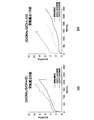
- siloxane polymer cross-linked cured material from which the number of DMS units differs It is a figure which shows the stress-strain curve before and after a heat test about a siloxane polymer crosslinked cured material from which the number of DMS units differs. It is a figure which shows the stress-strain curve before and after a heat test about a siloxane polymer crosslinked cured material from which a functional group ratio differs.
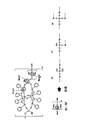
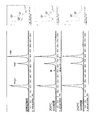
- siloxane polymer cross-linked cured product to be subjected to solid state 29 Si NMR measurement is an explanatory diagram displaying a portion of the structure. It is a figure which shows the result of solid-state 29 Si NMR measurement before and after a heat test.
- the crosslinked cured siloxane polymer of the present invention is obtained by reacting a silicon compound represented by the following formula (1) with a crosslinkable silicon compound represented by the following formula (2).
- the silicon compound may be one kind or two or more kinds.
- the crosslinkable silicon compound will be described later.
- R 0 independently represents phenyl or cycloalkyl.
- any hydrogen may be independently replaced by halogen or alkyl having 1 to 20 carbons.
- R 1 and R 2 independently represent phenyl, cyclohexyl, or alkyl having 1 to 5 carbons.
- any hydrogen may be independently replaced by fluorine, and any —CH 2 — is independently —O— or 5 to 20 carbon atoms. It may be replaced by cycloalkylene.
- any hydrogen may be independently replaced by halogen or alkyl having 1 to 20 carbons.
- alkyl having 1 to 20 carbons which is a substituent of phenyl and cyclohexyl in R 1 and R 2 any hydrogen may be independently replaced by fluorine, and any —CH 2 — may be replaced by —O —, May be replaced by cycloalkylene or phenylene having 5 to 20 carbon atoms.
- R 0 is phenyl and R 1 and R 2 are independently methyl or phenyl. From the viewpoint of obtaining various properties such as optical properties and the ease of synthesis, it is particularly preferable that R 0 is phenyl and R 1 and R 2 are methyl.
- n independently represents an integer of 1 to 30 (average value), and m represents an integer satisfying a weight average molecular weight of 2,000 to 10,000,000.
- n may give not a single but a plurality of integers. Therefore, n may be displayed as an average value. For example, when “average 5” is displayed, it means about 5.
- n is preferably an integer of 1 to 10, more preferably an integer of 3 to 5, and particularly preferably an average of 5, from the viewpoint of the physical properties of the obtained crosslinked cured siloxane polymer. If n is too large, the properties of the siloxane may be too strong in the properties of the silicon compound compared to the properties of silsesquioxane.
- m is preferably an integer satisfying the weight average molecular weight of the silicon compound from 5,000 to 2,000,000 from the viewpoints of ease of synthesis, physical properties of the obtained crosslinked cured siloxane polymer, and the like. More preferably, it is an integer satisfying the weight average molecular weight of 7,000 to 1,000,000.
- the weight average molecular weight is determined by calculating a chromatogram obtained by gel permeation chromatography (GPC) using a calibration curve obtained by using a molecular weight standard sample, as described in Examples described later.
- the weight average molecular weight of the silicon compound represented by the formula (1) is preferably from 4,000 to 200,000, and particularly preferably from 40,000 to 80,000.
- the silicon compound represented by the formula (1) is a silsesquioxane represented by the following formula (5) and a chain siloxane represented by the following formula (6). And in the presence of a base such as triethylamine. N in the formula (1) can be determined depending on the type of the chain siloxane. M in the formula (1) is adjusted according to reaction conditions (temperature, concentration of the linear siloxane represented by the formula (6), and the like). n is preferably 3 to 5.
- a cyclic siloxane represented by the following formula (6 ′) is refluxed with a silsesquioxane represented by the following formula (5) under the conditions of a usual polymerization reaction.
- a strong acid or strong base is usually used as a catalyst.
- a strong acid is preferred as the catalyst.
- examples of such a catalyst include hydrochloric acid, sulfuric acid, fluorosulfuric acid, p-toluenesulfonic acid-hydrate, trifluoromethanesulfonic acid-hydrate, trifluoromethanesulfonic acid, activated clay, sulfonic acid-based ion-exchange resin, and the like. Is mentioned.
- RCP-160M strongly acidic cation exchange resin, manufactured by Mitsubishi Chemical Corporation
- the solvent can be performed using a solvent.
- the solvent include hydrocarbon solvents such as hexane and heptane, aromatic hydrocarbon solvents such as benzene, toluene, and xylene, and ether solvents such as diethyl ether, tetrahydrofuran (THF), dioxane, and cyclopentyl methyl ether.
- halogenated hydrocarbon solvents such as methylene chloride and carbon tetrachloride.
- This reaction is usually performed at 40 to 150 ° C. in the presence of a strong acid or a base such as triethylamine.
- N in the formula (1) can be determined depending on the type of the chain siloxane. According to this reaction, it is possible to obtain a crosslinkable silicon compound in which silsesquioxane groups that may have a crosslinkable functional group and siloxane groups that may have a crosslinkable functional group are alternately arranged. Can be.
- the silsesquioxane represented by the formula (5) also reacts a compound represented by the following formula (7) with a compound represented by the following formula (8), as described in Patent Document 1. And hydrolyzed.
- X represents halogen or hydrogen.
- the compound represented by the following formula (7) hydrolyzes and condenses the compound represented by the following formula (9) in the presence of sodium hydroxide and water. Obtained by polymerization. The reaction at this time may be in the presence or absence of an organic solvent.
- R 0 , R 1 , and R 2 in the above formulas (5), (6), (6 ′), (7), or (8) are the same as those in the formula (1).
- the crosslinkable silicon compound represented by the formula (2) is a group or atom (hereinafter referred to as a group) that reacts with a hydroxyl group in the silicon compound from the viewpoint of improving the mechanical properties, heat resistance, and availability of the compound of the crosslinked cured siloxane polymer obtained.
- a group a group that reacts with a hydroxyl group in the silicon compound from the viewpoint of improving the mechanical properties, heat resistance, and availability of the compound of the crosslinked cured siloxane polymer obtained.
- One or more selected from the group consisting of a compound represented by the formula (2) having three or more “crosslinkable functional groups”) and an oligomer thereof is used.
- the crosslinkable silicon compound may be one kind or a mixture of two or more kinds.
- R 4 independently represents an alkyl group having 1 to 3 carbon atoms
- q is a code indicating a repeating structure
- q is an integer of 1 to 100, and preferably q is 1 ⁇ 10.
- all of R 4 independently represent a group selected from the group consisting of a methyl group and an ethyl group, and more preferably, all of R 4 are a methyl group.
- a partially hydrolyzed condensate of tetramethoxysilane is more preferably used.
- the crosslinkable silicon compound represented by the formula (2) is hydrolyzed and dealcoholized by reacting an alkoxy group at a molecular end or a side chain with moisture to form a silanol group.
- crosslinking is performed by a dealcoholization reaction. As this reaction proceeds, a polymer network having a high degree of crosslinking can be formed.
- Such crosslinkable silicon compounds are commercially available as, for example, MKC silicate MS57 (trademark), MKC silicate MS51 (trademark of tetramethoxysilane average pentamer), MKC silicate MS56, MS56S (manufactured by Mitsubishi Chemical Corporation).
- methyl silicate 51 (tetramethoxysilane tetramer), methyl silicate 53 (tetramethoxysilane hexamer), ethyl silicate 40 (tetraethoxysilane pentamer), ethyl silicate 48 (tetramer) manufactured by Colcoat Co., Ltd. Ethoxysilane 10-mers) and the like.
- Crosslinking between the silicon compound represented by the formula (1) and the crosslinkable silicon compound represented by the formula (2) is performed by forming a hydroxyl group in the silicon compound represented by the formula (1) which the crosslinkable silicon compound has. It is carried out by allowing both silicon compounds to coexist under appropriate conditions based on the type of the reactive crosslinkable functional group.
- the reaction between the silicon compound and the crosslinkable silicon compound can be performed, if necessary, in the presence of a catalyst.
- the catalyst include an acid catalyst such as acetic acid and hydrochloric acid, an organotin-based catalyst, an alkali, an organic titanium compound, and the like.
- the type and amount of the catalyst can be determined according to the type of the crosslinkable functional group.
- crosslinkable functional group is ethoxy
- dibutyltin laurate is used as the catalyst
- crosslinkable silicon compound 100 is used. It is used in an amount of 0.01 to 5 parts by weight based on parts by weight.
- Whether or not a siloxane polymer cross-linked cured product has been produced can be determined by determining the heat resistance and solubility of a product of the silicon compound represented by the formula (1) and the cross-linkable silicon compound represented by the formula (2) in a solvent. Can be confirmed by the change in For example, when the product is heated to 120 ° C., the product does not melt, thereby confirming that a siloxane polymer cross-linked cured product has been generated. Further, since the product is insoluble in acetone, it can be confirmed that a siloxane polymer cross-linked cured product was generated.
- the formula (1) in a mixture of a silicon compound represented by the formula (1) before crosslinking and a crosslinkable silicon compound represented by the formula (2) (hereinafter, sometimes referred to as a siloxane polymer composition) is used.
- the content of the crosslinkable silicon compound represented by 2) is 0.1 to 50 parts by weight based on 100 parts by weight of the silicon compound represented by the formula (1) from the viewpoint of improving the thermal properties and the like of the cured product. Is preferably 1 to 20 parts by weight, more preferably 5 to 10 parts by weight.
- the crosslinkable silicon compound represented by the formula (2) has a hydroxyl group-reacting group or atom in the silicon compound represented by the formula (1) in a functional group ratio of 1 to 30 times.
- the functional group ratio is a ratio (SiOMe / SiOH) to a hydroxyl group (SiOH) in the silicon compound represented by the formula (1) and a group (SiOMe) that reacts, and the SiOH at the polymer terminal is a number average.
- the SiOMe of the crosslinkable silicon compound represented by the formula (2) is calculated from the molecular weight Mn, and is calculated based on the numerical value of q in the formula (2).
- the functional group ratio is more preferably 2 to 15 times, and particularly preferably 5 to 10 times.
- Me represents methyl (when the same notation is used in the present specification, it has the same meaning), and n and m are the same as in the formula (1), respectively. is there. Further, q in the formula (4) represents an integer of 1 to 10, and is preferably 5 on average.
- the siloxane polymer composition before crosslinking further contains components other than the silicon compound represented by the formula (1) and the crosslinkable silicon compound represented by the formula (2) as long as the effects of the present invention can be obtained. It may be.
- Such other components include, for example, solvents, catalysts, polymers other than the crosslinked cured product of the siloxane polymer of the present invention, and various additives.
- the catalyst the catalyst described above in the description of the crosslinked cured product of the siloxane polymer of the present invention can be used.
- the solvent is preferably a solvent that dissolves the component containing the silicon compound and the crosslinkable silicon compound, and is preferably a solvent that has no reactivity with the component.
- the solvent may be one kind or a mixture of two or more kinds.
- examples of such a solvent include hydrocarbon solvents such as hexane and heptane, aromatic hydrocarbon solvents such as benzene, toluene, and xylene; ether solvents such as diethyl ether, tetrahydrofuran (THF) and dioxane; Examples include halogenated hydrocarbon solvents such as methylene chloride and carbon tetrachloride, and ester solvents such as ethyl acetate.
- additives various known additives can be used from the viewpoint of imparting or improving desired properties to the crosslinked cured siloxane polymer.
- additives include surfactants, fillers such as silica and mica.
- the content of the solvent in the siloxane polymer composition before crosslinking is preferably from 10 to 90% in the crosslinkable composition, from the viewpoint of enhancing the coatability of the crosslinkable composition. %, More preferably 30 to 70% by weight, even more preferably 40 to 60% by weight.
- the content of the catalyst in the siloxane polymer composition before crosslinking is, for example, when a tin-based catalyst is used as a catalyst, the molar concentration of tin relative to the number of functional groups of SiOH and SiOMe is 0.01 to 10%. Is more preferable, more preferably 0.2 to 5%, and still more preferably 0.1 to 0.5%.
- the content of the other polymer in the siloxane polymer composition before crosslinking can be arbitrarily determined from the viewpoint of improving the properties of the crosslinked cured siloxane polymer by adding the other polymer.
- the content of the additive in the siloxane polymer composition before crosslinking is preferably from 0.1 to 40% by weight, and more preferably from 0.5 to 20% by weight from the viewpoint of obtaining the effect of the addition of the additive. More preferably, the content is 1 to 10% by weight.
- Additives include acrylic, styrene, polyethyleneimine or urethane polymer dispersants; anionic, cationic, nonionic or fluorine surfactants; coatability improvers such as silicone resins; silanes An adhesion improver such as a coupling agent; an antioxidant such as a phenol-based, a sulfur-based, and a phosphorus-based; an ultraviolet absorber such as an alkoxybenzophenone; an anti-agglomeration agent such as a sodium polyacrylate; Thermal crosslinking agents such as bisazide compounds; alkali solubility promoters such as organic carboxylic acids; coloring agents such as titanium dioxide, molybdenum red, dark blue, ultramarine, cadmium yellow, cadmium red and organic dyes; antimony trioxide, bromo compounds and phosphorus Flame retardants such as compounds; metal oxides, silica, glass beads, metal hydroxide Powdered reinforcing agents and fillers, and the like the like can be
- An uncured film of the siloxane polymer composition before cross-linking is formed by applying the siloxane polymer composition before cross-linking to a substrate or a film by a dip method, a method of applying with a blade coater, a bar coater, an applicator, or the like. can do.
- the curing of the siloxane polymer composition before cross-linking is performed under the above-described conditions for producing the siloxane polymer of the present invention, such as leaving in an atmosphere of a water-containing gas, heating or light irradiation, depending on the type of the cross-linkable functional group. It can be performed by performing processing based on this.
- the siloxane polymer composition before crosslinking is cured by leaving it in ordinary air at a humidity of about 50%, and is hydrolyzed by moisture in the air. The rate of this cure is increased by the incorporation of the catalyst into the siloxane polymer composition before crosslinking and also by heating the composition.
- the siloxane polymer composition may be heated in an oven at 40 ° C., 70 ° C., 100 ° C., and then fired at 200 ° C. to obtain a cured siloxane polymer.
- the crosslinked cured siloxane polymer of the present invention has excellent long-term heat resistance.
- a heat resistance test is performed to evaluate long-term heat resistance.
- the apparent change in the activation energy at the glass transition temperature of the crosslinked cured siloxane polymer before and after the heat resistance test is 40 kJ. / Mol or less, preferably 35 kJ / mol or less, and more preferably 30 kJ / mol.
- Such activation energy is determined by dynamic viscoelasticity (DMA) measurement.
- DMA dynamic viscoelasticity
- the small change in the apparent activation energy at the glass transition temperature means that even after a severe heat test at 200 ° C or 250 ° C for 500 hours, the siloxane polymer crosslinked cured material deteriorates due to crosslinking and softens due to molecular chain breakage. This indicates that there is little change in physical properties such as deterioration, which indicates that it has excellent long-term heat resistance.
- FIG. 1A shows a stress-strain curve before the heat resistance test
- FIG. 1B shows a stress-strain curve after the heat resistance test.
- a crosslinked cured siloxane polymer obtained from a silicon compound having a siloxane chain length (the number of units of DMS) of 5 (average value) and a crosslinkable silicon compound having a functional group ratio of 15 times It can be seen that the elongation is large, and the elongation is 140% or more before and after the heat test.
- a crosslinked cured siloxane polymer using a silicon compound having a weight-average molecular weight of 60,000 or more exhibits an elongation of 200% or more before and after the heat test.
- the crosslinked cured product of the siloxane polymer of the present invention shows 5 MPa or more before and after the heat resistance test, indicating that the breaking stress is high. That is, among the siloxane polymer crosslinked cured products of the present invention, among them, the siloxane polymer crosslinked cured product having an average number of DMS units of 5 has good mechanical properties even before the heat resistance test. Even after a severe heat test, which is a time heat test, it retains its good mechanical properties. In other words, the crosslinked cured product of the siloxane polymer of the present invention does not cause resin degradation even after a long-term heat resistance test at 200 ° C. for 500 hours, and can exhibit good mechanical properties, thus supporting high output. It is possible.
- polydimethylsiloxane which is being studied as a material such as a flexible wiring material and a piezoelectric material, has a stress of less than 1 MPa and is inferior in mechanical strength before and after a heat resistance test.
- FIG. 2 shows a stress-strain curve obtained by performing a predetermined tensile test on the crosslinked cured product of the siloxane polymer of the present invention (functional group ratio: 5 times, 15 times).
- a stress-strain curve after performing a heat resistance test at 200 ° C. for 500 hours and a heat resistance test at 250 ° C. for 500 hours, and a stress-strain curve before performing the heat resistance test are shown.
- FIG. 2 (a) shows the results of a heat resistance test of a crosslinked cured product of a siloxane polymer having a functional group ratio of 5 times
- FIG. 2 (b) shows the results of a siloxane polymer having a functional group ratio of 15 times.
- the crosslinked cured siloxane polymer of the present invention has excellent optical properties even after a heat resistance test.
- the siloxane polymer crosslinked cured product of the present invention was subjected to a heat resistance test at 200 ° C. for 250 hours and a heat resistance test at 200 ° C. for 500 hours, and the transmittance and yellowing resistance before and after the heat resistance test were evaluated. That is, when the total light transmittance of the siloxane polymer crosslinked cured product at a wavelength of 380 nm to 780 nm by UV-visible light spectroscopy is determined, the total light transmittance before the heat test, after the heat test at 200 ° C. for 250 hours, and 500 hours at 200 ° C.
- the transmittance is 99.0% or more, which is excellent in transparency.
- the YI value does not change before and after the heat test, and is excellent in yellowing resistance.
- excellent results were shown regardless of the number of DMS units 3 to 5 (average value) and the weight average molecular weight of the silicon compound (40,000 to 80,000). It shows excellent optical characteristics without change even before and after.
- D unit (Me2 D 2) (2 pieces is Me group) Me2 left shoulder of the substituent, the right shoulder of the number 2 represents the number of oxygen that cross-linked.
- the measurement was performed using nuclear magnetic resonance spectroscopy (Varian NMR System 500 (manufactured by Varian)) under measurement conditions (CP-MAS contact time 5 ms, relaxation delay 2.5 s, spin 8 kHz).
- FIG. 4 the crosslinked cured product of the siloxane polymer of the present invention has almost no polymer main structure and no crosslinked portion before the heat test, after the heat test at 200 ° C. for 500 hours, and after the heat test at 250 ° C. for 500 hours. It can be seen that there is no change and the structure is stable even after a severe heat resistance test.
- siloxane polymer crosslinked cured product of the present invention by appropriately selecting the number of DMS units, the weight average molecular weight of the silicon compound, and the like, it is possible to realize a product having desired physical properties and excellent long-term heat resistance. You can do it. Therefore, use for a wide range of applications is expected.
- Examples of uses of the crosslinked cured product of the siloxane polymer of the present invention include optical materials. More specifically, coating materials for substrates such as metal elution prevention films, gas barrier films, and antireflection films, and liquid sealants For optical and electronic materials such as interlayer insulating films, antifouling coating agents, microlenses, light guide plates, optical elements such as optical waveguide materials, LED encapsulating materials, light transmitting adhesives, display substrates and printed wiring substrates, etc. Applications.
- the mixture was refluxed for 1 hour and then aged at 50 ° C. After completion of the aging, the mixture was cooled to room temperature, and RCP-160M was separated by filtration. The obtained filtrate was washed with water several times. Thereafter, the solvent and low boiling components were distilled off from the filtrate, and the obtained crude product was purified by reprecipitation with methanol. The obtained white viscous liquid was vacuum-dried at 40 ° C. to obtain 49.2 g of a white solid. According to 1H-NMR and GPC analysis, the obtained white solid was a silicon compound represented by the formula (3), and each structural unit (silsesquioxane unit and dimethylsiloxane unit) in the formula (3) was alternately formed.
- the mixture was refluxed for 1 hour and then aged at 50 ° C. After completion of the aging, the mixture was cooled to room temperature, and RCP-160M was separated by filtration. The obtained filtrate was washed with water several times. Thereafter, the solvent and low boiling components were distilled off from the filtrate, and the obtained crude product was purified by reprecipitation with methanol. The obtained white viscous liquid was vacuum-dried at 40 ° C. to obtain 55.4 g of a white solid. According to 1H-NMR and GPC analysis, the obtained white solid is a silicon compound represented by the formula (3), and the structural units (silsesquioxane unit and dimethylsiloxane unit) in the formula (3) are alternately arranged.
- the mixture was refluxed for 1 hour and then aged at 50 ° C. After completion of the aging, the mixture was cooled to room temperature, and RCP-160M was separated by filtration. The obtained filtrate was washed with water several times. Thereafter, the solvent and low boiling components were distilled off from the filtrate, and the obtained crude product was purified by reprecipitation with methanol. The obtained white viscous liquid was vacuum-dried at 40 ° C. to obtain 500.4 g of a white solid. According to 1H-NMR and GPC analysis, the obtained white solid was a silicon compound represented by the formula (3), and each structural unit (silsesquioxane unit and dimethylsiloxane unit) in the formula (3) was alternately formed.
- the mixture was refluxed for 1 hour and then aged at 50 ° C. After completion of the aging, the mixture was cooled to room temperature, and RCP-160M was separated by filtration. The obtained filtrate was washed with water several times. Thereafter, the solvent and low boiling components were distilled off from the filtrate, and the obtained crude product was purified by reprecipitation with methanol. The obtained white viscous liquid was vacuum-dried at 40 ° C. to obtain 42.7 g of a white solid. According to 1H-NMR and GPC analysis, the obtained white solid is a silicon compound represented by the formula (3), and the structural units (silsesquioxane unit and dimethylsiloxane unit) in the formula (3) are alternately arranged.
- Example 1 In a screw tube, 3 g of the silicon compound 1 obtained in Synthesis Example 1 was dissolved in 2.7 g of toluene, and 120.3 ⁇ L of MS-51 (manufactured by Mitsubishi Chemical Corporation) was added to the obtained solution and mixed. Thus, prepolymer 1 was obtained.
- a transparent siloxane polymer crosslinked cured product 1 having a thickness of about 230 ⁇ m was obtained.
- the thickness of the crosslinked cured siloxane polymer 1 was measured with a film thickness meter (Nikon DIGIMICRO MFC-101A).
- Example 2 In a screw tube, 3 g of the silicon compound 2 obtained in Synthesis Example 2 was dissolved in 3.0 mL of toluene, and 120.3 ⁇ L of MS-51 (manufactured by Mitsubishi Chemical Corporation) was added and mixed. Got.
- a transparent siloxane polymer crosslinked cured product 2 having a thickness of about 180 ⁇ m was obtained.
- the thickness of the crosslinked cured siloxane polymer 2 was measured with a film thickness meter (DIGIMICRO MFC-101A manufactured by Nikon).
- Example 3 In a screw tube, 3 g of the silicon compound 3 obtained in Synthesis Example 3 was dissolved in 2.0 mL of toluene, and 162.1 ⁇ L of MS-51 (manufactured by Mitsubishi Chemical Corporation) was added and mixed. Got.
- the obtained crosslinkable composition 3 was applied to a Teflon plate (thickness: 3 mm) using an applicator, and then placed in an oven for 10 minutes at 40 ° C, 30 minutes at 70 ° C, The composition was cured by heating at 100 ° C. for 1 hour. The obtained cured film was peeled off from the Teflon plate, suspended in an oven, and baked with hot air at 200 ° C. for 2 hours to obtain a cured siloxane polymer cured product 3 having a thickness of about 200 ⁇ m. The thickness of the crosslinked cured siloxane polymer 3 was measured with a film thickness gauge (Nikon DIGIMICRO MFC-101A).
- Example 4 In a screw tube, 3 g of the silicon compound 4 obtained in the above Synthesis Example 4 was dissolved in 3.3 mL of toluene, and 116.5 ⁇ L of MS-51 (manufactured by Mitsubishi Chemical Corporation) was added and mixed. Got.
- the obtained crosslinkable composition 4 was applied to a Teflon plate (thickness: 3 mm) using an applicator, and then placed in an oven for 10 minutes at 40 ° C, 30 minutes at 70 ° C, The composition was cured by heating at 100 ° C. for 1 hour.
- the obtained cured film was peeled off from the Teflon plate, hung in an oven, and baked with hot air at 200 ° C. for 2 hours to obtain a cured siloxane polymer cured product 4 having a thickness of about 220 ⁇ m.
- the thickness of the crosslinked cured siloxane polymer 4 was measured with a film thickness meter (DIGIMICRO MFC-101A manufactured by Nikon).
- 0.8 ⁇ L of dibutyltin laurate was added as a catalyst.
- the obtained PDMS crosslinkable composition 1 was charged into a PFA petri dish (5 cm in diameter), placed in an oven for 10 minutes at 40 ° C, 30 minutes at 70 ° C, and then for 1 hour at 100 ° C. It was cured by heating.
- the obtained cured film was taken out from the PFA petri dish, suspended in an oven, and baked with hot air at 200 ° C. for 2 hours to obtain a transparent cured PDMS product 1 having a thickness of about 230 ⁇ m.
- the thickness of the crosslinked cured product 1 was measured with a film thickness meter (DIGIMICRO MFC-101A manufactured by Nikon).
- Example 5 In a screw tube, 3 g of the silicon compound 1 obtained in Synthesis Example 1 was dissolved in 11 mL of toluene, and 120.3 ⁇ L of MS-51 (manufactured by Mitsubishi Chemical Corporation) was added and mixed to obtain a prepolymer 5.
- MS-51 manufactured by Mitsubishi Chemical Corporation
- the obtained crosslinkable composition 5 was spin-coated on a glass plate (Corning EAGLE XG (700 ⁇ m thick)), and then placed in an oven for 10 minutes at 40 ° C. and 30 ° C. at 70 ° C. The mixture was cured by heating at 100 ° C. for 20 minutes and at 200 ° C. for 2 hours to obtain a transparent siloxane polymer crosslinked cured product 5 having a thickness of about 12 ⁇ m. The thickness of the crosslinked cured siloxane polymer 5 was measured with a film thickness meter (DIGIMICRO MFC-101A manufactured by Nikon).
- Example 6 In a screw tube, 3 g of the silicon compound 2 obtained in Synthesis Example 2 was dissolved in 11 mL of toluene, and 120.3 ⁇ L of MS-51 (manufactured by Mitsubishi Chemical Corporation) was added and mixed to obtain a prepolymer 6.
- MS-51 manufactured by Mitsubishi Chemical Corporation
- the obtained crosslinkable composition 6 was spin-coated on a glass plate (Eagle XG, manufactured by Corning) (700 ⁇ m thick), and then placed in an oven for 10 minutes at 40 ° C. and 30 ° C. at 70 ° C. The mixture was cured by heating at 100 ° C. for 20 minutes and at 200 ° C. for 2 hours to obtain a crosslinked cured siloxane polymer 6 having a thickness of about 13 ⁇ m. The thickness of the crosslinked cured siloxane polymer 6 was measured by a film thickness meter (Nikon DIGIMICRO MFC-101A).
- Example 7 In a screw tube, 3 g of the silicon compound 3 obtained in the above Synthesis Example 3 was dissolved in 8.6 mL of toluene, and 162.1 ⁇ L of MS-51 (manufactured by Mitsubishi Chemical Corporation) was added and mixed. Got.
- the resulting crosslinkable composition 7 was spin-coated on a glass plate (Corning EAGLE XG (700 ⁇ m thick)) and then placed in an oven for 10 minutes at 40 ° C. and 30 ° C. at 70 ° C. The mixture was cured by heating at 100 ° C. for 20 minutes and at 200 ° C. for 2 hours to obtain a cured crosslinked siloxane polymer 7 having a thickness of about 14 ⁇ m. The thickness of the crosslinked cured siloxane polymer 7 was measured with a film thickness gauge (Nikon DIGIMICRO MFC-101A).
- Example 8 In a screw tube, 3 g of the silicon compound 4 obtained in the above Synthesis Example 4 was dissolved in 14.6 mL of toluene, 116.5 ⁇ L of MS-51 (manufactured by Mitsubishi Chemical Corporation) was added and mixed, and the prepolymer 8 was mixed. Got.
- the obtained crosslinkable composition 8 was spin-coated on a glass plate (EAGLE XG (700 ⁇ m thick) manufactured by Corning), and then placed in an oven for 10 minutes at 40 ° C. and 30 ° C. at 70 ° C. The mixture was cured by heating at 100 ° C. for 20 minutes and at 200 ° C. for 2 hours to obtain a cured cross-linked siloxane polymer 8 having a thickness of about 14 ⁇ m. The thickness of the crosslinked cured siloxane polymer 8 was measured with a film thickness meter (Nikon DIGIMICRO MFC-101A).
- PDMS crosslinkable composition 2 was spin-coated on a glass plate (Corning EAGLE XG (700 ⁇ m thick)), and then placed in an oven for 10 minutes at 40 ° C. and 30 minutes at 70 ° C. The resin was cured by heating at 100 ° C. for 20 minutes and at 200 ° C. for 2 hours to obtain a PDMS crosslinked cured product 2.
- siloxane polymer crosslinked cured products 1 to 4 and the PDMS crosslinked cured product 1 obtained in Examples 1 to 8 and Comparative Examples 1 and 2 were evaluated for heat resistance as described below, and the siloxane polymer crosslinked cured products 5 to 8 were evaluated.
- the following optical properties of the crosslinked cured product 2 and PDMS were evaluated. Table 3 shows the results.
- the YI value and the light transmittance of the obtained sample were measured.
- the YI value was measured according to JIS7373.
- the tristimulus values XYZ of the siloxane polymer crosslinked cured products 5 to 8 and the PDMS crosslinked cured product 2 were measured with an ultraviolet-visible spectral hardness tester (V-660, manufactured by JASCO Corporation) to calculate YI.
- V-660 ultraviolet-visible spectral hardness tester
- the crosslinked cured siloxane polymer prepared in the same manner as described above had elongation at break (296% before the heat test and 214% after the heat test) and breaking stress (9.0 MPa before the heat test and 11.7 MPa after the heat test), It was found to have excellent heat resistance properties.
- a silicone film having high light transmittance in addition to excellent long-term heat resistance can be obtained by a simple method of applying and curing a liquid composition.
- the crosslinked cured product of the siloxane polymer of the present invention can be obtained by curing the liquid composition, by using an appropriate mold, the crosslinked cured product of the siloxane polymer of the present invention in various shapes can be formed. Is possible. Therefore, the present invention can be applied to electric and electronic materials for forming various layers in various display elements, optical materials such as lenses, and used in various other technical fields.
Landscapes
- Chemical & Material Sciences (AREA)
- Health & Medical Sciences (AREA)
- Chemical Kinetics & Catalysis (AREA)
- Medicinal Chemistry (AREA)
- Polymers & Plastics (AREA)
- Organic Chemistry (AREA)
- Silicon Polymers (AREA)
- Compositions Of Macromolecular Compounds (AREA)
Abstract
Le problème décrit par la présente invention est de fournir un produit d'un polymère de siloxane durci par réticulation, qui contient un squelette de silsesquioxane dans la chaîne principale d'un polymère à base de silicium et qui présente une excellente résistance thermique à long terme. La solution selon l'invention porte sur un produit d'un polymère de siloxane durci par réticulation qui est caractérisé en ce qu'il est obtenu en faisant appel à une composition durcissable par réticulation obtenue par la réaction d'un composé de silicium spécifique ayant un squelette de silsesquioxane dans la chaîne principale avec un composé de silicium réticulable représenté par la formule (2), le degré apparent de variation d'énergie d'activation étant inférieur ou égal à 40 kJ/mol à la température de transition vitreuse après un test de résistance thermique réalisé pendant 500 heures à une température de 200 °C.
Applications Claiming Priority (2)
| Application Number | Priority Date | Filing Date | Title |
|---|---|---|---|
| JP2018124006A JP2021155462A (ja) | 2018-06-29 | 2018-06-29 | シロキサンポリマー架橋硬化物 |
| JP2018-124006 | 2018-06-29 |
Publications (1)
| Publication Number | Publication Date |
|---|---|
| WO2020004545A1 true WO2020004545A1 (fr) | 2020-01-02 |
Family
ID=68985478
Family Applications (1)
| Application Number | Title | Priority Date | Filing Date |
|---|---|---|---|
| PCT/JP2019/025578 Ceased WO2020004545A1 (fr) | 2018-06-29 | 2019-06-27 | Produit de polymère de siloxane durci par réticulation |
Country Status (3)
| Country | Link |
|---|---|
| JP (1) | JP2021155462A (fr) |
| TW (1) | TW202000746A (fr) |
| WO (1) | WO2020004545A1 (fr) |
Cited By (1)
| Publication number | Priority date | Publication date | Assignee | Title |
|---|---|---|---|---|
| WO2020116199A1 (fr) * | 2018-12-04 | 2020-06-11 | Jnc株式会社 | Composition de résine durcissable par condensation, produit durci, corps moulé et dispositif semi-conducteur |
Families Citing this family (2)
| Publication number | Priority date | Publication date | Assignee | Title |
|---|---|---|---|---|
| WO2023047978A1 (fr) | 2021-09-24 | 2023-03-30 | 国立研究開発法人産業技術総合研究所 | Bloc-batterie et procédé d'évaluation |
| WO2025063069A1 (fr) * | 2023-09-21 | 2025-03-27 | 積水化学工業株式会社 | Composition de résine durcissable, film durci, objet multicouche et dispositif à semi-conducteur |
Citations (4)
| Publication number | Priority date | Publication date | Assignee | Title |
|---|---|---|---|---|
| JP2008280420A (ja) * | 2007-05-09 | 2008-11-20 | Chisso Corp | 架橋性シロキサンポリマー、シロキサン系の架橋性組成物及びシリコーン膜 |
| JP2010116464A (ja) * | 2008-11-12 | 2010-05-27 | Chisso Corp | 架橋性ケイ素化合物、その製造方法、架橋性組成物、シロキサンポリマー、シリコーン膜、該架橋性ケイ素化合物の原料となるケイ素化合物、及びその製造方法 |
| JP2010116462A (ja) * | 2008-11-12 | 2010-05-27 | Chisso Corp | シロキサンポリマー、シロキサン系の架橋性組成物及びシリコーン膜 |
| JP2011190413A (ja) * | 2010-03-16 | 2011-09-29 | Kumamoto Univ | シロキサンポリマー架橋硬化物 |
-
2018
- 2018-06-29 JP JP2018124006A patent/JP2021155462A/ja active Pending
-
2019
- 2019-06-27 WO PCT/JP2019/025578 patent/WO2020004545A1/fr not_active Ceased
- 2019-06-27 TW TW108122606A patent/TW202000746A/zh unknown
Patent Citations (4)
| Publication number | Priority date | Publication date | Assignee | Title |
|---|---|---|---|---|
| JP2008280420A (ja) * | 2007-05-09 | 2008-11-20 | Chisso Corp | 架橋性シロキサンポリマー、シロキサン系の架橋性組成物及びシリコーン膜 |
| JP2010116464A (ja) * | 2008-11-12 | 2010-05-27 | Chisso Corp | 架橋性ケイ素化合物、その製造方法、架橋性組成物、シロキサンポリマー、シリコーン膜、該架橋性ケイ素化合物の原料となるケイ素化合物、及びその製造方法 |
| JP2010116462A (ja) * | 2008-11-12 | 2010-05-27 | Chisso Corp | シロキサンポリマー、シロキサン系の架橋性組成物及びシリコーン膜 |
| JP2011190413A (ja) * | 2010-03-16 | 2011-09-29 | Kumamoto Univ | シロキサンポリマー架橋硬化物 |
Cited By (3)
| Publication number | Priority date | Publication date | Assignee | Title |
|---|---|---|---|---|
| WO2020116199A1 (fr) * | 2018-12-04 | 2020-06-11 | Jnc株式会社 | Composition de résine durcissable par condensation, produit durci, corps moulé et dispositif semi-conducteur |
| JP2020090572A (ja) * | 2018-12-04 | 2020-06-11 | Jnc株式会社 | 縮合硬化型樹脂組成物、硬化物、成形体、及び半導体装置 |
| US12384888B2 (en) | 2018-12-04 | 2025-08-12 | Jnc Corporation | Condensation-curable resin composition, cured product, molded body, and semiconductor device |
Also Published As
| Publication number | Publication date |
|---|---|
| JP2021155462A (ja) | 2021-10-07 |
| TW202000746A (zh) | 2020-01-01 |
Similar Documents
| Publication | Publication Date | Title |
|---|---|---|
| JP5801028B2 (ja) | ケイ素含有硬化性組成物及びその硬化物 | |
| KR101569533B1 (ko) | 실리콘 수지용 조성물 | |
| TWI820260B (zh) | 縮合硬化型樹脂組成物、硬化物、成形體、及半導體裝置 | |
| KR101289960B1 (ko) | 광학 장치 밀봉용 수지 조성물, 그의 경화물 및 반도체소자의 밀봉 방법 | |
| JP2011190413A (ja) | シロキサンポリマー架橋硬化物 | |
| CN100379794C (zh) | 硅氧烷基聚合物及其组合物、发光装置以及硅氧烷基聚合物用于发光二极管的方法 | |
| JP2010280766A (ja) | 有機ケイ素化合物、該有機ケイ素化合物を含む熱硬化性組成物、および光半導体用封止材料 | |
| WO2020004545A1 (fr) | Produit de polymère de siloxane durci par réticulation | |
| KR20150075549A (ko) | 열 용융-압출 성형이 가능한 실세스퀴옥산, 이를 이용한 고투명 및 고내열 플라스틱 투명기판 및 이의 제조방법 | |
| CN104356390A (zh) | 含苯并环丁烯基团的有机硅氧烷及其制备和应用 | |
| US20210095126A1 (en) | Method of manufacturing silicone cured product, silicone cured product and optical member | |
| JP2015155541A (ja) | シロキサンポリマー架橋硬化物 | |
| CN108299645B (zh) | 可直接热固化的有机硅氧烷的制备和应用 | |
| CN105837617A (zh) | 可直接热固化的含三氟乙烯基醚的环硅氧烷的制备及应用 | |
| JPWO2015136820A1 (ja) | 硬化性樹脂組成物 | |
| Hayami et al. | Preparation and characterization of stable DQ silicone polymer sols | |
| KR102336227B1 (ko) | 유기규소 개질된 광개시제 및 그의 광경화성 접착제 조성물 | |
| CN109476920A (zh) | 固化性树脂组合物、其固化物、及半导体装置 | |
| JP7771958B2 (ja) | シロキサンポリマー、シロキサンポリマー組成物および成形体 | |
| CN117645725A (zh) | 一种光固化有机硅树脂、胶粘剂及其制备方法和应用 | |
| JP2020158692A (ja) | フッ素含有縮合型オルガノポリシロキサンプレポリマーおよびその硬化体 | |
| JP2024136725A (ja) | フッ素含有縮合型オルガノシロキサンポリマー前駆体 | |
| JP2013057032A (ja) | 多面体構造ポリシロキサン変性体、該変性体を含有する組成物、該組成物を硬化させてなる硬化物 | |
| JP2025125318A (ja) | シリル化ポリシルセスキオキサン、その製造方法、及びその用途 | |
| JP2010260962A (ja) | 硬化物の製造方法および硬化物 |
Legal Events
| Date | Code | Title | Description |
|---|---|---|---|
| 121 | Ep: the epo has been informed by wipo that ep was designated in this application |
Ref document number: 19825406 Country of ref document: EP Kind code of ref document: A1 |
|
| NENP | Non-entry into the national phase |
Ref country code: DE |
|
| 122 | Ep: pct application non-entry in european phase |
Ref document number: 19825406 Country of ref document: EP Kind code of ref document: A1 |
|
| NENP | Non-entry into the national phase |
Ref country code: JP |