WO2020004545A1 - シロキサンポリマー架橋硬化物 - Google Patents
シロキサンポリマー架橋硬化物 Download PDFInfo
- Publication number
- WO2020004545A1 WO2020004545A1 PCT/JP2019/025578 JP2019025578W WO2020004545A1 WO 2020004545 A1 WO2020004545 A1 WO 2020004545A1 JP 2019025578 W JP2019025578 W JP 2019025578W WO 2020004545 A1 WO2020004545 A1 WO 2020004545A1
- Authority
- WO
- WIPO (PCT)
- Prior art keywords
- siloxane polymer
- formula
- silicon compound
- crosslinked cured
- compound represented
- Prior art date
- Legal status (The legal status is an assumption and is not a legal conclusion. Google has not performed a legal analysis and makes no representation as to the accuracy of the status listed.)
- Ceased
Links
Images

Classifications
-
- C—CHEMISTRY; METALLURGY
- C08—ORGANIC MACROMOLECULAR COMPOUNDS; THEIR PREPARATION OR CHEMICAL WORKING-UP; COMPOSITIONS BASED THEREON
- C08G—MACROMOLECULAR COMPOUNDS OBTAINED OTHERWISE THAN BY REACTIONS ONLY INVOLVING UNSATURATED CARBON-TO-CARBON BONDS
- C08G77/00—Macromolecular compounds obtained by reactions forming a linkage containing silicon with or without sulfur, nitrogen, oxygen or carbon in the main chain of the macromolecule
- C08G77/04—Polysiloxanes
-
- C—CHEMISTRY; METALLURGY
- C08—ORGANIC MACROMOLECULAR COMPOUNDS; THEIR PREPARATION OR CHEMICAL WORKING-UP; COMPOSITIONS BASED THEREON
- C08G—MACROMOLECULAR COMPOUNDS OBTAINED OTHERWISE THAN BY REACTIONS ONLY INVOLVING UNSATURATED CARBON-TO-CARBON BONDS
- C08G77/00—Macromolecular compounds obtained by reactions forming a linkage containing silicon with or without sulfur, nitrogen, oxygen or carbon in the main chain of the macromolecule
- C08G77/42—Block-or graft-polymers containing polysiloxane sequences
- C08G77/44—Block-or graft-polymers containing polysiloxane sequences containing only polysiloxane sequences
-
- C—CHEMISTRY; METALLURGY
- C08—ORGANIC MACROMOLECULAR COMPOUNDS; THEIR PREPARATION OR CHEMICAL WORKING-UP; COMPOSITIONS BASED THEREON
- C08K—Use of inorganic or non-macromolecular organic substances as compounding ingredients
- C08K5/00—Use of organic ingredients
- C08K5/54—Silicon-containing compounds
- C08K5/541—Silicon-containing compounds containing oxygen
- C08K5/5415—Silicon-containing compounds containing oxygen containing at least one Si—O bond
-
- C—CHEMISTRY; METALLURGY
- C08—ORGANIC MACROMOLECULAR COMPOUNDS; THEIR PREPARATION OR CHEMICAL WORKING-UP; COMPOSITIONS BASED THEREON
- C08L—COMPOSITIONS OF MACROMOLECULAR COMPOUNDS
- C08L83/00—Compositions of macromolecular compounds obtained by reactions forming in the main chain of the macromolecule a linkage containing silicon with or without sulfur, nitrogen, oxygen or carbon only; Compositions of derivatives of such polymers
- C08L83/04—Polysiloxanes
- C08L83/06—Polysiloxanes containing silicon bound to oxygen-containing groups
Definitions
- the present invention relates to a crosslinked cured siloxane polymer obtained from a crosslinkable composition of a siloxane polymer as an optical material used for an LED sealing material, a lens, and the like.
- Polymers containing a silsesquioxane skeleton have attracted attention from various fields because they have a unique structure and are expected to have a unique effect.
- a silicon-based polymer having a silsesquioxane skeleton in a main chain is known (for example, see Patent Document 1). Since the silicon-based polymer is excellent in transparency, film-forming property, and the like, it can be used for films, sheets, and molded articles. However, since the silicon-based polymer has thermoplasticity, its application to a field where a molded article requires heat resistance is limited. Thus, the silicon-based polymer leaves room for study on the heat resistance of the molded article.
- An object of the present invention is to provide a crosslinked cured siloxane polymer having a silsesquioxane skeleton in the main chain of a silicon-based polymer and having excellent long-term heat resistance.
- the present invention is formed from a siloxane polymer obtained by reacting a terminal hydroxyl group of a specific silicon compound containing a silsesquioxane skeleton in the main chain with a tetrafunctional or more crosslinkable silicon compound having reactivity to the hydroxyl group. To provide a cured siloxane polymer crosslinked product.
- a cross-linkable curable composition obtained by reacting a silicon compound represented by the following formula (1) with at least one selected from the group consisting of cross-linkable silicon compounds represented by the following formula (2):
- a crosslinked cured siloxane polymer characterized by having a change in apparent activation energy of 40 kJ / mol or less at a glass transition temperature after a heat resistance test at a temperature of 200 ° C. for 500 hours at a temperature of 200 ° C.
- any hydrogen may be independently replaced by fluorine, and any -CH 2 -may be independently replaced by -O- or carbon atoms. 5-20 cycloalkylenes may be substituted.
- R 4 independently represents an alkyl group having 1 to 3 carbon atoms, and q represents an integer of 1 to 100.
- the crosslinkable silicon compound represented by the formula (2) has a group or atom that reacts with a hydroxyl group in the silicon compound represented by the formula (1) in a functional group ratio of 1 to 15 times.
- q Represents an integer of 1 to 10.
- the total light transmittance of the crosslinked cured siloxane polymer is 99.0% or more at 380 nm to 780 nm both before and after the heat resistance test [1].
- the crosslinked cured product of the siloxane polymer according to any one of to [9].
- a film-like siloxane polymer can be obtained by reacting the silicon compound represented by the formula (1) with the crosslinkable silicon compound represented by the formula (2), a silsesquioxane skeleton is obtained.
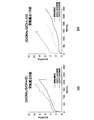
- siloxane polymer cross-linked cured material from which the number of DMS units differs It is a figure which shows the stress-strain curve before and after a heat test about a siloxane polymer crosslinked cured material from which the number of DMS units differs. It is a figure which shows the stress-strain curve before and after a heat test about a siloxane polymer crosslinked cured material from which a functional group ratio differs.
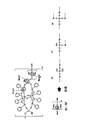
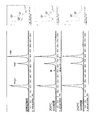
- siloxane polymer cross-linked cured product to be subjected to solid state 29 Si NMR measurement is an explanatory diagram displaying a portion of the structure. It is a figure which shows the result of solid-state 29 Si NMR measurement before and after a heat test.
- the crosslinked cured siloxane polymer of the present invention is obtained by reacting a silicon compound represented by the following formula (1) with a crosslinkable silicon compound represented by the following formula (2).
- the silicon compound may be one kind or two or more kinds.
- the crosslinkable silicon compound will be described later.
- R 0 independently represents phenyl or cycloalkyl.
- any hydrogen may be independently replaced by halogen or alkyl having 1 to 20 carbons.
- R 1 and R 2 independently represent phenyl, cyclohexyl, or alkyl having 1 to 5 carbons.
- any hydrogen may be independently replaced by fluorine, and any —CH 2 — is independently —O— or 5 to 20 carbon atoms. It may be replaced by cycloalkylene.
- any hydrogen may be independently replaced by halogen or alkyl having 1 to 20 carbons.
- alkyl having 1 to 20 carbons which is a substituent of phenyl and cyclohexyl in R 1 and R 2 any hydrogen may be independently replaced by fluorine, and any —CH 2 — may be replaced by —O —, May be replaced by cycloalkylene or phenylene having 5 to 20 carbon atoms.
- R 0 is phenyl and R 1 and R 2 are independently methyl or phenyl. From the viewpoint of obtaining various properties such as optical properties and the ease of synthesis, it is particularly preferable that R 0 is phenyl and R 1 and R 2 are methyl.
- n independently represents an integer of 1 to 30 (average value), and m represents an integer satisfying a weight average molecular weight of 2,000 to 10,000,000.
- n may give not a single but a plurality of integers. Therefore, n may be displayed as an average value. For example, when “average 5” is displayed, it means about 5.
- n is preferably an integer of 1 to 10, more preferably an integer of 3 to 5, and particularly preferably an average of 5, from the viewpoint of the physical properties of the obtained crosslinked cured siloxane polymer. If n is too large, the properties of the siloxane may be too strong in the properties of the silicon compound compared to the properties of silsesquioxane.
- m is preferably an integer satisfying the weight average molecular weight of the silicon compound from 5,000 to 2,000,000 from the viewpoints of ease of synthesis, physical properties of the obtained crosslinked cured siloxane polymer, and the like. More preferably, it is an integer satisfying the weight average molecular weight of 7,000 to 1,000,000.
- the weight average molecular weight is determined by calculating a chromatogram obtained by gel permeation chromatography (GPC) using a calibration curve obtained by using a molecular weight standard sample, as described in Examples described later.
- the weight average molecular weight of the silicon compound represented by the formula (1) is preferably from 4,000 to 200,000, and particularly preferably from 40,000 to 80,000.
- the silicon compound represented by the formula (1) is a silsesquioxane represented by the following formula (5) and a chain siloxane represented by the following formula (6). And in the presence of a base such as triethylamine. N in the formula (1) can be determined depending on the type of the chain siloxane. M in the formula (1) is adjusted according to reaction conditions (temperature, concentration of the linear siloxane represented by the formula (6), and the like). n is preferably 3 to 5.
- a cyclic siloxane represented by the following formula (6 ′) is refluxed with a silsesquioxane represented by the following formula (5) under the conditions of a usual polymerization reaction.
- a strong acid or strong base is usually used as a catalyst.
- a strong acid is preferred as the catalyst.
- examples of such a catalyst include hydrochloric acid, sulfuric acid, fluorosulfuric acid, p-toluenesulfonic acid-hydrate, trifluoromethanesulfonic acid-hydrate, trifluoromethanesulfonic acid, activated clay, sulfonic acid-based ion-exchange resin, and the like. Is mentioned.
- RCP-160M strongly acidic cation exchange resin, manufactured by Mitsubishi Chemical Corporation
- the solvent can be performed using a solvent.
- the solvent include hydrocarbon solvents such as hexane and heptane, aromatic hydrocarbon solvents such as benzene, toluene, and xylene, and ether solvents such as diethyl ether, tetrahydrofuran (THF), dioxane, and cyclopentyl methyl ether.
- halogenated hydrocarbon solvents such as methylene chloride and carbon tetrachloride.
- This reaction is usually performed at 40 to 150 ° C. in the presence of a strong acid or a base such as triethylamine.
- N in the formula (1) can be determined depending on the type of the chain siloxane. According to this reaction, it is possible to obtain a crosslinkable silicon compound in which silsesquioxane groups that may have a crosslinkable functional group and siloxane groups that may have a crosslinkable functional group are alternately arranged. Can be.
- the silsesquioxane represented by the formula (5) also reacts a compound represented by the following formula (7) with a compound represented by the following formula (8), as described in Patent Document 1. And hydrolyzed.
- X represents halogen or hydrogen.
- the compound represented by the following formula (7) hydrolyzes and condenses the compound represented by the following formula (9) in the presence of sodium hydroxide and water. Obtained by polymerization. The reaction at this time may be in the presence or absence of an organic solvent.
- R 0 , R 1 , and R 2 in the above formulas (5), (6), (6 ′), (7), or (8) are the same as those in the formula (1).
- the crosslinkable silicon compound represented by the formula (2) is a group or atom (hereinafter referred to as a group) that reacts with a hydroxyl group in the silicon compound from the viewpoint of improving the mechanical properties, heat resistance, and availability of the compound of the crosslinked cured siloxane polymer obtained.
- a group a group that reacts with a hydroxyl group in the silicon compound from the viewpoint of improving the mechanical properties, heat resistance, and availability of the compound of the crosslinked cured siloxane polymer obtained.
- One or more selected from the group consisting of a compound represented by the formula (2) having three or more “crosslinkable functional groups”) and an oligomer thereof is used.
- the crosslinkable silicon compound may be one kind or a mixture of two or more kinds.
- R 4 independently represents an alkyl group having 1 to 3 carbon atoms
- q is a code indicating a repeating structure
- q is an integer of 1 to 100, and preferably q is 1 ⁇ 10.
- all of R 4 independently represent a group selected from the group consisting of a methyl group and an ethyl group, and more preferably, all of R 4 are a methyl group.
- a partially hydrolyzed condensate of tetramethoxysilane is more preferably used.
- the crosslinkable silicon compound represented by the formula (2) is hydrolyzed and dealcoholized by reacting an alkoxy group at a molecular end or a side chain with moisture to form a silanol group.
- crosslinking is performed by a dealcoholization reaction. As this reaction proceeds, a polymer network having a high degree of crosslinking can be formed.
- Such crosslinkable silicon compounds are commercially available as, for example, MKC silicate MS57 (trademark), MKC silicate MS51 (trademark of tetramethoxysilane average pentamer), MKC silicate MS56, MS56S (manufactured by Mitsubishi Chemical Corporation).
- methyl silicate 51 (tetramethoxysilane tetramer), methyl silicate 53 (tetramethoxysilane hexamer), ethyl silicate 40 (tetraethoxysilane pentamer), ethyl silicate 48 (tetramer) manufactured by Colcoat Co., Ltd. Ethoxysilane 10-mers) and the like.
- Crosslinking between the silicon compound represented by the formula (1) and the crosslinkable silicon compound represented by the formula (2) is performed by forming a hydroxyl group in the silicon compound represented by the formula (1) which the crosslinkable silicon compound has. It is carried out by allowing both silicon compounds to coexist under appropriate conditions based on the type of the reactive crosslinkable functional group.
- the reaction between the silicon compound and the crosslinkable silicon compound can be performed, if necessary, in the presence of a catalyst.
- the catalyst include an acid catalyst such as acetic acid and hydrochloric acid, an organotin-based catalyst, an alkali, an organic titanium compound, and the like.
- the type and amount of the catalyst can be determined according to the type of the crosslinkable functional group.
- crosslinkable functional group is ethoxy
- dibutyltin laurate is used as the catalyst
- crosslinkable silicon compound 100 is used. It is used in an amount of 0.01 to 5 parts by weight based on parts by weight.
- Whether or not a siloxane polymer cross-linked cured product has been produced can be determined by determining the heat resistance and solubility of a product of the silicon compound represented by the formula (1) and the cross-linkable silicon compound represented by the formula (2) in a solvent. Can be confirmed by the change in For example, when the product is heated to 120 ° C., the product does not melt, thereby confirming that a siloxane polymer cross-linked cured product has been generated. Further, since the product is insoluble in acetone, it can be confirmed that a siloxane polymer cross-linked cured product was generated.
- the formula (1) in a mixture of a silicon compound represented by the formula (1) before crosslinking and a crosslinkable silicon compound represented by the formula (2) (hereinafter, sometimes referred to as a siloxane polymer composition) is used.
- the content of the crosslinkable silicon compound represented by 2) is 0.1 to 50 parts by weight based on 100 parts by weight of the silicon compound represented by the formula (1) from the viewpoint of improving the thermal properties and the like of the cured product. Is preferably 1 to 20 parts by weight, more preferably 5 to 10 parts by weight.
- the crosslinkable silicon compound represented by the formula (2) has a hydroxyl group-reacting group or atom in the silicon compound represented by the formula (1) in a functional group ratio of 1 to 30 times.
- the functional group ratio is a ratio (SiOMe / SiOH) to a hydroxyl group (SiOH) in the silicon compound represented by the formula (1) and a group (SiOMe) that reacts, and the SiOH at the polymer terminal is a number average.
- the SiOMe of the crosslinkable silicon compound represented by the formula (2) is calculated from the molecular weight Mn, and is calculated based on the numerical value of q in the formula (2).
- the functional group ratio is more preferably 2 to 15 times, and particularly preferably 5 to 10 times.
- Me represents methyl (when the same notation is used in the present specification, it has the same meaning), and n and m are the same as in the formula (1), respectively. is there. Further, q in the formula (4) represents an integer of 1 to 10, and is preferably 5 on average.
- the siloxane polymer composition before crosslinking further contains components other than the silicon compound represented by the formula (1) and the crosslinkable silicon compound represented by the formula (2) as long as the effects of the present invention can be obtained. It may be.
- Such other components include, for example, solvents, catalysts, polymers other than the crosslinked cured product of the siloxane polymer of the present invention, and various additives.
- the catalyst the catalyst described above in the description of the crosslinked cured product of the siloxane polymer of the present invention can be used.
- the solvent is preferably a solvent that dissolves the component containing the silicon compound and the crosslinkable silicon compound, and is preferably a solvent that has no reactivity with the component.
- the solvent may be one kind or a mixture of two or more kinds.
- examples of such a solvent include hydrocarbon solvents such as hexane and heptane, aromatic hydrocarbon solvents such as benzene, toluene, and xylene; ether solvents such as diethyl ether, tetrahydrofuran (THF) and dioxane; Examples include halogenated hydrocarbon solvents such as methylene chloride and carbon tetrachloride, and ester solvents such as ethyl acetate.
- additives various known additives can be used from the viewpoint of imparting or improving desired properties to the crosslinked cured siloxane polymer.
- additives include surfactants, fillers such as silica and mica.
- the content of the solvent in the siloxane polymer composition before crosslinking is preferably from 10 to 90% in the crosslinkable composition, from the viewpoint of enhancing the coatability of the crosslinkable composition. %, More preferably 30 to 70% by weight, even more preferably 40 to 60% by weight.
- the content of the catalyst in the siloxane polymer composition before crosslinking is, for example, when a tin-based catalyst is used as a catalyst, the molar concentration of tin relative to the number of functional groups of SiOH and SiOMe is 0.01 to 10%. Is more preferable, more preferably 0.2 to 5%, and still more preferably 0.1 to 0.5%.
- the content of the other polymer in the siloxane polymer composition before crosslinking can be arbitrarily determined from the viewpoint of improving the properties of the crosslinked cured siloxane polymer by adding the other polymer.
- the content of the additive in the siloxane polymer composition before crosslinking is preferably from 0.1 to 40% by weight, and more preferably from 0.5 to 20% by weight from the viewpoint of obtaining the effect of the addition of the additive. More preferably, the content is 1 to 10% by weight.
- Additives include acrylic, styrene, polyethyleneimine or urethane polymer dispersants; anionic, cationic, nonionic or fluorine surfactants; coatability improvers such as silicone resins; silanes An adhesion improver such as a coupling agent; an antioxidant such as a phenol-based, a sulfur-based, and a phosphorus-based; an ultraviolet absorber such as an alkoxybenzophenone; an anti-agglomeration agent such as a sodium polyacrylate; Thermal crosslinking agents such as bisazide compounds; alkali solubility promoters such as organic carboxylic acids; coloring agents such as titanium dioxide, molybdenum red, dark blue, ultramarine, cadmium yellow, cadmium red and organic dyes; antimony trioxide, bromo compounds and phosphorus Flame retardants such as compounds; metal oxides, silica, glass beads, metal hydroxide Powdered reinforcing agents and fillers, and the like the like can be
- An uncured film of the siloxane polymer composition before cross-linking is formed by applying the siloxane polymer composition before cross-linking to a substrate or a film by a dip method, a method of applying with a blade coater, a bar coater, an applicator, or the like. can do.
- the curing of the siloxane polymer composition before cross-linking is performed under the above-described conditions for producing the siloxane polymer of the present invention, such as leaving in an atmosphere of a water-containing gas, heating or light irradiation, depending on the type of the cross-linkable functional group. It can be performed by performing processing based on this.
- the siloxane polymer composition before crosslinking is cured by leaving it in ordinary air at a humidity of about 50%, and is hydrolyzed by moisture in the air. The rate of this cure is increased by the incorporation of the catalyst into the siloxane polymer composition before crosslinking and also by heating the composition.
- the siloxane polymer composition may be heated in an oven at 40 ° C., 70 ° C., 100 ° C., and then fired at 200 ° C. to obtain a cured siloxane polymer.
- the crosslinked cured siloxane polymer of the present invention has excellent long-term heat resistance.
- a heat resistance test is performed to evaluate long-term heat resistance.
- the apparent change in the activation energy at the glass transition temperature of the crosslinked cured siloxane polymer before and after the heat resistance test is 40 kJ. / Mol or less, preferably 35 kJ / mol or less, and more preferably 30 kJ / mol.
- Such activation energy is determined by dynamic viscoelasticity (DMA) measurement.
- DMA dynamic viscoelasticity
- the small change in the apparent activation energy at the glass transition temperature means that even after a severe heat test at 200 ° C or 250 ° C for 500 hours, the siloxane polymer crosslinked cured material deteriorates due to crosslinking and softens due to molecular chain breakage. This indicates that there is little change in physical properties such as deterioration, which indicates that it has excellent long-term heat resistance.
- FIG. 1A shows a stress-strain curve before the heat resistance test
- FIG. 1B shows a stress-strain curve after the heat resistance test.
- a crosslinked cured siloxane polymer obtained from a silicon compound having a siloxane chain length (the number of units of DMS) of 5 (average value) and a crosslinkable silicon compound having a functional group ratio of 15 times It can be seen that the elongation is large, and the elongation is 140% or more before and after the heat test.
- a crosslinked cured siloxane polymer using a silicon compound having a weight-average molecular weight of 60,000 or more exhibits an elongation of 200% or more before and after the heat test.
- the crosslinked cured product of the siloxane polymer of the present invention shows 5 MPa or more before and after the heat resistance test, indicating that the breaking stress is high. That is, among the siloxane polymer crosslinked cured products of the present invention, among them, the siloxane polymer crosslinked cured product having an average number of DMS units of 5 has good mechanical properties even before the heat resistance test. Even after a severe heat test, which is a time heat test, it retains its good mechanical properties. In other words, the crosslinked cured product of the siloxane polymer of the present invention does not cause resin degradation even after a long-term heat resistance test at 200 ° C. for 500 hours, and can exhibit good mechanical properties, thus supporting high output. It is possible.
- polydimethylsiloxane which is being studied as a material such as a flexible wiring material and a piezoelectric material, has a stress of less than 1 MPa and is inferior in mechanical strength before and after a heat resistance test.
- FIG. 2 shows a stress-strain curve obtained by performing a predetermined tensile test on the crosslinked cured product of the siloxane polymer of the present invention (functional group ratio: 5 times, 15 times).
- a stress-strain curve after performing a heat resistance test at 200 ° C. for 500 hours and a heat resistance test at 250 ° C. for 500 hours, and a stress-strain curve before performing the heat resistance test are shown.
- FIG. 2 (a) shows the results of a heat resistance test of a crosslinked cured product of a siloxane polymer having a functional group ratio of 5 times
- FIG. 2 (b) shows the results of a siloxane polymer having a functional group ratio of 15 times.
- the crosslinked cured siloxane polymer of the present invention has excellent optical properties even after a heat resistance test.
- the siloxane polymer crosslinked cured product of the present invention was subjected to a heat resistance test at 200 ° C. for 250 hours and a heat resistance test at 200 ° C. for 500 hours, and the transmittance and yellowing resistance before and after the heat resistance test were evaluated. That is, when the total light transmittance of the siloxane polymer crosslinked cured product at a wavelength of 380 nm to 780 nm by UV-visible light spectroscopy is determined, the total light transmittance before the heat test, after the heat test at 200 ° C. for 250 hours, and 500 hours at 200 ° C.
- the transmittance is 99.0% or more, which is excellent in transparency.
- the YI value does not change before and after the heat test, and is excellent in yellowing resistance.
- excellent results were shown regardless of the number of DMS units 3 to 5 (average value) and the weight average molecular weight of the silicon compound (40,000 to 80,000). It shows excellent optical characteristics without change even before and after.
- D unit (Me2 D 2) (2 pieces is Me group) Me2 left shoulder of the substituent, the right shoulder of the number 2 represents the number of oxygen that cross-linked.
- the measurement was performed using nuclear magnetic resonance spectroscopy (Varian NMR System 500 (manufactured by Varian)) under measurement conditions (CP-MAS contact time 5 ms, relaxation delay 2.5 s, spin 8 kHz).
- FIG. 4 the crosslinked cured product of the siloxane polymer of the present invention has almost no polymer main structure and no crosslinked portion before the heat test, after the heat test at 200 ° C. for 500 hours, and after the heat test at 250 ° C. for 500 hours. It can be seen that there is no change and the structure is stable even after a severe heat resistance test.
- siloxane polymer crosslinked cured product of the present invention by appropriately selecting the number of DMS units, the weight average molecular weight of the silicon compound, and the like, it is possible to realize a product having desired physical properties and excellent long-term heat resistance. You can do it. Therefore, use for a wide range of applications is expected.
- Examples of uses of the crosslinked cured product of the siloxane polymer of the present invention include optical materials. More specifically, coating materials for substrates such as metal elution prevention films, gas barrier films, and antireflection films, and liquid sealants For optical and electronic materials such as interlayer insulating films, antifouling coating agents, microlenses, light guide plates, optical elements such as optical waveguide materials, LED encapsulating materials, light transmitting adhesives, display substrates and printed wiring substrates, etc. Applications.
- the mixture was refluxed for 1 hour and then aged at 50 ° C. After completion of the aging, the mixture was cooled to room temperature, and RCP-160M was separated by filtration. The obtained filtrate was washed with water several times. Thereafter, the solvent and low boiling components were distilled off from the filtrate, and the obtained crude product was purified by reprecipitation with methanol. The obtained white viscous liquid was vacuum-dried at 40 ° C. to obtain 49.2 g of a white solid. According to 1H-NMR and GPC analysis, the obtained white solid was a silicon compound represented by the formula (3), and each structural unit (silsesquioxane unit and dimethylsiloxane unit) in the formula (3) was alternately formed.
- the mixture was refluxed for 1 hour and then aged at 50 ° C. After completion of the aging, the mixture was cooled to room temperature, and RCP-160M was separated by filtration. The obtained filtrate was washed with water several times. Thereafter, the solvent and low boiling components were distilled off from the filtrate, and the obtained crude product was purified by reprecipitation with methanol. The obtained white viscous liquid was vacuum-dried at 40 ° C. to obtain 55.4 g of a white solid. According to 1H-NMR and GPC analysis, the obtained white solid is a silicon compound represented by the formula (3), and the structural units (silsesquioxane unit and dimethylsiloxane unit) in the formula (3) are alternately arranged.
- the mixture was refluxed for 1 hour and then aged at 50 ° C. After completion of the aging, the mixture was cooled to room temperature, and RCP-160M was separated by filtration. The obtained filtrate was washed with water several times. Thereafter, the solvent and low boiling components were distilled off from the filtrate, and the obtained crude product was purified by reprecipitation with methanol. The obtained white viscous liquid was vacuum-dried at 40 ° C. to obtain 500.4 g of a white solid. According to 1H-NMR and GPC analysis, the obtained white solid was a silicon compound represented by the formula (3), and each structural unit (silsesquioxane unit and dimethylsiloxane unit) in the formula (3) was alternately formed.
- the mixture was refluxed for 1 hour and then aged at 50 ° C. After completion of the aging, the mixture was cooled to room temperature, and RCP-160M was separated by filtration. The obtained filtrate was washed with water several times. Thereafter, the solvent and low boiling components were distilled off from the filtrate, and the obtained crude product was purified by reprecipitation with methanol. The obtained white viscous liquid was vacuum-dried at 40 ° C. to obtain 42.7 g of a white solid. According to 1H-NMR and GPC analysis, the obtained white solid is a silicon compound represented by the formula (3), and the structural units (silsesquioxane unit and dimethylsiloxane unit) in the formula (3) are alternately arranged.
- Example 1 In a screw tube, 3 g of the silicon compound 1 obtained in Synthesis Example 1 was dissolved in 2.7 g of toluene, and 120.3 ⁇ L of MS-51 (manufactured by Mitsubishi Chemical Corporation) was added to the obtained solution and mixed. Thus, prepolymer 1 was obtained.
- a transparent siloxane polymer crosslinked cured product 1 having a thickness of about 230 ⁇ m was obtained.
- the thickness of the crosslinked cured siloxane polymer 1 was measured with a film thickness meter (Nikon DIGIMICRO MFC-101A).
- Example 2 In a screw tube, 3 g of the silicon compound 2 obtained in Synthesis Example 2 was dissolved in 3.0 mL of toluene, and 120.3 ⁇ L of MS-51 (manufactured by Mitsubishi Chemical Corporation) was added and mixed. Got.
- a transparent siloxane polymer crosslinked cured product 2 having a thickness of about 180 ⁇ m was obtained.
- the thickness of the crosslinked cured siloxane polymer 2 was measured with a film thickness meter (DIGIMICRO MFC-101A manufactured by Nikon).
- Example 3 In a screw tube, 3 g of the silicon compound 3 obtained in Synthesis Example 3 was dissolved in 2.0 mL of toluene, and 162.1 ⁇ L of MS-51 (manufactured by Mitsubishi Chemical Corporation) was added and mixed. Got.
- the obtained crosslinkable composition 3 was applied to a Teflon plate (thickness: 3 mm) using an applicator, and then placed in an oven for 10 minutes at 40 ° C, 30 minutes at 70 ° C, The composition was cured by heating at 100 ° C. for 1 hour. The obtained cured film was peeled off from the Teflon plate, suspended in an oven, and baked with hot air at 200 ° C. for 2 hours to obtain a cured siloxane polymer cured product 3 having a thickness of about 200 ⁇ m. The thickness of the crosslinked cured siloxane polymer 3 was measured with a film thickness gauge (Nikon DIGIMICRO MFC-101A).
- Example 4 In a screw tube, 3 g of the silicon compound 4 obtained in the above Synthesis Example 4 was dissolved in 3.3 mL of toluene, and 116.5 ⁇ L of MS-51 (manufactured by Mitsubishi Chemical Corporation) was added and mixed. Got.
- the obtained crosslinkable composition 4 was applied to a Teflon plate (thickness: 3 mm) using an applicator, and then placed in an oven for 10 minutes at 40 ° C, 30 minutes at 70 ° C, The composition was cured by heating at 100 ° C. for 1 hour.
- the obtained cured film was peeled off from the Teflon plate, hung in an oven, and baked with hot air at 200 ° C. for 2 hours to obtain a cured siloxane polymer cured product 4 having a thickness of about 220 ⁇ m.
- the thickness of the crosslinked cured siloxane polymer 4 was measured with a film thickness meter (DIGIMICRO MFC-101A manufactured by Nikon).
- 0.8 ⁇ L of dibutyltin laurate was added as a catalyst.
- the obtained PDMS crosslinkable composition 1 was charged into a PFA petri dish (5 cm in diameter), placed in an oven for 10 minutes at 40 ° C, 30 minutes at 70 ° C, and then for 1 hour at 100 ° C. It was cured by heating.
- the obtained cured film was taken out from the PFA petri dish, suspended in an oven, and baked with hot air at 200 ° C. for 2 hours to obtain a transparent cured PDMS product 1 having a thickness of about 230 ⁇ m.
- the thickness of the crosslinked cured product 1 was measured with a film thickness meter (DIGIMICRO MFC-101A manufactured by Nikon).
- Example 5 In a screw tube, 3 g of the silicon compound 1 obtained in Synthesis Example 1 was dissolved in 11 mL of toluene, and 120.3 ⁇ L of MS-51 (manufactured by Mitsubishi Chemical Corporation) was added and mixed to obtain a prepolymer 5.
- MS-51 manufactured by Mitsubishi Chemical Corporation
- the obtained crosslinkable composition 5 was spin-coated on a glass plate (Corning EAGLE XG (700 ⁇ m thick)), and then placed in an oven for 10 minutes at 40 ° C. and 30 ° C. at 70 ° C. The mixture was cured by heating at 100 ° C. for 20 minutes and at 200 ° C. for 2 hours to obtain a transparent siloxane polymer crosslinked cured product 5 having a thickness of about 12 ⁇ m. The thickness of the crosslinked cured siloxane polymer 5 was measured with a film thickness meter (DIGIMICRO MFC-101A manufactured by Nikon).
- Example 6 In a screw tube, 3 g of the silicon compound 2 obtained in Synthesis Example 2 was dissolved in 11 mL of toluene, and 120.3 ⁇ L of MS-51 (manufactured by Mitsubishi Chemical Corporation) was added and mixed to obtain a prepolymer 6.
- MS-51 manufactured by Mitsubishi Chemical Corporation
- the obtained crosslinkable composition 6 was spin-coated on a glass plate (Eagle XG, manufactured by Corning) (700 ⁇ m thick), and then placed in an oven for 10 minutes at 40 ° C. and 30 ° C. at 70 ° C. The mixture was cured by heating at 100 ° C. for 20 minutes and at 200 ° C. for 2 hours to obtain a crosslinked cured siloxane polymer 6 having a thickness of about 13 ⁇ m. The thickness of the crosslinked cured siloxane polymer 6 was measured by a film thickness meter (Nikon DIGIMICRO MFC-101A).
- Example 7 In a screw tube, 3 g of the silicon compound 3 obtained in the above Synthesis Example 3 was dissolved in 8.6 mL of toluene, and 162.1 ⁇ L of MS-51 (manufactured by Mitsubishi Chemical Corporation) was added and mixed. Got.
- the resulting crosslinkable composition 7 was spin-coated on a glass plate (Corning EAGLE XG (700 ⁇ m thick)) and then placed in an oven for 10 minutes at 40 ° C. and 30 ° C. at 70 ° C. The mixture was cured by heating at 100 ° C. for 20 minutes and at 200 ° C. for 2 hours to obtain a cured crosslinked siloxane polymer 7 having a thickness of about 14 ⁇ m. The thickness of the crosslinked cured siloxane polymer 7 was measured with a film thickness gauge (Nikon DIGIMICRO MFC-101A).
- Example 8 In a screw tube, 3 g of the silicon compound 4 obtained in the above Synthesis Example 4 was dissolved in 14.6 mL of toluene, 116.5 ⁇ L of MS-51 (manufactured by Mitsubishi Chemical Corporation) was added and mixed, and the prepolymer 8 was mixed. Got.
- the obtained crosslinkable composition 8 was spin-coated on a glass plate (EAGLE XG (700 ⁇ m thick) manufactured by Corning), and then placed in an oven for 10 minutes at 40 ° C. and 30 ° C. at 70 ° C. The mixture was cured by heating at 100 ° C. for 20 minutes and at 200 ° C. for 2 hours to obtain a cured cross-linked siloxane polymer 8 having a thickness of about 14 ⁇ m. The thickness of the crosslinked cured siloxane polymer 8 was measured with a film thickness meter (Nikon DIGIMICRO MFC-101A).
- PDMS crosslinkable composition 2 was spin-coated on a glass plate (Corning EAGLE XG (700 ⁇ m thick)), and then placed in an oven for 10 minutes at 40 ° C. and 30 minutes at 70 ° C. The resin was cured by heating at 100 ° C. for 20 minutes and at 200 ° C. for 2 hours to obtain a PDMS crosslinked cured product 2.
- siloxane polymer crosslinked cured products 1 to 4 and the PDMS crosslinked cured product 1 obtained in Examples 1 to 8 and Comparative Examples 1 and 2 were evaluated for heat resistance as described below, and the siloxane polymer crosslinked cured products 5 to 8 were evaluated.
- the following optical properties of the crosslinked cured product 2 and PDMS were evaluated. Table 3 shows the results.
- the YI value and the light transmittance of the obtained sample were measured.
- the YI value was measured according to JIS7373.
- the tristimulus values XYZ of the siloxane polymer crosslinked cured products 5 to 8 and the PDMS crosslinked cured product 2 were measured with an ultraviolet-visible spectral hardness tester (V-660, manufactured by JASCO Corporation) to calculate YI.
- V-660 ultraviolet-visible spectral hardness tester
- the crosslinked cured siloxane polymer prepared in the same manner as described above had elongation at break (296% before the heat test and 214% after the heat test) and breaking stress (9.0 MPa before the heat test and 11.7 MPa after the heat test), It was found to have excellent heat resistance properties.
- a silicone film having high light transmittance in addition to excellent long-term heat resistance can be obtained by a simple method of applying and curing a liquid composition.
- the crosslinked cured product of the siloxane polymer of the present invention can be obtained by curing the liquid composition, by using an appropriate mold, the crosslinked cured product of the siloxane polymer of the present invention in various shapes can be formed. Is possible. Therefore, the present invention can be applied to electric and electronic materials for forming various layers in various display elements, optical materials such as lenses, and used in various other technical fields.
Landscapes
- Chemical & Material Sciences (AREA)
- Health & Medical Sciences (AREA)
- Chemical Kinetics & Catalysis (AREA)
- Medicinal Chemistry (AREA)
- Polymers & Plastics (AREA)
- Organic Chemistry (AREA)
- Silicon Polymers (AREA)
- Compositions Of Macromolecular Compounds (AREA)
Abstract
【課題】シルセスキオキサン骨格をケイ素系重合体の主鎖に含み、かつ、長期耐熱性に優れるシロキサンポリマー架橋硬化物を提供すること。 【解決手段】シロキサンポリマー架橋硬化物は、シルセスキオキサン骨格を主鎖に含む特定のケイ素化合物と、下記式(2)で表される架橋性ケイ素化合物とを反応させて得られる架橋硬化性組成物を用いて成り、かつ、温度200℃で500時間耐熱試験した後のガラス転移温度における見かけの活性化エネルギーの変化量が40kJ/mol以下であることを特徴とするシロキサンポリマー架橋硬化物。
Description
本発明は、LED封止材やレンズ等に用いられる光学材料としてのシロキサンポリマーの架橋性組成物から得られるシロキサンポリマー架橋硬化物に関する。
シルセスキオキサン骨格を含むポリマーは、特異な構造を有し、またそれによる特異な効果が期待されるため、様々な分野から注目されている。このようなシルセスキオキサン骨格を含むポリマーには、シルセスキオキサン骨格を主鎖に含むケイ素系重合体が知られている(例えば、特許文献1参照)。このケイ素系重合体は、透明性、皮膜形成性等に優れることから、フィルム、シート及び成形体に使用することができる。しかしながら前記ケイ素系重合体は、熱可塑性を有することから、成形体に耐熱性を要求される分野への応用が制限される。このように前記ケイ素系重合体には、成形体の耐熱性において検討の余地が残されている。
そこで、架橋性ケイ素化合物を反応させて架橋性組成物とし、シロキサンポリマーで形成されるシロキサンポリマー架橋硬化物を形成し、成形体の耐熱性を上げる検討がなされている(例えば、特許文献2参照)。
そこで、架橋性ケイ素化合物を反応させて架橋性組成物とし、シロキサンポリマーで形成されるシロキサンポリマー架橋硬化物を形成し、成形体の耐熱性を上げる検討がなされている(例えば、特許文献2参照)。
しかしながら、近年においては光源であるLED等の高出力化によるLED封止材やレンズ等の光学材料の樹脂劣化が問題となっており、長期耐熱性に優れることが要求されるようになった。
本発明は、シルセスキオキサン骨格をケイ素系重合体の主鎖に含み、かつ長期耐熱性に優れるシロキサンポリマー架橋硬化物を提供することを課題とする。
本発明は、シルセスキオキサン骨格をケイ素系重合体の主鎖に含み、かつ長期耐熱性に優れるシロキサンポリマー架橋硬化物を提供することを課題とする。
本発明は、シルセスキオキサン骨格を主鎖に含む特定のケイ素化合物の末端の水酸基と、この水酸基に対する反応性を有する四官能以上の架橋性ケイ素化合物とを反応させてなるシロキサンポリマー、で形成されるシロキサンポリマー架橋硬化物を提供する。
すなわち本発明は下記[1]~[10]で表される発明を提供する。
[1] 下記式(1)で表されるケイ素化合物と、下記式(2)で表される架橋性ケイ素化合物からなる群から選ばれる一以上とを反応させて得られる架橋硬化性組成物を用いて成り、かつ、温度200℃で500時間、耐熱試験を行った後のガラス転移温度における見かけの活性化エネルギーの変化量が40kJ/mol以下であることを特徴とするシロキサンポリマー架橋硬化物。
[1] 下記式(1)で表されるケイ素化合物と、下記式(2)で表される架橋性ケイ素化合物からなる群から選ばれる一以上とを反応させて得られる架橋硬化性組成物を用いて成り、かつ、温度200℃で500時間、耐熱試験を行った後のガラス転移温度における見かけの活性化エネルギーの変化量が40kJ/mol以下であることを特徴とするシロキサンポリマー架橋硬化物。
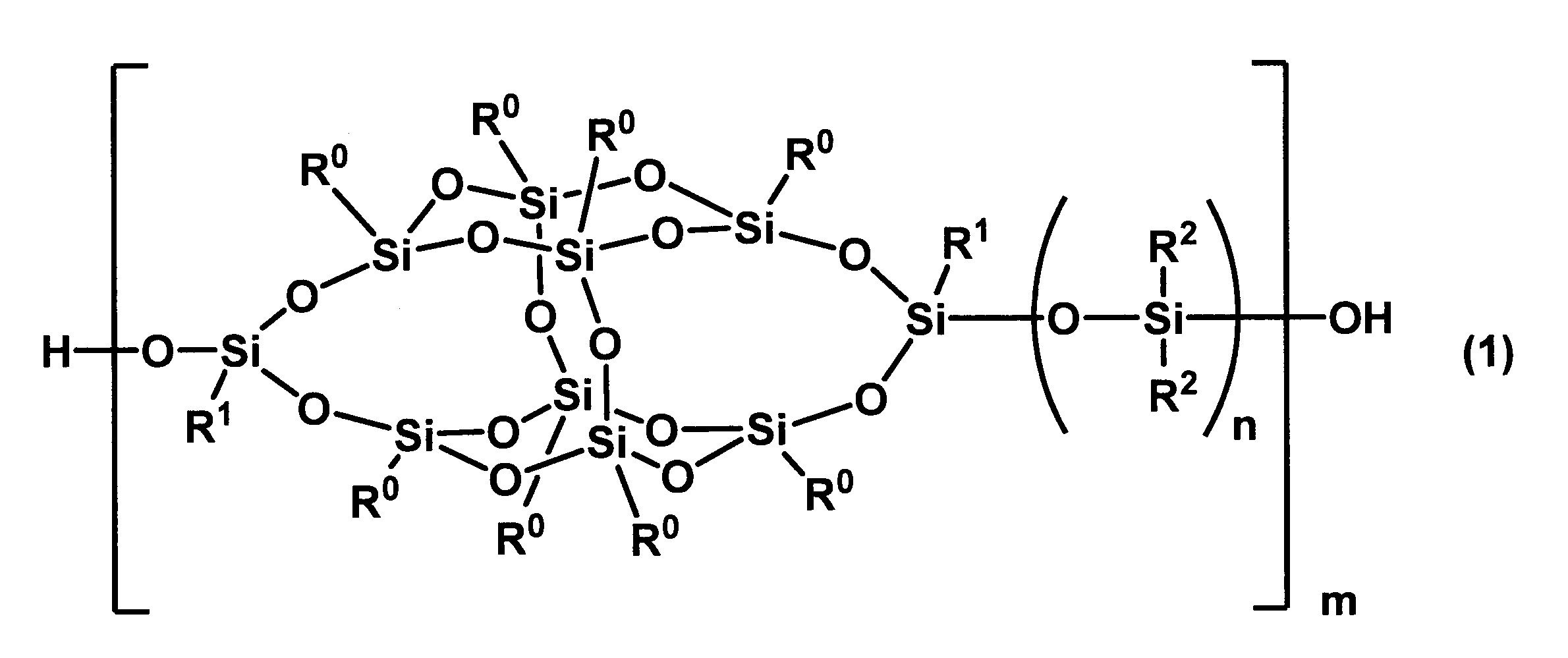
(式(1)中、nは、独立して1~30の整数を表し;mは、重量平均分子量2,000~10,000,000を満たす数字を表し;R0は、独立して、フェニル又はシクロヘキシルを表し;R1及びR2は、独立してフェニル、シクロヘキシル又は炭素数1~5のアルキルを表し、前記フェニル及びシクロヘキシルは、任意の水素が独立してハロゲン又は炭素数1~20のアルキルで置き換えられてもよく、前記炭素数1~5のアルキルは、任意の水素が独立してフッ素で置き換えられてもよく、任意の-CH2-が独立して-O-又は炭素数5~20のシクロアルキレンで置き換えられてもよい。)
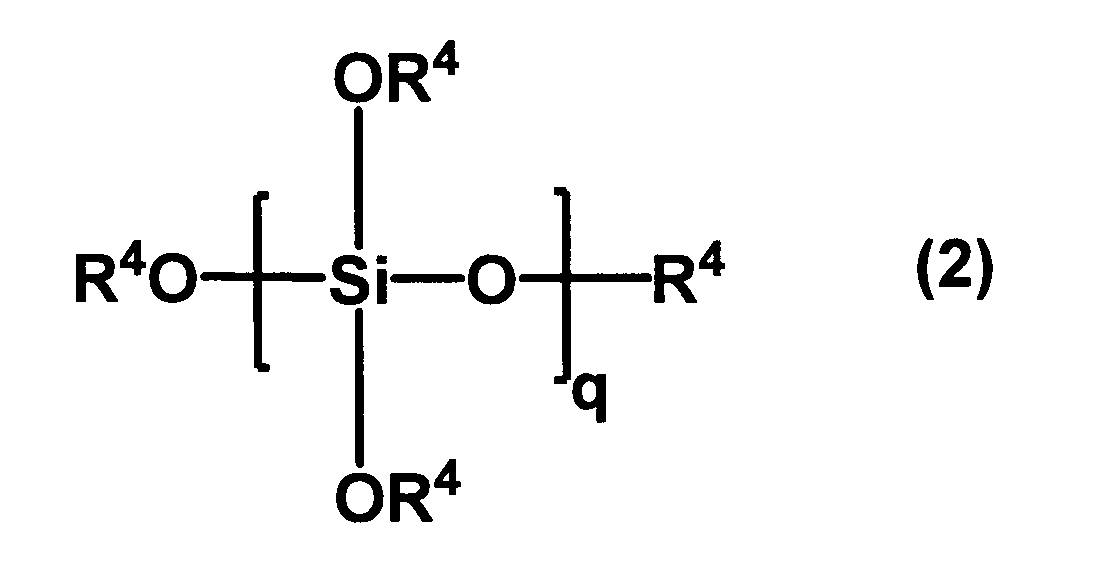
(式(2)中、R4は、それぞれ独立して、炭素数1~3のアルキル基を表し、qは1~100の整数を表わす。)
[2] 式(2)で表される架橋性ケイ素化合物は、式(1)で表されるケイ素化合物中の水酸基と反応する基又は原子を官能基比で1~15倍の範囲で有することを特徴とする[1]に記載のシロキサンポリマー架橋硬化物。
[3] 式(1)中のnが平均5であることを特徴とする[1]~[2]のいずれか1項に記載のシロキサンポリマー架橋硬化物。
[4] 式(1)中のR0~R2がそれぞれ独立してメチル又はフェニルであることを特徴とする[1]~[3]のいずれか一項に記載のシロキサンポリマー架橋硬化物。
[5] 式(2)で表される架橋性ケイ素化合物が、メチルシリケートオリゴマーであることを特徴とする[1]~[4]のいずれか一項に記載のシロキサンポリマー架橋硬化物。
[6] 前記式(1)が下記式(3)で表され、前記式(2)が下記式(4)で表されて、式(3)で表されるケイ素化合物と、式(4)で表される架橋性ケイ素化合物とを反応させて得られる、ことを特徴とする[1]~[5]のいずれか一項に記載のシロキサンポリマー架橋硬化物。
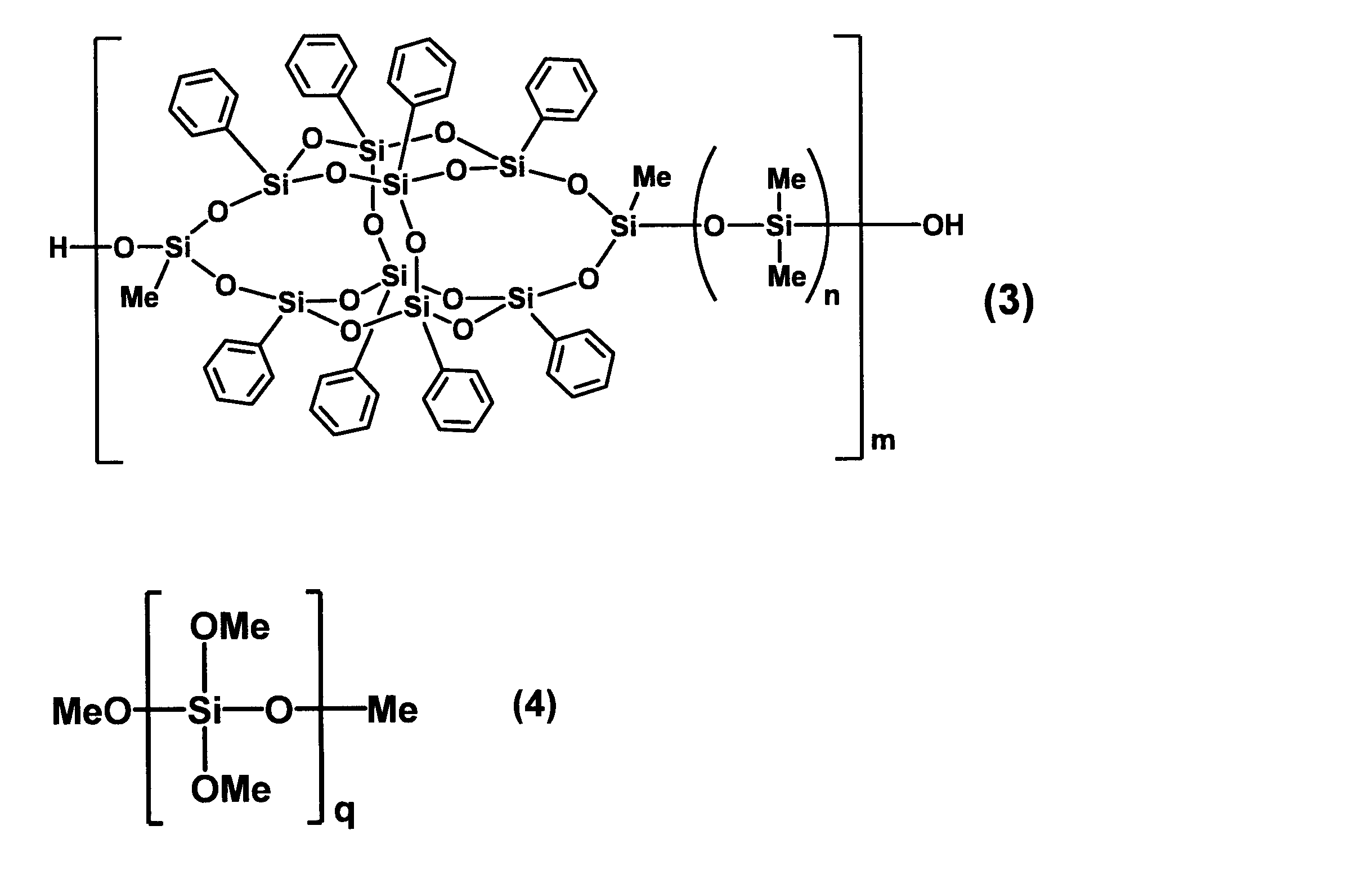
(式(3)中nは、独立して1~30の整数を表し;mは、重量平均分子量2,000~10,000,000を満たす数字を表す。 また、式(4)中、qは1~10の整数を表す。)
[7] 式(1)で表されるケイ素化合物の重量平均分子量が、40,000~80,000であることを特徴とする[1]~[6]のいずれか1項に記載のシロキサンポリマー架橋硬化物。
[8] 室温下、8号ダンベル試験片を引張速度5mm/minで引っ張ったときの前記シロキサンポリマー架橋硬化物の伸びが、前記耐熱試験の前および前記耐熱試験の後のいずれでも、140%以上であることを特徴とする[1]から[7]のいずれか一項に記載のシロキサンポリマー架橋硬化物。
[9] 前記シロキサンポリマー架橋硬化物の破断応力が、前記耐熱試験の前および前記耐熱試験の後のいずれでも、4MPa以上であることを特徴とする[1]~[8]のいずれか一項に記載のシロキサンポリマー架橋硬化物。
[10] 前記シロキサンポリマー架橋硬化物の全光線透過率が、前記耐熱試験の前および前記耐熱試験の後のいずれでも、380nm~780nmにおいて99.0%以上であることを特徴とする[1]~[9]のいずれか一項に記載のシロキサンポリマー架橋硬化物。
本発明では、式(1)で表されるケイ素化合物と式(2)で表される架橋性ケイ素化合物とを反応させることによって膜状のシロキサンポリマーを得ることができることから、シルセスキオキサン骨格をケイ素系重合体の主鎖に含み、かつ長期耐熱性および光学特性に優れるシロキサンポリマー架橋硬化物を提供することができる。
本発明のシロキサンポリマー架橋硬化物は、下記式(1)で表されるケイ素化合物と、下記式(2)で表される架橋性ケイ素化合物とを反応させて得られる。前記ケイ素化合物は一種でも二種以上でもよい。なお、架橋性ケイ素化合物については後述する。
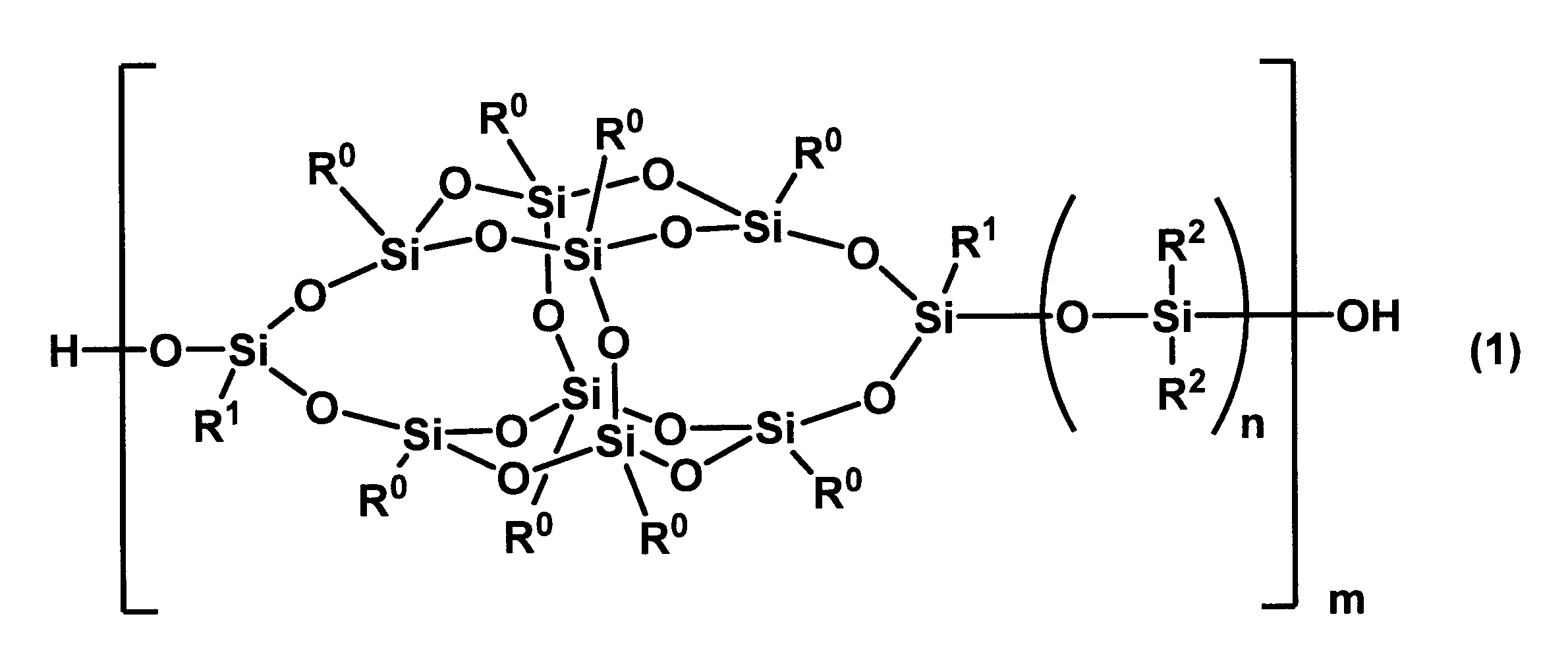
式(1)中、R0は独立してフェニル又はシクロアルキルを表す。R0のフェニル及びシクロアルキルは、任意の水素が独立してハロゲン又は炭素数1~20のアルキルで置き換えられてもよい。
式(1)中、R1及びR2は独立してフェニル、シクロヘキシル、又は炭素数1~5のアルキルを表す。R1及びR2における炭素数1~5のアルキルは、任意の水素が独立してフッ素で置き換えられてもよく、任意の-CH2-が独立して-O-又は炭素数5~20のシクロアルキレンで置き換えられてもよい。
R1及びR2におけるフェニル及びシクロヘキシルは、任意の水素が独立してハロゲン又は炭素数1~20のアルキルで置き換えられてもよい。R1及びR2におけるフェニル及びシクロヘキシルの置換基である炭素数1~20のアルキルは、任意の水素が独立してフッ素で置き換えられてもよく、任意の-CH2-が独立して-O-、炭素数5~20のシクロアルキレン又はフェニレンで置き換えられてもよい。
具体的には、R0がフェニルで、R1及びR2が独立してメチル又はフェニルであることが好ましい。光学特性等の諸特性を得る観点、及び合成の容易性の観点から、R0はフェニルであり、R1及びR2はメチルであることが特に好ましい。
式(1)中、nは、独立して1~30の整数(平均値)を表し、mは、重量平均分子量2,000~10,000,000を満たす整数を表す。ここで、nは単一ではなく複数の整数を与えることがある。したがって、nは平均値で表示することがあり、例えば「平均5」と表示した場合には、約5を意味する。nは、得られるシロキサンポリマー架橋硬化物の物性等の観点から、1~10の整数であることが好ましく、3~5の整数であることが更に好ましく、平均5であることが特に好ましい。nが大きすぎると、ケイ素化合物の特性において、シルセスキオキサンの特性に比べてシロキサンの特性が強くなりすぎることがある。本発明において、mは、合成の容易さ、得られるシロキサンポリマー架橋硬化物の物性等の観点から、ケイ素化合物の重量平均分子量5,000~2,000,000を満たす整数であることが好ましく、重量平均分子量7,000~1,000,000を満たす整数であることがより好ましい。
重量平均分子量は、後述の実施例に記載されるように、ゲル浸透クロマトグラフィー(GPC)にて得られたクロマトグラムを、分子量標準サンプルにて得られた検量線により計算して求める。
式(1)で表されるケイ素化合物の重量平均分子量は、好ましくは4,000~200,000であり、特に好ましくは、40,000~80,000である。
式(1)で表されるケイ素化合物の重量平均分子量は、好ましくは4,000~200,000であり、特に好ましくは、40,000~80,000である。
前記式(1)で表されるケイ素化合物は、特許文献1に記載されているように、下記式(5)で表されるシルセスキオキサンと下記式(6)で表される鎖状シロキサンとをトリエチルアミン等の塩基の存在下で反応させることによって得られる。式(1)中のnは、前記鎖状シロキサンの種類によって決めることができる。式(1)中のmは、反応条件(温度、式(6)で表される鎖状シロキサンの濃度等)によって調整される。nは3~5であることが好ましい。
あるいは、触媒および水の存在下、下記式(5)で表されるシルセスキオキサンに、下記式(6’)で表される環状シロキサンを、通常の重合反応の条件下で還流させ、続いて熟成工程(25℃~90℃)で平衡重合させることによって得ることもできる。
本反応系においては、触媒として強酸もしくは強塩基が通常用いられる。シルセスキオキサンの反応中の安定性を考慮すると、触媒としては強酸の方が好ましい。このような触媒としては、例えば、塩酸、硫酸、フルオロ硫酸、p-トルエンスルホン酸-水和物、トリフルオロメタンスルホン酸-水和物、トリフルオロメタンスルホン酸、活性白土、スルホン酸系イオン交換樹脂等が挙げられる。市販品としては、RCP-160M(強酸性陽イオン交換樹脂、三菱化学(株)製)などを用いることができる。
また、溶剤を用いて行うこともできる。溶剤としては、例えば、ヘキサンやヘプタン等の炭化水素系溶剤、ベンゼン、トルエン、キシレン等の芳香族炭化水素系溶剤、ジエチルエーテル、テトラハイドロフラン(THF)、ジオキサン、シクロペンチルメチルエーテル等のエーテル系溶剤、塩化メチレン、四塩化炭素等のハロゲン化炭化水素溶剤などが挙げられる。
この反応は、通常、強酸の存在下、又はトリエチルアミン等の塩基の存在下、40~150℃で行われる。式(1)中のnは、鎖状シロキサンの種類によって決めることができる。この反応によれば、架橋性官能基を有していてもよいシルセスキオキサン基と、架橋性官能基を有していてもよいシロキサン基とが交互に配置する架橋性ケイ素化合物を得ることができる。

なお、式(5)で表されるシルセスキオキサンも、特許文献1に記載されているように、下記式(7)で表される化合物と下記式(8)で表される化合物を反応させ、加水分解することによって得られる。ここで、Xはハロゲン又は水素を表す。そして下記式(7)で表される化合物も、前記特許文献1に記載されているように、下記式(9)で表される化合物を、水酸化ナトリウム及び水の存在下で加水分解、縮重合することによって得られる。このときの反応は有機溶剤の存在下であっても非存在下であってもよい。
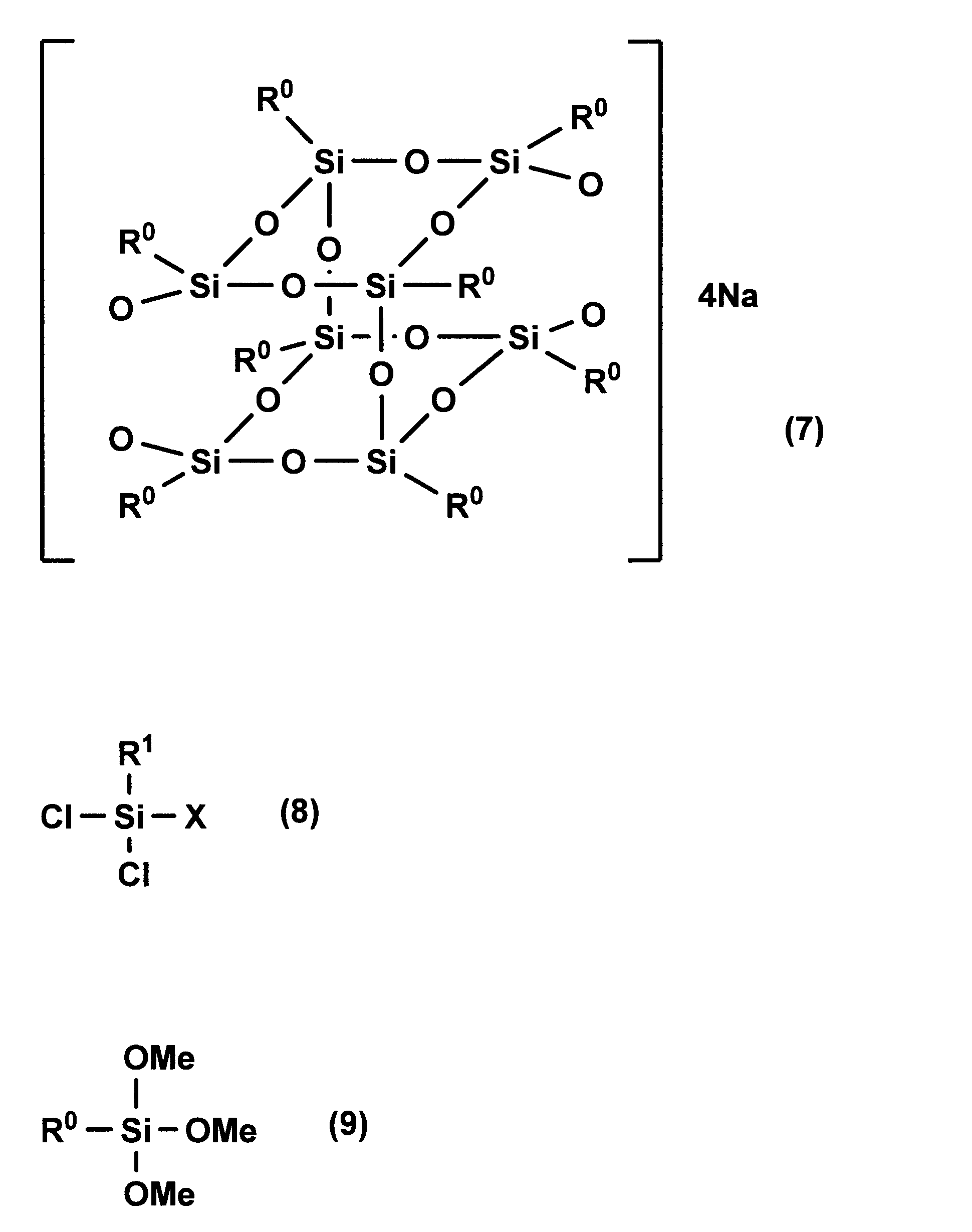
前記の式(5)、(6)、(6’)、(7)、または(8)中の、R0、R1、およびR2は、式(1)と同様である。
次に、式(2)で表される架橋性ケイ素化合物について説明する。
本発明において、架橋性ケイ素化合物は、得られるシロキサンポリマー架橋硬化物の機械的特性、耐熱性の向上、化合物の入手の容易さの観点から、ケイ素化合物中の水酸基と反応する基又は原子(以下「架橋性官能基」とも言う)を3以上有する、式(2)で表される化合物、及びそのオリゴマーからなる群から選ばれる一以上を用いる。架橋性ケイ素化合物は、一種類でも、二種以上の混合物であってもよい。
本発明において、架橋性ケイ素化合物は、得られるシロキサンポリマー架橋硬化物の機械的特性、耐熱性の向上、化合物の入手の容易さの観点から、ケイ素化合物中の水酸基と反応する基又は原子(以下「架橋性官能基」とも言う)を3以上有する、式(2)で表される化合物、及びそのオリゴマーからなる群から選ばれる一以上を用いる。架橋性ケイ素化合物は、一種類でも、二種以上の混合物であってもよい。
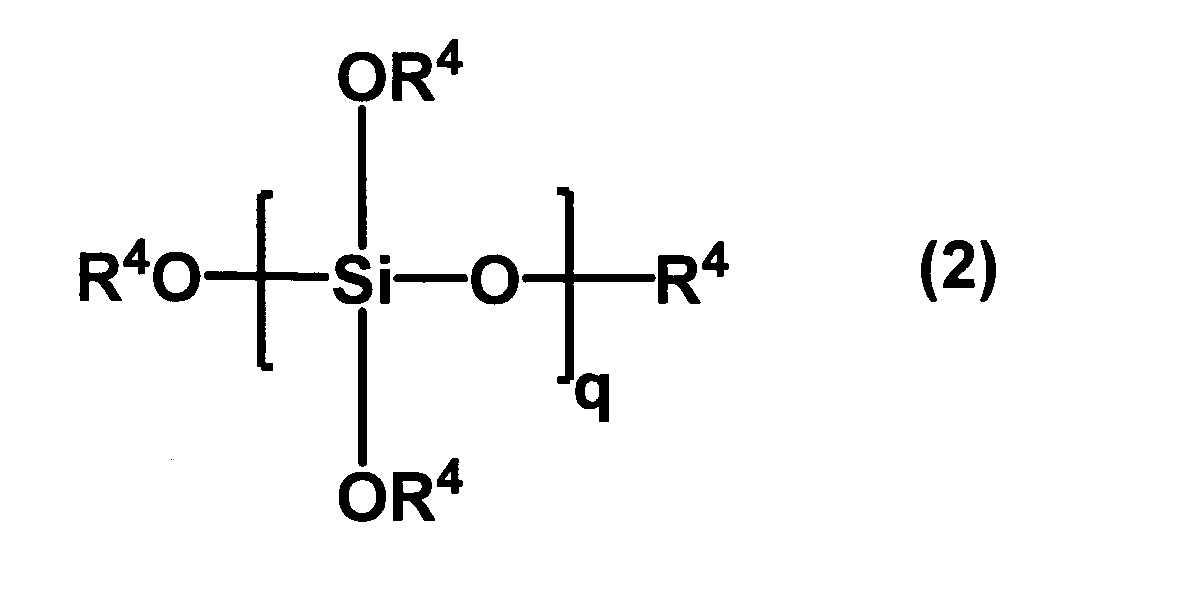
式(2)中、R4は、独立して、炭素数1~3のアルキル基を表し、qは繰り返し構造を示す符号であり、qは1~100の整数であり、好ましくはqは1~10である。好ましくは、R4の全てが、それぞれ独立に、メチル基及びエチル基より成る群から選ばれる基を表し、より好ましくは、R4の全てがメチル基である。式(2)で表される化合物としては、より好ましくはテトラメトキシシランの部分加水分解縮合物が使用される。式(2)で表される架橋性ケイ素化合物は、分子末端または側鎖のアルコキシ基が水分と反応することにより加水分解、脱アルコール反応してシラノール基となり、続いてこのシラノール基が分子間、または分子内のアルコキシ基と反応することにより、脱アルコール反応により架橋される。この反応が進むことにより、架橋度の高いポリマーネットワークを形成することができる。かかる架橋性ケイ素化合物は、市販品として、例えば、三菱化学(株)製MKCシリケートMS57(商標)、MKCシリケートMS51(商標)(テトラメトキシシラン平均5量体)、MKCシリケートMS56、MS56S(いずれも商標)、コルコート(株)製のメチルシリケート51(テトラメトキシシラン4量体)、メチルシリケート53(テトラメトキシシラン7量体)、エチルシリケート40(テトラエトキシシラン5量体)、エチルシリケート48(テトラエトキシシラン10量体)等を挙げることができる。
式(1)で表されるケイ素化合物と、式(2)で表される架橋性ケイ素化合物との架橋は、架橋性ケイ素化合物が有する、式(1)で表されるケイ素化合物中の水酸基と反応する架橋性の官能基の種類に基づいて、両ケイ素化合物を適切な条件下で共存させることによって行われる。
ケイ素化合物と架橋性ケイ素化合物との反応は、必要に応じて、触媒の存在下で行うことができる。触媒としては、例えば、酢酸、塩酸等の酸触媒、有機錫系触媒や、アルカリ、有機チタン化合物等が挙げられる。触媒の種類及び使用量は、架橋性官能基の種類に応じて決めることができ、例えば架橋性の官能基がエトキシである場合では、例えば触媒にはラウリン酸ジブチル錫が、架橋性ケイ素化合物100重量部に対して0.01~5重量部で使用される。
ケイ素化合物と架橋性ケイ素化合物との反応は、必要に応じて、触媒の存在下で行うことができる。触媒としては、例えば、酢酸、塩酸等の酸触媒、有機錫系触媒や、アルカリ、有機チタン化合物等が挙げられる。触媒の種類及び使用量は、架橋性官能基の種類に応じて決めることができ、例えば架橋性の官能基がエトキシである場合では、例えば触媒にはラウリン酸ジブチル錫が、架橋性ケイ素化合物100重量部に対して0.01~5重量部で使用される。
シロキサンポリマー架橋硬化物が生成できているかどうかについては、式(1)で表されるケイ素化合物と、式(2)で表される架橋性ケイ素化合物との生成物の耐熱性や溶剤に対する溶解性の変化によって確認することができる。例えば、120℃に加熱したときに、生成物が融解しなくなることによってシロキサンポリマー架橋硬化物が生成されたことを確認することができる。また、生成物がアセトンに対して不溶であることによってシロキサンポリマー架橋硬化物が生成されたことを確認することができる。
本発明における、架橋前の式(1)で表されるケイ素化合物と、式(2)で表される架橋性ケイ素化合物との混合物(以下、シロキサンポリマー組成物ということがある。)における式(2)で表される架橋性ケイ素化合物の含有量は、硬化物の熱特性等の向上の観点から、式(1)で表されるケイ素化合物100重量部に対して0.1~50重量部であることが好ましく、1~20重量部であることがより好ましく、5~10重量部であることがさらに好ましい。
本発明においては、式(2)で表される架橋性ケイ素化合物は、式(1)で表されるケイ素化合物中の水酸基と反応する基又は原子を官能基比で1~30倍、有することが好ましい。本発明において官能基比とは、式(1)で表されるケイ素化合物中の水酸基(SiOH)と反応する基(SiOMe)との比(SiOMe/SiOH)であり、ポリマー末端のSiOHは数平均分子量Mnから算出され、式(2)で表される架橋性ケイ素化合物のSiOMeは式(2)中のqの数値に基づいて算出される。
本発明においては、式(3)で表されるケイ素化合物と、式(4)で表される架橋性ケイ素化合物とを用いて架橋硬化性組成物を得ることが好ましい。この場合、官能基比は2~15倍であることが更に好ましく、5~10倍であることが特に好ましい。

式(3)および(4)中、Meはメチルを表し(本明細書において同様の表記をした場合には同様の意味を有するものとする)、n、mはそれぞれ式(1)と同様である。また、式(4)中のqは1~10の整数を表し、平均5であることが好ましい。
架橋前のシロキサンポリマー組成物は、本発明の効果が得られる範囲において、式(1)で表されるケイ素化合物及び式(2)で表される架橋性ケイ素化合物以外の他の成分をさらに含有していてもよい。このような他の成分としては、例えば溶剤、触媒、本発明のシロキサンポリマー架橋硬化物以外の他のポリマー、及び各種の添加剤が挙げられる。触媒には、本発明のシロキサンポリマー架橋硬化物の説明で前述した触媒を用いることができる。
溶剤は、ケイ素化合物及び架橋性ケイ素化合物を含む含有成分を溶解する溶剤であることが好ましく、また含有成分に対して反応性を有さない溶剤であることが好ましい。溶剤は、一種でも二種以上の混合物でもよい。このような溶剤としては、例えば、ヘキサンやヘプタン等の炭化水素系溶剤、ベンゼン、トルエン、キシレン等の芳香族炭化水素系溶剤、ジエチルエーテル、テトラハイドロフラン(THF)、ジオキサン等のエーテル系溶剤、塩化メチレン、四塩化炭素等のハロゲン化炭化水素系溶剤、及び酢酸エチル等のエステル系溶剤が挙げられる。
添加剤は、シロキサンポリマー架橋硬化物への所望の特性の付与や向上の観点から、公知の各種添加剤を利用することができる。このような添加剤としては、例えば、界面活性剤、シリカ、マイカ等の充填剤等が挙げられる。
架橋前のシロキサンポリマー組成物における溶剤の含有量は、架橋性組成物の塗布性を高める観点から、架橋性組成物に配合される固形の成分の含有量が架橋性組成物において、10~90重量%となる量であることが好ましく、30~70重量%となる量であることがより好ましく、40~60重量%となる量であることがさらに好ましい。
架橋前のシロキサンポリマー組成物における触媒の含有量は、例えば触媒としてスズ系触媒を使用する場合には、SiOHとSiOMeの官能基モル数に対するスズのモル濃度が0.01~10%であることが好ましく、より好ましくは0.2~5%であり、更に好ましくは0.1~0.5%である。
架橋前のシロキサンポリマー組成物における他のポリマーの含有量は、他のポリマーの添加によるシロキサンポリマー架橋硬化物の特性の向上の観点から任意に決めることができる。
架橋前のシロキサンポリマー組成物における添加剤の含有量は、添加剤の添加による効果を得る観点から、0.1~40重量%であることが好ましく、0.5~20重量%であることがより好ましく、1~10重量%であることがさらに好ましい。
添加剤としては、アクリル系、スチレン系、ポリエチレンイミン系もしくはウレタン系の高分子分散剤;アニオン系、カチオン系、ノニオン系もしくはフッ素系の界面活性剤;シリコン系樹脂等の塗布性向上剤;シランカップリング剤等の密着性向上剤;フェノール系、硫黄系、およびリン系等の酸化防止剤;アルコキシベンゾフェノン類等の紫外線吸収剤;ポリアクリル酸ナトリウム等の凝集防止剤;エポキシ化合物、メラミン化合物もしくはビスアジド化合物等の熱架橋剤;有機カルボン酸等のアルカリ溶解性促進剤;二酸化チタン、モリブデン赤、紺青、群青、カドミウム黄、カドミウム赤および有機色素等の着色剤;三酸化アンチモン、ブロム化合物およびリン化合物等の難燃剤;金属酸化物、シリカ、ガラスビーズ、金属水酸化物等の粉末状の補強剤や充填剤等が利用できる。
架橋前のシロキサンポリマー組成物の未硬化の膜は、基板やフィルムに架橋前のシロキサンポリマー組成物を、ディップ法や、ブレードコート、バーコーター、アプリケーター等で塗布する方法等で塗布することによって形成することができる。
前記の架橋前シロキサンポリマー組成物の硬化は、架橋性官能基の種類に応じて、含水気体の雰囲気中への放置、加熱や光照射等の、本発明のシロキサンポリマーを生成する前述した条件に基づいて処理することによって行うことができる。例えば架橋前シロキサンポリマー組成物の硬化は、湿度50%程度の通常の空気中へ放置することにより、空気中の水分による加水分解によって硬化する。この硬化の速度は、前記の架橋前シロキサンポリマー組成物中への触媒の配合によって増加し、また組成物を加熱することによっても増加する。例えば、シロキサンポリマー組成物をオーブン内で40℃、70℃、100℃で加熱してもよく、その後、200℃で焼成してシロキサンポリマー架橋硬化物を得てもよい。
本発明のシロキサンポリマー架橋硬化物は、長期耐熱性に優れている。本発明においては、長期耐熱性を評価するために、耐熱試験を行っている。
例えば、シロキサンポリマー架橋硬化物を200℃で500時間耐熱試験を行った場合、耐熱試験前と耐熱試験後の、シロキサンポリマー架橋硬化物のガラス転移温度における見かけの活性化エネルギーの変化量は、40kJ/mol以下であり、好ましくは、35kJ/mol以下であり、更に好ましくは、30kJ/molである。かかる活性化エネルギーは動的粘弾性(DMA)測定により求められる。ガラス転移温度における見かけの活性化エネルギーの変化量が小さいことは、200℃または250℃で500時間という過酷な耐熱試験の後でも、シロキサンポリマー架橋硬化物の架橋による硬化劣化や分子鎖切断による軟化劣化等の物性変化が少ないことを示しており、長期耐熱性に優れていることを示すのである。
例えば、シロキサンポリマー架橋硬化物を200℃で500時間耐熱試験を行った場合、耐熱試験前と耐熱試験後の、シロキサンポリマー架橋硬化物のガラス転移温度における見かけの活性化エネルギーの変化量は、40kJ/mol以下であり、好ましくは、35kJ/mol以下であり、更に好ましくは、30kJ/molである。かかる活性化エネルギーは動的粘弾性(DMA)測定により求められる。ガラス転移温度における見かけの活性化エネルギーの変化量が小さいことは、200℃または250℃で500時間という過酷な耐熱試験の後でも、シロキサンポリマー架橋硬化物の架橋による硬化劣化や分子鎖切断による軟化劣化等の物性変化が少ないことを示しており、長期耐熱性に優れていることを示すのである。
また、長期耐熱性を評価するために、本発明のシロキサンポリマー架橋硬化物について所定の引張試験を行い、200℃で500時間の耐熱試験を行った後の応力-歪曲線と、耐熱試験を行う前の応力-歪曲線とを求めて、その変化を比較した。図1の(a)に耐熱試験前の応力-歪曲線を示し、(b)に耐熱試験後の応力-歪曲線を示す。
図1を用いて説明すると、例えば、シロキサン鎖長(DMSのユニット数)が5(平均値)のケイ素化合物と官能基比15倍の架橋性ケイ素化合物とから得られるシロキサンポリマー架橋硬化物では、伸びが大きく、その伸びは耐熱試験前でも後でも140%以上であることが分かる。特に、重量平均分子量が60,000以上のケイ素化合物を用いてなるシロキサンポリマー架橋硬化物では、耐熱試験の前でも後でも200%以上の伸びを示す。
さらにまた、応力についても、本発明のシロキサンポリマー架橋硬化物は、耐熱試験前でも後でも5MPa以上を示し、破断応力が高いことが分る。
すなわち、本発明のシロキサンポリマー架橋硬化物は、中でも、DMSのユニット数が平均値で5のシロキサンポリマー架橋硬化物は、耐熱試験前でも良好な機械特性を有しているが、200℃で500時間の耐熱試験という過酷な耐熱試験後でも、その良好な機械特性を保持しているのである。すなわち、本発明のシロキサンポリマー架橋硬化物ならば、200℃で500時間という長期耐熱試験の後でも樹脂劣化等を起こさず、良好な機械特性を発揮することができるので、高出力化にも対応可能である。なお、フレキシブル配線材料、圧電材料等の材料として検討されているポリジメチルシロキサン(PDMS)は、耐熱試験の前でも後でも、応力が1MPaより小さく、機械強度に劣っている。
図1を用いて説明すると、例えば、シロキサン鎖長(DMSのユニット数)が5(平均値)のケイ素化合物と官能基比15倍の架橋性ケイ素化合物とから得られるシロキサンポリマー架橋硬化物では、伸びが大きく、その伸びは耐熱試験前でも後でも140%以上であることが分かる。特に、重量平均分子量が60,000以上のケイ素化合物を用いてなるシロキサンポリマー架橋硬化物では、耐熱試験の前でも後でも200%以上の伸びを示す。
さらにまた、応力についても、本発明のシロキサンポリマー架橋硬化物は、耐熱試験前でも後でも5MPa以上を示し、破断応力が高いことが分る。
すなわち、本発明のシロキサンポリマー架橋硬化物は、中でも、DMSのユニット数が平均値で5のシロキサンポリマー架橋硬化物は、耐熱試験前でも良好な機械特性を有しているが、200℃で500時間の耐熱試験という過酷な耐熱試験後でも、その良好な機械特性を保持しているのである。すなわち、本発明のシロキサンポリマー架橋硬化物ならば、200℃で500時間という長期耐熱試験の後でも樹脂劣化等を起こさず、良好な機械特性を発揮することができるので、高出力化にも対応可能である。なお、フレキシブル配線材料、圧電材料等の材料として検討されているポリジメチルシロキサン(PDMS)は、耐熱試験の前でも後でも、応力が1MPaより小さく、機械強度に劣っている。
図2に、本発明のシロキサンポリマー架橋硬化物(官能基比が5倍、15倍)について、所定の引張試験を行って得られた応力-歪曲線を示す。ここには、200℃で500時間の耐熱試験および250℃で500時間の耐熱試験を行った後の応力-歪曲線と、耐熱試験を行う前の応力-歪曲線を示す。なお、図2の(a)に示したのは、官能基比5倍のシロキサンポリマー架橋硬化物についての耐熱試験結果であり、(b)に示したのは、官能基比15倍のシロキサンポリマー架橋硬化物についての耐熱試験結果である。図2の(a)および(b)は、いずれも、耐熱試験前後で良好な伸びと応力を有することを示しており、しかも250℃で500時間という非常に厳しい耐熱試験後でさえも、150%以上の伸びと7MPa以上の応力を有し、優れた機械特性を有するものであることが分かる。特に、官能基比5倍のシロキサンポリマー架橋硬化物は、耐熱試験前とほとんど変化がなく、官能基比15倍のシロキサンポリマー架橋硬化物よりも耐熱試験後の変化が少ないことが分る。
本発明のシロキサンポリマー架橋硬化物は、耐熱試験後でも光学特性にも優れている。本発明のシロキサンポリマー架橋硬化物について、200℃で250時間の耐熱試験と、200℃で500時間の耐熱試験を行い、耐熱試験前後の透過率と耐黄変性の評価を行った。
すなわち、シロキサンポリマー架橋硬化物について、紫外可視光分光法による波長380nm~780nmの全光線透過率を求めると、耐熱試験前、200℃で250時間の耐熱試験後、および、200℃で500時間の耐熱試験後のいずれでも、透過率は、99.0%以上であり、透明性に優れたものである。また、YI値についても耐熱試験前後で変化はなく、耐黄変性にも優れている。なお、光学特性に関しては、DMSユニット数3~5(平均値)や、ケイ素化合物の重量平均分子量の数値(40,000~80,000)に関係なく、優れた結果を示し、耐熱性試験の前後でも変化無く、優れた光学特性を示すものである。
すなわち、シロキサンポリマー架橋硬化物について、紫外可視光分光法による波長380nm~780nmの全光線透過率を求めると、耐熱試験前、200℃で250時間の耐熱試験後、および、200℃で500時間の耐熱試験後のいずれでも、透過率は、99.0%以上であり、透明性に優れたものである。また、YI値についても耐熱試験前後で変化はなく、耐黄変性にも優れている。なお、光学特性に関しては、DMSユニット数3~5(平均値)や、ケイ素化合物の重量平均分子量の数値(40,000~80,000)に関係なく、優れた結果を示し、耐熱性試験の前後でも変化無く、優れた光学特性を示すものである。
本発明のシロキサンポリマー架橋硬化物について、構造部の変化を調べるため、固体29SiのNMRを測定した。構造変化は、ポリマー主構造におけるDユニット(Me2D2)とTユニット(MeT3、PhT3)、架橋部におけるQユニット(Q2、Q3、Q4)についてNMR測定を行った。Dユニット、TユニットおよびQユニットについては、具体的にどこの箇所を示すのかが図3に示されてある。すなわち、図3において、D,T,QはSiに結合している酸素の数によって、D構造(O=2)、T構造(O=3)、Q構造(O=4)を示し、例えば、Dユニット(Me2D2)について説明すると、左肩のMe2は置換基(Me基が2個)、右肩の数字2はクロスリンクしている酸素の数を表している。
測定対象は、シロキサンポリマー架橋硬化物(Mw=80,000、シロキサン鎖長=平均5、官能基比=平均5)である。測定機器は、核磁気共鳴分光装置(Varian NMR System 500 (バリアン社製))を用い、測定条件(CP-MAS contact time 5 ms, relaxation delay 2.5 s, spin 8kHz)で行った。その結果を図4に示す。図4から明らかなように、本発明のシロキサンポリマー架橋硬化物は、耐熱試験前、200℃500時間の耐熱試験後、250℃500時間の耐熱試験後において、ポリマー主構造部も架橋部もほとんど変化がなく、過酷な耐熱性試験を行っても、構造が安定していることが分かる。
本発明のシロキサンポリマー架橋硬化物によれば、DMSユニットの数やケイ素化合物の重量平均分子量等を適宜選択することにより、所望の物性を有し、長期耐熱性にも優れたものを実現することができるのである。したがって、幅広い用途への利用が期待される。
本発明のシロキサンポリマー架橋硬化物の用途としては、例えば、光学材料が挙げられるが、より具体的には、金属溶出防止膜、ガスバリア膜、反射防止膜等の基板用コーティング剤、液状封止剤、層間絶縁膜、汚れ防止用コーティング剤、マイクロレンズ、導光板、光導波路材料等の光学素子、LED封止材料、光透過性接着剤、ディスプレイ基板及びプリント配線用基板等の電気、電子材料への用途が挙げられる。
以下、実施例により本発明をより詳細に説明するが、本発明は以下に例示する実施例に限定されるものではない。
[合成例1]ケイ素化合物1の作製
300mLフラスコに、冷却管、メカニカルスターラー、温度計保護管を取り付け、フラスコ内部を窒素置換した。式(1)におけるR0がフェニルでありR1がメチルである下記構造式で示される化合物 48.0g、オクタメチルシクロテトラシロキサン(D4)12.0g、乾燥RCP-160M(強酸性陽イオン交換樹脂、三菱化学(株)製:含水量23.4mass%) 8.2g、脱水トルエン 102g、水0.77gをフラスコに入れた。1時間還流し、その後、50℃で熟成させた。熟成終了後、室温まで冷却し、RCP-160Mをろ別した。得られたろ液を、数回水洗した。その後、ろ液から溶剤及び低沸成分を留去して、得られた粗生成物をメタノールで再沈殿させて精製した。得られた白色粘調液体を40℃で真空乾燥することにより白色固体49.2gを得た。
1H-NMR及びGPC分析により、得られた白色固体は式(3)で表されるケイ素化合物であり、式(3)中の各構成単位(シルセスキオキサンユニットとジメチルシロキサンユニット)が交互に結合してなるポリマーであり、DMSユニット数nは平均3.2であることがわかった。GPC分析よりケイ素化合物1の数平均分子量はMn=27,800、重量平均分子量はMw=75,500であった。
300mLフラスコに、冷却管、メカニカルスターラー、温度計保護管を取り付け、フラスコ内部を窒素置換した。式(1)におけるR0がフェニルでありR1がメチルである下記構造式で示される化合物 48.0g、オクタメチルシクロテトラシロキサン(D4)12.0g、乾燥RCP-160M(強酸性陽イオン交換樹脂、三菱化学(株)製:含水量23.4mass%) 8.2g、脱水トルエン 102g、水0.77gをフラスコに入れた。1時間還流し、その後、50℃で熟成させた。熟成終了後、室温まで冷却し、RCP-160Mをろ別した。得られたろ液を、数回水洗した。その後、ろ液から溶剤及び低沸成分を留去して、得られた粗生成物をメタノールで再沈殿させて精製した。得られた白色粘調液体を40℃で真空乾燥することにより白色固体49.2gを得た。
1H-NMR及びGPC分析により、得られた白色固体は式(3)で表されるケイ素化合物であり、式(3)中の各構成単位(シルセスキオキサンユニットとジメチルシロキサンユニット)が交互に結合してなるポリマーであり、DMSユニット数nは平均3.2であることがわかった。GPC分析よりケイ素化合物1の数平均分子量はMn=27,800、重量平均分子量はMw=75,500であった。

[合成例2]ケイ素化合物2の作成
300mLフラスコに、冷却管、メカニカルスターラー、温度計保護管を取り付け、フラスコ内部を窒素置換した。式(1)におけるR0がフェニルでありR1がメチルである合成例1に記載の構造式で示される化合物 48.0g、オクタメチルシクロテトラシロキサン(D4)18.0g、乾燥RCP-160M(強酸性陽イオン交換樹脂、三菱化学(株)製:含水量23.4mass%) 9.0g、脱水トルエン 112g、水0.96gをフラスコに入れた。1時間還流し、その後50℃で熟成させた。熟成終了後、室温まで冷却し、RCP-160Mをろ別した。得られたろ液を、数回水洗した。その後、ろ液から溶剤及び低沸成分を留去して、得られた粗生成物をメタノールで再沈殿させて精製した。得られた白色粘調液体を40℃で真空乾燥することにより白色固体55.4gを得た。1H-NMR及びGPC分析により、得られた白色固体は式(3)で表されるケイ素化合物であり、式(3)中の各構成単位(シルセスキオキサンユニットとジメチルシロキサンユニット)が交互に結合してなるポリマーであり、DMSユニット数nは平均4.2であることがわかった。GPC分析よりケイ素化合物2の数平均分子量はMn=31,400、重量平均分子量はMw=74,000であった。
300mLフラスコに、冷却管、メカニカルスターラー、温度計保護管を取り付け、フラスコ内部を窒素置換した。式(1)におけるR0がフェニルでありR1がメチルである合成例1に記載の構造式で示される化合物 48.0g、オクタメチルシクロテトラシロキサン(D4)18.0g、乾燥RCP-160M(強酸性陽イオン交換樹脂、三菱化学(株)製:含水量23.4mass%) 9.0g、脱水トルエン 112g、水0.96gをフラスコに入れた。1時間還流し、その後50℃で熟成させた。熟成終了後、室温まで冷却し、RCP-160Mをろ別した。得られたろ液を、数回水洗した。その後、ろ液から溶剤及び低沸成分を留去して、得られた粗生成物をメタノールで再沈殿させて精製した。得られた白色粘調液体を40℃で真空乾燥することにより白色固体55.4gを得た。1H-NMR及びGPC分析により、得られた白色固体は式(3)で表されるケイ素化合物であり、式(3)中の各構成単位(シルセスキオキサンユニットとジメチルシロキサンユニット)が交互に結合してなるポリマーであり、DMSユニット数nは平均4.2であることがわかった。GPC分析よりケイ素化合物2の数平均分子量はMn=31,400、重量平均分子量はMw=74,000であった。
[合成例3]ケイ素化合物3の作製
2000mLフラスコに、冷却管、メカニカルスターラー、温度計保護管を取り付け、フラスコ内部を窒素置換した。式(1)におけるR0がフェニルでありR1がメチルである合成例1に記載の構造式で示される化合物400.0g、オクタメチルシクロテトラシロキサン(D4)200.0g、乾燥RCP-160M(強酸性陽イオン交換樹脂、三菱化学(株)製:含水量23.4mass%) 81.6g、脱水トルエン1023g、水9.57gをフラスコに入れた。1時間還流し、その後、50℃で熟成させた。熟成終了後、室温まで冷却し、RCP-160Mをろ別した。得られたろ液を、数回水洗した。その後、ろ液から溶剤及び低沸成分を留去して、得られた粗生成物をメタノールで再沈殿させて精製した。得られた白色粘調液体を40℃で真空乾燥することにより白色固体500.4gを得た。1H-NMR及びGPC分析により、得られた白色固体は式(3)で表されるケイ素化合物であり、式(3)中の各構成単位(シルセスキオキサンユニットとジメチルシロキサンユニット)が交互に結合してなるポリマーであり、DMSユニット数nは平均5.5であることがわかった。GPC分析よりケイ素化合物3の数平均分子量はMn=34,500、重量平均分子量はMw=79,400であった。
2000mLフラスコに、冷却管、メカニカルスターラー、温度計保護管を取り付け、フラスコ内部を窒素置換した。式(1)におけるR0がフェニルでありR1がメチルである合成例1に記載の構造式で示される化合物400.0g、オクタメチルシクロテトラシロキサン(D4)200.0g、乾燥RCP-160M(強酸性陽イオン交換樹脂、三菱化学(株)製:含水量23.4mass%) 81.6g、脱水トルエン1023g、水9.57gをフラスコに入れた。1時間還流し、その後、50℃で熟成させた。熟成終了後、室温まで冷却し、RCP-160Mをろ別した。得られたろ液を、数回水洗した。その後、ろ液から溶剤及び低沸成分を留去して、得られた粗生成物をメタノールで再沈殿させて精製した。得られた白色粘調液体を40℃で真空乾燥することにより白色固体500.4gを得た。1H-NMR及びGPC分析により、得られた白色固体は式(3)で表されるケイ素化合物であり、式(3)中の各構成単位(シルセスキオキサンユニットとジメチルシロキサンユニット)が交互に結合してなるポリマーであり、DMSユニット数nは平均5.5であることがわかった。GPC分析よりケイ素化合物3の数平均分子量はMn=34,500、重量平均分子量はMw=79,400であった。
[合成例4]ケイ素化合物4の作製
300mLフラスコに、冷却管、メカニカルスターラー、温度計保護管を取り付け、フラスコ内部を窒素置換した。式(1)におけるR0がフェニルでありR1がメチルである合成例1に記載の構造式で示される化合物 40.0g、オクタメチルシクロテトラシロキサン(D4)20.0g、乾燥RCP-160M(強酸性陽イオン交換樹脂、三菱化学(株)製:含水量23.4mass%) 8.2g、脱水トルエン 102g、水0.96gをフラスコに入れた。1時間還流し、その後、50℃で熟成させた。熟成終了後、室温まで冷却し、RCP-160Mをろ別した。得られたろ液を、数回水洗した。その後、ろ液から溶剤及び低沸成分を留去して、得られた粗生成物をメタノールで再沈殿させて精製した。得られた白色粘調液体を40℃で真空乾燥することにより白色固体42.7gを得た。1H-NMR及びGPC分析により、得られた白色固体は式(3)で表されるケイ素化合物であり、式(3)中の各構成単位(シルセスキオキサンユニットとジメチルシロキサンユニット)が交互に結合してなるポリマーであり、DMSユニット数nは平均5.5であることがわかった。GPC分析より、ケイ素化合物5の数平均分子量はMn=22,400、重量平均分子量はMw=44,100であった。
300mLフラスコに、冷却管、メカニカルスターラー、温度計保護管を取り付け、フラスコ内部を窒素置換した。式(1)におけるR0がフェニルでありR1がメチルである合成例1に記載の構造式で示される化合物 40.0g、オクタメチルシクロテトラシロキサン(D4)20.0g、乾燥RCP-160M(強酸性陽イオン交換樹脂、三菱化学(株)製:含水量23.4mass%) 8.2g、脱水トルエン 102g、水0.96gをフラスコに入れた。1時間還流し、その後、50℃で熟成させた。熟成終了後、室温まで冷却し、RCP-160Mをろ別した。得られたろ液を、数回水洗した。その後、ろ液から溶剤及び低沸成分を留去して、得られた粗生成物をメタノールで再沈殿させて精製した。得られた白色粘調液体を40℃で真空乾燥することにより白色固体42.7gを得た。1H-NMR及びGPC分析により、得られた白色固体は式(3)で表されるケイ素化合物であり、式(3)中の各構成単位(シルセスキオキサンユニットとジメチルシロキサンユニット)が交互に結合してなるポリマーであり、DMSユニット数nは平均5.5であることがわかった。GPC分析より、ケイ素化合物5の数平均分子量はMn=22,400、重量平均分子量はMw=44,100であった。

GPC測定の測定条件を以下に示す。
<測定条件>
カラム:Shodex KF-804L 300×8.0mm
Shodex KF-805L 300×8.0mm 2本直列
移動相:THF
流速:1.0ml/min
温度:40℃
検出器:RI
分子量標準サンプル:分子量既知のPMMA
<測定条件>
カラム:Shodex KF-804L 300×8.0mm
Shodex KF-805L 300×8.0mm 2本直列
移動相:THF
流速:1.0ml/min
温度:40℃
検出器:RI
分子量標準サンプル:分子量既知のPMMA
[実施例1]
スクリュー管に、前記合成例1で得られたケイ素化合物1の3gをトルエン2.7gに溶解させ、得られた溶液に、MS-51(三菱化学(株)製)120.3μLを加えて混合し、プレポリマー1を得た。
スクリュー管に、前記合成例1で得られたケイ素化合物1の3gをトルエン2.7gに溶解させ、得られた溶液に、MS-51(三菱化学(株)製)120.3μLを加えて混合し、プレポリマー1を得た。
得られたプレポリマー1の溶液に、触媒としてラウリン酸ジブチル錫3.4μLを加えた。1分間攪拌、脱泡後、得られた架橋性組成物1をテフロン板(3mm厚)にアプリケーターを用いて塗布した後、オーブンに入れて40℃で10分間、70℃で30分間、その後、100℃で1時間加熱することにより硬化させた。得られた硬化膜をテフロン板から剥がしてオーブン内に吊るし、200℃の熱風で2時間焼成してシロキサンポリマー架橋硬化物1を得た。厚さ約230μmの透明なシロキサンポリマー架橋硬化物1を得た。なお、シロキサンポリマー架橋硬化物1の厚さは膜厚計(Nikon製 DIGIMICRO MFC-101A)で測定した。
[実施例2]
スクリュー管に、前記合成例2で得られたケイ素化合物2を3gとり、トルエン3.0mLに溶解させ、MS-51(三菱化学(株)製)120.3μLを加えて混合し、プレポリマー2を得た。
スクリュー管に、前記合成例2で得られたケイ素化合物2を3gとり、トルエン3.0mLに溶解させ、MS-51(三菱化学(株)製)120.3μLを加えて混合し、プレポリマー2を得た。
得られたプレポリマー2の溶液に、触媒としてラウリン酸ジブチル錫3.4μLを加えた。1分間攪拌、脱泡後、得られた架橋性組成物2をテフロン板(3mm厚)にアプリケーターを用いて塗布した後、オーブンに入れて40℃で10分間、70℃で30分間、その後、100℃で1時間加熱することにより硬化させた。得られた硬化膜をテフロン板から剥がしてオーブン内に吊るし、200℃の熱風で2時間焼成してシロキサンポリマー架橋硬化物2を得た。厚さ約180μmの透明なシロキサンポリマー架橋硬化物2を得た。なお、シロキサンポリマー架橋硬化物2の厚さは膜厚計(Nikon製 DIGIMICRO MFC-101A)で測定した。
[実施例3]
スクリュー管に、前記合成例3で得られたケイ素化合物3を3gとり、トルエン2.0mLに溶解させ、MS-51(三菱化学(株)製)162.1μLを加えて混合し、プレポリマー3を得た。
スクリュー管に、前記合成例3で得られたケイ素化合物3を3gとり、トルエン2.0mLに溶解させ、MS-51(三菱化学(株)製)162.1μLを加えて混合し、プレポリマー3を得た。
得られたプレポリマー3の溶液に、触媒としてラウリン酸ジブチル錫4.6μLを加えた。1分間攪拌、脱泡後、得られた架橋性組成物3をテフロン板(3mm厚)にアプリケーターを用いて塗布した後、オーブンに入れて40℃で10分間、70℃で30分間、その後、100℃で1時間加熱することにより硬化させた。得られた硬化膜をテフロン板から剥がしてオーブン内に吊るし、200℃の熱風で2時間焼成して、厚さ約200μmの透明なシロキサンポリマー架橋硬化物3を得た。なお、シロキサンポリマー架橋硬化物3の厚さは膜厚計(Nikon製 DIGIMICRO MFC-101A)で測定した。
[実施例4]
スクリュー管に、前記合成例4で得られたケイ素化合物4を3gとり、トルエン3.3mLに溶解させ、MS-51(三菱化学(株)製)116.5μLを加えて混合し、プレポリマー4を得た。
スクリュー管に、前記合成例4で得られたケイ素化合物4を3gとり、トルエン3.3mLに溶解させ、MS-51(三菱化学(株)製)116.5μLを加えて混合し、プレポリマー4を得た。
得られたプレポリマー4の溶液に、触媒としてラウリン酸ジブチル錫3.3μLを加えた。1分間攪拌、脱泡後、得られた架橋性組成物4をテフロン板(3mm厚)にアプリケーターを用いて塗布した後、オーブンに入れて40℃で10分間、70℃で30分間、その後、100℃で1時間加熱することにより硬化させた。得られた硬化膜をテフロン板から剥がしてオーブン内に吊るし、200℃の熱風で2時間焼成して、厚さ約220μmの透明なシロキサンポリマー架橋硬化物4を得た。なお、シロキサンポリマー架橋硬化物4の厚さは膜厚計(Nikon製 DIGIMICRO MFC-101A)で測定した。
[比較例1]
スクリュー管に、PDMS(Gelest製 DMS-S42)1.0gをとり、トルエン1.8mLに溶解させ、MS-51(三菱化学(株)製)29.6μLを加えて混合し、PDMSワニス1を得た。
スクリュー管に、PDMS(Gelest製 DMS-S42)1.0gをとり、トルエン1.8mLに溶解させ、MS-51(三菱化学(株)製)29.6μLを加えて混合し、PDMSワニス1を得た。
得られたPDMSワニス1の溶液に、触媒としてラウリン酸ジブチル錫0.8μLを加えた。1分間攪拌、脱泡後、得られたPDMS架橋性組成物1をPFAシャーレ(直径5cm)に仕込み、オーブンに入れて40℃で10分間、70℃で30分間、その後、100℃で1時間加熱することにより硬化させた。得られた硬化膜をPFAシャーレから取り出し、オーブン内に吊るし、200℃の熱風で2時間焼成して、厚さ約230μmの透明なPDMS架橋硬化物1を得た。なお、PDMS架橋硬化物1の厚さは膜厚計(Nikon製 DIGIMICRO MFC-101A)で測定した。
[実施例5]
スクリュー管に、前記合成例1で得られたケイ素化合物1を3gとり、トルエン11mLに溶解させ、MS-51(三菱化学(株)製)120.3μLを加えて混合し、プレポリマー5を得た。
スクリュー管に、前記合成例1で得られたケイ素化合物1を3gとり、トルエン11mLに溶解させ、MS-51(三菱化学(株)製)120.3μLを加えて混合し、プレポリマー5を得た。
得られたプレポリマー5溶液に、触媒としてラウリン酸ジブチル錫3.4μLを加えた。1分間攪拌、脱泡後、得られた架橋性組成物5をガラス板(コーニング製 EAGLE XG(700 μm厚))にスピンコートした後、オーブンに入れて40℃で10分間、70℃で30分間、100℃で20分間、200℃で2時間加熱することにより硬化させ、厚さ約12μmの透明なシロキサンポリマー架橋硬化物5を得た。なお、シロキサンポリマー架橋硬化物5の厚さは膜厚計(Nikon製 DIGIMICRO MFC-101A)で測定した。
[実施例6]
スクリュー管に、前記合成例2で得られたケイ素化合物2を3gとり、トルエン11mLに溶解させ、MS-51(三菱化学(株)製)120.3μLを加えて混合し、プレポリマー6を得た。
スクリュー管に、前記合成例2で得られたケイ素化合物2を3gとり、トルエン11mLに溶解させ、MS-51(三菱化学(株)製)120.3μLを加えて混合し、プレポリマー6を得た。
得られたプレポリマー6溶液に、触媒としてラウリン酸ジブチル錫3.4μLを加えた。1分間攪拌、脱泡後、得られた架橋性組成物6をガラス板(コーニング製 EAGLE XG (700 μm厚))にスピンコートした後、オーブンに入れて40℃で10分間、70℃で30分間、100℃で20分間、200℃で2時間加熱することにより硬化させ、厚さ約13μmの透明なシロキサンポリマー架橋硬化物6を得た。なお、シロキサンポリマー架橋硬化物6の厚さは膜厚計(Nikon製 DIGIMICRO MFC-101A)で測定した。
[実施例7]
スクリュー管に、前記合成例3で得られたケイ素化合物3を3gとり、トルエン8.6mLに溶解させ、MS-51(三菱化学(株)製)162.1μLを加えて混合し、プレポリマー7を得た。
スクリュー管に、前記合成例3で得られたケイ素化合物3を3gとり、トルエン8.6mLに溶解させ、MS-51(三菱化学(株)製)162.1μLを加えて混合し、プレポリマー7を得た。
得られたプレポリマー7溶液に、触媒としてラウリン酸ジブチル錫4.6μLを加えた。1分間攪拌、脱泡後、得られた架橋性組成物7をガラス板(コーニング製 EAGLE XG (700 μm厚))にスピンコートした後、オーブンに入れて40℃で10分間、70℃で30分間、100℃で20分間、200℃で2時間加熱することにより硬化させ、厚さ約14μmの透明なシロキサンポリマー架橋硬化物7を得た。なお、シロキサンポリマー架橋硬化物7の厚さは膜厚計(Nikon製 DIGIMICRO MFC-101A)で測定した。
[実施例8]
スクリュー管に、前記合成例4で得られたケイ素化合物4を3gとり、トルエン14.6mLに溶解させ、MS-51(三菱化学(株)製)116.5μLを加えて混合し、プレポリマー8を得た。
スクリュー管に、前記合成例4で得られたケイ素化合物4を3gとり、トルエン14.6mLに溶解させ、MS-51(三菱化学(株)製)116.5μLを加えて混合し、プレポリマー8を得た。
得られたプレポリマー8溶液に、触媒としてラウリン酸ジブチル錫3.3μLを加えた。1分間攪拌、脱泡後、得られた架橋性組成物8をガラス板(コーニング製 EAGLE XG (700 μm厚))にスピンコートした後、オーブンに入れて40℃で10分間、70℃で30分間、100℃で20分間、200℃で2時間加熱することにより硬化させ、厚さ約14μmの透明なシロキサンポリマー架橋硬化物8を得た。なお、シロキサンポリマー架橋硬化物8の厚さは膜厚計(Nikon製 DIGIMICRO MFC-101A)で測定した。
[比較例2]
スクリュー管に、PDMS(Gelest製 DMS-S42)3gをとり、トルエン12.5mLに溶解させ、MS-51(三菱化学(株)製)88.8μLを加えて混合し、PDMSワニス2を得た。
スクリュー管に、PDMS(Gelest製 DMS-S42)3gをとり、トルエン12.5mLに溶解させ、MS-51(三菱化学(株)製)88.8μLを加えて混合し、PDMSワニス2を得た。
得られたPDMSワニス2溶液に、触媒としてラウリン酸ジブチル錫2.5μLを加えた。1分間攪拌、脱泡後、PDMS架橋性組成物2をガラス板(コーニング製 EAGLE XG (700 μm厚))にスピンコートした後、オーブンに入れて40℃で10分間、70℃で30分間、100℃で20分間、200℃で2時間加熱することにより硬化させ、PDMS架橋硬化物2を得た。厚さ約14μmの透明なPDMS架橋硬化物2を得た。なお、PDMS架橋硬化物2の厚さは膜厚計(Nikon製 DIGIMICRO MFC-101A)で測定した。
実施例1~8および比較例1~2で得られた、シロキサンポリマー架橋硬化物1~4およびPDMS架橋硬化物1について、以下に示す耐熱性の評価を行い、シロキサンポリマー架橋硬化物5~8およびPDMS架橋硬化物2について、以下に示す光学特性の評価を行った。その結果を表3に示す。
(耐熱性の評価方法)
(1)ガラス転移温度における見かけの活性化エネルギーの変化量
ガラス転移温度における見かけの活性化エネルギーは、動的粘弾性測定(DMA)の周波数分散の同時測定により、測定周波数とtanδのピーク温度をアレニウスプロットし、その直線の傾きから算出した。耐熱試験前後のフィルムにおいて、ガラス転移温度における見かけの活性化エネルギーを比較した。
(1)ガラス転移温度における見かけの活性化エネルギーの変化量
ガラス転移温度における見かけの活性化エネルギーは、動的粘弾性測定(DMA)の周波数分散の同時測定により、測定周波数とtanδのピーク温度をアレニウスプロットし、その直線の傾きから算出した。耐熱試験前後のフィルムにおいて、ガラス転移温度における見かけの活性化エネルギーを比較した。
(2)引張試験
得られた試料(シロキサンポリマー架橋硬化物およびPDMS架橋硬化物)について、引張速度5mm/min、8号形ダンベル試験片を用い、室温で引張試験を行い、応力(破断応力)と伸び(破断伸度)を測定した。
得られた試料(シロキサンポリマー架橋硬化物およびPDMS架橋硬化物)について、引張速度5mm/min、8号形ダンベル試験片を用い、室温で引張試験を行い、応力(破断応力)と伸び(破断伸度)を測定した。
(3)光学特性の評価
得られた試料について、YI値および光線透過率を測定した。
YI値の測定は、JIS7373に準じて実施した。シロキサンポリマー架橋硬化物5~8、PDMS架橋硬化物2において、紫外可視分光硬度計(日本分光(株)製 V-660)により三刺激値XYZを測定し、YIを算出した。そのとき、ガラス板(コーニング製 EAGLE XG (700 μm厚))をリファレンスとした。
得られた試料について、YI値および光線透過率を測定した。
YI値の測定は、JIS7373に準じて実施した。シロキサンポリマー架橋硬化物5~8、PDMS架橋硬化物2において、紫外可視分光硬度計(日本分光(株)製 V-660)により三刺激値XYZを測定し、YIを算出した。そのとき、ガラス板(コーニング製 EAGLE XG (700 μm厚))をリファレンスとした。
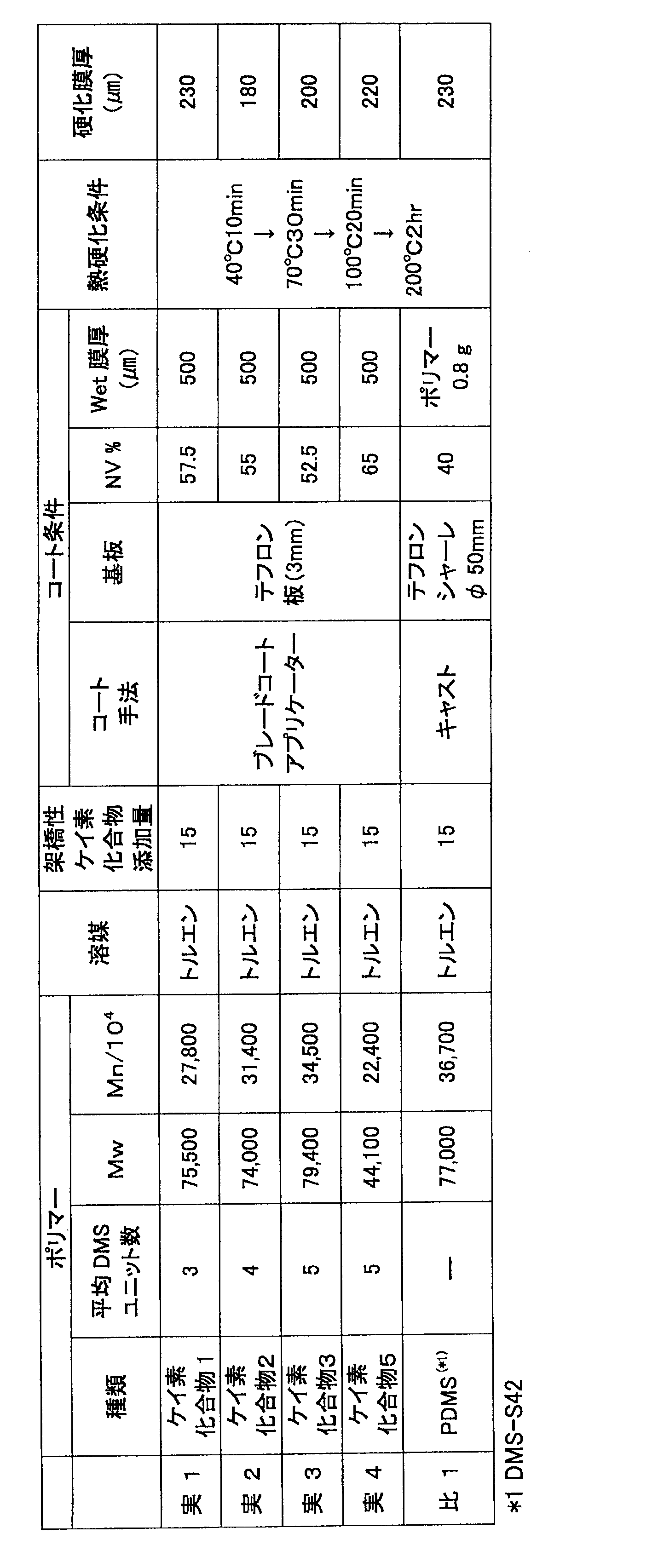


なお、式(3)で表されるケイ素化合物(DMSユニット数nが平均5.3、数平均分子量はMn=29,300、重量平均分子量はMw=57,900)を用いて、実施例1と同様にして作製したシロキサンポリマー架橋硬化物は、破断伸度(耐熱試験前296%、耐熱試験後214%)、破断応力(耐熱試験前9.0MPa、耐熱試験後11.7MPa)であり、優れた耐熱特性を有することが分かった。
以上より、ケイ素化合物に、ラウリン酸ジブチル錫の存在下で、ケイ素に結合する水酸基と反応する基を四つ以上有するケイ素化合物を反応させることによって、非常に優れた長期耐熱性と優れた光学特性を有する透明な膜を得ることができることが分かった。
本発明によれば、液状の組成物の塗布とその硬化という簡易な方法によって、非常に優れた長期耐熱性に加えて、高い光透過性を有するシリコーン膜を得ることができる。また本発明によれば、液状の組成物の硬化によって本発明のシロキサンポリマー架橋硬化物が得られることから、適当な型を用いることによって、種々の形状の本発明のシロキサンポリマー架橋硬化物の形成が可能である。したがって、各種表示素子における各種層を形成するための電気、電子材料を始め、レンズ等の光学材料への適用や、他の種々の技術分野への利用が可能である。
Claims (10)
- 下記式(1)で表されるケイ素化合物と、下記式(2)で表される架橋性ケイ素化合物からなる群から選ばれる一以上とを反応させて得られる架橋硬化性組成物を用いて成り、かつ、温度200℃で500時間、耐熱試験を行った後のガラス転移温度における見かけの活性化エネルギーの変化量が40kJ/mol以下であることを特徴とするシロキサンポリマー架橋硬化物。

(式(1)中、nは、独立して1~30の整数を表し;mは、重量平均分子量2,000~10,000,000を満たす数字を表し;R0は、独立して、フェニル又はシクロヘキシルを表し;R1及びR2は、独立してフェニル、シクロヘキシル又は炭素数1~5のアルキルを表し、前記フェニル及びシクロヘキシルは、任意の水素が独立してハロゲン又は炭素数1~20のアルキルで置き換えられてもよく、前記炭素数1~5のアルキルは、任意の水素が独立してフッ素で置き換えられてもよく、任意の-CH2-が独立して-O-又は炭素数5~20のシクロアルキレンで置き換えられてもよい。)
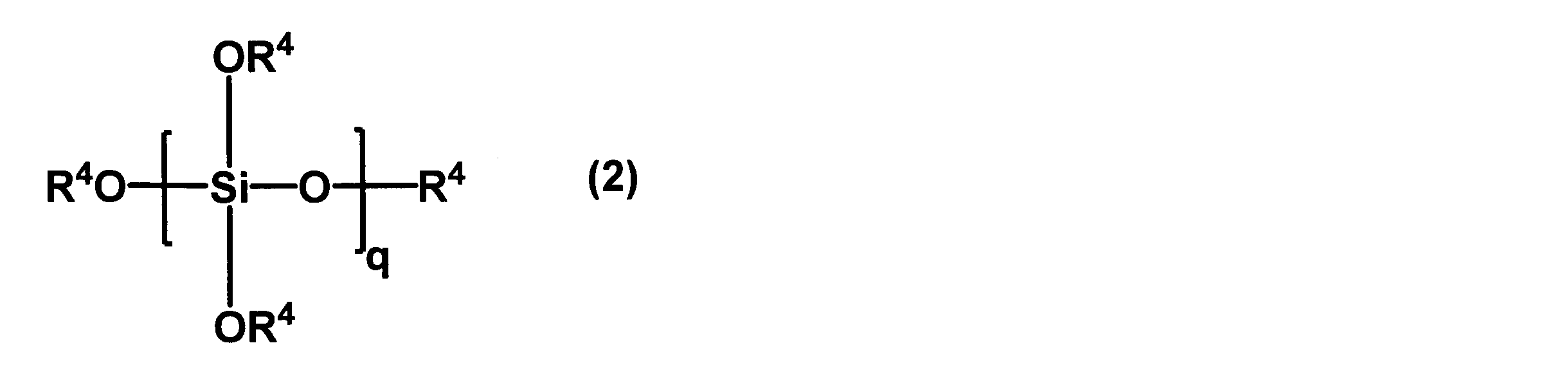
(式(2)中、R4は、それぞれ独立して、炭素数1~3のアルキル基を表し、qは1~100の整数を表す。) - 式(2)で表される架橋性ケイ素化合物は、式(1)で表されるケイ素化合物中の水酸基と反応する基又は原子を官能基比で1~15倍の範囲で有することを特徴とする請求項1に記載のシロキサンポリマー架橋硬化物。
- 式(1)中のnが平均5であることを特徴とする請求項1または2のいずれか1項に記載のシロキサンポリマー架橋硬化物。
- 式(1)中のR0~R2がそれぞれ独立してメチル又はフェニルであることを特徴とする請求項1から3のいずれか一項に記載のシロキサンポリマー架橋硬化物。
- 式(2)で表される架橋性ケイ素化合物が、メチルシリケートオリゴマーであることを特徴とする請求項1から4のいずれか一項に記載のシロキサンポリマー架橋硬化物。
- 前記式(1)が下記式(3)で表され、前記式(2)が下記式(4)で表されて、式(3)で表されるケイ素化合物と、式(4)で表される架橋性ケイ素化合物と反応させて得られる、ことを特徴とする請求項1から5のいずれか一項に記載のシロキサンポリマー架橋硬化物。
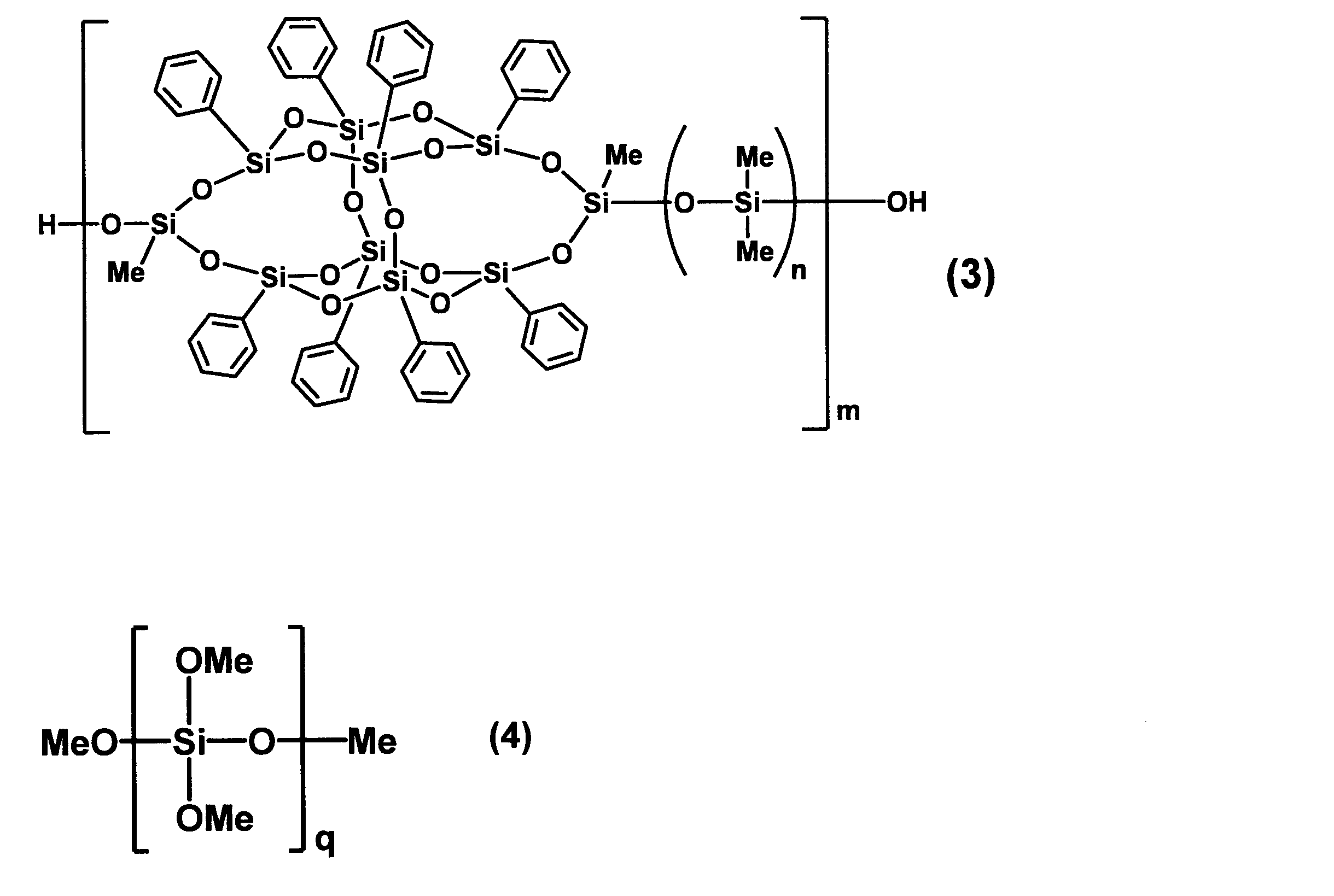
(式(3)中nは、独立して1~30の整数を表し;mは、重量平均分子量2,000~10,000,000を満たす数字を表す。また、式(4)中、qは1~10の整数を表す。) - 式(1)で表されるケイ素化合物の重量平均分子量が、40,000~80,000であることを特徴とする請求項1~6のいずれか1項に記載のシロキサンポリマー架橋硬化物。
- 室温下、8号ダンベル試験片を引張速度5mm/minで引っ張ったときの前記シロキサンポリマー架橋硬化物の伸びが、前記耐熱試験の前および前記耐熱試験の後のいずれでも、140%以上であることを特徴とする請求項1から7のいずれか一項に記載のシロキサンポリマー架橋硬化物。
- 前記シロキサンポリマー架橋硬化物の破断応力が、前記耐熱試験の前および前記耐熱試験の後のいずれでも、4MPa以上であることを特徴とする請求項1から8のいずれか一項に記載のシロキサンポリマー架橋硬化物。
- 前記シロキサンポリマー架橋硬化物の全光線透過率が、前記耐熱試験前および前記耐熱試験後のいずれでも、380nm~780nmにおいて99.0%以上であることを特徴とする請求項1~9のいずれか一項に記載のシロキサンポリマー架橋硬化物。
Applications Claiming Priority (2)
| Application Number | Priority Date | Filing Date | Title |
|---|---|---|---|
| JP2018124006A JP2021155462A (ja) | 2018-06-29 | 2018-06-29 | シロキサンポリマー架橋硬化物 |
| JP2018-124006 | 2018-06-29 |
Publications (1)
| Publication Number | Publication Date |
|---|---|
| WO2020004545A1 true WO2020004545A1 (ja) | 2020-01-02 |
Family
ID=68985478
Family Applications (1)
| Application Number | Title | Priority Date | Filing Date |
|---|---|---|---|
| PCT/JP2019/025578 Ceased WO2020004545A1 (ja) | 2018-06-29 | 2019-06-27 | シロキサンポリマー架橋硬化物 |
Country Status (3)
| Country | Link |
|---|---|
| JP (1) | JP2021155462A (ja) |
| TW (1) | TW202000746A (ja) |
| WO (1) | WO2020004545A1 (ja) |
Cited By (1)
| Publication number | Priority date | Publication date | Assignee | Title |
|---|---|---|---|---|
| WO2020116199A1 (ja) * | 2018-12-04 | 2020-06-11 | Jnc株式会社 | 縮合硬化型樹脂組成物、硬化物、成形体、及び半導体装置 |
Families Citing this family (2)
| Publication number | Priority date | Publication date | Assignee | Title |
|---|---|---|---|---|
| WO2023047978A1 (ja) | 2021-09-24 | 2023-03-30 | 国立研究開発法人産業技術総合研究所 | 組電池および評価方法 |
| WO2025063069A1 (ja) * | 2023-09-21 | 2025-03-27 | 積水化学工業株式会社 | 硬化性樹脂組成物、硬化膜、積層体及び半導体装置 |
Citations (4)
| Publication number | Priority date | Publication date | Assignee | Title |
|---|---|---|---|---|
| JP2008280420A (ja) * | 2007-05-09 | 2008-11-20 | Chisso Corp | 架橋性シロキサンポリマー、シロキサン系の架橋性組成物及びシリコーン膜 |
| JP2010116464A (ja) * | 2008-11-12 | 2010-05-27 | Chisso Corp | 架橋性ケイ素化合物、その製造方法、架橋性組成物、シロキサンポリマー、シリコーン膜、該架橋性ケイ素化合物の原料となるケイ素化合物、及びその製造方法 |
| JP2010116462A (ja) * | 2008-11-12 | 2010-05-27 | Chisso Corp | シロキサンポリマー、シロキサン系の架橋性組成物及びシリコーン膜 |
| JP2011190413A (ja) * | 2010-03-16 | 2011-09-29 | Kumamoto Univ | シロキサンポリマー架橋硬化物 |
-
2018
- 2018-06-29 JP JP2018124006A patent/JP2021155462A/ja active Pending
-
2019
- 2019-06-27 WO PCT/JP2019/025578 patent/WO2020004545A1/ja not_active Ceased
- 2019-06-27 TW TW108122606A patent/TW202000746A/zh unknown
Patent Citations (4)
| Publication number | Priority date | Publication date | Assignee | Title |
|---|---|---|---|---|
| JP2008280420A (ja) * | 2007-05-09 | 2008-11-20 | Chisso Corp | 架橋性シロキサンポリマー、シロキサン系の架橋性組成物及びシリコーン膜 |
| JP2010116464A (ja) * | 2008-11-12 | 2010-05-27 | Chisso Corp | 架橋性ケイ素化合物、その製造方法、架橋性組成物、シロキサンポリマー、シリコーン膜、該架橋性ケイ素化合物の原料となるケイ素化合物、及びその製造方法 |
| JP2010116462A (ja) * | 2008-11-12 | 2010-05-27 | Chisso Corp | シロキサンポリマー、シロキサン系の架橋性組成物及びシリコーン膜 |
| JP2011190413A (ja) * | 2010-03-16 | 2011-09-29 | Kumamoto Univ | シロキサンポリマー架橋硬化物 |
Cited By (3)
| Publication number | Priority date | Publication date | Assignee | Title |
|---|---|---|---|---|
| WO2020116199A1 (ja) * | 2018-12-04 | 2020-06-11 | Jnc株式会社 | 縮合硬化型樹脂組成物、硬化物、成形体、及び半導体装置 |
| JP2020090572A (ja) * | 2018-12-04 | 2020-06-11 | Jnc株式会社 | 縮合硬化型樹脂組成物、硬化物、成形体、及び半導体装置 |
| US12384888B2 (en) | 2018-12-04 | 2025-08-12 | Jnc Corporation | Condensation-curable resin composition, cured product, molded body, and semiconductor device |
Also Published As
| Publication number | Publication date |
|---|---|
| JP2021155462A (ja) | 2021-10-07 |
| TW202000746A (zh) | 2020-01-01 |
Similar Documents
| Publication | Publication Date | Title |
|---|---|---|
| JP5801028B2 (ja) | ケイ素含有硬化性組成物及びその硬化物 | |
| KR101569533B1 (ko) | 실리콘 수지용 조성물 | |
| TWI820260B (zh) | 縮合硬化型樹脂組成物、硬化物、成形體、及半導體裝置 | |
| KR101289960B1 (ko) | 광학 장치 밀봉용 수지 조성물, 그의 경화물 및 반도체소자의 밀봉 방법 | |
| JP2011190413A (ja) | シロキサンポリマー架橋硬化物 | |
| CN100379794C (zh) | 硅氧烷基聚合物及其组合物、发光装置以及硅氧烷基聚合物用于发光二极管的方法 | |
| JP2010280766A (ja) | 有機ケイ素化合物、該有機ケイ素化合物を含む熱硬化性組成物、および光半導体用封止材料 | |
| WO2020004545A1 (ja) | シロキサンポリマー架橋硬化物 | |
| KR20150075549A (ko) | 열 용융-압출 성형이 가능한 실세스퀴옥산, 이를 이용한 고투명 및 고내열 플라스틱 투명기판 및 이의 제조방법 | |
| CN104356390A (zh) | 含苯并环丁烯基团的有机硅氧烷及其制备和应用 | |
| US20210095126A1 (en) | Method of manufacturing silicone cured product, silicone cured product and optical member | |
| JP2015155541A (ja) | シロキサンポリマー架橋硬化物 | |
| CN108299645B (zh) | 可直接热固化的有机硅氧烷的制备和应用 | |
| CN105837617A (zh) | 可直接热固化的含三氟乙烯基醚的环硅氧烷的制备及应用 | |
| JPWO2015136820A1 (ja) | 硬化性樹脂組成物 | |
| Hayami et al. | Preparation and characterization of stable DQ silicone polymer sols | |
| KR102336227B1 (ko) | 유기규소 개질된 광개시제 및 그의 광경화성 접착제 조성물 | |
| CN109476920A (zh) | 固化性树脂组合物、其固化物、及半导体装置 | |
| JP7771958B2 (ja) | シロキサンポリマー、シロキサンポリマー組成物および成形体 | |
| CN117645725A (zh) | 一种光固化有机硅树脂、胶粘剂及其制备方法和应用 | |
| JP2020158692A (ja) | フッ素含有縮合型オルガノポリシロキサンプレポリマーおよびその硬化体 | |
| JP2024136725A (ja) | フッ素含有縮合型オルガノシロキサンポリマー前駆体 | |
| JP2013057032A (ja) | 多面体構造ポリシロキサン変性体、該変性体を含有する組成物、該組成物を硬化させてなる硬化物 | |
| JP2025125318A (ja) | シリル化ポリシルセスキオキサン、その製造方法、及びその用途 | |
| JP2010260962A (ja) | 硬化物の製造方法および硬化物 |
Legal Events
| Date | Code | Title | Description |
|---|---|---|---|
| 121 | Ep: the epo has been informed by wipo that ep was designated in this application |
Ref document number: 19825406 Country of ref document: EP Kind code of ref document: A1 |
|
| NENP | Non-entry into the national phase |
Ref country code: DE |
|
| 122 | Ep: pct application non-entry in european phase |
Ref document number: 19825406 Country of ref document: EP Kind code of ref document: A1 |
|
| NENP | Non-entry into the national phase |
Ref country code: JP |