WO2020006643A1 - Compositions based on maple sap, vegetable juice or fruit juice, and process for manufacturing same - Google Patents
Compositions based on maple sap, vegetable juice or fruit juice, and process for manufacturing same Download PDFInfo
- Publication number
- WO2020006643A1 WO2020006643A1 PCT/CA2019/050930 CA2019050930W WO2020006643A1 WO 2020006643 A1 WO2020006643 A1 WO 2020006643A1 CA 2019050930 W CA2019050930 W CA 2019050930W WO 2020006643 A1 WO2020006643 A1 WO 2020006643A1
- Authority
- WO
- WIPO (PCT)
- Prior art keywords
- composition
- approximately
- concentrated
- fruit juice
- sucrose
- Prior art date
- Legal status (The legal status is an assumption and is not a legal conclusion. Google has not performed a legal analysis and makes no representation as to the accuracy of the status listed.)
- Ceased
Links
Classifications
-
- A—HUMAN NECESSITIES
- A23—FOODS OR FOODSTUFFS; TREATMENT THEREOF, NOT COVERED BY OTHER CLASSES
- A23L—FOODS, FOODSTUFFS OR NON-ALCOHOLIC BEVERAGES, NOT OTHERWISE PROVIDED FOR; PREPARATION OR TREATMENT THEREOF
- A23L33/00—Modifying nutritive qualities of foods; Dietetic products; Preparation or treatment thereof
- A23L33/10—Modifying nutritive qualities of foods; Dietetic products; Preparation or treatment thereof using additives
- A23L33/125—Modifying nutritive qualities of foods; Dietetic products; Preparation or treatment thereof using additives containing carbohydrate syrups; containing sugars; containing sugar alcohols; containing starch hydrolysates
-
- A—HUMAN NECESSITIES
- A23—FOODS OR FOODSTUFFS; TREATMENT THEREOF, NOT COVERED BY OTHER CLASSES
- A23L—FOODS, FOODSTUFFS OR NON-ALCOHOLIC BEVERAGES, NOT OTHERWISE PROVIDED FOR; PREPARATION OR TREATMENT THEREOF
- A23L29/00—Foods or foodstuffs containing additives; Preparation or treatment thereof
- A23L29/30—Foods or foodstuffs containing additives; Preparation or treatment thereof containing carbohydrate syrups; containing sugars; containing sugar alcohols, e.g. xylitol; containing starch hydrolysates, e.g. dextrin
-
- C—CHEMISTRY; METALLURGY
- C13—SUGAR INDUSTRY
- C13B—PRODUCTION OF SUCROSE; APPARATUS SPECIALLY ADAPTED THEREFOR
- C13B25/00—Evaporators or boiling pans specially adapted for sugar juices; Evaporating or boiling sugar juices
-
- C—CHEMISTRY; METALLURGY
- C13—SUGAR INDUSTRY
- C13B—PRODUCTION OF SUCROSE; APPARATUS SPECIALLY ADAPTED THEREFOR
- C13B30/00—Crystallisation; Crystallising apparatus; Separating crystals from mother liquors ; Evaporating or boiling sugar juice
- C13B30/002—Evaporating or boiling sugar juice
-
- C—CHEMISTRY; METALLURGY
- C13—SUGAR INDUSTRY
- C13B—PRODUCTION OF SUCROSE; APPARATUS SPECIALLY ADAPTED THEREFOR
- C13B30/00—Crystallisation; Crystallising apparatus; Separating crystals from mother liquors ; Evaporating or boiling sugar juice
- C13B30/02—Crystallisation; Crystallising apparatus
-
- C—CHEMISTRY; METALLURGY
- C13—SUGAR INDUSTRY
- C13B—PRODUCTION OF SUCROSE; APPARATUS SPECIALLY ADAPTED THEREFOR
- C13B50/00—Sugar products, e.g. powdered, lump or liquid sugar; Working-up of sugar
-
- A—HUMAN NECESSITIES
- A23—FOODS OR FOODSTUFFS; TREATMENT THEREOF, NOT COVERED BY OTHER CLASSES
- A23L—FOODS, FOODSTUFFS OR NON-ALCOHOLIC BEVERAGES, NOT OTHERWISE PROVIDED FOR; PREPARATION OR TREATMENT THEREOF
- A23L27/00—Spices; Flavouring agents or condiments; Artificial sweetening agents; Table salts; Dietetic salt substitutes; Preparation or treatment thereof
- A23L27/88—Taste or flavour enhancing agents
-
- A—HUMAN NECESSITIES
- A23—FOODS OR FOODSTUFFS; TREATMENT THEREOF, NOT COVERED BY OTHER CLASSES
- A23L—FOODS, FOODSTUFFS OR NON-ALCOHOLIC BEVERAGES, NOT OTHERWISE PROVIDED FOR; PREPARATION OR TREATMENT THEREOF
- A23L5/00—Preparation or treatment of foods or foodstuffs, in general; Food or foodstuffs obtained thereby; Materials therefor
-
- A—HUMAN NECESSITIES
- A23—FOODS OR FOODSTUFFS; TREATMENT THEREOF, NOT COVERED BY OTHER CLASSES
- A23V—INDEXING SCHEME RELATING TO FOODS, FOODSTUFFS OR NON-ALCOHOLIC BEVERAGES AND LACTIC OR PROPIONIC ACID BACTERIA USED IN FOODSTUFFS OR FOOD PREPARATION
- A23V2002/00—Food compositions, function of food ingredients or processes for food or foodstuffs
Definitions
- Maple, fruit and vegetable products are known for their varied taste and composition, which are highly sought after by the industry today. More and more maple products, fruits and vegetables are being marketed, and new innovations are regularly sought in this area. It was therefore appropriate to offer alternatives to existing products and processes by developing new value-added products, which stimulates economic activity in the maple syrup industry.
- compositions and methods of the present application make it possible to promote maple products, fruits and vegetables and more specifically their organoleptic properties including the taste and flavor of maple, fruits and vegetables compared to products made using traditional maple, fruit and vegetable processes.
- the methods of the present disclosure make it possible to further enhance these properties in a product or preparation which can be the basis of the multitude of derivative products.
- the product or preparation obtained can serve as a basis for developing and launching products with higher added value compared to maple products, fruits and vegetables present on the market.
- These high added value products also have various advantageous contents in terms of certain compounds compared to the products. obtained from traditional processes. These high added value products can offer nutritional and health benefits.
- the present application comprises a composition based on concentrated maple sap and comprising a polyphenol content in mg per g of sucrose from approximately 0.8 to approximately 10.
- the present application also comprises a composition based on concentrated maple sap and comprising a manganese content in mg per g of sucrose from approximately 0.05 to approximately 0.7.
- the present application also includes a process for the preparation of a concentrated composition based on maple sap in which a maple sap or a maple sap concentrate is evaporated under vacuum so as to obtain a non-syrup caramelized;
- the non-caramelized syrup is subjected to crystallization so as to obtain sugar and said concentrated composition based on maple sap; and separating the sugar from said concentrated maple sap composition.
- the present application also includes a process for preparing a concentrated composition based on fruit juice, fruit juice concentrate, vegetable juice, and / or vegetable juice concentrate in which it is evaporated under empties a fruit juice, a fruit juice concentrate, a vegetable juice, and / or a vegetable juice concentrate so as to obtain a non-caramelized syrup;
- the non-caramelized syrup is subjected to crystallization so as to obtain sugar and said concentrated composition based on fruit juice, fruit juice concentrate, vegetable juice, and / or vegetable juice concentrate; and the sugar is separated from said concentrated composition based on fruit juice, concentrated fruit juice, vegetable juice, and / or concentrated vegetable juice.
- the present application comprises a composition based on fruit juice, fruit juice concentrate, vegetable juice, and / or vegetable juice concentrate and comprising a polyphenol content in mg per g of sucrose from about 0.8 to about 10.
- the present application also comprises a composition based on fruit juice, fruit juice concentrate, vegetable juice, and / or vegetable juice concentrate and comprising a manganese content in mg per g of sucrose from about 0.05 to about 0.7.
- Figure 1 Method according to the present disclosure for the production of enriched maple composition.
- Figure 2 Vacuum assembly for the production of syrup and non-caramelized composition in the laboratory.
- FIG. 3 Anhydro evaporator (left) and APV evaporator (right) used for the production of non-caramelized syrup
- FIG. 4 Filter press used for filtration of syrup in the factory.
- Figure 5 Crystallizers used in the factory. Pilot plant scale
- Figure 6 Crystallization steps of sugar from non-caramelized syrup.
- Figure 7 Centrifuge used in a pilot plant for the separation of the composition and the sugar crystals.
- Figure 8 Electric mini-evaporator used for the production of maple syrup on a pilot plant scale.
- Figure 9 Description of the pre-tests performed in the laboratory.
- Figure 10 Description of the tests carried out on a small scale in the laboratory and on the scale of a pilot plant in the factory.
- Figure 1 1 Description of the tests carried out on a semi-industrial scale.
- Figure 12 Concentration of polyphenols of the different compositions produced.
- Figure 13 Content of main mineral ions in the compositions produced at different scales by the two methods of thermal crystallization and cooling.
- Figure 14 Profiles of volatile compounds detected in the compositions produced in the pilot plant by the crystallization by cooling method.
- FIGS 15A and 15B Polyphenol content and antioxidant activity of the various syrups produced.
- Figures 16A, 16B and 16C Content of main mineral ions in caramelized syrups produced on the pilot and non-caramelized evaporator produced on APV.
- Figure 17 Profile of volatile compounds in caramelized syrups produced on the pilot evaporator.
- Figure 18 Profile of the volatile compounds detected in the condensates during the preparation of the composition by the two crystallization methods.
- Figure 19 Monitoring of the polyphenol concentration in the various products obtained on the production process chain of the maple composition.
- Figure 20 Monitoring of the antioxidant activity in the various products on the production process chain of the maple composition.
- Figures 21 A, 21 B and 21 C Content of main mineral ions of the various products on the production process chain of the maple composition.
- Figure 22 photos of compositions produced by cooling on a pilot and semi-industrial scale (the fine crystals are separated in composition after freezing).
- FIG. 23 Photos of different products from the manufacturing process of the maple composition and these derivatives.
- Figure 24 Concentration of polyphenols of different compositions produced from blackcurrant juice.
- compositions of the present application can have a polyphenol content in mg per g of sucrose of from about 0.8 to about 6.0; from about 0.8 to about 4.0; from about 1.0 to about 7.0; from about 1.2 to about 7.0; from about 1.4 to about 5.3; from about 2.0 to about 5.3; from about 1.0 to about 4.0; from about 1.0 to about 2.0; from about 1.2 to about 4.0; from about 1.5 to about 3.8 or from about 2.0 to about 4.0.
- compositions of the present application may have a phosphorus content in mg per g of sucrose of from approximately 0.02 to approximately 0.2 or from approximately 0.05 to approximately 0.2.
- compositions of the present application may have a magnesium content in mg per g of sucrose of from about 0.4 to about 1.8, or from about 0.6 to about 1.6.
- compositions of the present application can have an iron content in mg per g of sucrose of approximately 0.3 to approximately 0.6.
- the compositions of the present application can have a manganese content in mg per g of sucrose of approximately 0.02 to approximately 0.7.
- compositions of the present application can have a potassium content in mg per g of sucrose from about 5 to about 25; from about 8 to about 25 or from about 10 to about 25.
- compositions of the present application can have a calcium content in mg per g of sucrose of approximately 3 to approximately 10 or approximately 3 to approximately 8.
- compositions of the present application can have a manganese content in mg per g of sucrose of from approximately 0.05 to approximately 0.7; from about 0.1 to about 0.5 or from about 0.2 to about 0.5.
- compositions of the present application t comprising a manganese content in mg per g of sucrose of approximately 0.05 to approximately 0.7, may also contain a magnesium content in mg per g of sucrose d '' about 0.3 to about 1.8, or about 0.35 to about 1.8.
- compositions of the present application comprising a manganese content in mg per g of sucrose of approximately 0.05 to approximately 0.7, may also contain a phosphorus content in mg per g of sucrose about 0.02 to about 0.2 or about 0.05 to about 0.2.
- compositions of the present application can be in liquid form.
- compositions of the present application can be in solid form.
- compositions of the present application can be in the form of maple syrup.
- compositions of the present application can be in the form of maple butter.
- compositions of the present application can be in the form of maple sugar.
- compositions of the present application can have an antioxidant activity of at least 7000 or 7500 Eq. TE, mM; at least 8000 or 8500 Eq. TE, pM; at least 8000 or 9000 Eq. TE, pM; from about 8,000 to about 20,000 Eq. TE, pM; from about 8000 to about 15000 Eq. TE, pM from about 8000 to about 13000 Eq. TE, pM or from around 10,000 to around 12500 Eq. TE, pM.
- the crystallization of a process of the present application can be a crystallization under vacuum.
- the crystallization of a process of the present application can be an evaporative crystallization.
- the crystallization of a process of the present application can be a thermal crystallization.
- the crystallization of a process of the present application can be a crystallization by cooling.
- a concentrated composition based on maple sap, fruit juice, fruit juice concentrate, vegetable juice, and / or concentrate vegetable juice one can caramelize said concentrated composition obtained so as to obtain a caramelized syrup.
- said concentrated composition obtained can be subjected to another crystallization so as to obtain sugar and another concentrated composition based on maple sap, fruit juice, fruit juice concentrate, juice vegetables, and / or vegetable juice concentrate.
- said other concentrated composition obtained based on maple sap, juice fruit, fruit juice concentrate, vegetable juice, and / or vegetable juice concentrate can be caramelized so as to obtain a caramelized syrup.
- the process for preparing the present application for a concentrated composition based on maple sap, fruit juice, concentrated fruit juice, vegetable juice, and / or concentrated vegetable juice may further comprise drying said concentrated composition based on maple sap from fruit juice, fruit juice concentrate, vegetable juice, and / or vegetable juice concentrate, or said other concentrated composition based on maple sap, fruit juice, fruit juice concentrate, vegetable juice, and / or vegetable juice concentrate.
- drying of a process of the present application can be carried out lyophilization, by atomization or in an oven or a tunnel.
- said maple sap, said maple sap concentrate can be evaporated under vacuum by recovering aromas from said maple sap and / or said sap concentrate. maple using an aroma catcher.
- the fruits referred to in the present application can be selected from blueberries, cranberries, blackberries, blackcurrants, aronias, strawberries, raspberries, plums, apples, grapes, elderberries, camerises, lychees, apricots, dates, cherries, pomegranates, figs, pears, peaches, currants, cranberries, quinces, oranges, limes, lemons, mangoes, and nectarines.
- the fruits referred to in the present application can be selected from blueberries, cranberries, blackberries, blackcurrants, aronias, strawberries, raspberries, plums, apples, grapes, elderberries, and camerises.
- the fruits referred to in the present application can be selected from blueberries, cranberries, blackberries and blackcurrants.
- the vegetables referred to in the present application can be selected from artichokes, olives, onions, potatoes, carrots, shallots, beets, cabbage, corn, tomatoes, peas, turnips, and rhubarbs.
- the methods of the present application may comprise the removal of part of the sugars present in the syrup, which makes it possible to enhance the content of maple compounds, of fruits or of vegetables in the finished product "the composition maple / fruit / vegetable ”.
- this syrup can be extracted from them by means of vacuum crystallization until a composition of maple, fruits and / or vegetables is obtained.
- a composition reduced in sugars but enriched in other compounds can be interesting for the manufacture of high value products added from maple, fruit and / or vegetables (polyphenols, flavorings, etc.). This can allow people with diabetes or other blood sugar problems to eat maple products, fruits and / or vegetables while reducing health risks. It is important to mention that the feasibility tests were done without adding sugar germ (seed) to the supersaturated syrup so as not to affect the taste of the finished product. Of course, such products could also be prepared by adding a seed of sugar or seed, but the products thus obtained may be less advantageous in terms of their sugar content.
- the plan of the exemplary process for manufacturing the maple composition is presented in the figure. 1. Those skilled in the art will understand that this plan can also apply to the processing of fruit juice, fruit juice concentrate, vegetable juice, and vegetable juice concentrate. In fact, a person skilled in the art will understand that all the processes, methods, diagrams and techniques described in the present application with reference to maple products are applicable to fruit juice, fruit juice concentrate, vegetable juice, and vegetable juice concentrate. In fact, in all the processes, methods, schemes and techniques described in the present application, the starting material may be replaced with maple sap or maple sap concentrate (or different maple or maple-based compositions ) by fruit juice, fruit juice concentrate, vegetable juice, and / or vegetable juice concentrate.
- the present disclosure includes the use of a composition as defined in the present disclosure as a flavor or aroma enhancer.
- the present disclosure describes the use of a composition obtained by a process as defined in the present disclosure as a flavor or aroma enhancer.
- the method can further comprise, after having separated said sugar from said concentrated composition, a dilution of said concentrated composition in order to obtain a flavor or aroma enhancer.
- said concentrated composition can be diluted with water.
- Tests have been divided into different parts, to master the process on different scales. Firstly, pre-tests were carried out in the laboratory, providing feasibility and adapting the strategy to be followed. Following these pre-tests, two main crystallization methods were carried out in the laboratory, namely the crystallization method by thermal supersaturation and the crystallization method by cooling. These tests having both shown positive results, these were carried over to the factory on a pilot scale. Tests on this scale have shown better results with cooling crystallization, which has been applied on a semi-industrial scale for the production of a larger volume of first composition (composition-1). Part of this composition was recrystallized on a pilot scale to produce a second composition (composition-2).
- composition-1 a second part of composition-1 was used to produce a caramelized syrup of maple composition on a traditional evaporator.
- the latter was compared with a reference maple syrup produced from the same original concentrate used for the production of composition-1. It is of course possible to carry out the crystallization method by supersaturation i.e. with the addition of sugar germ (crystallization seed).
- the main objectives of the project were:
- T tell a portrait of the characteristics of this composition.
- the Applicant provided the ACER Center team with volumes of sap concentrates and maple syrup. These products were harvested by the applicant from a maple producer towards the end of the 2017 season. The list of products received is presented in Table 1. The products were frozen at -18 ° C until needed. The concentrates have been subdivided into three fractions, used for different test segments carried out in the laboratory, pilot plant and on a large scale.
- Pre-tests were carried out for the production of non-caramelized maple syrup (under vacuum) on a laboratory scale. Containers of Concentrate-1 at 20 ° Brix were thawed and used. Likewise, volumes of syrup diluted to 20 ° Brix were used to assess the effect of the syrup matrix on sugar saturation.
- the experimental device consists of a 2 L erlenmeyer flask, placed on a hot plate (Corning, PC-101). This Erlenmeyer flask serves as a cooking vessel for the treated liquid, under vacuum, with magnetic stirring. Another 0.5 L or 1 L Erlenmeyer flask was connected to the first and to the vacuum to collect the steam condensate. The vacuum used varied from 18 to 22 in Hg depending on its use elsewhere in the building. An RTD was immersed in the liquid in order to follow the boiling temperature throughout the test.
- composition was produced from non-caramelized syrup at 66 ° Brix obtained in various tests carried out on a small or large scale. A spontaneous crystallization was triggered without adding sugar germ to the mass-cooked so as not to affect the taste of the finished product (composition). Then, the development of the crystals was carried out according to the two types of crystallization tested: either by thermal supersaturation or by cooling. The objective of testing these two methods is to examine the effect of the crystallization temperature on the taste and characteristics of the fine product. For these two methods, several tests were carried out under different conditions depending on the objective of each.
- the thermal supersaturation was carried out with the same assembly as that used to make the non-caramelized syrup in the laboratory.
- the non-caramelized syrup was heated under vacuum and with stirring until reaching a targeted ° Brix between 78 and 86%.
- the crystallization by cooling tests consisted in cooling the saturated solution to 40 ° C. Two cooling modes were used. The first was to cool the baked mass at room temperature, while the second was performed under controlled conditions. The temperature is gradually lowered by 3 ° C over 15 minutes using a beaker immersed in a water bath for 3.5 h. The mash was brewed continuously throughout the cooling time using an agitator inserted into the beaker.
- the sugar crystals were separated from the composition using a laboratory centrifuge equipped with one of two types of rotors depending on the volume of liquid to be treated. In some cases, it was necessary to hydrate the solution of supersaturated composition with a little demineralized water to allow the separation of the crystals.
- the crystallization conditions tested during the tests carried out in the laboratory are presented in Table 4.
- the 66 ° Brix syrup was heated to supersaturation, at a ° Brix varying between 78 and 85%, and then cooled to between 37 and 72 ° C depending on the crystallization method used.
- Thermal crystallization was carried out by increasing the ° Brix of the non-caramelized syrup until the sugar supersaturation. When a sufficient quantity of crystals appeared in the baked mass, the vacuum was removed, then the temperature of the solution was lowered to 70 ° C for 1 to 1.5 hours ( Figure 6) . The crystals were subsequently separated by centrifugation. Supersaturation by cooling was carried out by increasing the ° Brix of the solution until the appearance of the sugar crystal nuclei and then the solution was gradually cooled to 40 ° C for 4 to 17 hours. This decrease of temperature makes it possible to maintain the supersaturation of the solution and the crystallization at a high temperature. .
- the centrifugation of the cooked mass was carried out on a basket centrifuge (Western States, United States) equipped with filters varying in size between 0.25 and 100 ⁇ m.
- the efficiency of centrifugation depends on the size of the filter used, the volume of the cooked mass to be centrifuged and the size of the sugar crystals. Different filters were tested since they blocked if the size of the crystals obtained was close to that of the filter used, as illustrated in photo-3 of Figure 7.
- demineralized water has been added to the cooked mass, either during its cooling, or before its centrifugation, to decrease its viscosity and to melt the fine sugar crystals.
- centrifugation methods have been tried in order to separate the composition of the crystals with the available filters.
- the centrifugation went better by treating a volume of less than one liter at a time.
- the distribution of the cooked mass on the filter was ensured by feeding the centrifuge at low speed (200 rpm) for one minute.
- the centrifugal speed increased to the various high levels I
- Table 6 The conditions for producing compositions-1 and 2 at the scales of a pilot and semi-industrial plant are presented in Table 6.
- composition 1 The yield of composition 1 (large scale) varies from 30 to 33% of the volume of non-caramelized syrup. This composition underwent a second crystallization phase (composition-2) on a pilot scale, for a yield of approximately 22.4% of the volume of composition-1. These yields would probably be higher if a specific centrifuge designed for the separation of sugar crystals was used. These yields were largely affected by the success of crystal separation during centrifugation. A subsequent study is planned to optimize the crystallization and improve the centrifugation performance.
- compositions-1 and 2 produced from this same concentrate were used to produce maple syrup according to the method used to produce traditional maple syrup . These syrups were produced on a pilot mini-evaporator available at the ACER Center.
- the sap concentrate was thawed for 24 h in a thawing system available at the ACER Center. It was then pre-filtered using a # 7 maple prefilter to remove coarse particles that may be found inside.
- the composition being much more concentrated and thawing more quickly, it was thawed in the fridge at 4 ° C overnight. Then it was diluted with deionized water until it reached the same ° Brix as the concentrate (22 ° Brix). The solution was homogenized using a compressed air stirrer.
- Each solution was transferred to the electric mini-evaporator available at the ACER Center ( Figure-8).
- This pilot evaporator is made up of three pleated pans and three flat bottom pans. It works on the same physical principle as industrial maple sap evaporators, i.e. by level difference, and has control and data acquisition systems for different process parameters (preheating temperature, liquid height, temperature heating, temperature liquid, feed rate).
- the maple syrups made from the concentrate and the composition were produced under the same heating conditions, before being filtered under pressure using a vertical plate filter press with diatomaceous earth.
- the experimental protocol aimed to do pretests and laboratory tests, as well as validation tests in an experimental plant at two scales (pilot plant and large scale). During the tests, it was adjusted according to the results obtained.
- the plans for different tests carried out on the different scales are presented in Figures 9, 10 and 1 1.
- the color of the products was determined by measuring their transmission to light at 560 nm. Their flavors have been evaluated by the maple syrup classifiers of the Acer inspection division of the ACER Center. Three inspectors had to taste each of the samples blindly to give it a taste score and assess the presence of flavor defects, then decide by consensus on the final score to be awarded.
- the profiles of volatile compounds in the composition, the condensates and the maple syrups produced in this project were determined by GC / MS after SPME extraction in headspace mode (Sabik et al., 2012).
- the fiber used for these tests is a DVB-CAR-PDMS fiber.
- the antioxidant activity was measured according to the ORAC method and expressed in (I Eq.TE, mM), which means pmol equivalent in Trolox per liter.
- the determination of the mineral ion profile and the measurement of the antioxidant activity of certain fractions were carried out by external laboratories.
- the summary of the samples taken and the analyzes planned is presented in Table 7.
- Fruit juice, vegetable juice, fruit juice concentrate, and / or vegetable juice concentrate can also be used as a raw material for this demand process.
- the fruit juice can be blueberry juice.
- Blueberry juice typically has a caloric content of 45 calories per 100g of juice from sugar, equivalent to a sugar concentration of 1 1.3g per 100g of juice, therefore 1 1 .3 ° Brix.
- Caloric content of sugar is 398 calories per 100g of sugar.
- the average characteristics of the non-caramelized syrups produced under vacuum from the sap concentrates on a laboratory and pilot plant scale are presented in Table 10. These characteristics are comparable to the characteristics of a standard maple syrup ( FPAQ, 2014, Van den Berg et al 2015). All syrups have comparable levels of ° Brix, pH and electrical conductivity. The average sucrose content in these non-caramelized syrups is 62.9% which corresponds to a purity of 94% of the sucrose relative to the total solids (° Brix).
- Non-caramelized syrup has an antioxidant capacity close to that of an apple juice (4140 Eq. TE, mM) and less than that of a blueberry juice (23590 Eq. TE, pM) (Haytowitz and Bhagwat, 2010).
- compositions produced by thermal supersaturation and cooling are very similar in terms of ° Brix and pH. However, there are differences in the electrical conductivity and the light transmission of the samples. On a laboratory scale, the composition produced by thermal supersaturation exhibits high transmission and low conductivity. This result could be explained by the addition of a small volume of water to assist in the separation of crystals by centrifugation in the laboratory. From a general point of view, these two parameters vary a little depending on the method of crystallization and the production scale used.
- Cooling etti-2 designates the second crystallization for the production of composition-2.
- composition-2 produced by a second crystallization phase, compared with composition-1 obtained on a large scale, the two compositions have similar physicochemical characteristics, except as regards electrical conductivity, which is 1.3 times higher in composition-2.
- the composition produced on a semi-scale industrial is richer in certain mineral ions, such as iron (Fe) (6.9 times), copper (Cu) (5.7 times), phosphorus (P) (3.3 times) and manganese (Mn ) (2.6 times). This increase is probably related both to the longer crystallization time and to the smaller volume centrifugation at a time.
- composition-2 made it possible to increase the content of all the minerals by 2 to 3 times as illustrated in the figure. 13. Consequently, the total content of mineral ions in composition-2 is 2.1 times higher than in composition-1.
- compositions produced by the two crystallization methods have comparable physicochemical characteristics.
- the method of crystallization by cooling makes it possible to retain more divalent mineral ions such as calcium, manganese and zinc in the composition of maple, fruits and vegetables than the method by thermal supersaturation.
- the polyphenol and mineral content in the composition improves with the scale of production.
- composition-2 makes it possible to further increase the concentration of polyphenols and of all the minerals.
- composition-1 has not really changed compared to the non-caramelized syrup.
- the second crystallization phase reduced these values to a level almost 2 times higher than in composition-1, while the sucrose slightly decreased.
- the two main volatile compounds present in the non-caramelized syrup are peak 13 and peak 16.
- the area of the peak corresponding to the compound 13 is 4 times that of compound 16.
- the caramelized syrups produced from the concentrate and the maple composition on the same pilot evaporator were compared with each other, as well as with the non-caramelized syrup produced under vacuum on a semi-industrial scale.
- the averages of the macroscopic characteristics, the sugar contents, the polyphenol contents and the antioxidant activities of these syrups are presented in Table 13. First, the three syrups have a similar pH and Brix degree.
- the polyphenol content and the antioxidant capacity of caramelized and non-caramelized syrups are shown in Figure 15.
- the reference caramelized syrup has a higher antioxidant activity than that of non-caramelized syrup by 1.6 times since it is richer in polyphenols by 1.5 times (Figure 15).
- composition syrup has a stronger antioxidant activity than the reference syrup by 2.5 times since it is richer in polyphenols by 1.9 times as illustrated in the figure 15. Consequently, the preparation of a syrup from the composition makes it possible to obtain a syrup much richer in phenol and endowed with a strong antioxidant activity.
- the differences obtained between the reference syrup and the composition syrup are probably related to the difference in polyphenol concentration in the corresponding raw material for each product.
- the concentration of polyphenols is high in the composition before dilution.
- the diluted composition used for the preparation of the syrup is therefore richer in polyphenols by 2.8 times than the sap concentrate used for the preparation of the reference syrup (Table 13).
- the polyphenols were concentrated by the same concentration factor.
- the main minerals found in caramelized syrups produced on the pilot evaporator and the non-caramelized syrup produced on the evaporator (APV) are shown in Figure 16.
- the most common mineral ions are potassium (K), calcium (Ca) and magnesium (Mg).
- Al aluminum
- B boron
- Copper (Cu) is no longer found in pilot syrups while it was present in the concentrate, the compositions and the non-caramelized syrup.
- lead (Pb), cobalt (Co) and cadmium (Cd) there are small amounts of lead (Pb), cobalt (Co) and cadmium (Cd).
- the caramelized composition-1 syrup has higher contents for the majority of minerals compared to the reference syrup.
- the potassium (K), calcium (Ca), magnesium (Mg), phosphorus (P), sodium (Na) and zinc (Zn) contents increased between 1.5 and 2.2 times in the composition syrup.
- the total content of mineral ions in the composition syrup increased by 1.7 times compared to the reference syrup.
- Tables 15, 16, 17, 18, 19, and 20 are a summary of the different data collected in the tests presented in sections 6, 7 and 8.
- Table 15 Physicochemical characteristics, chemical composition and various characteristics of the various concentrates, compositions and syrups produced from maple sap
- Two condensates were recovered during the preparation of the composition by the two crystallization methods at two levels of ° Brix: 82% for thermal supersaturation and 78% for that of cooling.
- the two condensates have an average pH of 8.25.
- the condensates are richer in compounds 16, 19 and 20. They contain more than 4 to 8 times than the non-caramelized syrup, and more than 4 to 7 times than the composition.
- the peak area of these compounds was similar in the non-caramelized syrup and the composition, therefore, it is possible that a significant amount of these was generated during supersaturation.
- This step consists in carrying out an analysis of the effect of the transformation of the maple sap concentrate to the various products according to the composition production process. This analysis makes it possible to perceive the effect of the successive stages on the compounds and the properties of interest.
- a photo of different products obtained according to the composition manufacturing process and these derivatives is presented in Figure 23.
- composition-1 and composition-2 contain 10 and 25 times more polyphenols respectively than the sap concentrate. It can be observed that there are two main steps which make it possible to further increase the content of polyphenols. The most important step is the production of composition-1 from non-caramelized syrup, since it concentrates the polyphenols by a factor of 3.1 times. The second step is the production of composition-2 from composition-1 which allows enrichment by a factor of 2.4 times.
- composition-1 increases the phenol content by a factor of 1, 3. Therefore, there are not many advantages between the production of composition-1 and composition syrup.
- the production of composition-2 is more advantageous in terms of polyphenol content than the composition syrup. On the other hand, the latter is more advantageous than the production of reference syrup.
- the production of syrup from composition-2 can further increase the phenol content by a factor of 1.3 compared to composition-2.
- Figure 20 also demonstrates that the antioxidant activity increases more with the preparation of composition-1 by a factor of 2.1 compared to the non-caramelized syrup. It remains fairly similar between composition-1, composition-2 and composition syrup.
- the production of composition-2 does not improve the antioxidant activity of this product compared to composition-1.
- this activity is increased in caramelized syrup by a factor of 1.2 compared to non-caramelized syrup.
- the production of the composition syrup makes it possible to increase it by a factor of 1, 1 compared to the composition-1. Consequently, caramelization does not bring about a great improvement in antioxidant activity.
- Composition-1 seems to be the first choice for its antioxidant capacity and in terms of production operations.
- composition-2 is the richest product in mineral ions, followed by composition-1 and composition syrup, then caramelized syrup. It seems that the composition syrup is less advantageous than composition-1. In addition, it contains 2 times more total minerals than caramelized syrup.
- the manganese (Mn), phosphorus (P), boron (B) and iron (Fe) contents are 8 to 21 times higher in composition-1 than in caramelized syrup.
- composition-2 prevails for its richness in polyphenols and minerals.
- composition-1 and composition syrup are also products of choice according to the interests of different target market sectors.
- compositions produced by the two crystallization methods are comparable.
- the method of crystallization by cooling makes it possible to obtain higher values in mineral ions, especially for the divalent ions.
- the increase in the production scale makes it possible to increase the polyphenol content.
- composition makes it possible to obtain a product richer than the traditional syrup in polyphenols, in minerals and in antioxidant activity.
- Composition-2 is much richer in these compounds, except for the antioxidant activity which is similar to composition-1.
- Non-caramelized syrup has values lower than the reference syrup for light transmission, polyphenol concentration and antioxidant activity. However, it is richer in glucose, fructose and mineral ions.
- composition syrup has higher values than the traditional syrup for electrical conductivity, the contents of glucose, fructose, polyphenols, antioxidants, as well as for most minerals. These increases seem related to the use of a composition already richer in these compounds for the production of this syrup. However, some of the minerals seem rather to have decreased during the production of the composition syrup compared to the starting composition.
- Tables 24, 25 and 26 as well as Figure 24 show results obtained from the use of various fruit juices.
- the juices were treated by the same methods as those previously described with regard to the various products based on maple sap, maple concentrate or various maple compositions.
- the same methods were used, only the starting material was different, ie during the tests of Tables 24, 25 and 26 as well as in Figure 24, various fruit juices were used as product of departure. The procedures used were therefore like that illustrated in Figure 1, but the maple sap was replaced by juices.
- the results of these tables and of this figure show that these methods are versatile and that they can treat various starting materials comprising sugar.
- the methods can make it possible to concentrate approximately 3 to approximately 10 times the polyphenol content relative to the starting juice.
- non-caramelized composition 1 was approximately 3 times more concentrated in polyphenols; non-caramelized composition 2 was approximately 7.1 times more concentrated in polyphenols; the caramelized syrup of composition 1 was approximately 4.2 times more concentrated in polyphenols; and the caramelized composition 2 syrup was about 9.9 times more concentrated in polyphenols.
- Table 24
- composition-1 not caramelized
- the description should be interpreted as an illustration of the present technology, but should not be considered as limiting the claims.
- the claims should not be limited in scope by the examples, but should be given the broadest interpretation which is consistent with the description as a whole.
Landscapes
- Life Sciences & Earth Sciences (AREA)
- Chemical & Material Sciences (AREA)
- Health & Medical Sciences (AREA)
- Engineering & Computer Science (AREA)
- Food Science & Technology (AREA)
- Nutrition Science (AREA)
- Polymers & Plastics (AREA)
- Organic Chemistry (AREA)
- Biochemistry (AREA)
- Molecular Biology (AREA)
- Mycology (AREA)
- Crystallography & Structural Chemistry (AREA)
- Jellies, Jams, And Syrups (AREA)
- Non-Alcoholic Beverages (AREA)
Abstract
Description
COMPOSITIONS À BASE DE SÈVE D'ÉRABLE, DE JUS DE LÉGUMES OU DE FRUITS ET LEURS PROCÉDÉS DE FABRICATION COMPOSITIONS BASED ON MAPLE SAP, VEGETABLE JUICE OR FRUIT AND METHODS OF MAKING SAME
RÉFÉRENCE À D’AUTRES DEMANDES RELIÉES REFERENCE TO OTHER RELATED REQUESTS
[0001] La présente demande revendique la priorité de la demande canadienne No 3,010,832 déposée le 6 juillet 2018, et de la demande canadienne No 3,019,455 déposée le 1 er octobre 2018. Ces documents sont ainsi incorporés par référence dans leur totalité. [0001] This application claims priority of the Canadian application No. 3,010,832 filed July 6, 2018, and the Canadian No. 3,019,455 filed application on October 1, 2018. These documents are hereby incorporated by reference in their entirety.
DOMAINE DE LA DIVULGATION AREA OF DISCLOSURE
[0002] Les produits de l’érable, des fruits et des légumes sont reconnus pour leur goût et leur composition variée, qui sont de nos jours très recherchés par l’industrie. De plus en plus de produits dérivés de l’érable, des fruits et des légumes sont mis en marché, et de nouvelles innovations sont recherchées régulièrement dans ce domaine. Il était donc de mise de proposer des alternatives aux produits et aux procédés existants par le développement des nouveaux produits à valeur ajoutée ce qui stimule l’activité économique de l’industrie acéricole. Maple, fruit and vegetable products are known for their varied taste and composition, which are highly sought after by the industry today. More and more maple products, fruits and vegetables are being marketed, and new innovations are regularly sought in this area. It was therefore appropriate to offer alternatives to existing products and processes by developing new value-added products, which stimulates economic activity in the maple syrup industry.
SUMMAIRE DE LA DIVULGATION DISCLOSURE SUMMARY
[0003] Il a été trouvé que les compositions et procédés de la présente demande permettent de promouvoir les produits d’érable, des fruits et des légumes et plus spécifiquement leurs propriétés organoleptiques dont le goût et la saveur d’érable, des fruits et des légumes par rapport aux produits faits selon les procédés traditionnels de l’érable, des fruits et des légumes. Les procédés de la présente divulgation permettent de rehausser davantage ces propriétés dans un produit ou une préparation qui peut être la base des multitudes de produits dérivés. Le produit ou la préparation obtenue peut servir comme une base pour développer et lancer des produits à plus haute valeur ajoutée comparés aux produits d’érable, des fruits et des légumes présents sur le marché. Ces produits à haute valeur ajoutée possèdent aussi diverses teneurs intéressantes en termes de certains composés par rapport aux produits obtenus à partir des procédés traditionnels. Ces produits à haute valeur ajoutée peuvent offrir des avantages au niveau nutritionnel et au niveau de la santé. It has been found that the compositions and methods of the present application make it possible to promote maple products, fruits and vegetables and more specifically their organoleptic properties including the taste and flavor of maple, fruits and vegetables compared to products made using traditional maple, fruit and vegetable processes. The methods of the present disclosure make it possible to further enhance these properties in a product or preparation which can be the basis of the multitude of derivative products. The product or preparation obtained can serve as a basis for developing and launching products with higher added value compared to maple products, fruits and vegetables present on the market. These high added value products also have various advantageous contents in terms of certain compounds compared to the products. obtained from traditional processes. These high added value products can offer nutritional and health benefits.
[0004] La présente demande comprend une composition à base de sève d’érable concentrée et comprenant une teneur en polyphénols en mg par g de sucrose d’environ 0,8 à environ 10. The present application comprises a composition based on concentrated maple sap and comprising a polyphenol content in mg per g of sucrose from approximately 0.8 to approximately 10.
[0005] La présente demande comprend aussi une composition à base de sève d’érable concentrée et comprenant une teneur en manganèse en mg par g de sucrose d’environ 0,05 à environ 0,7. The present application also comprises a composition based on concentrated maple sap and comprising a manganese content in mg per g of sucrose from approximately 0.05 to approximately 0.7.
[0006] La présente demande comprend également un procédé de préparation d’une composition concentrée à base de sève d’érable dans lequel on évapore sous vide une sève d’érable ou un concentré de sève d’érable de façon à obtenir un sirop non caramélisé; The present application also includes a process for the preparation of a concentrated composition based on maple sap in which a maple sap or a maple sap concentrate is evaporated under vacuum so as to obtain a non-syrup caramelized;
on soumet le sirop non caramélisé à une cristallisation de façon à obtenir du sucre et ladite composition concentrée à base de sève d’érable; et on sépare le sucre de ladite composition concentrée à base de sève d’érable. the non-caramelized syrup is subjected to crystallization so as to obtain sugar and said concentrated composition based on maple sap; and separating the sugar from said concentrated maple sap composition.
[0007] La présente demande comprend aussi un procédé de préparation d’une composition concentrée à base de jus de fruits, de concentré de jus de fruits, de jus des légumes, et/ou de concentré de jus des légumes dans lequel on évapore sous vide un jus de fruits, un concentré de jus de fruits, un jus de légumes, et/ou un concentré de jus de légumes de façon à obtenir un sirop non caramélisé; The present application also includes a process for preparing a concentrated composition based on fruit juice, fruit juice concentrate, vegetable juice, and / or vegetable juice concentrate in which it is evaporated under empties a fruit juice, a fruit juice concentrate, a vegetable juice, and / or a vegetable juice concentrate so as to obtain a non-caramelized syrup;
on soumet le sirop non caramélisé à une cristallisation de façon à obtenir du sucre et ladite composition concentrée à base de jus de fruits, de concentré de jus de fruits, de jus de légumes, et/ou de concentré de jus de légumes; et on sépare le sucre de ladite composition concentrée à base de jus de fruits, de concentré de jus de fruits, de jus de légumes, et/ou de concentré de jus de légumes. the non-caramelized syrup is subjected to crystallization so as to obtain sugar and said concentrated composition based on fruit juice, fruit juice concentrate, vegetable juice, and / or vegetable juice concentrate; and the sugar is separated from said concentrated composition based on fruit juice, concentrated fruit juice, vegetable juice, and / or concentrated vegetable juice.
[0008] La présente demande comprend une composition à base de de jus de fruits, de concentré de jus de fruits, de jus de légumes, et/ou de concentré de jus de légumes et comprenant une teneur en polyphénols en mg par g de sucrose d’environ 0,8 à environ 10. The present application comprises a composition based on fruit juice, fruit juice concentrate, vegetable juice, and / or vegetable juice concentrate and comprising a polyphenol content in mg per g of sucrose from about 0.8 to about 10.
[0009] La présente demande comprend aussi une composition à base de jus de fruits, de concentré de jus de fruits, de jus de légumes, et/ou de concentré de jus de légumes et comprenant une teneur en manganèse en mg par g de sucrose d’environ 0,05 à environ 0,7. The present application also comprises a composition based on fruit juice, fruit juice concentrate, vegetable juice, and / or vegetable juice concentrate and comprising a manganese content in mg per g of sucrose from about 0.05 to about 0.7.
BRÈVE DESCRIPTION DES FIGURES BRIEF DESCRIPTION OF THE FIGURES
[00010] Les figures suivantes sont présentées à titre d’exemple seulement et ne sont pas limitatives. The following figures are presented by way of example only and are not limiting.
[00011] Figure 1 : Procédé selon la présente divulgation pour la production de composition d’érable enrichie. Figure 1: Method according to the present disclosure for the production of enriched maple composition.
[00012] Figure 2 : Montage sous vide pour la production de sirop et de composition non caramélisés en laboratoire. Figure 2: Vacuum assembly for the production of syrup and non-caramelized composition in the laboratory.
[00013] Figure 3 : Évaporateur Anhydro (à gauche) et Évaporateur APV (à droite) utilisés pour la production de sirop non caramélisé Figure 3: Anhydro evaporator (left) and APV evaporator (right) used for the production of non-caramelized syrup
[00014] Figure 4 : Filtre-presse utilisé pour la filtration du sirop en usine. Figure 4: Filter press used for filtration of syrup in the factory.
[00015] Figure 5 : Cristallisateurs utilisés en usine. Échelle usine pilote Figure 5: Crystallizers used in the factory. Pilot plant scale
(gauche) ; échelle semi-industrielle (droite). (left); semi-industrial scale (right).
[00016] Figure 6 : Étapes de cristallisation de sucre du sirop non caramélisé. Figure 6: Crystallization steps of sugar from non-caramelized syrup.
[00017] Figure 7 : Centrifugeuse utilisée en usine pilote pour la séparation de la composition et des cristaux de sucre. [00018] Figure 8 : Mini-évaporateur électrique utilisé pour la production du sirop d’érable à l’échelle d’usine pilote. Figure 7: Centrifuge used in a pilot plant for the separation of the composition and the sugar crystals. Figure 8: Electric mini-evaporator used for the production of maple syrup on a pilot plant scale.
[00019] Figure 9 : Description des pré-tests réalisés en laboratoire. Figure 9: Description of the pre-tests performed in the laboratory.
[00020] Figure 10 : Description des essais réalisés à petite échelle en laboratoire et à l’échelle d’usine pilote en usine. Figure 10: Description of the tests carried out on a small scale in the laboratory and on the scale of a pilot plant in the factory.
[00021] Figure 1 1 Description des essais réalisés à l’échelle semi- industrielle. Figure 1 1 Description of the tests carried out on a semi-industrial scale.
[00022] Figure 12 : Concentration en polyphénols des différentes compositions produites. Figure 12: Concentration of polyphenols of the different compositions produced.
[00023] Figure 13 : Teneur en principaux ions minéraux dans les compositions produites aux différentes échelles par les deux méthodes de cristallisation thermique et refroidissement. Figure 13: Content of main mineral ions in the compositions produced at different scales by the two methods of thermal crystallization and cooling.
[00024] Figure 14 : Profils de composés volatils détectés dans les compositions produites en usine pilote par la méthode de cristallisation par refroidissement. Figure 14: Profiles of volatile compounds detected in the compositions produced in the pilot plant by the crystallization by cooling method.
[00025] Figures 15A et 15B : Teneur en polyphénols et activité anti- oxydante des différents sirops produits. Figures 15A and 15B: Polyphenol content and antioxidant activity of the various syrups produced.
[00026] Figures 16A, 16B et 16C : Teneur en principaux ions minéraux dans les sirops caramélisés produits sur l’évaporateur pilote et non caramélisé produit sur APV. Figures 16A, 16B and 16C: Content of main mineral ions in caramelized syrups produced on the pilot and non-caramelized evaporator produced on APV.
[00027] Figure 17 : Profil des composés volatils dans les sirops caramélisés produit sur l’évaporateur pilote. Figure 17: Profile of volatile compounds in caramelized syrups produced on the pilot evaporator.
[00028] Figure 18 : Profil des composés volatils détectés dans les condensais lors de la préparation de la composition par les deux méthodes de cristallisation. Figure 18: Profile of the volatile compounds detected in the condensates during the preparation of the composition by the two crystallization methods.
[00029] Figure 19 : Suivi de la concentration en polyphénols dans les différents produits obtenus sur la chaîne de procédé de production de la composition d’érable. [00030] Figure 20 : Suivi de l’activité anti-oxydante dans les différents produits sur la chaîne de procédé de production de la composition d’érable. Figure 19: Monitoring of the polyphenol concentration in the various products obtained on the production process chain of the maple composition. Figure 20: Monitoring of the antioxidant activity in the various products on the production process chain of the maple composition.
[00031] Figures 21 A, 21 B et 21 C Teneur en principaux ions minéraux des différents produits sur la chaîne de procédé de production de la composition d’érable. Figures 21 A, 21 B and 21 C Content of main mineral ions of the various products on the production process chain of the maple composition.
[00032] Figure 22 photos de compositions produites par refroidissement à l’échelle d’usine pilote et semi-industrielle (les fins cristaux sont séparés de composition après congélation). Figure 22 photos of compositions produced by cooling on a pilot and semi-industrial scale (the fine crystals are separated in composition after freezing).
[00033] Figure 23 Photos de différents produits issus du procédé de fabrication de la composition d’érable et ces dérivés. Figure 23 Photos of different products from the manufacturing process of the maple composition and these derivatives.
[00034] Figure 24 Concentration en polyphénols de différentes compositions produites à partir de jus de cassis. Figure 24 Concentration of polyphenols of different compositions produced from blackcurrant juice.
DESCRIPTION DÉTAILLÉE DE LA PRÉSENTE DIVULGATION DETAILED DESCRIPTION OF THIS DISCLOSURE
[00035] Par exemple, les compositions de la présente demande peuvent avoir une teneur en polyphénols en mg par g de sucrose d’environ 0,8 à environ 6,0; d’environ 0,8 à environ 4,0; d’environ 1 ,0 à environ 7,0; d’environ 1 ,2 à environ 7,0; d’environ 1 ,4 à environ 5,3; d’environ 2,0 à environ 5,3; d’environ 1 ,0 à environ 4,0; d’environ 1 ,0 à environ 2,0; d’environ 1 ,2 à environ 4,0; d’environ 1 ,5 à environ 3,8 ou d’environ 2,0 à environ 4,0. For example, the compositions of the present application can have a polyphenol content in mg per g of sucrose of from about 0.8 to about 6.0; from about 0.8 to about 4.0; from about 1.0 to about 7.0; from about 1.2 to about 7.0; from about 1.4 to about 5.3; from about 2.0 to about 5.3; from about 1.0 to about 4.0; from about 1.0 to about 2.0; from about 1.2 to about 4.0; from about 1.5 to about 3.8 or from about 2.0 to about 4.0.
[00036] Par exemple, les compositions de la présente demande peuvent avoir une teneur en phosphore en mg par g de sucrose d’environ 0,02 à environ 0,2 ou d’environ 0,05 à environ 0,2. For example, the compositions of the present application may have a phosphorus content in mg per g of sucrose of from approximately 0.02 to approximately 0.2 or from approximately 0.05 to approximately 0.2.
[00037] Par exemple, les compositions de la présente demande peuvent avoir une teneur en magnésium en mg par g de sucrose d’environ 0,4 à environ 1 ,8 ou d’environ 0,6 à environ 1 ,6. For example, the compositions of the present application may have a magnesium content in mg per g of sucrose of from about 0.4 to about 1.8, or from about 0.6 to about 1.6.
[00038] Par exemple, les compositions de la présente demande peuvent avoir une teneur en fer en mg par g de sucrose d’environ 0,3 à environ 0,6. [00039] Par exemple, les compositions de la présente demande peuvent avoir une teneur en manganèse en mg par g de sucrose d’environ 0,02 à environ 0,7. For example, the compositions of the present application can have an iron content in mg per g of sucrose of approximately 0.3 to approximately 0.6. For example, the compositions of the present application can have a manganese content in mg per g of sucrose of approximately 0.02 to approximately 0.7.
[00040] Par exemple, les compositions de la présente demande peuvent avoir une teneur en potassium en mg par g de sucrose d’environ 5 à environ 25; d’environ 8 à environ 25 ou d’environ 10 à environ 25. For example, the compositions of the present application can have a potassium content in mg per g of sucrose from about 5 to about 25; from about 8 to about 25 or from about 10 to about 25.
[00041] Par exemple, les compositions de la présente demande peuvent avoir une teneur en calcium en mg par g de sucrose d’environ 3 à environ 10 ou d’environ 3 à environ 8. For example, the compositions of the present application can have a calcium content in mg per g of sucrose of approximately 3 to approximately 10 or approximately 3 to approximately 8.
[00042] Par exemple, les compositions de la présente demande peuvent avoir une teneur en manganèse en mg par g de sucrose d’environ 0,05 à environ 0,7; d’environ 0,1 à environ 0,5 ou d’environ 0,2 à environ 0,5. For example, the compositions of the present application can have a manganese content in mg per g of sucrose of from approximately 0.05 to approximately 0.7; from about 0.1 to about 0.5 or from about 0.2 to about 0.5.
[00043] Par exemple, les compositions de la présente demande t comprenant une teneur en manganèse en mg par g de sucrose d’environ 0,05 à environ 0,7, peuvent aussi contenir une teneur en magnésium en mg par g de sucrose d’environ 0,3 à environ 1 ,8 ou d’environ 0,35 à environ 1 ,8. For example, the compositions of the present application t comprising a manganese content in mg per g of sucrose of approximately 0.05 to approximately 0.7, may also contain a magnesium content in mg per g of sucrose d '' about 0.3 to about 1.8, or about 0.35 to about 1.8.
[00044] Par exemple, les compositions de la présente demande comprenant une teneur en manganèse en mg par g de sucrose d’environ 0,05 à environ 0,7, peuvent aussi contenir une teneur en phosphore en mg par g de sucrose d’environ 0,02 à environ 0,2 ou d’environ 0,05 à environ 0,2. For example, the compositions of the present application comprising a manganese content in mg per g of sucrose of approximately 0.05 to approximately 0.7, may also contain a phosphorus content in mg per g of sucrose about 0.02 to about 0.2 or about 0.05 to about 0.2.
[00045] Par exemple, les compositions de la présente demande peuvent être sous forme liquide. For example, the compositions of the present application can be in liquid form.
[00046] Par exemple, les compositions de la présente demande peuvent être sous forme solide. For example, the compositions of the present application can be in solid form.
[00047] Par exemple, les compositions de la présente demande peuvent être sous forme de sirop d’érable. For example, the compositions of the present application can be in the form of maple syrup.
[00048] Par exemple, les compositions de la présente demande peuvent être sous forme de beurre d’érable. [00049] Par exemple, les compositions de la présente demande peuvent être sous forme de sucre d’érable. For example, the compositions of the present application can be in the form of maple butter. For example, the compositions of the present application can be in the form of maple sugar.
[00050] Par exemple, les compositions de la présente demande peuvent avoir une activité antioxydante d’au moins 7000 ou 7500 Eq. TE, mM; d’au moins 8000 ou 8500 Eq. TE, pM; d’au moins 8000 ou 9000 Eq. TE, pM; d’environ 8000 à environ 20000 Eq. TE, pM; d’environ 8000 à environ 15000 Eq. TE, pM d’environ 8000 à environ 13000 Eq. TE, pM ou d’environ 10000 à environ 12500 Eq. TE, pM. For example, the compositions of the present application can have an antioxidant activity of at least 7000 or 7500 Eq. TE, mM; at least 8000 or 8500 Eq. TE, pM; at least 8000 or 9000 Eq. TE, pM; from about 8,000 to about 20,000 Eq. TE, pM; from about 8000 to about 15000 Eq. TE, pM from about 8000 to about 13000 Eq. TE, pM or from around 10,000 to around 12500 Eq. TE, pM.
[00051] Par exemple, la cristallisation d’un procédé de la présente demande peut être une cristallisation sous vide. For example, the crystallization of a process of the present application can be a crystallization under vacuum.
[00052] Par exemple, la cristallisation d’un procédé de la présente demande peut être une cristallisation évaporative. For example, the crystallization of a process of the present application can be an evaporative crystallization.
[00053] Par exemple, la cristallisation d’un procédé de la présente demande peut être une cristallisation thermique. For example, the crystallization of a process of the present application can be a thermal crystallization.
[00054] Par exemple, la cristallisation d’un procédé de la présente demande peut être une cristallisation par refroidissement. For example, the crystallization of a process of the present application can be a crystallization by cooling.
[00055] Par exemple, dans un procédé de préparation de la présente demande d’une composition concentrée à base de sève d’érable, de jus de fruits, de concentré de jus de fruits, de jus de légumes, et/ou de concentré de jus de légumes, on peut caraméliser ladite composition concentrée obtenue de façon à obtenir un sirop caramélisé. For example, in a process for preparing the present application for a concentrated composition based on maple sap, fruit juice, fruit juice concentrate, vegetable juice, and / or concentrate vegetable juice, one can caramelize said concentrated composition obtained so as to obtain a caramelized syrup.
[00056] Par exemple, dans un procédé de préparation de la présente demande d’une composition concentrée à base de sève d’érable, de jus de fruits, de concentré de jus de fruits, de jus de légumes, et/ou de concentré de jus de légumes, ladite composition concentrée obtenue peut être soumise à une autre cristallisation de façon à obtenir du sucre et une autre composition concentrée à base de sève d’érable, de jus de fruits, de concentré de jus de fruits, de jus de légumes, et/ou de concentré de jus de légumes. Par exemple, ladite autre composition concentrée obtenue à base de sève d’érable, de jus de fruits, de concentré de jus de fruits, de jus de légumes, et/ou de concentré de jus de légumes peut être caramélisée de façon à obtenir un sirop caramélisé. For example, in a process for preparing the present application for a concentrated composition based on maple sap, fruit juice, fruit juice concentrate, vegetable juice, and / or concentrate vegetable juice, said concentrated composition obtained can be subjected to another crystallization so as to obtain sugar and another concentrated composition based on maple sap, fruit juice, fruit juice concentrate, juice vegetables, and / or vegetable juice concentrate. For example, said other concentrated composition obtained based on maple sap, juice fruit, fruit juice concentrate, vegetable juice, and / or vegetable juice concentrate can be caramelized so as to obtain a caramelized syrup.
[00057] Par exemple, le procédé de préparation de la présente demande d’une composition concentrée à base de sève d’érable, de jus de fruits, de concentré de jus de fruits, de jus de légumes, et/ou de concentré de jus de légumes peut comprendre en outre un séchage de ladite composition concentrée à base de sève d’érable de jus de fruits, de concentré de jus de fruits, de jus de légumes, et/ou de concentré de jus de légumes, ou de ladite autre composition concentrée à base de sève d’érable, de jus de fruits, de concentré de jus de fruits, de jus de légumes, et/ou de concentré de jus de légumes. For example, the process for preparing the present application for a concentrated composition based on maple sap, fruit juice, concentrated fruit juice, vegetable juice, and / or concentrated vegetable juice may further comprise drying said concentrated composition based on maple sap from fruit juice, fruit juice concentrate, vegetable juice, and / or vegetable juice concentrate, or said other concentrated composition based on maple sap, fruit juice, fruit juice concentrate, vegetable juice, and / or vegetable juice concentrate.
[00058] Par exemple, le séchage d’un procédé de la présente demande peut être effectué lyophilisation, par atomisation ou dans un four ou un tunnel. For example, the drying of a process of the present application can be carried out lyophilization, by atomization or in an oven or a tunnel.
[00059] Par exemple, dans un procédé de la présente demande, on peut évaporer sous vide en utilisant un évaporateur multi-stage. For example, in a process of the present application, one can evaporate under vacuum using a multi-stage evaporator.
[00060] Par exemple, dans un procédé de la présente demande, on peut évaporer sous vide ladite sève d’érable, ledit concentré de sève d’érable en récupérant des arômes de ladite sève d’érable et/ou ledit concentré de sève d’érable en utilisant un récupérateur d’arôme. For example, in a process of the present application, said maple sap, said maple sap concentrate can be evaporated under vacuum by recovering aromas from said maple sap and / or said sap concentrate. maple using an aroma catcher.
[00061] Par exemple, dans un procédé de la présente demande, on peut évaporer sous vide ledit jus de fruits, ledit concentré de jus de fruits, ledit jus de légumes, et/ou ledit concentré de jus de légumes en récupérant des arômes de ledit jus de fruits, ledit concentré de jus de fruits, ledit jus de légumes, et/ou ledit concentré de jus de légumes en utilisant un récupérateur d’arôme. For example, in a process of the present application, it is possible to evaporate under vacuum said fruit juice, said fruit juice concentrate, said vegetable juice, and / or said vegetable juice concentrate by recovering aromas of said fruit juice, said fruit juice concentrate, said vegetable juice, and / or said vegetable juice concentrate using an aroma recuperator.
[00062] Par exemple, les fruits référés dans la présente demande peuvent être sélectionnés parmi des bleuets, des canneberges, des mûres, des cassis, des aronias, des fraises, des framboises, des prunes, des pommes, des raisins, des sureaux, des camerises, des litchis, des abricots, des dattes, des cerises, des grenades, des figues, des poires, des pêches, des groseilles, des airelles, des coings, des oranges, des limes, des citrons, des mangues, et des nectarines. For example, the fruits referred to in the present application can be selected from blueberries, cranberries, blackberries, blackcurrants, aronias, strawberries, raspberries, plums, apples, grapes, elderberries, camerises, lychees, apricots, dates, cherries, pomegranates, figs, pears, peaches, currants, cranberries, quinces, oranges, limes, lemons, mangoes, and nectarines.
[00063] Par exemple, les fruits référés dans la présente demande peuvent être sélectionnés parmi des bleuets, des canneberges, des mûres, des cassis, des aronias, des fraises, des framboises, des prunes, des pommes, des raisins, des sureaux, et des camerises. For example, the fruits referred to in the present application can be selected from blueberries, cranberries, blackberries, blackcurrants, aronias, strawberries, raspberries, plums, apples, grapes, elderberries, and camerises.
[00064] Par exemple, les fruits référés dans la présente demande peuvent être sélectionnés parmi des bleuets, des canneberges, des mûres et des cassis. For example, the fruits referred to in the present application can be selected from blueberries, cranberries, blackberries and blackcurrants.
[00065] Par exemple, les légumes référées dans la présente demande peuvent être sélectionnés parmi des artichauts, des olives, des oignons, des pommes de terre, des carottes, des échalotes, des betteraves, des choux, des mais, des tomates, des pois, des navets, et des rhubarbes. For example, the vegetables referred to in the present application can be selected from artichokes, olives, onions, potatoes, carrots, shallots, beets, cabbage, corn, tomatoes, peas, turnips, and rhubarbs.
[00066] Les procédés de la présente demande peuvent comprendre l’enlèvement d’une partie des sucres présents dans le sirop, ce qui permet de rehausser la teneur en composés d’érable, des fruits ou des légumes dans le produit fini « la composition d’érable/de fruits/de légumes». Dans un premier temps, on peut transformer un concentré de sève d’érable, ou un concentré de jus de fruits et/ou de légumes en sirop non caramélisé sur un évaporateur sous- vide. Cette transformation sous-vide et à basse température permet de réduire la dégradation des composés d’érable, de fruits et/ou de légumes présents dans la sève fraîche ou jus frais, d’éviter la caramélisation des sucres et de diminuer le risque de brûler le sirop. Dans un deuxième temps, pour réduire sa teneur en sucre, ce sirop peut subir une extraction de ceux-ci par le moyen d’une cristallisation sous vide jusqu’à obtenir une composition d’érable, de fruits et/ou de légumes. On obtient alors un liquide enrichi de divers composés propres à l’érable, aux fruits et/ou aux légumes, mais avec une quantité de sucre diminuée. Une composition réduite en sucres mais enrichie en d’autres composés peut être intéressante pour la fabrication de produits à haute valeur ajoutée provenant de l’érable, de fruits et/ou de légumes (polyphénols, arômes, etc). Cela peut ainsi permettre à des personnes ayant un problème de diabète ou autres problèmes reliés à la glycémie de manger des produits de l’érable, des fruits et/ou des légumes en diminuant les risques pour la santé. Il est important de mentionner que les tests de faisabilité ont été fait sans l’ajoute de germe de sucre (semence) dans le sirop sursaturé pour ne pas affecter le goût de produit fini. Bien sûr de tels produits pourraient également être préparés en ajoutant un germe de sucre (« seeding ») or semence, mais les produits ainsi obtenus peuvent être moins intéressants en terme de leur teneur en sucre. Le plan du procédé exemplaire de fabrication de la composition d’érable est présenté par la figure. 1. L’homme de l’art comprendra que ce plan peut également s’appliquer au traitement de jus de fruits, au concentré de jus de fruits, au jus de légumes, et au concentré de jus de légumes. En fait, l’homme de l’art comprendra que tous les procédés, méthodes, schémas et techniques décrites dans la présente demande en référence aux produits de l’érable sont applicables au de jus de fruits, au concentré de jus de fruits, au jus de légumes, et au concentré de jus de légumes. En fait, dans tous les procédés, méthodes, schémas et techniques décrites dans la présente demande, on peut remplacer le produit de départ sève d’érable ou concentré de sève d’érable (ou différentes compositions d’érable ou à base d’érable) par jus de fruits, concentré de jus de fruits, jus de légumes, et/ou concentré de jus de légumes. The methods of the present application may comprise the removal of part of the sugars present in the syrup, which makes it possible to enhance the content of maple compounds, of fruits or of vegetables in the finished product "the composition maple / fruit / vegetable ”. First, you can transform a maple sap concentrate, or a fruit and / or vegetable juice concentrate into non-caramelized syrup on a vacuum evaporator. This vacuum and low temperature transformation makes it possible to reduce the degradation of the maple, fruit and / or vegetable compounds present in the fresh sap or fresh juice, to avoid the caramelization of the sugars and to reduce the risk of burning. the sirup. In a second step, to reduce its sugar content, this syrup can be extracted from them by means of vacuum crystallization until a composition of maple, fruits and / or vegetables is obtained. This gives a liquid enriched with various compounds specific to maple, fruit and / or vegetables, but with a reduced amount of sugar. A composition reduced in sugars but enriched in other compounds can be interesting for the manufacture of high value products added from maple, fruit and / or vegetables (polyphenols, flavorings, etc.). This can allow people with diabetes or other blood sugar problems to eat maple products, fruits and / or vegetables while reducing health risks. It is important to mention that the feasibility tests were done without adding sugar germ (seed) to the supersaturated syrup so as not to affect the taste of the finished product. Of course, such products could also be prepared by adding a seed of sugar or seed, but the products thus obtained may be less advantageous in terms of their sugar content. The plan of the exemplary process for manufacturing the maple composition is presented in the figure. 1. Those skilled in the art will understand that this plan can also apply to the processing of fruit juice, fruit juice concentrate, vegetable juice, and vegetable juice concentrate. In fact, a person skilled in the art will understand that all the processes, methods, diagrams and techniques described in the present application with reference to maple products are applicable to fruit juice, fruit juice concentrate, vegetable juice, and vegetable juice concentrate. In fact, in all the processes, methods, schemes and techniques described in the present application, the starting material may be replaced with maple sap or maple sap concentrate (or different maple or maple-based compositions ) by fruit juice, fruit juice concentrate, vegetable juice, and / or vegetable juice concentrate.
[00067] Par exemple, la présente divulgation comprend l’utilisation d’une composition telle que définie dans la présente divulgation à titre de rehausseur de saveur ou d’arôme. For example, the present disclosure includes the use of a composition as defined in the present disclosure as a flavor or aroma enhancer.
[00068] Par exemple, la présente divulgation décrit l’utilisation d’une composition obtenue par un procédé tel que défini dans la présente divulgation à titre de rehausseur de saveur ou d’arôme. For example, the present disclosure describes the use of a composition obtained by a process as defined in the present disclosure as a flavor or aroma enhancer.
[00069] Par exemple, le procédé peut comprendre en outre, après avoir séparé ledit sucre de ladite composition concentrée, une dilution de ladite composition concentrée afin d’obtenir un rehausseur de saveur ou d’arôme. Il For example, the method can further comprise, after having separated said sugar from said concentrated composition, a dilution of said concentrated composition in order to obtain a flavor or aroma enhancer. he
[00070] Par exemple, ladite composition concentrée peut être diluée avec de l’eau. For example, said concentrated composition can be diluted with water.
[00071] Des essais ont été divisés en différentes parties, pour maîtriser le procédé sous différentes échelles. Dans un premier temps, des pré-tests ont été réalisés en laboratoire, pourvoir la faisabilité et adapter la stratégie à suivre. Suite à ces pré-tests, deux méthodes de cristallisation principales ont été réalisées en laboratoire, soit la méthode de cristallisation par sursaturation thermique et la méthode de cristallisation par refroidissement. Ces essais ayant tous deux montré des résultats positifs, ceux-ci ont été reportés en usine à l’échelle pilote. Les tests sur cette échelle ont montré de meilleurs résultats avec la cristallisation par refroidissement, qui a été appliquée à grande échelle semi-industrielle pour la production d’un plus grand volume de première composition (composition-1 ). Une partie de cette composition a été recristallisée à l’échelle pilote pour produire une deuxième composition (composition-2). Ensuite, une deuxième partie de la composition-1 a été utilisée pour produire un sirop caramélisé de composition d’érable sur un évaporateur traditionnel. Ce dernier a été comparé avec un sirop d’érable de référence produit à partir du même concentré original utilisé pour la production de composition-1. Il est bien sûr possible d’effectuer la méthode de cristallisation par sursaturation i.e. avec l’ajout de germe de sucre (semence de cristallisation). Tests have been divided into different parts, to master the process on different scales. Firstly, pre-tests were carried out in the laboratory, providing feasibility and adapting the strategy to be followed. Following these pre-tests, two main crystallization methods were carried out in the laboratory, namely the crystallization method by thermal supersaturation and the crystallization method by cooling. These tests having both shown positive results, these were carried over to the factory on a pilot scale. Tests on this scale have shown better results with cooling crystallization, which has been applied on a semi-industrial scale for the production of a larger volume of first composition (composition-1). Part of this composition was recrystallized on a pilot scale to produce a second composition (composition-2). Then, a second part of composition-1 was used to produce a caramelized syrup of maple composition on a traditional evaporator. The latter was compared with a reference maple syrup produced from the same original concentrate used for the production of composition-1. It is of course possible to carry out the crystallization method by supersaturation i.e. with the addition of sugar germ (crystallization seed).
Les objectifs principaux du projet étaient les suivants : The main objectives of the project were:
[00072] Évaluer la faisabilité de produire une composition non caramélisée à partir de la sève d’érable (concentré). Assess the feasibility of producing a non-caramelized composition from maple sap (concentrated).
[00073] Fournir un prototype de produit obtenu. Provide a prototype product obtained.
[00074] T racer un portrait des caractéristiques de cette composition. T tell a portrait of the characteristics of this composition.
[00075] Évaluer les caractéristiques de produits dérivés de la composition d’érable. [00076] Présenter une preuve de concept sur la production de la composition d’érable à partir d’un concentré de sève d’érableEvaluate the characteristics of products derived from the maple composition. Present a proof of concept on the production of the maple composition from a maple sap concentrate
MÉTHODOLOGIE METHODOLOGY
1. ÉCHANTILLONNAGE 1. SAMPLING
[00077] Le demandeur a fourni à l’équipe du Centre ACER des volumes de concentrés de sève et de sirop d’érable. Ces produits ont été récoltés par le demandeur chez un producteur acéricole vers la fin de la saison 2017. La liste des produits reçus sont présentés dans le Tableau 1 . Les produits ont été congelés à -18 °C jusqu’à leurs utilisations. Les concentrés ont été subdivisés en trois fractions, utilisées pour différents segments de tests réalisés en laboratoire, en usine pilote et à grande échelle. The Applicant provided the ACER Center team with volumes of sap concentrates and maple syrup. These products were harvested by the applicant from a maple producer towards the end of the 2017 season. The list of products received is presented in Table 1. The products were frozen at -18 ° C until needed. The concentrates have been subdivided into three fractions, used for different test segments carried out in the laboratory, pilot plant and on a large scale.
Tableau 1 Liste des concentrés et sirops collectés et fournis par le client Table 1 List of concentrates and syrups collected and supplied by the customer

2. MONTAGE EXPÉRIMENTAL 2. EXPERIMENTAL ASSEMBLY
[00078] Lors des essais en laboratoire et usine pilote, différents instruments ont été utilisés pour le suivi des caractéristiques de produits et les paramètres de procédé, tel qu’indiqué au Tableau 2. Tableau 2 Instruments utilisés pour le suivi du procédé During laboratory and pilot plant tests, different instruments were used to monitor product characteristics and process parameters, as shown in Table 2. Table 2 Instruments used for monitoring the process

2.1. PRODUCTION DE SIROP EN LABORATOIRE 2.1. LABORATORY SYRUP PRODUCTION
[00079] Des pré-tests ont été effectués pour la production de sirop d’érable non caramélisé (sous vide) à l’échelle laboratoire. Des contenants de concentré-1 à 20 °Brix ont été décongelés et utilisés. De même, des volumes de sirop dilués à 20 °Brix ont été utilisés pour évaluer l’effet de la matrice du sirop sur la saturation du sucre. Le dispositif expérimental consiste en un erlenmeyer de 2 L, déposé sur une plaque chauffante (Corning, PC-101 ). Cet erlenmeyer sert de cuve de cuisson du liquide traité, sous vide, avec une agitation magnétique. Un autre erlenmeyer de 0,5 L ou de 1 L était connecté au premier et au vide afin de récupérer le condensât de vapeur. Le vide utilisé variait de 18 à 22 po Hg dépendant de son utilisation ailleurs dans la bâtisse. Un RTD était plongé dans le liquide afin de suivre la température d’ébullition tout au long de l’essai. Pre-tests were carried out for the production of non-caramelized maple syrup (under vacuum) on a laboratory scale. Containers of Concentrate-1 at 20 ° Brix were thawed and used. Likewise, volumes of syrup diluted to 20 ° Brix were used to assess the effect of the syrup matrix on sugar saturation. The experimental device consists of a 2 L erlenmeyer flask, placed on a hot plate (Corning, PC-101). This Erlenmeyer flask serves as a cooking vessel for the treated liquid, under vacuum, with magnetic stirring. Another 0.5 L or 1 L Erlenmeyer flask was connected to the first and to the vacuum to collect the steam condensate. The vacuum used varied from 18 to 22 in Hg depending on its use elsewhere in the building. An RTD was immersed in the liquid in order to follow the boiling temperature throughout the test.
[00080] Le sirop dilué ou le concentré ont été chauffés sous vide jusqu’à l’obtention du sirop non caramélisé à 66 °Brix qu’il a été filtré sous vide sur filtre Buschner 40 pm (filtre de papier VWR #417). Le Tableau 3 représente les conditions de production des sirops en laboratoire. Tableau 3 Description des conditions de production de sirop réalisées en laboratoire The diluted syrup or the concentrate were heated under vacuum until obtaining the non-caramelized syrup at 66 ° Brix that it was filtered under vacuum on a 40 µm Buschner filter (VWR # 417 paper filter). Table 3 shows the production conditions for syrups in the laboratory. Table 3 Description of laboratory syrup production conditions

[00081] Ces tests ont permis de déterminer les conditions préliminaires de production de sirop sous-vide, ainsi que de tester le dispositif devant servir aux essais de cristallisation. These tests made it possible to determine the preliminary conditions for producing vacuum syrup, as well as to test the device intended to be used for crystallization tests.
2.2 PRODUCTION DE COMPOSITION 2.2 PRODUCTION OF COMPOSITION
[00082] La composition a été produite à partir de sirop non caramélisé à 66°Brix obtenu dans différents tests effectués à petite ou à grande échelle. Une cristallisation spontanée a été déclenché sans l’ajout de germe de sucre à la masse-cuite pour ne pas affecter le goût de produit fini (composition). Puis, le développement des cristaux a été effectué selon les deux types de cristallisation testés : soit par une sursaturation thermique ou par le refroidissement. L’objectif de tester ces deux méthodes est d’examiner l’effet de la température de cristallisation sur le goût et les caractéristiques du produit fin. Pour ces deux méthodes, plusieurs tests ont été réalisés sous différentes conditions en fonction de l’objectif de chacun. The composition was produced from non-caramelized syrup at 66 ° Brix obtained in various tests carried out on a small or large scale. A spontaneous crystallization was triggered without adding sugar germ to the mass-cooked so as not to affect the taste of the finished product (composition). Then, the development of the crystals was carried out according to the two types of crystallization tested: either by thermal supersaturation or by cooling. The objective of testing these two methods is to examine the effect of the crystallization temperature on the taste and characteristics of the fine product. For these two methods, several tests were carried out under different conditions depending on the objective of each.
PRODUCTION DE COMPOSITION EN LABORATOIRE LABORATORY COMPOSITION PRODUCTION
[00083] La sursaturation thermique a été réalisée avec le même montage que celui utilisé pour faire le sirop non caramélisé en laboratoire. Le sirop non caramélisé a été chauffée sous vide et sous agitation jusqu’à atteindre un °Brix ciblé entre 78 et 86%. Les essais de cristallisation par le refroidissement consistaient à refroidir la solution saturée jusqu’à 40°C. Deux modes de refroidissement ont été utilisés. Le premier consistait à refroidir la masse cuite à la température de la pièce, alors que le deuxième a été réalisé sous des conditions contrôlées. La température est baissée graduellement de 3°C par 15 minutes à l’aide un bêcher plongé dans un bain-marie pendant 3,5 h. La masse cuite a été brassée en continu tout au long de la durée de refroidissement à l’aide d’un agitateur inséré dans le bêcher. The thermal supersaturation was carried out with the same assembly as that used to make the non-caramelized syrup in the laboratory. The non-caramelized syrup was heated under vacuum and with stirring until reaching a targeted ° Brix between 78 and 86%. The crystallization by cooling tests consisted in cooling the saturated solution to 40 ° C. Two cooling modes were used. The first was to cool the baked mass at room temperature, while the second was performed under controlled conditions. The temperature is gradually lowered by 3 ° C over 15 minutes using a beaker immersed in a water bath for 3.5 h. The mash was brewed continuously throughout the cooling time using an agitator inserted into the beaker.
Les cristaux de sucres ont été séparés de la composition à l’aide d’une centrifugeuse de laboratoire équipée d’un de deux types de rotors selon le volume de liquide à traiter. Dans certains cas, il a été nécessaire d’hydrater la solution de composition sursaturée avec un peu d’eau déminéralisée pour permettre la séparation des cristaux. Les conditions de cristallisation testées lors des essais réalisés en laboratoire sont présentées dans le Tableau 4. The sugar crystals were separated from the composition using a laboratory centrifuge equipped with one of two types of rotors depending on the volume of liquid to be treated. In some cases, it was necessary to hydrate the solution of supersaturated composition with a little demineralized water to allow the separation of the crystals. The crystallization conditions tested during the tests carried out in the laboratory are presented in Table 4.
Tableau 4 Description des conditions de production de composition réalisées en laboratoire Table 4 Description of the conditions for production of composition carried out in the laboratory

2.3. PRODUCTION DE SIROP EN USINE PILOTE ET A GRANDE ECHELLE 2.3. PILOT AND LARGE-SCALE SYRUP PRODUCTION
[00084] Les chaudières de concentrés 2 et 3 ont été décongelées à 4°C pendant 24h, puis transférées dans un bassin d’eau tiède jusqu’à leur décongélation complète. Ces concentrés ont été transformés en sirop d’érable non caramélisé sur un petit évaporateur sous vide (Anhydro, SPX, Denmark) (Figure 3) à l’échelle d’usine pilote, puis sur un évaporateur à plaque (APV junior, Crepaco, Denmark) (Figure 3) à la échelle semi-industrielle. Tous les sirops produits ont été filtrés à l’aide d’un filtre-presse à plaque (10 plaques) sans ou avec terre diatomée, selon le cas (Figure 4). Les conditions de production des sirops non caramélisés aux deux échelles testées sont présentées dans le Tableau 5. Tableau 5 Description des conditions de production de sirop non caramélisé produits en usine piloteThe concentrates boilers 2 and 3 were thawed at 4 ° C for 24 hours, then transferred to a basin of warm water until they were completely thawed. These concentrates were transformed into non-caramelized maple syrup on a small vacuum evaporator (Anhydro, SPX, Denmark) (Figure 3) at pilot plant scale, then on a plate evaporator (APV junior, Crepaco, Denmark) (Figure 3) on a semi-industrial scale. All syrups produced were filtered using a plate filter press (10 plates) with or without diatomaceous earth, as appropriate (Figure 4). The production conditions for the non-caramelized syrups on the two scales tested are presented in Table 5. Table 5 Description of the conditions for the production of non-caramelized syrup produced in the pilot plant

2.4. PRODUCTION DE COMPOSITION EN USINE 2.4. FACTORY COMPOSITION PRODUCTION
[00085] En usine pilote, deux types d’équipements ont été utilisés pour la production de composition d’érable à partir de sirop non caramélisé, soit un petit cristallisateur pilote d’une capacité de 20L (Groen, TDC/2/RA-20, États- Unis) à l’échelle d’usine pilote, et un grand cristallisateur d’une capacité de 200L (Goavec S.A, France) pour la production de composition à l’échelle semi- industrielle (Figure 5). Ces équipements permettent d’effectuer la sursaturation du sirop et déclencher la cristallisation par une évaporation sous vide. Ils possèdent une chemise à double paroi qui permet de chauffer le sirop par la circulation de vapeur ou de l’eau chaude. Cette chemise peut aussi être utilisée pour refroidir la masse-cuite en y circulant de l’eau froide. Ils sont équipés d’un mélangeur pour assurer l’homogénéité de la solution durant le processus de cristallisation. Dans tous les cas, le sirop 66°Brix a été chauffé jusqu’à sursaturation, à un °Brix variant entre 78 et 85%, pour ensuite être refroidi entre 37 et 72 °C selon la méthode de cristallisation utilisée. In the pilot plant, two types of equipment were used for the production of maple composition from non-caramelized syrup, ie a small pilot crystallizer with a capacity of 20L (Groen, TDC / 2 / RA- 20, United States) at the pilot plant scale, and a large crystallizer with a capacity of 200L (Goavec SA, France) for the production of composition on a semi-industrial scale (Figure 5). These devices make it possible to supersaturate the syrup and trigger crystallization by evaporation under vacuum. They have a double-walled jacket which allows the syrup to be heated by the circulation of steam or hot water. This shirt can also be used to cool the massecuite by circulating cold water. They are equipped with a mixer to ensure the homogeneity of the solution during the crystallization process. In all cases, the 66 ° Brix syrup was heated to supersaturation, at a ° Brix varying between 78 and 85%, and then cooled to between 37 and 72 ° C depending on the crystallization method used.
[00086] La cristallisation thermique a été réalisé en augmentant le °Brix du sirop non caramélisé jusqu’à la sursaturation en sucre. À l’apparition d’une quantité suffisante de cristaux dans la masse cuite, le vide a été enlevé, puis, la température de la solution a été diminuée jusqu’à 70°C pendant 1 à 1 ,5 heures (figure.6). Les cristaux ont par la suite été séparés par centrifugation. La sursaturation par refroidissement a été effectuée en augmentant le °Brix de la solution jusqu’à l’apparition des noyaux de cristaux de sucre puis la solution a été refroidie graduellement à 40°C pendant 4 à 17 heures. Cette diminution de température permet de maintenir la sursaturation de la solution et la cristallisation à une température mois élevée. . Thermal crystallization was carried out by increasing the ° Brix of the non-caramelized syrup until the sugar supersaturation. When a sufficient quantity of crystals appeared in the baked mass, the vacuum was removed, then the temperature of the solution was lowered to 70 ° C for 1 to 1.5 hours (Figure 6) . The crystals were subsequently separated by centrifugation. Supersaturation by cooling was carried out by increasing the ° Brix of the solution until the appearance of the sugar crystal nuclei and then the solution was gradually cooled to 40 ° C for 4 to 17 hours. This decrease of temperature makes it possible to maintain the supersaturation of the solution and the crystallization at a high temperature. .
[00087] La centrifugation de la masse cuite a été réalisée sur une centrifugeuse à panier (Western States, États-Unis) équipée avec des filtres de taille variant entre 0,25 et 100 pm. L’efficacité de la centrifugation dépend à la fois de la taille du filtre utilisé, du volume de masse cuite à centrifuger et de la taille des cristaux de sucre. Différents filtres ont été testé puisqu’ils bloquaient si la taille des cristaux obtenus est proche de celle du filtre utilisé, tel qu’illustré dans la photo-3 de la Figure 7. The centrifugation of the cooked mass was carried out on a basket centrifuge (Western States, United States) equipped with filters varying in size between 0.25 and 100 μm. The efficiency of centrifugation depends on the size of the filter used, the volume of the cooked mass to be centrifuged and the size of the sugar crystals. Different filters were tested since they blocked if the size of the crystals obtained was close to that of the filter used, as illustrated in photo-3 of Figure 7.
[00088] Dans certains cas, de l’eau déminéralisée a été ajoutée à la masse cuite, soit pendant son refroidissement, soit avant sa centrifugation, pour diminuer sa viscosité et faire fondre les fins cristaux de sucre. Plusieurs modalités de centrifugation ont été essayées afin de séparer la composition des cristaux avec les filtres disponibles. D’abord, la centrifugation s’est mieux déroulée en traitant un volume de moins d’un litre à la fois. Puis, la distribution de la masse cuite sur le filtre a été assuré en alimentant la centrifugeuse à basse vitesse (200 rpm) pendant une minute. La vitesse de centrifuge est montée aux différents hauts niveaux I Les conditions de production des compositions-1 et 2 aux échelles d’usine pilote et semi-industrielle sont présentées dans le Tableau 6. In some cases, demineralized water has been added to the cooked mass, either during its cooling, or before its centrifugation, to decrease its viscosity and to melt the fine sugar crystals. Several centrifugation methods have been tried in order to separate the composition of the crystals with the available filters. First, the centrifugation went better by treating a volume of less than one liter at a time. Then, the distribution of the cooked mass on the filter was ensured by feeding the centrifuge at low speed (200 rpm) for one minute. The centrifugal speed increased to the various high levels I The conditions for producing compositions-1 and 2 at the scales of a pilot and semi-industrial plant are presented in Table 6.
Tableau 6 Description des conditions de production de composition en usine pilote selon les deux méthodes testées Table 6 Description of the conditions for production of composition in a pilot plant using the two methods tested

2.5. PRODUCTION DE SIROP TRADITIONNEL (CARAMÉLISÉ) 2.5. PRODUCTION OF TRADITIONAL SYRUP (CARAMELIZED)
[00090] Des volumes de concentré de sève (concentré-3) et des compositions-1 et 2 produites à partir de ce même concentré ont été utilisés pour produire du sirop d’érable selon la méthode utilisée pour produire un sirop d’érable traditionnel. Ces sirops ont été produit sur un mini-évaporateur pilote disponible au Centre ACER. Le concentré de sève a été décongelé pendant 24 h dans un système de décongélation disponible au Centre ACER. Il a ensuite été pré-filtré à l’aide d’une pré-filtre acéricole #7 de façon à éliminer les particules grossières pouvant se retrouver à l’intérieur. La composition étant beaucoup plus concentrée et se décongelant plus rapidement, celle-ci a été décongelée au frigo à 4°C durant une nuit. Ensuite, elle a été diluée avec de l’eau déminéralisée jusqu’à atteindre le même °Brix que le concentré (22°Brix). La solution a été homogénéisé à l’aide d’un agitateur à air comprimé. Volumes of sap concentrate (concentrate-3) and compositions-1 and 2 produced from this same concentrate were used to produce maple syrup according to the method used to produce traditional maple syrup . These syrups were produced on a pilot mini-evaporator available at the ACER Center. The sap concentrate was thawed for 24 h in a thawing system available at the ACER Center. It was then pre-filtered using a # 7 maple prefilter to remove coarse particles that may be found inside. The composition being much more concentrated and thawing more quickly, it was thawed in the fridge at 4 ° C overnight. Then it was diluted with deionized water until it reached the same ° Brix as the concentrate (22 ° Brix). The solution was homogenized using a compressed air stirrer.
[00091] Chaque solution a été transférée dans le mini-évaporateur électrique disponible au Centre ACER (Figure-8). Cet évaporateur pilote est composé de trois casseroles à plis et trois casseroles à fond plat. Il fonctionne sur le même principe physique que les évaporateurs industriels de sève d’érable, soit par différence de niveau, et possède des systèmes de contrôle et d’acquisition de données pour différents paramètres de procédés (température de préchauffage, hauteur de liquide, température de chauffage, température de liquide, débit d’alimentation). Les sirops d’érable faits à partir du concentré et de la composition ont été produits sous les mêmes conditions de chauffage, avant d’être filtrés sous pression à l’aide d’un filtre-presse à plaque vertical avec de la terre diatomée. Each solution was transferred to the electric mini-evaporator available at the ACER Center (Figure-8). This pilot evaporator is made up of three pleated pans and three flat bottom pans. It works on the same physical principle as industrial maple sap evaporators, i.e. by level difference, and has control and data acquisition systems for different process parameters (preheating temperature, liquid height, temperature heating, temperature liquid, feed rate). The maple syrups made from the concentrate and the composition were produced under the same heating conditions, before being filtered under pressure using a vertical plate filter press with diatomaceous earth.
3. PROTOCOLE EXPÉRIMENTAL 3. EXPERIMENTAL PROTOCOL
[00092] Le protocole expérimental visait à faire des prétests et des essais en laboratoire, ainsi des tests de validation en usine expérimentale aux deux échelles (usine pilote et grande échelle). Au cours des essais, celui-ci a été ajusté en fonction des résultats obtenus. Les plans de différents essais réalisés sur les différentes échelles sont présentés par les figures 9, 10 et 1 1 . The experimental protocol aimed to do pretests and laboratory tests, as well as validation tests in an experimental plant at two scales (pilot plant and large scale). During the tests, it was adjusted according to the results obtained. The plans for different tests carried out on the different scales are presented in Figures 9, 10 and 1 1.
4. PLAN D’ÉCHANTILLONNAGE 4. SAMPLING PLAN
[00093] Des échantillons de concentrés, de sirops non caramélisé, de composition-1 et de composition-2 ont été prélevés selon le test effectué. Lors de la cristallisation du sirop, si l’équipement utilisé permettait de récupérer le condensât pur indépendamment de l’eau froide, les condensais de vapeur ont été prélevés. Ces échantillons ont été congelés rapidement pour être analysés par la suite au laboratoire du Centre ACER. Les analyses visaient à tracer un portrait de la composition chimique des différents produits et sous-produits obtenus dans les tests réalisés. Il s’agissait de déterminer la composition chimique (teneur en sucre, en minéraux et en polypolyphénols totaux), les propriétés physicochimiques (pH, °Brix, conductivité électrique), les propriétés sensorielles (saveur et couleur), le profil des composés volatils (arôme) et les propriétés biologiques (activité anti-oxydante). [00093] Concentrate samples, non-caramelized syrups, composition-1 and composition-2 were taken according to the test carried out. When the syrup crystallized, if the equipment used allowed the pure condensate to be recovered independently of the cold water, the steam condensates were removed. These samples were frozen quickly for further analysis in the laboratory of the ACER Center. The analyzes aimed to draw a portrait of the chemical composition of the various products and by-products obtained in the tests carried out. This involved determining the chemical composition (sugar, mineral and total polypolyphenol content), physicochemical properties (pH, ° Brix, electrical conductivity), sensory properties (flavor and color), the profile of volatile compounds ( aroma) and biological properties (antioxidant activity).
[00094] La couleur des produits a été déterminée par la mesure de leurs transmission à la lumière à 560 nm. Leurs saveurs ont été évaluée par les classificateurs de sirop d’érable de la division Acer inspection du Centre ACER. Trois inspecteurs devaient goûter à l’aveugle chacun des échantillons pour lui donner une note de goût et évaluer la présence de défauts de saveur, puis décider par consensus de la note finale à lui attribuer. [00095] Les profils de composés volatils dans la composition, les condensais et les sirops d’érable produits dans ce projet ont été déterminés parGC/MS après extraction SPME en mode espace de tête (Sabik et al., 2012). La fibre utilisée pour ces tests est une fibre DVB-CAR-PDMS. L’activité anti- oxydante a été mesurée selon la méthode ORAC et exprimée en (I Eq.TE, mM), qui signifie pmol équivalent en Trolox par litre. La détermination du profil des ions minéraux et la mesure de l’activité anti-oxydante de certaines fractions ont été réalisées par des laboratoires externes. Le sommaire des échantillons prélevés et les analyses prévues est présenté dans le Tableau 7. The color of the products was determined by measuring their transmission to light at 560 nm. Their flavors have been evaluated by the maple syrup classifiers of the Acer inspection division of the ACER Center. Three inspectors had to taste each of the samples blindly to give it a taste score and assess the presence of flavor defects, then decide by consensus on the final score to be awarded. The profiles of volatile compounds in the composition, the condensates and the maple syrups produced in this project were determined by GC / MS after SPME extraction in headspace mode (Sabik et al., 2012). The fiber used for these tests is a DVB-CAR-PDMS fiber. The antioxidant activity was measured according to the ORAC method and expressed in (I Eq.TE, mM), which means pmol equivalent in Trolox per liter. The determination of the mineral ion profile and the measurement of the antioxidant activity of certain fractions were carried out by external laboratories. The summary of the samples taken and the analyzes planned is presented in Table 7.
Tableau 7 Sommaire des analyses prévues en fonction du produit échantillonné Table 7 Summary of analyzes planned according to the product sampled

5. MATIERE PREMIERE 5. RAW MATERIAL
[00096] Les moyennes de caractéristiques physico-chimiques et de la composition des trois lots de concentrés utilisés dans ce projet sont présentées dans le Tableau 8. Les variations démontrent que les différents lots de concentrés ont des niveaux comparables en °Brix, en pH et en conductivité électrique. Ils ont des faibles teneurs en sucres invertis (glucose et fructose) inférieure à 0,2%. La teneur moyenne en saccharose est 19, 13% qui correspond à une pureté de 88% du saccharose par rapport aux solides totaux (°Brix). The means of physicochemical characteristics and of the composition of the three lots of concentrates used in this project are presented in Table 8. The variations demonstrate that the different lots of concentrates have comparable levels in ° Brix, in pH and in electrical conductivity. They have low contents of invert sugars (glucose and fructose) of less than 0.2%. The average sucrose content is 19.13% which corresponds to a purity of 88% of the sucrose compared to the total solids (° Brix).
Tableau 8 Caractéristiques physicochimiques et teneur moyenne en sucre des concentrés utilisés Table 8 Physicochemical characteristics and average sugar content of the concentrates used

[00097] Les concentrations des principaux ions minéraux retrouvés dans les concentrés utilisés sont présentés dans le Tableau 9. The concentrations of the main mineral ions found in the concentrates used are presented in Table 9.
Tableau 9 Teneur en minéraux retrouvés dans le concentré utilisé Table 9 Mineral content found in the concentrate used

[00098] Les données montrent que le potassium (K), le calcium (Ca), le magnésium (Mg) et le manganèse (Mn) sont les minéraux les plus présents dans les concentrés utilisés. Le phosphore (P), le zinc (Zn), l’aluminium (Al) et le sodium (Na) sont présents en plus faible concentration. Des quantités négligeables de cuivre (Cu), de fer (Fe) et de cobalt (Co) ont été détectées. L’ensemble des données obtenues montre que les concentrés utilisés dans cette étude présentent les caractéristiques typiques d’un concentré de sève d’érable. Ce profil permet de suivre la variation de la teneur en ces ions minéraux dans la composition et les produits dérivés. The data show that potassium (K), calcium (Ca), magnesium (Mg) and manganese (Mn) are the most common minerals in the concentrates used. Phosphorus (P), zinc (Zn), aluminum (Al) and sodium (Na) are present in lower concentrations. Negligible amounts of copper (Cu), iron (Fe) and cobalt (Co) have been detected. All the data obtained shows that the concentrates used in this study have the typical characteristics of a sap concentrate maple. This profile makes it possible to follow the variation in the content of these mineral ions in the composition and the derived products.
[00099] Du jus de fruits, du jus de légumes, du concentré de jus de fruits, et/ou du concentré de jus de légumes peuvent aussi être utilisés comme matière première pour les procédés de cettedemande. Fruit juice, vegetable juice, fruit juice concentrate, and / or vegetable juice concentrate can also be used as a raw material for this demand process.
[000100] Par exemple, le jus de fruits peut être le jus de bleuet. Le jus de bleuet a typiquement une teneur calorique de 45 calories par 100g de jus provenant du sucre, équivalente à une concentration en sucre de 1 1.3g par 100g de jus, donc 1 1 .3 °Brix. Teneur calorique de sucre est 398 calories par 100g de sucre. For example, the fruit juice can be blueberry juice. Blueberry juice typically has a caloric content of 45 calories per 100g of juice from sugar, equivalent to a sugar concentration of 1 1.3g per 100g of juice, therefore 1 1 .3 ° Brix. Caloric content of sugar is 398 calories per 100g of sugar.
6. SIROP NON CARAMÉLISÉS 6. NON-CARAMELIZED SYRUP
[000101] Les caractéristiques moyennes des sirops non caramélisés produits sous-vide à partir des concentrés de sève à l’échelle laboratoire et usine pilote sont présentées dans le Tableau 10. Ces caractéristiques sont comparables aux caractéristiques d’un sirop d’érable standard (FPAQ, 2014, Van den Berg et al 2015). Tous les sirops ont des niveaux comparables de °Brix, de pH et de conductivité électrique. La teneur moyenne en saccharose dans ces sirops non caramélisé est de 62,9% qui correspond à une pureté de 94% du saccharose par rapport aux solides totaux (°Brix). The average characteristics of the non-caramelized syrups produced under vacuum from the sap concentrates on a laboratory and pilot plant scale are presented in Table 10. These characteristics are comparable to the characteristics of a standard maple syrup ( FPAQ, 2014, Van den Berg et al 2015). All syrups have comparable levels of ° Brix, pH and electrical conductivity. The average sucrose content in these non-caramelized syrups is 62.9% which corresponds to a purity of 94% of the sucrose relative to the total solids (° Brix).
[000102] Par conséquent, la transformation du concentré en sirop non caramélisé permet d’améliorer la pureté du saccharose et aide par conséquent la cristallisation. La concentration en polyphénols totaux dans les sirops produits sous-vide dépend de leur concentration dans le concentré de départ. Les polyphénols se sont toujours concentrés selon le même facteur de concentration du °Brix entre le concentré et le sirop. Tableau 10 Caractéristiques moyennes des sirops produits en laboratoire, à l’échelle usine pilote et semi-industrielle [000102] Consequently, the transformation of the concentrate into non-caramelized syrup makes it possible to improve the purity of the sucrose and consequently helps crystallization. The concentration of total polyphenols in syrups produced under vacuum depends on their concentration in the starting concentrate. The polyphenols have always concentrated according to the same concentration factor of ° Brix between the concentrate and the syrup. Table 10 Average characteristics of syrups produced in the laboratory, at pilot plant and semi-industrial scale

[000103] Des variations importantes (min vs max) sont observées pour la transmittance des sirops produits aux différentes échelles. La transmittance du sirop produit à l’échelle semi-industrielle était beaucoup plus faible (12%) que celle du sirop produit à l’échelle d’usine pilote (51 %). Par conséquent, le sirop non caramélisé produit à l’échelle semi-industrielle était beaucoup plus foncé. Il est possible que cette différence résulte d’une dégradation de la qualité des concentrés lors de la longue durée de décongélation des grandes chaudières de 20L qu’elles contiennent ces concentrés, ou encore que ce soit relié au type de chauffage dans les deux équipements utilisés. Le sirop non caramélisé possède une capacité anti-oxydante proche de celle d’un jus de pomme (4140 Eq. TE, mM) et inférieure à celle d’un jus de bleuet (23590 Eq. TE, pM) (Haytowitz et Bhagwat, 2010). Significant variations (min vs max) are observed for the transmittance of the syrups produced at the different scales. The transmittance of syrup produced on a semi-industrial scale was much lower (12%) than that of syrup produced on a pilot plant scale (51%). As a result, the non-caramelized syrup produced on a semi-industrial scale was much darker. It is possible that this difference results from a deterioration in the quality of the concentrates during the long defrosting time of large 20L boilers that they contain these concentrates, or that it is related to the type of heating in the two equipment used. . Non-caramelized syrup has an antioxidant capacity close to that of an apple juice (4140 Eq. TE, mM) and less than that of a blueberry juice (23590 Eq. TE, pM) (Haytowitz and Bhagwat, 2010).
7. COMPOSITION D’ÉRABLE 7. MAPLE COMPOSITION
[000104] Différentes modalités de cristallisation et de séparation des cristaux de sucre ont été testées pour la production de composition à partir de sirop non caramélisé sur les différentes échelles de production. Les effets des principales modalités explorées sont présentés dans les prochaines sections.Different methods of crystallization and separation of the sugar crystals have been tested for the production of composition from non-caramelized syrup on the various production scales. The effects of the main methods explored are presented in the next sections.
7.1. EFFET MÉTHODE DE CRISTALLISATION 7.1. METHOD OF CRYSTALLIZATION EFFECT
7.1.1. CARACTÉRISTIQUES PHYSICOCHIMIQUES 7.1.1. PHYSICOCHEMICAL CHARACTERISTICS
[000105] Les deux méthodes de cristallisation, par sursaturation thermique et refroidissement, ont été testées pour la production de composition aux trois échelles (laboratoire, usine pilote et grande échelle). Les principales caractéristiques physicochimiques des compositions produites selon les deux méthodes sont présentées dans le T ableau 1 1. The two crystallization methods, by thermal supersaturation and cooling, were tested for the production of composition at three scales (laboratory, pilot plant and large scale). The main physicochemical characteristics of the compositions produced according to the two methods are presented in Table 1 1.
[000106] Les compositions produites par sursaturation thermique et refroidissement se ressemblent beaucoup au niveau du °Brix et du pH. Il y a cependant, des différences présentes au niveau de la conductivité électrique et de la transmission de la lumière des échantillons. À l’échelle de laboratoire, la composition produite par sursaturation thermique présente une transmission élevée et une faible conductivité. Ce résultat pourrait être expliqué par l’ajout d’un petit volume d’eau pour aider à la séparation des cristaux par centrifugation en laboratoire. D’un point de vue général, ces deux paramètres varient un peu selon la méthode de cristallisation et l’échelle de production utilisée. The compositions produced by thermal supersaturation and cooling are very similar in terms of ° Brix and pH. However, there are differences in the electrical conductivity and the light transmission of the samples. On a laboratory scale, the composition produced by thermal supersaturation exhibits high transmission and low conductivity. This result could be explained by the addition of a small volume of water to assist in the separation of crystals by centrifugation in the laboratory. From a general point of view, these two parameters vary a little depending on the method of crystallization and the production scale used.
Tableau 11 Caractéristiques physicochimiques des compositions produites aux différentes échelles selon les deux principales méthodes de cristallisation Table 11 Physicochemical characteristics of the compositions produced at different scales according to the two main crystallization methods


Refroid issement-2 désigne la deuxième cristallisation pour la production de la composition-2. Cooling issement-2 designates the second crystallization for the production of composition-2.
[000107] Les différences semblent plutôt liées à l’efficacité de séparation des cristaux de sucre par centrifugation. Si la composition obtenue est plus riche en fins cristaux de sucre, ceux-ci passent à travers les mailles du filtre utilisé et dévient les rayons de la lumière, ce qui donne une transmission plus faible (Figure 22 ). The differences seem rather related to the efficiency of separation of the sugar crystals by centrifugation. If the composition obtained is richer in fine sugar crystals, these pass through the mesh of the filter used and deflect the rays of light, which gives a weak transmission (Figure 22).
[000108] En fait, les essais ont montré que la cristallisation du sucre par refroidissement semble plus appropriée, mais qu’elle produit beaucoup plus de fins cristaux. Le nombre limités d’essais n’a pas permis d’optimiser la durée d’agrandissement des cristaux formés lors de la cristallisation par sursaturation et par refroidissement. Ce point serait important à investiguer afin d’améliorer la séparation lors de la centrifugation, ce qui devrait rendre la composition produite plus claire. Pour ce qui est de la composition-2, produite par une deuxième phase de cristallisation, par rapport à la composition-1 obtenue à grande échelle, les deux compositions ont des caractéristiques physicochimiques similaires, sauf pour ce qui est de la conductivité électrique, qui est de 1 ,3 fois plus élevée dans la composition-2. In fact, tests have shown that the crystallization of sugar by cooling seems more appropriate, but that it produces much more fine crystals. The limited number of tests has not made it possible to optimize the duration of enlargement of the crystals formed during crystallization by supersaturation and by cooling. This point would be important to investigate in order to improve the separation during centrifugation, which should make the composition produced clearer. As regards composition-2, produced by a second crystallization phase, compared with composition-1 obtained on a large scale, the two compositions have similar physicochemical characteristics, except as regards electrical conductivity, which is 1.3 times higher in composition-2.
7.1.2. TENEUR EN POLYPHÉNOLS 7.1.2. POLYPHENOL CONTENT
[000109] La teneur en polyphénols totaux dans les compositions produites aux différentes échelles est présentée par la Figure 12. Les résultats démontrent que la concentration en polyphénols est similaire dans les compositions produites par les deux méthodes de cristallisation pour les deux essais en laboratoire et les deux essais à l’échelle d’usine pilote. Par la suite, la teneur augmente pour la composition produite à l’échelle semi-industrielle pour hausser à nouveau dans la composition-2. La concentration en polyphénols de la composition semble avoir tendance à augmenter avec l’échelle de production. Cette augmentation est sûrement reliée à la différence de la durée de cristallisation en fonction du volume traité. The content of total polyphenols in the compositions produced at different scales is presented in Figure 12. The results demonstrate that the polyphenol concentration is similar in the compositions produced by the two crystallization methods for the two laboratory tests and the two pilot plant scale trials. Subsequently, the content increases for the composition produced on a semi-industrial scale to increase again in composition-2. The polyphenol concentration in the composition seems to tend to increase with the production scale. This increase is surely related to the difference in the duration of crystallization as a function of the volume treated.
7.1.3. TENEUR EN MINÉRAUX 7.1.3. MINERAL CONTENT
[000110] Les teneurs en principaux ions minéraux dans les compositions produites aux différentes échelles testées sont présentées à la Figure 17. En général, on constate que le potassium (K), le calcium (Ca), le magnésium (Mg) et le manganèse (Mn) sont présents en plus grande quantité. On retrouve également des quantités non négligeables de phosphore (P), sodium (Na) et zinc (Zn). En proportion plus faible, on retrouve l’aluminium (Al), le bore (B), le cuivre (Cu), le fer (Fe) et le nickel (Ni). The contents of main mineral ions in the compositions produced at the various scales tested are presented in Figure 17. In general, it can be seen that potassium (K), calcium (Ca), magnesium (Mg) and manganese (Mn) are present in greater quantity. There are also significant amounts of phosphorus (P), sodium (Na) and zinc (Zn). In lower proportions, we find aluminum (Al), boron (B), copper (Cu), iron (Fe) and nickel (Ni).
[000111] Si l’on compare l’effet de cristallisation par sursaturation thermique vs par refroidissement, on constate que les compositions produites par refroidissement aux échelles laboratoire et usine pilote ont des teneurs un peu supérieures. Les différences moyennes les plus importantes sont au niveau des teneurs en calcium (Ca) (2,6 fois plus élevés), suivies de celles en manganèse (Mn) et en zinc (Zn) (1 ,3 fois plus élevés). Les teneurs en aluminium (Al), en cuivre (Cu) et en fer (Fe) sont inférieures de près de 0,6 fois. Les autres minéraux sont similaires entre les deux types de cristallisation. La teneur totale des ions minéraux dans la composition produite par refroidissement est de 1 ,3 fois plus élevée que dans celle produite par sursaturation thermique. Il semble donc qu’une partie des minéraux se précipite dans les cristaux de sucre lors de la cristallisation par sursaturation thermique. Par conséquent, la cristallisation par refroidissement permet de maintenir plus des ions minéraux dans la composition produite. If we compare the crystallization effect by thermal supersaturation vs by cooling, we see that the compositions produced by cooling on laboratory and pilot plant scales have slightly higher contents. The most important average differences are in the calcium (Ca) contents (2.6 times higher), followed by those in manganese (Mn) and zinc (Zn) (1, 3 times higher). The aluminum (Al), copper (Cu) and iron (Fe) contents are almost 0.6 times lower. The other minerals are similar between the two types of crystallization. The total content of mineral ions in the composition produced by cooling is 1.3 times higher than in that produced by thermal supersaturation. It therefore seems that some of the minerals precipitate in the sugar crystals during crystallization by thermal supersaturation. Consequently, the crystallization by cooling makes it possible to maintain more of the mineral ions in the composition produced.
[000112] Par la suite, les teneurs en ions minéraux dans les compositions produites par refroidissement à l’échelle d’usine pilote et l’échelle semi- industrielle ont été comparé. La composition produite à l’échelle semi- industrielle est plus riche en certains ions minéraux, comme le fer (Fe) (6,9 fois), le cuivre (Cu) (5,7 fois), le phosphore (P) (3,3 fois) et le manganèse (Mn) (2.6 fois). Cette augmentation est probablement liée à la fois à la durée de cristallisation plus longue, et à la centrifugation de plus petit volume à la fois. Subsequently, the contents of mineral ions in the compositions produced by cooling on the scale of the pilot plant and the semi-industrial scale were compared. The composition produced on a semi-scale industrial is richer in certain mineral ions, such as iron (Fe) (6.9 times), copper (Cu) (5.7 times), phosphorus (P) (3.3 times) and manganese (Mn ) (2.6 times). This increase is probably related both to the longer crystallization time and to the smaller volume centrifugation at a time.
[000113] Par ailleurs, la seconde cristallisation par refroidissement utilisée pour la production de la composition-2 a permis d’hausse la teneur de tous les minéraux de 2 à 3 fois tel qu’illustré à la figure. 13. Par conséquent, la teneur totale des ions minéraux dans la composition-2 est 2,1 fois plus élevée que dans la composition-1 . In addition, the second cooling crystallization used for the production of composition-2 made it possible to increase the content of all the minerals by 2 to 3 times as illustrated in the figure. 13. Consequently, the total content of mineral ions in composition-2 is 2.1 times higher than in composition-1.
Suite aux résultats obtenus, il est possible de tirer les grandes tendances suivantes : Following the results obtained, it is possible to draw the following main trends:
[000114] Les compositions produites par les deux méthodes de cristallisation ont des caractéristiques physicochimiques comparables. The compositions produced by the two crystallization methods have comparable physicochemical characteristics.
[000115] La méthode de cristallisation par refroidissement permet de retenir plus d’ions minéraux divalents comme le calcium, le manganèse et le zinc dans la composition d’érable, des fruits et des légumes que la méthode par sursaturation thermique. The method of crystallization by cooling makes it possible to retain more divalent mineral ions such as calcium, manganese and zinc in the composition of maple, fruits and vegetables than the method by thermal supersaturation.
[000116] La teneur en polyphénols et en minéraux dans la composition s’améliore avec l’échelle de production. The polyphenol and mineral content in the composition improves with the scale of production.
[000117] La seconde cristallisation (composition-2) permet d’hausser davantage la concentration de polyphénols et de tous les minéraux. The second crystallization (composition-2) makes it possible to further increase the concentration of polyphenols and of all the minerals.
7.2. EFFET TYPE DE COMPOSITION 7.2. TYPE OF COMPOSITION EFFECT
7.2.1. TENEUR EN SUCRES 7.2.1. SUGAR CONTENT
[000118] La teneur en sucre dans les compositions obtenues comparativement au sirop non caramélisé est présentée dans le Tableau 12. The sugar content in the compositions obtained compared to the non-caramelized syrup is presented in Table 12.
Tableau 12 Teneur en sucre dans le sirop non caramélisé et les compositions obtenues par refroidissement à l’échelle d’usine pilote et semi-industrielle Table 12 Sugar content in non-caramelized syrup and the compositions obtained by cooling on the scale of a pilot and semi-industrial plant

[000119] Il est possible de constater que la teneur en saccharose, en glucose et en fructose dans la composition-1 n’a pas vraiment changé par rapport au sirop non caramélisé. Par-contre, la deuxième phase de cristallisation a ramené ces valeurs à un niveau de près de 2 fois plus élevé que dans la composition-1 , tandis que le saccharose a légèrement diminué. En comparant le total des sucres avec le °Brix de la composition, il apparait que la teneur en composés non sucrés augmente de 2,2 fois dans la composition-2 alors qu’elle avait augmenté seulement de 1 ,3 fois dans la composition-1 par rapport au sirop non caramélisé. La teneur de saccharose a diminué davantage dans la composition-2 ce qui a amené à une baisse de sa pureté jusqu’ à 82%. Ces résultats montrent que la seconde cristallisation permet d’extraire davantage de sucres que la première cristallisation. It is possible to note that the content of sucrose, glucose and fructose in composition-1 has not really changed compared to the non-caramelized syrup. On the other hand, the second crystallization phase reduced these values to a level almost 2 times higher than in composition-1, while the sucrose slightly decreased. By comparing the total of sugars with the ° Brix of the composition, it appears that the content of unsweetened compounds increases by 2.2 times in the composition-2 whereas it had increased only by 1.3 times in the composition- 1 compared to non-caramelized syrup. The sucrose content decreased further in composition-2 which led to a decrease in its purity up to 82%. These results show that the second crystallization makes it possible to extract more sugars than the first crystallization.
7.2.2. PROFIL DES COMPOSÉS VOLATILS 7.2.2. PROFILE OF VOLATILE COMPOUNDS
[000120] Les profils de composés volatils détectés dans les deux compositions produites par la méthode de cristallisation par refroidissement sont présentés à la Figure. 14. Les pics correspondant aux principaux vingt composés volatils détectés dans le profil de la composition d’érable ont été identifiés par leur temps de rétention. La variation de l’aire de ces pics permet de suivre l’évolution de la concentration des composés correspondants dans les différents produits obtenus. The profiles of volatile compounds detected in the two compositions produced by the cooling crystallization method are shown in Figure. 14. The peaks corresponding to the main twenty volatile compounds detected in the profile of the maple composition were identified by their retention time. The variation in the area of these peaks makes it possible to follow the evolution of the concentration of the corresponding compounds in the different products obtained.
[000121] Les deux principaux composés volatils présents dans le sirop non caramélisé sont le pic 13 et le pic 16. L’aire du pic correspondant au composé 13 est de 4 fois celui du composé 16. En comparant le profil du sirop non caramélisé et de la composition-1 , on constate une forte diminution de la concentration du principal composé (13) de 70%. Également, une grande diminution a été enregistré pour les composés 7, 14 et 20. D’un autre côté, les teneurs en composés 16 et 19 restent similaires au sirop non caramélisé, alors que l’aire des pics correspondant aux composés 1 1 et 12 a augmenté de 2,2 fois en moyenne. Une accentuation des pics des composés 6, 10 et 17 a aussi été remarquée dans le profil de la composition-1. Par conséquent, l’aire des pics correspondant aux composés 13 et 16 devient similaire dans la composition-1 , alors que le composé 16 est beaucoup plus faible dans le sirop non caramélisé comme mentionné au-dessus. Ce changement de rapport comparativement au sirop non caramélisé peut affecter la perception des goûts de ces deux produits. The two main volatile compounds present in the non-caramelized syrup are peak 13 and peak 16. The area of the peak corresponding to the compound 13 is 4 times that of compound 16. By comparing the profile of the non-caramelized syrup and of composition-1, there is a sharp decrease in the concentration of the main compound (13) by 70%. Also, a large decrease was recorded for compounds 7, 14 and 20. On the other hand, the contents of compounds 16 and 19 remain similar to non-caramelized syrup, while the area of the peaks corresponding to compounds 1 1 and 12 increased 2.2 times on average. An accentuation of the peaks of compounds 6, 10 and 17 was also noted in the profile of composition-1. Consequently, the area of the peaks corresponding to compounds 13 and 16 becomes similar in composition-1, while compound 16 is much smaller in the non-caramelized syrup as mentioned above. This change in ratio compared to non-caramelized syrup can affect the perception of tastes of these two products.
[000122] Des variations sont aussi observées dans les teneurs de composés volatils entre la composition-1 et la composition-2. Il y a une diminution de l’aire des pics correspondant aux deux principaux composés (13 et 16) dans la composition-2 de près de 1 ,7 fois. Il y a une quasi disparition de deux composés (1 1 et 20). Par contre, il y a une forte augmentation des pics des composés 1 , 2, 3 et 5. D’autres composés comme le 8, 9, 15 et 18 ont une faible proportion dans le profil aromatique de la composition-1 , mais occupent une forte proportion dans la composition-2. Les teneurs en composés 4, 12 et 19 restent similaires dans les deux compositions. L’aire du pic correspondant au composé 13 devient moindre que celui du composé 16 dans la composition- 2. [000122] Variations are also observed in the contents of volatile compounds between composition-1 and composition-2. There is a decrease in the area of the peaks corresponding to the two main compounds (13 and 16) in composition-2 by almost 1.7 times. There is a virtual disappearance of two compounds (1 1 and 20). On the other hand, there is a sharp increase in the peaks of compounds 1, 2, 3 and 5. Other compounds such as 8, 9, 15 and 18 have a low proportion in the aromatic profile of composition-1, but occupy a high proportion in composition-2. The contents of compounds 4, 12 and 19 remain similar in the two compositions. The area of the peak corresponding to compound 13 becomes less than that of compound 16 in composition-2.
[000123] Par conséquent, il y a un fort changement dans la proportion des pics des principaux composés dans le profil de la composition-2. Ces résultats montrent que la préparation de la composition-1 à partir du sirop non caramélisé ne permet pas de concentrer tous les composés volatils déjà présents. Une diminution de la proportion du principal composé (13) détecté dans le sirop non caramélisé se produit lors de la préparation de composition- 1 et composition-2. Le deuxième composé d’importance (16) est affecté surtout lors de la préparation de composition-2. Les teneurs en composés comme 8, 9 et 15 se sont accentuées entre le sirop non caramélisé et la composition-2. Ces modifications du profil de ces composés volatils affecteront la note globale du goût de composition-1 et de composition-2. [000123] Consequently, there is a strong change in the proportion of the peaks of the main compounds in the profile of composition-2. These results show that the preparation of composition-1 from non-caramelized syrup does not allow all the volatile compounds already present to be concentrated. A decrease in the proportion of the main compound (13) detected in the non-caramelized syrup occurs during the preparation of composition-1 and composition-2. The second important compound (16) is mainly affected during the preparation of composition-2. The contents of compounds such as 8, 9 and 15 increased between the non-caramelized syrup and composition-2. These changes in the profile of these volatile compounds will affect the overall rating of the taste of composition-1 and composition-2.
8. SIROPS CARAMÉLISÉS 8. CARAMELIZED SYRUP
8.1. CARACTÉRISTIQUES PHYSICOCHIMIQUES 8.1. PHYSICOCHEMICAL CHARACTERISTICS
[000124] Les sirops caramélisés produits à partir du concentré et de la composition d’érable sur le même évaporateur pilote ont été comparés entres eux, ainsi qu’avec le sirop non caramélisé produit sous vide à l’échelle semi- industrielle. Les moyennes des caractéristiques macroscopiques, des teneurs en sucre, des teneurs en polyphénols et des activités anti-oxydantes de ces sirops sont présentées dans le Tableau 13. Tout d’abord, les trois sirops ont un pH et un degré Brix similaires. The caramelized syrups produced from the concentrate and the maple composition on the same pilot evaporator were compared with each other, as well as with the non-caramelized syrup produced under vacuum on a semi-industrial scale. The averages of the macroscopic characteristics, the sugar contents, the polyphenol contents and the antioxidant activities of these syrups are presented in Table 13. First, the three syrups have a similar pH and Brix degree.
Tableau 13 Caractéristiques physicochimiques, composition chimique et activité anti-oxydante des sirops non caramélisés et caramélisés produits à partir de concentré de sève Table 13 Physicochemical characteristics, chemical composition and antioxidant activity of non-caramelized and caramelized syrups produced from sap concentrate
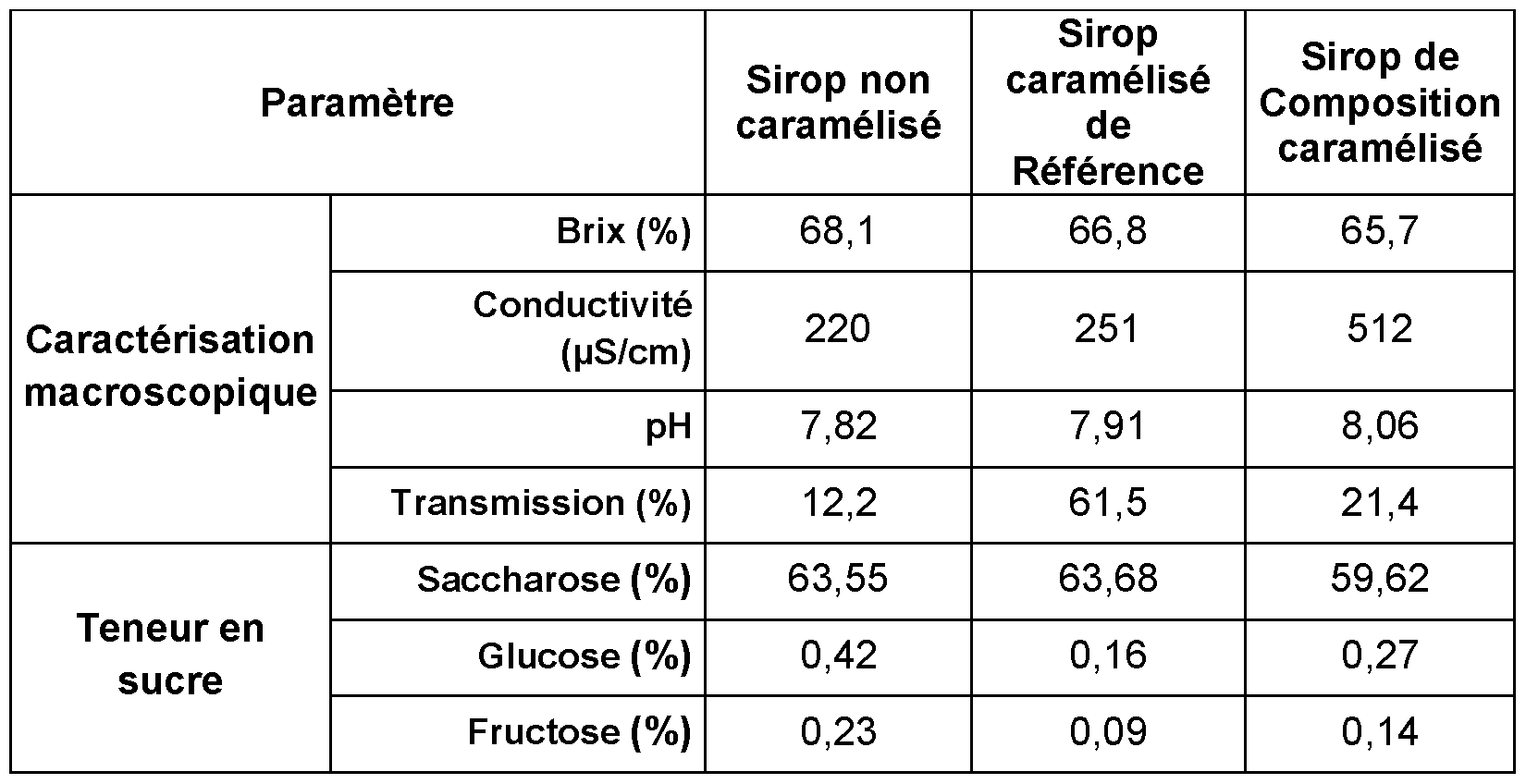
[000126] Ensuite, si l’on compare le sirop de composition caramélisé produit à partir de composition diluée avec le sirop caramélisé de référence, on constate également quelques différences. La transmission du sirop de composition est 3 fois plus faible que celle du sirop de référence, ce qui en fait un sirop plus foncé. Par contre, la conductivité électrique et les teneurs en glucose et en fructose dans le sirop de composition sont plus élevées de 2 et de1 ,6 fois respectivement. La conductivité élevée du sirop de composition résulte de la forte conductivité de la composition diluée comparativement à la conductivité du concentré de sève (Tableau 14). Cette information indique une teneur plus élevée en minéraux dans le sirop de composition. Par conséquent, la préparation de sirop caramélisé à partir de la composition permet d’obtenir un sirop plus riche en minéraux. Ces résultats seront détaillés dans la section dédié aux minéraux. Tableau 14 Caractéristiques physicochimiques des matières premières utilisées pour la production de sirop caramélisé Then, if we compare the caramelized syrup of composition produced from diluted composition with the reference caramelized syrup, we also see some differences. The transmission of the composition syrup is 3 times weaker than that of the reference syrup, which makes it a darker syrup. On the other hand, the electrical conductivity and the glucose and fructose contents in the composition syrup are 2 and 1.6 times higher, respectively. The high conductivity of the composition syrup results from the high conductivity of the diluted composition compared to the conductivity of the sap concentrate (Table 14). This information indicates a higher mineral content in the composition syrup. Consequently, the preparation of caramelized syrup from the composition makes it possible to obtain a syrup which is richer in minerals. These results will be detailed in the section dedicated to minerals. Table 14 Physicochemical characteristics of the raw materials used for the production of caramelized syrup

8.2. TENEUR EN POLYPHENOLS ET ACTIVITES ANTI-OXYDANTES 8.2. POLYPHENOL CONTENT AND ANTI-OXIDANT ACTIVITIES
[000127] La teneur en polyphénols et la capacité anti-oxydante des sirops caramélisés et non caramélisés sont présentées par la Figure 15. Le sirop caramélisé de référence possède une activité anti-oxydante plus élevée que celle du sirop non caramélisé de 1 ,6 fois puisqu’il est plus riche en polyphénols de 1 ,5 fois (Figure 15). The polyphenol content and the antioxidant capacity of caramelized and non-caramelized syrups are shown in Figure 15. The reference caramelized syrup has a higher antioxidant activity than that of non-caramelized syrup by 1.6 times since it is richer in polyphenols by 1.5 times (Figure 15).
[000128] De la même manière, le sirop de composition a une plus forte activité anti-oxydante que le sirop de référence de 2,5 fois puisqu’il est plus riche en polyphénols de 1 ,9 fois tel qu’illustré à la figure 15. Par conséquent, la préparation d’un sirop à partir de la composition permet d’obtenir un sirop beaucoup plus riche en phénol et doté d’une forte activité anti-oxydante. Similarly, the composition syrup has a stronger antioxidant activity than the reference syrup by 2.5 times since it is richer in polyphenols by 1.9 times as illustrated in the figure 15. Consequently, the preparation of a syrup from the composition makes it possible to obtain a syrup much richer in phenol and endowed with a strong antioxidant activity.
[000129] Les écarts obtenus entre le sirop de référence et le sirop de composition sont probablement reliés à la différence de concentration en polyphénols dans la matière première correspondante pour chaque produit. En fait, la concentration de polyphénols est élevée dans la composition avant dilution. La composition diluée utilisée pour la préparation du sirop est donc plus riche en polyphénols de 2,8 fois que le concentré de sève utilisé pour la préparation du sirop de référence (Tableau 13). Pendant la cuisson des deux sirops, les polyphénols ont été concentré par le même facteur de concentration. The differences obtained between the reference syrup and the composition syrup are probably related to the difference in polyphenol concentration in the corresponding raw material for each product. In fact, the concentration of polyphenols is high in the composition before dilution. The diluted composition used for the preparation of the syrup is therefore richer in polyphenols by 2.8 times than the sap concentrate used for the preparation of the reference syrup (Table 13). During the cooking of the two syrups, the polyphenols were concentrated by the same concentration factor.
8.3. TENEUR EN MINÉRAUX 8.3. MINERAL CONTENT
[000130] Les principaux minéraux retrouvés dans les sirops caramélisés produits sur l’évaporateur pilote et celui non caramélisé produit sur l’évaporateur (APV) sont présentés à la Figure 16. Les ions minéraux les plus présents sont le potassium (K), le calcium (Ca) et le magnésium (Mg). On retrouve également du manganèse (Mn), du phosphore (P), du sodium (Na) et du zinc (Zn). En plus petites concentrations se trouvent l’aluminium (Al), le bore (B), le fer (Fe) et le nickel (Ni). Le cuivre (Cu) n’est plus retrouvé dans les sirops pilotes alors qu’il était présent dans le concentré, les compositions et le sirop non caramélisé. Dans le sirop de composition caramélisé, on trouve de petites quantité de plomb (Pb), de cobalt (Co) et de cadmium (Cd). The main minerals found in caramelized syrups produced on the pilot evaporator and the non-caramelized syrup produced on the evaporator (APV) are shown in Figure 16. The most common mineral ions are potassium (K), calcium (Ca) and magnesium (Mg). There are also manganese (Mn), phosphorus (P), sodium (Na) and zinc (Zn). In smaller concentrations are found aluminum (Al), boron (B), iron (Fe) and nickel (Ni). Copper (Cu) is no longer found in pilot syrups while it was present in the concentrate, the compositions and the non-caramelized syrup. In the caramelized syrup, there are small amounts of lead (Pb), cobalt (Co) and cadmium (Cd).
[000131] Plusieurs minéraux ont des teneurs supérieures dans le sirop non caramélisé comparativement au sirop de référence. Le calcium (Ca), le bore (B), le zinc (Zn) et l’aluminium (Al) augmentent tous de 1 ,5 à 2,5 fois, tandis que le sodium (Na) diminue d’environ 2,5 fois. Ceux qui montrent le plus d’augmentation sont le manganèse (Mn) (16,1 fois), le phosphore (P) (8,5 fois) et le fer (Fe) (4.3 fois). Several minerals have higher contents in the non-caramelized syrup compared to the reference syrup. Calcium (Ca), boron (B), zinc (Zn) and aluminum (Al) all increase by 1.5 to 2.5 times, while sodium (Na) decreases by approximately 2.5 time. Those showing the most increase are manganese (Mn) (16.1 times), phosphorus (P) (8.5 times) and iron (Fe) (4.3 times).
[000132] Le sirop de composition-1 caramélisé a des teneurs plus élevées pour la majorité des minéraux comparativement au sirop de référence. Les teneurs en potassium (K), en calcium (Ca), en magnésium (Mg), en phosphore (P), en sodium (Na) et en zinc (Zn) ont augmenté entre 1 ,5 et 2,2 fois dans le sirop de composition. La teneur total des ions minéraux dans le sirop de composition a augmenté de 1 ,7 fois par rapport au sirop de référence. Ces résultats démontrent que le sirop de composition est plus riche en ions minéraux comparativement au sirop de référence produit à partir du même concentré de départ. The caramelized composition-1 syrup has higher contents for the majority of minerals compared to the reference syrup. The potassium (K), calcium (Ca), magnesium (Mg), phosphorus (P), sodium (Na) and zinc (Zn) contents increased between 1.5 and 2.2 times in the composition syrup. The total content of mineral ions in the composition syrup increased by 1.7 times compared to the reference syrup. These results demonstrate that the composition syrup is richer in mineral ions compared to the reference syrup produced from the same starting concentrate.
[000133] Les Tableaux 15, 16, 17, 18, 19, et 20 sont un résumé des différentes données receuillies dans les essais présentés aux sections 6, 7 et 8. Tableau 15 Caractéristiques physicochimiques, composition chimique et diverses caractéristiques des divers concentrés, compositions et sirops produits à partir de sève d’érable Tables 15, 16, 17, 18, 19, and 20 are a summary of the different data collected in the tests presented in sections 6, 7 and 8. Table 15 Physicochemical characteristics, chemical composition and various characteristics of the various concentrates, compositions and syrups produced from maple sap

Tableau 16 Caractéristiques physicochimiques, composition chimique et diverses caractéristiques des divers concentrés, compositions et sirops produits à partir de sève d’érable Table 16 Physicochemical characteristics, chemical composition and various characteristics of the various concentrates, compositions and syrups produced from maple sap


Tableau 18 Calcul du rapport de Concentration différents éléments / Concentration Saccharose


Tableau 20 Calcul du taux de production de polyphénol pendant l’évaporation (concentration) Table 20 Calculation of the rate of polyphenol production during evaporation (concentration)

Tableau 21 Gain des valeurs nutritives avec les procédés décrits Table 21 Gain of nutritional values with the procedures described

8.4. SAVEUR ET PROFIL DES COMPOSES VOLATILS 8.4. FLAVOR AND PROFILE OF VOLATILE COMPOUNDS
[000134] Les résultats de l’évaluation sensorielle de la saveur des deux sirops caramélisés produits sur le mini-évaporateur pilote sont présentés dans le Tableau-19. Les résultats démontrent que les deux sirops ont des cotes de saveur similaires qui vont de crochet à VR1 ou VR4 avec une note de caramel. Donc, le goût du sirop produit à partir de la composition diluée possède aussi bien les mêmes notes de goût que le sirop de référence. Mais cette évaluation ne permet pas de qualifier les sirops sur l’intensité de leur goût. The results of the sensory evaluation of the flavor of the two caramelized syrups produced on the pilot mini-evaporator are presented in Table-19. The results show that the two syrups have ratings of Similar flavors that range from crochet to VR1 or VR4 with a hint of caramel. Therefore, the taste of the syrup produced from the diluted composition has the same taste notes as the reference syrup. However, this assessment does not qualify the syrups on the intensity of their taste.
Tableau 22 Note de saveur par consensus des échantillons de sirop produits sur évaporateur pilote Table 22 Flavor rating by consensus of the syrup samples produced on a pilot evaporator

[000135] Une comparaison du profil des composés volatils détectés dans chacun de ces sirops permet de constater qu’il existe peu de différence entre la concentration en principaux composés volatils (en terme d’aire de pic) pour les deux sirops (Figure. 17). A comparison of the profile of the volatile compounds detected in each of these syrups shows that there is little difference between the concentration of main volatile compounds (in terms of peak area) for the two syrups (Figure. 17 ).
[000136] Tout d’abord, il est possible de remarquer la disparition dans les deux sirops du pic du composé 13, qui était le composé principal dans le sirop non caramélisé. Puis, l’aire des pics de deuxiêmeprincipal composé 16 est similaire dans les deux sirops. Également, les pics correspondant aux composés volatils 4, 7 et 13 sont identiques. Par-contre, une forte diminution de l’aire des pics des composés 5 et 1 1 est visible pour le sirop de composition, tandis qu’on y note une forte augmentation du pic du composé 12. Ces résultats indiquent que les deux sirops n’ont pas exactement le même profil aromatique, et que le sirop de composition n’est pas nécessairement plus riche en composés volatils que le sirop de référence. Par conséquent, la préparation du sirop de composition n’apporte pas d’accentuation des composés volatils déjà présents dans le sirop de référence. Il est difficile pour le moment d’anticiper l’impact de ces changements du profil aromatique sur le goût de ces deux sirops. 8.5. CONDENSAT First of all, it is possible to notice the disappearance in the two syrups of the peak of compound 13, which was the main compound in the non-caramelized syrup. Then, the area of the peaks of second main compound 16 is similar in the two syrups. Also, the peaks corresponding to volatile compounds 4, 7 and 13 are identical. On the other hand, a strong decrease in the area of the peaks of compounds 5 and 11 is visible for the composition syrup, while there is a sharp increase in the peak of compound 12. These results indicate that the two syrups n 'do not have exactly the same aromatic profile, and that the composition syrup is not necessarily richer in volatile compounds than the reference syrup. Consequently, the preparation of the composition syrup does not accentuate the volatile compounds already present in the reference syrup. It is difficult at the moment to anticipate the impact of these changes in the aromatic profile on the taste of these two syrups. 8.5. CONDENSATE
[000137] Deux condensats ont été récupérés lors de la préparation de la composition par les deux méthodes de cristallisation à deux niveaux de °Brix : 82% pour la sursaturation thermique et 78% pour celle de refroidissement. Les deux condensats ont un pH moyen de 8,25. Two condensates were recovered during the preparation of the composition by the two crystallization methods at two levels of ° Brix: 82% for thermal supersaturation and 78% for that of cooling. The two condensates have an average pH of 8.25.
8.5.1 PROFIL DES COMPOSÉS VOLATILS 8.5.1 PROFILE OF VOLATILE COMPOUNDS
[000138] Les profils de composés volatils détectés dans ces deux condensats sont présentés à la Figure 18. Ces profils permettent de constater que la majorité des pics détectés dans le sirop non caramélisé sont également détectés dans les deux condensats. L’aire des pics de la plupart des composés sont similaires dans les deux condensats. Le condensât obtenu par refroidissement contient plus de 2,7 fois en moyenne des composés 4 et 16 que celui obtenu par sursaturation thermique. The profiles of volatile compounds detected in these two condensates are shown in Figure 18. These profiles show that the majority of peaks detected in the non-caramelized syrup are also detected in the two condensates. The peak area of most compounds is similar in the two condensates. The condensate obtained by cooling contains more than 2.7 times on average compounds 4 and 16 than that obtained by thermal supersaturation.
[000139] Le composé 13, qui était le plus présent dans le sirop non caramélisé (figure 16), est retrouvé à seulement environ 5% dans les deux condensats. Sa teneur était également largement diminuée dans la composition-1. Ces résultats indiquent la possibilité que ce composé ait été dégradé en d’autres composés volatils lors de la cristallisation, ou soit il a échappé avec la vapeur non condensée puisqu’il n’a pas été récupéré dans le condensât. Compound 13, which was most present in the non-caramelized syrup (Figure 16), is found at only about 5% in the two condensates. Its content was also greatly reduced in composition-1. These results indicate the possibility that this compound was degraded to other volatile compounds during crystallization, or that it either escaped with uncondensed vapor since it was not recovered from the condensate.
[000140] Toutefois, les condensats sont plus riches en composés 16, 19 et 20. Ils en contiennent plus de 4 à 8 fois que le sirop non caramélisé, et plus de 4 à 7 fois que la composition. L’aire des pics de ces composés étaient similaires dans le sirop non caramélisé et la composition, par conséquent, il est possible qu’une quantité importante de ceux-ci a été générée lors de la sursaturation. [000140] However, the condensates are richer in compounds 16, 19 and 20. They contain more than 4 to 8 times than the non-caramelized syrup, and more than 4 to 7 times than the composition. The peak area of these compounds was similar in the non-caramelized syrup and the composition, therefore, it is possible that a significant amount of these was generated during supersaturation.
[000141] Ces résultats montrent que les composés volatils présents dans le sirop non caramélisé sont évaporés et entraînés avec la vapeur d’eau lors de l’opération de sursaturation. 9. CHAINE DE TRANSFORMATION DU PRODUIT These results show that the volatile compounds present in the non-caramelized syrup are evaporated and entrained with water vapor during the supersaturation operation. 9. PRODUCT PROCESSING CHAIN
[000142] Cette étape consiste à réaliser une analyse de l’effet de la transformation du concentré de sève d’érable jusqu’aux différents produits selon le procédé de production de composition. Cette analyse permet de percevoir l’effet des étapes successives sur les composés et les propriétés d’intérêt. Une photo de différents produits obtenus selon le procédé de fabrication de composition et ces dérivés est présentée en Figure 23. This step consists in carrying out an analysis of the effect of the transformation of the maple sap concentrate to the various products according to the composition production process. This analysis makes it possible to perceive the effect of the successive stages on the compounds and the properties of interest. A photo of different products obtained according to the composition manufacturing process and these derivatives is presented in Figure 23.
9.1. TENEUR EN POLYPHÉNOLS ET PROPRIÉTÉS ANTI-OXYDANTES 9.1. POLYPHENOL CONTENT AND ANTIOXIDANT PROPERTIES
[000143] La teneur en polyphénols augmente pendant la transformation du concentré de sève en différents produits, pour atteindre un maximum dans le sirop de la composition-2 (Figure. 19). La composition-1 et la composition-2 contiennent respectivement 10 et 25 fois plus de polyphénols que le concentré de sève. Il est possible d’observer qu’il y a deux étapes principales qui permettent d’augmenter davantage la teneur en polyphénols. L’étape la plus importante est la production de la composition-1 à partir du sirop non caramélisé, puisqu’il concentre les polyphénols par un facteur de 3,1 fois. La deuxième étape est la production de la composition-2 à partir de la composition-1 qui permet un enrichissement par un facteur de 2,4 fois. The polyphenol content increases during the transformation of the sap concentrate into different products, to reach a maximum in the syrup of composition-2 (Figure. 19). Composition-1 and composition-2 contain 10 and 25 times more polyphenols respectively than the sap concentrate. It can be observed that there are two main steps which make it possible to further increase the content of polyphenols. The most important step is the production of composition-1 from non-caramelized syrup, since it concentrates the polyphenols by a factor of 3.1 times. The second step is the production of composition-2 from composition-1 which allows enrichment by a factor of 2.4 times.
[000144] La production de sirop à partir de la composition-1 permet d’augmenter la teneur en phénol d’un facteur de 1 ,3. Par conséquent, il n’y a pas beaucoup d’avantages entre la production de la composition-1 et du sirop de composition. La production de composition-2 est plus avantageuse en terme de teneur en polyphénols que le sirop de composition. Par-contre, ce dernier est plus avantageux que la production de sirop de référence. La production de sirop à partir de la composition-2 peut permettre encore une augmentation de la teneur en phénol d’un facteur de 1 ,3 comparé à la composition-2. The production of syrup from composition-1 increases the phenol content by a factor of 1, 3. Therefore, there are not many advantages between the production of composition-1 and composition syrup. The production of composition-2 is more advantageous in terms of polyphenol content than the composition syrup. On the other hand, the latter is more advantageous than the production of reference syrup. The production of syrup from composition-2 can further increase the phenol content by a factor of 1.3 compared to composition-2.
[000145] La Figure 20 démontre également que l’activité anti-oxydante augmente plus avec la préparation de composition-1 par un facteur de 2,1 comparativement au sirop non caramélisé. Elle demeure assez similaire entre la composition-1 , la composition-2 et le sirop de composition. La production de composition-2 n’apporte pas d’amélioration à l’activité anti-oxydante de ce produit par rapport à la composition-1. Cette activité est toutefois augmentée dans le sirop caramélisé d’un facteur de 1 ,2 comparativement au sirop non caramélisé. De la même manière, la production du sirop de composition permet de l’augmenter d’un facteur de 1 ,1 par rapport à la composition-1 . Par conséquent, la caramélisation n’apporte pas une grande amélioration de l’activité anti-oxydante. La composition-1 semble être le premier choix pour sa capacité anti-oxydante et en terme d’opérations de production. Figure 20 also demonstrates that the antioxidant activity increases more with the preparation of composition-1 by a factor of 2.1 compared to the non-caramelized syrup. It remains fairly similar between composition-1, composition-2 and composition syrup. The production of composition-2 does not improve the antioxidant activity of this product compared to composition-1. However, this activity is increased in caramelized syrup by a factor of 1.2 compared to non-caramelized syrup. In the same way, the production of the composition syrup makes it possible to increase it by a factor of 1, 1 compared to the composition-1. Consequently, caramelization does not bring about a great improvement in antioxidant activity. Composition-1 seems to be the first choice for its antioxidant capacity and in terms of production operations.
9.2. TENEUR EN MINÉRAUX 9.2. MINERAL CONTENT
[000146] Au niveau des minéraux, les deux principales étapes pour concentrer les minéraux sont la production du sirop non caramélisé à partir du concentré, suivie par la production de composition-2 à partir de composition-1. Il est possible de constater les deux tendances distinctes suivantes (Figure 21 ). In terms of minerals, the two main steps for concentrating the minerals are the production of non-caramelized syrup from the concentrate, followed by the production of composition-2 from composition-1. The following two distinct trends can be seen (Figure 21).
[000147] La production de composition semble augmenter la teneur de la plupart des ions minéraux, alors que la production d’un sirop caramélisé, à partir de concentré ou de composition, les fait plutôt diminuer. Cette tendance est particulièrement observée pour les ions divalents comme le calcium (Ca), le magnésium (Mg), le manganèse (Mn) et le phosphore (P). La composition-2 est le produit le plus riche en ions minéraux, suivie de la composition-1 et du sirop de composition, puis du sirop caramélisé. Il semble que le sirop de composition est moins avantageux que la composition-1. De plus, celle-ci contient 2 fois plus de minéraux totaux que le sirop caramélisé. Les teneurs en manganèse (Mn), en phosphore (P), en bore (B) et en fer (Fe) sont de 8 à 21 fois plus élevées dans la composition-1 que dans le sirop caramélisé. The production of composition seems to increase the content of most of the mineral ions, while the production of a caramelized syrup, from concentrate or composition, makes them rather decrease. This trend is particularly observed for divalent ions such as calcium (Ca), magnesium (Mg), manganese (Mn) and phosphorus (P). Composition-2 is the richest product in mineral ions, followed by composition-1 and composition syrup, then caramelized syrup. It seems that the composition syrup is less advantageous than composition-1. In addition, it contains 2 times more total minerals than caramelized syrup. The manganese (Mn), phosphorus (P), boron (B) and iron (Fe) contents are 8 to 21 times higher in composition-1 than in caramelized syrup.
[000148] En résumé, la composition-2 l’emporte pour sa richesse en polyphénols et en minéraux. Par contre, la composition-1 et le sirop de composition sont aussi des produits de choix selon les intérêts de différents secteurs de marchés ciblés. In summary, composition-2 prevails for its richness in polyphenols and minerals. On the other hand, composition-1 and composition syrup are also products of choice according to the interests of different target market sectors.
En conclusion, les grandes tendances suivantes peuvent être tirées des résultats obtenus : [000149] Les compositions produites par les deux méthodes de cristallisation sont comparables. La méthode de cristallisation par refroidissement permet d’obtenir des valeurs plus élevées en ions minéraux, surtout pour les ions divalents. L’augmentation de l’échelle de production permet d’augmenter la teneur en polyphénols. In conclusion, the following main trends can be drawn from the results obtained: The compositions produced by the two crystallization methods are comparable. The method of crystallization by cooling makes it possible to obtain higher values in mineral ions, especially for the divalent ions. The increase in the production scale makes it possible to increase the polyphenol content.
[000150] La production de composition permet d’obtenir un produit plus riche que le sirop traditionnel en polyphénols, en minéraux et en activité anti- oxydante. La composition-2 est beaucoup plus riche en ces composés, sauf pour l’activité anti-oxydante qui est similaire à la composition-1. The production of composition makes it possible to obtain a product richer than the traditional syrup in polyphenols, in minerals and in antioxidant activity. Composition-2 is much richer in these compounds, except for the antioxidant activity which is similar to composition-1.
[000151] Le sirop non caramélisé a des valeurs inférieures au sirop de référence pour la transmission de lumière, la concentration en polyphénols et l’activité anti-oxydante. Par-contre, il est plus riche en glucose, en fructose et en ions minéraux. Non-caramelized syrup has values lower than the reference syrup for light transmission, polyphenol concentration and antioxidant activity. However, it is richer in glucose, fructose and mineral ions.
[000152] Le sirop de composition a des valeurs plus élevées que le sirop traditionnel pour la conductivité électrique, les teneurs en glucose, en fructose, en polyphénols, en antioxydants, ainsi que pour la plupart des minéraux. Ces augmentations semblent reliées à l’utilisation d’une composition déjà plus riche en ces composés pour la production de ce sirop. Toutefois, une partie des minéraux semble plutôt avoir diminué pendant la production du sirop de composition comparativement à la composition de départ. The composition syrup has higher values than the traditional syrup for electrical conductivity, the contents of glucose, fructose, polyphenols, antioxidants, as well as for most minerals. These increases seem related to the use of a composition already richer in these compounds for the production of this syrup. However, some of the minerals seem rather to have decreased during the production of the composition syrup compared to the starting composition.
[000153] Au niveau de l’analyse sensorielle, les deux sirops (traditionnel et celui de composition) ont donné des goûts comparables. Le sirop de composition semble donc aussi bon que le sirop de référence. [000153] In terms of sensory analysis, the two syrups (traditional and that of composition) gave comparable tastes. The composition syrup therefore seems as good as the reference syrup.
[000154] Le profil des composés volatils change grandement en avançant dans la chaîne de production entre le sirop non caramélisé et la composition-2. La teneur en certains composés diminue, alors qu’elle augmente pour d’autres. Ces changements peuvent affecter la perception des saveurs de ces produits. Mais, il est difficile à ce stade de l’étude de préciser les liens entre les goûts de ces sirops et les changements enregistrés dans leurs profils de composés volatils. [000155] Le Tableau 23 montre des résultats obtenus à partir des compositions produites selon la présente divulgation. The profile of volatile compounds changes greatly as we move forward in the production chain between the non-caramelized syrup and composition-2. The content of certain compounds decreases, while it increases for others. These changes may affect the perception of the flavors of these products. However, it is difficult at this stage of the study to specify the links between the tastes of these syrups and the changes recorded in their profiles of volatile compounds. Table 23 shows results obtained from the compositions produced according to the present disclosure.
Tableau 23 Table 23
Gain des valleurs nutritives avec notre procédé

10. ESSAIS EFFECTUES SUR DIVERS JUS 10. TESTS CARRIED OUT ON VARIOUS JUICES
[000159] Les Tableaux 24, 25 et 26 ainsi que la Figure 24 montrent des résultats obtenus à partir de l’utilisation de divers jus de fruits. Les jus ont été traités par les mêmes procédés que ceux précédemment décrits à propos des divers produits à base de sève d’érable, concentré d’érable ou diverses compositions d’érables. Tel que préalablement mentionné, les mêmes procédés ont été utilisés, seul le produit de départ à été différent i.e. lors des essais des T ableaux 24, 25 et 26 ainsi que la Figure 24, divers jus de fruits ont été utilisés à titre de produit de départ. Les procédés utilisés étaient donc comme celui illustré à la Figure 1 , mais la sève d’érable a été remplacée pas des jus. Les résultats de ces tableaux et de cette figure montrent que ces procédés sont polyvalents et qu’ils peuvent traiter divers produits de départs comprenant du sucre. En particulier, à la Figure 24, on peut voir que les procédés peuvent permettre de concentrer d’environ 3 à environ 10 fois la teneur en polyphénols par rapport au jus de départ. En fait, par rapport au jus de cassis de départ, la composition 1 non caramélisée était environ 3 fois plus concentrée en polyphénols; la composition 2 non caramélisée était environ 7.1 fois plus concentrée en polyphénols; le sirop de composition 1 caramélisé était environ 4.2 fois plus concentré en polyphénols; et le le sirop de composition 2 caramélisé était environ 9.9 fois plus concentrée en polyphénols. Tableau 24 Tables 24, 25 and 26 as well as Figure 24 show results obtained from the use of various fruit juices. The juices were treated by the same methods as those previously described with regard to the various products based on maple sap, maple concentrate or various maple compositions. As previously mentioned, the same methods were used, only the starting material was different, ie during the tests of Tables 24, 25 and 26 as well as in Figure 24, various fruit juices were used as product of departure. The procedures used were therefore like that illustrated in Figure 1, but the maple sap was replaced by juices. The results of these tables and of this figure show that these methods are versatile and that they can treat various starting materials comprising sugar. In particular, in Figure 24, it can be seen that the methods can make it possible to concentrate approximately 3 to approximately 10 times the polyphenol content relative to the starting juice. In fact, compared to the initial blackcurrant juice, the non-caramelized composition 1 was approximately 3 times more concentrated in polyphenols; non-caramelized composition 2 was approximately 7.1 times more concentrated in polyphenols; the caramelized syrup of composition 1 was approximately 4.2 times more concentrated in polyphenols; and the caramelized composition 2 syrup was about 9.9 times more concentrated in polyphenols. Table 24
Jus commercial actuel

Tableau 25 Table 25
Sirop non-caramélisé (SNC) des jus avec notre procédé

Tableau 26 Table 26
Composition-1 non caramélisée

Claims
Priority Applications (4)
| Application Number | Priority Date | Filing Date | Title |
|---|---|---|---|
| CA3098409A CA3098409C (en) | 2018-07-06 | 2019-07-05 | Compositions based on maple sap, vegetable juice or fruit juice, and process for manufacturing same |
| EP19831279.5A EP3818182A4 (en) | 2018-07-06 | 2019-07-05 | COMPOSITIONS BASED ON MAPLE SAP, VEGETABLE OR FRUIT JUICES AND METHOD FOR THEIR PRODUCTION |
| US17/252,718 US20220025472A1 (en) | 2018-07-06 | 2019-07-05 | Compositions based on maple sap, vegetable juice or fruit juice, and process for manufacturing same |
| US18/735,702 US20250092474A1 (en) | 2018-07-06 | 2024-06-06 | Compositions based on maple sap, vegetable juice or fruit juice, and process for manufacturing same |
Applications Claiming Priority (4)
| Application Number | Priority Date | Filing Date | Title |
|---|---|---|---|
| CA3,010,832 | 2018-07-06 | ||
| CA3010832A CA3010832A1 (en) | 2018-07-06 | 2018-07-06 | Compositions with maple syrup as their base and their manufacturing processes |
| CA3019455A CA3019455A1 (en) | 2018-10-01 | 2018-10-01 | Compositions based on maple sap, vegetable juice or fruit and their production processes |
| CA3,019,455 | 2018-10-01 |
Related Child Applications (2)
| Application Number | Title | Priority Date | Filing Date |
|---|---|---|---|
| US17/252,718 A-371-Of-International US20220025472A1 (en) | 2018-07-06 | 2019-07-05 | Compositions based on maple sap, vegetable juice or fruit juice, and process for manufacturing same |
| US18/735,702 Continuation US20250092474A1 (en) | 2018-07-06 | 2024-06-06 | Compositions based on maple sap, vegetable juice or fruit juice, and process for manufacturing same |
Publications (1)
| Publication Number | Publication Date |
|---|---|
| WO2020006643A1 true WO2020006643A1 (en) | 2020-01-09 |
Family
ID=69059759
Family Applications (1)
| Application Number | Title | Priority Date | Filing Date |
|---|---|---|---|
| PCT/CA2019/050930 Ceased WO2020006643A1 (en) | 2018-07-06 | 2019-07-05 | Compositions based on maple sap, vegetable juice or fruit juice, and process for manufacturing same |
Country Status (4)
| Country | Link |
|---|---|
| US (2) | US20220025472A1 (en) |
| EP (1) | EP3818182A4 (en) |
| CA (3) | CA3098409C (en) |
| WO (1) | WO2020006643A1 (en) |
Families Citing this family (2)
| Publication number | Priority date | Publication date | Assignee | Title |
|---|---|---|---|---|
| CA3104309A1 (en) | 2019-12-24 | 2021-06-24 | Les Equipements D'erabliere Cdl Inc. | High brix vaccum evaporation concentration process and system and concentrated product |
| JP7717477B2 (en) * | 2021-03-22 | 2025-08-04 | 旭化成株式会社 | Food product that is a concentrated liquid of raw material liquid containing sugar, raw material liquid concentration system, and raw material liquid concentration method |
Citations (2)
| Publication number | Priority date | Publication date | Assignee | Title |
|---|---|---|---|---|
| CA2819730A1 (en) * | 2013-02-08 | 2013-09-06 | Genevieve Beland | Process for the pasteurization of sap and products thereof |
| CA2876528A1 (en) * | 2012-07-13 | 2014-01-16 | Island Abbey Foods Ltd. | Solid maple syrup compositions |
Family Cites Families (4)
| Publication number | Priority date | Publication date | Assignee | Title |
|---|---|---|---|---|
| US4159210A (en) * | 1978-06-15 | 1979-06-26 | Amstar Corporation | Maple sugar product and method of preparing and using same |
| US6355110B1 (en) * | 1999-11-17 | 2002-03-12 | Tate & Lyle Industries, Limited | Process for purification of low grade sugar syrups using nanofiltration |
| US7575772B2 (en) * | 2005-11-21 | 2009-08-18 | Frisun, Inc. | Process and composition for syrup and jam from Luo Han Guo fruit |
| CA2665982A1 (en) * | 2009-05-13 | 2010-11-13 | Valerie Gay Chadbourne | Process for commercial production of maple syrup with low energy requirement |
-
2019
- 2019-07-05 CA CA3098409A patent/CA3098409C/en active Active
- 2019-07-05 WO PCT/CA2019/050930 patent/WO2020006643A1/en not_active Ceased
- 2019-07-05 EP EP19831279.5A patent/EP3818182A4/en active Pending
- 2019-07-05 CA CA3187950A patent/CA3187950C/en active Active
- 2019-07-05 CA CA3137832A patent/CA3137832C/en active Active
- 2019-07-05 US US17/252,718 patent/US20220025472A1/en not_active Abandoned
-
2024
- 2024-06-06 US US18/735,702 patent/US20250092474A1/en active Pending
Patent Citations (2)
| Publication number | Priority date | Publication date | Assignee | Title |
|---|---|---|---|---|
| CA2876528A1 (en) * | 2012-07-13 | 2014-01-16 | Island Abbey Foods Ltd. | Solid maple syrup compositions |
| CA2819730A1 (en) * | 2013-02-08 | 2013-09-06 | Genevieve Beland | Process for the pasteurization of sap and products thereof |
Non-Patent Citations (1)
| Title |
|---|
| See also references of EP3818182A4 * |
Also Published As
| Publication number | Publication date |
|---|---|
| CA3137832C (en) | 2023-02-07 |
| US20250092474A1 (en) | 2025-03-20 |
| CA3187950A1 (en) | 2020-01-09 |
| CA3187950C (en) | 2026-02-17 |
| US20220025472A1 (en) | 2022-01-27 |
| EP3818182A4 (en) | 2022-03-16 |
| CA3098409C (en) | 2023-02-07 |
| CA3098409A1 (en) | 2020-01-09 |
| CA3137832A1 (en) | 2020-01-09 |
| EP3818182A1 (en) | 2021-05-12 |
Similar Documents
| Publication | Publication Date | Title |
|---|---|---|
| JP4550898B2 (en) | Method for extracting juice from plant material containing terpene glycosides and compositions containing terpene glycosides | |
| US20250092474A1 (en) | Compositions based on maple sap, vegetable juice or fruit juice, and process for manufacturing same | |
| NO155912B (en) | PROCEDURE FOR THE PREPARATION OF A CONCENTRATED NATURAL CITRUS WARE PRODUCT. | |
| CN1119825A (en) | Compositions of sweet juices from cucurbit fruits and methods for their preparation | |
| WO2018127670A1 (en) | Non-crystallisable d-allulose syrups | |
| WO2014127474A1 (en) | Solid molasses composition | |
| JP6273080B2 (en) | Yuzu juice-containing concentrated beverage, yuzu juice-containing beverage, and method for producing the same | |
| JP6599384B2 (en) | Yuzu juice-containing concentrated beverage, yuzu juice-containing beverage, and method for producing the same | |
| CA3019455A1 (en) | Compositions based on maple sap, vegetable juice or fruit and their production processes | |
| FR2827741A1 (en) | Soluble roasted chicory powder with a high inulin and fructooligosaccharide content, useful in human and animal nutrition | |
| US10306901B2 (en) | Sugar-pickled vegetable foods, sugar-pickling liquid used therefor, and method for producing said foods | |
| US20070116813A1 (en) | Method for obtaining banana-derived products, in particular for liquefying banana to obtain pure juice | |
| CA2764907C (en) | Process for producing syrup from a frozen fruit | |
| CA3010832A1 (en) | Compositions with maple syrup as their base and their manufacturing processes | |
| US20140342062A1 (en) | Process for producing syrup from a frozen fruit | |
| Harlen et al. | Effect of using different clarifying agents and temperature on physicochemical and sensory properties of sweet sorghum syrup extract | |
| TW201817431A (en) | Solid honey production method | |
| CN120712364A (en) | Beet-derived products for crystallized sugar and preparation methods thereof | |
| KR100767799B1 (en) | Maru powder tea and preparation method thereof | |
| KR100706295B1 (en) | Maru drink and its manufacturing method | |
| CN114513964A (en) | Flavor enhanced raw material concentrate and method of making same | |
| CN118900636A (en) | Wholesome sugar beet derived products having light color and improved taste and mouthfeel and methods of making the same | |
| FR3116417A1 (en) | Process for cooking, dehydrating and/or candying food, and food prepared using such a process. | |
| Mohd | The Effects of Process Parameters on Concentration of Dragon Fruit Juices via Freeze Concentration Technique | |
| Khomathan | Development of spray dried sugar cane powder |
Legal Events
| Date | Code | Title | Description |
|---|---|---|---|
| 121 | Ep: the epo has been informed by wipo that ep was designated in this application |
Ref document number: 19831279 Country of ref document: EP Kind code of ref document: A1 |
|
| ENP | Entry into the national phase |
Ref document number: 3098409 Country of ref document: CA |
|
| NENP | Non-entry into the national phase |
Ref country code: DE |