WO2020009438A1 - Procédé de préparation de microcapsules - Google Patents
Procédé de préparation de microcapsules Download PDFInfo
- Publication number
- WO2020009438A1 WO2020009438A1 PCT/KR2019/008067 KR2019008067W WO2020009438A1 WO 2020009438 A1 WO2020009438 A1 WO 2020009438A1 KR 2019008067 W KR2019008067 W KR 2019008067W WO 2020009438 A1 WO2020009438 A1 WO 2020009438A1
- Authority
- WO
- WIPO (PCT)
- Prior art keywords
- microcapsules
- formula
- integer
- monomer
- polymerization
- Prior art date
- Legal status (The legal status is an assumption and is not a legal conclusion. Google has not performed a legal analysis and makes no representation as to the accuracy of the status listed.)
- Ceased
Links
- 0 CNC(C(*)=C)=O Chemical compound CNC(C(*)=C)=O 0.000 description 1
Images

Classifications
-
- B—PERFORMING OPERATIONS; TRANSPORTING
- B01—PHYSICAL OR CHEMICAL PROCESSES OR APPARATUS IN GENERAL
- B01J—CHEMICAL OR PHYSICAL PROCESSES, e.g. CATALYSIS OR COLLOID CHEMISTRY; THEIR RELEVANT APPARATUS
- B01J13/00—Colloid chemistry, e.g. the production of colloidal materials or their solutions, not otherwise provided for; Making microcapsules or microballoons
- B01J13/02—Making microcapsules or microballoons
-
- C—CHEMISTRY; METALLURGY
- C11—ANIMAL OR VEGETABLE OILS, FATS, FATTY SUBSTANCES OR WAXES; FATTY ACIDS THEREFROM; DETERGENTS; CANDLES
- C11D—DETERGENT COMPOSITIONS; USE OF SINGLE SUBSTANCES AS DETERGENTS; SOAP OR SOAP-MAKING; RESIN SOAPS; RECOVERY OF GLYCEROL
- C11D11/00—Special methods for preparing compositions containing mixtures of detergents
-
- C—CHEMISTRY; METALLURGY
- C11—ANIMAL OR VEGETABLE OILS, FATS, FATTY SUBSTANCES OR WAXES; FATTY ACIDS THEREFROM; DETERGENTS; CANDLES
- C11D—DETERGENT COMPOSITIONS; USE OF SINGLE SUBSTANCES AS DETERGENTS; SOAP OR SOAP-MAKING; RESIN SOAPS; RECOVERY OF GLYCEROL
- C11D3/00—Other compounding ingredients of detergent compositions covered in group C11D1/00
- C11D3/50—Perfumes
Definitions
- the present invention relates to a method for producing an environmentally friendly microcapsule which can increase the fiber adhesion of the flavor capsule, is not swollen in water, and thus has excellent fragrance carrying capacity and improves biodegradability compared to the prior art, and thus has fragrance persistence even after use.
- Microcapsules are widely used in various fields. For example, it can be used in various applications such as colorants, catalysts, adhesives, fragrances, fuels, pesticides, biomaterials, pharmaceuticals, food, cosmetics, household goods, detergents.
- fragrance oil microcapsules especially those used in biomaterials, pharmaceuticals, foods, cosmetics, detergents (e.g., hair rinses, body washes, fabric softeners, etc.), should be harmless to humans.
- detergents e.g., hair rinses, body washes, fabric softeners, etc.
- fragrance capsules are excellent in fragrance carrying capacity and supporting efficiency, but the capsules are not decomposed after use, causing environmental problems.
- flavor microcapsules are prepared using biopolymers (gumarabic, starch, cellulose, gelatin alginate, albumin, etc.) and modified biopolymers (ethyl cellulose, CMC, HPMC, HPMC-AS).
- biopolymers gumarabic, starch, cellulose, gelatin alginate, albumin, etc.
- modified biopolymers ethyl cellulose, CMC, HPMC, HPMC-AS
- the picking emulsion prepared as described above is vulnerable to the surrounding environment such as acid, base, temperature, etc., the emulsion is easily destroyed, it is difficult to prepare the desired microcapsules and there is a problem that the fiber adhesion of the flavor capsule is inferior.
- the object of the present invention is to solve the above problems, can increase the fiber adhesion through the charge control of the surface of the flavor capsule, and because it is not swollen in water, the fragrance support is excellent and biodegradability is improved, so that the fragrance persistence even after use It is intended to provide an environmentally friendly method for producing microcapsules.
- the present invention it is possible to increase the fiber adhesion by controlling the charge on the surface of the fragrance capsule, it is not swollen in water, the fragrance carrying capacity is excellent and biodegradability is improved than before, it is the fragrance persistence and environmentally friendly inorganic nano-particles after use- There is an effect to provide an acrylic resin composite microcapsules.
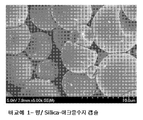
- Figure 1 shows an electron micrograph of the microcapsules of Example 1 of the present invention.
- Figure 2 shows an electron micrograph of the microcapsules of Reference Example 1.
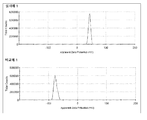
- Figure 3 shows a comparison of the zeta potential measurement results of Example 1 and Reference Example 1.
- the present invention provides a method for forming an inorganic nanoparticle-acrylic resin composite capsule to solve the conventional problem.
- the present invention by adsorbing an acrylic monomer to a hydrophilic inorganic nanoparticles, such as silica to form a stable fragrance emulsion in a pickling emulsion (Pickering emulsion) method, inorganic nanoparticles-acryl by radical polymerization by the initiation reaction of the radical initiator dissolved in the fragrance dissolved
- the amine-based monomer is further polymerized on the surface of the capsule to control the charge (charge) of the capsule surface, characterized in that to increase the fiber adhesion of the flavor capsule.
- microcapsules crosslinked using the pickling emulsion are polyacrylate capsules, and ester groups in the structure may be biodegraded by hydrolysis to prepare environment-friendly fragrance capsules.
- the first step is to adsorb the acrylic monomer on the surface of the hydrophilic inorganic nanoparticles.
- the inorganic nanoparticles can be used as long as the particles having hydrophilicity.
- the inorganic nanoparticles may be selected from the group consisting of silica, titania, metal oxide, noble metal, apatite and limestone having an average particle diameter of 2 nm to 100 nm. More preferably, the average particle diameter of the inorganic nanoparticles may be 5nm to 50nm.
- the inorganic nanoparticles may be used silica or titania having an average particle diameter of 2nm to 100nm or 5nm to 50nm.
- the inorganic nanoparticles in the first step may be used in the colloidal aqueous solution, and the dispersion process of the acrylic monomer in the colloidal aqueous solution, it is possible to form a stable pickling emulsion when added fragrance oil.
- the first step may include adding an acrylic monomer using an aqueous silica colloidal solution and dispersing the mixture to adsorb the acrylic monomer onto the silica surface.
- the dispersion treatment method is not limited as long as the inorganic nanoparticles, such as silica, in a colloidal aqueous solution, and the ultrasonic treatment method may be used as an example.
- hydrophilic silica as the inorganic nanoparticles will be described as an example.
- a fragrance picking emulsion is stably formed on the inorganic nanoparticles (preferably silica).
- such a stable pickling emulsion can be prepared in the silica-acrylate microcapsules by radical polymerization by the initiation reaction of the radical initiator dissolved in the fragrance.
- a pickling emulsion of fragrance oil is formed, and a capsule is formed by pre-radical polymerization.
- the acrylic monomer includes a biodegradable ester group, and has a water solubility of 1 to 100 g / L, and may be used alone or in combination.
- the temperature conditions of the water solubility may be based on room temperature 25 °C.
- the acrylic monomer may be used so that water solubility is 5 to 60 g / L or 10 to 60 g / L.
- solubility of the acrylic monomer in water is 1 g / L or less, it is difficult to adsorb the acrylic monomer to the hydrophilic inorganic nanoparticles, so that the pickling emulsion cannot be formed.
- solubility of the acrylic monomer in water is 100 g / L or more, the hydrophilicity of the surface of the hydrophilic inorganic nanoparticles is maximized and the contact angle between the water and the oil becomes small, so that a substantial portion of the surface of the particles is present in the water phase. . In this case, there is a problem that an unstable emulsion may be formed.
- the acrylic monomer may include at least one selected from the group consisting of a diacryl monomer represented by Formula 1 and a monoacrylic monomer compound represented by Formula 2.
- R 1 and R 2 are each independently hydrogen or-(CH 2 ) n CH 3 (n is an integer of 0 to 5), R 3 is-(CH 2 CR 4 HO) m ,-( CH 2 CR 4 H) m O, or-(CH 2 CH (OH) CH 2 -O) m (m is an integer from 1 to 5), R 4 is hydrogen or-(CH 2 ) n CH 3 (n Is an integer from 0 to 5),
- R 1 is hydrogen or-(CH 2 ) n CH 3 (n is an integer of 0 to 5)
- R 3 is-(CH 2 CR 4 HO) m ,-(CH 2 CR 4 H) m O, or-(CH 2 CH (OH) CH 2 -O) m (m is an integer from 1 to 5)
- R 4 is hydrogen or-(CH 2 ) n CH 3 (n is an integer from 0 to 5) )to be.
- an acrylic monomer having a solubility in water of 5 to 50 g / L may be used.
- an acrylic monomer one or more selected from the group consisting of dipropylene glycol diacrylate, diethylene glycol diacrylate, and tetraethylene glycol dimethacrylate may be used.
- the acrylic monomer when the acrylic monomer is adsorbed on the surface of the inorganic nanoparticles, when the ultrasonic treatment method is used, it can proceed to the following method.
- the first step may include adding an acrylic monomer using an inorganic nanoparticle colloidal aqueous solution, and performing an ultrasonic treatment for 1 to 30 minutes to adsorb the acrylic monomer to the surface of the inorganic nanoparticles.
- the sonication is preferably carried out at low temperature conditions such as ice baths.
- the inorganic nanoparticles may have an average particle diameter of 5nm to 50nm.
- the second step may be a step of forming an emulsion by adding fragrance oil to the inorganic nanoparticles of the acrylic monomer adsorbed on the surface of the inorganic nanoparticles prepared in the first step.
- the emulsion formed in the second step may be a pickling emulsion.
- the fragrance oil is added to the inorganic nanoparticles on which the acrylic monomer is adsorbed on the surface and sonicated for 1 to 30 minutes to form an oil-in-water picking emulsion (O / W pickering emulsion). It may include.
- the sonication is preferably carried out at low temperature conditions such as ice baths.
- the fragrance oil in the second step it can be used by dissolving the oil-soluble initiator in the fragrance oil.
- the oil-soluble initiator may be at least one selected from the group consisting of azo series and peroxide series.
- the oil-soluble initiator is in powder form and its amount is not particularly limited, and may be used according to contents well known in the art as long as the oil-soluble initiator is dissolved in fragrance oil. In addition, one-off commercial products can be used.
- the inorganic nanoparticles, acrylic monomers and fragrance oils are added to the colloidal aqueous solution containing water, the inorganic nanoparticles, acrylic monomers and fragrance oils based on the total content of the pickling emulsion solution. It can be used by adjusting the content of.
- the pickling emulsion solution of the third step may be a solution containing water, inorganic nanoparticles, acrylic monomers and fragrance.
- the pickling emulsion solution is 60 to 80% by weight of water based on the total solution content, 0.1 to 16% by weight of inorganic nanoparticles and 0.2 to 25% by weight of acrylic monomer and 2 to 36% by weight of fragrance. Can be used to include.
- the emulsion is formed in more than 1000 ⁇ m, if more than 16% by weight there is a problem that the emulsion is formed in less than 0.1 ⁇ m.
- the content of the acrylic monomer is less than 0.2% by weight, pickling emulsion cannot be formed or inorganic nanoparticles-acrylic resin capsule cannot be formed. If the content exceeds 25% by weight, it is not adsorbed by inorganic nanoparticles and participates in the polymerization reaction. There is a problem that a large amount of acrylic monomer not remaining in the aqueous phase.
- the capsule If the fragrance content is less than 2% by weight, the capsule is too thick, there is a problem that the fragrance is not released, if more than 36% by weight there is a problem that the performance of the capsule is reduced to form an unstable emulsion.
- the third step is to proceed with the polymerization of the pickling emulsion obtained in the second step.
- the aromatic / inorganic nanoparticle-polyacrylate capsule is synthesized by undergoing radical polymerization under certain conditions.
- the polymerization of the third step may include the step of radical polymerization of the oil-in-water pickling emulsion at 30 to 90 ° C. for 6 to 20 hours to form microcapsules.
- the stirring conditions during the polymerization may be 100 to 700 rpm, preferably 200 to 400 rpm.
- the polymerization may be performed under inert conditions through nitrogen purging or the like.
- the concentration or / and drying process can be further proceeded as necessary before the progress of the fourth step to be described later, the conditions are not limited.
- microcapsules obtained through the polymerization in the third step are composed of inorganic nanoparticles, acrylic monomers and incense.
- the fourth step includes the step of polymerizing by adding an amine monomer and an initiator to the polymerization solution of the third step.
- the step of polymerizing the amine-based monomer in the capsule surface additionally in the fourth step, it is possible to control the charge on the capsule surface, thereby increasing the fiber adhesion of the flavor capsule.
- the amine monomer and the initiator may be added during the polymerization of the third step or after completion of the polymerization.
- an additional amine monomer and an initiator may be added to the polymerization solution of the third step.
- Between the second half of the polymerization and the completion of the polymerization may mean a time at which polymerization of about 80 to 100% is completed in the total polymerization time (6 to 20 hours) described later.
- the amine monomer preferably includes an amine monomer of Formula 3 or Formula 4.
- R 6 and R 7 may be the same or different from each other, alkyl of C 1 to C 5 , — (CH 2 ) n —CH ⁇ CH 2 (n is an integer of 1 to 5), and an acrylamide series of Formula a Or a substituent of the acrylic acid series of the formula b, wherein R 6 and R 7 is not an alkyl group of C 1 to C 5 at the same time,
- R 9 and R 10 may be the same as or different from each other, and include — (CH 2 ) n —CH ⁇ CH 2 (n is an integer of 1 to 5), an acrylamide series of formula a or an acrylic acid series of formula b A substituent,
- n and m are each independently or simultaneously integers of 1 to 5, and R 11 and R 12 are each independently or simultaneously hydrogen or-(CH 2 ) n ' CH 3 ( n' is 0 To an integer of 5).
- R 4 to R 6 may be-(CH 2 ) n-CH 3 (n is an integer of 0 to 5), and R 7 may be formula a.
- n may be 2 to 3
- R 11 may be-(CH 2 ) n CH 3 ( n 'may be an integer of 0 to 2), and more preferably n' may be 0.
- C 1 to C 5 alkyl may include a linear or branched alkyl group.
- the amine monomer may be preferably [3- (methacryloylamino) propyl] trimethylammonium chloride solution ([3- (Methacryloylamino) propyl] trimethylammonium chloride solution) or diallyldimethylammonium chloride solution. Can be.
- the content of the amine monomer may be used in an amount of 0.2 to 5 parts by weight based on 100 parts by weight of the total solution content up to the third step.
- the content of the amine monomer is 0.2 parts by weight or less, there is a problem that the surface charge modification effect is reduced, and when 5 parts by weight or more, the monomer is polymerized on the capsule surface and polymerized separately to form polymer particles. have.
- the initiator used in the fourth step may be a water-soluble initiator, may be one or more selected from the group consisting of azo-based and peroxide-based, all of the water-soluble initiators well known in the art can be used.
- the water-soluble initiator may be used, such as sodium persulfate (SPS), ammonium persulfate (APS), or the like.
- SPS sodium persulfate
- APS ammonium persulfate
- the water-soluble initiator may be used in an amount of 0.004 to 0.03 parts by weight based on 100 parts by weight of the total solution content up to the third step.
- the polymerization of the fourth step may include a step of modifying the surface of the microcapsules formed in the third step by performing the polymerization at 30 to 90 ° C. for 6 to 20 hours.
- the stirring conditions during the polymerization may be 100 to 700 rpm, preferably 200 to 400 rpm.
- the present invention provides an inorganic nanoparticle-acrylic resin composite, and a microcapsule comprising a fragrance component; And a surface of the microcapsule is modified with an amine compound, and the surface charge has a zeta potential of +5 to 60 mV.
- the microcapsules provided herein mean a flavor capsule in which the capsule surface is modified with an amine compound, and includes a surface-modified inorganic nanoparticle-acrylic resin composite microcapsule containing a flavor component, and a zeta potential It may be about +5 to 60mV or +10 to 55mV or +30 to 50mV.
- the microcapsules are obtained by surface modification with an amine compound, and the zeta potential is obtained by measuring apparent zeta potential 10 times for each microcapsule by using a Malvern zetasizer device and a disposable folded capillary cell (Malvern DTS 1070). The result is.
- 0.5 to 40% by weight of inorganic nanoparticles 1 to 60% by weight acrylic monomer, 0.02 to 15% by weight amine monomer and 10 to 90% by weight fragrance can do.
- the surface-modified microcapsules of the present invention may be provided in the form of a surface-modified inorganic nanoparticle-acrylic resin composite capsule containing a fragrance component having an average particle diameter of 0.1 ⁇ m to 1000 ⁇ m.
- the surface-modified inorganic nanoparticles-acrylic resin composite capsule of the present invention does not swell in water, and thus has excellent fragrance support but is eco-friendly due to biodegradation of ester groups.
- the inorganic nanoparticle-acrylate composite capsule of the present invention does not swell in water, and thus has excellent fragrance supporting ability, but is also environmentally friendly due to biodegradation of the ester group.
- a water-soluble initiator (APS (Ammonium persulfate)
- [3- (methacryloylamino) propyl] trimethylammonium chloride solution 0.6 3-g of [3- (Methacryloylamino) propyl] trimethylammonium chloride solution
- APS Ammonium persulfate
- [3- (methacryloylamino) propyl] trimethylammonium chloride solution 0.6 3-g of [3- (Methacryloylamino) propyl] trimethylammonium chloride solution
- An oily pickling emulsion was prepared by adding 20 g of fragrance oil to an aqueous silica colloidal solution containing silica having an average particle diameter of 20 nm.
- SMA styrene maleic anhydride copolymer
- Pre-MF pre-Melamine formaldehyde
- Ethyl acetate was added to saturated water at a concentration of 1% of a surfactant (tween80) to prepare an aqueous phase.
- a surfactant tween80
- the core solution was prepared by dissolving EC (Ethyl cellulose) in ethyl acetate at a concentration of 20% and mixing fragrance (Oil) with EC at a weight ratio of 1: 1.
- the resulting fragrance emulsion solution was heated to about 60 ° C. and stirred at 500 rpm to remove fragrance / EC microcapsules with ethyl acetate removed.
- the solution was placed in a three-necked round flask connected with a condenser and sealed. After stirring at 300 rpm for about 30 minutes, N 2 bubbling was performed, followed by radical polymerization in an oil bath heated to 60 ° C. Proceeding for 20 hours, the fragrance / silica-acrylate microcapsules were prepared.
- Electron micrographs of the microcapsules of Example 1 and Reference Example 1 were measured, and the results are shown in FIGS. 1 and 2.
- the apparent zeta potential was measured 10 times for each microcapsule by a method using a Malvern zetasizer device and a disposable folded capillary cell (Malvern DTS 1070), and the results are shown in FIG. 3.
- the capsule before and after the surface modification (Reference Example 1) and the capsule after the surface modification (Example 1) were each prepared in a size of about 5um and there was no morphological difference before and after the surface modification.
- the surface-modified silica-acrylic resin flavor capsules had a value of about -76 mV, and the capsules whose surface was modified with an amine monomer had a value of about +43 mV. Indicated.
- the fiber adhesion of the fragrance capsule was evaluated by the evaluation of the reverberation in the fibers after washing.
- Test specimens were prepared with commercially available 100% cotton towels (30 * 20cm) and blended reverberation evaluation cloth (30 ⁇ 20cm) specimens. Dehydrated was used.
- composition (i.e. microcapsules) of the present invention was made into a 1% aqueous solution, and then treated with a rinse course in each rinse water (20 DEG C) used on a standard washing machine (0.67 ml / 1 L wash water) in a stirred washing machine and dewatered. After the test piece was taken out. Then, the specimen is not stretched or warped and flat-dried at 20 ° C. and 60% RH for 24 hours, and then the sensory evaluation test by an experienced panelist is used to score the intensity of fragrance. The reverberation effect was measured as an average value by repeating it three times or more. Other detailed test conditions shall be in accordance with the test method in EL306 (Fiber Softener) of the Environmental Labeling Certification Standard of Korea Environmental Industry and Technology Institute.
- Test specimens were prepared with commercially available 100% cotton towels (30 ⁇ 20 cm) and fabric cotton standard fabric (30 ⁇ 20 cm) specimens, and then washed repeatedly with a washing machine for 5 times using a standard laundry detergent. After dehydration was used. The contents of the composition (ie microcapsules) of the present invention in 0.2% aqueous solution were immersed for 10 minutes and then taken out. Then, the test piece was not stretched or twisted, and then flat dried at 20 ° C. and 60% RH for 24 hours, and then the sensory evaluation test of an experienced panelist was used as the score of the intensity of the fragrance. Five points were given and this was repeated three more times, and the reverberation effect was measured as the average value. Other detailed test conditions shall be in accordance with the test method in EL306 (Fiber Softener) of the Environmental Labeling Certification Standard of Korea Environmental Industry and Technology Institute.
- the content range must be used in a specific range, and both the fiber adhesion and the fragrance supporting power can be obtained.
Landscapes
- Chemical & Material Sciences (AREA)
- Organic Chemistry (AREA)
- Chemical Kinetics & Catalysis (AREA)
- Life Sciences & Earth Sciences (AREA)
- Engineering & Computer Science (AREA)
- Oil, Petroleum & Natural Gas (AREA)
- Wood Science & Technology (AREA)
- Dispersion Chemistry (AREA)
- Manufacturing Of Micro-Capsules (AREA)
Abstract
L'objectif de la présente invention est de fournir un procédé de préparation de microcapsules à surface modifiée, le procédé comprenant, après la préparation d'une émulsion de Pickering à l'aide de nanoparticules inorganiques et de monomères acryliques contenant des groupes ester biodégradables, la préparation de capsules par polymérisation de l'émulsion, et la modification des surfaces des capsules avec un monomère à base d'amine, ce qui permet d'améliorer l'adhérence des capsules de parfum au tissu et de fournir une excellente persistance de parfum même après utilisation. Les microcapsules sont respectueuses de l'environnement en raison de la biodégradation des groupes esters.
Priority Applications (4)
| Application Number | Priority Date | Filing Date | Title |
|---|---|---|---|
| US17/051,391 US11986790B2 (en) | 2018-07-02 | 2019-07-02 | Method for preparing microcapsules |
| CN201980027247.3A CN112262208B (zh) | 2018-07-02 | 2019-07-02 | 制备微胶囊的方法 |
| EP19831160.7A EP3770239A4 (fr) | 2018-07-02 | 2019-07-02 | Procédé de préparation de microcapsules |
| JP2020554453A JP7080988B2 (ja) | 2018-07-02 | 2019-07-02 | マイクロカプセルの製造方法 |
Applications Claiming Priority (4)
| Application Number | Priority Date | Filing Date | Title |
|---|---|---|---|
| KR20180076605 | 2018-07-02 | ||
| KR10-2018-0076605 | 2018-07-02 | ||
| KR10-2019-0079286 | 2019-07-02 | ||
| KR1020190079286A KR102457231B1 (ko) | 2018-07-02 | 2019-07-02 | 마이크로캡슐의 제조방법 |
Publications (1)
| Publication Number | Publication Date |
|---|---|
| WO2020009438A1 true WO2020009438A1 (fr) | 2020-01-09 |
Family
ID=69060420
Family Applications (1)
| Application Number | Title | Priority Date | Filing Date |
|---|---|---|---|
| PCT/KR2019/008067 Ceased WO2020009438A1 (fr) | 2018-07-02 | 2019-07-02 | Procédé de préparation de microcapsules |
Country Status (1)
| Country | Link |
|---|---|
| WO (1) | WO2020009438A1 (fr) |
Citations (5)
| Publication number | Priority date | Publication date | Assignee | Title |
|---|---|---|---|---|
| KR20130036002A (ko) * | 2010-02-18 | 2013-04-09 | 다우 코닝 코포레이션 | 표면-개질된 하이드로겔 및 하이드로겔 미세입자 |
| KR20160019549A (ko) * | 2013-06-14 | 2016-02-19 | 바스프 에스이 | 친수성 캡슐 코어가 있는 마이크로캡슐을 포함하는 마이크로캡슐 분산액의 제조 방법 |
| US20160168507A1 (en) * | 2013-07-29 | 2016-06-16 | Takasago International Corporation | Microcapsules |
| US20160168508A1 (en) * | 2013-07-29 | 2016-06-16 | Takasago International Corporation | Microcapsules |
| US20160166480A1 (en) * | 2009-09-18 | 2016-06-16 | International Flavors & Fragrances Inc. | Microcapsule compositions |
-
2019
- 2019-07-02 WO PCT/KR2019/008067 patent/WO2020009438A1/fr not_active Ceased
Patent Citations (5)
| Publication number | Priority date | Publication date | Assignee | Title |
|---|---|---|---|---|
| US20160166480A1 (en) * | 2009-09-18 | 2016-06-16 | International Flavors & Fragrances Inc. | Microcapsule compositions |
| KR20130036002A (ko) * | 2010-02-18 | 2013-04-09 | 다우 코닝 코포레이션 | 표면-개질된 하이드로겔 및 하이드로겔 미세입자 |
| KR20160019549A (ko) * | 2013-06-14 | 2016-02-19 | 바스프 에스이 | 친수성 캡슐 코어가 있는 마이크로캡슐을 포함하는 마이크로캡슐 분산액의 제조 방법 |
| US20160168507A1 (en) * | 2013-07-29 | 2016-06-16 | Takasago International Corporation | Microcapsules |
| US20160168508A1 (en) * | 2013-07-29 | 2016-06-16 | Takasago International Corporation | Microcapsules |
Non-Patent Citations (1)
| Title |
|---|
| See also references of EP3770239A4 * |
Similar Documents
| Publication | Publication Date | Title |
|---|---|---|
| JP2004512431A (ja) | 布類を処理するためのポリマーのナノ粒子又はナノラテックスをベースとする組成物 | |
| AU2020210829B2 (en) | Detergent compositions having improved olfactory properties | |
| CN114164655B (zh) | 一种人棉面料的抗菌整理工艺 | |
| EP2490663A2 (fr) | Compositions à base de silicone comprenant un gel de silicone expansé | |
| JPH07506137A (ja) | 分解しやすい成分及び複合ポリマーを含むカプセル | |
| WO2021091046A1 (fr) | Microcapsule biodégradable et son procédé de fabrication | |
| CZ20021239A3 (cs) | Prostředek pro úpravu textilních materiálů | |
| WO2017090998A1 (fr) | Composition en émulsion à phase bi-continue contenant une poudre anisotrope amphiphile | |
| CN116490536A (zh) | 生物可降解的递送颗粒 | |
| KR102457231B1 (ko) | 마이크로캡슐의 제조방법 | |
| CA2386256A1 (fr) | Composition de soin pour tissus | |
| JPH01156577A (ja) | 繊維製品処理製剤 | |
| KR20190068369A (ko) | 마이크로캡슐의 제조방법 | |
| WO2019054797A1 (fr) | Composition polymère, capsule polymère et composition d'adoucissant textile la comprenant | |
| JP2004010732A (ja) | シリコーンアクリル樹脂組成物及びその製造方法 | |
| CN101384692B (zh) | 用于纤维的污垢释放剂 | |
| EP1490466B1 (fr) | Composition de soin de toile | |
| JPH04503088A (ja) | 繊維製品処理製剤 | |
| WO2018169309A2 (fr) | Émulsion, son procédé de production et procédé de formation d'une couche de revêtement l'utilisant | |
| KR102030756B1 (ko) | 고형 섬유처리제 조성물 | |
| WO2017204372A1 (fr) | Microparticule de janus de type à auto-assemblage et son procédé de préparation | |
| Rahman et al. | Synthesis of acrylate binder from soft and hard monomers through emulsion polymerization to introduce mechanical properties to the applied substrate | |
| KR100471465B1 (ko) | 피혁용 염료의 제조 방법 | |
| JP5154038B2 (ja) | 洗浄剤組成物 | |
| EP4696749A1 (fr) | Composition |
Legal Events
| Date | Code | Title | Description |
|---|---|---|---|
| 121 | Ep: the epo has been informed by wipo that ep was designated in this application |
Ref document number: 19831160 Country of ref document: EP Kind code of ref document: A1 |
|
| ENP | Entry into the national phase |
Ref document number: 2020554453 Country of ref document: JP Kind code of ref document: A |
|
| ENP | Entry into the national phase |
Ref document number: 2019831160 Country of ref document: EP Effective date: 20201022 |
|
| NENP | Non-entry into the national phase |
Ref country code: DE |