WO2020021643A1 - Système de sélection et procédé de sélection d'effecteur terminal - Google Patents
Système de sélection et procédé de sélection d'effecteur terminal Download PDFInfo
- Publication number
- WO2020021643A1 WO2020021643A1 PCT/JP2018/027765 JP2018027765W WO2020021643A1 WO 2020021643 A1 WO2020021643 A1 WO 2020021643A1 JP 2018027765 W JP2018027765 W JP 2018027765W WO 2020021643 A1 WO2020021643 A1 WO 2020021643A1
- Authority
- WO
- WIPO (PCT)
- Prior art keywords
- work
- end effector
- selecting
- selection
- shape
- Prior art date
- Legal status (The legal status is an assumption and is not a legal conclusion. Google has not performed a legal analysis and makes no representation as to the accuracy of the status listed.)
- Ceased
Links
Images

Classifications
-
- B—PERFORMING OPERATIONS; TRANSPORTING
- B25—HAND TOOLS; PORTABLE POWER-DRIVEN TOOLS; MANIPULATORS
- B25J—MANIPULATORS; CHAMBERS PROVIDED WITH MANIPULATION DEVICES
- B25J15/00—Gripping heads and other end effectors
- B25J15/04—Gripping heads and other end effectors with provision for the remote detachment or exchange of the head or parts thereof
Definitions
- This specification discloses a method and system for selecting an end effector.
- Patent Literature 1 describes that suitability between a work and a hand is evaluated based on information about a work to be worked and information about a hand, and a more appropriate hand is automatically selected.
- the present disclosure has a main object of more appropriately selecting an end effector for gripping a work.
- This disclosure employs the following means to achieve the above-mentioned main object.
- An end effector selection method is a method for selecting an end effector that is exchangeably mounted on a robot that performs a work on a work and that grasps the work, and obtains information including the shape and the work content of the work.
- the end effector suitable for the target work from a plurality of types of the end effectors based on the shape and work content of the work in the target work and the model.
- a selecting step of selecting is a method for selecting.
- a model is constructed by learning the relationship between the shape and work content of a work in a known work and the type of the end effector selected in the work.
- a new target work is executed for at least one of the target work and the work content
- a plurality of types of end effectors are used to perform the target work based on the shape and the work content of the target work and the constructed model. Choose the right end effector for your work.
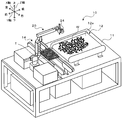
- FIG. 1 is a configuration diagram illustrating a schematic configuration of a robot system.
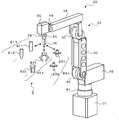
- FIG. 2 is a configuration diagram illustrating a schematic configuration of a robot.
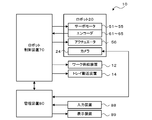
- FIG. 2 is a block diagram showing an electrical connection relationship of the robot system 10.
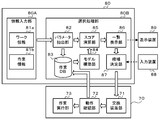
- FIG. 3 is a block diagram showing functions related to automatic selection of an end effector.
- Explanatory drawing which shows an example of the work DB83.
- Explanatory drawing which shows an example of a selection model.
- 9 is a flowchart illustrating an example of an automatic selection process.
- Explanatory drawing which shows an example of the list display screen 89a of the end effector.
- 9 is a flowchart illustrating an example of an end effector confirmation process.
- 9 is a flowchart illustrating an automatic selection process according to a modification.
- FIG. 1 is a configuration diagram schematically illustrating the configuration of the robot system 10
- FIG. 2 is a configuration diagram schematically illustrating the configuration of the robot 20
- FIG. 3 is a block diagram illustrating an electrical connection relationship of the robot system 10. is there. 1 is the X-axis direction, the front-back direction is the Y-axis direction, and the up-down direction is the Z-axis direction.
- the robot system 10 includes the robot 20, a robot control device 70, and a management device 80.
- the robot system 10 is configured as, for example, a pick-and-place system, and picks (holds) a work W such as a mechanical component or an electronic component supplied by the work supply device 12 and transports the workpiece W by the tray transport device 14. For example, a work of arranging and placing on T is performed. In addition, another work W such as a washer is picked with respect to a work W such as a bolt arranged on the tray T, and the work is placed so as to be inserted into a shaft portion of the bolt.
- the robot system 10 is not limited to the pick-and-place system, but can be applied to any work system as long as the work is performed on the work W using the robot 20.
- the robot 20 includes a five-axis vertical articulated arm (hereinafter, referred to as an arm) 22.
- the arm 22 has six links 31 to 36 and five joints 41 to 45 for connecting the links in a rotatable or pivotable manner.
- Each of the joints 41 to 45 is provided with servo motors 51 to 55 for driving the corresponding joints and encoders 61 to 65 for detecting the rotational positions of the corresponding motors.
- the end effector E1 * is an electromagnetic chuck that attracts a workpiece W made of a magnetic material by an electromagnet, and has a plurality of types (E11, E12,...) Having different sizes and shapes.
- the end effector E2 * is a mechanical chuck (hereinafter, referred to as a mechanical chuck) having a pair of clamp claws that can be opened and closed so as to hold and release the work W, and the size and shape of the clamp claws are different. It has a plurality of types (E21, E22, ).
- the end effector E3 * is a suction nozzle that suctions the workpiece W by negative pressure, and has a plurality of types (E31, E32,...) Having different diameters and lengths of the suction nozzle.
- the end effector E mounted on the distal link 36 is selected by an automatic selection process described later.
- the camera 24 is attached to the link 35 of the arm 22.
- the camera 24 captures an image of the work W to recognize the position and orientation of each work W supplied by the work supply device 12, and detects the position of the tray T transferred by the tray transfer device 14. Image T.
- the link 31 at the base end of the arm 22 is fixed to the worktable 11.
- the work table 11 is provided with a work supply device 12, a tray transfer device 14, and the like.
- the work supply device 12 includes a conveyor belt 12a that is stretched over a driving roller and a driven roller that are disposed apart in the front-rear direction (Y-axis direction).
- a plurality of works W are placed on the conveyor belt 12a at random, and the work supply device 12 supplies the plurality of works W on the conveyor belt 12a from back to front by rotating and driving a driving roller.
- a supply device that supplies a plurality of works housed in a case (part box) together with the conveyor belt 12a may be provided instead of or in addition to the conveyor belt 12a.
- the tray transport device 14 is configured by a conveyor belt, transports the tray T in a direction (X-axis direction) orthogonal to the supply direction of the work W, and positions and holds the tray T at a substantially central position.
- the robot controller 70 includes a CPU, ROM, HDD, RAM, input / output interface, communication interface, and the like. Detection signals from the encoders 61 to 65 and the like are input to the robot controller 70.
- the robot controller 70 outputs control signals to the work supply device 12, the tray transport device 14, the servomotors 51 to 55, the actuator 56, and the like.
- the actuator 56 drives the end effector E mounted on the robot 20.
- the robot control device 70 drives and controls the servo motors 51 to 55 of the robot 20 to cause the robot 20 to pick the work W or place the picked work W.
- the management device 80 includes a CPU, a ROM, a HDD, a RAM, an input / output interface, a communication interface, and the like.
- An image signal from the camera 24, an input signal from the input device 88, and the like are input to the management device 80.
- the management device 80 outputs a drive signal to the camera 24, a display signal to the display device 89, and the like.
- the input device 88 is, for example, a keyboard or a mouse
- the display device 89 is, for example, a liquid crystal display.
- the management device 80 is communicably connected to the robot control device 70 and exchanges control signals and various information with each other.
- the management device 80 transmits a control signal to the robot control device 70 to move the arm 22 (camera 24) to an imaging point of the work W supplied by the work supply device 12, and drives the camera 24 to image the work W. Then, the captured image is input. Subsequently, the management device 80 processes the input image and recognizes the work W in the image. Then, the management device 80 extracts a pickable work W from the recognized works W, determines a target position and a target posture of the end effector E for picking the work W, and transmits the target position and the target posture to the robot control device 70.
- FIG. 4 is a block diagram showing functions relating to automatic selection of the end effector.
- the management device 80 includes an information input unit 80A for inputting various information, and a selection processing unit 80B for performing a selection process of the end effector E from the input information.
- the information input unit 80A inputs various information including work information 81a on the work W and work information 81b on the contents of work performed on the work W.
- the work information 81a includes information such as the shape, dimensions, and type of the work W. For example, three-dimensional CAD information of the work W is input.
- the shape and size of the workpiece W obtained by processing the image captured by the camera 24 may be input as the workpiece information 81a.
- the work information 81b includes information on work contents such as a target shape and a target size on which the work W is to be placed, and whether the work W is to be aligned on the tray T or inserted into a bolt shaft.
- the information input unit 80A may acquire the work information 81b from a work instruction or the like input by the worker via the input device 88.
- the selection processing unit 80B includes a parameter extraction unit 82, a work DB 83, a model construction unit 84, a score calculation unit 85, a list display unit 86, and a candidate determination unit 87.
- the parameter extracting unit 82 extracts characteristic parameters from the work information 81a and the work information 81b input by the information input unit 80A. For example, in the case of an operation of inserting a washer into the shaft of a bolt, the parameter extracting unit 82 determines the end effector such as the shape of the work W (washer), the dimensions of the inner and outer diameters of the washer, the shaft diameter of the bolt, and the work content (shaft insertion). Information necessary for selecting E is extracted as a parameter.
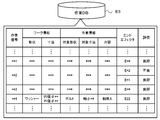
- FIG. 5 is an explanatory diagram showing an example of the work DB 83.
- the work DB 83 stores work information and work information of a known work, information of the end effector E selected in the work, and a determination result (evaluation) of the quality of the selected end effector E. It is registered with it.
- the parameters extracted by the parameter extracting unit 82 are registered in the work information and the work information of the known operation, but other information may be registered. The result of the pass / fail judgment will be described later.
- the model construction unit 84 constructs a selection model for automatically selecting the end effector E.
- the model construction unit 84 constructs a selection model that is grouped and classified for each type of the end effector E by machine learning using characteristic parameters among the information registered in the work DB 83.
- the machine learning may be performed using a known method of classifying into a plurality of groups by, for example, discriminant analysis or the K-nearest neighbor method. Further, deep learning or the like may be used.
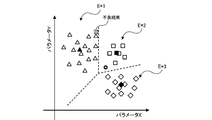
- FIG. 6 is an explanatory diagram showing an example of the selection model. In FIG. 6, for convenience of illustration, a selection model in which three types of end effectors E * 1 ( ⁇ ), E * 2 ( ⁇ ), E * 3 ( ⁇ ) are selected from two characteristic parameters X and Y. The image of is shown.
- representative values such as the center of gravity of each group (class) of the end effectors E * 1 ( ⁇ ), E * 2 ( ⁇ ), and E * 3 ( ⁇ ) are represented by representative values ⁇ , ⁇ , respectively.
- An example of the boundary of each group is indicated by a dotted line.
- the score calculation unit 85 calculates an approximate score indicating the relevance of the selected model to each group of the end effector E. For example, the score calculation unit 85 calculates an approximate score as a distance between the corresponding position ( ⁇ in FIG. 6) on the selection model based on the input parameters and the representative values ⁇ , ⁇ , ⁇ of each group. . When the work W and the work content in the new work are obtained in this way, the score calculation unit 85 calculates the approximate score for each of the various end effectors E selected in the known work.
- the list display unit 86 displays a list of a plurality of types of end effectors E on the display device 89 in descending order of the approximate score based on the calculation result by the score calculation unit 85.
- the candidate determining unit 87 determines one end effector E selected by the operator operating the input device 88 from among the listed end effectors E as a candidate.
- the candidate determining unit 87 transmits the type of the end effector E determined as the candidate and the work identification information such as the work number to the robot control device 70.
- the robot control device 70 includes a replacement mounting unit 71, an operation check unit 72, and a work execution unit 73.
- the replacement mounting unit 71 mounts the end effector E determined by the candidate determining unit 87 on the link 36 at the distal end. If the robot 20 is configured such that the end effector E can be automatically replaced, the replacement mounting section 71 automatically replaces the end effector E. If the robot 20 cannot automatically replace the end effector E, the replacement mounting section 71 displays a replacement instruction to the worker and performs replacement. Let it.
- the operation confirmation unit 72 confirms an operation such as picking the work W to be worked using the candidate end effector E determined by the candidate determination unit 87.
- the result of the operation confirmation by the operation confirmation unit 72 is transmitted to the management device 80 and registered in the work DB 83 as an evaluation.
- the work execution unit 73 performs an actual work using the end effector E for which the result of the check by the operation check unit 72 is good.
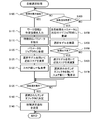
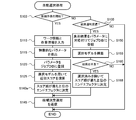
- FIG. 7 is a flowchart illustrating an example of the automatic selection process. This processing is executed by the above-described functions of the management device 80.
- the management device 80 first determines whether at least one of the shape of the work W and the work content is the timing at which a new work is started (S100), and checks the operation confirmation unit of the robot control device 70. It is determined whether it is the timing when the result notification is received from S72 (S105).
- the management device 80 determines in S100 that it is time to start a new work (target work), it inputs the work information 81a and the work information 81b (S110), and extracts characteristic parameters from the information. At the same time (S115), it is registered in the work DB 83 (S120). Next, the management device 80 calculates the approximate score of each end effector E for the new work using the selected model (S125), displays the list on the display device 89 in order of score (S130), and displays the end effector by the operator. The process waits for the selection operation of the candidate E (S135).
- FIG. 8 is an explanatory diagram showing an example of the end effector list display screen 89a.
- the end effectors E are displayed in order of score, and a schematic diagram of the end effector E indicated by the cursor is displayed.
- this list display screen 89a every time the operator performs an up / down operation with the input device 88, the cursor moves up or down, and the end effector E on which the schematic diagram is displayed changes.
- the operator performs a selection operation with the input device 88, the operator can select the end effector E indicated by the cursor on the list display screen 89a.
- the management device 80 determines the selected end effector E as a candidate (S140), and sends a candidate determination notification including the determined type of the end effector E and identification information of the operation to the robot. This is transmitted to the control device 70 (S145), and the automatic selection process ends.
- the description of the automatic selection process of the management device 80 will be interrupted, and the process of the robot control device 70 will be described.
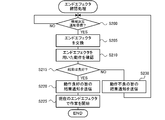
- FIG. 9 is a flowchart showing an example of the end effector confirmation processing. This process is executed by the robot control device 70. In this process, first, the robot control device 70 waits to determine that the candidate decision notification has been received (S200), and if it determines that the candidate decision notification has been received, the robot control device 70 sends the type of end effector E included in the candidate decision notification to the end effector E. Exchange (S205). In S205, automatic replacement by the robot 20 or replacement by an operator is performed. Next, the robot controller 70 confirms operations such as picking of the work W using the end effector E (S210).
- the robot control device 70 picks the work W to be worked using the end effector E that has been set as a candidate, and determines whether or not the work W can be normally picked. If the work W cannot be picked or the work W falls immediately after picking, the robot controller 70 determines that the work W cannot be picked normally. In S210, the robot control device 70 may determine not only the picking of the work W but also whether or not the work W can be normally placed.
- the robot control device 70 determines whether or not the result of the operation check is good (S215). If it is determined that the operation is good, the robot control device 70 transmits a result notification indicating that the operation is good to the management device 80 (S220). . In this case, since there is no problem in performing the work using the candidate end effector E, the robot controller 70 starts the work using the current end effector E as it is (S225), and ends the end effector confirmation processing. I do. On the other hand, when the robot control device 70 determines that the operation check result is defective, the robot control device 70 transmits a result notification of the operation failure to the management device 80 (S230), and returns to S200 to perform the processing.
- the management device 80 determines that the result notification has been received in S105 of the automatic selection process in FIG. Then, it is registered in the work DB 83 (S150). In S150, if the operation check result in the result notification is good, the goodness is registered in association with the job number, and if the operation check result in the result notification is bad, the badness is associated with the job number. be registered. Further, the management device 80 constructs (updates) the selected model based on the registered work DB 83 (S155).
- the relationship between the parameter and the end effector E in which the new pass / fail result is registered can be reflected in the selection model, so that the reliability of the selection model can be improved.
- the work number ** 2 in FIG. 5 illustrates a case where the confirmation result of the previously selected end effector E * 2 is bad and the confirmation result of the reselected end effector E * 1 is good. .
- a failure result when the end effector E of E * 2 ( ⁇ ) is selected is indicated by adding a cross.
- the management device 80 determines whether or not the operation check result is defective (S160). If it is determined that the operation check result is not defective but is good, the automatic selection process ends as it is.
- the management apparatus 80 determines in S160 that the operation check result is bad, the management apparatus 80 recalculates the approximate score of each end effector E using the selection model constructed in S155 (S165), and selects the selected end effector E Are displayed in a list in the order of score except for (S170).
- the management device 80 recalculates the other end effectors E except the selected end effector E22. The list will be displayed in the order of the given scores. Then, the management device 80 executes the processing of S135 to S145 for transmitting the end effector E selected by the worker to the robot control device 70.
- an appropriate end effector E can be selected again from the other end effectors E except for the end effector E which has been once selected but whose operation check result was inferior. Since the approximate score of each end effector E is recalculated using the selection model constructed by reflecting the operation confirmation result, it is possible for the operator to select from the list of each end effector E more appropriately. It becomes possible.
- the robot 20 of the present embodiment corresponds to a robot
- the end effector E corresponds to an end effector
- S110 of the automatic selection processing in FIG. 7 corresponds to an acquisition step
- S155 of the processing corresponds to a construction step
- S115 to S140 correspond to the selection step
- S210 of the end effector confirmation processing corresponds to a confirmation step
- the information input unit 80A that executes S110 of the automatic selection process in FIG. 7 corresponds to an acquisition unit
- the model construction unit 84 that executes S155 of the process corresponds to a construction unit
- executes S115 to S140 of the same process correspond to a selection unit.
- the parameter extraction unit 82, the score calculation unit 85, the list display unit 86, and the candidate determination unit 87 that correspond to each other correspond to a selection unit.
- the robot system 10 described above selects an end effector E suitable for a new work from a plurality of types of end effectors E based on the shape and the contents of the work W in the work and the constructed selection model. This makes it possible to more appropriately select the end effector E in consideration of the shape and the work content of the work W using the model constructed by learning the known work.
- approximate scores are calculated for a plurality of types of end effectors and displayed in a list on the display device 89 in the order of the score, and the end effector E is selected in accordance with the selection by the operator. The selection of the end effector E can be performed more appropriately.
- the selection model is constructed by associating the quality of the result of the confirmation, the reliability of the selection model is improved, and the accuracy of the selection of the end effector E is further improved. be able to.
- the reselection can be performed from a plurality of types of end effectors E excluding the already selected end effector E using the reconstructed selection model. Accuracy can be further improved.
- the approximate score is calculated again using the updated selection model, and then the end effector E is reselected.
- the re-selection of the end effector E from among the already selected end effectors E may be performed using the previous approximate score without calculating the approximate score again.
- FIG. 10 is a flowchart showing an automatic selection process according to a modification.
- the same processes as those in FIG. 7 are denoted by the same step numbers, and description thereof is omitted.
- the management device 80 determines the end effector E having the highest score order as a candidate (S140a). Therefore, in the example of FIG. 8, the end effector E22 is automatically determined as a candidate.
- the management device 80 determines in S160 that the result received from the robot control device 70 is bad, the management device 80 determines the end effector E having the highest score order, excluding the end effector E that has already been selected (S168). . For this reason, in the example of FIG. 8, the end effector E21 is automatically determined as a candidate. In FIG. 10, as in FIG. 7, the process of S168 may be executed after the approximate score is calculated again using the updated selection model.
- the operation is started after the quality of the end effector E is determined by confirming the operation of the end effector E selected as a candidate.
- the operation may be started without judging the condition. In this case, the reselection of the end effector E when the confirmation result is bad may not be performed.
- the quality of the end effector E selected as a candidate is determined before the start of the work, in order to prevent a work error such as a drop of the work W and a re-picking of the work W.
- the approximation score for each type of the end effector E in the selection model is calculated from the characteristic parameters, and the end effector E having the higher approximation score is preferentially selected. Not something.
- the end effector E of a new work is selected using a selection model constructed by learning the relationship between the shape and the content of the work W in a known work and the end effector E selected in the work. If so, the end effector E may be selected by any processing.
- the work information 81a includes dimensions and types in addition to the shape of the work W.
- the work information 81a may include at least the shape of the work W.
- the work information 81b includes the target shape and the target dimensions on which the work W is to be placed, but it is sufficient if the work information 81b includes at least the work content of what kind of work is to be performed.
- the method and system for selecting an end effector by the computer of the present disclosure may be configured as follows.
- the selecting step based on the shape and work content of the work in the target work and the model, a plurality of types of end effectors are associated with the target work.
- the end effector may be selected according to the selection by the operator by calculating the score indicating the gender and displaying the list in the order of the score. This makes it possible to select an end effector by adding judgment based on the experience of the worker in the order of the score of the end effector, so that the end effector can be selected more appropriately.
- the selection step based on the shape and the work content of the work in the target work and the model, a relationship between the target work and a plurality of types of end effectors is determined.
- the calculated score may be calculated, and the end effector having the higher score may be preferentially selected. This makes it possible to more appropriately select the end effector by simple processing using the constructed model.
- the method for selecting an end effector includes a confirmation step of confirming whether or not the gripping operation of the workpiece by the end effector selected in the selection step is satisfactory.
- a confirmation result of the confirmation step is obtained.
- the model may be constructed by associating the quality of the check result with the relationship between the shape and work content of the work in the target work and the type of the end effector selected in the selecting step. By doing so, the reliability of the model can be improved, and the accuracy of selecting the end effector can be further improved.
- the end effector selecting method in the selecting step, when a result of the confirmation in the confirming step is bad, a plurality of types of the end effectors other than the already selected end effector are suitable for the target work.
- the end effector may be reselected. By doing so, the end effector can be reselected using the model constructed in association with the quality of the confirmation result, so that the accuracy of the reselection can be further improved.
- An end effector selection system is an end effector selection system that is exchangeably mounted on a robot that performs a work on a work, and that obtains information including a shape and a work content of the work.
- the end effector selection system uses a model constructed by learning a known work, even if the work to be worked or the work content is a new target work.
- the end effector can be more appropriately selected in consideration of the shape and the work content.
- a function that realizes each step of the above-described selection method may be added.
- the present invention can be used in the manufacturing industry of robot systems and the like.
Landscapes
- Engineering & Computer Science (AREA)
- Robotics (AREA)
- Mechanical Engineering (AREA)
- Manipulator (AREA)
Abstract
L'invention concerne un procédé, pour sélectionner un effecteur terminal qui saisit une pièce et est monté de manière remplaçable sur un robot pour exécuter un processus de travail sur la pièce, comprenant : une étape d'acquisition pour acquérir des informations qui comprennent la forme de pièce et un contenu de processus de travail ; une étape de construction pour construire un modèle par apprentissage de la relation entre la forme de pièce et le contenu de processus de travail pour des processus de travail connus et le type d'effecteur terminal sélectionné pour lesdits processus de travail ; et une étape de sélection dans laquelle, lorsqu'un processus de travail cible impliquant une nouvelle pièce et/ou un nouveau contenu de processus de travail est exécuté, un effecteur terminal approprié pour le processus de travail cible est sélectionné parmi une pluralité de types d'effecteurs terminaux sur la base du modèle, de la forme de pièce et du contenu de processus de travail pour le processus de travail cible.
Priority Applications (2)
| Application Number | Priority Date | Filing Date | Title |
|---|---|---|---|
| JP2020531883A JP7133017B2 (ja) | 2018-07-24 | 2018-07-24 | エンドエフェクタの選択方法および選択システム |
| PCT/JP2018/027765 WO2020021643A1 (fr) | 2018-07-24 | 2018-07-24 | Système de sélection et procédé de sélection d'effecteur terminal |
Applications Claiming Priority (1)
| Application Number | Priority Date | Filing Date | Title |
|---|---|---|---|
| PCT/JP2018/027765 WO2020021643A1 (fr) | 2018-07-24 | 2018-07-24 | Système de sélection et procédé de sélection d'effecteur terminal |
Publications (1)
| Publication Number | Publication Date |
|---|---|
| WO2020021643A1 true WO2020021643A1 (fr) | 2020-01-30 |
Family
ID=69180973
Family Applications (1)
| Application Number | Title | Priority Date | Filing Date |
|---|---|---|---|
| PCT/JP2018/027765 Ceased WO2020021643A1 (fr) | 2018-07-24 | 2018-07-24 | Système de sélection et procédé de sélection d'effecteur terminal |
Country Status (2)
| Country | Link |
|---|---|
| JP (1) | JP7133017B2 (fr) |
| WO (1) | WO2020021643A1 (fr) |
Cited By (8)
| Publication number | Priority date | Publication date | Assignee | Title |
|---|---|---|---|---|
| JP2021177538A (ja) * | 2020-05-07 | 2021-11-11 | ▲たい▼昇科技股▲分▼有限公司 | 搬送用保持具の自動交換機構 |
| EP4101584A1 (fr) * | 2021-06-08 | 2022-12-14 | Dürr Assembly Products GmbH | Dispositif de préhension d'éléments oblongs de fixation à partir d'un entrepôt désordonné |
| JP2023528728A (ja) * | 2020-04-03 | 2023-07-06 | バイマー グループ エーエス | ピックアンドプレースロボットシステム |
| US12256678B2 (en) | 2021-08-03 | 2025-03-25 | 4Ag Robotics Inc. | Automated mushroom harvesting system |
| US12384026B1 (en) | 2024-02-08 | 2025-08-12 | 4Ag Robotics Inc. | Machine-learning-enabled tool changer for mushroom crop management system |
| WO2025191770A1 (fr) * | 2024-03-14 | 2025-09-18 | 日本電気株式会社 | Dispositif de sélection d'effecteur terminal, procédé de sélection d'effecteur terminal et programme |
| US12447631B2 (en) | 2021-09-13 | 2025-10-21 | Osaro | Automated robotic tool selection |
| US12602520B2 (en) | 2023-10-30 | 2026-04-14 | 4Ag Robotics Inc. | Machine-learning virtualization-enabled harvesting |
Families Citing this family (1)
| Publication number | Priority date | Publication date | Assignee | Title |
|---|---|---|---|---|
| JP2025073574A (ja) * | 2023-10-27 | 2025-05-13 | 三菱重工業株式会社 | 把持装置および方法 |
Citations (7)
| Publication number | Priority date | Publication date | Assignee | Title |
|---|---|---|---|---|
| JP2009148845A (ja) * | 2007-12-19 | 2009-07-09 | Olympus Corp | 小型生産設備 |
| JP2013052490A (ja) * | 2011-09-06 | 2013-03-21 | Mitsubishi Electric Corp | ワーク取り出し装置 |
| JP2015044274A (ja) * | 2013-08-29 | 2015-03-12 | 三菱電機株式会社 | 部品供給装置および部品供給装置のプログラム生成方法 |
| WO2015178377A1 (fr) * | 2014-05-20 | 2015-11-26 | 株式会社日立製作所 | Dispositif et procede d'instruction d'assemblage |
| JP2017030135A (ja) * | 2015-07-31 | 2017-02-09 | ファナック株式会社 | ワークの取り出し動作を学習する機械学習装置、ロボットシステムおよび機械学習方法 |
| US20170265392A1 (en) * | 2014-08-26 | 2017-09-21 | Vineland Research and Innovations Centre Inc. | Mushroom Harvester |
| JP6325174B1 (ja) * | 2017-04-04 | 2018-05-16 | 株式会社Mujin | 制御装置、ピッキングシステム、物流システム、プログラム、制御方法、及び、生産方法 |
Family Cites Families (1)
| Publication number | Priority date | Publication date | Assignee | Title |
|---|---|---|---|---|
| JP2009117732A (ja) | 2007-11-09 | 2009-05-28 | Panasonic Corp | ノズル |
-
2018
- 2018-07-24 WO PCT/JP2018/027765 patent/WO2020021643A1/fr not_active Ceased
- 2018-07-24 JP JP2020531883A patent/JP7133017B2/ja active Active
Patent Citations (8)
| Publication number | Priority date | Publication date | Assignee | Title |
|---|---|---|---|---|
| JP2009148845A (ja) * | 2007-12-19 | 2009-07-09 | Olympus Corp | 小型生産設備 |
| JP2013052490A (ja) * | 2011-09-06 | 2013-03-21 | Mitsubishi Electric Corp | ワーク取り出し装置 |
| JP2015044274A (ja) * | 2013-08-29 | 2015-03-12 | 三菱電機株式会社 | 部品供給装置および部品供給装置のプログラム生成方法 |
| WO2015178377A1 (fr) * | 2014-05-20 | 2015-11-26 | 株式会社日立製作所 | Dispositif et procede d'instruction d'assemblage |
| US20170265392A1 (en) * | 2014-08-26 | 2017-09-21 | Vineland Research and Innovations Centre Inc. | Mushroom Harvester |
| JP2017030135A (ja) * | 2015-07-31 | 2017-02-09 | ファナック株式会社 | ワークの取り出し動作を学習する機械学習装置、ロボットシステムおよび機械学習方法 |
| JP2017064910A (ja) * | 2015-07-31 | 2017-04-06 | ファナック株式会社 | ワークの取り出し動作を学習する機械学習装置、ロボットシステムおよび機械学習方法 |
| JP6325174B1 (ja) * | 2017-04-04 | 2018-05-16 | 株式会社Mujin | 制御装置、ピッキングシステム、物流システム、プログラム、制御方法、及び、生産方法 |
Cited By (11)
| Publication number | Priority date | Publication date | Assignee | Title |
|---|---|---|---|---|
| JP2023528728A (ja) * | 2020-04-03 | 2023-07-06 | バイマー グループ エーエス | ピックアンドプレースロボットシステム |
| US12338082B2 (en) | 2020-04-03 | 2025-06-24 | Beumer Group A/S | Pick and place robot system, method, use and sorter system |
| JP7796664B2 (ja) | 2020-04-03 | 2026-01-09 | バイマー グループ エーエス | ピックアンドプレースロボットシステム |
| JP2021177538A (ja) * | 2020-05-07 | 2021-11-11 | ▲たい▼昇科技股▲分▼有限公司 | 搬送用保持具の自動交換機構 |
| EP4101584A1 (fr) * | 2021-06-08 | 2022-12-14 | Dürr Assembly Products GmbH | Dispositif de préhension d'éléments oblongs de fixation à partir d'un entrepôt désordonné |
| US12256678B2 (en) | 2021-08-03 | 2025-03-25 | 4Ag Robotics Inc. | Automated mushroom harvesting system |
| US12447631B2 (en) | 2021-09-13 | 2025-10-21 | Osaro | Automated robotic tool selection |
| US12602520B2 (en) | 2023-10-30 | 2026-04-14 | 4Ag Robotics Inc. | Machine-learning virtualization-enabled harvesting |
| US12384026B1 (en) | 2024-02-08 | 2025-08-12 | 4Ag Robotics Inc. | Machine-learning-enabled tool changer for mushroom crop management system |
| WO2025166444A1 (fr) * | 2024-02-08 | 2025-08-14 | 4Ag Robotics Inc. | Changeur d'outil activé par apprentissage automatique pour système de gestion de culture de champignons |
| WO2025191770A1 (fr) * | 2024-03-14 | 2025-09-18 | 日本電気株式会社 | Dispositif de sélection d'effecteur terminal, procédé de sélection d'effecteur terminal et programme |
Also Published As
| Publication number | Publication date |
|---|---|
| JPWO2020021643A1 (ja) | 2021-08-02 |
| JP7133017B2 (ja) | 2022-09-07 |
Similar Documents
| Publication | Publication Date | Title |
|---|---|---|
| WO2020021643A1 (fr) | Système de sélection et procédé de sélection d'effecteur terminal | |
| US12194644B2 (en) | Work robot and work system | |
| JP7197653B2 (ja) | 画像処理装置 | |
| JP5382359B2 (ja) | ロボットシステム | |
| US10293499B2 (en) | Movable robot | |
| CN110871441A (zh) | 感测系统、作业系统、增强现实图像的显示方法、以及存储有程序的存储介质 | |
| EP3409428B1 (fr) | Système de travail comprenant un dispositif de création de táche et une commande de robot de travail | |
| WO2018131108A1 (fr) | Engin de chantier et procédé de sélection de position de saisie | |
| JP5198161B2 (ja) | ハンドリング装置およびワークハンドリング方法 | |
| CN111278612B (zh) | 元件移载装置 | |
| EP3722053B1 (fr) | Dispositif de commande, dispositif d'opération sur pièce à usiner, système d'opération sur pièce à usiner et procédé de commande | |
| JP7373028B2 (ja) | シミュレーション方法、シミュレーションシステム | |
| CN114800483B (zh) | 机器人的控制方法和机器人系统 | |
| CN111899629A (zh) | 柔性机器人教学系统和方法 | |
| WO2022269706A1 (fr) | Appareil de traitement d'anomalie, système de réseau et procédé pour fournir une procédure par rapport à une anomalie s'étant produite dans un système de robot | |
| JP7853327B2 (ja) | 産業機械の動作を検証するための装置、産業機械、及び方法 | |
| JP7105281B2 (ja) | 作業システム | |
| JP2024152392A (ja) | ピッキング条件決定システム | |
| US20220232747A1 (en) | Component mounting machine | |
| CN116301946A (zh) | 模组处理方法、装置、系统、电子设备及存储介质 | |
| CN121198622A (zh) | 机械手测试分类控制方法、系统、电子设备及可读存储介质 | |
| CN119156272A (zh) | 机器人控制装置以及加工系统 | |
| JP2018075660A (ja) | ワークの把持位置指示システムおよびピッキング装置 |
Legal Events
| Date | Code | Title | Description |
|---|---|---|---|
| 121 | Ep: the epo has been informed by wipo that ep was designated in this application |
Ref document number: 18927356 Country of ref document: EP Kind code of ref document: A1 |
|
| ENP | Entry into the national phase |
Ref document number: 2020531883 Country of ref document: JP Kind code of ref document: A |
|
| NENP | Non-entry into the national phase |
Ref country code: DE |
|
| 122 | Ep: pct application non-entry in european phase |
Ref document number: 18927356 Country of ref document: EP Kind code of ref document: A1 |