WO2020027005A1 - ロール状ラッピングネットの製造方法、及びロール状ラッピングネットの製造装置、及びロール状ラッピングネット - Google Patents
ロール状ラッピングネットの製造方法、及びロール状ラッピングネットの製造装置、及びロール状ラッピングネット Download PDFInfo
- Publication number
- WO2020027005A1 WO2020027005A1 PCT/JP2019/029549 JP2019029549W WO2020027005A1 WO 2020027005 A1 WO2020027005 A1 WO 2020027005A1 JP 2019029549 W JP2019029549 W JP 2019029549W WO 2020027005 A1 WO2020027005 A1 WO 2020027005A1
- Authority
- WO
- WIPO (PCT)
- Prior art keywords
- net
- roll
- winding
- fabric
- chain
- Prior art date
- Legal status (The legal status is an assumption and is not a legal conclusion. Google has not performed a legal analysis and makes no representation as to the accuracy of the status listed.)
- Ceased
Links
Images






Classifications
-
- D—TEXTILES; PAPER
- D04—BRAIDING; LACE-MAKING; KNITTING; TRIMMINGS; NON-WOVEN FABRICS
- D04B—KNITTING
- D04B27/00—Details of, or auxiliary devices incorporated in, warp knitting machines, restricted to machines of this kind
- D04B27/34—Take-up or draw-off devices for knitted products
-
- D—TEXTILES; PAPER
- D04—BRAIDING; LACE-MAKING; KNITTING; TRIMMINGS; NON-WOVEN FABRICS
- D04B—KNITTING
- D04B21/00—Warp knitting processes for the production of fabrics or articles not dependent on the use of particular machines; Fabrics or articles defined by such processes
- D04B21/10—Open-work fabrics
- D04B21/12—Open-work fabrics characterised by thread material
-
- D—TEXTILES; PAPER
- D04—BRAIDING; LACE-MAKING; KNITTING; TRIMMINGS; NON-WOVEN FABRICS
- D04B—KNITTING
- D04B35/00—Details of, or auxiliary devices incorporated in, knitting machines, not otherwise provided for
- D04B35/36—Devices for printing, coating, or napping knitted fabrics
-
- D—TEXTILES; PAPER
- D10—INDEXING SCHEME ASSOCIATED WITH SUBLASSES OF SECTION D, RELATING TO TEXTILES
- D10B—INDEXING SCHEME ASSOCIATED WITH SUBLASSES OF SECTION D, RELATING TO TEXTILES
- D10B2201/00—Cellulose-based fibres, e.g. vegetable fibres
- D10B2201/01—Natural vegetable fibres
- D10B2201/02—Cotton
-
- D—TEXTILES; PAPER
- D10—INDEXING SCHEME ASSOCIATED WITH SUBLASSES OF SECTION D, RELATING TO TEXTILES
- D10B—INDEXING SCHEME ASSOCIATED WITH SUBLASSES OF SECTION D, RELATING TO TEXTILES
- D10B2401/00—Physical properties
- D10B2401/12—Physical properties biodegradable
-
- D—TEXTILES; PAPER
- D10—INDEXING SCHEME ASSOCIATED WITH SUBLASSES OF SECTION D, RELATING TO TEXTILES
- D10B—INDEXING SCHEME ASSOCIATED WITH SUBLASSES OF SECTION D, RELATING TO TEXTILES
- D10B2505/00—Industrial
- D10B2505/10—Packaging, e.g. bags
Definitions
- the present invention relates to an improvement in a method for producing a roll-shaped wrapping net, and more particularly, to a method for producing a roll-shaped wrapping net made of a livestock or environmentally-friendly dough material, which can be used without problems in existing roll baler machines.
- cotton yarn was selected is that cotton is soft fiber and can be digested by an enzyme produced by bacteria in the stomach of livestock.
- Regenerated fibers which are other cellulose fibers, have a problem in safety due to chemical treatment and the like, and natural fibers such as hemp are hard fibers and have poor digestibility.
- the newly discovered problem is a problem in cutting the dough.
- the conventional PE / PP wrapping net uses a material having a dough width wider than the feed roll width to reduce the feed.
- the fabric was cut off by stopping the stretch by overhanging the fabric on both ends of the roll (overlaying and hooking), but cotton yarn has a small elongation unlike film yarn, so the part that protrudes when the fabric is overhanged Burned out, causing trouble.
- the above-mentioned conventional dough roll is not only difficult to cut smoothly, but also when used in a stationary type (detailed below) roll baler machine, the dough roll violates in the bucket, making it difficult for the brake to work. There were also problems, such as the drawn fabric shrinking in the width direction. Further, in the stationary roll baler machine, the dough roll having a non-uniform surface shape is placed on the bottom surface of the bucket, so that the dough roll is tilted, and a trouble that the dough ends are entangled at the time of pulling out is likely to occur.
- the conventional fabric roll has a long length due to the formation of a thick portion. Since the dough could not be compactly rolled, there was also a problem that if a necessary length of dough was rolled, the roll diameter would be too large to be mounted on a bucket or the like of an existing roll baler machine.
- JP 2014-133965 A Japanese Patent No. 5892637
- the present invention has been made in view of the above-mentioned problems, and the object thereof is that the dough material is not only friendly to livestock and the environment, but also compact and can be easily mounted on existing roll baler machines.
- the present invention relates to a warp yarn constituting a chain knitting structure arranged at regular intervals in the weft direction of the warp knitted fabric, and an insertion yarn laid in an oblique direction or a weft direction so as to connect adjacent chain knitting structures.
- a cotton yarn is used for each of the warp and the insertion yarn during the knitting step of the net cloth, and the net cloth winding step is performed.
- the net cloth is wound around a roll core while being shaken at a constant size in the width direction within the range of the chain knitting structure, and the net cloth is shaken in the width direction while maintaining the space between the chain knitting structures.
- the method is characterized in that a method of moving a net fabric by using a guide roller having a double spiral groove or by swinging a guide roller having unevenness to the left and right is used.
- the net cloth in the knitting step of the net cloth, cotton yarn is used for each of the warp and the insertion yarn, and the net cloth is wound within the interval of the chain stitch structure during the winding step of the net cloth.
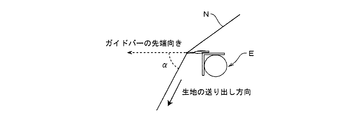
- a method of winding the net cloth to the left and right while keeping the spacing between the chain knitting structures while winding it around the roll core while shaking it in a certain size in the width direction a plurality of recesses are formed at predetermined intervals in the length direction It is also possible to employ a method of moving the net cloth by swinging the guide bar to the left and right in a state where each chain stitch structure is inserted into the concave portion using the guide bar thus set.
- the net cloth in the knitting step of the net cloth, cotton yarns are used for the warp and the insertion yarn, and at the time of the winding step of the net cloth, the interval of the chain knitting structure of the net cloth is knitted.
- the net cloth While maintaining the state immediately after the process, the net cloth is wound around a roll core while shaking the net cloth at a constant size in the width direction within the range of the chain knitting structure, and the net cloth is maintained with the space between the chain knitting structures maintained
- a method of swinging left and right using a guide roller or a guide bar in which a plurality of recesses are formed at predetermined intervals in the length direction, and swinging the winding roller left and right with each chain stitch structure inserted into the recess.
- a method of moving the net fabric can also be adopted.
- a food additive or edible wax having a solid water repellency is arranged in the concave portion of the guide bar, and in a knitting step of the net fabric, a cotton yarn having a chain stitch structure is formed.
- the food additive or the like can be efficiently attached to the cotton yarn.
- a liquid water-repellent food additive or edible wax is sequentially supplied into the concave portion of the guide bar, and in the knitting step of the net fabric, the cotton yarn having a chain stitch structure is formed.
- the food additive or the like can be efficiently attached to the cotton yarn.
- a food additive or edible wax supply pipe is connected to the guide bar, and the guide bar is inserted into the guide bar recess.
- a method of sequentially supplying a food additive or an edible wax through the supply tube from the formed liquid inlet can be adopted.
- a method of efficiently adhering the food additive or edible wax in a knitting step of the net fabric, a method of sending a cotton yarn having a chain knitting structure while rubbing the food additive or edible wax having water repellency. Can also be adopted.
- the warp yarns constituting the chain knitting structure arranged at regular intervals in the weft direction of the warp knitted fabric, and the insertion yarns laid diagonally or in the weft direction to connect adjacent chain knitting structures.
- the net cloth can be sent out in a state where each chain stitch structure is inserted into the concave portion of the guide roller or the guide bar, thereby forming the chain stitch structure. It can be wound into a roll core waving interval the net fabric while maintaining the in the width direction.
- a winding roller on which a roll core for winding the net cloth is mounted instead of the configuration of the manufacturing apparatus, a winding roller on which a roll core for winding the net cloth is mounted; a plurality of winding rollers arranged in front of the winding roller and into which each chain stitch structure is inserted; A guide roller or guide bar having recesses formed at predetermined intervals in the length direction; and a reciprocating mechanism connected to the winding roller for swinging the winding roller to the left and right. It is possible to send out the net fabric with each chain knitting structure inserted into the concave portion of the guide roller or the guide bar, and shake the net fabric in the width direction while maintaining the interval between the chain knitting structures to form a roll core. Can be wound up.
- a winding roller on which a roll core for winding the net cloth is mounted instead of the configuration of the manufacturing apparatus, a winding roller on which a roll core for winding the net cloth is mounted; and a winding roller arranged in front of the winding roller, into which each chain stitch structure is inserted.
- a guide roller having a double spiral groove By including a guide roller having a double spiral groove, the net fabric is sent out with each chain knitting structure inserted into the groove of the guide roller, and the interval between the chain knitting structures is maintained. It is also possible to shake the net cloth in the width direction and wind it around a roll core.
- the cotton yarn is used for the warp and the insertion yarn of the net cloth, and another chain knitting structure in which the same chain knitting structure wound up is adjacent to another one. And in parallel with each other in the width direction and the radial direction of the roll so as not to overlap with each other, and further, by attaching a water-repellent food additive or edible wax to the chain knitting structure of the net fabric, the net fabric is repelled. It can impart water-based properties and can improve fabric separation.
- the cotton yarn is used for the warp and the insertion yarn of the net cloth, and another chain knitting structure in which the same chain knitting structure wound up is adjacent to another one. And in parallel with the width direction and the radial direction of the roll in a state where they do not overlap with each other, and further, a coloring agent used as a food additive is adhered to the wound net dough in a strip shape in the width direction of the net dough. This makes it possible to visually check the remaining amount of the net cloth at the time of use.
- each chain stitch structure is arranged in parallel in the width direction and the radial direction of the roll. Since roll-type wrapping nets can be manufactured, not only can the dough overlap and the dough roll surface be smoothed, but also long dough can be rolled into a compact size that can be mounted on existing roll baler machines. be able to.
- the roll-shaped wrapping net manufactured by the method of the present invention is wound in a state where the interval between the chain stitch structures of the net fabric is kept constant, tension is applied to each chain stitch structure when the net fabric is pulled out. It can be pulled out in parallel while being evenly hung.
- the tension can be applied to each chain stitch with uniform tension, the cloth can be cut smoothly.
- the dough roll is used by being mounted on a stationary roll baler machine, the dough roll is unlikely to rampage in the bucket, so that the rotating dough roll can be easily braked.
- the roll-shaped wrapping net manufactured by the manufacturing method of the present invention is a natural material that is naturally decomposed into warp and insertion yarns of the fabric, and uses a cotton yarn excellent in digestibility, so that it is environmentally friendly. There are no problems or livestock health problems. Therefore, according to the present invention, it is possible to provide a roll-shaped wrapping net that is easy for dairy and livestock companies to use.
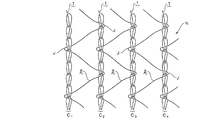
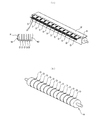
- FIG. 1 is an overall perspective view illustrating a roll-shaped wrapping net according to a first embodiment of the present invention. It is an enlarged view for explaining the knitting structure of the net cloth in the first embodiment of the present invention. It is a schematic image figure showing the section state of the chain knitting structure wound up of the roll-shaped wrapping net in a first embodiment of the present invention. It is a state explanatory view showing the use state of the roll-shaped wrapping net in the first embodiment of the present invention. It is explanatory drawing showing the manufacturing method of the roll-shaped wrapping net in 1st embodiment of this invention. It is an explanatory view showing a guide bar with a concave part and a guide roller in a first embodiment of the present invention.
- Each of the chain knitting structures C1, C2,... Of the roll-shaped wrapping net R is, as shown in FIGS.
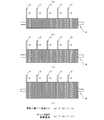
- the knitted structures C ′, C ′... Are not overlapped with each other, and are arranged in parallel in the width direction and the radial direction of the roll. Also, the tension of the loops of the wound chain stitch structures C1, C2,... Is uniform, and the chain stitch structures C1, C2,. Can be withdrawn.
- a chain knitting structure group arranged at the same position in the radial direction of the roll (a slight deviation due to an error is regarded as the same position) is referred to as “the same position”.
- a chain stitch structure on the same layer (a slight deviation due to an error is regarded as the same position) is referred to as a chain stitch structure on the same row in the roll width direction.
- the roll-shaped wrapping net R when used as a wrapping net for feed or the like, it is not only safe for livestock to eat the cotton dough N, but the net dough N is different. Since the chain knitting structures C1, C2,... Do not overlap vertically, the thickness of the roll does not partially increase, so that the winding length of the net cloth N can be further increased even with the roll having the same maximum diameter.
- a roll-type wrapping machine of a stationary type (a roll that is placed on a bucket B or on a plurality of rollers and pressed against a brake roller L to rotate the roll).
- a roll-type wrapping machine of a stationary type a roll that is placed on a bucket B or on a plurality of rollers and pressed against a brake roller L to rotate the roll.
- the net cloth N When used in the stationary type roll baler, the net cloth N can be pulled out while applying an equal tension to each of the chain stitch structures C1, C2,. ), And the pressing by the brake roller L when stopping the rotation of the roll can be performed without any trouble.
- each component of the roll-shaped wrapping net R will be described.
- the warp yarn 1 in this embodiment, 100% cotton yarn is used. However, if the yarn material is mainly made of cotton, a blended yarn mixed with plant fiber with good digestibility should be used. Can also. In the present embodiment, a plurality of cotton yarns are bundled and used as the warp yarn 1. However, the thickness and the number of the used cotton yarns can be appropriately changed according to the required strength and the like. It is desirable that the lengths of the chain stitch structures C1, C2,... Are uniform, but there is no problem even if there is some error.
- the insert yarn 2 is made of 100% cotton yarn. A blended yarn mixed with plant fiber having good digestibility can also be used. Further, in the present embodiment, since the strength of the warp 1 or more is not required for the inserted yarn 2, the number of the cotton yarns used for the inserted yarn 2 is set to one, but the thickness and the number of the used cotton yarns are determined by the width of the roll baler machine. It can be changed as appropriate within the range of strength that can withstand the dispenser. The thickness of the insertion yarn 2 is preferably as small as possible so as not to be bulky at the time of winding.
- the chain knitting structures CC are arranged so that the insertion yarn 2 becomes loose in the net cloth N immediately after knitting. And the insertion yarn 2 is knitted with a yarn tension that does not shorten the straight line distance between the intersections J and J. Thereby, when winding the net cloth N, the phenomenon in which the net cloth N, which has been tensioned in the length direction, shrinks in the width direction can be suppressed, so that the intervals between the chain stitch structures C, C,... The net cloth N can be wound up around the roll core P while keeping it.
- the yarn is wound in an oblique direction in a zigzag manner with respect to the adjacent chain knitting structures C, C. Not only that, it can also be stretched horizontally. Also, a plurality of insertion yarns 2 can be crossed over the adjacent chain knitting structures C and C so as to cross each other.
- this embodiment is used. A configuration in which one insertion thread 2 is bridged like the embodiment is preferable.
- FIG. (a) As shown in (b), it is preferable that the size of the gap between the same chain stitch structures C and C is uniform, but the size of the gap between the chain stitch structures C and C is If the width is smaller than the width of one knitting structure, there is no problem even if there is a slight error in the position of the chain knitting structure CC. There is no problem even if the size of the gap between the chain stitch structures C is slightly different in different layers.
- the gaps between different chain stitch structures C and C ′ in the chain stitch structures C and C on the same layer as shown in FIGS.
- the size of the gap between them smaller than the width of one chain stitch structure, the number of chain stitch structures C, C ... arranged on the same layer is maximized, without changing the roll diameter.
- the net fabric N can be wound more.
- the gap between the different chain stitch structures C and C ′ in the chain stitch structures C and C on the same layer is not a problem even if they are larger than the gap between the same chain stitch structures C and C unless they overlap each other. There is no.
- the water-repellent food additive is attached to the chain knitting structure C of the net fabric N to repel the cotton fabric net fabric N.
- Water-based As a result, even when a feed roll in which the net dough N is rolled is placed on moist soil, bacteria and mold that degrade cellulose are unlikely to adhere, and the strength of the yarn of the net dough N is reduced by bacteria and the like. The problem that the feed roll collapses can be suppressed.
- a food additive having water repellency can be attached to both the warp yarn 1 and the insertion yarn 2.
- the water-repellent food additive may be any food additive that is not harmful to livestock and is, for example, vegetable wax such as wood wax, sugar cane wax, palm wax, or animal wax such as beeswax or spermaceti wax. Etc. can be used.
- harmful substances include mineral waxes such as montan wax.
- edible wax or edible oil is used, the slippage of the net cloth N can be improved (the frictional resistance can be reduced), so that the cloth separation when the net cloth N is pulled out from the cloth roll is improved.
- the food additive having water repellency is mixed with yeasts and fungi for fungicidal use. You can also. In this case, by using a wax having a low melting point as a food additive having water repellency, it is possible to adhere the yeasts and bacteria to the net cloth N without killing them with heat.
- a material other than a fungicide for example, a pH adjuster
- a colorant used as a food additive is adhered to the net cloth N in the form of a band in the width direction on the net cloth N wound around the roll core P. I have.
- the coloring agent adhered to the net cloth N at the time of forming the feed roll serves as a mark, and the remaining amount and the like can be visually confirmed.
- the colorant may be any colorant that is not harmful to livestock and may be, for example, an edible tar pigment, safflower pigment, gardenia pigment, caramel pigment, or the like.
- the net cloth winding step is continuously performed.
- the net cloth winding step as shown in FIGS. 5 (a), 5 (b), and 5 (c), the net cloth is maintained in a state immediately after the knitting step.
- the roll is wound around a roll core while being shaken at a fixed size in the width direction of the roll within the interval. At this time, the net cloth wound on the roll core is pressed to compress the net cloth and fill gaps between the yarns, thereby making the roll-shaped wrapping net compact.
- the intervals between the concave portions D, D,... Of the guide bar E are formed at small intervals so as to be able to cope with various wrap nets having different intervals between chain stitch structures.
- the concave portions DD can be formed at wide intervals in accordance with the interval between the chain stitch structures of the net fabric.
- the depth, width, and shape of the concave portion D of the guide bar E can be appropriately changed according to the chain stitch structure of the net fabric.
- the take-up roller is swung right and left as described above, a method in which the take-up roller alone is swung right and left may be adopted in addition to the method in which the take-up roller is set right and left.
- the winding roller is a rotating shaft on which a roll core P (paper tube or the like) is mounted.
- the touch rollers TT rotate while contacting the roll-shaped wrapping net R.
- FIG. 7 (b) Arrangement of guide bar or guide roller Regarding the arrangement of the guide bar E having the concave portion D and the guide roller A, in the hollow winding system shown in FIG.
- the contact-type winding system shown in FIG. 7 (b) is arranged in the immediate vicinity of the rolled wrapping net R (position closer to the winding roller than the guide roller having no concave portion). -It is preferable to arrange it near T.
- a guide roller having a double spiral groove may be used instead of the method of swinging the guide bar E or the guide roller A to the left or right. Specifically, by forming a double helical groove in the guide roller, recesses are formed at predetermined intervals in the length direction of the guide roller, and the guide roller is inserted in a state where each chain stitch is inserted into these recesses. By rotating, the net fabric can be reciprocated in the width direction.
- the speed at which the net fabric is swung in the width direction of the roll is determined by a certain gap between the chain knitted structures on the same layer arranged in parallel in the roll width direction. And the size of the gap between the same chain stitch structures on the same layer is set to be smaller than the width of one chain stitch structure.
- the moving speed of the net fabric is determined from the interval of the chain knitting structure, the width of the chain knitting structure, the number of turns of the same chain knitting structure on the same layer, the diameter and outer circumference of the roll, and the winding speed of the net fabric. Can be calculated.
- the speed at which the net cloth is shaken in the width direction of the roll is the same chain knitting structure in the width direction of the roll (layer direction).
- the net fabric can be wound so that the chain stitch structure is arranged in the order of (1) to (25).
- the speed at which the net cloth is shaken in the width direction of the roll can be set so as to be spaced with a gap larger than the width of one chain stitch structure.
- the net fabric can be wound so that the chain stitch structures are arranged in the order of (1) to (25).
- the moving speed of the net cloth is gradually reduced as the winding amount of the net cloth with respect to the roll core increases.
- the gap between the same chain stitches is adjusted, the moving speed of the net fabric can be continuously adjusted according to the increase in the winding amount.
- the winding amount of the net cloth increases, the length of one turn becomes longer. Therefore, if the net cloth is moved at the same speed, the gap in the chain stitch structure gradually increases.
- the net dough is fixed to a bearing.
- the method of pressing the press roller against the roll from above is adopted, but other methods can also be adopted.
- the roll is fixed to a bearing that can slide up and down, and a rod-shaped weight is placed in the roll core.
- a method of pressing the roll against a placing roller arranged on the lower side may be adopted.
- a method of feeding a food additive or the like while passing it through a hollow portion of a donut-shaped food additive while rubbing the food additive or the like, a method of pressing the food additive or the like on the warp from below or above, a method of powdering the warp For example, a method of attaching the food additive described above.
- a guide bar including a liquid inlet formed in the concave portion D and a cavity communicating with the liquid inlet is provided.
- a method in which a food additive or edible wax supply pipe is connected to E, and the food additive or edible wax is sequentially supplied from the supply pipe to a liquid inlet formed in the concave portion D of the guide bar E can be suitably adopted.
- a method for adhering a liquid food additive or edible wax a method in which a liquid food additive or the like is impregnated in a sponge or the like and brought into contact with a warp can be used.
- the colorant used as a food additive is attached to the wound net dough in a strip shape in the width direction.
- a colorant dissolved in a volatile liquid (alcohol or the like) is sprayed through a plate having a rectangular window to adhere to the net fabric in a strip shape.
- the liquid food additive is used as a colorant, and the liquid colorant is intermittently supplied from the injection port of the guide bar E shown in FIG.
- the pump By operating the pump so as to blow out, the warp of the net fabric can be partially dyed at predetermined intervals.
- the colored portion of the net cloth can be used as a mark (for example, a mark indicating the end of the cloth).
- a winding roller F to which a roll core P is mounted is arranged as a winding mechanism of a warp knitting device (not shown) for knitting the net cloth N, and
- a guide bar E in which a plurality of concave portions DD in which the respective chain stitch structures are inserted is formed at predetermined intervals in the length direction is arranged.
- a reciprocating mechanism (not shown) for swinging E left and right is connected and configured.
- the concave portions D of the guide bar E can be formed by cutting or the like when a metal base is used for the guide bar E, or by using a plastic base. In this case, it can be formed by injection molding or the like.
- a drive motor a cam that converts the rotational motion of the drive motor into a linear motion and moves the guide bar E, and a guide bar E And an elastic member for pressing the actuator, but an actuator (for example, an electric cylinder, a fluid pressure cylinder, a direct-acting motor, etc.) that performs a linear reciprocating motion may be selected.
- an actuator for example, an electric cylinder, a fluid pressure cylinder, a direct-acting motor, etc.
- the reciprocating mechanism may be connected to the winding roller F.
- the guide bar E and the recess D of the guide roller A may be provided.
- the net cloth N is sent out in a state where each chain stitch structure is inserted, and is wound up while swinging the winding roller F to the left and right. It can be wound around the core P.
Landscapes
- Engineering & Computer Science (AREA)
- Textile Engineering (AREA)
- Knitting Of Fabric (AREA)
Priority Applications (1)
| Application Number | Priority Date | Filing Date | Title |
|---|---|---|---|
| EP19845375.5A EP3831995B1 (de) | 2018-07-30 | 2019-07-26 | Verfahren zur herstellung eines gerollten wickelnetzes |
Applications Claiming Priority (4)
| Application Number | Priority Date | Filing Date | Title |
|---|---|---|---|
| JP2018-142972 | 2018-07-30 | ||
| JP2018142972A JP6550510B1 (ja) | 2018-07-30 | 2018-07-30 | ロール状ラッピングネット、及びその製造方法 |
| JP2019-097559 | 2019-05-24 | ||
| JP2019097559A JP6896294B2 (ja) | 2019-05-24 | 2019-05-24 | ロール状ラッピングネット、及びその製造方法 |
Publications (1)
| Publication Number | Publication Date |
|---|---|
| WO2020027005A1 true WO2020027005A1 (ja) | 2020-02-06 |
Family
ID=69232581
Family Applications (1)
| Application Number | Title | Priority Date | Filing Date |
|---|---|---|---|
| PCT/JP2019/029549 Ceased WO2020027005A1 (ja) | 2018-07-30 | 2019-07-26 | ロール状ラッピングネットの製造方法、及びロール状ラッピングネットの製造装置、及びロール状ラッピングネット |
Country Status (2)
| Country | Link |
|---|---|
| EP (1) | EP3831995B1 (de) |
| WO (1) | WO2020027005A1 (de) |
Cited By (1)
| Publication number | Priority date | Publication date | Assignee | Title |
|---|---|---|---|---|
| CN115075426A (zh) * | 2022-07-26 | 2022-09-20 | 温州澳成建筑装饰有限公司 | 一种防开裂外墙结构及其施工方法 |
Families Citing this family (2)
| Publication number | Priority date | Publication date | Assignee | Title |
|---|---|---|---|---|
| EP4159905B1 (de) * | 2021-09-30 | 2024-06-12 | KARL MAYER STOLL R&D GmbH | Kettenwirkmaschine |
| IT202100032813A1 (it) * | 2021-12-28 | 2023-06-28 | Novatex Italia Spa | Rete a maglia per rotopresse |
Citations (6)
| Publication number | Priority date | Publication date | Assignee | Title |
|---|---|---|---|---|
| US5892637A (en) | 1996-05-10 | 1999-04-06 | International Business Machines Corporation | Multi-piece integrated suspension assembly for a magnetic storage system |
| WO2005108663A1 (en) * | 2004-05-11 | 2005-11-17 | Piippo Oy | Method and apparatus for treating a binding net, and a binding net |
| KR100974072B1 (ko) * | 2010-03-17 | 2010-08-04 | 박학근 | 사초더미 결속용 망원단의 권취장치 |
| JP2014133965A (ja) | 2013-01-13 | 2014-07-24 | Matsuyama Keori Kk | ラップネット |
| WO2014175300A1 (ja) * | 2013-04-26 | 2014-10-30 | 松山毛織株式会社 | ラップネット及びその製造方法 |
| JP2018028158A (ja) * | 2016-08-18 | 2018-02-22 | 松山毛織株式会社 | ラップネット及びその製造方法 |
Family Cites Families (1)
| Publication number | Priority date | Publication date | Assignee | Title |
|---|---|---|---|---|
| DE202004002592U1 (de) * | 2004-02-19 | 2004-04-29 | Rkw Ag Rheinische Kunststoffwerke Werk Michelstadt | Vorrichtung zum Aufwickeln von gewirkten Netzen |
-
2019
- 2019-07-26 WO PCT/JP2019/029549 patent/WO2020027005A1/ja not_active Ceased
- 2019-07-26 EP EP19845375.5A patent/EP3831995B1/de active Active
Patent Citations (6)
| Publication number | Priority date | Publication date | Assignee | Title |
|---|---|---|---|---|
| US5892637A (en) | 1996-05-10 | 1999-04-06 | International Business Machines Corporation | Multi-piece integrated suspension assembly for a magnetic storage system |
| WO2005108663A1 (en) * | 2004-05-11 | 2005-11-17 | Piippo Oy | Method and apparatus for treating a binding net, and a binding net |
| KR100974072B1 (ko) * | 2010-03-17 | 2010-08-04 | 박학근 | 사초더미 결속용 망원단의 권취장치 |
| JP2014133965A (ja) | 2013-01-13 | 2014-07-24 | Matsuyama Keori Kk | ラップネット |
| WO2014175300A1 (ja) * | 2013-04-26 | 2014-10-30 | 松山毛織株式会社 | ラップネット及びその製造方法 |
| JP2018028158A (ja) * | 2016-08-18 | 2018-02-22 | 松山毛織株式会社 | ラップネット及びその製造方法 |
Cited By (2)
| Publication number | Priority date | Publication date | Assignee | Title |
|---|---|---|---|---|
| CN115075426A (zh) * | 2022-07-26 | 2022-09-20 | 温州澳成建筑装饰有限公司 | 一种防开裂外墙结构及其施工方法 |
| CN115075426B (zh) * | 2022-07-26 | 2024-05-03 | 温州澳成建筑装饰有限公司 | 一种防开裂外墙结构及其施工方法 |
Also Published As
| Publication number | Publication date |
|---|---|
| EP3831995C0 (de) | 2023-08-30 |
| EP3831995A4 (de) | 2021-09-08 |
| EP3831995B1 (de) | 2023-08-30 |
| EP3831995A1 (de) | 2021-06-09 |
Similar Documents
| Publication | Publication Date | Title |
|---|---|---|
| US2601770A (en) | Method of forming sheer open-mesh material and apparatus therefor | |
| US7458236B2 (en) | Device for feeding fiber bands to a knitting machine | |
| JPH06503862A (ja) | 半仕上不織製品を形成する方法と半仕上不織製品 | |
| KR101609209B1 (ko) | 열경화성 및 열가소성 프리프레그 선택적 제조시스템 | |
| EP3831995B1 (de) | Verfahren zur herstellung eines gerollten wickelnetzes | |
| DE1410636A1 (de) | Verfahren zur Herstellung eines Garns mit Wechseldrehung | |
| WO2011020706A1 (de) | Verfahren und vorrichtung zur herstellung eines grasgarnes | |
| NO744502L (de) | ||
| JP6550510B1 (ja) | ロール状ラッピングネット、及びその製造方法 | |
| JP2018028158A (ja) | ラップネット及びその製造方法 | |
| CN112411069B (zh) | 一种针织服装面料生产方法 | |
| CN109312505A (zh) | 部分分纤纤维束的制造方法和部分分纤纤维束、以及使用了部分分纤纤维束的纤维增强树脂成型材料及其制造方法 | |
| WO2012164645A1 (ja) | フィルター製造装置、フィルター製造方法、およびフィルター | |
| JP6896294B2 (ja) | ロール状ラッピングネット、及びその製造方法 | |
| DE2500582A1 (de) | Verfahren und vorrichtung zum vorbehandeln von faeden | |
| JP2009144311A (ja) | 複合糸およびその製造方法 | |
| KR101229038B1 (ko) | 고강력 작물보호 및 베일러 결속용 끈의 제조장치 및 제조방법 | |
| JPS5846580B2 (ja) | 針通し生地体をつくり出すための方法及び機械 | |
| CN114921879A (zh) | 一种抗菌锦纶包覆纱的喷料装置及制作方法 | |
| US1316210A (en) | A corpobation oe | |
| JP5355018B2 (ja) | 意匠性の付与されたフェルトヤーンおよびその製造方法ならびにそのフェルトヤーンを使用したカーペット。 | |
| JP7240223B2 (ja) | 詰め物用糸及びこれを用いた詰め物体 | |
| CN204057457U (zh) | 一种特种纱纱线的卷线装置 | |
| CA1069284A (en) | Method and apparatus for producing a flat surface structure | |
| CN223633526U (zh) | 一种对纺丝进行上油-集束的结构 |
Legal Events
| Date | Code | Title | Description |
|---|---|---|---|
| 121 | Ep: the epo has been informed by wipo that ep was designated in this application |
Ref document number: 19845375 Country of ref document: EP Kind code of ref document: A1 |
|
| NENP | Non-entry into the national phase |
Ref country code: DE |
|
| ENP | Entry into the national phase |
Ref document number: 2019845375 Country of ref document: EP Effective date: 20210301 |