WO2020027092A1 - Système de calcul, procédé de calcul et serveur - Google Patents
Système de calcul, procédé de calcul et serveur Download PDFInfo
- Publication number
- WO2020027092A1 WO2020027092A1 PCT/JP2019/029747 JP2019029747W WO2020027092A1 WO 2020027092 A1 WO2020027092 A1 WO 2020027092A1 JP 2019029747 W JP2019029747 W JP 2019029747W WO 2020027092 A1 WO2020027092 A1 WO 2020027092A1
- Authority
- WO
- WIPO (PCT)
- Prior art keywords
- user
- power consumption
- battery
- calculation
- storage unit
- Prior art date
- Legal status (The legal status is an assumption and is not a legal conclusion. Google has not performed a legal analysis and makes no representation as to the accuracy of the status listed.)
- Ceased
Links
Images




Classifications
-
- G—PHYSICS
- G06—COMPUTING OR CALCULATING; COUNTING
- G06Q—INFORMATION AND COMMUNICATION TECHNOLOGY [ICT] SPECIALLY ADAPTED FOR ADMINISTRATIVE, COMMERCIAL, FINANCIAL, MANAGERIAL OR SUPERVISORY PURPOSES; SYSTEMS OR METHODS SPECIALLY ADAPTED FOR ADMINISTRATIVE, COMMERCIAL, FINANCIAL, MANAGERIAL OR SUPERVISORY PURPOSES, NOT OTHERWISE PROVIDED FOR
- G06Q30/00—Commerce
- G06Q30/06—Buying, selling or leasing transactions
Definitions
- the present invention relates to a calculation system, a calculation method, and a server.
- Priority is claimed on Japanese Patent Application No. 2018-143633 filed on Jul. 31, 2018, the content of which is incorporated herein by reference.
- a shared service is known in which a battery (battery), which is a drive source of an electric vehicle, is detachably attached and shared by a plurality of users.
- a battery battery
- charging stations for storing and charging one or more detachable batteries are installed in various places. When the remaining amount of the battery decreases due to running, the user replaces the used battery with a charged battery at the charging station.
- detachable batteries having different states of deterioration are mixed in one charging station.
- Patent Literature 1 discloses a technique of detecting a change in battery characteristics due to deterioration in a lithium ion battery mounted on an electric vehicle.
- Patent Literature 2 discloses a power storage device that moves in and out of a compartment arranged below a seat of an electric scooter so as to reduce the risk of ignition. Is described.
- the detachable batteries having different deterioration states coexist in one charging station.
- the user does not feel unfair even if the battery is replaced in any state because the same charge is applied no matter how many times the battery is replaced.
- charging is performed every time a battery is replaced, there is an unfair feeling between a user who borrows a non-degraded battery and a user who borrows a deteriorated battery.
- the mileage is presented as an index of battery performance. If the travelable distance is presented as an index of the battery performance, the user can select the battery according to the travel plan. However, the travelable distance is greatly affected by the power consumption of each user as well as the performance of the battery. That is, a user who travels in a general manner and a user who travels in a sport have significantly different electric mileage. Also, even for the same user, the power consumption is different when using for commuting and when using for entertainment.
- the aspect of the present invention provides a calculation system that can maintain fairness of the usage fee of a battery and can present a highly accurate travelable distance.
- the calculation system stores power consumption calculation parameter information for calculating power consumption, which is a power consumption rate for each user of an electric vehicle to which a detachable battery is mounted, in association with the user. And a management server that obtains the power consumption calculation parameter information stored in the storage unit and calculates the power consumption for each user, and uses the power consumption for each user calculated by the management server. Then, the travelable distance for each user in which the electric vehicle can travel with the detachable battery attached is calculated.
- the electricity cost calculation parameter information may be information on a travel distance of the electric vehicle and an amount of energy used by the detachable battery.
- the storage unit may further store classification information for classifying periods in which the user's behavior pattern and temperature are similar.
- a usage fee presented to the user may be calculated for each user.
- the usage fee for each user may be set according to the travelable distance for each user.
- the electricity consumption calculation parameter information stored in the storage unit is sent from the storage unit to the charging device when the removable battery is mounted on the charging device, and the power consumption calculation parameter information is transmitted from the charging device to the charging device. It may be sent to the management server.
- the power consumption calculation parameter information stored in the storage unit may be transmitted from the storage unit to the management server by a communication function.
- the travelable distance for each user may be displayed on a display unit of a charging device that charges the removable battery.
- the travelable distance for each user may be displayed on a display unit of a mobile terminal connected to the management server by a communication function.
- the storage unit may store the power consumption calculation parameter information for calculating the power consumption rate, which is a power consumption rate for each user of the electric vehicle to which the detachable battery is mounted. Storing in association with a user; a management server acquiring power consumption calculation parameter information stored in the storage unit and calculating a power consumption for each user; and the user calculated by the management server Calculating a travelable distance for each user, in which the electric vehicle can travel with the detachable battery attached, using the power consumption for each user.
- the server obtains power consumption calculation parameter information for calculating a power consumption rate, which is a power consumption rate for each user of the electric vehicle to which the detachable battery is mounted, and obtains the user information.
- a power consumption calculation unit for calculating the power consumption for each user; and a travelable distance for each user, on which the electric vehicle can travel with the detachable battery attached, using the power consumption for each user calculated by the power consumption calculation unit.
- a distance calculating unit for calculating.
- the power consumption for each user can be calculated by using information on the travel distance of the electric vehicle and the amount of energy used by the detachable battery.
- the power consumption of each user can be calculated for each user's action pattern and temperature, and the accuracy of the power consumption information can be improved.
- the usage fee for each user is calculated, so that an optimal battery can be selected according to the usage fee.
- the usage fee for each user is calculated, the fairness of the battery usage fee can be maintained.
- the charging device when the detachable battery is attached to the charging device, the charging device reads the electricity consumption calculation parameter information stored in the storage unit, and sends the information to the management server that manages the calculation system from the charging device. Can be sent. According to the above (7), the power consumption calculation parameter information stored in the storage unit can be appropriately transmitted to the management server by the communication function.
- the user when the user attaches the detachable battery to the charging device, the user can know the travelable distance of the available charged battery. According to (9) described above, the user can know the travelable distance of the available charged battery at the time of battery reservation or the like.
- FIG. 3 is a diagram illustrating a configuration example of a management server according to the embodiment.
- FIG. 4 is a diagram illustrating an example of a data structure of power consumption information stored in a storage unit of the management server according to the embodiment. It is a flowchart which shows the battery exchange procedure in the battery rental system which concerns on embodiment. It is a figure which shows the display of the possible driving
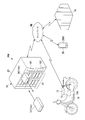
- FIG. 1 is a diagram illustrating an overall configuration of a battery lending system 10 (calculation system) according to the embodiment.
- the battery lending system 10 includes a saddle-ride type motorcycle 12 (saddle-ride type vehicle, electric vehicle), a detachable battery 14 (battery), a charging station 16 (charging device), and a management server 18 ( Server) and the mobile terminal 28.
- the detachable battery 14 is a cassette-type power storage device that is detachably attached to the motorcycle 12 that can run at least with electric power.
- the detachable battery 14 is provided by rental, and the user borrows it at the charging station 16 and mounts it on the motorcycle 12.
- the detachable battery 14 that needs to be charged may be distinguished from the “used battery 14u”, and the detachable battery 14 that has been charged may be distinguished from the “charged battery 14c”.
- At least one detachable battery 14 is mounted on one motorcycle 12.
- the detachable battery 14 has a storage unit 144.
- the storage unit 144 of the detachable battery 14 stores power consumption calculation parameter information (mileage, battery energy usage) and classification information (date and time) in association with user identification information (user ID). . Data stored in the removable battery 14 and the storage unit 144 will be described later.
- the charging station 16 is a facility for storing and charging one or more detachable batteries 14, and is installed at a plurality of locations.
- the housing 20 of the charging station 16 is provided with a slot portion 21 composed of a plurality of (12 in the example of FIG. 1) slots, a display 161 and an authentication device 162.
- the charging station 16 is communicably connected to a management server 18 via a network NW.
- the network NW is a wireless communication network or a wired communication network.
- a charger 163 (FIG. 4) capable of charging the detachable battery 14 and a connection portion 164 (FIG. 4) are provided behind the slot 21.
- the management server 18 manages the battery lending system 10.
- the management server 18 stores electricity consumption information in association with the user ID.
- the power consumption (power consumption rate) indicates the amount of energy used per traveling distance (Wh / km).
- the user ID and the power consumption calculation parameter information are stored in the storage 144 of the used battery 14u inserted into the slot 21. (Driving distance, battery energy usage) and classification information (date and time) are read, and these information are transmitted from the charging station 16 to the management server 18.
- the management server 18 calculates the power consumption for each user from the information, and updates the power consumption information. Then, the management server 18 transmits the power consumption information for each user to the charging station 16.
- the electricity consumption information is based on the classification information (date and time), and for each period in which the user's behavior pattern and temperature are similar (every day, every weekday / holiday, every time zone, every season, every month, etc.). ).
- the user uses the motorcycle 12 for commuting, and on a holiday, uses the motorcycle 12 for entertainment. Even when the same user uses the same motorcycle 12, it is considered that the power consumption is different between when the same user uses the same motorcycle 12 and when it is used for commuting.
- the outside air temperature affects the performance of the detachable battery 14, and that the power consumption is significantly different between a low temperature winter season and a high temperature summer season.
- the charging station 16 stores information on the battery capacity and the state of deterioration of the removable battery 14 held by the charging station 16.
- the charging station 16 calculates the travelable distance for each user from the power consumption for each user for the available charged battery 14 c.
- the usable charged battery 14c is a detachable battery 14 which has been charged in the slot 21 of the charging station 16 and is ready to be lent to the user.
- the charging station 16 displays on the display 161 the travelable distance and the rental fee for each available charged battery 14c. At this time, the fairness of the fee can be maintained by setting the rental fee according to the possible travel distance.
- the fairness of the charge can be maintained by lowering the rental fee than the charged battery 14c having a long travelable distance.
- the user looks at the display on the display 161, selects a desired one from the available charged batteries 14c according to the travel plan, and attaches the selected charged battery 14c to the motorcycle 12.
- the mobile terminal 28 is a terminal carried by the user, and is, for example, a smartphone, a tablet terminal, a notebook computer, or the like. The user can operate the portable terminal 28 to obtain information about the removable battery 14 and the chargeable charging station 16.
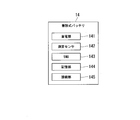
- FIG. 2 is a diagram illustrating a configuration example of the detachable battery 14 according to the present embodiment.
- the detachable battery 14 includes a power storage unit 141, a measurement sensor 142, a BMU 143, a storage unit 144, and a connection unit 145.
- the power storage unit 141 is, for example, any one of a secondary battery, a lead storage battery, a capacitor, a lithium ion battery, and the like.
- the measurement sensor 142 includes various sensors that measure current, voltage, and temperature.
- the BMU 143 is a battery management unit (Battery Management Unit), and controls charging and power supply to the power storage unit 141.
- the storage unit 144 stores various types of information.
- the storage unit 144 is, for example, a memory.
- the connection unit 145 is connected to a connection unit (not shown) of the motorcycle 12 and a connection unit 164 of the charging station 16 to input and output power and information.
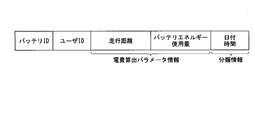
- FIG. 3 is a diagram illustrating an example of a data structure of the storage unit 144 of the detachable battery 14 according to the present embodiment.
- the storage unit 144 stores identification information of the detachable battery 14 (hereinafter, battery ID). Then, when the user borrows the detachable battery 14, the user ID indicating the borrowed user is stored in association with the battery ID. Then, while the user borrows the detachable battery 14, information on the travel distance obtained from the vehicle CAN (Controller Area Network) information and the information on the amount of battery energy used detected by the measurement sensor 142 are stored as power consumption calculation parameter information. You. Further, a date and a time are stored as the classification information.
- vehicle CAN Controller Area Network
- FIG. 4 is a diagram illustrating a configuration example of the charging station 16 according to the present embodiment.
- the charging station 16 includes a display 161, an authenticator 162, a charger 163, a connection unit 164, a communication unit 165, a storage unit 166, and a control unit 167.
- the display 161 is one of a liquid crystal display, an organic EL (Electro Luminescence) display, an electronic ink display, and the like.
- the display 161 displays information output by the control unit 167. In this embodiment, when the user borrows the battery, the display 161 displays, for each user, the charged battery 14c that can be used, the travelable distance of each charged battery 14c, and the rental fee. .
- the authenticator 162 is a device that reads record information of an NFC card (not shown) carried by the user using, for example, near field communication (NFC; Near Field Communication).
- NFC Near Field Communication
- the charger 163 is a device that charges the detachable battery 14 under the control of the control unit 167 while the connection unit 145 of the detachable battery 14 and the connection unit 164 of the charging station 16 are connected.
- a power supply (not shown) for supplying power to the detachable battery 14 is connected to the charger 163.
- the connection unit 164 is a connection unit with the connection unit 145 of the detachable battery 14, and supplies power and transmits and receives information.
- the connection unit 164 acquires the user ID output from the detachable battery 14, the power consumption calculation parameter information (mileage, battery energy usage), and the classification information (date and time), and sends the acquired information to the control unit 167. Output.
- the communication unit 165 transmits the user ID, the power consumption calculation parameter information (distance traveled, battery energy usage), and the classification information (date and time) read from the detachable battery 14 to the management server 18 via the network NW.
- the communication unit 165 receives the power consumption information for each user transmitted by the management server 18 and outputs the received power consumption information for each user to the control unit 167.
- the storage unit 166 stores a program that causes the control unit 167 to execute a process.
- the storage unit 166 stores information on the detachable batteries 14 inserted into the slot unit 21 and information on the state of charge and deterioration of each detachable battery 14.
- the control unit 167 functions as a charge control unit 1671, a measurement sensor 1672, an information acquisition unit 1673, and a calculation unit 1674 by reading and executing the program stored in the storage unit 166.
- the charging control unit 1671 controls charging of the removable battery 14 inserted in the slot unit 21.
- the measurement sensor 1672 acquires information of a current sensor, a voltage sensor, a temperature sensor, and the like. From the detection value of the measurement sensor 1672, the battery capacity and the state of deterioration of the removable battery 14 inserted in the slot 21 can be determined.
- the charge control unit 1671 performs charge control according to the detection value of the measurement sensor 1672.
- the information acquisition unit 1673 acquires information output from the detachable battery 14 connected to the connection unit 164, and causes the storage unit 166 to store the acquired information.
- the calculation unit 1674 performs various calculations. In the present embodiment, the information acquisition unit 1673 acquires the power consumption information for each user returned from the management server 18.
- the calculation unit 1674 can use the battery capacity and the deterioration state (for example, average voltage) of each detachable battery 14 obtained by the measurement sensor 1672 and the power consumption information for each user obtained from the management server 18. The travelable distance for each user is calculated for the charged battery 14c.
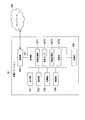
- FIG. 5 is a diagram illustrating a configuration example of the management server 18 according to the present embodiment.
- the management server 18 includes a communication unit 181, a storage unit 182, and a control unit 183.
- the control unit 183 includes an information acquisition unit 1831 and a calculation unit 1832 (power consumption calculation unit, distance calculation unit).
- the communication unit 181 receives the user ID, the power consumption calculation parameter information (mileage, battery energy usage), and the classification information (date and time) transmitted by the charging station 16.
- the communication unit 181 transmits the power consumption information for each user calculated by the calculation unit 1832 to the mobile terminal 28 via the network NW.
- the information acquisition unit 1831 acquires a user ID, power consumption calculation parameter information (mileage, battery energy usage), and classification information (date and time) from the information received by the communication unit 181.
- the operation unit 1832 calculates, for each power consumption calculation condition, the user ID acquired by the information acquisition unit 1831, the electricity consumption calculation parameter information (mileage, battery energy usage), and the classification information (date and time). Calculate the power consumption for each user.
- the storage unit 182 includes, for example, a storage device such as a hard disk built in or external to the computer system.
- the electricity consumption information for each user obtained by the calculation unit 1832 is recorded in the storage unit 182.
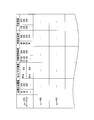
- FIG. 6 is a diagram illustrating an example of a data structure of the electricity consumption information stored in the storage unit 182 of the management server 18 according to the present embodiment.
- the storage unit 182 stores power consumption information of each user in association with the user ID.
- the power consumption information is obtained by classifying the power consumption information into periods and temperatures (each day of the week, weekdays / holidays, each time zone, each season, every month, etc.) based on the classification information (date and time). And stored in the storage unit 182.
- the power consumption of each user is obtained by classifying each day of the week, weekday / holiday, time zone, season, and month, it is not necessary to classify all.
- the power consumption of the user may be obtained by classifying only the weekdays / holidays.
- FIG. 7 is a flowchart showing a battery replacement procedure in the battery lending system 10 according to the present embodiment.
- Step L1 The replacement work of the detachable battery 14 is started.
- Step S1 When using the motorcycle 12, the user borrows the detachable battery 14 (charged battery 14c).
- Step S2 When the detachable battery 14 is lent, the user ID indicating the borrowed user is stored in the storage unit 144 of the detachable battery 14, as shown in FIG.
- Step S3 During the operation of the motorcycle 12 with the detachable battery 14 attached to the motorcycle 12, the power consumption calculation parameter information (travel distance, battery energy usage) and the classification information (date and time) are The acquired information is stored in the storage unit 144 of the removable battery 14 in association with the user ID as shown in FIG.
- Step S4 The user removes the detachable battery 14 (used battery 14u) from the motorcycle 12, and returns it to the slot 21 of the charging station 16.
- Step S5 Upon detecting that the detachable battery 14 has been returned to the slot unit 21, the control unit 167 of the charging station 16 reads the user ID and the electricity consumption calculation parameter information (the traveling distance) from the storage unit 144 of the detachable battery 14. , Battery energy usage) and classification information (date and time), and transmit them to the management server 18.
- the control unit 167 of the charging station 16 Upon detecting that the detachable battery 14 has been returned to the slot unit 21, the control unit 167 of the charging station 16 reads the user ID and the electricity consumption calculation parameter information (the traveling distance) from the storage unit 144 of the detachable battery 14. , Battery energy usage) and classification information (date and time), and transmit them to the management server 18.
- Step S6 the calculation unit 1832 of the management server 18 calculates the power consumption for each user using the power consumption calculation parameter information (the mileage and the amount of battery energy used).
- the power consumption is calculated based on the classification information (date and time) based on the period and the temperature in which the behavior pattern is similar (every day of the week, weekday / holiday, every time zone, every season, every month, etc.).
- the user's electricity cost can be calculated as follows.
- the storage unit 182 of the management server 18 stores power consumption information of each user up to the previous time. In the initial state, an average value is stored as power consumption information of the user. As the user repeatedly exchanges the detachable battery 14, the process of step S6 is repeated, and the power consumption information of each user is updated.
- Step S7 The management server 18 transmits the user electricity consumption information of the user to the charging station 16.
- Step S8 When the calculation unit 1674 of the charging station 16 receives the user power consumption information, the calculation unit 1674 can use the received user power consumption information and the battery capacity and the average voltage of the removable battery 14 stored in the storage unit 166.
- the travelable distance of the detachable battery 14 is calculated.
- the electricity cost information is calculated by classifying each day of the week, weekday / holiday, time zone, season, month, and the like, and the calculating unit 1674 of the charging station 16 uses the electricity cost information suitable for the current environment among them. To calculate the possible travel distance. For example, when renting a battery on a holiday, the travelable distance is calculated using the electricity consumption information of the user on the holiday.
- the travelable distance (AER: All @ Electric @ Range) can be calculated as follows.
- Driving distance (AER) (battery capacity x average voltage) / user's power consumption
- the available battery capacity and average voltage of each removable battery 14 are measured by the measurement sensor 1672 of the charging station 16 and stored in the storage unit 166.
- the battery capacity and the average voltage are the same for the same type of battery, but vary depending on the state of charge and the influence of deterioration.
- Step S9 After calculating the travelable distance for each user, the charging station 16 displays the travelable distance and the rental fee for each user for the available charged battery 14c. As will be described later, the rental fee can present a fair price in accordance with the power consumption of each user and the state of deterioration of the detachable battery 14.
- Step L2 The replacement of the removable battery 14 is completed.
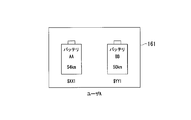
- FIG. 8A and 8B are diagrams showing the display of the mileage for each user displayed on the display 161 of the charging station 16 according to the present embodiment.
- FIG. 8A is a display for the user A.
- FIG. 8B is a display for the user B.
- two batteries, a battery “AA” and a battery “BB” are available charged batteries 14c. Even with the same charged battery 14c, the capacity of each battery varies depending on the deterioration of the battery.
- the battery capacity of battery “AA” is larger than the battery capacity of battery “BB”.
- the battery “AA” and the battery “BB” are presented as available charged batteries 14c.
- the mileage is displayed as “54 km”, and the rental fee is displayed as “$ XX1”.
- the mileage is displayed as “50 km” and the rental fee is displayed as “$ YY1”.
- the user A refers to the travelable distance and the rental fee to select and rent one of the battery “AA” and the battery “BB”.
- the difference in the lending fee between the battery “AA” and the battery “BB” is due to the difference in the mileage.
- the battery “AA” has a longer travelable distance than the battery “BB”, and thus the rental fee “$ XX1” is set to be slightly higher than the rental fee “$ YY1”.
- the user can select a battery according to how long the traveling distance of the motorcycle 12 to travel will be. That is, if the traveling distance is short, the rental fee can be reduced by selecting the battery “BB”. If the traveling distance is long, selecting the battery "AA” allows the vehicle to travel over a long distance with confidence.
- the battery “AA” and the battery “BB” are presented as available charged batteries 14c.
- the mileage is displayed as “59 km” and the rental fee is displayed as “$ XX2”
- the rental fee is displayed as “$ YY2”.
- the user B selects and borrows either the battery “AA” or the battery “BB” with reference to the travelable distance and the rental fee.
- the difference is caused by the difference in power consumption for each user. Since the user B has a better power consumption than the user A, the travelable distance is longer.
- the user B can select a battery according to how long the traveling distance of the motorcycle 12 to be traveling will be. Since the travelable distance displayed at this time is calculated according to the day of the week, weekday / holiday, time zone, season, month, and the like for each user, the reliability is high.
- the traveling distance of the user B is calculated based on the lending fee at the traveling distance unit price of the user A. Lending fee at unit price is low. That is, the lending fee ($ XX1 and $ YY1) when user A borrows batteries "AA” and "BB” and the lending fee ($ XX2 and $ XX) when user B borrows batteries "AA” and "BB". Even if YY2) is the same, user B can run a longer distance than user A, and accordingly, the rental fee per travel distance of user B is lower.
- the user can know a highly accurate travelable distance, and can select and borrow a desired battery from a plurality of available charged batteries 14c. Thereby, the user can select the optimal removable battery 14 according to the usage plan. Further, in the present embodiment, by setting the rental fee according to the travelable distance, the deterioration state of the battery can be reflected on the rental fee. As a result, the fairness of the rental fee can be maintained.
- the power consumption calculation parameter information (distance traveled, battery energy usage) and classification information (date and time) for each user are transmitted from the charging station 16 to the management server 18, but the motorcycle 12 has a communication function.
- the TCU may transmit such information to the management server 18 at a predetermined time or at a predetermined time interval.
- the process of calculating the possible travel distance from the electricity consumption information is performed by the calculation unit 1674 of the charging station 16; however, the process of calculating the possible travel distance from the electricity consumption information is performed by the calculation unit 1832 ( Distance calculation unit).
- the available travel distance and the rental fee for each user are displayed on the display 161 of the management server 18 for the available charged battery 14c.
- the rental fee may be displayed.
- FIG. 9 is a diagram showing an overall configuration of a battery lending system 10A according to a modification of the embodiment.
- the motorcycle 12 includes a TCU having a communication function.
- the calculation unit 1832 of the management server 18 performs the process of calculating the possible travel distance from the electricity cost information.
- the travelable distance and the rental fee for each user are displayed on the display unit 2801 of the portable terminal 28.
- the battery lending system 10A includes a saddle-ride type motorcycle 12 (saddle-ride type vehicle), a TCU 13, a detachable battery 14 (battery), a charging station 16, a management server 18, and a portable terminal 28. Including. Components having the same functions as those of the battery lending system 10 are denoted by the same reference numerals, and description thereof is omitted.
- the TCU 13 is a communication unit mounted in the motorcycle 12.
- the TCU 13 obtains the user ID, the power consumption calculation parameter information (mileage, battery energy usage), and the classification information (date and time) stored in the storage unit 144 of the detachable battery 14, and transmits the obtained information to the network NW.
- the transmission timing is, for example, a predetermined time or a predetermined time interval (for example, every one minute).
- the control unit 183 (FIG. 5) of the management server 18 transmits the user ID, the power consumption calculation parameter information (mileage, battery energy usage), and the classification information (date and time) from the TCU 13 via the communication unit 181 (FIG. 5). To receive. Then, the arithmetic unit 1832 of the management server 18 calculates the day of the week, weekday / holiday, time zone, season, month, etc. based on the electricity consumption calculation parameter information (travel distance, battery energy usage) based on the classification information (date and time). For each user, the power consumption of each user is calculated.
- the user can reserve the battery using the portable terminal 28 when replacing the removable battery 14.
- the user sends a user ID to be authenticated, and connects the mobile terminal 28 to the management server 18. Then, the user operates the portable terminal 28 to select the charging station 16 desired to be replaced.
- the management server 18 stores a database for managing information on the detachable batteries 14 of each charging station 16 (battery ID, the number of charged batteries 14c and used batteries 14u, the battery capacity of each detachable battery 14, the state of deterioration, and the like). Have.
- the management server 18 acquires information on the charged battery 14c that can be reserved at each charging station 16 from this database, and presents it to the portable terminal 28 of each user.
- the operation unit 1832 of the management server 18 calculates the possible travel distance for each user for the charged battery 14c that can be reserved at the charging station 16 that is desired to be replaced, from the power consumption information for each user and the information in the database.
- the portable terminal 28 displays the travelable distance and the rental fee for each user on the display unit 2801 for the charged battery 14c that can be reserved at the charging station 16 where replacement is desired.
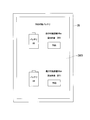
- FIG. 10 is a diagram showing a display example of the display unit 2801 of the portable terminal 28 according to the modification.
- the display unit 2801 of the portable terminal 28 displays the travelable distance and the rental fee for each user for the charged battery 14 c that can be reserved at the charging station 16 where the replacement is desired.
- the battery “AA” and the battery “BB” are presented as the charged battery 14c that can be reserved by the user.
- the mileage is displayed as “54 km”
- the rental fee is displayed as “$ XX1”.
- the battery “BB” the mileage is displayed as “50 km” and the rental fee is displayed as “$ YY1”.
- One embodiment of the present invention is a battery rental system 10 in which a charging station 16 for storing and charging a detachable battery 14 is installed, and the detachable battery 14 is rented at the charging station 16 and mounted on a motorcycle 12.
- a storage unit 144 for storing the power consumption calculation parameter information for obtaining the power consumption for each user in association with the user; and acquiring the power consumption calculation parameter information stored in the storage unit 144 to reduce the power consumption for each user.
- a program for realizing the functions of the battery lending systems 10 and 10A in the present invention is recorded on a computer-readable recording medium, and the program recorded on the recording medium is read by a computer system and executed.
- the battery lending system 10, 10A may be realized.
- the “computer system” includes an OS and hardware such as peripheral devices.
- the “computer system” also includes a WWW system provided with a homepage providing environment (or display environment).
- the “computer-readable recording medium” refers to a portable medium such as a flexible disk, a magneto-optical disk, a ROM, and a CD-ROM, and a storage device such as a hard disk built in a computer system.
- the “computer-readable recording medium” refers to a volatile memory (RAM) inside a computer system that becomes a server or a client when a program is transmitted through a network such as the Internet or a communication line such as a telephone line. And those holding programs for a certain period of time.
- RAM volatile memory
- the program may be transmitted from a computer system storing the program in a storage device or the like to another computer system via a transmission medium or by a transmission wave in the transmission medium.
- the "transmission medium” for transmitting a program refers to a medium having a function of transmitting information, such as a network (communication network) such as the Internet or a communication line (communication line) such as a telephone line.
- the program may be for realizing a part of the functions described above.
- a difference file difference file (difference program) may be sufficient.
- 10A battery lending system (calculation system), 12: motorcycle (electric vehicle), 14: detachable battery, 16: charging station (charging device), 18: management server (server), 21: slot unit, 28 ... portable terminal, 144 ... storage unit, 161 ... display unit, 166 ... storage unit, 167 ... control unit, 1671 ... charge control unit, 1672 ... measurement sensor, 1673 ... information acquisition unit, 1674 ... calculation unit, 183 # control unit, 1831: information acquisition unit, 1832: calculation unit (power consumption calculation unit, distance calculation unit)
Landscapes
- Business, Economics & Management (AREA)
- Accounting & Taxation (AREA)
- Finance (AREA)
- Development Economics (AREA)
- Economics (AREA)
- Marketing (AREA)
- Strategic Management (AREA)
- Physics & Mathematics (AREA)
- General Business, Economics & Management (AREA)
- General Physics & Mathematics (AREA)
- Engineering & Computer Science (AREA)
- Theoretical Computer Science (AREA)
- Management, Administration, Business Operations System, And Electronic Commerce (AREA)
- Electric Propulsion And Braking For Vehicles (AREA)
Abstract
L'invention porte sur un système de calcul comprenant : une unité de stockage qui stocke des informations de paramètres de calcul de consommation d'énergie, servant à calculer une consommation d'énergie qui est une vitesse de consommation d'énergie pour chaque utilisateur d'un véhicule électrique sur lequel une batterie amovible est montée, en association avec l'utilisateur ; et un serveur de gestion qui acquiert les informations de paramètres de calcul de consommation d'énergie stockées dans l'unité de stockage, et calcule la consommation d'énergie pour chaque utilisateur. Le système de calcul calcule, pour chaque utilisateur, une distance pouvant être parcourue que le véhicule électrique équipé de la batterie amovible peut parcourir, en utilisant la consommation d'énergie pour chaque utilisateur calculée par le serveur de gestion.
Priority Applications (1)
| Application Number | Priority Date | Filing Date | Title |
|---|---|---|---|
| JP2020534648A JP7420722B2 (ja) | 2018-07-31 | 2019-07-30 | 算出システム、算出方法、及びサーバ |
Applications Claiming Priority (2)
| Application Number | Priority Date | Filing Date | Title |
|---|---|---|---|
| JP2018-143633 | 2018-07-31 | ||
| JP2018143633 | 2018-07-31 |
Publications (1)
| Publication Number | Publication Date |
|---|---|
| WO2020027092A1 true WO2020027092A1 (fr) | 2020-02-06 |
Family
ID=69231900
Family Applications (1)
| Application Number | Title | Priority Date | Filing Date |
|---|---|---|---|
| PCT/JP2019/029747 Ceased WO2020027092A1 (fr) | 2018-07-31 | 2019-07-30 | Système de calcul, procédé de calcul et serveur |
Country Status (2)
| Country | Link |
|---|---|
| JP (1) | JP7420722B2 (fr) |
| WO (1) | WO2020027092A1 (fr) |
Cited By (1)
| Publication number | Priority date | Publication date | Assignee | Title |
|---|---|---|---|---|
| US12485760B2 (en) * | 2023-02-08 | 2025-12-02 | Toyota Jidosha Kabushiki Kaisha | Method of display control and display controller |
Citations (3)
| Publication number | Priority date | Publication date | Assignee | Title |
|---|---|---|---|---|
| JP2016143246A (ja) * | 2015-02-02 | 2016-08-08 | トヨタ自動車株式会社 | 消費電力量予測装置、消費電力量予測方法、サーバ装置 |
| JP2017005776A (ja) * | 2015-06-04 | 2017-01-05 | 株式会社椿本チエイン | 情報提供装置、充電装置、コンピュータプログラム及び情報提供方法 |
| WO2017086174A1 (fr) * | 2015-11-17 | 2017-05-26 | オムロン株式会社 | Dispositif de réservation de batterie et procédé de réservation de batterie |
Family Cites Families (2)
| Publication number | Priority date | Publication date | Assignee | Title |
|---|---|---|---|---|
| US9552682B2 (en) * | 2011-07-26 | 2017-01-24 | Gogoro Inc. | Apparatus, method and article for redistributing power storage devices, such as batteries, between collection, charging and distribution machines |
| US10158102B2 (en) * | 2013-08-30 | 2018-12-18 | Gogoro Inc. | Portable electrical energy storage device with thermal runaway mitigation |
-
2019
- 2019-07-30 WO PCT/JP2019/029747 patent/WO2020027092A1/fr not_active Ceased
- 2019-07-30 JP JP2020534648A patent/JP7420722B2/ja active Active
Patent Citations (3)
| Publication number | Priority date | Publication date | Assignee | Title |
|---|---|---|---|---|
| JP2016143246A (ja) * | 2015-02-02 | 2016-08-08 | トヨタ自動車株式会社 | 消費電力量予測装置、消費電力量予測方法、サーバ装置 |
| JP2017005776A (ja) * | 2015-06-04 | 2017-01-05 | 株式会社椿本チエイン | 情報提供装置、充電装置、コンピュータプログラム及び情報提供方法 |
| WO2017086174A1 (fr) * | 2015-11-17 | 2017-05-26 | オムロン株式会社 | Dispositif de réservation de batterie et procédé de réservation de batterie |
Cited By (1)
| Publication number | Priority date | Publication date | Assignee | Title |
|---|---|---|---|---|
| US12485760B2 (en) * | 2023-02-08 | 2025-12-02 | Toyota Jidosha Kabushiki Kaisha | Method of display control and display controller |
Also Published As
| Publication number | Publication date |
|---|---|
| JPWO2020027092A1 (ja) | 2021-08-10 |
| JP7420722B2 (ja) | 2024-01-23 |
Similar Documents
| Publication | Publication Date | Title |
|---|---|---|
| JP6738982B2 (ja) | サーバ装置、バッテリ共同利用サービスシステム、方法、コンピュータプログラム及び記憶媒体 | |
| JP6800124B2 (ja) | 電力課金システム及び電力課金方法 | |
| JP6624114B2 (ja) | 充放電システム用サーバ及び充放電システム | |
| JP7030994B2 (ja) | 充電システム、充電装置、充電方法、及びプログラム | |
| EP2802951B1 (fr) | Services réseau de charge de véhicule électrique | |
| JP7003595B2 (ja) | 賃貸料金設定装置、賃貸料金設定方法および賃貸料金設定システム | |
| JP5849897B2 (ja) | 電池管理システムおよび電池の交換方法 | |
| JP6972956B2 (ja) | 賃貸料金設定装置、賃貸料金設定方法および賃貸料金設定システム | |
| JP2019095988A (ja) | 賃貸料金設定装置、賃貸料金設定方法および賃貸料金設定システム | |
| JP2021077448A (ja) | バッテリ交換装置、不正判定方法、およびプログラム | |
| JP7031266B2 (ja) | 賃貸料金設定装置、賃貸料金通知方法および賃貸料金設定システム | |
| CN113993739A (zh) | 根据使用数据动态地改变可充电电池的充电率的可充电电池服务终端 | |
| WO2021005703A1 (fr) | Dispositif et procédé de fourniture d'informations, et programme | |
| WO2020166602A1 (fr) | Appareil et procédé de charge, programme et support d'enregistrement | |
| WO2020213608A1 (fr) | Procédé de commande, système de commande, et programme | |
| WO2020027087A1 (fr) | Système et procédé de guidage, dispositif de serveur, programme informatique et support de stockage | |
| EP4016693A1 (fr) | Procédé de traitement d'informations, dispositif de traitement d'informations et programme de traitement d'informations | |
| WO2020027092A1 (fr) | Système de calcul, procédé de calcul et serveur | |
| JPWO2020027119A1 (ja) | 測定システム、測定方法、コンピュータプログラム及び記憶媒体 | |
| JP7796891B2 (ja) | バッテリ共用システム、管理装置、制御方法、およびプログラム | |
| US20190172127A1 (en) | Information processing device, information processing method, and information processing system | |
| JP7760073B2 (ja) | バッテリ共用システム、管理装置、制御方法、およびプログラム | |
| US20190139160A1 (en) | Fee setting device and fee setting method | |
| JP2024040168A (ja) | 移動体の異常判定装置 | |
| WO2020213609A1 (fr) | Procédé de commande, système de commande et programme |
Legal Events
| Date | Code | Title | Description |
|---|---|---|---|
| 121 | Ep: the epo has been informed by wipo that ep was designated in this application |
Ref document number: 19844536 Country of ref document: EP Kind code of ref document: A1 |
|
| ENP | Entry into the national phase |
Ref document number: 2020534648 Country of ref document: JP Kind code of ref document: A |
|
| NENP | Non-entry into the national phase |
Ref country code: DE |
|
| 122 | Ep: pct application non-entry in european phase |
Ref document number: 19844536 Country of ref document: EP Kind code of ref document: A1 |