WO2020031349A1 - Dispositif de génération d'énergie solaire et procédé de commande de dispositif de génération d'énergie solaire - Google Patents
Dispositif de génération d'énergie solaire et procédé de commande de dispositif de génération d'énergie solaire Download PDFInfo
- Publication number
- WO2020031349A1 WO2020031349A1 PCT/JP2018/029988 JP2018029988W WO2020031349A1 WO 2020031349 A1 WO2020031349 A1 WO 2020031349A1 JP 2018029988 W JP2018029988 W JP 2018029988W WO 2020031349 A1 WO2020031349 A1 WO 2020031349A1
- Authority
- WO
- WIPO (PCT)
- Prior art keywords
- power generation
- attitude
- rain
- light
- light receiving
- Prior art date
- Legal status (The legal status is an assumption and is not a legal conclusion. Google has not performed a legal analysis and makes no representation as to the accuracy of the status listed.)
- Ceased
Links
Images






Classifications
-
- G—PHYSICS
- G05—CONTROLLING; REGULATING
- G05D—SYSTEMS FOR CONTROLLING OR REGULATING NON-ELECTRIC VARIABLES
- G05D3/00—Control of position or direction
-
- H—ELECTRICITY
- H02—GENERATION; CONVERSION OR DISTRIBUTION OF ELECTRIC POWER
- H02S—GENERATION OF ELECTRIC POWER BY CONVERSION OF INFRARED RADIATION, VISIBLE LIGHT OR ULTRAVIOLET LIGHT, e.g. USING PHOTOVOLTAIC [PV] MODULES
- H02S20/00—Supporting structures for PV modules
- H02S20/30—Supporting structures being movable or adjustable, e.g. for angle adjustment
- H02S20/32—Supporting structures being movable or adjustable, e.g. for angle adjustment specially adapted for solar tracking
-
- Y—GENERAL TAGGING OF NEW TECHNOLOGICAL DEVELOPMENTS; GENERAL TAGGING OF CROSS-SECTIONAL TECHNOLOGIES SPANNING OVER SEVERAL SECTIONS OF THE IPC; TECHNICAL SUBJECTS COVERED BY FORMER USPC CROSS-REFERENCE ART COLLECTIONS [XRACs] AND DIGESTS
- Y02—TECHNOLOGIES OR APPLICATIONS FOR MITIGATION OR ADAPTATION AGAINST CLIMATE CHANGE
- Y02E—REDUCTION OF GREENHOUSE GAS [GHG] EMISSIONS, RELATED TO ENERGY GENERATION, TRANSMISSION OR DISTRIBUTION
- Y02E10/00—Energy generation through renewable energy sources
- Y02E10/50—Photovoltaic [PV] energy
Definitions
- the present invention relates to a photovoltaic power generator and a control method for the photovoltaic power generator.
- a photovoltaic power generation device having a solar tracking function of changing the attitude of the photovoltaic power generation panel and automatically tracking the light receiving surface to the sun. Such a photovoltaic power generator does not execute the sun tracking at night when solar radiation cannot be obtained.
- Patent Document 1 discloses that in a situation where sufficient power generation performance cannot be expected, such as at night, the light receiving surface of the photovoltaic power generation panel is turned obliquely upward to easily receive rain, and the dust and other attached substances are washed away by rain. A device has been proposed.
- a photovoltaic power generation device includes a photovoltaic power generation panel having a light receiving surface, a driving device that changes the attitude of the photovoltaic power generation panel, and a case where a predetermined light rain condition is satisfied during the day.
- a control unit that causes the drive device to execute a retracting operation of changing the attitude of the solar power panel to a retracting attitude in which a light receiving surface of the solar panel faces downward.
- control method of the photovoltaic power generation device includes a driving device that changes a photovoltaic power generation panel posture, the photovoltaic power generation panel posture, the photovoltaic power generation panel light receiving surface.
- the operation is performed by the driving device.
- the present disclosure can be realized not only as a photovoltaic power generation device including such a characteristic control unit and a control method of the photovoltaic power generation device having such a characteristic process as a step, but also assuming such a step as It can be realized as a program to be executed. Further, the present invention can be realized as a semiconductor integrated circuit having a function of performing some or all of the steps, or as a solar power generation system including a solar power generation device.
- FIG. 4 is a side view showing an example of a retracted attitude of the array. It is a flowchart which shows an example of the attitude
- the photovoltaic power generation device includes a photovoltaic power generation panel having a light receiving surface, a driving device that changes the attitude of the photovoltaic power generation panel, and a case where a predetermined light rain condition is satisfied during the day.
- a control unit that causes the drive device to execute a retracting operation of changing the attitude of the photovoltaic panel to a retracting attitude in which the light receiving surface of the solar panel faces downward.
- the photovoltaic panel may be a concentrating photovoltaic panel or a crystalline silicon type photovoltaic panel.
- the retracting posture may be a horizontal posture or an inclined posture as long as the light receiving surface faces downward.
- the light rain condition may be a condition based on at least one of precipitation intensity, precipitation, and cloudiness.
- the light rain condition is a condition in which light rain is predicted
- the control unit determines whether the light rain condition is a predetermined time before the time when light rain is predicted.
- the driving device may start the shunting operation.
- the control unit may cause the driving device to avoid the evacuation operation when a heavy rain condition different from the light rain condition is satisfied in the daytime. You may. This makes it possible to wash away dirt attached to the light receiving surface when a certain heavy rain falls.
- the control unit may be configured such that when the solar power generation panel is in the evacuation position during the daytime and the light rain condition is not satisfied,
- the driving device may execute a release operation for releasing the retracted posture. In this way, when the rain has stopped or when the rain has changed to a certain level, the evacuation posture of the photovoltaic power generation panel is released, and the posture of the photovoltaic power generation panel is received by the light receiving surface for receiving sunlight. It is possible to change to a cleaning posture or the like in which dirt on the light receiving surface is washed away by rain.
- the driving device can execute a sun tracking operation in which the solar power generation panel tracks the sun, and the control unit performs the sun tracking operation.
- the driving device may switch from the sun tracking operation to the retreat operation.
- the solar power generation device performs the sun tracking operation in fine weather to generate power with high efficiency, and when the light rain condition is satisfied, switches from the sun tracking operation to the evacuation operation to remove dirt on the light receiving surface. Adhesion can be prevented.
- the method for controlling a photovoltaic power generation device includes: a driving device that changes the photovoltaic power generation panel; Evacuation for changing the attitude of the photovoltaic power generation panel from the light-receiving attitude to the evacuation attitude in which the light-receiving surface faces downward when a predetermined light rain condition is satisfied during the daytime by setting the light-receiving attitude toward the sun.
- the operation is performed by the driving device.
- FIG. 1 is a perspective view showing a configuration of a solar power generation device according to the present embodiment
- FIG. 2 is a side view thereof.
- the photovoltaic power generation device 100 includes an array 1 having a shape that is continuous on the upper side and is divided into left and right sides on the lower side, and a supporting device 2 for the array.
- the array 1 is an example of the solar panel according to the embodiment.
- the array 1 is configured by arranging the concentrating photovoltaic modules 1M on a gantry 11 (FIG. 2) on the rear side.
- the support device 2 includes a support column 21, a foundation 22, a two-axis driving unit 23, and a horizontal shaft 24 (FIG. 2) serving as a driving shaft.
- the support 21 has a lower end fixed to the foundation 22 and a biaxial drive unit 23 at the upper end.
- a box 13 (FIG. 2) for electrical connection and storage of an electric circuit is provided near the lower end of the column 21.
- the foundation 22 is buried firmly in the ground so that only the upper surface can be seen.
- the struts 21 are vertical and the horizontal axis 24 is horizontal.
- the two-axis driving unit 23 can rotate the horizontal axis 24 in two directions of an azimuth (an angle with the support 21 as a central axis) and an elevation (an angle with the horizontal axis 24 as a central axis).
- the horizontal shaft 24 is fixed to the gantry 11. Thus, if the horizontal axis 24 rotates in an azimuth or elevation direction, the array 1 also rotates in that direction.
- the support device 2 that supports the array 1 with one support 21 is shown, but the configuration of the support device 2 is not limited to this. In short, any supporting device that can movably support the array 1 in two axes (azimuth and elevation) may be used.
- FIG. 3 is a perspective view illustrating an example of the configuration of the module 1M.
- the module 1M is a concentrating solar power generation module.
- the module 1M includes a rectangular flat-bottomed container 31 made of metal, for example, and a light collector 32 mounted thereon like a lid.
- the condensing unit 32 is configured by, for example, attaching a resin condensing lens 32f to the back surface of one transparent glass plate 32a.
- each of the illustrated square (10 ⁇ 14) sections is a Fresnel lens as the condenser lens 32f, and can converge sunlight to a focal position.
- the flexible printed wiring board 33 is disposed on the bottom surface 31 b of the housing 31. At a predetermined position on the flexible printed wiring board 33, a cell package 34 holding a cell (power generation element) is mounted. In the figure, a portion surrounded by a two-dot chain line “O” is an enlarged view of the light receiving portion R.
- a secondary lens 35 is provided on the cell package 34, and a protection plate 36 is provided around the secondary lens 35.
- the secondary lens 35 is, for example, a ball lens.
- the protection plate 36 is, for example, an annular metal body, and a commercially available washer can be used.
- the protection plate 36 prevents the convergent light from thermally damaging the cell periphery when the convergent light of the sunlight deviates from the secondary lens 15. Further, even when all the converging light enters the secondary lens 35, the protection plate 36 receives the scattered light in the housing 31 and reflects it.
- the number of the light receiving portions R is provided in the same number and at the same interval corresponding to each of the condenser lenses 32f.
- a shielding plate 37 is provided between the light receiving unit R and the light collecting unit 32.
- a square opening 37a similar to the outer shape of one condenser lens 32f is formed at a position corresponding to each condenser lens 32f.
- Light converged by the condenser lens 32f passes through the opening 37a.
- FIG. 4 is an example of a sectional view showing the minimum basic configuration of the optical system.
- the incident direction of the sunlight is perpendicular to the condenser lens 32f of the condensing unit 32, and the incident direction A S and the optical axis A X are parallel to each other (i.e., the incident direction A S and the light and the axis A X are coincident).
- the light converged by the condenser lens 32f passes through the opening 37a of the shielding plate 37 and enters the secondary lens 35.
- the secondary lens 35 guides the incident light to the cell 38.
- the cell 38 is held in the cell package 34.
- the protection plate 36 is attached so as to ride on the upper end of the cell package 34.
- a light transmissive resin 39 is sealed between the secondary lens 35 and the cell 38. As shown in FIG. 4, when the optical axis A X connecting the condenser lens 32f and the cell 38 meets the incident direction A S of sunlight, all light collected by the condenser lens 32f cell It is led to 38. The cell 38 converts most of the received light into electrical energy and outputs power.
- FIG. 5 is a block diagram illustrating an example of an outline of a control unit of the photovoltaic power generation device 100.
- the control unit 5 is provided, for example, in a box 13 (see FIG. 2).
- the control unit 5 includes a CPU 51 and a memory 52.
- the memory 52 stores a control program 52a for executing a later-described attitude control process and a precipitation state determination process, and the CPU 51 can execute the control program 52a stored in the memory 52.
- a driving device 6 for driving each of an azimuth driving motor 23a and an elevation driving motor 23e is provided, and the CPU 51 executes the control program 52a to execute the driving.
- each of the motors 23a and 23e can be controlled. Accordingly, the CPU 51 drives the azimuth drive motor 23a and the elevation drive motor 23e to cause the drive device 6 to perform the sun tracking operation so that the array 1 faces the sun. Further, as described later, when a light rain condition is satisfied, the CPU 51 causes a retreat operation to change the attitude of the array 1 to the retreat attitude.
- the memory 52 is provided with a save flag indicating whether or not the save operation can be executed (not shown).
- the solar power generation device 100 includes a tracking sensor 701, a solar radiation sensor 702, and a precipitation sensor 703.
- the tracking sensor 701, the solar radiation sensor 702, and the precipitation sensor 703 are installed in an empty space of the array 1 or in the vicinity of the array 1.
- the precipitation sensor 703 is, for example, a precipitation particle size measuring device or a precipitation intensity meter, and outputs information on precipitation intensity.
- the control unit 5 is provided with an A / D converter 53, and the CPU 51 is connected to the A / D converter 53.
- Each of the tracking sensor 701, the solar radiation sensor 702, and the precipitation sensor 703 is connected to the A / D converter 53, and the output signals of the tracking sensor 701, the solar radiation sensor 702, and the precipitation sensor 703 are digitally output by the A / D converter 53.
- the signal is converted into a signal and input to the control unit 5.
- the power generated by the array 1 can be detected by the power sensor 704, and the power sensor 704 is connected to the A / D converter 53. Thereby, a signal indicating the power detected by the power sensor 704 is input to the CPU 51.
- the control unit 5 stores the latitude and longitude of the installation location of the solar power generation device 100 and has a clock function.
- the control unit 5 causes the driving device 6 to perform a sun tracking operation based on the output signal of the tracking sensor 701 and the position of the sun calculated from the latitude, longitude, and time so that the solar power generation panel 1 always faces the sun. Let it run. However, the tracking sensor 701 may not be provided. In that case, the sun tracking operation is performed based only on the position of the sun calculated from the latitude, longitude, and time.
- the control unit 5 is connected to the external data source 9 via, for example, the Internet.
- the external data source 9 is a server that provides weather information and is operated by, for example, an organization of a national or local government or a private weather information company.
- the external data source 9 provides the control unit 5 with local weather information at the place where the photovoltaic power generator 100 is installed.
- a space is provided between the left and right wings of the array 1 (see FIG. 1).
- the columns 21 are located in this space, and contact between the columns 21 and the array 1 is prevented.
- the array 1 can take any posture from a horizontal posture with the light receiving surface facing upward to a horizontal posture with the light receiving surface facing downward without interfering with the support 21 (see FIG. 2).
- the attitude of the array 1 can be changed between the sun tracking attitude in which the light receiving surface faces the sun and the retracting attitude in which the light receiving surface faces downward by the attitude control by the control unit 5. it can.
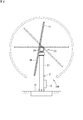
- FIG. 6A is a side view showing an example of the sun tracking attitude of the array 1.
- the attitude control of the array 1 is performed so that the light receiving surface 1a faces the sun, and the attitude of the array 1 becomes the sun tracking attitude.
- the array 1 since the sun altitude is 0 ° at sunrise or sunset, the array 1 takes a vertical posture in which the light receiving surface 1a is parallel to the vertical direction. In the daytime when the sun altitude exceeds 0 °, the array 1 takes a posture in which the light receiving surface faces upward.
- the incident angle of sunlight on the light receiving surface 1a becomes 0 °, and efficient power generation is performed.
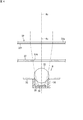
- FIG. 6B is a side view showing an example of the retracted posture of the array 1.
- the driving device 6 executes a retreat operation for changing the attitude of the array 1 to the retreat attitude.
- the retracted posture is a horizontal posture in which the light receiving surface 1a of the array 1 faces vertically downward.
- the retracting posture may not be a horizontal posture as long as the light receiving surface faces downward, and may be, for example, a posture inclined at an angle of 45 ° or less with respect to a horizontal plane.
- FIG. 7 is a flowchart illustrating an example of the attitude control process of the array 1.
- the CPU 51 determines whether or not it is during the day (step S101). In this process, for example, the CPU 51 determines whether it is daytime or nighttime based on time information obtained by a clock function provided in the control unit 5, or determines whether it is daytime or nighttime based on the solar radiation intensity detected by the solar radiation sensor 702. Or you can.
- the CPU 51 determines whether or not the array 1 is in the evacuation posture (step S102). When the array 1 is in the retracted posture (YES in step S102), the CPU 51 ends the posture control processing. On the other hand, when the array 1 is not in the retracting posture (NO in step S102), the CPU 51 causes the driving device 6 to execute the retracting operation (step S103). Thereby, the attitude of the array 1 changes to the retracted attitude. After the processing in step S103, the CPU 51 ends the attitude control processing. With the above-described processing, the array 1 assumes the retracted posture at night.
- step S101 determines whether the evacuation flag is set (that is, set to ON) (step S104). If the save flag is down (that is, set to off) (NO in step S104), CPU 51 causes drive device 6 to execute a sun tracking operation (step S105).
- the array 1 takes a posture facing the sun, and the incident angle of the sunlight on the light receiving surface 1a becomes 0 ° (see FIG. 4). As a result, the light converged by the condenser lens 32f is guided to the cell 38, and power is generated.
- the CPU 51 ends the attitude control process.
- step S104 If the evacuation flag is set (YES in step S104), the CPU 51 shifts the processing to step S102.
- the posture control process is terminated, and when the array 1 is not in the retreating posture (NO in step S102), the retreat operation is executed.
- Step S103 That is, when the evacuation flag is set, the array 1 takes the evacuation posture. After the execution of the evacuation operation, the CPU 51 ends the attitude control process.
- the CPU 51 repeatedly executes the posture control process as described above at predetermined time intervals (for example, at one second intervals).
- the array 1 can take an appropriate posture according to the situation.
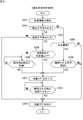
- FIG. 8 is a flowchart illustrating an example of the precipitation state determination process.
- the CPU 51 executes the following precipitation condition determination processing in time parallel with the attitude control processing.
- the CPU 51 receives the weather information from the external data source 9 (Step S201).
- the weather information includes information on predicted precipitation intensity and predicted precipitation time.
- the CPU 51 determines whether or not precipitation is predicted based on weather information (step S202). In the process of step S202, for example, the CPU 51 determines that precipitation is predicted if the predicted rainfall intensity included in the weather information exceeds 0 mm / h, and does not predict the rainfall if the predicted rainfall intensity is 0 mm / h. Can be determined.
- step S203 the CPU 51 determines whether light rain is predicted based on weather information.
- the CPU 51 determines that light rain is predicted when the predicted rainfall intensity is 1 mm / h or less, for example, and does not predict light rainfall when the predicted rainfall intensity exceeds 1 mm / h.
- heavy rain is predicted.
- “light rain” means rain having a rainfall intensity equal to or lower than a predetermined value
- “heavy rain” means rain having a higher rainfall intensity than light rain, that is, rain having a rainfall intensity higher than a predetermined value. means.
- the light rain is rain having a precipitation intensity of 1 mm / h or less
- rain having a precipitation intensity higher than 1 mm / h is heavy rain.
- Predicting light rain is an example of light rain conditions according to the present embodiment. That is, when light rain is predicted (YES in step S203), the light rain condition is satisfied.
- the light rain condition can be a condition based on at least one of precipitation intensity, precipitation, and cloudiness.
- step S204 determines whether the solar radiation intensity detected by the solar radiation sensor 702 is equal to or less than a predetermined value. If the solar irradiance is high, it can be estimated that there are few clouds and it takes time until precipitation. On the other hand, if the solar radiation intensity is low, it can be estimated that there are many clouds and precipitation is near. Therefore, when the solar radiation intensity is equal to or less than the predetermined value (YES in step S204), CPU 51 sets a save flag (step S205). As a result, the operation is switched from the sun tracking operation to the evacuation operation, and the attitude of the array 1 is changed to the evacuation attitude.
- CPU 51 determines whether or not the time reaches a time set before the predicted rain time (hereinafter, referred to as “precipitation approach time”) (step S206). . It takes a certain time for the array 1 to transition from the sun tracking posture to the evacuation posture. For this reason, if the evacuation operation is started after the predicted rainfall time has been reached, it will start to rain until the posture change to the evacuation posture is completed, and water droplets may adhere to the light receiving surface 1a. Therefore, in this example, the evacuation operation is started at the timing when the precipitation approach time is reached.
- the attitude of the array 1 can be set to the attitude that can cope with the light rain, such as the evacuation attitude. Therefore, if the CPU 51 has not reached the precipitation approach time (NO in step S206), the CPU 51 returns the process to step S206, and if it has reached the precipitation approach time (YES in step S206), sets the evacuation flag (step S205). .
- the set time can be determined based on the maximum time required for the retreat operation, that is, the time required for the array 1 to transition from the horizontal position in which the light receiving surface 1a faces upward to the retreat position. .
- the evacuation flag is set, and the operation switches from the sun tracking operation to the evacuation operation.
- the attitude of the array 1 shifts from the sun tracking attitude to the retracted attitude.
- the sun tracking operation can be performed to generate power efficiently.
- step S207 determines whether or not the observed rain is no longer a light rain.
- An example of a condition for determining that the rain has stopped may be that the intensity of the rainfall is equal to or less than the measurement limit of the precipitation sensor 703 for a predetermined time (for example, two minutes).
- a condition for determining that heavy rain has occurred may be that the rainfall intensity is higher than 1 mm / h for a predetermined time (for example, two minutes).
- step S207 If light rain is continuously observed (NO in step S207), CPU 51 executes step S207 again. On the other hand, when it is no longer light rain (YES in step S207), CPU 51 turns down the evacuation flag (step S208). Thereby, the retreat operation is released, and the sun tracking operation is performed. As a result, the attitude of the array 1 shifts to the sun tracking attitude. If the attitude of the array 1 becomes the sun tracking attitude when the weather recovers, power generation starts. If the attitude of the array 1 becomes the sun tracking attitude when heavy rain occurs, dirt on the light receiving surface 1a is washed away by rain. When the evacuation flag is defeated, the CPU 51 ends the precipitation condition determination process.
- step S203 If the light rain is not predicted in step S203, that is, if the heavy rain is predicted (NO in step S203), the CPU 51 shifts the processing to step S208 and turns off the evacuation flag.
- Predicting heavy rain is an example of heavy rain conditions according to the present embodiment. That is, when heavy rain is predicted, the heavy rain condition is satisfied.
- the value of the amount of precipitation per hour that divides light rain from heavy rain may be defined, and the prediction of precipitation exceeding this value may be set as the heavy rain condition.
- a value of the amount of cloud per hour that separates light rain from heavy rain may be defined, and a cloud amount exceeding this value may be predicted as the heavy rain condition.
- a complex condition combining at least two of the above-mentioned heavy rain conditions of precipitation intensity, precipitation, and cloudiness may be set as the heavy rain condition.
- step S203 When heavy rain is predicted (YES in step S203), the evacuation flag is defeated, so that the evacuation operation is avoided, and the attitude of the array 1 becomes the sun tracking attitude. Thereby, the dirt on the light receiving surface 1a can be washed away with rain.
- the evacuation flag is defeated, the CPU 51 ends the precipitation condition determination process.
- step S202 determines whether rain has been observed based on the output signal of precipitation sensor 703 (step S209). In the process of step S209, the CPU 51 determines that rain has been observed if rain has been measured, regardless of, for example, the value measured by the precipitation sensor 703. If the rainfall intensity is equal to or less than the measurement limit of the precipitation sensor 703, rain is observed. It can be determined that it is not performed.
- step S209 If no rain is observed (NO in step S209), CPU 51 shifts the processing to step S208 and turns off the evacuation flag. Thus, when it is not raining, the array 1 takes the sun tracking attitude, and power is generated. After the evacuation flag is defeated, the CPU 51 ends the precipitation condition determination process.
- step S210 determines whether or not the observed rain is light rain (step S210). That is, in the process of step S210, it is determined whether the precipitation intensity detected by the precipitation sensor 703 is equal to or less than a predetermined value, for example, 1 mm / h. If the precipitation intensity is equal to or less than the predetermined value, the observed rain is determined to be light rain, and if the precipitation intensity is higher than the predetermined value, the observed rain is determined to be heavy rain.
- a predetermined value for example, 1 mm / h.
- the CPU 51 shifts the processing to step S205 and sets a save flag. As a result, a retreat operation is performed.
- the CPU 51 executes the processing of steps S207 and S208, and ends the precipitation state determination processing.
- the CPU 51 shifts the processing to step S208 and turns off the evacuation flag.
- the fact that the observed rain is heavy rain is an example of the heavy rain condition according to the present embodiment. That is, when heavy rain is observed, the heavy rain condition is satisfied.
- the evacuation flag is defeated, the evacuation operation is not performed, and the attitude of the array 1 becomes the sun tracking attitude. Thereby, the dirt on the light receiving surface 1a can be washed away with rain.
- the CPU 51 ends the precipitation condition determination process.
- FIG. 9 is a graph illustrating an example of a change in the power generation performance of the photovoltaic power generation panel before and after light rain.
- the vertical axis indicates the power generation performance, and the power generation performance is compared by normalizing the ratio of the actual output (kW) to the rated output (kW) measured within a predetermined time during the day by the amount of solar radiation. Value.
- the power generation performance is approximately 85%.
- the power generation performance is reduced to approximately 70% due to the contamination on the light receiving surface 1a.
- dirt was removed from the light receiving surface 1a, so that the power generation performance was restored to the same level as before the precipitation. As shown in this example, when dirt adheres to the light receiving surface 1a due to light rain, the power generation performance rapidly decreases.
- FIG. 10 is a graph illustrating an example of a change in the power generation performance of the solar power generation panel before and after heavy rain.
- the vertical axis indicates the power generation performance.
- the example shown in FIG. 10 is a change in power generation performance when a rainfall with a precipitation intensity of about 60 mm / h falls.
- the power generation performance before the precipitation was about 84%
- the power generation performance after the precipitation was about 88%. Therefore, as a result of the dirt on the light receiving surface 1a being washed away by the heavy rain, the power generation performance was increased by about 4%.
- the following table shows the evaluation results.
- the total of each of the direct solar radiation amount, the measured power generation amount, and the estimated power generation amount for one day to be evaluated is shown.
- the loss of power generation due to the evacuation operation is obtained as (actually measured power generation-estimated power generation), and is 13.3 kWh / day.
- the following table shows the amount of power generation immediately after the light receiving surface 1a is contaminated by precipitation and when the power generation performance is restored by cleaning the light receiving surface 1a.
- “after precipitation” indicates immediately after the light receiving surface 1a is stained
- “after cleaning” indicates immediately after the light receiving surface 1a is cleaned.
- both the case where the rainfall of a predetermined or less rainfall is predicted by an external organization and the case where the light rain is observed by the precipitation sensor 703 provided in the photovoltaic power generator 100 are both low.
- the present invention is not limited to this.
- the precipitation sensor 703 only monitors the precipitation. It can be determined whether the light rain condition has been satisfied. In the case where the precipitation sensor 703 is not provided or the like, it can be determined whether or not the light rain condition has been satisfied only by the weather information provided from the external data source 9.
Landscapes
- Physics & Mathematics (AREA)
- General Physics & Mathematics (AREA)
- Engineering & Computer Science (AREA)
- Automation & Control Theory (AREA)
- Life Sciences & Earth Sciences (AREA)
- Sustainable Development (AREA)
- Photovoltaic Devices (AREA)
Abstract
La présente invention concerne un dispositif de génération d'énergie solaire comprenant : un panneau de génération d'énergie solaire ayant une surface de réception de lumière ; un dispositif d'entraînement pour changer l'attitude du panneau de génération d'énergie solaire ; et une unité de commande qui, lorsqu'une condition de pluie de lumière prédéterminée est satisfaite pendant la journée, amène le dispositif d'entraînement à effectuer une opération de repli pour changer l'attitude du panneau de génération d'énergie solaire en une attitude de repli, dans laquelle la surface de réception de lumière du panneau de génération d'énergie solaire est tournée vers le bas.
Priority Applications (1)
| Application Number | Priority Date | Filing Date | Title |
|---|---|---|---|
| PCT/JP2018/029988 WO2020031349A1 (fr) | 2018-08-09 | 2018-08-09 | Dispositif de génération d'énergie solaire et procédé de commande de dispositif de génération d'énergie solaire |
Applications Claiming Priority (1)
| Application Number | Priority Date | Filing Date | Title |
|---|---|---|---|
| PCT/JP2018/029988 WO2020031349A1 (fr) | 2018-08-09 | 2018-08-09 | Dispositif de génération d'énergie solaire et procédé de commande de dispositif de génération d'énergie solaire |
Publications (1)
| Publication Number | Publication Date |
|---|---|
| WO2020031349A1 true WO2020031349A1 (fr) | 2020-02-13 |
Family
ID=69414588
Family Applications (1)
| Application Number | Title | Priority Date | Filing Date |
|---|---|---|---|
| PCT/JP2018/029988 Ceased WO2020031349A1 (fr) | 2018-08-09 | 2018-08-09 | Dispositif de génération d'énergie solaire et procédé de commande de dispositif de génération d'énergie solaire |
Country Status (1)
| Country | Link |
|---|---|
| WO (1) | WO2020031349A1 (fr) |
Cited By (1)
| Publication number | Priority date | Publication date | Assignee | Title |
|---|---|---|---|---|
| JP2022087888A (ja) * | 2020-12-02 | 2022-06-14 | 住友電気工業株式会社 | 太陽光発電装置 |
Citations (6)
| Publication number | Priority date | Publication date | Assignee | Title |
|---|---|---|---|---|
| JP2009146582A (ja) * | 2007-12-11 | 2009-07-02 | Sharp Corp | ソーラー街路灯 |
| JP2011210796A (ja) * | 2010-03-29 | 2011-10-20 | Furukawa Electric Co Ltd:The | 太陽光発電装置 |
| JP2012530357A (ja) * | 2009-06-15 | 2012-11-29 | イェホーシュア フィシュラー, | 電力グリッド太陽エネルギー収集システム |
| JP2013089808A (ja) * | 2011-10-19 | 2013-05-13 | Adc Technology Inc | 太陽光発電装置 |
| JP2015181324A (ja) * | 2013-08-26 | 2015-10-15 | Thk株式会社 | 太陽光追尾装置 |
| JP2016046950A (ja) * | 2014-08-25 | 2016-04-04 | 住友電気工業株式会社 | 太陽光発電システム及びパネル洗浄方法 |
-
2018
- 2018-08-09 WO PCT/JP2018/029988 patent/WO2020031349A1/fr not_active Ceased
Patent Citations (6)
| Publication number | Priority date | Publication date | Assignee | Title |
|---|---|---|---|---|
| JP2009146582A (ja) * | 2007-12-11 | 2009-07-02 | Sharp Corp | ソーラー街路灯 |
| JP2012530357A (ja) * | 2009-06-15 | 2012-11-29 | イェホーシュア フィシュラー, | 電力グリッド太陽エネルギー収集システム |
| JP2011210796A (ja) * | 2010-03-29 | 2011-10-20 | Furukawa Electric Co Ltd:The | 太陽光発電装置 |
| JP2013089808A (ja) * | 2011-10-19 | 2013-05-13 | Adc Technology Inc | 太陽光発電装置 |
| JP2015181324A (ja) * | 2013-08-26 | 2015-10-15 | Thk株式会社 | 太陽光追尾装置 |
| JP2016046950A (ja) * | 2014-08-25 | 2016-04-04 | 住友電気工業株式会社 | 太陽光発電システム及びパネル洗浄方法 |
Cited By (1)
| Publication number | Priority date | Publication date | Assignee | Title |
|---|---|---|---|---|
| JP2022087888A (ja) * | 2020-12-02 | 2022-06-14 | 住友電気工業株式会社 | 太陽光発電装置 |
Similar Documents
| Publication | Publication Date | Title |
|---|---|---|
| US9998069B2 (en) | Photovoltaic system and panel cleaning method | |
| AU2012330715B2 (en) | Determining timing for cleaning electricity generating solar panels | |
| CN108347215B (zh) | 可折叠移动式自动追踪太阳能发电装置 | |
| Kumar et al. | Dust cleaning robots (DCR) for BIPV and BAPV solar power plants-A conceptual framework and research challenges | |
| JP2010190566A (ja) | 二体型太陽エネルギ収集システム | |
| CN111306494A (zh) | 一种用于智慧城市的多功能太阳能路灯 | |
| CN110768619A (zh) | 一种太阳能光伏组件 | |
| JP2015122401A (ja) | 追尾型太陽光発電装置および追尾型太陽光発電システム | |
| KR101652243B1 (ko) | 태양광 감지장치 및 이를 갖는 태양광 트랙커 | |
| JP7238802B2 (ja) | 太陽光発電装置及び太陽光発電装置の制御方法 | |
| KR20140122424A (ko) | 태양광과 풍력을 이용한 가로등 | |
| KR102914065B1 (ko) | 태양전지 패널용 적설 방지 장치 및 이를 구비한 태양전지 패널 시스템 | |
| JP7026385B2 (ja) | 太陽光発電装置 | |
| KR101279427B1 (ko) | 태양열 발전기의 태양 추적 장치 | |
| JP2019216554A (ja) | 太陽光発電装置 | |
| Zulkefli et al. | Investigation of solar photovoltaic performance via cooling-light concentrating and cleaning system using robotic arduino approach | |
| CN108258067A (zh) | 一种太阳能电池的组装工艺 | |
| JP5615209B2 (ja) | 太陽光発電装置 | |
| CN209496885U (zh) | 一种太阳能电池组件及太阳能发电设备 | |
| KR102656003B1 (ko) | 태양광 집광모듈 설치용 프레임 | |
| KR20140144353A (ko) | 열에너지를 재활용하는 집광형 태양전지 | |
| JP7206133B2 (ja) | 太陽光発電システム及び太陽光発電装置 | |
| JP2009295836A (ja) | 太陽電池集積装置 | |
| KR20160146046A (ko) | 제설기능이 있는 태양전지 | |
| KR101370551B1 (ko) | 돔형 태양광 집광장치 |
Legal Events
| Date | Code | Title | Description |
|---|---|---|---|
| 121 | Ep: the epo has been informed by wipo that ep was designated in this application |
Ref document number: 18929810 Country of ref document: EP Kind code of ref document: A1 |
|
| NENP | Non-entry into the national phase |
Ref country code: DE |
|
| 122 | Ep: pct application non-entry in european phase |
Ref document number: 18929810 Country of ref document: EP Kind code of ref document: A1 |
|
| NENP | Non-entry into the national phase |
Ref country code: JP |