WO2020032015A1 - ポリシロキサン-ポリアルキレングリコールブロック共重合体とその製造方法 - Google Patents
ポリシロキサン-ポリアルキレングリコールブロック共重合体とその製造方法 Download PDFInfo
- Publication number
- WO2020032015A1 WO2020032015A1 PCT/JP2019/030875 JP2019030875W WO2020032015A1 WO 2020032015 A1 WO2020032015 A1 WO 2020032015A1 JP 2019030875 W JP2019030875 W JP 2019030875W WO 2020032015 A1 WO2020032015 A1 WO 2020032015A1
- Authority
- WO
- WIPO (PCT)
- Prior art keywords
- polysiloxane
- polyalkylene glycol
- block copolymer
- group
- glycol block
- Prior art date
- Legal status (The legal status is an assumption and is not a legal conclusion. Google has not performed a legal analysis and makes no representation as to the accuracy of the status listed.)
- Ceased
Links
Images


Classifications
-
- C—CHEMISTRY; METALLURGY
- C08—ORGANIC MACROMOLECULAR COMPOUNDS; THEIR PREPARATION OR CHEMICAL WORKING-UP; COMPOSITIONS BASED THEREON
- C08G—MACROMOLECULAR COMPOUNDS OBTAINED OTHERWISE THAN BY REACTIONS ONLY INVOLVING UNSATURATED CARBON-TO-CARBON BONDS
- C08G81/00—Macromolecular compounds obtained by interreacting polymers in the absence of monomers, e.g. block polymers
-
- C—CHEMISTRY; METALLURGY
- C08—ORGANIC MACROMOLECULAR COMPOUNDS; THEIR PREPARATION OR CHEMICAL WORKING-UP; COMPOSITIONS BASED THEREON
- C08G—MACROMOLECULAR COMPOUNDS OBTAINED OTHERWISE THAN BY REACTIONS ONLY INVOLVING UNSATURATED CARBON-TO-CARBON BONDS
- C08G65/00—Macromolecular compounds obtained by reactions forming an ether link in the main chain of the macromolecule
- C08G65/02—Macromolecular compounds obtained by reactions forming an ether link in the main chain of the macromolecule from cyclic ethers by opening of the heterocyclic ring
- C08G65/32—Polymers modified by chemical after-treatment
- C08G65/329—Polymers modified by chemical after-treatment with organic compounds
- C08G65/336—Polymers modified by chemical after-treatment with organic compounds containing silicon
-
- C—CHEMISTRY; METALLURGY
- C08—ORGANIC MACROMOLECULAR COMPOUNDS; THEIR PREPARATION OR CHEMICAL WORKING-UP; COMPOSITIONS BASED THEREON
- C08G—MACROMOLECULAR COMPOUNDS OBTAINED OTHERWISE THAN BY REACTIONS ONLY INVOLVING UNSATURATED CARBON-TO-CARBON BONDS
- C08G77/00—Macromolecular compounds obtained by reactions forming a linkage containing silicon with or without sulfur, nitrogen, oxygen or carbon in the main chain of the macromolecule
- C08G77/04—Polysiloxanes
- C08G77/38—Polysiloxanes modified by chemical after-treatment
-
- C—CHEMISTRY; METALLURGY
- C08—ORGANIC MACROMOLECULAR COMPOUNDS; THEIR PREPARATION OR CHEMICAL WORKING-UP; COMPOSITIONS BASED THEREON
- C08G—MACROMOLECULAR COMPOUNDS OBTAINED OTHERWISE THAN BY REACTIONS ONLY INVOLVING UNSATURATED CARBON-TO-CARBON BONDS
- C08G77/00—Macromolecular compounds obtained by reactions forming a linkage containing silicon with or without sulfur, nitrogen, oxygen or carbon in the main chain of the macromolecule
- C08G77/42—Block-or graft-polymers containing polysiloxane sequences
- C08G77/46—Block-or graft-polymers containing polysiloxane sequences containing polyether sequences
-
- C—CHEMISTRY; METALLURGY
- C08—ORGANIC MACROMOLECULAR COMPOUNDS; THEIR PREPARATION OR CHEMICAL WORKING-UP; COMPOSITIONS BASED THEREON
- C08L—COMPOSITIONS OF MACROMOLECULAR COMPOUNDS
- C08L63/00—Compositions of epoxy resins; Compositions of derivatives of epoxy resins
-
- C—CHEMISTRY; METALLURGY
- C08—ORGANIC MACROMOLECULAR COMPOUNDS; THEIR PREPARATION OR CHEMICAL WORKING-UP; COMPOSITIONS BASED THEREON
- C08L—COMPOSITIONS OF MACROMOLECULAR COMPOUNDS
- C08L83/00—Compositions of macromolecular compounds obtained by reactions forming in the main chain of the macromolecule a linkage containing silicon with or without sulfur, nitrogen, oxygen or carbon only; Compositions of derivatives of such polymers
- C08L83/10—Block- or graft-copolymers containing polysiloxane sequences
- C08L83/12—Block- or graft-copolymers containing polysiloxane sequences containing polyether sequences
-
- H—ELECTRICITY
- H10—SEMICONDUCTOR DEVICES; ELECTRIC SOLID-STATE DEVICES NOT OTHERWISE PROVIDED FOR
- H10W—GENERIC PACKAGES, INTERCONNECTIONS, CONNECTORS OR OTHER CONSTRUCTIONAL DETAILS OF DEVICES COVERED BY CLASS H10
- H10W42/00—Arrangements for protection of devices
- H10W42/121—Arrangements for protection of devices protecting against mechanical damage
-
- H—ELECTRICITY
- H10—SEMICONDUCTOR DEVICES; ELECTRIC SOLID-STATE DEVICES NOT OTHERWISE PROVIDED FOR
- H10W—GENERIC PACKAGES, INTERCONNECTIONS, CONNECTORS OR OTHER CONSTRUCTIONAL DETAILS OF DEVICES COVERED BY CLASS H10
- H10W74/00—Encapsulations, e.g. protective coatings
- H10W74/40—Encapsulations, e.g. protective coatings characterised by their materials
- H10W74/47—Encapsulations, e.g. protective coatings characterised by their materials comprising organic materials, e.g. plastics or resins
- H10W74/476—Organic materials comprising silicon
Definitions
- the present invention relates to a polysiloxane-polyalkylene glycol block copolymer suitably used for an epoxy resin cured product such as a semiconductor encapsulant and a method for producing the same.
- the semiconductor encapsulant is generally composed of an epoxy resin, a curing agent, a filler, and various additives such as a low stress agent and a flame retardant.
- various additives such as a low stress agent and a flame retardant.
- To reduce the stress of the semiconductor encapsulant there is a method of reducing the elastic modulus of the epoxy resin cured product, and it is common to add a compound containing polysiloxane as a main component as a low stress agent.
- a technique of forming an ABA-type triblock copolymer in which polyalkylene glycol chains are modified at both ends of polysiloxane is known (Patent Reference 1).
- an ABA-type triblock copolymer in which both ends of polysiloxane are modified with a polyalkylene glycol chain, and a copolymer composed of polysiloxane and polyalkylene glycol in which glycidyl group or carboxyl group is added to a terminal are dispersible.
- An object of the present invention is to provide a polysiloxane-polyalkylene glycol block copolymer which is excellent in dispersibility in a cured epoxy resin product and achieves low stress in the cured epoxy resin product.
- the present invention is as follows. ⁇ 1> Polysiloxane (A) having a functional group selected from a carboxylic anhydride group, a hydroxyl group, an epoxy group, an amino group, and a thiol group, and a carboxylic anhydride group, a hydroxyl group, an amino group, an epoxy group, and By reacting a polyalkylene glycol (B) having a functional group selected from thiol groups, a polysiloxane-polyalkylene glycol block copolymer intermediate is obtained.
- a method for producing a polysiloxane-polyalkylene glycol block copolymer which comprises performing the following step (2) after the following step (1); Step (1): a polysiloxane (A) having a functional group selected from a carboxylic acid anhydride group, a hydroxyl group, an epoxy group, an amino group, and a thiol group, and a carboxylic acid anhydride group, a hydroxyl group, an amino group, and an epoxy group And reacting a polyalkylene glycol (B) having a functional group selected from thiol groups to obtain a polysiloxane-polyalkylene glycol block copolymer intermediate; Step (2): a step of reacting a carboxyl group of the polysiloxane-polyalkylene glycol block copolymer intermediate obtained in Step (1) with a compound having reactivity with a carboxyl group, The compound having reactivity with is at least one compound selected from orthoesters, ox
- the polysiloxane-polyalkylene glycol block copolymer of the present invention has a polysiloxane which is incompatible with an epoxy resin but has excellent flexibility, and a polyalkylene glycol which is compatible with an epoxy resin and has excellent flexibility. It is a block copolymer and has both flexibility and good dispersibility in a cured epoxy resin.
- the polysiloxane-polyalkylene glycol block copolymer of the present invention is blended with an epoxy resin, the polysiloxane-polyalkylene glycol block copolymer is well dispersed in the epoxy resin cured product, and the epoxy resin cured product can be reduced in stress.
- a decrease in fluidity due to the addition of the polysiloxane-polyalkylene glycol block copolymer to the epoxy resin is also suppressed.
- it is also useful as various additives such as a surfactant and a resin modifier, and is particularly suitable as a low-stress agent for a semiconductor sealing material.
- Example 3 is a cross-sectional TEM photograph of the cured epoxy resin obtained in Example 1.
- 4 is a TEM photograph of a cross section of the cured epoxy resin obtained in Example 2.
- the polysiloxane-polyalkylene glycol block copolymer of the present invention comprises a polysiloxane (A) having a functional group selected from a carboxylic anhydride group, a hydroxyl group, an epoxy group, an amino group, and a thiol group; A polysiloxane-polyalkylene glycol block copolymer intermediate (hereinafter simply referred to as a block copolymer) by reacting a polyalkylene glycol (B) having a functional group selected from a compound group, a hydroxyl group, an amino group, an epoxy group, and a thiol group.
- a polysiloxane-polyalkylene glycol block copolymer intermediate (hereinafter simply referred to as a block copolymer) by reacting a polyalkylene glycol (B) having a functional group selected from a compound group, a hydroxyl group, an amino group, an epoxy group, and a thiol group
- Polysiloxane-polyalkylene glycol block A polymer (hereinafter sometimes simply referred to as a block copolymer), wherein the content of the structure derived from the polysiloxane (A) is defined as 100% by mass of the entire polysiloxane-polyalkylene glycol block copolymer.
- a polysiloxane (A) having a functional group hereinafter sometimes simply referred to as polysiloxane (A)
- a polyalkylene glycol (B) having a functional group hereinafter simply referred to as polyalkylene glycol (B)
- the reaction may be performed by directly reacting and bonding the polysiloxane (A) having a functional group and the polyalkylene glycol (B) having a functional group, or the polysiloxane having a functional group ( A) and the polyalkylene glycol (B) having a functional group may be bonded via a copolymer component (C) which reacts with both the component (A) and the component (B).
- a polysiloxane-polyalkylene glycol block copolymer intermediate can be obtained.
- the polysiloxane (A) having a functional group and the polyalkylene glycol (B) having a functional group react directly, a polysiloxane (A) and a polyalkylene are added to impart a carboxyl group to the resulting block copolymer intermediate.
- One of the functional groups of the glycol (B) must be a carboxylic anhydride group, and the other functional group must be a hydroxyl group, an epoxy group, an amino group or a thiol group.
- one of the functional groups of the polysiloxane (A) and the polyalkylene glycol (B) is a carboxylic anhydride group, and the other functional group is A hydroxyl group, amino group or thiol group is more preferred.
- one of the functional groups of the polysiloxane (A) and the polyalkylene glycol (B) is a carboxylic anhydride group, and the other functional group is a hydroxyl group or an amino group. Groups are more preferred.
- the functional group of polysiloxane (A) and the functional group of polyalkylene glycol (B) directly react and bond
- the functional group of polysiloxane (A) and the functional group of polyalkylene glycol (B) react to form an ester.
- a bond selected from a bond, an amide bond and a thioester bond is formed.
- an ester bond or a thioester bond is preferable from the viewpoint of viscosity, and an ester bond is more preferable from the viewpoint of heat resistance.
- the bonding part of the obtained block copolymer intermediate contains a carboxyl group generated by the reaction.
- a plurality of polysiloxanes (A) having different functional groups and / or a plurality of polyalkylene glycols (B) having different functional groups may be reacted.
- the polysiloxane-polyalkylene glycol block copolymer of the present invention is obtained by reacting a part of the carboxyl group of the block copolymer intermediate obtained as described above with a compound having reactivity with a carboxyl group.
- the desired carboxyl group content can be controlled.
- the carboxyl group is blocked and a substituent containing a carboxylic acid derivative is generated.
- esterifying agent examples include orthoesters, oxazolines, epoxies, alcohols, monovalent phenols, dimethylformamide dialkylacetals, alkyl halides, alkyl carbonates and the like.
- orthoesters include trimethyl orthoformate, trimethyl orthoacetate, triethyl orthoformate, triethyl orthoacetate, tripropyl orthoformate, tripropyl orthoacetate, tributyl orthoformate, and tributyl orthoacetate.
- oxazolines examples include 2-methyl-2-oxazoline, 2-ethyl-2-oxazoline, 2-phenyl-2-oxazoline, 2-propyl-2-oxazoline, 2-isopropyl-2-oxazoline, 2,4 , 4-trimethyl-2-oxazoline and the like.
- the substituent containing a carboxylic acid derivative formed after the reaction is an ester group and has an amide group.
- Oxazolines are preferable because they do not produce by-products in the reaction with a carboxyl group.
- Epoxy is a compound having an epoxy group, and specific examples thereof include propylene oxide, isobutylene oxide, 1,2-butylene oxide, 1,2-epoxypentane, 1,2-epoxyhexane, and 1,2. -Epoxyheptane, 1,2-epoxyoctane, 1,2-epoxydecane, 1,2-epoxydodecane, 1,2-epoxytetradecane, 1,2-epoxyhexadecane, 1,2-epoxyoctadecane, glycidyl methyl ether, Ethyl glycidyl ether, butyl glycidyl ether, t-butyl glycidyl ether, benzyl glycidyl ether, phenyl glycidyl ether, 4-t-butylphenyl glycidyl ether, glycidyl lauryl ether, 2-biphenyl glycidyl
- Alcohols are compounds having a hydroxyl group, such as methanol, ethanol, 1-propanol, 2-propanol, 1-butanol, 2-butanol, 2,2-dimethyl-1-propanol (t- Butyl alcohol), 2-methyl-1-butanol, 3-methyl-1-butanol, 1-pentanol, 2-pentanol, 3-pentanol, 2-methyl-1-pentanol, 3-methyl-1- Pentanol, 4-methyl-1-pentanol, 1-hexanol, 2-hexanol, 3-hexanol, 2-methyl-1-hexanol, 3-methyl-1-hexanol, 4-methyl-1-hexanol, 5- Methyl-1-hexanol, benzyl alcohol and the like can be mentioned.
- Monohydric phenols include phenol, 3-methylphenol, 3-t-butylphenol, 3,5-dimethylphenol, 3,4,5-trimethylphenol, dibutylhydroxytoluene, cresol, eugenol, guaiacol, thymol, salicylic acid Methyl, propofol and the like.
- alkyl halides examples include methyl bromide, methyl iodide, ethyl bromide, ethyl iodide, propyl bromide, propyl iodide, butyl bromide, butyl iodide and the like.
- esterifying agent a compound selected from orthoesters, oxazolines, epoxy compounds, alcohols, monovalent phenols, alkyl halides, and alkyl carbonates is preferable since the fluidity does not decrease. Since the reaction proceeds without a catalyst, compounds selected from orthoesters, oxazolines, and alkyl carbonates are more preferable.
- Orthoesters are preferred because they have a high effect of lowering the elastic modulus. Of the orthoesters, trimethyl orthoformate, trimethyl orthoacetate, triethyl orthoformate, triethyl orthoacetate, tripropyl orthoformate, and tripropyl orthoacetate are preferred because of their excellent dispersibility in the cured epoxy resin.
- Oxazolines are preferred because of their excellent dispersibility in the cured epoxy resin.
- 2-methyl-2-oxazoline, 2-ethyl-2-oxazoline and 2-phenyl-2-oxazoline are preferred.
- Use of dimethylformamide dialkyl acetals is not preferred because the fluidity may decrease.
- the compound having reactivity with the carboxyl group one kind may be used, or two or more kinds may be used in combination.
- the boiling point of the by-product is preferably 130 ° C. or lower, more preferably 100 ° C. or lower, and particularly preferably 80 ° C. or lower because removal by drying is easy.
- the drying conditions differ depending on the boiling point of the by-product, but are preferably 200 ° C. or lower under reduced pressure, more preferably 180 ° C. or lower, and particularly preferably 150 ° C. or lower.
- the amount of the compound having reactivity with the carboxyl group is not particularly limited as long as the carboxyl group content of the obtained polysiloxane-polyalkylene glycol block copolymer falls within a desired range. Is preferably 0.1 to 3.0 equivalents, 0.2 to 2.0 equivalents, and 0.4 to 1.5 equivalents based on the carboxyl group content contained in the block copolymer intermediate before the reaction. Is more preferable, and 0.7 to 1.0 equivalent is particularly preferable.
- the carboxyl group content can be determined by a known titration method as described later.
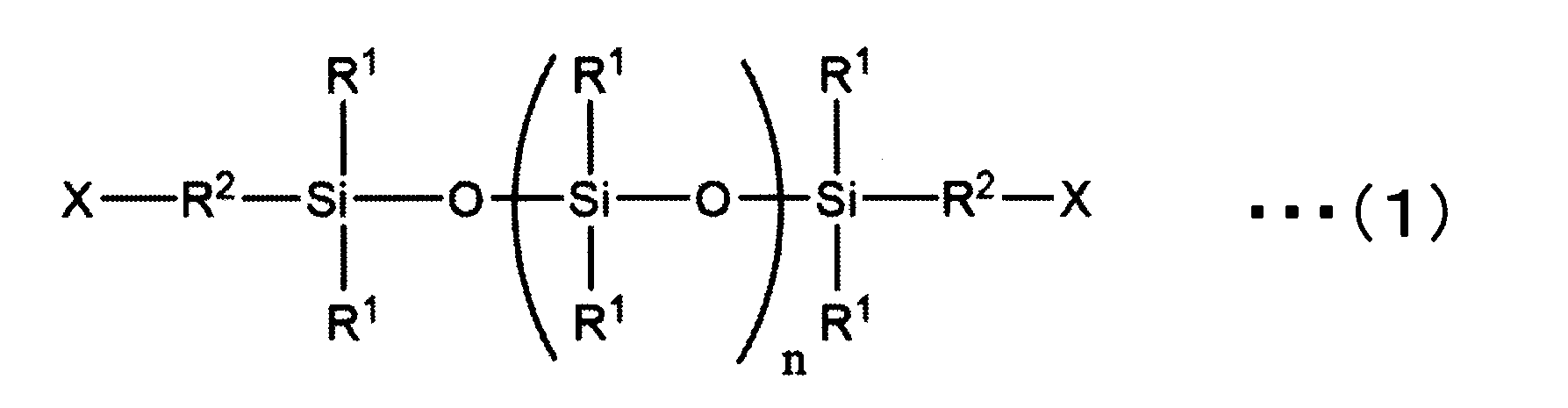
- polysiloxane (A) having a functional group a polysiloxane represented by the general formula (1) can be used.
- n represents the number of repeating units of 5 to 100.
- X is a functional group selected from a carboxylic anhydride group, a hydroxyl group, an epoxy group, an amino group, and a thiol group.
- the carboxylic anhydride group includes a cyclic group such as maleic anhydride, phthalic anhydride, and succinic anhydride.
- R 1 is a hydrogen atom, an alkyl group having 1 to 5 carbon atoms or a phenyl group.
- R 2 is a group selected from a single bond, a divalent aliphatic or aromatic hydrocarbon group having 1 to 10 carbon atoms, and a divalent hydrocarbon ether group having 1 to 10 carbon atoms.
- the single bond means that R 2 does not exist and silicon and X are directly bonded.
- R 2 is preferably a butylene group, a propylene group or an ethylene group, and most preferably a propylene group or an ethylene group.
- X is a carboxylic acid anhydride group of cyclic
- bonding position to X and R 2 or silicon atom may be any positions.
- the divalent hydrocarbon ether group is preferably a group represented by — (CH 2 ) a —O— (CH 2 ) b — and satisfying 1 ⁇ a + b ⁇ 10. All R 1 and R 2 and X may be the same or different.
- R 1 in the general formula (1) is a hydrogen atom, an alkyl group having 1 to 5 carbon atoms or a phenyl group, and is preferably a group which does not react with any of X, Y and the copolymer component (C).
- R 1 reacts with any of X, Y and the copolymer component (C)
- the chain length of R 1 is too long, the resulting polysiloxane-alkylene glycol block copolymer is added to an epoxy resin, so that the viscosity increases and molding processability deteriorates, which is not preferable.
- R 1 is preferably any of a propyl group, an ethyl group and a methyl group, more preferably an ethyl group or a methyl group, and most preferably a methyl group. Also, all R 1 may be different or the same.
- the polysiloxane having a functional group (A) is preferably a polyorganosiloxane having a functional group, and particularly preferably a polydimethylsiloxane having a functional group.
- the weight average molecular weight of the polysiloxane (A) having a functional group is not particularly limited, but the lower limit is preferably 500 or more, more preferably 800 or more, and further preferably 1,000 or more. .
- the upper limit of the weight average molecular weight is preferably 8,000 or less, more preferably 5,000 or less, further preferably 4,000 or less, and most preferably 3,000 or less.
- the weight average molecular weight of the functional group-containing polysiloxane (A) When the weight average molecular weight of the functional group-containing polysiloxane (A) is large, the functional group-containing polysiloxane (A) and the functional group-containing polyalkylene glycol (B) are phase-separated and reacted in a uniform state. Does not proceed, the reactivity with the polyalkylene glycol (B) having a functional group is deteriorated.
- the weight average molecular weight of the polysiloxane (A) having a functional group refers to the weight average molecular weight measured by gel permeation chromatography using tetrahydrofuran (THF) as a solvent and converted into polymethyl methacrylate.
- Examples of the functional group-containing polysiloxane (A) include X-22-168AS, KF-105, X-22-163A, X-22-163B, X-22-163C which are commercially available from Shin-Etsu Chemical Co., Ltd.
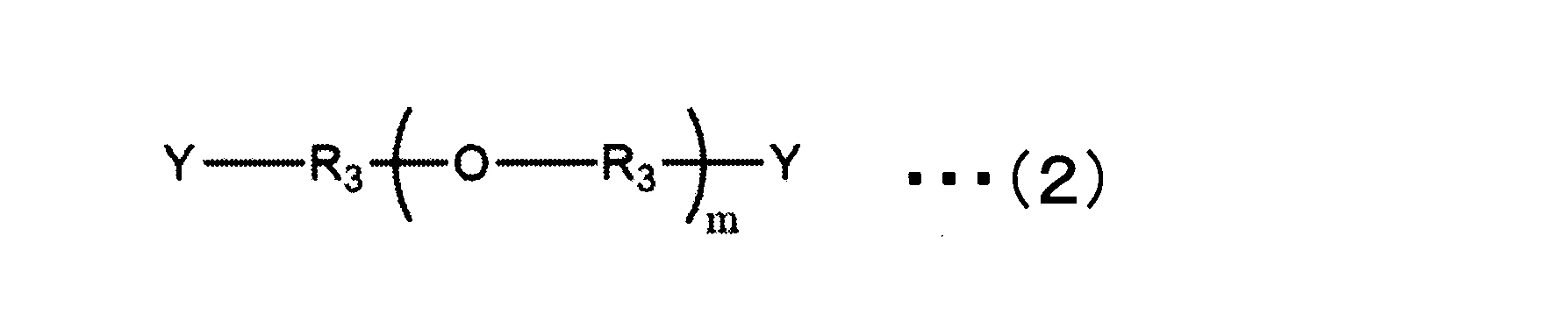
- Y is a functional group selected from a carboxylic anhydride group, a hydroxyl group, an amino group, an epoxy group, and a thiol group.
- the carboxylic anhydride group includes a cyclic group such as maleic anhydride, phthalic anhydride, and succinic anhydride.
- R 3 is a linear or branched alkyl group having 2 to 10 carbon atoms. When the carbon number of R 3 is greater than 10, the polyalkylene glycol (B) having a functional group is not compatible with the epoxy resin, and the resulting polysiloxane-polyalkylene glycol block copolymer has an epoxy resin cured product.
- the weight average molecular weight of the functional group-containing polyalkylene glycol (B) refers to a weight average molecular weight measured by gel permeation chromatography using tetrahydrofuran (THF) as a solvent and converted into polymethyl methacrylate.
- copolymers that can react with the polysiloxane-alkylene glycol block copolymer in addition to the polysiloxane (A) and the polyalkylene glycol (B) as long as the flexibility and the good dispersibility in the epoxy resin are not impaired.
- the component (C) may be further added and reacted.
- the copolymer component (C) referred to here is a compound having at least one functional group that reacts with the functional group of the polysiloxane (A) and / or the functional group of the polyalkylene glycol (B).
- the obtained block copolymer has a structure derived from the copolymer component (C) in addition to a structure derived from the polysiloxane (A) and a structure derived from the polyalkylene glycol (B).
- copolymer component (C) be dissolved in both the polysiloxane (A) and the polyalkylene glycol (B) at the time of the reaction because the reaction can easily proceed. Further, a plurality of copolymer components (C) may be used.
- copolymerization component (C) monovalent or divalent carboxylic anhydrides, diols, alcohols, monovalent or divalent phenols, diamines, amines, dithiols, thiols, isocyanates, epoxies, etc. Is mentioned.
- monovalent carboxylic anhydride examples include succinic anhydride, phthalic anhydride, maleic anhydride, acetic anhydride, propionic anhydride, oxalic anhydride, and benzoic anhydride.
- divalent carboxylic anhydride examples include pyromellitic dianhydride, 4,4′-oxydiphthalic anhydride, 3,3 ′, 4,4′-biphenyltetracarboxylic dianhydride, 2,2′- Dimethyl-3,3 ', 4,4'-biphenyltetracarboxylic dianhydride, 5,5'-dimethyl-3,3', 4,4'-biphenyltetracarboxylic dianhydride, 2,3,3 ', 4'-biphenyltetracarboxylic dianhydride, 2,2', 3,3'-biphenyltetracarboxylic dianhydride, 3,3 ', 4,4'-diphenylethertetracarboxylic dianhydride and the like Carboxylic anhydride containing aromatic ring, 1,2,3,4-butanetetracarboxylic acid, 2,3,5-tricarboxycyclopentylacetic dianhydride,
- diamine examples include ethanediamine, 1,2-propylenediamine, 1,3-propylenediamine, 1,2-butanediamine, 1,3-butanediamine, 1,4-butanediamine, 1,5-pentanediamine, -Methyl-1,5-pentanediamine, 1,6-hexanediamine, 2,2-dimethyl-1,3-propanediamine, 1,8-octanediamine, 1,9-nonanediamine, 1,4-cyclohexanediamine, Examples thereof include 1,4-benzenediamine and 1,4-benzenedimethanamine.
- the amines are as described above. Diamines and amines may cause poor fluidity if unreacted materials remain.Therefore, after the reaction, it is necessary to remove unreacted materials to the extent that fluidity is not reduced by purification or drying. preferable.
- dithiols examples include ethanedithiol, 1,2-propylenedithiol, 1,3-propylenedithiol, 1,2-butanedithiol, 1,3-butanedithiol, 1,4-butanedithiol, 1,5-pentanedithiol, -Methyl-1,5-pentanedithiol, 1,6-hexanedithiol, 2,2-dimethyl-1,3-propanedithiol, 1,8-octanedithiol, 1,9-nonanedithiol, 1,4-cyclohexanedithiol , 1,4-benzenedithiol, 1,4-benzenedimethanethiol and the like.
- thiols examples include 1-ethanethiol, 1-propylenethiol, 2-propylenethiol, 1-butanethiol, 2-butanethiol, 1-pentanethiol, 1-hexanethiol, 1-heptanethiol, 1-octanethiol, Examples thereof include 1-nonanethiol, 1-cyclohexanethiol, benzenethiol, and benzylmercaptan.
- Epoxy compounds are as described above.
- the reaction of the copolymer component (C) preferably proceeds without using a metal catalyst which is a reaction accelerator.
- a metal catalyst which is a reaction accelerator.
- those capable of simultaneously introducing a carboxyl group are preferred from the viewpoint of improving dispersibility in the cured epoxy resin.
- a monovalent or divalent carboxylic acid anhydride may be used.
- the functional group of the polysiloxane (A) is a carboxylic acid anhydride group and the polyalkylene glycol (B) is a polytetramethylene glycol, or when the functional group of the polysiloxane (A) is a hydroxyl group
- the glycol (B) is a polypropylene glycol, it is dissolved in the polysiloxane (A) and the polytetramethylene glycol or the polypropylene glycol, and the reactivity increases. Therefore, pyromellitic dianhydride is used as the copolymerization component (C).
- the amount of the copolymer component (C) to be added is not particularly limited. However, in order not to affect the physical properties of the polysiloxane-polyalkylene glycol block copolymer of the present invention, the upper limit is set to the polysiloxane-polyalkylene glycol block.
- the total amount of the copolymer is 100% by mass, preferably 40% by mass or less, more preferably 30% by mass or less, further preferably 20% by mass or less, and most preferably 10% by mass or less.
- the addition amount is larger than this range, the flexibility of the obtained polysiloxane-polyalkylene glycol block copolymer is impaired, and the presence of the unreacted copolymer component (C) causes curing with the epoxy resin. This is not preferable because the reaction is accelerated and the fluidity is reduced.
- pyromellitic dianhydride 3,3 ′, 4,4′-benzophenonetetracarboxylic dianhydride, 4,4 ′-(4,4′-isopropylidene diphenoxy) diphthalic anhydride
- Carboxylic anhydrides selected from 4'-oxydiphthalic anhydride and 3,3 ', 4,4'-biphenyltetracarboxylic dianhydride are preferred.
- Pyromellitic dianhydride is most preferred in that it can impart flexibility to the obtained polysiloxane-polyalkylene glycol block copolymer and can be copolymerized without using an organic solvent. Two or more copolymer components (C ') may be used.
- the functional groups of the polysiloxane (A) and the polyalkylene glycol (B) are carboxylic anhydride groups
- a compound selected from diols, diamines, dithiols, dihydric phenols, and divalent epoxy compounds is preferable. Diols or dihydric phenols are more preferred.
- the content of the structure derived from the copolymer component (C ′) in the polysiloxane-polyalkylene glycol block copolymer is preferably 30% by mass or less, based on 100% by mass of the entire polysiloxane-polyalkylene glycol block copolymer. .
- the content of the structure derived from the copolymer component (C ') is large, the effect of lowering the elastic modulus of the polysiloxane-polyalkylene glycol block copolymer is reduced. If the content is small, the dispersibility in the cured epoxy resin is deteriorated.
- the content is preferably 25% by mass or less, more preferably 20% by mass or less, particularly preferably 15% by mass or less, and most preferably 10% by mass or less.
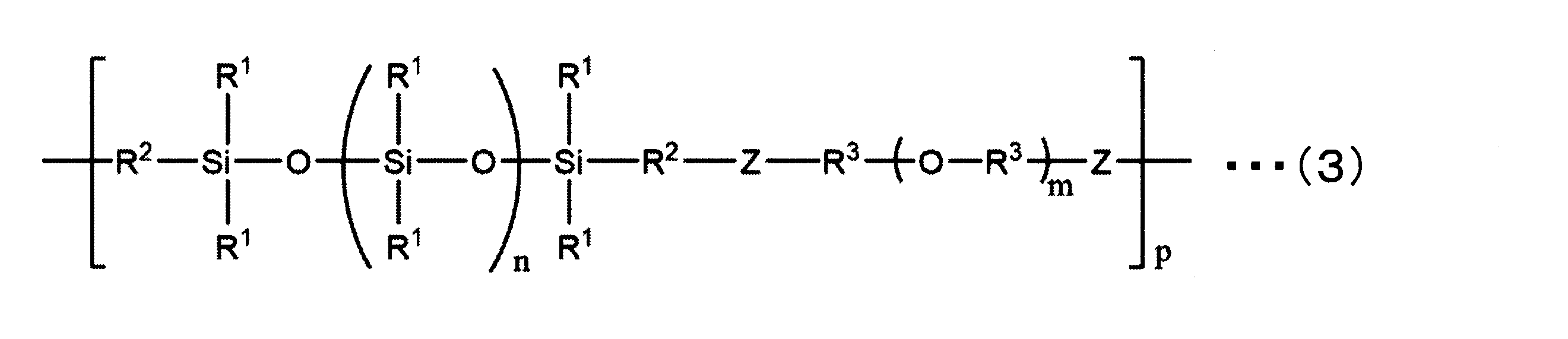
- the polysiloxane-polyalkylene glycol block copolymer of the present invention preferably has a structure represented by the general formula (3).
- R 1 is a hydrogen atom, an alkyl group having 1 to 5 carbon atoms or a phenyl group. If the chain length of R 1 is longer than the above, the resulting polysiloxane-polyalkylene glycol block copolymer becomes undesirably high in viscosity when added to an epoxy resin, resulting in poor moldability.
- R 1 is preferably any of a propyl group, an ethyl group and a methyl group, more preferably an ethyl group or a methyl group, and most preferably a methyl group. Further, all R 1 may be different or the same.
- Z is a bonding part formed by the reaction between the polysiloxane (A) having a functional group and the polyalkylene glycol having a functional group.
- the residue where the X of the polysiloxane (A) and the Y of the polyalkylene glycol (B) have reacted is bonded to the bonding portion Z.
- the X of the polysiloxane (A) and the polyalkylene glycol (B) may be used.
- the bond Z has a bond selected from an ester bond, an amide bond and a thioester bond as a result of this reaction. Among these bonds, an ester bond and a thioester bond are preferable in terms of viscosity, and an ester bond is more preferable in terms of heat resistance.
- Z also contains a carboxyl group newly generated as a result of this reaction.
- the carboxyl group may be a substituent containing a carboxylic acid derivative by a reaction of the carboxyl group with a reactive compound. Further, all Z may be the same or different.
- a substituent containing a carboxylic acid derivative is a substituent formed by a reaction between a carboxyl group and a compound having reactivity with the carboxyl group, and examples thereof include an ester group and an amide group.
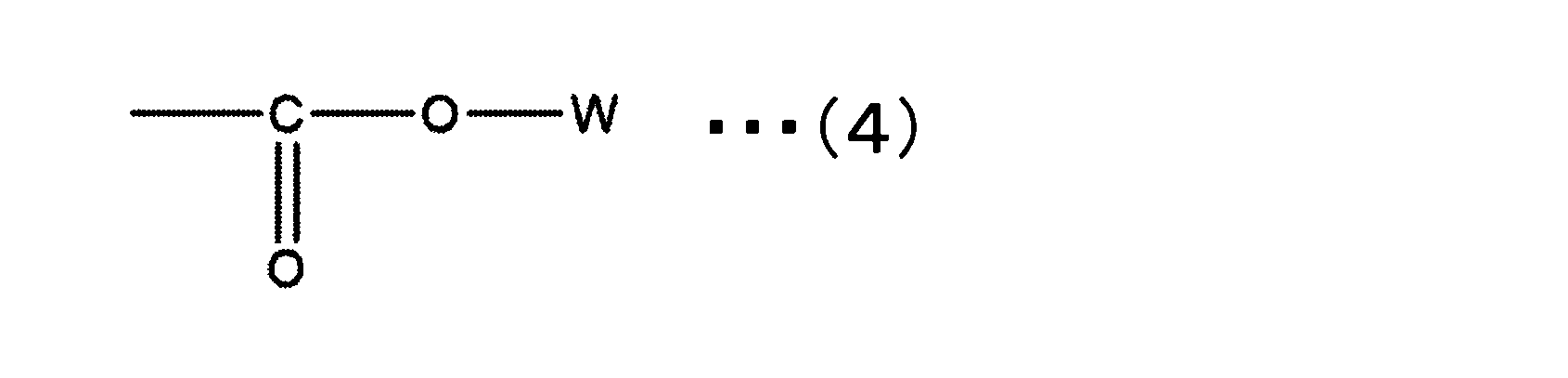
- the ester group is a group represented by a structure represented by the following general formula (4).
- W is an alkyl group having 1 to 10 carbon atoms or an aromatic hydrocarbon group.
- W may have a hydroxyl group, an ether group and / or an ether amide group.
- Specific examples of the alkyl group having 1 to 10 carbon atoms include methyl, ethyl, propyl, isopropyl, butyl, t-butyl, pentyl, neopentyl, hexyl, heptyl, octyl, and nonyl.
- aromatic hydrocarbon group include a phenyl group, a tolyl group, and a naphthyl group. If the polysiloxane-polyalkylene glycol block copolymer does not affect the effect of lowering the elastic modulus, the good dispersibility in the cured epoxy resin, and the fluidity, W may further have a substituent. Good.
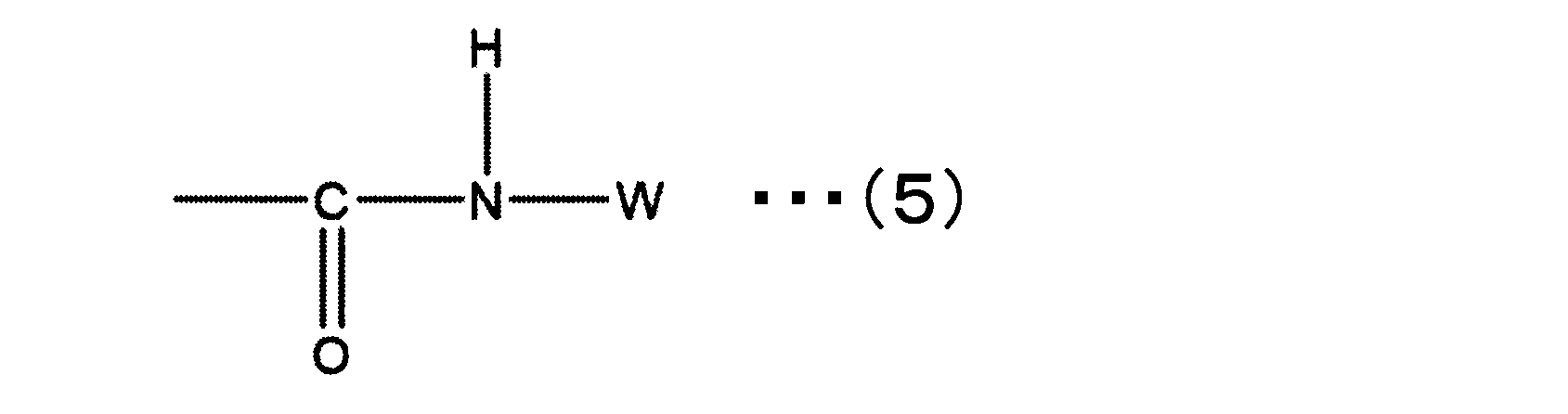
- the amide group is a group having a structure represented by the following general formula (5).
- the content of the structure derived from polysiloxane in the polysiloxane-polyalkylene glycol block copolymer of the present invention is 30% by mass or more based on 100% by mass of the whole polysiloxane-polyalkylene glycol block copolymer. , More preferably 35% by mass or more, further preferably 40% by mass or more, and most preferably 45% by mass or more.
- the upper limit of the content is 70% by mass or less, more preferably 65% by mass or less, further preferably 60% by mass or less, and most preferably 55% by mass or less.
- the polysiloxane-polyalkylene glycol block copolymer may be added to the epoxy resin to prepare a cured product. Has a low effect of lowering the elastic modulus.
- the polysiloxane-polyalkylene glycol block copolymer is added to the cured epoxy resin when the polysiloxane-polyalkylene glycol block copolymer is added to the epoxy resin. Coalescence does not disperse well.
- the content of the polysiloxane-derived structure in the polysiloxane-polyalkylene glycol block copolymer is obtained by dividing the weight of the functional group-containing polysiloxane (A) by the weight of all raw materials when synthesizing the block copolymer. Can be obtained by When by-products are generated in the process of synthesizing the block copolymer, the weight is calculated by subtracting the weight of the generated by-product from the weight of all the raw materials. That is, the content of the structure derived from polysiloxane can be determined by the following equation.
- the polysiloxane-polyalkylene glycol block copolymer of the present invention has a carboxyl group content of 0.1 mmol / g or more and 0.75 mmol / g or less.
- the lower limit of the carboxyl group content is more preferably 0.2 mmol / g or more, further preferably 0.3 mmol / g or more, particularly preferably 0.4 mmol / g or more, and most preferably 0.1 mmol / g or more. It is 45 mmol / g or more.
- the upper limit is more preferably 0.7 mmol / g or less, further preferably 0.65 mmol / g or less, and particularly preferably 0.6 mmol / g or less.
- the carboxyl group content is larger than this range, the effect of lowering the elastic modulus is reduced when the epoxy resin cured product is prepared by adding the polysiloxane-polyalkylene glycol block copolymer of the present invention, which is not preferable. . If the carboxyl group content is less than this range, the dispersibility in the cured epoxy resin decreases, and the polysiloxane-polyalkylene glycol block copolymer is undesirably coarsely dispersed in the cured epoxy resin.
- the weight average molecular weight (M w ) of the polysiloxane-polyalkylene glycol block copolymer of the present invention is not particularly limited, but the mechanical properties and the physical properties of the cured epoxy resin to which the polysiloxane-polyalkylene glycol block copolymer is added From the viewpoint of moldability, the lower limit is preferably 5,000 or more, more preferably 6,000 or more, more preferably 8,000 or more, and more preferably 10,000 or more, More preferably, it is 15,000 or more, still more preferably 20,000 or more, and particularly preferably 30,000 or more.
- the upper limit is preferably 500,000 or less, more preferably 200,000 or less, more preferably 150,000 or less, further preferably 100,000 or less, and most preferably 80 or less. 2,000 or less.
- the weight average molecular weight is smaller than this range, the effect of lowering the elastic modulus of the cured epoxy resin to which the polysiloxane-polyalkylene glycol block copolymer has been added is low. If the weight average molecular weight is larger than this range, the epoxy resin composition added to the epoxy resin has a high viscosity, which is not preferable because it causes cracks due to the fact that the epoxy resin composition does not penetrate into the details during molding of the sealing material.
- the weight average molecular weight of the polysiloxane-polyalkylene glycol block copolymer is measured by gel permeation chromatography using tetrahydrofuran (THF) as a solvent and converted using polymethyl methacrylate as a standard sample. Weight average molecular weight.
- the number average molecular weight (M n ) of the polysiloxane-polyalkylene glycol block copolymer of the present invention is not particularly limited, the mechanical properties and the physical properties of the cured epoxy resin to which the polysiloxane-polyalkylene glycol block copolymer is added From the viewpoint of moldability, the lower limit is 1,000 or more, preferably 2,000 or more, more preferably 5,000 or more, still more preferably 10,000 or more, and still more preferably , 15,000 or more, more preferably 20,000 or more, and particularly preferably 30,000 or more.
- the upper limit is preferably 500,000 or less, more preferably 200,000 or less, more preferably 150,000 or less, further preferably 100,000 or less, and most preferably 80,000 or less.
- the weight average molecular weight is smaller than this range, the effect of lowering the elastic modulus of the cured epoxy resin to which the polysiloxane-polyalkylene glycol block copolymer has been added is low. If the weight average molecular weight is larger than this range, the epoxy resin composition added to the epoxy resin has a high viscosity, which is not preferable because it causes cracks due to the fact that the epoxy resin composition does not penetrate into the details during molding of the sealing material.
- the number average molecular weight can be measured by gel permeation chromatography similarly to the weight average molecular weight.
- the molecular weight distribution (M w / M n ) of the polysiloxane-polyalkylene glycol block copolymer of the present invention is preferably 5 or less, more preferably 3 or less, and further preferably 2 or less.
- the lower limit of the molecular weight distribution is theoretically 1.
- the molecular weight distribution ( Mw / Mn ) is calculated from the weight average molecular weight ( Mw ) and the number average molecular weight ( Mn ) measured as described above using gel permeation chromatography.
- the polysiloxane-polyalkylene glycol block copolymer of the present invention has two flexible polymer backbones and a carboxyl group content of 0.1 to 0.75 mmol / g.
- the cured product can exhibit a remarkable effect of lowering the elastic modulus. Since the polysiloxane-polyalkylene glycol block copolymer of the present invention is well dispersed in the cured epoxy resin, there is no variation in physical properties of the material. It is possible to efficiently reduce the elastic modulus of the cured resin and alleviate the internal stress.
- Step (2) is performed after the following step (1).
- Step (1) a polysiloxane (A) having a functional group selected from a carboxylic acid anhydride group, a hydroxyl group, an epoxy group, an amino group, and a thiol group, and a carboxylic acid anhydride group, a hydroxyl group, an amino group, and an epoxy group
- a polyalkylene glycol (B) having a functional group selected from thiol groups to obtain a polysiloxane-polyalkylene glycol block copolymer intermediate
- Step (2) a step of reacting a carboxyl group of the polysiloxane-polyalkylene glycol block copolymer intermediate obtained in Step (1) with a compound having reactivity with a carboxyl group, The compound having reactivity with is at least one compound selected from orthoesters, ox
- a functional group is introduced into a molecular chain as a reaction residue, so that two carboxyl groups are introduced into both ends of the molecular chain, that is, one molecular chain. Is done.
- the polysiloxane-polyalkylene glycol block copolymer of the present invention is obtained by reacting a functional group-containing polysiloxane (A) and a functional group-containing polyalkylene glycol (B) to form at least three or more groups per molecule. It can include functional groups.
- the number is more preferably 5 or more, more preferably 10 or more, more preferably 10 or more, and still more preferably 20 or more.
- the polysiloxane-polyalkylene glycol block copolymer of the present invention preferably has a product of the number average molecular weight and the carboxyl group content of more than 2. It is more preferably 3 or more, more preferably 5 or more, still more preferably 10 or more, and particularly preferably 20 or more.
- the polysiloxane (A) having a functional group and the polyalkylene glycol (B) having a functional group are mixed and heated. Then, a method of causing a reaction can be given.
- the reaction may be performed in an organic solvent if necessary. If necessary, the reaction may be performed under a nitrogen atmosphere, or may be performed under reduced pressure to accelerate the reaction.
- the mixing ratio of the polysiloxane (A) having a functional group and the polyalkylene glycol (B) having a functional group can be appropriately adjusted, but the polysiloxane (A) having a functional group and the polysiloxane having a functional group can be appropriately adjusted.
- the mixing ratio is preferably such that the stoichiometric equivalent ratio is between 0.1 and 10.
- the stoichiometric equivalent ratio refers to the ratio of the number of moles of the functional group contained in the polyalkylene glycol (B) to the number of moles of the functional group contained in the polysiloxane (A).
- the equivalent ratio is more preferably from 0.2 to 5, further preferably from 0.5 to 3, most preferably from 0.8 to 1.5, and most preferably 1.
- the block copolymer is adjusted so that the content of the structure derived from the polysiloxane (A) contained in 100% by mass of the obtained polysiloxane-polyalkylene glycol block copolymer is 30% by mass or more and 70% by mass or less.
- a good solvent of the polysiloxane (A) having a functional group and the polyalkylene glycol (B) having a functional group is preferable as the organic solvent.
- the organic solvent include hydrocarbon solvents such as toluene, xylene, benzene, and 2-methylnaphthalene; ester solvents such as ethyl acetate, methyl acetate, butyl acetate, butyl propionate, butyl butyrate, and ethyl acetoacetate; chloroform.
- Halogenated hydrocarbon solvents such as acetone, methyl ethyl ketone, methyl isobutyl ketone and methyl butyl ketone; alcohol solvents such as methanol, ethanol, 1-propanol and 2-propanol; formic acid, acetic acid, propionic acid, butyric acid, Carboxylic acid solvents such as lactic acid; Aniso Le, diethyl ether, tetrahydrofuran, diisopropyl ether, dioxane, diglyme, ether solvents such as dimethoxyethane; or a mixture thereof.
- ketone solvents such as acetone, methyl ethyl ketone, methyl isobutyl ketone and methyl butyl ketone
- alcohol solvents such as methanol, ethanol, 1-propanol and 2-propanol
- formic acid acetic acid, propionic acid, butyric acid
- the organic solvent can be removed and purified by a known method such as heating, reduced pressure, and reprecipitation. A plurality of steps may be combined to remove the organic solvent.
- the temperature at which the functional group-containing polysiloxane (A) and the functional group-containing polyalkylene glycol (B) are reacted is not particularly limited, but is preferably 220 ° C. or less to suppress side reactions and polymer decomposition. It is preferably at most 200 ° C, more preferably at most 180 ° C, particularly preferably at most 150 ° C. When the reaction proceeds at room temperature or lower, it is difficult to stably store at room temperature. Therefore, it is preferable that the reaction does not proceed at room temperature or lower.
- the lower limit of the reaction temperature is preferably 50 ° C. or higher, more preferably 70 ° C. or higher, and further preferably 100 ° C. or higher.
- the reaction time is preferably within 20 hours, more preferably within 15 hours, even more preferably within 10 hours from the viewpoint of productivity.
- the carboxyl group of the block copolymer intermediate thus obtained is reacted with a compound having reactivity with a carboxyl group, thereby controlling the carboxyl group content to a desired content.
- a siloxane-polyalkylene glycol block copolymer is obtained.
- a part of the carboxyl group is blocked and a substituent containing a carboxylic acid derivative is generated.
- the compound having reactivity with a carboxyl group is as described above.
- the temperature at which the compound having reactivity with the carboxyl group is reacted with the carboxyl group is not particularly limited because it depends on the compound used, but is preferably 220 ° C. or lower, more preferably 200 ° C. or lower, further more preferably 180 ° C. Or less, particularly preferably 150 ° C. or less.
- the lower limit of the reaction temperature is preferably 50 ° C. or higher, more preferably 70 ° C. or higher, and further preferably 100 ° C. or higher.
- the pressure may be reduced.
- a catalyst or a condensing agent may be added, but it is preferable not to add a catalyst or a condensing agent because steps such as purification are increased in order to remove them and production efficiency is reduced.
- the use of an organic solvent does not require a purification step for removing the organic solvent, simplifies the production process, and enables a higher reaction temperature, and is a reaction accelerator. It is preferable because the reaction rate can be increased even in a system not using a metal catalyst because productivity is improved.
- the preferred amount of the polysiloxane-polyalkylene glycol block copolymer contained in the epoxy resin composition of the present invention is 0.1 to 50 parts by mass, more preferably 0.1 to 50 parts by mass, per 100 parts by mass of the epoxy resin.
- the amount is 1 to 40 parts by mass, more preferably 0.5 to 30 parts by mass, and still more preferably 0.5 to 20 parts by mass.
- bisphenol A type epoxy resins include “jER” (registered trademark) 825, “jER” (registered trademark) 826, “jER” (registered trademark) 827, and “jER” (registered trademark) 828 (all Mitsubishi Chemical Co., Ltd.), “Epiclon” (registered trademark) 850 (manufactured by DIC), “Epototo” (registered trademark) YD-128 (manufactured by Nippon Steel & Sumikin Chemical Co., Ltd.), E. FIG.
- R-331 TM manufactured by Dow Chemical Company
- “Bakelite” (registered trademark) EPR154 “Bakelite” (registered trademark) EPR162, “Bakelite” (registered trademark) EPR172, “Bakelite” (registered trademark) EPR173, and “Bakelite” (registered trademark) EPR174 (all manufactured by Bakerite AG) and the like.
- resorcinol type epoxy resin examples include “Denacol” (registered trademark) EX-201 (manufactured by Nagase ChemteX Corporation).
- tetraglycidyl diaminodiphenylmethanes include “Sumiepoxy” (registered trademark) ELM434 (manufactured by Sumitomo Chemical Co., Ltd.), “Araldite” (registered trademark) MY720, “Araldite” (registered trademark) MY721, and “araldite” ( (Registered trademark) MY9512, “araldite” (registered trademark) MY9612, “araldite” (registered trademark) MY9634, “araldite” (registered trademark) MY9663 (all manufactured by Huntsman Advanced Materials), "jER” (registered trademark) 604 (manufactured by Mitsubishi Chemical Corporation), “Bakelite” (registered trademark) EPR494, “Bakelite” (registered trademark) EPR495, “Bakelite” (registered trademark) EPR496, and “Bakelite” (registered trademark) EPR497 ( On
- Examples of commercially available glycidylanilines include GAN and GOT (both manufactured by Nippon Kayaku Co., Ltd.) and “Bakelite” (registered trademark) EPR493 (manufactured by Bakerite AG).
- diglycidyl dimer acid esters include “jER” (registered trademark) 871 (manufactured by Mitsubishi Chemical Corporation) and “Epototo” (registered trademark) YD-171 (manufactured by Nippon Steel & Sumikin Chemical Co., Ltd.). Can be
- a curing agent and / or a curing accelerator can be added to the epoxy resin composition.
- epoxy resin curing agents examples include aliphatic polyamine curing agents such as diethylenetriamine and triethylenetetramine; alicyclic polyamine curing agents such as mensendiamine and isophoronediamine; aromatic polyamine curing agents such as diaminodiphenylmethane and m-phenylenediamine.
- the acid anhydride-based curing agent examples include methyltetrahydrophthalic anhydride, methylhexahydrophthalic anhydride, methylnadic anhydride, hydrogenated methylnadic anhydride, trialkyltetrahydrophthalic anhydride, and tetrahydrophthalic anhydride.
- Acid hexahydrophthalic anhydride, dodecenyl succinic anhydride, benzophenonetetracarboxylic dianhydride and the like.
- polyphenol-based curing agent examples include phenol aralkyl resin, 1-naphthol aralkyl resin, o-cresol novolak epoxy resin, dicyclopentadiene phenol resin, terpene phenol resin, and naphthol novolak type resin.
- the curing agent can be used in any form of a monomer or an oligomer, and may be in the form of a powder or a liquid when mixed. These curing agents may be used alone or in combination of two or more. Further, a curing accelerator may be used in combination.
- curing accelerator examples include amine compound-based curing accelerators represented by 1,8-diazabicyclo (5.4.0) undecene-7; imidazoles represented by 2-methylimidazole and 2-ethyl-4-methylimidazole Compound-based curing accelerator; phosphorus compound-based curing accelerators represented by triphenyl phosphite and the like can be used. Among them, phosphorus compound-based curing accelerators are most preferred.
- the epoxy resin composition of the present invention may optionally contain various additives other than the epoxy resin and the block copolymer, such as a flame retardant, a filler, a colorant, and a release agent.
- various additives other than the epoxy resin and the block copolymer such as a flame retardant, a filler, a colorant, and a release agent.
- the filler is not particularly limited, but powder or fine particles of fused silica, crystalline silica, alumina, zircon, calcium silicate, calcium carbonate, silicon carbide, aluminum nitride, boron nitride, beryllia, zirconia and the like are used. These fillers may be used alone or in combination of two or more. Above all, it is preferable to use fused silica since the linear expansion coefficient is reduced.
- the shape of the filler is preferably spherical from the viewpoint of fluidity and abrasion during molding.
- the amount of the filler is preferably from 20 to 2,000 parts by mass, more preferably from 50 to 2,000 parts by mass, based on 100 parts by mass of the epoxy resin, from the viewpoint of decreasing the moisture absorption, decreasing the linear expansion coefficient, and improving the strength.
- Parts more preferably 100 to 2,000 parts by weight, particularly preferably 100 to 1000 parts by weight, most preferably 500 to 800 parts by weight.
- additives are preferably added at a stage before the epoxy resin composition is cured, and may be added in any form of powder, liquid, or slurry.
- the epoxy resin composition of the present invention has good fluidity and excellent handleability.
- the epoxy resin composition cannot be filled into details, which may cause voids and lead to breakage of the package.
- the block copolymer of the present invention is added to an epoxy resin, an increase in viscosity due to the addition is small, and an epoxy resin composition having excellent fluidity can be obtained.
- two or more types of block copolymers may be added to the epoxy resin composition.
- the polysiloxane-polyalkylene glycol block copolymer of the present invention comprises a polysiloxane skeleton which is incompatible with an epoxy resin but has excellent flexibility, and a polyalkylene glycol skeleton which is compatible with an epoxy resin and has excellent flexibility. Therefore, good dispersibility in a cured epoxy resin and a low elastic modulus effect are exhibited.
- the cured epoxy resin can be produced by a known method. For example, there is a method in which an epoxy resin, a curing agent, a curing accelerator, various additives, and a filler are mixed, and the mixture is cured by heating.
- the fluidity of the epoxy resin composition at the time of producing a cured product is low from the viewpoint of working efficiency at the time of producing a sealing material. Due to impurities contained in the block copolymer, the viscosity of the epoxy resin composition may increase and the fluidity may decrease. When having such impurities, it is preferable to perform purification and drying so that the flowability is not reduced. In particular, impurities having a nitrogen atom cause a decrease in fluidity, and examples thereof include amines.
- the viscosity of the epoxy resin containing no block copolymer at a temperature of 200 ° C. is measured. With respect to the viscosity at 200 ° C. measured in this way, the viscosity of the epoxy resin composition containing 15 parts by mass of the block copolymer with respect to 100 parts by mass of the epoxy resin composition relative to the viscosity of the epoxy resin containing no block copolymer
- the liquidity is evaluated by the rate of increase.
- the rate of increase in viscosity is preferably 15 times or less, more preferably 10 times or less, particularly preferably 8 times or less, and most preferably 5 times or less. The smaller the rate of increase in viscosity, the better.
- the lower limit of the viscosity is at least one time theoretically. If the rate of increase in viscosity is large, the resulting epoxy resin composition has poor fluidity, cannot penetrate into the details at the time of molding the sealing material, and is not preferable because it causes cracks.
- the epoxy resin composition of the present invention can be prepared by adding the above block copolymer to an epoxy resin and, if necessary, a curing agent, and kneading the mixture with a generally known kneading machine.
- a kneader include a three-roll kneader, a revolving mixer, a planetary mixer, and the like.
- the cured epoxy resin of the present invention is obtained by curing the above epoxy resin composition.
- a temperature may be applied as necessary.
- the temperature at that time is preferably room temperature to 250 ° C., more preferably 50 to 200 ° C., further preferably 70 to 190 ° C., and particularly preferably 100 to 180 ° C. If necessary, a temperature raising program may be applied.
- the heating rate at this time is not particularly limited, but is preferably 0.5 to 20 ° C./min, more preferably 0.5 to 10 ° C./min, and still more preferably 1 to 5 ° C./min. It is.
- the pressure during curing is preferably 1 to 100 kg / cm 2 , more preferably 1 to 50 kg / cm 2 , still more preferably 1 to 20 kg / cm 2 , and particularly preferably 1 to 5 kg / cm 2 .
- the polysiloxane-polyalkylene glycol block copolymer of the present invention can be well dispersed in a cured epoxy resin. Whether the dispersion is good can be determined by dyeing the cured resin plate with ruthenium tetroxide and confirming the cross section with a photograph observed with a transmission electron microscope. Dyeing with ruthenium tetroxide dyes the polysiloxane domains. The finer the average domain diameter of the polysiloxane domain is, the better the dispersibility is.
- the average domain diameter of the polysiloxane domain can be calculated by specifying the diameter of any 100 domains from the above-mentioned transmission electron microscope (TEM) photograph and calculating the arithmetic average according to the following equation. If the domain is not perfectly spherical, the maximum diameter of the domain is taken as its diameter.
- TEM transmission electron microscope
- Ri diameter of each domain
- n number of measurements 100
- Dn average domain diameter
- the average domain diameter of the polysiloxane domain in the cured epoxy resin obtained by this method is preferably 50 ⁇ m or less, more preferably 10 ⁇ m or less, further preferably 5 ⁇ m or less, and particularly preferably 3 ⁇ m or less. Yes, very preferably 1 ⁇ m or less, most preferably 500 nm or less.
- the dispersion state of the polysiloxane-polyalkylene glycol block copolymer in the cured epoxy resin is determined using energy dispersive X-ray analysis (EDX). You can check. Specifically, the cross section of the epoxy resin cured product to which polysiloxane is added is observed using EDX, and the dispersion state of the polysiloxane-polyalkylene glycol block copolymer is determined by mapping with silicon.
- EDX energy dispersive X-ray analysis
- the semiconductor encapsulant of the present invention comprises the cured epoxy resin of the present invention.
- the cured epoxy resin of the present invention is used as a material suitable for a semiconductor encapsulant because the polysiloxane-polyalkylene glycol block copolymer functions as a low stress agent.
- semiconductor encapsulant refers to a material for encapsulating an electronic component such as a semiconductor element to protect it from external stimuli.
- the polysiloxane-polyalkylene glycol block copolymer of the present invention is obtained by the reaction of polysiloxane (A) having a functional group and polyalkylene glycol (B) having a functional group. Since it is possible to have abundant functional groups in the molecule, it is very excellent in dispersibility in an epoxy resin. Further, the carboxyl group of the block copolymer intermediate thus obtained was reacted with a compound having reactivity with a carboxyl group, and added to the epoxy resin by controlling to a desired carboxyl group content. In this case, the cured product can exhibit a remarkable effect of lowering the elastic modulus.
- the epoxy resin composition containing the polysiloxane-polyalkylene glycol block copolymer and the epoxy resin of the present invention has excellent fluidity, has a small decrease in fluidity due to the addition of the block copolymer, and has excellent handleability. Furthermore, in the cured epoxy resin composition obtained by curing the epoxy resin composition, the added block copolymer is finely dispersed, bleed-out is suppressed, and not only the elastic modulus of the cured epoxy resin is reduced, but also the effect of improving toughness is improved. Are also expressed. For these reasons, the block copolymer of the present invention is extremely useful as a low-stress agent for epoxy resins.
- Viscosity measurement The viscosity of the epoxy resin shown in each example was measured using a rheometer (MCR501 manufactured by Anton Paar) under the following conditions, and the viscosity at 200 ° C was obtained. Next, the viscosity at 200 ° C. of the epoxy resin composition obtained by adding 15 parts by mass of the block copolymer to the total of 100 parts by mass of the same epoxy resin and epoxy resin curing agent was measured in the same manner. Fluidity was evaluated from the ratio of the increase in the viscosity of the epoxy resin composition containing 15 parts by mass of the block copolymer to the viscosity of the epoxy resin containing no block copolymer.
- Ri diameter of each domain
- n number of measurements 100
- Dn average domain diameter
- the resulting polysiloxane-polyalkylene glycol block copolymer intermediate has a polysiloxane (A) -derived structure content of 50% by mass, a carboxyl group content of 1.01 mmol / g, and a number average molecular weight of 27,800. And the weight average molecular weight was 49,200. Table 1 shows the results.
- the mixture was heated to 160 ° C. and reacted for 8 hours to obtain a polysiloxane-polyalkylene glycol block copolymer intermediate.
- the content of the structure derived from polysiloxane (A) in the resulting polysiloxane-polyalkylene glycol block copolymer intermediate is 50% by mass, the carboxyl group content is 0.95 mmol / g, and the number average molecular weight is 14,300. And the weight average molecular weight was 32,000. Table 1 shows the results.
- the obtained polysiloxane-polyalkylene glycol block copolymer intermediate is a colorless and transparent liquid
- the content of the structure derived from polysiloxane (A) is 61% by mass
- the carboxyl group content is 0.68 mmol / g
- the number average molecular weight was 27,000 and the weight average molecular weight was 49,000. Table 1 shows the results.
- polysiloxane-polyalkylene glycol block copolymer intermediate The content of the structure derived from polysiloxane (A) in the resulting polysiloxane-polyalkylene glycol block copolymer intermediate is 50% by mass, the carboxyl group content is 1.00 mmol / g, and the number average molecular weight is 4,400. And the weight average molecular weight was 8,900. Table 1 shows the results.
- the mixture was heated to 100 ° C. and reacted for 8 hours to obtain a polysiloxane-polyalkylene glycol block copolymer intermediate.
- the content of the structure derived from polysiloxane (A) in the resulting polysiloxane-polyalkylene glycol block copolymer intermediate is 50% by mass, the carboxyl group content is 0.95 mmol / g, and the number average molecular weight is 12,200. And the weight average molecular weight was 25,000. Table 1 shows the results.
- the content of the polysiloxane (A) -derived structure in the obtained polysiloxane-polyalkylene glycol block copolymer is 50% by mass, the carboxyl group content is 0.66 mmol / g, the number average molecular weight is 38,600, and the weight is The average molecular weight was 112,900. Table 1 shows the results.
- the content of the structure derived from the polysiloxane (A) in the obtained polysiloxane-polyalkylene glycol block copolymer is 50% by mass, the carboxyl group content is 0.74 mmol / g, the number average molecular weight is 19,000, and the weight The average molecular weight was 50,200. Table 1 shows the results.
- the content of the polysiloxane (A) -derived structure in the obtained polysiloxane was 50% by mass, the carboxyl group content was 0.63 mmol / g, the number average molecular weight was 18,600, and the weight average molecular weight was 47,400.
- Table 1 shows the results.
- the content of the structure derived from the polysiloxane (A) in the obtained polysiloxane-polyalkylene glycol block copolymer is 49% by mass, the carboxyl group content is 0.49 mmol / g, the number average molecular weight is 17,000, and the weight is The average molecular weight was 41,700. Table 1 shows the results.
- the content of the structure derived from the polysiloxane (A) in the obtained polysiloxane-polyalkylene glycol block copolymer is 49% by mass, the carboxyl group content is 0.38 mmol / g, the number average molecular weight is 17,000, and the weight is The average molecular weight was 43,300. Table 1 shows the results.
- the content of the structure derived from polysiloxane (A) of the obtained polysiloxane-polyalkylene glycol block copolymer is 50% by mass, the carboxyl group content is 0.55 mmol / g, the number average molecular weight is 14,900, and the weight The average molecular weight was 37,200. Table 1 shows the results.
- the content of the structure derived from the polysiloxane (A) in the obtained polysiloxane-polyalkylene glycol block copolymer is 47% by mass, the carboxyl group content is 0.30 mmol / g, the number average molecular weight is 8,800, and the weight is The average molecular weight was 17,700. Table 1 shows the results.
- the content of the structure derived from polysiloxane (A) in the obtained polysiloxane-polyalkylene glycol block copolymer is 50% by mass, the carboxyl group content is 0.32 mmol / g, the number average molecular weight is 10,500, and the weight The average molecular weight was 21,900. Table 1 shows the results.
- the content of the structure derived from polysiloxane (A) in the obtained polysiloxane-polyalkylene glycol block copolymer is 50% by mass, the carboxyl group content is 0.73 mmol / g, the number average molecular weight is 13,800, and the weight is The average molecular weight was 39,500. Table 1 shows the results.
- the content of the structure derived from the polysiloxane (A) in the obtained polysiloxane-polyalkylene glycol block copolymer is 50% by mass, the carboxyl group content is 0.51 mmol / g, the number average molecular weight is 4,400, and the weight The average molecular weight was 9,000. Table 1 shows the results.
- the content of the structure derived from the polysiloxane (A) in the obtained polysiloxane-polyalkylene glycol block copolymer is 50% by mass, the carboxyl group content is 0.70 mmol / g, the number average molecular weight is 30,500, and the weight The average molecular weight was 102,900. Table 1 shows the results.
- the content of the structure derived from the polysiloxane (A) in the obtained polysiloxane-polyalkylene glycol block copolymer is 49% by mass, the carboxyl group content is 0.06 mmol / g, the number average molecular weight is 19,400, and the weight is The average molecular weight was 54,700. Table 1 shows the results.
- Example 1 9.0 g of the polysiloxane-polyalkylene glycol block copolymer obtained in Production Example 2, 38.25 g of a biphenyl type epoxy resin (manufactured by Mitsubishi Chemical Corporation, "jER” (registered trademark) YX4000H), and curing.
- a phenol novolak type curing agent (H-1 manufactured by Meiwa Kasei Co., Ltd.) (21.75 g) was weighed into a 150 cc stainless steel beaker and dissolved in an oven at 120 ° C. to make uniform.
- the uncured epoxy resin composition was poured into an aluminum mold in which a 4 mm-thick “Teflon” (registered trademark) spacer and a release film were set, and placed in an oven.
- the temperature of the oven was set to 80 ° C., and after holding for 5 minutes, the temperature was raised to 175 ° C. at a rate of 1.5 ° C./min and cured for 4 hours to obtain a cured epoxy resin having a thickness of 4 mm.
- the obtained cured epoxy resin was cut into a width of 10 mm and a length of 80 mm, and the flexural modulus and the strain at break were measured by the methods described above. As a result, the flexural modulus was 2.1 GPa and the strain at break was 15%. .
- the average domain diameter of the polysiloxane in the cured product was 130 nm (FIG. 1).
- Example 2 A cured epoxy resin was obtained in the same manner as in Example 1, except that the copolymer was replaced with 9.0 g of the polysiloxane-polyalkylene glycol block copolymer obtained in Production Example 3.
- the flexural modulus and the strain at break of the obtained epoxy resin cured product were measured, the flexural modulus was 1.8 GPa and the strain at break was 14%.
- the average domain diameter of the polysiloxane in the cured product was 3100 nm (FIG. 2).
- the viscosity of the epoxy resin composition at 200 ° C. was 0.11 Pa ⁇ s, and the increase ratio of the viscosity to the viscosity of the epoxy resin containing no block copolymer was 2.8 times, and the fluidity was good.
- the results showed low elastic modulus, good dispersibility, and excellent fluidity. Table 2 shows the results.
- Example 3 A cured epoxy resin was obtained in the same manner as in Example 1 except that the copolymer was changed to 9.0 g of the polysiloxane-polyalkylene glycol block copolymer obtained in Production Example 5.
- the flexural modulus and strain at break of the obtained cured epoxy resin were measured, the flexural modulus was 1.5 GPa and the strain at break was 7.2%.
- the average domain diameter of the polysiloxane in the cured product was 34,700 nm.
- Example 4 A cured epoxy resin was obtained in the same manner as in Example 1, except that the copolymer was changed to 9.0 g of the polysiloxane-polyalkylene glycol block copolymer obtained in Production Example 6.
- the flexural modulus and the strain at break of the obtained epoxy resin cured product were measured, the flexural modulus was 1.9 GPa and the strain at break was 15%.
- the average domain diameter of the polysiloxane in the cured product was 430 nm.
- Example 5 A cured epoxy resin was obtained in the same manner as in Example 1, except that the copolymer was changed to 9.0 g of the polysiloxane-polyalkylene glycol block copolymer obtained in Production Example 7.
- the flexural modulus and the strain at break of the obtained epoxy resin cured product were measured, the flexural modulus was 2.2 GPa and the strain at break was 17%.
- the average domain diameter of the polysiloxane in the cured product was 880 nm.
- Example 6 Except that the copolymer was replaced with 4.5 g of the polysiloxane-polyalkylene glycol block copolymer obtained in Production Example 4 and 4.5 g of the polysiloxane-polyalkylene glycol block copolymer obtained in Production Example 7.
- an epoxy resin cured product was obtained.
- the flexural modulus and the strain at break of the obtained cured epoxy resin were measured, the flexural modulus was 2.1 GPa and the strain at break was 15%.
- the average domain diameter of the polysiloxane in the cured product was 2010 nm.
- Example 7 A cured epoxy resin was obtained in the same manner as in Example 1, except that the copolymer was changed to 9.0 g of the polysiloxane-polyalkylene glycol block copolymer obtained in Production Example 8.
- the flexural modulus and the strain at break of the obtained cured epoxy resin were measured, the flexural modulus was 1.9 GPa and the strain at break was 14%.
- the average domain diameter of the polysiloxane in the cured product was 2050 nm.
- the viscosity at 200 ° C. of the epoxy resin composition was 7,750 Pa ⁇ s, and the increase ratio of the viscosity to the viscosity of the epoxy resin containing no block copolymer was 200,000, and the fluidity was poor. Although low elastic modulus and good dispersibility were shown, the result was that the fluidity deteriorated. Table 2 shows the results.
- a cured epoxy resin was prepared in the same manner as in Example 1 except that the copolymer was replaced with 9.0 g of the polysiloxane-polyalkylene glycol block copolymer intermediate synthesized in Synthesis Example 2.
- the flexural modulus and strain at break of the obtained cured epoxy resin were measured, the flexural modulus was 2.3 GPa and the strain at break was 10%.
- the average domain diameter of the polysiloxane in the cured product was 51 nm.
- the viscosity at 200 ° C. of the epoxy resin composition was 0.10 Pa ⁇ s, and the increase ratio of the viscosity to the viscosity of the epoxy resin containing no block copolymer was 2.5 times, and the fluidity was good. It showed good dispersibility in the cured epoxy resin and excellent fluidity, but the effect of lowering the elastic modulus was low. Table 2 shows the results.
- the viscosity at 200 ° C. of the epoxy resin composition was 0.12 Pa ⁇ s, and the increase ratio of the viscosity to the viscosity of the epoxy resin containing no block copolymer was 3.0 times, and the fluidity was good. Although it showed a low elastic modulus and was excellent in fluidity, the result was that the dispersibility in the cured epoxy resin material deteriorated. Table 2 shows the results.
Landscapes
- Chemical & Material Sciences (AREA)
- Health & Medical Sciences (AREA)
- Chemical Kinetics & Catalysis (AREA)
- Medicinal Chemistry (AREA)
- Polymers & Plastics (AREA)
- Organic Chemistry (AREA)
- General Chemical & Material Sciences (AREA)
- Other Resins Obtained By Reactions Not Involving Carbon-To-Carbon Unsaturated Bonds (AREA)
- Compositions Of Macromolecular Compounds (AREA)
- Epoxy Resins (AREA)
Abstract
Description
<1>カルボン酸無水物基、水酸基、エポキシ基、アミノ基、およびチオール基から選ばれる官能基を有するポリシロキサン(A)、ならびに、カルボン酸無水物基、水酸基、アミノ基、エポキシ基、およびチオール基から選ばれる官能基を有するポリアルキレングリコール(B)を反応させてポリシロキサン-ポリアルキレングリコールブロック共重合体中間体を得て、さらに該ポリシロキサン-ポリアルキレングリコールブロック共重合体中間体のカルボキシル基の一部を、カルボキシル基との反応性を有する化合物と反応させることによって得られるポリシロキサン-ポリアルキレングリコールブロック共重合体であって、該ポリシロキサン-ポリアルキレングリコールブロック共重合体全体を100質量%として、ポリシロキサン(A)由来の構造の含有量が30質量%以上70質量%以下であり、かつ、該ポリシロキサン-ポリアルキレングリコールブロック共重合体のカルボキシル基含有量が0.1mmol/g~0.75mmol/g、重量平均分子量が5,000~500,000であるポリシロキサン-ポリアルキレングリコールブロック共重合体。
<2>ポリシロキサン-ポリアルキレングリコールブロック共重合体の製造方法であって、下記工程(1)の後に、下記工程(2)を行うポリシロキサン-ポリアルキレングリコールブロック共重合体の製造方法;
工程(1):カルボン酸無水物基、水酸基、エポキシ基、アミノ基、およびチオール基から選ばれる官能基を有するポリシロキサン(A)、ならびに、カルボン酸無水物基、水酸基、アミノ基、エポキシ基、およびチオール基から選ばれる官能基を有するポリアルキレングリコール(B)を反応させてポリシロキサン-ポリアルキレングリコールブロック共重合体中間体を得る工程;
工程(2):工程(1)により得られたポリシロキサン-ポリアルキレングリコールブロック共重合体中間体のカルボキシル基を、カルボキシル基との反応性を有する化合物と反応させる工程であって、前記カルボキシル基との反応性を有する化合物が、オルトエステル類、オキサゾリン類、エポキシ類、アルコール類、1価のフェノール類、ハロゲン化アルキル類、および炭酸アルキル類から選ばれる少なくとも1種類の化合物である。
<3>上記のポリシロキサン-ポリアルキレングリコールブロック共重合体およびエポキシ樹脂を含むエポキシ樹脂組成物。
<4>上記のエポキシ樹脂組成物を硬化させてなるエポキシ樹脂硬化物。

工程(1):カルボン酸無水物基、水酸基、エポキシ基、アミノ基、およびチオール基から選ばれる官能基を有するポリシロキサン(A)、ならびに、カルボン酸無水物基、水酸基、アミノ基、エポキシ基、およびチオール基から選ばれる官能基を有するポリアルキレングリコール(B)を反応させてポリシロキサン-ポリアルキレングリコールブロック共重合体中間体を得る工程;
工程(2):工程(1)により得られたポリシロキサン-ポリアルキレングリコールブロック共重合体中間体のカルボキシル基を、カルボキシル基との反応性を有する化合物と反応させる工程であって、前記カルボキシル基との反応性を有する化合物が、オルトエステル類、オキサゾリン類、エポキシ類、アルコール類、1価のフェノール類、ハロゲン化アルキル類、および炭酸アルキル類から選ばれる少なくとも1種類の化合物である。

ポリシロキサン-ポリアルキレングリコールブロック共重合体、官能基を有するポリシロキサン(A)および官能基を有するポリアルキレングリコール(B)の重量平均分子量は、ゲルパーミエーションクロマトグラフィ法を用いて、下記条件にて測定し、ポリメタクリル酸メチルによる較正曲線と対比させて分子量を算出した。
カラム:昭和電工株式会社 KF-806L×2
流速:1.0mL/min
移動相:テトラヒドロフラン
検出:示差屈折率計
カラム温度:40℃。
ポリシロキサン-ポリアルキレングリコールブロック共重合体0.5gをテトラヒドロフラン10gに溶解し、フェノールフタレインを指示薬として0.1mol/Lのアルコール性水酸化カリウムで滴定し、カルボキシル基含有量を定量した。
ポリシロキサン-ポリアルキレングリコールブロック共重合体におけるポリシロキサン由来の構造の含有量は、ブロック共重合体を合成する際の、官能基を有するポリシロキサン(A)の重量を全原料の合計重量で除することで求めた。なお、ブロック共重合体中間体と、カルボキシル基との反応性を有する化合物との反応で副生物が生じる際は、全原料の合計重量から副生物の重量を差し引いて算出した。すなわち、ポリシロキサン(A)由来の構造の含有量は下式により算出した。

各実施例に示したエポキシ樹脂の粘度を、レオメーター(Anton Paar社製 MCR501)を用いて下記条件にて測定し、200℃における粘度を求めた。次に同じエポキシ樹脂およびエポキシ樹脂硬化剤の合計100質量部に対して、ブロック共重合体を15質量部添加したエポキシ樹脂組成物の200℃における粘度を、同様に測定した。ブロック共重合体を含まないエポキシ樹脂の粘度に対する、ブロック共重合体を15質量部含むエポキシ樹脂組成物の粘度の上昇割合の倍率から流動性を評価した。
周波数:0.5Hz
ひずみ:100%
ギャップ:1mm
測定温度:70℃~220℃
昇温速度:10℃/分
雰囲気:窒素。
ポリシロキサン-ポリアルキレングリコールブロック共重合体が分散したエポキシ樹脂硬化物を幅10mm、長さ80mm、厚さ4mmにカットし試験片を得た。テンシロン万能試験機(TENSIRON TRG-1250、エー・アンド・デイ社製)を用い、JIS K7171(2008)に従い、支点間距離64mm、試験速度2mm/分の条件で3点曲げ試験を行い、曲げ弾性率および破断点歪みを測定した。測定温度は室温(23℃)、測定数はn=5とし、その平均値を求めた。
ポリシロキサン-ポリアルキレングリコールブロック共重合体が分散したエポキシ樹脂硬化物を四酸化ルテニウムを用いて染色し、その断面を透過型電子顕微鏡で得た写真から、任意の100個のポリシロキサンドメインの直径を測長し、下式に従い、算出した。

[合成例1]
100mLのセパラブルフラスコ中に、両末端無水マレイン酸変性シリコーンオイル(信越化学工業株式会社製、X-22-168AS、重量平均分子量1300、5%重量減少温度299℃)を10.0g、およびポリテトラメチレングリコール(和光純薬工業株式会社製、ポリテトラメチレンオキシド1,000、重量平均分子量2700、5%重量減少温度275℃)を10.0g加え、窒素置換を行った。その後、120℃に加熱して8時間反応させ、ポリシロキサン-ポリアルキレングリコールブロック共重合体中間体を得た。得られたポリシロキサン-ポリアルキレングリコールブロック共重合体中間体のポリシロキサン(A)由来の構造の含有量は50質量%、カルボキシル基含有量は1.01mmol/g、数平均分子量は27,800、重量平均分子量は49,200であった。結果を表1に示す。
100mLのセパラブルフラスコ中に、両末端水酸基変性シリコーンオイル(信越化学工業株式会社製、KF-6001、重量平均分子量3000、5%重量減少温度298℃)を10g、およびポリプロピレングリコール(和光純薬工業株式会社製、ポリプロピレングリコール、ジオール型、2000、重量平均分子量3350、5%重量減少温度296℃)を8.0g加え、均一溶液を得た。次に、ピロメリット酸二無水物(東京化成工業社製)を2.0g加え、窒素置換を行った。その後、160℃に加熱して8時間反応させ、ポリシロキサン-ポリアルキレングリコールブロック共重合体中間体を得た。得られたポリシロキサン-ポリアルキレングリコールブロック共重合体中間体のポリシロキサン(A)由来の構造の含有量は50質量%、カルボキシル基含有量は0.95mmol/g、数平均分子量は14,300、重量平均分子量は32,000であった。結果を表1に示す。
100mLの2つ口フラスコ中に、両末端無水マレイン酸変性シリコーンオイル(信越化学工業株式会社製、X-22-168AS、重量平均分子量1300、5%重量減少温度299℃)を10.0g、ポリテトラメチレングリコール(和光純薬工業株式会社製、ポリテトラメチレンオキシド650、重量平均分子量1600、5%重量減少温度263℃)を6.5g、およびトルエン66gを加え、窒素置換を行った。その後、120℃に加熱して8時間反応させ、無色透明液体を得た。エバポレータにて、トルエンを除去後、80℃の真空乾燥機にて18時間乾燥し、トルエンを完全に除去した。得られたポリシロキサン-ポリアルキレングリコールブロック共重合体中間体は無色透明な液体であり、ポリシロキサン(A)由来の構造の含有量は61質量%、カルボキシル基含有量は0.68mmol/g、数平均分子量は27,000、重量平均分子量は49,000であった。結果を表1に示す。
100mLのセパラブルフラスコ中に、両末端無水マレイン酸変性シリコーンオイル(信越化学工業株式会社製、X-22-168AS、重量平均分子量1300、5%重量減少温度299℃)を10.0g、およびポリテトラメチレングリコール(和光純薬工業株式会社製、ポリテトラメチレンオキシド1,000、重量平均分子量2700、5%重量減少温度275℃)を10.0g加え、窒素置換を行った。その後、120℃に加熱して0.5時間反応させ、ポリシロキサン-ポリアルキレングリコールブロック共重合体中間体を得た。得られたポリシロキサン-ポリアルキレングリコールブロック共重合体中間体のポリシロキサン(A)由来の構造の含有量は50質量%、カルボキシル基含有量は1.00mmol/g、数平均分子量は4,400、重量平均分子量は8,900であった。結果を表1に示す。 [合成例5]
100mLのセパラブルフラスコ中に、両末端アミノ基変性シリコーンオイル(信越化学工業株式会社製、KF-8010、重量平均分子量1200、5%重量減少温度295℃)を10.0g、およびポリテトラメチレングリコール(和光純薬工業株式会社製、ポリテトラメチレンオキシド1,000、重量平均分子量2700、5%重量減少温度275℃)を10.0g、ピロメリット酸無水物(東京化成工業社製)を3.8g加え、窒素置換を行った。その後、100℃に加熱して8時間反応させ、ポリシロキサン-ポリアルキレングリコールブロック共重合体中間体を得た。得られたポリシロキサン-ポリアルキレングリコールブロック共重合体中間体のポリシロキサン(A)由来の構造の含有量は50質量%、カルボキシル基含有量は0.95mmol/g、数平均分子量は12,200、重量平均分子量は25,000であった。結果を表1に示す。
100mLのセパラブルフラスコ中に、合成例1で合成したポリシロキサン-ポリアルキレングリコールブロック共重合体中間体15g、オルト酢酸トリエチル0.85gを加え、窒素置換を行い、70℃に加熱して6時間反応させた。その後、80℃真空下で12時間乾燥させて副生物を除去し、ポリシロキサン-ポリアルキレングリコールブロック共重合体を得た。得られたポリシロキサン-ポリアルキレングリコールブロック共重合体のポリシロキサン(A)由来の構造の含有量は50質量%、カルボキシル基含有量は0.66mmol/g、数平均分子量は38,600、重量平均分子量は112,900であった。結果を表1に示す。
100mLのセパラブルフラスコ中に、合成例2で合成したポリシロキサン-ポリアルキレングリコールブロック共重合体中間体15g、オルト酢酸トリエチル0.51gを加え、窒素置換を行い、70℃に加熱して6時間反応させた。その後、80℃真空下で12時間乾燥させて副生物を除去し、ポリシロキサン-ポリアルキレングリコールブロック共重合体を得た。得られたポリシロキサン-ポリアルキレングリコールブロック共重合体のポリシロキサン(A)由来の構造の含有量は50質量%、カルボキシル基含有量は0.74mmol/g、数平均分子量は19,000、重量平均分子量は50,200であった。結果を表1に示す。
100mLのセパラブルフラスコ中に、合成例2で合成したポリシロキサン-ポリアルキレングリコールブロック共重合体中間体15g、オルト酢酸トリエチル0.78gを加え、窒素置換を行い、70℃に加熱して6時間反応させた。その後、80℃真空下で12時間乾燥させて副生物を除去し、ポリシロキサン-ポリアルキレングリコールブロック共重合体を得た。得られたポリシロキサンのポリシロキサン(A)由来の構造の含有量は50質量%、カルボキシル基含有量は0.63mmol/g、数平均分子量は18,600、重量平均分子量は47,400であった。結果を表1に示す。
100mLのセパラブルフラスコ中に、合成例2で合成したポリシロキサン-ポリアルキレングリコールブロック共重合体中間体15g、オルト酢酸トリエチル1.11gを加え、窒素置換を行い、70℃に加熱して6時間反応させた。その後、80℃真空下で12時間乾燥させて副生物を除去し、ポリシロキサン-ポリアルキレングリコールブロック共重合体を得た。得られたポリシロキサン-ポリアルキレングリコールブロック共重合体のポリシロキサン(A)由来の構造の含有量は49質量%、カルボキシル基含有量は0.49mmol/g、数平均分子量は17,000、重量平均分子量は41,700であった。結果を表1に示す。
100mLのセパラブルフラスコ中に、合成例2で合成したポリシロキサン-ポリアルキレングリコールブロック共重合体中間体15g、オルト酢酸トリエチル1.39gを加え、窒素置換を行い、70℃に加熱して6時間反応させた。その後、80℃真空下で12時間乾燥させて副生物を除去し、ポリシロキサン-ポリアルキレングリコールブロック共重合体を得た。得られたポリシロキサン-ポリアルキレングリコールブロック共重合体のポリシロキサン(A)由来の構造の含有量は49質量%、カルボキシル基含有量は0.38mmol/g、数平均分子量は17,000、重量平均分子量は43,300であった。結果を表1に示す。
100mLのセパラブルフラスコ中に、合成例2で合成したポリシロキサン-ポリアルキレングリコールブロック共重合体中間体15g、オルト酢酸トリメチル0.72gを加え、窒素置換を行い、70℃に加熱して6時間反応させた。その後、80℃真空下で12時間乾燥させて副生物を除去し、ポリシロキサン-ポリアルキレングリコールブロック共重合体を得た。得られたポリシロキサン-ポリアルキレングリコールブロック共重合体のポリシロキサン(A)由来の構造の含有量は50質量%、カルボキシル基含有量は0.55mmol/g、数平均分子量は14,900、重量平均分子量は37,200であった。結果を表1に示す。
100mLのセパラブルフラスコ中に、合成例2で合成したポリシロキサン-ポリアルキレングリコールブロック共重合体中間体15g、2-エチル-2-オキサゾリン1.00gを加え、窒素置換を行い、100℃に加熱して5時間反応させ、ポリシロキサン-ポリアルキレングリコールブロック共重合体を得た。得られたポリシロキサン-ポリアルキレングリコールブロック共重合体のポリシロキサン(A)由来の構造の含有量は47質量%、カルボキシル基含有量は0.30mmol/g、数平均分子量は8,800、重量平均分子量は17,700であった。結果を表1に示す。
100mLのセパラブルフラスコ中に、合成例2で合成したポリシロキサン-ポリアルキレングリコールブロック共重合体中間体15g、N,N-ジメチルホルムアミドジメチルアセタール1.12gを加え、窒素置換を行い、50℃に加熱して5時間反応させた。その後、80℃真空下で12時間乾燥させて副生物を除去し、ポリシロキサン-ポリアルキレングリコールブロック共重合体を得た。得られたポリシロキサン-ポリアルキレングリコールブロック共重合体のポリシロキサン(A)由来の構造の含有量は50質量%、カルボキシル基含有量は0.32mmol/g、数平均分子量は10,500、重量平均分子量は21,900であった。結果を表1に示す。
100mLのセパラブルフラスコ中に、合成例2で合成したポリシロキサン-ポリアルキレングリコールブロック共重合体中間体15g、フェニルグリシジルエーテル0.85gを加え、窒素置換を行い、120℃に加熱して6時間反応させ、ポリシロキサン-ポリアルキレングリコールブロック共重合体を得た。得られたポリシロキサン-ポリアルキレングリコールブロック共重合体のポリシロキサン(A)由来の構造の含有量は50質量%、カルボキシル基含有量は0.73mmol/g、数平均分子量は13,800、重量平均分子量は39,500であった。結果を表1に示す。
100mLのセパラブルフラスコ中に、合成例4で合成したポリシロキサン-ポリアルキレングリコールブロック共重合体中間体15g、オルト酢酸トリエチル1.00gを加え、窒素置換を行い、50℃に加熱して6時間反応させた。その後、80℃真空下で12時間乾燥させて副生物を除去し、ポリシロキサン-ポリアルキレングリコールブロック共重合体を得た。得られたポリシロキサン-ポリアルキレングリコールブロック共重合体のポリシロキサン(A)由来の構造の含有量は50質量%、カルボキシル基含有量は0.51mmol/g、数平均分子量は4,400、重量平均分子量は9,000であった。結果を表1に示す。
100mLのセパラブルフラスコ中に、合成例5で合成したポリシロキサン-ポリアルキレングリコールブロック共重合体中間体15g、オルト酢酸トリエチル0.85gを加え、窒素置換を行い、70℃に加熱して6時間反応させた。その後、80℃真空下で12時間乾燥させて副生物を除去し、ポリシロキサン-ポリアルキレングリコールブロック共重合体を得た。得られたポリシロキサン-ポリアルキレングリコールブロック共重合体のポリシロキサン(A)由来の構造の含有量は50質量%、カルボキシル基含有量は0.70mmol/g、数平均分子量は30,500、重量平均分子量は102,900であった。結果を表1に示す。
100mLのセパラブルフラスコ中に、合成例2で合成したポリシロキサン-ポリアルキレングリコールブロック共重合体中間体15g、オルト酢酸トリエチル2.16gを加え、窒素置換を行い、70℃に加熱して6時間反応させた。その後、80℃真空下で12時間乾燥させて副生物を除去し、ポリシロキサン-ポリアルキレングリコールブロック共重合体を得た。得られたポリシロキサン-ポリアルキレングリコールブロック共重合体のポリシロキサン(A)由来の構造の含有量は49質量%、カルボキシル基含有量は0.06mmol/g、数平均分子量は19,400、重量平均分子量は54,700であった。結果を表1に示す。

製造例2で得られたポリシロキサン-ポリアルキレングリコールブロック共重合体9.0g、エポキシ樹脂としてビフェニル型エポキシ樹脂(三菱ケミカル株式会社製、“jER”(登録商標)YX4000H)38.25g、および硬化剤としてフェノールノボラック型硬化剤(明和化成株式会社製、H-1)21.75gを150ccのステンレス製ビーカーに秤量し、120℃のオーブンにて溶解し、均一にした。その後、硬化促進剤としてテトラフェニルホスホニウム テトラ-p-トリルボレート0.3gを加え、撹拌棒により簡単に混ぜた後、自公転ミキサー「あわとり練太郎」(株式会社シンキー製)を用いて、2000rpm、80kPa、1.5分間の混合を1回、2000rpm、50kPa、1.5分間の撹拌を1回、2000rpm、0.2kPa、1.5分間の撹拌を2回行い、未硬化のエポキシ樹脂組成物を得た。
共重合体を製造例3で得られたポリシロキサン-ポリアルキレングリコールブロック共重合体9.0gに代えたこと以外は実施例1と同様にして、エポキシ樹脂硬化物を得た。得られたエポキシ樹脂硬化物の曲げ弾性率および破断点歪みを測定したところ、曲げ弾性率1.8GPa、破断点歪み14%であった。硬化物におけるポリシロキサンの平均ドメイン径は3100nm(図2)であった。
共重合体を製造例5で得られたポリシロキサン-ポリアルキレングリコールブロック共重合体9.0gに代えたこと以外は実施例1と同様にして、エポキシ樹脂硬化物を得た。得られたエポキシ樹脂硬化物の曲げ弾性率および破断点歪みを測定したところ、曲げ弾性率1.5GPa、破断点歪み7.2%であった。硬化物におけるポリシロキサンの平均ドメイン径は34700nmであった。
共重合体を製造例6で得られたポリシロキサン-ポリアルキレングリコールブロック共重合体9.0gに代えたこと以外は実施例1と同様にして、エポキシ樹脂硬化物を得た。得られたエポキシ樹脂硬化物の曲げ弾性率および破断点歪みを測定したところ、曲げ弾性率1.9GPa、破断点歪み15%であった。硬化物におけるポリシロキサンの平均ドメイン径は430nmであった。
共重合体を製造例7で得られたポリシロキサン-ポリアルキレングリコールブロック共重合体9.0gに代えたこと以外は実施例1と同様にして、エポキシ樹脂硬化物を得た。得られたエポキシ樹脂硬化物の曲げ弾性率および破断点歪みを測定したところ、曲げ弾性率2.2GPa、破断点歪み17%であった。硬化物におけるポリシロキサンの平均ドメイン径は880nmであった。
共重合体を製造例4で得られたポリシロキサン-ポリアルキレングリコールブロック共重合体4.5gと製造例7で得られたポリシロキサン-ポリアルキレングリコールブロック共重合体4.5gに代えたこと以外は実施例1と同様にして、エポキシ樹脂硬化物を得た。得られたエポキシ樹脂硬化物の曲げ弾性率および破断点歪みを測定したところ、曲げ弾性率2.1GPa、破断点歪み15%であった。硬化物におけるポリシロキサンの平均ドメイン径は2010nmであった。
共重合体を製造例8で得られたポリシロキサン-ポリアルキレングリコールブロック共重合体9.0gに代えたこと以外は実施例1と同様にして、エポキシ樹脂硬化物を得た。得られたエポキシ樹脂硬化物の曲げ弾性率および破断点歪みを測定したところ、曲げ弾性率1.9GPa、破断点歪み14%であった。硬化物におけるポリシロキサンの平均ドメイン径は2050nmであった。
共重合体を製造例9で得られたポリシロキサン-ポリアルキレングリコールブロック共重合体に代えたこと以外は実施例1と同様にして、エポキシ樹脂硬化物を得た。得られたエポキシ樹脂硬化物の曲げ弾性率および破断点歪みを測定したところ、曲げ弾性率2.1GPa、破断点歪み11%であった。硬化物におけるポリシロキサンの平均ドメイン径は180nmであった。
共重合体を製造例10で得られたポリシロキサン-ポリアルキレングリコールブロック共重合体に代えたこと以外は実施例1と同様にして、エポキシ樹脂硬化物を得た。得られたエポキシ樹脂硬化物の曲げ弾性率および破断点歪みを測定したところ、曲げ弾性率2.1GPa、破断点歪み12%であった。硬化物におけるポリシロキサンの平均ドメイン径は1500nmであった。
共重合体を製造例11で得られたポリシロキサン-ポリアルキレングリコールブロック共重合体に代えたこと以外は実施例1と同様にして、エポキシ樹脂硬化物を得た。得られたエポキシ樹脂硬化物の曲げ弾性率および破断点歪みを測定したところ、曲げ弾性率2.0GPa、破断点歪み15%であった。硬化物におけるポリシロキサンの平均ドメイン径は140nmであった。
ポリシロキサン-ポリアルキレングリコールブロック共重合体を配合しないこと以外は実施例1と同様にエポキシ樹脂硬化物を作製した。得られたエポキシ樹脂硬化物を用いて、3点曲げ試験を実施したところ、曲げ弾性率は2.9GPa、破断点歪みは9.5%であった。エポキシ樹脂組成物の200℃における粘度は0.04Pa・sであった。結果を表2に示す。
共重合体を合成例1で合成したポリシロキサン-ポリアルキレングリコールブロック共重合体中間体9.0gに代えたこと以外は実施例1と同様にエポキシ樹脂硬化物を作製した。得られたエポキシ樹脂硬化物の曲げ弾性率および破断点歪みを測定したところ、曲げ弾性率2.5GPa、破断点歪み11%であった。硬化物におけるポリシロキサンの平均ドメイン径は53nmであった。
共重合体を合成例2で合成したポリシロキサン-ポリアルキレングリコールブロック共重合体中間体9.0gに代えたこと以外は実施例1と同様にエポキシ樹脂硬化物を作製した。得られたエポキシ樹脂硬化物の曲げ弾性率および破断点歪みを測定したところ、曲げ弾性率2.3GPa、破断点歪み10%であった。硬化物におけるポリシロキサンの平均ドメイン径は51nmであった。
共重合体を合成例3で得られたポリシロキサン-ポリアルキレングリコールブロック共重合体中間体9.0gに代えたこと以外は実施例1と同様にして、エポキシ樹脂硬化物を得た。得られたエポキシ樹脂硬化物の曲げ弾性率および破断点歪みを測定したところ、曲げ弾性率2.4GPa、破断点歪み11%であった。硬化物におけるポリシロキサンの平均ドメイン径は65nmであった。
共重合体を参考例1で得られたポリシロキサン-ポリアルキレングリコールブロック共重合体9.0gに代えたこと以外は実施例1と同様にして、エポキシ樹脂硬化物を得た。得られたエポキシ樹脂硬化物の曲げ弾性率および破断点歪みを測定したところ、曲げ弾性率1.3GPa、破断点歪み4.3%であった。硬化物におけるポリシロキサンの平均ドメイン径は200000nmであった。
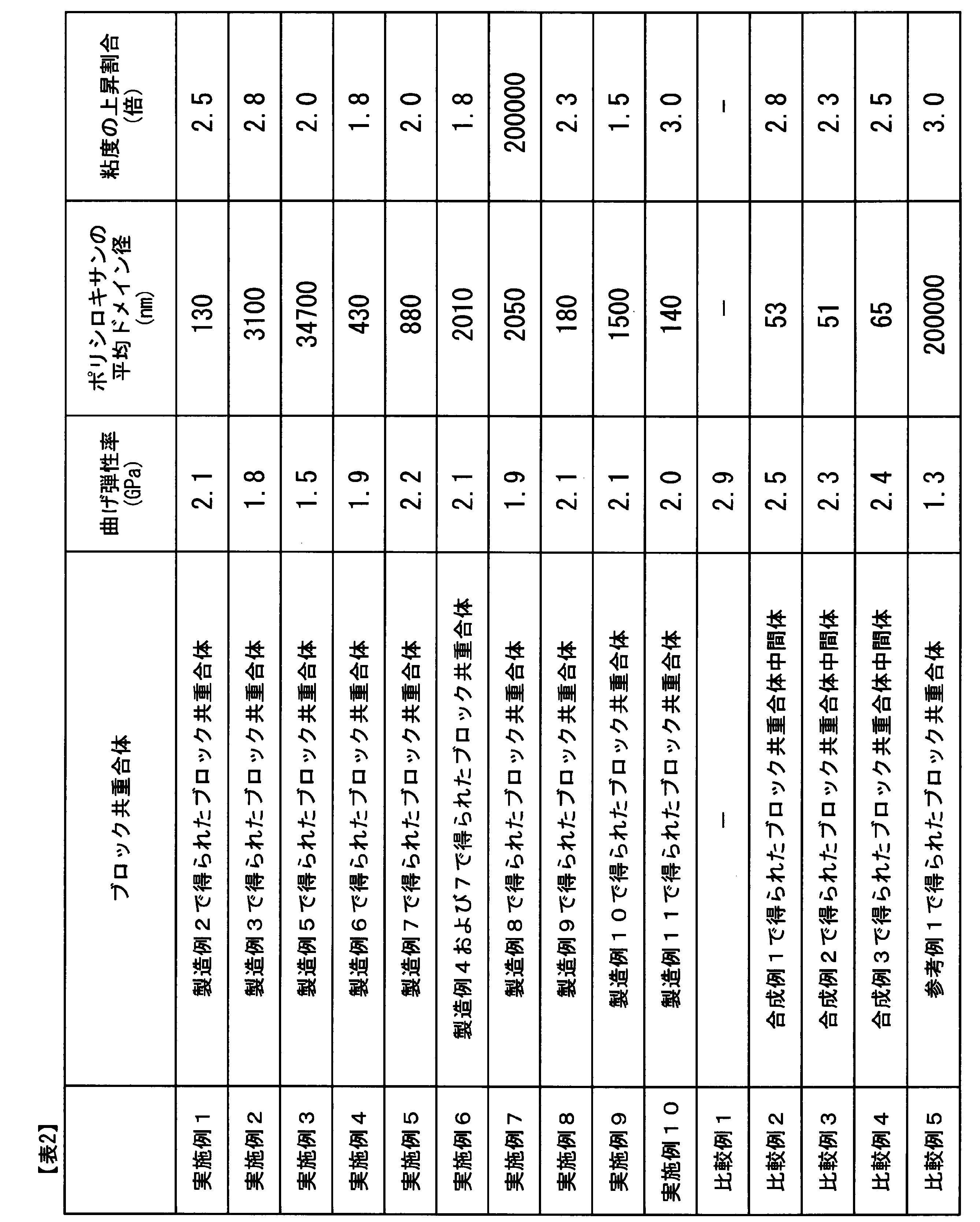
Claims (14)
- カルボン酸無水物基、水酸基、エポキシ基、アミノ基、およびチオール基から選ばれる官能基を有するポリシロキサン(A)、ならびに、カルボン酸無水物基、水酸基、アミノ基、エポキシ基、およびチオール基から選ばれる官能基を有するポリアルキレングリコール(B)を反応させてポリシロキサン-ポリアルキレングリコールブロック共重合体中間体を得て、さらに該ポリシロキサン-ポリアルキレングリコールブロック共重合体中間体のカルボキシル基の一部を、カルボキシル基との反応性を有する化合物と反応させることによって得られるポリシロキサン-ポリアルキレングリコールブロック共重合体であって、該ポリシロキサン-ポリアルキレングリコールブロック共重合体全体を100質量%として、ポリシロキサン(A)由来の構造の含有量が30質量%以上70質量%以下であり、かつ、該ポリシロキサン-ポリアルキレングリコールブロック共重合体のカルボキシル基含有量が0.1mmol/g~0.75mmol/g、重量平均分子量が5,000~500,000であるポリシロキサン-ポリアルキレングリコールブロック共重合体。
- 前記カルボキシル基との反応性を有する化合物がオルトエステル類、オキサゾリン類、エポキシ類、アルコール類、1価のフェノール類、ハロゲン化アルキル類、および炭酸アルキル類から選ばれる少なくとも1種類の化合物である請求項1記載のポリシロキサン-ポリアルキレングリコールブロック共重合体。
- ポリシロキサン-ポリアルキレングリコールブロック共重合体の数平均分子量とカルボキシル基含有量の積が2より大きい請求項1または2記載のポリシロキサン-ポリアルキレングリコールブロック共重合体。
- 前記ポリシロキサン(A)が一般式(1)で表される請求項1~3のいずれかに記載のポリシロキサン-ポリアルキレングリコールブロック共重合体;

- 前記ポリアルキレングリコール(B)が一般式(2)で表される請求項1~4のいずれかに記載のポリシロキサン-ポリアルキレングリコールブロック共重合体;

- 前記ポリシロキサン(A)の官能基および/または前記ポリアルキレングリコール(B)の官能基に反応する官能基を1以上有する共重合成分(C)由来の構造を含む請求項1~5のいずれかに記載のポリシロキサン-ポリアルキレングリコールブロック共重合体。
- 前記ポリアルキレングリコール(B)がポリテトラメチレングリコールおよび/またはポリプロピレングリコールである請求項1~6のいずれかに記載のポリシロキサン-ポリアルキレングリコールブロック共重合体。
- ポリシロキサン-ポリアルキレングリコールブロック共重合体の製造方法であって、下記工程(1)の後に、下記工程(2)を行うポリシロキサン-ポリアルキレングリコールブロック共重合体の製造方法;
工程(1):カルボン酸無水物基、水酸基、エポキシ基、アミノ基、およびチオール基から選ばれる官能基を有するポリシロキサン(A)、ならびに、カルボン酸無水物基、水酸基、アミノ基、エポキシ基、およびチオール基から選ばれる官能基を有するポリアルキレングリコール(B)を反応させてポリシロキサン-ポリアルキレングリコールブロック共重合体中間体を得る工程;
工程(2):工程(1)により得られたポリシロキサン-ポリアルキレングリコールブロック共重合体中間体のカルボキシル基を、カルボキシル基との反応性を有する化合物と反応させる工程であって、前記カルボキシル基との反応性を有する化合物が、オルトエステル類、オキサゾリン類、エポキシ類、アルコール類、1価のフェノール類、ハロゲン化アルキル類、および炭酸アルキル類から選ばれる少なくとも1種類の化合物である。 - 前記工程(1)において、前記ポリシロキサン(A)、前記ポリアルキレングリコール(B)および前記ポリシロキサン(A)の官能基および/または前記ポリアルキレングリコール(B)の官能基に反応する共重合成分(C)を反応させる請求項8に記載のポリシロキサン-ポリアルキレングリコールブロック共重合体の製造方法。
- 前記工程(1)において、共重合成分(C)が前記ポリシロキサン(A)の官能基および前記ポリアルキレングリコール(B)の官能基の両方に反応する共重合成分(C’)である、請求項8または9に記載のポリシロキサン-ポリアルキレングリコールブロック共重合体の製造方法。
- 得られるポリシロキサン-ポリアルキレングリコールブロック共重合体が、ポリシロキサン-ポリアルキレングリコールブロック共重合体全体を100質量%として、ポリシロキサン(A)由来の構造の含有量が30質量%以上70質量%以下であり、カルボキシル基含有量が0.1~0.75mmol/gである請求項8~10のいずれかに記載のポリシロキサン-ポリアルキレングリコールブロック共重合体の製造方法。
- 前記工程(1)において、反応促進剤である金属触媒を用いずに反応させる請求項8~11のいずれかに記載のポリシロキサン-ポリアルキレングリコールブロック共重合体の製造方法。
- 請求項1~7のいずれかに記載のポリシロキサン-ポリアルキレングリコールブロック共重合体およびエポキシ樹脂を含むエポキシ樹脂組成物。
- 請求項13のエポキシ樹脂組成物を硬化させてなるエポキシ樹脂硬化物。
Priority Applications (6)
| Application Number | Priority Date | Filing Date | Title |
|---|---|---|---|
| SG11202100277YA SG11202100277YA (en) | 2018-08-10 | 2019-08-06 | Polysiloxane-polyalkylene glycol block copolymer and method for producing same |
| KR1020217002587A KR20210042085A (ko) | 2018-08-10 | 2019-08-06 | 폴리실록산-폴리알킬렌 글리콜 블록 공중합체 및 그 제조 방법 |
| US17/263,696 US20210221959A1 (en) | 2018-08-10 | 2019-08-06 | Polysiloxane-polyalkylene glycol block copolymer and method of producing same |
| CN201980051077.2A CN112513146A (zh) | 2018-08-10 | 2019-08-06 | 聚硅氧烷-聚亚烷基二醇嵌段共聚物及其制造方法 |
| EP19846178.2A EP3835339A4 (en) | 2018-08-10 | 2019-08-06 | POLYSILOXANE POLYALKYLENE GLYCOL BLOCK COPOLYMER AND PROCESS FOR ITS PRODUCTION |
| JP2019544938A JP6711468B1 (ja) | 2018-08-10 | 2019-08-06 | ポリシロキサン−ポリアルキレングリコールブロック共重合体とその製造方法 |
Applications Claiming Priority (2)
| Application Number | Priority Date | Filing Date | Title |
|---|---|---|---|
| JP2018-151726 | 2018-08-10 | ||
| JP2018151726 | 2018-08-10 |
Publications (1)
| Publication Number | Publication Date |
|---|---|
| WO2020032015A1 true WO2020032015A1 (ja) | 2020-02-13 |
Family
ID=69413538
Family Applications (1)
| Application Number | Title | Priority Date | Filing Date |
|---|---|---|---|
| PCT/JP2019/030875 Ceased WO2020032015A1 (ja) | 2018-08-10 | 2019-08-06 | ポリシロキサン-ポリアルキレングリコールブロック共重合体とその製造方法 |
Country Status (8)
| Country | Link |
|---|---|
| US (1) | US20210221959A1 (ja) |
| EP (1) | EP3835339A4 (ja) |
| JP (1) | JP6711468B1 (ja) |
| KR (1) | KR20210042085A (ja) |
| CN (1) | CN112513146A (ja) |
| SG (1) | SG11202100277YA (ja) |
| TW (1) | TW202017980A (ja) |
| WO (1) | WO2020032015A1 (ja) |
Families Citing this family (1)
| Publication number | Priority date | Publication date | Assignee | Title |
|---|---|---|---|---|
| JP7465790B2 (ja) * | 2020-11-18 | 2024-04-11 | 信越化学工業株式会社 | シリコーンハイブリッド樹脂組成物、及び半導体装置 |
Citations (11)
| Publication number | Priority date | Publication date | Assignee | Title |
|---|---|---|---|---|
| JPH04359023A (ja) | 1991-06-05 | 1992-12-11 | Nippon Unicar Co Ltd | シリコーン系ブロック共重合体および成形用エポキシ樹脂組成物 |
| JPH0873596A (ja) * | 1994-07-08 | 1996-03-19 | Nippon Paint Co Ltd | ブロックポリマー、その製造方法、表面改質剤、コーティング材組成物および多層塗膜の形成方法 |
| JPH08104831A (ja) * | 1994-10-05 | 1996-04-23 | Nippon Paint Co Ltd | 防汚塗料組成物 |
| JPH09106240A (ja) * | 1995-10-09 | 1997-04-22 | Toyo Ink Mfg Co Ltd | ホログラム記録用感光性組成物、ホログラム記録媒体およびそれを用いたホログラムの製造方法 |
| JPH10182831A (ja) | 1996-12-26 | 1998-07-07 | Sumitomo Bakelite Co Ltd | エポキシ樹脂組成物 |
| JPH1160822A (ja) * | 1997-08-19 | 1999-03-05 | Jsr Corp | ゴム組成物 |
| JP2011105809A (ja) * | 2009-11-13 | 2011-06-02 | Mitsubishi Chemicals Corp | ポリシロキサン骨格を有するポリエステルポリオールの製造方法 |
| JP2012036348A (ja) * | 2010-08-11 | 2012-02-23 | Shin-Etsu Chemical Co Ltd | 新規オルガノポリシロキサン化合物およびそれを含む化粧料 |
| JP2013540188A (ja) * | 2010-10-06 | 2013-10-31 | ノバルティス アーゲー | ダングリング親水性ポリマー鎖を有する連鎖延長ポリシロキサン架橋剤 |
| JP2015197596A (ja) * | 2014-04-01 | 2015-11-09 | Jsr株式会社 | ケイ素含有膜形成組成物及びパターン形成方法 |
| WO2018221373A1 (ja) * | 2017-05-31 | 2018-12-06 | 東レ株式会社 | ブロック共重合体とその製造方法、エポキシ樹脂組成物、およびその硬化物ならびに半導体封止材 |
Family Cites Families (12)
| Publication number | Priority date | Publication date | Assignee | Title |
|---|---|---|---|---|
| JP2738487B2 (ja) * | 1992-12-03 | 1998-04-08 | サンスター技研株式会社 | 液状エポキシ樹脂組成物 |
| CN1154124A (zh) * | 1995-03-14 | 1997-07-09 | 长濑-西巴株式会社 | 有机聚硅氧烷衍生物 |
| JPH10251520A (ja) * | 1997-03-11 | 1998-09-22 | Sumitomo Bakelite Co Ltd | 半導体封止用エポキシ樹脂組成物 |
| US7728094B2 (en) * | 2005-05-03 | 2010-06-01 | Imec | Selfassembled grafted polymeric layer for use in biosensor technology |
| CN1982356A (zh) * | 2005-12-15 | 2007-06-20 | 山东大易化工有限公司 | 环氧丙氧丙基封端聚醚和苯基共改性聚硅氧烷及制备方法和应用 |
| US7759435B2 (en) * | 2006-09-26 | 2010-07-20 | Loctite (R&D) Limited | Adducts and curable compositions using same |
| DE102008044199A1 (de) * | 2008-11-28 | 2010-06-02 | Wacker Chemie Ag | Siloxan-Mischungen enthaltende Epoxidharze und Verfahren zu ihrer Herstellung und deren Verwendung |
| WO2012137837A1 (ja) * | 2011-04-07 | 2012-10-11 | 日本化薬株式会社 | 多価カルボン酸樹脂およびその組成物 |
| JP6006725B2 (ja) * | 2011-09-09 | 2016-10-12 | 日本化薬株式会社 | 光半導体素子封止用硬化性樹脂組成物およびその硬化物 |
| CN104684960B (zh) * | 2012-09-27 | 2017-05-10 | 日本化药株式会社 | 多元羧酸树脂及环氧树脂组合物 |
| KR102072060B1 (ko) * | 2013-08-05 | 2020-01-31 | 히타치가세이가부시끼가이샤 | 에폭시 수지 조성물 및 전자 부품 장치 |
| CN105457074A (zh) * | 2015-12-22 | 2016-04-06 | 华南理工大学 | 一种含peg嵌段的聚硅氧烷超分子弹性体创面敷料的制备 |
-
2019
- 2019-08-06 KR KR1020217002587A patent/KR20210042085A/ko not_active Withdrawn
- 2019-08-06 SG SG11202100277YA patent/SG11202100277YA/en unknown
- 2019-08-06 CN CN201980051077.2A patent/CN112513146A/zh active Pending
- 2019-08-06 US US17/263,696 patent/US20210221959A1/en not_active Abandoned
- 2019-08-06 EP EP19846178.2A patent/EP3835339A4/en not_active Withdrawn
- 2019-08-06 WO PCT/JP2019/030875 patent/WO2020032015A1/ja not_active Ceased
- 2019-08-06 JP JP2019544938A patent/JP6711468B1/ja active Active
- 2019-08-08 TW TW108128211A patent/TW202017980A/zh unknown
Patent Citations (11)
| Publication number | Priority date | Publication date | Assignee | Title |
|---|---|---|---|---|
| JPH04359023A (ja) | 1991-06-05 | 1992-12-11 | Nippon Unicar Co Ltd | シリコーン系ブロック共重合体および成形用エポキシ樹脂組成物 |
| JPH0873596A (ja) * | 1994-07-08 | 1996-03-19 | Nippon Paint Co Ltd | ブロックポリマー、その製造方法、表面改質剤、コーティング材組成物および多層塗膜の形成方法 |
| JPH08104831A (ja) * | 1994-10-05 | 1996-04-23 | Nippon Paint Co Ltd | 防汚塗料組成物 |
| JPH09106240A (ja) * | 1995-10-09 | 1997-04-22 | Toyo Ink Mfg Co Ltd | ホログラム記録用感光性組成物、ホログラム記録媒体およびそれを用いたホログラムの製造方法 |
| JPH10182831A (ja) | 1996-12-26 | 1998-07-07 | Sumitomo Bakelite Co Ltd | エポキシ樹脂組成物 |
| JPH1160822A (ja) * | 1997-08-19 | 1999-03-05 | Jsr Corp | ゴム組成物 |
| JP2011105809A (ja) * | 2009-11-13 | 2011-06-02 | Mitsubishi Chemicals Corp | ポリシロキサン骨格を有するポリエステルポリオールの製造方法 |
| JP2012036348A (ja) * | 2010-08-11 | 2012-02-23 | Shin-Etsu Chemical Co Ltd | 新規オルガノポリシロキサン化合物およびそれを含む化粧料 |
| JP2013540188A (ja) * | 2010-10-06 | 2013-10-31 | ノバルティス アーゲー | ダングリング親水性ポリマー鎖を有する連鎖延長ポリシロキサン架橋剤 |
| JP2015197596A (ja) * | 2014-04-01 | 2015-11-09 | Jsr株式会社 | ケイ素含有膜形成組成物及びパターン形成方法 |
| WO2018221373A1 (ja) * | 2017-05-31 | 2018-12-06 | 東レ株式会社 | ブロック共重合体とその製造方法、エポキシ樹脂組成物、およびその硬化物ならびに半導体封止材 |
Non-Patent Citations (1)
| Title |
|---|
| See also references of EP3835339A4 |
Also Published As
| Publication number | Publication date |
|---|---|
| SG11202100277YA (en) | 2021-02-25 |
| KR20210042085A (ko) | 2021-04-16 |
| US20210221959A1 (en) | 2021-07-22 |
| JP6711468B1 (ja) | 2020-06-17 |
| EP3835339A4 (en) | 2022-07-13 |
| TW202017980A (zh) | 2020-05-16 |
| CN112513146A (zh) | 2021-03-16 |
| EP3835339A1 (en) | 2021-06-16 |
| JPWO2020032015A1 (ja) | 2020-08-20 |
Similar Documents
| Publication | Publication Date | Title |
|---|---|---|
| JP6642761B2 (ja) | ブロック共重合体とその製造方法、エポキシ樹脂組成物、およびその硬化物ならびに半導体封止材 | |
| EP3315530B1 (en) | Epoxy resin composition, fiber-reinforced composite material, molded article, and pressure vessel | |
| US9371416B2 (en) | Epoxy elastomer compositions | |
| JP6711468B1 (ja) | ポリシロキサン−ポリアルキレングリコールブロック共重合体とその製造方法 | |
| KR20160061323A (ko) | 경화성 에폭시 수지 조성물 | |
| US20120259044A1 (en) | Hyperbranched polymers for modifying the toughness of anionically cured epoxy resin systems | |
| WO2022124191A1 (ja) | 熱硬化性エポキシ樹脂組成物、熱硬化性エポキシ樹脂成形品、繊維強化複合材料用成形材料、繊維強化複合材料、および繊維強化複合材料の製造方法 | |
| US20120136092A1 (en) | Thermosettable resin compositions | |
| JP2023121887A (ja) | シリコーン系ブロック共重合体、その製造方法、エポキシ樹脂組成物およびエポキシ樹脂硬化剤 | |
| JP7823570B2 (ja) | エポキシ樹脂組成物、プリプレグおよび繊維強化複合材料 | |
| JP2022138123A (ja) | ポリイミドブロック共重合体、エポキシ樹脂組成物、その硬化物、半導体封止材およびポリイミドブロック共重合体の製造方法 | |
| JP2023048208A (ja) | ブロック共重合体およびその製造方法 | |
| KR20220157117A (ko) | 신규한 글리시딜 산 무수물기반 폴리올 화합물, 이로부터 제조된 개질된 폴리우레탄 공중합체와 이를 포함하는 접착제 조성물 및 이로부터 제조된 경화물 | |
| TWI909071B (zh) | 苯酚混合物、環氧樹脂、環氧樹脂組合物、硬化物及電氣、電子零件 | |
| KR102928771B1 (ko) | 에스터기 및 아미드기를 갖는 신규한 경화제, 이의 제조방법, 이를 포함하는 에폭시 조성물, 경화물 및 물품 | |
| JP5081788B2 (ja) | エポキシ樹脂を用いた硬化物 | |
| KR20260030402A (ko) | 신규한 화합물 및 이를 포함하는 에폭시 조성물 | |
| WO2021149727A1 (ja) | 封止用樹脂組成物、電子部品装置及び電子部品装置の製造方法 | |
| JP2022055335A (ja) | ポリシロキサン-ポリアルキレングリコールブロック共重合体の製造方法、およびポリシロキサン-ポリアルキレングリコールブロック共重合体 | |
| JP2021091878A (ja) | ブロック共重合体とその製造方法 | |
| JP2021187916A (ja) | ポリシロキサン系共重合体とその製造方法 |
Legal Events
| Date | Code | Title | Description |
|---|---|---|---|
| ENP | Entry into the national phase |
Ref document number: 2019544938 Country of ref document: JP Kind code of ref document: A |
|
| 121 | Ep: the epo has been informed by wipo that ep was designated in this application |
Ref document number: 19846178 Country of ref document: EP Kind code of ref document: A1 |
|
| ENP | Entry into the national phase |
Ref document number: 20217002587 Country of ref document: KR Kind code of ref document: A |
|
| NENP | Non-entry into the national phase |
Ref country code: DE |
|
| ENP | Entry into the national phase |
Ref document number: 2019846178 Country of ref document: EP Effective date: 20210310 |