WO2020039902A1 - Corset - Google Patents
Corset Download PDFInfo
- Publication number
- WO2020039902A1 WO2020039902A1 PCT/JP2019/030641 JP2019030641W WO2020039902A1 WO 2020039902 A1 WO2020039902 A1 WO 2020039902A1 JP 2019030641 W JP2019030641 W JP 2019030641W WO 2020039902 A1 WO2020039902 A1 WO 2020039902A1
- Authority
- WO
- WIPO (PCT)
- Prior art keywords
- contact portion
- corset
- main body
- contact
- frame
- Prior art date
- Legal status (The legal status is an assumption and is not a legal conclusion. Google has not performed a legal analysis and makes no representation as to the accuracy of the status listed.)
- Ceased
Links
Images


Classifications
-
- A—HUMAN NECESSITIES
- A41—WEARING APPAREL
- A41D—OUTERWEAR; PROTECTIVE GARMENTS; ACCESSORIES
- A41D13/00—Professional, industrial or sporting protective garments, e.g. surgeons' gowns or garments protecting against blows or punches
- A41D13/05—Professional, industrial or sporting protective garments, e.g. surgeons' gowns or garments protecting against blows or punches protecting only a particular body part
-
- A—HUMAN NECESSITIES
- A61—MEDICAL OR VETERINARY SCIENCE; HYGIENE
- A61F—FILTERS IMPLANTABLE INTO BLOOD VESSELS; PROSTHESES; DEVICES PROVIDING PATENCY TO, OR PREVENTING COLLAPSING OF, TUBULAR STRUCTURES OF THE BODY, e.g. STENTS; ORTHOPAEDIC, NURSING OR CONTRACEPTIVE DEVICES; FOMENTATION; TREATMENT OR PROTECTION OF EYES OR EARS; BANDAGES, DRESSINGS OR ABSORBENT PADS; FIRST-AID KITS
- A61F5/00—Orthopaedic methods or devices for non-surgical treatment of bones or joints; Nursing devices ; Anti-rape devices
- A61F5/01—Orthopaedic devices, e.g. long-term immobilising or pressure directing devices for treating broken or deformed bones such as splints, casts or braces
- A61F5/02—Orthopaedic corsets
Definitions
- the present disclosure relates to a corset, and particularly relates to a corset used for lumbar spine disease and the like.
- corset In lumbar spine disease, a trunk orthosis (corset) that supports and fixes the lumbar spine is used.
- the corset when worn, increases the internal pressure of the abdominal cavity, thereby supporting the anterior spine and reducing the load on the lumbar spine. For this reason, a normal corset compresses the abdomen and the lumbar spine, restricting the movement of the lumbar region and fixing the trunk.
- a stretchable belt is wound around the trunk to compress and fix.
- a normal corset gives the wearer great discomfort because the lower abdomen is squeezed. In addition, it may interfere with daily life such as eating and sitting.
- An object of the present disclosure is to realize a corset that can fix the trunk without relying on compression of the lower abdomen.
- One aspect of the corset of the present disclosure is a frame mounted on a torso of a wearer, and a first abutment provided on the frame and abutting on a position of a lumbar vertebra when the frame is mounted on the torso of the wearer. And a second contact portion and a third contact portion that contact the positions of the left and right hip bones, respectively, and the torso of the wearer is connected to the first contact portion, the second contact portion, and the second contact portion. Three points are supported by three contact portions.
- the lumbar spine can be dispersed and supported by the lumbar bone, and sufficient lumbar spine support and fixation can be achieved while significantly reducing discomfort during mounting due to compression of the lower abdomen. It becomes possible.
- the frame includes a main body that is a C-shaped cylindrical body having a slit-shaped opening extending in the axial direction, and includes a first contact part, a second contact part, and a second contact part.
- the contact portion 3 may be provided on the inner surface of the main body.
- the frame may include an adjustment unit that adjusts the interval between the slit-shaped openings of the main body.
- the frame has two wing portions provided so as to protrude downward from the lower end portion of the main body portion, and the second contact portion and the third contact portion are wing portions. Each part may be provided. With such a configuration, the corset is hardly displaced, and the trunk can be supported and fixed more stably.
- the second contact portion and the third contact portion are provided at the center of the wing portion. With this configuration, the trunk can be supported and fixed more stably.
- the first contact portion can be brought into contact with any position from the third lumbar vertebra to the fifth lumbar vertebra of the wearer. With such a configuration, it is possible to cope with many lumbar spine diseases.
- the frame includes a first portion including a first contact portion, a second portion including a second contact portion, and a third portion including a third contact portion.
- the trunk can be fixed without depending on the compression of the lower abdomen, and the discomfort at the time of wearing can be greatly reduced.
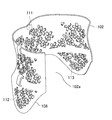
- FIG. 1 is a perspective view showing a corset according to one embodiment.
- FIG. 2 is a perspective view showing a corset cylinder according to one embodiment.
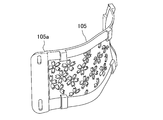
- FIG. 3 is a perspective view showing a plate of the corset according to one embodiment.
- FIG. 4 is a side view showing an example of mounting a corset according to one embodiment.
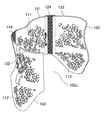
- FIG. 5 is a perspective view showing a modification of the housing.
- the corset of the present embodiment comes into contact with the frame 101 to be mounted on the torso of the wearer and the position of the lumbar vertebra when the frame 101 is mounted on the torso of the wearer.
- the wearer's trunk (torso) is supported at three points by a first contact portion 111, a second contact portion 112, and a third contact portion 113.
- the corset of the present embodiment supports the left and right greater trochanters and the lumbar vertebra at three points, and disperses a part of the force applied to the lumbar vertebra to the left and right greater trochanters to reduce the load on the lumbar vertebra. To reduce. Therefore, the trunk can be supported without compressing the lower abdomen, and discomfort due to compression of the lower abdomen can be significantly reduced.
- the frame 101 includes a main body 102 that is a C-shaped cylindrical body having a slit-shaped opening 102 a extending in the height direction, and protrudes below the main body 102. And two substantially triangular wing portions 108.
- the main body 102 is mounted on the body with the opening 102a on the abdomen side.
- the main body 102 preferably has a constricted shape at the center in the circumferential direction and at the center in the height, corresponding to the shape of the torso of a person.
- the first contact portion 111, the second contact portion 112, and the third contact portion 113 are provided on the inner peripheral surface of the frame 101, respectively, and contact the corresponding body surface of the body.
- the first contact portion 111 is provided at the center in the circumferential direction at the upper part of the main body portion 102, and the second contact portion 112 and the third contact portion 113 are respectively provided at the center of the wing portion 108. It is provided near the section.
- the frame 101 is formed of a hard material capable of supporting the trunk at three points. Further, it is preferable that the opening 102a has such flexibility that the opening 102a can be widened and attached to the trunk. Specifically, it can be formed of a resin such as polyethylene, polypropylene, polyester, polyamide, polyvinyl chloride, polycarbonate, polyamide elastomer, and polyimide. For this reason, the frame 101 becomes independent in a state where it is not mounted, and the relative positional relationship of the three contact portions does not change.
- a resin such as polyethylene, polypropylene, polyester, polyamide, polyvinyl chloride, polycarbonate, polyamide elastomer, and polyimide.
- the frame 101 adjusts the interval between the openings 102a of the main body 102, and increases the force with which the second abutment portion 112 and the third abutment portion 113 abut on the left and right greater trochanters of the femur.
- It has an adjusting unit 103 that adjusts and fixes the position of the main body 102 with respect to the trunk.
- the adjustment unit 103 includes a plate 105 that covers the opening 102a of the main body 102, and a belt 106 that connects the plate 105 and the main body 102. By tightening the belt 106, the C-shaped main body 102 is deformed, so that the radial gap between the second contact portion 112 and the third contact portion 113 can be adjusted.
- the plate 105 does not press the lower abdomen to increase the internal pressure of the abdominal cavity, but adjusts the interval between the second contact portion 112 and the third contact portion 113 so as to adjust the left and right thighs. It is intended to abut on the greater trochanter with moderate force. Thereby, a part of the force applied to the lumbar vertebra is received by the first contact portion 111 and can be dispersed to the lumbar bone through the second contact portion 112 and the third contact portion 113. Further, it is possible to prevent the mounting position of the frame 101 from being shifted or the frame 101 from coming off due to the movement of the wearer.
- the plate 105 does not need to be in close contact with the body surface of the wearer, and an appropriate gap can be provided between the plate 105 and the body surface. By providing a gap between the plate 105 and the body surface, it is possible to make it difficult for the wearer's muscular strength to decrease due to relying on the plate 105 as a support.
- the plate 105 has step portions 105a on both sides, and the circumferential length of a portion between the step portions 105a in the plate 105 is larger than the circumferential length of the opening portion 102a of the main body portion 102. Designed to be a little shorter. For this reason, when the belt 106 is tightened, the main body 102 is deformed to a position where the step portion 105a and the end of the main body 102 are in contact with each other, and the distance between the second contact portion 112 and the third contact portion 113 is reduced. Become smaller.
- the second contact portion 112 and the third contact portion 113 are not deformed any more, so that the force of the second contact portion 112 and the third contact portion 113 contacting the hip bone is not too large, and the plate 105 does not compress the abdomen.
- a configuration in which the step portion 105a is not provided may be adopted.
- the plate 105 and the main body 102 may have mutually complementary inclined surfaces or curved surfaces, and the portions may be brought into contact with each other to prevent over-closing.
- the belt 106 connecting the plate 105 and the main body 102 has a hook-and-loop fastener, so that the length can be easily adjusted and the plate 105 can be easily removed.
- the adjustment of the length of the belt 106 may be realized by any configuration, for example, by a lock strap or the like.
- one end of the plate 105 may be fixed to the main body 102 by a hinge or the like, and the other end may be connected to the main body 102 by a belt or the like whose length can be adjusted.
- each of the plate 105 and the main body 102 may be provided with an adjustable-length belt or the like having a buckle that engages with each other, and the plate 105 and the main body 102 may be connected using this.
- the operation of fixing and adjusting the plate 105 can be performed in front of the wearer's body.
- the wearer can operate without twisting the body sideways, so that even a wearer who has a symptom such as low back pain and has difficulty twisting the body sideways can easily use the plate 105. Fixing and adjustment can be facilitated.
- the plate 105 and the main body 102 can be connected in an adjustable manner, not only a belt but also a string or a wire can be used.
- a latch mechanism and a dial such as those used for tightening shoelaces, can be provided with an adjusting mechanism that can adjust the length of the string or wire by turning the dial.
- the plate 105 and the main body 102 may be connected by using a snap button, a key hook, or the like.
- the adjustment unit may be configured to have no plate.
- both ends of the opening 102a may be directly connected by a belt or the like whose length is adjustable.
- a plate it is preferable to use a belt having a certain width, but a thin belt, a string, a wire, or the like may be used.
- the main body 102 is integrally formed.
- the integral molding facilitates the formation of the main body 102.
- the main body 102 can be formed by connecting a plurality of members. In this case, the main body 102 can be disassembled, which facilitates storage.
- the main body 102 is divided into a first portion including the first contact portion 111, a second portion including the second contact portion 112, and a third portion including the third contact portion 113.
- the first portion, the second portion, and the third portion may be provided with connecting portions, respectively, so that they can be integrally assembled.
- the connecting portion may be, for example, a concave portion and a convex portion which are provided at a side end portion of each portion and are fitted to each other.
- a hook-and-loop fastener may be attached to a side end portion of each portion, and the attached hook-and-loop fasteners may connect each other.
- the first portion 121 is not directly connected to the second portion 122 and the third portion 123 but is connected via a band-shaped connecting member 124 made of a flexible mesh cloth or the like. You can also. In this way, even when the respective parts are connected to each other, the parts can be folded and stored at the connecting member 124.
- FIG. 5 shows an example in which both sides of the connecting member 124 are fixed portions, and the fixed portions are fixed to the respective portions by adhesion or fusion so that the three portions are not separated from each other. With this configuration, the three portions are not connected by mistake, and the three portions can be prevented from being inadvertently separated during use and the positional relationship between the three portions can be prevented from shifting.
- the three parts may be configured to be separable from each other.
- FIG. 5 shows an example in which one belt-shaped connecting member 124 is continuously connected from the upper end to the lower end of each part.
- the length of the connecting member extends from the upper end to the lower end of each part. It is not necessary.
- a plurality of short connecting members may be arranged at intervals to connect each part.
- the connecting member 124 is not limited to the mesh cloth, and can be formed of a material that is more flexible than the first portion 121, the second portion 122, and the third portion 123.
- the main body 102 can be divided into three or more parts.
- the first contact portion 111 is a convex portion provided on the inner surface of the main body portion, and the second contact portion 112 and the third contact portion 113 are provided on the inner surface of each wing portion 108. It is a provided curved surface. It is preferable that each contact portion is designed to contact a necessary portion as a surface in order to suppress occurrence of pain or the like at the contact portion. In addition, when the contact portion is designed not for exclusive use of an individual but for general use, it is preferable that each contact portion is expanded to a range that can absorb the individual difference in the contact position.
- the first contact portion 111 is brought into contact with that position.
- each wing portion 108 has a substantially triangular shape whose width gradually decreases downward, and the second contact portion 112 and the second contact portion 112 whose central portions abut against the greater trochanter of the wearer. 3 is provided so as to be the contact portion 113.
- the shape of the wing portion 108 is not limited to a substantially triangular shape as long as it can cover the iliac bone, and may be a square shape, a semicircular shape, or the like.
- the trunk can be more stably supported and fixed.
- the second contact portion 112 and the third contact portion 113 may be provided anywhere on the wing portion 108, and may be provided at the tip of the wing portion 108, for example.
- the wing portion 108 can be formed integrally with the main body portion 102, but can also be formed separately from the main body portion 102 and attached to the main body portion 102 later.
- the second contact portion and the third contact portion may be provided so that the entire main body 102 extends downward without providing the wing portion 108.
- the movement of the body can be made more difficult to hinder than when the entire main body 102 extends to the position of the greater trochanter of the femur.
- first contact portion 111, the second contact portion 112, and the third contact portion 113 on the inner surface of the frame 101 need only be in contact with the body surface of the wearer, and the other portions are in contact with the body surface. You don't have to. However, a portion that contacts the body surface other than the first contact portion 111, the second contact portion 112, and the third contact portion 113 may be generated. For example, when the second abutment portion 112 and the third abutment portion 113 abut on the greater trochanter of the femur, the fourth and fifth abutments on the upper posterior upper iliac spine or the upper anterior upper iliac spine. Can be provided.
- the frame 101 has a plurality of openings.
- the openings can be freely arranged as long as the required strength can be maintained. Further, in the present embodiment, an example is shown in which the opening exerts a design, but the shape of the opening is not limited as long as air permeability can be ensured.
- the main body 102 has a configuration in which a C-shaped upper band provided with the first contact portion 111 and a C-shaped lower band connected to the wing 108 are connected by a plurality of columnar portions. You can also. In this case, one or more C-shaped intermediate bands may be provided between the upper band and the lower band.
- the corset of the present embodiment can tolerate individual differences in the body shape of the wearer to some extent, it is possible to apply it to most wearers by preparing several types having different diameters and heights of the main body 102.
- the position of each contact portion can be designed according to the body type of the wearer.
- the positions of the lumbar vertebra and the lumbar bone can be specified from, for example, an X-ray photograph or a CT photograph of the waist of the wearer, and the lumbar spine and the lumbar can be designed accordingly.
- the corset of the present embodiment has a hard frame, unlike a conventional hard corset in which a fracture is fixed by pressing the entire abdomen, the first abutment that contacts the position of the lumbar vertebra is provided.
- the trunk In order to support and fix at the three points of the contact part and the second contact part and the third contact part that contact the position of the greater trochanter of the left and right femurs, respectively, the trunk is not pressed by the lower abdomen. It can be fixed and discomfort at the time of mounting can be greatly reduced.
- the conventional rigid corset is pressed and fixed in accordance with the body surface, it is necessary to increase the area of the corset.
- the corset of the present disclosure can fix the trunk without relying on compression of the lower abdomen, and is useful as a corset used in lumbar spine disease and the like.
Landscapes
- Health & Medical Sciences (AREA)
- General Health & Medical Sciences (AREA)
- Engineering & Computer Science (AREA)
- Animal Behavior & Ethology (AREA)
- Biomedical Technology (AREA)
- Heart & Thoracic Surgery (AREA)
- Vascular Medicine (AREA)
- Life Sciences & Earth Sciences (AREA)
- Orthopedic Medicine & Surgery (AREA)
- Nursing (AREA)
- Public Health (AREA)
- Veterinary Medicine (AREA)
- Physical Education & Sports Medicine (AREA)
- Textile Engineering (AREA)
- Orthopedics, Nursing, And Contraception (AREA)
Abstract
L'invention concerne un corset comprenant : un cadre 101 monté sur la partie torse d'un porteur ; et une première partie de butée 111 qui vient en butée contre la position lombaire ainsi qu'une deuxième partie de butée 112 et une troisième partie de butée 113 qui viennent en butée contre les positions des grands trochanters du fémur gauche et du fémur droit, respectivement, lorsque le cadre 101 est monté sur la partie torse du porteur, la première partie de butée 111, la deuxième partie de butée 112, et la troisième partie de butée 113 étant disposées sur le cadre 101. Le corset supporte la partie torse du porteur en trois points au moyen de la première partie de butée 111, de la deuxième partie de butée 112 et de la troisième partie de butée 113.
Priority Applications (1)
| Application Number | Priority Date | Filing Date | Title |
|---|---|---|---|
| JP2020538278A JP7384164B2 (ja) | 2018-08-20 | 2019-08-05 | コルセット |
Applications Claiming Priority (2)
| Application Number | Priority Date | Filing Date | Title |
|---|---|---|---|
| JP2018-154151 | 2018-08-20 | ||
| JP2018154151 | 2018-08-20 |
Publications (1)
| Publication Number | Publication Date |
|---|---|
| WO2020039902A1 true WO2020039902A1 (fr) | 2020-02-27 |
Family
ID=69593028
Family Applications (1)
| Application Number | Title | Priority Date | Filing Date |
|---|---|---|---|
| PCT/JP2019/030641 Ceased WO2020039902A1 (fr) | 2018-08-20 | 2019-08-05 | Corset |
Country Status (2)
| Country | Link |
|---|---|
| JP (1) | JP7384164B2 (fr) |
| WO (1) | WO2020039902A1 (fr) |
Cited By (1)
| Publication number | Priority date | Publication date | Assignee | Title |
|---|---|---|---|---|
| JP7364297B1 (ja) | 2022-08-24 | 2023-10-18 | 株式会社P.O.イノベーション | キャスティングシステム |
Citations (3)
| Publication number | Priority date | Publication date | Assignee | Title |
|---|---|---|---|---|
| JPH0513417U (ja) * | 1991-08-02 | 1993-02-23 | 敏雄 宗 | 医療用ベルト |
| JPH067394A (ja) * | 1992-06-29 | 1994-01-18 | Tomijiro Nakano | 骨盤サポータ |
| JP2012130388A (ja) * | 2010-12-20 | 2012-07-12 | Fine Brace:Kk | 医療用コルセット |
Family Cites Families (1)
| Publication number | Priority date | Publication date | Assignee | Title |
|---|---|---|---|---|
| KR100822375B1 (ko) * | 2007-03-23 | 2008-04-16 | 주식회사 에이치비티 | 골반 교정용 보조기 |
-
2019
- 2019-08-05 WO PCT/JP2019/030641 patent/WO2020039902A1/fr not_active Ceased
- 2019-08-05 JP JP2020538278A patent/JP7384164B2/ja active Active
Patent Citations (3)
| Publication number | Priority date | Publication date | Assignee | Title |
|---|---|---|---|---|
| JPH0513417U (ja) * | 1991-08-02 | 1993-02-23 | 敏雄 宗 | 医療用ベルト |
| JPH067394A (ja) * | 1992-06-29 | 1994-01-18 | Tomijiro Nakano | 骨盤サポータ |
| JP2012130388A (ja) * | 2010-12-20 | 2012-07-12 | Fine Brace:Kk | 医療用コルセット |
Cited By (2)
| Publication number | Priority date | Publication date | Assignee | Title |
|---|---|---|---|---|
| JP7364297B1 (ja) | 2022-08-24 | 2023-10-18 | 株式会社P.O.イノベーション | キャスティングシステム |
| JP2024031762A (ja) * | 2022-08-24 | 2024-03-07 | 株式会社P.O.イノベーション | キャスティングシステム |
Also Published As
| Publication number | Publication date |
|---|---|
| JP7384164B2 (ja) | 2023-11-21 |
| JPWO2020039902A1 (ja) | 2021-08-26 |
Similar Documents
| Publication | Publication Date | Title |
|---|---|---|
| JP4840881B2 (ja) | 腰用サポータ | |
| KR100426130B1 (ko) | 맞춤형 교정장치 | |
| EP1437109B1 (fr) | Support lombaire | |
| US4688558A (en) | Orthopedic appliance | |
| CN103354738B (zh) | 腰部支撑带 | |
| JP7333513B2 (ja) | 体幹装具 | |
| EP4005539B1 (fr) | Vêtement de compression pour corriger la forme du bas du corps et la démarche pour la déformation angulaire des jambes | |
| KR101801868B1 (ko) | 척추측만증 보조기 | |
| JP7384164B2 (ja) | コルセット | |
| KR20160146269A (ko) | 척추측만증 보조기 | |
| CA3165450C (fr) | Appareil orthopedique d'immobilisation de l'epaule | |
| EP4199868B1 (fr) | Orthèse sacro-iliaque | |
| TWI763587B (zh) | 胸腰椎矯具 | |
| KR101895004B1 (ko) | 척추측만증 보조기 | |
| JP2022038469A (ja) | 骨盤矯正用サポータ及びその装着方法 | |
| RU2271179C1 (ru) | Ортопедический тутор | |
| HK40035684A (en) | Torso orthosis | |
| HK40035684B (zh) | 躯干矫形器 | |
| JP2021132818A (ja) | 腰部固定帯 | |
| JP2006239343A (ja) | 腰痛ベルト | |
| JP2002095686A (ja) | 腰部装着ベルト装置 | |
| JP2007090008A (ja) | 腰部ガードル |
Legal Events
| Date | Code | Title | Description |
|---|---|---|---|
| 121 | Ep: the epo has been informed by wipo that ep was designated in this application |
Ref document number: 19851206 Country of ref document: EP Kind code of ref document: A1 |
|
| ENP | Entry into the national phase |
Ref document number: 2020538278 Country of ref document: JP Kind code of ref document: A |
|
| NENP | Non-entry into the national phase |
Ref country code: DE |
|
| 122 | Ep: pct application non-entry in european phase |
Ref document number: 19851206 Country of ref document: EP Kind code of ref document: A1 |