WO2020066058A1 - Solution électrolytique non aqueuse, électrolyte non volatil et batterie rechargeable - Google Patents
Solution électrolytique non aqueuse, électrolyte non volatil et batterie rechargeable Download PDFInfo
- Publication number
- WO2020066058A1 WO2020066058A1 PCT/JP2019/006166 JP2019006166W WO2020066058A1 WO 2020066058 A1 WO2020066058 A1 WO 2020066058A1 JP 2019006166 W JP2019006166 W JP 2019006166W WO 2020066058 A1 WO2020066058 A1 WO 2020066058A1
- Authority
- WO
- WIPO (PCT)
- Prior art keywords
- electrolyte
- aqueous electrolyte
- log
- nonvolatile
- secondary battery
- Prior art date
- Legal status (The legal status is an assumption and is not a legal conclusion. Google has not performed a legal analysis and makes no representation as to the accuracy of the status listed.)
- Ceased
Links
Images


Classifications
-
- H—ELECTRICITY
- H01—ELECTRIC ELEMENTS
- H01M—PROCESSES OR MEANS, e.g. BATTERIES, FOR THE DIRECT CONVERSION OF CHEMICAL ENERGY INTO ELECTRICAL ENERGY
- H01M10/00—Secondary cells; Manufacture thereof
- H01M10/05—Accumulators with non-aqueous electrolyte
- H01M10/052—Li-accumulators
-
- H—ELECTRICITY
- H01—ELECTRIC ELEMENTS
- H01M—PROCESSES OR MEANS, e.g. BATTERIES, FOR THE DIRECT CONVERSION OF CHEMICAL ENERGY INTO ELECTRICAL ENERGY
- H01M10/00—Secondary cells; Manufacture thereof
- H01M10/05—Accumulators with non-aqueous electrolyte
- H01M10/056—Accumulators with non-aqueous electrolyte characterised by the materials used as electrolytes, e.g. mixed inorganic/organic electrolytes
-
- H—ELECTRICITY
- H01—ELECTRIC ELEMENTS
- H01M—PROCESSES OR MEANS, e.g. BATTERIES, FOR THE DIRECT CONVERSION OF CHEMICAL ENERGY INTO ELECTRICAL ENERGY
- H01M10/00—Secondary cells; Manufacture thereof
- H01M10/05—Accumulators with non-aqueous electrolyte
- H01M10/056—Accumulators with non-aqueous electrolyte characterised by the materials used as electrolytes, e.g. mixed inorganic/organic electrolytes
- H01M10/0564—Accumulators with non-aqueous electrolyte characterised by the materials used as electrolytes, e.g. mixed inorganic/organic electrolytes the electrolyte being constituted of organic materials only
- H01M10/0566—Liquid materials
-
- Y—GENERAL TAGGING OF NEW TECHNOLOGICAL DEVELOPMENTS; GENERAL TAGGING OF CROSS-SECTIONAL TECHNOLOGIES SPANNING OVER SEVERAL SECTIONS OF THE IPC; TECHNICAL SUBJECTS COVERED BY FORMER USPC CROSS-REFERENCE ART COLLECTIONS [XRACs] AND DIGESTS
- Y02—TECHNOLOGIES OR APPLICATIONS FOR MITIGATION OR ADAPTATION AGAINST CLIMATE CHANGE
- Y02E—REDUCTION OF GREENHOUSE GAS [GHG] EMISSIONS, RELATED TO ENERGY GENERATION, TRANSMISSION OR DISTRIBUTION
- Y02E60/00—Enabling technologies; Technologies with a potential or indirect contribution to GHG emissions mitigation
- Y02E60/10—Energy storage using batteries
Definitions
- the present invention relates to a non-aqueous electrolyte, a nonvolatile electrolyte, and a secondary battery.
- Patent Document 1 discloses the following content.
- a hetero element-containing organic solvent containing a specific organic solvent having a relative dielectric constant of 10 or less and / or a dipole moment of 5 D or less, and a metal salt having lithium as a cation and having a chemical structure represented by the following general formula (1) as an anion And a molar ratio of 3 to 5, and in the powder X-ray diffraction measurement, 1.10 ⁇ (integrated intensity of peak derived from (003) plane I (003)) / derived from ((104) plane to satisfy the integrated intensity I (104)) ⁇ 2.0 for the peak, or the general formula Li a (Ni x Co y M z) O b (1.05 ⁇ a ⁇ 1.20,0.15 ⁇ x ⁇ 0.55, 0.25 ⁇ y ⁇ 0.75, 0.01 ⁇ z ⁇ 0.29, x + y + z 1, 1.7 ⁇ b
- Patent Document 1 there is no description or suggestion regarding the temperature at which the electrolytic solution volatilizes, so that the electrolytic solution may volatilize depending on the use conditions of the battery, and the safety of the battery may be reduced.
- the present invention has been made in view of the above circumstances, and an object of the present invention is to provide a non-aqueous electrolyte, a non-aqueous electrolyte having a non-aqueous electrolyte, and a secondary battery which improve the safety of the battery.
- the nonaqueous electrolyte which improves the safety
- the non-volatile electrolyte which has a nonaqueous electrolyte
- a secondary battery can be provided.
- FIG. 1 is a schematic cross-sectional view illustrating a configuration of a secondary battery according to one embodiment of the present invention.
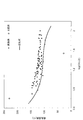
- the logarithm log (ion conductivity) of the ionic conductivity of the nonaqueous electrolyte is expressed as log (O / Li). It is the figure which plotted. In the figure, the horizontal axis indicates log (O / Li), and the vertical axis indicates log (ion conductivity) (S / cm).
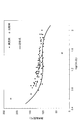
- FIG. 7 is a diagram in which the volatilization temperature of a nonaqueous electrolyte is plotted against log (O / Li) for the contents of Tables 1-2, 2-2, 3-2, and 4-2.
- FIG. 4 is a diagram in which the volatilization temperature of a nonvolatile electrolyte is plotted against log (O / Li) for the contents of Tables 1-2, 2-2, 3-2, and 4-2.
- the horizontal axis indicates log (O / Li)
- the vertical axis indicates volatilization temperature (° C.).
- a lithium ion secondary battery is an electrochemical device that stores or uses electric energy by inserting and extracting lithium ions into and from an electrode in an electrolyte. This is referred to by another name such as a lithium ion battery, a non-aqueous electrolyte secondary battery, and a non-aqueous electrolyte secondary battery, and any of the batteries is an object of the present invention.
- the technical idea of the present invention can be applied to a sodium ion secondary battery, a magnesium ion secondary battery, a calcium ion secondary battery, a zinc secondary battery, an aluminum ion secondary battery, and the like.
- the material may be selected alone, or may be selected in combination of two or more, within a range not inconsistent with the content disclosed in the present specification.
- a material other than the material group exemplified below may be selected within a range not inconsistent with the content disclosed in the present specification.
- FIG. 1 is a schematic sectional view illustrating the configuration of a secondary battery according to one embodiment of the present invention.
- FIG. 1 illustrates a stacked secondary battery.
- the secondary battery 1000 has a positive electrode 100, a negative electrode 200, a package 500, and an insulating layer 300.
- the outer package 500 contains the insulating layer 300, the positive electrode 100, and the negative electrode 200.
- the exterior body 500 may be formed of any material selected from a group of materials having corrosion resistance to a non-aqueous electrolyte, such as aluminum, stainless steel, and nickel-plated steel.
- the present invention can also be applied to a wound secondary battery.
- An electrode body 400 composed of a positive electrode 100, an insulating layer 300, and a negative electrode 200 is stacked in a secondary battery 1000.
- the insulating layer 300 has a nonvolatile electrolyte layer having a nonvolatile electrolyte as described later.
- the secondary battery 1000 may include the positive electrode 100, the negative electrode 200, and the non-volatile electrolyte layer having a non-volatile electrolyte described below formed between the positive electrode 100 and the negative electrode 200.
- the positive electrode 100 or the negative electrode 200 may be called an electrode.
- the positive electrode 100, the negative electrode 200, or the insulating layer 300 may be referred to as a secondary battery sheet.
- the positive electrode 100 has a positive electrode current collector 120 and a positive electrode mixture layer 110. Positive electrode mixture layers 110 are formed on both surfaces of positive electrode current collector 120.
- the negative electrode 200 has a negative electrode current collector 220 and a negative electrode mixture layer 210. Negative electrode mixture layers 210 are formed on both surfaces of negative electrode current collector 220.
- the positive electrode mixture layer 110 or the negative electrode mixture layer 210 may be referred to as an electrode mixture layer, and the positive electrode current collector 120 or the negative electrode current collector 220 may be referred to as an electrode current collector.
- the positive electrode current collector 120 has the positive electrode tab 130.
- the negative electrode current collector 220 has a negative electrode tab 230.
- the positive electrode tab 130 or the negative electrode tab 230 may be referred to as an electrode tab. No electrode mixture layer is formed on the electrode tab. However, an electrode mixture layer may be formed on the electrode tab within a range that does not adversely affect the performance of the secondary battery 1000.
- the positive electrode tab 130 and the negative electrode tab 230 protrude outside the exterior body 500. Then, the plurality of protruding positive electrode tabs 130 and the plurality of negative electrode tabs 230 are connected to each other by, for example, ultrasonic bonding, so that a parallel connection is formed in the secondary battery 1000.
- the present invention can be applied to a bipolar secondary battery in which an electric series connection is formed in the secondary battery 1000.
- the positive electrode mixture layer 110 has a positive electrode active material, a positive electrode conductive agent, and a positive electrode binder.
- the negative electrode mixture layer 210 includes a negative electrode active material, a negative electrode conductive agent, and a negative electrode binder.
- the positive electrode active material or the negative electrode active material may be referred to as an electrode active material
- the positive electrode conductive agent or the negative electrode conductive agent may be referred to as an electrode conductive agent
- the positive electrode binder or the negative electrode binder may be referred to as an electrode binder.
- the electrode conductive agent improves the conductivity of the electrode mixture layer.
- the electrode conductive agent is selected from a material group such as Ketjen black, acetylene black, and graphite.
- a particulate agent can be suitably used as the electrode conductive agent.
- the electrode binder binds an electrode active material and an electrode conductive agent in the electrode.
- the electrode binder is selected from a material group such as, for example, styrene-butadiene rubber, carboxymethylcellulose, polyvinylidene fluoride (PVDF), and the like.
- ⁇ Positive electrode active material> In the positive electrode active material having a noble potential, lithium ions are desorbed in a charging process, and lithium ions desorbed from the negative electrode active material in the negative electrode mixture layer 210 are inserted in a discharging process.
- a lithium composite oxide having a transition metal is desirable.
- x is the concentration of oxygen contained in the compound, and is an integer of 0 or more. Can be taken.).
- the element ratio may deviate from the stoichiometric composition.
- the positive electrode active material a material which is selected from the above-described material group and formed into particles can be suitably used.
- the positive electrode current collector 120 is selected from a material group such as an aluminum foil having a thickness of 1 to 100 ⁇ m and a perforated aluminum foil having a thickness of 10 to 100 ⁇ m and a hole diameter of 0.1 to 10 mm.
- ⁇ Negative electrode active material> In the negative electrode active material having a low potential, lithium ions are desorbed in a discharging process, and lithium ions desorbed from the positive electrode active material in the positive electrode mixture layer 110 are inserted in a charging process.
- the negative electrode active material includes, for example, a carbon-based material (graphite, easily graphitized carbon material, amorphous carbon material, organic crystal, activated carbon, and the like), silicon, a silicon-containing compound, and a conductive polymer material (polyacene, polyparaphenylene, Polyaniline, polyacetylene, etc.), lithium composite oxide (lithium titanate: Li 4 Ti 5 O 12 , Li 2 TiO 4, etc.), metallic lithium, at least one kind of metal alloying with lithium (aluminum, silicon, tin, etc.) ) And oxides thereof.
- the element ratio may deviate from the stoichiometric composition.
- As the negative electrode active material a material which is selected from the above-described material group and formed into a particle shape can be suitably used.
- the negative electrode current collector 220 is selected from a group of materials such as, for example, a copper foil having a thickness of 1 to 100 ⁇ m and a copper perforated foil having a thickness of 1 to 100 ⁇ m and a hole diameter of 0.1 to 10 mm.
- An electrode mixture layer is prepared by applying an electrode slurry obtained by mixing an electrode active material, an electrode conductive agent, an electrode binder and a solvent to an electrode current collector by a coating method such as a doctor blade method, a dipping method, or a spray method. You.
- the solvent is selected from a group of materials such as N-methylpyrrolidone (NMP) and water. Thereafter, the electrode mixture layer is dried to remove the solvent, and the electrode mixture layer is pressure-formed by a roll press to produce an electrode.
- a non-aqueous electrolyte is injected into the secondary battery 1000 from a vacant side or liquid injection hole of the outer package 500, and the pores of the electrode mixture layer are filled with the non-aqueous electrolyte.
- the particles such as the electrode active material and the electrode conductive agent in the electrode mixture layer function as the support particles without the need for the support particles contained in the nonvolatile electrolyte, and these particles hold the nonaqueous electrolyte. I do.
- a slurry is prepared by mixing a non-aqueous electrolyte, an electrode active material, an electrode conductive agent, and an electrode binder, and the adjusted slurry is subjected to electrode current collection. There is a method of applying together on the body.
- the thickness of the electrode mixture layer is desirably not less than the average particle size of the electrode active material.
- the thickness of the electrode mixture layer is set in this manner, the electron conductivity between adjacent electrode active materials can be improved. If the electrode active material powder contains coarse particles having an average particle size greater than the thickness of the electrode mixture layer, the coarse particles are removed in advance by sieving, airflow classification, etc. It is desirable that
- the insulating layer 300 serves as a medium for transmitting ions between the positive electrode 100 and the negative electrode 200.
- the insulating layer 300 also functions as an electron insulator, and prevents a short circuit between the positive electrode 100 and the negative electrode 200.
- the insulating layer 300 has a separator or a nonvolatile electrolyte layer.
- a separator and a nonvolatile electrolyte layer may be used in combination. In the present embodiment, it is preferable to use the nonvolatile electrolyte layer alone as the insulating layer 300 or to use the separator and the nonvolatile electrolyte layer together.
- a porous sheet can be used as the separator.
- the porous sheet is selected from, for example, a material group of cellulose, denatured cellulose (such as carboxymethylcellulose (CMC) and hydroxypropylcellulose (HPC)), and polyolefin (such as polypropylene (PP) and propylene copolymer). Those formed in an arbitrary shape can be used.
- separator for example, a separator formed by applying a mixture for forming a separator having separator particles, a separator binder and a solvent to the electrode mixture layer can be used.
- separator for example, a separator formed by applying a mixture for forming a separator to the porous sheet can be used.
- the separator particles are selected from a group of materials such as ⁇ -alumina (Al 2 O 3 ), silica (SiO 2 ), and zirconia (ZrO 2 ).
- the average particle diameter of the separator particles is preferably, for example, 1/100 to 1/2 of the thickness of the separator.
- the separator binder is selected from a material group such as polyethylene (PE), PP, polytetrafluoroethylene (PTFE), PVDF, styrene butadiene rubber (SBR), polyalginic acid, and polyacrylic acid.
- PE polyethylene
- PP polytetrafluoroethylene
- PVDF polytetrafluoroethylene
- SBR styrene butadiene rubber
- the separator is filled with the nonaqueous electrolyte by injecting the nonaqueous electrolyte into the secondary battery 1000 from one of the open sides or the injection hole of the outer package 500.
- the nonvolatile electrolyte layer has a nonvolatile electrolyte binder and a nonvolatile electrolyte.
- the non-volatile electrolyte has a carrier particle and a non-aqueous electrolyte.
- the non-volatile electrolyte has pores formed by the aggregate of the supporting particles, and the non-aqueous electrolyte is held therein. By holding the non-aqueous electrolyte in the nonvolatile electrolyte, the nonvolatile electrolyte allows lithium ions to permeate.
- a non-aqueous electrolyte When a non-aqueous electrolyte is used as the insulating layer 300 and the electrode mixture layer is filled with a non-aqueous electrolyte, it is not necessary to inject the non-aqueous electrolyte into the secondary battery 1000.
- a nonaqueous electrolyte may be injected into the secondary battery 1000 from one of the open sides or the injection hole of the outer package 500.
- Examples of the method for forming the nonvolatile electrolyte layer include a method in which the nonvolatile electrolyte powder is compression-molded into a pellet shape using a molding die or the like, a method in which a nonvolatile electrolyte binder is added to and mixed with the nonvolatile electrolyte powder, and a method in which a sheet is formed. is there.
- a method in which the powder of the nonvolatile electrolyte binder By adding and mixing the powder of the nonvolatile electrolyte binder to the nonvolatile electrolyte, a highly flexible sheet-like nonvolatile electrolyte layer can be produced.
- a solution of a binder obtained by dissolving a nonvolatile electrolyte binder in a dispersion solvent is added to and mixed with the nonvolatile electrolyte, the mixture is applied on a substrate such as an electrode, and the dispersion solvent is distilled off by drying. Then, a nonvolatile electrolyte layer may be formed.
- Nonvolatile electrolyte binder As the nonvolatile electrolyte binder, a fluorine-based resin is preferably used.
- the fluorine-based resin is selected from a group of materials such as PTFE and PVDF. These materials may be used alone or in combination. Among them, when PVDF is used, the adhesion between the insulating layer 300 and the electrode current collector is improved, so that the battery performance is improved.
- Nonvolatile electrolyte The non-aqueous electrolyte is carried or held by the carrier particles to form a nonvolatile electrolyte.
- a nonvolatile electrolyte solution and carrier particles are mixed at a specific volume ratio, an organic solvent such as methanol is added and mixed, and a nonvolatile electrolyte slurry is prepared.
- the slurry may be spread on a petri dish, and the organic solvent may be distilled off to obtain a nonvolatile electrolyte powder.
- the supporting particles are preferably insulating particles and insoluble in the non-aqueous electrolyte from the viewpoint of electrochemical stability.
- the carrier particles are selected from a material group such as SiO 2 particles, Al 2 O 3 particles, ceria (CeO 2 ) particles, oxide inorganic particles such as ZrO 2 particles, and solid electrolyte.
- oxide inorganic particles By using the oxide inorganic particles as the supporting particles, the non-aqueous electrolyte can be held at a high concentration in the nonvolatile electrolyte layer.
- the average particle size of the primary particles of the carrier particles is preferably, for example, 1 nm to 10 ⁇ m.
- the carrier particles can appropriately hold a sufficient amount of the non-aqueous electrolyte, thereby facilitating the formation of the nonvolatile electrolyte.
- the average particle size of the primary particles of the supported particles is in this range, the surface force between the supported particles is appropriately obtained, and the supported particles are less likely to aggregate with each other, so that the formation of the nonvolatile electrolyte is facilitated.
- the average particle size of the primary particles of the carrier particles is more preferably 1 to 50 nm, further preferably 1 to 10 nm.
- the average particle size of the primary particles of the supported particles can be measured using a TEM.
- the non-aqueous electrolyte is obtained by dissolving an electrolyte (for example, an electrolyte salt or a solvate electrolyte salt described later) in a non-aqueous solvent.
- the volatilization temperature of the non-aqueous electrolyte in this embodiment is 80 ° C. or higher.
- the volatilization temperature of the non-aqueous electrolyte in the present embodiment refers to a temperature at which the non-aqueous electrolyte is heated for a predetermined time and a predetermined amount of the non-aqueous electrolyte is reduced from the start of heating.
- the temperature of the secondary battery becomes 60 ° C. or higher. Therefore, depending on the components contained in the non-aqueous electrolyte, such as when the non-aqueous electrolyte contains a flammable organic solvent in a certain amount or more, the non-aqueous electrolyte may volatilize, and the safety of the secondary battery may decrease. .
- the volatilization temperature of the non-aqueous electrolyte to 80 ° C. or higher, even if the non-aqueous electrolyte contains a flammable organic solvent, the volatilization of the flammable organic solvent can be suppressed, and the secondary battery Safety can be improved.
- the volatilization temperature of the non-aqueous electrolyte is 80 ° C. or higher, the number of lithium ion carriers contained in the non-aqueous electrolyte and the interaction between the non-aqueous solvent in the non-aqueous electrolyte and lithium ions cause the non-aqueous electrolyte to The ionic conductivity changes. If the ionic conductivity of the non-aqueous electrolyte is low, the input / output characteristics of the secondary battery 1000 may deteriorate.
- log (O / Li) which is the logarithm of the ratio of the amount of oxygen contained in the non-aqueous electrolyte to the amount of lithium contained in the non-aqueous electrolyte
- Rate can be improved.
- the ionic conductivity of the non-aqueous electrolyte can be increased to 0.2 mS / cm (milli-Siemens per centimeter) or more.
- the volatilization temperature of the water electrolyte can be maintained at 80 ° C. or higher.
- the amount of lithium contained in the non-aqueous electrolyte and the amount of oxygen contained in the non-aqueous electrolyte were determined and managed by calculating the logarithm log (O / Li) of these ratios. It has been found that the ionic conductivity of the electrolytic solution can be suitably controlled. Regarding that the ionic conductivity of the non-aqueous electrolyte can be improved by defining log (O / Li) in a desired range, and that log (O / Li) is specifically set to 0.87 to 2.05. Will be described in the section of Examples.
- the log (O / Li) can be measured by quantifying the chemical composition and the mixing ratio by NMR or the like.
- log (O / Li) is desirably 0.87 to 1.93. This makes it possible to maintain the ionic conductivity of the non-aqueous electrolyte at 0.2 mS / cm or more and maintain the volatilization temperature of the non-aqueous electrolyte at 90 ° C. or more. Also, it is desirable that log (O / Li) is 1.10 to 1.84. Thereby, the volatilization temperature of the non-aqueous electrolyte can be kept at 95 ° C. or more while the ionic conductivity of the non-aqueous electrolyte is kept at 0.5 mS / cm or more.
- log (O / Li) is 1.30 to 1.71.
- the volatilization temperature of the non-aqueous electrolyte can be kept at 100 ° C. or more while the ionic conductivity of the non-aqueous electrolyte is kept at 1.1 mS / cm or more.
- the non-aqueous electrolyte has a non-aqueous solvent.
- the non-aqueous solvent has an organic solvent, an ionic liquid, or a mixture (complex) of an ether-based solvent and a solvated electrolyte salt exhibiting properties similar to the ionic liquid.
- An organic solvent, an ionic liquid or an ether solvent may be referred to as a main solvent.
- the nonaqueous electrolyte may use these materials alone or in combination.
- An ionic liquid is a compound that dissociates into a cation and an anion at room temperature and maintains a liquid state.
- the ionic liquid may be referred to as an ionic liquid, a low melting point molten salt or a room temperature molten salt.
- Non-aqueous solvent from the viewpoint of stability in the atmosphere and heat resistance in the secondary battery, low volatility, specifically, those having a vapor pressure of 150 Pa or less at room temperature are desirable, but are not limited thereto. Absent.
- a non-volatile solvent such as an ionic liquid or an ether-based solvent having properties similar to the ionic liquid as the non-aqueous electrolyte, volatilization of the non-aqueous electrolyte from the nonvolatile electrolyte layer can be suppressed.
- the content of the non-aqueous electrolyte in the nonvolatile electrolyte layer is not particularly limited, but is preferably 40 to 90 vol%. When the content of the non-aqueous electrolyte is in this range, the interface resistance between the electrode and the nonvolatile electrolyte layer hardly increases. Further, when the content of the non-aqueous electrolyte is in this range, the non-aqueous electrolyte hardly leaks from the nonvolatile electrolyte layer.
- the content of the non-aqueous electrolyte in the non-volatile electrolyte layer is desirably 50 to 80 vol%, and more desirably 60 to 80 vol%.
- the mixing mass ratio of the main solvent in the nonaqueous electrolyte is not particularly limited, the mass ratio of the main solvent to the total solvent in the nonaqueous electrolyte is 30 to 70% by mass from the viewpoint of battery stability and high-speed charge / discharge. Is preferably 40 to 60% by mass, and more preferably 45 to 55% by mass.
- Organic solvent examples include carbonates such as ethylene carbonate (EC), propylene carbonate (PC), butylene carbonate (BC), dimethyl carbonate (DMC), diethyl carbonate (DEC), and ethyl methyl carbonate (EMC), and ⁇ -butyrolactone. (GBL).
- EC ethylene carbonate
- PC propylene carbonate
- BC butylene carbonate
- DMC dimethyl carbonate
- DEC diethyl carbonate
- EMC ethyl methyl carbonate
- GBL ⁇ -butyrolactone
- the ionic liquid or an ether-based solvent having properties similar to the ionic liquid may have a low-viscosity organic solvent.
- the low-viscosity organic solvent lowers the viscosity of the non-aqueous electrolyte and improves the ionic conductivity.
- the internal resistance of the non-aqueous electrolyte is large, the internal resistance of the non-aqueous electrolyte can be reduced by adding a low-viscosity organic solvent to increase the ionic conductivity of the non-aqueous electrolyte.
- the low-viscosity organic solvent is preferably, but not limited to, a solvent having a viscosity of less than 140 Pa ⁇ s at 25 ° C. of a mixture of an ether solvent and a solvated electrolyte salt.
- the low-viscosity organic solvent is selected from a group of materials such as EC, PC, and GBL.
- Ionic liquids are composed of cations and anions. Ionic liquids are classified into imidazolium-based, pyrrolidinium-based, and the like, depending on the type of cation. Examples of the cation constituting the imidazolium-based ionic liquid include an alkyl imidazolium cation such as 1-butyl-3-methylimidazorium (BMI). Examples of the cations constituting the pyrrolidinium-based ionic liquid include alkylpyrrolidinium cations such as N-methyl-N-propylpyrrolidinium (Py13) and 1-butyl-1-methylpyrrolidinium.
- anion to be paired with these cations examples include bis (trifluoromethanesulfonyl) imide (TFSI), bis (fluorosulfonyl) imide, and tetrafluoroborate (BF 4 ).
- the non-aqueous electrolyte has an electrolyte salt. It is desirable that the electrolyte salt can be uniformly dispersed in the main solvent.
- the electrolyte salt a lithium salt composed of a lithium cation and the above-mentioned anion can be used.
- electrolyte salt examples include lithium bis (fluorosulfonyl) imide (LiFSI), lithium bis (trifluoromethanesulfonyl) imide (LiTFSI), lithium tetrafluoroborate (LiBF 4 ), lithium bisoxalate borate (LiBOB), and lithium It is selected from a group of materials such as triflate.
- LiFSI lithium bis (fluorosulfonyl) imide
- LiTFSI lithium bis (trifluoromethanesulfonyl) imide
- LiBF 4 lithium tetrafluoroborate
- LiBOB lithium bisoxalate borate
- It is selected from a group of materials such as triflate.
- the ether solvent forms a solvated ionic liquid with the solvated electrolyte salt.
- the ether solvent is, for example, symmetrical represented by glyme (RO (CH 2 CH 2 O) n -R ′ (R and R ′ are saturated hydrocarbons and n is an integer) exhibiting properties similar to an ionic liquid. Glycol diether).
- the glyme is preferably, for example, tetraglyme (tetraethylene dimethyl glycol, G4) or triglyme (triethylene glycol dimethyl ether, G3).
- Solvated electrolyte salt for example, LiFSI, LiTFSI, is selected from the group of materials such as LiBF 4.
- Example 1> ⁇ Preparation of nonvolatile electrolyte>
- Li salt 1 (A) was LiTFSI
- Li salt 2 (B) was not used
- solvent 1 (C) was G4
- solvent 2 (D) was PC
- solvent 3 (E) was not used.
- a non-aqueous electrolyte according to Example 1 was prepared. Note that, for the materials used, “LiTFSI”, “G4”, and the like correspond to those exemplified in the description of the embodiments for each material. "-" In Table 1-1 indicates that it is not used. These are the same for Tables 2-1, 3-1 and 4-1. Then, this mixed solvent and fumed silica nanoparticles having a particle diameter of 7 nm were weighed and mixed so as to have a volume ratio of 80:20 to obtain a powdery nonvolatile electrolyte.
- nonvolatile electrolyte layer ⁇ Preparation of nonvolatile electrolyte layer>
- the nonvolatile electrolyte and PTFE were each weighed so as to have a mass ratio of 95: 5, put into a mortar, and mixed uniformly.
- the mixture was set on a hydraulic press via a PTFE sheet and pressed at 39.2 MPa (400 kgf / cm 2 ). Further, the PTFE sheet was rolled by a roll press to have a thickness of 200 ⁇ m, and the mixture mass ratio of A, B, C, D, and E was 45.1: 0: 34.9: 20.0: 0 (Table 1). For No.
- log (O / Li) was derived from the amount of oxygen contained in the solvent in the non-aqueous electrolyte and the concentration of Li salt (amount of lithium).
- the nonvolatile electrolyte layer was sandwiched between two pieces of metal lithium foil punched out with a diameter of 16 mm and sealed in a CR2032 type coin cell.
- the impedance was measured at a voltage amplitude of 10 mV by a two-terminal method in a frequency range of 2 MHz to 10 mHz (2 MHz to 10 mHz).
- the point of intersection with the real axis on the high frequency side was defined as the resistance of the nonvolatile electrolyte layer, and the ionic conductivity (mS / cm) of the nonvolatile electrolyte layer was determined.
- log ⁇ ion conductivity (S / cm) ⁇ was derived from the ion conductivity.
- Example 1 was repeated except that the non-aqueous electrolyte and the like were as shown in Table 1-1, Table 2-1 and Table 3-1.
- Example 1 was repeated except that the nonaqueous electrolyte and the like were changed as shown in Table 4-1.
- FIGS. 2 to 4 show graphs of Table 1-2, Table 2-2, Table 3-2, and Table 4-2.
- the logarithm ( ⁇ ) of the ionic conductivity of the nonaqueous electrolyte as shown in FIG. 2 and the ratio of the amount of oxygen contained in the nonaqueous electrolyte to the amount of lithium contained in the nonaqueous electrolyte are shown in FIG.
- a logarithmic log (O / Li) relationship was derived.
- the relational expression between log ( ⁇ ) and log (O / Li) was derived as in the following expression (1).
- FIG. 2 shows the logarithm (ionic conductivity) of the ionic conductivity of the non-aqueous electrolyte as log (O / O / D) for the contents of Tables 1-2, 2-2, 3-2, and 4-2. It is the figure plotted with respect to Li).
- the curve shown in FIG. 2 is obtained by polynomial approximation of the minimum value of the ionic conductivity at each log (O / Li) among the obtained experimental values. It is larger than the value calculated from the curve.
- a composition smaller than this value is a region where the mixing ratio of the low-viscosity organic solvent is small, and as log (O / Li) approaches 1.55, that is, as the mixing ratio of the low-viscosity organic solvent increases, In addition, the viscosity of the non-aqueous electrolyte decreased, and the ionic conductivity of the non-aqueous electrolyte increased.
- FIG. 3 is a diagram in which the volatilization temperature of the non-aqueous electrolyte is plotted against log (O / Li) for the contents of Tables 1-2, 2-2, 3-2, and 4-2.
- the volatilization temperature of the non-aqueous electrolyte increased as the log (O / Li) became smaller, that is, as the mixing ratio of the low-viscosity organic solvent became smaller.
- the mixing ratio of the low-viscosity organic solvent decreases.
- Equation (2) represents the curve (approximate equation) shown in FIG. This equation is obtained by polynomial approximation of the minimum value of the volatilization temperature at each log (O / Li) among the obtained experimental values, and the volatilization temperature of various materials is calculated from this curve. It is larger than the value.
- FIG. 4 is a diagram in which the volatilization temperature of the nonvolatile electrolyte is plotted against log (O / Li) for the contents of Tables 1-2, 2-2, 3-2, and 4-2. Assuming that the volatilization temperature of the non-volatile electrolyte is T ', T' and log (O / Li) satisfy the following equation (3). Equation (3) represents the curve (approximation equation) in FIG.
- T ' - 101.24 ⁇ log ( O / Li) ⁇ 3 +423.56 ⁇ log (O / Li) ⁇ 2 -582.51 ⁇ log (O / Li) ⁇ + 365.7 ... (3)
- the volatilization temperature of the non-volatile electrolyte was lower than the volatilization temperature of the non-aqueous electrolyte, the temperature difference in each log (O / Li) derived from equations (1) and (2) was the largest. However, it was about 8 ° C.
- the ionic conductivity of the non-aqueous electrolyte is derived from the relationship between log ( ⁇ ) and log (O / Li) (formula (1)) and the relationship between T and log (O / Li) (formula (2)).
- the range of log (O / Li) at which both the non-aqueous electrolyte is 0.2 mS / cm or more and the volatilization temperature of the non-aqueous electrolyte is 80 ° C. or more is 0.87 to 2.05 (for the non-aqueous electrolyte in the nonvolatile electrolyte layer). In this case, it was 0.87 to 2.04).
- the range of log (O / Li) at which the ionic conductivity of the nonaqueous electrolyte is 0.2 mS / cm or more and the volatilization temperature of the nonaqueous electrolyte is 90 ° C or more is 0.87 to 1.93 ( In the case of the non-aqueous electrolyte in the nonvolatile electrolyte layer, the ratio was 0.87 to 1.95).
- the range of the log (O / Li) at which the ionic conductivity of the nonaqueous electrolyte is 0.5 mS / cm or more and the volatilization temperature of the nonaqueous electrolyte is 95 ° C or more is 1.10 to 1.84 (non-volatile). In the case of the non-aqueous electrolyte in the electrolyte layer, the ratio was 1.10 to 1.88).
- the range of log (O / Li) for satisfying both the ionic conductivity of the non-aqueous electrolyte of 1.1 mS / cm or more and the volatilization temperature of the non-aqueous electrolyte of 100 ° C. or more is 1.30 to 1.71 (non-volatile). In the case of the non-aqueous electrolyte in the electrolyte layer, it was found to be 1.30 to 1.78).
- the nonaqueous electrolyte according to the example satisfying the requirements of the present invention has an ionic conductivity of 0.2 mS / cm or more, the input / output characteristics are deteriorated when used in a secondary battery. Hard to do.
- the non-aqueous electrolyte according to the example satisfying the requirements of the present invention has a volatilization temperature of 80 ° C. or higher as described above, so even if the non-aqueous electrolyte contains a flammable organic solvent, The volatilization of the flammable organic solvent can be suppressed, and the safety of the secondary battery can be improved.
- the non-aqueous electrolyte, the nonvolatile electrolyte, and the secondary battery according to the present invention have been described in detail with reference to the embodiments and the examples.
- the gist of the present invention is not limited thereto, and various modifications may be made. included.
- the above-described embodiments have been described in detail for easy understanding of the present invention, and are not necessarily limited to those having all the configurations described above.
- a part of the configuration of one embodiment can be replaced with the configuration of another embodiment, and the configuration of one embodiment can be added to the configuration of another embodiment.
- REFERENCE SIGNS LIST 100 positive electrode 110 positive electrode mixture layer 120 positive electrode current collector 130 positive electrode tab 200 negative electrode 210 negative electrode mixture layer 220 negative electrode current collector 230 negative electrode tab 300 insulating layer 400 electrode body 500 exterior body 1000 secondary battery
Landscapes
- Chemical & Material Sciences (AREA)
- Engineering & Computer Science (AREA)
- Manufacturing & Machinery (AREA)
- Chemical Kinetics & Catalysis (AREA)
- Electrochemistry (AREA)
- General Chemical & Material Sciences (AREA)
- Inorganic Chemistry (AREA)
- Physics & Mathematics (AREA)
- Condensed Matter Physics & Semiconductors (AREA)
- General Physics & Mathematics (AREA)
- Secondary Cells (AREA)
Abstract
L'invention concerne une solution électrolytique non aqueuse qui améliore la sécurité des batteries. Cette solution électrolytique non aqueuse a une température de volatilisation supérieure ou égale à 80 °C, et un log(O/Li), qui est le logarithme du rapport de la quantité d'oxygène contenu dans la solution électrolytique non aqueuse par rapport à la quantité de lithium contenu dans la solution électrolytique non aqueuse, est de 0,87 à 2,05.
Priority Applications (2)
| Application Number | Priority Date | Filing Date | Title |
|---|---|---|---|
| KR1020217003202A KR20210025103A (ko) | 2018-09-25 | 2019-02-19 | 비수 전해액, 불휘발성 전해질, 이차 전지 |
| CN201980048469.3A CN112470319A (zh) | 2018-09-25 | 2019-02-19 | 非水电解液、非挥发性电解质和二次电池 |
Applications Claiming Priority (2)
| Application Number | Priority Date | Filing Date | Title |
|---|---|---|---|
| JP2018-179457 | 2018-09-25 | ||
| JP2018179457A JP2020053171A (ja) | 2018-09-25 | 2018-09-25 | 非水電解液、不揮発性電解質、二次電池 |
Publications (1)
| Publication Number | Publication Date |
|---|---|
| WO2020066058A1 true WO2020066058A1 (fr) | 2020-04-02 |
Family
ID=69951274
Family Applications (1)
| Application Number | Title | Priority Date | Filing Date |
|---|---|---|---|
| PCT/JP2019/006166 Ceased WO2020066058A1 (fr) | 2018-09-25 | 2019-02-19 | Solution électrolytique non aqueuse, électrolyte non volatil et batterie rechargeable |
Country Status (4)
| Country | Link |
|---|---|
| JP (1) | JP2020053171A (fr) |
| KR (1) | KR20210025103A (fr) |
| CN (1) | CN112470319A (fr) |
| WO (1) | WO2020066058A1 (fr) |
Cited By (1)
| Publication number | Priority date | Publication date | Assignee | Title |
|---|---|---|---|---|
| EP4246640A1 (fr) * | 2022-03-18 | 2023-09-20 | Toyota Jidosha Kabushiki Kaisha | Matériau conducteur d'ions lithium et batterie secondaire au lithium |
Citations (8)
| Publication number | Priority date | Publication date | Assignee | Title |
|---|---|---|---|---|
| JP2009245911A (ja) * | 2008-03-11 | 2009-10-22 | Hitachi Chem Co Ltd | 電解液及びこれを用いた二次電池 |
| JP2010073489A (ja) * | 2008-09-18 | 2010-04-02 | Nissan Motor Co Ltd | 熱安定性に優れた電解液およびそれを用いた二次電池 |
| JP2012109223A (ja) * | 2010-10-29 | 2012-06-07 | Yokohama National Univ | アルカリ金属−硫黄系二次電池 |
| WO2013141195A1 (fr) * | 2012-03-19 | 2013-09-26 | 国立大学法人横浜国立大学 | Pile secondaire métal-soufre alcaline |
| JP2014007117A (ja) * | 2012-06-27 | 2014-01-16 | Yokohama National Univ | Li系二次電池 |
| WO2018030150A1 (fr) * | 2016-08-08 | 2018-02-15 | 株式会社日立製作所 | Électrolyte solide et cellule tout solide |
| WO2018074174A1 (fr) * | 2016-10-20 | 2018-04-26 | 株式会社日立製作所 | Batterie secondaire au lithium |
| JP2018133258A (ja) * | 2017-02-16 | 2018-08-23 | 株式会社豊田中央研究所 | 電解質 |
Family Cites Families (6)
| Publication number | Priority date | Publication date | Assignee | Title |
|---|---|---|---|---|
| JP4847675B2 (ja) * | 2002-10-23 | 2011-12-28 | パナソニック株式会社 | 非水電解質二次電池およびそれに用いる電解質 |
| JP5165862B2 (ja) * | 2005-07-19 | 2013-03-21 | パナソニック株式会社 | 非水電解液およびそれを用いた電気化学エネルギー蓄積デバイス |
| JP5573146B2 (ja) * | 2009-12-21 | 2014-08-20 | パナソニック株式会社 | 電気化学素子 |
| JP2015133299A (ja) * | 2014-01-15 | 2015-07-23 | トヨタ自動車株式会社 | 非水電解質二次電池 |
| WO2016143295A1 (fr) | 2015-03-10 | 2016-09-15 | 国立大学法人東京大学 | Batterie secondaire lithium-ion |
| JP2018045794A (ja) * | 2016-09-12 | 2018-03-22 | 株式会社豊田自動織機 | 電解液 |
-
2018
- 2018-09-25 JP JP2018179457A patent/JP2020053171A/ja active Pending
-
2019
- 2019-02-19 KR KR1020217003202A patent/KR20210025103A/ko not_active Ceased
- 2019-02-19 WO PCT/JP2019/006166 patent/WO2020066058A1/fr not_active Ceased
- 2019-02-19 CN CN201980048469.3A patent/CN112470319A/zh active Pending
Patent Citations (9)
| Publication number | Priority date | Publication date | Assignee | Title |
|---|---|---|---|---|
| JP2009245911A (ja) * | 2008-03-11 | 2009-10-22 | Hitachi Chem Co Ltd | 電解液及びこれを用いた二次電池 |
| JP2010073489A (ja) * | 2008-09-18 | 2010-04-02 | Nissan Motor Co Ltd | 熱安定性に優れた電解液およびそれを用いた二次電池 |
| JP2012109223A (ja) * | 2010-10-29 | 2012-06-07 | Yokohama National Univ | アルカリ金属−硫黄系二次電池 |
| JP2015216124A (ja) * | 2010-10-29 | 2015-12-03 | 国立大学法人横浜国立大学 | アルカリ金属−硫黄系二次電池 |
| WO2013141195A1 (fr) * | 2012-03-19 | 2013-09-26 | 国立大学法人横浜国立大学 | Pile secondaire métal-soufre alcaline |
| JP2014007117A (ja) * | 2012-06-27 | 2014-01-16 | Yokohama National Univ | Li系二次電池 |
| WO2018030150A1 (fr) * | 2016-08-08 | 2018-02-15 | 株式会社日立製作所 | Électrolyte solide et cellule tout solide |
| WO2018074174A1 (fr) * | 2016-10-20 | 2018-04-26 | 株式会社日立製作所 | Batterie secondaire au lithium |
| JP2018133258A (ja) * | 2017-02-16 | 2018-08-23 | 株式会社豊田中央研究所 | 電解質 |
Cited By (1)
| Publication number | Priority date | Publication date | Assignee | Title |
|---|---|---|---|---|
| EP4246640A1 (fr) * | 2022-03-18 | 2023-09-20 | Toyota Jidosha Kabushiki Kaisha | Matériau conducteur d'ions lithium et batterie secondaire au lithium |
Also Published As
| Publication number | Publication date |
|---|---|
| KR20210025103A (ko) | 2021-03-08 |
| CN112470319A (zh) | 2021-03-09 |
| JP2020053171A (ja) | 2020-04-02 |
Similar Documents
| Publication | Publication Date | Title |
|---|---|---|
| US10763496B2 (en) | Silicon oxide-carbon composite, method of manufacturing the composite, and energy storage device having the composite | |
| TWI686977B (zh) | 半固體電解質層、電池單元薄片及二次電池 | |
| JP7270210B2 (ja) | 非水電解液、半固体電解質層、二次電池用シート及び二次電池 | |
| JP7119452B2 (ja) | リチウムイオン二次電池用電解液およびリチウムイオン二次電池 | |
| WO2015041167A1 (fr) | Batterie secondaire non aqueuse | |
| EP3618156A1 (fr) | Organe de batterie pour accumulateur, accumulateur, et leurs procédés de production | |
| JP2018195372A (ja) | リチウムイオン電池用電極組成物、その組成物を用いたリチウムイオン電池用電極及びリチウムイオン電池、並びにリチウムイオン電池用電極の製造方法 | |
| WO2021225065A1 (fr) | Solution électrolytique non aqueuse, couche d'électrolyte semi-solide, feuille pour batterie secondaire et batterie secondaire | |
| WO2021111847A1 (fr) | Électrolyte non aqueux, couche d'électrolyte semi-solide, feuille pour batterie secondaire et batterie secondaire | |
| JP6843966B2 (ja) | 半固体電解液、半固体電解質、半固体電解質層、電極、二次電池 | |
| WO2019176174A1 (fr) | Bouillie d'électrode positive, électrode positive, feuille de cellule, batterie secondaire | |
| CN110521049B (zh) | 半固体电解质、电极、带有半固体电解质层的电极和二次电池 | |
| WO2020066058A1 (fr) | Solution électrolytique non aqueuse, électrolyte non volatil et batterie rechargeable | |
| US11063298B2 (en) | Semisolid electrolyte solution, semisolid electrolyte, semisolid electrolyte layer, electrode, and secondary battery | |
| WO2020213268A1 (fr) | Solution électrolytique non aqueuse, électrolyte non volatil et batterie secondaire | |
| JP2020202158A (ja) | 絶縁層、電池セル用シート及び電池セル | |
| JP2020004598A (ja) | 電池 | |
| JP2020194739A (ja) | リチウムイオン二次電池及びリチウムイオン二次電池の製造方法 | |
| JP2019185989A (ja) | 絶縁層、電池セルシート、電池 | |
| CN111373579A (zh) | 负极、半二次电池、二次电池 | |
| WO2019087815A1 (fr) | Couche de mélange d'électrodes positives, électrode positive, batterie semi-secondaire et batterie secondaire |
Legal Events
| Date | Code | Title | Description |
|---|---|---|---|
| 121 | Ep: the epo has been informed by wipo that ep was designated in this application |
Ref document number: 19865574 Country of ref document: EP Kind code of ref document: A1 |
|
| ENP | Entry into the national phase |
Ref document number: 20217003202 Country of ref document: KR Kind code of ref document: A |
|
| NENP | Non-entry into the national phase |
Ref country code: DE |
|
| 122 | Ep: pct application non-entry in european phase |
Ref document number: 19865574 Country of ref document: EP Kind code of ref document: A1 |