WO2020085143A1 - 結晶性全芳香族ポリエステルおよびポリエステル樹脂組成物 - Google Patents
結晶性全芳香族ポリエステルおよびポリエステル樹脂組成物 Download PDFInfo
- Publication number
- WO2020085143A1 WO2020085143A1 PCT/JP2019/040441 JP2019040441W WO2020085143A1 WO 2020085143 A1 WO2020085143 A1 WO 2020085143A1 JP 2019040441 W JP2019040441 W JP 2019040441W WO 2020085143 A1 WO2020085143 A1 WO 2020085143A1
- Authority
- WO
- WIPO (PCT)
- Prior art keywords
- mol
- structural unit
- wholly aromatic
- aromatic polyester
- polyester
- Prior art date
- Legal status (The legal status is an assumption and is not a legal conclusion. Google has not performed a legal analysis and makes no representation as to the accuracy of the status listed.)
- Ceased
Links
Classifications
-
- C—CHEMISTRY; METALLURGY
- C08—ORGANIC MACROMOLECULAR COMPOUNDS; THEIR PREPARATION OR CHEMICAL WORKING-UP; COMPOSITIONS BASED THEREON
- C08L—COMPOSITIONS OF MACROMOLECULAR COMPOUNDS
- C08L67/00—Compositions of polyesters obtained by reactions forming a carboxylic ester link in the main chain; Compositions of derivatives of such polymers
- C08L67/02—Polyesters derived from dicarboxylic acids and dihydroxy compounds
- C08L67/03—Polyesters derived from dicarboxylic acids and dihydroxy compounds the dicarboxylic acids and dihydroxy compounds having the carboxyl- and the hydroxy groups directly linked to aromatic rings
-
- C—CHEMISTRY; METALLURGY
- C08—ORGANIC MACROMOLECULAR COMPOUNDS; THEIR PREPARATION OR CHEMICAL WORKING-UP; COMPOSITIONS BASED THEREON
- C08G—MACROMOLECULAR COMPOUNDS OBTAINED OTHERWISE THAN BY REACTIONS ONLY INVOLVING UNSATURATED CARBON-TO-CARBON BONDS
- C08G63/00—Macromolecular compounds obtained by reactions forming a carboxylic ester link in the main chain of the macromolecule
- C08G63/02—Polyesters derived from hydroxycarboxylic acids or from polycarboxylic acids and polyhydroxy compounds
- C08G63/12—Polyesters derived from hydroxycarboxylic acids or from polycarboxylic acids and polyhydroxy compounds derived from polycarboxylic acids and polyhydroxy compounds
- C08G63/16—Dicarboxylic acids and dihydroxy compounds
- C08G63/18—Dicarboxylic acids and dihydroxy compounds the acids or hydroxy compounds containing carbocyclic rings
- C08G63/19—Hydroxy compounds containing aromatic rings
- C08G63/193—Hydroxy compounds containing aromatic rings containing two or more aromatic rings
-
- C—CHEMISTRY; METALLURGY
- C08—ORGANIC MACROMOLECULAR COMPOUNDS; THEIR PREPARATION OR CHEMICAL WORKING-UP; COMPOSITIONS BASED THEREON
- C08G—MACROMOLECULAR COMPOUNDS OBTAINED OTHERWISE THAN BY REACTIONS ONLY INVOLVING UNSATURATED CARBON-TO-CARBON BONDS
- C08G63/00—Macromolecular compounds obtained by reactions forming a carboxylic ester link in the main chain of the macromolecule
- C08G63/02—Polyesters derived from hydroxycarboxylic acids or from polycarboxylic acids and polyhydroxy compounds
- C08G63/12—Polyesters derived from hydroxycarboxylic acids or from polycarboxylic acids and polyhydroxy compounds derived from polycarboxylic acids and polyhydroxy compounds
- C08G63/16—Dicarboxylic acids and dihydroxy compounds
- C08G63/18—Dicarboxylic acids and dihydroxy compounds the acids or hydroxy compounds containing carbocyclic rings
- C08G63/181—Acids containing aromatic rings
- C08G63/183—Terephthalic acids
-
- C—CHEMISTRY; METALLURGY
- C08—ORGANIC MACROMOLECULAR COMPOUNDS; THEIR PREPARATION OR CHEMICAL WORKING-UP; COMPOSITIONS BASED THEREON
- C08G—MACROMOLECULAR COMPOUNDS OBTAINED OTHERWISE THAN BY REACTIONS ONLY INVOLVING UNSATURATED CARBON-TO-CARBON BONDS
- C08G63/00—Macromolecular compounds obtained by reactions forming a carboxylic ester link in the main chain of the macromolecule
- C08G63/02—Polyesters derived from hydroxycarboxylic acids or from polycarboxylic acids and polyhydroxy compounds
- C08G63/12—Polyesters derived from hydroxycarboxylic acids or from polycarboxylic acids and polyhydroxy compounds derived from polycarboxylic acids and polyhydroxy compounds
- C08G63/16—Dicarboxylic acids and dihydroxy compounds
- C08G63/18—Dicarboxylic acids and dihydroxy compounds the acids or hydroxy compounds containing carbocyclic rings
- C08G63/181—Acids containing aromatic rings
- C08G63/185—Acids containing aromatic rings containing two or more aromatic rings
-
- C—CHEMISTRY; METALLURGY
- C08—ORGANIC MACROMOLECULAR COMPOUNDS; THEIR PREPARATION OR CHEMICAL WORKING-UP; COMPOSITIONS BASED THEREON
- C08G—MACROMOLECULAR COMPOUNDS OBTAINED OTHERWISE THAN BY REACTIONS ONLY INVOLVING UNSATURATED CARBON-TO-CARBON BONDS
- C08G63/00—Macromolecular compounds obtained by reactions forming a carboxylic ester link in the main chain of the macromolecule
- C08G63/66—Polyesters containing oxygen in the form of ether groups
- C08G63/668—Polyesters containing oxygen in the form of ether groups derived from polycarboxylic acids and polyhydroxy compounds
- C08G63/672—Dicarboxylic acids and dihydroxy compounds
-
- C—CHEMISTRY; METALLURGY
- C08—ORGANIC MACROMOLECULAR COMPOUNDS; THEIR PREPARATION OR CHEMICAL WORKING-UP; COMPOSITIONS BASED THEREON
- C08K—Use of inorganic or non-macromolecular organic substances as compounding ingredients
- C08K3/00—Use of inorganic substances as compounding ingredients
- C08K3/02—Elements
- C08K3/04—Carbon
- C08K3/042—Graphene or derivatives, e.g. graphene oxides
-
- C—CHEMISTRY; METALLURGY
- C08—ORGANIC MACROMOLECULAR COMPOUNDS; THEIR PREPARATION OR CHEMICAL WORKING-UP; COMPOSITIONS BASED THEREON
- C08K—Use of inorganic or non-macromolecular organic substances as compounding ingredients
- C08K3/00—Use of inorganic substances as compounding ingredients
- C08K3/40—Glass
-
- C—CHEMISTRY; METALLURGY
- C08—ORGANIC MACROMOLECULAR COMPOUNDS; THEIR PREPARATION OR CHEMICAL WORKING-UP; COMPOSITIONS BASED THEREON
- C08K—Use of inorganic or non-macromolecular organic substances as compounding ingredients
- C08K7/00—Use of ingredients characterised by shape
- C08K7/02—Fibres or whiskers
- C08K7/04—Fibres or whiskers inorganic
- C08K7/06—Elements
-
- C—CHEMISTRY; METALLURGY
- C08—ORGANIC MACROMOLECULAR COMPOUNDS; THEIR PREPARATION OR CHEMICAL WORKING-UP; COMPOSITIONS BASED THEREON
- C08K—Use of inorganic or non-macromolecular organic substances as compounding ingredients
- C08K7/00—Use of ingredients characterised by shape
- C08K7/02—Fibres or whiskers
- C08K7/04—Fibres or whiskers inorganic
- C08K7/14—Glass
-
- C—CHEMISTRY; METALLURGY
- C08—ORGANIC MACROMOLECULAR COMPOUNDS; THEIR PREPARATION OR CHEMICAL WORKING-UP; COMPOSITIONS BASED THEREON
- C08L—COMPOSITIONS OF MACROMOLECULAR COMPOUNDS
- C08L27/00—Compositions of homopolymers or copolymers of compounds having one or more unsaturated aliphatic radicals, each having only one carbon-to-carbon double bond, and at least one being terminated by a halogen; Compositions of derivatives of such polymers
- C08L27/02—Compositions of homopolymers or copolymers of compounds having one or more unsaturated aliphatic radicals, each having only one carbon-to-carbon double bond, and at least one being terminated by a halogen; Compositions of derivatives of such polymers not modified by chemical after-treatment
- C08L27/12—Compositions of homopolymers or copolymers of compounds having one or more unsaturated aliphatic radicals, each having only one carbon-to-carbon double bond, and at least one being terminated by a halogen; Compositions of derivatives of such polymers not modified by chemical after-treatment containing fluorine atoms
-
- C—CHEMISTRY; METALLURGY
- C08—ORGANIC MACROMOLECULAR COMPOUNDS; THEIR PREPARATION OR CHEMICAL WORKING-UP; COMPOSITIONS BASED THEREON
- C08L—COMPOSITIONS OF MACROMOLECULAR COMPOUNDS
- C08L77/00—Compositions of polyamides obtained by reactions forming a carboxylic amide link in the main chain; Compositions of derivatives of such polymers
- C08L77/10—Polyamides derived from aromatically bound amino and carboxyl groups of amino-carboxylic acids or of polyamines and polycarboxylic acids
-
- C—CHEMISTRY; METALLURGY
- C08—ORGANIC MACROMOLECULAR COMPOUNDS; THEIR PREPARATION OR CHEMICAL WORKING-UP; COMPOSITIONS BASED THEREON
- C08K—Use of inorganic or non-macromolecular organic substances as compounding ingredients
- C08K3/00—Use of inorganic substances as compounding ingredients
- C08K3/30—Sulfur-, selenium- or tellurium-containing compounds
- C08K2003/3009—Sulfides
-
- C—CHEMISTRY; METALLURGY
- C08—ORGANIC MACROMOLECULAR COMPOUNDS; THEIR PREPARATION OR CHEMICAL WORKING-UP; COMPOSITIONS BASED THEREON
- C08K—Use of inorganic or non-macromolecular organic substances as compounding ingredients
- C08K3/00—Use of inorganic substances as compounding ingredients
- C08K3/02—Elements
- C08K3/04—Carbon
-
- C—CHEMISTRY; METALLURGY
- C08—ORGANIC MACROMOLECULAR COMPOUNDS; THEIR PREPARATION OR CHEMICAL WORKING-UP; COMPOSITIONS BASED THEREON
- C08K—Use of inorganic or non-macromolecular organic substances as compounding ingredients
- C08K7/00—Use of ingredients characterised by shape
- C08K7/02—Fibres or whiskers
Definitions
- the present invention relates to a crystalline wholly aromatic polyester.
- the present invention also relates to a polyester resin composition containing the crystalline wholly aromatic polyester and a filler. Furthermore, the present invention relates to a molded article made of the crystalline wholly aromatic polyester and a molded article made of the polyester resin composition.
- a wholly aromatic polyether ether ketone having a repeating structural unit of an ether bond, an ether bond, and a ketone bond is known as a constituent material having excellent toughness and abrasion resistance.
- a product obtained by combining a hydroquinone and a benzophenone derivative by a nucleophilic substitution reaction to produce the compound is put on the market and called "PEEK (peak)".
- the “PEEK” has expanded its application as a structural material for mechanical parts such as gears and bearings, but it may be pointed out that injection molding and heat resistance are insufficient.
- Patent Document 1 discloses a method for producing a polymer in which (a) an organic compound containing at least one trichloromethylketone group is reacted with (b) an organic compound containing at least one hydroxyl group, amino group or acyl group. Is disclosed. However, there is no specific suggestion regarding the material properties of the polymer described in Patent Document 1.
- resin products have been used also as machine parts for weight reduction of machines and reduction of product cost, and for machine parts requiring slidability (friction characteristics, wear characteristics, limit PV value).
- Resin products are often used.
- a resin composition obtained by adding an additive such as a lubricant for improving slidability to a thermoplastic resin has been used.
- a thermoplastic resin when used, it can be used without problems under relatively low temperature conditions, but as the temperature rises, it easily wears due to the melting point of the resin, and due to friction heat, it seizes or melts. There was a problem that it could not be used due to the occurrence of a problem.
- Patent Document 2 in a crystalline wholly aromatic polyester which is a polycondensation product of an aromatic dicarboxylic acid and an aromatic diol, a specific "aromatic dicarboxylic acid having an ether group in the molecule" is used as a main structural unit.
- an object of the present invention is to provide a crystalline wholly aromatic compound capable of improving slidability (friction characteristics, abrasion characteristics, limit PV value) and thermal stability during molding while having the heat resistance of crystalline polyester.
- Another object of the present invention is to add a filler to the crystalline wholly aromatic polyester so that the mechanical properties in addition to slidability (friction characteristics, abrasion characteristics, limit PV value) and thermal stability during molding can be improved.
- a polyester resin composition having excellent physical properties.
- a crystalline wholly aromatic polyester which is a polycondensation product of an aromatic dicarboxylic acid and an aromatic diol, Structural unit derived from the aromatic dicarboxylic acid,
- a crystalline wholly aromatic polyester is
- the composition ratio (mol%) of the structural units (I) to (III) is as follows: 32 mol% ⁇ structural unit (I) ⁇ 39 mol% 5 mol% ⁇ structural unit (II) ⁇ 8 mol% 6 mol% ⁇ structural unit (III) ⁇ 10 mol% 48 mol% ⁇ structural unit (I) + structural unit (II) + structural unit (III) ⁇ 50 mol% It is preferable to satisfy.
- the composition ratio (mol%) of the structural unit (IV) is as follows: It is preferable to satisfy 45 mol% ⁇ structural unit (IV) ⁇ 50 mol% or less.
- the melting point of the crystalline wholly aromatic polyester is preferably 300 ° C. or higher and lower than 360 ° C.
- the crystalline wholly aromatic polyester preferably has a melting point of 305 ° C or higher and 335 ° C or lower.
- a polyester resin composition containing the above-mentioned crystalline wholly aromatic polyester and a filler.
- the filler preferably contains a fiber filler.
- the fiber filler is selected from the group consisting of carbon fibers, silicon carbide fibers, ceramic fibers, glass fibers, boron nitride fibers, wollastonite, whiskers, metal fibers, and aramid fibers. Preferably.
- the filler preferably contains a non-fiber filler. ..
- the non-fiber filler is preferably selected from the group consisting of fluororesin, graphite, boron nitride, and molybdenum disulfide.
- the content of the filler in the polyester resin composition is preferably 1 to 70 parts by mass when the total amount of the polyester resin composition is 100 parts by mass.
- a molded article comprising the above-mentioned crystalline wholly aromatic polyester or the above polyester resin composition.
- the crystalline wholly aromatic polyester according to the present invention has heat resistance (high melting point, high glass transition temperature), but improves slidability (friction characteristics, wear characteristics, limit PV value) and thermal stability during molding. be able to. Further, according to the present invention, a polyester resin composition containing such a crystalline wholly aromatic polyester and a filler can be obtained. Furthermore, according to the present invention, a molded product made of the crystalline wholly aromatic polyester and a molded product made of the polyester resin composition can be obtained. These molded products are useful as structural materials for various machine parts, especially as constituent materials for bearings, gears, chassis and the like.
- the crystalline wholly aromatic polyester according to the present invention is a polycondensation product of an aromatic dicarboxylic acid and an aromatic diol, and has a structural unit derived from a specific "aromatic dicarboxylic acid having an ether group in the molecule" and a specific structural unit.
- a structural unit derived from "an aromatic diol having a carbonyl group (ketone group) in the molecule” is included as a main repeating structural unit.
- a specific "aromatic dicarboxylic acid having an ether group in the molecule” derived from the specific structural unit is, as a lower limit, preferably 70 mol% or more, more preferably 75 mol% or more, further preferably 80 mol% or more. Further, the upper limit is preferably 90 mol% or less, more preferably 88 mol% or less, and further preferably 86 mol% or less.
- the compositional ratio (mol%) of the structural units derived from the aromatic dicarboxylic acid and the compositional ratio (mol%) of the structural units derived from the aromatic diol are It is substantially equivalent.
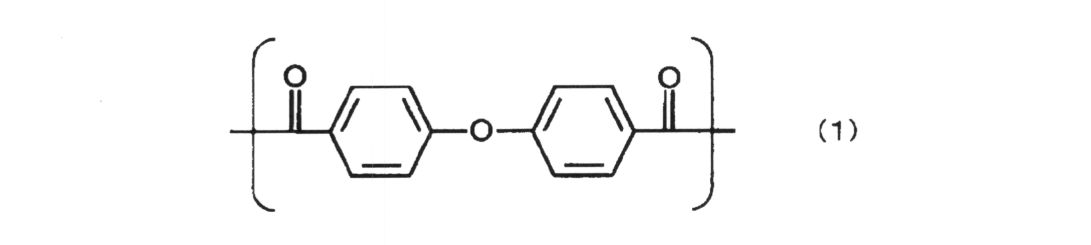
- the structural unit derived from the "aromatic dicarboxylic acid having an ether group in the molecule" in the wholly aromatic polyester is represented by the chemical formula (1).
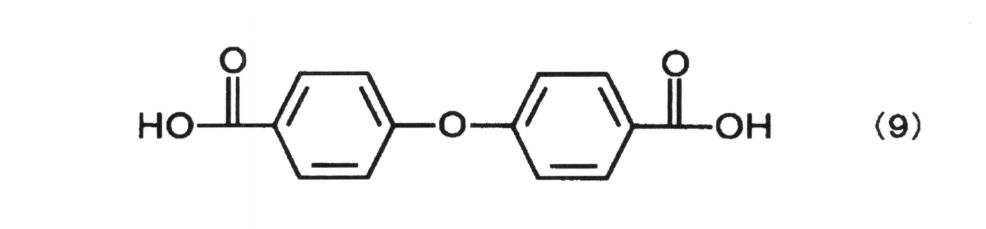
- the structural unit (I) represented by the chemical formula (1) can be obtained by using, for example, 4,4′-dicarboxydiphenyl ether (DCDPE, chemical formula (9)) and its derivative.
- the structural unit derived from the aromatic dicarboxylic acid further includes both the structural unit (II) represented by the chemical formula (2) and the structural unit (III) represented by the chemical formula (3).
- the structural unit (II) represented by the chemical formula (2) can be obtained using, for example, terephthalic acid (TPA, chemical formula (10)) and its derivative.
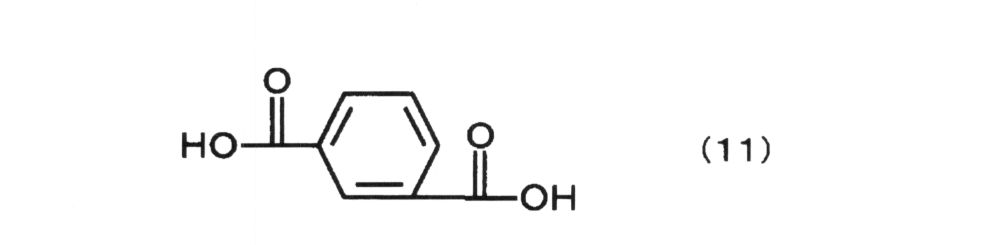
- the structural unit (III) represented by the chemical formula (3) can be obtained using, for example, isophthalic acid (IPA, chemical formula (11)) and its derivative.
- the composition ratio (mol%) of the structural units (I) to (III) derived from the aromatic dicarboxylic acid in all the structural units of the crystalline wholly aromatic polyester is as follows: 30 mol% ⁇ structural unit (I) ⁇ 40 mol% 5 mol% ⁇ structural unit (II) ⁇ 10 mol% 5 mol% ⁇ structural unit (III) ⁇ 10 mol% It is preferable to satisfy. Further, the composition ratio (mol%) of the structural units (I) to (III) is as follows: 32 mol% ⁇ structural unit (I) ⁇ 39 mol% 5 mol% ⁇ structural unit (II) ⁇ 8 mol% 6 mol% ⁇ structural unit (III) ⁇ 10 mol% It is more preferable to satisfy.
- composition ratio (mol%) of the structural units (I) to (III) is as follows: 34 mol% ⁇ structural unit (I) ⁇ 38 mol% 6 mol% ⁇ structural unit (II) ⁇ 8 mol% 6 mol% ⁇ structural unit () ⁇ 8 mol% It is more preferable to satisfy.
- the composition ratio of the structural units (I) to (III) derived from the aromatic dicarboxylic acid is within the above numerical range, the heat resistance is provided, and the slidability (friction characteristics, wear characteristics, limit PV value) and It is possible to obtain a crystalline wholly aromatic polyester that improves thermal stability during molding.
- the slidability (friction characteristics, wear characteristics, limit PV value) can be improved, but on the other hand, it becomes difficult to melt-polymerize in the manufacturing process of the crystalline wholly aromatic polyester. Moreover, it may be difficult to perform the molding process. Further, by increasing the composition ratio of the structural unit (III), the melting point is lowered, melt polymerization is facilitated in the production process of the crystalline wholly aromatic polyester, and molding is facilitated, but slidability is reduced. There is a fear.
- melt polymerization is possible by balancing the composition ratios of the structural units (II) and (III), and while having heat resistance, slidability (friction characteristics, wear characteristics, limit PV value) ) And a crystalline wholly aromatic polyester capable of improving thermal stability during molding.
- the total composition ratio (mol%) of the structural units (I) to (III) derived from the aromatic dicarboxylic acid in all the structural units of the crystalline wholly aromatic polyester is as follows: 45 mol% ⁇ Structural unit (I) + Structural unit (II) + Structural unit (III) ⁇ 50 mol% It is preferable to satisfy. Further, the total composition ratio (mol%) of the structural units (I) to (III) derived from the aromatic dicarboxylic acid is as follows: 48 mol% ⁇ structural unit (I) + structural unit (II) + structural unit (III) ⁇ 50 mol% It is more preferable to satisfy.
- the structural unit derived from the aromatic dicarboxylic acid may include structural units other than the above structural units (I) to (III).
- Other structural units include, for example, structural units derived from 2,6-naphthalenedicarboxylic acid (NADA) and its derivatives.
- the composition ratio of such other structural units is preferably less than 5 mol%, more preferably less than 2 mol%, and even more preferably 0 mol% in the total structural units of the crystalline wholly aromatic polyester. Good.
- the structural unit derived from the "aromatic diol having a carbonyl group (ketone group) in the molecule" in the wholly aromatic polyester according to the present invention includes a structural unit (IV) represented by the chemical formula (4).
- the structural unit (IV) represented by the chemical formula (4) can be obtained using, for example, 4,4′-dihydroxybenzophenone (DHBP, chemical formula (12)) and its derivative.
- a part of the structural unit (IV) represented by the chemical formula (4) may be replaced with the structural unit represented by the chemical formula (8).
- These structural units can be obtained using an aromatic diol and its derivative (chemical formula (16)).
- R 1 and R 2 are a hydrogen atom or a hydrocarbon group having 1 to 10 carbon atoms
- R 3 and R 4 are hydrogen atoms or an alkyl group having 1 to 3 carbon atoms
- p is 4 to 4 It is an integer of 7
- R 5 and R 6 are any of a hydrogen atom, an alkyl group having 1 to 3 carbon atoms, and a halogen atom.
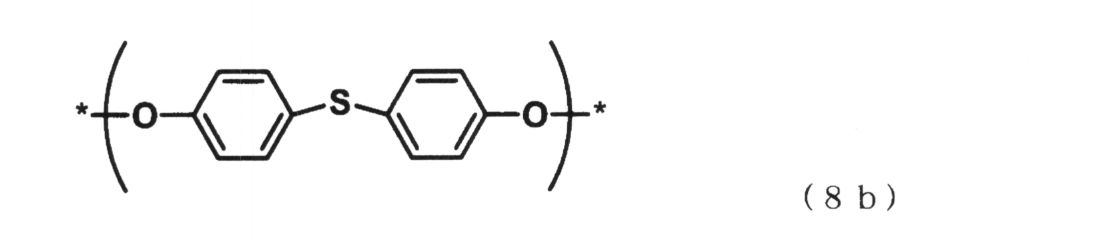
- a part of the structural unit (IV) represented by the chemical formula (4) may be replaced with the structural unit represented by either the chemical formula (8a) or the chemical formula (8b).
- Each of these structural units can be obtained using, for example, 4,4'-dihydroxydiphenylsulfone (chemical formula (16a)) and its derivative, 4,4'-dihydroxydiphenyl sulfide (chemical formula (16b)).
- composition ratio of the structural unit (IV) represented by the chemical formula (4) in all the structural units of the crystalline wholly aromatic polyester is preferably 45 mol% or more, more preferably 46 mol% as a lower limit value. Or more, more preferably 47 mol% or more, still more preferably 48 mol% or more, and the upper limit value is preferably 50 mol% or less, or even 50 mol% Good.
- the wholly aromatic polyester can be obtained by using the ester bond of the structural unit composed of the chemical formulas (1) and (4) as the main repeating unit. It is considered that both the heat resistance (melting point, glass transition temperature) and the slidability (friction characteristics, wear characteristics, limit PV value) are efficiently and well balanced.
- the melting point of the crystalline wholly aromatic polyester according to the present invention is preferably 300 ° C. or higher, more preferably 305 ° C. or higher, and further preferably 310 ° C. or higher, from the viewpoint of heat resistance in actual use.
- the upper limit of the molding process is preferably less than 360 ° C., more preferably 355 ° C. or less, still more preferably 350 ° C. or less, still more preferably 335 ° C. or less.
- the melting point of the crystalline wholly aromatic polyester is a value measured by a differential scanning calorimeter (DSC) manufactured by Hitachi High-Tech Science Co., Ltd.
- DSC differential scanning calorimeter
- the temperature was raised from room temperature to 390 ° C. at a rate of 20 ° C./minute to completely melt the polyester, then the temperature was lowered to 50 ° C. at a rate of 10 ° C./minute, and further 420 ° C. at a rate of 20 ° C./minute.
- the peak of the endothermic peak obtained when the temperature was raised to ° C was defined as the melting point.
- the glass transition temperature of the crystalline wholly aromatic polyester according to the present invention has a lower limit value of preferably 120 ° C. or higher, more preferably 140 ° C. or higher, and an upper limit value of preferably 170 ° C. It is the following.
- the glass transition temperature of the crystalline wholly aromatic polyester according to the present invention is based on JISK7244, using a dynamic viscoelasticity measuring device (Hitachi High-Tech Science Co., Ltd., trade name: DMA7100), etc. It can be obtained from the peak top temperature of the loss tangent tan ⁇ obtained by elasticity measurement.
- the crystalline wholly aromatic polyester according to the present invention is produced by polymerizing at least a monomer that provides the structural units (I) to (IV) by a conventionally known method such as melt polymerization, solid phase polymerization, solution polymerization and slurry polymerization. can do.
- the crystalline wholly aromatic polyester can also be produced by a two-step polymerization in which a prepolymer is prepared by melt polymerization and then solid polymerized.
- the melt polymerization is performed in an amount of 1.05 to 1.15 molar equivalents of anhydrous monomers based on 100% by mole of the monomers in a predetermined composition, based on all hydroxyl groups of the monomers. It is preferable to carry out the reaction under the reflux of acetic acid in the presence of acetic acid.
- the prepolymer obtained by the melt polymerization is cooled and solidified and then pulverized into powder or flakes, followed by known solid phase polymerization.
- a preferable method is, for example, a method of heat-treating the prepolymer for 1 to 30 hours in a temperature range of 200 to 350 ° C. under an inert atmosphere such as nitrogen or under vacuum.
- the solid phase polymerization may be carried out with stirring, or may be carried out in a stationary state without stirring.
- the catalyst may or may not be used in the polymerization reaction.
- the catalyst to be used those conventionally known as catalysts for polyester polymerization can be used, and metals such as magnesium acetate, stannous acetate, tetrabutyl titanate, lead acetate, sodium acetate, potassium acetate and antimony trioxide can be used. Examples thereof include salt catalysts, nitrogen-containing heterocyclic compounds such as N-methylimidazole, and organic compound catalysts.
- the amount of the catalyst used is not particularly limited, but is preferably 0.0001 to 0.1 part by mass based on 100 parts by mass of the total amount of the monomers.
- the polymerization reaction device in melt polymerization is not particularly limited, but a reaction device used for the reaction of general high-viscosity fluid is preferably used.
- these reaction devices include, for example, anchor type, multi-stage type, spiral band type, spiral shaft type, etc., or a stirring tank type polymerization reaction device having a stirring device having stirring blades of various shapes obtained by modifying these, or , Kneaders, roll mills, Banbury mixers and the like, which are generally used for kneading resins.
- the polyester resin composition of the present invention contains the above-mentioned crystalline wholly aromatic polyester and the following filler.
- Such a polyester resin composition is prepared by combining a crystalline wholly aromatic polyester and a filler in combination so as to have slidability (friction characteristics, abrasion characteristics, limit PV value) and mechanical properties while having heat resistance. It is possible to provide a molded product having excellent properties and thermal stability.
- the filler preferably contains a filling material, and may be used as a composite material in which the filling material and another material such as an organic polymer material are mixed.
- the filler material preferably comprises a fiber filler and / or a non-fiber filler.
- an organic polymer material other than the crystalline wholly aromatic polyester may be contained.
- the above fiber filler may be selected from inorganic fibrous materials and organic fibrous materials.
- Inorganic fibrous materials include carbon fibers, silicon carbide fibers, ceramic fibers, glass fibers, asbestos fibers, alumina fibers, zirconia fibers, boron nitride fibers, silicon nitride fibers, boron fibers, wollastonite, whiskers. , Potassium titanate fiber and metal fiber, and the like, carbon fiber, silicon carbide fiber, ceramic fiber, glass fiber, wollastonite, whiskers, and metal fiber are preferable, and carbon fiber and glass fiber are more preferable.
- Examples of the organic fibrous material include high melting point organic fibrous materials such as aramid fibers.
- the fiber filler may be in the form of nanofibers.
- the non-fiber filler is mica, silica, talc, alumina, kaolin, calcium sulfate, calcium carbonate, titanium oxide, ferrite, clay, glass powder, zinc oxide, nickel carbonate, iron oxide, quartz powder, magnesium carbonate, fluororesin. , Graphite, boron nitride, melamine cyanurate, carbon powder, carbon black, nanotubes, molybdenum disulfide, organic molybdenum, barium sulfate and metal powder, and the like, and fluororesin, graphite, boron nitride and molybdenum disulfide are preferred.
- Non-fibrous fillers can be introduced in the form of powdered or flake-like particles.
- the above-mentioned crystalline wholly aromatic polyester is not included in the organic polymer material, and from the viewpoint of heat resistance of the polyester resin composition, a non-melting polymer material or a high melting point polymer material is preferable.
- the polymer material include polyamide, polyacetal, thermoplastic polyesters other than the above aromatic polyesters, polyethylene, polypropylene, polyisobutylene, polyisoprene, polybutene, poly-p-xylene, polyvinyl chloride, polyvinylidene chloride and polycarbonate.
- the crystalline wholly aromatic polyester, the filler, and the organic polymer material are mixed at a high temperature, suitably at a temperature above the melting point of the crystalline wholly aromatic polyester.
- the above-mentioned high temperature is appropriately lower than the decomposition temperature of the crystalline wholly aromatic polyester, and is preferably above the main peak of the melting endotherm of the crystalline wholly aromatic polyester.
- the elevated temperature is preferably at least 300 ° C, more preferably at least 350 ° C.
- the content of the filler in the polyester resin composition when the total amount of the polyester resin composition is 100 parts by mass, the lower limit is preferably 1 part by mass or more, more preferably 5 parts by mass or more, It is more preferably 10 parts by mass or more, still more preferably 20 parts by mass or more, and the upper limit value is preferably 70 parts by mass or less, more preferably 50 parts by mass or less, and further preferably It is 40 parts by mass or less, more preferably 35 parts by mass or less, and particularly preferably 32 parts by mass or less.
- the total content thereof should be within the above range. It is preferable to use a polyester resin composition having such a content within the range because a molded article having more excellent mechanical properties can be obtained.
- the phosphite ester represented by the chemical formula (17) is preferable as the antioxidant.
- R and R ′ each independently represent an alkyl group, an alkenyl group, an aryl group or an aralkyl group, and may be the same or different.
- phosphorous acid ester examples include bis (2,6-di-tert-butyl-4-methylphenyl) pentaerythritol diphosphite and bis (2,4-di-tert-butylphenyl) pentaerythritol.
- Diphosphite, distearyl pentaerythritol diphosphite, bis (dodecyl) pentaerythritol diphosphite, bis (2,6-di-tert-butyl-4-methylphenyl) -2,4,8,10-tetraoxa- Examples include 3,9-diphosphaspiro [5.5] undecane and the like.
- the content of the phosphite ester in the polyester resin composition is preferably 0.001 part by mass or more, and more preferably 0.01 as a lower limit value with respect to 100 parts by mass of the crystalline wholly aromatic polyester.
- the amount is not less than 1 part by mass, and the upper limit is preferably not more than 1 part by mass, more preferably not more than 0.5 part by mass.
- the crystalline wholly aromatic polyester and polyester resin composition of the present invention can be used as a molded article such as a resin molding material by molding by a conventionally known method.
- the molding method may be any of injection molding, compression molding, extrusion molding, injection compression molding and the like.
- the crystalline wholly aromatic polyester and the polyester resin composition may be formed into a sheet or a film by a conventionally known method.
- a method for forming a sheet or a film any method such as inflation molding, melt extrusion molding or solution cast molding may be used. It may be a single layer film or a multilayer film of different materials.
- the sheet or film that has been melt-extruded or solution cast may be stretched uniaxially or biaxially for the purpose of improving dimensional stability and mechanical properties.
- the crystalline wholly aromatic polyester and the polyester resin composition may be powder-coated on the surface of the object to be coated by a known method.
- the fluidized-bed method, the thermal spraying method, the electrostatic powder method and the like are preferable.
- the powder of the polyester resin composition is uniformly adhered by electrostatic powder coating, the powder is melted at about 350 to 400 ° C. in an electric oven or the like, then taken out from the electric oven and rapidly cooled. Annealing may be performed for the purpose of stabilizing the crystal state and removing residual stress.
- the crystalline wholly aromatic polyester and the polyester resin composition can be used as a matrix resin by impregnating a carbon fiber aggregate by a known method to obtain CFRP.
- CFRP includes resin transfer molding (RTM), vacuum assisted resin transfer molding (VaRTM), reaction injection molding (RIM), and the like.
- RTM resin transfer molding
- VaRTM vacuum assisted resin transfer molding
- RIM reaction injection molding
- the molded article according to the present invention is excellent in slidability (friction characteristics, wear characteristics, limit PV value), mechanical properties, and thermal stability while having heat resistance. Therefore, the molded product is used as a constituent material for various machine parts, automobile parts, electric / electronic parts, in particular, various bearings, various gears, various gears, various valves, chassis, bearings, washers, thrust washers, seal rings, guide rings. , Vane pump parts, ESC parts, impeller piston rings, shift forks, FOUPs, wire coatings, speaker diaphragms, insulating films, various medical instruments, binding bands for aircraft, clamps, tubes, sound insulation films, structural materials, etc. Useful for.
- Example 1 ⁇ Production of crystalline wholly aromatic polyester> (Example 1) In a 200 ml three-necked glass flask equipped with a stirrer, 33 mol% 4,4′-dicarboxydiphenyl ether (DCDPE), 7 mol% terephthalic acid (TPA), 10 mol% isophthalic acid (IPA), 4,4′-dihydroxybenzophenone (DHBP) 50 mol%, potassium acetate and magnesium acetate as catalysts (total number of moles of each monomer ⁇ 25 mg / mol), depressurization-nitrogen injection into the flask 3 times to replace nitrogen, and then acetic anhydride (hydroxyl group) (1.08 mol equivalent) was further added, the rotation speed of the stirring blade was 100 rpm, the temperature was raised to 150 ° C., and the acetylation reaction was carried out for 2 hours under reflux.
- DCDPE 4,4′-dicarboxydiphenyl ether
- TPA 7 mol
- the temperature of the polymerization vessel in the acetic acid distillation state was raised at 0.5 ° C / min.
- the resin temperature reached 200 ° C.
- the distillation of acetic acid was stopped once.
- the temperature of the polymerization vessel was not stopped, and when the temperature of the flask tank reached 320 ° C., the acetic acid was distilled again.
- the melt temperature in the flask tank reached 320 ° C.
- the obtained polymer was pulverized by a pulverizer into a size that passed through a sieve having an opening of 2.0 mm to obtain a prepolymer.
- the prepolymer obtained above was charged into a solid phase polymerization apparatus, heated to 300 ° C. by a heater, and then the temperature was maintained at 300 ° C. for 1 hour to carry out solid phase polymerization. After that, natural heat dissipation was performed at room temperature to obtain powdery crystalline wholly aromatic polyester.
- Example 2 Solid-phase polymerization was carried out in the same manner as in Example 1 except that the monomer charge was changed to 33 mol% DCDPE, 10 mol% TPA, 7 mol% IPA, and 50 mol% DHBP to obtain a crystalline wholly aromatic polyester.
- Example 3 Solid phase polymerization was carried out in the same manner as in Example 1 except that the monomer charge was changed to 34 mol% DCDPE, 9 mol% TPA, 7 mol% IPA, and 50 mol% DHBP to obtain a crystalline wholly aromatic polyester.
- Example 4 Monomer charging was changed to 34 mol% DCDPE, 10 mol% TPA, 6 mol% IPA, 50 mol% DHBP, and the solid phase polymerization was carried out in the same manner as in Example 1 except that the final temperature of the solid phase polymerization was 280 ° C., A crystalline wholly aromatic polyester was obtained.
- Example 5 Solid-phase polymerization was carried out in the same manner as in Example 1 except that the monomer charge was changed to 35 mol% DCDPE, 8 mol% TPA, 7 mol% IPA, and 50 mol% DHBP to obtain a crystalline wholly aromatic polyester.
- Example 6 Solid phase polymerization was carried out in the same manner as in Example 1 except that the monomer charge was changed to 35 mol% DCDPE, 9 mol% TPA, 6 mol% IPA, and 50 mol% DHBP to obtain a crystalline wholly aromatic polyester.
- Example 7 Solid phase polymerization was carried out in the same manner as in Example 1 except that the monomer charge was changed to 35 mol% DCDPE, 10 mol% TPA, 5 mol% IPA, and 50 mol% DHBP to obtain a crystalline wholly aromatic polyester.
- Example 8 Solid phase polymerization was carried out in the same manner as in Example 1 except that the monomer charge was changed to 36 mol% DCDPE, 7 mol% TPA, 7 mol% IPA, and 50 mol% DHBP to obtain a crystalline wholly aromatic polyester.
- Example 9 Solid phase polymerization was carried out in the same manner as in Example 1 except that the monomer charge was changed to 36 mol% DCDPE, 8 mol% TPA, 6 mol% IPA, and 50 mol% DHBP to obtain a crystalline wholly aromatic polyester.
- Example 10 Solid-phase polymerization was carried out in the same manner as in Example 1 except that the monomer charge was changed to 37 mol% DCDPE, 7 mol% TPA, 6 mol% IPA, and 50 mol% DHBP to obtain a crystalline wholly aromatic polyester.
- Example 11 Solid phase polymerization was carried out in the same manner as in Example 1 except that the monomer charge was changed to 37 mol% DCDPE, 8 mol% TPA, 5 mol% IPA, and 50 mol% DHBP to obtain a crystalline wholly aromatic polyester.
- Example 12 Monomer charging was changed to 40 mol% DCDPE, 5 mol% TPA, 5 mol% IPA, 50 mol% DHBP, and the solid phase polymerization was carried out in the same manner as in Example 1 except that the final temperature of solid phase polymerization was 280 ° C., A crystalline wholly aromatic polyester was obtained.
- Table 1 shows a list of compositions of the crystalline wholly aromatic polyesters produced in the above Examples and Comparative Examples.
- the apex of the endothermic peak obtained when the temperature was raised to ° C was defined as the melting point (° C). Further, the glass transition temperature (° C) was determined from the inflection point on the lower temperature side than the endothermic peak. The measurement results are shown in Table 2.
- melt polymerization From the state of the prepolymer during melt polymerization in the production of the crystalline wholly aromatic polyester, the productivity by melt polymerization was evaluated according to the following evaluation criteria. The evaluation results are shown in Table 1. [Evaluation criteria] ⁇ : It was very suitable for melt polymerization because it maintains good fluidity even during the withdrawal process during stirring during the polymerization process. ⁇ : Good fluidity was maintained during stirring in the polymerization process, and part of the polymer solidified in the extraction process, but fluidity was maintained, so it was suitable for melt polymerization. X: Not suitable for melt polymerization because the polymer solidifies during stirring during the polymerization process.
- the polymer weight loss was measured with a TGA device at the melting point of each polymer obtained after polymerization + 30 ° C., and the thermal stability was evaluated. At this time, after the temperature was raised from room temperature to a predetermined temperature (melting point of polymer + 30 ° C.) at a heating rate of 20 ° C./min in a nitrogen environment, the weight loss of the polymer was reduced when the temperature was kept for 1 hour in an air environment. It was calculated as a percentage (%). The measurement results are shown in Table 2.
- the pellets of "PEEK” (Victrex 450G) prepared above were molded into a plate-shaped molded product having a thickness of 30 x 30 x 1 mm, a cylinder temperature of 400 ° C, and a mold temperature. It was molded into a plate-shaped test piece under the condition of 180 ° C.
- the mating material was a hollow cylinder having an outer diameter of 25.6 mm, an inner diameter of 20 mm and a length of 15 mm, and the material used was S45C.
- the test speed was 0.5 m / s
- the load was 150 N
- the test time was 60 minutes
- the dynamic coefficient of friction was an average value of 30 minutes to 60 minutes after the start of the test. The measurement results are shown in Table 2.
- the amount of wear was measured using the plate-shaped test piece obtained by the above injection molding.
- the mating material was a hollow cylinder having an outer diameter of 25.6 mm, an inner diameter of 20 mm and a length of 15 mm, and the material used was S45C.
- the test speed was 0.5 m / s, the load was 150 N, the test time was 60 minutes, the weight change before and after the test was measured, and the values converted into volume are shown in Table 2.
- the limiting PV value was measured using the plate-shaped test piece obtained by the above injection molding.
- the mating material was a hollow cylinder having an outer diameter of 25.6 mm, an inner diameter of 20 mm and a length of 15 mm, and the material used was S45C.
- the test speed was 0.5 m / s, the initial load was 50 N, and the load was increased by 100 N every 10 minutes. At this time, the product of the pressure and the speed at the load immediately before the load step in which abnormal wear occurred was set as the limit PV value, and the results are shown in Table 2.
- Example 14 69.2 parts by mass of wholly aromatic liquid crystal polyester obtained in Example 9, 10 parts by mass of carbon fiber filler (CF, manufactured by Toho Tenax Co., Ltd., trade name: HTC702), 10 parts by mass of fluororesin, 10 parts by mass of graphite Parts and 0.8 parts by mass of carbon black were extruded in the same manner as in Example 13 to obtain a polyester resin composition.
- CF carbon fiber filler
- Example 15 69.2 parts by weight of wholly aromatic liquid crystalline polyester obtained in Example 9, 10 parts by weight of fluororesin, 10 parts by weight of aramid fiber (Conex, Teijin Ltd.), 10 parts by weight of graphite, and 0. Extrusion was carried out in the same manner as in Example 13 except that 8 parts by mass was blended to obtain a polyester resin composition.
- Example 16 Extruded in the same manner as in Example 13 except that 69.2 parts by mass of the wholly aromatic liquid crystal polyester obtained in Example 9, 30 parts by mass of carbon fibrous filler, and 0.8 parts by mass of carbon black were blended to obtain a polyester. A resin composition was obtained.
- Example 17 69.2 parts by mass of wholly aromatic liquid crystal polyester obtained in Example 9, 15 parts by mass of carbon fiber filler, 10 parts by mass of graphite, boron nitride fiber (BN, Denka Boron Nitride_GP) 5 A polyester resin composition was obtained by extruding in the same manner as in Example 13 except that 100 parts by mass and 0.8 parts by mass of carbon black were blended.
- Example 18 69.2 parts by weight of wholly aromatic liquid crystalline polyester obtained in Example 9, 15 parts by weight of carbon fiber filler, 10 parts by weight of graphite, molybdenum disulfide (MoS 2 , manufactured by Daizo Co., Ltd., M-5 powder) 5
- a polyester resin composition was obtained by extruding in the same manner as in Example 13 except that 100 parts by mass and 0.8 parts by mass of carbon black were blended.
- Example 19 69.2 parts by weight of the wholly aromatic liquid crystal polyester obtained in Example 9, 30 parts by weight of glass fiber filler (GF, manufactured by Nippon Electric Glass Co., Ltd., trade name: T-786H), and carbon black 0.8. Extrusion was carried out in the same manner as in Example 13 except that the mass parts were blended to obtain a polyester resin composition.
- glass fiber filler GF, manufactured by Nippon Electric Glass Co., Ltd., trade name: T-786H
- Table 3 shows a list of compositions of the polyester resin compositions produced in the above Examples and Comparative Examples.
Landscapes
- Chemical & Material Sciences (AREA)
- Health & Medical Sciences (AREA)
- Chemical Kinetics & Catalysis (AREA)
- Medicinal Chemistry (AREA)
- Polymers & Plastics (AREA)
- Organic Chemistry (AREA)
- Compositions Of Macromolecular Compounds (AREA)
- Polyesters Or Polycarbonates (AREA)
Abstract
[課題]耐熱性を備えながら、摺動性(摩擦特性や摩耗特性、限界PV値)や成形時の熱安定性を向上させることができる結晶性全芳香族ポリエステルの提供。 [解決手段]本発明による結晶性全芳香族ポリエステルは、芳香族ジカルボン酸と芳香族ジオールとの重縮合体であって、 前記芳香族ジカルボン酸に由来の構造単位が、 下記化学式(1):で表される構造単位(I)と、 下記化学式(2):で表される構造単位(II)と、 下記化学式(3):で表される構造単位(III)と、を含み、 前記芳香族ジオールに由来の構造単位が、 下記化学式(4):で表される構造単位(IV)を含み、 前記結晶性全芳香族ポリエステルの全構造単位中、前記構造単位(I)~(III)の組成比(モル%)が、下記の条件: 30モル%≦構造単位(I)≦40モル% 5モル%≦構造単位(II)≦10モル% 5モル%≦構造単位(III)≦10モル% 45モル%≦構造単位(I)+構造単位(II)+構造単位(III)≦50モル% を満たすことを特徴とする、結晶性全芳香族ポリエステル。
Description
本発明は、結晶性全芳香族ポリエステルに関する。また、本発明は、該結晶性全芳香族ポリエステルとフィラーとを含むポリエステル樹脂組成物に関する。さらに、本発明は、該結晶性全芳香族ポリエステルからなる成形品および該ポリエステル樹脂組成物からなる成形品に関する。
エーテル結合、エーテル結合、ケトン結合を繰り返し構造単位とする全芳香族ポリエーテルエーテルケトンは、靱性と耐摩耗性に優れる構成材料として知られている。具体的には、ヒドロキノンとベンゾフェノン誘導体を求核置換反応で結合させて製造させて得られるものが上市され、「PEEK(ピーク)」と呼ばれている。
前記「PEEK」は、ギア、軸受け等の機械部品の構造材として用途を拡大したが、射出成形性や耐熱性の不足を指摘される場合がある。
前記「PEEK」は、ギア、軸受け等の機械部品の構造材として用途を拡大したが、射出成形性や耐熱性の不足を指摘される場合がある。
また、ケトン結合を繰り返し構造単位中に有するポリマーの製造方法が知られている。例えば、特許文献1には、(a)少なくとも1のトリクロロメチルケトン基を含有する有機化合物を(b)少なくとも1のヒドロキシル基、アミノ基またはアシル基を含有する有機化合物と反応させるポリマーの製造方法が開示されている。しかしながら、特許文献1に記載のポリマーの材料特性に関して何ら具体的示唆は無い。
さらに、近年、機械の軽量化、製品コストの低減のため樹脂製品が機械部品としても数多く用いられるようになり、摺動性(摩擦特性や摩耗特性、限界PV値)を要求される機械部品にも樹脂製品が多く利用されている。このような樹脂製品としては、熱可塑性樹脂に潤滑剤等の摺動性を改良するための添加剤を加えた樹脂組成物が利用されてきた。しかし、熱可塑性樹脂を用いた場合、比較的低温の条件下では特に問題なく使用できるが、高温になるに従ってその樹脂のもつ融点のために摩耗しやすくなり、また摩擦熱のため焼き付いたり、溶融を起こしたりして使用できなくなるという課題があった。
本発明者は、上記状況に鑑み、結晶性ポリエステルの射出成形性と耐熱性を備え、かつ、前記「PEEK」と対比して同等またはそれ以上の摺動性を備えた、結晶性ポリエステルの開発を行ってきた。例えば、特許文献2では、芳香族ジカルボン酸と芳香族ジオールとの重縮合体である結晶性全芳香族ポリエステルにおいて、主な構造単位として、特定の「分子内にエーテル基を有する芳香族ジカルボン酸」(4,4’-ジカルボキシジフェニルエーテル)由来の構造単位と、特定の「分子内にカルボニル基(ケトン基)を有する芳香族ジオール」(4,4’-ジヒドロキシベンゾフェノン)由来の構造単位とを含有させることを提案した。
しかしながら、本発明者は、特許文献2に記載の結晶性全芳香族ポリエステルでは、摺動性(摩擦特性や摩耗特性、限界PV値)や成形時の熱安定性に改善の余地があることを知見した。したがって、本発明の目的は、結晶性ポリエステルの耐熱性を備えながら、摺動性(摩擦特性や摩耗特性、限界PV値)や成形時の熱安定性を向上させることができる結晶性全芳香族ポリエステルを得ることにある。
また、本発明の別の目的は、該結晶性全芳香族ポリエステルにフィラーを配合することで、摺動性(摩擦特性や摩耗特性、限界PV値)や成形時の熱安定性に加えて機械的性質に優れたポリエステル樹脂組成物を得ることにある。
また、本発明の別の目的は、該結晶性全芳香族ポリエステルにフィラーを配合することで、摺動性(摩擦特性や摩耗特性、限界PV値)や成形時の熱安定性に加えて機械的性質に優れたポリエステル樹脂組成物を得ることにある。
本発明者は、上記課題を解決するために鋭意検討した結果、芳香族ジカルボン酸と芳香族ジオールとの重縮合体である結晶性全芳香族ポリエステルにおいて、芳香族ジカルボン酸に由来の構造単位として少なくとも3種の特定の化合物由来の構造単位を特定の組成比に調節することで上記課題を解決し得ることを見出し、本発明を完成するに至った。
本発明の一態様によれば、
芳香族ジカルボン酸と芳香族ジオールとの重縮合体である結晶性全芳香族ポリエステルであって、
前記芳香族ジカルボン酸に由来の構造単位が、
下記化学式(1):

で表される構造単位(I)と、
下記化学式(2):

で表される構造単位(II)と、
下記化学式(3):
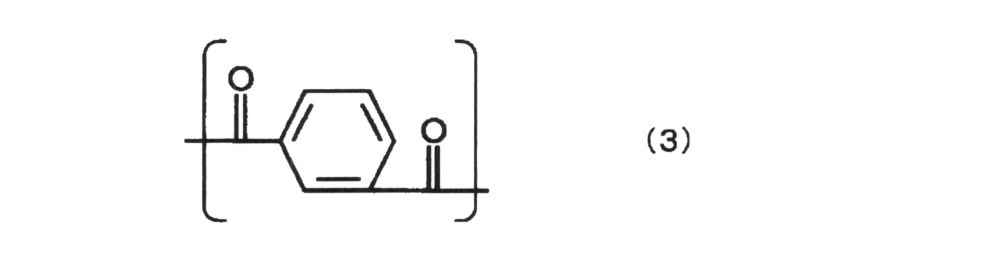
で表される構造単位(III)と、を含み、
前記芳香族ジオールに由来の構造単位が、
下記化学式(4):

で表される構造単位(IV)を含み、
前記結晶性全芳香族ポリエステルの全構造単位中、前記構造単位(I)~(III)の組成比(モル%)が、下記の条件:
30モル%≦構造単位(I)≦40モル%
5モル%≦構造単位(II)≦10モル%
5モル%≦構造単位(III)≦10モル%
45モル%≦構造単位(I)+構造単位(II)+構造単位(III)≦50モル%
を満たすことを特徴とする、結晶性全芳香族ポリエステルが提供される。
芳香族ジカルボン酸と芳香族ジオールとの重縮合体である結晶性全芳香族ポリエステルであって、
前記芳香族ジカルボン酸に由来の構造単位が、
下記化学式(1):
下記化学式(2):
下記化学式(3):
前記芳香族ジオールに由来の構造単位が、
下記化学式(4):
前記結晶性全芳香族ポリエステルの全構造単位中、前記構造単位(I)~(III)の組成比(モル%)が、下記の条件:
30モル%≦構造単位(I)≦40モル%
5モル%≦構造単位(II)≦10モル%
5モル%≦構造単位(III)≦10モル%
45モル%≦構造単位(I)+構造単位(II)+構造単位(III)≦50モル%
を満たすことを特徴とする、結晶性全芳香族ポリエステルが提供される。
本発明の一態様においては、
前記結晶性全芳香族ポリエステルの全構造単位中、前記構造単位(I)~(III)の組成比(モル%)が、下記の条件:
32モル%≦構造単位(I)≦39モル%
5モル%≦構造単位(II)≦8モル%
6モル%≦構造単位(III)≦10モル%
48モル%≦構造単位(I)+構造単位(II)+構造単位(III)≦50モル%
を満たすことが好ましい。
前記結晶性全芳香族ポリエステルの全構造単位中、前記構造単位(I)~(III)の組成比(モル%)が、下記の条件:
32モル%≦構造単位(I)≦39モル%
5モル%≦構造単位(II)≦8モル%
6モル%≦構造単位(III)≦10モル%
48モル%≦構造単位(I)+構造単位(II)+構造単位(III)≦50モル%
を満たすことが好ましい。
本発明の一態様においては、
前記結晶性全芳香族ポリエステルの全構造単位中、前記構造単位(IV)の組成比(モル%)が、下記の条件:
45モル%≦構造単位(IV)≦50モル%以下
を満たすことが好ましい。
前記結晶性全芳香族ポリエステルの全構造単位中、前記構造単位(IV)の組成比(モル%)が、下記の条件:
45モル%≦構造単位(IV)≦50モル%以下
を満たすことが好ましい。
本発明の一態様においては、前記結晶性全芳香族ポリエステルの融点が、300℃以上360℃未満であることが好ましい。
本発明の一態様においては、前記結晶性全芳香族ポリエステルの融点が、305℃以上335℃以下であることが好ましい。
本発明の別の態様によれば、上記の結晶性全芳香族ポリエステルと、フィラーとを含む、ポリエステル樹脂組成物が提供される。
本発明の別の態様においては、前記フィラーが、繊維充填材を含むことが好ましい。
本発明の別の態様においては、前記繊維充填材が、炭素繊維、炭化ケイ素繊維、セラミック繊維、ガラス繊維、窒化ホウ素繊維、ウォラストナイト、ウィスカ、金属繊維、およびアラミド繊維からなる群から選択されることが好ましい。
本発明の別の態様においては、前記フィラーが、非繊維充填材を含むことが好ましい。
本発明の別の態様においては、前記非繊維充填材が、フッ素樹脂、グラファイト、窒化ホウ素、および二硫化モリブテンからなる群から選択されることが好ましい。
本発明の別の態様においては、前記ポリエステル樹脂組成物中の前記フィラーの含有量が、前記ポリエステル樹脂組成物全量を100質量部とした場合に1~70質量部であることが好ましい。
本発明の更なる別の態様によれば、上記の結晶性全芳香族ポリエステルまたは上記のポリエステル樹脂組成物からなる、成形品が提供される。
本発明による結晶性全芳香族ポリエステルは、耐熱性(高融点、高ガラス転移温度)を備えながら、摺動性(摩擦特性や摩耗特性、限界PV値)や成形時の熱安定性を向上させることができる。また、本発明によれば、このような結晶性全芳香族ポリエステルとフィラーとを含むポリエステル樹脂組成物を得ることができる。さらに、本発明によれば、該結晶性全芳香族ポリエステルからなる成形品および該ポリエステル樹脂組成物からなる成形品を得ることができる。これらの成形品は、各種機械部品の構造材料として、特に、ベアリング、歯車、シャーシー等の構成材料として有用である。
<結晶性全芳香族ポリエステル>
本発明による結晶性全芳香族ポリエステルは、芳香族ジカルボン酸と芳香族ジオールとの重縮合体であって、特定の「分子内にエーテル基を有する芳香族ジカルボン酸」由来の構造単位と特定の「分子内にカルボニル基(ケトン基)を有する芳香族ジオール」由来の構造単位とを、主たる繰り返し構造単位として含むものである。本発明においては、耐熱性や機械的特性の観点から、結晶性全芳香族ポリエステルの全構造単位中、特定の「分子内にエーテル基を有する芳香族ジカルボン酸」由来の構造単位と特定の「分子内にカルボニル基(ケトン基)を有する芳香族ジオール」由来の構造単位とを合計で、下限値として、好ましくは70モル%以上、より好ましくは75モル%以上、さらに好ましくは80モル%以上とすることが良く、また、上限値として、好ましくは90モル%以下、より好ましくは88モル%以下、さらに好ましくは86モル%以下とすることが良い。なお、結晶性全芳香族ポリエステルの全構造単位中、芳香族ジカルボン酸に由来の構造単位の組成比(モル%)と、芳香族ジオールに由来の構造単位の組成比(モル%)とは、実質的に当量となる。
本発明による結晶性全芳香族ポリエステルは、芳香族ジカルボン酸と芳香族ジオールとの重縮合体であって、特定の「分子内にエーテル基を有する芳香族ジカルボン酸」由来の構造単位と特定の「分子内にカルボニル基(ケトン基)を有する芳香族ジオール」由来の構造単位とを、主たる繰り返し構造単位として含むものである。本発明においては、耐熱性や機械的特性の観点から、結晶性全芳香族ポリエステルの全構造単位中、特定の「分子内にエーテル基を有する芳香族ジカルボン酸」由来の構造単位と特定の「分子内にカルボニル基(ケトン基)を有する芳香族ジオール」由来の構造単位とを合計で、下限値として、好ましくは70モル%以上、より好ましくは75モル%以上、さらに好ましくは80モル%以上とすることが良く、また、上限値として、好ましくは90モル%以下、より好ましくは88モル%以下、さらに好ましくは86モル%以下とすることが良い。なお、結晶性全芳香族ポリエステルの全構造単位中、芳香族ジカルボン酸に由来の構造単位の組成比(モル%)と、芳香族ジオールに由来の構造単位の組成比(モル%)とは、実質的に当量となる。
(芳香族ジカルボン酸)
全芳香族ポリエステル中の「分子内にエーテル基を有する芳香族ジカルボン酸」由来の構造単位は、化学式(1)で表される。化学式(1)で表される構造単位(I)は、例えば、4,4’-ジカルボキシジフェニルエーテル(DCDPE、化学式(9))およびその誘導体を用いて得ることができる。
全芳香族ポリエステル中の「分子内にエーテル基を有する芳香族ジカルボン酸」由来の構造単位は、化学式(1)で表される。化学式(1)で表される構造単位(I)は、例えば、4,4’-ジカルボキシジフェニルエーテル(DCDPE、化学式(9))およびその誘導体を用いて得ることができる。

本発明においては、芳香族ジカルボン酸に由来の構造単位として、化学式(2)で表される構造単位(II)および化学式(3)で表される構造単位(III)の両方をさらに含むものである。化学式(2)で表される構造単位(II)は、例えば、テレフタル酸(TPA、化学式(10))およびその誘導体を用いて得ることができる。また、化学式(3)で表される構造単位(III)は、例えば、イソフタル酸(IPA、化学式(11))およびその誘導体を用いて得ることができる。


本発明においては、結晶性全芳香族ポリエステルの全構造単位中、芳香族ジカルボン酸に由来の構造単位(I)~(III)の組成比(モル%)が、下記の条件:
30モル%≦構造単位(I)≦40モル%
5モル%≦構造単位(II)≦10モル%
5モル%≦構造単位(III)≦10モル%
を満たすことが好ましい。
また、構造単位(I)~(III)の組成比(モル%)が、下記の条件:
32モル%≦構造単位(I)≦39モル%
5モル%≦構造単位(II)≦8モル%
6モル%≦構造単位(III)≦10モル%
を満たすことがより好ましい。
また、構造単位(I)~(III)の組成比(モル%)が、下記の条件:
34モル%≦構造単位(I)≦38モル%
6モル%≦構造単位(II)≦8モル%
6モル%≦構造単位()≦8モル%
を満たすことがさらに好ましい。
芳香族ジカルボン酸に由来の構造単位(I)~(III)の組成比が上記数値範囲内であることで、耐熱性を備えながら、摺動性(摩擦特性や摩耗特性、限界PV値)や成形時の熱安定性を向上させる結晶性全芳香族ポリエステルを得ることができる。特に、構造単位(II)の組成比を上げることで摺動性(摩擦特性や摩耗特性、限界PV値)を向上できるが、一方で結晶性全芳香族ポリエステルの製造工程において溶融重合しづらくなる、また成形加工しづらくなる恐れがある。また、構造単位(III)の組成比を上げることで融点が低下し、結晶性全芳香族ポリエステルの製造工程において溶融重合し易くなる、また成形加工が容易になるが、摺動性が低下する恐れがある。本発明においては、構造単位(II)および(III)の組成比のバランスを取ることで、溶融重合が可能であり、耐熱性を備えながら、摺動性(摩擦特性や摩耗特性、限界PV値)や成形時の熱安定性を向上させることができる結晶性全芳香族ポリエステルを実現できた。
30モル%≦構造単位(I)≦40モル%
5モル%≦構造単位(II)≦10モル%
5モル%≦構造単位(III)≦10モル%
を満たすことが好ましい。
また、構造単位(I)~(III)の組成比(モル%)が、下記の条件:
32モル%≦構造単位(I)≦39モル%
5モル%≦構造単位(II)≦8モル%
6モル%≦構造単位(III)≦10モル%
を満たすことがより好ましい。
また、構造単位(I)~(III)の組成比(モル%)が、下記の条件:
34モル%≦構造単位(I)≦38モル%
6モル%≦構造単位(II)≦8モル%
6モル%≦構造単位()≦8モル%
を満たすことがさらに好ましい。
芳香族ジカルボン酸に由来の構造単位(I)~(III)の組成比が上記数値範囲内であることで、耐熱性を備えながら、摺動性(摩擦特性や摩耗特性、限界PV値)や成形時の熱安定性を向上させる結晶性全芳香族ポリエステルを得ることができる。特に、構造単位(II)の組成比を上げることで摺動性(摩擦特性や摩耗特性、限界PV値)を向上できるが、一方で結晶性全芳香族ポリエステルの製造工程において溶融重合しづらくなる、また成形加工しづらくなる恐れがある。また、構造単位(III)の組成比を上げることで融点が低下し、結晶性全芳香族ポリエステルの製造工程において溶融重合し易くなる、また成形加工が容易になるが、摺動性が低下する恐れがある。本発明においては、構造単位(II)および(III)の組成比のバランスを取ることで、溶融重合が可能であり、耐熱性を備えながら、摺動性(摩擦特性や摩耗特性、限界PV値)や成形時の熱安定性を向上させることができる結晶性全芳香族ポリエステルを実現できた。
なお、結晶性全芳香族ポリエステルの全構造単位中、芳香族ジカルボン酸に由来の構造単位(I)~(III)の合計組成比(モル%)が下記の条件:
45モル%<構造単位(I)+構造単位(II)+構造単位(III)≦50モル%
を満たすことが好ましい。
また、芳香族ジカルボン酸に由来の構造単位(I)~(III)の合計組成比(モル%)が下記の条件:
48モル%≦構造単位(I)+構造単位(II)+構造単位(III)≦50モル%
を満たすことがより好ましい。
また、芳香族ジカルボン酸に由来の構造単位(I)~(III)の合計組成比(モル%)が下記の条件:
構造単位(I)+構造単位(II)+構造単位(III)=50モル%
を満たすことがさらに好ましい。
芳香族ジカルボン酸に由来の構造単位が、主として構造単位(I)~(III)で構成されることで、耐熱性を備えながら、摺動性(摩擦特性や摩耗特性、限界PV値)や成形時の熱安定性を向上させる結晶性全芳香族ポリエステルを得ることができる。
45モル%<構造単位(I)+構造単位(II)+構造単位(III)≦50モル%
を満たすことが好ましい。
また、芳香族ジカルボン酸に由来の構造単位(I)~(III)の合計組成比(モル%)が下記の条件:
48モル%≦構造単位(I)+構造単位(II)+構造単位(III)≦50モル%
を満たすことがより好ましい。
また、芳香族ジカルボン酸に由来の構造単位(I)~(III)の合計組成比(モル%)が下記の条件:
構造単位(I)+構造単位(II)+構造単位(III)=50モル%
を満たすことがさらに好ましい。
芳香族ジカルボン酸に由来の構造単位が、主として構造単位(I)~(III)で構成されることで、耐熱性を備えながら、摺動性(摩擦特性や摩耗特性、限界PV値)や成形時の熱安定性を向上させる結晶性全芳香族ポリエステルを得ることができる。
芳香族ジカルボン酸に由来の構造単位としては、上記構造単位(I)~(III)以外の他の構造単位が含まれてもよい。他の構造単位としては、例えば、2,6-ナフタレンジカルボン酸(NADA)およびその誘導体に由来の構造単位を挙げることができる。このような他の構造単位の組成比は、結晶性全芳香族ポリエステルの全構造単位中、5モル%未満であること好ましく、2モル%未満であることがより好ましく、0モル%であってもよい。
(本発明に係る芳香族ジオール)
本発明に係る全芳香族ポリエステル中の「分子内にカルボニル基(ケトン基)を有する芳香族ジオール」由来の構造単位は、化学式(4)で表される構造単位(IV)を含む。化学式(4)で表される構造単位(IV)は、例えば、4,4’-ジヒドロキシベンゾフェノン(DHBP、化学式(12))およびその誘導体を用いて得ることができる。
本発明に係る全芳香族ポリエステル中の「分子内にカルボニル基(ケトン基)を有する芳香族ジオール」由来の構造単位は、化学式(4)で表される構造単位(IV)を含む。化学式(4)で表される構造単位(IV)は、例えば、4,4’-ジヒドロキシベンゾフェノン(DHBP、化学式(12))およびその誘導体を用いて得ることができる。


本発明においては、化学式(4)で表される構造単位(IV)の一部を、化学式(5)、化学式(6)、化学式(7)で表される構造単位のいずれかで置き換えても良い。これらの構造単位は、それぞれ、例えば、ヒドロキノン(HQ、化学式(13))およびその誘導体、レゾルシノール(Res、化学式(14))およびその誘導体、4,4’-ジヒドロキシビフェニル(BP、化学式(15))およびその誘導体を用いて得ることができる。




本発明においては、化学式(4)で表される構造単位(IV)の一部を、化学式(8)で表される構造単位で置き換えても良い。これらの構造単位は、芳香族ジオールおよびその誘導体(化学式(16))、を用いて得ることができる。


化学式(16)に該当する化合物は、市場から多数入手できる。「Z」の具体例は、以下のとおりである。

ここで、R1およびR2は、水素原子または炭素数1から10の炭化水素基であり、R3およびR4は、水素原子または炭素数1から3のアルキル基であり、pは4から7の整数であり、R5およびR6は、水素原子、炭素数1から3のアルキル基、ハロゲン原子のいずれかである。
これらの中でも、化学式(4)で表される構造単位(IV)の一部を、化学式(8a)および化学式(8b)のいずれかで表される構造単位で置き換えても良い。これらの構造単位は、それぞれ、例えば、4,4’-ジヒドロキシジフェニルスルフォン(化学式(16a))およびその誘導体、4,4’-ジヒドロキシジフェニルスルフィド(化学式(16b))を用いて得ることができる。



結晶性全芳香族ポリエステルの全構造単位中、化学式(4)で表される構造単位(IV)の組成比は、下限値としては、好ましくは45モル%以上であり、より好ましくは46モル%以上であり、さらに好ましくは47モル%以上であり、さらにより好ましくは48モル%以上であり、また、上限値としては、好ましくは50モル%以下であり、あるいは、50モル%であってもよい。
以上、個々の構造単位について述べたが、分子構造全体を俯瞰した場合、化学式(1)と化学式(4)から構成される構造単位のエステル結合を主たる繰り返し単位とすることで、全芳香族ポリエステルの耐熱性(融点、ガラス転移温度)、および摺動性(摩擦特性や摩耗特性、限界PV値)の両特性が効率的にかつバランスよく発揮されているものと考えられる。
本発明による結晶性全芳香族ポリエステルの融点は、実使用の耐熱性の観点から、下限値としては、好ましくは300℃以上であり、より好ましくは305℃以上であり、さらに好ましくは310℃以上であり、また、成形加工上の上限値としては、好ましくは360℃未満であり、より好ましくは355℃以下であり、さらに好ましくは350℃以下であり、さらにより好ましくは335℃以下である。本発明による樹脂成形品の融点が上記数値範囲内であれば、耐熱性と成形時の熱安定性に優れる。
なお、本明細書において、結晶性全芳香族ポリエステルの融点は、日立ハイテクサイエンス(株)製の示差走査熱量計(DSC)により測定した値である。このとき、昇温速度20℃/分で室温から390℃まで昇温してポリエステルを完全に融解させた後、速度10℃/分で50℃まで降温し、更に20℃/分の速度で420℃まで昇温するときに得られる吸熱ピークの頂点を融点とした。
なお、本明細書において、結晶性全芳香族ポリエステルの融点は、日立ハイテクサイエンス(株)製の示差走査熱量計(DSC)により測定した値である。このとき、昇温速度20℃/分で室温から390℃まで昇温してポリエステルを完全に融解させた後、速度10℃/分で50℃まで降温し、更に20℃/分の速度で420℃まで昇温するときに得られる吸熱ピークの頂点を融点とした。
また、本発明による結晶性全芳香族ポリエステルのガラス転移温度は、下限値としては、好ましくは120℃以上であり、より好ましくは140℃以上であり、また、上限値としては、好ましくは170℃以下である。
本発明による結晶性全芳香族ポリエステルのガラス転移温度を上記数値範囲とすることにより、各種機械部品等の構造材料に使用される成形品の耐熱性を向上させることができる。
なお、本明細書において、結晶性全芳香族ポリエステルのガラス転移温度は、JISK7244に準拠し、動的粘弾性測定装置(日立ハイテクサイエンス(株)、商品名:DMA7100)等を用い、動的粘弾性測定により得られる損失正接tanδのピークトップ温度から求めることができる。
本発明による結晶性全芳香族ポリエステルのガラス転移温度を上記数値範囲とすることにより、各種機械部品等の構造材料に使用される成形品の耐熱性を向上させることができる。
なお、本明細書において、結晶性全芳香族ポリエステルのガラス転移温度は、JISK7244に準拠し、動的粘弾性測定装置(日立ハイテクサイエンス(株)、商品名:DMA7100)等を用い、動的粘弾性測定により得られる損失正接tanδのピークトップ温度から求めることができる。
<結晶性全芳香族ポリエステルの製造方法>
本発明による結晶性全芳香族ポリエステルは、少なくとも構成単位(I)~(IV)を与えるモノマーを、溶融重合、固相重合、溶液重合およびスラリー重合等、従来公知の方法で重合することにより製造することができる。一実施態様において、結晶性全芳香族ポリエステルは、溶融重合によりプレポリマーを作製し、これをさらに固相重合する2段階重合によっても製造することができる。
本発明による結晶性全芳香族ポリエステルは、少なくとも構成単位(I)~(IV)を与えるモノマーを、溶融重合、固相重合、溶液重合およびスラリー重合等、従来公知の方法で重合することにより製造することができる。一実施態様において、結晶性全芳香族ポリエステルは、溶融重合によりプレポリマーを作製し、これをさらに固相重合する2段階重合によっても製造することができる。
溶融重合は、結晶性全芳香族ポリエステルが効率よく得られる観点から、モノマーを所定の配合で合わせて100モル%として、モノマーが有する全水酸基に対し、1.05~1.15モル当量の無水酢酸を存在させて酢酸還流下において行うことが好ましい。
溶融重合とこれに続く固相重合の二段階により重合反応を行う際には、溶融重合により得られたプレポリマーを冷却固化後に粉砕してパウダー状もしくはフレーク状にした後、公知の固相重合方法、例えば、窒素等の不活性雰囲気下、または真空下において200~350℃の温度範囲で1~30時間プレポリマーを熱処理する等の方法が好ましい。固相重合は、攪拌しながら行ってもよく、また攪拌することなく静置した状態で行ってもよい。
重合反応において触媒は使用してもよいし、また使用しなくてもよい。使用する触媒としては、ポリエステルの重合用触媒として従来公知のものを使用することができ、酢酸マグネシウム、酢酸第一錫、テトラブチルチタネート、酢酸鉛、酢酸ナトリウム、酢酸カリウム、三酸化アンチモン等の金属塩触媒、N-メチルイミダゾール等の窒素含有複素環化合物等、有機化合物触媒等が挙げられる。触媒の使用量は、特に限定されるものではないが、モノマーの総量100質量部に対して、0.0001~0.1質量部であることが好ましい。
溶融重合における重合反応装置は特に限定されるものではないが、一般の高粘度流体の反応に用いられる反応装置が好ましく使用される。これらの反応装置の例としては、例えば、錨型、多段型、螺旋帯型、螺旋軸型等、あるいはこれらを変形した各種形状の攪拌翼をもつ攪拌装置を有する攪拌槽型重合反応装置、又は、ニーダー、ロールミル、バンバリーミキサー等の、一般に樹脂の混練に使用される混合装置等が挙げられる。
<ポリエステル樹脂組成物>
本発明のポリエステル樹脂組成物は、上記の結晶性全芳香族ポリエステルと、下記のフィラーとを含むものである。このようなポリエステル樹脂組成物は、結晶性全芳香族ポリエステルと、フィラーとを組み合わせて配合することで、耐熱性を備えながら、摺動性(摩擦特性や摩耗特性、限界PV値)や機械的性質、熱安定性にも優れた成形品を提供することができる。
本発明のポリエステル樹脂組成物は、上記の結晶性全芳香族ポリエステルと、下記のフィラーとを含むものである。このようなポリエステル樹脂組成物は、結晶性全芳香族ポリエステルと、フィラーとを組み合わせて配合することで、耐熱性を備えながら、摺動性(摩擦特性や摩耗特性、限界PV値)や機械的性質、熱安定性にも優れた成形品を提供することができる。
[フィラー]
フィラーは、充填材料を含むことが好ましく、充填材料と有機高分子材料等の他の材料とを混合した複合材料として用いてもよい。上記充填材料は、繊維充填材および/または非繊維充填材を含むことが好ましい。また上記結晶性全芳香族ポリエステル以外の有機高分子材料を含んでもよい。上記結晶性全芳香族ポリエステルを含む樹脂組成物にフィラーを配合することで、耐熱性を備えながら、機械的性質、摺動特性にも優れる成形品を得ることができる。
フィラーは、充填材料を含むことが好ましく、充填材料と有機高分子材料等の他の材料とを混合した複合材料として用いてもよい。上記充填材料は、繊維充填材および/または非繊維充填材を含むことが好ましい。また上記結晶性全芳香族ポリエステル以外の有機高分子材料を含んでもよい。上記結晶性全芳香族ポリエステルを含む樹脂組成物にフィラーを配合することで、耐熱性を備えながら、機械的性質、摺動特性にも優れる成形品を得ることができる。
上記繊維充填材は、無機繊維状材料および有機繊維状材料から選択され得る。無機繊維状材料としては、炭素繊維(カーボンファイバー)、炭化ケイ素繊維、セラミック繊維、ガラス繊維、アスベストス繊維、アルミナ繊維、ジルコニア繊維、窒化ホウ素繊維、窒化ケイ素繊維、ホウ素繊維、ウォラストナイト、ウィスカ、チタン酸カリウム繊維および金属繊維等が挙げられ、炭素繊維、炭化ケイ素繊維、セラミック繊維、ガラス繊維、ウォラストナイト、ウィスカ、および金属繊維が好ましく、炭素繊維およびガラス繊維がより好ましい。また、有機繊維状材料としては、アラミド繊維等の高融点有機繊維状材料が挙げられる。繊維充填材は、ナノファイバーの形態であってもよい。
上記非繊維充填材は、マイカ、シリカ、タルク、アルミナ、カオリン、硫酸カルシウム、炭酸カルシウム、酸化チタン、フェライト、粘土、ガラス粉末、酸化亜鉛、炭酸ニッケル、酸化鉄、石英粉末、炭酸マグネシウム、フッ素樹脂、グラファイト、窒化ホウ素、メラミンシアヌレート、炭素粉末、カーボンブラック、ナノチューブ、二硫化モリブデン、有機モリブテン、硫酸バリウムおよび金属粉末などが挙げられ、フッ素樹脂、グラファイト、窒化ホウ素、および二硫化モリブテンが好ましい。非繊維充填材は、粉末状またはフレーク状粒子の形態で導入され得る。
有機高分子材料には、上記結晶性全芳香族ポリエステルは含まれず、ポリエステル樹脂組成物の耐熱性の観点から、非溶融高分子材料または高融点高分子材料が好ましい。高分子材料としては、例えば、ポリアミド、ポリアセタール、上記の芳香族ポリエステル以外の熱可塑性ポリエステル、ポリエチレン、ポリプロピレン、ポリイソブチレン、ポリイソプレン、ポリブテン、ポリ-p-キシレン、ポリ塩化ビニル、ポリ塩化ビニリデン、ポリカーボネート、変性ポリフェニレンエーテル、ポリウレタン、ポリジメチルシロキサン、ポリ酢酸ビニル、ポリスチレン、ポリアクリル酸メチル、ポリメタクリル酸メチル、ABS樹脂、ポリフェニレンスルフィド、ポリエーテルエーテルケトン、ポリエーテルケトン、ポリフェニレンスルフィドケトン、ポリフェニレンスルフィドスルホン、ポリエーテルニトリル、液晶性ポリエステル、液晶性ポリエステルアミド、ポリアリレート、ポリスルホン、ポリエーテルスルホン、ポリエーテルイミド、ポリアミドイミド、ポリイミド、ポリアミノビスマレイド、トリアジン樹脂、エポキシ樹脂、フェノール樹脂、ジアリルフタレート樹脂、またはこれらの変性物等が挙げられ、ポリフェニレンスルフィド、ポリエーテルエーテルケトン、液晶性ポリエステル、ポリアリレート、ポリスルホン、ポリエーテルスルホン、ポリエーテルイミド、ポリアミドイミド、ポリイミドが好ましい。
結晶性全芳香族ポリエステルとフィラー、有機高分子材料は高温、適切には結晶性全芳香族ポリエステルの融点以上の温度で混合されることが好ましい。上記の高温は、結晶性全芳香族ポリエステルの分解温度よりも適切に低く、好適には結晶性全芳香族ポリエステルの溶融吸熱の主ピーク以上である。上記の高温は、好適には少なくとも300℃、より好適には少なくとも350℃である。
ポリエステル樹脂組成物中のフィラーの含有量は、ポリエステル樹脂組成物全量を100質量部とした場合に、下限値としては、好ましくは1質量部以上であり、より好ましくは5質量部以上であり、さらに好ましくは10質量部以上であり、さらにより好ましくは20質量部以上であり、また、上限値としては、好ましくは70質量部以下であり、より好ましくは50質量部以下であり、さらに好ましくは40質量部以下であり、さらにより好ましくは35質量部以下であり、特に好ましくは32質量部以下である。フィラーが2種以上含まれる場合には、それらの合計含有量が上記範囲内であればよい。このような含有量の範囲内にあるポリエステル樹脂組成物を用いることで、機械的性質により優れる成形品が得られるため、好ましい。
<他の成分>
ポリエステル樹脂組成物には、上記フィラー以外に、従来公知の着色剤、分散剤、可塑剤、酸化防止剤、難燃剤等を添加してもよい。
ポリエステル樹脂組成物には、上記フィラー以外に、従来公知の着色剤、分散剤、可塑剤、酸化防止剤、難燃剤等を添加してもよい。
酸化防止剤としては化学式(17)で示される亜リン酸エステルが好ましい。

亜リン酸エステルの具体的な化合物としては、ビス(2,6-ジ-tert-ブチル-4-メチルフェニル)ペンタエリスリトールジホスファイト、ビス(2,4-ジ-tert-ブチルフェニル)ペンタエリスリトールジホスファイト、ジステアリルペンタエリスリトールジホスファイト、ビス(ドデシル)ペンタエリスリトールジホスファイト、ビス(2,6-ジ-tert-ブチル-4-メチルフェニル)-2,4,8,10-テトラオキサ-3,9-ジフォスファスピロ[5.5]ウンデカンなどが例示される。
ポリエステル樹脂組成物中の亜リン酸エステルの含有量は、結晶性全芳香族ポリエステル100質量部に対して、下限値としては、好ましくは0.001質量部以上であり、より好ましくは0.01質量部以上であり、また、上限値としては、好ましくは1質量部以下であり、より好ましくは0.5質量部以下である。亜リン酸エステルの配合量が上記範囲内であれば、発生ガスを低減することができ、また、亜リン酸エステルの分解ガスの増加を抑制することができる。
<成形品>
本発明の結晶性全芳香族ポリエステルおよびポリエステル樹脂組成物は、従来公知の方法により成形することで、樹脂成形材料等の成形品として用いることができる。例えば、成形方法としては、射出成形、圧縮成形、押出成形、射出圧縮成形等のいずれの方法でもよい。
本発明の結晶性全芳香族ポリエステルおよびポリエステル樹脂組成物は、従来公知の方法により成形することで、樹脂成形材料等の成形品として用いることができる。例えば、成形方法としては、射出成形、圧縮成形、押出成形、射出圧縮成形等のいずれの方法でもよい。
また、結晶性全芳香族ポリエステルおよびポリエステル樹脂組成物は、従来公知の方法によりシート化やフィルム化してもよい。例えば、シート化やフィルム化の方法としては、インフレーション成形、溶融押出成形、溶液キャスト成形等のいずれの方法でもよい。単層フィルムでもよく、異種材料との多層フィルムでもよい。溶融押出成形、溶液キャスト成形を行ったシートやフィルムを寸法安定性や機械的性質を改良する目的で、単軸または二軸にて延伸処理を施してもよい。
また、結晶性全芳香族ポリエステルおよびポリエステル樹脂組成物は、公知の方法で、被塗装物の表面に紛体塗装しても良い。これらの中でも、流動浸漬法、溶射法、静電粉体法などが好ましい。例えば、静電粉体塗装により、ポリエステル樹脂組成物の粉体を均一に付着後、電気オーブン等で350℃から400℃程度で溶融し、その後電気オーブンから取り出し、急冷する。結晶状態を安定させることおよび残留応力の除去を目的に、アニール処理を行ってもよい。
また、結晶性全芳香族ポリエステルおよびポリエステル樹脂組成物は、マトリックス樹脂として、公知の方法で炭素繊維集合体に含浸してCFRPを得る事ができる。例えば、レジン・トランスファー成形(RTM)、バキューム・アシスティッド・レジントラスファー成形(VaRTM)またはリアクション・インジェクション成形(RIM)等が挙げられる。更に、マトリックス樹脂を含浸した後に射出成形したり、プレス成形することもでき、マトリックス樹脂をプレス成形により含浸させることもできる。
(用途)
本発明による成形品は、耐熱性を備えながら、摺動性(摩擦特性や摩耗特性、限界PV値)や機械的性質、熱安定性に優れる。そのため、該成形品は、各種機械部品、自動車部品、電気電子部品の構成材料として、特に、各種ベアリング、各種歯車、各種ギア、各種バルブ、シャーシー、軸受け、ワッシャー、スラストワッシャー、シールリング、ガイドリング、ベーンポンプ部品、ESC部品、インペラピストンリング、シフトフォーク、FOUP、電線の被覆、スピーカー振動板、絶縁フィルム、各種医療器具、航空機などの結束バンド、クランプ、チュ-ブ、防音断熱フィルム、構造材等に有用である。
本発明による成形品は、耐熱性を備えながら、摺動性(摩擦特性や摩耗特性、限界PV値)や機械的性質、熱安定性に優れる。そのため、該成形品は、各種機械部品、自動車部品、電気電子部品の構成材料として、特に、各種ベアリング、各種歯車、各種ギア、各種バルブ、シャーシー、軸受け、ワッシャー、スラストワッシャー、シールリング、ガイドリング、ベーンポンプ部品、ESC部品、インペラピストンリング、シフトフォーク、FOUP、電線の被覆、スピーカー振動板、絶縁フィルム、各種医療器具、航空機などの結束バンド、クランプ、チュ-ブ、防音断熱フィルム、構造材等に有用である。
以下、実施例により本発明をさらに具体的に説明するが、本発明は以下の実施例に限定されるものではない。
<結晶性全芳香族ポリエステルの製造>
(実施例1)
攪拌機を有する200ml三口ガラスフラスコに、4,4’-ジカルボキシジフェニルエーテル(DCDPE)33モル%、テレフタル酸(TPA)7モル%、イソフタル酸(IPA)10モル%、4,4’-ジヒドロキシベンゾフェノン(DHBP)50モル%、触媒として酢酸カリウムおよび酢酸マグネシウムを仕込み(それぞれモノマーの合計モル数×25mg/モル)、フラスコの減圧-窒素注入を3回行って窒素置換を行った後、無水酢酸(水酸基に対して1.08モル当量)を更に添加し、攪拌翼の回転速度を100rpmとし、150℃まで昇温し、還流状態で2時間アセチル化反応を行った。
(実施例1)
攪拌機を有する200ml三口ガラスフラスコに、4,4’-ジカルボキシジフェニルエーテル(DCDPE)33モル%、テレフタル酸(TPA)7モル%、イソフタル酸(IPA)10モル%、4,4’-ジヒドロキシベンゾフェノン(DHBP)50モル%、触媒として酢酸カリウムおよび酢酸マグネシウムを仕込み(それぞれモノマーの合計モル数×25mg/モル)、フラスコの減圧-窒素注入を3回行って窒素置換を行った後、無水酢酸(水酸基に対して1.08モル当量)を更に添加し、攪拌翼の回転速度を100rpmとし、150℃まで昇温し、還流状態で2時間アセチル化反応を行った。
アセチル化終了後、酢酸留出状態にした重合容器を0.5℃/分で昇温した。樹脂温度が200℃に達した段階で一旦酢酸の留出を止めた。この際、重合容器の昇温は止めずに、フラスコ槽温度が320℃になったところで、再び酢酸留出状態にした。フラスコ槽内の溶融体温度が320℃になったところで重合物を抜き出し、冷却固化した。得られた重合物を粉砕機により目開き2.0mmの篩を通過する大きさに粉砕して、プレポリマーを得た。
次に、上記で得られたプレポリマーを、固相重合装置に充填し、ヒーターにより300℃まで昇温した後、300℃で温度を1時間保持して固相重合を行った。その後室温で自然放熱し、粉末状の結晶性全芳香族ポリエステルを得た。
(実施例2)
モノマー仕込みを、DCDPE33モル%、TPA10モル%、IPA7モル%、DHBP50モル%に変更した以外は実施例1と同様にして固相重合を行って、結晶性全芳香族ポリエステルを得た。
モノマー仕込みを、DCDPE33モル%、TPA10モル%、IPA7モル%、DHBP50モル%に変更した以外は実施例1と同様にして固相重合を行って、結晶性全芳香族ポリエステルを得た。
(実施例3)
モノマー仕込みを、DCDPE34モル%、TPA9モル%、IPA7モル%、DHBP50モル%に変更した以外は実施例1と同様にして固相重合を行って、結晶性全芳香族ポリエステルを得た。
モノマー仕込みを、DCDPE34モル%、TPA9モル%、IPA7モル%、DHBP50モル%に変更した以外は実施例1と同様にして固相重合を行って、結晶性全芳香族ポリエステルを得た。
(実施例4)
モノマー仕込みを、DCDPE34モル%、TPA10モル%、IPA6モル%、DHBP50モル%に変更し、固相重合の最終温度を280℃にした以外は実施例1と同様にして固相重合を行って、結晶性全芳香族ポリエステルを得た。
モノマー仕込みを、DCDPE34モル%、TPA10モル%、IPA6モル%、DHBP50モル%に変更し、固相重合の最終温度を280℃にした以外は実施例1と同様にして固相重合を行って、結晶性全芳香族ポリエステルを得た。
(実施例5)
モノマー仕込みを、DCDPE35モル%、TPA8モル%、IPA7モル%、DHBP50モル%に変更した以外は実施例1と同様にして固相重合を行って、結晶性全芳香族ポリエステルを得た。
モノマー仕込みを、DCDPE35モル%、TPA8モル%、IPA7モル%、DHBP50モル%に変更した以外は実施例1と同様にして固相重合を行って、結晶性全芳香族ポリエステルを得た。
(実施例6)
モノマー仕込みを、DCDPE35モル%、TPA9モル%、IPA6モル%、DHBP50モル%に変更した以外は実施例1と同様にして固相重合を行って、結晶性全芳香族ポリエステルを得た。
モノマー仕込みを、DCDPE35モル%、TPA9モル%、IPA6モル%、DHBP50モル%に変更した以外は実施例1と同様にして固相重合を行って、結晶性全芳香族ポリエステルを得た。
(実施例7)
モノマー仕込みを、DCDPE35モル%、TPA10モル%、IPA5モル%、DHBP50モル%に変更した以外は実施例1と同様にして固相重合を行って、結晶性全芳香族ポリエステルを得た。
モノマー仕込みを、DCDPE35モル%、TPA10モル%、IPA5モル%、DHBP50モル%に変更した以外は実施例1と同様にして固相重合を行って、結晶性全芳香族ポリエステルを得た。
(実施例8)
モノマー仕込みを、DCDPE36モル%、TPA7モル%、IPA7モル%、DHBP50モル%に変更した以外は実施例1と同様にして固相重合を行って、結晶性全芳香族ポリエステルを得た。
モノマー仕込みを、DCDPE36モル%、TPA7モル%、IPA7モル%、DHBP50モル%に変更した以外は実施例1と同様にして固相重合を行って、結晶性全芳香族ポリエステルを得た。
(実施例9)
モノマー仕込みを、DCDPE36モル%、TPA8モル%、IPA6モル%、DHBP50モル%に変更した以外は実施例1と同様にして固相重合を行って、結晶性全芳香族ポリエステルを得た。
モノマー仕込みを、DCDPE36モル%、TPA8モル%、IPA6モル%、DHBP50モル%に変更した以外は実施例1と同様にして固相重合を行って、結晶性全芳香族ポリエステルを得た。
(実施例10)
モノマー仕込みを、DCDPE37モル%、TPA7モル%、IPA6モル%、DHBP50モル%に変更した以外は実施例1と同様にして固相重合を行って、結晶性全芳香族ポリエステルを得た。
モノマー仕込みを、DCDPE37モル%、TPA7モル%、IPA6モル%、DHBP50モル%に変更した以外は実施例1と同様にして固相重合を行って、結晶性全芳香族ポリエステルを得た。
(実施例11)
モノマー仕込みを、DCDPE37モル%、TPA8モル%、IPA5モル%、DHBP50モル%に変更した以外は実施例1と同様にして固相重合を行って、結晶性全芳香族ポリエステルを得た。
モノマー仕込みを、DCDPE37モル%、TPA8モル%、IPA5モル%、DHBP50モル%に変更した以外は実施例1と同様にして固相重合を行って、結晶性全芳香族ポリエステルを得た。
(実施例12)
モノマー仕込みを、DCDPE40モル%、TPA5モル%、IPA5モル%、DHBP50モル%に変更し、固相重合の最終温度を280℃にした以外は実施例1と同様にして固相重合を行って、結晶性全芳香族ポリエステルを得た。
モノマー仕込みを、DCDPE40モル%、TPA5モル%、IPA5モル%、DHBP50モル%に変更し、固相重合の最終温度を280℃にした以外は実施例1と同様にして固相重合を行って、結晶性全芳香族ポリエステルを得た。
(比較例1)
比較対象として、「PEEK」(商品名「VICTREX」)を準備した。
比較対象として、「PEEK」(商品名「VICTREX」)を準備した。
(比較例2)
モノマー仕込みを、DCDPE50モル%、DHBP40モル%、4,4-ジヒドロキシビフェニル(BP)10モル%に変更した以外は実施例1と同様にして固相重合を行って、結晶性全芳香族ポリエステルを得た。
モノマー仕込みを、DCDPE50モル%、DHBP40モル%、4,4-ジヒドロキシビフェニル(BP)10モル%に変更した以外は実施例1と同様にして固相重合を行って、結晶性全芳香族ポリエステルを得た。
(比較例3)
モノマー仕込みを、DCDPE25モル%、TPA10モル%、IPA15モル%、DHBP50モル%に変更した以外は実施例1と同様にして固相重合を行って、結晶性全芳香族ポリエステルを得た。
モノマー仕込みを、DCDPE25モル%、TPA10モル%、IPA15モル%、DHBP50モル%に変更した以外は実施例1と同様にして固相重合を行って、結晶性全芳香族ポリエステルを得た。
(比較例4)
モノマー仕込みを、DCDPE35モル%、TPA13モル%、IPA2モル%、DHBP50モル%に変更した以外は実施例1と同様にして固相重合を行って、結晶性全芳香族ポリエステルを得た。
モノマー仕込みを、DCDPE35モル%、TPA13モル%、IPA2モル%、DHBP50モル%に変更した以外は実施例1と同様にして固相重合を行って、結晶性全芳香族ポリエステルを得た。
(比較例5)
モノマー仕込みを、DCDPE40モル%、TPA10モル%、DHBP50モル%に変更した以外は実施例1と同様にして固相重合を行って、結晶性全芳香族ポリエステルを得た。
モノマー仕込みを、DCDPE40モル%、TPA10モル%、DHBP50モル%に変更した以外は実施例1と同様にして固相重合を行って、結晶性全芳香族ポリエステルを得た。
(比較例6)
モノマー仕込みを、DCDPE45モル%、IPA5モル%、DHBP50モル%に変更した以外は実施例1と同様にして固相重合を行って、結晶性全芳香族ポリエステルを得た。
モノマー仕込みを、DCDPE45モル%、IPA5モル%、DHBP50モル%に変更した以外は実施例1と同様にして固相重合を行って、結晶性全芳香族ポリエステルを得た。
上記の実施例および比較例で製造した結晶性全芳香族ポリエステルの組成の一覧を表1に示した。

[性能評価1]
(融点およびガラス転移温度の測定)
上記の結晶性全芳香族ポリエステルおよびPEEKについて、示差走査熱量計(DSC)(日立ハイテクサイエンス社(株)製)を用いて、融点(℃)およびガラス転移温度(℃)を測定した。このとき、昇温速度20℃/分で室温から390℃まで昇温してポリマーを完全に融解させたあと、速度10℃/分で50℃まで降温し、更に20℃/分の速度で420℃まで昇温するときに得られる吸熱ピークの頂点を融点(℃)とした。また、その吸熱ピークよりも低温側にある変曲点からガラス転移温度(℃)を求めた。測定結果を表2に示した。
(融点およびガラス転移温度の測定)
上記の結晶性全芳香族ポリエステルおよびPEEKについて、示差走査熱量計(DSC)(日立ハイテクサイエンス社(株)製)を用いて、融点(℃)およびガラス転移温度(℃)を測定した。このとき、昇温速度20℃/分で室温から390℃まで昇温してポリマーを完全に融解させたあと、速度10℃/分で50℃まで降温し、更に20℃/分の速度で420℃まで昇温するときに得られる吸熱ピークの頂点を融点(℃)とした。また、その吸熱ピークよりも低温側にある変曲点からガラス転移温度(℃)を求めた。測定結果を表2に示した。
(溶融重合)
上記の結晶性全芳香族ポリエステルの製造において溶融重合中のプレポリマーの状態から、溶融重合による生産可能性について、下記の評価基準で評価した。評価結果を表1に示した。
[評価基準]
・○:重合過程撹拌中、抜出過程においても良好な流動性を保つため、溶融重合には非常に好適であった。
・△:重合過程撹拌中に良好な流動性を保ち、抜出過程においてポリマーの一部が固まりかけるが、流動性は保つため、溶融重合には好適であった。
・×:重合過程撹拌中にポリマーが固化してしまうため、溶融重合には不適であった。
上記の結晶性全芳香族ポリエステルの製造において溶融重合中のプレポリマーの状態から、溶融重合による生産可能性について、下記の評価基準で評価した。評価結果を表1に示した。
[評価基準]
・○:重合過程撹拌中、抜出過程においても良好な流動性を保つため、溶融重合には非常に好適であった。
・△:重合過程撹拌中に良好な流動性を保ち、抜出過程においてポリマーの一部が固まりかけるが、流動性は保つため、溶融重合には好適であった。
・×:重合過程撹拌中にポリマーが固化してしまうため、溶融重合には不適であった。
(熱安定性)
上記の結晶性全芳香族ポリエステルおよびPEEKについて、重合後に得られた各ポリマーの融点+30℃で、TGA装置にてポリマーの重量減少を測定し、熱安定性を評価した。この時、昇温速度20℃/分で室温から所定の温度(ポリマーの融点+30℃)まで窒素環境下で昇温した後、空気環境下で1時間温度を保持した際のポリマーの重量減少を百分率(%)で求めた。測定結果を表2に示した。
上記の結晶性全芳香族ポリエステルおよびPEEKについて、重合後に得られた各ポリマーの融点+30℃で、TGA装置にてポリマーの重量減少を測定し、熱安定性を評価した。この時、昇温速度20℃/分で室温から所定の温度(ポリマーの融点+30℃)まで窒素環境下で昇温した後、空気環境下で1時間温度を保持した際のポリマーの重量減少を百分率(%)で求めた。測定結果を表2に示した。
[性能評価2]
<成形品の製造>
上記で得られた結晶性全芳香族ポリエステル紛体を、射出成形機(Rambaldi製 Babyplast)を用いて、30×30×1mm厚の板状成形品の金型で、シリンダー温度融点+30℃、金型温度170℃の条件で板状試験片に成形した。
上記で準備した「PEEK」(Victrex450G)のペレットを、射出成形機(Rambaldi製 Babyplast)を用いて、30×30×1mm厚の板状成形品の金型で、シリンダー温度400℃、金型温度180℃の条件で板状試験片に成形した。
<成形品の製造>
上記で得られた結晶性全芳香族ポリエステル紛体を、射出成形機(Rambaldi製 Babyplast)を用いて、30×30×1mm厚の板状成形品の金型で、シリンダー温度融点+30℃、金型温度170℃の条件で板状試験片に成形した。
上記で準備した「PEEK」(Victrex450G)のペレットを、射出成形機(Rambaldi製 Babyplast)を用いて、30×30×1mm厚の板状成形品の金型で、シリンダー温度400℃、金型温度180℃の条件で板状試験片に成形した。
(動摩擦係数の測定)
上記射出成形で得た板状試験片を使用し、動摩擦係数を測定した。相手材料は外径25.6mm、内径20mm、長さ15mmの中空円筒であり、材質はS45Cを使用した。試験速度は0.5m/s、荷重は150N、試験時間を60分とし、動摩擦係数は試験開始後30分~60分の平均値を測定した。測定結果を表2に示した。
上記射出成形で得た板状試験片を使用し、動摩擦係数を測定した。相手材料は外径25.6mm、内径20mm、長さ15mmの中空円筒であり、材質はS45Cを使用した。試験速度は0.5m/s、荷重は150N、試験時間を60分とし、動摩擦係数は試験開始後30分~60分の平均値を測定した。測定結果を表2に示した。
(摩耗量の測定)
上記射出成形で得た板状試験片を使用し、摩耗量を測定した。相手材料は外径25.6mm、内径20mm、長さ15mmの中空円筒であり、材質はS45Cを使用した。試験速度は0.5m/s、荷重は150N、試験時間を60分とし、試験前後の重量変化を測定し、体積量に変換した値を表2に示した。
上記射出成形で得た板状試験片を使用し、摩耗量を測定した。相手材料は外径25.6mm、内径20mm、長さ15mmの中空円筒であり、材質はS45Cを使用した。試験速度は0.5m/s、荷重は150N、試験時間を60分とし、試験前後の重量変化を測定し、体積量に変換した値を表2に示した。
(限界PV値の測定)
上記射出成形で得た板状試験片を使用し、限界PV値を測定した。相手材料は外径25.6mm、内径20mm、長さ15mmの中空円筒であり、材質はS45Cを使用した。試験速度は0.5m/s、初期荷重は50Nとし、10分毎に100Nずつ荷重を上げる操作を行った。この際に、異常摩耗が生じた荷重ステップの1つ前段階の荷重における圧力と速度の積を限界PV値とし、結果を表2に示した。
上記射出成形で得た板状試験片を使用し、限界PV値を測定した。相手材料は外径25.6mm、内径20mm、長さ15mmの中空円筒であり、材質はS45Cを使用した。試験速度は0.5m/s、初期荷重は50Nとし、10分毎に100Nずつ荷重を上げる操作を行った。この際に、異常摩耗が生じた荷重ステップの1つ前段階の荷重における圧力と速度の積を限界PV値とし、結果を表2に示した。

<ポリエステル樹脂組成物の製造>
(実施例13)
実施例9で得られた全芳香族液晶ポリエステル69.2質量部、フッ素樹脂(PTFE、(株)喜多村製 KT-400M)20質量部、グラファイト(日本黒鉛(株)製、PAG―5)10質量部、およびカーボンブラック0.8質量部を配合し、φ25mm二軸押し出し機(L/D=41)を用いて、シリンダー温度350℃、スクリュー回転数100rpm、樹脂投入量6kg/hで押し出して、ポリエステル樹脂組成物を得た。
(実施例13)
実施例9で得られた全芳香族液晶ポリエステル69.2質量部、フッ素樹脂(PTFE、(株)喜多村製 KT-400M)20質量部、グラファイト(日本黒鉛(株)製、PAG―5)10質量部、およびカーボンブラック0.8質量部を配合し、φ25mm二軸押し出し機(L/D=41)を用いて、シリンダー温度350℃、スクリュー回転数100rpm、樹脂投入量6kg/hで押し出して、ポリエステル樹脂組成物を得た。
(実施例14)
実施例9で得られた全芳香族液晶ポリエステル69.2質量部、炭素繊維状フィラー(CF、東邦テナックス(株)製、商品名:HTC702)10質量部、フッ素樹脂10質量部、グラファイト10質量部、およびカーボンブラック0.8質量部を配合した以外は、実施例13と同様に押し出して、ポリエステル樹脂組成物を得た。
実施例9で得られた全芳香族液晶ポリエステル69.2質量部、炭素繊維状フィラー(CF、東邦テナックス(株)製、商品名:HTC702)10質量部、フッ素樹脂10質量部、グラファイト10質量部、およびカーボンブラック0.8質量部を配合した以外は、実施例13と同様に押し出して、ポリエステル樹脂組成物を得た。
(実施例15)
実施例9で得られた全芳香族液晶ポリエステル69.2質量部、フッ素樹脂10質量部、アラミド繊維(帝人(株)製、コーネックス)10質量部、グラファイト10質量部、およびカーボンブラック0.8質量部を配合した以外は、実施例13と同様に押し出して、ポリエステル樹脂組成物を得た。
実施例9で得られた全芳香族液晶ポリエステル69.2質量部、フッ素樹脂10質量部、アラミド繊維(帝人(株)製、コーネックス)10質量部、グラファイト10質量部、およびカーボンブラック0.8質量部を配合した以外は、実施例13と同様に押し出して、ポリエステル樹脂組成物を得た。
(実施例16)
実施例9で得られた全芳香族液晶ポリエステル69.2質量部、炭素繊維状フィラー30質量部、およびカーボンブラック0.8質量部を配合した以外は、実施例13と同様に押し出して、ポリエステル樹脂組成物を得た。
実施例9で得られた全芳香族液晶ポリエステル69.2質量部、炭素繊維状フィラー30質量部、およびカーボンブラック0.8質量部を配合した以外は、実施例13と同様に押し出して、ポリエステル樹脂組成物を得た。
(実施例17)
実施例9で得られた全芳香族液晶ポリエステル69.2質量部、炭素繊維状フィラー15質量部、グラファイト10質量部、窒化ホウ素繊維(BN、デンカ(株)製、デンカボロンナイトライド_GP)5質量部、およびカーボンブラック0.8質量部を配合した以外は、実施例13と同様に押し出して、ポリエステル樹脂組成物を得た。
実施例9で得られた全芳香族液晶ポリエステル69.2質量部、炭素繊維状フィラー15質量部、グラファイト10質量部、窒化ホウ素繊維(BN、デンカ(株)製、デンカボロンナイトライド_GP)5質量部、およびカーボンブラック0.8質量部を配合した以外は、実施例13と同様に押し出して、ポリエステル樹脂組成物を得た。
(実施例18)
実施例9で得られた全芳香族液晶ポリエステル69.2質量部、炭素繊維状フィラー15質量部、グラファイト10質量部、二硫化モリブデン(MoS2、(株)ダイゾー製、M-5パウダー)5質量部、およびカーボンブラック0.8質量部を配合した以外は、実施例13と同様に押し出して、ポリエステル樹脂組成物を得た。
実施例9で得られた全芳香族液晶ポリエステル69.2質量部、炭素繊維状フィラー15質量部、グラファイト10質量部、二硫化モリブデン(MoS2、(株)ダイゾー製、M-5パウダー)5質量部、およびカーボンブラック0.8質量部を配合した以外は、実施例13と同様に押し出して、ポリエステル樹脂組成物を得た。
(実施例19)
実施例9で得られた全芳香族液晶ポリエステル69.2質量部、ガラス繊維状フィラー(GF、日本電気硝子(株)製、商品名:T-786H)30質量部、およびカーボンブラック0.8質量部を配合した以外は、実施例13と同様に押し出して、ポリエステル樹脂組成物を得た。
実施例9で得られた全芳香族液晶ポリエステル69.2質量部、ガラス繊維状フィラー(GF、日本電気硝子(株)製、商品名:T-786H)30質量部、およびカーボンブラック0.8質量部を配合した以外は、実施例13と同様に押し出して、ポリエステル樹脂組成物を得た。
(参考例1)
実施例9で得られた全芳香族液晶ポリエステルを、実施例13と同様に押し出して、ポリエステル樹脂組成物を得た。
実施例9で得られた全芳香族液晶ポリエステルを、実施例13と同様に押し出して、ポリエステル樹脂組成物を得た。
上記の実施例および比較例で製造したポリエステル樹脂組成物の組成の一覧を表3に示した。

[性能評価3]
<成形品の製造>
上記で得られた結晶性全芳香族ポリエステルを、φ25mm二軸押し出し機(L/D=41)を用いて、シリンダー温度350℃、スクリュー回転数100rpm、樹脂投入量4kg/hで押し出して、ペレットを得た。
得られたペレットを、射出成形機(住友重機械工業製 SE18DUZ)を用いて、40×40×2mm厚の板状成形品の金型で、シリンダー温度350℃、金型温度175℃の条件で板状試験片に成形した。
<成形品の製造>
上記で得られた結晶性全芳香族ポリエステルを、φ25mm二軸押し出し機(L/D=41)を用いて、シリンダー温度350℃、スクリュー回転数100rpm、樹脂投入量4kg/hで押し出して、ペレットを得た。
得られたペレットを、射出成形機(住友重機械工業製 SE18DUZ)を用いて、40×40×2mm厚の板状成形品の金型で、シリンダー温度350℃、金型温度175℃の条件で板状試験片に成形した。
(動摩擦係数の測定)
上記射出成形で得た板状試験片を、上記の[性能評価2]と同様にして動摩擦係数を測定した。実施例13、14、15、および参考例1について測定結果を表4に示した。
上記射出成形で得た板状試験片を、上記の[性能評価2]と同様にして動摩擦係数を測定した。実施例13、14、15、および参考例1について測定結果を表4に示した。
(摩耗量の測定)
上記射出成形で得た板状試験片を、上記の[性能評価2]と同様にして摩耗量を測定した。実施例13、14、15、および参考例1について測定結果を表4に示した。
上記射出成形で得た板状試験片を、上記の[性能評価2]と同様にして摩耗量を測定した。実施例13、14、15、および参考例1について測定結果を表4に示した。

[性能評価4]
(弾性率の測定)
上記の[性能評価3]<成形品の製造>で得られた40×40×2mm厚の板状成形品を40×3×2mm厚の試験片に切削し、粘弾性測定装置(DMA)(日立ハイテクサイエンス社(株)製)を用いて、貯蔵弾性率(GPa)を測定した。このとき、昇温速度4℃/分で室温から220℃まで昇温した。測定結果を表5に示した。フィラー添加により貯蔵弾性率は大幅に高くなっており、機械的性質に優れていることが確認できた。
(弾性率の測定)
上記の[性能評価3]<成形品の製造>で得られた40×40×2mm厚の板状成形品を40×3×2mm厚の試験片に切削し、粘弾性測定装置(DMA)(日立ハイテクサイエンス社(株)製)を用いて、貯蔵弾性率(GPa)を測定した。このとき、昇温速度4℃/分で室温から220℃まで昇温した。測定結果を表5に示した。フィラー添加により貯蔵弾性率は大幅に高くなっており、機械的性質に優れていることが確認できた。

Claims (12)
- 芳香族ジカルボン酸と芳香族ジオールとの重縮合体である結晶性全芳香族ポリエステルであって、
前記芳香族ジカルボン酸に由来の構造単位が、
下記化学式(1):
下記化学式(2):

下記化学式(3):

前記芳香族ジオールに由来の構造単位が、
下記化学式(4):

前記結晶性全芳香族ポリエステルの全構造単位中、前記構造単位(I)~(III)の組成比(モル%)が、下記の条件:
30モル%≦構造単位(I)≦40モル%
5モル%≦構造単位(II)≦10モル%
5モル%≦構造単位(III)≦10モル%
45モル%≦構造単位(I)+構造単位(II)+構造単位(III)≦50モル%
を満たすことを特徴とする、結晶性全芳香族ポリエステル。 - 前記結晶性全芳香族ポリエステルの全構造単位中、前記構造単位(I)~(III)の組成比(モル%)が、下記の条件:
32モル%≦構造単位(I)≦39モル%
5モル%≦構造単位(II)≦8モル%
6モル%≦構造単位(III)≦10モル%
48モル%≦構造単位(I)+構造単位(II)+構造単位(III)≦50モル%
を満たす、請求項1に記載の結晶性全芳香族ポリエステル。 - 前記結晶性全芳香族ポリエステルの全構造単位中、前記構造単位(IV)の組成比(モル%)が、下記の条件:
45モル%≦構造単位(IV)≦50モル%以下
を満たす、請求項1または2に記載の結晶性全芳香族ポリエステル。 - 前記結晶性全芳香族ポリエステルの融点が、300℃以上360℃未満である、請求項1~3のいずれか一項に記載の結晶性全芳香族ポリエステル。
- 前記結晶性全芳香族ポリエステルの融点が、305℃以上335℃以下である、請求項1~4のいずれか一項に記載の結晶性全芳香族ポリエステル。
- 請求項1~5のいずれか一項に記載の結晶性全芳香族ポリエステルと、フィラーとを含む、ポリエステル樹脂組成物。
- 前記フィラーが、繊維充填材を含む、請求項6に記載のポリエステル樹脂組成物。
- 前記繊維充填材が、炭素繊維、炭化ケイ素繊維、セラミック繊維、ガラス繊維、窒化ホウ素繊維、ウォラストナイト、ウィスカ、金属繊維、およびアラミド繊維からなる群から選択される、請求項7に記載のポリエステル樹脂組成物。
- 前記フィラーが、非繊維充填材を含む、請求項6~8のいずれか一項に記載のポリエステル樹脂組成物。
- 前記非繊維充填材が、フッ素樹脂、グラファイト、窒化ホウ素、および二硫化モリブテンからなる群から選択される、請求項9に記載のポリエステル樹脂組成物。
- 前記ポリエステル樹脂組成物中の前記フィラーの含有量が、前記ポリエステル樹脂組成物全量を100質量部とした場合に1~70質量部である、請求項6~10のいずれか一項に記載のポリエステル樹脂組成物。
- 請求項1~5のいずれか一項に記載の結晶性全芳香族ポリエステルまたは請求項6~11のいずれか一項に記載のポリエステル樹脂組成物からなる、成形品。
Priority Applications (4)
| Application Number | Priority Date | Filing Date | Title |
|---|---|---|---|
| EP19876070.4A EP3872114A4 (en) | 2018-10-22 | 2019-10-15 | CRYSTALLINE FULLY AROMATIC POLYESTER AND POLYESTER RESIN COMPOSITION |
| US17/286,343 US20210388156A1 (en) | 2018-10-22 | 2019-10-15 | Crystalline wholly aromatic polyester and polyester resin composition |
| CN201980052203.6A CN112533977A (zh) | 2018-10-22 | 2019-10-15 | 结晶性全芳香族聚酯和聚酯树脂组合物 |
| JP2020553190A JPWO2020085143A1 (ja) | 2018-10-22 | 2019-10-15 | 結晶性全芳香族ポリエステルおよびポリエステル樹脂組成物 |
Applications Claiming Priority (2)
| Application Number | Priority Date | Filing Date | Title |
|---|---|---|---|
| JP2018198748 | 2018-10-22 | ||
| JP2018-198748 | 2018-10-22 |
Publications (1)
| Publication Number | Publication Date |
|---|---|
| WO2020085143A1 true WO2020085143A1 (ja) | 2020-04-30 |
Family
ID=70330999
Family Applications (1)
| Application Number | Title | Priority Date | Filing Date |
|---|---|---|---|
| PCT/JP2019/040441 Ceased WO2020085143A1 (ja) | 2018-10-22 | 2019-10-15 | 結晶性全芳香族ポリエステルおよびポリエステル樹脂組成物 |
Country Status (5)
| Country | Link |
|---|---|
| US (1) | US20210388156A1 (ja) |
| EP (1) | EP3872114A4 (ja) |
| JP (1) | JPWO2020085143A1 (ja) |
| CN (1) | CN112533977A (ja) |
| WO (1) | WO2020085143A1 (ja) |
Cited By (1)
| Publication number | Priority date | Publication date | Assignee | Title |
|---|---|---|---|---|
| JP2023110209A (ja) * | 2022-01-28 | 2023-08-09 | 帝人株式会社 | 樹脂組成物およびそれを用いた成形体 |
Families Citing this family (1)
| Publication number | Priority date | Publication date | Assignee | Title |
|---|---|---|---|---|
| KR102461065B1 (ko) * | 2020-12-29 | 2022-11-01 | 세양폴리머주식회사 | 액정 폴리에스테르 수지 조성물 및 이를 포함하는 저분진 특성의 전자부품 소재 |
Citations (5)
| Publication number | Priority date | Publication date | Assignee | Title |
|---|---|---|---|---|
| JPS627715B2 (ja) | 1980-10-03 | 1987-02-18 | Mitsubishi Electric Corp | |
| JPH055024A (ja) * | 1990-08-22 | 1993-01-14 | Teijin Ltd | 結晶性全芳香族ポリエステル重合体、その製造法並びにそれを用いた樹脂組成物およびその成形体 |
| JP2015108036A (ja) * | 2013-12-03 | 2015-06-11 | Jx日鉱日石エネルギー株式会社 | 全芳香族液晶ポリエステル樹脂組成物およびその射出成形品を構成部材として含むカメラモジュール部品 |
| WO2016158839A1 (ja) | 2015-03-30 | 2016-10-06 | Jxエネルギー株式会社 | 結晶性全芳香族ポリエステルおよびその製造方法 |
| JP2018053143A (ja) * | 2016-09-29 | 2018-04-05 | Jxtgエネルギー株式会社 | ポリエステル樹脂組成物 |
Family Cites Families (2)
| Publication number | Priority date | Publication date | Assignee | Title |
|---|---|---|---|---|
| FR2653436A1 (fr) * | 1989-10-24 | 1991-04-26 | Atochem | Copolyesters aromatiques thermotropes et leur procede de preparation. |
| JPH0649189A (ja) * | 1992-07-31 | 1994-02-22 | Polyplastics Co | 芳香族ポリエステル及びポリエステル樹脂組成物 |
-
2019
- 2019-10-15 US US17/286,343 patent/US20210388156A1/en not_active Abandoned
- 2019-10-15 WO PCT/JP2019/040441 patent/WO2020085143A1/ja not_active Ceased
- 2019-10-15 CN CN201980052203.6A patent/CN112533977A/zh active Pending
- 2019-10-15 JP JP2020553190A patent/JPWO2020085143A1/ja active Pending
- 2019-10-15 EP EP19876070.4A patent/EP3872114A4/en not_active Withdrawn
Patent Citations (5)
| Publication number | Priority date | Publication date | Assignee | Title |
|---|---|---|---|---|
| JPS627715B2 (ja) | 1980-10-03 | 1987-02-18 | Mitsubishi Electric Corp | |
| JPH055024A (ja) * | 1990-08-22 | 1993-01-14 | Teijin Ltd | 結晶性全芳香族ポリエステル重合体、その製造法並びにそれを用いた樹脂組成物およびその成形体 |
| JP2015108036A (ja) * | 2013-12-03 | 2015-06-11 | Jx日鉱日石エネルギー株式会社 | 全芳香族液晶ポリエステル樹脂組成物およびその射出成形品を構成部材として含むカメラモジュール部品 |
| WO2016158839A1 (ja) | 2015-03-30 | 2016-10-06 | Jxエネルギー株式会社 | 結晶性全芳香族ポリエステルおよびその製造方法 |
| JP2018053143A (ja) * | 2016-09-29 | 2018-04-05 | Jxtgエネルギー株式会社 | ポリエステル樹脂組成物 |
Non-Patent Citations (1)
| Title |
|---|
| See also references of EP3872114A4 |
Cited By (2)
| Publication number | Priority date | Publication date | Assignee | Title |
|---|---|---|---|---|
| JP2023110209A (ja) * | 2022-01-28 | 2023-08-09 | 帝人株式会社 | 樹脂組成物およびそれを用いた成形体 |
| JP7810564B2 (ja) | 2022-01-28 | 2026-02-03 | 帝人株式会社 | 樹脂組成物およびそれを用いた成形体 |
Also Published As
| Publication number | Publication date |
|---|---|
| JPWO2020085143A1 (ja) | 2021-09-16 |
| US20210388156A1 (en) | 2021-12-16 |
| CN112533977A (zh) | 2021-03-19 |
| EP3872114A1 (en) | 2021-09-01 |
| EP3872114A4 (en) | 2022-08-10 |
Similar Documents
| Publication | Publication Date | Title |
|---|---|---|
| JP5695063B2 (ja) | 耐熱性が向上した電子部品用全芳香族液晶ポリエステル樹脂コンパウンド | |
| JP6258705B2 (ja) | 流動性が向上した全芳香族液晶ポリエステル樹脂コンパウンド | |
| JP6047552B2 (ja) | 熱伝導性高分子複合素材及びそれを含む物品 | |
| CN101423599B (zh) | 全芳族液晶聚酯 | |
| US9234095B2 (en) | Thermally-conductive organic additive, resin composition, and cured product | |
| TW201012857A (en) | Liquid-crystalline polymer composition containing nanostructured hollow-carbon material and molded article thereof | |
| WO2005033177A1 (ja) | 液晶ポリエステル樹脂 | |
| TW201506078A (zh) | 液晶聚酯組成物 | |
| JP2010095613A (ja) | ポリエーテルエーテルケトン系樹脂組成物 | |
| JPWO2019188959A1 (ja) | 芳香族液晶ポリエステル、芳香族液晶ポリエステル組成物及び成形品 | |
| JP2019014787A (ja) | 液晶ポリエステル組成物およびその成形品 | |
| WO2020085143A1 (ja) | 結晶性全芳香族ポリエステルおよびポリエステル樹脂組成物 | |
| JP6505829B2 (ja) | 結晶性全芳香族ポリエステルおよびその製造方法 | |
| JP2011202062A (ja) | 摺動用熱可塑性樹脂組成物、摺動用熱可塑性樹脂組成物の製造方法および摺動部品 | |
| JP6723890B6 (ja) | ポリエステル樹脂組成物 | |
| JP2023094358A (ja) | 結晶性ポリマー、結晶性ポリマーの製造方法、樹脂組成物、および成形品 | |
| JP2001234053A (ja) | 樹脂組成物 | |
| JP7520734B2 (ja) | 液晶ポリマー | |
| TW202530296A (zh) | 液晶聚酯組合物、成形品及成形品之製造方法 | |
| WO2023276902A1 (ja) | 樹脂組成物及び成形体 | |
| JPH0350255A (ja) | 樹脂組成物及びスピーカ用振動板 | |
| CN121487980A (zh) | 液晶聚酯、液晶聚酯的制造方法、粒料及成型品 | |
| WO2025018269A1 (ja) | 樹脂組成物、ペレット及び成形品 | |
| JPH0760917A (ja) | フッ素樹脂膜被覆体 | |
| JPH03190956A (ja) | 芳香族ポリエステル樹脂組成物 |
Legal Events
| Date | Code | Title | Description |
|---|---|---|---|
| 121 | Ep: the epo has been informed by wipo that ep was designated in this application |
Ref document number: 19876070 Country of ref document: EP Kind code of ref document: A1 |
|
| ENP | Entry into the national phase |
Ref document number: 2020553190 Country of ref document: JP Kind code of ref document: A |
|
| NENP | Non-entry into the national phase |
Ref country code: DE |
|
| ENP | Entry into the national phase |
Ref document number: 2019876070 Country of ref document: EP Effective date: 20210525 |