WO2020095930A1 - Capteur d'ultrason et procédé de fabrication de capteur d'ultrason - Google Patents
Capteur d'ultrason et procédé de fabrication de capteur d'ultrason Download PDFInfo
- Publication number
- WO2020095930A1 WO2020095930A1 PCT/JP2019/043428 JP2019043428W WO2020095930A1 WO 2020095930 A1 WO2020095930 A1 WO 2020095930A1 JP 2019043428 W JP2019043428 W JP 2019043428W WO 2020095930 A1 WO2020095930 A1 WO 2020095930A1
- Authority
- WO
- WIPO (PCT)
- Prior art keywords
- vibration detecting
- vibration
- ultrasonic sensor
- piezoelectric body
- low
- Prior art date
- Legal status (The legal status is an assumption and is not a legal conclusion. Google has not performed a legal analysis and makes no representation as to the accuracy of the status listed.)
- Ceased
Links
Images




Classifications
-
- G—PHYSICS
- G01—MEASURING; TESTING
- G01N—INVESTIGATING OR ANALYSING MATERIALS BY DETERMINING THEIR CHEMICAL OR PHYSICAL PROPERTIES
- G01N29/00—Investigating or analysing materials by the use of ultrasonic, sonic or infrasonic waves; Visualisation of the interior of objects by transmitting ultrasonic or sonic waves through the object
- G01N29/22—Details, e.g. general constructional or apparatus details
- G01N29/24—Probes
-
- H—ELECTRICITY
- H04—ELECTRIC COMMUNICATION TECHNIQUE
- H04R—LOUDSPEAKERS, MICROPHONES, GRAMOPHONE PICK-UPS OR LIKE ACOUSTIC ELECTROMECHANICAL TRANSDUCERS; ELECTRIC HEARING AIDS; PUBLIC ADDRESS SYSTEMS
- H04R17/00—Piezoelectric transducers; Electrostrictive transducers
Definitions
- the present invention relates to an ultrasonic sensor and a method for manufacturing the ultrasonic sensor.
- Ultrasonic sensors are used, for example, to inspect the heat sealability of food packages and the presence or absence of air bubbles in storage batteries and fuel cells.
- the ultrasonic sensor is provided so as to face the ultrasonic transmitter with the subject in between.
- This ultrasonic sensor is configured to be able to inspect the adhesive state of the heat seal by detecting the ultrasonic waves transmitted from the ultrasonic transmitter and transmitted through the subject.
- This ultrasonic sensor is composed of a piezoelectric element and has an ultrasonic receiving surface facing the ultrasonic transmitter with the subject in between.
- the ultrasonic wave receiving surface has, for example, a concave curved surface shape whose focus is located on the subject (see Japanese Patent Laid-Open No. 2013-127400).
- a piezoelectric element is stacked on the upper surface of a back surface addition material curved in a concave shape in one direction, and a pressure plate having an inverted shape of the upper surface of the back surface addition material is pressed from above the piezoelectric element.
- a piezoelectric element a relatively expensive inorganic piezoelectric body made of lead zirconate titanate (PZT) or the like and having a pair of electrodes laminated on both sides is used.
- the ultrasonic wave transmitting surface of the ultrasonic wave transmitter and the ultrasonic wave receiving surface of the ultrasonic wave sensor have three-dimensional curved shapes (for example, the same focal point). It is desired to form a bowl shape.
- the conventional ultrasonic sensor is formed into a three-dimensional curved shape, wrinkles may be generated in the ultrasonic wave detection region, and it may not be possible to perform an appropriate inspection.
- the present invention has been made under these circumstances, and an object of the present invention is to provide an ultrasonic sensor capable of easily forming a three-dimensional curved shape.
- An ultrasonic sensor made to solve the above problems is a support member having a curved surface, a film-shaped piezoelectric body provided on the curved surface of the support member, and laminated on the front and back of the piezoelectric body.
- a vibration detecting element composed of a pair of electrodes, wherein at least a part of the vibration detecting element has a non-vibration detecting section that does not detect vibration,
- the portion is a portion in which the electrode is not laminated on at least one of the front surface and the back surface of the piezoelectric body, and extends inward from the edge of the curved surface of the support member.
- FIG. 1 is a schematic perspective view of an ultrasonic sensor including a vibration detection element according to an embodiment of the present invention.
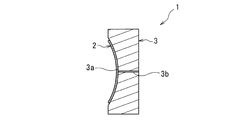
- FIG. 2 is a schematic AA line end view of the ultrasonic sensor of FIG.
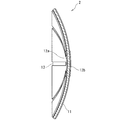
- FIG. 3 is a schematic enlarged sectional view taken along the line AA of the vibration detecting element of the ultrasonic sensor of FIG.
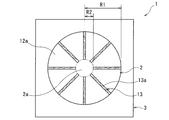
- FIG. 4 is a schematic front view of the ultrasonic sensor of FIG.
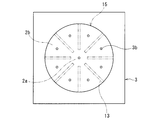
- FIG. 5 is a schematic rear view showing a bonded state between the vibration detection element and the support member of the ultrasonic sensor of FIG.
- FIG. 6 is a schematic front view showing the arrangement of the through holes of the supporting member of the ultrasonic sensor of FIG.
- FIG. 1 is a schematic perspective view of an ultrasonic sensor including a vibration detection element according to an embodiment of the present invention.
- FIG. 2 is a schematic AA line end view of the ultrasonic sensor of FIG.
- FIG. 3 is a schematic enlarged sectional view taken along the line AA of the vibration detecting
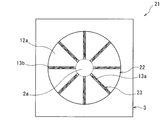
- FIG. 7 is a schematic front view showing an ultrasonic sensor according to an embodiment different from the ultrasonic sensor of FIG.
- FIG. 8 is a schematic front view showing a vibration detecting element of an ultrasonic sensor according to an embodiment different from the ultrasonic sensors of FIGS. 1 and 7.
- FIG. 9 is a schematic front view showing a vibration detecting element of an ultrasonic sensor according to an embodiment different from the ultrasonic sensors of FIGS. 1, 7 and 8.
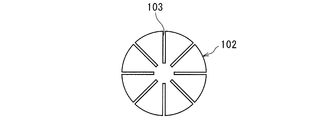
- FIG. 10 is a schematic front view showing the vibration detection element of the ultrasonic sensor according to the comparative embodiment.
- An ultrasonic sensor includes a support member having a curved surface, a film-shaped piezoelectric body provided on the curved surface of the support member, and a pair of electrodes laminated on the front and back of the piezoelectric body.
- a vibration detecting element which is an ultrasonic sensor including at least a part of the vibration detecting element, has a non-vibration detecting section that does not detect vibration, and the non-vibration detecting section is a table of the piezoelectric body or It is a portion where the electrode is not laminated on at least one of the back side and extends inward from the edge of the curved surface of the support member.
- the vibration detecting element has a base portion, and the non-vibration detecting portion may extend radially from the outer peripheral edge of the base portion.
- the piezoelectric body preferably has a slit in the non-vibration detecting portion.
- the vibration detection element may be curved or bent in the non-vibration detection part in a direction perpendicular to the extending direction of the non-vibration detection part.
- the curved surface should be concave.
- a pleats formed by the piezoelectric body may be formed on the non-vibration detection section.
- the support member preferably has at least one through hole.
- the vibration detecting element may be bonded to the supporting member by one or more non-vibration detecting portions.
- An ultrasonic sensor manufacturing method includes a support member having a curved surface, a film-shaped piezoelectric body, and a pair of electrodes laminated on the front and back surfaces of the piezoelectric body, and at least a part of the piezoelectric body.
- a vibration detecting element that does not detect vibration wherein the non-vibration detecting portion uses a vibration detecting element that is a portion in which the electrode is not laminated on at least one of the front and back of the piezoelectric body, The step of laminating the detection element on the curved surface, and the step of laminating the vibration detection element such that the non-vibration detection portion extends inward from the edge of the curved surface of the support member after the laminating step or at the same time as the laminating step. And a step of forming a shape according to the shape of.
- the "front” means the side that receives the vibration
- the "back” means the opposite side.
- the “fold” means a wrinkle formed by overlapping, folding, or the like.
- the ultrasonic sensor can be easily formed into a three-dimensional curved shape.
- the ultrasonic sensor 1 of FIGS. 1 and 2 includes a vibration detection element 2 and a support member 3 that supports the vibration detection element 2 from the back side.
- the ultrasonic sensor 1 is used in an inspection device for ultrasonically inspecting the heat sealability of a food package and the presence or absence of bubbles in a storage battery or a fuel cell.
- the surface on the front side of the vibration detecting element 2 constitutes an ultrasonic receiving surface that faces an ultrasonic transmitter (not shown) with the subject in between.
- the ultrasonic wave transmitting surface of the ultrasonic wave transmitter is formed as a quadratic curve rotating surface, a rotating parabolic surface, or the like so that the ultrasonic wave can be focused toward one point of the subject.
- the vibration detecting element 2 includes a film-shaped piezoelectric body 11 and a pair of electrodes laminated on the front and back sides of the piezoelectric body 11 (the first electrode 12a and the piezoelectric body laminated on the front side surface of the piezoelectric body 11). It has a second electrode 12b) laminated on the backside of the body 11.
- the vibration detecting element 2 has a sheet shape as a whole.
- the piezoelectric material forming the piezoelectric body 11 may be a flexible polymer piezoelectric material.
- the polymeric piezoelectric material include polyvinylidene fluoride (PVDF), vinylidene fluoride-trifluoroethylene copolymer (P (VDF / TrFE)), vinylidene cyanide-vinyl acetate copolymer (P (VDCN / VAc)) and the like. Further, by using these polymeric piezoelectric materials as the porous film, the flexibility is further increased, and the bendability and bendability of the vibration detection element 2 can be enhanced.
- the piezoelectric body 11 for example, polytetrafluoroethylene (PTFE), polypropylene (PP), polyethylene (PE), polyethylene terephthalate (PET), etc., which do not have piezoelectric characteristics, are formed with a large number of flat pores to form a corona discharge.
- PTFE polytetrafluoroethylene
- PP polypropylene
- PE polyethylene
- PET polyethylene terephthalate
- the lower limit of the average thickness of the piezoelectric body 11 is preferably 10 ⁇ m, more preferably 50 ⁇ m.
- the upper limit of the average thickness of the piezoelectric body 11 is preferably 500 ⁇ m, more preferably 200 ⁇ m. If the average thickness of the piezoelectric body 11 is less than the lower limit, the strength of the piezoelectric body 11 may be insufficient. On the other hand, if the average thickness of the piezoelectric body 11 exceeds the upper limit, it may be difficult to form the vibration detection element 2 into a desired curved or bent shape when the vibration detection element 2 is laminated on the support member 3.
- the first electrode 12a and the second electrode 12b are thin films.
- the first electrode 12a and the second electrode 12b are used to detect the potential difference between the front surface and the back surface of the piezoelectric body 11. Therefore, the first electrode 12a and the second electrode 12b are connected to a detection circuit (not shown).
- the material of the first electrode 12a and the second electrode 12b may be any material having conductivity, and examples thereof include metals such as aluminum, copper and nickel, and carbon.
- the method for laminating the first electrode 12a and the second electrode 12b on the piezoelectric body 11 is not particularly limited, and examples thereof include vapor deposition of metal, printing of carbon conductive ink, and coating and drying of silver paste.
- the average thickness of the first electrode 12a and the second electrode 12b may be, for example, 0.1 ⁇ m or more and 30 ⁇ m or less, depending on the stacking method. If the average thickness is less than the lower limit, the strength of the first electrode 12a and the second electrode 12b may be insufficient. On the contrary, when the average thickness exceeds the upper limit, there is a possibility that the followability to the curved surface shape in the state where the vibration detecting element 2 is curved or bent is deteriorated.
- the vibration detecting element 2 has a plurality of belt-shaped low-rigidity portions 13 extending inward from the outer edge thereof.
- the vibration detecting element 2 is smoothly curved or bent in a direction perpendicular to the extending direction of the low-rigidity portion 13 while absorbing the excess portion of the sheet in the plurality of low-rigidity portions 13.
- the vibration detecting element 2 is also curved or bent in the direction along the extending direction of the plurality of low-rigidity portions 13. That is, the vibration detecting element 2 is curved or bent three-dimensionally by the plurality of low-rigidity portions 13.
- the “strip shape” means a shape whose width is smaller than its length.
- the "extending direction of the low-rigidity portion” means a direction perpendicular to the width of the low-rigidity portion at any point.
- the low-rigidity portion 13 is a portion of the vibration detection element 2 having a lower rigidity than the portion where the first electrode 12a and the second electrode 12b are laminated on the piezoelectric body 11.
- the plurality of low-rigidity portions 13 are formed with the outer edge of the vibration detection element 2 as one end in the extending direction.
- the plurality of low-rigidity portions 13 are thin portions in which the first electrode 12a and the second electrode 12b are not laminated on both surfaces of the piezoelectric body 11.
- the vibration detecting element 2 is patterned in the same shape in plan view so that the first electrode 12a and the second electrode 12b face each other in the thickness direction of the piezoelectric body 11.
- the non-patterning regions of the first electrode 12a and the second electrode 12b form the low rigidity portion 13. That is, the piezoelectric body 11 has an exposed region where neither the first electrode 12a nor the second electrode 12b is laminated at a position facing each other in the thickness direction, and this exposed region constitutes the low-rigidity portion 13. ing.
- the ultrasonic sensor 1 has a vibration detection unit in which first electrodes 12a and second electrodes 12b are laminated on both surfaces of a piezoelectric body 11, and a first electrode 12a and second electrodes 12b are laminated on both surfaces of the piezoelectric body 11. And has a non-vibration detection unit that does not detect vibration.
- the vibration detection element 2 has at least a part of the non-vibration detection part that does not detect vibration, and the non-vibration detection part has electrodes laminated on at least one of the front and back of the piezoelectric body 11. Not the part.
- the plurality of low-rigidity portions 13 are non-vibration detecting portions that do not detect vibration.
- the vibration detecting element 2 Since the vibration detecting element 2 has the low-rigidity portion 13, the low-rigidity portion 13 absorbs the excess portion of the sheet (while the excess portion of the sheet due to the bending or bending is overlapped with the low-rigidity portion 13). Can be curved to More specifically, the vibration detecting element 2 in the expanded state has a surplus portion in the seat surface direction with respect to the curved or bent state. This excess portion is likely to be formed as a fold in a curved or bent state. At this time, if the low-rigidity portion 13 does not exist, a plurality of folds are likely to occur randomly (no principle) in the vibration detection portion in which the first electrode 12a and the second electrode 12b are laminated on the piezoelectric body 11.
- the vibration detecting element 2 has the low-rigidity part 13 whose rigidity is smaller than that of the vibration detection part is likely to be selectively folded.
- the vibration detection element 2 since the vibration detection element 2 has the low-rigidity portion 13, it is possible to prevent the low-rigidity portion 13 from forming a fold in the vibration detection portion. Therefore, in the ultrasonic sensor 1, since the vibration detection element 2 has the low-rigidity portion 13, it is possible to suppress a decrease in detection sensitivity due to a fold in the vibration detection portion, and appropriately detect vibration.
- the low-rigidity portions 13 arranged radially are arranged at a uniform pitch in the circumferential direction. By arranging the low-rigidity portions 13 at a uniform pitch, it is possible to form folds of the same degree on all the low-rigidity portions 13.
- the low rigidity portion 13 is the thin portion described above.
- the first electrode 12a and the second electrode 12b are separated by the piezoelectric body 11, and a short circuit between the first electrode 12a and the second electrode 12b can be prevented.
- a slit penetrating in the thickness direction of the vibration detection element instead of the low-rigidity portion 13.
- a cutout 103 that penetrates in the thickness direction of the vibration detection element 102 is provided in place of the low-rigidity portion 13, and the cutout 103 is not overlapped even when both sides of the cutout 103 are not overlapped.
- a conductive member may adhere to the end surface cut by 103, or conductive dust may adhere, resulting in a short circuit between the first electrode and the second electrode.
- the piezoelectric body 11 is provided with a thin portion where the first electrode 12a and the second electrode 12b are not laminated, thereby preventing a short circuit between the first electrode 12a and the second electrode 12b. can do.
- the vibration detecting element 2 has a shape corresponding to the shape of the ultrasonic wave transmitting surface of the ultrasonic wave transmitter described above.
- the vibration detecting element 2 is formed in a concave shape that is depressed on the back side.
- the vibration detecting element 2 has a bowl shape. Since the vibration detecting element 2 has a bowl shape, the ultrasonic sensor 1 can easily and surely detect defects such as adhesion failure and bubbles by ultrasonic waves.
- the vibration detecting element 2 has a base portion 2a in a region within its surface.
- the base 2a has a circular shape in plan view, more specifically, a perfect circular shape in plan view.
- the base portion 2a constitutes a part of a vibration detecting portion in which the first electrode 12a and the second electrode 12b are laminated on the piezoelectric body 11.
- the base portion 2a is located at the center portion (that is, the bottom portion) of the vibration detection element 2.
- the outer peripheral edge of the base portion 2a and the outer peripheral edge of the vibration detecting element 2 are formed in a concentric shape in a plan view.
- the vibration detecting element 2 has a plurality of low-rigidity portions 13 (that is, non-vibration detecting portions) radially extending from the outer peripheral edge of the base portion 2a.
- the plurality of low-rigidity portions 13 extend linearly in the radial direction of the vibration detection element 2.
- the plurality of low-rigidity portions 13 radially extend from the outer peripheral edge of the base portion 2a, so that the plurality of low-rigidity portions 13 extend in the extending direction (in the present embodiment, the diameter of the vibration detection element 2).
- the “circle” includes not only a perfect circle but also an ellipse and an oval.
- the base portion 2a is not limited to a circular shape in plan view, and may be a polygonal shape, a star shape, or the like.
- the base portion 2a is a region that does not absorb the excess portion of the sheet in a curved or bent state, and is formed in a relatively small area of the center portion of the vibration detection element 2 as shown in FIG.
- the lower limit of the ratio of the average radius R2 of the base 2a (the length along the curved or bent surface) to the average radius R1 of the vibration detection element 2 (the length along the curved or bent surface, that is, the average radius in the deployed state) is: 0.1 is preferable and 0.3 is more preferable.
- the upper limit of the ratio is preferably 0.5, more preferably 0.4.
- the ratio is less than the lower limit, the area ratio of the plurality of low-rigidity portions 13 becomes relatively large, which may unnecessarily reduce the area of the vibration detection portion.
- the ratio exceeds the upper limit, the plurality of low-rigidity portions 13 cannot sufficiently absorb the excess portion of the sheet, and there is a possibility that the vibration detection portion may be pleated.
- the plurality of low-rigidity portions 13 are arranged at equal angular intervals from the outer peripheral edge of the base portion 2a. By arranging the plurality of low-rigidity portions 13 at equal angular intervals, the plurality of low-rigidity portions 13 can effectively absorb the excess portion of the sheet, and it is easy to prevent the vibration detection portion from being pleated.
- the low-rigidity portion 13 has a strip shape and has a constant width. Since the low-rigidity portion 13 has a constant width, it is possible to absorb the excess portion of the sheet.
- the average width of the plurality of low-rigidity portions 13 can be set according to the size of the vibration detection element 2, but can be set to, for example, 0.5 mm or more and 3 mm or less.
- the low-rigidity portion 13 has a fold 13a. That is, it is preferable that the non-vibration detecting portion is formed with the pleats 13 a formed of the piezoelectric body 11.
- the folds 13a are formed by overlapping the excess sheet portions when the vibration detecting element 2 is formed into a curved shape from the expanded state.
- the folds 13a are formed in the low-rigidity portion 13, so that the vibration detection element 2 can be easily formed into a desired curved surface shape.
- the ultrasonic sensor 1 is formed with the folds in the low-rigidity portion 13, it becomes easy to keep the front side surface of the vibration detecting section in a desired smooth curved surface shape, and the vibration detecting section detects the vibration. A decrease in sensitivity can be suppressed.
- the support member 3 has an inverted shape of the surface on the back side of the vibration detection element 2 and has a mounting surface 3a on which the vibration detection element 2 is mounted from the back side.
- the mounting surface 3a is a curved surface. That is, the vibration detection element 2 is provided on the curved surface of the support member 3.
- the curved surface is a concave surface.
- the mounting surface 3a is curved three-dimensionally and has a bowl shape in the present embodiment.
- the non-vibration detecting portion extends inward from the edge of the curved surface of the support member 3.
- the support member 3 has a plurality of through holes 3b penetrating in the thickness direction (front and back direction).
- the vibration detection element 2 can be easily formed in a shape along the curved surface shape of the mounting surface 3a.
- the “bowl shape” means a shape that is three-dimensionally concave and has a blunt bottom (rounded or flat bottom).
- the non-vibration detecting section extendends from the edge of the curved surface” means that the end of the non-vibration detecting section is located at the edge of the curved surface, and It includes a structure in which a curved surface region of the support member exists.
- the support member 3 is formed of, for example, a synthetic resin as a main component.
- this synthetic resin include polyethylene terephthalate and polypropylene.
- a "main component” means a component with the largest content in terms of mass.
- the ultrasonic sensor 1 has a plurality of adhesive portions 14 (a plurality of first adhesive portions 14 a and a plurality of second adhesive portions 14 b) that adhere the vibration detection element 2 and the support member 3.
- the plurality of adhesive portions 14 can be formed by, for example, a well-known double-sided tape or adhesive.
- the plurality of first adhesive portions 14a are laminated on the plurality of low-rigidity portions 13. That is, the vibration detecting element 2 is bonded to the support member 3 at the plurality of non-vibration detecting portions. As a result, the vibration detection element 2 is partially bonded to the mounting surface 3a by the plurality of low-rigidity portions 13. In the ultrasonic sensor 1, the resonance frequency of the vibration detection element 2 is affected by the support member 3 because the vibration detection element 2 is partially bonded to the mounting surface 3a by the plurality of low-rigidity portions 13. It is possible to suppress the change.
- the plurality of second adhesive portions 14b are laminated on the outer peripheral edge portion of the vibration detection element 2.
- the plurality of second adhesive portions 14b are laminated on the outer peripheral edge portion of the second electrode 12b (that is, the vibration detection portion).
- the vibration detection element 2 is partially bonded to the mounting surface 3a at the outer peripheral edge portion of the vibration detection element 2 in addition to the plurality of low-rigidity portions 13.
- the resonance frequency of the vibration detection element 2 is affected by the support member 3 because the vibration detection element 2 is partially bonded to the mounting surface 3a at the outer peripheral edge portion of the vibration detection element 2. It is possible to easily suppress the peeling of the vibration detection element 2 from the mounting surface 3a while suppressing such a change.
- the plurality of through holes 3b are provided so as to reach the vibration detection element 2.
- the plurality of through holes 3b are provided so as to reach the vibration detection element 2 at a position not overlapping the plurality of low-rigidity portions 13.
- the ultrasonic sensor 1 can communicate the space on the back side of the vibration detection portion of the vibration detection element 2 with the space on the back side of the support member 3.
- the ultrasonic sensor 1 can suppress the resonance frequency of the vibration detection element 2 from being affected by the sealing with the mounting surface 3a.
- the ultrasonic sensor 1 includes the vibration detection unit in which the plurality of low-rigidity portions 13 that are non-vibration detection units and the first electrode 12a and the second electrode 12b are laminated on both surfaces of the piezoelectric body 11. 15 and.
- the vibration detecting unit 15 has a base portion 2a and a plurality of peripheral edge portions 2b defined by a plurality of low-rigidity portions 13 outside the outer peripheral edge of the base portion 2a.
- the ultrasonic sensor 1 is provided with through holes 3b corresponding to the base portion 2a and the plurality of peripheral portions 2b.
- the through holes 3b are provided in the base portion 2a and the peripheral portions 2b, and preferably, the through holes 3b are provided in a one-to-one correspondence with the base portion 2a and the peripheral portions 2b.
- the ultrasonic sensor 1 can communicate the space on the back side of each section of the vibration detection unit 15 with the space on the back side of the support member 3.
- the ultrasonic sensor 1 can more reliably suppress the resonance frequency of the vibration detection element 2 from being affected by the sealing with the mounting surface 3a.
- the ultrasonic sensor 1 fixes the vibration detection element 2 on the mounting surface 3a while allowing the flat film-shaped (developed state) vibration detection element 2 to follow the curved surface shape of the mounting surface 3a of the support member 3. It is formed by The method of manufacturing the ultrasonic sensor 1 includes a step of stacking the vibration detection element 2 on the mounting surface 3a (that is, a curved surface) of the support member 3 (a stacking step), and vibration detection after or at the same time as the stacking step. And a step (forming step) of forming the element 2 into a shape along the curved surface shape of the mounting surface 3a.
- the vibration detecting element 2 can be formed into a shape along the curved surface shape of the mounting surface 3a by suction from the back side of the supporting member 3.
- the vibration detecting element 2 may be pressed from the front side by a convex member.
- the vibration detecting element 2 is formed in a shape along the curved surface so that the non-vibration detecting portion extends inward from the edge of the curved surface of the support member 3.
- the vibration detecting element 2 is sucked toward the mounting surface 3a side by vacuuming from the plurality of through holes 3b of the supporting member 3.
- a plurality of folds 13a are selectively formed in the plurality of low-rigidity portions 13 of the vibration detecting element 2, whereby the vibration detecting element 2 is formed into a desired curved surface shape while absorbing the excess portion of the sheet.
- the vibration detecting element 2 has a plurality of belt-shaped low-rigidity portions 13 extending inward from the outer edge thereof, and the plurality of low-rigidity portions 13 are arranged in a direction perpendicular to the extending direction of the low-rigidity portions 13. It can be curved or bent. Furthermore, since the vibration detection element 2 has the plurality of belt-shaped low-rigidity portions 13, the vibration-detection element 2 is easily bent or bent in the direction along the extending direction of the low-rigidity portions 13. Therefore, the vibration detecting element 2 can be easily formed into a three-dimensional curved shape.
- the vibration detection element 2 has a plurality of belt-shaped low-rigidity portions 13 extending inward from the outer edge thereof.
- the low-rigidity portion 13 can be curved or bent in a direction perpendicular to the extending direction.
- the vibration detection element 2 since the vibration detection element 2 has the plurality of belt-shaped low-rigidity portions 13, the vibration detection element 2 is curved or bent in a direction along the extending direction of the low-rigidity portions 13. It's easy to do. Therefore, the ultrasonic sensor 1 can easily form the vibration detecting element 2 having a three-dimensional curved shape.
- the ultrasonic wave detecting element 2 is used as a pair with the ultrasonic wave transmitter. It is preferably used as a sensor for detecting sound waves.
- the method of manufacturing the ultrasonic sensor can easily and reliably manufacture the ultrasonic sensor 1 in which the vibration detecting element 2 can be easily formed into a three-dimensional curved shape.
- the ultrasonic sensor 21 of FIG. 7 includes a vibration detection element 22 and a support member 3 that supports the vibration detection element 22 from the back side.
- the vibration detection element 22 has a plurality of belt-shaped low-rigidity portions 23 (that is, non-vibration detection portions) extending inward from the outer edge thereof.
- the low-rigidity portion 23 has a slit 13b. That is, the vibration detecting element 22 has the slit 13b in the non-vibration detecting portion.
- the ultrasonic sensor 21 may have the same configuration as the ultrasonic sensor 1 of FIG. 1 except that the low-rigidity portion 23 has the slit 13b. Therefore, only the slit 13b will be described below.
- the slit 13b extends inward from the outer edge of the vibration detecting element 22.
- the slit 13b extends along the extending direction of the low-rigidity portion 23 at an intermediate position in the width direction of the low-rigidity portion 23 (a position that does not include both ends in the width direction).
- the slits 13b may be provided only in a part of the low-rigidity portions 23, it is preferable that the slits 13b be provided in each low-rigidity portion 23 in a one-to-one correspondence.
- the vibration detection element 22 Since the low-rigidity portion 23 has the slit 13b, the vibration detection element 22 is easily bent or bent by the slit 13b.
- the vibration detecting element 22 since the slit 13b is formed at an intermediate position in the width direction of the low-rigidity portion 23, at least one of the first electrode 12a and the second electrode 12b is provided in a certain range on both sides of the slit 13b. A non-vibration detection part is formed in which one does not exist. Therefore, the vibration detection element 22 easily suppresses a short circuit between the first electrode 12a and the second electrode 12b.
- the vibration detection element 22 since the vibration detection element 22 has the slit 13b in the low-rigidity portion 23, it is easy to bend or bend the vibration detection element 22 with the slit 13b.
- the slit 13b is formed at the intermediate position in the width direction of the low-rigidity portion 23, it is easy to suppress a short circuit between the first electrode 12a and the second electrode 12b.
- the base portion of the vibration detecting element does not necessarily have to be a perfect circle shape in plan view.
- the base 32a may have an oval shape.
- the plurality of low-rigidity portions 33 may extend radially only from the circumferential portion of the outer peripheral edge of the base portion 32a.
- the vibration detection element may have only one low-rigidity portion extending inward from the outer edge thereof.
- the vibration detecting element 42 of FIG. 9 has only one low-rigidity portion 43 extending inward from its outer edge.
- the low-rigidity portion 43 is formed in a spiral shape from the outer edge of the vibration detection element 42 toward the inside. That is, the low-rigidity portion 43 does not extend radially from the outer peripheral edge of the base portion that is circular in plan view. Even with this configuration, the vibration detection element can bend or bend in the low-rigidity portion 43 in the direction perpendicular to the extending direction of the low-rigidity portion 43.
- the curved surface shape of the vibration detecting element can be set according to the application, and the vibration detecting element does not necessarily have to be bowl-shaped.
- the vibration detection element may be configured in a dome shape or the like that is raised on the front side.
- the one or more low-rigidity portions may be composed of a thin portion in which electrodes are laminated only on one surface of the piezoelectric body.
- the difference in rigidity between the low-rigidity portion and the other portion (vibration detection portion) is large. Therefore, it is more preferable that the low-rigidity portion is a thin portion in which electrodes are not laminated on both surfaces of the piezoelectric body.
- the pair of electrodes may not be patterned in the same shape in plan view.
- a region where at least one electrode is not laminated on the piezoelectric body can be configured as a thin portion.
- a slit may be formed in the low rigidity portion. Further, the slit may be formed in an inner region apart from the outer edge of the vibration detecting element. Further, in the vibration detecting element, two or more slits may be formed for one low rigidity portion.
- the vibration detecting element may be provided with a low-rigidity portion between the base portion and the plurality of peripheral portions.
- a thin portion where at least one electrode is not laminated on the piezoelectric body may be formed between the base portion and the plurality of peripheral portions.
- the width of the one or more low-rigidity portions may not be constant along the extending direction.
- the width of these low-rigidity portions may be gradually reduced toward the outer side in the radial direction, may be gradually increased, and the width may be gradually increased. Both the gradually decreasing area and the gradually increasing area may be included.
- the ultrasonic sensor does not necessarily need to have pleats formed on the one or more low-rigidity portions as long as the curved shape of the vibration detecting element can be appropriately maintained.
- the ultrasonic sensor does not necessarily have to have the above-mentioned supporting member as long as the curved surface shape of the vibration detecting element can be maintained.
- the vibration detection element may be partially bonded to the mounting surface only at the one or more low-rigidity portions. Further, in the case where the ultrasonic sensor has this supporting member, the vibration detecting element and the supporting member can be adhered and fixed at an arbitrary laminated region of the electrode if the detection accuracy is not insufficient. ..
- the ultrasonic sensor may have a structure in which a plurality of vibration detecting elements are laminated on a supporting member.
- the ultrasonic sensor according to one aspect of the present invention can be easily formed into a three-dimensional curved shape, it is preferably used as an ultrasonic detection sensor.
Landscapes
- Physics & Mathematics (AREA)
- Engineering & Computer Science (AREA)
- Acoustics & Sound (AREA)
- Signal Processing (AREA)
- Health & Medical Sciences (AREA)
- Life Sciences & Earth Sciences (AREA)
- Chemical & Material Sciences (AREA)
- Analytical Chemistry (AREA)
- Biochemistry (AREA)
- General Health & Medical Sciences (AREA)
- General Physics & Mathematics (AREA)
- Immunology (AREA)
- Pathology (AREA)
- Transducers For Ultrasonic Waves (AREA)
- Investigating Or Analyzing Materials By The Use Of Ultrasonic Waves (AREA)
Abstract
La présente invention aborde le problème de la fourniture d'un capteur d'ultrasons permettant la formation aisée d'une forme tridimensionnelle de courbure. Un capteur d'ultrason 1 selon un aspect de la présente invention comporte : un élément de support 3 ayant une surface courbée ; un corps piézoélectrique de type film disposé sur la surface courbé de l'élément de support ; et un élément de détection de vibrations 2 constitué d'une paire d'électrodes apposée sur les surfaces supérieure et inférieure du corps piézoélectrique. Au moins une partie de l'élément de détection de vibration 2 comprend une partie de détection de non vibration qui ne détecte pas de vibration. La partie de détection de non-vibration est une partie d'au moins l'une des surfaces supérieure et inférieure du corps piézoélectrique dans lequel une électrode 12a n'est pas apposée, et qui s'étend vers l'intérieur à partir du bord de la surface courbée de l'élément de support 3.
Applications Claiming Priority (2)
| Application Number | Priority Date | Filing Date | Title |
|---|---|---|---|
| JP2018209174A JP2020077945A (ja) | 2018-11-06 | 2018-11-06 | 振動検出素子及び超音波センサ |
| JP2018-209174 | 2018-11-06 |
Publications (1)
| Publication Number | Publication Date |
|---|---|
| WO2020095930A1 true WO2020095930A1 (fr) | 2020-05-14 |
Family
ID=70611821
Family Applications (1)
| Application Number | Title | Priority Date | Filing Date |
|---|---|---|---|
| PCT/JP2019/043428 Ceased WO2020095930A1 (fr) | 2018-11-06 | 2019-11-06 | Capteur d'ultrason et procédé de fabrication de capteur d'ultrason |
Country Status (2)
| Country | Link |
|---|---|
| JP (1) | JP2020077945A (fr) |
| WO (1) | WO2020095930A1 (fr) |
Citations (3)
| Publication number | Priority date | Publication date | Assignee | Title |
|---|---|---|---|---|
| JPH0432726A (ja) * | 1990-05-30 | 1992-02-04 | Toshiba Corp | ハイドロホン |
| JPH06281634A (ja) * | 1993-03-29 | 1994-10-07 | Hitachi Constr Mach Co Ltd | 超音波探触子 |
| JP2007036612A (ja) * | 2005-07-26 | 2007-02-08 | Tdk Corp | 圧電薄膜振動子およびその製造方法、並びにそれを用いた駆動装置および圧電モータ |
-
2018
- 2018-11-06 JP JP2018209174A patent/JP2020077945A/ja active Pending
-
2019
- 2019-11-06 WO PCT/JP2019/043428 patent/WO2020095930A1/fr not_active Ceased
Patent Citations (3)
| Publication number | Priority date | Publication date | Assignee | Title |
|---|---|---|---|---|
| JPH0432726A (ja) * | 1990-05-30 | 1992-02-04 | Toshiba Corp | ハイドロホン |
| JPH06281634A (ja) * | 1993-03-29 | 1994-10-07 | Hitachi Constr Mach Co Ltd | 超音波探触子 |
| JP2007036612A (ja) * | 2005-07-26 | 2007-02-08 | Tdk Corp | 圧電薄膜振動子およびその製造方法、並びにそれを用いた駆動装置および圧電モータ |
Also Published As
| Publication number | Publication date |
|---|---|
| JP2020077945A (ja) | 2020-05-21 |
Similar Documents
| Publication | Publication Date | Title |
|---|---|---|
| JP5160984B2 (ja) | 防水通音膜、防水通音膜の製造方法およびそれを用いた電気製品 | |
| US9635467B2 (en) | Electroacoustic converter film | |
| JP5599856B2 (ja) | 電気音響変換器および表示デバイス | |
| US20180364113A1 (en) | Pressure Sensor | |
| CN110832293A (zh) | 振动传感器 | |
| WO2020049934A1 (fr) | Capteur biométrique | |
| JP2016139494A (ja) | ラミネート型電池 | |
| JP2014103055A (ja) | 電池パック | |
| JP2020077945A (ja) | 振動検出素子及び超音波センサ | |
| JP7538293B2 (ja) | 積層電極体 | |
| US9986341B2 (en) | Electroacoustic converter | |
| WO2019064708A1 (fr) | Biocapteur | |
| CN112272883A (zh) | 电池 | |
| JP5575220B2 (ja) | 組電池の電池パック | |
| JP3270616B2 (ja) | 受波型圧電素子 | |
| CN109068246B (zh) | 振膜及具有该振膜的扬声器 | |
| TW202118370A (zh) | 覆蓋構件及具備其之構件供給組件 | |
| TW202108377A (zh) | 高分子複合壓電體及壓電薄膜 | |
| JP6838646B2 (ja) | 生体振動センサー | |
| JP2023109841A (ja) | 少なくとも1つの支持構造体を含む音響抵抗性支持体付き膜集成体 | |
| JP2020155919A (ja) | 超音波センサ | |
| KR101718970B1 (ko) | 전극 조립체 및 이를 이용한 이차 전지 | |
| JP2020202357A (ja) | 圧電センサ及び積層体 | |
| US20260129372A1 (en) | Driver unit and headphone | |
| JP2004249198A (ja) | ベントフィルタの製造方法及びベントフィルタ |
Legal Events
| Date | Code | Title | Description |
|---|---|---|---|
| 121 | Ep: the epo has been informed by wipo that ep was designated in this application |
Ref document number: 19881709 Country of ref document: EP Kind code of ref document: A1 |
|
| NENP | Non-entry into the national phase |
Ref country code: DE |
|
| 122 | Ep: pct application non-entry in european phase |
Ref document number: 19881709 Country of ref document: EP Kind code of ref document: A1 |