WO2020096059A1 - Agent externe pour la pousse des cheveux ou la prévention de la perte des cheveux - Google Patents
Agent externe pour la pousse des cheveux ou la prévention de la perte des cheveux Download PDFInfo
- Publication number
- WO2020096059A1 WO2020096059A1 PCT/JP2019/044000 JP2019044000W WO2020096059A1 WO 2020096059 A1 WO2020096059 A1 WO 2020096059A1 JP 2019044000 W JP2019044000 W JP 2019044000W WO 2020096059 A1 WO2020096059 A1 WO 2020096059A1
- Authority
- WO
- WIPO (PCT)
- Prior art keywords
- hair
- lactic acid
- enterococcus
- item
- cells
- Prior art date
- Legal status (The legal status is an assumption and is not a legal conclusion. Google has not performed a legal analysis and makes no representation as to the accuracy of the status listed.)
- Ceased
Links
Images


Classifications
-
- A—HUMAN NECESSITIES
- A61—MEDICAL OR VETERINARY SCIENCE; HYGIENE
- A61Q—SPECIFIC USE OF COSMETICS OR SIMILAR TOILETRY PREPARATIONS
- A61Q7/00—Preparations for affecting hair growth
-
- A—HUMAN NECESSITIES
- A61—MEDICAL OR VETERINARY SCIENCE; HYGIENE
- A61K—PREPARATIONS FOR MEDICAL, DENTAL OR TOILETRY PURPOSES
- A61K8/00—Cosmetics or similar toiletry preparations
- A61K8/18—Cosmetics or similar toiletry preparations characterised by the composition
- A61K8/96—Cosmetics or similar toiletry preparations characterised by the composition containing materials, or derivatives thereof of undetermined constitution
- A61K8/99—Cosmetics or similar toiletry preparations characterised by the composition containing materials, or derivatives thereof of undetermined constitution from microorganisms other than algae or fungi, e.g. protozoa or bacteria
-
- A—HUMAN NECESSITIES
- A61—MEDICAL OR VETERINARY SCIENCE; HYGIENE
- A61P—SPECIFIC THERAPEUTIC ACTIVITY OF CHEMICAL COMPOUNDS OR MEDICINAL PREPARATIONS
- A61P17/00—Drugs for dermatological disorders
- A61P17/14—Drugs for dermatological disorders for baldness or alopecia
-
- A—HUMAN NECESSITIES
- A61—MEDICAL OR VETERINARY SCIENCE; HYGIENE
- A61Q—SPECIFIC USE OF COSMETICS OR SIMILAR TOILETRY PREPARATIONS
- A61Q5/00—Preparations for care of the hair
- A61Q5/06—Preparations for styling the hair, e.g. by temporary shaping or colouring
-
- A—HUMAN NECESSITIES
- A61—MEDICAL OR VETERINARY SCIENCE; HYGIENE
- A61K—PREPARATIONS FOR MEDICAL, DENTAL OR TOILETRY PURPOSES
- A61K35/00—Medicinal preparations containing materials or reaction products thereof with undetermined constitution
- A61K35/66—Microorganisms or materials therefrom
- A61K35/74—Bacteria
- A61K35/741—Probiotics
- A61K35/744—Lactic acid bacteria, e.g. enterococci, pediococci, lactococci, streptococci or leuconostocs
Definitions
- the present invention relates to an external preparation for hair growth or hair loss prevention.
- Lactic acid bacteria belonging to the genus Enterococcus are known to have various effects on the living body.
- the Enterococcus faecalis NF-1011 strain suppresses blood pressure elevation and prevents cardiac hypertrophy (Patent Document 1), immunostimulatory effect (Patent Document 2), interferon production enhancing effect (Patent Document 3), infection.
- a protective effect (Patent Document 4), an anti-cancer enhancing effect (Patent Document 5), a toxicity reducing effect of an anti-cancer agent (Patent Document 6), a biological antioxidant activity activating effect (Patent Document 7) and the like have been reported.
- Patent Documents 1 to 7 basically describe ingestion of lactic acid bacteria and are not expected to be used as an external preparation.
- Japanese Patent Laid-Open No. 5-201871 Japanese Patent Laid-Open No. 8-99887 Japanese Patent Laid-Open No. 8-259450
- Japanese Patent Laid-Open No. 8-283166 Japanese Patent Laid-Open No. 8-295631 Japanese Patent Laid-Open No. 9-48733 Japan JP 2017-1961
- An object of the present invention is to provide an external preparation having excellent hair-growth action and hair loss prevention action.
- the present inventors have found that the bacterial cells of the Enterococcus faecalis NF-1011 strain and the bacterial cell components thereof exhibit remarkably excellent hair-growth action and hair loss prevention action.
- the present invention has been completed after further studies based on these findings, and provides the following external agents for hair growth or hair loss prevention.
- Item 1 An external preparation for hair growth or hair loss containing at least one selected from the group consisting of lactic acid bacteria belonging to the genus Enterococcus and components of the bacteria.
- Item 2. The external preparation according to Item 1, wherein the lactic acid bacterium belonging to the genus Enterococcus is Enterococcus faecalis.
- Item 3. Item 3. The external preparation according to Item 1 or 2, wherein the lactic acid bacterium belonging to the genus Enterococcus is Enterococcus faecalis NF-1011 strain (FERM BP-10902).
- Item 4. Item 4. The external preparation according to any one of Items 1 to 3, wherein the cells are dead cells.
- Item 5. Item 5.
- Item 6. A method for preventing hair growth or hair loss, which comprises a step of applying at least one selected from the group consisting of lactic acid bacteria belonging to the genus Enterococcus and components thereof to the skin of a mammal in need of hair growth or hair loss prevention.
- Item 7. Item 7. The method according to Item 6, wherein the lactic acid bacterium belonging to the genus Enterococcus is Enterococcus faecalis.
- Item 8. Item 8.
- Item 6 or 7 wherein the lactic acid bacterium belonging to the genus Enterococcus is Enterococcus faecalis NF-1011 strain (FERM BP-10902).
- Item 9. The method according to any one of Items 6 to 8, wherein the bacterium is a dead bacterium.
- the lactic acid bacterium cell component is a lactic acid bacterium lytic enzyme and a heat-treated product.
- Item 11 Use of at least one selected from the group consisting of cells of lactic acid bacteria belonging to the genus Enterococcus and components of the cells in the manufacture of an external preparation for growing hair or preventing hair loss.
- Item 12. Item 12.
- the lactic acid bacterium belonging to the genus Enterococcus and the microbial component thereof have remarkably excellent hair-growth action and hair loss-preventing action, and thus are useful as an active ingredient of an external preparation for hair growth or hair loss prevention.
- the external preparation for hair growth or hair loss of the present invention is characterized by containing at least one selected from the group consisting of lactic acid bacteria belonging to the genus Enterococcus and components of the bacteria.
- the lactic acid bacterium belonging to the genus Enterococcus is not particularly limited, and includes, for example, Enterococcus faecalis, Enterococcus faecium, Enterococcus avium, Enterococcus flavours, Enterococcus, -Galinarum (Enterococcus gallinarum), Enterococcus flavescens and the like.
- Enterococcus faecalis, Enterococcus faecium and the like are preferable, and Enterococcus faecalis is more preferable.
- Enterococcus faecalis NF-1011 strain which is a strain isolated from the feces of healthy subjects, is preferable.
- Enterococcus faecalis NF-1011 strain was registered at National Institute of Advanced Industrial Science and Technology, Patent Biological Depository Center (Chuo No. 6, 1-1, Higashi 1-1-chome, Tsukuba, Ibaraki, Japan, October 8th, 1991). Deposited under accession number FERM P-12564 on the day. In addition, this strain is currently transferred to international deposit, and its deposit number is FERMBP-10902.
- the lactic acid bacterium belonging to the genus Enterococcus is not particularly limited as long as it is the entire composition of the lactic acid bacterium belonging to the genus Enterococcus, and may be live cells or dead cells.
- the microbial cell may be a dried product such as a freeze-dried product.
- Live microbial cells of lactic acid bacteria belonging to the genus Enterococcus can be ordered from domestic consignment organizations such as ATCC, IFO, and JCM, international concession organizations, etc., or can be isolated from organisms.
- Live lactic acid bacteria belonging to the genus Enterococcus can also be grown by culturing according to a known method.
- the lactic acid bacterium is inoculated into an appropriate amount of sterilized Rogoza liquid medium and aerobically cultivated at 35 to 37 ° C for 10 to 16 hours to obtain a preculture liquid.
- a large amount of viable cells can be obtained by statically culturing in addition to the medium.
- the culture solution itself may be used, or the solid content of the culture solution (for example, a precipitate obtained by precipitating viable cells from the culture solution by centrifugation, etc., If necessary, a precipitate obtained by washing with physiological saline or the like) may be used, or a suspension of the solid content (for example, obtained by suspending the suspension in an isotonic solution such as physiological saline). Suspension, etc.) may be used.
- the solid content of the culture solution for example, a precipitate obtained by precipitating viable cells from the culture solution by centrifugation, etc., If necessary, a precipitate obtained by washing with physiological saline or the like
- a suspension of the solid content for example, obtained by suspending the suspension in an isotonic solution such as physiological saline). Suspension, etc.
- the dead cells of lactic acid bacteria belonging to the genus Enterococcus are not particularly limited, and may be, for example, a heat-treated product of live cells.
- the temperature of the heat treatment is not particularly limited as long as it is 100 ° C. or higher, but is preferably a temperature at which autoclave treatment is possible (for example, 110 to 125 ° C.).
- the heat treatment time is, for example, 1 minute or more, preferably 5 to 20 minutes, more preferably about 5 to 15 minutes.
- the lactic acid bacterium Enterococcus faecalis strain NF-1011 strain is commercially available, for example, as FK-23 (trademark) from Nichiniti Pharmaceutical Co., Ltd.
- the “cellular component of lactic acid bacterium” means a component released to the outside of the cell when the cell wall of lactic acid bacterium is destroyed.
- the lactic acid bacterium cell component is not particularly limited, but is, for example, a product obtained by cell wall destruction treatment of live bacterium. This cell wall disruption may be the whole or part of the cell wall of live cells.
- the cell wall destruction treatment method include heat treatment, physical force treatment, lytic enzyme treatment, and the like, or a combination thereof.
- a method including a treatment with a lytic enzyme is preferable, and more preferably, at least one selected from the group consisting of (a) treatment with a lytic enzyme, and (b) heat treatment and treatment with physical force.
- the method include a treatment (preferably heat treatment), more preferably (a) treatment with a lytic enzyme, and (b) at least one treatment selected from the group consisting of heat treatment and treatment with physical force (preferably A heat treatment).
- the temperature of the heat treatment is not particularly limited as long as it is 100 ° C or higher, but is preferably a temperature at which autoclave treatment can be performed (for example, 110 to 125 ° C).
- the heat treatment time is not particularly limited as long as it can destroy a part or the whole of the cell wall, and can be appropriately set according to the temperature of the heat treatment.
- the heat treatment time is, for example, 1 minute or more, preferably 5 to 20 minutes, more preferably 5 to 15 minutes.
- the method of treatment by physical force is not particularly limited as long as it can destroy a part or all of the cell wall. Examples include ultrasonic treatment and French press.
- the enzyme used for the treatment with the lytic enzyme is not particularly limited as long as it can destroy a part or the whole of the cell wall, and an enzyme generally used for lysing bacteria can be widely used.
- the lytic enzyme include lysozyme, actinase, zymolyase, kitalase, mutanocillin, achromopeptidase and the like. Among these, lysozyme is preferable.
- the lytic enzymes may be used alone or in combination of two or more.
- the treatment conditions with the lytic enzyme can be appropriately set according to the type of the lytic enzyme, the amount of the lytic target (viable cells), and the like.
- the lytic enzyme may be added to the viable cell suspension at a final concentration of 0.01 to 1 mg / mL, and treated at 30 to 40 ° C for 1 to 10 hours.
- the lactic acid bacterium cell component is not particularly limited as long as it is a component constituting the lactic acid bacterium cell body.
- the bacterial cell component is preferably a water-soluble component.
- the water-soluble component is obtained, for example, by removing the solid content from a product obtained by disrupting the cell wall of lactic acid bacteria by centrifugation or the like.
- the microbial component of the lactic acid bacterium Enterococcus faecalis NF-1011 strain is commercially available, for example, as LFK TM (trademark) from Nichinichi Pharmaceutical Co., Ltd.
- the external preparation of the present invention exerts hair-growth action and hair loss-preventing action due to microbial cells and bacterial cell components of lactic acid bacteria belonging to Enterococcus, and is therefore suitably used as an external-use agent for hair growth, hair loss prevention, etc.
- the external preparation of the present invention includes external medicines and cosmetics.
- the cosmetics also include quasi-drugs.
- the external preparation of the present invention is applied to the skin (including the scalp) of mammals including humans.
- hair growth includes the concepts of hair growth and hair growth.
- lactic acid bacteria cells and cell components are prepared in the form of external solid preparations, external liquid preparations, sprays, ointments, creams, gels, patches and the like, It is possible to prepare an external preparation.
- additives used in external preparations for example, antibacterial agents, cooling agents, emulsifiers, oils, antioxidants, surfactants, fragrances, ultraviolet absorbers, pigments, ethanol, water, moisturizers,
- a thickener for example, a solubilizer, a gelling agent and the like
- a solubilizer for example, a solubilizer, a gelling agent and the like
- the ratio of lactic acid bacteria cells and cell components contained in the drug is not particularly limited, and examples thereof include concentrations of 0.01 to 99% by mass.
- the dosage form of cosmetics includes aqueous solution, solubilization system, emulsion system, oil liquid system, powder system, gel system, ointment system, aerosol system, water-oil 2-layer system, water-oil-powder 3-layer system, etc.
- aqueous solution solubilization system, emulsion system, oil liquid system, powder system, gel system, ointment system, aerosol system, water-oil 2-layer system, water-oil-powder 3-layer system, etc.
- cosmetics are also arbitrary, and examples thereof include shampoo, conditioner, hair treatment, hair conditioner, hair styling agent, hair tonic, hair dye, hair manicure, pomade, hair liquid, hair spray, hair cream, hair restorer and the like. Be done.
- components usually used in cosmetics for example, moisturizers, antioxidants, oily components, ultraviolet absorbers, surfactants, thickeners, alcohols
- a coloring material, a bactericidal agent, an antiseptic, a fragrance, a solvent, a pH adjusting agent, a blood circulation promoting agent and the like can be appropriately added as needed.
- the ratio of lactic acid bacteria cells and cell components contained in the cosmetic is not particularly limited, and examples thereof include concentrations of 0.01 to 99% by mass.
- Lactic acid bacteria belonging to the genus Enterococcus and the components thereof have a hair-growth action and a hair-prevention action, and thus are useful as an active ingredient of an external preparation for hair-growth and hair-loss prevention.
- the obtained bacterial cell fluid was centrifuged (12,000 ⁇ g, 20 minutes) to collect the cells, which was washed twice with physiological saline (0.85% sodium chloride aqueous solution) and suspended in 100 ml of distilled water to collect the cells. A body suspension was obtained. Lysozyme was added to the bacterial cell suspension to a final concentration of 0.1 mg / ml, and the mixture was treated at 37 ° C for 4 hours and then heated at 110 ° C for 10 minutes to obtain a treated bacterial cell product. The obtained treated bacterial cell product was used as a bacterial cell sample (LFK) in the following experiment.
- LFK bacterial cell sample
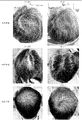
- Test example 1 A 39-year-old male subject was treated with a hairdressing preparation prepared by suspending 1% of a powder prepared by mixing FK-23: LFK at a ratio of 1: 1 in a solution containing ethanol and water as a main component, and the skin mainly on the scalp was seen. I used it once a day on the part I was concerned about. Although the use time period was not specified, it was mainly used before bedtime and after hair was dried during hair washing.
- Figure 1 shows a photograph of the crown of a male subject after use. It was observed with the naked eye that the hair started to be used from June 5, 2018, and the hair increased from June 19 to July 3 of the same year.
- Test example 2 The same hair styling agent as in Test Example 1 was applied once daily to five male and female subjects in their 40s to 70s to the part of the scalp where the bare skin was visible. Although the use time period was not specified, it was mainly used before bedtime and after hair was dried during hair washing.
- 2 and 3 are photographs of the crown of each subject after the start of use. It was confirmed that the bare skin became inconspicuous at 4 weeks after use in early subjects and at 8 weeks in late subjects.
Landscapes
- Health & Medical Sciences (AREA)
- Life Sciences & Earth Sciences (AREA)
- Animal Behavior & Ethology (AREA)
- General Health & Medical Sciences (AREA)
- Public Health (AREA)
- Veterinary Medicine (AREA)
- Engineering & Computer Science (AREA)
- Pharmacology & Pharmacy (AREA)
- Medicinal Chemistry (AREA)
- Chemical & Material Sciences (AREA)
- Epidemiology (AREA)
- Dermatology (AREA)
- Microbiology (AREA)
- Mycology (AREA)
- General Chemical & Material Sciences (AREA)
- Bioinformatics & Cheminformatics (AREA)
- Tropical Medicine & Parasitology (AREA)
- Nuclear Medicine, Radiotherapy & Molecular Imaging (AREA)
- Organic Chemistry (AREA)
- Biotechnology (AREA)
- Chemical Kinetics & Catalysis (AREA)
- Birds (AREA)
- Molecular Biology (AREA)
- Medicines Containing Material From Animals Or Micro-Organisms (AREA)
- Cosmetics (AREA)
Abstract
L'invention concerne un agent externe pour la pousse des cheveux ou la prévention de la perte des cheveux, ledit agent externe comprenant au moins un élément choisi dans le groupe constitué de cellules d'une bactérie d'acide lactique appartenant au genre Enterococcus et d'un composant cellulaire de celle-ci.
Priority Applications (3)
| Application Number | Priority Date | Filing Date | Title |
|---|---|---|---|
| CN201980073170.3A CN113164531B (zh) | 2018-11-09 | 2019-11-08 | 用于生发或防止脱发的外用剂 |
| US17/291,341 US12128074B2 (en) | 2018-11-09 | 2019-11-08 | External agent for hair growth or hair loss prevention |
| JP2020555654A JP7426100B2 (ja) | 2018-11-09 | 2019-11-08 | 育毛用又は脱毛防止用外用剤 |
Applications Claiming Priority (2)
| Application Number | Priority Date | Filing Date | Title |
|---|---|---|---|
| JP2018-211211 | 2018-11-09 | ||
| JP2018211211 | 2018-11-09 |
Publications (1)
| Publication Number | Publication Date |
|---|---|
| WO2020096059A1 true WO2020096059A1 (fr) | 2020-05-14 |
Family
ID=70612092
Family Applications (1)
| Application Number | Title | Priority Date | Filing Date |
|---|---|---|---|
| PCT/JP2019/044000 Ceased WO2020096059A1 (fr) | 2018-11-09 | 2019-11-08 | Agent externe pour la pousse des cheveux ou la prévention de la perte des cheveux |
Country Status (4)
| Country | Link |
|---|---|
| US (1) | US12128074B2 (fr) |
| JP (1) | JP7426100B2 (fr) |
| CN (1) | CN113164531B (fr) |
| WO (1) | WO2020096059A1 (fr) |
Cited By (1)
| Publication number | Priority date | Publication date | Assignee | Title |
|---|---|---|---|---|
| JP2023053719A (ja) * | 2021-10-01 | 2023-04-13 | カゴメ株式会社 | インターフェロン-λ産生促進用組成物及びその製造方法 |
Families Citing this family (1)
| Publication number | Priority date | Publication date | Assignee | Title |
|---|---|---|---|---|
| JP7474990B2 (ja) * | 2018-11-09 | 2024-04-26 | 学校法人立命館 | 皮脂腺調整剤 |
Citations (6)
| Publication number | Priority date | Publication date | Assignee | Title |
|---|---|---|---|---|
| JP2004210659A (ja) * | 2002-12-27 | 2004-07-29 | Shinei Ferumentekku:Kk | 発毛剤およびそれを担時した頭部装着体ならびに該頭部装着体の製造方法 |
| KR20090051586A (ko) * | 2007-11-19 | 2009-05-22 | 게놈앤메디신(주) | 발모, 양모 촉진 및 탈모 방지를 위한 생약 조성물 및 이의제조방법 |
| JP2016084303A (ja) * | 2014-10-24 | 2016-05-19 | 共栄化学工業株式会社 | 抗酸化剤、皮膚化粧料及び毛髪化粧料 |
| WO2018135843A2 (fr) * | 2017-01-19 | 2018-07-26 | (주)코엔바이오 | Souche de lactobacillus fermentum pouvant empêcher la perte de cheveux, favoriser la pousse des cheveux, ou améliorer la fonction sexuelle, et composition comprenant cette souche |
| JP2018529720A (ja) * | 2015-09-30 | 2018-10-11 | アモーレパシフィック コーポレーション | 乳酸菌由来の細胞外小胞を含む脱毛防止又は育毛促進用組成物 |
| KR20190041865A (ko) * | 2017-10-13 | 2019-04-23 | 연세대학교 원주산학협력단 | 엔테로코커스 패칼리스를 유효성분으로 함유하는 탈모 예방 또는 치료용 조성물 |
Family Cites Families (9)
| Publication number | Priority date | Publication date | Assignee | Title |
|---|---|---|---|---|
| JPH05201871A (ja) | 1992-01-27 | 1993-08-10 | Nichinichi Seiyaku Kk | 血圧上昇抑制及び心臓肥大防止剤 |
| JPH0899887A (ja) | 1994-08-01 | 1996-04-16 | Nichinichi Seiyaku Kk | 免疫賦活剤 |
| JPH08295631A (ja) | 1995-02-27 | 1996-11-12 | Nichinichi Seiyaku Kk | 制癌増強剤 |
| JPH08259450A (ja) | 1995-03-17 | 1996-10-08 | Nichinichi Seiyaku Kk | インターフェロン産生増強剤 |
| JPH08283166A (ja) | 1995-04-12 | 1996-10-29 | Nichinichi Seiyaku Kk | 感染防御剤 |
| JP2017001961A (ja) | 2015-06-04 | 2017-01-05 | 学校法人同志社 | 生体抗酸化能賦活剤 |
| WO2018043874A1 (fr) * | 2016-08-30 | 2018-03-08 | (주)코엔바이오 | Composition permettant de prévenir la chute des cheveux ou de favoriser la pousse des cheveux, comprenant des souches présentant un effet de lipolyse |
| KR101840376B1 (ko) * | 2017-10-20 | 2018-03-20 | (주)코엔바이오 | 탈모 예방, 발모 촉진 또는 성기능 개선능이 있는 락토바실러스 퍼멘텀 균주 및 이를 포함하는 조성물 |
| CN109048733A (zh) | 2018-09-18 | 2018-12-21 | 世通海泰泵业(天津)股份有限公司 | 滑片泵固定装置 |
-
2019
- 2019-11-08 CN CN201980073170.3A patent/CN113164531B/zh active Active
- 2019-11-08 US US17/291,341 patent/US12128074B2/en active Active
- 2019-11-08 JP JP2020555654A patent/JP7426100B2/ja active Active
- 2019-11-08 WO PCT/JP2019/044000 patent/WO2020096059A1/fr not_active Ceased
Patent Citations (6)
| Publication number | Priority date | Publication date | Assignee | Title |
|---|---|---|---|---|
| JP2004210659A (ja) * | 2002-12-27 | 2004-07-29 | Shinei Ferumentekku:Kk | 発毛剤およびそれを担時した頭部装着体ならびに該頭部装着体の製造方法 |
| KR20090051586A (ko) * | 2007-11-19 | 2009-05-22 | 게놈앤메디신(주) | 발모, 양모 촉진 및 탈모 방지를 위한 생약 조성물 및 이의제조방법 |
| JP2016084303A (ja) * | 2014-10-24 | 2016-05-19 | 共栄化学工業株式会社 | 抗酸化剤、皮膚化粧料及び毛髪化粧料 |
| JP2018529720A (ja) * | 2015-09-30 | 2018-10-11 | アモーレパシフィック コーポレーション | 乳酸菌由来の細胞外小胞を含む脱毛防止又は育毛促進用組成物 |
| WO2018135843A2 (fr) * | 2017-01-19 | 2018-07-26 | (주)코엔바이오 | Souche de lactobacillus fermentum pouvant empêcher la perte de cheveux, favoriser la pousse des cheveux, ou améliorer la fonction sexuelle, et composition comprenant cette souche |
| KR20190041865A (ko) * | 2017-10-13 | 2019-04-23 | 연세대학교 원주산학협력단 | 엔테로코커스 패칼리스를 유효성분으로 함유하는 탈모 예방 또는 치료용 조성물 |
Cited By (2)
| Publication number | Priority date | Publication date | Assignee | Title |
|---|---|---|---|---|
| JP2023053719A (ja) * | 2021-10-01 | 2023-04-13 | カゴメ株式会社 | インターフェロン-λ産生促進用組成物及びその製造方法 |
| JP7720054B2 (ja) | 2021-10-01 | 2025-08-07 | カゴメ株式会社 | インターフェロン-λ産生促進用組成物及びその製造方法 |
Also Published As
| Publication number | Publication date |
|---|---|
| US12128074B2 (en) | 2024-10-29 |
| CN113164531A (zh) | 2021-07-23 |
| JPWO2020096059A1 (ja) | 2021-09-30 |
| JP7426100B2 (ja) | 2024-02-01 |
| US20210393708A1 (en) | 2021-12-23 |
| CN113164531B (zh) | 2023-12-15 |
Similar Documents
| Publication | Publication Date | Title |
|---|---|---|
| US8088369B2 (en) | Anti-wrinkle agent | |
| US20090035294A1 (en) | Lipopolysaccharide fractions of vitreoscilla filiformis useful for stimulating the synthesis of anti-microbial peptides of the skin | |
| US20040115766A1 (en) | Method for producing proteins by fermentation of microorganisms from the thermus family the protein mixture thus obtained and cosmetic compositions containing same | |
| KR102149102B1 (ko) | 피부보습 및 피부재생 기능이 있는 더모바이오틱스 블록 조성물의 제조방법 | |
| CN101203600A (zh) | 保护皮肤对抗病原微生物的方法和手段 | |
| TWI668009B (zh) | 用於皮膚美白之包含經醱酵之小麥胚芽的皮膚外用劑 | |
| KR100302504B1 (ko) | 유산균발효액및이를함유하는화장료조성물 | |
| KR102270709B1 (ko) | 복합 세라마이드 및 천연 추출물을 포함하는 피부개선용 화장료 조성물 | |
| KR102133689B1 (ko) | 용암해수 유래 미네랄과 더마바이오틱스 유래 뉴클레오티드의 결합체 제조방법 및 이를 이용한 기능성 더마바이오틱스 화장품 조성물 | |
| WO2018073278A1 (fr) | Composition cosmétique pour prévenir et/ou traiter une odeur corporelle | |
| KR102125316B1 (ko) | 신규한 락토바실러스 펜토서스 j2k-185 유산균 균주 및 상기 균주를 포함하는 자극완화 및 피부진정 개선용 화장료 조성물 | |
| KR102700857B1 (ko) | Ak1954 균주를 이용하여 발효시킨 돌가시나무 발효 추출물을 유효성분으로 함유하는 화장료 조성물 | |
| JP2004269408A (ja) | 皮膚用保湿剤 | |
| JP7426100B2 (ja) | 育毛用又は脱毛防止用外用剤 | |
| KR100467068B1 (ko) | 락토코쿠스 락티스 씨비티-19, 이를 이용한 항균 배양액분리 농축물의 제조 방법 및 이를 포함하는 화장료 조성물 | |
| JP6746091B2 (ja) | 皮膚外用剤 | |
| JP7474990B2 (ja) | 皮脂腺調整剤 | |
| JP3579134B2 (ja) | 化粧料 | |
| KR102528620B1 (ko) | 벌노랑이속 식물의 종자 발효물을 포함하는 액취증의 예방 또는 개선용 조성물 | |
| KR102139000B1 (ko) | 발효 식이유황 추출물을 함유하는 항산화, 항주름, 미백 및 항균 기능성 화장료 조성물 및 그 제조방법 | |
| KR102737352B1 (ko) | Ak1954 균주를 이용하여 발효시킨 바다고리풀 발효 추출물을 유효성분으로 함유하는 화장료 조성물 | |
| JP2022031140A (ja) | 皮膚外用剤 | |
| JP2003113097A (ja) | アウレオバシジウム培養液を含有する外用剤 | |
| KR102903469B1 (ko) | 락토바실러스 브레비스 j2k-55 균주 유래 세포외 소포체를 함유하는 피부 장벽 개선용 화장료 조성물 | |
| KR102700856B1 (ko) | Ak1954 균주를 이용하여 발효시킨 큰황새냉이 발효 추출물을 유효성분으로 함유하는 화장료 조성물 |
Legal Events
| Date | Code | Title | Description |
|---|---|---|---|
| 121 | Ep: the epo has been informed by wipo that ep was designated in this application |
Ref document number: 19881422 Country of ref document: EP Kind code of ref document: A1 |
|
| ENP | Entry into the national phase |
Ref document number: 2020555654 Country of ref document: JP Kind code of ref document: A |
|
| NENP | Non-entry into the national phase |
Ref country code: DE |
|
| 122 | Ep: pct application non-entry in european phase |
Ref document number: 19881422 Country of ref document: EP Kind code of ref document: A1 |