WO2020108423A1 - Anticorps reconnaissant de manière spécifique le récepteur alpha du facteur de stimulation des colonies de granulocytes-macrophages et utilisations associées - Google Patents
Anticorps reconnaissant de manière spécifique le récepteur alpha du facteur de stimulation des colonies de granulocytes-macrophages et utilisations associées Download PDFInfo
- Publication number
- WO2020108423A1 WO2020108423A1 PCT/CN2019/120545 CN2019120545W WO2020108423A1 WO 2020108423 A1 WO2020108423 A1 WO 2020108423A1 CN 2019120545 W CN2019120545 W CN 2019120545W WO 2020108423 A1 WO2020108423 A1 WO 2020108423A1
- Authority
- WO
- WIPO (PCT)
- Prior art keywords
- amino acid
- seq
- acid sequence
- csfrα
- antibody
- Prior art date
- Legal status (The legal status is an assumption and is not a legal conclusion. Google has not performed a legal analysis and makes no representation as to the accuracy of the status listed.)
- Ceased
Links
Images




Classifications
-
- C—CHEMISTRY; METALLURGY
- C07—ORGANIC CHEMISTRY
- C07K—PEPTIDES
- C07K16/00—Immunoglobulins [IG], e.g. monoclonal or polyclonal antibodies
- C07K16/18—Immunoglobulins [IG], e.g. monoclonal or polyclonal antibodies against material from animals or humans
- C07K16/28—Immunoglobulins [IG], e.g. monoclonal or polyclonal antibodies against material from animals or humans against receptors, cell surface antigens or cell surface determinants
- C07K16/2866—Immunoglobulins [IG], e.g. monoclonal or polyclonal antibodies against material from animals or humans against receptors, cell surface antigens or cell surface determinants against receptors for cytokines, lymphokines, interferons
-
- A—HUMAN NECESSITIES
- A61—MEDICAL OR VETERINARY SCIENCE; HYGIENE
- A61P—SPECIFIC THERAPEUTIC ACTIVITY OF CHEMICAL COMPOUNDS OR MEDICINAL PREPARATIONS
- A61P11/00—Drugs for disorders of the respiratory system
-
- A—HUMAN NECESSITIES
- A61—MEDICAL OR VETERINARY SCIENCE; HYGIENE
- A61P—SPECIFIC THERAPEUTIC ACTIVITY OF CHEMICAL COMPOUNDS OR MEDICINAL PREPARATIONS
- A61P19/00—Drugs for skeletal disorders
- A61P19/02—Drugs for skeletal disorders for joint disorders, e.g. arthritis, arthrosis
-
- A—HUMAN NECESSITIES
- A61—MEDICAL OR VETERINARY SCIENCE; HYGIENE
- A61P—SPECIFIC THERAPEUTIC ACTIVITY OF CHEMICAL COMPOUNDS OR MEDICINAL PREPARATIONS
- A61P35/00—Antineoplastic agents
-
- A—HUMAN NECESSITIES
- A61—MEDICAL OR VETERINARY SCIENCE; HYGIENE
- A61P—SPECIFIC THERAPEUTIC ACTIVITY OF CHEMICAL COMPOUNDS OR MEDICINAL PREPARATIONS
- A61P35/00—Antineoplastic agents
- A61P35/02—Antineoplastic agents specific for leukemia
-
- A—HUMAN NECESSITIES
- A61—MEDICAL OR VETERINARY SCIENCE; HYGIENE
- A61P—SPECIFIC THERAPEUTIC ACTIVITY OF CHEMICAL COMPOUNDS OR MEDICINAL PREPARATIONS
- A61P37/00—Drugs for immunological or allergic disorders
-
- A—HUMAN NECESSITIES
- A61—MEDICAL OR VETERINARY SCIENCE; HYGIENE
- A61P—SPECIFIC THERAPEUTIC ACTIVITY OF CHEMICAL COMPOUNDS OR MEDICINAL PREPARATIONS
- A61P9/00—Drugs for disorders of the cardiovascular system
- A61P9/10—Drugs for disorders of the cardiovascular system for treating ischaemic or atherosclerotic diseases, e.g. antianginal drugs, coronary vasodilators, drugs for myocardial infarction, retinopathy, cerebrovascula insufficiency, renal arteriosclerosis
-
- C—CHEMISTRY; METALLURGY
- C12—BIOCHEMISTRY; BEER; SPIRITS; WINE; VINEGAR; MICROBIOLOGY; ENZYMOLOGY; MUTATION OR GENETIC ENGINEERING
- C12N—MICROORGANISMS OR ENZYMES; COMPOSITIONS THEREOF; PROPAGATING, PRESERVING, OR MAINTAINING MICROORGANISMS; MUTATION OR GENETIC ENGINEERING; CULTURE MEDIA
- C12N15/00—Mutation or genetic engineering; DNA or RNA concerning genetic engineering, vectors, e.g. plasmids, or their isolation, preparation or purification; Use of hosts therefor
- C12N15/09—Recombinant DNA-technology
- C12N15/10—Processes for the isolation, preparation or purification of DNA or RNA
- C12N15/1034—Isolating an individual clone by screening libraries
- C12N15/1037—Screening libraries presented on the surface of microorganisms, e.g. phage display, E. coli display
-
- C—CHEMISTRY; METALLURGY
- C12—BIOCHEMISTRY; BEER; SPIRITS; WINE; VINEGAR; MICROBIOLOGY; ENZYMOLOGY; MUTATION OR GENETIC ENGINEERING
- C12N—MICROORGANISMS OR ENZYMES; COMPOSITIONS THEREOF; PROPAGATING, PRESERVING, OR MAINTAINING MICROORGANISMS; MUTATION OR GENETIC ENGINEERING; CULTURE MEDIA
- C12N15/00—Mutation or genetic engineering; DNA or RNA concerning genetic engineering, vectors, e.g. plasmids, or their isolation, preparation or purification; Use of hosts therefor
- C12N15/09—Recombinant DNA-technology
- C12N15/63—Introduction of foreign genetic material using vectors; Vectors; Use of hosts therefor; Regulation of expression
- C12N15/79—Vectors or expression systems specially adapted for eukaryotic hosts
-
- A—HUMAN NECESSITIES
- A61—MEDICAL OR VETERINARY SCIENCE; HYGIENE
- A61K—PREPARATIONS FOR MEDICAL, DENTAL OR TOILETRY PURPOSES
- A61K39/00—Medicinal preparations containing antigens or antibodies
- A61K2039/505—Medicinal preparations containing antigens or antibodies comprising antibodies
-
- C—CHEMISTRY; METALLURGY
- C07—ORGANIC CHEMISTRY
- C07K—PEPTIDES
- C07K2317/00—Immunoglobulins specific features
- C07K2317/20—Immunoglobulins specific features characterized by taxonomic origin
- C07K2317/24—Immunoglobulins specific features characterized by taxonomic origin containing regions, domains or residues from different species, e.g. chimeric, humanized or veneered
-
- C—CHEMISTRY; METALLURGY
- C07—ORGANIC CHEMISTRY
- C07K—PEPTIDES
- C07K2317/00—Immunoglobulins specific features
- C07K2317/30—Immunoglobulins specific features characterized by aspects of specificity or valency
- C07K2317/34—Identification of a linear epitope shorter than 20 amino acid residues or of a conformational epitope defined by amino acid residues
-
- C—CHEMISTRY; METALLURGY
- C07—ORGANIC CHEMISTRY
- C07K—PEPTIDES
- C07K2317/00—Immunoglobulins specific features
- C07K2317/50—Immunoglobulins specific features characterized by immunoglobulin fragments
- C07K2317/52—Constant or Fc region; Isotype
-
- C—CHEMISTRY; METALLURGY
- C07—ORGANIC CHEMISTRY
- C07K—PEPTIDES
- C07K2317/00—Immunoglobulins specific features
- C07K2317/50—Immunoglobulins specific features characterized by immunoglobulin fragments
- C07K2317/56—Immunoglobulins specific features characterized by immunoglobulin fragments variable (Fv) region, i.e. VH and/or VL
-
- C—CHEMISTRY; METALLURGY
- C07—ORGANIC CHEMISTRY
- C07K—PEPTIDES
- C07K2317/00—Immunoglobulins specific features
- C07K2317/50—Immunoglobulins specific features characterized by immunoglobulin fragments
- C07K2317/56—Immunoglobulins specific features characterized by immunoglobulin fragments variable (Fv) region, i.e. VH and/or VL
- C07K2317/565—Complementarity determining region [CDR]
-
- C—CHEMISTRY; METALLURGY
- C07—ORGANIC CHEMISTRY
- C07K—PEPTIDES
- C07K2317/00—Immunoglobulins specific features
- C07K2317/60—Immunoglobulins specific features characterized by non-natural combinations of immunoglobulin fragments
- C07K2317/62—Immunoglobulins specific features characterized by non-natural combinations of immunoglobulin fragments comprising only variable region components
- C07K2317/622—Single chain antibody (scFv)
-
- C—CHEMISTRY; METALLURGY
- C07—ORGANIC CHEMISTRY
- C07K—PEPTIDES
- C07K2317/00—Immunoglobulins specific features
- C07K2317/70—Immunoglobulins specific features characterized by effect upon binding to a cell or to an antigen
- C07K2317/76—Antagonist effect on antigen, e.g. neutralization or inhibition of binding
-
- C—CHEMISTRY; METALLURGY
- C07—ORGANIC CHEMISTRY
- C07K—PEPTIDES
- C07K2317/00—Immunoglobulins specific features
- C07K2317/90—Immunoglobulins specific features characterized by (pharmaco)kinetic aspects or by stability of the immunoglobulin
- C07K2317/92—Affinity (KD), association rate (Ka), dissociation rate (Kd) or EC50 value
-
- C—CHEMISTRY; METALLURGY
- C07—ORGANIC CHEMISTRY
- C07K—PEPTIDES
- C07K2317/00—Immunoglobulins specific features
- C07K2317/90—Immunoglobulins specific features characterized by (pharmaco)kinetic aspects or by stability of the immunoglobulin
- C07K2317/94—Stability, e.g. half-life, pH, temperature or enzyme-resistance
Definitions
- This application pertains to antibodies that specifically recognize granulocyte-macrophage colony stimulating factor receptor alpha (GM-CSFR ⁇ ) , and methods of manufacture and uses thereof, including methods of treating autoimmune and inflammatory conditions, and cancer.
- GM-CSFR ⁇ granulocyte-macrophage colony stimulating factor receptor alpha
- Granulocyte-macrophage colony stimulating factor is also known as colony-stimulating factor 2 (CSF2) .
- GM-CSF is a type I proinflammatory cytokine which plays a role in exacerbating inflammatory, respiratory and autoimmune diseases.
- the GM-CSF receptor is a member of the hematopoietic receptor superfamily. It is heterodimeric, consisting of an alpha and a beta subunit. GM-CSF is able to bind with relatively low affinity to the ⁇ subunit alone (K d 1-5nM) but not at all to the ⁇ subunit alone.
- the present application provides an isolated anti-GM-CSFR ⁇ antibody that specifically binds to an epitope on human GM-CSFR ⁇ , wherein the epitope comprises one, two , three, four, five, or six amino acid residues selected from the group consisting of Val50, Glu59, Lys194, Lys195, Arg283, and Ile284 of human GM-CSFR ⁇ .
- the epitope further comprises amino acid residues: (i) Val51, Thr63, and Ile196; (ii) Leu191 and Ile196; or (iii) Arg49, Val51, Asn57, and Ser61.
- the isolated anti-GM-CSFR ⁇ antibody binds to the human GM-CSFR ⁇ with a K d from about 0.1 pM to about 1 nM.
- the isolated anti-GM-CSFR ⁇ antibody comprises: a heavy chain variable domain (V H ) comprising a heavy chain complementarity determining region (HC-CDR) 1 comprising X 1 LX 2 X 3 H (SEQ ID NO: 76) , wherein X 1 is E, N, G, D, M, S, P, F, Y, A, V, K, W, R or C, X 2 is S, C or P, and X 3 is I or M; an HC-CDR2 comprising GFDX 1 X 2 X 3 X 4 EX 5 X 6 YAQKX 7 QG (SEQ ID NO: 77) , wherein X 1 is P, G, T, S, or V, X 2 is E, D, G, or A, X 3 is D, G, I, W, S, or V, X 4 is G, E, D, or H, X 5 is T
- the anti-GM-CSFR ⁇ antibody comprises: a V H comprising a HC-CDR1 comprising ELX 1 X 2 H (SEQ ID NO: 295) , wherein X 1 is S, C or P, and X 2 is I or M; an HC-CDR2 comprising GFDX 1 X 2 X 3 X 4 EX 5 X 6 YAQKX 7 QG (SEQ ID NO: 77) , wherein X 1 is P, G, T, S, or V, X 2 is E, D, G, or A, X 3 is D, G, I, W, S, or V, X 4 is G, E, D, or H, X 5 is T or A, X 6 is N or I, and X 7 is S or F; and an HC-CDR3 comprising GRYX 1 X 2 X 3 X 4 X 5 X 6 YGFDY (SEQ ID NO: 78) , wherein X 1 is C,
- an isolated anti-GM-CSFR ⁇ antibody comprises: a V H comprising an HC-CDR1 comprising the amino acid sequence of any one of SEQ ID NOs: 1-4, or a variant thereof comprising up to about 3 amino acid substitutions; an HC-CDR2 comprising the amino acid sequence of any one of SEQ ID NOs: 5-16, or a variant thereof comprising up to about 3 amino acid substitutions; and an HC-CDR3 comprising the amino acid sequence of any one of SEQ ID NOs: 17-50, or a variant thereof comprising up to about 3 amino acid substitutions; and a V L comprising a LC-CDR1 comprising the amino acid sequence of SEQ ID NO: 51, or a variant thereof comprising up to about 3 amino acid substitutions; a LC-CDR2 comprising the amino acid sequence of SEQ ID NO: 52, or a variant thereof comprising up to about 3 amino acid substitutions; and a LC-CDR3 comprising the amino acid sequence of any one of
- an isolated anti-GM-CSFR ⁇ antibody comprising a V H comprising an HC-CDR1, an HC-CDR2, and an HC-CDR3 of a V H comprising the amino acid sequence of any one of SEQ ID NOs: 80-121; and a V L comprising a LC-CDR1, a LC-CDR2, and a LC-CDR3 of a V L comprising the amino acid sequence of any one of SEQ ID NOs: 122-144.
- an isolated anti-GM-CSFR ⁇ antibody comprises: (i) a V H comprising an HC-CDR1 comprising the amino acid sequence of SEQ ID NO: 1, an HC-CDR2 comprising the amino acid sequence of SEQ ID NO: 5, and an HC-CDR3 comprising the amino acid sequence of SEQ ID NO: 17, or a variant thereof comprising up to about 5 amino acid substitutions in the HC-CDRs; and a V L comprising a LC-CDR1 comprising the amino acid sequence of SEQ ID NO: 51, a LC-CDR2 comprising the amino acid sequence of SEQ ID NO: 52, and a LC-CDR3 comprising the amino acid sequence of SEQ ID NO: 54 , or a variant thereof comprising up to about 5 amino acid substitutions in the LC-CDRs; (ii) a V H comprising an HC-CDR1 comprising the amino acid sequence of SEQ ID NO: 1, an HC-CDR2 comprising the amino acid
- the isolated anti-GM-CSFR ⁇ antibody comprises amino acid residues: (i) E, H, N, G, D, M, S, P, F, Y, A, V, K, W, R, or C at position 31 of the V H ; and/or (ii) S, L, N, A, K, R, I, Q, G, T, H, M, or C at position 26 of the V L ; and/or (iii) Q, Y, P, A, I, F, T, R, V, L, E, S, or C at position 27 of the V L ; and/or (iv) S, H, W, L, R, K, T, P, I, F, V, E, A, or Q at position 28 of the V L ; and/or (v) S, L, W, M, A, Y, K, R, G, T, E, V, N, F, or C at position 30 of the
- the isolated anti-GM-CSFR ⁇ antibody comprises: a V H comprising the amino acid sequence of any one of SEQ ID NOs: 80-121, and 246-287, or a variant thereof having at least about 90%sequence identity to the amino acid sequence of any one of SEQ ID NOs: 80-121, and 246-287; and a V L comprising the amino acid sequence of any one of SEQ ID NOs: 122-144, 150-245, and 288-289, or a variant thereof having at least about 90%sequence identity to the amino acid sequence of any one of SEQ ID NOs: 122-144, 150-245, and 288-289.
- the isolated anti-GM-CSFR ⁇ antibody comprises: (i) a V H comprising the amino acid sequence of SEQ ID NO: 80; and a V L comprising the amino acid sequence of SEQ ID NO: 123; (ii) a V H comprising the amino acid sequence of SEQ ID NO: 85; and a V L comprising the amino acid sequence of SEQ ID NO: 125; (iii) a V H comprising the amino acid sequence of SEQ ID NO: 86; and a V L comprising the amino acid sequence of SEQ ID NO: 126; (iv) a V H comprising the amino acid sequence of SEQ ID NO: 91; and a V L comprising the amino acid sequence of SEQ ID NO: 126; (v) a V H comprising the amino acid sequence of SEQ ID NO: 99; and a V L comprising the amino acid sequence of SEQ ID NO: 122; (vi) a V H comprising the amino acid sequence of SEQ ID NO: 101; and a V L comprising the amino acid
- an isolated anti-GM-CSFR ⁇ antibody that specifically binds to GM-CSFR ⁇ competitively with any one of the isolated anti-GM-CSFR ⁇ antibodies as described above. In some embodiments, there is provided an isolated anti-GM-CSFR ⁇ antibody that specifically binds to the same epitope as any one of isolated anti-GM-CSFR ⁇ antibodies as described above.
- the isolated anti-GM-CSFR ⁇ antibody comprises an Fc fragment.
- the isolated anti-GM-CSFR ⁇ antibody is a full-length IgG antibody.
- the isolated anti-GM-CSFR ⁇ antibody is a full-length IgG1 or IgG4 antibody.
- the anti-GM-CSFR ⁇ antibody is chimeric, human, or humanized.
- the anti-GM-CSFR ⁇ antibody is an antigen binding fragment selected from the group consisting of a Fab, a Fab’, a F (ab) ’2, a Fab’-SH, a single-chain Fv (scFv) , an Fv fragment, a dAb, a Fd , ananobody, a diabody, and a linear antibody.
- nucleic acid molecule that encodes any one of the anti-GM-CSFR ⁇ antibodies described above.
- a vector comprising a nucleic acid molecule according to any one of the nucleic acid molecules described above.
- a host cell comprising any one of the anti-GM-CSFR ⁇ antibodies described above, any one of the nucleic acid molecules described above, or any one of the vectors described above.
- a method of producing an anti-GM-CSFR ⁇ antibody comprising: a) culturing any one of the host cells described above under conditions effective to express the anti-GM-CSFR ⁇ antibody; and b) obtaining the expressed anti-GM-CSFR ⁇ antibody from the host cell.
- a method of treating a disease or condition in an individual in need thereof comprising administering to the individual an effective amount of an anti-GM-CSFR ⁇ antibody according to any one of the anti-GM-CSFR ⁇ antibodies described above.
- the disease or condition is an inflammatory, respiratory or autoimmune disease or condition.
- the disease or condition is selected from the group consisting of rheumatoid arthritis, asthma, chronic obstructive pulmonary disease, allergic response, multiple sclerosis, myeloid leukemia, atherosclerosis.
- compositions, kits and articles of manufacture comprising any one of the anti-GM-CSFR ⁇ antibodies described above.
- FIGS. 1A-1C show the binding affinity of exemplary anti-GM-CSFR ⁇ antibodies to human GM-CSFR ⁇ as analyzed by ELISA.
- FIG. 1A shows the binding curves of T119, E9, E16, E27, E29, E30, E35, E36, E54 and E34 to human GM-CSFR ⁇ .
- FIG. 1B shows the binding curves of T119, E108, E105, E113, E87, E85, E39, E40, EII55, E200a, and EII81 to human GM-CSFR ⁇ .
- FIG. 1C shows the binding curves of T119, E61, E83, E88, E90, E84, E172, E164, E1 and E31 to human GM-CSFR ⁇ .
- FIG. 2 shows the binding affinity of E35, E200a, T119, E87, and E108 for cynomolgus monkey GM-CSFR ⁇ as analyzed by ELISA.
- FIG. 3 shows the binding affinity of E35, E87, and E108 for IL3RA, IL5RA, and G-CSFR as compared to GM-CSFR ⁇ .
- FIG. 4 shows the binding affinity of E35-IgG4 to WIL2S cells expressing GM-CSFR ⁇ as compared to control WIL2S cells that do not express GM-CSFR ⁇ , as analyzed by FACS.
- FIGS. 5A-5D show results of the competitive binding assay for the ability of the parental antibody T119 and lead-optimized antibodies to compete with GM-CSF for binding to GM-CSFR ⁇ , as measured using competitive ELISA.
- FIG. 5A shows results of the competitive binding assay for T119, E01, E09, E194, E27, E29, E34, E35, E40, and E30.
- FIG. 5B shows results of the competitive binding assay for T119, E83, E87, EII81, E85, E54, EII55, E31, E105, and E84.
- FIG. 5C shows results of the competitive binding assay for T119, E164, E172, E108, E16, E36, E61, E88, and E39.
- FIG. 5D shows results of the competitive binding assay for T119, E90, EII33, E200a, E94, E113, and EII52.
- FIGS. 6A and 6B show the thermal melting profiles and the thermal aggregation profiles of the anti-GM-CSFR ⁇ antibodies Mab-IgG1, T119-IgG1, E35-IgG1 and E35b-IgG1 as analyzed by UNcle.
- FIG. 6A shows the thermal melting profiles of the antibodies.
- FIG. 6B shows the thermal aggregation profiles of the antibodies.
- FIG. 7 shows results of the TF-1 proliferation assay for the parental antibody T119 and lead-optimized antibodies.
- FIG. 8 shows results of the human granulocyte shape change assay for E35, E108 and E87b.
- FIG. 9 shows results of the cynomolgus monkey granulocyte shape change assay for E35.
- FIG. 10 shows results of the granulocyte survival assay for E35, E108, and E87b.
- FIG. 11 shows results of the CD11b expression assay for E35 and E87b as compared to Mab.
- FIGS. 12A and 12B show results of the TNF ⁇ release assays for E35 and E87b as compared to Mab.
- FIG. 12A shows results of the TNF ⁇ release assay for E35 and E87b as compared to Mab, as measured by the Human Macrophage/Microglia Panel.
- FIG. 12B shows results of the TNF ⁇ release assay for E35 and E87b as compared to Mab, as measured by ELISA.
- FIG. 13 shows results of the IL-1 ⁇ production assay for E35 and E87b as compared to Mab.
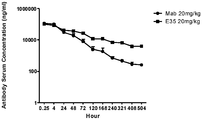
- FIGS. 14A and 14B show results of pharmacokinetics analysis of Mab and E35 in rat as measured by ELISA.
- FIG. 14A shows antibody serum concentrations of Mab and E35 upon intravenous injection of 2mg/kg of the respective antibodies.
- FIG. 14B shows pharmacokinetics of Mab and E35 upon intravenous injection of 20mg/kg of the respective antibodies.
- FIG. 15 shows results of pharmacokinetics analysis of Mab and E35 in cynomolgus monkey as measured by ELISA.
- FIGS. 16A-D show FACS plots of in vivo granulocyte shape change analysis upon administration of Mab-IgG4 or E35-IgG4 in cynomolgus monkey.
- FIG. 16A shows FACS plots of granulocytes prior to antibody administration.
- FIG. 16B shows FACS plots of granulocytes 14 days after antibody administration.
- FIG. 16C shows FACS plots of granulocytes 21 days after antibody administration.
- FIG. 16D shows results of the in vivo granulocyte shape change analysis from prior to antibody administration up to 21 days following antibody administration.
- FIGS. 17A-17G show results of the inhibitory effect of E35-IgG4 on GM-CSF-induced increase in inflammatory cells.
- FIG. 17A shows results of the inhibitory effect of E35-IgG4 on GM-CSF-induced increase in white blood cells.
- FIG. 17B shows results of the inhibitory effect of E35-IgG4 on GM-CSF-induced increase in neutrophils.
- FIG. 17C shows results of the inhibitory effect of E35-IgG4 on GM-CSF-induced increase in lymphocytes.
- FIG. 17D shows results of the inhibitory effect of E35-IgG4 on GM-CSF-induced increase in basophils.
- FIG. 17E shows results of the inhibitory effect of E35-IgG4 on GM-CSF-induced increase in eosinophils.
- FIG. 17F shows results of the inhibitory effect of E35-IgG4 on GM-CSF-induced increase in monocytes.
- FIG. 17G shows results of the inhibitory effect of E35-IgG4 on GM-CSF-induced increase in red blood cells.
- FIGS. 18A-18C show the binding affinity of E35-IgG4, E87b-IgG4 and T119-IgG4 for wild type GMRah and GMRah with mutations at exemplary amino acid residues as measured by ELISA.
- FIG. 18A shows the binding affinity of E35-IgG4 for wild type GMRah and mutated GMRah.
- FIG. 18B shows the binding affinity of E87b-IgG4 for wild type GMRah and mutated GMRah.
- FIG. 18C shows the binding affinity of T119-IgG4 for wild type GMRah and mutated GMRah.
- FIGS. 19A-19B show the sequence alignments of the variable domain sequences of the anti-GM-CSFR ⁇ antibodies. The complementarity determining regions are denoted.
- FIG. 19A shows the sequence alignments of the heavy chain variable domain sequences.
- FIG. 19B shows the sequence alignments of the light chain variable domain sequences.
- FIG. 20 shows the numbering of amino acid residues 16-296 in GM-CSFR ⁇ .
- the present application in one aspect provides anti-GM-CSFR ⁇ antibodies.
- anti-GM-CSFR ⁇ antibodies By using a combination of selections on scFv phage libraries, affinity maturation and appropriately designed biochemical and biological assays, we have identified highly potent antibody molecules that bind to human GM-CSFR ⁇ and inhibit the action of human GM-CSF at its receptor.
- the results presented herein indicate that our antibodies bind a different region or epitope of GM-CSFR ⁇ compared with the known anti-GM-CSFR ⁇ antibody Mucunimumab, and surprisingly are even more potent than Mucunimumab as demonstrated in a variety of biological assays.
- anti-GM-CSFR ⁇ antibodies provided by the present application include, for example, full-length anti-GM-CSFR ⁇ antibodies, anti-GM-CSFR ⁇ scFvs, anti-GM-CSFR ⁇ Fc fusion proteins, multi-specific (such as bispecific) anti-GM-CSFR ⁇ antibodies, anti-GM-CSFR ⁇ immunoconjugates, and the like.
- anti-GM-CSFR ⁇ antibodies that specifically bind to an epitope on human GM-CSFR ⁇ , wherein the epitope comprises amino acid residues Val50, Glu59, Lys194, Lys195, Arg283, and Ile284 of human GM-CSFR ⁇ .
- an anti-GM-CSFR ⁇ antibody comprising a heavy chain variable domain (V H ) comprising a heavy chain variable domain (V H ) comprising an HC-CDR1 comprising X 1 LX 2 X 3 H (SEQ ID NO: 76) , wherein X 1 is E, N, G, D, M, S, P, F, Y, A, V, K, W, R or C, X 2 is S, C or P, and X 3 is I or M; an HC-CDR2 comprising GFDX 1 X 2 X 3 X 4 EX 5 X 6 YAQKX 7 QG (SEQ ID NO: 77) , wherein X 1 is P, G, T, S, or V, X 2 is E, D, G, or A, X 3 is D, G, I, W, S, or V, X 4 is G, E, D, or H, X 5 is T or A
- nucleic acids encoding the anti-GM-CSFR ⁇ antibodies are also provided.
- compositions comprising the anti-GM-CSFR ⁇ antibodies are also provided.
- treatment is an approach for obtaining beneficial or desired results, including clinical results.
- beneficial or desired clinical results include, but are not limited to, one or more of the following: alleviating one or more symptoms resulting from the disease, diminishing the extent of the disease, stabilizing the disease (e.g., preventing or delaying the worsening of the disease) , preventing or delaying the spread (e.g., metastasis) of the disease, preventing or delaying the recurrence of the disease, delay or slowing the progression of the disease, ameliorating the disease state, providing a remission (partial or total) of the disease, decreasing the dose of one or more other medications required to treat the disease, delaying the progression of the disease, increasing or improving the quality of life, increasing weight gain, and/or prolonging survival.
- treatment is a reduction of pathological consequence of the disease (such as, for example, tumor volume for cancer) .
- the methods of the application contemplate any one or more of
- antibody includes full-length antibodies and antigen-binding fragments thereof.
- a full-length antibody comprises two heavy chains and two light chains.
- the variable regions of the light and heavy chains are responsible for antigen binding.
- the variable regions in both chains generally contain three highly variable loops called the complementarity determining regions (CDRs) (light chain (LC) CDRs including LC-CDR1, LC-CDR2, and LC-CDR3, heavy chain (HC) CDRs including HC-CDR1, HC-CDR2, and HC-CDR3) .
- CDRs complementarity determining regions
- CDR boundaries for the antibodies and antigen-binding fragments disclosed herein may be defined or identified by the conventions of Kabat, Chothia, or Al-Lazikani (Al-Lazikani 1997; Chothia 1985; Chothia 1987; Chothia 1989; Kabat 1987; Kabat 1991) .
- the three CDRs of the heavy or light chains are interposed between flanking stretches known as framework regions (FRs) , which are more highly conserved than the CDRs and form a scaffold to support the hypervariable loops.
- FRs framework regions
- the constant regions of the heavy and light chains are not involved in antigen binding, but exhibit various effector functions.
- Antibodies are assigned to classes based on the amino acid sequence of the constant region of their heavy chain.
- the five major classes or isotypes of antibodies are IgA, IgD, IgE, IgG, and IgM, which are characterized by the presence of ⁇ , ⁇ , ⁇ , ⁇ , and ⁇ heavy chains, respectively.
- IgG1 ( ⁇ 1 heavy chain) IgG2 ( ⁇ 2 heavy chain)
- IgG3 ( ⁇ 3 heavy chain) IgG4 ( ⁇ 4 heavy chain)
- IgA1 ( ⁇ 1 heavy chain) ⁇ 2 heavy chain
- IgA2 ( ⁇ 2 heavy chain) Several of the major antibody classes are divided into subclasses such as IgG1 ( ⁇ 1 heavy chain) , IgG2 ( ⁇ 2 heavy chain) , IgG3 ( ⁇ 3 heavy chain) , IgG4 ( ⁇ 4 heavy chain) , IgA1 ( ⁇ 1 heavy chain) , or IgA2 ( ⁇ 2 heavy chain) .
- antigen-binding fragment refers to an antibody fragment including, for example, a diabody, a Fab, a Fab’, a F (ab’) 2, an Fv fragment, a disulfide stabilized Fv fragment (dsFv) , a (dsFv) 2, a bispecific dsFv (dsFv-dsFv’) , a disulfide stabilized diabody (ds diabody) , a single-chain Fv (scFv) , an scFv dimer (bivalent diabody) , a multispecific antibody formed from a portion of an antibody comprising one or more CDRs, a single domain antibody, a nanobody, a domain antibody, a bivalent domain antibody, or any other antibody fragment that binds to an antigen but does not comprise a complete antibody structure.
- an antigen-binding fragment is capable of binding to the same antigen to which the parent antibody or a parent antibody fragment (e.g., a parent scFv) binds.
- an antigen-binding fragment may comprise one or more CDRs from a particular human antibody grafted to a framework region from one or more different human antibodies.
- epitope refers to the specific group of atoms or amino acids on an antigen to which an antibody or antibody moiety binds. Two antibodies or antibody moieties may bind the same epitope within an antigen if they exhibit competitive binding for the antigen.
- a first antibody “competes” for binding to a target GM-CSFR ⁇ with a second antibody when the first antibody inhibits target GM-CSFR ⁇ binding of the second antibody by at least about 50% (such as at least about any of 55%, 60%, 65%, 70%, 75%, 80%, 85%, 90%, 95%, 98%or 99%) in the presence of an equimolar concentration of the first antibody, or vice versa.
- a high throughput process for “binning” antibodies based upon their cross-competition is described in PCT Publication No. WO 03/48731.
- the term “specifically binds, ” “specifically recognizing, ” or “is specific for” refers to measurable and reproducible interactions, such as binding between a target and an antibody that is determinative of the presence of the target in the presence of a heterogeneous population of molecules, including biological molecules.
- an antibody that specifically recognizes a target (which can be an epitope) is an antibody that binds this target with greater affinity, avidity, more readily, and/or with greater duration than its bindings to other targets.
- an antibody that specifically recognizes an antigen reacts with one or more antigenic determinants of the antigen with a binding affinity that is at least about 10 times its binding affinity for other targets.
- an “isolated” anti-GM-CSFR ⁇ antibody as used herein refers to an anti-GM-CSFR ⁇ antibody that (1) is not associated with proteins found in nature, (2) is free of other proteins from the same source, (3) is expressed by a cell from a different species, or, (4) does not occur in nature.
- isolated nucleic acid as used herein is intended to mean a nucleic acid of genomic, cDNA, or synthetic origin or some combination thereof, which by virtue of its origin the “isolated nucleic acid” (1) is not associated with all or a portion of a polynucleotide in which the “isolated nucleic acid” is found in nature, (2) is operably linked to a polynucleotide which it is not linked to in nature, or (3) does not occur in nature as part of a larger sequence.
- CDR complementarity determining region
- CDR complementarity determining region
- chimeric antibodies refer to antibodies in which a portion of the heavy and/or light chain is identical with or homologous to corresponding sequences in antibodies derived from a particular species or belonging to a particular antibody class or subclass, while the remainder of the chain (s) is identical with or homologous to corresponding sequences in antibodies derived from another species or belonging to another antibody class or subclass, as well as fragments of such antibodies, so long as they exhibit a biological activity of this application (see U.S. Patent No. 4,816,567; and Morrison et al., Proc. Natl. Acad. Sci. USA, 81: 6851-6855 (1984) ) .
- “Fv” is the minimum antibody fragment which contains a complete antigen-recognition and -binding site. This fragment consists of a dimer of one heavy-and one light-chain variable region domain in tight, non-covalent association. From the folding of these two domains emanate six hypervariable loops (3 loops each from the heavy and light chain) that contribute the amino acid residues for antigen binding and confer antigen binding specificity to the antibody. However, even a single variable domain (or half of an Fv comprising only three CDRs specific for an antigen) has the ability to recognize and bind antigen, although at a lower affinity than the entire binding site.
- Single-chain Fv also abbreviated as “sFv” or “scFv, ” are antibody fragments that comprise the V H and V L antibody domains connected into a single polypeptide chain.
- the scFv polypeptide further comprises a polypeptide linker between the V H and V L domains which enables the scFv to form the desired structure for antigen binding.
- diabodies refers to small antibody fragments prepared by constructing scFv fragments (see preceding paragraph) typically with short linkers (such as about 5 to about 10 residues) between the V H and V L domains such that inter-chain but not intra-chain pairing of the V domains is achieved, resulting in a bivalent fragment, i.e., fragment having two antigen-binding sites.
- Bispecific diabodies are heterodimers of two “crossover” scFv fragments in which the V H and V L domains of the two antibodies are present on different polypeptide chains.
- Diabodies are described more fully in, for example, EP 404,097; WO 93/11161; and Hollinger et al., Proc. Natl. Acad. Sci. USA, 90: 6444-6448 (1993) .
- “Humanized” forms of non-human (e.g., rodent) antibodies are chimeric antibodies that contain minimal sequence derived from the non-human antibody.
- humanized antibodies are human immunoglobulins (recipient antibody) in which residues from a hypervariable region (HVR) of the recipient are replaced by residues from a hypervariable region of a non-human species (donor antibody) such as mouse, rat, rabbit or non-human primate having the desired antibody specificity, affinity, and capability.
- donor antibody such as mouse, rat, rabbit or non-human primate having the desired antibody specificity, affinity, and capability.
- framework region (FR) residues of the human immunoglobulin are replaced by corresponding non-human residues.
- humanized antibodies can comprise residues that are not found in the recipient antibody or in the donor antibody. These modifications are made to further refine antibody performance.
- the humanized antibody will comprise substantially all of at least one, and typically two, variable domains, in which all or substantially all of the hypervariable loops correspond to those of a non-human immunoglobulin and all or substantially all of the FRs are those of a human immunoglobulin sequence.
- the humanized antibody optionally also will comprise at least a portion of an immunoglobulin constant region (Fc) , typically that of a human immunoglobulin.
- Fc immunoglobulin constant region
- Percent (%) amino acid sequence identity or “homology” with respect to the polypeptide and antibody sequences identified herein is defined as the percentage of amino acid residues in a candidate sequence that are identical with the amino acid residues in the polypeptide being compared, after aligning the sequences considering any conservative substitutions as part of the sequence identity. Alignment for purposes of determining percent amino acid sequence identity can be achieved in various ways that are within the skill in the art, for instance, using publicly available computer software such as BLAST, BLAST-2, ALIGN, Megalign (DNASTAR) , or MUSCLE software. Those skilled in the art can determine appropriate parameters for measuring alignment, including any algorithms needed to achieve maximal alignment over the full-length of the sequences being compared.
- %amino acid sequence identity values are generated using the sequence comparison computer program MUSCLE (Edgar, R.C., Nucleic Acids Research 32 (5) : 1792-1797, 2004; Edgar, R.C., BMC Bioinformatics 5 (1) : 113, 2004) .
- Fc receptor or “FcR” are used to describe a receptor that binds to the Fc region of an antibody.
- an FcR of this application is one that binds an IgG antibody (a ⁇ receptor) and includes receptors of the Fc ⁇ RI, Fc ⁇ RII, and Fc ⁇ RIII subclasses, including allelic variants and alternatively spliced forms of these receptors.
- Fc ⁇ RII receptors include Fc ⁇ RIIA (an “activating receptor” ) and Fc ⁇ RIIB (an “inhibiting receptor” ) , which have similar amino acid sequences that differ primarily in the cytoplasmic domains thereof.
- Activating receptor Fc ⁇ RIIA contains an immunoreceptor tyrosine-based activation motif (ITAM) in its cytoplasmic domain.
- Inhibiting receptor Fc ⁇ RIIB contains an immunoreceptor tyrosine-based inhibition motif (ITIM) in its cytoplasmic domain (see review M. in Annu. Rev. Immunol. 15: 203-234 (1997) ) .
- the term includes allotypes, such as Fc ⁇ RIIIA allotypes: Fc ⁇ RIIIA-Phe158, Fc ⁇ RIIIA-Val158, Fc ⁇ RIIA-R131 and/or Fc ⁇ RIIA-H131.
- FcRs are reviewed in Ravetch and Kinet, Annu. Rev.
- FcR neonatal receptor
- FcRn refers to the neonatal Fc receptor (FcRn) .
- FcRn is structurally similar to major histocompatibility complex (MHC) and consists of an ⁇ -chain noncovalently bound to ⁇ 2-microglobulin.
- MHC major histocompatibility complex
- FcRn plays a role in the passive delivery of immunoglobulin IgGs from mother to young and the regulation of serum IgG levels.
- FcRn can act as a salvage receptor, binding and transporting pinocytosed IgGs in intact form both within and across cells, and rescuing them from a default degradative pathway.
- CH1 domain of a human IgG Fc region usually extends from about amino acid 118 to about amino acid 215 (EU numbering system) .
- Hinge region is generally defined as stretching from Glu216 to Pro230 of human IgG1 (Burton, Molec. Immunol. 22: 161-206 (1985) ) . Hinge regions of other IgG isotypes may be aligned with the IgG1 sequence by placing the first and last cysteine residues forming inter-heavy chain S-Sbonds in the same positions.
- the “CH2 domain” of a human IgG Fc region usually extends from about amino acid 231 to about amino acid 340.
- the CH2 domain is unique in that it is not closely paired with another domain. Rather, two N-linked branched carbohydrate chains are interposed between the two CH2 domains of an intact native IgG molecule. It has been speculated that the carbohydrate may provide a substitute for the domain-domain pairing and help stabilize the CH2 domain.
- CH3 domain (also referred to as “C2” or “H3” domain) comprises the stretch of residues C-terminal to a CH2 domain in an Fc region (i.e. from about amino acid residue 341 to the C-terminal end of an antibody sequence, typically at amino acid residue 446 or 447 of an IgG) .
- a “functional Fc fragment” possesses an “effector function” of a native sequence Fc region.
- effector functions include C1q binding; complement dependent cytotoxicity (CDC) ; Fc receptor binding; antibody-dependent cell-mediated cytotoxicity (ADCC) ; phagocytosis; down regulation of cell surface receptors (e.g. B cell receptor; BCR) , etc.
- CDC complement dependent cytotoxicity
- ADCC antibody-dependent cell-mediated cytotoxicity
- phagocytosis e.g. B cell receptor; BCR
- Such effector functions generally require the Fc region to be combined with a binding domain (e.g. an antibody variable domain) and can be assessed using various assays known in the art.
- An antibody with a variant IgG Fc with “altered” FcR binding affinity or ADCC activity is one which has either enhanced or diminished FcR binding activity (e.g., Fc ⁇ R or FcRn) and/or ADCC activity compared to a parent polypeptide or to a polypeptide comprising a native sequence Fc region.
- the variant Fc which “exhibits increased binding” to an FcR binds at least one FcR with higher affinity (e.g., lower apparent K d or IC 50 value) than the parent polypeptide or a native sequence IgG Fc.
- the improvement in binding compared to a parent polypeptide is about 3 fold, such as about any of 5, 10, 25, 50, 60, 100, 150, 200, or up to 500 fold, or about 25%to 1000%improvement in binding.
- the polypeptide variant which “exhibits decreased binding” to an FcR binds at least one FcR with lower affinity (e.g., higher apparent K d or higher IC 50 value) than a parent polypeptide.
- the decrease in binding compared to a parent polypeptide may be about 40%or more decrease in binding.
- ADCC antibody-dependent cell-mediated cytotoxicity
- FcRs Fc receptors
- cytotoxic cells e.g., Natural Killer (NK) cells, neutrophils, and macrophages
- NK cells Natural Killer cells
- neutrophils neutrophils
- macrophages cytotoxic cells
- the antibodies “arm” the cytotoxic cells and are required for such killing.
- the primary cells for mediating ADCC, NK cells express Fc ⁇ RIII only, whereas monocytes express Fc ⁇ RI, Fc ⁇ RII and Fc ⁇ RIII.
- FcR expression on hematopoietic cells is summarized in Table 3 on page 464 of Ravetch and Kinet, Annu. Rev. Immunol 9: 457-92 (1991) .
- an in vitro ADCC assay such as that described in US Patent No. 5,500,362 or 5,821,337 may be performed.
- Useful effector cells for such assays include peripheral blood mononuclear cells (PBMC) and Natural Killer (NK) cells.
- PBMC peripheral blood mononuclear cells
- NK Natural Killer
- ADCC activity of the molecule of interest may be assessed in vivo, e.g., in an animal model such as that disclosed in Clynes et al. PNAS (USA) 95: 652-656 (1998) .
- the polypeptide comprising a variant Fc region which “exhibits increased ADCC” or mediates ADCC in the presence of human effector cells more effectively than a polypeptide having wild type IgG Fc or a parent polypeptide is one which in vitro or in vivo is substantially more effective at mediating ADCC, when the amounts of polypeptide with variant Fc region and the polypeptide with wild type Fc region (or the parent polypeptide) in the assay are essentially the same.
- such variants will be identified using any in vitro ADCC assay known in the art, such as assays or methods for determining ADCC activity, e.g., in an animal model etc.
- the variant is from about 5 fold to about 100 fold, e.g. from about 25 to about 50 fold, more effective at mediating ADCC than the wild type Fc (or parent polypeptide) .
- “Complement dependent cytotoxicity” or “CDC” refers to the lysis of a target cell in the presence of complement. Activation of the classical complement pathway is initiated by the binding of the first component of the complement system (C1q) to antibodies (of the appropriate subclass) which are bound to their cognate antigen.
- C1q the first component of the complement system
- a CDC assay e.g. as described in Gazzano-Santoro et al., J. Immunol. Methods 202: 163 (1996) .
- Polypeptide variants with altered Fc region amino acid sequences and increased or decreased C1q binding capability are described in US patent No. 6,194,551B1 and WO99/51642. The contents of those patent publications are specifically incorporated herein by reference. See also, Idusogie et al. J. Immunol. 164: 4178-4184 (2000) .
- nucleotide sequence encoding an amino acid sequence includes all nucleotide sequences that are degenerate versions of each other and that encode the same amino acid sequence.
- the phrase nucleotide sequence that encodes a protein or a RNA may also include introns to the extent that the nucleotide sequence encoding the protein may in some version contain an intron (s) .
- operably linked refers to functional linkage between a regulatory sequence and a heterologous nucleic acid sequence resulting in expression of the latter.
- a first nucleic acid sequence is operably linked with a second nucleic acid sequence when the first nucleic acid sequence is placed in a functional relationship with the second nucleic acid sequence.
- a promoter is operably linked to a coding sequence if the promoter affects the transcription or expression of the coding sequence.
- operably linked DNA sequences are contiguous and, where necessary to join two protein coding regions, in the same reading frame.
- “Homologous” refers to the sequence similarity or sequence identity between two polypeptides or between two nucleic acid molecules. When a position in both of the two compared sequences is occupied by the same base or amino acid monomer subunit, e.g., if a position in each of two DNA molecules is occupied by adenine, then the molecules are homologous at that position.
- the percent of homology between two sequences is a function of the number of matching or homologous positions shared by the two sequences divided by the number of positions compared times 100. For example, if 6 of 10 of the positions in two sequences are matched or homologous then the two sequences are 60%homologous.
- the DNA sequences ATTGCC and TATGGC share 50%homology. Generally, a comparison is made when two sequences are aligned to give maximum homology.
- an “effective amount” of an anti-GM-CSFR ⁇ antibody or composition as disclosed herein is an amount sufficient to carry out a specifically stated purpose.
- An “effective amount” can be determined empirically and by known methods relating to the stated purpose.
- therapeutically effective amount refers to an amount of an anti-GM-CSFR ⁇ antibody or composition as disclosed herein, effective to “treat” a disease or disorder in an individual.
- the therapeutically effective amount of the anti-GM-CSFR ⁇ antibody or composition as disclosed herein can reduce the number of cancer cells; reduce the tumor size or weight; inhibit (i.e., slow to some extent and preferably stop) cancer cell infiltration into peripheral organs; inhibit (i.e., slow to some extent and preferably stop) tumor metastasis; inhibit, to some extent, tumor growth; and/or relieve to some extent one or more of the symptoms associated with the cancer.
- the anti-GM-CSFR ⁇ antibody or composition as disclosed herein can prevent growth and/or kill existing cancer cells, it can be cytostatic and/or cytotoxic.
- the therapeutically effective amount is a growth inhibitory amount.
- the therapeutically effective amount is an amount that extends the survival of a patient.
- the therapeutically effective amount is an amount that improves progression free survival of a patient.
- pharmaceutically acceptable or “pharmacologically compatible” is meant a material that is not biologically or otherwise undesirable, e.g., the material may be incorporated into a pharmaceutical composition administered to a patient without causing any significant undesirable biological effects or interacting in a deleterious manner with any of the other components of the composition in which it is contained.
- Pharmaceutically acceptable carriers or excipients have preferably met the required standards of toxicological and manufacturing testing and/or are included on the Inactive Ingredient Guide prepared by the U.S. Food and Drug administration.
- references to “about” a value or parameter herein includes (and describes) variations that are directed to that value or parameter per se. For example, description referring to “about X” includes description of “X” .
- reference to “not” a value or parameter generally means and describes “other than” a value or parameter.
- the method is not used to treat cancer of type X means the method is used to treat cancer of types other than X.
- the present application provides anti-GM-CSFR ⁇ antibodies that specifically bind to GM-CSFR ⁇ .
- Anti-GM-CSFR ⁇ antibodies include, but are not limited to, humanized antibodies, chimeric antibodies, mouse antibodies, human antibodies, and antibodies comprising the heavy chain and/or light chain CDRs discussed herein.
- the present application provides isolated antibodies that bind to GM-CSFR ⁇ .
- Contemplated anti-GM-CSFR ⁇ antibodies include, for example, full-length anti-GM-CSFR ⁇ antibodies (e.g., full-length IgG1 or IgG4) , anti-GM-CSFR ⁇ scFvs, anti-GM-CSFR ⁇ Fc fusion proteins, multi-specific (such as bispecific) anti-GM-CSFR ⁇ antibodies, anti-GM-CSFR ⁇ immunoconjugates, and the like.
- the anti-GM-CSFR ⁇ antibody is a full-length antibody (e.g., full-length IgG1 or IgG4) or antigen-binding fragment thereof, which specifically binds to GM-CSFR ⁇ .
- the anti-GM-CSFR ⁇ antibody is a Fab, a Fab’, a F (ab) ’2, a Fab’-SH, a single-chain Fv (scFv) , an Fv fragment, a dAb, a Fd , a nanobody, a diabody, or a linear antibody.
- reference to an antibody that specifically binds to GM-CSFR ⁇ means that the antibody binds to GM-CSFR ⁇ with an affinity that is at least about 10 times (including for example at least about any one of 10, 10 2 , 10 3 , 10 4 , 10 5 , 10 6 , or 10 7 times) more tightly than its binding affinity for a non-target.
- the non-target is an antigen that is not GM-CSFR ⁇ .
- Binding affinity can be determined by methods known in the art, such as ELISA, fluorescence activated cell sorting (FACS) analysis, or radioimmunoprecipitation assay (RIA) .
- K d can be determined by methods known in the art, such as surface plasmon resonance (SPR) assay or biolayer interferometry (BLI) .
- non-human anti-GM-CSFR ⁇ antibodies containing human sequences (e.g., human heavy and light chain variable domain sequences comprising human CDR sequences) are extensively discussed herein, non-human anti-GM-CSFR ⁇ antibodies are also contemplated.
- non-human anti-GM-CSFR ⁇ antibodies comprise human CDR sequences from an anti-GM-CSFR ⁇ antibody as described herein and non-human framework sequences.
- Non-human framework sequences include, in some embodiments, any sequence that can be used for generating synthetic heavy and/or light chain variable domains using one or more human CDR sequences as described herein, including, e.g., mammals, e.g., mouse, rat, rabbit, pig, bovine (e.g., cow, bull, buffalo) , deer, sheep, goat, chicken, cat, dog, ferret, primate (e.g., marmoset, rhesus monkey) , etc.
- mammals e.g., mouse, rat, rabbit, pig, bovine (e.g., cow, bull, buffalo) , deer, sheep, goat, chicken, cat, dog, ferret, primate (e.g., marmoset, rhesus monkey) , etc.
- a non-human anti-GM-CSFR ⁇ antibody includes an anti-GM-CSFR ⁇ antibody generated by grafting one or more human CDR sequences as described herein onto a non-human framework sequence (e.g., a mouse or chicken framework sequence) .
- a non-human framework sequence e.g., a mouse or chicken framework sequence
- the complete amino acid sequence of an exemplary human GM-CSFR ⁇ comprises or consists of the amino acid sequence of SEQ ID NO: 148.
- amino acid sequence of the extracellular domain of an exemplary human GM-CSFR ⁇ comprises or consists of the amino acid sequence of SEQ ID NO: 149.
- the anti-GM-CSFR ⁇ antibody described herein specifically recognizes an epitope within human GM-CSFR ⁇ . In some embodiments, the anti-GM-CSFR ⁇ antibody cross-reacts with GM-CSFR ⁇ from species other than human. In some embodiments, the anti-GM-CSFR ⁇ antibody is completely specific for human GM-CSFR ⁇ and does not exhibit species or other types of non-human cross-reactivity.
- the anti-GM-CSFR ⁇ antibody described herein specifically binds to a linear epitope within human GM-CSFR ⁇ . In some embodiments, the anti-GM-CSFR ⁇ antibody described herein specifically binds to a nonlinear epitope within human GM-CSFR ⁇ . In some embodiments, the anti-GM-CSFR ⁇ antibody described herein specifically binds to an epitope on human GM-CSFR ⁇ , wherein the epitope comprises one, two, three, four, five, or six amino acid residues selected from the group consisting of Val50, Glu59, Lys194, Lys195, Arg283, and Ile284 of human GM-CSFR ⁇ .
- the anti-GM-CSFR ⁇ antibody described herein specifically binds to an epitope on human GM-CSFR ⁇ , wherein the epitope comprises Val50, Glu59, Lys194, Lys195, Arg283, and Ile284 of human GM-CSFR ⁇ .
- the anti-GM-CSFR ⁇ antibody described herein specifically binds to an epitope on human GM-CSFR ⁇ , wherein the epitope comprises one, two, three, four, five, six, seven, eight, or nine amino acid residues selected from the group consisting of Val50, Glu59, Lys194, Lys195, Arg283, Ile284, Val51, Thr63, and Ile196.
- the anti-GM-CSFR ⁇ antibody described herein specifically binds to an epitope on human GM-CSFR ⁇ , wherein the epitope comprises amino acid residues Val50, Glu59, Lys194, Lys195, Arg283, Ile284, Val51, Thr63, and Ile196.
- the anti-GM-CSFR ⁇ antibody described herein specifically binds to an epitope on human GM-CSFR ⁇ , wherein the epitope comprises one, two, three, four, five, six, seven, or eight amino acid residues selected from the group consisting of Val50, Glu59, Lys194, Lys195, Arg283, Ile284, Leu191 and Ile196.
- the anti-GM-CSFR ⁇ antibody described herein specifically binds to an epitope on human GM-CSFR ⁇ , wherein the epitope comprises amino acid residues Val50, Glu59, Lys194, Lys195, Arg283, Ile284, Leu191 and Ile196.
- the anti-GM-CSFR ⁇ antibody described herein specifically binds to an epitope on human GM-CSFR ⁇ , wherein the epitope comprises one, two, three, four, five, six, seven, eight, nine, or ten amino acid residues selected from the group consisting of Val50, Glu59, Lys194, Lys195, Arg283, Ile284, Arg49, Val51, Asn57, and Ser61.
- the anti-GM-CSFR ⁇ antibody described herein specifically binds to an epitope on human GM-CSFR ⁇ , wherein the epitope comprises amino acid residues Val50, Glu59, Lys194, Lys195, Arg283, Ile284, Arg49, Val51, Asn57, and Ser61.
- the anti-GM-CSFR ⁇ antibody cross-reacts with at least one allelic variant of the GM-CSFR ⁇ protein (or fragments thereof) .
- the allelic variant has up to about 30 (such as about any of 1, 2, 3, 4, 5, 6, 7, 8, 9, 10, 15, 20, 25, or 30) amino acid substitutions (such as a conservative substitution) when compared to the naturally occurring GM-CSFR ⁇ (or fragments thereof) .
- the anti-GM-CSFR ⁇ antibody does not cross-react with any allelic variant of the GM-CSFR ⁇ protein (or fragments thereof) .
- the anti-GM-CSFR ⁇ antibody cross-reacts with at least one interspecies variant of the GM-CSFR ⁇ protein.
- the GM-CSFR ⁇ protein (or fragments thereof) is human GM-CSFR ⁇ and the interspecies variant of the GM-CSFR ⁇ protein (or fragments thereof) is a cynomolgus monkey variant thereof.
- the anti-GM-CSFR ⁇ antibody does not cross-react with any interspecies variant of the GM-CSFR ⁇ protein.
- the anti-GM-CSFR ⁇ antibody comprises an antibody heavy chain constant region and an antibody light chain constant region.
- the anti-GM-CSFR ⁇ antibody comprises an IgG1 heavy chain constant region.
- the anti-GM-CSFR ⁇ antibody comprises an IgG2 heavy chain constant region.
- the anti-GM-CSFR ⁇ antibody comprises an IgG3 heavy chain constant region.
- the anti-GM-CSFR ⁇ antibody comprises an IgG4 heavy chain constant region.
- the heavy chain constant region comprises (including consisting of or consisting essentially of) the amino acid sequence of SEQ ID NO: 145.
- the heavy chain constant region comprises (including consisting of or consisting essentially of) the amino acid sequence of SEQ ID NO: 146.
- the anti-GM-CSFR ⁇ comprises a lambda light chain constant region.
- the anti-GM-CSFR ⁇ antibody comprises a kappa light chain constant region.
- the light chain constant region comprises (including consisting of or consisting essentially of) the amino acid sequence of SEQ ID NO: 147.
- the anti-GM-CSFR ⁇ antibody comprises an antibody heavy chain variable domain and an antibody light chain variable domain.
- the anti-GM-CSFR ⁇ antibody comprises a V H comprising an HC-CDR1 comprising X 1 LX 2 X 3 H (SEQ ID NO: 76) , wherein X 1 is E, N, G, D, M, S, P, F, Y, A, V, K, W, R or C, X 2 is S, C or P, and X 3 is I or M; an HC-CDR2 comprising GFDX 1 X 2 X 3 X 4 EX 5 X 6 YAQKX 7 QG (SEQ ID NO: 77) , wherein X 1 is P, G, T, S, or V, X 2 is E, D, G, or A, X 3 is D, G, I, W, S, or V, X 4 is G, E, D, or H, X 5 is T or A, X 6 is N or I, and X 7 is S or F; and an HC-CDR3 comprising GRYX 1 X
- the anti-GM-CSFR ⁇ antibody comprises a V H comprising a HC-CDR1 comprising ELX 1 X 2 H (SEQ ID NO: 295) , wherein X 1 is S, C or P, and X 2 is I or M; an HC-CDR2 comprising GFDX 1 X 2 X 3 X 4 EX 5 X 6 YAQKX 7 QG (SEQ ID NO: 77) , wherein X 1 is P, G, T, S, or V, X 2 is E, D, G, or A, X 3 is D, G, I, W, S, or V, X 4 is G, E, D, or H, X 5 is T or A, X 6 is N or I, and X 7 is S or F; and an HC-CDR3 comprising GRYX 1 X 2 X 3 X 4 X 5 X 6 YGFDY (SEQ ID NO: 78) , wherein X 1 is C, T
- the anti-GM-CSFR ⁇ antibody comprises a V H comprising: an HC-CDR1 comprising the amino acid sequence of any one of SEQ ID NOs: 1-4, or a variant thereof comprising up to about 3 (such as about any of 1, 2, or 3) amino acid substitutions, an HC-CDR2 comprising the amino acid sequence of any one of SEQ ID NOs: 5-16, or a variant thereof comprising up to about 3 (such as about any of 1, 2, or 3) amino acid substitutions, and an HC-CDR3 comprising the amino acid sequence of any one of SEQ ID NOs: 17-50, or a variant thereof comprising up to about 3 (such as about any of 1, 2, or 3) amino acid substitutions.
- the anti-GM-CSFR ⁇ antibody comprises a V H comprising: an HC-CDR1 comprising the amino acid sequence of any one of SEQ ID NOs: 1-4, an HC-CDR2 comprising the amino acid sequence of any one of SEQ ID NOs: 5-16, and an HC-CDR3 comprising the amino acid sequence of any one of SEQ ID NOs: 17-50.
- the anti-GM-CSFR ⁇ antibody comprises a V L comprising: an LC-CDR1 comprising the amino acid sequence of SEQ ID NO: 51, or a variant thereof comprising up to about 3 (such as about any of 1, 2, or 3) amino acid substitutions, an LC-CDR2 comprising the amino acid sequence of SEQ ID NO: 52, or a variant thereof comprising up to about 3 (such as about any of 1, 2, or 3) amino acid substitutions, and an LC-CDR3 comprising the amino acid sequence of any one of SEQ ID NOs: 53-75, or a variant thereof comprising up to about 3 (such as about any of 1, 2, or 3) amino acid substitutions.
- the anti-GM-CSFR ⁇ antibody comprises a V L comprising: an LC-CDR1 comprising the amino acid sequence of SEQ ID NOs: 51, an LC-CDR2 comprising the amino acid sequence of SEQ ID NO: 52, and an LC-CDR3 comprising the amino acid sequence of any one of SEQ ID NOs: 53-75.
- the anti-GM-CSFR ⁇ antibody comprises a V H comprising: an HC-CDR1 comprising the amino acid sequence of any one of SEQ ID NOs: 1-4, or a variant thereof comprising up to about 3 (such as about any of 1, 2, or 3) amino acid substitutions, an HC-CDR2 comprising the amino acid sequence of any one of SEQ ID NOs: 5-16, or a variant thereof comprising up to about 3 (such as about any of 1, 2, or 3) amino acid substitutions, and an HC-CDR3 comprising the amino acid sequence of any one of SEQ ID NOs: 17-50, or a variant thereof comprising up to about 3 (such as about any of 1, 2, or 3) amino acid substitutions; and a V L comprising: an LC-CDR1 comprising the amino acid sequence of SEQ ID NO: 51, or a variant thereof comprising up to about 3 (such as about any of 1, 2, or 3) amino acid substitutions, an LC-CDR2 comprising the amino acid sequence of SEQ ID
- the anti-GM-CSFR ⁇ antibody comprises a V H comprising: an HC-CDR1 comprising the amino acid sequence of any one of SEQ ID NOs: 1-4, an HC-CDR2 comprising the amino acid sequence of any one of SEQ ID NOs: 5-16, and an HC-CDR3 comprising the amino acid sequence of any one of SEQ ID NOs: 17-50; and a V L comprising: an LC-CDR1 comprising the amino acid sequence of SEQ ID NOs: 51, an LC-CDR2 comprising the amino acid sequence of SEQ ID NO: 52, and an LC-CDR3 comprising the amino acid sequence of any one of SEQ ID NOs: 53-75.
- the anti-GM-CSFR ⁇ antibody comprises a V H comprising: an HC-CDR1 comprising the amino acid sequence of SEQ ID NO: 1, an HC-CDR2 comprising the amino acid sequence of SEQ ID NO: 5, and an HC-CDR3 comprising the amino acid sequence of SEQ ID NO: 17, or a variant thereof comprising up to about 5 amino acid substitutions in the HC-CDRs; and a V L comprising: an LC-CDR1 comprising the amino acid sequence of SEQ ID NO: 51, an LC-CDR2 comprising the amino acid sequence of SEQ ID NO: 52, and an LC-CDR3 comprising the amino acid sequence of SEQ ID NO: 54, or a variant thereof comprising up to about 5 amino acid substitutions in the LC-CDRs.
- the anti-GM-CSFR ⁇ antibody comprises a V H comprising: an HC-CDR1 comprising the amino acid sequence of SEQ ID NO: 1, an HC-CDR2 comprising the amino acid sequence of SEQ ID NO: 5, and an HC-CDR3 comprising the amino acid sequence of SEQ ID NO: 17; and a V L comprising an LC-CDR1 comprising the amino acid sequence of SEQ ID NO: 51, an LC-CDR2 comprising the amino acid sequence of SEQ ID NO: 52, and an LC-CDR3 comprising the amino acid sequence of SEQ ID NO: 54.
- the anti-GM-CSFR ⁇ antibody comprises a V H comprising: an HC-CDR1 comprising the amino acid sequence of SEQ ID NO: 1, an HC-CDR2 comprising the amino acid sequence of SEQ ID NO: 8, and an HC-CDR3 comprising the amino acid sequence of SEQ ID NO: 22, or a variant thereof comprising up to about 5 amino acid substitutions in the HC-CDRs; and a V L comprising an LC-CDR1 comprising the amino acid sequence of SEQ ID NO: 51, an LC-CDR2 comprising the amino acid sequence of SEQ ID NO: 52, and an LC-CDR3 comprising the amino acid sequence of SEQ ID NO: 56, or a variant thereof comprising up to about 5 amino acid substitutions in the LC-CDRs.
- the anti-GM-CSFR ⁇ antibody comprises a V H comprising: an HC-CDR1 comprising the amino acid sequence of SEQ ID NO: 1, an HC-CDR2 comprising the amino acid sequence of SEQ ID NO: 8, and an HC-CDR3 comprising the amino acid sequence of SEQ ID NO: 22; and a V L comprising an LC-CDR1 comprising the amino acid sequence of SEQ ID NO: 51, an LC-CDR2 comprising the amino acid sequence of SEQ ID NO: 52, and an LC-CDR3 comprising the amino acid sequence of SEQ ID NO: 56.
- the anti-GM-CSFR ⁇ antibody comprises a V H comprising: an HC-CDR1 comprising the amino acid sequence of SEQ ID NO: 1, an HC-CDR2 comprising the amino acid sequence of SEQ ID NO: 7, and an HC-CDR3 comprising the amino acid sequence of SEQ ID NO: 23, or a variant thereof comprising up to about 5 amino acid substitutions in the HC-CDRs; and a V L comprising an LC-CDR1 comprising the amino acid sequence of SEQ ID NO: 51, an LC-CDR2 comprising the amino acid sequence of SEQ ID NO: 52, and an LC-CDR3 comprising the amino acid sequence of SEQ ID NO: 57, or a variant thereof comprising up to about 5 amino acid substitutions in the LC-CDRs.
- the anti-GM-CSFR ⁇ antibody comprises a V H comprising an HC-CDR1 comprising the amino acid sequence of SEQ ID NO: 1, an HC-CDR2 comprising the amino acid sequence of SEQ ID NO: 7, and an HC-CDR3 comprising the amino acid sequence of SEQ ID NO: 23; and a V L comprising an LC-CDR1 comprising the amino acid sequence of SEQ ID NO: 51, an LC-CDR2 comprising the amino acid sequence of SEQ ID NO: 52, and an LC-CDR3 comprising the amino acid sequence of SEQ ID NO: 57.
- the anti-GM-CSFR ⁇ antibody comprises a V H comprising: an HC-CDR1 comprising the amino acid sequence of SEQ ID NO: 1, an HC-CDR2 comprising the amino acid sequence of SEQ ID NO: 6, and an HC-CDR3 comprising the amino acid sequence of SEQ ID NO: 27, or a variant thereof comprising up to about 5 amino acid substitutions in the HC-CDRs; and a V L comprising an LC-CDR1 comprising the amino acid sequence of SEQ ID NO: 51, an LC-CDR2 comprising the amino acid sequence of SEQ ID NO: 52, and an LC-CDR3 comprising the amino acid sequence of SEQ ID NO: 57, or a variant thereof comprising up to about 5 amino acid substitutions in the LC-CDRs.
- the anti-GM-CSFR ⁇ antibody comprises a V H comprising: an HC-CDR1 comprising the amino acid sequence of SEQ ID NO: 1, an HC-CDR2 comprising the amino acid sequence of SEQ ID NO: 6, and an HC-CDR3 comprising the amino acid sequence of SEQ ID NO: 27; and a V L comprising an LC-CDR1 comprising the amino acid sequence of SEQ ID NO: 51, an LC-CDR2 comprising the amino acid sequence of SEQ ID NO: 52, and an LC-CDR3 comprising the amino acid sequence of SEQ ID NO: 57.
- the anti-GM-CSFR ⁇ antibody comprises a V H comprising: an HC-CDR1 comprising the amino acid sequence of SEQ ID NO: 1, an HC-CDR2 comprising the amino acid sequence of SEQ ID NO: 7, and an HC-CDR3 comprising the amino acid sequence of SEQ ID NO: 35, or a variant thereof comprising up to about 5 amino acid substitutions in the HC-CDRs; and a V L comprising an LC-CDR1 comprising the amino acid sequence of SEQ ID NO: 51, an LC-CDR2 comprising the amino acid sequence of SEQ ID NO: 52, and an LC-CDR3 comprising the amino acid sequence of SEQ ID NO: 53, or a variant thereof comprising up to about 5 amino acid substitutions in the LC-CDRs.
- the anti-GM-CSFR ⁇ antibody comprises a V H comprising: an HC-CDR1 comprising the amino acid sequence of SEQ ID NO: 1, an HC-CDR2 comprising the amino acid sequence of SEQ ID NO: 7, and an HC-CDR3 comprising the amino acid sequence of SEQ ID NO: 35; and a V L comprising an LC-CDR1 comprising the amino acid sequence of SEQ ID NO: 51, an LC-CDR2 comprising the amino acid sequence of SEQ ID NO: 52, and an LC-CDR3 comprising the amino acid sequence of SEQ ID NO: 53.
- the anti-GM-CSFR ⁇ antibody comprises a V H comprising: an HC-CDR1 comprising the amino acid sequence of SEQ ID NO: 1, an HC-CDR2 comprising the amino acid sequence of SEQ ID NO: 7, and an HC-CDR3 comprising the amino acid sequence of SEQ ID NO: 37, or a variant thereof comprising up to about 5 amino acid substitutions in the HC-CDRs; and a V L comprising an LC-CDR1 comprising the amino acid sequence of SEQ ID NO: 51, an LC-CDR2 comprising the amino acid sequence of SEQ ID NO: 52, and an LC-CDR3 comprising the amino acid sequence of SEQ ID NO: 57, or a variant thereof comprising up to about 5 amino acid substitutions in the LC-CDRs.
- the anti-GM-CSFR ⁇ antibody comprises a V H comprising: an HC-CDR1 comprising the amino acid sequence of SEQ ID NO: 1, an HC-CDR2 comprising the amino acid sequence of SEQ ID NO: 7, and an HC-CDR3 comprising the amino acid sequence of SEQ ID NO: 37; and a V L comprising an LC-CDR1 comprising the amino acid sequence of SEQ ID NO: 51, an LC-CDR2 comprising the amino acid sequence of SEQ ID NO: 52, and an LC-CDR3 comprising the amino acid sequence of SEQ ID NO: 57.
- the anti-GM-CSFR ⁇ antibody comprises a V H comprising: an HC-CDR1 comprising the amino acid sequence of SEQ ID NO: 3, an HC-CDR2 comprising the amino acid sequence of SEQ ID NO: 6, and an HC-CDR3 comprising the amino acid sequence of SEQ ID NO: 39, or a variant thereof comprising up to about 5 amino acid substitutions in the HC-CDRs; and a V L comprising an LC-CDR1 comprising the amino acid sequence of SEQ ID NO: 51, an LC-CDR2 comprising the amino acid sequence of SEQ ID NO: 52, and an LC-CDR3 comprising the amino acid sequence of SEQ ID NO: 54, or a variant thereof comprising up to about 5 amino acid substitutions in the LC-CDRs.
- the anti-GM-CSFR ⁇ antibody comprises a V H comprising: an HC-CDR1 comprising the amino acid sequence of SEQ ID NO: 3, an HC-CDR2 comprising the amino acid sequence of SEQ ID NO: 6, and an HC-CDR3 comprising the amino acid sequence of SEQ ID NO: 39; and a V L comprising an LC-CDR1 comprising the amino acid sequence of SEQ ID NO: 51, an LC-CDR2 comprising the amino acid sequence of SEQ ID NO: 52, and an LC-CDR3 comprising the amino acid sequence of SEQ ID NO: 54.
- the anti-GM-CSFR ⁇ antibody comprises a V H comprising: an HC-CDR1 comprising the amino acid sequence of SEQ ID NO: 1, an HC-CDR2 comprising the amino acid sequence of SEQ ID NO: 7, and an HC-CDR3 comprising the amino acid sequence of SEQ ID NO: 35, or a variant thereof comprising up to about 5 amino acid substitutions in the HC-CDRs; and a V L comprising an LC-CDR1 comprising the amino acid sequence of SEQ ID NO: 51, an LC-CDR2 comprising the amino acid sequence of SEQ ID NO: 52, and an LC-CDR3 comprising the amino acid sequence of SEQ ID NO: 57, or a variant thereof comprising up to about 5 amino acid substitutions in the LC-CDRs.
- the anti-GM-CSFR ⁇ antibody comprises a V H comprising: an HC-CDR1 comprising the amino acid sequence of SEQ ID NO: 1, an HC-CDR2 comprising the amino acid sequence of SEQ ID NO: 7, and an HC-CDR3 comprising the amino acid sequence of SEQ ID NO: 35; and a V L comprising an LC-CDR1 comprising the amino acid sequence of SEQ ID NO: 51, an LC-CDR2 comprising the amino acid sequence of SEQ ID NO: 52, and an LC-CDR3 comprising the amino acid sequence of SEQ ID NO: 57.
- the anti-GM-CSFR ⁇ antibody comprises a V H comprising: an HC-CDR1 comprising the amino acid sequence of SEQ ID NO: 1, an HC-CDR2 comprising the amino acid sequence of SEQ ID NO: 7, and an HC-CDR3 comprising the amino acid sequence of SEQ ID NO: 50, or a variant thereof comprising up to about 5 amino acid substitutions in the HC-CDRs; and a V L comprising an LC-CDR1 comprising the amino acid sequence of SEQ ID NO: 51, an LC-CDR2 comprising the amino acid sequence of SEQ ID NO: 52, and an LC-CDR3 comprising the amino acid sequence of SEQ ID NO: 57, or a variant thereof comprising up to about 5 amino acid substitutions in the LC-CDRs.
- the anti-GM-CSFR ⁇ antibody comprises a V H comprising: an HC-CDR1 comprising the amino acid sequence of SEQ ID NO: 1, an HC-CDR2 comprising the amino acid sequence of SEQ ID NO: 7, and an HC-CDR3 comprising the amino acid sequence of SEQ ID NO: 50; and a V L comprising an LC-CDR1 comprising the amino acid sequence of SEQ ID NO: 51, an LC-CDR2 comprising the amino acid sequence of SEQ ID NO: 52, and an LC-CDR3 comprising the amino acid sequence of SEQ ID NO: 57.
- the anti-GM-CSFR ⁇ antibody comprises a V H comprising the amino acid sequences of SEQ ID NOs: 1-50, or a variant thereof comprising up to about 5 amino acid substitutions; and a V L comprising the amino acid sequences of SEQ ID NOs: 51-75, or a variant thereof comprising up to about 5 amino acid substitutions.
- the anti-GM-CSFR ⁇ antibody comprises a V H comprising the amino acid sequences of SEQ ID NOs: 1-50; and a V L comprising the amino acid sequences of SEQ ID NOs: 51-75.
- the anti-GM-CSFR ⁇ antibody comprises a V H comprising the amino acid sequences of SEQ ID NOs: 1, 5 and 17, or a variant thereof comprising up to about 5 amino acid substitutions; and a V L comprising the amino acid sequences of SEQ ID NOs: 51, 52 and 54, or a variant thereof comprising up to about 5 amino acid substitutions.
- the anti-GM-CSFR ⁇ antibody comprises a V H comprising the amino acid sequences of SEQ ID NOs: 1, 5 and 17; and a V L comprising the amino acid sequences of SEQ ID NOs: 51, 52 and 54.
- the anti-GM-CSFR ⁇ antibody comprises a V H comprising the amino acid sequences of SEQ ID NOs: 1, 8 and 22, or a variant thereof comprising up to about 5 amino acid substitutions; and a V L comprising the amino acid sequences of SEQ ID NOs: 51, 52 and 56, or a variant thereof comprising up to about 5 amino acid substitutions.
- the anti-GM-CSFR ⁇ antibody comprises a V H comprising the amino acid sequences of SEQ ID NOs: 1, 8 and 22; and a V L comprising the amino acid sequences of SEQ ID NOs: 51, 52 and 56.
- the anti-GM-CSFR ⁇ antibody comprises a V H comprising the amino acid sequences of SEQ ID NOs: 1, 7 and 23, or a variant thereof comprising up to about 5 amino acid substitutions; and a V L comprising the amino acid sequences of SEQ ID NOs: 51, 52 and 57, or a variant thereof comprising up to about 5 amino acid substitutions.
- the anti-GM-CSFR ⁇ antibody comprises a V H comprising the amino acid sequences of SEQ ID NOs: 1, 7 and 23; and a V L comprising the amino acid sequences of SEQ ID NOs: 51, 52 and 57.
- the anti-GM-CSFR ⁇ antibody comprises a V H comprising the amino acid sequences of SEQ ID NOs: 1, 6 and 27, or a variant thereof comprising up to about 5 amino acid substitutions; and a V L comprising the amino acid sequences of SEQ ID NOs: 51, 52 and 57, or a variant thereof comprising up to about 5 amino acid substitutions.
- the anti-GM-CSFR ⁇ antibody comprises a V H comprising the amino acid sequences of SEQ ID NOs: 1, 6 and 27; and a V L comprising the amino acid sequences of SEQ ID NOs: 51, 52 and 57.
- the anti-GM-CSFR ⁇ antibody comprises a V H comprising the amino acid sequences of SEQ ID NOs: 1, 7 and 35, or a variant thereof comprising up to about 5 amino acid substitutions; and a V L comprising the amino acid sequences of SEQ ID NOs: 51, 52 and 53, or a variant thereof comprising up to about 5 amino acid substitutions.
- the anti-GM-CSFR ⁇ antibody comprises a V H comprising the amino acid sequences of SEQ ID NOs: 1, 7 and 35; and a V L comprising the amino acid sequences of SEQ ID NOs: 51, 52 and 53.
- the anti-GM-CSFR ⁇ antibody comprises a V H comprising the amino acid sequences of SEQ ID NOs: 1, 7 and 37, or a variant thereof comprising up to about 5 amino acid substitutions; and a V L comprising the amino acid sequences of SEQ ID NOs: 51, 52 and 57, or a variant thereof comprising up to about 5 amino acid substitutions.
- the anti-GM-CSFR ⁇ antibody comprises a V H comprising the amino acid sequences of SEQ ID NOs: 1, 7 and 37; and a V L comprising the amino acid sequences of SEQ ID NOs: 51, 52 and 57.
- the anti-GM-CSFR ⁇ antibody comprises a V H comprising the amino acid sequences of SEQ ID NOs: 3, 6 and 39, or a variant thereof comprising up to about 5 amino acid substitutions; and a V L comprising the amino acid sequences of SEQ ID NOs: 51, 52 and 54, or a variant thereof comprising up to about 5 amino acid substitutions.
- the anti-GM-CSFR ⁇ antibody comprises a V H comprising the amino acid sequences of SEQ ID NOs: 3, 6 and 39; and a V L comprising the amino acid sequences of SEQ ID NOs: 51, 52 and 54.
- the anti-GM-CSFR ⁇ antibody comprises a V H comprising the amino acid sequences of SEQ ID NOs: 1, 7 and 35, or a variant thereof comprising up to about 5 amino acid substitutions; and a V L comprising the amino acid sequences of SEQ ID NOs: 51, 52 and 57, or a variant thereof comprising up to about 5 amino acid substitutions.
- the anti-GM-CSFR ⁇ antibody comprises a V H comprising the amino acid sequences of SEQ ID NOs: 1, 7 and 35; and a V L comprising the amino acid sequences of SEQ ID NOs: 51, 52 and 57.
- the anti-GM-CSFR ⁇ antibody comprises a V H comprising the amino acid sequences of SEQ ID NOs: 1, 7 and 50, or a variant thereof comprising up to about 5 amino acid substitutions; and a V L comprising the amino acid sequences of SEQ ID NOs: 51, 52 and 57, or a variant thereof comprising up to about 5 amino acid substitutions.
- the anti-GM-CSFR ⁇ antibody comprises a V H comprising the amino acid sequences of SEQ ID NOs: 1, 7 and 50; and a V L comprising the amino acid sequences of SEQ ID NOs: 51, 52 and 57.
- the anti-GM-CSFR ⁇ antibody comprises a V H comprising an HC-CDR1, an HC-CDR2 and an HC-CDR3 of the V H comprising the amino acid sequence of any one of SEQ ID NOs: 80-121, and 246-287; and a V L comprising a LC-CDR1, a LC-CDR2, and a LC-CDR3 of the V L comprising the amino acid sequence of any one of SEQ ID NOs: 122-144, 150-245, and 288-289.
- the anti-GM-CSFR ⁇ antibody comprises a V H comprising one, two or three HC-CDRs of SEQ ID NO: 80. In some embodiments, the anti-GM-CSFR ⁇ antibody comprises a V H comprising one, two or three HC-CDRs of SEQ ID NO: 85. In some embodiments, the anti-GM-CSFR ⁇ antibody comprises a V H comprising one, two or three HC-CDRs of SEQ ID NO: 86. In some embodiments, the anti-GM-CSFR ⁇ antibody comprises a V H comprising one, two or three HC-CDRs of SEQ ID NO: 91.
- the anti-GM-CSFR ⁇ antibody comprises a V H comprising one, two or three HC-CDRs of SEQ ID NO: 99. In some embodiments, the anti-GM-CSFR ⁇ antibody comprises a V H comprising one, two or three HC-CDRs of SEQ ID NO: 101. In some embodiments, the anti-GM-CSFR ⁇ antibody comprises a V H comprising one, two or three HC-CDRs of SEQ ID NO: 103. In some embodiments, the anti-GM-CSFR ⁇ antibody comprises a V H comprising one, two or three HC-CDRs of SEQ ID NO: 121.
- the anti-GM-CSFR ⁇ antibody comprises a V L comprising one, two or three LC-CDRs of SEQ ID NO: 123. In some embodiments, the anti-GM-CSFR ⁇ antibody comprises a V L comprising one, two or three LC-CDRs of SEQ ID NO: 125. In some embodiments, the anti-GM-CSFR ⁇ antibody comprises a V L comprising one, two or three LC-CDRs of SEQ ID NO: 126. In some embodiments, the anti-GM-CSFR ⁇ antibody comprises a V L comprising one, two or three LC-CDRs of SEQ ID NO: 122.
- the anti-GM-CSFR ⁇ antibody comprises a V H comprising HC-CDR1, HC-CDR2 and HC-CDR3 of the V H of SEQ ID NO: 80, and a V L comprising LC-CDR1, LC-CDR2 and LC-CDR3 of the V L of SEQ ID NO: 123.
- the anti-GM-CSFR ⁇ antibody comprises a V H comprising HC-CDR1, HC-CDR2 and HC-CDR3 of the V H of SEQ ID NO: 85, and a V L comprising LC-CDR1, LC-CDR2 and LC-CDR3 of the V L of SEQ ID NO: 125.
- the anti-GM-CSFR ⁇ antibody comprises a V H comprising HC-CDR1, HC-CDR2 and HC-CDR3 of the V H of SEQ ID NO: 86, and a V L comprising LC-CDR1, LC-CDR2 and LC-CDR3 of the V L of SEQ ID NO: 126.
- the anti-GM-CSFR ⁇ antibody comprises a V H comprising HC-CDR1, HC-CDR2 and HC-CDR3 of the V H of SEQ ID NO: 91, and a V L comprising LC-CDR1, LC-CDR2 and LC-CDR3 of the V L of SEQ ID NO: 126.
- the anti-GM-CSFR ⁇ antibody comprises a V H comprising HC-CDR1, HC-CDR2 and HC-CDR3 of the V H of SEQ ID NO: 99, and a V L comprising LC-CDR1, LC-CDR2 and LC-CDR3 of the V L of SEQ ID NO: 122.
- the anti-GM-CSFR ⁇ antibody comprises a V H comprising HC-CDR1, HC-CDR2 and HC-CDR3 of the V H of SEQ ID NO: 101, and a V L comprising LC-CDR1, LC-CDR2 and LC-CDR3 of the V L of SEQ ID NO: 126.
- the anti-GM-CSFR ⁇ antibody comprises a V H comprising HC-CDR1, HC-CDR2 and HC-CDR3 of the V H of SEQ ID NO: 103, and a V L comprising LC-CDR1, LC-CDR2 and LC-CDR3 of the V L of SEQ ID NO: 123.
- the anti-GM-CSFR ⁇ antibody comprises a V H comprising HC-CDR1, HC-CDR2 and HC-CDR3 of the V H of SEQ ID NO: 99, and a V L comprising LC-CDR1, LC-CDR2 and LC-CDR3 of the V L of SEQ ID NO: 126.
- the anti-GM-CSFR ⁇ antibody comprises a V H comprising HC-CDR1, HC-CDR2 and HC-CDR3 of the V H of SEQ ID NO: 121, and a V L comprising LC-CDR1, LC-CDR2 and LC-CDR3 of the V L of SEQ ID NO: 126.
- the anti-GM-CSFR ⁇ antibody comprises a V H comprising the amino acid sequence of any one of SEQ ID NOs: 80-121 and 246-287, or a variant thereof having at least about 90% (for example at least about any of 91%, 92%, 93%, 94%, 95%, 96%, 97%, 98%, or 99%) sequence identity, and a V L comprising the amino acid sequence of any one of SEQ ID NOs: 122-144, 150-245, and 288-289, or a variant thereof having at least about 90%sequence identity.
- the anti-GM-CSFR ⁇ antibody comprises a V H comprising the amino acid sequence of any one of SEQ ID NOs: 80-121 and 246-287, and a V L comprising the amino acid sequence of any one of SEQ ID NOs: 122-144, 150-245, and 288-289.
- the anti-GM-CSFR ⁇ antibody comprises a V H comprising the amino acid sequence of SEQ ID NO: 80, or a variant thereof having at least about 90% (for example at least about any of 91%, 92%, 93%, 94%, 95%, 96%, 97%, 98%, or 99%) sequence identity, and a V L comprising the amino acid sequence of SEQ ID NO: 123, or a variant thereof having at least about 90%sequence identity.
- the anti-GM-CSFR ⁇ antibody comprises a V H comprising the amino acid sequence of SEQ ID NO: 80 and a V L comprising the amino acid sequence of SEQ ID NO: 123.
- the anti-GM-CSFR ⁇ antibody comprises a V H comprising the amino acid sequence of SEQ ID NO: 85, or a variant thereof having at least about 90% (for example at least about any of 91%, 92%, 93%, 94%, 95%, 96%, 97%, 98%, or 99%) sequence identity, and a V L comprising the amino acid sequence of SEQ ID NO: 125, or a variant thereof having at least about 90%sequence identity.
- the anti-GM-CSFR ⁇ antibody comprises a V H comprising the amino acid sequence of SEQ ID NO: 85 and a V L comprising the amino acid sequence of SEQ ID NO: 125.
- the anti-GM-CSFR ⁇ antibody comprises a V H comprising the amino acid sequence of SEQ ID NO: 86, or a variant thereof having at least about 90% (for example at least about any of 91%, 92%, 93%, 94%, 95%, 96%, 97%, 98%, or 99%) sequence identity, and a V L comprising the amino acid sequence of SEQ ID NO: 126, or a variant thereof having at least about 90%sequence identity.
- the anti-GM-CSFR ⁇ antibody comprises a V H comprising the amino acid sequence of SEQ ID NO: 86 and a V L comprising the amino acid sequence of SEQ ID NO: 126.
- the anti-GM-CSFR ⁇ antibody comprises a V H comprising the amino acid sequence of SEQ ID NO: 91, or a variant thereof having at least about 90% (for example at least about any of 91%, 92%, 93%, 94%, 95%, 96%, 97%, 98%, or 99%) sequence identity, and a V L comprising the amino acid sequence of SEQ ID NO: 126, or a variant thereof having at least about 90%sequence identity.
- the anti-GM-CSFR ⁇ antibody comprises a V H comprising the amino acid sequence of SEQ ID NO: 91 and a V L comprising the amino acid sequence of SEQ ID NO: 126.
- the anti-GM-CSFR ⁇ antibody comprises a V H comprising the amino acid sequence of SEQ ID NO: 99, or a variant thereof having at least about 90% (for example at least about any of 91%, 92%, 93%, 94%, 95%, 96%, 97%, 98%, or 99%) sequence identity, and a V L comprising the amino acid sequence of SEQ ID NO: 122, or a variant thereof having at least about 90%sequence identity.
- the anti-GM-CSFR ⁇ antibody comprises a V H comprising the amino acid sequence of SEQ ID NO: 99 and a V L comprising the amino acid sequence of SEQ ID NO: 122.
- the anti-GM-CSFR ⁇ antibody comprises a V H comprising the amino acid sequence of SEQ ID NO: 101, or a variant thereof having at least about 90% (for example at least about any of 91%, 92%, 93%, 94%, 95%, 96%, 97%, 98%, or 99%) sequence identity, and a V L comprising the amino acid sequence of SEQ ID NO: 126, or a variant thereof having at least about 90%sequence identity.
- the anti-GM-CSFR ⁇ antibody comprises a V H comprising the amino acid sequence of SEQ ID NO: 101 and a V L comprising the amino acid sequence of SEQ ID NO: 126.
- the anti-GM-CSFR ⁇ antibody comprises a V H comprising the amino acid sequence of SEQ ID NO: 103, or a variant thereof having at least about 90% (for example at least about any of 91%, 92%, 93%, 94%, 95%, 96%, 97%, 98%, or 99%) sequence identity, and a V L comprising the amino acid sequence of SEQ ID NO: 123, or a variant thereof having at least about 90%sequence identity.
- the anti-GM-CSFR ⁇ antibody comprises a V H comprising the amino acid sequence of SEQ ID NO: 103 and a V L comprising the amino acid sequence of SEQ ID NO: 123.
- the anti-GM-CSFR ⁇ antibody comprises a V H comprising the amino acid sequence of SEQ ID NO: 99, or a variant thereof having at least about 90% (for example at least about any of 91%, 92%, 93%, 94%, 95%, 96%, 97%, 98%, or 99%) sequence identity, and a V L comprising the amino acid sequence of SEQ ID NO: 126, or a variant thereof having at least about 90%sequence identity.
- the anti-GM-CSFR ⁇ antibody comprises a V H comprising the amino acid sequence of SEQ ID NO: 99 and a V L comprising the amino acid sequence of SEQ ID NO: 126.
- the anti-GM-CSFR ⁇ antibody comprises a V H comprising the amino acid sequence of SEQ ID NO: 121, or a variant thereof having at least about 90% (for example at least about any of 91%, 92%, 93%, 94%, 95%, 96%, 97%, 98%, or 99%) sequence identity, and a V L comprising the amino acid sequence of SEQ ID NO: 126, or a variant thereof having at least about 90%sequence identity.
- the anti-GM-CSFR ⁇ antibody comprises a V H comprising the amino acid sequence of SEQ ID NO: 121 and a V L comprising the amino acid sequence of SEQ ID NO: 126.
- functional epitopes can be mapped by combinatorial alanine scanning.
- a combinatorial alanine-scanning strategy can be used to identify amino acids in the GM-CSFR ⁇ protein that are necessary for interaction with GM-CSFR ⁇ antibodies.
- the epitope is conformational and crystal structure of anti-GM-CSFR ⁇ antibodies bound to GM-CSFR ⁇ may be employed to identify the epitopes.
- the present application provides antibodies which compete with any one of the GM-CSFR ⁇ antibodies described herein for binding to GM-CSFR ⁇ . In some embodiments, the present application provides antibodies which compete with any one of the anti-GM-CSFR ⁇ antibodies provided herein for binding to an epitope on the GM-CSFR ⁇ . In some embodiments, an anti-GM-CSFR ⁇ antibody is provided that binds to the same epitope as an anti-GM-CSFR ⁇ antibody comprising a V H comprising the amino acid sequence of any one of SEQ ID NOs: 80-121, and 246-287, and a V L comprising the amino acid sequence of any one of SEQ ID NOs: 122-144, 150-245, and 288-289.
- an anti-GM-CSFR ⁇ antibody that specifically binds to GM-CSFR ⁇ competitively with an anti-GM-CSFR ⁇ antibody comprising a V H comprising the amino acid sequence of any one of SEQ ID NOs: 80-121, and 246-287 and a V L comprising the amino acid sequence of any one of SEQ ID NOs: 122-144, 150-245, and 288-289.
- competition assays may be used to identify a monoclonal antibody that competes with an anti-GM-CSFR ⁇ antibody described herein for binding to GM-CSFR ⁇ .
- Competition assays can be used to determine whether two antibodies bind the same epitope by recognizing identical or sterically overlapping epitopes or one antibody competitively inhibits binding of another antibody to the antigen. In certain embodiments, such a competing antibody binds to the same epitope that is bound by an antibody described herein.
- Exemplary competition assays include, but are not limited to, routine assays such as those provided in Harlow and Lane (1988) Antibodies: A Laboratory Manual ch. 14 (Cold Spring Harbor Laboratory, Cold Spring Harbor, N. Y. ) .
- mapping an epitope to which an antibody binds are provided in Morris (1996) "Epitope Mapping Protocols, " in Methods in Molecular Biology vol. 66 (Humana Press, Totowa, N. J. ) .
- two antibodies are said to bind to the same epitope if each blocks binding of the other by 50%or more.
- the antibody that competes with an anti-GM-CSFR ⁇ antibody described herein is a chimeric, humanized or human antibody.
- anti-GM-CSFR ⁇ antibody sequences are shown in Tables 2, 3 and 18, and in FIGS. 19A, 19B.
- Those skilled in the art will recognize that many algorithms are known for prediction of CDR positions and for delimitation of antibody heavy chain and light chain variable regions.
- Anti-GM-CSFR ⁇ antibodies comprising CDRs, V H and/or V L sequences from antibodies described herein, but based on prediction algorithms other than those exemplified in the tables below, are within the scope of this invention.
- Granulocyte-macrophage colony stimulating factor (GM-CSF) , also known as colony-stimulating factor 2 (CSF2) , is produced by macrophages, T cells, mast cells, natural killer cells, endothelial cells, and fibroblasts.
- GM-CSF is a type I proinflammatory cytokine which enhances survival, proliferation, and/or differentiation of a broad range of hematopoietic cell types including neutrophils, eosinophils, monocytes, and macrophages, such as, myeloid differentiation, recruitment and differentiation of monocyte-derived dendritic cells, initiation and activation of neutrophils. It is also involved in promoting formation of blood vessels as well as tumor growth. Clinically, GM-CSF is often used to enhance the restoration of bone marrow following radiation procedures.
- GM-CSF is one of the first proinflammatory cytokines that are present at the inflammation sites and is critical in the regulation of the inflammatory process, by for example, enhancing the differentiation of hematopoietic cell types into neutrophils, eosinophils, monocytes, and macrophages (Nature Reviews Rheumatology 2015; 7 (11) : 415-430) . By activating the vascular endothelial cells, GM-CSF promotes the recruitment of monocytes and macrophages.
- GM-CSF also enhances the proliferation of monocytes and macrophages, such as macrophages of the synovial joints in rheumatoid arthritis; as well as promoting cytokine production from macrophages, including GM-CSF and other inflammatory cytokines such as TNF- ⁇ , IL-6, IL-1 and chemokines.
- GM-CSF is further involved in modulating antigen-presenting cells in the inflammatory tissues, and promoting IL-23 production by macrophages and dendritic cells, which together with IL-6 and IL-1, modulates T cell differentiation. Endogenous GM-CSF modulates sensory neurons by relying pain signals and promoting sensitivity to pain.
- GM-CSF knockout mice myeloid cell development was not affected, suggesting a limited role for GM-CSF in promoting myeloid cell development (Stanley et al. PNAS 1994; 91 (12) : 5592-5594) .
- GM-CSF knockout mice were more prone to infections (Trapnell et al. N Engl J Med 2003; 349: 2527-2539; Dranoff et al. Science 1994; 264: 713-716) .
- the GM-CSF receptor is a member of the hematopoietic receptor superfamily. It is heterodimeric, consisting of an alpha and a beta subunit. The alpha subunit is highly specific for GM-CSF whereas the beta subunit is shared with other cytokine receptors, including IL3 and IL5. This is reflected in a broader tissue distribution of the beta receptor subunit.
- the alpha subunit, GM-CSFR ⁇ is primarily expressed on myeloid cells and non-hematopoietic cells, such as neutrophils, macrophages, eosinophils, dendritic cells, endothelial cells and respiratory epithelial cells.
- Full length GM-CSFR ⁇ is a 400 amino acid type I membrane glycoprotein that belongs to the type I cytokine receptor family, and consists of a 22 amino acid signal peptide (positions 1-22) , a 298 amino acid extracellular domain (positions 23-320) , a transmembrane domain from positions 321-345 and a short 55 amino acid intra-cellular domain.
- the signal peptide is cleaved to provide the mature form of GM-CSFR ⁇ as a 378 amino acid protein.
- cDNA clones of the human and murine GM-CSFR ⁇ are available and, at the protein level, the receptor subunits have 36%identity.
- GM-CSF is able to bind with relatively low affinity to the ⁇ subunit alone (Kd 1-5nM) but not at all to the ⁇ subunit alone.
- Kd high affinity ligand-receptor complex
- GM-CSF signaling occurs through its initial binding to the GM-CSFR ⁇ chain and then cross-linking with a larger subunit the common ⁇ chain to generate the high affinity interaction, which phosphorylates the JAK-STAT pathway.
- GM-CSFR binding to GM-CSF is reviewed in Haman et al. Journal of Biological Chemistry 1999; 274 (48) .
- GM-CSF has been shown to play a role in exacerbating inflammatory, respiratory and autoimmune diseases. Neutralization of GM-CSF binding to GM-CSFR ⁇ is therefore a therapeutic approach to treating diseases and conditions mediated through GM-CSFR.
- the anti-GM-CSFR ⁇ antibody in some embodiments is a full-length anti-GM-CSFR ⁇ antibody.
- the full-length anti-GM-CSFR ⁇ antibody is an IgA, IgD, IgE, IgG, or IgM.
- the full-length anti-GM-CSFR ⁇ antibody comprises IgG constant domains, such as constant domains of any of IgG1, IgG2, IgG3, and IgG4 including variants thereof.
- the full-length anti-GM-CSFR ⁇ antibody comprises a lambda light chain constant region.
- the full-length anti-GM-CSFR ⁇ antibody comprises a kappa light chain constant region.
- the full-length anti-GM-CSFR ⁇ antibody is a full-length human anti-GM-CSFR ⁇ antibody. In some embodiments, the full-length anti-GM-CSFR ⁇ antibody comprises an Fc sequence of a mouse immunoglobulin. In some embodiments, the full-length anti-GM-CSFR ⁇ antibody comprises an Fc sequence that has been altered or otherwise changed so that it has enhanced antibody dependent cellular cytotoxicity (ADCC) or complement dependent cytotoxicity (CDC) effector function.
- ADCC antibody dependent cellular cytotoxicity
- CDC complement dependent cytotoxicity
- the anti-GM-CSFR ⁇ antibody comprising IgG1 constant domains, wherein the anti-GM-CSFR ⁇ antibody specifically binds to GM-CSFR ⁇ .
- the IgG1 is human IgG1.
- the heavy chain constant region comprises or consists of the amino acid sequence of SEQ ID NO: 145.
- the light chain constant region comprises or consists of the amino acid sequence of SEQ ID NO: 147.
- the heavy chain constant region comprises or consists of the amino acid sequence of SEQ ID NO: 145 and the light chain constant region comprises or consists of the amino acid sequence of SEQ ID NO: 147.
- a full-length anti-GM-CSFR ⁇ antibody comprising IgG2 constant domains, wherein the anti-GM-CSFR ⁇ antibody specifically binds to GM-CSFR ⁇ .
- the IgG2 is human IgG2.
- the light chain constant region comprises or consists of the amino acid sequence of SEQ ID NO: 147.
- a full-length anti-GM-CSFR ⁇ antibody comprising IgG3 constant domains, wherein the anti-GM-CSFR ⁇ antibody specifically binds to GM-CSFR ⁇ .
- the IgG3 is human IgG3.
- the light chain constant region comprises or consists of the amino acid sequence of SEQ ID NO: 147.
- the heavy chain constant region comprises or consists of the amino acid sequence of SEQ ID NO: 146.
- the light chain constant region comprises or consists of the amino acid sequence of SEQ ID NO: 147.
- the heavy chain constant region comprises or consists of the amino acid sequence of SEQ ID NO: 146 and the light chain constant region comprises or consists of the amino acid sequence of SEQ ID NO: 147.
- a full-length anti-GM-CSFR ⁇ antibody comprising IgG1 constant domains
- the anti-GM-CSFR ⁇ antibody comprises a) a heavy chain variable domain comprising an HC-CDR1 comprising the amino acid sequence of any one of SEQ ID NOs: 1-4, or a variant thereof comprising up to about 3 (such as about any of 1, 2, or 3) amino acid substitutions, an HC-CDR2 comprising the amino acid sequence of any one of SEQ ID NOs: 5-16, or a variant thereof comprising up to about 3 (such as about any of 1, 2, or 3) amino acid substitutions, and an HC-CDR3 comprising the amino acid sequence of any one of SEQ ID NOs: 17-50, or a variant thereof comprising up to about 3 (such as about any of 1, 2, or 3) amino acid substitutions; and b) a light chain variable domain comprising an LC-CDR1 comprising the amino acid sequence of SEQ ID NO: 51, or a variant thereof comprising up to about 3 (such as about any
- the IgG1 is human IgG1.
- the heavy chain constant region comprises or consists of the amino acid sequence of SEQ ID NO: 145.
- the light chain constant region comprises or consists of the amino acid sequence of SEQ ID NO: 147.
- the heavy chain constant region comprises or consists of the amino acid sequence of SEQ ID NO: 145 and the light chain constant region comprises or consists of the amino acid sequence of SEQ ID NO: 147.
- a full-length anti-GM-CSFR ⁇ antibody comprising IgG2 constant domains
- the anti-GM-CSFR ⁇ antibody comprises a) a heavy chain variable domain comprising an HC-CDR1 comprising the amino acid sequence of any one of SEQ ID NOs: 1-4, or a variant thereof comprising up to about 3 (such as about any of 1, 2, or 3) amino acid substitutions, an HC-CDR2 comprising the amino acid sequence of any one of SEQ ID NOs: 5-16, or a variant thereof comprising up to about 3 (such as about any of 1, 2, or 3) amino acid substitutions, and an HC-CDR3 comprising the amino acid sequence of any one of SEQ ID NOs: 17-50, or a variant thereof comprising up to about 3 (such as about any of 1, 2, or 3) amino acid substitutions; and b) a light chain variable domain comprising an LC-CDR1 comprising the amino acid sequence of SEQ ID NO: 51, or a variant thereof comprising up
- a full-length anti-GM-CSFR ⁇ antibody comprising IgG3 constant domains
- the anti-GM-CSFR ⁇ antibody comprises a) a heavy chain variable domain comprising an HC-CDR1 comprising the amino acid sequence of any one of SEQ ID NOs: 1-4, or a variant thereof comprising up to about 3 (such as about any of 1, 2, or 3) amino acid substitutions, an HC-CDR2 comprising the amino acid sequence of any one of SEQ ID NOs: 5-16, or a variant thereof comprising up to about 3 (such as about any of 1, 2, or 3) amino acid substitutions, and an HC-CDR3 comprising the amino acid sequence of any one of SEQ ID NOs: 17-50, or a variant thereof comprising up to about 3 (such as about any of 1, 2, or 3) amino acid substitutions; and b) a light chain variable domain comprising an LC-CDR1 comprising the amino acid sequence of SEQ ID NO: 51, or a variant thereof comprising up
- a full-length anti-GM-CSFR ⁇ antibody comprising IgG4 constant domains
- the anti-GM-CSFR ⁇ antibody comprises a) a heavy chain variable domain comprising an HC-CDR1 comprising the amino acid sequence of any one of SEQ ID NOs: 1-4, or a variant thereof comprising up to about 3 (such as about any of 1, 2, or 3) amino acid substitutions, an HC-CDR2 comprising the amino acid sequence of any one of SEQ ID NOs: 5-16, or a variant thereof comprising up to about 3 (such as about any of 1, 2, or 3) amino acid substitutions, and an HC-CDR3 comprising the amino acid sequence of any one of SEQ ID NOs: 17-50, or a variant thereof comprising up to about 3 (such as about any of 1, 2, or 3) amino acid substitutions; and b) a light chain variable domain comprising an LC-CDR1 comprising the amino acid sequence of SEQ ID NO: 51, or a variant thereof comprising up
- the IgG4 is human IgG4.
- the heavy chain constant region comprises or consists of the amino acid sequence of SEQ ID NO: 146.
- the light chain constant region comprises or consists of the amino acid sequence of SEQ ID NO: 147.
- the heavy chain constant region comprises or consists of the amino acid sequence of SEQ ID NO: 146 and the light chain constant region comprises or consists of the amino acid sequence of SEQ ID NO: 147.
- a full-length anti-GM-CSFR ⁇ antibody comprising IgG1 constant domains
- the anti-GM-CSFR ⁇ antibody comprises a) a heavy chain variable domain comprising an HC-CDR1 comprising the amino acid sequence of any one of SEQ ID NOs: 1-4, an HC-CDR2 comprising the amino acid sequence of any one of SEQ ID NOs: 5-16, and an HC-CDR3 comprising the amino acid sequence of any one of SEQ ID NOs: 17-50, or a variant thereof comprising up to about 3 (such as about any of 1, 2, or 3) amino acid substitutions in the HC-CDR sequences; and b) a light chain variable domain comprising an LC-CDR1 comprising the amino acid sequence of SEQ ID NO: 51, an LC-CDR2 comprising the amino acid sequence of SEQ ID NO: 52, and an LC-CDR3 comprising the amino acid sequence of any one of SEQ ID NOs: 53-75, or a variant
- the IgG1 is human IgG1.
- the anti-GM-CSFR ⁇ heavy chain constant region comprises or consists of the amino acid sequence of SEQ ID NO: 145.
- the anti-GM-CSFR ⁇ light chain constant region comprises or consists of the amino acid sequence of SEQ ID NO: 147.
- the heavy chain constant region comprises or consists of the amino acid sequence of SEQ ID NO: 145 and the light chain constant region comprises or consists of the amino acid sequence of SEQ ID NO: 147.
- a full-length anti-GM-CSFR ⁇ antibody comprising IgG4 constant domains
- the anti-GM-CSFR ⁇ antibody comprises a) a heavy chain variable domain comprising an HC-CDR1 comprising the amino acid sequence of any one of SEQ ID NOs: 1-4, an HC-CDR2 comprising the amino acid sequence of any one of SEQ ID NOs: 5-16, and an HC-CDR3 comprising the amino acid sequence of any one of SEQ ID NOs: 17-50, or a variant thereof comprising up to about 3 (such as about any of 1, 2, or 3) amino acid substitutions in the HC-CDR sequences; and b) a light chain variable domain comprising an LC-CDR1 comprising the amino acid sequence of SEQ ID NO: 51, an LC-CDR2 comprising the amino acid sequence of SEQ ID NO: 52, and an LC-CDR3 comprising the amino acid sequence of any one of SEQ ID NOs: 53-75, or a variant
- the IgG4 is human IgG4.
- the heavy chain constant region comprises or consists of the amino acid sequence of SEQ ID NO: 146.
- the light chain constant region comprises or consists of the amino acid sequence of SEQ ID NO: 147.
- the heavy chain constant region comprises or consists of the amino acid sequence of SEQ ID NO: 146 and the light chain constant region comprises or consists of the amino acid sequence of SEQ ID NO: 147.
- a full-length anti-GM-CSFR ⁇ antibody comprising IgG1 constant domains
- the anti-GM-CSFR ⁇ antibody comprises a) a heavy chain variable domain comprising an HC-CDR1 comprising the amino acid sequence of any one of SEQ ID NOs: 1-4, an HC-CDR2 comprising the amino acid sequence of any one of SEQ ID NOs: 5-16, and an HC-CDR3 comprising the amino acid sequence of any one of SEQ ID NOs: 17-50; and b) a light chain variable domain comprising an LC-CDR1 comprising the amino acid sequence of SEQ ID NO: 51, an LC-CDR2 comprising the amino acid sequence of SEQ ID NO: 52, and an LC-CDR3 comprising the amino acid sequence of any one of SEQ ID NOs: 53-75.
- the IgG1 is human IgG1.
- the heavy chain constant region comprises or consists of the amino acid sequence of SEQ ID NO: 145.
- the light chain constant region comprises or consists of the amino acid sequence of SEQ ID NO: 147.
- the heavy chain constant region comprises or consists of the amino acid sequence of SEQ ID NO: 145 and the light chain constant region comprises or consists of the amino acid sequence of SEQ ID NO: 147.
- a full-length anti-GM-CSFR ⁇ antibody comprising IgG4 constant domains
- the anti-GM-CSFR ⁇ antibody comprises a) a heavy chain variable domain comprising an HC-CDR1 comprising the amino acid sequence of any one of SEQ ID NOs: 1-4, an HC-CDR2 comprising the amino acid sequence of any one of SEQ ID NOs: 5-16, and an HC-CDR3 comprising the amino acid sequence of any one of SEQ ID NOs: 17-50; and b) a light chain variable domain comprising an LC-CDR1 comprising the amino acid sequence of SEQ ID NO: 51, an LC-CDR2 comprising the amino acid sequence of SEQ ID NO: 52, and an LC-CDR3 comprising the amino acid sequence of any one of SEQ ID NOs: 53-75.
- the IgG4 is human IgG4.
- the heavy chain constant region comprises or consists of the amino acid sequence of SEQ ID NO: 146.
- the light chain constant region comprises or consists of the amino acid sequence of SEQ ID NO: 147.
- the heavy chain constant region comprises or consists of the amino acid sequence of SEQ ID NO: 146 and the light chain constant region comprises or consists of the amino acid sequence of SEQ ID NO: 147.
- a full-length anti-GM-CSFR ⁇ antibody comprising IgG1 constant domains
- the anti-GM-CSFR ⁇ antibody comprises a) a heavy chain variable domain comprising an HC-CDR1 comprising the amino acid sequence of SEQ ID NO: 1, an HC-CDR2 comprising the amino acid sequence of SEQ ID NO: 5, and an HC-CDR3 comprising the amino acid sequence of SEQ ID NO: 17; and b) a light chain variable domain comprising an LC-CDR1 comprising the amino acid sequence of SEQ ID NO: 51, an LC-CDR2 comprising the amino acid sequence of SEQ ID NO: 52, and an LC-CDR3 comprising the amino acid sequence of SEQ ID NO: 54.
- the IgG1 is human IgG1.
- the heavy chain constant region comprises or consists of the amino acid sequence of SEQ ID NO: 145.
- the light chain constant region comprises or consists of the amino acid sequence of SEQ ID NO: 147.
- the heavy chain constant region comprises or consists of the amino acid sequence of SEQ ID NO: 145 and the light chain constant region comprises or consists of the amino acid sequence of SEQ ID NO: 147.
- a full-length anti-GM-CSFR ⁇ antibody comprising IgG1 constant domains
- the anti-GM-CSFR ⁇ antibody comprises a) a heavy chain variable domain comprising an HC-CDR1 comprising the amino acid sequence of SEQ ID NO: 1, an HC-CDR2 comprising the amino acid sequence of SEQ ID NO: 8, and an HC-CDR3 comprising the amino acid sequence of SEQ ID NO: 22; and b) a light chain variable domain comprising an LC-CDR1 comprising the amino acid sequence of SEQ ID NO: 51, an LC-CDR2 comprising the amino acid sequence of SEQ ID NO: 52, and an LC-CDR3 comprising the amino acid sequence of SEQ ID NO: 56.
- the IgG1 is human IgG1.
- the heavy chain constant region comprises or consists of the amino acid sequence of SEQ ID NO: 145.
- the light chain constant region comprises or consists of the amino acid sequence of SEQ ID NO: 147.
- the heavy chain constant region comprises or consists of the amino acid sequence of SEQ ID NO: 145 and the light chain constant region comprises or consists of the amino acid sequence of SEQ ID NO: 147.
- a full-length anti-GM-CSFR ⁇ antibody comprising IgG1 constant domains
- the anti-GM-CSFR ⁇ antibody comprises a) a heavy chain variable domain comprising an HC-CDR1 comprising the amino acid sequence of SEQ ID NO: 1, an HC-CDR2 comprising the amino acid sequence of SEQ ID NO: 7, and an HC-CDR3 comprising the amino acid sequence of SEQ ID NO: 23; and b) a light chain variable domain comprising an LC-CDR1 comprising the amino acid sequence of SEQ ID NO: 51, an LC-CDR2 comprising the amino acid sequence of SEQ ID NO: 52, and an LC-CDR3 comprising the amino acid sequence of SEQ ID NO: 57.
- the IgG1 is human IgG1.
- the heavy chain constant region comprises or consists of the amino acid sequence of SEQ ID NO: 145.
- the light chain constant region comprises or consists of the amino acid sequence of SEQ ID NO: 147.
- the heavy chain constant region comprises or consists of the amino acid sequence of SEQ ID NO: 145 and the light chain constant region comprises or consists of the amino acid sequence of SEQ ID NO: 147.
- a full-length anti-GM-CSFR ⁇ antibody comprising IgG1 constant domains
- the anti-GM-CSFR ⁇ antibody comprises a) a heavy chain variable domain comprising an HC-CDR1 comprising the amino acid sequence of SEQ ID NO: 1, an HC-CDR2 comprising the amino acid sequence of SEQ ID NO: 6, and an HC-CDR3 comprising the amino acid sequence of SEQ ID NO: 27; and b) a light chain variable domain comprising an LC-CDR1 comprising the amino acid sequence of SEQ ID NO: 51, an LC-CDR2 comprising the amino acid sequence of SEQ ID NO: 52, and an LC-CDR3 comprising the amino acid sequence of SEQ ID NO: 57.
- the IgG1 is human IgG1.
- the heavy chain constant region comprises or consists of the amino acid sequence of SEQ ID NO: 145.
- the light chain constant region comprises or consists of the amino acid sequence of SEQ ID NO: 147.
- the heavy chain constant region comprises or consists of the amino acid sequence of SEQ ID NO: 145 and the light chain constant region comprises or consists of the amino acid sequence of SEQ ID NO: 147.
- a full-length anti-GM-CSFR ⁇ antibody comprising IgG1 constant domains
- the anti-GM-CSFR ⁇ antibody comprises a) a heavy chain variable domain comprising an HC-CDR1 comprising the amino acid sequence of SEQ ID NO: 1, an HC-CDR2 comprising the amino acid sequence of SEQ ID NO: 7, and an HC-CDR3 comprising the amino acid sequence of SEQ ID NO: 35; and b) a light chain variable domain comprising an LC-CDR1 comprising the amino acid sequence of SEQ ID NO: 51, an LC-CDR2 comprising the amino acid sequence of SEQ ID NO: 52, and an LC-CDR3 comprising the amino acid sequence of SEQ ID NO: 53.
- the IgG1 is human IgG1.
- the heavy chain constant region comprises or consists of the amino acid sequence of SEQ ID NO: 145.
- the light chain constant region comprises or consists of the amino acid sequence of SEQ ID NO: 147.
- the heavy chain constant region comprises or consists of the amino acid sequence of SEQ ID NO: 145 and the light chain constant region comprises or consists of the amino acid sequence of SEQ ID NO: 147.
- a full-length anti-GM-CSFR ⁇ antibody comprising IgG1 constant domains
- the anti-GM-CSFR ⁇ antibody comprises a) a heavy chain variable domain comprising an HC-CDR1 comprising the amino acid sequence of SEQ ID NO: 1, an HC-CDR2 comprising the amino acid sequence of SEQ ID NO: 7, and an HC-CDR3 comprising the amino acid sequence of SEQ ID NO: 37; and b) a light chain variable domain comprising an LC-CDR1 comprising the amino acid sequence of SEQ ID NO: 51, an LC-CDR2 comprising the amino acid sequence of SEQ ID NO: 52, and an LC-CDR3 comprising the amino acid sequence of SEQ ID NO: 57.
- the IgG1 is human IgG1.
- the heavy chain constant region comprises or consists of the amino acid sequence of SEQ ID NO: 145.
- the light chain constant region comprises or consists of the amino acid sequence of SEQ ID NO: 147.
- the heavy chain constant region comprises or consists of the amino acid sequence of SEQ ID NO: 145 and the light chain constant region comprises or consists of the amino acid sequence of SEQ ID NO: 147.
- a full-length anti-GM-CSFR ⁇ antibody comprising IgG1 constant domains
- the anti-GM-CSFR ⁇ antibody comprises a) a heavy chain variable domain comprising an HC-CDR1 comprising the amino acid sequence of SEQ ID NO: 3, an HC-CDR2 comprising the amino acid sequence of SEQ ID NO: 6, and an HC-CDR3 comprising the amino acid sequence of SEQ ID NO: 39; and b) a light chain variable domain comprising an LC-CDR1 comprising the amino acid sequence of SEQ ID NO: 51, an LC-CDR2 comprising the amino acid sequence of SEQ ID NO: 52, and an LC-CDR3 comprising the amino acid sequence of SEQ ID NO: 54.
- the IgG1 is human IgG1.
- the heavy chain constant region comprises or consists of the amino acid sequence of SEQ ID NO: 145.
- the light chain constant region comprises or consists of the amino acid sequence of SEQ ID NO: 147.
- the heavy chain constant region comprises or consists of the amino acid sequence of SEQ ID NO: 145 and the light chain constant region comprises or consists of the amino acid sequence of SEQ ID NO: 147.
- a full-length anti-GM-CSFR ⁇ antibody comprising IgG1 constant domains
- the anti-GM-CSFR ⁇ antibody comprises a) a heavy chain variable domain comprising an HC-CDR1 comprising the amino acid sequence of SEQ ID NO: 1, an HC-CDR2 comprising the amino acid sequence of SEQ ID NO: 7, and an HC-CDR3 comprising the amino acid sequence of SEQ ID NO: 35; and b) a light chain variable domain comprising an LC-CDR1 comprising the amino acid sequence of SEQ ID NO: 51, an LC-CDR2 comprising the amino acid sequence of SEQ ID NO: 52, and an LC-CDR3 comprising the amino acid sequence of SEQ ID NO: 57.
- the IgG1 is human IgG1.
- the heavy chain constant region comprises or consists of the amino acid sequence of SEQ ID NO: 145.
- the light chain constant region comprises or consists of the amino acid sequence of SEQ ID NO: 147.
- the heavy chain constant region comprises or consists of the amino acid sequence of SEQ ID NO: 145 and the light chain constant region comprises or consists of the amino acid sequence of SEQ ID NO: 147.
- a full-length anti-GM-CSFR ⁇ antibody comprising IgG1 constant domains
- the anti-GM-CSFR ⁇ antibody comprises a) a heavy chain variable domain comprising an HC-CDR1 comprising the amino acid sequence of SEQ ID NO: 1, an HC-CDR2 comprising the amino acid sequence of SEQ ID NO: 7, and an HC-CDR3 comprising the amino acid sequence of SEQ ID NO: 50; and b) a light chain variable domain comprising an LC-CDR1 comprising the amino acid sequence of SEQ ID NO: 51, an LC-CDR2 comprising the amino acid sequence of SEQ ID NO: 52, and an LC-CDR3 comprising the amino acid sequence of SEQ ID NO: 57.
- the IgG1 is human IgG1.
- the heavy chain constant region comprises or consists of the amino acid sequence of SEQ ID NO: 145.
- the light chain constant region comprises or consists of the amino acid sequence of SEQ ID NO: 147.
- the heavy chain constant region comprises or consists of the amino acid sequence of SEQ ID NO: 145 and the light chain constant region comprises or consists of the amino acid sequence of SEQ ID NO: 147.
- a full-length anti-GM-CSFR ⁇ antibody comprising IgG4 constant domains
- the anti-GM-CSFR ⁇ antibody comprises a) a heavy chain variable domain comprising an HC-CDR1 comprising the amino acid sequence of SEQ ID NO: 1, an HC-CDR2 comprising the amino acid sequence of SEQ ID NO: 5, and an HC-CDR3 comprising the amino acid sequence of SEQ ID NO: 17; and b) a light chain variable domain comprising an LC-CDR1 comprising the amino acid sequence of SEQ ID NO: 51, an LC-CDR2 comprising the amino acid sequence of SEQ ID NO: 52, and an LC-CDR3 comprising the amino acid sequence of SEQ ID NO: 54.
- the IgG4 is human IgG4.
- the heavy chain constant region comprises or consists of the amino acid sequence of SEQ ID NO: 146.
- the light chain constant region comprises or consists of the amino acid sequence of SEQ ID NO: 147.
- the heavy chain constant region comprises or consists of the amino acid sequence of SEQ ID NO: 146 and the light chain constant region comprises or consists of the amino acid sequence of SEQ ID NO: 147.
- a full-length anti-GM-CSFR ⁇ antibody comprising IgG4 constant domains
- the anti-GM-CSFR ⁇ antibody comprises a) a heavy chain variable domain comprising an HC-CDR1 comprising the amino acid sequence of SEQ ID NO: 1, an HC-CDR2 comprising the amino acid sequence of SEQ ID NO: 8, and an HC-CDR3 comprising the amino acid sequence of SEQ ID NO: 22; and b) a light chain variable domain comprising an LC-CDR1 comprising the amino acid sequence of SEQ ID NO: 51, an LC-CDR2 comprising the amino acid sequence of SEQ ID NO: 52, and an LC-CDR3 comprising the amino acid sequence of SEQ ID NO: 56.
- the IgG4 is human IgG4.
- the heavy chain constant region comprises or consists of the amino acid sequence of SEQ ID NO: 146.
- the light chain constant region comprises or consists of the amino acid sequence of SEQ ID NO: 147.
- the heavy chain constant region comprises or consists of the amino acid sequence of SEQ ID NO: 146 and the light chain constant region comprises or consists of the amino acid sequence of SEQ ID NO: 147.
- a full-length anti-GM-CSFR ⁇ antibody comprising IgG4 constant domains
- the anti-GM-CSFR ⁇ antibody comprises a) a heavy chain variable domain comprising an HC-CDR1 comprising the amino acid sequence of SEQ ID NO: 1, an HC-CDR2 comprising the amino acid sequence of SEQ ID NO: 7, and an HC-CDR3 comprising the amino acid sequence of SEQ ID NO: 23; and b) a light chain variable domain comprising an LC-CDR1 comprising the amino acid sequence of SEQ ID NO: 51, an LC-CDR2 comprising the amino acid sequence of SEQ ID NO: 52, and an LC-CDR3 comprising the amino acid sequence of SEQ ID NO: 57.
- the IgG4 is human IgG4.
- the heavy chain constant region comprises or consists of the amino acid sequence of SEQ ID NO: 146.
- the light chain constant region comprises or consists of the amino acid sequence of SEQ ID NO: 147.
- the heavy chain constant region comprises or consists of the amino acid sequence of SEQ ID NO: 146 and the light chain constant region comprises or consists of the amino acid sequence of SEQ ID NO: 147.
- a full-length anti-GM-CSFR ⁇ antibody comprising IgG4 constant domains
- the anti-GM-CSFR ⁇ antibody comprises a) a heavy chain variable domain comprising an HC-CDR1 comprising the amino acid sequence of SEQ ID NO: 1, an HC-CDR2 comprising the amino acid sequence of SEQ ID NO: 6, and an HC-CDR3 comprising the amino acid sequence of SEQ ID NO: 27; and b) a light chain variable domain comprising an LC-CDR1 comprising the amino acid sequence of SEQ ID NO: 51, an LC-CDR2 comprising the amino acid sequence of SEQ ID NO: 52, and an LC-CDR3 comprising the amino acid sequence of SEQ ID NO: 57.
- the IgG4 is human IgG4.
- the heavy chain constant region comprises or consists of the amino acid sequence of SEQ ID NO: 146.
- the light chain constant region comprises or consists of the amino acid sequence of SEQ ID NO: 147.
- the heavy chain constant region comprises or consists of the amino acid sequence of SEQ ID NO: 146 and the light chain constant region comprises or consists of the amino acid sequence of SEQ ID NO: 147.
- a full-length anti-GM-CSFR ⁇ antibody comprising IgG4 constant domains
- the anti-GM-CSFR ⁇ antibody comprises a) a heavy chain variable domain comprising an HC-CDR1 comprising the amino acid sequence of SEQ ID NO: 1, an HC-CDR2 comprising the amino acid sequence of SEQ ID NO: 7, and an HC-CDR3 comprising the amino acid sequence of SEQ ID NO: 35; and b) a light chain variable domain comprising an LC-CDR1 comprising the amino acid sequence of SEQ ID NO: 51, an LC-CDR2 comprising the amino acid sequence of SEQ ID NO: 52, and an LC-CDR3 comprising the amino acid sequence of SEQ ID NO: 53.
- the IgG4 is human IgG4.
- the heavy chain constant region comprises or consists of the amino acid sequence of SEQ ID NO: 146.
- the light chain constant region comprises or consists of the amino acid sequence of SEQ ID NO: 147.
- the heavy chain constant region comprises or consists of the amino acid sequence of SEQ ID NO: 146 and the light chain constant region comprises or consists of the amino acid sequence of SEQ ID NO: 147.
- a full-length anti-GM-CSFR ⁇ antibody comprising IgG4 constant domains
- the anti-GM-CSFR ⁇ antibody comprises a) a heavy chain variable domain comprising an HC-CDR1 comprising the amino acid sequence of SEQ ID NO: 1, an HC-CDR2 comprising the amino acid sequence of SEQ ID NO: 7, and an HC-CDR3 comprising the amino acid sequence of SEQ ID NO: 37; and b) a light chain variable domain comprising an LC-CDR1 comprising the amino acid sequence of SEQ ID NO: 51, an LC-CDR2 comprising the amino acid sequence of SEQ ID NO: 52, and an LC-CDR3 comprising the amino acid sequence of SEQ ID NO: 57.
- the IgG4 is human IgG4.
- the heavy chain constant region comprises or consists of the amino acid sequence of SEQ ID NO: 146.
- the light chain constant region comprises or consists of the amino acid sequence of SEQ ID NO: 147.
- the heavy chain constant region comprises or consists of the amino acid sequence of SEQ ID NO: 146 and the light chain constant region comprises or consists of the amino acid sequence of SEQ ID NO: 147.
- a full-length anti-GM-CSFR ⁇ antibody comprising IgG4 constant domains
- the anti-GM-CSFR ⁇ antibody comprises a) a heavy chain variable domain comprising an HC-CDR1 comprising the amino acid sequence of SEQ ID NO: 3, an HC-CDR2 comprising the amino acid sequence of SEQ ID NO: 6, and an HC-CDR3 comprising the amino acid sequence of SEQ ID NO: 39; and b) a light chain variable domain comprising an LC-CDR1 comprising the amino acid sequence of SEQ ID NO: 51, an LC-CDR2 comprising the amino acid sequence of SEQ ID NO: 52, and an LC-CDR3 comprising the amino acid sequence of SEQ ID NO: 54.
- the IgG4 is human IgG4.
- the heavy chain constant region comprises or consists of the amino acid sequence of SEQ ID NO: 146.
- the light chain constant region comprises or consists of the amino acid sequence of SEQ ID NO: 147.
- the heavy chain constant region comprises or consists of the amino acid sequence of SEQ ID NO: 146 and the light chain constant region comprises or consists of the amino acid sequence of SEQ ID NO: 147.
- a full-length anti-GM-CSFR ⁇ antibody comprising IgG4 constant domains
- the anti-GM-CSFR ⁇ antibody comprises a) a heavy chain variable domain comprising an HC-CDR1 comprising the amino acid sequence of SEQ ID NO: 1, an HC-CDR2 comprising the amino acid sequence of SEQ ID NO: 7, and an HC-CDR3 comprising the amino acid sequence of SEQ ID NO: 35; and b) a light chain variable domain comprising an LC-CDR1 comprising the amino acid sequence of SEQ ID NO: 51, an LC-CDR2 comprising the amino acid sequence of SEQ ID NO: 52, and an LC-CDR3 comprising the amino acid sequence of SEQ ID NO: 57.
- the IgG4 is human IgG4.
- the heavy chain constant region comprises or consists of the amino acid sequence of SEQ ID NO: 146.
- the light chain constant region comprises or consists of the amino acid sequence of SEQ ID NO: 147.
- the heavy chain constant region comprises or consists of the amino acid sequence of SEQ ID NO: 146 and the light chain constant region comprises or consists of the amino acid sequence of SEQ ID NO: 147.
- a full-length anti-GM-CSFR ⁇ antibody comprising IgG4 constant domains
- the anti-GM-CSFR ⁇ antibody comprises a) a heavy chain variable domain comprising an HC-CDR1 comprising the amino acid sequence of SEQ ID NO: 1, an HC-CDR2 comprising the amino acid sequence of SEQ ID NO: 7, and an HC-CDR3 comprising the amino acid sequence of SEQ ID NO: 50; and b) a light chain variable domain comprising an LC-CDR1 comprising the amino acid sequence of SEQ ID NO: 51, an LC-CDR2 comprising the amino acid sequence of SEQ ID NO: 52, and an LC-CDR3 comprising the amino acid sequence of SEQ ID NO: 57.
- the IgG4 is human IgG4.
- the heavy chain constant region comprises or consists of the amino acid sequence of SEQ ID NO: 146.
- the light chain constant region comprises or consists of the amino acid sequence of SEQ ID NO: 147.
- the heavy chain constant region comprises or consists of the amino acid sequence of SEQ ID NO: 146 and the light chain constant region comprises or consists of the amino acid sequence of SEQ ID NO: 147.
- a full-length anti-GM-CSFR ⁇ antibody comprising IgG1 constant domains
- the anti-GM-CSFR ⁇ antibody comprises a heavy chain variable domain comprising the amino acid sequence of any one of SEQ ID NOs: 80-121, and 246-287, or a variant thereof having at least about 90% (for example at least about any of 91%, 92%, 93%, 94%, 95%, 96%, 97%, 98%, or 99%) sequence identity, and a light chain variable domain comprising the amino acid sequence of any one of SEQ ID NOs: 122-144, 150- 245, and 288-289, or a variant thereof having at least about 90% (for example at least about any of 91%, 92%, 93%, 94%, 95%, 96%, 97%, 98%, or 99%) sequence identity.
- the IgG1 is human IgG1.
- the heavy chain constant region comprises or consists of the amino acid sequence of SEQ ID NO: 145.
- the light chain constant region comprises or consists of the amino acid sequence of SEQ ID NO: 147.
- the heavy chain constant region comprises or consists of the amino acid sequence of SEQ ID NO: 145 and the light chain constant region comprises or consists of the amino acid sequence of SEQ ID NO: 147.
- a full-length anti-GM-CSFR ⁇ antibody comprising IgG2 constant domains
- the anti-GM-CSFR ⁇ antibody comprises a heavy chain variable domain comprising the amino acid sequence of any one of SEQ ID NOs: 80-121, and 246-287, or a variant thereof having at least about 90% (for example at least about any of 91%, 92%, 93%, 94%, 95%, 96%, 97%, 98%, or 99%) sequence identity
- a light chain variable domain comprising the amino acid sequence of any one of SEQ ID NOs: 122-144, 150-245, and 288-289, or a variant thereof having at least about 90% (for example at least about any of 91%, 92%, 93%, 94%, 95%, 96%, 97%, 98%, or 99%) sequence identity
- the IgG2 is human IgG2.
- the light chain constant region comprises or consists of the amino acid sequence of SEQ ID NO: 147.
- a full-length anti-GM-CSFR ⁇ antibody comprising IgG3 constant domains
- the anti-GM-CSFR ⁇ antibody comprises a heavy chain variable domain comprising the amino acid sequence of any one of SEQ ID NOs: 80-121, and 246-287, or a variant thereof having at least about 90% (for example at least about any of 91%, 92%, 93%, 94%, 95%, 96%, 97%, 98%, or 99%) sequence identity
- a light chain variable domain comprising the amino acid sequence of any one of SEQ ID NOs: 122-144, 150-245, and 288-289, or a variant thereof having at least about 90% (for example at least about any of 91%, 92%, 93%, 94%, 95%, 96%, 97%, 98%, or 99%) sequence identity
- the IgG3 is human IgG3.
- the light chain constant region comprises or consists of the amino acid sequence of SEQ ID NO: 147.
- a full-length anti-GM-CSFR ⁇ antibody comprising IgG4 constant domains
- the anti-GM-CSFR ⁇ antibody comprises a heavy chain variable domain comprising the amino acid sequence of any one of SEQ ID NOs: 80-121, and 246-287, or a variant thereof having at least about 90% (for example at least about any of 91%, 92%, 93%, 94%, 95%, 96%, 97%, 98%, or 99%) sequence identity, and a light chain variable domain comprising the amino acid sequence of any one of SEQ ID NOs: 122-144, 150- 245, and 288-289, or a variant thereof having at least about 90% (for example at least about any of 91%, 92%, 93%, 94%, 95%, 96%, 97%, 98%, or 99%) sequence identity.
- the IgG4 is human IgG4.
- the heavy chain constant region comprises or consists of the amino acid sequence of SEQ ID NO: 146.
- the light chain constant region comprises or consists of the amino acid sequence of SEQ ID NO: 147.
- the heavy chain constant region comprises or consists of the amino acid sequence of SEQ ID NO: 146 and the light chain constant region comprises or consists of the amino acid sequence of SEQ ID NO: 147.
- a full-length anti-GM-CSFR ⁇ antibody comprising IgG1 constant domains
- the anti-GM-CSFR ⁇ antibody comprises a heavy chain variable domain comprising the amino acid sequence of any one of SEQ ID NOs: 80-121, and 246-287, and a light chain variable domain comprising the amino acid sequence of any one of SEQ ID NOs: 122-144, 150-245, and 288-289.
- the IgG1 is human IgG1.
- the heavy chain constant region comprises or consists of the amino acid sequence of SEQ ID NO: 145.
- the light chain constant region comprises or consists of the amino acid sequence of SEQ ID NO: 147.
- the heavy chain constant region comprises or consists of the amino acid sequence of SEQ ID NO: 145 and the light chain constant region comprises or consists of the amino acid sequence of SEQ ID NO: 147.
- a full-length anti-GM-CSFR ⁇ antibody comprising IgG4 constant domains
- the anti-GM-CSFR ⁇ antibody comprises a heavy chain variable domain comprising the amino acid sequence of any one of SEQ ID NOs: 80-121, and 246-287, and a light chain variable domain comprising the amino acid sequence of any one of SEQ ID NOs: 122-144, 150-245, and 288-289.
- the IgG4 is human IgG4.
- the heavy chain constant region comprises or consists of the amino acid sequence of SEQ ID NO: 146.
- the light chain constant region comprises or consists of the amino acid sequence of SEQ ID NO: 147.
- the heavy chain constant region comprises or consists of the amino acid sequence of SEQ ID NO: 146 and the light chain constant region comprises or consists of the amino acid sequence of SEQ ID NO: 147.
- a full-length anti-GM-CSFR ⁇ antibody comprising IgG1 constant domains
- the anti-GM-CSFR ⁇ antibody comprises a heavy chain variable domain comprising the amino acid sequence of SEQ ID NO: 80 and a light chain variable domain comprising the amino acid sequence of SEQ ID NO: 123.
- the IgG1 is human IgG1.
- the heavy chain constant region comprises or consists of the amino acid sequence of SEQ ID NO: 145.
- the light chain constant region comprises or consists of the amino acid sequence of SEQ ID NO: 147.
- the heavy chain constant region comprises or consists of the amino acid sequence of SEQ ID NO: 145 and the light chain constant region comprises or consists of the amino acid sequence of SEQ ID NO: 147.
- a full-length anti-GM-CSFR ⁇ antibody comprising IgG1 constant domains, wherein the anti-GM-CSFR ⁇ antibody comprises a heavy chain variable domain comprising the amino acid sequence of SEQ ID NO: 85 and a light chain variable domain comprising the amino acid sequence of SEQ ID NO: 125.
- the IgG1 is human IgG1.
- the heavy chain constant region comprises or consists of the amino acid sequence of SEQ ID NO: 145.
- the light chain constant region comprises or consists of the amino acid sequence of SEQ ID NO: 147.
- the heavy chain constant region comprises or consists of the amino acid sequence of SEQ ID NO: 145 and the light chain constant region comprises or consists of the amino acid sequence of SEQ ID NO: 147.
- a full-length anti-GM-CSFR ⁇ antibody comprising IgG1 constant domains
- the anti-GM-CSFR ⁇ antibody comprises a heavy chain variable domain comprising the amino acid sequence of SEQ ID NO: 86 and a light chain variable domain comprising the amino acid sequence of SEQ ID NO: 126.
- the IgG1 is human IgG1.
- the heavy chain constant region comprises or consists of the amino acid sequence of SEQ ID NO: 145.
- the light chain constant region comprises or consists of the amino acid sequence of SEQ ID NO: 147.
- the heavy chain constant region comprises or consists of the amino acid sequence of SEQ ID NO: 145 and the light chain constant region comprises or consists of the amino acid sequence of SEQ ID NO: 147.
- a full-length anti-GM-CSFR ⁇ antibody comprising IgG1 constant domains, wherein the anti-GM-CSFR ⁇ antibody comprises a heavy chain variable domain comprising the amino acid sequence of SEQ ID NO: 91 and a light chain variable domain comprising the amino acid sequence of SEQ ID NO: 126.
- the IgG1 is human IgG1.
- the heavy chain constant region comprises or consists of the amino acid sequence of SEQ ID NO: 145.
- the light chain constant region comprises or consists of the amino acid sequence of SEQ ID NO: 147.
- the heavy chain constant region comprises or consists of the amino acid sequence of SEQ ID NO: 145 and the light chain constant region comprises or consists of the amino acid sequence of SEQ ID NO: 147.
- a full-length anti-GM-CSFR ⁇ antibody comprising IgG1 constant domains, wherein the anti-GM-CSFR ⁇ antibody comprises a heavy chain variable domain comprising the amino acid sequence of SEQ ID NO: 99 and a light chain variable domain comprising the amino acid sequence of SEQ ID NO: 122.
- the IgG1 is human IgG1.
- the heavy chain constant region comprises or consists of the amino acid sequence of SEQ ID NO: 145.
- the light chain constant region comprises or consists of the amino acid sequence of SEQ ID NO: 147.
- the heavy chain constant region comprises or consists of the amino acid sequence of SEQ ID NO: 145 and the light chain constant region comprises or consists of the amino acid sequence of SEQ ID NO: 147.
- a full-length anti-GM-CSFR ⁇ antibody comprising IgG1 constant domains
- the anti-GM-CSFR ⁇ antibody comprises a heavy chain variable domain comprising the amino acid sequence of SEQ ID NO: 101 and a light chain variable domain comprising the amino acid sequence of SEQ ID NO: 126.
- the IgG1 is human IgG1.
- the heavy chain constant region comprises or consists of the amino acid sequence of SEQ ID NO: 145.
- the light chain constant region comprises or consists of the amino acid sequence of SEQ ID NO: 147.
- the heavy chain constant region comprises or consists of the amino acid sequence of SEQ ID NO: 145 and the light chain constant region comprises or consists of the amino acid sequence of SEQ ID NO: 147.
- a full-length anti-GM-CSFR ⁇ antibody comprising IgG1 constant domains
- the anti-GM-CSFR ⁇ antibody comprises a heavy chain variable domain comprising the amino acid sequence of SEQ ID NO: 103 and a light chain variable domain comprising the amino acid sequence of SEQ ID NO: 123.
- the IgG1 is human IgG1.
- the heavy chain constant region comprises or consists of the amino acid sequence of SEQ ID NO: 145.
- the light chain constant region comprises or consists of the amino acid sequence of SEQ ID NO: 147.
- the heavy chain constant region comprises or consists of the amino acid sequence of SEQ ID NO: 145 and the light chain constant region comprises or consists of the amino acid sequence of SEQ ID NO: 147.
- a full-length anti-GM-CSFR ⁇ antibody comprising IgG1 constant domains, wherein the anti-GM-CSFR ⁇ antibody comprises a heavy chain variable domain comprising the amino acid sequence of SEQ ID NO: 99 and a light chain variable domain comprising the amino acid sequence of SEQ ID NO: 126.
- the IgG1 is human IgG1.
- the heavy chain constant region comprises or consists of the amino acid sequence of SEQ ID NO: 145.
- the light chain constant region comprises or consists of the amino acid sequence of SEQ ID NO: 147.
- the heavy chain constant region comprises or consists of the amino acid sequence of SEQ ID NO: 145 and the light chain constant region comprises or consists of the amino acid sequence of SEQ ID NO: 147.
- a full-length anti-GM-CSFR ⁇ antibody comprising IgG1 constant domains
- the anti-GM-CSFR ⁇ antibody comprises a heavy chain variable domain comprising the amino acid sequence of SEQ ID NO: 121 and a light chain variable domain comprising the amino acid sequence of SEQ ID NO: 126.
- the IgG1 is human IgG1.
- the heavy chain constant region comprises or consists of the amino acid sequence of SEQ ID NO: 145.
- the light chain constant region comprises or consists of the amino acid sequence of SEQ ID NO: 147.
- the heavy chain constant region comprises or consists of the amino acid sequence of SEQ ID NO: 145 and the light chain constant region comprises or consists of the amino acid sequence of SEQ ID NO: 147.
- a full-length anti-GM-CSFR ⁇ antibody comprising IgG4 constant domains, wherein the anti-GM-CSFR ⁇ antibody comprises a heavy chain variable domain comprising the amino acid sequence of SEQ ID NO: 80 and a light chain variable domain comprising the amino acid sequence of SEQ ID NO: 123.
- the IgG4 is human IgG4.
- the heavy chain constant region comprises or consists of the amino acid sequence of SEQ ID NO: 146.
- the light chain constant region comprises or consists of the amino acid sequence of SEQ ID NO: 147.
- the heavy chain constant region comprises or consists of the amino acid sequence of SEQ ID NO: 146 and the light chain constant region comprises or consists of the amino acid sequence of SEQ ID NO: 147.
- a full-length anti-GM-CSFR ⁇ antibody comprising IgG4 constant domains, wherein the anti-GM-CSFR ⁇ antibody comprises a heavy chain variable domain comprising the amino acid sequence of SEQ ID NO: 85 and a light chain variable domain comprising the amino acid sequence of SEQ ID NO: 125.
- the IgG4 is human IgG4.
- the heavy chain constant region comprises or consists of the amino acid sequence of SEQ ID NO: 146.
- the light chain constant region comprises or consists of the amino acid sequence of SEQ ID NO: 147.
- the heavy chain constant region comprises or consists of the amino acid sequence of SEQ ID NO: 146 and the light chain constant region comprises or consists of the amino acid sequence of SEQ ID NO: 147.
- a full-length anti-GM-CSFR ⁇ antibody comprising IgG4 constant domains, wherein the anti-GM-CSFR ⁇ antibody comprises a heavy chain variable domain comprising the amino acid sequence of SEQ ID NO: 86 and a light chain variable domain comprising the amino acid sequence of SEQ ID NO: 126.
- the IgG4 is human IgG4.
- the heavy chain constant region comprises or consists of the amino acid sequence of SEQ ID NO: 146.
- the light chain constant region comprises or consists of the amino acid sequence of SEQ ID NO: 147.
- the heavy chain constant region comprises or consists of the amino acid sequence of SEQ ID NO: 146 and the light chain constant region comprises or consists of the amino acid sequence of SEQ ID NO: 147.
- a full-length anti-GM-CSFR ⁇ antibody comprising IgG4 constant domains, wherein the anti-GM-CSFR ⁇ antibody comprises a heavy chain variable domain comprising the amino acid sequence of SEQ ID NO: 91 and a light chain variable domain comprising the amino acid sequence of SEQ ID NO: 126.
- the IgG4 is human IgG4.
- the heavy chain constant region comprises or consists of the amino acid sequence of SEQ ID NO: 146.
- the light chain constant region comprises or consists of the amino acid sequence of SEQ ID NO: 147.
- the heavy chain constant region comprises or consists of the amino acid sequence of SEQ ID NO: 146 and the light chain constant region comprises or consists of the amino acid sequence of SEQ ID NO: 147.
- a full-length anti-GM-CSFR ⁇ antibody comprising IgG4 constant domains, wherein the anti-GM-CSFR ⁇ antibody comprises a heavy chain variable domain comprising the amino acid sequence of SEQ ID NO: 99 and a light chain variable domain comprising the amino acid sequence of SEQ ID NO: 122.
- the IgG4 is human IgG4.
- the heavy chain constant region comprises or consists of the amino acid sequence of SEQ ID NO: 146.
- the light chain constant region comprises or consists of the amino acid sequence of SEQ ID NO: 147.
- the heavy chain constant region comprises or consists of the amino acid sequence of SEQ ID NO: 146 and the light chain constant region comprises or consists of the amino acid sequence of SEQ ID NO: 147.
- a full-length anti-GM-CSFR ⁇ antibody comprising IgG4 constant domains, wherein the anti-GM-CSFR ⁇ antibody comprises a heavy chain variable domain comprising the amino acid sequence of SEQ ID NO: 101 and a light chain variable domain comprising the amino acid sequence of SEQ ID NO: 126.
- the IgG4 is human IgG4.
- the heavy chain constant region comprises or consists of the amino acid sequence of SEQ ID NO: 146.
- the light chain constant region comprises or consists of the amino acid sequence of SEQ ID NO: 147.
- the heavy chain constant region comprises or consists of the amino acid sequence of SEQ ID NO: 146 and the light chain constant region comprises or consists of the amino acid sequence of SEQ ID NO: 147.
- a full-length anti-GM-CSFR ⁇ antibody comprising IgG4 constant domains, wherein the anti-GM-CSFR ⁇ antibody comprises a heavy chain variable domain comprising the amino acid sequence of SEQ ID NO: 103 and a light chain variable domain comprising the amino acid sequence of SEQ ID NO: 123.
- the IgG4 is human IgG4.
- the heavy chain constant region comprises or consists of the amino acid sequence of SEQ ID NO: 146.
- the light chain constant region comprises or consists of the amino acid sequence of SEQ ID NO: 147.
- the heavy chain constant region comprises or consists of the amino acid sequence of SEQ ID NO: 146 and the light chain constant region comprises or consists of the amino acid sequence of SEQ ID NO: 147.
- a full-length anti-GM-CSFR ⁇ antibody comprising IgG4 constant domains, wherein the anti-GM-CSFR ⁇ antibody comprises a heavy chain variable domain comprising the amino acid sequence of SEQ ID NO: 99 and a light chain variable domain comprising the amino acid sequence of SEQ ID NO: 126.
- the IgG4 is human IgG4.
- the heavy chain constant region comprises or consists of the amino acid sequence of SEQ ID NO: 146.
- the light chain constant region comprises or consists of the amino acid sequence of SEQ ID NO: 147.
- the heavy chain constant region comprises or consists of the amino acid sequence of SEQ ID NO: 146 and the light chain constant region comprises or consists of the amino acid sequence of SEQ ID NO: 147.
- a full-length anti-GM-CSFR ⁇ antibody comprising IgG4 constant domains, wherein the anti-GM-CSFR ⁇ antibody comprises a heavy chain variable domain comprising the amino acid sequence of SEQ ID NO: 121 and a light chain variable domain comprising the amino acid sequence of SEQ ID NO: 126.
- the IgG4 is human IgG4.
- the heavy chain constant region comprises or consists of the amino acid sequence of SEQ ID NO: 146.
- the light chain constant region comprises or consists of the amino acid sequence of SEQ ID NO: 147.
- the heavy chain constant region comprises or consists of the amino acid sequence of SEQ ID NO: 146 and the light chain constant region comprises or consists of the amino acid sequence of SEQ ID NO: 147.
- Binding affinity can be indicated by K d , K off , K on , or K a .
- K off is intended to refer to the off-rate constant for dissociation of an antibody from the antibody /antigen complex, as determined from a kinetic selection set up.
- K on is intended to refer to the on-rate constant for association of an antibody to the antigen to form the antibody/antigen complex.
- K d The term equilibrium dissociation constant “K d ” , as used herein, refers to the dissociation constant of a particular antibody-antigen interaction, and describes the concentration of antigen required to occupy one half of all of the antibody-binding domains present in a solution of antibody molecules at equilibrium, and is equal to K off /K on .
- the measurement of K d presupposes that all binding agents are in solution.
- the affinity constant, K a is the inverse of the dissociation constant, K d .
- the dissociation constant (K d ) is used as an indicator showing affinity of antibody moieties to antigens.
- K d The dissociation constant
- easy analysis is possible by the Scatchard method using antibodies marked with a variety of marker agents, as well as by using Biacore (made by Amersham Biosciences) , analysis of biomolecular interactions by surface plasmon resonance, according to the user's manual and attached kit.
- the K d value that can be derived using these methods is expressed in units of M (Mols) .
- An antibody that specifically binds to a target may have a K d of, for example, ⁇ 10 -7 M, ⁇ 10 -8 M, ⁇ 10 -9 M, ⁇ 10 -10 M, ⁇ 10 -11 M, ⁇ 10 -12 M, or ⁇ 10 - 13 M.
- Binding specificity of the antibody can be determined experimentally by methods known in the art. Such methods comprise, but are not limited to, Western blots, ELISA-, RIA-, ECL-, IRMA-, EIA-, BIAcore-tests and peptide scans.
- the anti-GM-CSFR ⁇ antibody specifically binds to a target GM-CSFR ⁇ with a K d of about 10 -7 M to about 10 -13 M (such as about 10 -7 M to about 10 -13 M, about 10 -8 M to about 10 -13 M, about 10 -9 M to about 10 -13 M, or about 10 -10 M to about 10 -12 M) .
- the K d of the binding between the anti-GM-CSFR ⁇ antibody and GM-CSFR ⁇ is about 10 -7 M to about 10 -13 M, about 1 ⁇ 10 -7 M to about 5 ⁇ 10 -13 M, about 10 -7 M to about 10 -12 M, about 10 -7 M to about 10 -11 M, about 10 -7 M to about 10 -10 M, about 10 -7 M to about 10 -9 M, about 10 -8 M to about 10 -13 M, about 1 ⁇ 10 -8 M to about 5 ⁇ 10 -13 M, about 10 -8 M to about 10 -12 M, about 10 -8 M to about 10 -11 M, about 10 -8 M to about 10 -10 M, about 10 -8 M to about 10 -9 M, about 5 ⁇ 10 -9 M to about 1 ⁇ 10 -13 M, about 5 ⁇ 10 -9 M to about 1 ⁇ 10 -12 M, about 5 ⁇ 10 -9 M to about 1 ⁇ 10 -11 M, about 5 ⁇ 10 -9 M to about 1 ⁇ 10 -10 M, about 10 -9 M to about
- the K d of the binding between the anti-GM-CSFR ⁇ antibody and a non-target is more than the K d of the binding between the anti-GM-CSFR ⁇ antibody and the target, and is herein referred to in some embodiments as the binding affinity of the anti-GM-CSFR ⁇ antibody to the target (e.g., GM-CSFR ⁇ ) is higher than that to a non-target.
- the non-target is an antigen that is not GM-CSFR ⁇ .
- the K d of the binding between the anti-GM-CSFR ⁇ antibody (against GM-CSFR ⁇ ) and a non-GM-CSFR ⁇ target can be at least about 10 times, such as about 10-100 times, about 100-1000 times, about 10 3 -10 4 times, about 10 4 -10 5 times, about 10 5 -10 6 times, about 10 6 -10 7 times, about 10 7 -10 8 times, about 10 8 -10 9 times, about 10 9 -10 10 times, about 10 10 -10 11 times, or about 10 11 -10 12 times of the K d of the binding between the anti-GM-CSFR ⁇ antibody and a target GM-CSFR ⁇ .
- the anti-GM-CSFR ⁇ antibody binds to a non-target with a K d of about 10 -1 M to about 10 -6 M (such as about 10 -1 M to about 10 -6 M, about 10 -1 M to about 10 -5 M, or about 10 -2 M to about 10 -4 M) .
- the non-target is an antigen that is not GM-CSFR ⁇ .
- the K d of the binding between the anti-GM-CSFR ⁇ antibody and a non-GM-CSFR ⁇ target is about 10 -1 M to about 10 -6 M, about 1 ⁇ 10 -1 M to about 5 ⁇ 10 -6 M, about 10 -1 M to about 10 -5 M, about 1 ⁇ 10 -1 M to about 5 ⁇ 10 -5 M, about 10 -1 M to about 10 -4 M, about 1 ⁇ 10 -1 M to about 5 ⁇ 10 -4 M, about 10 -1 M to about 10 -3 M, about 1 ⁇ 10 -1 M to about 5 ⁇ 10 -3 M, about 10 -1 M to about 10 -2 M, about 10 -2 M to about 10 -6 M, about 1 ⁇ 10 -2 M to about 5 ⁇ 10 -6 M, about 10 -2 M to about 10 -5 M, about 1 ⁇ 10 -2 M to about 5 ⁇ 10 -5 M, about 10 -2 M to about 10 -4 M, about 1 ⁇ 10 -2 M to about 5 ⁇ 10 -4 M, about 10 -2 M to about 10 -3 M,
- the anti-GM-CSFR ⁇ antibody when referring to that the anti-GM-CSFR ⁇ antibody specifically recognizes a target GM-CSFR ⁇ at a high binding affinity, and binds to a non-target at a low binding affinity, the anti-GM-CSFR ⁇ antibody will bind to the target GM-CSFR ⁇ with a K d of about 10 -7 M to about 10 -13 M (such as about 10 -7 M to about 10 -13 M, about 10 -8 M to about 10 -13 M, about 10 -9 M to about 10 -13 M, or about 10 -10 M to about 10 -12 M) , and will bind to the non-target with a K d of about 10 -1 M to about 10 -6 M (such as about 10 -1 M to about 10 -6 M, about 10 - 1 M to about 10 -5 M, or about 10 -2 M to about 10 -4 M) .
- a K d of about 10 -7 M to about 10 -13 M such as about 10 -7 M to about 10 -13 M
- the binding affinity of the anti-GM-CSFR ⁇ antibody is compared to a control anti-GM-CSFR ⁇ antibody (such as Methosimumab) .
- the K d of the binding between the control anti-GM-CSFR ⁇ antibody and GM-CSFR ⁇ can be at least about 2 times, such as about 2 times, about 3 times, about 4 times, about 5 times, about 6 times, about 7 times, about 8 times, about 9 times, about 10 times, about 10-100 times, about 100-1000 times, about 10 3 -10 4 times of the K d of the binding between the anti-GM-CSFR ⁇ antibody described herein and GM-CSFR ⁇ .
- nucleic acid molecules encoding the anti-GM-CSFR ⁇ antibodies are also contemplated.
- a nucleic acid (or a set of nucleic acids) encoding a full-length anti-GM-CSFR ⁇ antibody including any of the full-length anti-GM-CSFR ⁇ antibodies described herein.
- the nucleic acid (or a set of nucleic acids) encoding the anti-GM-CSFR ⁇ antibody described herein may further comprises a nucleic acid sequence encoding a peptide tag (such as protein purification tag, e.g., His-tag, HA tag) .
- a peptide tag such as protein purification tag, e.g., His-tag, HA tag
- isolated host cells comprising an anti-GM-CSFR ⁇ antibody, an isolated nucleic acid encoding the polypeptide components of the anti-GM-CSFR ⁇ antibody, or a vector comprising a nucleic acid encoding the polypeptide components of the anti-GM-CSFR ⁇ antibody described herein.
- the present application also includes variants to these nucleic acid sequences.
- the variants include nucleotide sequences that hybridize to the nucleic acid sequences encoding the anti-GM-CSFR ⁇ antibodies of the present application under at least moderately stringent hybridization conditions.
- the present application also provides vectors in which a nucleic acid of the present application is inserted.
- an anti-GM-CSFR ⁇ antibody e.g., full-length anti-GM-CSFR ⁇ antibody
- a natural or synthetic nucleic acid encoding the anti-GM-CSFR ⁇ antibody can be achieved by inserting the nucleic acid into an appropriate expression vector, such that the nucleic acid is operably linked to 5’ and 3’ regulatory elements, including for example a promoter (e.g., a lymphocyte-specific promoter) and a 3’ untranslated region (UTR) .
- the vectors can be suitable for replication and integration in eukaryotic host cells. Typical cloning and expression vectors contain transcription and translation terminators, initiation sequences, and promoters useful for regulation of the expression of the desired nucleic acid sequence.
- nucleic acids of the present application may also be used for nucleic acid immunization and gene therapy, using standard gene delivery protocols. Methods for gene delivery are known in the art. See, e.g., U.S. Pat. Nos. 5,399,346, 5,580,859, 5,589,466, incorporated by reference herein in their entireties.
- the application provides a gene therapy vector.
- the nucleic acid can be cloned into a number of types of vectors.
- the nucleic acid can be cloned into a vector including, but not limited to a plasmid, a phagemid, a phage derivative, an animal virus, and a cosmid.
- Vectors of particular interest include expression vectors, replication vectors, probe generation vectors, and sequencing vectors.
- the expression vector may be provided to a cell in the form of a viral vector.
- Viral vector technology is well known in the art and is described, for example, in Green and Sambrook (2013, Molecular Cloning: A Laboratory Manual, Cold Spring Harbor Laboratory, New York) , and in other virology and molecular biology manuals.
- Viruses which are useful as vectors include, but are not limited to, retroviruses, adenoviruses, adeno-associated viruses, herpes viruses, and lentiviruses.
- a suitable vector contains an origin of replication functional in at least one organism, a promoter sequence, convenient restriction endonuclease sites, and one or more selectable markers (see, e.g., WO 01/96584; WO 01/29058; and U.S. Pat. No. 6,326,193) .
- retroviruses provide a convenient platform for gene delivery systems.
- a selected gene can be inserted into a vector and packaged in retroviral particles using techniques known in the art.
- the recombinant virus can then be isolated and delivered to cells of the subject either in vivo or ex vivo.
- retroviral systems are known in the art.
- adenovirus vectors are used.
- a number of adenovirus vectors are known in the art.
- lentivirus vectors are used.
- Vectors derived from retroviruses such as the lentivirus are suitable tools to achieve long-term gene transfer since they allow long-term, stable integration of a transgene and its propagation in daughter cells.
- Lentiviral vectors have the added advantage over vectors derived from onco-retroviruses such as murine leukemia viruses in that they can transduce non-proliferating cells, such as hepatocytes. They also have the added advantage of low immunogenicity.
- promoter elements e.g., enhancers
- promoters regulate the frequency of transcriptional initiation.
- these are located in the region 30-110 bp upstream of the start site, although a number of promoters have recently been shown to contain functional elements downstream of the start site as well.
- the spacing between promoter elements frequently is flexible, so that promoter function is preserved when elements are inverted or moved relative to one another.
- tk thymidine kinase
- the spacing between promoter elements can be increased to 50 bp apart before activity begins to decline.
- a suitable promoter is the immediate early cytomegalovirus (CMV) promoter sequence. This promoter sequence is a strong constitutive promoter sequence capable of driving high levels of expression of any polynucleotide sequence operatively linked thereto.
- CMV immediate early cytomegalovirus
- EF-1 ⁇ Elongation Growth Factor-1 ⁇
- constitutive promoter sequences may also be used, including, but not limited to the simian virus 40 (SV40) early promoter, mouse mammary tumor virus (MMTV) , human immunodeficiency virus (HIV) long terminal repeat (LTR) promoter, MoMuLV promoter, an avian leukemia virus promoter, an Epstein-Barr virus immediate early promoter, a Rous sarcoma virus promoter, as well as human gene promoters such as, but not limited to, the actin promoter, the myosin promoter, the hemoglobin promoter, and the creatine kinase promoter. Further, the application should not be limited to the use of constitutive promoters.
- inducible promoters are also contemplated as part of the application.
- the use of an inducible promoter provides a molecular switch capable of turning on expression of the polynucleotide sequence which it is operatively linked when such expression is desired, or turning off the expression when expression is not desired.
- inducible promoters include, but are not limited to a metallothionine promoter, a glucocorticoid promoter, a progesterone promoter, and a tetracycline promoter.
- the expression of the anti-GM-CSFR ⁇ antibody is inducible.
- a nucleic acid sequence encoding the anti-GM-CSFR ⁇ antibody is operably linked to an inducible promoter, including any inducible promoter described herein.
- an inducible promoter provides a molecular switch capable of turning on expression of the polynucleotide sequence which it is operatively linked when such expression is desired, or turning off the expression when expression is not desired.
- exemplary inducible promoter systems for use in eukaryotic cells include, but are not limited to, hormone-regulated elements (e.g., see Mader, S. and White, J.H. (1993) Proc. Natl. Acad. Sci. USA 90: 5603-5607) , synthetic ligand-regulated elements (see, e.g., Spencer, D. M. et al 1993) Science 262: 1019-1024) and ionizing radiation-regulated elements (e.g., see Manome, Y. et al.
- inducible promoter system for use to express the anti-GM-CSFR ⁇ antibody is the Tet system.
- the inducible promoter system for use to express the anti-GM-CSFR ⁇ antibody is the lac repressor system from E. coli.
- an exemplary inducible promoter system for use in the present application is the Tet system.
- Tet system Such systems are based on the Tet system described by Gossen et al. (1993) .
- a polynucleotide of interest is under the control of a promoter that comprises one or more Tet operator (TetO) sites.
- TetO Tet operator
- TetR Tet repressor
- the inducing agent causes release of TetR from TetO, thereby allowing transcription to take place.
- Doxycycline is a member of the tetracycline family of antibiotics having the chemical name of 1-dimethylamino-2, 4a, 5, 7, 12-pentahydroxy-11-methyl-4, 6-dioxo-1, 4a, 11, 11a, 12, 12a-hexahydrotetracene-3-carboxamide.
- a TetR is codon-optimized for expression in mammalian cells, e.g., murine or human cells.
- Most amino acids are encoded by more than one codon due to the degeneracy of the genetic code, allowing for substantial variations in the nucleotide sequence of a given nucleic acid without any alteration in the amino acid sequence encoded by the nucleic acid.
- many organisms display differences in codon usage, also known as “codon bias” (i.e., bias for use of a particular codon (s) for a given amino acid) . Codon bias often correlates with the presence of a predominant species of tRNA for a particular codon, which in turn increases efficiency of mRNA translation.
- a coding sequence derived from a particular organism e.g., a prokaryote
- Tet-Off transcription is inactive in the presence of Tc or Dox.
- tTA tetracycline-controlled transactivator protein
- TRE tetracycline-responsive promoter element
- the TRE is made up of TetO sequence concatamers fused to a promoter (commonly the minimal promoter sequence derived from the human cytomegalovirus (hCMV) immediate-early promoter) .
- a promoter commonly the minimal promoter sequence derived from the human cytomegalovirus (hCMV) immediate-early promoter
- tTA binds to the TRE and activates transcription of the target gene.
- Tc or Dox In the presence of Tc or Dox, tTA cannot bind to the TRE, and expression from the target gene remains inactive.
- rtTA is a reverse tetracycline-controlled transactivator, rtTA.
- rtTA is a fusion protein comprised of the TetR repressor and the VP16 transactivation domain.
- a four amino acid change in the TetR DNA binding moiety alters rtTA's binding characteristics such that it can only recognize the tetO sequences in the TRE of the target transgene in the presence of Dox.
- transcription of the TRE-regulated target gene is stimulated by rtTA only in the presence of Dox.
- lac repressor system Another inducible promoter system is the lac repressor system from E. coli (See Brown et al., Cell 49: 603-612 (1987) ) .
- the lac repressor system functions by regulating transcription of a polynucleotide of interest operably linked to a promoter comprising the lac operator (lacO) .
- lacO lac operator
- lacR lac repressor
- lacR lacR
- Expression of the polynucleotide of interest is induced by a suitable inducing agent, e.g., isopropyl- ⁇ -D-thiogalactopyranoside (IPTG) .
- IPTG isopropyl- ⁇ -D-thiogalactopyranoside
- the expression vector to be introduced into a cell can also contain either a selectable marker gene or a reporter gene or both to facilitate identification and selection of expressing cells from the population of cells sought to be transfected or infected through viral vectors.
- the selectable marker may be carried on a separate piece of DNA and used in a co-transfection procedure. Both selectable markers and reporter genes may be flanked with appropriate regulatory sequences to enable expression in the host cells.
- Useful selectable markers include, for example, antibiotic-resistance genes, such as neo and the like.
- Reporter genes are used for identifying potentially transfected cells and for evaluating the functionality of regulatory sequences.
- a reporter gene is a gene that is not present in or expressed by the recipient organism or tissue and that encodes a polypeptide whose expression is manifested by some easily detectable property, e.g., enzymatic activity. Expression of the reporter gene is assayed at a suitable time after the DNA has been introduced into the recipient cells.
- Suitable reporter genes may include genes encoding luciferase, ⁇ -galactosidase, chloramphenicol acetyl transferase, secreted alkaline phosphatase, or the green fluorescent protein gene (e.g., Ui-Tel et al., 2000 FEBS Letters 479: 79-82) .
- Suitable expression systems are well known and may be prepared using known techniques or obtained commercially.
- the construct with the minimal 5’ flanking region showing the highest level of expression of reporter gene is identified as the promoter.
- Such promoter regions may be linked to a reporter gene and used to evaluate agents for the ability to modulate promoter-driven transcription.
- nucleic acid encoding a full-length anti-GM-CSFR ⁇ antibody according to any of the full-length anti-GM-CSFR ⁇ antibodies described herein.
- the nucleic acid comprises one or more nucleic acid sequences encoding the heavy and light chains of the full-length anti-GM-CSFR ⁇ antibody.
- each of the one or more nucleic acid sequences are contained in separate vectors.
- at least some of the nucleic acid sequences are contained in the same vector.
- all of the nucleic acid sequences are contained in the same vector.
- Vectors may be selected, for example, from the group consisting of mammalian expression vectors and viral vectors (such as those derived from retroviruses, adenoviruses, adeno-associated viruses, herpes viruses, and lentiviruses) .
- mammalian expression vectors such as those derived from retroviruses, adenoviruses, adeno-associated viruses, herpes viruses, and lentiviruses.
- the vector can be readily introduced into a host cell, e.g., mammalian, bacterial, yeast, or insect cell by any method in the art.
- the expression vector can be transferred into a host cell by physical, chemical, or biological means.
- Physical methods for introducing a polynucleotide into a host cell include calcium phosphate precipitation, lipofection, particle bombardment, microinjection, electroporation, and the like. Methods for producing cells comprising vectors and/or exogenous nucleic acids are well-known in the art. See, for example, Green and Sambrook (2013, Molecular Cloning: A Laboratory Manual, Cold Spring Harbor Laboratory, New York) . In some embodiments, the introduction of a polynucleotide into a host cell is carried out by calcium phosphate transfection.
- Biological methods for introducing a polynucleotide of interest into a host cell include the use of DNA and RNA vectors.
- Viral vectors, and especially retroviral vectors have become the most widely used method of inserting genes into mammalian, e.g., human cells.
- Other viral vectors can be derived from lentivirus, poxviruses, herpes simplex virus 1, adenoviruses and adeno-associated viruses, and the like. See, for example, U.S. Pat. Nos. 5,350,674 and 5,585,362.
- Chemical means for introducing a polynucleotide into a host cell include colloidal dispersion systems, such as macromolecule complexes, nanocapsules, microspheres, beads, and lipid-based systems including oil-in-water emulsions, micelles, mixed micelles, and liposomes.
- colloidal dispersion systems such as macromolecule complexes, nanocapsules, microspheres, beads, and lipid-based systems including oil-in-water emulsions, micelles, mixed micelles, and liposomes.
- An exemplary colloidal system for use as a delivery vehicle in vitro and in vivo is a liposome (e.g., an artificial membrane vesicle) .
- an exemplary delivery vehicle is a liposome.
- lipid formulations is contemplated for the introduction of the nucleic acids into a host cell (in vitro, ex vivo or in vivo) .
- the nucleic acid may be associated with a lipid.
- the nucleic acid associated with a lipid may be encapsulated in the aqueous interior of a liposome, interspersed within the lipid bilayer of a liposome, attached to a liposome via a linking molecule that is associated with both the liposome and the oligonucleotide, entrapped in a liposome, complexed with a liposome, dispersed in a solution containing a lipid, mixed with a lipid, combined with a lipid, contained as a suspension in a lipid, contained or complexed with a micelle, or otherwise associated with a lipid.
- Lipid, lipid/DNA or lipid/expression vector associated compositions are not limited to any particular structure in solution.
- Lipids are fatty substances which may be naturally occurring or synthetic lipids.
- lipids include the fatty droplets that naturally occur in the cytoplasm as well as the class of compounds which contain long-chain aliphatic hydrocarbons and their derivatives, such as fatty acids, alcohols, amines, amino alcohols, and aldehydes.
- assays include, for example, “molecular biological” assays well known to those of skill in the art, such as Southern and Northern blotting, RT-PCR and PCR; “biochemical” assays, such as detecting the presence or absence of a particular peptide, e.g., by immunological means (ELISAs and Western blots) or by assays described herein to identify agents falling within the scope of the application.
- molecular biological assays well known to those of skill in the art, such as Southern and Northern blotting, RT-PCR and PCR
- biochemical assays such as detecting the presence or absence of a particular peptide, e.g., by immunological means (ELISAs and Western blots) or by assays described herein to identify agents falling within the scope of the application.
- the anti-GM-CSFR ⁇ antibody is a monoclonal antibody or derived from a monoclonal antibody.
- the anti-GM-CSFR ⁇ antibody comprises V H and V L domains, or variants thereof, from the monoclonal antibody.
- the anti-GM-CSFR ⁇ antibody further comprises C H 1 and C L domains, or variants thereof, from the monoclonal antibody.
- Monoclonal antibodies can be prepared, e.g., using known methods in the art, including hybridoma methods, phage display methods, or using recombinant DNA methods. Additionally, exemplary phage display methods are described herein and in the Examples below.
- a hamster, mouse, or other appropriate host animal is typically immunized with an immunizing agent to elicit lymphocytes that produce or are capable of producing antibodies that will specifically bind to the immunizing agent.
- the lymphocytes can be immunized in vitro.
- the immunizing agent can include a polypeptide or a fusion protein of the protein of interest.
- peripheral blood lymphocytes “PBLs” are used if cells of human origin are desired, or spleen cells or lymph node cells are used if non-human mammalian sources are desired.
- the lymphocytes are then fused with an immortalized cell line using a suitable fusing agent, such as polyethylene glycol, to form a hybridoma cell.
- a suitable fusing agent such as polyethylene glycol
- Immortalized cell lines are usually transformed mammalian cells, particularly myeloma cells of rodent, bovine, and human origin. Usually, rat or mouse myeloma cell lines are employed.
- the hybridoma cells can be cultured in a suitable culture medium that preferably contains one or more substances that inhibit the growth or survival of the unfused, immortalized cells.
- the culture medium for the hybridomas typically will include hypoxanthine, aminopterin, and thymidine ( “HAT medium” ) , which prevents the growth of HGPRT-deficient cells.
- the immortalized cell lines fuse efficiently, support stable high-level expression of antibody by the selected antibody-producing cells, and are sensitive to a medium such as HAT medium.
- the immortalized cell lines are murine myeloma lines, which can be obtained, for instance, from the Salk Institute Cell Distribution Center, San Diego, California and the American Type Culture Collection, Manassas, Virginia. Human myeloma and mouse-human heteromyeloma cell lines also have been described for the production of human monoclonal antibodies.
- the culture medium in which the hybridoma cells are cultured can then be assayed for the presence of monoclonal antibodies directed against the polypeptide.
- the binding specificity of monoclonal antibodies produced by the hybridoma cells can be determined by immunoprecipitation or by an in vitro binding assay, such as radioimmunoassay (RIA) or enzyme-linked immunoabsorbent assay (ELISA) . Such techniques and assays are known in the art.
- the binding affinity of the monoclonal antibody can, for example, be determined by the Scatchard analysis of Munson and Pollard, Anal. Biochem., 107: 220 (1980) .
- the clones can be sub cloned by limiting dilution procedures and grown by standard methods. Goding, supra. Suitable culture media for this purpose include, for example, Dulbecco's Modified Eagle's Medium and RPMI-1640 medium. Alternatively, the hybridoma cells can be grown in vivo as ascites in a mammal.
- the monoclonal antibodies secreted by the sub clones can be isolated or purified from the culture medium or ascites fluid by conventional immunoglobulin purification procedures such as, for example, protein A-Sepharose, hydroxylapatite chromatography, gel electrophoresis, dialysis, or affinity chromatography.
- the anti-GM-CSFR ⁇ antibody comprises sequences from a clone selected from an antibody library (such as a phage library presenting scFv or Fab fragments) .
- the clone may be identified by screening combinatorial libraries for antibody fragments with the desired activity or activities. For example, a variety of methods are known in the art for generating phage display libraries and screening such libraries for antibodies possessing the desired binding characteristics.
- repertoires of V H and V L genes are separately cloned by polymerase chain reaction (PCR) and recombined randomly in phage libraries, which can then be screened for antigen-binding phage as described in Winter et al., Ann. Rev. Immunol., 12: 433-455 (1994) .
- Phage typically display antibody fragments, either as scFv fragments or as Fab fragments. Libraries from immunized sources provide high-affinity antibodies to the immunogen without the requirement of constructing hybridomas.
- naive repertoire can be cloned (e.g., from human) to provide a single source of antibodies to a wide range of non-self and also self-antigens without any immunization as described by Griffiths et al., EMBO J, 12: 725-734 (1993) .
- naive libraries can also be made synthetically by cloning unrearranged V-gene segments from stem cells, and using PCR primers containing random sequence to encode the highly variable CDR3 regions and to accomplish rearrangement in vitro, as described by Hoogenboom and Winter, J. Mol. Biol., 227: 381-388 (1992) .
- Patent publications describing human antibody phage libraries include, for example: U.S. Pat. No. 5,750,373, and US Patent Publication Nos. 2005/0079574, 2005/0119455, 2005/0266000, 2007/0117126, 2007/0160598, 2007/0237764, 2007/0292936, and 2009/0002360.
- the anti-GM-CSFR ⁇ antibodies can be prepared using phage display to screen libraries for anti-GM-CSFR ⁇ antibody moieties specific to the target GM-CSFR ⁇ .
- the library can be a human scFv phage display library having a diversity of at least one x 10 9 (such as at least about any of 1 ⁇ 10 9 , 2.5 ⁇ 10 9 , 5 ⁇ 10 9 , 7.5 ⁇ 10 9 , 1 ⁇ 10 10 , 2.5 ⁇ 10 10 , 5 ⁇ 10 10 , 7.5 ⁇ 10 10 , or 1 ⁇ 10 11 ) unique human antibody fragments.
- the library is a human library constructed from DNA extracted from human PMBCs and spleens from healthy donors, encompassing all human heavy and light chain subfamilies.
- the library is a human library constructed from DNA extracted from PBMCs isolated from patients with various diseases, such as patients with autoimmune diseases, cancer patients, and patients with infectious diseases.
- the library is a semi-synthetic human library, wherein heavy chain CDR3 is completely randomized, with all amino acids (with the exception of cysteine) equally likely to be present at any given position (see, e.g., Hoet, R.M. et al., Nat. Biotechnol. 23 (3) : 344-348, 2005) .
- the heavy chain CDR3 of the semi-synthetic human library has a length from about 5 to about 24 (such as about any of 5, 6, 7, 8, 9, 10, 11, 12, 13, 14, 15, 16, 17, 18, 19, 20, 21, 22, 23, or 24) amino acids.
- the library is a fully-synthetic phage display library.
- the library is a non-human phage display library.
- Phage clones that bind to the target GM-CSFR ⁇ with high affinity can be selected by iterative binding of phage to the target GM-CSFR ⁇ , which is bound to a solid support (such as, for example, beads for solution panning or mammalian cells for cell panning) , followed by removal of non-bound phage and by elution of specifically bound phage. The bound phage clones are then eluted and used to infect an appropriate host cell, such as E. coli XL1-Blue, for expression and purification.
- a solid support such as, for example, beads for solution panning or mammalian cells for cell panning
- the panning can be performed for multiple (such as about any of 2, 3, 4, 5, 6 or more) rounds with solution panning, cell panning, or a combination of both, to enrich for phage clones binding specifically to the target GM-CSFR ⁇ .
- Enriched phage clones can be tested for specific binding to the target GM-CSFR ⁇ by any methods known in the art, including for example ELISA and FACS.
- Monoclonal antibodies can also be made by recombinant DNA methods, such as those described in U.S. Patent No. 4,816,567.
- DNA encoding the monoclonal antibodies of the application can be readily isolated and sequenced using conventional procedures (e.g., by using oligonucleotide probes that are capable of binding specifically to genes encoding the heavy and light chains of murine antibodies) .
- Hybridoma cells as described above or GM-CSFR ⁇ -specific phage clones of the application can serve as a source of such DNA.
- the DNA can be placed into expression vectors, which are then transfected into host cells such as simian COS cells, Chinese hamster ovary (CHO) cells, or myeloma cells that do not otherwise produce immunoglobulin protein, to obtain the synthesis of monoclonal antibodies in the recombinant host cells.
- the DNA also can be modified, for example, by substituting the coding sequence for human heavy-and light-chain constant domains and/or framework regions in place of the homologous non-human sequences (U.S. Patent No. 4,816,567; Morrison et al., supra) or by covalently joining to the immunoglobulin coding sequence all or part of the coding sequence for a non-immunoglobulin polypeptide.
- non-immunoglobulin polypeptide can be substituted for the constant domains of an antibody of the application, or can be substituted for the variable domains of one antigen-combining site of an antibody of the application to create a chimeric bivalent antibody.
- the antibodies can be monovalent antibodies.
- Methods for preparing monovalent antibodies are known in the art. For example, one method involves recombinant expression of immunoglobulin light chain and modified heavy chain.
- the heavy chain is truncated generally at any point in the Fc region so as to prevent heavy-chain crosslinking.
- the relevant cysteine residues are substituted with another amino acid residue or are deleted so as to prevent crosslinking.
- In vitro methods are also suitable for preparing monovalent antibodies. Digestion of antibodies to produce fragments thereof, particularly Fab fragments, can be accomplished using any method known in the art.
- Antibody variable domains with the desired binding specificities can be fused to immunoglobulin constant-domain sequences.
- the fusion preferably is with an immunoglobulin heavy-chain constant domain, comprising at least part of the hinge, CH2, and CH3 regions.
- the first heavy-chain constant region (CH1) containing the site necessary for light-chain binding is present in at least one of the fusions.
- the anti-GM-CSFR ⁇ antibodies can be humanized antibodies or human antibodies.
- Humanized forms of non-human (e.g., murine) antibody moieties are chimeric immunoglobulins, immunoglobulin chains, or fragments thereof (such as Fv, Fab, Fab’, F (ab’) 2 , scFv, or other antigen-binding subsequences of antibodies) that typically contain minimal sequence derived from non-human immunoglobulin.
- Humanized antibody moieties include human immunoglobulins, immunoglobulin chains, or fragments thereof (recipient antibody) in which residues from a CDR of the recipient are replaced by residues from a CDR of a non-human species (donor antibody) such as mouse, rat, or rabbit having the desired specificity, affinity, and capacity.
- donor antibody such as mouse, rat, or rabbit having the desired specificity, affinity, and capacity.
- Fv framework residues of the human immunoglobulin are replaced by corresponding non-human residues.
- Humanized antibody moieties can also comprise residues that are found neither in the recipient antibody nor in the imported CDR or framework sequences.
- the humanized antibody can comprise substantially all of at least one, and typically two, variable domains, in which all or substantially all of the CDR regions correspond to those of a non-human immunoglobulin, and all or substantially all of the FR regions are those of a human immunoglobulin consensus sequence.
- a humanized antibody has one or more amino acid residues introduced into it from a source that is non-human. These non-human amino acid residues are often referred to as “import” residues, which are typically taken from an “import” variable domain.
- humanization can be essentially performed following the method of Winter and co-workers (Jones et al., Nature, 321: 522-525 (1986) ; Riechmann et al., Nature, 332: 323-327 (1988) ; Verhoeyen et al., Science, 239: 1534-1536 (1988) ) , by substituting rodent CDRs or CDR sequences for the corresponding sequences of a human antibody.
- humanized antibody moieties are antibody moieties (U.S. Patent No. 4,816,567) , wherein substantially less than an intact human variable domain has been substituted by the corresponding sequence from a non-human species.
- humanized antibody moieties are typically human antibody moieties in which some CDR residues and possibly some FR residues are substituted by residues from analogous sites in rodent antibodies.
- human antibody moieties can be generated.
- transgenic animals e.g., mice
- JH antibody heavy-chain joining region
- human antibodies can be made by introducing human immunoglobulin loci into transgenic animals, e.g., mice in which the endogenous immunoglobulin genes have been partially or completely inactivated.
- Human antibodies may also be generated by in vitro activated B cells (see U.S. Patents 5,567,610 and 5,229,275) or by using various techniques known in the art, including phage display libraries. Hoogenboom and Winter, J. Mol. Biol., 227: 381 (1991) ; Marks et al., J. Mol. Biol., 222: 581 (1991) . The techniques of Cole et al. and Boerner et al. are also available for the preparation of human monoclonal antibodies. Cole et al., Monoclonal Antibodies and Cancer Therapy, Alan R. Liss, p. 77 (1985) and Boerner et al., J. Immunol., 147 (1) : 86-95 (1991) .
- amino acid sequence variants of the anti-GM-CSFR ⁇ antibodies are contemplated.
- Amino acid sequence variants of an antibody may be prepared by introducing appropriate modifications into the nucleotide sequence encoding the antibody, or by peptide synthesis. Such modifications include, for example, deletions from, and/or insertions into and/or substitutions of residues within the amino acid sequences of the antibody. Any combination of deletion, insertion, and substitution can be made to arrive at the final construct, provided that the final construct possesses the desired characteristics, e.g., antigen-binding.
- anti-GM-CSFR ⁇ antibody variants having one or more amino acid substitutions are provided.
- Sites of interest for substitutional mutagenesis include the HVRs and FRs.
- Amino acid substitutions may be introduced into an antibody of interest and the products screened for a desired activity, e.g., improved bioactivity, retained/improved antigen binding, decreased immunogenicity, or improved ADCC or CDC.
- Amino acids may be grouped into different classes according to common side-chain properties:
- Non-conservative substitutions will entail exchanging a member of one of these classes for another class.
- An exemplary substitutional variant is an affinity matured antibody, which may be conveniently generated, e.g., using phage display-based affinity maturation techniques. Briefly, one or more CDR residues are mutated and the variant antibody moieties displayed on phage and screened for a particular biological activity (e.g., bioactivity based on TF-1 cell proliferation assay or binding affinity) . Alterations (e.g., substitutions) may be made in HVRs, e.g., to improve bioactivity based on TF-1 cell proliferation assay or antibody affinity.
- HVR “hotspots, ” i.e., residues encoded by codons that undergo mutation at high frequency during the somatic maturation process (see, e.g., Chowdhury, Methods Mol. Biol. 207: 179-196 (2008) ) , and/or specificity determining residues (SDRs) , with the resulting variant V H or V L being tested for binding affinity.
- SDRs specificity determining residues
- variable genes chosen for maturation are introduced into the variable genes chosen for maturation by any of a variety of methods (e.g., error-prone PCR, chain shuffling, or oligonucleotide-directed mutagenesis) .
- a secondary library is then created. The library is then screened to identify any antibody variants with the desired affinity.
- Another method to introduce diversity involves HVR-directed approaches, in which several HVR residues (e.g., 4-6 residues at a time) are randomized. HVR residues involved in antigen binding may be specifically identified, e.g., using alanine scanning mutagenesis or modeling. CDR-H3 and CDR-L3 in particular are often targeted.
- substitutions, insertions, or deletions may occur within one or more HVRs so long as such alterations do not substantially reduce the ability of the antibody to bind antigen.
- conservative alterations e.g., conservative substitutions as provided herein
- Such alterations may be outside of HVR “hotspots” or SDRs.
- each HVR either is unaltered, or contains no more than one, two or three amino acid substitutions.
- a useful method for identification of residues or regions of an antibody that may be targeted for mutagenesis is called “alanine scanning mutagenesis” as described by Cunningham and Wells (1989) Science, 244: 1081-1085.
- a residue or group of target residues e.g., charged residues such as arg, asp, his, lys, and glu
- a neutral or negatively charged amino acid e.g., alanine or polyalanine
- a crystal structure of an antigen-antibody complex can be determined to identify contact points between the antibody and antigen. Such contact residues and neighboring residues may be targeted or eliminated as candidates for substitution. Variants may be screened to determine whether they contain the desired properties.
- Amino acid sequence insertions include amino-and/or carboxyl-terminal fusions ranging in length from one residue to polypeptides containing a hundred or more residues, as well as intrasequence insertions of single or multiple amino acid residues.
- terminal insertions include an antibody with an N-terminal methionyl residue.
- Other insertional variants of the antibody molecule include the fusion to the N-or C-terminus of the antibody to an enzyme (e.g. for ADEPT) or a polypeptide which increases the serum half-life of the antibody.
- anti-GM-CSFR ⁇ antibodies comprising a V H comprising an HC-CDR1 comprising the amino acid sequence of SEQ ID NO: 1, an HC-CDR2 comprising the amino acid sequence of SEQ ID NO: 6, and an HC-CDR3 comprising the amino acid sequence of SEQ ID NO: 27, or a variant thereof comprising up to about 5 amino acid substitutions in the V H ; and a V L comprising a LC-CDR1 comprising the amino acid sequence of SEQ ID NO: 51, a LC-CDR2 comprising the amino acid sequence of SEQ ID NO: 52, and a LC-CDR3 comprising the amino acid sequence of SEQ ID NO: 57, or a variant thereof comprising up to about 5 amino acid substitutions in the V L .
- anti-GM-CSFR ⁇ antibodies comprising a V H comprising an HC-CDR1 comprising the amino acid sequence of SEQ ID NO: 1, an HC-CDR2 comprising the amino acid sequence of SEQ ID NO: 6, and an HC-CDR3 comprising the amino acid sequence of SEQ ID NO: 27, wherein the V H comprises amino acid substitutions comprising amino acid residues E, H, N, G, D, M, S, P, F, Y, A, V, K, W, R, or C at position 31.
- anti-GM-CSFR ⁇ antibodies comprising a V H comprising an HC-CDR1 comprising the amino acid sequence of SEQ ID NO: 1, an HC-CDR2 comprising the amino acid sequence of SEQ ID NO: 6, and an HC-CDR3 comprising the amino acid sequence of SEQ ID NO: 27, wherein the V H comprises amino acid residues selected from T, H, V, E, P, L, M, S, W, C, A, G, N, or K at position 28, and/or amino acid residues selected from T, P, D, E, Y, W, V, M, N, L, Q, G, S, A, K, or R at position 30.
- anti-GM-CSFR ⁇ antibodies comprising a V L comprising a LC-CDR1 comprising the amino acid sequence of SEQ ID NO: 51, a LC-CDR2 comprising the amino acid sequence of SEQ ID NO: 52, and a LC-CDR3 comprising the amino acid sequence of SEQ ID NO: 57, wherein the V L comprises amino acid substitutions comprising S, L, N, A, K, R, I, Q, G, T, H, M, or C at position 26; and/or Q, Y, P, A, I, F, T, R, V, L, E, S, or C at position 27; and/or S, H, W, L, R, K, T, P, I, F, V, E, A, or Q at position 28; and/or S, L, W, M, A, Y, K, R, G, T, E, V, N, F, or C at position 30; and/or S, T, R, A, H,
- any one or combination of the amino acid substitutions as shown in Table 15 is contemplated.
- the anti-GM-CSFR ⁇ antibody comprises a V H comprising the amino acid sequence of SEQ ID NO: 250, or a variant thereof having at least about 90% (for example at least about any of 91%, 92%, 93%, 94%, 95%, 96%, 97%, 98%, or 99%) sequence identity, and a V L comprising the amino acid sequence of SEQ ID NO: 241, or a variant thereof having at least about 90%sequence identity.
- the anti-GM-CSFR ⁇ antibody comprises a V H comprising the amino acid sequence of SEQ ID NO: 250 and a V L comprising the amino acid sequence of SEQ ID NO: 241.
- the anti-GM-CSFR ⁇ antibody comprises a V H comprising the amino acid sequence of SEQ ID NO: 250, or a variant thereof having at least about 90% (for example at least about any of 91%, 92%, 93%, 94%, 95%, 96%, 97%, 98%, or 99%) sequence identity, and a V L comprising the amino acid sequence of SEQ ID NO: 193, or a variant thereof having at least about 90%sequence identity.
- the anti-GM-CSFR ⁇ antibody comprises a V H comprising the amino acid sequence of SEQ ID NO: 250 and a V L comprising the amino acid sequence of SEQ ID NO: 193.
- the anti-GM-CSFR ⁇ antibody comprises a V H comprising the amino acid sequence of SEQ ID NO: 248, or a variant thereof having at least about 90% (for example at least about any of 91%, 92%, 93%, 94%, 95%, 96%, 97%, 98%, or 99%) sequence identity, and a V L comprising the amino acid sequence of SEQ ID NO: 188, or a variant thereof having at least about 90%sequence identity.
- the anti-GM-CSFR ⁇ antibody comprises a V H comprising the amino acid sequence of SEQ ID NO: 248 and a V L comprising the amino acid sequence of SEQ ID NO: 188.
- the anti-GM-CSFR ⁇ antibody comprises a V H comprising the amino acid sequence of SEQ ID NO: 248, or a variant thereof having at least about 90% (for example at least about any of 91%, 92%, 93%, 94%, 95%, 96%, 97%, 98%, or 99%) sequence identity, and a V L comprising the amino acid sequence of SEQ ID NO: 193, or a variant thereof having at least about 90%sequence identity.
- the anti-GM-CSFR ⁇ antibody comprises a V H comprising the amino acid sequence of SEQ ID NO: 248 and a V L comprising the amino acid sequence of SEQ ID NO: 193.
- the anti-GM-CSFR ⁇ antibody comprises a V H comprising the amino acid sequence of SEQ ID NO: 250, or a variant thereof having at least about 90% (for example at least about any of 91%, 92%, 93%, 94%, 95%, 96%, 97%, 98%, or 99%) sequence identity, and a V L comprising the amino acid sequence of SEQ ID NO: 288, or a variant thereof having at least about 90%sequence identity.
- the anti-GM-CSFR ⁇ antibody comprises a V H comprising the amino acid sequence of SEQ ID NO: 250 and a V L comprising the amino acid sequence of SEQ ID NO: 288.
- the anti-GM-CSFR ⁇ antibody comprises a V H comprising the amino acid sequence of SEQ ID NO: 250, or a variant thereof having at least about 90% (for example at least about any of 91%, 92%, 93%, 94%, 95%, 96%, 97%, 98%, or 99%) sequence identity, and a V L comprising the amino acid sequence of SEQ ID NO: 188, or a variant thereof having at least about 90%sequence identity.
- the anti-GM-CSFR ⁇ antibody comprises a V H comprising the amino acid sequence of SEQ ID NO: 250 and a V L comprising the amino acid sequence of SEQ ID NO: 188.
- the anti-GM-CSFR ⁇ antibody comprises a V H comprising the amino acid sequence of SEQ ID NO: 250, or a variant thereof having at least about 90% (for example at least about any of 91%, 92%, 93%, 94%, 95%, 96%, 97%, 98%, or 99%) sequence identity, and a V L comprising the amino acid sequence of SEQ ID NO: 236, or a variant thereof having at least about 90%sequence identity.
- the anti-GM-CSFR ⁇ antibody comprises a V H comprising the amino acid sequence of SEQ ID NO: 250 and a V L comprising the amino acid sequence of SEQ ID NO: 236.
- the anti-GM-CSFR ⁇ antibody comprises a V H comprising the amino acid sequence of SEQ ID NO: 91, or a variant thereof having at least about 90% (for example at least about any of 91%, 92%, 93%, 94%, 95%, 96%, 97%, 98%, or 99%) sequence identity, and a V L comprising the amino acid sequence of SEQ ID NO: 288, or a variant thereof having at least about 90%sequence identity.
- the anti-GM-CSFR ⁇ antibody comprises a V H comprising the amino acid sequence of SEQ ID NO: 91 and a V L comprising the amino acid sequence of SEQ ID NO: 288.
- one or more amino acid modifications may be introduced into the Fc region of an antibody (e.g., a full-length anti-GM-CSFR ⁇ antibody or anti-GM-CSFR ⁇ Fc fusion protein) provided herein, thereby generating an Fc region variant.
- the Fc region variant has enhanced ADCC effector function, often related to binding to Fc receptors (FcRs) .
- the Fc region variant has decreased ADCC effector function.
- ADCC Antibody-Dependent Cell-Mediated Cytotoxicity
- a target cell e.g., a cancer cell
- a target cell e.g., a cancer cell
- specific antibodies e.g., an anti-GM-CSFR ⁇ antibody
- the typical ADCC involves activation of NK cells by antibodies.
- An NK cell expresses CD16 which is an Fc receptor. This receptor recognizes, and binds to, the Fc portion of an antibody bound to the surface of a target cell.
- the most common Fc receptor on the surface of an NK cell is called CD16 or Fc ⁇ RIII.
- Binding of the Fc receptor to the Fc region of an antibody results in NK cell activation, release of cytolytic granules and consequent target cell apoptosis.
- the contribution of ADCC to tumor cell killing can be measured with a specific test that uses NK-92 cells that have been transfected with a high-affinity FcR. Results are compared to wild-type NK-92 cells that do not express the FcR.
- the application contemplates an anti-GM-CSFR ⁇ antibody variant (such as a full-length anti-GM-CSFR ⁇ antibody variant) comprising an Fc region that possesses some but not all effector functions, which makes it a desirable candidate for applications in which the half-life of the anti-GM-CSFR ⁇ antibody in vivo is important yet certain effector functions (such as CDC and ADCC) are unnecessary or deleterious.
- an anti-GM-CSFR ⁇ antibody variant such as a full-length anti-GM-CSFR ⁇ antibody variant
- an Fc region that possesses some but not all effector functions
- Fc receptor (FcR) binding assays can be conducted to ensure that the antibody lacks Fc ⁇ R binding (hence likely lacking ADCC activity) , but retains FcRn binding ability.
- FcR expression on hematopoietic cells is summarized in Table 3 on page 464 of Ravetch and Kinet, Annu. Rev. Immunol. 9: 457-492 (1991) .
- Non-limiting examples of in vitro assays to assess ADCC activity of a molecule of interest is described in U.S. Pat. No. 5,500,362 (see, e.g.
- PBMC peripheral blood mononuclear cells
- NK Natural Killer
- ADCC activity of the molecule of interest may be assessed in vivo, e.g., in an animal model such as that disclosed in Clynes et al. Proc. Nat'l Acad. Sci. USA 95: 652-656 (1998) .
- C1q binding assays may also be carried out to confirm that the antibody is unable to bind C1q and hence lacks CDC activity.
- a CDC assay may be performed (see, for example, Gazzano-Santoro et al., J. Immunol. Methods 202: 163 (1996) ; Cragg, M.S. et al., Blood 101: 1045-1052 (2003) ; and Cragg, M.S. and M.J. Glennie, Blood 103: 2738-2743 (2004) ) .
- FcRn binding and in vivo clearance/half-life determinations can also be performed using methods known in the art (see, e.g., Petkova, S.B. et al., Int'l. Immunol. 18 (12) : 1759-1769 (2006) ) .
- Antibodies with reduced effector function include those with substitution of one or more of Fc region residues 238, 265, 269, 270, 297, 327 and 329 (U.S. Pat. No. 6,737,056) .
- Such Fc mutants include Fc mutants with substitutions at two or more of amino acid positions 265, 269, 270, 297 and 327, including the so-called “DANA” Fc mutant with substitution of residues 265 and 297 to alanine (U.S. Pat. No. 7,332,581) .
- an anti-GM-CSFR ⁇ antibody (such as a full-length anti-GM-CSFR ⁇ antibody) variant comprising a variant Fc region comprising one or more amino acid substitutions which improve ADCC.
- the variant Fc region comprises one or more amino acid substitutions which improve ADCC, wherein the substitutions are at positions 298, 333, and/or 334 of the variant Fc region (EU numbering of residues) .
- the anti-GM-CSFR ⁇ antibody (e.g., full-length anti-GM-CSFR ⁇ antibody) variant comprises the following amino acid substitution in its variant Fc region: S298A, E333A, and K334A.
- alterations are made in the Fc region that result in altered (i.e., either improved or diminished) C1q binding and/or Complement Dependent Cytotoxicity (CDC) , e.g., as described in U.S. Pat. No. 6,194,551, WO 99/51642, and Idusogie et al., J. Immunol. 164: 4178-4184 (2000) .
- CDC Complement Dependent Cytotoxicity
- an anti-GM-CSFR ⁇ antibody (such as a full-length anti-GM-CSFR ⁇ antibody) variant comprising a variant Fc region comprising one or more amino acid substitutions which increase half-life and/or improve binding to the neonatal Fc receptor (FcRn) .
- Antibodies with increased half-lives and improved binding to FcRn are described in US2005/0014934A1 (Hinton et al. ) .
- Those antibodies comprise an Fc region with one or more substitutions therein which improve binding of the Fc region to FcRn.
- Such Fc variants include those with substitutions at one or more of Fc region residues: 238, 256, 265, 272, 286, 303, 305, 307, 311, 312, 317, 340, 356, 360, 362, 376, 378, 380, 382, 413, 424 or 434, e.g., substitution of Fc region residue 434 (U.S. Pat. No. 7,371,826) .
- Anti-GM-CSFR ⁇ antibodies (such as full-length anti-GM-CSFR ⁇ antibodies) comprising any of the Fc variants described herein, or combinations thereof, are contemplated.
- an anti-GM-CSFR ⁇ antibody (such as a full-length anti-GM-CSFR ⁇ antibody) provided herein is altered to increase or decrease the extent to which the anti-GM-CSFR ⁇ antibody is glycosylated.
- Addition or deletion of glycosylation sites to an anti-GM-CSFR ⁇ antibody may be conveniently accomplished by altering the amino acid sequence of the anti-GM-CSFR ⁇ antibody or polypeptide portion thereof such that one or more glycosylation sites is created or removed.
- the anti-GM-CSFR ⁇ antibody comprises an Fc region
- the carbohydrate attached thereto may be altered.
- Native antibodies produced by mammalian cells typically comprise a branched, biantennary oligosaccharide that is generally attached by an N-linkage to Asn297 of the CH2 domain of the Fc region. See, e.g., Wright et al., TIBTECH 15: 26-32 (1997) .
- the oligosaccharide may include various carbohydrates, e.g., mannose, N-acetyl glucosamine (GlcNAc) , galactose, and sialic acid, as well as a fucose attached to a GlcNAc in the “stem” of the biantennary oligosaccharide structure.
- modifications of the oligosaccharide in an anti-GM-CSFR ⁇ antibody of the application may be made in order to create anti-GM-CSFR ⁇ antibody variants with certain improved properties.
- N-glycans attached to the CH2 domain of Fc is heterogeneous.
- Antibodies or Fc fusion proteins generated in CHO cells are fucosylated by fucosyltransferase activity. See Shoji-Hosaka et al., J. Biochem. 2006, 140: 777-83. Normally, a small percentage of naturally occurring afucosylated IgGs may be detected in human serum.
- N-glycosylation of the Fc is important for binding to Fc ⁇ R; and afucosylation of the N-glycan increases Fc's binding capacity to Fc ⁇ RIIIa. Increased Fc ⁇ RIIIa binding can enhance ADCC, which can be advantageous in certain antibody therapeutic applications in which cytotoxicity is desirable.
- an enhanced effector function can be detrimental when Fc-mediated cytotoxicity is undesirable.
- the Fc fragment or CH2 domain is not glycosylated.
- the N-glycosylation site in the CH2 domain is mutated to prevent from glycosylation.
- anti-GM-CSFR ⁇ antibody (such as a full-length anti-GM-CSFR ⁇ antibody) variants comprising an Fc region wherein a carbohydrate structure attached to the Fc region has reduced fucose or lacks fucose, which may improve ADCC function.
- anti-GM-CSFR ⁇ antibodies are contemplated herein that have reduced fucose relative to the amount of fucose on the same anti-GM-CSFR ⁇ antibody produced in a wild-type CHO cell.
- the anti-GM-CSFR ⁇ antibody is one wherein less than about 50%, 40%, 30%, 20%, 10%, or 5%of the N-linked glycans thereon comprise fucose.
- the amount of fucose in such an anti-GM-CSFR ⁇ antibody may be from 1%to 80%, from 1%to 65%, from 5%to 65%or from 20%to 40%.
- the anti-GM-CSFR ⁇ antibody is one wherein none of the N-linked glycans thereon comprise fucose, i.e., wherein the anti-GM-CSFR ⁇ antibody is completely without fucose, or has no fucose or is afucosylated.
- the amount of fucose is determined by calculating the average amount of fucose within the sugar chain at Asn297, relative to the sum of all glycostructures attached to Asn 297 (e.g. complex, hybrid and high mannose structures) as measured by MALDI-TOF mass spectrometry, as described in WO 2008/077546, for example.
- Asn297 refers to the asparagine residue located at about position 297 in the Fc region (EU numbering of Fc region residues) ; however, Asn297 may also be located about ⁇ 3 amino acids upstream or downstream of position 297, i.e., between positions 294 and 300, due to minor sequence variations in antibodies. Such fucosylation variants may have improved ADCC function. See, e.g., US Patent Publication Nos. US 2003/0157108 (Presta, L. ) ; US 2004/0093621 (Kyowa Hakko Kogyo Co., Ltd) .
- Examples of publications related to “defucosylated” or “fucose-deficient” antibody variants include: US 2003/0157108; WO 2000/61739; WO 2001/29246; US 2003/0115614; US 2002/0164328; US 2004/0093621; US 2004/0132140; US 2004/0110704; US 2004/0110282; US 2004/0109865; WO 2003/085119; WO 2003/084570; WO 2005/035586; WO 2005/035778; WO2005/053742; WO2002/031140; Okazaki et al. J. Mol. Biol. 336: 1239-1249 (2004) ; Yamane-Ohnuki et al. Biotech.
- Examples of cell lines capable of producing defucosylated antibodies include Lec13 CHO cells deficient in protein fucosylation (Ripka et al. Arch. Biochem. Biophys. 249: 533-545 (1986) ; US Pat Appl No US 2003/0157108 A1, Presta, L; and WO 2004/056312 A1, Adams et al., especially at Example 11) , and knockout cell lines, such as ⁇ -1, 6-fucosyltransferase gene, FUT8, knockout CHO cells (see, e.g., Yamane-Ohnuki et al. Biotech. Bioeng. 87: 614 (2004) ; Kanda, Y. et al., Biotechnol. Bioeng., 94 (4) : 680-688 (2006) ; and WO2003/085107) .
- Anti-GM-CSFR ⁇ antibody (such as a full-length anti-GM-CSFR ⁇ antibody) variants are further provided with bisected oligosaccharides, e.g., in which a biantennary oligosaccharide attached to the Fc region of the anti-GM-CSFR ⁇ antibody is bisected by GlcNAc.
- Such anti-GM-CSFR ⁇ antibody (such as a full-length anti-GM-CSFR ⁇ antibody) variants may have reduced fucosylation and/or improved ADCC function. Examples of such antibody variants are described, e.g., in WO 2003/011878 (Jean-Mairet et al. ) ; U.S. Pat. No. 6,602,684 (Umana et al.
- Anti-GM-CSFR ⁇ antibody (such as full-length anti-GM-CSFR ⁇ antibody) variants with at least one galactose residue in the oligosaccharide attached to the Fc region are also provided.
- Such anti-GM-CSFR ⁇ antibody variants may have improved CDC function.
- Such antibody variants are described, e.g., in WO 1997/30087 (Patel et al. ) ; WO 1998/58964 (Raju, S. ) ; and WO 1999/22764 (Raju, S. ) .
- the anti-GM-CSFR ⁇ antibody (such as a full-length anti-GM-CSFR ⁇ antibody) variants comprising an Fc region are capable of binding to an Fc ⁇ RIII.
- the anti-GM-CSFR ⁇ antibody (such as a full-length anti-GM-CSFR ⁇ antibody) variants comprising an Fc region have ADCC activity in the presence of human effector cells (e.g., T cell) or have increased ADCC activity in the presence of human effector cells compared to the otherwise same anti-GM-CSFR ⁇ antibody (such as a full-length anti-GM-CSFR ⁇ antibody) comprising a human wild-type IgG1Fc region.
- cysteine engineered anti-GM-CSFR ⁇ antibodies such as a full-length anti-GM-CSFR ⁇ antibody
- the substituted residues occur at accessible sites of the anti-GM-CSFR ⁇ antibody.
- reactive thiol groups are thereby positioned at accessible sites of the anti-GM-CSFR ⁇ antibody and may be used to conjugate the anti-GM-CSFR ⁇ antibody to other moieties, such as drug moieties or linker-drug moieties, to create an anti-GM-CSFR ⁇ immunoconjugate, as described further herein.
- Cysteine engineered anti-GM-CSFR ⁇ antibodies e.g., full-length anti-GM-CSFR ⁇ antibodies
- an anti-GM-CSFR ⁇ antibody (such as a full-length anti-GM-CSFR ⁇ antibody) provided herein may be further modified to contain additional non-proteinaceous moieties that are known in the art and readily available.
- the moieties suitable for derivatization of the anti-GM-CSFR ⁇ antibody include but are not limited to water soluble polymers.
- Non-limiting examples of water soluble polymers include, but are not limited to, polyethylene glycol (PEG) , copolymers of ethylene glycol/propylene glycol, carboxymethylcellulose, dextran, polyvinyl alcohol, polyvinyl pyrrolidone, poly-1, 3-dioxolane, poly-1, 3, 6-trioxane, ethylene/maleic anhydride copolymer, polyaminoacids (either homopolymers or random copolymers) , and dextran or poly (n-vinyl pyrrolidone) polyethylene glycol, propropylene glycol homopolymers, prolypropylene oxide/ethylene oxide co-polymers, polyoxyethylated polyols (e.g., glycerol) , polyvinyl alcohol, and mixtures thereof.
- PEG polyethylene glycol
- copolymers of ethylene glycol/propylene glycol carboxymethylcellulose
- dextran polyvinyl alcohol
- Polyethylene glycol propionaldehyde may have advantages in manufacturing due to its stability in water.
- the polymer may be of any molecular weight, and may be branched or unbranched.
- the number of polymers attached to the anti-GM-CSFR ⁇ antibody may vary, and if more than one polymer are attached, they can be the same or different molecules. In general, the number and/or type of polymers used for derivatization can be determined based on considerations including, but not limited to, the particular properties or functions of anti-GM-CSFR ⁇ antibody to be improved, whether the anti-GM-CSFR ⁇ antibody derivative will be used in a therapy under defined conditions, etc.
- compositions comprising any of the anti-GM-CSFR ⁇ antibodies (such as a full-length anti-GM-CSFR ⁇ antibody) , nucleic acids encoding the antibodies, vectors comprising the nucleic acids encoding the antibodies, or host cells comprising the nucleic acids or vectors described herein.
- a pharmaceutical composition comprising any one of the anti-GM-CSFR ⁇ antibodies described herein and a pharmaceutically acceptable carrier.
- Suitable formulations of the anti-GM-CSFR ⁇ antibodies are obtained by mixing an anti-GM-CSFR ⁇ antibody having the desired degree of purity with optional pharmaceutically acceptable carriers, excipients or stabilizers (Remington's Pharmaceutical Sciences 16th edition, Osol, A. Ed. (1980) ) , in the form of lyophilized formulations or aqueous solutions.
- Acceptable carriers, excipients, or stabilizers are nontoxic to recipients at the dosages and concentrations employed, and include buffers such as phosphate, citrate, and other organic acids; antioxidants including ascorbic acid and methionine; preservatives (such as octadecyldimethylbenzyl ammonium chloride; hexamethonium chloride; benzalkonium chloride, benzethonium chloride; phenol, butyl or benzyl alcohol; alkyl parabens such as methyl or propylparaben; catechol; resorcinol; cyclohexanol; 3-pentanol; and m-cresol) ; low molecular weight (less than about 10 residues) polypeptides; proteins, such as serum albumin, gelatin, or immunoglobulins; hydrophilic polymers such as olyvinylpyrrolidone; amino acids such as glycine, glutamine, asparagine, his
- Zn-protein complexes Zn-protein complexes
- non-ionic surfactants such as TWEEN TM , PLURONICS TM or polyethylene glycol (PEG) .
- Exemplary formulations are described in WO98/56418, expressly incorporated herein by reference.
- Lyophilized formulations adapted for subcutaneous administration are described in WO97/04801. Such lyophilized formulations may be reconstituted with a suitable diluent to a high protein concentration and the reconstituted formulation may be administered subcutaneously to the individual to be treated herein.
- Lipofectins or liposomes can be used to deliver the anti-GM-CSFR ⁇ antibodies of this application into cells.
- the formulation herein may also contain one or more active compounds in addition to the anti-GM-CSFR ⁇ antibody (such as a full-length anti-GM-CSFR ⁇ antibody) as necessary for the particular indication being treated, preferably those with complementary activities that do not adversely affect each other.
- active compounds such as a full-length anti-GM-CSFR ⁇ antibody
- Such molecules are suitably present in combination in amounts that are effective for the purpose intended.
- the effective amount of such other agents depends on the amount of anti-GM-CSFR ⁇ antibody present in the formulation, the type of disease or disorder or treatment, and other factors discussed above. These are generally used in the same dosages and with administration routes as described herein or about from 1 to 99%of the heretofore employed dosages.
- anti-GM-CSFR ⁇ antibodies may also be entrapped in microcapsules prepared, for example, by coacervation techniques or by interfacial polymerization, for example, hydroxymethylcellulose or gelatin-microcapsules and poly- (methylmethacylate) microcapsules, respectively, in colloidal drug delivery systems (for example, liposomes, albumin microspheres, microemulsions, nano-particles and nanocapsules) or in macroemulsions. Sustained-release preparations may be prepared.
- colloidal drug delivery systems for example, liposomes, albumin microspheres, microemulsions, nano-particles and nanocapsules
- Sustained-release preparations may be prepared.
- sustained-release preparations of the anti-GM-CSFR ⁇ antibodies can be prepared.
- suitable examples of sustained-release preparations include semipermeable matrices of solid hydrophobic polymers containing the antibody (or fragment thereof) , which matrices are in the form of shaped articles, e.g., films, or microcapsules.
- sustained-release matrices include polyesters, hydrogels (for example, poly (2-hydroxyethyl-methacrylate ) , or poly (vinylalcohol) ) , polylactides (U.S. Pat. No.
- copolymers of L-glutamic acid and ethyl-L-glutamate non-degradable ethylene-vinyl acetate, degradable lactic acid-glycolic acid copolymers such as the LUPRON DEPOT TM (injectable microspheres composed of lactic acid-glycolic acid copolymer and leuprolide acetate) , and poly-D (-) -3-hydroxybutyric acid.
- LUPRON DEPOT TM injectable microspheres composed of lactic acid-glycolic acid copolymer and leuprolide acetate
- poly-D (-) -3-hydroxybutyric acid While polymers such as ethylene-vinyl acetate and lactic acid-glycolic acid enable release of molecules for over 100 days, certain hydro gels release proteins for shorter time periods.
- encapsulated antibody When encapsulated antibody remain in the body for a long time, they can denature or aggregate as a result of exposure to moisture at 37 °C, resulting in a loss of biological activity and possible changes in immunogenicity.
- Rational strategies can be devised for stabilization of anti-GM-CSFR ⁇ antibodies depending on the mechanism involved. For example, if the aggregation mechanism is discovered to be intermolecular S-Sbond formation through thio-disulfide interchange, stabilization can be achieved by modifying sulfhydryl residues, lyophilizing from acidic solutions, controlling moisture content, using appropriate additives, and developing specific polymer matrix compositions.
- the anti-GM-CSFR ⁇ antibody (such as a full-length anti-GM-CSFR ⁇ antibody) is formulated in a buffer comprising a citrate, NaCl, acetate, succinate, glycine, polysorbate 80 (Tween 80) , or any combination of the foregoing.
- the formulations to be used for in vivo administration must be sterile. This is readily accomplished by, e.g., filtration through sterile filtration membranes.
- the anti-GM-CSFR ⁇ antibodies e.g., full-length anti-GM-CSFR ⁇ antibodies
- compositions of the application can be administered to individuals (e.g., mammals such as humans) to treat a disease and/or disorder associated with high expression levels of GM-CSF and/or GM-CSFR ⁇ , and disease and/or disorder with deregulated GM-CSF and/or GM-CSFR ⁇ function, such as autoimmune and/or inflammatory conditions or cancer characterized by high GM-CSF and/or GM-CSFR ⁇ expression and/or abnormal GM-CSF/GM-CSFR ⁇ function, for example, rheumatoid arthritis, asthma, and myeloid leukemia pulmonary disease.
- the present application thus in some embodiments provides a method of treating an autoimmune and/or inflammatory condition or cancer characterized by high GM-CSF and/or GM-CSFR ⁇ expression and/or abnormal GM-CSF/GM-CSFR ⁇ function (e.g., rheumatoid arthritis, asthma, or myeloid leukemia) in an individual comprising administering to the individual an effective amount of a composition (such as a pharmaceutical composition) comprising an anti-GM-CSFR ⁇ antibody (e.g., a full-length anti-GM-CSFR ⁇ antibody) , such as any one of the anti-GM-CSFR ⁇ antibodies (e.g., full-length anti-GM-CSFR ⁇ antibodies) described herein.
- a composition such as a pharmaceutical composition
- an anti-GM-CSFR ⁇ antibody e.g., a full-length anti-GM-CSFR ⁇ antibody
- any one of the anti-GM-CSFR ⁇ antibodies e.g., full-length anti-GM-CSFR ⁇ antibodies
- the disease or condition is selected, for example, from the group consisting of rheumatoid arthritis, asthma, chronic obstructive pulmonary disease, allergic response, multiple sclerosis, myeloid leukemia, and atherosclerosis.
- the individual is human.
- a method of treating an individual having an autoimmune and/or inflammatory condition or cancer characterized by high GM-CSF and/or GM-CSFR ⁇ expression and/or abnormal GM-CSF/GM-CSFR ⁇ function comprising administering to the individual an effective amount of a pharmaceutical composition comprising an anti-GM-CSFR ⁇ antibody (e.g., full-length anti-GM-CSFR ⁇ antibody) specifically binding to an epitope on human GM-CSFR ⁇ , wherein the epitope comprises amino acid residues Val50, Glu59, Lys194, Lys195, Arg283, and Ile284 of human GM-CSFR ⁇ .
- an anti-GM-CSFR ⁇ antibody e.g., full-length anti-GM-CSFR ⁇ antibody
- the anti-GM-CSFR ⁇ antibody described herein specifically binds to an epitope on human GM-CSFR ⁇ , wherein the epitope comprises amino acid residues Val50, Glu59, Lys194, Lys195, Arg283, Ile284, Val51, Thr63, and Ile196.
- the anti-GM-CSFR ⁇ antibody described herein specifically binds to an epitope on human GM-CSFR ⁇ , wherein the epitope comprises amino acid residues Val50, Glu59, Lys194, Lys195, Arg283, Ile284, Leu191 and Ile196.
- the anti-GM-CSFR ⁇ antibody described herein specifically binds to an epitope on human GM-CSFR ⁇ , wherein the epitope comprises amino acid residues Val50, Glu59, Lys194, Lys195, Arg283, Ile284, Arg49, Val51, Asn57, and Ser61.
- the anti-GM-CSFR ⁇ antibody is a full-length antibody.
- the full-length anti-GM-CSFR ⁇ antibody is an IgG1 or IgG4 antibody.
- the disease or condition is selected from the group consisting of rheumatoid arthritis, asthma, chronic obstructive pulmonary disease, allergic response, multiple sclerosis, myeloid leukemia, and atherosclerosis.
- the individual is human.
- a method of treating an individual having an autoimmune and/or inflammatory condition or cancer characterized by high GM-CSF and/or GM-CSFR ⁇ expression and/or abnormal GM-CSF/GM-CSFR ⁇ function comprising administering to the individual an effective amount of a pharmaceutical composition comprising an anti-GM-CSFR ⁇ antibody (e.g., full-length anti-GM-CSFR ⁇ antibody) comprising a heavy chain variable domain (V H ) comprising an HC-CDR1 comprising X 1 LX 2 X 3 H (SEQ ID NO: 76) , wherein X 1 is E, N, G, D, M, S, P, F, Y, A, V, K, W, R or C, X 2 is S, C or P, and X 3 is I or M; an HC-CDR2 comprising GFDX 1 X 2 X 3 X 4
- a method of treating an individual having an autoimmune and/or inflammatory condition or cancer characterized by high GM-CSF and/or GM-CSFR ⁇ expression and/or abnormal GM-CSF/GM-CSFR ⁇ function comprising administering to the individual an effective amount of a composition comprising an anti-GM-CSFR ⁇ antibody comprising: a V H comprising an HC-CDR1 comprising the amino acid sequence of SEQ ID NOs: 1-4, an HC-CDR2 comprising the amino acid sequence of SEQ ID NOs: 5-16, and an HC-CDR3 comprising the amino acid sequence of SEQ ID NOs: 17-50, or a variant thereof comprising up to 5 amino acid substitutions; and a V L comprising an LC-CDR1 comprising the amino acid sequence of SEQ ID NOs: 51, an LC-CDR2 comprising the amino acid sequence of SEQ ID NOs
- a method of treating an individual having an autoimmune and/or inflammatory condition or cancer characterized by high GM-CSF and/or GM-CSFR ⁇ expression and/or abnormal GM-CSF/GM-CSFR ⁇ function comprising administering to the individual an effective amount of a composition comprising an anti-GM-CSFR ⁇ antibody comprising a V H comprising the amino acid sequence of SEQ ID NOs: 80-121, and 246-287 or a variant thereof having at least about 90%sequence identity to the amino acid sequence of any one of SEQ ID NOs: 80-121, and 246-287, and a V L comprising the amino acid sequence of SEQ ID NOs: 122-144, 150-245, and 288-289, or a variant thereof having at least about 90%sequence identity to the amino acid sequence of any one of SEQ ID NOs: 122-144, 150-245, and 288-289.
- the anti-GM-CSFR ⁇ antibody provided herein is a full-length anti-GM-CSFR ⁇ antibody comprising IgG1 or IgG4 constant domains.
- the IgG1 is human IgG1.
- the IgG4 is human IgG4.
- the heavy chain constant region comprises or consists of the amino acid sequence of SEQ ID NO: 145.
- the heavy chain constant region comprises or consists of the amino acid sequence of SEQ ID NO: 146.
- the light chain constant region comprises or consists of the amino acid sequence of SEQ ID NO: 147.
- a method of treating an individual having an autoimmune and/or inflammatory condition or cancer characterized by high GM-CSF and/or GM-CSFR ⁇ expression and/or abnormal GM-CSF/GM-CSFR ⁇ function comprising administering to the individual an effective amount of a composition comprising an anti-GM-CSFR ⁇ antibody comprising: a V H comprising an HC-CDR1 comprising the amino acid sequence of SEQ ID NO: 1, an HC-CDR2 comprising the amino acid sequence of SEQ ID NO: 5, and an HC-CDR3 comprising the amino acid sequence of SEQ ID NO: 17, or a variant thereof comprising up to 5 amino acid substitutions; and a V L comprising an LC-CDR1 comprising the amino acid sequence of SEQ ID NO: 51, an LC-CDR2 comprising the amino acid sequence of SEQ ID NO: 52, and an LC-CDR3
- the anti-GM-CSFR ⁇ antibody provided herein comprises a V H comprising the amino acid sequence of SEQ ID NO: 80 and a V L comprising the amino acid sequence of SEQ ID NO: 123.
- the anti-GM-CSFR ⁇ antibody provided herein is a full-length anti-GM-CSFR ⁇ antibody comprising IgG1 or IgG4 constant domains.
- the IgG1 is human IgG1.
- the IgG4 is human IgG4.
- the heavy chain constant region comprises or consists of the amino acid sequence of SEQ ID NO: 145.
- the heavy chain constant region comprises or consists of the amino acid sequence of SEQ ID NO: 146.
- the light chain constant region comprises or consists of the amino acid sequence of SEQ ID NO: 147.
- a method of treating an individual having an autoimmune and/or inflammatory condition or cancer characterized by high GM-CSF and/or GM-CSFR ⁇ expression and/or abnormal GM-CSF/GM-CSFR ⁇ function comprising administering to the individual an effective amount of a composition comprising an anti-GM-CSFR ⁇ antibody comprising: a V H comprising an HC-CDR1 comprising the amino acid sequence of SEQ ID NO: 1, an HC-CDR2 comprising the amino acid sequence of SEQ ID NO: 8, and an HC-CDR3 comprising the amino acid sequence of SEQ ID NO: 22, or a variant thereof comprising up to 5 amino acid substitutions; and a V L comprising an LC-CDR1 comprising the amino acid sequence of SEQ ID NO: 51, an LC-CDR2 comprising the amino acid sequence of SEQ ID NO: 52, and an LC-CDR3
- the anti-GM-CSFR ⁇ antibody provided herein comprises a V H comprising the amino acid sequence of SEQ ID NO: 85 and a V L comprising the amino acid sequence of SEQ ID NO: 125.
- the anti-GM-CSFR ⁇ antibody provided herein is a full-length anti-GM-CSFR ⁇ antibody comprising IgG1 or IgG4 constant domains.
- the IgG1 is human IgG1.
- the IgG4 is human IgG4.
- the heavy chain constant region comprises or consists of the amino acid sequence of SEQ ID NO: 145.
- the heavy chain constant region comprises or consists of the amino acid sequence of SEQ ID NO: 146.
- the light chain constant region comprises or consists of the amino acid sequence of SEQ ID NO: 147.
- a method of treating an individual having an autoimmune and/or inflammatory condition or cancer characterized by high GM-CSF and/or GM-CSFR ⁇ expression and/or abnormal GM-CSF/GM-CSFR ⁇ function comprising administering to the individual an effective amount of a composition comprising an anti-GM-CSFR ⁇ antibody comprising: a V H comprising an HC-CDR1 comprising the amino acid sequence of SEQ ID NO: 1, an HC-CDR2 comprising the amino acid sequence of SEQ ID NO: 7, and an HC-CDR3 comprising the amino acid sequence of SEQ ID NO: 23, or a variant thereof comprising up to 5 amino acid substitutions; and a V L comprising an LC-CDR1 comprising the amino acid sequence of SEQ ID NO: 51, an LC-CDR2 comprising the amino acid sequence of SEQ ID NO: 52, and an LC-CDR3
- the anti-GM-CSFR ⁇ antibody provided herein comprises a V H comprising the amino acid sequence of SEQ ID NO: 86 and a V L comprising the amino acid sequence of SEQ ID NO: 126.
- the anti-GM-CSFR ⁇ antibody provided herein is a full-length anti-GM-CSFR ⁇ antibody comprising IgG1 or IgG4 constant domains.
- the IgG1 is human IgG1.
- the IgG4 is human IgG4.
- the heavy chain constant region comprises or consists of the amino acid sequence of SEQ ID NO: 145.
- the heavy chain constant region comprises or consists of the amino acid sequence of SEQ ID NO: 146.
- the light chain constant region comprises or consists of the amino acid sequence of SEQ ID NO: 147.
- a method of treating an individual having an autoimmune and/or inflammatory condition or cancer characterized by high GM-CSF and/or GM-CSFR ⁇ expression and/or abnormal GM-CSF/GM-CSFR ⁇ function comprising administering to the individual an effective amount of a composition comprising an anti-GM-CSFR ⁇ antibody comprising: a V H comprising an HC-CDR1 comprising the amino acid sequence of SEQ ID NO: 1, an HC-CDR2 comprising the amino acid sequence of SEQ ID NO: 6, and an HC-CDR3 comprising the amino acid sequence of SEQ ID NO: 27, or a variant thereof comprising up to 5 amino acid substitutions; and a V L comprising an LC-CDR1 comprising the amino acid sequence of SEQ ID NO: 51, an LC-CDR2 comprising the amino acid sequence of SEQ ID NO: 52, and an LC-CDR3
- the anti-GM-CSFR ⁇ antibody provided herein comprises a V H comprising the amino acid sequence of SEQ ID NO: 91 and a V L comprising the amino acid sequence of SEQ ID NO: 126.
- the anti-GM-CSFR ⁇ antibody provided herein is a full-length anti-GM-CSFR ⁇ antibody comprising IgG1 or IgG4 constant domains.
- the IgG1 is human IgG1.
- the IgG4 is human IgG4.
- the heavy chain constant region comprises or consists of the amino acid sequence of SEQ ID NO: 145.
- the heavy chain constant region comprises or consists of the amino acid sequence of SEQ ID NO: 146.
- the light chain constant region comprises or consists of the amino acid sequence of SEQ ID NO: 147.
- a method of treating an individual having an autoimmune and/or inflammatory condition or cancer characterized by high GM-CSF and/or GM-CSFR ⁇ expression and/or abnormal GM-CSF/GM-CSFR ⁇ function comprising administering to the individual an effective amount of a composition comprising an anti-GM-CSFR ⁇ antibody comprising: a V H comprising an HC-CDR1 comprising the amino acid sequence of SEQ ID NO: 1, an HC-CDR2 comprising the amino acid sequence of SEQ ID NO: 7, and an HC-CDR3 comprising the amino acid sequence of SEQ ID NO: 35, or a variant thereof comprising up to 5 amino acid substitutions; and a V L comprising an LC-CDR1 comprising the amino acid sequence of SEQ ID NO: 51, an LC-CDR2 comprising the amino acid sequence of SEQ ID NO: 52, and an LC-CDR
- the anti-GM-CSFR ⁇ antibody provided herein comprises a V H comprising the amino acid sequence of SEQ ID NO: 99 and a V L comprising the amino acid sequence of SEQ ID NO: 122.
- the anti-GM-CSFR ⁇ antibody provided herein is a full-length anti-GM-CSFR ⁇ antibody comprising IgG1 or IgG4 constant domains.
- the IgG1 is human IgG1.
- the IgG4 is human IgG4.
- the heavy chain constant region comprises or consists of the amino acid sequence of SEQ ID NO: 145.
- the heavy chain constant region comprises or consists of the amino acid sequence of SEQ ID NO: 146.
- the light chain constant region comprises or consists of the amino acid sequence of SEQ ID NO: 147.
- a method of treating an individual having an autoimmune and/or inflammatory condition or cancer characterized by high GM-CSF and/or GM-CSFR ⁇ expression and/or abnormal GM-CSF/GM-CSFR ⁇ function comprising administering to the individual an effective amount of a composition comprising an anti-GM-CSFR ⁇ antibody comprising: a V H comprising an HC-CDR1 comprising the amino acid sequence of SEQ ID NO: 1, an HC-CDR2 comprising the amino acid sequence of SEQ ID NO: 7, and an HC-CDR3 comprising the amino acid sequence of SEQ ID NO: 37, or a variant thereof comprising up to 5 amino acid substitutions; and a V L comprising an LC-CDR1 comprising the amino acid sequence of SEQ ID NO: 51, an LC-CDR2 comprising the amino acid sequence of SEQ ID NO: 52, and an LC-CDR
- the anti-GM-CSFR ⁇ antibody provided herein comprises a V H comprising the amino acid sequence of SEQ ID NO: 101 and a V L comprising the amino acid sequence of SEQ ID NO: 126.
- the anti-GM-CSFR ⁇ antibody provided herein is a full-length anti-GM-CSFR ⁇ antibody comprising IgG1 or IgG4 constant domains.
- the IgG1 is human IgG1.
- the IgG4 is human IgG4.
- the heavy chain constant region comprises or consists of the amino acid sequence of SEQ ID NO: 145.
- the heavy chain constant region comprises or consists of the amino acid sequence of SEQ ID NO: 146.
- the light chain constant region comprises or consists of the amino acid sequence of SEQ ID NO: 147.
- a method of treating an individual having an autoimmune and/or inflammatory condition or cancer characterized by high GM-CSF and/or GM-CSFR ⁇ expression and/or abnormal GM-CSF/GM-CSFR ⁇ function comprising administering to the individual an effective amount of a composition comprising an anti-GM-CSFR ⁇ antibody comprising: a V H comprising an HC-CDR1 comprising the amino acid sequence of SEQ ID NO: 3, an HC-CDR2 comprising the amino acid sequence of SEQ ID NO: 6, and an HC-CDR3 comprising the amino acid sequence of SEQ ID NO: 39, or a variant thereof comprising up to 5 amino acid substitutions; and a V L comprising an LC-CDR1 comprising the amino acid sequence of SEQ ID NO: 51, an LC-CDR2 comprising the amino acid sequence of SEQ ID NO: 52, and an LC-CDR
- the anti-GM-CSFR ⁇ antibody provided herein comprises a V H comprising the amino acid sequence of SEQ ID NO: 103 and a V L comprising the amino acid sequence of SEQ ID NO: 123.
- the anti-GM-CSFR ⁇ antibody provided herein is a full-length anti-GM-CSFR ⁇ antibody comprising IgG1 or IgG4 constant domains.
- the IgG1 is human IgG1.
- the IgG4 is human IgG4.
- the heavy chain constant region comprises or consists of the amino acid sequence of SEQ ID NO: 145.
- the heavy chain constant region comprises or consists of the amino acid sequence of SEQ ID NO: 146.
- the light chain constant region comprises or consists of the amino acid sequence of SEQ ID NO: 147.
- a method of treating an individual having an autoimmune and/or inflammatory condition or cancer characterized by high GM-CSF and/or GM-CSFR ⁇ expression and/or abnormal GM-CSF/GM-CSFR ⁇ function comprising administering to the individual an effective amount of a composition comprising an anti-GM-CSFR ⁇ antibody comprising: a V H comprising an HC-CDR1 comprising the amino acid sequence of SEQ ID NO: 1, an HC-CDR2 comprising the amino acid sequence of SEQ ID NO: 7, and an HC-CDR3 comprising the amino acid sequence of SEQ ID NO: 35, or a variant thereof comprising up to 5 amino acid substitutions; and a V L comprising an LC-CDR1 comprising the amino acid sequence of SEQ ID NO: 51, an LC-CDR2 comprising the amino acid sequence of SEQ ID NO: 52, and an LC-CDR
- the anti-GM-CSFR ⁇ antibody provided herein comprises a V H comprising the amino acid sequence of SEQ ID NO: 99 and a V L comprising the amino acid sequence of SEQ ID NO: 126.
- the anti-GM-CSFR ⁇ antibody provided herein is a full-length anti-GM-CSFR ⁇ antibody comprising IgG1 or IgG4 constant domains.
- the IgG1 is human IgG1.
- the IgG4 is human IgG4.
- the heavy chain constant region comprises or consists of the amino acid sequence of SEQ ID NO: 145.
- the heavy chain constant region comprises or consists of the amino acid sequence of SEQ ID NO: 146.
- the light chain constant region comprises or consists of the amino acid sequence of SEQ ID NO: 147.
- a method of treating an individual having an autoimmune and/or inflammatory condition or cancer characterized by high GM-CSF and/or GM-CSFR ⁇ expression and/or abnormal GM-CSF/GM-CSFR ⁇ function comprising administering to the individual an effective amount of a composition comprising an anti-GM-CSFR ⁇ antibody comprising: a V H comprising an HC-CDR1 comprising the amino acid sequence of SEQ ID NO: 1, an HC-CDR2 comprising the amino acid sequence of SEQ ID NO: 7, and an HC-CDR3 comprising the amino acid sequence of SEQ ID NO: 50, or a variant thereof comprising up to 5 amino acid substitutions; and a V L comprising an LC-CDR1 comprising the amino acid sequence of SEQ ID NO: 51, an LC-CDR2 comprising the amino acid sequence of SEQ ID NO: 52, and an LC-CDR
- the anti-GM-CSFR ⁇ antibody provided herein comprises a V H comprising the amino acid sequence of SEQ ID NO: 121 and a V L comprising the amino acid sequence of SEQ ID NO: 126.
- the anti-GM-CSFR ⁇ antibody provided herein is a full-length anti-GM-CSFR ⁇ antibody comprising IgG1 or IgG4 constant domains.
- the IgG1 is human IgG1.
- the IgG4 is human IgG4.
- the heavy chain constant region comprises or consists of the amino acid sequence of SEQ ID NO: 145.
- the heavy chain constant region comprises or consists of the amino acid sequence of SEQ ID NO: 146.
- the light chain constant region comprises or consists of the amino acid sequence of SEQ ID NO: 147.
- the individual is a mammal (e.g., human, non-human primate, rat, mouse, cow, horse, pig, sheep, goat, dog, cat, etc. ) .
- the individual is a human.
- the individual is a clinical patient, a clinical trial volunteer, an experimental animal, etc.
- the individual is younger than about 60 years old (including for example younger than about any of 50, 40, 30, 25, 20, 15, or 10 years old) .
- the individual is older than about 60 years old (including for example older than about any of 70, 80, 90, or 100 years old) .
- the individual is diagnosed with or genetically prone to one or more of the diseases or disorders described herein (such as rheumatoid arthritis, asthma, chronic obstructive pulmonary disease, allergic response, multiple sclerosis, myeloid leukemia, or atherosclerosis) .
- the individual has one or more risk factors associated with one or more diseases or disorders described herein.
- the present application in some embodiments provides a method of delivering an anti-GM-CSFR ⁇ antibody (such as any one of the anti-GM-CSFR ⁇ antibodies described herein, e.g., an isolated anti-GM-CSFR ⁇ antibody) to a cell expressing GM-CSFR ⁇ on its surface in an individual, the method comprising administering to the individual a composition comprising the anti-GM-CSFR ⁇ antibody.
- an anti-GM-CSFR ⁇ antibody such as any one of the anti-GM-CSFR ⁇ antibodies described herein, e.g., an isolated anti-GM-CSFR ⁇ antibody
- GM-CSF and/or GM-CSFR ⁇ expression are known in the art. Such methods include, but are not limited to, e.g., immunohistochemistry, PCR, and fluorescent in situ hybridization (FISH) .
- FISH fluorescent in situ hybridization
- the anti-GM-CSFR ⁇ antibodies e.g., full-length anti-GM-CSFR ⁇ antibodies
- compositions of the application are administered in combination with a second, third, or fourth agent (including, e.g., an antineoplastic agent, a growth inhibitory agent, a cytotoxic agent, or a chemotherapeutic agent) to treat diseases or disorders involving abnormal GM-CSF/GM-CSFR ⁇ expression.
- a second, third, or fourth agent including, e.g., an antineoplastic agent, a growth inhibitory agent, a cytotoxic agent, or a chemotherapeutic agent
- Cancer treatments can be evaluated by, e.g., tumor regression, tumor weight or size shrinkage, time to progression, duration of survival, progression free survival, overall response rate, duration of response, quality of life, protein expression and/or activity.
- Approaches to determining efficacy of the therapy can be employed, including for example, measurement of response through radiological imaging.
- the efficacy of treatment is measured as the percentage tumor growth inhibition (%TGI) , calculated using the equation 100- (T/C ⁇ 100) , where T is the mean relative tumor volume of the treated tumor, and C is the mean relative tumor volume of a non-treated tumor.
- the %TGI is about 10%, about 20%, about 30%, about 40%, about 50%, about 60%, about 70%, about 80%, about 90%, about 91%, about 92%, about 93%, about 94%, about 95%, or more than 95%.
- the efficacy of treatment is measured using shape change of granulocytes and/or increase in the survival of granulocytes.
- the efficacy of treatment is measured by the increase of cytokine secretion by monocytes.
- the dose of the anti-GM-CSFR ⁇ antibody (such as isolated anti-GM-CSFR ⁇ antibody) compositions administered to an individual may vary with the particular composition, the mode of administration, and the type of disease being treated.
- the amount of the composition (such as composition comprising isolated anti-GM-CSFR ⁇ antibody) is effective to result in an objective response (such as a partial response or a complete response) in the treatment of cancer.
- the amount of the anti-GM-CSFR ⁇ antibody composition is sufficient to result in a complete response in the individual.
- the amount of the anti-GM-CSFR ⁇ antibody composition is sufficient to result in a partial response in the individual.
- the amount of the anti-GM-CSFR ⁇ antibody composition administered is sufficient to produce an overall response rate of more than about any of 20%, 25%, 30%, 35%, 40%, 45%, 50%, 55%, 60%, 64%, 65%, 70%, 75%, 80%, 85%, or 90%among a population of individuals treated with the anti-GM-CSFR ⁇ antibody composition.
- Responses of an individual to the treatment of the methods described herein can be determined, for example, based on RECIST levels.
- the amount of the composition (such as composition comprising isolated anti-GM-CSFR ⁇ antibody) is sufficient to prolong progress-free survival of the individual. In some embodiments, the amount of the composition is sufficient to prolong overall survival of the individual. In some embodiments, the amount of the composition (for example when administered along) is sufficient to produce clinical benefit of more than about any of 50%, 60%, 70%, or 77%among a population of individuals treated with the anti-GM-CSFR ⁇ antibody composition.
- the amount of the composition is an amount sufficient to decrease the size of a tumor, decrease the number of cancer cells, or decrease the growth rate of a tumor by at least about any of 10%, 20%, 30%, 40%, 50%, 60%, 70%, 80%, 90%, 95%or 100%compared to the corresponding tumor size, number of cancer cells, or tumor growth rate in the same subject prior to treatment or compared to the corresponding activity in other subjects not receiving the treatment.
- Standard methods can be used to measure the magnitude of this effect, such as in vitro assays with purified enzyme, cell-based assays, animal models, or human testing.
- the amount of the anti-GM-CSFR ⁇ antibody (such as a full-length anti-GM-CSFR ⁇ antibody) in the composition is below the level that induces a toxicological effect (i.e., an effect above a clinically acceptable level of toxicity) or is at a level where a potential side effect can be controlled or tolerated when the composition is administered to the individual.
- the amount of the composition is close to a maximum tolerated dose (MTD) of the composition following the same dosing regimen. In some embodiments, the amount of the composition is more than about any of 80%, 90%, 95%, or 98%of the MTD.
- MTD maximum tolerated dose
- the amount of an anti-GM-CSFR ⁇ antibody (such as a full-length anti-GM-CSFR ⁇ antibody) in the composition is included in a range of about 0.001 ⁇ g to about 1000 ⁇ g.
- the effective amount of anti-GM-CSFR ⁇ antibody (such as a full-length anti-GM-CSFR ⁇ antibody) in the composition is in the range of about 0.1 ⁇ g/kg to about 100 mg/kg of total body weight.
- the anti-GM-CSFR ⁇ antibody compositions can be administered to an individual (such as human) via various routes, including, for example, intravenous, intra-arterial, intraperitoneal, intrapulmonary, oral, inhalation, intravesicular, intramuscular, intra-tracheal, subcutaneous, intraocular, intrathecal, transmucosal, and transdermal.
- sustained continuous release formulation of the composition may be used.
- the composition is administered intravenously.
- the composition is administered intraportally.
- the composition is administered intraarterially.
- the composition is administered intraperitoneally.
- the composition is administered intrahepatically.
- the composition is administered by hepatic arterial infusion.
- the administration is to an injection site distal to a first disease site.
- an article of manufacture containing materials useful for the treatment of autoimmune and/or inflammatory condition or cancer characterized by high GM-CSF and/or GM-CSFR ⁇ expression and/or abnormal GM-CSF/GM-CSFR ⁇ function (e.g., rheumatoid arthritis, asthma, or myeloid leukemia) , or for delivering an anti-GM-CSFR ⁇ antibody (such as a full-length anti-GM-CSFR ⁇ antibody) to a cell expressing GM-CSFR ⁇ on its surface.
- the article of manufacture can comprise a container and a label or package insert on or associated with the container. Suitable containers include, for example, bottles, vials, syringes, etc.
- the containers may be formed from a variety of materials such as glass or plastic.
- the container holds a composition which is effective for treating a disease or disorder described herein, and may have a sterile access port (for example the container may be an intravenous solution bag or a vial having a stopper pierceable by a hypodermic injection needle) .
- At least one active agent in the composition is an anti-GM-CSFR ⁇ antibody of the application.
- the label or package insert indicates that the composition is used for treating the particular condition.
- the label or package insert will further comprise instructions for administering the anti-GM-CSFR ⁇ antibody composition to the patient.
- Articles of manufacture and kits comprising combinatorial therapies described herein are also contemplated.
- Package insert refers to instructions customarily included in commercial packages of therapeutic products that contain information about the indications, usage, dosage, administration, contraindications and/or warnings concerning the use of such therapeutic products.
- the package insert indicates that the composition is used for treating autoimmune and/or inflammatory conditions (such as rheumatoid arthritis, asthma, chronic obstructive pulmonary disease, allergic response, multiple sclerosis, myeloid leukemia, and atherosclerosis) .
- the package insert indicates that the composition is used for treating cancer (e.g. myeloid leukemia) .
- the article of manufacture may further comprise a second container comprising a pharmaceutically-acceptable buffer, such as bacteriostatic water for injection (BWFI) , phosphate-buffered saline, Ringer's solution and dextrose solution. It may further include other materials desirable from a commercial and user standpoint, including other buffers, diluents, filters, needles, and syringes.
- a pharmaceutically-acceptable buffer such as bacteriostatic water for injection (BWFI) , phosphate-buffered saline, Ringer's solution and dextrose solution.
- Kits are also provided that are useful for various purposes, e.g., for treatment of an autoimmune and/or inflammatory condition or cancer characterized by high GM-CSF and/or GM-CSFR ⁇ expression and/or abnormal GM-CSF/GM-CSFR ⁇ function (e.g., rheumatoid arthritis, asthma, or myeloid leukemia) , or for delivering an anti-GM-CSFR ⁇ antibody (such as a full-length anti-GM-CSFR ⁇ antibody) to a cell expressing GM-CSFR ⁇ on its surface, optionally in combination with the articles of manufacture.
- an anti-GM-CSFR ⁇ antibody such as a full-length anti-GM-CSFR ⁇ antibody
- Kits of the application include one or more containers comprising anti-GM-CSFR ⁇ antibody composition (or unit dosage form and/or article of manufacture) , and in some embodiments, further comprise another agent (such as the agents described herein) and/or instructions for use in accordance with any of the methods described herein.
- the kit may further comprise a description of selection of individuals suitable for treatment. Instructions supplied in the kits of the application are typically written instructions on a label or package insert (e.g., a paper sheet included in the kit) , but machine-readable instructions (e.g., instructions carried on a magnetic or optical storage disk) are also acceptable.
- the kit comprises a composition comprising an anti-GM-CSFR ⁇ antibody (such as a full-length anti-GM-CSFR ⁇ antibody) .
- the kit comprises a) a composition comprising any one of the anti-GM-CSFR ⁇ antibodies described herein, and b) an effective amount of at least one other agent, wherein the other agent enhances the effect (e.g., treatment effect, detecting effect) of the anti-GM-CSFR ⁇ antibody.
- the kit comprises a) a composition comprising any one of the anti-GM-CSFR ⁇ antibodies described herein, and b) instructions for administering the anti-GM-CSFR ⁇ antibody composition to an individual for treatment of an autoimmune and/or inflammatory condition or cancer characterized by high GM-CSF and/or GM-CSFR ⁇ expression and/or abnormal GM-CSF/GM-CSFR ⁇ function (e.g., rheumatoid arthritis, asthma, or myeloid leukemia) .
- an GM-CSF and/or GM-CSFR ⁇ expression and/or abnormal GM-CSF/GM-CSFR ⁇ function e.g., rheumatoid arthritis, asthma, or myeloid leukemia
- the kit comprises a) a composition comprising any one of the anti-GM-CSFR ⁇ antibodies described herein, b) an effective amount of at least one other agent, wherein the other agent enhances the effect (e.g., treatment effect, detecting effect) of the anti-GM-CSFR ⁇ antibody, and c) instructions for administering the anti-GM-CSFR ⁇ antibody composition and the other agent (s) to an individual for treatment of an autoimmune and/or inflammatory condition or cancer characterized by high GM-CSF and/or GM-CSFR ⁇ expression and/or abnormal GM-CSF/GM-CSFR ⁇ function (e.g., rheumatoid arthritis, asthma, or myeloid leukemia) .
- an autoimmune and/or inflammatory condition or cancer characterized by high GM-CSF and/or GM-CSFR ⁇ expression and/or abnormal GM-CSF/GM-CSFR ⁇ function (e.g., rheumatoid arthritis, asthma, or myeloid leukemia) .
- the anti-GM-CSFR ⁇ antibody and the other agent (s) can be present in separate containers or in a single container.
- the kit may comprise one distinct composition or two or more compositions wherein one composition comprises an anti-GM-CSFR ⁇ antibody and another composition comprises another agent.
- the kit comprises a nucleic acid (or set of nucleic acids) encoding an anti-GM-CSFR ⁇ antibody (such as a full-length anti-GM-CSFR ⁇ antibody) .
- the kit comprises a) a nucleic acid (or set of nucleic acids) encoding an anti-GM-CSFR ⁇ antibody, and b) a host cell for expressing the nucleic acid (or set of nucleic acids) .
- the kit comprises a) a nucleic acid (or set of nucleic acids) encoding an anti-GM-CSFR ⁇ antibody, and b) instructions for i) expressing the anti-GM-CSFR ⁇ antibody in a host cell, ii) preparing a composition comprising the anti-GM-CSFR ⁇ antibody, and iii) administering the composition comprising the anti-GM-CSFR ⁇ antibody to an individual for the treatment of an autoimmune and/or inflammatory condition or cancer characterized by high GM-CSF and/or GM-CSFR ⁇ expression and/or abnormal GM-CSF/GM-CSFR ⁇ function (e.g., rheumatoid arthritis, asthma, or myeloid leukemia) .
- an autoimmune and/or inflammatory condition or cancer characterized by high GM-CSF and/or GM-CSFR ⁇ expression and/or abnormal GM-CSF/GM-CSFR ⁇ function (e.g., rheumatoid arthritis, asthma, or myeloid le
- the kit comprises a) a nucleic acid (or set of nucleic acids) encoding an anti-GM-CSFR ⁇ antibody, b) a host cell for expressing the nucleic acid (or set of nucleic acids) , and c) instructions for i) expressing the anti-GM-CSFR ⁇ antibody in the host cell, ii) preparing a composition comprising the anti-GM-CSFR ⁇ antibody, and iii) administering the composition comprising the anti-GM-CSFR ⁇ antibody to an individual for the treatment of an autoimmune and/or inflammatory condition or cancer characterized by high GM-CSF and/or GM-CSFR ⁇ expression and/or abnormal GM-CSF/GM-CSFR ⁇ function (e.g., rheumatoid arthritis, asthma, or myeloid leukemia) .
- an autoimmune and/or inflammatory condition or cancer characterized by high GM-CSF and/or GM-CSFR ⁇ expression and/or abnormal GM-CSF/GM-CSFR
- kits of the application are in suitable packaging.
- suitable packaging includes, but is not limited to, vials, bottles, jars, flexible packaging (e.g., sealed Mylar or plastic bags) , and the like. Kits may optionally provide additional components such as buffers and interpretative information.
- the present application thus also provides articles of manufacture, which include vials (such as sealed vials) , bottles, jars, flexible packaging, and the like.
- kits may be provided that contain sufficient dosages of an anti-GM-CSFR ⁇ antibody (such as a full-length anti-GM-CSFR ⁇ antibody) as disclosed herein to provide effective treatment of an individual for an extended period, such as any of a week, 8 days, 9 days, 10 days, 11 days, 12 days, 13 days, 2 weeks, 3 weeks, 4 weeks, 6 weeks, 8 weeks, 3 months, 4 months, 5 months, 7 months, 8 months, 9 months, or more. Kits may also include multiple unit doses of the anti-GM-CSFR ⁇ antibody and pharmaceutical compositions and instructions for use and packaged in quantities sufficient for storage and use in pharmacies, for example, hospital pharmacies and compounding pharmacies.
- GMF human GM-CSF
- GMRa human GM-CSFR ⁇
- GMRb human GM-CSFR ⁇
- Mab Mab
- GMRah human GM-CSFR ⁇ -6His
- BGMRa Biotin-Avi-GM-CSFR ⁇
- mGMRa cynomolgus monkey GM-CSFR ⁇
- mGMRah cynomolgus monkey GM-CSFR ⁇ -6His
- Example 1 Generation of recombinant human GM-CSFR ⁇ and selection of anti-GM-CSFR ⁇ scFv antibodies
- GMRa human GM-CSFR ⁇
- pSC-GM-CSFR ⁇ Generay, Shanghai
- pTT5 using restriction enzyme recognition sites HindIII and XhoI. His-tag or other conventionally used tags were used to tag GMRa.
- Expression vectors pTT5-GMRa-6his (ECD) , pTT5-Avi-10His-GMRa (ECD) , and pTT5-GMRa (400a. a) were generated. “ECD” stands for extracellular domain, “his or His” stands for His-tag, and “Avi” stands for Avidin tag.
- cynomolgus monkey GM-CSFR ⁇ construct was cloned.
- Primers were designed based on the sequence of cynomolgus monkey GM-CSFR ⁇ in NCBI database (XM_024791666.1) , and used to obtain GM-CSFR ⁇ cDNA by reverse transcription of RNA from peripheral blood mononuclear cells (PBMC) of cynomolgus monkeys.
- PBMC peripheral blood mononuclear cells
- the ECD-encoding sequence was amplified from the GM-CSFR ⁇ cDNA and cloned into an eukaryotic expression vector pTT5 to generate pTT5-mGMRa-6his (ECD) .
- GM-CSFR ⁇ recombinant human GM-CSFR ⁇ , including GMRa-6his (ECD) , Avi-10His-GMRa (ECD) , and mGMRa-6his (ECD) were carried out according to manufacturer’s protocol. Briefly, 293F cells were transfected with the expression vectors, and the cells were cultured at 37°C, under 8%CO 2 and 120rpm for 5 days. The culture media was collected and proteins expressing His-tag were purified using Ni Sepharose purification according to manufacturer’s protocol. Specifically, the Qiagen Ni-NTA superflow cartridges were used for immobilized metal affinity chromatography (IMAC) analysis.
- IMAC immobilized metal affinity chromatography
- the cartridges were first equilibrated with buffer A1 (50mM Na 3 PO 4 , 0.15M NaCl, pH 7.2) with a flow rate of 150cm/h.
- buffer A1 50mM Na 3 PO 4 , 0.15M NaCl, pH 7.2
- the pH of the supernatant of the culture media was adjusted to 7.2 and flown through the cartridges at room temperature at 150cm/h.
- buffer A1 (6 times the volume of that of the cartridges) was used to equilibrate the cartridges at 150cm/h.
- a 50mM PB solution (0.15M NaCl and 0.2M Imidazole, pH 7.2) with a volume that is 10 times that of the cartridges was used to wash the cartridges and the elution was collected.
- Biotinylation of Avi-10His-GMRa using the biotin ligase B0101A (GeneCopoeia) was carried out according to the manufacturer’s protocol. Briefly, buffer A/B and BirA ligase were added to Avi-10His-GMRa, followed by 2 hours of incubation at 30°C. The biotinylated GMRa is referred to as Bavih-GMRa. The efficiency of biotinylation was measured using ELISA. Briefly, Bavih-GMRa was serially diluted at a 1: 2 ratio, from a starting concentration of 500ng/mL, before being used to coat the ELISA plate. SA-HRP was used for detection and standard biotinylation products were used as control. The biotinylation efficiency was determined to be 70%. The bioactivity of Bavih-GMRa was confirmed using TF-1 cell proliferation assay.
- yeast scFv antibody display library RNA collected from 2000 human blood samples was reverse-transcribed into cDNA, and the V H and V K fragments were amplified using V H -and V K -specific primers. Upon gel extraction and purification, scFvs were generated by linking V H and V K , and were cloned into the yeast display plasmid PYD1, which were then electroporated into yeast to generate the yeast scFv antibody display library.
- MCS magnetic-activated cell sorting
- the pellet was resuspended in 5-10 times volume of 1 ⁇ M Bavih-GMR ⁇ (in PBSM) , and incubated for an hour at 4°C. After centrifugation and washing with PBSM, unbound antigens were washed off with PBSM. Magnetic beads were added and mixed thoroughly before incubation for 30 minutes at 4°C on a rotator. The supernatant was discarded after centrifugation at 2500g for 5 minutes, and the pellet was resuspended in PBSM with 5-10 times the volume. 7mL of cells was added to the column at a time until all cells were passed through the column. Bound cells were collected and upon further culturing and centrifugation were subjected to plasmid isolation.
- scFv antibody fragments from the selected yeast cells were PCR amplified using scFv-F and scFv-R primers.
- the scFv fragments were then cloned into the phage display vector pDAN5 using SfiI.
- the vector was used to transduce TG1 phage display electroporation-competent cells to obtain the phage scFv antibody display library.
- scFv antibodies specific to GM-CSFR ⁇ were isolated from the phage display library in a series of repeated selection cycles.
- phage scFv library (2x10 11 PFU) was added to biotinylated GM-CSFR ⁇ , and incubated for 2 hours at 37°C.
- GM-CSFR ⁇ with phage bound was captured on streptavidin coated magnetic beads. Unbound phage were washed away.
- TBST washing with TBST for 8-15 times (increasing number of washes for every round of selection)
- phage that specifically bound to GM-CSFR ⁇ were washed off with Glycine-HCl (pH2.2) . These phages were used to transduce TG1 cells in log phase, with the addition of Ampicillin, and cultured for an hour.
- helper phage Upon the addition of helper phage, the cells were cultured on a rocking bed for overnight at 200rpm at 28°C. Culture media was collected the next day, centrifuged to obtain the supernatant, and was subjected to the next round of selection. A panel of positive scFv antibodies was obtained at the end of the selection process.
- Monoclonal scFv antibodies were selected and subjected to ligand binding assays.
- the first assay was designed to identify scFv antibodies that bound human GM-CSFR ⁇ and/or cynomolgus monkey GM-CSFR ⁇ . Briefly, a 96-well plate was coated with GMRah (human GM-CSFR ⁇ -6His) or mGMRah (cynomolgus monkey GM-CSFR ⁇ -6His) in PBS at 0.2 ⁇ g/well and left overnight at 4°C. Before loading the scFv antibodies, the plates were washed with TBST, blocked for 1-2 hours at 37°C using 5%milk and washed again with TBST.
- Each scFv sample was first diluted to 40 ⁇ g/mL, and 150 ⁇ L was added to the first row of wells.
- the 40 ⁇ g/mL scFv samples were then serially diluted at a 1: 3 ratio and added to the remaining wells.
- 100 ⁇ l of the primary antibody and secondary antibody mixture (mouse anti-flag (1: 2500) and anti-mouse FC-AP (1: 2000) ) was added to each well. After incubation for an hour under 37°C, the plate was washed for 3 times using TBST.
- pNPP was then added at 50 ⁇ L/well and incubated for 10-20 minutes at 37°C. 3M NaOH was used to stop the reaction.
- the ELISA results (OD410) were then analyzed and the binding curves were generated by PRISM.
- the second assay was designed to identify scFv antibodies that were capable of inhibiting binding of GM-CSF to GM-CSFR ⁇ , as measured by competitive ELISA. Briefly, a 96-well plate was coated with 0.5 ⁇ g/well of GM-CSF and 5%milk, incubated for 1-2 hours at 37°C, and followed by washing with TBST. Each scFv antibody sample was first diluted to 40 ⁇ g/mL, and 100 ⁇ L was added to the first row of wells. The 40 ⁇ g/mL scFv antibody samples were then serially diluted at a 1: 2 ratio and added to the remaining wells. 50 ⁇ L of 2.5 ⁇ g/mL Bavih-GMRa in PBS was added to each well.
- TF-1 proliferation assay scFv antibodies able to inhibit binding between GM-CSF and GM-CSFR ⁇ were assessed for biological activity in a TF-1 proliferation assay, which analyzed the ability of the antibodies to inhibit the proliferation of TF-1 cells stimulated with GM-CSF.
- TF-1 is a human premyeloid cell line established from a patient with erythroleukemia. This cell line is factor-dependent for survival and proliferation, and is routinely maintained in human GM-CSF. Briefly, TF-1 cells were maintained in RPMI1640, 10%FBS, 10ng/mL GM-CSF media, and were passaged twice every week.
- GM-CSF RPMI1640, 10%FBS
- scFv antibodies were serially diluted at a 1: 10 ratio (from 10 ⁇ g/mL to 0.0001 ⁇ g/mL) , and were added to the cells.
- GM-CSF Peprotech
- IC 50 was calculated by PRISM.
- Example 2 Generation and characterization of full-length human anti-GM-CSFR ⁇ antibodies
- the most potent scFv antibodies were reformatted as human IgG1 or IgG4 antibody molecules with a human IgG1 or IgG4 heavy chain constant domain, and a human kappa light chain constant domain.
- VL and VH were amplified from the prokaryotic expression vector and introduced into eukaryotic expression vectors pTT5-L (containing kappa constant domain) and pTT5-H1 (containing IgG1 heavy chain constant domain) , or pTT5-H4 (containing IgG4 heavy chain constant domain) . Plasmids expressing the light and heavy chains were extracted and used to transform 293F cells.
- the culture media was purified using Protein A affinity chromatography. Briefly, Protein A column was first equilibrated with a PBS buffer containing 50mM PBS and 0.15M NaCl (pH7.2) , at a flow rate of 150cm/h and with a volume that is six times the volume of the column. The supernatant of the culture media (pH was adjusted to 7.2) was passed through the column at 150cm/h. Upon further equilibration, the column was washed off using 50mM sodium citrate (pH3.5) and the elution was collected. Out of the full-length antibodies that were generated, T119 was selected as the lead parent antibody.
- scFv of T119 Using the scFv of T119, a phage scFv display library containing mutations in the CDR regions was generated. Variants that were able to bind human GM-CSFR ⁇ with high affinity, and with low dissociation rate were assessed for biological activity in the TF-1 proliferation assay. scFv antibodies that showed improved biological activity as compared to the scFv of T119 were used to generate full-length antibodies. A further round of selection of the full-length antibodies using the TF-1 proliferation assay was carried out. The selected lead-optimized antibodies were then subjected to further biochemical and biological analysis.
- the affinity of the parent antibody T119 and the lead-optimized antibodies (reformatted as human IgG1) for human GM-CSFR ⁇ was evaluated using ELISA. As shown in FIGS. 1A-1C, the lead-optimized antibodies exhibited improved binding affinity as compared to T119.
- the affinity of the parent antibody T119 and lead-optimized antibodies E35, E200a, E87, and E108 (reformatted as human IgG4) for cynomolgus monkey GM-CSFR ⁇ (mGMRah) was evaluated using ELISA. As shown in FIG. 2, the anti-GM-CSFR ⁇ antibodies cross-reacted with cynomolgus monkey GM-CSFR ⁇ .
- Binding specificity to GM-CSFR ⁇ -expressing WIL2S cells The anti-GM-CSFR ⁇ antibody E35-IgG4 was further assessed for binding to WIL2S cells expressing GM-CSFR ⁇ .
- Anti-GM-CSFR ⁇ antibody E35-IgG4 was fluorescently labeled with GYL-650 (Dylight Amine-Reactive Dyes, Thermo Fisher) according to manufacturer’s protocol.
- WIL2S cells expressing GM-CSFR ⁇ were generated via electroporation with an expression vector containing the full-length GM-CSFR ⁇ , and untreated WIL2S were used as controls.
- both electroporated and untreated cells were transferred into 15mL conical tubes, centrifuged for 5 minutes at 1000rpm, and resuspended in DPBS. 1x10 6 cells were then added to each Eppendorf tube and centrifuged for 5 minutes at 1000g.
- GM-CSFR ⁇ -expressing WIL2S cells were treated with 15 ⁇ g/mL of E35-IgG4 in 100 ⁇ L 1%BSA (GMRa-E35)
- control WIL2S cells were treated with either 100 ⁇ L of 1%BSA (CK) or 5 ⁇ g/mL of E35-IgG4 in 100 ⁇ L 1%BSA (NC-E35) .
- E35-IgG4 did not bind to control WIL2S cells but showed strong binding to WIL2S cells expressing GM-CSFR ⁇ .
- the binding affinity of anti-GM-CSFR ⁇ antibodies E35, and E87b were characterized using Biacore T200 (GE) .
- Antibodies E35 and E87b were stabilized on sensor chip CM5.
- the affinities for GMRah at various concentrations were measured. The range of concentrations included 10, 5, 2.5, 1.25, 0.625, 0.3125, 0.15625, 0.078, 0.039, 0.0195, and 0 nm.
- the concentrations of 0.625 and 0 nM were repeated once.
- the association and dissociation rates were measured, and binding affinity was determined. Table 5 shows the K on , K off , and K d of E35 and E87b.
- Anti-GM-CSFR ⁇ antibodies compete with GM-CSF for binding to GM-CSFR ⁇
- Thermal stability analysis The thermal stability of T119-IgG1, E35-IgG1, E35b-IgG1, and Mab-IgG1 were analyzed using the UNcle platform.
- T m indicates the unfolding temperature of the antibody during a thermal ramp
- T agg indicates the aggregation temperature of the antibody during a thermal ramp. As shown in Table 6 and FIGS.
- T119-IgG1, E35-IgG1 and E35b-IgG1 showed increased thermal melting temperature as compared to Mab-IgG1, with E35-IgG1 and E35b-IgG1 exhibiting higher melting temperature than the parent T119-IgG1.
- T119-IgG1, E35-IgG1 and E35b-IgG1 also showed increased thermal aggregation temperature as compared to Mab-IgG1, with E35-IgG1 and E35b-IgG1 exhibiting higher aggregation temperature than the parent T119-IgG1.
- TF-1 proliferation assay was performed as described in Example 1.
- the parent antibody T119 and lead-optimized antibodies (reformatted as human IgG4) were tested for their abilities to inhibit TF-1 cell proliferation.
- the lead-optimized antibodies showed comparable or improved ability to inhibit TF-1 cell proliferation as compared to the parental T119 antibody.
- the anti-GM-CSFR ⁇ antibodies were further evaluated using human granulocyte shape change assays. Briefly, PBMCs were removed from 10mL human peripheral blood using Ficoll gradient. Upon removal of PBMCs and the Ficoll buffer, red blood cells were lysed using cell lysis buffer. The remaining cells were washed with PBS and cell culture media. 100,000 cells were added to each well of a 96-well plate, and incubated for 30 minutes at 37°C. Cells were then treated with 100pg/mL GM-CSF, as well as serially diluted antibodies (1: 10 dilution; 10 ⁇ g/mL to 0.0001 ⁇ g/mL) .
- E35, E108 and E87b (reformatted as human IgG4) prevented granulocyte shape change.
- the IC50 of each antibody is shown in Table 7 below.
- the anti-GM-CSFR ⁇ antibody E35 (reformatted as human IgG4) was further evaluated using cynomolgus monkey granulocyte shape change assays. Cynomolgus monkey granulocytes were purified from whole blood, and treated with 100pg/mL GM-CSF, as well as serially diluted E35 (1: 10 dilution; 10 ⁇ g/mL to 0.0001 ⁇ g/mL) . The cells were subjected to FACS analysis, and the shape change of the granulocytes was evaluated based on the GEO mean of the forward scatter. The results showed that E35 prevented cynomolgus monkey granulocyte shape change (FIG. 9) , with an IC50 of 0.002527 ⁇ g/mL.
- Granulocytes are able to survive for longer in the presence of GM-CSF.
- human granulocyte survival assay the ability of the anti-GM-CSFR ⁇ antibodies to inhibit this response was assessed. Briefly, granulocytes were isolated from human peripheral blood and treated with 100pg/mL GM-CSF. Antibodies were serially diluted at a 1: 10 ratio (10 ⁇ g/mL to 0.0001 ⁇ g/mL) and were added to the cells. After incubation for 48 hours, cell survival was analyzed using the Celltiter-glo assay kit (Promega) . As shown in FIG. 10, E35, E108, and E87b effectively inhibited granulocyte survival. Table 8 shows the IC50 of each antibody for inhibiting human granulocyte survival.
- Anti-GM-CSFR ⁇ antibodies E35 and E87b, as well as Mab were evaluated for their abilities to inhibit the expression of CD11b from cells in the human peripheral blood. Briefly, 50 ⁇ L of human peripheral blood was added to each well of a 96-well plate, and incubated with serially diluted antibodies (1: 10 dilution; 10 ⁇ g/mL to 0.0001 ⁇ g/mL) . After incubating for 1 hour at 37°C, 10ng/mL GM-CSF was added, and followed by incubation for an additional hour. FITC conjugated anti-CD11b antibody (BD53310) was used to label CD11b by incubating for 30 minutes at 4°C.
- BD53310 FITC conjugated anti-CD11b antibody
- Red blood cells were then lysed using 1mL red blood cell lysis buffer (BD349202) , and after two washes with PBS, the expression of CD11b was analyzed using FACS. As shown in FIG. 11 and Table 9, E35 and E87b showed improved abilities to inhibit CD11b expression as compared to Mab.
- the IC50 of the antibodies are shown in Table 9.
- PBMCs were isolated from 10mL human peripheral blood using Ficoll gradient, washed with PBS twice, and resuspended in the cell culture media. 1,000,000 cells (100 ⁇ L) were added to each well of a 96-well plate, and 50 ⁇ L of serially diluted antibodies (100-0.001 ⁇ g/mL) were added to the wells and incubated for an hour at 37°C. LPS and GM-CSF were then added to a final concentration of 100ng/mL and 50ng/mL, respectively.
- E35 and E87b (reformatted as human IgG4) showed improved inhibitory effect on TNF ⁇ secretion as compared to Mab-IgG4.
- E35 and E87b both exhibited improved inhibitory effect on IL-1 ⁇ secretion as compared to Mab-IgG4.
- Antibody Mab E35 E87b IC50 ( ⁇ g/mL) 3.094 0.2777 0.06664
- the supernatant was further analyzed for levels of TNF ⁇ using ELISA.
- the ELISA results confirmed that E35 and E87b exhibited improved inhibitory effect on TNF ⁇ secretion as compared to Mab (FIG. 12B and Table 12) .
- PK values in rat 10 healthy adult rats (approximately 0.2kg by weight) were separated into two groups by weight, with 5 in each group. Rat in the first group were injected intravenously with 20mg/kg of Mab-IgG4 or E35-IgG4, while rat in the second group were injected intravenously with 2mg/kg of Mab-IgG4 or E35-IgG4. Blood was collected first at one hour after injection, and subsequently at 2 days, 3 days, 5 days, 9 days, and 15 days after injection. After centrifugation, the plasma was used for analyzing antibody concentration using ELISA. Briefly, synthetic GM-CSFR ⁇ was used to cover the wells of a 96-well plate.
- PK and PD studies in cynomolgus monkey Four cynomolgus monkeys (approximately 3kg by weight) were injected with either E35-IgG4 or the control antibody Mab-IgG4 at a concentration of 10mg/kg. Specifically. Animal #1 and #2 were injected with Mab-IgG4, and Animal #3 and #4 were injected with E35-IgG4.6mL of blood was collected from each animal the day before injection (D-1) , one hour after injection (D1) , and subsequently at D2, D4, D8, D15, D22, D29, and D36.
- E35-IgG4 and Mab-IgG4 were analyzed using ELISA performed as described above for the pharmacokinetics study in rats. As shown in FIG. 15 and Table 14, the half-life of E35-IgG4 was longer than that of Mab-IgG4.
- granulocytes were isolated from 5mL of the blood sample collected at each time point and subjected to granulocyte shape change analysis.
- GM-CSF was administered to cynomolgus monkeys previously injected with E35-IgG4 or NaCl solution as a control, and the levels of white blood cells, neutrophils, lymphocytes, basophils, eosinophils, monocytes, and red blood cells were evaluated following GM-CSF administration.
- E35-IgG4 was administered to one group via intraperitoneal injections on Day 1 and Day 3. The other group was injected with NaCl solution as control.
- both groups were injected with 5.0 ⁇ g/kg of GM-CSF (twice a day, approximately 8 hours in between injections) .
- Blood samples were collected prior to the first GM-CSF injection and subsequently at 0.5h, 4.0h, 28.0h, 52.0h, 76.0h, 124.0h, and 176.0h after the first injection, and the levels of various cells types at each time point were analyzed.
- the sequence of his-tagged E35-scFv was cloned into a prokaryotic expression vector. Selected residues in the CDR regions were subjected to saturation mutagenesis and screening. The mutated versions were inserted into prokaryotic expression vectors and used to transfect BL21. After plating, 60 clones were randomly selected for sequencing, and 14-19 distinct mutations at each position were obtained. scFvs containing these mutations were generated, purified and subjected to TF-1 proliferation assay to assess their biological activity. The mutations and corresponding IC50 for reducing TF-1 cell proliferation are shown in Table 15 below (numbering is according to the EU index of Kabat) :
- Table 15 The unit for IC50 values indicated is ⁇ g/mL
- amino acid residues selected from T, H, V, E, P, L, M, S, W, C, A, G, N, or K at position 28 of the V H ;
- amino acid residues selected from T, P, D, E, Y, W, V, M, N, L, Q, G, S, A, K, or R at position 30 of the V H .
- E35 variants containing combinatorial mutations were also generated.
- the IC50 for reducing TF-1 cell proliferation of full-length IgG4 antibodies containing the E35 variants were analyzed and are shown in Table 16 below. These results suggested that E35 variants containing combinatorial mutations exhibited improved efficacy for reducing TF-1 cell proliferation.
- FIGS. 18A-18C show the ELISA binding curves of the antibodies for mutated GM-CSFR ⁇ .
- GMRah represents His-tagged wild-type human GM-CSFR ⁇ (GM-CSFR ⁇ -6His) . Mutations at various positions of the amino acid sequence of the wild type GM-CSFR ⁇ were generated using alanine scanning as described above. As shown in FIGS. 18A-18C, mutation at position C60 significantly affected the binding affinity E35, E87b, and T119 and was determined to be a mutation that affected the protein structure of GM-CSFR ⁇ . Based on these results, exemplary epitopes of antibodies E35, E87b, and T119 were identified as comprising amino acid residues as shown in Table 18. The numbering of the amino acid residues in GM-CSFR ⁇ (SEQ ID NO: 292) is shown in FIG. 20.
Landscapes
- Health & Medical Sciences (AREA)
- Chemical & Material Sciences (AREA)
- Life Sciences & Earth Sciences (AREA)
- Organic Chemistry (AREA)
- Engineering & Computer Science (AREA)
- General Health & Medical Sciences (AREA)
- Bioinformatics & Cheminformatics (AREA)
- Genetics & Genomics (AREA)
- Medicinal Chemistry (AREA)
- Immunology (AREA)
- Chemical Kinetics & Catalysis (AREA)
- Pharmacology & Pharmacy (AREA)
- Animal Behavior & Ethology (AREA)
- Public Health (AREA)
- Veterinary Medicine (AREA)
- General Chemical & Material Sciences (AREA)
- Nuclear Medicine, Radiotherapy & Molecular Imaging (AREA)
- Molecular Biology (AREA)
- Biochemistry (AREA)
- Biophysics (AREA)
- Zoology (AREA)
- Wood Science & Technology (AREA)
- General Engineering & Computer Science (AREA)
- Biotechnology (AREA)
- Biomedical Technology (AREA)
- Proteomics, Peptides & Aminoacids (AREA)
- Microbiology (AREA)
- Plant Pathology (AREA)
- Physics & Mathematics (AREA)
- Heart & Thoracic Surgery (AREA)
- Cardiology (AREA)
- Vascular Medicine (AREA)
- Urology & Nephrology (AREA)
- Pulmonology (AREA)
- Orthopedic Medicine & Surgery (AREA)
- Rheumatology (AREA)
- Physical Education & Sports Medicine (AREA)
- Crystallography & Structural Chemistry (AREA)
- Hematology (AREA)
- Oncology (AREA)
Abstract
Priority Applications (16)
| Application Number | Priority Date | Filing Date | Title |
|---|---|---|---|
| KR1020217019432A KR102655193B1 (ko) | 2018-11-27 | 2019-11-25 | 과립구-마크로파지 콜로니 자극 인자 수용체 알파를 특이적으로 인식하는 항체 및 그 용도 |
| EA202191470A EA202191470A1 (ru) | 2018-11-27 | 2019-11-25 | Антитела, специфично распознающие рецептор-альфа гранулоцитарно-макрофагального колониестимулирующего фактора, и их применения |
| MYPI2021002848A MY209069A (en) | 2018-11-27 | 2019-11-25 | Antibodies specifically recognizing granulocyte-macrophage colony stimulating factor receptor alpha and uses thereof |
| CN201980076356.4A CN113348179A (zh) | 2018-11-27 | 2019-11-25 | 特异性识别粒细胞-巨噬细胞集落刺激因子受体α的抗体及其用途 |
| EP19891384.0A EP3902835A4 (fr) | 2018-11-27 | 2019-11-25 | Anticorps reconnaissant de manière spécifique le récepteur alpha du facteur de stimulation des colonies de granulocytes-macrophages et utilisations associées |
| US17/297,421 US12460008B2 (en) | 2018-11-27 | 2019-11-25 | Antibodies specifically recognizing granulocyte-macrophage colony stimulating factor receptor alpha and uses thereof |
| JP2021529718A JP7290725B2 (ja) | 2018-11-27 | 2019-11-25 | 顆粒球-マクロファージコロニー刺激因子受容体αを特異的に認識する抗体及びその使用 |
| AU2019388584A AU2019388584B2 (en) | 2018-11-27 | 2019-11-25 | Antibodies specifically recognizing Granulocyte-Macrophage Colony Stimulating Factor Receptor alpha and uses thereof |
| NZ776382A NZ776382B2 (en) | 2019-11-25 | Antibodies specifically recognizing granulocyte-macrophage colony stimulating factor receptor alpha and uses thereof | |
| BR112021009709-0A BR112021009709A2 (pt) | 2018-11-27 | 2019-11-25 | ANTICORPOS ANTI-GM-CSFRa ISOLADOS, MOLÉCULA DE ÁCIDO NUCLEICO ISOLADA, VETOR, CÉLULAHOSPEDEIRA ISOLADA, SEUS USOS, COMPOSIÇÃO FARMACÊUTICA E MÉTODO DE PRODUÇÃO DE ANTICORPO ANTI-GM-CSFRa ISOLADO |
| SG11202105403XA SG11202105403XA (en) | 2018-11-27 | 2019-11-25 | Antibodies specifically recognizing granulocyte-macrophage colony stimulating factor receptor alpha and uses thereof |
| CN202211024107.0A CN116003597A (zh) | 2018-11-27 | 2019-11-25 | 特异性识别粒细胞-巨噬细胞集落刺激因子受体α的抗体及其用途 |
| CA3120729A CA3120729A1 (fr) | 2018-11-27 | 2019-11-25 | Anticorps reconnaissant de maniere specifique le recepteur alpha du facteur de stimulation des colonies de granulocytes-macrophages et utilisations associees |
| PH12021551195A PH12021551195A1 (en) | 2018-11-27 | 2021-05-25 | Antibodies specifically recognizing granulocyte-macrophage colony stimulating factor receptor alpha and uses thereof |
| ZA2021/03596A ZA202103596B (en) | 2018-11-27 | 2021-05-26 | Antibodies specifically recognizing granulocyte-macrophage colony stimulating factor receptor alpha and uses thereof |
| JP2022178427A JP2023011887A (ja) | 2018-11-27 | 2022-11-07 | 顆粒球-マクロファージコロニー刺激因子受容体αを特異的に認識する抗体及びその使用 |
Applications Claiming Priority (2)
| Application Number | Priority Date | Filing Date | Title |
|---|---|---|---|
| CNPCT/CN2018/117581 | 2018-11-27 | ||
| CN2018117581 | 2018-11-27 |
Publications (1)
| Publication Number | Publication Date |
|---|---|
| WO2020108423A1 true WO2020108423A1 (fr) | 2020-06-04 |
Family
ID=70853745
Family Applications (1)
| Application Number | Title | Priority Date | Filing Date |
|---|---|---|---|
| PCT/CN2019/120545 Ceased WO2020108423A1 (fr) | 2018-11-27 | 2019-11-25 | Anticorps reconnaissant de manière spécifique le récepteur alpha du facteur de stimulation des colonies de granulocytes-macrophages et utilisations associées |
Country Status (14)
| Country | Link |
|---|---|
| US (1) | US12460008B2 (fr) |
| EP (1) | EP3902835A4 (fr) |
| JP (2) | JP7290725B2 (fr) |
| KR (1) | KR102655193B1 (fr) |
| CN (2) | CN116003597A (fr) |
| AU (1) | AU2019388584B2 (fr) |
| BR (1) | BR112021009709A2 (fr) |
| CA (2) | CA3183309A1 (fr) |
| EA (1) | EA202191470A1 (fr) |
| MY (1) | MY209069A (fr) |
| PH (1) | PH12021551195A1 (fr) |
| SG (1) | SG11202105403XA (fr) |
| WO (1) | WO2020108423A1 (fr) |
| ZA (1) | ZA202103596B (fr) |
Cited By (1)
| Publication number | Priority date | Publication date | Assignee | Title |
|---|---|---|---|---|
| WO2022133191A3 (fr) * | 2020-12-18 | 2022-07-28 | Kiniksa Pharmaceuticals, Ltd. | Compositions de protéines et leurs procédés de production et d'utilisation |
Families Citing this family (2)
| Publication number | Priority date | Publication date | Assignee | Title |
|---|---|---|---|---|
| CN116887856A (zh) * | 2022-01-20 | 2023-10-13 | 舒泰神(北京)生物制药股份有限公司 | 一种特异性地识别粒细胞-巨噬细胞集落刺激因子受体的抗体制剂及其应用 |
| EP4735480A1 (fr) * | 2023-06-27 | 2026-05-06 | Staidson (Beijing) Biopharmaceuticals Co., Ltd. | Anticorps multi-spécifiques comprenant des domaines de liaison à l'antigène reconnaissant de manière spécifique c5ar1 et gm-csfr alpha |
Citations (2)
| Publication number | Priority date | Publication date | Assignee | Title |
|---|---|---|---|---|
| CN101443360A (zh) * | 2006-03-27 | 2009-05-27 | 医学免疫有限公司 | Gm-csf受体结合元件 |
| CN103193882A (zh) * | 2013-03-29 | 2013-07-10 | 浙江大学 | 胚胎干细胞特异性标志物GM-CSFRα及其应用 |
Family Cites Families (69)
| Publication number | Priority date | Publication date | Assignee | Title |
|---|---|---|---|---|
| US3773919A (en) | 1969-10-23 | 1973-11-20 | Du Pont | Polylactide-drug mixtures |
| US4816567A (en) | 1983-04-08 | 1989-03-28 | Genentech, Inc. | Recombinant immunoglobin preparations |
| US5567610A (en) | 1986-09-04 | 1996-10-22 | Bioinvent International Ab | Method of producing human monoclonal antibodies and kit therefor |
| IL85035A0 (en) | 1987-01-08 | 1988-06-30 | Int Genetic Eng | Polynucleotide molecule,a chimeric antibody with specificity for human b cell surface antigen,a process for the preparation and methods utilizing the same |
| JP3101690B2 (ja) | 1987-03-18 | 2000-10-23 | エス・ビィ・2・インコーポレイテッド | 変性抗体の、または変性抗体に関する改良 |
| GB8823869D0 (en) | 1988-10-12 | 1988-11-16 | Medical Res Council | Production of antibodies |
| US5175384A (en) | 1988-12-05 | 1992-12-29 | Genpharm International | Transgenic mice depleted in mature t-cells and methods for making transgenic mice |
| US5703055A (en) | 1989-03-21 | 1997-12-30 | Wisconsin Alumni Research Foundation | Generation of antibodies through lipid mediated DNA delivery |
| US5399346A (en) | 1989-06-14 | 1995-03-21 | The United States Of America As Represented By The Department Of Health And Human Services | Gene therapy |
| DE3920358A1 (de) | 1989-06-22 | 1991-01-17 | Behringwerke Ag | Bispezifische und oligospezifische, mono- und oligovalente antikoerperkonstrukte, ihre herstellung und verwendung |
| US5585362A (en) | 1989-08-22 | 1996-12-17 | The Regents Of The University Of Michigan | Adenovirus vectors for gene therapy |
| US5229275A (en) | 1990-04-26 | 1993-07-20 | Akzo N.V. | In-vitro method for producing antigen-specific human monoclonal antibodies |
| US5633425A (en) | 1990-08-29 | 1997-05-27 | Genpharm International, Inc. | Transgenic non-human animals capable of producing heterologous antibodies |
| US5625126A (en) | 1990-08-29 | 1997-04-29 | Genpharm International, Inc. | Transgenic non-human animals for producing heterologous antibodies |
| ATE158021T1 (de) | 1990-08-29 | 1997-09-15 | Genpharm Int | Produktion und nützung nicht-menschliche transgentiere zur produktion heterologe antikörper |
| US5545806A (en) | 1990-08-29 | 1996-08-13 | Genpharm International, Inc. | Ransgenic non-human animals for producing heterologous antibodies |
| US5661016A (en) | 1990-08-29 | 1997-08-26 | Genpharm International Inc. | Transgenic non-human animals capable of producing heterologous antibodies of various isotypes |
| CA2095633C (fr) | 1990-12-03 | 2003-02-04 | Lisa J. Garrard | Methode d'enrichissement de proteines variantes aux proprietes liantes alterees |
| EP1400536A1 (fr) | 1991-06-14 | 2004-03-24 | Genentech Inc. | Procédé pour fabriquer des anticorps humanisés |
| ATE207080T1 (de) | 1991-11-25 | 2001-11-15 | Enzon Inc | Multivalente antigen-bindende proteine |
| US5350674A (en) | 1992-09-04 | 1994-09-27 | Becton, Dickinson And Company | Intrinsic factor - horse peroxidase conjugates and a method for increasing the stability thereof |
| AU691811B2 (en) | 1993-06-16 | 1998-05-28 | Celltech Therapeutics Limited | Antibodies |
| ES2434840T3 (es) | 1995-07-27 | 2013-12-17 | Genentech, Inc. | Formulación de proteína liofilizada isotónica estable |
| DE19544393A1 (de) | 1995-11-15 | 1997-05-22 | Hoechst Schering Agrevo Gmbh | Synergistische herbizide Mischungen |
| GB9603256D0 (en) | 1996-02-16 | 1996-04-17 | Wellcome Found | Antibodies |
| CA2635352C (fr) | 1997-06-13 | 2012-09-11 | Genentech, Inc. | Formulation stabilisee renfermant un anticorps |
| ES2244066T3 (es) | 1997-06-24 | 2005-12-01 | Genentech, Inc. | Procedimiento y composiciones de glicoproteinas galactosiladas. |
| AU759779B2 (en) | 1997-10-31 | 2003-05-01 | Genentech Inc. | Methods and compositions comprising glycoprotein glycoforms |
| ATE375365T1 (de) | 1998-04-02 | 2007-10-15 | Genentech Inc | Antikörper varianten und fragmente davon |
| US6194551B1 (en) | 1998-04-02 | 2001-02-27 | Genentech, Inc. | Polypeptide variants |
| DK1071700T3 (da) | 1998-04-20 | 2010-06-07 | Glycart Biotechnology Ag | Glykosylerings-modifikation af antistoffer til forbedring af antistofafhængig cellulær cytotoksicitet |
| US6737056B1 (en) | 1999-01-15 | 2004-05-18 | Genentech, Inc. | Polypeptide variants with altered effector function |
| PL209392B1 (pl) | 1999-01-15 | 2011-08-31 | Genentech Inc | Przeciwciało, komórka gospodarza, sposób wytwarzania przeciwciała oraz zastosowanie przeciwciała |
| CA2704600C (fr) | 1999-04-09 | 2016-10-25 | Kyowa Kirin Co., Ltd. | Methode de production d'anticorps avec activite adcc accrue |
| HK1047109A1 (zh) | 1999-10-15 | 2003-02-07 | University Of Massachusetts | 作为指定基因干预工具的rna干预轨迹基因 |
| EP1229125A4 (fr) | 1999-10-19 | 2005-06-01 | Kyowa Hakko Kogyo Kk | Procede de production d'un polypeptide |
| US6326193B1 (en) | 1999-11-05 | 2001-12-04 | Cambria Biosciences, Llc | Insect control agent |
| EP1240319A1 (fr) | 1999-12-15 | 2002-09-18 | Genentech, Inc. | Balayage aveugle, procede combinatoire permettant la representation d'epitopes de proteines fonctionnelles |
| AU2001275474A1 (en) | 2000-06-12 | 2001-12-24 | Akkadix Corporation | Materials and methods for the control of nematodes |
| CA2953239A1 (fr) | 2000-10-06 | 2002-04-18 | Kyowa Hakko Kirin Co., Ltd. | Cellules produisant des compositions d'anticorps |
| US6946292B2 (en) | 2000-10-06 | 2005-09-20 | Kyowa Hakko Kogyo Co., Ltd. | Cells producing antibody compositions with increased antibody dependent cytotoxic activity |
| US7064191B2 (en) | 2000-10-06 | 2006-06-20 | Kyowa Hakko Kogyo Co., Ltd. | Process for purifying antibody |
| NZ571596A (en) | 2001-08-03 | 2010-11-26 | Glycart Biotechnology Ag | Antibody glycosylation variants having increased antibody-dependent cellular cytotoxicity |
| CA2463879C (fr) | 2001-10-25 | 2012-12-04 | Genentech, Inc. | Compositions de glycoproteine |
| US7771951B2 (en) | 2001-12-03 | 2010-08-10 | Amgen Fremont Inc. | Antibody categorization based on binding characteristics |
| US20040093621A1 (en) | 2001-12-25 | 2004-05-13 | Kyowa Hakko Kogyo Co., Ltd | Antibody composition which specifically binds to CD20 |
| CA2481658A1 (fr) | 2002-04-09 | 2003-10-16 | Kyowa Hakko Kogyo Co., Ltd. | Procede d'amelioration de l'activite d'une composition d'anticorps de liaison avec le recepteur fcy iiia |
| ATE503829T1 (de) | 2002-04-09 | 2011-04-15 | Kyowa Hakko Kirin Co Ltd | Zelle mit erniedrigter oder deletierter aktivität eines am gdp-fucosetransport beteiligten proteins |
| CA2481925A1 (fr) | 2002-04-09 | 2003-10-16 | Kyowa Hakko Kogyo Co., Ltd. | Agent therapeutique pour les patients atteints du fc.gamma.riiia humain |
| BR0309145A (pt) | 2002-04-09 | 2005-02-01 | Kyowa Hakko Kogyo Kk | Células das quais o genoma é modificado |
| EP1498490A4 (fr) | 2002-04-09 | 2006-11-29 | Kyowa Hakko Kogyo Kk | Procede de production de composition anticorps |
| EP1500400A4 (fr) | 2002-04-09 | 2006-10-11 | Kyowa Hakko Kogyo Kk | Medicament contenant une composition anticorps |
| CA2488441C (fr) | 2002-06-03 | 2015-01-27 | Genentech, Inc. | Bibliotheques de phages et anticorps synthetiques |
| US7361740B2 (en) | 2002-10-15 | 2008-04-22 | Pdl Biopharma, Inc. | Alteration of FcRn binding affinities or serum half-lives of antibodies by mutagenesis |
| TWI335821B (en) | 2002-12-16 | 2011-01-11 | Genentech Inc | Immunoglobulin variants and uses thereof |
| WO2004065416A2 (fr) | 2003-01-16 | 2004-08-05 | Genentech, Inc. | Banques de phages anticorps synthetiques |
| JPWO2005035586A1 (ja) | 2003-10-08 | 2007-11-22 | 協和醗酵工業株式会社 | 融合蛋白質組成物 |
| JPWO2005035778A1 (ja) | 2003-10-09 | 2006-12-21 | 協和醗酵工業株式会社 | α1,6−フコシルトランスフェラーゼの機能を抑制するRNAを用いた抗体組成物の製造法 |
| US9296820B2 (en) | 2003-11-05 | 2016-03-29 | Roche Glycart Ag | Polynucleotides encoding anti-CD20 antigen binding molecules with increased Fc receptor binding affinity and effector function |
| WO2005053742A1 (fr) | 2003-12-04 | 2005-06-16 | Kyowa Hakko Kogyo Co., Ltd. | Medicament contenant une composition a base d'anticorps |
| US7785903B2 (en) | 2004-04-09 | 2010-08-31 | Genentech, Inc. | Variable domain library and uses |
| PT1737891E (pt) | 2004-04-13 | 2013-04-16 | Hoffmann La Roche | Anticorpos anti p-selectina |
| TWI380996B (zh) | 2004-09-17 | 2013-01-01 | Hoffmann La Roche | 抗ox40l抗體 |
| DK1791565T3 (en) | 2004-09-23 | 2016-08-01 | Genentech Inc | Cysteingensplejsede antibodies and conjugates |
| ES2577292T3 (es) | 2005-11-07 | 2016-07-14 | Genentech, Inc. | Polipéptidos de unión con secuencias hipervariables de VH/VL diversificadas y consenso |
| EP1973951A2 (fr) | 2005-12-02 | 2008-10-01 | Genentech, Inc. | Polypeptides de liaison avec des sequences de diversite limitees |
| TW200812616A (en) | 2006-05-09 | 2008-03-16 | Genentech Inc | Binding polypeptides with optimized scaffolds |
| US20080226635A1 (en) | 2006-12-22 | 2008-09-18 | Hans Koll | Antibodies against insulin-like growth factor I receptor and uses thereof |
| CN100592373C (zh) | 2007-05-25 | 2010-02-24 | 群康科技(深圳)有限公司 | 液晶显示面板驱动装置及其驱动方法 |
-
2019
- 2019-11-25 CN CN202211024107.0A patent/CN116003597A/zh active Pending
- 2019-11-25 KR KR1020217019432A patent/KR102655193B1/ko active Active
- 2019-11-25 EP EP19891384.0A patent/EP3902835A4/fr active Pending
- 2019-11-25 BR BR112021009709-0A patent/BR112021009709A2/pt unknown
- 2019-11-25 SG SG11202105403XA patent/SG11202105403XA/en unknown
- 2019-11-25 AU AU2019388584A patent/AU2019388584B2/en active Active
- 2019-11-25 CN CN201980076356.4A patent/CN113348179A/zh active Pending
- 2019-11-25 US US17/297,421 patent/US12460008B2/en active Active
- 2019-11-25 MY MYPI2021002848A patent/MY209069A/en unknown
- 2019-11-25 WO PCT/CN2019/120545 patent/WO2020108423A1/fr not_active Ceased
- 2019-11-25 CA CA3183309A patent/CA3183309A1/fr active Pending
- 2019-11-25 EA EA202191470A patent/EA202191470A1/ru unknown
- 2019-11-25 JP JP2021529718A patent/JP7290725B2/ja active Active
- 2019-11-25 CA CA3120729A patent/CA3120729A1/fr active Pending
-
2021
- 2021-05-25 PH PH12021551195A patent/PH12021551195A1/en unknown
- 2021-05-26 ZA ZA2021/03596A patent/ZA202103596B/en unknown
-
2022
- 2022-11-07 JP JP2022178427A patent/JP2023011887A/ja active Pending
Patent Citations (2)
| Publication number | Priority date | Publication date | Assignee | Title |
|---|---|---|---|---|
| CN101443360A (zh) * | 2006-03-27 | 2009-05-27 | 医学免疫有限公司 | Gm-csf受体结合元件 |
| CN103193882A (zh) * | 2013-03-29 | 2013-07-10 | 浙江大学 | 胚胎干细胞特异性标志物GM-CSFRα及其应用 |
Cited By (1)
| Publication number | Priority date | Publication date | Assignee | Title |
|---|---|---|---|---|
| WO2022133191A3 (fr) * | 2020-12-18 | 2022-07-28 | Kiniksa Pharmaceuticals, Ltd. | Compositions de protéines et leurs procédés de production et d'utilisation |
Also Published As
| Publication number | Publication date |
|---|---|
| EA202191470A1 (ru) | 2021-09-07 |
| AU2019388584A1 (en) | 2021-06-10 |
| JP7290725B2 (ja) | 2023-06-13 |
| KR20210129631A (ko) | 2021-10-28 |
| KR102655193B1 (ko) | 2024-04-04 |
| EP3902835A1 (fr) | 2021-11-03 |
| EP3902835A4 (fr) | 2022-08-17 |
| PH12021551195A1 (en) | 2021-10-25 |
| CA3120729A1 (fr) | 2020-06-04 |
| JP2022510171A (ja) | 2022-01-26 |
| AU2019388584B2 (en) | 2024-02-15 |
| US20230002496A1 (en) | 2023-01-05 |
| MY209069A (en) | 2025-06-18 |
| JP2023011887A (ja) | 2023-01-24 |
| BR112021009709A2 (pt) | 2021-10-19 |
| CN113348179A (zh) | 2021-09-03 |
| CN116003597A (zh) | 2023-04-25 |
| ZA202103596B (en) | 2022-04-28 |
| CA3183309A1 (fr) | 2020-06-04 |
| SG11202105403XA (en) | 2021-06-29 |
| US12460008B2 (en) | 2025-11-04 |
| NZ776382A (en) | 2025-05-02 |
Similar Documents
| Publication | Publication Date | Title |
|---|---|---|
| WO2022052974A1 (fr) | Anticorps reconnaissant de manière spécifique le récepteur alpha de l'interleukine 4 et leurs utilisations | |
| WO2022166739A1 (fr) | Anticorps reconnaissant spécifiquement la lymphopoïétine stromale thymique et leurs utilisations | |
| JP2023011887A (ja) | 顆粒球-マクロファージコロニー刺激因子受容体αを特異的に認識する抗体及びその使用 | |
| US20260015423A1 (en) | Antibodies specifically recognizing programmed cell death1 ligand 1 and uses thereof | |
| WO2023129870A2 (fr) | Anticorps reconnaissant spécifiquement c5ar1 et utilisations associées | |
| US12534521B2 (en) | Antibodies specifically recognizing C5A and uses thereof | |
| AU2020311511A1 (en) | Antibodies specifically recognizing Pseudomonas PcrV and uses thereof | |
| US20250101120A1 (en) | Antibodies specifically recognizing fasl and uses thereof | |
| WO2023016538A1 (fr) | Anticorps reconnaissant spécifiquement fcrn et leurs utilisations | |
| US20240343817A1 (en) | Antibody that specifically recognizes cd40 and application thereof | |
| WO2023186054A1 (fr) | Anticorps reconnaissant de manière spécifique c5a et utilisation associée | |
| US20250326828A1 (en) | Antibodies Specifically Recognizing Gdf15 and Uses Thereof | |
| WO2025002221A1 (fr) | Anticorps multi-spécifiques comprenant des domaines de liaison à l'antigène reconnaissant de manière spécifique c5ar1 et gm-csfr alpha | |
| EA048006B1 (ru) | Антитела, специфично распознающие рецептор-альфа гранулоцитарно-макрофагального колониестимулирующего фактора, и их применения | |
| CN121843960A (zh) | 特异性识别robo2的抗体及其应用 | |
| WO2025040163A1 (fr) | Anticorps isolé et son utilisation | |
| CN120424219A (zh) | 特异性结合ve-ptp的抗体及其应用 |
Legal Events
| Date | Code | Title | Description |
|---|---|---|---|
| 121 | Ep: the epo has been informed by wipo that ep was designated in this application |
Ref document number: 19891384 Country of ref document: EP Kind code of ref document: A1 |
|
| ENP | Entry into the national phase |
Ref document number: 3120729 Country of ref document: CA |
|
| ENP | Entry into the national phase |
Ref document number: 2021529718 Country of ref document: JP Kind code of ref document: A |
|
| NENP | Non-entry into the national phase |
Ref country code: DE |
|
| REG | Reference to national code |
Ref country code: BR Ref legal event code: B01A Ref document number: 112021009709 Country of ref document: BR |
|
| ENP | Entry into the national phase |
Ref document number: 2019388584 Country of ref document: AU Date of ref document: 20191125 Kind code of ref document: A |
|
| ENP | Entry into the national phase |
Ref document number: 2019891384 Country of ref document: EP Effective date: 20210628 |
|
| ENP | Entry into the national phase |
Ref document number: 112021009709 Country of ref document: BR Kind code of ref document: A2 Effective date: 20210519 |
|
| WWG | Wipo information: grant in national office |
Ref document number: 776382 Country of ref document: NZ |
|
| WWG | Wipo information: grant in national office |
Ref document number: 17297421 Country of ref document: US |