WO2020127145A2 - Materialien für elektronische vorrichtungen - Google Patents
Materialien für elektronische vorrichtungen Download PDFInfo
- Publication number
- WO2020127145A2 WO2020127145A2 PCT/EP2019/085484 EP2019085484W WO2020127145A2 WO 2020127145 A2 WO2020127145 A2 WO 2020127145A2 EP 2019085484 W EP2019085484 W EP 2019085484W WO 2020127145 A2 WO2020127145 A2 WO 2020127145A2
- Authority
- WO
- WIPO (PCT)
- Prior art keywords
- aromatic ring
- atoms
- substituted
- groups
- radicals
- Prior art date
- Legal status (The legal status is an assumption and is not a legal conclusion. Google has not performed a legal analysis and makes no representation as to the accuracy of the status listed.)
- Ceased
Links
Classifications
-
- C—CHEMISTRY; METALLURGY
- C07—ORGANIC CHEMISTRY
- C07C—ACYCLIC OR CARBOCYCLIC COMPOUNDS
- C07C211/00—Compounds containing amino groups bound to a carbon skeleton
- C07C211/43—Compounds containing amino groups bound to a carbon skeleton having amino groups bound to carbon atoms of six-membered aromatic rings of the carbon skeleton
- C07C211/54—Compounds containing amino groups bound to a carbon skeleton having amino groups bound to carbon atoms of six-membered aromatic rings of the carbon skeleton having amino groups bound to two or three six-membered aromatic rings
-
- C—CHEMISTRY; METALLURGY
- C07—ORGANIC CHEMISTRY
- C07C—ACYCLIC OR CARBOCYCLIC COMPOUNDS
- C07C211/00—Compounds containing amino groups bound to a carbon skeleton
- C07C211/43—Compounds containing amino groups bound to a carbon skeleton having amino groups bound to carbon atoms of six-membered aromatic rings of the carbon skeleton
- C07C211/57—Compounds containing amino groups bound to a carbon skeleton having amino groups bound to carbon atoms of six-membered aromatic rings of the carbon skeleton having amino groups bound to carbon atoms of six-membered aromatic rings being part of condensed ring systems of the carbon skeleton
- C07C211/61—Compounds containing amino groups bound to a carbon skeleton having amino groups bound to carbon atoms of six-membered aromatic rings of the carbon skeleton having amino groups bound to carbon atoms of six-membered aromatic rings being part of condensed ring systems of the carbon skeleton with at least one of the condensed ring systems formed by three or more rings
-
- C—CHEMISTRY; METALLURGY
- C07—ORGANIC CHEMISTRY
- C07C—ACYCLIC OR CARBOCYCLIC COMPOUNDS
- C07C211/00—Compounds containing amino groups bound to a carbon skeleton
- C07C211/33—Compounds containing amino groups bound to a carbon skeleton having amino groups bound to carbon atoms of rings other than six-membered aromatic rings
- C07C211/39—Compounds containing amino groups bound to a carbon skeleton having amino groups bound to carbon atoms of rings other than six-membered aromatic rings of an unsaturated carbon skeleton
- C07C211/41—Compounds containing amino groups bound to a carbon skeleton having amino groups bound to carbon atoms of rings other than six-membered aromatic rings of an unsaturated carbon skeleton containing condensed ring systems
- C07C211/42—Compounds containing amino groups bound to a carbon skeleton having amino groups bound to carbon atoms of rings other than six-membered aromatic rings of an unsaturated carbon skeleton containing condensed ring systems with six-membered aromatic rings being part of the condensed ring systems
-
- C—CHEMISTRY; METALLURGY
- C07—ORGANIC CHEMISTRY
- C07C—ACYCLIC OR CARBOCYCLIC COMPOUNDS
- C07C211/00—Compounds containing amino groups bound to a carbon skeleton
- C07C211/43—Compounds containing amino groups bound to a carbon skeleton having amino groups bound to carbon atoms of six-membered aromatic rings of the carbon skeleton
- C07C211/57—Compounds containing amino groups bound to a carbon skeleton having amino groups bound to carbon atoms of six-membered aromatic rings of the carbon skeleton having amino groups bound to carbon atoms of six-membered aromatic rings being part of condensed ring systems of the carbon skeleton
-
- C—CHEMISTRY; METALLURGY
- C07—ORGANIC CHEMISTRY
- C07C—ACYCLIC OR CARBOCYCLIC COMPOUNDS
- C07C211/00—Compounds containing amino groups bound to a carbon skeleton
- C07C211/43—Compounds containing amino groups bound to a carbon skeleton having amino groups bound to carbon atoms of six-membered aromatic rings of the carbon skeleton
- C07C211/57—Compounds containing amino groups bound to a carbon skeleton having amino groups bound to carbon atoms of six-membered aromatic rings of the carbon skeleton having amino groups bound to carbon atoms of six-membered aromatic rings being part of condensed ring systems of the carbon skeleton
- C07C211/58—Naphthylamines; N-substituted derivatives thereof
-
- C—CHEMISTRY; METALLURGY
- C07—ORGANIC CHEMISTRY
- C07D—HETEROCYCLIC COMPOUNDS
- C07D307/00—Heterocyclic compounds containing five-membered rings having one oxygen atom as the only ring hetero atom
- C07D307/77—Heterocyclic compounds containing five-membered rings having one oxygen atom as the only ring hetero atom ortho- or peri-condensed with carbocyclic rings or ring systems
- C07D307/91—Dibenzofurans; Hydrogenated dibenzofurans
-
- C—CHEMISTRY; METALLURGY
- C07—ORGANIC CHEMISTRY
- C07D—HETEROCYCLIC COMPOUNDS
- C07D333/00—Heterocyclic compounds containing five-membered rings having one sulfur atom as the only ring hetero atom
- C07D333/50—Heterocyclic compounds containing five-membered rings having one sulfur atom as the only ring hetero atom condensed with carbocyclic rings or ring systems
- C07D333/76—Dibenzothiophenes
-
- C—CHEMISTRY; METALLURGY
- C07—ORGANIC CHEMISTRY
- C07D—HETEROCYCLIC COMPOUNDS
- C07D407/00—Heterocyclic compounds containing two or more hetero rings, at least one ring having oxygen atoms as the only ring hetero atoms, not provided for by group C07D405/00
- C07D407/02—Heterocyclic compounds containing two or more hetero rings, at least one ring having oxygen atoms as the only ring hetero atoms, not provided for by group C07D405/00 containing two hetero rings
- C07D407/12—Heterocyclic compounds containing two or more hetero rings, at least one ring having oxygen atoms as the only ring hetero atoms, not provided for by group C07D405/00 containing two hetero rings linked by a chain containing hetero atoms as chain links
-
- C—CHEMISTRY; METALLURGY
- C07—ORGANIC CHEMISTRY
- C07D—HETEROCYCLIC COMPOUNDS
- C07D493/00—Heterocyclic compounds containing oxygen atoms as the only ring hetero atoms in the condensed system
-
- C—CHEMISTRY; METALLURGY
- C07—ORGANIC CHEMISTRY
- C07D—HETEROCYCLIC COMPOUNDS
- C07D495/00—Heterocyclic compounds containing in the condensed system at least one hetero ring having sulfur atoms as the only ring hetero atoms
-
- C—CHEMISTRY; METALLURGY
- C07—ORGANIC CHEMISTRY
- C07F—ACYCLIC, CARBOCYCLIC OR HETEROCYCLIC COMPOUNDS CONTAINING ELEMENTS OTHER THAN CARBON, HYDROGEN, HALOGEN, OXYGEN, NITROGEN, SULFUR, SELENIUM OR TELLURIUM
- C07F7/00—Compounds containing elements of Groups 4 or 14 of the Periodic Table
- C07F7/02—Silicon compounds
-
- C—CHEMISTRY; METALLURGY
- C07—ORGANIC CHEMISTRY
- C07F—ACYCLIC, CARBOCYCLIC OR HETEROCYCLIC COMPOUNDS CONTAINING ELEMENTS OTHER THAN CARBON, HYDROGEN, HALOGEN, OXYGEN, NITROGEN, SULFUR, SELENIUM OR TELLURIUM
- C07F7/00—Compounds containing elements of Groups 4 or 14 of the Periodic Table
- C07F7/02—Silicon compounds
- C07F7/08—Compounds having one or more C—Si linkages
- C07F7/0803—Compounds with Si-C or Si-Si linkages
- C07F7/081—Compounds with Si-C or Si-Si linkages comprising at least one atom selected from the elements N, O, halogen, S, Se or Te
-
- C—CHEMISTRY; METALLURGY
- C09—DYES; PAINTS; POLISHES; NATURAL RESINS; ADHESIVES; COMPOSITIONS NOT OTHERWISE PROVIDED FOR; APPLICATIONS OF MATERIALS NOT OTHERWISE PROVIDED FOR
- C09K—MATERIALS FOR MISCELLANEOUS APPLICATIONS, NOT PROVIDED FOR ELSEWHERE
- C09K11/00—Luminescent materials, e.g. electroluminescent or chemiluminescent
- C09K11/06—Luminescent materials, e.g. electroluminescent or chemiluminescent containing organic luminescent materials
-
- H—ELECTRICITY
- H10—SEMICONDUCTOR DEVICES; ELECTRIC SOLID-STATE DEVICES NOT OTHERWISE PROVIDED FOR
- H10K—ORGANIC ELECTRIC SOLID-STATE DEVICES
- H10K50/00—Organic light-emitting devices
- H10K50/10—OLEDs or polymer light-emitting diodes [PLED]
- H10K50/14—Carrier transporting layers
- H10K50/15—Hole transporting layers
-
- H—ELECTRICITY
- H10—SEMICONDUCTOR DEVICES; ELECTRIC SOLID-STATE DEVICES NOT OTHERWISE PROVIDED FOR
- H10K—ORGANIC ELECTRIC SOLID-STATE DEVICES
- H10K50/00—Organic light-emitting devices
- H10K50/10—OLEDs or polymer light-emitting diodes [PLED]
- H10K50/18—Carrier blocking layers
- H10K50/181—Electron blocking layers
-
- H—ELECTRICITY
- H10—SEMICONDUCTOR DEVICES; ELECTRIC SOLID-STATE DEVICES NOT OTHERWISE PROVIDED FOR
- H10K—ORGANIC ELECTRIC SOLID-STATE DEVICES
- H10K85/00—Organic materials used in the body or electrodes of devices covered by this subclass
- H10K85/40—Organosilicon compounds, e.g. TIPS pentacene
-
- H—ELECTRICITY
- H10—SEMICONDUCTOR DEVICES; ELECTRIC SOLID-STATE DEVICES NOT OTHERWISE PROVIDED FOR
- H10K—ORGANIC ELECTRIC SOLID-STATE DEVICES
- H10K85/00—Organic materials used in the body or electrodes of devices covered by this subclass
- H10K85/60—Organic compounds having low molecular weight
- H10K85/615—Polycyclic condensed aromatic hydrocarbons, e.g. anthracene
-
- H—ELECTRICITY
- H10—SEMICONDUCTOR DEVICES; ELECTRIC SOLID-STATE DEVICES NOT OTHERWISE PROVIDED FOR
- H10K—ORGANIC ELECTRIC SOLID-STATE DEVICES
- H10K85/00—Organic materials used in the body or electrodes of devices covered by this subclass
- H10K85/60—Organic compounds having low molecular weight
- H10K85/615—Polycyclic condensed aromatic hydrocarbons, e.g. anthracene
- H10K85/626—Polycyclic condensed aromatic hydrocarbons, e.g. anthracene containing more than one polycyclic condensed aromatic rings, e.g. bis-anthracene
-
- H—ELECTRICITY
- H10—SEMICONDUCTOR DEVICES; ELECTRIC SOLID-STATE DEVICES NOT OTHERWISE PROVIDED FOR
- H10K—ORGANIC ELECTRIC SOLID-STATE DEVICES
- H10K85/00—Organic materials used in the body or electrodes of devices covered by this subclass
- H10K85/60—Organic compounds having low molecular weight
- H10K85/631—Amine compounds having at least two aryl rest on at least one amine-nitrogen atom, e.g. triphenylamine
-
- H—ELECTRICITY
- H10—SEMICONDUCTOR DEVICES; ELECTRIC SOLID-STATE DEVICES NOT OTHERWISE PROVIDED FOR
- H10K—ORGANIC ELECTRIC SOLID-STATE DEVICES
- H10K85/00—Organic materials used in the body or electrodes of devices covered by this subclass
- H10K85/60—Organic compounds having low molecular weight
- H10K85/631—Amine compounds having at least two aryl rest on at least one amine-nitrogen atom, e.g. triphenylamine
- H10K85/633—Amine compounds having at least two aryl rest on at least one amine-nitrogen atom, e.g. triphenylamine comprising polycyclic condensed aromatic hydrocarbons as substituents on the nitrogen atom
-
- H—ELECTRICITY
- H10—SEMICONDUCTOR DEVICES; ELECTRIC SOLID-STATE DEVICES NOT OTHERWISE PROVIDED FOR
- H10K—ORGANIC ELECTRIC SOLID-STATE DEVICES
- H10K85/00—Organic materials used in the body or electrodes of devices covered by this subclass
- H10K85/60—Organic compounds having low molecular weight
- H10K85/631—Amine compounds having at least two aryl rest on at least one amine-nitrogen atom, e.g. triphenylamine
- H10K85/636—Amine compounds having at least two aryl rest on at least one amine-nitrogen atom, e.g. triphenylamine comprising heteroaromatic hydrocarbons as substituents on the nitrogen atom
-
- H—ELECTRICITY
- H10—SEMICONDUCTOR DEVICES; ELECTRIC SOLID-STATE DEVICES NOT OTHERWISE PROVIDED FOR
- H10K—ORGANIC ELECTRIC SOLID-STATE DEVICES
- H10K85/00—Organic materials used in the body or electrodes of devices covered by this subclass
- H10K85/60—Organic compounds having low molecular weight
- H10K85/649—Aromatic compounds comprising a hetero atom
- H10K85/657—Polycyclic condensed heteroaromatic hydrocarbons
- H10K85/6574—Polycyclic condensed heteroaromatic hydrocarbons comprising only oxygen in the heteroaromatic polycondensed ring system, e.g. cumarine dyes
-
- H—ELECTRICITY
- H10—SEMICONDUCTOR DEVICES; ELECTRIC SOLID-STATE DEVICES NOT OTHERWISE PROVIDED FOR
- H10K—ORGANIC ELECTRIC SOLID-STATE DEVICES
- H10K85/00—Organic materials used in the body or electrodes of devices covered by this subclass
- H10K85/60—Organic compounds having low molecular weight
- H10K85/649—Aromatic compounds comprising a hetero atom
- H10K85/657—Polycyclic condensed heteroaromatic hydrocarbons
- H10K85/6576—Polycyclic condensed heteroaromatic hydrocarbons comprising only sulfur in the heteroaromatic polycondensed ring system, e.g. benzothiophene
-
- C—CHEMISTRY; METALLURGY
- C07—ORGANIC CHEMISTRY
- C07C—ACYCLIC OR CARBOCYCLIC COMPOUNDS
- C07C2603/00—Systems containing at least three condensed rings
- C07C2603/02—Ortho- or ortho- and peri-condensed systems
- C07C2603/04—Ortho- or ortho- and peri-condensed systems containing three rings
- C07C2603/06—Ortho- or ortho- and peri-condensed systems containing three rings containing at least one ring with less than six ring members
- C07C2603/10—Ortho- or ortho- and peri-condensed systems containing three rings containing at least one ring with less than six ring members containing five-membered rings
- C07C2603/12—Ortho- or ortho- and peri-condensed systems containing three rings containing at least one ring with less than six ring members containing five-membered rings only one five-membered ring
- C07C2603/18—Fluorenes; Hydrogenated fluorenes
-
- H—ELECTRICITY
- H10—SEMICONDUCTOR DEVICES; ELECTRIC SOLID-STATE DEVICES NOT OTHERWISE PROVIDED FOR
- H10K—ORGANIC ELECTRIC SOLID-STATE DEVICES
- H10K2101/00—Properties of the organic materials covered by group H10K85/00
- H10K2101/10—Triplet emission
-
- H—ELECTRICITY
- H10—SEMICONDUCTOR DEVICES; ELECTRIC SOLID-STATE DEVICES NOT OTHERWISE PROVIDED FOR
- H10K—ORGANIC ELECTRIC SOLID-STATE DEVICES
- H10K2101/00—Properties of the organic materials covered by group H10K85/00
- H10K2101/30—Highest occupied molecular orbital [HOMO], lowest unoccupied molecular orbital [LUMO] or Fermi energy values
-
- H—ELECTRICITY
- H10—SEMICONDUCTOR DEVICES; ELECTRIC SOLID-STATE DEVICES NOT OTHERWISE PROVIDED FOR
- H10K—ORGANIC ELECTRIC SOLID-STATE DEVICES
- H10K2101/00—Properties of the organic materials covered by group H10K85/00
- H10K2101/40—Interrelation of parameters between multiple constituent active layers or sublayers, e.g. HOMO values in adjacent layers
-
- H—ELECTRICITY
- H10—SEMICONDUCTOR DEVICES; ELECTRIC SOLID-STATE DEVICES NOT OTHERWISE PROVIDED FOR
- H10K—ORGANIC ELECTRIC SOLID-STATE DEVICES
- H10K50/00—Organic light-emitting devices
- H10K50/10—OLEDs or polymer light-emitting diodes [PLED]
- H10K50/11—OLEDs or polymer light-emitting diodes [PLED] characterised by the electroluminescent [EL] layers
-
- H—ELECTRICITY
- H10—SEMICONDUCTOR DEVICES; ELECTRIC SOLID-STATE DEVICES NOT OTHERWISE PROVIDED FOR
- H10K—ORGANIC ELECTRIC SOLID-STATE DEVICES
- H10K50/00—Organic light-emitting devices
- H10K50/10—OLEDs or polymer light-emitting diodes [PLED]
- H10K50/14—Carrier transporting layers
- H10K50/15—Hole transporting layers
- H10K50/155—Hole transporting layers comprising dopants
-
- H—ELECTRICITY
- H10—SEMICONDUCTOR DEVICES; ELECTRIC SOLID-STATE DEVICES NOT OTHERWISE PROVIDED FOR
- H10K—ORGANIC ELECTRIC SOLID-STATE DEVICES
- H10K50/00—Organic light-emitting devices
- H10K50/10—OLEDs or polymer light-emitting diodes [PLED]
- H10K50/14—Carrier transporting layers
- H10K50/15—Hole transporting layers
- H10K50/156—Hole transporting layers comprising a multilayered structure
-
- H—ELECTRICITY
- H10—SEMICONDUCTOR DEVICES; ELECTRIC SOLID-STATE DEVICES NOT OTHERWISE PROVIDED FOR
- H10K—ORGANIC ELECTRIC SOLID-STATE DEVICES
- H10K50/00—Organic light-emitting devices
- H10K50/10—OLEDs or polymer light-emitting diodes [PLED]
- H10K50/17—Carrier injection layers
Definitions
- the present application relates to fluorenyl-amine compounds of a certain formula which are each unequally substituted in the 9 and 9 'positions.
- the connections are suitable for use in electronic devices.
- organic electronic devices in the sense of this application are understood as so-called organic electronic devices (organic electronic devices), which organic Flalbleitermaterialien as
- OLEDs organic electroluminescent devices
- OLEDs organic electroluminescent devices
- the term OLEDs is understood to mean electronic devices which have one or more layers containing organic compounds and which emit light when electrical voltage is applied.
- the structure and the general principle of operation of OLEDs are known to the person skilled in the art.
- Devices have emission layers and layers with
- hole-transporting matrix material in particular for phosphorescent emitters, can serve in an emitting layer.
- connections are sought that have a high
- a high stability of the connection is one Prerequisite for achieving a long lifespan for the electronic device.
- triarylamine compounds in particular are known as hole transport materials and hole transport matrix materials for electronic devices.
- the triarylamine compounds known for use in electronic devices also include fluorenylamine compounds, i.e. H. Triarylamine compounds in which at least one aryl group is a fluorenyl group.
- fluorenyl amine compounds are outstandingly suitable for use in electronic devices, in particular for use in OLEDs, again in particular for use as hole transport materials and for use as hole transporting matrix materials, in particular for
- the compounds also preferably have a high glass transition temperature, high stability and high conductivity for holes.
- the compounds found correspond to a formula (I) where for the variables that occur:
- Z is when the group - [Ar1] k -N (Ar2) (Ar3) is attached to it is C, and Z is when the group - [Ar1] k -N (Ar2) (Ar3) is not attached to it , the same or different for each occurrence CR1 or N;
- Ar1 is the same or different at each occurrence an aromatic ring system with 6 to 40 aromatic ring atoms which is substituted by radicals R3, or a heteroaromatic ring system with 5 to 40 aromatic ring atoms which is substituted by radicals R3;
- Ar2 is an aromatic ring system with 6 to 40 aromatic rings
- Ring atoms which are substituted with R4 radicals, or a
- heteroaromatic ring system with 5 to 40 aromatic ring atoms, which is substituted by radicals R4;
- Ar3 is an aromatic ring system with 6 to 40 aromatic rings
- Ring atoms which are substituted with R4 radicals, or a
- heteroaromatic ring system with 5 to 40 aromatic ring atoms, which is substituted by radicals R4;
- Ar4 is phenyl which may be substituted by R2 or naphthyl which may be substituted by R2;
- R2 is selected identically or differently from D, F, CN, Si (R5) 3 , N (R5) 2 , aromatic ring systems with 6 to 40 aromatic ring atoms which are substituted by radicals R5, and heteroaromatic ring systems with 5 to 40 aromatic ring atoms which are substituted with R5 radicals;
- R6 is selected identically or differently from H, D, F, CI, Br, I, CN, alkyl or alkoxy groups with 1 to 20 C atoms, alkenyl or alkynyl groups with 2 to 20 C atoms, aromatic ring systems with 6 to 40 aromatic ring atoms and heteroaromatic ring systems with 5 to 40 aromatic ring atoms; wherein said alkyl, alkoxy, alkenyl and alkynyl groups, aromatic ring systems and heteroaromatic ring systems can be substituted with one or more radicals selected from F and CN
- the case i 1 means that a group R2 is bonded to exactly one position of the benzene ring in question.
- the case n 1 means that a group R2 is bonded to exactly one position of the benzene ring in question.
- the case i 2, 3, 4 or 5 means that a group R2 is bonded to 2, 3, 4 or 5 different positions of the benzene ring in question.
- the case n 2, 3 or 4 means that on 2, 3 or 4 different ones
- Positions of the benzene ring in question are each bound to a group R2.
- an aryl group is either a single aromatic cycle, that is to say benzene, or a condensed one aromatic polycycle, for example naphthalene, phenanthrene or anthracene, understood.
- a condensed aromatic polycycle consists of two or more individual aromatic cycles condensed with one another. Condensation between cycles means that the cycles share at least one edge with one another.
- An aryl group in the sense of this invention contains 6 to 40 aromatic ring atoms, none of which is a hetero atom.
- a heteroaryl group is understood to mean either a single heteroaromatic cycle, for example pyridine, pyrimidine or thiophene, or a condensed heteroaromatic polycycle, for example quinoline or carbazole.
- Heteroaryl group in the sense of this invention contains 5 to 40 aromatic ring atoms, at least one of which represents a hetero atom.
- the heteroatoms of the heteroaryl group are preferably selected from N, O and S.
- radicals mentioned can be understood to mean, in particular, groups which are derived from benzene, naphthalene, anthracene, phenanthrene, pyrene, dihydropyrene, chrysene, perylene, triphenylene,
- An aromatic ring system in the sense of this invention is a system which does not necessarily only contain aryl groups, but which can additionally contain one or more non-aromatic rings which are condensed with at least one aryl group. Not this one
- aromatic rings contain only carbon atoms as
- Ring atoms examples of groups included in this definition are tetrahydronaphthalene, fluorene and spirobifluorene.
- aromatic ring system also includes systems which consist of two or more aromatic ring systems which are connected to one another via single bonds, for example biphenyl, terphenyl, 7-phenyl-2-fluorenyl, quaterphenyl and 3, 5-diphenyl-1-phenyl.
- An aromatic ring system in the sense of this invention contains 6 to 40 carbon atoms and no heteroatoms in the ring system.
- the definition of “aromatic ring system” does not include heteroaryl groups.
- a heteroaromatic ring system corresponds to that mentioned above
- Ring system not exclusively aryl groups and heteroaryl groups included, but it cannot additionally include one or more
- Heteroaryl group are condensed.
- the non-aromatic rings can contain only carbon atoms as ring atoms, or they can additionally contain one or more heteroatoms, the
- Heteroatoms are preferably selected from N, O and S.
- An example of such a heteroaromatic ring system is benzopyranyl.
- the term “heteroaromatic ring system” is understood to mean systems which consist of two or more aromatic or heteroaromatic ring systems which are linked to one another via single bonds
- Heteroaromatic ring system in the sense of this invention contains 5 to 40 ring atoms which are selected from carbon and heteroatoms, at least one of the ring atoms being a heteroatom.
- the heteroatoms of the heteroaromatic ring system are preferably selected from N, O and S.
- an aromatic ring system cannot have a hetero atom as a ring atom, whereas a heteroaromatic ring system must have at least one hetero atom as a ring atom.
- This heteroatom can be used as a ring atom of a non-aromatic heterocyclic ring or as a ring atom of one
- each aryl group is included in the term “aromatic ring system” and each heteroaryl group is included in the term “heteroatomatic ring system”.
- Ring atoms or a heteroaromatic ring system with 5 to 40 aromatic ring atoms in particular groups which are derived from the groups mentioned above under aryl groups and heteroaryl groups and from biphenyl, terphenyl, quaterphenyl, fluorene, spirobifluorene, dihydrophenanthrene, dihydropyrene, tetrahydropyrene, indenofluorene, truxen, isotruxes, spirotruxes, spirotruxes, spirotruxes, in particular groups which are derived from the groups mentioned above under aryl groups and heteroaryl groups and from biphenyl, terphenyl, quaterphenyl, fluorene, spirobifluorene, dihydrophenanthrene, dihydropyrene, tetrahydropyrene, indenofluorene, truxen, isotruxes,
- a straight-chain alkyl group with 1 to 20 C atoms or a branched or cyclic alkyl group with 3 to 20 C atoms or an alkenyl or alkynyl group with 2 to 40 C atoms in which also individual H atoms or CH2 groups can be substituted by the groups mentioned above in the definition of the radicals, preferably the radicals methyl, ethyl, n-propyl, i-propyl, n-butyl, i-butyl, s-butyl, t- Butyl, 2-methylbutyl, n-pentyl, s-pentyl, cyclopentyl, neo-pentyl, n-hexyl, cyclohexyl, neo-hexyl, n-heptyl, cycloheptyl, n-octyl,
- radicals can be substituted, preferably methoxy, trifluoromethoxy, ethoxy, n-propoxy, i-propoxy, n-butoxy, i-butoxy, s-butoxy, t-butoxy, n-pentoxy, s-pentoxy, 2nd -Methylbutoxy, n-hexoxy, cyclohexyloxy, n-heptoxy, cycloheptyloxy, n-octyloxy, cyclooctyloxy, 2-ethylhexyloxy, pentafluoroethoxy, 2,2,2-trifluoroethoxy, methylthio, ethylthio, n-propylthio, i-propylthio, n -Butylthio, i-butylthio, s-butylthio, t-butylthio, n-pentylthio, s
- Hexinylthio, heptinylthio or octinylthio understood.
- the wording that two or more radicals can form a ring with one another should be understood, inter alia, to mean that the two radicals are linked to one another by a chemical bond.
- the above-mentioned formulation should also be understood to mean that in the event that one of the two radicals is hydrogen, the second radical is
- the compound of formula (I) is preferably a monoamine.
- a monoamine is understood to mean one compound, the only one
- Triarylamino group contains, and no further triarylamino groups, particularly preferably a compound containing a single amino group, and no further amino groups.
- z is preferably equal to CR1 when the group - [Ar1] k -N (Ar2) (Ar3) is not attached to it.
- Ar1 is preferably selected from aromatic ring systems with 6 to 20 aromatic ring atoms, which can be substituted with one or more radicals R3, and heteroaromatic ring systems with 5 to 20 aromatic ring atoms, which can be substituted with one or more radicals R3.
- Particularly preferred groups Ar1 are selected from divalent groups derived from benzene, biphenyl, terphenyl, naphthalene, fluorene, indenofluorene, indenocarbazole, spirobifluorene, dibenzofuran, dibenzothiophene and carbazole, each of which can be substituted by one or more radicals R3.
- Ar1 is very particularly preferably a divalent group derived from benzene, each with a or more radicals R3 can be substituted.
- Groups Ar1 can be chosen the same or different for each occurrence.
- K is preferably selected from 0 or 1, particularly preferably k is 0.
- Groups Ar2 and Ar3 are preferably selected the same or different for each occurrence from monovalent groups derived from benzene, biphenyl, terphenyl, quaterphenyl, naphthalene, fluorene, especially 9,9'-dimethylfluorene and 9,9'-diphenylfluorene, 9-sila-fluorene , in particular 9,9'-dimethyl-9-silafluorene and 9,9'-diphenyl-9-silafluorene, benzofluorene, Spirobifluorene, indenofluorene, indenocarbazole, dibenzofuran,
- the groups Ar2 and Ar3 can be chosen the same or different for each occurrence from combinations of groups derived from benzene, biphenyl, terphenyl,
- Ar2 and Ar3 are selected the same or different for each occurrence from phenyl, biphenyl, terphenyl,
- Ar2 and Ar3 in formula (I) are chosen differently.
- Ar4 is preferably phenyl, which can be substituted by radicals R2, or 1-naphthyl, which can be substituted by radicals R2, particularly preferably phenyl, which can be substituted by radicals R2.
- Ar4 is very particularly preferably unsubstituted phenyl or 1-naphthyl, most preferably unsubstituted phenyl.
- R1 is preferably selected identically or differently from H, D, F, CN, Si (R5) 3, N (R5) 2 , straight-chain alkyl or alkoxy groups with 1 to 20 C atoms, branched or cyclic alkyl or Alkoxy groups with 3 to 20 carbon atoms, aromatic ring systems with 6 to 40
- R1 is particularly preferably selected identically or differently from H, aromatic ring systems with 6 to 40 aromatic ring atoms, and heteroaromatic ring systems with 5 to 40
- R1 is very particularly preferably equal to H.
- one or two, preferably one, R1 are selected from aromatic ring systems with 6 to 40 aromatic ring atoms which are substituted with radicals R5 and heteroaromatic ring systems with 5 to 40 aromatic ring atoms which are substituted with radicals R5 and the other radicals R1 are equal to H.
- aromatic and heteroaromatic ring systems as radicals R1 are in this Case phenyl, biphenyl, terphenyl, fluorenyl, naphthyl, dibenzofuranyl,
- the radicals R1, which are selected from aromatic or heteroaromatic ring systems, are preferably bonded in formula (I) in a position selected from positions 5 to 8 on the fluorene in formula (I), particularly preferably in position 5.
- R1 is preferably not equal to N (R5) 2. Particularly preferably, radicals R1, including substituents, contain no amino group.
- R2 is preferably selected identically or differently from aromatic ring systems with 6 to 40 aromatic ring atoms which are substituted with radicals R5 and heteroaromatic ring systems with 5 to 40 aromatic ring atoms which are substituted with radicals R5.
- R2 is particularly preferably selected from aromatic ring systems having 6 to 40 aromatic ring atoms which are substituted by radicals R5;
- R2 is very particularly preferably selected from phenyl, fluorenyl, in particular 9,9'-dimethylfluorenyl and 9,9'-diphenylfluorenyl, and naphthyl, where the groups mentioned are each substituted by radicals R5, R5 then preferably being equal to Fl.
- R3 is preferably selected the same or different for each occurrence from Fl, D, F, CN, Si (R5) 3, N (R5) 2 , straight-chain alkyl or alkoxy groups having 1 to 20 C atoms, branched or cyclic alkyl or Alkoxy groups with 3 to 20 carbon atoms, aromatic ring systems with 6 to 40
- R3 is particularly preferably selected identically or differently from H, N (R5) 2 , straight-chain alkyl groups with 1 to 20 C atoms, branched or cyclic alkyl groups with 3 to 20 C atoms, aromatic ring systems with 6 to 40 aromatic ring atoms, and heteroaromatic ring systems with 5 to 40 aromatic ring atoms, the alkyl groups, the aromatic ring systems and the
- heteroaromatic ring systems are each substituted with radicals R5.
- R3 is very particularly preferably H.
- R4 is preferably selected the same or different for each occurrence from H, D, F, CN, Si (R5) 3, N (R5) 2 , straight-chain alkyl or alkoxy groups with 1 to 20 C- Atoms, branched or cyclic alkyl or alkoxy groups with 3 to 20 carbon atoms, aromatic ring systems with 6 to 40
- R4 is particularly preferably selected identically or differently from H, N (R5) 2 , straight-chain alkyl groups with 1 to 20 C atoms, branched or cyclic alkyl groups with 3 to 20 C atoms, aromatic ring systems with 6 to 40 aromatic ring atoms, and heteroaromatic ring systems with 5 to 40 aromatic ring atoms, the alkyl groups, the aromatic ring systems and the heteroaromatic ring systems are each substituted with radicals R5.
- R4 is very particularly preferably equal to H.
- R5 is preferably selected the same or different for each occurrence from H, D, F, CN, Si (R6) 3, N (R6) 2 , straight-chain alkyl or alkoxy groups having 1 to 20 carbon atoms, branched or cyclic alkyl or Alkoxy groups with 3 to 20 carbon atoms, aromatic ring systems with 6 to 40
- R5 is particularly preferably selected identically or differently from H, straight-chain alkyl groups with 1 to 20 C atoms, branched or cyclic alkyl groups with 3 to 20 C atoms, aromatic ring systems with 6 to 40 aromatic ring atoms, and heteroaromatic ring systems with 5 up to 40 aromatic ring atoms, the alkyl groups, the aromatic ring systems and the
- heteroaromatic ring systems are each substituted with radicals R6.
- R5 is very particularly preferably equal to H.
- i 0.
- n 0. I and n are particularly preferably equal to 0.
- the group - [Ar1] k -N (Ar2) (Ar3) in the 1-position, in the 2-position or in the 4-position is bonded to the fluorenyl group in formula (I). It is particularly preferably bound in the 2-position or in the 4-position, very particularly preferably in the 4-position.
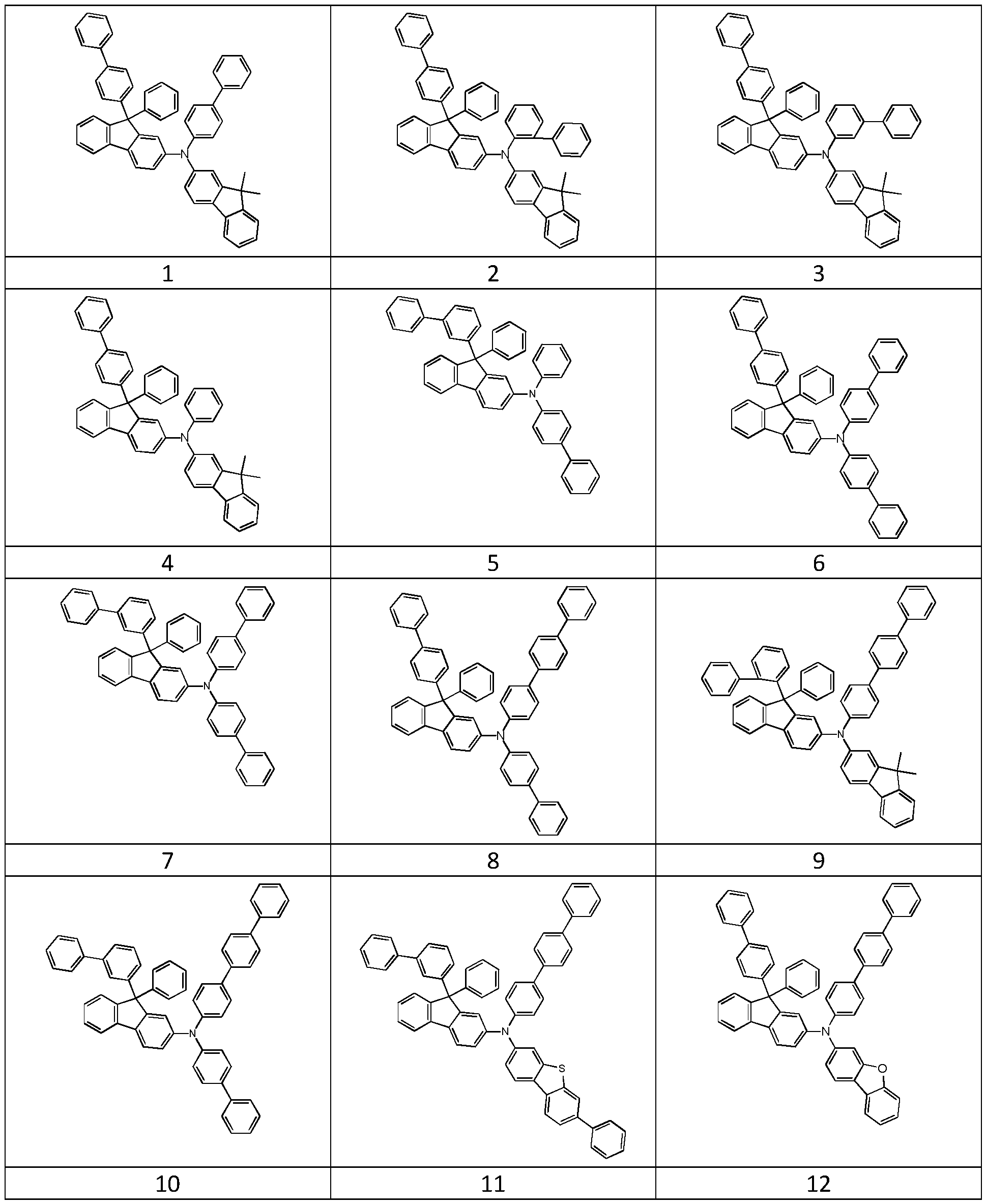
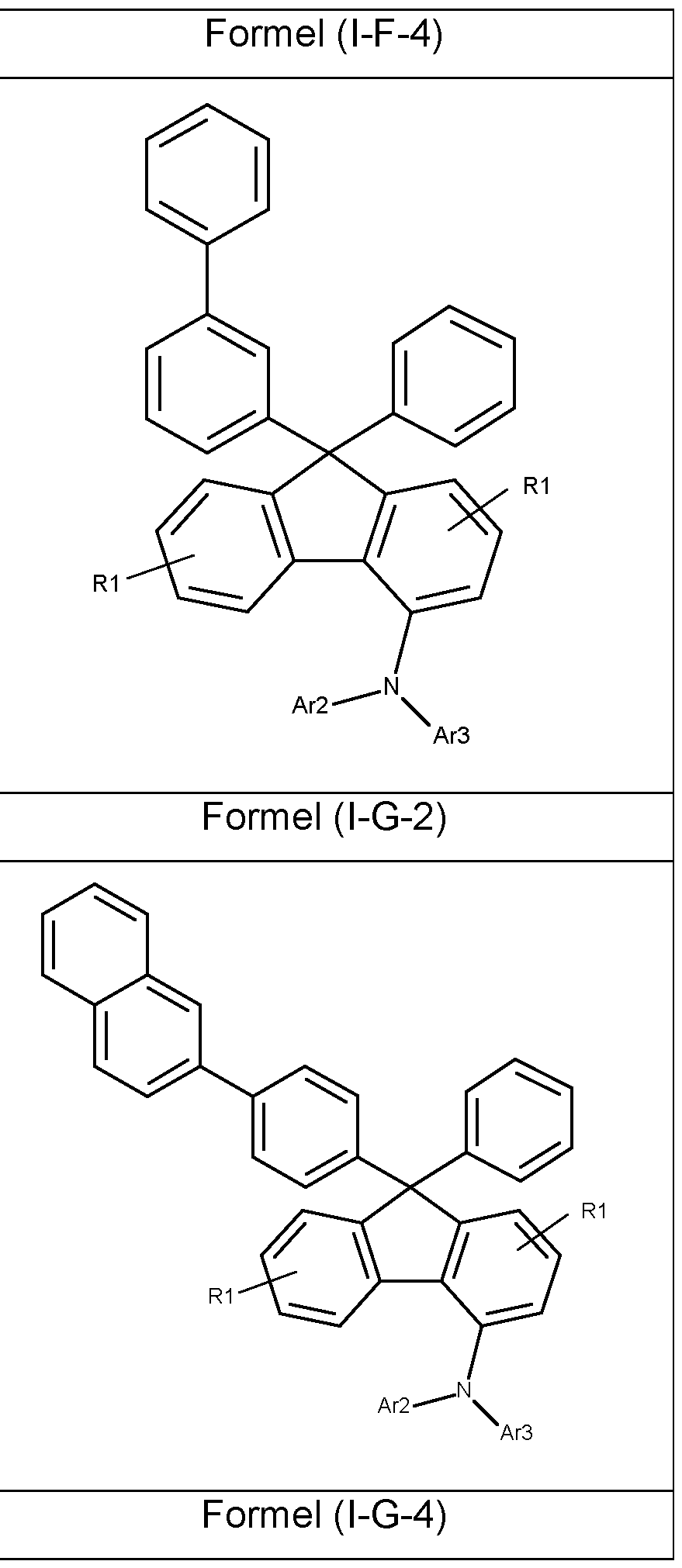
- Preferred embodiments of the formula (I) correspond to the following formulas:
- R2 is selected from aromatic ring systems with 6 to 40 aromatic ring atoms which are substituted with radicals R5. Again, it is preferred if R1 is H. Again, it is preferred if Ar4 is phenyl or 1-naphthyl, preferably phenyl, each with radicals R2
- formulas (IA) to (1H) and (1G) and (1H) are preferred, more preferably formulas (1C), (I-D), (IG) and (lH). Most preferred are formulas (I-C) and (I-D).
- R2 is selected from aromatic ring systems with 6 to 40 aromatic ring atoms which are substituted with radicals R5. It is further preferred that R1 is H. It is further preferred if Ar4 is phenyl or 1-naphthyl, is preferably phenyl, which can each be substituted by radicals R2, and are preferably unsubstituted.
- R1 is preferably equal to F1.
- Ar1 is selected from divalent groups derived from benzene, biphenyl, terphenyl, naphthalene, fluorene, indenofluorene, indenocarbazole, spirobifluorene, dibenzofuran, dibenzothiophene and carbazole, each of which can be substituted by one or more R3 radicals.
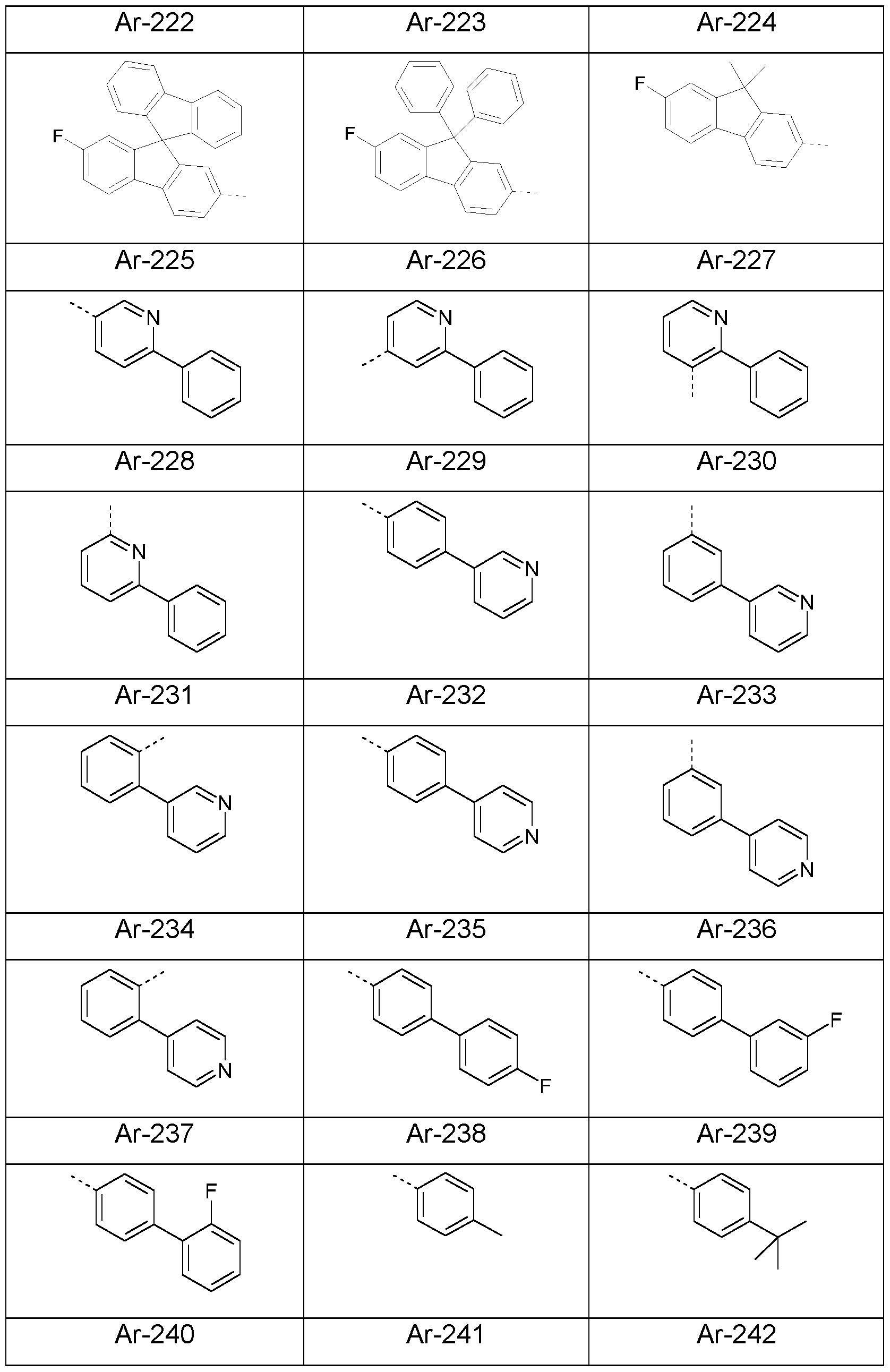
- Ar2 and Ar3 are selected the same or different for each occurrence from groups of the formulas (Ar-1) to (Ar-256) as defined above.
- the compounds of the formula (I) can be prepared by means of conventional synthetic methods in organic chemistry, for example Buchwald coupling reactions and Suzuki coupling reactions.
- a metal organyl is added to a carbonyl derivative which carries a phenyl or naphthyl-substituted phenyl group and a phenyl group.
- This metal organyl is formed from a biphenyl substituted by two reactive groups, at least one of the reactive groups being bonded to the biphenyl in the ortho position. Following the addition there is cyclization under acidic conditions
- the two step reaction involves a Suzuki reaction in which a aromatic or heteroaromatic ring system bearing a reactive group is introduced at the position of the reactive group, and a Buchwald reaction in which a diarylamino group is introduced at the position of the reactive group on the aromatic or heteroaromatic ring system.
- the reactive group is preferably selected from CI, Br and I, particularly preferably it is Br.
- the group R is preferably selected the same or different at each occurrence from H, F, heteroaryl groups with 5 to 40 aromatic ring atoms and aryl groups with 6 to 40 aromatic ring atoms. There may be one or more R groups on the benzene rings.
- the aryl group Ar4 in the scheme shown above is preferably selected from phenyl, which is preferably unsubstituted.
- the application thus relates to a process for the preparation of a compound of the formula (I), characterized in that a
- Biphenyl derivative bearing two reactive groups, at least one of which is in the ortho position, is metalated and then added to a carbonyl derivative containing a phenyl or naphthyl substituted phenyl group and a phenyl group attached to the carbonyl group.
- the process is preferably characterized in that cyclization then takes place under acidic conditions, in which a fluorenyl derivative is obtained which has a phenyl group and a phenyl- or naphthyl-substituted phenyl group on its bridgehead carbon atom, and this with a reactive group is substituted.
- This fluorenyl derivative is then preferably reacted in a Buchwald reaction with a secondary amine which has two substituents selected from aromatic and heteroaromatic ring systems, a compound of the formula (I) being obtained.
- the fluorenyl derivative is reacted in a Suzuki reaction with an aromatic or heteroaromatic ring system which has two reactive groups. According to this
- the invention therefore furthermore relates to oligomers, polymers or dendrimers containing one or more compounds of the formula (I), the bond (s) to the polymer, oligomer or dendrimer
- an oligomer is understood to mean a compound which is composed of at least three monomer units.
- a polymer is understood to mean a compound which is composed of at least ten monomer units.
- Oligomers or dendrimers can be conjugated, partially conjugated or non-conjugated.
- the oligomers or polymers according to the invention can be linear, branched, or dendritic.
- the units of the formula (I) can be linked directly to one another or they can be linked to one another via a bivalent group, for example via a substituted or unsubstituted alkylene group, via a hetero atom or via a bivalent aromatic or heteroaromatic group.
- branched and dendritic structures for example, three or more units of the formula (I) can be linked via a trivalent or higher-valent group, for example via a trivalent or higher-valent aromatic or heteroaromatic group, to form a branched or dendritic oligomer or polymer.
- the monomers according to the invention are homopolymerized or copolymerized with other monomers.
- Suitable and preferred comonomers are selected from fluorenes, spirobifluorenes, paraphenylenes, carbazoles, thiophenes, dihydrophenanthrenes, cis- and trans-lindenofluorenes, ketones,
- Oligomers and dendrimers usually contain other units, for example emitting (fluorescent or phosphorescent) units, such as.
- emitting (fluorescent or phosphorescent) units such as.
- the polymers, oligomers and dendrimers according to the invention have advantageous properties, in particular long life spans
- the polymers and oligomers according to the invention are generally prepared by polymerizing one or more types of monomer, of which at least one monomer in the polymer leads to repeating units of the formula (I). Suitable polymerization reactions are known to the person skilled in the art and are described in the literature. Particularly suitable and preferred polymerization reactions which lead to CC or CN linkages are as follows:
- Formulations of the compounds according to the invention are required for processing the compounds according to the invention from the liquid phase, for example by spin coating or by printing processes.
- These formulations can be, for example, solutions, dispersions or emulsions. It may be preferred to use mixtures of two or more solvents for this.
- Suitable and preferred solvents are, for example, toluene, anisole, o-, m- or p-xylene, methylbenzoate, mesitylene, tetralin, veratrol, THF, methyl-THF, THP, chlorobenzene, dioxane,
- Phenoxytoluene especially 3-phenoxytoluene, (-) - fenchone, 1, 2,3,5-tetramethylbenzene, 1, 2,4,5-tetramethylbenzene, 1-methylnaphthalene, 2-methylbenzothiazole, 2-phenoxyethanol, 2-pyrrolidinone, 3 -Methylanisole, 4-methylanisole, 3,4-dimethylanisole, 3,5-dimethylanisole, acetophenone, alpha-terpineol, benzothiazole, butylbenzoate, cumene, cyclohexanol, cyclohexanone, cyclohexylbenzene, decalin, dodecylbenzene, ethylbenzoate, indane, Methyl benzoate, NMP, p-cymene, phenetol, 1,4-diisopropylbenzene,
- Dibenzyl ether diethylene glycol butyl methyl ether, triethylene glycol butyl methyl ether, diethylene glycol dibutyl ether, triethylene glycol dimethyl ether,
- the invention therefore also relates to a formulation
- solvent preferably an organic solvent.
- the compound of formula (I) is suitable for use in an electronic device, in particular an organic electro luminescent device (OLED). Depending on the substitution, the compound of formula (I) can be used in different functions and layers. Use as a hole-transporting material in a hole-transporting layer and / or as a matrix material in an emitting layer is preferred, particularly preferably in combination with a phosphorescent emitter.
- Another object of the invention is therefore the use of a
- the electronic device is preferably selected from the group consisting of organic integrated circuits (OlCs), organic field-effect transistors (OFETs), organic thin-film transistors
- OFTs organic light-emitting transistors
- OLETs organic solar cells
- OSCs organic solar cells
- OFQDs organic field quench devices
- OLEDs organic light-emitting electrochemical cells
- O-lasers organic laser diodes
- OEDs organic electroluminescent devices
- the invention further relates to an electronic device containing at least one compound of the formula (I).
- the electronic device is preferably selected from the devices mentioned above.
- An organic electroluminescent device containing anode, cathode and at least one emitting layer is particularly preferred, characterized in that the device contains at least one organic layer which contains at least one compound of the formula (I).
- An organic electroluminescent device is preferred, comprising anode, cathode and at least one emitting layer, characterized in that at least one organic layer in the device, selected from hole-transporting and emitting layers, contains at least one compound of the formula (I).
- a hole-transporting layer is understood to mean all layers which are arranged between the anode and the emitting layer, preferably hole injection layer, hole transport layer, and
- Electron blocking layer is understood to mean a layer that is directly adjacent to the anode. Under one
- Hole transport layer is understood to mean a layer that is present between the anode and the emitting layer, but is not directly adjacent to the anode, preferably also not directly adjacent to the emitting layer.
- An electron blocking layer is understood to mean a layer that is present between the anode and the emitting layer and directly adjoins the emitting layer.
- An electron blocking layer has prefers an energetically high LUMO and thereby prevents electrons from emerging from the emitting layer.
- the electronic device can also contain further layers. These are selected, for example, from one or more hole injection layers,
- Hole transport layers hole blocking layers
- Electron transport layers electron injection layers, electron blocking layers, exciton blocking layers, intermediate layers
- Interlayers charge generation layers (charge generation layers) and / or organic or inorganic p / n transitions.
- charge generation layers charge generation layers
- organic or inorganic p / n transitions organic or inorganic p / n transitions.
- each of these layers does not necessarily have to be present and the choice of the layers always depends on the compounds used and in particular also on the fact whether it is a fluorescent or phosphorescent electroluminescent device.
- the sequence of the layers of the electronic device is preferably as follows:
- the organic electroluminescent device according to the invention can contain several emitting layers. These emission layers particularly preferably have a total of a plurality of emission maxima between 380 nm and 750 nm, so that overall white emission results, ie different emitting layers are present in the emitting layers
- Compounds are used that can fluoresce or phosphoresce and that emit blue, green, yellow, orange or red light.
- Three-layer systems that is to say systems with three emitting layers, are particularly preferred, one of the three layers being blue, one of the three layers green and one of the three layers
- Connections are preferably present in a hole-transporting layer or in the emitting layer. It should be noted that instead of several color-emitting emitter connections, one was used individually to generate white light
- Emitter connection can be suitable, which in a wide
- Wavelength range emitted Wavelength range emitted.
- the emitting layer can be a fluorescent emitting layer or it can be one
- emitting layer a blue fluorescent layer or a green phosphorescent layer.
- the device containing the compound of formula (I) contains a phosphorescent emitting layer, it is preferred that this layer has two or more, preferably exactly two, different ones
- Electron blocking layer used the compound can be used as
- Pure material i.e. in a proportion of 100% in the hole transport layer, or it can be used in combination with one or more other compounds.
- one contains
- Hole-transporting layer containing the compound of formula (I) additionally one or more further hole-transporting compounds.
- These further hole-transporting compounds are preferably selected from triarylamine compounds, particularly preferably from mono-triarylamine compounds. They are very particularly preferably selected from the preferred embodiments of hole transport materials specified below. In the described preferred embodiments of hole transport materials specified below.
- the compound of the formula (I) and the one or more further hole-transporting compounds are preferably present in each case in a proportion of at least 10%, particularly preferably in each case in a proportion of at least 20%.
- one contains
- Hole-transporting layer containing the compound of formula (I) additionally one or more p-dopants.
- preferred organic p-dopants are organic
- Electron acceptor compounds used that can oxidize one or more of the other compounds in the mixture.
- Particularly preferred p-dopants are quinodimethane compounds, azaindenofluorendiones, azaphenalenes, azatriphenylenes, I2,
- Metal halides preferably transition metal halides, metal oxides, preferably metal oxides containing at least one transition metal or a metal of the 3rd main group, and transition metal complexes, preferably Complexes of Cu, Co, Ni, Pd and Pt with ligands containing at least one oxygen atom as the binding site.
- transition metal complexes preferably Complexes of Cu, Co, Ni, Pd and Pt with ligands containing at least one oxygen atom as the binding site.
- Transition metal oxides as dopants preferably oxides of rhenium, molybdenum and tungsten, particularly preferably Re 2 07 , M0O3, WO3 and Re03.
- the p-dopants are preferably largely uniformly distributed in the p-doped layers. This can be achieved, for example, by co-evaporation of the p-dopant and the hole transport material matrix.
- the p-dopant is preferably present in the p-doped layer in a proportion of 1 to 10%.
- a hole injection layer is present in the device, which is one of the following
- Embodiments correspond to: a) it contains a triarylamine and a p-dopant; or b) it contains a single electron deficient material (electron acceptor).
- the triarylamine is a monotriarylamine, in particular one of the preferred triarylamine derivatives mentioned below.
- the electron-deficient material is a hexaazatriphenylene derivative, as in
- the compound of formula (I) may be contained in a hole injection layer, in a hole transport layer, and / or in an electron blocking layer of the device. If the connection is in a
- Hole injection layer or in a hole transport layer it is preferably p-doped, that is to say it is mixed with a p-dopant, as described above, in the layer.
- the compound of the formula (I) is particularly preferred in one
- Contain electron blocking layer Contain electron blocking layer.
- it is preferably not p-doped. In this case, it is furthermore preferred as
- the phosphorescent emitting compounds are preferably selected from red phosphorescent and green
- the proportion of the matrix material in the emitting layer in this case is between 50.0 and 99.9% by volume, preferably between 80.0 and 99.5% by volume and particularly preferably between 85.0 and 97.0% by volume.
- the proportion of the emissive compound is between 0.1 and 50.0% by volume, preferably between 0.5 and 20.0% by volume and particularly preferably between 3.0 and 15.0% by volume.
- An emitting layer of an organic electroluminescent device can also contain systems comprising a plurality of matrix materials (mixed-matrix systems) and / or a plurality of emitting compounds.
- the emissive compounds are generally those compounds whose proportion in the system is the smaller and the matrix materials are those compounds whose proportion in the system is the larger.
- the proportion of an individual Matrix material in the system can be smaller than the proportion of a single emitting compound.
- Component of mixed matrix systems preferred for:
- the mixed matrix systems preferably comprise two or three different matrix materials, particularly preferably two different matrix materials.
- One of the two materials is preferably a material with hole-transporting properties and the other material is a material with electron-transporting properties. It is also preferred if one of the materials is selected from compounds with a large energy difference between HOMO and LUMO (wide band gap materials). .
- the compound of the formula (I) preferably represents this
- the compound of the formula (I) is used as the matrix material for a phosphorescent emitter in the emitting layer of an OLED, a second matrix compound is present in the emitting layer which has electron-transporting properties.
- the two different matrix materials can be combined in one
- the desired electron-transporting and hole-transporting properties of the mixed matrix components can, however, also be mainly or completely combined in a single mixed matrix component, the further or the further mixed matrix components fulfilling other functions.
- the following material classes are preferably used in the above-mentioned layers of the device: Phosphorescent emitters:
- phosphorescent emitter typically includes compounds in which the light emission by a spin-prohibited
- Transition takes place, for example a transition from an excited triplet state or a state with a higher spin quantum number, for example a quintet state.
- Particularly suitable as phosphorescent emitters are compounds which, when suitably excited, emit light, preferably in the visible range, and also contain at least one atom of atomic number greater than 20, preferably greater than 38 and less than 84, particularly preferably greater than 56 and less than 80.
- Preferred phosphorescent emitters are compounds which contain copper, molybdenum, tungsten, rhenium,
- Ruthenium, osmium, rhodium, iridium, palladium, platinum, silver, gold or europium are used, in particular compounds containing iridium, platinum or copper.
- Preferred fluorescent emitting compounds are selected from the class of arylamines. Under an arylamine or a
- aromatic amine in the sense of this invention is understood to mean a compound which contains three substituted or unsubstituted aromatic or heteroaromatic ring systems bonded directly to the nitrogen. At least one of these is preferred aromatic or hetero
- aromatic ring systems a condensed ring system, particularly preferably with at least 14 aromatic ring atoms.
- Preferred examples of this are aromatic anthracenamines, aromatic
- Anthracene diamines aromatic pyrenamines, aromatic pyrendiamines, aromatic chrysenamines or aromatic chrysediamines.
- An aromatic anthracenamine is understood to mean a compound in which a diarylamino group is bonded directly to an anthracene group, preferably in the 9-position.
- An aromatic anthracene diamine is understood to mean a compound in which two diarylamino groups are bonded directly to an anthracene group, preferably in the 9,10 position.
- Aromatic pyrenamines, pyrendiamines, chrysenamines and chrysenamines are defined analogously, the diarylamino groups being preferably attached to the pyrene in the 1-position or in the 1,6-position.
- Further preferred emitting compounds are indenofluorenamines or -diamines, benzoindenofluorenamines or -diamines, and dibenzoindenofluoramines or -diamines, and also indenofluorene derivatives with condensed Aryl groups. Pyrene-arylamines are also preferred.
- benzoindenofluorene amines benzofluorene amines, extended benzoindenofluorenes, phenoxazines, and fluorene derivatives which are linked to furan units or to thiophene units.
- fluorescent emitters are shown in the following table:
- Preferred matrix materials for fluorescent emitters are selected from the classes of the oligoarylenes (eg 2,2 ', 7,7'-tetraphenyl spirobifluorene), in particular the oligoarylenes containing condensed aromatic groups, the oligoarylenevinylenes, the polypodal metal complexes, the hole-conducting Compounds, the electron-conducting compounds, in particular ketones, phosphine oxides, and sulfoxides; the atropisomers, the boronic acid derivatives or the benzanthracenes.
- the oligoarylenes eg 2,2 ', 7,7'-tetraphenyl spirobifluorene
- the oligoarylenes containing condensed aromatic groups e.g 2,2 ', 7,7'-tetraphenyl spirobifluorene
- the oligoarylenes containing condensed aromatic groups e.g 2,2 ', 7,7'-t
- Particularly preferred matrix materials are selected from the classes of oligoarylenes containing naphthalene, anthracene, benzanthracene and / or pyrene or atropisomers of these compounds, the oligoarylene vinylenes, the ketones, the phosphine oxides and the sulfoxides.
- Very particularly preferred matrix materials are selected from the classes of oligoarylenes containing anthracene, benzanthracene, benzphenanthrene and / or pyrene or atropisomers of these compounds.
- An oligoarylene in the sense of this invention is to be understood as meaning a compound in which at least three aryl or arylene groups are bonded to one another.
- Preferred matrix materials for fluorescent emitters are shown in the following table:
- preferred matrix materials for phosphorescent emitters are aromatic ketones, aromatic ones
- Triphenylene derivatives or lactams.
- Electron-transporting materials are Electron-transporting materials:
- Suitable electron-transporting materials are, for example, those described in Y. Shirota et al. , Chem. Rev. 2007, 107 (4), 953-1010
- Compounds or other materials as used in these layers according to the prior art are compounds or other materials as used in these layers according to the prior art.
- materials for the electron transport layer all materials can be used which are used in the prior art as electron transport materials in the electron transport layer.
- Aluminum complexes, for example Alq3, are particularly suitable.
- Zirconium complexes for example Zrq4, lithium complexes, for example Liq, benzimidazole derivatives, triazine derivatives, pyrimidine derivatives, pyridine derivatives, pyrazine derivatives, quinoxaline derivatives, quinoline derivatives,
- Oxadiazole derivatives aromatic ketones, lactams, boranes,
- Electron-transporting compounds are shown in the following table:
- Dihydroacridine derivatives Dihydroacridine derivatives, spirodibenzofurans and spirodibenzothiophenes, phenanthrene diarylamines, spiro-tribenzotropolones, spirobifluorenes with meta-phenyldiamine groups, spiro-bisacridines, xanthene-diarylamines, and 9,10-dihydroanthracene-spiro-arabino compounds.
- Preferred hole transporting compounds are shown in the following table:
- Metals with a low work function, metal alloys or multilayer structures are made as the cathode of the electronic device
- alkaline earth metals such as alkaline earth metals, alkali metals, main group metals or lanthanoids (e.g. Ca, Ba, Mg, Al, In, Mg, Yb, Sm, etc.). Alloys of an alkali or alkaline earth metal and silver, for example an alloy of, are also suitable.
- Magnesium and silver In the case of multilayer structures, in addition to the metals mentioned, other metals can also be used which have a relatively high work function, such as, for example, B. Ag or Al, in which case combinations of the metals, such as Ca / Ag, Mg / Ag or Ba / Ag are usually used. It may also be preferred to insert a thin intermediate layer of a material with a high dielectric constant between a metallic cathode and the organic semiconductor. For example, alkali metal or
- Alkaline earth metal fluorides but also the corresponding oxides or
- LiF, L1 2 O, BaF 2 , MgO, NaF, CsF, CS 2 CO3, etc. Lithium quinolinate (LiQ) can also be used.
- the layer thickness of this layer is preferably between 0.5 and 5 nm.
- the anode preferably has a work function greater than 4.5 eV vs. Vacuum on.
- metals with a high redox potential are suitable for this, such as Ag, Pt or Au.
- metal / metal oxide electrodes eg Al / Ni / NiO x , Al / PtO x
- at least one of the electrodes must be transparent or
- anode materials are conductive mixed metal oxides. Indium tin oxide (ITO) or indium zinc oxide (IZO) are particularly preferred. Also preferred are conductive, doped organic materials, in particular conductive doped polymers. Furthermore, the anode can also consist of several layers, for example an inner layer made of ITO and an outer layer made of a metal oxide, preferably tungsten oxide, molybdenum oxide or vanadium oxide.
- ITO Indium tin oxide
- IZO indium zinc oxide
- conductive, doped organic materials in particular conductive doped polymers.
- the anode can also consist of several layers, for example an inner layer made of ITO and an outer layer made of a metal oxide, preferably tungsten oxide, molybdenum oxide or vanadium oxide.
- the electronic device is characterized in that one or more layers are coated with a sublimation process.
- the materials are evaporated in vacuum sublimation systems at an initial pressure of less than 10 -5 mbar, preferably less than 10 -6 mbar. However, it is also possible for the initial pressure to be even lower, for example less than 10 7 mbar.
- An electronic device is also preferred.
- Carrier gas sublimation can be coated.
- the materials are applied at a pressure between 10 -5 mbar and 1 bar.
- This process is the OVJP (Organic Vapor Jet Printing) process, in which the materials are applied directly through a nozzle and structured in this way (for example BMS Arnold et al., Appl. Phys. Lett. 2008, 92, 053301).
- An electronic device is further preferred
- one or more layers of solution such as. B. by spin coating, or with any printing method, such as. B. screen printing, flexographic printing, nozzle printing or offset printing, but particularly preferably LITI (Light Induced Thermal Imaging, thermal transfer printing) or ink-jet printing (ink jet printing).
- LITI Light Induced Thermal Imaging, thermal transfer printing
- ink-jet printing ink jet printing
- Soluble compounds according to formula (I) are necessary for this. High solubility can be achieved by suitable substitution of the compounds.
- one or more layers of solution and one or more layers are applied by a sublimation process to produce an electronic device according to the invention. After application of the layers, depending on the application, the device is structured, contacted and finally sealed in order to exclude damaging effects of water and air.
- the electronic devices containing one or more compounds of the formula (I) can be used in displays, as light sources in lighting applications and as light sources in medical and / or cosmetic applications. Examples
- reaction mixture is allowed to warm up slowly to room temperature, NH4Cl is added and the mixture is then concentrated on a rotary evaporator. The evaporated solution is carefully mixed with 200 ml of acetic acid and then 50 ml of smoking HCl are added. The mixture is heated to 75 ° C. and held there for 6 hours. A white solid precipitates out. The mixture is now allowed to cool to room temperature and the precipitated solid is filtered off and washed with methanol.
- the yields are between 65 and 90%.
- the yields are between 40 and 90%.
- the OLEDs basically have the following layer structure: substrate / hole injection layer (HIL) / hole transport layer (HTL) / electrons
- EBL emission layer
- ETL electron transport layer
- EIL electron injection layer
- the emission layer consists of at least one matrix material (host material, host material) and an emitting dopant (dopant, emitter) that passes through the matrix material or the matrix materials
- Cover vaporization is added in a certain volume fraction.
- An indication like H: SEB (95%: 5%) means that the material H is present in the layer in a volume fraction of 95% and SEB in a proportion of 5%.
- Hole injection layer made of a mixture of two materials.
- the OLEDs are characterized by default.
- the electroluminescence spectra, the external quantum efficiency (EQE, measured in%) as a function of the luminance, calculated from current-voltage-luminance characteristics under the assumption of a Lambertian radiation characteristic, and the service life are determined.
- the specification EQE @ 10mA / cm 2 denotes the external quantum efficiency that is achieved at 10mA / cm 2 .
- the specification U @ 10 mA / cm 2 denotes the
- the service life LT is defined as the time after which the luminance drops from the starting luminance to a certain proportion during operation with a constant current density.
- Specifying LT80 means that the specified service life corresponds to the time after which the luminance reaches 80% of its initial value has sunk.
- the specification @ 60 or 40 mA / cm 2 means that the relevant service life is measured at 60 or 40 mA / cm 2 .
- OLEDs with the following structure are manufactured:
- OLEDs E1 and E14 show the use of the compounds HTM-4 and HTM-7 according to the application in the HIL (p-doped) and HTL of a blue fluorescent OLED.
- OLEDs E2 to E7 show the use of the compounds HTM-1 to HTM-6 in the EBL of blue fluorescent OLEDs.
- OLEDs E8 to E13 show the use of the compounds HTM-1 to HTM-6 in the EBL of green phosphorescent OLEDs.
- the OLEDs show the following values for operating voltage, EQE and service life:
- the OLEDs have a good service life, high efficiency and low operating voltage. This result is obtained in all three OLED structures used and for all the connections according to the application used above.
- the HTM-4 connection according to the application is connected to the
- An OLED stack as in part 2) is used, in which the compounds in the EBL are in a blue fluorescent stack.
- Ref-1 shows a voltage at 10mA / cm 2 of 3.7 V and EQE at 10mA / cm 2 of 8.5%.
- HTM-4 shows a better EQE of 8.9% with a similar voltage (3.8 V).
- asymmetric substitution at the bridgehead carbon atom results, in particular a substitution with biphenyl and phenyl at this atom, compared to a symmetrical substitution with two phenyl groups.
- the HTM-7 connection according to the application is connected to the
- Ref-2 has alkyl substitution on the phenyl group on the above
- Bridgehead carbon atom while HTM-7 has no alkyl substitution.
- An OLED structure as in part 2) is used, in which the compounds in the HIL and HTL are present in a blue fluorescent stack.
- the reference connection Ref-2 shows a voltage at 10mA / cm 2 of 4.2 V.
- the service life LT80 measured at 60mA / cm 2 , is 150h.
- HTM-7 shows a significantly better LT80 of 310h with comparable voltage (4.3 V). This shows the improvement that is due to the omission of
- Alkyl groups on the substituents on the bridgehead carbon atom This improvement is not limited to the structures shown, but occurs generally.
Landscapes
- Chemical & Material Sciences (AREA)
- Organic Chemistry (AREA)
- Engineering & Computer Science (AREA)
- Materials Engineering (AREA)
- Physics & Mathematics (AREA)
- Spectroscopy & Molecular Physics (AREA)
- Optics & Photonics (AREA)
- Electroluminescent Light Sources (AREA)
- Organic Low-Molecular-Weight Compounds And Preparation Thereof (AREA)
- Furan Compounds (AREA)
- Devices For Indicating Variable Information By Combining Individual Elements (AREA)
- Structures Or Materials For Encapsulating Or Coating Semiconductor Devices Or Solid State Devices (AREA)
Abstract
Description






Claims



Priority Applications (8)
| Application Number | Priority Date | Filing Date | Title |
|---|---|---|---|
| CN201980078632.0A CN113166088A (zh) | 2018-12-20 | 2019-12-17 | 用于电子器件的材料 |
| US17/415,972 US12275682B2 (en) | 2018-12-20 | 2019-12-17 | Materials for electronic devices |
| EP19832612.6A EP3898605A2 (de) | 2018-12-20 | 2019-12-17 | Materialien für elektronische vorrichtungen |
| JP2021535723A JP7728702B2 (ja) | 2018-12-20 | 2019-12-17 | 電子デバイス用の材料 |
| KR1020267005702A KR20260032647A (ko) | 2018-12-20 | 2019-12-17 | 전자 디바이스용 재료 |
| KR1020217022394A KR20210105935A (ko) | 2018-12-20 | 2019-12-17 | 전자 디바이스용 재료 |
| US19/050,169 US20250188014A1 (en) | 2018-12-20 | 2025-02-11 | Materials for electronic devices |
| JP2025134779A JP2025186233A (ja) | 2018-12-20 | 2025-08-13 | 電子デバイス用の材料 |
Applications Claiming Priority (2)
| Application Number | Priority Date | Filing Date | Title |
|---|---|---|---|
| EP18214570 | 2018-12-20 | ||
| EP18214570.6 | 2018-12-20 |
Related Child Applications (2)
| Application Number | Title | Priority Date | Filing Date |
|---|---|---|---|
| US17/415,972 A-371-Of-International US12275682B2 (en) | 2018-12-20 | 2019-12-17 | Materials for electronic devices |
| US19/050,169 Division US20250188014A1 (en) | 2018-12-20 | 2025-02-11 | Materials for electronic devices |
Publications (2)
| Publication Number | Publication Date |
|---|---|
| WO2020127145A2 true WO2020127145A2 (de) | 2020-06-25 |
| WO2020127145A3 WO2020127145A3 (de) | 2020-08-13 |
Family
ID=64746419
Family Applications (1)
| Application Number | Title | Priority Date | Filing Date |
|---|---|---|---|
| PCT/EP2019/085484 Ceased WO2020127145A2 (de) | 2018-12-20 | 2019-12-17 | Materialien für elektronische vorrichtungen |
Country Status (7)
| Country | Link |
|---|---|
| US (2) | US12275682B2 (de) |
| EP (1) | EP3898605A2 (de) |
| JP (2) | JP7728702B2 (de) |
| KR (2) | KR20210105935A (de) |
| CN (1) | CN113166088A (de) |
| TW (1) | TW202039417A (de) |
| WO (1) | WO2020127145A2 (de) |
Cited By (5)
| Publication number | Priority date | Publication date | Assignee | Title |
|---|---|---|---|---|
| CN112457866A (zh) * | 2020-10-29 | 2021-03-09 | 深圳清荷科技有限公司 | 一种液晶取向剂、液晶取向膜以及液晶显示元件 |
| WO2021160898A2 (de) | 2020-05-27 | 2021-08-19 | Merck Patent Gmbh | Materialien für elektronische vorrichtungen |
| WO2022154030A1 (ja) * | 2021-01-13 | 2022-07-21 | 出光興産株式会社 | 有機エレクトロルミネッセンス素子、有機エレクトロルミネッセンス表示装置及び電子機器 |
| WO2022154029A1 (ja) * | 2021-01-13 | 2022-07-21 | 出光興産株式会社 | 有機エレクトロルミネッセンス素子、有機エレクトロルミネッセンス表示装置及び電子機器 |
| WO2023072975A1 (de) * | 2021-10-29 | 2023-05-04 | Merck Patent Gmbh | Verbindungen für elektronische vorrichtungen |
Families Citing this family (3)
| Publication number | Priority date | Publication date | Assignee | Title |
|---|---|---|---|---|
| EP4238956A4 (de) * | 2020-09-30 | 2024-10-02 | Idemitsu Kosan Co., Ltd. | Verbindung, material für ein organisches elektrolumineszierendes element, organisches elektrolumineszierendes element und elektronische vorrichtung |
| KR102608380B1 (ko) * | 2023-01-09 | 2023-12-01 | 덕산네오룩스 주식회사 | 유기전기소자용 화합물을 포함하는 유기전기소자 및 그 전자 장치 |
| KR20240148984A (ko) * | 2023-04-03 | 2024-10-14 | 덕산네오룩스 주식회사 | 유기전기소자용 화합물을 포함하는 유기전기소자 및 그 전자 장치 |
Citations (1)
| Publication number | Priority date | Publication date | Assignee | Title |
|---|---|---|---|---|
| US20070092755A1 (en) | 2005-10-26 | 2007-04-26 | Eastman Kodak Company | Organic element for low voltage electroluminescent devices |
Family Cites Families (30)
| Publication number | Priority date | Publication date | Assignee | Title |
|---|---|---|---|---|
| DE10317556B4 (de) | 2003-04-15 | 2021-05-12 | Merck Patent Gmbh | Mischungen von organischen zur Emission befähigten Halbleitern und Matrixmaterialien, deren Verwendung und Elektronikbauteile enthaltend diese |
| DE102008024182A1 (de) | 2008-05-19 | 2009-11-26 | Merck Patent Gmbh | Verbindungen für organische elektronische Vorrichtung |
| DE102010005697A1 (de) | 2010-01-25 | 2011-07-28 | Merck Patent GmbH, 64293 | Verbindungen für elektronische Vorrichtungen |
| KR101807925B1 (ko) | 2012-07-23 | 2017-12-11 | 메르크 파텐트 게엠베하 | 화합물 및 유기 전계 발광 디바이스 |
| EP3424907B1 (de) | 2012-07-23 | 2025-03-12 | Merck Patent GmbH | Verbindungen und organische elektronische vorrichtungen |
| KR101950474B1 (ko) | 2012-08-22 | 2019-02-21 | 삼성디스플레이 주식회사 | 유기 발광 소자 |
| KR101974757B1 (ko) | 2012-08-31 | 2019-05-02 | 이데미쓰 고산 가부시키가이샤 | 방향족 아민 유도체 및 이것을 이용한 유기 전기발광 소자 |
| KR102000208B1 (ko) * | 2012-12-20 | 2019-07-16 | 삼성디스플레이 주식회사 | 유기 발광 소자 |
| JP6896422B2 (ja) | 2013-12-06 | 2021-06-30 | メルク パテント ゲーエムベーハー | 化合物および有機電子素子 |
| CN105829279B (zh) | 2013-12-26 | 2018-06-08 | 罗门哈斯电子材料韩国有限公司 | 有机电致发光化合物和包含其的有机电致发光装置 |
| CN104037339B (zh) | 2014-06-25 | 2016-05-18 | 上海道亦化工科技有限公司 | 一种有机电致发光器件 |
| CN104073248B (zh) | 2014-06-25 | 2016-01-20 | 上海道亦化工科技有限公司 | 一种基于芴的空穴传输化合物 |
| CN104086447B (zh) | 2014-06-25 | 2016-06-15 | 上海道亦化工科技有限公司 | 一种基于芴的空穴传输化合物 |
| CN104037361B (zh) | 2014-06-25 | 2016-06-15 | 上海道亦化工科技有限公司 | 一种有机电致发光器件 |
| KR102398726B1 (ko) | 2014-07-11 | 2022-05-16 | 이데미쓰 고산 가부시키가이샤 | 화합물, 유기 전기발광 소자용 재료, 유기 전기발광 소자, 및 전자 기기 |
| KR20160017596A (ko) * | 2014-08-05 | 2016-02-16 | 삼성디스플레이 주식회사 | 유기 전계 발광 소자 |
| JP2016039187A (ja) | 2014-08-05 | 2016-03-22 | 三星ディスプレイ株式會社Samsung Display Co.,Ltd. | 有機エレクトロルミネッセンス素子 |
| JP2016192464A (ja) | 2015-03-31 | 2016-11-10 | 三星ディスプレイ株式會社Samsung Display Co.,Ltd. | 有機エレクトロルミネッセンス素子用材料及びそれを用いた有機エレクトロルミネッセンス素子 |
| US20160351817A1 (en) | 2015-05-27 | 2016-12-01 | Samsung Display Co., Ltd. | Organic light-emitting device |
| KR102660538B1 (ko) | 2015-07-22 | 2024-04-24 | 메르크 파텐트 게엠베하 | 유기 전계발광 소자용 재료 |
| US9806552B2 (en) | 2016-02-15 | 2017-10-31 | Analog Devices Global | Analog/digital converter with charge rebalanced integrator |
| CN108203417A (zh) * | 2016-12-20 | 2018-06-26 | 江苏三月光电科技有限公司 | 以芴为主体的有机化合物及有机电致发光器件 |
| KR102032954B1 (ko) * | 2017-03-13 | 2019-10-16 | 주식회사 엘지화학 | 신규한 헤테로 고리 화합물 및 이를 이용한 유기 발광 소자 |
| KR102235629B1 (ko) | 2017-06-05 | 2021-04-02 | 덕산네오룩스 주식회사 | 유기전기 소자용 화합물, 이를 이용한 유기전기소자 및 그 전자 장치 |
| KR20250086794A (ko) | 2017-12-15 | 2025-06-13 | 메르크 파텐트 게엠베하 | 유기 전계 발광 디바이스용 치환된 방향족 아민 |
| CN108218664A (zh) | 2018-01-30 | 2018-06-29 | 长春海谱润斯科技有限公司 | 一种有机电致发光材料及其有机发光器件 |
| CN110835318B (zh) | 2018-08-17 | 2021-06-08 | 江苏三月科技股份有限公司 | 一种以氮杂芴为核心的有机化合物及其制备方法与应用 |
| JP7351713B2 (ja) | 2018-11-30 | 2023-09-27 | 関東化学株式会社 | 2-置換フルオレン系化合物、該化合物を含有する正孔輸送材料および該化合物を正孔輸送層に含む有機電子デバイス |
| KR20250048398A (ko) | 2018-12-20 | 2025-04-08 | 메르크 파텐트 게엠베하 | 전자 디바이스용 재료 |
| US10840455B1 (en) | 2019-09-06 | 2020-11-17 | Duk San Neolux Co., Ltd. | Compound for organic electronic element, organic electronic element using the same, and electronic device thereof |
-
2019
- 2019-12-17 KR KR1020217022394A patent/KR20210105935A/ko not_active Ceased
- 2019-12-17 KR KR1020267005702A patent/KR20260032647A/ko active Pending
- 2019-12-17 JP JP2021535723A patent/JP7728702B2/ja active Active
- 2019-12-17 US US17/415,972 patent/US12275682B2/en active Active
- 2019-12-17 CN CN201980078632.0A patent/CN113166088A/zh active Pending
- 2019-12-17 TW TW108146128A patent/TW202039417A/zh unknown
- 2019-12-17 EP EP19832612.6A patent/EP3898605A2/de active Pending
- 2019-12-17 WO PCT/EP2019/085484 patent/WO2020127145A2/de not_active Ceased
-
2025
- 2025-02-11 US US19/050,169 patent/US20250188014A1/en active Pending
- 2025-08-13 JP JP2025134779A patent/JP2025186233A/ja not_active Withdrawn
Patent Citations (1)
| Publication number | Priority date | Publication date | Assignee | Title |
|---|---|---|---|---|
| US20070092755A1 (en) | 2005-10-26 | 2007-04-26 | Eastman Kodak Company | Organic element for low voltage electroluminescent devices |
Non-Patent Citations (2)
| Title |
|---|
| M. S. ARNOLD ET AL., APPL. PHYS. LETT., vol. 92, 2008, pages 053301 |
| Y. SHIROTA ET AL., CHEM. REV., vol. 107, no. 4, 2007, pages 953 - 1010 |
Cited By (7)
| Publication number | Priority date | Publication date | Assignee | Title |
|---|---|---|---|---|
| WO2021160898A2 (de) | 2020-05-27 | 2021-08-19 | Merck Patent Gmbh | Materialien für elektronische vorrichtungen |
| CN112457866A (zh) * | 2020-10-29 | 2021-03-09 | 深圳清荷科技有限公司 | 一种液晶取向剂、液晶取向膜以及液晶显示元件 |
| CN112457866B (zh) * | 2020-10-29 | 2021-07-27 | 深圳清荷科技有限公司 | 一种液晶取向剂、液晶取向膜以及液晶显示元件 |
| WO2022154030A1 (ja) * | 2021-01-13 | 2022-07-21 | 出光興産株式会社 | 有機エレクトロルミネッセンス素子、有機エレクトロルミネッセンス表示装置及び電子機器 |
| WO2022154029A1 (ja) * | 2021-01-13 | 2022-07-21 | 出光興産株式会社 | 有機エレクトロルミネッセンス素子、有機エレクトロルミネッセンス表示装置及び電子機器 |
| US12369490B2 (en) | 2021-01-13 | 2025-07-22 | Idemitsu Kosan Co., Ltd. | Organic electroluminescent element, organic electroluminescent display device, and electronic device |
| WO2023072975A1 (de) * | 2021-10-29 | 2023-05-04 | Merck Patent Gmbh | Verbindungen für elektronische vorrichtungen |
Also Published As
| Publication number | Publication date |
|---|---|
| US20220073447A1 (en) | 2022-03-10 |
| CN113166088A (zh) | 2021-07-23 |
| WO2020127145A3 (de) | 2020-08-13 |
| JP2025186233A (ja) | 2025-12-23 |
| KR20260032647A (ko) | 2026-03-09 |
| EP3898605A2 (de) | 2021-10-27 |
| TW202039417A (zh) | 2020-11-01 |
| US12275682B2 (en) | 2025-04-15 |
| JP2022514875A (ja) | 2022-02-16 |
| KR20210105935A (ko) | 2021-08-27 |
| US20250188014A1 (en) | 2025-06-12 |
| JP7728702B2 (ja) | 2025-08-25 |
Similar Documents
| Publication | Publication Date | Title |
|---|---|---|
| EP3114102B1 (de) | Materialien für elektronische vorrichtungen | |
| EP3523834A1 (de) | Elektronische vorrichtung | |
| EP4066289A1 (de) | Verbindungen für elektronische vorrichtungen | |
| WO2014106522A1 (de) | Materialien für elektronische vorrichtungen | |
| WO2020127145A2 (de) | Materialien für elektronische vorrichtungen | |
| WO2023025971A2 (de) | Materialien für elektronische vorrichtungen | |
| EP3589624A1 (de) | Materialien für organische elektronische vorrichtungen | |
| EP3679023A1 (de) | Materialien für elektronische vorrichtungen | |
| EP4240718A1 (de) | Materialien für elektronische vorrichtungen | |
| EP3714022A1 (de) | Materialien für elektronische vorrichtungen | |
| EP4078692A1 (de) | Verbindungen für elektronische vorrichtungen | |
| EP4423065A1 (de) | Verbindungen für elektronische vorrichtungen | |
| WO2020109524A1 (de) | Verbindungen für elektronische vorrichtungen | |
| EP2984150A1 (de) | Materialien für elektronische vorrichtungen | |
| EP4225733A2 (de) | Verbindungen für elektronische vorrichtungen | |
| WO2022129117A1 (de) | Materialien für elektronische vorrichtungen | |
| EP4158703A2 (de) | Materialien für elektronische vorrichtungen | |
| EP4555839A1 (de) | Materialien für elektronische vorrichtungen | |
| EP4423064A1 (de) | Verbindungen für elektronische vorrichtungen | |
| WO2023072975A1 (de) | Verbindungen für elektronische vorrichtungen | |
| WO2024126322A1 (de) | Materialien für elektronische vorrichtungen | |
| EP4548728A1 (de) | Verbindungen für elektronische vorrichtungen | |
| EP4423073A2 (de) | Verbindungen für elektronische vorrichtungen | |
| EP4041709A1 (de) | Verbindungen für elektronische vorrichtungen | |
| EP4555040A1 (de) | Materialien für elektronische vorrichtungen |
Legal Events
| Date | Code | Title | Description |
|---|---|---|---|
| 121 | Ep: the epo has been informed by wipo that ep was designated in this application |
Ref document number: 19832612 Country of ref document: EP Kind code of ref document: A2 |
|
| ENP | Entry into the national phase |
Ref document number: 2021535723 Country of ref document: JP Kind code of ref document: A |
|
| NENP | Non-entry into the national phase |
Ref country code: DE |
|
| ENP | Entry into the national phase |
Ref document number: 20217022394 Country of ref document: KR Kind code of ref document: A |
|
| ENP | Entry into the national phase |
Ref document number: 2019832612 Country of ref document: EP Effective date: 20210720 |
|
| WWG | Wipo information: grant in national office |
Ref document number: 17415972 Country of ref document: US |
|
| WWD | Wipo information: divisional of initial pct application |
Ref document number: 1020267005702 Country of ref document: KR |
|
| WWC | Wipo information: continuation of processing after refusal or withdrawal |
Ref document number: 1020217022394 Country of ref document: KR |
|
| WWP | Wipo information: published in national office |
Ref document number: 1020267005702 Country of ref document: KR |