WO2020136772A1 - Alliage de bronze pour la coulée, et élément coulissant comprenant ledit alliage de bronze - Google Patents
Alliage de bronze pour la coulée, et élément coulissant comprenant ledit alliage de bronze Download PDFInfo
- Publication number
- WO2020136772A1 WO2020136772A1 PCT/JP2018/047938 JP2018047938W WO2020136772A1 WO 2020136772 A1 WO2020136772 A1 WO 2020136772A1 JP 2018047938 W JP2018047938 W JP 2018047938W WO 2020136772 A1 WO2020136772 A1 WO 2020136772A1
- Authority
- WO
- WIPO (PCT)
- Prior art keywords
- mass
- bronze alloy
- bronze
- copper
- alloy
- Prior art date
- Legal status (The legal status is an assumption and is not a legal conclusion. Google has not performed a legal analysis and makes no representation as to the accuracy of the status listed.)
- Ceased
Links
Images




Classifications
-
- C—CHEMISTRY; METALLURGY
- C22—METALLURGY; FERROUS OR NON-FERROUS ALLOYS; TREATMENT OF ALLOYS OR NON-FERROUS METALS
- C22C—ALLOYS
- C22C9/00—Alloys based on copper
- C22C9/02—Alloys based on copper with tin as the next major constituent
-
- B—PERFORMING OPERATIONS; TRANSPORTING
- B22—CASTING; POWDER METALLURGY
- B22F—WORKING METALLIC POWDER; MANUFACTURE OF ARTICLES FROM METALLIC POWDER; MAKING METALLIC POWDER; APPARATUS OR DEVICES SPECIALLY ADAPTED FOR METALLIC POWDER
- B22F3/00—Manufacture of workpieces or articles from metallic powder characterised by the manner of compacting or sintering; Apparatus specially adapted therefor ; Presses and furnaces
- B22F3/12—Both compacting and sintering
- B22F3/14—Both compacting and sintering simultaneously
-
- B—PERFORMING OPERATIONS; TRANSPORTING
- B22—CASTING; POWDER METALLURGY
- B22F—WORKING METALLIC POWDER; MANUFACTURE OF ARTICLES FROM METALLIC POWDER; MAKING METALLIC POWDER; APPARATUS OR DEVICES SPECIALLY ADAPTED FOR METALLIC POWDER
- B22F7/00—Manufacture of composite layers, workpieces, or articles, comprising metallic powder, by sintering the powder, with or without compacting wherein at least one part is obtained by sintering or compression
- B22F7/02—Manufacture of composite layers, workpieces, or articles, comprising metallic powder, by sintering the powder, with or without compacting wherein at least one part is obtained by sintering or compression of composite layers
- B22F7/04—Manufacture of composite layers, workpieces, or articles, comprising metallic powder, by sintering the powder, with or without compacting wherein at least one part is obtained by sintering or compression of composite layers with one or more layers not made from powder, e.g. made from solid metal
-
- C—CHEMISTRY; METALLURGY
- C22—METALLURGY; FERROUS OR NON-FERROUS ALLOYS; TREATMENT OF ALLOYS OR NON-FERROUS METALS
- C22C—ALLOYS
- C22C1/00—Making non-ferrous alloys
- C22C1/04—Making non-ferrous alloys by powder metallurgy
- C22C1/0425—Copper-based alloys
-
- C—CHEMISTRY; METALLURGY
- C23—COATING METALLIC MATERIAL; COATING MATERIAL WITH METALLIC MATERIAL; CHEMICAL SURFACE TREATMENT; DIFFUSION TREATMENT OF METALLIC MATERIAL; COATING BY VACUUM EVAPORATION, BY SPUTTERING, BY ION IMPLANTATION OR BY CHEMICAL VAPOUR DEPOSITION, IN GENERAL; INHIBITING CORROSION OF METALLIC MATERIAL OR INCRUSTATION IN GENERAL
- C23C—COATING METALLIC MATERIAL; COATING MATERIAL WITH METALLIC MATERIAL; SURFACE TREATMENT OF METALLIC MATERIAL BY DIFFUSION INTO THE SURFACE, BY CHEMICAL CONVERSION OR SUBSTITUTION; COATING BY VACUUM EVAPORATION, BY SPUTTERING, BY ION IMPLANTATION OR BY CHEMICAL VAPOUR DEPOSITION, IN GENERAL
- C23C4/00—Coating by spraying the coating material in the molten state, e.g. by flame, plasma or electric discharge
- C23C4/02—Pretreatment of the material to be coated, e.g. for coating on selected surface areas
-
- C—CHEMISTRY; METALLURGY
- C23—COATING METALLIC MATERIAL; COATING MATERIAL WITH METALLIC MATERIAL; CHEMICAL SURFACE TREATMENT; DIFFUSION TREATMENT OF METALLIC MATERIAL; COATING BY VACUUM EVAPORATION, BY SPUTTERING, BY ION IMPLANTATION OR BY CHEMICAL VAPOUR DEPOSITION, IN GENERAL; INHIBITING CORROSION OF METALLIC MATERIAL OR INCRUSTATION IN GENERAL
- C23C—COATING METALLIC MATERIAL; COATING MATERIAL WITH METALLIC MATERIAL; SURFACE TREATMENT OF METALLIC MATERIAL BY DIFFUSION INTO THE SURFACE, BY CHEMICAL CONVERSION OR SUBSTITUTION; COATING BY VACUUM EVAPORATION, BY SPUTTERING, BY ION IMPLANTATION OR BY CHEMICAL VAPOUR DEPOSITION, IN GENERAL
- C23C4/00—Coating by spraying the coating material in the molten state, e.g. by flame, plasma or electric discharge
- C23C4/04—Coating by spraying the coating material in the molten state, e.g. by flame, plasma or electric discharge characterised by the coating material
- C23C4/06—Metallic material
-
- C—CHEMISTRY; METALLURGY
- C23—COATING METALLIC MATERIAL; COATING MATERIAL WITH METALLIC MATERIAL; CHEMICAL SURFACE TREATMENT; DIFFUSION TREATMENT OF METALLIC MATERIAL; COATING BY VACUUM EVAPORATION, BY SPUTTERING, BY ION IMPLANTATION OR BY CHEMICAL VAPOUR DEPOSITION, IN GENERAL; INHIBITING CORROSION OF METALLIC MATERIAL OR INCRUSTATION IN GENERAL
- C23C—COATING METALLIC MATERIAL; COATING MATERIAL WITH METALLIC MATERIAL; SURFACE TREATMENT OF METALLIC MATERIAL BY DIFFUSION INTO THE SURFACE, BY CHEMICAL CONVERSION OR SUBSTITUTION; COATING BY VACUUM EVAPORATION, BY SPUTTERING, BY ION IMPLANTATION OR BY CHEMICAL VAPOUR DEPOSITION, IN GENERAL
- C23C4/00—Coating by spraying the coating material in the molten state, e.g. by flame, plasma or electric discharge
- C23C4/18—After-treatment
-
- F—MECHANICAL ENGINEERING; LIGHTING; HEATING; WEAPONS; BLASTING
- F16—ENGINEERING ELEMENTS AND UNITS; GENERAL MEASURES FOR PRODUCING AND MAINTAINING EFFECTIVE FUNCTIONING OF MACHINES OR INSTALLATIONS; THERMAL INSULATION IN GENERAL
- F16C—SHAFTS; FLEXIBLE SHAFTS; ELEMENTS OR CRANKSHAFT MECHANISMS; ROTARY BODIES OTHER THAN GEARING ELEMENTS; BEARINGS
- F16C33/00—Parts of bearings; Special methods for making bearings or parts thereof
- F16C33/02—Parts of sliding-contact bearings
- F16C33/04—Brasses; Bushes; Linings
- F16C33/06—Sliding surface mainly made of metal
- F16C33/12—Structural composition; Use of special materials or surface treatments, e.g. for rust-proofing
- F16C33/121—Use of special materials
-
- F—MECHANICAL ENGINEERING; LIGHTING; HEATING; WEAPONS; BLASTING
- F16—ENGINEERING ELEMENTS AND UNITS; GENERAL MEASURES FOR PRODUCING AND MAINTAINING EFFECTIVE FUNCTIONING OF MACHINES OR INSTALLATIONS; THERMAL INSULATION IN GENERAL
- F16C—SHAFTS; FLEXIBLE SHAFTS; ELEMENTS OR CRANKSHAFT MECHANISMS; ROTARY BODIES OTHER THAN GEARING ELEMENTS; BEARINGS
- F16C33/00—Parts of bearings; Special methods for making bearings or parts thereof
- F16C33/02—Parts of sliding-contact bearings
- F16C33/04—Brasses; Bushes; Linings
- F16C33/06—Sliding surface mainly made of metal
- F16C33/12—Structural composition; Use of special materials or surface treatments, e.g. for rust-proofing
- F16C33/122—Multilayer structures of sleeves, washers or liners
-
- F—MECHANICAL ENGINEERING; LIGHTING; HEATING; WEAPONS; BLASTING
- F16—ENGINEERING ELEMENTS AND UNITS; GENERAL MEASURES FOR PRODUCING AND MAINTAINING EFFECTIVE FUNCTIONING OF MACHINES OR INSTALLATIONS; THERMAL INSULATION IN GENERAL
- F16C—SHAFTS; FLEXIBLE SHAFTS; ELEMENTS OR CRANKSHAFT MECHANISMS; ROTARY BODIES OTHER THAN GEARING ELEMENTS; BEARINGS
- F16C33/00—Parts of bearings; Special methods for making bearings or parts thereof
- F16C33/02—Parts of sliding-contact bearings
- F16C33/04—Brasses; Bushes; Linings
- F16C33/06—Sliding surface mainly made of metal
- F16C33/14—Special methods of manufacture; Running-in
- F16C33/145—Special methods of manufacture; Running-in of sintered porous bearings
-
- F—MECHANICAL ENGINEERING; LIGHTING; HEATING; WEAPONS; BLASTING
- F16—ENGINEERING ELEMENTS AND UNITS; GENERAL MEASURES FOR PRODUCING AND MAINTAINING EFFECTIVE FUNCTIONING OF MACHINES OR INSTALLATIONS; THERMAL INSULATION IN GENERAL
- F16C—SHAFTS; FLEXIBLE SHAFTS; ELEMENTS OR CRANKSHAFT MECHANISMS; ROTARY BODIES OTHER THAN GEARING ELEMENTS; BEARINGS
- F16C2202/00—Solid materials defined by their properties
- F16C2202/02—Mechanical properties
- F16C2202/04—Hardness
-
- F—MECHANICAL ENGINEERING; LIGHTING; HEATING; WEAPONS; BLASTING
- F16—ENGINEERING ELEMENTS AND UNITS; GENERAL MEASURES FOR PRODUCING AND MAINTAINING EFFECTIVE FUNCTIONING OF MACHINES OR INSTALLATIONS; THERMAL INSULATION IN GENERAL
- F16C—SHAFTS; FLEXIBLE SHAFTS; ELEMENTS OR CRANKSHAFT MECHANISMS; ROTARY BODIES OTHER THAN GEARING ELEMENTS; BEARINGS
- F16C2204/00—Metallic materials; Alloys
-
- F—MECHANICAL ENGINEERING; LIGHTING; HEATING; WEAPONS; BLASTING
- F16—ENGINEERING ELEMENTS AND UNITS; GENERAL MEASURES FOR PRODUCING AND MAINTAINING EFFECTIVE FUNCTIONING OF MACHINES OR INSTALLATIONS; THERMAL INSULATION IN GENERAL
- F16C—SHAFTS; FLEXIBLE SHAFTS; ELEMENTS OR CRANKSHAFT MECHANISMS; ROTARY BODIES OTHER THAN GEARING ELEMENTS; BEARINGS
- F16C2204/00—Metallic materials; Alloys
- F16C2204/10—Alloys based on copper
- F16C2204/12—Alloys based on copper with tin as the next major constituent
-
- F—MECHANICAL ENGINEERING; LIGHTING; HEATING; WEAPONS; BLASTING
- F16—ENGINEERING ELEMENTS AND UNITS; GENERAL MEASURES FOR PRODUCING AND MAINTAINING EFFECTIVE FUNCTIONING OF MACHINES OR INSTALLATIONS; THERMAL INSULATION IN GENERAL
- F16C—SHAFTS; FLEXIBLE SHAFTS; ELEMENTS OR CRANKSHAFT MECHANISMS; ROTARY BODIES OTHER THAN GEARING ELEMENTS; BEARINGS
- F16C2223/00—Surface treatments; Hardening; Coating
- F16C2223/30—Coating surfaces
- F16C2223/42—Coating surfaces by spraying the coating material, e.g. plasma spraying
Definitions
- the present invention relates to a bronze alloy sliding member used under high pressure and high speed, such as an axial piston type hydraulic pump or a cylinder block of a motor, for casting having excellent seizure resistance and friction and wear characteristics despite being a lead-free composition.
- the present invention relates to bronze alloys, and further, a multi-layer sliding having a sliding surface obtained by fusion-bonding the bronze alloy with an iron-based material, or a sliding surface obtained by melting only the bronze alloy by a method such as thermal spraying. It relates to members.
- sliding members such as hydraulic pumps to which high surface pressure is applied slide the nitride steel piston and lead bronze alloy in order to obtain stable sliding characteristics even under the severe conditions described above.
- a combination of a cylinder block used as a material is used, and as a lightweight sliding member, a multi-layer sliding member in which a copper alloy is lined with steel has been developed.
- a sliding member to which a high surface pressure is applied such as a cylinder block of a hydraulic pump described above, is also required to have high seizure resistance.
- Lead bronze containing about 10% is used.
- Lead contained in a copper alloy has a low affinity for both steel and copper alloys, and is an essential element for imparting high seizure resistance and wear resistance. When the content of lead in the lead bronze is suppressed, seizure resistance is lowered and it cannot be used as a sliding member of hydraulic equipment used under severe conditions.
- Patent Document 1-5 lead-free copper alloys for sliding have been studied in various fields, and various sliding materials having improved sliding characteristics while suppressing the content of lead have been proposed.
- Patent Documents 1 and 2 are multilayers in which a Cu-Sn-based copper alloy (bronze) in which a bismuth-based solid lubricating phase is dispersed/precipitated in a matrix by a powder sintering technique is joined to a steel sheet.
- the present invention relates to a sliding member.
- the solid lubricating phase in the copper alloy is easily floated and separated due to the difference in specific gravity, it is difficult to melt and mix, and sufficient sliding characteristics cannot be obtained unless it is uniformly dispersed. Manufactured with a binding technique.
- Patent Document 3 by simultaneously adding three elements of Ni, Bi, and sulfur to bronze, the formation of copper sulfide in the matrix and a part of the metallographic structure are changed to a layered eutectoid structure, and lead It discloses the production of a casting bronze alloy having a free composition and seizure resistance comparable to that of lead bronze, and a sliding member using the bronze alloy.
- primary crystal ⁇ -Cu grows in a dendrite-like shape and forms an inhomogeneous metal structure with the eutectoid structure, and the rotation on the thrust surface such as a hydraulic motor is frequently reversed.
- high speed/high surface pressure sliding there is a drawback that metal fatigue accumulates between the primary crystal ⁇ and the eutectoid structure and microcracks are easily generated on the copper alloy sliding surface.
- Patent Document 4 is a lead-free copper alloy for castings used as a material for faucet fittings, water contact plugs, and the like, and from the viewpoint of achieving a high level of wear resistance and seizure resistance, Not a suitable material.
- the melting point of the generated copper sulfide is 3.5% or less of Bi, 0.5% or less of Fe, and 3.0% or less of Ni are added.
- the invention described in the cited document 4 is intended for a lead-free copper alloy for casting which is used as a material for faucet fittings, water contact plugs and the like, and the Sn content is about 3 to 4% in Examples as well. However, wear resistance and seizure resistance are not considered at all.
- JP-A-11-293305 JP-A-2002-285262 International publication WO 2007/126006 A1 JP, 2007-297675, A Japanese Patent No. 4806823
- Patent Document 5 controls the precipitation behavior of bronze during the eutectoid reaction by adding Ni, Bi, and sulfur to bronze to realize excellent wear friction characteristics and seizure resistance.
- it is not possible to suppress the formation of a heterogeneous metallographic structure between the primary crystal ⁇ and the eutectoid structure accompanying the dendrite growth.
- primary crystal ⁇ -Cu grows largely in dendrite form and produces an inhomogeneous metal structure with the eutectoid structure, so the rotational direction on the thrust surface such as a hydraulic motor changes frequently.
- the object of the present invention is to crystallize the heterogeneous solidification nuclei at a temperature higher than the crystallization temperature of the primary crystal ⁇ primary crystal It realizes the refinement of ⁇ and eliminates the inhomogeneity of the cast structure of the bronze alloy. Then, it is also possible to suppress the addition of expensive elements and elements that hinder the castability, it is possible to suppress the manufacturing cost, and to provide a bronze alloy and sliding member of high industrial value and a manufacturing method thereof. To do.
- An object of the present invention is to provide a bronze alloy for casting, which has high seizure resistance and adhesion wear resistance that can withstand high surface pressure sliding, and a sliding member thereof.
- Heterogeneous solidification nuclei are solid particles that do not appear in the Cu-Sn binary binary equilibrium diagram, are insoluble in the liquid phase, or are formed at a temperature higher than the crystallization of primary crystals, and include sulfides and nitrides, Examples include oxides and borides.
- the sulfides, nitrides, oxides, and borides that exist in the liquid phase are produced by impurities, and because the amount contained is minute, they are nano-sized particles, and the cast structure of bronze alloys has a fine structure. The effect of converting to is small.
- the present inventors have studied from various angles in order to realize a lead-free bronze alloy for casting, in which the heterogeneous solidification nuclei do not disappear even in the actual production with a long casting operation time and the casting structure has a large refining effect.
- the intermetallic compound produced in the liquid phase has a size of micron size because it reacts with alloy elements contained in a large amount, and has a large effect of refining the cast structure of the bronze alloy.
- austenite primary crystals tend to grow into coarse dendrites as the iron content increases, and Fe 3 Sn is likely to precipitate and embrittle when gradually cooled.
- iron is contained in bronze in an amount of 0.5% by mass or more, free iron crystallizes due to a peritectic eutectic reaction, which becomes a hard spot and significantly reduces machinability. Therefore, in a bronze alloy, iron is generally treated as an impurity, and the iron content is suppressed to less than 0.5% by mass.
- the present inventors focused on free iron generated by the peritectic eutectic reaction in bronze, and found that crystallizing the free iron as an intermetallic compound reduces the machinability and makes the cast structure finer.
- the bronze alloy for casting according to claim 1 wherein Sn is 8 to 15% by mass, Bi is 0.5 to 5.0% by mass, Ni is 0.5 to 5.0% by mass, and S is 0.08 to By adding 1.5 to 6.0% by mass of Fe to a bronze alloy containing 1.2% by mass and the balance of Cu and unavoidable impurities, free iron crystallized is an Fe-Ni-based intermetallic compound. And is a double sulfide solid-dissolved in copper sulfide and does not generate a hard spot. In this alloy, phosphorus can be added in an amount of about 0.02 to 0.1% in order to improve the castability.
- the present invention is a layered eutectoid structure excellent in seizure resistance in microstructure described above by adjusting the content of iron and nickel while utilizing the eutectoid transformation of bronze, and an intermetallic compound
- a uniform eutectoid structure in which a double sulfur compound is dispersed can be made to appear, and in addition to friction and wear characteristics and seizure resistance, a copper alloy excellent in hardness, which is important for microcrack resistance, can be provided as-cast.
- the present inventors have found that nickel expands the solid solubility limit of a Cu—Sn alloy, and when added at the same time as Fe, primary austenite ( ⁇ phase) that appears in the liquid phase becomes an Fe—Ni based intermetallic compound. It has been found that there is an effect of changing and uniformly dispersing in the structure, and the Brinell hardness (HB) of the alloy is improved. Then, iron having a peritectic-eutectic point or higher is added to bronze which is mainly composed of copper and tin and which solidifies in a dendrite type, so that primary austenite ( ⁇ phase) appears in the liquid phase.
- the casting bronze alloy of the present invention is a bronze alloy containing copper and tin as main components, and the metallographic structure is such that the flaky copper-tin based intermetallic compound is precipitated in ⁇ -copper, and the metal fine particles containing bismuth are. It is characterized by having a fine eutectoid structure dispersed and precipitated. Furthermore, the eutectoid structure has a fine structure in which an intermetallic compound and a double sulfur compound are uniformly dispersed, and the bronze alloy is a bronze alloy in which ⁇ -copper appears and is composed of nickel, bismuth, sulfur, and iron. It is characterized in that the elements are controlled so as to have a uniform eutectoid structure by alloying the elements at the same time.
- the casting bronze alloy of the present invention preferably contains Ni in an amount of 1.5 to 5.0 mass% and Fe in an amount of 2.0 to 5.5 mass%. This limits the component range in which the properties required for achieving the following objects are obtained in the bronze alloy casting of the present invention. Even if Fe is contained in an amount of 1.5 to 6.0% by mass, if Ni is in the range of 0.5 to 1.5% by mass, the precipitation amount of the Cu—Sn—Ni-based intermetallic compound of flaky ⁇ -copper It is suitable for application to a cylinder block having a small size due to a decrease in the breaking elongation.
- the eutectoid structure is a metal. It has a fine structure in which the intermetallic compound and the double sulfur compound are uniformly dispersed, and can be suitably used for a large-sized cylinder block, and the application is expanded. Further, the dispersion state of the Fe—Ni intermetallic compound in the metallic structure of the bronze alloy casting of the present invention is influenced by the mass ratio of Fe content to Ni content (Fe/Ni). By devising the addition amount of and, the problem of hard spot generation due to Fe addition is solved, microcracks are less likely to occur, and Brinell hardness (HB) is improved.
- the unevenness of the intermetallic compound or the double-current compound is less likely to occur, and the metal structure has a uniform dispersion thereof.
- Fe/Ni is in the range of 0.8 to 1.2, and primary crystals of Fe appearing at the time of casting are precipitated as an Fe-Ni-based intermetallic compound. It is characterized by that.
- the above-mentioned bronze alloy has excellent wear and friction characteristics and seizure resistance, and can be used as a sliding member.
- the sliding member according to a third aspect is characterized in that the sliding surface is formed of the bronze alloy described above.
- the multi-layer sliding member according to the fourth aspect it has a multi-layer structure in which the above-mentioned bronze alloy is melt-bonded to the sliding surface of the iron-based material.
- the entire sliding member may be in the form of a cast product using the bronze alloy of the present invention, or may be melt-bonded to a part of a steel member by a method such as casting or overlay welding.
- a multilayer structure in which only a bronze alloy is melted by a method such as thermal spraying and subjected to a lining treatment may be used.
- the bronze alloy of the present invention having the above structure has seizure resistance comparable to that of lead bronze, and is excellent in friction and wear characteristics, mechanical properties, machinability, and hardness. It is useful as an industrial lead bronze alternative bearing copper alloy material used below. Further, by utilizing the phase transformation and the peritectic eutectic reaction of the bronze alloy shown in the present invention, compared with the prior art utilizing solid lubrication of the produced compound and the crystallized phase, expensive elements such as bismuth and sulfur It is possible to provide a bronze alloy that is industrially highly useful, such as that the amount of elements that impede castability can be minimized, manufacturing costs can be suppressed, and productivity can be improved. ..
- the sliding member for example, a cylinder block for a hydraulic pump
- the sliding surface is formed by attaching the above-mentioned copper alloy to a steel body by a method such as fusion bonding or press fitting.
- Multi-layer sliding member Since the above-mentioned copper alloy is excellent in friction and wear characteristics and seizure resistance, the sliding member using this exhibits excellent performance, for example, excellent bearing characteristics under fluctuating high load and high speed sliding. Exert.
- the bronze alloy to which the present invention is applied contains Cu, Sn which are main components, Ni, Fe, Bi and S (sulfur) as essential elements, and the other elements are unavoidable impurities (elements of less than 0.3 mass%, However, S is less than 0.08 mass %), but the reason for limiting these ranges is as follows.
- Sn dissolves in a Cu base to improve the tensile strength and hardness of the bronze alloy. If it is less than 8% by mass, the strength and hardness required for the sliding member cannot be obtained and the wear resistance is lowered. As a result, the microcrack resistance decreases.
- a preferable lower limit of Sn is 9.0% by mass and an upper limit thereof is 13.5% by mass. More preferably, the range is 10.0 to 13.0 mass %.
- Ni transforms the primary austenite of Fe appearing in the liquid phase into an Fe—Ni-based intermetallic compound, and prevents a decrease in machinability. Further, it has an effect of uniformly dispersing the crystallized phase in the structure, and forms a solid solution together with Sn in the Cu base to improve the Brinell hardness (HB) of the bronze alloy. If it is less than 0.5% by mass, there is no effect of preventing a decrease in machinability or an effect of evenly dispersing the crystallized phase in the structure. Becomes worse.
- the preferable lower limit of Ni is 1.5% by mass. More preferably, the range is 2.0 to 4.5% by mass.
- Fe in bronze produces primary austenite (free iron) by a peritectic eutectic reaction. Free iron hinders the growth of Cu primary ⁇ -dendrite and becomes a heterogeneous solidification nucleus to refine the cast structure. If it is less than 1.5% by mass, there is no effect of refining the cast structure, and if it exceeds 6.0% by mass, primary crystal austenite becomes coarse and the effect of refining the cast structure is lost.
- the more preferable range of Fe is 2.0 to 5.5 mass %.
- Bi 0.5 to 5.0 mass%
- Bi is a metal element with a low melting point that does not form a solid solution in Cu and has properties similar to Pb, and improves the machinability and friction and wear characteristics of the bronze alloy. However, it tends to segregate at the grain boundaries to lower the high-temperature strength, and if it is contained in excess, it causes cracks due to heat generated during cutting and deteriorates the mechanical properties. If it is less than 0.5% by mass, there is no effect of improving machinability and frictional wear characteristics, and if it exceeds 5.0% by mass, the Bi phase becomes excessive and mechanical properties are deteriorated.
- the more preferable range of Bi is 1.0 to 3.5 mass %.
- S combines with Cu or Fe to form a double sulfide of copper and iron, and the double sulfide has an action as an extreme pressure additive for preventing seizure of the sliding surface. If it is less than 0.08% by mass, the amount of double sulfide produced is small, so that there is no effect, and if it exceeds 1.2% by mass, a reaction gas is generated during solidification and a sound casting cannot be manufactured.
- the more preferable range of S is 0.15 to 0.6 mass %.
- a bronze alloy having the composition shown in Table 1 was melted in a high-frequency melting furnace, cast into a shell sand mold of JIS No. A tensile test piece, and then machined into a JIS No. 4 tensile test piece. (MPa), elongation at break (%), Brinell hardness (HB), and grain size of the metal structure were measured.
- Comparative material 1 has a lead-free composition, and the difference from the example is that it does not contain Fe.
- Comparative materials 8 and 9 are existing lead bronze alloys.
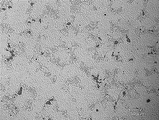
- FIG. 2 shows the metal structure of Example 5, and
- FIG. 3 shows the metal structure of Comparative Material 1.
- the tensile strength (MPa) and elongation at break (%) were measured according to JIS Z2241, and the Brinell hardness was measured according to JIS Z2243. The results are shown in Table 2.
- the grain size was measured by the cutting method, and the representative values are shown in Table 2.
- the bronze alloys according to the present invention have No. Except for No. 2, the Brinell hardness exceeds 120, and it can be seen that a higher hardness can be obtained as compared with the comparative material containing substantially the same amount of Sn.
- the grain size is one order of magnitude smaller than that of the comparative material and contains about 3.5 mass% Fe and Ni. No. In No. 5, the crystal grain size of 1/10 or less was obtained as compared with the unimplemented bronze alloy (Comparative Material 3). It is understood that Ni and Bi affect the crystal grain size even in a small amount.
- test materials No. 5 (Example) out of the bronze alloys in Table 1 and Comparative Materials 1, 7, 8 and 9 were cast into a cylindrical mold of ⁇ 60 ⁇ 150 mm after being cast.
- 10 W class diesel engine oil heated to 60° C. was used as the lubricating oil lu.
- SCM420 steel material which was carburized and hardened to adjust the hardness to HRC58 was used.
- the symbol M indicates a torque meter
- the symbol d indicates oil drainage (FIG. 1).
- the seizure limit PV value (N/mm 2 ⁇ m/min) and the specific wear amount (mm/(N/cm 2 ⁇ m/min ⁇ hr)) were measured.
- the limit PV value is such that the test piece R pressed against the disk D rotating around the rotation axis s at a constant speed of 10 m/sec is run for 10 minutes at 1.25 MPa, and then continuously with a gradient of 0.4 MPa/min.
- the load L was increased, and abnormal rotation or abnormal noise was generated, the test piece temperature was 120° C. or higher, or the friction coefficient reached 0.2, and it was determined as seizure.
- the specific wear amount is such that the test piece R pressed against the disk D that rotates about the rotation axis s at a constant speed of 10 m/sec is run-in for 10 minutes at 2.5 MPa, and then rubbed at a constant pressure of 6.4 MPa for 8 hours.
- the test was conducted and calculated from the dimensional change before and after the test. The results are shown in Table 3.
- the bronze alloy No. 5 shows a seizure limit PV value of over 6000, which is higher than that of the lead bronze-based comparative materials 8 and 9, and it can be seen that the specific wear amount is smaller than that of the other lead-free bronze alloy-based comparative materials 1 and 7.
- FIG. 4 shows an example of seizure resistance test data of a bronze alloy according to the present invention.
- the horizontal axis represents time (min).
- the vertical axis represents the coefficient of friction ( ⁇ ), the load (N), and the temperature (°C), each of which represents friction coefficient data (symbol A), load data (symbol B), and test piece temperature data in the graph. (Symbol C) respectively.
- the graph with large fluctuation shows the change of friction coefficient with the increase of load.
- the seizure limit PV value is calculated from the load when the friction coefficient sharply increases.
- the difference in the seizure limit PV value is the difference in the test piece pressing load, and because of the high-speed sliding of the friction speed of 10 m/sec, when the oil film on the friction surface is interrupted, it seizes instantaneously. Therefore, the bronze alloy No. It is considered that the difference between No. 5 and Comparative Materials 1 and 7 was that the microstructure in the eutectoid structure was changed and the retention of the lubricating oil was improved.
- FIG. 5 shows the hardness of the test materials arranged by the amount of added elements.
- the horizontal axis represents the added amount (mass %), and the vertical axis represents the Brinell hardness (HB).
- the gradient of the approximate line of Fe has a gradient twice as large as the gradient of the approximate line of Sn or Ni, and the effect of increasing hardness is large even with a small amount. This is because Sn and Ni are solid solution strengthening in solid solution in the Cu base, whereas Fe is combined with Ni to form a fine intermetallic compound, which is due to dispersion strengthening uniformly precipitated in the metal structure. Conceivable.
- the method of improving the hardness of the Cu—Sn based bronze alloy according to the present invention is an epoch-making technology.
- Ni is contained in an amount of 1.5 to 5.0 mass% and Fe is contained in an amount of 2.0 to 5.5 mass%, and particularly preferably, the Fe/Ni ratio is 0.1.
- a range of 8 to 1.2 is suitable. In this range, the primary austenite produced by the peritectic eutectic reaction of Fe is combined with Ni to form a fine intermetallic compound and is uniformly precipitated in the metal structure, so that the occurrence of hard spots is suppressed.
- FIG. 6 shows the state of the sliding surfaces of the comparative material 1 (left side FIG. 6a) and the bronze alloy of Example 5 (right side FIG. 6b) after the abrasion test.
- the alloy according to the present invention has a high hardness and therefore has a high resistance to adhesion wear, and no transfer substance is observed on the sliding surface. It is also considered that the Fe-Ni-based intermetallic compound uniformly precipitated in the metal structure hinders the deposition of the transfer material and enhances the cohesive wear resistance.
- the sliding surface of the comparative material 1 having low hardness it is confirmed that the striped transfer material is accumulated. Since the transfer material is brittle and grows into microcracks when subjected to a strong frictional force, it was confirmed that the invention alloy in which the transfer material is hard to deposit has excellent microcrack resistance.
- FIG. 7 is an electron micrograph for identifying the substance precipitated in the bronze alloy of Example 5.
- Fig. 7a is an analysis view
- Fig. 7b is copper
- Fig. 7c is sulfur
- Fig. 7d is nickel
- Fig. 7e is iron.
- the precipitate indicated by the arrow in the analysis field on the left corresponds to the sulfur signal on the right, and is a double sulfide because the shapes of copper and iron are raised.
- many round precipitates other than sulfides are also seen.
- the precipitates other than the sulfides are found only in the bronze alloy according to the present invention, and the shapes of nickel and iron stand out, which indicates that they are Fe-Ni-based intermetallic compounds.
- the present invention is a bronze alloy having a lead-free composition, which is equivalent to or better than a lead bronze-based alloy, or has superior seizure resistance, and a copper alloy system having excellent mechanical strength and microcrack resistance.
- the sliding member can be provided.
- FIG. 7 is a diagram showing a state of sliding surfaces of Comparative Material 1 and a bronze alloy of Example 5 after the abrasion test.
- 5 is an electron micrograph identifying a substance precipitated in a bronze alloy of Example 5.
Landscapes
- Engineering & Computer Science (AREA)
- Chemical & Material Sciences (AREA)
- Mechanical Engineering (AREA)
- Materials Engineering (AREA)
- General Engineering & Computer Science (AREA)
- Organic Chemistry (AREA)
- Metallurgy (AREA)
- Chemical Kinetics & Catalysis (AREA)
- Plasma & Fusion (AREA)
- Physics & Mathematics (AREA)
- Manufacturing & Machinery (AREA)
- Composite Materials (AREA)
- Sliding-Contact Bearings (AREA)
- Other Surface Treatments For Metallic Materials (AREA)
- Powder Metallurgy (AREA)
Abstract
La présente invention concerne un alliage de bronze destiné à être utilisé pour la coulée, qui a une composition sans plomb et présente une résistance au grippage élevée et une résistance à l'usure d'adhérence suffisante pour résister à un glissement à haute vitesse/haute pression de surface variable; et un élément coulissant. L'alliage de bronze pour la coulée selon l'invention est caractérisé en ce qu'il contient 8 à 15 % en masse de Sn, 0,5 à 5,0 % en masse de Bi, 0,5 à 5,0 % en masse de Ni, 0,08 à 1,2 % en masse de S et 1,5 à 6,0 % en masse de Fe, le reste étant constitué de Cu et d'impuretés inévitables, et est également caractérisé en ce qu'il présente, dans sa structure métallique, une structure de microstratifié telle qu'un composé intermétallique à base de cuivre-étain de type flocon est précipité en alpha-cuivre, une structure eutectoïde telle que des micrograins métalliques contenant du Bi sont précipités dans un état dispersé étant développée dans la structure métallique.
Priority Applications (8)
| Application Number | Priority Date | Filing Date | Title |
|---|---|---|---|
| PCT/JP2018/047938 WO2020136772A1 (fr) | 2018-12-26 | 2018-12-26 | Alliage de bronze pour la coulée, et élément coulissant comprenant ledit alliage de bronze |
| CN201980001808.2A CN111630194B (zh) | 2018-12-26 | 2019-05-08 | 青铜合金和使用该青铜合金的滑动件 |
| EP19790416.2A EP3816310B1 (fr) | 2018-12-26 | 2019-05-08 | Alliage de bronze et élément coulissant utilisant ledit alliage de bronze |
| PCT/JP2019/018323 WO2020136935A1 (fr) | 2018-12-26 | 2019-05-08 | Alliage de bronze et élément coulissant utilisant ledit alliage de bronze |
| DK19790416.2T DK3816310T3 (da) | 2018-12-26 | 2019-05-08 | Bronzelegering og glideelement, der anvender denne bronzelegering |
| JP2019572698A JP6953035B2 (ja) | 2018-12-26 | 2019-05-08 | 青銅合金及びその青銅合金を用いた摺動部材並びに摺動部材の製造方法 |
| KR1020197030842A KR102343107B1 (ko) | 2018-12-26 | 2019-05-08 | 청동 합금 및 그 청동 합금을 사용한 슬라이딩 부재 |
| US16/613,314 US20200232068A1 (en) | 2018-12-26 | 2019-05-08 | Bronze alloy, and sliding member using the bronze alloy |
Applications Claiming Priority (1)
| Application Number | Priority Date | Filing Date | Title |
|---|---|---|---|
| PCT/JP2018/047938 WO2020136772A1 (fr) | 2018-12-26 | 2018-12-26 | Alliage de bronze pour la coulée, et élément coulissant comprenant ledit alliage de bronze |
Publications (1)
| Publication Number | Publication Date |
|---|---|
| WO2020136772A1 true WO2020136772A1 (fr) | 2020-07-02 |
Family
ID=71127848
Family Applications (2)
| Application Number | Title | Priority Date | Filing Date |
|---|---|---|---|
| PCT/JP2018/047938 Ceased WO2020136772A1 (fr) | 2018-12-26 | 2018-12-26 | Alliage de bronze pour la coulée, et élément coulissant comprenant ledit alliage de bronze |
| PCT/JP2019/018323 Ceased WO2020136935A1 (fr) | 2018-12-26 | 2019-05-08 | Alliage de bronze et élément coulissant utilisant ledit alliage de bronze |
Family Applications After (1)
| Application Number | Title | Priority Date | Filing Date |
|---|---|---|---|
| PCT/JP2019/018323 Ceased WO2020136935A1 (fr) | 2018-12-26 | 2019-05-08 | Alliage de bronze et élément coulissant utilisant ledit alliage de bronze |
Country Status (7)
| Country | Link |
|---|---|
| US (1) | US20200232068A1 (fr) |
| EP (1) | EP3816310B1 (fr) |
| JP (1) | JP6953035B2 (fr) |
| KR (1) | KR102343107B1 (fr) |
| CN (1) | CN111630194B (fr) |
| DK (1) | DK3816310T3 (fr) |
| WO (2) | WO2020136772A1 (fr) |
Cited By (1)
| Publication number | Priority date | Publication date | Assignee | Title |
|---|---|---|---|---|
| CN114907901A (zh) * | 2022-05-31 | 2022-08-16 | 中国科学院兰州化学物理研究所 | 一种无铅铜合金自润滑材料和泵马达双金属缸体及其制备方法 |
Families Citing this family (2)
| Publication number | Priority date | Publication date | Assignee | Title |
|---|---|---|---|---|
| US11649527B2 (en) * | 2021-01-19 | 2023-05-16 | Robert Bosch Gmbh | Metal alloys for hydraulic applications |
| CN113215435B (zh) * | 2021-05-06 | 2022-03-08 | 西华大学 | Cr2AlC/铜基复合材料及其制备方法 |
Citations (4)
| Publication number | Priority date | Publication date | Assignee | Title |
|---|---|---|---|---|
| JPH11293305A (ja) * | 1998-04-07 | 1999-10-26 | Komatsu Ltd | 摺動材料および複層焼結摺動部材 |
| JP2006022896A (ja) * | 2004-07-08 | 2006-01-26 | Daido Metal Co Ltd | 複層軸受材料およびその製造方法 |
| WO2010030031A1 (fr) * | 2008-09-10 | 2010-03-18 | 大豊工業株式会社 | ÉLÉMENT COULISSANT CONSTITUÉ D'UN MATÉRIAU FRITTÉ EXEMPT DE Pb DE TYPE Cu-Bi |
| JP4806823B2 (ja) * | 2008-05-09 | 2011-11-02 | 石川県 | 青銅合金及びその製造方法、青銅合金を用いた摺動部材 |
Family Cites Families (12)
| Publication number | Priority date | Publication date | Assignee | Title |
|---|---|---|---|---|
| JP3939931B2 (ja) | 2001-03-23 | 2007-07-04 | 大同メタル工業株式会社 | 銅系複層摺動材料 |
| JP2008255490A (ja) * | 2001-07-12 | 2008-10-23 | Komatsu Ltd | 銅系焼結摺動材料および複層焼結摺動部材 |
| JP4514416B2 (ja) | 2003-06-02 | 2010-07-28 | 株式会社小松製作所 | 滑り軸受およびそれを用いる作業機連結装置 |
| JPWO2007126006A1 (ja) | 2006-04-28 | 2009-09-10 | 株式会社カイバラ | 軸受性に優れた摺動材料用銅合金 |
| JP2007297675A (ja) * | 2006-04-28 | 2007-11-15 | Shiga Valve Cooperative | 被削性に優れた鋳物用無鉛銅合金 |
| KR100940593B1 (ko) * | 2009-02-06 | 2010-02-03 | 주식회사 서원 | 무연 쾌삭 청동 주물용 합금 및 그 제조 방법 |
| AT509867B1 (de) * | 2010-04-15 | 2011-12-15 | Miba Gleitlager Gmbh | Mehrschichtgleitlager mit einer antifrettingschicht |
| US20120121455A1 (en) * | 2010-10-29 | 2012-05-17 | Sloan Valve Company | Low lead ingot |
| GB2527368B (en) * | 2014-06-20 | 2020-05-06 | Daido Metal Co | Structure and fabrication method of a multilayer overlay for plain bearings |
| CN104164589B (zh) * | 2014-08-06 | 2016-05-11 | 中国兵器科学研究院宁波分院 | 一种高强耐磨铜合金及其制备方法 |
| CN106544542B (zh) * | 2016-11-10 | 2018-10-02 | 合肥工业大学 | 一种无铅铜基滑动轴承材料及其制备方法 |
| CN108994291A (zh) * | 2018-09-27 | 2018-12-14 | 无锡佳力欣精密机械有限公司 | 一种止推轴承无铅铜基粉末冶金材料 |
-
2018
- 2018-12-26 WO PCT/JP2018/047938 patent/WO2020136772A1/fr not_active Ceased
-
2019
- 2019-05-08 JP JP2019572698A patent/JP6953035B2/ja active Active
- 2019-05-08 US US16/613,314 patent/US20200232068A1/en not_active Abandoned
- 2019-05-08 DK DK19790416.2T patent/DK3816310T3/da active
- 2019-05-08 CN CN201980001808.2A patent/CN111630194B/zh active Active
- 2019-05-08 EP EP19790416.2A patent/EP3816310B1/fr active Active
- 2019-05-08 WO PCT/JP2019/018323 patent/WO2020136935A1/fr not_active Ceased
- 2019-05-08 KR KR1020197030842A patent/KR102343107B1/ko active Active
Patent Citations (4)
| Publication number | Priority date | Publication date | Assignee | Title |
|---|---|---|---|---|
| JPH11293305A (ja) * | 1998-04-07 | 1999-10-26 | Komatsu Ltd | 摺動材料および複層焼結摺動部材 |
| JP2006022896A (ja) * | 2004-07-08 | 2006-01-26 | Daido Metal Co Ltd | 複層軸受材料およびその製造方法 |
| JP4806823B2 (ja) * | 2008-05-09 | 2011-11-02 | 石川県 | 青銅合金及びその製造方法、青銅合金を用いた摺動部材 |
| WO2010030031A1 (fr) * | 2008-09-10 | 2010-03-18 | 大豊工業株式会社 | ÉLÉMENT COULISSANT CONSTITUÉ D'UN MATÉRIAU FRITTÉ EXEMPT DE Pb DE TYPE Cu-Bi |
Cited By (2)
| Publication number | Priority date | Publication date | Assignee | Title |
|---|---|---|---|---|
| CN114907901A (zh) * | 2022-05-31 | 2022-08-16 | 中国科学院兰州化学物理研究所 | 一种无铅铜合金自润滑材料和泵马达双金属缸体及其制备方法 |
| CN114907901B (zh) * | 2022-05-31 | 2022-12-16 | 中国科学院兰州化学物理研究所 | 一种无铅铜合金自润滑材料和泵马达双金属缸体及其制备方法 |
Also Published As
| Publication number | Publication date |
|---|---|
| KR102343107B1 (ko) | 2021-12-24 |
| KR20200083377A (ko) | 2020-07-08 |
| CN111630194B (zh) | 2022-05-03 |
| WO2020136935A1 (fr) | 2020-07-02 |
| EP3816310A1 (fr) | 2021-05-05 |
| EP3816310B1 (fr) | 2024-11-20 |
| DK3816310T3 (da) | 2024-12-02 |
| JP6953035B2 (ja) | 2021-10-27 |
| JPWO2020136935A1 (ja) | 2021-02-18 |
| US20200232068A1 (en) | 2020-07-23 |
| EP3816310A4 (fr) | 2021-12-29 |
| CN111630194A (zh) | 2020-09-04 |
Similar Documents
| Publication | Publication Date | Title |
|---|---|---|
| US9434005B2 (en) | Pb-free copper-alloy sliding material, and plain bearing | |
| JP4190570B2 (ja) | 無鉛快削性銅合金押出材 | |
| JP5563489B2 (ja) | 錫基ホワイトメタルから成る滑り軸受合金 | |
| CN104018024B (zh) | 青铜合金及其制造方法、使用青铜合金的滑动构件 | |
| FI3736350T3 (fi) | Monikerroksinen liukulaakerielementti | |
| GB2367070A (en) | An aluminium bearing alloy | |
| JP6359523B2 (ja) | アンチモン−変性低−鉛銅合金 | |
| JP6953035B2 (ja) | 青銅合金及びその青銅合金を用いた摺動部材並びに摺動部材の製造方法 | |
| JP2003119530A (ja) | アルミニウム系軸受合金 | |
| WO2026040776A1 (fr) | Matériau de titane facile à usiner et son procédé de préparation | |
| CN109022945B (zh) | 一种制冷压缩机的上下轴承法兰、隔板及汽缸体专用稀土铝合金材料及其制备方法 | |
| JP2014501844A (ja) | 低鉛インゴット | |
| JP4341438B2 (ja) | 耐摩耗性に優れたアルミニウム合金及び同合金を用いた摺動部材 | |
| US4025336A (en) | Aluminum bronze having a good wear resistance | |
| JP3920656B2 (ja) | ホウ素含有高剛性Al合金 | |
| CN101384740B (zh) | 用于半固态金属铸造的原料铝-青铜合金 | |
| CN101384386A (zh) | 用于半固态金属铸造的原料磷-青铜合金 | |
| US20180245184A1 (en) | Sliding element composed of a copper alloy | |
| JP2003293068A (ja) | 快削性の過共晶Al−Si系合金 | |
| KR101830841B1 (ko) | 고내마모성을 갖는 싱크로나이저 링용 동합금 및 이의 제조방법 | |
| JPH0913133A (ja) | アルミニウム青銅及びそれを用いた摺動部材 |
Legal Events
| Date | Code | Title | Description |
|---|---|---|---|
| 121 | Ep: the epo has been informed by wipo that ep was designated in this application |
Ref document number: 18945296 Country of ref document: EP Kind code of ref document: A1 |
|
| NENP | Non-entry into the national phase |
Ref country code: DE |
|
| 122 | Ep: pct application non-entry in european phase |
Ref document number: 18945296 Country of ref document: EP Kind code of ref document: A1 |
|
| NENP | Non-entry into the national phase |
Ref country code: JP |