WO2020147526A1 - Procédé et dispositif de codage de code polaire pour concaténer un code crc - Google Patents
Procédé et dispositif de codage de code polaire pour concaténer un code crc Download PDFInfo
- Publication number
- WO2020147526A1 WO2020147526A1 PCT/CN2019/127792 CN2019127792W WO2020147526A1 WO 2020147526 A1 WO2020147526 A1 WO 2020147526A1 CN 2019127792 W CN2019127792 W CN 2019127792W WO 2020147526 A1 WO2020147526 A1 WO 2020147526A1
- Authority
- WO
- WIPO (PCT)
- Prior art keywords
- bits
- matrix
- reliability
- polarized
- rows
- Prior art date
- Legal status (The legal status is an assumption and is not a legal conclusion. Google has not performed a legal analysis and makes no representation as to the accuracy of the status listed.)
- Ceased
Links
Images



Classifications
-
- H—ELECTRICITY
- H03—ELECTRONIC CIRCUITRY
- H03M—CODING; DECODING; CODE CONVERSION IN GENERAL
- H03M13/00—Coding, decoding or code conversion, for error detection or error correction; Coding theory basic assumptions; Coding bounds; Error probability evaluation methods; Channel models; Simulation or testing of codes
- H03M13/29—Coding, decoding or code conversion, for error detection or error correction; Coding theory basic assumptions; Coding bounds; Error probability evaluation methods; Channel models; Simulation or testing of codes combining two or more codes or code structures, e.g. product codes, generalised product codes, concatenated codes, inner and outer codes
- H03M13/2906—Coding, decoding or code conversion, for error detection or error correction; Coding theory basic assumptions; Coding bounds; Error probability evaluation methods; Channel models; Simulation or testing of codes combining two or more codes or code structures, e.g. product codes, generalised product codes, concatenated codes, inner and outer codes using block codes
-
- H—ELECTRICITY
- H03—ELECTRONIC CIRCUITRY
- H03M—CODING; DECODING; CODE CONVERSION IN GENERAL
- H03M13/00—Coding, decoding or code conversion, for error detection or error correction; Coding theory basic assumptions; Coding bounds; Error probability evaluation methods; Channel models; Simulation or testing of codes
- H03M13/03—Error detection or forward error correction by redundancy in data representation, i.e. code words containing more digits than the source words
- H03M13/05—Error detection or forward error correction by redundancy in data representation, i.e. code words containing more digits than the source words using block codes, i.e. a predetermined number of check bits joined to a predetermined number of information bits
- H03M13/09—Error detection only, e.g. using cyclic redundancy check [CRC] codes or single parity bit
-
- H—ELECTRICITY
- H03—ELECTRONIC CIRCUITRY
- H03M—CODING; DECODING; CODE CONVERSION IN GENERAL
- H03M13/00—Coding, decoding or code conversion, for error detection or error correction; Coding theory basic assumptions; Coding bounds; Error probability evaluation methods; Channel models; Simulation or testing of codes
- H03M13/03—Error detection or forward error correction by redundancy in data representation, i.e. code words containing more digits than the source words
- H03M13/05—Error detection or forward error correction by redundancy in data representation, i.e. code words containing more digits than the source words using block codes, i.e. a predetermined number of check bits joined to a predetermined number of information bits
- H03M13/13—Linear codes
Definitions
- This application relates to the field of communication technology, and more specifically, to a polarization code encoding method and device for concatenated CRC codes.
- Polar code also called Polar code, polar code
- Polar code is a coding method proposed by Professor Arikan based on channel polarization.
- Polarization codes are the first and only known channel coding method that can be strictly proven to "reach" the channel capacity. Under different code lengths, especially for limited codes, the performance of Polar codes is much better than Turbo codes and LDPC codes.
- Polar code has lower computational complexity in encoding and decoding.
- This application provides a polar code encoding method and device for concatenated CRC codes, and the Polar code using the concatenated CRC code has better performance than the traditional concatenated scheme.
- an encoding method which includes:
- bit sequence of length K the bit sequence includes K bits, and K is a positive integer
- the M bits are based on the reliability of the K polarized subchannels where the K bits are placed or the K of the K polarized subchannels where the K bits are placed in the first matrix.
- the line weight is determined, or
- the M bits are based on the reliability of the K polarized subchannels where the K bits are placed and the K rows of the K polarized subchannels where the K bits are placed in the first matrix. If the row weight is determined, N is a positive integer power of 2, K is less than or equal to N, L is less than N, (K+L) is less than or equal to N;
- an encoding device which includes:
- An obtaining unit configured to obtain a bit sequence of length K, the bit sequence includes K bits, and K is a positive integer;
- the CRC encoding unit is used to perform CRC encoding on the M bits in the K bits to obtain L CRC check bits, where M and L are both positive integers, and M is less than K;
- the polarization encoding unit is used to perform polarization encoding on the K bits and the L CRC check bits to obtain an encoded codeword of length N, and the polarization encoding encoding matrix is the first matrix ;
- the M bits are based on the reliability of the K polarized subchannels where the K bits are placed or the K of the K polarized subchannels where the K bits are placed in the first matrix.
- the line weight is determined, or
- the M bits are based on the reliability of the K polarized subchannels where the K bits are placed and the K rows of the K polarized subchannels where the K bits are placed in the first matrix. If the row weight is determined, N is a positive integer power of 2, K is less than or equal to N, L is less than N, (K+L) is less than or equal to N;
- the output unit is used to output the encoded codeword.
- a decoding method including:
- the M bits are based on the reliability of the K polarized sub-channels where the K bits are placed or the K rows of the K polarized sub-channels where the K bits are placed in the first matrix. If the row weight is determined, the first matrix is a coding matrix for polarization coding; or
- the M bits are based on the reliability of the K polarized subchannels where the K bits are placed and the K rows of the K polarized subchannels where the K bits are placed in the first matrix.
- N is a positive integer power of 2
- K is less than or equal to N
- L is less than N
- (K+L) is less than or equal to N.
- a decoding device including:
- a decoding unit configured to perform serial cancellation list SCL decoding on information to be decoded, and the information to be decoded includes K bits to be decoded;
- the CRC check unit is used to perform CRC check on candidate paths, where there are L CRC check bits, and the L CRC check bits are used to check M bits among the K bits, and M and L is a positive integer, and M is less than K, and the candidate path that passes the CRC check is determined as the decoding result, and the decoding result includes the decoding result of the information to be decoded;
- An output unit for outputting the decoding result of the information to be decoded
- the M bits are based on the reliability of the K polarized sub-channels where the K bits are placed or the K rows of the K polarized sub-channels where the K bits are placed in the first matrix. If the row weight is determined, the first matrix is a coding matrix for polarization coding; or
- the M bits are based on the reliability of the K polarized subchannels where the K bits are placed and the K rows of the K polarized subchannels where the K bits are placed in the first matrix.
- N is a positive integer power of 2
- K is less than or equal to N
- L is less than N
- (K+L) is less than or equal to N.
- the M bits are based on the K polarized subchannels corresponding to the K bits placed in the first matrix If the row weight of the K rows of, the M bits are bits corresponding to the M rows with a smaller row weight in the K rows or (K+L) rows.
- the first matrix refers to the coding matrix of the polarization code. Generally speaking, for the polarization code, the reliability of the polarization subchannel with a small row weight of the coding matrix is low. The reliability of the polarization subchannel is determined by the row weight of the coding matrix. Sex is very convenient.
- the row weight of the M rows corresponding to the M bits is less than or equal to the first threshold.
- the first threshold is greater than or equal to the minimum value of the row weights of the K rows corresponding to the K bits.
- the first threshold is determined according to the minimum code distance of the polarization code.
- the M bits are determined based on the reliability of the K polarized subchannels in which the K bits are placed.
- the M bits are M bits corresponding to the M polar subchannels with lower reliability among the K polar subchannels where the K bits are placed.
- CRC encoding is performed on the bits with low channel reliability, and the bits with high channel reliability are directly mapped to the polarized sub-channel, which reduces the frame error rate compared to the traditional concatenation scheme with the same CRC code length.
- the M bits are based on the reliability of the K polarization sub-channels in which the K bits are placed and the first matrix
- the row weights of the K rows of the K polarized subchannels corresponding to the K bits are determined.
- the step of determining the M bits includes:
- M bits are determined from the M1 bits, and the M bits are the M bits corresponding to the polarized subchannels with lower reliability among the M1 bits.
- the M bits are based on the reliability of the K polarization sub-channels in which the K bits are placed and the first matrix
- the row weights of the K rows of the K polarized subchannels corresponding to the K bits are determined.
- the step of determining the M bits includes:
- M2 bits are the M2 bits with lower reliability of the corresponding polarized subchannel in the K bits, M2 is greater than or equal to M, and the M2 is positive Integer
- M bits are determined from the M2 bits, and the row weight of the M rows corresponding to the M bits is less than or equal to a second threshold.
- the M bits corresponding to the M polar subchannels with lower reliability are determined according to a table or sequence characterizing reliability, or
- the reliability ranking of the M1 polarized subchannels of M1 bits is determined according to the table or sequence characterizing reliability.
- the M bits corresponding to the M polar subchannels with lower reliability are determined according to the capacity (I(W)), or The reliability ranking of the M1 polarized subchannels of M1 bits is determined according to the capacity (I(W)).
- the M bits corresponding to the M polar subchannels with lower reliability are determined according to the Bhattacharyya parameter (Z(W)), Or the reliability ranking of the M1 polarized subchannels of M1 bits is determined according to the Bhattacharyya parameter (Z(W)).
- the M bits corresponding to the M polar sub-channels with lower reliability are determined according to the error probability (P(W)), Or, the reliability ranking of the M1 polarized channel subchannels of M1 bits is determined according to the error probability (P(W)).
- an encoding device including:
- the processor is configured to execute a program stored in the memory, and when the program is executed, the device executes the method described in the first aspect or all implementation manners of the first aspect.
- the memory is located in the device.
- the memory is integrated with the processor.
- the memory is located outside the device.
- the apparatus is a base station or a terminal.
- the device is a chip or an integrated circuit.
- this application provides a computer-readable storage medium having computer program instructions stored in the computer-readable storage medium.
- the computer executes the first aspect, second aspect, or first aspect described above.
- the method in any possible implementation of the second aspect.
- this application provides a computer program product, the computer program product comprising computer program code, when the computer program code runs on a computer, causes the computer to execute the first aspect, the second aspect, or the first aspect, the first aspect Two methods in any possible implementation.
- a polarization encoding device which has the function of implementing the method described in the first aspect and any one of the possible designs of the first aspect.
- the functions can be realized by hardware, or by hardware executing corresponding software.
- the hardware or software includes one or more modules corresponding to the above functions.
- the polarization encoding device includes a processor, configured to execute the method described in the first aspect and any one of the possible designs of the first aspect.
- the polarization encoding device further includes a storage unit for storing data generated or used in the process of the processor executing the method described in the first aspect and any one of the possible designs of the first aspect. .
- the storage unit may be located outside the encoding device, may be a physically independent unit, or may be a storage space on a cloud server or a network hard disk.
- the polarization encoding device may be a chip or an integrated circuit.
- the polarization encoding device when part or all of the functions are implemented by hardware, includes: an input interface for acquiring a bit sequence; an encoding circuit for executing the first aspect and the first aspect described above. The steps other than obtaining and outputting in the method described in any one of the possible designs; the output interface is used to output the encoded codeword.
- the polarization encoding device may be a chip or an integrated circuit.
- a communication system in a ninth aspect, includes a network device and a terminal, and the network device or terminal can execute the method described in the first aspect and its possible designs.
- a wireless device including a polarization encoding device and a transceiver for implementing the first aspect and any possible design of the first aspect,
- the modulator is used to modulate the processed encoded codeword to obtain a modulated codeword
- the transceiver is used to send modulated codewords.
- the wireless device is a terminal or a network device.
- a polarization decoding device which has the function of implementing the method described in any one of the foregoing third aspect and the third aspect.
- the functions can be realized by hardware, or by hardware executing corresponding software.
- the hardware or software includes one or more modules corresponding to the above functions.
- the polarization decoding apparatus includes a processor, configured to execute the method described in any one of the foregoing third aspect and the third aspect.
- the polarization decoding device further includes a storage unit, configured to store data generated or used during the execution of the method described in the first aspect and any one of the possible designs of the first aspect by the processor. data.
- the storage unit may be located outside the encoding device, may be a physically independent unit, or may be a storage space on a cloud server or a network hard disk.
- the polarization decoding device may be a chip or an integrated circuit.
- the Polar code encoding device when part or all of the functions are realized by hardware, includes: an input interface for obtaining the to-be-decoded bits of a bit sequence of length K; and a decoding circuit , Used to perform steps other than acquisition and output in the method described in the first aspect and any one of the possible designs of the first aspect; the output interface is used to output the bit sequence in the decoding result.
- the polarization decoding device may be a chip or an integrated circuit.
- a communication system which includes a network device and a terminal, and the network device or terminal can execute the method described in the third aspect and its possible designs.
- a wireless device including a polarization decoding device, a demodulator, and a transceiver for implementing the third aspect and any possible design of the third aspect,
- the transceiver receives the modulated codeword.
- the demodulator is used to demodulate the modulated codeword to obtain information to be decoded.
- the wireless device is a terminal or a network device.
- the embodiment of the application selects the bit sequence for CRC encoding from the row weight of the coding matrix (the first matrix) or the reliability of the polarized sub-channel, or comprehensive consideration of row weight and reliability, etc., the cascaded CRC check code
- the polarization code encoding method can achieve better performance.
- Figure 1 (a) a schematic diagram of a wireless communication system in an embodiment of the present application
- Figure 1(b) a simplified schematic diagram of a wireless communication system in an embodiment of the present application
- Figure 2 is a schematic flow diagram of a wireless communication system
- Figure 3 is a block diagram of the encoding process of the traditional Polar code concatenated CRC code
- Fig. 4(a) is a basic flow chart of a polarization code encoding method of concatenated CRC codes provided by an embodiment of this application;
- FIG. 4(b) is a schematic block diagram of a polarization code encoding method of concatenated CRC codes provided by an embodiment of this application;
- FIG. 5 is a flowchart of a method for generating CRC codes based on polarization codes according to an embodiment of the application
- FIG. 6 is a flowchart of another CRC code generation method based on polarization codes provided by an embodiment of the application.
- FIG. 7 is a flowchart of another method for generating CRC codes based on polarization codes according to an embodiment of the application.
- Figure 8 is a simulation comparison curve of the frame error rate FER between the solution of this application and the traditional cascade solution under certain conditions
- FIG. 9 is a schematic structural diagram of an encoding device 900 provided by this application.
- FIG. 10 is a basic flowchart of a polarization code decoding method for concatenated CRC codes provided by an embodiment of the application;
- FIG. 11 is a schematic structural diagram of a decoding device 1100 provided by this application.
- FIG. 12 is a schematic structural diagram of another encoding device 1200 provided by this application.
- FIG. 13 is a schematic structural diagram of a chip 1300 provided by this application.
- FIG. 14 is a schematic structural diagram of another decoding device 1400 provided by this application.
- the embodiments of the present application can be applied to a wireless communication system.
- the wireless communication systems mentioned in the embodiments of this application include but are not limited to: Long Term Evolution (LTE) and the three major application scenarios of the next-generation 5G mobile communication system Enhanced Mobile Broadband (eMBB), URLLC and Massive Machine-Type Communications (mMTC).
- the wireless communication system may also be a device-to-device (D2D) communication system, other communication systems, or future communication systems.
- LTE Long Term Evolution
- eMBB Enhanced Mobile Broadband
- URLLC Massive Machine-Type Communications
- mMTC Massive Machine-Type Communications
- D2D device-to-device
- the communication device involved in this application can be configured in a communication device, and the communication device mainly includes a network device or a terminal device. If the sending end in this application is a network device, the receiving end can be a terminal device; if the sending end in this application is a terminal device, the receiving end can be a network device.
- the wireless communication system in the embodiment of the present application is shown in FIG. 1(a).
- the wireless communication system 100 includes a network device 110 and a terminal 112.
- the network device 110 may also be connected to the core network.
- the network device 101 can also communicate with the IP network 200, for example, the Internet, a private IP network, or other data networks.
- Network equipment provides services for terminals within the coverage area.
- the network device 110 provides wireless access to one or more terminals within the coverage area of the network device 110.
- the network devices may also communicate with each other.
- the network device 110 may communicate with the network device 120.
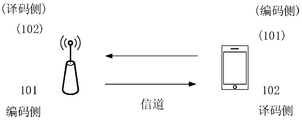
- the embodiment of the present application simplifies the communication system 100 as shown in FIG. 1(b) including a sending end 101 and the receiving end 102 system.
- the sending end 101 may be a network device 110 and the receiving end 102 is a terminal 112; or the sending end 101 is a terminal 112 and the receiving end 102 is a network device 110.
- the network device 110 may be a device for communicating with terminal devices.
- the network device can be an evolved base station (evolved Node B, eNB or eNodeB) in an LTE system, a network side device in a 5G network, a network side device that communicates with a terminal in other networks, or a network side device in a future network, etc. .
- the network device may also be a relay station, an access point, a vehicle-mounted device, etc.
- the network device may also be a terminal that functions as a base station.
- the network equipment may include a BBU (Baseband Unit, baseband unit) and RRU (Remote Radio Unit, remote radio unit). The BBU and RRU can be placed in different places.
- the RRU can be extended and placed in a high-traffic area, and the BBU can be placed in the central computer room.
- the BBU and RRU can also be placed in the same computer room.
- the BBU and RRU may also be different components under one rack.
- Terminals can include various handheld devices with wireless communication functions, vehicle-mounted devices, wearable devices, computing devices or other processing devices connected to wireless modems, as well as various forms of user equipment (UE), and mobile stations (mobile stations). station, MS) etc.
- UE user equipment
- MS mobile stations
- Figure 2 is a schematic diagram of a wireless communication process.
- the source is sent out after source coding, channel coding, rate matching (optional step), and modulation.
- the receiving end it is sequentially output to the sink through demodulation, de-rate matching (optional step), channel decoding, and source decoding.
- the embodiment of this application relates to channel coding.
- the channel coding module the method of polarizing code concatenated CRC code described in the embodiment of this application can be used.
- the method and device provided in this application are applicable to both control channels and data channels.
- Polar code (Polar code, or polar code) is an encoding method that can theoretically achieve the Shannon capacity limit and has low coding and decoding complexity, and can be used for channel coding.
- Polarization code is a linear block code. Under Binary Discrete Memoryless Channel (BDMC), when the length of the polarization code tends to infinity, the continuous cancellation (SC) decoding method is used, and the polarization code can approach the theoretical channel capacity.
- BDMC Binary Discrete Memoryless Channel
- SC continuous cancellation
- the encoding matrix of Polar code is G N , and the encoding process is among them Is a binary row vector with length N; G N is an N ⁇ N matrix, and It is a binary row vector of length N, which can also be called a coding sequence, output sequence, or codeword.
- the codeword or sequence of length N obtained by Polar encoding is also called mother code, so N can also be called mother code length or mother code length. It is defined as the Kronecker product of log 2 N matrices F 2 .
- the above matrix Another form of G N is Coming soon Multiply by a transposed matrix B N , such as a bit reversal (Bit Reversal) matrix.
- a part of the bits are used to carry information, which is called information bit set or information bit sequence.
- the set of indexes of these bits can be called information bit index set or information bit position set, denoted by
- the other part of the bits is set to a fixed value agreed by the receiving end and the sending end in advance.
- These are called frozen bits or frozen bit sets.
- the set of indexes corresponding to these frozen bits can be called frozen bits.
- Index set or frozen bit position set use 'S complement Said.
- Frozen bits are also called fixed bits, which means that fixed bits are placed in these positions and are not used to place information.
- GN(A) is the set of GN The index corresponding to those rows in the sub-matrix
- GN (AC) is the set of The index corresponding to those rows in the sub-matrix.
- K is K.
- various checks including but not limited to Cyclic Redundancy Check (CRC) bits and Parity Check (PC) bits Bits are also included in the information bit set; for The fixed bit set in, whose number is (NK), is a known bit. These fixed bits are usually set to 0, but as long as the receiving end and the sending end agree in advance, the fixed bits can be set arbitrarily.
- Cyclic Redundancy Check (CRC) code is the most common outer code cascaded with Polar code.
- the traditional Polar code concatenated CRC code encoding process block diagram is shown in Figure 3.
- All the bit sequences to be encoded are CRC encoded according to the given CRC polynomial.
- the generated CRC check bits are spliced
- polarization coding is performed on the CRC check bit obtained after CRC encoding and the bit sequence.
- the performance of the traditional polarization code concatenated CRC code scheme is not optimal due to the missed detection. In this case, how to make the polarization code obtain better performance gain is worth studying.
- bit sequence (or information vector) in this application file is different from the above information bit set or information bit sequence.
- the bit sequence in this application file includes payload bits (payload). When PC bits are present, information bits are also Including PC bits.
- the solution of this application provides a polarization code encoding method and device of concatenated CRC codes.
- the method performs CRC encoding on a part of the input bits, and this part of the bits is selected according to a specific rule.
- the rule is from line weight or reliability Or considering three possible perspectives, such as line weight and reliability, to perform polarization encoding on the CRC code obtained after CRC encoding and the input bits, so that the performance of the cascaded polarization code is improved.
- AWGN additive White Gaussian Noise
- the solution of this application works better when the polar code and the CRC are cascaded and the CRC length is short.
- Figure 4(a) shows the basic flow chart of a polarization code encoding method for concatenated CRC codes provided by an embodiment of this application.
- the method selects some bits from the bit sequence to be encoded according to certain rules to participate in the CRC. Encode, generate CRC check bits, and then map these bits and CRC check bits to polarized sub-channels, and the remaining bits in the bit sequence are directly mapped to polarized sub-channels. Perform polarization encoding on all bits of the bit sequence and the generated CRC check bits to generate an encoded codeword.
- This method is applied to sending equipment. As shown in Figure 4(a), the method includes the following steps:
- S102 Perform cyclic redundancy check CRC encoding on the M bits of the K bits to obtain L CRC check bits, where M and L are both positive integers, and M is less than K; where the M bits are Determined based on the reliability of the K polarized subchannels where the K bits are placed or the row weight of the K rows of the K polarized subchannels where the K bits are placed in the first matrix, or The M bits are based on the reliability of the K polarized subchannels where the K bits are placed and the K rows of the K polarized subchannels where the K bits are placed in the first matrix. If the row weight is determined, the first matrix is a coding matrix for polarization coding.
- Fig. 4(b) The schematic diagram of the bit sequence input and output process in the scheme provided by the embodiment of the application is shown in Fig. 4(b).
- bit sequence of length K some bits (M bits) are selected, and the partial bits are based on the row weight. Either reliability is determined, or determined based on both line weight and reliability.
- the L CRC check bits and K bits are used as the input of polarization encoding to generate an encoded codeword of length N. It can be called the length of the polarization code.
- the codeword after polarization encoding is used as the output of the encoding link.
- the M bits are determined based on the row weights of the K rows of the K polarized sub-channels in the first matrix corresponding to the K bits, and the M bits are the Bits corresponding to M rows with a smaller row weight in K rows or (K+L) rows.
- the first matrix refers to a coding matrix of a polarization code.
- the first matrix may be an NxN matrix, where N is the code length of the Polar code, and N is a positive integer.
- N can be 2 n
- n is a non-negative integer.
- the first matrix may be generated according to the value of N, for example, the first matrix may be generated in an existing manner.
- Polar code is a linear block code.
- the generator matrix (or coding matrix) is G N.
- the coding process is Here
- B N is a transposed matrix, such as a bit reversal matrix.
- a bit reversal matrix may not be used, namely
- a pre-stored first matrix corresponding to the value of N may be read.
- the first matrix corresponding to different N values can be pre-stored locally.
- the sequence of 1 ⁇ N may be generated according to the value of N, as described above This sequence is a set including information bits and frozen bits.
- the sequence of 1 ⁇ N stored in advance may be read.
- sequences corresponding to different N values can be pre-stored locally
- Each element in corresponds to N rows of the first matrix of N ⁇ N, Contains information bit sets and frozen bit sets.
- the bit sequence described in S101 can be considered as a subset of the information bit set.
- the bit sequence in this application file refers to the payload bit (payload).
- the bit sequence It may or may not include PC bits. Therefore, the K bits in the bit sequence correspond to K rows in the N ⁇ N first matrix, and the M bits in the K bits correspond to M rows in the N ⁇ N first matrix.
- the “row weight” or “weight” of each row in the involved matrix refers to the number of non-“0” elements in the row.
- One way to determine the weight of a row is to add the non-"0" elements of each row. Therefore, the weight of a row can be equal to the total number of elements "1" in the row. Therefore, the K bits correspond to the row weight of the K rows in the N ⁇ N first matrix, and the M bits in the K bits correspond to the rows of M rows in the N ⁇ N first matrix. weight.
- the M bits corresponding to the M rows with the smaller row weight among the K rows are selected as the bits for CRC encoding.
- the row weight of the M rows corresponding to the M bits is less than or equal to a first threshold.
- the first threshold is greater than or equal to the minimum value of the row weights of the K rows corresponding to the K bits.
- the first threshold is determined according to the minimum code distance of the polarization code.
- rate matching punctching or shortening
- the M bits are determined based on the reliability of the K polarized subchannels in which the K bits are placed.
- the M bits are M bits corresponding to the M polar subchannels with lower reliability among the K polarized subchannels where the K bits are placed.
- CRC encoding is performed on the bits with low channel reliability, and the bits with high channel reliability are directly mapped to the polarized sub-channel, which reduces the frame error rate compared with the traditional cascade scheme.
- the specific method for determining the reliability of the polarized sub-channel is shown in the following embodiments.
- the M bits are based on the reliability of the K polar subchannels where the K bits are placed and the K polarons corresponding to the K bits are placed in the first matrix
- the step of determining the M bits includes:
- M bits are determined from the M1 bits, the M bits are M bits corresponding to the low reliability of the polarized subchannel among the M1 bits, and the M1 is a positive integer.
- the row weight of the first matrix and the reliability of the polarized subchannel are comprehensively considered to select the bits for CRC encoding.
- the K row weights are sorted from small to large, and according to the set threshold, select Smaller M1 rows correspond to bits, where M1 is greater than or equal to the number of bits M for CRC encoding. From the perspective of the reliability of the polarized subchannel, sort the reliability of the polarized subchannel corresponding to the M1 bits, and select the bits corresponding to the M polarized subchannels with lower reliability as the input bits of the CRC encoder .
- the M bits are based on the reliability of the K polarized subchannels where the K bits are placed and the K polarized subchannels where the K bits are placed correspondingly in the first matrix If the row weight of the K rows of is determined, the step of determining the M bits includes:
- M2 bits are determined from the K bits, where the M2 bits are the M2 bits with lower reliability of the corresponding polarized subchannel among the K bits, and M2 is greater than or equal to M;
- M bits are determined from the M2 bits, the row weight of the M rows corresponding to the M bits is less than or equal to a second threshold, and the M2 is a positive integer.
- the row weight of the first matrix and the reliability of the polarized sub-channel are comprehensively considered to select the bits for CRC encoding.
- the K bits Corresponding polarized sub-channel reliability ranking select the bits corresponding to M2 polarized sub-channels with lower reliability, where M2 is greater than or equal to the number of bits M for CRC encoding.
- the M2 row weights are sorted from smallest to largest, and the bits corresponding to the smaller M row weights are selected as the input bits of the CRC encoder according to the set threshold.
- the embodiment of the application considers the two factors of reliability and row weight at the same time, but the embodiment of the application does not impose any restriction on the order of using these two factors.
- FIG. 5 is a flowchart of a method for generating a CRC code based on a polarization code provided by an embodiment of the application, and the method is applied to a sending device (or called a sending end).
- the method selects the bits in the bit sequence for CRC encoding from the perspective of the row weight of the encoding matrix.
- the method includes the following steps:
- the sending end obtains the N ⁇ N first matrix, where N is the code length of the Polar code, and N is a positive integer.
- N is 32
- the first matrix G 32 is a 32 ⁇ 32 matrix, which is generated by the Kronecker power:
- the first matrix G 32 is specifically as follows:
- the transmitting end obtains a bit sequence of length K, where the bit sequence includes K bits, and K is a positive integer.
- the sending end performs CRC encoding on the M bits of the K bits to obtain L CRC check bits, where M and L are both positive integers, and M is less than K, where the M bits are based on The row weight of the K rows of the K polarized subchannels corresponding to the K bits in the first matrix is determined.
- the index i of the K bits corresponds to the K rows of the first matrix (which can be the generator matrix of the polarization code), and mark A as the set of the index i of the bits; mark w represents the weight of each row (That is, the row re-refers to the number of 1s in the row), the bit index corresponding to the weight of the first matrix row is recorded as w i , and the bit index i can be corresponding to the first matrix row without puncturing.
- the part of the bits corresponding to the row weight of the first matrix dmin can be selected for CRC encoding as the input bits of the CRC encoder;
- the row weight of the first matrix is selected as dmin, and the part of the bits corresponding to the row weight of 2*dmin is CRC encoded as the input bits of the CRC encoder, and z is a positive integer; or
- the row weight of each row of the first matrix is based on dmin, and the row weight of the i-th row is expressed as ⁇ i*dmin, and the row weight in the first matrix whose row weight ⁇ i is less than a certain threshold is selected.
- Part of the bits are CRC encoded. As the input bits of the CRC encoder, ⁇ is a positive number.
- the “row weight” or “weight” of each row in the involved matrix refers to the number of non-“0” elements in the row.
- One way to determine the weight of a row is to add the non-"0" elements of each row. Therefore, the weight of a row can represent the total number of elements "1" in the row.
- the row weight of the generator matrix corresponding to the information bit is the weight of the corresponding row of the generator matrix corresponding to the index i of the information bit.
- the minimum distance dmin can be defined in multiple ways according to different conditions.
- one way to determine the minimum distance dmin is to obtain the traditional minimum distance algorithm for calculating linear block codes, such as the Anne Canteaut algorithm.
- an interleaving operation may be performed on the L CRC check bits.
- the rows of the matrix correspond to the input vector of polarization encoding in order from top to bottom.
- [1] is the first row of the first matrix G 32 , corresponding to the first polarized sub-channel;
- [2] is the second row of the first matrix G 32 , corresponding to the second polarized sub-channel ,...
- [32] is the 32nd row of the above-mentioned first matrix G 32 , corresponding to the 32nd polarized subchannel.
- the transmitting end performs some or all of the steps including but not limited to rate matching, modulation mapping, analog-to-digital conversion, and frequency conversion on the polarization-encoded bit sequence.
- step S105 is optional. Since the code length of the codeword (mother code) after polarization encoding is an integer power of 2, in practical applications, it is necessary to achieve any code length through rate matching Polar code. Of course, if the code length of the code block after polarization encoding is the same as the code length of the target code, rate matching is not required. Since the focus of the embodiment of the present invention is not on step S105, it will not be described in detail here.
- FIG. 6 is a flowchart of another method for generating CRC codes based on polarization codes provided by an embodiment of the application, and the method is applied to a sending device. The method includes the following steps:
- the transmitting end obtains a bit sequence of length K, the bit sequence includes K bits, and K is a positive integer.
- S302 The sending end performs CRC encoding on the M bits of the K bits to obtain L CRC check bits, where M and L are both positive integers, and M is less than K, where the M bits are based on The reliability of the K polarized subchannels where the K bits are placed is determined.
- the reliability of the K polarized sub-channels may be sorted according to a predetermined table or sequence that characterizes reliability, so as to obtain the reliability of all the K polarized sub-channels.
- a predetermined table or sequence that characterizes reliability, so as to obtain the reliability of all the K polarized sub-channels.
- the reliability ranking can be determined by determining the capacity (I(W)) of each sub-channel in the K polarized sub-channels, where sub-channels with large capacity have high reliability, and sub-channels with small capacity have low reliability.
- the capacity of each channel can be calculated in the existing way. For example, given a binary discrete memoryless channel W, the capacity I(W) is defined as follows:
- the reliability ranking can also be determined by determining the Bhattacharyya parameter (Z(W)) of each of the K polarized sub-channels Among them, the reliability of the polarized subchannel with a small Bhattacharyya parameter is high, and the reliability of the polarized subchannel with a large Bhattacharyya parameter is low.
- the Bhattacharyya parameter Z(W) is defined as follows:
- the reliability ranking can also be determined by determining the error probability (P(W)) of each sub-channel in the K polarized sub-channels, where the reliability of the polarized sub-channel with a small error probability is high, and the error probability is high. Large polarized sub-channels have low reliability.
- the error pattern of each channel can be obtained through Monte Carlo simulation, and the error probability of each channel can be determined in combination with the number of simulations.
- the reliability ranking of the K bits can also be determined through the functional relationship f(I(W), Z(W), P(W), C), where I(W) represents bit capacity, Z(W) represents the Bhattacharyya parameter, P(W) represents the error probability, and C represents the adjustment parameter (determined according to parameters such as code length and code rate).
- f(I(W), Z(W), P(W), C) the larger the function value, the higher the reliability, and the smaller the function value, the higher the reliability.
- a new function is constructed by taking the inverse of f(I(W), Z(W), P(W), C) and other operations. The smaller the value of the new function, the higher the reliability, and the larger the value of the new function. , The lower the reliability.
- the embodiment of this application does not limit the form of the reliability measurement. You can refer to the reliability measurement parameters for selection, such as bit capacity, Bhattacharyya parameter, error probability and other parameters and combinations thereof to select t information bits with low reliability.
- the method of constructing the functional relationship between the reliability and the bit capacity, Bhattacharyya parameter, error probability and other parameters to determine the reliability of the information bit also falls within the scope of the embodiment of the present application.
- S303 The transmitting end performs polarization encoding on the CRC-encoded bit sequence to obtain a polarization-encoded bit sequence.
- the transmitting end performs some or all of the steps including but not limited to rate matching, modulation mapping, analog-to-digital conversion, frequency conversion, etc., on the polarization-encoded bit sequence.
- S305 The transmitting end outputs the codeword after polarization encoding.
- Fig. 7 is a flowchart of another method for generating CRC codes based on polarization codes provided by an embodiment of the application, and the method is applied to a sending device. The method includes the following steps:
- the sending end obtains the N ⁇ N first matrix, where N is the code length of the Polar code, and N is a positive integer.
- the transmitting end obtains a bit sequence of length K, the bit sequence includes K bits, and K is a positive integer;
- the transmitting end obtains a bit sequence of length K, where the bit sequence includes K bits, and K is a positive integer.
- S403 The sending end performs CRC encoding on the M bits in the K bits to obtain L CRC check bits, where M and L are both positive integers, and M is less than K, where the M bits are based on The reliability of the K polarized subchannels where the K bits are placed is determined by the row weight of the K rows of the K polarized subchannels where the K bits are placed in the first matrix.
- the M1 bits in the M bits are determined based on the row weight in the first matrix of NxN being the bits corresponding to the third set, the third set being: dmin, 2dmin,..., zdmin; or The three sets are dmin; or the third set is ⁇ i*dmin, ⁇ i is less than a certain threshold, i belongs to (1,2,...32), corresponding to the i-th row of the first matrix, where z is a positive integer and ⁇ i is positive number.
- the dmin refers to the minimum value of the row weight corresponding to the K bits in the NxN first matrix; the remaining (M-M1) bits in the M bits are more reliable than the K polarized subchannels.
- the polarized sub-channels corresponding to the M1 bits in the M bits are first excluded from the reliability ranking, and then the less reliable (M-M- M1) sub-channels, the (M-M1) bits corresponding to the (M-M1) sub-channels with lower reliability are the remaining (M-M1) bits in the M bits, where M1 is less than M .
- M1 bits are determined as the to-be-coded bits for CRC encoding by row weight, and the row weight of the first matrix is specifically selected as dmin, 2*dmin,..., the M1 bits corresponding to z*dmin Bits. It can be understood that the above row regrouping is only an example, and does not limit this specific embodiment.
- the remaining (M-M1) bits of the M bits are determined by the reliability of the polarized subchannel, and the polarized subchannel corresponding to the M1 bit of the M bits is first excluded from the reliability ranking, Then from the sorting, according to the order of reliability from low to high, select (M-M1) sub-channels with lower reliability, then (M-M1) corresponding to the (M-M1) sub-channels with lower reliability Bits are the remaining (M-M1) bits in the M bits, where M1 is less than M.
- the purpose of excluding the polarized sub-channels corresponding to M1 bits is that if (M-M1) sub-channels are directly selected from the reliability ranking, the polarized sub-channels corresponding to the M1 bits may be the same as the (M-M- M1) The channels have intersections, so the number of bits finally selected will be less than M.
- the polarization sub-channel corresponding to M1 bits can also be determined based on the row weight.
- M1 is greater than M.
- the polarization sub-channel corresponding to M1 bits can also be determined based on the row weight.
- M1 is greater than M.
- the M polarized sub-channels are the M bits described in step S403.
- the method for determining dmin is the same as the method in the foregoing embodiment, and the method for determining the reliability ranking is also the same as the method in the foregoing embodiment, and will not be repeated.
- This step can include interleaving to become DCRC.
- the transmitting end performs some or all of the steps including but not limited to rate matching, modulation mapping, analog-to-digital conversion, frequency conversion, etc., on the code block after polarization encoding.
- Figure 8 shows the simulation comparison curve of the frame error rate FER between the scheme of this application and the traditional cascade scheme under certain conditions (in AWGN channel, the code rate R of the polarization code is 1/2, and the mother code length N is 128, the CRC code length is 4).
- the solid line with the data point in the figure is the FER curve of the traditional polarization code cascaded with 4 CRC check bits.
- the dotted line with the data point is the star of this application.
- the bit rate R of the polarized code is 1/2
- the length of the mother code is 128, and the length of the CRC code is 4, which is less reliable.
- the bit number t of the polarized sub-channel is 48) and a scheme that comprehensively considers the row weight of the coding matrix and channel reliability (under the AWGN channel, the bit rate R of the polarized code is 1/2, the length of the mother code is 128, and the CRC The code length is 4, the bit number t placed in the polarized sub-channel with lower reliability is 48, and S is set to 2). Good performance results are obtained.
- This application can achieve better performance when the CRC length is small.
- the polarization coding method provided in the embodiment of the present application may be adopted.
- FIG. 9 is a schematic structural diagram of an encoding device 900 provided by this application.
- the encoding device 900 includes:
- the obtaining unit 901 is configured to obtain a bit sequence of length K, the bit sequence includes K bits, and K is a positive integer;
- the CRC encoding unit 902 is configured to perform CRC encoding on the M bits of the K bits to obtain L CRC check bits, where M and L are both positive integers, and M is less than K;
- the polarization encoding unit 903 is configured to perform polarization encoding on the K bits and the L CRC check bits to obtain an encoded codeword of length N, and the polarization encoding encoding matrix is the first matrix;
- the M bits are based on the reliability of the K polarized subchannels where the K bits are placed or the K of the K polarized subchannels where the K bits are placed in the first matrix.
- the line weight is determined, or
- the M bits are based on the reliability of the K polarized subchannels where the K bits are placed and the K rows of the K polarized subchannels where the K bits are placed in the first matrix. If the row weight is determined, N is a positive integer power of 2, K is less than or equal to N, L is less than N, (K+L) is less than or equal to N;
- the output unit 904 is configured to output the encoded codeword.
- the M bits are determined based on the row weights of the K rows of the K polarized sub-channels in the first matrix corresponding to the K bits, and the M bits are the Bits corresponding to M rows with a smaller row weight in K rows or (K+L) rows.
- the first matrix refers to the coding matrix of the polarization code.
- the reliability of the polarization subchannel with a small row weight of the coding matrix is low.
- the reliability of the polarization subchannel is determined by the row weight of the coding matrix. Sex is very convenient.
- the row weight of the M rows corresponding to the M bits is less than or equal to a first threshold.
- the first threshold is greater than or equal to the minimum value of the row weights of the K rows corresponding to the K bits.
- the first threshold is determined according to the minimum code distance of the polarization code.
- the M bits are determined based on the reliability of the K polarized sub-channels where the K bits are placed. Specifically, the M bits are the K polarizations where the K bits are placed. Among the sub-channels, M polarized sub-channels with lower reliability correspond to M bits. CRC encoding is performed on the bits with low channel reliability, and the bits with high channel reliability are directly mapped to the polarized sub-channel, thereby reducing the frame error rate.
- the M bits are based on the reliability of the K polarized subchannels where the K bits are placed and the K polarized subchannels where the K bits are placed correspondingly in the first matrix If the row weight of the K rows of is determined, the step of determining the M bits includes:
- M bits are determined from the M1 bits, the M bits are M bits corresponding to the low reliability of the polarized subchannel among the M1 bits, and the M1 is a positive integer.
- the M bits are based on the reliability of the K polarized subchannels where the K bits are placed and the K polarized subchannels where the K bits are placed correspondingly in the first matrix If the row weight of the K rows of is determined, the step of determining the M bits includes:
- M2 bits are determined from the K bits, where the M2 bits are M2 bits corresponding to the K bits with low reliability of the polarized subchannel, M2 is greater than or equal to M, and M2 is a positive integer;
- M bits are determined from the M2 bits, and the row weight of the M rows corresponding to the M bits is less than or equal to a second threshold.
- the reliability ranking of the M1 polarized subchannels of M1 bits is determined according to the table or sequence characterizing reliability.
- FIG. 10 is a basic flowchart of a polarization code decoding method for concatenated CRC codes provided by an embodiment of this application. The method includes the following steps:
- the receiving end performs serial cancellation list SCL decoding on information to be decoded, and the information to be decoded includes K bits to be decoded.
- S503 Output the decoding result of the information to be decoded.
- the M bits are based on the reliability of the K polarized sub-channels where the K bits are placed or the K rows of the K polarized sub-channels where the K bits are placed in the first matrix. If the row weight is determined, the first matrix is a coding matrix for polarization coding; or
- the M bits are based on the reliability of the K polarized subchannels where the K bits are placed and the K rows of the K polarized subchannels where the K bits are placed in the first matrix.
- N is a positive integer power of 2
- K is less than or equal to N
- L is less than N
- (K+L) is less than or equal to N.
- the M bits are determined based on the row weights of the K rows of the K polarized sub-channels in the first matrix corresponding to the K bits, and the M bits are the Bits corresponding to M rows with a smaller row weight in K rows or (K+L) rows.
- the first matrix refers to a coding matrix of a polarization code.
- the row weight of the M rows corresponding to the M bits is less than or equal to a first threshold.
- the first threshold is greater than or equal to the minimum value of the row weights of the K rows corresponding to the K bits.
- the first threshold is determined according to the minimum code distance of the polarization code.
- the M bits are determined based on the reliability of the K polarized subchannels in which the K bits are placed.
- the M bits are M bits corresponding to the M polar subchannels with lower reliability among the K polar subchannels where the K bits are placed.
- CRC encoding is performed on the bits with low channel reliability, and the bits with high channel reliability are directly mapped to the polarized sub-channel, which reduces the frame error rate compared to the traditional concatenation scheme with the same CRC code length.
- the M bits are based on the reliability of the K polarized subchannels where the K bits are placed and the K polarized subchannels where the K bits are placed correspondingly in the first matrix
- the line weight of the K lines is determined.
- the step of determining the M bits includes:
- M bits are determined from the M1 bits, and the M bits are the M bits corresponding to the polarized subchannels with lower reliability among the M1 bits.
- the M bits are based on the reliability of the K polarized subchannels where the K bits are placed and the K polarized subchannels where the K bits are placed correspondingly in the first matrix
- the line weight of the K lines is determined.
- the step of determining the M bits includes:
- M2 bits are the M2 bits with lower reliability of the corresponding polarized subchannel in the K bits, M2 is greater than or equal to M, and the M2 is positive Integer
- M bits are determined from the M2 bits, and the row weight of the M rows corresponding to the M bits is less than or equal to a second threshold.
- the reliability ranking of the M1 polarized subchannels of M1 bits is determined according to the table or sequence characterizing reliability.
- FIG. 11 is a schematic structural diagram of a decoding device 1100 provided by this application.
- the encoding device 1100 includes:
- the decoding unit 1101 is configured to perform serial cancellation list SCL decoding on information to be decoded, and the information to be decoded includes K bits to be decoded;
- the CRC check unit 1102 is used to perform CRC check on candidate paths, where there are L CRC check bits, and the L CRC check bits are used to check M bits among the K bits, and M And L are both positive integers, and M is less than K, the candidate path that passes the CRC check is determined as the decoding result, and the decoding result includes the decoding result of the information to be decoded;
- the output unit 1103 is configured to output the decoding result of the information to be decoded
- the M bits are based on the reliability of the K polarized sub-channels where the K bits are placed or the K rows of the K polarized sub-channels where the K bits are placed in the first matrix. If the row weight is determined, the first matrix is a coding matrix for polarization coding; or
- the M bits are based on the reliability of the K polarized subchannels where the K bits are placed and the K rows of the K polarized subchannels where the K bits are placed in the first matrix.
- N is a positive integer power of 2
- K is less than or equal to N
- L is less than N
- (K+L) is less than or equal to N.
- the row weight of the M rows corresponding to the M bits is less than or equal to a first threshold.
- the first threshold is greater than or equal to the minimum value of the row weights of the K rows corresponding to the K bits.
- the first threshold is determined according to the minimum code distance of the polarization code.
- the M bits are determined based on the reliability of the K polarized subchannels in which the K bits are placed.
- the M bits are M bits corresponding to the M polar subchannels with lower reliability among the K polar subchannels where the K bits are placed.
- CRC encoding is performed on the bits with low channel reliability, and the bits with high channel reliability are directly mapped to the polarized sub-channel, which reduces the frame error rate compared to the traditional concatenation scheme with the same CRC code length.
- the M bits are based on the reliability of the K polarized subchannels where the K bits are placed and the K polarized subchannels where the K bits are placed correspondingly in the first matrix
- the line weight of the K lines is determined.
- the step of determining the M bits includes:
- M bits are determined from the M1 bits, and the M bits are the M bits corresponding to the polarized subchannels with lower reliability among the M1 bits.
- the M bits are based on the reliability of the K polarized subchannels where the K bits are placed and the K polarized subchannels where the K bits are placed correspondingly in the first matrix
- the line weight of the K lines is determined.
- the step of determining the M bits includes:
- M2 bits are the M2 bits with lower reliability of the corresponding polarized subchannel in the K bits, M2 is greater than or equal to M, and the M2 is positive Integer
- M bits are determined from the M2 bits, and the row weight of the M rows corresponding to the M bits is less than or equal to a second threshold.
- the reliability ranking of the M1 polarized subchannels of M1 bits is determined according to the table or sequence characterizing reliability.
- FIG. 12 shows the structure of another encoding device 1200 provided by this application.
- the encoding device 1200 includes:
- the processor 1201 is configured to execute a program stored in the memory 1202 or the memory 1203 or the memory 1204, and when the program is executed, the device executes the encoding method described in any of the foregoing embodiments.
- the memory 1202, the memory 1203, or the memory 1204 may also store data generated or used during the execution of the encoding method by the processor.
- the memory is a cache.
- the storage can be a physically independent unit, or it can be a storage space on a cloud server or a network hard drive.
- the memory 1202 is located in the device.
- the memory 1203 is integrated with the processor 1201.
- the memory 1204 is located outside the device.
- the device is a base station or a terminal.
- the device is a chip or an integrated circuit.
- the processor 1201 may be a central processing unit (CPU), a network processor (NP), or a combination of CPU and NP.
- CPU central processing unit
- NP network processor
- the processor 1201 may also be a hardware chip, and may be an application-specific integrated circuit (ASIC), a programmable logic device (PLD), or a combination thereof.
- the PLD may be a complex programmable logic device (complex programmable logic device, CPLD), a field programmable logic gate array (field-programmable gate array, FPGA), a general array logic (generic array logic, GAL), or any combination thereof.
- the memory (or storage unit) in the embodiment of the present application may include volatile memory (volatile memory), such as random-access memory (RAM); the memory may also include non-volatile memory (non-volatile memory).
- volatile memory volatile memory
- non-volatile memory non-volatile memory
- memory such as flash memory (flash memory), hard disk drive (HDD) or solid-state drive (SSD), cloud storage (cloud storage), network attached storage (NAS: network attached Storage) , Network drive, etc.
- the memory may also include a combination of the above-mentioned types of memory or any other medium or product with storage function.
- the device is a base station or a terminal.
- the device is a chip or an integrated circuit.
- FIG. 13 is a schematic structural diagram of a chip 1300 provided by this application.
- the chip 1300 includes:
- the input interface 1301 is used to obtain a bit sequence of length K, the bit sequence includes K bits, and K is a positive integer;
- the encoding circuit 1302 is configured to perform CRC encoding on M of the K bits to obtain L CRC check bits, where M and L are both positive integers, and M is less than K;
- the encoding circuit 1302 is further configured to perform polarization encoding on the K bits and the L CRC check bits to obtain an encoded codeword of length N, and the polarization encoding encoding matrix is the first matrix ;
- the M bits are based on the reliability of the K polarized subchannels where the K bits are placed or the K of the K polarized subchannels where the K bits are placed in the first matrix.
- the line weight is determined, or
- the M bits are based on the reliability of the K polarized subchannels where the K bits are placed and the K rows of the K polarized subchannels where the K bits are placed in the first matrix. If the row weight is determined, N is a positive integer power of 2, K is less than or equal to N, L is less than N, (K+L) is less than or equal to N;
- the output interface 1303 is used to output the encoded codeword.
- the M bits are determined based on the row weights of the K rows of the K polarized sub-channels in the first matrix corresponding to the K bits, and the M bits are the Bits corresponding to M rows with a smaller row weight in K rows or (K+L) rows.
- the row weight of the M rows corresponding to the M bits is less than or equal to a first threshold.
- the first threshold is greater than or equal to the minimum value of the row weights of the K rows corresponding to the K bits.
- the M bits are determined based on the reliability of the K polarized sub-channels where the K bits are placed. Specifically, the M bits are the K polarizations where the K bits are placed. Among the sub-channels, M polarized sub-channels with lower reliability correspond to M bits.
- the M bits are determined based on the reliability of the K polarized subchannels where the K bits are placed and the row weight of the first matrix, and the step of determining the M bits includes:
- M bits are determined from the M1 bits, and the M bits are the M bits corresponding to the polarized subchannels with lower reliability among the M1 bits.
- the M bits are determined based on the reliability of the K polarized subchannels where the K bits are placed and the row weight of the first matrix, and the step of determining the M bits includes:
- M2 bits are determined from the K bits, where the M2 bits are the M2 bits with lower reliability of the corresponding polarized subchannel among the K bits, and M2 is greater than or equal to M;
- M bits are determined from the M2 bits, and the row weight of the M rows corresponding to the M bits is less than or equal to a second threshold.
- An embodiment of the present application also provides a communication system, which includes a network device and a terminal, and the network device or terminal can execute the encoding method described in the foregoing embodiment.
- An embodiment of the present application also provides a wireless device, including an encoding device and a transceiver used to implement the above-mentioned embodiment, where the modulator is used to modulate the processed encoded codeword to obtain a modulated codeword; The transceiver is used to transmit the modulated codeword.
- the wireless device is a terminal or a network device.
- Part or all of the decoding method described in the foregoing embodiment can be implemented by hardware or software.
- Another decoding device 1400 provided by this application is shown in FIG. 14
- the structure diagram of the decoding device 1400 includes:
- the processor 1401 is configured to execute a program stored in the memory 1402 or the memory 1403 or the memory 1404, and when the program is executed, the device executes the decoding method described in any of the foregoing embodiments.
- the storage 1402 or the storage 1403 or the storage 1404 may also store data generated or used in the process of executing the decoding method by the processor.
- the storage can be a physically independent unit, or it can be a storage space on a cloud server or a network hard drive.
- the storage is a cache or cloud disk.
- the memory 1402 is located in the device.
- the memory 1403 is integrated with the processor 1401.
- the memory 1404 is located outside the device.
- the device is a base station or a terminal.
- the device is a chip or an integrated circuit.
- the processor 1401 may be a central processing unit (CPU), a network processor (NP), or a combination of a CPU and an NP.
- CPU central processing unit
- NP network processor
- the processor 1401 may also be a hardware chip, which may be an application-specific integrated circuit (ASIC), a programmable logic device (PLD), or a combination thereof.
- the PLD may be a complex programmable logic device (complex programmable logic device, CPLD), a field programmable logic gate array (field-programmable gate array, FPGA), a general array logic (generic array logic, GAL), or any combination thereof.
- the memory (or storage unit) in the embodiment of the present application may include volatile memory (volatile memory), such as random-access memory (RAM); the memory may also include non-volatile memory (non-volatile memory).
- volatile memory volatile memory
- non-volatile memory non-volatile memory
- memory such as flash memory (flash memory), hard disk drive (HDD) or solid-state drive (SSD), cloud storage (cloud storage), network attached storage (NAS: network attached Storage) , Network drive, etc.
- the memory may also include a combination of the above-mentioned types of memory or any other medium or product with storage function.
- the device is a base station or a terminal.
- the device is a chip or an integrated circuit.
- An embodiment of the present application also provides a communication system, which includes a network device and a terminal, and the network device or terminal can execute the decoding method described in the foregoing embodiment.
- An embodiment of the present application also provides a wireless device, including a decoding device, a demodulator, and a transceiver used to implement the above-mentioned embodiment, and the transceiver receives the modulated codeword.
- the demodulator is used to demodulate the modulated codeword to obtain information to be decoded.
- the wireless device is a terminal or a network device.
- An embodiment of the present application also provides a computer-readable storage medium on which computer program instructions are stored, and when the computer program instructions are executed by a computer, the decoding method in any of the above-mentioned embodiments is implemented.
- the embodiments of the present application also provide a computer program product, which, when it is run on a computer, enables the computer to implement the decoding method in any of the foregoing embodiments.
- the embodiment of the present application also provides a system chip, which includes a processing unit and a communication unit.
- the processing unit may be a processor, for example.
- the communication unit may be, for example, an input/output interface, a pin, or a circuit.
- the processing unit can execute computer instructions so that the chip in the communication device executes any of the methods provided in the foregoing embodiments of the present application.
- the processor may include, but is not limited to, at least one of the following: central processing unit (central processing unit, CPU), microprocessor, digital signal processor (DSP), microcontroller (microcontroller unit, MCU), or artificial intelligence
- CPU central processing unit
- DSP digital signal processor
- MCU microcontroller unit
- Various computing devices that run software, such as processors, and each computing device may include one or more cores for executing software instructions to perform operations or processing.
- the processor can be built in SoC (system on chip) or application specific integrated circuit (ASIC), or it can be an independent semiconductor chip.
- SoC system on chip
- ASIC application specific integrated circuit
- the processor's internal processing is used to execute software instructions for calculations or processing, and may further include necessary hardware accelerators, such as field programmable gate array (FPGA), PLD (programmable logic device) , Or a logic circuit that implements dedicated logic operations.
- FPGA field programmable gate array
- PLD programmable logic device
- the hardware may be CPU, microprocessor, DSP, MCU, artificial intelligence processor, ASIC, SoC, FPGA, PLD, dedicated digital circuit, hardware accelerator or non-integrated discrete device Any one or any combination of them can run the necessary software or do not depend on the software to perform the above method flow.
Landscapes
- Physics & Mathematics (AREA)
- Probability & Statistics with Applications (AREA)
- Engineering & Computer Science (AREA)
- Theoretical Computer Science (AREA)
- Error Detection And Correction (AREA)
- Compression, Expansion, Code Conversion, And Decoders (AREA)
Abstract
La présente invention concerne un procédé et un dispositif de codage de code polaire pour concaténer un code CRC. Le procédé consiste à : obtenir une séquence de bits ayant une longueur K au niveau d'une extrémité d'envoi ; sélectionner M bits à partir de K bits de la séquence pour un codage de CRC, les M bits étant déterminés sur la base d'une fiabilité de K sous-canaux polarisés dans lesquels les K bits sont placés ou un poids de rangée de K rangées dans une première matrice correspondant aux K sous-canaux polarisés où les K bits sont placés, ou les M bits sont déterminés sur la base de la fiabilité des K sous-canaux polarisés où les K bits sont placés et le poids de rangée des K rangées dans la première matrice correspondant aux K sous-canaux polarisés où les K bits sont placés, et la première matrice est une matrice de codage codée polaire ; et la réaliser un codage polaire et délivrer en sortie les K bits et des bits de contrôle CRC obtenus. Des résultats de simulation montrent que, par comparaison avec un procédé de concaténation de code polaire classique ayant la même longueur de code CRC, le procédé peut réduire efficacement le taux d'erreur de trame et obtenir un gain de performance.
Priority Applications (2)
| Application Number | Priority Date | Filing Date | Title |
|---|---|---|---|
| EP19910624.6A EP3852274B1 (fr) | 2019-01-17 | 2019-12-24 | Procédé et dispositif de codage de code polaire pour concaténer un code crc |
| US17/322,451 US11558068B2 (en) | 2019-01-17 | 2021-05-17 | Method and apparatus for encoding polar code concatenated with CRC code |
Applications Claiming Priority (2)
| Application Number | Priority Date | Filing Date | Title |
|---|---|---|---|
| CN201910042371.9A CN111446969B (zh) | 2019-01-17 | 2019-01-17 | 一种级联crc码的极化码编码方法及装置 |
| CN201910042371.9 | 2019-01-17 |
Related Child Applications (1)
| Application Number | Title | Priority Date | Filing Date |
|---|---|---|---|
| US17/322,451 Continuation US11558068B2 (en) | 2019-01-17 | 2021-05-17 | Method and apparatus for encoding polar code concatenated with CRC code |
Publications (1)
| Publication Number | Publication Date |
|---|---|
| WO2020147526A1 true WO2020147526A1 (fr) | 2020-07-23 |
Family
ID=71614032
Family Applications (1)
| Application Number | Title | Priority Date | Filing Date |
|---|---|---|---|
| PCT/CN2019/127792 Ceased WO2020147526A1 (fr) | 2019-01-17 | 2019-12-24 | Procédé et dispositif de codage de code polaire pour concaténer un code crc |
Country Status (4)
| Country | Link |
|---|---|
| US (1) | US11558068B2 (fr) |
| EP (1) | EP3852274B1 (fr) |
| CN (1) | CN111446969B (fr) |
| WO (1) | WO2020147526A1 (fr) |
Cited By (1)
| Publication number | Priority date | Publication date | Assignee | Title |
|---|---|---|---|---|
| CN115603760A (zh) * | 2022-09-26 | 2023-01-13 | 中国地质大学(武汉)(Cn) | 一种关键集保护的CRC级联Polar码编码方法 |
Families Citing this family (10)
| Publication number | Priority date | Publication date | Assignee | Title |
|---|---|---|---|---|
| CN110727633A (zh) * | 2019-09-17 | 2020-01-24 | 广东高云半导体科技股份有限公司 | 基于SoC FPGA的边缘人工智能计算系统构架 |
| CN113438023B (zh) * | 2021-06-18 | 2022-08-05 | 重庆理工大学 | 一种自由空间光通信中极化码级联编码方法及装置 |
| EP4177900A3 (fr) | 2021-10-12 | 2023-07-26 | Purecodon (Hong Kong) Biopharma Limited | Procédé de criblage d'ires basé sur la distance de levenshtéine et polynucléotide marqué sur la base de ce procédé |
| CN115086684B (zh) * | 2022-08-22 | 2022-11-18 | 中科金勃信(山东)科技有限公司 | 一种基于crc的图像压缩方法、系统及介质 |
| CN118138189A (zh) * | 2022-12-02 | 2024-06-04 | 华为技术有限公司 | 编码方法、译码方法以及通信装置 |
| CN116232543B (zh) * | 2022-12-30 | 2025-05-13 | 北京通广龙电子科技有限公司 | Link16数据链往返计时传输方法及系统 |
| US20240405785A1 (en) * | 2023-05-30 | 2024-12-05 | Samsung Electronics Co., Ltd. | Polar codes with partial repetition |
| CN120433885A (zh) * | 2024-02-05 | 2025-08-05 | 华为技术有限公司 | 通信方法及装置 |
| CN121098445A (zh) * | 2024-06-03 | 2025-12-09 | 华为技术有限公司 | 通信方法和通信装置 |
| CN119316096B (zh) * | 2024-12-17 | 2025-03-11 | 杰创智能科技股份有限公司 | Crc校验码的生成方法、装置、电子设备及存储介质 |
Citations (3)
| Publication number | Priority date | Publication date | Assignee | Title |
|---|---|---|---|---|
| US20140173376A1 (en) * | 2012-12-14 | 2014-06-19 | Sungkyunkwan University Research & Business Foundation | Encoding method and apparatus using crc code and polar code |
| CN109120376A (zh) * | 2018-06-30 | 2019-01-01 | 中国人民解放军陆军工程大学 | 基于极化码级联的低复杂度crc设计方法 |
| CN109150383A (zh) * | 2017-06-27 | 2019-01-04 | 华为技术有限公司 | 一种Polar码的编码方法及装置 |
Family Cites Families (7)
| Publication number | Priority date | Publication date | Assignee | Title |
|---|---|---|---|---|
| US9917675B2 (en) * | 2016-06-01 | 2018-03-13 | Qualcomm Incorporated | Enhanced polar code constructions by strategic placement of CRC bits |
| US10637607B2 (en) * | 2016-09-15 | 2020-04-28 | Huawei Technologies Co., Ltd. | Method and apparatus for encoding data using a polar code |
| CN114553243A (zh) * | 2017-03-02 | 2022-05-27 | 华为技术有限公司 | Polar码编译码方法及装置 |
| US10075197B1 (en) * | 2017-03-07 | 2018-09-11 | Lg Electronics Inc. | Method and apparatus for transmitting hamming weight and codeword |
| CN110785937B (zh) * | 2017-06-26 | 2023-08-25 | 上海诺基亚贝尔股份有限公司 | Crc和极化码传输方案 |
| WO2019073403A1 (fr) * | 2017-10-10 | 2019-04-18 | Telefonaktiebolaget Lm Ericsson (Publ) | Calcul de bit de contrôle de parité simple pour codes polaires |
| WO2020045943A1 (fr) * | 2018-08-30 | 2020-03-05 | 엘지전자 주식회사 | Procédé et dispositif destinés à la réalisation de codage de canal sur la base d'un codage polaire dans un système de communication sans fil |
-
2019
- 2019-01-17 CN CN201910042371.9A patent/CN111446969B/zh active Active
- 2019-12-24 WO PCT/CN2019/127792 patent/WO2020147526A1/fr not_active Ceased
- 2019-12-24 EP EP19910624.6A patent/EP3852274B1/fr active Active
-
2021
- 2021-05-17 US US17/322,451 patent/US11558068B2/en active Active
Patent Citations (3)
| Publication number | Priority date | Publication date | Assignee | Title |
|---|---|---|---|---|
| US20140173376A1 (en) * | 2012-12-14 | 2014-06-19 | Sungkyunkwan University Research & Business Foundation | Encoding method and apparatus using crc code and polar code |
| CN109150383A (zh) * | 2017-06-27 | 2019-01-04 | 华为技术有限公司 | 一种Polar码的编码方法及装置 |
| CN109120376A (zh) * | 2018-06-30 | 2019-01-01 | 中国人民解放军陆军工程大学 | 基于极化码级联的低复杂度crc设计方法 |
Non-Patent Citations (1)
| Title |
|---|
| NTT DOCOMO: "CRC related design of Polar codes", 3GPP TSG RAN WG1 MEETING #88BIS R1-1705756, 25 March 2017 (2017-03-25), XP051252171 * |
Cited By (2)
| Publication number | Priority date | Publication date | Assignee | Title |
|---|---|---|---|---|
| CN115603760A (zh) * | 2022-09-26 | 2023-01-13 | 中国地质大学(武汉)(Cn) | 一种关键集保护的CRC级联Polar码编码方法 |
| CN115603760B (zh) * | 2022-09-26 | 2025-12-23 | 中国地质大学(武汉) | 一种关键集保护的CRC级联Polar码编码方法 |
Also Published As
| Publication number | Publication date |
|---|---|
| CN111446969B (zh) | 2023-10-20 |
| US11558068B2 (en) | 2023-01-17 |
| EP3852274A1 (fr) | 2021-07-21 |
| CN111446969A (zh) | 2020-07-24 |
| EP3852274A4 (fr) | 2021-12-22 |
| EP3852274B1 (fr) | 2025-02-19 |
| US20210273658A1 (en) | 2021-09-02 |
Similar Documents
| Publication | Publication Date | Title |
|---|---|---|
| WO2020147526A1 (fr) | Procédé et dispositif de codage de code polaire pour concaténer un code crc | |
| US11750217B2 (en) | Polar coding method and apparatus | |
| US20230113448A1 (en) | Polar code rate matching method and apparatus | |
| WO2019062145A1 (fr) | Procédé de codage polaire et appareil de codage ainsi que procédé de décodage et appareil de décodage | |
| WO2023226690A1 (fr) | Procédé et appareil de codage et de décodage | |
| CN107659381B (zh) | 编译码方法及装置 | |
| CN111447042B (zh) | 一种极化编译码方法及装置 | |
| CN111385059B (zh) | 极化编码调制的方法和装置 | |
| RU2760317C2 (ru) | Способ и устройство для полярного кодирования | |
| WO2019024594A1 (fr) | Procédés, appareils et dispositifs permettant de coder et décoder un code de polarisation | |
| CN109314524A (zh) | 使用通用极化码时通过异构内核进行速率匹配的系统和方法 | |
| US12463746B2 (en) | Encoding and decoding method and apparatus | |
| CN108282259A (zh) | 一种编码方法及装置 | |
| WO2022007621A1 (fr) | Procédé et appareil de codage/décodage de code polaire | |
| CN109391367A (zh) | 通信方法和装置 | |
| WO2023226689A1 (fr) | Procédé et appareil de codage, et procédé et appareil de décodage | |
| WO2019024815A1 (fr) | Procédé et dispositif de codage segmenté | |
| WO2018127069A1 (fr) | Procédé et dispositif de codage | |
| CN108390739B (zh) | 数据处理的方法和装置 | |
| US12143125B2 (en) | Polarization encoding method and apparatus | |
| CN115378546A (zh) | 编译码方法及装置 | |
| CN108418658A (zh) | 编码方法及装置 | |
| CN109088698B (zh) | 一种编码方法及通信设备 | |
| CN110890949B (zh) | 配置无线网络临时标识rnti的方法和装置 |
Legal Events
| Date | Code | Title | Description |
|---|---|---|---|
| 121 | Ep: the epo has been informed by wipo that ep was designated in this application |
Ref document number: 19910624 Country of ref document: EP Kind code of ref document: A1 |
|
| ENP | Entry into the national phase |
Ref document number: 2019910624 Country of ref document: EP Effective date: 20210315 |
|
| NENP | Non-entry into the national phase |
Ref country code: DE |