WO2020149394A1 - 細胞凍結保存液 - Google Patents
細胞凍結保存液 Download PDFInfo
- Publication number
- WO2020149394A1 WO2020149394A1 PCT/JP2020/001432 JP2020001432W WO2020149394A1 WO 2020149394 A1 WO2020149394 A1 WO 2020149394A1 JP 2020001432 W JP2020001432 W JP 2020001432W WO 2020149394 A1 WO2020149394 A1 WO 2020149394A1
- Authority
- WO
- WIPO (PCT)
- Prior art keywords
- cell
- cells
- cell cryopreservation
- cryopreservation solution
- solution
- Prior art date
- Legal status (The legal status is an assumption and is not a legal conclusion. Google has not performed a legal analysis and makes no representation as to the accuracy of the status listed.)
- Ceased
Links
Images






Classifications
-
- A—HUMAN NECESSITIES
- A01—AGRICULTURE; FORESTRY; ANIMAL HUSBANDRY; HUNTING; TRAPPING; FISHING
- A01N—PRESERVATION OF BODIES OF HUMANS OR ANIMALS OR PLANTS OR PARTS THEREOF; BIOCIDES, e.g. AS DISINFECTANTS, AS PESTICIDES OR AS HERBICIDES; PEST REPELLANTS OR ATTRACTANTS; PLANT GROWTH REGULATORS
- A01N1/00—Preservation of bodies of humans or animals, or parts thereof
- A01N1/10—Preservation of living parts
- A01N1/12—Chemical aspects of preservation
- A01N1/122—Preservation or perfusion media
-
- A—HUMAN NECESSITIES
- A01—AGRICULTURE; FORESTRY; ANIMAL HUSBANDRY; HUNTING; TRAPPING; FISHING
- A01N—PRESERVATION OF BODIES OF HUMANS OR ANIMALS OR PLANTS OR PARTS THEREOF; BIOCIDES, e.g. AS DISINFECTANTS, AS PESTICIDES OR AS HERBICIDES; PEST REPELLANTS OR ATTRACTANTS; PLANT GROWTH REGULATORS
- A01N1/00—Preservation of bodies of humans or animals, or parts thereof
- A01N1/10—Preservation of living parts
- A01N1/12—Chemical aspects of preservation
- A01N1/122—Preservation or perfusion media
- A01N1/126—Physiologically active agents, e.g. antioxidants or nutrients
Definitions
- the present invention relates to a cell cryopreservation liquid.
- Cultured cells may undergo cell alteration, genetic mutation, and contamination by miscellaneous cells by repeated passages. Therefore, the cultured cells should be stored frozen for long-term stable use. Is being done. For example, cells are suspended in a preservative solution containing dimethylsulfoxide (DMSO), glycerin, etc. added to a medium or serum, and this is filled in a cryovial, and the temperature is controlled by a speed control freezer to freeze the cells. , It is stored in liquid nitrogen.
- DMSO dimethylsulfoxide
- an object of the present invention is to provide a cell cryopreservation solution which is excellent in cell preservation effect and has less foaming.
- Another object of the present invention is to provide a cell cryopreservation solution that does not contain dimethyl sulfoxide (DMSO) as an essential component.
- DMSO dimethyl sulfoxide
- the present inventors have conducted extensive studies for the above purpose, and as a result, in preparing a cell cryopreservation solution, 1.0 to 25.0 v/v% of cell membrane-permeable polyhydric alcohol (a), 100 Preservation of cells by using ⁇ 1000 mM saccharide (b) and at least one (c) selected from the group consisting of 0.5-10.0 w/v% total Ficoll and polyethylene glycol as main components
- a cell cryopreservation solution having excellent effects and less foaming can be obtained, and completed the present invention.
- the present invention relates to the following.
- the cell cryopreservation liquid according to (3) above which contains only ethylene glycol as the cell membrane-permeable polyhydric alcohol (a).
- the present invention also relates to the following.
- a slow freezing method for cells which comprises using the cell cryopreservation liquid according to any one of (1) to (7) above.
- this cell cryopreservation solution does not contain dimethyl sulfoxide (DMSO) as an essential component, there is little risk of inducing unexpected cell differentiation, and it can be safely used.
- DMSO dimethyl sulfoxide
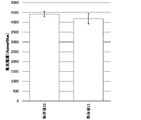
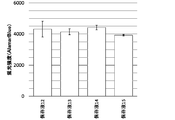
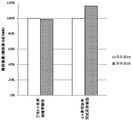
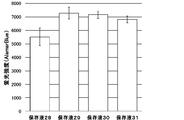
- FIG. 1 is a graph showing the preservative effect of each cell cryopreservation solution on normal human dermal fibroblasts.
- FIG. 2 is a graph showing the preservative effect of each cell cryopreservation solution on normal human dermal fibroblasts.
- FIG. 3 is a graph showing the preservative effect of each cell cryopreservation solution on normal human dermal fibroblasts.
- FIG. 4 is a graph showing the preservative effect of each cell cryopreservation solution on NIH3T3 cells (mouse fibroblasts).
- FIG. 5 is a graph showing the preservative effect of each cell cryopreservation solution on normal human dermal fibroblasts or human bone marrow-derived mesenchymal stem cells.
- FIG. 1 is a graph showing the preservative effect of each cell cryopreservation solution on normal human dermal fibroblasts.
- FIG. 2 is a graph showing the preservative effect of each cell cryopreservation solution on normal human dermal
- FIG. 6 is a representative photograph showing the remaining state of bubbles in the bubble breakage test of each cell cryopreservation solution.
- FIG. 7 is a graph showing the preservative effect of each cell cryopreservation solution on normal human dermal fibroblasts.
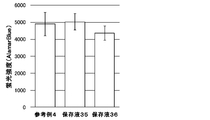
- FIG. 8 is a graph showing the preservative effect of each cell cryopreservation solution on normal human dermal fibroblasts.
- FIG. 9 is a graph showing the preservative effect of each cell cryopreservation solution on two types of human bone marrow-derived mesenchymal stem cells or human adipose tissue-derived stem cells.
- FIG. 10 is a graph showing the preservative effect of each cell cryopreservation solution on normal human dermal fibroblasts.
- FIG. 11 is a graph showing the preservative effect of each cell cryopreservation solution on normal human dermal fibroblasts or bone marrow-derived mesenchymal stem cells.
- FIG. 12 is a graph showing the preservation effect of each cell cryopreservation solution on normal human dermal fibroblasts.
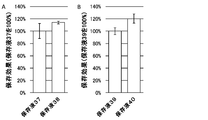
- FIG. 13 is a graph showing the preservation effect of each cell cryopreservation solution on normal human dermal fibroblasts.
- the cell cryopreservation solution of the present invention comprises 1.0 to 25.0 v/v% of cell membrane-permeable polyhydric alcohols (a), 100 to 1000 mM saccharides (b), and a total of 0.5 to 10.0 w/ At least one (c) selected from the group consisting of v% ficoll and polyethylene glycol.
- the cell cryopreservation liquid of the present invention has such a composition, has an excellent cell preservation effect, and has little foaming.
- the cell membrane-permeable polyhydric alcohol (a) is a polyhydric alcohol that can permeate the cell membrane and is basically a low molecular weight polyhydric alcohol.
- the cell membrane-permeable polyhydric alcohol used in the present invention is not particularly limited, but ethylene glycol, propylene glycol, 1,3-propanediol, butylene glycol, isoprene glycol, dipropylene glycol and glycerin are preferable, and ethylene glycol is preferable. Glycol and propylene glycol are more preferred, and propylene glycol is particularly preferred.
- These cell membrane permeable polyhydric alcohols can be used alone or in combination of two or more.
- the cell membrane-permeable polyhydric alcohols can be used alone or in combination of two or more, but it is preferable to use them individually. Therefore, the cell cryopreservation liquid of the present invention preferably contains only propylene glycol as the cell membrane-permeable polyhydric alcohol, and also preferably contains only ethylene glycol.
- the content of the cell membrane-permeable polyhydric alcohol (a) in the cell cryopreservation liquid of the present invention is 1.0 to 25.0 v/v %.
- the more preferable content of the cell membrane-permeable polyhydric alcohol (a) is 2.0 to 20.0 v/v%, and the further preferable content is 2.5 to 17.5 v/v%. Is 5.0 to 15.0 v/v%, and a particularly preferable content is 8.0 to 12.0 v/v%.
- the saccharide (b) means monosaccharides and oligosaccharides and their derivatives.
- the oligosaccharide refers to an oligomer in which 2 to 10 monosaccharides are linked, and specific examples thereof include disaccharides, trisaccharides, tetrasaccharides, pentasaccharides, and heptasaccharides.
- monosaccharides include glucose, galactose, fructose, ribose, mannose, and the like
- oligosaccharides include trehalose, sucrose, maltose, isomaltose, cellobiose, disaccharides such as lactose, trisaccharides such as maltotriose, and malto. Tetraose, maltopentaose, maltoheptaose and the like can be mentioned.
- the saccharide used in the present invention is preferably an oligosaccharide, more preferably a disaccharide and a trisaccharide, and among them, trehalose, sucrose, lactose, and maltotriose are preferable, and trehalose, sucrose, and maltotriose are preferable. More preferred, trehalose and sucrose are even more preferred, and trehalose is particularly preferred. In addition, these sugars can be used individually or in combination of 2 or more types.
- the cell cryopreservation solution of the present invention preferably contains only one kind selected from the group consisting of trehalose, sucrose, lactose, and maltotriose as a saccharide, and consists of trehalose, sucrose, and maltotriose. It is preferable to contain only one kind selected from the group, it is even more preferable to contain only one kind selected from the group consisting of trehalose and sucrose, and it is particularly preferable to contain only trehalose.
- the content of the saccharide (b) in the cell cryopreservation solution of the present invention is 100 to 1000 mM.
- the more preferable content of the saccharide (b) is 100 to 600 mM, the further preferable content is 100 to 400 mM, the further preferable content is 100 to 300 mM, and the particularly preferable content is 200 to 300 mM. Is.
- the cell cryopreservation liquid of the present invention contains at least one kind (c) selected from the group consisting of ficoll and polyethylene glycol. Ficoll and polyethylene glycol can be used alone or in combination. In the present invention, ficoll and/or polyethylene glycol constitutes the cell cryopreservation solution of the present invention in combination with the cell membrane permeable polyhydric alcohols (a) and saccharides (b).
- the liquid is a cell cryopreservation liquid that has an excellent cell preservation effect and little foaming.
- the cell cryopreservation solution of the present invention contains at least one kind (c) selected from the group consisting of ficoll and polyethylene glycol, a cell cryopreservation solution having more excellent cell preservation effect and less foaming can be obtained more reliably.
- the cell membrane-impermeable polymer means a polymer that does not penetrate cell membranes, and includes, for example, albumin (serum albumin, etc.), polyvinyl alcohol (PVA), etc., and the saccharide (b), L- It does not include ascorbic acid 2-glucoside.
- the cell cryopreservation liquid of the present invention more preferably does not contain albumin (serum albumin or the like), more preferably does not contain albumin (serum albumin or the like) and polyvinyl alcohol (PVA). It is particularly preferable to contain no cell membrane-impermeable polymer other than at least one (c) selected from the group consisting of (including only Ficoll and/or polyethylene glycol as the cell-membrane impermeable polymer). In particular, the cell cryopreservation liquid of the present invention preferably contains only polyethylene glycol as the cell membrane-impermeable polymer.
- Ficoll polysucrose
- the ficoll used in the present invention preferably has an average molecular weight of 10,000 to 1,000,000, particularly preferably 300,000 to 550,000.
- specific products of Ficoll having an average molecular weight of 10,000 to 1,000,000 include Ficoll PM70 (average molecular weight 60,000 to 80,000) and Ficoll PM400 (average molecular weight 300 of GE Healthcare). , 000 to 500,000), and specific examples of Ficoll having an average molecular weight of 300,000 to 550,000 include Ficoll PM400 manufactured by GE Healthcare.
- Ficoll is a registered trademark of GE Healthcare
- the Ficoll in the present invention also includes a polymer having the same constituent molecule as that of Ficoll. Examples include claus 400 (average molecular weight 350,000 to 550,000) and the like.
- Polyethylene glycol is a polymer compound having a structure in which ethylene glycol is polymerized.
- the polyethylene glycol used in the present invention preferably has an average molecular weight of 200 to 50,000, and more preferably 6,000 to 30,000.
- polyethylene glycol #200, #300, #400, #600, #1,000, #1,500 manufactured by Nacalai Tesque, Inc. #1,540, #2,000, #4,000, #6,000, #20,000 and the like can be exemplified
- Examples include #6,000 and #20,000 manufactured by Nacalai Tesque.
- the content of ficoll and/or polyethylene glycol (c) in the cell cryopreservation solution of the present invention is 0.5 to 10.0 w/v% in total.
- the lower limit of the preferred content is 0.5 w/v% in total, 1.0 w/v% in total, 1.5 w/v% in total, 2.0 w/v% in total, 2.5 w/v% in total, and 4. 0w/v%, 4.5w/v% in total
- the preferable upper limit of the content is 10.0w/v% in total, 9.0w/v% in total, 8.0w/v% in total, 7.5w in total. /V%, 6.0 w/v% in total, and 5.5 w/v% in total.
- the preferable content is 1.0 to 10.0 w/v% in total.
- a more preferable content is 2.0 to 10.0 w/v% in total.
- a more preferable content is 2.5 to 7.5 w/v% in total.
- An even more preferable content is 4.0 to 6.0 w/v% in total, and a particularly preferable content is 4.5 to 5.5 w/v% in total.
- a total of 1.5 to 6.0 w/v%, a total of 2.0 to 6.0 w/v%, and a total of 2.5 to 6.0 w/v% are also preferable.
- ⁇ Other ingredients> By adding other components to the cell cryopreservation solution of the present invention within a range that does not impair the effects of the present invention, the effects of the present invention can be enhanced or further effects can be imparted.
- Examples of such components include cell cryoprotectants other than the above components, antioxidants, pH adjusters, excipients, binders, fragrances, buffers, thickeners, colorants, stabilizers, moisturizers, antiseptics. Agents and the like. Above all, it is preferable to add an antioxidant to the cell cryopreservation liquid of the present invention. In the cell cryopreservation solution of the present invention, these other components may be blended alone or in combination of two or more.
- the antioxidant is preferably added to the cell cryopreservation solution of the present invention, because when added to the cell cryopreservation solution of the present invention, the cell preservation effect is further improved.
- the cell preservation effect on pluripotent stem cells particularly mesenchymal stem cells such as bone marrow-derived mesenchymal stem cells, is further improved. It is preferably blended in the cell cryopreservation solution.
- the antioxidant include glutathione, sodium ⁇ -tocopheryl phosphate (TPNa: TPNa is a registered trademark of Showa Denko KK), ascorbic acid, and derivatives thereof.
- ascorbic acid derivative examples include L-ascorbic acid 2-glucoside, L-ascorbic acid 2-sesquimagnesium phosphate hydrate, and L-ascorbic acid 2-phosphate trisodium salt. Of these, ascorbic acid or an ascorbic acid derivative is preferable, and L-ascorbic acid 2-glucoside is more preferable.
- dimethyl sulfoxide is not an essential component in the cell cryopreservation solution of the present invention.
- Dimethyl sulfoxide (DMSO) is used to induce the differentiation of cultured cells, and it has been pointed out that the differentiation trait of cells may be changed by using it for cryopreservation.
- the preservation solution preferably does not contain dimethyl sulfoxide (DMSO).
- the cryopreservation liquid for cells of the present invention comprises the above components dispersed in a basic solution.
- the base solution can be, for example, an aqueous or alcoholic solution, but is preferably an aqueous solution.
- aqueous solution for example, an isotonic solution, various buffer solutions (including isotonic solutions having a buffering effect), or various basal media for cells or tissues can be used.
- the isotonic solution include physiological saline, Ringer's solution, Hank's solution, and the like.
- buffer solution examples include Good's buffer solution, phosphate buffer solution, imidazole buffer solution, triethanolamine hydrochloride buffer solution (TEA), and further, phosphate buffer saline (PBS), Tris buffer.
- PBS phosphate buffer saline
- examples include physiological saline (TBS), physiological saline having a buffering effect such as HEPES buffered physiological saline.
- Examples of the basal medium include DMEM, EMEM, RPMI-1640, ⁇ -MEM, F-12, F-10, M-199 and the like.
- a buffer or basal medium is preferably used as the basal solution used in the present invention.
- the basal medium is an amino acid, vitamin, or inorganic substance whose composition is clear and which does not include biopolymers of unknown origin (eg, serum, or growth factor, albumin, protein components such as extracellular matrix, etc.) It is a medium composed of salts and carbon sources such as glucose.
- PBS phosphate buffered saline
- the pH of the cell cryopreservation solution of the present invention is usually pH 6.0 to 8.0, and preferably pH 7.0 to 7.5.
- the pH can be adjusted by using the above pH adjuster.
- the cell cryopreservation liquid of the present invention can cryopreserve cells to be preserved by various cryopreservation methods.
- the cryopreservation method in which the cell cryopreservation liquid of the present invention can be used is not particularly limited, and the cells to be preserved can be cryopreserved by various cryopreservation methods, but particularly suitable for the slow freezing method. ..
- the method for cryopreserving cells by the slow freezing method is, for example, suspending cells to be preserved in the cell cryopreservation solution of the present invention, then slowly cooling to freeze the cells, and the frozen cells are appropriately frozen. It can be carried out by storing (for example, storing in an ultra-low temperature freezer or liquid nitrogen).
- the present invention also relates to a slow freezing method of cells, which is characterized by using the cell cryopreservation solution of the present invention.
- the method for slowly freezing cells of the present invention includes, for example, a step of suspending cells to be preserved in a cell cryopreservation solution of the present invention, and slowly cooling the cell cryopreservation solution in which the cells are suspended And a step of freezing the cells to freeze the cells slowly.
- the method of slowly freezing cells of the present invention uses the cell cryopreservation solution of the present invention, and therefore has excellent operability because it is not necessary to worry about foaming when suspending cells in the cell cryopreservation solution, and Since the slow freezing method is used, for example, it is not necessary to prepare liquid nitrogen or special equipment required for the vitrification method, and the operation is simple. Furthermore, the method for cryopreserving cells of the present invention can preserve cells with high preservation efficiency.
- the cells to be preserved are not particularly limited, and cells that are generally cryopreserved can be preserved by the cell cryopreservation solution of the present invention.
- any type of cells such as cells established as cultured cells, non-established normal cells obtained from biological tissues, transformed cells obtained by genetic engineering techniques, etc.
- various pluripotent stem cells such as induced pluripotent stem cells (iPS cells) and embryonic stem cells (ES cells), mesenchymal stem cells, hematopoietic stem cells, neural stem cells, bone marrow stem cells, reproductive stem cells, etc.
- iPS cells induced pluripotent stem cells
- ES cells embryonic stem cells
- mesenchymal stem cells hematopoietic stem cells
- neural stem cells hematopoietic stem cells
- bone marrow stem cells reproductive stem cells, etc.
- reproductive stem cells etc.
- the cell cryopreservation solution of the present invention can store not only these cells but also various tissues and organs.
- the origin of cells is not particularly limited, and may be microorganisms, bacteria, animal cells, plant cells, preferably animal cells.
- animal cells for example, mammalian cells such as mice, rats, guinea pigs, hamsters, rabbits, cats, dogs, sheep, pigs, cows, horses, goats, monkeys, humans, birds such as chickens and ostriches, crocodile etc.
- animal cells include vertebrate cells including amphibians such as reptiles and frogs, fishes such as zebrafish and medaka, and cells of invertebrates including insects such as silkworms, moths and fruit flies.
- the cell cryopreservation solution of the present invention is preferably used for mesenchymal cells and mesenchymal stem cells.
- mesenchymal cells and mesenchymal stem cells include bone cells, chondrocytes, bone marrow cells, muscle cells, cardiomyocytes, tendon cells, adipocytes, dermal papilla cells, dental pulp cells and stem cells thereof.
- the cell cryopreservation solution of the present invention can be preferably used for bone marrow-derived mesenchymal stem cells and adipose tissue-derived stem cells.
- Example 1 Cell preservation effect test Material ⁇ Cell cryopreservation solution> A cell cryopreservation solution having various compositions was prepared using the following components and the basic solution. The cell cryopreservation solution was sterilized by filtration with a 0.22 ⁇ m filter (manufactured by Nalgene (Thermo Scientific)) and used in the test.
- -Propylene glycol Made by Nacalai Tesque-Trehalose: Made by Hayashibara-Sucrose: Made by Nacalai Tesque-Lactose: Made by Nacalai Tesque-Maltotriose: Made by Hayashibara-Ficoll: Made by Nacalai Tesque-Polyethylene glycol (PEG) #200, PEG #600, PEG#2000, PEG#6000, PEG#20000: manufactured by Nacalai Tesque, hydroxyethyl starch (HES): manufactured by SIGMA, pullulan: manufactured by Hayashibara, human serum albumin (HSA): manufactured by Nacalai Tesque, L-ascorbic acid 2-glucoside: Made by Hayashibara
- Base solution The following was used as the base solution.
- ⁇ DMEM manufactured by Nacalai Tesque
- PBS Phosphate buffered saline
- the final concentration of phosphate buffered saline (PBS) is 1 ⁇ , 0.5 ⁇ , 0.2 ⁇
- a cell cryopreservation solution was prepared as follows.
- ⁇ Cell> The following cells were used in the experiment. Normal human skin fibroblasts (obtained from Kurabo) NIH3T3 cells (mouse fibroblasts) (obtained from ECACC) Human bone marrow-derived mesenchymal stem cells (obtained from Lonza)
- the cell preservation effect was evaluated by cryopreserving the cells to be preserved using each cell cryopreservation solution and measuring the viability of the cells after thawing. Specifically, first, the cells to be preserved were suspended in each cell cryopreservation solution so that the cell concentration was 1.0 ⁇ 10 6 cells/ml, and 1 ml of each suspension was dispensed into each cryotube. Above, these cells were slowly frozen at -80°C. The cells thus frozen were stored at ⁇ 80° C. for a predetermined period and then thawed at 37° C. The thawed cells were seeded at a predetermined density and cultured overnight in a cell culture medium.
- the number of each viable cell was measured using alamarBlue (registered trademark) Cell Viability Reagent (manufactured by Invitrogen (Thermo Scientific)) according to the attached protocol.
- the survival rate is indicated by the fluorescence intensity proportional to the number of living cells.
- Test 1 A cell cryopreservation solution having the following composition was tested.
- the unit “%” is "v/v%” in the case of propylene glycol and "w/v%” in the case of other components (hereinafter, the tests of Examples 1 and 2). Same as in).
- the thawed cells were seeded at a cell density of 1.0 ⁇ 10 5 cells/well (24-well plate), and the number of viable cells was measured using alamarBlue (registered trademark) Cell Viability Reagent. ..
- a commercially available cell cryopreservation solution STEM-CELLBANKER (registered trademark) DMSO Free GMP grade (manufactured by Nippon Zenyaku Kogyo, Reference Example 1) was also tested. The results are shown in Figure 1.
- 5% Ficoll or 5% polyethylene glycol (PEG#200, PEG#600, PEG#2000, PEG#6000, PEG#20000) was added.
- Cell cryopreservation solution containing 5% higher than 5% ficoll or 5% polyethylene glycol instead of 5% hydroxyethyl starch, 5% pullulan, or 5% human serum albumin The survival rate was shown, and the survival rate was also higher than that of a commercially available cell cryopreservation solution.
- Test 2 A cell cryopreservation solution having the following composition was tested.
- the thawed cells were seeded at a cell density of 1.0 ⁇ 10 5 cells/well (24-well plate), and the number of viable cells was measured using alamarBlue (registered trademark) Cell Viability Reagent. .. The results are shown in Figure 2.
- the cell cryopreservation solution containing 250 mM sucrose instead of 250 mM trehalose also showed high survival rate.
- Test 3 A cell cryopreservation solution having the following composition was tested.
- the thawed cells were seeded at a cell density of 1.0 ⁇ 10 5 cells/well (24-well plate), and the number of viable cells was measured using alamarBlue (registered trademark) Cell Viability Reagent. .. The results are shown in Fig. 3.
- the cell cryopreservation solution having a trehalose concentration of 100 mM, 200 mM, or 300 mM also showed high viability. Indicated.
- Test 4 A cell cryopreservation solution having the following composition was tested.
- the thawed cells were seeded at a cell density of 1.0 ⁇ 10 5 cells/well (24-well plate), and the number of viable cells was measured using alamarBlue (registered trademark) Cell Viability Reagent. ..
- a commercially available cell cryopreservation solution STEM-CELLBANKER (registered trademark) DMSO Free GMP grade (manufactured by Nippon Zenyaku Kogyo, Reference Example 1) was also tested. The results are shown in Fig. 4.
- the cell cryopreservation solution containing 10% propylene glycol, 250 mM trehalose, and 5% Ficoll used PBS (1 ⁇ , 0.5 ⁇ , 0.2 ⁇ concentration) as a base solution. Also in the case, the survival rate was higher for NIH3T3 cells (mouse fibroblasts) than the commercially available cell cryopreservation solution.
- Test 5 A cell cryopreservation solution having the following composition was tested.
- the thawed cells were seeded at a cell density of 1.0 ⁇ 10 5 cells/well (24-well plate), and the number of viable cells was measured using alamarBlue (registered trademark) Cell Viability Reagent. .. Results are shown in FIG. In FIG. 5, the preservation effect on each cell is shown as a relative value when the measured value (fluorescence intensity) of the preservation solution 19 is 100%.
- a cell cryopreservation solution containing 5 mM L-ascorbic acid 2-glucoside was added to 5 mM L-ascorbic acid 2-glucoside. Higher survival rate was observed in human bone marrow-derived mesenchymal stem cells as compared with the cell cryopreservation solution containing no.
- Example 2 Bubble freeness test of cell cryopreservation solution 1.
- Material ⁇ Cell cryopreservation solution> In the same manner as in Example 1, cell cryopreservation solutions having various compositions were prepared.
- Method Foam depletion of the cell cryopreservation solution was evaluated by forcing each cell cryopreservation solution to foam and measuring the time until the foam disappeared. Specifically, first, each cell cryopreservation liquid in which NIH-3T3 cells (1.0 ⁇ 10 6 cells/ml) were suspended was prepared in a 2 mL centrifuge tube (Eppendorf). Then 200 ⁇ L of air bubbles were generated in each cell cryopreservation solution using a micropipette (20-200) loaded with 200 ⁇ L of tip. The centrifuge tube was allowed to stand at room temperature, and it was examined with time whether bubbles remained in the cell cryopreservation solution in the centrifuge tube.
- Table 7 is a table showing the number of centrifuge tubes in which bubbles remained in each time when the foam breakage test was performed by the above method using four centrifuge tubes for each cell cryopreservation solution.
- FIG. 6 is a representative photograph showing the state of bubbles remaining in each cell cryopreservation solution at 1 hour, 3 hours, and 24 hours after the bubble generation operation. The foam break test was repeated 20 times, but all had the same results.
- Example 3 Cell preservation effect test 2 1.
- Material ⁇ Cell cryopreservation solution> A cell cryopreservation solution having various compositions was prepared using the following components and the basic solution. The cell cryopreservation solution was sterilized by filtration with a 0.22 ⁇ m filter (manufactured by Nalgene (Thermo Scientific)) and used in the test.
- each component The following components were used as the components of the cell cryopreservation liquid.
- -Propylene glycol Nacalai Tesque-Ethylene glycol: Nacalai Tesque-Trehalose: Hayashibara-Sucrose: Nacalai Tesque-Maltotriose: Hayashibara-Polyethylene glycol (PEG) #20000: Nacalai Tesque-L-ascorbic acid 2
- PEG phosphate buffered saline
- PBS phosphate buffered saline
- ⁇ Cell> The following cells were used in the experiment. Normal human skin fibroblasts (obtained from Kurabo) Human adipose tissue-derived stem cells (obtained from PromoCell) Human bone marrow-derived mesenchymal stem cells 1 (obtained from Lonza) -Human bone marrow-derived mesenchymal stem cells 2 (obtained from PromoCell)
- the cell preservation effect was evaluated by cryopreserving the cells to be preserved using each cell cryopreservation solution and measuring the survival rate of the cells after thawing. Specifically, first, the cells to be preserved were suspended in each cell cryopreservation solution at a cell concentration of 1.0 ⁇ 10 6 cells/ml, and 0.2 ml of each was suspended in a cryotube (test). 8) or 1 ml (tests 6-7 and tests 9-11) were dispensed and the cells were frozen slowly at -80°C. The cells thus frozen were stored at ⁇ 80° C. for a predetermined period and then thawed at 37° C. Then, the number of each viable cell was measured by the alamarBlue assay or the trypan blue staining method.
- the alamarBlue assay was performed in the same manner as in Example 1 after seeding thawed cells at a predetermined density and culturing overnight in a cell culture medium.
- trypan blue staining method thawed cells were stained with trypan blue, the total cell number and the viable cell number were measured on a hemocytometer, and the survival rate was calculated from the ratio of the viable cells to the total cells.
- Test 6 A cell cryopreservation solution having the following composition was tested.
- the unit “%” is “v/v%” in the case of propylene glycol and ethylene glycol, and "w/v%” in the case of the other components (hereinafter, referred to in Example 3). The same in the test).
- the thawed cells were seeded at a cell density of 5.0 ⁇ 10 4 cells/well (24-well plate), and the viable cell number was measured using alamarBlue (registered trademark) Cell Viability Reagent. .. The results are shown in Fig. 7.
- Test 7 A cell cryopreservation solution having the following composition was tested.
- the thawed cells were seeded at a cell density of 5.0 ⁇ 10 4 cells/well (24-well plate), and the viable cell number was measured using alamarBlue (registered trademark) Cell Viability Reagent. .. The results are shown in Fig. 8.
- Test 8 A cell cryopreservation solution having the following composition was tested.
- human bone marrow-derived mesenchymal stem cells 1 obtained from Lonza
- human bone marrow-derived mesenchymal stem cells 2 obtained from PromoCell
- human adipose tissue-derived stem cells or normal human skin fibroblasts were stored.
- FIG. 9A shows the results when human bone marrow-derived mesenchymal stem cells 1 (obtained from Lonza) were preserved
- FIG. 9B shows the results when human bone marrow-derived mesenchymal stem cells 2 (obtained from PromoCell) were preserved
- 9C and the results when human adipose tissue-derived stem cells were set as preservation targets are shown in FIG. 9C.
- the results obtained when normal human dermal fibroblasts were stored are shown in FIG.
- STEM-CELLBANKER registered trademark
- GMP grade DMSO-containing, manufactured by Nippon Zenyaku Kogyo, Reference Example 4
- the cell cryopreservation solution containing 10% propylene glycol, 250 mM trehalose, and 5% polyethylene glycol was equivalent to or comparable to the commercially available cell cryopreservation solution for all stem cells.
- the above high survival rate was exhibited.
- the cell cryopreservation solution containing ethylene glycol in place of propylene glycol showed a high survival rate equal to or higher than that of the cell cryopreservation solution containing propylene glycol, and as shown in FIG.
- the viability of blast cells was also higher than that of the cell cryopreservation solution containing propylene glycol.
- Test 9 A cell cryopreservation solution having the following composition was tested.
- STEM-CELLBANKER registered trademark
- DMSO Free GMP grade manufactured by Nippon Zenyaku Kogyo, reference example 1
- CELLBANKER registered trademark 1 (all Japan) References 2)
- STEM-CELL BANKER registered trademark GMP grade
- Reference Example 4 manufactured by Nippon Zenyaku Kogyo Co., Ltd.
- a cell cryopreservation solution containing 10% propylene glycol, 250 mM trehalose, 5% polyethylene glycol, and 5 mM L-ascorbic acid 2-glucoside was used for normal human dermal fibroblasts and bone marrow-derived mesenchyme.
- the survival rate equivalent to or higher than that of the commercially available cell cryopreservation solution was shown.
- Test 10 A cell cryopreservation solution having the following composition was tested.
- the thawed cells were seeded at a cell density of 5.0 ⁇ 10 4 cells/well (24-well plate), and the viable cell number was measured using alamarBlue (registered trademark) Cell Viability Reagent. .. Results are shown in FIG.
- a commercially available cell cryopreservation solution STEM-CELLBANKER (registered trademark) GMP grade (DMSO-containing, manufactured by Nippon Zenyaku Kogyo, Reference Example 4) was also tested.
- the cell cryopreservation solution containing 10% propylene glycol, 250 mM sucrose, and 5% polyethylene glycol was equivalent to normal human dermal fibroblasts compared to the commercially available cell cryopreservation solution. It showed high survival rate of more than that. A cell cryopreservation solution containing maltotriose instead of sucrose also showed a high survival rate.
- Test 11 A cell cryopreservation solution having the following composition was tested.
- the thawed cells were seeded at a cell density of 5.0 ⁇ 10 4 cells/well (24-well plate), and the viable cell number was measured using alamarBlue (registered trademark) Cell Viability Reagent. ..
- the results are shown in Figures 13A and B. In FIGS.
- the preservative effect of each cell cryopreservation solution on cells is shown by setting the measured value (fluorescence intensity) of the cell cryopreservation solution (preservation solutions 37 and 39) containing no L-ascorbic acid 2-glucoside to 100%. It shows as a relative value when it did.
- Foam breakage test With respect to the preservative solutions 25 to 27 and 29 to 40, the foam breakage test was carried out in the same manner as in Example 2 except that cells were not suspended in each preservative solution. However, all the bubbles in the centrifuge tube disappeared within about 10 seconds after the bubble generation operation.
- a cell cryopreservation liquid which is excellent in cell preservation effect and has less foaming.
- Such a cell cryopreservation solution can be usefully used as a preservative for medical stem cells, differentiated cells (including cell preparations), and a reagent for basic research.
Landscapes
- Life Sciences & Earth Sciences (AREA)
- Health & Medical Sciences (AREA)
- Engineering & Computer Science (AREA)
- Dentistry (AREA)
- General Health & Medical Sciences (AREA)
- Wood Science & Technology (AREA)
- Zoology (AREA)
- Environmental Sciences (AREA)
- Micro-Organisms Or Cultivation Processes Thereof (AREA)
- Biophysics (AREA)
- Physiology (AREA)
- Agricultural Chemicals And Associated Chemicals (AREA)
Abstract
細胞の保存効果に優れ、かつ泡立ちの少ない細胞凍結保存液の提供を目的とする。 本発明は、1.0~25.0v/v%の細胞膜透過性多価アルコール類(a)、100~1000mMの糖類(b)、および合計0.5~10.0w/v%のフィコールおよびポリエチレングリコールからなる群より選択された少なくとも1種(c)を含む、細胞凍結保存液である。
Description
本発明は、細胞凍結保存液に関する。
培養細胞は、継代を繰り返すことによって、細胞変質、遺伝的変異および雑菌汚染を生じる可能性があることから、長期間、細胞を安定的に利用するために、培養細胞を凍結保存しておくことが行われている。例えば、細胞を培地や血清などにジメチルスルホキシド(DMSO)やグリセリンなどを加えた保存液に懸濁し、これをクライオバイアルに充填し、速度制御フリーザー等で制御的に温度を下げて細胞を凍結し、液体窒素中に保存することが行われている。
この細胞凍結のための保存液については、これまで、その用途に応じて、種々の保存液が開発されている。保存液に使用される成分の一つであるジメチルスルホキシド(DMSO)については、培養細胞の分化を誘導するために使用される事例や、凍結保存に用いることにより細胞の分化形質が変化してしまう可能性についての報告等もある。このため、ジメチルスルホキシド(DMSO)を使用しない保存液が開発されている(特許文献1)。
ところで、これまでの細胞凍結保存液においては、保存細胞に与える影響や保存効果の高さの観点から開発が行われていたことから、その操作性については未だ不十分なものが多い。例えば、泡立ちやすい細胞凍結保存液では、懸濁操作の際に生じた泡がはじけて、細胞へダメージを与えることやコンタミネーションの原因となることが危惧される。したがって、このような細胞保存液を使用する際には、非常に慎重な操作が必要となり、操作性が低下してしまうという問題がある。
したがって、本発明の目的は、上記で説明した事情を鑑み、細胞の保存効果に優れ、かつ泡立ちの少ない細胞凍結保存液の提供にある。
また、本発明の他の目的は、ジメチルスルホキシド(DMSO)を必須の成分としない細胞凍結保存液の提供にある。
本発明者らは、上記目的のため鋭意検討を行った結果、細胞凍結保存液を調製するのに、1.0~25.0v/v%の細胞膜透過性多価アルコール類(a)、100~1000mMの糖類(b)、および合計0.5~10.0w/v%のフィコールおよびポリエチレングリコールからなる群より選択された少なくとも1種(c)を主な成分として用いることによって、細胞の保存効果に優れ、かつ泡立ちの少ない細胞凍結保存液が得られることを見出し、本発明を完成させた。
すなわち、本発明は以下に関する。
(1)1.0~25.0v/v%の細胞膜透過性多価アルコール類(a)、100~1000mMの糖類(b)、および合計0.5~10.0w/v%のフィコールおよびポリエチレングリコールからなる群より選択された少なくとも1種(c)を含む、細胞凍結保存液。
(2)基礎溶液が、緩衝液、または基礎培地である、前記(1)に記載の細胞凍結保存液。
(3)細胞膜透過性多価アルコール類(a)が、エチレングリコールおよびプロピレングリコールからなる群より選択された少なくとも1種である、前記(1)または(2)に記載の細胞凍結保存液。
(4)細胞膜透過性多価アルコール類(a)として、エチレングリコールのみを含む、前記(3)に記載の細胞凍結保存液。
(5)糖類(b)が、オリゴ糖である、前記(1)~(4)のいずれかに記載の細胞凍結保存液。
(6)糖類(b)が、トレハロース、スクロース、ラクトース、およびマルトトリオースからなる群より選択された少なくとも1種である、前記(5)に記載の細胞凍結保存液。
(7)さらに、L-アスコルビン酸2-グルコシドを含む、前記(1)~(6)のいずれかに記載の細胞凍結保存液。
(2)基礎溶液が、緩衝液、または基礎培地である、前記(1)に記載の細胞凍結保存液。
(3)細胞膜透過性多価アルコール類(a)が、エチレングリコールおよびプロピレングリコールからなる群より選択された少なくとも1種である、前記(1)または(2)に記載の細胞凍結保存液。
(4)細胞膜透過性多価アルコール類(a)として、エチレングリコールのみを含む、前記(3)に記載の細胞凍結保存液。
(5)糖類(b)が、オリゴ糖である、前記(1)~(4)のいずれかに記載の細胞凍結保存液。
(6)糖類(b)が、トレハロース、スクロース、ラクトース、およびマルトトリオースからなる群より選択された少なくとも1種である、前記(5)に記載の細胞凍結保存液。
(7)さらに、L-アスコルビン酸2-グルコシドを含む、前記(1)~(6)のいずれかに記載の細胞凍結保存液。
また、本発明は以下にも関する。
(8)前記(1)~(7)のいずれかに記載の細胞凍結保存液を使用することを特徴とする、細胞の緩慢凍結方法。
本発明によれば、細胞の保存効果に優れ、かつ泡立ちの少ない細胞凍結保存液を提供することができる。また、この細胞凍結保存液は、ジメチルスルホキシド(DMSO)を必須の成分としていないことから、予期しない細胞の分化が誘導される危険性が低く、安全に使用することができる。
以下、本発明について詳細に説明する。なお、本明細書中で使用される用語は、特に言及しない限り、当該技術分野で通常用いられる意味で解釈される。
[細胞凍結保存液]
本発明の細胞凍結保存液は、1.0~25.0v/v%の細胞膜透過性多価アルコール類(a)、100~1000mMの糖類(b)、および合計0.5~10.0w/v%のフィコールおよびポリエチレングリコールからなる群より選択された少なくとも1種(c)を含む。本発明の細胞凍結保存液は、このような組成を有しており、細胞の保存効果に優れ、かつ泡立ちが少ない。
本発明の細胞凍結保存液は、1.0~25.0v/v%の細胞膜透過性多価アルコール類(a)、100~1000mMの糖類(b)、および合計0.5~10.0w/v%のフィコールおよびポリエチレングリコールからなる群より選択された少なくとも1種(c)を含む。本発明の細胞凍結保存液は、このような組成を有しており、細胞の保存効果に優れ、かつ泡立ちが少ない。
<細胞膜透過性多価アルコール類(a)>
本発明において、細胞膜透過性多価アルコール類(a)は、細胞膜を透過可能な多価アルコール類であり、基本的に低分子量の多価アルコール類である。本発明に使用される細胞膜透過性多価アルコール類としては、特に制限はないが、エチレングリコール、プロピレングリコール、1,3-プロパンジオール、ブチレングリコール、イソプレングリコール、ジプロピレングリコールおよびグリセリンが好ましく、エチレングリコールおよびプロピレングリコールがより好ましく、プロピレングリコールが特に好ましい。これらの細胞膜透過性多価アルコール類は、単独でまたは二種以上組み合わせて使用できる。
本発明において、細胞膜透過性多価アルコール類(a)は、細胞膜を透過可能な多価アルコール類であり、基本的に低分子量の多価アルコール類である。本発明に使用される細胞膜透過性多価アルコール類としては、特に制限はないが、エチレングリコール、プロピレングリコール、1,3-プロパンジオール、ブチレングリコール、イソプレングリコール、ジプロピレングリコールおよびグリセリンが好ましく、エチレングリコールおよびプロピレングリコールがより好ましく、プロピレングリコールが特に好ましい。これらの細胞膜透過性多価アルコール類は、単独でまたは二種以上組み合わせて使用できる。
本発明の細胞凍結保存液において、細胞膜透過性多価アルコール類は、単独でまたは二種以上組み合わせて使用できるが、単独で使用することが好ましい。そこで、本発明の細胞凍結保存液は、細胞膜透過性多価アルコール類として、プロピレングリコールのみを含むことが好ましく、また、エチレングリコールのみを含むことも好ましい。
本発明の細胞凍結保存液における細胞膜透過性多価アルコール類(a)の含有量は、1.0~25.0v/v%である。より好ましい細胞膜透過性多価アルコール類(a)の含有量は、2.0~20.0v/v%であり、さらに好ましい含有量は、2.5~17.5v/v%であり、さらには5.0~15.0v/v%であり、特に好ましい含有量は、8.0~12.0v/v%である。
<糖類(b)>
本発明において、糖類(b)は、単糖およびオリゴ糖ならびにこれらの誘導体を意味する。ここで、オリゴ糖は、単糖が2分子から10分子結合したオリゴマーを指し、具体的には、二糖、三糖、四糖、五糖、七糖等が挙げられる。単糖としては、グルコース、ガラクトース、フルクトース、リボース、マンノース等が挙げられ、オリゴ糖としては、トレハロース、スクロース、マルトース、イソマルトース、セロビオース、ラクトース等の二糖、マルトトリオース等の三糖、マルトテトラオース、マルトペンタオース、マルトヘプタオース等が挙げられる。本発明に使用される糖類としては、オリゴ糖が好ましく、二糖および三糖がより好ましく、これらのなかでもトレハロース、スクロース、ラクトース、およびマルトトリオースが好ましく、トレハロース、スクロース、およびマルトトリオースがより好ましく、トレハロースおよびスクロースがさらにより好ましく、トレハロースが特に好ましい。なお、これらの糖類は、単独でまたは二種以上組み合わせて使用できる。
本発明において、糖類(b)は、単糖およびオリゴ糖ならびにこれらの誘導体を意味する。ここで、オリゴ糖は、単糖が2分子から10分子結合したオリゴマーを指し、具体的には、二糖、三糖、四糖、五糖、七糖等が挙げられる。単糖としては、グルコース、ガラクトース、フルクトース、リボース、マンノース等が挙げられ、オリゴ糖としては、トレハロース、スクロース、マルトース、イソマルトース、セロビオース、ラクトース等の二糖、マルトトリオース等の三糖、マルトテトラオース、マルトペンタオース、マルトヘプタオース等が挙げられる。本発明に使用される糖類としては、オリゴ糖が好ましく、二糖および三糖がより好ましく、これらのなかでもトレハロース、スクロース、ラクトース、およびマルトトリオースが好ましく、トレハロース、スクロース、およびマルトトリオースがより好ましく、トレハロースおよびスクロースがさらにより好ましく、トレハロースが特に好ましい。なお、これらの糖類は、単独でまたは二種以上組み合わせて使用できる。
本発明の細胞凍結保存液において、糖類は、単独でまたは二種以上組み合わせて使用できるが、単独で使用することが好ましい。そこで、本発明の細胞凍結保存液は、糖類として、トレハロース、スクロース、ラクトース、およびマルトトリオースからなる群より選択された1種のみを含むことが好ましく、トレハロース、スクロース、およびマルトトリオースからなる群より選択された1種のみを含むことが好ましく、トレハロースおよびスクロースからなる群より選択された1種のみを含むことがさらにより好ましく、トレハロースのみを含むことが特に好ましい。
本発明の細胞凍結保存液における糖類(b)の含有量は、100~1000mMである。より好ましい糖類(b)の含有量は、100~600mMであり、さらに好ましい含有量は、100~400mMであり、さらに好ましい含有量は、100~300mMであり、特に好ましい含有量は、200~300mMである。
<フィコールおよび/またはポリエチレングリコール(c)>
本発明の細胞凍結保存液は、フィコールおよびポリエチレングリコールからなる群より選択された少なくとも1種(c)を含む。フィコールおよびポリエチレングリコールは、それぞれ単独でまたは組み合わせて使用できる。本発明において、フィコールおよび/またはポリエチレングリコールは、上記細胞膜透過性多価アルコール類(a)および糖類(b)と組み合わされて本発明の細胞凍結保存液を構成するが、このような細胞凍結保存液は、細胞の保存効果に優れ、かつ泡立ちが少ない細胞凍結保存液である。
本発明の細胞凍結保存液は、フィコールおよびポリエチレングリコールからなる群より選択された少なくとも1種(c)を含む。フィコールおよびポリエチレングリコールは、それぞれ単独でまたは組み合わせて使用できる。本発明において、フィコールおよび/またはポリエチレングリコールは、上記細胞膜透過性多価アルコール類(a)および糖類(b)と組み合わされて本発明の細胞凍結保存液を構成するが、このような細胞凍結保存液は、細胞の保存効果に優れ、かつ泡立ちが少ない細胞凍結保存液である。
本発明の細胞凍結保存液は、フィコールおよびポリエチレングリコールからなる群より選択された少なくとも1種(c)を含むが、より確実に、細胞の保存効果に優れ、かつ泡立ちが少ない細胞凍結保存液を得るために、これら以外の細胞膜非透過性高分子は含まないことが好ましい。ここで、細胞膜非透過性高分子とは、細胞膜を透過しない高分子をいい、例えば、アルブミン(血清アルブミン等)、ポリビニルアルコール(PVA)等が含まれ、本発明における糖類(b)、L-アスコルビン酸2-グルコシド等は含まれない。そこで、本発明の細胞凍結保存液は、アルブミン(血清アルブミン等)を含まないことがより好ましく、アルブミン(血清アルブミン等)およびポリビニルアルコール(PVA)を含まないことがさらに好ましく、フィコールおよびポリエチレングリコールからなる群より選択された少なくとも1種(c)以外の細胞膜非透過性高分子を一切含まない(細胞膜非透過性高分子として、フィコールおよび/またはポリエチレングリコールのみを含む)ことが特に好ましい。とりわけ、本発明の細胞凍結保存液は、細胞膜非透過性高分子として、ポリエチレングリコールのみを含むことが好ましい。
フィコール(ポリスクロース)は、ショ糖から作られた側鎖に富む、中性、親水性の合成多糖類である(なお、フィコールはGEヘルスケア社の登録商標)。本発明に使用されるフィコールとしては、平均分子量が10,000~1,000,000のものが好ましく、300,000~550,000のものが特に好ましい。ここで、平均分子量が10,000~1,000,000のフィコールの具体的な製品としては、GEヘルスケア社のFicoll PM70(平均分子量60,000~80,000)、Ficoll PM400(平均分子量300,000~500,000)等が例示でき、平均分子量が300,000~550,000のフィコールの具体的な製品としては、GEヘルスケア社のFicoll PM400等が例示できる。なお、フィコールはGEヘルスケア社の登録商標であるが、本発明におけるフィコールには、これと同一の構成分子を有するポリマーも含まれ、具体的な製品としては、富士フイルム和光純薬社のポリスクロース400(平均分子量350,000~550,000)等が例示できる。
ポリエチレングリコールは、エチレングリコールが重合した構造をもつ高分子化合物である。本発明に使用されるポリエチレングリコールとしては、平均分子量が200~50,000のものが好ましく、特に、6,000~30,000のものが好ましい。ここで、平均分子量が200~50,000のポリエチレングリコールの具体的な製品としては、ナカライテスク社のポリエチレングリコール#200、#300、#400、#600、#1,000、#1,500、#1,540、#2,000、#4,000、#6,000、#20,000等が例示でき、平均分子量が6,000~30,000のポリエチレングリコールの具体的な製品としては、ナカライテスク社の#6,000、#20,000等が例示できる。
本発明の細胞凍結保存液におけるフィコールおよび/またはポリエチレングリコール(c)の含有量は、合計0.5~10.0w/v%である。好ましい含有量の下限は、合計0.5w/v%、合計1.0w/v%、合計1.5w/v%、合計2.0w/v%、合計2.5w/v%、合計4.0w/v%、合計4.5w/v%であり、好ましい含有量の上限は、合計10.0w/v%、合計9.0w/v%、合計8.0w/v%、合計7.5w/v%、合計6.0w/v%、合計5.5w/v%である。範囲として、好ましい含有量は、合計1.0~10.0w/v%である。より好ましい含有量は、合計2.0~10.0w/v%である。さらに好ましい含有量は、合計2.5~7.5w/v%である。さらにより好ましい含有量は、合計4.0~6.0w/v%であり、特に好ましい含有量は、合計4.5~5.5w/v%である。また、合計1.5~6.0w/v%、合計2.0~6.0w/v%、合計2.5~6.0w/v%も好ましい。
<他の成分>
本発明の細胞凍結保存液には、本発明の効果を損なわない範囲で他の成分を配合することで、本発明の効果を高めたり、さらなる効果を付与したりすることができる。かかる成分としては、例えば、上記成分以外の細胞凍結保護剤、抗酸化剤、pH調整剤、賦形剤、結合剤、香料、緩衝剤、増粘剤、着色剤、安定剤、保湿剤、防腐剤等が挙げられる。なかでも、本発明の細胞凍結保存液には、抗酸化剤を配合することが好ましい。なお、本発明の細胞凍結保存液において、これら他の成分はそれぞれ単独でまたは二種以上を組み合わせて配合してもよい。
本発明の細胞凍結保存液には、本発明の効果を損なわない範囲で他の成分を配合することで、本発明の効果を高めたり、さらなる効果を付与したりすることができる。かかる成分としては、例えば、上記成分以外の細胞凍結保護剤、抗酸化剤、pH調整剤、賦形剤、結合剤、香料、緩衝剤、増粘剤、着色剤、安定剤、保湿剤、防腐剤等が挙げられる。なかでも、本発明の細胞凍結保存液には、抗酸化剤を配合することが好ましい。なお、本発明の細胞凍結保存液において、これら他の成分はそれぞれ単独でまたは二種以上を組み合わせて配合してもよい。
これらのうち、抗酸化剤は、本発明の細胞凍結保存液に配合した場合、細胞保存効果がさらに向上することから、本発明の細胞凍結保存液に好ましく配合される。とくに、抗酸化剤は、本発明の細胞凍結保存液に配合した場合、多能性幹細胞、とりわけ骨髄由来間葉系幹細胞等の間葉系幹細胞に対する細胞保存効果がさらに向上することから、本発明の細胞凍結保存液に好ましく配合される。抗酸化剤としては、例えば、グルタチオン、α-トコフェリルリン酸ナトリウム(TPNa:なお、TPNaは昭和電工株式会社の登録商標)、アスコルビン酸、これらの誘導体等が挙げられる。アスコルビン酸誘導体の具体例としては、L-アスコルビン酸2-グルコシド、L-アスコルビン酸2-リン酸セスキマグネシウム水和物、L-アスコルビン酸2-リン酸エステル三ナトリウム等が挙げられる。これらのうち、好ましくはアスコルビン酸またはアスコルビン酸誘導体であり、さらに好ましくはL-アスコルビン酸2-グルコシドである。
なお、本発明の細胞凍結保存液において、ジメチルスルホキシド(DMSO)は必須の成分ではない。ジメチルスルホキシド(DMSO)は、培養細胞の分化を誘導するために使用されたり、凍結保存に用いることにより細胞の分化形質が変化してしまう可能性が指摘されていることから、本発明の細胞凍結保存液は、ジメチルスルホキシド(DMSO)を含まないことが好ましい。
<基礎溶液>
本発明の細胞凍結保存液は、上記成分を基礎溶液に分散させてなる。この基礎溶液には、例えば、水系またはアルコール系の溶液を使用できるが、好ましくは水溶液を使用できる。水溶液としては、例えば、等張液、各種の緩衝液(緩衝効果のある等張液を含む)、または各種の細胞もしくは組織用の基礎培地を使用できる。等張液としては、例えば、生理食塩水、リンゲル液、ハンクス液等が挙げられる。緩衝液としては、例えば、グッド緩衝液、リン酸緩衝液、イミダゾール緩衝液、トリエタノールアミン塩酸塩緩衝液(TEA)等が挙げられ、さらには、リン酸緩衝生理食塩水(PBS)、トリス緩衝生理食塩水(TBS)、HEPES緩衝生理食塩水等の緩衝効果のある生理食塩水が挙げられる。基礎培地としては、例えば、DMEM、EMEM、RPMI-1640、α-MEM、F-12、F-10、M-199等が挙げられる。
本発明の細胞凍結保存液は、上記成分を基礎溶液に分散させてなる。この基礎溶液には、例えば、水系またはアルコール系の溶液を使用できるが、好ましくは水溶液を使用できる。水溶液としては、例えば、等張液、各種の緩衝液(緩衝効果のある等張液を含む)、または各種の細胞もしくは組織用の基礎培地を使用できる。等張液としては、例えば、生理食塩水、リンゲル液、ハンクス液等が挙げられる。緩衝液としては、例えば、グッド緩衝液、リン酸緩衝液、イミダゾール緩衝液、トリエタノールアミン塩酸塩緩衝液(TEA)等が挙げられ、さらには、リン酸緩衝生理食塩水(PBS)、トリス緩衝生理食塩水(TBS)、HEPES緩衝生理食塩水等の緩衝効果のある生理食塩水が挙げられる。基礎培地としては、例えば、DMEM、EMEM、RPMI-1640、α-MEM、F-12、F-10、M-199等が挙げられる。
本発明に使用される基礎溶液としては、緩衝液または基礎培地が好適に使用される。ここで、基礎培地とは、組成が明らかであって、由来不明の生体高分子(例えば、血清、あるいは成長因子、アルブミン、細胞外マトリックス等のタンパク質成分等)を含まない、アミノ酸、ビタミン、無機塩およびグルコース等の炭素源等からなる培地のことである。このような基礎溶液を使用することで、より確実に細胞の保存効果に優れ、かつ泡立ちが少ない細胞凍結保存液を得ることができる。なかでも、リン酸緩衝生理食塩水(PBS)が特に好ましく使用される。
<pH>
本発明の細胞凍結保存液のpHは、通常pH6.0~8.0であり、好ましくはpH7.0~7.5である。なお、このpHは、上記のpH調整剤の使用により調整することができる。
本発明の細胞凍結保存液のpHは、通常pH6.0~8.0であり、好ましくはpH7.0~7.5である。なお、このpHは、上記のpH調整剤の使用により調整することができる。
[細胞の凍結保存方法]
本発明の細胞凍結保存液は、各種の凍結保存方法により保存対象となる細胞を凍結保存することができる。本発明の細胞凍結保存液が使用できる凍結保存方法には、特に制限はなく、各種の凍結保存方法により保存対象となる細胞を凍結保存することができるが、特に緩慢凍結法に好適に使用できる。緩慢凍結法による細胞の凍結保存方法は、例えば、保存対象となる細胞を、本発明の細胞凍結保存液に懸濁させ、その後、緩慢に冷却して細胞を凍結し、この凍結細胞を適切に保存(例えば、超低温フリーザー中、液体窒素中等に保存)することで実施できる。
本発明の細胞凍結保存液は、各種の凍結保存方法により保存対象となる細胞を凍結保存することができる。本発明の細胞凍結保存液が使用できる凍結保存方法には、特に制限はなく、各種の凍結保存方法により保存対象となる細胞を凍結保存することができるが、特に緩慢凍結法に好適に使用できる。緩慢凍結法による細胞の凍結保存方法は、例えば、保存対象となる細胞を、本発明の細胞凍結保存液に懸濁させ、その後、緩慢に冷却して細胞を凍結し、この凍結細胞を適切に保存(例えば、超低温フリーザー中、液体窒素中等に保存)することで実施できる。
そこで、本発明は、本発明の細胞凍結保存液を使用することを特徴とする、細胞の緩慢凍結方法にも関する。
具体的には、本発明の細胞の緩慢凍結方法は、例えば、保存対象となる細胞を本発明の細胞凍結保存液に懸濁する工程と、細胞を懸濁した細胞凍結保存液を緩慢に冷却して細胞を凍結する工程とを含む、細胞の緩慢凍結方法である。
本発明の細胞の緩慢凍結方法は、本発明の細胞凍結保存液を使用することから、細胞を細胞凍結保存液に懸濁させる際に泡立ちを気にしなくてもよいため操作性に優れ、また緩慢凍結法であることから、例えば、ガラス化法で必要となる液体窒素や特別な器具などを準備する必要がなく、実施が簡便である。さらに、本発明の細胞の凍結保存方法は、高い保存効率で細胞を保存することができる。
<保存対象となる細胞>
保存対象となる細胞としては、特に制限はなく、一般に凍結保存される細胞であれば本発明の細胞凍結保存液によって保存可能である。例えば、培養細胞として株化された細胞、生物組織から得られる株化されていない正常細胞、遺伝子工学的手法により得られた形質転換細胞等、いずれの形式のものであっても保存可能であり、さらに、人工多能性幹細胞(iPS細胞)、胚性幹細胞(ES細胞)等の多能性幹細胞、間葉系幹細胞、造血系幹細胞、神経系幹細胞、骨髄幹細胞、生殖幹細胞等の各種の幹細胞も保存可能である。また、本発明の細胞凍結保存液は、これら細胞だけでなく、例えば、各種の組織や臓器も保存可能である。
保存対象となる細胞としては、特に制限はなく、一般に凍結保存される細胞であれば本発明の細胞凍結保存液によって保存可能である。例えば、培養細胞として株化された細胞、生物組織から得られる株化されていない正常細胞、遺伝子工学的手法により得られた形質転換細胞等、いずれの形式のものであっても保存可能であり、さらに、人工多能性幹細胞(iPS細胞)、胚性幹細胞(ES細胞)等の多能性幹細胞、間葉系幹細胞、造血系幹細胞、神経系幹細胞、骨髄幹細胞、生殖幹細胞等の各種の幹細胞も保存可能である。また、本発明の細胞凍結保存液は、これら細胞だけでなく、例えば、各種の組織や臓器も保存可能である。
細胞の由来は特に制限されず、微生物、細菌、動物細胞、植物細胞であってよく、好ましくは動物細胞である。動物細胞としては、例えば、マウス、ラット、モルモット、ハムスター、ウサギ、ネコ、イヌ、ヒツジ、ブタ、ウシ、ウマ、ヤギ、サル、ヒト等の哺乳動物細胞、ニワトリ、ダチョウ等の鳥類、ワニ等の爬虫類、カエル等の両生類、ゼブラフィッシュ、メダカ等の魚類を含む脊椎動物の細胞が挙げられ、また、蚕、蛾、ショウジョウバエ等の昆虫を含む非脊椎動物の細胞が挙げられる。
これらのうち、本発明の細胞凍結保存液は、間葉系細胞および間葉系幹細胞に好適に使用される。間葉系細胞および間葉系幹細胞としては、例えば、骨細胞、軟骨細胞、骨髄細胞、筋細胞、心筋細胞、腱細胞、脂肪細胞、毛乳頭細胞、歯髄細胞およびこれらの幹細胞が挙げられる。特に、本発明の細胞凍結保存液は、骨髄由来間葉系幹細胞および脂肪組織由来幹細胞に好適に使用できる。
以下、実施例により本発明をより詳細に説明するが、本発明はこれらによって限定されるものではない。
[実施例1]細胞の保存効果試験
1.材料
<細胞凍結保存液>
下記の各成分および基礎溶液を用いて、各種組成の細胞凍結保存液を調製した。また、細胞凍結保存液は、それぞれ0.22μmのフィルター(Nalgene(Thermo Scientific)製)でろ過滅菌して試験に用いた。
1.材料
<細胞凍結保存液>
下記の各成分および基礎溶液を用いて、各種組成の細胞凍結保存液を調製した。また、細胞凍結保存液は、それぞれ0.22μmのフィルター(Nalgene(Thermo Scientific)製)でろ過滅菌して試験に用いた。
(各成分)
細胞凍結保存液の各成分は、以下のものを使用した。
・プロピレングリコール:ナカライテスク製
・トレハロース:林原製
・スクロース:ナカライテスク製
・ラクトース:ナカライテスク製
・マルトトリオース:林原製
・フィコール:ナカライテスク製
・ポリエチレングリコール(PEG)#200、PEG#600、PEG#2000、PEG#6000、PEG#20000:ナカライテスク製
・ヒドロキシエチルスターチ(HES):SIGMA製
・プルラン:林原製
・ヒト血清アルブミン(HSA):ナカライテスク製
・L-アスコルビン酸2-グルコシド:林原製
細胞凍結保存液の各成分は、以下のものを使用した。
・プロピレングリコール:ナカライテスク製
・トレハロース:林原製
・スクロース:ナカライテスク製
・ラクトース:ナカライテスク製
・マルトトリオース:林原製
・フィコール:ナカライテスク製
・ポリエチレングリコール(PEG)#200、PEG#600、PEG#2000、PEG#6000、PEG#20000:ナカライテスク製
・ヒドロキシエチルスターチ(HES):SIGMA製
・プルラン:林原製
・ヒト血清アルブミン(HSA):ナカライテスク製
・L-アスコルビン酸2-グルコシド:林原製
(基礎溶液)
基礎溶液は、以下のものを使用した。
・DMEM:ナカライテスク製
・リン酸緩衝生理食塩水(PBS):ナカライテスク製
なお、リン酸緩衝生理食塩水(PBS)は、最終濃度が1×、0.5×、0.2×となるように細胞凍結保存液を調製した。
基礎溶液は、以下のものを使用した。
・DMEM:ナカライテスク製
・リン酸緩衝生理食塩水(PBS):ナカライテスク製
なお、リン酸緩衝生理食塩水(PBS)は、最終濃度が1×、0.5×、0.2×となるように細胞凍結保存液を調製した。
<細胞>
実験には、以下の細胞を使用した。
・正常ヒト皮膚繊維芽細胞(クラボウから入手した)
・NIH3T3細胞(マウス繊維芽細胞)(ECACCから入手した)
・ヒト骨髄由来間葉系幹細胞(Lonzaから入手した)
実験には、以下の細胞を使用した。
・正常ヒト皮膚繊維芽細胞(クラボウから入手した)
・NIH3T3細胞(マウス繊維芽細胞)(ECACCから入手した)
・ヒト骨髄由来間葉系幹細胞(Lonzaから入手した)
2.方法
細胞の保存効果は、各細胞凍結保存液を用いて保存対象の細胞を凍結保存し、解凍後の細胞の生存率を測定することによって評価した。具体的には、まず、各細胞凍結保存液に、保存対象の細胞を、細胞濃度が1.0×10⁶cells/mlとなるように懸濁し、これをそれぞれ凍結チューブに1mlずつ分注した上、これら細胞を-80℃で緩慢凍結させた。このように凍結させた細胞を、-80℃で所定の期間保存した後、37℃にて解凍した。解凍した細胞を、所定の密度で播種し、細胞培養用培地で一晩培養した。そして、それぞれの生細胞数を、alamarBlue(登録商標) Cell Viability Reagent(Invitrogen(Thermo Scientific)製)を使用して、添付のプロトコルに従い測定した。なお、本測定法では、生存率は、生細胞数に比例する蛍光強度によって示される。
細胞の保存効果は、各細胞凍結保存液を用いて保存対象の細胞を凍結保存し、解凍後の細胞の生存率を測定することによって評価した。具体的には、まず、各細胞凍結保存液に、保存対象の細胞を、細胞濃度が1.0×10⁶cells/mlとなるように懸濁し、これをそれぞれ凍結チューブに1mlずつ分注した上、これら細胞を-80℃で緩慢凍結させた。このように凍結させた細胞を、-80℃で所定の期間保存した後、37℃にて解凍した。解凍した細胞を、所定の密度で播種し、細胞培養用培地で一晩培養した。そして、それぞれの生細胞数を、alamarBlue(登録商標) Cell Viability Reagent(Invitrogen(Thermo Scientific)製)を使用して、添付のプロトコルに従い測定した。なお、本測定法では、生存率は、生細胞数に比例する蛍光強度によって示される。
3.結果
(1)試験1
以下の組成の細胞凍結保存液を試験した。なお、以下の組成において、単位「%」は、プロピレングリコールの場合「v/v%」であり、それ以外の成分の場合「w/v%」である(以下、実施例1および2の試験において同様)。
(1)試験1
以下の組成の細胞凍結保存液を試験した。なお、以下の組成において、単位「%」は、プロピレングリコールの場合「v/v%」であり、それ以外の成分の場合「w/v%」である(以下、実施例1および2の試験において同様)。

試験1では、正常ヒト皮膚繊維芽細胞を保存対象とし、各種細胞凍結保存液において3週間保存した後の細胞の生存率を測定した(n=2)。ここで、解凍後の細胞は、1.0×10⁵cells/well(24ウェルプレート)の細胞密度で播種し、これについてalamarBlue(登録商標) Cell Viability Reagentを使用して生細胞数を測定した。また、参考例として、市販の細胞凍結保存液であるSTEM-CELLBANKER(登録商標) DMSO Free GMP grade(日本全薬工業製、参考例1)についても試験した。結果を、図1に示す。
図1に示すように、10%プロピレングリコールおよび250mMトレハロースの他に、5%のフィコールまたは5%のポリエチレングリコール(PEG#200、PEG#600、PEG#2000、PEG#6000、PEG#20000)を含む細胞凍結保存液は、5%のフィコールまたは5%のポリエチレングリコールに代えて5%のヒドロキシエチルスターチ、5%のプルラン、または5%のヒト血清アルブミンを含む細胞凍結保存液と比較して高い生存率を示し、また市販の細胞凍結保存液と比較しても高い生存率を示した。
(2)試験2
以下の組成の細胞凍結保存液を試験した。
以下の組成の細胞凍結保存液を試験した。

試験2では、正常ヒト皮膚繊維芽細胞を保存対象とし、各種細胞凍結保存液において10日間保存した後の細胞の生存率を測定した(n=4)。ここで、解凍後の細胞は、1.0×10⁵cells/well(24ウェルプレート)の細胞密度で播種し、これについてalamarBlue(登録商標) Cell Viability Reagentを使用して生細胞数を測定した。結果を、図2に示す。
図2に示すように、10%プロピレングリコール、250mMトレハロース、および5%のフィコールを含む細胞凍結保存液と同様、250mMトレハロースに代えて250mMスクロースを含む細胞凍結保存液も高い生存率を示した。
(3)試験3
以下の組成の細胞凍結保存液を試験した。
以下の組成の細胞凍結保存液を試験した。

試験3では、正常ヒト皮膚繊維芽細胞を保存対象とし、各種細胞凍結保存液において2週間保存した後の細胞の生存率を測定した(n=4)。ここで、解凍後の細胞は、1.0×10⁵cells/well(24ウェルプレート)の細胞密度で播種し、これについてalamarBlue(登録商標) Cell Viability Reagentを使用して生細胞数を測定した。結果を、図3に示す。
図3に示すように、10%プロピレングリコール、250mMトレハロース、および5%のフィコールを含む細胞凍結保存液と同様、トレハロースの濃度が100mM、200mM、または300mMである細胞凍結保存液も高い生存率を示した。
(4)試験4
以下の組成の細胞凍結保存液を試験した。
以下の組成の細胞凍結保存液を試験した。
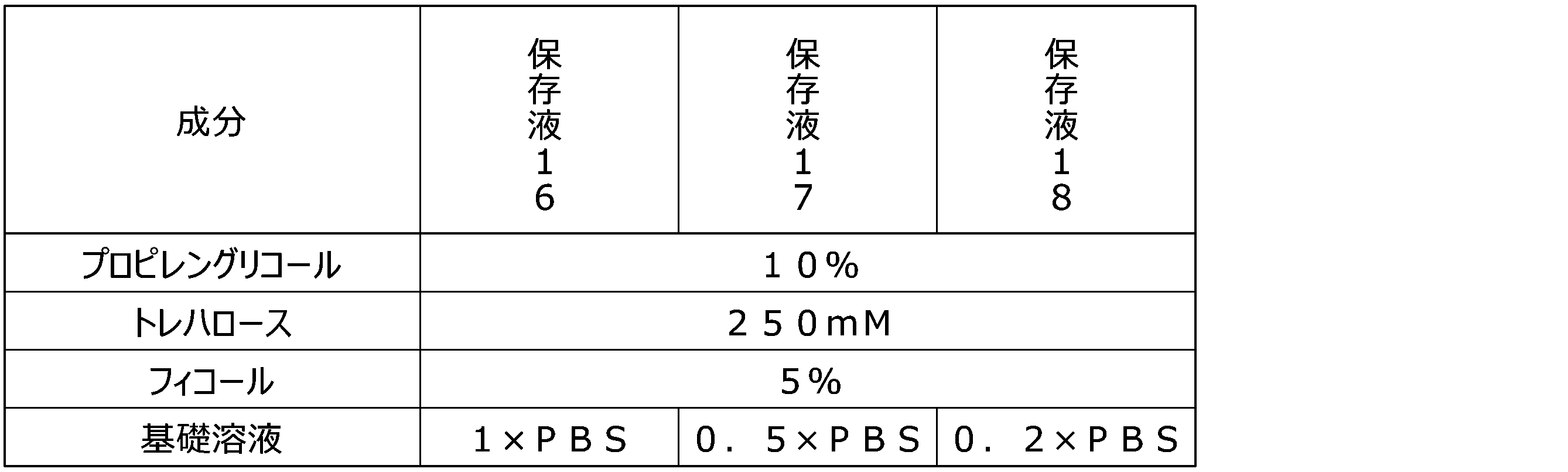
試験4では、NIH3T3細胞(マウス繊維芽細胞)を保存対象とし、各種細胞凍結保存液において2週間保存した後の細胞の生存率を測定した(n=4)。ここで、解凍後の細胞は、1.0×10⁵cells/well(24ウェルプレート)の細胞密度で播種し、これについてalamarBlue(登録商標) Cell Viability Reagentを使用して生細胞数を測定した。また、試験4では、参考例として、市販の細胞凍結保存液であるSTEM-CELLBANKER(登録商標) DMSO Free GMP grade(日本全薬工業製、参考例1)についても試験した。結果を、図4に示す。
図4に示すように、10%プロピレングリコール、250mMトレハロース、および5%のフィコールを含む細胞凍結保存液は、基礎溶液としてPBS(1×、0.5×、0.2×の濃度)を使用した場合においても、NIH3T3細胞(マウス繊維芽細胞)に対して、市販の細胞凍結保存液と比較して高い生存率を示した。
(5)試験5
以下の組成の細胞凍結保存液を試験した。
(5)試験5
以下の組成の細胞凍結保存液を試験した。

試験5では、正常ヒト皮膚繊維芽細胞またはヒト骨髄由来間葉系幹細胞を保存対象とし、各種細胞凍結保存液において2週間保存した後の細胞の生存率を測定した(n=1)。ここで、解凍後の細胞は、1.0×10⁵cells/well(24ウェルプレート)の細胞密度で播種し、これについてalamarBlue(登録商標) Cell Viability Reagentを使用して生細胞数を測定した。結果を、図5に示す。図5では、各細胞に対する保存効果を、保存液19の測定値(蛍光強度)を100%としたときの相対値として示す。
図5に示すように、10%プロピレングリコール、250mMトレハロース、および5%のフィコールの他、さらに5mMのL-アスコルビン酸2-グルコシドを含む細胞凍結保存液は、5mMのL-アスコルビン酸2-グルコシドを含まない細胞凍結保存液と比較して、ヒト骨髄由来間葉系幹細胞において高い生存率を示した。
[実施例2]細胞凍結保存液の泡切れ試験
1.材料
<細胞凍結保存液>
実施例1と同様にして、各種組成の細胞凍結保存液を調製した。
1.材料
<細胞凍結保存液>
実施例1と同様にして、各種組成の細胞凍結保存液を調製した。
2.方法
細胞凍結保存液の泡切れは、各細胞凍結保存液を強制的に泡立たせて、その泡が消えるまでの時間を測定することによって評価した。具体的には、まず、NIH-3T3細胞(1.0×10⁶cells/ml)を懸濁した各細胞凍結保存液を2mLの遠心チューブ(エッペンドルフ製)中に調製した。次いで、200μLのチップを装填したマイクロピペット(20-200)を用いて、200μLの気泡を各細胞凍結保存液中で発生させた。遠心チューブを室温に静置し、経時的に遠心チューブ中の細胞凍結保存液に泡が残存しているか否かを調べた。
細胞凍結保存液の泡切れは、各細胞凍結保存液を強制的に泡立たせて、その泡が消えるまでの時間を測定することによって評価した。具体的には、まず、NIH-3T3細胞(1.0×10⁶cells/ml)を懸濁した各細胞凍結保存液を2mLの遠心チューブ(エッペンドルフ製)中に調製した。次いで、200μLのチップを装填したマイクロピペット(20-200)を用いて、200μLの気泡を各細胞凍結保存液中で発生させた。遠心チューブを室温に静置し、経時的に遠心チューブ中の細胞凍結保存液に泡が残存しているか否かを調べた。
3.結果
以下の組成の細胞凍結保存液を試験した。

以下の組成の細胞凍結保存液を試験した。
また、参考例として、市販の細胞凍結保存液であるSTEM-CELLBANKER(登録商標) DMSO Free GMP grade(日本全薬工業製、参考例1)、CELLBANKER(登録商標)1(日本全薬工業製、参考例2)、CELLBANKER(登録商標)1 plus(日本全薬工業製、参考例3)についても試験した。結果を、表7および図6に示す。表7は、各細胞凍結保存液について、それぞれ4本の遠心チューブを用いて上記の方法で泡切れ試験を行い、各時間において泡が残存していた遠心チューブの数を示す表である。図6は、気泡発生操作後、1時間、3時間、24時間の時点での、各細胞凍結保存液における泡の残存状態を示す代表的な写真である。なお、この泡切れ試験は20回繰り返したが全て同様の結果であった。
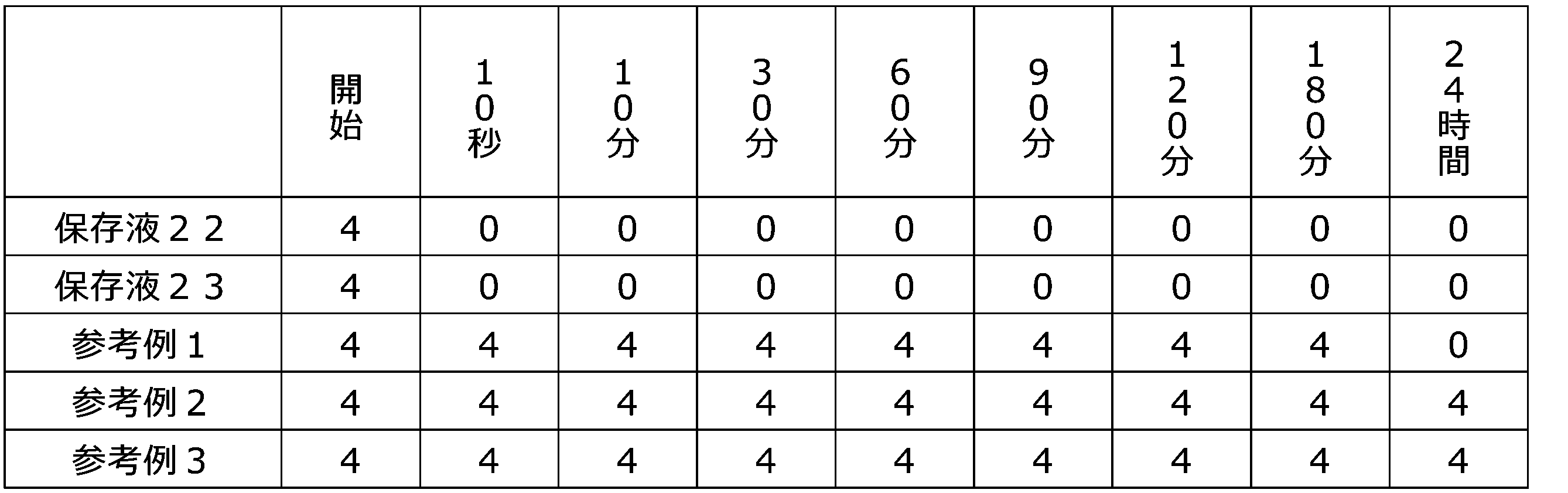
表7および図6に示すように、10%プロピレングリコール、250mMトレハロース、5%のフィコールまたはPEG#20000、および5mMのL-アスコルビン酸2-グルコシドを含む細胞凍結保存液は、市販の細胞凍結保存液と比較して非常に泡切れがよいことが示された。また、5mMのL-アスコルビン酸2-グルコシドを含まない保存液21も、気泡発生操作後10秒以内に遠心チューブ中の全ての泡が消失した(n=20)。
また、保存液22において、トレハロースに代えて、スクロース、ラクトースまたはマルトトリオースを使用した保存液について試験したが、いずれも、気泡発生操作後約10秒以内には遠心チューブ中の全ての泡が消失した。また、保存液22において、フィコールに代えて、ヒト血清アルブミンを使用した保存液について試験したところ、気泡発生操作後24時間後にも、遠心チューブ中に泡が残存していた。
[実施例3]細胞の保存効果試験2
1.材料
<細胞凍結保存液>
下記の各成分および基礎溶液を用いて、各種組成の細胞凍結保存液を調製した。また、細胞凍結保存液は、それぞれ0.22μmのフィルター(Nalgene(Thermo Scientific)製)でろ過滅菌して試験に用いた。
1.材料
<細胞凍結保存液>
下記の各成分および基礎溶液を用いて、各種組成の細胞凍結保存液を調製した。また、細胞凍結保存液は、それぞれ0.22μmのフィルター(Nalgene(Thermo Scientific)製)でろ過滅菌して試験に用いた。
(各成分)
細胞凍結保存液の各成分は、以下のものを使用した。
・プロピレングリコール:ナカライテスク製
・エチレングリコール:ナカライテスク製
・トレハロース:林原製
・スクロース:ナカライテスク製
・マルトトリオース:林原製
・ポリエチレングリコール(PEG)#20000:ナカライテスク製
・L-アスコルビン酸2-グルコシド:林原製
なお、基礎溶液は、いずれの細胞凍結保存液についても、リン酸緩衝生理食塩水(PBS)(ナカライテスク製)を、最終濃度が0.5×となるように調整して使用した。
細胞凍結保存液の各成分は、以下のものを使用した。
・プロピレングリコール:ナカライテスク製
・エチレングリコール:ナカライテスク製
・トレハロース:林原製
・スクロース:ナカライテスク製
・マルトトリオース:林原製
・ポリエチレングリコール(PEG)#20000:ナカライテスク製
・L-アスコルビン酸2-グルコシド:林原製
なお、基礎溶液は、いずれの細胞凍結保存液についても、リン酸緩衝生理食塩水(PBS)(ナカライテスク製)を、最終濃度が0.5×となるように調整して使用した。
<細胞>
実験には、以下の細胞を使用した。
・正常ヒト皮膚繊維芽細胞(クラボウから入手した)
・ヒト脂肪組織由来幹細胞(PromoCellから入手した)
・ヒト骨髄由来間葉系幹細胞1(Lonzaから入手した)
・ヒト骨髄由来間葉系幹細胞2(PromoCellから入手した)
実験には、以下の細胞を使用した。
・正常ヒト皮膚繊維芽細胞(クラボウから入手した)
・ヒト脂肪組織由来幹細胞(PromoCellから入手した)
・ヒト骨髄由来間葉系幹細胞1(Lonzaから入手した)
・ヒト骨髄由来間葉系幹細胞2(PromoCellから入手した)
2.方法
細胞の保存効果は、各細胞凍結保存液を用いて保存対象の細胞を凍結保存し、解凍後の細胞の生存率を測定することによって評価した。具体的には、まず、各細胞凍結保存液に、保存対象の細胞を、細胞濃度が1.0×10⁶cells/mlとなるように懸濁し、これをそれぞれ凍結チューブに0.2ml(試験8)または1ml(試験6~7および試験9~11)ずつ分注した上、これら細胞を-80℃で緩慢凍結させた。このように凍結させた細胞を、-80℃で所定の期間保存した後、37℃にて解凍した。そして、それぞれの生細胞数について、alamarBlueアッセイもしくはトリパンブルー染色法によって測定した。ここで、alamarBlueアッセイは、解凍した細胞を、所定の密度で播種し、細胞培養用培地で一晩培養した後、実施例1と同様にして行った。トリパンブルー染色法では、解凍した細胞について、トリパンブルーにより染色を行ったのち、血球計算盤上で全細胞数および生細胞数を測定し、全細胞に対する生細胞の割合から生存率を算出した。
細胞の保存効果は、各細胞凍結保存液を用いて保存対象の細胞を凍結保存し、解凍後の細胞の生存率を測定することによって評価した。具体的には、まず、各細胞凍結保存液に、保存対象の細胞を、細胞濃度が1.0×10⁶cells/mlとなるように懸濁し、これをそれぞれ凍結チューブに0.2ml(試験8)または1ml(試験6~7および試験9~11)ずつ分注した上、これら細胞を-80℃で緩慢凍結させた。このように凍結させた細胞を、-80℃で所定の期間保存した後、37℃にて解凍した。そして、それぞれの生細胞数について、alamarBlueアッセイもしくはトリパンブルー染色法によって測定した。ここで、alamarBlueアッセイは、解凍した細胞を、所定の密度で播種し、細胞培養用培地で一晩培養した後、実施例1と同様にして行った。トリパンブルー染色法では、解凍した細胞について、トリパンブルーにより染色を行ったのち、血球計算盤上で全細胞数および生細胞数を測定し、全細胞に対する生細胞の割合から生存率を算出した。
3.結果
(1)試験6
以下の組成の細胞凍結保存液を試験した。なお、以下の組成において、単位「%」は、プロピレングリコールおよびエチレングリコールの場合「v/v%」であり、それ以外の成分の場合「w/v%」である(以下、実施例3の試験において同様)。
(1)試験6
以下の組成の細胞凍結保存液を試験した。なお、以下の組成において、単位「%」は、プロピレングリコールおよびエチレングリコールの場合「v/v%」であり、それ以外の成分の場合「w/v%」である(以下、実施例3の試験において同様)。
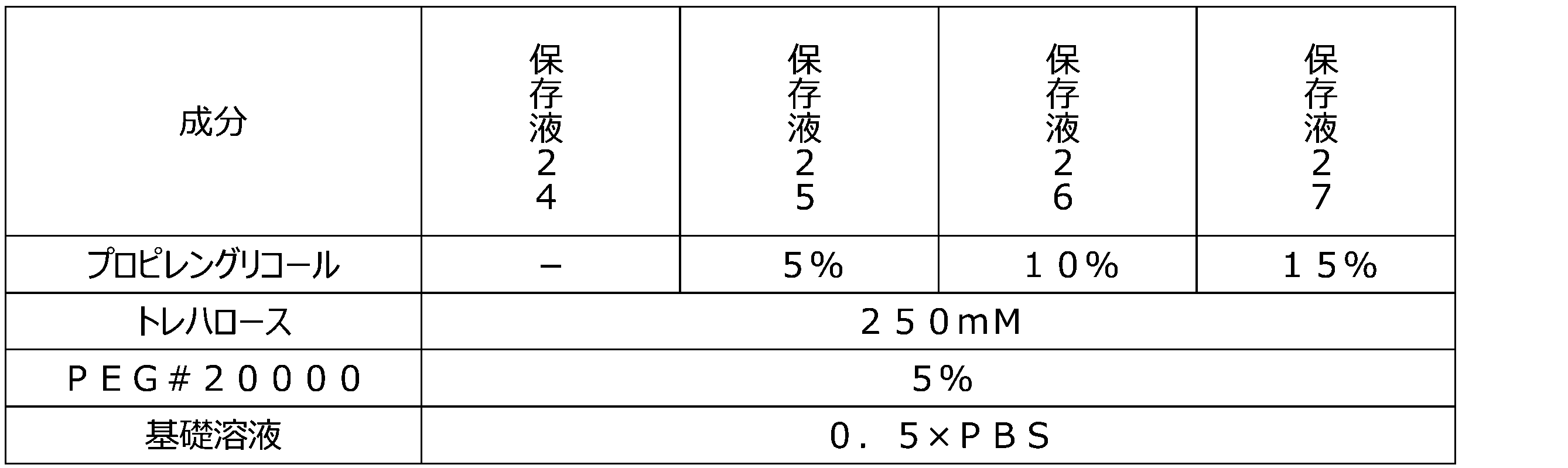
試験6では、正常ヒト皮膚繊維芽細胞を保存対象とし、各種細胞凍結保存液において2週間保存した後の細胞の生存率を測定した(n=4)。ここで、解凍後の細胞は、5.0×10⁴cells/well(24ウェルプレート)の細胞密度で播種し、これについてalamarBlue(登録商標) Cell Viability Reagentを使用して生細胞数を測定した。結果を図7に示す。
図7に示すように、プロピレングリコール、トレハロース、ポリエチレングリコールを含む細胞凍結保存液において、プロピレングリコールの濃度を5%、10%、15%と変化させたとき、いずれの濃度でも高い生存率を示したが、とくに10%の濃度で高い生存率を示した。
(2)試験7
以下の組成の細胞凍結保存液を試験した。
以下の組成の細胞凍結保存液を試験した。

試験7では、正常ヒト皮膚繊維芽細胞を保存対象とし、各種細胞凍結保存液において2週間保存した後の細胞の生存率を測定した(n=4)。ここで、解凍後の細胞は、5.0×10⁴cells/well(24ウェルプレート)の細胞密度で播種し、これについてalamarBlue(登録商標) Cell Viability Reagentを使用して生細胞数を測定した。結果を、図8に示す。
図8に示すように、プロピレングリコール、トレハロース、ポリエチレングリコールを含む細胞凍結保存液において、ポリエチレングリコールの濃度を2.5%、5.0%、7.5%と変化させたとき、いずれの濃度であっても高い生存率を示した。
(3)試験8
以下の組成の細胞凍結保存液を試験した。
以下の組成の細胞凍結保存液を試験した。

試験8では、ヒト骨髄由来間葉系幹細胞1(Lonzaから入手)、ヒト骨髄由来間葉系幹細胞2(PromoCellから入手)、ヒト脂肪組織由来幹細胞、または正常ヒト皮膚繊維芽細胞を保存対象とし、各種細胞凍結保存液において1~5日間保存し(骨髄由来間葉系幹細胞は2日、脂肪組織由来幹細胞は一晩、皮膚繊維芽細胞は5日)、保存後の細胞の生存率を測定した(n=4)。ここで、解凍後の細胞は、5.0×10⁴cells/well(24ウェルプレート)の細胞密度で播種し、これについてalamarBlue(登録商標) Cell Viability Reagentを使用して生細胞数を測定した。ヒト骨髄由来間葉系幹細胞1(Lonzaから入手)を保存対象としたときの結果を図9Aにし、ヒト骨髄由来間葉系幹細胞2(PromoCellから入手)を保存対象としたときの結果を図9Bに示し、ヒト脂肪組織由来幹細胞を保存対象としたときの結果を図9Cに示す。また、正常ヒト皮膚繊維芽細胞を保存対象としたときの結果を図10に示す。なお、試験8では、参考例として、市販の細胞凍結保存液であるSTEM-CELLBANKER(登録商標) GMP grade(DMSO含有、日本全薬工業製、参考例4)についても試験した(正常ヒト皮膚繊維芽細胞には試験せず)。
図9に示すように、10%プロピレングリコール、250mMトレハロース、および5%のポリエチレングリコールを含む細胞凍結保存液は、いずれの幹細胞に対しても、市販の細胞凍結保存液と比較して同等かそれ以上の高い生存率を示した。さらに、プロピレングリコールに代えてエチレングリコールを含む細胞凍結保存液は、プロピレングリコールを含む細胞凍結保存液と同等かそれ以上の高い生存率を示し、また、図10に示すように、正常ヒト皮膚繊維芽細胞に対しても、プロピレングリコールを含む細胞凍結保存液よりも高い生存率を示した。
(4)試験9
以下の組成の細胞凍結保存液を試験した。
以下の組成の細胞凍結保存液を試験した。

試験9では、正常ヒト皮膚繊維芽細胞または骨髄由来間葉系幹細胞1(Lonzaから入手)を保存対象とし、各種細胞凍結保存液において10日間保存した後の細胞の生存率を測定した(n=4)。ここで、解凍後の細胞についてトリパンブルー染色法によって生細胞数を測定し、生存率を算出した。正常ヒト皮膚繊維芽細胞を保存対象としたときの結果を図11Aに示し、ヒト骨髄由来間葉系幹細胞1を保存対象としたときの結果を図11Bに示す。また、試験9では、参考例として、市販の細胞凍結保存液であるSTEM-CELLBANKER(登録商標) DMSO Free GMP grade(日本全薬工業製、参考例1)、CELLBANKER(登録商標)1(日本全薬工業製、参考例2)、STEM-CELLBANKER(登録商標) GMP grade(日本全薬工業製、参考例4)についても試験した(正常ヒト皮膚繊維芽細胞では参考例2のみ)。
図11に示すように、10%プロピレングリコール、250mMトレハロース、5%のポリエチレングリコール、および5mMのL-アスコルビン酸2-グルコシドを含む細胞凍結保存液は、正常ヒト皮膚繊維芽細胞、骨髄由来間葉系幹細胞1のいずれに対しても、市販の細胞凍結保存液と比較して同等かそれ以上の高い生存率を示した。
(5)試験10
以下の組成の細胞凍結保存液を試験した。
以下の組成の細胞凍結保存液を試験した。

試験10では、正常ヒト皮膚繊維芽細胞を保存対象とし、各種細胞凍結保存液において1週間保存した後の細胞の生存率を測定した(n=4)。ここで、解凍後の細胞は、5.0×10⁴cells/well(24ウェルプレート)の細胞密度で播種し、これについてalamarBlue(登録商標) Cell Viability Reagentを使用して生細胞数を測定した。結果を、図12に示す。なお、試験10では、参考例として、市販の細胞凍結保存液であるSTEM-CELLBANKER(登録商標) GMP grade(DMSO含有、日本全薬工業製、参考例4)についても試験した。
図12に示すように、10%プロピレングリコール、250mMスクロース、および5%のポリエチレングリコールを含む細胞凍結保存液は、正常ヒト皮膚繊維芽細胞に対して、市販の細胞凍結保存液と比較して同等かそれ以上の高い生存率を示した。また、スクロースに代えてマルトトリオースを含む細胞凍結保存液も、同様に高い生存率を示した。
(6)試験11
以下の組成の細胞凍結保存液を試験した。
以下の組成の細胞凍結保存液を試験した。

試験11では、正常ヒト皮膚繊維芽細胞を保存対象とし、各種細胞凍結保存液において1週間保存した後の細胞の生存率を測定した(n=3)。ここで、解凍後の細胞は、5.0×10⁴cells/well(24ウェルプレート)の細胞密度で播種し、これについてalamarBlue(登録商標) Cell Viability Reagentを使用して生細胞数を測定した。結果を、図13AおよびBに示す。図13AおよびBでは、各細胞凍結保存液の細胞に対する保存効果を、L-アスコルビン酸2-グルコシドを含まない細胞凍結保存液(保存液37、39)の測定値(蛍光強度)を100%としたときの相対値として示す。
図13AおよびBに示すように、10%プロピレングリコール、250mMトレハロース、および5%のポリエチレングリコールの他、さらに5mMのL-アスコルビン酸2-グルコシドを含む細胞凍結保存液は、5mMのL-アスコルビン酸2-グルコシドを含まない細胞凍結保存液と比較して、高い生存率を示した。また、プロピレングリコールに代えてエチレングリコールを含む細胞凍結保存液も、5mMのL-アスコルビン酸2-グルコシドを含む細胞凍結保存液の方が、5mMのL-アスコルビン酸2-グルコシドを含まない細胞凍結保存液よりも高い生存率を示した。
(7)泡切れ試験
保存液25~27、29~40について、各保存液に細胞を懸濁させなかった以外は、実施例2と同様にして泡切れ試験を実施したが、いずれの保存液も、気泡発生操作後約10秒以内には遠心チューブ中の全ての泡が消失した。
保存液25~27、29~40について、各保存液に細胞を懸濁させなかった以外は、実施例2と同様にして泡切れ試験を実施したが、いずれの保存液も、気泡発生操作後約10秒以内には遠心チューブ中の全ての泡が消失した。
本発明によれば、細胞の保存効果に優れ、かつ泡立ちの少ない細胞凍結保存液を提供することができる。このような細胞凍結保存液は、医療用幹細胞や分化細胞(細胞製剤等を含む)などの保存剤、また基礎研究用試薬として有用に使用できる。
Claims (8)
- 1.0~25.0v/v%の細胞膜透過性多価アルコール類(a)、100~1000mMの糖類(b)、および合計0.5~10.0w/v%のフィコールおよびポリエチレングリコールからなる群より選択された少なくとも1種(c)を含む、細胞凍結保存液。
- 基礎溶液が、緩衝液、または基礎培地である、請求項1記載の細胞凍結保存液。
- 細胞膜透過性多価アルコール類(a)が、エチレングリコールおよびプロピレングリコールからなる群より選択された少なくとも1種である、請求項1または2記載の細胞凍結保存液。
- 細胞膜透過性多価アルコール類(a)として、エチレングリコールのみを含む、請求項3記載の細胞凍結保存液。
- 糖類(b)が、オリゴ糖である、請求項1~4のいずれか一項に記載の細胞凍結保存液。
- 糖類(b)が、トレハロース、スクロース、ラクトース、およびマルトトリオースからなる群より選択された少なくとも1種である、請求項4記載の細胞凍結保存液。
- さらに、L-アスコルビン酸2-グルコシドを含む、請求項1~6のいずれか一項に記載の細胞凍結保存液。
- 請求項1~7のいずれか一項に記載の細胞凍結保存液を使用することを特徴とする、細胞の緩慢凍結方法。
Priority Applications (3)
| Application Number | Priority Date | Filing Date | Title |
|---|---|---|---|
| JP2020566496A JP7524077B2 (ja) | 2019-01-17 | 2020-01-17 | 細胞凍結保存液 |
| EP20741728.8A EP3913046A4 (en) | 2019-01-17 | 2020-01-17 | CELL CRYOPRESERVATION LIQUID |
| US17/423,046 US20220117221A1 (en) | 2019-01-17 | 2020-01-17 | Cell cryopreservation solution |
Applications Claiming Priority (2)
| Application Number | Priority Date | Filing Date | Title |
|---|---|---|---|
| JP2019006350 | 2019-01-17 | ||
| JP2019-006350 | 2019-01-17 |
Publications (1)
| Publication Number | Publication Date |
|---|---|
| WO2020149394A1 true WO2020149394A1 (ja) | 2020-07-23 |
Family
ID=71613609
Family Applications (1)
| Application Number | Title | Priority Date | Filing Date |
|---|---|---|---|
| PCT/JP2020/001432 Ceased WO2020149394A1 (ja) | 2019-01-17 | 2020-01-17 | 細胞凍結保存液 |
Country Status (5)
| Country | Link |
|---|---|
| US (1) | US20220117221A1 (ja) |
| EP (1) | EP3913046A4 (ja) |
| JP (1) | JP7524077B2 (ja) |
| TW (1) | TWI837281B (ja) |
| WO (1) | WO2020149394A1 (ja) |
Cited By (4)
| Publication number | Priority date | Publication date | Assignee | Title |
|---|---|---|---|---|
| JP2022104329A (ja) * | 2020-12-28 | 2022-07-08 | イビデン株式会社 | 凍結保存液 |
| JP2023050921A (ja) * | 2021-09-30 | 2023-04-11 | 株式会社カネカ | 接着性幹細胞製剤の製造方法 |
| WO2023199641A1 (ja) * | 2022-04-12 | 2023-10-19 | 株式会社大塚製薬工場 | 哺乳動物細胞凍結保存液 |
| CN117158413A (zh) * | 2023-09-22 | 2023-12-05 | 广州正源生物技术有限公司 | 一种玻璃样冻存液及其应用 |
Citations (5)
| Publication number | Priority date | Publication date | Assignee | Title |
|---|---|---|---|---|
| JP2005239685A (ja) * | 2004-02-27 | 2005-09-08 | Fukuoka Prefecture | 凍結用具 |
| JP2010213692A (ja) * | 2009-02-19 | 2010-09-30 | Hiroaki Inui | 細胞をガラス化保存する方法および細胞のガラス化保存用容器 |
| JP2010273549A (ja) | 2009-05-26 | 2010-12-09 | Kyoto Univ | 多能性幹細胞用の凍結保存液と多能性幹細胞の凍結保存方法 |
| WO2015182019A1 (ja) * | 2014-05-30 | 2015-12-03 | Sbiファーマ株式会社 | 臓器保存液 |
| WO2017141991A1 (ja) * | 2016-02-17 | 2017-08-24 | 国立大学法人北陸先端科学技術大学院大学 | 動物細胞凍結保存液用ガラス化状態安定化剤 |
Family Cites Families (7)
| Publication number | Priority date | Publication date | Assignee | Title |
|---|---|---|---|---|
| EP2043431B1 (en) * | 2006-06-12 | 2018-03-07 | The Jackson Laboratory | Sperm cryoprotective media |
| JP6329468B2 (ja) * | 2014-09-16 | 2018-05-23 | 三菱製紙株式会社 | 線維芽細胞のガラス化凍結保存方法 |
| MX391259B (es) * | 2015-10-14 | 2025-03-21 | X Therma Inc | Composiciones y métodos para reducir la formación de cristales de hielo. |
| CN105961374A (zh) * | 2016-07-04 | 2016-09-28 | 深圳市合康生物科技股份有限公司 | 细胞冻存液 |
| WO2018017843A1 (en) * | 2016-07-22 | 2018-01-25 | Tissue Testing Technologies Llc | Enhancement of cell cryopreservation with glycolipids |
| US10815456B2 (en) * | 2016-10-04 | 2020-10-27 | Transwell Biotech Co., Ltd. | Composition, kit and method for cryopreserving cells |
| CN109221082B (zh) * | 2018-09-14 | 2021-07-09 | 上海慧存医疗科技有限公司 | 细胞冻存液、冻存复苏方法及其应用 |
-
2020
- 2020-01-17 TW TW109101684A patent/TWI837281B/zh active
- 2020-01-17 JP JP2020566496A patent/JP7524077B2/ja active Active
- 2020-01-17 EP EP20741728.8A patent/EP3913046A4/en active Pending
- 2020-01-17 US US17/423,046 patent/US20220117221A1/en not_active Abandoned
- 2020-01-17 WO PCT/JP2020/001432 patent/WO2020149394A1/ja not_active Ceased
Patent Citations (5)
| Publication number | Priority date | Publication date | Assignee | Title |
|---|---|---|---|---|
| JP2005239685A (ja) * | 2004-02-27 | 2005-09-08 | Fukuoka Prefecture | 凍結用具 |
| JP2010213692A (ja) * | 2009-02-19 | 2010-09-30 | Hiroaki Inui | 細胞をガラス化保存する方法および細胞のガラス化保存用容器 |
| JP2010273549A (ja) | 2009-05-26 | 2010-12-09 | Kyoto Univ | 多能性幹細胞用の凍結保存液と多能性幹細胞の凍結保存方法 |
| WO2015182019A1 (ja) * | 2014-05-30 | 2015-12-03 | Sbiファーマ株式会社 | 臓器保存液 |
| WO2017141991A1 (ja) * | 2016-02-17 | 2017-08-24 | 国立大学法人北陸先端科学技術大学院大学 | 動物細胞凍結保存液用ガラス化状態安定化剤 |
Non-Patent Citations (1)
| Title |
|---|
| See also references of EP3913046A4 |
Cited By (6)
| Publication number | Priority date | Publication date | Assignee | Title |
|---|---|---|---|---|
| JP2022104329A (ja) * | 2020-12-28 | 2022-07-08 | イビデン株式会社 | 凍結保存液 |
| JP7716851B2 (ja) | 2020-12-28 | 2025-08-01 | イビデン株式会社 | 凍結保存液 |
| JP2023050921A (ja) * | 2021-09-30 | 2023-04-11 | 株式会社カネカ | 接着性幹細胞製剤の製造方法 |
| JP7833271B2 (ja) | 2021-09-30 | 2026-03-19 | 株式会社カネカ | 接着性幹細胞製剤の製造方法 |
| WO2023199641A1 (ja) * | 2022-04-12 | 2023-10-19 | 株式会社大塚製薬工場 | 哺乳動物細胞凍結保存液 |
| CN117158413A (zh) * | 2023-09-22 | 2023-12-05 | 广州正源生物技术有限公司 | 一种玻璃样冻存液及其应用 |
Also Published As
| Publication number | Publication date |
|---|---|
| US20220117221A1 (en) | 2022-04-21 |
| TW202043452A (zh) | 2020-12-01 |
| EP3913046A4 (en) | 2022-10-26 |
| TWI837281B (zh) | 2024-04-01 |
| EP3913046A1 (en) | 2021-11-24 |
| JP7524077B2 (ja) | 2024-07-29 |
| JPWO2020149394A1 (ja) | 2021-11-25 |
Similar Documents
| Publication | Publication Date | Title |
|---|---|---|
| KR101368924B1 (ko) | 세포 보존용 수용액 | |
| JP7524077B2 (ja) | 細胞凍結保存液 | |
| US6365338B1 (en) | Organ preservative solution containing trehalose, anti-oxidant, cations and an energy source | |
| US20240397936A1 (en) | High subzero cryopreservation | |
| Balci et al. | The assessment of cryopreservation conditions for human umbilical cord stroma-derived mesenchymal stem cells towards a potential use for stem cell banking | |
| JP7401865B2 (ja) | 機能的な間葉系幹細胞の富化集団を得る方法、それによって得られる細胞、およびその細胞を含む組成物 | |
| KR102253850B1 (ko) | 포유동물 세포 동결 보존액 | |
| JP7000212B2 (ja) | 幹細胞の凍結保存液 | |
| Malo et al. | Dimethylformamide is not better than glycerol for cryopreservation of boar semen | |
| KR20060052158A (ko) | 세포 보존액 | |
| CN113490414B (zh) | 干细胞的保存 | |
| CZ2016284A3 (cs) | Prostředek pro uchování, transport a aplikaci kmenových buněk | |
| US11985968B2 (en) | Cryosolutions and uses thereof | |
| US20200396985A1 (en) | Preservation and cryopreservation media | |
| US20250263673A1 (en) | Mammalian cell cryopreservation liquid | |
| KR20250003736A (ko) | 히알루론산을 포함하는 냉동보존 매질, 이의 용도 및 냉동보존법 | |
| CZ2017396A3 (cs) | Prostředek pro uchování lidských nebo zvířecích buněk při velmi nízkých teplotách a jeho použití | |
| JP2019110799A (ja) | 動物細胞のガラス化凍結保存方法 | |
| Ray | Cryopreservation Strategy for Adipose Tissue and Adipose Tissue Derived Stem Cells by Developing Non-Toxic Freezing Solutions | |
| CZ31206U1 (cs) | Prostředek pro uchování lidských nebo zvířecích buněk při velmi nízkých teplotách | |
| ITMI20110678A1 (it) | Composizione e metodo per la crioconservazione di cellule | |
| CZ30270U1 (cs) | Prostředek pro uchování, transport a aplikaci kmenových buněk |
Legal Events
| Date | Code | Title | Description |
|---|---|---|---|
| 121 | Ep: the epo has been informed by wipo that ep was designated in this application |
Ref document number: 20741728 Country of ref document: EP Kind code of ref document: A1 |
|
| ENP | Entry into the national phase |
Ref document number: 2020566496 Country of ref document: JP Kind code of ref document: A |
|
| NENP | Non-entry into the national phase |
Ref country code: DE |
|
| ENP | Entry into the national phase |
Ref document number: 2020741728 Country of ref document: EP Effective date: 20210817 |