WO2020153343A1 - 核剤組成物、オレフィン系樹脂組成物、その成形品およびオレフィン系樹脂組成物の製造方法 - Google Patents
核剤組成物、オレフィン系樹脂組成物、その成形品およびオレフィン系樹脂組成物の製造方法 Download PDFInfo
- Publication number
- WO2020153343A1 WO2020153343A1 PCT/JP2020/001895 JP2020001895W WO2020153343A1 WO 2020153343 A1 WO2020153343 A1 WO 2020153343A1 JP 2020001895 W JP2020001895 W JP 2020001895W WO 2020153343 A1 WO2020153343 A1 WO 2020153343A1
- Authority
- WO
- WIPO (PCT)
- Prior art keywords
- mass
- nucleating agent
- olefin resin
- parts
- resin composition
- Prior art date
- Legal status (The legal status is an assumption and is not a legal conclusion. Google has not performed a legal analysis and makes no representation as to the accuracy of the status listed.)
- Ceased
Links
Classifications
-
- C—CHEMISTRY; METALLURGY
- C08—ORGANIC MACROMOLECULAR COMPOUNDS; THEIR PREPARATION OR CHEMICAL WORKING-UP; COMPOSITIONS BASED THEREON
- C08J—WORKING-UP; GENERAL PROCESSES OF COMPOUNDING; AFTER-TREATMENT NOT COVERED BY SUBCLASSES C08B, C08C, C08F, C08G or C08H
- C08J3/00—Processes of treating or compounding macromolecular substances
- C08J3/20—Compounding polymers with additives, e.g. colouring
- C08J3/203—Solid polymers with solid and/or liquid additives
-
- C—CHEMISTRY; METALLURGY
- C08—ORGANIC MACROMOLECULAR COMPOUNDS; THEIR PREPARATION OR CHEMICAL WORKING-UP; COMPOSITIONS BASED THEREON
- C08F—MACROMOLECULAR COMPOUNDS OBTAINED BY REACTIONS ONLY INVOLVING CARBON-TO-CARBON UNSATURATED BONDS
- C08F110/00—Homopolymers of unsaturated aliphatic hydrocarbons having only one carbon-to-carbon double bond
- C08F110/04—Monomers containing three or four carbon atoms
- C08F110/06—Propene
-
- C—CHEMISTRY; METALLURGY
- C08—ORGANIC MACROMOLECULAR COMPOUNDS; THEIR PREPARATION OR CHEMICAL WORKING-UP; COMPOSITIONS BASED THEREON
- C08K—Use of inorganic or non-macromolecular organic substances as compounding ingredients
- C08K5/00—Use of organic ingredients
- C08K5/49—Phosphorus-containing compounds
- C08K5/51—Phosphorus bound to oxygen
- C08K5/52—Phosphorus bound to oxygen only
- C08K5/527—Cyclic esters
-
- C—CHEMISTRY; METALLURGY
- C07—ORGANIC CHEMISTRY
- C07F—ACYCLIC, CARBOCYCLIC OR HETEROCYCLIC COMPOUNDS CONTAINING ELEMENTS OTHER THAN CARBON, HYDROGEN, HALOGEN, OXYGEN, NITROGEN, SULFUR, SELENIUM OR TELLURIUM
- C07F9/00—Compounds containing elements of Groups 5 or 15 of the Periodic Table
- C07F9/02—Phosphorus compounds
- C07F9/547—Heterocyclic compounds, e.g. containing phosphorus as a ring hetero atom
- C07F9/6564—Heterocyclic compounds, e.g. containing phosphorus as a ring hetero atom having phosphorus atoms, with or without nitrogen, oxygen, sulfur, selenium or tellurium atoms, as ring hetero atoms
- C07F9/6571—Heterocyclic compounds, e.g. containing phosphorus as a ring hetero atom having phosphorus atoms, with or without nitrogen, oxygen, sulfur, selenium or tellurium atoms, as ring hetero atoms having phosphorus and oxygen atoms as the only ring hetero atoms
- C07F9/6574—Esters of oxyacids of phosphorus
- C07F9/65744—Esters of oxyacids of phosphorus condensed with carbocyclic or heterocyclic rings or ring systems
-
- C—CHEMISTRY; METALLURGY
- C08—ORGANIC MACROMOLECULAR COMPOUNDS; THEIR PREPARATION OR CHEMICAL WORKING-UP; COMPOSITIONS BASED THEREON
- C08K—Use of inorganic or non-macromolecular organic substances as compounding ingredients
- C08K13/00—Use of mixtures of ingredients not covered by one single of the preceding main groups, each of these compounds being essential
- C08K13/02—Organic and inorganic ingredients
-
- C—CHEMISTRY; METALLURGY
- C08—ORGANIC MACROMOLECULAR COMPOUNDS; THEIR PREPARATION OR CHEMICAL WORKING-UP; COMPOSITIONS BASED THEREON
- C08K—Use of inorganic or non-macromolecular organic substances as compounding ingredients
- C08K3/00—Use of inorganic substances as compounding ingredients
- C08K3/18—Oxygen-containing compounds, e.g. metal carbonyls
- C08K3/20—Oxides; Hydroxides
-
- C—CHEMISTRY; METALLURGY
- C08—ORGANIC MACROMOLECULAR COMPOUNDS; THEIR PREPARATION OR CHEMICAL WORKING-UP; COMPOSITIONS BASED THEREON
- C08K—Use of inorganic or non-macromolecular organic substances as compounding ingredients
- C08K5/00—Use of organic ingredients
- C08K5/0008—Organic ingredients according to more than one of the "one dot" groups of C08K5/01 - C08K5/59
- C08K5/0083—Nucleating agents promoting the crystallisation of the polymer matrix
-
- C—CHEMISTRY; METALLURGY
- C08—ORGANIC MACROMOLECULAR COMPOUNDS; THEIR PREPARATION OR CHEMICAL WORKING-UP; COMPOSITIONS BASED THEREON
- C08K—Use of inorganic or non-macromolecular organic substances as compounding ingredients
- C08K5/00—Use of organic ingredients
- C08K5/04—Oxygen-containing compounds
- C08K5/05—Alcohols; Metal alcoholates
- C08K5/053—Polyhydroxylic alcohols
-
- C—CHEMISTRY; METALLURGY
- C08—ORGANIC MACROMOLECULAR COMPOUNDS; THEIR PREPARATION OR CHEMICAL WORKING-UP; COMPOSITIONS BASED THEREON
- C08K—Use of inorganic or non-macromolecular organic substances as compounding ingredients
- C08K5/00—Use of organic ingredients
- C08K5/04—Oxygen-containing compounds
- C08K5/10—Esters; Ether-esters
- C08K5/101—Esters; Ether-esters of monocarboxylic acids
- C08K5/103—Esters; Ether-esters of monocarboxylic acids with polyalcohols
-
- C—CHEMISTRY; METALLURGY
- C08—ORGANIC MACROMOLECULAR COMPOUNDS; THEIR PREPARATION OR CHEMICAL WORKING-UP; COMPOSITIONS BASED THEREON
- C08K—Use of inorganic or non-macromolecular organic substances as compounding ingredients
- C08K5/00—Use of organic ingredients
- C08K5/49—Phosphorus-containing compounds
- C08K5/51—Phosphorus bound to oxygen
- C08K5/52—Phosphorus bound to oxygen only
- C08K5/521—Esters of phosphoric acids, e.g. of H3PO4
-
- C—CHEMISTRY; METALLURGY
- C08—ORGANIC MACROMOLECULAR COMPOUNDS; THEIR PREPARATION OR CHEMICAL WORKING-UP; COMPOSITIONS BASED THEREON
- C08L—COMPOSITIONS OF MACROMOLECULAR COMPOUNDS
- C08L23/00—Compositions of homopolymers or copolymers of unsaturated aliphatic hydrocarbons having only one carbon-to-carbon double bond; Compositions of derivatives of such polymers
-
- C—CHEMISTRY; METALLURGY
- C08—ORGANIC MACROMOLECULAR COMPOUNDS; THEIR PREPARATION OR CHEMICAL WORKING-UP; COMPOSITIONS BASED THEREON
- C08L—COMPOSITIONS OF MACROMOLECULAR COMPOUNDS
- C08L23/00—Compositions of homopolymers or copolymers of unsaturated aliphatic hydrocarbons having only one carbon-to-carbon double bond; Compositions of derivatives of such polymers
- C08L23/02—Compositions of homopolymers or copolymers of unsaturated aliphatic hydrocarbons having only one carbon-to-carbon double bond; Compositions of derivatives of such polymers not modified by chemical after-treatment
- C08L23/04—Homopolymers or copolymers of ethene
- C08L23/08—Copolymers of ethene
- C08L23/0807—Copolymers of ethene with unsaturated hydrocarbons only containing four or more carbon atoms
- C08L23/0815—Copolymers of ethene with unsaturated hydrocarbons only containing four or more carbon atoms with aliphatic 1-olefins containing one carbon-to-carbon double bond
-
- C—CHEMISTRY; METALLURGY
- C08—ORGANIC MACROMOLECULAR COMPOUNDS; THEIR PREPARATION OR CHEMICAL WORKING-UP; COMPOSITIONS BASED THEREON
- C08L—COMPOSITIONS OF MACROMOLECULAR COMPOUNDS
- C08L23/00—Compositions of homopolymers or copolymers of unsaturated aliphatic hydrocarbons having only one carbon-to-carbon double bond; Compositions of derivatives of such polymers
- C08L23/02—Compositions of homopolymers or copolymers of unsaturated aliphatic hydrocarbons having only one carbon-to-carbon double bond; Compositions of derivatives of such polymers not modified by chemical after-treatment
- C08L23/10—Homopolymers or copolymers of propene
- C08L23/12—Polypropene
-
- C—CHEMISTRY; METALLURGY
- C08—ORGANIC MACROMOLECULAR COMPOUNDS; THEIR PREPARATION OR CHEMICAL WORKING-UP; COMPOSITIONS BASED THEREON
- C08L—COMPOSITIONS OF MACROMOLECULAR COMPOUNDS
- C08L29/00—Compositions of homopolymers or copolymers of compounds having one or more unsaturated aliphatic radicals, each having only one carbon-to-carbon double bond, and at least one being terminated by an alcohol, ether, aldehydo, ketonic, acetal or ketal radical; Compositions of hydrolysed polymers of esters of unsaturated alcohols with saturated carboxylic acids; Compositions of derivatives of such polymers
- C08L29/02—Homopolymers or copolymers of unsaturated alcohols
- C08L29/04—Polyvinyl alcohol; Partially hydrolysed homopolymers or copolymers of esters of unsaturated alcohols with saturated carboxylic acids
-
- C—CHEMISTRY; METALLURGY
- C08—ORGANIC MACROMOLECULAR COMPOUNDS; THEIR PREPARATION OR CHEMICAL WORKING-UP; COMPOSITIONS BASED THEREON
- C08J—WORKING-UP; GENERAL PROCESSES OF COMPOUNDING; AFTER-TREATMENT NOT COVERED BY SUBCLASSES C08B, C08C, C08F, C08G or C08H
- C08J2323/00—Characterised by the use of homopolymers or copolymers of unsaturated aliphatic hydrocarbons having only one carbon-to-carbon double bond; Derivatives of such polymers
- C08J2323/02—Characterised by the use of homopolymers or copolymers of unsaturated aliphatic hydrocarbons having only one carbon-to-carbon double bond; Derivatives of such polymers not modified by chemical after treatment
- C08J2323/10—Homopolymers or copolymers of propene
- C08J2323/12—Polypropene
-
- C—CHEMISTRY; METALLURGY
- C08—ORGANIC MACROMOLECULAR COMPOUNDS; THEIR PREPARATION OR CHEMICAL WORKING-UP; COMPOSITIONS BASED THEREON
- C08J—WORKING-UP; GENERAL PROCESSES OF COMPOUNDING; AFTER-TREATMENT NOT COVERED BY SUBCLASSES C08B, C08C, C08F, C08G or C08H
- C08J2323/00—Characterised by the use of homopolymers or copolymers of unsaturated aliphatic hydrocarbons having only one carbon-to-carbon double bond; Derivatives of such polymers
- C08J2323/02—Characterised by the use of homopolymers or copolymers of unsaturated aliphatic hydrocarbons having only one carbon-to-carbon double bond; Derivatives of such polymers not modified by chemical after treatment
- C08J2323/10—Homopolymers or copolymers of propene
- C08J2323/14—Copolymers of propene
-
- C—CHEMISTRY; METALLURGY
- C08—ORGANIC MACROMOLECULAR COMPOUNDS; THEIR PREPARATION OR CHEMICAL WORKING-UP; COMPOSITIONS BASED THEREON
- C08J—WORKING-UP; GENERAL PROCESSES OF COMPOUNDING; AFTER-TREATMENT NOT COVERED BY SUBCLASSES C08B, C08C, C08F, C08G or C08H
- C08J2423/00—Characterised by the use of homopolymers or copolymers of unsaturated aliphatic hydrocarbons having only one carbon-to-carbon double bond; Derivatives of such polymers
- C08J2423/02—Characterised by the use of homopolymers or copolymers of unsaturated aliphatic hydrocarbons having only one carbon-to-carbon double bond; Derivatives of such polymers not modified by chemical after treatment
- C08J2423/04—Homopolymers or copolymers of ethene
- C08J2423/08—Copolymers of ethene
-
- C—CHEMISTRY; METALLURGY
- C08—ORGANIC MACROMOLECULAR COMPOUNDS; THEIR PREPARATION OR CHEMICAL WORKING-UP; COMPOSITIONS BASED THEREON
- C08K—Use of inorganic or non-macromolecular organic substances as compounding ingredients
- C08K3/00—Use of inorganic substances as compounding ingredients
- C08K3/18—Oxygen-containing compounds, e.g. metal carbonyls
-
- C—CHEMISTRY; METALLURGY
- C08—ORGANIC MACROMOLECULAR COMPOUNDS; THEIR PREPARATION OR CHEMICAL WORKING-UP; COMPOSITIONS BASED THEREON
- C08L—COMPOSITIONS OF MACROMOLECULAR COMPOUNDS
- C08L2201/00—Properties
- C08L2201/10—Transparent films; Clear coatings; Transparent materials
-
- C—CHEMISTRY; METALLURGY
- C08—ORGANIC MACROMOLECULAR COMPOUNDS; THEIR PREPARATION OR CHEMICAL WORKING-UP; COMPOSITIONS BASED THEREON
- C08L—COMPOSITIONS OF MACROMOLECULAR COMPOUNDS
- C08L2205/00—Polymer mixtures characterised by other features
- C08L2205/24—Crystallisation aids
-
- C—CHEMISTRY; METALLURGY
- C08—ORGANIC MACROMOLECULAR COMPOUNDS; THEIR PREPARATION OR CHEMICAL WORKING-UP; COMPOSITIONS BASED THEREON
- C08L—COMPOSITIONS OF MACROMOLECULAR COMPOUNDS
- C08L2207/00—Properties characterising the ingredient of the composition
- C08L2207/20—Recycled plastic
Definitions
- TECHNICAL FIELD The present invention relates to a nucleating agent composition, an olefin resin composition (hereinafter, also simply referred to as “resin composition”), a molded article thereof and a method for producing an olefin resin composition.
- TECHNICAL FIELD The present invention relates to a nucleating agent composition, an olefin resin composition, a molded article and a method for producing an olefin resin composition which can impart crystallinity to obtain a molded article having excellent mechanical properties and transparency.
- Olefin resins such as polyethylene, polypropylene, and polybutene-1 are inexpensive and have excellent properties such as moldability, hygiene, heat resistance, chemical resistance, mechanical properties, and low specific gravity. Materials, household appliances/electronics materials, textile materials, packaging materials, agricultural materials, housing materials for home appliances, household goods, medical instruments, food containers, beverage containers, films, sheets and various molded parts such as structural parts Widely used in. However, olefin resins have problems such as a low crystallization rate after heat molding and a long molding cycle during processing.
- nucleating agents are added to rapidly produce fine crystals. Further, it is known that the addition of a nucleating agent improves the transparency and mechanical properties of a molded product obtained by molding an olefin resin.
- the nucleating agent for improving the crystallinity of the olefin resin for example, a carboxylic acid metal salt, an aromatic phosphoric acid ester metal salt, a benzylidene sorbitol compound, an amide compound, a rosin acid metal salt, talc and the like are used. ..
- sodium benzoate, 4-tert-butylbenzoic acid aluminum salt, sodium adipate and carboxylic acid metal salts such as disodium bicyclo[2.2.1]heptane-2,3-dicarboxylate, sodium-2, 2'-methylenebis(4,6-di-tert-butylphenyl)phosphate, lithium-2,2'-methylenebis(4,6-di-tert-butylphenyl)phosphate, aluminum hydroxybis[2,2'-methylenebis (4,6-di-tert-butylphenyl)phosphate] and other aromatic phosphate metal salts, dibenzylidene sorbitol, bis(methylbenzylidene)sorbitol, bis(3,4-dimethylbenzylidene)sorbitol, bis(p- Benzylidene sorbitol compounds such as ethylbenzylidene)sorbitol and bis(dimethylbenzylidene)sorbito
- Patent Documents 1 and 2 after preparing an olefin resin composition containing a nucleating agent by polymerizing an olefin monomer in the presence of a nucleating agent, water is added to the olefin resin composition containing the nucleating agent.
- a method for producing an olefin resin composition to be blended is described.
- the molded article made of the olefin resin composition produced by the production method described in Patent Document 1 or 2 had room for further improvement in terms of mechanical properties or transparency.
- an object of the present invention is to provide a olefin resin with excellent crystallinity and to obtain a molded article having excellent mechanical properties and transparency, a nucleating agent composition, an olefin resin composition, and a molding thereof.
- the object of the present invention is to provide a product and a method for producing an olefin resin composition.
- the present inventors have conducted extensive studies to solve the above-mentioned problems, and as a result, by using a specific aromatic phosphoric acid ester metal salt and a specific auxiliary agent in combination, an olefin resin composition is formed.
- the inventors have found that the physical properties of molded articles are remarkably improved, and have completed the present invention.
- the nucleating agent composition of the present invention contains a nucleating agent and an auxiliary agent, and the nucleating agent has the following general formula (1):
- R 1 to R 4 represent an alkyl group having 1 to 6 carbon atoms
- R 5 represents a hydrogen atom or an alkyl group having 1 to 3 carbon atoms
- n is 1 or 2 and n is 1
- M represents lithium or dihydroxyaluminum
- n is 2, M represents hydroxyaluminum
- the auxiliary agent is at least one selected from the group consisting of water and a polyol compound, and the content of the auxiliary agent with respect to 100 parts by mass of the nucleating agent is 1 to 10000 parts by mass.
- the polyol compound is preferably at least one selected from the group consisting of glycols, sugar alcohols, monofatty acid esters of sugar alcohols, and polyvinyl alcohol.
- the olefin resin composition of the present invention contains an olefin resin, a nucleating agent and an auxiliary agent, and the nucleating agent is represented by the following general formula (1):
- R 1 to R 4 represent an alkyl group having 1 to 6 carbon atoms
- R 5 represents a hydrogen atom or an alkyl group having 1 to 3 carbon atoms
- n is 1 or 2 and n is 1
- M represents lithium or dihydroxyaluminum
- n is 2
- M represents hydroxyaluminum
- the auxiliary is at least one selected from the group consisting of water and polyol compounds, It is characterized by containing 0.001 to 5 parts by mass of the nucleating agent and 0.003 to 10 parts by mass of the auxiliary with respect to 100 parts by mass of the olefin resin.
- the polyol compound is preferably at least one selected from the group consisting of glycols, sugar alcohols, monofatty acid esters of sugar alcohols, and polyvinyl alcohol.
- the molded article of the present invention is characterized by being formed by molding the olefin resin composition of the present invention.
- the method for producing an olefin resin composition of the present invention comprises a preparatory step of preparing an olefin resin containing no nucleating agent component, A blending step of blending a nucleating agent and an auxiliary agent into an olefin resin not containing the nucleating agent component prepared in the preparing step to obtain an olefin resin blend, wherein the nucleating agent is represented by the following general formula ( 1), (In the general formula (1), R 1 to R 4 represent an alkyl group having 1 to 6 carbon atoms, R 5 represents a hydrogen atom or an alkyl group having 1 to 3 carbon atoms, and n is 1 or 2 and n is 1, M represents lithium or dihydroxyaluminum, and n is 2, M represents hydroxyaluminum).
- the auxiliary is at least one selected from the group consisting of water and polyol compounds,
- 0.001 to 5 parts by mass of the nucleating agent and 0.003 to 10 parts by mass of the auxiliary agent are blended with 100 parts by mass of the olefin resin containing no nucleating agent component. It is a thing.
- the olefin resin composition production method of the present invention preferably further comprises a melt-kneading step of melt-kneading the olefin resin composition obtained in the compounding step to obtain an olefin resin composition.
- the polyol compound is preferably at least one selected from the group consisting of glycols, sugar alcohols, monofatty acid esters of sugar alcohols, and polyvinyl alcohol.
- a nucleating agent composition capable of imparting excellent crystallinity to an olefin resin and obtaining a molded article having excellent mechanical properties and transparency, an olefin resin composition, a molded article thereof, and A method for manufacturing an olefin resin composition can be provided.
- the nucleating agent composition of the present invention contains a nucleating agent and an auxiliary agent.
- the nucleating agent contains an aromatic phosphoric acid ester metal salt represented by the following general formula (1), and the auxiliary agent is at least one selected from the group consisting of water and a polyol compound.
- the content of the auxiliary agent is 1 to 10000 parts by mass with respect to 100 parts by mass of the nucleating agent.
- R 1 to R 4 represent an alkyl group having 1 to 6 carbon atoms
- R 5 represents a hydrogen atom or an alkyl group having 1 to 3 carbon atoms
- n is 1 or 2, where n is 1, M represents lithium or dihydroxyaluminum, and when n is 2, M represents hydroxyaluminum.
- the nucleating agent composition of the present invention can impart excellent crystallinity to an olefin resin. Further, according to the nucleating agent composition of the present invention, a molded article made of an olefin resin having excellent mechanical properties and transparency can be obtained.
- the nucleating agent composition of the present invention contains a nucleating agent, and this nucleating agent contains the phosphoric acid ester metal salt represented by the general formula (1).
- the alkyl group having 1 to 6 carbon atoms represented by R 1 to R 4 in the general formula (1) include methyl, ethyl, propyl, isopropyl, butyl, sec-butyl, tert-butyl, isobutyl and amyl. , Isoamyl, tert-amyl, hexyl, 2-hexyl, 3-hexyl and the like. Of these, tert-butyl is preferable because of its excellent nucleating agent effect.
- the alkyl group having 1 to 3 carbon atoms represented by R 5 in the general formula (1) include methyl, ethyl, propyl and isopropyl.
- aromatic phosphoric acid ester metal salt represented by the general formula (1) include compounds represented by the following chemical formulas.
- the nucleating agent contained in the nucleating agent composition of the present invention may contain a compound different from the aromatic phosphoric acid ester metal salt represented by the general formula (1).
- the compound different from the aromatic phosphate metal salt represented by the general formula (1) include, for example, sodium-2,2'-methylenebis(4,6-di-tert-butylphenyl)phosphate and sodium benzoate.
- the compounding amount is the aromatic phosphoric acid ester metal salt represented by the general formula (1) and the general formula (1).
- the ratio of the aromatic phosphate metal salt represented is preferably 50% by mass or more, more preferably 60% by mass or more, further preferably 95% by mass or more, and 100% by mass. It is particularly preferable that
- the nucleating agent composition of the present invention contains an auxiliary agent, and the auxiliary agent is at least one selected from the group consisting of water and a polyol compound.
- Examples of water include tap water, industrial water, purified water, and the like.
- Examples of the purified water include ion exchanged water, ultrafiltered water, reverse osmosis water, distilled water and the like.
- a polyol compound is a compound having two or more hydroxyl groups.
- Specific examples of the polyol compound include, for example, 1,2-ethanediol, 1,3-propanediol, 1,2-propanediol, 1,4-butanediol, 1,3-butanediol, neopentyl glycol and diethylene glycol.
- Triethylene glycol Triethylene glycol, polyethylene glycol, dipropylene glycol, tripropylene glycol, polypropylene glycol, cyclobutanediol, cyclopentanediol, cyclohexanediol, cycloheptanediol, cyclooctanediol, cyclohexanedimethanol, tricyclohexanedimethanol, tricyclodecanediene Methanol, hydroxypropylcyclohexanol, tricyclo[5,2,1,0,2,6]decane-dimethanol, bicyclo[4,3,0]-nonanediol, dicyclohexanediol, tricyclo[5,3,1,] 1] dodecanediol, bicyclo[4,3,0]nonanedimethanol, tricyclo[5,3,1,1]dodecane-diethanol, hydroxypropyltricyclo[5,
- hydroxyl groups having three or more hydroxyl groups, linear or branched Or cyclic aliphatic polyol, cyclohexanediethanoldihydroxybenzene, benzenetriol, hydroxybenzyl alcohol, dihydroxytoluene, 4,4′-oxybisphenol, 4,4′-dihydroxybenzophenone, 4,4′-thiobisphenol, phenolphthalein, Bis(4-hydroxyphenyl)methane, 4,4'-(1,2- Ethenediyl)bisphenol, 4,4'-sulfonylbisphenol, 4,4'-isopropylidenebis(2,6-dibromophenol), 4,4'-isopropylidenebis(2,6-dichlorophenol), 4,4' -Aromatic polyols such as isopropylidene bis(2,3,5,6-tetrachlorophenol) and 4,4'-thiobiscyclohexanol.
- glycols, sugar alcohols, monofatty acid esters consisting of sugar alcohols and fatty acids, polyvinyl alcohol are preferable from the viewpoint of further improving the mechanical properties and transparency of the molded product, ethylene glycol, diethylene glycol, More preferred are propylene glycol, dipropylene glycol, glycerol, erythritol, pentaerythritol, dipentaerythritol, xylitol, sorbitol, maltitol, lactitol, glycerol monostearate, glycerol monooleate, glycerol mono-12-hydroxystearate and polyvinyl alcohol. , Ethylene glycol, glycerol, pentaerythritol, xylitol, glycerol monostearate, polyvinyl alcohol are particularly preferred.
- the auxiliary agent contained in the nucleating agent composition of the present invention may be composed only of water, may be composed of a polyol compound, or may be composed of a mixture of water and a polyol compound. ..
- the auxiliary agent contained in the nucleating agent composition of the present invention is: It is preferably composed of water.
- the auxiliary agent contained in the nucleating agent composition of the present invention preferably comprises a polyol compound.
- the polyol compound is preferably a solid or liquid at 230° C., more preferably a solid or liquid at 250° C., from the viewpoint of suppressing volatilization of the auxiliary agent during molding. More preferably, it is a solid or liquid at 280°C.
- the content of the auxiliary agent is 1 to 10000 parts by mass with respect to 100 parts by mass of the nucleating agent.
- the content of the auxiliary agent is preferably 5 to 1000 parts by mass, and more preferably 10 to 500 parts by mass with respect to 100 parts by mass of the nucleating agent. preferable.
- the nucleating agent composition of the present invention may further contain other additives that can be added to the olefin resin as long as the characteristics of the molded product are not significantly impaired. Further, the nucleating agent composition of the present invention may be a masterbatch which further contains an olefin resin.
- additives include additives generally used for olefin resins, for example, phenolic antioxidants, phosphorus antioxidants, sulfur antioxidants, ultraviolet absorbers, hindered amine compounds, flame retardants, flame retardants. Examples include fuel aids, lubricants, fillers, hydrotalcites, fatty acid metal salts, antistatic agents, optical brighteners, pigments and dyes.
- the amount of the other additives is within a range that does not impair the effects of the present invention, when the nucleating agent composition of the present invention is blended with an olefin resin and molded, The compounding amount may be an appropriate amount so as to impart desired performance to the molded product.
- phenolic antioxidants examples include 2,6-di-tert-butyl-4-ethylphenol, 2-tert-butyl-4,6-dimethylphenol, styrenated phenol, and 2,2′-methylenebis(4 -Ethyl-6-tert-butylphenol), 2,2'-thiobis-(6-tert-butyl-4-methylphenol), 2,2'-thiodiethylenebis[3-(3,5-di-tert- Butyl-4-hydroxyphenyl)propionate], 2-methyl-4,6-bis(octylsulfanylmethyl)phenol, 2,2′-isobutylidene bis(4,6-dimethylphenol), isooctyl-3-(3 ,5-Di-tert-butyl-4-hydroxyphenyl)propionate, N,N′-hexane-1,6-diylbis[3-(3,5-di-tert-butyl-4-hydroxypheny
- phosphorus-based antioxidants examples include triphenyl phosphite, diisooctyl phosphite, heptakis (dipropylene glycol) triphosphite, triisodecyl phosphite, diphenylisooctyl phosphite, diisooctylphenyl phosphite, diphenyl.
- Tridecyl phosphite triisooctyl phosphite, trilauryl phosphite, diphenyl phosphite, tris(dipropylene glycol) phosphite, dioleyl hydrogen phosphite, trilauryl trithiophosphite, bis(tridecyl) phosphite, tris (Isodecyl)phosphite, tris(tridecyl)phosphite, diphenyldecylphosphite, dinonylphenylbis(nonylphenyl)phosphite, poly(dipropyleneglycol)phenylphosphite, tetraphenyldipropylglycol diphosphite, trisnonyl Phenyl phosphite, tris(2,4-di-tert-butylphenyl)phos
- sulfur-based antioxidant examples include tetrakis[methylene-3-(laurylthio)propionate]methane, bis(methyl-4-[3-n-alkyl(C12/C14)thiopropionyloxy]5-tert-butylphenyl ) Sulfide, ditridecyl-3,3'-thiodipropionate, dilauryl-3,3'-thiodipropionate, dimyristyl-3,3'-thiodipropionate, distearyl-3,3'-thiodipropionate Nate, lauryl/stearyl thiodipropionate, 4,4′-thiobis(6-tert-butyl-m-cresol), 2,2′-thiobis(6-tert-butyl-p-cresol), distearyl-di
- One example is sulfide. When blending the sulfur-based antioxidant, the blending amount is adjusted to 0.001 to 10 parts by
- Examples of the ultraviolet absorber include 2-hydroxybenzophenones such as 2,4-dihydroxybenzophenone and 5,5′-methylenebis(2-hydroxy-4-methoxybenzophenone); 2-(2-hydroxy-5-methylphenyl) ) Benzotriazole, 2-(2-hydroxy-5-tert-octylphenyl)benzotriazole, 2-(2-hydroxy-3,5-di-tert-butylphenyl)-5-chlorobenzotriazole, 2-(2 -Hydroxy-3-tert-butyl-5-methylphenyl)-5-chlorobenzotriazole, 2-(2-hydroxy-3,5-dicumylphenyl)benzotriazole, 2,2'-methylenebis(4-tert- Octyl-6-benzotriazolylphenol), polyethylene glycol ester of 2-(2-hydroxy-3-tert-butyl-5-carboxyphenyl)benzotriazole, 2-[2-hydroxy-3-(2-acryloyloxy
- hindered amine compound examples include 2,2,6,6-tetramethyl-4-piperidyl stearate, 1,2,2,6,6-pentamethyl-4-piperidyl stearate, 2,2,6,6- Tetramethyl-4-piperidyl benzoate, bis(2,2,6,6-tetramethyl-4-piperidyl) sebacate, tetrakis(2,2,6,6-tetramethyl-4-piperidyl)-1,2,3 ,4-butanetetracarboxylate, tetrakis(1,2,2,6,6-pentamethyl-4-piperidyl)-1,2,3,4-butanetetracarboxylate, bis(2,2,6,6- Tetramethyl-4-piperidyl) ⁇ di(tridecyl)-1,2,3,4-butanetetracarboxylate, bis(1,2,2,6,6-pentamethyl-4-piperidyl)-di(tridecyl)- 1,2,3,4-butane t
- Examples of the flame retardant include triphenyl phosphate, tricresyl phosphate, trixylenyl phosphate, cresyl diphenyl phosphate, cresyl-2,6-dixylenyl phosphate, resorcinol bis(diphenyl phosphate), (1-methylethylidene).
- -800" aromatic phosphate phenylphosphonate divinyl, phenylphosphonate diallyl, phenylphosphonate (1-butenyl) and other phosphonates, phenyl diphenylphosphinate, methyl diphenylphosphinate, 9,10-dihydro- Phosphinic acid esters such as 9-oxa-10-phosphaphenanthrene-10-oxide derivatives, phosphazene compounds such as bis(2-allylphenoxy)phosphazene, dicresylphosphazene, melamine phosphate, melamine pyrophosphate, melamine polyphosphate, polyline Acid melam, ammonium polyphosphate, piperazine phosphate, piperazine pyrophosphate, piperazine polyphosphate, phosphorus-containing vinylbenzyl compounds and phosphorus-based flame retardants such as red phosphorus, metal hydroxides such as magnesium hydroxide and aluminum hydroxide, brominated Bis
- flame retardants are preferably used in combination with anti-dripping agents such as fluororesins and flame retardant aids such as polyhydric alcohols and hydrotalcite.
- anti-dripping agents such as fluororesins and flame retardant aids such as polyhydric alcohols and hydrotalcite.
- the blending amount is preferably adjusted to 1 to 100 parts by mass, more preferably 10 to 70 parts by mass, relative to 100 parts by mass of the olefin resin.
- Lubricant is added for the purpose of imparting lubricity to the surface of the molded product and enhancing the scratch prevention effect.
- the lubricant include unsaturated fatty acid amides such as oleic acid amide and erucic acid amide; saturated fatty acid amides such as behenic acid amide and stearic acid amide, butyl stearate, stearyl alcohol, stearic acid monoglyceride, sorbitan monopalmitate, Examples thereof include sorbitan monostearate, mannitol, stearic acid, hydrogenated castor oil, stearic acid amide, oleic acid amide, and ethylenebisstearic acid amide.
- the blending amount is preferably adjusted to 0.01 to 2 parts by mass, more preferably 0.03 to 1 part by mass with respect to 100 parts by mass of the olefin resin.
- ⁇ Fillers are roughly classified into organic fillers and inorganic fillers.
- the organic filler include naturally occurring polymers such as starch, cellulose, wood flour, okara, fir shell, and bran, and modified products thereof.
- the inorganic filler talc, calcium carbonate, zinc carbonate, wollastonite, silica, mica, alumina, magnesium oxide, calcium silicate, sodium aluminate, calcium aluminate, sodium aluminosilicate, magnesium silicate, glass balloon , Carbon black, zinc oxide, antimony trioxide, zeolite, metal fibers, metal whiskers, ceramic whiskers, potassium titanate, boron nitride, graphite, carbon fibers and the like.
- the compounding amount is preferably adjusted to 0.1 to 500 parts by mass, more preferably 1 to 100 parts by mass, relative to 100 parts by mass of the olefin resin.
- Hydrotalcites are complex salt compounds composed of magnesium, aluminum, a hydroxyl group, a carbonate group and arbitrary crystal water, which are known as natural products or synthetic products, and a part of magnesium or aluminum is mixed with other metals such as alkali metals and zinc. And a hydroxyl group or a carbonate group substituted with another anion group.
- the metal of hydrotalcite represented by the following general formula (2) is substituted with an alkali metal.
- Al-Li hydrotalcites compounds represented by the following general formula (3) can also be used.
- x1 and x2 are respectively the following formulas, 0 ⁇ x2/x1 ⁇ 10, 2 ⁇ x1+x2 ⁇ 20 Represents a number satisfying the condition represented by, and p represents 0 or a positive number.
- a q ⁇ represents a q-valent anion
- p represents 0 or a positive number
- carbonate anion in hydrotalcites may be partially replaced with another anion.
- Hydrotalcites may be dehydrated water of crystallization, higher fatty acids such as stearic acid, higher fatty acid metal salts such as alkali oleic acid salts, organic sulfonic acid metal salts such as dodecylbenzene sulfonic acid alkali metal salts. It may be coated with salt, higher fatty acid amide, higher fatty acid ester, wax or the like.
- Hydrotalcites may be natural products or synthetic products.
- Japanese Patent Publication No. 46-2280 Japanese Patent Publication No. 50-30039, Japanese Patent Publication No. 51-29129, Japanese Patent Publication No. 3-36839, Japanese Patent Publication No. 61-174270 and Japanese Patent Publication No.
- Known methods are described in, for example, JP-A-5-179052.
- hydrotalcites can be used without being limited by their crystal structure, crystal particles and the like.
- the compounding amount thereof may be adjusted to 0.001 to 5 parts by mass, more preferably 0.01 to 3 parts by mass, relative to 100 parts by mass of the olefin resin. preferable.
- the fatty acid metal salt is preferably a compound represented by the following general formula (4) from the viewpoint of obtaining heat resistance and the effect of dispersing the nucleating agent in the resin.
- R 6 represents a linear or branched fatty acid having 12 to 20 carbon atoms, and the fatty acid may be substituted with a hydroxyl group.
- M 2 represents a monovalent to trivalent metal atom, the metal atom may have hydroxy, and m represents an integer of 1 to 3.
- the fatty acid metal salt is preferably a metal salt of lauric acid, myristic acid, palmitic acid, stearic acid, 12-hydroxystearic acid, and the metal salt of a fatty acid metal salt is sodium, potassium, lithium, calcium, zinc or barium. , Magnesium, hydroxyaluminum, and the like, and sodium, lithium, and potassium are more preferable.
- antistatic agent examples include low molecular type antistatic agents such as nonionic, anionic, cationic or amphoteric surfactants, and polymeric antistatic agents such as polymeric compounds.
- Nonionic surfactants include polyethylene glycol type nonionic surfactants such as higher alcohol ethylene oxide adducts, fatty acid ethylene oxide adducts, higher alkylamine ethylene oxide adducts, polypropylene glycol ethylene oxide adducts; polyethylene oxide, fatty acid esters of glycerin.
- Fatty acid esters of pentaerythritol, fatty acid esters of sorbit or sorbitan, alkyl ethers of polyhydric alcohols, aliphatic amides of alkanolamines, and other polyhydric alcohol-type nonionic surfactants are, for example, carboxylic acid salts such as alkali metal salts of higher fatty acids; sulfuric acid ester salts such as higher alcohol sulfate ester salts and higher alkyl ether sulfate ester salts, alkylbenzene sulfonates, alkyl sulfonates, paraffin sulfonates and the like.
- amphoteric surfactant include amino acid-type amphoteric surfactants such as higher alkylaminopropionate, higher alkyldimethylbetaine, betaine-type amphoteric surfactants such as higher alkyldihydroxyethylbetaine, and the like.
- anionic surfactants are preferable, and sulfonates such as alkylbenzene sulfonate, alkyl sulfonate, and paraffin sulfonate are particularly preferable.
- the compounding amount is adjusted to be 0.1 to 10 parts by mass, more preferably 0.5 to 5 parts by mass, relative to 100 parts by mass of the olefin resin. It is preferable.
- Examples of high molecular type antistatic agents include ionomers and block polymers having polyethylene glycol as a hydrophilic part.
- Examples of the ionomer include the ionomers described in JP 2010-132927 A.
- Examples of the polymer having polyethylene glycol as a hydrophilic part include polyether ester amide described in JP-A-7-10989, a polymer composed of polyolefin and polyethylene glycol described in US Pat. No. 6,552,131, and JP-A-2016-023254. Examples thereof include polymers composed of polyester and polyethylene glycol.
- the blending amount is 3 to 60 parts by mass, more preferably 5 to 25 parts by mass, and further preferably 7 to 20 parts by mass with respect to 100 parts by mass of the olefin resin. It is preferable to adjust so that
- Fluorescent whitening agent is a compound that promotes the whiteness and bluishness of molded articles by absorbing the ultraviolet rays of sunlight and artificial light, converting them into visible rays of purple to blue and radiating them.
- the fluorescent whitening agent include benzoxazole-based compounds C.I. I. Fluorescent Brightner 184; coumarin-based compound C.I. I. Fluorescent Brightner 52; diaminostilbene disulphonic acid compound C.I. I. Fluorescent Brightner 24, 85, 71 and the like.
- the compounding amount is adjusted to be 0.00001 to 0.1 part by mass, more preferably 0.00005 to 0.05 part by mass, relative to 100 parts by mass of the olefin resin. Preferably.
- the pigment may be a commercially available pigment, for example, Pigment Red 1, 2, 3, 9, 10, 17, 22, 23, 31, 38, 41, 48, 49, 88, 90, 97, 112, 119, 122, 123, 144, 149, 166, 168, 169, 170, 171, 177, 179, 180, 184, 185, 192, 200, 202, 209, 215, 216, 217, 220, 223, 224, 226, 227, 228, 240, 254; Pigment Orange 13, 31, 34, 36, 38, 43, 46, 48, 49, 51, 52, 55, 59, 60, 61, 62, 64, 65, 71; Pigment Yellow 1, 3, 12, 13, 14, 16, 17, 20, 24, 55, 60, 73, 81, 83, 86, 93, 95, 97, 98, 100, 109, 110, 113, 114, 117, 120, 125, 126, 127, 129, 137, 138, 139, 147, 148,
- the dye examples include azo dye, anthraquinone dye, indigoid dye, triarylmethane dye, xanthene dye, alizarin dye, acridine dye, stilbene dye, thiazole dye, naphthol dye, quinoline dye, nitro dye, indamine dye, oxazine dye, phthalocyanine dye. , Dyes such as cyanine dyes, and the like, and a plurality of these may be mixed and used.
- the olefin resin composition of the present invention contains an olefin resin, a nucleating agent, and an auxiliary agent.
- the nucleating agent contains an aromatic phosphoric acid ester metal salt represented by the following general formula (1)
- the auxiliary agent is at least one selected from the group consisting of water and a polyol compound.
- R 1 to R 4 represent an alkyl group having 1 to 6 carbon atoms
- R 5 represents a hydrogen atom or an alkyl group having 1 to 3 carbon atoms
- n is 1 or 2, where n is 1, M represents lithium or dihydroxyaluminum, and when n is 2, M represents hydroxyaluminum.
- the olefin resin composition of the present invention contains 0.001 to 5 parts by mass of the nucleating agent and 0.003 to 10 parts by mass of the auxiliary agent, based on 100 parts by mass of the olefin resin.
- the olefin resin composition of the present invention has excellent crystallinity. Further, according to the olefin resin composition of the present invention, a molded article having excellent mechanical properties and transparency can be obtained.
- olefin resin used in the resin composition of the present invention examples include low-density polyethylene (LDPE), linear low-density polyethylene (L-LDPE), high-density polyethylene (HDPE), isotactic polypropylene, and syndiotactic.
- ⁇ - such as tic polypropylene, hemiisotactic polypropylene, cycloolefin polymer, stereoblock polypropylene, poly-3-methyl-1-butene, poly-3-methyl-1-pentene, poly-4-methyl-1-pentene Olefin polymer, homopolypropylene, ethylene/propylene block or random copolymer, impact copolymer polypropylene, ethylene-methyl methacrylate copolymer, ethylene-methyl acrylate copolymer, ethylene-ethyl acrylate copolymer, ethylene-butyl acrylate copolymer
- a polymer, an ethylene-vinyl acetate copolymer, an ⁇ -olefin copolymer such as an ethylene-vinyl alcohol resin (EVOH) can be used, and may include an elastomer made of an olefin resin.
- EVOH ethylene-vinyl alcohol resin
- a block copolymer may be formed to be used as a block polymer type, and the resin may be alloyed. .. Further, chlorinated products of these olefin resins may be used.
- a polyolefin such as polypropylene or polyethylene is used as a hard segment
- a rubber such as ethylene-propylene rubber is used as a soft segment
- an elastomer obtained by blending these is obtained, or obtained by dynamic crosslinking.
- Elastomers may be mentioned.
- the hard segment include at least one selected from polypropylene homopolymer, polypropylene block copolymer, polypropylene random copolymer and the like.
- soft segment examples include ethylene-propylene copolymer (EPM), ethylene-propylene-diene copolymer (EPDM), ethylene-vinyl acetate copolymer (EVA) and vinyl acetate homopolymer.
- EPM ethylene-propylene copolymer
- EPDM ethylene-propylene-diene copolymer
- EVA ethylene-vinyl acetate copolymer
- vinyl acetate homopolymer examples of the soft segment include ethylene-propylene copolymer (EPM), ethylene-propylene-diene copolymer (EPDM), ethylene-vinyl acetate copolymer (EVA) and vinyl acetate homopolymer.
- EVA ethylene-vinyl acetate copolymer
- the olefin resin polypropylene, ethylene/propylene block or random copolymer, ⁇ -olefin/propylene block or random copolymer other than ethylene, these propylene polymers and other
- a polypropylene resin such as a mixture with an ⁇ -olefin polymer is particularly preferable because the effect of the present invention is remarkable.
- the method for producing an olefin resin includes a Ziegler catalyst, a Ziegler-Natta catalyst, a metallocene catalyst and other various polymerization catalysts as a co-catalyst, a catalyst carrier, a chain transfer agent, a gas phase polymerization, a solution polymerization, an emulsion polymerization, and a bulk polymerization.
- various polymerization methods such as polymerization, various polymerization conditions such as temperature, pressure, concentration, flow rate and removal of catalyst residue can be appropriately selected for production.
- Number average molecular weight of olefin resin weight average molecular weight, molecular weight distribution, melt flow rate, melting point, melting peak temperature, isotactic, stereoregularity such as syndiotactic, presence or absence of branching, degree, specific gravity, to various solvents Whether or not the ratio of dissolved components, Haze, gloss, impact strength, flexural modulus, Olsen rigidity, and other characteristics and each characteristic value satisfy a specific equation can be appropriately selected according to desired characteristics.
- the nucleating agent and auxiliary agent may be the same as those contained in the nucleating agent composition of the present invention.
- the content of the nucleating agent is 0.001 to 5 parts by mass with respect to 100 parts by mass of the olefin resin. From the viewpoint of sufficiently obtaining the effect of adding the nucleating agent and suppressing the generation of aggregates of the nucleating agent as foreign matter in the molded product, the content of the nucleating agent is 0.
- the amount is preferably 005 to 5 parts by mass, more preferably 0.01 to 1 part by mass.
- the content of the auxiliary agent is 0.003 to 10 parts by mass with respect to 100 parts by mass of the olefin resin.
- the content of the auxiliary agent is less than 0.003 parts by mass, the effect of the present invention may not be obtained, and when it exceeds 10 parts by mass, the feedability of the composition is deteriorated, and for example, in an extruder or the like.
- a bridge may be generated in the hopper or feeder of the processing machine, foaming may occur during extrusion of the composition, or air bubbles may be generated in the molded product to impair the appearance.
- the content of the auxiliary agent is 0.01 to 5 parts by mass with respect to 100 parts by mass of the olefin resin. It is preferably 0.04 to 1 part by mass.
- the content of the auxiliaries is preferably 1 to 10000 parts by mass, more preferably 5 to 1000 parts by mass, and further preferably 10 to 500 parts by mass with respect to 100 parts by mass of the nucleating agent. More preferable.
- the water content of the resin composition of the present invention is in the range of 0.003 to 0.05 mass% from the viewpoint of sufficiently suppressing foaming at the time of molding without causing uneconomical labor required for drying. Is preferable, and more preferably in the range of 0.005 to 0.03 mass %.
- the "water content” means the water content calculated from the water content measured by using a water content meter for polymer "Aquatrack 3E” manufactured by ITS Japan Co., Ltd.
- the resin composition of the present invention may further contain other additives that can be added to the olefin resin as long as the characteristics of the molded product are not significantly impaired.
- other additives the same additives as those used in the nucleating agent composition of the present invention can be used.
- the amount of other additives to be added is within a range that does not impair the effects of the present invention, and when the resin composition of the present invention is molded, it may be an appropriate amount for imparting desired performance to a molded article. Good.
- the method for producing an olefin resin composition of the present invention comprises a preparatory step of preparing an olefin resin containing no nucleating agent component, a nucleating agent and an auxiliary agent for the olefin resin containing no nucleating agent component prepared in the preparatory step. And a blending step of blending to obtain an olefin-based resin blend, and the nucleating agent contains an aromatic phosphoric acid ester metal salt represented by the following general formula (1).
- the auxiliary is at least one selected from the group consisting of water and a polyol compound.
- the amount of the nucleating agent is 0.001 to 5 parts by mass with respect to 100 parts by mass of the olefin resin containing no nucleating agent component
- the amount of the auxiliary agent is the olefin containing no nucleating agent component.
- the amount is 0.003 to 10 parts by mass with respect to 100 parts by mass of the system resin.
- R 1 to R 4 represent an alkyl group having 1 to 6 carbon atoms
- R 5 represents a hydrogen atom or an alkyl group having 1 to 3 carbon atoms
- n is 1 or 2, where n is 1, M represents lithium or dihydroxyaluminum, and when n is 2, M represents hydroxyaluminum.
- an olefin resin composition of the present invention it is possible to produce an olefin resin composition that imparts excellent transparency and mechanical properties to a molded product.
- an olefin resin that does not contain a nucleating agent In the preparation process, prepare an olefin resin that does not contain a nucleating agent.
- the olefin resin containing no nucleating agent may contain other additives that can be blended with the above-mentioned olefin resin.
- the olefin resin that does not contain the nucleating agent component prepared in the preparation step is compounded with a nucleating agent and an auxiliary agent to obtain an olefin resin compound.
- the blending amount of the nucleating agent is 0.001 to 5 parts by mass based on 100 parts by mass of the olefin resin that does not contain the nucleating agent.
- the amount of the nucleating agent is 100 parts by mass of the olefin resin containing no nucleating agent.
- it is preferably 0.005 to 5 parts by mass, more preferably 0.01 to 1 part by mass.
- the amount of the auxiliary compounded is 0.003 to 10 parts by mass based on 100 parts by mass of the olefin resin containing no nucleating agent.
- the amount of the auxiliary compounded is less than 0.003 parts by mass, the effect of the present invention may not be obtained, and when it exceeds 10 parts by mass, the feedability of the composition is deteriorated and, for example, in an extruder or the like.
- a bridge may be generated in the hopper or feeder of the processing machine, foaming may occur during extrusion of the composition, or air bubbles may be generated in the molded product to impair the appearance.
- the amount of the auxiliary compounded is 0.01 to 5 parts by mass with respect to 100 parts by mass of the olefin-based resin containing no nucleating agent. It is preferably 0.1 part by mass, more preferably 0.04 to 1 part by mass.
- the amount of the auxiliary compounded is preferably 1 to 10000 parts by mass, more preferably 5 to 1000 parts by mass, and even more preferably 10 to 500 parts by mass with respect to 100 parts by mass of the nucleating agent. More preferable.
- each component in the blending step is not particularly limited, and examples thereof include a method of blending using a mixer such as a Henschel mixer or a tumbler.
- water When water is blended as an auxiliary agent in the blending step, water may be blended as a hydrate, a hydroxide, a complex in which water is coordinated, or the like.
- the hydrate include a compound having water of crystallization, a substance containing water in the form of a molecule, an inclusion compound and the like.
- hydroxides include metal hydroxides such as calcium hydroxide, magnesium hydroxide, aluminum hydroxide, and boehmite type aluminum hydroxide.
- Water may be added as a water-containing resin composition obtained by mixing an olefin resin and water.
- the olefin resin composition of the present invention is obtained as an olefin resin compound.
- the olefin resin composition manufacturing method of the present invention preferably further comprises a melt-kneading step of melt-kneading the olefin resin compound obtained in the compounding step.
- a melt-kneading step of melt-kneading the olefin resin compound obtained in the compounding step.
- an olefin resin composition in which the nucleating agent and the auxiliary agent are uniformly dispersed in the olefin resin can be obtained.
- water is added as an auxiliary agent, excess water volatilizes during melt-kneading to reduce the water content in the composition, and foaming during molding of the composition can be sufficiently suppressed.
- the melt-kneading method is not particularly limited, and examples thereof include a method using an extruder such as a single-screw extruder or a twin-screw extruder.
- the temperature of melt kneading is not particularly limited, and may be, for example, 180 to 300°C.
- a side feeder may be used to further mix other additives that can be mixed with the above-mentioned olefin resin.
- the olefin resin composition of the present invention is obtained as a melt-kneaded product of an olefin resin compound.
- the thus obtained melt-kneaded product of the olefin resin compound may be granulated into pellets by a method such as strand cutting using a pelletizer or the like.
- the molded article of the present invention is obtained by molding the olefin resin composition of the present invention.
- the method for molding the resin composition of the present invention is not particularly limited, and a known molding method can be adopted.
- a known molding method can be adopted.
- the injection molding method, the extrusion molding method, and the blow molding method are preferable.
- Examples of the molded product of the present invention include injection molded products, fibers, flat yarns, biaxially stretched films, uniaxially stretched films, unstretched films, sheets, thermoformed products, extrusion blow molded products, injection blow molded products, and injection stretched products.
- Examples include blow molded products, profile extrusion molded products, rotational molded products, and other molded products. Among these, injection molded products, films, sheets and thermoformed products are preferable.
- the molded article of the present invention is used in various applications such as building materials, agricultural materials, automobiles, trains, ships, vehicle parts such as aircraft, packaging materials, miscellaneous goods, toys, home appliances, medical products, etc. be able to.
- vehicle parts such as bumpers, dashboards, instrument panels, battery cases, luggage cases, door panels, door trims, fender liners, etc.
- resin parts for home appliances such as refrigerators, washing machines, vacuum cleaners; tableware, bottles.
- Household goods such as caps, buckets, bath products, etc.; resin parts for connection such as connectors; miscellaneous goods such as toys, storage containers, synthetic paper; medical packs, syringes, catheters, medical tubes, syringe preparations, infusion bags, reagents Medical products such as containers, medicine containers, individual medicine packages, etc.; wall materials, flooring materials, window frames, wallpaper, windows and other building materials; electric wire coating materials; agricultural materials such as houses, tunnels, flat yarn mesh bags, etc.
- Industrial materials such as pallets, pail cans, back grind tapes, liquid crystal protection tapes, pipes, modified silicone polymers for sealing materials; food packaging materials such as wraps, trays, cups, films, bottles, caps, storage containers, 3D Examples thereof include printer materials, battery separator films, fibers such as clothing, woven fabrics, and non-woven fabrics.
- post-treatments for example, medical applications, food packaging applications, and other radiation sterilization applications, or to improve surface properties such as paintability
- low-temperature plasma is used after molding. It can be used for purposes such as treatment.
- the molded article of the present invention is particularly preferably used for automobile materials, household products, and packaging materials.
- ⁇ Crystallization temperature Tc (°C)> The crystallization temperature (° C.) of the pellet was measured using a differential scanning calorimeter (Diamond DSC manufactured by Perkin Elmer Co., Ltd.). The measurement method was as follows: the temperature was raised from room temperature to 230° C. at a rate of 50° C./min, held for 15 minutes, and then cooled to 50° C. at ⁇ 10° C./min. The temperature at the top was defined as the crystallization temperature (°C).
- T 1/2 ⁇ Semi-crystallization time T 1/2 (second)> Using the pellets obtained by granulation, the half-crystallization time (T 1/2 ) was measured using a differential scanning calorimeter (Diamond DSC manufactured by Perkin Elmer). The measuring method is to heat from room temperature to 230°C at a rate of 50°C/min, hold for 15 minutes, cool to 135°C at a rate of -200°C/min, and after reaching 135°C, keep the temperature. , The time from when the temperature reached 135° C. until the heat quantity of the exothermic enthalpy required for crystallization was halved was obtained, and this was taken as the half-crystallization time (second).
- a body measurement and evaluation device Multitester MT-02, manufactured by Seishin Enterprise Co., Ltd.
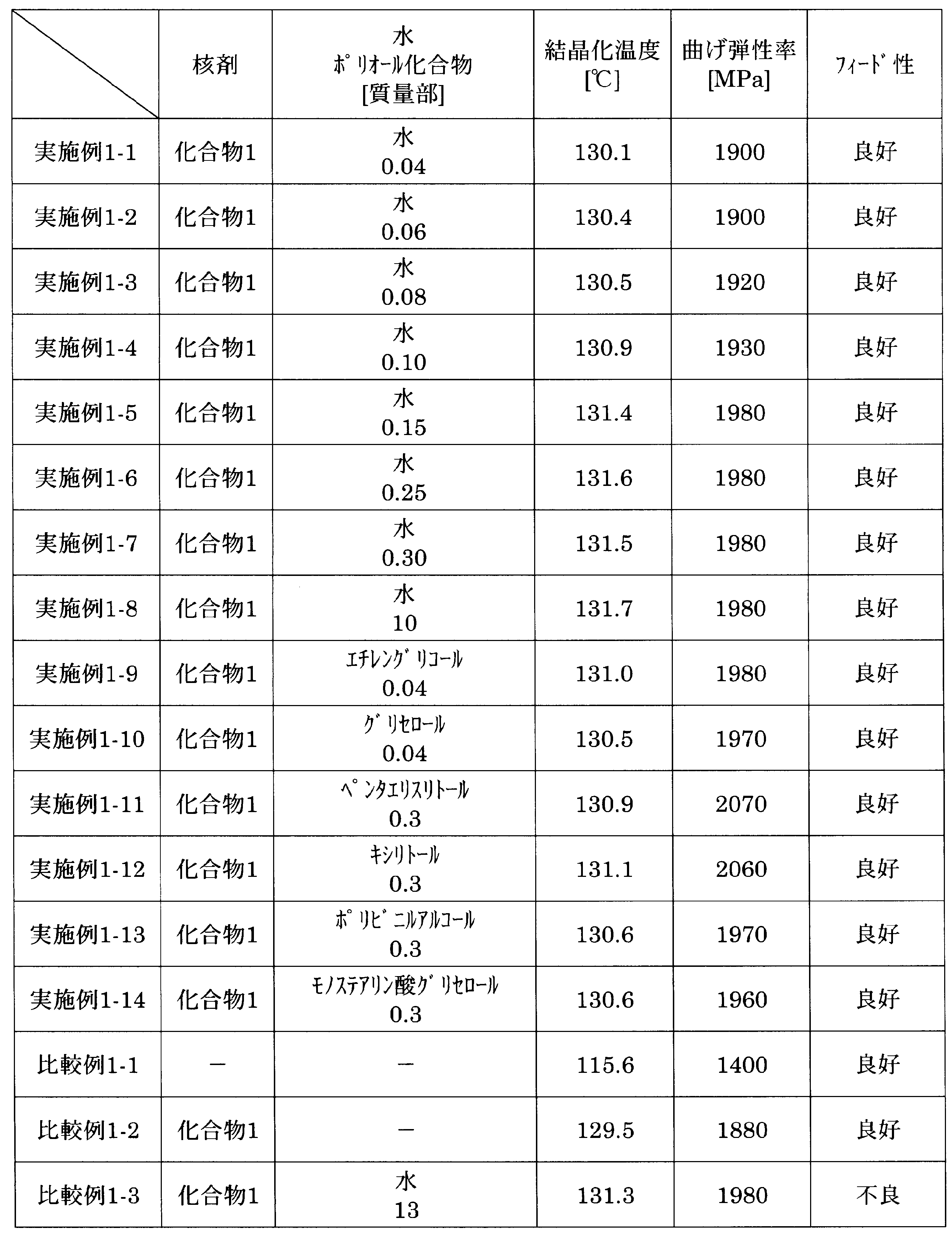
- Examples 1-1 to 1-14, Comparative Examples 1-1 to 1-3 As an olefin resin, 100 parts by mass of homopolypropylene (melt flow rate 8 g/10 min; 2.16 kg ⁇ 230° C. according to ISO standard 1133) was added to a phenolic antioxidant [tetrakis[methylene-3-(3′,5′] -Di-tert-butyl-4'-hydroxyphenyl)propionate]methane] 0.05 part by mass, phosphorus-based antioxidant [tris(2,4-di-tert-butylphenyl)phosphite] 0.1 part by mass , 0.05 part by mass of calcium stearate, 0.1 part by mass of the nucleating agent shown in Table 1 and water or a polyol compound in the compounding amounts shown in Table 1 with a Henschel mixer at 1000 rpm ⁇ 1 min, and then a twin-screw extruder ( TEX-28V; manufactured by Japan Steel Works, Ltd.
- Comparative Example 1-1 did not contain the nucleating agent, water and the polyol compound
- Comparative Example 1-2 did not contain the water and the polyol compound.
- the water content of each of the obtained pellets was around 0.008% by mass.
- the pellet was dried at 60° C. for 8 hours, and then used for evaluation of crystallization temperature (° C.) and flexural modulus (MPa).
- the water content of the dried pellet was about 0.0055% by mass.
- Compound 1 Lithium-2,2'-methylenebis(4,6-di-tert-butylphenyl)phosphate
- the pellets were dried at 60° C. for 8 hours and then used for evaluation of crystallization temperature (° C.), flexural modulus (MPa) and Izod impact strength (kJ/m 2 ).
- the water content of the dried pellet was about 0.0055% by mass. Further, the feedability was evaluated using the olefin resin composition immediately after blending with a Henschel mixer.
- Compound 2 Adeka Stab NA-21 manufactured by ADEKA Co., Ltd. (composite of main component: hydroxyaluminum bis[2,2'-methylenebis(4,6-di-tert-butylphenyl)phosphate])
- Examples 3-1 to 3-2, Comparative Examples 3-1 to 3-4 As an olefin resin, 100 parts by mass of homopolypropylene (melt flow rate 8 g/10 min; 2.16 kg ⁇ 230° C. according to ISO standard 1133) was added to a phenolic antioxidant [tetrakis[methylene-3-(3′,5′] -Di-tert-butyl-4'-hydroxyphenyl)propionate]methane] 0.05 part by mass, phosphorus-based antioxidant [tris(2,4-di-tert-butylphenyl)phosphite] 0.1 part by mass , 0.05 part by mass of calcium stearate, nucleating agent and water in a blending amount shown in Table 3 with a Henschel mixer at 1000 rpm ⁇ 1 min, and then a twin-screw extruder (TEX-28V; manufactured by Japan Steel Works, Ltd.).
- a phenolic antioxidant tetrakis[methylene-3-(
- Examples 4-1 to 4-2, Comparative Examples 4-1 to 4-4 As the olefin resin, 100 parts by mass of homopolypropylene (melt flow rate 8 g/10 min; 2.16 kg ⁇ 230° C. according to ISO standard 1133) was added to a phenolic antioxidant [tetrakis[methylene-3-(3′,5′] -Di-tert-butyl-4'-hydroxyphenyl)propionate]methane] 0.05 part by mass, phosphorus-based antioxidant [tris(2,4-di-tert-butylphenyl)phosphite] 0.1 part by mass , 0.05 parts by mass of calcium stearate, a nucleating agent and water in a blending amount shown in Table 4 with a Henschel mixer at 1000 rpm ⁇ 1 min, and then a twin-screw extruder (TEX-28V; manufactured by Japan Steel Works, Ltd.).
- a phenolic antioxidant tetrakis[methylene-3-
- Examples 5-1 to 5-2, Comparative Examples 5-1 to 5-4 As an olefin resin, 100 parts by mass of homopolypropylene (melt flow rate 8 g/10 min; 2.16 kg ⁇ 230° C. according to ISO standard 1133) was added to a phenolic antioxidant [tetrakis[methylene-3-(3′,5′] -Di-tert-butyl-4'-hydroxyphenyl)propionate]methane] 0.05 part by mass, phosphorus-based antioxidant [tris(2,4-di-tert-butylphenyl)phosphite] 0.1 part by mass , 0.05 part by mass of calcium stearate, nucleating agent and water in a blending amount shown in Table 5 with a Henschel mixer at 1000 rpm ⁇ 1 min, and then a twin-screw extruder (TEX-28V; manufactured by Japan Steel Works, Ltd.).
- a phenolic antioxidant tetrakis[methylene-3-(
- Examples 6-1 to 6-2, Comparative Examples 6-1 to 6-4 As the olefin resin, 100 parts by mass of homopolypropylene (melt flow rate 8 g/10 min; 2.16 kg ⁇ 230° C. according to ISO standard 1133) was added to a phenolic antioxidant [tetrakis[methylene-3-(3′,5′] -Di-tert-butyl-4'-hydroxyphenyl)propionate]methane] 0.05 part by mass, phosphorus-based antioxidant [tris(2,4-di-tert-butylphenyl)phosphite] 0.1 part by mass , 0.05 part by mass of calcium stearate, nucleating agent and water in a blending amount shown in Table 6 with a Henschel mixer at 1000 rpm ⁇ 1 min, and then a twin-screw extruder (TEX-28V; manufactured by Japan Steel Works, Ltd.).
- a phenolic antioxidant tetrakis[methylene-3-(
- Examples 7-1 to 7-2, Comparative Examples 7-1 to 7-4 As the olefin resin, 100 parts by mass of homopolypropylene (melt flow rate 8 g/10 min; 2.16 kg ⁇ 230° C. according to ISO standard 1133) was added to a phenolic antioxidant [tetrakis[methylene-3-(3′,5′] -Di-tert-butyl-4'-hydroxyphenyl)propionate]methane] 0.05 part by mass, phosphorus-based antioxidant [tris(2,4-di-tert-butylphenyl)phosphite] 0.1 part by mass , 0.05 part by mass of calcium stearate, and the nucleating agent and water described in Table 7 in a compounding amount shown in Table 7 with a Henschel mixer at 1000 rpm ⁇ 1 min, and then a twin-screw extruder (TEX-28V; Japan Co., Ltd.
- a phenolic antioxidant tetrakis[methylene
- Example 8 As the olefin resin, 60 parts by mass of "Novatech PP BC03B” (olefin block copolymer, melt flow rate 30 g/10 min; ISO standard 1133 compliant 2.16 kg ⁇ 230° C.) manufactured by Nippon Polypropylene Corporation, olefin elastomer (Dow Chemical Co., Ltd. product name "Engage 8200”) 20 parts by mass, filler (Matsumura Sangyo Co., Ltd.
- the olefin resin composition of the present invention can be suitably used in automobile materials.
- Example 9 As an olefin resin, a phenolic antioxidant [tetrakis[methylene-3-(3′,5′-di-tert-butyl-4′-hydroxyphenyl)] was added to 100 parts by mass of polypropylene having a melt flow rate of 3 g/10 min.
- the olefin resin composition of the present invention can be suitably used in packaging materials such as food containers and beverage containers.
- Example 10-1 to Example 10-9, Comparative Example 10-1 to Comparative Example 10-2 100 parts by mass of "Prime Polypro R720" (olefin random copolymer, melt flow rate 12 g/10 min; ISO standard 1133 compliant 2.16 kg x 230 °C) manufactured by Prime Polymer Co., Ltd. as an olefin resin, phenolic antioxidant 0.05 parts by mass of tetrakis[methylene-3-(3′,5′-di-tert-butyl-4′-hydroxyphenyl)propionate]methane as an agent, and tris(2,4-diene) as a phosphorus-based antioxidant.
- "Prime Polypro R720” olefin random copolymer, melt flow rate 12 g/10 min; ISO standard 1133 compliant 2.16 kg x 230 °C
- phenolic antioxidant 0.05 parts by mass of tetrakis[methylene-3-(3′,5′-di-tert-butyl-4′-hydroxyphen
- the obtained mixture was melt-kneaded using a twin-screw extruder (TEX-28V; manufactured by Nippon Steel Works, Ltd.) at an extrusion temperature of 230° C., and then granulated into pellets.
- TEX-28V twin-screw extruder
- Comparative Example 10-1 did not contain a nucleating agent and a polyol compound
- Comparative Example 10-2 did not contain a polyol compound.
- the obtained pellets were dried at 60° C. for 8 hours and then used for evaluation of crystallization temperature (° C.).
- the olefin resin composition of the present invention has excellent crystallinity. It was also confirmed that the olefin resin composition of the present invention can provide a molded product having mechanical properties and transparency.
Landscapes
- Chemical & Material Sciences (AREA)
- Organic Chemistry (AREA)
- Health & Medical Sciences (AREA)
- Chemical Kinetics & Catalysis (AREA)
- Medicinal Chemistry (AREA)
- Polymers & Plastics (AREA)
- Crystallography & Structural Chemistry (AREA)
- Life Sciences & Earth Sciences (AREA)
- Biochemistry (AREA)
- General Health & Medical Sciences (AREA)
- Molecular Biology (AREA)
- Compositions Of Macromolecular Compounds (AREA)
Abstract
Description


前記オレフィン系樹脂100質量部に対し、前記核剤を0.001~5質量部、前記助剤を0.003~10質量部含有することを特徴とするものである。
前記準備工程で準備した前記核剤成分を含まないオレフィン系樹脂に、核剤および助剤を配合してオレフィン系樹脂配合物を得る配合工程と、を備え、前記核剤が、下記一般式(1)、

前記助剤が水およびポリオール化合物からなる群より選ばれる少なくとも一種であり、
前記配合工程において前記核剤成分を含まないオレフィン系樹脂100質量部に対し、前記核剤を0.001~5質量部、前記助剤を0.003~10質量部配合することを特徴とするものである。


0≦x2/x1<10,2≦x1+x2≦20
で表される条件を満たす数を表し、pは0または正の数を表す。


ペレットの結晶化温度(℃)は、示差走査熱量測定装置(パーキンエルマー社製ダイアモンドDSC)を用いて測定した。測定方法は、室温から50℃/minの速度で230℃まで昇温し、15分間保持後、-10℃/minで50℃まで冷却して得られたチャートにおいて、冷却過程における発熱反応がピークトップとなる温度を結晶化温度(℃)とした。
造粒して得られたペレットを用い、射出成形機(EC100-2A;東芝機械株式会社製)にて、金型温度50℃、樹脂温度200℃の条件で射出成形し、寸法80mm×10mm×4mmの試験片を作製し、23℃の恒温機で48時間以上静置した後、島津製作所株式会社製曲げ試験機「AG-IS」を用いて、ISO178に準拠し、曲げ弾性率(MPa)を測定した。
造粒して得られたペレットを用い、射出成形機(EC100-2A;東芝機械株式会社製)にて、金型温度50℃、樹脂温度200℃の条件で射出成形し、80mm×10mm×4mmの試験片(ノッチ付き)を作製し、23℃の恒温機で48時間以上静置した後、ISO180に準拠してアイゾッド衝撃強度(kJ/m2)を測定した。
造粒して得られたペレットを用い、示差走査熱量測定装置(パーキンエルマー社製ダイアモンドDSC)を用いて、半結晶化時間(T1/2)を測定した。測定方法は、室温から50℃/minの速度で230℃まで加熱し、15分間保持後、-200℃/minの速度で135℃まで冷却し、135℃に到達後は、その温度を保持し、135℃に到達した時点から結晶化に要する発熱エンタルピーの熱量が半分となるまでの時間を求め、これを半結晶化時間(秒)とした。
造粒して得られたペレットを用い、射出成形機(EC100-2A;東芝機械株式会社製)にて、金型温度50℃、樹脂温度200℃の条件で射出成形して寸法60mm×60mm×2mmの試験片を作製した。試験片は成形後、ただちに23℃の恒温機で48時間以上静置した後、ヘイズガードi〔BYK Additives&Instruments製〕を用いて、ISO 14782に準拠してHaze(%)を測定した。
オレフィン系樹脂、核剤、水またはポリオール化合物、フェノール系酸化防止剤、リン系酸化防止剤およびステアリン酸カルシウム塩をヘンシェルミキサーでブレンドして得られたオレフィン系樹脂組成物を20g秤量し、これを粉体測定評価装置(セイシン企業社製、マルチテスターMT-02)のフィーダーに投入して、オレフィン系樹脂組成物が排出されるまでの時間を計測した。オレフィン系樹脂組成物が排出されるまでにかかった時間が3.2秒以内の場合は、フィード性が良好であり、3.2秒を超える場合は、フィード性が不良であると評価した。
オレフィン系樹脂として、ホモポリプロピレン(メルトフローレート 8g/10min;ISO規格1133準拠 2.16kg×230℃)100質量部に対し、フェノール系酸化防止剤〔テトラキス[メチレン-3-(3’,5’-ジ-tert-ブチル-4’-ヒドロキシフェニル)プロピオネート]メタン〕0.05質量部、リン系酸化防止剤〔トリス(2,4-ジ-tert-ブチルフェニル)ホスファイト〕0.1質量部、ステアリン酸カルシウム塩0.05質量部、表1記載の核剤0.1質量部および水またはポリオール化合物を表1記載の配合量で、ヘンシェルミキサーで、1000rpm×1min混合後、二軸押出機(TEX-28V;株式会社日本製鋼所製)を用いて、230℃の押出温度で溶融混練した後、ペレットに造粒した。ただし、比較例1-1は核剤、水およびポリオール化合物を配合せず、比較例1-2は、水およびポリオール化合物を配合しなかった。得られたペレットの含水率は、いずれも0.008質量%近傍であった。ペレットは、60℃で8時間乾燥させてから、結晶化温度(℃)、曲げ弾性率(MPa)の評価に用いた。乾燥後のペレットの含水率は、約0.0055質量%であった。
オレフィン系樹脂として、ホモポリプロピレン(メルトフローレート 8g/10min;ISO規格1133準拠 2.16kg×230℃)100質量部に対し、フェノール系酸化防止剤〔テトラキス[メチレン-3-(3’,5’-ジ-tert-ブチル-4’-ヒドロキシフェニル)プロピオネート]メタン〕0.05質量部、リン系酸化防止剤〔トリス(2,4-ジ-tert-ブチルフェニル)ホスファイト〕0.1質量部、ステアリン酸カルシウム塩0.05質量部、核剤0.1質量部および水またはポリオール化合物を表2記載の配合量で、ヘンシェルミキサーで、1000rpm×1min混合後、二軸押出機(TEX-28V;株式会社日本製鋼所製)を用いて、230℃の押出温度で溶融混練した後、ペレットに造粒した。ただし、比較例2-1は、水およびポリオール化合物を配合しなかった。得られたペレットの含水率はいずれも0.008質量%近傍であった。

オレフィン系樹脂として、ホモポリプロピレン(メルトフローレート 8g/10min;ISO規格1133準拠 2.16kg×230℃)100質量部に対し、フェノール系酸化防止剤〔テトラキス[メチレン-3-(3’,5’-ジ-tert-ブチル-4’-ヒドロキシフェニル)プロピオネート]メタン〕0.05質量部、リン系酸化防止剤〔トリス(2,4-ジ-tert-ブチルフェニル)ホスファイト〕0.1質量部、ステアリン酸カルシウム塩0.05質量部、核剤および水を表3記載の配合量で、ヘンシェルミキサーで、1000rpm×1min混合後、二軸押出機(TEX-28V;株式会社日本製鋼所製)を用いて、230℃の押出温度で溶融混練した後、ペレットに造粒した。得られたペレットの含水率はいずれも0.008質量%近傍であった。ペレットを、60℃で8時間乾燥させた後、結晶化温度(℃)の評価に用いた。乾燥後のペレットの含水率は、約0.0055質量%であった。これらの結果について、それぞれ表3に示す。

※2:水を添加しない場合の結晶化温度
※3:水を0.3質量部添加した場合と添加しない場合の結晶化温度の差
コントロール:核剤未配合
HPN-20E:Milliken社製商品名「Hyperform HPN-20E」
NA-11:株式会社ADEKA製商品名「アデカスタブNA-11」
安息香酸Na:安息香酸ナトリウム
オレフィン系樹脂として、ホモポリプロピレン(メルトフローレート 8g/10min;ISO規格1133準拠 2.16kg×230℃)100質量部に対し、フェノール系酸化防止剤〔テトラキス[メチレン-3-(3’,5’-ジ-tert-ブチル-4’-ヒドロキシフェニル)プロピオネート]メタン〕0.05質量部、リン系酸化防止剤〔トリス(2,4-ジ-tert-ブチルフェニル)ホスファイト〕0.1質量部、ステアリン酸カルシウム塩0.05質量部、核剤および水を表4記載の配合量で、ヘンシェルミキサーで、1000rpm×1min混合後、二軸押出機(TEX-28V;株式会社日本製鋼所製)を用いて、230℃の押出温度で溶融混練した後、ペレットに造粒した。得られたペレットの含水率はいずれも0.008質量%近傍であった。ペレットを、60℃で8時間乾燥させた後、曲げ弾性率(MPa)の評価に用いた。乾燥後のペレットの含水率は、約0.0055質量%であった。これらの結果について、それぞれ表4に示す。

※5:水を添加しない場合の曲げ弾性率
※6:水を0.3質量部添加した場合と添加しない場合の曲げ弾性率の差
オレフィン系樹脂として、ホモポリプロピレン(メルトフローレート 8g/10min;ISO規格1133準拠 2.16kg×230℃)100質量部に対し、フェノール系酸化防止剤〔テトラキス[メチレン-3-(3’,5’-ジ-tert-ブチル-4’-ヒドロキシフェニル)プロピオネート]メタン〕0.05質量部、リン系酸化防止剤〔トリス(2,4-ジ-tert-ブチルフェニル)ホスファイト〕0.1質量部、ステアリン酸カルシウム塩0.05質量部、核剤および水を表5記載の配合量で、ヘンシェルミキサーで、1000rpm×1min混合後、二軸押出機(TEX-28V;株式会社日本製鋼所製)を用いて、230℃の押出温度で溶融混練した後、ペレットに造粒した。得られたペレットの含水率はいずれも0.008質量%近傍であった。ペレットを、60℃で8時間乾燥させた後、HDT(℃)の評価に用いた。乾燥後のペレットの含水率は、約0.0055質量%であった。HDT(℃)の評価方法は以下のとおりである。これらの結果について、それぞれ表5に示す。
造粒して得られたペレットを用い、射出成形機(EC100-2A;東芝機械株式会社製)にて、金型温度50℃、樹脂温度200℃の条件で射出成形し、寸法80mm×10mm×4mmの試験片を作製し、23℃の恒温機で48時間以上静置した後、ISO75(荷重0.45MPa)に準拠してHDT(℃)を測定した。

※8:水を添加しない場合のHDT
※9:水を0.3質量部添加した場合と添加しない場合のHDTの差
オレフィン系樹脂として、ホモポリプロピレン(メルトフローレート 8g/10min;ISO規格1133準拠 2.16kg×230℃)100質量部に対し、フェノール系酸化防止剤〔テトラキス[メチレン-3-(3’,5’-ジ-tert-ブチル-4’-ヒドロキシフェニル)プロピオネート]メタン〕0.05質量部、リン系酸化防止剤〔トリス(2,4-ジ-tert-ブチルフェニル)ホスファイト〕0.1質量部、ステアリン酸カルシウム塩0.05質量部、核剤および水を表6記載の配合量で、ヘンシェルミキサーで、1000rpm×1min混合後、二軸押出機(TEX-28V;株式会社日本製鋼所製)を用いて、230℃の押出温度で溶融混練した後、ペレットに造粒した。得られたペレットの含水率はいずれも0.008質量%近傍であった。ペレットを、60℃で8時間乾燥させた後、半結晶化時間(秒)の評価に用いた。乾燥後のペレットの含水率は、約0.0055質量%であった。これらの結果について、それぞれ表6に示す。

※11:水を添加しない場合の半結晶化時間
※12:水を0.3質量部添加した場合と添加しない場合の半結晶化時間の差
オレフィン系樹脂として、ホモポリプロピレン(メルトフローレート 8g/10min;ISO規格1133準拠 2.16kg×230℃)100質量部に対し、フェノール系酸化防止剤〔テトラキス[メチレン-3-(3’,5’-ジ-tert-ブチル-4’-ヒドロキシフェニル)プロピオネート]メタン〕0.05質量部、リン系酸化防止剤〔トリス(2,4-ジ-tert-ブチルフェニル)ホスファイト〕0.1質量部、ステアリン酸カルシウム塩0.05質量部、および表7記載の核剤および水を表7記載の配合量で、ヘンシェルミキサーで、1000rpm×1min混合後、二軸押出機(TEX-28V;株式会社日本製鋼所製)を用いて、230℃の押出温度で溶融混練した後、ペレットに造粒した。造粒して得られたペレットの含水率はいずれも0.008質量%近傍であった。ペレットを、60℃で8時間乾燥させた後、Haze(%)の評価に用いた。乾燥後のペレットの含水率は、約0.0055質量%であった。これらの結果について、それぞれ表7に示す。

※14:水を0.005質量部添加した場合のHaze
※15:水を0.3質量部添加した場合と0.005質量部添加した場合のHazeの差
オレフィン系樹脂として、日本ポリプロピレン株式会社製の商品名「ノバテックPP BC03B」(オレフィンブロック共重合体、メルトフローレート 30g/10min;ISO規格1133準拠 2.16kg×230℃)60質量部、オレフィン系エラストマー(ダウケミカル社製品名「Engage8200」)20質量部、充填剤(松村産業株式会社製品名「クラウンタルクPP」)20質量部、フェノール系酸化防止剤〔テトラキス[メチレン-3-(3’,5’-ジ-tert-ブチル-4’-ヒドロキシフェニル)プロピオネート]メタン〕0.05質量部、リン系酸化防止剤〔トリス(2,4-ジ-tert-ブチルフェニル)ホスファイト〕0.1質量部、ステアリン酸カルシウム塩0.05質量部、ヒンダードアミン化合物(アデカスタブLA-81)0.3質量部、0.1質量部の化合物1および水0.3質量部を、ヘンシェルミキサーで、1000rpm×1min混合後、二軸押出機(TEX-28V;株式会社日本製鋼所製)を用いて、230℃の押出温度で溶融混練した後、ペレットに造粒した。得られたペレットの含水率は0.008質量%近傍であった。ペレットを、60℃で8時間乾燥させた後、230℃で射出成形して厚さ2mmの試験片を得た。乾燥後のペレットの含水率は、約0.0055質量%であった。得られた試験片は着色が少なく耐候性に優れ、曲げ弾性率、結晶化温度等の物性は良好であった。本発明のオレフィン系樹脂組成物は、自動車材料において好適に用いることができる。
オレフィン系樹脂として、メルトフローレート3g/10minのポリプロピレン100質量部に対し、フェノール系酸化防止剤〔テトラキス[メチレン-3-(3’,5’-ジ-tert-ブチル-4’-ヒドロキシフェニル)プロピオネート]メタン〕0.05質量部、リン系酸化防止剤〔トリス(2,4-ジ-tert-ブチルフェニル)ホスファイト〕0.1質量部、ステアリン酸カルシウム0.05質量部、0.05質量部の化合物1および水0.3質量部を、ヘンシェルミキサーで、1000rpm×1min混合後、二軸押出機(TEX-28V;株式会社日本製鋼所製)を用いて、230℃の押出温度で溶融混練した後、ペレットに造粒した。得られたペレットの含水率は0.008質量%近傍であった。ペレットを、60℃で8時間乾燥させた後、230℃で押出シート成形して厚みが1mmのシートを得た。乾燥後のペレットの含水率は、約0.0055質量%であった。得られたシートを用いて熱成形により成形したカップの透明性と強度は良好であった。本発明のオレフィン系樹脂組成物は、食品用容器、飲料容器等の包装材料において好適に用いることができる。
オレフィン系樹脂としてプライムポリマー社製の商品名「プライムポリプロ R720」(オレフィンランダム共重合体、メルトフローレート 12g/10min;ISO規格1133準拠 2.16kg×230℃)を100質量部、フェノール系酸化防止剤としてテトラキス[メチレン-3-(3’,5’-ジ-tert-ブチル-4’-ヒドロキシフェニル)プロピオネート]メタンを0.05質量部、リン系酸化防止剤としてトリス(2,4-ジ-tert-ブチルフェニル)ホスファイトを0.1質量部、ステアリン酸カルシウム塩を0.05質量部、核剤として表8記載の核剤を0.1質量部、助剤として表8記載のポリオール化合物を表8記載の配合量で配合し、ヘンシェルミキサーを用いて1000rpm×1min混合した。得られた混合物を、二軸押出機(TEX-28V;株式会社日本製鋼所製)を用いて230℃の押出温度で溶融混練した後、ペレットに造粒した。ただし、比較例10-1は核剤およびポリオール化合物を配合せず、比較例10-2はポリオール化合物を配合しなかった。得られたペレットは、60℃で8時間乾燥させてから、結晶化温度(℃)の評価に用いた。

Claims (8)
- 核剤と助剤とを含み、前記核剤が、下記一般式(1)、
(一般式(1)中、R1~R4は、炭素原子数1~6のアルキル基を表し、R5は、水素原子または炭素原子数1~3のアルキル基を表し、nは1または2を表し、nが1の場合、Mは、リチウムまたはジヒドロキシアルミニウムを表し、nが2の場合、Mは、ヒドロキシアルミニウムを表す。)で表される芳香族リン酸エステル金属塩を含み、前記助剤が水およびポリオール化合物からなる群より選ばれる少なくとも一種であり、前記核剤100質量部に対する前記助剤の含有量が、1~10000質量部であることを特徴とする核剤組成物。
- 前記ポリオール化合物が、グリコール類、糖アルコール、糖アルコールのモノ脂肪酸エステルおよびポリビニルアルコールからなる群より選ばれる少なくとも一種である請求項1記載の核剤組成物。
- オレフィン系樹脂と核剤と助剤とを含み、前記核剤が、下記一般式(1)、
(一般式(1)中、R1~R4は、炭素原子数1~6のアルキル基を表し、R5は、水素原子または炭素原子数1~3のアルキル基を表し、nは1または2を表し、nが1の場合、Mは、リチウムまたはジヒドロキシアルミニウムを表し、nが2の場合、Mは、ヒドロキシアルミニウムを表す。)で表される芳香族リン酸エステル金属塩を含み、前記助剤が水およびポリオール化合物からなる群より選ばれる少なくとも一種であり、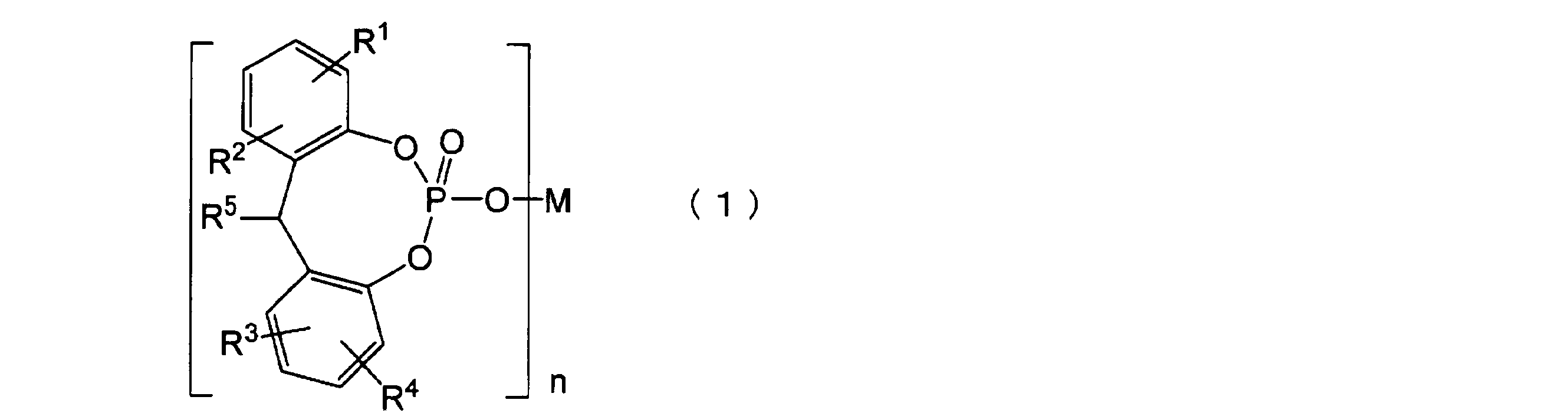
前記オレフィン系樹脂100質量部に対し、前記核剤を0.001~5質量部、前記助剤を0.003~10質量部含有することを特徴とするオレフィン系樹脂組成物。 - 前記ポリオール化合物が、グリコール類、糖アルコール、糖アルコールのモノ脂肪酸エステルおよびポリビニルアルコールからなる群より選ばれる少なくとも一種である請求項3記載のオレフィン系樹脂組成物。
- 請求項3または4記載のオレフィン系樹脂組成物を成形してなることを特徴とする成形品。
- 核剤成分を含まないオレフィン系樹脂を準備する準備工程と、
前記準備工程で準備した前記核剤成分を含まないオレフィン系樹脂に、核剤および助剤を配合してオレフィン系樹脂配合物を得る配合工程と、を備え、前記核剤が、下記一般式(1)、
(一般式(1)中、R1~R4は、炭素原子数1~6のアルキル基を表し、R5は、水素原子または炭素原子数1~3のアルキル基を表し、nは1または2を表し、nが1の場合、Mは、リチウムまたはジヒドロキシアルミニウムを表し、nが2の場合、Mは、ヒドロキシアルミニウムを表す。)で表される芳香族リン酸エステル金属塩を含み、
前記助剤が水およびポリオール化合物からなる群より選ばれる少なくとも一種であり、
前記配合工程において前記核剤成分を含まないオレフィン系樹脂100質量部に対し、前記核剤を0.001~5質量部、前記助剤を0.003~10質量部配合することを特徴とするオレフィン系樹脂組成物の製造方法。 - さらに、前記配合工程で得られたオレフィン系樹脂配合物を溶融混練してオレフィン系樹脂組成物を得る溶融混練工程を備える請求項6記載のオレフィン系樹脂組成物の製造方法。
- 前記ポリオール化合物が、グリコール類、糖アルコール、糖アルコールのモノ脂肪酸エステルおよびポリビニルアルコールからなる群より選ばれる少なくとも一種である請求項6または7記載のオレフィン系樹脂組成物の製造方法。
Priority Applications (8)
| Application Number | Priority Date | Filing Date | Title |
|---|---|---|---|
| US17/424,089 US20220119559A1 (en) | 2019-01-21 | 2020-01-21 | Nucleating agent composition, olefin-based resin composition, molded article thereof, and method for producing olefin-based resin composition |
| KR1020217024210A KR20210116501A (ko) | 2019-01-21 | 2020-01-21 | 핵제 조성물, 올레핀계 수지 조성물, 그 성형품 및 올레핀계 수지 조성물의 제조 방법 |
| CN202411350188.2A CN119350709A (zh) | 2019-01-21 | 2020-01-21 | 成核剂组合物、烯烃系树脂组合物、其成型品及烯烃系树脂组合物的制造方法 |
| CN202080010046.5A CN113330058B (zh) | 2019-01-21 | 2020-01-21 | 成核剂组合物、烯烃系树脂组合物、其成型品及烯烃系树脂组合物的制造方法 |
| BR112021013408-5A BR112021013408A2 (pt) | 2019-01-21 | 2020-01-21 | Composição de agente de nucleação, composição de resina à base de olefina, artigo moldado desta e método para a produção de composição de resina à base de olefina |
| EP20744412.6A EP3916039A4 (en) | 2019-01-21 | 2020-01-21 | NUCLATING AGENT COMPOSITION, OLEFIN-BASED RESIN COMPOSITION, MOLDING THEREOF AND METHOD OF MAKING AN OLEFIN-BASED RESIN COMPOSITION |
| JP2020568152A JP7464538B2 (ja) | 2019-01-21 | 2020-01-21 | 核剤組成物、オレフィン系樹脂組成物、その成形品およびオレフィン系樹脂組成物の製造方法 |
| JP2024050955A JP7717214B2 (ja) | 2019-01-21 | 2024-03-27 | 核剤組成物、オレフィン系樹脂組成物、その成形品およびオレフィン系樹脂組成物の製造方法 |
Applications Claiming Priority (2)
| Application Number | Priority Date | Filing Date | Title |
|---|---|---|---|
| JP2019007628 | 2019-01-21 | ||
| JP2019-007628 | 2019-01-21 |
Publications (1)
| Publication Number | Publication Date |
|---|---|
| WO2020153343A1 true WO2020153343A1 (ja) | 2020-07-30 |
Family
ID=71735668
Family Applications (1)
| Application Number | Title | Priority Date | Filing Date |
|---|---|---|---|
| PCT/JP2020/001895 Ceased WO2020153343A1 (ja) | 2019-01-21 | 2020-01-21 | 核剤組成物、オレフィン系樹脂組成物、その成形品およびオレフィン系樹脂組成物の製造方法 |
Country Status (8)
| Country | Link |
|---|---|
| US (1) | US20220119559A1 (ja) |
| EP (1) | EP3916039A4 (ja) |
| JP (2) | JP7464538B2 (ja) |
| KR (1) | KR20210116501A (ja) |
| CN (2) | CN113330058B (ja) |
| BR (1) | BR112021013408A2 (ja) |
| TW (1) | TW202045520A (ja) |
| WO (1) | WO2020153343A1 (ja) |
Cited By (3)
| Publication number | Priority date | Publication date | Assignee | Title |
|---|---|---|---|---|
| JP2023540503A (ja) * | 2020-09-03 | 2023-09-25 | ダブリュー・アール・グレース・アンド・カンパニー-コーン | 酸化分解に耐性のあるポリマー組成物及びそれから製造される物品 |
| EP4253470A4 (en) * | 2020-11-25 | 2024-10-23 | Adeka Corporation | Crystallization inhibitor for polyolefin resin, polyolefin resin composition, molded article, method for producing polyolefin resin composition, and method for inhibiting crystallization of polyolefin resin |
| CN120118455A (zh) * | 2025-03-25 | 2025-06-10 | 湖北新南化科技有限公司 | 一种成核剂组合物及其制备方法及应用 |
Families Citing this family (3)
| Publication number | Priority date | Publication date | Assignee | Title |
|---|---|---|---|---|
| JP7626150B2 (ja) * | 2023-02-07 | 2025-02-04 | トヨタ自動車株式会社 | リザーブタンクおよびこれを備えた冷却システム |
| CN119039704B (zh) * | 2024-10-09 | 2025-06-13 | 湖北新南化科技有限公司 | 一种透明聚丙烯的制备方法 |
| CN119306759B (zh) * | 2024-10-24 | 2025-10-17 | 中国科学院长春应用化学研究所 | 一种成核剂及其制备方法和应用 |
Citations (17)
| Publication number | Priority date | Publication date | Assignee | Title |
|---|---|---|---|---|
| JPH07278448A (ja) * | 1994-04-15 | 1995-10-24 | Asahi Denka Kogyo Kk | 結晶性合成樹脂組成物 |
| JPH07286104A (ja) * | 1994-04-15 | 1995-10-31 | Asahi Denka Kogyo Kk | 結晶性合成樹脂組成物 |
| JP2001059040A (ja) * | 1999-06-15 | 2001-03-06 | Asahi Denka Kogyo Kk | 造核剤 |
| JP2003089734A (ja) * | 2001-09-19 | 2003-03-28 | Sumitomo Seika Chem Co Ltd | ポリプロピレン樹脂組成物 |
| US6552131B1 (en) | 1999-02-10 | 2003-04-22 | Sanyo Chemical Industries, Ltd. | Block polymer and antistatic agent comprising the same |
| JP2008512535A (ja) * | 2004-09-13 | 2008-04-24 | チバ スペシャルティ ケミカルズ ホールディング インコーポレーテッド | ポリオレフィン物品 |
| JP2009120800A (ja) * | 2007-10-24 | 2009-06-04 | Japan Polypropylene Corp | プロピレン系樹脂組成物およびその成形品 |
| JP2010132927A (ja) | 2007-12-07 | 2010-06-17 | Du Pont Mitsui Polychem Co Ltd | カリウムアイオノマーからなる高分子型帯電防止剤 |
| JP2011246589A (ja) * | 2010-05-26 | 2011-12-08 | Adeka Corp | 樹脂添加剤マスターバッチ |
| CN103087401A (zh) * | 2011-10-28 | 2013-05-08 | 中国石油化工股份有限公司 | 一种制备包装用薄膜的聚丙烯树脂组合物及其薄膜和薄膜制备方法 |
| JP2013159623A (ja) * | 2012-02-01 | 2013-08-19 | Adeka Corp | 造核剤組成物 |
| WO2013187240A1 (ja) * | 2012-06-14 | 2013-12-19 | 株式会社Adeka | 造核剤マスターバッチの製造方法 |
| JP2014095046A (ja) | 2012-11-09 | 2014-05-22 | Adeka Corp | オレフィン樹脂組成物の製造方法 |
| JP2015201616A (ja) * | 2014-03-31 | 2015-11-12 | 王子ホールディングス株式会社 | コンデンサ用二軸延伸ポリプロピレンフィルム |
| JP2016023254A (ja) | 2014-07-22 | 2016-02-08 | 株式会社Adeka | 帯電防止剤、帯電防止剤組成物、帯電防止性樹脂組成物および成形体 |
| JP2017125116A (ja) | 2016-01-13 | 2017-07-20 | 株式会社Adeka | ポリエチレン樹脂組成物の製造方法 |
| JP2018154794A (ja) * | 2017-03-21 | 2018-10-04 | 日本ポリプロ株式会社 | ポリプロピレン系樹脂組成物 |
Family Cites Families (8)
| Publication number | Priority date | Publication date | Assignee | Title |
|---|---|---|---|---|
| JPS581736A (ja) * | 1981-06-25 | 1983-01-07 | Adeka Argus Chem Co Ltd | ポリオレフイン系樹脂組成物 |
| JP3445671B2 (ja) * | 1994-10-19 | 2003-09-08 | 旭電化工業株式会社 | 結晶性合成樹脂組成物 |
| WO2005082989A1 (en) * | 2004-02-17 | 2005-09-09 | Clariant International Ltd | Polyolefin compositions comprising hydrated inorganic or organic compounds for the prevention of discoloration |
| JP2005307138A (ja) | 2004-04-23 | 2005-11-04 | Api Corporation | 有機リン酸エステル金属塩を含む液体組成物、並びにこれを含有してなる結晶性熱可塑性樹脂組成物及びその成形体 |
| RU2464288C2 (ru) * | 2008-07-14 | 2012-10-20 | Бореалис Аг | Полиолефиновое соединение с низким коэффициентом теплового линейного расширения |
| JP5722002B2 (ja) * | 2010-11-10 | 2015-05-20 | 株式会社Adeka | ポリプロピレン系樹脂組成物 |
| JP6143326B2 (ja) * | 2013-01-25 | 2017-06-07 | 株式会社Adeka | 樹脂組成物 |
| JP6513278B1 (ja) * | 2018-08-30 | 2019-05-15 | 株式会社Adeka | 組成物、これを含有する熱可塑性樹脂組成物およびその成形品 |
-
2020
- 2020-01-21 US US17/424,089 patent/US20220119559A1/en active Pending
- 2020-01-21 WO PCT/JP2020/001895 patent/WO2020153343A1/ja not_active Ceased
- 2020-01-21 CN CN202080010046.5A patent/CN113330058B/zh active Active
- 2020-01-21 CN CN202411350188.2A patent/CN119350709A/zh active Pending
- 2020-01-21 KR KR1020217024210A patent/KR20210116501A/ko not_active Withdrawn
- 2020-01-21 EP EP20744412.6A patent/EP3916039A4/en active Pending
- 2020-01-21 TW TW109102285A patent/TW202045520A/zh unknown
- 2020-01-21 BR BR112021013408-5A patent/BR112021013408A2/pt not_active Application Discontinuation
- 2020-01-21 JP JP2020568152A patent/JP7464538B2/ja active Active
-
2024
- 2024-03-27 JP JP2024050955A patent/JP7717214B2/ja active Active
Patent Citations (17)
| Publication number | Priority date | Publication date | Assignee | Title |
|---|---|---|---|---|
| JPH07278448A (ja) * | 1994-04-15 | 1995-10-24 | Asahi Denka Kogyo Kk | 結晶性合成樹脂組成物 |
| JPH07286104A (ja) * | 1994-04-15 | 1995-10-31 | Asahi Denka Kogyo Kk | 結晶性合成樹脂組成物 |
| US6552131B1 (en) | 1999-02-10 | 2003-04-22 | Sanyo Chemical Industries, Ltd. | Block polymer and antistatic agent comprising the same |
| JP2001059040A (ja) * | 1999-06-15 | 2001-03-06 | Asahi Denka Kogyo Kk | 造核剤 |
| JP2003089734A (ja) * | 2001-09-19 | 2003-03-28 | Sumitomo Seika Chem Co Ltd | ポリプロピレン樹脂組成物 |
| JP2008512535A (ja) * | 2004-09-13 | 2008-04-24 | チバ スペシャルティ ケミカルズ ホールディング インコーポレーテッド | ポリオレフィン物品 |
| JP2009120800A (ja) * | 2007-10-24 | 2009-06-04 | Japan Polypropylene Corp | プロピレン系樹脂組成物およびその成形品 |
| JP2010132927A (ja) | 2007-12-07 | 2010-06-17 | Du Pont Mitsui Polychem Co Ltd | カリウムアイオノマーからなる高分子型帯電防止剤 |
| JP2011246589A (ja) * | 2010-05-26 | 2011-12-08 | Adeka Corp | 樹脂添加剤マスターバッチ |
| CN103087401A (zh) * | 2011-10-28 | 2013-05-08 | 中国石油化工股份有限公司 | 一种制备包装用薄膜的聚丙烯树脂组合物及其薄膜和薄膜制备方法 |
| JP2013159623A (ja) * | 2012-02-01 | 2013-08-19 | Adeka Corp | 造核剤組成物 |
| WO2013187240A1 (ja) * | 2012-06-14 | 2013-12-19 | 株式会社Adeka | 造核剤マスターバッチの製造方法 |
| JP2014095046A (ja) | 2012-11-09 | 2014-05-22 | Adeka Corp | オレフィン樹脂組成物の製造方法 |
| JP2015201616A (ja) * | 2014-03-31 | 2015-11-12 | 王子ホールディングス株式会社 | コンデンサ用二軸延伸ポリプロピレンフィルム |
| JP2016023254A (ja) | 2014-07-22 | 2016-02-08 | 株式会社Adeka | 帯電防止剤、帯電防止剤組成物、帯電防止性樹脂組成物および成形体 |
| JP2017125116A (ja) | 2016-01-13 | 2017-07-20 | 株式会社Adeka | ポリエチレン樹脂組成物の製造方法 |
| JP2018154794A (ja) * | 2017-03-21 | 2018-10-04 | 日本ポリプロ株式会社 | ポリプロピレン系樹脂組成物 |
Non-Patent Citations (1)
| Title |
|---|
| See also references of EP3916039A4 |
Cited By (3)
| Publication number | Priority date | Publication date | Assignee | Title |
|---|---|---|---|---|
| JP2023540503A (ja) * | 2020-09-03 | 2023-09-25 | ダブリュー・アール・グレース・アンド・カンパニー-コーン | 酸化分解に耐性のあるポリマー組成物及びそれから製造される物品 |
| EP4253470A4 (en) * | 2020-11-25 | 2024-10-23 | Adeka Corporation | Crystallization inhibitor for polyolefin resin, polyolefin resin composition, molded article, method for producing polyolefin resin composition, and method for inhibiting crystallization of polyolefin resin |
| CN120118455A (zh) * | 2025-03-25 | 2025-06-10 | 湖北新南化科技有限公司 | 一种成核剂组合物及其制备方法及应用 |
Also Published As
| Publication number | Publication date |
|---|---|
| CN113330058A (zh) | 2021-08-31 |
| CN113330058B (zh) | 2024-10-11 |
| BR112021013408A2 (pt) | 2021-09-14 |
| JP7717214B2 (ja) | 2025-08-01 |
| TW202045520A (zh) | 2020-12-16 |
| KR20210116501A (ko) | 2021-09-27 |
| US20220119559A1 (en) | 2022-04-21 |
| EP3916039A4 (en) | 2022-09-28 |
| JP7464538B2 (ja) | 2024-04-09 |
| EP3916039A1 (en) | 2021-12-01 |
| CN119350709A (zh) | 2025-01-24 |
| JPWO2020153343A1 (ja) | 2021-11-25 |
| JP2024096721A (ja) | 2024-07-17 |
Similar Documents
| Publication | Publication Date | Title |
|---|---|---|
| JP7717214B2 (ja) | 核剤組成物、オレフィン系樹脂組成物、その成形品およびオレフィン系樹脂組成物の製造方法 | |
| JP6728506B1 (ja) | ポリオレフィン系樹脂用核剤、これを含有するポリオレフィン系樹脂用核剤組成物、ポリオレフィン系樹脂用マスターバッチ、ポリオレフィン系樹脂組成物、その成形品、そのフィルム、多孔質フィルムの製造方法および包装体 | |
| US12024622B2 (en) | Composition, thermoplastic resin composition using same, and molded article thereof | |
| CN115335447B (zh) | 成核剂、树脂组合物、树脂组合物的制造方法和成形品 | |
| WO2021125184A1 (ja) | 樹脂組成物、その成形品、および、その樹脂組成物の製造方法 | |
| JP2020152838A (ja) | ポリオレフィン系樹脂の核形成を促す化合物、マスターバッチ、樹脂組成物および成形品 | |
| EP4357405A1 (en) | Nucleating agent composition, resin composition, molded article thereof, and method for manufacturing resin composition | |
| BR112021001448B1 (pt) | Composição de aditivo, composição de resina de poliolefina que a contém, método para a produção de composição de resina de poliolefina e seus artigos moldados | |
| JP7802002B2 (ja) | 添加剤組成物、樹脂組成物、樹脂組成物の製造方法および成形品 | |
| JP2020037603A (ja) | ポリオレフィン系樹脂組成物およびその成形品 | |
| WO2025013891A1 (ja) | 樹脂組成物、成形品、樹脂添加剤組成物、樹脂組成物の製造方法、結晶性樹脂の結晶性向上方法および樹脂添加剤組成物用材料 | |
| JP2024117817A (ja) | 樹脂組成物、成形品、樹脂組成物の製造方法、合成樹脂の結晶化促進方法および合成樹脂の透明性向上方法 | |
| JP2025170794A (ja) | 樹脂組成物、成形品、樹脂組成物の製造方法、樹脂添加剤組成物および樹脂の結晶性向上方法 |
Legal Events
| Date | Code | Title | Description |
|---|---|---|---|
| 121 | Ep: the epo has been informed by wipo that ep was designated in this application |
Ref document number: 20744412 Country of ref document: EP Kind code of ref document: A1 |
|
| ENP | Entry into the national phase |
Ref document number: 2020568152 Country of ref document: JP Kind code of ref document: A |
|
| REG | Reference to national code |
Ref country code: BR Ref legal event code: B01A Ref document number: 112021013408 Country of ref document: BR |
|
| NENP | Non-entry into the national phase |
Ref country code: DE |
|
| ENP | Entry into the national phase |
Ref document number: 20217024210 Country of ref document: KR Kind code of ref document: A |
|
| ENP | Entry into the national phase |
Ref document number: 2020744412 Country of ref document: EP Effective date: 20210823 |
|
| ENP | Entry into the national phase |
Ref document number: 112021013408 Country of ref document: BR Kind code of ref document: A2 Effective date: 20210707 |