WO2020162016A1 - Dispositif de commande de réglage de distribution pour moteur à combustion interne - Google Patents
Dispositif de commande de réglage de distribution pour moteur à combustion interne Download PDFInfo
- Publication number
- WO2020162016A1 WO2020162016A1 PCT/JP2019/047363 JP2019047363W WO2020162016A1 WO 2020162016 A1 WO2020162016 A1 WO 2020162016A1 JP 2019047363 W JP2019047363 W JP 2019047363W WO 2020162016 A1 WO2020162016 A1 WO 2020162016A1
- Authority
- WO
- WIPO (PCT)
- Prior art keywords
- combustion engine
- internal combustion
- shaft
- valve timing
- control device
- Prior art date
- Legal status (The legal status is an assumption and is not a legal conclusion. Google has not performed a legal analysis and makes no representation as to the accuracy of the status listed.)
- Ceased
Links
Images



Classifications
-
- F—MECHANICAL ENGINEERING; LIGHTING; HEATING; WEAPONS; BLASTING
- F01—MACHINES OR ENGINES IN GENERAL; ENGINE PLANTS IN GENERAL; STEAM ENGINES
- F01L—CYCLICALLY OPERATING VALVES FOR MACHINES OR ENGINES
- F01L1/00—Valve-gear or valve arrangements, e.g. lift-valve gear
- F01L1/34—Valve-gear or valve arrangements, e.g. lift-valve gear characterised by the provision of means for changing the timing of the valves without changing the duration of opening and without affecting the magnitude of the valve lift
- F01L1/344—Valve-gear or valve arrangements, e.g. lift-valve gear characterised by the provision of means for changing the timing of the valves without changing the duration of opening and without affecting the magnitude of the valve lift changing the angular relationship between crankshaft and camshaft, e.g. using helicoidal gear
- F01L1/352—Valve-gear or valve arrangements, e.g. lift-valve gear characterised by the provision of means for changing the timing of the valves without changing the duration of opening and without affecting the magnitude of the valve lift changing the angular relationship between crankshaft and camshaft, e.g. using helicoidal gear using bevel or epicyclic gear
-
- F—MECHANICAL ENGINEERING; LIGHTING; HEATING; WEAPONS; BLASTING
- F01—MACHINES OR ENGINES IN GENERAL; ENGINE PLANTS IN GENERAL; STEAM ENGINES
- F01M—LUBRICATING OF MACHINES OR ENGINES IN GENERAL; LUBRICATING INTERNAL COMBUSTION ENGINES; CRANKCASE VENTILATING
- F01M1/00—Pressure lubrication
- F01M1/06—Lubricating systems characterised by the provision therein of crankshafts or connecting rods with lubricant passageways, e.g. bores
-
- F—MECHANICAL ENGINEERING; LIGHTING; HEATING; WEAPONS; BLASTING
- F01—MACHINES OR ENGINES IN GENERAL; ENGINE PLANTS IN GENERAL; STEAM ENGINES
- F01M—LUBRICATING OF MACHINES OR ENGINES IN GENERAL; LUBRICATING INTERNAL COMBUSTION ENGINES; CRANKCASE VENTILATING
- F01M9/00—Lubrication means having pertinent characteristics not provided for in, or of interest apart from, groups F01M1/00 - F01M7/00
- F01M9/10—Lubrication of valve gear or auxiliaries
Definitions
- the present invention relates to a valve timing control device for an internal combustion engine that controls the opening/closing timing of an intake valve and an exhaust valve, for example.
- Patent Document 1 As a conventional valve timing control device for an internal combustion engine, the one described in Patent Document 1 below is known.
- This valve timing control device uses a planetary gear device as a speed reducer.
- a planetary gear device as a speed reducer.
- the lubricating oil discharged from the mechanical pump to the introduction passage formed inside the cam shaft is introduced into the lubrication chamber through the introduction port.
- the lubricating oil is sequentially supplied to the friction generating portion of the planetary gear device.
- the introduction passage is formed from one end of the cam shaft to the inside along the direction of the rotation axis deviating from the rotation axis. For this reason, the processing operation becomes complicated, and the processing cost may increase.
- the present invention has been devised in view of the above-described conventional technical problems, and is an internal combustion engine that can reduce the cost and ease of working an oil passage hole for supplying lubricating oil to a speed reducer. It is an object to provide a valve timing control device.
- a speed reducer that is provided between the driving rotary body and the driven rotary body, and rotates the input shaft relative to the driven rotary body with respect to the drive rotary body
- An electric motor having a motor shaft for rotating the input shaft through a joint
- a cam bolt for coupling the driven rotating body to a cam shaft, which has an oil passage hole communicating with a supply passage for supplying lubricating oil to the inside of the internal combustion engine and capable of supplying lubricating oil to the joint and the speed reducer inside.
- a cam bolt having the same.
- the work of working the oil passage hole for supplying the lubricating oil to the speed reducer is facilitated and the cost rise can be suppressed.
- FIG. 2 is a sectional view taken along the line AA of FIG. 1. It is a B arrow line view of FIG. It is a front view of the electric motor provided for the present embodiment.
- FIG. 2 is a sectional view taken along line CC of FIG. 1.
- the eccentric shaft used for this embodiment is shown, A is a side view of the eccentric shaft, B is a front view of the eccentric shaft, and C is a sectional view taken along line DD of B.
- valve timing control device It is a partial longitudinal cross-sectional view of the valve timing control device in a second embodiment of the present invention. It is a partial longitudinal cross-sectional view of a valve timing control device in a third embodiment of the present invention. It is a partial longitudinal cross-sectional view of the valve timing control device in a fourth embodiment of the present invention. It is a perspective view which shows the front cover provided for 4th Embodiment.
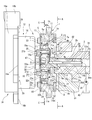
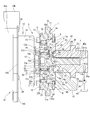
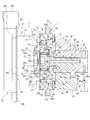
- FIG. 1 is a partial vertical cross-sectional view showing a valve timing control device according to this embodiment
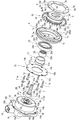
- FIG. 2 is an exploded perspective view showing main constituent members used in this embodiment
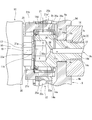
- FIG. 3 is a view of this embodiment shown in FIG.
- FIG. 4 is an enlarged view of a main part
- FIG. 4 is a sectional view taken along the line AA of FIG.
- valve timing control device is rotatably supported by a timing sprocket 1 (hereinafter referred to as sprocket 1), which is a driving rotating body, and a bearing 02 on a cylinder head 01.
- sprocket 1 a timing sprocket 1
- a camshaft 2 and a phase changing mechanism 3 that is arranged between the sprocket 1 and the camshaft 2 and that changes the relative rotational phase of the both 1, 2 according to the engine operating state are provided.
- the sprocket 1 is integrally formed of an iron-based metal, which is a metal material, in an annular shape.
- the sprocket body 1 a has an annular shape, and the sprocket body 1 a is integrally provided on the outer periphery of the sprocket body 1 a and wound around the outer periphery.
- a gear portion 1b that receives a rotational force from the crankshaft of the internal combustion engine via an external timing chain.
- a chain case (not shown) connected to the cylinder block of the internal combustion engine and the cylinder head 01 is provided on the outer periphery of the sprocket 1.
- an annular internal gear 5 that forms a part of a speed reducer 13 described later is integrally provided.
- the internal gear 5 is integrally connected to the sprocket body 1a in the rotation axis direction, and has a plurality of corrugated internal teeth 5a formed on the inner periphery thereof.
- the sprocket body 1a is provided with a slide bearing mechanism 6 between an inner peripheral surface of the sprocket body 1a and an outer peripheral surface of a driven member 9 which will be described later and is a driven rotating body fixed to one end 2a of the cam shaft 2 in the rotation axis direction. There is.
- the plain bearing mechanism 6 rotatably supports the sprocket 1 on the outer periphery of the driven member 9 (camshaft 2).
- a holding plate 8 is fixed to the rear end surface of the sprocket body 1a opposite to the internal gear 5 in the axial direction.
- the holding plate 8 is formed in an annular shape by a plate material of an iron-based metal which is a metal material, and its outer diameter is set to be substantially the same as the outer diameter of the sprocket body 1a.
- the holding plate 8 has a central hole 8a formed at the center thereof so that the inner peripheral portion 8b on the side of the central hole 8a covers one end opening on the cam shaft 2 side of a bearing recess 10 of the sliding bearing mechanism 6 which will be described later. It is located in.
- a portion serving as a hole edge of the central hole 8a is located inside the tooth bottom surface of the internal tooth 5a of the internal gear 5.
- the holding plate 8 is integrally provided with a stopper convex portion 8c projecting radially inward, that is, toward the central axis direction, at a predetermined position on the inner peripheral edge of the central hole 8a.
- the stopper projection 8c is formed in a substantially inverted trapezoidal shape, and the tip end surface is formed in an arc shape along the arc inner surface of the stopper groove 9f of the fixed end portion 9b of the driven member 9 described later. ..
- FIG. 5 is a view on arrow B of FIG.
- a front cover 15 which is a cover member, is provided on the front end surface of the sprocket 1 on the internal gear 5 side. As shown in FIGS. 1, 2 and 5, the front cover 15 is formed by punching an iron-based metal plate into a ring shape by press molding, and an eccentric shaft 21 described later is inserted and arranged in the center. An insertion hole 15a is formed therethrough.
- each outer peripheral portion of the sprocket body 1a including the internal gear 5 and the front cover 15 six bolt insertion holes 1c and 15b through which a plurality of (six in the present embodiment) bolts 7 are inserted are located at substantially equal intervals in the circumferential direction. Are formed to penetrate each. Further, the holding plate 8 is formed with six female screw holes 8d into which the male screw portions 7a at the tips of the bolts 7 are screwed, at positions corresponding to the bolt insertion holes 1c and 15b.
- two positioning pins 28a and 28b are inserted into the respective side portions of the two bolt insertion holes 1c of the sprocket body 1a and the corresponding two female screw holes 8d of the holding plate 8. Small holes 1d and 8e for positioning are provided respectively. By these, the holding plate 8 is positioned with respect to the sprocket 1 in the circumferential direction and the axial direction.
- the camshaft 2 has two drive cams per cylinder that open the intake valve (not shown) on the outer periphery. Further, the cam shaft 2 is integrally provided with a flange portion 2b for axially positioning via a bearing 02 at one end portion 2a on the phase changing mechanism 3 side in the rotation axis direction.
- the camshaft 2 also has an insertion hole 2c formed along the inner axial direction from the tip surface of the one end 2a.
- a shaft portion 14b of a cam bolt 14 to be described later is inserted into the insertion hole 2c, and a female screw portion 2d to which a male screw portion 14c of the cam bolt 14 is fastened is formed on a part of an inner peripheral surface of the one end portion 2a side. ..
- an oil supply passage 34 forming a part of a lubricating oil supply passage, which will be described later, for allowing the lubricating oil to flow therethrough is continuously formed inside the female screw portion 2d.
- a positioning pin 2g for positioning the driven member 9 in the rotational direction is press-fitted and fixed to the tip of the one end 2a of the camshaft 2 in the rotational axis direction.
- the driven member 9 is integrally formed of iron-based metal, and as shown in FIGS. 1 to 4, a disc-shaped body 9a and a circle integrally formed on the rear end side (camshaft 2 side) of the disc-shaped body 9a. It is mainly composed of an annular fixed end portion 9b.
- the disk-shaped main body 9a is integrally provided with a journal portion 11 forming a part of the slide bearing mechanism 6 on the outer peripheral surface. Further, the disk-shaped main body 9a is formed with a bolt insertion hole 9c through which an intermediate shaft portion 14g of a cam bolt 14, which will be described later, is inserted and fitted in the inner axial direction including the fixed end portion 9b.
- the bolt insertion hole 9c has an inner diameter larger than that of the insertion hole 2c of the camshaft 2.
- the fixed end 9b has a constant wall thickness and protrudes from the disc-shaped body 9a toward the camshaft 2. Further, the fixed end portion 9b has an annular fitting groove 9d into which the tip end of the one end portion 2a of the camshaft 2 fits, at approximately the center of the outer surface on the camshaft 2 side (outer peripheral side of the bolt insertion hole 9c). Has been formed. On the bottom surface of the fitting groove 9d, there is formed a positioning hole 9e into which the positioning pin 2g of the cam shaft 2 is inserted in the axial direction.
- the fixed end portion 9b is formed with a stopper concave groove 9f along the circumferential direction in which the stopper convex portion 8c of the holding plate 8 enters on the outer peripheral surface.
- the stopper groove 9f is formed in an arc shape having a predetermined length in the circumferential direction. Both side surfaces of the stopper convex portion 8c, which are rotated in the arcuate length range of the stopper concave groove 9f, respectively come into contact with the circumferential facing surfaces of the stopper concave groove 9f. As a result, the relative rotation position of the camshaft 2 with respect to the timing sprocket 1 on the maximum advance side or the maximum retard side is mechanically restricted.
- the driven member 9 is configured to be fastened and fixed to the camshaft 2 by the cam bolt 14 in the axial direction with the tip end of the one end 2a of the camshaft 2 fitted in the fitting groove 9d in the axial direction.
- the sliding bearing mechanism 6 is provided in an annular bearing recess 10 formed on the inner peripheral surface of the sprocket body 1 a and an outer peripheral surface of the disk-shaped main body 9 a. It has a journal portion 11 arranged inside and the holding plate 8 that covers one end opening of the bearing recess 10.
- the bearing recess 10 is formed only on the inner peripheral surface side of the sprocket body 1a, which is closer to the camshaft 2 side, without extending from one side surface of the sprocket body 1a on the holding plate 8 side to the internal gear 5. Further, as shown in FIG. 1, the bearing recess 10 has a substantially rectangular cross-sectional shape along the radial direction from the rotational axis of the sprocket 1, and a part thereof is formed at the formation position of each gear part 1b. It is arranged so as to overlap with the axial direction.
- the bearing recess 10 has a slide bearing surface 10a formed on the bottom surface of the annular shape. Further, in the bearing recess 10, an inner side surface 10b provided on the other end side opposite to the holding plate 8 in the axial direction is cut out from the sliding bearing surface 10a at a substantially right angle in the radial direction. As described above, the bearing recess 10 is opened to the outside by opening the other end portion on the camshaft 2 side, and the released other end opening is formed by the inner surface 8f of the inner peripheral portion 8b of the holding plate 8. Is covered.
- the journal portion 11 projects radially outward from the outer peripheral surface of the disk-shaped main body 9a and is formed in a rectangular shape whose cross-sectional shape is substantially similar to that of the bearing recess 10. Since the bearing recess 10 axially overlaps each gear portion 1b, the journal portion 11 is also partially axially overlapped with each gear portion 1b of the sprocket 1.
- journal portion 11 has annular grooves formed on both sides in the axial direction of the base portion 11a, which is a connecting portion with the disc-shaped main body 9a. Further, the journal portion 11 has an annular outer peripheral surface slidable over the sliding bearing surface 10 a of the bearing recess 10. Each annular groove prevents the journal portion from coming into contact with the inner side surface 8f of the holding plate 8 and the inner side surface 10b of the bearing recess 10 when the driven member 9 rotates.
- journal portion 11 is configured such that one end surface on the front cover 15 side in the axial direction can slide on the inner side surface 10b of the bearing recess 10.
- the inner side surface 10b comes into contact with one end surface of the journal portion 11 when the sprocket 1 is tilted, and restricts one thrust movement.
- the other end surface of the journal portion 11 on the side of the holding plate 8 in the axial direction is slidable on the inner side surface 8f of the inner peripheral portion 8b of the holding plate 8.
- the inner side surface 8f of the holding plate 8 comes into contact with the other end surface of the journal portion 11 when the sprocket 1 is tilted to regulate the thrust movement of the other.
- the cam bolt 14 is formed on a substantially cylindrical head portion 14a, a shaft portion 14b integrally fixed to the head portion 14a, and an outer peripheral surface of the shaft portion 14b.
- the male screw portion 14c screwed to the female screw portion 2d of the camshaft 2 is included.
- the head 14a has a hexagonal tool hole 14d formed at the tip to insert a tool such as a hexagon wrench. Further, the head 14a has a hardness higher than that of the other parts of the head 14a by subjecting the entire outer peripheral surface 14e to heat treatment such as induction hardening.
- the other portion is, for example, a seat surface 14f which is an axial side surface of the head portion 14a to which an intermediate shaft portion 14g of the shaft portion 14b described later is coupled. Further, each needle roller 25a of the needle bearing 25 is rotatably supported by the high hardness outer peripheral surface 14e of the head portion 14a.
- the seat surface 14f is located on the opposite surface outside the hole edge of the bolt insertion hole 9c of the disk-shaped body 9a of the driven member 9 when the male screw portion 14c of the cam bolt 14 is screwed into the female screw portion 2d of the cam shaft 2 and fastened. I am supposed to sit down.
- the shaft portion 14b is integrally provided with a large-diameter intermediate shaft portion 14g at the base of the head portion 14a, that is, in the center of the seat surface 14f in the axial direction of the head portion 14a.
- the outer diameter of the intermediate shaft portion 14g is larger than the outer diameter of the male screw portion 14c of the shaft portion 14b, and is slightly smaller than the inner diameter of the bolt insertion hole 9c of the driven member 9.
- the intermediate shaft portion 14g is inserted and fitted in the inner peripheral surface of the bolt insertion hole 9c with a minute clearance, and the coaxiality between the driven member 9 and the cam shaft 2 is ensured.
- the intermediate shaft portion 14g is inserted and fitted into the bolt insertion hole 9c to ensure the coaxiality between the driven member 9 and the camshaft 2.
- the insertion fitting of the intermediate shaft portion 14g into the bolt insertion hole 9c is a state close to a so-called intermediate fitting which is a mechanical fitting for ensuring the coaxiality between the driven member 9 and the cam shaft 2.
- the axial length of the intermediate shaft portion 14g is set to be substantially the same as the axial length of the bolt insertion hole 9c, and the tapered portion 14h is formed at the connecting portion of the shaft portion 14b with the male screw portion 14c. It is provided.
- An outer peripheral surface of the tapered portion 14h is formed so as to be inclined downward from the outer peripheral surface of the intermediate shaft portion 14g to the male screw portion 14c at a predetermined angle.
- an arcuate groove 14i is formed between the seat surface 14f of the head portion 14a and the intermediate shaft portion 14g (root portion). As shown in FIG. 3, the arcuate groove 14i is formed in an annular shape along the outer circumference of the intermediate shaft portion 14g.
- the cam bolt 14 when the cam bolt 14 is fastened to the camshaft 2 by the arcuate groove 14i, the seat surface 14f of the head portion 14a and the root of the intermediate shaft portion 14g are aligned with the hole edge of the bolt insertion hole 9c of the driven member 9. Is in a non-contact state without contact.
- the phase changing mechanism 3 is transmitted from the electric motor 12 arranged on the front end side of the fixed end portion 9b of the driven member 9 and the electric motor 12 via the Oldham coupling 20. It mainly comprises a speed reducer 13 that reduces the rotational speed and transmits it to the camshaft 2.
- FIG. 6 is a front view of the electric motor 12, and FIG. 7 is a sectional view taken along the line CC of FIG.
- the electric motor 12 is a so-called brushless DC type motor, and as shown in FIGS. 1, 2 and 6, a bottomed cylindrical motor housing 16 fixed to a chain case and a rear of the motor housing 16.
- a motor stator (not shown) which is provided at the end and accommodates a stator coil and the like inside, a motor shaft 17 arranged on the inner peripheral side of the stator coil, and a cylindrical shape fixed to the outer periphery of the motor shaft 17.
- a power feeding mechanism 18 provided at the front end of the motor housing 16 on the side opposite to the sprocket 1.
- the motor housing 16 is formed in a substantially cup shape, and a through hole (not shown) through which the motor shaft 17 is inserted is formed in substantially the center of the front end (bottom wall).
- a flange portion 16a protruding outward in the radial direction is integrally provided on the outer circumference of the rear end portion.
- the flange portion 16a is integrally provided with three bracket pieces 16b at a position of about 120° in the circumferential direction.
- bolt insertion holes 16c through which bolts for coupling to a chain case (not shown) are inserted are formed through the three bracket pieces 16b.
- each bolt 29 is adapted to connect the power feeding mechanism 18 to the motor housing 16.
- the motor stator is integrally formed mainly by a resin portion of synthetic resin material, and the stator coil is fixed inside the mold.
- the power feeding mechanism 18 has a box-shaped housing 18a made of a synthetic resin material. Inside the housing 18a, an energizing circuit such as a bus bar for supplying power to the electric motor 12, a rotation sensor for detecting the rotation position of the motor shaft 17, and the like are housed. Further, in the power feeding mechanism 18, a power feeding connector 18b electrically connected to a power feeding circuit and a signal connector (not shown) are integrally provided in the housing 18a.
- the power supply connector 18b has an internal terminal connected to a control unit (not shown) via a female terminal to a battery as a power source.
- the built-in terminal is connected to the control unit via the female terminal, and the rotation angle signal detected by the rotation sensor is output to the control unit.
- the motor shaft 17 is made of a metal material in a cylindrical shape, and has two width portions 17b and 17c formed along the tangential direction on the outer surface of the tip end 17a on the speed reducer 13 side. Further, as shown in FIG. 6, a pair of fitting grooves 17d and 17e are formed on the tip edge side of the tip portion 17a, the notch being cut out in a direction orthogonal to the two width portions 17b and 17c. A stopper member 19 for restricting the movement of the intermediate member 30 described later toward the cam bolt 14 is fitted and fixed in the both fitting grooves 17d and 17e in the radial direction.
- the motor shaft 17 is arranged such that the tip portion 17a is close to the head portion 14a of the cam bolt 14 with a slight clearance C from the rotation axis direction. Further, the entire tip portion 17a including the stopper member 19 can be inserted into the tool hole 14d from the axial direction.
- the stopper member 19 is formed in a C-ring shape, and is elastically deformable in the radial direction and the radial direction by its own elastic force.
- An intermediate member 30 is provided on the tip portion 17a of the motor shaft 17.
- the intermediate member 30 constitutes a part of the Oldham's joint 20, which is a joint connected to the speed reducer 13, and has a tubular shape fixed to the tip portion 17 a of the motor shaft 17, as shown in FIG. 6. It has a base 31.
- the tubular base portion 31 has a pair of flat portions 31a and 31b having a width across flats on both sides of the circular outer surface, that is, at a position of 180° in the circumferential direction, whereby the outer shape is substantially oval. Is formed in.
- a through hole 32 into which the tip portion 17a of the motor shaft 17 is inserted is formed at the center of the cylindrical base portion 31.
- the through hole 32 has a circular inner peripheral surface formed with a pair of facing surfaces 32 a and 32 b having a width across flat from the rotation axis of the motor shaft 17 in the radial direction. As a result, it is formed in an oval shape that is long in the radial direction and is similar to the outer shape of the tubular base 31. Therefore, the intermediate member 30 is movable in the radial direction (vertical direction in FIG. 6) with respect to the tip portion 17a of the motor shaft 17 via the oval through hole 32.
- the tubular base portion 31 is provided with two transmission keys 33a and 33b, which are a pair of projecting portions, at substantially central positions in the longitudinal direction (vertical direction in FIG. 6) of the pair of flat surface portions 31a and 31b.
- Each of the transmission keys 33a and 33b is formed in a substantially rectangular plate shape and protrudes radially outward from the two flat surface portions 31a and 31b of the tubular base portion 31.
- the speed reducer 13 is provided separately from the electric motor 12 in the axial direction, and each component is housed and arranged inside the sprocket 1 between the holding plate 8 and the front cover 15. ing.
- the speed reducer 13 includes a cylindrical eccentric shaft 21 which is an input shaft partially arranged inside the sprocket body 1a, and A ball bearing 22 which is a bearing provided on the outer circumference of the eccentric shaft 21, and a plurality of rollers 23 provided on the outer circumference of the ball bearing 22 and rotatably held in each internal tooth 5a of the internal gear 5,
- the driven member 9 is mainly provided with a retainer 24 which is integrally provided on the outer peripheral side of the disk-shaped body 9a and holds the plurality of rollers 23 in the rolling direction while permitting radial movement.
- FIG. 8 shows the eccentric shaft 21, A is a side view of the eccentric shaft 21, B is a front view of the eccentric shaft 21, and C is a sectional view taken along line DD of B.
- the eccentric shaft 21 includes an eccentric shaft portion 21a arranged on the outer periphery of a needle bearing 25, which is a bearing provided on the outer periphery of the head 14a of the cam bolt 14, And a large-diameter cylindrical portion 21b which is a connecting portion of the eccentric shaft portion 21a on the electric motor 12 side.
- the eccentric shaft portion 21a is formed in a cylindrical shape whose axial length is longer than the axial length of the needle bearing 25. Further, in the eccentric shaft portion 21a, the wall thickness t of the entire circumferential direction changes so that the shaft center X is slightly eccentric with respect to the shaft center Y of the cam bolt 14 (see FIGS. 2 and 8C).
- the large-diameter cylindrical portion 21b has a uniform thickness and is formed into a substantially circular shape, and is slightly thicker than the eccentric shaft portion 21a.
- the large-diameter cylindrical portion 21b projects from the inside of the sprocket body 1a toward the electric motor 12 through the insertion hole 15a of the front cover 15.
- the large-diameter cylindrical portion 21b constitutes the Oldham's joint 20 together with the intermediate member 30.
- the large-diameter cylindrical portion 21b is formed therein with a two-width-shaped fitting hole 21c into which the tubular base portion 31 of the intermediate member 30 can be fitted in the axial direction.
- the large-diameter cylindrical portion 21b is provided with a pair of crescent-shaped convex portions 21f and 21g forming a width across flats at a position of approximately 180° in the circumferential direction on the inner peripheral surface of the fitting hole 21c. Therefore, the inner peripheral surface of the fitting hole 21c is a large diameter portion, and the pair of convex portions 21f and 21g are configured as a small diameter portion.
- a pair of key grooves 21d and 21e into which the two transmission keys 33a and 33b of the tubular base portion 31 can be fitted in the rotational axis direction are provided at substantially the upper and lower central positions of the pair of convex portions 21f and 21g in FIG. 8B. Are formed.
- the key grooves 21d and 21e are formed in a rectangular shape similar to the transmission keys 33a and 33b, and the depth thereof is set to be substantially the same as the width of the transmission keys 33a and 33b.
- the pair of convex portions 21f and 21g function as a suppressing portion that suppresses excessive supply of the lubricating oil injected from the first oil hole 38 of the lubricating oil supply mechanism described later to the electric motor 12 (Oldham coupling 20). It has become.
- the needle bearing 25 is fixed to a plurality of needle rollers 25a rolling on the outer peripheral surface 14e of the head 14a of the cam bolt 14 and a stepped surface formed on the inner peripheral surface of the eccentric shaft portion 21a, and needle needles 25 are formed on the inner peripheral surface.
- a cylindrical shell 25b having a plurality of groove portions that rotatably hold the roller 25a.
- the ball bearings 22 are arranged in a state where they are substantially overlapped at the radial position of the needle bearing 25.
- the ball bearing 22 includes an inner ring 22a, an outer ring 22b, balls 22c interposed between the two wheels 22a and 22b, and a cage 22d holding the balls 22c.
- the inner ring 22a is press-fitted and fixed to the outer peripheral surface of the eccentric shaft portion 21a, while the outer ring 22b is in a free state without being fixed in the axial direction. That is, one end surface of the outer ring 22b on the electric motor 12 side in the axial direction is in a non-contact state with the inner surface of the front cover 15 via a minute clearance. Further, the other end surface of the outer ring 22b in the axial direction is also in a non-contact state with the back surface of the disk-shaped main body 9a of the driven member 9 facing it through a minute clearance.
- the outer ring 22b is in rollable contact with the outer peripheral surface of each roller 23. Further, an annular clearance is formed between the outer peripheral surface of the outer ring 22b and the inner surface of the cage 24. Therefore, the ball bearing 22 can be eccentrically moved in the radial direction along with the eccentric rotation of the eccentric shaft portion 21a via the clearance.
- the cage 24 is formed in a cylindrical shape and is integrally provided on the outer peripheral portion of the disk-shaped main body 9a. That is, the cage 24 linearly projects from the base portion 11a of the journal portion 11 of the disk-shaped main body 9a toward the front cover 15. A predetermined clearance is formed between the tip surface 24 a of the cage 24 and the inner surface of the front cover 15.
- the retainer 24 has a plurality of substantially rectangular roller holding holes 24b, which hold the plurality of rollers 23 rollably, respectively, formed along the axial direction.
- the plurality of roller holding holes 24b are provided at equidistant positions in the circumferential direction of the cage 24, and the tip end side is closed to form an elongated rectangular shape in the front-rear direction.
- the total number of roller holding holes 24b (the number of rollers 23) is smaller than the total number of teeth of the internal teeth 5a of the internal gear 5, so that a predetermined reduction ratio can be obtained. ing.
- Each roller 23 is made of iron-based metal, and is fitted into the internal teeth 5a of the internal gear 5 while moving in the radial direction due to the eccentric movement of the ball bearing 22. Further, each roller 23 is configured to swing in the radial direction while being guided in the circumferential direction by both side edges of each roller holding hole 24b.
- the reduction gear 13 and the Oldham coupling 20 described above are configured such that lubricating oil is supplied to the inside through a lubricating oil supply mechanism.
- the lubricating oil supply mechanism includes the oil supply passage 34 formed in the inner axial direction of the camshaft 2 and the bottom center of the tool hole 14d of the head 14a of the cam bolt 14. It has an oil passage hole 35 penetratingly formed along the inner axial direction of the shaft portion 14b, and an oil pump 36 for supplying lubricating oil to the oil supply passage 34.
- the oil supply passage 34 is formed long along the inner axial direction of the camshaft 2 and is also used as a means for supplying lubricating oil to a plurality of bearings (not shown) of the camshaft 2.
- the oil supply passage 34 communicates with the discharge passage 36a of the oil pump 36 via a supply hole 34a formed along the radial direction of the camshaft 2.
- the oil passage hole 35 includes a main passage hole 37 formed in a part of the head portion 14a of the cam bolt 14 and an inner axial direction of the shaft portion 14b, and an inner axial direction of the head portion 14a. And a first oil hole 38 which is formed on the lower end of the main passage hole 37 and communicates with the other end portion 37b on the downstream side of the main passage hole 37, and which communicates with the other end portion 37b of the main passage hole 37 that extends radially from the axial center of the head portion 14a. And a second oil hole 39.
- the main passage hole 37 is formed in a straight line along the axis of the cam bolt 14, and one upstream end portion 37 a opens into the oil supply passage 34 of the cam shaft 2.
- the other end portion 37b on the downstream side is located inside the head portion 14a and is connected to the first and second oil holes 38 and 39.
- the main passage hole 37 has a uniform inner diameter of about 2 mm.
- the upstream end of the first oil hole 38 is continuously connected to the other end 37b of the main passage hole 37 from the axial direction, while the first opening 38a at the downstream end opens to the tool hole 14d.
- the first opening 38a is adapted to supply a lubricating oil to the Oldham's joint 20 by being directed to a tip portion 17a of a motor shaft 17, which will be described later, from the axial direction.
- the inner diameter of the first oil hole 38 is set to about 1 mm, and the first oil hole 38 functions as an orifice narrowed down from the main passage hole 37. Therefore, as shown by the arrow in FIG.
- the lubricating oil that has flowed into the main passage hole 37 flows from the first opening portion 38a of the first oil hole 38 into the tip portion 17a of the motor shaft 17, that is, the tool hole 14d. It is injected, diffused from here, and supplied to the friction generation site of the Oldham's joint 20 and the speed reducer 13.
- the upstream end of the second oil hole 39 is connected to the other end 37b of the main passage hole 37 in the radial direction, and the downstream second opening 39a opens inside the speed reducer 13.
- the second opening 39a is directed from the radial direction to one axial end of the shell 25b of the needle bearing 25.
- the second oil hole 39 has an inner diameter set to about 1 mm like the first oil hole 38 and functions as an orifice narrowed down from the main passage hole 37 of about 2 mm. Therefore, the lubricating oil that has flowed into the main passage hole 37 is jetted from the second opening 39 a of the second oil hole 39 to the speed reducer 13. That is, the lubricating oil injected from the second opening 39a is supplied to the entire speed reducer 13 including the needle bearing 25, the ball bearing 22, the cage 24, and the like.
- the lubricating oil that has flowed into the speed reducer 13 from the second oil hole 39 passes through the inside of the ball bearing 22 and the retainer 24 on the outer peripheral side due to centrifugal force during driving, and from here, the bearing recess 10 is formed. And the journal portion 11. That is, the lubricating oil passes through between the both end surfaces and the outer peripheral surface of the journal portion 11 and the inner side surface 10b of the bearing recess 10 and the sliding bearing surface 10a to be used for lubrication.
- the oil pump 36 is a general pump such as a trochoid, and the discharge passage 36a communicates with a main oil gallery (not shown) that mainly supplies lubricating oil that lubricates the inside of the internal combustion engine.
- the control unit detects the current engine operating state based on information signals from various sensors such as a crank angle sensor, an air flow meter, a water temperature sensor, and an accelerator opening sensor (not shown), and controls the engine based on this. Is going.
- the control unit controls the rotation of the motor shaft 17 by energizing the coil portion based on the information signals and the rotational position detection mechanism, and controls the rotation phase of the camshaft 2 with respect to the timing sprocket 1 by the speed reducer 13. It is designed to be controlled. [Operation and effect of this embodiment] The operation of the valve timing control device in this embodiment will be described below.
- a control current from the control unit is supplied to the coil portion of the electric motor 12 to drive the motor shaft 17 in the forward and reverse directions.
- the rotational force of the motor shaft 17 is transmitted to the eccentric shaft 21 via the Oldham coupling 20 and the rotational force reduced by the operation of the speed reducer 13 is transmitted to the camshaft 2.
- each intake valve is controlled to convert the opening/closing timing to the advance side or the retard side.
- the inside of the Oldham coupling 20 and the speed reducer 13 can be effectively lubricated by the lubricating oil supply function.
- the lubricating oil discharged to the discharge passage 36a by the drive of the oil pump 36 is partially supplied to the inside of the engine from the main oil gallery, but the other part is supplied to the oil supply passage 34 from the supply hole 34a.
- the lubricating oil supplied to the oil supply passage 34 flows into the oil passage hole 35 from the one end 37a and the first oil hole 38 and the second oil hole 38 from the other end 37b, as shown by the arrows in FIGS. 1 and 3. It diverts to the oil hole 39.
- the lubricating oil in the first oil hole 38 is sprayed from the first opening 38a through the tool hole 14d to the tip portion 17a of the motor shaft 17 in the axial direction to collide and scatter.
- the scattered lubricating oil is supplied to the inside of the Oldham coupling 20.
- the lubricating oil injected from the first oil hole 38 partially passes through the clearance C by the centrifugal force and is partially supplied to the one end side of the needle bearing 25 on the electric motor 12 side in the axial direction, The other part goes around to the front end side of the eccentric shaft 21 and is supplied to the axial front end side of the ball bearing 22. As a result, the needle bearing 25 and the ball bearing 22 are lubricated.
- the lubricating oil injected from the first oil hole 38 is suppressed from scattering from the eccentric shaft 21 to the outside by the both convex portions 21f and 21g of the eccentric shaft 21. Therefore, it is efficiently supplied to the Oldham coupling 20 and the speed reducer 13.
- the lubricating oil that has flowed into the second oil hole 39 from the other end of the oil passage hole 35 is injected from the second opening 39a as shown by the arrow in FIG. Supplied to the department side. Further, from here, it is supplied to the axial rear end side of the ball bearing 22 by centrifugal force during driving, and is also supplied between each roller holding hole 24b of the holder 24 and each roller 23. Further, this lubricating oil is supplied between the sliding bearing surface 10a of the bearing recess 10 and the outer peripheral surface of the journal portion 11 by centrifugal force.
- the lubricity for the speed reducer 13 is further promoted and the lubricity for the bearing between the driven member 9 and the sprocket 1 is also improved.
- the lubricating oil supplied from the first and second oil holes 38 and 39 to the Oldham's joint 20 and the speed reducer 13 passes through the clearance C, the fitting hole 21c, etc. by centrifugal force, as shown by the arrow, The oil is discharged into the oil pan 45 from the insertion hole 15a of the cover 15.
- the lubricating oil supplied from the oil passage hole 35 to the first oil hole 38 and the second oil hole 39 is in an injection state due to the throttling function of both oil holes 38, 39, so an excessive supply amount is suppressed. To be done.
- the lubricating oil injected from the first oil hole 38 is prevented from excessive diffusion by the inner peripheral surface of the tool hole 14d and the both convex portions 21f and 21g of the fitting hole 21c. Therefore, it becomes possible to efficiently supply the lubricating oil to the Oldham coupling 20 and the speed reducer 13.
- the oil passage hole 35 of the lubricating oil supply mechanism is formed inside the cam bolt 14 instead of inside the cam shaft 2, so that the forming work is simplified and the work cost can be reduced.
- the camshaft 2 is simply provided with an existing oil supply passage 34 for lubricating the bearing of the camshaft 2.
- the oil passage hole 35 for lubricating the speed reducer 13 and the like is formed by the main passage hole 37a in the inner axial direction of the cam bolt 14 and the first and second oil holes 38, 39 in the radial direction. There is. That is, since the oil passage hole 35 can be formed only by drilling the cam bolt 14, for example, the working operation can be facilitated and the working cost can be reduced.
- the second oil hole 39 is formed inside the head portion 14a, not the shaft portion 14b of the cam bolt 14, it is possible to suppress the decrease in strength of the cam bolt 14.
- the intermediate member 14g causes the driven member 9 and the cam shaft 2 to be coaxial (alignment). Can be obtained.
- the intermediate shaft portion 14g is inserted into and fitted into the bolt insertion hole 9c in a substantially intermediate fit state, and the female screw portion 2d and the male screw portion 14c are fastened to each other, so that the driven member 9 and the cam shaft 2 are coaxial with each other. It will be possible to obtain.
- the seat surface 14f of the head portion 14a causes the peripheral surface of the hole on the electric motor 12 side of the bolt insertion hole 9c of the driven member 9 (the peripheral surface of the disk-shaped main body 9a). Press against. Even if the seat 14f side of the head 14a is buckled and deformed in the radial direction by this pressure, this deformation has little influence on the tightening torque. Therefore, it becomes possible to obtain a desired fastening torque by the cam bolt 14.
- the bolt insertion hole 9c of the driven member 9 is formed to have a relatively large diameter for inserting and fitting the intermediate shaft portion 14g having an inner diameter larger than the outer diameter of the shaft portion 14b (male screw portion 14c). Therefore, the cam bolt 14 can insert the shaft portion 14b into the bolt insertion hole 9c with a margin through the gap between the two portions 9c and 14b. Therefore, it is possible to prevent the external thread portion 14c from interfering with and damaging the hole edge of the bolt insertion hole 9c at the time of this insertion.
- the taper portion 14h provided on the tip side of the intermediate shaft portion 14g functions as a guide when the shaft portion 14b of the cam bolt 14 is inserted into the bolt insertion hole 9c. Therefore, the work of inserting the cam bolt 14 into the bolt insertion hole 9c becomes easy.
- the outer peripheral surface 14e of the head portion 14a is induction hardened to have high hardness, so that the following effects can be obtained.
- a reverse input to the reducer 13 acts on the cam bolt 14 due to the positive and negative alternating torque of the camshaft 2 generated while the engine is being driven, and a radial load is input to the outer peripheral surface 14e of the head 14a.
- the needle bearing 25 may interfere with the outer peripheral surface 14e of the head portion 14a.
- the outer peripheral surface 14e of the head 14a has a high hardness, it is possible to suppress the occurrence of damage.
- the bearing surface 14f of the head portion 14a has a hardness lower than that of the outer peripheral surface 14e, it is possible to sufficiently secure the fastening force of the cam bolt 14 due to the high toughness.
- the tip portion 17a (including the stopper member 19) of the motor shaft 17 of the electric motor 12 can be inserted into the tool hole 14d of the cam bolt 14 from the rotation axis direction. Therefore, when the motor shaft 17 or the cam shaft 2 (driven member 9) moves in the rotation axis direction due to the vibration of the engine or the like, the tip portion 17a of the motor shaft 17 enters the tool hole 14d to absorb the movement. it can. This makes it possible to shorten the axial distance between the motor shaft 17 and the cam bolt 14 as much as possible.
- the overall valve timing control device can be shortened in the axial direction, so the device can be downsized and the mountability in the engine room is improved.
- the intermediate member 30 can be moved in the radial direction with respect to the motor shaft 17 through the respective facing surfaces 32a and 32b of the through hole 32 and the two-face width portions 17b and 17c of the motor shaft tip portion 17a. ing. Further, the eccentric shaft 21 can be moved in the radial direction orthogonal to the radial movement of the intermediate member 30 via the two key grooves 21d and 21e and the two transmission keys 33a and 33b of the intermediate member 30.
- the inner side surface 8f of the inner peripheral portion 8b of the holding plate 8 contacts the other end surface of the journal portion 11 to receive and regulate the thrust load F2 in the other direction.
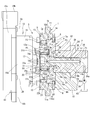
- FIG. 9 shows a second embodiment of the present invention, in which the motor shaft 17 of the electric motor 12 and the tubular base portion 31 of the Oldham coupling 20 are separated from the front end surface of the head portion 14a of the cam bolt 14 in the axial direction to form a gap C. Has a large axial width.
- the second oil hole 39 of the oil passage hole 35 is eliminated and only the first oil hole 38 is provided.
- Other configurations are the same as those in the first embodiment.
- the lubricating oil pressure-fed from the oil pump 36 to the main passage hole 37a of the oil passage hole 35 is injected from the first oil hole 38 to the tip portion 17a of the motor shaft 17 from the axial direction, as shown by the arrow in FIG. To be done.
- the injected lubricating oil collides with the tip portion 17a and scatters to lubricate the inside and outside of the tubular base 31, that is, the Oldham coupling 20.
- a part of the injected lubricating oil is supplied to one end portion of the needle bearing 25 in the axial direction through the clearance C by a centrifugal force or the like, and lubricates the inside of the needle bearing 25 while the ball bearing on the outer peripheral side. 22 is supplied inside.
- the lubricating oil is further supplied from here between the roller holding holes 24b on the outer peripheral side and the rollers 23, and is also supplied to the journal portion 11. Therefore, the friction generating parts such as the speed reducer 13 and the periphery of the journal 11 are effectively lubricated.
- the lubricating oil that lubricated the Oldham coupling 20 is discharged into the oil pan 45 as it is.
- FIG. 10 shows a third embodiment.
- a pair of passage grooves 40 and 41 are formed on the outer peripheral surface of the shaft portion 14b of the cam bolt 14, and a driven member is formed.
- An L-shaped communication hole 42 is formed in the inner peripheral portion of the member 9.
- the pair of passage grooves 40, 41 are formed at a position of approximately 180° in the circumferential direction of the shaft portion 14b, and are formed by linearly traversing the male screw portion 14c on the outer peripheral surface of the shaft portion 14b along the axial direction. It is provided in.
- the camshaft 2 has an annular groove groove 43 formed on the inner peripheral surface of the insertion hole 2c on the one end 2a side.
- Each of the passage grooves 40, 41 has one end portion 40 a, 41 a on the upstream side opening to the oil supply passage 34 of the camshaft 2, while the other end portion 40 b, 41 b on the downstream side opens to the groove groove 43. ..
- the communication hole 42 is provided with a radial hole 42a provided in the bottom surface of the fitting groove 9d of the driven member 9 so as to extend in the radial direction with respect to the rotation axis, and an axis formed through the disk-shaped body 9a in the rotation axis direction. And a direction hole 42b.
- the radial hole 42a is formed in an elongated groove shape, and one end on the inner side communicates with one end of the groove groove 43, and the other end on the outer side communicates with the axial hole 42b.
- the one end of the axial hole 42b opposite to the radial hole 42a is opened along the axial direction at the other end of the needle bearing 25 in the axial direction.
- the lubricating oil pressure-fed from the oil supply passage 34 to the passage grooves 40, 41 flows into the communication hole 42 via the groove groove 43 as shown by the arrow in the figure. Then, the lubricating oil flowing into the radial hole 42a of the communication hole 42 is injected from the axial hole 42b to the other end side of the needle bearing 25. After that, the lubricating oil is supplied to the outer ball bearing 22 by centrifugal force or the like, is further supplied between the roller holding hole 24b and the roller 23, and is further supplied around the journal portion 11. Therefore, each friction generating portion such as the speed reducer 13 is effectively lubricated.
- FIG. 11 shows a fourth embodiment, which has the same basic configuration as the second embodiment, but the structure of the front cover 15 which is a cover member is modified.
- the outer peripheral portion 15c of the front cover 15 is formed in a flat annular flange shape, but the inner peripheral portion 15d around the central insertion hole 15a bulges toward the electric motor 12 side. It is deforming. That is, the inner peripheral portion 15d is bent and deformed into a crank shape in a vertical cross section so as to project toward the electric motor 12, and the entire front cover 15 is formed in a bowl shape.
- the inner peripheral portion 15d is formed in a truncated cone shape, and the front end portion 15d on the insertion hole 15a side covers the outer periphery of the large-diameter cylindrical portion 21b of the eccentric shaft 21 via a predetermined gap C1.
- the lubricating oil pressure-fed from the oil pump 36 to the main passage hole 37a of the oil passage hole 35 is injected from the first oil hole 38 to the tip portion 17a of the motor shaft 17 from the axial direction, as shown by the arrow in FIG. To be done.
- the injected lubricating oil collides with the tip portion 17a and scatters to lubricate the inside and outside of the cylindrical base portion 31, that is, the Oldham coupling 20.
- a part of the injected lubricating oil is supplied to one end portion of the needle bearing 25 in the axial direction through the gap C by a centrifugal force or the like, and lubricates the inside of the needle bearing 25 while the ball bearing on the outer peripheral side. 22 is supplied inside. Further, the lubricating oil is supplied from here between the roller holding holes 24b on the outer peripheral side and the rollers 23, and is also supplied to the journal portion 11. Therefore, the friction generating parts such as the speed reducer 13 and the periphery of the journal 11 are effectively lubricated.
- the inner peripheral portion 15b of the front cover 15 functions as a guide and a trap for the lubricating oil, the supply amount of the lubricating oil such as the speed reducer 13 is increased and a higher lubricating performance is obtained.
- the reduction gear 13 may be, for example, a planetary gear device or the like.
- first and second oil holes 38 and 39 of each embodiment may be formed to have the same inner diameter as the oil passage hole 35, and conversely, the oil passage hole 35 may be formed to the first and second oil holes 38. , 39 and the same orifice-shaped small diameter.
- valve timing control device for an internal combustion engine based on the embodiment described above, for example, the following modes are conceivable.
- a driving rotary body to which the rotational force from the crankshaft is transmitted a driven rotary body that is provided so as to be rotatable relative to the driving rotary body, and is fixed to the camshaft,
- a reduction gear that is provided between the driving rotary body and the driven rotary body and rotates the input rotary shaft relative to the drive rotary body by rotating the input shaft, and rotates the input shaft via a joint.
- An electric motor having a motor shaft for driving, and a cam bolt for coupling the driven rotor to the cam shaft, the cam bolt communicating with a supply passage for supplying lubricating oil into the internal combustion engine, and at least one of the joint and the speed reducer.
- the cam bolt having an oil passage hole capable of supplying lubricating oil therein.
- the joint includes an intermediate member that is integrally rotatably held on the motor shaft, and a connecting portion that is provided on the input shaft and that is integrally rotatably connected to the intermediate member. ..
- the oil passage hole has an opening on the downstream side that opens in the axial direction so as to face the joint.
- the opening of the oil passage hole opens in the joint in the axial direction, lubricity to the joint is improved.
- the input shaft has a suppressing portion that suppresses excessive supply of lubricating oil from the oil passage hole to the electric motor side.
- the lubricating oil flowing out from the oil passage hole to the joint side can be prevented from being scattered to the outside by the suppressing portion, so that the lubricity of the joint and the speed reducer is improved.
- the suppressing portion is provided on the inner circumference of the input shaft, and includes a large-diameter portion provided on the camshaft side in the axial direction and a motor shaft side in the axial direction with respect to the large-diameter portion. And at least a part of the small diameter portion is formed to have a diameter smaller than the inner diameter of the large diameter portion.
- the cam bolt has a head portion whose seating surface can come into axial contact with the driven rotating body, and a bolt insertion hole formed in the driven rotating body extending from the seating surface in the cam shaft direction. And a male screw portion formed on the outer peripheral surface of the shaft portion and screwed into a female screw portion formed in the inner axial direction of the cam shaft, wherein the oil passage hole is ,
- a main passage hole provided mainly along the inner axial direction of the cam bolt from the tip end side of the shaft portion, and a main passage hole continuously provided along the inner axial direction of the head portion on the tip end side.
- a first oil hole having the opening and having an inner diameter smaller than the inner diameter of the main passage hole is provided.
- the lubricating oil flowing into the main passage hole is supplied from the first oil hole to the joint in an injection state. Moreover, the excessive supply of lubricating oil is suppressed by the throttling function of the first oil hole.
- the first oil hole is opened in a tool hole provided in the head of the cam bolt.
- the lubricating oil injected from the first oil hole through the opening diffuses in the tool hole, it is possible to supply it to the entire joint.
- the cam bolt has a head portion whose seating surface can come into axial contact with the driven rotating body, and a bolt insertion hole formed in the driven rotating body extending from the seating surface in the cam shaft direction. And a male screw portion formed on the outer peripheral surface of the shaft portion and screwed into a female screw portion formed in the inner axial direction of the cam shaft, wherein the oil passage hole is A main passage hole provided along the inner axial direction mainly from the tip side of the shaft portion of the cam bolt, and an inner radial direction of the head portion, one end of which communicates with the main passage hole, The other end has a second oil hole having a second opening opening toward the speed reducer.
- the lubricating oil that has flowed into the second oil hole from the main passage hole is directly supplied to the speed reducer from the second opening, so that the lubricating performance of the speed reducer is improved.
- the second oil hole is formed in the highly rigid head portion of the cam bolt, it is possible to suppress the decrease in strength of the cam bolt as compared with the case where the second oil hole is formed in the shaft portion or the male screw portion of the shaft portion.
- the second opening portion opens radially inward of the speed reducer.
- the lubricating oil that has flowed into the second oil hole from the main passage hole can be supplied to the reducer from the radially inner side through the second opening by utilizing the discharge pressure and the centrifugal force. , Can be sufficiently supplied to the speed reducer.
- a bearing forming a part of the speed reducer is provided between the outer peripheral surface of the head of the cam bolt and the inner peripheral surface of the input shaft, and the second opening of the second oil hole is The bearing is arranged closer to the contact portion between the bearing surface of the head and the driven rotating body than the center position of the bearing in the axial direction.
- the lubricating oil that has flowed into the second oil hole from the main passage hole can be directly supplied to the bearing of the speed reducer from the second opening. Therefore, it becomes possible to supply the lubricating oil to the bearing more efficiently than when supplying the lubricating oil from the tip end side of the head.
- the speed reducer includes an internal gear provided on an inner circumference of the drive rotating body, a bearing arranged on an outer circumference of the input shaft, and an outer circumference of the bearing and an inner tooth of the inner gear.
- a plurality of rolling elements arranged in the same manner, and a retainer that is provided integrally with the driven rotating body and holds the plurality of rolling elements at predetermined circumferential intervals, and the bearing and the oil passage hole are It is in communication.
- the lubricating oil supplied to the oil passage hole can be positively supplied to the bearing of the speed reducer via the oil passage hole, so that the lubrication performance of the bearing can be improved. ..
- a seat surface has a head portion that can come into contact with the driven rotor in the axial direction, and a bolt insertion hole formed in the driven rotor that extends from the seat surface in the cam shaft direction.
- a male screw portion formed on the outer peripheral surface of the shaft portion and screwed into a female screw portion formed in the inner axial direction of the cam shaft, wherein the oil passage hole is
- An opening at a downstream end opens to the electric motor side of the head, and the bearing has one end portion on the electric motor side in the axial direction of the bearing more than a front end portion of the head on the electric motor side in the axial direction. It is arranged near the electric motor.
- the lubricating oil flowing out from the downstream side opening through the oil passage hole scatters in the radial direction by the rotating centrifugal force and passes through the front end face of the head, and one end portion of the bearing. It will be collected by. This improves the lubricity of the bearing.
- the cam bolt is formed in the driven rotating body by extending from the seating surface of the head in the camshaft direction to a head having a seating surface that can come into contact with the driven rotating body in the axial direction.
- the oil passage hole has an opening at the downstream end that opens toward the electric motor of the head, and the drive rotor has at least a portion that covers the end of the input shaft on the electric motor side in the axial direction.
- the lubricating oil flowing out from the opening at the downstream end through the oil passage hole is scattered from the inner side of the head to the outer peripheral side by the centrifugal force, but a part of the scattered lubricating oil. Are collected on the inner surface of the cover member and supplied to the inside of the speed reducer. This improves the lubricity of parts such as the bearings and rollers of the speed reducer.
- a driving rotary body to which the rotational force from the crankshaft is transmitted, a driven rotary body fixed to a camshaft so as to be rotatable relative to the driving rotary body, and the driving rotary body
- a reduction gear that is provided between the body and the driven rotating body, and that rotates the input shaft by rotating the input shaft, and a motor shaft that rotates the input shaft via a joint.
- a cam bolt for coupling the driven rotating body to a cam shaft, the shaft portion having a male screw portion screwed into a female screw hole provided in the cam shaft inner axial direction, and the male screw portion.
- the cam bolt having a passage groove provided along the axial direction of the outer peripheral surface of the shaft portion for allowing lubricating oil to flow therethrough, and the driven rotor provided with the passage groove and the speed reducer communicating with each other. And a communication hole for connecting.
- the lubricating oil that has flowed into the passage groove formed on the outer peripheral surface of the shaft portion of the cam bolt can be supplied to the reduction gear through the communication hole.
- the forming work is easy because the passage groove along the axial direction is simply formed on the outer peripheral surface of the shaft portion (including the male screw portion) of the cam bolt. Therefore, the molding workability is improved and the cost can be reduced.
- the cam bolt has a head portion whose seating surface abuts on the driven rotor in the axial direction, and a bearing is provided between the outer circumference of the head portion and the inner circumference of the input shaft.
- the hole has a radial tip end position that is the same as the bearing or is located inside the bearing from the rotation axis of the driven rotor.
- the tip of the communication hole is located at the same position as or inside the bearing, it is easy to lubricate the bearing.
- the passage groove is provided across the thread of the male screw portion.
- Eccentric shaft input shaft
- 21a... Eccentric shaft Part 21b... Large-diameter cylindrical part (connecting part), 21c... Fitting hole (large-diameter part, suppressing part), 21g ⁇ 21f... Convex part (small-diameter part, suppressing part), 22... Ball bearing (bearing), 23 ... roller, 24... cage, 24b... roller holding hole, 25... needle bearing (bearing), 30... intermediate member, 31... cylindrical base, 34... oil supply passage, 37... oil passage hole 35a... main passage hole, 38... 1st oil hole, 38a... 1st opening part, 39... 2nd oil hole, 39a... 2nd opening part, 40*41... Passage groove, 42... Communication hole, 42a... Radial hole, 42b... Axial direction Hole.
Landscapes
- Engineering & Computer Science (AREA)
- Mechanical Engineering (AREA)
- General Engineering & Computer Science (AREA)
- Valve Device For Special Equipments (AREA)
- Lubrication Of Internal Combustion Engines (AREA)
Abstract
La présente invention comprend : un réducteur (13) qui fait tourner un élément entraîné (9) par rapport à un pignon (1) à travers la rotation d'un arbre excentrique (21) ; un moteur électrique (12) qui comporte un arbre de moteur (17) destiné à faire tourner l'arbre excentrique par l'intermédiaire d'un accouplement Oldham (20) ; et un boulon à came (14) qui relie l'élément entraîné à un arbre à cames (2). Le boulon à came comporte, formé en son sein de façon à pénétrer dans la direction de son axe interne, un trou de passage d'huile (35) qui est relié à un passage d'alimentation en huile (34) pour fournir de l'huile de lubrification à l'intérieur du moteur à combustion interne. Le trou de passage d'huile comporte des premier et second trous d'huile (38, 39) ayant de petits diamètres sur le côté aval d'un trou de passage principal (37a) ayant un grand diamètre. L'accouplement Oldham et/ou le réducteur est directement lubrifié par l'huile lubrifiante évacuée par les deux trous d'huile.
Priority Applications (1)
| Application Number | Priority Date | Filing Date | Title |
|---|---|---|---|
| JP2020571009A JPWO2020162016A1 (ja) | 2019-02-06 | 2019-12-04 | 内燃機関のバルブタイミング制御装置 |
Applications Claiming Priority (2)
| Application Number | Priority Date | Filing Date | Title |
|---|---|---|---|
| JP2019019282 | 2019-02-06 | ||
| JP2019-019282 | 2019-02-06 |
Publications (1)
| Publication Number | Publication Date |
|---|---|
| WO2020162016A1 true WO2020162016A1 (fr) | 2020-08-13 |
Family
ID=71948198
Family Applications (1)
| Application Number | Title | Priority Date | Filing Date |
|---|---|---|---|
| PCT/JP2019/047363 Ceased WO2020162016A1 (fr) | 2019-02-06 | 2019-12-04 | Dispositif de commande de réglage de distribution pour moteur à combustion interne |
Country Status (2)
| Country | Link |
|---|---|
| JP (1) | JPWO2020162016A1 (fr) |
| WO (1) | WO2020162016A1 (fr) |
Cited By (2)
| Publication number | Priority date | Publication date | Assignee | Title |
|---|---|---|---|---|
| CN120211904A (zh) * | 2023-12-27 | 2025-06-27 | 北京车和家汽车科技有限公司 | 增程式发动机及车辆 |
| WO2025140456A1 (fr) * | 2023-12-27 | 2025-07-03 | 北京车和家汽车科技有限公司 | Système de circuit d'huile de couvercle de cylindre, moteur à autonomie prolongée, système d'extrémité avant de vilebrequin, structure d'amortissement, moteur et véhicule |
Citations (7)
| Publication number | Priority date | Publication date | Assignee | Title |
|---|---|---|---|---|
| JPH02241914A (ja) * | 1989-03-14 | 1990-09-26 | Aisin Seiki Co Ltd | 弁開閉時期制御装置 |
| JPH062512A (ja) * | 1992-06-19 | 1994-01-11 | Mazda Motor Corp | エンジンのバルブタイミング制御装置 |
| JP2009293576A (ja) * | 2008-06-09 | 2009-12-17 | Hitachi Automotive Systems Ltd | 内燃機関のバルブタイミング制御装置 |
| JP2010090889A (ja) * | 2008-09-10 | 2010-04-22 | Ntn Corp | 可変バルブタイミング装置 |
| WO2018092390A1 (fr) * | 2016-11-18 | 2018-05-24 | アイシン精機株式会社 | Dispositif de commande de temporisation d'ouverture/fermeture de soupape |
| US20180238200A1 (en) * | 2015-08-13 | 2018-08-23 | Thyssenkrupp Presta Teccenter Ag | Adjustable camshaft having a phase actuator |
| US20180283231A1 (en) * | 2015-10-28 | 2018-10-04 | Schaeffler Technologies AG & Co. KG | Camshaft Adjusting Device |
Family Cites Families (2)
| Publication number | Priority date | Publication date | Assignee | Title |
|---|---|---|---|---|
| JPH0528321Y2 (fr) * | 1988-09-30 | 1993-07-21 | ||
| JPH11141312A (ja) * | 1997-11-11 | 1999-05-25 | Unisia Jecs Corp | 内燃機関のバルブタイミング制御装置 |
-
2019
- 2019-12-04 WO PCT/JP2019/047363 patent/WO2020162016A1/fr not_active Ceased
- 2019-12-04 JP JP2020571009A patent/JPWO2020162016A1/ja active Pending
Patent Citations (7)
| Publication number | Priority date | Publication date | Assignee | Title |
|---|---|---|---|---|
| JPH02241914A (ja) * | 1989-03-14 | 1990-09-26 | Aisin Seiki Co Ltd | 弁開閉時期制御装置 |
| JPH062512A (ja) * | 1992-06-19 | 1994-01-11 | Mazda Motor Corp | エンジンのバルブタイミング制御装置 |
| JP2009293576A (ja) * | 2008-06-09 | 2009-12-17 | Hitachi Automotive Systems Ltd | 内燃機関のバルブタイミング制御装置 |
| JP2010090889A (ja) * | 2008-09-10 | 2010-04-22 | Ntn Corp | 可変バルブタイミング装置 |
| US20180238200A1 (en) * | 2015-08-13 | 2018-08-23 | Thyssenkrupp Presta Teccenter Ag | Adjustable camshaft having a phase actuator |
| US20180283231A1 (en) * | 2015-10-28 | 2018-10-04 | Schaeffler Technologies AG & Co. KG | Camshaft Adjusting Device |
| WO2018092390A1 (fr) * | 2016-11-18 | 2018-05-24 | アイシン精機株式会社 | Dispositif de commande de temporisation d'ouverture/fermeture de soupape |
Cited By (2)
| Publication number | Priority date | Publication date | Assignee | Title |
|---|---|---|---|---|
| CN120211904A (zh) * | 2023-12-27 | 2025-06-27 | 北京车和家汽车科技有限公司 | 增程式发动机及车辆 |
| WO2025140456A1 (fr) * | 2023-12-27 | 2025-07-03 | 北京车和家汽车科技有限公司 | Système de circuit d'huile de couvercle de cylindre, moteur à autonomie prolongée, système d'extrémité avant de vilebrequin, structure d'amortissement, moteur et véhicule |
Also Published As
| Publication number | Publication date |
|---|---|
| JPWO2020162016A1 (ja) | 2021-12-02 |
Similar Documents
| Publication | Publication Date | Title |
|---|---|---|
| EP2415978B1 (fr) | Dispositif de minuterie de soupape variable | |
| JPH1113426A (ja) | ローラ支持装置 | |
| KR101896672B1 (ko) | 밸브 타이밍 조정장치 | |
| JP2019007409A (ja) | 弁開閉時期制御装置 | |
| JP2012145037A (ja) | 内燃機関のバルブタイミング制御装置 | |
| JP2009293576A (ja) | 内燃機関のバルブタイミング制御装置 | |
| JP2010242721A (ja) | 内燃機関のバルブタイミング制御装置 | |
| JPWO2020162016A1 (ja) | 内燃機関のバルブタイミング制御装置 | |
| CN111043279B (zh) | 一种惰齿轮装置及发动机 | |
| JP2010138736A (ja) | 内燃機関のバルブタイミング制御装置 | |
| JP5180135B2 (ja) | 可変バルブタイミング装置およびこの可変バルブタイミング装置に組み込まれるローラ減速機 | |
| JP7256691B2 (ja) | 内燃機関のバルブタイミング制御装置 | |
| CN114402123A (zh) | 内燃机的气门正时控制装置 | |
| JP2024065122A (ja) | 内燃機関のバルブタイミング制御装置 | |
| JP2020056357A (ja) | 内燃機関のバルブタイミング制御装置 | |
| JP2024054435A (ja) | 内燃機関のバルブタイミング制御装置 | |
| WO2023101003A1 (fr) | Dispositif de commande de réglage de distribution pour moteur à combustion interne | |
| US20190078473A1 (en) | Electric phaser with orbiting eccentric gears | |
| WO2020090198A1 (fr) | Unité de changement de phase et dispositif de changement de calage de distribution | |
| JP2021165547A (ja) | 内燃機関のバルブタイミング制御装置及び減速機 | |
| JP2024125442A (ja) | 内燃機関のバルブタイミング制御装置 | |
| JP2020033961A (ja) | 内燃機関のバルブタイミング制御装置 | |
| CN112840106B (zh) | 内燃机的气门正时控制装置 | |
| JP6817455B2 (ja) | 内燃機関のバルブタイミング制御装置 | |
| KR20130125768A (ko) | 내연기관의 캠축 조정기 |
Legal Events
| Date | Code | Title | Description |
|---|---|---|---|
| 121 | Ep: the epo has been informed by wipo that ep was designated in this application |
Ref document number: 19914451 Country of ref document: EP Kind code of ref document: A1 |
|
| ENP | Entry into the national phase |
Ref document number: 2020571009 Country of ref document: JP Kind code of ref document: A |
|
| NENP | Non-entry into the national phase |
Ref country code: DE |
|
| 122 | Ep: pct application non-entry in european phase |
Ref document number: 19914451 Country of ref document: EP Kind code of ref document: A1 |