WO2020169903A1 - Composition adjuvante pour vaccin - Google Patents
Composition adjuvante pour vaccin Download PDFInfo
- Publication number
- WO2020169903A1 WO2020169903A1 PCT/FR2020/050267 FR2020050267W WO2020169903A1 WO 2020169903 A1 WO2020169903 A1 WO 2020169903A1 FR 2020050267 W FR2020050267 W FR 2020050267W WO 2020169903 A1 WO2020169903 A1 WO 2020169903A1
- Authority
- WO
- WIPO (PCT)
- Prior art keywords
- isoparaffins
- weight
- carbon atoms
- oil
- vaccine
- Prior art date
- Legal status (The legal status is an assumption and is not a legal conclusion. Google has not performed a legal analysis and makes no representation as to the accuracy of the status listed.)
- Ceased
Links
Classifications
-
- A—HUMAN NECESSITIES
- A61—MEDICAL OR VETERINARY SCIENCE; HYGIENE
- A61K—PREPARATIONS FOR MEDICAL, DENTAL OR TOILETRY PURPOSES
- A61K39/00—Medicinal preparations containing antigens or antibodies
- A61K39/39—Medicinal preparations containing antigens or antibodies characterised by the immunostimulating additives, e.g. chemical adjuvants
-
- A—HUMAN NECESSITIES
- A61—MEDICAL OR VETERINARY SCIENCE; HYGIENE
- A61K—PREPARATIONS FOR MEDICAL, DENTAL OR TOILETRY PURPOSES
- A61K39/00—Medicinal preparations containing antigens or antibodies
- A61K2039/555—Medicinal preparations containing antigens or antibodies characterised by a specific combination antigen/adjuvant
- A61K2039/55511—Organic adjuvants
- A61K2039/55566—Emulsions, e.g. Freund's adjuvant, MF59
Definitions
- the present invention relates to a new adjuvant composition for a vaccine comprising a predominantly isoparaffinic hydrocarbon oil and a surfactant.
- live antigens vaccines called “attenuated virus” or vaccines called “inactivated virus” (inactivated antigen).
- Attenuated or inactivated virus vaccines have limited efficacy which requires the use of an adjuvant.
- the attenuated or inactivated virus dissolved in water, is dispersed in an oil, its effectiveness is greatly increased.
- This dispersion called emulsion, must be stable and as fluid as possible, stable to have good preservation of the vaccine and fluid to be able to be injected quickly and painlessly.
- the oil thus acts as an adjuvant.
- the reference oil used as a vaccine adjuvant is a white oil
- Marcol TM 52 consisting of paraffins and naphthenic compounds.
- Document FR 2 922 767 discloses the use, in an adjuvant composition for a vaccine, of various oils of mineral, plant or animal origin as well as of synthetic oils.
- This document discloses, among other things, white oil Marcol TM 52 and an isohexadecane corresponding to the commercial product Creasil® IH CG. These oils are formulated with surfactants in vaccine adjuvants.
- oils have the disadvantage of having a certain cytotoxicity towards immune cells such as isolated mononuclear cells from peripheral blood (PBMC), macrophages and dendritic cells.
- PBMC peripheral blood
- macrophages and dendritic cells.
- Document RU2072868 proposes an oil as an adjuvant for a vaccine
- the nature of the adjuvant oil can also have an effect on the immune response of the subject treated.
- the present invention aims to provide a vaccine adjuvant inducing a strong immune response and the lowest possible cytotoxicity.
- the invention relates to an adjuvant composition for a vaccine comprising, relative to the total weight of the adjuvant composition:
- hydrocarbon oil comprising a content by weight of isoparaffins ranging from 90 to 100% relative to the total weight of the hydrocarbon oil, said isoparaffins including isoparaffins having 17 carbon atoms or 18 carbon atoms and
- said isoparaffins comprise, relative to the total weight of isoparaffins, at least 2% by weight of isoparaffins having 17 carbon atoms and / or isoparaffins having 18 carbon atoms.
- the hydrocarbon oil comprises:
- the surfactant is chosen from nonionic surfactants, preferably sorbitan esters, preferably sorbitan fatty acid esters, preferably the surfactant is a sorbitan monooleate.
- the composition of the invention comprises, relative to the total weight of the composition: - from 60 to 98% by weight of hydrocarbon oil comprising a content by weight of isoparaffins ranging from 95 to 100% relative to the total weight of the oil
- isoparaffins including isoparaffins having 17 carbon atoms and / or 18 carbon atoms
- the present invention also relates to a vaccine comprising the adjuvant composition according to the invention and at least one antigen.
- the vaccine is in the form of a water-in-oil emulsion.
- the mass ratio between the aqueous phase and the fatty phase of the water-in-oil emulsion ranges from 50/50 to 10/90, preferably from 40/60 to 20 / 80 and more preferably is 30/70.
- the present invention also relates to the use of an adjuvant composition according to the invention for reducing the cytotoxicity of a vaccine comprising said adjuvant composition.
- the present invention also relates to the use of hydrocarbon oil
- an adjuvant composition for a vaccine for reducing the cytotoxicity of the vaccine comprising said adjuvant composition.
- the present invention also relates to the use of hydrocarbon oil
- an adjuvant composition for a vaccine in an adjuvant composition for a vaccine, to improve the stability of the vaccine, in particular for a vaccine in the form of an emulsion.
- the adjuvant composition according to the invention makes it possible to have a composition for a vaccine that is not very cytotoxic while inducing a strong anti-infectious response of the immune cells.
- the adjuvant composition according to the invention makes it possible to prepare vaccines which are both stable and fluid.
- FIG. 1 Effects of oils on the viability and activation of PBMCs, in the absence of parallel antigenic stimulation.
- FIG. 2 Effects of oils on the viability and activation of macrophages, in the absence of parallel antigen stimulation.
- FIG. 3 Effects of oils on the viability and activation of dendritic cells, in the absence of parallel antigen stimulation.
- the invention relates to an adjuvant composition for a vaccine comprising, relative to the total weight of the adjuvant composition:
- hydrocarbon oil comprising a content by weight of isoparaffins ranging from 90 to 100% relative to the total weight of the hydrocarbon oil, said isoparaffins including isoparaffins having 17 carbon atoms and / or 18 carbon atoms and
- the hydrocarbon oil comprises a content by weight of isoparaffins ranging from 90 to 100% relative to the total weight of the hydrocarbon oil.
- isoparaffins of hydrocarbon oil include isoparaffins having 17 carbon atoms and / or isoparaffins having 18 carbon atoms.
- the hydrocarbon oil used in the adjuvant composition comprises between 90 and 100% by weight of isoparaffins relative to the total weight of the hydrocarbon oil, said isoparaffins including, relative to the total weight of isoparaffins, at least 2% by weight of isoparaffins having 17 carbon atoms and / or isoparaffins having 18 carbon atoms.
- the hydrocarbon oil of the adjuvant composition comprises a content by weight of isoparaffins greater than or equal to 95% and advantageously greater than or equal to 98% relative to the total weight of the 'hydrocarbon oil, said isoparaffins including, relative to the total weight of
- isoparaffins at least 2% by weight of isoparaffins having 17 carbon atoms and / or isoparaffins having 18 carbon atoms.
- the hydrocarbon oil of the adjuvant composition comprises a content by weight of isoparaffins greater than or equal to 95% and advantageously greater than or equal to 98% relative to the total weight of the 'hydrocarbon oil, said isoparaffins including, relative to the total weight of isoparaffins, at least 20% by weight of isoparaffins having 17 carbon atoms and / or isoparaffins having 18 carbon atoms.
- the isoparaffins contained in the hydrocarbon oil include, relative to the total weight of the isoparaffins, at least 20% by weight, preferably at least 30% by weight, preferably at least 35% by weight, preferably at least 40% by weight, preferably at least 60% by weight, preferably at least 80% by weight of isoparaffins having 17 carbon atoms and / or isoparaffins having 18 atoms of carbon.
- the hydrocarbon oil of the adjuvant composition comprises a content by weight of isoparaffins greater than or equal to 95% and advantageously greater than or equal to 98% relative to the total weight of the 'hydrocarbon oil and at least 90%, preferably at least 95%, by weight of said isoparaffins, relative to the total weight of isoparaffins present in the hydrocarbon oil, contain from 12 to 30 carbon atoms, preferably from 13 to 19 carbon atoms, more preferably 14 to 18 carbon atoms.
- the hydrocarbon oil comprises:
- isoparaffins are non-cyclic isoparaffins.
- the hydrocarbon oil according to the invention preferably comprises a content of normal paraffins less than or equal to 10% by weight, preferably less than or equal to 5% by weight and advantageously less than or equal to 2% by weight, relative to the total weight of the hydrocarbon oil.
- the hydrocarbon oil according to the invention preferably comprises, relative to the total weight of the hydrocarbon oil, an isoparaffin content ranging from 90 to 100% by weight and a normal paraffin content. ranging from 0 to 10% by weight, preferably from 95 to 100% by weight of isoparaffins and from 0 to 5% by weight of normal paraffins and more preferably from 98% to 100% by weight of isoparaffins and from 0 to 2 % by weight of normal paraffins. Even more advantageously, the hydrocarbon-based oil of the adjuvant composition according to the invention does not contain normal paraffins.
- the hydrocarbon oil of the adjuvant composition according to the invention preferably comprises a content of naphthenic compounds less than or equal to 1% by weight, preferably less than or equal to 0.5% by weight and more preferably less than or equal to 100 ppm by weight, based on the total weight of the oil
- the invention is advantageously free of aromatic compounds.
- a content by weight of aromatic compounds less than or equal to 500 ppm, preferably less than or equal to 300 ppm, preferably less than or equal to 100 ppm, more preferably less than or equal to 50 ppm and advantageously less than or equal to 20 ppm measured for example by UV spectrometry.
- the hydrocarbon oil comprises:
- an isoparaffin content ranging from 90 to 100% by weight, preferably from 95 to 100% by weight and preferably from 98% to 100% by weight relative to the total weight of the hydrocarbon oil, said isoparaffins including, relative to the total weight of isoparaffins, at least 2% by weight and preferably at least 20% by weight, of isoparaffins having 17 carbon atoms and / or isoparaffins having 18 carbon atoms,
- a normal paraffin content of less than or equal to 10% by weight, preferably less than or equal to 5% by weight and preferably less than or equal to 2% by weight relative to the total weight of the hydrocarbon oil;
- a content of naphthenic compounds less than or equal to 1% by weight, preferably less than or equal to 0.5% by weight and preferably less than or equal to 100 ppm relative to the total weight of the hydrocarbon oil; and or
- a content by weight of aromatic compounds less than or equal to 500 ppm, preferably less than or equal to 300 ppm, preferably less than or equal to 100 ppm, more preferably less than or equal to 50 ppm and advantageously less than or equal to 20 ppm, relative to the total weight of the hydrocarbon oil.
- the contents by weight of isoparaffins, normal paraffins, naphthenes and aromatics of the hydrocarbon oil can be determined according to methods well known to those skilled in the art. Mention may be made, by way of nonlimiting example, of a gas chromatography method.
- the invention also preferably has an extremely low content by weight of sulfur compounds, typically less than or equal to 5 ppm, preferably less than or equal to 3 ppm and more preferably less than or equal to 0.5 ppm, that is to say say at a level too low to be detected with conventional low-sulfur analyzers.
- the hydrocarbon oil has a boiling point ranging from 230 to 340 ° C, preferably from 235 to 330 ° C and more
- hydrocarbon is less than 80 ° C, preferably less than 60 ° C, and more
- the invention also preferably has a flash point greater than or equal to 110 ° C, preferably greater than or equal to 120 ° C and more preferably greater than or equal to 140 ° C according to standard EN ISO 2719.
- a high flash point, typically above 110 ° C allowing, among other things, to alleviate safety problems during storage and transport by avoiding excessive flammability of the oil
- the hydrocarbon oil also preferably has a vapor pressure of 20 ° C.
- the hydrocarbon oil used in the hydrocarbon oil used in the hydrocarbon oil used in the hydrocarbon oil used in the hydrocarbon oil used in the hydrocarbon oil used in the hydrocarbon oil used in the hydrocarbon oil used in the hydrocarbon oil used in the hydrocarbon oil used in the hydrocarbon oil used in the hydrocarbon oil used in the hydrocarbon oil used in the hydrocarbon oil used in the hydrocarbon oil used in the hydrocarbon oil used in the hydrocarbon oil used in the hydrocarbon oil used in the hydrocarbon oil used in the
- the adjuvant composition according to the invention has a flash point greater than or equal to 110 ° C according to standard EN ISO 2719 and a vapor pressure at 20 ° C less than or equal to 0.01 kPa.
- the hydrocarbon-based oil has a flash point greater than or equal to 120 ° C. and a vapor pressure at 20 ° C. less than or equal to 0.01 kPa. And more preferably, it has a flash point greater than or equal to 140 ° C and a vapor pressure at 20 ° C less than or equal to 0.01 kPa.
- the hydrocarbon oil is of original
- biomaterial content of at least 90% by weight relative to the total weight of the hydrocarbon oil. This content is advantageously higher, in particular greater than or equal to 95% by weight, preferably greater than or equal to 98% by weight and advantageously equal to 100%.
- the hydrocarbon oil of the adjuvant composition according to the invention further preferably has a kinematic viscosity at 40 ° C less than or equal to 5 cSt,
- bio-carbon indicates that the carbon is of natural origin and comes from a biomaterial, as indicated below.
- Bio-carbon content and biomaterial content are expressions indicating the same value.
- a material of renewable origin or biomaterial is an organic material in which the carbon is obtained from CO2 fixed recently (on a human scale) by photosynthesis from the atmosphere.
- a biomaterial (100% carbon of natural origin) exhibits a 14 C / 12 C isotopic ratio greater than 10 -12 , typically around 1.2 x 10 -12 , while a fossil material has a zero ratio.
- isotopic 14 C is formed in the atmosphere and is then integrated by photosynthesis, according to a time scale of a few decades at most. The half-life of 14 C is 5730 years.
- the materials resulting from photosynthesis namely plants in general, necessarily have a maximum content of the isotope 14 C.
- the hydrocarbon oil has a
- OECD 306 preferably at least 75% and even more preferably at least 80% measured according to the OECD 306 standard.
- the hydrocarbon oil has:
- a boiling point ranging from 230 to 340 ° C, preferably from 235 to 330 ° C and more preferably from 240 to 325 ° C according to standard ASTM D86; and or - a difference between the final boiling point and the initial boiling point according to the ASTM D86 standard for hydrocarbon oil of less than 80 ° C, preferably less than 60 ° C, and more preferably less than 40 ° C, and or
- the hydrocarbon oil of the adjuvant composition has a boiling range (measured according to the ASTM D86 standard) in the range ranging from 235 to 330 ° C and more preferably from 240 at 325 ° C, and contains an isoparaffin content by weight greater than or equal to 95% and
- isoparaffins including, relative to the total weight of
- isoparaffins at least 2% by weight, preferably at least 20% by weight
- isoparaffins having 17 carbon atoms and / or isoparaffins having 18 carbon atoms are isoparaffins having 17 carbon atoms and / or isoparaffins having 18 carbon atoms.
- the hydrocarbon oil according to the invention can be a hydrocarbon cut resulting, for example, from the conversion of biomass.
- the term “result of the conversion of the biomass” is understood to mean a hydrocarbon cut produced from raw materials of biological origin.
- the hydrocarbon cut of biological origin is obtained by a process comprising hydrodeoxygenation (HDO) and isomerization (ISO) stages.
- the hydrodeoxygenation (HDO) step leads to the decomposition of the structures of the biological esters or of the triglyceride constituents, to the elimination of oxygenated, phosphorus and sulfur compounds and to the hydrogenation of the olefinic bonds.
- the product resulting from the hydrodeoxygenation reaction is then isomerized.
- a fractionation step can preferably follow the hydrodeoxygenation and isomerization steps.
- the fractions of interest are then subjected to hydrotreatment and then distillation stages in order to obtain the specifications of the desired hydrocarbon oil according to the invention.
- This HDO / ISO process is implemented on a gross biological load, also called biomass or raw material of biological origin, selected from the group consisting of vegetable oils, animal fats, fish oils and their mixed.
- Suitable raw materials of biological origin are for example rapeseed oil, canola oil, tall oil, sunflower oil, soybean oil, hemp oil, olive oil , linseed oil, mustard oil, palm oil, peanut oil, castor oil, coconut oil, animal fats such as tallow, fats recycled food, raw materials from genetic engineering, and organic raw materials produced from microorganisms such as algae and bacteria. Condensation products, esters or other derivatives obtained from raw biological materials can also serve as raw materials.
- the raw material of biological origin is an ester or a triglyceride derivative.
- This material is first subjected to a hydrodeoxygenation (HDO) step to break down the structure of the constituent esters or triglycerides and to eliminate the oxygenated, phosphorus and sulfur compounds concomitantly with
- HDO hydrodeoxygenation
- the hydrogen and the raw material of biological origin are passed through a hydrodeoxygenation catalytic bed simultaneously or in countercurrent manner.
- the pressure and the temperature are between 20 and 150 bars and between 200 and 500 ° C respectively.
- Conventional and known hydrodeoxygenation catalysts are used during this step.
- the raw material of biological origin can be subjected to prehydrogenation under mild conditions to avoid the side reactions of the double bonds before the HDO step.
- the product resulting from the reaction is subjected to an isomerization step (ISO) where the hydrogen and the product, and optionally a mixture of n-paraffins, are passed through catalytic beds of simultaneous or countercurrent isomerization.
- ISO isomerization step
- the pressure and the temperature are between 20 and 150 bars and between 200 and 500 ° C respectively.
- Conventional and known isomerization catalysts are used during this step.
- WO 2014/033762 describes a process comprising a pre-hydrogenation step, a hydrodeoxygenation (HDO) step and an isomerization step operated against the current.
- Patent application EP 1728844 describes a process for the production of hydrocarbon compounds from a mixture of compounds of plant and animal origin. Additional secondary processes can also be implemented (such as intermediate mixtures, traps or other such processes).
- the adjuvant composition according to the invention preferably comprises a hydrocarbon oil content ranging from 40 to 99% by weight, preferentially from 60 to 98% by weight and more preferably from 85 to 96% by weight relative to the total weight. of the adjuvant composition.
- the adjuvant composition according to the invention constitutes a fatty phase which, to form a vaccine, can be mixed with an aqueous phase comprising an antigen.
- the surfactant present in the adjuvant composition makes it possible to mix the fatty phase and the aqueous phase which are immiscible in order to obtain a homogeneous and stable mixture.
- the adjuvant composition comprises
- surfactant is meant one or more surfactants.
- the surfactants which can be used in the invention are surfactants which are commercially available and accessible to those skilled in the art. These are typically pharmaceutically acceptable surfactants, in particular
- the surfactant contained in the surfactant contained in the surfactant
- adjuvant composition is a nonionic surfactant.
- the surfactant contained in the surfactant contained in the surfactant
- adjuvant composition is chosen from sorbitan esters, polyethoxylated sorbitan esters, mannitan esters, polyethoxylated mannitan esters, preferably from sorbitan esters.
- the surfactant contained in the surfactant contained in the surfactant
- the adjuvant composition is a sorbitan fatty acid ester chosen from sorbitan oleate, sorbitan stearate, sorbitan palmitate and sorbitan laurate.
- the surfactant is a sorbitan monooleate.
- a non-limiting example of a surfactant which can be used in the adjuvant composition according to the invention is SPAN® 80 sold by Croda.
- the surfactant contained in the adjuvant composition is chosen from lecithins, polyethoxylated alkanols, polyethylene glycol esters, polyglycol or polyglycerol polyhydroxystearates.
- Adjuvant composition according to the invention
- the adjuvant composition according to the invention comprises at least one oil
- hydrocarbon as defined above and at least one surfactant are hydrocarbon as defined above and at least one surfactant.
- the adjuvant composition consists of one or more hydrocarbon oils as defined above and of one or more surfactants.
- the adjuvant composition comprises at least one other oil other than the hydrocarbon oil defined in the present invention.
- the adjuvant composition comprises from 1 to 40% by weight, preferably from 5 to 30% by weight, or even from 10 to 20% by weight of another oil, relative to the total weight of the adjuvant composition.
- the other oils can be a hydrocarbon oil of fossil or renewable origin or a hydrogenated or non-hydrogenated vegetable oil.
- the adjuvant composition according to the invention comprises another oil chosen from n-paraffins, typically from n-paraffins comprising from 12 to 40 carbon atoms, preferably from 14 to 30 carbon atoms. carbon, or even from 16 to 24 carbon atoms.
- n-paraffins can be chosen from bio-based n-paraffins. These n-paraffins may be available commercially.
- the adjuvant composition for a vaccine consists of, relative to the total weight of the adjuvant composition:
- hydrocarbon oil comprising a content by weight of isoparaffins ranging from 90 to 100% relative to the total weight of the hydrocarbon oil, said isoparaffins including, relative to the weight total isoparaffins, at least 20% by weight of isoparaffins having 17 carbon atoms or 18 carbon atoms,
- the adjuvant composition for a vaccine preferably comprises, relative to the total weight of the adjuvant composition:
- hydrocarbon oil comprising a content by weight of isoparaffins ranging from 90 to 100% relative to the total weight of the hydrocarbon oil, said isoparaffins including, relative to the weight total isoparaffins, at least 20% by weight of isoparaffins having 17 carbon atoms or 18 carbon atoms,
- the adjuvant composition for the vaccine according to the invention comprises a mass ratio of hydrocarbon oil (s) defined in the invention / n-paraffin (s) ranging from 60/40 to 99/1, preferably from 70/30 to 98/2, or even from 80/20 to 95/5.
- the adjuvant composition does not
- the adjuvant composition for a vaccine consists of, relative to the total weight of the adjuvant composition:
- hydrocarbon oil comprising a content by weight of isoparaffins ranging from 90 to 100% relative to the total weight of the hydrocarbon oil, said isoparaffins including, relative to the weight total isoparaffins, at least 2% by weight, preferably at least 20% by weight isoparaffins having 17 carbon atoms or 18 carbon atoms and
- sorbitan esters preferably sorbitan monooleate.
- the adjuvant composition can also comprise other agents such as for example metal salts, preferably aluminum salts, preferably in an amount ranging from 0.1 to 5% by weight relative to the total weight of the product. adjuvant composition. These metal salts make it possible to increase the viscosity of the adjuvant composition and to improve the stability of the emulsion.
- the adjuvant composition for a vaccine comprises, or even consists of, relative to the total weight of the adjuvant composition:
- hydrocarbon oil comprising a content by weight of isoparaffins ranging from 90 to 100% relative to the total weight of the hydrocarbon oil, said isoparaffins including isoparaffins having 17 carbon atoms or 18 carbon atoms
- metal salts preferably of aluminum salts
- the adjuvant composition for a vaccine comprises, or even consists of, relative to the total weight of the adjuvant composition:
- hydrocarbon oil comprising a content by weight of isoparaffins ranging from 90 to 100% relative to the total weight of the hydrocarbon oil, said isoparaffins including isoparaffins having 17 atoms carbon or 18 carbon atoms
- metal salts preferably of aluminum salts
- oils chosen, for example, from n-paraffins.
- the adjuvant composition further comprises a preservative, for example a paraben, preferably methylparaben, ethylparaben and / or propylparaben.
- a preservative for example a paraben, preferably methylparaben, ethylparaben and / or propylparaben.
- the adjuvant composition for vaccine does not
- the adjuvant composition does not comprise a polymer.
- Vaccine prepared from the adjuvant composition according to the invention
- the adjuvant composition according to the invention is useful for preparing a vaccine.
- the vaccine is in the form of an emulsion, in which the adjuvant composition of the invention constitutes the fatty phase.
- the vaccine according to the invention does not comprise a fatty phase different from the adjuvant composition according to the invention.
- the vaccine is in the form of an emulsion, in which the aqueous phase comprises water, an antigen and a surfactant.
- the surfactant contained in the aqueous phase may be identical or different from the surfactant contained in the adjuvant composition constituting the fatty phase.
- the surfactant contained in the aqueous phase is chosen from nonionic surfactants, preferably from sorbitan esters, polyethoxylated sorbitan esters, mannitan esters, polyethoxylated mannitane esters of preferably from sorbitan esters.
- the surfactant contained in the aqueous phase is a sorbitan fatty acid ester chosen from sorbitan oleate, sorbitan stearate, sorbitan palmitate, sorbitan laurate. sorbitan.
- the surfactant is a polyethoxylated sorbitan ester.
- Tween® 80 sold by Croda.
- the surfactant contained in the aqueous phase is chosen from lecithins, polyethoxylated alkanols, polyethylene glycol esters, polyglycol or polyglycerol polyhydroxystearates.
- the vaccine is in the form of a water-in-oil emulsion.
- the vaccine is in the form of an emulsion in
- the mass ratio between the aqueous phase and the fatty phase ranges from 50/50 to 10/90, preferably from 40/60 to 20/80 and more preferably is from 30/70.
- the vaccine according to the invention has a dynamic viscosity at 25 ° C of between 10 and 150 mPa.s, preferably between 15 and 120 mPa.s, preferably between 20 and 100 mPa.s measured according to the ASTM D445 standard.
- the vaccine is prepared by contacting the
- antigen any substance which the immunological system of an individual recognizes as foreign, and which provokes a response by the production of antibodies.
- Antigens are generally polysaccharides, polysaccharide derivatives, proteins or protein derivatives.
- the antigen present in the vaccine is chosen from an anti-Foot and Mouth Disease virus, an anti-bacteria Pasteurella, a Newcastle antigen, an Avian Influenza antigen.
- the vaccine is prepared by bringing the adjuvant composition according to the invention into contact with an aqueous phase comprising an antigen and a surfactant.
- hydrocarbon oil according to the invention improves the anti-infective effect of an antigen.
- the present invention thus relates to the use of the hydrocarbon oil defined in the present invention, in an adjuvant composition, to improve the anti-infectious effect of said adjuvant vaccine composition.
- the adjuvant composition in the context of use, will preferably exhibit one or more of the characteristics defined above for the adjuvant composition according to the invention.
- the present invention also relates to the use of the hydrocarbon oil according to the invention, in an adjuvant composition for a vaccine, for reducing the cytotoxicity of the vaccine.
- the present invention also relates to the use of hydrocarbon oil
- an adjuvant composition for a vaccine in an adjuvant composition for a vaccine, to improve the stability of the vaccine, in particular for a vaccine in the form of an emulsion.
- Table 1 below groups together the physicochemical properties of two hydrocarbon oils which can be used in adjuvant compositions according to the invention.
- refractive index at 20 ° C ASTM D 1218 vapor pressure: calculated according to methods well known to those skilled in the art.
- Example 2 evaluation of the immunological effect of the oils of Example 1
- Oils A and B described in Example 1 were tested in vitro to determine their immunological effects on human immune cells.
- oils according to the invention were compared with those of reference adjuvants, in particular hydrocarbon oils, Marcol TM 52 and Creasil IH CG, the latter being an isoparaffinic oil.
- hydrocarbon oils Marcol TM 52 and Creasil IH CG
- Creasil IH CG an isoparaffinic oil.
- the effects of the oils have also been compared to those of aluminum hydroxide, a benchmark adjuvant used in many commercial vaccines.
- PBMC peripheral blood
- IL interleukin
- PBMCs, macrophages and dendritic cells were brought into contact for 24 hours with the oils according to the invention as well as with reference adjuvants.
- the ability of cells to multiply, die and differentiate was measured by assaying cell activation, cell viability, cytokine profile and membrane expression of other biomarkers.
- the cells are seeded in 96-well microplates (Corning). The microplates are then placed in the incubator at 37 ° C.
- the microplates are emptied and the cells are rinsed.
- Measurement of cell activation and viability 3 days after the treatment with the oils, the cells are observed under a microscope to assess cell activation and then subjected to a colorimetric test with methyl tetrazolium salt (MTT) to assess cell viability.
- Cytokine assay 5 days after the treatment with the oils, multiplexed immunoenzymatic assays are carried out and immunophenotypings are analyzed by flow cytometry in order to determine the cytokine profile and the membrane expression of the cells.
- Marcol TM 52 and Creasil® IH CG exhibit the same profile since they reduce the viability of PBMCs, macrophages and dendritic cells originating from different cell donors.
- Marcol TM 52 and Creasil® IH CG exhibit cytotoxicity at low dilutions (dilutions expressed in% by volume), ie at high concentrations.
- Oils A and B just like aluminum hydroxide, do not cause a decrease in cell viability.
- Oils A and B show no cytotoxicity at the concentrations tested.
- cytokine profile of PBMCs is observed after antigenic stimulation or not, either using tetanus toxin (TT) or tuberculin (PPD).
- TT tetanus toxin
- PPD tuberculin
- Table 2 collates the results of the cytokine assays after 5 days in the supernatants of PBMC cultures not exposed in parallel to an antigen. The results are expressed in pg / mL.
- Oil A is distinguished from other adjuvants by a more pronounced decrease in the level of IL-5, a decrease in that of TNF-a and an absence of increase in IFN-g.
- the cytokine profile of macrophages and dendritic cells was evaluated during mixed lymphocyte reactions (MLR).
- lymphocyte in response to interactions with macrophages, under antigen (PPD) or not.
- PPD antigen
- the results are expressed as a percentage relative to the untreated cells (Control).
- Table 4 details the effects of the adjuvants on the cytokine levels in the culture supernatants of macrophages cocultured with the autologous lymphocytes and without prior antigen presentation (PPD).
- IL-2 results in increased production of IL-2, IL-10, IL-12 and TNF-a. These results suggest a Th1, cellular response that is favored over a Th2 profile.
- the presence of IL-12 directs the differentiation of naive T lymphocytes to lymphocytes with a Th1 profile.
- detection of cytokines such as IL-4 and L-13 indicates a mixed Th1 and Th2 profile or regulation between the two profiles.
- the high production of GM-CSF by Oils A and B is also an element that can accelerate a microbial response. Indeed, GM-CSF, at the central and peripheral levels, increases the number or the functionality of cells of the monocyto / macrophage lineage, thus potentiating the anti-infectious responses.
- Table 7 details the effects of the adjuvants on the cytokine levels in the culture supernatants of dendritic cells cocultured with autologous lymphocytes and without prior antigen presentation (PPD).
- Table 8 details the effects of the adjuvants on the cytokine levels in the culture supernatants of the dendritic cells cocultured with the autologous lymphocytes and after antigen presentation (PPD).
- Oils A and B direct the response towards a Th1 profile with an increase in the levels of TNF-a, of IFN-g and IL-2.
- an increase in the level of GM-CSF is observed.
- Oils A and B are distinguished from other adjuvants tested at the cytokine level. Indeed, the other three adjuvants generate little or no modulations of the cytokines tested.
- Oils A and B promote the proliferation / activation of lymphocytes brought into contact with cells presenting antigens, whether they are macrophages or dendritic cells, in the presence or absence of an antigen such as PPD.
- Oils A and B exhibit a specific profile. On the one hand, they do not modulate the expression of CD1a, specific for dendritic cells.On the other hand, Oils A and B, and in particular Oil A, increase the expression of CD83, a marker of maturation of dendritic cells.
- Oils A and B exhibit a specific profile, oriented towards Th1 type responses for lymphocytes and M1 for macrophages. They also lead to maturation of dendritic cells. These profiles, like the increased macrophage synthesis of GM-CSF, are believed to promote an anti-infectious response, a role expected of an adjuvant.
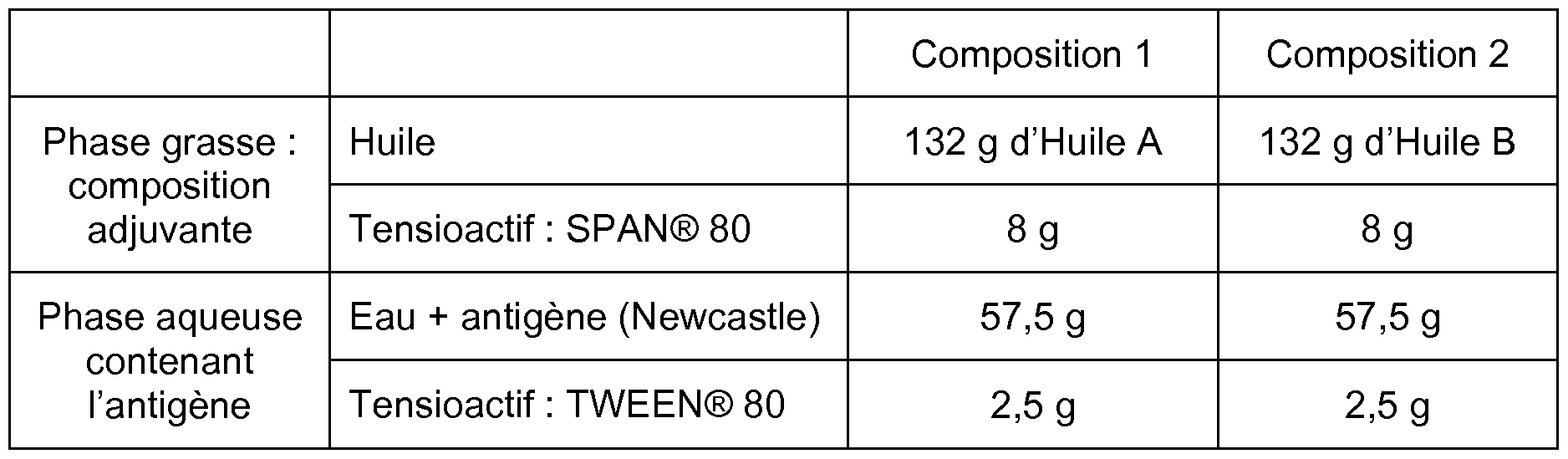
- Example 3 preparation of an emulsion comprising the adjuvant composition of the invention - evaluation of the stability of the emulsion
- the oil and the surfactant of the fatty phase are introduced into a test tube in the proportions indicated in Table 11.
- the test tube is stirred and heated at 80 ° C until obtaining d 'a homogeneous phase.
- the water and the surfactant of the aqueous phase are introduced into a second test tube in the proportions indicated in Table 1 1.
- the test tube is stirred and heated at 80 ° C until the obtaining a homogeneous phase.
- the aqueous phase is poured slowly into the fatty phase with vigorous stirring. Then the emulsion is mixed using a Turrax® type mixer at 9500 revolutions / minute for 30 seconds.
- the stability of the composition described in Table 11 is observed visually after centrifugation at T0, after centrifugation after 24 hours (T24h) and after 90 days (T2160h).
- the test tube contains 6.6 cm of emulsion, including 4.2 cm of fatty phase.
- a manual measurement of the phase shift is made, that is to say a measurement of the fatty phase released above the emulsion.
- the emulsion comprising the Marcol TM 52 oil has released more than the emulsion comprising Oil A.
- Example 4 preparation of a vaccine comprising the adjuvant composition of
- the vaccine is prepared according to the following protocol:
- Turrax® type mixer set at 10,000 rpm for 3 minutes at 25 ° C.
Landscapes
- Health & Medical Sciences (AREA)
- Chemical & Material Sciences (AREA)
- Life Sciences & Earth Sciences (AREA)
- Mycology (AREA)
- Epidemiology (AREA)
- Immunology (AREA)
- Medicinal Chemistry (AREA)
- Microbiology (AREA)
- Chemical Kinetics & Catalysis (AREA)
- Pharmacology & Pharmacy (AREA)
- General Chemical & Material Sciences (AREA)
- Animal Behavior & Ethology (AREA)
- General Health & Medical Sciences (AREA)
- Public Health (AREA)
- Veterinary Medicine (AREA)
- Medicines Containing Antibodies Or Antigens For Use As Internal Diagnostic Agents (AREA)
- Medicinal Preparation (AREA)
Abstract
Description


Claims
Priority Applications (5)
| Application Number | Priority Date | Filing Date | Title |
|---|---|---|---|
| MX2021009718A MX2021009718A (es) | 2019-02-18 | 2020-02-13 | Composicion de adyuvante para una vacuna. |
| CN202080013930.4A CN113423424B (zh) | 2019-02-18 | 2020-02-13 | 用于疫苗的佐剂组合物 |
| EP20710220.3A EP3927373A1 (fr) | 2019-02-18 | 2020-02-13 | Composition adjuvante pour vaccin |
| BR112021015900-2A BR112021015900A2 (pt) | 2019-02-18 | 2020-02-13 | Vacina, composição de adjuvante para uma vacina e seu uso |
| US17/430,554 US12629416B2 (en) | 2019-02-18 | 2020-02-13 | Adjuvant composition for a vaccine |
Applications Claiming Priority (2)
| Application Number | Priority Date | Filing Date | Title |
|---|---|---|---|
| FR1901614A FR3092754B1 (fr) | 2019-02-18 | 2019-02-18 | Composition adjuvante pour vaccin |
| FR1901614 | 2019-02-18 |
Publications (1)
| Publication Number | Publication Date |
|---|---|
| WO2020169903A1 true WO2020169903A1 (fr) | 2020-08-27 |
Family
ID=67002015
Family Applications (1)
| Application Number | Title | Priority Date | Filing Date |
|---|---|---|---|
| PCT/FR2020/050267 Ceased WO2020169903A1 (fr) | 2019-02-18 | 2020-02-13 | Composition adjuvante pour vaccin |
Country Status (7)
| Country | Link |
|---|---|
| US (1) | US12629416B2 (fr) |
| EP (1) | EP3927373A1 (fr) |
| CN (1) | CN113423424B (fr) |
| BR (1) | BR112021015900A2 (fr) |
| FR (1) | FR3092754B1 (fr) |
| MX (1) | MX2021009718A (fr) |
| WO (1) | WO2020169903A1 (fr) |
Cited By (1)
| Publication number | Priority date | Publication date | Assignee | Title |
|---|---|---|---|---|
| CN112213438A (zh) * | 2020-10-12 | 2021-01-12 | 青岛易邦生物工程有限公司 | 一种灭活疫苗佐剂白油检验方法 |
Citations (9)
| Publication number | Priority date | Publication date | Assignee | Title |
|---|---|---|---|---|
| EP0343548A2 (fr) * | 1988-05-24 | 1989-11-29 | BEHRINGWERKE Aktiengesellschaft | Solution d'antigène contenant une poly alpha oléfine (PAO), procédé pour sa préparation et l'utilisation de PAO comme adjuvant |
| RU2072868C1 (ru) | 1991-12-18 | 1997-02-10 | Шабалина Татьяна Николаевна | Состав для приготовления биопрепаратов |
| US20060233831A1 (en) * | 2005-04-15 | 2006-10-19 | Parisot Alexis G A | Novel vaccine formulations |
| EP1728844A1 (fr) | 2005-05-19 | 2006-12-06 | Uop Llc | Production d'un carburant diesel à partir de charges biologiques renouvelables |
| FR2922767A1 (fr) | 2007-10-24 | 2009-05-01 | Seppic Sa | Procede de preparation d'une composition vaccinale comprenant au moins un antigene et au moins un adjuvant. |
| WO2014033762A1 (fr) | 2012-09-03 | 2014-03-06 | Eni S.P.A | Procédé pour rénover une raffinerie d'huiles minérales traditionnelle pour créer une bioraffinerie |
| EP3095839A1 (fr) * | 2015-05-20 | 2016-11-23 | Total Marketing Services | Procédé pour la production de fluides hydrocarbonés biodégradables par hydrogénation |
| EP3143981A1 (fr) * | 2015-09-16 | 2017-03-22 | Total Marketing Services | Composition émolliente biosourcée |
| US20180148656A1 (en) | 2015-05-20 | 2018-05-31 | Total Marketing Services | Process for the production of biodegradable hydrocarbon fluids |
Family Cites Families (2)
| Publication number | Priority date | Publication date | Assignee | Title |
|---|---|---|---|---|
| FR2703247B1 (fr) * | 1993-03-29 | 1995-06-09 | Oreal | Emulsion a base de dihydroxyacetone et son utilisation en cosmetique. |
| PL1651265T3 (pl) | 2003-07-24 | 2008-10-31 | Merial Ltd | Formulacje szczepionek zawierających emulsję olej w wodzie |
-
2019
- 2019-02-18 FR FR1901614A patent/FR3092754B1/fr active Active
-
2020
- 2020-02-13 WO PCT/FR2020/050267 patent/WO2020169903A1/fr not_active Ceased
- 2020-02-13 CN CN202080013930.4A patent/CN113423424B/zh active Active
- 2020-02-13 EP EP20710220.3A patent/EP3927373A1/fr active Pending
- 2020-02-13 US US17/430,554 patent/US12629416B2/en active Active
- 2020-02-13 BR BR112021015900-2A patent/BR112021015900A2/pt unknown
- 2020-02-13 MX MX2021009718A patent/MX2021009718A/es unknown
Patent Citations (9)
| Publication number | Priority date | Publication date | Assignee | Title |
|---|---|---|---|---|
| EP0343548A2 (fr) * | 1988-05-24 | 1989-11-29 | BEHRINGWERKE Aktiengesellschaft | Solution d'antigène contenant une poly alpha oléfine (PAO), procédé pour sa préparation et l'utilisation de PAO comme adjuvant |
| RU2072868C1 (ru) | 1991-12-18 | 1997-02-10 | Шабалина Татьяна Николаевна | Состав для приготовления биопрепаратов |
| US20060233831A1 (en) * | 2005-04-15 | 2006-10-19 | Parisot Alexis G A | Novel vaccine formulations |
| EP1728844A1 (fr) | 2005-05-19 | 2006-12-06 | Uop Llc | Production d'un carburant diesel à partir de charges biologiques renouvelables |
| FR2922767A1 (fr) | 2007-10-24 | 2009-05-01 | Seppic Sa | Procede de preparation d'une composition vaccinale comprenant au moins un antigene et au moins un adjuvant. |
| WO2014033762A1 (fr) | 2012-09-03 | 2014-03-06 | Eni S.P.A | Procédé pour rénover une raffinerie d'huiles minérales traditionnelle pour créer une bioraffinerie |
| EP3095839A1 (fr) * | 2015-05-20 | 2016-11-23 | Total Marketing Services | Procédé pour la production de fluides hydrocarbonés biodégradables par hydrogénation |
| US20180148656A1 (en) | 2015-05-20 | 2018-05-31 | Total Marketing Services | Process for the production of biodegradable hydrocarbon fluids |
| EP3143981A1 (fr) * | 2015-09-16 | 2017-03-22 | Total Marketing Services | Composition émolliente biosourcée |
Non-Patent Citations (2)
| Title |
|---|
| ANONYMOUS: "Freund's Adjuvant, complete and incomplete. Produktinformation", SIGMA, 1 January 1998 (1998-01-01), pages 1 - 2, XP093114259 |
| RIMANIOL: "ln vitro interactions between macrophages and aluminum-containing adjuvants", VACCINE, vol. 25, 2007, pages 6784 - 6792, XP022227074, DOI: 10.1016/j.vaccine.2007.06.051 |
Cited By (1)
| Publication number | Priority date | Publication date | Assignee | Title |
|---|---|---|---|---|
| CN112213438A (zh) * | 2020-10-12 | 2021-01-12 | 青岛易邦生物工程有限公司 | 一种灭活疫苗佐剂白油检验方法 |
Also Published As
| Publication number | Publication date |
|---|---|
| FR3092754B1 (fr) | 2022-06-03 |
| US20220125918A1 (en) | 2022-04-28 |
| CN113423424B (zh) | 2025-07-11 |
| US12629416B2 (en) | 2026-05-19 |
| MX2021009718A (es) | 2021-12-10 |
| BR112021015900A2 (pt) | 2021-10-05 |
| CN113423424A (zh) | 2021-09-21 |
| FR3092754A1 (fr) | 2020-08-21 |
| EP3927373A1 (fr) | 2021-12-29 |
Similar Documents
| Publication | Publication Date | Title |
|---|---|---|
| Ciubota-Rosie et al. | Sinapis alba seed as a prospective biodiesel source | |
| El Arroussi et al. | Screening of marine microalgae strains from Moroccan coasts for biodiesel production | |
| US8936923B2 (en) | Production of biodiesel | |
| BR112020010526A2 (pt) | método para diminuir o teor de óleo em grãos de destiladores de um processo de fermentação, composição de auxiliar de separação e vinhaça tratada | |
| CA3229977A1 (fr) | Composition renouvelable de carbureacteur | |
| EP3927373A1 (fr) | Composition adjuvante pour vaccin | |
| EP1591514B1 (fr) | Utilisation d'additifs pour améliorer l'odeur de compositions d'hydrocarbures et compositions d'hydrocarbures comprenant de tels additifs | |
| FR3082430A1 (fr) | Principe actif cosmetique raffermissant issu d'algues pheophycees, composition l'incluant et utilisation | |
| FR3042498A1 (fr) | Nouveau solvant d'extraction et/ou de solubilisation organique, procede d'extraction mettant en oeuvre ledit solvant, et extraits issus dudit procede | |
| WO2010073233A2 (fr) | Carburant de type gazole pour moteur diesel a fortes teneurs en carbone d'origine renouvelable et en oxygene | |
| WO2020053372A1 (fr) | Huile de microorganismes riches en acide docosahexaénoïque | |
| EP4189050B1 (fr) | Composition pour bougie | |
| WO2023152122A1 (fr) | Composition comprenant un melange de dna et/ou d'epa et d'un phospholipide d'orgine vegetale | |
| EP4065670B1 (fr) | Additif de lubrifiance pour carburant | |
| Laurens | Whole algal biomass in situ transesterification to fatty acid methyl esters as biofuel feedstocks | |
| FR3110577A1 (fr) | Composition aqueuse sous forme d’émulsion comprenant au moins un peroxyde organique à chaîne courte et au moins un peroxyde organique à chaîne longue | |
| Opoku-Boahen et al. | Investigation of Cucumeropsis mannii N. seed oil as potential biodiesel feedstock | |
| FR3070126B1 (fr) | Extrait de pseudotsuga menziesii, procede d'obtention et utilisations | |
| Galan et al. | Development of a new method for determination of the oil content from microalgae lipid fraction | |
| EP2531214B1 (fr) | Adjuvant pour la préparation de compositions vaccinales destinées à la prévention contre les coccidioses | |
| EP3962966A1 (fr) | Composition aqueuse sous forme d'emulsion comprenant au moins un peroxydicarbonate et au moins un peroxyester | |
| CN101657542B (zh) | 生物柴油的生产 | |
| WO2023208855A1 (fr) | Fluide de refroidissement biodegradable par immersion directe | |
| Maduwanthi et al. | Effect of Different Pretreatment Methods on Lipid Yield and Biodiesel Quality of Desmodesmus sp. Isolated from Sri Lanka | |
| FR2979633A1 (fr) | Composition d'additifs pour combustible liquide de type burning kerosene et ses utilisations |
Legal Events
| Date | Code | Title | Description |
|---|---|---|---|
| 121 | Ep: the epo has been informed by wipo that ep was designated in this application |
Ref document number: 20710220 Country of ref document: EP Kind code of ref document: A1 |
|
| NENP | Non-entry into the national phase |
Ref country code: DE |
|
| REG | Reference to national code |
Ref country code: BR Ref legal event code: B01A Ref document number: 112021015900 Country of ref document: BR |
|
| ENP | Entry into the national phase |
Ref document number: 2020710220 Country of ref document: EP Effective date: 20210920 |
|
| ENP | Entry into the national phase |
Ref document number: 112021015900 Country of ref document: BR Kind code of ref document: A2 Effective date: 20210812 |
|
| WWG | Wipo information: grant in national office |
Ref document number: 202080013930.4 Country of ref document: CN |
|
| WWG | Wipo information: grant in national office |
Ref document number: 17430554 Country of ref document: US |